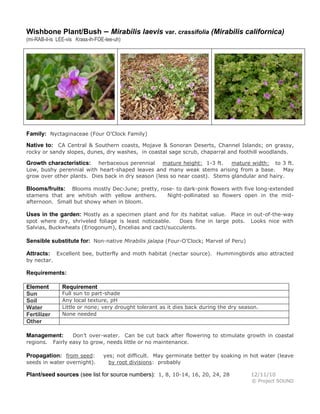
Wishbone Plant/Bush – Mirabilis laevis var. crassifolia (Mirabilis californica)
(mi-RAB-il-is LEE-vis Krass-ih-FOE-lee-uh)

Family: Nyctaginaceae (Four O’Clock Family)
Native to: CA Central & Southern coasts, Mojave & Sonoran Deserts, Channel Islands; on grassy,
rocky or sandy slopes, dunes, dry washes, in coastal sage scrub, chaparral and foothill woodlands.
herbaceous perennial mature height: 1-3 ft.
mature width: to 3 ft.
Low, bushy perennial with heart-shaped leaves and many weak stems arising from a base.
May
grow over other plants. Dies back in dry season (less so near coast). Stems glandular and hairy.

Growth characteristics:

Blooms mostly Dec-June; pretty, rose- to dark-pink flowers with five long-extended
stamens that are whitish with yellow anthers.
Night-pollinated so flowers open in the midafternoon. Small but showy when in bloom.

Blooms/fruits:

Uses in the garden: Mostly as a specimen plant and for its habitat value. Place in out-of-the-way
spot where dry, shriveled foliage is least noticeable.
Does fine in large pots.
Salvias, Buckwheats (Eriogonum), Encelias and cacti/succulents.

Looks nice with

Sensible substitute for: Non-native Mirabilis jalapa (Four-O’Clock; Marvel of Peru)
Excellent bee, butterfly and moth habitat (nectar source). Hummingbirds also attracted

Attracts:
by nectar.

Requirements:
Element
Sun
Soil
Water
Fertilizer
Other

Requirement

Full sun to part-shade
Any local texture, pH
Little or none; very drought tolerant as it dies back during the dry season.
None needed

Don’t over-water. Can be cut back after flowering to stimulate growth in coastal
Fairly easy to grow, needs little or no maintenance.

Management:
regions.

Propagation: from seed:
seeds in water overnight).

yes; not difficult. May germinate better by soaking in hot water (leave
by root divisions: probably

Plant/seed sources (see list for source numbers): 1, 8, 10-14, 16, 20, 24, 28

12/11/10
© Project SOUND

Gardening sheet mirabilis laevis

  • 1.
    Wishbone Plant/Bush –Mirabilis laevis var. crassifolia (Mirabilis californica) (mi-RAB-il-is LEE-vis Krass-ih-FOE-lee-uh) Family: Nyctaginaceae (Four O’Clock Family) Native to: CA Central & Southern coasts, Mojave & Sonoran Deserts, Channel Islands; on grassy, rocky or sandy slopes, dunes, dry washes, in coastal sage scrub, chaparral and foothill woodlands. herbaceous perennial mature height: 1-3 ft. mature width: to 3 ft. Low, bushy perennial with heart-shaped leaves and many weak stems arising from a base. May grow over other plants. Dies back in dry season (less so near coast). Stems glandular and hairy. Growth characteristics: Blooms mostly Dec-June; pretty, rose- to dark-pink flowers with five long-extended stamens that are whitish with yellow anthers. Night-pollinated so flowers open in the midafternoon. Small but showy when in bloom. Blooms/fruits: Uses in the garden: Mostly as a specimen plant and for its habitat value. Place in out-of-the-way spot where dry, shriveled foliage is least noticeable. Does fine in large pots. Salvias, Buckwheats (Eriogonum), Encelias and cacti/succulents. Looks nice with Sensible substitute for: Non-native Mirabilis jalapa (Four-O’Clock; Marvel of Peru) Excellent bee, butterfly and moth habitat (nectar source). Hummingbirds also attracted Attracts: by nectar. Requirements: Element Sun Soil Water Fertilizer Other Requirement Full sun to part-shade Any local texture, pH Little or none; very drought tolerant as it dies back during the dry season. None needed Don’t over-water. Can be cut back after flowering to stimulate growth in coastal Fairly easy to grow, needs little or no maintenance. Management: regions. Propagation: from seed: seeds in water overnight). yes; not difficult. May germinate better by soaking in hot water (leave by root divisions: probably Plant/seed sources (see list for source numbers): 1, 8, 10-14, 16, 20, 24, 28 12/11/10 © Project SOUND