WASTE:
GENERATION AND
MANAGEMENT
PRESENTED BY SAFEER BHOLA
YAHAN KACHRA WAHAN
KACHRA JAHA DEKHO
WAHA KACHRA …….
KACHRA SAMBHALNA TO
MUNICIPALITY KA KAM
.?.?.?.?.?.?
Complain
Nahi…
…Co-operate
Karo!!!
In Association with
PUNE MUNCIPAL CORPORATION
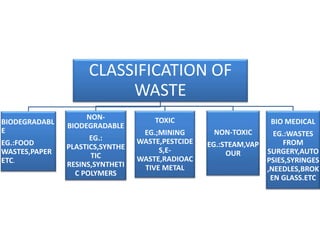
CLASSIFICATION OF
WASTE
BIODEGRADABL
E
EG.:FOOD
WASTES,PAPER
ETC.
NON-
BIODEGRADABLE
EG.:
PLASTICS,SYNTHE
TIC
RESINS,SYNTHETI
C POLYMERS
TOXIC
EG.;MINING
WASTE,PESTCIDE
S,E-
WASTE,RADIOAC
TIVE METAL
NON-TOXIC
EG.:STEAM,VAP
OUR
BIO MEDICAL
EG.:WASTES
FROM
SURGERY,AUTO
PSIES,SYRINGES
,NEEDLES,BROK
EN GLASS.ETC
ITEMS TIME TO DEGRADE
Cotton rags 1-5 months
Paper 2-5 months
Rope 3-14 months
Orange peels 6 months
Woollen socks 1-5 years
Plastic-coated paper cartons 50-100 years
Leather shoes 25-40 years
Nylon fabric 30-40 years
Tin cans 50-100 years
Aluminium cans 80-100 years
Plastic bags 450 years
Glass and plastic bottles Forever!!
There are many occupational hazards associated with the handling of
accumulated waste of all types:
1. Skin and blood infections resulting from direct contact with waste and
from infected wounds.
2. Eye and respiratory infections resulting from exposure to infected dust,
especially during landfill operations.
3. Various diseases which are caused due to the bites of animals feeding on
the accumulated waste.
4. Intestinal infections that are transmitted by flies or insects that are
feeding on the accumulated waste.
Water pollution due to sewage and domestic waste is of major concern,
because diseases such as typhoid, cholera, jaundice, dysentery, diarrhoea,
etc. are infectious diseases which spread through contaminated water.
Sometimes this leads to the outbreak of epidemics and mass illness.
As they spread through contaminated water, they are called waterborne
diseases. About 60 per cent of all diseases in India are due to the
presence of pathogenic bacteria in water.
India generates around 0.2 to 0.3 million tons of waste on an
average everyday. A city like Bangalore generates around 3500-
4000 tons of waste while Mumbai and Delhi average almost
double of this. The onus of disposing this waste in a safe way falls
on the municipal corporation. While the developed nations also
face the complicated issue of waste disposal, there is a
fundamental difference – other nations have been able to achieve
high levels of source segregation and have done much more
scientific studies on the various disposal techniques and more
importantly, implemented them through active public-private
participation.
Waste management is the collection, transport, processing or disposal, managing and
monitoring of waste materials. The term usually relates to materials produced by human
activity, and the process is generally undertaken to reduce their effect on health,
the environment or aesthetics. Waste management is a distinct practice from resource
recovery which focuses on delaying the rate of consumption of natural resources. All wastes
materials, whether they are solid, liquid, gaseous or radioactive fall within the remit of waste
management
Waste management practices can differ for developed and developing nations,
for urban and rural areas, and for residential and industrial producers. Management of non-
hazardous wasteresidential and institutional waste in metropolitan areas is usually the
responsibility of local government authorities, while management for non-hazardous
commercial and industrial waste is usually the responsibility of the generator subject to local,
national or international controls.
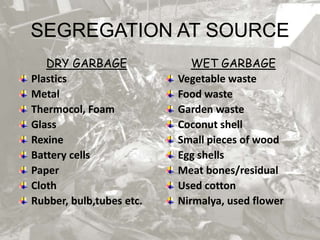
SEGREGATION AT SOURCE
DRY GARBAGE
Plastics
Metal
Thermocol, Foam
Glass
Rexine
Battery cells
Paper
Cloth
Rubber, bulb,tubes etc.
WET GARBAGE
Vegetable waste
Food waste
Garden waste
Coconut shell
Small pieces of wood
Egg shells
Meat bones/residual
Used cotton
Nirmalya, used flower
REDUCE
-USE CLOTH BAGS
INSTEAD OF
PLASTIC BAGS FOR
SHOPPING
RE COLLECT
SEGREGATION AT
SOURCE
RE USE
USE 50 MICRON
PLASTIC BAGS
WHICH CAN BE RE-
USED
RECYCLE
PLASTICS, CANS,
PAPER, SILVER
FOILS, METALS, E-
WASTE
4 R
ZERO GARBAGE MAHARASHTRA
MISSION 2020
Supreme Court has directed the Ministry of Environment
& Forest, Govt. of India to enforce MUNICIPAL SOLID
WASTE(Management & Handling) Rule 2000 and to
strengthen this law MAHARASHTRA NON BIO-
DEGRADABLE GARBAGE (Control) ACT 2006.
In short Rule 2000 says any Household
/Society/Bungalow/Row House and Commercial
Premises established after year 2000 must segregate
wet and dry garbage and dispose it off in a scientific
manner.
Any rule cannot be implemented effectively without
Citizen’s Participation. Keeping this in mind we request
all Punekars
to support this movement and make
PUNE GREEN & CLEAN.
PRESENTED BY MR. RAJA BHOLA 8087191300/SAFEER BHOLA-9881460914

Garbage zero karo 1

  • 2.
  • 4.
    YAHAN KACHRA WAHAN KACHRAJAHA DEKHO WAHA KACHRA ……. KACHRA SAMBHALNA TO MUNICIPALITY KA KAM .?.?.?.?.?.?
  • 5.
  • 6.
    In Association with PUNEMUNCIPAL CORPORATION
  • 8.
  • 9.
    ITEMS TIME TODEGRADE Cotton rags 1-5 months Paper 2-5 months Rope 3-14 months Orange peels 6 months Woollen socks 1-5 years Plastic-coated paper cartons 50-100 years Leather shoes 25-40 years Nylon fabric 30-40 years Tin cans 50-100 years Aluminium cans 80-100 years Plastic bags 450 years Glass and plastic bottles Forever!!
  • 10.
    There are manyoccupational hazards associated with the handling of accumulated waste of all types: 1. Skin and blood infections resulting from direct contact with waste and from infected wounds. 2. Eye and respiratory infections resulting from exposure to infected dust, especially during landfill operations. 3. Various diseases which are caused due to the bites of animals feeding on the accumulated waste. 4. Intestinal infections that are transmitted by flies or insects that are feeding on the accumulated waste. Water pollution due to sewage and domestic waste is of major concern, because diseases such as typhoid, cholera, jaundice, dysentery, diarrhoea, etc. are infectious diseases which spread through contaminated water. Sometimes this leads to the outbreak of epidemics and mass illness. As they spread through contaminated water, they are called waterborne diseases. About 60 per cent of all diseases in India are due to the presence of pathogenic bacteria in water.
  • 12.
    India generates around0.2 to 0.3 million tons of waste on an average everyday. A city like Bangalore generates around 3500- 4000 tons of waste while Mumbai and Delhi average almost double of this. The onus of disposing this waste in a safe way falls on the municipal corporation. While the developed nations also face the complicated issue of waste disposal, there is a fundamental difference – other nations have been able to achieve high levels of source segregation and have done much more scientific studies on the various disposal techniques and more importantly, implemented them through active public-private participation.
  • 15.
    Waste management isthe collection, transport, processing or disposal, managing and monitoring of waste materials. The term usually relates to materials produced by human activity, and the process is generally undertaken to reduce their effect on health, the environment or aesthetics. Waste management is a distinct practice from resource recovery which focuses on delaying the rate of consumption of natural resources. All wastes materials, whether they are solid, liquid, gaseous or radioactive fall within the remit of waste management Waste management practices can differ for developed and developing nations, for urban and rural areas, and for residential and industrial producers. Management of non- hazardous wasteresidential and institutional waste in metropolitan areas is usually the responsibility of local government authorities, while management for non-hazardous commercial and industrial waste is usually the responsibility of the generator subject to local, national or international controls.
  • 16.
    SEGREGATION AT SOURCE DRYGARBAGE Plastics Metal Thermocol, Foam Glass Rexine Battery cells Paper Cloth Rubber, bulb,tubes etc. WET GARBAGE Vegetable waste Food waste Garden waste Coconut shell Small pieces of wood Egg shells Meat bones/residual Used cotton Nirmalya, used flower
  • 17.
    REDUCE -USE CLOTH BAGS INSTEADOF PLASTIC BAGS FOR SHOPPING RE COLLECT SEGREGATION AT SOURCE RE USE USE 50 MICRON PLASTIC BAGS WHICH CAN BE RE- USED RECYCLE PLASTICS, CANS, PAPER, SILVER FOILS, METALS, E- WASTE 4 R
  • 18.
  • 19.
    Supreme Court hasdirected the Ministry of Environment & Forest, Govt. of India to enforce MUNICIPAL SOLID WASTE(Management & Handling) Rule 2000 and to strengthen this law MAHARASHTRA NON BIO- DEGRADABLE GARBAGE (Control) ACT 2006. In short Rule 2000 says any Household /Society/Bungalow/Row House and Commercial Premises established after year 2000 must segregate wet and dry garbage and dispose it off in a scientific manner. Any rule cannot be implemented effectively without Citizen’s Participation. Keeping this in mind we request all Punekars to support this movement and make PUNE GREEN & CLEAN.
  • 21.
    PRESENTED BY MR.RAJA BHOLA 8087191300/SAFEER BHOLA-9881460914