GAME SENSE
WHEN TEACHING PHYSICAL EDUCATION LESSONS AS TEACHERS WE USE A
VARIETY OF APPROACHES TO MEET EACH STUDENT NEEDS AND
LEARNING ABILITIES.
A NEW APPROACH THAT TEACHERS ARE FINDING USEFUL TO MEET
STUDENTS’ NEEDS AND LEARNING ABILITIES IS TEACHING GAMES FOR
UNDERSTANDING APPROACH (TGFU), ALSO KNOWN AS GAME SENSE.
Game Sense… what
is it? Well come
along and find out
SID:17790101
GAME SENSE WHAT IS IT?
 The game sense approach to teaching and learning emphasises on the development of decision making,
motor competency and tactics to develop an understanding of the game.
 Game sense approach is a student-centred and an inquiry-based approach that allows students to develop
skills and understanding that are needed while being actively involved in a game and/or sport. It is
designed to develop and encourage students thinking skills, decision making and problem-solving skills as
well as physical performance through the use of physical activity. Through the game sense approach, it
places students in situations where these skills are essential for a successful performance
 Skills are developed contextually by participating in game-sense modified games because skill is an
important element of game sense. As students will developed an understanding of them game by
communicating and thinking through techniques and tactics of the game.
 Through the game sense modified games, allows students to learn the skills and techniques that they can
then use in specific games and/ or sports.
 The game sense approach is a teaching approach that is based on the TGfU model by Bunker and Thorpe
(1982)
(Light, 2013., Phil, S, 2014., & Mandigo, Butler, & Hopper, 2007
HOW IS GAME SENSE TAUGHT? - TGFU MODEL
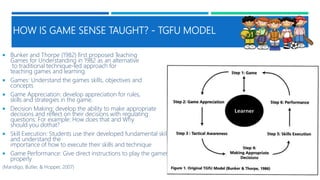
 Bunker and Thorpe (1982) first proposed Teaching
Games for Understanding in 1982 as an alternative
to traditional technique-led approach for
teaching games and learning.
 Games: Understand the games skills, objectives and
concepts
 Game Appreciation: develop appreciation for rules,
skills and strategies in the game.
 Decision Making: develop the ability to make appropriate
decisions and reflect on their decisions with regulating
questions: For example: How does that and Why
should you dothat?
 Skill Execution: Students use their developed fundamental skills
and understand the
importance of how to execute their skills and technique
 Game Performance: Give direct instructions to play the gamer
properly
(Mandigo, Butler, & Hopper, 2007)
WHAT IS 2V LEARNING?
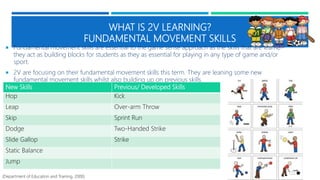
FUNDAMENTAL MOVEMENT SKILLS
 Fundamental movement skills are essential to the game sense approach as the skills that are learnt,
they act as building blocks for students as they as essential for playing in any type of game and/or
sport.
 2V are focusing on their fundamental movement skills this term. They are leaning some new
fundamental movement skills whilst also building up on previous skills.
New Skills Previous/ Developed Skills
Hop Kick
Leap Over-arm Throw
Skip Sprint Run
Dodge Two-Handed Strike
Slide Gallop Strike
Static Balance
Jump
(Department of Education and Training, 2000)
GAME CATEGORIES
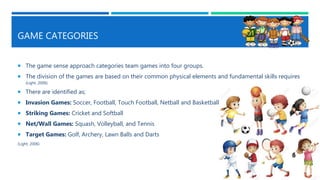
 The game sense approach categories team games into four groups.
 The division of the games are based on their common physical elements and fundamental skills requires
(Light, 2006).
 There are identified as;
 Invasion Games: Soccer, Football, Touch Football, Netball and Basketball
 Striking Games: Cricket and Softball
 Net/Wall Games: Squash, Volleyball, and Tennis
 Target Games: Golf, Archery, Lawn Balls and Darts
(Light, 2006)
GAME SENSE BENEFITS
 Students are encouraged and to participate in decision making, tactical problem solving and students
constantly develop their skills throughout the game
 Students develop the ability to express themselves, interact with their peers and gain valuable social
skills as well as conflict resolution skills. Games sense also incorporates knowledge essential for a
healthy life style
 Students develop and gain skills in a fun and enjoyable way while also understanding the games rules
and skills.
 Promotes inclusion, with a student-centred and inquiry-based approach
 Provides teachers with a level of flexibility as games can be modified to suit the age, size and level of
abilities in the class. Thus, allowing everyone a fair go and to enjoy themselves.
GAME SENSE RATIONALE
WHY GAMES SENSE?
 There are many benefits towards the Game Sense Approach, thus making it an approach that as I
teacher I implement in my P.E. Lessons. The Game Sense Approach is an effective in teaching P.E. for
the class of 2V as there are mix abilities students within the class. Allowing game modification permits
every student for being included within the game.
 It is important in a P.E. lesson that all games are inclusive which in turn keep students active
throughout the lesson, which is what the Game Sense Approach offers. The Game Sense Approach
allows students to learn new skills and build on previous skills in a more enjoyable, engaging and fun
way whilst also gaining an understanding and appreciation about the game’s rules, skills and the game
itself.
 Through the Game Sense Approach, it builds up students’ skills that will allow students to utilise these
new-found skills and previous skills and apply them from one
game to another.
DIRECT LINKS TO PDHPE K-10 SYLLABUS
 INS1.3 Develops positive relationships with peers and other people.
 displays cooperation in group activities,eg taking turns
 MOS1.4 Demonstrates maturing performance of basic movement and compositional skills in a variety of predictable situations.
• hops on preferred and non-preferred foot
• strikes a stationary object, eg soccer ball, teeball
 PSS1.5 Draws on past experiences to solve familiar problems.
• when appropriate, identifies problem situations
• follows basic safety procedures
• suggests solutions to problems
 ALS1.6 Participates in physical activity, recognising that it can be both enjoyable and important
for health.
• engages in a range of planned activities, eg fundamental movement skills, favourite simple games, movement exploration
• contributes to a class list of activities they like or do not like to play
 GSS1.8 Performs fundamental movement skills with equipment in minor games
• participates in a range of minor games and practices that assist skill development
• throws a small ball or beanbag overarm to a wall, target or partner, using high and low pathways
• strikes a ball from a tee with a small bat
REFERENCES:
 Light, R. (2006). Game sense: Innovation or just good coaching? Journal of Physical Education New
Zealand, 39(1), 8-19
 Light, R. (2013). Game sense pedagogy for performance, participation and enjoyment. Milton Park,
Abingdon: Oxon Routledge
 Mandigo, J., Butler., & Hopper, T. (2007). What is teaching games for understanding? A Canadian
Perspective Physical & Health Education Journal, 73(2), 14-20
 New South Wales Board of Studies (2006). Personal development, health and physical education K-6
syllabus. Sydney: Board of Studies NSW. Retrieved from:
https://vuws.westernsydney.edu.au/bbcswebdav/pid-3487357-dt-content-rid-
26755229_1/courses/102072_2018_2h/k6_pdhpe_syl.pdf
 Phil, S. (2014). Play with purpose: netball game sense: teaching movement and tactical skills.
Hindmash, South Australia: ACHPER

Pdhpe17790101

  • 1.
    GAME SENSE WHEN TEACHINGPHYSICAL EDUCATION LESSONS AS TEACHERS WE USE A VARIETY OF APPROACHES TO MEET EACH STUDENT NEEDS AND LEARNING ABILITIES. A NEW APPROACH THAT TEACHERS ARE FINDING USEFUL TO MEET STUDENTS’ NEEDS AND LEARNING ABILITIES IS TEACHING GAMES FOR UNDERSTANDING APPROACH (TGFU), ALSO KNOWN AS GAME SENSE. Game Sense… what is it? Well come along and find out SID:17790101
  • 2.
    GAME SENSE WHATIS IT?  The game sense approach to teaching and learning emphasises on the development of decision making, motor competency and tactics to develop an understanding of the game.  Game sense approach is a student-centred and an inquiry-based approach that allows students to develop skills and understanding that are needed while being actively involved in a game and/or sport. It is designed to develop and encourage students thinking skills, decision making and problem-solving skills as well as physical performance through the use of physical activity. Through the game sense approach, it places students in situations where these skills are essential for a successful performance  Skills are developed contextually by participating in game-sense modified games because skill is an important element of game sense. As students will developed an understanding of them game by communicating and thinking through techniques and tactics of the game.  Through the game sense modified games, allows students to learn the skills and techniques that they can then use in specific games and/ or sports.  The game sense approach is a teaching approach that is based on the TGfU model by Bunker and Thorpe (1982) (Light, 2013., Phil, S, 2014., & Mandigo, Butler, & Hopper, 2007
  • 3.
    HOW IS GAMESENSE TAUGHT? - TGFU MODEL  Bunker and Thorpe (1982) first proposed Teaching Games for Understanding in 1982 as an alternative to traditional technique-led approach for teaching games and learning.  Games: Understand the games skills, objectives and concepts  Game Appreciation: develop appreciation for rules, skills and strategies in the game.  Decision Making: develop the ability to make appropriate decisions and reflect on their decisions with regulating questions: For example: How does that and Why should you dothat?  Skill Execution: Students use their developed fundamental skills and understand the importance of how to execute their skills and technique  Game Performance: Give direct instructions to play the gamer properly (Mandigo, Butler, & Hopper, 2007)
  • 4.
    WHAT IS 2VLEARNING? FUNDAMENTAL MOVEMENT SKILLS  Fundamental movement skills are essential to the game sense approach as the skills that are learnt, they act as building blocks for students as they as essential for playing in any type of game and/or sport.  2V are focusing on their fundamental movement skills this term. They are leaning some new fundamental movement skills whilst also building up on previous skills. New Skills Previous/ Developed Skills Hop Kick Leap Over-arm Throw Skip Sprint Run Dodge Two-Handed Strike Slide Gallop Strike Static Balance Jump (Department of Education and Training, 2000)
  • 5.
    GAME CATEGORIES  Thegame sense approach categories team games into four groups.  The division of the games are based on their common physical elements and fundamental skills requires (Light, 2006).  There are identified as;  Invasion Games: Soccer, Football, Touch Football, Netball and Basketball  Striking Games: Cricket and Softball  Net/Wall Games: Squash, Volleyball, and Tennis  Target Games: Golf, Archery, Lawn Balls and Darts (Light, 2006)
  • 6.
    GAME SENSE BENEFITS Students are encouraged and to participate in decision making, tactical problem solving and students constantly develop their skills throughout the game  Students develop the ability to express themselves, interact with their peers and gain valuable social skills as well as conflict resolution skills. Games sense also incorporates knowledge essential for a healthy life style  Students develop and gain skills in a fun and enjoyable way while also understanding the games rules and skills.  Promotes inclusion, with a student-centred and inquiry-based approach  Provides teachers with a level of flexibility as games can be modified to suit the age, size and level of abilities in the class. Thus, allowing everyone a fair go and to enjoy themselves.
  • 7.
    GAME SENSE RATIONALE WHYGAMES SENSE?  There are many benefits towards the Game Sense Approach, thus making it an approach that as I teacher I implement in my P.E. Lessons. The Game Sense Approach is an effective in teaching P.E. for the class of 2V as there are mix abilities students within the class. Allowing game modification permits every student for being included within the game.  It is important in a P.E. lesson that all games are inclusive which in turn keep students active throughout the lesson, which is what the Game Sense Approach offers. The Game Sense Approach allows students to learn new skills and build on previous skills in a more enjoyable, engaging and fun way whilst also gaining an understanding and appreciation about the game’s rules, skills and the game itself.  Through the Game Sense Approach, it builds up students’ skills that will allow students to utilise these new-found skills and previous skills and apply them from one game to another.
  • 8.
    DIRECT LINKS TOPDHPE K-10 SYLLABUS  INS1.3 Develops positive relationships with peers and other people.  displays cooperation in group activities,eg taking turns  MOS1.4 Demonstrates maturing performance of basic movement and compositional skills in a variety of predictable situations. • hops on preferred and non-preferred foot • strikes a stationary object, eg soccer ball, teeball  PSS1.5 Draws on past experiences to solve familiar problems. • when appropriate, identifies problem situations • follows basic safety procedures • suggests solutions to problems  ALS1.6 Participates in physical activity, recognising that it can be both enjoyable and important for health. • engages in a range of planned activities, eg fundamental movement skills, favourite simple games, movement exploration • contributes to a class list of activities they like or do not like to play  GSS1.8 Performs fundamental movement skills with equipment in minor games • participates in a range of minor games and practices that assist skill development • throws a small ball or beanbag overarm to a wall, target or partner, using high and low pathways • strikes a ball from a tee with a small bat
  • 9.
    REFERENCES:  Light, R.(2006). Game sense: Innovation or just good coaching? Journal of Physical Education New Zealand, 39(1), 8-19  Light, R. (2013). Game sense pedagogy for performance, participation and enjoyment. Milton Park, Abingdon: Oxon Routledge  Mandigo, J., Butler., & Hopper, T. (2007). What is teaching games for understanding? A Canadian Perspective Physical & Health Education Journal, 73(2), 14-20  New South Wales Board of Studies (2006). Personal development, health and physical education K-6 syllabus. Sydney: Board of Studies NSW. Retrieved from: https://vuws.westernsydney.edu.au/bbcswebdav/pid-3487357-dt-content-rid- 26755229_1/courses/102072_2018_2h/k6_pdhpe_syl.pdf  Phil, S. (2014). Play with purpose: netball game sense: teaching movement and tactical skills. Hindmash, South Australia: ACHPER