Game Sense
What is the game sense approach?
The game sense approach is a student centered approach. This approach gives
students the opportunity to develop skills and understanding of the lesson while
being active and independent learners as they are involved in the game (Australian
Sports Commission, 2016).
The game sense approach is increasing physical education pedagogies in primary
schools as it practices high quality teaching (Light, 2014).
Fundamental Movement Skills
The fundamental movement skills are the skills
that primary school students need to master in
order to participate in and enjoy a wide variety of
physical activities, sports, and games.
There are 12 fundamental movement skills that
are deemed to be the foundation for movement.
The core movement skills are as follows:
• Static balance
• Sprint run
• Vertical jump
• Side gallop
• Catch
• Kick
• Hop
• Skip
• Leap
• Overarm throw
• Two hand strike
• Dodge
(Reference)
These essential skills are
learnt through a game
sense approach where
students learn the skills
through active and
involved learning in
sports and games during
PE lessons.
 The game sense approach is based on the theory that specific principles are
common across a range of different games, and that teaching the students
about the principles will give students the knowledge of participating in the
game with more understanding (Curry, 2011).
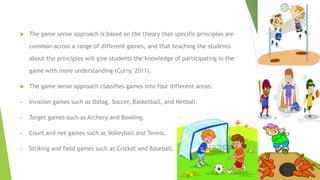
 The game sense approach classifies games into four different areas:
• Invasion games such as Oztag, Soccer, Basketball, and Netball.
• Target games such as Archery and Bowling.
• Court and net games such as Volleyball and Tennis.
• Striking and field games such as Cricket and Baseball.
Strengths of using the Game Sense approach for
teaching
 The game sense approach promotes high quality teaching. It uses a variety of
teaching strategies instead of solely focusing on lessons that are based on
teaching the skills repetitively through using the traditional approach.
 The game sense approach is very student centered. Students learn the skills
as they are practicing them through participating in various games that
include the skills students essentially need to learn.
 By playing a range of games students realise the particular skills and rules that are
necessary in playing the game successfully.
 By using the game sense approach, the game itself becomes the central part of the
lesson rather than being played at the end of the lesson.
 The game sense approach is engaging and students enjoy being able to be given
choices as well as being taught skills through various games. Student input is
essential in the game sense approach as open ended questions are used in each
lesson to encourage cognitive thinking and reflection.
 Students input is considered in modifying games an making games more engaging for
students that are participating in them.
Links with the syllabus content
 The game sense approach links with the PDHPE K-6 syllabus as it clearly
promotes learning, growth, and development through games, understanding
of fair and safe play, as well the positive impacts of learning through play and
cooperation.
 The fundamental movement skills in the syllabus promotes learning through
games and sports, which include playing with and sharing equipment (BOSTES,
2007).
 The game sense approach implements all the skill outcomes that are included
in the syllabus content which include learning skills through communicating,
decision making, interacting, moving, and problem solving, all of which the
game sense approach is based on.
Reference List
 Australian Sports Commission. (2016). Sporting Schools. Game Sense Approach. Retrieved from
https://sportingschools.gov.au/resources-and-pd/schools/playing-for-life-resources/game-
sense-approach
 Board of Studies, NSW. (2007). Personal development, health and physical education K-6:
Syllabus. Sydney, Australia: Author.
 Curry, C. (2011). Using the Game Sense Approach to Deliver Quality Teaching in Physical
Education. 21st Century Learning. Western Sydney University. Retrieved from
https://learning21c.wordpress.com/2011/11/27/using-the-game-sense-approach-to-deliver-
quality-teaching-in-physical-education/
 Light, R. (2014). Quality Teaching Beyond Games Through Game Sense Pedagogy. University of
Sydney Papers in HMHCE- Special Game Sense Edition. Retrieved from
https://sydney.edu.au/education_social_work/research/centres_and_networks/ADPN/HMHCE-
papers/resources/HMHCE_GS_Ed_Article_01_2014.pdf

Game sense

  • 1.
    Game Sense What isthe game sense approach? The game sense approach is a student centered approach. This approach gives students the opportunity to develop skills and understanding of the lesson while being active and independent learners as they are involved in the game (Australian Sports Commission, 2016). The game sense approach is increasing physical education pedagogies in primary schools as it practices high quality teaching (Light, 2014).
  • 2.
    Fundamental Movement Skills Thefundamental movement skills are the skills that primary school students need to master in order to participate in and enjoy a wide variety of physical activities, sports, and games. There are 12 fundamental movement skills that are deemed to be the foundation for movement. The core movement skills are as follows: • Static balance • Sprint run • Vertical jump • Side gallop • Catch • Kick • Hop • Skip • Leap • Overarm throw • Two hand strike • Dodge (Reference) These essential skills are learnt through a game sense approach where students learn the skills through active and involved learning in sports and games during PE lessons.
  • 3.
     The gamesense approach is based on the theory that specific principles are common across a range of different games, and that teaching the students about the principles will give students the knowledge of participating in the game with more understanding (Curry, 2011).  The game sense approach classifies games into four different areas: • Invasion games such as Oztag, Soccer, Basketball, and Netball. • Target games such as Archery and Bowling. • Court and net games such as Volleyball and Tennis. • Striking and field games such as Cricket and Baseball.
  • 4.
    Strengths of usingthe Game Sense approach for teaching  The game sense approach promotes high quality teaching. It uses a variety of teaching strategies instead of solely focusing on lessons that are based on teaching the skills repetitively through using the traditional approach.  The game sense approach is very student centered. Students learn the skills as they are practicing them through participating in various games that include the skills students essentially need to learn.
  • 5.
     By playinga range of games students realise the particular skills and rules that are necessary in playing the game successfully.  By using the game sense approach, the game itself becomes the central part of the lesson rather than being played at the end of the lesson.  The game sense approach is engaging and students enjoy being able to be given choices as well as being taught skills through various games. Student input is essential in the game sense approach as open ended questions are used in each lesson to encourage cognitive thinking and reflection.  Students input is considered in modifying games an making games more engaging for students that are participating in them.
  • 6.
    Links with thesyllabus content  The game sense approach links with the PDHPE K-6 syllabus as it clearly promotes learning, growth, and development through games, understanding of fair and safe play, as well the positive impacts of learning through play and cooperation.  The fundamental movement skills in the syllabus promotes learning through games and sports, which include playing with and sharing equipment (BOSTES, 2007).  The game sense approach implements all the skill outcomes that are included in the syllabus content which include learning skills through communicating, decision making, interacting, moving, and problem solving, all of which the game sense approach is based on.
  • 7.
    Reference List  AustralianSports Commission. (2016). Sporting Schools. Game Sense Approach. Retrieved from https://sportingschools.gov.au/resources-and-pd/schools/playing-for-life-resources/game- sense-approach  Board of Studies, NSW. (2007). Personal development, health and physical education K-6: Syllabus. Sydney, Australia: Author.  Curry, C. (2011). Using the Game Sense Approach to Deliver Quality Teaching in Physical Education. 21st Century Learning. Western Sydney University. Retrieved from https://learning21c.wordpress.com/2011/11/27/using-the-game-sense-approach-to-deliver- quality-teaching-in-physical-education/  Light, R. (2014). Quality Teaching Beyond Games Through Game Sense Pedagogy. University of Sydney Papers in HMHCE- Special Game Sense Edition. Retrieved from https://sydney.edu.au/education_social_work/research/centres_and_networks/ADPN/HMHCE- papers/resources/HMHCE_GS_Ed_Article_01_2014.pdf