






Game Development History
Content
•Primitive Era
•Board Games
•Card Games
•Game Devices
•Games Industry & Convergence.
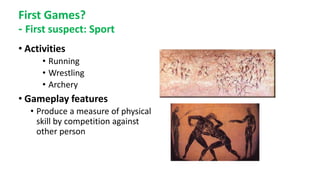
First Games?
- First suspect: Sport
• Activities
• Running
• Wrestling
• Archery
• Gameplay features
• Produce a measure of physical
skill by competition against
other person
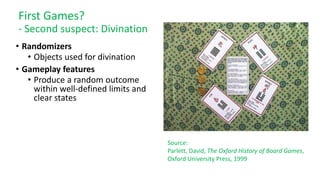
First Games?
- Second suspect: Divination
• Randomizers
• Objects used for divination
• Gameplay features
• Produce a random outcome
within well-defined limits and
clear states
Source:
Parlett, David, The Oxford History of Board Games,
Oxford University Press, 1999
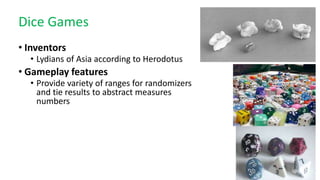
Dice Games
• Inventors
• Lydians of Asia according to Herodotus
• Gameplay features
• Provide variety of ranges for randomizers
and tie results to abstract measures
numbers
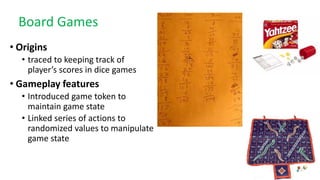
Board Games
• Origins
• traced to keeping track of
player’s scores in dice games
• Gameplay features
• Introduced game token to
maintain game state
• Linked series of actions to
randomized values to manipulate
game state
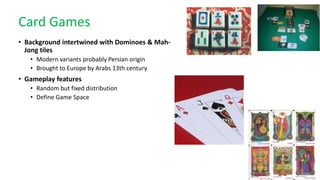
Card Games
• Background intertwined with Dominoes & Mah-
Jong tiles
• Modern variants probably Persian origin
• Brought to Europe by Arabs 13th century
• Gameplay features
• Random but fixed distribution
• Define Game Space
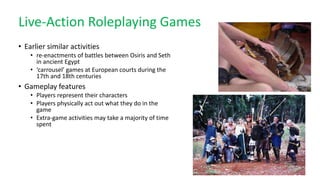
Live-Action Roleplaying Games
• Earlier similar activities
• re-enactments of battles between Osiris and Seth
in ancient Egypt
• ‘carrousel’ games at European courts during the
17th and 18th centuries
• Gameplay features
• Players represent their characters
• Players physically act out what they do in the
game
• Extra-game activities may take a majority of time
spent
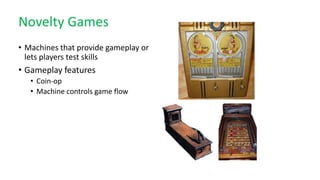
Novelty Games
• Machines that provide gameplay or
lets players test skills
• Gameplay features
• Coin-op
• Machine controls game flow
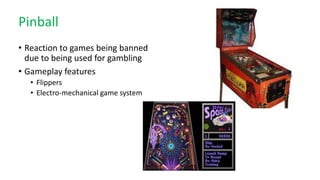
Pinball
• Reaction to games being banned
due to being used for gambling
• Gameplay features
• Flippers
• Electro-mechanical game system
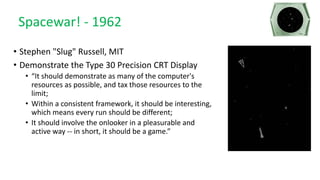
Spacewar! - 1962
• Stephen "Slug" Russell, MIT
• Demonstrate the Type 30 Precision CRT Display
• “It should demonstrate as many of the computer's
resources as possible, and tax those resources to the
limit;
• Within a consistent framework, it should be interesting,
which means every run should be different;
• It should involve the onlooker in a pleasurable and
active way -- in short, it should be a game.”
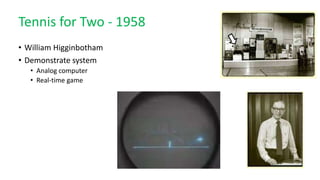
Tennis for Two - 1958
• William Higginbotham
• Demonstrate system
• Analog computer
• Real-time game
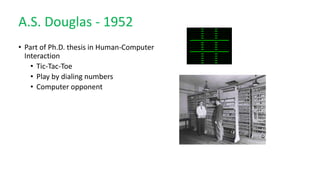
A.S. Douglas - 1952
• Part of Ph.D. thesis in Human-Computer
Interaction
• Tic-Tac-Toe
• Play by dialing numbers
• Computer opponent
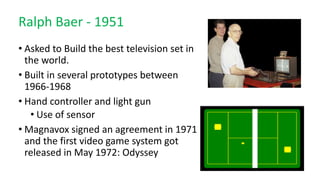
Ralph Baer - 1951
• Asked to Build the best television set in
the world.
• Built in several prototypes between
1966-1968
• Hand controller and light gun
• Use of sensor
• Magnavox signed an agreement in 1971
and the first video game system got
released in May 1972: Odyssey
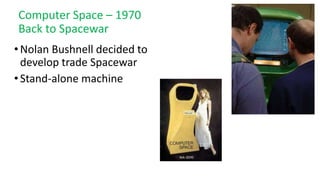
Computer Space – 1970
Back to Spacewar
•Nolan Bushnell decided to
develop trade Spacewar
•Stand-alone machine
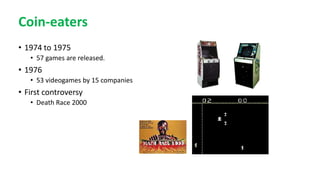
Coin-eaters
• 1974 to 1975
• 57 games are released.
• 1976
• 53 videogames by 15 companies
• First controversy
• Death Race 2000
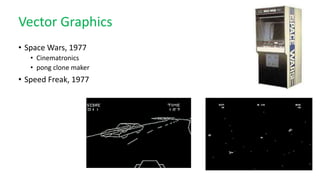
Vector Graphics
• Space Wars, 1977
• Cinematronics
• pong clone maker
• Speed Freak, 1977
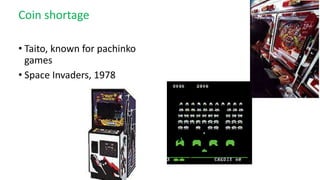
Coin shortage
• Taito, known for pachinko
games
• Space Invaders, 1978
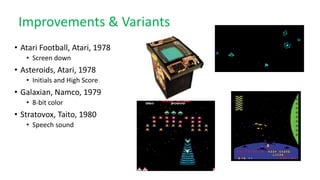
Improvements & Variants
• Atari Football, Atari, 1978
• Screen down
• Asteroids, Atari, 1978
• Initials and High Score
• Galaxian, Namco, 1979
• 8-bit color
• Stratovox, Taito, 1980
• Speech sound
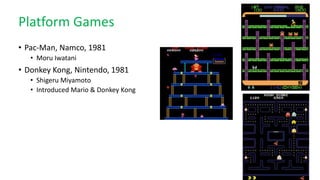
Platform Games
• Pac-Man, Namco, 1981
• Moru Iwatani
• Donkey Kong, Nintendo, 1981
• Shigeru Miyamoto
• Introduced Mario & Donkey Kong
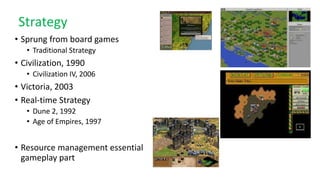
Strategy
• Sprung from board games
• Traditional Strategy
• Civilization, 1990
• Civilization IV, 2006
• Victoria, 2003
• Real-time Strategy
• Dune 2, 1992
• Age of Empires, 1997
• Resource management essential
gameplay part
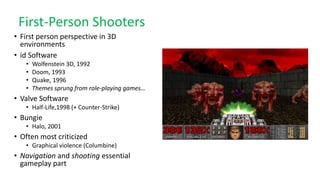
First-Person Shooters
• First person perspective in 3D
environments
• id Software
• Wolfenstein 3D, 1992
• Doom, 1993
• Quake, 1996
• Themes sprung from role-playing games…
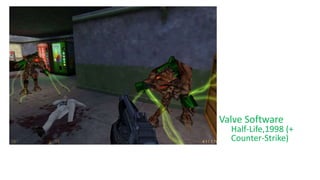
• Valve Software
• Half-Life,1998 (+ Counter-Strike)
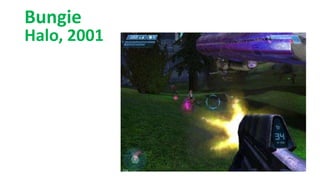
• Bungie
• Halo, 2001
• Often most criticized
• Graphical violence (Columbine)
• Navigation and shooting essential
gameplay part
Valve Software
Half-Life,1998 (+
Counter-Strike)
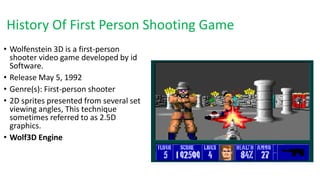
History Of First Person Shooting Game
• Wolfenstein 3D is a first-person
shooter video game developed by id
Software.
• Release May 5, 1992
• Genre(s): First-person shooter
• 2D sprites presented from several set
viewing angles, This technique
sometimes referred to as 2.5D
graphics.
• Wolf3D Engine
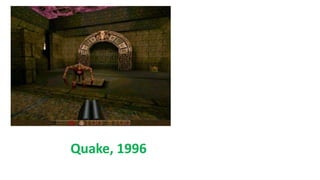
Quake, 1996
Bungie
Halo, 2001
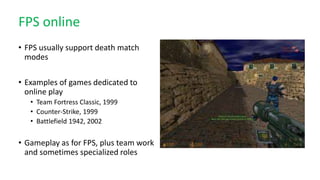
FPS online
• FPS usually support death match
modes
• Examples of games dedicated to
online play
• Team Fortress Classic, 1999
• Counter-Strike, 1999
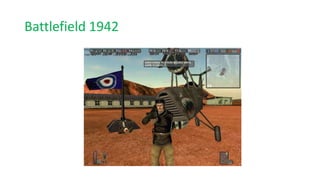
• Battlefield 1942, 2002
• Gameplay as for FPS, plus team work
and sometimes specialized roles
Battlefield 1942
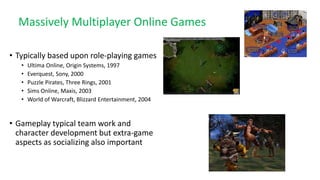
Massively Multiplayer Online Games
• Typically based upon role-playing games
• Ultima Online, Origin Systems, 1997
• Everquest, Sony, 2000
• Puzzle Pirates, Three Rings, 2001
• Sims Online, Maxis, 2003
• World of Warcraft, Blizzard Entertainment, 2004
• Gameplay typical team work and
character development but extra-game
aspects as socializing also important
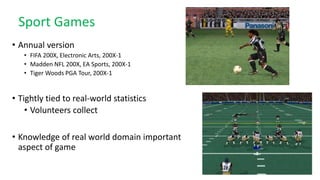
Sport Games
• Annual version
• FIFA 200X, Electronic Arts, 200X-1
• Madden NFL 200X, EA Sports, 200X-1
• Tiger Woods PGA Tour, 200X-1
• Tightly tied to real-world statistics
• Volunteers collect
• Knowledge of real world domain important
aspect of game
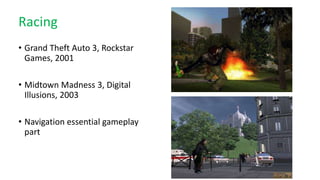
Racing
• Grand Theft Auto 3, Rockstar
Games, 2001
• Midtown Madness 3, Digital
Illusions, 2003
• Navigation essential gameplay
part
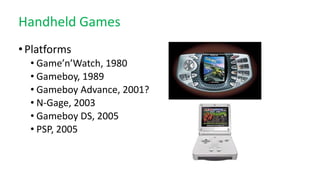
Handheld Games
•Platforms
• Game’n’Watch, 1980
• Gameboy, 1989
• Gameboy Advance, 2001?
• N-Gage, 2003
• Gameboy DS, 2005
• PSP, 2005
Game Industry Origins
•SEGA
•Atari
•Magnavox
•Nintendo
•Coleco
•Activision
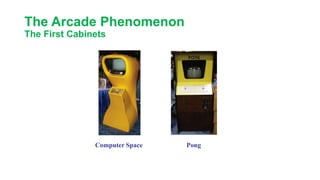
The Arcade Phenomenon
The First Cabinets
Computer Space Pong
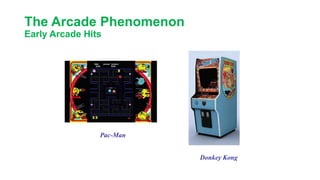
The Arcade Phenomenon
Early Arcade Hits
Pac-Man
Donkey Kong
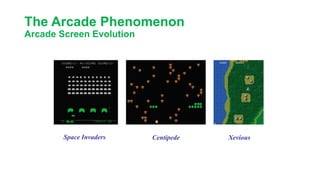
The Arcade Phenomenon
Arcade Screen Evolution
Space Invaders XeviousCentipede
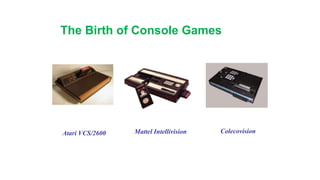
The Birth of Console Games
Atari VCS/2600 Mattel Intellivision Colecovision
The Video Game Slump
• Temporary decline
• Oversupply
• Lack of innovation
• Competitive pricing
• Personal computer revolution
• Console arcade games
• Economics (coin-op)
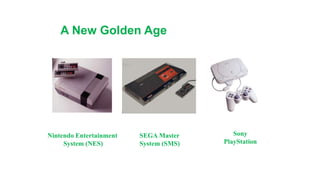
A New Golden Age
Nintendo Entertainment
System (NES)
SEGA Master
System (SMS)
Sony
PlayStation
Senate Hearings &
Video Game Violence
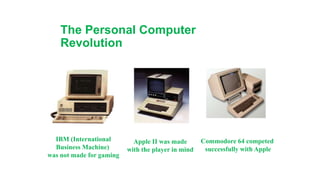
The Personal Computer
Revolution
IBM (International
Business Machine)
was not made for gaming
Apple II was made
with the player in mind
Commodore 64 competed
successfully with Apple
Multiplayer Meets the Online Elite
• PLATO
• MUDs
• CompuServe
• QuantumLink (AOL)
• GEnie
• LAN-based games
• Online games
Convergence
Industry Segments Come Together
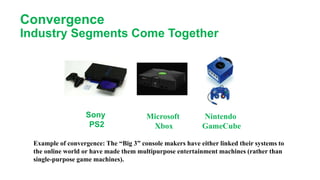
Sony
PS2
Microsoft
Xbox
Nintendo
GameCube
Example of convergence: The “Big 3” console makers have either linked their systems to
the online world or have made them multipurpose entertainment machines (rather than
single-purpose game machines).
Summary
•Before the arcades
•Game industry origins
•Arcade phenomenon
•Birth of console games
•Video game slump
•New golden age
•Senate hearings & video game violence
•Personal computer revolution
•Multiplayer meets the online elite
•Convergence: Industry segments come together
Key Chapter Questions
■ What are the significant milestones in the history of electronic game development?
■ Who are the pioneers in game development, and how did they contribute to the
industry?
■ How did the game industry evolve from coin operated electromechanical and
mainframe computer games of the ’60s to today’s console, personal computer, online,
and mobile industries?
■ What factors contributed to the video game slump of the early 80s?
■ Why did certain game companies and game titles succeed during game development
history and why did some fail miserably?

Game development history

  • 1.
  • 2.
    Content •Primitive Era •Board Games •CardGames •Game Devices •Games Industry & Convergence.
  • 3.
    First Games? - Firstsuspect: Sport • Activities • Running • Wrestling • Archery • Gameplay features • Produce a measure of physical skill by competition against other person
  • 4.
    First Games? - Secondsuspect: Divination • Randomizers • Objects used for divination • Gameplay features • Produce a random outcome within well-defined limits and clear states Source: Parlett, David, The Oxford History of Board Games, Oxford University Press, 1999
  • 5.
    Dice Games • Inventors •Lydians of Asia according to Herodotus • Gameplay features • Provide variety of ranges for randomizers and tie results to abstract measures numbers
  • 6.
    Board Games • Origins •traced to keeping track of player’s scores in dice games • Gameplay features • Introduced game token to maintain game state • Linked series of actions to randomized values to manipulate game state
  • 7.
    Card Games • Backgroundintertwined with Dominoes & Mah- Jong tiles • Modern variants probably Persian origin • Brought to Europe by Arabs 13th century • Gameplay features • Random but fixed distribution • Define Game Space
  • 8.
    Live-Action Roleplaying Games •Earlier similar activities • re-enactments of battles between Osiris and Seth in ancient Egypt • ‘carrousel’ games at European courts during the 17th and 18th centuries • Gameplay features • Players represent their characters • Players physically act out what they do in the game • Extra-game activities may take a majority of time spent
  • 9.
    Novelty Games • Machinesthat provide gameplay or lets players test skills • Gameplay features • Coin-op • Machine controls game flow
  • 10.
    Pinball • Reaction togames being banned due to being used for gambling • Gameplay features • Flippers • Electro-mechanical game system
  • 11.
    Spacewar! - 1962 •Stephen "Slug" Russell, MIT • Demonstrate the Type 30 Precision CRT Display • “It should demonstrate as many of the computer's resources as possible, and tax those resources to the limit; • Within a consistent framework, it should be interesting, which means every run should be different; • It should involve the onlooker in a pleasurable and active way -- in short, it should be a game.”
  • 12.
    Tennis for Two- 1958 • William Higginbotham • Demonstrate system • Analog computer • Real-time game
  • 13.
    A.S. Douglas -1952 • Part of Ph.D. thesis in Human-Computer Interaction • Tic-Tac-Toe • Play by dialing numbers • Computer opponent
  • 14.
    Ralph Baer -1951 • Asked to Build the best television set in the world. • Built in several prototypes between 1966-1968 • Hand controller and light gun • Use of sensor • Magnavox signed an agreement in 1971 and the first video game system got released in May 1972: Odyssey
  • 15.
    Computer Space –1970 Back to Spacewar •Nolan Bushnell decided to develop trade Spacewar •Stand-alone machine
  • 16.
    Coin-eaters • 1974 to1975 • 57 games are released. • 1976 • 53 videogames by 15 companies • First controversy • Death Race 2000
  • 17.
    Vector Graphics • SpaceWars, 1977 • Cinematronics • pong clone maker • Speed Freak, 1977
  • 18.
    Coin shortage • Taito,known for pachinko games • Space Invaders, 1978
  • 19.
    Improvements & Variants •Atari Football, Atari, 1978 • Screen down • Asteroids, Atari, 1978 • Initials and High Score • Galaxian, Namco, 1979 • 8-bit color • Stratovox, Taito, 1980 • Speech sound
  • 20.
    Platform Games • Pac-Man,Namco, 1981 • Moru Iwatani • Donkey Kong, Nintendo, 1981 • Shigeru Miyamoto • Introduced Mario & Donkey Kong
  • 21.
    Strategy • Sprung fromboard games • Traditional Strategy • Civilization, 1990 • Civilization IV, 2006 • Victoria, 2003 • Real-time Strategy • Dune 2, 1992 • Age of Empires, 1997 • Resource management essential gameplay part
  • 22.
    First-Person Shooters • Firstperson perspective in 3D environments • id Software • Wolfenstein 3D, 1992 • Doom, 1993 • Quake, 1996 • Themes sprung from role-playing games… • Valve Software • Half-Life,1998 (+ Counter-Strike) • Bungie • Halo, 2001 • Often most criticized • Graphical violence (Columbine) • Navigation and shooting essential gameplay part
  • 23.
  • 24.
    History Of FirstPerson Shooting Game • Wolfenstein 3D is a first-person shooter video game developed by id Software. • Release May 5, 1992 • Genre(s): First-person shooter • 2D sprites presented from several set viewing angles, This technique sometimes referred to as 2.5D graphics. • Wolf3D Engine
  • 25.
  • 26.
  • 27.
    FPS online • FPSusually support death match modes • Examples of games dedicated to online play • Team Fortress Classic, 1999 • Counter-Strike, 1999 • Battlefield 1942, 2002 • Gameplay as for FPS, plus team work and sometimes specialized roles
  • 29.
  • 30.
    Massively Multiplayer OnlineGames • Typically based upon role-playing games • Ultima Online, Origin Systems, 1997 • Everquest, Sony, 2000 • Puzzle Pirates, Three Rings, 2001 • Sims Online, Maxis, 2003 • World of Warcraft, Blizzard Entertainment, 2004 • Gameplay typical team work and character development but extra-game aspects as socializing also important
  • 34.
    Sport Games • Annualversion • FIFA 200X, Electronic Arts, 200X-1 • Madden NFL 200X, EA Sports, 200X-1 • Tiger Woods PGA Tour, 200X-1 • Tightly tied to real-world statistics • Volunteers collect • Knowledge of real world domain important aspect of game
  • 35.
    Racing • Grand TheftAuto 3, Rockstar Games, 2001 • Midtown Madness 3, Digital Illusions, 2003 • Navigation essential gameplay part
  • 36.
    Handheld Games •Platforms • Game’n’Watch,1980 • Gameboy, 1989 • Gameboy Advance, 2001? • N-Gage, 2003 • Gameboy DS, 2005 • PSP, 2005
  • 37.
  • 38.
    The Arcade Phenomenon TheFirst Cabinets Computer Space Pong
  • 39.
    The Arcade Phenomenon EarlyArcade Hits Pac-Man Donkey Kong
  • 40.
    The Arcade Phenomenon ArcadeScreen Evolution Space Invaders XeviousCentipede
  • 41.
    The Birth ofConsole Games Atari VCS/2600 Mattel Intellivision Colecovision
  • 42.
    The Video GameSlump • Temporary decline • Oversupply • Lack of innovation • Competitive pricing • Personal computer revolution • Console arcade games • Economics (coin-op)
  • 43.
    A New GoldenAge Nintendo Entertainment System (NES) SEGA Master System (SMS) Sony PlayStation
  • 44.
  • 45.
    The Personal Computer Revolution IBM(International Business Machine) was not made for gaming Apple II was made with the player in mind Commodore 64 competed successfully with Apple
  • 46.
    Multiplayer Meets theOnline Elite • PLATO • MUDs • CompuServe • QuantumLink (AOL) • GEnie • LAN-based games • Online games
  • 47.
    Convergence Industry Segments ComeTogether Sony PS2 Microsoft Xbox Nintendo GameCube Example of convergence: The “Big 3” console makers have either linked their systems to the online world or have made them multipurpose entertainment machines (rather than single-purpose game machines).
  • 48.
    Summary •Before the arcades •Gameindustry origins •Arcade phenomenon •Birth of console games •Video game slump •New golden age •Senate hearings & video game violence •Personal computer revolution •Multiplayer meets the online elite •Convergence: Industry segments come together
  • 49.
    Key Chapter Questions ■What are the significant milestones in the history of electronic game development? ■ Who are the pioneers in game development, and how did they contribute to the industry? ■ How did the game industry evolve from coin operated electromechanical and mainframe computer games of the ’60s to today’s console, personal computer, online, and mobile industries? ■ What factors contributed to the video game slump of the early 80s? ■ Why did certain game companies and game titles succeed during game development history and why did some fail miserably?