WELCOME TO
QUEEN MARY
SCHOOLTOPIC-RUSSIA-GAMAYUN
FROM-5A
BY-
VRISHA,YUVNA,NIEURIN,NUP
UR,
MYTHS AND LEGENDS OF
RUSSIA AND GAMAYUN
MORE ABOUT GAMAYUN
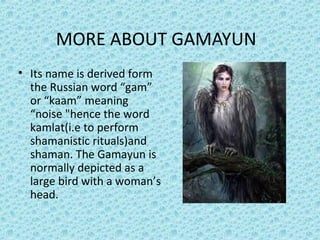
• Its name is derived form
the Russian word “gam”
or “kaam” meaning
“noise "hence the word
kamlat(i.e to perform
shamanistic rituals)and
shaman. The Gamayun is
normally depicted as a
large bird with a woman’s
head.
Unlike Sirin and Alkonost, Humayun came to Russia not
from ancient Greece, its roots can be found in Iranian
folklore, in which the bird appears. Gamayun is clever and
wise. Among the Slavs bird Gamayun gained great
popularity. It is the embodiment of Veles – god of wisdom,
knowing and keeping the secret of creation, the birth of
the gods and humans. The messenger of peace to the
people it arrives and sings an ancient book “Songs”.
“Prophetic bird, wise bird, you know a lot, a lot … You tell
knowest, Gamayun, sing, narrate to us … ” – “Do not deny
that Veda … ”
MORE ABOUT GAMAYUN
Gamayun is a prophetic bird of 
russian folklore. it is a symbol of wisdom and 
knowledGe and lives on an island in the east, 
close to paradise. like the sirin and the 
alkonost, the Gamayun is normally depicted 
as a larGe bird with a woman's head.
in his esoteric christian-buddhist 
cosmoGraphy .  roza mira, daniil andreev
 maintains that sirins, alkonosts, and 
Gamayuns are transformed into archanGels 
in paradise.
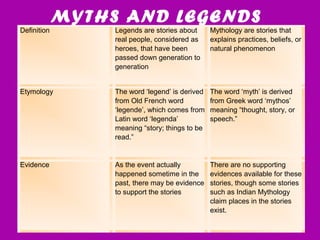
Definition Legends are stories about
real people, considered as
heroes, that have been
passed down generation to
generation
Mythology are stories that
explains practices, beliefs, or
natural phenomenon
Etymology The word ‘legend’ is derived
from Old French word
‘legende’, which comes from
Latin word ‘legenda’
meaning “story; things to be
read.”
The word ‘myth’ is derived
from Greek word ‘mythos’
meaning “thought, story, or
speech.”
Evidence As the event actually
happened sometime in the
past, there may be evidence
to support the stories
There are no supporting
evidences available for these
stories, though some stories
such as Indian Mythology
claim places in the stories
exist.
MYTHS AND LEGENDS
How are myths and legends of GAMAYUN different from
written stories with an oral tradition ?
Fact or Fiction Fact, but it is
exaggerated
Mostly fiction, made
up stories about how
the “world was formed”
People portrayed Are actual heroes in
their own times, whose
actions or deeds are
exaggerated
Most commonly
includes gods, demi-
gods, etc
Storylines Legends feature an
actual cultural hero
but include imaginative
elements.
Traditional narrative
that explains natural
phenomena through
symbolism; often
involves the gods of
ancient cultures.
Elements Imaginative element is
used to exaggerate a
story
Symbolism is used to
define a natural
situation or event
Famous Works Atlantis, El Dorado, Greek Mythology
Gamayun is a symbol of wisdom and knowledge,
a talking bird who foretells the future and tells
fortunes. Its name is derived from the Russian
word “gam” or “kam”, meaning “noise”, hence
are the words “kamlat” (i.e. to perform
shamanistic rituals) and “shaman”. In the
Belorussian language the word “gamanits”
means “to speak, to talk”.
Like the Sirin and the Alkonost, the Gamayun is
normally depicted as a large bird with a
woman's head. In Old Russian tradition
Gamayun Bird served to pagan gods, namely
Veles, Kryshen, Kolyada and Dazhbog, and she
was the one who sing the Book of the Vedas.
In his esoteric Christian-Buddhist cosmography
Roza Mira, Daniil Andreev maintains that Sirins,
Alkonosts, and Gamayuns are transformed into
How do traits of a legendary hero exemplify the values of the
culture of from which the legends originate?
It is a symbol of wisdom and knowledge and lives on an island in the
east, close to paradise. Like the Sirin and the Alkonost, the Gamayun is
normally depicted as a large bird with a woman's head.
Character picture along with their symbols
Many people once believed in mythological animals and gods.
These animals or gods may have control or has power over a
part of human or natural life. For example, the Greek god
Zeus had powers over lightning and storms. Whenever Zeus
wanted to, he could make a storm, and that he made storms to
show his anger. Another example is that of the Egyptian god,
Atum, who was said to be the creator of everything in the
world. In Hindu mythology, the cause of thunderstorms was
said to be the wrath of Indra, the chief of all gods. His most
A myth is a story which may or may not be true. The
definition of the word myth is still subject to debate.
Myths may be very old, or new. There may not be records
or other proof that they happened, but at least some parts
of myths may be true. We know about them from older
people telling them to younger people. Some myths may
have started as 'true' stories but as people told and re-
told them, they may have changed some parts, so they are
less 'true'. All cultures have myths.
Mythology can refer to the collected myths of a
people—their body of stories which they tell to
explain nature, history, and customs.
MYTHOLOGY IS ALL
ARROUND US
Gamayun- Russia

Gamayun- Russia

  • 1.
  • 2.
    MYTHS AND LEGENDSOF RUSSIA AND GAMAYUN
  • 3.
    MORE ABOUT GAMAYUN •Its name is derived form the Russian word “gam” or “kaam” meaning “noise "hence the word kamlat(i.e to perform shamanistic rituals)and shaman. The Gamayun is normally depicted as a large bird with a woman’s head.
  • 4.
    Unlike Sirin andAlkonost, Humayun came to Russia not from ancient Greece, its roots can be found in Iranian folklore, in which the bird appears. Gamayun is clever and wise. Among the Slavs bird Gamayun gained great popularity. It is the embodiment of Veles – god of wisdom, knowing and keeping the secret of creation, the birth of the gods and humans. The messenger of peace to the people it arrives and sings an ancient book “Songs”. “Prophetic bird, wise bird, you know a lot, a lot … You tell knowest, Gamayun, sing, narrate to us … ” – “Do not deny that Veda … ” MORE ABOUT GAMAYUN
  • 5.
  • 6.
    Definition Legends arestories about real people, considered as heroes, that have been passed down generation to generation Mythology are stories that explains practices, beliefs, or natural phenomenon Etymology The word ‘legend’ is derived from Old French word ‘legende’, which comes from Latin word ‘legenda’ meaning “story; things to be read.” The word ‘myth’ is derived from Greek word ‘mythos’ meaning “thought, story, or speech.” Evidence As the event actually happened sometime in the past, there may be evidence to support the stories There are no supporting evidences available for these stories, though some stories such as Indian Mythology claim places in the stories exist. MYTHS AND LEGENDS
  • 7.
    How are mythsand legends of GAMAYUN different from written stories with an oral tradition ? Fact or Fiction Fact, but it is exaggerated Mostly fiction, made up stories about how the “world was formed” People portrayed Are actual heroes in their own times, whose actions or deeds are exaggerated Most commonly includes gods, demi- gods, etc Storylines Legends feature an actual cultural hero but include imaginative elements. Traditional narrative that explains natural phenomena through symbolism; often involves the gods of ancient cultures. Elements Imaginative element is used to exaggerate a story Symbolism is used to define a natural situation or event Famous Works Atlantis, El Dorado, Greek Mythology
  • 8.
    Gamayun is asymbol of wisdom and knowledge, a talking bird who foretells the future and tells fortunes. Its name is derived from the Russian word “gam” or “kam”, meaning “noise”, hence are the words “kamlat” (i.e. to perform shamanistic rituals) and “shaman”. In the Belorussian language the word “gamanits” means “to speak, to talk”. Like the Sirin and the Alkonost, the Gamayun is normally depicted as a large bird with a woman's head. In Old Russian tradition Gamayun Bird served to pagan gods, namely Veles, Kryshen, Kolyada and Dazhbog, and she was the one who sing the Book of the Vedas. In his esoteric Christian-Buddhist cosmography Roza Mira, Daniil Andreev maintains that Sirins, Alkonosts, and Gamayuns are transformed into How do traits of a legendary hero exemplify the values of the culture of from which the legends originate?
  • 9.
    It is asymbol of wisdom and knowledge and lives on an island in the east, close to paradise. Like the Sirin and the Alkonost, the Gamayun is normally depicted as a large bird with a woman's head. Character picture along with their symbols
  • 10.
    Many people oncebelieved in mythological animals and gods. These animals or gods may have control or has power over a part of human or natural life. For example, the Greek god Zeus had powers over lightning and storms. Whenever Zeus wanted to, he could make a storm, and that he made storms to show his anger. Another example is that of the Egyptian god, Atum, who was said to be the creator of everything in the world. In Hindu mythology, the cause of thunderstorms was said to be the wrath of Indra, the chief of all gods. His most A myth is a story which may or may not be true. The definition of the word myth is still subject to debate. Myths may be very old, or new. There may not be records or other proof that they happened, but at least some parts of myths may be true. We know about them from older people telling them to younger people. Some myths may have started as 'true' stories but as people told and re- told them, they may have changed some parts, so they are less 'true'. All cultures have myths. Mythology can refer to the collected myths of a people—their body of stories which they tell to explain nature, history, and customs. MYTHOLOGY IS ALL ARROUND US