UNIVERSIDAD PABLO GUARDADO CHÁVEZ
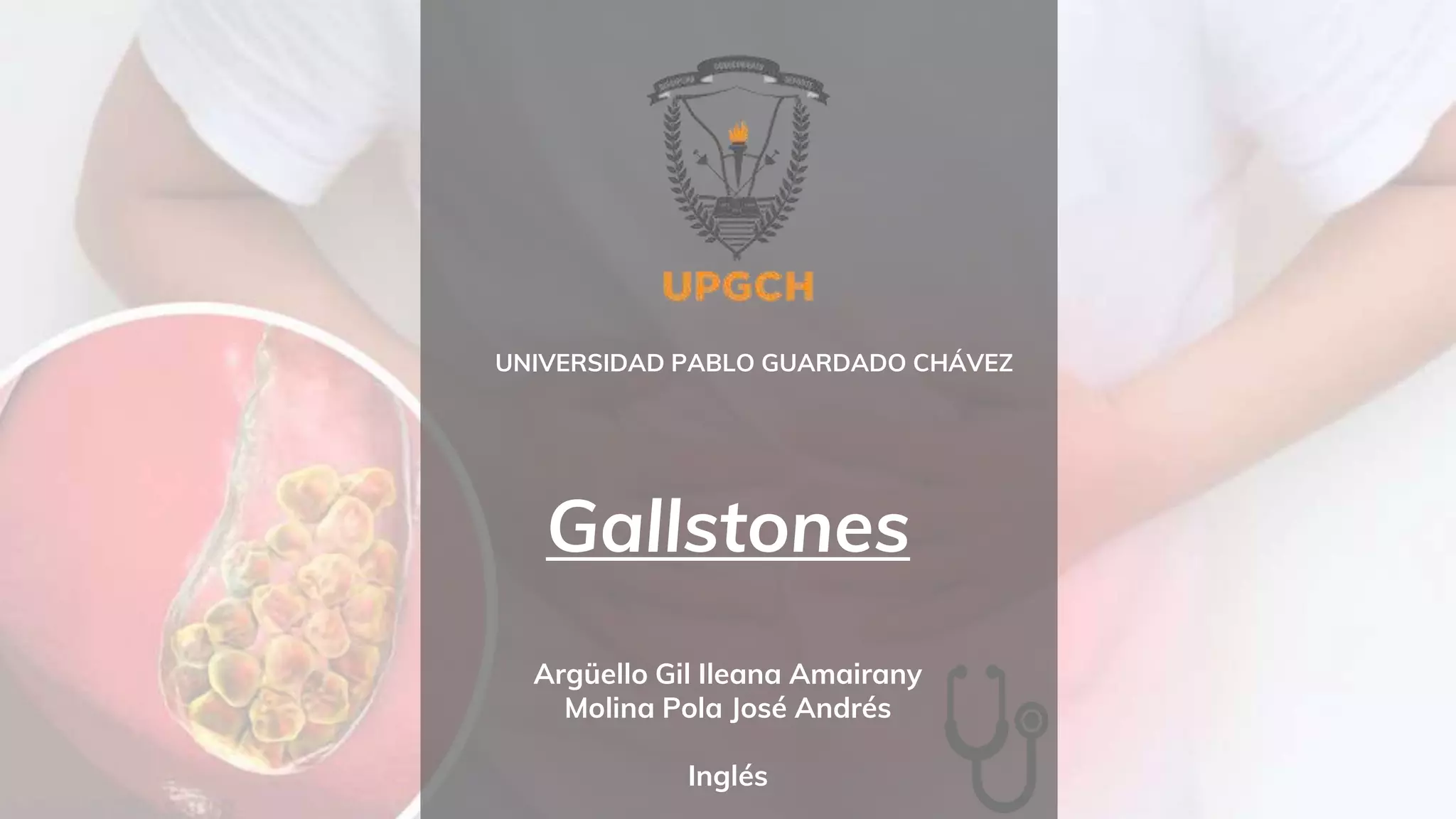
Gallstones
Argüello Gil Ileana Amairany
Molina Pola José Andrés
Inglés
WHAT ARE GALLSTONES?
Types
 Cholesterol stones.
 Pigment stones.
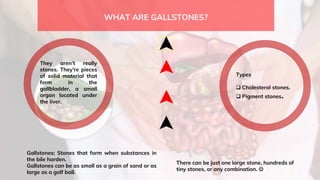
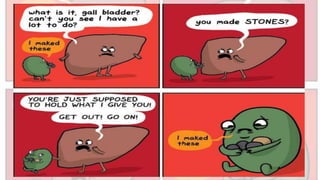
They aren’t really
stones. They're pieces
of solid material that
form in the
gallbladder, a small
organ located under
the liver.
There can be just one large stone, hundreds of
tiny stones, or any combination. 
Gallstones: Stones that form when substances in
the bile harden.
Gallstones can be as small as a grain of sand or as
large as a golf ball.
o Your genes
o Your weight
o Problems with your gallbladder
o Diet
What Causes
Gallstones?
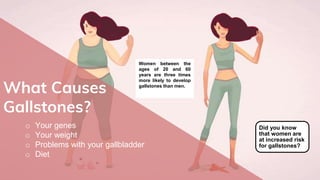
Women between the
ages of 20 and 60
years are three times
more likely to develop
gallstones than men.
Did you know
that women are
at increased risk
for gallstones?
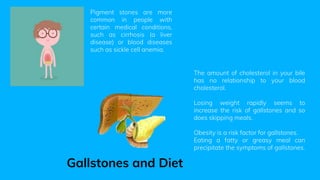
Pigment stones are more
common in people with
certain medical conditions,
such as cirrhosis (a liver
disease) or blood diseases
such as sickle cell anemia.
The amount of cholesterol in your bile
has no relationship to your blood
cholesterol.
Losing weight rapidly seems to
increase the risk of gallstones and so
does skipping meals.
Obesity is a risk factor for gallstones.
Eating a fatty or greasy meal can
precipitate the symptoms of gallstones.
Gallstones and Diet
Gallstones Symptoms
 Nausea and vomiting.
 Fever.
 Indigestion.
 Belching.
 Bloating.
 Intolerance for fatty or
greasy food
 Jaundice (yellowing of
the skin or the whites
of the eyes).
Warning signs of a
serious problem are fever,
jaundice, and persistent
pain
Attacks may occur every few days,
weeks, or months; they may even
be separated by years.
The pain usually starts within 30
minutes after a fatty or greasy
meal.
The pain is usually severe, dull, and
constant, and can last from one to
five hours.
It may radiate to the right shoulder
or back.
It occurs frequently at night and
may awaken the person from
sleep.
The pain may make the person
want to move around to seek relief,
but many patients prefer to lay still
and wait for the attack to subside.
TESTS AND PROCEDURES USED TO DIAGNOSE
GALLSTONES INCLUDE:
•Tests to create pictures of your gallbladder.Your
doctor may recommend an abdominal ultrasound and a
computerized tomography (CT) scan to create pictures of
your gallbladder. These images can be analyzed to look
for signs of gallstones.
•Tests to check your bile ducts for gallstones. A test
that uses a special dye to highlight your bile ducts on
images may help your doctor determine whether a
gallstone is causing a blockage.
•Tests may include a hepatobiliary iminodiacetic acid
(HIDA) scan, magnetic resonance imaging (MRI) or
endoscopic retrograde cholangiopancreatography
(ERCP). Gallstones discovered using ERCP can be
removed during the procedure.
➜Surgery to remove the gallbladder (cholecystectomy). Your
doctor may recommend surgery to remove your gallbladder, since
gallstones frequently recur. Once your gallbladder is removed, bile
flows directly from your liver into your small intestine, rather than
being stored in your gallbladder.
➜Medications to dissolve gallstones. Medications you take by
mouth may help dissolve gallstones. But it may take months or
years of treatment to dissolve your gallstones in this way and
gallstones will likely form again if treatment is stopped.
➜Sometimes medications don't work. Medications for gallstones
aren't commonly used and are reserved for people who can't
undergo surgery.
TREATMENT
Gallstones

Gallstones

  • 1.
    UNIVERSIDAD PABLO GUARDADOCHÁVEZ Gallstones Argüello Gil Ileana Amairany Molina Pola José Andrés Inglés
  • 2.
    WHAT ARE GALLSTONES? Types Cholesterol stones.  Pigment stones. They aren’t really stones. They're pieces of solid material that form in the gallbladder, a small organ located under the liver. There can be just one large stone, hundreds of tiny stones, or any combination.  Gallstones: Stones that form when substances in the bile harden. Gallstones can be as small as a grain of sand or as large as a golf ball.
  • 3.
    o Your genes oYour weight o Problems with your gallbladder o Diet What Causes Gallstones? Women between the ages of 20 and 60 years are three times more likely to develop gallstones than men. Did you know that women are at increased risk for gallstones?
  • 4.
    Pigment stones aremore common in people with certain medical conditions, such as cirrhosis (a liver disease) or blood diseases such as sickle cell anemia. The amount of cholesterol in your bile has no relationship to your blood cholesterol. Losing weight rapidly seems to increase the risk of gallstones and so does skipping meals. Obesity is a risk factor for gallstones. Eating a fatty or greasy meal can precipitate the symptoms of gallstones. Gallstones and Diet
  • 5.
    Gallstones Symptoms  Nauseaand vomiting.  Fever.  Indigestion.  Belching.  Bloating.  Intolerance for fatty or greasy food  Jaundice (yellowing of the skin or the whites of the eyes). Warning signs of a serious problem are fever, jaundice, and persistent pain Attacks may occur every few days, weeks, or months; they may even be separated by years. The pain usually starts within 30 minutes after a fatty or greasy meal. The pain is usually severe, dull, and constant, and can last from one to five hours. It may radiate to the right shoulder or back. It occurs frequently at night and may awaken the person from sleep. The pain may make the person want to move around to seek relief, but many patients prefer to lay still and wait for the attack to subside.
  • 6.
    TESTS AND PROCEDURESUSED TO DIAGNOSE GALLSTONES INCLUDE: •Tests to create pictures of your gallbladder.Your doctor may recommend an abdominal ultrasound and a computerized tomography (CT) scan to create pictures of your gallbladder. These images can be analyzed to look for signs of gallstones. •Tests to check your bile ducts for gallstones. A test that uses a special dye to highlight your bile ducts on images may help your doctor determine whether a gallstone is causing a blockage. •Tests may include a hepatobiliary iminodiacetic acid (HIDA) scan, magnetic resonance imaging (MRI) or endoscopic retrograde cholangiopancreatography (ERCP). Gallstones discovered using ERCP can be removed during the procedure.
  • 7.
    ➜Surgery to removethe gallbladder (cholecystectomy). Your doctor may recommend surgery to remove your gallbladder, since gallstones frequently recur. Once your gallbladder is removed, bile flows directly from your liver into your small intestine, rather than being stored in your gallbladder. ➜Medications to dissolve gallstones. Medications you take by mouth may help dissolve gallstones. But it may take months or years of treatment to dissolve your gallstones in this way and gallstones will likely form again if treatment is stopped. ➜Sometimes medications don't work. Medications for gallstones aren't commonly used and are reserved for people who can't undergo surgery. TREATMENT