BRIDGE
June 2018 2nd
Edition
Simplified method to identify the Harmonized System Coding
By Dr. Lalith Edirisinghe, PhD
Traditionally, it is considered that assigning the appropriate Harmonized System code (commonly
known as HS code) is a tacit knowledge. Many practitioners used to ascertain the HS code of
commodities through the hands-on experience, or by simply by following the instructions of their
senior officers or solely accepting the decision of customs officers. This practice was not a big
challenge when the importers and exporters handled just a handful of commodities. However, with
the gradual increase of international trading and logistics activities the industry became very
complex resulting the logisticians need to deal with many commodities thus HS codes. This paper
provides a simplified method that helps the user to find the accurate HS code of any complicated
cargo/commodity promptly and logically. Therefore, the Documentation or Customer service staff in
the shipping line/agent office should be very familiar about the HS Nomenclature to expedite the
booking process while eliminating risks of potential customs penalties.
With the implementation of ENS-Entry Summary System (or AMS- Advanced Manifest Submission
to Customs authorities) the HS code became a buzz word in the industry because even the front-line
customer service personnel are compelled to work with HS codes. In contrast, this challenge was
faced by those who directly interact with customs officials and others simply followed the
instructions of the said staff. Therefore, in addition to those who are directly involved in commercial
trading, the staff of shipping lines/agents also need to be very cautious about the accuracy of the HS
codes.
The Harmonized System is a structured nomenclature comprising descriptions of goods that are set
out under 4-digit classification numbers. These are called headings in which most of these headings
are further subdivided into 5- and 6-digit subheadings. It is important that shipping line/exporter
provide the acceptable goods description and Valid HS code as mentioned by World Customs
Organisation (WCO) – 6-digit code. The HS code has been viewed as just a ‘number’ by most of the
stakeholders in Logistics, Transport, and supply chain industry. However, the beauty is that this code
revels many vital information about the commodity that you declare and only those who could
visualize the internal mechanism may be able convert the number (data) into information.
The HS code information is in addition to all other relevant information required to process the
shipment. It is an international standardised system of names and numbers for classifying traded
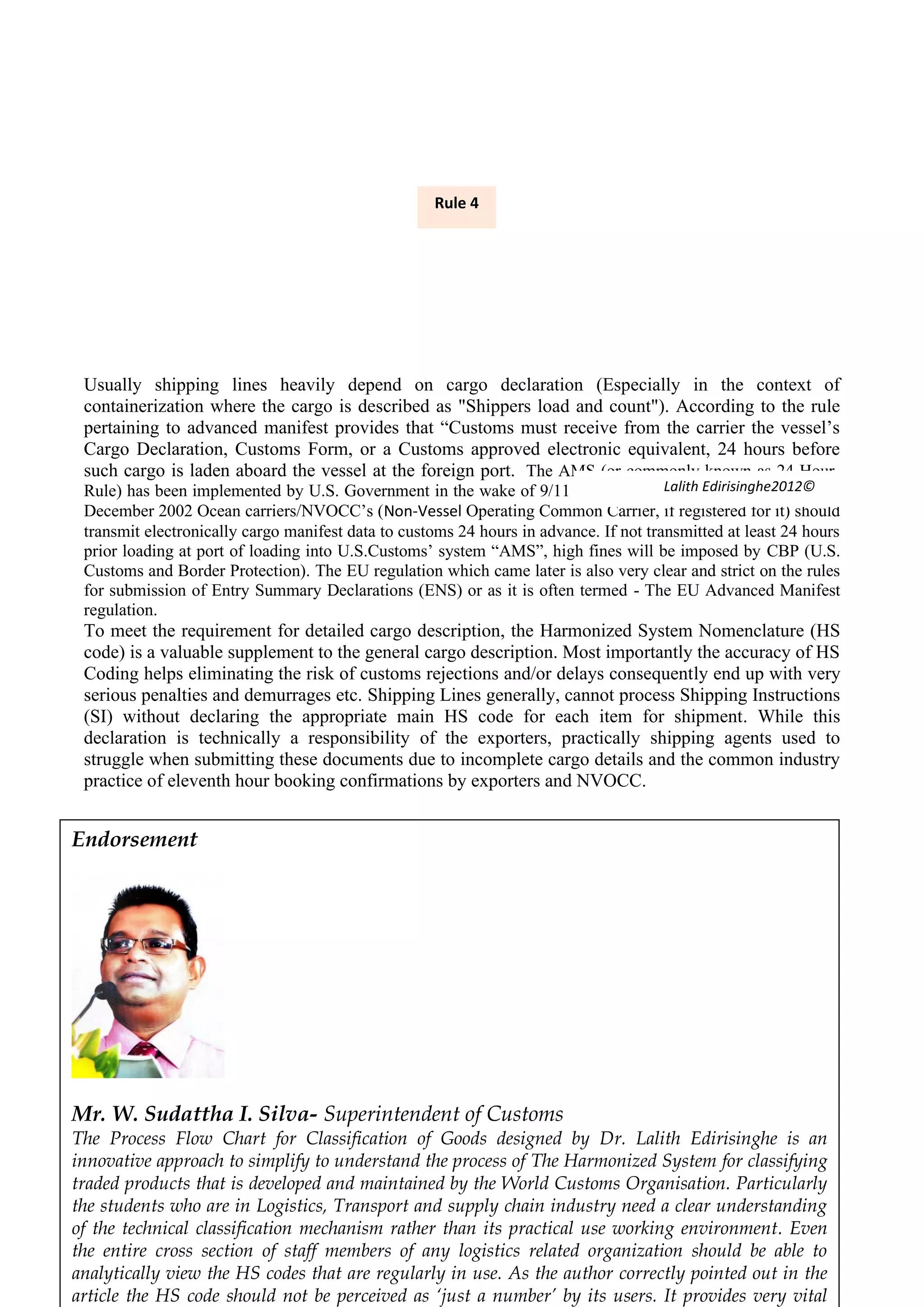
products developed and maintained by the World Customs Organisation (WCO). Below flow chart
explains the process that usually follow in classifying goods.
Goods to be
classified
Rule
1
Incomplete
Unfinished
Can
classified
up to 4
digits?
Titles of Sections, Chapters,
Sub Chapters
Terms of Headings,
Sections notes, Chapter
Notes
“Do not otherwise require”
Classification
done to 6
digits
Rule
6
Yes
No
Most Specific
Description
Rule 2
Is the
Classification
possible?
Yes
No
Classification
done to 6
digits
Rule
6
Is the
Classification
possible?
Is the
Classification
possible?
Rule
6
Classification
done to 6
digits
No
Rule
3
Essential
Character
Is the
Classification
possible?
Yes
Classification
done to 6
digits
Rule
6
Is the
Classificatio
n possible? No
Yes
No
Last in the
numerical order
Is the
Classification
No
2(b) 2(a)
3(a)
3(b)
3 (c)
The Process Flow Chart for Classification of Goods
Yes
Mixtures
Combinations
Usually shipping lines heavily depend on cargo declaration (Especially in the context of
containerization where the cargo is described as "Shippers load and count"). According to the rule
pertaining to advanced manifest provides that “Customs must receive from the carrier the vessel’s
Cargo Declaration, Customs Form, or a Customs approved electronic equivalent, 24 hours before
such cargo is laden aboard the vessel at the foreign port. The AMS (or commonly known as 24 Hour-
Rule) has been implemented by U.S. Government in the wake of 9/11 attacks. Accordingly, with effect from
December 2002 Ocean carriers/NVOCC’s (Non-Vessel Operating Common Carrier, if registered for it) should
transmit electronically cargo manifest data to customs 24 hours in advance. If not transmitted at least 24 hours
prior loading at port of loading into U.S.Customs’ system “AMS”, high fines will be imposed by CBP (U.S.
Customs and Border Protection). The EU regulation which came later is also very clear and strict on the rules
for submission of Entry Summary Declarations (ENS) or as it is often termed - The EU Advanced Manifest
regulation.
To meet the requirement for detailed cargo description, the Harmonized System Nomenclature (HS
code) is a valuable supplement to the general cargo description. Most importantly the accuracy of HS
Coding helps eliminating the risk of customs rejections and/or delays consequently end up with very
serious penalties and demurrages etc. Shipping Lines generally, cannot process Shipping Instructions
(SI) without declaring the appropriate main HS code for each item for shipment. While this
declaration is technically a responsibility of the exporters, practically shipping agents used to
struggle when submitting these documents due to incomplete cargo details and the common industry
practice of eleventh hour booking confirmations by exporters and NVOCC.
Rule 4
Lalith Edirisinghe2012©
Endorsement
Mr. W. Sudattha I. Silva- Superintendent of Customs
The Process Flow Chart for Classification of Goods designed by Dr. Lalith Edirisinghe is an
innovative approach to simplify to understand the process of The Harmonized System for classifying
traded products that is developed and maintained by the World Customs Organisation. Particularly
the students who are in Logistics, Transport and supply chain industry need a clear understanding
of the technical classification mechanism rather than its practical use working environment. Even
the entire cross section of staff members of any logistics related organization should be able to
analytically view the HS codes that are regularly in use. As the author correctly pointed out in the
article the HS code should not be perceived as ‘just a number’ by its users. It provides very vital

M Bridge 2 (2) CASA 2018 Simplified method to identify the Harmonized System Coding.pdf

  • 1.
    BRIDGE June 2018 2nd Edition Simplifiedmethod to identify the Harmonized System Coding By Dr. Lalith Edirisinghe, PhD Traditionally, it is considered that assigning the appropriate Harmonized System code (commonly known as HS code) is a tacit knowledge. Many practitioners used to ascertain the HS code of commodities through the hands-on experience, or by simply by following the instructions of their senior officers or solely accepting the decision of customs officers. This practice was not a big challenge when the importers and exporters handled just a handful of commodities. However, with the gradual increase of international trading and logistics activities the industry became very complex resulting the logisticians need to deal with many commodities thus HS codes. This paper provides a simplified method that helps the user to find the accurate HS code of any complicated cargo/commodity promptly and logically. Therefore, the Documentation or Customer service staff in the shipping line/agent office should be very familiar about the HS Nomenclature to expedite the booking process while eliminating risks of potential customs penalties. With the implementation of ENS-Entry Summary System (or AMS- Advanced Manifest Submission to Customs authorities) the HS code became a buzz word in the industry because even the front-line customer service personnel are compelled to work with HS codes. In contrast, this challenge was faced by those who directly interact with customs officials and others simply followed the instructions of the said staff. Therefore, in addition to those who are directly involved in commercial trading, the staff of shipping lines/agents also need to be very cautious about the accuracy of the HS codes.
  • 2.
    The Harmonized Systemis a structured nomenclature comprising descriptions of goods that are set out under 4-digit classification numbers. These are called headings in which most of these headings are further subdivided into 5- and 6-digit subheadings. It is important that shipping line/exporter provide the acceptable goods description and Valid HS code as mentioned by World Customs Organisation (WCO) – 6-digit code. The HS code has been viewed as just a ‘number’ by most of the stakeholders in Logistics, Transport, and supply chain industry. However, the beauty is that this code revels many vital information about the commodity that you declare and only those who could visualize the internal mechanism may be able convert the number (data) into information. The HS code information is in addition to all other relevant information required to process the shipment. It is an international standardised system of names and numbers for classifying traded products developed and maintained by the World Customs Organisation (WCO). Below flow chart explains the process that usually follow in classifying goods. Goods to be classified Rule 1 Incomplete Unfinished Can classified up to 4 digits? Titles of Sections, Chapters, Sub Chapters Terms of Headings, Sections notes, Chapter Notes “Do not otherwise require” Classification done to 6 digits Rule 6 Yes No Most Specific Description Rule 2 Is the Classification possible? Yes No Classification done to 6 digits Rule 6 Is the Classification possible? Is the Classification possible? Rule 6 Classification done to 6 digits No Rule 3 Essential Character Is the Classification possible? Yes Classification done to 6 digits Rule 6 Is the Classificatio n possible? No Yes No Last in the numerical order Is the Classification No 2(b) 2(a) 3(a) 3(b) 3 (c) The Process Flow Chart for Classification of Goods Yes Mixtures Combinations
  • 3.
    Usually shipping linesheavily depend on cargo declaration (Especially in the context of containerization where the cargo is described as "Shippers load and count"). According to the rule pertaining to advanced manifest provides that “Customs must receive from the carrier the vessel’s Cargo Declaration, Customs Form, or a Customs approved electronic equivalent, 24 hours before such cargo is laden aboard the vessel at the foreign port. The AMS (or commonly known as 24 Hour- Rule) has been implemented by U.S. Government in the wake of 9/11 attacks. Accordingly, with effect from December 2002 Ocean carriers/NVOCC’s (Non-Vessel Operating Common Carrier, if registered for it) should transmit electronically cargo manifest data to customs 24 hours in advance. If not transmitted at least 24 hours prior loading at port of loading into U.S.Customs’ system “AMS”, high fines will be imposed by CBP (U.S. Customs and Border Protection). The EU regulation which came later is also very clear and strict on the rules for submission of Entry Summary Declarations (ENS) or as it is often termed - The EU Advanced Manifest regulation. To meet the requirement for detailed cargo description, the Harmonized System Nomenclature (HS code) is a valuable supplement to the general cargo description. Most importantly the accuracy of HS Coding helps eliminating the risk of customs rejections and/or delays consequently end up with very serious penalties and demurrages etc. Shipping Lines generally, cannot process Shipping Instructions (SI) without declaring the appropriate main HS code for each item for shipment. While this declaration is technically a responsibility of the exporters, practically shipping agents used to struggle when submitting these documents due to incomplete cargo details and the common industry practice of eleventh hour booking confirmations by exporters and NVOCC. Rule 4 Lalith Edirisinghe2012© Endorsement Mr. W. Sudattha I. Silva- Superintendent of Customs The Process Flow Chart for Classification of Goods designed by Dr. Lalith Edirisinghe is an innovative approach to simplify to understand the process of The Harmonized System for classifying traded products that is developed and maintained by the World Customs Organisation. Particularly the students who are in Logistics, Transport and supply chain industry need a clear understanding of the technical classification mechanism rather than its practical use working environment. Even the entire cross section of staff members of any logistics related organization should be able to analytically view the HS codes that are regularly in use. As the author correctly pointed out in the article the HS code should not be perceived as ‘just a number’ by its users. It provides very vital