Adaptive gravitational softening in GADGET
Iannuzzi & Dolag (2011) and more
What softening is
*Monaghan & Lattanzio 1985, A&A, 149, 135
What we need it for
Depends on the kind of simulation one is performing:
Collisional simulation - need softening to avoid divergences and reduce
the computational time
Collisionless simulation - need softening to reduce computational time
and moderate the noise induced by the under-representation of the
particles’ DF
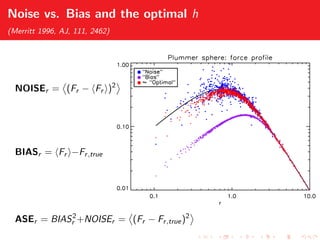
Noise vs. Bias and the optimal h
(Merritt 1996, AJ, 111, 2462)
NOISEr = (Fr − Fr )2
BIASr = Fr −Fr,true
ASEr = BIAS2
r +NOISEr = (Fr − Fr,true)2
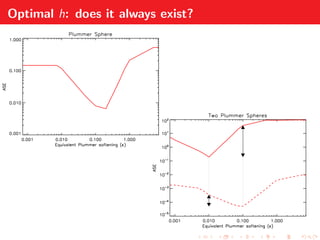
Optimal h: does it always exist?
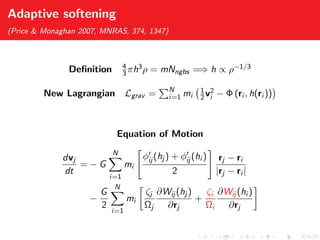
Adaptive softening
(Price & Monaghan 2007, MNRAS, 374, 1347)
Definition 4
3πh3ρ = mNngbs =⇒ h ∝ ρ−1/3
New Lagrangian Lgrav = N
i=1 mi
1
2v2
i − Φ (ri , h(ri ))
Equation of Motion
dvj
dt
= − G
N
i=1
mi
φij (hj ) + φij (hi )
2
rj − ri
|rj − ri |
−
G
2
N
i=1
mi
ζj
Ωj
∂Wij (hj )
∂rj
+
ζi
Ωi
∂Wij (hi )
∂rj
Adaptive softening
(Price & Monaghan 2007, MNRAS, 374, 1347)
Definition 4
3πh3ρ = mNngbs =⇒ h ∝ ρ−1/3
New Lagrangian Lgrav = N
i=1 mi
1
2v2
i − Φ (ri , h(ri ))
Equation of Motion
dvj
dt
= − G
N
i=1
mi
φij (hj ) + φij (hi )
2
rj − ri
|rj − ri |
−
G
2
N
i=1
mi
ζj
Ωj
∂Wij (hj )
∂rj
+
ζi
Ωi
∂Wij (hi )
∂rj
Adaptive softening
(Price & Monaghan 2007, MNRAS, 374, 1347)
Definition 4
3πh3ρ = mNngbs =⇒ h ∝ ρ−1/3
New Lagrangian Lgrav = N
i=1 mi
1
2v2
i − Φ (ri , h(ri ))
Equation of Motion
dvj
dt
= − G
N
i=1
mi
φij (hj ) + φij (hi )
2
rj − ri
|rj − ri |
−
G
2
N
i=1
mi
ζj
Ωj
∂Wij (hj )
∂rj
+
ζi
Ωi
∂Wij (hi )
∂rj
Adaptive softening
(Price & Monaghan 2007, MNRAS, 374, 1347)
Definition 4
3πh3ρ = mNngbs =⇒ h ∝ ρ−1/3
New Lagrangian Lgrav = N
i=1 mi
1
2v2
i − Φ (ri , h(ri ))
Equation of Motion
dvj
dt
= − G
N
i=1
mi
φij (hj ) + φij (hi )
2
rj − ri
|rj − ri |
−
G
2
N
i=1
mi
ζj
Ωj
∂Wij (hj )
∂rj
+
ζi
Ωi
∂Wij (hi )
∂rj
Adaptive softening
(Price & Monaghan 2007, MNRAS, 374, 1347)
Zeta
ζi ≡
∂hi
∂ρi
N
k=0
mk
∂φik(hi )
∂hi
Omega
Ωi ≡ 1 −
∂hi
∂ρi
N
k=0
mk
∂Wik(hi )
∂hi
Optimal h: fixed vs. adaptive softening
Correction term and energy conservation
Effects in a cosmological environment
No analytical solution
Keep the same power spectrum and increase the resolution
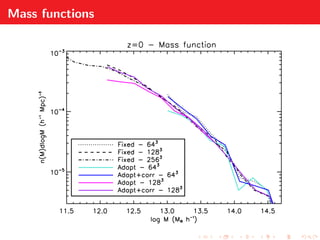
Fixed 643
Fixed 1283
Fixed 2563
Adapt 643
Adapt 1283
Adapt+corr 643
Adapt+corr 1283
Mass functions
Correlation functions
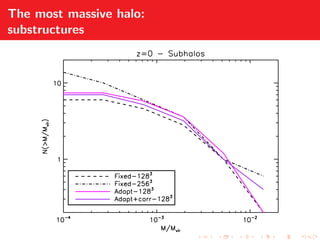
The most massive halo
M200 1015
M ; r200 2.4 h−1
Mpc; 3000, 21000, 160000 particles
The most massive halo
M200 1015
M ; r200 2.4 h−1
Mpc; 3000, 21000, 160000 particles
The most massive halo:
substructures
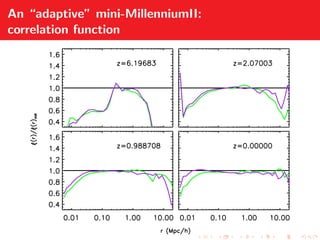
An “adaptive” mini-MillenniumII
low-resolution version of the MillenniumII (Boylan-Kolchin et al. 2009)
same power-spectrum, 125 times less particles
mII mini-mII
adaptive
mini-mII
An “adaptive” mini-MillenniumII:
mass function
An “adaptive” mini-MillenniumII:
correlation function
Conclusions (I)
adaptive softening lengths provide near-optimal softening with little
dependance on Nngbs
in order to retain energy conservation the equation of motion needs to
be modified
the use of adaptive softening in a cosmological simulation enhances
the clustering of particles at small scales, anticipating the results
obtained in higher resolution simulations
Hybrid simulations
Fields sampled by particles of different masses:
Collisionless species - to start with
Hydrodynamical simulations - eventually
Do we have an impact on two-body effects?
Hybrid collisionless simulation:
evaporation of the light component from halos
Hybrid collisionless simulation:
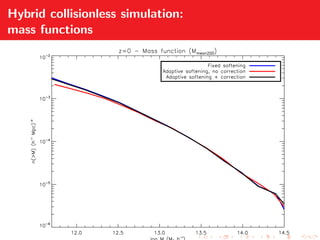
mass functions
Hybrid collisionless simulation:
evaporation of the light component from halos
Hybrid collisionless simulation:
evaporation of the light component from halos
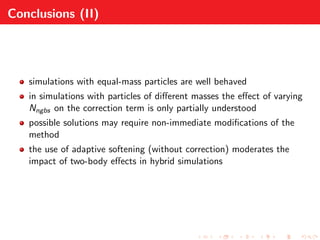
Conclusions (II)
simulations with equal-mass particles are well behaved
in simulations with particles of different masses the effect of varying
Nngbs on the correction term is only partially understood
possible solutions may require non-immediate modifications of the
method
the use of adaptive softening (without correction) moderates the
impact of two-body effects in hybrid simulations
Distribution of the softening lengths
Time bins
Dependence on the number of neighbours
Inner density profile of a Hernquist sphere
Passive evolution of a bulge+halo system

gadget_meeting

  • 1.
    Adaptive gravitational softeningin GADGET Iannuzzi & Dolag (2011) and more
  • 2.
    What softening is *Monaghan& Lattanzio 1985, A&A, 149, 135
  • 3.
    What we needit for Depends on the kind of simulation one is performing: Collisional simulation - need softening to avoid divergences and reduce the computational time Collisionless simulation - need softening to reduce computational time and moderate the noise induced by the under-representation of the particles’ DF
  • 4.
    Noise vs. Biasand the optimal h (Merritt 1996, AJ, 111, 2462) NOISEr = (Fr − Fr )2 BIASr = Fr −Fr,true ASEr = BIAS2 r +NOISEr = (Fr − Fr,true)2
  • 5.
    Optimal h: doesit always exist?
  • 6.
    Adaptive softening (Price &Monaghan 2007, MNRAS, 374, 1347) Definition 4 3πh3ρ = mNngbs =⇒ h ∝ ρ−1/3 New Lagrangian Lgrav = N i=1 mi 1 2v2 i − Φ (ri , h(ri )) Equation of Motion dvj dt = − G N i=1 mi φij (hj ) + φij (hi ) 2 rj − ri |rj − ri | − G 2 N i=1 mi ζj Ωj ∂Wij (hj ) ∂rj + ζi Ωi ∂Wij (hi ) ∂rj
  • 7.
    Adaptive softening (Price &Monaghan 2007, MNRAS, 374, 1347) Definition 4 3πh3ρ = mNngbs =⇒ h ∝ ρ−1/3 New Lagrangian Lgrav = N i=1 mi 1 2v2 i − Φ (ri , h(ri )) Equation of Motion dvj dt = − G N i=1 mi φij (hj ) + φij (hi ) 2 rj − ri |rj − ri | − G 2 N i=1 mi ζj Ωj ∂Wij (hj ) ∂rj + ζi Ωi ∂Wij (hi ) ∂rj
  • 8.
    Adaptive softening (Price &Monaghan 2007, MNRAS, 374, 1347) Definition 4 3πh3ρ = mNngbs =⇒ h ∝ ρ−1/3 New Lagrangian Lgrav = N i=1 mi 1 2v2 i − Φ (ri , h(ri )) Equation of Motion dvj dt = − G N i=1 mi φij (hj ) + φij (hi ) 2 rj − ri |rj − ri | − G 2 N i=1 mi ζj Ωj ∂Wij (hj ) ∂rj + ζi Ωi ∂Wij (hi ) ∂rj
  • 9.
    Adaptive softening (Price &Monaghan 2007, MNRAS, 374, 1347) Definition 4 3πh3ρ = mNngbs =⇒ h ∝ ρ−1/3 New Lagrangian Lgrav = N i=1 mi 1 2v2 i − Φ (ri , h(ri )) Equation of Motion dvj dt = − G N i=1 mi φij (hj ) + φij (hi ) 2 rj − ri |rj − ri | − G 2 N i=1 mi ζj Ωj ∂Wij (hj ) ∂rj + ζi Ωi ∂Wij (hi ) ∂rj
  • 10.
    Adaptive softening (Price &Monaghan 2007, MNRAS, 374, 1347) Zeta ζi ≡ ∂hi ∂ρi N k=0 mk ∂φik(hi ) ∂hi Omega Ωi ≡ 1 − ∂hi ∂ρi N k=0 mk ∂Wik(hi ) ∂hi
  • 11.
    Optimal h: fixedvs. adaptive softening
  • 12.
    Correction term andenergy conservation
  • 13.
    Effects in acosmological environment No analytical solution Keep the same power spectrum and increase the resolution Fixed 643 Fixed 1283 Fixed 2563 Adapt 643 Adapt 1283 Adapt+corr 643 Adapt+corr 1283
  • 14.
  • 15.
  • 16.
    The most massivehalo M200 1015 M ; r200 2.4 h−1 Mpc; 3000, 21000, 160000 particles
  • 17.
    The most massivehalo M200 1015 M ; r200 2.4 h−1 Mpc; 3000, 21000, 160000 particles
  • 18.
    The most massivehalo: substructures
  • 19.
    An “adaptive” mini-MillenniumII low-resolutionversion of the MillenniumII (Boylan-Kolchin et al. 2009) same power-spectrum, 125 times less particles mII mini-mII adaptive mini-mII
  • 20.
  • 21.
  • 22.
    Conclusions (I) adaptive softeninglengths provide near-optimal softening with little dependance on Nngbs in order to retain energy conservation the equation of motion needs to be modified the use of adaptive softening in a cosmological simulation enhances the clustering of particles at small scales, anticipating the results obtained in higher resolution simulations
  • 23.
    Hybrid simulations Fields sampledby particles of different masses: Collisionless species - to start with Hydrodynamical simulations - eventually Do we have an impact on two-body effects?
  • 24.
    Hybrid collisionless simulation: evaporationof the light component from halos
  • 25.
  • 26.
    Hybrid collisionless simulation: evaporationof the light component from halos
  • 27.
    Hybrid collisionless simulation: evaporationof the light component from halos
  • 28.
    Conclusions (II) simulations withequal-mass particles are well behaved in simulations with particles of different masses the effect of varying Nngbs on the correction term is only partially understood possible solutions may require non-immediate modifications of the method the use of adaptive softening (without correction) moderates the impact of two-body effects in hybrid simulations
  • 30.
    Distribution of thesoftening lengths
  • 31.
  • 32.
    Dependence on thenumber of neighbours Inner density profile of a Hernquist sphere
  • 33.
    Passive evolution ofa bulge+halo system