TREBUCHET
PARAMETRIC DESIGN
OPTIMIZATION
ME 644 Final Project – Spring 2016Ben Johnson
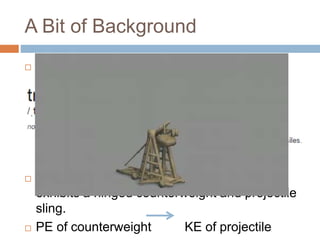
 What is a trebuchet?
 We will consider the trebuchet design which
exhibits a hinged counterweight and projectile
sling.
 PE of counterweight KE of projectile
A Bit of Background
Project Objective
 A paper titled “Trebuchet Mechanics” by
Donald Siano will serve as frame or reference
for this project.
 Plan to test following assertions from the
paper:
 Max “range efficiency” of a 2-D, 3 DOF model is
83%
 Including component mass in analysis reduces
efficiency significantly
“Efficiency is the Word” –James Brown
Range Efficiency: The ratio of range
achieved to the range of an idealized
trebuchet where the total potential
energy of the counterweight is
converted to the kinetic energy of the
projectile and the projectile is released
at the optimum angle of 45 degrees.
Range Efficiency =
𝑚2 𝑣0
2(𝑠𝑖𝑛𝛼)(𝑐𝑜𝑠𝛼
𝑚1 𝑔 ℎ
Where v0 is the projectile release
velocity, α is the angle of v0 measured
with respect to the horizontal ground, g
is the acceleration due to gravity, and h
is the vertical travel of the
 Design parameters:
 Lengths L1-L4
 Masses m1 (counterweight) and m2 (projectile)
2 Dimensional 3 DOF Model
Lagrangian Equations of Motion
𝑇 𝑖. 𝑒. 𝐾𝑖𝑛𝑒𝑡𝑖𝑐 𝐸𝑛𝑒𝑟𝑔𝑦
=
1
2
𝜃1
2
(𝑚1 𝐿1
2
+ 𝑚2 𝐿4
2
+ 𝜃1 [2𝐿3 𝐿4 𝑚2 𝜃3 cos 𝜃1 − 𝜃3 − 2𝐿1 𝐿2 𝑚1 𝜃2 cos 𝜃1 − 𝜃2 ] + 𝐿2
2
𝑚1 𝜃2
2
+ 𝐿3
2
𝑚2 𝜃3
2
)
𝑉 𝑖. 𝑒. 𝑃𝑜𝑡𝑒𝑛𝑡𝑖𝑎𝑙 𝐸𝑛𝑒𝑟𝑔𝑦
= 𝑔𝑐𝑜𝑠 𝜃1 (𝐿4 𝑚2 − 𝐿1 𝑚1 ) + 𝑔𝐿2 𝑚1cos(𝜃2) + 𝑔𝐿3 𝑚2cos(𝜃3)
𝐿𝑎𝑔𝑟𝑎𝑛𝑔𝑖𝑎𝑛 = 𝑇 − 𝑉
𝑑
𝑑𝑡
𝜕𝐿
𝜕 𝑞 𝑗
−
𝜕𝐿
𝜕𝑞 𝑗
= 0
𝑚1 𝐿1
2
𝜃1 + 𝑚2 𝐿4
2
𝜃1 − 𝐿1 𝐿2 𝑚1 𝜃2
2
sin 𝜃1 − 𝜃2 − 𝐿1 𝐿2 𝑚1 𝜃2cos 𝜃1 − 𝜃2 + 𝐿3 𝐿4 𝑚2 𝜃3
2
sin 𝜃1 − 𝜃3 + 𝐿3 𝐿4 𝑚2 𝜃3cos 𝜃1 − 𝜃3 − 𝑔𝐿1 𝑚1 sin 𝜃1 + 𝑔𝐿4 𝑚2 sin 𝜃1
= 0
Equations of Motion:
𝐿2 𝜃2 + 𝐿1 𝜃1
2
sin 𝜃1 − 𝜃2 − 𝐿1 𝜃1cos 𝜃1 − 𝜃2 + 𝑔 sin 𝜃2 = 0
𝐿3 𝜃3 − 𝐿4 𝜃1
2
sin 𝜃1 − 𝜃3 + 𝐿4 𝜃1cos 𝜃1 − 𝜃2 + 𝑔 sin 𝜃3 = 0
Matlab® Optimization
 Transform EOM’s to state space model
 Apply Gaussian reduction since each equation
may only contain one acceleration term
 Create function to solve EOM’s with Runge-
Kutta
 Must pass design parameters to ODE45 function
 Function returns max attainable range efficiency
 Apply built in function fmincon to optimize
objective (range efficiency) for the decision
variables (design parameters)
Optimization Tool Output
 92.6% Range Efficiency
 “Final point” values
 L2 = 4.846
 L3 =1.737
 L4 =4.12,
 M2=130.024
 L1= M1=1=constant
System Motion for Optimum
Basis
 Admittedly difficult to interpret without animation
 Motion of the beam is completely arrested very near the optimum point of
Justification for New Optimum
Basis
 “Trebuchet Mechanics”:
 Optimized one parameter at a time
 Applied brute force optimization, i.e. tested
objective function for many random parameter
values
 Current Model
 Optimizes all parameters at once
 Applies gradient based approach
ANSYS Optimization Model
 Includes additional considerations:
 Component dimensions (3D)
 Materials
 Density, Young’s modulus, Poisson’s ratio, yield
strength, etc.
 Additional considerations provide for:
 Incorporation of component inertia
 Stress/strain calculation
 Factor of safety
Beam Dimensions
 Most critical
component to system
efficiency
 Final dimensions and
minimum FOS below
Simulation Animations
Beam too short - 63% range efficiency Beam too long - 66% range efficiency
Sling too long - 68% range efficiency Optimized - 83% Range Efficiency
Optimized design w/ stress - 83% range efficiency
Conclusions
 Applying an improved optimization method to
analytical model has been demonstrated to
increase the theoretical range efficiency of a
trebuchet beyond the previously asserted
value of 83% to 92%.
 Inclusion of component dimensions and
stresses encountered has been shown to be of
limited impact to the theoretical efficiency
References
1. D. Siano, “Trebuchet Mechanics,” Accessed online:
http://www.aemma.org/training/trebuchet/trebmath35.pdf. 2001.
2. E. Mahieu, “Optimizing the Counterweight Trebuchet,” Accessed online:
http://demonstrations.wolfram.com/OptimizingTheCounterweightTrebuch
et/. 2012
3. M. Senese, “Tuning a Trebuchet for Maximum Distance,” Accessed
online: http://www.mikesenese.com/DOIT/2010/12/tuning-a-
trebuchet/2012. 2010.

Final Presentation

  • 1.
    TREBUCHET PARAMETRIC DESIGN OPTIMIZATION ME 644Final Project – Spring 2016Ben Johnson
  • 2.
     What isa trebuchet?  We will consider the trebuchet design which exhibits a hinged counterweight and projectile sling.  PE of counterweight KE of projectile A Bit of Background
  • 3.
    Project Objective  Apaper titled “Trebuchet Mechanics” by Donald Siano will serve as frame or reference for this project.  Plan to test following assertions from the paper:  Max “range efficiency” of a 2-D, 3 DOF model is 83%  Including component mass in analysis reduces efficiency significantly
  • 4.
    “Efficiency is theWord” –James Brown Range Efficiency: The ratio of range achieved to the range of an idealized trebuchet where the total potential energy of the counterweight is converted to the kinetic energy of the projectile and the projectile is released at the optimum angle of 45 degrees. Range Efficiency = 𝑚2 𝑣0 2(𝑠𝑖𝑛𝛼)(𝑐𝑜𝑠𝛼 𝑚1 𝑔 ℎ Where v0 is the projectile release velocity, α is the angle of v0 measured with respect to the horizontal ground, g is the acceleration due to gravity, and h is the vertical travel of the
  • 5.
     Design parameters: Lengths L1-L4  Masses m1 (counterweight) and m2 (projectile) 2 Dimensional 3 DOF Model
  • 6.
    Lagrangian Equations ofMotion 𝑇 𝑖. 𝑒. 𝐾𝑖𝑛𝑒𝑡𝑖𝑐 𝐸𝑛𝑒𝑟𝑔𝑦 = 1 2 𝜃1 2 (𝑚1 𝐿1 2 + 𝑚2 𝐿4 2 + 𝜃1 [2𝐿3 𝐿4 𝑚2 𝜃3 cos 𝜃1 − 𝜃3 − 2𝐿1 𝐿2 𝑚1 𝜃2 cos 𝜃1 − 𝜃2 ] + 𝐿2 2 𝑚1 𝜃2 2 + 𝐿3 2 𝑚2 𝜃3 2 ) 𝑉 𝑖. 𝑒. 𝑃𝑜𝑡𝑒𝑛𝑡𝑖𝑎𝑙 𝐸𝑛𝑒𝑟𝑔𝑦 = 𝑔𝑐𝑜𝑠 𝜃1 (𝐿4 𝑚2 − 𝐿1 𝑚1 ) + 𝑔𝐿2 𝑚1cos(𝜃2) + 𝑔𝐿3 𝑚2cos(𝜃3) 𝐿𝑎𝑔𝑟𝑎𝑛𝑔𝑖𝑎𝑛 = 𝑇 − 𝑉 𝑑 𝑑𝑡 𝜕𝐿 𝜕 𝑞 𝑗 − 𝜕𝐿 𝜕𝑞 𝑗 = 0 𝑚1 𝐿1 2 𝜃1 + 𝑚2 𝐿4 2 𝜃1 − 𝐿1 𝐿2 𝑚1 𝜃2 2 sin 𝜃1 − 𝜃2 − 𝐿1 𝐿2 𝑚1 𝜃2cos 𝜃1 − 𝜃2 + 𝐿3 𝐿4 𝑚2 𝜃3 2 sin 𝜃1 − 𝜃3 + 𝐿3 𝐿4 𝑚2 𝜃3cos 𝜃1 − 𝜃3 − 𝑔𝐿1 𝑚1 sin 𝜃1 + 𝑔𝐿4 𝑚2 sin 𝜃1 = 0 Equations of Motion: 𝐿2 𝜃2 + 𝐿1 𝜃1 2 sin 𝜃1 − 𝜃2 − 𝐿1 𝜃1cos 𝜃1 − 𝜃2 + 𝑔 sin 𝜃2 = 0 𝐿3 𝜃3 − 𝐿4 𝜃1 2 sin 𝜃1 − 𝜃3 + 𝐿4 𝜃1cos 𝜃1 − 𝜃2 + 𝑔 sin 𝜃3 = 0
  • 7.
    Matlab® Optimization  TransformEOM’s to state space model  Apply Gaussian reduction since each equation may only contain one acceleration term  Create function to solve EOM’s with Runge- Kutta  Must pass design parameters to ODE45 function  Function returns max attainable range efficiency  Apply built in function fmincon to optimize objective (range efficiency) for the decision variables (design parameters)
  • 8.
    Optimization Tool Output 92.6% Range Efficiency  “Final point” values  L2 = 4.846  L3 =1.737  L4 =4.12,  M2=130.024  L1= M1=1=constant
  • 9.
    System Motion forOptimum Basis  Admittedly difficult to interpret without animation  Motion of the beam is completely arrested very near the optimum point of
  • 10.
    Justification for NewOptimum Basis  “Trebuchet Mechanics”:  Optimized one parameter at a time  Applied brute force optimization, i.e. tested objective function for many random parameter values  Current Model  Optimizes all parameters at once  Applies gradient based approach
  • 11.
    ANSYS Optimization Model Includes additional considerations:  Component dimensions (3D)  Materials  Density, Young’s modulus, Poisson’s ratio, yield strength, etc.  Additional considerations provide for:  Incorporation of component inertia  Stress/strain calculation  Factor of safety
  • 12.
    Beam Dimensions  Mostcritical component to system efficiency  Final dimensions and minimum FOS below
  • 13.
    Simulation Animations Beam tooshort - 63% range efficiency Beam too long - 66% range efficiency Sling too long - 68% range efficiency Optimized - 83% Range Efficiency Optimized design w/ stress - 83% range efficiency
  • 14.
    Conclusions  Applying animproved optimization method to analytical model has been demonstrated to increase the theoretical range efficiency of a trebuchet beyond the previously asserted value of 83% to 92%.  Inclusion of component dimensions and stresses encountered has been shown to be of limited impact to the theoretical efficiency
  • 15.
    References 1. D. Siano,“Trebuchet Mechanics,” Accessed online: http://www.aemma.org/training/trebuchet/trebmath35.pdf. 2001. 2. E. Mahieu, “Optimizing the Counterweight Trebuchet,” Accessed online: http://demonstrations.wolfram.com/OptimizingTheCounterweightTrebuch et/. 2012 3. M. Senese, “Tuning a Trebuchet for Maximum Distance,” Accessed online: http://www.mikesenese.com/DOIT/2010/12/tuning-a- trebuchet/2012. 2010.