GABA-ERGIC SYSTEM
SIDDHARTHA DAS PRAMANIK
M.PHARM 1ST YEAR
DEPARTMENT OF PHARMACEUTICAL ENGINEERING & TECHNOLOGY, IIT BHU, VARANASI
OUTLINE
• INTRODUCTION
• GABA
• SYNTHESIS & METABOLISM
• MECHANISM OF ACTION
• RECEPTORS
• FUNCTION
• CONCLUSION
• REFERENCES
INTRODUCTION
• GABAergic means "pertaining to or affecting
the neurotransmitter GABA". A synapse is GABAergic if it uses
GABA as its neurotransmitter.
• A GABAergic or GABAergic agent is any chemical that modifies
the effects of GABA in the body or brain. Some different classes
of GABAergic drugs include the following: GABA receptor
agonists, GABA receptor antagonists, and GABA reuptake
inhibitors.
Watanabe M, Maemura K, Kanbara K, Tamayama T, Hayasaki H (2002). "GABA and GABA receptors in the central nervous system and other organs"
GABA
• GABA stands for gamma amino butyric acid which is a zwitter ion with
deprotonated carboxyl group and protonated amino group.
• GABA acts at inhibitory synapses in the brain by binding to specific
transmembrane receptors in the plasma membrane of both pre- and
postsynaptic neuronal processes.
• It is most highly concentrated in the substantia nigra and globus pallidus
nuclei of the basal ganglia, followed by the hypothalamus, the
periaqueductal grey matter.
• There are two types of GABA receptors: GABA-A & GABA-B
Watanabe M, Maemura K, Kanbara K, Tamayama T, Hayasaki H (2002). "GABA and GABA receptors in the central nervous system and other organs"
SYNTHESIS & METABOLISM OF GABA
MECHANISM OF ACTION
• GABA open chloride
receptors channels and
induce the cellular
hyperpolarization by
increasing intracellular
concentration of chloride
ions.
Enna, S. J., and Bowery, N. G. (eds.), The GABA Receptors, 2nd ed. Clifton, NJ: Humana Press, 1997.
GABA receptors:
• It has pentameric structure.
• Each GABA-A receptor
contains two alpha, two
beta and one gamma
subunits.
• It has structural and
functional similarity with
ligand gated ion channel.
J Biol Chem. 2012 Nov 23; 287(48): 40224–40231.
• There are two hetero dimers.
• GABA-B have been cloned to
subunits B1 and B2.
• B1 subunit has a GABA binding
site while B2 subunit interact with
G protein.
• It has two biological actions:
-increase K+ conductance
-decrease Ca2+ conductance
GABA-B
Eduardo E. Benarroch Neurology Feb 2012, 78 (8) 578-584; DOI:10.1212/WNL.0b013e318247cd03
FUNCTIONS OF GABA
• Relieving from anxiety
• Improving mood
• Regulating the release of sex hormone
• Promoting lean muscle growth
• Burning fat
• Lowering elevated blood sugar levels in diabetes
• Stabilizing the blood pressure
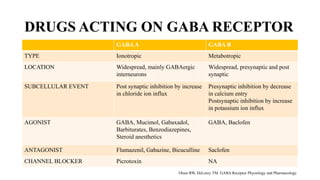
DRUGS ACTING ON GABA RECEPTOR
GABAA GABA B
TYPE Ionotropic Metabotropic
LOCATION Widespread, mainly GABAergic
interneurons
Widespread, presynaptic and post
synaptic
SUBCELLULAR EVENT Post synaptic inhibition by increase
in chloride ion influx
Presynaptic inhibition by decrease
in calcium entry
Postsynaptic inhibition by increase
in potassium ion influx
AGONIST GABA, Mucimol, Gabaxadol,
Barbiturates, Benzodiazepines,
Steroid anesthetics
GABA, Baclofen
ANTAGONIST Flumazenil, Gabazine, Bicuculline Saclofen
CHANNEL BLOCKER Picrotoxin NA
Olsen RW, DeLorey TM. GABA Receptor Physiology and Pharmacology.
CONCLUSION
• GABA is an amino acid made in brain cells from
glutamate. It functions as an inhibitory
neurotransmitter, meaning it blocks nerve impulses.
Without GABA, nerve cells fire too often and too
easily.
REFERENCES
• Kuffler SW, Edwards C (November 1958). "Mechanism of gamma
aminobutyric acid (GABA) action and its relation to synaptic inhibition". J.
Neurophysiol. 21 (6): 589–610.
• Kravitz EA, Kuffler SW, Potter DD (September 1963). "Gamma-
aminobutyric acid and other blocking compounds in crustacea. III. Their
relative concentrations in separated motor and inhibitory axons". J.
Neurophysiol. 26: 739–51.
• Barnard EA, Skolnick P, Olsen RW, Mohler H, Sieghart W, Biggio G,
Braestrup C, Bateson AN, Langer SZ (June 1998). "International Union of
Pharmacology. XV. Subtypes of gamma-aminobutyric acidA receptors:
classification on the basis of subunit structure and receptor
function". Pharmacol. Rev.50 (2): 291–313.
THANK YOU

Gabaergic system by Siddhartha Das

  • 1.
    GABA-ERGIC SYSTEM SIDDHARTHA DASPRAMANIK M.PHARM 1ST YEAR DEPARTMENT OF PHARMACEUTICAL ENGINEERING & TECHNOLOGY, IIT BHU, VARANASI
  • 2.
    OUTLINE • INTRODUCTION • GABA •SYNTHESIS & METABOLISM • MECHANISM OF ACTION • RECEPTORS • FUNCTION • CONCLUSION • REFERENCES
  • 3.
    INTRODUCTION • GABAergic means"pertaining to or affecting the neurotransmitter GABA". A synapse is GABAergic if it uses GABA as its neurotransmitter. • A GABAergic or GABAergic agent is any chemical that modifies the effects of GABA in the body or brain. Some different classes of GABAergic drugs include the following: GABA receptor agonists, GABA receptor antagonists, and GABA reuptake inhibitors. Watanabe M, Maemura K, Kanbara K, Tamayama T, Hayasaki H (2002). "GABA and GABA receptors in the central nervous system and other organs"
  • 4.
    GABA • GABA standsfor gamma amino butyric acid which is a zwitter ion with deprotonated carboxyl group and protonated amino group. • GABA acts at inhibitory synapses in the brain by binding to specific transmembrane receptors in the plasma membrane of both pre- and postsynaptic neuronal processes. • It is most highly concentrated in the substantia nigra and globus pallidus nuclei of the basal ganglia, followed by the hypothalamus, the periaqueductal grey matter. • There are two types of GABA receptors: GABA-A & GABA-B Watanabe M, Maemura K, Kanbara K, Tamayama T, Hayasaki H (2002). "GABA and GABA receptors in the central nervous system and other organs"
  • 5.
  • 6.
    MECHANISM OF ACTION •GABA open chloride receptors channels and induce the cellular hyperpolarization by increasing intracellular concentration of chloride ions. Enna, S. J., and Bowery, N. G. (eds.), The GABA Receptors, 2nd ed. Clifton, NJ: Humana Press, 1997.
  • 7.
    GABA receptors: • Ithas pentameric structure. • Each GABA-A receptor contains two alpha, two beta and one gamma subunits. • It has structural and functional similarity with ligand gated ion channel. J Biol Chem. 2012 Nov 23; 287(48): 40224–40231.
  • 8.
    • There aretwo hetero dimers. • GABA-B have been cloned to subunits B1 and B2. • B1 subunit has a GABA binding site while B2 subunit interact with G protein. • It has two biological actions: -increase K+ conductance -decrease Ca2+ conductance GABA-B Eduardo E. Benarroch Neurology Feb 2012, 78 (8) 578-584; DOI:10.1212/WNL.0b013e318247cd03
  • 9.
    FUNCTIONS OF GABA •Relieving from anxiety • Improving mood • Regulating the release of sex hormone • Promoting lean muscle growth • Burning fat • Lowering elevated blood sugar levels in diabetes • Stabilizing the blood pressure
  • 10.
    DRUGS ACTING ONGABA RECEPTOR GABAA GABA B TYPE Ionotropic Metabotropic LOCATION Widespread, mainly GABAergic interneurons Widespread, presynaptic and post synaptic SUBCELLULAR EVENT Post synaptic inhibition by increase in chloride ion influx Presynaptic inhibition by decrease in calcium entry Postsynaptic inhibition by increase in potassium ion influx AGONIST GABA, Mucimol, Gabaxadol, Barbiturates, Benzodiazepines, Steroid anesthetics GABA, Baclofen ANTAGONIST Flumazenil, Gabazine, Bicuculline Saclofen CHANNEL BLOCKER Picrotoxin NA Olsen RW, DeLorey TM. GABA Receptor Physiology and Pharmacology.
  • 11.
    CONCLUSION • GABA isan amino acid made in brain cells from glutamate. It functions as an inhibitory neurotransmitter, meaning it blocks nerve impulses. Without GABA, nerve cells fire too often and too easily.
  • 12.
    REFERENCES • Kuffler SW,Edwards C (November 1958). "Mechanism of gamma aminobutyric acid (GABA) action and its relation to synaptic inhibition". J. Neurophysiol. 21 (6): 589–610. • Kravitz EA, Kuffler SW, Potter DD (September 1963). "Gamma- aminobutyric acid and other blocking compounds in crustacea. III. Their relative concentrations in separated motor and inhibitory axons". J. Neurophysiol. 26: 739–51. • Barnard EA, Skolnick P, Olsen RW, Mohler H, Sieghart W, Biggio G, Braestrup C, Bateson AN, Langer SZ (June 1998). "International Union of Pharmacology. XV. Subtypes of gamma-aminobutyric acidA receptors: classification on the basis of subunit structure and receptor function". Pharmacol. Rev.50 (2): 291–313.
  • 13.