Objectives:
●Describe musical elementsof
given Classical period pieces.
●Demonstrate understanding of
the different classical forms
through recognition of the audio
clips provided.
MUSIC OF THE
CLASSICALPERIOD
(1750-1820)
• The classical era, also called
“Age of Reason”, is the period
from 1750-1820.
7.
MUSIC OF THE
CLASSICALPERIOD
(1750-1820)++
• The cultural life was dominated by
the aristocracy, as patrons of
musicians and artists who generally
influenced the arts. Significant
changes in musical forms and
styles were made.
8.
The term “classical”denotes
conformity with the principles
and characteristics of ancient
Greece and Roman literature
and art which were formal,
elegant, simple, freed, and
dignified.
9.
The same characteristics
mayalso describe the
melodies of classical
music.
Harmony and texture
are homophonic in
general.
The dynamics of loud and soft were
clearly shown through the extensive
use of crescendo and diminuendo.
10.
➢Sonata
MARS
Instrumental Forms ofClassical
Music
A multi-movement work for solo
instrument, Sonata came from the
word “Sonare” which means to
make a sound.
11.
➢Sonata
MARS
Instrumental Forms ofClassical
Music
This term is applied to a variety of
works for a solo instrument such
as keyboard or violin.
MARS
Components of theSonata
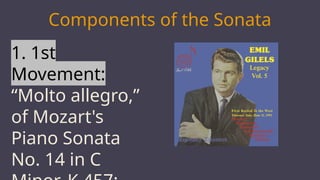
1. 1st Movement: Allegro – fast
movement Listen to an example of
first movement, “Molto allegro,” of
Mozart's Piano Sonata No. 14 in C
Minor, K 457; from a 1951
recording by pianist Emil Guilels. .
14.
MARS
Components of theSonata
1. 1st
Movement:
“Molto allegro,”
of Mozart's
Piano Sonata
No. 14 in C
15.
MARS
2. 2nd Movement:Slow tempo:
(Andante, Largo, etc.), mostly
lyrical and emotional. Listen to an
example of second movement,
“Andantino,” of Franz Schubert's
Piano Sonata No. 20 in A Major;
from a 1937 recording by pianist
Artur Schnabel.
16.
MARS
3. Third Movement:
“Minuet:It is in three-four time
and in a moderate or fast tempo.
Listen to an example of third
movement, “Allegro vivace,” of
Franz Schubert's Piano Sonata No.
14 in A Minor.
➢Sonata form
MARS
Instrumental Formsof Classical
Music
is also called first-movement form or
sonata-allegro form. It is a musical
structure that is usually a part of the
first movement of various Western
instrumental genres, like sonatas,
19.
Basic Elements of
Sonataform
MARS
1. Exposition - the first part of a
composition in sonata form that
introduces the theme
2. Development is the middle part
of the sonata-allegro form wherein
themes are being developed
20.
Basic Elements of
Sonataform
MARS
3. Recapitulation - repeats the
theme as they first emerge in the
opening exposition
21.
Basic Elements of
Sonataform
MARS
3. Recapitulation - repeats the
theme as they first emerge in the
opening exposition
22.
Example of Sonataform
MARS
Eine kleine Nachtmusik “ a little night music”.
23.
➢ Concerto
Instrumental Formsof Classical
Music
JUPITER
The classical concerto is a piece
of music composed for an
instrumental soloist and
orchestra.
24.
➢ Concerto
Instrumental Formsof Classical
Music
JUPITER
It is written to feature the musical
skills and expressiveness of a single
musician, the soloist, while being
accompanied by a large group of
musicians that make up the
orchestra. It has 3 movements: F-S-F
➢ Symphony
Instrumental Formsof Classical
Music
JUPITER
A multi-movement work for
orchestra, the symphony is
derived from the word “Sinfonia”
which literally means “a
harmonious sounding together”.
27.
➢ Symphony
Instrumental Formsof Classical
Music
JUPITER
A multi-movement work for
orchestra, the symphony is
derived from the word “Sinfonia”
which literally means “a
harmonious sounding together”.
28.
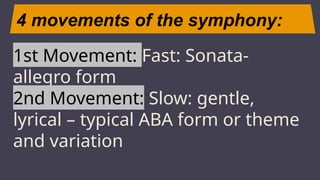
4 movements ofthe symphony:
JUPITER
1st Movement: Fast: Sonata-
allegro form
2nd Movement: Slow: gentle,
lyrical – typical ABA form or theme
and variation
29.
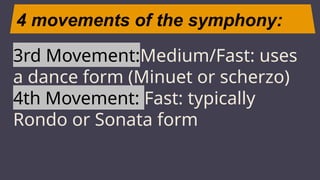
4 movements ofthe symphony:
JUPITER
3rd Movement:Medium/Fast: uses
a dance form (Minuet or scherzo)
4th Movement: Fast: typically
Rondo or Sonata form
➢ Classical Opera
VocalForms of Classical Music
JUPITER
Opera is a drama set to music
where singers and musicians
perform in a theatrical setting.
32.
two distinct stylesof opera:
JUPITER
1. Opera Seria
- serious opera
- usually implies heroic or tragic
drama that uses mythological
characters, which was inherited
from the Baroque period
33.
two distinct stylesof opera:
JUPITER
1. Opera Seria
- was the opera of the court, of the
monarchy and the nobility, but this
was not always the case; Handel
composed operas for people with
various social status
JUPITER
2. Opera Buffa
-comic opera from Italy
- made use of everyday characters
and situations, and usually used
spoken dialogues, lengthy arias and
was spiced with sight gags, naughty
humor, and social satire
36.
JUPITER
2. Opera Buffa
-“The Marriage of Figaro”, “Don
Giovanni”, and “The Magic Flute”
are examples of popular Opera
Buffa by Mozart.
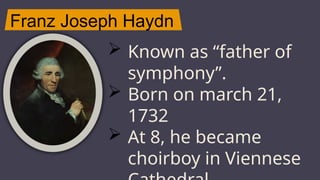
Franz Joseph Haydn
JUPITER
Known as “father of
symphony”.
Born on march 21,
1732
At 8, he became
choirboy in Viennese
41.
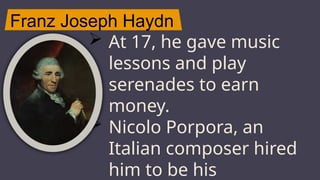
Franz Joseph Haydn
JUPITER
At 17, he gave music
lessons and play
serenades to earn
money.
Nicolo Porpora, an
Italian composer hired
him to be his
42.
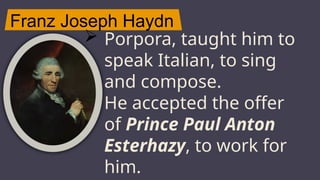
Franz Joseph Haydn
JUPITER
Porpora, taught him to
speak Italian, to sing
and compose.
He accepted the offer
of Prince Paul Anton
Esterhazy, to work for
him.
43.
Franz Joseph Haydn
JUPITER
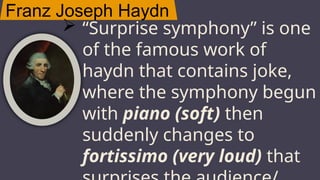
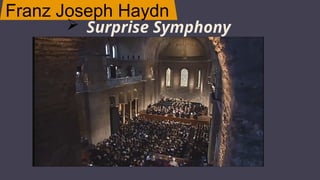
“Surprise symphony” is one
of the famous work of
haydn that contains joke,
where the symphony begun
with piano (soft) then
suddenly changes to
fortissimo (very loud) that
44.
Franz Joseph Haydn
JUPITER
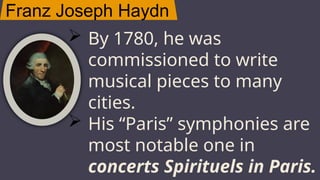
By 1780, he was
commissioned to write
musical pieces to many
cities.
His “Paris” symphonies are
most notable one in
concerts Spirituels in Paris.
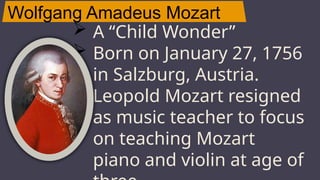
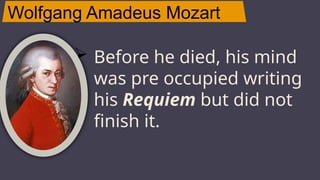
Wolfgang Amadeus Mozart
JUPITER
A “Child Wonder”
Born on January 27, 1756
in Salzburg, Austria.
Leopold Mozart resigned
as music teacher to focus
on teaching Mozart
piano and violin at age of
48.
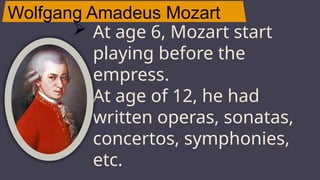
Wolfgang Amadeus Mozart
JUPITER
At age 6, Mozart start
playing before the
empress.
At age of 12, he had
written operas, sonatas,
concertos, symphonies,
etc.
49.
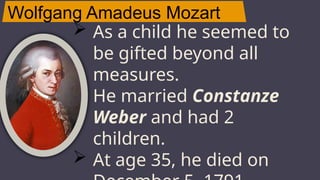
Wolfgang Amadeus Mozart
JUPITER
As a child he seemed to
be gifted beyond all
measures.
He married Constanze
Weber and had 2
children.
At age 35, he died on
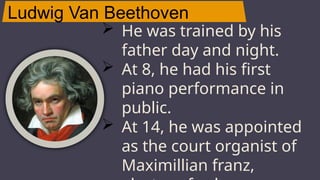
Ludwig Van Beethoven
JUPITER
He was trained by his
father day and night.
At 8, he had his first
piano performance in
public.
At 14, he was appointed
as the court organist of
Maximillian franz,
53.
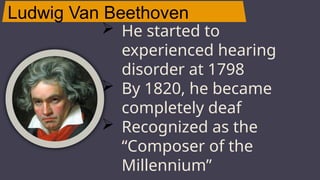
Ludwig Van Beethoven
JUPITER
He started to
experienced hearing
disorder at 1798
By 1820, he became
completely deaf
Recognized as the
“Composer of the
Millennium”
Quiz no. 1
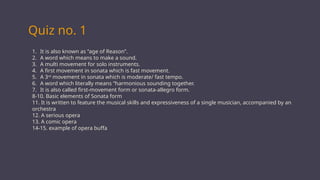
1.It is also known as “age of Reason”.
2. A word which means to make a sound.
3. A multi movement for solo instruments.
4. A first movement in sonata which is fast movement.
5. A 3rd
movement in sonata which is moderate/ fast tempo.
6. A word which literally means “harmonious sounding together.
7. It is also called first-movement form or sonata-allegro form.
8-10. Basic elements of Sonata form
11. It is written to feature the musical skills and expressiveness of a single musician, accompanied by an
orchestra
12. A serious opera
13. A comic opera
14-15. example of opera buffa
57.
Quiz no. 2(Identification)
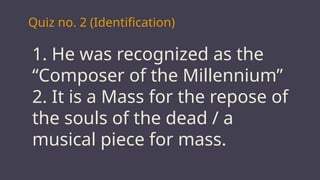
1. He was recognized as the
“Composer of the Millennium”
2. It is a Mass for the repose of
the souls of the dead / a
musical piece for mass.
58.
3. She marriedMozart and had
2 children.
4. A “Child Wonder” and was
Born on January 27, 1756 in
Salzburg, Austria.
59.
5. He wasKnown as “father of
symphony”.
6. He was the father and
teacher of Mozart.
7. an Italian composer who
hired Haydn to be his
accompanist.
60.
8. It isone of the famous work
of Haydn that contains joke.
9.
10.
Two famous musical
pieces of Ludwig Van
Beethoven
Editor's Notes
#6 the time of life when one begins to be able to distinguish right from wrong. 2 : a period characterized by a prevailing belief in the use of reason especially Age of Reason :
#7 the time of life when one begins to be able to distinguish right from wrong. 2 : a period characterized by a prevailing belief in the use of reason especially Age of Reason :
#9 Homophonic - having the same sound. Music. having one part or melody predominating (opposed to polyphonic).
Crescendo - the loudest point reached in a gradually increasing sound.
Diminuendo - a decrease in loudness.
#10 Movement – in musical terms it refers to work or compositions.
#11 Movement – in musical terms it refers to work or compositions.
#12 Movement – in musical terms it refers to work or compositions.
Joseph Haydn, Wolfgang Amadeus Mozart
And Ludwig van Beethoven all wrote sonatas.
#27 It is a classical music for the whole orchestra, generally in four movements.
#28 ABA form - Ternary form is a musical form consisting of three distinct sections with an ABA pattern of large-scale repetition: an opening section (A), a contrasting section in the middle (B), and then a return to the material from the opening section (A).
#29 ABA form - Ternary form is a musical form consisting of three distinct sections with an ABA pattern of large-scale repetition: an opening section (A), a contrasting section in the middle (B), and then a return to the material from the opening section (A).
#31 It is a classical music for the whole orchestra, generally in four movements.
#32 ABA form - Ternary form is a musical form consisting of three distinct sections with an ABA pattern of large-scale repetition: an opening section (A), a contrasting section in the middle (B), and then a return to the material from the opening section (A).
#33 ABA form - Ternary form is a musical form consisting of three distinct sections with an ABA pattern of large-scale repetition: an opening section (A), a contrasting section in the middle (B), and then a return to the material from the opening section (A).
#34 Idomeneo (serious, heroic emotion with a richness unparalleled elsewhere in his operas)- In Greek mythology, Idomeneus was a Cretan king and commander who led the Cretan armies to the Trojan War.
(Mythology says that Crete was the birthplace of the Greek god twins, Apollo and Artemis, who were born in the nearby islets of Paximadia. )
Humanity and forgiveness drive the drama of this opera and in this respect Idomeneo is an opera of its time; man is not ruled by gods, but is an individual living life according to his own moral principals.
#37 Idomeneo (serious, heroic emotion with a richness unparalleled elsewhere in his operas)- In Greek mythology, Idomeneus was a Cretan king and commander who led the Cretan armies to the Trojan War.
(Mythology says that Crete was the birthplace of the Greek god twins, Apollo and Artemis, who were born in the nearby islets of Paximadia. )
Tamino, a prince lost in a foreign land, is being pursued by an enormous monster. He is rescued by three mysterious ladies, who kill the monster and give Tamino a picture of Pamina, daughter of the Queen of the Night, with whom he falls instantly in love.
#38 A manor house near Seville, the 1930s. In a storeroom that they have been allocated, Figaro and Susanna, servants to the Count and Countess Almaviva, are preparing for their wedding. Figaro is furious when he learns from his bride that the Count has tried to seduce her. He's determined to have revenge on his master.
#42 Prince Paul II Anton Esterházy de Galántha was a Hungarian prince, soldier and patron of music from the Esterházy family.
#43 Prince Paul II Anton Esterházy de Galántha was a Hungarian prince, soldier and patron of music from the Esterházy family.
#44 The repertory (performance) typically consisted of a mix of sacred choral works and instrumental music, including both symphonies and concertos.
#45 The repertory (performance) typically consisted of a mix of sacred choral works and instrumental music, including both symphonies and concertos.
#47 Leopold Mozart - German violinist, teacher, and composer, the father and principal teacher of Wolfgang Amadeus Mozart.
#48 empress - woman who is a sovereign ruler of great power and rank, especially one ruling an empire.
#49 Requiem - a musical composition setting parts of a requiem Mass, or of a similar character.
Cause of death – iba ibang speculations – kidney failure other said its poisoned, fever and rash.
#50 Requiem rekweyem / misa sa patay- a musical composition setting parts of a requiem Mass, or of a similar character.
"Fauré's Requiem"
#51 Cause of death – iba ibang speculations – kidney failure other said its poisoned, fever and rash.
#52 Francis Maximillian - Electoral Cologne, was an ecclesiastical principality of the Holy Roman Empire that existed from the 10th to the early 19th century.
Ludwig van Beethoven, (baptized December 17, 1770, Bonn, archbishopric of Cologne [Germany]—died March 26, 1827, Vienna, Austria), German composer, the predominant musical figure in the transitional period between the Classical and Romantic eras.Oct 23, 2022
#53 it has been suggested that Beethoven's universal appeal is partly due to his being the first “freelance composer.” Instead of writing to satisfy the pleasure of an individual patron, he wrote for humanity at large and thus was able to give his music a wide expressive scope
#56 1. classical period
2. Sonare
3. sonata
4. Allegro
5. minuet
6. Sinfonia
7. sonata form
8. exposition, 9. development, 10. recap
11. Concerto
12. Opera seria
13. Opera buffa
14. magic flute, don Giovanni, marriage of figaro.
#58 Ludwig Van Bethoveen
Requiem
Constanze Weber
Wolfgang Amadeus Mozart
#59 Ludwig Van Bethoveen
Requiem
Constanze Weber
Wolfgang Amadeus Mozart
Franz Joseph haydn
Leopold Mozart
Nicolo porpora
#60 Ludwig Van Bethoveen
Requiem
Constanze Weber
Wolfgang Amadeus Mozart
Franz Joseph haydn
Leopold Mozart
Nicolo porpora
Surprise symphony
Fur elise
Symphony no. 5