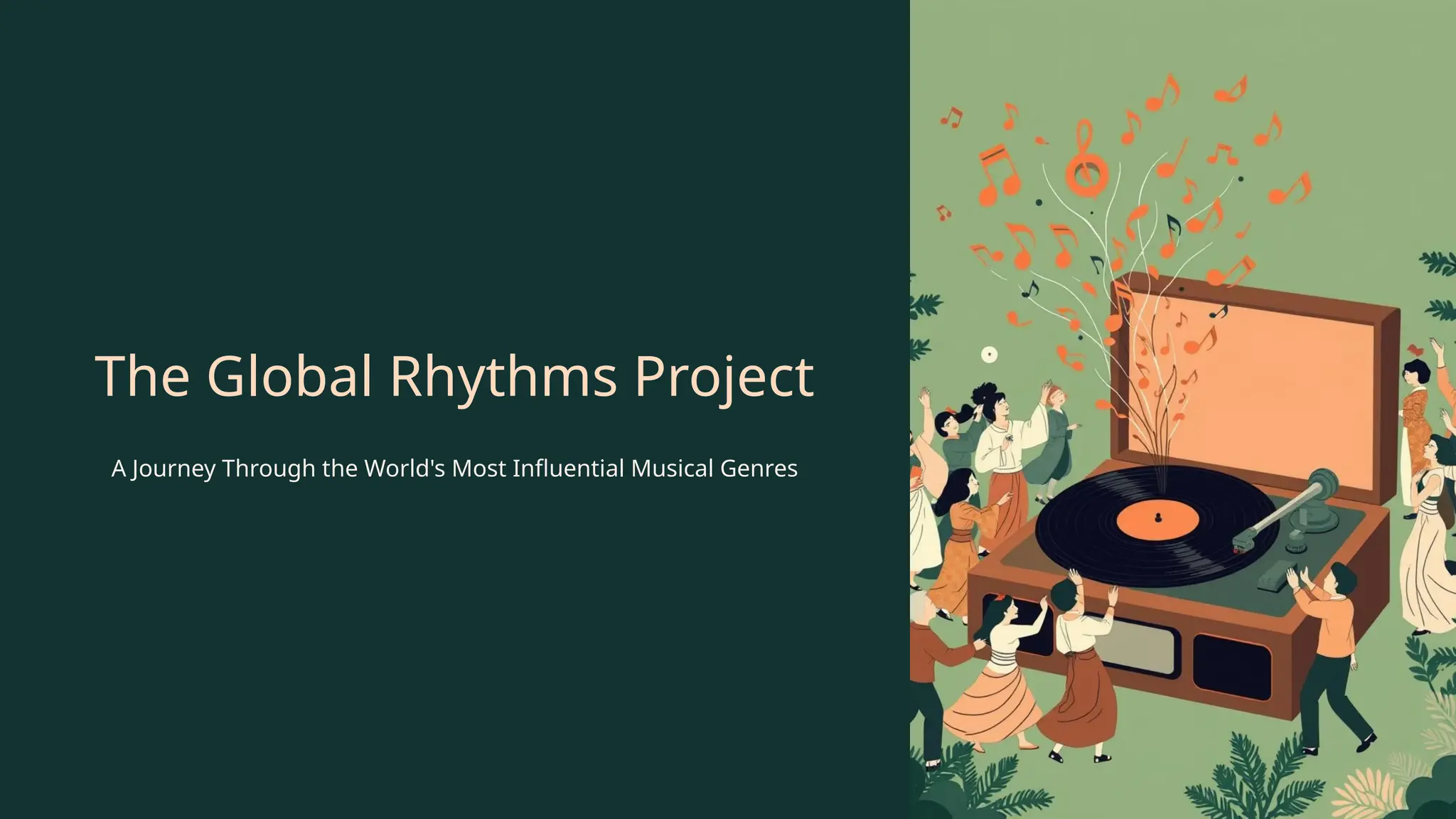
The Global RhythmsProject
A Journey Through the World's Most Influential Musical Genres
2.
Charting Our MusicalCourse
What We'll Explore
01
African Roots & Rhythms
Discovering the foundational sounds and traditions of
African music.
02
Latin American Fusion
Unpacking the vibrant blend of cultures in Latin American
genres.
03
The Evolution of Jazz
From Ragtime's syncopation to the improvisational spirit
of Bebop.
04
Popular Music's Impact
Tracing the rise of genres that shaped global soundscapes.
3.
Chapter 1: ThePulse of a Continent
African Music's Enduring Legacy
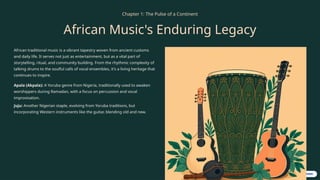
African traditional music is a vibrant tapestry woven from ancient customs
and daily life. It serves not just as entertainment, but as a vital part of
storytelling, ritual, and community building. From the rhythmic complexity of
talking drums to the soulful calls of vocal ensembles, it's a living heritage that
continues to inspire.
Apala (Akpala): A Yoruba genre from Nigeria, traditionally used to awaken
worshippers during Ramadan, with a focus on percussion and vocal
improvisation.
Juju: Another Nigerian staple, evolving from Yoruba traditions, but
incorporating Western instruments like the guitar, blending old and new.
4.
African Music's EnduringLegacy (Cont.)
Soul, Spirit, and a "Party"
Zouk
Hailing from the French
Caribbean islands of Guadeloupe
and Martinique, Zouk, meaning
"party" in Creole, emerged in the
1980s as a fast, carnival-like
rhythmic music, perfect for
dancing.
Blues & Soul
The Blues captures profound
human emotions – loss,
frustration, longing – through
expressive notes. Soul Music
(1950s-60s) fuses African-
American gospel, R&B, and jazz,
known for its catchy rhythms and
energetic audience participation.
Spirituals
These powerful Negro spirituals
were created by enslaved
Africans in America, providing an
outlet for their pain and anger,
blending African and American
musical and religious elements.
5.
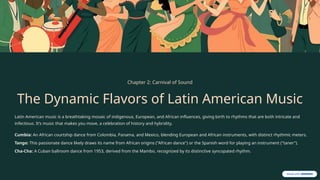
Chapter 2: Carnivalof Sound
The Dynamic Flavors of Latin American Music
Latin American music is a breathtaking mosaic of indigenous, European, and African influences, giving birth to rhythms that are both intricate and
infectious. It’s music that makes you move, a celebration of history and hybridity.
Cumbia: An African courtship dance from Colombia, Panama, and Mexico, blending European and African instruments, with distinct rhythmic meters.
Tango: This passionate dance likely draws its name from African origins ("African dance") or the Spanish word for playing an instrument ("taner").
Cha-Cha: A Cuban ballroom dance from 1953, derived from the Mambo, recognized by its distinctive syncopated rhythm.
6.
The Dynamic Flavorsof Latin American Music (Cont.)
Grooves that Define a Continent
Bossa Nova
Meaning "new trend" or "charming thing," Bossa Nova
integrates melody, harmony, and rhythm into a unique
swaying feel, often with a distinctive nasal vocal style.
Salsa
A social dance from the mid-1970s New York, with strong
Cuban and Puerto Rican roots, incorporating elements of
swing, hustle, and Afro-Cuban forms like Pachanga.
Rumba
Characterized by repetitive melodies and ostinato patterns,
driven by Cuban percussion like maracas and claves. Its jazz
elements influenced the Cha-Cha and Mambo.
Reggae
Originating in Jamaica in the mid-1960s, Reggae features
English lyrics interspersed with Creole expressions, known for
its distinctive off-beat rhythm and bass lines.
7.
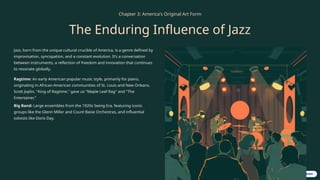
Chapter 3: America'sOriginal Art Form
The Enduring Influence of Jazz
Jazz, born from the unique cultural crucible of America, is a genre defined by
improvisation, syncopation, and a constant evolution. It’s a conversation
between instruments, a reflection of freedom and innovation that continues
to resonate globally.
Ragtime: An early American popular music style, primarily for piano,
originating in African-American communities of St. Louis and New Orleans.
Scott Joplin, "King of Ragtime," gave us "Maple Leaf Rag" and "The
Entertainer."
Big Band: Large ensembles from the 1920s Swing Era, featuring iconic
groups like the Glenn Miller and Count Basie Orchestras, and influential
soloists like Doris Day.
8.
The Enduring Influenceof Jazz (Cont.)
Innovation and Fusion
Bebop (Bop)
A modern jazz style characterized by its fast tempo,
complex harmonies, and intense, free-flowing
instrumental performances.
Jazz Rock
Also known as "jazz fusion," this style emerged in the
1960s and 70s, blending jazz elements with funk and
R&B rhythms.
9.
Chapter 4: TheSound of Generations
Tracing Popular Music's Evolution
Popular music is a mirror reflecting societal changes, youth culture, and technological advancements. From heartfelt
ballads to rebellious rock, it captures the zeitgeist, shaping trends and giving voice to each new generation.
Ballad: Expressive folksongs often narrating tales of love, characterized by a slow to moderate tempo and highly
singable melodies.
Rock and Roll: Hugely popular in the late 1940s-50s, this genre combined African-American forms (blues, jazz, gospel)
with Western swing and country music.
Disco Music: Danceable rock music that sparked the creation of public dancing venues, symbolizing a new era of social
expression.
Alternative Music: An independent, underground form from the 1980s that defied mainstream rock with its distinctive
distorted guitars and defiant attitude.
Rap: Originated as a form of rhythmic storytelling and poetry over musical beats, gaining global popularity through
artists like Francis Magalona ("King of Pinoy Rap").
10.
Key Takeaways &Next Steps
A Symphony of Global Influence
Interconnected
History
Music's evolution is a
testament to global exchange,
with genres continually
influencing and transforming
one another across continents
and cultures.
Cultural Reflection
Each genre serves as a
powerful mirror, reflecting the
unique societal contexts,
struggles, and triumphs of its
origin.
Your Musical Journey
Continue exploring! Dive
deeper into the artists and
histories that captivate you,
and let your curiosity guide
your next listen.