ROI based HEVC for
Aerial Videos
Ahmed Bin Athar
Sp13-BCS-012
Hamail Ayaz
Sp13-BCS-051
Supervisor:
Dr. Mubeen Ghafoor
Abbreviations
ROI Region of Interest
HEVC High efficiency video codecs
Introduction
• This project deals with the idea of ROI
• It deals with the extraction of ROI
• compress the imaging keeping in view the ROI based on HEVC
• HEVC is one of most modern and efficient compression
technique.
• Our project is where we combine the ROI principles with
HEVC.
Introduction
• Advantages of the Proposed System
• A better resolution in the identified Regions of Interest
• Low memory and bandwidth requirement
• Fast response from the system
• Imaging could provide a better analytical approach.
Scope & Limitations
• Acquiring aerial imaging
• Segment the imaging
• Tailored imaging would then be encoded using HEVC
• The encoded imaging would then be transmitted to a desktop via FTP for viewing
later.
 The project is limited :
• There would be a delay while applying the notion of ROI based HEVC on the
imaging.
 The project would also be limited onto the hardware
• If hardware of the device is not capable for high definition imaging
• Algorithm would not be abundant to develop the quality of imaging
Problem Statement
• System would be indulged in elucidating the problem of live
transmission of high definition aerial imaging
• HEVC keeping in play the preferred ROI.
• Postulating a high definition view of ROI
• Lessening down the size of imaging
• Lessening down the bandwidth requirement
Tools & Technologies
• CMAKE
• QMAKE
• MATLAB
• Spyder
• XCODE
• C,
• C++,
• OpenCV,
• Python
• Linux
Modules
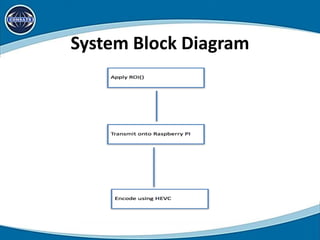
1. ROI Segmentation from aerial image
2. Encoding based on region of interest
3. Transmission of Imaging
4. Decoding of Imaging
System Block Diagram
Design Methodology
• Incremental Approach;
• modules will be broken down into small
modules
• each module will be tested, debugged
• This is important because the hardware has to
synchronize with the software
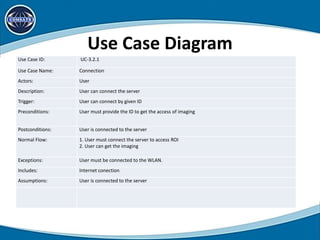
Use Case Diagram
Use Case ID: UC-3.2.1
Use Case Name: Connection
Actors: User
Description: User can connect the server
Trigger: User can connect by given ID
Preconditions: User must provide the ID to get the access of imaging
Postconditions: User is connected to the server
Normal Flow: 1. User must connect the server to access ROI
2. User can get the imaging
Exceptions: User must be connected to the WLAN.
Includes: Internet conection
Assumptions: User is connected to the server
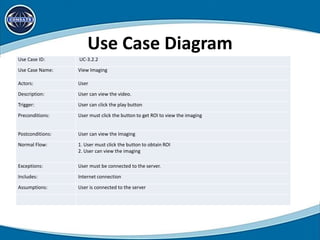
Use Case Diagram
Use Case ID: UC-3.2.2
Use Case Name: View Imaging
Actors: User
Description: User can view the video.
Trigger: User can click the play button
Preconditions: User must click the button to get ROI to view the imaging
Postconditions: User can view the Imaging
Normal Flow: 1. User must click the button to obtain ROI
2. User can view the imaging
Exceptions: User must be connected to the server.
Includes: Internet connection
Assumptions: User is connected to the server
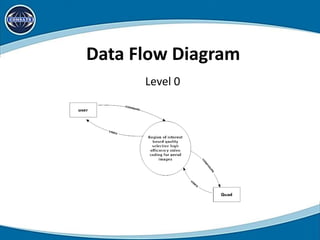
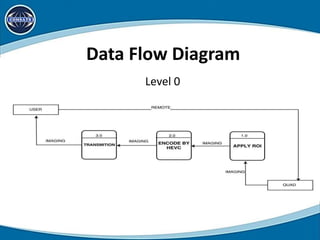
Data Flow Diagram
Level 0
Data Flow Diagram
Level 0
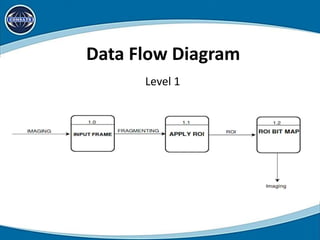
Data Flow Diagram
Level 1
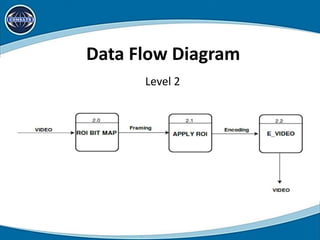
Data Flow Diagram
Level 2
Algorithm
• Algorithm for Receiving ROI
Begin:
Input Imaging
Select the ROI on the Imaging
Make BinaryMap
Send Imaging to HEVC
END
Algorithm
• Algorithm for Application of HEVC
Begin:
Receive Imaging from ROI
Read BinaryMap
Apply BinaryMap Based QP
Encode
Reconstruct
END
Conclusion
• In conclusion, it was a successful research,
• the algorithm that was created works on imaging efficiently.
• At this particular case the imaging is applied onto the static
road
• the result obtained were committed to the initial finding of
the algorithm.
Future Work
• For future work on the project,
• To create a system of video conferencing
• Where the face of the user would be region of interest
• the basis of network bandwidth availability quality selected
compression would be applied
• ROI always in a quality better than that of the rest of imaging.
References
– Intra Coding of the HEVC Standard (Research Paper by Jani Lainema,
Frank Bossen, Member, IEEE, Woo-Jin, Han, Member, IEEE, Junghye
Min, and Kemal Ugur)
– A Hybrid Scheme Based on Pipelining and Multitasking in Mobile
Application Processors for Advanced Video Coding (Research Paper by
Muhammad Asif,1 Imtiaz A. Taj,1 S. M. Ziauddin,2 Maaz Bin Ahmad,3
and M. Tahir1)
– Complexity scalability for real-time HEVC encoders (Research Paper by
Guilherme Correa, Pedro Assuncao, Luciano Agostini, Luis A. da Silva
Cruz at Springer-Verlag Berlin Heidelberg 2014)
– Trimble UX5 Aerial Imaging Solution (White Paper by Dr. P. Cosyn & R.
Miller)
– Simultaneous localization and mapping with the AR. Drone (Paper By
Nick Dijkshoorn Universiteit Van Amsterdam)
Question and Answers

FYP-Final-External

  • 1.
    ROI based HEVCfor Aerial Videos Ahmed Bin Athar Sp13-BCS-012 Hamail Ayaz Sp13-BCS-051 Supervisor: Dr. Mubeen Ghafoor
  • 2.
    Abbreviations ROI Region ofInterest HEVC High efficiency video codecs
  • 3.
    Introduction • This projectdeals with the idea of ROI • It deals with the extraction of ROI • compress the imaging keeping in view the ROI based on HEVC • HEVC is one of most modern and efficient compression technique. • Our project is where we combine the ROI principles with HEVC.
  • 4.
    Introduction • Advantages ofthe Proposed System • A better resolution in the identified Regions of Interest • Low memory and bandwidth requirement • Fast response from the system • Imaging could provide a better analytical approach.
  • 5.
    Scope & Limitations •Acquiring aerial imaging • Segment the imaging • Tailored imaging would then be encoded using HEVC • The encoded imaging would then be transmitted to a desktop via FTP for viewing later.  The project is limited : • There would be a delay while applying the notion of ROI based HEVC on the imaging.  The project would also be limited onto the hardware • If hardware of the device is not capable for high definition imaging • Algorithm would not be abundant to develop the quality of imaging
  • 6.
    Problem Statement • Systemwould be indulged in elucidating the problem of live transmission of high definition aerial imaging • HEVC keeping in play the preferred ROI. • Postulating a high definition view of ROI • Lessening down the size of imaging • Lessening down the bandwidth requirement
  • 7.
    Tools & Technologies •CMAKE • QMAKE • MATLAB • Spyder • XCODE • C, • C++, • OpenCV, • Python • Linux
  • 8.
    Modules 1. ROI Segmentationfrom aerial image 2. Encoding based on region of interest 3. Transmission of Imaging 4. Decoding of Imaging
  • 9.
  • 10.
    Design Methodology • IncrementalApproach; • modules will be broken down into small modules • each module will be tested, debugged • This is important because the hardware has to synchronize with the software
  • 11.
    Use Case Diagram UseCase ID: UC-3.2.1 Use Case Name: Connection Actors: User Description: User can connect the server Trigger: User can connect by given ID Preconditions: User must provide the ID to get the access of imaging Postconditions: User is connected to the server Normal Flow: 1. User must connect the server to access ROI 2. User can get the imaging Exceptions: User must be connected to the WLAN. Includes: Internet conection Assumptions: User is connected to the server
  • 12.
    Use Case Diagram UseCase ID: UC-3.2.2 Use Case Name: View Imaging Actors: User Description: User can view the video. Trigger: User can click the play button Preconditions: User must click the button to get ROI to view the imaging Postconditions: User can view the Imaging Normal Flow: 1. User must click the button to obtain ROI 2. User can view the imaging Exceptions: User must be connected to the server. Includes: Internet connection Assumptions: User is connected to the server
  • 13.
  • 14.
  • 15.
  • 16.
  • 17.
    Algorithm • Algorithm forReceiving ROI Begin: Input Imaging Select the ROI on the Imaging Make BinaryMap Send Imaging to HEVC END
  • 18.
    Algorithm • Algorithm forApplication of HEVC Begin: Receive Imaging from ROI Read BinaryMap Apply BinaryMap Based QP Encode Reconstruct END
  • 19.
    Conclusion • In conclusion,it was a successful research, • the algorithm that was created works on imaging efficiently. • At this particular case the imaging is applied onto the static road • the result obtained were committed to the initial finding of the algorithm.
  • 20.
    Future Work • Forfuture work on the project, • To create a system of video conferencing • Where the face of the user would be region of interest • the basis of network bandwidth availability quality selected compression would be applied • ROI always in a quality better than that of the rest of imaging.
  • 21.
    References – Intra Codingof the HEVC Standard (Research Paper by Jani Lainema, Frank Bossen, Member, IEEE, Woo-Jin, Han, Member, IEEE, Junghye Min, and Kemal Ugur) – A Hybrid Scheme Based on Pipelining and Multitasking in Mobile Application Processors for Advanced Video Coding (Research Paper by Muhammad Asif,1 Imtiaz A. Taj,1 S. M. Ziauddin,2 Maaz Bin Ahmad,3 and M. Tahir1) – Complexity scalability for real-time HEVC encoders (Research Paper by Guilherme Correa, Pedro Assuncao, Luciano Agostini, Luis A. da Silva Cruz at Springer-Verlag Berlin Heidelberg 2014) – Trimble UX5 Aerial Imaging Solution (White Paper by Dr. P. Cosyn & R. Miller) – Simultaneous localization and mapping with the AR. Drone (Paper By Nick Dijkshoorn Universiteit Van Amsterdam)
  • 22.