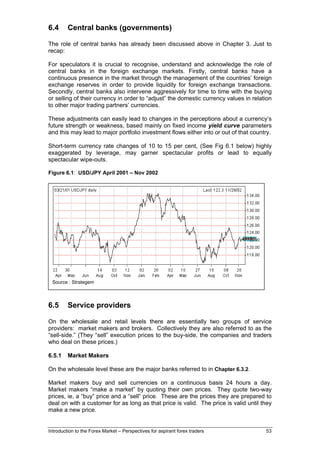
INTRODUCTION

     TO THE FOREX MARKET

             PERSPECTIVES FOR

     ASPIRANT FOREX TRADERS


                              by

                     Dirk du Toit

 www.forexmentorprogramme.com


       This promotional gift is sponsored by AskoBid MT4,
        where you can trade the BWILC strategy optimally:
  low leverage – same account hedging – per ticket execution,
small account capital – micro lot trading – account funding bonus

                         AskoBid MT4


                      © 2009 Dirk D du Toit
Preface


In the last several years tremendous changes have occurred in the forex market if
you are an online retail trader. These changes offer great new opportunities in this
dynamic and vibrant market, the largest in the world, provided you are properly
grounded in the basics.
Forex is now seen as an asset class in its own right. Hedge funds and other
investment managers are increasingly making use of the advantages offered by the
forex market in active short- and medium-term investments.
I’ve been involved in the forex business both as trader and as mentor for going on a
decade now. There is lots of money to be made, but there are also many pitfalls for
the unwary trader. I’ve seen most of the scams, the schemes, and the marketing
wizards promising overnight riches. More often than not new traders are taken in.
This happens early on in their career and it is sad because it means they never have
a fair shot at making a go of it. They crash and burn before they have a chance to
find their feet.
Although a thorough understanding of the forex market is not in itself enough to make
a success of trading as a business, it remains an indispensable and necessary
starting point. I am talking here of the very basics, the stuff that makes up the market,
the stuff that too many novice traders gloss over. Most of what is contained in this
ebook you can find by trawling the internet, perhaps not in any logical or ordered
form, but it is all there, in the public domain. It’s also what distinguishes it from my
book Bird Watching in Lion Country – Forex trading explained (BWILC). I believe this
is the sort of primer every aspirant trader should read, know, and understand, before
turning his hand to the more challenging issue of how to trade.
Let me elaborate on this for a minute because it’s an important point. This book
contains the nuts and bolts of what forex is, how the market works, and what the
essentials are that you need to know. It is these basics that many new traders don’t
master. I still get students, for example, who after years of trading are struggling
simply because they do not know how to calculate leverage properly. They don’t
know how to calculate leverage properly because they don’t really understand what
leverage is. Incredible as this may sound, it is true. Often they have been misled by
the marketing wizards who have subtly and skilfully misrepresented what leverage is.
But if you understand what this basic and vital concept is, and know how to calculate
it, you won’t have the wool pulled over your eyes.
And that got me thinking that a primer of this nature is indispensable for my
approach, the knowledge or attitude my mentoring is aiming to impart. That is the
process of owning your own brain. My reasoning is that before I can get students to
the point that they own their own brains, I need to set out what is a minimum
requirement for any trader to know before he can even think of trading. In other
words: I need to know that you know, and understand certain things, as a basic
minimum. Bird Watching in Lion Country – Forex Trading Explained is the next
step in this chain to trading success.
I believe this guide will be of crucial assistance to those of you who are just starting
out and don’t know your Greenback from your Sterling. It’s free, you’ve got nothing to
lose, except your money of course when one day you decide to make the step up to
live trading. And for those of you who are already trading, you may yet still find
nuggets of information and interest that could contribute to making you a better
trader.


Dirk du Toit
December 2009


Introduction to the Forex Market – Perspectives for aspirant forex traders             2
Introduction

The foreign exchange market plays a unique role within the universe of financial
markets. The foreign exchange market underpins all other financial markets.

Almost every country has its own domestic currency or monetary unit, used to make
and receive payment for goods and services within its own borders.

When engaging in cross-border transactions with entities or residents of other
countries, the parties usually trade in foreign currencies or foreign exchange. There
is an exchange of one currency (the local currency) for a foreign currency (the
domestic currency of the other party).

The foreign exchange market is essentially a global market where role players from
different countries and jurisdictions continually operate under a set of rules mostly
agreed upon by convention or market practice.

    The feature, which distinguishes foreign exchange from other financial
  instruments, is the fact that it involves cross-border financial transactions.


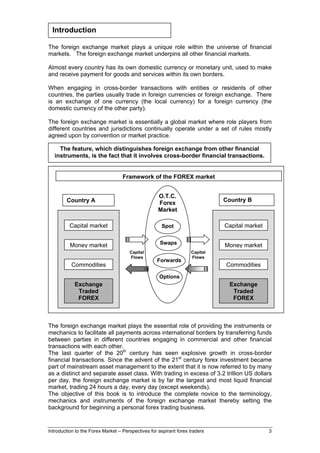
                                   Framework of the FOREX market


                                                    O.T.C.
        Country A                                                            Country B
                                                    Forex
                                                    Market

          Capital market                             Spot                    Capital market


          Money market                               Swaps                   Money market
                                      Capital                      Capital
                                      Flows                        Flows
                                                   Forwards
          Commodities                                                        Commodities
                                                    Options
            Exchange                                                          Exchange
             Traded                                                            Traded
             FOREX                                                             FOREX


The foreign exchange market plays the essential role of providing the instruments or
mechanics to facilitate all payments across international borders by transferring funds
between parties in different countries engaging in commercial and other financial
transactions with each other.
The last quarter of the 20th century has seen explosive growth in cross-border
financial transactions. Since the advent of the 21st century forex investment became
part of mainstream asset management to the extent that it is now referred to by many
as a distinct and separate asset class. With trading in excess of 3.2 trillion US dollars
per day, the foreign exchange market is by far the largest and most liquid financial
market, trading 24 hours a day, every day (except weekends).
The objective of this book is to introduce the complete novice to the terminology,
mechanics and instruments of the foreign exchange market thereby setting the
background for beginning a personal forex trading business.


Introduction to the Forex Market – Perspectives for aspirant forex traders                    3
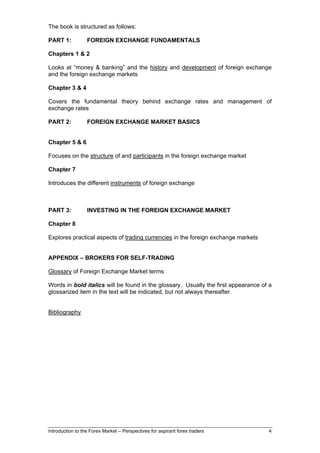
The book is structured as follows:

PART 1:           FOREIGN EXCHANGE FUNDAMENTALS

Chapters 1 & 2

Looks at “money & banking” and the history and development of foreign exchange
and the foreign exchange markets

Chapter 3 & 4

Covers the fundamental theory behind exchange rates and management of
exchange rates

PART 2:           FOREIGN EXCHANGE MARKET BASICS


Chapter 5 & 6

Focuses on the structure of and participants in the foreign exchange market

Chapter 7

Introduces the different instruments of foreign exchange


PART 3:           INVESTING IN THE FOREIGN EXCHANGE MARKET

Chapter 8

Explores practical aspects of trading currencies in the foreign exchange markets


APPENDIX – BROKERS FOR SELF-TRADING

Glossary of Foreign Exchange Market terms

Words in bold italics will be found in the glossary. Usually the first appearance of a
glossarized item in the text will be indicated, but not always thereafter.


Bibliography


Introduction to the Forex Market – Perspectives for aspirant forex traders          4
You may find the following Internet websites useful:


Bank for International Settlements           :         www.bis.org
International Monetary Fund                  :         www.imf.org
World Bank                                   :         www.worldbank.org
Dismal Scientist                             :         www.dismal.com
European Central Bank                        :         www.ecb.int
Federal Reserve Bank of New York             :         www.ny.frb.org
DayForex                                     :         www.dayforex.com
Dirk du Toit                                 :         www.dirkdutoit.com
                                             :         www.bird-watching-in-lion-country.com


Introduction to the Forex Market – Perspectives for aspirant forex traders                     5
Contents


Introduction

PART 1:           FOREIGN EXCHANGE FUNDAMENTALS

1.       Theory of Money & Banking

         1.1      What is “money”?
         1.2      Characteristics of money
         1.3      The money unit: price
         1.4      Fiddling with the price of money
         1.5      The problem with paper (fiat) money: inflation
         1.6      A quick look at banking and central banks
         1.7      Summary

2.       History of foreign exchange

         2.1      Earliest history
         2.2      Medieval times
         2.3      The New World
         2.4      The Gold Standard
         2.5      Early 20th century foreign exchange developments
         2.6      Floating exchange rates since 1973
         2.7      Most recent developments

3.       Managing foreign exchange rates

         3.1      What is Foreign Exchange?
         3.2      Role of the “exchange rate”
         3.3      Managing the Exchange Rate

4.       Fundamental factors governing exchange rates

         4.1      Purchasing Power Parity
         4.2      Interest Rate factors
         4.3      The Balance of Payments
         4.4      Overshooting Rates

PART 2: FOREIGN EXCHANGE MARKET BASICS

5.       The Structure of the forex market

         5.1      The foreign exchange market is not a formal “exchange”
         5.2      The size of the foreign exchange market
         5.3      The foreign exchange market day
         5.4      Foreign exchange classifications

6.       Participants in the foreign exchange market

         6.1      Exporters and importers
         6.2      Investors
         6.3      Speculators
         6.4      Central banks (governments)
         6.5      Service providers

Introduction to the Forex Market – Perspectives for aspirant forex traders   6
7.       The Spot Market

         7.1      The Spot Market


PART 3:           INVESTING IN THE FOREIGN EXCHANGE MARKET

8.       Investing in and trading foreign exchange

         8.1      Foreign Exchange – A new asset class
         8.2      Characteristics of forex investments: Margin
         8.3      Characteristics of forex investments: Leverage
         8.4      Analyzing foreign exchange price behaviour
         8.5      Risk in the foreign exchange market
         8.6      Forex investment “products”


Appendix 1: Currency Codes
Glossary
Bibliography


Introduction to the Forex Market – Perspectives for aspirant forex traders   7
PART 1

              FOREIGN EXCHANGE FUNDAMENTALS

CHAPTER 1:                 THEORY OF MONEY & BANKING

A treatise on foreign exchange cannot be undertaken without a concise discussion of
the substance so exchanged: money.

1.1      What is ‘money’?
Read this is background. It is useful and interesting. If you grasp that the forex
market is basically nothing more than a highly sophisticated mechanism to support
barter, you will have a new insight. Sometimes it helps to demystify things What
money is can only be understood in the terms of its use, what purpose it has.

Money arose from barter. People would meet at a market place and exchange the
products of their labour. A trader would ‘gain’ if he exchanged something he needed
less of for something he needed more of.

Soon, problems arose because of the inherent limitations of the barter system –
largely its robust inflexibility: a man who made quivers but who needed fish would, in
order to conclude a deal, have to find a fisherman who needed a quiver. In addition
there was the problem of indivisibility. What if your only asset was a house, but you
needed a camel? Breaking off pieces of the house would clearly not be a practical
solution. A further problem was that business could not act with any type of
exactness. For example, calculating profits would be all but impossible. Some sort of
facilitator was needed, a go-between if you like. And so, the inventiveness of the
market gave us…money, the lubricator of exchange.

It was in all likelihood not a quantum leap but a slow plod whereby the quiver maker
would find out what the fisherman needed, obtain that, and use it as a medium of
exchange. ‘That’ would often be a thing, say, like a bundle of dates, or a block of salt.
So one would start off with a commodity which became a commodity of exchange
which in turn became known as a medium of exchange. It became more
sophisticated as more people accepted its use, until eventually it could be termed
“money”.

All exchanged goods are now priced in monetary terms and not relative to all other
goods or in terms of all other goods. Businesses can easily calculate their profit or
loss. And it is ‘divisible’ – you can pay a lot for a valuable item, or a little for a trinket.

1.2      Characteristics of money
Through the centuries all sorts of commodities were used as money: salt, sugar,
cattle, iron hoes, tea, cowrie shells, fish and many others. Historically one of the
main characteristics of money was that the commodity had been in general demand.
People wanted it. Money should be highly divisible in order to facilitate the demand
for flexible and different sized goods to be exchanged. Money must also be portable
and scarce in order to have a high weight per unit (which in turn increases
portability). Money needed to be durable and keep its value in order that the holder
may be able to purchase goods with it long into the future.


Introduction to the Forex Market – Perspectives for aspirant forex traders                   8
Throughout the centuries and civilizations two commodities dominated the money hit
parade, namely gold and silver. At first, gold and silver were highly prized only for
their luster and ornamental value. They were always in great demand. Second, they
were always relatively scarce, and hence valuable per unit of weight. And for that
reason they were portable as well. They were also divisible, and could be sliced into
thin segments without losing their pro rata value. Finally, silver or gold were blended
with small amounts of alloy to harden them, and since they did not corrode, they
would last almost forever. 1

1.3       The money unit: price
Here is a good definition from Murray Rothbard, taken from his book, The Mystery of
Banking:

A price is simply the ratio of the two quantifies exchanged in any transaction. It
should be no surprise that every monetary unit we are now familiar with - the dollar,
pound, mark, franc, et al., began on the market simply as names for different units of
weight of gold or silver. Thus the “pound sterling” in Britain, was exactly that - one
pound of silver….

Since gold or silver exchanges by weight, the various national currency units, all
defined as particular weights of a precious metal, will be automatically fixed in terms
of each other. Thus, suppose that the dollar is defined as 1/20 of a gold ounce (as it
was in the nineteenth century in the United States), while the pound sterling is
defined as 1/4 of a gold ounce, and the French franc is established at 1/100 of a gold
ounce. But in that case, the exchange rates between the various currencies are
automatically fixed by their respective quantities of gold. If a dollar is 1/20 of a gold
ounce, and the pound is 1/4 of a gold ounce, then the pound will automatically
exchange for 5 dollars. And, in our example, the pound will exchange for 25 francs
and the dollar for 5 francs. The definitions of weight automatically set the exchange
rates between them. 2

1.4       Fiddling with the price of money
The last few years abound with examples of how governments and politicians
attempted to manipulate the price of their money. The Japanese central bank is
notorious for its intervention to keep the yen weak in order to maintain its exports’
profitability. The Chinese artificially maintained a peg to the US dollar even though
demand for Chinese goods and services and investment in China increased
exponentially over the last 10 years. With the rise of the euro during late 2004, a
chorus of politicians called for action by the European Central Bank (ECB) to halt the
rise in the value of the euro. Without sounding like a conspiracy theorist it may not
be too far-fetched to speculate that the US government is covertly busy with a
programme to allow the US dollar to fall in value in order to repay massive amounts
of debt at ever decreasing dollar values. Currency debasement - making your
currency less valuable - is not new. Murray Rothbard explains this with a theoretical
example:

How debasement profits the State can be seen from a hypothetical case: Say the rur,
the currency of the mythical kingdom of Ruritania, is worth 20 grams of gold. A new
king now ascends the throne, and, being chronically short of money, decides to take
the debasement route to the acquisition of wealth. He announces a mammoth call-in
of all the old gold coins of the realm, each now dirty with wear and with the picture of
the previous king stamped on its face. In return he will supply brand new coins with
his face stamped on them, and will return the same number of rurs paid in. Someone
presenting 100 rurs in old coins will receive 100 rurs in the new.
1
    Rothbard, Murray, N. The Mystery of Banking, Richarson & Snyder, 1983, p. 11
2
    Rothbard Murray, N. The Mystery of Banking, Richarson & Snyder, 1983, p. 11
Introduction to the Forex Market – Perspectives for aspirant forex traders             9
Seemingly a bargain! Except for a slight hitch: During the course of this recoinage,
the king changes the definition of the rur from 20 to 16 grams. He then pockets the
extra 20% of gold, minting the gold for his own use and pouring the coins into
circulation for his own expenses. In short, the number of grams of gold in the society
remains the same, but since people are now accustomed to use the name rather
than the weight in their money accounts and prices, the number of rurs will have
increased by 20%. The money supply in rurs, therefore, has gone up by 20%, and,
as we shall see later on, this will drive up prices in the economy in terms of rurs.
Debasement, then, is the arbitrary redefining and lightening of the currency so as to
add to the coffers of the State.

Rothbard gives some excellent examples and explains the theory and importance of
“money supply”. Don’t worry too much about formulas. Just try to grasp the basic
idea of money supply.

The pound sterling has diminished from 16 ounces of silver to its present fractional
state because of repeated debasements, or changes in definition, by the kings of
England. Similarly, rapid and extensive debasement was a striking feature of the
Middle Ages, in almost every country in Europe. Thus, in 1200, the French livre
tournois was defined as 98 grams of fine silver; by 1600 it equaled only 11 grams.

A particularly striking case is the dinar, the coin of the Saracens in Spain. The dinar,
when first coined at the end of the seventh century, consisted of 65 gold grains. The
Saracens, notably sound in monetary matters, kept the dinar’s weight relatively
constant, and as late as the middle of the twelfth century, it still equalled 60 grains. At
that point, the Christian kings conquered Spain, and by the early thirteenth century,
the dinar (now called maravedi) had been reduced to 14 grains of gold. Soon the
gold coin was too lightweight to circulate, and it was converted into a silver coin
weighing 26 grains of silver. But this, too, was debased further, and by the mid-
fifteenth century, the maravedi consisted of only 1.5 silver grains, and was
again too small to circulate.

Where is the total money supply - that crucial concept - in all this? First, before
debasement, when the regional or national currency unit simply stands for a certain
unit of weight of gold, the total money supply is the aggregate of all the monetary
gold in existence in that society, that is, all the gold ready to be used in exchange.
In practice, this means the total stock of gold coin and gold bullion available. Since all
property and therefore all money is owned by someone, this means that the total
money stock in the society at any given time is the aggregate, the sum total, of all
existing cash balances, or money stock, owned by each individual or group.
Thus, if there is a village of 10 people, A, B, C, etc., the total money stock in the
village will equal the sum of all cash balances held by each of the ten citizens. If we
wish to put this in mathematical terms, we can say that

                                               M=Σm

where M is the total stock or supply of money in any given area or in society as a
whole, m is the individual stock or cash balance owned by each individual, and Σ
means the sum or aggregate of each of the Ms.

After debasement, since the money unit is the name (dinar) rather than the actual
weight (specific number of gold grams], the number of dinars or pounds or maravedis
will increase, and thus increase the supply of money. M will be the sum of the
individual dinars held by each person, and will increase by the extent of the
debasement. As we will see later, this increased money supply will tend to raise
prices throughout the economy. 3

3
    Rothbard, Murray, N. The Mystery of Banking, Richarson & Snyder, 1983, p. 12ff
Introduction to the Forex Market – Perspectives for aspirant forex traders              10
1.5       The problem with paper (fiat) money: inflation
For a monarch with insatiable needs the invention of the printing press was like
taking the lid off a pot of bottomless gold. Rothbard again: In short, if the king could
become a legalized monopoly counterfeiter, and simply issue “gold coins” by printing
paper tickets with the same names on them, the king could inflate the money supply
indefinitely and pay for his unlimited needs 4.

Due to the debasement tactics described above societies became used to the idea of
calling some object a name that represents real money in the form of say one ounce
of gold. The next step would be to print a piece of paper and have everyone refer to
it and treat it the same as a unit of gold. Usually it was not that easy to get people to
accept paper as money and the government had to back it up with the real thing – a
promise to, on demand, exchange the paper (let’s say $10.00) for gold to the value of
$10.00. Once accepted however, the government can print money at will, but this
has consequences: inflation.

Rothbard explains:

Once the paper money becomes generally accepted, however, the government can
then inflate the money supply to finance its needs. If it prints $50 billion to spend on
pyramids, then it - the government - gets the new money first and spends it. The
pyramid contractors are the second to receive the new money. They will then spend
the $50 billion on construction equipment and hiring new workers; these in turn will
spend the money. In this way, the new $50 billion ripples out into the system, raising
demand curves and individual prices, and hence the level of prices, as it goes.

It should be clear that by printing new money to finance its deficits, the government
and the early receivers of the new money benefit at the expense of those who
receive the new money last or not at all: pensioners, fixed-income groups, or people
who live in areas remote from pyramid construction. The expansion of the money
supply has caused inflation; but, more than that, the essence of inflation is the
process by which a large and hidden tax is imposed on much of society for the
benefit of government and the early receivers of the new money. Inflationary
increases of the money supply are pernicious forms of tax because they are covert,
and few people are able to understand why prices are rising. Direct, overt taxation
raises hackles and can cause revolution; inflationary increases of the money supply
can fool the public - its victims - for centuries. 5

The vicious circle is closed when government eventually cuts the link with the
underlying store of value – gold. As long as they needed to consider the availability
of gold to back up the promises printed on pieces of paper they had to be careful
about the number of dollars they print. If the public loses trust in the paper money
and asked for their gold back, the government would have to reduce the number of
paper notes in circulation by physically destroying them until the number of paper
dollars and gold value were the same.

So the threat of gold redeemability imposes a constant check and limit on inflationary
issues of government paper. If the government can remove the threat, it can expand
and inflate without cease. And so it begins to emit propaganda, trying to persuade
the public not to use gold coins in their daily lives. Gold is “old-fashioned,” out-dated,
“a barbarous relic” in J. M. Keynes’s famous dictum, and something that only hicks
and hillbillies would wish to use as money. Sophisticates use paper. In this way, by
1933, very few Americans were actually using gold coin in their daily lives; gold was


4
    Rothbard p.37
5
    Rothbard p. 38
Introduction to the Forex Market – Perspectives for aspirant forex traders             11
virtually confined to Christmas presents for children. For that reason, the public was
ready to accept the confiscation of their gold by the Roosevelt administration in 1933
with barely a murmur. 6

During certain periods in US history paper dollars and gold or silver were
simultaneously used. Inevitably, the value of paper dollars was subject to inflation.
They may have started off as being $1.00 paper - $1.00 in gold but soon this
changed. The inflation was not in gold dollars, but only in paper dollars. This proved
that it was not speculators, or worker greed, or structural issues that caused inflation,
but rather the printing of paper money.

During a period of an international “dollar standard” and huge American trade and
budget deficits, as well as purported destabilisation by the Chinese of the
international financial system due to their long standing peg of the yuan to the US
dollar, the origins of paper money as described by Rothbard is instructive:

Printing was first invented in ancient China and so it is not surprising that government
paper money began there as well. It emerged from the government’s seeking a way
to avoid physically transporting gold collected in taxes from the provinces to the
capital at Peking. As a result, in the mid-eighth century, provincial governments
began to set up offices in the capital selling paper drafts which could be collected in
gold in the provincial capitals. In 811-812, the central government outlawed the
private firms involved in this business and established its own system of drafts on
provincial governments (called “flying money”).

The first government paper money in the Western world was issued in the British
American province of Massachusetts in 1690. Massachusetts was accustomed to
engaging in periodic plunder expeditions against prosperous French Quebec. The
successful plunderers would then return to Boston and sell their loot, paying off the
soldiers with the booty thus amassed. This time, however, the expedition was beaten
back decisively, and the soldiers returned to Boston in ill humor, grumbling for their
pay. Discontented soldiers are liable to become unruly, and so the Massachusetts
government looked around for a way to pay them off.

It tried to borrow 3 to 4 thousand pounds sterling from Boston merchants, but the
Massachusetts credit rating was evidently not the best. Consequently,
Massachusetts decided in December 1690 to print £7,000 in paper notes, and use
them to pay the soldiers. The government was shrewd enough to realize that it could
not simply print irredeemable paper, for no one would have accepted the money, and
its value would have dropped in relation to sterling. It therefore made a twofold
pledge when it issued the notes: It would redeem the notes in gold or silver out of tax
revenues in a few years, and that absolutely no further paper notes would be issued.
Characteristically, however, both parts of the pledge quickly went by the board: the
issue limit disappeared in a few months, and the bills continued unredeemed for
nearly forty years. As early as February 1691, the Massachusetts government
proclaimed that its issue had fallen “far short,” and so it proceeded to emit £40,000
more to repay all of its outstanding debt, again pledging falsely that this would be
the absolutely final note issue 7:

Why is inflation important in the world of a forex trading? Because inflation affects the
way banks, and central banks in particular, think about the economy. It may affect
their actions and inform their decisions to raise or reduce interest rates. When central
banks adjust interest rates, forex prices move, often significantly. Grasping the link
between these facts is a basic requirement for someone involved in the market.


6
    Rothbard p. 39
7
    Rothbard p.40
Introduction to the Forex Market – Perspectives for aspirant forex traders             12
1.6      A quick look at banking and Central banks
The major players in the foreign exchange market include the Central banks of
different countries and a small cohort of international banks, called the “Interbank”
market. We have looked at the reasons behind and the results of the issuance of
paper money. Today we are globally endowed in the industrial society with paper
money systems. Since 1971 the link between paper money and gold was broken
and today we don’t have a “gold standard”, ie, all money is not measured in terms of
gold unit value but a dollar standard where the pricing of money is dominated by the
value in dollar terms. Hence the dominant role of the central bank of the United
States, the Federal Reserve, in the foreign exchange and other financial markets and
the power of the Chairman of the Federal Reserve bank, Dr Alan Greenspan, who
retired last year (also known as “Dr Bubbles” by his many detractors).

All currencies are thus primarily valued against the US dollar, but with the US dollar
also being a fiat currency the economic ups and downs of the US, US interest rates,
US monetary policy, US inflation and in general US economic conditions became the
dominating factor in the world’s financial markets and especially so in the foreign
exchange market. Even while the gold standard existed the US dominated the scene
due to its primary role amongst the industrial economies. But when the dollar became
“money” in itself, backed by a promise to pay by the US central bank, the Federal
Reserve, a true paradigm shift occurred. The original law-enacted brief of the
Federal Reserve was not to preserve the value of the US dollar or to act as the
lender of last resort to the world’s central banks, but primarily to maintain price
stability.

To clearly understand how the main issues dominating forex market fundamentals,
namely the level of US interest rates, US deficits, and US economic and business
cycles come together, it is necessary to investigate the development of banking and
central banking.

Banking is not a simple concept, but for our purposes we can note the existence of
“loan banking” and “deposit banking” as the two primary forms of banking. Finally we
will look at the extremely important concept of fractional reserve banking in order to
understand how the forex market can, every day, turn over more money than the
total yearly economic activity of a majority of the world’s countries measured as gross
domestic product.

In a pure sense, the purpose of banks is to take the savings of the public and turn
that into productive investments through its on-lending to borrowers.

1.6.1    Loan banking

Loan banking is essentially the “pure” concept described above. The purest form
would be where the owners of money lend out their own money in order to earn an
interest on the money and make a profit. It however became customary that banks
would make use of the money of others by borrowing from money owners with
unproductive savings at a lower rate than what they lend to the customers in need of
financing.

In a simplified scenario the assets of a loan bank will consist of the cash invested by
the owners, their borrowings from investors and the IOU’s from clients. The liabilities
are the equity of the owners and the claims of the investors from which the bank
borrowed money.


Introduction to the Forex Market – Perspectives for aspirant forex traders          13
1.6.2     Deposit banking

Deposit banking is a completely different kettle of fish. It originated from the need of
gold bullion owners and gold coin bearers to have their gold stored in a safe place.
Deposit banks thus operated as safety deposit boxes do today. As with any
warehouse, on depositing the gold or gold coins the owner received a ticket or
warehouse receipt with which he could at any time, on demand, redeem his gold
bullion or gold coins. This is very important: on presenting the warehouse ticket the
goods (gold) is redeemable instantly, there and then. The money warehouse
charged a service fee to store the gold safely calculated on the time it had to perform
this service.

Originally, when gold held on deposit was used in transactions by the owner, he
would physically redeem some of his gold. This was cumbersome and after many
years some of the warehouses acquired a very good name and their warehouse
receipts became a proxy for the gold stored with them. In these cases, people began
to trade the warehouse receipts rather than the physical gold.

It is important to recognise that in the case of deposit banking the gold deposited for
warehousing does not become a part of the assets of the bank. Such deposits for
safekeeping are not a loan to the bank, because in the case of a loan interest is paid
on the loan by the bank to the lender and in this case it is the owner of the gold that
pays the bank to keep it safe.

Deposit banking was a useful concept and was used as early as the ancient Greeks
and Egyptians. It was also used in Syria and later well established in Europe and
Britain where rich merchants stored their gold in the Tower of London which was the
king’s mint. In 1638 things drastically changed when King Charles 1, in dire need of
money, simply confiscated a large amount of gold on deposit and called it a “loan”
(by the depositors to him). The depositors got their gold back after some time but
immediately forsook the king’s mint and started to warehouse their gold at trusted
goldsmiths. This act of misappropriation of the goods entrusted to a warehouse for
safekeeping is one of the dangers of safekeeping. The more common risk in
warehousing is that the safe keeper “borrows” the goods (money/gold) for
speculation purposes with the idea to return it after his successful speculation. The
temptation to embezzle increases enormously if the goods can be co-mingled, ie, it is
not a specific object that must be returned to the depositor, but rather a “class of
object”, like, grain, gold, or ideally, money.

In the deposit banking scenario a banker could safely assume that most of the
money on deposit, or rather gold, will not be exchanged (for other similar gold) and
thus he could safely print in addition to the original warehouse receipt for the gold,
further fake warehouse receipts, for a large percentage of the gold on deposit. The
warehouse receipts are then exchanged as a surrogate for gold.

The English goldsmiths discovered and fell prey to this temptation in a very short
time, in fact by the end of the Civil War. So eager were they to make profits in this
basically fraudulent enterprise, that they even offered to pay interest to depositors so
that they could then “lend out” the money. The “lending out,” however, was
duplicitous, since the depositors, possessing their warehouse receipts, were under
the impression that their money was safe in the goldsmiths’ vaults, and so
exchanged them as equivalent to gold. Thus, gold in the goldsmiths’ vaults was
covered by two or more receipts. 8

Early evidence of this deposit banking scam or fraud is found in China, in Venice and
in England and instead of clamping down on it, the law progressed to change the
nature of the deposits from “bailment” to “debt” - in English law. In 1848 there was a

8
    Rothbard p. 60
Introduction to the Forex Market – Perspectives for aspirant forex traders           14
landmark ruling in the House of Lords in terms of which the law was set that clearly
differentiated banks from warehouses, and instead of finding the banks guilty of
embezzlement they were given carte blanche to continue with this practice.

Money, when paid into a bank, ceases altogether to be the money of the principal; it
is then the money of the banker, who is bound to an equivalent by paying a similar
sum to that deposited with him when he is asked for it . . . . The money placed in the
custody of a banker is, to all intents and purposes, the money of the banker, to do
with it as he pleases; he is guilty of no breach of trust in employing it; he is not
answerable to the principal if he puts it into jeopardy, if he engages in a hazardous
speculation; he is not bound to keep it or deal with it as the property of his principal;
but he is, of course, answerable for the mount, because he has contracted ... 9

Also in US law ambiguous principles came to the fore whereby banking deposits
were afforded the status of debt albeit repayable on demand. This has blossomed
into full fractional reserve banking as we know it today as well as run-away inflation.

1.6.3     Fractional reserve banking

The money kept in a bank for immediate redemption is called its “reserves”. In the
fractional reserve banking scenario the first significant change from loan banking and
deposit banking is that any deposit becomes part of the banks assets and the
redemption due (on demand) a debt. As long as a deposit is made and only the
original receipt circulates in exchange transactions, it is called 100% reserve
banking.

This is best understood in terms of a deposit of gold. If, say $100,000 of gold is
deposited and a receipt is issued and the depositor then uses the receipt in
exchange for goods and services in the local economy, only the form of the money
changed. The money supply is exactly the same, hence there are no inflationary
pressures.

History has shown that it was an irresistible temptation for bankers to issue
warehouse receipts of higher value than the gold (money) on deposit and charge
interest on these receipts. In other words there are more warehouse receipts in
circulation than money in the bank.

In fractional reserve banking, if a deposit of R100 000 of gold is made and multiple
receipts to the value of, say R300 000 are issued, the money supply is increased with
the amount of the “credit” above the original gold deposit of R100 000, in this case
R200 000. Where does this R200 000 originate? Out of thin air. No difference
between counterfeiters printing fake notes and the bank creating fake receipts –
except in law. The one is prosecuted and jailed, the other may very well be hailed as
an entrepreneur.

The principles of fractional reserve banking are not changed by the fact that we don’t
have gold but government paper money (fiat money) backing the multiple receipts in
circulation. With fractional reserve banking, as is the case with counterfeiting, there
is an increase in money supply with an inflationary effect which ripples through the
economy as the money created out of thin air exchanges hands further from the
source – the bank. It is eventually the man on the street, furthest from the source,
who feels the inflationary bite.

In fractional reserve banking regimes there is, usually by law or by custom, a
minimum reserve level to be maintained by the banks.


9
    Rothbard p. 61
Introduction to the Forex Market – Perspectives for aspirant forex traders            15
1.6.4     Free banking (or banking in a free market)

Free banking is banking where anyone can engage in fractional reserve banking and
not be prosecuted. The opposite would be Central banking, or placing severe
limitations on free banks.

1.6.5     Central banking

The president of the Federal Reserve (US central bank) is often called most powerful
person in the world. The foreign-exchange market is dominated by the actions of
Central banks. As a case in point, take the day the European Central Bank made its
usual monthly overnight interest rate announcement during October 2005. Even
though there was no change in this rate, but a general expectation that the ECB
would be slightly hawkish in their tone given future expectations, the Euro, Swiss
franc and British pound strengthened almost 2 percent versus the US dollar when
these expectations were fulfilled even though the rate itself was not changed.

A central bank is where banks bank. Just as the public has cheque accounts at the
commercial banks, these banks have “cheque” accounts with the central bank. The
central bank is the only bank permitted by law to issue fiat money (the base money
which is multiplied in the fractional reserve system); thus when a client redeems his
claim at his bank, the bank must get the money from the central bank.

Rothbard on central banking:

Free banking, then, will inevitably be a regime of hard money and virtually no
inflation. In contrast, the essential purpose of central banking is to use government
privilege to remove the limitations placed by free banking on monetary and bank
credit inflation. The Central Bank is either government-owned and operated, or else
especially privileged by the central government. In any case, the Central Bank
receives from the government the monopoly privilege for issuing banknotes or cash,
while other, privately-owned commercial banks are only permitted to issue demand
liabilities in the form of checking deposits. In some cases, the government treasury
itself continues to issue paper money as well, but classically the Central Bank is
given the sole privilege of issuing paper money in the form of bank notes—Bank of
England notes, Federal Reserve Notes, and so forth.

If the client of a commercial bank wants to cash in his deposits for paper money, he
cannot then obtain notes from his own bank, for that bank is not permitted to issue
them. His bank would have to obtain the paper money from the Central Bank. The
bank could only obtain such Central Bank cash by buying it, that is, either by selling
the Central Bank various assets it agrees to buy, or by drawing down its own
checking account with the Central Bank. 10

The central bank also acts as the so-called “lender of last resort” in case a
commercial bank runs into trouble (the dreaded run on the bank if there is a loss of
confidence). In the fractional reserve system, with a cap on the extent of the
leverage, a sudden run on the bank’s fractional reserves can have a big impact on its
ability to maintain its customers’ confidence. An example:

If a commercial bank has reserves of 5:1, or 20%, ie it pyramids its reserves 5 times
and the value of the reserves is R100,000,000, the money in circulation
R500,000,000 and for some reason customers representing a value of 5% of its
money in circulation become nervous and withdraw money to deposit elsewhere the
withdrawal is 25% on the reserves and the bank is in “overdraft” on its fractional
reserve threshold of 20%. It only has R75,000,000 while the money in circulation still
equals R475,000,000. The fractional reserve ratio is not 5:1 but 6.33:1 or 15.8%.

10
     Rothbard p. 79
Introduction to the Forex Market – Perspectives for aspirant forex traders         16
When a central bank changes the fractional reserve, it can have a dramatic effect on
the total money supply due to a bank running at close to the maximum draw-down of
its reserve. If the reserve is lowered this has a levered effect on the money supply
and immediate inflationary consequences. If the central bank increases the fractional
reserve minimum too much it leads to decreased money supply and economic
contraction and even recession.

Due to the leveraged effects of changes in the reserves, it remains a contentious
issue in fractional reserve and central banking. Changes in the reserves are caused
by two factors: the demand for cash by the market (public) due to the economic
circumstances and the central bank policy. I will only look at some aspects of the
latter, namely loans to the commercial banks by the central bank.

1.6.6     Overnight central bank lending

Due to commercial banks’ practice to always stay at maximum leverage they tend to
fall short of the reserve requirements from time to time as described in a previous
paragraph. The central bank, as lender in last resort, and to maintain stability in the
financial system will thus lend money in the short term to commercial banks to stay
within the formal reserve requirements under all circumstances. In the United States
these loans are outright advances made against the collateral of US government
securities.

Central Banks generally insist that borrowing from themselves is a “privilege,” not a
right conferred upon commercial banks, and the Federal Reserve even maintains this
about members of the Federal Reserve System. In practice, however, Central Banks
try to serve as an ultimate “safety net” for banks, though they will not lend reserves
indiscriminately; rather, they will enforce patterns of behavior upon borrowing
banks. 11

In modern times these lending practices literally became overnight lending. In the
United States this overnight lending happens in the federal funds market. The rate at
which the Federal Reserve lends money to banks became the most important and
closely watched, analysed and talked about factor in the financial markets. The
foreign exchange market is no exception.

The overnight lending rate has a dramatic impact on foreign investment, especially of
short-term liquid capital and thus the buying or selling of the currency. This is a
major demand or supply factor in the short and medium term for any currency.
Relative overnight interest rates and differentials in these rates gave rise to a
common phenomenon in the foreign exchange market namely the “carry trade”. The
overnight lending rate determines to a large extent the rate at which commercial
banks will lend money to their customers, the so-called prime rate, being the best
rate at which they will be willing to make short-term loans.

If a global institution can borrow money cheaply in one country (or currency) and
exchange it for another currency where it can “park” the funds on deposit at a higher
rate paid on deposits than in the country it borrowed from due to interest rate
differentials, it can make risk free profits. Changes in the overnight lending rates to
banks in different countries thus have a serious leveraged effect on the profitability of
these transactions and institutions, and causes relatively large fluctuations in
currency values over the short term.

The legendary trending nature of currencies’ values is also largely due to these
changes in overnight lending rates and the resulting differentials in interest rates.
One of the reasons why the US dollar turned the tide, at least temporarily, against

11
     Rothbard p. 93
Introduction to the Forex Market – Perspectives for aspirant forex traders            17
most major currencies during 2005 was due to continued increases in the “federal
funds rate” since mid 2004. By September 2005 it increased the federal funds rate
on thirteen consecutive rate decision meetings with ¼ per cent per rate hike. By
December 2004 it turned “positive” against the euro.

Due to the serious economic decline and long term economic woes in Japan since
the early 1990’s, overnight lending rates were virtually kept at 0% for many years
while Japan also struggled under a deficient banking system where the reserve ratio
was very low in order to maintain enough liquidity and money supply in the
contracting and deflationary economy of the nineties and early part of this century.

The dominant role of short-term interest rate expectations is clearly described in this
extract from market commentary by Saxo Bank:

The prime means of tracking the market's expectations for future rate trajectories (a key for
pricing any currency pair) is through the short-term interest rate futures (STIR) market.
Studying a longer-term chart of the June 2006 future for Euribor and the EuroDollar 3-month
futures, one can see the evolution in the market’s thinking. Through much of 2004, the
June06 Euribor future assumed that the ECB would begin a hiking stance at some point and
on October 1, 2004, the assumption was that the ECB rate would rise from 2.00% to 3.00%
by June 2006. Meanwhile, the EuroDollar contracts priced in a Fed move from 1.75% at the
time to 3.50% by June2006 on Oct 1, 2004. This means there was a mere 50 basis points of
difference in expectations. Part of the reason, therefore, for the USD strengthening for the
balance of 2005 has been the diverging trajectory of expectations on rates. By October 1 of
this year, the market assumed that the ECB rate would only be 2.5% on June of next year
and the Fed rate will be 4.50% or higher - a 200 basis point and widening differential. (As
recently as late June of this year, the market was still actually pricing in slight odds that the
ECB might actually need to cut!)
The rate differentials in the real and expected European and US rates were a huge driver and
strong argument for buying the USD. The market was amazingly persistent in its thinking that
the economy would force the ECB to continue to reign in rates. But with the ECB's broadside
to European rate bears yesterday, the pendulum is now swinging the other way again, as the
market has a) underestimated the potential for ECB hikes and b) perhaps overestimated the
Fed's hiking potential and the robustness of global growth. So there may be a bit more room
for the USD to weaken - perhaps as high as 1.2500 - before the market finds a new
               12
"equilibrium".


1.6.7     Central bank open market operations

Central bank lending as a manner to influence the reserve levels of the banks in a
fractional reserve system through the overnight rate is but a small part of modern
central banking operations. Central banks can and do influence the reserve positions
in the country mainly through open market operations, ie, they participate in the free
market.

It works like this:

If the central bank wants to acquire an asset, say a car, it will go to the car dealer and
issue a cheque upon itself in exchange for the car. Let’s say the central bank’s total
reserves are R10 billion and the cost of the car to the central bank is R100 000. The
dealer who sold the car can’t cash the central bank’s cheque at the central bank but
must deposit it at a commercial bank. The commercial bank rushes it off to the
central bank because it increases its reserves at the central bank and it can create,
according to the money multiplier, new money to lend out and make more profits.
The money supply thus increased with R100 000 as the reserves did, plus the effect
of the further activity and multiplying of the reserves by creating money out of thin
air.


12
     Saxo Bank, Weekly Market Update, October 07, 2005
Introduction to the Forex Market – Perspectives for aspirant forex traders                    18
If the central bank engages in large-scale open market operations it will have a
dramatic impact on reserves, money supply and inflation, either through buying
assets or through selling assets. The US Federal Reserve engages in massive open
market buying and selling of US government treasuries (bonds) on the very large and
liquid bond market. Central banks also have to keep, for liquidity and other debt
management purposes, certain levels of foreign currency reserves. In many
instances the central banks purchase foreign government securities (bonds). Thus
the important link between interest rate instruments like government bonds and
foreign exchange. Huge amounts of foreign exchange transactions are due to these
purchases of government securities by different central banks.

The following extract explains the open market operations of the Bank of England:

The Bank's operations are conducted through a group of counterparties, which can
include banks, building societies and securities firms. Normally, two rounds of
operations are held at the official repo rate each day at 9.45 and 2.30. If these
operations are not sufficient to relieve the liquidity shortage there is an overnight
operation conducted at 3.30, and a late repo facility at 4.20 for settlement banks only,
once the money market is closed. Both overnight operations are conducted at a
higher rate than the official rate. Also at 3.30 the Bank makes available to its
counterparties a daily overnight deposit facility at a lower rate than the official rate.
These overnight rates set upper and lower bands to market rates, designed to allow
active trading but moderate undue volatility, which might complicate banks' liquidity
management and deter use of money markets by non-financial companies. 13

1.7       Summary

Of the banks described above the most important bank is the central bank. These are
the guys who move the markets. They are one of the big players in the forex world.
Forex trading is about money flows that affect price. It is dynamic and by seeing it in
its proper historical context you will better grasp where we find ourselves now as
regards the influence of these big institutions.

It should be clear how the development of money and banking had a major impact on
the foreign exchange markets which made global trade, global investment, global
finance and speculation possible as it became needed in a more globalised world.

The amount of money in circulation impacts directly on inflation. Interest rates are
used to manipulate the money supply in a country. Interest rate differentials between
different countries cause increased foreign exchange transactions for a variety of
reasons. All of this is possible due to the development of money from crude barter
instruments to grain, seashells, coins, banknotes and computer bytes.


13
     http://www.bankofengland.co.uk/markets/money/index.htm
Introduction to the Forex Market – Perspectives for aspirant forex traders            19
CHAPTER 2:                       HISTORY OF FOREIGN EXCHANGE

2.1          Earliest history
Foreign exchange history can be traced back to ancient Greece and the Roman
Empire where moneychangers were prominent in commercial centres. Their role
was to weigh coins and also to ascertain the fineness of coins with simple assaying
methods.

Provinces of the Roman Empire adjacent to foreign countries made use of coins from
across their borders with or without official exchange rates against the dinari. During
the 3rd century BC, the dinari became generally accepted as the denomination used
for formal business.

In Jerusalem, more than 2000 years ago, moneylenders and moneychangers
exchanged the Jewish shekel for Roman dinari, effectively setting the exchange rate
of the day.

2.2          Medieval times
During the Middle Ages money lending and money changing were in the hands of
prosperous families. Business activity centred in the bustling market place in the
town squares where moneychangers abounded. The English word “Bank” is derived
from the Italian “banco” – for “bench”. This referred to the moneychangers doing
business on the “benches” at the market.

During this period gold and silver coins circulated freely across Europe’s borders.
Foreign exchange traders provided exchange services to allay the fears unfamiliar
coins containing less precious metal than was claimed, produced.

International commercial banking began when rich Italian merchants of the late 13th
century established banking operations in several cities, such as the now famous
Lombard Street in London, referring to the Italian region Lombardy where they
originated. The principle instruments they dealt in were paper debits or credits.
These were issued in different currencies and then discounted based on what the
individual merchant perceived to be the currencies' relative values at any given time.

2.3          The New World
At the heart of international capital flows, during the period of colonization of the new
world, was a tendency by cash-rich European banks to incur high-risk loans to
support the expansion drives of the colonizing countries.

Banking centres developed in England (London), France (Paris), Germany (Berlin)
and also smaller centres in Italy, the Netherlands, Austria, Switzerland, etc. From
these centres European merchant banks moved capital in the form of bonds from
the established European countries and economies to the developing regions in
order to finance growth in the latter.

During the late 19th century (1850 – 1890) the first modern systematically traded
forward foreign exchange markets came into being in Vienna and Berlin with
forward trading in the Austrian currency, sterling and Russian rouble 14.


14
     Kettell, B. What drives currency markets? Financial Times, 2000, Prentice-Hall, p. 4.

Introduction to the Forex Market – Perspectives for aspirant forex traders                   20
Initially at least there was little practical need for foreign exchange trading, with the
exception of niche transactions. This was because despite the prevalence of paper
money, its value was fixed by the amount of silver or gold backing it, ie, the amount
which a government undertook to pay the bearer of the paper money. This value or
amount remained fairly constant, which made the likelihood of exchange-rate
fluctuations unlikely and therefore posed little risk to merchant's profits. As a result
foreign exchange trading played a very small role in the world of international
finance.

2.4      The Gold Standard
As international trade and finance became more voluminous and complex, countries
needed to adopt techniques to “manage” foreign exchange and the relative values of
currencies. During the late 19th century the so-called gold standard was introduced.

By 1870, according to the gold standard agreement, gold was the internationally
recognised sole medium of exchange and all currencies’ values were set in relation
to gold. This is also known as a fixed exchange rate regime.

Under the gold standard a currency’s value is defined in terms of a specific weight of
gold. If more countries, trading with each other set a gold standard, their exchange
rates relative to each other will be stable and there would be no foreign exchange
risk. The UK set its gold standard at £100 to be equal to 22 ounces of gold. The US
standard was set to $100 being equal to 4.5 ounces of gold.


 Example:

 The relative value of the currencies is determined by calculating the amount payable in
 each currency for a fixed amount (unit) of gold.

 In the above example £1 = $4.89 (22 oz / 4.5 oz). $4.89 can buy the same value of
 gold as £1.


Ideally, the gold standard would act as a mechanism to manage money supply and
foreign exchange risk. If ever a central bank or a Treasury printed "too many"
banknotes under a gold standard, the first thing that would happen would be that
those excess bank notes would be returned to the Treasury by individuals
demanding gold in exchange. Thus each country's domestic supply of money was
linked directly to its domestic reserves of gold.

Before the World Wars the gold standard worked very well. Exchange rate risk was
non-existent amongst industrialized countries.

The gold standard as an effective method of managing foreign exchange proved to
be problematic during times of international upheaval, such as the times of the World
Wars, when the creation of money by central banks to finance their countries’
participation in the wars, led to high inflation differentials between countries. Some
countries had to devalue their currencies and others had to revalue it in order to
adjust the relative value or buying power of their currencies.

The World Wars (WW I (1914-1918); WW II (1939 - 1945)) also led to the
introduction of foreign exchange controls, which in turn impacted on free trade and
other aspects of global finance and investment.


Introduction to the Forex Market – Perspectives for aspirant forex traders                 21
2.5      Early 20th Century foreign exchange developments
At the end of World War II all countries had introduced foreign exchange control
measures and international finance was in disarray. Central and Eastern Europe lay
in ruins and rebuilding (mainly funded by international investments) received high
priority on industrialized countries’ national agendas.

After World War II a new agreement was reached between the United States and the
UK to manage foreign exchange in a manner that would prevent the problems
caused by the gold standard during the rebuilding of Europe after World War I. It
was the so-called Bretton Woods agreement.

The Bretton Woods system differed from the gold exchange standard in three
important aspects:

•    Exchange rates were fixed and pegged, but the pegs were adjustable in order to
     avoid cycles of devaluation and revaluation.
•    Controls on international capital flows were explicitly allowed.
•    The International Monetary Fund (IMF) was founded to monitor the agreement. It
     was also charged with the responsibility to decide whether exchange rate pegs
     should be changed.

The IMF had the following objectives 15:

•    To establish stable exchange rates
•    To eliminate exchange control measures
•    To bring about convertibility of all currencies

The IMF could also assist countries in keeping rates stable by lending them gold or
foreign currencies to avert short-term problems and de- or revaluation.

The Bretton Woods agreement stated that each member of the IMF set a fixed rate of
its currency relative to either

•    either gold, or
•    the US dollar

Furthermore each member country would guarantee the chosen rate within (more or
less) 1 per cent. This would be managed by central bank operations.
Through many years, until the late 1960s and early 1970s, the gold exchange
standard served its purpose, but it was beset with the same problems as that of the
simple gold standard era’s problems. It could not adequately cope with crises of
devaluation / revaluation and inflation.

The Bretton Woods system eventually collapsed, and so did the efforts of
industrialized economies / countries, to manage foreign exchange with fixed rate
regimes. The collapse of the gold exchange standard quickly opened the doors for a
completely new dispensation – floating exchange rate regimes.

2.6      Floating exchange rates since 1973
The gold exchange standard came to an end because one of its pillars, the US dollar,
started to wobble as a result of the Vietnam war. Several measures were taken to
“rescue” the system by devaluing the dollar from $35 to $38 per ounce (gold),

15
  Taylor, F. Mastering Foreign Exchange & Currency Options – A Practitioner’s Guide to the Mechanics of the
Markets, 1997, Prentice-Hall, p. 3

Introduction to the Forex Market – Perspectives for aspirant forex traders                                    22
revaluing other major currencies against the dollar and setting the guaranteed
“deviation percentage” at 2.25 per cent. This was all in vain and the whole fixed rate
system collapsed when the major currency countries from Europe and also Japan
simply abandoned it during 1973.

A “floating exchange rate” simply means a currency is “free” to “float” against other
currencies, with price (ie, its price relative to another currency) being determined by
market forces of supply and demand, with limited intervention by monetary
authorities. Monetary policy will not primarily focus on the value of the currency but
will use other measures to influence the currency such as

•                Stabilising domestic prices
•                Stimulating economic growth
•                Combating inflation

Originally it was thought to be a short-term “measure” but after a number of years it
became evident that the global foreign exchange market would not easily return to
any fixed rate system. Currencies now float freely against each other, causing many
differences between currency values, and that in turn resulted in enormous growth in
currency trading. International trade, which also grew at an enormous rate, is now
susceptible to a new main risk factor, namely currency risk, which has to be
minimized.

Currently most countries operate under floating exchange rate regimes and by far
the largest percentage of international trade occurs between these countries.

Currencies have fluctuated quite rapidly and haphazardly relative to each other under
the floating rate system, and from time to time countries had to intervene through
central bank operations in order to influence their currencies if they were either totally
overvalued or undervalued relative to economic fundamentals.

2.7         Most recent developments

A number of factors, and particularly the floating rate system, has exponentially
increased the amount of cross-border trade and investment transactions. The growth
in traditional trade between countries has been comparatively much smaller than the
extraordinary increase in turnover witnessed since the global introduction of floating
exchange rates.

According to the Bank for International Settlements (BIS) the average daily
turnover in “traditional” foreign exchange instruments, including spot, outright
forwards and foreign exchange swaps, has been officially estimated at $1,880
billion in April 2004, compared with $590 billion in April 1989 16.

The foreign exchange market, like all other financial markets has also experienced
enormous growth in OTC (Over-the-counter) derivative instruments such as
currency swaps and currency options. The growth in these types of instruments
was again considerably higher than in the traditional instruments, but by 1997, at $97
billion a day, it was still only a fraction of overall daily turnover 17.

2.7.1       The Euro

The Treaty of Rome was ratified in 1958, establishing the European Economic
Community (EEC). It stated that a common market was to be established and
economic policies of the member states were to be harmonized, with a view to raise
16
     Kettell, Brian, What drives currency markets? Financial Times, 2000, Prentice-Hall, p 18.
17
     Kettell, Brian, What drives currency markets? Financial Times, 2000, Prentice-Hall, p 18.

Introduction to the Forex Market – Perspectives for aspirant forex traders                       23
the standard of living in an expansive and stable economy. Furthermore it aimed at
closer relations between the nations and sought to reconstruct Europe economically.
The tool to achieve this was economic integration. The means to achieve these
goals was the establishment of a common external tariff and commercial policy, the
removal of barriers to the free movement of goods, persons, services and capital, the
creation of common policy in key areas of the economy (agriculture and transport),
the coordination of economic and monetary policy, the "harmonization" of the laws of
the Member States to assist the common market, the creation of a European Social
Fund and a European Investment Bank to improve the employment opportunities and
facilitate expansion of the Community, and the association with overseas countries
and territories to increase trade.

In 1970, Luxembourg's Prime Minister, Pierre Werner, published a report on the need
for a complete monetary union among the European economies in which the idea of
a single European currency was raised.

In 1979 the European Monetary System (EMS) was developed. It gave national
currencies an upper and lower limit on either side of a central rate within which they
could fluctuate. This was known as the Exchange Rate Mechanism (ERM). This
move, in itself, stabilized the underlying European economies by creating
“predictable” trading zones.

In 1989 the Delors Report was published by Jacques Delors, President of the
European Commission. The report sped up the process of establishing the Euro. This
important report outlined a three-stage plan to implement a single European
currency.

•   The first stage began on July 1, 1990 and set the scene for further developments
    by removing restrictions on the free flow of capital between member states.
    Priorities were identified and a plan of action formulated.

•   The next stage began on January 1, 1994, by creating the European Monetary
    Institute (EMI). The EMI was tasked with a number of administrative and policy
    functions such as co-ordinating monetary policy and facilitating central bank co-
    operation. It also had to lay the foundation for the establishment of the European
    System of Central Banks with the ultimate goal of a single currency (the Euro)
    and a unified monetary policy.

•   With the establishment of an "irrevocably fixed exchange rate", stage three was
    introduced on January 1, 1999. All member states were now tied to this rate. The
    euro had been introduced as the official currency of these member countries, but
    it could not yet be used for cash transactions. It was however in use for non-cash
    inter bank transactions such as wire transfers or credit payments.

The European Central Bank (ECB) was established in 1998. Its principle function is
to make sure that the different European Central Banks carry out their functions, and
to implement the changeover required by the euro statutes. The ECB irrevocably
fixed the conversion rates for the euro of each member country. This conversion rate
was based on the existing national currency of each country so that the euro became
a "generic" expression of the previous value of each member country's currency.

On January 1, 1999, the euro was introduced as the official currency of the 12
participating members of the European Union. For the first time the euro could be
used for non-cash transactions, such as making electronic payments and other inter
bank transactions. Balances were generally shown in both the old national currency
as well as the corresponding euro value.

The euro currency was introduced on January 1, 2002 without any real problems as
“street” currency.
Introduction to the Forex Market – Perspectives for aspirant forex traders         24
2.7.2    The yuan

The yuan or Renminbi is the currency of the China. This ex-communist country is
rapidly moving towards a market economy and is developing into the economic
powerhouse of Asia and one of the three largest economies in the world. With huge
global investment in China with a population of more than a billion people (1/6th of the
world’s population) and extremely cheap labour costs, many US corporations
outsourced manufacturing services to China in the last decade of the previous
century. China, moving towards a capitalist regime, kept the value of its currency
pegged to the US dollar. The enormous capital inflows caused the Chinese central
bank to buy billions of dollars to maintain the peg between the yuan and the US
dollar. The effect was global economic imbalances due to the size and amount of
Chinese exports. The explosion in demand for Chinese goods together with acquiring
assets in the form of fixed direct investments was not offset by a revaluation of the
Chinese currency as should happen if properly based on supply and demand factors.

The Chinese banking system - which is under-developed - was offered as an excuse
by the regime as to why they were not prepared to adjust to a fully floating currency
driven by market forces. In July 2005 China took a first step towards floating its
currency. The peg with the US dollar was replaced with a managed floating band
against a basket of currencies and strict limitations on the daily movements of the
Chinese currency against the US dollar compared to a basket of other currencies.

2.8      Summary
If you had to stifle a yawn half-way through the above section, don’t be too worried.
Look, the basic issue here is that once again, if you don’t understand the history of a
foreign exchange and particularly the development of the forex market from gold to
fixed to a floating exchange, you are unlikely to understand, and therefore benefit
from the implications of say, the Chinese yuan and the effect it has on the dollar,
when some Chinese or American government official starts using words like,
“floating” or “pegged” or artificially pegged”. The market is interested in what is
happening in China, and therefore it is interested in what is happening to China’s
currency. It affects the US dollar, and the chances are good that you are involved as
a forex trader in a currency pair, one half of which is greenback. So you need to sit
up and take notice.

I make the point in BWILC that forex trading and soap operas have something in
common: relationships. What affects one character (or currency) has a ripple effect,
sometimes big, sometimes small. But nothing happens in isolation and the
interconnectedness of our modern world based on the advances of technology
makes for a forex soap opera that is dynamic.


Introduction to the Forex Market – Perspectives for aspirant forex traders           25
CHAPTER 3:                 MANAGING FOREIGN EXCHANGE RATES

3.1      What is foreign exchange?
“Foreign exchange” refers to money denominated in the currency of another nation or
group of nations. Any person who exchanges money denominated in his own
nation’s currency for money denominated in another nation’s currency acquires
foreign exchange. The size of the transaction is irrelevant. A person changing a few
dollars at JFK airport or cashing a traveller’s cheque at a Shop in Venice is involved
in a foreign exchange transaction just the same as a company who is changing
millions of rands in order to make an investment in another country. Similarly the
exchange does not have to be notes in order to qualify as foreign exchange. It holds
true for foreign currency denominated bank deposits or other short-term negotiable
financial instruments expressed in a foreign currency.

Foreign exchange can be cash, funds available on credit cards and debit cards,
traveller’s cheques, bank deposits, or other short-term claims if it is a short-term
negotiable financial claim denominated in a currency other than the “home” currency.

However, bank deposits of different national currency denominations are almost
always the method of exchange within the foreign exchange market. If a bank agrees
to sell, say euros, for dollars to another bank, then it will take place by the exchange
of a euro bank deposit for a dollar bank deposit.

   Definition:

   Almost every nation has its own national currency or monetary unit used to make and
   receive payments within its own borders. But foreign currencies are usually needed for
   payments across national borders. Thus, in any country whose residents conduct
   business abroad or engage in financial transactions with persons in other countries, there
   must be a mechanism for providing access to foreign currencies, so that payments can be
   made in a form acceptable to foreigners. In other words, there is need for “foreign
   exchange” transactions – exchanges of one currency for another.


3.2      Role of the “exchange rate”
The exchange rate is a price – it is the number of units of one currency that can be
bought by a number of units of another currency, and vice versa. In the spot market,
there is an exchange rate for every currency traded in that market. There are also the
so-called “composite” currencies, such as the International Monetary Fund’s “SDR”
(Special Drawing Right).

 Example:

 At time of writing some of the Dollar Euro exchange rate was:

 EUR/USD            1.3450            (One Euro buys 1.34 dollars)

         #


A “trade-weighted” or effective exchange rate is designed to show a currency’s
value against a weighted average of various other currencies. The weighting is
Introduction to the Forex Market – Perspectives for aspirant forex traders                 26
determined by using the different countries’ share in foreign trade with the country
under consideration as basis. There are also other exchange rates for delivery dates,
as quoted in the forward market. Therefore, while it is useful to talk about a
currency’s exchange rate in the market at a given time, this is something of a
misnomer. There is no such thing as a unique single exchange rate.

A currency’s market price is determined by supply and demand, by buyers and
sellers, that is, the market participants, whether individual or institutional. A currency
with an exchange rate that is fixed requires the support and intervention of its central
bank to keep the currency at the fixed rate. By contrast, a floating currency can
fluctuate in value, determined by the market participants buying or selling the
currency.

It stands to reason that the players in this market are a diverse group with different
needs and goals. Some may be engaged in commercial trading, others financial
speculation. Some may be financing deals requiring the purchase of a foreign
currency. They will often have different time frames with some participants buying
and selling on the same day, while others have a time horizon of months or even
years. But whatever their different and differing interests, these all determine the
price since it forms part of the aggregate supply and demand of the currency.

Because of these diverse interests, predicting future currency movements can be a
challenging business. But one thing is certain: currency prices in an open economy
play a very important role because of their influence on economic growth, consumer
prices, investment decisions, interest rates and ultimately, economic growth.


3.3       Managing the exchange rate
In Section 2.6 of Chapter 2, on the history of foreign exchange we looked at the
concept of the most prevalent exchange rate regimes, namely fixed or floating rates.
We also saw that since 1973, more and more floating rates have become the
standard amongst industrialized countries.

The exchange rate, being so vital to the economic fortunes of a country, is actively
managed or influenced with direct or indirect measures by central banks and/or
monetary officials (ministries of finance).

3.3.1     Exchange rate pegs

This means that a country decides to keep the value of its currency constant in terms
of another country’s currency, also called the “anchor currency”. The anchor
currency is usually that of an important and geographically close trading partner like
Germany and Austria (before the euro was introduced).

 Example:

 •      With the introduction of the euro all the participating European Union countries’
        currencies were pegged at specific levels.
 •      Denmark, though not part of the EU, has pegged its currency, the Danish krone
        (DKK) to the euro as it trades mostly with the EU countries.

 The implication of this is that the Danish krone will move against other crosses in unison
 with the euro. Ie, if the euro strengthens against the US dollar so will the Danish krone.


Introduction to the Forex Market – Perspectives for aspirant forex traders                    27
In a pegged regime, the pegging country should try to set a monetary policy that
always appears to be consistent with the pre-announced conversion rate. Therefore
the pegging country must manage its monetary policy in accordance with the anchor
currency in terms of broad money supply policy.

Finance experts and economists offer many reasons why simple unilateral currency
pegs are ineffective in a globalized financial environment and why they should rather
be replaced by some type of currency board arrangement.

A currency board 18 includes the fixing of the currency to an “anchor currency”,
complete convertibility (right to exchange domestic currency at the fixed rate when
desired) and, usually the passing of a law to show long-term commitment to the
semi-fixed exchange rate system.


     Example:

     Hong Kong has a currency board that pegs the Hong Kong dollar (HKD) to the USD.


3.3.2      Shortcomings of fixed-rate systems

All fixed-rates systems have the same problems. As long as people are free to move
  Example:
money in and out of a country, investors will sell the currency for other currencies,
just the stable, writing there is a considerablerates and therefore a risk free investment.#
  At as time of but offering higher interest interest rate differential between the United
     States where the overnight bank lending rate (Fed rate) y 1.25% and the overnight interest
     rate offered by the Bank of England, namely 3.75%.

     This causes a natural attraction to invest risk free in the country with the higher interest
     rate, which causes demand for that currency and an increase in its value (theoretically).


A fixed rate also creates a risk-free opportunity for investors to borrow in a foreign
currency that has lower interest rates than the domestic country / currency. This can
lead to severe financial crises.


     Example:

     If Country B has a one-year interest rate of 12% and its currency is pegged against Country
     D with a one-year interest rate of 8%, the following opportunity may arise:

     An investor in B can borrow at 8% in D and then exchange the foreign currency (at the
     pegged rate) for the domestic currency and invest it at a higher rate than the borrowed rate,
     say 10%. After one year he can again buy the foreign currency to repay the loan. He has
     banked the risk-free interest rate differential. In a floating rate system this wouldn’t be so
     easy because of the variations in the exchange rates during the year.

     The above may cause a crises if country B’s central bank can not provide the currency at
     the fixed rate if too many investors follow this risk free investment option. It may have to
     abandon the fixed rate, making borrowing more expensive to buy the foreign currency to
     repay the loans. This was the major cause of the currency crises in Asia during 1997 and
     the melt down of the so-called “tiger” economies.


18
  For more on currency boards, see Kettell, Brian, What drives currency markets? Financial Times, 2000, Prentice-
Hall, p. 183-216.

Introduction to the Forex Market – Perspectives for aspirant forex traders                                     28
3.3.3    Semi-fixed systems

These systems leave room for exchange rate variations and fluctuations according to
market forces, while the central banks actively seek to guide the market.

(i)      Bands

         Before adopting the euro, most EU countries adopted the European
         Exchange Rate Mechanism. According to this agreement the central banks
         would see to it that their respective currencies remained within a certain band
         against the German mark. If the currency reached the top or bottom of the
         band against the mark, the country’s central bank would adjust interest rates
         to keep the exchange rate within the band.

(ii)     Target zones

         It is similar to bands but any central bank may set a target zone where it
         wishes to see the currency trade against any other currency. It may or may
         not commit itself to keep the exchange rate within the target zone.

(iii)    Pegs and baskets

         In this case a country will peg its currency to a basket of other currencies,
         rather than only one. On July 21 2005, the People’s Republic of China, which
         is fast emerging as an economic powerhouse with more liberalised economic
         policies, un-pegged its currency, the yuan, from the US dollar in order to allow
         it to enter into a regime of a managed floating currency. It is now pegged
         against a basket of currencies including China’s main trading partners, Japan,
         Korea and Europe. The exchange rate can be managed by changing the
         relative weights of the different currencies within the basket if discrepancies
         arise between different crosses.

         Singapore and Turkey are examples of countries where their currencies are
         pegged against a basket of other currencies.

3.3.4    Floating exchange rate systems

In a floating rate system, the exchange rate is determined directly by market forces,
and can fluctuate as dictated by changing market conditions. The distinguishing
characteristic of a floating exchange rate system is that the price of a currency
adjusts automatically to whatever level is required to equate the supply and demand
for that currency, creating an equilibrium in the capital flows into and out of the
country as reflected in the balance of payments.

It is however incorrect to accept that exchange rates float completely freely.
Monetary authorities may try to influence the value of the currency in order to prevent
it from overshooting too far below or above its parity level in relation to other
currencies. Even though it may not be expressly stated, role players in the financial
markets may interpret policy statements as an attempt to influence currency
valuations.
  Example:

  At time of writing the Japanese economy is in the doldrums. The central bank is consistently
  trying to weaken the yen (JPY) with policy statements to the effect that a weaker yen would
  cause better export competitiveness and that would in turn stimulate the economy. A stronger
  yen would cause the exporters to be less competitive and that would cause the economy to
  perform even worse.


Introduction to the Forex Market – Perspectives for aspirant forex traders                29
One of the main effects of floating exchange rate systems is that market forces cause
large fluctuations if any national event causes many investors or traders to act in the
same way. This may cause the currency of that country to totally overshoot its
“equilibrium” level – which in itself is very subjective. In other words, the currency
becomes over or undervalued in the short-term.

Misvaluations may be caused by a number of factors, of which the following three
provide a general summary: 19

•       First its exchange rates with other currencies may not be moving towards
        covered interest parity suggesting that the markets expect a sharp rise or fall in
        the immediate future.

•       A long-term extremely large balance of payments deficit or surplus may indicate
        that the currency is far too high or too low relative to the currencies of major
        trading partners.

•       The third indication of misvaluation is when the before-tax prices of traded goods
        in one country are very different from the prices of another. The approach draws
        on the theory of purchasing power parity, which holds that a given amount of
        money should buy similar amounts of traded goods in different countries.


          Example:

          One well-known guide to purchasing power parity is the Big Mac index, which uses the
          cost of a hamburger in different countries, expressed in dollars, to estimate whether
          currencies are overvalued or undervalued relative to the US dollar.


3.3.5        Managing floating exchange rates

Changing economic policy

Under floating exchange rate regimes conditions may develop at times that prompt
the central bank or monetary officials to attempt to reset the imbalances with
appropriate actions. Fine-tuning or completely revising certain economic policies
often has the desired effect.

(i)          If a policy change causes a general expectation amongst investors that
             inflation will drop, the currency will under normal circumstances strengthen.
             Due to lower inflation, investors will receive a higher real return (after inflation)
             and that will improve the country’s attraction as a possible investment
             destination.

(ii)         If a central bank reduces short-term interest rates, while keeping inflation in
             check, the currency could be expected to weaken against its major trading
             partners if they maintain their interest rate levels at that time. This reduces the
             interest rate differential and also the prospects of potential investment flows to
             be gained from those differentials.


19
      Levinson, M. Guide to Financial Markets, Economist, 2002, p. 31.

Introduction to the Forex Market – Perspectives for aspirant forex traders                     30
Intervention

In many cases a central bank may want to alter exchange rates but without making
government economic policy changes. In these cases the desired effect can be
reached by changing the markets’ perceptions about the value of the exchange rate
or other economic variables.

In some cases a central bank uses covert intervention by either buying its own
currency with foreign exchange reserves or in some instances buying foreign
exchanges reserves in order to weaken the domestic currency.

In the long term a central bank can however not fight the market forces indefinitely,
due to its currency reserve constraints. Therefore, the timing of intervention, in order
to achieve the maximum psychological impact, is very important.

Concerted intervention by two or more central banks may have a much more lasting
effect.

One should not expect too much from official intervention, but intervention can be a
useful and effective tool in influencing exchange rates in the short term, especially
when these interventions are consistent with fundamental economic policies.

Undoubtedly, interventionist actions are more likely to succeed when there is a
consistency or alignment with fundamental economic policies. Such consistencies
are difficult to determine and furthermore, the market reaction to policy changes
might seriously hamper the realization of the desired effect of the policy change.
Although attitudes differ, monetary authorities in all of the major countries intervene
in the foreign exchange markets at times when they consider it useful or appropriate,
and they are likely to continue with this practice.

The current attitude toward foreign exchange market intervention is summarized in
the following excerpt from the June 1996 report of the finance ministers of the Group
of Seven Nations 20:

     CONTINUING CLOSE G7 COOPERATION IN EXCHANGE MARKETS

     Exchange rate misalignments can heighten uncertainty in the global economy and can be
     detrimental to growth and trade. When exchange rates appear to move out of line with
     underlying fundamentals, close monitoring is necessary and coordinated responses may be
     required.

     We should continue our close cooperation in exchange markets in this foundation, taking into
     account the fact that:

     •   A clear and consistent articulation of a common G7 view can have a stabilizing influence
         and help reinforce the credibility of our commitment to cooperate in the exchange market
         when circumstances warrant;
     •   Interventions can be effective in certain circumstances, especially when they reinforce
         changes in policies and/or underlying fundamentals that lead to changes in market
         expectations about future exchange rates;
     •   The instrument of intervention must be used judiciously, given its implications for
         monetary policy and the amount that the authorities can mobilize relative to the size of
         international capital markets. Nevertheless, these factors do not impede our joint ability
         to send a clear message to the markets, if and when appropriate;
     •   Interventions are more likely to be effective when they are concerted and reflect a
         common assessment;
     •   An important condition for success is the appropriate timing of intervention.


20
     Cross, Sam Y, The Foreign Exchange Market in the United States, Federal Reserve Bank, 1998, p. 117.

Introduction to the Forex Market – Perspectives for aspirant forex traders                                 31
Figure 2.2: ECB Intervention on 21 September 2000 to halt the slide in the EUR/USD value


 EUR/USD - Graphics : Metastock


This example (Figure 2.2) clearly illustrates one of the limitations of intervention. The
currency, after the initial boost provided by intervention, continues to weaken against
the dollar. Repeated interventions in the following months were required in order to
stabilise the euro against the dollar.

Soft intervention

Playing on market expectations, politicians or monetary officials may make
statements as to their thinking regarding their currency. The Japanese especially
make use of this type of managing of their currency and role players in the market
have learned to pay close attention to their rhetoric.

In market terms this is known as “jawboning”.


 Example: Soft intervention: Japan, November 26th 2002

 Japan's officialdom attempts to jawbone the yen lower after a sharp rise in the currency in
 Asian trading. Any further rise in the yen (USD/JPY fall) may be limited after Haruhiko
 Kuroda, Japan's vice finance minister of international affairs, said gains in the currency
 would worsen the country's efforts to reverse four years of deflation. The yen is up almost 2
 percent against the dollar in the past month. However, BOJ (Bank of Japan) Governor
 Masaru Hayami, seemed to disagree, saying it was important to avoid the devaluation of
                                                                            Source: Forex News
 the yen. Nonetheless, Minister of Finance Masajuro Shiokawa backed up Kuroda, saying a
 weak yen helps Japan's economic recovery.


Introduction to the Forex Market – Perspectives for aspirant forex traders                  32
3.4 Summary
Understanding the need for management of free floating currencies, and the steps
central banks and government officials can take to manage such currencies is a vital
piece of understanding in the armoury of the forex trader. The relationship between
central banks and the market is similar to a dance, with the market being the lead
partner. Banks will follow that lead, but occasionally, and for different reasons, they
may want to nudge their partner in a different direction. This must be carefully and
gently done, but most importantly, the market must not be surprised. Little clues,
pieces of information, are given, and whereas the banks can’t show their hand openly
– speculators will swoop in for the kill – and they need to keep the market on its toes
guessing, they try to indicate, within a broadish spectrum, where they want their
currency to be.
The lead partner, the market, will always win out in the end, the banks know this, and
so it is a temporary adjustment. Too often I have seen new traders ignore the signals
from central banks, or more often, not understand them. One of the themes running
through BWILC is that success in forex trading depends on understanding how the
big guys think, and then following their lead. You don’t want to be on the wrong side
of a central bank intervention. And yet this is what many traders do, either blithely
unaware of the danger, or they have never learnt dance sequence.


Introduction to the Forex Market – Perspectives for aspirant forex traders          33
CHAPTER 4:  FUNDAMENTAL FACTORS GOVERNING
EXCHANGE RATES

The aim of this chapter is to look at exchange rate economics in a simple and easily
understood manner so that it will be clear what the factors are that drive exchange
rate behaviour. It must also be remembered that factors that drive exchange rates in
the long-term may be overshadowed by other factors in the short-term. However, if
one has a good understanding of exchange rate economics, it will be easier to pick
up deviations of exchange rates from their long established path.

The exchange rate of a country is determined by the supply and demand for the
currency. There are various factors that influence this supply and demand. The
factors that will be discussed in this chapter are the demand for goods and their
prices, as well as the role interest rates play in determining the exchange rate.

4.1      Purchasing Power Parity
There are three concepts of Purchasing power parity (PPP) that are employed by
economists. On the most basic level, PPP states that identical goods should have
exactly the same price irrespective the location of those goods.

4.1.1    The Law of One Price

The ‘law of one price’ states that identical goods should have the same price in all
locations. For example, a Big Mac should cost the same in New York, London, Tokyo
and Johannesburg after adjusting for the exchange rate. If widgets cost less in
London than in Johannesburg, an enterprising individual will import widgets from
London to Johannesburg and sell them in Johannesburg for cheaper than the
domestic widgets. The demand for these cheaper imported widgets will increase,
pushing up the price of the London widgets until the price is equal in Johannesburg
and London.

However in practice the law of one price does not hold, due to the effects of tariffs,
transportation costs and labour costs.


4.1.2    Absolute Purchasing Power Parity

Instead of focusing on individual products, absolute PPP compares the price of a
basket of similar goods between two countries.

Absolute PPP is derived as a measure of an equilibrium exchange rate:

 Definition:

 Absolute PPP = (Exchange Rate) x (Domestic Price/Foreign Price)


The PPP is intuitively appealing. For example, suppose prices in the foreign country
rise by 10 per cent and remain constant in the US, each dollar still buys the same
basket of foreign goods, but those goods are now 10 per cent more expensive –
hence the dollar strengthens by 10 per cent.

4.1.3    Relative Purchasing Power Parity

While absolute PPP depends on the ratio of the level of prices in two countries,
relative PPP depends on the ratio of the growth rates of the prices in the two
countries. Hence, it is the rate of inflation that is critical here. Consequently, relative
Introduction to the Forex Market – Perspectives for aspirant forex traders              34
PPP requires that the exchange rate be only proportional to the ratio of the two price
indices.

4.1.4      Empirical Observations regarding PPP

•     PPP is a poor predictor of short-term exchange rate movements.
•     PPP tends to hold over the long term. However, evidence supporting the long
      term effectiveness of PPP as a predictor of exchange fluctuations is weak.

4.1.5      Reasons why PPP does not tend to hold

•     The measure of inflation varies across countries.
•     Transaction costs, import taxes and export subsidies prevent arbitrage from
      taking place.
•     Factors of production (ie labour and capital) are not completely mobile in the
      short term.

For exchange rate forecasting PPP is not a good measure of what will happen to the
exchange rate in the short run. What should be noticed from this is that price
movements play a role in exchange rate movements, but they are overshadowed by
other factors in the short run. These are factors such as capital flows due to political
risk as well as supply and demand pressures of goods and services and financial
assets.

4.2. Interest Rate Factors
4.2.1      The Fisher Effect

The nominal risk-free rate of interest in a country can be derived from the real
interest rate and the rate of expected inflation.

    Definition:

    Nominal Rate = Real Rate + Expected Inflation

The nominal rate is the rate that you see quoted in the financial press on risk-free
deposits. For example, the money market rate in the US is a nominal rate. As an
investor however, you are really only concerned with the real interest rate. In other
words: the return on your investment after adjusting for inflation.

The real interest rates will be equal across borders in an environment of capital
integration. In an integrated global capital market, with no capital controls, funds flow
relatively freely across borders – real interest rates are determined by the overall
global supply and demand of funds.

Countries with high relative real rates will see their currencies appreciate as foreign
investors sell their home currencies and buy the currency of the country with the
high real rate.

There are, however, a couple of reasons why real interest rate differentials may
still exist in the integrated market:

•     Tax rate differences between countries can force an after-tax real interest rate
      differential.
•     Currency risk: Investors may want to avoid currency risk and invest primarily in
      domestic securities.


Introduction to the Forex Market – Perspectives for aspirant forex traders            35
If a capital market is segmented, then the flow of funds in and out of the country is
controlled by the government or restricted in some other way. In this case, the local
supply and demand for funds determines the real interest rate within the country.

Again, interest rate differentials play a role in determining the exchange rate as
capital flows in or out of a country. As more capital flows to the country, the currency
will appreciate. However, the Fisher equation also only holds in the long run.
Although the interest rate plays a definite role, other factors like risk, news and
expectations may overshadow the day-to-day capital flows to and from a country.

In recent years the flow of capital in the global markets due to trade in financial
assets has come to the point where interest rates play a large role in determining
where capital will tend to go. These flows of capital determine the exchange rate in
the short run. However, capital is a coward and will hit the road at the slightest sign of
potential losses in the current location, or better prospects in another location. It is
therefore not surprising that exchange rates are volatile in response to new and
unexpected news as soon as it becomes available in the market.

4.3      The Balance of Payments

 Definition:

 The Balance of Payments (BoP) is the systematic account of all transactions in a given
 period (usually a year) between a country and the rest of the world.

 The BoP has different accounts that have different transactions in it. For exchange rate
 purposes the financial account and the current account is especially important.


4.3.1    The Current account

This is the account that holds all the transactions of imports and exports of goods
and services for the country, ie, the trade balance. For instance, when Japan exports
electronic equipment, retailers in the US must buy yen on the forex market to pay for
these products. There is thus an increase in the demand for yen, which will lead to an
appreciation of the yen versus the dollar. So if it is announced that Japan has a
surplus trade balance, it implies that Japan has exported more than it imported. This
in turn means that demand for yen must have risen since the previous period. This
increase in demand for yen should be reflected in an appreciation of the yen against
its trading partner’s currency.

   Example: United States

   The August FT-900 report on international trade revealed a trade deficit of $38.5 billion.
   Exports fell while imports gained, to increase the size of the deficit by $4.1 billion. This
   has been the result of years of importing more than exporting.


4.3.2    The Financial Account

This account holds the transaction for the flow of capital for portfolio and direct
investment purposes to and from a country. When an investor (for example a large
US investment bank) wants to buy Japanese government bonds for investment
purposes, they have to do this in yen. An increase in the demand for yen will thus be
experienced. When this transaction goes through, it will reflect on the financial
account. The opposite also holds. When a huge investment bank decides to sell
Japanese government bonds, it will increase the supply of yen in the market.
Introduction to the Forex Market – Perspectives for aspirant forex traders                        36
Therefore, a surplus on the financial account of a country will reflect an increase in
demand for a currency (implying an appreciation of the currency), while a deficit on
the financial account will imply an increase in supply of the currency (implying a
depreciation of the currency).


Summary

Trade that results in the flow of capital between countries will influence currency
prices. This trade can be in the form of the traditional goods and services, or in
financial instruments between major market players. The different accounts on the
balance of payments are used to record these transactions.


4.4      Overshooting Exchange Rates
We know that purchasing parity does not hold well in the short term under flexible
exchange rates. Exchange rates exhibit a lot more volatility than prices of goods and
services do. In the short term, following some disturbance to the current equilibrium,
prices will adjust slowly to the new equilibrium level, whereas exchange rates and
interest rates will adjust quickly. This difference in the speed of adjustments to
equilibrium allows for some interesting behaviour regarding exchange rates and
prices.

At times, it appears that the spot exchange rates move too much following some
economic disturbance. For example, country A has higher inflation than country B but
country A’s exchange rate still depreciates much more in the short term than it is
“supposed” to. Anomalies like these can be explained in the context of an
“overshooting” exchange rate model. In the short term, it sometimes happens that the
exchange rate of a country overshoots its long-term equilibrium when some
unexpected event happens.

Because of sticky prices for goods and services, and very flexible asset prices, the
exchange rate will sometimes overshoot its long-term equilibrium in the event of
unanticipated news, in order for the interest rate parity relationship to hold. However,
when prices eventually start to adjust, the exchange rate will adjust as well, and
move back to the long-term equilibrium.


 Example:

 Say the money supply in country A increases. This implies more money in the pockets of
 the people. There is now an increase in demand for everything. Financial markets adjust
 instantly to this exogenous shock, whereas goods markets adjust slowly (because of labour
 contracts, production outlays, competition, etc.) We further know that PPP does not hold in
 the short term, and that spot exchange rates are much more volatile than the forward rate.
 Also, for equilibrium in the money market, demand must equal supply. So if money supply
 increases, something must happen so that the money demand also increases.


Introduction to the Forex Market – Perspectives for aspirant forex traders                37
4.5      Summary

         Ok, there is quite a lot of stuff here with complicated sounding names, fancy
         acronyms and weird formulas. I want you to think of this information as
         following: forex trading is about making money and in order to make money
         the price has to move (change). The first, and most obvious enquiry for a
         forex trader to make would then be, well, what is it that makes prices change?
         And that is really all we are looking at here. The “what” of price change. This
         includes some detail of the nature (the “how”) of price change (the overshoot).
         But this is really all we mean when we talk about the fundamental factors
         governing exchange rates. It is an enquiry into what makes prices go up and
         down.

         So obsessed are some traders about the “when” part – when is the price
         going to change so that I can perfectly time my entry in the market – that they
         lose sight of these fundamental factors, or ignore them entirely. I am of the
         opinion that the more confident a trader is in his grasp of the fundamentals
         underlying exchange rates, the more seamless, and unconscious, the
         transition from what changes price, to when is the price going to change,
         becomes.

             The two are not disconnected or separate from each other, but they are
           distinct. Traders with an obsession with technical analysis (I use technical
           analysis, but only selectively and I discuss the logical unsuitability of many
            technical analysis tools in the forex market in BWILC) are often stunningly
            ignorant of market fundamentals. I think this is perilous. If all the available
         information is telling you that the price is likely to move in this rather than that
         direction (because of fundamental factors), even though you are uncertain as
          to when it will move, you’d be stupid to take an opposite position. Yet people
                                             do just that.


Introduction to the Forex Market – Perspectives for aspirant forex traders                 38
PART 2
              FOREIGN EXCHANGE MARKET BASICS

CHAPTER 5:                 THE STRUCTURE OF THE FOREX MARKET

5.1      The Forex “Market” is not a formal “exchange”

One should not confuse the usage of the term Forex “market” with an organised
exchange such as the JSE Securities Exchange or the London Stock Exchange or
the Chicago Board of Exchange.

A traditional exchange is located at one physical location and the rules of the
exchange are applicable to all stocks (or other financial instruments) listed on that
particular exchange.

Members of the exchange, usually “stockbrokers” arrange all the buying and selling
and do reporting to the exchange. The exchange oversees the settlement of
transactions, i.e. that the share certificates are delivered to the buyers and the money
delivered to the sellers.

The foreign exchange “market” does not have a similarly organized exchange.
Foreign exchange transactions are being done “over-the-counter” between two
parties and in essence this movement of 3.2 trillion dollars per day is based on trust
between participating parties.

To say the market is “over-the-counter” actually means it is “decentralized” consisting
of a multiplicity of closely co-operating “markets”. One very practical aspect of this
decentralized market is that currency prices at any given moment, vary from dealer to
dealer or bank to bank or dealing desk to dealing desk or market maker to market
maker. There is not one global “price” for any currency pair at any given moment in
time. However there are dominant price providers in the Interbank market, preventing
any serious price discrepancies.

If one monitors several dealing rooms simultaneously one would find several
different, but comparable prices. All dealing rooms have access to informational
price feeds. These are by definition historical prices, based on concluded deals,
which allow the dealing room to make its prices in close proximity to the informational
prices.

New entrants to the market must clearly distinguish between execution prices on
which trades can be done as provided by systems like the Reuters dealing system,
EBS and Bloomberg, versus informational prices provided by price and information
vendors such as Dow Jones Newswires, and providing historical prices (up to the
minute) provided by price vendors for analysis purposes.

Price vendors gather prices from different dealing rooms and then broadcast
averaged prices to give an indication of the latest “global” prices. Every market
maker or broker is however free to set the prices he wants and the “buyer” is free to
accept, reject or quibble about the prices.

In the foreign exchange market, between the two parties concluding a deal,
everything is negotiable to an extent:


Introduction to the Forex Market – Perspectives for aspirant forex traders           39
•   The currencies
       •   The prices of the currencies involved
       •   The amounts of currency
       •   The dates of delivery or maturity (settlement)
       •   The spreads
       •   Margin requirements
       •   Trading hours
       •   “Carry” or rollover costs and times


5.1.1      The Interbank Market

The foreign exchange market consists of the dealers in the dealing rooms of about
2000 major commercial and merchant banking institutions in the global financial
centers, trading with the banks customers and more often amongst each other.

The Interbank market participants are in close communication with each other
through modern telecommunication facilities and computer links. One of the main
functions of a much smaller group of about 200 of these banks is market making.

Foreign exchange trading is a global practice and takes place in the financial centers
of major cities such as Chicago, Frankfurt, Hong Kong, London, New York, Paris,
Tokyo and Zurich, to name a few. Essentially, trading takes place in the form of bank
deposits denominating major currencies.

Note that if a dealer in London is buying dollars, he is actually buying a dollar deposit
in a US bank (or a claim on a dollar deposit in a US bank). Therefore foreign
exchange transactions can be undertaken irrespective of the actual physical location
of the banks involved in that transaction.

5.1.2      “Standardization” or “regulation” in the foreign exchange market

Each country enforces its own foreign exchange controls or regime and applicable
laws, banking regulations, accounting rules, and payment and settlement systems.

Standardization was reached by convention over many year, between dealers,
brokers, bankers and other role players. Some of these conventions are:

       •   Rules regarding delivery of spot forex transactions
       •   Manner in which currency prices are quoted
       •   Telephone conduct (until very recently most transactions were done orally via
           dedicated telephonic links)

More formal self-regulation is attained by way of internationally adhered to Codes of
Conduct. The first such Code appeared in 1975 and was written by the Association
Cambiste Internationale (ACI) (Financial Markets Association).

The purpose of such globally accepted Codes of Conduct has been summarised by
the Federal Reserve Bank of New York: 21


21
     Dino Kos, Codes of Conduct: An overview, Federal Reserve Bank of New York, October 1995.
Introduction to the Forex Market – Perspectives for aspirant forex traders                      40
“Efficient markets permit buyers and sellers to complete transactions quickly, at low
     transaction cost, and with minimal effect on market prices. In mature markets, such as
     foreign exchange or many government securities markets, dealers stand ready to quote
     two-way prices to wholesale and retail clients, while money brokers intermediate between
     dealers themselves. Over time conventions develop about, for example quoting prices and
     the respective role of dealers and brokers. Moreover, markets and therefore conventions
     are constantly evolving, though not necessarily in lockstep. New financial products develop
     because of financial innovation. Advances in trading techniques allow participants to trade
     in new ways. International banks enter new geographic regions and are not always aware
     of local conventions. Moreover, even seemingly innocuous issues create potential
     uncertainties. The precise role that market participants play can get blurred sometimes.
     For example a bank may be acting as a principal in one transaction with a customer, but
     as an agent for the customer in a different transaction. That bank’s fiduciary
     responsibilities, depending on local laws, may differ dramatically in the two transactions.

     The uncertainties noted above, of which many more could be listed, potentially affect the
     efficiency of the market adversely. A written code of conduct that is carefully administered
     and maintained can be useful in reducing those uncertainties and helping to promote a
     robust and efficient market. It can contribute to that objective in three very important ways.

     •       First, a code may be useful in clarifying roles and responsibilities of dealers, brokers,
             and customers and in so doing allow the market to operate faster while reducing
             potential conflicts because of uncertainties about roles
     •       Second, the code is often part of a broader effort to promote a high level of ethical
             behaviour, professionalism and honest dealing.
     •       Third, a strong code of conduct may be an alternative to government regulation that
             could be overly burdensome and not conducive to healthy and efficient markets.”


The widely accepted ACI Code of Conduct addresses the following market conduct: 22

         •     Responsibility for dealing activities
         •     Dealing at non-current rates
         •     After-hours dealing
         •     Position Parking
         •     Stop-loss orders
         •     Dealing for personal account
         •     Taping
         •     Entertainment, gifts and gambling
         •     Abused substances
         •     Confidentiality
         •     Dealing procedures
         •     Firmness of quotation
         •     Concluding a deal
         •     Passing of names by brokers
         •     Name substitution or switching by brokers
         •     Payments / settlement instructions
         •     Monday Morning trading
         •     Confirmation procedures
         •     Fraud
         •     Money laundering
         •     Banking Holidays
         •     Terms and documentation
         •     Settlement of differences

22
  From ACI Code quoted by Taylor, F. Mastering Foreign Exchange & Currency Options, 1997, Prentice- Hall, p.
272.

Introduction to the Forex Market – Perspectives for aspirant forex traders                                     41
•   Commission / brokerage
       •   Market terminology

5.1.3      Foreign exchange is also traded on “organized” exchanges

On the ”organized exchanges” foreign exchange products traded are currency
futures and certain currency options.

Trading practices on the organized exchanges, and the regulatory arrangements
covering the exchanges, are markedly different from those in the OTC market. On
the exchanges, trading takes place publicly in a centralised location. Hours, trading
practices and other matters are regulated by the particular exchange; products are
standardized. There are margin payments, daily marking to market, and cash
settlements through a central clearing house. 23


5.2        The size of the foreign exchange market

It has already been established that the foreign exchange market is huge in
comparison with all other financial markets. According to the latest BIS survey
(2007) turnover increased since 2004 to 3.2 trillion dollars a day, and now probably
exceeds that. The size of the market is very important as it contributes towards
specific characteristics important for all participants, including investors.

Some resultant characteristics of the size of the market that really improves
conditions for role players are:

       •   Continuous and full liquidity.
       •   Around the clock trading
       •   Around the globe trading
       •   High efficiency
       •   Price stability

5.2.1      The global growth in forex trading

The growth in forex trading is the result of globalisation of the financial markets, the
formation of major trading blocks and the enormous growth in cross-border capital
flows as well as financial instrument innovation – specifically derivative instruments.

Turnover is equivalent to more than $200 in foreign exchange market transactions,
every business day of the year, for every man, woman and child on earth. 24

The Bank for International Settlements reports on FX market turnover and other
statistics every three years. While the turnover between 1998 and 2001 dropped
considerably from 1.5 trillion USD a day to 1.2 trillion USD there was a remarkable
increase of 60% from 2001 to 2004.

The daily turnover in April 2004 rose to 1.9 trillion USD in traditional foreign exchange
instruments. This is equivalent to:

       •   15 times the average daily turnover of global equity markets ($130 billion) 25
       •   40 times the average daily turnover of the NYSE ($46 billion) 26
       •   An annual turnover more than 10 times world GDP ($36 trillion) 27

23
     Cross, Sam, Y. The Foreign Exchange Market in the United States, Federal Reserve Bank, 1998, p. 21.
24
     Cross, Sam, Y. The Foreign Exchange Market in the United States, Federal Reserve Bank, 1998, p. 15.
25
     World Federation of Exchange 2003
26
     New York Stock Exchange 2004
Introduction to the Forex Market – Perspectives for aspirant forex traders                                 42
These numbers however were dwarfed by the 2007 numbers. $3.2 trillion per day.
Most of this increase was due to new participants in the financial sector.

Estimates by the Bank of Japan were that 10% of forex market turnover in Tokyo was
the result of individual online spot forex margin speculators.

5.2.2       London is the centre of the Forex Market

A great number of financial institutions are located in London because of its
dominance as the major trading centre in the world during the18th and 19th centuries.

London also has other advantages such as its time zone (it falls neatly between Asia
and the USA) and its proximity to euro currency markets and their attendant financial
institutions. This means that trading time in London catches both the end of the Asian
trading day and the beginning of the American trading day.

The largest amount of foreign exchange trading takes place in London, UK even
though the GBP is less widely traded than some other currencies. More dollars are
actually traded in London than in New York. However, most of these trades are
undertaken by non-UK owned companies situated in London, with US institutions
owning the lion’s share.

Table 5.4 below shows that 56% of all foreign exchange trading takes place in 3 time
zones: East-Asia, Europe and the Western hemisphere.


Table 5.4: Global distribution of forex volume, including spot, forwards and swaps 28

             Forex centre                 Rank           Average daily           Percentage   of
                                                         turnover                daily volume
             United Kingdom               #1             504 billion             31.1 %
             United States                #2             254 billion             15.7%
             Japan                        #3             147 billion             9.1%
             Singapore                    #4             101 billion             6.2%
             Germany                      #5             88 billion              5.4%
             Switzerland                  #6             71 billion              4.4%
             Hong Kong                    #7             67 billion              4.1 %
             Australia                    #8             52 billion              3.2%
             France                       #9             48 billion              3.0%
             Canada                       # 10           42 billion              2.6%


5.3         The foreign exchange market day

The foreign exchange market follows the sun around the earth. The foreign
Exchange “week” begins according to the ACI Code of Conduct at 05:00 Sydney time
on Monday mornings.

The foreign exchange trading day almost never ceases except for short periods over
weekends. At any given time, someone, somewhere, is buying and selling
currencies. As one market closes, another market opens, business hours overlap,
and the exchange continues as day becomes night and night becomes day.


27
     World Bank 2003
28
     Source : BIS, Quoted by Levinson, M. Guide to Financial Markets, The Economist, 2002, Profile Books, p. 20.

Introduction to the Forex Market – Perspectives for aspirant forex traders                                         43
The twenty-four-hours-a-day characteristic of the foreign exchange market has major
implications for participants in the market, both with regards to physical delivery and
settlement of transactions as well as the dynamics regarding short-term price
behaviour. This is particularly relevant for the new breed of electronic intra-day
traders who have mushroomed in numbers due to Internet-based retail foreign
exchange trading.

It should be noted however that the portion of exchange-traded foreign exchange
instruments, such as foreign exchange futures and options adhere to the traditional
exchange trading hours.

A typical trading day will start in New Zealand and Sydney, Australia, followed by
Tokyo, Hong Kong and Singapore. These markets will be into their stride when
trading begins in parts of the Middle East. As Tokyo begins to wind down, the
European markets open for the day. The late European afternoon sees the start of
business in New York, and as the USA day reaches its end it is time for the Western
Pacific countries to open their doors once again.

Table 5.5: The 24-hour trading day

The implications for short-term speculators in the foreign exchange market are that
they actually have three “trading days” in each 24-hour day. There is roughly a “day”
each for the Asian time zone, European time zone and American time zone. Unlike
in other markets, currency traders do not have 16 hours to contemplate their next
move or the advantages of herd-like behaviour at the opening bell of a market.

The global nature of this market, its interconnectedness, means that events in
different time zones can have a universal impact. While institutions have the capacity
to keep a 24 hour-watch, day traders cannot do so continuously and need to be
aware of the possibility of sharp market movements during their off hours. Generally
the markets tend to make their biggest moves during the Europe/New York overlap
                                                                                 with
JHB Time         London Time     New York time     Action
Monday 01:00 Monday 00:00 Sunday 19:00             Trading starts in Tokyo
                                                                                   Ne
Monday 03:00 Monday 02:00 Sunday 21:00             Hong Kong, Singapore open        w
Monday 08:00 Monday 07:00 Monday 02:00             Trading starts in Europe       Yor
Monday 09:00 Monday 08:00 Monday 03:00             Tokyo closes                      k
Monday 09:00 Monday 08:00 Monday 03:00             London opens                   usu
Monday 10:00 Monday 09:00 Monday 04:00             Hong Kong closes               ally
Monday 14:00 Monday 13:00 Monday 08:00             New York opens                 mor
Monday 17:00 Monday 16:00 Monday 11:00             San Francisco opens               e
Monday 19:00 Monday 18:00 Monday 13:00             Europe, London closes          acti
Monday 22:00 Monday 21:00 Monday 16:00             New York closes                 ve
Tuesday 01:00 Tuesday 00:00 Monday 19:00           San Francisco closes             in
Tuesday 01:00 Tuesday 00:00 Monday 19:00           Trading starts in Tokyo        the
morning than afternoon. There are no hard rules but market moves during these
times tend to be more significant than moves that occur during traditionally more
inactive periods, and traders respond accordingly.

The differences between currency futures trading and trading forex on the spot
market become apparent when one considers that almost all currency futures are
traded in two places: either the Chicago Mercantile Exchange or the Brazilian
exchange in Sao Paulo. The European Union trades no futures while Japan offers
only a few contracts. Those exchanges that do offer currency futures trading limit it to
either the local currency, or dollar, euro or yen. Forward contracts and swaps have
become more popular than currency futures, further adding to the decline in volume
of this form of currency trading.


Introduction to the Forex Market – Perspectives for aspirant forex traders           44
5.4         Foreign exchange classifications
5.4.1       The US dollar (USD)

The US dollar is the most widely traded currency. The US dollar (USD) has
accounted for 40 – 45 per cent of all spot forex trading since the first comprehensive
surveys in 1989. Recently the most popular currency trade became the exchange
between USD and euro (EUR), accounting for 30 per cent of currency market activity
and in the second place with 20 per cent of activity the USD / Japanese yen (JPY).
In derivatives trading the US dollar is even more dominant. In 2001 28 per cent of all
over-the-counter currency derivatives involved the USD/JPY and 26 per cent the
EUR/USD.

In part, the widespread use of the dollar reflects its substantial international role as: 29

•      “Investment” currency in many capital markets,
•      “Reserve” currency in many international commodity markets,
•      “Invoice” currency in many contracts, and
•      “Intervention” currency employed by monetary authorities in market operations to
       influence their own exchange rates

In addition the widespread trading of the dollar reflects its use as a “vehicle” currency
in foreign exchange transactions, a use that reinforces and is reinforced by its
international role in trade and finance. For most cross-currency pairs, the market
practice is to trade each of the two currencies against a common third currency as a
vehicle rather than to trade the two currencies directly against each other. 30

Table 5.6: Most widely traded currencies (April 2004) 31


            Source: Bank for International Settlements (BIS) 2004

Participants in the foreign exchange market should take note of these figures as the
liquidity of a currency may have a drastic impact on the price quoted at any specific
time. Less liquid currencies tend to be more erratic in their price fluctuations and the
cost of trading is also higher as brokers and market makers compensate for the lack
of liquidity with wider spreads.

5.4.2       Major currencies

Major currencies can be defined as currencies freely available in the spot and
derivatives (forward) markets.


29
     Cross, Sam, Y. The Foreign Exchange Market in the United States, Federal Reserve Bank, 1998.

30
     Source : BIS, Quoted from Levinson, M. Guide to Financial Markets, The Economist, 2002, Profile Books, p.21.
31
     Source : BIS, 2004 report.

Introduction to the Forex Market – Perspectives for aspirant forex traders                                          45
The top five major currencies are very liquid, even in large volumes in both the spot
and forward markets.

The top five majors are:

    •    US dollar
    •    Japanese yen
    •    Euro
    •    British pound
    •    Swiss frank

Other majors:

    •    Canadian dollar
    •    Australian dollar

5.4.3    Minor currencies

Minor currencies are freely available, although the spot market may from time to time
lack liquidity. Restrictions can be applicable in the forward market in terms of
maturity, ie, not more than six months.

Although the forex market is extremely liquid, volumes in excess of around USD 50
million, may be difficult to trade at once. In the forward market the maturity periods
may be limited or the transaction may be very expensive.

In certain instances the subjective distinction between “major” and minor currencies
may be blurred.

Well-known “minors”:

    •    Irish punt
    •    Singapore dollar
    •    New Zealand dollar
    •    Norwegian kroner
    •    Swedish kroner
    •    Danish kroner
    •    Indian rupee
    •    Greek drachma

5.4.4    Exotic currencies

Spot market rates are available, but may be restricted with regard to transaction
amount or government intervention.     The forward market could be lacking,
intermittent or very expensive.

The “exotics” include mostly some East Asian and Far East, but also African
currencies:

    •    Indonesian rupiah
    •    Thai baht
    •    Hong Kong dollar
    •    Malaysian ringgit
    •    Philippine peso


Introduction to the Forex Market – Perspectives for aspirant forex traders         46
5.4.5       Emerging market currencies

Technically they fall under “exotics” but they include currencies from the old “Eastern
Block”, South America and the South African rand.

Some emerging market currencies:

       •    Polish zloty
       •    Russian rouble
       •    Hungarian forint
       •    Argentine peso
       •    Brazilian real
       •    South African rand

It is important to note that emerging markets are lumped together from an institutional
investor’s point of view and any occurrence affecting one emerging market currency
may spread like wild fire through all emerging market currencies.

Investors or traders in emerging market currencies must therefore always keep a tab
on generic developments in other emerging markets.

5.4.6       Currency Baskets

Currency baskets are used as part of the analysis of the performance of one specific
currency in relation to several others. For this purpose analysts make use of the
trade-weighted exchange rate. The trade-weighted or effective exchange rate of a
currency is an index including a currency’s performance against a “basket “ of
currencies containing all the major trading partners of the analysed currency.

The most prominent recent example of how currency baskets are utilized was with
the announcement of the revaluation of the Chinese yuan (renminbi). The
revaluation would allow the yuan to fluctuate within a price band of a basket of
currencies. The basket comprised the largest Chinese trade partners, namely the
USA, Euro-zone, Japan and Korea.

Currency baskets clarify two basic facts of life in the currency markets:

       •    No currency is strong forever, so buy and hold is not a profitable strategy in
            foreign-exchange markets.

       •    Currencies can fluctuate greatly over comparatively brief periods of time, i.e.
            over very short, short and medium term time frames, offering potentially huge
            gains to investors / speculators who are astute enough to anticipate correctly
            which way the markets will go. 32

5.5 Summary
The forex market is big, and except for week-ends, it operates 24-hours a day.
London wakes up and has a look at what Tokyo has done. New York comes on line
and has a look at what London has done based on what Tokyo has done. These
markets are watching each other and the cycle repeats itself. Part of gaining a good
fundamental grasp of forex basics is to understand these connections.

Big price moves generally occour during the waking hours of the big market players.
This is either when announcements that affect price are made or when the traders

32
     Levinson, M. Guide to Financial Markets, The Economist, 2002, Profile Books, p. 36.

Introduction to the Forex Market – Perspectives for aspirant forex traders                 47
themselves are active. So whereas the market itself can be traded 24 hours a day,
price spikes tend to occour during the trading hours of the big centres.


Introduction to the Forex Market – Perspectives for aspirant forex traders          48
CHAPTER 6:                   THE PARTICIPANTS IN THE FOREX MARKET


6.1        Exporters and importers
Traditionally the main purpose of the foreign exchange market was to support
international trade and travel. Any firm that partakes in exports or imports makes use
of the foreign exchange market. Goods and services are usually paid for in the
currency of the originating country. Trade transactions are usually done directly with
the firm’s bank or increasingly through Internet full service brokers. Global
corporations also fall into this group.

     Example:

     A small businessman has sold goods to a German firm to the value of €10 000. The
     German firm sends €10 000 via a SWIFT wire transfer to the small businessman’s bank,
     his account as beneficiary.

     The businessman’s bank confirms the funds received and does the conversion from EUR
     to USD at the spot rate, say, EUR/USD 1.2530.


6.2        Investors
6.2.1      Foreign direct investments

Foreign direct investment refers to an entity or person that makes investments in
property, facilities or buys a company in a foreign country. In order to do this type of
transaction / make this type of investment the investor has to acquire the currency of
the foreign country to make the investment.

Although this may account for a relatively small numbers of foreign exchange
transactions it may from time to time involve huge amounts per single transaction.
Since 1970 the value of such foreign exchange transactions has increased an
impressive 32 times.

Table 6.1: Growth in foreign direct investments in the G-7 countries 33

                               Year                   Billion US dollar
                               1970                   14.45
                               1980                   82.82
                               1990                   283.24
                               1995                   369.01
                               1997                   448.32

6.2.2      Foreign portfolio investments

Foreign portfolio investment covers the investment in foreign financial assets such as
bonds, equities or any other securities. In these cases the investor has to convert
home currency into the foreign currency to make the investment and then convert the
earnings from these investments to the home currency. Also, in order to repatriate
the capital he has to convert the foreign currency back to the home currency.


33
   Source: IMF, Balance of Payments Statistics Yearbook, as quoted by Kettell, B., What drives currency markets?
Financial Times, 2000, Prentice-Hall, p. 11.
Introduction to the Forex Market – Perspectives for aspirant forex traders                                     49
Example:

     A US emerging markets portfolio decides to invest in South African government bonds with
     maturity of 5 years. The amount is $1 000 000. For the purposes of this example no
     technical aspects of bonds and bond pricing will be used. Several exchange rate
     transactions may take place:

     •       Convert USD1 000 000 to ZAR at X conversion rate
     •       Each six month period coupon (interest) payments are made in ZAR
     •       The coupon payment may be converted to USD at the present rate at time of the
             coupon payment
     •       After 5 years the capital may be converted back to USD

     Fluctuations in the USD/ZAR exchange rate may impact negatively or positively on each
     coupon payment as well the capital amount.


Table 6.2: Growth in foreign portfolio investments in the G-7 countries 34

                                Year                  Billion US dollar
                                1970                  5.26
                                1980                  60.93
                                1990                  329.63
                                1997                  1040.19


6.3            Speculators

The increase in foreign exchange trading by traditional asset managers, investment
managers and hedge funds during the last few years, has been enormous. It
presented several challenges to the Interbank and traditional sell-side providers of
foreign exchange.

Foreign exchange speculators buy and sell currencies with the goal to profit from
expected changes in exchange rates of the time frame chosen to speculate in. The
natural volatility and strong trending character of foreign exchange price behaviour
became more and more prevalent due to technology advances and the availability of
Internet-based foreign exchange trading platforms. It has been mentioned before that
because of huge fluctuations in currency prices as well as the acceptance of high
levels of leverage, speculation in the currency markets is very popular.

In the integrated global financial markets foreign exchange speculation is mostly
combined with speculation in other financial instruments such as fixed income
instruments (bonds).

The leading speculators are banks speculating with their own money (as opposed to
their customers’ money). This is usually done through the so-called proprietary
trading desks. Other speculators include:

         •     Investment funds
         •     Asset managers
         •     Hedge funds
         •     Multinational corporations
         •     Other companies
         •     Individual high net-worth speculators

34
   Source: IMF, Balance of Payments Statistics Yearbook, as quoted by Kettell, B., What drives currency markets?
Financial Times, 2000, Prentice-Hall, p. 11.
Introduction to the Forex Market – Perspectives for aspirant forex traders                                     50
•    Trading advisors / money managers
    •    Individual “retail” speculators who include “retail” money managers

In essence speculators usually do not consider taking or making delivery of foreign
exchange and the “commercial” participants may suffer from intra-day volatility in
currency prices caused by brute speculation activities.

 Example: A speculative “retail” transaction

 A retail money manager operates through a non-bank, second generation, market maker.
 Per agreement he needs 5% margin and can thus use substantial leverage. Based on his
 analysis he expects a 1% weakening of the USD versus the EUR. For argument’s sake we
 accept he has $100 000 under management and usually levers his funds 5:1, ie, he
 speculates with $500 000.

 He will, usually through his electronic, Internet-based platform, open a “long” EUR (buy
 EUR, sell USD) position, expecting an increase in the value of EUR.

 The market maker, may or may not take the other side of the position, or offset the position
 at a clearing house.
 It is contractually arranged that the position will be indefinitely (as long as it is open) rolled
 over to prevent the onset of delivery. On reaching his profit target after EUR has actually
 increased 1% the speculator now sells the EUR (and buys “back” the sold USD) and
 returns to a neutral position.

 Based on his 5:1 leverage he has made a 5% profit without any real flow of $500 000.


6.3.1    Proprietary trading

Proprietary trading may be seen as the speculative arm of any institution’s trading
activities, not only in the foreign exchange market, but also in all financial markets
and instruments, fixed income instruments and in the money market and options
and futures markets.

Based on a well-planned strategy and different parameters regarding time frames,
available capital or margin, leverage principles and analysis techniques, proprietary
trading desks will attempt to trade profitably without increasing risks to uncomfortable
levels.

 Example: A typical proprietary spot forex trade

 Analysis of recent price history in the USD/JPY may have indicated that the USD/JPY cross
 is severely overbought, i.e. the market is long USD. Usually Japanese corporations and
 investment funds, which are heavily invested offshore, have to repatriate capital in order to
 pay taxes and the tax year-end – 31 March.

 A proprietary trader may, based on such analysis, decide to sell USD, buy JPY in
 expectation that the demand for JPY will increase in the weeks leading to the tax year-end.
 After the period of repatriation of capital for tax purposes is complete, theoretically the
 demand for JPY will drop and he will close the positions, hopefully with a handy profit.

 In such a trade, which may be open for a number of weeks, the trader has to take into
 account the cost of rolling over open positions in order to avoid delivery.


Introduction to the Forex Market – Perspectives for aspirant forex traders                        51
6.3.2    Participants classified according to other criteria

    •   Wholesale

        These would include approximately 5000 banks that operate in the foreign
        exchange market. Interestingly enough, only a handful (about 15) of these banks
        account for the majority of trading.

        According to a BIS (Bank for International Settlements) survey in 1995 the top ten
        banks operating in London accounted for 44 per cent of total volume and the top
        20 banks for 68 per cent.

        Wholesale foreign exchange trading also implies trading in large single
        transaction volumes, say from $10 000 000 and up.

    •   Retail

        The online retail foreign exchange market is the latest development in foreign
        exchange and it can be guessed that the sheer numbers will in future impact
        significantly on the “protected” domain of the wholesale participants.

        The advent of Internet-based trading, coupled with very low barriers, has led to
        several inventions:

             o   A network of internet-based market makers , called “liquidity aggregators”
             o   Thousands of smaller banks and investment companies
             o   Thousands of small individual speculators
             o   Smaller margin requirements
             o   Lenient or higher leverage allowed
             o   Trading in lot sizes as small as $1.

    •   Long-term

        Institutional role players have to be in the foreign exchange market and take long-
        term positions based for example on anticipated interest rate and foreign
        exchange rate fluctuations in different countries and changes in a country’s
        investment climate.

•       Medium-term

        This consists mainly of proprietary traders with profit objectives that can
        reasonably be achieved within a few weeks to several months. Trading is based
        on historical price action and analysis of external factors.

•       Short-term

    o            Proprietary trading with a timeframe of a few days or weeks
    o            Day traders
    o            Market makers
    o            Spot market bank dealers


    Introduction to the Forex Market – Perspectives for aspirant forex traders           52
6.4      Central banks (governments)

The role of central banks has already been discussed above in Chapter 3. Just to
recap:

For speculators it is crucial to recognise, understand and acknowledge the role of
central banks in the foreign exchange markets. Firstly, central banks have a
continuous presence in the market through the management of the countries’ foreign
exchange reserves in order to provide liquidity for foreign exchange transactions.
Secondly, central banks also intervene aggressively for time to time with the buying
or selling of their currency in order to “adjust” the domestic currency values in relation
to other major trading partners’ currencies.

These adjustments can easily lead to changes in the perceptions about a currency’s
future strength or weakness, based mainly on fixed income yield curve parameters
and this may lead to major portfolio investment flows either into or out of that country.

Short-term currency rate changes of 10 to 15 per cent, (See Fig 6.1 below) highly
exaggerated by leverage, may garner spectacular profits or lead to equally
spectacular wipe-outs.

Figure 6.1: USD/JPY April 2001 – Nov 2002


 Source : Strategem


6.5      Service providers

On the wholesale and retail levels there are essentially two groups of service
providers: market makers and brokers. Collectively they are also referred to as the
“sell-side.” (They “sell” execution prices to the buy-side, the companies and traders
who deal on these prices.)

6.5.1    Market Makers

On the wholesale level these are the major banks referred to in Chapter 6.3.2.

Market makers buy and sell currencies on a continuous basis 24 hours a day.
Market makers “make a market” by quoting their own prices. They quote two-way
prices, ie, a “buy” price and a “sell” price. These are the prices they are prepared to
deal on with a customer for as long as that price is valid. The price is valid until they
make a new price.


Introduction to the Forex Market – Perspectives for aspirant forex traders             53
Any market maker can make the prices he wishes to, there are no restrictions, but
common sense and parameters such as deal size as well as the knowledge of other
most recent (up to the second) prices obviously play a role.

The gap (“spread”) between the buy and sell prices quoted represents their profit
after providing for costs. On the retail level the mechanics and objectives are
basically the same. Retail spreads are wider to cover the costs of more role players
in the transaction chain.

Market makers therefore act as the principal to their clients.

6.5.2    Brokers

These institutions act as intermediaries or agents rather than principals. They do not
trade “against” their customers or do their own proprietary trading (although amongst
online brokers you find some hybrids).

Their purpose would be to find good prices for their clients to trade at. Like insurance
brokers, foreign exchange brokers act as a conduit putting the best bid and offer
together to provide the most competitive quotation.

They also provide value added services such as research, and general impressions
regarding the direction the market is moving in (trends) and news, helping clients to
make short-term trading decisions.

They also contribute to liquidity by encouraging their clients (market making banks) to
make competitive prices.

Online brokerages offering electronic execution will in the future gain more and more
market share.

 Example: A simplified online brokerage transaction

 • Indicative price of EUR/USD .9900 / .9905 is offered to the customer;
 • Customer requests to buy EUR (.9905);
 • Broker searches to match with another client wanting to sell at .9900; or
 • Broker searches for best deal (in terms of market) with several market makers;
 •
6.5.3 Broker relays operations in thesay .9899 / .9903 and makes 2 pips profit
        Practical trade to best price, Forex Market

Until very recently virtually all foreign exchange trading happened over the telephone.

The emergence of more and better electronic trading systems, the entrance of more
and more buy-side participants and more smaller sell-side market makers -
especially in the retail forex speculative market - is changing the forex landscape
forever.


Introduction to the Forex Market – Perspectives for aspirant forex traders           54
6.6 Summary
Many aspirant forex traders are ignorant of the effect (and even the existence) of
different role players in the forex market. Time frames differ from years to days. This
necessarily has an impact on how these different forex participants perceive price. If
you are in the market as a short-term speculator, a move of 500 points is significant.
If you are a long-term investor, this is a minor swing.

Participants with different time frames have different strategies and outlooks. And, for
example, exporters and importers may be forced to buy or sell, regardless of the
current price, because they must conclude the transaction.

For a spot forex trader, a basic knowledge of the market participants and their role in
the forex market is important. A big repatriation of a certain country’s currency before
tax year end is likely to affect the price of that currency (as it is bought back). We
have already looked at the role of central banks as one of the key participants in the
forex market. Suffice it to say again that they should form the subject of close study
and scrutiny by any forex trader.

Basically, the different role players, and their place and affect in the currency market
is part of the holistic picture that makes up international foreign exchange trading and
the point of this ebook is to flesh out that picture as comprehensively as possible.


Introduction to the Forex Market – Perspectives for aspirant forex traders           55
CHAPTER 7:                 FOREX MARKET INSTRUMENTS
The foreign exchange market is essentially and largely a decentralised, OTC (Over-
the-counter) market.     Limited foreign exchange trading (in foreign exchange
derivatives) takes place on regulated Futures Exchanges, like the Chicago Mercantile
Exchange (the largest Forex Futures Exchange).

The three “traditional” foreign exchange instruments:

•     spot,
•     outright forwards, and
•     FX swaps.

These three instruments still constitute the overwhelming share of all foreign
exchange market activity. For purposes of this book, and your trading, we will
concentrate on the spot market.

7.1        The Spot Market

Also known as the “cash” market, the spot market is a very straightforward market.


    Definition:

    A spot transaction is an “outright” exchange of one currency for another. The spot rate is
    the current market price payable for the one currency in terms of another currency.


The spot market is therefore the market where current foreign exchange transactions
are executed at current market prices.

The simplest spot transaction would be where a money changer, say at an airport,
exchanges the incoming passenger’s currency for the local currency at the spot rate
as provided by a price vendor, say Reuters. In this case delivery is immediate.

In the Interbank market the term “spot” market refers to the fact that a deal is
concluded “on the spot” for delivery within two business days. The actual exchange
of the currency (settlement) is handled through the banking system.

Spot market trading activity is based purely on supply and demand factors as created
by a myriad of market makers at the wholesale and retail levels.

    Example:

    In a typical spot transaction, Bank A in New York will agree on September 1 to sell $10
    million euro to Bank B in Paris at the rate of, say USD 0.9520 per Euro, for value
    (settlement) September 3.

    On September 3, Bank B will pay €10.504 million for credit to Bank A’s account at a bank in
    France, and Bank A will pay $10 million for credit to Bank B’s account at a bank in the
    United States.

    The execution of the two payments completes the transaction.


Introduction to the Forex Market – Perspectives for aspirant forex traders                       56
7.1.1    Spot market characteristics: Price quotation

Currency prices are always quoted as a buying price and a selling price in one
quotation. In other words, the dealer or market maker will simultaneously quote the
price he is prepared to buy the currency at and the price he is prepared to sell the
currency at. It is also called a “two-way” price.

For example a quote for EUR/USD 1.0779/1.0783 indicates the dealer is prepared to
buy EUR at 1.0779 and sell EUR at 1.0783. The client, conversely, will buy at
1.0783 and sell at 1.0779.

(i)      The base currency

         Every foreign exchange transaction involves two currencies, the base
         currency (or quoted, principal, underlying, or fixed currency) and terms
         currency (or variable, counter currency).

         The international standard for currency code format is set by the bank-owned
         cooperative, SWIFT - the Society for Worldwide Interbank Financial
         Telecommunication. (See Appendix 1 for all the major currency codes.)

         Quoting conventions, established over years, led to standard quoting formats
         which are adhered to by most market participants.

         The base (principal) currency is always quoted first. The effect is that in a
         currency price quote the currency mentioned first is expressed in terms of the
         currency mentioned second. All deals are therefore sized in terms of the
         principal currency.

         , a currency quote indicates how many units of the second currency are worth
         one unit of the first currency. Amongst the major currencies, in pecking order
         (of quoting conventions), the principal currencies are:

         Euro (EUR)
         British pound (GBP)
         US dollar (USD)
         Swiss frank (CHF) / Japanese yen (JPY)


           Example: Principal currency quotation formats

           EUR/GBP           1 Euro equals, say 0.6400 pound sterling
           EUR/USD           1 Euro equals, say 0.9950 US dollar
           EURJPY            1 Euro equals, say 123.00 yen
           EUR/CHF           1 Euro equals, say 1.4800 Swiss frank

           GBP/USD           1 Pound sterling equals 1.5500 US dollar
           GBP/JPY           1 Pound sterling equals 190.00 yen

           USD/JPY           1 USD equals 122.50 yen
           USD/CHF           1 USD equals 1.4860 Swiss frank


Introduction to the Forex Market – Perspectives for aspirant forex traders          57
Figure 7.1: Major currency quotations


                                                                        Source: Visual Trading Systems.


(ii)        Direct and indirect quotations

            Exchange rate quotes, as the price of one currency in terms of another, come
            in two forms: a “direct” quotation and an “indirect” quotation. The former is a
            quote for the amount of the domestic currency per unit of foreign currency
            and the latter is the amount of foreign currency per unit of domestic currency.

              Example:

              A direct quotation of the Euro against the US dollar:

              EUR/USD 1.34 Directly quoted this means one buys / sells $1.34 per Euro.

              An indirect quotation of the Euro against the US dollar:

              USD/EUR 0.746. Indirectly quoted this means one buys / sells Euro 0.746 per
              USD.


 (iii)      “Bids” and “offers”

            Traders always think in terms of how much it costs to buy or sell the base
            currency. A market maker’s quotes are always presented from the market
            maker’s point of view, so the bid price is the amount of terms currency that
            the market maker will pay for a unit of the base currency; the offer price is the
            amount of terms currency the market maker will charge for a unit of the base
            currency.

            The higher price is the price the dealer sells the base currency at. This is
            also known as the “offer” (to buy at) or “asking” price (asked by the dealer).
            From the trader’s / customer’s perspective, this higher price is the price he
            can buy the base currency at.

            The lower of the two prices is the dealer’s “bid”. The dealer is buying and
            therefore it is a “bid”. I.e. the “bid” price is the price the dealer is willing to pay
            for the base currency. From the trader’s / customer’s perspective, this lower
            price is the price he can sell the base currency at. 35

35
     Cross, Sam, Y. The Foreign Exchange Market in the United States, Federal Reserve Bank, 1998, p.33.

Introduction to the Forex Market – Perspectives for aspirant forex traders                                58
Example: Spot forex “bids” and “offers”

            •    Say the price quote is: GBP/USD 1.5495 / 99

            If the customer sells 1 unit of GBP he will receive 1.5495 USD
            If the customer buys 1 unit of GBP he will “pay” 1.5499 USD

            •    Say the price quote is: USD/JPY 122.52 / 56

            If the customer sells 1 unit of USD he will receive 122.52 JPY
            If the customer buys 1 unit of USD he will “pay” 122.56 JPY


(iv)     The dealing spread

The smallest increment in a currency quotation is called a “pip” or “point”. This
refers, with the notable exception amongst the major currencies of the Japanese yen,
to the 4th decimal point.

A buy position opened on the dealer’s offer price can only be closed on the dealer’s
bid price, if the quote has not changed. This difference between the “bid” and “offer”
made by the dealer constitutes the dealing spread and includes the mark-up of the
dealer. This results in an immediate cost in establishing a position in the spot forex
market.

For this reason it is not necessarily correct to say the spot forex trading is a zero-sum
“game”. Although for each buyer there is a seller and vice versa, the cost of the
trade drains money out of the market towards the pocket of the service provider.

 Spreads can vary from dealer to dealer and also from time to time because of
 factors such as liquidity and the business model of the dealers.

7.1.2    Spot market characteristics: Contract sizes

In the spot market the parties can decide from time to time on the size or value of a
deal. A fixed contract in the spot market is known as a “lot”.

In the wholesale Interbank market, deals will normally be to the value of 1 million
units of the principal or base currency. Generally the following deal sizes are found:

GBP/USD           ₤5 million
EUR/USD           €10 million
USD/JPY           $10 million
USD/CHF           $10 million

In the online retail market the conventional lot size, until a few years ago, used to be
100,000 of the base currency units. That has changed, with dealers now offering
mini (10,000) and micro (1,000) lots, even as small as $1.00.


7.1.3    Spot market characteristics: Time factors and value date

The day a spot transaction is entered into is the dealing date and the value or
settlement date is two days later. Delivery takes place on settlement date.

The two business days necessary allow for all administration to be done and also for
the fact that the parties may be in different time zones.

Introduction to the Forex Market – Perspectives for aspirant forex traders            59
The value date must be a business day in both countries and indicates the day on
which the currency must be paid “for value” into a nominated bank account of the
country (or denominated in the currency) of concern.

The value date can be set four or five days ahead because of weekends and banking
holidays in different countries.

One standard exception to the rule is US dollar / Canadian dollar transactions where
the value date is only one day later.

7.1.4      Spot market characteristics: The rollover

These transactions are needed to:

•     Extend delivery dates when banking holidays or weekends play a role
•     Postpone settlement dates for practical purposes
•     Indefinitely extend delivery in the case of speculative margin transactions

When a dealer / trader does not want to make delivery of a transaction he can either
close the transaction on the day he has opened it or ask his broker to roll it over
(“carry” it) till the following delivery date.

The rollover transaction is usually done at a specific time. London based
transactions are rolled at 22:00 London time and in the US most rollovers are done at
15:00 EST (Eastern Standard Time). Rollover transactions are also known as “Tom-
next”. The mechanics of a rollover transaction:


    Example: Rollover

    On Wednesday November 20 at 09:30 a London based proprietary trader opens the
    following spot market USD / CHF position at a rate of 1.5000:

    Buy    USD 1 000 000
    Sell   CHF 1 500 000
    Value date is Friday November 22nd

    The trader has a standing agreement with his broker to roll over the position if it is still
    open at rollover time (22:00). At 22:00 the rate of the USD/CHF has changed to 1.5002.

    The first leg of the rollover procedure is initiated:

    Rate    1.5002
    Sell    USD 1 000 000
    Buy     CHF 1 500 200

    The implication of the price movement is that the trader made a profit of 2 pips, to the
    value of $133.32.

    This first leg of the rollover transaction closed out the position taken earlier in the day and
    prevented the need for settlement.


Introduction to the Forex Market – Perspectives for aspirant forex traders                            60
The second leg of the rollover procedure is to re-establish the trader’s position for the next
 day. At rollover time the broker simultaneously does the following transactions:

 Rate 1.5001
 Buy    USD1 000 000
 Sell   CHF1 500 100
 Value date is Monday, November 25th

 On the rollover there is a one-pip difference, accounting for the interest rate differential.


Interest rate differential

Interest rate differentials refer to the differences that may exist between the overnight
interest rates of two countries.

This has implications for a foreign exchange rollover transaction because when
settlement is due, the buyer of a currency must actually deposit the funds he uses to
buy the currency. If he doesn’t have it, he needs to borrow it. If he borrows, interest
is payable.

Speculative transactions pre-supposes a borrowing of currency for the purpose of
rollovers to postpone settlement, because the speculator only has his margin, which
is usually much less than the value he trades with and he is not interested in
delivering the currency.

If a trader, with a margin account denominated in USD, opens and closes a trade on
the same value date, between, say 15:00 EST on January 3rd and 15:00 EST on
January 4th, no rollover will have to take place and his profits and losses are settled in
his margin account.

If, however the trader opens a long USD position of $100 000 CHF at 14:00 EST at
the price of 1.5000 and carries it through the rollover time of 15:00, his position will
be rolled over to the next day, postponing settlement with 24 hours. The overnight
interest rate in the Euromarket for USD is higher than for CHF because the USA
interest rate is higher than the Swiss rate.

Rollover procedure

From the administrative point of view the following happens:

1.       Trader opened a position to buy $100 000. He holds (buy, is long) USD.
2.       Trader will pay with CHF150 000. He borrows (sell, is short) CHF.
3.       The trader therefore has bought and is holding the USD; and has sold and is
         borrowing the CHF.
4.       The transaction will be closed at the end of the day and simultaneously be
         reopened at the beginning of the next day at the same price by a FX swap
         procedure.
5.       Establishing the new position on the next day causes the settlement date to
         be postponed with 24 hours.
6.       The trader holds USD, with the higher interest rate and will receive an interest
         payment during the rollover in the form of a better new opening price.
7.       (If the trader held CHF, with the lower interest rate he would have received a
         worse price on the rollover because he will have to pay interest for the
         overnight position.)
8.       The first leg of the swap transaction is done to close the position: Sell USD,
         buy CHF.

Introduction to the Forex Market – Perspectives for aspirant forex traders                       61
9.       Now the trader is short (sold, borrowed) the higher yielding currency (USD)
         and long (bought, hold) the lower yielding currency (CHF).
10.      This is inherently unfair and to compensate for this aspect of the swap the
         next day’s opening rate is adjusted to a discount to the current day’s closing
         rate. Therefore you receive a premium in the form of a pip or two.

If you don’t understand all the technical aspects or calculations of the rollover do not
worry. What is important is that you grasp that rollovers can cost you money. The
more highly leveraged you are (in other words, the more money you have borrowed)
the more interest you will pay, and it may add up to a significant sum. Be aware of
this. May beginner traders are not.

It is also important to note that the rollover difference varies greatly based on the
currency pair, the interest rate differential between the two currencies, and fluctuates
from day to day with the changes in swap rates.

Especially medium term proprietary traders should take into account the interest rate
differentials of the countries which currencies they are trading and which are rolled
over because it all adds up and affects profits.

7.1.5    Spot market characteristics: Cross Currencies

When we refer to cross currency rates we mean a currency pair in which the dollar
is neither the base nor the terms currency. An example would be “pound-yen,” in
which the GBP is the base currency. Either currency can be made the base currency
in a cross rate quotation, although there are standard pairs based on quoting
conventions: euro-yen, euro-pound, euro-swissie, pound-yen, etc.

Historically market practice was to derive cross rates from the dollar rates of the two
currencies quoted. Thus, a cross rate for sterling-swissy would be derived from the
sterling-dollar and dollar-swissy rates.

Some of the major cross currency pairs are:

EUR/GBP
EUR/CHF
EUR/JPY
GBP/JPY
GBP/CHF
CHF/JPY

7.2 Summary
Trading costs money, even before you have made a profit by a price move in your
chosen direction. The calculation of this cost, whether it be the spread, or in the case
of a roll over where you have a negative interest rate differential, is money that
comes out of your pocket.

Leverage increases this cost, and few traders actually ever bother (or know) how to
calculate its effect on their trading performance. As I make abundantly clear in
BWILC, forex trading is a business, it should be approached therefore as a business,
and why then would you not make sure that all the costs of your business are
calculated and accounted for.

Much of what I have said in this chapter is technical (things like price quotations and
contract sizes) and is stuff that you probably already know or will soon master. Make
sure however you include in your knowledge base an understanding of roll over and
interest rate differentials.

Introduction to the Forex Market – Perspectives for aspirant forex traders           62
PART 3

   INVESTING IN THE FOREIGN EXCHANGE MARKET

CHAPTER 8: INVESTING AND TRADING IN THE FOREIGN
EXCHANGE MARKET


8.1      Foreign Exchange – a new asset class

Traditionally the foreign exchange market was not seen as a financial market in
which investors and their advisors could participate. The man in the street’s
knowledge of this market was limited to the foreign exchange desk in commercial
banks, which he would visit to get traveller’s cheques or foreign currency for
overseas travel. Treasurers of companies doing international business used foreign
exchange to hedge foreign exchange risk.

In recent years however, currencies have developed all the characteristics of a
distinct asset class utilized in portfolio structuring by investment professionals.
Options are no longer limited to cash, stocks and bonds in terms of “financial assets”,
through participation in the traditional markets of money, stock and bonds.

The most important factor why currencies qualify as an asset class is their non-
correlation with other asset classes. By putting a chunk of your portfolio in forex you
are likely to protect, through diversification, your total portfolio from adverse trends in
the stock, bond and money markets both globally and locally. Other good reasons
for investing in the forex market include its size and consequent liquidity,
accessibility, leverage and popularity.

The advent of low-barrier-to-entry Internet-based currency trading, has revolutionized
- and is still changing - the foreign exchange market. The following can be noted:

    •    The speed of decentralization is increasing
    •    The once “closed” Interbank market is now also the domain of individuals with
         access to the Internet
    •    The number of role players has increased exponentially
    •    The financial market professionals adopted the forex market as a important
         part of their business and now have more options regarding investment
         vehicles and portfolio management
    •    A clearly distinguishable “retail market” with thousands of individuals
         participating in short term, very short term and day trading has developed
    •    The value / size of “standard instruments” is continuously decreasing. Lot
         sizes came down from $millions to $100,000 to $10,000. Certain forex
         trading broker dealers offer on electronic trading platforms transactions sizes
         as small as $1.00 and account balances (essentially security to trade against)
         of $250.00.
    •    More and more less sophisticated participants enter the market
    •    The need for regulation has increased with the explosive growth in the market
    •    A new breed of “day trader” has found a fertile new playground
    •    Financial advisors can also offer their clients new investment opportunities.


Introduction to the Forex Market – Perspectives for aspirant forex traders              63
8.2      Characteristics of Forex Investments: Margin

Traders and investors sometimes wish to increase their exposure to a particular
financial instrument without putting up additional money. This can be achieved by
increasing leverage (or gearing) by putting up a percentage of the needed capital as
collateral – a margin deposit.

In the OTC foreign exchange market this is the norm, rather than the exception. As
the parties have to take on each other’s credit risk, parameters for gearing and
associated margin (“collateral”) are very flexible.

In the Internet currency trading environment leverage of up to ½ per cent is found on
smaller exposures.

The use of margin to gain leverage is best described as a way to “borrow” the
additional currency one wants to speculate with.

8.2.1    Initial margin

Initial margin refers to the minimum amount of collateral a service provider (i.e.
broker) requires from its clients to open a currency trading account.

8.2.2    Margin requirements

Different service providers will have different margin requirements, based on the risk
profile of the typical client, the types of currency instruments traded and the business
model of the service provider.

Margin requirements are usually expressed in terms of the collateral needed per lot
traded.

It can be expressed either as a fixed amount per lot (we use USD examples) or as a
percentage of the value of the lot:

Typical margin requirements found in the Internet currency trading market place:

Table 9.1

    Lot size             Initial margin            Fixed amount              Percentage
    $500 000             $50 000                   $25 000                   5%
    $100 000             $10 000                   $500 - $5 000             ½% - 5%
    $10 000              $250                      $50 - $100                ½% - 1%


8.3      Characteristics of Forex Investments: Leverage

Leverage (or “gearing”) simply means to trade with “borrowed” funds. The value of
currencies transactions engaged is higher than the amount a trader or investor has
on margin.

Leverage is a double-edged sword. Highly leveraged positions can lead to large
gains if the exchange rate between two currencies moves as anticipated, but
conversely will cause large losses if the exchange rate moves in the opposite
direction.

The concept of being “wiped out” is not just a theoretical possibility, but a real one.
There is a real danger that a trader / investor will overplay his hand with leverage. It

Introduction to the Forex Market – Perspectives for aspirant forex traders                64
is also essential that leverage should be understood correctly as misconceptions
about actual leverage employed may be disastrous.

Leverage must not be seen as a “magic wand” used by traders to replace inabilities
to trade properly. Too high leverage skews short-term trading results – both profits
and losses.

Investors and advisors must acquaint themselves with leverage, must find out what
gearing any forex money manager or portfolio uses, and must run for cover if this
significantly and consistently exceeds norms and parameters employed by
professional traders delivering consistent, long-term returns.

“If it is too good to be true, then it probably is”.

Advisors must also be aware of not misleading investors, or not                              to be misled by
traders. It has become common in the vernacular to say that one                              only puts 10 per
cent of an investors fund at risk, meaning one trade at an already                           high leverage of
10:1. This is simply untrue as the fact of leverage implies that all                         funds on margin
are at risk, because one trades with more than what one has!

8.3.1       How leverage beat the professors

In September 1998 a hedge fund, Long-term Capital Management (LTCM) almost
brought down the entire American financial system, as a result of too high leverage.

The star financial wizards of the fund were a number of brainy, PhD-certified
arbitrageurs, two of whom had won Economics Nobel prizes. One was Scholes of
the famous Black and Scholes option pricing formula.

For four years, LTCM had been the envy of Wall Street. The fund had racked up
returns of more than 40 per cent per year, with no losing stretches (hedge funds
usually report on a monthly basis to their investors), no volatility (in returns),
seemingly no risk at all. 36

LTCM had amassed an amazing $100 billion in assets, virtually all of it borrowed
from the top American banks. The fund had entered into thousands of leveraged
derivative contracts, covering an astronomical more than $1 trillion worth of
exposure.

At the heart of the trouble was the Russian debt crisis of 1998 and many derivative
positions going further and further out-of-the-money. After 4 years of knowing only
gains, and the positive side of leverage, the professors could not fathom the impact
of high leverage together with ever increasing losing positions.

A global financial market crash of such proportions occurred on 27 August 1998 that
the Wall Street Journal referred to it as “a global margin call”.

When losses mount, leveraged investors are forced either to add substantially more
capital to their margin (usually required in the OTC currency market) or sell out of
their positions, lest their losses overwhelm them. The mathematics behind this is
simple: as your margin becomes less (because of losses), your real leverage
becomes more! Adjusted for the timeframe of the trader / investor, highly leveraged
positions are not compatible with long-term thinking. One may just not survive that
long.


36
     Lowenstein, R. The Rise and Fall of Long-Term Capital Management, 2002, Fourth Estate, p. xix.
Introduction to the Forex Market – Perspectives for aspirant forex traders                                65
But owing to its loss of capital, Long-Term’s leverage had become dangerously high
– dangerous because losses accumulate faster as leverage increases. 37

At the end of August 1998, LTCM had lost $1.9 billion or 45 per cent of its capital
(margin) but it had still had 98 per cent of the assets it had at the end of July 1998.
The leverage had however increased to an astonishing 55 times its capital (or a real
leverage of 55:1), in addition to the massive leverage employed on derivative bets.

This leverage was simply untenable. If its assets continued to fall, its losses would
eat through that $2.28 billion sliver of equity in an eye blink. Yet that leverage could
not be reduced – not given the size of the trades and the utter loss of liquidity. 38

8.3.2       Leverage explained

A trader can, and should, distinguish between two “types” of leverage

       •    Nominal leverage, and
       •    Real leverage.

Further clarity must be gained regarding

       •    Minimum leverage and maximum leverage,
       •    “Single” leverage, and
       •    “Compounded” leverage.

       Nominal leverage

       Nominal leverage can also be called the maximum allowable leverage.

       A trader trading $100 000 contracts may be requiring 1 per cent margin, or $1000
       per lot traded. In this case the nominal leverage will be 100:1, meaning for every
       $100 he trades (borrows) he need collateral (margin) of $1.00.

       Therefore a trader with $10 000 will be allowed to trade a maximum of ten $100
       000 lots or a total of $1 million.

       If so, his nominal and real leverage will be exactly the same, namely 100:1.

       Real leverage

       As can be derived from the LTCM example above, real leverage is a function of
       the margin available and the value of open positions.

       Real leverage is calculated by dividing the margin into the total value of open
       positions.

       Therefore a trader with $10 000 margin will have leverage (or gearing ratio) of
       10:1 when trading one $100 000 lot.

       If this trader loses money and his margin drops to, say $4000, his real leverage,
       trading one lot of $100 000, has increased to 25:1.


37
     Lowenstein, R. The Rise and Fall of Long-Term Capital Management, 2002, Fourth Estate, p. 148.
38
     Lowenstein, R. The Rise and Fall of Long-Term Capital Management, 2002, Fourth Estate, p. 159.

Introduction to the Forex Market – Perspectives for aspirant forex traders                            66
Minimum leverage

    Because of the risks involved in leveraged trading, one should from a risk
    management perspective, always work from the minimum leverage point of view.
    I.e. “What would be the lowest risk (all other factors being equal) trade?”

    Minimum leverage is calculated by dividing the margin into the minimum contract
    size.

    Traders and investors should take care that although margin requirements may
    not be stringent, they trade with acceptable and manageable levels of minimum
    leverage.

    Maximum leverage

    This should only be a theoretical figure for the prudent trader / investor. As was
    described in the case of LTCM, maximum (or maxi) leverage only comes into play
    when losses start to mount, and then usually leverage and further losses grow
    exponentially.

    Voluntary usage of maximum allowable leverage in the OTC currency markets is
    not an efficient risk management principle and would in most market participants’
    minds be seen as irresponsible and irrational.

    Single leverage

    This refers to the leverage per single position where a trader / investor has more
    than one open position simultaneously.

    Compound leverage

    This refers to the aggregate leverage of all open positions.

    Compound leverage is not just a straight multiple of single leverage and therefore
    the same as the real leverage. Factors influencing the compound leverage are
    the differences or relationships between price and time at which different
    positions were opened.

    The effect of leverage

    Leverage amplifies the movement in the relative price changes of two currencies
    by the factor of the leverage in a margin trading account.

         Gearing          % price change in market           % price change in account
         100:1            1%                                 100%
         50:1             1%                                 50%
         33:1             1%                                 33%
         20:1             1%                                 20%
         10:1             1%                                 10%
         3:1              1%                                 3%
         1:1              1%                                 1%


Introduction to the Forex Market – Perspectives for aspirant forex traders               67
If the EUR/USD price changes by 1 per cent, say from 1.0000 to 1.0100 the effect in
a leveraged margin account, trading one lot of $100 000 would be as follows:

         Gearing          Margin (USD)                       % Price change in account
         100:1            $1 000                             100%
         50:1             $2 000                             50%
         33:1             $3 300                             33%
         20:1             $5 000                             20%
         10:1             $10 000                            10%
         5:1              $20 000                            5%
         3:1              $33 300                            3%
         2:1              $50 000                            2%
         1:1              $100 000                           1%

Cost of Leverage

In the above example a spread may be 5 pips, translating to a $50.00 cost for the
transaction.

As is the case with profits and losses, the relative value of transaction costs also
increases with the use of leverage:

         Gearing          Margin (USD)                       Cost as % of margin
         100:1            $1 000                             5.00%
         50:1             $2 000                             2.50%
         33:1             $3 300                             1.50%
         20:1             $5 000                             1.00%
         10:1             $10 000                            0.50%
         5:1              $20 000                            0.25%
         3:1              $33 300                            0.15%
         2:1              $50 000                            0.10%
         1:1              $100 000                           0.05%


8.4      Analyzing the foreign exchange market

The forex investment product is very simple but the factors determining prices are
highly complex. The scope of this manual excludes details of different analysis
techniques, but the learner should be aware of the different techniques, and how
specific characteristics of OTC foreign exchange should be incorporated in
establishing an effective analysis framework. According to a recent representative
survey the following are the first choice or primary analysis techniques used by forex
market traders:

         Fundamental analysis                 41%
         Technical analysis                   26%
         Flow Information                     16%
         Quantitative analysis                17%

Flow information relates to the volume of forex trading usually derived internally by
banks from order books of clients. This information is thus not available first hand for
forex traders and forex investment managers. Quantitative analysis refers to the
systematic analysis of all relevant numerical data sets. Not only does it include
aspects of forex flows but also the impact of fundamental factors on the market in
terms of volatility or liquidity changes, the measurement of surprise factors and so
forth.

Introduction to the Forex Market – Perspectives for aspirant forex traders               68
8.4.1    Technical analysis

 In a strict sense there isn’t any risk – if the world will behave in the future as
 it did in the past.
                                                         Merton Miller - LTCM, Nobel Laureate


   Definition:

   Technical analysis is the study of price related data as an aid to investment decision-
   making.


The theory of technical analysis is that the known prices are the best source of
market information as they contain all the useful market information (and the market
participants’ reaction thereto), and that repetitive price patterns can be expected in
the future. Added to the price data, technical analysts also use volume data
extensively in their analysis.

Institutional traders make expansive use of technical analysis in the currency
markets, especially support and resistance levels, moving averages and trading
bands.

Volume

Volume as a workable data set is not readily available in the OTC market. This is a
result of the OTC currency market being decentralized, unlike formal exchanges
where per transaction and per specified period, volumes are made readily available,
together with price information to all participants.

Traders / investors in the OTC currency market must account for this deficiency in
the technical analysis source information available to them.

Where in the Newtonian physics, momentum = speed X mass, in the financial
markets momentum = speed X volume. This makes technical indicators that include
volume in their calculation or that are used in conjunction with volume indicators for
more precision, less effective in the OTC currency market.

Time frames

Because of the exceptional liquidity and high volatility in the OTC currency markets
the timeframes of traders tend to be shorter than in the traditional markets, such as
equity markets.

Easy accessible credit to increase leverage also contribute to the fact that traders
have ever shorter time frames, while in other cases, such as with the Interbank spot
dealer, seconds may make a difference between a big loss or profit.

The longer-term volatility of currencies makes a buy-and-hold strategy totally
untenable in currency trading.

On the other hand, probability theory suggests that on shorter-term frames, the
statistical chance of beating the odds and dealing with the inherent higher
randomness of short-term price movement becomes less.


Introduction to the Forex Market – Perspectives for aspirant forex traders                      69
Further more behavioral economics suggest that the effect of randomness and the
impact of negative impulses on a trader or investor is up to 2.5 times worse than the
effect of positive impulses. For this reason traders and investors will be well advised
not to be caught in the “noise” caused by intra day volatility in the currency markets.

It is also worthy to take into consideration the diversity of the participants in the forex
market. Many forex transactions, mostly hedging of currency risk, are not time
sensitive. It has to be done. With participants differing from thousands of intra day
traders to huge speculative funds and central banks one of the arts of technical
analysis in this market is to analyse the dominating time frame and any given
moment.

8.4.2    Fundamental analysis

Despite its scientific pretensions, economics still remains more of an art than a
science.
                                                             - Robert Kuttner


Definition:

Fundamental analysis is the study of driving forces behind price changes as an aid to
investment decision-making.


In the OTC foreign exchange market this means taking into consideration the macro
economic variables that impact on short and long-term interest rates as well as geo-
political factors influencing international capital flows.

Interest rates

Not only the absolute interest rates, but also the differentials between interest rates
and the expectations as to how these differentials may change, are factors impacting
on fundamentally based decision-making.

Economic data

Fundamental analysts have to follow the consistent releases of macro economic data
of the countries whose currencies they trade / analyze.

Depending on the stage of the economic cycle in both countries, relative to the global
economy and regional economies, different economic indicators may have more
importance at certain times than at other times.

Generally the main economic data factors influencing the currency markets are:

    •    Employment data
    •    Consumer confidence data
    •    Manufacturing / production data


Introduction to the Forex Market – Perspectives for aspirant forex traders              70
8.4.3    Relational analysis

 Markets can remain irrational longer than you can remain solvent.

                                               - John Maynard Keynes: Famous economist


 Definition:

 Relational analysis is the study of the relationships between price, time and driving
 forces behind price changes as an aid to investment decision-making.


Institutional role players in the OTC currency markets have access to huge resources
of technical and fundamental analysts, quantitative analysts and economists. These
professionals abound in and around dealing rooms.

Price-time relationships

As we have seen in the discussion on options pricing, price volatility plays an
important role in pricing financial instruments. Volatility can only occur with the lapse
of time, and the longer the time period in which absolute price movements occur, the
lower the volatility.

Event-time relationships

External factors impacting on currency prices may be correctly referred to as
“events”. Traders should consider the timing of trades / investments based on the
occurrence of such events and the impact that events may have on the market
participants as a whole. I.e. how and when they will react to news based on different
trading approaches.

Event-price relationships

Events may have a direct and immediate impact on currency prices, which may
cause excessive temporary volatility and changes in liquidity. As the impact of the
event is discounted (“worked through the system”), volatility returns to normal levels.


8.5      Risk in the foreign exchange market
As can be judged from the explanation of different foreign exchange instruments it is
clear that foreign exchange instruments are inherently more complex than traditional
investments.

Features of currency trading such as leverage, short selling, complex derivatives
trading, spread positions and liquidity, contribute to reasons for specific assessment
of risk factors in the foreign exchange market.

Some of the risk factors to be accounted for in a proper evaluation of risk and risk
management by a currency trader / investor / money manager, are those that also
play a role in other financial instrument investments. These are:


Introduction to the Forex Market – Perspectives for aspirant forex traders               71
8.5.1    Market risk

Market risk is the risk of loss due to unexpected and adverse price movements or
changes of volatility in the broader foreign exchange market or a specific currency
pair.

8.5.2    Exchange rate risk (also ‘currency risk’)

From an investment point of view this is the risk of loss from carrying out operations
or holding assets and liabilities in a foreign currency.

From a forex trading point of view this is the risk that a long or short position in a
foreign currency might cause losses due to an adverse movement in the relevant
exchange rate.

8.5.3    Counterparty / Credit risk

Credit risk is the risk that the counterparty in a transaction will default on his
obligations.

8.5.4    Liquidity risk

Liquidity risk is twofold:

(1)      The risk of loss due to the (temporary) inability to unwind a position at a
         normal bid/ask spread.
(2)      The risk of not being able to fund investment leverage.

8.5.5    Common-factor risk

Common factor risk is general risks shared by some but not all currencies, e.g.
geographic risk, emerging market risk, etc.

8.5.6    Event risk

Event risk is the risk of an external and unexpected geo-political or economic event
influencing currency prices, such as a war, earthquake and election results.

8.5.7    Model risk

Trading models or systems may be mis-specified and this can cause wrong
valuations of currency prices, or model risk may be the risk of a particular trading
system or model not being suitable for a specific trading approach.

8.5.8    Trader / Manager risk

In currency and currency derivative trading returns are to a high degree directly
proportional to individual skills. Much discretionary decision-making power is based
on one or a few individuals’ opinions or views. This creates risks such as single-
person dependency, style drift and “bets”.

8.5.6    Leverage risk

Leverage is part of currency trading but excessive amounts of leverage, not only can,
but also according to probability theory, will be disastrous – it is just a matter of time.
(This was seen with the LTCM case in Chapter 9.2 above.)

Leverage risk has two components: volatility and financing. Leverage may on the
one hand enhance returns but it increases investment risk proportionally. The
Introduction to the Forex Market – Perspectives for aspirant forex traders              72
problems of leverage become apparent with the advent of the unexpected, when
leverage can quickly turn moderate losses into investment disasters. For strategies
that use external financing for leverage, sudden unavailability of financing can cause
significant problems. A single margin call on a position can destroy an entire
portfolio. 39

8.5.7       Capacity risk

Most traders have an optimum trading level or performance level. Stated differently,
they can only handle a certain amount of money before their performance starts to
deteriorate.

8.5.8       Fraud risk

In an OTC market, and an essentially unregulated environment like OTC foreign
exchange, a certain occurrence of fraudulent activity should be expected. Fraud in
the form of false performance reports and audits or pyramid schemes can result in
significant losses. Advisors and investors should insist on third party reporting.

8.5.9       Performance measurement risk

Unlike trading in equity or bonds, where fund managers’ performances are measured
against benchmarks (usually the important indices), the OTC currency market has no
such external benchmarks. In addition, leverage can create distorted returns over
short periods making performance measurement even more difficult. 40

8.5.10 Operational risk

Operational risk is the risk of the failure of systems integral to a specific investment or
market, including technology like communication systems, or risk caused by physical
events. In an increasingly Internet-based trading environment, operational risk is
becoming more prevalent.


8.6         Forex investment “products”
The product is very simple and can best be described in terms of the goal of a forex
investment. Traditionally forex plays a role in any offshore investment or investment
in an asset or financial market (bond, stocks, futures) in a foreign country. In this
traditional situation converting the investor’s home currency for the foreign currency
is a means to an end. The investor is focused on benefiting from the investment in a
specific stock, indices, bond or other asset. In forex investments the investor wants
to benefit solely from the appreciation of the value of the foreign currency versus the
home currency.

The most complex aspect of forex investments is the fact that all currencies fluctuate
the whole time against all other currencies and the investor must thus in many
instances do double valuations.

8.6.1       Investment funds

Investors can invest in forex through either specialist forex funds or other investment
funds that also incorporate forex investment as a means of portfolio diversification.
An important distinction with a high bearing on the risk – return ratio is if investment


39
     Jaeger, L. Managing Risk in Alternative Investment Strategies. Financial Times, 2002, Prentice-Hall, p. 139.

40
     See for an informal index: http://www.parkerglobal.com/fxindex.htm
Introduction to the Forex Market – Perspectives for aspirant forex traders                                          73
funds make use of leverage in foreign exchange or not. Make sure to find out about
this as well as the maximum leverage funds will be exposed too.

8.6.2    Managed forex accounts

This is the most commonly available type of forex investment product. The
investment is made in the investor’s own name and not co-mingled with other
investors’ funds. Managed forex accounts are usually quite actively traded, very
liquid and easy to set up, considering the global nature of these transactions.

In the online forex trading space many automated systems purport to offer superior
returns due to programmed algorithms. Caution is suggested.

8.6.3    Certificates of deposit

There are actually very few other ways to invest in forex. Some niche banks have
Certificates of Deposit over different terms denominated in foreign currencies to
which the foreign country’s interest rates also apply.

8.6.4    Currency warrants and CFDs (Contracts for difference)

As the forex market develops, niche market players are developing niche investment
instruments for investors with those interests.

8.6.5    Self-directed trading

Internet-based forex market makers catering for the retail market, offer sophisticated
trading platforms and auxiliary services to attract hundreds of thousands of self-
directed individual traders. It is my contention that with a proper perspective on the
risks and opportunities in this market self-directed traders can make a success of a
personal forex trading business.

8.7      Summary
I wanted to provide you with some useful basic information on the forex market and
as I acknowledged at the outset I am not going to sell information which is readily
available on the internet if you have the time and energy to trawl for it. Surprisingly
though, the information on leverage, and how to calculate it, seems to elude so many
aspirant traders that a simple exposition of what it is and how to calculate it may well
be a commodity I should sell.

I have just seen so many traders fail because they don’t understand leverage or are
taken in by the marketing wizards’ definitions of leverage that when I take on
students one of the first things I try to ascertain is whether they have a solid
understanding of this concept.

It is good also the be aware of the other risks (besides the market) in forex trading as
I have listed them above. It is, as I keep saying, an enterprise, and should be thought
of in those terms, including all the possible risks you may have to face. However, if
you choose a credible broker, most of these risks will be almost entirely mitigated.
The largest risk, the one in your hands, remains that of leverage.


Introduction to the Forex Market – Perspectives for aspirant forex traders            74
APPENDIX – Forex Brokers for self-trading

US based brokers
Certain aspects of US regulation make it unattractive to trade with brokers
regulated by the CFTC. US residents, however cannot since 18 October 2010
trade with US brokers offshore offices which bypass this regulation.

US residents will do well to consider this broker that allow per-ticket execution:
Excellent US brokers 1

NON US based brokers

EU Regulated brokers are not limited to some of the impediments CFTC
regulation place on US brokers.

Non US residents may consider this broker AskoBid MT4


Swiss based forex brokers must now have Swiss banking licences.
This is the #1 Forex market place, conveniently situated in Switzerland with as
Swiss banking licence:

#1 Swiss Forex Market Place


Introduction to the Forex Market – Perspectives for aspirant forex traders     75
Glossary
ACI                        Association Cambiste Internationale (Financial Markets Association).

American style option An option that can be exercised at any time between the purchase of
                      the option and expiry.

Arbitrage                  Taking advantage of price discrepancies in two related markets, to
                           lock in a profit.

Balance of payments The Balance of Payments (BoP) is the account of all foreign currency
                    transactions in a given period between a country and the rest of the
                    world.

Base currency              The currency in an exchange rate quotation expressed in terms of
                           the number of units of the other currency in the quotation (the
                           variable currency). (Also home currency)

Bearish                    Expecting a fall in financial instrument / market prices. In foreign
                           exchange: a fall in the price of the base currency.

Bid                        The price at which the dealer quoting a price or rate is prepared to
                           buy. The bid price of a foreign exchange quotation is the rate at
                           which a dealer will buy the base currency and sell the variable
                           currency. The bid price is therefore the price at which a client will
                           sell the base currency.

BIS                        Bank for International Settlements.

Black and Scholes model             A formula for calculating option prices, developed by Fischer
                                    Black and Myron Scholes.

BOE                        Bank of England.

BOJ                        Bank of Japan.

Bonds                      A bond is a debt instrument issued by a borrower usually for a period
                           longer than one year with the purpose of raising capital. The
                           principal amount borrowed plus interest is payable to the bondholder.

Bretton Woods              An agreement reached inn 1944 to establish fixed exchange rates for
                           the world’s major currencies. The US dollar became, the world’s
                           reserve currency and was redeemable for gold from the US Treasury
                           at a guaranteed rate of $35.00 per ounce.

Broker                     A person who matches buyer and sellers in the currency markets,
                           and who does not profit from the price movements in currencies, but
                           rather earns commissions from the trades that he matches.

Bullish                    Expecting rising financial instrument / market prices.     In foreign
                           exchange: a rise in the price of the base currency.

Call option                An option, without the obligation, to buy an agreed amount of a
                           particular financial instrument or commodity, at an agreed rate, on or
                           before an agreed date.

Cash Market                (Also spot market) The market for trading a financial instrument,
                           where settlement takes place on the normal delivery date. As
                           opposed to futures, options or forwards (where delivery is for a
                           later date than normal.)

Clearing house             Organization through which transactions in financial instruments are
                           confirmed, delivered and settled.


Introduction to the Forex Market – Perspectives for aspirant forex traders                    76
Covered interest arbitrage          The creation of a borrowing or a deposit in one currency by
                                    combining a borrowing or deposit in another with a forward
                                    swap.

Covered interest parity             A condition relating the interest rate differential on similar
                                    financial assets in two countries to the spot and forward
                                    exchange rates.

Cross-rate                 An exchange rate between any two currencies, neither of which is the
                           US dollar. Also any exchange rate derived from two other exchange
                           rates.

Commercial rand            As part of the dual exchange rate regime abolished in 1995, a rand
                           value for all transactions not exchanged with the financial rand.

Currency Board             A monetary system that complies with the monetary rule requiring
                           that any change in the monetary base should be matched by a
                           corresponding change in foreign reserves in a specified foreign
                           currency at a fixed exchange rate.

Currency option            An option which gives the owner the right to buy or sell the indicated
                           amount of foreign currency at a specified price on or before a specific
                           date.

Currency risk              The risk that a fluctuation in exchange rates may adversely impact on
                           the value of an investment denominated in a foreign currency.

Currency swap              An exchange of a series of cashflows in one currency for a series of
                           cashflows in another currency, at agreed intervals over an agreed
                           period, used to change the currency exposure of an investment.

Dealer                     A person who functions as a principal in a trade by taking one side,
                           with the intention to set off the trade through a counter party, with a
                           view to make a profit from this “dealing”.

Delta                      The relative change in the price of an option as a proportion of the
                           value of the change in the underlying security.

Derivative                 Any financial instrument whose value is derived from another, such
                           as a forward foreign exchange rate, a futures contract, an option,
                           an interest rate swap etc.

Double                     A quote of a buy and sell price for a currency.

ECB                        European Central Bank.

ECU                        European Currency Unit. A composite monetary unit consisting of a
                           basket of European Community currencies that served as the
                           predecessor to the Euro.

Effective exchange rate             The rate of exchange of one currency in relation to a group of
                                    other currencies.

Eurocurrency               A currency deposited in a country other than in which the currency is
                           legal tender.

Eurodollars                Currencies held outside their home countries without being converted
                           to another currency.

European style option An option that may be exercised only at expiry.

Exercise (an option)       To require the seller of an option to fulfil his obligation in terms of the
                           option.


Introduction to the Forex Market – Perspectives for aspirant forex traders                         77
Expiry date                The final date on which an option can be exercised.

Fed                        Federal Reserve Bank of New York.

Financial rand             A rand value for investments by foreigners in South Africa as part of
                           the dual exchange rate regime abolished in 1995.

Fixed exchange rate regime          The setting at a constant rate of one exchange rate in terms
                                    of another exchange rate.

Floating exchange rate regime                Allowing currencies to fluctuate freely, influenced by
                                             supply and demand factors only.

Foreign exchange control            Measures to exercise control over currency flows in and out
                                    of a country.

Foreign forex services provider               Foreign-based intermediaries (discretionary or non-
                                              discretionary) carrying on business corresponding to
                                              or complementing the business of a forex FSP.

Forex FSP                  Authorised financial services provider dealing in forex investments

Forward (agreement) A deal for settlement later than the normal settlement date for that
                    particular financial instrument.

Forward foreign exchange            All foreign exchange transactions to be settled more than two
                                    business days in the future.

Forward outright           (Outright forward) An outright currency in exchange for another
                           currency for delivery on a fixed future date beyond the normal (spot)
                           settlement date.

Forward swap               The purchase of one currency against another for settlement on one
                           date, with a simultaneous sale to reverse the transaction on a
                           subsequent settlement date.

Fractional reserve banking          A banking system in which only a fraction of the total
                                    deposits managed by a bank must be kept in reserve.

Futures contract           A deal, traded on a recognised exchange, to buy or sell some
                           financial instrument or commodity for settlement on a future date.

FX Swap                    The simultaneous purchase and sale of identical amounts of currency
                           for different value dates.

Gold standard              The fixing of the price of a currency to the price of gold.

Hedge                      Protect against the risks arising from potential movements in
                           exchange rates, interest rates or other variables.

Initial margin             Collateral placed with a clearing house at the time of a deal, against
                           the possibility that the market price will move against the trader,
                           thereby leaving the counter party with a credit risk.

Interbank                  Deals between banks, rather than between banks and customers.

Interest rate differential          The differences in interest rates between two countries.

Interest rate swap         An exchange of one series of interest payments, at agreed intervals
                           over an agreed period, for another series, in the same currency but
                           with no exchange of principal.

Intervention (intervene)            A government, or central bank taking action to influence the
                                    value of its currency.

Introduction to the Forex Market – Perspectives for aspirant forex traders                       78
In-the-money               An option whose strike price is more advantageous to the option
                           holder than the current market rate.

JIBAR                      Johannesburg Interbank agreed rate, the rate at which South African
                           banks are willing to lend to each other.

Leverage                   Means the usage of a relatively small foreign currency margin deposit
                           to control a much larger foreign currency amount. Also known as
                           “gearing”. The leverage employed is usually expressed as a ratio –
                           being the ratio of the margin deposit to the total value of levered
                           foreign currency.

LIBOR                      London Interbank offered rate, the rate at which banks are willing to
                           lend to other banks.

Liquid                     An investment easy to sell or a position easy to close out.

Long                       Owning or buying a given currency or asset.

Margin                     A specified amount of money required by a dealer to insure against
                           risk of losses from outstanding positions.

Mark to market             Revalue a position at current market rates.

Market maker               A dealer in foreign exchange who will risk his own capital by offering
                           both buy and sell quotes in a currency. Market makers add liquidity
                           to the market.

Money market               The market for short-term debt instruments such as bankers
                           acceptances with a period of one year and less.

Money Supply               All money (in domestic currency) available in a country.

Non-deliverable forward             A foreign exchange forward outright where, instead of each
                                    part delivering the full amount of currency at settlement,
                                    there is a single net cash payment to reflect the change
                                    between the forward rate transacted and the spot rate two
                                    working days before settlement.

Offer                      The offer price of a foreign exchange quotation is the rate at which a
                           dealer will sell the base currency and buy the terms currency. The
                           offer price is therefore the price the client will buy the currency at.

Option                     The right, with out any obligation, to undertake a particular deal.

Out-of-the-money           An option whose strike is less advantageous to the option holder than
                           the current market rate.

Over-the-counter           (OTC) A transaction dealt privately between any two parties, rather
                           than dealt on an exchange.

Outright forward           (Forward outright) An outright purchase or sale of one currency in
                           exchange for another currency for delivery on a fixed date in the
                           future other than the spot settlement date.

Par                        In foreign exchange, when the forward outright and spot exchange
                           rates are equal, the forward swap is zero or par.

Pip                        The smallest incremental value by which an exchange rate move is
                           measured in the foreign exchange market.

Plain vanilla transaction           A straightforward transaction.

Points                     The last two decimal places in an exchange rate.

Introduction to the Forex Market – Perspectives for aspirant forex traders                       79
Premium                    The amount by which one currency is more expensive, in terms of
                           another currency for forward delivery than for spot.

Purchasing power parity             PPP states that identical goods should have exactly the
                                    same price no matter the location of those goods.

Put option                 An option, without the obligation, to sell an agreed amount of a
                           particular financial instrument or commodity, at an agreed rate, on or
                           before an agreed date.

SDR                        Special Drawing Right. An artificial currency unit based upon several
                           national currencies. The Special Drawing Right serves as the official
                           monetary unit of several international organizations including the
                           International Monetary Fund.

Settlement date (Value date or maturity date). The date on which a transaction is
                     consummated, i.e. delivery takes place.

Short                      Not owning or a selling of a given currency or asset.

Short date                 A foreign exchange forward swap or forward outright transaction or a
                           money market deposit for settlement less than one month after spot.

Speculation                A deal undertaken because the dealer expects prices to move in his
                           favour.

Spot (spot rate; spot market) A deal to be settled on the customary settlement date for
                              that particular market. In the foreign exchange market, this is
                              for value in two working days’ time.

Spot/next (rollover; Tom/next)               A forward swap deal from spot until the next working
                                             day.

Spread                     The difference between the bid and offer prices in a quotation.

Strike price/rate          The price or rate at which a holder of an option can insist on the
                           underlying transaction being fulfilled.

SWIFT                      The Society for Worldwide Interbank Financial Telecommunication.

Technical Analysis         An evaluation of market prices based on historical price patterns.

Theta                      The change in the value of an option as a proportion of the change in
                           time.

Variable currency          (terms, counter, quoted currency) The currency as part of an
                           exchange rate quote of which the number of units equals one unit of
                           the base currency).

Vega (lambda or kappa)              The change in the value of an option as a proportion of the
                                    change in volatility.

Volatility                 A measure of how much the price of a financial instrument fluctuates
                           within a specific time period.

Writer                     The Seller of an option.

Yield                      The interest rate that can be earned on an investment.

Yield curve                A data series showing the relationships between yields and maturity
                           dates of investments, specifically fixed income instruments like
                           government bonds.


Introduction to the Forex Market – Perspectives for aspirant forex traders                      80
Bibliography (and further reading)

Alexander, Robert                   Futures and Options. A South African Guide to Derivatives,
                                    1996, Zebra Press.

Bernstein, Peter L                  Against the Gods - The remarkable story of risk, 1996, John
                                    Wiley & Sons Inc.

Bonner, William                     Financial Reckoning Day, 2003, John Wiley & Sons Inc.

Bollinger, John                     Bollinger on Bollinger Bands, 2002, McGraw-Hill.

Chancellor, Edward                  Devil Take the Hindmost - A History of Financial Speculation,
                                    1999, MacMillan.

Cross, Sam Y                        The Foreign Exchange Market in the United States, Federal
                                    Reserve Bank, 1998.

De Kock, A, et al.                  The Practical guide to Offshore Investments 2002 – 2003,
                                    The Offshore Investment Corporation.

De Wet, Walter                      Empirical Models for the South African Exchange Rate,
                                    Unpublished Thesis, April 2001.

Du Toit, Dirk                       Bird Watching in Lion Country – Retail Forex Trading
                                    Explained, 2004, DayForex.

Jaeger, Lars                        Managing Risk in Alternative Investment Strategies.
                                    Successful Investing in Hedge Funds and Managed Futures.
                                    Financial Times, 2002, Prentice-Hall.

Kettell, Brian                      What drives currency markets? Financial Times, 2000,
                                    Prentice Hall.

Lee, Tim                            Economics for Professional Investors, 1998, Prentice-Hall
                                    Europe.

Levinson, Marc                      Guide to Financial Markets, The Economist, 2002, Profile
                                    Books.

Long, Keith; Walter, Kurt           Electronic Currency Trading for Maximum Profit, 2001, Prima
                                    Publishing.

Lowenstein, Roger                   When Genius Failed – The Rise and Fall of Long-Term
                                    Capital Management, 2002, Fourth Estate.

Luca, Cornelius                     Technical Analysis Applications in the Global Currency
                                    Markets, New York Institute of Finance, 2000, Prentice-Hall.


Mennis, Edmund                      How the Economy Works, 1999, New York Institute of
                                    Finance.

Natenberg, Sheldon                  Option Volatility and Pricing, 1994, McGraw-Hill.

Rothbard, Murray                    The Mystery of Banking, 1983, Richardson & Snyder.

Steiner, Bob                        Key Market Concepts – 100 financial terms explained, 2001,
                                    Reuters, Pearson Education.

South African Reserve Bank          Exchange Control Manual, Updated August 2002, South
                                    African Reserve Bank.

Introduction to the Forex Market – Perspectives for aspirant forex traders                      81
Taylor, Francesca                   Mastering Foreign Exchange & Currency Options – A
                                    practitioner’s Guide to the mechanics of the markets, 1997,
                                    Prentice-Hall.

Taleb, Nassim N                     Fooled by Randomness - The Hidden Role of Chance in the
                                    Markets and Life, 2001, Texere.

Van Zyl, Cecilia (et al. Ed.)       Understanding South African Financial Markets, 2002, Van
                                    Schaik Publishers.

Van Zyl, Franso                     Financial Advisory and Intermediary Services Manual, 2004,
                                    Juta and Co. Ltd

Wiggin, Addison                     The Demise of the Dollar, 2005, John Wiley & Sons Inc.


Introduction to the Forex Market – Perspectives for aspirant forex traders                     82

Fxperspectives2011

  • 1.
    INTRODUCTION TO THE FOREX MARKET PERSPECTIVES FOR ASPIRANT FOREX TRADERS by Dirk du Toit www.forexmentorprogramme.com This promotional gift is sponsored by AskoBid MT4, where you can trade the BWILC strategy optimally: low leverage – same account hedging – per ticket execution, small account capital – micro lot trading – account funding bonus AskoBid MT4 © 2009 Dirk D du Toit
  • 2.
    Preface In the lastseveral years tremendous changes have occurred in the forex market if you are an online retail trader. These changes offer great new opportunities in this dynamic and vibrant market, the largest in the world, provided you are properly grounded in the basics. Forex is now seen as an asset class in its own right. Hedge funds and other investment managers are increasingly making use of the advantages offered by the forex market in active short- and medium-term investments. I’ve been involved in the forex business both as trader and as mentor for going on a decade now. There is lots of money to be made, but there are also many pitfalls for the unwary trader. I’ve seen most of the scams, the schemes, and the marketing wizards promising overnight riches. More often than not new traders are taken in. This happens early on in their career and it is sad because it means they never have a fair shot at making a go of it. They crash and burn before they have a chance to find their feet. Although a thorough understanding of the forex market is not in itself enough to make a success of trading as a business, it remains an indispensable and necessary starting point. I am talking here of the very basics, the stuff that makes up the market, the stuff that too many novice traders gloss over. Most of what is contained in this ebook you can find by trawling the internet, perhaps not in any logical or ordered form, but it is all there, in the public domain. It’s also what distinguishes it from my book Bird Watching in Lion Country – Forex trading explained (BWILC). I believe this is the sort of primer every aspirant trader should read, know, and understand, before turning his hand to the more challenging issue of how to trade. Let me elaborate on this for a minute because it’s an important point. This book contains the nuts and bolts of what forex is, how the market works, and what the essentials are that you need to know. It is these basics that many new traders don’t master. I still get students, for example, who after years of trading are struggling simply because they do not know how to calculate leverage properly. They don’t know how to calculate leverage properly because they don’t really understand what leverage is. Incredible as this may sound, it is true. Often they have been misled by the marketing wizards who have subtly and skilfully misrepresented what leverage is. But if you understand what this basic and vital concept is, and know how to calculate it, you won’t have the wool pulled over your eyes. And that got me thinking that a primer of this nature is indispensable for my approach, the knowledge or attitude my mentoring is aiming to impart. That is the process of owning your own brain. My reasoning is that before I can get students to the point that they own their own brains, I need to set out what is a minimum requirement for any trader to know before he can even think of trading. In other words: I need to know that you know, and understand certain things, as a basic minimum. Bird Watching in Lion Country – Forex Trading Explained is the next step in this chain to trading success. I believe this guide will be of crucial assistance to those of you who are just starting out and don’t know your Greenback from your Sterling. It’s free, you’ve got nothing to lose, except your money of course when one day you decide to make the step up to live trading. And for those of you who are already trading, you may yet still find nuggets of information and interest that could contribute to making you a better trader. Dirk du Toit December 2009 Introduction to the Forex Market – Perspectives for aspirant forex traders 2
  • 3.
    Introduction The foreign exchangemarket plays a unique role within the universe of financial markets. The foreign exchange market underpins all other financial markets. Almost every country has its own domestic currency or monetary unit, used to make and receive payment for goods and services within its own borders. When engaging in cross-border transactions with entities or residents of other countries, the parties usually trade in foreign currencies or foreign exchange. There is an exchange of one currency (the local currency) for a foreign currency (the domestic currency of the other party). The foreign exchange market is essentially a global market where role players from different countries and jurisdictions continually operate under a set of rules mostly agreed upon by convention or market practice. The feature, which distinguishes foreign exchange from other financial instruments, is the fact that it involves cross-border financial transactions. Framework of the FOREX market O.T.C. Country A Country B Forex Market Capital market Spot Capital market Money market Swaps Money market Capital Capital Flows Flows Forwards Commodities Commodities Options Exchange Exchange Traded Traded FOREX FOREX The foreign exchange market plays the essential role of providing the instruments or mechanics to facilitate all payments across international borders by transferring funds between parties in different countries engaging in commercial and other financial transactions with each other. The last quarter of the 20th century has seen explosive growth in cross-border financial transactions. Since the advent of the 21st century forex investment became part of mainstream asset management to the extent that it is now referred to by many as a distinct and separate asset class. With trading in excess of 3.2 trillion US dollars per day, the foreign exchange market is by far the largest and most liquid financial market, trading 24 hours a day, every day (except weekends). The objective of this book is to introduce the complete novice to the terminology, mechanics and instruments of the foreign exchange market thereby setting the background for beginning a personal forex trading business. Introduction to the Forex Market – Perspectives for aspirant forex traders 3
  • 4.
    The book isstructured as follows: PART 1: FOREIGN EXCHANGE FUNDAMENTALS Chapters 1 & 2 Looks at “money & banking” and the history and development of foreign exchange and the foreign exchange markets Chapter 3 & 4 Covers the fundamental theory behind exchange rates and management of exchange rates PART 2: FOREIGN EXCHANGE MARKET BASICS Chapter 5 & 6 Focuses on the structure of and participants in the foreign exchange market Chapter 7 Introduces the different instruments of foreign exchange PART 3: INVESTING IN THE FOREIGN EXCHANGE MARKET Chapter 8 Explores practical aspects of trading currencies in the foreign exchange markets APPENDIX – BROKERS FOR SELF-TRADING Glossary of Foreign Exchange Market terms Words in bold italics will be found in the glossary. Usually the first appearance of a glossarized item in the text will be indicated, but not always thereafter. Bibliography Introduction to the Forex Market – Perspectives for aspirant forex traders 4
  • 5.
    You may findthe following Internet websites useful: Bank for International Settlements : www.bis.org International Monetary Fund : www.imf.org World Bank : www.worldbank.org Dismal Scientist : www.dismal.com European Central Bank : www.ecb.int Federal Reserve Bank of New York : www.ny.frb.org DayForex : www.dayforex.com Dirk du Toit : www.dirkdutoit.com : www.bird-watching-in-lion-country.com Introduction to the Forex Market – Perspectives for aspirant forex traders 5
  • 6.
    Contents Introduction PART 1: FOREIGN EXCHANGE FUNDAMENTALS 1. Theory of Money & Banking 1.1 What is “money”? 1.2 Characteristics of money 1.3 The money unit: price 1.4 Fiddling with the price of money 1.5 The problem with paper (fiat) money: inflation 1.6 A quick look at banking and central banks 1.7 Summary 2. History of foreign exchange 2.1 Earliest history 2.2 Medieval times 2.3 The New World 2.4 The Gold Standard 2.5 Early 20th century foreign exchange developments 2.6 Floating exchange rates since 1973 2.7 Most recent developments 3. Managing foreign exchange rates 3.1 What is Foreign Exchange? 3.2 Role of the “exchange rate” 3.3 Managing the Exchange Rate 4. Fundamental factors governing exchange rates 4.1 Purchasing Power Parity 4.2 Interest Rate factors 4.3 The Balance of Payments 4.4 Overshooting Rates PART 2: FOREIGN EXCHANGE MARKET BASICS 5. The Structure of the forex market 5.1 The foreign exchange market is not a formal “exchange” 5.2 The size of the foreign exchange market 5.3 The foreign exchange market day 5.4 Foreign exchange classifications 6. Participants in the foreign exchange market 6.1 Exporters and importers 6.2 Investors 6.3 Speculators 6.4 Central banks (governments) 6.5 Service providers Introduction to the Forex Market – Perspectives for aspirant forex traders 6
  • 7.
    7. The Spot Market 7.1 The Spot Market PART 3: INVESTING IN THE FOREIGN EXCHANGE MARKET 8. Investing in and trading foreign exchange 8.1 Foreign Exchange – A new asset class 8.2 Characteristics of forex investments: Margin 8.3 Characteristics of forex investments: Leverage 8.4 Analyzing foreign exchange price behaviour 8.5 Risk in the foreign exchange market 8.6 Forex investment “products” Appendix 1: Currency Codes Glossary Bibliography Introduction to the Forex Market – Perspectives for aspirant forex traders 7
  • 8.
    PART 1 FOREIGN EXCHANGE FUNDAMENTALS CHAPTER 1: THEORY OF MONEY & BANKING A treatise on foreign exchange cannot be undertaken without a concise discussion of the substance so exchanged: money. 1.1 What is ‘money’? Read this is background. It is useful and interesting. If you grasp that the forex market is basically nothing more than a highly sophisticated mechanism to support barter, you will have a new insight. Sometimes it helps to demystify things What money is can only be understood in the terms of its use, what purpose it has. Money arose from barter. People would meet at a market place and exchange the products of their labour. A trader would ‘gain’ if he exchanged something he needed less of for something he needed more of. Soon, problems arose because of the inherent limitations of the barter system – largely its robust inflexibility: a man who made quivers but who needed fish would, in order to conclude a deal, have to find a fisherman who needed a quiver. In addition there was the problem of indivisibility. What if your only asset was a house, but you needed a camel? Breaking off pieces of the house would clearly not be a practical solution. A further problem was that business could not act with any type of exactness. For example, calculating profits would be all but impossible. Some sort of facilitator was needed, a go-between if you like. And so, the inventiveness of the market gave us…money, the lubricator of exchange. It was in all likelihood not a quantum leap but a slow plod whereby the quiver maker would find out what the fisherman needed, obtain that, and use it as a medium of exchange. ‘That’ would often be a thing, say, like a bundle of dates, or a block of salt. So one would start off with a commodity which became a commodity of exchange which in turn became known as a medium of exchange. It became more sophisticated as more people accepted its use, until eventually it could be termed “money”. All exchanged goods are now priced in monetary terms and not relative to all other goods or in terms of all other goods. Businesses can easily calculate their profit or loss. And it is ‘divisible’ – you can pay a lot for a valuable item, or a little for a trinket. 1.2 Characteristics of money Through the centuries all sorts of commodities were used as money: salt, sugar, cattle, iron hoes, tea, cowrie shells, fish and many others. Historically one of the main characteristics of money was that the commodity had been in general demand. People wanted it. Money should be highly divisible in order to facilitate the demand for flexible and different sized goods to be exchanged. Money must also be portable and scarce in order to have a high weight per unit (which in turn increases portability). Money needed to be durable and keep its value in order that the holder may be able to purchase goods with it long into the future. Introduction to the Forex Market – Perspectives for aspirant forex traders 8
  • 9.
    Throughout the centuriesand civilizations two commodities dominated the money hit parade, namely gold and silver. At first, gold and silver were highly prized only for their luster and ornamental value. They were always in great demand. Second, they were always relatively scarce, and hence valuable per unit of weight. And for that reason they were portable as well. They were also divisible, and could be sliced into thin segments without losing their pro rata value. Finally, silver or gold were blended with small amounts of alloy to harden them, and since they did not corrode, they would last almost forever. 1 1.3 The money unit: price Here is a good definition from Murray Rothbard, taken from his book, The Mystery of Banking: A price is simply the ratio of the two quantifies exchanged in any transaction. It should be no surprise that every monetary unit we are now familiar with - the dollar, pound, mark, franc, et al., began on the market simply as names for different units of weight of gold or silver. Thus the “pound sterling” in Britain, was exactly that - one pound of silver…. Since gold or silver exchanges by weight, the various national currency units, all defined as particular weights of a precious metal, will be automatically fixed in terms of each other. Thus, suppose that the dollar is defined as 1/20 of a gold ounce (as it was in the nineteenth century in the United States), while the pound sterling is defined as 1/4 of a gold ounce, and the French franc is established at 1/100 of a gold ounce. But in that case, the exchange rates between the various currencies are automatically fixed by their respective quantities of gold. If a dollar is 1/20 of a gold ounce, and the pound is 1/4 of a gold ounce, then the pound will automatically exchange for 5 dollars. And, in our example, the pound will exchange for 25 francs and the dollar for 5 francs. The definitions of weight automatically set the exchange rates between them. 2 1.4 Fiddling with the price of money The last few years abound with examples of how governments and politicians attempted to manipulate the price of their money. The Japanese central bank is notorious for its intervention to keep the yen weak in order to maintain its exports’ profitability. The Chinese artificially maintained a peg to the US dollar even though demand for Chinese goods and services and investment in China increased exponentially over the last 10 years. With the rise of the euro during late 2004, a chorus of politicians called for action by the European Central Bank (ECB) to halt the rise in the value of the euro. Without sounding like a conspiracy theorist it may not be too far-fetched to speculate that the US government is covertly busy with a programme to allow the US dollar to fall in value in order to repay massive amounts of debt at ever decreasing dollar values. Currency debasement - making your currency less valuable - is not new. Murray Rothbard explains this with a theoretical example: How debasement profits the State can be seen from a hypothetical case: Say the rur, the currency of the mythical kingdom of Ruritania, is worth 20 grams of gold. A new king now ascends the throne, and, being chronically short of money, decides to take the debasement route to the acquisition of wealth. He announces a mammoth call-in of all the old gold coins of the realm, each now dirty with wear and with the picture of the previous king stamped on its face. In return he will supply brand new coins with his face stamped on them, and will return the same number of rurs paid in. Someone presenting 100 rurs in old coins will receive 100 rurs in the new. 1 Rothbard, Murray, N. The Mystery of Banking, Richarson & Snyder, 1983, p. 11 2 Rothbard Murray, N. The Mystery of Banking, Richarson & Snyder, 1983, p. 11 Introduction to the Forex Market – Perspectives for aspirant forex traders 9
  • 10.
    Seemingly a bargain!Except for a slight hitch: During the course of this recoinage, the king changes the definition of the rur from 20 to 16 grams. He then pockets the extra 20% of gold, minting the gold for his own use and pouring the coins into circulation for his own expenses. In short, the number of grams of gold in the society remains the same, but since people are now accustomed to use the name rather than the weight in their money accounts and prices, the number of rurs will have increased by 20%. The money supply in rurs, therefore, has gone up by 20%, and, as we shall see later on, this will drive up prices in the economy in terms of rurs. Debasement, then, is the arbitrary redefining and lightening of the currency so as to add to the coffers of the State. Rothbard gives some excellent examples and explains the theory and importance of “money supply”. Don’t worry too much about formulas. Just try to grasp the basic idea of money supply. The pound sterling has diminished from 16 ounces of silver to its present fractional state because of repeated debasements, or changes in definition, by the kings of England. Similarly, rapid and extensive debasement was a striking feature of the Middle Ages, in almost every country in Europe. Thus, in 1200, the French livre tournois was defined as 98 grams of fine silver; by 1600 it equaled only 11 grams. A particularly striking case is the dinar, the coin of the Saracens in Spain. The dinar, when first coined at the end of the seventh century, consisted of 65 gold grains. The Saracens, notably sound in monetary matters, kept the dinar’s weight relatively constant, and as late as the middle of the twelfth century, it still equalled 60 grains. At that point, the Christian kings conquered Spain, and by the early thirteenth century, the dinar (now called maravedi) had been reduced to 14 grains of gold. Soon the gold coin was too lightweight to circulate, and it was converted into a silver coin weighing 26 grains of silver. But this, too, was debased further, and by the mid- fifteenth century, the maravedi consisted of only 1.5 silver grains, and was again too small to circulate. Where is the total money supply - that crucial concept - in all this? First, before debasement, when the regional or national currency unit simply stands for a certain unit of weight of gold, the total money supply is the aggregate of all the monetary gold in existence in that society, that is, all the gold ready to be used in exchange. In practice, this means the total stock of gold coin and gold bullion available. Since all property and therefore all money is owned by someone, this means that the total money stock in the society at any given time is the aggregate, the sum total, of all existing cash balances, or money stock, owned by each individual or group. Thus, if there is a village of 10 people, A, B, C, etc., the total money stock in the village will equal the sum of all cash balances held by each of the ten citizens. If we wish to put this in mathematical terms, we can say that M=Σm where M is the total stock or supply of money in any given area or in society as a whole, m is the individual stock or cash balance owned by each individual, and Σ means the sum or aggregate of each of the Ms. After debasement, since the money unit is the name (dinar) rather than the actual weight (specific number of gold grams], the number of dinars or pounds or maravedis will increase, and thus increase the supply of money. M will be the sum of the individual dinars held by each person, and will increase by the extent of the debasement. As we will see later, this increased money supply will tend to raise prices throughout the economy. 3 3 Rothbard, Murray, N. The Mystery of Banking, Richarson & Snyder, 1983, p. 12ff Introduction to the Forex Market – Perspectives for aspirant forex traders 10
  • 11.
    1.5 The problem with paper (fiat) money: inflation For a monarch with insatiable needs the invention of the printing press was like taking the lid off a pot of bottomless gold. Rothbard again: In short, if the king could become a legalized monopoly counterfeiter, and simply issue “gold coins” by printing paper tickets with the same names on them, the king could inflate the money supply indefinitely and pay for his unlimited needs 4. Due to the debasement tactics described above societies became used to the idea of calling some object a name that represents real money in the form of say one ounce of gold. The next step would be to print a piece of paper and have everyone refer to it and treat it the same as a unit of gold. Usually it was not that easy to get people to accept paper as money and the government had to back it up with the real thing – a promise to, on demand, exchange the paper (let’s say $10.00) for gold to the value of $10.00. Once accepted however, the government can print money at will, but this has consequences: inflation. Rothbard explains: Once the paper money becomes generally accepted, however, the government can then inflate the money supply to finance its needs. If it prints $50 billion to spend on pyramids, then it - the government - gets the new money first and spends it. The pyramid contractors are the second to receive the new money. They will then spend the $50 billion on construction equipment and hiring new workers; these in turn will spend the money. In this way, the new $50 billion ripples out into the system, raising demand curves and individual prices, and hence the level of prices, as it goes. It should be clear that by printing new money to finance its deficits, the government and the early receivers of the new money benefit at the expense of those who receive the new money last or not at all: pensioners, fixed-income groups, or people who live in areas remote from pyramid construction. The expansion of the money supply has caused inflation; but, more than that, the essence of inflation is the process by which a large and hidden tax is imposed on much of society for the benefit of government and the early receivers of the new money. Inflationary increases of the money supply are pernicious forms of tax because they are covert, and few people are able to understand why prices are rising. Direct, overt taxation raises hackles and can cause revolution; inflationary increases of the money supply can fool the public - its victims - for centuries. 5 The vicious circle is closed when government eventually cuts the link with the underlying store of value – gold. As long as they needed to consider the availability of gold to back up the promises printed on pieces of paper they had to be careful about the number of dollars they print. If the public loses trust in the paper money and asked for their gold back, the government would have to reduce the number of paper notes in circulation by physically destroying them until the number of paper dollars and gold value were the same. So the threat of gold redeemability imposes a constant check and limit on inflationary issues of government paper. If the government can remove the threat, it can expand and inflate without cease. And so it begins to emit propaganda, trying to persuade the public not to use gold coins in their daily lives. Gold is “old-fashioned,” out-dated, “a barbarous relic” in J. M. Keynes’s famous dictum, and something that only hicks and hillbillies would wish to use as money. Sophisticates use paper. In this way, by 1933, very few Americans were actually using gold coin in their daily lives; gold was 4 Rothbard p.37 5 Rothbard p. 38 Introduction to the Forex Market – Perspectives for aspirant forex traders 11
  • 12.
    virtually confined toChristmas presents for children. For that reason, the public was ready to accept the confiscation of their gold by the Roosevelt administration in 1933 with barely a murmur. 6 During certain periods in US history paper dollars and gold or silver were simultaneously used. Inevitably, the value of paper dollars was subject to inflation. They may have started off as being $1.00 paper - $1.00 in gold but soon this changed. The inflation was not in gold dollars, but only in paper dollars. This proved that it was not speculators, or worker greed, or structural issues that caused inflation, but rather the printing of paper money. During a period of an international “dollar standard” and huge American trade and budget deficits, as well as purported destabilisation by the Chinese of the international financial system due to their long standing peg of the yuan to the US dollar, the origins of paper money as described by Rothbard is instructive: Printing was first invented in ancient China and so it is not surprising that government paper money began there as well. It emerged from the government’s seeking a way to avoid physically transporting gold collected in taxes from the provinces to the capital at Peking. As a result, in the mid-eighth century, provincial governments began to set up offices in the capital selling paper drafts which could be collected in gold in the provincial capitals. In 811-812, the central government outlawed the private firms involved in this business and established its own system of drafts on provincial governments (called “flying money”). The first government paper money in the Western world was issued in the British American province of Massachusetts in 1690. Massachusetts was accustomed to engaging in periodic plunder expeditions against prosperous French Quebec. The successful plunderers would then return to Boston and sell their loot, paying off the soldiers with the booty thus amassed. This time, however, the expedition was beaten back decisively, and the soldiers returned to Boston in ill humor, grumbling for their pay. Discontented soldiers are liable to become unruly, and so the Massachusetts government looked around for a way to pay them off. It tried to borrow 3 to 4 thousand pounds sterling from Boston merchants, but the Massachusetts credit rating was evidently not the best. Consequently, Massachusetts decided in December 1690 to print £7,000 in paper notes, and use them to pay the soldiers. The government was shrewd enough to realize that it could not simply print irredeemable paper, for no one would have accepted the money, and its value would have dropped in relation to sterling. It therefore made a twofold pledge when it issued the notes: It would redeem the notes in gold or silver out of tax revenues in a few years, and that absolutely no further paper notes would be issued. Characteristically, however, both parts of the pledge quickly went by the board: the issue limit disappeared in a few months, and the bills continued unredeemed for nearly forty years. As early as February 1691, the Massachusetts government proclaimed that its issue had fallen “far short,” and so it proceeded to emit £40,000 more to repay all of its outstanding debt, again pledging falsely that this would be the absolutely final note issue 7: Why is inflation important in the world of a forex trading? Because inflation affects the way banks, and central banks in particular, think about the economy. It may affect their actions and inform their decisions to raise or reduce interest rates. When central banks adjust interest rates, forex prices move, often significantly. Grasping the link between these facts is a basic requirement for someone involved in the market. 6 Rothbard p. 39 7 Rothbard p.40 Introduction to the Forex Market – Perspectives for aspirant forex traders 12
  • 13.
    1.6 A quick look at banking and Central banks The major players in the foreign exchange market include the Central banks of different countries and a small cohort of international banks, called the “Interbank” market. We have looked at the reasons behind and the results of the issuance of paper money. Today we are globally endowed in the industrial society with paper money systems. Since 1971 the link between paper money and gold was broken and today we don’t have a “gold standard”, ie, all money is not measured in terms of gold unit value but a dollar standard where the pricing of money is dominated by the value in dollar terms. Hence the dominant role of the central bank of the United States, the Federal Reserve, in the foreign exchange and other financial markets and the power of the Chairman of the Federal Reserve bank, Dr Alan Greenspan, who retired last year (also known as “Dr Bubbles” by his many detractors). All currencies are thus primarily valued against the US dollar, but with the US dollar also being a fiat currency the economic ups and downs of the US, US interest rates, US monetary policy, US inflation and in general US economic conditions became the dominating factor in the world’s financial markets and especially so in the foreign exchange market. Even while the gold standard existed the US dominated the scene due to its primary role amongst the industrial economies. But when the dollar became “money” in itself, backed by a promise to pay by the US central bank, the Federal Reserve, a true paradigm shift occurred. The original law-enacted brief of the Federal Reserve was not to preserve the value of the US dollar or to act as the lender of last resort to the world’s central banks, but primarily to maintain price stability. To clearly understand how the main issues dominating forex market fundamentals, namely the level of US interest rates, US deficits, and US economic and business cycles come together, it is necessary to investigate the development of banking and central banking. Banking is not a simple concept, but for our purposes we can note the existence of “loan banking” and “deposit banking” as the two primary forms of banking. Finally we will look at the extremely important concept of fractional reserve banking in order to understand how the forex market can, every day, turn over more money than the total yearly economic activity of a majority of the world’s countries measured as gross domestic product. In a pure sense, the purpose of banks is to take the savings of the public and turn that into productive investments through its on-lending to borrowers. 1.6.1 Loan banking Loan banking is essentially the “pure” concept described above. The purest form would be where the owners of money lend out their own money in order to earn an interest on the money and make a profit. It however became customary that banks would make use of the money of others by borrowing from money owners with unproductive savings at a lower rate than what they lend to the customers in need of financing. In a simplified scenario the assets of a loan bank will consist of the cash invested by the owners, their borrowings from investors and the IOU’s from clients. The liabilities are the equity of the owners and the claims of the investors from which the bank borrowed money. Introduction to the Forex Market – Perspectives for aspirant forex traders 13
  • 14.
    1.6.2 Deposit banking Deposit banking is a completely different kettle of fish. It originated from the need of gold bullion owners and gold coin bearers to have their gold stored in a safe place. Deposit banks thus operated as safety deposit boxes do today. As with any warehouse, on depositing the gold or gold coins the owner received a ticket or warehouse receipt with which he could at any time, on demand, redeem his gold bullion or gold coins. This is very important: on presenting the warehouse ticket the goods (gold) is redeemable instantly, there and then. The money warehouse charged a service fee to store the gold safely calculated on the time it had to perform this service. Originally, when gold held on deposit was used in transactions by the owner, he would physically redeem some of his gold. This was cumbersome and after many years some of the warehouses acquired a very good name and their warehouse receipts became a proxy for the gold stored with them. In these cases, people began to trade the warehouse receipts rather than the physical gold. It is important to recognise that in the case of deposit banking the gold deposited for warehousing does not become a part of the assets of the bank. Such deposits for safekeeping are not a loan to the bank, because in the case of a loan interest is paid on the loan by the bank to the lender and in this case it is the owner of the gold that pays the bank to keep it safe. Deposit banking was a useful concept and was used as early as the ancient Greeks and Egyptians. It was also used in Syria and later well established in Europe and Britain where rich merchants stored their gold in the Tower of London which was the king’s mint. In 1638 things drastically changed when King Charles 1, in dire need of money, simply confiscated a large amount of gold on deposit and called it a “loan” (by the depositors to him). The depositors got their gold back after some time but immediately forsook the king’s mint and started to warehouse their gold at trusted goldsmiths. This act of misappropriation of the goods entrusted to a warehouse for safekeeping is one of the dangers of safekeeping. The more common risk in warehousing is that the safe keeper “borrows” the goods (money/gold) for speculation purposes with the idea to return it after his successful speculation. The temptation to embezzle increases enormously if the goods can be co-mingled, ie, it is not a specific object that must be returned to the depositor, but rather a “class of object”, like, grain, gold, or ideally, money. In the deposit banking scenario a banker could safely assume that most of the money on deposit, or rather gold, will not be exchanged (for other similar gold) and thus he could safely print in addition to the original warehouse receipt for the gold, further fake warehouse receipts, for a large percentage of the gold on deposit. The warehouse receipts are then exchanged as a surrogate for gold. The English goldsmiths discovered and fell prey to this temptation in a very short time, in fact by the end of the Civil War. So eager were they to make profits in this basically fraudulent enterprise, that they even offered to pay interest to depositors so that they could then “lend out” the money. The “lending out,” however, was duplicitous, since the depositors, possessing their warehouse receipts, were under the impression that their money was safe in the goldsmiths’ vaults, and so exchanged them as equivalent to gold. Thus, gold in the goldsmiths’ vaults was covered by two or more receipts. 8 Early evidence of this deposit banking scam or fraud is found in China, in Venice and in England and instead of clamping down on it, the law progressed to change the nature of the deposits from “bailment” to “debt” - in English law. In 1848 there was a 8 Rothbard p. 60 Introduction to the Forex Market – Perspectives for aspirant forex traders 14
  • 15.
    landmark ruling inthe House of Lords in terms of which the law was set that clearly differentiated banks from warehouses, and instead of finding the banks guilty of embezzlement they were given carte blanche to continue with this practice. Money, when paid into a bank, ceases altogether to be the money of the principal; it is then the money of the banker, who is bound to an equivalent by paying a similar sum to that deposited with him when he is asked for it . . . . The money placed in the custody of a banker is, to all intents and purposes, the money of the banker, to do with it as he pleases; he is guilty of no breach of trust in employing it; he is not answerable to the principal if he puts it into jeopardy, if he engages in a hazardous speculation; he is not bound to keep it or deal with it as the property of his principal; but he is, of course, answerable for the mount, because he has contracted ... 9 Also in US law ambiguous principles came to the fore whereby banking deposits were afforded the status of debt albeit repayable on demand. This has blossomed into full fractional reserve banking as we know it today as well as run-away inflation. 1.6.3 Fractional reserve banking The money kept in a bank for immediate redemption is called its “reserves”. In the fractional reserve banking scenario the first significant change from loan banking and deposit banking is that any deposit becomes part of the banks assets and the redemption due (on demand) a debt. As long as a deposit is made and only the original receipt circulates in exchange transactions, it is called 100% reserve banking. This is best understood in terms of a deposit of gold. If, say $100,000 of gold is deposited and a receipt is issued and the depositor then uses the receipt in exchange for goods and services in the local economy, only the form of the money changed. The money supply is exactly the same, hence there are no inflationary pressures. History has shown that it was an irresistible temptation for bankers to issue warehouse receipts of higher value than the gold (money) on deposit and charge interest on these receipts. In other words there are more warehouse receipts in circulation than money in the bank. In fractional reserve banking, if a deposit of R100 000 of gold is made and multiple receipts to the value of, say R300 000 are issued, the money supply is increased with the amount of the “credit” above the original gold deposit of R100 000, in this case R200 000. Where does this R200 000 originate? Out of thin air. No difference between counterfeiters printing fake notes and the bank creating fake receipts – except in law. The one is prosecuted and jailed, the other may very well be hailed as an entrepreneur. The principles of fractional reserve banking are not changed by the fact that we don’t have gold but government paper money (fiat money) backing the multiple receipts in circulation. With fractional reserve banking, as is the case with counterfeiting, there is an increase in money supply with an inflationary effect which ripples through the economy as the money created out of thin air exchanges hands further from the source – the bank. It is eventually the man on the street, furthest from the source, who feels the inflationary bite. In fractional reserve banking regimes there is, usually by law or by custom, a minimum reserve level to be maintained by the banks. 9 Rothbard p. 61 Introduction to the Forex Market – Perspectives for aspirant forex traders 15
  • 16.
    1.6.4 Free banking (or banking in a free market) Free banking is banking where anyone can engage in fractional reserve banking and not be prosecuted. The opposite would be Central banking, or placing severe limitations on free banks. 1.6.5 Central banking The president of the Federal Reserve (US central bank) is often called most powerful person in the world. The foreign-exchange market is dominated by the actions of Central banks. As a case in point, take the day the European Central Bank made its usual monthly overnight interest rate announcement during October 2005. Even though there was no change in this rate, but a general expectation that the ECB would be slightly hawkish in their tone given future expectations, the Euro, Swiss franc and British pound strengthened almost 2 percent versus the US dollar when these expectations were fulfilled even though the rate itself was not changed. A central bank is where banks bank. Just as the public has cheque accounts at the commercial banks, these banks have “cheque” accounts with the central bank. The central bank is the only bank permitted by law to issue fiat money (the base money which is multiplied in the fractional reserve system); thus when a client redeems his claim at his bank, the bank must get the money from the central bank. Rothbard on central banking: Free banking, then, will inevitably be a regime of hard money and virtually no inflation. In contrast, the essential purpose of central banking is to use government privilege to remove the limitations placed by free banking on monetary and bank credit inflation. The Central Bank is either government-owned and operated, or else especially privileged by the central government. In any case, the Central Bank receives from the government the monopoly privilege for issuing banknotes or cash, while other, privately-owned commercial banks are only permitted to issue demand liabilities in the form of checking deposits. In some cases, the government treasury itself continues to issue paper money as well, but classically the Central Bank is given the sole privilege of issuing paper money in the form of bank notes—Bank of England notes, Federal Reserve Notes, and so forth. If the client of a commercial bank wants to cash in his deposits for paper money, he cannot then obtain notes from his own bank, for that bank is not permitted to issue them. His bank would have to obtain the paper money from the Central Bank. The bank could only obtain such Central Bank cash by buying it, that is, either by selling the Central Bank various assets it agrees to buy, or by drawing down its own checking account with the Central Bank. 10 The central bank also acts as the so-called “lender of last resort” in case a commercial bank runs into trouble (the dreaded run on the bank if there is a loss of confidence). In the fractional reserve system, with a cap on the extent of the leverage, a sudden run on the bank’s fractional reserves can have a big impact on its ability to maintain its customers’ confidence. An example: If a commercial bank has reserves of 5:1, or 20%, ie it pyramids its reserves 5 times and the value of the reserves is R100,000,000, the money in circulation R500,000,000 and for some reason customers representing a value of 5% of its money in circulation become nervous and withdraw money to deposit elsewhere the withdrawal is 25% on the reserves and the bank is in “overdraft” on its fractional reserve threshold of 20%. It only has R75,000,000 while the money in circulation still equals R475,000,000. The fractional reserve ratio is not 5:1 but 6.33:1 or 15.8%. 10 Rothbard p. 79 Introduction to the Forex Market – Perspectives for aspirant forex traders 16
  • 17.
    When a centralbank changes the fractional reserve, it can have a dramatic effect on the total money supply due to a bank running at close to the maximum draw-down of its reserve. If the reserve is lowered this has a levered effect on the money supply and immediate inflationary consequences. If the central bank increases the fractional reserve minimum too much it leads to decreased money supply and economic contraction and even recession. Due to the leveraged effects of changes in the reserves, it remains a contentious issue in fractional reserve and central banking. Changes in the reserves are caused by two factors: the demand for cash by the market (public) due to the economic circumstances and the central bank policy. I will only look at some aspects of the latter, namely loans to the commercial banks by the central bank. 1.6.6 Overnight central bank lending Due to commercial banks’ practice to always stay at maximum leverage they tend to fall short of the reserve requirements from time to time as described in a previous paragraph. The central bank, as lender in last resort, and to maintain stability in the financial system will thus lend money in the short term to commercial banks to stay within the formal reserve requirements under all circumstances. In the United States these loans are outright advances made against the collateral of US government securities. Central Banks generally insist that borrowing from themselves is a “privilege,” not a right conferred upon commercial banks, and the Federal Reserve even maintains this about members of the Federal Reserve System. In practice, however, Central Banks try to serve as an ultimate “safety net” for banks, though they will not lend reserves indiscriminately; rather, they will enforce patterns of behavior upon borrowing banks. 11 In modern times these lending practices literally became overnight lending. In the United States this overnight lending happens in the federal funds market. The rate at which the Federal Reserve lends money to banks became the most important and closely watched, analysed and talked about factor in the financial markets. The foreign exchange market is no exception. The overnight lending rate has a dramatic impact on foreign investment, especially of short-term liquid capital and thus the buying or selling of the currency. This is a major demand or supply factor in the short and medium term for any currency. Relative overnight interest rates and differentials in these rates gave rise to a common phenomenon in the foreign exchange market namely the “carry trade”. The overnight lending rate determines to a large extent the rate at which commercial banks will lend money to their customers, the so-called prime rate, being the best rate at which they will be willing to make short-term loans. If a global institution can borrow money cheaply in one country (or currency) and exchange it for another currency where it can “park” the funds on deposit at a higher rate paid on deposits than in the country it borrowed from due to interest rate differentials, it can make risk free profits. Changes in the overnight lending rates to banks in different countries thus have a serious leveraged effect on the profitability of these transactions and institutions, and causes relatively large fluctuations in currency values over the short term. The legendary trending nature of currencies’ values is also largely due to these changes in overnight lending rates and the resulting differentials in interest rates. One of the reasons why the US dollar turned the tide, at least temporarily, against 11 Rothbard p. 93 Introduction to the Forex Market – Perspectives for aspirant forex traders 17
  • 18.
    most major currenciesduring 2005 was due to continued increases in the “federal funds rate” since mid 2004. By September 2005 it increased the federal funds rate on thirteen consecutive rate decision meetings with ¼ per cent per rate hike. By December 2004 it turned “positive” against the euro. Due to the serious economic decline and long term economic woes in Japan since the early 1990’s, overnight lending rates were virtually kept at 0% for many years while Japan also struggled under a deficient banking system where the reserve ratio was very low in order to maintain enough liquidity and money supply in the contracting and deflationary economy of the nineties and early part of this century. The dominant role of short-term interest rate expectations is clearly described in this extract from market commentary by Saxo Bank: The prime means of tracking the market's expectations for future rate trajectories (a key for pricing any currency pair) is through the short-term interest rate futures (STIR) market. Studying a longer-term chart of the June 2006 future for Euribor and the EuroDollar 3-month futures, one can see the evolution in the market’s thinking. Through much of 2004, the June06 Euribor future assumed that the ECB would begin a hiking stance at some point and on October 1, 2004, the assumption was that the ECB rate would rise from 2.00% to 3.00% by June 2006. Meanwhile, the EuroDollar contracts priced in a Fed move from 1.75% at the time to 3.50% by June2006 on Oct 1, 2004. This means there was a mere 50 basis points of difference in expectations. Part of the reason, therefore, for the USD strengthening for the balance of 2005 has been the diverging trajectory of expectations on rates. By October 1 of this year, the market assumed that the ECB rate would only be 2.5% on June of next year and the Fed rate will be 4.50% or higher - a 200 basis point and widening differential. (As recently as late June of this year, the market was still actually pricing in slight odds that the ECB might actually need to cut!) The rate differentials in the real and expected European and US rates were a huge driver and strong argument for buying the USD. The market was amazingly persistent in its thinking that the economy would force the ECB to continue to reign in rates. But with the ECB's broadside to European rate bears yesterday, the pendulum is now swinging the other way again, as the market has a) underestimated the potential for ECB hikes and b) perhaps overestimated the Fed's hiking potential and the robustness of global growth. So there may be a bit more room for the USD to weaken - perhaps as high as 1.2500 - before the market finds a new 12 "equilibrium". 1.6.7 Central bank open market operations Central bank lending as a manner to influence the reserve levels of the banks in a fractional reserve system through the overnight rate is but a small part of modern central banking operations. Central banks can and do influence the reserve positions in the country mainly through open market operations, ie, they participate in the free market. It works like this: If the central bank wants to acquire an asset, say a car, it will go to the car dealer and issue a cheque upon itself in exchange for the car. Let’s say the central bank’s total reserves are R10 billion and the cost of the car to the central bank is R100 000. The dealer who sold the car can’t cash the central bank’s cheque at the central bank but must deposit it at a commercial bank. The commercial bank rushes it off to the central bank because it increases its reserves at the central bank and it can create, according to the money multiplier, new money to lend out and make more profits. The money supply thus increased with R100 000 as the reserves did, plus the effect of the further activity and multiplying of the reserves by creating money out of thin air. 12 Saxo Bank, Weekly Market Update, October 07, 2005 Introduction to the Forex Market – Perspectives for aspirant forex traders 18
  • 19.
    If the centralbank engages in large-scale open market operations it will have a dramatic impact on reserves, money supply and inflation, either through buying assets or through selling assets. The US Federal Reserve engages in massive open market buying and selling of US government treasuries (bonds) on the very large and liquid bond market. Central banks also have to keep, for liquidity and other debt management purposes, certain levels of foreign currency reserves. In many instances the central banks purchase foreign government securities (bonds). Thus the important link between interest rate instruments like government bonds and foreign exchange. Huge amounts of foreign exchange transactions are due to these purchases of government securities by different central banks. The following extract explains the open market operations of the Bank of England: The Bank's operations are conducted through a group of counterparties, which can include banks, building societies and securities firms. Normally, two rounds of operations are held at the official repo rate each day at 9.45 and 2.30. If these operations are not sufficient to relieve the liquidity shortage there is an overnight operation conducted at 3.30, and a late repo facility at 4.20 for settlement banks only, once the money market is closed. Both overnight operations are conducted at a higher rate than the official rate. Also at 3.30 the Bank makes available to its counterparties a daily overnight deposit facility at a lower rate than the official rate. These overnight rates set upper and lower bands to market rates, designed to allow active trading but moderate undue volatility, which might complicate banks' liquidity management and deter use of money markets by non-financial companies. 13 1.7 Summary Of the banks described above the most important bank is the central bank. These are the guys who move the markets. They are one of the big players in the forex world. Forex trading is about money flows that affect price. It is dynamic and by seeing it in its proper historical context you will better grasp where we find ourselves now as regards the influence of these big institutions. It should be clear how the development of money and banking had a major impact on the foreign exchange markets which made global trade, global investment, global finance and speculation possible as it became needed in a more globalised world. The amount of money in circulation impacts directly on inflation. Interest rates are used to manipulate the money supply in a country. Interest rate differentials between different countries cause increased foreign exchange transactions for a variety of reasons. All of this is possible due to the development of money from crude barter instruments to grain, seashells, coins, banknotes and computer bytes. 13 http://www.bankofengland.co.uk/markets/money/index.htm Introduction to the Forex Market – Perspectives for aspirant forex traders 19
  • 20.
    CHAPTER 2: HISTORY OF FOREIGN EXCHANGE 2.1 Earliest history Foreign exchange history can be traced back to ancient Greece and the Roman Empire where moneychangers were prominent in commercial centres. Their role was to weigh coins and also to ascertain the fineness of coins with simple assaying methods. Provinces of the Roman Empire adjacent to foreign countries made use of coins from across their borders with or without official exchange rates against the dinari. During the 3rd century BC, the dinari became generally accepted as the denomination used for formal business. In Jerusalem, more than 2000 years ago, moneylenders and moneychangers exchanged the Jewish shekel for Roman dinari, effectively setting the exchange rate of the day. 2.2 Medieval times During the Middle Ages money lending and money changing were in the hands of prosperous families. Business activity centred in the bustling market place in the town squares where moneychangers abounded. The English word “Bank” is derived from the Italian “banco” – for “bench”. This referred to the moneychangers doing business on the “benches” at the market. During this period gold and silver coins circulated freely across Europe’s borders. Foreign exchange traders provided exchange services to allay the fears unfamiliar coins containing less precious metal than was claimed, produced. International commercial banking began when rich Italian merchants of the late 13th century established banking operations in several cities, such as the now famous Lombard Street in London, referring to the Italian region Lombardy where they originated. The principle instruments they dealt in were paper debits or credits. These were issued in different currencies and then discounted based on what the individual merchant perceived to be the currencies' relative values at any given time. 2.3 The New World At the heart of international capital flows, during the period of colonization of the new world, was a tendency by cash-rich European banks to incur high-risk loans to support the expansion drives of the colonizing countries. Banking centres developed in England (London), France (Paris), Germany (Berlin) and also smaller centres in Italy, the Netherlands, Austria, Switzerland, etc. From these centres European merchant banks moved capital in the form of bonds from the established European countries and economies to the developing regions in order to finance growth in the latter. During the late 19th century (1850 – 1890) the first modern systematically traded forward foreign exchange markets came into being in Vienna and Berlin with forward trading in the Austrian currency, sterling and Russian rouble 14. 14 Kettell, B. What drives currency markets? Financial Times, 2000, Prentice-Hall, p. 4. Introduction to the Forex Market – Perspectives for aspirant forex traders 20
  • 21.
    Initially at leastthere was little practical need for foreign exchange trading, with the exception of niche transactions. This was because despite the prevalence of paper money, its value was fixed by the amount of silver or gold backing it, ie, the amount which a government undertook to pay the bearer of the paper money. This value or amount remained fairly constant, which made the likelihood of exchange-rate fluctuations unlikely and therefore posed little risk to merchant's profits. As a result foreign exchange trading played a very small role in the world of international finance. 2.4 The Gold Standard As international trade and finance became more voluminous and complex, countries needed to adopt techniques to “manage” foreign exchange and the relative values of currencies. During the late 19th century the so-called gold standard was introduced. By 1870, according to the gold standard agreement, gold was the internationally recognised sole medium of exchange and all currencies’ values were set in relation to gold. This is also known as a fixed exchange rate regime. Under the gold standard a currency’s value is defined in terms of a specific weight of gold. If more countries, trading with each other set a gold standard, their exchange rates relative to each other will be stable and there would be no foreign exchange risk. The UK set its gold standard at £100 to be equal to 22 ounces of gold. The US standard was set to $100 being equal to 4.5 ounces of gold. Example: The relative value of the currencies is determined by calculating the amount payable in each currency for a fixed amount (unit) of gold. In the above example £1 = $4.89 (22 oz / 4.5 oz). $4.89 can buy the same value of gold as £1. Ideally, the gold standard would act as a mechanism to manage money supply and foreign exchange risk. If ever a central bank or a Treasury printed "too many" banknotes under a gold standard, the first thing that would happen would be that those excess bank notes would be returned to the Treasury by individuals demanding gold in exchange. Thus each country's domestic supply of money was linked directly to its domestic reserves of gold. Before the World Wars the gold standard worked very well. Exchange rate risk was non-existent amongst industrialized countries. The gold standard as an effective method of managing foreign exchange proved to be problematic during times of international upheaval, such as the times of the World Wars, when the creation of money by central banks to finance their countries’ participation in the wars, led to high inflation differentials between countries. Some countries had to devalue their currencies and others had to revalue it in order to adjust the relative value or buying power of their currencies. The World Wars (WW I (1914-1918); WW II (1939 - 1945)) also led to the introduction of foreign exchange controls, which in turn impacted on free trade and other aspects of global finance and investment. Introduction to the Forex Market – Perspectives for aspirant forex traders 21
  • 22.
    2.5 Early 20th Century foreign exchange developments At the end of World War II all countries had introduced foreign exchange control measures and international finance was in disarray. Central and Eastern Europe lay in ruins and rebuilding (mainly funded by international investments) received high priority on industrialized countries’ national agendas. After World War II a new agreement was reached between the United States and the UK to manage foreign exchange in a manner that would prevent the problems caused by the gold standard during the rebuilding of Europe after World War I. It was the so-called Bretton Woods agreement. The Bretton Woods system differed from the gold exchange standard in three important aspects: • Exchange rates were fixed and pegged, but the pegs were adjustable in order to avoid cycles of devaluation and revaluation. • Controls on international capital flows were explicitly allowed. • The International Monetary Fund (IMF) was founded to monitor the agreement. It was also charged with the responsibility to decide whether exchange rate pegs should be changed. The IMF had the following objectives 15: • To establish stable exchange rates • To eliminate exchange control measures • To bring about convertibility of all currencies The IMF could also assist countries in keeping rates stable by lending them gold or foreign currencies to avert short-term problems and de- or revaluation. The Bretton Woods agreement stated that each member of the IMF set a fixed rate of its currency relative to either • either gold, or • the US dollar Furthermore each member country would guarantee the chosen rate within (more or less) 1 per cent. This would be managed by central bank operations. Through many years, until the late 1960s and early 1970s, the gold exchange standard served its purpose, but it was beset with the same problems as that of the simple gold standard era’s problems. It could not adequately cope with crises of devaluation / revaluation and inflation. The Bretton Woods system eventually collapsed, and so did the efforts of industrialized economies / countries, to manage foreign exchange with fixed rate regimes. The collapse of the gold exchange standard quickly opened the doors for a completely new dispensation – floating exchange rate regimes. 2.6 Floating exchange rates since 1973 The gold exchange standard came to an end because one of its pillars, the US dollar, started to wobble as a result of the Vietnam war. Several measures were taken to “rescue” the system by devaluing the dollar from $35 to $38 per ounce (gold), 15 Taylor, F. Mastering Foreign Exchange & Currency Options – A Practitioner’s Guide to the Mechanics of the Markets, 1997, Prentice-Hall, p. 3 Introduction to the Forex Market – Perspectives for aspirant forex traders 22
  • 23.
    revaluing other majorcurrencies against the dollar and setting the guaranteed “deviation percentage” at 2.25 per cent. This was all in vain and the whole fixed rate system collapsed when the major currency countries from Europe and also Japan simply abandoned it during 1973. A “floating exchange rate” simply means a currency is “free” to “float” against other currencies, with price (ie, its price relative to another currency) being determined by market forces of supply and demand, with limited intervention by monetary authorities. Monetary policy will not primarily focus on the value of the currency but will use other measures to influence the currency such as • Stabilising domestic prices • Stimulating economic growth • Combating inflation Originally it was thought to be a short-term “measure” but after a number of years it became evident that the global foreign exchange market would not easily return to any fixed rate system. Currencies now float freely against each other, causing many differences between currency values, and that in turn resulted in enormous growth in currency trading. International trade, which also grew at an enormous rate, is now susceptible to a new main risk factor, namely currency risk, which has to be minimized. Currently most countries operate under floating exchange rate regimes and by far the largest percentage of international trade occurs between these countries. Currencies have fluctuated quite rapidly and haphazardly relative to each other under the floating rate system, and from time to time countries had to intervene through central bank operations in order to influence their currencies if they were either totally overvalued or undervalued relative to economic fundamentals. 2.7 Most recent developments A number of factors, and particularly the floating rate system, has exponentially increased the amount of cross-border trade and investment transactions. The growth in traditional trade between countries has been comparatively much smaller than the extraordinary increase in turnover witnessed since the global introduction of floating exchange rates. According to the Bank for International Settlements (BIS) the average daily turnover in “traditional” foreign exchange instruments, including spot, outright forwards and foreign exchange swaps, has been officially estimated at $1,880 billion in April 2004, compared with $590 billion in April 1989 16. The foreign exchange market, like all other financial markets has also experienced enormous growth in OTC (Over-the-counter) derivative instruments such as currency swaps and currency options. The growth in these types of instruments was again considerably higher than in the traditional instruments, but by 1997, at $97 billion a day, it was still only a fraction of overall daily turnover 17. 2.7.1 The Euro The Treaty of Rome was ratified in 1958, establishing the European Economic Community (EEC). It stated that a common market was to be established and economic policies of the member states were to be harmonized, with a view to raise 16 Kettell, Brian, What drives currency markets? Financial Times, 2000, Prentice-Hall, p 18. 17 Kettell, Brian, What drives currency markets? Financial Times, 2000, Prentice-Hall, p 18. Introduction to the Forex Market – Perspectives for aspirant forex traders 23
  • 24.
    the standard ofliving in an expansive and stable economy. Furthermore it aimed at closer relations between the nations and sought to reconstruct Europe economically. The tool to achieve this was economic integration. The means to achieve these goals was the establishment of a common external tariff and commercial policy, the removal of barriers to the free movement of goods, persons, services and capital, the creation of common policy in key areas of the economy (agriculture and transport), the coordination of economic and monetary policy, the "harmonization" of the laws of the Member States to assist the common market, the creation of a European Social Fund and a European Investment Bank to improve the employment opportunities and facilitate expansion of the Community, and the association with overseas countries and territories to increase trade. In 1970, Luxembourg's Prime Minister, Pierre Werner, published a report on the need for a complete monetary union among the European economies in which the idea of a single European currency was raised. In 1979 the European Monetary System (EMS) was developed. It gave national currencies an upper and lower limit on either side of a central rate within which they could fluctuate. This was known as the Exchange Rate Mechanism (ERM). This move, in itself, stabilized the underlying European economies by creating “predictable” trading zones. In 1989 the Delors Report was published by Jacques Delors, President of the European Commission. The report sped up the process of establishing the Euro. This important report outlined a three-stage plan to implement a single European currency. • The first stage began on July 1, 1990 and set the scene for further developments by removing restrictions on the free flow of capital between member states. Priorities were identified and a plan of action formulated. • The next stage began on January 1, 1994, by creating the European Monetary Institute (EMI). The EMI was tasked with a number of administrative and policy functions such as co-ordinating monetary policy and facilitating central bank co- operation. It also had to lay the foundation for the establishment of the European System of Central Banks with the ultimate goal of a single currency (the Euro) and a unified monetary policy. • With the establishment of an "irrevocably fixed exchange rate", stage three was introduced on January 1, 1999. All member states were now tied to this rate. The euro had been introduced as the official currency of these member countries, but it could not yet be used for cash transactions. It was however in use for non-cash inter bank transactions such as wire transfers or credit payments. The European Central Bank (ECB) was established in 1998. Its principle function is to make sure that the different European Central Banks carry out their functions, and to implement the changeover required by the euro statutes. The ECB irrevocably fixed the conversion rates for the euro of each member country. This conversion rate was based on the existing national currency of each country so that the euro became a "generic" expression of the previous value of each member country's currency. On January 1, 1999, the euro was introduced as the official currency of the 12 participating members of the European Union. For the first time the euro could be used for non-cash transactions, such as making electronic payments and other inter bank transactions. Balances were generally shown in both the old national currency as well as the corresponding euro value. The euro currency was introduced on January 1, 2002 without any real problems as “street” currency. Introduction to the Forex Market – Perspectives for aspirant forex traders 24
  • 25.
    2.7.2 The yuan The yuan or Renminbi is the currency of the China. This ex-communist country is rapidly moving towards a market economy and is developing into the economic powerhouse of Asia and one of the three largest economies in the world. With huge global investment in China with a population of more than a billion people (1/6th of the world’s population) and extremely cheap labour costs, many US corporations outsourced manufacturing services to China in the last decade of the previous century. China, moving towards a capitalist regime, kept the value of its currency pegged to the US dollar. The enormous capital inflows caused the Chinese central bank to buy billions of dollars to maintain the peg between the yuan and the US dollar. The effect was global economic imbalances due to the size and amount of Chinese exports. The explosion in demand for Chinese goods together with acquiring assets in the form of fixed direct investments was not offset by a revaluation of the Chinese currency as should happen if properly based on supply and demand factors. The Chinese banking system - which is under-developed - was offered as an excuse by the regime as to why they were not prepared to adjust to a fully floating currency driven by market forces. In July 2005 China took a first step towards floating its currency. The peg with the US dollar was replaced with a managed floating band against a basket of currencies and strict limitations on the daily movements of the Chinese currency against the US dollar compared to a basket of other currencies. 2.8 Summary If you had to stifle a yawn half-way through the above section, don’t be too worried. Look, the basic issue here is that once again, if you don’t understand the history of a foreign exchange and particularly the development of the forex market from gold to fixed to a floating exchange, you are unlikely to understand, and therefore benefit from the implications of say, the Chinese yuan and the effect it has on the dollar, when some Chinese or American government official starts using words like, “floating” or “pegged” or artificially pegged”. The market is interested in what is happening in China, and therefore it is interested in what is happening to China’s currency. It affects the US dollar, and the chances are good that you are involved as a forex trader in a currency pair, one half of which is greenback. So you need to sit up and take notice. I make the point in BWILC that forex trading and soap operas have something in common: relationships. What affects one character (or currency) has a ripple effect, sometimes big, sometimes small. But nothing happens in isolation and the interconnectedness of our modern world based on the advances of technology makes for a forex soap opera that is dynamic. Introduction to the Forex Market – Perspectives for aspirant forex traders 25
  • 26.
    CHAPTER 3: MANAGING FOREIGN EXCHANGE RATES 3.1 What is foreign exchange? “Foreign exchange” refers to money denominated in the currency of another nation or group of nations. Any person who exchanges money denominated in his own nation’s currency for money denominated in another nation’s currency acquires foreign exchange. The size of the transaction is irrelevant. A person changing a few dollars at JFK airport or cashing a traveller’s cheque at a Shop in Venice is involved in a foreign exchange transaction just the same as a company who is changing millions of rands in order to make an investment in another country. Similarly the exchange does not have to be notes in order to qualify as foreign exchange. It holds true for foreign currency denominated bank deposits or other short-term negotiable financial instruments expressed in a foreign currency. Foreign exchange can be cash, funds available on credit cards and debit cards, traveller’s cheques, bank deposits, or other short-term claims if it is a short-term negotiable financial claim denominated in a currency other than the “home” currency. However, bank deposits of different national currency denominations are almost always the method of exchange within the foreign exchange market. If a bank agrees to sell, say euros, for dollars to another bank, then it will take place by the exchange of a euro bank deposit for a dollar bank deposit. Definition: Almost every nation has its own national currency or monetary unit used to make and receive payments within its own borders. But foreign currencies are usually needed for payments across national borders. Thus, in any country whose residents conduct business abroad or engage in financial transactions with persons in other countries, there must be a mechanism for providing access to foreign currencies, so that payments can be made in a form acceptable to foreigners. In other words, there is need for “foreign exchange” transactions – exchanges of one currency for another. 3.2 Role of the “exchange rate” The exchange rate is a price – it is the number of units of one currency that can be bought by a number of units of another currency, and vice versa. In the spot market, there is an exchange rate for every currency traded in that market. There are also the so-called “composite” currencies, such as the International Monetary Fund’s “SDR” (Special Drawing Right). Example: At time of writing some of the Dollar Euro exchange rate was: EUR/USD 1.3450 (One Euro buys 1.34 dollars) # A “trade-weighted” or effective exchange rate is designed to show a currency’s value against a weighted average of various other currencies. The weighting is Introduction to the Forex Market – Perspectives for aspirant forex traders 26
  • 27.
    determined by usingthe different countries’ share in foreign trade with the country under consideration as basis. There are also other exchange rates for delivery dates, as quoted in the forward market. Therefore, while it is useful to talk about a currency’s exchange rate in the market at a given time, this is something of a misnomer. There is no such thing as a unique single exchange rate. A currency’s market price is determined by supply and demand, by buyers and sellers, that is, the market participants, whether individual or institutional. A currency with an exchange rate that is fixed requires the support and intervention of its central bank to keep the currency at the fixed rate. By contrast, a floating currency can fluctuate in value, determined by the market participants buying or selling the currency. It stands to reason that the players in this market are a diverse group with different needs and goals. Some may be engaged in commercial trading, others financial speculation. Some may be financing deals requiring the purchase of a foreign currency. They will often have different time frames with some participants buying and selling on the same day, while others have a time horizon of months or even years. But whatever their different and differing interests, these all determine the price since it forms part of the aggregate supply and demand of the currency. Because of these diverse interests, predicting future currency movements can be a challenging business. But one thing is certain: currency prices in an open economy play a very important role because of their influence on economic growth, consumer prices, investment decisions, interest rates and ultimately, economic growth. 3.3 Managing the exchange rate In Section 2.6 of Chapter 2, on the history of foreign exchange we looked at the concept of the most prevalent exchange rate regimes, namely fixed or floating rates. We also saw that since 1973, more and more floating rates have become the standard amongst industrialized countries. The exchange rate, being so vital to the economic fortunes of a country, is actively managed or influenced with direct or indirect measures by central banks and/or monetary officials (ministries of finance). 3.3.1 Exchange rate pegs This means that a country decides to keep the value of its currency constant in terms of another country’s currency, also called the “anchor currency”. The anchor currency is usually that of an important and geographically close trading partner like Germany and Austria (before the euro was introduced). Example: • With the introduction of the euro all the participating European Union countries’ currencies were pegged at specific levels. • Denmark, though not part of the EU, has pegged its currency, the Danish krone (DKK) to the euro as it trades mostly with the EU countries. The implication of this is that the Danish krone will move against other crosses in unison with the euro. Ie, if the euro strengthens against the US dollar so will the Danish krone. Introduction to the Forex Market – Perspectives for aspirant forex traders 27
  • 28.
    In a peggedregime, the pegging country should try to set a monetary policy that always appears to be consistent with the pre-announced conversion rate. Therefore the pegging country must manage its monetary policy in accordance with the anchor currency in terms of broad money supply policy. Finance experts and economists offer many reasons why simple unilateral currency pegs are ineffective in a globalized financial environment and why they should rather be replaced by some type of currency board arrangement. A currency board 18 includes the fixing of the currency to an “anchor currency”, complete convertibility (right to exchange domestic currency at the fixed rate when desired) and, usually the passing of a law to show long-term commitment to the semi-fixed exchange rate system. Example: Hong Kong has a currency board that pegs the Hong Kong dollar (HKD) to the USD. 3.3.2 Shortcomings of fixed-rate systems All fixed-rates systems have the same problems. As long as people are free to move Example: money in and out of a country, investors will sell the currency for other currencies, just the stable, writing there is a considerablerates and therefore a risk free investment.# At as time of but offering higher interest interest rate differential between the United States where the overnight bank lending rate (Fed rate) y 1.25% and the overnight interest rate offered by the Bank of England, namely 3.75%. This causes a natural attraction to invest risk free in the country with the higher interest rate, which causes demand for that currency and an increase in its value (theoretically). A fixed rate also creates a risk-free opportunity for investors to borrow in a foreign currency that has lower interest rates than the domestic country / currency. This can lead to severe financial crises. Example: If Country B has a one-year interest rate of 12% and its currency is pegged against Country D with a one-year interest rate of 8%, the following opportunity may arise: An investor in B can borrow at 8% in D and then exchange the foreign currency (at the pegged rate) for the domestic currency and invest it at a higher rate than the borrowed rate, say 10%. After one year he can again buy the foreign currency to repay the loan. He has banked the risk-free interest rate differential. In a floating rate system this wouldn’t be so easy because of the variations in the exchange rates during the year. The above may cause a crises if country B’s central bank can not provide the currency at the fixed rate if too many investors follow this risk free investment option. It may have to abandon the fixed rate, making borrowing more expensive to buy the foreign currency to repay the loans. This was the major cause of the currency crises in Asia during 1997 and the melt down of the so-called “tiger” economies. 18 For more on currency boards, see Kettell, Brian, What drives currency markets? Financial Times, 2000, Prentice- Hall, p. 183-216. Introduction to the Forex Market – Perspectives for aspirant forex traders 28
  • 29.
    3.3.3 Semi-fixed systems These systems leave room for exchange rate variations and fluctuations according to market forces, while the central banks actively seek to guide the market. (i) Bands Before adopting the euro, most EU countries adopted the European Exchange Rate Mechanism. According to this agreement the central banks would see to it that their respective currencies remained within a certain band against the German mark. If the currency reached the top or bottom of the band against the mark, the country’s central bank would adjust interest rates to keep the exchange rate within the band. (ii) Target zones It is similar to bands but any central bank may set a target zone where it wishes to see the currency trade against any other currency. It may or may not commit itself to keep the exchange rate within the target zone. (iii) Pegs and baskets In this case a country will peg its currency to a basket of other currencies, rather than only one. On July 21 2005, the People’s Republic of China, which is fast emerging as an economic powerhouse with more liberalised economic policies, un-pegged its currency, the yuan, from the US dollar in order to allow it to enter into a regime of a managed floating currency. It is now pegged against a basket of currencies including China’s main trading partners, Japan, Korea and Europe. The exchange rate can be managed by changing the relative weights of the different currencies within the basket if discrepancies arise between different crosses. Singapore and Turkey are examples of countries where their currencies are pegged against a basket of other currencies. 3.3.4 Floating exchange rate systems In a floating rate system, the exchange rate is determined directly by market forces, and can fluctuate as dictated by changing market conditions. The distinguishing characteristic of a floating exchange rate system is that the price of a currency adjusts automatically to whatever level is required to equate the supply and demand for that currency, creating an equilibrium in the capital flows into and out of the country as reflected in the balance of payments. It is however incorrect to accept that exchange rates float completely freely. Monetary authorities may try to influence the value of the currency in order to prevent it from overshooting too far below or above its parity level in relation to other currencies. Even though it may not be expressly stated, role players in the financial markets may interpret policy statements as an attempt to influence currency valuations. Example: At time of writing the Japanese economy is in the doldrums. The central bank is consistently trying to weaken the yen (JPY) with policy statements to the effect that a weaker yen would cause better export competitiveness and that would in turn stimulate the economy. A stronger yen would cause the exporters to be less competitive and that would cause the economy to perform even worse. Introduction to the Forex Market – Perspectives for aspirant forex traders 29
  • 30.
    One of themain effects of floating exchange rate systems is that market forces cause large fluctuations if any national event causes many investors or traders to act in the same way. This may cause the currency of that country to totally overshoot its “equilibrium” level – which in itself is very subjective. In other words, the currency becomes over or undervalued in the short-term. Misvaluations may be caused by a number of factors, of which the following three provide a general summary: 19 • First its exchange rates with other currencies may not be moving towards covered interest parity suggesting that the markets expect a sharp rise or fall in the immediate future. • A long-term extremely large balance of payments deficit or surplus may indicate that the currency is far too high or too low relative to the currencies of major trading partners. • The third indication of misvaluation is when the before-tax prices of traded goods in one country are very different from the prices of another. The approach draws on the theory of purchasing power parity, which holds that a given amount of money should buy similar amounts of traded goods in different countries. Example: One well-known guide to purchasing power parity is the Big Mac index, which uses the cost of a hamburger in different countries, expressed in dollars, to estimate whether currencies are overvalued or undervalued relative to the US dollar. 3.3.5 Managing floating exchange rates Changing economic policy Under floating exchange rate regimes conditions may develop at times that prompt the central bank or monetary officials to attempt to reset the imbalances with appropriate actions. Fine-tuning or completely revising certain economic policies often has the desired effect. (i) If a policy change causes a general expectation amongst investors that inflation will drop, the currency will under normal circumstances strengthen. Due to lower inflation, investors will receive a higher real return (after inflation) and that will improve the country’s attraction as a possible investment destination. (ii) If a central bank reduces short-term interest rates, while keeping inflation in check, the currency could be expected to weaken against its major trading partners if they maintain their interest rate levels at that time. This reduces the interest rate differential and also the prospects of potential investment flows to be gained from those differentials. 19 Levinson, M. Guide to Financial Markets, Economist, 2002, p. 31. Introduction to the Forex Market – Perspectives for aspirant forex traders 30
  • 31.
    Intervention In many casesa central bank may want to alter exchange rates but without making government economic policy changes. In these cases the desired effect can be reached by changing the markets’ perceptions about the value of the exchange rate or other economic variables. In some cases a central bank uses covert intervention by either buying its own currency with foreign exchange reserves or in some instances buying foreign exchanges reserves in order to weaken the domestic currency. In the long term a central bank can however not fight the market forces indefinitely, due to its currency reserve constraints. Therefore, the timing of intervention, in order to achieve the maximum psychological impact, is very important. Concerted intervention by two or more central banks may have a much more lasting effect. One should not expect too much from official intervention, but intervention can be a useful and effective tool in influencing exchange rates in the short term, especially when these interventions are consistent with fundamental economic policies. Undoubtedly, interventionist actions are more likely to succeed when there is a consistency or alignment with fundamental economic policies. Such consistencies are difficult to determine and furthermore, the market reaction to policy changes might seriously hamper the realization of the desired effect of the policy change. Although attitudes differ, monetary authorities in all of the major countries intervene in the foreign exchange markets at times when they consider it useful or appropriate, and they are likely to continue with this practice. The current attitude toward foreign exchange market intervention is summarized in the following excerpt from the June 1996 report of the finance ministers of the Group of Seven Nations 20: CONTINUING CLOSE G7 COOPERATION IN EXCHANGE MARKETS Exchange rate misalignments can heighten uncertainty in the global economy and can be detrimental to growth and trade. When exchange rates appear to move out of line with underlying fundamentals, close monitoring is necessary and coordinated responses may be required. We should continue our close cooperation in exchange markets in this foundation, taking into account the fact that: • A clear and consistent articulation of a common G7 view can have a stabilizing influence and help reinforce the credibility of our commitment to cooperate in the exchange market when circumstances warrant; • Interventions can be effective in certain circumstances, especially when they reinforce changes in policies and/or underlying fundamentals that lead to changes in market expectations about future exchange rates; • The instrument of intervention must be used judiciously, given its implications for monetary policy and the amount that the authorities can mobilize relative to the size of international capital markets. Nevertheless, these factors do not impede our joint ability to send a clear message to the markets, if and when appropriate; • Interventions are more likely to be effective when they are concerted and reflect a common assessment; • An important condition for success is the appropriate timing of intervention. 20 Cross, Sam Y, The Foreign Exchange Market in the United States, Federal Reserve Bank, 1998, p. 117. Introduction to the Forex Market – Perspectives for aspirant forex traders 31
  • 32.
    Figure 2.2: ECBIntervention on 21 September 2000 to halt the slide in the EUR/USD value EUR/USD - Graphics : Metastock This example (Figure 2.2) clearly illustrates one of the limitations of intervention. The currency, after the initial boost provided by intervention, continues to weaken against the dollar. Repeated interventions in the following months were required in order to stabilise the euro against the dollar. Soft intervention Playing on market expectations, politicians or monetary officials may make statements as to their thinking regarding their currency. The Japanese especially make use of this type of managing of their currency and role players in the market have learned to pay close attention to their rhetoric. In market terms this is known as “jawboning”. Example: Soft intervention: Japan, November 26th 2002 Japan's officialdom attempts to jawbone the yen lower after a sharp rise in the currency in Asian trading. Any further rise in the yen (USD/JPY fall) may be limited after Haruhiko Kuroda, Japan's vice finance minister of international affairs, said gains in the currency would worsen the country's efforts to reverse four years of deflation. The yen is up almost 2 percent against the dollar in the past month. However, BOJ (Bank of Japan) Governor Masaru Hayami, seemed to disagree, saying it was important to avoid the devaluation of Source: Forex News the yen. Nonetheless, Minister of Finance Masajuro Shiokawa backed up Kuroda, saying a weak yen helps Japan's economic recovery. Introduction to the Forex Market – Perspectives for aspirant forex traders 32
  • 33.
    3.4 Summary Understanding theneed for management of free floating currencies, and the steps central banks and government officials can take to manage such currencies is a vital piece of understanding in the armoury of the forex trader. The relationship between central banks and the market is similar to a dance, with the market being the lead partner. Banks will follow that lead, but occasionally, and for different reasons, they may want to nudge their partner in a different direction. This must be carefully and gently done, but most importantly, the market must not be surprised. Little clues, pieces of information, are given, and whereas the banks can’t show their hand openly – speculators will swoop in for the kill – and they need to keep the market on its toes guessing, they try to indicate, within a broadish spectrum, where they want their currency to be. The lead partner, the market, will always win out in the end, the banks know this, and so it is a temporary adjustment. Too often I have seen new traders ignore the signals from central banks, or more often, not understand them. One of the themes running through BWILC is that success in forex trading depends on understanding how the big guys think, and then following their lead. You don’t want to be on the wrong side of a central bank intervention. And yet this is what many traders do, either blithely unaware of the danger, or they have never learnt dance sequence. Introduction to the Forex Market – Perspectives for aspirant forex traders 33
  • 34.
    CHAPTER 4: FUNDAMENTAL FACTORS GOVERNING EXCHANGE RATES The aim of this chapter is to look at exchange rate economics in a simple and easily understood manner so that it will be clear what the factors are that drive exchange rate behaviour. It must also be remembered that factors that drive exchange rates in the long-term may be overshadowed by other factors in the short-term. However, if one has a good understanding of exchange rate economics, it will be easier to pick up deviations of exchange rates from their long established path. The exchange rate of a country is determined by the supply and demand for the currency. There are various factors that influence this supply and demand. The factors that will be discussed in this chapter are the demand for goods and their prices, as well as the role interest rates play in determining the exchange rate. 4.1 Purchasing Power Parity There are three concepts of Purchasing power parity (PPP) that are employed by economists. On the most basic level, PPP states that identical goods should have exactly the same price irrespective the location of those goods. 4.1.1 The Law of One Price The ‘law of one price’ states that identical goods should have the same price in all locations. For example, a Big Mac should cost the same in New York, London, Tokyo and Johannesburg after adjusting for the exchange rate. If widgets cost less in London than in Johannesburg, an enterprising individual will import widgets from London to Johannesburg and sell them in Johannesburg for cheaper than the domestic widgets. The demand for these cheaper imported widgets will increase, pushing up the price of the London widgets until the price is equal in Johannesburg and London. However in practice the law of one price does not hold, due to the effects of tariffs, transportation costs and labour costs. 4.1.2 Absolute Purchasing Power Parity Instead of focusing on individual products, absolute PPP compares the price of a basket of similar goods between two countries. Absolute PPP is derived as a measure of an equilibrium exchange rate: Definition: Absolute PPP = (Exchange Rate) x (Domestic Price/Foreign Price) The PPP is intuitively appealing. For example, suppose prices in the foreign country rise by 10 per cent and remain constant in the US, each dollar still buys the same basket of foreign goods, but those goods are now 10 per cent more expensive – hence the dollar strengthens by 10 per cent. 4.1.3 Relative Purchasing Power Parity While absolute PPP depends on the ratio of the level of prices in two countries, relative PPP depends on the ratio of the growth rates of the prices in the two countries. Hence, it is the rate of inflation that is critical here. Consequently, relative Introduction to the Forex Market – Perspectives for aspirant forex traders 34
  • 35.
    PPP requires thatthe exchange rate be only proportional to the ratio of the two price indices. 4.1.4 Empirical Observations regarding PPP • PPP is a poor predictor of short-term exchange rate movements. • PPP tends to hold over the long term. However, evidence supporting the long term effectiveness of PPP as a predictor of exchange fluctuations is weak. 4.1.5 Reasons why PPP does not tend to hold • The measure of inflation varies across countries. • Transaction costs, import taxes and export subsidies prevent arbitrage from taking place. • Factors of production (ie labour and capital) are not completely mobile in the short term. For exchange rate forecasting PPP is not a good measure of what will happen to the exchange rate in the short run. What should be noticed from this is that price movements play a role in exchange rate movements, but they are overshadowed by other factors in the short run. These are factors such as capital flows due to political risk as well as supply and demand pressures of goods and services and financial assets. 4.2. Interest Rate Factors 4.2.1 The Fisher Effect The nominal risk-free rate of interest in a country can be derived from the real interest rate and the rate of expected inflation. Definition: Nominal Rate = Real Rate + Expected Inflation The nominal rate is the rate that you see quoted in the financial press on risk-free deposits. For example, the money market rate in the US is a nominal rate. As an investor however, you are really only concerned with the real interest rate. In other words: the return on your investment after adjusting for inflation. The real interest rates will be equal across borders in an environment of capital integration. In an integrated global capital market, with no capital controls, funds flow relatively freely across borders – real interest rates are determined by the overall global supply and demand of funds. Countries with high relative real rates will see their currencies appreciate as foreign investors sell their home currencies and buy the currency of the country with the high real rate. There are, however, a couple of reasons why real interest rate differentials may still exist in the integrated market: • Tax rate differences between countries can force an after-tax real interest rate differential. • Currency risk: Investors may want to avoid currency risk and invest primarily in domestic securities. Introduction to the Forex Market – Perspectives for aspirant forex traders 35
  • 36.
    If a capitalmarket is segmented, then the flow of funds in and out of the country is controlled by the government or restricted in some other way. In this case, the local supply and demand for funds determines the real interest rate within the country. Again, interest rate differentials play a role in determining the exchange rate as capital flows in or out of a country. As more capital flows to the country, the currency will appreciate. However, the Fisher equation also only holds in the long run. Although the interest rate plays a definite role, other factors like risk, news and expectations may overshadow the day-to-day capital flows to and from a country. In recent years the flow of capital in the global markets due to trade in financial assets has come to the point where interest rates play a large role in determining where capital will tend to go. These flows of capital determine the exchange rate in the short run. However, capital is a coward and will hit the road at the slightest sign of potential losses in the current location, or better prospects in another location. It is therefore not surprising that exchange rates are volatile in response to new and unexpected news as soon as it becomes available in the market. 4.3 The Balance of Payments Definition: The Balance of Payments (BoP) is the systematic account of all transactions in a given period (usually a year) between a country and the rest of the world. The BoP has different accounts that have different transactions in it. For exchange rate purposes the financial account and the current account is especially important. 4.3.1 The Current account This is the account that holds all the transactions of imports and exports of goods and services for the country, ie, the trade balance. For instance, when Japan exports electronic equipment, retailers in the US must buy yen on the forex market to pay for these products. There is thus an increase in the demand for yen, which will lead to an appreciation of the yen versus the dollar. So if it is announced that Japan has a surplus trade balance, it implies that Japan has exported more than it imported. This in turn means that demand for yen must have risen since the previous period. This increase in demand for yen should be reflected in an appreciation of the yen against its trading partner’s currency. Example: United States The August FT-900 report on international trade revealed a trade deficit of $38.5 billion. Exports fell while imports gained, to increase the size of the deficit by $4.1 billion. This has been the result of years of importing more than exporting. 4.3.2 The Financial Account This account holds the transaction for the flow of capital for portfolio and direct investment purposes to and from a country. When an investor (for example a large US investment bank) wants to buy Japanese government bonds for investment purposes, they have to do this in yen. An increase in the demand for yen will thus be experienced. When this transaction goes through, it will reflect on the financial account. The opposite also holds. When a huge investment bank decides to sell Japanese government bonds, it will increase the supply of yen in the market. Introduction to the Forex Market – Perspectives for aspirant forex traders 36
  • 37.
    Therefore, a surpluson the financial account of a country will reflect an increase in demand for a currency (implying an appreciation of the currency), while a deficit on the financial account will imply an increase in supply of the currency (implying a depreciation of the currency). Summary Trade that results in the flow of capital between countries will influence currency prices. This trade can be in the form of the traditional goods and services, or in financial instruments between major market players. The different accounts on the balance of payments are used to record these transactions. 4.4 Overshooting Exchange Rates We know that purchasing parity does not hold well in the short term under flexible exchange rates. Exchange rates exhibit a lot more volatility than prices of goods and services do. In the short term, following some disturbance to the current equilibrium, prices will adjust slowly to the new equilibrium level, whereas exchange rates and interest rates will adjust quickly. This difference in the speed of adjustments to equilibrium allows for some interesting behaviour regarding exchange rates and prices. At times, it appears that the spot exchange rates move too much following some economic disturbance. For example, country A has higher inflation than country B but country A’s exchange rate still depreciates much more in the short term than it is “supposed” to. Anomalies like these can be explained in the context of an “overshooting” exchange rate model. In the short term, it sometimes happens that the exchange rate of a country overshoots its long-term equilibrium when some unexpected event happens. Because of sticky prices for goods and services, and very flexible asset prices, the exchange rate will sometimes overshoot its long-term equilibrium in the event of unanticipated news, in order for the interest rate parity relationship to hold. However, when prices eventually start to adjust, the exchange rate will adjust as well, and move back to the long-term equilibrium. Example: Say the money supply in country A increases. This implies more money in the pockets of the people. There is now an increase in demand for everything. Financial markets adjust instantly to this exogenous shock, whereas goods markets adjust slowly (because of labour contracts, production outlays, competition, etc.) We further know that PPP does not hold in the short term, and that spot exchange rates are much more volatile than the forward rate. Also, for equilibrium in the money market, demand must equal supply. So if money supply increases, something must happen so that the money demand also increases. Introduction to the Forex Market – Perspectives for aspirant forex traders 37
  • 38.
    4.5 Summary Ok, there is quite a lot of stuff here with complicated sounding names, fancy acronyms and weird formulas. I want you to think of this information as following: forex trading is about making money and in order to make money the price has to move (change). The first, and most obvious enquiry for a forex trader to make would then be, well, what is it that makes prices change? And that is really all we are looking at here. The “what” of price change. This includes some detail of the nature (the “how”) of price change (the overshoot). But this is really all we mean when we talk about the fundamental factors governing exchange rates. It is an enquiry into what makes prices go up and down. So obsessed are some traders about the “when” part – when is the price going to change so that I can perfectly time my entry in the market – that they lose sight of these fundamental factors, or ignore them entirely. I am of the opinion that the more confident a trader is in his grasp of the fundamentals underlying exchange rates, the more seamless, and unconscious, the transition from what changes price, to when is the price going to change, becomes. The two are not disconnected or separate from each other, but they are distinct. Traders with an obsession with technical analysis (I use technical analysis, but only selectively and I discuss the logical unsuitability of many technical analysis tools in the forex market in BWILC) are often stunningly ignorant of market fundamentals. I think this is perilous. If all the available information is telling you that the price is likely to move in this rather than that direction (because of fundamental factors), even though you are uncertain as to when it will move, you’d be stupid to take an opposite position. Yet people do just that. Introduction to the Forex Market – Perspectives for aspirant forex traders 38
  • 39.
    PART 2 FOREIGN EXCHANGE MARKET BASICS CHAPTER 5: THE STRUCTURE OF THE FOREX MARKET 5.1 The Forex “Market” is not a formal “exchange” One should not confuse the usage of the term Forex “market” with an organised exchange such as the JSE Securities Exchange or the London Stock Exchange or the Chicago Board of Exchange. A traditional exchange is located at one physical location and the rules of the exchange are applicable to all stocks (or other financial instruments) listed on that particular exchange. Members of the exchange, usually “stockbrokers” arrange all the buying and selling and do reporting to the exchange. The exchange oversees the settlement of transactions, i.e. that the share certificates are delivered to the buyers and the money delivered to the sellers. The foreign exchange “market” does not have a similarly organized exchange. Foreign exchange transactions are being done “over-the-counter” between two parties and in essence this movement of 3.2 trillion dollars per day is based on trust between participating parties. To say the market is “over-the-counter” actually means it is “decentralized” consisting of a multiplicity of closely co-operating “markets”. One very practical aspect of this decentralized market is that currency prices at any given moment, vary from dealer to dealer or bank to bank or dealing desk to dealing desk or market maker to market maker. There is not one global “price” for any currency pair at any given moment in time. However there are dominant price providers in the Interbank market, preventing any serious price discrepancies. If one monitors several dealing rooms simultaneously one would find several different, but comparable prices. All dealing rooms have access to informational price feeds. These are by definition historical prices, based on concluded deals, which allow the dealing room to make its prices in close proximity to the informational prices. New entrants to the market must clearly distinguish between execution prices on which trades can be done as provided by systems like the Reuters dealing system, EBS and Bloomberg, versus informational prices provided by price and information vendors such as Dow Jones Newswires, and providing historical prices (up to the minute) provided by price vendors for analysis purposes. Price vendors gather prices from different dealing rooms and then broadcast averaged prices to give an indication of the latest “global” prices. Every market maker or broker is however free to set the prices he wants and the “buyer” is free to accept, reject or quibble about the prices. In the foreign exchange market, between the two parties concluding a deal, everything is negotiable to an extent: Introduction to the Forex Market – Perspectives for aspirant forex traders 39
  • 40.
    The currencies • The prices of the currencies involved • The amounts of currency • The dates of delivery or maturity (settlement) • The spreads • Margin requirements • Trading hours • “Carry” or rollover costs and times 5.1.1 The Interbank Market The foreign exchange market consists of the dealers in the dealing rooms of about 2000 major commercial and merchant banking institutions in the global financial centers, trading with the banks customers and more often amongst each other. The Interbank market participants are in close communication with each other through modern telecommunication facilities and computer links. One of the main functions of a much smaller group of about 200 of these banks is market making. Foreign exchange trading is a global practice and takes place in the financial centers of major cities such as Chicago, Frankfurt, Hong Kong, London, New York, Paris, Tokyo and Zurich, to name a few. Essentially, trading takes place in the form of bank deposits denominating major currencies. Note that if a dealer in London is buying dollars, he is actually buying a dollar deposit in a US bank (or a claim on a dollar deposit in a US bank). Therefore foreign exchange transactions can be undertaken irrespective of the actual physical location of the banks involved in that transaction. 5.1.2 “Standardization” or “regulation” in the foreign exchange market Each country enforces its own foreign exchange controls or regime and applicable laws, banking regulations, accounting rules, and payment and settlement systems. Standardization was reached by convention over many year, between dealers, brokers, bankers and other role players. Some of these conventions are: • Rules regarding delivery of spot forex transactions • Manner in which currency prices are quoted • Telephone conduct (until very recently most transactions were done orally via dedicated telephonic links) More formal self-regulation is attained by way of internationally adhered to Codes of Conduct. The first such Code appeared in 1975 and was written by the Association Cambiste Internationale (ACI) (Financial Markets Association). The purpose of such globally accepted Codes of Conduct has been summarised by the Federal Reserve Bank of New York: 21 21 Dino Kos, Codes of Conduct: An overview, Federal Reserve Bank of New York, October 1995. Introduction to the Forex Market – Perspectives for aspirant forex traders 40
  • 41.
    “Efficient markets permitbuyers and sellers to complete transactions quickly, at low transaction cost, and with minimal effect on market prices. In mature markets, such as foreign exchange or many government securities markets, dealers stand ready to quote two-way prices to wholesale and retail clients, while money brokers intermediate between dealers themselves. Over time conventions develop about, for example quoting prices and the respective role of dealers and brokers. Moreover, markets and therefore conventions are constantly evolving, though not necessarily in lockstep. New financial products develop because of financial innovation. Advances in trading techniques allow participants to trade in new ways. International banks enter new geographic regions and are not always aware of local conventions. Moreover, even seemingly innocuous issues create potential uncertainties. The precise role that market participants play can get blurred sometimes. For example a bank may be acting as a principal in one transaction with a customer, but as an agent for the customer in a different transaction. That bank’s fiduciary responsibilities, depending on local laws, may differ dramatically in the two transactions. The uncertainties noted above, of which many more could be listed, potentially affect the efficiency of the market adversely. A written code of conduct that is carefully administered and maintained can be useful in reducing those uncertainties and helping to promote a robust and efficient market. It can contribute to that objective in three very important ways. • First, a code may be useful in clarifying roles and responsibilities of dealers, brokers, and customers and in so doing allow the market to operate faster while reducing potential conflicts because of uncertainties about roles • Second, the code is often part of a broader effort to promote a high level of ethical behaviour, professionalism and honest dealing. • Third, a strong code of conduct may be an alternative to government regulation that could be overly burdensome and not conducive to healthy and efficient markets.” The widely accepted ACI Code of Conduct addresses the following market conduct: 22 • Responsibility for dealing activities • Dealing at non-current rates • After-hours dealing • Position Parking • Stop-loss orders • Dealing for personal account • Taping • Entertainment, gifts and gambling • Abused substances • Confidentiality • Dealing procedures • Firmness of quotation • Concluding a deal • Passing of names by brokers • Name substitution or switching by brokers • Payments / settlement instructions • Monday Morning trading • Confirmation procedures • Fraud • Money laundering • Banking Holidays • Terms and documentation • Settlement of differences 22 From ACI Code quoted by Taylor, F. Mastering Foreign Exchange & Currency Options, 1997, Prentice- Hall, p. 272. Introduction to the Forex Market – Perspectives for aspirant forex traders 41
  • 42.
    Commission / brokerage • Market terminology 5.1.3 Foreign exchange is also traded on “organized” exchanges On the ”organized exchanges” foreign exchange products traded are currency futures and certain currency options. Trading practices on the organized exchanges, and the regulatory arrangements covering the exchanges, are markedly different from those in the OTC market. On the exchanges, trading takes place publicly in a centralised location. Hours, trading practices and other matters are regulated by the particular exchange; products are standardized. There are margin payments, daily marking to market, and cash settlements through a central clearing house. 23 5.2 The size of the foreign exchange market It has already been established that the foreign exchange market is huge in comparison with all other financial markets. According to the latest BIS survey (2007) turnover increased since 2004 to 3.2 trillion dollars a day, and now probably exceeds that. The size of the market is very important as it contributes towards specific characteristics important for all participants, including investors. Some resultant characteristics of the size of the market that really improves conditions for role players are: • Continuous and full liquidity. • Around the clock trading • Around the globe trading • High efficiency • Price stability 5.2.1 The global growth in forex trading The growth in forex trading is the result of globalisation of the financial markets, the formation of major trading blocks and the enormous growth in cross-border capital flows as well as financial instrument innovation – specifically derivative instruments. Turnover is equivalent to more than $200 in foreign exchange market transactions, every business day of the year, for every man, woman and child on earth. 24 The Bank for International Settlements reports on FX market turnover and other statistics every three years. While the turnover between 1998 and 2001 dropped considerably from 1.5 trillion USD a day to 1.2 trillion USD there was a remarkable increase of 60% from 2001 to 2004. The daily turnover in April 2004 rose to 1.9 trillion USD in traditional foreign exchange instruments. This is equivalent to: • 15 times the average daily turnover of global equity markets ($130 billion) 25 • 40 times the average daily turnover of the NYSE ($46 billion) 26 • An annual turnover more than 10 times world GDP ($36 trillion) 27 23 Cross, Sam, Y. The Foreign Exchange Market in the United States, Federal Reserve Bank, 1998, p. 21. 24 Cross, Sam, Y. The Foreign Exchange Market in the United States, Federal Reserve Bank, 1998, p. 15. 25 World Federation of Exchange 2003 26 New York Stock Exchange 2004 Introduction to the Forex Market – Perspectives for aspirant forex traders 42
  • 43.
    These numbers howeverwere dwarfed by the 2007 numbers. $3.2 trillion per day. Most of this increase was due to new participants in the financial sector. Estimates by the Bank of Japan were that 10% of forex market turnover in Tokyo was the result of individual online spot forex margin speculators. 5.2.2 London is the centre of the Forex Market A great number of financial institutions are located in London because of its dominance as the major trading centre in the world during the18th and 19th centuries. London also has other advantages such as its time zone (it falls neatly between Asia and the USA) and its proximity to euro currency markets and their attendant financial institutions. This means that trading time in London catches both the end of the Asian trading day and the beginning of the American trading day. The largest amount of foreign exchange trading takes place in London, UK even though the GBP is less widely traded than some other currencies. More dollars are actually traded in London than in New York. However, most of these trades are undertaken by non-UK owned companies situated in London, with US institutions owning the lion’s share. Table 5.4 below shows that 56% of all foreign exchange trading takes place in 3 time zones: East-Asia, Europe and the Western hemisphere. Table 5.4: Global distribution of forex volume, including spot, forwards and swaps 28 Forex centre Rank Average daily Percentage of turnover daily volume United Kingdom #1 504 billion 31.1 % United States #2 254 billion 15.7% Japan #3 147 billion 9.1% Singapore #4 101 billion 6.2% Germany #5 88 billion 5.4% Switzerland #6 71 billion 4.4% Hong Kong #7 67 billion 4.1 % Australia #8 52 billion 3.2% France #9 48 billion 3.0% Canada # 10 42 billion 2.6% 5.3 The foreign exchange market day The foreign exchange market follows the sun around the earth. The foreign Exchange “week” begins according to the ACI Code of Conduct at 05:00 Sydney time on Monday mornings. The foreign exchange trading day almost never ceases except for short periods over weekends. At any given time, someone, somewhere, is buying and selling currencies. As one market closes, another market opens, business hours overlap, and the exchange continues as day becomes night and night becomes day. 27 World Bank 2003 28 Source : BIS, Quoted by Levinson, M. Guide to Financial Markets, The Economist, 2002, Profile Books, p. 20. Introduction to the Forex Market – Perspectives for aspirant forex traders 43
  • 44.
    The twenty-four-hours-a-day characteristicof the foreign exchange market has major implications for participants in the market, both with regards to physical delivery and settlement of transactions as well as the dynamics regarding short-term price behaviour. This is particularly relevant for the new breed of electronic intra-day traders who have mushroomed in numbers due to Internet-based retail foreign exchange trading. It should be noted however that the portion of exchange-traded foreign exchange instruments, such as foreign exchange futures and options adhere to the traditional exchange trading hours. A typical trading day will start in New Zealand and Sydney, Australia, followed by Tokyo, Hong Kong and Singapore. These markets will be into their stride when trading begins in parts of the Middle East. As Tokyo begins to wind down, the European markets open for the day. The late European afternoon sees the start of business in New York, and as the USA day reaches its end it is time for the Western Pacific countries to open their doors once again. Table 5.5: The 24-hour trading day The implications for short-term speculators in the foreign exchange market are that they actually have three “trading days” in each 24-hour day. There is roughly a “day” each for the Asian time zone, European time zone and American time zone. Unlike in other markets, currency traders do not have 16 hours to contemplate their next move or the advantages of herd-like behaviour at the opening bell of a market. The global nature of this market, its interconnectedness, means that events in different time zones can have a universal impact. While institutions have the capacity to keep a 24 hour-watch, day traders cannot do so continuously and need to be aware of the possibility of sharp market movements during their off hours. Generally the markets tend to make their biggest moves during the Europe/New York overlap with JHB Time London Time New York time Action Monday 01:00 Monday 00:00 Sunday 19:00 Trading starts in Tokyo Ne Monday 03:00 Monday 02:00 Sunday 21:00 Hong Kong, Singapore open w Monday 08:00 Monday 07:00 Monday 02:00 Trading starts in Europe Yor Monday 09:00 Monday 08:00 Monday 03:00 Tokyo closes k Monday 09:00 Monday 08:00 Monday 03:00 London opens usu Monday 10:00 Monday 09:00 Monday 04:00 Hong Kong closes ally Monday 14:00 Monday 13:00 Monday 08:00 New York opens mor Monday 17:00 Monday 16:00 Monday 11:00 San Francisco opens e Monday 19:00 Monday 18:00 Monday 13:00 Europe, London closes acti Monday 22:00 Monday 21:00 Monday 16:00 New York closes ve Tuesday 01:00 Tuesday 00:00 Monday 19:00 San Francisco closes in Tuesday 01:00 Tuesday 00:00 Monday 19:00 Trading starts in Tokyo the morning than afternoon. There are no hard rules but market moves during these times tend to be more significant than moves that occur during traditionally more inactive periods, and traders respond accordingly. The differences between currency futures trading and trading forex on the spot market become apparent when one considers that almost all currency futures are traded in two places: either the Chicago Mercantile Exchange or the Brazilian exchange in Sao Paulo. The European Union trades no futures while Japan offers only a few contracts. Those exchanges that do offer currency futures trading limit it to either the local currency, or dollar, euro or yen. Forward contracts and swaps have become more popular than currency futures, further adding to the decline in volume of this form of currency trading. Introduction to the Forex Market – Perspectives for aspirant forex traders 44
  • 45.
    5.4 Foreign exchange classifications 5.4.1 The US dollar (USD) The US dollar is the most widely traded currency. The US dollar (USD) has accounted for 40 – 45 per cent of all spot forex trading since the first comprehensive surveys in 1989. Recently the most popular currency trade became the exchange between USD and euro (EUR), accounting for 30 per cent of currency market activity and in the second place with 20 per cent of activity the USD / Japanese yen (JPY). In derivatives trading the US dollar is even more dominant. In 2001 28 per cent of all over-the-counter currency derivatives involved the USD/JPY and 26 per cent the EUR/USD. In part, the widespread use of the dollar reflects its substantial international role as: 29 • “Investment” currency in many capital markets, • “Reserve” currency in many international commodity markets, • “Invoice” currency in many contracts, and • “Intervention” currency employed by monetary authorities in market operations to influence their own exchange rates In addition the widespread trading of the dollar reflects its use as a “vehicle” currency in foreign exchange transactions, a use that reinforces and is reinforced by its international role in trade and finance. For most cross-currency pairs, the market practice is to trade each of the two currencies against a common third currency as a vehicle rather than to trade the two currencies directly against each other. 30 Table 5.6: Most widely traded currencies (April 2004) 31 Source: Bank for International Settlements (BIS) 2004 Participants in the foreign exchange market should take note of these figures as the liquidity of a currency may have a drastic impact on the price quoted at any specific time. Less liquid currencies tend to be more erratic in their price fluctuations and the cost of trading is also higher as brokers and market makers compensate for the lack of liquidity with wider spreads. 5.4.2 Major currencies Major currencies can be defined as currencies freely available in the spot and derivatives (forward) markets. 29 Cross, Sam, Y. The Foreign Exchange Market in the United States, Federal Reserve Bank, 1998. 30 Source : BIS, Quoted from Levinson, M. Guide to Financial Markets, The Economist, 2002, Profile Books, p.21. 31 Source : BIS, 2004 report. Introduction to the Forex Market – Perspectives for aspirant forex traders 45
  • 46.
    The top fivemajor currencies are very liquid, even in large volumes in both the spot and forward markets. The top five majors are: • US dollar • Japanese yen • Euro • British pound • Swiss frank Other majors: • Canadian dollar • Australian dollar 5.4.3 Minor currencies Minor currencies are freely available, although the spot market may from time to time lack liquidity. Restrictions can be applicable in the forward market in terms of maturity, ie, not more than six months. Although the forex market is extremely liquid, volumes in excess of around USD 50 million, may be difficult to trade at once. In the forward market the maturity periods may be limited or the transaction may be very expensive. In certain instances the subjective distinction between “major” and minor currencies may be blurred. Well-known “minors”: • Irish punt • Singapore dollar • New Zealand dollar • Norwegian kroner • Swedish kroner • Danish kroner • Indian rupee • Greek drachma 5.4.4 Exotic currencies Spot market rates are available, but may be restricted with regard to transaction amount or government intervention. The forward market could be lacking, intermittent or very expensive. The “exotics” include mostly some East Asian and Far East, but also African currencies: • Indonesian rupiah • Thai baht • Hong Kong dollar • Malaysian ringgit • Philippine peso Introduction to the Forex Market – Perspectives for aspirant forex traders 46
  • 47.
    5.4.5 Emerging market currencies Technically they fall under “exotics” but they include currencies from the old “Eastern Block”, South America and the South African rand. Some emerging market currencies: • Polish zloty • Russian rouble • Hungarian forint • Argentine peso • Brazilian real • South African rand It is important to note that emerging markets are lumped together from an institutional investor’s point of view and any occurrence affecting one emerging market currency may spread like wild fire through all emerging market currencies. Investors or traders in emerging market currencies must therefore always keep a tab on generic developments in other emerging markets. 5.4.6 Currency Baskets Currency baskets are used as part of the analysis of the performance of one specific currency in relation to several others. For this purpose analysts make use of the trade-weighted exchange rate. The trade-weighted or effective exchange rate of a currency is an index including a currency’s performance against a “basket “ of currencies containing all the major trading partners of the analysed currency. The most prominent recent example of how currency baskets are utilized was with the announcement of the revaluation of the Chinese yuan (renminbi). The revaluation would allow the yuan to fluctuate within a price band of a basket of currencies. The basket comprised the largest Chinese trade partners, namely the USA, Euro-zone, Japan and Korea. Currency baskets clarify two basic facts of life in the currency markets: • No currency is strong forever, so buy and hold is not a profitable strategy in foreign-exchange markets. • Currencies can fluctuate greatly over comparatively brief periods of time, i.e. over very short, short and medium term time frames, offering potentially huge gains to investors / speculators who are astute enough to anticipate correctly which way the markets will go. 32 5.5 Summary The forex market is big, and except for week-ends, it operates 24-hours a day. London wakes up and has a look at what Tokyo has done. New York comes on line and has a look at what London has done based on what Tokyo has done. These markets are watching each other and the cycle repeats itself. Part of gaining a good fundamental grasp of forex basics is to understand these connections. Big price moves generally occour during the waking hours of the big market players. This is either when announcements that affect price are made or when the traders 32 Levinson, M. Guide to Financial Markets, The Economist, 2002, Profile Books, p. 36. Introduction to the Forex Market – Perspectives for aspirant forex traders 47
  • 48.
    themselves are active.So whereas the market itself can be traded 24 hours a day, price spikes tend to occour during the trading hours of the big centres. Introduction to the Forex Market – Perspectives for aspirant forex traders 48
  • 49.
    CHAPTER 6: THE PARTICIPANTS IN THE FOREX MARKET 6.1 Exporters and importers Traditionally the main purpose of the foreign exchange market was to support international trade and travel. Any firm that partakes in exports or imports makes use of the foreign exchange market. Goods and services are usually paid for in the currency of the originating country. Trade transactions are usually done directly with the firm’s bank or increasingly through Internet full service brokers. Global corporations also fall into this group. Example: A small businessman has sold goods to a German firm to the value of €10 000. The German firm sends €10 000 via a SWIFT wire transfer to the small businessman’s bank, his account as beneficiary. The businessman’s bank confirms the funds received and does the conversion from EUR to USD at the spot rate, say, EUR/USD 1.2530. 6.2 Investors 6.2.1 Foreign direct investments Foreign direct investment refers to an entity or person that makes investments in property, facilities or buys a company in a foreign country. In order to do this type of transaction / make this type of investment the investor has to acquire the currency of the foreign country to make the investment. Although this may account for a relatively small numbers of foreign exchange transactions it may from time to time involve huge amounts per single transaction. Since 1970 the value of such foreign exchange transactions has increased an impressive 32 times. Table 6.1: Growth in foreign direct investments in the G-7 countries 33 Year Billion US dollar 1970 14.45 1980 82.82 1990 283.24 1995 369.01 1997 448.32 6.2.2 Foreign portfolio investments Foreign portfolio investment covers the investment in foreign financial assets such as bonds, equities or any other securities. In these cases the investor has to convert home currency into the foreign currency to make the investment and then convert the earnings from these investments to the home currency. Also, in order to repatriate the capital he has to convert the foreign currency back to the home currency. 33 Source: IMF, Balance of Payments Statistics Yearbook, as quoted by Kettell, B., What drives currency markets? Financial Times, 2000, Prentice-Hall, p. 11. Introduction to the Forex Market – Perspectives for aspirant forex traders 49
  • 50.
    Example: A US emerging markets portfolio decides to invest in South African government bonds with maturity of 5 years. The amount is $1 000 000. For the purposes of this example no technical aspects of bonds and bond pricing will be used. Several exchange rate transactions may take place: • Convert USD1 000 000 to ZAR at X conversion rate • Each six month period coupon (interest) payments are made in ZAR • The coupon payment may be converted to USD at the present rate at time of the coupon payment • After 5 years the capital may be converted back to USD Fluctuations in the USD/ZAR exchange rate may impact negatively or positively on each coupon payment as well the capital amount. Table 6.2: Growth in foreign portfolio investments in the G-7 countries 34 Year Billion US dollar 1970 5.26 1980 60.93 1990 329.63 1997 1040.19 6.3 Speculators The increase in foreign exchange trading by traditional asset managers, investment managers and hedge funds during the last few years, has been enormous. It presented several challenges to the Interbank and traditional sell-side providers of foreign exchange. Foreign exchange speculators buy and sell currencies with the goal to profit from expected changes in exchange rates of the time frame chosen to speculate in. The natural volatility and strong trending character of foreign exchange price behaviour became more and more prevalent due to technology advances and the availability of Internet-based foreign exchange trading platforms. It has been mentioned before that because of huge fluctuations in currency prices as well as the acceptance of high levels of leverage, speculation in the currency markets is very popular. In the integrated global financial markets foreign exchange speculation is mostly combined with speculation in other financial instruments such as fixed income instruments (bonds). The leading speculators are banks speculating with their own money (as opposed to their customers’ money). This is usually done through the so-called proprietary trading desks. Other speculators include: • Investment funds • Asset managers • Hedge funds • Multinational corporations • Other companies • Individual high net-worth speculators 34 Source: IMF, Balance of Payments Statistics Yearbook, as quoted by Kettell, B., What drives currency markets? Financial Times, 2000, Prentice-Hall, p. 11. Introduction to the Forex Market – Perspectives for aspirant forex traders 50
  • 51.
    Trading advisors / money managers • Individual “retail” speculators who include “retail” money managers In essence speculators usually do not consider taking or making delivery of foreign exchange and the “commercial” participants may suffer from intra-day volatility in currency prices caused by brute speculation activities. Example: A speculative “retail” transaction A retail money manager operates through a non-bank, second generation, market maker. Per agreement he needs 5% margin and can thus use substantial leverage. Based on his analysis he expects a 1% weakening of the USD versus the EUR. For argument’s sake we accept he has $100 000 under management and usually levers his funds 5:1, ie, he speculates with $500 000. He will, usually through his electronic, Internet-based platform, open a “long” EUR (buy EUR, sell USD) position, expecting an increase in the value of EUR. The market maker, may or may not take the other side of the position, or offset the position at a clearing house. It is contractually arranged that the position will be indefinitely (as long as it is open) rolled over to prevent the onset of delivery. On reaching his profit target after EUR has actually increased 1% the speculator now sells the EUR (and buys “back” the sold USD) and returns to a neutral position. Based on his 5:1 leverage he has made a 5% profit without any real flow of $500 000. 6.3.1 Proprietary trading Proprietary trading may be seen as the speculative arm of any institution’s trading activities, not only in the foreign exchange market, but also in all financial markets and instruments, fixed income instruments and in the money market and options and futures markets. Based on a well-planned strategy and different parameters regarding time frames, available capital or margin, leverage principles and analysis techniques, proprietary trading desks will attempt to trade profitably without increasing risks to uncomfortable levels. Example: A typical proprietary spot forex trade Analysis of recent price history in the USD/JPY may have indicated that the USD/JPY cross is severely overbought, i.e. the market is long USD. Usually Japanese corporations and investment funds, which are heavily invested offshore, have to repatriate capital in order to pay taxes and the tax year-end – 31 March. A proprietary trader may, based on such analysis, decide to sell USD, buy JPY in expectation that the demand for JPY will increase in the weeks leading to the tax year-end. After the period of repatriation of capital for tax purposes is complete, theoretically the demand for JPY will drop and he will close the positions, hopefully with a handy profit. In such a trade, which may be open for a number of weeks, the trader has to take into account the cost of rolling over open positions in order to avoid delivery. Introduction to the Forex Market – Perspectives for aspirant forex traders 51
  • 52.
    6.3.2 Participants classified according to other criteria • Wholesale These would include approximately 5000 banks that operate in the foreign exchange market. Interestingly enough, only a handful (about 15) of these banks account for the majority of trading. According to a BIS (Bank for International Settlements) survey in 1995 the top ten banks operating in London accounted for 44 per cent of total volume and the top 20 banks for 68 per cent. Wholesale foreign exchange trading also implies trading in large single transaction volumes, say from $10 000 000 and up. • Retail The online retail foreign exchange market is the latest development in foreign exchange and it can be guessed that the sheer numbers will in future impact significantly on the “protected” domain of the wholesale participants. The advent of Internet-based trading, coupled with very low barriers, has led to several inventions: o A network of internet-based market makers , called “liquidity aggregators” o Thousands of smaller banks and investment companies o Thousands of small individual speculators o Smaller margin requirements o Lenient or higher leverage allowed o Trading in lot sizes as small as $1. • Long-term Institutional role players have to be in the foreign exchange market and take long- term positions based for example on anticipated interest rate and foreign exchange rate fluctuations in different countries and changes in a country’s investment climate. • Medium-term This consists mainly of proprietary traders with profit objectives that can reasonably be achieved within a few weeks to several months. Trading is based on historical price action and analysis of external factors. • Short-term o Proprietary trading with a timeframe of a few days or weeks o Day traders o Market makers o Spot market bank dealers Introduction to the Forex Market – Perspectives for aspirant forex traders 52
  • 53.
    6.4 Central banks (governments) The role of central banks has already been discussed above in Chapter 3. Just to recap: For speculators it is crucial to recognise, understand and acknowledge the role of central banks in the foreign exchange markets. Firstly, central banks have a continuous presence in the market through the management of the countries’ foreign exchange reserves in order to provide liquidity for foreign exchange transactions. Secondly, central banks also intervene aggressively for time to time with the buying or selling of their currency in order to “adjust” the domestic currency values in relation to other major trading partners’ currencies. These adjustments can easily lead to changes in the perceptions about a currency’s future strength or weakness, based mainly on fixed income yield curve parameters and this may lead to major portfolio investment flows either into or out of that country. Short-term currency rate changes of 10 to 15 per cent, (See Fig 6.1 below) highly exaggerated by leverage, may garner spectacular profits or lead to equally spectacular wipe-outs. Figure 6.1: USD/JPY April 2001 – Nov 2002 Source : Strategem 6.5 Service providers On the wholesale and retail levels there are essentially two groups of service providers: market makers and brokers. Collectively they are also referred to as the “sell-side.” (They “sell” execution prices to the buy-side, the companies and traders who deal on these prices.) 6.5.1 Market Makers On the wholesale level these are the major banks referred to in Chapter 6.3.2. Market makers buy and sell currencies on a continuous basis 24 hours a day. Market makers “make a market” by quoting their own prices. They quote two-way prices, ie, a “buy” price and a “sell” price. These are the prices they are prepared to deal on with a customer for as long as that price is valid. The price is valid until they make a new price. Introduction to the Forex Market – Perspectives for aspirant forex traders 53
  • 54.
    Any market makercan make the prices he wishes to, there are no restrictions, but common sense and parameters such as deal size as well as the knowledge of other most recent (up to the second) prices obviously play a role. The gap (“spread”) between the buy and sell prices quoted represents their profit after providing for costs. On the retail level the mechanics and objectives are basically the same. Retail spreads are wider to cover the costs of more role players in the transaction chain. Market makers therefore act as the principal to their clients. 6.5.2 Brokers These institutions act as intermediaries or agents rather than principals. They do not trade “against” their customers or do their own proprietary trading (although amongst online brokers you find some hybrids). Their purpose would be to find good prices for their clients to trade at. Like insurance brokers, foreign exchange brokers act as a conduit putting the best bid and offer together to provide the most competitive quotation. They also provide value added services such as research, and general impressions regarding the direction the market is moving in (trends) and news, helping clients to make short-term trading decisions. They also contribute to liquidity by encouraging their clients (market making banks) to make competitive prices. Online brokerages offering electronic execution will in the future gain more and more market share. Example: A simplified online brokerage transaction • Indicative price of EUR/USD .9900 / .9905 is offered to the customer; • Customer requests to buy EUR (.9905); • Broker searches to match with another client wanting to sell at .9900; or • Broker searches for best deal (in terms of market) with several market makers; • 6.5.3 Broker relays operations in thesay .9899 / .9903 and makes 2 pips profit Practical trade to best price, Forex Market Until very recently virtually all foreign exchange trading happened over the telephone. The emergence of more and better electronic trading systems, the entrance of more and more buy-side participants and more smaller sell-side market makers - especially in the retail forex speculative market - is changing the forex landscape forever. Introduction to the Forex Market – Perspectives for aspirant forex traders 54
  • 55.
    6.6 Summary Many aspirantforex traders are ignorant of the effect (and even the existence) of different role players in the forex market. Time frames differ from years to days. This necessarily has an impact on how these different forex participants perceive price. If you are in the market as a short-term speculator, a move of 500 points is significant. If you are a long-term investor, this is a minor swing. Participants with different time frames have different strategies and outlooks. And, for example, exporters and importers may be forced to buy or sell, regardless of the current price, because they must conclude the transaction. For a spot forex trader, a basic knowledge of the market participants and their role in the forex market is important. A big repatriation of a certain country’s currency before tax year end is likely to affect the price of that currency (as it is bought back). We have already looked at the role of central banks as one of the key participants in the forex market. Suffice it to say again that they should form the subject of close study and scrutiny by any forex trader. Basically, the different role players, and their place and affect in the currency market is part of the holistic picture that makes up international foreign exchange trading and the point of this ebook is to flesh out that picture as comprehensively as possible. Introduction to the Forex Market – Perspectives for aspirant forex traders 55
  • 56.
    CHAPTER 7: FOREX MARKET INSTRUMENTS The foreign exchange market is essentially and largely a decentralised, OTC (Over- the-counter) market. Limited foreign exchange trading (in foreign exchange derivatives) takes place on regulated Futures Exchanges, like the Chicago Mercantile Exchange (the largest Forex Futures Exchange). The three “traditional” foreign exchange instruments: • spot, • outright forwards, and • FX swaps. These three instruments still constitute the overwhelming share of all foreign exchange market activity. For purposes of this book, and your trading, we will concentrate on the spot market. 7.1 The Spot Market Also known as the “cash” market, the spot market is a very straightforward market. Definition: A spot transaction is an “outright” exchange of one currency for another. The spot rate is the current market price payable for the one currency in terms of another currency. The spot market is therefore the market where current foreign exchange transactions are executed at current market prices. The simplest spot transaction would be where a money changer, say at an airport, exchanges the incoming passenger’s currency for the local currency at the spot rate as provided by a price vendor, say Reuters. In this case delivery is immediate. In the Interbank market the term “spot” market refers to the fact that a deal is concluded “on the spot” for delivery within two business days. The actual exchange of the currency (settlement) is handled through the banking system. Spot market trading activity is based purely on supply and demand factors as created by a myriad of market makers at the wholesale and retail levels. Example: In a typical spot transaction, Bank A in New York will agree on September 1 to sell $10 million euro to Bank B in Paris at the rate of, say USD 0.9520 per Euro, for value (settlement) September 3. On September 3, Bank B will pay €10.504 million for credit to Bank A’s account at a bank in France, and Bank A will pay $10 million for credit to Bank B’s account at a bank in the United States. The execution of the two payments completes the transaction. Introduction to the Forex Market – Perspectives for aspirant forex traders 56
  • 57.
    7.1.1 Spot market characteristics: Price quotation Currency prices are always quoted as a buying price and a selling price in one quotation. In other words, the dealer or market maker will simultaneously quote the price he is prepared to buy the currency at and the price he is prepared to sell the currency at. It is also called a “two-way” price. For example a quote for EUR/USD 1.0779/1.0783 indicates the dealer is prepared to buy EUR at 1.0779 and sell EUR at 1.0783. The client, conversely, will buy at 1.0783 and sell at 1.0779. (i) The base currency Every foreign exchange transaction involves two currencies, the base currency (or quoted, principal, underlying, or fixed currency) and terms currency (or variable, counter currency). The international standard for currency code format is set by the bank-owned cooperative, SWIFT - the Society for Worldwide Interbank Financial Telecommunication. (See Appendix 1 for all the major currency codes.) Quoting conventions, established over years, led to standard quoting formats which are adhered to by most market participants. The base (principal) currency is always quoted first. The effect is that in a currency price quote the currency mentioned first is expressed in terms of the currency mentioned second. All deals are therefore sized in terms of the principal currency. , a currency quote indicates how many units of the second currency are worth one unit of the first currency. Amongst the major currencies, in pecking order (of quoting conventions), the principal currencies are: Euro (EUR) British pound (GBP) US dollar (USD) Swiss frank (CHF) / Japanese yen (JPY) Example: Principal currency quotation formats EUR/GBP 1 Euro equals, say 0.6400 pound sterling EUR/USD 1 Euro equals, say 0.9950 US dollar EURJPY 1 Euro equals, say 123.00 yen EUR/CHF 1 Euro equals, say 1.4800 Swiss frank GBP/USD 1 Pound sterling equals 1.5500 US dollar GBP/JPY 1 Pound sterling equals 190.00 yen USD/JPY 1 USD equals 122.50 yen USD/CHF 1 USD equals 1.4860 Swiss frank Introduction to the Forex Market – Perspectives for aspirant forex traders 57
  • 58.
    Figure 7.1: Majorcurrency quotations Source: Visual Trading Systems. (ii) Direct and indirect quotations Exchange rate quotes, as the price of one currency in terms of another, come in two forms: a “direct” quotation and an “indirect” quotation. The former is a quote for the amount of the domestic currency per unit of foreign currency and the latter is the amount of foreign currency per unit of domestic currency. Example: A direct quotation of the Euro against the US dollar: EUR/USD 1.34 Directly quoted this means one buys / sells $1.34 per Euro. An indirect quotation of the Euro against the US dollar: USD/EUR 0.746. Indirectly quoted this means one buys / sells Euro 0.746 per USD. (iii) “Bids” and “offers” Traders always think in terms of how much it costs to buy or sell the base currency. A market maker’s quotes are always presented from the market maker’s point of view, so the bid price is the amount of terms currency that the market maker will pay for a unit of the base currency; the offer price is the amount of terms currency the market maker will charge for a unit of the base currency. The higher price is the price the dealer sells the base currency at. This is also known as the “offer” (to buy at) or “asking” price (asked by the dealer). From the trader’s / customer’s perspective, this higher price is the price he can buy the base currency at. The lower of the two prices is the dealer’s “bid”. The dealer is buying and therefore it is a “bid”. I.e. the “bid” price is the price the dealer is willing to pay for the base currency. From the trader’s / customer’s perspective, this lower price is the price he can sell the base currency at. 35 35 Cross, Sam, Y. The Foreign Exchange Market in the United States, Federal Reserve Bank, 1998, p.33. Introduction to the Forex Market – Perspectives for aspirant forex traders 58
  • 59.
    Example: Spot forex“bids” and “offers” • Say the price quote is: GBP/USD 1.5495 / 99 If the customer sells 1 unit of GBP he will receive 1.5495 USD If the customer buys 1 unit of GBP he will “pay” 1.5499 USD • Say the price quote is: USD/JPY 122.52 / 56 If the customer sells 1 unit of USD he will receive 122.52 JPY If the customer buys 1 unit of USD he will “pay” 122.56 JPY (iv) The dealing spread The smallest increment in a currency quotation is called a “pip” or “point”. This refers, with the notable exception amongst the major currencies of the Japanese yen, to the 4th decimal point. A buy position opened on the dealer’s offer price can only be closed on the dealer’s bid price, if the quote has not changed. This difference between the “bid” and “offer” made by the dealer constitutes the dealing spread and includes the mark-up of the dealer. This results in an immediate cost in establishing a position in the spot forex market. For this reason it is not necessarily correct to say the spot forex trading is a zero-sum “game”. Although for each buyer there is a seller and vice versa, the cost of the trade drains money out of the market towards the pocket of the service provider. Spreads can vary from dealer to dealer and also from time to time because of factors such as liquidity and the business model of the dealers. 7.1.2 Spot market characteristics: Contract sizes In the spot market the parties can decide from time to time on the size or value of a deal. A fixed contract in the spot market is known as a “lot”. In the wholesale Interbank market, deals will normally be to the value of 1 million units of the principal or base currency. Generally the following deal sizes are found: GBP/USD ₤5 million EUR/USD €10 million USD/JPY $10 million USD/CHF $10 million In the online retail market the conventional lot size, until a few years ago, used to be 100,000 of the base currency units. That has changed, with dealers now offering mini (10,000) and micro (1,000) lots, even as small as $1.00. 7.1.3 Spot market characteristics: Time factors and value date The day a spot transaction is entered into is the dealing date and the value or settlement date is two days later. Delivery takes place on settlement date. The two business days necessary allow for all administration to be done and also for the fact that the parties may be in different time zones. Introduction to the Forex Market – Perspectives for aspirant forex traders 59
  • 60.
    The value datemust be a business day in both countries and indicates the day on which the currency must be paid “for value” into a nominated bank account of the country (or denominated in the currency) of concern. The value date can be set four or five days ahead because of weekends and banking holidays in different countries. One standard exception to the rule is US dollar / Canadian dollar transactions where the value date is only one day later. 7.1.4 Spot market characteristics: The rollover These transactions are needed to: • Extend delivery dates when banking holidays or weekends play a role • Postpone settlement dates for practical purposes • Indefinitely extend delivery in the case of speculative margin transactions When a dealer / trader does not want to make delivery of a transaction he can either close the transaction on the day he has opened it or ask his broker to roll it over (“carry” it) till the following delivery date. The rollover transaction is usually done at a specific time. London based transactions are rolled at 22:00 London time and in the US most rollovers are done at 15:00 EST (Eastern Standard Time). Rollover transactions are also known as “Tom- next”. The mechanics of a rollover transaction: Example: Rollover On Wednesday November 20 at 09:30 a London based proprietary trader opens the following spot market USD / CHF position at a rate of 1.5000: Buy USD 1 000 000 Sell CHF 1 500 000 Value date is Friday November 22nd The trader has a standing agreement with his broker to roll over the position if it is still open at rollover time (22:00). At 22:00 the rate of the USD/CHF has changed to 1.5002. The first leg of the rollover procedure is initiated: Rate 1.5002 Sell USD 1 000 000 Buy CHF 1 500 200 The implication of the price movement is that the trader made a profit of 2 pips, to the value of $133.32. This first leg of the rollover transaction closed out the position taken earlier in the day and prevented the need for settlement. Introduction to the Forex Market – Perspectives for aspirant forex traders 60
  • 61.
    The second legof the rollover procedure is to re-establish the trader’s position for the next day. At rollover time the broker simultaneously does the following transactions: Rate 1.5001 Buy USD1 000 000 Sell CHF1 500 100 Value date is Monday, November 25th On the rollover there is a one-pip difference, accounting for the interest rate differential. Interest rate differential Interest rate differentials refer to the differences that may exist between the overnight interest rates of two countries. This has implications for a foreign exchange rollover transaction because when settlement is due, the buyer of a currency must actually deposit the funds he uses to buy the currency. If he doesn’t have it, he needs to borrow it. If he borrows, interest is payable. Speculative transactions pre-supposes a borrowing of currency for the purpose of rollovers to postpone settlement, because the speculator only has his margin, which is usually much less than the value he trades with and he is not interested in delivering the currency. If a trader, with a margin account denominated in USD, opens and closes a trade on the same value date, between, say 15:00 EST on January 3rd and 15:00 EST on January 4th, no rollover will have to take place and his profits and losses are settled in his margin account. If, however the trader opens a long USD position of $100 000 CHF at 14:00 EST at the price of 1.5000 and carries it through the rollover time of 15:00, his position will be rolled over to the next day, postponing settlement with 24 hours. The overnight interest rate in the Euromarket for USD is higher than for CHF because the USA interest rate is higher than the Swiss rate. Rollover procedure From the administrative point of view the following happens: 1. Trader opened a position to buy $100 000. He holds (buy, is long) USD. 2. Trader will pay with CHF150 000. He borrows (sell, is short) CHF. 3. The trader therefore has bought and is holding the USD; and has sold and is borrowing the CHF. 4. The transaction will be closed at the end of the day and simultaneously be reopened at the beginning of the next day at the same price by a FX swap procedure. 5. Establishing the new position on the next day causes the settlement date to be postponed with 24 hours. 6. The trader holds USD, with the higher interest rate and will receive an interest payment during the rollover in the form of a better new opening price. 7. (If the trader held CHF, with the lower interest rate he would have received a worse price on the rollover because he will have to pay interest for the overnight position.) 8. The first leg of the swap transaction is done to close the position: Sell USD, buy CHF. Introduction to the Forex Market – Perspectives for aspirant forex traders 61
  • 62.
    9. Now the trader is short (sold, borrowed) the higher yielding currency (USD) and long (bought, hold) the lower yielding currency (CHF). 10. This is inherently unfair and to compensate for this aspect of the swap the next day’s opening rate is adjusted to a discount to the current day’s closing rate. Therefore you receive a premium in the form of a pip or two. If you don’t understand all the technical aspects or calculations of the rollover do not worry. What is important is that you grasp that rollovers can cost you money. The more highly leveraged you are (in other words, the more money you have borrowed) the more interest you will pay, and it may add up to a significant sum. Be aware of this. May beginner traders are not. It is also important to note that the rollover difference varies greatly based on the currency pair, the interest rate differential between the two currencies, and fluctuates from day to day with the changes in swap rates. Especially medium term proprietary traders should take into account the interest rate differentials of the countries which currencies they are trading and which are rolled over because it all adds up and affects profits. 7.1.5 Spot market characteristics: Cross Currencies When we refer to cross currency rates we mean a currency pair in which the dollar is neither the base nor the terms currency. An example would be “pound-yen,” in which the GBP is the base currency. Either currency can be made the base currency in a cross rate quotation, although there are standard pairs based on quoting conventions: euro-yen, euro-pound, euro-swissie, pound-yen, etc. Historically market practice was to derive cross rates from the dollar rates of the two currencies quoted. Thus, a cross rate for sterling-swissy would be derived from the sterling-dollar and dollar-swissy rates. Some of the major cross currency pairs are: EUR/GBP EUR/CHF EUR/JPY GBP/JPY GBP/CHF CHF/JPY 7.2 Summary Trading costs money, even before you have made a profit by a price move in your chosen direction. The calculation of this cost, whether it be the spread, or in the case of a roll over where you have a negative interest rate differential, is money that comes out of your pocket. Leverage increases this cost, and few traders actually ever bother (or know) how to calculate its effect on their trading performance. As I make abundantly clear in BWILC, forex trading is a business, it should be approached therefore as a business, and why then would you not make sure that all the costs of your business are calculated and accounted for. Much of what I have said in this chapter is technical (things like price quotations and contract sizes) and is stuff that you probably already know or will soon master. Make sure however you include in your knowledge base an understanding of roll over and interest rate differentials. Introduction to the Forex Market – Perspectives for aspirant forex traders 62
  • 63.
    PART 3 INVESTING IN THE FOREIGN EXCHANGE MARKET CHAPTER 8: INVESTING AND TRADING IN THE FOREIGN EXCHANGE MARKET 8.1 Foreign Exchange – a new asset class Traditionally the foreign exchange market was not seen as a financial market in which investors and their advisors could participate. The man in the street’s knowledge of this market was limited to the foreign exchange desk in commercial banks, which he would visit to get traveller’s cheques or foreign currency for overseas travel. Treasurers of companies doing international business used foreign exchange to hedge foreign exchange risk. In recent years however, currencies have developed all the characteristics of a distinct asset class utilized in portfolio structuring by investment professionals. Options are no longer limited to cash, stocks and bonds in terms of “financial assets”, through participation in the traditional markets of money, stock and bonds. The most important factor why currencies qualify as an asset class is their non- correlation with other asset classes. By putting a chunk of your portfolio in forex you are likely to protect, through diversification, your total portfolio from adverse trends in the stock, bond and money markets both globally and locally. Other good reasons for investing in the forex market include its size and consequent liquidity, accessibility, leverage and popularity. The advent of low-barrier-to-entry Internet-based currency trading, has revolutionized - and is still changing - the foreign exchange market. The following can be noted: • The speed of decentralization is increasing • The once “closed” Interbank market is now also the domain of individuals with access to the Internet • The number of role players has increased exponentially • The financial market professionals adopted the forex market as a important part of their business and now have more options regarding investment vehicles and portfolio management • A clearly distinguishable “retail market” with thousands of individuals participating in short term, very short term and day trading has developed • The value / size of “standard instruments” is continuously decreasing. Lot sizes came down from $millions to $100,000 to $10,000. Certain forex trading broker dealers offer on electronic trading platforms transactions sizes as small as $1.00 and account balances (essentially security to trade against) of $250.00. • More and more less sophisticated participants enter the market • The need for regulation has increased with the explosive growth in the market • A new breed of “day trader” has found a fertile new playground • Financial advisors can also offer their clients new investment opportunities. Introduction to the Forex Market – Perspectives for aspirant forex traders 63
  • 64.
    8.2 Characteristics of Forex Investments: Margin Traders and investors sometimes wish to increase their exposure to a particular financial instrument without putting up additional money. This can be achieved by increasing leverage (or gearing) by putting up a percentage of the needed capital as collateral – a margin deposit. In the OTC foreign exchange market this is the norm, rather than the exception. As the parties have to take on each other’s credit risk, parameters for gearing and associated margin (“collateral”) are very flexible. In the Internet currency trading environment leverage of up to ½ per cent is found on smaller exposures. The use of margin to gain leverage is best described as a way to “borrow” the additional currency one wants to speculate with. 8.2.1 Initial margin Initial margin refers to the minimum amount of collateral a service provider (i.e. broker) requires from its clients to open a currency trading account. 8.2.2 Margin requirements Different service providers will have different margin requirements, based on the risk profile of the typical client, the types of currency instruments traded and the business model of the service provider. Margin requirements are usually expressed in terms of the collateral needed per lot traded. It can be expressed either as a fixed amount per lot (we use USD examples) or as a percentage of the value of the lot: Typical margin requirements found in the Internet currency trading market place: Table 9.1 Lot size Initial margin Fixed amount Percentage $500 000 $50 000 $25 000 5% $100 000 $10 000 $500 - $5 000 ½% - 5% $10 000 $250 $50 - $100 ½% - 1% 8.3 Characteristics of Forex Investments: Leverage Leverage (or “gearing”) simply means to trade with “borrowed” funds. The value of currencies transactions engaged is higher than the amount a trader or investor has on margin. Leverage is a double-edged sword. Highly leveraged positions can lead to large gains if the exchange rate between two currencies moves as anticipated, but conversely will cause large losses if the exchange rate moves in the opposite direction. The concept of being “wiped out” is not just a theoretical possibility, but a real one. There is a real danger that a trader / investor will overplay his hand with leverage. It Introduction to the Forex Market – Perspectives for aspirant forex traders 64
  • 65.
    is also essentialthat leverage should be understood correctly as misconceptions about actual leverage employed may be disastrous. Leverage must not be seen as a “magic wand” used by traders to replace inabilities to trade properly. Too high leverage skews short-term trading results – both profits and losses. Investors and advisors must acquaint themselves with leverage, must find out what gearing any forex money manager or portfolio uses, and must run for cover if this significantly and consistently exceeds norms and parameters employed by professional traders delivering consistent, long-term returns. “If it is too good to be true, then it probably is”. Advisors must also be aware of not misleading investors, or not to be misled by traders. It has become common in the vernacular to say that one only puts 10 per cent of an investors fund at risk, meaning one trade at an already high leverage of 10:1. This is simply untrue as the fact of leverage implies that all funds on margin are at risk, because one trades with more than what one has! 8.3.1 How leverage beat the professors In September 1998 a hedge fund, Long-term Capital Management (LTCM) almost brought down the entire American financial system, as a result of too high leverage. The star financial wizards of the fund were a number of brainy, PhD-certified arbitrageurs, two of whom had won Economics Nobel prizes. One was Scholes of the famous Black and Scholes option pricing formula. For four years, LTCM had been the envy of Wall Street. The fund had racked up returns of more than 40 per cent per year, with no losing stretches (hedge funds usually report on a monthly basis to their investors), no volatility (in returns), seemingly no risk at all. 36 LTCM had amassed an amazing $100 billion in assets, virtually all of it borrowed from the top American banks. The fund had entered into thousands of leveraged derivative contracts, covering an astronomical more than $1 trillion worth of exposure. At the heart of the trouble was the Russian debt crisis of 1998 and many derivative positions going further and further out-of-the-money. After 4 years of knowing only gains, and the positive side of leverage, the professors could not fathom the impact of high leverage together with ever increasing losing positions. A global financial market crash of such proportions occurred on 27 August 1998 that the Wall Street Journal referred to it as “a global margin call”. When losses mount, leveraged investors are forced either to add substantially more capital to their margin (usually required in the OTC currency market) or sell out of their positions, lest their losses overwhelm them. The mathematics behind this is simple: as your margin becomes less (because of losses), your real leverage becomes more! Adjusted for the timeframe of the trader / investor, highly leveraged positions are not compatible with long-term thinking. One may just not survive that long. 36 Lowenstein, R. The Rise and Fall of Long-Term Capital Management, 2002, Fourth Estate, p. xix. Introduction to the Forex Market – Perspectives for aspirant forex traders 65
  • 66.
    But owing toits loss of capital, Long-Term’s leverage had become dangerously high – dangerous because losses accumulate faster as leverage increases. 37 At the end of August 1998, LTCM had lost $1.9 billion or 45 per cent of its capital (margin) but it had still had 98 per cent of the assets it had at the end of July 1998. The leverage had however increased to an astonishing 55 times its capital (or a real leverage of 55:1), in addition to the massive leverage employed on derivative bets. This leverage was simply untenable. If its assets continued to fall, its losses would eat through that $2.28 billion sliver of equity in an eye blink. Yet that leverage could not be reduced – not given the size of the trades and the utter loss of liquidity. 38 8.3.2 Leverage explained A trader can, and should, distinguish between two “types” of leverage • Nominal leverage, and • Real leverage. Further clarity must be gained regarding • Minimum leverage and maximum leverage, • “Single” leverage, and • “Compounded” leverage. Nominal leverage Nominal leverage can also be called the maximum allowable leverage. A trader trading $100 000 contracts may be requiring 1 per cent margin, or $1000 per lot traded. In this case the nominal leverage will be 100:1, meaning for every $100 he trades (borrows) he need collateral (margin) of $1.00. Therefore a trader with $10 000 will be allowed to trade a maximum of ten $100 000 lots or a total of $1 million. If so, his nominal and real leverage will be exactly the same, namely 100:1. Real leverage As can be derived from the LTCM example above, real leverage is a function of the margin available and the value of open positions. Real leverage is calculated by dividing the margin into the total value of open positions. Therefore a trader with $10 000 margin will have leverage (or gearing ratio) of 10:1 when trading one $100 000 lot. If this trader loses money and his margin drops to, say $4000, his real leverage, trading one lot of $100 000, has increased to 25:1. 37 Lowenstein, R. The Rise and Fall of Long-Term Capital Management, 2002, Fourth Estate, p. 148. 38 Lowenstein, R. The Rise and Fall of Long-Term Capital Management, 2002, Fourth Estate, p. 159. Introduction to the Forex Market – Perspectives for aspirant forex traders 66
  • 67.
    Minimum leverage Because of the risks involved in leveraged trading, one should from a risk management perspective, always work from the minimum leverage point of view. I.e. “What would be the lowest risk (all other factors being equal) trade?” Minimum leverage is calculated by dividing the margin into the minimum contract size. Traders and investors should take care that although margin requirements may not be stringent, they trade with acceptable and manageable levels of minimum leverage. Maximum leverage This should only be a theoretical figure for the prudent trader / investor. As was described in the case of LTCM, maximum (or maxi) leverage only comes into play when losses start to mount, and then usually leverage and further losses grow exponentially. Voluntary usage of maximum allowable leverage in the OTC currency markets is not an efficient risk management principle and would in most market participants’ minds be seen as irresponsible and irrational. Single leverage This refers to the leverage per single position where a trader / investor has more than one open position simultaneously. Compound leverage This refers to the aggregate leverage of all open positions. Compound leverage is not just a straight multiple of single leverage and therefore the same as the real leverage. Factors influencing the compound leverage are the differences or relationships between price and time at which different positions were opened. The effect of leverage Leverage amplifies the movement in the relative price changes of two currencies by the factor of the leverage in a margin trading account. Gearing % price change in market % price change in account 100:1 1% 100% 50:1 1% 50% 33:1 1% 33% 20:1 1% 20% 10:1 1% 10% 3:1 1% 3% 1:1 1% 1% Introduction to the Forex Market – Perspectives for aspirant forex traders 67
  • 68.
    If the EUR/USDprice changes by 1 per cent, say from 1.0000 to 1.0100 the effect in a leveraged margin account, trading one lot of $100 000 would be as follows: Gearing Margin (USD) % Price change in account 100:1 $1 000 100% 50:1 $2 000 50% 33:1 $3 300 33% 20:1 $5 000 20% 10:1 $10 000 10% 5:1 $20 000 5% 3:1 $33 300 3% 2:1 $50 000 2% 1:1 $100 000 1% Cost of Leverage In the above example a spread may be 5 pips, translating to a $50.00 cost for the transaction. As is the case with profits and losses, the relative value of transaction costs also increases with the use of leverage: Gearing Margin (USD) Cost as % of margin 100:1 $1 000 5.00% 50:1 $2 000 2.50% 33:1 $3 300 1.50% 20:1 $5 000 1.00% 10:1 $10 000 0.50% 5:1 $20 000 0.25% 3:1 $33 300 0.15% 2:1 $50 000 0.10% 1:1 $100 000 0.05% 8.4 Analyzing the foreign exchange market The forex investment product is very simple but the factors determining prices are highly complex. The scope of this manual excludes details of different analysis techniques, but the learner should be aware of the different techniques, and how specific characteristics of OTC foreign exchange should be incorporated in establishing an effective analysis framework. According to a recent representative survey the following are the first choice or primary analysis techniques used by forex market traders: Fundamental analysis 41% Technical analysis 26% Flow Information 16% Quantitative analysis 17% Flow information relates to the volume of forex trading usually derived internally by banks from order books of clients. This information is thus not available first hand for forex traders and forex investment managers. Quantitative analysis refers to the systematic analysis of all relevant numerical data sets. Not only does it include aspects of forex flows but also the impact of fundamental factors on the market in terms of volatility or liquidity changes, the measurement of surprise factors and so forth. Introduction to the Forex Market – Perspectives for aspirant forex traders 68
  • 69.
    8.4.1 Technical analysis In a strict sense there isn’t any risk – if the world will behave in the future as it did in the past. Merton Miller - LTCM, Nobel Laureate Definition: Technical analysis is the study of price related data as an aid to investment decision- making. The theory of technical analysis is that the known prices are the best source of market information as they contain all the useful market information (and the market participants’ reaction thereto), and that repetitive price patterns can be expected in the future. Added to the price data, technical analysts also use volume data extensively in their analysis. Institutional traders make expansive use of technical analysis in the currency markets, especially support and resistance levels, moving averages and trading bands. Volume Volume as a workable data set is not readily available in the OTC market. This is a result of the OTC currency market being decentralized, unlike formal exchanges where per transaction and per specified period, volumes are made readily available, together with price information to all participants. Traders / investors in the OTC currency market must account for this deficiency in the technical analysis source information available to them. Where in the Newtonian physics, momentum = speed X mass, in the financial markets momentum = speed X volume. This makes technical indicators that include volume in their calculation or that are used in conjunction with volume indicators for more precision, less effective in the OTC currency market. Time frames Because of the exceptional liquidity and high volatility in the OTC currency markets the timeframes of traders tend to be shorter than in the traditional markets, such as equity markets. Easy accessible credit to increase leverage also contribute to the fact that traders have ever shorter time frames, while in other cases, such as with the Interbank spot dealer, seconds may make a difference between a big loss or profit. The longer-term volatility of currencies makes a buy-and-hold strategy totally untenable in currency trading. On the other hand, probability theory suggests that on shorter-term frames, the statistical chance of beating the odds and dealing with the inherent higher randomness of short-term price movement becomes less. Introduction to the Forex Market – Perspectives for aspirant forex traders 69
  • 70.
    Further more behavioraleconomics suggest that the effect of randomness and the impact of negative impulses on a trader or investor is up to 2.5 times worse than the effect of positive impulses. For this reason traders and investors will be well advised not to be caught in the “noise” caused by intra day volatility in the currency markets. It is also worthy to take into consideration the diversity of the participants in the forex market. Many forex transactions, mostly hedging of currency risk, are not time sensitive. It has to be done. With participants differing from thousands of intra day traders to huge speculative funds and central banks one of the arts of technical analysis in this market is to analyse the dominating time frame and any given moment. 8.4.2 Fundamental analysis Despite its scientific pretensions, economics still remains more of an art than a science. - Robert Kuttner Definition: Fundamental analysis is the study of driving forces behind price changes as an aid to investment decision-making. In the OTC foreign exchange market this means taking into consideration the macro economic variables that impact on short and long-term interest rates as well as geo- political factors influencing international capital flows. Interest rates Not only the absolute interest rates, but also the differentials between interest rates and the expectations as to how these differentials may change, are factors impacting on fundamentally based decision-making. Economic data Fundamental analysts have to follow the consistent releases of macro economic data of the countries whose currencies they trade / analyze. Depending on the stage of the economic cycle in both countries, relative to the global economy and regional economies, different economic indicators may have more importance at certain times than at other times. Generally the main economic data factors influencing the currency markets are: • Employment data • Consumer confidence data • Manufacturing / production data Introduction to the Forex Market – Perspectives for aspirant forex traders 70
  • 71.
    8.4.3 Relational analysis Markets can remain irrational longer than you can remain solvent. - John Maynard Keynes: Famous economist Definition: Relational analysis is the study of the relationships between price, time and driving forces behind price changes as an aid to investment decision-making. Institutional role players in the OTC currency markets have access to huge resources of technical and fundamental analysts, quantitative analysts and economists. These professionals abound in and around dealing rooms. Price-time relationships As we have seen in the discussion on options pricing, price volatility plays an important role in pricing financial instruments. Volatility can only occur with the lapse of time, and the longer the time period in which absolute price movements occur, the lower the volatility. Event-time relationships External factors impacting on currency prices may be correctly referred to as “events”. Traders should consider the timing of trades / investments based on the occurrence of such events and the impact that events may have on the market participants as a whole. I.e. how and when they will react to news based on different trading approaches. Event-price relationships Events may have a direct and immediate impact on currency prices, which may cause excessive temporary volatility and changes in liquidity. As the impact of the event is discounted (“worked through the system”), volatility returns to normal levels. 8.5 Risk in the foreign exchange market As can be judged from the explanation of different foreign exchange instruments it is clear that foreign exchange instruments are inherently more complex than traditional investments. Features of currency trading such as leverage, short selling, complex derivatives trading, spread positions and liquidity, contribute to reasons for specific assessment of risk factors in the foreign exchange market. Some of the risk factors to be accounted for in a proper evaluation of risk and risk management by a currency trader / investor / money manager, are those that also play a role in other financial instrument investments. These are: Introduction to the Forex Market – Perspectives for aspirant forex traders 71
  • 72.
    8.5.1 Market risk Market risk is the risk of loss due to unexpected and adverse price movements or changes of volatility in the broader foreign exchange market or a specific currency pair. 8.5.2 Exchange rate risk (also ‘currency risk’) From an investment point of view this is the risk of loss from carrying out operations or holding assets and liabilities in a foreign currency. From a forex trading point of view this is the risk that a long or short position in a foreign currency might cause losses due to an adverse movement in the relevant exchange rate. 8.5.3 Counterparty / Credit risk Credit risk is the risk that the counterparty in a transaction will default on his obligations. 8.5.4 Liquidity risk Liquidity risk is twofold: (1) The risk of loss due to the (temporary) inability to unwind a position at a normal bid/ask spread. (2) The risk of not being able to fund investment leverage. 8.5.5 Common-factor risk Common factor risk is general risks shared by some but not all currencies, e.g. geographic risk, emerging market risk, etc. 8.5.6 Event risk Event risk is the risk of an external and unexpected geo-political or economic event influencing currency prices, such as a war, earthquake and election results. 8.5.7 Model risk Trading models or systems may be mis-specified and this can cause wrong valuations of currency prices, or model risk may be the risk of a particular trading system or model not being suitable for a specific trading approach. 8.5.8 Trader / Manager risk In currency and currency derivative trading returns are to a high degree directly proportional to individual skills. Much discretionary decision-making power is based on one or a few individuals’ opinions or views. This creates risks such as single- person dependency, style drift and “bets”. 8.5.6 Leverage risk Leverage is part of currency trading but excessive amounts of leverage, not only can, but also according to probability theory, will be disastrous – it is just a matter of time. (This was seen with the LTCM case in Chapter 9.2 above.) Leverage risk has two components: volatility and financing. Leverage may on the one hand enhance returns but it increases investment risk proportionally. The Introduction to the Forex Market – Perspectives for aspirant forex traders 72
  • 73.
    problems of leveragebecome apparent with the advent of the unexpected, when leverage can quickly turn moderate losses into investment disasters. For strategies that use external financing for leverage, sudden unavailability of financing can cause significant problems. A single margin call on a position can destroy an entire portfolio. 39 8.5.7 Capacity risk Most traders have an optimum trading level or performance level. Stated differently, they can only handle a certain amount of money before their performance starts to deteriorate. 8.5.8 Fraud risk In an OTC market, and an essentially unregulated environment like OTC foreign exchange, a certain occurrence of fraudulent activity should be expected. Fraud in the form of false performance reports and audits or pyramid schemes can result in significant losses. Advisors and investors should insist on third party reporting. 8.5.9 Performance measurement risk Unlike trading in equity or bonds, where fund managers’ performances are measured against benchmarks (usually the important indices), the OTC currency market has no such external benchmarks. In addition, leverage can create distorted returns over short periods making performance measurement even more difficult. 40 8.5.10 Operational risk Operational risk is the risk of the failure of systems integral to a specific investment or market, including technology like communication systems, or risk caused by physical events. In an increasingly Internet-based trading environment, operational risk is becoming more prevalent. 8.6 Forex investment “products” The product is very simple and can best be described in terms of the goal of a forex investment. Traditionally forex plays a role in any offshore investment or investment in an asset or financial market (bond, stocks, futures) in a foreign country. In this traditional situation converting the investor’s home currency for the foreign currency is a means to an end. The investor is focused on benefiting from the investment in a specific stock, indices, bond or other asset. In forex investments the investor wants to benefit solely from the appreciation of the value of the foreign currency versus the home currency. The most complex aspect of forex investments is the fact that all currencies fluctuate the whole time against all other currencies and the investor must thus in many instances do double valuations. 8.6.1 Investment funds Investors can invest in forex through either specialist forex funds or other investment funds that also incorporate forex investment as a means of portfolio diversification. An important distinction with a high bearing on the risk – return ratio is if investment 39 Jaeger, L. Managing Risk in Alternative Investment Strategies. Financial Times, 2002, Prentice-Hall, p. 139. 40 See for an informal index: http://www.parkerglobal.com/fxindex.htm Introduction to the Forex Market – Perspectives for aspirant forex traders 73
  • 74.
    funds make useof leverage in foreign exchange or not. Make sure to find out about this as well as the maximum leverage funds will be exposed too. 8.6.2 Managed forex accounts This is the most commonly available type of forex investment product. The investment is made in the investor’s own name and not co-mingled with other investors’ funds. Managed forex accounts are usually quite actively traded, very liquid and easy to set up, considering the global nature of these transactions. In the online forex trading space many automated systems purport to offer superior returns due to programmed algorithms. Caution is suggested. 8.6.3 Certificates of deposit There are actually very few other ways to invest in forex. Some niche banks have Certificates of Deposit over different terms denominated in foreign currencies to which the foreign country’s interest rates also apply. 8.6.4 Currency warrants and CFDs (Contracts for difference) As the forex market develops, niche market players are developing niche investment instruments for investors with those interests. 8.6.5 Self-directed trading Internet-based forex market makers catering for the retail market, offer sophisticated trading platforms and auxiliary services to attract hundreds of thousands of self- directed individual traders. It is my contention that with a proper perspective on the risks and opportunities in this market self-directed traders can make a success of a personal forex trading business. 8.7 Summary I wanted to provide you with some useful basic information on the forex market and as I acknowledged at the outset I am not going to sell information which is readily available on the internet if you have the time and energy to trawl for it. Surprisingly though, the information on leverage, and how to calculate it, seems to elude so many aspirant traders that a simple exposition of what it is and how to calculate it may well be a commodity I should sell. I have just seen so many traders fail because they don’t understand leverage or are taken in by the marketing wizards’ definitions of leverage that when I take on students one of the first things I try to ascertain is whether they have a solid understanding of this concept. It is good also the be aware of the other risks (besides the market) in forex trading as I have listed them above. It is, as I keep saying, an enterprise, and should be thought of in those terms, including all the possible risks you may have to face. However, if you choose a credible broker, most of these risks will be almost entirely mitigated. The largest risk, the one in your hands, remains that of leverage. Introduction to the Forex Market – Perspectives for aspirant forex traders 74
  • 75.
    APPENDIX – ForexBrokers for self-trading US based brokers Certain aspects of US regulation make it unattractive to trade with brokers regulated by the CFTC. US residents, however cannot since 18 October 2010 trade with US brokers offshore offices which bypass this regulation. US residents will do well to consider this broker that allow per-ticket execution: Excellent US brokers 1 NON US based brokers EU Regulated brokers are not limited to some of the impediments CFTC regulation place on US brokers. Non US residents may consider this broker AskoBid MT4 Swiss based forex brokers must now have Swiss banking licences. This is the #1 Forex market place, conveniently situated in Switzerland with as Swiss banking licence: #1 Swiss Forex Market Place Introduction to the Forex Market – Perspectives for aspirant forex traders 75
  • 76.
    Glossary ACI Association Cambiste Internationale (Financial Markets Association). American style option An option that can be exercised at any time between the purchase of the option and expiry. Arbitrage Taking advantage of price discrepancies in two related markets, to lock in a profit. Balance of payments The Balance of Payments (BoP) is the account of all foreign currency transactions in a given period between a country and the rest of the world. Base currency The currency in an exchange rate quotation expressed in terms of the number of units of the other currency in the quotation (the variable currency). (Also home currency) Bearish Expecting a fall in financial instrument / market prices. In foreign exchange: a fall in the price of the base currency. Bid The price at which the dealer quoting a price or rate is prepared to buy. The bid price of a foreign exchange quotation is the rate at which a dealer will buy the base currency and sell the variable currency. The bid price is therefore the price at which a client will sell the base currency. BIS Bank for International Settlements. Black and Scholes model A formula for calculating option prices, developed by Fischer Black and Myron Scholes. BOE Bank of England. BOJ Bank of Japan. Bonds A bond is a debt instrument issued by a borrower usually for a period longer than one year with the purpose of raising capital. The principal amount borrowed plus interest is payable to the bondholder. Bretton Woods An agreement reached inn 1944 to establish fixed exchange rates for the world’s major currencies. The US dollar became, the world’s reserve currency and was redeemable for gold from the US Treasury at a guaranteed rate of $35.00 per ounce. Broker A person who matches buyer and sellers in the currency markets, and who does not profit from the price movements in currencies, but rather earns commissions from the trades that he matches. Bullish Expecting rising financial instrument / market prices. In foreign exchange: a rise in the price of the base currency. Call option An option, without the obligation, to buy an agreed amount of a particular financial instrument or commodity, at an agreed rate, on or before an agreed date. Cash Market (Also spot market) The market for trading a financial instrument, where settlement takes place on the normal delivery date. As opposed to futures, options or forwards (where delivery is for a later date than normal.) Clearing house Organization through which transactions in financial instruments are confirmed, delivered and settled. Introduction to the Forex Market – Perspectives for aspirant forex traders 76
  • 77.
    Covered interest arbitrage The creation of a borrowing or a deposit in one currency by combining a borrowing or deposit in another with a forward swap. Covered interest parity A condition relating the interest rate differential on similar financial assets in two countries to the spot and forward exchange rates. Cross-rate An exchange rate between any two currencies, neither of which is the US dollar. Also any exchange rate derived from two other exchange rates. Commercial rand As part of the dual exchange rate regime abolished in 1995, a rand value for all transactions not exchanged with the financial rand. Currency Board A monetary system that complies with the monetary rule requiring that any change in the monetary base should be matched by a corresponding change in foreign reserves in a specified foreign currency at a fixed exchange rate. Currency option An option which gives the owner the right to buy or sell the indicated amount of foreign currency at a specified price on or before a specific date. Currency risk The risk that a fluctuation in exchange rates may adversely impact on the value of an investment denominated in a foreign currency. Currency swap An exchange of a series of cashflows in one currency for a series of cashflows in another currency, at agreed intervals over an agreed period, used to change the currency exposure of an investment. Dealer A person who functions as a principal in a trade by taking one side, with the intention to set off the trade through a counter party, with a view to make a profit from this “dealing”. Delta The relative change in the price of an option as a proportion of the value of the change in the underlying security. Derivative Any financial instrument whose value is derived from another, such as a forward foreign exchange rate, a futures contract, an option, an interest rate swap etc. Double A quote of a buy and sell price for a currency. ECB European Central Bank. ECU European Currency Unit. A composite monetary unit consisting of a basket of European Community currencies that served as the predecessor to the Euro. Effective exchange rate The rate of exchange of one currency in relation to a group of other currencies. Eurocurrency A currency deposited in a country other than in which the currency is legal tender. Eurodollars Currencies held outside their home countries without being converted to another currency. European style option An option that may be exercised only at expiry. Exercise (an option) To require the seller of an option to fulfil his obligation in terms of the option. Introduction to the Forex Market – Perspectives for aspirant forex traders 77
  • 78.
    Expiry date The final date on which an option can be exercised. Fed Federal Reserve Bank of New York. Financial rand A rand value for investments by foreigners in South Africa as part of the dual exchange rate regime abolished in 1995. Fixed exchange rate regime The setting at a constant rate of one exchange rate in terms of another exchange rate. Floating exchange rate regime Allowing currencies to fluctuate freely, influenced by supply and demand factors only. Foreign exchange control Measures to exercise control over currency flows in and out of a country. Foreign forex services provider Foreign-based intermediaries (discretionary or non- discretionary) carrying on business corresponding to or complementing the business of a forex FSP. Forex FSP Authorised financial services provider dealing in forex investments Forward (agreement) A deal for settlement later than the normal settlement date for that particular financial instrument. Forward foreign exchange All foreign exchange transactions to be settled more than two business days in the future. Forward outright (Outright forward) An outright currency in exchange for another currency for delivery on a fixed future date beyond the normal (spot) settlement date. Forward swap The purchase of one currency against another for settlement on one date, with a simultaneous sale to reverse the transaction on a subsequent settlement date. Fractional reserve banking A banking system in which only a fraction of the total deposits managed by a bank must be kept in reserve. Futures contract A deal, traded on a recognised exchange, to buy or sell some financial instrument or commodity for settlement on a future date. FX Swap The simultaneous purchase and sale of identical amounts of currency for different value dates. Gold standard The fixing of the price of a currency to the price of gold. Hedge Protect against the risks arising from potential movements in exchange rates, interest rates or other variables. Initial margin Collateral placed with a clearing house at the time of a deal, against the possibility that the market price will move against the trader, thereby leaving the counter party with a credit risk. Interbank Deals between banks, rather than between banks and customers. Interest rate differential The differences in interest rates between two countries. Interest rate swap An exchange of one series of interest payments, at agreed intervals over an agreed period, for another series, in the same currency but with no exchange of principal. Intervention (intervene) A government, or central bank taking action to influence the value of its currency. Introduction to the Forex Market – Perspectives for aspirant forex traders 78
  • 79.
    In-the-money An option whose strike price is more advantageous to the option holder than the current market rate. JIBAR Johannesburg Interbank agreed rate, the rate at which South African banks are willing to lend to each other. Leverage Means the usage of a relatively small foreign currency margin deposit to control a much larger foreign currency amount. Also known as “gearing”. The leverage employed is usually expressed as a ratio – being the ratio of the margin deposit to the total value of levered foreign currency. LIBOR London Interbank offered rate, the rate at which banks are willing to lend to other banks. Liquid An investment easy to sell or a position easy to close out. Long Owning or buying a given currency or asset. Margin A specified amount of money required by a dealer to insure against risk of losses from outstanding positions. Mark to market Revalue a position at current market rates. Market maker A dealer in foreign exchange who will risk his own capital by offering both buy and sell quotes in a currency. Market makers add liquidity to the market. Money market The market for short-term debt instruments such as bankers acceptances with a period of one year and less. Money Supply All money (in domestic currency) available in a country. Non-deliverable forward A foreign exchange forward outright where, instead of each part delivering the full amount of currency at settlement, there is a single net cash payment to reflect the change between the forward rate transacted and the spot rate two working days before settlement. Offer The offer price of a foreign exchange quotation is the rate at which a dealer will sell the base currency and buy the terms currency. The offer price is therefore the price the client will buy the currency at. Option The right, with out any obligation, to undertake a particular deal. Out-of-the-money An option whose strike is less advantageous to the option holder than the current market rate. Over-the-counter (OTC) A transaction dealt privately between any two parties, rather than dealt on an exchange. Outright forward (Forward outright) An outright purchase or sale of one currency in exchange for another currency for delivery on a fixed date in the future other than the spot settlement date. Par In foreign exchange, when the forward outright and spot exchange rates are equal, the forward swap is zero or par. Pip The smallest incremental value by which an exchange rate move is measured in the foreign exchange market. Plain vanilla transaction A straightforward transaction. Points The last two decimal places in an exchange rate. Introduction to the Forex Market – Perspectives for aspirant forex traders 79
  • 80.
    Premium The amount by which one currency is more expensive, in terms of another currency for forward delivery than for spot. Purchasing power parity PPP states that identical goods should have exactly the same price no matter the location of those goods. Put option An option, without the obligation, to sell an agreed amount of a particular financial instrument or commodity, at an agreed rate, on or before an agreed date. SDR Special Drawing Right. An artificial currency unit based upon several national currencies. The Special Drawing Right serves as the official monetary unit of several international organizations including the International Monetary Fund. Settlement date (Value date or maturity date). The date on which a transaction is consummated, i.e. delivery takes place. Short Not owning or a selling of a given currency or asset. Short date A foreign exchange forward swap or forward outright transaction or a money market deposit for settlement less than one month after spot. Speculation A deal undertaken because the dealer expects prices to move in his favour. Spot (spot rate; spot market) A deal to be settled on the customary settlement date for that particular market. In the foreign exchange market, this is for value in two working days’ time. Spot/next (rollover; Tom/next) A forward swap deal from spot until the next working day. Spread The difference between the bid and offer prices in a quotation. Strike price/rate The price or rate at which a holder of an option can insist on the underlying transaction being fulfilled. SWIFT The Society for Worldwide Interbank Financial Telecommunication. Technical Analysis An evaluation of market prices based on historical price patterns. Theta The change in the value of an option as a proportion of the change in time. Variable currency (terms, counter, quoted currency) The currency as part of an exchange rate quote of which the number of units equals one unit of the base currency). Vega (lambda or kappa) The change in the value of an option as a proportion of the change in volatility. Volatility A measure of how much the price of a financial instrument fluctuates within a specific time period. Writer The Seller of an option. Yield The interest rate that can be earned on an investment. Yield curve A data series showing the relationships between yields and maturity dates of investments, specifically fixed income instruments like government bonds. Introduction to the Forex Market – Perspectives for aspirant forex traders 80
  • 81.
    Bibliography (and furtherreading) Alexander, Robert Futures and Options. A South African Guide to Derivatives, 1996, Zebra Press. Bernstein, Peter L Against the Gods - The remarkable story of risk, 1996, John Wiley & Sons Inc. Bonner, William Financial Reckoning Day, 2003, John Wiley & Sons Inc. Bollinger, John Bollinger on Bollinger Bands, 2002, McGraw-Hill. Chancellor, Edward Devil Take the Hindmost - A History of Financial Speculation, 1999, MacMillan. Cross, Sam Y The Foreign Exchange Market in the United States, Federal Reserve Bank, 1998. De Kock, A, et al. The Practical guide to Offshore Investments 2002 – 2003, The Offshore Investment Corporation. De Wet, Walter Empirical Models for the South African Exchange Rate, Unpublished Thesis, April 2001. Du Toit, Dirk Bird Watching in Lion Country – Retail Forex Trading Explained, 2004, DayForex. Jaeger, Lars Managing Risk in Alternative Investment Strategies. Successful Investing in Hedge Funds and Managed Futures. Financial Times, 2002, Prentice-Hall. Kettell, Brian What drives currency markets? Financial Times, 2000, Prentice Hall. Lee, Tim Economics for Professional Investors, 1998, Prentice-Hall Europe. Levinson, Marc Guide to Financial Markets, The Economist, 2002, Profile Books. Long, Keith; Walter, Kurt Electronic Currency Trading for Maximum Profit, 2001, Prima Publishing. Lowenstein, Roger When Genius Failed – The Rise and Fall of Long-Term Capital Management, 2002, Fourth Estate. Luca, Cornelius Technical Analysis Applications in the Global Currency Markets, New York Institute of Finance, 2000, Prentice-Hall. Mennis, Edmund How the Economy Works, 1999, New York Institute of Finance. Natenberg, Sheldon Option Volatility and Pricing, 1994, McGraw-Hill. Rothbard, Murray The Mystery of Banking, 1983, Richardson & Snyder. Steiner, Bob Key Market Concepts – 100 financial terms explained, 2001, Reuters, Pearson Education. South African Reserve Bank Exchange Control Manual, Updated August 2002, South African Reserve Bank. Introduction to the Forex Market – Perspectives for aspirant forex traders 81
  • 82.
    Taylor, Francesca Mastering Foreign Exchange & Currency Options – A practitioner’s Guide to the mechanics of the markets, 1997, Prentice-Hall. Taleb, Nassim N Fooled by Randomness - The Hidden Role of Chance in the Markets and Life, 2001, Texere. Van Zyl, Cecilia (et al. Ed.) Understanding South African Financial Markets, 2002, Van Schaik Publishers. Van Zyl, Franso Financial Advisory and Intermediary Services Manual, 2004, Juta and Co. Ltd Wiggin, Addison The Demise of the Dollar, 2005, John Wiley & Sons Inc. Introduction to the Forex Market – Perspectives for aspirant forex traders 82