Foreign Exchange | Currency Trading School

Forex Trading from GFT
Play the Markets Risk-Free. See for yourself.                      Some Useful Sites worth
www.GFTforex.com
                                                                   visiting
Online Forex Trading
Start Forex Trading Today w/ a Free Practice Account at            madezee.com - Free Computer
FX Solutions
www.FXSolutions.com
                                                                     Based training|Career Related
Forex Broker                                                         Information|Home Based
Free $10,000 Practice Account With Real Time Charts,                 Business
News & Research
www.iTradeFX.com                                                     Opportunity|Entertainment|Soft
Free Forex Trading Demo                                              ware
Learn to Trade the Forex Market Attend A Free Live                   Downloads|Development|SEO
Trading Session
www.MarketTraders.com                                              Only For Her | Womens
                                                                     reference website providing
                                                                     news articles directory internet
                                                          Search     search

                                                                   Rich Jerk | Profit Guide | Making
                  n Web n forextechie.blogspot.com
                  i
                  j
                  k
                  l
                  m     j
                        k
                        l
                        m
                                                                     Money Working From Home

Wednesday, February 20, 2008
Introduction To Foreign Exchange

A Little History
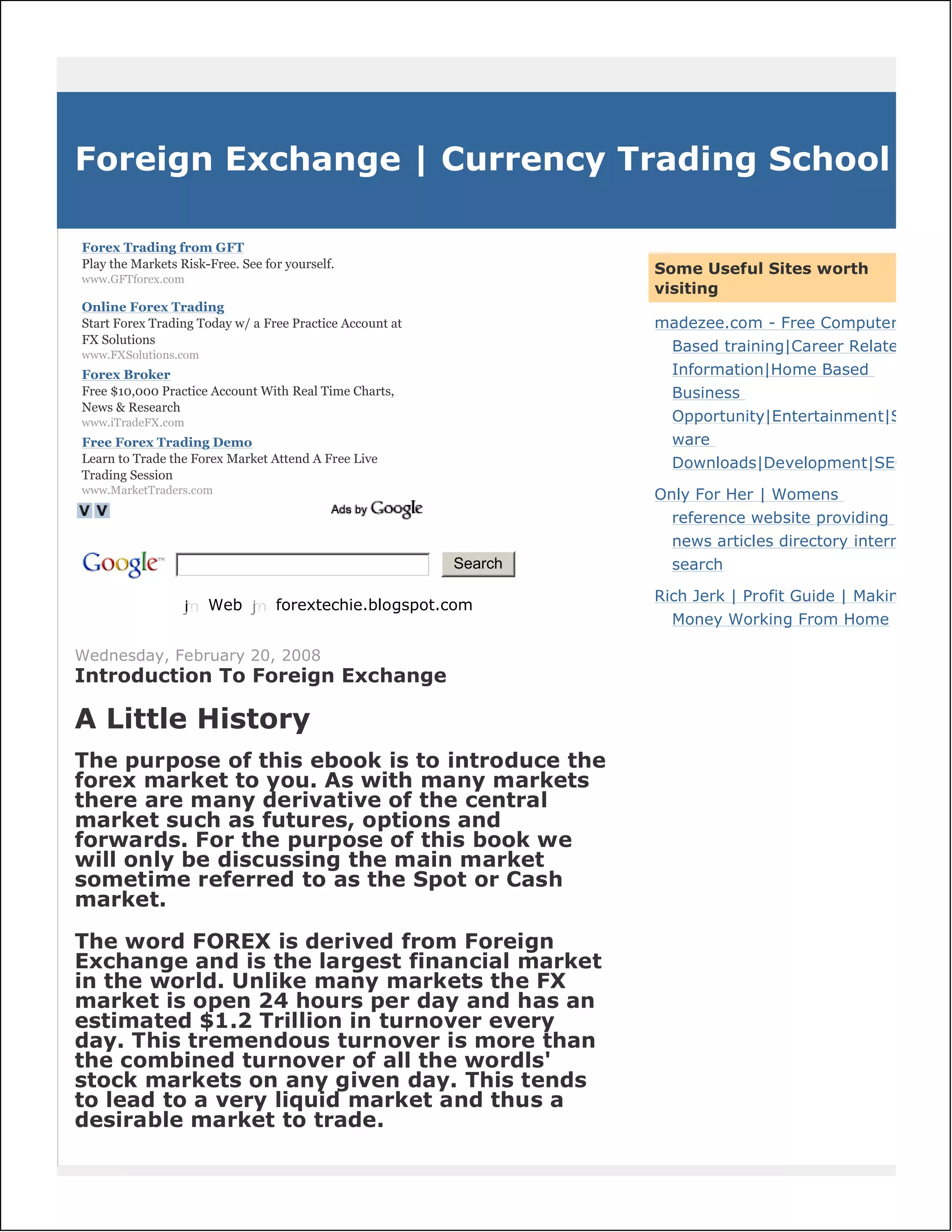
The purpose of this ebook is to introduce the
forex market to you. As with many markets
there are many derivative of the central
market such as futures, options and
forwards. For the purpose of this book we
will only be discussing the main market
sometime referred to as the Spot or Cash
market.

The word FOREX is derived from Foreign
Exchange and is the largest financial market
in the world. Unlike many markets the FX
market is open 24 hours per day and has an
estimated $1.2 Trillion in turnover every
day. This tremendous turnover is more than
the combined turnover of all the wordls'
stock markets on any given day. This tends
to lead to a very liquid market and thus a
desirable market to trade.
Unlike many other securities (any financial
instrument that can be traded) the FX
market does not have a fixed exchange. It is      Forex Broker
primarily traded through banks, brokers,          Free $10,000 Practice
dealers, financial institutions and private       Account With Real Time
individuals. Trades are executed through          Charts, News & Research
phone and increasingly through the                www.iTradeFX.com

Internet. It is only in the last few years that
the smaller investor has been able to gain        Free Forex Trading
access to this market. Previously the large       Demo
amounts of deposits required precluded the        Learn to Trade the Forex
smaller investors. With the advent of the         Market Attend A Free
Internet and growing competition it is now        Live Trading Session
easily in the reach of most investors.            www.MarketTraders.com


You will often hear the term INTERBANK            Free FX Trading
discussed in FX terminology. This originally,     Simulator
as the name implies was simply banks and          Real-time Forex Trading
large institutions exchanging information         Simulator Trade Forex
about the current rate at which their clients     Commission Free
or themselves were prepared to buy or sell a      www.tradingsimulator.net

currency. INTER meaning between and Bank          Forex Trading
meaning deposit taking institutions normally      "Exposed"
made up of banks, large institution, brokers      Ex-Banker Reveals How
or even the government. The market has            To Turn Every $2,000
moved on to such a degree now that the            Into $75,410 Trading
term interbank now means anybody who is           Forex!
prepared to buy or sell a currency. It could      www.CurrencyOptionsInsider.com
be two individuals or your local travel agent
offering to exchange Euros for US Dollars.        Forex Trading Course
You will however find that most of the            Learn How To Profit
                                                  Consistently Range Of
brokers and banks use centralized feeds to
                                                  Courses. Register For
insure reliability of quote. The quotes for Bid   Free
(buy) and Offer (sell) will all be from           www.TradingAcademy.com
reliable sources. These quotes are normally
made up of the top 300 or so large
institutions. This insures that if they place
                                                  Blog Archive
an order on your behalf that the institutions
they have placed the order with is capable of     ▼ 2008 (1)
fulfilling the order.
                                                    ▼ February (1)
Now although we have spoken about orders               Introduction To Foreign
being fulfilled, it is estimated that anywhere            Exchange
from 70%-90% of the FX market is
speculative. In other words the person or
institution that bought or sold the currency
has no intention of actually taking delivery
of the currency. Instead they were solely
speculating on the movement of that
particular currency.

Source: Bank For International Settlements
http://www.bis.org Extract From The
Triennial Central Bank Survey of Foreign
Exchange and Derivatives Market Activity.
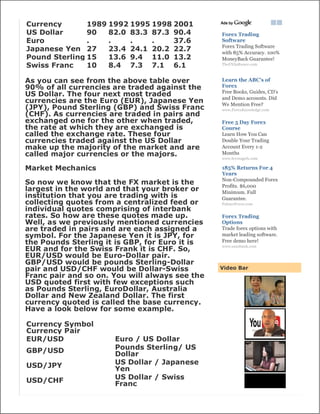
Currency       1989 1992 1995 1998 2001
US Dollar      90   82.0 83.3 87.3 90.4         Forex Trading
Euro           .    .    .    .    37.6         Software
                                                Forex Trading Software
Japanese Yen 27     23.4 24.1 20.2 22.7         with 85% Accuracy. 100%
Pound Sterling 15   13.6 9.4 11.0 13.2          MoneyBack Guarantee!
Swiss Franc    10   8.4 7.3 7.1 6.1             TheFXSoftware.com


As you can see from the above table over        Learn the ABC's of
90% of all currencies are traded against the    Forex
                                                Free Books, Guides, CD’s
US Dollar. The four next most traded            and Demo accounts. Did
currencies are the Euro (EUR), Japanese Yen     We Mention Free?
(JPY), Pound Sterling (GBP) and Swiss Franc     www.ForexKnowledge.com
(CHF). As currencies are traded in pairs and
exchanged one for the other when traded,        Free 5 Day Forex
the rate at which they are exchanged is         Course
called the exchange rate. These four            Learn How You Can
currencies traded against the US Dollar         Double Your Trading
make up the majority of the market and are      Account Every 1-2
called major currencies or the majors.          Months
                                                www.leveragefx.com

Market Mechanics                                185% Returns For 4
                                                Years
                                                Non-Compounded Forex
So now we know that the FX market is the        Profits. $6,000
largest in the world and that your broker or    Minimum. Full
institution that you are trading with is        Guarantee.
collecting quotes from a centralized feed or    PalmerForex.com
individual quotes comprising of interbank
rates. So how are these quotes made up.         Forex Trading
Well, as we previously mentioned currencies     Options
are traded in pairs and are each assigned a     Trade forex options with
symbol. For the Japanese Yen it is JPY, for     market leading software.
the Pounds Sterling it is GBP, for Euro it is   Free demo here!
                                                www.saxobank.com
EUR and for the Swiss Frank it is CHF. So,
EUR/USD would be Euro-Dollar pair.
GBP/USD would be pounds Sterling-Dollar
pair and USD/CHF would be Dollar-Swiss          Video Bar
Franc pair and so on. You will always see the
USD quoted first with few exceptions such
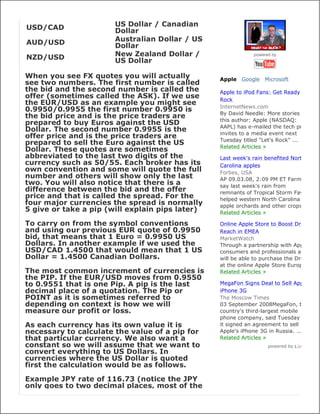
as Pounds Sterling, EuroDollar, Australia
Dollar and New Zealand Dollar. The first
currency quoted is called the base currency.
Have a look below for some example.

Currency Symbol
Currency Pair
EUR/USD               Euro / US Dollar
GBP/USD               Pounds Sterling/ US
                      Dollar
USD/JPY               US Dollar / Japanese
                      Yen
USD/CHF               US Dollar / Swiss
                      Franc
USD/CAD                US Dollar / Canadian
                       Dollar
AUD/USD                Australian Dollar / US
                       Dollar
NZD/USD                New Zealand Dollar /                  powered by
                       US Dollar

When you see FX quotes you will actually         Apple Google Microsoft
see two numbers. The first number is called
the bid and the second number is called the      Apple to iPod Fans: Get Ready to
offer (sometimes called the ASK). If we use      Rock
the EUR/USD as an example you might see
                                                 InternetNews.com
0.9950/0.9955 the first number 0.9950 is
                                                 By David Needle: More stories by
the bid price and is the price traders are
                                                 this author: Apple (NASDAQ:
prepared to buy Euros against the USD
                                                 AAPL) has e-mailed the tech press
Dollar. The second number 0.9955 is the
                                                 invites to a media event next
offer price and is the price traders are
                                                 Tuesday titled "Let's Rock" ...
prepared to sell the Euro against the US
                                                 Related Articles »
Dollar. These quotes are sometimes
abbreviated to the last two digits of the        Last week's rain benefited North
currency such as 50/55. Each broker has its      Carolina apples
own convention and some will quote the full      Forbes, USA
number and others will show only the last        AP 09.03.08, 2:09 PM ET Farmers
two. You will also notice that there is a        say last week's rain from
difference between the bid and the offer         remnants of Tropical Storm Fay
price and that is called the spread. For the     helped western North Carolina
four major currencies the spread is normally     apple orchards and other crops
5 give or take a pip (will explain pips later)   Related Articles »

To carry on from the symbol conventions          Online Apple Store to Boost Drobo
and using our previous EUR quote of 0.9950       Reach in EMEA
bid, that means that 1 Euro = 0.9950 US          MarketWatch
Dollars. In another example if we used the       Through a partnership with Apple
USD/CAD 1.4500 that would mean that 1 US         consumers and professionals alike
Dollar = 1.4500 Canadian Dollars.                will be able to purchase the Drobo
                                                 at the online Apple Store Europe
The most common increment of currencies is       Related Articles »
the PIP. If the EUR/USD moves from 0.9550
to 0.9551 that is one Pip. A pip is the last     MegaFon Signs Deal to Sell Apple's
decimal place of a quotation. The Pip or         iPhone 3G
POINT as it is sometimes referred to             The Moscow Times
depending on context is how we will              03 September 2008MegaFon, the
measure our profit or loss.                      country's third-largest mobile
                                                 phone company, said Tuesday that
As each currency has its own value it is         it signed an agreement to sell
necessary to calculate the value of a pip for    Apple's iPhone 3G in Russia. ...
that particular currency. We also want a         Related Articles »
constant so we will assume that we want to                         powered by
convert everything to US Dollars. In
currencies where the US Dollar is quoted
first the calculation would be as follows.

Example JPY rate of 116.73 (notice the JPY
only goes to two decimal places, most of the
other currencies have four decimal places)

In the case of the JPY 1 pip would be .01
therefore

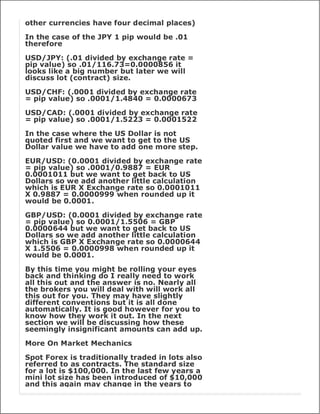
USD/JPY: (.01 divided by exchange rate =
pip value) so .01/116.73=0.0000856 it
looks like a big number but later we will
discuss lot (contract) size.

USD/CHF: (.0001 divided by exchange rate
= pip value) so .0001/1.4840 = 0.0000673

USD/CAD: (.0001 divided by exchange rate
= pip value) so .0001/1.5223 = 0.0001522

In the case where the US Dollar is not
quoted first and we want to get to the US
Dollar value we have to add one more step.

EUR/USD: (0.0001 divided by exchange rate
= pip value) so .0001/0.9887 = EUR
0.0001011 but we want to get back to US
Dollars so we add another little calculation
which is EUR X Exchange rate so 0.0001011
X 0.9887 = 0.0000999 when rounded up it
would be 0.0001.

GBP/USD: (0.0001 divided by exchange rate
= pip value) so 0.0001/1.5506 = GBP
0.0000644 but we want to get back to US
Dollars so we add another little calculation
which is GBP X Exchange rate so 0.0000644
X 1.5506 = 0.0000998 when rounded up it
would be 0.0001.

By this time you might be rolling your eyes
back and thinking do I really need to work
all this out and the answer is no. Nearly all
the brokers you will deal with will work all
this out for you. They may have slightly
different conventions but it is all done
automatically. It is good however for you to
know how they work it out. In the next
section we will be discussing how these
seemingly insignificant amounts can add up.

More On Market Mechanics

Spot Forex is traditionally traded in lots also
referred to as contracts. The standard size
for a lot is $100,000. In the last few years a
mini lot size has been introduced of $10,000
and this again may change in the years to
come. As we mentioned on the previous
page currencies are measured in pips, which
is the smallest increment of that currency.
To take advantage of these tiny increments
it is desirable to trade large amounts of a
particular currency in order to see any
significant profit or loss. We shall cover
leverage later but for the time being let's
assume we will be using $100,000 lot size.
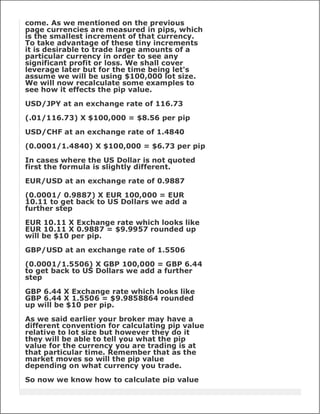
We will now recalculate some examples to
see how it effects the pip value.

USD/JPY at an exchange rate of 116.73

(.01/116.73) X $100,000 = $8.56 per pip

USD/CHF at an exchange rate of 1.4840

(0.0001/1.4840) X $100,000 = $6.73 per pip

In cases where the US Dollar is not quoted
first the formula is slightly different.

EUR/USD at an exchange rate of 0.9887

(0.0001/ 0.9887) X EUR 100,000 = EUR
10.11 to get back to US Dollars we add a
further step

EUR 10.11 X Exchange rate which looks like
EUR 10.11 X 0.9887 = $9.9957 rounded up
will be $10 per pip.

GBP/USD at an exchange rate of 1.5506

(0.0001/1.5506) X GBP 100,000 = GBP 6.44
to get back to US Dollars we add a further
step

GBP 6.44 X Exchange rate which looks like
GBP 6.44 X 1.5506 = $9.9858864 rounded
up will be $10 per pip.

As we said earlier your broker may have a
different convention for calculating pip value
relative to lot size but however they do it
they will be able to tell you what the pip
value for the currency you are trading is at
that particular time. Remember that as the
market moves so will the pip value
depending on what currency you trade.

So now we know how to calculate pip value
lets have a look at how you work out your
profit or loss. Let's assume you want to buy
US Dollars and Sell Japanese Yen. The rate
you are quoted is 116.70/116.75 because
you are buying the US you will be working
on the 116.75, the rate at which traders are
prepared to sell. So you buy 1 lot of
$100,000 at 116.75. A few hours later the
price moves to 116.95 and you decide to
close your trade. You ask for a new quote
and are quoted 116.95/117.00 as you are
now closing your trade and you initially
bought to enter the trade you now sell in
order to close the trade and you take 116.95
the price traders are prepared to buy at. The
difference between 116.75 and 116.95 is .20
or 20 pips. Using our formula from before,
we now have (.01/116.95) X $100,000 =
$8.55 per pip X 20 pips =$171

In the case of the EUR/USD you decide to
sell the EUR and are quoted 0.9885/0.9890
you take 0.9885. Now don't get confused
here. Remember you are now selling and
you need a buyer. The buyer is biding
0.9885 and that is what you take. A few
hours later the EUR moves to 0.9805 and
you ask for a quote. You are quoted
0.9805/0.9810 and you take 0.9810. You
originally sold EUR to open the trade and
now to close the trade you must buy back
your position. In order to buy back your
position you take the price traders are
prepared to sell at which is 0.9810. The
difference between 0.9810 and 0.9885 is
0.0075 or 75 pips. Using the formula from
before, we now have (.0001/0.9810) X EUR
100,000 = EUR10.19: EUR 10.19 X Exchange
rate 0.9810 =$9.99($10) so 75 X $10 =
$750.

To reiterate what has gone before, when you
enter or exit a trade at some point your are
subject to the spread in the bid/offer quote.
As a rule of thumb when you buy a currency
you will use the offer price and when you
sell you will use the bid price. So when you
buy a currency you pay the spread as you
enter the trade but not as you exit and when
you sell a currency you pay no spread when
you enter but only when you exit.

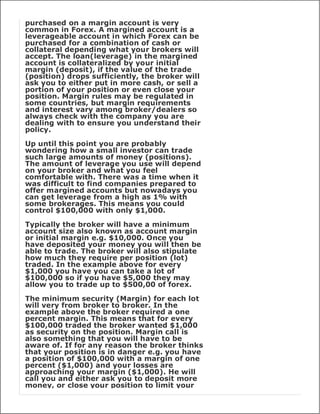
Leverage

Leverage financed with credit, such as that
purchased on a margin account is very
common in Forex. A margined account is a
leverageable account in which Forex can be
purchased for a combination of cash or
collateral depending what your brokers will
accept. The loan(leverage) in the margined
account is collateralized by your initial
margin (deposit), if the value of the trade
(position) drops sufficiently, the broker will
ask you to either put in more cash, or sell a
portion of your position or even close your
position. Margin rules may be regulated in
some countries, but margin requirements
and interest vary among broker/dealers so
always check with the company you are
dealing with to ensure you understand their
policy.

Up until this point you are probably
wondering how a small investor can trade
such large amounts of money (positions).
The amount of leverage you use will depend
on your broker and what you feel
comfortable with. There was a time when it
was difficult to find companies prepared to
offer margined accounts but nowadays you
can get leverage from a high as 1% with
some brokerages. This means you could
control $100,000 with only $1,000.

Typically the broker will have a minimum
account size also known as account margin
or initial margin e.g. $10,000. Once you
have deposited your money you will then be
able to trade. The broker will also stipulate
how much they require per position (lot)
traded. In the example above for every
$1,000 you have you can take a lot of
$100,000 so if you have $5,000 they may
allow you to trade up to $500,00 of forex.

The minimum security (Margin) for each lot
will very from broker to broker. In the
example above the broker required a one
percent margin. This means that for every
$100,000 traded the broker wanted $1,000
as security on the position. Margin call is
also something that you will have to be
aware of. If for any reason the broker thinks
that your position is in danger e.g. you have
a position of $100,000 with a margin of one
percent ($1,000) and your losses are
approaching your margin ($1,000). He will
call you and either ask you to deposit more
money, or close your position to limit your
risk and his risk. If you are going to trade on
a margin account it is imperative that you
talk with your broker first to find out what
their polices are on this type of accounts.

Variation Margin is also very important.
Variation margin is the amount of profit or
loss your account is showing on open
positions. Let's say you have just deposited
$10,000 with your broker. You take 5 lots of
USD/JPY which is $500,000. To secure this
the broker needs $5,000 (1%). The trade
goes bad and your losses equal $5001, your
broker may do a margin call. The reason he
may do a margin call is that even though
you still have $4,999 in your account the
broker needs that as security and allowing
you to use it could endanger yourself and
him. Another way to look at it is this, if you
have an account of $10,000 and you have a
1 lot ($100,000) position. That's $1,000
assuming a (1% margin) is no longer
available for you to trade. The money still
belongs to you but for the time you are
margined the broker needs that as security.
Another point of note is that some brokers
may require a higher margin at the
weekeneds. This may take the form of 1%
margin during the week and if you intend to
hold the position over the weekend it may
rise to 2% or higher. Also in the example we
have used a 1% margin. This is by no means
standard. I have seen as high as 0.5% and
many between 3%-5% margin. It all
depends on your broker.

There have been many discussions on the
topic of margin and some argue that too
much margin is dangerous. This is a point
for the individual concerned. The important
thing to remember as with all trading is that
you thoroughly understand your brokers
policies on the subject and you are
comfortable with and understand your risk.

Rollovers

Even though the mighty US dominates many
markets most of Spot Forex is still traded
through London in Great Britain. So for our
next description we shall use London time.
Most deals in Forex are done as Spot deals.
Spot deals are nearly always due for
settlement two business days day later. This
is referred to as the value date or delivery
date. On that date the counterparties take
delivery of the currency they have sold or
bought.

In Spot FX the majority of the time the end
of the business day is 21:59 (London time).
Any positions still open at this time are
automatically rolled over to the next
business day, which again finishes at 21:59.
This is necessary to avoid the actual delivery
of the currency. As Spot FX is predominantly
speculative most of the time the trades
never wish to actually take delivery of the
actual currency. They will instruct the
brokerage to always rollover their position.
Many of the brokers nowadays do this
automatically and it will be in their polices
and procedures. The act of rolling the
currency pair over is known as tom.next
which, stands for tomorrow and the next
day. Just to go over this again, your broker
will automatically rollover your position
unless you instruct him that you actually
want delivery of the currency. Another point
noting is that most leveraged accounts are
unable to actual deliver of the currency as
there is insufficient capital there to cover
the transaction.

Remember that if you are trading on margin,
you have in effect got a loan from your
broker for the amount you are trading. If
you had a 1 lot position you broker has
advanced you the $100,000 even though you
did not actually have $100,000. The broker
will normally charge you the interest
differential between the two currencies if
you rollover your position. This normally
only happens if you have rolled over the
position and not if you open and close the
position within the same business day.

To calculate the broker's interest he will
normally close your position at the end of
the business day and again reopen a new
position almost simultaneously. You open a
1 lot ($100,000) EUR/USD position on
Monday 15th at 11:00 at an exchange rate of
0.9950. During the day the rate fluctuates
and at 22:00 the rate is 0.9975. The broker
closes your position and reopens a new
position with a different value date. The new
position was opened at 0.9976 a 1 pip
difference. The 1 pip deference reflects the
difference in interest rates between the US
Dollar and the Euro. In our example your are
long Euro and short US Dollar. As the US
Dollar in the example has a higher interest
rate than the Euro you pay the premium of 1
pip.

Now the good news. If you had the reverse
position and you were short Euors and long
US Dollars you would gain the interest
differential of 1 pip. If the first named
currency has an overnight interest rate
lower than the second currency then you
will pay that interest differential if you
bought that currency. If the first named
currency has a higher interest rate than the
second currency then you will gain the
interest differential.

To simplify the above. If you are long
(bought) a particular currency and that
currency has a higher overnight interest rate
you will gain. If you are short (sold) the
currency with a higher overnight interest
rate then you will lose the difference.

I would like to emphasis here that although
we are going a little in-depth to explain how
all this works, your broker will calculate all
this for you. The purpose of this book is just
to give you an overview of how the forex
market works.

Accounts

Although the movement today is towards all
transaction eventually finishing in a profit
and loss in US Dollars it is important to
realize that your profit or loss may not
actually be in US Dollars. From my
observation the trend is more pronounced in
the US as you would expect. Most US based
traders assume they will see their balance at
the end of each day in US Dollars. I have
even spoken with some traders who are
oblivious to the fact the their profit might
have actually been in Japanese Yen.

Let me explain a little more. You sell (go
short) USD/JPY and as such are short USD
and Long (bought) JPY. You enter the trade
at 116.10 and exit 116.90. You in fact made
80,000 Japanese Yen (1 lot traded) not US
Dollars. If you traded all four major
currencies against the US Dollar you would
in fact have made or lose in EUR, GPY, JPY
and CHF. This might give you a ledger
balance at the end of the day or month with
four different currencies. This is common in
London. They will stay in that currency until
you instruct the broker to exchange the
currency you have a profit or loss into your
own base currency. This actually happened
to me. After dealing with mainly US based
brokers it had never occurred to me that my
statement would be in anything other than
US Dollars. This can work for you or against
you depending on the rate of exchange
when you change back into your home
currency. Once I knew the convention I
simply instructed the broker to change my
profit or loss into US Dollars when I closed
my position. It is worth checking how your
broker approaches this and simply ask them
how they handle it. A small point but worth
noting.

It's a sad fact that for many years the forex
market largely remained unregulated. Even
today there are many countries that still
don't regulate companies that trade forex.
London has been regulated for many years
and the US is now getting its act together
and has also started regulating companies
dealing forex. It was only recently in the US
you could with no more than an Internet site
and a few thousand dollars set up your own
forex operation and give the impression that
you were larger than you are. I am all for
the entrepreneurial flair and everyone need
to start somewhere but when dealing with
people's money it is imperative that the
company you choose is solid.

Preferably you want a company that is
regulated in the country that it operates,
insured or bonded and has some kind of
track recorded. I cannot advise you on
which broker you should use as there are
just to many variables to each person, but
as a rule of thumb, nearly all countries have
some kind of regulatory authority who will
be able to advise you. Most of the regulatory
authorities will have a list of brokers that
fall with their jurisdiction and will give you a
list. They probably wont tell whom to use
but at least if the list came from them you
can have some confidence in those
companies. Once you have a list give a few
of them a call, see who you feel comfortable
with, ask for them to send you their polices
and procedures. If you live near where your
broker is based, go spend the day with him.
I have been to many brokerages just to
check them out. It will give you a chance to
see their operation and meet their team.

This brings up another interesting point.
When you open an account with a broker
you will have to fill in some forms basically
stating your acceptance of their polices. This
can range from a 1 page document to
something resembling a book. Take the time
to read through these documents and make
a list of things you don't understand or want
explained. Most reputable companies will be
happy to spend some time with you on this.
Your involvement with your broker is largely
up to you. As a forex trader you will
probably spend long hours staring at the
screen without talking to anyone. You may
be the sort of person who likes this or you
may be the sort of person who likes to chat
with the dealer in the trading room. You will
normally get a call once a week or once a
month from someone in the brokerage
asking if everything is OK.

Statements

Before we move on to account statements I
just want to touch on segregation of funds.
In times past there was a danger that
traders who deposited money with their
broker who did not segregate their clients
money from their own companies money
were at some risk. The problem arose if the
broker misused the deposited funds to
either reinvest or otherwise manipulated
these deposits to enhance their own
standing. There were also instances were
the broker became insolvent and many
complications ensued as to what was the
clients money and what was the broker's
money. With the advent of regulation most
broker now segregate their clients funds
from the brokerage funds. Deposits are
normally held with banks or other large
financial institution that are also regulated
and bonded or insured. This protects you
money should anything happen to your
broker. The deposit taking institution is
normally aware that these deposits are
client's funds. Depending on regulation in
the particular country you live, each client
may have their own segregated account or
for smaller depositors they may be pooled.
The point is that segregation of funds is a
safeguard. Ask your broker if your funds are
segregated and who actually has your
money.

Just as with a bank you should are entitled
to interest on the money you have on
deposit. Some broker may stipulate that
interest is only payable on accounts over a
certain amount but the trend today is that
you will earn interest on any amount you
have that is not being used to cover your
margin. Your broker is probably not the
most competitive place to earn interest but
that should not be the point of having your
money with him in the first place. Payment
on your account that is not being used and
segregation of funds all go to show the
reputability of the company you are dealing
with.

In this section I will discuss briefly the basic
account statement. I have to keep this basic
as there are as many flavours of account
statements as you can imagine. Just about
every broker has their own way of
presenting this. The most important thing is
to know where you stand at the end of each
day or week. Just because your broker is
Internet based and has all the bells and
whistles does not mean they are infallible.
Many of the actions taken before
information is imputed are still done by
hand and if humans are involved there will
be a mistake at some point. The
responsibility lies with you. It is your money
so make sure that all the transactions are
correct.

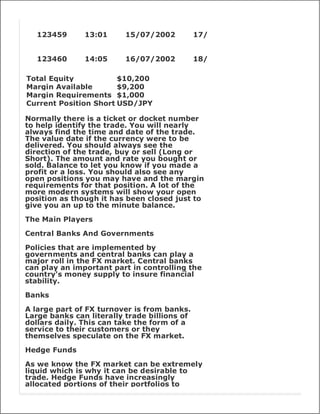
FX Some Company New York Statement for:
Mr. Joe Bloggs Statement Date: 16th July
2002 Account No: 123456 Summary Of All
Trades From: 15/07/02-17/07/02

   Ticket       Time       Trade Date        Value
   No                                        Date


   123458       09:05      15/07/2002        17/07/02
123459      13:01      15/07/2002          17/07/02


   123460      14:05      16/07/2002          18/07/02

Total Equity           $10,200
Margin Available       $9,200
Margin Requirements $1,000
Current Position Short USD/JPY

Normally there is a ticket or docket number
to help identify the trade. You will nearly
always find the time and date of the trade.
The value date if the currency were to be
delivered. You should always see the
direction of the trade, buy or sell (Long or
Short). The amount and rate you bought or
sold. Balance to let you know if you made a
profit or a loss. You should also see any
open positions you may have and the margin
requirements for that position. A lot of the
more modern systems will show your open
position as though it has been closed just to
give you an up to the minute balance.

The Main Players

Central Banks And Governments

Policies that are implemented by
governments and central banks can play a
major roll in the FX market. Central banks
can play an important part in controlling the
country's money supply to insure financial
stability.

Banks

A large part of FX turnover is from banks.
Large banks can literally trade billions of
dollars daily. This can take the form of a
service to their customers or they
themselves speculate on the FX market.

Hedge Funds

As we know the FX market can be extremely
liquid which is why it can be desirable to
trade. Hedge Funds have increasingly
allocated portions of their portfolios to
speculate on the FX market. Another
advantage Hedge Funds can utilize is a much
higher degree of leverage than would
typically be found in the equity markets.

Corporate Businesses

The FX market mainstay is that of
international trade. Many companies have to
import or exports goods to different
countries all around the world. Payment for
these goods and services may be made and
received in different currencies. Many
billions of dollars are exchanges daily to
facilitate trade. The timing of those
transactions can dramatically affect a
company's balance sheet.

The Man In The Street

Although you may not think it the man in the
street also plays a part in toady's FX world.
Every time he goes on holiday overseas he
normally need to purchase that country's
currency and again change it back into his
own currency once he returns. Unwittingly
he is in fact trading currencies. He may also
purchase goods and services whilst overseas
and his credit card company has to convert
those sales back into his base currency in
order to charge him.

Speculators And Investors

We shall differentiate speculator from
investors here with the definition that an
investor has a much longer time horizon in
which he expects his investment to yield a
profit. Regardless of the difference both
speculators and investors will approach the
FX market to exploit the movement in
currency pairs. They both will have their
reason for believing a particular currency
will perform better or worse as the case may
be and will buy or sell accordingly. They may
decide that the Euro will appreciate against
the US Dollar and take what is called a long
position in Euro. If the Euro does in fact gain
ground against the US Dollar they will have
made a profit.

What Next

Well now we have a basic understanding of
how the FX market works and who the main
players are, what next? You are now going
to have to decide the best way to trade the
market. The two most common approaches
are that of fundamental analysis and
technical analysis.

Fundamental analysis concentrates on the
forces of supply and demand for a given
security. This approach examines all the
factors that determine the price of a security
and the real value of that security. This is
referred to as the intrinsic value. If the
intrinsic value is below the market price
then there is an opportunity to buy and if
the market is above the intrinsic price then
there is an opportunity to sell.

Technical analysis is the study of market
action, mainly through the use of charts and
indicators to forecast the future price of a
security. There are three main points that a
technical analyst applies. A. Market action
discounts everything. Regardless of what
the fundamentals are saying, the price you
see is the price you get. B. The price of a
given security moves in trends. C. The
historical trend of a security will tend to
repeat.

Of all of the above things the most
important of them is point A. The tools of
the technical analyst are indicators, patterns
and systems. These tools are applied to
charts. Moving averages, support and
resistance lines, envelopes, Bollinger bands
and momentum are all examples of
indicators.

There are many ways to skin a cat as the
saying goes but fundamental and technical
analysis are the two most popular ways of
trading FX.

My own preferred approach is that of
technical analysis. It is beyond the scope if
this little book to cover all the finer points of
trading and if you would like to learn more
then I would suggest your first book should
be ''Trading For Beginners'' which you can
find at www.tradingforbeginners.com. It is
specifically designed for the novice trader
wishing to learn more about trading and
technical analysis.
Conclusion

I hope you have enjoyed my little ebook
introducing you to the Forex market. This
book is free and you may freely pass it on to
your friends and associates. If you are a
webmaster and wish to have the book co
branded with your own banners and logos
drop me a line at info@wizardoftrading.com

You may wish to join our free trading
lessons newsletter at
www.wizardoftrading.com Every couple of
weeks you will receive a free trading lesson
teaching you different techniques on how to
trade the markets. Remember caution is the
best way forward in trading. Don't risk
money you can't afford to lose, don't trade
with live cash until you have paper traded
for at least three months and control your
emotions.

If you have any questions, feel free to drop
me a line at the email address above. Until
then,

God Bless and good trading.

Mark McRae


7 Habits Trader


Download


e123system
Download

eDayTradingMind
Download

epocketbook
Download
eswing trading book
Download


eTheEBookofTechnicalMarketIndicators

Download


Forexmanual

Download


Posted by indianenigma007 at 1:49 PM 0 comments


Subscribe to: Posts (Atom)

FOREX_TECHIE

  • 1.
    Foreign Exchange |Currency Trading School Forex Trading from GFT Play the Markets Risk-Free. See for yourself. Some Useful Sites worth www.GFTforex.com visiting Online Forex Trading Start Forex Trading Today w/ a Free Practice Account at madezee.com - Free Computer FX Solutions www.FXSolutions.com Based training|Career Related Forex Broker Information|Home Based Free $10,000 Practice Account With Real Time Charts, Business News & Research www.iTradeFX.com Opportunity|Entertainment|Soft Free Forex Trading Demo ware Learn to Trade the Forex Market Attend A Free Live Downloads|Development|SEO Trading Session www.MarketTraders.com Only For Her | Womens reference website providing news articles directory internet Search search Rich Jerk | Profit Guide | Making n Web n forextechie.blogspot.com i j k l m j k l m Money Working From Home Wednesday, February 20, 2008 Introduction To Foreign Exchange A Little History The purpose of this ebook is to introduce the forex market to you. As with many markets there are many derivative of the central market such as futures, options and forwards. For the purpose of this book we will only be discussing the main market sometime referred to as the Spot or Cash market. The word FOREX is derived from Foreign Exchange and is the largest financial market in the world. Unlike many markets the FX market is open 24 hours per day and has an estimated $1.2 Trillion in turnover every day. This tremendous turnover is more than the combined turnover of all the wordls' stock markets on any given day. This tends to lead to a very liquid market and thus a desirable market to trade.
  • 2.
    Unlike many othersecurities (any financial instrument that can be traded) the FX market does not have a fixed exchange. It is Forex Broker primarily traded through banks, brokers, Free $10,000 Practice dealers, financial institutions and private Account With Real Time individuals. Trades are executed through Charts, News & Research phone and increasingly through the www.iTradeFX.com Internet. It is only in the last few years that the smaller investor has been able to gain Free Forex Trading access to this market. Previously the large Demo amounts of deposits required precluded the Learn to Trade the Forex smaller investors. With the advent of the Market Attend A Free Internet and growing competition it is now Live Trading Session easily in the reach of most investors. www.MarketTraders.com You will often hear the term INTERBANK Free FX Trading discussed in FX terminology. This originally, Simulator as the name implies was simply banks and Real-time Forex Trading large institutions exchanging information Simulator Trade Forex about the current rate at which their clients Commission Free or themselves were prepared to buy or sell a www.tradingsimulator.net currency. INTER meaning between and Bank Forex Trading meaning deposit taking institutions normally "Exposed" made up of banks, large institution, brokers Ex-Banker Reveals How or even the government. The market has To Turn Every $2,000 moved on to such a degree now that the Into $75,410 Trading term interbank now means anybody who is Forex! prepared to buy or sell a currency. It could www.CurrencyOptionsInsider.com be two individuals or your local travel agent offering to exchange Euros for US Dollars. Forex Trading Course You will however find that most of the Learn How To Profit Consistently Range Of brokers and banks use centralized feeds to Courses. Register For insure reliability of quote. The quotes for Bid Free (buy) and Offer (sell) will all be from www.TradingAcademy.com reliable sources. These quotes are normally made up of the top 300 or so large institutions. This insures that if they place Blog Archive an order on your behalf that the institutions they have placed the order with is capable of ▼ 2008 (1) fulfilling the order. ▼ February (1) Now although we have spoken about orders Introduction To Foreign being fulfilled, it is estimated that anywhere Exchange from 70%-90% of the FX market is speculative. In other words the person or institution that bought or sold the currency has no intention of actually taking delivery of the currency. Instead they were solely speculating on the movement of that particular currency. Source: Bank For International Settlements http://www.bis.org Extract From The Triennial Central Bank Survey of Foreign Exchange and Derivatives Market Activity.
  • 3.
    Currency 1989 1992 1995 1998 2001 US Dollar 90 82.0 83.3 87.3 90.4 Forex Trading Euro . . . . 37.6 Software Forex Trading Software Japanese Yen 27 23.4 24.1 20.2 22.7 with 85% Accuracy. 100% Pound Sterling 15 13.6 9.4 11.0 13.2 MoneyBack Guarantee! Swiss Franc 10 8.4 7.3 7.1 6.1 TheFXSoftware.com As you can see from the above table over Learn the ABC's of 90% of all currencies are traded against the Forex Free Books, Guides, CD’s US Dollar. The four next most traded and Demo accounts. Did currencies are the Euro (EUR), Japanese Yen We Mention Free? (JPY), Pound Sterling (GBP) and Swiss Franc www.ForexKnowledge.com (CHF). As currencies are traded in pairs and exchanged one for the other when traded, Free 5 Day Forex the rate at which they are exchanged is Course called the exchange rate. These four Learn How You Can currencies traded against the US Dollar Double Your Trading make up the majority of the market and are Account Every 1-2 called major currencies or the majors. Months www.leveragefx.com Market Mechanics 185% Returns For 4 Years Non-Compounded Forex So now we know that the FX market is the Profits. $6,000 largest in the world and that your broker or Minimum. Full institution that you are trading with is Guarantee. collecting quotes from a centralized feed or PalmerForex.com individual quotes comprising of interbank rates. So how are these quotes made up. Forex Trading Well, as we previously mentioned currencies Options are traded in pairs and are each assigned a Trade forex options with symbol. For the Japanese Yen it is JPY, for market leading software. the Pounds Sterling it is GBP, for Euro it is Free demo here! www.saxobank.com EUR and for the Swiss Frank it is CHF. So, EUR/USD would be Euro-Dollar pair. GBP/USD would be pounds Sterling-Dollar pair and USD/CHF would be Dollar-Swiss Video Bar Franc pair and so on. You will always see the USD quoted first with few exceptions such as Pounds Sterling, EuroDollar, Australia Dollar and New Zealand Dollar. The first currency quoted is called the base currency. Have a look below for some example. Currency Symbol Currency Pair EUR/USD Euro / US Dollar GBP/USD Pounds Sterling/ US Dollar USD/JPY US Dollar / Japanese Yen USD/CHF US Dollar / Swiss Franc
  • 4.
    USD/CAD US Dollar / Canadian Dollar AUD/USD Australian Dollar / US Dollar NZD/USD New Zealand Dollar / powered by US Dollar When you see FX quotes you will actually Apple Google Microsoft see two numbers. The first number is called the bid and the second number is called the Apple to iPod Fans: Get Ready to offer (sometimes called the ASK). If we use Rock the EUR/USD as an example you might see InternetNews.com 0.9950/0.9955 the first number 0.9950 is By David Needle: More stories by the bid price and is the price traders are this author: Apple (NASDAQ: prepared to buy Euros against the USD AAPL) has e-mailed the tech press Dollar. The second number 0.9955 is the invites to a media event next offer price and is the price traders are Tuesday titled "Let's Rock" ... prepared to sell the Euro against the US Related Articles » Dollar. These quotes are sometimes abbreviated to the last two digits of the Last week's rain benefited North currency such as 50/55. Each broker has its Carolina apples own convention and some will quote the full Forbes, USA number and others will show only the last AP 09.03.08, 2:09 PM ET Farmers two. You will also notice that there is a say last week's rain from difference between the bid and the offer remnants of Tropical Storm Fay price and that is called the spread. For the helped western North Carolina four major currencies the spread is normally apple orchards and other crops 5 give or take a pip (will explain pips later) Related Articles » To carry on from the symbol conventions Online Apple Store to Boost Drobo and using our previous EUR quote of 0.9950 Reach in EMEA bid, that means that 1 Euro = 0.9950 US MarketWatch Dollars. In another example if we used the Through a partnership with Apple USD/CAD 1.4500 that would mean that 1 US consumers and professionals alike Dollar = 1.4500 Canadian Dollars. will be able to purchase the Drobo at the online Apple Store Europe The most common increment of currencies is Related Articles » the PIP. If the EUR/USD moves from 0.9550 to 0.9551 that is one Pip. A pip is the last MegaFon Signs Deal to Sell Apple's decimal place of a quotation. The Pip or iPhone 3G POINT as it is sometimes referred to The Moscow Times depending on context is how we will 03 September 2008MegaFon, the measure our profit or loss. country's third-largest mobile phone company, said Tuesday that As each currency has its own value it is it signed an agreement to sell necessary to calculate the value of a pip for Apple's iPhone 3G in Russia. ... that particular currency. We also want a Related Articles » constant so we will assume that we want to powered by convert everything to US Dollars. In currencies where the US Dollar is quoted first the calculation would be as follows. Example JPY rate of 116.73 (notice the JPY only goes to two decimal places, most of the
  • 5.
    other currencies havefour decimal places) In the case of the JPY 1 pip would be .01 therefore USD/JPY: (.01 divided by exchange rate = pip value) so .01/116.73=0.0000856 it looks like a big number but later we will discuss lot (contract) size. USD/CHF: (.0001 divided by exchange rate = pip value) so .0001/1.4840 = 0.0000673 USD/CAD: (.0001 divided by exchange rate = pip value) so .0001/1.5223 = 0.0001522 In the case where the US Dollar is not quoted first and we want to get to the US Dollar value we have to add one more step. EUR/USD: (0.0001 divided by exchange rate = pip value) so .0001/0.9887 = EUR 0.0001011 but we want to get back to US Dollars so we add another little calculation which is EUR X Exchange rate so 0.0001011 X 0.9887 = 0.0000999 when rounded up it would be 0.0001. GBP/USD: (0.0001 divided by exchange rate = pip value) so 0.0001/1.5506 = GBP 0.0000644 but we want to get back to US Dollars so we add another little calculation which is GBP X Exchange rate so 0.0000644 X 1.5506 = 0.0000998 when rounded up it would be 0.0001. By this time you might be rolling your eyes back and thinking do I really need to work all this out and the answer is no. Nearly all the brokers you will deal with will work all this out for you. They may have slightly different conventions but it is all done automatically. It is good however for you to know how they work it out. In the next section we will be discussing how these seemingly insignificant amounts can add up. More On Market Mechanics Spot Forex is traditionally traded in lots also referred to as contracts. The standard size for a lot is $100,000. In the last few years a mini lot size has been introduced of $10,000 and this again may change in the years to
  • 6.
    come. As wementioned on the previous page currencies are measured in pips, which is the smallest increment of that currency. To take advantage of these tiny increments it is desirable to trade large amounts of a particular currency in order to see any significant profit or loss. We shall cover leverage later but for the time being let's assume we will be using $100,000 lot size. We will now recalculate some examples to see how it effects the pip value. USD/JPY at an exchange rate of 116.73 (.01/116.73) X $100,000 = $8.56 per pip USD/CHF at an exchange rate of 1.4840 (0.0001/1.4840) X $100,000 = $6.73 per pip In cases where the US Dollar is not quoted first the formula is slightly different. EUR/USD at an exchange rate of 0.9887 (0.0001/ 0.9887) X EUR 100,000 = EUR 10.11 to get back to US Dollars we add a further step EUR 10.11 X Exchange rate which looks like EUR 10.11 X 0.9887 = $9.9957 rounded up will be $10 per pip. GBP/USD at an exchange rate of 1.5506 (0.0001/1.5506) X GBP 100,000 = GBP 6.44 to get back to US Dollars we add a further step GBP 6.44 X Exchange rate which looks like GBP 6.44 X 1.5506 = $9.9858864 rounded up will be $10 per pip. As we said earlier your broker may have a different convention for calculating pip value relative to lot size but however they do it they will be able to tell you what the pip value for the currency you are trading is at that particular time. Remember that as the market moves so will the pip value depending on what currency you trade. So now we know how to calculate pip value
  • 7.
    lets have alook at how you work out your profit or loss. Let's assume you want to buy US Dollars and Sell Japanese Yen. The rate you are quoted is 116.70/116.75 because you are buying the US you will be working on the 116.75, the rate at which traders are prepared to sell. So you buy 1 lot of $100,000 at 116.75. A few hours later the price moves to 116.95 and you decide to close your trade. You ask for a new quote and are quoted 116.95/117.00 as you are now closing your trade and you initially bought to enter the trade you now sell in order to close the trade and you take 116.95 the price traders are prepared to buy at. The difference between 116.75 and 116.95 is .20 or 20 pips. Using our formula from before, we now have (.01/116.95) X $100,000 = $8.55 per pip X 20 pips =$171 In the case of the EUR/USD you decide to sell the EUR and are quoted 0.9885/0.9890 you take 0.9885. Now don't get confused here. Remember you are now selling and you need a buyer. The buyer is biding 0.9885 and that is what you take. A few hours later the EUR moves to 0.9805 and you ask for a quote. You are quoted 0.9805/0.9810 and you take 0.9810. You originally sold EUR to open the trade and now to close the trade you must buy back your position. In order to buy back your position you take the price traders are prepared to sell at which is 0.9810. The difference between 0.9810 and 0.9885 is 0.0075 or 75 pips. Using the formula from before, we now have (.0001/0.9810) X EUR 100,000 = EUR10.19: EUR 10.19 X Exchange rate 0.9810 =$9.99($10) so 75 X $10 = $750. To reiterate what has gone before, when you enter or exit a trade at some point your are subject to the spread in the bid/offer quote. As a rule of thumb when you buy a currency you will use the offer price and when you sell you will use the bid price. So when you buy a currency you pay the spread as you enter the trade but not as you exit and when you sell a currency you pay no spread when you enter but only when you exit. Leverage Leverage financed with credit, such as that
  • 8.
    purchased on amargin account is very common in Forex. A margined account is a leverageable account in which Forex can be purchased for a combination of cash or collateral depending what your brokers will accept. The loan(leverage) in the margined account is collateralized by your initial margin (deposit), if the value of the trade (position) drops sufficiently, the broker will ask you to either put in more cash, or sell a portion of your position or even close your position. Margin rules may be regulated in some countries, but margin requirements and interest vary among broker/dealers so always check with the company you are dealing with to ensure you understand their policy. Up until this point you are probably wondering how a small investor can trade such large amounts of money (positions). The amount of leverage you use will depend on your broker and what you feel comfortable with. There was a time when it was difficult to find companies prepared to offer margined accounts but nowadays you can get leverage from a high as 1% with some brokerages. This means you could control $100,000 with only $1,000. Typically the broker will have a minimum account size also known as account margin or initial margin e.g. $10,000. Once you have deposited your money you will then be able to trade. The broker will also stipulate how much they require per position (lot) traded. In the example above for every $1,000 you have you can take a lot of $100,000 so if you have $5,000 they may allow you to trade up to $500,00 of forex. The minimum security (Margin) for each lot will very from broker to broker. In the example above the broker required a one percent margin. This means that for every $100,000 traded the broker wanted $1,000 as security on the position. Margin call is also something that you will have to be aware of. If for any reason the broker thinks that your position is in danger e.g. you have a position of $100,000 with a margin of one percent ($1,000) and your losses are approaching your margin ($1,000). He will call you and either ask you to deposit more money, or close your position to limit your
  • 9.
    risk and hisrisk. If you are going to trade on a margin account it is imperative that you talk with your broker first to find out what their polices are on this type of accounts. Variation Margin is also very important. Variation margin is the amount of profit or loss your account is showing on open positions. Let's say you have just deposited $10,000 with your broker. You take 5 lots of USD/JPY which is $500,000. To secure this the broker needs $5,000 (1%). The trade goes bad and your losses equal $5001, your broker may do a margin call. The reason he may do a margin call is that even though you still have $4,999 in your account the broker needs that as security and allowing you to use it could endanger yourself and him. Another way to look at it is this, if you have an account of $10,000 and you have a 1 lot ($100,000) position. That's $1,000 assuming a (1% margin) is no longer available for you to trade. The money still belongs to you but for the time you are margined the broker needs that as security. Another point of note is that some brokers may require a higher margin at the weekeneds. This may take the form of 1% margin during the week and if you intend to hold the position over the weekend it may rise to 2% or higher. Also in the example we have used a 1% margin. This is by no means standard. I have seen as high as 0.5% and many between 3%-5% margin. It all depends on your broker. There have been many discussions on the topic of margin and some argue that too much margin is dangerous. This is a point for the individual concerned. The important thing to remember as with all trading is that you thoroughly understand your brokers policies on the subject and you are comfortable with and understand your risk. Rollovers Even though the mighty US dominates many markets most of Spot Forex is still traded through London in Great Britain. So for our next description we shall use London time. Most deals in Forex are done as Spot deals. Spot deals are nearly always due for settlement two business days day later. This is referred to as the value date or delivery
  • 10.
    date. On thatdate the counterparties take delivery of the currency they have sold or bought. In Spot FX the majority of the time the end of the business day is 21:59 (London time). Any positions still open at this time are automatically rolled over to the next business day, which again finishes at 21:59. This is necessary to avoid the actual delivery of the currency. As Spot FX is predominantly speculative most of the time the trades never wish to actually take delivery of the actual currency. They will instruct the brokerage to always rollover their position. Many of the brokers nowadays do this automatically and it will be in their polices and procedures. The act of rolling the currency pair over is known as tom.next which, stands for tomorrow and the next day. Just to go over this again, your broker will automatically rollover your position unless you instruct him that you actually want delivery of the currency. Another point noting is that most leveraged accounts are unable to actual deliver of the currency as there is insufficient capital there to cover the transaction. Remember that if you are trading on margin, you have in effect got a loan from your broker for the amount you are trading. If you had a 1 lot position you broker has advanced you the $100,000 even though you did not actually have $100,000. The broker will normally charge you the interest differential between the two currencies if you rollover your position. This normally only happens if you have rolled over the position and not if you open and close the position within the same business day. To calculate the broker's interest he will normally close your position at the end of the business day and again reopen a new position almost simultaneously. You open a 1 lot ($100,000) EUR/USD position on Monday 15th at 11:00 at an exchange rate of 0.9950. During the day the rate fluctuates and at 22:00 the rate is 0.9975. The broker closes your position and reopens a new position with a different value date. The new position was opened at 0.9976 a 1 pip difference. The 1 pip deference reflects the difference in interest rates between the US
  • 11.
    Dollar and theEuro. In our example your are long Euro and short US Dollar. As the US Dollar in the example has a higher interest rate than the Euro you pay the premium of 1 pip. Now the good news. If you had the reverse position and you were short Euors and long US Dollars you would gain the interest differential of 1 pip. If the first named currency has an overnight interest rate lower than the second currency then you will pay that interest differential if you bought that currency. If the first named currency has a higher interest rate than the second currency then you will gain the interest differential. To simplify the above. If you are long (bought) a particular currency and that currency has a higher overnight interest rate you will gain. If you are short (sold) the currency with a higher overnight interest rate then you will lose the difference. I would like to emphasis here that although we are going a little in-depth to explain how all this works, your broker will calculate all this for you. The purpose of this book is just to give you an overview of how the forex market works. Accounts Although the movement today is towards all transaction eventually finishing in a profit and loss in US Dollars it is important to realize that your profit or loss may not actually be in US Dollars. From my observation the trend is more pronounced in the US as you would expect. Most US based traders assume they will see their balance at the end of each day in US Dollars. I have even spoken with some traders who are oblivious to the fact the their profit might have actually been in Japanese Yen. Let me explain a little more. You sell (go short) USD/JPY and as such are short USD and Long (bought) JPY. You enter the trade at 116.10 and exit 116.90. You in fact made 80,000 Japanese Yen (1 lot traded) not US Dollars. If you traded all four major currencies against the US Dollar you would
  • 12.
    in fact havemade or lose in EUR, GPY, JPY and CHF. This might give you a ledger balance at the end of the day or month with four different currencies. This is common in London. They will stay in that currency until you instruct the broker to exchange the currency you have a profit or loss into your own base currency. This actually happened to me. After dealing with mainly US based brokers it had never occurred to me that my statement would be in anything other than US Dollars. This can work for you or against you depending on the rate of exchange when you change back into your home currency. Once I knew the convention I simply instructed the broker to change my profit or loss into US Dollars when I closed my position. It is worth checking how your broker approaches this and simply ask them how they handle it. A small point but worth noting. It's a sad fact that for many years the forex market largely remained unregulated. Even today there are many countries that still don't regulate companies that trade forex. London has been regulated for many years and the US is now getting its act together and has also started regulating companies dealing forex. It was only recently in the US you could with no more than an Internet site and a few thousand dollars set up your own forex operation and give the impression that you were larger than you are. I am all for the entrepreneurial flair and everyone need to start somewhere but when dealing with people's money it is imperative that the company you choose is solid. Preferably you want a company that is regulated in the country that it operates, insured or bonded and has some kind of track recorded. I cannot advise you on which broker you should use as there are just to many variables to each person, but as a rule of thumb, nearly all countries have some kind of regulatory authority who will be able to advise you. Most of the regulatory authorities will have a list of brokers that fall with their jurisdiction and will give you a list. They probably wont tell whom to use but at least if the list came from them you can have some confidence in those companies. Once you have a list give a few of them a call, see who you feel comfortable
  • 13.
    with, ask forthem to send you their polices and procedures. If you live near where your broker is based, go spend the day with him. I have been to many brokerages just to check them out. It will give you a chance to see their operation and meet their team. This brings up another interesting point. When you open an account with a broker you will have to fill in some forms basically stating your acceptance of their polices. This can range from a 1 page document to something resembling a book. Take the time to read through these documents and make a list of things you don't understand or want explained. Most reputable companies will be happy to spend some time with you on this. Your involvement with your broker is largely up to you. As a forex trader you will probably spend long hours staring at the screen without talking to anyone. You may be the sort of person who likes this or you may be the sort of person who likes to chat with the dealer in the trading room. You will normally get a call once a week or once a month from someone in the brokerage asking if everything is OK. Statements Before we move on to account statements I just want to touch on segregation of funds. In times past there was a danger that traders who deposited money with their broker who did not segregate their clients money from their own companies money were at some risk. The problem arose if the broker misused the deposited funds to either reinvest or otherwise manipulated these deposits to enhance their own standing. There were also instances were the broker became insolvent and many complications ensued as to what was the clients money and what was the broker's money. With the advent of regulation most broker now segregate their clients funds from the brokerage funds. Deposits are normally held with banks or other large financial institution that are also regulated and bonded or insured. This protects you money should anything happen to your broker. The deposit taking institution is normally aware that these deposits are client's funds. Depending on regulation in the particular country you live, each client
  • 14.
    may have theirown segregated account or for smaller depositors they may be pooled. The point is that segregation of funds is a safeguard. Ask your broker if your funds are segregated and who actually has your money. Just as with a bank you should are entitled to interest on the money you have on deposit. Some broker may stipulate that interest is only payable on accounts over a certain amount but the trend today is that you will earn interest on any amount you have that is not being used to cover your margin. Your broker is probably not the most competitive place to earn interest but that should not be the point of having your money with him in the first place. Payment on your account that is not being used and segregation of funds all go to show the reputability of the company you are dealing with. In this section I will discuss briefly the basic account statement. I have to keep this basic as there are as many flavours of account statements as you can imagine. Just about every broker has their own way of presenting this. The most important thing is to know where you stand at the end of each day or week. Just because your broker is Internet based and has all the bells and whistles does not mean they are infallible. Many of the actions taken before information is imputed are still done by hand and if humans are involved there will be a mistake at some point. The responsibility lies with you. It is your money so make sure that all the transactions are correct. FX Some Company New York Statement for: Mr. Joe Bloggs Statement Date: 16th July 2002 Account No: 123456 Summary Of All Trades From: 15/07/02-17/07/02 Ticket Time Trade Date Value No Date 123458 09:05 15/07/2002 17/07/02
  • 15.
    123459 13:01 15/07/2002 17/07/02 123460 14:05 16/07/2002 18/07/02 Total Equity $10,200 Margin Available $9,200 Margin Requirements $1,000 Current Position Short USD/JPY Normally there is a ticket or docket number to help identify the trade. You will nearly always find the time and date of the trade. The value date if the currency were to be delivered. You should always see the direction of the trade, buy or sell (Long or Short). The amount and rate you bought or sold. Balance to let you know if you made a profit or a loss. You should also see any open positions you may have and the margin requirements for that position. A lot of the more modern systems will show your open position as though it has been closed just to give you an up to the minute balance. The Main Players Central Banks And Governments Policies that are implemented by governments and central banks can play a major roll in the FX market. Central banks can play an important part in controlling the country's money supply to insure financial stability. Banks A large part of FX turnover is from banks. Large banks can literally trade billions of dollars daily. This can take the form of a service to their customers or they themselves speculate on the FX market. Hedge Funds As we know the FX market can be extremely liquid which is why it can be desirable to trade. Hedge Funds have increasingly allocated portions of their portfolios to
  • 16.
    speculate on theFX market. Another advantage Hedge Funds can utilize is a much higher degree of leverage than would typically be found in the equity markets. Corporate Businesses The FX market mainstay is that of international trade. Many companies have to import or exports goods to different countries all around the world. Payment for these goods and services may be made and received in different currencies. Many billions of dollars are exchanges daily to facilitate trade. The timing of those transactions can dramatically affect a company's balance sheet. The Man In The Street Although you may not think it the man in the street also plays a part in toady's FX world. Every time he goes on holiday overseas he normally need to purchase that country's currency and again change it back into his own currency once he returns. Unwittingly he is in fact trading currencies. He may also purchase goods and services whilst overseas and his credit card company has to convert those sales back into his base currency in order to charge him. Speculators And Investors We shall differentiate speculator from investors here with the definition that an investor has a much longer time horizon in which he expects his investment to yield a profit. Regardless of the difference both speculators and investors will approach the FX market to exploit the movement in currency pairs. They both will have their reason for believing a particular currency will perform better or worse as the case may be and will buy or sell accordingly. They may decide that the Euro will appreciate against the US Dollar and take what is called a long position in Euro. If the Euro does in fact gain ground against the US Dollar they will have made a profit. What Next Well now we have a basic understanding of
  • 17.
    how the FXmarket works and who the main players are, what next? You are now going to have to decide the best way to trade the market. The two most common approaches are that of fundamental analysis and technical analysis. Fundamental analysis concentrates on the forces of supply and demand for a given security. This approach examines all the factors that determine the price of a security and the real value of that security. This is referred to as the intrinsic value. If the intrinsic value is below the market price then there is an opportunity to buy and if the market is above the intrinsic price then there is an opportunity to sell. Technical analysis is the study of market action, mainly through the use of charts and indicators to forecast the future price of a security. There are three main points that a technical analyst applies. A. Market action discounts everything. Regardless of what the fundamentals are saying, the price you see is the price you get. B. The price of a given security moves in trends. C. The historical trend of a security will tend to repeat. Of all of the above things the most important of them is point A. The tools of the technical analyst are indicators, patterns and systems. These tools are applied to charts. Moving averages, support and resistance lines, envelopes, Bollinger bands and momentum are all examples of indicators. There are many ways to skin a cat as the saying goes but fundamental and technical analysis are the two most popular ways of trading FX. My own preferred approach is that of technical analysis. It is beyond the scope if this little book to cover all the finer points of trading and if you would like to learn more then I would suggest your first book should be ''Trading For Beginners'' which you can find at www.tradingforbeginners.com. It is specifically designed for the novice trader wishing to learn more about trading and technical analysis.
  • 18.
    Conclusion I hope youhave enjoyed my little ebook introducing you to the Forex market. This book is free and you may freely pass it on to your friends and associates. If you are a webmaster and wish to have the book co branded with your own banners and logos drop me a line at info@wizardoftrading.com You may wish to join our free trading lessons newsletter at www.wizardoftrading.com Every couple of weeks you will receive a free trading lesson teaching you different techniques on how to trade the markets. Remember caution is the best way forward in trading. Don't risk money you can't afford to lose, don't trade with live cash until you have paper traded for at least three months and control your emotions. If you have any questions, feel free to drop me a line at the email address above. Until then, God Bless and good trading. Mark McRae 7 Habits Trader Download e123system Download eDayTradingMind Download epocketbook Download
  • 19.
    eswing trading book Download eTheEBookofTechnicalMarketIndicators Download Forexmanual Download Postedby indianenigma007 at 1:49 PM 0 comments Subscribe to: Posts (Atom)