Demographic headwinds
A rapidly aging population
magnifies the productivity
challenge
Advanced manufacturing
Revitalizing Japan’s
signature industries
Innovation
Capturing global market
share for cutting-edge
products
614833
HIGHLIGHTS
MARCH 2015
THE FUTURE OF JAPAN:
REIGNITING PRODUCTIVITY
AND GROWTH
Copyright © McKinsey & Company 2015
The McKinsey Global Institute (MGI), the business and economics research arm of
McKinsey & Company, was established in 1990 to develop a deeper understanding of the
evolving global economy. Our goal is to provide leaders in the commercial, public, and social
sectors with the facts and insights on which to base management and policy decisions.
MGI research combines the disciplines of economics and management, employing the
analytical tools of economics with the insights of business leaders. Our “micro-to-macro”
methodology examines microeconomic industry trends to better understand the broad
macroeconomic forces affecting business strategy and public policy. MGI’s in-depth reports
have covered more than 20 countries and 30 industries. Current research focuses on six
themes: productivity and growth, natural resources, labor markets, the evolution of global
financial markets, the economic impact of technology and innovation, and urbanization.
Recent reports have assessed job creation, resource productivity, cities of the future, the
economic impact of the Internet, and the future of manufacturing.
MGI is led by three McKinsey & Company directors: Richard Dobbs, James Manyika, and
Jonathan Woetzel. Michael Chui, Susan Lund, and Jaana Remes serve as MGI partners.
Project teams are led by the MGI partners and a group of senior fellows, and include
consultants from McKinsey & Company’s offices around the world. These teams draw on
McKinsey & Company’s global network of partners and industry and management experts.
In addition, leading economists, including Nobel laureates, act as research advisers.
The partners of McKinsey & Company fund MGI’s research; it is not commissioned by
any business, government, or other institution. For further information about MGI and to
download reports, please visit www.mckinsey.com/mgi.
In collaboration with
McKinsey & Company in Japan
With some 9,000 consultants in more than 60 countries, McKinsey & Company is a global
management consulting firm that advises institutions in the private and public sectors on
issues concerning strategy, organization, operations, and technology.
McKinsey’s Japan office, located in Tokyo, helps Japanese companies as well as
multinationals make significant, sustainable progress toward their most pressing goals.
We provide world-class expertise tailored to the Japanese context and serve 70 percent
of the top 50 Japanese companies, including the industry leaders in most sectors. We
are committed to sustaining a long-term relationship with the world’s leading institutions
and support client initiatives such as globalization, corporate and business-unit strategy,
and operational improvement in functions such as marketing, sales, sourcing, product
development, and supply chain.
Georges Desvaux | Tokyo
Jonathan Woetzel | Shanghai
Tasuku Kuwabara | Tokyo
Michael Chui | San Francisco
Asta Fjeldsted | Tokyo
Salvador Guzman-Herrera | Jakarta
MARCH 2015
THE FUTURE OF JAPAN:
REIGNITING PRODUCTIVITY
AND GROWTH
PREFACE
Two lost decades have taken a toll on Japan’s confidence and
competitiveness, but today there is new resolve to do “whatever it takes” to
revive the nation’s prospects. Beyond its dramatic moves in monetary policy
and fiscal stimulus, Japan is wrestling with a wide array of policy proposals
intended to address long-standing structural barriers that have hampered
productivity. In addition to reigniting growth in the immediate term, Japan
has to prepare for a brave new world of demographic headwinds, fast-paced
technological change, and amplified global competition.
Abenomics speaks to many of these challenges, but Japan needs an even
broader agenda for change—and its fundamental challenges cannot be
solved in the policy arena alone. This report aims to highlight potential avenues
for growth and renewal, with particular emphasis on areas where the private
sector can take the lead.
This report is the result of collaboration between the McKinsey Global
Institute (MGI) and McKinsey’s Japan practice. The project was led by
Georges Desvaux, managing partner of McKinsey’s Japan office, and
Jonathan Woetzel, an MGI director in Shanghai. Tasuku Kuwabara, a
McKinsey partner in Tokyo, and Michael Chui, an MGI partner based
in San Francisco, directed the research. The research team, led by
Salvador Guzman-Herrera and Asta Fjeldsted, comprised Mami Ariie,
Ken Fujimoto, Karen Kawabata, Motonori Kuwana, Andrew Marconi,
Andrey Mironenko, Mika Mizunuma, Miki Sarumaru, Misako Sasayama,
Elizabeth Silliman, and Manae Uchibori. Lisa Renaud provided editorial
support. Thanks go to our colleagues in operations, production, and
external relations, including Tim Beacom, Marisa Carder, Matt Cooke,
Vanessa Gotthainer, Deadra Henderson, Midori Horii, Misayo Iye,
Yoko Matsumoto, Hanako Muto, Tomoko Okayasu, Julie Philpot,
Rebeca Robboy, and Eriko Tsurugaya.
We are grateful for the advice and input of many McKinsey colleagues,
including Ken Kajii, Peter Kenevan, Kenji Nonaka, Sree Ramaswamy,
Yasushi Sawada, Yoshi Takanuki, and Bill Wiseman, all of whom provided
insight on advanced manufacturing. For advice on retail, we relied on
Peter Child, Rimpei Iwata, and Paul McInerney. Vivek Agrawal, Vito Giudici,
Fumiaki Katsuki, Masaaki Tanaka, and Ryoma Yamamoto provided advice on
the financial services industry. For health care, we received valuable guidance
from Axel Baur and Ludwig Kanzler.
We also thank our academic advisers, Martin N. Baily, the Bernard L.
Schwartz Chair in Economic Policy Development at the Brookings Institution,
and Keiko Ito, professor of economics at Senshu University, for insights that
enriched this report.
This report contributes to MGI’s mission to help business and policy leaders
understand the forces transforming the global economy, identify strategic
locations, and prepare for the next wave of growth. As with all MGI research,
this work is independent and has not been commissioned or sponsored in
any way by any business, government, or other institution. We welcome your
comments on the research at MGI@mckinsey.com.
Richard Dobbs
Director, McKinsey Global Institute
London
James Manyika
Director, McKinsey Global Institute
San Francisco
Jonathan Woetzel
Director, McKinsey Global Institute
Shanghai
Georges Desvaux
Director, McKinsey & Company
Tokyo
March 2015
© Getty Images
CONTENTS
HIGHLIGHTS
Advanced manufacturing
Retail
Financial services
Health care
48
61
78
89
In brief
Executive summary  Page 1
1. The origins of Japan’s productivity imperative  Page 21
Japan’s current trajectory and the need to accelerate productivity growth
2. The opportunity for a new path  Page 33
The private sector’s role in engineering a leaner and more competitive economy
3. A sector-level road map  Page 47
Opportunities for revenue growth and efficiency improvements in four key sectors
4. The enablers of growth  Page 103
Human capital, education, entrepreneurship, innovation, competition, and
infrastructure productivity
Appendix: Technical notes  Page 121
Bibliography  Page 125
IN BRIEF
THE FUTURE OF JAPAN:
REIGNITING PRODUCTIVITY AND GROWTH
Over the course of two painful “lost decades,” Japan has lost much of its competitive edge. Its economy continues
to operate below its potential. Productivity growth has steadily eroded in almost every sector, including its signature
advanced manufacturing industries. Policy changes can create the right conditions for reigniting growth, but Japan
needs a greater focus on what individual companies can do immediately and on their own. In fact, launching a major
private-sector initiative to transform Japan’s productivity performance can constitute a “fourth arrow” of economic
reform to complement the Abenomics agenda.
ƒƒ A demographic challenge of historic proportions has arrived on Japan’s doorstep. Its working-age population will
decline from 79 million in 2012 to 71 million in 2025, and its dependency ratio is set to soar from 0.60 to 0.73 over the
same period. With its workforce shrinking, Japan has to rely on productivity as its primary catalyst for growth.
ƒƒ Japan’s labor productivity growth has been stalled below 2 percent for much of the past two decades, and today
there is a substantial and widening gap between Japan and other major advanced economies. Capital productivity
has similarly eroded: the return on investment generated by listed non-financial companies in Japan is 23
percentage points below the performance of equivalent US corporations. Japan is on pace for sluggish annual GDP
growth of just 1.3 percent through 2025 if these trends continue. But there is still time to head off this outcome.
ƒƒ If Japan can successfully double its rate of productivity growth, with a sharp focus on increasing value added as
well as reducing costs, it could boost annual GDP growth to approximately 3 percent. This would increase Japan’s
GDP by up to 30 percent over the current trajectory by 2025 and improve its fiscal outlook. Some $1.4 trillion in GDP
growth is at stake in 2025 alone.
ƒƒ Multiple fast-moving forces are realigning the global economy, including immense flows of global trade, the rise
of billions of new urban consumers in the emerging world, and technology breakthroughs. Japan can ride these
trends to gain new momentum.
ƒƒ Companies have multiple avenues for growing revenues and finding deeper operational efficiencies. These
strategies fall into three main categories: adopting global best practices, deploying next-generation technologies,
and organizing for discipline and performance. Japan can reach some 50 to 70 percent of its productivity goal by
applying practices that are already in use elsewhere around the world.
ƒƒ Around one-third of the productivity potential can be captured within four sectors: advanced manufacturing, retail,
financial services, and health care. In the case of health care, we estimate that Japan can slow the rate of annual
expenditure growth from 3.7 percent to just 1.5 percent.
ƒƒ Implementing productivity improvements such as increased automation will affect jobs in many industries. But the
pursuit of new growth markets and a projected 3.7 percent decline in Japan’s labor force by 2025 can cushion the
net impact on employment.
ƒƒ The public and private sectors will have to work together to create the right environment for growth, focusing
on talent and skills development, labor market frameworks, entrepreneurship, innovation, competition, and
infrastructure productivity.
The task of continuously capturing new productivity improvements grows more difficult over time, but it is achievable,
particularly if Japan takes steps to create new competitive dynamics across entire industries. This effort goes
beyond cost cutting; it is about spurring growth and increasing value added by launching business lines, pushing the
boundaries of innovation, and entering new markets. Private-sector initiative and drive will be key to the resurgence
of Japan.
Global
best practices
Organizing for discipline
and performance
Next-generation
technologies
A private-sector “fourth arrow” could
accelerate productivity and
boost value added by 28%
$32,000
$48,000
GDP
per capita
~3%
1.3%
Annual
GDP growth
2%
4%
Productivity
growth
With Japan’s labor force shrinking, productivity
will determine its economic outlook for 2025
71 million
2025
79 million
2012
Japan’s working-age population
is declining
© Alamy
EXECUTIVE SUMMARY
Despite two painful “lost decades,” Japan remains the third-largest economy and the
fourth-leading exporter in the world. It is a nation with advanced technological know-how,
a formidable manufacturing base, world-class infrastructure, and a large and affluent
consumer market. This is a rare combination of strengths—and yet the world remains
pessimistic about Japan’s prospects for growth and reinvention.
A demographic challenge of historic proportions has arrived on the nation’s doorstep, and
many Japanese themselves regard the future with anxiety. Japan passed the tipping point at
which its population began to decline in 2011. As of 2013, a quarter of its population was age
65 or older; by 2040, that share will rise to more than one-third. The implications of this shift
are already being felt economically and socially.
Japan’s productivity growth has been stalled below 2 percent for much of the past two
decades, reflecting both missed opportunities to grow value added and deteriorating cost
competitiveness. A continuation of this trend would put the economy on pace to grow by
only 1.3 percent annually through 2025. Another decade of sluggish growth would do little to
boost household purchasing power. Even more ominously, it would constrain the resources
available for social security and health care just as demand for them intensifies.
There is still time to head off this outcome. With its working-age population shrinking, Japan
has to focus on productivity as the primary catalyst for economic momentum. If Japan can
successfully double its rate of productivity growth, it could boost annual GDP growth to
approximately 3 percent. By 2025, this would increase Japan’s GDP by up to 30 percent
over the current trajectory. The size of the prize is $1.4 trillion in annual GDP growth in that
year alone.
Public policy changes can create the right conditions for growth, but most of the outcome
is in the hands of the private sector. Individual companies can do a great deal immediately
and on their own without waiting for government action. Reigniting the Japanese economy
will depend on their willingness to invest and take risks. The good news is that our research
has identified areas within multiple industries that are ripe for revenue growth and efficiency
improvements. This effort is not simply about cost cutting. It is also about spurring growth
by launching business lines, pushing the boundaries of innovation, and entering new
markets. A major private-sector initiative to accelerate productivity growth can constitute a
“fourth arrow” of economic stimulus that complements the Abenomics agenda.
Japan’s productivity growth has been hobbled by inadequate competitive
pressures and a rigid labor market
After making rapid leaps forward in the 1970s and 1980s, productivity growth has steadily
eroded in almost every sector, including Japan’s signature advanced manufacturing
industries. Today there are substantial and widening labor and capital productivity gaps
between Japan and other advanced economies (Exhibits E1 and E2). In 2010, the mean
return on invested capital for large listed Japanese companies was 23 percentage points
lower than that of non-financial institutions in the US S&P 500, a symptom of large-scale
misallocation of capital.1
Japan has been unable to sustain consistent growth in value
added, and the economy continues to operate below its potential.
1
	 In the first and second sections of the Tokyo Stock Exchange, excluding financial institutions.
2X
Acceleration in
productivity
needed to push
Japan’s GDP
growth to
approximately 3%
McKinsey Global Institute	 Executive summary2
Exhibit E1
Japan’s labor productivity gap with the United States has been widening across most industries
SOURCE: World Input-Output Database; World Bank; McKinsey Global Institute analysis
NOTE: Education, public administration, and domestic employees not included.
United States
more productive
Japan
more productive
20-55 -35-45 -25 -5-15 0 5 10-10-20-60 25-65 -50 -40-70 -30 15
Advanced manufacturing
and consumer electronics
Manufacturing (other)
Hotels and restaurants
Post and telecommunication
Electricity, gas, and
water supply
Financial intermediation
Agriculture
Health and social work
Transport
Retail trade
Other community, social,
and personal services
Wholesale trade
Construction
Business services
Real estate
Labor productivity gap by sector (%, based on $ 2009 at purchasing power parity)
Index: 0 = United States
Sectors
analyzed
in detail
20052000 2011
3McKinsey Global Institute	 The future of Japan: Reigniting productivity and growth
Exhibit E2
Japanese sectors are also falling behind US sectors in capital productivity
SOURCE: World Input-Output Database; World Bank; McKinsey Global Institute analysis
NOTE: Education, public administration, and domestic employees not included.
United States
more productive
Japan
more productive
-80-90 -75-85 105-25-30-55 -40-60-65-70 -5-45-50 -10-20-35 0-15
Manufacturing (other)
Business services
Financial intermediation
Construction
Real estate
Transport
Hotels and restaurants
Wholesale trade
Agriculture
Advanced manufacturing
and consumer electronics
Health and social work
Electricity, gas, and
water supply
Post and telecommunication
Retail trade
Other community, social,
and personal services
Capital productivity gap by sector (%)
Index: 0 = United States
Sectors
analyzed
in detail
20112000 2005
McKinsey Global Institute	 Executive summary4
Competition fuels productivity, as the most nimble and innovative companies win out over
less efficient firms. But in Japan, highly indebted firms and even uncompetitive divisions
of large conglomerates have often been kept alive in the interest of stability.2
As banks
continue to roll over bad loans, and corporate headquarters continue to allocate funds to
underperforming units, resources are diverted that could be put to better use elsewhere
and the process of creative destruction is impeded. In addition, regulatory barriers make it
difficult for new competitors to challenge incumbents in certain sectors. The presence of
multinationals could provide additional competitive intensity, but Japan attracts very little
foreign direct investment (FDI).
Japan’s long-standing lifetime employment model has also contributed to a certain degree
of stasis. Today the legal strictures around lifetime employment have mostly been lifted,
making the labor market more flexible in theory. But downsizing is viewed in a strongly
negative light in practice, producing inefficient bureaucracies that lack agility. Workers, too,
are reluctant to advance their careers by changing employers, which limits their incentive to
develop new skills.
Japan has partially addressed this issue by allowing firms to hire non-regular (temporary)
workers, or haken. By 2013, more than one-third of workers were covered by these
arrangements, which offer limited legal protections and no pensions. At the current rate
of growth, haken could account for 50 percent of the workforce by 2030. Paradoxically,
this has taken a toll on productivity: temporary workers have fewer incentives to excel, and
employers do not invest in their development. At a broader societal level, this situation has
created a two-tiered workforce and contributed to inequality.
A continuation of current trends would have profound consequences,
but Japan can change course
Although unemployment has remained low for the past two decades, deflation has eaten
away at income growth and discouraged consumer spending. Japan has maintained global
market share in automotive and other select industries, but many of its companies are being
outperformed by Korean, Chinese, and US competitors. Few Japanese startups have
broken through on a global scale. Perhaps most worrisome is Japan’s fiscal trajectory; in
2014, its public debt stood at 234 percent of GDP.
Japan has an opportunity to once again outpace the
world in efficiency and quality.
If current trends hold, Japan’s GDP per capita would grow by a mere 1.3 percent annually
over the next decade. Its overall labor productivity gap with the United States is on track to
widen from 29 percent in 2011 to 37 percent in 2025. Japan could face a third decade of
stagnation—one that would collide with an unprecedented demographic shift, creating even
more damaging consequences.
But Japan has a window of opportunity to create a different outcome—to once again
outpace the world in efficiency and quality, emerging as a global leader in fields such as
advanced materials, 3D manufacturing, and the life sciences.
2
	 Richard C. Koo, The holy grail of macroeconomics: Lessons from Japan’s Great Recession, Wiley, 2009.
5McKinsey Global Institute	 The future of Japan: Reigniting productivity and growth
In this scenario, Japan would open the door to greater competition from multinationals, and
its large companies would rise to the challenge. The Japanese education system would
foster experimentation and critical thinking. Entrepreneurship would become rooted in
campus life, with students in Tokyo University dorms cooking up plans for the next Google,
Facebook, or Alibaba.
In this future, Japan proves that it is possible to provide an aging population with top-quality
medical care while containing costs. Improved health allows experienced workers to remain
on the job as they age, as physically demanding tasks are automated. Millions of women join
the workforce, and many rise through the leadership ranks.
This vision is highly aspirational, but Japan can begin to move in this direction. Instead
of settling for 1.3 percent annual GDP growth, Japan could grow by an average of
approximately 3 percent through 2025. This would lift Japan’s projected annual GDP
in 2025 by almost 20 to 30 percent over current trends—for an increase of up to some
$1.4 trillion in that year alone (Exhibit E3).
Productivity initiatives in specific industries can help Japan increase value added by up to 28 percent
above the current trajectory
SOURCE: World Input-Output Database; IHS; McKinsey Global Institute analysis
Value added
$ billion, 2009
Exhibit E3
1 Increases in value added and productivity in the sectors examined in detail were used to extrapolate gains in similar
industries (e.g., gains in advanced manufacturing were applied to all manufacturing).
NOTE: Numbers may not sum due to rounding.
120
96
2025
estimated
4,900
2011
105186
109
Financial
services
4,139
6,290
2025
improved
907
544
Other
industries1
Health
care
21
Advanced
manufac-
turing
14156
Retail
Low range
High range
+28%
+18%
5,768
McKinsey Global Institute	 Executive summary6
To get there, Japan will need to more than double its labor productivity growth rate,
boosting it to approximately 4 percent. This is an ambitious goal for any economy, but
with its labor force shrinking, Japan has to focus on productivity to accelerate growth.
Increased labor force participation will also play a part, as will innovative business models
and social paradigms. Japan’s capital productivity could improve by 25 percent through
better allocation of resources, higher revenues, and a push for greater cost effectiveness in
infrastructure spending.
New efficiency measures such as increased automation will affect jobs in many industries.
But a growing economy combined with a projected 3.7 percent decline in Japan’s labor
force by 2025 can cushion the net impact on employment.
Japan’s productivity challenge ultimately has to be
met by the private sector—and there is a great deal
that individual companies can do immediately and on
their own.
Firing a fourth arrow: Individual companies can transform Japan’s
productivity performance
A nationwide effort to accelerate productivity growth—led by the business community and
spanning every sector of the economy—could amount to a “fourth arrow” for Abenomics.
Many of the barriers and bottlenecks that have constrained growth are not imposed by
regulation; they stem from traditional ways of doing business. Japan can reach some
50 to 70 percent of its productivity goal by adopting practices that are already in use
around the world, while most of the remaining improvement can be captured by deploying
new technologies.
Incorporating global best practices
ƒƒ Become more globally integrated. Rather than relying heavily on the domestic market,
Japanese companies have to become more aggressive about entering the fastest-
growing overseas markets. But rather than just going global, enterprises have to become
truly global, thinking beyond borders with regard to their operational footprint and talent
development. Organizations can retain their Japanese roots while cultivating deeper
connections to global value chains.
ƒƒ Improve capabilities across the value chain. Japanese companies have historically
excelled in manufacturing and product development, but they need to invest in building
world-class capabilities in other functions such as sourcing, supply-chain management,
customer relationship management, marketing, and after-sales service.
ƒƒ Continue the journey of digitization. In most companies, an end-to-end review will
likely reveal areas that have received a lack of IT investment and process innovation.
Replacing outdated IT systems and equipping employees with mobile tools can enable
massive improvements in performance.
ƒƒ Determine the optimal physical footprint. Organizations may need to reconfigure in
a more digital world with changing demographics. In retail, for example, smaller urban
storefronts (or, conversely, big-box stores) offering innovative customer experiences
can help to reduce costs and increase proximity to customers. Health-care providers
7McKinsey Global Institute	 The future of Japan: Reigniting productivity and growth
may need to consider whether their locations, scale, and degree of specialization match
the needs of patients by age and geography. Financial institutions may need to close
some of their least profitable branches and incorporate new interactive technologies
into others.
Adopting next-generation technologies
ƒƒ Harness the power of big data. Big data is a powerful tool for pricing, customer
segmentation and marketing, sales forecasting, risk management, and R&D—and many
large Japanese companies have yet to begin using it to transform their operations.
ƒƒ Take automation to the next level. Intelligent software systems and robotics could help
Japanese companies address critical labor shortages in the years ahead.
ƒƒ Deploy advanced technologies in manufacturing processes. Technology can
reinvent the assembly line yet again, from the adoption of low-cost sensors and
big data analytics for better accuracy in production to the use of 3D printing for
mass customization.
Organizing for discipline and performance
ƒƒ Restructure as needed to create a more competitive and fluid industry landscape.
If additional policies that have constrained market forces are removed, companies will
have to adapt to a much more intense level of competition. Some may need to reorganize
or exit unprofitable markets, while others may undertake mergers and acquisitions to
achieve economies of scale.
ƒƒ Create a culture of performance and accountability. Shareholders and top
executives can reinforce that productivity is a top organizational goal by tying
performance goals to incentives. Some of Japan’s largest companies have already
begun shifting away from the traditional seniority-based advancement system in favor
of merit-based pay structures, and other firms can follow their lead. Promoting younger
talent into management ranks and rewarding results can create agile organizations with
fresh ideas.
ƒƒ Draw on all sources to build talent, leadership, and skills for the future. Individual
companies can attract and retain female talent by implementing supportive human
resource policies and making tangible changes in workplace culture (such as relaxing
the demands for long hours that make it difficult for new mothers to return to work). It is
especially critical for companies to invest in programs that develop and mentor female
leaders who can drive growth and productivity in the future. Employers will also need to
retain valuable skills and experience by reengineering the workplace to accommodate
aging workers, perhaps by automating physically demanding tasks, offering flexible
hours, or focusing on ergonomics. Older workers could also transition to mentorship and
training roles.
ƒƒ Focus on the customer to achieve a better return on R&D investments. Instead of
focusing on technology itself, the development process has to start with understanding
what the customer wants and deliver solutions based on that insight. Innovation
has to evolve from closed and tightly managed R&D operations to more fluid, open
processes involving teamwork across the organization and collaboration with customers
and suppliers.
McKinsey Global Institute	 Executive summary8
Box E1. Riding global trends for faster growth
What is different about today’s environment that could support
a fundamental shift in Japan’s direction? The answer is
simple: everything.
This is an era of explosive growth in global trade, yet Japan’s
share of global exports has fallen from 7 percent in 2000 to
4 percent in 2013. But Japan has the manufacturing, export, and
innovation capabilities to make up for lost time and lost market
share. As emerging economies continue to industrialize, they will
become growth markets for vehicles, machinery and equipment,
and electronics, all long-standing areas of strength for Japan.
Much of the developed world is aging—and it will be watching
intently to see if Japan, the nation at the leading edge of this
trend, can pioneer policy responses. The private sector will
also have to develop new business practices and technologies
to alleviate labor shortages, all of which will have positive
implications for productivity. Japan could be well positioned to
export innovative products and services geared to seniors, who
represent a lucrative consumer segment.
The world is undergoing a historic surge of urbanization, a
shift that puts the spotlight on infrastructure. There is a huge
opportunity for Japan to improve capital productivity in its own
infrastructure projects as well as providing project finance and
engineering expertise to the rest of the world.
Today multiple transformative technologies, from artificial
intelligence and 3D printing to the Internet of Things,
have already appeared on the horizon. Japan is already
adopting—and even inventing—some of these breakthroughs.
Now the challenge is to accelerate adoption throughout
entire industries so that technology moves the needle on
productivity performance.
As one of the most rapidly aging, urbanized, globally connected,
and technologically advanced societies on the planet, Japan
stands smack in the forefront of a global wave of disruption.
These trends present both pressures and incentives to
act. Japan can turn the current wave of global disruption
into opportunity.
9McKinsey Global Institute	 The future of Japan: Reigniting productivity and growth
Four sectors illustrate Japan’s untapped productivity potential
Around one-third of the estimated productivity potential can be captured within the four
sectors discussed below, which were selected to illustrate differing parts of the Japanese
economy. The strategies outlined here are by no means exhaustive, but they do offer a
starting point for action and an indicator of the size of Japan’s opportunity.
Advanced manufacturing
Advanced manufacturing (which includes automotive, industrial machinery, and electronics)
represents the vanguard of Japan’s industrial capabilities and the source of its signature
exports. But over the past 15 years, this sector’s global market share has eroded in the face
of new competition. Japan’s advanced manufacturers once raised the bar for the rest of
the world in efficiency and quality, but today their labor productivity is 29 percent below that
of the US sector and 32 percent below Germany’s. This gap is not only significant; it has
been widening.
At the firm level, Japanese auto companies have remained excellent performers, but the
biggest names have shifted much of their production outside of Japan to local markets.
The consumer electronics space has not fared as well. Lean players such as Samsung,
LG, Xiaomi, Huawei, and Lenovo have grabbed market share for products such as TVs,
PCs, and smartphones—often at the expense of Japanese firms. The major Japanese
conglomerates have spent the past decade fighting for profitability. In some cases, they
made unfortunate bets on technologies that did not win out in the marketplace. The
Japanese consumer electronics industry includes many subscale companies and plants
focusing on products with declining margins.
Our research has identified multiple industries
that are ripe for revenue growth and
efficiency improvements.
One of the advanced manufacturing sector’s major challenges has been downward
pricing pressure, but this is a worldwide phenomenon that does not fully explain Japan’s
productivity gap. Four other issues have been at play. First and foremost has been an
insufficient focus on fast-growing global markets. Japanese automakers have successfully
tailored their vehicles for emerging markets, but other Japanese products have failed to
resonate in lower-income economies. Second, Japan’s electronics sector remains heavily
weighted toward hardware in an era when the market has shifted toward software, IT
services, mobile applications, and integrated solutions. Third, Japan spends more on
manufacturing R&D than almost any other country, but in recent years, that investment has
not adequately paid off in the form of new hit products. Fourth, Japan has to contend with a
higher non-labor cost base, due in part to inefficiencies in global operations and in functional
areas such as supply chains (Exhibit E4). Japan’s advanced manufacturing industries could
face a future of declining global market share and slow productivity growth. The sector’s
value added is on pace to increase by a mere 1.4 percent annually through 2025.
But Japanese companies can change this outcome by aggressively adopting global best
practices, starting with redirecting their formidable R&D capabilities to higher-value spaces.
In an era of rapid-fire technology breakthroughs, there is enormous potential to create
entirely new goods and services—not to mention applying innovation to management
and production practices. Companies will have to make smart decisions about where to
McKinsey Global Institute	 Executive summary10
compete globally and which market segments to target; adopting international standards
can broaden their appeal. They will have to strive for operational excellence in areas
such as supply-chain management, product platforms, sourcing, procurement, revenue
management, and support costs. Manufacturers can also create new revenue streams by
adding after-sales services, such as delivery and installation, operation, maintenance, or
systems integration. Mergers and acquisitions would allow companies to reach the critical
size necessary to benefit from economies of scale and better deploy their capital and
human resources.
The coming decade will bring an ongoing wave of innovation in manufacturing. Software
is increasingly being integrated into traditional manufactured goods. The coming wave of
connected cars, for example, represents a new competitive challenge—and a major market
opportunity—for Japan’s automakers. Japan can also capitalize on growth in robotics and
3D printing for its own production processes and for export.
By 2025, these combined strategies have the potential to boost the sector’s value added
by more than 50 percent above the current trajectory. If a critical mass of Japanese
manufacturers were to adopt breakthrough technologies, they could virtually close the
productivity gap with the United States.
Cost as
% of revenue
Revenue breakdown by subsector, 2011
$ billion, 2009 at purchasing power parity
SOURCE: World Input-Output Database; McKinsey Global Institute analysis
590.7
Japan
231.3
353.8
363.5
United
States
122.5
227.1
70.7
161.4
Japan
117.9
188.6
324.4
United
States
163.0
608.9
475.4
374.0
95.2
United
States
133.5
278.7
Japan
65 38 63 50 75 78
Value add (includes labor cost)
Non-labor cost of intermediate inputs
Japan has a high non-labor cost base, particularly in the electrical and
optical equipment industry
Exhibit E4
NOTE: Numbers may not sum due to rounding.
Electrical and
optical equipment Machinery
Transport
equipment
11McKinsey Global Institute	 The future of Japan: Reigniting productivity and growth
Retail
Japan’s retail sector benefits from a large and sophisticated consumer base as well
as excellent logistics. High Internet and mobile penetration has underpinned growth in
online shopping. But small specialty shops, many of them family-owned, account for
approximately half of all retail sales—and because these businesses are less productive,
they create a drag on the overall sector. Segments such as traditional convenience
stores, supermarkets, and drugstores also remain highly fragmented; the relative lack of
large chains has prevented investment in automation and technology. Only 40 percent of
Japanese retailers are among the top ten national players, compared with 75 percent in the
United Kingdom and 76 percent in Germany.
Since the 2000 repeal of the Large Scale Retail Store Law, traditional store formats have
been on the decline. With a greater weighting of modern-format stores, the retail sector
increased its labor productivity by 2.2 percent annually between 2000 and 2011. But Japan
has not kept pace with the US sector in terms of operational innovations. Even those formats
with higher consolidation and revenue growth have struggled to reduce costs and improve
operating margins. Legacy IT systems and overinvestment in floor space have also weighed
on profit margins.
On its current trajectory, the sector’s value added would increase by just 1.1 percent
annually through 2025. By then, the Japanese sector’s productivity would stand at only
71 percent of the US level. In addition, if the industry continues to expand total floor space
at its current rate, sales per square meter would decline by about 1 percent annually
through 2025.
But the retail sector can make a quantum leap in performance by deploying new
technologies, responding to changing demographics, and increasing its efficiency.
We estimate that there is potential to boost labor productivity by anywhere from 22 to
39 percent by 2025.
One element in this formula is achieving smarter store footprints. By introducing innovative
customer experiences and multiple channels, retailers can rationalize floor space, saving
costs and boosting revenues. Retailers also need to adopt global best practices in
operations along the entire value chain, some of which employ cutting-edge technologies.
In addition to managing complex shipments from vendors, the Internet of Things can use
sensors and tags in stores to avoid stock-outs and signal when reorders are necessary.
Becoming fluent in big data and advanced analytics can help retailers better understand
and segment their customers and make both front- and back-end operations (such as
sales forecasting and employee scheduling) more efficient. With the return of some limited
inflation, Japanese retailers may finally have an opening to raise prices. Companies can
capture new value added by implementing pricing strategies built on a deeper level of
marketing insights from big data.
The continuing growth of e-commerce is another important source of retail productivity.
Japan has already developed the world’s third-largest e-commerce market, but sales are
growing more slowly than in the United States (and are well below the dramatic rate of
growth in China). E-tailers such as Rakuten and Amazon are making strides, but there is still
ample room for adoption by brick-and-mortar incumbents—and for disruptive new players
to emerge in this space.
Accelerating consolidation and the transition to more modern-format stores (and perhaps
“leapfrogging” directly to more innovative digital-hybrid formats) will be crucial to improving
the sector’s productivity.
McKinsey Global Institute	 Executive summary12
Financial services
Japan’s financial sector was the third-largest in the world in 2012, with $11 trillion in assets.
But its low-risk, low-margin operating model has produced limited revenue growth. More
than half of personal financial assets are held in cash or cash deposits. Between 2005 and
2011, annual labor productivity growth was 4.5 percent in the US sector and 7.6 percent in
the German sector, while Japan actually experienced a decrease of 2 percent.
During Japan’s long period of muted demand, banks tended to funnel excess cash into
low-risk, low-return government debt. The government’s most recent and most aggressive
program of quantitative easing is meant to reverse this trend and spark new lending and
investment. Jumpstarting the flow of financing and investment is an Abenomics priority, and
the conditions may be coming together for the financial services sector to achieve higher
margins, increase its value added, and create momentum in the broader economy.
Looking specifically at the banking industry, Japanese institutions serve their customers
with fewer branches and fewer employees than US banks. Despite this advantage, their
labor productivity was 22 percent lower than that of US banks in 2011. The major factors
driving this gap include low returns on assets, risk aversion, simpler product offerings, and
intense competition that has driven down pricing. Japan’s persistently low interest rate
environment has limited spreads and depressed returns on investments—and because
loan demand has stagnated, banks have been unable to compensate for declining interest
margins by boosting volumes. A failure to build deeper relationships harms banks’ ability to
increase advisory revenues.
Japan’s insurance sector trailed the US sector in labor productivity by 29 percent in 2011.
There is high market penetration for life insurance products, but policies produce lower
revenues. Product offerings and pricing strategies tend to be relatively basic across all types
of coverage, and there has been little growth in demand for property and casualty coverage.
Insurers, like banks, have struggled with low returns on their investments.
Whatever Japan’s macroeconomic conditions, individual firms still have scope to improve
productivity and growth. Players can rethink their investment strategies to shift toward
higher-yield assets, finding a better balance between risk and reward. They also need to find
new ways to maximize value from customers. Many firms already segment their customers
by wealth and life stage to develop tailored offerings, but new analytics tools can take
this to an entirely new level of detail. There are opportunities to launch a wider variety of
financial products, using big data tools to monitor risk and determine pricing. In particular,
financial firms can create products and advisory services to meet the needs of seniors and
affluent individuals.
Japanese banks are already the world’s largest international lenders, but further emphasis
on foreign lending and foreign expansion (especially into the most promising markets
in emerging Asia) could be an avenue for growth. Insurers have similarly increased their
overseas operations in response to declining revenues at home.
Banks and insurers alike can undertake an end-to-end review of processes and focus
attention on areas that have received little IT investment and digital process transformation.
Financial institutions will have to continue their efforts to deliver a truly seamless online and
offline experience while slimming down or reimagining their branch formats, with more
advisory and sales centers.
By 2025, these initiatives could increase the sector’s value added by up to 44 percent
while reducing the labor required by 9 percent. This would boost labor productivity up to
24 percent over the current trajectory—and provide a lift to the entire economy by putting
cash reserves to work in productive investment.
13McKinsey Global Institute	 The future of Japan: Reigniting productivity and growth
Health care
Providing universal access to quality health care is a point of national pride. Japan manages
to achieve good outcomes while holding health-care spending to 8.1 percent of GDP (well
below Germany, at 11.3 percent, or the United States, at 17.7 percent). But there are serious
questions about whether the current trajectory is sustainable. Government estimates
indicate that health-care expenditures could reach some $515 billion by 2025, for average
annual growth of 3.7 percent. If health care swallows an ever-larger share of national
spending, it could crowd out consumption and investment in other parts of the economy
and force painful tax and social security reforms.
The aging population is frequently discussed as the driver of health-care costs, but that is
only part of the story. Utilization rates remain very high by international standards; Japanese
patients consult physicians an average of almost 13 times per year, more than twice the
OECD average. The average hospital stay is three times longer in Japan than in other
advanced economies—partly due to reimbursement formulas, but also because hospitals
often continue to care for patients who might be better served in rehabilitation centers or
nursing homes, which are in short supply. The ongoing process of medical innovation also
contributes to rising expenditures.
Measures such as increasing taxes to shore up the system or adjusting reimbursement rates
are only partial solutions, and repeated rounds will not be feasible. Japan needs to bend the
cost curve in a more fundamental way. The good news is that other nations facing similar
pressures have managed to implement successful reforms, and Japan can draw on their
experiences. One of the most important lessons they offer is that reimbursement changes
drive provider changes.
The current system rewards providers for generating a high volume of procedures. Japan
took a positive step by introducing a diagnosis procedure combination (DPC) payment
system, much like the billing system used by Medicare in the United States (although
Japan’s version includes a length-of-stay component). It shows promise for controlling costs
and standardizing data, but a limited number of institutions participate. Policy makers can
reopen this issue and consider deeper reforms such as mandating DPC adoption across
the entire system, implementing capitation (which pays providers a set amount for each
enrollee, whether or not the individual seeks treatment), or directly linking reimbursement to
performance and outcomes.
Because Japan has some 3,000 private insurers, a crucial part of the health-care landscape
is fragmented. Insurers do not perform a gatekeeping or cost-control function, as they do
in other countries—but Japan could transform them from payors to real players. Instead of
imposing uniform reimbursement rates, Japan could give them greater flexibility to negotiate
with providers and design their own formulas. Germany’s experience indicates that once
insurers are given responsibility for real management, a wave of consolidation could follow.
Reducing the number of visits per capita requires significant changes on both the demand
and supply sides. Requiring continuing medical education and recertification could promote
a greater culture of trust among patients. The clinical data aggregated by electronic medical
records can be used to create a ratings-based system that allows patients to compare
providers (much like the UK National Health Service’s Choices website). On the other side,
steeper co-payments could discourage unnecessary additional visits or repetitive testing.
Japan’s Ministry of Health, Labour and Welfare has made progress in expanding the
use of generic drugs; meeting its goal of achieving a 60 percent penetration rate by 2017
would save some $8 billion annually. But this would still leave Japan below international
benchmarks. Japan can set a more ambitious target and take steps to bring the price of
generics down to international levels.
McKinsey Global Institute	 Executive summary14
Japan has a fragmented provider landscape, with many small generalist hospitals.
Surprisingly few institutions specialize in specific therapeutic areas, with repercussions
for the quality of care. Financial incentives could encourage some hospitals—especially
subscale institutions—to merge or specialize. Mergers could lead to major savings in IT
systems, purchasing, and the allocation of resources. Greater specialization would prevent
high-risk procedures from being performed at low-volume centers. It would also improve
housing and treatment options for elderly patients, particularly those with dementia. There
are major efficiency gains still to be captured from electronic medical records and big
data tools. Most hospitals do have solid technology systems in place, but the key will be
connecting these systems and ensuring interoperability across providers.
This is an age of medical breakthroughs. Already, 3D printers are being used to produce
artificial organs and implants, robots are being deployed in medical settings, and
nanodevices are making more procedures minimally invasive. In addition to adopting
advances in patient care, Japan has the scientific and manufacturing capabilities to pioneer
many of these technologies.
Today Japan’s health-care expenditures are growing faster than GDP and are on track to
swell to 10.7 percent of GDP by 2025. But we estimate that the reforms described above
can slow the annual rate of growth from the anticipated 3.7 percent to just 1.5 percent. By
2025, expenditures could come in some 22 percent below projections, holding the line
at 8.3 percent of GDP, only slightly above the level in 2013 (Exhibit E5). This would free up
resources that could be used to develop a more comprehensive long-term care sector.
Furthermore, if Japan’s productivity initiatives successfully boost GDP growth to 3 percent,
health-care spending would grow more slowly than GDP, putting the system on a more
sustainable path.
Compound annual growth rate (%)
Index: 0 = 2013
Exhibit E5
Reforms could help Japan cut the growth rate of health-care expenditures in half,
potentially even bringing it below the rate of GDP growth
SOURCE: Ministry of Economy, Trade and Industry; Ministry of Health, Labour and Welfare; McKinsey Global Institute analysis
Pessimistic case Optimistic case
Current trajectory Slower growth of
health-care costs
Slower growth of
health-care costs plus
improved GDP growth
Health-care costs
GDP
Growth rate (%)
0
1
2
3
4
20252013
Health care
% of GDP
2013 2025 20252013
3.7
1.3
1.5
1.3
1.5
3.0
8.1 8.1 8.110.7 8.3 6.8
15McKinsey Global Institute	 The future of Japan: Reigniting productivity and growth
Japan has a road map, and now it needs the political will to start the journey. Reform will be
a process of “continuous improvement” that will require periodic readjustment. It will take a
steady commitment to create a more sustainable system—one based on a vision that looks
decades ahead and is insulated from short-term political pressures.
The right policies and enablers can spur growth
Deregulating and reforming individual sectors can inject new dynamism into the economy.
But Japan also has to create a broader environment that is conducive to growth. While
Abenomics speaks to a number of these priorities, the agenda for change needs to be
even broader.
Tapping new talent sources
ƒƒ Encourage more women to participate in the workforce and create pathways to
success. Many Japanese feel that women should focus on household duties, and this
cultural attitude is exacerbated by a sharp gender gap in pay and a glass ceiling. But
Japan cannot afford to lose so much potential talent. The participation rate drops sharply
when women reach prime childbearing age; they step off the career ladder when they
might otherwise begin moving up into managerial roles (Exhibit E6). The government
has recognized that expanding child care is a critical starting point. Additionally, Japan
can follow through with removing tax policies that encourage married women to opt out
of the workforce or to choose low-paying part-time work. Companies and institutions
have a critical role to play in helping women fulfill their potential as future leaders of
Japan. They need to make gender diversity a top strategic priority, with executive teams
demonstrating visible support for this change.
Exhibit E6
Japanese women step off the career ladder during their prime child-bearing years
and occupy few senior leadership roles
SOURCE: McKinsey proprietary database, 2011; government publications
ESTIMATES
54
49
57
57
57
49
48
49
42
50
Malaysia
Indonesia
Hong Kong
Taiwan
Australia
Singapore
South Korea
Japan
India
China
52
44
45
47
53
50
40
45
29
55
23
18
20
11
20
6
11
9
21
n/a
11
9
12
15
2
1
3
9
n/a
n/a
2
1
3
5
5
8
1
<1
<1
<1
9
8
13
6
6
7
1
2
5
8
University
graduates
Entry-level
professionals
Mid- to senior
management
Executive
committee CEO Board
%
McKinsey Global Institute	 Executive summary16
ƒƒ Retain experienced workers as they age. Japan is gradually raising the mandatory
retirement age that companies can impose from 60 to 65 by 2025, requiring employers
to offer continuing employment options to workers who hit retirement age and offering
subsidies to employers that hire and retain older workers. In fact, Japan already has
one of the highest labor force participation rates in the world for older workers. But
since a quarter of the population is expected to be over age 75 by 2055, further policy
adjustments may be needed—and, as mentioned above, individual companies will have
to drive this effort forward by implementing more flexible working models and ergonomic
adjustments that can entice seniors to stay on the job.
ƒƒ Address supply constraints by rethinking immigration policies. Japan will need
to identify critical roles that are being affected by an undersupply of labor and consider
whether foreign workers could provide at least a partial solution. Increasing their
presence would not only fill gaps in specific roles; it could also bring an infusion of
diverse ideas, new energy, and best practices developed in other countries.
Creating a more dynamic labor force with the skills demanded in a fast-
changing environment
ƒƒ Make the workforce more equitable. The greater flexibility afforded by the use of
temporary workers has harmed productivity while creating a two-tiered workforce, as
discussed above. Faster economic growth will not be enough in and of itself to create a
more equitable system. Policy makers may need to take formal steps to provide better
conditions and benefits for temporary workers—both to ensure they are protected and to
increase their motivation to become more productive.
ƒƒ Create ambitious retraining programs to meet new business requirements. Since
multiple industries face wide-ranging technology transformations, the public and private
sectors will have to ensure that well-chosen, well-designed training programs are
available on a large scale. Companies can also collaborate at the industry level to offer
apprenticeships and partner with education providers to design vocational training and
certificate programs.
Reforming the education system to build talent and capabilities over the
longer term
ƒƒ Instill critical thinking skills. The next generation of workers will need critical thinking
skills and an open attitude toward experimentation to enhance Japan’s productivity
and competitiveness. The current educational experience leaves graduates at a
disadvantage in this area compared with their international peers.
ƒƒ Promote a global mindset. Japan could benefit from achieving greater foreign
language fluency and expanding international student exchanges, which lay the
groundwork for future research collaborations and business deals.
ƒƒ Create a true education-to-employment pipeline. In most countries, the education-
to-employment system fails many young people and employers alike. But employers
and educators can bridge this gap by moving more fluidly into each other’s worlds.
Companies can help to design curricula and lend their employees as “faculty,” while
education providers can integrate internships into their programs and secure hiring
guarantees for graduates. Sustaining long-term growth requires careful, ongoing
evaluation of evolving shifts in demand for specific skills.
17McKinsey Global Institute	 The future of Japan: Reigniting productivity and growth
Fostering a startup culture
ƒƒ Increase access to funding. Despite favorable regulatory changes, there is little
angel investing in Japan. Information platforms can help to build a community of angel
investors, and large corporations could play a role where individual investors currently
do not. Japan’s venture capital industry is also underdeveloped. Israel offers a useful
template; it rapidly expanded its fledgling VC industry in the 1990s by offering tax
incentives to foreign investors and matching private capital. The Innovation Network
Corporation of Japan is a positive step in this direction, but unlocking private investment
will require sustained effort.
ƒƒ Promote a supportive legal and regulatory framework for startups. Making the
process of setting up a new business more user-friendly could motivate more aspiring
entrepreneurs to take a leap with their ideas. Japan can also revisit the framework
around intellectual property protection and its incentive structure for commercializing
university research.
ƒƒ Create an ecosystem that allows entrepreneurs and innovation to flourish. Japan’s
current network of business incubators has a limited reach, and the public sector may
need to mobilize resources. New York, for example, has undertaken an ambitious
public-private partnership to build Cornell Tech, which will offer an MBA program with a
digital, entrepreneurial focus. University-affiliated business incubators (such as Waseda
University’s) can expose Japanese students to the process and excitement of turning
ideas into profitable realities.
Implementing market-oriented reforms to unleash competition
Reducing government intervention in specific sectors could open the door to a wave of
consolidation that would allow companies to realize economies of scale. A number of
market distortions, such as barriers to entry for startups, protectionist measures that limit
imports, zoning restrictions, and subsidies that keep unproductive firms afloat, could
be removed.
ƒƒ Promote competition by allowing companies to enter and exit the market. The
birth of new firms and the closure of failing companies are akin to a healthy circulatory
system—and the continued support of highly indebted firms as well as uncompetitive
divisions of large conglomerates represents a disorder that hinders that dynamic.
Resolving the continuing overhang would improve the allocation of capital across
the economy.
ƒƒ Deepen global trade ties. New trade agreements would open the door for Japanese
companies to penetrate new markets and grow revenues. Japan is engaged in a number
of bilateral and multilateral negotiations, the largest of which is the proposed Trans-
Pacific Partnership. Bringing these agreements to a successful conclusion could provide
Japan with new sources of growth.
ƒƒ Move toward open standards. Shifting away from proprietary technologies to globally
accepted standards and platforms that allow for interoperability (and participating in the
creation of these standards) will broaden the market for Japanese products.
ƒƒ Promote a culture of performance at the macro level, including increased
shareholder pressure. Proposed new regulatory standards call for at least two
outside directors on each corporate board, but even stronger measures may be
needed to ensure accountability and improved corporate governance. Shareholders
in Japan have traditionally exercised relatively little pressure for performance, but a
more activist approach would push management to increase revenues and achieve
operational efficiencies.
McKinsey Global Institute	 Executive summary18
Improving productivity in infrastructure
Modern infrastructure comes at a high public cost if projects encounter long delays or
if they are underutilized after their completion. While the value of infrastructure stock in
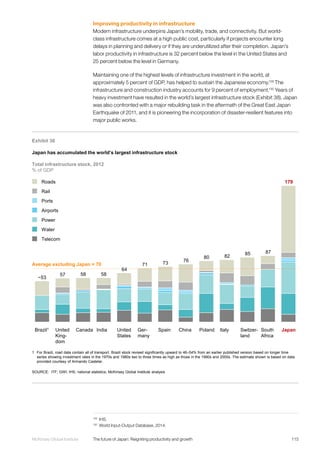
most economies averages around 70 percent of GDP, Japan has the world’s highest
infrastructure stock, at 179 percent of GDP in 2012.3
Given the size of its investment, Japan
needs to maximize every dollar.
ƒƒ Make project selection and project management as rigorous as possible. It is
critical to direct investment to where it can underpin economic growth or societal goals
rather than to “showcase” projects. Proposals should be subjected to a sophisticated
cost-benefit analysis and prioritized using a transparent, fact-based decision-making
process. An important source of savings would come from speeding up the approval
and land acquisition processes and using the latest technology to plan and manage
projects. Advanced 5D building information modeling systems, for example, can ensure
design accuracy and feasibility to prevent substantial changes and delays later in
the process.
ƒƒ Use maintenance, optimization, and demand management to extend the life
of existing infrastructure assets. In many cases, it is more cost-effective to invest
in extending the life span and capacity of existing assets than to build new projects.
Refurbishment and optimization strategies can save approximately 15 percent on
infrastructure investment.
ƒƒ Export world-class infrastructure. Japan can export its engineering expertise to the
rest of the world. Recent MGI research estimated that Southeast Asia alone has some
$3.3 trillion in infrastructure needs through 2030. There are many opportunities to serve
as either financier or provider of infrastructure services in developing economies around
the world, but Japan will have to compete for them.
• • •
The next decade offers a window of opportunity for Japan to shift its trajectory, in part by
capitalizing on immense flows of global trade, the rise of billions of new urban consumers
in the emerging world, and technology breakthroughs. But the new global economy is not
simply realigning; it is also accelerating. The time is right for Japan to undertake bolder
moves, bigger investments, and deeper reforms. Decades ago, Japanese manufacturers
famously introduced the world to “lean” practices. Today businesses throughout
the Japanese economy can apply these concepts to new industries and use digital
technologies to take them to the next level. Focusing on the priorities discussed here can
help to address persistent legacy issues and put Japan on a faster track toward recovery
and renewal.
3
	 Infrastructure productivity: How to save $1 trillion a year, McKinsey Global Institute, January 2013.
© Getty Images
© Alamy
1. THE ORIGINS OF JAPAN’S
PRODUCTIVITY IMPERATIVE
For much of the postwar era, Japan has been synonymous with rapid improvements in
efficiency and quality. It remains widely admired for innovation in both technology and
processes. From the 1950s through the 1980s, it outpaced the United States and Western
Europe in productivity gains—and this advantage led to robust economic growth, producing
one of the world’s highest standards of living.
Over two painful “lost decades,” however, Japan has lost much of its competitive edge.
Growth in both labor and capital productivity has steadily eroded in almost every sector
of the economy. This trend holds true even in Japan’s signature advanced manufacturing
industries, which originally introduced the world to the concept of “lean.” Today there
is a substantial and widening productivity gap between Japan and other leading
advanced economies.
The task of continuously capturing new productivity improvements grows more difficult
over time, but it is achievable, particularly if Japan takes steps to create new competitive
dynamics across entire industries. The good news is that our research has identified areas
within multiple industries that are ripe for efficiency improvements and revenue growth. This
effort goes beyond cost cutting; it is about spurring growth and increasing value added by
launching business lines, pushing the boundaries of innovation, and entering new markets.
(See Box 1, “Why productivity matters.”)
With its working-age population shrinking, Japan will need to focus on productivity as never
before. Overall productivity growth has been stalled below 2 percent for much of the past
two decades, which puts the Japanese economy on pace to grow by only 1.3 percent
annually through 2025.4
This sluggish pace would do little to boost household purchasing
power, and it would intensify the fiscal pressures of providing social security and health-care
benefits to an aging population. But if Japan can successfully double its rate of productivity
growth, returning to the levels it once posted in the 1970s and 1980s, it could boost
annual GDP growth to approximately 3 percent. This would indicate solid momentum and
contribute to an improved fiscal outlook.
While policy changes can create the right environment for growth, the vast majority of this
potential is in the hands of the private sector. There is a great deal that individual companies
can do immediately and on their own without waiting for government action. Multiple
fast-moving forces are realigning the global economy, and Japan can capitalize on these
trends to seek out new growth opportunities. To break out of its slump, the economy needs
broader adoption of global best practices, a wave of investment in new technologies, and a
greater willingness to try bold new business models.
4
	 Japan’s productivity growth was 1.5 percent in 2013 (the latest year for which OECD data is available).
McKinsey Global Institute	 1. The origins of Japan’s productivity imperative22
Box 1. Why productivity matters
Productivity growth is the result of workers making more—and better—goods
per hour. This may be a simple concept, but at the macroeconomic level, it
becomes a powerful force. Productivity gains are a marker of progress and
higher living standards. Conversely, a loss of momentum in this area can
cause slow-motion damage to an economy over time. As Nobel laureate Paul
Krugman once put it, “Productivity isn’t everything, but in the long run it is
almost everything.”5
At the global level, rising productivity and a steadily growing labor force, the
twin drivers of economic growth, combined to produce 50 years of rapid
economic expansion. Today, however, the prospects for growth are becoming
murkier in the face of demographic headwinds—not only in Japan but in
advanced economies around the world.
MGI has studied the patterns of growth in dozens of industries and across
more than 20 countries. A recent report building on this body of work attempts
to analyze what the decades ahead might bring.6
Given the pressure of aging
trends on the pool of available labor, it finds that the world’s rate of GDP
growth is set to slow by 40 percent from its rate over the past 50 years. As a
result, income growth could decline by 19 percent in developed economies
and by 14 percent in emerging economies. To head off this outcome, the world
needs to accelerate the pace of productivity growth by 80 percent, reaching a
difficult-to-achieve average of 3.3 percent a year.
These global findings clearly resonate for Japan, the first nation confronting the
full magnitude of the world’s demographic shift. As of 2013, a quarter of the
population was age 65 or older. That share is projected to rise to 36 percent by
2040 and to 40 percent by 2060.7
Its shrinking workforce presents Japan with
an urgent imperative to boost productivity—and other advanced economies
will be watching intently to see if Japan can pioneer solutions.
MGI’s work suggests that, at a global level, it is possible to boost productivity
past the point needed to counteract demographic trends. Most of this
potential comes from adopting existing best practices more widely. The
rest would stem from fully deploying the current pipeline of technological,
operational, and business innovations, which could push the boundaries
of what is achievable through today’s best practices. In Japan’s case, it is
important to note that more than half of the productivity gains that MGI’s
analysis finds feasible in advanced economies could come from closing
the gap between less efficient companies and plants and those with
higher productivity.
Productivity allows companies to offer better products and services at more
competitive prices, which leads to increased consumption and higher-value-
adding employment. This virtuous cycle could pave the way to sustainable
growth while addressing the demographic challenge and maintaining the
universal health-care and pension systems that underpin Japanese society.
5
	 Paul Krugman, The age of diminished expectations, MIT Press, 1994.
6
	 For a fuller discussion, see Global growth: Can productivity save the day in an aging world?
McKinsey Global Institute, January 2015.
7
	 Population projections for Japan: 2011 to 2060, National Institute of Population and Social
Security Research, January 2012.
23McKinsey Global Institute	 The future of Japan: Reigniting productivity and growth
Once a two-speed economy, Japan now faces deteriorating productivity
growth across all sectors
When MGI studied Japan in 2000, it found that a “two-speed” economy had developed.8
Export-oriented manufacturing industries (including steel, automotive, consumer
electronics, and machine tools) set the global standard, but these stood in sharp contrast
to low-performing, domestically oriented manufacturing and service sectors that were
protected from both international and local competition by tariffs and regulation. Our
research recommended three types of reforms to unleash growth: ending subsidies for
unproductive firms and allowing them to exit the market, removing laws and regulations
that prevent more productive companies from entering markets or introducing innovative
products, and creating incentives for competition and innovation.
Given its rapidly aging population and the persistently
low labor force participation of women, Japan will
have to focus on productivity as the primary catalyst
for growth.
Japan has taken some steps toward reform, including a bid to improve corporate
governance by requiring the addition of independent directors and the establishment of
special economic zones to showcase deregulation. Deeper reforms of key industries such
as the power sector, health care, and agriculture are part of the “third arrow” of Abenomics,
although many ideas are still in the proposal or legislative stages. In the meantime, structural
issues continue to constrain sectors across the economy. Barriers to entering and exiting
various markets still exist; for example, zoning regulations limit the presence of big-box
retailers, while tax incentives keep smaller, less productive shops afloat. Tariffs and other
protectionist policies shield many domestic industries from global competition. Furthermore,
government subsidies support unprofitable health-care providers and payors, channeling
public resources into maintaining an inefficient system. Without bold new incentives for
innovation and competition in place, the current era of digital and scientific breakthroughs
has not produced a surge in entrepreneurship in Japan on a par with what has been
unleashed in many other countries.
Today, the two-speed characterization of Japan’s economy no longer holds true. Even its
advanced industries have lost their competitive edge; labor productivity in the transport
equipment sector, for instance, is almost half the level in Germany. Today virtually all
sectors of Japan’s economy lag behind the United States in terms of both labor and capital
productivity, even though the United States (like other advanced economies) has itself
posted only weak productivity gains over the past decade (Exhibits 1 and 2). If current
trends are not reversed, Japan’s overall labor productivity gap with the United States is on
track to grow from 29 percent in 2011 to 37 percent in 2025.
These gaps represent the fundamental structural challenge facing Japan. GDP growth can
be generated by an expansion of the labor force and by productivity increases—and given
its rapidly aging population and persistently low labor force participation rate for women,
Japan will have to focus on productivity as the primary catalyst for growth. Its ability to
increase incomes and maintain its standard of living into the future hangs in the balance.
8
	 Why the Japanese economy is not growing: Micro barriers to productivity growth, McKinsey Global Institute,
July 2000.
McKinsey Global Institute	 1. The origins of Japan’s productivity imperative24
Exhibit 1
Japan’s labor productivity gap with the United States has been widening across most industries
SOURCE: World Input-Output Database; World Bank; McKinsey Global Institute analysis
NOTE: Education, public administration, and domestic employees not included.
United States
more productive
Japan
more productive
20-55 -35-45 -25 -5-15 0 5 10-10-20-60 25-65 -50 -40-70 -30 15
Advanced manufacturing
and consumer electronics
Manufacturing (other)
Hotels and restaurants
Post and telecommunication
Electricity, gas, and
water supply
Financial intermediation
Agriculture
Health and social work
Transport
Retail trade
Other community, social,
and personal services
Wholesale trade
Construction
Business services
Real estate
Labor productivity gap by sector (%, based on $ 2009 at purchasing power parity)
Index: 0 = United States
Sectors
analyzed
in detail
20052000 2011
25McKinsey Global Institute	 The future of Japan: Reigniting productivity and growth
Exhibit 2
Japanese sectors are also falling behind US sectors in capital productivity
SOURCE: World Input-Output Database; World Bank; McKinsey Global Institute analysis
NOTE: Education, public administration, and domestic employees not included.
United States
more productive
Japan
more productive
-80-90 -75-85 105-25-30-55 -40-60-65-70 -5-45-50 -10-20-35 0-15
Manufacturing (other)
Business services
Financial intermediation
Construction
Real estate
Transport
Hotels and restaurants
Wholesale trade
Agriculture
Advanced manufacturing
and consumer electronics
Health and social work
Electricity, gas, and
water supply
Post and telecommunication
Retail trade
Other community, social,
and personal services
Capital productivity gap by sector (%)
Index: 0 = United States
Sectors
analyzed
in detail
20112000 2005
McKinsey Global Institute	 1. The origins of Japan’s productivity imperative26
The “lost decades” have eroded productivity
Following the collapse of its stock market and real estate bubble at the beginning of
the 1990s, Japan went on to post an anemic average annual GDP growth rate of only
0.8 percent from 1992 to 2012. This prolonged slowdown was accompanied by a dramatic
drop-off in productivity growth.
Japan once made rapid leaps forward in productivity, averaging 3.5 to 4 percent annual
increases in the 1970s and 1980s. But its productivity growth slowed to less than 2 percent
throughout the 1990s and 2000s, a pace that lagged behind even the modest gains posted
by the United States. After the mid-1990s, productivity growth particularly stagnated in
distribution services (retail, wholesale, and transportation) and manufacturing (excluding
electrical machinery). One contributor to this trend was lower IT investment and a failure
to capture the full productivity and innovation potential of new digital technologies.9
While
industry growth and technology innovation have been the primary drivers of US progress,
Japan’s recent productivity gains have been based on holding output steady with a
shrinking workforce rather than growing markets and revenues. With weak demand for both
domestic consumption and exports, Japan has been unable to sustain clear and consistent
growth in value added; the economy continues to operate below its potential.
Structural issues within the Japanese economy, including the factors discussed below, have
increased the challenges of reigniting productivity growth.
Inadequate competitive pressures
Industries with a high level of competition tend to be more productive overall, as the most
nimble and innovative companies win out over less efficient firms. The market pressure
applied by allowing firms to fail offers a bracing effect on overall productivity. But in Japan,
this process of winnowing out does not play out as expected. Since Japan’s asset price
bubble burst in the early 1990s, highly indebted firms have been kept alive by banks that
may have a stake in them and wish to minimize bankruptcies.10
This stabilized employment
during the initial crisis, but the continued operation of unproductive firms today diverts
valuable resources that could be put to far better use elsewhere. The extension of credit
guarantees, particularly for small and medium-sized enterprises in service sectors, limits
the pressure for bank-led workouts and restructuring. With weak balance sheets, these
companies are unable to invest in productivity improvements.
The same tendency to preserve stability even at the expense of competitiveness is also
apparent in large conglomerates, which have typically shied away from radical reallocation
of resources or from restructuring underperforming business units. This phenomenon has
undermined capital productivity.
Given Japan’s relatively limited entrepreneurial activity, it is rare for startups to disrupt
established industries. In addition, regulatory barriers make it difficult for new competitors to
challenge incumbents, particularly in industries such as health care, education, transport,
and utilities.11
The presence of multinationals could provide additional competitive intensity;
in general, these companies tend to be more productive than purely domestic firms (due to
9
	 Kyoji Fukao and Tsutomu Miyagawa, Productivity in Japan, the US, and the major EU economies: Is Japan
falling behind? Research Institute of Economy, Trade and Industry, July 2007.
10
	 Richard C. Koo, The holy grail of macroeconomics: Lessons from Japan’s Great Recession, Wiley, 2009. See
also Ricardo J. Caballero, Takeo Hoshi, and Anil K. Kashyap, “Zombie lending and depressed restructuring in
Japan,” American Economic Review, volume 98, number 5, December 2008. For a more recent discussion,
see Noah Smith, “Japan needs more corporate funerals,” Bloomberg View, February 5, 2014, and Atsushi
Kodera, “Zombie firms pressured to act,” Japan Times, June 6, 2014.
11
	 Japan sustainability report, Group of Twenty, IMF, November 2011; Japan: 2014 Article IV consultation,
concluding statement of the IMF Mission, IMF, May 2014.
0.8%
Japan’s average
annual GDP
growth over the
past 20 years
27McKinsey Global Institute	 The future of Japan: Reigniting productivity and growth
their ability to shift production functions to lower-cost countries).12
But Japan attracts very
little investment from multinationals. FDI inflows into Japan’s manufacturing sector in 2011
amounted to just 0.06 percent of GDP, compared with 0.60 percent in the United States and
0.24 percent in Germany.13
There is no one reason for Japan’s relative dearth of foreign investment, but rather a
host of smaller factors such as the language barrier, a (frequently mistaken) belief that
Japanese consumers have fundamentally different preferences than consumers in other
developed countries, the proximity of many countries with lower labor costs, and a history of
protectionist policies. Doubling inward foreign investment is part of the Abenomics agenda,
and the public sector will have to make a concerted effort to win over global investors—not
only to capture the jobs and revenue they represent but for the best practices and new
technologies they bring and the competitive dynamics they can unleash.
Relative inflexibility in the labor market
Historically, Japanese companies offered a lifetime employment system that emphasized
seniority. This evolved because of cultural and social norms, and it provided a strong
foundation on which to drive postwar growth and nurture a sense of belonging and
cohesiveness among employees. Today the legal strictures around lifetime employment
have mostly been lifted, making the labor market more flexible in theory. But in practice,
downsizing is viewed in a strongly negative light, making it difficult for firms to pare back
where necessary. Workers, too, tend to be reluctant to advance their careers by moving
from company to company.
Inflexibility hurts productivity in a few ways. First, it can result in overstaffed and bloated
workforces, especially in headquarters and office environments. Second, since workers are
not likely to change employers, an important informal channel of sharing best practices is
lost. Third, employees have little incentive to continue developing new skills throughout their
career since they are unlikely find themselves competing for a new job.
Japan has partially addressed this issue by allowing firms to shift away from the lifetime
employment model and begin hiring non-regular (temporary) workers, or haken. Between
2000 and 2013, 6.5 million non-regular workers were added to the workforce, while
4.1 million “regular” employees left the workforce.14
By 2013, more than one-third of workers
were covered by these arrangements (Exhibit 3). Unlike full-time regular employees, these
temporary workers have limited legal protections and earn no pensions. This shift has
afforded firms a greater degree of agility, but paradoxically, it takes a toll on productivity.
Not only do temporary employees have fewer incentives to excel, but employers rarely
invest in their development.15
At a broader societal level, this situation has created a two-
tiered workforce and contributed to inequality. This issue urgently needs to be addressed,
since haken could account for more than 50 percent of the workforce by 2030 if current
trends continue.
12
	 Eiichi Tomiura, “Foreign outsourcing, exporting, and FDI: A productivity comparison at the firm level,” Journal
of International Economics, volume 72, number 1, May 2007. Multinationals are defined here as companies
that have at least 20 percent ownership stake in a foreign enterprise; domestic companies used for
comparison do not take part in exporting.
13
	 OECD. StatExtracts, 2014.
14
	 Statistics Bureau, Ministry of Internal Affairs and Communications, 2014.
15
	 Multiple international studies have shown that a dual labor market can have a negative effect on productivity
for a variety of reasons, including lower motivation and reduced training for temporary workers. See, for
example, Chie Aoyagi and Giovanni Ganelli, The path to higher growth: Does revamping Japan’s dual labor
market matter? IMF working paper number 13/202, October 2013; Francesca Lotti and Eliana Viviano,
Temporary workers, uncertainty, and productivity, Bank of Italy, October 2012; Juan J. Dolado and Rodolfo
Stucchi, Do temporary contracts affect TFP? Evidence from Spanish manufacturing firms, Institute for the
Study of Labor (IZA) discussion paper number 3832, November 2008. One study focused on Japan suggests
that part-time workers are about 75 percent less productive and receive 70 percent lower wages than full-time
workers; see Kyoji Fukao et al., Deferred compensation: Evidence from employer-employee matched data for
Japan, Hitotsubashi University Research Unit for Statistical Analysis in Social Sciences, October 2006.
1/3+
Share of non-
regular employees
in Japan’s
workforce
McKinsey Global Institute	 1. The origins of Japan’s productivity imperative28
A continuation of current trends would have profound economic and
societal consequences
Slower GDP growth has already had damaging, if subtle, effects in Japan. Although
unemployment has remained low throughout the two lost decades, deflation has eaten
away at income growth. Japan ranks third in the world in terms of GDP, but was only 16th
for GDP per capita in 2013.16
As a result of falling real wages, consumer spending has been
virtually stagnant since 1997.
While Japan has maintained global market share in automotive and other select industries,
many of its companies are being outperformed by Korean, Chinese, and US competitors.
In 2010, the mean return on invested capital for large Japanese companies17
was 23
percentage points lower than that of non-financial institutions in the US S&P 500. The
struggle for market share and profitability is particularly apparent in categories that were
once Japanese flagships, such as TVs and mobile phones.
Perhaps most worrisome is the unsustainable nature of Japan’s current fiscal trajectory.
Public debt was 234 percent of GDP in 2014, giving Japan the dubious honor of topping
Greece in this category.18
However, more than 90 percent of this public debt was held
by domestic investors (mostly financial institutions) as of 2012; this is in contrast to other
advanced economies, whose debt instruments are mostly held externally. This high level of
domestic purchasing of government bonds has kept borrowing costs low and avoided the
volatility that can accompany foreign capital flows (although it has also limited returns for
financial firms). Yet Japan ranks as the world’s most indebted country.
16
	 2013 ranking based on 2005 US dollars at 2005 purchasing power parity; figures from OECD
Economic Outlook.
17
	 In the first and second sections of the Tokyo Stock Exchange, excluding financial institutions.
18
	 For further discussion, see Debt and (not much) deleveraging, McKinsey Global Institute, February 2015.
SOURCE: Labour Force Survey, Statistics Bureau of Japan; National Livelihood Survey, Ministry of Health, Labour and
Welfare; McKinsey Global Institute analysis
Non-regular employment has increased substantially over the past two decades
36.7
20.2
4.0
2.1
0
5
10
15
20
25
30
35
40
95 05 101990 2000
%
Non-regular employees
as share of workforce
Unemployment rate
2013
Exhibit 3
+2.0
+16.5
Change,
1990–2013
Percentage
points
NOTE: Numbers may not sum due to rounding.
234%
Japan’s public debt
as a share of GDP
in 2014
29McKinsey Global Institute	 The future of Japan: Reigniting productivity and growth
Fiscal pressures are being exacerbated by Japan’s demographic shift, as deficits continue
to build within the pension and health systems. According to the World Bank, Japan passed
the tipping point at which its population began to decline in 2011. The implications of an
aging society are beginning to make themselves felt both economically and socially. The
number of Japanese citizens over age 65 who live alone has increased by 80 percent over
the past ten years, for example.19
This trend has created a sense of isolation and anxiety as
well as speeding the depopulation of rural areas.
The past two decades have also been marked by political instability. Japan saw 16 prime
ministers come and go between 1989 and the end of 2012. Today, however, the recent
reelection of Shinzo Abe has provided a greater degree of certainty, ensuring a measure
of continuity for at least the next four years. This should allow time to implement a more
systematic growth agenda without abruptly changing course; it should also improve Japan’s
ability to mount a coherent and consistent response to rising geopolitical challenges.
Large Japanese companies are generating
sharply lower returns on invested capital than their
US counterparts.
The Japanese economy can draw on significant strengths to reverse
this situation
Many global commentators have seized on these sobering trends and written off Japan’s
prospects for growth and renewal. But this narrative of doom and gloom tends to obscure
the nation’s remarkable strengths, including technological know-how, a formidable
manufacturing base, a highly educated labor force, world-class infrastructure, and a large
and affluent consumer market.
Despite two decades of sluggish growth, Japan is still the third-largest economy in the
world, and its citizens enjoy a high standard of living. In 2012, real GDP reached $5.6 trillion,
behind only the United States and China.20
Even under an expectation of limited growth (at
just above 1 percent annually), Japan would likely retain this ranking in 2025.
Japan achieved this status largely on the back of its highly efficient manufacturing and
exporting capabilities, which it built through heavy capital investment and an emphasis
on technology and process innovation. In auto manufacturing, for example, Japanese
companies (led by Toyota) imported US and European mass-production approaches,
procedures, and equipment, and then added their own adaptations (such as the concept
of continual refinements and a greater integration of suppliers into production processes)
to reap even greater benefits from them.21
Thanks to its sophisticated industrial base,
Japan exported more $700 billion worth of goods in 2013, with a heavy weighting toward
knowledge-intensive products such as vehicles, industrial equipment, and electronics.
Although it has begun to run a trade deficit in recent years, Japan ranks as the world’s
fourth-leading exporter.22
Its modern transportation and logistics infrastructure is
considered among the best in the world.23
19
	 National livelihood survey 2012, Ministry of Health, Labour and Welfare.
20
	 2010 US dollar values. IHS, real GDP by country.
21
	 Michael A. Cusumano, “Manufacturing innovation: Lessons from the Japanese auto industry,” MIT Sloan
Management Review, October 1988.
22
	 2013 values, OECD international trade statistics.
23
	 Japan ranked sixth globally for the overall quality of its infrastructure in the World Economic Forum’s Global
competitiveness report 2014–2015.
McKinsey Global Institute	 1. The origins of Japan’s productivity imperative30
Although Japanese consumers have, to some degree, shifted away from top-quality luxury
goods and have begun to hold out for bargains, domestic demand continues to be a major
engine of the economy.24
Japan is the second-largest consumer market in the world in many
categories, including packaged goods, over-the-counter drugs, and cosmetics. And the
Japanese consumer still has untapped potential: most households have significant savings
and hold more than half of their assets in cash and deposits.
Japan also remains a powerhouse of technology and innovation. As of the end of 2013, its
Internet penetration exceeded 86 percent, and because of excellent digital infrastructure,
Japan has the second-fastest connection speeds in the world.25
This provides a solid
foundation for technology adoption in multiple fields. Furthermore, Japan accounted for
one-fifth of all patents filed globally in 2012. Japanese players have captured major market
share in multiple fields with long-term growth potential, such as articulated robots, lithium-
ion batteries, carbon fiber products, and vacuum pumps.
Japan can build on a remarkable set of advantages,
including technological know-how, a formidable
manufacturing base, a highly educated labor force,
world-class infrastructure, and a large and affluent
consumer market.
Japan prides itself on having a highly educated population and a deeply held work ethic.
In 2012, 46.6 percent of the workforce had attained tertiary education (the second-highest
share in the world). Educational equity has improved in recent years: women accounted
for only 36 percent of university graduates in 2000 but 42 percent in 2012. Japan has also
begun to attract some top foreign students, a strategy that has served to bolster talent
development and innovation in other countries. The number of visiting Chinese students in
Japan doubled between 2001 and 2011, reaching almost 90,000 (out of some 140,000 total
foreign students at the tertiary level).26
Taken together, these factors constitute an impressive set of advantages. Japan is facing a
daunting economic and demographic challenge, but it has the financial, physical, human,
and social capital at hand to meet them.
• • •
The next decade offers a window of opportunity for Japan to shift its trajectory—in part
by taking advantage of some of the broad trends that are reshaping the world economy,
including increased connectivity across borders and disruptive technologies. But the
new global economy is not simply realigning; it is also accelerating, which increases the
imperative to act now. The following chapter takes a closer look at what it will take for Japan
to restore competitiveness and capture a greater share of global growth.
24
	 Brian Salsberg, “The new Japanese consumer,” McKinsey Quarterly, March 2010.
25
	 Penetration statistics from Nielsen and the International Telecommunications Union; connection speed
rankings from Akamai’s State of the Internet report, first quarter, 2014.
26
	 Education at a glance 2014: OECD indicators, OECD, October 2014.
31McKinsey Global Institute	 The future of Japan: Reigniting productivity and growth
© Getty Images
© Source© Getty Images
2. THE OPPORTUNITY FOR
A NEW PATH
Japan’s efforts to change course are approaching a critical inflection point. After
showing promising signs of growth in the first half of 2014, the economy slid back into
recession. Policy makers are attempting to administer a dose of strong medicine to the
faltering economy, including additional fiscal stimulus and an enormous new round of
quantitative easing.
If current trends hold, Japan’s GDP per capita would grow by a mere 1.3 percent
annually over the next decade, weakening consumer purchasing power. The overall
labor productivity gap with the United States is on track to grow from 29 percent in
2011 to 37 percent in 2025. The nation could face a third decade of stagnation—one
that would collide with an unprecedented demographic shift, creating even more
damaging consequences.
The continued aging of the population is inevitable, and unless Japan can boost workforce
participation and productivity, this trend could overwhelm the economy. Projections from
McKinsey’s Cityscope database indicate that Japan’s working-age population will decline
from 79 million in 2012 to 71 million in 2025 (with effective employment decreasing from
58 million in 2012 to 56 million in 2025). Its dependency ratio is set to soar from 0.60 to 0.73
over the same period, eventually hitting a staggering 0.96 by 2050.27
Persistent sluggish
growth would constrain the resources available for the social security and health-care
benefits that Japanese citizens expect at the very moment when demand for these services
will intensify. Japan’s public debt, already the highest in the world, would continue to mount.
Saddled with snowballing burdens of health care and elder care, Japan’s younger workers
would have diminished hopes for the future.
There is still time to head off this outcome. Japan has the opportunity and the capabilities
to engineer a leaner and more competitive economy. It will take political will to push through
structural reforms—but the private sector can take action in many areas without waiting for
policy changes. Japan can add a “fourth arrow” to the Abenomics agenda by engaging the
business community in a multifaceted, long-term national project to accelerate productivity
growth and innovation in every sector of the economy. In fact, our analysis finds that Japan
can meet some 50 to 70 percent of its productivity challenge if the private sector adopts the
best industry practices already in use by global companies in a variety of industries.28
Japan can change course and reignite growth
If productivity stagnates at 2013 levels while the population continues to age, the average
citizen will see his or her annual income shrink by approximately $1,600 in real terms by
2025. Japan would have to boost labor productivity by some 5 percent by 2025 merely
to maintain the GDP per capita it posted in 2013. Maintaining today’s income level is not
enough, of course—it is just the beginning. To sustain current social security spending, and
to ensure competitiveness and employment opportunities for generations to come, Japan
needs to grow beyond the status quo.
27
	 The dependency ratio is defined as the ratio of the non-working-age population (those below 14 years of age
and those above age 65) to the working-age population (ages 15–65).
28
	 This was estimated by calculating the potential impact produced by various industry levers described in detail
in Chapter 3. Most of the remaining improvement can be captured through technology adoption.
McKinsey Global Institute	 2. The opportunity for a new path34
Imagine a future Japan that once again outpaces the world in efficiency and quality—so
much so that experts from overseas flock there to study the best practices developed in its
industries. In this scenario, Japan emerges as a global leader in cutting-edge fields such
as advanced materials, 3D manufacturing, and the life sciences. Several major technology
clusters anchored by research centers and universities serve as the foundation for a newly
revitalized culture of innovation; top researchers and engineers from around the world
gather in these settings to collaborate. Intelligent robots fill the gaps where labor is scarce,
delivering results with high precision and low cost—and Japan exports this technology to
the rest of the world. At home, Japan reserves its human capital for tackling more creative
and knowledge-intensive work, reaping higher returns while working fewer hours.
Achieving a more prosperous future largely boils
down to whether Japan can more than double its
annual rate of productivity growth to generate new
economic momentum.
This future Japan has developed a thriving entrepreneurial ecosystem with easier access to
seed capital. Not only is there is a wave of new startups, but Japan also opens more of its
domestic markets to multinationals and foreign firms, unleashing new competitive dynamics
that force its large companies to rise to the challenge and become more nimble. Japanese
names enjoy market-leading positions in their respective industries globally and are run by a
new generation of innovative executives (some of whom come from outside Japan and all of
whom have international experience). More Japanese companies move to replace traditional
seniority-based pay scales with merit-based incentive structures that reward younger
talent. Corporations cede more responsibility to early-tenure managers with fresh ideas.
Shareholders insist on a new culture of performance, accountability, and agility—one that
transforms the way talent is managed and the way capital is allocated.
Japanese companies play an active role in establishing and implementing international
standards and take a more open-architecture approach to hardware and software
development. Financing and government support is made available to help Japanese firms
expand across all major geographies.
A rigorous focus on resource productivity helps Japan become a global leader in new
technologies for energy efficiency, transportation, and infrastructure management, opening
new possibilities for exporting some of these solutions worldwide. More of the nation’s
energy comes from domestic renewable sources, and “smart cities” deploy intelligent
infrastructure systems to manage demand and increase efficiency. Japan bolsters its energy
security, while efficiency and lower costs support new growth in domestic manufacturing.
The Japanese education system of the future would be retooled to instill a more open
and global mindset. Top students study abroad and undertake international internships
as a core part of their experience. Japanese universities hire more foreign faculty and
welcome the same share of international students as their leading European counterparts.
Entrepreneurship becomes rooted in campus life, with students in Tokyo University dorms
cooking up plans for the next Google, Facebook, Alibaba, or Tencent. Government funding
for education focuses on developing the specialized skills that are needed by employers as
well as the entrepreneurial and creative approaches that spur innovation in the economy
more broadly.
35McKinsey Global Institute	 The future of Japan: Reigniting productivity and growth
Japan remains one of the healthiest nations in the world and leads the way in demonstrating
that aging nations can deliver high-quality medical care while containing costs. The health-
care sector deploys new technologies such as remote health monitoring systems that can
take readings 24/7, alerting patients and doctors when an intervention is needed. Japan
becomes a leader in cutting-edge fields such as regenerative medicine, and it pioneers
the use of intelligent robots for everything from the daily care of elderly patients to the
sterilization of surgical instruments. New incentives encourage the development of more
specialist practices that deliver a higher quality of care, and providers compete on the basis
of outcomes rather than the number of treatments they perform.
Improved health allows experienced workers to remain on the job as they age, with
increased automation to relieve them of more physically demanding tasks. New policies
and practices draw more women into the labor force—and women begin to assert a
much greater presence in all types of leadership roles. Japan also begins to liberalize its
immigration policy to address its labor shortages.
Thanks to the adoption of autonomous vehicles, Japanese society becomes even more
mobile. High-speed connections between industry clusters allow for better deployment of
specialized and high-skilled labor. Mobile payments make for seamless transactions, and
big data analytics help companies offer goods and services that are better tailored to what
consumers really want. The Japan of the future harnesses technology to improve the quality
of life.
In this scenario, the specter of deflation disappears, and Japan’s economy averages
approximately 3 percent annual growth through 2025 (Exhibit 4). GDP per capita increases
by almost 3.5 percent annually, and Japan closes a substantial share of its current
productivity gap with the United States. Economic growth generates revenue that supports
Japan’s commitments to provide health care and social security for the elderly, and the
nation begins to chip away at public debt.
Exhibit 4
Accelerating productivity growth would change the outlook for Japan’s economy over the next decade
SOURCE: World Input-Output Database 2011; IHS; OECD GDP statistics; McKinsey Global Institute analysis
2%
Annual
increase in
productivity,
2000–11
4%+
Aspiration
for 2025
1.3%
GDP annual
growth,
2000–12
~3%
16th
World ranking
in GDP per
capita, 2013
5th $32,000
GDP per
capita, 2013
$48,000
McKinsey Global Institute	 2. The opportunity for a new path36
This alternative vision is highly aspirational, but Japan can in fact begin to move in this
direction. Achieving a more prosperous future largely boils down to whether Japan
can more than double its annual rate of productivity growth to generate new economic
momentum. Increased labor force participation will also play a part, as will a greater
willingness to experiment with more innovative business models and social paradigms.
Global trends are creating growth opportunities
After two decades of frustrated attempts to break out of stagnation, it is only natural for an
outside observer to ask what is different about today’s environment that could support a
fundamental shift in Japan’s direction.
The answer is simple: everything. The world outside Japan has been changing radically, and
it’s no longer possible to stand apart.29
As one of the most rapidly aging, urbanized, globally connected, technologically advanced,
and resource-scarce societies on the planet, Japan stands smack in the forefront of a global
wave of disruption. These trends present both pressures and incentives for Japan to make
bold moves. In some cases, they play directly to its strengths—and even where they pose
economic dangers, they will force Japan to adapt. And because Japan will be among the
first nations to face these issues, its responses will be of global relevance.
Global markets are growing more interconnected and fluid
We take it for granted that our world has grown more connected, but it is startling to
contemplate the immense flows of goods, services, finance, people, and data and
communications that now move across the world’s borders. Previous MGI research
estimated that $26 trillion worth of goods, services, and finance were traded in 2012 and
projected that global flows could triple by 2025.30
Today market forces are “on steroids”—
but Japan has yet to capitalize on these opportunities, as it is not as plugged into the global
economy as other developed countries. It ranks 21st on the MGI Connectedness Index
(below the United States, most of Western Europe, Russia, Hong Kong, Malaysia, and
South Korea). Its ratio of exports to GDP is 0.15, in contrast to 0.40 for Germany. Its private
sector has lacked the agility to match the speed of change in this new world, and as a result,
Japan’s share of global exports has fallen from 7 percent in 2000 to 4 percent in 2013.
But Japan has the manufacturing, export, and innovation capabilities to make up for lost
time and lost market share. By 2025, emerging economies will account for half of global
consumption.31
As their incomes rise and as they continue to industrialize, these countries
will be growth markets for more sophisticated, value-added products such as vehicles,
machinery and equipment, and electronics—long-standing areas of strength for Japan. To
take advantage of growing demand, Japanese firms will have to operate in a more genuinely
global fashion. This may include tailoring products and services in new ways and lowering
price points to compete in volume-driven markets. Companies will have to gather detailed
market intelligence to cater to varying consumer preferences and design their products
to fit local definitions of value; consumers everywhere are beginning to expect specificity
and customization.
For Japan, this new era of global connectedness presents a massive opportunity to
overcome sluggish consumption growth at home. Targeted, prioritized international
expansions, especially throughout emerging Asia, can unlock new demand.
29
	 See Richard Dobbs, James Manyika, and Jonathan Woetzel, No ordinary disruption: The four global forces
breaking all the trends, Public Affairs, 2015, for a book-length discussion of how these forces are transforming
the global economy.
30
	 Global flows in a digital age, McKinsey Global Institute, April 2014.
31
	 Urban world: Cities and the rise of the consuming class, McKinsey Global Institute, June 2012.
7%
Japan’s share of
global exports in
2000
4%
Japan’s share in
2013
37McKinsey Global Institute	 The future of Japan: Reigniting productivity and growth
An aging population can spur policy reform and represent a huge new
consumer market
Much of the developed world is aging along with Japan. Many advanced economies
will soon face the prospect of a shrinking labor force. This trend will only intensify in the
future, as 60 percent of world’s population lives in countries with fertility rates below the
replacement threshold. This fundamentally transforms the economic growth equation:
if countries cannot grow through an expansion of the labor force, they have to look to
productivity gains to compensate. Growing dependency ratios will also force countries
to make hard policy choices to maintain their social safety nets in the face of limited
fiscal resources.
No country is more exposed to this demographic headwind than Japan. Further
exacerbating the problem, only 59 percent of Japanese in the 60-to-64-year-old age
bracket are employed (vs. 66 percent in Sweden and 79 percent in Iceland).
As the country at the leading edge of the global demographic challenge, Japan will have
to pioneer policy solutions to increase labor force participation. The private sector will
also have to innovate to develop new business practices and technology solutions to fill
critical shortages and maximize the impact of human capital (such as advanced robotics,
autonomous cars, or intelligent software systems that can perform knowledge work). These
developments can have positive implications for productivity, and some of these solutions
could be exported to other countries.
The graying of the population also represents more than a policy or societal challenge.
Seniors are a potentially lucrative consumer segment. Japan could be well positioned to
export innovative products and services geared to the changing needs and preferences
of aging consumers in other developed markets (as Fujitsu has done with its senior-
friendly smartphone).
Japan—and the rest of the world—is growing more urban
The world is undergoing a historic surge of urbanization that is spurring new economic
growth. As of 2007, more people lived in cities than in rural areas. The global urban
population is growing by 65 million a year, creating legions of new consumers. Nearly half
of global GDP growth between 2010 and 2025 is expected to come from 440 cities in
emerging markets.32
If Japanese companies can develop the necessary market intelligence
and tailor their products to match local cultural preferences and price points at the city level,
they could unlock significant export opportunities.
Although Japan’s total population is expected to decline by 2025, Tokyo is projected to
remain the world’s largest metropolitan area, with 38 million inhabitants.33
Japan is already
one of the world’s more urbanized nations, but now depopulation of the countryside is
accelerating, posing challenges for integrating rural migrants into already-dense urban
areas. This shift also poses important questions about infrastructure investment—both in
growing urban centers and in rural areas with fewer and fewer inhabitants.
While the value of infrastructure stock in most economies averages around 70 percent
of GDP, Japan peaks with the world’s highest level at 179 percent in 2012. Furthermore
Japan’s spending on infrastructure has historically been among the world’s highest,
averaging approximately 5 percent of GDP from 1992 to 2011 (second only to China, at
8.5 percent of GDP). Beyond any new projects it may undertake in the future, Japan’s
recent wave of infrastructure projects locks in the need for substantial ongoing expenditures
for operation, maintenance, renewal, or expansion as existing assets age. Previous
32
	Ibid.
33
	 Projections from McKinsey Cityscope database.
40%
Potential
improvement in
infrastructure
productivity
McKinsey Global Institute	 2. The opportunity for a new path38
MGI research has identified opportunities to improve infrastructure productivity by up to
40 percent through better project selection, streamlined construction and delivery, capacity
management, and optimized maintenance.34
Its modern, world-class infrastructure puts Japan in an excellent position for trade and
digital innovation. In addition, Japan can export its engineering expertise to the rest of the
world—and there is a growing market for infrastructure as the world’s emerging economies
urbanize. Recent MGI research estimated that Southeast Asia alone will need to invest
some $3.3 trillion in infrastructure through 2030, with much of this going to urban transit,
water, and power systems. The region’s infrastructure gaps are growing increasingly
evident: less than two-thirds of Indonesia’s roads are paved, and approximately a quarter
of the population in both Indonesia and the Philippines still lacks access to electricity.35
Japan is already partnering with the region’s governments on a variety of projects. Tokyo
Metro is providing technical assistance to develop urban metro lines in Hanoi, for example,
and Japan is providing capital and expertise for electricity projects in Myanmar and road
projects in the Philippines.36
There are many more opportunities to serve as either financier
or provider of infrastructure services in Southeast Asia and around the world, but Japan will
have to compete for them.37
Disruptive technologies are setting the stage for productivity gains and new
product development
Today a host of potentially transformative innovations have already appeared on the
horizon, from advanced materials and 3D printing to the Internet of Things.38
Japan is
already adopting—and even inventing—some of these breakthroughs. Moving beyond
that first wave of experimentation, the next challenge is to apply these tools and accelerate
adoption throughout entire industries so that technology moves the needle on productivity
performance. If Japan moves quickly, it can seize the initiative to become a global leader in
some of these areas.
Advances in artificial intelligence, machine learning, and human-machine interaction are
making it possible to automate and augment knowledge work. Embedded sensors and
actuators in machines and other physical objects enable remote monitoring of everything
from factory equipment to urban infrastructure and medical devices. Google’s autonomous
cars have driven more than 700,000 miles (as of April 2014) among conventional manual-
driven cars, further illustrating the rollout of the Internet of Things, robotics, and big data.
With its strong capabilities in technology R&D and manufacturing, its depth of specialization
in robotics and hardware, and its great need for automation due to a shrinking labor force,
Japan has a unique combination of “push and pull” factors to become a global leader in
these fields, which could represent tremendous growth markets in the decades ahead.
The Internet is also shaking up the competitive landscape for businesses in profound
ways, as newcomers can scale up with stunning speed and little capital. As a result,
value is shifting between sectors, and entrepreneurs and startups have a new advantage
over large, established businesses. These competitive dynamics will force Japan’s most
tradition-bound companies to evolve and become more agile if they are to survive in this
fast-paced environment.
34
	 Infrastructure productivity: How to save $1 trillion a year, McKinsey Global Institute, January 2013.
35
	 Southeast Asia at the crossroads: Three paths to prosperity, McKinsey Global Institute, November 2014.
36
	 “Tokyo Metro offers assistance to Hanoi Metro,” Voice of Vietnam, February 18, 2014; Yuka Hayashi, “Japan
aids neighbors with ‘high-quality infrastructure,’” The Wall Street Journal, November 12, 2014.
37
	 “Japan, China competing for construction projects in Asia,” Japan Times, January 28, 2015.
38
	See Disruptive technologies: Advances that will transform life, business, and the global economy, McKinsey
Global Institute, May 2013, for a full discussion of the 12 technologies with the largest economic potential on a
global scale.
39McKinsey Global Institute	 The future of Japan: Reigniting productivity and growth
The private sector can pursue three major types of strategies to
boost productivity
Emerging economies have the ability to capture large productivity gains as they undertake
an initial wave of industrialization and modernization. But for a highly advanced economy
such as Japan, it takes a sustained commitment to drill down and find new efficiencies and
to push the boundaries of innovation beyond the current frontier.
That being said, there is ample scope for Japan to improve productivity. While there is plenty
of inefficiency that begs to be addressed in Japan’s state sector, most of the economy—
and therefore most of the opportunity for improvement—lies within the private sector. The
business community will have to provide the leadership for a national productivity project
to succeed.
This is a time for business leaders to think big—in terms of creating innovative products,
penetrating new markets, and making substantial investments in equipment, technology,
and talent—to generate new value added. But they will simultaneously have to put every
aspect of their operations under the microscope to find ways to streamline. In many
cases, the barriers and bottlenecks are not imposed from above via regulation; they stem
from entrenched ways of doing business. Private-sector leaders can dismantle these
practices themselves without waiting for policy directives. In fact, doing so is a matter of
survival. Productivity drives growth at the macroeconomic level, but it also determines
whether individual companies can thrive in a fast-moving, digital, and highly competitive
global economy.
This report explores three sets of industry initiatives: adopting existing industry best
practices, including those developed in other countries; moving to the frontier of technology;
and organizing for discipline and performance. Within each of these areas, companies can
adopt multiple strategies to boost productivity.
Overall, Japan can reach some 50 to 70 percent of the productivity goal discussed here if a
critical mass of companies adopts practices that are already global standards; technology
accounts for most of the remaining potential. Chapter 3 will explore these topics in greater
detail as they apply within advanced manufacturing, retail, financial services, and health
care, but the following list speaks to Japan’s entire private sector more broadly. Chapter 4
will outline the basic enablers that need to be in place to meet the productivity challenge;
these issues depend in large part on public policy, but they can also benefit from private-
sector support and engagement.
Incorporating global best practices
ƒƒ Become more globally integrated. Rather than relying heavily on the domestic market,
Japanese companies have to become more aggressive about entering the fastest-
growing overseas markets. But in addition to going global, enterprises have to become
more truly global, thinking beyond borders with regard to their operational footprint
and talent development. Organizations can retain their Japanese roots while cultivating
deeper connections to global value chains.
ƒƒ Improve capabilities across the value chain. Japanese companies have historically
excelled in manufacturing and product development, but they often lag behind their
global competitors in other corporate functions such as sourcing, supply-chain
management, customer relationship management, marketing, and after-sales service, to
name just a few. Japanese companies need to invest in building capabilities across their
entire organization and the broader value chain.
McKinsey Global Institute	 2. The opportunity for a new path40
ƒƒ Continue the journey of digitization. Many Japanese companies continue to operate
with legacy IT systems and antiquated architecture. In most companies, an end-to-
end review will likely reveal areas that have received little IT investment and process
innovation. Replacing outdated systems and equipping employees with mobile tools
can enable companies to transform their business processes to become more efficient
and effective. It can also open up avenues for creating value, expanding offerings, and
improving the customer experience.
ƒƒ Determine the optimal physical footprint. Organizations may need to reconfigure in
a more digital world with changing demographics. In retail, for example, smaller urban
storefronts (or, conversely, big-box stores) offering innovative customer experiences can
help to reduce costs and increase proximity to affluent customers. Health-care providers
may need to consider whether their locations, scale, and degree of specialization match
the needs of patients by age and geography. Financial institutions may need to close
some of their least profitable branches and incorporate new interactive technologies
into others.
Adopting next-generation technologies
ƒƒ Harness the power of big data and advanced analytics. Big data can be a
powerful tool for pricing, customer segmentation and marketing, sales forecasting, risk
management, and R&D. But a recent Nikkei survey showed that almost half of the major
Japanese companies surveyed were not using it to transform operations.39
ƒƒ Take automation to the next level. Internet technologies have been automating
business processes for years, but now this trend could expand into many additional
roles as intelligent software systems become more adept at performing knowledge
work. These technologies, along with developments in robotics, could help Japanese
companies address critical labor shortages in the years ahead.
ƒƒ Deploy advanced technologies in manufacturing processes. The coming decade
will bring an ongoing wave of innovation in manufacturing that reinvents the assembly line
yet again. Firms will have to embrace these new technologies to keep pace and capture
new sources of value. This could mean adopting low-cost sensors and big data analytics
for better accuracy in production or using 3D printing to achieve mass customization.
New technologies also make it possible to exert much tighter control over supply
chains; the Internet of Things, for example, can help to manage transportation fleets and
distribution networks in real time.
Organizing for discipline and performance
ƒƒ Restructure as needed to create more competitive and fluid industries.
Competition is the greatest driver of productivity, and in some sectors, the government
could spur substantial progress by removing policies that have constrained market
forces. Companies will have to adapt to a much more intense level of competition—
and new winners would likely emerge in a variety of industries. A more fluid industry
structure would allow more up-and-coming startups to enter various markets while
removing protections and subsidies for incumbents. In response to these changes,
some companies may need to reorganize or exit unprofitable markets, while others may
undertake mergers and acquisitions to achieve economies of scale and quickly gain
new capabilities. These dynamics would support more effective capital allocation by
individual firms and across the broader economy.
39
	 “Majority of Japanese companies mine big data,” Nikkei Asian Review, December 11, 2014.
41McKinsey Global Institute	 The future of Japan: Reigniting productivity and growth
ƒƒ Create a culture of performance and accountability. Shareholders and top
executives have to make it clear that productivity is a top organizational goal. The best
way to spur real change is to tie performance goals to an incentive structure. Companies
such as Hitachi, Sony, and Panasonic have already begun shifting away from the
traditional seniority-based advancement system, and Toyota’s recent announcement
of a merit-based pay structure is likely to create even broader momentum for this
transition.40
Promoting younger talent into the management ranks and rewarding results
have the potential to create more agile organizations and fresh ideas.
ƒƒ Draw on all sources to build talent, leadership, and skills for the future. At a
macroeconomic level, Japan needs to maximize the labor force participation of women
and older workers (see Chapter 4 for a deeper discussion). Some of this effort can be
addressed by public policy, but much of it depends on the willingness of individual
companies to change entrenched norms and attitudes (such as the demands for long
hours that make it difficult for new mothers to return to work). It is especially critical for
companies to invest in programs that develop and mentor female leaders. McKinsey
research indicates that companies with the highest proportions of women in senior
management positions report enhanced organizational and financial performance.41
Companies will also need to find ways to retain valuable skills and experience by
reengineering the workplace to accommodate the needs of aging workers. This could
include increasing automation to reduce physically demanding activities; implementing
flexible hours, part-time arrangements, and work-from-home policies; and redesigning
the physical environment with a greater focus on ergonomic issues. Older workers could
be also reassigned into mentorship and training roles.
ƒƒ Focus on the customer to achieve a better return on R&D investments. Japan
has the sophisticated R&D and manufacturing capabilities to develop new products
and services—whether in traditional industries or at the cutting edge of fields such as
robotics, advanced materials, and genomics. But instead of focusing on the technology
itself, the development process has to focus on understanding what the customer wants
and delivering solutions based on that insight. Innovation is no longer just about creating
products within a closed and tightly managed R&D process; it involves both teamwork
and a more external, customer-centric orientation. A greater willingness to collaborate
with customers and suppliers can yield new ideas for product development and process
refinement based on real end-user insights. New working models (from social media
platforms for collaboration to new arrangements of physical office environments) can
break down hierarchies and department silos to encourage more innovation from across
the organization. Google and 3M have both been noted for policies that encourage
employees to spend some portion of their hours working on personal ideas. Procter
& Gamble and GE have both embraced open innovation, starting programs that
crowdsource ideas from outside the company for solving design conundrums. Tencent
has created an open platform that allows developers to connect with millions of its QQ
users to create mobile apps and other products.42
40
	 Kana Inagaki, “Japan Inc shuns seniority in favour of merit-based pay,” Financial Times, January 27, 2015;
Craig Trudell and Yukiko Hagiwara, “Toyota plans overhaul to seniority-based pay,” Bloomberg, January
26, 2015.
41
	 Women matter: An Asian perspective, McKinsey & Company, June 2012.
42
	 “Tencent open platform heralds a new era,” company press release, October 30, 2014.
McKinsey Global Institute	 2. The opportunity for a new path42
These initiatives can have a remarkable impact on economic growth
and productivity
If the private sector undertakes the initiatives described above, it could lead the way in
putting the economy on a faster track toward recovery and renewal. Instead of settling
for a future with 1.3 percent annual GDP growth, Japan could grow by an average of
approximately 3 percent through 2025—in other words, realizing the alternative scenario
for a more prosperous future described earlier in this chapter. This would increase Japan’s
projected GDP in 2025 by up to 30 percent over current trends (Exhibit 5). In fact, the size of
the prize is $1.4 trillion in GDP in that year alone.
To get there, however, Japan needs to more than double its labor productivity growth rate
over this period, boosting it from approximately 2 percent to approximately 4 percent. This
is a highly ambitious goal, but with its labor force expected to decline by some 3.7 percent
between 2011 and 2025, productivity is Japan’s most important means to accelerate
growth. If this effort is successful, Japan would surpass Germany in productivity by 2025.
Its productivity gap with the United States would persist, but instead of growing from
29 percent in 2011 to 37 percent, it could be reduced to 19 to 26 percent (Exhibit 6).
Productivity initiatives in specific industries can help Japan increase value added by up to 28 percent
above the current trajectory
SOURCE: World Input-Output Database; IHS; McKinsey Global Institute analysis
Value added
$ billion, 2009
Exhibit 5
1 Increases in value added and productivity in the sectors examined in detail were used to extrapolate gains in similar
industries (e.g., gains in advanced manufacturing were applied to all manufacturing).
NOTE: Numbers may not sum due to rounding.
120
96
2025
estimated
4,900
2011
105186
109
Financial
services
4,139
6,290
2025
improved
907
544
Other
industries1
Health
care
21
Advanced
manufac-
turing
14156
Retail
Low range
High range
+28%
+18%
5,768
43McKinsey Global Institute	 The future of Japan: Reigniting productivity and growth
Economic growth, along with better allocation of capital and a focus on optimizing
expenditures, could also improve capital productivity in Japan by an average of 25 percent
across all industries by 2025 (Exhibit 7).
The innovations pioneered by one leading company can have an outsized impact on the
productivity of an entire industry as competitors are forced to raise their game. In the 1950s
and 1960s, Toyota introduced more efficient production processes that were soon widely
adopted by the entire Japanese auto industry. Decades later, Wal-Mart had a major direct
and indirect effect on the productivity of the entire US retail sector by introducing new
managerial and supply-chain practices.43
This observation leads to crucial questions: Which Japanese companies will be the ones to
spur industry-wide change? And could the ripple effects on their competitors lead to higher
levels of corporate churn?
A drive for greater productivity can also raise anxiety about the eventual impact on jobs.
Technology often enhances productivity by automating tasks, which can eliminate some
jobs or force existing employees to adapt to new roles and responsibilities that require
43
	 US productivity growth, 1995–2000, McKinsey Global Institute, October 2001.
Japan can shrink its labor productivity gap with the United States and surpass Germany by 2025
SOURCE: World Input-Output Database; IHS; McKinsey Global Institute analysis
Labor productivity (value added per hour worked)
$ 2009
Exhibit 6
1 Increases in value added and productivity in the sectors examined in detail were used to extrapolate gains in similar
industries (e.g., gains in advanced manufacturing were applied to all manufacturing).
NOTE: Numbers may not sum due to rounding.
6
12
1
RetailAdvanced
manufac-
turing
40
2
Financial
services
2025
estimated
1
52
2011
66
Other
industries1
10
Health
care
<1
Germany
United States
2025
improved
61
Low range
High range
-19%
-26%
McKinsey Global Institute	 2. The opportunity for a new path44
different skill sets. The effect of automation on overall unemployment is likely to be roughly
neutral in Japan, given that the workforce is shrinking. Our estimates suggest that in some
sectors, such as advanced manufacturing and financial services, productivity growth from
automation may displace 6 to 9 percent of the workforce, while labor inputs (total workers
and declining working hours) are on track to decline by 9 percent. Nevertheless, change
does not happen at the same pace across the economy. The need for labor may decline
sharply in some sectors, while other industries may have sudden spikes in demand for
new skills. The public and private sectors will have to be prepared to deal with this issue
by ensuring that adequate support is available to ease the pain of transition for affected
workers as labor is reallocated across the economy. A key component of this will be
providing retraining programs on a large scale so that workers can acquire the new skills
employers need.
• • •
Industrial policy can enable economic growth (as we will explore more fully in Chapter 4),
but Japan’s productivity imperative will ultimately have to be met by the private sector.
Japanese manufacturers famously invented “lean” practices and exported them to the rest
of the world. Today businesses throughout Japan’s economy—and particularly in service
sectors—can reinvent these concepts, applying them to new industries and extending their
impact with the help of new digital technologies. Businesses will need a greater willingness
to invest and take risks, while managers and workers will have to adapt to fresh ways of
doing business. Achieving the rate of productivity growth needed to drive Japan’s economy
forward will be a long-haul national project that involves every employer and employee.
By 2025, Japanese industries can sharply improve their capital productivity
SOURCE: World Input-Output Database; IHS; McKinsey Global Institute analysis
Gross value added per unit of fixed capital stock—
2025 estimates
%
24
12
90
47
10
30
14
138
77
15
0
All industriesFinancial
services
54%
26%
54%
17%
65%
Health careRetailAdvanced
manufacturing
Base case
Improved capital productivity
Exhibit 7
NOTE: Numbers may not sum due to rounding.
45McKinsey Global Institute	 The future of Japan: Reigniting productivity and growth
© Alamy
© Getty Images
3. A SECTOR-LEVEL ROAD MAP
With its labor force shrinking, Japan has to focus on productivity as its primary source of
growth—and identifying areas that are ripe for improvement is at the heart of our research.
Unless Japan cracks the productivity challenge, long-term trends of stagnation, eroding
competitiveness, low fertility, and rapid aging will bring about a society with a reduced
quality of life and an unprecedented burden on the working-age population. Boosting
productivity can head off this outcome and inject new dynamism into the economy.
The preceding chapter described some cross-cutting strategies for the private sector,
but here we examine more specific opportunities to accelerate productivity growth in four
sectors: advanced manufacturing, retail, financial services, and health care. These were
chosen because they represent significant but diverse parts of the Japanese economy.
Some 30 percent of Japan’s productivity potential
can be captured within four sectors: advanced
manufacturing, retail, financial services, and
health care.
If Japan can more than double its annual rate of productivity growth to approximately
4 percent, the size of the prize would be substantial: up to $1.4 trillion in GDP growth in
2025 alone. Some 30 percent of that potential can be captured within the sectors profiled
here, while the remainder can be achieved in other sectors based on benchmarking against
international peers that have adopted best practices.44
The strategies outlined below are by
no means exhaustive, but they do offer a starting point for action and an indicator of the size
of Japan’s still-untapped productivity opportunity.
44
	 We have extrapolated the potential impact from the four industries we analyzed in detail to the remainder of
the economy, differentiating by type of industry (e.g., private, public, goods, or services) and industry structure
(e.g., level of consolidation).
McKinsey Global Institute	 3. A sector-level road map48
ADVANCED MANUFACTURING
Japanese manufacturing was once viewed as a “two-speed” sector. When MGI examined
the Japanese economy back in 2000, domestically focused industries such as textiles and
food manufacturing lagged in productivity, but more export-oriented industries posted
world-class performance.45
Today, however, even some of the flagship industries within the latter group have grown
less competitive. This report will focus on a subset that is of particular concern. “Advanced
manufacturing” is defined here as the aggregate of three industries: electrical and optical
equipment (which includes consumer electronics), industrial machinery, and transport
equipment (which includes automotive). These industries have multiple attributes in
common: high R&D intensity, high value added, a substantial share of output for export, and
a relatively low reliance on labor and energy compared with other manufacturing industries.
Above all, these industries represent the vanguard of Japan’s industrial capabilities and
the source of its signature exports. For years, Toyota, Honda, Nissan, and other Japanese
automakers set the global standard for reliable, well-made cars at affordable prices.
Japanese electronics brands such as Sharp, Sony, and Panasonic were lauded for their
quality. They remained consistently at the forefront of technological innovation, introducing
products such as the PlayStation, Blu-ray, and the flat-panel, high-definition televisions that
are ubiquitous today.
But over the past 15 years, these leading names have seen their market share erode in the
face of new global competition. Even more worrisome, Japan’s advanced manufacturing
sector, which once led the world in productivity, has fallen behind its competitors. Today
Japan’s labor productivity in this sector is 29 percent below that of the United States and
32 percent below that of Germany (Exhibit 8).
45
	 The 2000 report included the steel industry in this category along with automotive, consumer electronics, and
machine tools.
29%
Japan’s labor
productivity gap
with the US in
advanced
manufacturing
Labor productivity in Japan’s advanced manufacturing sector lags behind
that of the US and German sectors
50
39
23
19
70
56
37
22
73
69
52
43
0
20
40
60
80
Advanced manufacturing labor productivity
(value added per hour)
$ 2009 at purchasing power parity
022000 071995 2011
United States
Japan
Germany
SOURCE: IHS; McKinsey Global Institute analysis
Exhibit 8
49McKinsey Global Institute	 The future of Japan: Reigniting productivity and growth
Japan’s productivity gap vs. the United States is not only significant—it has been widening
(Exhibit 9). Since 1995, US productivity in advanced manufacturing has grown by
218 percent, while Japan’s has grown by 163 percent.46
Technology advances in the years
ahead will naturally continue to improve labor productivity in both nations. But if current
trends continue, Japan’s improvement would still lag behind the pace in the United States.
Unless targeted measures are taken, the productivity gap between the US and Japanese
advanced manufacturing sectors is on pace to grow from 29 percent in 2011 to 34 percent
by 2025.
46
	 Adjusted for inflation and price level changes.
Exhibit 9
Japan’s productivity gaps with the United States in manufacturing have been widening,
especially in electrical and optical equipment
SOURCE: IHS, World Input-Output Database, McKinsey Global Institute analysis
98
52
0
20
40
60
80
100
64
49
10
20
30
40
50
60
70
42
49
0
20
40
60
80
100
20111008060498961995 022000
Advanced manufacturing labor productivity
(value added per hour)
$, 2009 at purchasing power parity)
Electrical
and optical
equipment
Machinery
Transport
equipment
Japan
United States
NOTE: Not to scale.
McKinsey Global Institute	 3. A sector-level road map50
Despite these challenges, advanced manufacturing remains one of Japan’s core sectors,
and its performance is closely tied to the health of the broader economy. These industries
account for 7 percent of Japan’s employment, 6.7 percent of its GDP, and 60 percent of
R&D spending; they also produce more than two-thirds of Japan’s exports. The erosion of
their global market share is a clear cause for concern (Exhibit 10).
At the firm level, Japanese auto companies have remained excellent performers. Nissan
rebounded strongly after entering its partnership with Renault, and Toyota successfully
pioneered hybrid cars with the Prius, which continues to dominate its category. Toyota’s
Corolla ranked as the number 2 top-selling model globally in 2013, while the Camry came in
sixth; the Honda CRV was the number 9 best seller.47
However, Japanese carmakers have
shifted much of their production outside of Japan to local markets.
The consumer electronics space has not fared as well. The market has shifted toward
a greater emphasis on software and integrated platforms such as Apple’s iOS, which
creates the ecosystem for all of its devices. Fast-following, lean players such as Samsung,
LG, Xiaomi, Huawei, and Lenovo have grabbed market share for products such as TVs,
PCs, and smartphones—often at the expense of Japanese firms. The most recognizable
Japanese conglomerates (Sony, Sharp, Panasonic, Toshiba, and NEC) have spent
the past decade fighting for profitability in the face of stagnant growth. In a number of
cases, Japanese companies made some unfortunate bets on technologies that did not
ultimately win out in the marketplace; they have not developed blockbuster products
that have resonated with global consumers and have largely missed out on the growth of
smartphones. Consumer electronics companies need to achieve truly global scale to stay
47
	 LMC Automotive data as quoted in Joann Muller, “The world’s most popular cars: Ford Focus and other
surprises,” Forbes, December 23, 2013.
87 92
13 8
20102000
6.8 9.8
Global consumption of
advanced manufactured goods
%; real 2005 $ trillion
32.8
93.6 100.0
67.2
91.1
8.96.4
TVs MobileAutos PCs
Share of Japanese market, 2010
%
SOURCE: IHS World Industry Service; Gartner; iSuppli; IDC; Japan Automobile Importers Association; Japan Automobile
Manufacturers Association; IHS AutoInsight; McKinsey Global Institute analysis
Japan’s advanced manufacturing industries have relied on the domestic market
while losing ground globally
Exhibit 10
Japan Rest of world
NOTE: Numbers may not sum due to rounding.
Japanese goods Imported goods
51McKinsey Global Institute	 The future of Japan: Reigniting productivity and growth
competitive, but Japan’s industry has been hampered by fragmentation and an adherence
to proprietary standards. Many subscale companies and plants are focused on products
with declining margins.
The global market for electronics looks significantly different than it did just 15 years ago.
These products were once considered luxury goods destined for consumers in advanced
economies, but today there is an explosion of demand from emerging economies.
While consumption in Japan is expected to stay flat, consumption throughout all of Asia
(including Japan) has doubled in the past ten years, and it is expected to grow by more than
170 percent in the decade ahead.48
In Southeast Asia alone, MGI estimates that 81 million
households are currently part of the “consuming class,” and this number is forecast to grow
to 163 million households by 2030.49
Similarly, consumer-facing industries in Africa are
expected to grow by more than $400 billion by 2020.50
Emerging economies are not just
sources of low-cost labor. They are now lucrative consumer markets—and multinational
companies from around the world are competing to establish market share.
Many Japanese exports have been slow to gain traction in emerging economies, and
while this is cause for concern, it is also an indicator of opportunity. If Japan’s advanced
manufacturing sector can unlock new sources of revenue growth, in part by taking
advantage of its proximity to many of the world’s fastest-growing centers of demand, it can
reestablish itself as a global leader.
Productivity challenges
Advanced manufacturing industries have experienced downward pricing pressure over
the past decade—and that pressure has been particularly acute in the electronic and
optical equipment sector. This downward pressure has been exacerbated by the industry’s
reliance on cost-based pricing and competition; Japan’s traditional monozukuri spirit places
value on delivering excellent craftsmanship and quality at a “fair price” to the consumer.
Some leading global names have changed the rules of the game by introducing innovative
products for which consumers are willing to pay premium prices, but by and large,
electronics are subject to rapid commoditization and falling prices.
Pricing pressures are a worldwide phenomenon, however, so they do not fully explain the
productivity performance of Japan’s advanced manufacturing sector relative to that of the
United States. The three major challenges described below contributed to today’s gap. They
concern mismatches between the industry’s focus and changing market trends, and they
relate to the broader issues around Japan’s underlying environment for competitiveness and
innovation raised earlier in Chapter 1.
Insufficient focus on fast-growing global markets
Japanese manufacturers have long been able to rely on the spending power of the
Japanese consumer. But today domestic demand is stagnating even as more international
competitors have entered the Japanese market. By contrast, there is booming demand in
emerging economies around the world. Japanese companies face an increasingly urgent
imperative to go global.
The typical global strategy for Japanese companies has been “inward-out”—that is, taking
products that have performed well in the Japanese market and simply selling them abroad.
51
This has worked, to some extent, when entering other developed markets such as the
United States or Western Europe.
48
	 IHS Global Insight, World Industry Service.
49
	 Southeast Asia at the crossroads: Three paths to prosperity, McKinsey Global Institute, November 2014.
50
	 “The rise of the African consumer,” McKinsey Quarterly, November 2012.
51
	 Some automotive companies have taken a different approach, moving production closer to local end-
user markets.
McKinsey Global Institute	 3. A sector-level road map52
But this strategy falls flat when companies attempt to enter emerging markets such as
India, China, or Africa. Japanese products are often overly feature-rich and expensive, and
as a result, they can fail to resonate in lower-income economies. (Japanese automakers
are an exception, however. Toyota, Nissan, and Honda have successfully tailored their
vehicles to appeal to the needs of a growing consumer class in emerging markets. In fact,
Nissan recently revived its Datsun brand for entry-level buyers in India and elsewhere.52
Honda motorcycles are ubiquitous for commuters in markets such as India, Southeast
Asia, and Brazil.) Understanding what drives value for consumers in local markets requires
local intelligence—and many Japanese firms have not made the necessary investments to
develop these insights.53
As a result of insufficient investment and misaligned focus, Japan’s advanced
manufacturing industries have lost ground in growing international markets, resulting in
a decline in net exports since 2010 (Exhibit 11). Japan’s exports of electrical and optical
equipment have fallen behind those of the United States and Germany in terms of both
volume and growth rate.
Language barriers, delayed adoption of global standards, and management culture
have also combined to slow the pace of internationalization. While there is a great deal to
overcome, Japan’s proximity to emerging Asian economies means that there is massive
growth potential at its doorstep.
52
	 Siddharth Vikram Philip, “Datsun leads Nissan’s emerging markets push with Go model,” Bloomberg
Businessweek, July 16, 2013.
53
	 Andrew Dugan, Randy Kyung-rok Han, and Sagar Pagare, Asia or bust: Why Japanese firms must succeed in
Asia to survive, Knowledge@Wharton, December 2013.
Net exports of R&D-intensive manufactured goods
$ billion
SOURCE: World Integrated Trade Solutions Database; McKinsey Global Institute analysis
Consumption of advanced manufacturing products
Index: 100 = 2005
While the global market continues to grow, Japan’s net exports have been on the decline
Exhibit 11
0
50
100
150
200
250
300
350
400
World
Asia
2015E 2025E20102005 2020E
NOTE: Numbers may not sum due to rounding.
22
2012
Machinery
148
66
Transport
equipment
236
2013
Electrical
and optical
equipment
165
318
2010
310
57
82
169
96
63
2011
164
47
300
84
53McKinsey Global Institute	 The future of Japan: Reigniting productivity and growth
A product mix that is weighted toward lower-value goods
At the industry level, labor productivity is not just affected by how quickly workers can
churn out goods. It is highly influenced by the industry’s overall product mix. In advanced
manufacturing, parts and components tend to generate less value than final goods—a
phenomenon that explains why companies such as Apple and Vizio have “unbundled” their
value chains across geographies, relying on far-flung suppliers to become “factory-less
manufacturers.” By contrast, producers of parts and components are a mainstay of Japan’s
advanced manufacturing sector. Although these players have been successful, the fact
remains that these companies collectively produce less value added per hour of labor than
other types of manufacturing.
Japanese firms have to find a way to play to their strengths in these areas. One possibility
is to maximize value added through better pricing and marketing; another is to concentrate
R&D activity in technology hubs to develop more innovative products.
In the electronics sector, the product mix effect is especially relevant. Japan’s electronics
sector is still heavily weighted toward hardware; its firms hold large market shares in
products such as digital cameras, printers, and TVs. Meanwhile, those same firms have
largely missed out on tapping into growth in software, IT services, and smartphones. They
have been hindered by an adherence to proprietary standards and a lack of interoperability
as well as an environment that does not encourage more fluid innovation. These points are
discussed more fully elsewhere in this section.
Difficulties in commercializing new innovations
Japan has a long-standing global reputation for innovation. It is a leader in patent filings,
holding 50 percent or more of the world’s intellectual property in areas such as lithium-ion
batteries, articulated robots, and copy machines. Japan spends more on manufacturing
R&D than almost any other country in the world: in 2010, its R&D investment in the advanced
manufacturing sector was equivalent to 1.7 percent of GDP, ahead of Germany’s 1.6 percent
and 1.1 percent in the United States. Nevertheless, in recent years Japan has not seen the
payoff in terms of growth or productivity that one would expect from such heavy investment.
It performs well below peers in productivity growth relative to R&D investment (Exhibit 12).
This is due in large part to the difficulties entrepreneurs and businesses encounter in
commercializing new ideas and cutting-edge technologies. Japan has fewer entrepreneurs
than the United States; one study found that they constituted 3.7 percent of the labor force
in Japan in 2013, compared with 12.7 percent of the US labor force.54
Additionally, their odds
of securing early-stage funding are much lower than they would be in the United States and
other developed countries.
Another driver may be the Japanese approach to R&D. Companies tend to keep their
research operations tightly contained rather than taking a more open approach that allows
ideas to cross-pollinate between different parts of the organization and outside entities
(including suppliers and customers). The new norm of collaborative innovation has been
embraced more fully by companies in other advanced economies. Outside partnerships are
particularly important as companies try to get closer to customers in local markets across
the world and tailor products to meet their preferences.
54
	 José Ernesto Amorós and Niels Bosma, 2013 global report, Global Entrepreneurship Monitor, January 2014.
3.7%
Share of
entrepreneurs in
the Japanese
labor force
McKinsey Global Institute	 3. A sector-level road map54
A high cost base
Compared with its international competitors, Japan often has to contend with a higher
non-labor cost base, particularly in the electrical and optical equipment industry (Exhibit 13).
The cost of intermediate inputs in the comparable US sector is equivalent to only
38 percent of revenue, as opposed to 65 percent in Japan. Examining the performance
of key players in both countries reveals that only a small part of this difference is explained
by the cost of goods or by R&D expenditures. Japan’s operational expenses are driven
higher by inefficiencies in global operations and in corporate functions such as supply-
chain management.
Exhibit 12
Heavy investment in R&D has not produced a large payoff in productivity for Japanese firms
1 Total factor productivity is a measure of technological progress that measures increases in output after taking labor and capital inputs into account.
-2.0
-1.5
-1.0
-0.5
0
0.5
1.0
1.5
2.0
0 0.5 1.0 1.5 2.0 2.5
New Zealand
United Kingdom
Iceland
Denmark
Norway
Austria
Switzerland
Portugal
Belgium
Japan
Netherlands
Finland
Australia
Spain
Sweden
Canada
Italy
France
United States
Germany
Business investment in R&D vs. total factor productivity, 1986–20081
SOURCE: Gartner; iSuppli; IDC; Euromonitor; IMF; McKinsey Global Institute analysis
GDP size, 2013
Total factor productivity annual change
%
R&D
% of GDP
55McKinsey Global Institute	 The future of Japan: Reigniting productivity and growth
Japan’s future path: Comparing the current trajectory of advanced
manufacturing with a vision for revitalization
If Japanese manufacturing continues on its current trajectory, it will face limited growth,
continued loss of share in global markets, and widening labor productivity gaps with the
United States. The sector’s value added would increase by a mere 1.4 percent annually
through 2025. Labor productivity would increase by a total of 41 percent over the entire
period from 2011 to 2025. By then, the Japanese sector would generate only $71 per labor
hour vs. $107 per labor hour in the United States, leaving Japanese productivity at just
66 percent of the US level.
But Japan has an opportunity to change this path if companies aggressively pursue the
strategies we outline below, including value optimization, targeted globalization, improved
operational excellence in all corporate functions, and the deployment of next-generation
technologies. By prioritizing the most lucrative global markets and employing the right
pricing strategies, Japan could reestablish a world-leading position in its advanced
manufacturing industries—not only in automotive, but also in areas such as optical and
electrical components and robotics.
Japan has long realized the beauty of keeping things simple and streamlined. Its advanced
manufacturing industries can reap significant productivity gains from adopting international
standards and a modular approach—that is, using an increasing number of interoperable
Cost as
% of revenue
Revenue breakdown by subsector, 2011
$ billion, 2009 at purchasing power parity
SOURCE: World Input-Output Database; McKinsey Global Institute analysis
590.7
Japan
231.3
353.8
363.5
United
States
122.5
227.1
70.7
161.4
Japan
117.9
188.6
324.4
United
States
163.0
608.9
475.4
374.0
95.2
United
States
133.5
278.7
Japan
65 38 63 50 75 78
Value add (includes labor cost)
Non-labor cost of intermediate inputs
Japan has a high non-labor cost base, particularly in the electrical and
optical equipment industry
Exhibit 13
NOTE: Numbers may not sum due to rounding.
Electrical and
optical equipment Machinery
Transport
equipment
McKinsey Global Institute	 3. A sector-level road map56
parts and processes to build platforms of components that can be plugged together like
Lego bricks. Taking an open-architecture approach and adopting international standards
can raise quality and lower costs. Automation will play a significant role in this Japan of the
future, with increased use of advanced robotics that are able to work alongside humans and
support labor-intensive tasks.
In this vision, Japanese manufacturers reinvent their world-renowned lean thinking
approach for a new era by integrating the Internet of Things and other next-generation
technology solutions into their processes. These solutions can allow them to add new
business lines such as cost-efficient and high-quality after-sales service and maintenance.
With the right environment in place, entrepreneurship could grow within the industry,
and innovative ideas would more frequently translate into new product lines. This is a
time of tremendous evolution—and tremendous churn—in manufacturing, trade, and
technology. But the current wave of disruption is presenting Japanese manufacturers with
new opportunities.
Challenges and opportunities from global forces
For Japan, a new era of globalization means an opportunity to overcome sluggish demand
at home. Emerging economies represent huge new markets, and not only for consumer
goods. As these nations rapidly urbanize, they are generating new demand for compact
cars and rail technology, which plays directly to Japan’s strengths. Exports of machinery
can also unlock greater demand for services; workers in economies that are just beginning
to industrialize have less experience in operating and maintaining sophisticated equipment.
Japan has the manufacturing, innovation, and
export capabilities to make up for lost time and lost
market share.
Global connectedness is also allowing manufacturers to separate their headquarters from
R&D operations and from actual production. This translates into fierce competition for spots
in global value chains—and because Japan has significantly higher labor costs than many
other countries in the region, its firms have to compete by developing unique capabilities.
At a global level, the manufacturing industry is experiencing a remarkable wave of
innovation—and Japanese firms can capture enormous opportunities by establishing
themselves as global leaders. Some of the most promising areas include nanomaterials,
new production technologies such as additive manufacturing (3D printing), and integration
of the Internet of Things and advanced robotics into production processes.55
Innovative
software is increasingly being integrated into traditional manufactured goods; Apple,
Google, IBM, and Baidu, for example, are developing platforms for “connected cars” and
have engaged with major global automakers. This blending of software and hardware
represents a new competitive challenge—and a major market opportunity—for Japan’s
automakers if they can stay at the forefront as they unveil their own connected car offerings.
Japan is importing a larger share of its energy than at any point in the past decade. This
makes Japanese producers in energy-intensive manufacturing industries more sensitive to
a fluctuating yen. Additionally, consumers are increasingly demanding eco-friendly goods
made by companies that operate sustainably. Despite the recent dip in global energy prices,
the industry has incentives to minimize its energy consumption—and these efforts would
55
	 Manufacturing the future: The next area of global growth and innovation, McKinsey Global Institute,
November 2012.
57McKinsey Global Institute	 The future of Japan: Reigniting productivity and growth
support a push toward more efficient processes overall. There is untapped potential for
Japanese firms to use “circular economy” concepts such as recycling and minimizing waste
in production processes. In the same way that Toyota anticipated customer desires and led
the way in the hybrid car market with the Prius, other firms should be deliberate about the
opportunities for growth and efficiency they can achieve by going greener.
Company strategies for boosting productivity and growth
A new era of innovation is under way, and Japan can take decisive action to revitalize its
advanced manufacturing sector. We have identified key strategies that collectively have
the potential to boost value added in Japan’s advanced manufacturing industry by up to
53 percent above the current trajectory by 2025 (Exhibit 14). It should be noted, however,
that Japan would need to adopt breakthrough technologies on a wide scale to achieve the
full potential.
-4.4
-0.4
6.6
1.5
1.1
0.3
-7.0
-6.5
Productivity levers can help Japan boost value added in manufacturing by more than 50 percent in 2025
53.4
5.3
0.8
7.2
13.2
14.0
7.8
5.2
Next-generation
technologies
Global best
practices
Commercialization of
innovation
Industry consolidation
Operational excellence
across the value chain
New manufacturing
technologies
Internationalization
strategies
After-sales services
and opportunities
Taking the lead in
robotics and 3D
manufacturing markets
Total impact
Organizing for
discipline and
performance
Exhibit 14
%
SOURCE: McKinsey Global Institute analysis
Impact on value added Impact on labor hoursLever
NOTE: Numbers may not sum due to rounding.
McKinsey Global Institute	 3. A sector-level road map58
Four of these strategies result in more output and will require additional labor, while the
remaining four create value through efficiency gains that will reduce the need for labor. We
project that if current trends hold, the sector’s employment would fall by 14 percent by 2025.
However, our estimates indicate that by fully implementing these initiatives, industry growth
could mitigate the expected decline in employment, reducing it to 10 percent.56
Combining these strategies would produce a significant improvement in labor productivity.
By 2025, this sector’s performance could increase by 26 to 47 percent above the current
trajectory—almost matching projections for US productivity in this area (Exhibit 15).57
56
	 The expected decline in employment stems from a combination of a roughly 4 percent reduction in labor hours
due to increased productivity and a 6 percent reduction due to the continuing trend in Japan toward shorter
workdays and lower average hours per worker. All in all, the 2025 labor hours required are estimated to be
about 90 percent of 2011 levels. See the technical appendix for more detail on these assumptions.
57
	 Industry projections from IHS Global Insight, World Industry Service, 2014.
335
251
2011
5,727
2025Decline
from levers
Decline in
average
hours per
worker1
5,140
-10.2%
534
2025 improved2011
348
2025
457
288
+53%
Exhibit 15
Japan’s advanced manufacturing sector has the potential to almost close the productivity gap with the US sector
89
71
50
2025
104
-34%
2025 improved2011
1 Average hours per worker gradually decrease over time as general technological progress improves productivity.
NOTE: Numbers may not sum due to rounding.
-5.9%
-4.4%
SOURCE: McKinsey Global Institute analysis
Range Low High
Labor productivity, 2025
(value added per hour worked)
$, 2009 at purchasing power parity
United States = 107
Germany = 97
Value added
$ billion, 2009 at purchasing power parity
Labor inputs
Million hours worked
59McKinsey Global Institute	 The future of Japan: Reigniting productivity and growth
Incorporating global best practices
Shifting R&D to higher-value-added opportunities
Japan, once a world leader in innovation, has seen limited return on its R&D investment in
recent years, and its reputation for cutting-edge creativity has lagged. But it may be able
to reverse this trend by redirecting its formidable R&D capabilities to higher-value spaces
(for example, by shifting away from its traditional focus on hardware and moving more
decisively into software and systems). In an era of rapid-fire technology breakthroughs, there
is enormous potential to increase revenues from creating entirely new categories of goods
and services as well as by creating new value within existing categories—not to mention
the potential to increase margins by applying innovation to management and production
practices to boost labor productivity. The link between productivity and job creation is
particularly strong when efficiencies stem from innovation. Success in high-tech fields could
also improve capital productivity, as it may encourage the formation of new companies and
business models that are more asset-light than other types of heavy industry.
Japan can boost productivity by redirecting its focus
from hardware to software and systems.
Targeted globalization strategies
The need for Japanese firms to expand into international markets has already been
well established. This will require increased output and will likely increase the need for
labor. Japanese firms need extremely targeted and prioritized strategies to capture
this opportunity. It is critical for firms to have a granular understanding of markets and
customers—not only at the national level, but at the city level. In Africa, for example, MGI’s
Cityscope database suggests that 47 cities will account for nearly 50 percent of African GDP
growth by 2025. In China, 250 cities are expected to account for 28 percent of global GDP
growth by 2025.58
The more accurately firms can target city-level pockets of demand and
the more precisely they can tailor products to local preferences, the more successful they
will be. This is not a matter of simply capturing greater market share, but of making smart
decisions about where to compete and in which market segments.59
Adopting international
standards will be key to helping Japanese firms go global.
Operational excellence along the value chain
Companies will have to strive for new standards of performance in every corporate
function—not just in production but also in areas such as sourcing, procurement, pricing,
and marketing, to name just a few. For example, only two of the top 100 supply chains in the
world are owned by Japanese companies (Honda and Toyota).60
But technology is making
it possible for companies to gain much tighter control over this part of their operations.
E-commerce allows manufacturers to tap suppliers from anywhere across the globe. The
Internet of Things can track materials and components as they move through warehouses
and transportation hubs. GPS-enabled telematics can manage fleets and distribution
networks in real time, while big data–enabled demand forecasting systems can avoid stock-
outs and excess inventory. These types of systems can produce significant cost savings.
58
	 Urban world: Cities and the rise of the consuming class, McKinsey Global Institute, June 2012.
59
	 Patrick Viguerie, Sven Smit, and Mehrdad Baghai, The granularity of growth, John Wiley & Sons, 2008.
60
	 2014 Gartner supply chain top 25: Asia/Pacific. This ranking evaluates performance in return on assets,
inventory turns, and revenue growth.
McKinsey Global Institute	 3. A sector-level road map60
Manufacturers can also create platforms that make production both flexible and cost-
effective. As companies penetrate new markets and consumers grow to expect more
personalization, demand is becoming increasingly fragmented. Companies could incur high
development, design, and production costs in this type of environment unless there are real
synergies between products. But some manufacturers are able to solve this problem by
developing product platforms that offer the ability to achieve scale while still offering product
diversity (although it imposes some constraints on the ability to individually tailor features).
This approach is particularly well developed in the automotive industry.61
Platforms reuse components, processes, equipment, and even knowledge and teams
to make an entire product family. Modular platforms, in particular, allow manufacturers to
assemble common subsystems to create distinctive products with varying functionalities,
expanding a company’s portfolio of products while minimizing complexity. This is achieved
by increasing the number of compatible parts and components that can be used across
products and applying this up and down the value chain, from quoting through installation
and delivery. Using different levels of modules to appeal to different market segments is key,
along with pricing discipline that charges a premium for additional customization beyond the
standard modular products. This approach dovetails with the adoption of global standards,
as the world has been shifting toward a more open-architecture approach.
After-sales services and opportunities
Manufacturers are creating new revenue streams by adding services that tie into their
products, such as delivery and installation, operation, maintenance, or systems integration.
The market for these types of offerings is growing, especially in emerging economies.
Japanese companies are generally known for providing excellent service but have been
slow to monetize this part of the value chain. To go this route, companies will need to
professionalize their service arms (potentially adding employees) and develop pricing
models in which customers pay different amounts for various agreed-upon service levels.
Some companies may experiment with business model innovations, in some cases going
so far as to transform themselves from product companies to service companies.
Adopting next-generation technologies
New manufacturing technologies
The coming decade will bring an ongoing wave of innovation in manufacturing that reinvents
the assembly line yet again—and new technologies can push the boundaries of what
can be achieved through lean concepts. Firms will have to embrace these developments
to keep pace and capture new sources of value. This could mean adopting ubiquitous
sensor networks and big data analytics for more efficient, higher-quality production or
using 3D printing to achieve mass customization or more accurate product molds. These
and other manufacturing technologies present opportunities for increased revenue from
new product and service offerings as well as cost savings, faster time to market, and
quality improvements.
By implementing these changes, Japanese manufacturers can achieve a long-term
improvement in capital productivity. Since technology continues to evolve at an accelerated
pace, adoption is not a one-time investment; companies have to continuously watch for new
breakthroughs they can integrate into their own business models.
61
	 Olivier L. de Weck, Eun Suk Suh, and David Change, Product family strategy and platform design
optimization, presented at the 2003 ASME Design Engineering Technical Conference, September 2003; David
Robertson and Karl Ulrich, “Planning for product platforms,” MIT Sloan Management Review, July 1998. See
also Claire Bal, “Toyota wants TGNA platform to close gap with VW, Hyundai,” Automotive News Europe,
December 12, 2013.
61McKinsey Global Institute	 The future of Japan: Reigniting productivity and growth
The use of industrial robots in production could automate up to a quarter of all industrial
tasks in developed countries by 2025.62
Japan is already leading the way, with the greatest
absolute number of industrial robots deployed in the world. It is second in the world in terms
of robot density, with 323 robots deployed for every 10,000 workers in 2013 (behind only
South Korea, with 437).63
This trend toward automation can smooth the way for adopting the
modular production approaches described above. Perhaps most important, it can mitigate
the impact of Japan’s aging and shrinking workforce, and by reducing the necessary human
labor required for certain functions, it can contribute to higher labor productivity.
Gaining global market share in robotics and 3D printing
Japan is in a strong position to capitalize on growth in robotics—not only for automating
its own operations but for exporting its technology to the world. In fact, it already owns
50 percent of the global industrial robotics market.64
Focusing on exports of additive
manufacturing (3D printing) technology could be another area for rapid growth.
Japan could capture significant growth opportunities by boosting its global market share
for both of these technologies by 5 to 10 percent. To accomplish this, the industry needs to
first target pockets of international demand, such as the rapidly growing market for industrial
robotics in China. The industry can also intensify R&D efforts to continue pushing the frontier
of innovation in these fields, such as the use of robotics in service industries.
Organizing for discipline and performance
The industry landscape is fragmented in a number of Japan’s advanced manufacturing
industries, with many small, inefficient players. Pursuing consolidation through mergers
and acquisitions would allow companies to reach the critical size necessary to benefit from
economies of scale and better optimize their capital and human resources. Larger firms
can improve their cost structure and become more competitive in international markets—in
some cases even regaining their global leadership.
Companies will have to strive for new standards of
performance in every corporate function—not just
in production but also in sourcing, procurement,
pricing, and marketing.
62
	 “Shaping the future of manufacturing,” McKinsey Quarterly, issue number 1, 2014.
63
	 International Federation of Robotics statistics.
64
	 Trends in the market for the robotics industry in 2012, Ministry of Economy, Trade and Industry, July 2013.
McKinsey Global Institute	 3. A sector-level road map62
RETAIL
Japan’s retail sector represents a significant part of the economy: it accounts for 9 percent
of total employment and 5 percent of GDP.65
In addition to its large and sophisticated
consumer base, Japanese retail benefits from excellent logistics; many companies routinely
offer same-day delivery or even a one-hour delivery window. High Internet and mobile
penetration has underpinned growth in online shopping.
Despite these strengths, Japanese retail is fraught with challenges and inefficiencies.
Forty-seven percent of sales derive from small, often family-owned specialty shops—and
because these businesses are less productive, they create a drag on the overall sector (see
Box 2, “Japan’s retail formats at a glance”). Furthermore, Japan’s persistent deflationary
environment has put a damper on consumer demand; retailers have struggled to maintain
margins and to price products at full value. Finally, in segments such as traditional
convenience stores, supermarkets, and drugstores, the market remains highly fragmented.
Consolidation has been slow, as many retailers that have been family-owned for generations
are hesitant to become part of larger brands. With few large national chains, retailers cannot
achieve the full benefits of purchasing at scale.
Japan has not kept pace with the productivity growth
posted by the US retail sector—but it can close up to
95 percent of the gap.
Recently Japan’s retail sector has begun to change. Since the 2000 repeal of the Large
Scale Retail Store Law, Japan has seen a decline in traditional store formats and an
increase in drugstores, small modern specialty stores, e-commerce, and mail-order/catalog
shopping. This shift has contributed to gains in labor productivity over the past 15 years—
even so, Japan has not kept pace with the productivity growth posted by the US retail
sector. Even large retail chains have not created best-in-class processes and mechanisms
to capture true economies of scale in sourcing and IT systems.
E-commerce is another major source of retail productivity. Japan’s e-commerce market
is already the third largest in the world, with $119 billion in 2014 sales. But it is growing
more slowly (at 7 percent annually) than the US market (12 percent annual growth) or the
Chinese market (which has rocketed ahead to become the largest market in the world,
with 51 percent annual growth).66
Major players such as Rakuten and Amazon are making
strides, but there is still room for brick-and-mortar incumbents to add new channels—and
for disruptive new players to emerge in this space.
New developments could help the Japanese sector gain ground. Retailers can adopt
new technologies to generate consumer insights, forecast demand, and tighten inventory
management; they can also make a more decisive shift to e-commerce and create new
market opportunities by actively catering to seniors. By implementing the specific strategies
outlined later in this section, the retail sector can add $105 billion to $156 billion to its GDP by
2025, an increase of 41 to 61 percent over current 2025 projections.
65
	 World Input-Output Database, 2014.
66
	 Ekos Global statistics.
35%
Japan’s
productivity gap
with the US retail
sector
63McKinsey Global Institute	 The future of Japan: Reigniting productivity and growth
Box 2. Japan’s retail formats at a glance
The retail sector encompasses seven main formats that vary on the basis of
the choices, service, and prices offered to consumers.
ƒƒ Small convenience stores primarily sell food and some general
merchandise products such as toiletries and household items. They are
typically located near residential areas. Two types of store formats are
included in this category.67
—— Small, modern convenience stores that are part of larger chains (such
as 7-Eleven or Lawson) represent 10 percent of this category. They are
typically open 24 hours a day.
—— Small, traditional stores. These are generally family-owned and may
employ two or three family members. Since they are not part of larger
chains, they are hard-pressed to offer a wide range of products or low
prices. This category is dominated by specialty stores with a specific
focus on household goods (71 percent of the overall category), food
(11 percent), or apparel (9 percent). These traditional stores are some
25 percent less productive than the modern convenience stores.
ƒƒ Specialty chains focus on a narrow range of products. Some offer a high
level of service in small stores, while others (category killers) offer a broader
selection of brands within each product and compete on price.
ƒƒ Supermarkets are large-scale stores selling primarily food items. In the
United States, this category is dominated by large chains, but in Japan,
supermarkets tend to be part of smaller chains.
ƒƒ Department stores are large-scale stores offering a broad range of general
merchandise. While they have a heavy focus on clothing, accessories, and
cosmetics, Japanese department stores sell some food items; they also
tend to be very high-end.
ƒƒ Drugstores sell over-the-counter drugs and general merchandise; they also
contain pharmacies.
ƒƒ The non-stores category includes mail-order businesses, catalog
businesses, and e-commerce. The mail-order and catalog business is still
strong in Japan, accounting for 43 percent of non-store sales in 2012, while
e-commerce accounted for 57 percent.
ƒƒ Stores that do not fit into the categories above are simply categorized as
“other.”
67
	 See other MGI reports for the traditional vs. modern categorization of store formats, such as
A tale of two Mexicos: Growth and prosperity in a two-speed economy, McKinsey Global
Institute, March 2014. MGI’s 2000 study of Japan considered the two types of small stores
described here as separate categories, but they have been consolidated in this report to
better reflect the stores’ purpose and access to consumers; this approach is consistent with
retail definitions used in other parts of the world.
McKinsey Global Institute	 3. A sector-level road map64
Productivity challenges
MGI’s 2000 report identified the prevalence of traditional stores as a primary driver of
the sector’s low productivity. Structural barriers slowed the sector’s modernization, as
larger retailers often encountered zoning restrictions that prevented their expansion, while
tax incentives and government subsidies kept traditional stores going. The report noted
that removing these barriers would be key to speeding the sector’s transition into more
productive formats.
Since then, Japan has liberalized the sector by repealing the Large Scale Retail Store Law
and making it somewhat easier to open big-box stores and shopping centers in new areas
(although some barriers remain). It also adjusted laws concerning property, capital gains,
and inheritance taxes that discouraged traditional stores from exiting the market and selling
off their land. As a result of these moves, a growing number of large-scale shopping centers
have opened in Japan’s suburbs. Traditional formats have significantly declined in the past
15 years, but they still account for a large share of the sector’s total sales and employment.
While supermarkets and department stores continue to decline, more modern specialty
chains (such as big-box electronics stores) and drugstores have increased. Thanks in part
to these changes, labor productivity in the retail sector grew at a compound annual growth
rate of 2.2 percent between 2000 and 2011. Despite this improvement, growth has not kept
pace with the US sector.
Traditional store formats have significantly declined,
but they still account for a large share of the retail
sector’s total sales and employment.
Over the past 15 years, the US sector has put an intense focus on value-added pricing
and cost savings. US retailers have become more efficient by introducing innovations in
merchandise management, supply-chain management, and store operations. This has
also been a period of tremendous churn among US industry leaders. Today’s leading big-
box retailers (such as Wal-Mart, Target, Costco, and Home Depot) and e-commerce sites
(most notably Amazon) have set a high bar for efficiency and competitive pricing. As the
Internet has increased price transparency, margins have become razor-thin in many product
categories, and many small independent retailers and less efficient chains have shuttered.68
The US sector is characterized by low wages, irregular hours, and few benefits for many
workers, however. A desire to avoid these outcomes does not mean that Japanese retail
should avoid undertaking a push to improve productivity, but rather that it should focus on
innovation and growth as the major drivers.
While the total number of labor hours worked has remained relatively flat in the US sector,
the real value added generated for each hour worked has risen steadily, which translates
into a continuous increase in labor productivity (Exhibit 16). Over the same period, Japanese
retail has averaged 2 percent annual labor productivity growth, only half the average
annual productivity gains in the United States (4 percent). In 2011, the Japanese sector
produced $24.80 in real value added per hour worked, less than the US sector at $38.20
(and slightly below Germany’s performance). Like Japan, Germany has seen relatively flat
labor productivity growth in retail during this period. Its major retailers, such as Aldi and Lidl,
compete heavily on price and maintain a limited number of SKUs (stock keeping units); this
model has resulted in relatively flat real value added over the years.
68
	 See “How retailers can keep up with consumers,” McKinsey Quarterly, October 2013, and the case study on
retail trade in US productivity growth 1995–2000, McKinsey Global Institute, October 2001.
65McKinsey Global Institute	 The future of Japan: Reigniting productivity and growth
Japan has not fully embraced global best practices in retail, such as focusing on key value
items, implementing cutting-edge pricing strategies, benefiting from economies of scale
in purchasing and distribution, using big data for targeting marketing, and creating more
efficient warehousing operations.69
This has led to gaps with the US sector across all store
formats. A lean mindset, long a source of pride for Japanese auto manufacturing, is not
sufficiently applied in retail. Customer buying habits lead to small average transactions,
thus increasing the cost of sales, while wholesalers capture a large share of value through
excessive intermediation.
69
	 Why the Japanese economy is not growing: Micro barriers to productivity growth, McKinsey Global Institute,
July 2000.
SOURCE: World Input-Output Database; McKinsey Global Institute analysis
0
5
10
15
20
25
30
35
40
05
Labor productivity
(real value added per hour worked)
$, 2009 at purchasing power parity
201120001995
600
400
800
1,000
200
0
1,200
20112000
Value added
$ billion, 2009 at purchasing power parity
1995 05
25
10
35
30
20
15
5
0
Labor inputs
Billion hours worked
20110520001995
Despite its growing share of modern-format stores, Japan’s retail sector has not kept pace with the US sector
in labor productivity
Exhibit 16
United States
Japan
Germany
McKinsey Global Institute	 3. A sector-level road map66
Above all, growth and productivity have been dampened in recent years mostly due to the
factors described below.
Low consumer spending
Data suggest that compared with other major developed economies, Japan has
significant room for consumer spending to increase. Japan’s retail spending is equivalent
to 8.3 percent of GDP, which is 32 percent lower than the 12.2 percent share in the United
Kingdom (Exhibit 17). If retail spending rises by two percentage points of GDP, it would bring
Japan into line with the share in the United States and close half the gap with the United
Kingdom. It would produce a 23 percent increase in current gross output, equivalent to
unlocking latent demand of just over $116 billion.
Years of deflation have had a pernicious effect on the retail sector. When consumers expect
falling prices and wages, they are more inclined to postpone or even forgo purchases—and
to look for bargains when they do shop. Retailers are often forced to resort to discounting
to lure shoppers, resulting in price wars and eroded margins. Even in these conditions,
however, there is room to spark greater consumer demand through innovation in both
offerings and formats.
2
p.p.
The Japanese consumer has significant room for increased retail spending
SOURCE: World Input-Output Database; OECD; McKinsey Global Institute
13
8
9
10
12
0
11
09
Retail spending
% of GDP1
-4
Germany
United
Kingdom
Japan
United
States
2011072005
Potential for growth
Exhibit 17
1 Retail spending measured as gross output from the retail sector in national GDP.
▪ Matching the US level
▪ Closing half the gap with
the United Kingdom
equivalent to
23%
increase in current
gross output
67McKinsey Global Institute	 The future of Japan: Reigniting productivity and growth
Prevalence of less productive formats
Traditional stores and small convenience stores have historically dominated the Japanese
retail sector. Although their share of total retail sales has declined slightly, from 65 percent in
1999 to 52 percent in 2012, they continue to account for the largest share of labor hours and
to bring down the sector’s overall labor productivity (Exhibit 18).
Exhibit 18
Japan’s high proportion of small stores decreases overall labor productivity in the retail sector
70 90
30
20
10
0
14
16
18
6
30
28
20 60 8010
8
2
4
100
12
22
0
24
26
32
40 50
Share of labor hours
%
Value added per hour worked
$
SOURCE: Ministry of Economy, Trade and Industry commerce census; annual reports; McKinsey Global Institute analysis
6 4
65
52
16
27
6 5
7 5
5
31
Other
Specialty
chain
Non-store
1999
Drugstore
2012
Small
convenience
store1
Supermarket
Department
store
10
-2
-3
n/a2
-2
-2
4
1 This category includes small, modern-format stores that are part of larger chains as well as traditional stores that are owned and run by families.
2 “Non-store" retail revenue not reported in 1999, including e-commerce.
3 Includes sales from gas station stores that sell food and/or convenience items.
NOTE: Numbers may not sum due to rounding.
Sales by store format
%
Productivity by format and share of labor hours, 2012
Compound
annual growth
rate, 1999–2012
%
Store format Growing Declining
Department store
Drugstore
Supermarket
Non-store
Specialty chain Small convenience store Other3
Japan retail average
McKinsey Global Institute	 3. A sector-level road map68
Traditional independent stores account for 86 percent of this category. Their average size
is 76 square meters, which is roughly 40 percent of the average size of small modern chain
stores, and they employ an average of four workers per store (including part-time workers).
The productivity of these traditional stores is $23.50 per hour; by contrast, small modern
chain stores post labor productivity of $30.70 per hour (Exhibit 19). Many small Japanese
retailers own their stores’ land. Their low property taxes, combined with high capital gains
taxes and land exemptions from high inheritance taxes, discourage these traditional retailers
from selling.
Exhibit 19
Several store formats within the small convenience store category notably lag behind in
labor productivity
90
24
28
32
4
20
16
12
8
0
251510 20 8035 400 5 45 50 60 65 70 75 10085 9530 55
Share of labor hours
%
Value added per hour worked
$
SOURCE: Ministry of Economy, Trade and Industry commerce census and interviews; McKinsey Global Institute analysis
1 Includes automotive retail, furniture, fuel, health and beauty goods, leisure goods (including sporting goods). Consistent
with our overall definition of the retail sector, sales are for individual/household purposes or, if they are made by
businesses, they are small quantities or values.
Productivity by format and share of labor hours, 2012
Value added/hour worked ($)
Store format
Growing
Declining
Small, modern
chain stores
Traditional,
food
Traditional,
apparel Traditional, household goods, and other1
Japan
retail
average
69McKinsey Global Institute	 The future of Japan: Reigniting productivity and growth
Fragmented industry structure in some formats
While there is a growing trend of retail consolidation, the industry structure remains highly
fragmented in many formats, particularly supermarkets, drugstores, and specialty chains
(Exhibit 20). Only 40 percent of Japanese retailers are part of the top ten national players
vs. 75 percent in the United Kingdom and 76 percent in Germany. This has prevented
investment in automation and technology; larger chains can take fuller advantage of
economies of scale that reduce costs and improve operations. A lack of standardization
inflates capital and operating expenses for stores.
Exhibit 20
Japan’s retail landscape is highly fragmented, with relatively few major national chains
64
41 39
52
14
9
30
34
38
48
72
91
14
23
24
6
Aeon Retail
Ito-Yokado
Daiei
Uny
Don Quijote
SOURCE: Nikkei estimates and convenience store survey; Japan Chain Drugstore Association; Japan Department Stores Association;
McKinsey Global Institute analysis
1 Small traditional/family-operated stores are excluded from analysis since no major player exists.
NOTE: Numbers may not sum due to rounding.
Market share, top players, 2012–13
% of revenue
Less consolidated More consolidated
Supermarkets Drugstores Specialty chains Non-store
Department
stores
Convenience
stores1
Matsumoto
Kiyoshi
Holdings
Sun Drug
Tsuruha
Holdings
Cosmos
Pharma-
ceutical
Sugi
Holdings
Yamada
Denki
Bic Camera
Edion
K's Holdings
Yodobashi
Camera
Isetan
Mitsukoshi
Holdings
J. Front
Retailing
Takashimaya
Sogo &
Seibu
H2O
Retailing
First tier Second tier Other
Rakuten
Amazon.
co.jp
Yahoo!
Japan
7-Eleven
Japan
Lawson
Family-
Mart
Ministop
Circle K
Sunkus
2 second-tier
players
6 second-tier
players 6 second-tier
players
3 second-tier
players
McKinsey Global Institute	 3. A sector-level road map70
A failure to reap scale benefits even when consolidation has occurred
Although Japan’s retail landscape is relatively fragmented, there is a trend toward
consolidation—and one would expect to see higher productivity as larger companies
achieve economies of scale. But this has not been the case in Japan. Exhibit 21 shows
that while revenues have increased from organic growth and industry consolidation across
multiple store formats, industry profitability and costs have improved only marginally.
Even those retail formats with higher rates of revenue growth are not necessarily reducing
their costs or improving their operating margins. The top specialty chains, for example,
posted annual revenue growth of some 5 percent between 2009 and 2013 but were not able
to increase profit margins at all. Many retailers have high selling, general, and administrative
(SG&A) costs as they struggle to provide customized offerings to Japanese consumers
across different regions. Consolidation has also had little impact on the cost of goods
sold (Exhibit 22). Retailers with higher revenue growth posted only limited improvement in
merchandising costs; their procurement processes have not captured the benefits of scale.
Some top retail players have consolidated and increased revenue,
but profitability has improved only marginally
SOURCE: Company financial reports; Bloomberg; McKinsey Global Institute analysis
1 Includes the top three to five players from each format (supermarkets, drugstores, specialty chains, department stores,
convenience stores, non-store retailers).
80
90
100
110
120
130
140
2009 2010 2011 2012 2013
Net revenue
Index: 100 = 2009
4.0 4.6
Cost of goods sold
% of revenue
26.1 25.6Selling, general, and
administrative costs
% of revenue
69.9 69.5
Operating profit
%
4.3 5.0 4.7
25.6 25.0 25.1
69.8 69.8 69.6
Exhibit 21
Revenue growth and profitability of top retailers1
4.7% p.a.
71McKinsey Global Institute	 The future of Japan: Reigniting productivity and growth
High cost of legacy IT infrastructure
Legacy IT infrastructure has been a general problem in Japanese corporations, and the
situation is no different for the retail industry. One survey indicates that 75 percent of IT
spending in Japan goes toward maintenance.70
This leaves very little for investing in newer
technologies. However, for the retail industry, where there are rapidly changing customer
demands, broad product inventory, and complex supply chains to manage, being up to date
in IT is critical to maintaining high productivity.
Overinvestment in floor space
The Japanese retail sector has expanded its physical footprint over the past decade; total
retail space has increased by 13 percent. The average store size has increased across every
format. In particular, from 2007 to 2012, drugstores increased their average floor space
by 36 percent, while specialty chains (such as consumer electronics retailers) increased
by 25 percent. But revenue growth has not kept pace with this expansion, and as a result,
sales per square meter have been declining since 1999. Conversely, US stores have been
shrinking their footprints and holding capital expenditures flat.
70
	 “METI considers making IT investment disclosure an obligation for corporates,” Nikkei Shimbun, December
8, 2014.
SOURCE: Company financial reports; Bloomberg; McKinsey Global Institute analysis
1 Includes the top three to five players from each format (supermarkets, drugstores, specialty chains, department stores,
convenience stores, non-store retailers).
Even Japan’s more consolidated retail formats are not capturing the benefits of scale
Exhibit 22
Revenue growth and merchandising synergies of top retailers
by store format1
-2
0
2
4
6
8
10
12
14
16
-4.5 -4.0 -3.5 -3.0 -2.5 -2.0 -1.5 -1.0 -0.5 0 0.5 1.0 1.5 2.0
Revenue growth, 2009–13
Compound annual growth rate (%)
Growth in cost of goods sold
% of revenue
Specialty chains
Non-store
Department
stores
Convenience
stores
Supermarkets
Drugstores
Revenue size
Higher consolidationLess consolidation Medium consolidation
13%
Increase in retail
floor space over
the past decade
McKinsey Global Institute	 3. A sector-level road map72
Japan’s future path: Comparing the retail sector’s current trajectory with a
vision for revitalization
If Japanese retail continues on its current trajectory, the industry will be faced with limited
growth and a sustained gap with US labor productivity. The sector’s value added would
increase by only 1.1 percent annually through 2025. Labor productivity would increase by a
total of 60 percent over the entire period from 2011 to 2025. By then, the Japanese sector
would generate only $40 per labor hour vs. $56 per labor hour in the United States, leaving
Japanese productivity at just 71 percent of the US level. In addition, if the industry continues
to expand total floor space at its current rate, retail sales per square meter will decline by
about 1 percent annually through 2025 (Exhibit 23).
But Japan has an opportunity to carve out a different path if retailers focus on the
opportunities outlined below. By 2025, the retail sector can make a quantum leap in
performance by deploying new technologies, better serving aging consumers, and
increasing its efficiency and sustainability. Applying the strategies discussed here could
boost labor productivity by up to 39 percent over this period, closing up to 95 percent of the
productivity gap with the US sector.
The new world of Japanese retail could conceivably offer a very different experience in
the future—one in which consumers may not need to go to stores at all. A weekly supply
of groceries, based on their typical shopping patterns, could be delivered straight to
their homes, and big data–enabled predictions could tailor promotional offerings to their
preferences. Large automated distribution centers could handle fulfillment with precision
and at low cost, while automated ground and aerial vehicles make delivery fast and cheap.
Retail revenue has not kept pace with expansion of floor space, which has led to
declining sales per square meter
SOURCE: Ministry of Economy, Trade and Industry commerce census; McKinsey Global Institute analysis
0.83
0.89
0.93
0.97
1.07
2007200420021999 2012
Retail sales per square meter
¥ million
Exhibit 23
138
134
136
144
142
150
0
140
0
132
135
160
145
130
155
140
03 040201
Retail sales
¥ trillion
Total floor space
Million square meters
11100905 06 0799 082000 2012
-2% p.a.
73McKinsey Global Institute	 The future of Japan: Reigniting productivity and growth
When consumers do choose to visit brick-and-mortar stores, location-based technology
could be used to send them personalized recommendations and discounts based on their
shopping history. “Endless aisles” and “virtual mirrors” could enable shoppers to tap into
an online and an offline assortment. Friendly robots using the next generation of artificial
intelligence could answer product questions. Retailers can continue to experiment with
creating unique in-store experiences (such as those pioneered by Apple in its stores). Store
operations could become more efficient, with shoppers gaining the ability to scan items as
they go or use mobile self-checkout. Technology will make it possible to adjust prices and
promotions and to track inventory (including the temperature and expiration dates of food
products) and reorder automatically. Supply chains could be dramatically streamlined by
deploying the Internet of Things and using robots to supplement labor in warehouses.
The retail sector’s future potential will be determined in part by whether it is able to respond
to the changes posed by new global trends. Brick-and-mortar stores will have to evolve in
order to survive in a more digital—and increasingly mobile—retail landscape, developing a
more multichannel approach. In general, selling through digital channels can underpin much
higher productivity in the sector. Previous MGI research estimated that selling through digital
channels rather than a traditional store could produce productivity gains of 6 to 15 percent,
based on reduced labor requirements, inventory efficiencies, and lower real estate costs.71
The shift to e-commerce can have other spillover benefits as well: a 2013 MGI study on
China noted that e-tailing spurred growth in supporting industries such as online advertising
and marketing, payment systems, warehousing, express delivery, and IT services. It
also unlocked additional consumer demand by making a wider product set available to
households. Additionally, e-tailing accelerated consolidation and modernization of store
formats.72
It will be critical for Japanese retailers to become fluent in big data and advanced analytics.
These new capabilities will allow retailers to better understand and segment their customers
and to make both front- and back-end operations (such as sales forecasting, employee
scheduling, and merchandising) more efficient and effective. The Internet of Things, too, can
help retailers manage complex shipments from vendors, while sensors and tags in stores
can avoid stock-outs and signal when reorders are necessary.
Demographic trends will have a significant impact both on consumer demand and on the
retail labor force. The elderly population will be an engine of consumption, and retailers that
can meet the needs and preferences of this segment could be poised for growth. Retailers
have already begun shifting their strategies to meet this new reality. Aeon has begun putting
medical clinics inside its locations, while modern chain convenience stores are shifting to
healthier products and offering delivery services that are particularly valuable to shoppers
who cannot carry heavy packages home. Shifting the product mix and offering new services
to cater to the needs of a population that is growing older will be key.
Urban residents tend to shop frequently, value ready-to-eat selections and portability, and
demand more deliveries with a higher level of complexity (although they are increasingly
unwilling to pay more for convenience or expedited delivery). In response to this trend,
retailers will need to rethink their footprints and invest in smaller, more nimble urban
operations and innovative digital strategies as opposed to sprawling suburban shopping
malls. Furthermore, they will need to develop best-in-class logistics and supply-chain
management to manage the costs of complex networks and increased deliveries.
71
	 Disruptive technologies: Advances that will transform life, business, and the global economy, McKinsey Global
Institute, May 2013.
72
	 China’s e-tail revolution: Online shopping as a catalyst for growth, McKinsey Global Institute, March 2013.
McKinsey Global Institute	 3. A sector-level road map74
Industry initiatives for jumpstarting productivity and growth in retail
We have identified seven strategies that could boost growth for Japanese retailers by 2025
(Exhibit 24). Together they can produce a significant improvement in labor productivity
of anywhere from 22 to 39 percent (Exhibit 25). This is derived from an increase in value
added (ranging from 41 to 61 percent) plus a 15 percent decrease in labor hours thanks
to increased efficiency. Deploying all of these could help Japan potentially close the
productivity gap with the US sector by 52 to 95 percent by 2025.
-9.0
-1.9
-0.5
-2.3
-4.3
0
n/a
n/a
Productivity levers can help Japan’s retail sector boost value added and make more efficient use of labor by 2025
61.3
7.7
6.9
13.9
18.2
8.6
5.9
n/a
Next-generation
technologies
Global best
practices
Smarter store
footprints
Economies of scale for
sourcing
State-of-the-art IT
systems1
Mobile e-commerce
and omni-channel
retailing
Operational/supply
chain excellence
Pricing and
merchandising
excellence
Transition to modern
formats
Total impact
Organizing for
discipline and
performance
Exhibit 24
%
SOURCE: McKinsey Global Institute analysis
Impact on value added Impact on labor hoursLever
1 This allows retailers to capture additional value added from scale and operational efficiencies. It can improve operations, supply chains, pricing and marketing
strategies, e-commerce, and purchasing.
NOTE: Numbers may not sum due to rounding.
75McKinsey Global Institute	 The future of Japan: Reigniting productivity and growth
530
790
-15.0%
2025Decline
from levers
Decline in
average
hours per
worker1
7,461
2011
8,781
2011 2025
411
359
+61%
2025 improved
255
218
Exhibit 25
Japanese retailers have the potential to increase labor productivity by almost 40 percent
over the current trajectory by 2025
48
40
25
55
22–
39%
20252011 2025 improved
1 Average hours per worker gradually decrease over time as general technological progress improves productivity.
NOTE: Numbers may not sum due to rounding.
-6.0%
-9.0%
SOURCE: McKinsey Global Institute analysis
Range Low High
Labor productivity, 2025
(value added per hour worked)
$, 2009 at purchasing power parity
United States = 56
Germany = 30
Value added
$ billion, 2009 at purchasing power parity
Labor inputs
Million hours worked
McKinsey Global Institute	 3. A sector-level road map76
Incorporating global best practices
Smarter store footprints
Increasing urban density combined with decreasing sales per square meter should serve
as an impetus for Japanese retailers to rethink their current store footprints. By introducing
all-new types of customer experiences and multiple channels, retailers can rationalize floor
space, saving costs and boosting revenues. Store rationalization and consolidation will likely
result in a decrease in required labor, reducing the total retail workforce by approximately
1 percent.
Operational and supply-chain excellence
As networks become more complex and deliveries increase, retailers must keep tighter
control over their supply chains and distribution to manage costs. They also need to fine-
tune store operations, from displays and merchandising to energy usage and employee
scheduling. New technology tools—from the Internet of Things and big data to automated
self-checkout systems—can make major inroads on these fronts. Increasing automation
and efficiency in these areas will reduce the retail workforce by approximately 2 percent.
Big data analytics will allow Japanese retailers to
understand and segment their customers and to
make front- and back-end operations more efficient.
Adopting next-generation technologies
State-of-the-art IT systems
As the industry consolidates, replacing inefficient legacy IT systems with fully integrated,
state-of-the-art IT architecture will be a critical part of capturing synergies and realizing
economies of scale. Technology can now allow retailers to tighten their management of
multiple channels, complex supply chains, and store operations; it also makes them much
more agile in responding to changing market trends. It will take substantial investment (in
both systems and talent) to build big data capabilities that are on a par with the leading
global players. A recent survey of large enterprises in 13 countries found that 48 percent
of Japanese companies had adopted big data, compared with 82 percent in the United
States.73
Pricing and merchandising excellence
Japanese retailers struggled with pricing during the years of persistent deflation, but with the
return of some limited inflation, they may finally have an opening to raise prices. Companies
can capture new value added by implementing new pricing strategies that combine global
best practices with a much deeper level of marketing insight from big data and advanced
analytics. Drawing on a variety of data sources, sophisticated models can examine
historical sales data to determine pricing at the SKU level, including markdown pricing and
scheduling. E-commerce sites can make individual suggestions for cross-selling, while
physical stores can use location-based marketing and analyze customers’ in-store behavior.
Big data tools can also scan social media to glean new insights that lead to products
and promotions that are better targeted to what customers want. With this new level of
segmentation and customer relationship management, sophisticated demand models can
be designed to guide decisions on which products can command a premium and when
promotions would be most effective.
73
	 Global tech hot spots: A country-level look at big data & analytics, cloud, mobile, and social, IBM Center for
Applied Insights, November 3, 2014.
77McKinsey Global Institute	 The future of Japan: Reigniting productivity and growth
Big data can also guide the process of determining the right assortment of products to carry
based on factors such as demographics, buyer perceptions, and economic modeling. It can
even help with optimizing the placement of goods and visual design, analyzing down to the
SKU level to maximize sales per square meter (or sales per online visit).74
Mobile e-commerce and omni-channel retailing
Japan is a wired and affluent society, and these are the necessary ingredients for
e-commerce to flourish. With $119 billion in 2014 sales, Japan ranked as the third-largest
e-commerce market in the world. Perhaps the best-known name in this space is Rakuten,
which hosts more than 40,000 small vendors on its marketplace platform. The company
states that 95 percent of Japanese Internet users have registered with it, and now it is
expanding globally.75
But while e-commerce is already well developed in Japan, there is still
room for growth.
Traditional retailers can continue to expand into the digital space, with a particular focus
on mobile e-commerce. To increase their distinctiveness and relevance, they may need
to reconsider their branding and customer engagement strategies, using social media,
customer loyalty data, and remote touch points to create an omni-channel experience that
leads to “stickier” customer relationships.
Because e-commerce is less labor-intensive than other formats, this shift will likely reduce
the overall retail sector labor hours by 4 percent by 2025. It may also allow retailers to avoid
zoning battles altogether.
Organizing for discipline and performance
Modern-format stores
MGI research has found that one of the most powerful ways to improve productivity
in advanced economies is to close the gap between low-productivity companies and
their more efficient counterparts within the same industry. This is particularly relevant
in Japanese retail, where small traditional-format stores still account for 47 percent of
sales. Modern-format stores capture more value per employee, and a greater weighting
of these will thus increase productivity. It will also lower the need for labor by 2 percent.
Beyond a straightforward shift to modern-format stores, Japan also has the potential for
“leapfrogging” directly to more innovative formats (such as “showrooms” where customers
can try out goods that are purchased digitally, for example) and for the entry of disruptive
new players in e-commerce.
Economies of scale for sourcing
One of the most powerful strategies to improve retail margins is to purchase in large volumes
to reduce costs. Small Japanese retailers often struggle with this issue; further consolidation
would enable them to benefit from purchasing at scale. Even large retailers, however, could
benefit from revamping their procurement processes to leverage their size in negotiations
with suppliers and wholesalers.
74
	 Big data: The next frontier for innovation, competition, and productivity, McKinsey Global Institute, May 2011.
75
	 Rakuten corporate website.
McKinsey Global Institute	 3. A sector-level road map78
FINANCIAL SERVICES
A healthy financial services sector is a crucial foundation for any economy. The sector
represents 5.3 percent of Japan’s GDP (well above the G20 average of 3.9 percent) but
employs only 2.4 percent of its labor force. By contrast, 4.2 percent of the US labor force
and 3.1 percent of the German labor force work in financial services.
The sector can be split into three major components: banks, insurers, and other financial
firms and institutions (a category that includes asset managers, credit card issuers,
leasing companies, consumer/business lending operations, and the Japan Agricultural
Cooperatives group, a cooperative society offering banking and mutual fund services).
Our discussion of specific mechanisms for boosting productivity will focus solely on the
banking and insurance industries since these two segments represent some 70 percent of
employment and 84 percent of profits generated in the Japanese financial services sector
(Exhibit 26).76
76
	 McKinsey Global Banking Profit Pools database.
SOURCE: Basic survey on wage structure, Ministry of Health, Labour and Welfare; industry associations;
McKinsey Global Institute analysis
Banking and insurance account for the vast majority of employment and profits
in Japan’s financial services sector
64
33
16
31
27
51
3
30
39
Life
Banking
Other
financial
businesses
Property
and casualty
Ordinary
profit
$74 billion1,787
Number
of em-
ployees
Number
of players
3
2
97,596
Current industry breakdown, 2014
%
Exhibit 26
▪ City
▪ Regional
▪ Trust
▪ Shinkin/shinkumi
▪ Others, including
Japan agricultural
cooperatives and
Japan Post
▪ Life
▪ Property and
casualty
▪ Agents
▪ Securities
▪ Credit card issuers
▪ Leasing
▪ Asset management
▪ Consumer
business finance
Major players
▪ Bank of
Tokyo-
Mitsubishi
UFJ
▪ Mizuho
▪ MUFG
▪ SMBC
▪ Dai-ichi Life
▪ Meiji Yasuda
▪ Nissay
▪ Daiwa
Securities
Group Inc.
▪ Nikko Asset
Management
▪ Nomura
NOTE: Numbers may not sum due to rounding.
Insurance
79McKinsey Global Institute	 The future of Japan: Reigniting productivity and growth
Japan has a unique banking structure. The industry includes three giant “megabanks” that
operate nationally, more than 100 regional banks that operate mainly within their home
prefecture, four trust banks that perform both banking and fiduciary functions, and 400-plus
shinkin banks and credit unions (non-commercial banks that serve union members). The
insurance sector consists of life and property/casualty, as well as a small industry share of
mutual insurance.
Japan’s financial sector was the third largest in the world in 2012, with 12 percent of total
worldwide assets ($11 trillion). Thanks to a large base of affluent customers, Japan’s
personal financial assets were equivalent to 309 percent of GDP, also ranking third in the
world—but ironically, this has dampened productivity, since more than half of these personal
assets are held in cash or cash deposits.77
The conditions may be coming together for the
financial services sector to achieve higher margins,
increase value added, and support new momentum
in the broader economy.
Although Japan is one of the top players in global financial markets, the sector has seen
limited revenue growth due to its low-risk operating model, which keeps margins below
those in Western Europe, North America, and emerging markets. During Japan’s long
period of muted demand, banks tended to funnel excess cash into low-risk, low-return
government debt. From 2000 to 2012, government bonds outstanding increased from
$3.3 trillion to $8.2 trillion.78
The government’s most recent and most aggressive program
of quantitative easing is meant to reverse this trend and spark new lending and investment.
During 2013, for instance, commercial banks reduced their $1.8 trillion bond holdings by
$267 billion, while business lending increased by around 5 percent on an annual basis.79
Jumpstarting the flow of financing and investment is an Abenomics priority, and the
conditions may be coming together for the financial services sector to achieve higher
margins, increase its value added, and support new momentum in the broader economy.
Productivity challenges
For years, Japan’s industry landscape has been marked by ultralow interest rates and fierce
price competition—and as a result, a significant labor productivity gap has formed between
the Japanese financial services sector and its US and German counterparts.80
Between
2005 and 2011, annual labor productivity growth was 4.5 percent in the US sector and
7.6 percent in the German sector, but the Japanese sector actually experienced a decrease
of 2 percent (Exhibit 27). By 2011, Japan’s overall labor productivity in the financial services
sector was only about two-thirds of the US level.
77
	Ibid.
78
	 Japan Ministry of Finance.
79
	 Masashi Saito and Yoshihiko Hogen, Portfolio rebalancing following the Bank of Japan’s government bond
purchases: Empirical analysis using data on bank loans and investment flows, Bank of Japan, June 2014.
80
	 These figures compare the entire financial sector in each country, including banks, insurers, and others.
McKinsey Global Institute	 3. A sector-level road map80
The period of 2005–11 was, of course, no ordinary moment in the history of finance. It was
marked by an immense bubble and a deep crisis in the global financial system, with the
United States at the center. However, US banks have bounced back from the depths of
2008–09.
Looking at a longer time horizon, the US sector has experienced a gradual but consistent
trend of labor productivity improvements, achieved by creating higher value added
while reducing its workforce. Banks and insurers have responded to shareholder and
management pressure to keep margins high. In addition, as traditional pension plans
disappear, consumers have assumed responsibility for managing their own retirement
assets; banks and insurers alike compete with brokerages and other types of asset
managers in offering retirement products to individuals and employers.81
The US sector
has introduced new digital and mobile channels and has heavily automated back-office
operations, creating substantial cost savings. Once they are in place, these platforms
81
	 Retirement plan products and services, US Office of the Comptroller of the Currency, February 2014.
SOURCE: World Input-Output Database; McKinsey Global Institute analysis
0
20
40
60
80
100
120
140
Labor productivity
(value added per hour worked)
$, 2009 at purchasing power parity
20111995 052000
1,000
600
0
1,400
200
400
1,200
800
2000 2011
Value added
$ billion, 2009 at purchasing power parity
051995
0
12
6
2
8
14
10
4
Labor inputs
Billion hours worked
2000 05 20111995
Labor productivity has risen in the US and German financial services sectors but declined in the Japanese sector
Exhibit 27
Germany
Japan banking
and insurance
United States
Japan total
1 The compound annual growth rates are equivalent for Japan’s total and for its banking and insurance industries only (with the exception of value added,
where Japan’s total is -4.8% and the rate for banking and insurance is -4.9%).
Compound annual
growth rate,
2005–11 (%)1
-0.4
-2.1
-2.9
7.1
2.3
-4.8
7.6
4.5
-2.0
81McKinsey Global Institute	 The future of Japan: Reigniting productivity and growth
can process an unlimited number of transactions at virtually no cost—and the United
States has been a particular beneficiary of this industry trend because of its sheer volume
of transactions.
Germany’s sector has experienced even stronger growth, given that it started from a
relatively less saturated market. Between 2005 and 2011, its labor productivity grew by
7.6 percent annually. Most of this was due to a 7.1 percent increase in value added, which
was achieved while keeping labor inputs essentially flat. Not only is the German market
relatively affluent, but there is also a growing market for personal retirement plans to
supplement public pensions. These trends have had a positive effect on labor productivity,
as have automation and industry consolidation.82
As in the United States, the German sector
managed to streamline its use of labor.
The Japanese sector, by contrast, has lagged behind. While firms reduced their headcount
by 3.5 percent per year from 2005 to 2011, their value added declined by almost 5 percent
per year over the same period. The financial services sector as a whole has struggled to
increase revenues—not only because of the challenging macroeconomic environment
but also because of its own difficulties in responding to a changing landscape. To fully
understand the factors behind this erosion, it helps to examine the banking and insurance
industries separately.
Japan’s persistently low interest rates have limited
spreads and depressed returns on investments.
Productivity in the Japanese banking sector
The Japanese banking sector grew more consolidated than the US industry during the late
1990s and into the early 2000s, which confers an advantage in labor productivity. Japanese
banks serve their customers with fewer branches and fewer employees than US banks,
partially due to Japan’s higher population density.
Despite this advantage, labor productivity was 22 percent lower for Japanese banks than
for US banks by 2011 (Exhibit 28). The major factors driving this gap include the difficulty of
obtaining significant return on assets, a limited appetite for risk, simpler product offerings,
and intense competition that has driven down pricing.
While US banks have increased their value added through more diverse trading and
investment strategies, Japanese banks have largely confined themselves to low-risk loans
and government bonds. Japan’s persistently low interest rate environment has limited
spreads and depressed returns on investments—and because loan demand has stagnated
over time, banks have been unable to compensate for declining interest margins by
boosting volumes.
Although customer satisfaction with their primary bank has slightly improved over the course
of McKinsey surveys taken in 2011 and 2014, Japan had the lowest levels of customer
loyalty in Asian banking.83
A failure to build deeper relationships harms banks’ ability to
increase advisory revenues and opens up a considerable opportunity for competitors that
are able to design effective marketing strategies. Banks have not been able to fully capture
opportunities in retirement and estate plans, two of the largest concerns for an aging
82
	 Eurostat and Deutsche Bundesbank (German central bank).
83
	 As measured by the preference for customers to go back to their banks for new services and for their
willingness to recommend their bank to others. 2011 McKinsey Personal Financial Services Survey and 2014
McKinsey Personal Financial Services Survey, McKinsey & Company.
McKinsey Global Institute	 3. A sector-level road map82
population. In addition, they have not sufficiently targeted younger customers as they build
wealth for retirement.
Furthermore, although Japanese banks have digitized many of their operations, online
banking services tend to be more extensive in the United States than in Japan (where they
are mostly limited to checking balances and making remittances). This type of approach to
online banking has limited the opportunity to reduce labor intensity.
Productivity in the Japanese insurance sector
Japan’s insurance sector trailed the US sector in labor productivity by 29 percent in 2011
(Exhibit 29). There is high market penetration in Japan for life insurance products, but lower
revenues per policy. This applies to both life insurance and property and casualty (P&C);
product offerings and pricing strategies tend to be relatively basic. In addition, the stagnant
economy has constrained consumption of durable goods, creating little growth in demand
for property and casualty coverage.
Insurers, like banks, have struggled with low returns on their investments. Some firms have
partially offset this issue by serving a larger volume of customers per employee, but this
is difficult to sustain given the already high penetration of life insurance, limited product
offerings, and limited consumer demand.
SOURCE: World Input-Output Database; Japanese Bankers Association; US Federal Deposit Insurance Corporation; IHS;
McKinsey Global Banking Pools database; McKinsey Global Institute analysis
12
10
58
56
117
91
73
14
26
Labor
input
-22%
United States
2011
117
Online
penetration
5
Non-labor
cost
1
Portfolio mixJapan
2011
Exhibit 28
Lower revenue is the major factor driving Japan’s productivity gap in banking
Labor productivity, 2011 (real value added/hours worked)
$, 2009 at purchasing power parity
Other income
Other interest
Interest on securities
Interest on loans
Fees
Return on assets
NOTE: Numbers may not sum due to rounding.
83McKinsey Global Institute	 The future of Japan: Reigniting productivity and growth
Japan’s future path: Comparing the current trajectory of financial services with
a vision for revitalization
Japan’s financial sector is on a path of limited growth. Current trends point to a labor decline
of up to 22 percent by 2025, but the revenue gap with the US and German sectors would
likely widen if margins do not improve. Most important, the sector’s performance would
reflect a lack of productive investment across the wider economy.
But the sector could take a different direction by capitalizing on broad trends. An
aging population requires new types of products and services tailored to its changing
needs; retirement and inheritance products can create new sources of revenue. As the
depopulation of rural areas accelerates, banks will have a greater incentive to reconfigure
their physical footprints, leading to more effective capital allocation. Increased global
connectivity provides an opportunity to expand Japan’s current role as a financier of
international infrastructure projects and businesses in emerging economies. Technology will
lead to even more sophisticated and customer-centric digital models.
In this alternative scenario, customers will have the flexibility to purchase a wider array of
financial products through the channels that are most convenient for them. Younger clients
will primarily be self-serving, conducting all their transactions from their smartphones or
tablets and conversing with customer service through instant chats when necessary. Older
customers will have trusted financial advisers they consult on a regular basis for asset
management and retirement planning. A more competitive market could offer innovative
products that benefit consumers—and it could provide a lift to the entire economy by putting
cash reserves to work.
Labor productivity, 2011 (real value added/hours worked)
$, 2009 at purchasing power parity
The productivity gap in Japan’s insurance industry stems from low revenue per policy
for both life and property and casualty coverage
113
81
39
76
190
34
106
-112
-5
Policies
per capita
296
3
United
States
-110
Population
per
employee
Cost
per policy
Revenue
per policy
Hours
worked
per
employee
-29%
Japan
-36
SOURCE: World Input-Output Database; Japanese Insurance Association; SNL Financial: Business Intelligence Services;
Ministry of Health, Labour and Welfare; McKinsey Global Institute analysis
Exhibit 29
Life
Property and casualty
NOTE: Numbers may not sum due to rounding.
McKinsey Global Institute	 3. A sector-level road map84
Industry initiatives for realizing productivity and growth
Whatever Japan’s macroeconomic conditions, individual financial firms still have scope
to improve productivity and capture new growth opportunities. We have identified key
strategies within banking and insurance.
Together these strategies could increase value added up to 44 percent while reducing
the labor required by 9 percent (Exhibit 30). On its current trajectory, the sector’s labor
productivity would grow to only $137 per hour worked in 2025. But we project that the
industry could boost this to anywhere from $159 to $170 in 2025 by undertaking all of these
initiatives. This would represent an increase of up to 24 percent over the baseline.
147
89
Decline
from levers
Decline in
average
hours per
worker1
2025
2,318
-9.2%
2011
2,554
+44%
369
2025 2025 improved
393
273
2011
206
24
Exhibit 30
Japan’s overall financial services sector can improve labor productivity by almost 25 percent
over the current trajectory by 2025
159
10
137
81
170
24%
20252011 2025 improved
1 Average hours per worker gradually decrease over time as general technological progress improves productivity.
NOTE: Numbers may not sum due to rounding.
-6.0%
-3.5%
SOURCE: McKinsey Global Institute analysis
Range Low High
Labor productivity, 2025
(value added per hour worked)
$, 2009 at purchasing power parity
United States = 211
Germany = 98
Value added
$ billion, 2009 at purchasing power parity
Labor inputs
Million hours worked
85McKinsey Global Institute	 The future of Japan: Reigniting productivity and growth
Incorporating global best practices
Customer insights and customized value propositions, driven by big data
Financial firms collect a vast amount of customer, transaction, and market data, so it is no
surprise that the financial sector has been one of the first to adopt big data analytics on a
large scale. New analytics tools can allow firms to combine disparate data sets, such as
online transactions, observations on how customers behave in branches, data from partner
companies, and retail purchase histories. Obtaining a more comprehensive view of a
customer’s financial picture can be a valuable tool for deepening relationships (provided, of
course, that appropriate privacy standards and safeguards are in place).84
Japanese banks
and insurers are still at the beginning of this journey, but big data could revolutionize how
they identify and interact with customers.
Many banks already segment their customers by wealth and life stage and develop offerings
tailored to various groups. But technology can now take this to the individual customer level.
This capability will allow firms to focus their efforts on the most promising relationships and
fine-tune their value propositions. Big data analytics tools can help firms accomplish this on
a larger scale and at a level of detail that was not possible just a few short years ago (by, for
example, noting when customers are approaching major life events).
An aging population represents a market
opportunity for offering new retirement products and
advisory services.
On the insurance side, it is rare for customers to switch property and casualty carriers, and
insurers have to seize those opportunities. The same kind of data analytics approaches
can target those elusive consumers at exactly the right moment (for example, when they
are about to buy a car or move) with differentiated and targeted offerings. Insurers can also
analyze their existing policy holders to look for opportunities to up-sell. Big data can offer
much more sophisticated and detailed analysis of the risk behind each policy.85
New pricing strategies
Japanese banks, which lag behind many of their international counterparts in interest
revenue, have a significant opportunity to launch a wider variety of products with
differentiated pricing (for example, risk-adjusted pricing for subprime mortgages or
structured finance products for smaller corporations to expand their options for financing).
But introducing more value-adding fee-based products and risk-based interest rates or
pricing has to be undertaken with an abundance of planning and caution to ensure that
customers will absorb these changes. This process has to involve the frontline sales force to
ensure its buy-in; it also has to feature a solid communications plan.
The insurance industry, too, can benefit significantly from using more sophisticated risk
models based on big data analysis to arrive at pricing. One area of growth for the future
could be low-cost coverage, sold mostly online to younger, more price-sensitive customers.
84
	 Big data: The next frontier for innovation, competition, and productivity, McKinsey Global Institute, May 2011.
85
	 Unleashing the value of advanced analytics in insurance, McKinsey & Company, August 2014.
McKinsey Global Institute	 3. A sector-level road map86
Broader product offerings
Seniors represent a potentially lucrative customer segment for the financial services sector.
The 55-and-older segment accounts for almost two-thirds of personal financial assets in
Japan. But the industry will have to take a new approach to cementing relationships with
seniors. Financial firms must quickly develop the expertise and services to specifically
target this group, offering tailored advice on retirement and inheritance issues as well as
investment products. In Sweden, for example, Swedbank designates a specific daily hour
for advisers to dedicate their time to senior customers, and senior-specific products and
communications are offered.86
Targeted approaches can pay off across other age groups as
well. Customers begin to worry about long-term retirement planning as early as their thirties,
and almost half of those in their thirties and forties have indicated they will purchase financial
products in the future. With the right marketing and follow-through, the industry could win
their long-term business and even cultivate new attitudes toward saving and investing.
Japan has a heavy concentration of affluent and high-net-worth customers, but they have
historically had a strong preference for cash deposits. The financial services sector has a
huge opportunity to design and market new investment products that will coax them out
of cash deposits and low-risk certificates of deposit in search of better yields. Financial
firms will need to improve frontline capabilities and tools to provide better advisory services
to customers.
Regional banks can capitalize on their deep ties to small and medium-sized enterprises and
local businesses to provide offerings beyond traditional lending (such as real estate advisory,
introduction of management talent, and financing for international expansion). Pursuing this
advisory business would require regional banks to develop new scale and capabilities.
Japan can expand its current role as a financier of
global infrastructure projects and businesses in
emerging economies.
Increased return on assets
Banks are generating lower revenues from low-interest loans, and both banks and
insurers rely on low-yield investments such as government bonds. Players can rethink their
investment strategies to shift toward higher-yield domestic or international assets, finding a
better balance between risk and reward.
Alternatively, banks can boost return on assets through capital optimization and asset-
light financing products. Instead of traditional “originate-to-hold” lending, they can move
to an “originate-to-distribute” model that involves securitizing loans and selling them to
other investors instead of keeping them on the originators’ own balance sheets. However,
securitization on a large scale requires appropriate internal and regulatory safeguards (such
as requirements for banks to retain a minimum share of the underlying loans or transparency
disclosures) to ensure that outsized risks are not dispersed throughout the financial system.
86
	 Swedbank company website.
87McKinsey Global Institute	 The future of Japan: Reigniting productivity and growth
Globalization strategy
A number of global trends offer potential areas of growth for financial services in Japan—
starting with the dramatic rise of emerging economies, many of which still lack well-
developed financial systems.
Megabanks in Japan have already been expanding overseas to compensate for declining
performance in the domestic market. In 2011, Japanese banks surpassed German banks
as the world’s largest international lenders. Their share of consolidated international claims
among all banks that report to the Bank for International Settlements rose from 8 percent
in early 2007 to 13 percent at the end of March 2013.87
Japanese cross-border claims in
Asia have more than doubled since the global financial crisis; they accounted for about
10 percent of total foreign consolidated claims as of March 2013.88
This overseas activity
has contributed to revenue growth, although it has not been enough to compensate for
the overall negative impact of falling returns in the domestic market. Further emphasis on
foreign lending and foreign expansion could be an avenue for Japanese banks to grow,
although it presents risks (and indeed, this strategy resulted in heavy losses in the late 1980s
and 1990s).
The global trend toward urbanization also presents an opportunity for Japanese banks
to utilize their liquidity and expand their role as global financiers of infrastructure projects.
Previous MGI research has estimated that cities will need annual physical capital investment
of more than $20 trillion by 2025.89
Emerging Asia alone has some $8 trillion in infrastructure
needs, and Japanese banks have found opportunities in financing utility, transportation, and
communications projects.90
Mitsubishi UFJ Financial Group, SMBC, and Mizuho Financial
ranked among the top five banks for infrastructure financing in 2013.91
Insurers have similarly increased their foreign operations in response to declining revenues
at home. Targeted, prioritized expansions (especially into the most promising markets in
emerging Asia) will be key to creating value.
Adopting next-generation technologies
Automation of processes
By undertaking an end-to-end review of processes, banks can identify and focus attention
on areas that have received little IT investment and digital process transformation. Research
has found that the top 20 to 30 processes account for approximately 40 to 50 percent of
costs and 80 to 90 percent of activities, suggesting the potential for huge savings still exists
in back offices. Gains could be found in functions such as opening accounts, processing
mortgage applications, lending, customer inquiries, credit card issuance, annual reviews,
customer complaints, and cash handling. Although digitizing additional processes takes
setup time and effort, the chances of success improve with well-thought-out training, quality
management and testing, and a structured rollout plan.92
The insurance sector also has ample potential for capturing operational savings on
processes that remain largely manual, such as processing applications and claims. This will
provide more touch points with customers for cross-selling.
87
	 Adrian van Rixtel and Jeff Slee, “The return of Japanese banks,” BIS Quarterly Review, September 2013. US
banks followed Japan as the next largest cross-border lenders, with a market share of about 12 percent at the
end of March 2013, followed by German banks at 11 percent.
88
	 Raphael W. Lam, Cross-border activity of Japanese banks, IMF working paper number 13/235,
November 2013.
89
	 Urban world: Cities and the rise of the consuming class, McKinsey Global Institute, June 2012.
90
	 Raphael W. Lam, Cross-border activity of Japanese banks, IMF working paper number 13/235,
November 2013.
91
	 Project Finance International ranking, 2013.
92
	 “Accelerating the digitization of business processes,” McKinsey Quarterly, May 2014.
McKinsey Global Institute	 3. A sector-level road map88
Superior digital platforms and omni-channel distribution
The initial phase of digitization—including the introduction of online banking and mobile
apps—brought greater convenience to customers. But it has required heavy investment in
systems and talent without always delivering the profits that banks and insurers expected.
Today, however, emerging software solutions can help financial firms continue to push
toward digitizing processes and give them greater agility.
Revenues generated by multichannel banking are 110 percent higher than those generated
by single-channel users. Multichannel users on average use nine products (vs. six products
for customers who use two channels and five for customers with one channel). Accessibility
allows customers to explore their product choices more fully, and because they invest
time in customizing their digital interfaces, digital customers have “stickier” relationships
with their banks. A recent survey targeting “digital high-value” customers in Asia revealed
that customers value experience, flexibility, and customization over pricing.93
The shift to
multichannel banking promises a combination of faster and more automated operations,
cost savings, room to adjust pricing, and customer loyalty—a win-win scenario.
To capture the full benefits of digitization, financial institutions will have to continue their
efforts to deliver a truly seamless online and offline experience—while slimming down
or reimagining their branch formats. Banks will need to rethink their footprints, closing
some of their least profitable branches, transforming others to sales and advisory centers,
and incorporating new automated and interactive technologies into others. Self-service
platforms can be used to provide a presence at minimal cost, while branches can refocus
on advisory services. Taken together, this could result in lower real estate costs and added
operational efficiency.
93
	 Retail banking in Asia: Actionable insights for new opportunities, McKinsey & Company, March 2013.
89McKinsey Global Institute	 The future of Japan: Reigniting productivity and growth
HEALTH CARE
Japan’s ability to provide universal access to quality health care is a point of national pride.
Indeed, Japan is one of the healthiest societies in the world, with life expectancies that top
the global rankings (although this outcome is also likely influenced by the nature of Japan’s
traditional diet).94
The nation manages to deliver good outcomes while holding health-care
spending to 8.1 percent of GDP, which is well below the levels in other advanced economies
(such as Germany, at 11.3 percent, or the United States, at 17.7 percent).95
But there are serious questions about whether the current trajectory is sustainable. Health-
care costs are trending sharply upward. In 2012, actual expenditures exceeded projections
by some $40 billion. Government estimates indicate that they could total some $515 billion
by 2025, for an annual growth rate of 3.7 percent.96
This would drive expenditures to
10.7 percent of GDP (Exhibit 31). If health care continues to swallow an ever-larger share
of national spending, it could crowd out consumption and investment in other parts of the
economy and force painful reforms of the tax and social security system.
The aging population and the growing incidence of chronic diseases are frequently
discussed as the drivers of health-care costs, but in reality, they are only part of the
story. In some ways, the system is a victim of its own success. Japanese citizens have
developed exceedingly high expectations for their health and longevity. Patients tend to
visit doctors frequently and insist on the most sophisticated treatments; there are few caps
or gatekeeping controls to limit the number of procedures or consultations they can seek
out. The ongoing process of medical innovation also contributes to rising expenditures. The
94
	 OECD data (2012).
95
	 Health at a glance: OECD indicators, OECD, November 2013.
96
	 Council for the next generation healthcare industry, Ministry of Economy, Trade and Industry, June 2014.
8.1%
Health-care
spending as a
share of Japan’s
GDP in 2013
10.7%
Potential share in
2025 if no action is
taken
Current trajectory of health-care expense growth
Compound annual growth rate (%)
Index: 0 = 2013
If no action is taken, Japan’s health-care expenditures are on track to rise
from 8 percent of GDP to almost 11 percent of GDP by 2025
SOURCE: Ministry of Economy, Trade and Industry; Ministry of Health, Labour and Welfare; McKinsey Global Institute
analysis
Exhibit 31
0
1
2
3
4
GDP
20252013
Health-care costs
Health care
% of GDP
3.7
1.3
8.1 10.7
McKinsey Global Institute	 3. A sector-level road map90
latest drugs, diagnostics, and devices carry high price tags, and patients expect to receive
the full benefits of cutting-edge technologies.
Reimbursement models create incentives that reinforce overtreatment. Providers bill for
each procedure, and hospitals are paid for longer patient stays. Japan took a solid step
with the introduction of a diagnosis procedure combination (DPC) payment system, much
like the billing system used by Medicare in the United States (although Japan’s version
includes a length-of-stay component). It shows promise as a means of controlling costs and
standardizing data, but a limited number of institutions participate.97
In recent years, Japan has resorted to cutting reimbursement rates to providers to contain
costs, and today debate is focused on whether the Japanese economy can withstand the
consumption tax increases that were earmarked to shore up the system. But these types
of measures provide only partial solutions, and repeated rounds will not be feasible. Cost-
containment measures alone are not enough. In fact, they could merely exacerbate existing
pressures on the system. Many Japanese public hospitals are unprofitable.98
Patients are
finding it more difficult to access care, particularly if they need to consult with a specialist.
Japan needs to bend the cost curve in a more fundamental way. With funding and
demographic trends on a collision course, there is growing pressure to consider deeper
measures such as redefining the role of payors, encouraging consolidation, changing
incentive structures, and implementing systems to make performance and outcomes
more transparent.
The good news is that other nations facing similar pressures on their health-care systems
have managed to implement bold reforms, and Japan can draw on their experiences.
Germany, for instance, has a universal multipayor system like Japan’s, and it has had
remarkable success in containing the growth of health-care spending as a percentage
of GDP.99
One of the most important lessons demonstrated in other countries is that
reimbursement changes drive provider changes. Specialization, too, makes providers more
efficient while simultaneously elevating the quality of care.
Health-care costs will likely continue to rise in the years ahead, but there is ample scope
to slow the rate of growth simply by implementing strategies that have already proven
successful elsewhere. Revamping the health-care system could free up some of the
resources that are being put to inefficient use today and reallocate them to meet the growing
long-term care needs of the elderly patient population.
Structural challenges
A number of structural issues combine to increase the stresses on Japan’s system. While
simple measures of labor productivity are not always useful in the health-care sector, it is
important to take stock of how the system’s general structure influences efficiency, cost-
effectiveness, and the quality of care (see Box 3, “The limitations of measuring GDP and
productivity in health care”).
97
	 Gerard Anderson and Naoki Ikegami, How can Japan’s DPC inpatient hospital payment system be
strengthened? Lessons from the US Medicare prospective system, Center for Strategic and International
Studies, October 2011.
98
	 Central Social Insurance Medical Council report, Ministry of Health, Labour and Welfare, November 2013.
99
	 OECD Health Statistics database (2014).
91McKinsey Global Institute	 The future of Japan: Reigniting productivity and growth
Box 3. The limitations of measuring GDP and productivity in health care
Making health-care more efficient and cost-effective can have an outsized impact on the
Japanese economy due to the sheer size of the sector and the ripple effects of having a
healthier and more productive workforce. But cost savings do not directly translate into
GDP gains because of the way GDP is measured for public and quasi-public sectors in the
national accounts.
In private sectors of the economy, such as manufacturing, GDP is measured as the value
added produced within the sector. But the national accounts approach the government and
health-care sectors differently, basing their GDP on expenditures rather than the value of
output. Because cost-saving measures reduce spending, they reduce GDP in the sector.
The benefits of improved health outcomes for workers across the economy are likewise not
measured in health-care GDP.
Because it is directly influenced by efficiency, productivity would seem to be a useful
concept for evaluating the health-care sector. But this measurement has its limitations. At its
most basic, labor productivity is the output produced for every hour workers put in. This is
simple enough in a sector such as manufacturing—but defining exactly what constitutes an
“output” in health care is a much trickier proposition.
Many comparative studies define health “outputs” by looking at the consumption, or
utilization, of health-care services; they may use measures such as in-patient stays or
the number of consultations. But this approach fails to take into account how effective
these units of service are in producing the sector’s real value—that is, health outcomes.
The outcomes that matter are ensuring access to care, improving the quality of care, and
producing the best possible outcomes for patients.
Several national statistics bureaus are engaged in the process of finding a better way to
measure these types of outcomes, and therefore productivity, in health care, but this is no
easy task. “Value” in health care is a multifaceted concept that might encompass survival
rates for various diseases, recovery time after an intervention, or the degree of health that a
patient regains. Health care is delivered in a multitude of settings, and patients may receive
multiple treatments for the same condition or for conditions that appear simultaneously.
Michael Porter has argued for measuring the total costs over a patient’s entire care cycle
and weighing them against outcomes rather than measuring costs that are broken down by
provider, department, or discrete types of procedures or pharmaceuticals.100
Capturing improvements in the quality of care over time is a particular challenge. Cutting
down on waiting times and shifting nurses from administrative tasks to patient care are
obvious improvements that would boost patient satisfaction, but these types of changes are
difficult to capture in statistics.101
Despite the challenges of quantifying productivity in the health-care sector, Japan needs
a broad and standardized push to collect better data on health outcomes. These data
can serve as the basis for clearer metrics on the performance of individual providers, the
efficacy of various treatments, and best practices—all of which go into the formula for
boosting productivity.
100
	 Michael E. Porter, “What is value in health care?” New England Journal of Medicine, volume 363, number 26,
December 23, 2010.
101
	 For a fuller discussion of how to measure productivity in health care, see Paul Schreyer, Toward measuring
the volume output of education and health services: A handbook, OECD Statistics Directorate, working
paper number 31, April 2010; P. S. Hussey et al., “Health care efficiency: A systematic review of health care
efficiency measures,” Health Services Research, volume 44, number 3, June 2009; and Shannon Brownlee,
Joseph Colucci, and Thom Walsh, Productivity and the health care workforce, New America Foundation,
October 2013.
McKinsey Global Institute	 3. A sector-level road map92
Heavy and growing demands on the system
Japan guarantees universal access to care, and carrying health insurance is mandatory.
There is no gatekeeping system; patients may consult any doctor at any time without pre-
authorization. Co-payments were established to curtail demand and provide another stream
of funding. Most patients must pay 30 percent of the cost of care, although seniors (who are
the heaviest users of the system) pay only 10 percent.
Despite these measures, utilization rates remain very high by international standards
(Exhibit 32). Japanese patients consult physicians an average of 13 times per year, which
is more than twice the OECD average.102
Many crowd into hospitals whenever they need
to see a doctor due to the widespread perception that hospitals provide the best care.
But even then, a certain level of trust is absent; some patients seek out second and third
opinions (sometimes with repetitive diagnostic testing) before deciding on a course of
treatment. Low co-payments for additional visits provide little deterrent to this approach.
Furthermore, the average hospital stay is three times longer in Japan than in other advanced
economies for two main reasons. First, hospitals have incentives to keep patients longer
as they are reimbursed by the day. The government moved to address this issue in 2014
by reducing the reimbursement rates for long-term hospitalization of more than 90 days.103
But this change does not affect the many in-patient stays of shorter duration, and it is
a much more limited measure than implementing an outcomes-based reimbursement
system. Second, hospitals often continue to care for patients who might be better served in
rehabilitation centers or nursing homes, as these specialized care facilities have long waiting
lists.104
Creating an adequate number of so-called “step-down” facilities for convalescing
and elderly patients would free up hospital capacity for acute cases. The shortage of
102
	 OECD data (2012).
103
	 The revision of the reimbursement 2014 summary, Ministry of Health, Labour and Welfare, April 2014.
104
	 See, for example, Kiichiro Onishi, “Reduction in the number of hospital beds in a super-aging society: An
upsurge in isolation deaths,” Japan Hospitals, Journal of the Japan Hospital Association, number 33, July
2014, which finds that there are currently more than half a million patients on waiting lists for specialized
nursing homes in Japan, and they must typically wait more than three years after applying to obtain a spot.
13Japan’s annual
outpatient visits per
capita, a number
that is twice the
OECD average
SOURCE: OECD health data; Business Monitor International; McKinsey Global Institute analysis
17.2
5.2
7.5
5.4
5.3
7.2
+139%
Average length of stay, 2013
Days
9.7
6.7
5.0
4.0
13.0
France
7.0
Germany
United States
Japan
United Kingdom
+86%
Number of outpatient visits
per capita, 20121
1 2011 data for Japan; 2010 data for United States; 2009 data for United Kingdom.
Japan’s health-care system has very high utilization rates by international standards
Exhibit 32
OECD average
93McKinsey Global Institute	 The future of Japan: Reigniting productivity and growth
long-term care options means that patients often receive treatment in settings that are not
specifically geared to their needs.
Because the long-term care sector remains underdeveloped in Japan, growing demand
is straining other parts of the system. As mentioned earlier in this report, a quarter of the
population has already passed age 65, and by 2060, this share is projected to rise to
40 percent.105
This points to an increasing burden of care for age-related diseases such as
Alzheimer’s. In addition, as Japan adopts a more Western diet, there is a growing incidence
of diabetes and cardiovascular disease. Traditionally, adult children have cared for their
elderly relatives at home, but this custom is breaking down. The government has taken
steps to expand home- and community-based services and to support new nursing home
developments, but there is still an acute undersupply of specialized care facilities (including
assisted living options that could help seniors with more minimal needs enjoy a greater
degree of independence and quality of life). Resources will need to be reallocated in order to
meet these growing needs and create a long-term care sector with the scale and reach to
serve Japan’s population.
A fragmented provider landscape with imbalances, a lack of specialization, and
inadequate quality controls
On a per capita basis, Japan has more than twice as many hospitals and almost three
times as many hospital beds as the OECD average (Exhibit 33). But the system may actually
have too many beds—and this fact, combined with financial incentives to treat on an in-
patient basis, leads to longer lengths of stay. Japan’s reimbursement model is not currently
equipped to deal with this oversupply and drive a reallocation of resources.
105
	 Population projections for Japan: 2011 to 2060, National Institute of Population and Social Security Research,
January 2012.
SOURCE: OECD health data; McKinsey Global Institute analysis
13.4
3.1
2.8
5.0
8.3
6.3
+168%
Hospital beds
29.5
40.2
40.6
18.6
67.2
+127%
OECD average
Germany
France
United Kingdom n/a
Japan
United States1
Hospitals
1 2010 data for United States.
NOTE: Numbers may not sum due to rounding.
Japan has an oversupply of generalist hospitals
Exhibit 33
Number per million population, 2012
McKinsey Global Institute	 3. A sector-level road map94
Many Japanese hospitals operate at a loss.106
This situation is frequently chalked up to low
reimbursement rates, but there is another factor at work: the sheer number of independent
small-scale providers. There are few integrated providers that operate multiple facilities.
This industry structure reduces hospitals’ purchasing power and limits their opportunities to
capture administrative efficiencies.
This fragmentation also makes it more difficult to share diagnostic information across the
system, so that patients may not receive coordinated care. Small, generalist hospitals
may lack intensive-care units and other specialized facilities. Surprisingly few institutions
specialize in specific therapeutic areas—and this has repercussions for the quality of care.
Research has shown that outcomes tend to improve with the number of times that certain
procedures are repeated, allowing medical professionals to gain experience.107
Japan has no mechanisms for addressing gaps in the system by encouraging physicians to
practice in certain locations or determine which area of medicine they choose. Specialists
are employed by hospitals, usually receiving salaries that are lower than what they could
earn in a primary care practice. As a result, Japan has an acute shortage of specialists, and
these doctors typically carry heavy patient loads to keep up with demand. The system has
also developed geographic imbalances.
Compared with peer countries, Japan also has a relatively weak system for accreditation.108
Medical licenses are granted for life, and no continuing education or recertification is
required. No central body oversees the quality of physician training. Additionally, data
on treatments and outcomes are not collected systematically, so there is no high-level
mechanism for monitoring the performance of individual providers. This information gap
makes it impossible for patients to evaluate providers based on performance—or to create
a compensation structure based on quality. It can also erode confidence, potentially leading
patients to seek out multiple opinions.
A reimbursement model that creates incentives for a higher volume of procedures
Japan uses a highly standardized fee-for-service model rather than paying for performance
(the United States has long had a similar, if less standardized, model, although it is now
attempting to make the transition to value-based payments). The current Japanese system
rewards providers for generating a high volume of procedures, and it can even encourage
medically unnecessary treatment and testing. A physician may bill separately for examining
a patient, writing a prescription for that patient, and then filling the prescription in his
own small pharmacy. In fact, as reimbursement fees are cut, providers face even greater
pressures to increase the number of patients they see or the number of procedures they
perform—a trend that leads to shorter, more impersonal patient interactions that erode the
quality of care.
Low use of generic drugs
Japan has made clear progress in expanding the use of generic drugs. In 2008, for example,
prescription forms were redesigned so that physician authorization of generic substitution
became the default; incentive payments were also established for dispensing pharmacies.109
106
	 Tesun Oh and Shingo Kawamoto, “Battle for survival among Japan hospitals lures health funds,” Bloomberg
Business, October 21, 2014.
107
	 John D. Birkmeyer et al., “Hospital volume and surgical mortality in the United States,” New England Journal
of Medicine, volume 346, number 15, April 2002. Also see, for example, a study in the November 2013 issue
of The Annals of Thoracic Surgery that found high-risk patients had better outcomes when undergoing aortic
valve replacement at hospitals that performed the procedure more frequently. Another study published in the
November 2013 issue of Medical Care found similar results for patients undergoing complex endoscopic
procedures, as did a five-year US study on coronary stents published in 2014 by the journal Circulation.
108
	 Nicolaus Henke, Sonosuke Kadonaga, and Ludwig Kanzler, “Reforming Japan’s health care system,”
McKinsey Quarterly, March 2009.
109
	 Toshiaki Iizuka and Kensuke Kubo, “The generic drug market in Japan: Will it finally take off?” Health
Economics, Policy and Law, volume 6, issue 3, 2011.
95McKinsey Global Institute	 The future of Japan: Reigniting productivity and growth
The government has also taken steps to dispel quality concerns about generics among both
physicians and the general public. As a result of these efforts, Japan’s usage of generics has
reached more than half of the total drugs by volume for which there is a generic alternative
available (and more than 35 percent of its total pharmaceutical market).110
However, there is
room for more aggressive adoption, as Japan still has one of the lowest generic usage rates
among OECD countries—and the price of generics is notably higher in Japan than in other
countries. In 2013, generics represented 30 percent of total drugs prescribed by volume
and 12 percent of total drugs by expense. By comparison, generics account for more than
75 percent of drugs by volume and 20 to 25 percent of drugs by expense in the United
States and Germany.111
Japan’s future path: Comparing the current trajectory with a vision for a more
efficient and sustainable health-care system
Given Japan’s demographic and fiscal pressures, inertia is actually the risky course of
action. Without fundamental structural changes, Japan will be left with few options for
containing costs, and additional rounds of co-payment increases or tax increases could be
economically damaging. The system could be swamped with a level of demand it simply
cannot handle as the population ages. Without an infusion of new specialists, patients could
be hard-pressed to obtain the care they need. Heavy demand could degrade the quality of
care that Japanese citizens have come to expect, and resources would not be available to
take advantage of the latest medical breakthroughs. Providers and payors could sink into
deeper financial straits.
But if Japan can make meaningful changes on both the supply and demand sides, it could
put the system on much firmer and more sustainable footing. It could go beyond meeting
the basic needs of elderly patients and set new global standards for excellent geriatric care
that spans a continuum of needs throughout the aging process.
In this scenario, Japan’s outpatient sector becomes more fully developed and handles
a wider variety of checkups and minor treatments more efficiently. Delivering a greater
share of health-care services in outpatient settings would free up hospital capacity to
focus on acute cases. Drug prescriptions would be renewed online, the price of generic
drugs would fall, and routine checks for many illnesses could be handled remotely. There
are more specialized hospitals, clinics, and nursing homes, and because they belong to
integrated chains, there are able to take advantage of economies of scale and attract the
best management talent. They harness technology to automate non-core tasks, integrate
data, and support clinical decisions. Treatments are based on research into efficacy and
cost-effectiveness. Payor reform leads to better cost controls. With wasteful incentives
removed, fewer unnecessary tests are ordered, and the length of hospital stays goes
down. The emphasis shifts from volume to quality. Patients could be empowered with
better information about the performance of each provider, which would create new
competitive dynamics.
Reforms for boosting efficiency and cost-effectiveness
Today Japan’s health-care expenditures are growing faster than GDP—and if the current
trajectory continues, they will swell to more than 10 percent of GDP by 2025. But we
estimate that the following initiatives can slow the annual rate of growth from the anticipated
3.7 percent to just 1.5 percent. By 2025, expenditures could come in some 22 percent
below projections, holding the line at 8.3 percent of GDP, only slightly above the level in
2013. This would free up resources that could be used to develop a more comprehensive
long-term care sector.
110
	 The latest status of pharmaceutical medical costs, Ministry of Health, Labour and Welfare, July 2014.
111
	 OECD Health Statistics database (2013); Generating value in generics: Finding the next five years of growth,
McKinsey & Company, May 2013.
McKinsey Global Institute	 3. A sector-level road map96
Furthermore, if Japan implements the productivity initiatives outlined in this report and
successfully boosts GDP growth from 1.3 percent to 3 percent, the growth rate of health-
care expenditures would fall below the rate of GDP growth, putting the system on a much
more sustainable trajectory (Exhibit 34). In this scenario, health-care spending would
decrease to approximately 7 percent of GDP by 2025.
The initiatives below do not represent an exhaustive list of potential reforms. They offer
the broad outlines of reform and are meant to indicate the magnitude of what is possible.
Collectively, they would provide Japan with the flexibility it needs to adopt new medical
technologies in the future and smooth imbalances in the system.
Incorporating global best practices
Changing the reimbursement model
Japan’s current fee-for-service model for reimbursement creates a set of distorted
incentives. Providers are rewarded for ordering additional tests and procedures (even if
they are not considered strictly necessary), prescribing more drugs, and keeping patients in
hospitals for additional nights.
A new payment system (the diagnosis procedure combination, or DPC) was introduced in
2003 in an attempt to shift to a pay-for-performance model. This system of standardized
codes for billing is similar to the diagnosis-related groups, or DRG, system used by Medicare
in the United States. It provides a basic framework for collecting standardized clinical data,
making performance analysis possible; it also represents a step away from the fee-for-
procedure model. There are positive signs that this system is helping to contain costs (DPC
hospitals already post a lower average length of stay than non-participating hospitals, for
Compound annual growth rate (%)
Index: 0 = 2013
Exhibit 34
Reforms could help Japan cut the growth rate of health-care expenditures in half,
potentially even bringing it below the rate of GDP growth
SOURCE: Ministry of Economy, Trade and Industry; Ministry of Health, Labour and Welfare; McKinsey Global Institute analysis
Pessimistic case Optimistic case
Current trajectory Slower growth of
health-care costs
Slower growth of
health-care costs plus
improved GDP growth
Health-care costs
GDP
Growth rate (%)
0
1
2
3
4
20252013
Health care
% of GDP
2013 2025 20252013
3.7
1.3
1.5
1.3
1.5
3.0
8.1 8.1 8.110.7 8.3 6.8
97McKinsey Global Institute	 The future of Japan: Reigniting productivity and growth
example).112
But the system has not been adopted by all hospitals across the country, and it
excludes some procedures and drugs.
Policy makers will need to reopen this issue and consider deeper reforms. One option would
be mandating DPC adoption across the entire health-care system.
A bolder step would be capitation (which pays providers a set amount for each enrollee,
whether or not the individual seeks treatment) or directly linking reimbursement policies
to performance and outcomes. This would remove the current incentives for wasteful
treatments, and more broadly, it could inject more transparency and competition into the
system. Japan could replace across-the-board fee hikes or cuts with pay-for-performance
programs that reward physicians for high-quality care and penalize them for poor-quality or
inefficient care.
To make this shift, Japan needs to complete the transition to a robust electronic medical
records system across all providers and use big data analytics to its fullest potential (see
Box 4, “Concepts that are reshaping health care around the globe,” for additional discussion
on this point). It is also important to note that Japan will have to build up the long-term care
sector in order to achieve a meaningful reduction in the length of hospital stays.
Empowering payors to play a role in containing costs
Japan guarantees universal health care, but its system is not a simple single-payor model.
In fact, there are some 3,000 private insurers, although they are legally prevented from
competing in a meaningful way. This structure keeps another crucial part of the health-care
landscape fragmented.
The government keeps tight control over fees and reimbursement levels but also covers
treatments (such as cold medicines) and services that other systems do not. Insurers do
not perform a gatekeeping or cost-control function, as they do in other countries. They
simply process claims and have very little influence over containing costs. Many of them
are unprofitable and have needed government support. Eliminating that financial support
and removing barriers to competition could potentially have a bracing impact on the
wider sector.
Japan could empower its payors to play a more meaningful role in the system, transforming
them from payors to real players. Instead of imposing uniform reimbursement rates, Japan
could give insurers greater flexibility to negotiate with their contracted providers and adjust
reimbursement formulas (for example, declining to pay for services that are medically
unnecessary or do not meet a certain threshold of cost effectiveness). Payors could also
begin to use more sophisticated predictive modeling tools to direct patients through the
system—steering them toward treatments that are not only more cost-effective but also
higher quality. Payors are in a unique position to demand the provider data on outcomes
that is needed to support the fee-for-performance model discussed above, and as an
added incentive, they could be allowed to benefit financially from successful reforms to the
broader system. Once they are given responsibility for real management, there will likely be
a wave of consolidation in the industry—and as companies gain scale, their operations can
potentially become more efficient.
Japan can draw on Germany’s successful experience in reforming the health insurance
landscape by unleashing competition and giving patients a wider choice of health plans.
Germany also established the principle of lifelong coverage, which creates incentives for
payors to take an integrated and proactive approach to managing a patient’s health for the
long term. The German industry has undergone a dramatic consolidation, with the number
112
	 The current status in beds for general patients, Ministry of Health, Labour and Welfare, January 2012.
McKinsey Global Institute	 3. A sector-level road map98
of payors falling by 89 percent from 1992 to 2013. These changes have contributed to
slowing the growth of health-care costs—and they have given publicly insured patients a
meaningful choice among different health plans.
Reduce the number of outpatient visits per capita through a combination of
co‑payments and performance transparency
Reducing the number of visits per capita requires significant changes on both the demand
and supply sides. A system that requires continuing medical education and recertification
will improve the quality of care and promote a greater culture of trust among patients.
Furthermore, the health-care system as a whole can build on the clinical data aggregated
by electronic medical records to implement a ratings-based system that allows patients
to compare the quality of service and the outcomes achieved by different health-care
providers (much like the UK National Health Service’s Choices website, which posts detailed
performance indicators and allows visitors to leave their own comments). On the other
side, steeper co-payments could be implemented to discourage patients from undertaking
unnecessary additional visits, and reimbursement could be questioned for repetitive testing.
Increase the use of generic drugs
Another reimbursement change that can help control costs would be limiting prescription
coverage to more affordable generic drugs whenever that alternative is available. Japan’s
Ministry of Health, Labour and Welfare has taken steps to expand the use of generic
drugs; meeting its goal of achieving a 60 percent penetration rate by 2017 would save
some $8 billion annually. But even this increase would still leave Japan below international
benchmarks, as generics account for up to 80 percent of total drug volume in other
countries. Continuing the shift toward generics will involve overcoming perceptions among
doctors and patients alike that brand-name pharmaceuticals offer higher quality. Japan also
has unique requirements for generics that drive up their cost to approximately 40 percent of
the cost of branded drugs, but in other countries, generics can drop to as little as 20 percent
of the cost of branded drugs.113
Professionalize procurement function within individual providers
Japan’s renowned “lean” principles, developed in its auto sector, are attracting new
attention from health-care providers around the globe. Japan has ample scope to apply
more of this approach to its own providers, who will have new incentives to boost efficiency
in an environment of increased performance transparency and competition. McKinsey’s
experience in hospital transformation projects indicates that institutions can achieve up to a
7 percent reduction in non-labor costs through better procurement practices, for example.
Adopting next-generation technologies
Accelerate digitization of medical records and connectivity among providers
There are major efficiency gains still to be captured from electronic medical records and
big data tools. Most hospitals already have solid technology systems in place, but the key
will be connecting these systems and ensuring interoperability across providers. When the
broader system becomes more efficient at sharing information, the number of unnecessary
procedures and treatments can be reduced. This not only relieves the burden on the
system, but it also increases the quality of care as diagnosis and treatment become better
coordinated. Furthermore, health-care providers can eliminate some unnecessary costs,
save time, and reduce errors by digitizing manual processes.
113
	 “Generic manufacturer of Atorvastatin saves NHS £350 million in first 12 months,” British Generic
Manufacturers Association, May 14, 2013; Facts about generic drugs, US Food and Drug Administration,
July 2013.
99McKinsey Global Institute	 The future of Japan: Reigniting productivity and growth
Become a global leader in emerging areas of medicine
This is an age of medical breakthroughs. Already, 3D printers are being used to produce
artificial organs and implants, and robots are being deployed in medical settings—not
only to deliver basic daily care but even to assist in complex surgeries. Companies have
developed tiny diagnostic devices (such as capsule endoscopes that contain miniature
cameras), and further developments in nanotechnology will make more procedures
minimally invasive. Genomics researchers are moving the world ever closer to the goal
of personalized medicine. Although new technologies are drivers of health-care costs,
Japan will want to adopt the latest advances for improved patient care. In addition, Japan
has the scientific and manufacturing capabilities to pioneer many of these technologies,
developing treatments and devices that can be exported around the world. Choosing the
right areas of focus and assisting the process of translating basic science through R&D and
commercialization could form an important part of Japan’s agenda.
Organizing for discipline and performance
Financial incentives could encourage some hospitals—especially subscale institutions—
to merge or specialize. Some may abandon acute care and instead become long-term,
rehabilitative, or palliative care providers. Mergers could lead to major savings, allowing
institutions to make better use of IT systems, purchase supplies in greater volume, allocate
resources between facilities, and coordinate the purchasing and location of expensive
medical equipment such as MRI machines. In other words, Japan could aim to reconfigure
the health-care industry’s footprint and services in order to create specialization plus scale.
Reform of the payment system (such as moving to volume targets) would trigger changes
in the industry structure for providers.114
Japan can wield these tools to encourage greater
hospital specialization, which would prevent high-risk procedures from being performed at
low-volume centers.
A key benefit of greater specialization would be improved housing and treatment options
for elderly patients—particularly those with dementia. “Step-down” facilities—whether
rehabilitation centers or home care programs—would become available for patients who
require further treatment after being discharged from the hospital. This shift would not only
improve the quality of the services but would lower costs for the health-care institutions
themselves. The Ministry of Health, Labour and Welfare estimates that more than 2 million
dementia patients are treated in hospitals or in rehabilitation centers (despite lacking
prospects for actual rehabilitation).115
While the patients receive good quality care, the
cost can be more than 50 percent higher than in long-term care facilities that specialize
in dementia patient care. An independent agency that classifies patients according to the
severity of their condition could help ensure the system is providing the right type of care for
each patient.
Increased payments to hospitals may be needed to make specialist hospital practice more
attractive for physicians and address the current shortage. But this type of shift would need
to be undertaken in concert with reform of Japan’s accreditation standards, particularly
board certification in the specialties, to maintain the quality of care throughout the transition.
Japan could also consider exerting more regulatory control over how physicians are trained,
as well as offering incentives to enter certain fields or practice in underserved areas.
114
	 Volume targets involve reimbursing hospitals only if they perform a given procedure a minimum number of
times during the year.
115
	 Survey for elderly care payments, Ministry of Health, Labour and Welfare, August 2014.
McKinsey Global Institute	 3. A sector-level road map100
Box 4. Concepts that are reshaping health care around the globe
Three interconnected models for delivering health care have been successfully implemented
by other countries in recent years—and they could provide some useful templates for Japan.
The concept of integrated care involves providing seamless treatment and communication
across a patient’s entire contact with the health-care system, coordinating among providers
that may be treating different conditions or picking up the baton at different points in
the patient’s treatment journey. This can involve something as simple as providing full
and complete patient notes and communication during handovers or a more ambitious
model that forms a care team for each patient. This is a more holistic approach that takes
the patient’s overall health into account—and it is especially relevant to treating elderly
patients, who may be coping with multiple ailments. Integrated care can improve the patient
experience, and it can also make the broader system more efficient, as it enables better
allocation of resources, discourages overtreatment, and eliminates room for medical errors
stemming from gaps in communication. Strong integration between payors and providers
can help with implementation. Today the system does include some care managers, but
their role is generally limited to establishing a common system of record keeping.
Standardized care is another concept that shifts the focus of medical decision making
into well-mapped protocols. By studying large clinical data sets, researchers can identify
which treatments produce the best outcomes. Connecting patient records through the
Internet (with the appropriate privacy and data security safeguards) and analyzing them with
the help of big data can enable providers to make use of comparative effective studies; the
same Web-based systems can review prescriptions and detect deviations to ensure that
best practices are being followed. These types of protocols will help to reduce unnecessary
treatments and identify which interventions produce the best outcomes at the lowest cost.
Telemedicine harnesses the power of the Internet to provide clinical services remotely.
This approach is gaining acceptance in a number of countries (including the United States
and China), and it can be a valuable tool for handling routine checks of patients with chronic
conditions and creating a more cost-effective alternative to hospital stays. It can address
some of the geographic gaps in the health-care system by connecting rural patients with
doctors in urban hospitals; they can consult via videoconference, and doctors can make
remote diagnoses using images and pathology reports that are transmitted electronically.
Remote intensive care makes the most of available manpower by using cameras, monitors,
microphones, and alarms to track the condition of patients in critical condition. Although
this technology has been available for some time, the penetration rate of such systems in
Japan was estimated at only 5.7 percent.116
This indicates ample room to deploy remote
monitoring technology as it grows more sophisticated and to capture the associated
efficiency improvements.
These models all depend on having a critical foundation in place: a well-designed
electronic medical records system. Records must follow a standard digital format that
can be used and accessed seamlessly by different providers and payors. Japan has taken
initial steps toward implementing electronic health records, but it needs to complete this
push with interoperability and consistent standards firmly in mind. Japan will need a clear
policy framework to enable data sharing while protecting patient privacy and information
security; this can enable big data analytics to produce insights that form the basis of
efficacy studies and public health interventions. It can also aggregate outcomes and
cost-effectiveness by provider, generating the kind of performance data that can be used
to create competition and inform patient decisions. These data sets can also be used by
pharmaceutical companies and medical device makers to boost R&D.
116
	 Research on socio-economic benefits from ICT in healthcare treatments, Ministry of Internal Affairs and
Communications, 2012.
101McKinsey Global Institute	 The future of Japan: Reigniting productivity and growth
Creating the right conditions
Revamping an entire health-care system is a complex and contentious process, as the
recent US experience bears out. Stakeholders are often resistant to change, and patients
are understandably concerned about preserving access to care and containing out-of-
pocket costs. There is growing recognition of the magnitude of Japan’s future funding
problem, but that looming concern has yet to translate into bolder action.
The reforms outlined above are not new ideas. They have been shown to work around
the world, including within the German health-care system, which is configured much
like Japan’s. Germany has rolled out multiple complex reforms during the past decade
(including laws to strengthen competition in the sector, a pharmaceutical savings package,
financial reform of public payors, the introduction of a specialist outpatient care sector, and
long-term care reform). Together these measures have successfully contained health-care
expenditures as a share of GDP despite growing pressures on the system.
The good news is that other nations facing similar
pressures on their health-care systems have
successfully implemented reforms. Japan can draw
on their experiences.
To change the system, Japanese policy makers will need to communicate a clear message
that reform is the best way to ensure its survival and its ability to deliver an even higher
standard of care. But issuing sweeping directives from the top down could reduce
the likelihood of buy-in. Stakeholders will be more likely to rise to the challenge if they
are involved in a consultative process that values and incorporates their perspectives.
Japan could convene leading physicians, nurses, and patient advocates to undertake a
comprehensive, well-funded review of the health system with the aim of creating national
consensus on what needs to be done and setting clear benchmarks for reform.
Japan has a road map. Now it needs the political will to start the journey. Reform will be
a process of “continuous improvement” that will happen in stages and require periodic
readjustment. It will take continuity of leadership to create a more sustainable system—
one that is based on a vision that looks decades ahead and is insulated from short-term
political pressures.
• • •
Japan’s companies have a wide menu of options for improving productivity and growing
revenues. For the most part, pursuing these opportunities depends on their own willingness
to invest, innovate, and take new risks. But at a broader level, Japan also needs to make
sure that the fundamentals are in place to fuel growth over the long term; these include
human capital, an education system geared to the needs of the economy, an ecosystem
that supports innovation, and greater competitive dynamics. The next chapter examines
how Japan’s public and private sectors can work together to shore up these basic enablers.
© Getty Images
4. THE ENABLERS OF GROWTH
Japan already has many of the building blocks of future growth at hand: a highly educated
labor force, technology prowess, abundant capital, modern and extensive infrastructure,
and a legacy of industrial innovation. But the economy’s foundations need to be shored
up and reconfigured to withstand demographic headwinds as well as the demands of a
hyperspeed, hypercompetitive global economy.
Since 2012, much of the focus has been on the first two “arrows” of Abenomics: bold moves
in monetary policy and fiscal stimulus. But Japan has been slower to unleash the third arrow
of structural reform, which will shake up the status quo and challenge entrenched interests.
Today it has become clear that hard decisions can no longer be postponed. Substantial
structural change is still needed to lift Japan out of its malaise and inject real dynamism into
the economy. Deregulating and reforming individual sectors will be critical, but Japan also
has to create a broader environment that is conducive to growth, starting by putting the right
set of enablers in place.
Human capital, education and skills development, labor market frameworks,
entrepreneurship, innovation, competition, and infrastructure productivity are among the
core issues that will determine whether the Japanese economy has the ability to adapt and
grow in the decades ahead. Abenomics speaks to a number of these priorities, but the
agenda needs to be extended even further. It will take vision, leadership, and persistence
from the public sector to push through fundamental change in these areas. But it is equally
up to the private sector to speed and scale up these efforts.
Tapping new talent sources to address labor shortages and cultivate the next
generation of business leaders
Economic growth can be generated by expanding the size of the labor force or by increasing
productivity. Given Japan’s shrinking population, much of this research has focused on the
actions individual companies and industries can take to jumpstart productivity growth. But
the other side of the equation begs to be addressed as well. Japanese employers already
report having more difficulty than their international counterparts in filling job openings.96
Japan can take steps to bolster the size of its workforce and minimize its looming
labor shortages.
Encourage more women to participate in the workforce and create pathways
to success
Japan’s female labor force participation rate is only 62.5 percent (compared with 69 percent
in Germany and 72.5 percent in Sweden). Many Japanese feel that women should focus
on household duties, and this cultural attitude is exacerbated by a sharp gender gap in pay,
tax policies that discourage two-income families, and a glass ceiling that limits the number
of women in leadership roles. But Japan cannot afford to lose so much potential talent.
Fully mobilizing its human capital has to be a national priority (see Box 5, “Women in the
workforce: Japan’s most underutilized resource”).
96
	 More than 80 percent of Japanese employers reported difficulties filling jobs, far above the 36 percent global
average, in the Manpower Group’s latest annual survey, The talent shortage continues: How the ever-
changing role of HR can bridge the gap, May 2014.
McKinsey Global Institute	 4. The enablers of growth104
Box 5. Women in the workforce: Japan’s most underutilized resource
The Japanese workplace remains a man’s world. The
World Economic Forum’s Global Gender Gap Report
2013 ranked Japan only 105th out of 130 countries for
gender parity in the economy. It ranks 79th for female
labor force participation—and more than a third of
employed women work only part time.
A look behind these numbers reveals multiple policy
issues as well as corporate practices and pervasive
societal attitudes that are stubbornly slow to change.
Tax incentives, for example, favor single-income families,
leading many married working women to accept
part-time jobs that keep their earnings just under the
eligible threshold.
Young mothers, in particular, are likely to drop out of
the workforce; just over one-third return to work after
having children. Some are discouraged from working by
long-held family and societal expectations that women
should stay at home to raise their children and care for the
household. But equally daunting is the scramble to secure
affordable day care. Prime Minister Abe has pledged to
dramatically expand the number of child-care slots, but
today young families continue to face an acute shortage
of options. Yokohama offers a template for change,
however. Under the leadership of Mayor Fumiko Hayashi,
the city privatized the sector, adding dozens of facilities
run by new operators. In just three years, Yokohama went
from having the longest day-care wait lists in the country
to having no wait list at all.97
Japan’s salary gap also ranks 79th in the world—not only
because of the concentration of women in lower-paying,
part-time work but also due to wage discrimination for
similar roles. Japanese women account for 49 percent of
university graduates and fill nearly half of all professional
and technical roles. But they occupy only about one in ten
management positions and account for only 2 percent of
corporate board membership.
McKinsey’s past work on the gender gap identified four
critical elements that underpin the success of women in
the workplace: public policies and a social fabric that lead
to progressive attitudes and pro-family support; personal
commitment from top management to make gender
diversity a strategic priority; leadership programs that help
individual women develop as leaders; and transparent
metrics and human resource policies that create equal
opportunities for recruitment and promotion.98
97
	 Mami Maruko, “Yokohama day care centers scramble to keep kids
off waiting lists,” Japan Times, June 18, 2013.
98
	 Women matter 2013: Gender diversity in top management: Moving
corporate culture, moving boundaries, McKinsey & Company,
February 2013.
A recent survey found that a clear majority of Japanese
companies offer parental leave, flexible work programs,
and other programs to facilitate work-life balance. But
the existence of these policies has not yet translated
into broad acceptance—and other types of support
systems that could propel women into leadership roles
are in short supply. The same survey found that only
16 percent of Japanese corporations have mentoring
programs for women, and less than a quarter have
executive training programs designed for women.99
Companies will have to focus on building leadership
skills as well as removing other types of barriers in the
workplace. Long hours and after-work socializing are key
elements of Japan’s traditional corporate culture, placing
tremendous strains on all employees, but particularly on
women who are already struggling to balance work with
household responsibilities.
Creating greater workforce opportunity for women in
Japan is not only a matter of social equity. It has become
an issue that can make or break Japan’s future prospects
as aging shrinks the workforce, and Prime Minister Abe
has emphasized “womenomics” as a core component of
his economic agenda.100
Attitudes and customs will not
shift overnight, but Japan can change in this regard, just
as other developed countries have done.
Policy makers can lead by example, implementing
workplace changes within government institutions. They
will also need to continue leading a public dialogue that
emphasizes the potential boost to economic growth from
mobilizing millions of young, highly educated women.
One study estimated that raising Japan’s female labor
force participation rate to the G7 average would add
a quarter of a percentage point to annual economic
growth and increase GDP per capita by 4 percent.101
Another has suggested that fully closing the gender
gap in employment would add more than seven million
workers to the labor force, boosting Japan’s GDP by
nearly 13 percent.102
Japan clearly has much to gain
from tapping into what Prime Minister Abe has called the
nation’s “most underutilized resource.”
99
	 Closing the gender gap in Japan, World Economic Forum,
June 2014.
100
	 Shinzo Abe, “Unleashing the power of ‘womenomics,’” The Wall
Street Journal, September 25, 2013. See also Laura D’Andrea
Tyson, “Japan’s women to the rescue,” The New York Times,
August 23, 2013.
101
	 Chad Steinberg and Masato Nakane, Can women save Japan? IMF
working paper WP/12/248, October 2012.
102
	 Womenomics 4.0: Time to walk the talk, Goldman Sachs Portfolio
Strategy Research, May 2014.
105McKinsey Global Institute	 The future of Japan: Reigniting productivity and growth
The government has recognized that expanding child care is a critical starting point. The
drop-off in participation rates is particularly steep when women reach prime childbearing
age—and this has the unfortunate side effect of removing them from the career ladder at the
very stage when they might otherwise begin moving up into managerial roles. As Exhibit 35
shows, this problem is not unique to Japan by any means, but it has heightened urgency
in light of the country’s aging workforce. Additionally, Japan can remove tax policies that
encourage married women to opt of the workforce or to choose low-paying part-time work.
For its part, the private sector will need to step up on this issue by changing traditional
corporate cultures that have constrained opportunities for women.103
Retain experienced workers as they age
Encouraging an aging population to remain engaged in productive work is another way for
Japan to increase the size of its labor force—and to ensure that the economy is not drained
of valuable experience and skills as a large cohort nears retirement. Individual companies
can do a great deal to change their policies, create less physically demanding roles, and
adjust the ergonomics of the workplace to accommodate the needs of aging workers. This
would be a great opportunity for Japan to pioneer new workplace approaches. BMW, for
example, redesigned its assembly line to accommodate older workers in one of its German
plants with a host of small changes, including a slightly slower production line, better
103
	 See McKinsey’s ongoing “Women matter” series of research reports, including Gender diversity in top
management: Moving corporate culture, moving boundaries, November 2013; and Women matter: An Asian
perspective, June 2012.
Exhibit 35
Japanese women step off the career ladder during their prime child-bearing years
and occupy few senior leadership roles
SOURCE: McKinsey proprietary database, 2011; government publications
ESTIMATES
54
49
57
57
57
49
48
49
42
50
Malaysia
Indonesia
Hong Kong
Taiwan
Australia
Singapore
South Korea
Japan
India
China
52
44
45
47
53
50
40
45
29
55
23
18
20
11
20
6
11
9
21
n/a
11
9
12
15
2
1
3
9
n/a
n/a
2
1
3
5
5
8
1
<1
<1
<1
9
8
13
6
6
7
1
2
5
8
University
graduates
Entry-level
professionals
Mid- to senior
management
Executive
committee CEO Board
%
McKinsey Global Institute	 4. The enablers of growth106
lighting, mobile tool carts, ergonomic back supports, and robots to handle some basic
tasks.104
But public policy has to provide the right mandates and incentives to spur these types
of changes on a wider scale. In 2013, Japan began phasing in a gradual increase in the
mandatory retirement age that companies can impose; it was set at age 60 but will rise to
age 65 by 2025. Even before this policy fully takes effect, employers are required to offer
continuing employment options to workers who hit retirement age. The government also
provides subsidies to employers to hire and retain older workers.
As Exhibit 36 shows, Japan already has one of the highest labor force participation rates
in the world for older workers, but since a quarter of the population will be over age 75 by
2055, further policy adjustments and incentives may be needed.105
Many of the new roles
available to older workers after their mandatory retirement age are lower-paid, lower-skilled,
or part time. Improving the options available to those who wish to continue working and
valuing their contributions is not simply a matter of economics. It is also about providing
greater satisfaction, engagement, and autonomy to a large segment of the population
approaching one of life’s big transitions.
104
	 Ariel Schwartz, “BMW’s new plant built with aging workforce in mind,” Fast Company, February 11, 2011.
105
	 Ministry of Health, Labour and Welfare.
Japan already has one of the highest labor force participation rates in the world
for seniors
2.3
4.6
9.2
18.5
19.9
United Kingdom
Japan
France
United States
Germany1
Share of total population age 65+
in the labor force
SOURCE: OECD; McKinsey Global Institute analysis
0.9
1.9
3.2
5.1
9.5
Share of active
labor force age 65+
Older workforce, 2012
%
Exhibit 36
1 2011 data for Germany.
107McKinsey Global Institute	 The future of Japan: Reigniting productivity and growth
Address supply constraints by rethinking immigration policies
Even if Japan takes the steps described above, there is a strong likelihood of labor
shortages. Japan will need to identify critical roles that are being affected by an undersupply
of workers (such as the health-care workers needed to care for aging patients, to give just
one example) and consider whether foreign workers could provide at least a partial solution.
Today foreign workers represent only 1 percent of the Japanese labor force, far below their
16 percent share in the United States and 8 percent share in Germany.106
A greater presence of foreign workers would not only fill gaps in specific roles; it could
also bring an infusion of diverse ideas, new energy, and best practices developed in other
countries. One study in the United States, for example, found that every one percentage
point rise in the share of immigrant college graduates in the population increases patents per
capita by 6 percent.107
Forty-four percent of the engineering and technology firms founded in
Silicon Valley between 2006 and 2012 had at least one key founder who was foreign-born.108
Similarly in Ireland, Israel, and India, skilled migrants have played a key role in the growth of
local software clusters.109
In addition, research has found that flows of high-skilled migrants
between countries and other types of cultural ties facilitate cross-border venture capital
deals.110
As of 2011, some 140,000 foreign students were studying in Japan at the tertiary
level.111
They represent a pool of talent that has already begun the process of integrating
into Japanese society. Japan could create programs that build direct connections between
these students and potential employers. It could also re-examine the visa requirements
for obtaining employment after a degree program is completed so that it derives the full
economic benefit from the presence of these students.
While the public sector may need to rethink long-held immigration constraints, Japan’s
private sector can do much more to recruit global talent and create a more inclusive
corporate environment for foreigners. Language barriers, too, would have to be overcome in
order to implement this strategy.
Creating a more dynamic labor force with the skills demanded in a
fast‑changing environment
Japan’s long-standing tradition of lifetime employment has contributed to a certain degree
of economic stasis. Workers who rarely have to compete for new jobs have fewer incentives
to continue acquiring new skills, and an important informal channel of sharing best practices
is lost. But the current wave of disruption sweeping through the global economy means that
some roles are being quickly rendered obsolete while there are sudden spikes in demand for
new skills. Japan can no longer afford to have a rigid labor market; its workforce will have to
evolve quickly to keep pace with changes in global markets and technologies.
106
	 IMD world competitiveness yearbook executive survey 1995–2014, IMD World Competitiveness Center; US
Bureau of Labor Statistics.
107
	 Jennifer Hunt and Marjolaine Gauthier-Loiselle, How much does immigration boost innovation? NBER working
paper number 14312, September 2008. See also William R. Kerr, US high-skilled immigration, innovation, and
entrepreneurship: Empirical approaches and evidence, NBER working paper number 19377, August 2013.
108
	 Vivek Wadhwa, AnnaLee Saxenian, and F. Daniel Siciliano, America’s new immigrant entrepreneurs: Then and
now, Ewing Marion Kauffman Foundation, October 2012.
109
	 Ashish Arora and Alfonso Gambardella, eds., From underdogs to tigers: The rise and growth of the software
industry in Brazil, China, India, Ireland, and Israel, Oxford University Press, 2006.
110
	 Sonal Pandya and David Leblang, Deal or no deal: The growth of international venture capital investment,
University of Virginia, November 2011.
111
	 Education at a glance 2014: OECD indicators, OECD, October 2014.
140K
Foreign students
studying in Japan
in 2011
McKinsey Global Institute	 4. The enablers of growth108
Make the workforce more equitable
Japan has taken steps to relax rigid labor laws, but this will need to be an ongoing process
of reform. The greater flexibility afforded by the use of temporary workers has actually
harmed productivity while creating a two-tiered workforce, as discussed earlier in this
report. There is a significant wage gap between regular and non-regular workers; the latter
must also cover all the costs of their own health insurance and pension.
Faster economic growth should allow companies to hire more regular workers, but it will
not be enough in and of itself to create a more equitable system. Policy makers may need
to take formal steps to provide better conditions and benefits for temporary workers—both
to ensure they are protected and to increase their motivation to become more productive.
Public policy can also encourage companies to make the shift to a pay-for-performance
model, which can help to reduce the wage gap between regular and non-regular workers.
Japan will need to create well-chosen, well-designed
training programs on a large scale so that workers
can acquire the skills needed in a fast-changing
digital economy.
Create ambitious retraining programs to meet new business requirements
Effective training programs can help employees acquire the new capabilities needed
to boost productivity, particularly as technology evolves. Recent McKinsey work in the
insurance industry, for example, suggests that a high level of process automation and
digitization could improve productivity and boost sales, but this could require significant
retraining for up to 50 percent of the labor force across the entire value chain.
Since multiple industries face these kinds of transformations, the public and private sectors
will have to work together to ensure that well-chosen, well-designed training programs are
available on a large scale. One possible action would be to build on the e-learning systems
available at many of Japan’s larger companies; with additional funding, these types of
platforms could be expanded to cover emerging technologies and to reach a wider target
group for training. Companies can also be encouraged to collaborate at the industry level
to offer new types of apprenticeships and partner with education providers to design
vocational training and certificate programs that develop specific skills.
Reforming the education system to build talent and capabilities
Instill critical thinking skills
Japan is consistently ranked among the top ten countries in PISA (Programme for
International Student Assessment) test scores for math, science, and reading.112
The system
achieves these outcomes in a relatively cost-efficient manner, with annual costs of $11,000
per student, which is below the OECD average.113
However, Japanese students have the
lowest level of confidence among their peers throughout the OECD when it comes to solving
problems and taking on complex tasks.114
An emphasis on rote memorization can produce
strong results on standardized tests, but new teaching methods, curricula, and real-world
projects can help students learn to problem solve, innovate, and adapt.
112
	 PISA 2012 results: What students know and can do—student performance in mathematics, reading and
science (volume I, revised edition), OECD, February 2014.
113
	 Education at a glance 2013: OECD indicators, OECD, September 2013.
114
	 PISA 2012 results: Ready to learn—students’ engagement, drive and self-beliefs (volume III), OECD,
December 2013.
109McKinsey Global Institute	 The future of Japan: Reigniting productivity and growth
To support Japan’s goals of enhanced productivity and innovation, students need
to develop industry-specific skills. But critical thinking, an open attitude toward
experimentation, and the ability to collaborate are equally important. These attributes will
prepare Japan’s next generation of workers to adapt to new opportunities and demands
throughout their lives.
Promote a global mindset
A global marketplace also demands foreign language fluency. Japan has long required
six years of English language instruction, yet it posts the lowest English-proficiency levels
among OECD countries (as measured by scores on the Test of English as a Foreign
Language).115
More recently, it has introduced English classes in earlier grades and brought
in assistant language teachers from English-speaking countries. But it remains to be seen
whether these strategies will shift the traditional emphasis away from grammar and written
English, producing better ease with practical spoken English. Policy makers will need
to monitor progress—and to consider emphasizing other foreign languages in addition
to English.
The post-secondary level represents an ideal time to expose students to more global
perspectives. But only 34,000 Japanese tertiary students were studying abroad in 2012,
down from 64,000 in 2002, indicating a drop in the number of young people actively seeking
out international experiences. Japan could benefit from sending more students to study
abroad and welcoming more foreign students to its own universities. Student exchanges
not only build personal connections and the transfer of skills over time, but they also set the
stage for future research collaborations.
The next generation of Japanese workers will need
to develop critical thinking skills, a willingness to take
risks, and a more global mindset—and the education
system has to evolve accordingly.
Create a true education-to-employment pipeline
Previous McKinsey work highlighted the fact that the education-to-employment system in
most countries often fails young people and employers alike. But some programs manage
to bridge this gap, ensuring that students are working to acquire the tangible skills that
employers need. The most effective invite education providers and employers to move
more fluidly into each other’s worlds. Companies can help to design curricula and lend their
employees as “faculty,” while education providers can integrate internships on job sites into
their programs and work to secure hiring guarantees for graduates.116
Japan is unlikely to experience the high levels of youth unemployment seen in other
countries, but the education system still needs to align its curricula to match the economy’s
needs. Sustaining long-term growth requires careful, ongoing evaluation of evolving shifts
in demand for specific skills. One study estimated that service sectors such as health care
and construction face a combined shortage of 2.6 million people, while there are almost
1.9 million surplus manufacturing and office workers.117
115
	 Test and score data summary for TOEFL iBT tests, Educational Testing Service, 2013.
116
	 Education to employment: Designing a system that works, McKinsey Center for Government,
December 2012.
117
	 Japan economic analysis, issue number 44, Estimating potential excess demand for labor, Credit Suisse,
September 2013.
McKinsey Global Institute	 4. The enablers of growth110
The Australian Workforce and Productivity Agency could provide a useful template. It
was established in 2012 to facilitate greater collaboration among industry, educators,
and government. The agency administers a National Workforce Development Fund to
deliver training for high-priority industries and occupations. It also develops and monitors
workforce development plans in conjunction with industry skills councils, researches
current and emerging skill requirements across all sectors, and offers independent advice to
government and other entities.118
Fostering a startup culture
Japan does not have a strong track record for disruptive entrepreneurship in recent
decades; few up-and-coming Japanese companies have broken through on a global
scale. Only 3.7 percent of the country’s labor force is engaged in entrepreneurial activity,
compared with 4.5 percent in France, 5.1 percent in Germany, 7.2 percent in the United
Kingdom, and 12.9 percent in the United States (Exhibit 37).119
This low level of entrepreneurial activity is perhaps unsurprising in a county that regards
cohesion as important and seniority in employment as a sign of success. Individualistic
entrepreneurs may be celebrated as cultural heroes in the United States, but in Japan they
tend to be countercultural figures—or even regarded as self-serving or greedy. Reversing
this perception and igniting Japanese entrepreneurship could enhance job creation,
innovation, and economic vitality.
118
	Ibid.
119
	 José Ernesto Amorós and Niels Bosma, 2013 global report, Global Entrepreneurship Monitor, January 2014.
Share of labor force engaged in entrepreneurial activity, 20131
%
Japan has fallen behind other advanced economies in enterprise creation and growth
SOURCE: Global Entrepreneurship Monitor; World Bank; McKinsey Global Institute analysis
1 Labor force defined as individuals 18 to 64 years old.
NOTE: Numbers may not sum due to rounding.
1.5 1.8 2.0
3.6 3.7
2.2
2.7
3.1
3.6
9.2
United
States
12.9
United
Kingdom
7.2
Germany
5.1
France
4.5
Japan
3.7
Exhibit 37
Nascent entrepreneurship
Setting up a new business
Early stage
Managing a business for
less than 42 months
111McKinsey Global Institute	 The future of Japan: Reigniting productivity and growth
Increase access to funding
The major hurdle for most startups is access to funding. In the earliest stages, US
entrepreneurs can acquire seed capital from an active community of angel investors—one
that made more than $24 billion available to fledgling enterprises in 2013.120
But in Japan,
angel investing does not exist on the same kind of scale. Regulatory changes undertaken
in 1997 were intended to spur growth in this area, but only $113 million has been invested in
the intervening years.121
Regulators have continued to make changes to try to induce more investment, and Japan
certainly has many individual investors with capital on hand. The issues seem to be a culture
of risk aversion and a lack of information about specific opportunities. One-third of potential
investors in one survey by the Ministry of Economy, Trade and Industry cited not knowing
how to make angel investments and a lack of professional advisers in this area. Japan can
actively try to build a community of angel investors by creating information platforms, and
large corporations could play a role in funding innovative ideas where individual investors
currently do not.
Even if entrepreneurs manage to launch a business and reach the point at which they are
ready to scale up, they face later-stage funding gaps. One study ranked Japan only 39th
in the world for the availability of venture capital, and private equity funding is also minimal
compared with the US industry (at $6 billion in Japan vs. $159 billion in the United States).122
Venture funding grew by 20 percent from 2009 to 2013, with particularly strong momentum
in companies that are going global. But this growth is starting from a low base, and less
than a third of ventures are able to secure further rounds of investment needed to sustain
growth.123
Israel’s success story could provide a useful template. Its Yozma program rapidly expanded
the country’s fledgling VC industry in the 1990s by offering tax incentives to attract
foreign VC investment and matching private capital with government funding. Japan has
established the Innovation Network Corporation of Japan, a major public-private VC fund
that combines government funding and guarantees with private capital from more than two
dozen corporate investors. But it may take even bolder steps to unlock private investment
and expand Japan’s VC industry.
Japan’s finance sector can also expand the mechanisms available to entrepreneurs in the
exit phase. Although initial public offerings are the preferred choice, Japan’s IPO market has
not produced the same volume of successful offerings as the United States. Furthermore,
Japanese companies rely more heavily on senior debt rather than a strategy of IPO or
acquisition, and there is low utilization of options such as mezzanine or project finance.
Regulations have paved the way for a greater and more flexible use of stock options, but
this, too, has been slow to catch on. (Classified stock options have been permitted since
2008, for instance, but Cyberdyne was the first to use this approach in 2014—and the
company was able to succeed in going public as a result.) Promoting a wider variety of
funding options, with appropriate education for both investors and investees, could also
spur the growth of new ventures.
120
	 Center for Venture Research.
121
	 Yoshiaki Ishii, “Support from individuals energizes startups,” Toyo Keizai, August 2014.
122
	 Beñat Bilbao-Osorio, Soumitra Dutta, and Bruno Lanvin, eds., The global information technology report 2014,
World Economic Forum, April 2014; Capital IQ; Asian Venture Capital Journal; IHS.
123
	 Venture Enterprise Center.
McKinsey Global Institute	 4. The enablers of growth112
Promote a supportive legal and regulatory framework for startups
The time and number of procedures that it takes to set up and register a new business
in Japan is just above the OECD average, and only 2 percent of entrepreneurs find
procedures to be a hurdle during startup. However, aspiring entrepreneurs who have not
actually been through the process have a very different perception of how difficult it will be;
a significant number have cited seemingly complicated processes as one of the largest
reasons for not starting a new business.124
Increasing awareness of what is actually involved
in starting a business and making the process even more user-friendly could motivate
greater numbers of potential entrepreneurs to take a leap with their ideas. Japan can also
revisit the framework around intellectual property protection and its incentive structure for
commercializing university research to spur more entrepreneurial activity.
Create an ecosystem that allows entrepreneurs and innovation to flourish
Japan lacks a robust network that connects entrepreneurs, financial institutions, investors,
the educational system, and business mentors. These connections are the key to turning
innovative ideas into startups and startups into successful businesses.
Japan needs to build stronger networks linking
entrepreneurs, investors, educators, and
business mentors.
Business incubators can help pockets of startup activity reach critical mass, and a number
have been launched in Japan. More established entrepreneurs are beginning to see the
importance of providing mentorship for those who are following in their footsteps, emulating
the model developed in Silicon Valley and practiced in high-tech hubs around the world. In
some cases, incubators provide physical communities that offer entrepreneurs the chance
to collaborate (such as Tokyo’s Samurai Startup Island). However, Japan’s current network
of business incubators has limited reach. Most young entrepreneurs turn to family and
friends for advice; few connect with fellow entrepreneurs and successful pioneers.125
The public sector can find ways to mobilize resources and excitement around these kinds
of efforts so hubs will grow and other communities will follow suit. In the United States, for
example, New York has undertaken an ambitious public-private partnership to build the
new Cornell Tech campus, which will offer graduate students an MBA program specifically
designed with a digital, entrepreneurial focus and a collaborative ethos centered on making
products rather than learning theory.126
University-affiliated business incubators (such as
the program established by Waseda University and Tokyo University) that engage with
established mentors and investors can expose students to the process and excitement of
turning ideas into profitable realities. Universities can also grant faculty members stakes in
the intellectual property they develop, allow flexible leaves of absence to start companies,
and offer support for commercializing research.
124
	 Small and Medium Enterprise Agency, Ministry of Economy, Trade, and Industry.
125
	Ibid.
126
	 Steve Lohr, “MBA programs start to follow Silicon Valley into the data age,” The New York Times, December
25, 2014; Ruth Reader, “Here’s why Cornell Tech is so important to building NYC’s startup ecosystem,”
Venture Beat, December 3, 2014.
113McKinsey Global Institute	 The future of Japan: Reigniting productivity and growth
Promote an entrepreneurial mindset
A recent survey showed that while Japan has greater confidence that it produces innovative
products and services than other OECD countries, a greater share of the labor force that
perceives positive opportunities hesitates to pursue them by setting up a business due to
the fear of failure.127
Countries that pride themselves on having more entrepreneurial DNA,
such as the United States or Israel, tend to view business failures as noble attempts or
exciting learning experiences to be accepted in stride, but failure is viewed in a dire light by
the Japanese.
The Japanese education system equips students with a strong tool kit of hard knowledge,
particularly in math and science. But as mentioned above, there is little if any emphasis
placed on experimentation. The education system can create a new outlook over the longer
term through classroom activities and startup competitions that encourage risk-taking.
Presenting the stories of successful entrepreneurs can create new aspirations for students
and help them consider starting their own businesses as a promising and desirable career
opportunity. Exploring real-life business challenges in the classroom can provide students
with a framework for the future.
Implementing market-oriented reforms to unleash competition
Competition, both domestic and foreign, fuels productivity. Japan has a number of market
distortions that could be removed, such as barriers to entry for startups, protectionist
measures that limit imports, zoning restrictions, and subsidies that keep unproductive firms
afloat. Japan is already engaged in an ongoing effort to reform the power sector in hopes
that greater competition in the residential electricity market will bring down high prices.
Reducing government intervention in other sectors (such as health care and manufacturing)
would likely lead to a wave of consolidation, allowing companies to realize economies of
scale. Unleashing market forces may lead to greater corporate churn and disruption for
incumbent companies (and workers), but it would ultimately provide a bracing effect on the
economy’s resilience and overall health.
Competition fuels productivity. The birth of new firms
and the closure of failing companies are signs of a
healthy economy.
Promote competition by allowing companies to enter and exit the market
During the 1990s recession, the Japanese government made it a priority to protect
companies and workers during a time of turbulence. Although banks were saddled with
an increasing number of bad loans, additional financing was extended to struggling
companies, which minimized corporate downsizing. While this stabilized the immediate
situation at hand, it has left a legacy of indebted companies that should have folded under
normal circumstances but remain in operation to this day. The same tendency to preserve
stability even at the expense of competitiveness is also apparent in large conglomerates,
which have typically shied away from radical reallocation of resources and from restructuring
underperforming business units.
127
	 José Ernesto Amorós and Niels Bosma, 2013 global report, Global Entrepreneurship Monitor, January 2014.
McKinsey Global Institute	 4. The enablers of growth114
The birth of new firms and the closure of failing companies is akin to a healthy circulatory
system. The continued operation of highly indebted firms (as well as uncompetitive divisions
of large conglomerates) represents a disorder that hinders that dynamic, constraining
innovation and productivity. Over the past decade, steps have been taken to prevent a
repeat of this issue, including new policies on loan information disclosure, but resolving the
continuing overhang would improve the overall allocation of capital across the economy.
Deepen global trade ties
New trade agreements with fast-growing economies (especially those across emerging
Asia) would open the door for Japanese companies to penetrate new markets and grow
revenues. A new trade pact with Australia went into effect at the beginning of 2015. Trilateral
talks with China and South Korea are ongoing, while bilateral talks with Turkey were just
opened. Negotiations are also ongoing with the European Union. Bringing the Trans-
Pacific Partnership negotiations to a successful conclusion has been a top priority of the
Abe administration. The TPP has the potential to increase trade volumes (most notably
with the United States) and to spur productivity by exposing domestic industries to greater
competition from imports. The cabinet office has predicted that a successful agreement
would boost real GDP by $23 billion over the next ten years, with the automotive industry
reaping the greatest benefits from the removal of tariffs.128
Move toward open standards
Over the years, Japanese industry has often created and maintained its own proprietary
technologies and standards. But this approach has undercut global demand for Japanese
products; it has also slowed innovation and added risk by necessitating complex in-
house development. Shifting to global accepted standards and platforms that allow for
interoperability (such as Linux and Android), and even participating in the creation of these
standards, would be especially critical in software development. It could allow Japan to
draw on an agile open-source community for improved support, bug fixes, updates, and
quality enhancements. Productivity could also improve as developers follow structured
development practices and documentation.
Promote a culture of performance and accountability, including increased
shareholder pressure
Chapter 2 discussed the importance of individual companies changing their incentive
structures to promote talent and reward results. But market and regulatory reforms can
support a culture of performance at an even broader level. Proposed new regulatory
standards call for at least two outside directors on each corporate board, but even stronger
measures may be needed to ensure accountability and improved corporate governance.
One interesting approach has been the creation of a new stock index, the JPX-Nikkei 400,
which includes only the 400 top-performing companies on the Tokyo Stock Exchange
as measured by return on equity. With Japan’s Government Pension Investment Fund
adopting this index as a benchmark, companies now have an incentive to compete on this
critical metric. Further empowering shareholders and improving corporate governance can
create the necessary pressures for companies to invest excess cash holdings and address
profit margins.
Shareholders in Japan have traditionally exercised relatively little pressure for performance,
partially due to limited alternative investment opportunities and partially because of a sense
that stability takes precedence over profitability. But a more activist approach has the
potential to push management to increase revenues and achieve operational efficiencies—
ultimately creating more competitive industries and better allocation of capital across the
entire economy.
128
	 “Cabinet office estimates TTP agreement will boost $23 billion,” Nikkei Shimbun, October 25, 2014.
115McKinsey Global Institute	 The future of Japan: Reigniting productivity and growth
Improving productivity in infrastructure
Modern infrastructure underpins Japan’s mobility, trade, and connectivity. But world-
class infrastructure comes at a high public cost, particularly if projects encounter long
delays in planning and delivery or if they are underutilized after their completion. Japan’s
labor productivity in infrastructure is 32 percent below the level in the United States and
25 percent below the level in Germany.
Maintaining one of the highest levels of infrastructure investment in the world, at
approximately 5 percent of GDP, has helped to sustain the Japanese economy.129
The
infrastructure and construction industry accounts for 9 percent of employment.130
Years of
heavy investment have resulted in the world’s largest infrastructure stock (Exhibit 38). Japan
was also confronted with a major rebuilding task in the aftermath of the Great East Japan
Earthquake of 2011, and it is pioneering the incorporation of disaster-resilient features into
major public works.
129
	IHS.
130
	 World Input-Output Database, 2014.
SOURCE: ITF; GWI; IHS; national statistics; McKinsey Global Institute analysis
Japan
179
South
Africa
87
Switzer-
land
85
Italy
82
Poland
80
China
76
Spain
73
Ger-
many
71
United
States
64
India
58
Canada
58
United
King-
dom
57
Brazil1
~53
Japan has accumulated the world’s largest infrastructure stock
Total infrastructure stock, 2012
% of GDP
Telecom
Power
Water
Airports
Ports
Rail
Roads
1 For Brazil, road data contain all of transport. Brazil stock revised significantly upward to 46–54% from an earlier published version based on longer time
series showing investment rates in the 1970s and 1980s two to three times as high as those in the 1990s and 2000s. The estimate shown is based on data
provided courtesy of Armando Castelar.
Average excluding Japan = 70
Exhibit 38
McKinsey Global Institute	 4. The enablers of growth116
This level of funding poses a tremendous challenge for a nation with the world’s highest
public debt burden. Furthermore, by 2032, more than half of Japan’s infrastructure assets
will be more than five decades old, and it will require significant expenditure to keep them
functioning efficiently and safely.131
Japan will need to ensure that every dollar is used as
productively as possible. Based on previous McKinsey research, we estimate that the
strategies described below can help Japan can reduce its annual infrastructure spending by
almost 40 percent.132
Make project selection and project management as rigorous as possible
In the past, Japan has built projects that turned out to be underutilized, but it is critical to
direct investment to where it can underpin economic growth or provide important social
infrastructure, resisting the pressure to create “showcase” projects. Proposals should
be subject to a sophisticated cost-benefit analysis and prioritized using a transparent,
fact-based decision-making process that considers how each project fits into other
policy priorities.
Costs can easily spiral on a major infrastructure build, but more timely and efficient project
delivery can reduce costs by up to 15 percent. An important source of savings would come
from speeding up the approval and land acquisition processes and using big data–related
technologies to plan and manage projects. Advanced 5D building information modeling
(BIM) systems can cut costs by enabling value engineering and ensuring design accuracy.
Actual construction time can be streamlined by monitoring real-time updates on all the
complex aspects of a large-scale project in a central command center. Contracts can be
structured around cost-saving approaches such as design-to-cost principles and the use of
prefabrication and modular techniques.
Use maintenance, optimization, and demand management to extend the life of
existing infrastructure assets
In many cases, it is more cost-effective to invest in extending the life span and capacity
of existing assets than to build new projects. Japan could save approximately 15 percent
on infrastructure investment through the right refurbishment and optimization strategies.
A total cost of ownership approach allows for maintenance planning across the entire
life of the asset, for instance. Japan already has an extensive system of toll roads, which
generate revenue streams and tend to deter heavier usage, but more aggressive and
comprehensive demand-management measures may need to be considered. The Internet
of Things now makes it possible to take these concepts to a sophisticated new level, using
networks of sensors to transmit streams of data regarding maintenance, capacity, and
usage. This allows for much tighter management of transit systems, traffic, air control, and
water systems.
Export world-class infrastructure capabilities and financing
Japan can export its engineering expertise to the rest of the world. Recent MGI research
estimated that Southeast Asia alone has some $3.3 trillion in infrastructure needs through
2030. There are many opportunities to serve as either financier or provider of infrastructure
services in developing economies around the world, but Japan will have to compete
for them.
131
	 White paper on land, infrastructure, transport, and tourism in Japan, Ministry of Land, Infrastructure, Transport
and Tourism, 2012.
132
	 For a more in-depth discussion of this issue, see Infrastructure productivity: How to save $1 trillion a year,
McKinsey Global Institute, January 2013.
117McKinsey Global Institute	 The future of Japan: Reigniting productivity and growth
Japan’s challenge will be transforming ideas into action
The parallels between the current Japanese economy and the Germany economy of
2000 are striking. The reunification of East and West Germany was heralded as a time of
great opportunity, but it was followed by a prolonged slump during the 1990s. Despite its
strong technology and industrial base, Germany found itself mired in an extended period
of weak GDP growth, worsening productivity performance, and limited capital investment
and consumer spending. The nation’s ratio of public debt to GDP rose rapidly, a trend that
seemed destined to worsen given the demographic challenges of its low fertility rate. But
Germany embarked on a pro-growth agenda that included monetary and fiscal policy
moves and broad labor market reforms. Its companies also began to globalize, taking
advantage of the new trade frameworks created by the formation of the European Union,
favorable exchange rates, and low interest rates. These moves paid off in the form of a solid
foundation for competitiveness, and they helped Germany weather the global financial
crisis and the subsequent Eurozone crisis in better shape than most of its peer economies.
Germany has surmounted some of the same challenges facing Japan today, and its
success offers some reason for optimism.
Reform is beginning to percolate through Japan’s economy, although these efforts need to
gain traction, scale, and scope. The “third arrow” has always been the most ambitious—
and the most ambiguous—part of Abenomics. The government has proposed a number
of structural reforms, but much of the heavy lifting of passing legislation and ensuring
implementation still remains to be done. In many areas, even bigger issues have yet to make
their way into the public debate.
The government is moving to create an additional 200,000 child-care slots this year,
for example. New labor regulations have been proposed, including a move to evaluate
employees on their productivity performance rather than the number of hours they put
in and a slight increase in the number of foreign workers in certain fields. Tax incentives
have been created to improve capital access for startups, and within key areas such as
agriculture and the power sector, regulatory reform is being debated or phased in. But the
growing inequality created by a two-tiered workforce, the need for large-scale retraining
programs, and a realignment of the education system are looming issues that Japan will
have to address.
Japan is taking steps in the right direction, but its demographic shift is already under way—
and other countries are not sitting still in the battle for global market share and competitive
advantage. In addition to reigniting growth in the immediate term, Japan has to prepare
for a brave new world of demographic headwinds, fast-paced technological change, and
amplified global competition. The global economy is being radically transformed, and it will
take big ideas and bold moves to ride this wave of change successfully.
There is a narrow window of opportunity for turning the general drive for structural
reform into action. To meet these challenges, Japan has to engage the corporate sector,
government, and even the broader public simultaneously. Structural reform of industry
cannot work without the right policy frameworks. Nor can it work without a new vision for
what it means to be a productive Japanese citizen.
If Japan can successfully mobilize new talent, design effective retraining programs, and
retool its education system, its future workforce will have a distinctly different face. Perhaps
the most dramatic change would be the addition of millions of working women, whose
presence could launch a new wave of female leaders into the ranks of Japan’s corporations
and government institutions. Seniors would remain engaged in productive work, passing
McKinsey Global Institute	 4. The enablers of growth118
their skills and experience on to the next generation, while more immigrants would fill critical
roles, bringing in new energy and new best practices. Japanese workers will be forced
to adapt as the lifetime employment model gives way to a more dynamic and fluid labor
market. They will have to rise to the challenge of competing for jobs multiple times during
their careers, keeping their skills continually refreshed, and understanding that every job
carries a mandate for efficiency and ingenuity. All of this would require a sea change in long-
held attitudes and expectations.
There is a narrow window of opportunity for
turning the general drive for structural reform into
concrete action.
Companies can launch a “fourth arrow” of growth and productivity. Japan’s revitalization
depends on their willingness to invest and innovate. But the business community also
has an obligation to engage on the broader aspects of transforming the economy. Japan
cannot mobilize all of its human capital, for instance, unless individual companies take the
lead in hiring more women and seniors or designing training programs. Long-established
companies can take a more entrepreneurial approach to their business lines—and refrain
from fighting measures to open markets and spur competition in the interest of creating
more expansive economic benefits. Last but not least, helping the government become
more productive and entering into public-private partnerships to advance some of Japan’s
social and economic goals could represent more than just good corporate citizenship; it
could be a significant market opportunity.
• • •
Japan will have to pursue an ambitious agenda to break free from a protracted period of
stagnation while simultaneously preparing for a demographic shift of historic proportions.
Focusing on the priorities discussed here can help to address persistent legacy issues and
put Japan in a stronger position to meet its looming challenges. They can also help Japan
look to the future, capitalizing on immense flows of global trade, the rise of billions of new
urban consumers in the emerging world, and technology breakthroughs. With a stronger
emphasis on human capital, agility, innovation, and productivity, Japan can turn the current
wave of global disruption into opportunity.
119McKinsey Global Institute	 The future of Japan: Reigniting productivity and growth
© Alamy
© Getty Images
APPENDIX: TECHNICAL NOTES
This report analyzes the productivity of Japan with a special focus on four of its main
industries. It tracks how their performance has changed over time, how they are likely to
perform in the decade ahead if current trends continue, and the potential for improvement
if various productivity measures are undertaken. It also measures Japan’s performance at
both the country and the sector level vs. two benchmark advanced economies: the United
States and Germany.
There is a limited amount of comparable data available at the industry level. Therefore,
as detailed below, we have based our analysis on global databases whenever possible
to ensure data consistency. We filled data gaps by turning to national sources, including
government ministries and industry associations. In addition, we used base-case growth
projections for 2025 from IHS Global Insight.
This appendix describes the data and methodology we employed for assessing labor
productivity at both the national and industry levels and for estimating the potential for
productivity improvement by 2025.
1. Analyzing productivity at the country and industry level
We define labor productivity as the value added generated per each hour worked. To
estimate labor productivity and to benchmark Japan vs. the United States and Germany, we
analyzed data from the World Input-Output Database (WIOD).
At the country level, we first looked at value added from 1995 to 2011, which is reported in
nominal prices using local currency by WIOD. We then adjusted all nominal figures to 2009
constant values using annual value added deflators from WIOD. Finally, to make figures
comparable across countries, we then converted national currencies to US dollars using the
purchasing power parity (PPP) conversion rate from the World Bank (World Development
Indicators). Once we obtained figures in 2009 USD PPP values for all three countries for the
period 1995 to 2011, we divided the annual value added by the number of hours worked
during each of those years as reported by WIOD.
At an industry level, we followed a similar methodology as described above, adjusting
nominal value added reported by industry to 2009 US dollars at PPP, using industry-specific
deflators for 1995 to 2011 and 2009 PPP conversion rates at the country level, then dividing
resulting value added by labor hours reported by industry in each of those years.
For the four industries we analyzed, we used the following data:
ƒƒ Advanced manufacturing: We used WIOD data that corresponds to sector ISIC
classifications 30t33 (electrical and optical equipment), 34t35 (transport equipment), and
29 (machinery).
ƒƒ Retail: We used WIOD data that corresponds to sector ISIC classifications 52 (retail
trade, except of motor vehicles and motorcycles; repair of household goods) and 50
(sale, maintenance, and repair of motor vehicles and motorcycles; retail sale of fuel).
McKinsey Global Institute	 Appendix: Technical notes122
ƒƒ Financial services: We used WIOD data that corresponds to sector ISIC classification
J (financial intermediation) for productivity at the industry level. We further break down
the value added as reported by WIOD at an industry level into three subsectors (banking,
insurance, and other financial services). For Japan we used the breakdown of value
added data as reported by IHS; revenues from the Ministry of Economy, Trade, and
Industry’s Economic Census; and labor inputs as reported by the Ministry of Health,
Labor, and Welfare. To break down data for the United States, we used data from
the Bureau of Economic Analysis for value added and data from the Bureau of Labor
Statistics for labor inputs.
ƒƒ Health care: We used WIOD data that corresponds to sector ISIC classification N
(health and social work).
We also estimated capital productivity, defined as value added generated per unit of gross
fixed capital, at both the country and industry level. For this, we divided value added figures
(in 2009 US dollars at PPP values), obtained as described above, by the annual gross fixed
capital stock of each industry (also in 2009 US dollars at PPP values). These were obtained
following a similar methodology as used to derive value added: we adjusted annual reported
gross fixed capital in nominal national currency to 2009 constant values (using industry-
specific deflators for capital formation as reported by WIOD), and converted all figures into
US dollars using each country’s 2009 PPP values as reported by the World Bank.
2. Calculating the potential for productivity improvements within
specific industries
To estimate the potential for productivity improvements at the industry level, we applied the
following methodology.
First, we projected labor productivity in 2025 under current trends:
ƒƒ We used projections for growth in value added by 2025 at the industry level from IHS.
ƒƒ We then estimated the likely decline in labor hours within the sector by 2025, taking two
factors into consideration: 1) a total decline of approximately 3.7 percent in the workforce
by 2025, based on projections from METI that show the labor force falling from
66.3 million in 2010 to 65.0 million in 2020 and then to 62.6 million in 2030; and 2) a total
decline of approximately 5.8 percent in hours worked per employee by 2025, following
historic trends of declining labor hours as reported by WIOD.
ƒƒ Combining the projections for both value added and labor hours, we estimated the
expected labor productivity of these industries (and for the Japanese economy as a
whole) by 2025.
ƒƒ Similarly, we estimated projected labor productivity at both the country level and at the
industry level for the United States and Germany in 2025 for benchmarking purposes.
These were calculated using industry growth expectations from IHS and historic trends
for labor inputs from WIOD.
Second, we calculated the potential for improved productivity performance if a specific set
of levers is deployed within each of the industries analyzed:
ƒƒ We sized the potential benefit of each one of the individual industry initiatives described
in Chapter 3 of this report, focusing on their impact on revenue increases, the reduction
of non-labor costs, and/or the reduction of labor inputs resulting from efficiency gains.
123McKinsey Global Institute	 The future of Japan: Reigniting productivity and growth
ƒƒ Our estimate for each lever is based on industry benchmarks, global best practices,
and case studies from McKinsey’s own industry experience. Because the benchmark
usually suggests the performance of the “best-in-class” player within a given industry,
we estimated different rates of success and adoption across different players within a
given industry based on the characteristics of that industry. For example, in retail, large
chain retailers with modern store formats are much more likely than small traditional
retailers to be able to take advantage of economies of scale and to have the capabilities
to improve operations using next-generation digital tools. Our estimated impact for this
lever was therefore adjusted proportionally to reflect the share of the industry that is ripe
for adoption of these strategies. Similarly, in banking, megabanks are more likely to be
able to expand their globalization strategies than small regional banks.
ƒƒ We then adjusted the estimated value added by 2025 for each sector based on expected
improvements in revenue or reductions in non-labor costs.
ƒƒ A similar process was performed on the labor side. We estimated a reduction in the
labor inputs needed within each sector by 2025, using a combination of two factors:
1) a decline in working hours per employee, based on historic trends of technological
progress, as previously described; and 2) a decline in employment numbers as result of
efficiency initiatives that require less labor. Although the labor inputs estimated under this
methodology closely track the labor decline already projected under current trends, it is
worth noting that these outcomes do point to a scenario in which operational efficiencies
result in the elimination of some jobs. However, this trend is partially offset by other
industry initiatives that involve pursuing higher revenues and creating new markets;
capturing this growth will likely require additional labor.
In the case of the health-care industry, the system reforms and industry initiatives described
in this report are mostly focused on containing the growth rate of health-care expense
while maintaining high-quality services and freeing up resources to develop a more
comprehensive long-term care sector:
ƒƒ We arrived at base-case estimates of growth in health-care expenditures by 2025 by
relying on projections from the Ministry of Economy, Trade, and Industry. These were
combined from GDP growth forecasts from IHS to estimate health-care expenses as a
percentage of GDP by 2025.
ƒƒ We then sized individual initiatives to control health-care expenditures and create
operational efficiencies within providers and payors, based on a combination of
international best practices and estimates from Japan’s Ministry of Health, Labour
and Welfare.
ƒƒ As with the other industries, we estimated the labor hours required by 2025 considering
both the general trend of decline in hours per worker and more specific declines in labor
produced by implementing both demand-control initiatives and operational efficiencies.
ƒƒ Although this previous step allows us to estimate labor productivity in the health-
care sector by 2025, we have opted to consider this outcome as an improvement in
controlling health-care costs (and therefore on the ratio of health-care expenditures as
a share of GDP). This metric better reflects the effort to continue delivering high-quality
services and the fact that Japan may opt to reallocate these resources in other areas,
such as the development of a comprehensive long-term care system.
McKinsey Global Institute	 Appendix: Technical notes124
3. Estimating potential productivity improvement at the country level by 2025
Once we produced estimates for potential acceleration in productivity growth at the industry
level for the four industries we examined in detail, we extrapolated those improvements to
the rest of the economy using the following methodology:
ƒƒ We began with a base case for value added by 2025 for the remaining industries across
the Japanese economy using country-level growth estimates from IHS.
ƒƒ We then linked each of the remaining industries across the economy to one of the four
analyzed in detail based on their similarities. For example, advanced manufacturing
was linked to other manufacturing industries such as textiles, food and beverage, wood
products, and chemicals; health care was linked to other industries that are heavily
influenced by the public sector, such as education, public administration and defense,
and water transportation.
ƒƒ We broke down the potential value added improvement, expressed in percentage terms,
of the four industries analyzed into the three categories of initiatives: 1) incorporating
global best practices; 2) adoption of next-generation technologies; and 3) organizing for
discipline and performance. We assumed that the benefits of the latter category mostly
apply to industries with higher levels of consolidation (i.e., those in which the top 10
players account for more than 40 percent of their industry’s revenues).
ƒƒ Having identified the potential improvement for the rest of the industries across the
economy in percentage terms, we then used the base case for value added to estimate
the potential improvement to value added, and thus to labor productivity, by 2025 for the
rest of the economy.
ƒƒ On the labor input side, we assumed current trends of labor force reduction continue.
As mentioned above, the estimates under current trends and the estimates based on
industry initiatives that involve pursuing higher growth with more efficient use of labor
show very similar declines.
ƒƒ Adding the estimates for the four industries profiled in this report to estimates for the
rest of the economy, we then arrived at estimated value added and labor inputs for
Japan under a potential scenario for growth by 2025. This produced an 18 to 28 percent
increase in value added over the 2025 base case and an absolute reduction of some
9.5 percent in labor hours between 2011 and 2025.
Finally, our estimates of GDP per capita by 2025 are based on a base case that combines
OECD projections of GDP per capita (from $31,900 in 2011 to $37,100 in 2025) with
estimates on population decline from our proprietary Cityscope 2.55 database (showing a
drop from 127 million in 2012 to 123 million in 2025). Assuming that GDP in 2025 improves
by a similar rate as value added (i.e., by approximately 28 percent), and that population
estimates remain constant at 123 million, GDP per capita has the potential to increase to
$47,700 by 2025 under the best-case scenario for higher growth.
BIBLIOGRAPHY
A
Abe, Shinzo, “Unleashing the power of ‘womenomics,’”
The Wall Street Journal, September 25, 2013.
Amorós, José Ernesto, and Niels Bosma, 2013 global
report, Global Entrepreneurship Monitor, January 2014.
Anderson, Gerard, and Naoki Ikegami, How can Japan’s
DPC inpatient hospital payment system be strengthened?
Lessons from the US Medicare prospective system,
Center for Strategic and International Studies,
October 2011.
Aoyagi, Chie, and Giovanni Ganelli, The path to
higher growth: Does revamping Japan’s dual labor
market matter? IMF working paper number 13/202,
October 2013.
Arora, Ashish, and Alfonso Gambardella, eds., From
underdogs to tigers: The rise and growth of the software
industry in Brazil, China, India, Ireland, and Israel, Oxford
University Press, 2006.
B
Bal, Claire, “Toyota wants TNGA platform to close gap
with VW, Hyundai,” Automotive News Europe, December
12, 2013.
Badheka, Apurva, Nileshkumar Patel, Peevush Grover,
Vikas Singh, and Nilay Patel, “Impact of annual operator
and institutional volume on percutaneous coronary
intervention outcomes: A 5-year United States experience
(2005–2009),” Circulation, September 2014.
Bilbao-Osorio, Beñat, Soumitra Dutta, and Bruno Lanvin,
eds., The global information technology report 2014:
Rewards and risks of big data, World Economic Forum,
INSEAD, and Samuel Curtis Johnson Graduate School of
Management at Cornell University, April 2014.
Birkmeyer, John D., Andrea E. Siewers, Emily V. A.
Finlayson, Therese A. Stukel, F. Lee Lucas, Ida Batista, et
al., “Hospital volume and surgical mortality in the United
States,” New England Journal of Medicine, volume 346,
number 15, April 2002.
Brownlee, Shannon, Joseph Colucci, and Thom Walsh,
Productivity and the health care workforce, New America
Foundation, October 2013.
C
Caballero, Ricardo J., Takeo Hoshi, and Anil K. Kashyap,
“Zombie lending and depressed restructuring in Japan,”
American Economic Review, volume 98, number 5,
December 2008.
Cusumano, Michael A., “Manufacturing innovation:
Lessons from the Japanese auto industry,” MIT Sloan
Management Review, October 1988.
D
De Weck, Olivier L., Eun Suk Suh, and David Change,
Product family strategy and platform design optimization,
presented at the 2003 ASME Design Engineering
Technical Conference in Chicago, September 2–6, 2003.
Dobbs, Richard, James Manyika, and Jonathan Woetzel,
No ordinary disruption: The four global forces breaking all
the trends, Public Affairs, forthcoming in May 2015.
Dolado, Juan J., and Rodolfo Stucchi, Do temporary
contracts affect TFP? Evidence from Spanish
manufacturing firms, Institute for the Study of Labor (IZA)
discussion paper number 3832, November 2008.
Dugan, Andrew, Randy Kyung-rok Han, and Sagar
Pagare, Asia or bust: Why Japanese firms must succeed
in Asia to survive, Knowledge@Wharton, December 2013.
E
Educational Testing Service, Test and score data
summary for TOEFL iBT tests, 2013.
F
Fukao, Kyoji, and Tsutomu Miyagawa, Productivity in
Japan, the US, and the major EU economies: Is Japan
falling behind? Research Institute of Economy, Trade and
Industry, July 2007.
Fukao, Kyoji, Ryo Kambayashi, Daiji Kawaguchi, Hyeog
Ug Kwon, Young Gak Kim, and Izumi Yokoyama, Deferred
compensation: Evidenced from employer-employee
matched data from Japan, Hitotsubashi University
Research Unit for Statistical Analysis in Social Sciences,
October 2006.
McKinsey Global Institute	Bibliography126
G
Goldman Sachs, Womenomics 4.0: Time to walk the talk,
Portfolio Strategy Research, May 2014.
Group of Twenty and International Monetary Fund, Japan
sustainability report, November 2011.
H
Hayashi, Yuka, “Japan aids neighbors with ‘high-quality
infrastructure,’” The Wall Street Journal, November
12, 2014.
Henke, Nicolaus, Sonosuke Kadonaga, and Ludwig
Kanzler, “Reforming Japan’s health care system,”
McKinsey Quarterly, March 2009.
Hunt, Jennifer, and Marjolaine Gauthier-Loiselle, How
much does immigration boost innovation? NBER working
paper number 14312, September 2008.
Hussey, P. S., H. de Vries, J. Romley, M. C. Wang, S. S.
Chen, P. G. Shekelle, and E. A. McGlynn, “Health care
efficiency: A systematic review of health care efficiency
measures,” Health Services Research, volume 44,
number 3, June 2009.
I
IBM Center for Applied Insights, Global tech hot spots: A
country-level look at big data & analytics, cloud, mobile,
and social, November 3, 2014.
Iizuka, Toshiaki, and Kensuke Kubo, “The generic drug
market in Japan: Will it finally take off?” Health Economics,
Policy and Law, volume 6, issue 3, June 2011.
International Monetary Fund, Japan: 2014 Article IV
consultation, concluding statement of the IMF Mission,
May 2014.
Ishii, Yoshiaki, “Support from individuals energizes
startups,” Toyo Keizai, August 2014.
K
Kerr, William R., US high-skilled immigration, innovation,
and entrepreneurship: Empirical approaches and
evidence, NBER working paper number 19377,
August 2013.
Koo, Richard C., The holy grail of macroeconomics:
Lessons from Japan’s Great Recession, Wiley, 2009.
Krugman, Paul, The age of diminished expectations, MIT
Press, 1994.
L
Lam, Raphael W., Cross-border activity of Japanese
banks, IMF working paper number 13/235,
November 2013.
Lotti, Francesca, and Eliana Viviano, Temporary workers,
uncertainty, and productivity, Bank of Italy, October 2012.
M
MacKenzie, Ian, Chris Meyer, and Steve Noble, “How
retailers can keep up with consumers,” McKinsey
Quarterly, October 2013.
Manpower Group, The talent shortage continues:
How the ever-changing role of HR can bridge the gap,
May 2014.
Markovitch, Shahar, and Paul Willmott, “Accelerating the
digitization of business processes,” McKinsey Quarterly,
May 2014.
McKinsey & Company, The challenge of funding Japan’s
future health care needs, March 2008.
McKinsey & Company, Gender diversity in top
management: Moving corporate culture, moving
boundaries, November 2013.
McKinsey & Company, Generating value in generics:
Finding the next five years of growth, May 2013.
McKinsey & Company, Retail banking in Asia: Actionable
insights for new opportunities, March 2013.
McKinsey & Company, Unleashing the value of advanced
analytics in insurance, August 2014.
McKinsey & Company, Women matter: An Asian
perspective, June 2012.
McKinsey Global Institute, Big data: The next frontier for
innovation, competition, and productivity, May 2011.
McKinsey Global Institute, China’s e-tail revolution: Online
shopping as a catalyst for growth, March 2013.
McKinsey Global Institute, Debt and (not much)
deleveraging, February 2015.
McKinsey Global Institute, Disruptive technologies:
Advances that will transform life, business, and the global
economy, May 2013.
McKinsey Global Institute, Global flows in a digital age,
April 2014.
McKinsey Global Institute, Global growth: Can
productivity save the day in an aging world?
January 2015.
McKinsey Global Institute, Infrastructure productivity:
How to save $1 trillion a year, January 2013.
127McKinsey Global Institute	 The future of Japan: Reigniting productivity and growth
McKinsey Global Institute, Manufacturing the future:
The next area of global growth and innovation,
November 2012.
McKinsey Global Institute, Southeast Asia at the
crossroads: Three paths to prosperity, November 2014.
McKinsey Global Institute, Urban world: Cities and the rise
of the consuming class, June 2012.
McKinsey Global Institute, US productivity growth 1995–
2000: Understanding the contribution of Information
Technology relative to other factors, October 2001.
McKinsey Global Institute, Why the Japanese economy
is not growing: Micro barriers to productivity growth,
July 2000.
McKinsey Quarterly, “Improving Japan’s health care
system,” issue number 2, 2009.
McKinsey Quarterly, “Shaping the future of
manufacturing,” issue number 1, 2014.
Ministry of Economy, Trade and Industry, Report of the
Council for the next generation healthcare industry,
June 2014.
Ministry of Health, Labour and Welfare, Central Social
Insurance Medical Council report, November 2013.
Ministry of Health, Labour and Welfare, The current status
in beds for general patients, January 2012.
Ministry of Health, Labour and Welfare, The latest status in
pharmaceutical medical costs, July 2014.
Ministry of Health, Labour and Welfare, National livelihood
survey 2012.
Ministry of Health, Labour and Welfare, The revision of the
reimbursement 2014 summary, April 2014.
Ministry of Health, Labour and Welfare, Survey for elderly
care payments, August 2014.
Ministry of Internal Affairs and Communications,
Research on socio-economic benefits from ICT in health-
care treatments, 2012.
Ministry of Land, Infrastructure, Transport and Tourism,
White paper on land, infrastructure, transport, and
tourism in Japan, 2012.
Mourshed, Mona, Diana Farrell, and Dominic Barton,
Education to employment: Designing a system that works,
McKinsey Center for Government, December 2012.
Muller, Joann, “The world’s most popular cars: Ford
Focus and other surprises,” Forbes, December 23, 2013.
N
National Institute of Population and Social Security
Research, Population projections for Japan: 2011 to
2060, January 2012.
Nikkei Asian Review, “Majority of Japanese companies
mine big data,” December 11, 2014.
Nikkei Shimbun, “Cabinet office estimates TPP agreement
will boost $23 billion,” October 25, 2014.
Nikkei Shimbun, “METI considers making IT investment
disclosure an obligation for corporates,” December
8, 2014.
O
OECD, Education at a glance 2013: OECD indicators,
September 2013.
OECD, Education at a glance 2014: OECD indicators,
October 2014.
OECD, Health at a glance 2013: OECD indicators,
November 2013.
OECD, PISA 2012 results: Ready to learn—students’
engagement, drive and self-beliefs (volume III),
December 2013.
OECD, PISA 2012 results: What students know and can
do—student performance in mathematics, reading and
science (volume I, revised edition), February 2014.
Onishi, Kiichiro, “Reduction in the number of hospital
beds in a super-aging society: An upsurge in isolation
deaths,” Japan Hospitals, number 33, July 2014.
P
Pandya, Sonal, and David Leblang, Deal or no deal:
The growth of international venture capital investment,
University of Virginia, November 2011.
Porter, Michael E., “What is value in health care?” New
England Journal of Medicine, volume 363, number 26,
December 2010.
R
Robertson, David, and Karl Ulrich, “Planning for product
platforms,” MIT Sloan Management Review, July 1998.
McKinsey Global Institute	Bibliography128
S
Saito, Masashi, and Yoshihiko Hogen, Portfolio
rebalancing following the Bank of Japan’s government
bond purchases: Empirical analysis using data on bank
loans and investment flows, Bank of Japan, June 2014.
Salsberg, Brian, “The new Japanese consumer,”
McKinsey Quarterly, March 2010.
Schreyer, Paul, Towards measuring the volume output
of education and health services: A handbook, OECD
Statistics Directorate, working paper number 31,
April 2010.
Schwartz, Ariel, “BMW’s new plant built with aging
workforce in mind,” Fast Company, February 11, 2011.
Shirakawa, Hiromichi, and Takashi Shiono, Japan
economic analysis, issue number 44: Estimating potential
excess demand for labor, Credit Suisse, September 2013.
Statistics Bureau of Japan, Labour statistics of Japan’s
workforce: Overview of the system and basic statistics,
general welfare and labour, January 2015.
Steinberg, Chad, and Masato Nakane, Can women
save Japan? IMF working paper number 12/248,
October 2012.
T
Tarafdar, Debashis, Vikas Sarangdhar, and James Lisica,
2014 Gartner supply chain top 25: Asia/Pacific, Gartner,
August 2014.
Tomiura, Eiichi, “Foreign outsourcing, exporting, and FDI:
A productivity comparison at the firm level,” Journal of
International Economics, volume 72, number 1, May 2007.
Trudell, Craig, and Yukiko Hagiwara, “Toyota plans
overhaul to seniority-based pay,” Bloomberg Business,
January 26, 2015.
Tyson, Laura D’Andrea, “Japan’s women to the rescue,”
The New York Times, August 23, 2013.
U
US Food and Drug Administration, Facts about generic
drugs, July 2013.
V
Van Rixtel, Adrian, and Jeff Slee, “The return of Japanese
banks,” Bank for International Settlements, BIS Quarterly
Review, September 2013.
Viguerie, Patrick, Sven Smit, and Mehrdad Baghai,
The granularity of growth: How to identify the sources
of growth and drive enduring company performance,
Wiley, 2008.
W
World Economic Forum and McKinsey & Company,
Closing the gender gap in Japan, June 2014.
RELATED MGI
AND MCKINSEY RESEARCH
Global growth: Can productivity save the day
in an aging world? (January 2015)
Over the past 50 years, the world economy
expanded sixfold, average per capita income
almost tripled, and hundreds of millions of people
were lifted out of poverty. Yet global economic
growth will almost halve in the next 50 years—
unless the world can engineer a dramatic
improvement in productivity.
Debt and (not much) deleveraging
(February 2015)
Global debt has grown by $57 trillion, and no
major economy has decreased its debt-to-
GDP ratio since 2007. High government debt
in advanced economies, mounting household
debt, and the rapid rise of China’s debt are areas
of potential concern.
Global flows in a digital age: How trade,
finance, people, and data connect the world
economy (April 2014)
The movement of goods and services, finance,
and people has reached previously unimagined
levels. Global flows are creating new degrees of
connectedness among economies—and playing
an ever-larger role in determining the fate of
nations, companies, and individuals.
Manufacturing the future: The next era of
global growth and innovation
(November 2012)
Manufacturing remains a critical force in both
advanced and developing economies. But the
sector has changed, bringing new opportunities
and challenges to business leaders and
policy makers.
McKinsey Insights App
Explore insights from McKinsey, MGI, and the
McKinsey Quarterly—all delivered seamlessly to
your mobile devices. Broaden your knowledge
and widen your perspective on our latest thinking
on issues facing senior leaders, spanning all
industries, functions, and geographies.
Read MGI reports on
your mobile device
www.mckinsey.com/mgi
E-book versions of selected MGI reports are available at MGI’s website,
Amazon’s Kindle bookstore, and Apple’s iBooks Store.
Download and listen to MGI podcasts on iTunes or at
www.mckinsey.com/mgi/publications/multimedia/
Cover image: Tokyo Gate Bridge © Getty Images.
Cover insets: Woman and children © Alamy; auto factory © Alamy;
robot © Getty Images.
Contents page images: Auto factory © Getty Images; woman shopper
© Getty Images; woman by stock prices © Getty Images; doctor
examining child © Corbis.
McKinsey Global Institute
March 2015
Copyright © McKinsey & Company
www.mckinsey.com/mgi
	@McKinsey_MGI
	McKinseyGlobalInstitute

Future_of_Japan_Full_report_March_2015

  • 1.
    Demographic headwinds A rapidlyaging population magnifies the productivity challenge Advanced manufacturing Revitalizing Japan’s signature industries Innovation Capturing global market share for cutting-edge products 614833 HIGHLIGHTS MARCH 2015 THE FUTURE OF JAPAN: REIGNITING PRODUCTIVITY AND GROWTH
  • 2.
    Copyright © McKinsey& Company 2015 The McKinsey Global Institute (MGI), the business and economics research arm of McKinsey & Company, was established in 1990 to develop a deeper understanding of the evolving global economy. Our goal is to provide leaders in the commercial, public, and social sectors with the facts and insights on which to base management and policy decisions. MGI research combines the disciplines of economics and management, employing the analytical tools of economics with the insights of business leaders. Our “micro-to-macro” methodology examines microeconomic industry trends to better understand the broad macroeconomic forces affecting business strategy and public policy. MGI’s in-depth reports have covered more than 20 countries and 30 industries. Current research focuses on six themes: productivity and growth, natural resources, labor markets, the evolution of global financial markets, the economic impact of technology and innovation, and urbanization. Recent reports have assessed job creation, resource productivity, cities of the future, the economic impact of the Internet, and the future of manufacturing. MGI is led by three McKinsey & Company directors: Richard Dobbs, James Manyika, and Jonathan Woetzel. Michael Chui, Susan Lund, and Jaana Remes serve as MGI partners. Project teams are led by the MGI partners and a group of senior fellows, and include consultants from McKinsey & Company’s offices around the world. These teams draw on McKinsey & Company’s global network of partners and industry and management experts. In addition, leading economists, including Nobel laureates, act as research advisers. The partners of McKinsey & Company fund MGI’s research; it is not commissioned by any business, government, or other institution. For further information about MGI and to download reports, please visit www.mckinsey.com/mgi. In collaboration with McKinsey & Company in Japan With some 9,000 consultants in more than 60 countries, McKinsey & Company is a global management consulting firm that advises institutions in the private and public sectors on issues concerning strategy, organization, operations, and technology. McKinsey’s Japan office, located in Tokyo, helps Japanese companies as well as multinationals make significant, sustainable progress toward their most pressing goals. We provide world-class expertise tailored to the Japanese context and serve 70 percent of the top 50 Japanese companies, including the industry leaders in most sectors. We are committed to sustaining a long-term relationship with the world’s leading institutions and support client initiatives such as globalization, corporate and business-unit strategy, and operational improvement in functions such as marketing, sales, sourcing, product development, and supply chain.
  • 3.
    Georges Desvaux |Tokyo Jonathan Woetzel | Shanghai Tasuku Kuwabara | Tokyo Michael Chui | San Francisco Asta Fjeldsted | Tokyo Salvador Guzman-Herrera | Jakarta MARCH 2015 THE FUTURE OF JAPAN: REIGNITING PRODUCTIVITY AND GROWTH
  • 4.
    PREFACE Two lost decadeshave taken a toll on Japan’s confidence and competitiveness, but today there is new resolve to do “whatever it takes” to revive the nation’s prospects. Beyond its dramatic moves in monetary policy and fiscal stimulus, Japan is wrestling with a wide array of policy proposals intended to address long-standing structural barriers that have hampered productivity. In addition to reigniting growth in the immediate term, Japan has to prepare for a brave new world of demographic headwinds, fast-paced technological change, and amplified global competition. Abenomics speaks to many of these challenges, but Japan needs an even broader agenda for change—and its fundamental challenges cannot be solved in the policy arena alone. This report aims to highlight potential avenues for growth and renewal, with particular emphasis on areas where the private sector can take the lead. This report is the result of collaboration between the McKinsey Global Institute (MGI) and McKinsey’s Japan practice. The project was led by Georges Desvaux, managing partner of McKinsey’s Japan office, and Jonathan Woetzel, an MGI director in Shanghai. Tasuku Kuwabara, a McKinsey partner in Tokyo, and Michael Chui, an MGI partner based in San Francisco, directed the research. The research team, led by Salvador Guzman-Herrera and Asta Fjeldsted, comprised Mami Ariie, Ken Fujimoto, Karen Kawabata, Motonori Kuwana, Andrew Marconi, Andrey Mironenko, Mika Mizunuma, Miki Sarumaru, Misako Sasayama, Elizabeth Silliman, and Manae Uchibori. Lisa Renaud provided editorial support. Thanks go to our colleagues in operations, production, and external relations, including Tim Beacom, Marisa Carder, Matt Cooke, Vanessa Gotthainer, Deadra Henderson, Midori Horii, Misayo Iye, Yoko Matsumoto, Hanako Muto, Tomoko Okayasu, Julie Philpot, Rebeca Robboy, and Eriko Tsurugaya. We are grateful for the advice and input of many McKinsey colleagues, including Ken Kajii, Peter Kenevan, Kenji Nonaka, Sree Ramaswamy, Yasushi Sawada, Yoshi Takanuki, and Bill Wiseman, all of whom provided insight on advanced manufacturing. For advice on retail, we relied on Peter Child, Rimpei Iwata, and Paul McInerney. Vivek Agrawal, Vito Giudici, Fumiaki Katsuki, Masaaki Tanaka, and Ryoma Yamamoto provided advice on the financial services industry. For health care, we received valuable guidance from Axel Baur and Ludwig Kanzler. We also thank our academic advisers, Martin N. Baily, the Bernard L. Schwartz Chair in Economic Policy Development at the Brookings Institution, and Keiko Ito, professor of economics at Senshu University, for insights that enriched this report.
  • 5.
    This report contributesto MGI’s mission to help business and policy leaders understand the forces transforming the global economy, identify strategic locations, and prepare for the next wave of growth. As with all MGI research, this work is independent and has not been commissioned or sponsored in any way by any business, government, or other institution. We welcome your comments on the research at MGI@mckinsey.com. Richard Dobbs Director, McKinsey Global Institute London James Manyika Director, McKinsey Global Institute San Francisco Jonathan Woetzel Director, McKinsey Global Institute Shanghai Georges Desvaux Director, McKinsey & Company Tokyo March 2015
  • 6.
  • 7.
    CONTENTS HIGHLIGHTS Advanced manufacturing Retail Financial services Healthcare 48 61 78 89 In brief Executive summary  Page 1 1. The origins of Japan’s productivity imperative  Page 21 Japan’s current trajectory and the need to accelerate productivity growth 2. The opportunity for a new path  Page 33 The private sector’s role in engineering a leaner and more competitive economy 3. A sector-level road map  Page 47 Opportunities for revenue growth and efficiency improvements in four key sectors 4. The enablers of growth  Page 103 Human capital, education, entrepreneurship, innovation, competition, and infrastructure productivity Appendix: Technical notes  Page 121 Bibliography  Page 125
  • 8.
    IN BRIEF THE FUTUREOF JAPAN: REIGNITING PRODUCTIVITY AND GROWTH Over the course of two painful “lost decades,” Japan has lost much of its competitive edge. Its economy continues to operate below its potential. Productivity growth has steadily eroded in almost every sector, including its signature advanced manufacturing industries. Policy changes can create the right conditions for reigniting growth, but Japan needs a greater focus on what individual companies can do immediately and on their own. In fact, launching a major private-sector initiative to transform Japan’s productivity performance can constitute a “fourth arrow” of economic reform to complement the Abenomics agenda. ƒƒ A demographic challenge of historic proportions has arrived on Japan’s doorstep. Its working-age population will decline from 79 million in 2012 to 71 million in 2025, and its dependency ratio is set to soar from 0.60 to 0.73 over the same period. With its workforce shrinking, Japan has to rely on productivity as its primary catalyst for growth. ƒƒ Japan’s labor productivity growth has been stalled below 2 percent for much of the past two decades, and today there is a substantial and widening gap between Japan and other major advanced economies. Capital productivity has similarly eroded: the return on investment generated by listed non-financial companies in Japan is 23 percentage points below the performance of equivalent US corporations. Japan is on pace for sluggish annual GDP growth of just 1.3 percent through 2025 if these trends continue. But there is still time to head off this outcome. ƒƒ If Japan can successfully double its rate of productivity growth, with a sharp focus on increasing value added as well as reducing costs, it could boost annual GDP growth to approximately 3 percent. This would increase Japan’s GDP by up to 30 percent over the current trajectory by 2025 and improve its fiscal outlook. Some $1.4 trillion in GDP growth is at stake in 2025 alone. ƒƒ Multiple fast-moving forces are realigning the global economy, including immense flows of global trade, the rise of billions of new urban consumers in the emerging world, and technology breakthroughs. Japan can ride these trends to gain new momentum. ƒƒ Companies have multiple avenues for growing revenues and finding deeper operational efficiencies. These strategies fall into three main categories: adopting global best practices, deploying next-generation technologies, and organizing for discipline and performance. Japan can reach some 50 to 70 percent of its productivity goal by applying practices that are already in use elsewhere around the world. ƒƒ Around one-third of the productivity potential can be captured within four sectors: advanced manufacturing, retail, financial services, and health care. In the case of health care, we estimate that Japan can slow the rate of annual expenditure growth from 3.7 percent to just 1.5 percent. ƒƒ Implementing productivity improvements such as increased automation will affect jobs in many industries. But the pursuit of new growth markets and a projected 3.7 percent decline in Japan’s labor force by 2025 can cushion the net impact on employment. ƒƒ The public and private sectors will have to work together to create the right environment for growth, focusing on talent and skills development, labor market frameworks, entrepreneurship, innovation, competition, and infrastructure productivity. The task of continuously capturing new productivity improvements grows more difficult over time, but it is achievable, particularly if Japan takes steps to create new competitive dynamics across entire industries. This effort goes beyond cost cutting; it is about spurring growth and increasing value added by launching business lines, pushing the boundaries of innovation, and entering new markets. Private-sector initiative and drive will be key to the resurgence of Japan.
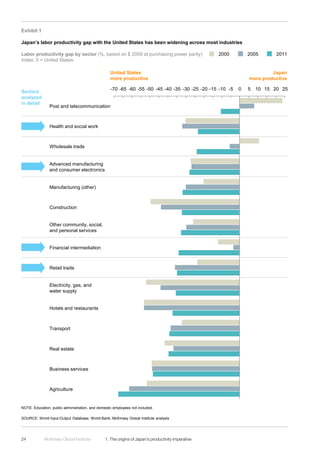
  • 9.
    Global best practices Organizing fordiscipline and performance Next-generation technologies A private-sector “fourth arrow” could accelerate productivity and boost value added by 28% $32,000 $48,000 GDP per capita ~3% 1.3% Annual GDP growth 2% 4% Productivity growth With Japan’s labor force shrinking, productivity will determine its economic outlook for 2025 71 million 2025 79 million 2012 Japan’s working-age population is declining
  • 10.
  • 11.
    EXECUTIVE SUMMARY Despite twopainful “lost decades,” Japan remains the third-largest economy and the fourth-leading exporter in the world. It is a nation with advanced technological know-how, a formidable manufacturing base, world-class infrastructure, and a large and affluent consumer market. This is a rare combination of strengths—and yet the world remains pessimistic about Japan’s prospects for growth and reinvention. A demographic challenge of historic proportions has arrived on the nation’s doorstep, and many Japanese themselves regard the future with anxiety. Japan passed the tipping point at which its population began to decline in 2011. As of 2013, a quarter of its population was age 65 or older; by 2040, that share will rise to more than one-third. The implications of this shift are already being felt economically and socially. Japan’s productivity growth has been stalled below 2 percent for much of the past two decades, reflecting both missed opportunities to grow value added and deteriorating cost competitiveness. A continuation of this trend would put the economy on pace to grow by only 1.3 percent annually through 2025. Another decade of sluggish growth would do little to boost household purchasing power. Even more ominously, it would constrain the resources available for social security and health care just as demand for them intensifies. There is still time to head off this outcome. With its working-age population shrinking, Japan has to focus on productivity as the primary catalyst for economic momentum. If Japan can successfully double its rate of productivity growth, it could boost annual GDP growth to approximately 3 percent. By 2025, this would increase Japan’s GDP by up to 30 percent over the current trajectory. The size of the prize is $1.4 trillion in annual GDP growth in that year alone. Public policy changes can create the right conditions for growth, but most of the outcome is in the hands of the private sector. Individual companies can do a great deal immediately and on their own without waiting for government action. Reigniting the Japanese economy will depend on their willingness to invest and take risks. The good news is that our research has identified areas within multiple industries that are ripe for revenue growth and efficiency improvements. This effort is not simply about cost cutting. It is also about spurring growth by launching business lines, pushing the boundaries of innovation, and entering new markets. A major private-sector initiative to accelerate productivity growth can constitute a “fourth arrow” of economic stimulus that complements the Abenomics agenda. Japan’s productivity growth has been hobbled by inadequate competitive pressures and a rigid labor market After making rapid leaps forward in the 1970s and 1980s, productivity growth has steadily eroded in almost every sector, including Japan’s signature advanced manufacturing industries. Today there are substantial and widening labor and capital productivity gaps between Japan and other advanced economies (Exhibits E1 and E2). In 2010, the mean return on invested capital for large listed Japanese companies was 23 percentage points lower than that of non-financial institutions in the US S&P 500, a symptom of large-scale misallocation of capital.1 Japan has been unable to sustain consistent growth in value added, and the economy continues to operate below its potential. 1 In the first and second sections of the Tokyo Stock Exchange, excluding financial institutions. 2X Acceleration in productivity needed to push Japan’s GDP growth to approximately 3%
  • 12.
    McKinsey Global Institute Executive summary2 Exhibit E1 Japan’s labor productivity gap with the United States has been widening across most industries SOURCE: World Input-Output Database; World Bank; McKinsey Global Institute analysis NOTE: Education, public administration, and domestic employees not included. United States more productive Japan more productive 20-55 -35-45 -25 -5-15 0 5 10-10-20-60 25-65 -50 -40-70 -30 15 Advanced manufacturing and consumer electronics Manufacturing (other) Hotels and restaurants Post and telecommunication Electricity, gas, and water supply Financial intermediation Agriculture Health and social work Transport Retail trade Other community, social, and personal services Wholesale trade Construction Business services Real estate Labor productivity gap by sector (%, based on $ 2009 at purchasing power parity) Index: 0 = United States Sectors analyzed in detail 20052000 2011
  • 13.
    3McKinsey Global Institute The future of Japan: Reigniting productivity and growth Exhibit E2 Japanese sectors are also falling behind US sectors in capital productivity SOURCE: World Input-Output Database; World Bank; McKinsey Global Institute analysis NOTE: Education, public administration, and domestic employees not included. United States more productive Japan more productive -80-90 -75-85 105-25-30-55 -40-60-65-70 -5-45-50 -10-20-35 0-15 Manufacturing (other) Business services Financial intermediation Construction Real estate Transport Hotels and restaurants Wholesale trade Agriculture Advanced manufacturing and consumer electronics Health and social work Electricity, gas, and water supply Post and telecommunication Retail trade Other community, social, and personal services Capital productivity gap by sector (%) Index: 0 = United States Sectors analyzed in detail 20112000 2005
  • 14.
    McKinsey Global Institute Executive summary4 Competition fuels productivity, as the most nimble and innovative companies win out over less efficient firms. But in Japan, highly indebted firms and even uncompetitive divisions of large conglomerates have often been kept alive in the interest of stability.2 As banks continue to roll over bad loans, and corporate headquarters continue to allocate funds to underperforming units, resources are diverted that could be put to better use elsewhere and the process of creative destruction is impeded. In addition, regulatory barriers make it difficult for new competitors to challenge incumbents in certain sectors. The presence of multinationals could provide additional competitive intensity, but Japan attracts very little foreign direct investment (FDI). Japan’s long-standing lifetime employment model has also contributed to a certain degree of stasis. Today the legal strictures around lifetime employment have mostly been lifted, making the labor market more flexible in theory. But downsizing is viewed in a strongly negative light in practice, producing inefficient bureaucracies that lack agility. Workers, too, are reluctant to advance their careers by changing employers, which limits their incentive to develop new skills. Japan has partially addressed this issue by allowing firms to hire non-regular (temporary) workers, or haken. By 2013, more than one-third of workers were covered by these arrangements, which offer limited legal protections and no pensions. At the current rate of growth, haken could account for 50 percent of the workforce by 2030. Paradoxically, this has taken a toll on productivity: temporary workers have fewer incentives to excel, and employers do not invest in their development. At a broader societal level, this situation has created a two-tiered workforce and contributed to inequality. A continuation of current trends would have profound consequences, but Japan can change course Although unemployment has remained low for the past two decades, deflation has eaten away at income growth and discouraged consumer spending. Japan has maintained global market share in automotive and other select industries, but many of its companies are being outperformed by Korean, Chinese, and US competitors. Few Japanese startups have broken through on a global scale. Perhaps most worrisome is Japan’s fiscal trajectory; in 2014, its public debt stood at 234 percent of GDP. Japan has an opportunity to once again outpace the world in efficiency and quality. If current trends hold, Japan’s GDP per capita would grow by a mere 1.3 percent annually over the next decade. Its overall labor productivity gap with the United States is on track to widen from 29 percent in 2011 to 37 percent in 2025. Japan could face a third decade of stagnation—one that would collide with an unprecedented demographic shift, creating even more damaging consequences. But Japan has a window of opportunity to create a different outcome—to once again outpace the world in efficiency and quality, emerging as a global leader in fields such as advanced materials, 3D manufacturing, and the life sciences. 2 Richard C. Koo, The holy grail of macroeconomics: Lessons from Japan’s Great Recession, Wiley, 2009.
  • 15.
    5McKinsey Global Institute The future of Japan: Reigniting productivity and growth In this scenario, Japan would open the door to greater competition from multinationals, and its large companies would rise to the challenge. The Japanese education system would foster experimentation and critical thinking. Entrepreneurship would become rooted in campus life, with students in Tokyo University dorms cooking up plans for the next Google, Facebook, or Alibaba. In this future, Japan proves that it is possible to provide an aging population with top-quality medical care while containing costs. Improved health allows experienced workers to remain on the job as they age, as physically demanding tasks are automated. Millions of women join the workforce, and many rise through the leadership ranks. This vision is highly aspirational, but Japan can begin to move in this direction. Instead of settling for 1.3 percent annual GDP growth, Japan could grow by an average of approximately 3 percent through 2025. This would lift Japan’s projected annual GDP in 2025 by almost 20 to 30 percent over current trends—for an increase of up to some $1.4 trillion in that year alone (Exhibit E3). Productivity initiatives in specific industries can help Japan increase value added by up to 28 percent above the current trajectory SOURCE: World Input-Output Database; IHS; McKinsey Global Institute analysis Value added $ billion, 2009 Exhibit E3 1 Increases in value added and productivity in the sectors examined in detail were used to extrapolate gains in similar industries (e.g., gains in advanced manufacturing were applied to all manufacturing). NOTE: Numbers may not sum due to rounding. 120 96 2025 estimated 4,900 2011 105186 109 Financial services 4,139 6,290 2025 improved 907 544 Other industries1 Health care 21 Advanced manufac- turing 14156 Retail Low range High range +28% +18% 5,768
  • 16.
    McKinsey Global Institute Executive summary6 To get there, Japan will need to more than double its labor productivity growth rate, boosting it to approximately 4 percent. This is an ambitious goal for any economy, but with its labor force shrinking, Japan has to focus on productivity to accelerate growth. Increased labor force participation will also play a part, as will innovative business models and social paradigms. Japan’s capital productivity could improve by 25 percent through better allocation of resources, higher revenues, and a push for greater cost effectiveness in infrastructure spending. New efficiency measures such as increased automation will affect jobs in many industries. But a growing economy combined with a projected 3.7 percent decline in Japan’s labor force by 2025 can cushion the net impact on employment. Japan’s productivity challenge ultimately has to be met by the private sector—and there is a great deal that individual companies can do immediately and on their own. Firing a fourth arrow: Individual companies can transform Japan’s productivity performance A nationwide effort to accelerate productivity growth—led by the business community and spanning every sector of the economy—could amount to a “fourth arrow” for Abenomics. Many of the barriers and bottlenecks that have constrained growth are not imposed by regulation; they stem from traditional ways of doing business. Japan can reach some 50 to 70 percent of its productivity goal by adopting practices that are already in use around the world, while most of the remaining improvement can be captured by deploying new technologies. Incorporating global best practices ƒƒ Become more globally integrated. Rather than relying heavily on the domestic market, Japanese companies have to become more aggressive about entering the fastest- growing overseas markets. But rather than just going global, enterprises have to become truly global, thinking beyond borders with regard to their operational footprint and talent development. Organizations can retain their Japanese roots while cultivating deeper connections to global value chains. ƒƒ Improve capabilities across the value chain. Japanese companies have historically excelled in manufacturing and product development, but they need to invest in building world-class capabilities in other functions such as sourcing, supply-chain management, customer relationship management, marketing, and after-sales service. ƒƒ Continue the journey of digitization. In most companies, an end-to-end review will likely reveal areas that have received a lack of IT investment and process innovation. Replacing outdated IT systems and equipping employees with mobile tools can enable massive improvements in performance. ƒƒ Determine the optimal physical footprint. Organizations may need to reconfigure in a more digital world with changing demographics. In retail, for example, smaller urban storefronts (or, conversely, big-box stores) offering innovative customer experiences can help to reduce costs and increase proximity to customers. Health-care providers
  • 17.
    7McKinsey Global Institute The future of Japan: Reigniting productivity and growth may need to consider whether their locations, scale, and degree of specialization match the needs of patients by age and geography. Financial institutions may need to close some of their least profitable branches and incorporate new interactive technologies into others. Adopting next-generation technologies ƒƒ Harness the power of big data. Big data is a powerful tool for pricing, customer segmentation and marketing, sales forecasting, risk management, and R&D—and many large Japanese companies have yet to begin using it to transform their operations. ƒƒ Take automation to the next level. Intelligent software systems and robotics could help Japanese companies address critical labor shortages in the years ahead. ƒƒ Deploy advanced technologies in manufacturing processes. Technology can reinvent the assembly line yet again, from the adoption of low-cost sensors and big data analytics for better accuracy in production to the use of 3D printing for mass customization. Organizing for discipline and performance ƒƒ Restructure as needed to create a more competitive and fluid industry landscape. If additional policies that have constrained market forces are removed, companies will have to adapt to a much more intense level of competition. Some may need to reorganize or exit unprofitable markets, while others may undertake mergers and acquisitions to achieve economies of scale. ƒƒ Create a culture of performance and accountability. Shareholders and top executives can reinforce that productivity is a top organizational goal by tying performance goals to incentives. Some of Japan’s largest companies have already begun shifting away from the traditional seniority-based advancement system in favor of merit-based pay structures, and other firms can follow their lead. Promoting younger talent into management ranks and rewarding results can create agile organizations with fresh ideas. ƒƒ Draw on all sources to build talent, leadership, and skills for the future. Individual companies can attract and retain female talent by implementing supportive human resource policies and making tangible changes in workplace culture (such as relaxing the demands for long hours that make it difficult for new mothers to return to work). It is especially critical for companies to invest in programs that develop and mentor female leaders who can drive growth and productivity in the future. Employers will also need to retain valuable skills and experience by reengineering the workplace to accommodate aging workers, perhaps by automating physically demanding tasks, offering flexible hours, or focusing on ergonomics. Older workers could also transition to mentorship and training roles. ƒƒ Focus on the customer to achieve a better return on R&D investments. Instead of focusing on technology itself, the development process has to start with understanding what the customer wants and deliver solutions based on that insight. Innovation has to evolve from closed and tightly managed R&D operations to more fluid, open processes involving teamwork across the organization and collaboration with customers and suppliers.
  • 18.
    McKinsey Global Institute Executive summary8 Box E1. Riding global trends for faster growth What is different about today’s environment that could support a fundamental shift in Japan’s direction? The answer is simple: everything. This is an era of explosive growth in global trade, yet Japan’s share of global exports has fallen from 7 percent in 2000 to 4 percent in 2013. But Japan has the manufacturing, export, and innovation capabilities to make up for lost time and lost market share. As emerging economies continue to industrialize, they will become growth markets for vehicles, machinery and equipment, and electronics, all long-standing areas of strength for Japan. Much of the developed world is aging—and it will be watching intently to see if Japan, the nation at the leading edge of this trend, can pioneer policy responses. The private sector will also have to develop new business practices and technologies to alleviate labor shortages, all of which will have positive implications for productivity. Japan could be well positioned to export innovative products and services geared to seniors, who represent a lucrative consumer segment. The world is undergoing a historic surge of urbanization, a shift that puts the spotlight on infrastructure. There is a huge opportunity for Japan to improve capital productivity in its own infrastructure projects as well as providing project finance and engineering expertise to the rest of the world. Today multiple transformative technologies, from artificial intelligence and 3D printing to the Internet of Things, have already appeared on the horizon. Japan is already adopting—and even inventing—some of these breakthroughs. Now the challenge is to accelerate adoption throughout entire industries so that technology moves the needle on productivity performance. As one of the most rapidly aging, urbanized, globally connected, and technologically advanced societies on the planet, Japan stands smack in the forefront of a global wave of disruption. These trends present both pressures and incentives to act. Japan can turn the current wave of global disruption into opportunity.
  • 19.
    9McKinsey Global Institute The future of Japan: Reigniting productivity and growth Four sectors illustrate Japan’s untapped productivity potential Around one-third of the estimated productivity potential can be captured within the four sectors discussed below, which were selected to illustrate differing parts of the Japanese economy. The strategies outlined here are by no means exhaustive, but they do offer a starting point for action and an indicator of the size of Japan’s opportunity. Advanced manufacturing Advanced manufacturing (which includes automotive, industrial machinery, and electronics) represents the vanguard of Japan’s industrial capabilities and the source of its signature exports. But over the past 15 years, this sector’s global market share has eroded in the face of new competition. Japan’s advanced manufacturers once raised the bar for the rest of the world in efficiency and quality, but today their labor productivity is 29 percent below that of the US sector and 32 percent below Germany’s. This gap is not only significant; it has been widening. At the firm level, Japanese auto companies have remained excellent performers, but the biggest names have shifted much of their production outside of Japan to local markets. The consumer electronics space has not fared as well. Lean players such as Samsung, LG, Xiaomi, Huawei, and Lenovo have grabbed market share for products such as TVs, PCs, and smartphones—often at the expense of Japanese firms. The major Japanese conglomerates have spent the past decade fighting for profitability. In some cases, they made unfortunate bets on technologies that did not win out in the marketplace. The Japanese consumer electronics industry includes many subscale companies and plants focusing on products with declining margins. Our research has identified multiple industries that are ripe for revenue growth and efficiency improvements. One of the advanced manufacturing sector’s major challenges has been downward pricing pressure, but this is a worldwide phenomenon that does not fully explain Japan’s productivity gap. Four other issues have been at play. First and foremost has been an insufficient focus on fast-growing global markets. Japanese automakers have successfully tailored their vehicles for emerging markets, but other Japanese products have failed to resonate in lower-income economies. Second, Japan’s electronics sector remains heavily weighted toward hardware in an era when the market has shifted toward software, IT services, mobile applications, and integrated solutions. Third, Japan spends more on manufacturing R&D than almost any other country, but in recent years, that investment has not adequately paid off in the form of new hit products. Fourth, Japan has to contend with a higher non-labor cost base, due in part to inefficiencies in global operations and in functional areas such as supply chains (Exhibit E4). Japan’s advanced manufacturing industries could face a future of declining global market share and slow productivity growth. The sector’s value added is on pace to increase by a mere 1.4 percent annually through 2025. But Japanese companies can change this outcome by aggressively adopting global best practices, starting with redirecting their formidable R&D capabilities to higher-value spaces. In an era of rapid-fire technology breakthroughs, there is enormous potential to create entirely new goods and services—not to mention applying innovation to management and production practices. Companies will have to make smart decisions about where to
  • 20.
    McKinsey Global Institute Executive summary10 compete globally and which market segments to target; adopting international standards can broaden their appeal. They will have to strive for operational excellence in areas such as supply-chain management, product platforms, sourcing, procurement, revenue management, and support costs. Manufacturers can also create new revenue streams by adding after-sales services, such as delivery and installation, operation, maintenance, or systems integration. Mergers and acquisitions would allow companies to reach the critical size necessary to benefit from economies of scale and better deploy their capital and human resources. The coming decade will bring an ongoing wave of innovation in manufacturing. Software is increasingly being integrated into traditional manufactured goods. The coming wave of connected cars, for example, represents a new competitive challenge—and a major market opportunity—for Japan’s automakers. Japan can also capitalize on growth in robotics and 3D printing for its own production processes and for export. By 2025, these combined strategies have the potential to boost the sector’s value added by more than 50 percent above the current trajectory. If a critical mass of Japanese manufacturers were to adopt breakthrough technologies, they could virtually close the productivity gap with the United States. Cost as % of revenue Revenue breakdown by subsector, 2011 $ billion, 2009 at purchasing power parity SOURCE: World Input-Output Database; McKinsey Global Institute analysis 590.7 Japan 231.3 353.8 363.5 United States 122.5 227.1 70.7 161.4 Japan 117.9 188.6 324.4 United States 163.0 608.9 475.4 374.0 95.2 United States 133.5 278.7 Japan 65 38 63 50 75 78 Value add (includes labor cost) Non-labor cost of intermediate inputs Japan has a high non-labor cost base, particularly in the electrical and optical equipment industry Exhibit E4 NOTE: Numbers may not sum due to rounding. Electrical and optical equipment Machinery Transport equipment
  • 21.
    11McKinsey Global Institute The future of Japan: Reigniting productivity and growth Retail Japan’s retail sector benefits from a large and sophisticated consumer base as well as excellent logistics. High Internet and mobile penetration has underpinned growth in online shopping. But small specialty shops, many of them family-owned, account for approximately half of all retail sales—and because these businesses are less productive, they create a drag on the overall sector. Segments such as traditional convenience stores, supermarkets, and drugstores also remain highly fragmented; the relative lack of large chains has prevented investment in automation and technology. Only 40 percent of Japanese retailers are among the top ten national players, compared with 75 percent in the United Kingdom and 76 percent in Germany. Since the 2000 repeal of the Large Scale Retail Store Law, traditional store formats have been on the decline. With a greater weighting of modern-format stores, the retail sector increased its labor productivity by 2.2 percent annually between 2000 and 2011. But Japan has not kept pace with the US sector in terms of operational innovations. Even those formats with higher consolidation and revenue growth have struggled to reduce costs and improve operating margins. Legacy IT systems and overinvestment in floor space have also weighed on profit margins. On its current trajectory, the sector’s value added would increase by just 1.1 percent annually through 2025. By then, the Japanese sector’s productivity would stand at only 71 percent of the US level. In addition, if the industry continues to expand total floor space at its current rate, sales per square meter would decline by about 1 percent annually through 2025. But the retail sector can make a quantum leap in performance by deploying new technologies, responding to changing demographics, and increasing its efficiency. We estimate that there is potential to boost labor productivity by anywhere from 22 to 39 percent by 2025. One element in this formula is achieving smarter store footprints. By introducing innovative customer experiences and multiple channels, retailers can rationalize floor space, saving costs and boosting revenues. Retailers also need to adopt global best practices in operations along the entire value chain, some of which employ cutting-edge technologies. In addition to managing complex shipments from vendors, the Internet of Things can use sensors and tags in stores to avoid stock-outs and signal when reorders are necessary. Becoming fluent in big data and advanced analytics can help retailers better understand and segment their customers and make both front- and back-end operations (such as sales forecasting and employee scheduling) more efficient. With the return of some limited inflation, Japanese retailers may finally have an opening to raise prices. Companies can capture new value added by implementing pricing strategies built on a deeper level of marketing insights from big data. The continuing growth of e-commerce is another important source of retail productivity. Japan has already developed the world’s third-largest e-commerce market, but sales are growing more slowly than in the United States (and are well below the dramatic rate of growth in China). E-tailers such as Rakuten and Amazon are making strides, but there is still ample room for adoption by brick-and-mortar incumbents—and for disruptive new players to emerge in this space. Accelerating consolidation and the transition to more modern-format stores (and perhaps “leapfrogging” directly to more innovative digital-hybrid formats) will be crucial to improving the sector’s productivity.
  • 22.
    McKinsey Global Institute Executive summary12 Financial services Japan’s financial sector was the third-largest in the world in 2012, with $11 trillion in assets. But its low-risk, low-margin operating model has produced limited revenue growth. More than half of personal financial assets are held in cash or cash deposits. Between 2005 and 2011, annual labor productivity growth was 4.5 percent in the US sector and 7.6 percent in the German sector, while Japan actually experienced a decrease of 2 percent. During Japan’s long period of muted demand, banks tended to funnel excess cash into low-risk, low-return government debt. The government’s most recent and most aggressive program of quantitative easing is meant to reverse this trend and spark new lending and investment. Jumpstarting the flow of financing and investment is an Abenomics priority, and the conditions may be coming together for the financial services sector to achieve higher margins, increase its value added, and create momentum in the broader economy. Looking specifically at the banking industry, Japanese institutions serve their customers with fewer branches and fewer employees than US banks. Despite this advantage, their labor productivity was 22 percent lower than that of US banks in 2011. The major factors driving this gap include low returns on assets, risk aversion, simpler product offerings, and intense competition that has driven down pricing. Japan’s persistently low interest rate environment has limited spreads and depressed returns on investments—and because loan demand has stagnated, banks have been unable to compensate for declining interest margins by boosting volumes. A failure to build deeper relationships harms banks’ ability to increase advisory revenues. Japan’s insurance sector trailed the US sector in labor productivity by 29 percent in 2011. There is high market penetration for life insurance products, but policies produce lower revenues. Product offerings and pricing strategies tend to be relatively basic across all types of coverage, and there has been little growth in demand for property and casualty coverage. Insurers, like banks, have struggled with low returns on their investments. Whatever Japan’s macroeconomic conditions, individual firms still have scope to improve productivity and growth. Players can rethink their investment strategies to shift toward higher-yield assets, finding a better balance between risk and reward. They also need to find new ways to maximize value from customers. Many firms already segment their customers by wealth and life stage to develop tailored offerings, but new analytics tools can take this to an entirely new level of detail. There are opportunities to launch a wider variety of financial products, using big data tools to monitor risk and determine pricing. In particular, financial firms can create products and advisory services to meet the needs of seniors and affluent individuals. Japanese banks are already the world’s largest international lenders, but further emphasis on foreign lending and foreign expansion (especially into the most promising markets in emerging Asia) could be an avenue for growth. Insurers have similarly increased their overseas operations in response to declining revenues at home. Banks and insurers alike can undertake an end-to-end review of processes and focus attention on areas that have received little IT investment and digital process transformation. Financial institutions will have to continue their efforts to deliver a truly seamless online and offline experience while slimming down or reimagining their branch formats, with more advisory and sales centers. By 2025, these initiatives could increase the sector’s value added by up to 44 percent while reducing the labor required by 9 percent. This would boost labor productivity up to 24 percent over the current trajectory—and provide a lift to the entire economy by putting cash reserves to work in productive investment.
  • 23.
    13McKinsey Global Institute The future of Japan: Reigniting productivity and growth Health care Providing universal access to quality health care is a point of national pride. Japan manages to achieve good outcomes while holding health-care spending to 8.1 percent of GDP (well below Germany, at 11.3 percent, or the United States, at 17.7 percent). But there are serious questions about whether the current trajectory is sustainable. Government estimates indicate that health-care expenditures could reach some $515 billion by 2025, for average annual growth of 3.7 percent. If health care swallows an ever-larger share of national spending, it could crowd out consumption and investment in other parts of the economy and force painful tax and social security reforms. The aging population is frequently discussed as the driver of health-care costs, but that is only part of the story. Utilization rates remain very high by international standards; Japanese patients consult physicians an average of almost 13 times per year, more than twice the OECD average. The average hospital stay is three times longer in Japan than in other advanced economies—partly due to reimbursement formulas, but also because hospitals often continue to care for patients who might be better served in rehabilitation centers or nursing homes, which are in short supply. The ongoing process of medical innovation also contributes to rising expenditures. Measures such as increasing taxes to shore up the system or adjusting reimbursement rates are only partial solutions, and repeated rounds will not be feasible. Japan needs to bend the cost curve in a more fundamental way. The good news is that other nations facing similar pressures have managed to implement successful reforms, and Japan can draw on their experiences. One of the most important lessons they offer is that reimbursement changes drive provider changes. The current system rewards providers for generating a high volume of procedures. Japan took a positive step by introducing a diagnosis procedure combination (DPC) payment system, much like the billing system used by Medicare in the United States (although Japan’s version includes a length-of-stay component). It shows promise for controlling costs and standardizing data, but a limited number of institutions participate. Policy makers can reopen this issue and consider deeper reforms such as mandating DPC adoption across the entire system, implementing capitation (which pays providers a set amount for each enrollee, whether or not the individual seeks treatment), or directly linking reimbursement to performance and outcomes. Because Japan has some 3,000 private insurers, a crucial part of the health-care landscape is fragmented. Insurers do not perform a gatekeeping or cost-control function, as they do in other countries—but Japan could transform them from payors to real players. Instead of imposing uniform reimbursement rates, Japan could give them greater flexibility to negotiate with providers and design their own formulas. Germany’s experience indicates that once insurers are given responsibility for real management, a wave of consolidation could follow. Reducing the number of visits per capita requires significant changes on both the demand and supply sides. Requiring continuing medical education and recertification could promote a greater culture of trust among patients. The clinical data aggregated by electronic medical records can be used to create a ratings-based system that allows patients to compare providers (much like the UK National Health Service’s Choices website). On the other side, steeper co-payments could discourage unnecessary additional visits or repetitive testing. Japan’s Ministry of Health, Labour and Welfare has made progress in expanding the use of generic drugs; meeting its goal of achieving a 60 percent penetration rate by 2017 would save some $8 billion annually. But this would still leave Japan below international benchmarks. Japan can set a more ambitious target and take steps to bring the price of generics down to international levels.
  • 24.
    McKinsey Global Institute Executive summary14 Japan has a fragmented provider landscape, with many small generalist hospitals. Surprisingly few institutions specialize in specific therapeutic areas, with repercussions for the quality of care. Financial incentives could encourage some hospitals—especially subscale institutions—to merge or specialize. Mergers could lead to major savings in IT systems, purchasing, and the allocation of resources. Greater specialization would prevent high-risk procedures from being performed at low-volume centers. It would also improve housing and treatment options for elderly patients, particularly those with dementia. There are major efficiency gains still to be captured from electronic medical records and big data tools. Most hospitals do have solid technology systems in place, but the key will be connecting these systems and ensuring interoperability across providers. This is an age of medical breakthroughs. Already, 3D printers are being used to produce artificial organs and implants, robots are being deployed in medical settings, and nanodevices are making more procedures minimally invasive. In addition to adopting advances in patient care, Japan has the scientific and manufacturing capabilities to pioneer many of these technologies. Today Japan’s health-care expenditures are growing faster than GDP and are on track to swell to 10.7 percent of GDP by 2025. But we estimate that the reforms described above can slow the annual rate of growth from the anticipated 3.7 percent to just 1.5 percent. By 2025, expenditures could come in some 22 percent below projections, holding the line at 8.3 percent of GDP, only slightly above the level in 2013 (Exhibit E5). This would free up resources that could be used to develop a more comprehensive long-term care sector. Furthermore, if Japan’s productivity initiatives successfully boost GDP growth to 3 percent, health-care spending would grow more slowly than GDP, putting the system on a more sustainable path. Compound annual growth rate (%) Index: 0 = 2013 Exhibit E5 Reforms could help Japan cut the growth rate of health-care expenditures in half, potentially even bringing it below the rate of GDP growth SOURCE: Ministry of Economy, Trade and Industry; Ministry of Health, Labour and Welfare; McKinsey Global Institute analysis Pessimistic case Optimistic case Current trajectory Slower growth of health-care costs Slower growth of health-care costs plus improved GDP growth Health-care costs GDP Growth rate (%) 0 1 2 3 4 20252013 Health care % of GDP 2013 2025 20252013 3.7 1.3 1.5 1.3 1.5 3.0 8.1 8.1 8.110.7 8.3 6.8
  • 25.
    15McKinsey Global Institute The future of Japan: Reigniting productivity and growth Japan has a road map, and now it needs the political will to start the journey. Reform will be a process of “continuous improvement” that will require periodic readjustment. It will take a steady commitment to create a more sustainable system—one based on a vision that looks decades ahead and is insulated from short-term political pressures. The right policies and enablers can spur growth Deregulating and reforming individual sectors can inject new dynamism into the economy. But Japan also has to create a broader environment that is conducive to growth. While Abenomics speaks to a number of these priorities, the agenda for change needs to be even broader. Tapping new talent sources ƒƒ Encourage more women to participate in the workforce and create pathways to success. Many Japanese feel that women should focus on household duties, and this cultural attitude is exacerbated by a sharp gender gap in pay and a glass ceiling. But Japan cannot afford to lose so much potential talent. The participation rate drops sharply when women reach prime childbearing age; they step off the career ladder when they might otherwise begin moving up into managerial roles (Exhibit E6). The government has recognized that expanding child care is a critical starting point. Additionally, Japan can follow through with removing tax policies that encourage married women to opt out of the workforce or to choose low-paying part-time work. Companies and institutions have a critical role to play in helping women fulfill their potential as future leaders of Japan. They need to make gender diversity a top strategic priority, with executive teams demonstrating visible support for this change. Exhibit E6 Japanese women step off the career ladder during their prime child-bearing years and occupy few senior leadership roles SOURCE: McKinsey proprietary database, 2011; government publications ESTIMATES 54 49 57 57 57 49 48 49 42 50 Malaysia Indonesia Hong Kong Taiwan Australia Singapore South Korea Japan India China 52 44 45 47 53 50 40 45 29 55 23 18 20 11 20 6 11 9 21 n/a 11 9 12 15 2 1 3 9 n/a n/a 2 1 3 5 5 8 1 <1 <1 <1 9 8 13 6 6 7 1 2 5 8 University graduates Entry-level professionals Mid- to senior management Executive committee CEO Board %
  • 26.
    McKinsey Global Institute Executive summary16 ƒƒ Retain experienced workers as they age. Japan is gradually raising the mandatory retirement age that companies can impose from 60 to 65 by 2025, requiring employers to offer continuing employment options to workers who hit retirement age and offering subsidies to employers that hire and retain older workers. In fact, Japan already has one of the highest labor force participation rates in the world for older workers. But since a quarter of the population is expected to be over age 75 by 2055, further policy adjustments may be needed—and, as mentioned above, individual companies will have to drive this effort forward by implementing more flexible working models and ergonomic adjustments that can entice seniors to stay on the job. ƒƒ Address supply constraints by rethinking immigration policies. Japan will need to identify critical roles that are being affected by an undersupply of labor and consider whether foreign workers could provide at least a partial solution. Increasing their presence would not only fill gaps in specific roles; it could also bring an infusion of diverse ideas, new energy, and best practices developed in other countries. Creating a more dynamic labor force with the skills demanded in a fast- changing environment ƒƒ Make the workforce more equitable. The greater flexibility afforded by the use of temporary workers has harmed productivity while creating a two-tiered workforce, as discussed above. Faster economic growth will not be enough in and of itself to create a more equitable system. Policy makers may need to take formal steps to provide better conditions and benefits for temporary workers—both to ensure they are protected and to increase their motivation to become more productive. ƒƒ Create ambitious retraining programs to meet new business requirements. Since multiple industries face wide-ranging technology transformations, the public and private sectors will have to ensure that well-chosen, well-designed training programs are available on a large scale. Companies can also collaborate at the industry level to offer apprenticeships and partner with education providers to design vocational training and certificate programs. Reforming the education system to build talent and capabilities over the longer term ƒƒ Instill critical thinking skills. The next generation of workers will need critical thinking skills and an open attitude toward experimentation to enhance Japan’s productivity and competitiveness. The current educational experience leaves graduates at a disadvantage in this area compared with their international peers. ƒƒ Promote a global mindset. Japan could benefit from achieving greater foreign language fluency and expanding international student exchanges, which lay the groundwork for future research collaborations and business deals. ƒƒ Create a true education-to-employment pipeline. In most countries, the education- to-employment system fails many young people and employers alike. But employers and educators can bridge this gap by moving more fluidly into each other’s worlds. Companies can help to design curricula and lend their employees as “faculty,” while education providers can integrate internships into their programs and secure hiring guarantees for graduates. Sustaining long-term growth requires careful, ongoing evaluation of evolving shifts in demand for specific skills.
  • 27.
    17McKinsey Global Institute The future of Japan: Reigniting productivity and growth Fostering a startup culture ƒƒ Increase access to funding. Despite favorable regulatory changes, there is little angel investing in Japan. Information platforms can help to build a community of angel investors, and large corporations could play a role where individual investors currently do not. Japan’s venture capital industry is also underdeveloped. Israel offers a useful template; it rapidly expanded its fledgling VC industry in the 1990s by offering tax incentives to foreign investors and matching private capital. The Innovation Network Corporation of Japan is a positive step in this direction, but unlocking private investment will require sustained effort. ƒƒ Promote a supportive legal and regulatory framework for startups. Making the process of setting up a new business more user-friendly could motivate more aspiring entrepreneurs to take a leap with their ideas. Japan can also revisit the framework around intellectual property protection and its incentive structure for commercializing university research. ƒƒ Create an ecosystem that allows entrepreneurs and innovation to flourish. Japan’s current network of business incubators has a limited reach, and the public sector may need to mobilize resources. New York, for example, has undertaken an ambitious public-private partnership to build Cornell Tech, which will offer an MBA program with a digital, entrepreneurial focus. University-affiliated business incubators (such as Waseda University’s) can expose Japanese students to the process and excitement of turning ideas into profitable realities. Implementing market-oriented reforms to unleash competition Reducing government intervention in specific sectors could open the door to a wave of consolidation that would allow companies to realize economies of scale. A number of market distortions, such as barriers to entry for startups, protectionist measures that limit imports, zoning restrictions, and subsidies that keep unproductive firms afloat, could be removed. ƒƒ Promote competition by allowing companies to enter and exit the market. The birth of new firms and the closure of failing companies are akin to a healthy circulatory system—and the continued support of highly indebted firms as well as uncompetitive divisions of large conglomerates represents a disorder that hinders that dynamic. Resolving the continuing overhang would improve the allocation of capital across the economy. ƒƒ Deepen global trade ties. New trade agreements would open the door for Japanese companies to penetrate new markets and grow revenues. Japan is engaged in a number of bilateral and multilateral negotiations, the largest of which is the proposed Trans- Pacific Partnership. Bringing these agreements to a successful conclusion could provide Japan with new sources of growth. ƒƒ Move toward open standards. Shifting away from proprietary technologies to globally accepted standards and platforms that allow for interoperability (and participating in the creation of these standards) will broaden the market for Japanese products. ƒƒ Promote a culture of performance at the macro level, including increased shareholder pressure. Proposed new regulatory standards call for at least two outside directors on each corporate board, but even stronger measures may be needed to ensure accountability and improved corporate governance. Shareholders in Japan have traditionally exercised relatively little pressure for performance, but a more activist approach would push management to increase revenues and achieve operational efficiencies.
  • 28.
    McKinsey Global Institute Executive summary18 Improving productivity in infrastructure Modern infrastructure comes at a high public cost if projects encounter long delays or if they are underutilized after their completion. While the value of infrastructure stock in most economies averages around 70 percent of GDP, Japan has the world’s highest infrastructure stock, at 179 percent of GDP in 2012.3 Given the size of its investment, Japan needs to maximize every dollar. ƒƒ Make project selection and project management as rigorous as possible. It is critical to direct investment to where it can underpin economic growth or societal goals rather than to “showcase” projects. Proposals should be subjected to a sophisticated cost-benefit analysis and prioritized using a transparent, fact-based decision-making process. An important source of savings would come from speeding up the approval and land acquisition processes and using the latest technology to plan and manage projects. Advanced 5D building information modeling systems, for example, can ensure design accuracy and feasibility to prevent substantial changes and delays later in the process. ƒƒ Use maintenance, optimization, and demand management to extend the life of existing infrastructure assets. In many cases, it is more cost-effective to invest in extending the life span and capacity of existing assets than to build new projects. Refurbishment and optimization strategies can save approximately 15 percent on infrastructure investment. ƒƒ Export world-class infrastructure. Japan can export its engineering expertise to the rest of the world. Recent MGI research estimated that Southeast Asia alone has some $3.3 trillion in infrastructure needs through 2030. There are many opportunities to serve as either financier or provider of infrastructure services in developing economies around the world, but Japan will have to compete for them. • • • The next decade offers a window of opportunity for Japan to shift its trajectory, in part by capitalizing on immense flows of global trade, the rise of billions of new urban consumers in the emerging world, and technology breakthroughs. But the new global economy is not simply realigning; it is also accelerating. The time is right for Japan to undertake bolder moves, bigger investments, and deeper reforms. Decades ago, Japanese manufacturers famously introduced the world to “lean” practices. Today businesses throughout the Japanese economy can apply these concepts to new industries and use digital technologies to take them to the next level. Focusing on the priorities discussed here can help to address persistent legacy issues and put Japan on a faster track toward recovery and renewal. 3 Infrastructure productivity: How to save $1 trillion a year, McKinsey Global Institute, January 2013.
  • 29.
  • 30.
  • 31.
    1. THE ORIGINSOF JAPAN’S PRODUCTIVITY IMPERATIVE For much of the postwar era, Japan has been synonymous with rapid improvements in efficiency and quality. It remains widely admired for innovation in both technology and processes. From the 1950s through the 1980s, it outpaced the United States and Western Europe in productivity gains—and this advantage led to robust economic growth, producing one of the world’s highest standards of living. Over two painful “lost decades,” however, Japan has lost much of its competitive edge. Growth in both labor and capital productivity has steadily eroded in almost every sector of the economy. This trend holds true even in Japan’s signature advanced manufacturing industries, which originally introduced the world to the concept of “lean.” Today there is a substantial and widening productivity gap between Japan and other leading advanced economies. The task of continuously capturing new productivity improvements grows more difficult over time, but it is achievable, particularly if Japan takes steps to create new competitive dynamics across entire industries. The good news is that our research has identified areas within multiple industries that are ripe for efficiency improvements and revenue growth. This effort goes beyond cost cutting; it is about spurring growth and increasing value added by launching business lines, pushing the boundaries of innovation, and entering new markets. (See Box 1, “Why productivity matters.”) With its working-age population shrinking, Japan will need to focus on productivity as never before. Overall productivity growth has been stalled below 2 percent for much of the past two decades, which puts the Japanese economy on pace to grow by only 1.3 percent annually through 2025.4 This sluggish pace would do little to boost household purchasing power, and it would intensify the fiscal pressures of providing social security and health-care benefits to an aging population. But if Japan can successfully double its rate of productivity growth, returning to the levels it once posted in the 1970s and 1980s, it could boost annual GDP growth to approximately 3 percent. This would indicate solid momentum and contribute to an improved fiscal outlook. While policy changes can create the right environment for growth, the vast majority of this potential is in the hands of the private sector. There is a great deal that individual companies can do immediately and on their own without waiting for government action. Multiple fast-moving forces are realigning the global economy, and Japan can capitalize on these trends to seek out new growth opportunities. To break out of its slump, the economy needs broader adoption of global best practices, a wave of investment in new technologies, and a greater willingness to try bold new business models. 4 Japan’s productivity growth was 1.5 percent in 2013 (the latest year for which OECD data is available).
  • 32.
    McKinsey Global Institute 1. The origins of Japan’s productivity imperative22 Box 1. Why productivity matters Productivity growth is the result of workers making more—and better—goods per hour. This may be a simple concept, but at the macroeconomic level, it becomes a powerful force. Productivity gains are a marker of progress and higher living standards. Conversely, a loss of momentum in this area can cause slow-motion damage to an economy over time. As Nobel laureate Paul Krugman once put it, “Productivity isn’t everything, but in the long run it is almost everything.”5 At the global level, rising productivity and a steadily growing labor force, the twin drivers of economic growth, combined to produce 50 years of rapid economic expansion. Today, however, the prospects for growth are becoming murkier in the face of demographic headwinds—not only in Japan but in advanced economies around the world. MGI has studied the patterns of growth in dozens of industries and across more than 20 countries. A recent report building on this body of work attempts to analyze what the decades ahead might bring.6 Given the pressure of aging trends on the pool of available labor, it finds that the world’s rate of GDP growth is set to slow by 40 percent from its rate over the past 50 years. As a result, income growth could decline by 19 percent in developed economies and by 14 percent in emerging economies. To head off this outcome, the world needs to accelerate the pace of productivity growth by 80 percent, reaching a difficult-to-achieve average of 3.3 percent a year. These global findings clearly resonate for Japan, the first nation confronting the full magnitude of the world’s demographic shift. As of 2013, a quarter of the population was age 65 or older. That share is projected to rise to 36 percent by 2040 and to 40 percent by 2060.7 Its shrinking workforce presents Japan with an urgent imperative to boost productivity—and other advanced economies will be watching intently to see if Japan can pioneer solutions. MGI’s work suggests that, at a global level, it is possible to boost productivity past the point needed to counteract demographic trends. Most of this potential comes from adopting existing best practices more widely. The rest would stem from fully deploying the current pipeline of technological, operational, and business innovations, which could push the boundaries of what is achievable through today’s best practices. In Japan’s case, it is important to note that more than half of the productivity gains that MGI’s analysis finds feasible in advanced economies could come from closing the gap between less efficient companies and plants and those with higher productivity. Productivity allows companies to offer better products and services at more competitive prices, which leads to increased consumption and higher-value- adding employment. This virtuous cycle could pave the way to sustainable growth while addressing the demographic challenge and maintaining the universal health-care and pension systems that underpin Japanese society. 5 Paul Krugman, The age of diminished expectations, MIT Press, 1994. 6 For a fuller discussion, see Global growth: Can productivity save the day in an aging world? McKinsey Global Institute, January 2015. 7 Population projections for Japan: 2011 to 2060, National Institute of Population and Social Security Research, January 2012.
  • 33.
    23McKinsey Global Institute The future of Japan: Reigniting productivity and growth Once a two-speed economy, Japan now faces deteriorating productivity growth across all sectors When MGI studied Japan in 2000, it found that a “two-speed” economy had developed.8 Export-oriented manufacturing industries (including steel, automotive, consumer electronics, and machine tools) set the global standard, but these stood in sharp contrast to low-performing, domestically oriented manufacturing and service sectors that were protected from both international and local competition by tariffs and regulation. Our research recommended three types of reforms to unleash growth: ending subsidies for unproductive firms and allowing them to exit the market, removing laws and regulations that prevent more productive companies from entering markets or introducing innovative products, and creating incentives for competition and innovation. Given its rapidly aging population and the persistently low labor force participation of women, Japan will have to focus on productivity as the primary catalyst for growth. Japan has taken some steps toward reform, including a bid to improve corporate governance by requiring the addition of independent directors and the establishment of special economic zones to showcase deregulation. Deeper reforms of key industries such as the power sector, health care, and agriculture are part of the “third arrow” of Abenomics, although many ideas are still in the proposal or legislative stages. In the meantime, structural issues continue to constrain sectors across the economy. Barriers to entering and exiting various markets still exist; for example, zoning regulations limit the presence of big-box retailers, while tax incentives keep smaller, less productive shops afloat. Tariffs and other protectionist policies shield many domestic industries from global competition. Furthermore, government subsidies support unprofitable health-care providers and payors, channeling public resources into maintaining an inefficient system. Without bold new incentives for innovation and competition in place, the current era of digital and scientific breakthroughs has not produced a surge in entrepreneurship in Japan on a par with what has been unleashed in many other countries. Today, the two-speed characterization of Japan’s economy no longer holds true. Even its advanced industries have lost their competitive edge; labor productivity in the transport equipment sector, for instance, is almost half the level in Germany. Today virtually all sectors of Japan’s economy lag behind the United States in terms of both labor and capital productivity, even though the United States (like other advanced economies) has itself posted only weak productivity gains over the past decade (Exhibits 1 and 2). If current trends are not reversed, Japan’s overall labor productivity gap with the United States is on track to grow from 29 percent in 2011 to 37 percent in 2025. These gaps represent the fundamental structural challenge facing Japan. GDP growth can be generated by an expansion of the labor force and by productivity increases—and given its rapidly aging population and persistently low labor force participation rate for women, Japan will have to focus on productivity as the primary catalyst for growth. Its ability to increase incomes and maintain its standard of living into the future hangs in the balance. 8 Why the Japanese economy is not growing: Micro barriers to productivity growth, McKinsey Global Institute, July 2000.
  • 34.
    McKinsey Global Institute 1. The origins of Japan’s productivity imperative24 Exhibit 1 Japan’s labor productivity gap with the United States has been widening across most industries SOURCE: World Input-Output Database; World Bank; McKinsey Global Institute analysis NOTE: Education, public administration, and domestic employees not included. United States more productive Japan more productive 20-55 -35-45 -25 -5-15 0 5 10-10-20-60 25-65 -50 -40-70 -30 15 Advanced manufacturing and consumer electronics Manufacturing (other) Hotels and restaurants Post and telecommunication Electricity, gas, and water supply Financial intermediation Agriculture Health and social work Transport Retail trade Other community, social, and personal services Wholesale trade Construction Business services Real estate Labor productivity gap by sector (%, based on $ 2009 at purchasing power parity) Index: 0 = United States Sectors analyzed in detail 20052000 2011
  • 35.
    25McKinsey Global Institute The future of Japan: Reigniting productivity and growth Exhibit 2 Japanese sectors are also falling behind US sectors in capital productivity SOURCE: World Input-Output Database; World Bank; McKinsey Global Institute analysis NOTE: Education, public administration, and domestic employees not included. United States more productive Japan more productive -80-90 -75-85 105-25-30-55 -40-60-65-70 -5-45-50 -10-20-35 0-15 Manufacturing (other) Business services Financial intermediation Construction Real estate Transport Hotels and restaurants Wholesale trade Agriculture Advanced manufacturing and consumer electronics Health and social work Electricity, gas, and water supply Post and telecommunication Retail trade Other community, social, and personal services Capital productivity gap by sector (%) Index: 0 = United States Sectors analyzed in detail 20112000 2005
  • 36.
    McKinsey Global Institute 1. The origins of Japan’s productivity imperative26 The “lost decades” have eroded productivity Following the collapse of its stock market and real estate bubble at the beginning of the 1990s, Japan went on to post an anemic average annual GDP growth rate of only 0.8 percent from 1992 to 2012. This prolonged slowdown was accompanied by a dramatic drop-off in productivity growth. Japan once made rapid leaps forward in productivity, averaging 3.5 to 4 percent annual increases in the 1970s and 1980s. But its productivity growth slowed to less than 2 percent throughout the 1990s and 2000s, a pace that lagged behind even the modest gains posted by the United States. After the mid-1990s, productivity growth particularly stagnated in distribution services (retail, wholesale, and transportation) and manufacturing (excluding electrical machinery). One contributor to this trend was lower IT investment and a failure to capture the full productivity and innovation potential of new digital technologies.9 While industry growth and technology innovation have been the primary drivers of US progress, Japan’s recent productivity gains have been based on holding output steady with a shrinking workforce rather than growing markets and revenues. With weak demand for both domestic consumption and exports, Japan has been unable to sustain clear and consistent growth in value added; the economy continues to operate below its potential. Structural issues within the Japanese economy, including the factors discussed below, have increased the challenges of reigniting productivity growth. Inadequate competitive pressures Industries with a high level of competition tend to be more productive overall, as the most nimble and innovative companies win out over less efficient firms. The market pressure applied by allowing firms to fail offers a bracing effect on overall productivity. But in Japan, this process of winnowing out does not play out as expected. Since Japan’s asset price bubble burst in the early 1990s, highly indebted firms have been kept alive by banks that may have a stake in them and wish to minimize bankruptcies.10 This stabilized employment during the initial crisis, but the continued operation of unproductive firms today diverts valuable resources that could be put to far better use elsewhere. The extension of credit guarantees, particularly for small and medium-sized enterprises in service sectors, limits the pressure for bank-led workouts and restructuring. With weak balance sheets, these companies are unable to invest in productivity improvements. The same tendency to preserve stability even at the expense of competitiveness is also apparent in large conglomerates, which have typically shied away from radical reallocation of resources or from restructuring underperforming business units. This phenomenon has undermined capital productivity. Given Japan’s relatively limited entrepreneurial activity, it is rare for startups to disrupt established industries. In addition, regulatory barriers make it difficult for new competitors to challenge incumbents, particularly in industries such as health care, education, transport, and utilities.11 The presence of multinationals could provide additional competitive intensity; in general, these companies tend to be more productive than purely domestic firms (due to 9 Kyoji Fukao and Tsutomu Miyagawa, Productivity in Japan, the US, and the major EU economies: Is Japan falling behind? Research Institute of Economy, Trade and Industry, July 2007. 10 Richard C. Koo, The holy grail of macroeconomics: Lessons from Japan’s Great Recession, Wiley, 2009. See also Ricardo J. Caballero, Takeo Hoshi, and Anil K. Kashyap, “Zombie lending and depressed restructuring in Japan,” American Economic Review, volume 98, number 5, December 2008. For a more recent discussion, see Noah Smith, “Japan needs more corporate funerals,” Bloomberg View, February 5, 2014, and Atsushi Kodera, “Zombie firms pressured to act,” Japan Times, June 6, 2014. 11 Japan sustainability report, Group of Twenty, IMF, November 2011; Japan: 2014 Article IV consultation, concluding statement of the IMF Mission, IMF, May 2014. 0.8% Japan’s average annual GDP growth over the past 20 years
  • 37.
    27McKinsey Global Institute The future of Japan: Reigniting productivity and growth their ability to shift production functions to lower-cost countries).12 But Japan attracts very little investment from multinationals. FDI inflows into Japan’s manufacturing sector in 2011 amounted to just 0.06 percent of GDP, compared with 0.60 percent in the United States and 0.24 percent in Germany.13 There is no one reason for Japan’s relative dearth of foreign investment, but rather a host of smaller factors such as the language barrier, a (frequently mistaken) belief that Japanese consumers have fundamentally different preferences than consumers in other developed countries, the proximity of many countries with lower labor costs, and a history of protectionist policies. Doubling inward foreign investment is part of the Abenomics agenda, and the public sector will have to make a concerted effort to win over global investors—not only to capture the jobs and revenue they represent but for the best practices and new technologies they bring and the competitive dynamics they can unleash. Relative inflexibility in the labor market Historically, Japanese companies offered a lifetime employment system that emphasized seniority. This evolved because of cultural and social norms, and it provided a strong foundation on which to drive postwar growth and nurture a sense of belonging and cohesiveness among employees. Today the legal strictures around lifetime employment have mostly been lifted, making the labor market more flexible in theory. But in practice, downsizing is viewed in a strongly negative light, making it difficult for firms to pare back where necessary. Workers, too, tend to be reluctant to advance their careers by moving from company to company. Inflexibility hurts productivity in a few ways. First, it can result in overstaffed and bloated workforces, especially in headquarters and office environments. Second, since workers are not likely to change employers, an important informal channel of sharing best practices is lost. Third, employees have little incentive to continue developing new skills throughout their career since they are unlikely find themselves competing for a new job. Japan has partially addressed this issue by allowing firms to shift away from the lifetime employment model and begin hiring non-regular (temporary) workers, or haken. Between 2000 and 2013, 6.5 million non-regular workers were added to the workforce, while 4.1 million “regular” employees left the workforce.14 By 2013, more than one-third of workers were covered by these arrangements (Exhibit 3). Unlike full-time regular employees, these temporary workers have limited legal protections and earn no pensions. This shift has afforded firms a greater degree of agility, but paradoxically, it takes a toll on productivity. Not only do temporary employees have fewer incentives to excel, but employers rarely invest in their development.15 At a broader societal level, this situation has created a two- tiered workforce and contributed to inequality. This issue urgently needs to be addressed, since haken could account for more than 50 percent of the workforce by 2030 if current trends continue. 12 Eiichi Tomiura, “Foreign outsourcing, exporting, and FDI: A productivity comparison at the firm level,” Journal of International Economics, volume 72, number 1, May 2007. Multinationals are defined here as companies that have at least 20 percent ownership stake in a foreign enterprise; domestic companies used for comparison do not take part in exporting. 13 OECD. StatExtracts, 2014. 14 Statistics Bureau, Ministry of Internal Affairs and Communications, 2014. 15 Multiple international studies have shown that a dual labor market can have a negative effect on productivity for a variety of reasons, including lower motivation and reduced training for temporary workers. See, for example, Chie Aoyagi and Giovanni Ganelli, The path to higher growth: Does revamping Japan’s dual labor market matter? IMF working paper number 13/202, October 2013; Francesca Lotti and Eliana Viviano, Temporary workers, uncertainty, and productivity, Bank of Italy, October 2012; Juan J. Dolado and Rodolfo Stucchi, Do temporary contracts affect TFP? Evidence from Spanish manufacturing firms, Institute for the Study of Labor (IZA) discussion paper number 3832, November 2008. One study focused on Japan suggests that part-time workers are about 75 percent less productive and receive 70 percent lower wages than full-time workers; see Kyoji Fukao et al., Deferred compensation: Evidence from employer-employee matched data for Japan, Hitotsubashi University Research Unit for Statistical Analysis in Social Sciences, October 2006. 1/3+ Share of non- regular employees in Japan’s workforce
  • 38.
    McKinsey Global Institute 1. The origins of Japan’s productivity imperative28 A continuation of current trends would have profound economic and societal consequences Slower GDP growth has already had damaging, if subtle, effects in Japan. Although unemployment has remained low throughout the two lost decades, deflation has eaten away at income growth. Japan ranks third in the world in terms of GDP, but was only 16th for GDP per capita in 2013.16 As a result of falling real wages, consumer spending has been virtually stagnant since 1997. While Japan has maintained global market share in automotive and other select industries, many of its companies are being outperformed by Korean, Chinese, and US competitors. In 2010, the mean return on invested capital for large Japanese companies17 was 23 percentage points lower than that of non-financial institutions in the US S&P 500. The struggle for market share and profitability is particularly apparent in categories that were once Japanese flagships, such as TVs and mobile phones. Perhaps most worrisome is the unsustainable nature of Japan’s current fiscal trajectory. Public debt was 234 percent of GDP in 2014, giving Japan the dubious honor of topping Greece in this category.18 However, more than 90 percent of this public debt was held by domestic investors (mostly financial institutions) as of 2012; this is in contrast to other advanced economies, whose debt instruments are mostly held externally. This high level of domestic purchasing of government bonds has kept borrowing costs low and avoided the volatility that can accompany foreign capital flows (although it has also limited returns for financial firms). Yet Japan ranks as the world’s most indebted country. 16 2013 ranking based on 2005 US dollars at 2005 purchasing power parity; figures from OECD Economic Outlook. 17 In the first and second sections of the Tokyo Stock Exchange, excluding financial institutions. 18 For further discussion, see Debt and (not much) deleveraging, McKinsey Global Institute, February 2015. SOURCE: Labour Force Survey, Statistics Bureau of Japan; National Livelihood Survey, Ministry of Health, Labour and Welfare; McKinsey Global Institute analysis Non-regular employment has increased substantially over the past two decades 36.7 20.2 4.0 2.1 0 5 10 15 20 25 30 35 40 95 05 101990 2000 % Non-regular employees as share of workforce Unemployment rate 2013 Exhibit 3 +2.0 +16.5 Change, 1990–2013 Percentage points NOTE: Numbers may not sum due to rounding. 234% Japan’s public debt as a share of GDP in 2014
  • 39.
    29McKinsey Global Institute The future of Japan: Reigniting productivity and growth Fiscal pressures are being exacerbated by Japan’s demographic shift, as deficits continue to build within the pension and health systems. According to the World Bank, Japan passed the tipping point at which its population began to decline in 2011. The implications of an aging society are beginning to make themselves felt both economically and socially. The number of Japanese citizens over age 65 who live alone has increased by 80 percent over the past ten years, for example.19 This trend has created a sense of isolation and anxiety as well as speeding the depopulation of rural areas. The past two decades have also been marked by political instability. Japan saw 16 prime ministers come and go between 1989 and the end of 2012. Today, however, the recent reelection of Shinzo Abe has provided a greater degree of certainty, ensuring a measure of continuity for at least the next four years. This should allow time to implement a more systematic growth agenda without abruptly changing course; it should also improve Japan’s ability to mount a coherent and consistent response to rising geopolitical challenges. Large Japanese companies are generating sharply lower returns on invested capital than their US counterparts. The Japanese economy can draw on significant strengths to reverse this situation Many global commentators have seized on these sobering trends and written off Japan’s prospects for growth and renewal. But this narrative of doom and gloom tends to obscure the nation’s remarkable strengths, including technological know-how, a formidable manufacturing base, a highly educated labor force, world-class infrastructure, and a large and affluent consumer market. Despite two decades of sluggish growth, Japan is still the third-largest economy in the world, and its citizens enjoy a high standard of living. In 2012, real GDP reached $5.6 trillion, behind only the United States and China.20 Even under an expectation of limited growth (at just above 1 percent annually), Japan would likely retain this ranking in 2025. Japan achieved this status largely on the back of its highly efficient manufacturing and exporting capabilities, which it built through heavy capital investment and an emphasis on technology and process innovation. In auto manufacturing, for example, Japanese companies (led by Toyota) imported US and European mass-production approaches, procedures, and equipment, and then added their own adaptations (such as the concept of continual refinements and a greater integration of suppliers into production processes) to reap even greater benefits from them.21 Thanks to its sophisticated industrial base, Japan exported more $700 billion worth of goods in 2013, with a heavy weighting toward knowledge-intensive products such as vehicles, industrial equipment, and electronics. Although it has begun to run a trade deficit in recent years, Japan ranks as the world’s fourth-leading exporter.22 Its modern transportation and logistics infrastructure is considered among the best in the world.23 19 National livelihood survey 2012, Ministry of Health, Labour and Welfare. 20 2010 US dollar values. IHS, real GDP by country. 21 Michael A. Cusumano, “Manufacturing innovation: Lessons from the Japanese auto industry,” MIT Sloan Management Review, October 1988. 22 2013 values, OECD international trade statistics. 23 Japan ranked sixth globally for the overall quality of its infrastructure in the World Economic Forum’s Global competitiveness report 2014–2015.
  • 40.
    McKinsey Global Institute 1. The origins of Japan’s productivity imperative30 Although Japanese consumers have, to some degree, shifted away from top-quality luxury goods and have begun to hold out for bargains, domestic demand continues to be a major engine of the economy.24 Japan is the second-largest consumer market in the world in many categories, including packaged goods, over-the-counter drugs, and cosmetics. And the Japanese consumer still has untapped potential: most households have significant savings and hold more than half of their assets in cash and deposits. Japan also remains a powerhouse of technology and innovation. As of the end of 2013, its Internet penetration exceeded 86 percent, and because of excellent digital infrastructure, Japan has the second-fastest connection speeds in the world.25 This provides a solid foundation for technology adoption in multiple fields. Furthermore, Japan accounted for one-fifth of all patents filed globally in 2012. Japanese players have captured major market share in multiple fields with long-term growth potential, such as articulated robots, lithium- ion batteries, carbon fiber products, and vacuum pumps. Japan can build on a remarkable set of advantages, including technological know-how, a formidable manufacturing base, a highly educated labor force, world-class infrastructure, and a large and affluent consumer market. Japan prides itself on having a highly educated population and a deeply held work ethic. In 2012, 46.6 percent of the workforce had attained tertiary education (the second-highest share in the world). Educational equity has improved in recent years: women accounted for only 36 percent of university graduates in 2000 but 42 percent in 2012. Japan has also begun to attract some top foreign students, a strategy that has served to bolster talent development and innovation in other countries. The number of visiting Chinese students in Japan doubled between 2001 and 2011, reaching almost 90,000 (out of some 140,000 total foreign students at the tertiary level).26 Taken together, these factors constitute an impressive set of advantages. Japan is facing a daunting economic and demographic challenge, but it has the financial, physical, human, and social capital at hand to meet them. • • • The next decade offers a window of opportunity for Japan to shift its trajectory—in part by taking advantage of some of the broad trends that are reshaping the world economy, including increased connectivity across borders and disruptive technologies. But the new global economy is not simply realigning; it is also accelerating, which increases the imperative to act now. The following chapter takes a closer look at what it will take for Japan to restore competitiveness and capture a greater share of global growth. 24 Brian Salsberg, “The new Japanese consumer,” McKinsey Quarterly, March 2010. 25 Penetration statistics from Nielsen and the International Telecommunications Union; connection speed rankings from Akamai’s State of the Internet report, first quarter, 2014. 26 Education at a glance 2014: OECD indicators, OECD, October 2014.
  • 41.
    31McKinsey Global Institute The future of Japan: Reigniting productivity and growth © Getty Images
  • 42.
  • 43.
    2. THE OPPORTUNITYFOR A NEW PATH Japan’s efforts to change course are approaching a critical inflection point. After showing promising signs of growth in the first half of 2014, the economy slid back into recession. Policy makers are attempting to administer a dose of strong medicine to the faltering economy, including additional fiscal stimulus and an enormous new round of quantitative easing. If current trends hold, Japan’s GDP per capita would grow by a mere 1.3 percent annually over the next decade, weakening consumer purchasing power. The overall labor productivity gap with the United States is on track to grow from 29 percent in 2011 to 37 percent in 2025. The nation could face a third decade of stagnation—one that would collide with an unprecedented demographic shift, creating even more damaging consequences. The continued aging of the population is inevitable, and unless Japan can boost workforce participation and productivity, this trend could overwhelm the economy. Projections from McKinsey’s Cityscope database indicate that Japan’s working-age population will decline from 79 million in 2012 to 71 million in 2025 (with effective employment decreasing from 58 million in 2012 to 56 million in 2025). Its dependency ratio is set to soar from 0.60 to 0.73 over the same period, eventually hitting a staggering 0.96 by 2050.27 Persistent sluggish growth would constrain the resources available for the social security and health-care benefits that Japanese citizens expect at the very moment when demand for these services will intensify. Japan’s public debt, already the highest in the world, would continue to mount. Saddled with snowballing burdens of health care and elder care, Japan’s younger workers would have diminished hopes for the future. There is still time to head off this outcome. Japan has the opportunity and the capabilities to engineer a leaner and more competitive economy. It will take political will to push through structural reforms—but the private sector can take action in many areas without waiting for policy changes. Japan can add a “fourth arrow” to the Abenomics agenda by engaging the business community in a multifaceted, long-term national project to accelerate productivity growth and innovation in every sector of the economy. In fact, our analysis finds that Japan can meet some 50 to 70 percent of its productivity challenge if the private sector adopts the best industry practices already in use by global companies in a variety of industries.28 Japan can change course and reignite growth If productivity stagnates at 2013 levels while the population continues to age, the average citizen will see his or her annual income shrink by approximately $1,600 in real terms by 2025. Japan would have to boost labor productivity by some 5 percent by 2025 merely to maintain the GDP per capita it posted in 2013. Maintaining today’s income level is not enough, of course—it is just the beginning. To sustain current social security spending, and to ensure competitiveness and employment opportunities for generations to come, Japan needs to grow beyond the status quo. 27 The dependency ratio is defined as the ratio of the non-working-age population (those below 14 years of age and those above age 65) to the working-age population (ages 15–65). 28 This was estimated by calculating the potential impact produced by various industry levers described in detail in Chapter 3. Most of the remaining improvement can be captured through technology adoption.
  • 44.
    McKinsey Global Institute 2. The opportunity for a new path34 Imagine a future Japan that once again outpaces the world in efficiency and quality—so much so that experts from overseas flock there to study the best practices developed in its industries. In this scenario, Japan emerges as a global leader in cutting-edge fields such as advanced materials, 3D manufacturing, and the life sciences. Several major technology clusters anchored by research centers and universities serve as the foundation for a newly revitalized culture of innovation; top researchers and engineers from around the world gather in these settings to collaborate. Intelligent robots fill the gaps where labor is scarce, delivering results with high precision and low cost—and Japan exports this technology to the rest of the world. At home, Japan reserves its human capital for tackling more creative and knowledge-intensive work, reaping higher returns while working fewer hours. Achieving a more prosperous future largely boils down to whether Japan can more than double its annual rate of productivity growth to generate new economic momentum. This future Japan has developed a thriving entrepreneurial ecosystem with easier access to seed capital. Not only is there is a wave of new startups, but Japan also opens more of its domestic markets to multinationals and foreign firms, unleashing new competitive dynamics that force its large companies to rise to the challenge and become more nimble. Japanese names enjoy market-leading positions in their respective industries globally and are run by a new generation of innovative executives (some of whom come from outside Japan and all of whom have international experience). More Japanese companies move to replace traditional seniority-based pay scales with merit-based incentive structures that reward younger talent. Corporations cede more responsibility to early-tenure managers with fresh ideas. Shareholders insist on a new culture of performance, accountability, and agility—one that transforms the way talent is managed and the way capital is allocated. Japanese companies play an active role in establishing and implementing international standards and take a more open-architecture approach to hardware and software development. Financing and government support is made available to help Japanese firms expand across all major geographies. A rigorous focus on resource productivity helps Japan become a global leader in new technologies for energy efficiency, transportation, and infrastructure management, opening new possibilities for exporting some of these solutions worldwide. More of the nation’s energy comes from domestic renewable sources, and “smart cities” deploy intelligent infrastructure systems to manage demand and increase efficiency. Japan bolsters its energy security, while efficiency and lower costs support new growth in domestic manufacturing. The Japanese education system of the future would be retooled to instill a more open and global mindset. Top students study abroad and undertake international internships as a core part of their experience. Japanese universities hire more foreign faculty and welcome the same share of international students as their leading European counterparts. Entrepreneurship becomes rooted in campus life, with students in Tokyo University dorms cooking up plans for the next Google, Facebook, Alibaba, or Tencent. Government funding for education focuses on developing the specialized skills that are needed by employers as well as the entrepreneurial and creative approaches that spur innovation in the economy more broadly.
  • 45.
    35McKinsey Global Institute The future of Japan: Reigniting productivity and growth Japan remains one of the healthiest nations in the world and leads the way in demonstrating that aging nations can deliver high-quality medical care while containing costs. The health- care sector deploys new technologies such as remote health monitoring systems that can take readings 24/7, alerting patients and doctors when an intervention is needed. Japan becomes a leader in cutting-edge fields such as regenerative medicine, and it pioneers the use of intelligent robots for everything from the daily care of elderly patients to the sterilization of surgical instruments. New incentives encourage the development of more specialist practices that deliver a higher quality of care, and providers compete on the basis of outcomes rather than the number of treatments they perform. Improved health allows experienced workers to remain on the job as they age, with increased automation to relieve them of more physically demanding tasks. New policies and practices draw more women into the labor force—and women begin to assert a much greater presence in all types of leadership roles. Japan also begins to liberalize its immigration policy to address its labor shortages. Thanks to the adoption of autonomous vehicles, Japanese society becomes even more mobile. High-speed connections between industry clusters allow for better deployment of specialized and high-skilled labor. Mobile payments make for seamless transactions, and big data analytics help companies offer goods and services that are better tailored to what consumers really want. The Japan of the future harnesses technology to improve the quality of life. In this scenario, the specter of deflation disappears, and Japan’s economy averages approximately 3 percent annual growth through 2025 (Exhibit 4). GDP per capita increases by almost 3.5 percent annually, and Japan closes a substantial share of its current productivity gap with the United States. Economic growth generates revenue that supports Japan’s commitments to provide health care and social security for the elderly, and the nation begins to chip away at public debt. Exhibit 4 Accelerating productivity growth would change the outlook for Japan’s economy over the next decade SOURCE: World Input-Output Database 2011; IHS; OECD GDP statistics; McKinsey Global Institute analysis 2% Annual increase in productivity, 2000–11 4%+ Aspiration for 2025 1.3% GDP annual growth, 2000–12 ~3% 16th World ranking in GDP per capita, 2013 5th $32,000 GDP per capita, 2013 $48,000
  • 46.
    McKinsey Global Institute 2. The opportunity for a new path36 This alternative vision is highly aspirational, but Japan can in fact begin to move in this direction. Achieving a more prosperous future largely boils down to whether Japan can more than double its annual rate of productivity growth to generate new economic momentum. Increased labor force participation will also play a part, as will a greater willingness to experiment with more innovative business models and social paradigms. Global trends are creating growth opportunities After two decades of frustrated attempts to break out of stagnation, it is only natural for an outside observer to ask what is different about today’s environment that could support a fundamental shift in Japan’s direction. The answer is simple: everything. The world outside Japan has been changing radically, and it’s no longer possible to stand apart.29 As one of the most rapidly aging, urbanized, globally connected, technologically advanced, and resource-scarce societies on the planet, Japan stands smack in the forefront of a global wave of disruption. These trends present both pressures and incentives for Japan to make bold moves. In some cases, they play directly to its strengths—and even where they pose economic dangers, they will force Japan to adapt. And because Japan will be among the first nations to face these issues, its responses will be of global relevance. Global markets are growing more interconnected and fluid We take it for granted that our world has grown more connected, but it is startling to contemplate the immense flows of goods, services, finance, people, and data and communications that now move across the world’s borders. Previous MGI research estimated that $26 trillion worth of goods, services, and finance were traded in 2012 and projected that global flows could triple by 2025.30 Today market forces are “on steroids”— but Japan has yet to capitalize on these opportunities, as it is not as plugged into the global economy as other developed countries. It ranks 21st on the MGI Connectedness Index (below the United States, most of Western Europe, Russia, Hong Kong, Malaysia, and South Korea). Its ratio of exports to GDP is 0.15, in contrast to 0.40 for Germany. Its private sector has lacked the agility to match the speed of change in this new world, and as a result, Japan’s share of global exports has fallen from 7 percent in 2000 to 4 percent in 2013. But Japan has the manufacturing, export, and innovation capabilities to make up for lost time and lost market share. By 2025, emerging economies will account for half of global consumption.31 As their incomes rise and as they continue to industrialize, these countries will be growth markets for more sophisticated, value-added products such as vehicles, machinery and equipment, and electronics—long-standing areas of strength for Japan. To take advantage of growing demand, Japanese firms will have to operate in a more genuinely global fashion. This may include tailoring products and services in new ways and lowering price points to compete in volume-driven markets. Companies will have to gather detailed market intelligence to cater to varying consumer preferences and design their products to fit local definitions of value; consumers everywhere are beginning to expect specificity and customization. For Japan, this new era of global connectedness presents a massive opportunity to overcome sluggish consumption growth at home. Targeted, prioritized international expansions, especially throughout emerging Asia, can unlock new demand. 29 See Richard Dobbs, James Manyika, and Jonathan Woetzel, No ordinary disruption: The four global forces breaking all the trends, Public Affairs, 2015, for a book-length discussion of how these forces are transforming the global economy. 30 Global flows in a digital age, McKinsey Global Institute, April 2014. 31 Urban world: Cities and the rise of the consuming class, McKinsey Global Institute, June 2012. 7% Japan’s share of global exports in 2000 4% Japan’s share in 2013
  • 47.
    37McKinsey Global Institute The future of Japan: Reigniting productivity and growth An aging population can spur policy reform and represent a huge new consumer market Much of the developed world is aging along with Japan. Many advanced economies will soon face the prospect of a shrinking labor force. This trend will only intensify in the future, as 60 percent of world’s population lives in countries with fertility rates below the replacement threshold. This fundamentally transforms the economic growth equation: if countries cannot grow through an expansion of the labor force, they have to look to productivity gains to compensate. Growing dependency ratios will also force countries to make hard policy choices to maintain their social safety nets in the face of limited fiscal resources. No country is more exposed to this demographic headwind than Japan. Further exacerbating the problem, only 59 percent of Japanese in the 60-to-64-year-old age bracket are employed (vs. 66 percent in Sweden and 79 percent in Iceland). As the country at the leading edge of the global demographic challenge, Japan will have to pioneer policy solutions to increase labor force participation. The private sector will also have to innovate to develop new business practices and technology solutions to fill critical shortages and maximize the impact of human capital (such as advanced robotics, autonomous cars, or intelligent software systems that can perform knowledge work). These developments can have positive implications for productivity, and some of these solutions could be exported to other countries. The graying of the population also represents more than a policy or societal challenge. Seniors are a potentially lucrative consumer segment. Japan could be well positioned to export innovative products and services geared to the changing needs and preferences of aging consumers in other developed markets (as Fujitsu has done with its senior- friendly smartphone). Japan—and the rest of the world—is growing more urban The world is undergoing a historic surge of urbanization that is spurring new economic growth. As of 2007, more people lived in cities than in rural areas. The global urban population is growing by 65 million a year, creating legions of new consumers. Nearly half of global GDP growth between 2010 and 2025 is expected to come from 440 cities in emerging markets.32 If Japanese companies can develop the necessary market intelligence and tailor their products to match local cultural preferences and price points at the city level, they could unlock significant export opportunities. Although Japan’s total population is expected to decline by 2025, Tokyo is projected to remain the world’s largest metropolitan area, with 38 million inhabitants.33 Japan is already one of the world’s more urbanized nations, but now depopulation of the countryside is accelerating, posing challenges for integrating rural migrants into already-dense urban areas. This shift also poses important questions about infrastructure investment—both in growing urban centers and in rural areas with fewer and fewer inhabitants. While the value of infrastructure stock in most economies averages around 70 percent of GDP, Japan peaks with the world’s highest level at 179 percent in 2012. Furthermore Japan’s spending on infrastructure has historically been among the world’s highest, averaging approximately 5 percent of GDP from 1992 to 2011 (second only to China, at 8.5 percent of GDP). Beyond any new projects it may undertake in the future, Japan’s recent wave of infrastructure projects locks in the need for substantial ongoing expenditures for operation, maintenance, renewal, or expansion as existing assets age. Previous 32 Ibid. 33 Projections from McKinsey Cityscope database. 40% Potential improvement in infrastructure productivity
  • 48.
    McKinsey Global Institute 2. The opportunity for a new path38 MGI research has identified opportunities to improve infrastructure productivity by up to 40 percent through better project selection, streamlined construction and delivery, capacity management, and optimized maintenance.34 Its modern, world-class infrastructure puts Japan in an excellent position for trade and digital innovation. In addition, Japan can export its engineering expertise to the rest of the world—and there is a growing market for infrastructure as the world’s emerging economies urbanize. Recent MGI research estimated that Southeast Asia alone will need to invest some $3.3 trillion in infrastructure through 2030, with much of this going to urban transit, water, and power systems. The region’s infrastructure gaps are growing increasingly evident: less than two-thirds of Indonesia’s roads are paved, and approximately a quarter of the population in both Indonesia and the Philippines still lacks access to electricity.35 Japan is already partnering with the region’s governments on a variety of projects. Tokyo Metro is providing technical assistance to develop urban metro lines in Hanoi, for example, and Japan is providing capital and expertise for electricity projects in Myanmar and road projects in the Philippines.36 There are many more opportunities to serve as either financier or provider of infrastructure services in Southeast Asia and around the world, but Japan will have to compete for them.37 Disruptive technologies are setting the stage for productivity gains and new product development Today a host of potentially transformative innovations have already appeared on the horizon, from advanced materials and 3D printing to the Internet of Things.38 Japan is already adopting—and even inventing—some of these breakthroughs. Moving beyond that first wave of experimentation, the next challenge is to apply these tools and accelerate adoption throughout entire industries so that technology moves the needle on productivity performance. If Japan moves quickly, it can seize the initiative to become a global leader in some of these areas. Advances in artificial intelligence, machine learning, and human-machine interaction are making it possible to automate and augment knowledge work. Embedded sensors and actuators in machines and other physical objects enable remote monitoring of everything from factory equipment to urban infrastructure and medical devices. Google’s autonomous cars have driven more than 700,000 miles (as of April 2014) among conventional manual- driven cars, further illustrating the rollout of the Internet of Things, robotics, and big data. With its strong capabilities in technology R&D and manufacturing, its depth of specialization in robotics and hardware, and its great need for automation due to a shrinking labor force, Japan has a unique combination of “push and pull” factors to become a global leader in these fields, which could represent tremendous growth markets in the decades ahead. The Internet is also shaking up the competitive landscape for businesses in profound ways, as newcomers can scale up with stunning speed and little capital. As a result, value is shifting between sectors, and entrepreneurs and startups have a new advantage over large, established businesses. These competitive dynamics will force Japan’s most tradition-bound companies to evolve and become more agile if they are to survive in this fast-paced environment. 34 Infrastructure productivity: How to save $1 trillion a year, McKinsey Global Institute, January 2013. 35 Southeast Asia at the crossroads: Three paths to prosperity, McKinsey Global Institute, November 2014. 36 “Tokyo Metro offers assistance to Hanoi Metro,” Voice of Vietnam, February 18, 2014; Yuka Hayashi, “Japan aids neighbors with ‘high-quality infrastructure,’” The Wall Street Journal, November 12, 2014. 37 “Japan, China competing for construction projects in Asia,” Japan Times, January 28, 2015. 38 See Disruptive technologies: Advances that will transform life, business, and the global economy, McKinsey Global Institute, May 2013, for a full discussion of the 12 technologies with the largest economic potential on a global scale.
  • 49.
    39McKinsey Global Institute The future of Japan: Reigniting productivity and growth The private sector can pursue three major types of strategies to boost productivity Emerging economies have the ability to capture large productivity gains as they undertake an initial wave of industrialization and modernization. But for a highly advanced economy such as Japan, it takes a sustained commitment to drill down and find new efficiencies and to push the boundaries of innovation beyond the current frontier. That being said, there is ample scope for Japan to improve productivity. While there is plenty of inefficiency that begs to be addressed in Japan’s state sector, most of the economy— and therefore most of the opportunity for improvement—lies within the private sector. The business community will have to provide the leadership for a national productivity project to succeed. This is a time for business leaders to think big—in terms of creating innovative products, penetrating new markets, and making substantial investments in equipment, technology, and talent—to generate new value added. But they will simultaneously have to put every aspect of their operations under the microscope to find ways to streamline. In many cases, the barriers and bottlenecks are not imposed from above via regulation; they stem from entrenched ways of doing business. Private-sector leaders can dismantle these practices themselves without waiting for policy directives. In fact, doing so is a matter of survival. Productivity drives growth at the macroeconomic level, but it also determines whether individual companies can thrive in a fast-moving, digital, and highly competitive global economy. This report explores three sets of industry initiatives: adopting existing industry best practices, including those developed in other countries; moving to the frontier of technology; and organizing for discipline and performance. Within each of these areas, companies can adopt multiple strategies to boost productivity. Overall, Japan can reach some 50 to 70 percent of the productivity goal discussed here if a critical mass of companies adopts practices that are already global standards; technology accounts for most of the remaining potential. Chapter 3 will explore these topics in greater detail as they apply within advanced manufacturing, retail, financial services, and health care, but the following list speaks to Japan’s entire private sector more broadly. Chapter 4 will outline the basic enablers that need to be in place to meet the productivity challenge; these issues depend in large part on public policy, but they can also benefit from private- sector support and engagement. Incorporating global best practices ƒƒ Become more globally integrated. Rather than relying heavily on the domestic market, Japanese companies have to become more aggressive about entering the fastest- growing overseas markets. But in addition to going global, enterprises have to become more truly global, thinking beyond borders with regard to their operational footprint and talent development. Organizations can retain their Japanese roots while cultivating deeper connections to global value chains. ƒƒ Improve capabilities across the value chain. Japanese companies have historically excelled in manufacturing and product development, but they often lag behind their global competitors in other corporate functions such as sourcing, supply-chain management, customer relationship management, marketing, and after-sales service, to name just a few. Japanese companies need to invest in building capabilities across their entire organization and the broader value chain.
  • 50.
    McKinsey Global Institute 2. The opportunity for a new path40 ƒƒ Continue the journey of digitization. Many Japanese companies continue to operate with legacy IT systems and antiquated architecture. In most companies, an end-to- end review will likely reveal areas that have received little IT investment and process innovation. Replacing outdated systems and equipping employees with mobile tools can enable companies to transform their business processes to become more efficient and effective. It can also open up avenues for creating value, expanding offerings, and improving the customer experience. ƒƒ Determine the optimal physical footprint. Organizations may need to reconfigure in a more digital world with changing demographics. In retail, for example, smaller urban storefronts (or, conversely, big-box stores) offering innovative customer experiences can help to reduce costs and increase proximity to affluent customers. Health-care providers may need to consider whether their locations, scale, and degree of specialization match the needs of patients by age and geography. Financial institutions may need to close some of their least profitable branches and incorporate new interactive technologies into others. Adopting next-generation technologies ƒƒ Harness the power of big data and advanced analytics. Big data can be a powerful tool for pricing, customer segmentation and marketing, sales forecasting, risk management, and R&D. But a recent Nikkei survey showed that almost half of the major Japanese companies surveyed were not using it to transform operations.39 ƒƒ Take automation to the next level. Internet technologies have been automating business processes for years, but now this trend could expand into many additional roles as intelligent software systems become more adept at performing knowledge work. These technologies, along with developments in robotics, could help Japanese companies address critical labor shortages in the years ahead. ƒƒ Deploy advanced technologies in manufacturing processes. The coming decade will bring an ongoing wave of innovation in manufacturing that reinvents the assembly line yet again. Firms will have to embrace these new technologies to keep pace and capture new sources of value. This could mean adopting low-cost sensors and big data analytics for better accuracy in production or using 3D printing to achieve mass customization. New technologies also make it possible to exert much tighter control over supply chains; the Internet of Things, for example, can help to manage transportation fleets and distribution networks in real time. Organizing for discipline and performance ƒƒ Restructure as needed to create more competitive and fluid industries. Competition is the greatest driver of productivity, and in some sectors, the government could spur substantial progress by removing policies that have constrained market forces. Companies will have to adapt to a much more intense level of competition— and new winners would likely emerge in a variety of industries. A more fluid industry structure would allow more up-and-coming startups to enter various markets while removing protections and subsidies for incumbents. In response to these changes, some companies may need to reorganize or exit unprofitable markets, while others may undertake mergers and acquisitions to achieve economies of scale and quickly gain new capabilities. These dynamics would support more effective capital allocation by individual firms and across the broader economy. 39 “Majority of Japanese companies mine big data,” Nikkei Asian Review, December 11, 2014.
  • 51.
    41McKinsey Global Institute The future of Japan: Reigniting productivity and growth ƒƒ Create a culture of performance and accountability. Shareholders and top executives have to make it clear that productivity is a top organizational goal. The best way to spur real change is to tie performance goals to an incentive structure. Companies such as Hitachi, Sony, and Panasonic have already begun shifting away from the traditional seniority-based advancement system, and Toyota’s recent announcement of a merit-based pay structure is likely to create even broader momentum for this transition.40 Promoting younger talent into the management ranks and rewarding results have the potential to create more agile organizations and fresh ideas. ƒƒ Draw on all sources to build talent, leadership, and skills for the future. At a macroeconomic level, Japan needs to maximize the labor force participation of women and older workers (see Chapter 4 for a deeper discussion). Some of this effort can be addressed by public policy, but much of it depends on the willingness of individual companies to change entrenched norms and attitudes (such as the demands for long hours that make it difficult for new mothers to return to work). It is especially critical for companies to invest in programs that develop and mentor female leaders. McKinsey research indicates that companies with the highest proportions of women in senior management positions report enhanced organizational and financial performance.41 Companies will also need to find ways to retain valuable skills and experience by reengineering the workplace to accommodate the needs of aging workers. This could include increasing automation to reduce physically demanding activities; implementing flexible hours, part-time arrangements, and work-from-home policies; and redesigning the physical environment with a greater focus on ergonomic issues. Older workers could be also reassigned into mentorship and training roles. ƒƒ Focus on the customer to achieve a better return on R&D investments. Japan has the sophisticated R&D and manufacturing capabilities to develop new products and services—whether in traditional industries or at the cutting edge of fields such as robotics, advanced materials, and genomics. But instead of focusing on the technology itself, the development process has to focus on understanding what the customer wants and delivering solutions based on that insight. Innovation is no longer just about creating products within a closed and tightly managed R&D process; it involves both teamwork and a more external, customer-centric orientation. A greater willingness to collaborate with customers and suppliers can yield new ideas for product development and process refinement based on real end-user insights. New working models (from social media platforms for collaboration to new arrangements of physical office environments) can break down hierarchies and department silos to encourage more innovation from across the organization. Google and 3M have both been noted for policies that encourage employees to spend some portion of their hours working on personal ideas. Procter & Gamble and GE have both embraced open innovation, starting programs that crowdsource ideas from outside the company for solving design conundrums. Tencent has created an open platform that allows developers to connect with millions of its QQ users to create mobile apps and other products.42 40 Kana Inagaki, “Japan Inc shuns seniority in favour of merit-based pay,” Financial Times, January 27, 2015; Craig Trudell and Yukiko Hagiwara, “Toyota plans overhaul to seniority-based pay,” Bloomberg, January 26, 2015. 41 Women matter: An Asian perspective, McKinsey & Company, June 2012. 42 “Tencent open platform heralds a new era,” company press release, October 30, 2014.
  • 52.
    McKinsey Global Institute 2. The opportunity for a new path42 These initiatives can have a remarkable impact on economic growth and productivity If the private sector undertakes the initiatives described above, it could lead the way in putting the economy on a faster track toward recovery and renewal. Instead of settling for a future with 1.3 percent annual GDP growth, Japan could grow by an average of approximately 3 percent through 2025—in other words, realizing the alternative scenario for a more prosperous future described earlier in this chapter. This would increase Japan’s projected GDP in 2025 by up to 30 percent over current trends (Exhibit 5). In fact, the size of the prize is $1.4 trillion in GDP in that year alone. To get there, however, Japan needs to more than double its labor productivity growth rate over this period, boosting it from approximately 2 percent to approximately 4 percent. This is a highly ambitious goal, but with its labor force expected to decline by some 3.7 percent between 2011 and 2025, productivity is Japan’s most important means to accelerate growth. If this effort is successful, Japan would surpass Germany in productivity by 2025. Its productivity gap with the United States would persist, but instead of growing from 29 percent in 2011 to 37 percent, it could be reduced to 19 to 26 percent (Exhibit 6). Productivity initiatives in specific industries can help Japan increase value added by up to 28 percent above the current trajectory SOURCE: World Input-Output Database; IHS; McKinsey Global Institute analysis Value added $ billion, 2009 Exhibit 5 1 Increases in value added and productivity in the sectors examined in detail were used to extrapolate gains in similar industries (e.g., gains in advanced manufacturing were applied to all manufacturing). NOTE: Numbers may not sum due to rounding. 120 96 2025 estimated 4,900 2011 105186 109 Financial services 4,139 6,290 2025 improved 907 544 Other industries1 Health care 21 Advanced manufac- turing 14156 Retail Low range High range +28% +18% 5,768
  • 53.
    43McKinsey Global Institute The future of Japan: Reigniting productivity and growth Economic growth, along with better allocation of capital and a focus on optimizing expenditures, could also improve capital productivity in Japan by an average of 25 percent across all industries by 2025 (Exhibit 7). The innovations pioneered by one leading company can have an outsized impact on the productivity of an entire industry as competitors are forced to raise their game. In the 1950s and 1960s, Toyota introduced more efficient production processes that were soon widely adopted by the entire Japanese auto industry. Decades later, Wal-Mart had a major direct and indirect effect on the productivity of the entire US retail sector by introducing new managerial and supply-chain practices.43 This observation leads to crucial questions: Which Japanese companies will be the ones to spur industry-wide change? And could the ripple effects on their competitors lead to higher levels of corporate churn? A drive for greater productivity can also raise anxiety about the eventual impact on jobs. Technology often enhances productivity by automating tasks, which can eliminate some jobs or force existing employees to adapt to new roles and responsibilities that require 43 US productivity growth, 1995–2000, McKinsey Global Institute, October 2001. Japan can shrink its labor productivity gap with the United States and surpass Germany by 2025 SOURCE: World Input-Output Database; IHS; McKinsey Global Institute analysis Labor productivity (value added per hour worked) $ 2009 Exhibit 6 1 Increases in value added and productivity in the sectors examined in detail were used to extrapolate gains in similar industries (e.g., gains in advanced manufacturing were applied to all manufacturing). NOTE: Numbers may not sum due to rounding. 6 12 1 RetailAdvanced manufac- turing 40 2 Financial services 2025 estimated 1 52 2011 66 Other industries1 10 Health care <1 Germany United States 2025 improved 61 Low range High range -19% -26%
  • 54.
    McKinsey Global Institute 2. The opportunity for a new path44 different skill sets. The effect of automation on overall unemployment is likely to be roughly neutral in Japan, given that the workforce is shrinking. Our estimates suggest that in some sectors, such as advanced manufacturing and financial services, productivity growth from automation may displace 6 to 9 percent of the workforce, while labor inputs (total workers and declining working hours) are on track to decline by 9 percent. Nevertheless, change does not happen at the same pace across the economy. The need for labor may decline sharply in some sectors, while other industries may have sudden spikes in demand for new skills. The public and private sectors will have to be prepared to deal with this issue by ensuring that adequate support is available to ease the pain of transition for affected workers as labor is reallocated across the economy. A key component of this will be providing retraining programs on a large scale so that workers can acquire the new skills employers need. • • • Industrial policy can enable economic growth (as we will explore more fully in Chapter 4), but Japan’s productivity imperative will ultimately have to be met by the private sector. Japanese manufacturers famously invented “lean” practices and exported them to the rest of the world. Today businesses throughout Japan’s economy—and particularly in service sectors—can reinvent these concepts, applying them to new industries and extending their impact with the help of new digital technologies. Businesses will need a greater willingness to invest and take risks, while managers and workers will have to adapt to fresh ways of doing business. Achieving the rate of productivity growth needed to drive Japan’s economy forward will be a long-haul national project that involves every employer and employee. By 2025, Japanese industries can sharply improve their capital productivity SOURCE: World Input-Output Database; IHS; McKinsey Global Institute analysis Gross value added per unit of fixed capital stock— 2025 estimates % 24 12 90 47 10 30 14 138 77 15 0 All industriesFinancial services 54% 26% 54% 17% 65% Health careRetailAdvanced manufacturing Base case Improved capital productivity Exhibit 7 NOTE: Numbers may not sum due to rounding.
  • 55.
    45McKinsey Global Institute The future of Japan: Reigniting productivity and growth © Alamy
  • 56.
  • 57.
    3. A SECTOR-LEVELROAD MAP With its labor force shrinking, Japan has to focus on productivity as its primary source of growth—and identifying areas that are ripe for improvement is at the heart of our research. Unless Japan cracks the productivity challenge, long-term trends of stagnation, eroding competitiveness, low fertility, and rapid aging will bring about a society with a reduced quality of life and an unprecedented burden on the working-age population. Boosting productivity can head off this outcome and inject new dynamism into the economy. The preceding chapter described some cross-cutting strategies for the private sector, but here we examine more specific opportunities to accelerate productivity growth in four sectors: advanced manufacturing, retail, financial services, and health care. These were chosen because they represent significant but diverse parts of the Japanese economy. Some 30 percent of Japan’s productivity potential can be captured within four sectors: advanced manufacturing, retail, financial services, and health care. If Japan can more than double its annual rate of productivity growth to approximately 4 percent, the size of the prize would be substantial: up to $1.4 trillion in GDP growth in 2025 alone. Some 30 percent of that potential can be captured within the sectors profiled here, while the remainder can be achieved in other sectors based on benchmarking against international peers that have adopted best practices.44 The strategies outlined below are by no means exhaustive, but they do offer a starting point for action and an indicator of the size of Japan’s still-untapped productivity opportunity. 44 We have extrapolated the potential impact from the four industries we analyzed in detail to the remainder of the economy, differentiating by type of industry (e.g., private, public, goods, or services) and industry structure (e.g., level of consolidation).
  • 58.
    McKinsey Global Institute 3. A sector-level road map48 ADVANCED MANUFACTURING Japanese manufacturing was once viewed as a “two-speed” sector. When MGI examined the Japanese economy back in 2000, domestically focused industries such as textiles and food manufacturing lagged in productivity, but more export-oriented industries posted world-class performance.45 Today, however, even some of the flagship industries within the latter group have grown less competitive. This report will focus on a subset that is of particular concern. “Advanced manufacturing” is defined here as the aggregate of three industries: electrical and optical equipment (which includes consumer electronics), industrial machinery, and transport equipment (which includes automotive). These industries have multiple attributes in common: high R&D intensity, high value added, a substantial share of output for export, and a relatively low reliance on labor and energy compared with other manufacturing industries. Above all, these industries represent the vanguard of Japan’s industrial capabilities and the source of its signature exports. For years, Toyota, Honda, Nissan, and other Japanese automakers set the global standard for reliable, well-made cars at affordable prices. Japanese electronics brands such as Sharp, Sony, and Panasonic were lauded for their quality. They remained consistently at the forefront of technological innovation, introducing products such as the PlayStation, Blu-ray, and the flat-panel, high-definition televisions that are ubiquitous today. But over the past 15 years, these leading names have seen their market share erode in the face of new global competition. Even more worrisome, Japan’s advanced manufacturing sector, which once led the world in productivity, has fallen behind its competitors. Today Japan’s labor productivity in this sector is 29 percent below that of the United States and 32 percent below that of Germany (Exhibit 8). 45 The 2000 report included the steel industry in this category along with automotive, consumer electronics, and machine tools. 29% Japan’s labor productivity gap with the US in advanced manufacturing Labor productivity in Japan’s advanced manufacturing sector lags behind that of the US and German sectors 50 39 23 19 70 56 37 22 73 69 52 43 0 20 40 60 80 Advanced manufacturing labor productivity (value added per hour) $ 2009 at purchasing power parity 022000 071995 2011 United States Japan Germany SOURCE: IHS; McKinsey Global Institute analysis Exhibit 8
  • 59.
    49McKinsey Global Institute The future of Japan: Reigniting productivity and growth Japan’s productivity gap vs. the United States is not only significant—it has been widening (Exhibit 9). Since 1995, US productivity in advanced manufacturing has grown by 218 percent, while Japan’s has grown by 163 percent.46 Technology advances in the years ahead will naturally continue to improve labor productivity in both nations. But if current trends continue, Japan’s improvement would still lag behind the pace in the United States. Unless targeted measures are taken, the productivity gap between the US and Japanese advanced manufacturing sectors is on pace to grow from 29 percent in 2011 to 34 percent by 2025. 46 Adjusted for inflation and price level changes. Exhibit 9 Japan’s productivity gaps with the United States in manufacturing have been widening, especially in electrical and optical equipment SOURCE: IHS, World Input-Output Database, McKinsey Global Institute analysis 98 52 0 20 40 60 80 100 64 49 10 20 30 40 50 60 70 42 49 0 20 40 60 80 100 20111008060498961995 022000 Advanced manufacturing labor productivity (value added per hour) $, 2009 at purchasing power parity) Electrical and optical equipment Machinery Transport equipment Japan United States NOTE: Not to scale.
  • 60.
    McKinsey Global Institute 3. A sector-level road map50 Despite these challenges, advanced manufacturing remains one of Japan’s core sectors, and its performance is closely tied to the health of the broader economy. These industries account for 7 percent of Japan’s employment, 6.7 percent of its GDP, and 60 percent of R&D spending; they also produce more than two-thirds of Japan’s exports. The erosion of their global market share is a clear cause for concern (Exhibit 10). At the firm level, Japanese auto companies have remained excellent performers. Nissan rebounded strongly after entering its partnership with Renault, and Toyota successfully pioneered hybrid cars with the Prius, which continues to dominate its category. Toyota’s Corolla ranked as the number 2 top-selling model globally in 2013, while the Camry came in sixth; the Honda CRV was the number 9 best seller.47 However, Japanese carmakers have shifted much of their production outside of Japan to local markets. The consumer electronics space has not fared as well. The market has shifted toward a greater emphasis on software and integrated platforms such as Apple’s iOS, which creates the ecosystem for all of its devices. Fast-following, lean players such as Samsung, LG, Xiaomi, Huawei, and Lenovo have grabbed market share for products such as TVs, PCs, and smartphones—often at the expense of Japanese firms. The most recognizable Japanese conglomerates (Sony, Sharp, Panasonic, Toshiba, and NEC) have spent the past decade fighting for profitability in the face of stagnant growth. In a number of cases, Japanese companies made some unfortunate bets on technologies that did not ultimately win out in the marketplace; they have not developed blockbuster products that have resonated with global consumers and have largely missed out on the growth of smartphones. Consumer electronics companies need to achieve truly global scale to stay 47 LMC Automotive data as quoted in Joann Muller, “The world’s most popular cars: Ford Focus and other surprises,” Forbes, December 23, 2013. 87 92 13 8 20102000 6.8 9.8 Global consumption of advanced manufactured goods %; real 2005 $ trillion 32.8 93.6 100.0 67.2 91.1 8.96.4 TVs MobileAutos PCs Share of Japanese market, 2010 % SOURCE: IHS World Industry Service; Gartner; iSuppli; IDC; Japan Automobile Importers Association; Japan Automobile Manufacturers Association; IHS AutoInsight; McKinsey Global Institute analysis Japan’s advanced manufacturing industries have relied on the domestic market while losing ground globally Exhibit 10 Japan Rest of world NOTE: Numbers may not sum due to rounding. Japanese goods Imported goods
  • 61.
    51McKinsey Global Institute The future of Japan: Reigniting productivity and growth competitive, but Japan’s industry has been hampered by fragmentation and an adherence to proprietary standards. Many subscale companies and plants are focused on products with declining margins. The global market for electronics looks significantly different than it did just 15 years ago. These products were once considered luxury goods destined for consumers in advanced economies, but today there is an explosion of demand from emerging economies. While consumption in Japan is expected to stay flat, consumption throughout all of Asia (including Japan) has doubled in the past ten years, and it is expected to grow by more than 170 percent in the decade ahead.48 In Southeast Asia alone, MGI estimates that 81 million households are currently part of the “consuming class,” and this number is forecast to grow to 163 million households by 2030.49 Similarly, consumer-facing industries in Africa are expected to grow by more than $400 billion by 2020.50 Emerging economies are not just sources of low-cost labor. They are now lucrative consumer markets—and multinational companies from around the world are competing to establish market share. Many Japanese exports have been slow to gain traction in emerging economies, and while this is cause for concern, it is also an indicator of opportunity. If Japan’s advanced manufacturing sector can unlock new sources of revenue growth, in part by taking advantage of its proximity to many of the world’s fastest-growing centers of demand, it can reestablish itself as a global leader. Productivity challenges Advanced manufacturing industries have experienced downward pricing pressure over the past decade—and that pressure has been particularly acute in the electronic and optical equipment sector. This downward pressure has been exacerbated by the industry’s reliance on cost-based pricing and competition; Japan’s traditional monozukuri spirit places value on delivering excellent craftsmanship and quality at a “fair price” to the consumer. Some leading global names have changed the rules of the game by introducing innovative products for which consumers are willing to pay premium prices, but by and large, electronics are subject to rapid commoditization and falling prices. Pricing pressures are a worldwide phenomenon, however, so they do not fully explain the productivity performance of Japan’s advanced manufacturing sector relative to that of the United States. The three major challenges described below contributed to today’s gap. They concern mismatches between the industry’s focus and changing market trends, and they relate to the broader issues around Japan’s underlying environment for competitiveness and innovation raised earlier in Chapter 1. Insufficient focus on fast-growing global markets Japanese manufacturers have long been able to rely on the spending power of the Japanese consumer. But today domestic demand is stagnating even as more international competitors have entered the Japanese market. By contrast, there is booming demand in emerging economies around the world. Japanese companies face an increasingly urgent imperative to go global. The typical global strategy for Japanese companies has been “inward-out”—that is, taking products that have performed well in the Japanese market and simply selling them abroad. 51 This has worked, to some extent, when entering other developed markets such as the United States or Western Europe. 48 IHS Global Insight, World Industry Service. 49 Southeast Asia at the crossroads: Three paths to prosperity, McKinsey Global Institute, November 2014. 50 “The rise of the African consumer,” McKinsey Quarterly, November 2012. 51 Some automotive companies have taken a different approach, moving production closer to local end- user markets.
  • 62.
    McKinsey Global Institute 3. A sector-level road map52 But this strategy falls flat when companies attempt to enter emerging markets such as India, China, or Africa. Japanese products are often overly feature-rich and expensive, and as a result, they can fail to resonate in lower-income economies. (Japanese automakers are an exception, however. Toyota, Nissan, and Honda have successfully tailored their vehicles to appeal to the needs of a growing consumer class in emerging markets. In fact, Nissan recently revived its Datsun brand for entry-level buyers in India and elsewhere.52 Honda motorcycles are ubiquitous for commuters in markets such as India, Southeast Asia, and Brazil.) Understanding what drives value for consumers in local markets requires local intelligence—and many Japanese firms have not made the necessary investments to develop these insights.53 As a result of insufficient investment and misaligned focus, Japan’s advanced manufacturing industries have lost ground in growing international markets, resulting in a decline in net exports since 2010 (Exhibit 11). Japan’s exports of electrical and optical equipment have fallen behind those of the United States and Germany in terms of both volume and growth rate. Language barriers, delayed adoption of global standards, and management culture have also combined to slow the pace of internationalization. While there is a great deal to overcome, Japan’s proximity to emerging Asian economies means that there is massive growth potential at its doorstep. 52 Siddharth Vikram Philip, “Datsun leads Nissan’s emerging markets push with Go model,” Bloomberg Businessweek, July 16, 2013. 53 Andrew Dugan, Randy Kyung-rok Han, and Sagar Pagare, Asia or bust: Why Japanese firms must succeed in Asia to survive, Knowledge@Wharton, December 2013. Net exports of R&D-intensive manufactured goods $ billion SOURCE: World Integrated Trade Solutions Database; McKinsey Global Institute analysis Consumption of advanced manufacturing products Index: 100 = 2005 While the global market continues to grow, Japan’s net exports have been on the decline Exhibit 11 0 50 100 150 200 250 300 350 400 World Asia 2015E 2025E20102005 2020E NOTE: Numbers may not sum due to rounding. 22 2012 Machinery 148 66 Transport equipment 236 2013 Electrical and optical equipment 165 318 2010 310 57 82 169 96 63 2011 164 47 300 84
  • 63.
    53McKinsey Global Institute The future of Japan: Reigniting productivity and growth A product mix that is weighted toward lower-value goods At the industry level, labor productivity is not just affected by how quickly workers can churn out goods. It is highly influenced by the industry’s overall product mix. In advanced manufacturing, parts and components tend to generate less value than final goods—a phenomenon that explains why companies such as Apple and Vizio have “unbundled” their value chains across geographies, relying on far-flung suppliers to become “factory-less manufacturers.” By contrast, producers of parts and components are a mainstay of Japan’s advanced manufacturing sector. Although these players have been successful, the fact remains that these companies collectively produce less value added per hour of labor than other types of manufacturing. Japanese firms have to find a way to play to their strengths in these areas. One possibility is to maximize value added through better pricing and marketing; another is to concentrate R&D activity in technology hubs to develop more innovative products. In the electronics sector, the product mix effect is especially relevant. Japan’s electronics sector is still heavily weighted toward hardware; its firms hold large market shares in products such as digital cameras, printers, and TVs. Meanwhile, those same firms have largely missed out on tapping into growth in software, IT services, and smartphones. They have been hindered by an adherence to proprietary standards and a lack of interoperability as well as an environment that does not encourage more fluid innovation. These points are discussed more fully elsewhere in this section. Difficulties in commercializing new innovations Japan has a long-standing global reputation for innovation. It is a leader in patent filings, holding 50 percent or more of the world’s intellectual property in areas such as lithium-ion batteries, articulated robots, and copy machines. Japan spends more on manufacturing R&D than almost any other country in the world: in 2010, its R&D investment in the advanced manufacturing sector was equivalent to 1.7 percent of GDP, ahead of Germany’s 1.6 percent and 1.1 percent in the United States. Nevertheless, in recent years Japan has not seen the payoff in terms of growth or productivity that one would expect from such heavy investment. It performs well below peers in productivity growth relative to R&D investment (Exhibit 12). This is due in large part to the difficulties entrepreneurs and businesses encounter in commercializing new ideas and cutting-edge technologies. Japan has fewer entrepreneurs than the United States; one study found that they constituted 3.7 percent of the labor force in Japan in 2013, compared with 12.7 percent of the US labor force.54 Additionally, their odds of securing early-stage funding are much lower than they would be in the United States and other developed countries. Another driver may be the Japanese approach to R&D. Companies tend to keep their research operations tightly contained rather than taking a more open approach that allows ideas to cross-pollinate between different parts of the organization and outside entities (including suppliers and customers). The new norm of collaborative innovation has been embraced more fully by companies in other advanced economies. Outside partnerships are particularly important as companies try to get closer to customers in local markets across the world and tailor products to meet their preferences. 54 José Ernesto Amorós and Niels Bosma, 2013 global report, Global Entrepreneurship Monitor, January 2014. 3.7% Share of entrepreneurs in the Japanese labor force
  • 64.
    McKinsey Global Institute 3. A sector-level road map54 A high cost base Compared with its international competitors, Japan often has to contend with a higher non-labor cost base, particularly in the electrical and optical equipment industry (Exhibit 13). The cost of intermediate inputs in the comparable US sector is equivalent to only 38 percent of revenue, as opposed to 65 percent in Japan. Examining the performance of key players in both countries reveals that only a small part of this difference is explained by the cost of goods or by R&D expenditures. Japan’s operational expenses are driven higher by inefficiencies in global operations and in corporate functions such as supply- chain management. Exhibit 12 Heavy investment in R&D has not produced a large payoff in productivity for Japanese firms 1 Total factor productivity is a measure of technological progress that measures increases in output after taking labor and capital inputs into account. -2.0 -1.5 -1.0 -0.5 0 0.5 1.0 1.5 2.0 0 0.5 1.0 1.5 2.0 2.5 New Zealand United Kingdom Iceland Denmark Norway Austria Switzerland Portugal Belgium Japan Netherlands Finland Australia Spain Sweden Canada Italy France United States Germany Business investment in R&D vs. total factor productivity, 1986–20081 SOURCE: Gartner; iSuppli; IDC; Euromonitor; IMF; McKinsey Global Institute analysis GDP size, 2013 Total factor productivity annual change % R&D % of GDP
  • 65.
    55McKinsey Global Institute The future of Japan: Reigniting productivity and growth Japan’s future path: Comparing the current trajectory of advanced manufacturing with a vision for revitalization If Japanese manufacturing continues on its current trajectory, it will face limited growth, continued loss of share in global markets, and widening labor productivity gaps with the United States. The sector’s value added would increase by a mere 1.4 percent annually through 2025. Labor productivity would increase by a total of 41 percent over the entire period from 2011 to 2025. By then, the Japanese sector would generate only $71 per labor hour vs. $107 per labor hour in the United States, leaving Japanese productivity at just 66 percent of the US level. But Japan has an opportunity to change this path if companies aggressively pursue the strategies we outline below, including value optimization, targeted globalization, improved operational excellence in all corporate functions, and the deployment of next-generation technologies. By prioritizing the most lucrative global markets and employing the right pricing strategies, Japan could reestablish a world-leading position in its advanced manufacturing industries—not only in automotive, but also in areas such as optical and electrical components and robotics. Japan has long realized the beauty of keeping things simple and streamlined. Its advanced manufacturing industries can reap significant productivity gains from adopting international standards and a modular approach—that is, using an increasing number of interoperable Cost as % of revenue Revenue breakdown by subsector, 2011 $ billion, 2009 at purchasing power parity SOURCE: World Input-Output Database; McKinsey Global Institute analysis 590.7 Japan 231.3 353.8 363.5 United States 122.5 227.1 70.7 161.4 Japan 117.9 188.6 324.4 United States 163.0 608.9 475.4 374.0 95.2 United States 133.5 278.7 Japan 65 38 63 50 75 78 Value add (includes labor cost) Non-labor cost of intermediate inputs Japan has a high non-labor cost base, particularly in the electrical and optical equipment industry Exhibit 13 NOTE: Numbers may not sum due to rounding. Electrical and optical equipment Machinery Transport equipment
  • 66.
    McKinsey Global Institute 3. A sector-level road map56 parts and processes to build platforms of components that can be plugged together like Lego bricks. Taking an open-architecture approach and adopting international standards can raise quality and lower costs. Automation will play a significant role in this Japan of the future, with increased use of advanced robotics that are able to work alongside humans and support labor-intensive tasks. In this vision, Japanese manufacturers reinvent their world-renowned lean thinking approach for a new era by integrating the Internet of Things and other next-generation technology solutions into their processes. These solutions can allow them to add new business lines such as cost-efficient and high-quality after-sales service and maintenance. With the right environment in place, entrepreneurship could grow within the industry, and innovative ideas would more frequently translate into new product lines. This is a time of tremendous evolution—and tremendous churn—in manufacturing, trade, and technology. But the current wave of disruption is presenting Japanese manufacturers with new opportunities. Challenges and opportunities from global forces For Japan, a new era of globalization means an opportunity to overcome sluggish demand at home. Emerging economies represent huge new markets, and not only for consumer goods. As these nations rapidly urbanize, they are generating new demand for compact cars and rail technology, which plays directly to Japan’s strengths. Exports of machinery can also unlock greater demand for services; workers in economies that are just beginning to industrialize have less experience in operating and maintaining sophisticated equipment. Japan has the manufacturing, innovation, and export capabilities to make up for lost time and lost market share. Global connectedness is also allowing manufacturers to separate their headquarters from R&D operations and from actual production. This translates into fierce competition for spots in global value chains—and because Japan has significantly higher labor costs than many other countries in the region, its firms have to compete by developing unique capabilities. At a global level, the manufacturing industry is experiencing a remarkable wave of innovation—and Japanese firms can capture enormous opportunities by establishing themselves as global leaders. Some of the most promising areas include nanomaterials, new production technologies such as additive manufacturing (3D printing), and integration of the Internet of Things and advanced robotics into production processes.55 Innovative software is increasingly being integrated into traditional manufactured goods; Apple, Google, IBM, and Baidu, for example, are developing platforms for “connected cars” and have engaged with major global automakers. This blending of software and hardware represents a new competitive challenge—and a major market opportunity—for Japan’s automakers if they can stay at the forefront as they unveil their own connected car offerings. Japan is importing a larger share of its energy than at any point in the past decade. This makes Japanese producers in energy-intensive manufacturing industries more sensitive to a fluctuating yen. Additionally, consumers are increasingly demanding eco-friendly goods made by companies that operate sustainably. Despite the recent dip in global energy prices, the industry has incentives to minimize its energy consumption—and these efforts would 55 Manufacturing the future: The next area of global growth and innovation, McKinsey Global Institute, November 2012.
  • 67.
    57McKinsey Global Institute The future of Japan: Reigniting productivity and growth support a push toward more efficient processes overall. There is untapped potential for Japanese firms to use “circular economy” concepts such as recycling and minimizing waste in production processes. In the same way that Toyota anticipated customer desires and led the way in the hybrid car market with the Prius, other firms should be deliberate about the opportunities for growth and efficiency they can achieve by going greener. Company strategies for boosting productivity and growth A new era of innovation is under way, and Japan can take decisive action to revitalize its advanced manufacturing sector. We have identified key strategies that collectively have the potential to boost value added in Japan’s advanced manufacturing industry by up to 53 percent above the current trajectory by 2025 (Exhibit 14). It should be noted, however, that Japan would need to adopt breakthrough technologies on a wide scale to achieve the full potential. -4.4 -0.4 6.6 1.5 1.1 0.3 -7.0 -6.5 Productivity levers can help Japan boost value added in manufacturing by more than 50 percent in 2025 53.4 5.3 0.8 7.2 13.2 14.0 7.8 5.2 Next-generation technologies Global best practices Commercialization of innovation Industry consolidation Operational excellence across the value chain New manufacturing technologies Internationalization strategies After-sales services and opportunities Taking the lead in robotics and 3D manufacturing markets Total impact Organizing for discipline and performance Exhibit 14 % SOURCE: McKinsey Global Institute analysis Impact on value added Impact on labor hoursLever NOTE: Numbers may not sum due to rounding.
  • 68.
    McKinsey Global Institute 3. A sector-level road map58 Four of these strategies result in more output and will require additional labor, while the remaining four create value through efficiency gains that will reduce the need for labor. We project that if current trends hold, the sector’s employment would fall by 14 percent by 2025. However, our estimates indicate that by fully implementing these initiatives, industry growth could mitigate the expected decline in employment, reducing it to 10 percent.56 Combining these strategies would produce a significant improvement in labor productivity. By 2025, this sector’s performance could increase by 26 to 47 percent above the current trajectory—almost matching projections for US productivity in this area (Exhibit 15).57 56 The expected decline in employment stems from a combination of a roughly 4 percent reduction in labor hours due to increased productivity and a 6 percent reduction due to the continuing trend in Japan toward shorter workdays and lower average hours per worker. All in all, the 2025 labor hours required are estimated to be about 90 percent of 2011 levels. See the technical appendix for more detail on these assumptions. 57 Industry projections from IHS Global Insight, World Industry Service, 2014. 335 251 2011 5,727 2025Decline from levers Decline in average hours per worker1 5,140 -10.2% 534 2025 improved2011 348 2025 457 288 +53% Exhibit 15 Japan’s advanced manufacturing sector has the potential to almost close the productivity gap with the US sector 89 71 50 2025 104 -34% 2025 improved2011 1 Average hours per worker gradually decrease over time as general technological progress improves productivity. NOTE: Numbers may not sum due to rounding. -5.9% -4.4% SOURCE: McKinsey Global Institute analysis Range Low High Labor productivity, 2025 (value added per hour worked) $, 2009 at purchasing power parity United States = 107 Germany = 97 Value added $ billion, 2009 at purchasing power parity Labor inputs Million hours worked
  • 69.
    59McKinsey Global Institute The future of Japan: Reigniting productivity and growth Incorporating global best practices Shifting R&D to higher-value-added opportunities Japan, once a world leader in innovation, has seen limited return on its R&D investment in recent years, and its reputation for cutting-edge creativity has lagged. But it may be able to reverse this trend by redirecting its formidable R&D capabilities to higher-value spaces (for example, by shifting away from its traditional focus on hardware and moving more decisively into software and systems). In an era of rapid-fire technology breakthroughs, there is enormous potential to increase revenues from creating entirely new categories of goods and services as well as by creating new value within existing categories—not to mention the potential to increase margins by applying innovation to management and production practices to boost labor productivity. The link between productivity and job creation is particularly strong when efficiencies stem from innovation. Success in high-tech fields could also improve capital productivity, as it may encourage the formation of new companies and business models that are more asset-light than other types of heavy industry. Japan can boost productivity by redirecting its focus from hardware to software and systems. Targeted globalization strategies The need for Japanese firms to expand into international markets has already been well established. This will require increased output and will likely increase the need for labor. Japanese firms need extremely targeted and prioritized strategies to capture this opportunity. It is critical for firms to have a granular understanding of markets and customers—not only at the national level, but at the city level. In Africa, for example, MGI’s Cityscope database suggests that 47 cities will account for nearly 50 percent of African GDP growth by 2025. In China, 250 cities are expected to account for 28 percent of global GDP growth by 2025.58 The more accurately firms can target city-level pockets of demand and the more precisely they can tailor products to local preferences, the more successful they will be. This is not a matter of simply capturing greater market share, but of making smart decisions about where to compete and in which market segments.59 Adopting international standards will be key to helping Japanese firms go global. Operational excellence along the value chain Companies will have to strive for new standards of performance in every corporate function—not just in production but also in areas such as sourcing, procurement, pricing, and marketing, to name just a few. For example, only two of the top 100 supply chains in the world are owned by Japanese companies (Honda and Toyota).60 But technology is making it possible for companies to gain much tighter control over this part of their operations. E-commerce allows manufacturers to tap suppliers from anywhere across the globe. The Internet of Things can track materials and components as they move through warehouses and transportation hubs. GPS-enabled telematics can manage fleets and distribution networks in real time, while big data–enabled demand forecasting systems can avoid stock- outs and excess inventory. These types of systems can produce significant cost savings. 58 Urban world: Cities and the rise of the consuming class, McKinsey Global Institute, June 2012. 59 Patrick Viguerie, Sven Smit, and Mehrdad Baghai, The granularity of growth, John Wiley & Sons, 2008. 60 2014 Gartner supply chain top 25: Asia/Pacific. This ranking evaluates performance in return on assets, inventory turns, and revenue growth.
  • 70.
    McKinsey Global Institute 3. A sector-level road map60 Manufacturers can also create platforms that make production both flexible and cost- effective. As companies penetrate new markets and consumers grow to expect more personalization, demand is becoming increasingly fragmented. Companies could incur high development, design, and production costs in this type of environment unless there are real synergies between products. But some manufacturers are able to solve this problem by developing product platforms that offer the ability to achieve scale while still offering product diversity (although it imposes some constraints on the ability to individually tailor features). This approach is particularly well developed in the automotive industry.61 Platforms reuse components, processes, equipment, and even knowledge and teams to make an entire product family. Modular platforms, in particular, allow manufacturers to assemble common subsystems to create distinctive products with varying functionalities, expanding a company’s portfolio of products while minimizing complexity. This is achieved by increasing the number of compatible parts and components that can be used across products and applying this up and down the value chain, from quoting through installation and delivery. Using different levels of modules to appeal to different market segments is key, along with pricing discipline that charges a premium for additional customization beyond the standard modular products. This approach dovetails with the adoption of global standards, as the world has been shifting toward a more open-architecture approach. After-sales services and opportunities Manufacturers are creating new revenue streams by adding services that tie into their products, such as delivery and installation, operation, maintenance, or systems integration. The market for these types of offerings is growing, especially in emerging economies. Japanese companies are generally known for providing excellent service but have been slow to monetize this part of the value chain. To go this route, companies will need to professionalize their service arms (potentially adding employees) and develop pricing models in which customers pay different amounts for various agreed-upon service levels. Some companies may experiment with business model innovations, in some cases going so far as to transform themselves from product companies to service companies. Adopting next-generation technologies New manufacturing technologies The coming decade will bring an ongoing wave of innovation in manufacturing that reinvents the assembly line yet again—and new technologies can push the boundaries of what can be achieved through lean concepts. Firms will have to embrace these developments to keep pace and capture new sources of value. This could mean adopting ubiquitous sensor networks and big data analytics for more efficient, higher-quality production or using 3D printing to achieve mass customization or more accurate product molds. These and other manufacturing technologies present opportunities for increased revenue from new product and service offerings as well as cost savings, faster time to market, and quality improvements. By implementing these changes, Japanese manufacturers can achieve a long-term improvement in capital productivity. Since technology continues to evolve at an accelerated pace, adoption is not a one-time investment; companies have to continuously watch for new breakthroughs they can integrate into their own business models. 61 Olivier L. de Weck, Eun Suk Suh, and David Change, Product family strategy and platform design optimization, presented at the 2003 ASME Design Engineering Technical Conference, September 2003; David Robertson and Karl Ulrich, “Planning for product platforms,” MIT Sloan Management Review, July 1998. See also Claire Bal, “Toyota wants TGNA platform to close gap with VW, Hyundai,” Automotive News Europe, December 12, 2013.
  • 71.
    61McKinsey Global Institute The future of Japan: Reigniting productivity and growth The use of industrial robots in production could automate up to a quarter of all industrial tasks in developed countries by 2025.62 Japan is already leading the way, with the greatest absolute number of industrial robots deployed in the world. It is second in the world in terms of robot density, with 323 robots deployed for every 10,000 workers in 2013 (behind only South Korea, with 437).63 This trend toward automation can smooth the way for adopting the modular production approaches described above. Perhaps most important, it can mitigate the impact of Japan’s aging and shrinking workforce, and by reducing the necessary human labor required for certain functions, it can contribute to higher labor productivity. Gaining global market share in robotics and 3D printing Japan is in a strong position to capitalize on growth in robotics—not only for automating its own operations but for exporting its technology to the world. In fact, it already owns 50 percent of the global industrial robotics market.64 Focusing on exports of additive manufacturing (3D printing) technology could be another area for rapid growth. Japan could capture significant growth opportunities by boosting its global market share for both of these technologies by 5 to 10 percent. To accomplish this, the industry needs to first target pockets of international demand, such as the rapidly growing market for industrial robotics in China. The industry can also intensify R&D efforts to continue pushing the frontier of innovation in these fields, such as the use of robotics in service industries. Organizing for discipline and performance The industry landscape is fragmented in a number of Japan’s advanced manufacturing industries, with many small, inefficient players. Pursuing consolidation through mergers and acquisitions would allow companies to reach the critical size necessary to benefit from economies of scale and better optimize their capital and human resources. Larger firms can improve their cost structure and become more competitive in international markets—in some cases even regaining their global leadership. Companies will have to strive for new standards of performance in every corporate function—not just in production but also in sourcing, procurement, pricing, and marketing. 62 “Shaping the future of manufacturing,” McKinsey Quarterly, issue number 1, 2014. 63 International Federation of Robotics statistics. 64 Trends in the market for the robotics industry in 2012, Ministry of Economy, Trade and Industry, July 2013.
  • 72.
    McKinsey Global Institute 3. A sector-level road map62 RETAIL Japan’s retail sector represents a significant part of the economy: it accounts for 9 percent of total employment and 5 percent of GDP.65 In addition to its large and sophisticated consumer base, Japanese retail benefits from excellent logistics; many companies routinely offer same-day delivery or even a one-hour delivery window. High Internet and mobile penetration has underpinned growth in online shopping. Despite these strengths, Japanese retail is fraught with challenges and inefficiencies. Forty-seven percent of sales derive from small, often family-owned specialty shops—and because these businesses are less productive, they create a drag on the overall sector (see Box 2, “Japan’s retail formats at a glance”). Furthermore, Japan’s persistent deflationary environment has put a damper on consumer demand; retailers have struggled to maintain margins and to price products at full value. Finally, in segments such as traditional convenience stores, supermarkets, and drugstores, the market remains highly fragmented. Consolidation has been slow, as many retailers that have been family-owned for generations are hesitant to become part of larger brands. With few large national chains, retailers cannot achieve the full benefits of purchasing at scale. Japan has not kept pace with the productivity growth posted by the US retail sector—but it can close up to 95 percent of the gap. Recently Japan’s retail sector has begun to change. Since the 2000 repeal of the Large Scale Retail Store Law, Japan has seen a decline in traditional store formats and an increase in drugstores, small modern specialty stores, e-commerce, and mail-order/catalog shopping. This shift has contributed to gains in labor productivity over the past 15 years— even so, Japan has not kept pace with the productivity growth posted by the US retail sector. Even large retail chains have not created best-in-class processes and mechanisms to capture true economies of scale in sourcing and IT systems. E-commerce is another major source of retail productivity. Japan’s e-commerce market is already the third largest in the world, with $119 billion in 2014 sales. But it is growing more slowly (at 7 percent annually) than the US market (12 percent annual growth) or the Chinese market (which has rocketed ahead to become the largest market in the world, with 51 percent annual growth).66 Major players such as Rakuten and Amazon are making strides, but there is still room for brick-and-mortar incumbents to add new channels—and for disruptive new players to emerge in this space. New developments could help the Japanese sector gain ground. Retailers can adopt new technologies to generate consumer insights, forecast demand, and tighten inventory management; they can also make a more decisive shift to e-commerce and create new market opportunities by actively catering to seniors. By implementing the specific strategies outlined later in this section, the retail sector can add $105 billion to $156 billion to its GDP by 2025, an increase of 41 to 61 percent over current 2025 projections. 65 World Input-Output Database, 2014. 66 Ekos Global statistics. 35% Japan’s productivity gap with the US retail sector
  • 73.
    63McKinsey Global Institute The future of Japan: Reigniting productivity and growth Box 2. Japan’s retail formats at a glance The retail sector encompasses seven main formats that vary on the basis of the choices, service, and prices offered to consumers. ƒƒ Small convenience stores primarily sell food and some general merchandise products such as toiletries and household items. They are typically located near residential areas. Two types of store formats are included in this category.67 —— Small, modern convenience stores that are part of larger chains (such as 7-Eleven or Lawson) represent 10 percent of this category. They are typically open 24 hours a day. —— Small, traditional stores. These are generally family-owned and may employ two or three family members. Since they are not part of larger chains, they are hard-pressed to offer a wide range of products or low prices. This category is dominated by specialty stores with a specific focus on household goods (71 percent of the overall category), food (11 percent), or apparel (9 percent). These traditional stores are some 25 percent less productive than the modern convenience stores. ƒƒ Specialty chains focus on a narrow range of products. Some offer a high level of service in small stores, while others (category killers) offer a broader selection of brands within each product and compete on price. ƒƒ Supermarkets are large-scale stores selling primarily food items. In the United States, this category is dominated by large chains, but in Japan, supermarkets tend to be part of smaller chains. ƒƒ Department stores are large-scale stores offering a broad range of general merchandise. While they have a heavy focus on clothing, accessories, and cosmetics, Japanese department stores sell some food items; they also tend to be very high-end. ƒƒ Drugstores sell over-the-counter drugs and general merchandise; they also contain pharmacies. ƒƒ The non-stores category includes mail-order businesses, catalog businesses, and e-commerce. The mail-order and catalog business is still strong in Japan, accounting for 43 percent of non-store sales in 2012, while e-commerce accounted for 57 percent. ƒƒ Stores that do not fit into the categories above are simply categorized as “other.” 67 See other MGI reports for the traditional vs. modern categorization of store formats, such as A tale of two Mexicos: Growth and prosperity in a two-speed economy, McKinsey Global Institute, March 2014. MGI’s 2000 study of Japan considered the two types of small stores described here as separate categories, but they have been consolidated in this report to better reflect the stores’ purpose and access to consumers; this approach is consistent with retail definitions used in other parts of the world.
  • 74.
    McKinsey Global Institute 3. A sector-level road map64 Productivity challenges MGI’s 2000 report identified the prevalence of traditional stores as a primary driver of the sector’s low productivity. Structural barriers slowed the sector’s modernization, as larger retailers often encountered zoning restrictions that prevented their expansion, while tax incentives and government subsidies kept traditional stores going. The report noted that removing these barriers would be key to speeding the sector’s transition into more productive formats. Since then, Japan has liberalized the sector by repealing the Large Scale Retail Store Law and making it somewhat easier to open big-box stores and shopping centers in new areas (although some barriers remain). It also adjusted laws concerning property, capital gains, and inheritance taxes that discouraged traditional stores from exiting the market and selling off their land. As a result of these moves, a growing number of large-scale shopping centers have opened in Japan’s suburbs. Traditional formats have significantly declined in the past 15 years, but they still account for a large share of the sector’s total sales and employment. While supermarkets and department stores continue to decline, more modern specialty chains (such as big-box electronics stores) and drugstores have increased. Thanks in part to these changes, labor productivity in the retail sector grew at a compound annual growth rate of 2.2 percent between 2000 and 2011. Despite this improvement, growth has not kept pace with the US sector. Traditional store formats have significantly declined, but they still account for a large share of the retail sector’s total sales and employment. Over the past 15 years, the US sector has put an intense focus on value-added pricing and cost savings. US retailers have become more efficient by introducing innovations in merchandise management, supply-chain management, and store operations. This has also been a period of tremendous churn among US industry leaders. Today’s leading big- box retailers (such as Wal-Mart, Target, Costco, and Home Depot) and e-commerce sites (most notably Amazon) have set a high bar for efficiency and competitive pricing. As the Internet has increased price transparency, margins have become razor-thin in many product categories, and many small independent retailers and less efficient chains have shuttered.68 The US sector is characterized by low wages, irregular hours, and few benefits for many workers, however. A desire to avoid these outcomes does not mean that Japanese retail should avoid undertaking a push to improve productivity, but rather that it should focus on innovation and growth as the major drivers. While the total number of labor hours worked has remained relatively flat in the US sector, the real value added generated for each hour worked has risen steadily, which translates into a continuous increase in labor productivity (Exhibit 16). Over the same period, Japanese retail has averaged 2 percent annual labor productivity growth, only half the average annual productivity gains in the United States (4 percent). In 2011, the Japanese sector produced $24.80 in real value added per hour worked, less than the US sector at $38.20 (and slightly below Germany’s performance). Like Japan, Germany has seen relatively flat labor productivity growth in retail during this period. Its major retailers, such as Aldi and Lidl, compete heavily on price and maintain a limited number of SKUs (stock keeping units); this model has resulted in relatively flat real value added over the years. 68 See “How retailers can keep up with consumers,” McKinsey Quarterly, October 2013, and the case study on retail trade in US productivity growth 1995–2000, McKinsey Global Institute, October 2001.
  • 75.
    65McKinsey Global Institute The future of Japan: Reigniting productivity and growth Japan has not fully embraced global best practices in retail, such as focusing on key value items, implementing cutting-edge pricing strategies, benefiting from economies of scale in purchasing and distribution, using big data for targeting marketing, and creating more efficient warehousing operations.69 This has led to gaps with the US sector across all store formats. A lean mindset, long a source of pride for Japanese auto manufacturing, is not sufficiently applied in retail. Customer buying habits lead to small average transactions, thus increasing the cost of sales, while wholesalers capture a large share of value through excessive intermediation. 69 Why the Japanese economy is not growing: Micro barriers to productivity growth, McKinsey Global Institute, July 2000. SOURCE: World Input-Output Database; McKinsey Global Institute analysis 0 5 10 15 20 25 30 35 40 05 Labor productivity (real value added per hour worked) $, 2009 at purchasing power parity 201120001995 600 400 800 1,000 200 0 1,200 20112000 Value added $ billion, 2009 at purchasing power parity 1995 05 25 10 35 30 20 15 5 0 Labor inputs Billion hours worked 20110520001995 Despite its growing share of modern-format stores, Japan’s retail sector has not kept pace with the US sector in labor productivity Exhibit 16 United States Japan Germany
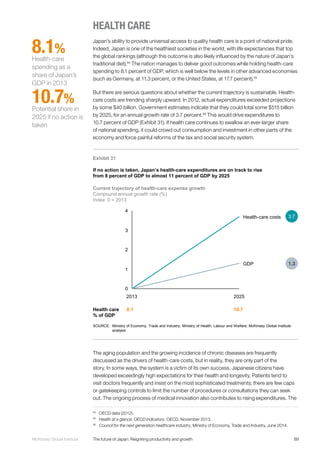
  • 76.
    McKinsey Global Institute 3. A sector-level road map66 Above all, growth and productivity have been dampened in recent years mostly due to the factors described below. Low consumer spending Data suggest that compared with other major developed economies, Japan has significant room for consumer spending to increase. Japan’s retail spending is equivalent to 8.3 percent of GDP, which is 32 percent lower than the 12.2 percent share in the United Kingdom (Exhibit 17). If retail spending rises by two percentage points of GDP, it would bring Japan into line with the share in the United States and close half the gap with the United Kingdom. It would produce a 23 percent increase in current gross output, equivalent to unlocking latent demand of just over $116 billion. Years of deflation have had a pernicious effect on the retail sector. When consumers expect falling prices and wages, they are more inclined to postpone or even forgo purchases—and to look for bargains when they do shop. Retailers are often forced to resort to discounting to lure shoppers, resulting in price wars and eroded margins. Even in these conditions, however, there is room to spark greater consumer demand through innovation in both offerings and formats. 2 p.p. The Japanese consumer has significant room for increased retail spending SOURCE: World Input-Output Database; OECD; McKinsey Global Institute 13 8 9 10 12 0 11 09 Retail spending % of GDP1 -4 Germany United Kingdom Japan United States 2011072005 Potential for growth Exhibit 17 1 Retail spending measured as gross output from the retail sector in national GDP. ▪ Matching the US level ▪ Closing half the gap with the United Kingdom equivalent to 23% increase in current gross output
  • 77.
    67McKinsey Global Institute The future of Japan: Reigniting productivity and growth Prevalence of less productive formats Traditional stores and small convenience stores have historically dominated the Japanese retail sector. Although their share of total retail sales has declined slightly, from 65 percent in 1999 to 52 percent in 2012, they continue to account for the largest share of labor hours and to bring down the sector’s overall labor productivity (Exhibit 18). Exhibit 18 Japan’s high proportion of small stores decreases overall labor productivity in the retail sector 70 90 30 20 10 0 14 16 18 6 30 28 20 60 8010 8 2 4 100 12 22 0 24 26 32 40 50 Share of labor hours % Value added per hour worked $ SOURCE: Ministry of Economy, Trade and Industry commerce census; annual reports; McKinsey Global Institute analysis 6 4 65 52 16 27 6 5 7 5 5 31 Other Specialty chain Non-store 1999 Drugstore 2012 Small convenience store1 Supermarket Department store 10 -2 -3 n/a2 -2 -2 4 1 This category includes small, modern-format stores that are part of larger chains as well as traditional stores that are owned and run by families. 2 “Non-store" retail revenue not reported in 1999, including e-commerce. 3 Includes sales from gas station stores that sell food and/or convenience items. NOTE: Numbers may not sum due to rounding. Sales by store format % Productivity by format and share of labor hours, 2012 Compound annual growth rate, 1999–2012 % Store format Growing Declining Department store Drugstore Supermarket Non-store Specialty chain Small convenience store Other3 Japan retail average
  • 78.
    McKinsey Global Institute 3. A sector-level road map68 Traditional independent stores account for 86 percent of this category. Their average size is 76 square meters, which is roughly 40 percent of the average size of small modern chain stores, and they employ an average of four workers per store (including part-time workers). The productivity of these traditional stores is $23.50 per hour; by contrast, small modern chain stores post labor productivity of $30.70 per hour (Exhibit 19). Many small Japanese retailers own their stores’ land. Their low property taxes, combined with high capital gains taxes and land exemptions from high inheritance taxes, discourage these traditional retailers from selling. Exhibit 19 Several store formats within the small convenience store category notably lag behind in labor productivity 90 24 28 32 4 20 16 12 8 0 251510 20 8035 400 5 45 50 60 65 70 75 10085 9530 55 Share of labor hours % Value added per hour worked $ SOURCE: Ministry of Economy, Trade and Industry commerce census and interviews; McKinsey Global Institute analysis 1 Includes automotive retail, furniture, fuel, health and beauty goods, leisure goods (including sporting goods). Consistent with our overall definition of the retail sector, sales are for individual/household purposes or, if they are made by businesses, they are small quantities or values. Productivity by format and share of labor hours, 2012 Value added/hour worked ($) Store format Growing Declining Small, modern chain stores Traditional, food Traditional, apparel Traditional, household goods, and other1 Japan retail average
  • 79.
    69McKinsey Global Institute The future of Japan: Reigniting productivity and growth Fragmented industry structure in some formats While there is a growing trend of retail consolidation, the industry structure remains highly fragmented in many formats, particularly supermarkets, drugstores, and specialty chains (Exhibit 20). Only 40 percent of Japanese retailers are part of the top ten national players vs. 75 percent in the United Kingdom and 76 percent in Germany. This has prevented investment in automation and technology; larger chains can take fuller advantage of economies of scale that reduce costs and improve operations. A lack of standardization inflates capital and operating expenses for stores. Exhibit 20 Japan’s retail landscape is highly fragmented, with relatively few major national chains 64 41 39 52 14 9 30 34 38 48 72 91 14 23 24 6 Aeon Retail Ito-Yokado Daiei Uny Don Quijote SOURCE: Nikkei estimates and convenience store survey; Japan Chain Drugstore Association; Japan Department Stores Association; McKinsey Global Institute analysis 1 Small traditional/family-operated stores are excluded from analysis since no major player exists. NOTE: Numbers may not sum due to rounding. Market share, top players, 2012–13 % of revenue Less consolidated More consolidated Supermarkets Drugstores Specialty chains Non-store Department stores Convenience stores1 Matsumoto Kiyoshi Holdings Sun Drug Tsuruha Holdings Cosmos Pharma- ceutical Sugi Holdings Yamada Denki Bic Camera Edion K's Holdings Yodobashi Camera Isetan Mitsukoshi Holdings J. Front Retailing Takashimaya Sogo & Seibu H2O Retailing First tier Second tier Other Rakuten Amazon. co.jp Yahoo! Japan 7-Eleven Japan Lawson Family- Mart Ministop Circle K Sunkus 2 second-tier players 6 second-tier players 6 second-tier players 3 second-tier players
  • 80.
    McKinsey Global Institute 3. A sector-level road map70 A failure to reap scale benefits even when consolidation has occurred Although Japan’s retail landscape is relatively fragmented, there is a trend toward consolidation—and one would expect to see higher productivity as larger companies achieve economies of scale. But this has not been the case in Japan. Exhibit 21 shows that while revenues have increased from organic growth and industry consolidation across multiple store formats, industry profitability and costs have improved only marginally. Even those retail formats with higher rates of revenue growth are not necessarily reducing their costs or improving their operating margins. The top specialty chains, for example, posted annual revenue growth of some 5 percent between 2009 and 2013 but were not able to increase profit margins at all. Many retailers have high selling, general, and administrative (SG&A) costs as they struggle to provide customized offerings to Japanese consumers across different regions. Consolidation has also had little impact on the cost of goods sold (Exhibit 22). Retailers with higher revenue growth posted only limited improvement in merchandising costs; their procurement processes have not captured the benefits of scale. Some top retail players have consolidated and increased revenue, but profitability has improved only marginally SOURCE: Company financial reports; Bloomberg; McKinsey Global Institute analysis 1 Includes the top three to five players from each format (supermarkets, drugstores, specialty chains, department stores, convenience stores, non-store retailers). 80 90 100 110 120 130 140 2009 2010 2011 2012 2013 Net revenue Index: 100 = 2009 4.0 4.6 Cost of goods sold % of revenue 26.1 25.6Selling, general, and administrative costs % of revenue 69.9 69.5 Operating profit % 4.3 5.0 4.7 25.6 25.0 25.1 69.8 69.8 69.6 Exhibit 21 Revenue growth and profitability of top retailers1 4.7% p.a.
  • 81.
    71McKinsey Global Institute The future of Japan: Reigniting productivity and growth High cost of legacy IT infrastructure Legacy IT infrastructure has been a general problem in Japanese corporations, and the situation is no different for the retail industry. One survey indicates that 75 percent of IT spending in Japan goes toward maintenance.70 This leaves very little for investing in newer technologies. However, for the retail industry, where there are rapidly changing customer demands, broad product inventory, and complex supply chains to manage, being up to date in IT is critical to maintaining high productivity. Overinvestment in floor space The Japanese retail sector has expanded its physical footprint over the past decade; total retail space has increased by 13 percent. The average store size has increased across every format. In particular, from 2007 to 2012, drugstores increased their average floor space by 36 percent, while specialty chains (such as consumer electronics retailers) increased by 25 percent. But revenue growth has not kept pace with this expansion, and as a result, sales per square meter have been declining since 1999. Conversely, US stores have been shrinking their footprints and holding capital expenditures flat. 70 “METI considers making IT investment disclosure an obligation for corporates,” Nikkei Shimbun, December 8, 2014. SOURCE: Company financial reports; Bloomberg; McKinsey Global Institute analysis 1 Includes the top three to five players from each format (supermarkets, drugstores, specialty chains, department stores, convenience stores, non-store retailers). Even Japan’s more consolidated retail formats are not capturing the benefits of scale Exhibit 22 Revenue growth and merchandising synergies of top retailers by store format1 -2 0 2 4 6 8 10 12 14 16 -4.5 -4.0 -3.5 -3.0 -2.5 -2.0 -1.5 -1.0 -0.5 0 0.5 1.0 1.5 2.0 Revenue growth, 2009–13 Compound annual growth rate (%) Growth in cost of goods sold % of revenue Specialty chains Non-store Department stores Convenience stores Supermarkets Drugstores Revenue size Higher consolidationLess consolidation Medium consolidation 13% Increase in retail floor space over the past decade
  • 82.
    McKinsey Global Institute 3. A sector-level road map72 Japan’s future path: Comparing the retail sector’s current trajectory with a vision for revitalization If Japanese retail continues on its current trajectory, the industry will be faced with limited growth and a sustained gap with US labor productivity. The sector’s value added would increase by only 1.1 percent annually through 2025. Labor productivity would increase by a total of 60 percent over the entire period from 2011 to 2025. By then, the Japanese sector would generate only $40 per labor hour vs. $56 per labor hour in the United States, leaving Japanese productivity at just 71 percent of the US level. In addition, if the industry continues to expand total floor space at its current rate, retail sales per square meter will decline by about 1 percent annually through 2025 (Exhibit 23). But Japan has an opportunity to carve out a different path if retailers focus on the opportunities outlined below. By 2025, the retail sector can make a quantum leap in performance by deploying new technologies, better serving aging consumers, and increasing its efficiency and sustainability. Applying the strategies discussed here could boost labor productivity by up to 39 percent over this period, closing up to 95 percent of the productivity gap with the US sector. The new world of Japanese retail could conceivably offer a very different experience in the future—one in which consumers may not need to go to stores at all. A weekly supply of groceries, based on their typical shopping patterns, could be delivered straight to their homes, and big data–enabled predictions could tailor promotional offerings to their preferences. Large automated distribution centers could handle fulfillment with precision and at low cost, while automated ground and aerial vehicles make delivery fast and cheap. Retail revenue has not kept pace with expansion of floor space, which has led to declining sales per square meter SOURCE: Ministry of Economy, Trade and Industry commerce census; McKinsey Global Institute analysis 0.83 0.89 0.93 0.97 1.07 2007200420021999 2012 Retail sales per square meter ¥ million Exhibit 23 138 134 136 144 142 150 0 140 0 132 135 160 145 130 155 140 03 040201 Retail sales ¥ trillion Total floor space Million square meters 11100905 06 0799 082000 2012 -2% p.a.
  • 83.
    73McKinsey Global Institute The future of Japan: Reigniting productivity and growth When consumers do choose to visit brick-and-mortar stores, location-based technology could be used to send them personalized recommendations and discounts based on their shopping history. “Endless aisles” and “virtual mirrors” could enable shoppers to tap into an online and an offline assortment. Friendly robots using the next generation of artificial intelligence could answer product questions. Retailers can continue to experiment with creating unique in-store experiences (such as those pioneered by Apple in its stores). Store operations could become more efficient, with shoppers gaining the ability to scan items as they go or use mobile self-checkout. Technology will make it possible to adjust prices and promotions and to track inventory (including the temperature and expiration dates of food products) and reorder automatically. Supply chains could be dramatically streamlined by deploying the Internet of Things and using robots to supplement labor in warehouses. The retail sector’s future potential will be determined in part by whether it is able to respond to the changes posed by new global trends. Brick-and-mortar stores will have to evolve in order to survive in a more digital—and increasingly mobile—retail landscape, developing a more multichannel approach. In general, selling through digital channels can underpin much higher productivity in the sector. Previous MGI research estimated that selling through digital channels rather than a traditional store could produce productivity gains of 6 to 15 percent, based on reduced labor requirements, inventory efficiencies, and lower real estate costs.71 The shift to e-commerce can have other spillover benefits as well: a 2013 MGI study on China noted that e-tailing spurred growth in supporting industries such as online advertising and marketing, payment systems, warehousing, express delivery, and IT services. It also unlocked additional consumer demand by making a wider product set available to households. Additionally, e-tailing accelerated consolidation and modernization of store formats.72 It will be critical for Japanese retailers to become fluent in big data and advanced analytics. These new capabilities will allow retailers to better understand and segment their customers and to make both front- and back-end operations (such as sales forecasting, employee scheduling, and merchandising) more efficient and effective. The Internet of Things, too, can help retailers manage complex shipments from vendors, while sensors and tags in stores can avoid stock-outs and signal when reorders are necessary. Demographic trends will have a significant impact both on consumer demand and on the retail labor force. The elderly population will be an engine of consumption, and retailers that can meet the needs and preferences of this segment could be poised for growth. Retailers have already begun shifting their strategies to meet this new reality. Aeon has begun putting medical clinics inside its locations, while modern chain convenience stores are shifting to healthier products and offering delivery services that are particularly valuable to shoppers who cannot carry heavy packages home. Shifting the product mix and offering new services to cater to the needs of a population that is growing older will be key. Urban residents tend to shop frequently, value ready-to-eat selections and portability, and demand more deliveries with a higher level of complexity (although they are increasingly unwilling to pay more for convenience or expedited delivery). In response to this trend, retailers will need to rethink their footprints and invest in smaller, more nimble urban operations and innovative digital strategies as opposed to sprawling suburban shopping malls. Furthermore, they will need to develop best-in-class logistics and supply-chain management to manage the costs of complex networks and increased deliveries. 71 Disruptive technologies: Advances that will transform life, business, and the global economy, McKinsey Global Institute, May 2013. 72 China’s e-tail revolution: Online shopping as a catalyst for growth, McKinsey Global Institute, March 2013.
  • 84.
    McKinsey Global Institute 3. A sector-level road map74 Industry initiatives for jumpstarting productivity and growth in retail We have identified seven strategies that could boost growth for Japanese retailers by 2025 (Exhibit 24). Together they can produce a significant improvement in labor productivity of anywhere from 22 to 39 percent (Exhibit 25). This is derived from an increase in value added (ranging from 41 to 61 percent) plus a 15 percent decrease in labor hours thanks to increased efficiency. Deploying all of these could help Japan potentially close the productivity gap with the US sector by 52 to 95 percent by 2025. -9.0 -1.9 -0.5 -2.3 -4.3 0 n/a n/a Productivity levers can help Japan’s retail sector boost value added and make more efficient use of labor by 2025 61.3 7.7 6.9 13.9 18.2 8.6 5.9 n/a Next-generation technologies Global best practices Smarter store footprints Economies of scale for sourcing State-of-the-art IT systems1 Mobile e-commerce and omni-channel retailing Operational/supply chain excellence Pricing and merchandising excellence Transition to modern formats Total impact Organizing for discipline and performance Exhibit 24 % SOURCE: McKinsey Global Institute analysis Impact on value added Impact on labor hoursLever 1 This allows retailers to capture additional value added from scale and operational efficiencies. It can improve operations, supply chains, pricing and marketing strategies, e-commerce, and purchasing. NOTE: Numbers may not sum due to rounding.
  • 85.
    75McKinsey Global Institute The future of Japan: Reigniting productivity and growth 530 790 -15.0% 2025Decline from levers Decline in average hours per worker1 7,461 2011 8,781 2011 2025 411 359 +61% 2025 improved 255 218 Exhibit 25 Japanese retailers have the potential to increase labor productivity by almost 40 percent over the current trajectory by 2025 48 40 25 55 22– 39% 20252011 2025 improved 1 Average hours per worker gradually decrease over time as general technological progress improves productivity. NOTE: Numbers may not sum due to rounding. -6.0% -9.0% SOURCE: McKinsey Global Institute analysis Range Low High Labor productivity, 2025 (value added per hour worked) $, 2009 at purchasing power parity United States = 56 Germany = 30 Value added $ billion, 2009 at purchasing power parity Labor inputs Million hours worked
  • 86.
    McKinsey Global Institute 3. A sector-level road map76 Incorporating global best practices Smarter store footprints Increasing urban density combined with decreasing sales per square meter should serve as an impetus for Japanese retailers to rethink their current store footprints. By introducing all-new types of customer experiences and multiple channels, retailers can rationalize floor space, saving costs and boosting revenues. Store rationalization and consolidation will likely result in a decrease in required labor, reducing the total retail workforce by approximately 1 percent. Operational and supply-chain excellence As networks become more complex and deliveries increase, retailers must keep tighter control over their supply chains and distribution to manage costs. They also need to fine- tune store operations, from displays and merchandising to energy usage and employee scheduling. New technology tools—from the Internet of Things and big data to automated self-checkout systems—can make major inroads on these fronts. Increasing automation and efficiency in these areas will reduce the retail workforce by approximately 2 percent. Big data analytics will allow Japanese retailers to understand and segment their customers and to make front- and back-end operations more efficient. Adopting next-generation technologies State-of-the-art IT systems As the industry consolidates, replacing inefficient legacy IT systems with fully integrated, state-of-the-art IT architecture will be a critical part of capturing synergies and realizing economies of scale. Technology can now allow retailers to tighten their management of multiple channels, complex supply chains, and store operations; it also makes them much more agile in responding to changing market trends. It will take substantial investment (in both systems and talent) to build big data capabilities that are on a par with the leading global players. A recent survey of large enterprises in 13 countries found that 48 percent of Japanese companies had adopted big data, compared with 82 percent in the United States.73 Pricing and merchandising excellence Japanese retailers struggled with pricing during the years of persistent deflation, but with the return of some limited inflation, they may finally have an opening to raise prices. Companies can capture new value added by implementing new pricing strategies that combine global best practices with a much deeper level of marketing insight from big data and advanced analytics. Drawing on a variety of data sources, sophisticated models can examine historical sales data to determine pricing at the SKU level, including markdown pricing and scheduling. E-commerce sites can make individual suggestions for cross-selling, while physical stores can use location-based marketing and analyze customers’ in-store behavior. Big data tools can also scan social media to glean new insights that lead to products and promotions that are better targeted to what customers want. With this new level of segmentation and customer relationship management, sophisticated demand models can be designed to guide decisions on which products can command a premium and when promotions would be most effective. 73 Global tech hot spots: A country-level look at big data & analytics, cloud, mobile, and social, IBM Center for Applied Insights, November 3, 2014.
  • 87.
    77McKinsey Global Institute The future of Japan: Reigniting productivity and growth Big data can also guide the process of determining the right assortment of products to carry based on factors such as demographics, buyer perceptions, and economic modeling. It can even help with optimizing the placement of goods and visual design, analyzing down to the SKU level to maximize sales per square meter (or sales per online visit).74 Mobile e-commerce and omni-channel retailing Japan is a wired and affluent society, and these are the necessary ingredients for e-commerce to flourish. With $119 billion in 2014 sales, Japan ranked as the third-largest e-commerce market in the world. Perhaps the best-known name in this space is Rakuten, which hosts more than 40,000 small vendors on its marketplace platform. The company states that 95 percent of Japanese Internet users have registered with it, and now it is expanding globally.75 But while e-commerce is already well developed in Japan, there is still room for growth. Traditional retailers can continue to expand into the digital space, with a particular focus on mobile e-commerce. To increase their distinctiveness and relevance, they may need to reconsider their branding and customer engagement strategies, using social media, customer loyalty data, and remote touch points to create an omni-channel experience that leads to “stickier” customer relationships. Because e-commerce is less labor-intensive than other formats, this shift will likely reduce the overall retail sector labor hours by 4 percent by 2025. It may also allow retailers to avoid zoning battles altogether. Organizing for discipline and performance Modern-format stores MGI research has found that one of the most powerful ways to improve productivity in advanced economies is to close the gap between low-productivity companies and their more efficient counterparts within the same industry. This is particularly relevant in Japanese retail, where small traditional-format stores still account for 47 percent of sales. Modern-format stores capture more value per employee, and a greater weighting of these will thus increase productivity. It will also lower the need for labor by 2 percent. Beyond a straightforward shift to modern-format stores, Japan also has the potential for “leapfrogging” directly to more innovative formats (such as “showrooms” where customers can try out goods that are purchased digitally, for example) and for the entry of disruptive new players in e-commerce. Economies of scale for sourcing One of the most powerful strategies to improve retail margins is to purchase in large volumes to reduce costs. Small Japanese retailers often struggle with this issue; further consolidation would enable them to benefit from purchasing at scale. Even large retailers, however, could benefit from revamping their procurement processes to leverage their size in negotiations with suppliers and wholesalers. 74 Big data: The next frontier for innovation, competition, and productivity, McKinsey Global Institute, May 2011. 75 Rakuten corporate website.
  • 88.
    McKinsey Global Institute 3. A sector-level road map78 FINANCIAL SERVICES A healthy financial services sector is a crucial foundation for any economy. The sector represents 5.3 percent of Japan’s GDP (well above the G20 average of 3.9 percent) but employs only 2.4 percent of its labor force. By contrast, 4.2 percent of the US labor force and 3.1 percent of the German labor force work in financial services. The sector can be split into three major components: banks, insurers, and other financial firms and institutions (a category that includes asset managers, credit card issuers, leasing companies, consumer/business lending operations, and the Japan Agricultural Cooperatives group, a cooperative society offering banking and mutual fund services). Our discussion of specific mechanisms for boosting productivity will focus solely on the banking and insurance industries since these two segments represent some 70 percent of employment and 84 percent of profits generated in the Japanese financial services sector (Exhibit 26).76 76 McKinsey Global Banking Profit Pools database. SOURCE: Basic survey on wage structure, Ministry of Health, Labour and Welfare; industry associations; McKinsey Global Institute analysis Banking and insurance account for the vast majority of employment and profits in Japan’s financial services sector 64 33 16 31 27 51 3 30 39 Life Banking Other financial businesses Property and casualty Ordinary profit $74 billion1,787 Number of em- ployees Number of players 3 2 97,596 Current industry breakdown, 2014 % Exhibit 26 ▪ City ▪ Regional ▪ Trust ▪ Shinkin/shinkumi ▪ Others, including Japan agricultural cooperatives and Japan Post ▪ Life ▪ Property and casualty ▪ Agents ▪ Securities ▪ Credit card issuers ▪ Leasing ▪ Asset management ▪ Consumer business finance Major players ▪ Bank of Tokyo- Mitsubishi UFJ ▪ Mizuho ▪ MUFG ▪ SMBC ▪ Dai-ichi Life ▪ Meiji Yasuda ▪ Nissay ▪ Daiwa Securities Group Inc. ▪ Nikko Asset Management ▪ Nomura NOTE: Numbers may not sum due to rounding. Insurance
  • 89.
    79McKinsey Global Institute The future of Japan: Reigniting productivity and growth Japan has a unique banking structure. The industry includes three giant “megabanks” that operate nationally, more than 100 regional banks that operate mainly within their home prefecture, four trust banks that perform both banking and fiduciary functions, and 400-plus shinkin banks and credit unions (non-commercial banks that serve union members). The insurance sector consists of life and property/casualty, as well as a small industry share of mutual insurance. Japan’s financial sector was the third largest in the world in 2012, with 12 percent of total worldwide assets ($11 trillion). Thanks to a large base of affluent customers, Japan’s personal financial assets were equivalent to 309 percent of GDP, also ranking third in the world—but ironically, this has dampened productivity, since more than half of these personal assets are held in cash or cash deposits.77 The conditions may be coming together for the financial services sector to achieve higher margins, increase value added, and support new momentum in the broader economy. Although Japan is one of the top players in global financial markets, the sector has seen limited revenue growth due to its low-risk operating model, which keeps margins below those in Western Europe, North America, and emerging markets. During Japan’s long period of muted demand, banks tended to funnel excess cash into low-risk, low-return government debt. From 2000 to 2012, government bonds outstanding increased from $3.3 trillion to $8.2 trillion.78 The government’s most recent and most aggressive program of quantitative easing is meant to reverse this trend and spark new lending and investment. During 2013, for instance, commercial banks reduced their $1.8 trillion bond holdings by $267 billion, while business lending increased by around 5 percent on an annual basis.79 Jumpstarting the flow of financing and investment is an Abenomics priority, and the conditions may be coming together for the financial services sector to achieve higher margins, increase its value added, and support new momentum in the broader economy. Productivity challenges For years, Japan’s industry landscape has been marked by ultralow interest rates and fierce price competition—and as a result, a significant labor productivity gap has formed between the Japanese financial services sector and its US and German counterparts.80 Between 2005 and 2011, annual labor productivity growth was 4.5 percent in the US sector and 7.6 percent in the German sector, but the Japanese sector actually experienced a decrease of 2 percent (Exhibit 27). By 2011, Japan’s overall labor productivity in the financial services sector was only about two-thirds of the US level. 77 Ibid. 78 Japan Ministry of Finance. 79 Masashi Saito and Yoshihiko Hogen, Portfolio rebalancing following the Bank of Japan’s government bond purchases: Empirical analysis using data on bank loans and investment flows, Bank of Japan, June 2014. 80 These figures compare the entire financial sector in each country, including banks, insurers, and others.
  • 90.
    McKinsey Global Institute 3. A sector-level road map80 The period of 2005–11 was, of course, no ordinary moment in the history of finance. It was marked by an immense bubble and a deep crisis in the global financial system, with the United States at the center. However, US banks have bounced back from the depths of 2008–09. Looking at a longer time horizon, the US sector has experienced a gradual but consistent trend of labor productivity improvements, achieved by creating higher value added while reducing its workforce. Banks and insurers have responded to shareholder and management pressure to keep margins high. In addition, as traditional pension plans disappear, consumers have assumed responsibility for managing their own retirement assets; banks and insurers alike compete with brokerages and other types of asset managers in offering retirement products to individuals and employers.81 The US sector has introduced new digital and mobile channels and has heavily automated back-office operations, creating substantial cost savings. Once they are in place, these platforms 81 Retirement plan products and services, US Office of the Comptroller of the Currency, February 2014. SOURCE: World Input-Output Database; McKinsey Global Institute analysis 0 20 40 60 80 100 120 140 Labor productivity (value added per hour worked) $, 2009 at purchasing power parity 20111995 052000 1,000 600 0 1,400 200 400 1,200 800 2000 2011 Value added $ billion, 2009 at purchasing power parity 051995 0 12 6 2 8 14 10 4 Labor inputs Billion hours worked 2000 05 20111995 Labor productivity has risen in the US and German financial services sectors but declined in the Japanese sector Exhibit 27 Germany Japan banking and insurance United States Japan total 1 The compound annual growth rates are equivalent for Japan’s total and for its banking and insurance industries only (with the exception of value added, where Japan’s total is -4.8% and the rate for banking and insurance is -4.9%). Compound annual growth rate, 2005–11 (%)1 -0.4 -2.1 -2.9 7.1 2.3 -4.8 7.6 4.5 -2.0
  • 91.
    81McKinsey Global Institute The future of Japan: Reigniting productivity and growth can process an unlimited number of transactions at virtually no cost—and the United States has been a particular beneficiary of this industry trend because of its sheer volume of transactions. Germany’s sector has experienced even stronger growth, given that it started from a relatively less saturated market. Between 2005 and 2011, its labor productivity grew by 7.6 percent annually. Most of this was due to a 7.1 percent increase in value added, which was achieved while keeping labor inputs essentially flat. Not only is the German market relatively affluent, but there is also a growing market for personal retirement plans to supplement public pensions. These trends have had a positive effect on labor productivity, as have automation and industry consolidation.82 As in the United States, the German sector managed to streamline its use of labor. The Japanese sector, by contrast, has lagged behind. While firms reduced their headcount by 3.5 percent per year from 2005 to 2011, their value added declined by almost 5 percent per year over the same period. The financial services sector as a whole has struggled to increase revenues—not only because of the challenging macroeconomic environment but also because of its own difficulties in responding to a changing landscape. To fully understand the factors behind this erosion, it helps to examine the banking and insurance industries separately. Japan’s persistently low interest rates have limited spreads and depressed returns on investments. Productivity in the Japanese banking sector The Japanese banking sector grew more consolidated than the US industry during the late 1990s and into the early 2000s, which confers an advantage in labor productivity. Japanese banks serve their customers with fewer branches and fewer employees than US banks, partially due to Japan’s higher population density. Despite this advantage, labor productivity was 22 percent lower for Japanese banks than for US banks by 2011 (Exhibit 28). The major factors driving this gap include the difficulty of obtaining significant return on assets, a limited appetite for risk, simpler product offerings, and intense competition that has driven down pricing. While US banks have increased their value added through more diverse trading and investment strategies, Japanese banks have largely confined themselves to low-risk loans and government bonds. Japan’s persistently low interest rate environment has limited spreads and depressed returns on investments—and because loan demand has stagnated over time, banks have been unable to compensate for declining interest margins by boosting volumes. Although customer satisfaction with their primary bank has slightly improved over the course of McKinsey surveys taken in 2011 and 2014, Japan had the lowest levels of customer loyalty in Asian banking.83 A failure to build deeper relationships harms banks’ ability to increase advisory revenues and opens up a considerable opportunity for competitors that are able to design effective marketing strategies. Banks have not been able to fully capture opportunities in retirement and estate plans, two of the largest concerns for an aging 82 Eurostat and Deutsche Bundesbank (German central bank). 83 As measured by the preference for customers to go back to their banks for new services and for their willingness to recommend their bank to others. 2011 McKinsey Personal Financial Services Survey and 2014 McKinsey Personal Financial Services Survey, McKinsey & Company.
  • 92.
    McKinsey Global Institute 3. A sector-level road map82 population. In addition, they have not sufficiently targeted younger customers as they build wealth for retirement. Furthermore, although Japanese banks have digitized many of their operations, online banking services tend to be more extensive in the United States than in Japan (where they are mostly limited to checking balances and making remittances). This type of approach to online banking has limited the opportunity to reduce labor intensity. Productivity in the Japanese insurance sector Japan’s insurance sector trailed the US sector in labor productivity by 29 percent in 2011 (Exhibit 29). There is high market penetration in Japan for life insurance products, but lower revenues per policy. This applies to both life insurance and property and casualty (P&C); product offerings and pricing strategies tend to be relatively basic. In addition, the stagnant economy has constrained consumption of durable goods, creating little growth in demand for property and casualty coverage. Insurers, like banks, have struggled with low returns on their investments. Some firms have partially offset this issue by serving a larger volume of customers per employee, but this is difficult to sustain given the already high penetration of life insurance, limited product offerings, and limited consumer demand. SOURCE: World Input-Output Database; Japanese Bankers Association; US Federal Deposit Insurance Corporation; IHS; McKinsey Global Banking Pools database; McKinsey Global Institute analysis 12 10 58 56 117 91 73 14 26 Labor input -22% United States 2011 117 Online penetration 5 Non-labor cost 1 Portfolio mixJapan 2011 Exhibit 28 Lower revenue is the major factor driving Japan’s productivity gap in banking Labor productivity, 2011 (real value added/hours worked) $, 2009 at purchasing power parity Other income Other interest Interest on securities Interest on loans Fees Return on assets NOTE: Numbers may not sum due to rounding.
  • 93.
    83McKinsey Global Institute The future of Japan: Reigniting productivity and growth Japan’s future path: Comparing the current trajectory of financial services with a vision for revitalization Japan’s financial sector is on a path of limited growth. Current trends point to a labor decline of up to 22 percent by 2025, but the revenue gap with the US and German sectors would likely widen if margins do not improve. Most important, the sector’s performance would reflect a lack of productive investment across the wider economy. But the sector could take a different direction by capitalizing on broad trends. An aging population requires new types of products and services tailored to its changing needs; retirement and inheritance products can create new sources of revenue. As the depopulation of rural areas accelerates, banks will have a greater incentive to reconfigure their physical footprints, leading to more effective capital allocation. Increased global connectivity provides an opportunity to expand Japan’s current role as a financier of international infrastructure projects and businesses in emerging economies. Technology will lead to even more sophisticated and customer-centric digital models. In this alternative scenario, customers will have the flexibility to purchase a wider array of financial products through the channels that are most convenient for them. Younger clients will primarily be self-serving, conducting all their transactions from their smartphones or tablets and conversing with customer service through instant chats when necessary. Older customers will have trusted financial advisers they consult on a regular basis for asset management and retirement planning. A more competitive market could offer innovative products that benefit consumers—and it could provide a lift to the entire economy by putting cash reserves to work. Labor productivity, 2011 (real value added/hours worked) $, 2009 at purchasing power parity The productivity gap in Japan’s insurance industry stems from low revenue per policy for both life and property and casualty coverage 113 81 39 76 190 34 106 -112 -5 Policies per capita 296 3 United States -110 Population per employee Cost per policy Revenue per policy Hours worked per employee -29% Japan -36 SOURCE: World Input-Output Database; Japanese Insurance Association; SNL Financial: Business Intelligence Services; Ministry of Health, Labour and Welfare; McKinsey Global Institute analysis Exhibit 29 Life Property and casualty NOTE: Numbers may not sum due to rounding.
  • 94.
    McKinsey Global Institute 3. A sector-level road map84 Industry initiatives for realizing productivity and growth Whatever Japan’s macroeconomic conditions, individual financial firms still have scope to improve productivity and capture new growth opportunities. We have identified key strategies within banking and insurance. Together these strategies could increase value added up to 44 percent while reducing the labor required by 9 percent (Exhibit 30). On its current trajectory, the sector’s labor productivity would grow to only $137 per hour worked in 2025. But we project that the industry could boost this to anywhere from $159 to $170 in 2025 by undertaking all of these initiatives. This would represent an increase of up to 24 percent over the baseline. 147 89 Decline from levers Decline in average hours per worker1 2025 2,318 -9.2% 2011 2,554 +44% 369 2025 2025 improved 393 273 2011 206 24 Exhibit 30 Japan’s overall financial services sector can improve labor productivity by almost 25 percent over the current trajectory by 2025 159 10 137 81 170 24% 20252011 2025 improved 1 Average hours per worker gradually decrease over time as general technological progress improves productivity. NOTE: Numbers may not sum due to rounding. -6.0% -3.5% SOURCE: McKinsey Global Institute analysis Range Low High Labor productivity, 2025 (value added per hour worked) $, 2009 at purchasing power parity United States = 211 Germany = 98 Value added $ billion, 2009 at purchasing power parity Labor inputs Million hours worked
  • 95.
    85McKinsey Global Institute The future of Japan: Reigniting productivity and growth Incorporating global best practices Customer insights and customized value propositions, driven by big data Financial firms collect a vast amount of customer, transaction, and market data, so it is no surprise that the financial sector has been one of the first to adopt big data analytics on a large scale. New analytics tools can allow firms to combine disparate data sets, such as online transactions, observations on how customers behave in branches, data from partner companies, and retail purchase histories. Obtaining a more comprehensive view of a customer’s financial picture can be a valuable tool for deepening relationships (provided, of course, that appropriate privacy standards and safeguards are in place).84 Japanese banks and insurers are still at the beginning of this journey, but big data could revolutionize how they identify and interact with customers. Many banks already segment their customers by wealth and life stage and develop offerings tailored to various groups. But technology can now take this to the individual customer level. This capability will allow firms to focus their efforts on the most promising relationships and fine-tune their value propositions. Big data analytics tools can help firms accomplish this on a larger scale and at a level of detail that was not possible just a few short years ago (by, for example, noting when customers are approaching major life events). An aging population represents a market opportunity for offering new retirement products and advisory services. On the insurance side, it is rare for customers to switch property and casualty carriers, and insurers have to seize those opportunities. The same kind of data analytics approaches can target those elusive consumers at exactly the right moment (for example, when they are about to buy a car or move) with differentiated and targeted offerings. Insurers can also analyze their existing policy holders to look for opportunities to up-sell. Big data can offer much more sophisticated and detailed analysis of the risk behind each policy.85 New pricing strategies Japanese banks, which lag behind many of their international counterparts in interest revenue, have a significant opportunity to launch a wider variety of products with differentiated pricing (for example, risk-adjusted pricing for subprime mortgages or structured finance products for smaller corporations to expand their options for financing). But introducing more value-adding fee-based products and risk-based interest rates or pricing has to be undertaken with an abundance of planning and caution to ensure that customers will absorb these changes. This process has to involve the frontline sales force to ensure its buy-in; it also has to feature a solid communications plan. The insurance industry, too, can benefit significantly from using more sophisticated risk models based on big data analysis to arrive at pricing. One area of growth for the future could be low-cost coverage, sold mostly online to younger, more price-sensitive customers. 84 Big data: The next frontier for innovation, competition, and productivity, McKinsey Global Institute, May 2011. 85 Unleashing the value of advanced analytics in insurance, McKinsey & Company, August 2014.
  • 96.
    McKinsey Global Institute 3. A sector-level road map86 Broader product offerings Seniors represent a potentially lucrative customer segment for the financial services sector. The 55-and-older segment accounts for almost two-thirds of personal financial assets in Japan. But the industry will have to take a new approach to cementing relationships with seniors. Financial firms must quickly develop the expertise and services to specifically target this group, offering tailored advice on retirement and inheritance issues as well as investment products. In Sweden, for example, Swedbank designates a specific daily hour for advisers to dedicate their time to senior customers, and senior-specific products and communications are offered.86 Targeted approaches can pay off across other age groups as well. Customers begin to worry about long-term retirement planning as early as their thirties, and almost half of those in their thirties and forties have indicated they will purchase financial products in the future. With the right marketing and follow-through, the industry could win their long-term business and even cultivate new attitudes toward saving and investing. Japan has a heavy concentration of affluent and high-net-worth customers, but they have historically had a strong preference for cash deposits. The financial services sector has a huge opportunity to design and market new investment products that will coax them out of cash deposits and low-risk certificates of deposit in search of better yields. Financial firms will need to improve frontline capabilities and tools to provide better advisory services to customers. Regional banks can capitalize on their deep ties to small and medium-sized enterprises and local businesses to provide offerings beyond traditional lending (such as real estate advisory, introduction of management talent, and financing for international expansion). Pursuing this advisory business would require regional banks to develop new scale and capabilities. Japan can expand its current role as a financier of global infrastructure projects and businesses in emerging economies. Increased return on assets Banks are generating lower revenues from low-interest loans, and both banks and insurers rely on low-yield investments such as government bonds. Players can rethink their investment strategies to shift toward higher-yield domestic or international assets, finding a better balance between risk and reward. Alternatively, banks can boost return on assets through capital optimization and asset- light financing products. Instead of traditional “originate-to-hold” lending, they can move to an “originate-to-distribute” model that involves securitizing loans and selling them to other investors instead of keeping them on the originators’ own balance sheets. However, securitization on a large scale requires appropriate internal and regulatory safeguards (such as requirements for banks to retain a minimum share of the underlying loans or transparency disclosures) to ensure that outsized risks are not dispersed throughout the financial system. 86 Swedbank company website.
  • 97.
    87McKinsey Global Institute The future of Japan: Reigniting productivity and growth Globalization strategy A number of global trends offer potential areas of growth for financial services in Japan— starting with the dramatic rise of emerging economies, many of which still lack well- developed financial systems. Megabanks in Japan have already been expanding overseas to compensate for declining performance in the domestic market. In 2011, Japanese banks surpassed German banks as the world’s largest international lenders. Their share of consolidated international claims among all banks that report to the Bank for International Settlements rose from 8 percent in early 2007 to 13 percent at the end of March 2013.87 Japanese cross-border claims in Asia have more than doubled since the global financial crisis; they accounted for about 10 percent of total foreign consolidated claims as of March 2013.88 This overseas activity has contributed to revenue growth, although it has not been enough to compensate for the overall negative impact of falling returns in the domestic market. Further emphasis on foreign lending and foreign expansion could be an avenue for Japanese banks to grow, although it presents risks (and indeed, this strategy resulted in heavy losses in the late 1980s and 1990s). The global trend toward urbanization also presents an opportunity for Japanese banks to utilize their liquidity and expand their role as global financiers of infrastructure projects. Previous MGI research has estimated that cities will need annual physical capital investment of more than $20 trillion by 2025.89 Emerging Asia alone has some $8 trillion in infrastructure needs, and Japanese banks have found opportunities in financing utility, transportation, and communications projects.90 Mitsubishi UFJ Financial Group, SMBC, and Mizuho Financial ranked among the top five banks for infrastructure financing in 2013.91 Insurers have similarly increased their foreign operations in response to declining revenues at home. Targeted, prioritized expansions (especially into the most promising markets in emerging Asia) will be key to creating value. Adopting next-generation technologies Automation of processes By undertaking an end-to-end review of processes, banks can identify and focus attention on areas that have received little IT investment and digital process transformation. Research has found that the top 20 to 30 processes account for approximately 40 to 50 percent of costs and 80 to 90 percent of activities, suggesting the potential for huge savings still exists in back offices. Gains could be found in functions such as opening accounts, processing mortgage applications, lending, customer inquiries, credit card issuance, annual reviews, customer complaints, and cash handling. Although digitizing additional processes takes setup time and effort, the chances of success improve with well-thought-out training, quality management and testing, and a structured rollout plan.92 The insurance sector also has ample potential for capturing operational savings on processes that remain largely manual, such as processing applications and claims. This will provide more touch points with customers for cross-selling. 87 Adrian van Rixtel and Jeff Slee, “The return of Japanese banks,” BIS Quarterly Review, September 2013. US banks followed Japan as the next largest cross-border lenders, with a market share of about 12 percent at the end of March 2013, followed by German banks at 11 percent. 88 Raphael W. Lam, Cross-border activity of Japanese banks, IMF working paper number 13/235, November 2013. 89 Urban world: Cities and the rise of the consuming class, McKinsey Global Institute, June 2012. 90 Raphael W. Lam, Cross-border activity of Japanese banks, IMF working paper number 13/235, November 2013. 91 Project Finance International ranking, 2013. 92 “Accelerating the digitization of business processes,” McKinsey Quarterly, May 2014.
  • 98.
    McKinsey Global Institute 3. A sector-level road map88 Superior digital platforms and omni-channel distribution The initial phase of digitization—including the introduction of online banking and mobile apps—brought greater convenience to customers. But it has required heavy investment in systems and talent without always delivering the profits that banks and insurers expected. Today, however, emerging software solutions can help financial firms continue to push toward digitizing processes and give them greater agility. Revenues generated by multichannel banking are 110 percent higher than those generated by single-channel users. Multichannel users on average use nine products (vs. six products for customers who use two channels and five for customers with one channel). Accessibility allows customers to explore their product choices more fully, and because they invest time in customizing their digital interfaces, digital customers have “stickier” relationships with their banks. A recent survey targeting “digital high-value” customers in Asia revealed that customers value experience, flexibility, and customization over pricing.93 The shift to multichannel banking promises a combination of faster and more automated operations, cost savings, room to adjust pricing, and customer loyalty—a win-win scenario. To capture the full benefits of digitization, financial institutions will have to continue their efforts to deliver a truly seamless online and offline experience—while slimming down or reimagining their branch formats. Banks will need to rethink their footprints, closing some of their least profitable branches, transforming others to sales and advisory centers, and incorporating new automated and interactive technologies into others. Self-service platforms can be used to provide a presence at minimal cost, while branches can refocus on advisory services. Taken together, this could result in lower real estate costs and added operational efficiency. 93 Retail banking in Asia: Actionable insights for new opportunities, McKinsey & Company, March 2013.
  • 99.
    89McKinsey Global Institute The future of Japan: Reigniting productivity and growth HEALTH CARE Japan’s ability to provide universal access to quality health care is a point of national pride. Indeed, Japan is one of the healthiest societies in the world, with life expectancies that top the global rankings (although this outcome is also likely influenced by the nature of Japan’s traditional diet).94 The nation manages to deliver good outcomes while holding health-care spending to 8.1 percent of GDP, which is well below the levels in other advanced economies (such as Germany, at 11.3 percent, or the United States, at 17.7 percent).95 But there are serious questions about whether the current trajectory is sustainable. Health- care costs are trending sharply upward. In 2012, actual expenditures exceeded projections by some $40 billion. Government estimates indicate that they could total some $515 billion by 2025, for an annual growth rate of 3.7 percent.96 This would drive expenditures to 10.7 percent of GDP (Exhibit 31). If health care continues to swallow an ever-larger share of national spending, it could crowd out consumption and investment in other parts of the economy and force painful reforms of the tax and social security system. The aging population and the growing incidence of chronic diseases are frequently discussed as the drivers of health-care costs, but in reality, they are only part of the story. In some ways, the system is a victim of its own success. Japanese citizens have developed exceedingly high expectations for their health and longevity. Patients tend to visit doctors frequently and insist on the most sophisticated treatments; there are few caps or gatekeeping controls to limit the number of procedures or consultations they can seek out. The ongoing process of medical innovation also contributes to rising expenditures. The 94 OECD data (2012). 95 Health at a glance: OECD indicators, OECD, November 2013. 96 Council for the next generation healthcare industry, Ministry of Economy, Trade and Industry, June 2014. 8.1% Health-care spending as a share of Japan’s GDP in 2013 10.7% Potential share in 2025 if no action is taken Current trajectory of health-care expense growth Compound annual growth rate (%) Index: 0 = 2013 If no action is taken, Japan’s health-care expenditures are on track to rise from 8 percent of GDP to almost 11 percent of GDP by 2025 SOURCE: Ministry of Economy, Trade and Industry; Ministry of Health, Labour and Welfare; McKinsey Global Institute analysis Exhibit 31 0 1 2 3 4 GDP 20252013 Health-care costs Health care % of GDP 3.7 1.3 8.1 10.7
  • 100.
    McKinsey Global Institute 3. A sector-level road map90 latest drugs, diagnostics, and devices carry high price tags, and patients expect to receive the full benefits of cutting-edge technologies. Reimbursement models create incentives that reinforce overtreatment. Providers bill for each procedure, and hospitals are paid for longer patient stays. Japan took a solid step with the introduction of a diagnosis procedure combination (DPC) payment system, much like the billing system used by Medicare in the United States (although Japan’s version includes a length-of-stay component). It shows promise as a means of controlling costs and standardizing data, but a limited number of institutions participate.97 In recent years, Japan has resorted to cutting reimbursement rates to providers to contain costs, and today debate is focused on whether the Japanese economy can withstand the consumption tax increases that were earmarked to shore up the system. But these types of measures provide only partial solutions, and repeated rounds will not be feasible. Cost- containment measures alone are not enough. In fact, they could merely exacerbate existing pressures on the system. Many Japanese public hospitals are unprofitable.98 Patients are finding it more difficult to access care, particularly if they need to consult with a specialist. Japan needs to bend the cost curve in a more fundamental way. With funding and demographic trends on a collision course, there is growing pressure to consider deeper measures such as redefining the role of payors, encouraging consolidation, changing incentive structures, and implementing systems to make performance and outcomes more transparent. The good news is that other nations facing similar pressures on their health-care systems have managed to implement bold reforms, and Japan can draw on their experiences. Germany, for instance, has a universal multipayor system like Japan’s, and it has had remarkable success in containing the growth of health-care spending as a percentage of GDP.99 One of the most important lessons demonstrated in other countries is that reimbursement changes drive provider changes. Specialization, too, makes providers more efficient while simultaneously elevating the quality of care. Health-care costs will likely continue to rise in the years ahead, but there is ample scope to slow the rate of growth simply by implementing strategies that have already proven successful elsewhere. Revamping the health-care system could free up some of the resources that are being put to inefficient use today and reallocate them to meet the growing long-term care needs of the elderly patient population. Structural challenges A number of structural issues combine to increase the stresses on Japan’s system. While simple measures of labor productivity are not always useful in the health-care sector, it is important to take stock of how the system’s general structure influences efficiency, cost- effectiveness, and the quality of care (see Box 3, “The limitations of measuring GDP and productivity in health care”). 97 Gerard Anderson and Naoki Ikegami, How can Japan’s DPC inpatient hospital payment system be strengthened? Lessons from the US Medicare prospective system, Center for Strategic and International Studies, October 2011. 98 Central Social Insurance Medical Council report, Ministry of Health, Labour and Welfare, November 2013. 99 OECD Health Statistics database (2014).
  • 101.
    91McKinsey Global Institute The future of Japan: Reigniting productivity and growth Box 3. The limitations of measuring GDP and productivity in health care Making health-care more efficient and cost-effective can have an outsized impact on the Japanese economy due to the sheer size of the sector and the ripple effects of having a healthier and more productive workforce. But cost savings do not directly translate into GDP gains because of the way GDP is measured for public and quasi-public sectors in the national accounts. In private sectors of the economy, such as manufacturing, GDP is measured as the value added produced within the sector. But the national accounts approach the government and health-care sectors differently, basing their GDP on expenditures rather than the value of output. Because cost-saving measures reduce spending, they reduce GDP in the sector. The benefits of improved health outcomes for workers across the economy are likewise not measured in health-care GDP. Because it is directly influenced by efficiency, productivity would seem to be a useful concept for evaluating the health-care sector. But this measurement has its limitations. At its most basic, labor productivity is the output produced for every hour workers put in. This is simple enough in a sector such as manufacturing—but defining exactly what constitutes an “output” in health care is a much trickier proposition. Many comparative studies define health “outputs” by looking at the consumption, or utilization, of health-care services; they may use measures such as in-patient stays or the number of consultations. But this approach fails to take into account how effective these units of service are in producing the sector’s real value—that is, health outcomes. The outcomes that matter are ensuring access to care, improving the quality of care, and producing the best possible outcomes for patients. Several national statistics bureaus are engaged in the process of finding a better way to measure these types of outcomes, and therefore productivity, in health care, but this is no easy task. “Value” in health care is a multifaceted concept that might encompass survival rates for various diseases, recovery time after an intervention, or the degree of health that a patient regains. Health care is delivered in a multitude of settings, and patients may receive multiple treatments for the same condition or for conditions that appear simultaneously. Michael Porter has argued for measuring the total costs over a patient’s entire care cycle and weighing them against outcomes rather than measuring costs that are broken down by provider, department, or discrete types of procedures or pharmaceuticals.100 Capturing improvements in the quality of care over time is a particular challenge. Cutting down on waiting times and shifting nurses from administrative tasks to patient care are obvious improvements that would boost patient satisfaction, but these types of changes are difficult to capture in statistics.101 Despite the challenges of quantifying productivity in the health-care sector, Japan needs a broad and standardized push to collect better data on health outcomes. These data can serve as the basis for clearer metrics on the performance of individual providers, the efficacy of various treatments, and best practices—all of which go into the formula for boosting productivity. 100 Michael E. Porter, “What is value in health care?” New England Journal of Medicine, volume 363, number 26, December 23, 2010. 101 For a fuller discussion of how to measure productivity in health care, see Paul Schreyer, Toward measuring the volume output of education and health services: A handbook, OECD Statistics Directorate, working paper number 31, April 2010; P. S. Hussey et al., “Health care efficiency: A systematic review of health care efficiency measures,” Health Services Research, volume 44, number 3, June 2009; and Shannon Brownlee, Joseph Colucci, and Thom Walsh, Productivity and the health care workforce, New America Foundation, October 2013.
  • 102.
    McKinsey Global Institute 3. A sector-level road map92 Heavy and growing demands on the system Japan guarantees universal access to care, and carrying health insurance is mandatory. There is no gatekeeping system; patients may consult any doctor at any time without pre- authorization. Co-payments were established to curtail demand and provide another stream of funding. Most patients must pay 30 percent of the cost of care, although seniors (who are the heaviest users of the system) pay only 10 percent. Despite these measures, utilization rates remain very high by international standards (Exhibit 32). Japanese patients consult physicians an average of 13 times per year, which is more than twice the OECD average.102 Many crowd into hospitals whenever they need to see a doctor due to the widespread perception that hospitals provide the best care. But even then, a certain level of trust is absent; some patients seek out second and third opinions (sometimes with repetitive diagnostic testing) before deciding on a course of treatment. Low co-payments for additional visits provide little deterrent to this approach. Furthermore, the average hospital stay is three times longer in Japan than in other advanced economies for two main reasons. First, hospitals have incentives to keep patients longer as they are reimbursed by the day. The government moved to address this issue in 2014 by reducing the reimbursement rates for long-term hospitalization of more than 90 days.103 But this change does not affect the many in-patient stays of shorter duration, and it is a much more limited measure than implementing an outcomes-based reimbursement system. Second, hospitals often continue to care for patients who might be better served in rehabilitation centers or nursing homes, as these specialized care facilities have long waiting lists.104 Creating an adequate number of so-called “step-down” facilities for convalescing and elderly patients would free up hospital capacity for acute cases. The shortage of 102 OECD data (2012). 103 The revision of the reimbursement 2014 summary, Ministry of Health, Labour and Welfare, April 2014. 104 See, for example, Kiichiro Onishi, “Reduction in the number of hospital beds in a super-aging society: An upsurge in isolation deaths,” Japan Hospitals, Journal of the Japan Hospital Association, number 33, July 2014, which finds that there are currently more than half a million patients on waiting lists for specialized nursing homes in Japan, and they must typically wait more than three years after applying to obtain a spot. 13Japan’s annual outpatient visits per capita, a number that is twice the OECD average SOURCE: OECD health data; Business Monitor International; McKinsey Global Institute analysis 17.2 5.2 7.5 5.4 5.3 7.2 +139% Average length of stay, 2013 Days 9.7 6.7 5.0 4.0 13.0 France 7.0 Germany United States Japan United Kingdom +86% Number of outpatient visits per capita, 20121 1 2011 data for Japan; 2010 data for United States; 2009 data for United Kingdom. Japan’s health-care system has very high utilization rates by international standards Exhibit 32 OECD average
  • 103.
    93McKinsey Global Institute The future of Japan: Reigniting productivity and growth long-term care options means that patients often receive treatment in settings that are not specifically geared to their needs. Because the long-term care sector remains underdeveloped in Japan, growing demand is straining other parts of the system. As mentioned earlier in this report, a quarter of the population has already passed age 65, and by 2060, this share is projected to rise to 40 percent.105 This points to an increasing burden of care for age-related diseases such as Alzheimer’s. In addition, as Japan adopts a more Western diet, there is a growing incidence of diabetes and cardiovascular disease. Traditionally, adult children have cared for their elderly relatives at home, but this custom is breaking down. The government has taken steps to expand home- and community-based services and to support new nursing home developments, but there is still an acute undersupply of specialized care facilities (including assisted living options that could help seniors with more minimal needs enjoy a greater degree of independence and quality of life). Resources will need to be reallocated in order to meet these growing needs and create a long-term care sector with the scale and reach to serve Japan’s population. A fragmented provider landscape with imbalances, a lack of specialization, and inadequate quality controls On a per capita basis, Japan has more than twice as many hospitals and almost three times as many hospital beds as the OECD average (Exhibit 33). But the system may actually have too many beds—and this fact, combined with financial incentives to treat on an in- patient basis, leads to longer lengths of stay. Japan’s reimbursement model is not currently equipped to deal with this oversupply and drive a reallocation of resources. 105 Population projections for Japan: 2011 to 2060, National Institute of Population and Social Security Research, January 2012. SOURCE: OECD health data; McKinsey Global Institute analysis 13.4 3.1 2.8 5.0 8.3 6.3 +168% Hospital beds 29.5 40.2 40.6 18.6 67.2 +127% OECD average Germany France United Kingdom n/a Japan United States1 Hospitals 1 2010 data for United States. NOTE: Numbers may not sum due to rounding. Japan has an oversupply of generalist hospitals Exhibit 33 Number per million population, 2012
  • 104.
    McKinsey Global Institute 3. A sector-level road map94 Many Japanese hospitals operate at a loss.106 This situation is frequently chalked up to low reimbursement rates, but there is another factor at work: the sheer number of independent small-scale providers. There are few integrated providers that operate multiple facilities. This industry structure reduces hospitals’ purchasing power and limits their opportunities to capture administrative efficiencies. This fragmentation also makes it more difficult to share diagnostic information across the system, so that patients may not receive coordinated care. Small, generalist hospitals may lack intensive-care units and other specialized facilities. Surprisingly few institutions specialize in specific therapeutic areas—and this has repercussions for the quality of care. Research has shown that outcomes tend to improve with the number of times that certain procedures are repeated, allowing medical professionals to gain experience.107 Japan has no mechanisms for addressing gaps in the system by encouraging physicians to practice in certain locations or determine which area of medicine they choose. Specialists are employed by hospitals, usually receiving salaries that are lower than what they could earn in a primary care practice. As a result, Japan has an acute shortage of specialists, and these doctors typically carry heavy patient loads to keep up with demand. The system has also developed geographic imbalances. Compared with peer countries, Japan also has a relatively weak system for accreditation.108 Medical licenses are granted for life, and no continuing education or recertification is required. No central body oversees the quality of physician training. Additionally, data on treatments and outcomes are not collected systematically, so there is no high-level mechanism for monitoring the performance of individual providers. This information gap makes it impossible for patients to evaluate providers based on performance—or to create a compensation structure based on quality. It can also erode confidence, potentially leading patients to seek out multiple opinions. A reimbursement model that creates incentives for a higher volume of procedures Japan uses a highly standardized fee-for-service model rather than paying for performance (the United States has long had a similar, if less standardized, model, although it is now attempting to make the transition to value-based payments). The current Japanese system rewards providers for generating a high volume of procedures, and it can even encourage medically unnecessary treatment and testing. A physician may bill separately for examining a patient, writing a prescription for that patient, and then filling the prescription in his own small pharmacy. In fact, as reimbursement fees are cut, providers face even greater pressures to increase the number of patients they see or the number of procedures they perform—a trend that leads to shorter, more impersonal patient interactions that erode the quality of care. Low use of generic drugs Japan has made clear progress in expanding the use of generic drugs. In 2008, for example, prescription forms were redesigned so that physician authorization of generic substitution became the default; incentive payments were also established for dispensing pharmacies.109 106 Tesun Oh and Shingo Kawamoto, “Battle for survival among Japan hospitals lures health funds,” Bloomberg Business, October 21, 2014. 107 John D. Birkmeyer et al., “Hospital volume and surgical mortality in the United States,” New England Journal of Medicine, volume 346, number 15, April 2002. Also see, for example, a study in the November 2013 issue of The Annals of Thoracic Surgery that found high-risk patients had better outcomes when undergoing aortic valve replacement at hospitals that performed the procedure more frequently. Another study published in the November 2013 issue of Medical Care found similar results for patients undergoing complex endoscopic procedures, as did a five-year US study on coronary stents published in 2014 by the journal Circulation. 108 Nicolaus Henke, Sonosuke Kadonaga, and Ludwig Kanzler, “Reforming Japan’s health care system,” McKinsey Quarterly, March 2009. 109 Toshiaki Iizuka and Kensuke Kubo, “The generic drug market in Japan: Will it finally take off?” Health Economics, Policy and Law, volume 6, issue 3, 2011.
  • 105.
    95McKinsey Global Institute The future of Japan: Reigniting productivity and growth The government has also taken steps to dispel quality concerns about generics among both physicians and the general public. As a result of these efforts, Japan’s usage of generics has reached more than half of the total drugs by volume for which there is a generic alternative available (and more than 35 percent of its total pharmaceutical market).110 However, there is room for more aggressive adoption, as Japan still has one of the lowest generic usage rates among OECD countries—and the price of generics is notably higher in Japan than in other countries. In 2013, generics represented 30 percent of total drugs prescribed by volume and 12 percent of total drugs by expense. By comparison, generics account for more than 75 percent of drugs by volume and 20 to 25 percent of drugs by expense in the United States and Germany.111 Japan’s future path: Comparing the current trajectory with a vision for a more efficient and sustainable health-care system Given Japan’s demographic and fiscal pressures, inertia is actually the risky course of action. Without fundamental structural changes, Japan will be left with few options for containing costs, and additional rounds of co-payment increases or tax increases could be economically damaging. The system could be swamped with a level of demand it simply cannot handle as the population ages. Without an infusion of new specialists, patients could be hard-pressed to obtain the care they need. Heavy demand could degrade the quality of care that Japanese citizens have come to expect, and resources would not be available to take advantage of the latest medical breakthroughs. Providers and payors could sink into deeper financial straits. But if Japan can make meaningful changes on both the supply and demand sides, it could put the system on much firmer and more sustainable footing. It could go beyond meeting the basic needs of elderly patients and set new global standards for excellent geriatric care that spans a continuum of needs throughout the aging process. In this scenario, Japan’s outpatient sector becomes more fully developed and handles a wider variety of checkups and minor treatments more efficiently. Delivering a greater share of health-care services in outpatient settings would free up hospital capacity to focus on acute cases. Drug prescriptions would be renewed online, the price of generic drugs would fall, and routine checks for many illnesses could be handled remotely. There are more specialized hospitals, clinics, and nursing homes, and because they belong to integrated chains, there are able to take advantage of economies of scale and attract the best management talent. They harness technology to automate non-core tasks, integrate data, and support clinical decisions. Treatments are based on research into efficacy and cost-effectiveness. Payor reform leads to better cost controls. With wasteful incentives removed, fewer unnecessary tests are ordered, and the length of hospital stays goes down. The emphasis shifts from volume to quality. Patients could be empowered with better information about the performance of each provider, which would create new competitive dynamics. Reforms for boosting efficiency and cost-effectiveness Today Japan’s health-care expenditures are growing faster than GDP—and if the current trajectory continues, they will swell to more than 10 percent of GDP by 2025. But we estimate that the following initiatives can slow the annual rate of growth from the anticipated 3.7 percent to just 1.5 percent. By 2025, expenditures could come in some 22 percent below projections, holding the line at 8.3 percent of GDP, only slightly above the level in 2013. This would free up resources that could be used to develop a more comprehensive long-term care sector. 110 The latest status of pharmaceutical medical costs, Ministry of Health, Labour and Welfare, July 2014. 111 OECD Health Statistics database (2013); Generating value in generics: Finding the next five years of growth, McKinsey & Company, May 2013.
  • 106.
    McKinsey Global Institute 3. A sector-level road map96 Furthermore, if Japan implements the productivity initiatives outlined in this report and successfully boosts GDP growth from 1.3 percent to 3 percent, the growth rate of health- care expenditures would fall below the rate of GDP growth, putting the system on a much more sustainable trajectory (Exhibit 34). In this scenario, health-care spending would decrease to approximately 7 percent of GDP by 2025. The initiatives below do not represent an exhaustive list of potential reforms. They offer the broad outlines of reform and are meant to indicate the magnitude of what is possible. Collectively, they would provide Japan with the flexibility it needs to adopt new medical technologies in the future and smooth imbalances in the system. Incorporating global best practices Changing the reimbursement model Japan’s current fee-for-service model for reimbursement creates a set of distorted incentives. Providers are rewarded for ordering additional tests and procedures (even if they are not considered strictly necessary), prescribing more drugs, and keeping patients in hospitals for additional nights. A new payment system (the diagnosis procedure combination, or DPC) was introduced in 2003 in an attempt to shift to a pay-for-performance model. This system of standardized codes for billing is similar to the diagnosis-related groups, or DRG, system used by Medicare in the United States. It provides a basic framework for collecting standardized clinical data, making performance analysis possible; it also represents a step away from the fee-for- procedure model. There are positive signs that this system is helping to contain costs (DPC hospitals already post a lower average length of stay than non-participating hospitals, for Compound annual growth rate (%) Index: 0 = 2013 Exhibit 34 Reforms could help Japan cut the growth rate of health-care expenditures in half, potentially even bringing it below the rate of GDP growth SOURCE: Ministry of Economy, Trade and Industry; Ministry of Health, Labour and Welfare; McKinsey Global Institute analysis Pessimistic case Optimistic case Current trajectory Slower growth of health-care costs Slower growth of health-care costs plus improved GDP growth Health-care costs GDP Growth rate (%) 0 1 2 3 4 20252013 Health care % of GDP 2013 2025 20252013 3.7 1.3 1.5 1.3 1.5 3.0 8.1 8.1 8.110.7 8.3 6.8
  • 107.
    97McKinsey Global Institute The future of Japan: Reigniting productivity and growth example).112 But the system has not been adopted by all hospitals across the country, and it excludes some procedures and drugs. Policy makers will need to reopen this issue and consider deeper reforms. One option would be mandating DPC adoption across the entire health-care system. A bolder step would be capitation (which pays providers a set amount for each enrollee, whether or not the individual seeks treatment) or directly linking reimbursement policies to performance and outcomes. This would remove the current incentives for wasteful treatments, and more broadly, it could inject more transparency and competition into the system. Japan could replace across-the-board fee hikes or cuts with pay-for-performance programs that reward physicians for high-quality care and penalize them for poor-quality or inefficient care. To make this shift, Japan needs to complete the transition to a robust electronic medical records system across all providers and use big data analytics to its fullest potential (see Box 4, “Concepts that are reshaping health care around the globe,” for additional discussion on this point). It is also important to note that Japan will have to build up the long-term care sector in order to achieve a meaningful reduction in the length of hospital stays. Empowering payors to play a role in containing costs Japan guarantees universal health care, but its system is not a simple single-payor model. In fact, there are some 3,000 private insurers, although they are legally prevented from competing in a meaningful way. This structure keeps another crucial part of the health-care landscape fragmented. The government keeps tight control over fees and reimbursement levels but also covers treatments (such as cold medicines) and services that other systems do not. Insurers do not perform a gatekeeping or cost-control function, as they do in other countries. They simply process claims and have very little influence over containing costs. Many of them are unprofitable and have needed government support. Eliminating that financial support and removing barriers to competition could potentially have a bracing impact on the wider sector. Japan could empower its payors to play a more meaningful role in the system, transforming them from payors to real players. Instead of imposing uniform reimbursement rates, Japan could give insurers greater flexibility to negotiate with their contracted providers and adjust reimbursement formulas (for example, declining to pay for services that are medically unnecessary or do not meet a certain threshold of cost effectiveness). Payors could also begin to use more sophisticated predictive modeling tools to direct patients through the system—steering them toward treatments that are not only more cost-effective but also higher quality. Payors are in a unique position to demand the provider data on outcomes that is needed to support the fee-for-performance model discussed above, and as an added incentive, they could be allowed to benefit financially from successful reforms to the broader system. Once they are given responsibility for real management, there will likely be a wave of consolidation in the industry—and as companies gain scale, their operations can potentially become more efficient. Japan can draw on Germany’s successful experience in reforming the health insurance landscape by unleashing competition and giving patients a wider choice of health plans. Germany also established the principle of lifelong coverage, which creates incentives for payors to take an integrated and proactive approach to managing a patient’s health for the long term. The German industry has undergone a dramatic consolidation, with the number 112 The current status in beds for general patients, Ministry of Health, Labour and Welfare, January 2012.
  • 108.
    McKinsey Global Institute 3. A sector-level road map98 of payors falling by 89 percent from 1992 to 2013. These changes have contributed to slowing the growth of health-care costs—and they have given publicly insured patients a meaningful choice among different health plans. Reduce the number of outpatient visits per capita through a combination of co‑payments and performance transparency Reducing the number of visits per capita requires significant changes on both the demand and supply sides. A system that requires continuing medical education and recertification will improve the quality of care and promote a greater culture of trust among patients. Furthermore, the health-care system as a whole can build on the clinical data aggregated by electronic medical records to implement a ratings-based system that allows patients to compare the quality of service and the outcomes achieved by different health-care providers (much like the UK National Health Service’s Choices website, which posts detailed performance indicators and allows visitors to leave their own comments). On the other side, steeper co-payments could be implemented to discourage patients from undertaking unnecessary additional visits, and reimbursement could be questioned for repetitive testing. Increase the use of generic drugs Another reimbursement change that can help control costs would be limiting prescription coverage to more affordable generic drugs whenever that alternative is available. Japan’s Ministry of Health, Labour and Welfare has taken steps to expand the use of generic drugs; meeting its goal of achieving a 60 percent penetration rate by 2017 would save some $8 billion annually. But even this increase would still leave Japan below international benchmarks, as generics account for up to 80 percent of total drug volume in other countries. Continuing the shift toward generics will involve overcoming perceptions among doctors and patients alike that brand-name pharmaceuticals offer higher quality. Japan also has unique requirements for generics that drive up their cost to approximately 40 percent of the cost of branded drugs, but in other countries, generics can drop to as little as 20 percent of the cost of branded drugs.113 Professionalize procurement function within individual providers Japan’s renowned “lean” principles, developed in its auto sector, are attracting new attention from health-care providers around the globe. Japan has ample scope to apply more of this approach to its own providers, who will have new incentives to boost efficiency in an environment of increased performance transparency and competition. McKinsey’s experience in hospital transformation projects indicates that institutions can achieve up to a 7 percent reduction in non-labor costs through better procurement practices, for example. Adopting next-generation technologies Accelerate digitization of medical records and connectivity among providers There are major efficiency gains still to be captured from electronic medical records and big data tools. Most hospitals already have solid technology systems in place, but the key will be connecting these systems and ensuring interoperability across providers. When the broader system becomes more efficient at sharing information, the number of unnecessary procedures and treatments can be reduced. This not only relieves the burden on the system, but it also increases the quality of care as diagnosis and treatment become better coordinated. Furthermore, health-care providers can eliminate some unnecessary costs, save time, and reduce errors by digitizing manual processes. 113 “Generic manufacturer of Atorvastatin saves NHS £350 million in first 12 months,” British Generic Manufacturers Association, May 14, 2013; Facts about generic drugs, US Food and Drug Administration, July 2013.
  • 109.
    99McKinsey Global Institute The future of Japan: Reigniting productivity and growth Become a global leader in emerging areas of medicine This is an age of medical breakthroughs. Already, 3D printers are being used to produce artificial organs and implants, and robots are being deployed in medical settings—not only to deliver basic daily care but even to assist in complex surgeries. Companies have developed tiny diagnostic devices (such as capsule endoscopes that contain miniature cameras), and further developments in nanotechnology will make more procedures minimally invasive. Genomics researchers are moving the world ever closer to the goal of personalized medicine. Although new technologies are drivers of health-care costs, Japan will want to adopt the latest advances for improved patient care. In addition, Japan has the scientific and manufacturing capabilities to pioneer many of these technologies, developing treatments and devices that can be exported around the world. Choosing the right areas of focus and assisting the process of translating basic science through R&D and commercialization could form an important part of Japan’s agenda. Organizing for discipline and performance Financial incentives could encourage some hospitals—especially subscale institutions— to merge or specialize. Some may abandon acute care and instead become long-term, rehabilitative, or palliative care providers. Mergers could lead to major savings, allowing institutions to make better use of IT systems, purchase supplies in greater volume, allocate resources between facilities, and coordinate the purchasing and location of expensive medical equipment such as MRI machines. In other words, Japan could aim to reconfigure the health-care industry’s footprint and services in order to create specialization plus scale. Reform of the payment system (such as moving to volume targets) would trigger changes in the industry structure for providers.114 Japan can wield these tools to encourage greater hospital specialization, which would prevent high-risk procedures from being performed at low-volume centers. A key benefit of greater specialization would be improved housing and treatment options for elderly patients—particularly those with dementia. “Step-down” facilities—whether rehabilitation centers or home care programs—would become available for patients who require further treatment after being discharged from the hospital. This shift would not only improve the quality of the services but would lower costs for the health-care institutions themselves. The Ministry of Health, Labour and Welfare estimates that more than 2 million dementia patients are treated in hospitals or in rehabilitation centers (despite lacking prospects for actual rehabilitation).115 While the patients receive good quality care, the cost can be more than 50 percent higher than in long-term care facilities that specialize in dementia patient care. An independent agency that classifies patients according to the severity of their condition could help ensure the system is providing the right type of care for each patient. Increased payments to hospitals may be needed to make specialist hospital practice more attractive for physicians and address the current shortage. But this type of shift would need to be undertaken in concert with reform of Japan’s accreditation standards, particularly board certification in the specialties, to maintain the quality of care throughout the transition. Japan could also consider exerting more regulatory control over how physicians are trained, as well as offering incentives to enter certain fields or practice in underserved areas. 114 Volume targets involve reimbursing hospitals only if they perform a given procedure a minimum number of times during the year. 115 Survey for elderly care payments, Ministry of Health, Labour and Welfare, August 2014.
  • 110.
    McKinsey Global Institute 3. A sector-level road map100 Box 4. Concepts that are reshaping health care around the globe Three interconnected models for delivering health care have been successfully implemented by other countries in recent years—and they could provide some useful templates for Japan. The concept of integrated care involves providing seamless treatment and communication across a patient’s entire contact with the health-care system, coordinating among providers that may be treating different conditions or picking up the baton at different points in the patient’s treatment journey. This can involve something as simple as providing full and complete patient notes and communication during handovers or a more ambitious model that forms a care team for each patient. This is a more holistic approach that takes the patient’s overall health into account—and it is especially relevant to treating elderly patients, who may be coping with multiple ailments. Integrated care can improve the patient experience, and it can also make the broader system more efficient, as it enables better allocation of resources, discourages overtreatment, and eliminates room for medical errors stemming from gaps in communication. Strong integration between payors and providers can help with implementation. Today the system does include some care managers, but their role is generally limited to establishing a common system of record keeping. Standardized care is another concept that shifts the focus of medical decision making into well-mapped protocols. By studying large clinical data sets, researchers can identify which treatments produce the best outcomes. Connecting patient records through the Internet (with the appropriate privacy and data security safeguards) and analyzing them with the help of big data can enable providers to make use of comparative effective studies; the same Web-based systems can review prescriptions and detect deviations to ensure that best practices are being followed. These types of protocols will help to reduce unnecessary treatments and identify which interventions produce the best outcomes at the lowest cost. Telemedicine harnesses the power of the Internet to provide clinical services remotely. This approach is gaining acceptance in a number of countries (including the United States and China), and it can be a valuable tool for handling routine checks of patients with chronic conditions and creating a more cost-effective alternative to hospital stays. It can address some of the geographic gaps in the health-care system by connecting rural patients with doctors in urban hospitals; they can consult via videoconference, and doctors can make remote diagnoses using images and pathology reports that are transmitted electronically. Remote intensive care makes the most of available manpower by using cameras, monitors, microphones, and alarms to track the condition of patients in critical condition. Although this technology has been available for some time, the penetration rate of such systems in Japan was estimated at only 5.7 percent.116 This indicates ample room to deploy remote monitoring technology as it grows more sophisticated and to capture the associated efficiency improvements. These models all depend on having a critical foundation in place: a well-designed electronic medical records system. Records must follow a standard digital format that can be used and accessed seamlessly by different providers and payors. Japan has taken initial steps toward implementing electronic health records, but it needs to complete this push with interoperability and consistent standards firmly in mind. Japan will need a clear policy framework to enable data sharing while protecting patient privacy and information security; this can enable big data analytics to produce insights that form the basis of efficacy studies and public health interventions. It can also aggregate outcomes and cost-effectiveness by provider, generating the kind of performance data that can be used to create competition and inform patient decisions. These data sets can also be used by pharmaceutical companies and medical device makers to boost R&D. 116 Research on socio-economic benefits from ICT in healthcare treatments, Ministry of Internal Affairs and Communications, 2012.
  • 111.
    101McKinsey Global Institute The future of Japan: Reigniting productivity and growth Creating the right conditions Revamping an entire health-care system is a complex and contentious process, as the recent US experience bears out. Stakeholders are often resistant to change, and patients are understandably concerned about preserving access to care and containing out-of- pocket costs. There is growing recognition of the magnitude of Japan’s future funding problem, but that looming concern has yet to translate into bolder action. The reforms outlined above are not new ideas. They have been shown to work around the world, including within the German health-care system, which is configured much like Japan’s. Germany has rolled out multiple complex reforms during the past decade (including laws to strengthen competition in the sector, a pharmaceutical savings package, financial reform of public payors, the introduction of a specialist outpatient care sector, and long-term care reform). Together these measures have successfully contained health-care expenditures as a share of GDP despite growing pressures on the system. The good news is that other nations facing similar pressures on their health-care systems have successfully implemented reforms. Japan can draw on their experiences. To change the system, Japanese policy makers will need to communicate a clear message that reform is the best way to ensure its survival and its ability to deliver an even higher standard of care. But issuing sweeping directives from the top down could reduce the likelihood of buy-in. Stakeholders will be more likely to rise to the challenge if they are involved in a consultative process that values and incorporates their perspectives. Japan could convene leading physicians, nurses, and patient advocates to undertake a comprehensive, well-funded review of the health system with the aim of creating national consensus on what needs to be done and setting clear benchmarks for reform. Japan has a road map. Now it needs the political will to start the journey. Reform will be a process of “continuous improvement” that will happen in stages and require periodic readjustment. It will take continuity of leadership to create a more sustainable system— one that is based on a vision that looks decades ahead and is insulated from short-term political pressures. • • • Japan’s companies have a wide menu of options for improving productivity and growing revenues. For the most part, pursuing these opportunities depends on their own willingness to invest, innovate, and take new risks. But at a broader level, Japan also needs to make sure that the fundamentals are in place to fuel growth over the long term; these include human capital, an education system geared to the needs of the economy, an ecosystem that supports innovation, and greater competitive dynamics. The next chapter examines how Japan’s public and private sectors can work together to shore up these basic enablers.
  • 112.
  • 113.
    4. THE ENABLERSOF GROWTH Japan already has many of the building blocks of future growth at hand: a highly educated labor force, technology prowess, abundant capital, modern and extensive infrastructure, and a legacy of industrial innovation. But the economy’s foundations need to be shored up and reconfigured to withstand demographic headwinds as well as the demands of a hyperspeed, hypercompetitive global economy. Since 2012, much of the focus has been on the first two “arrows” of Abenomics: bold moves in monetary policy and fiscal stimulus. But Japan has been slower to unleash the third arrow of structural reform, which will shake up the status quo and challenge entrenched interests. Today it has become clear that hard decisions can no longer be postponed. Substantial structural change is still needed to lift Japan out of its malaise and inject real dynamism into the economy. Deregulating and reforming individual sectors will be critical, but Japan also has to create a broader environment that is conducive to growth, starting by putting the right set of enablers in place. Human capital, education and skills development, labor market frameworks, entrepreneurship, innovation, competition, and infrastructure productivity are among the core issues that will determine whether the Japanese economy has the ability to adapt and grow in the decades ahead. Abenomics speaks to a number of these priorities, but the agenda needs to be extended even further. It will take vision, leadership, and persistence from the public sector to push through fundamental change in these areas. But it is equally up to the private sector to speed and scale up these efforts. Tapping new talent sources to address labor shortages and cultivate the next generation of business leaders Economic growth can be generated by expanding the size of the labor force or by increasing productivity. Given Japan’s shrinking population, much of this research has focused on the actions individual companies and industries can take to jumpstart productivity growth. But the other side of the equation begs to be addressed as well. Japanese employers already report having more difficulty than their international counterparts in filling job openings.96 Japan can take steps to bolster the size of its workforce and minimize its looming labor shortages. Encourage more women to participate in the workforce and create pathways to success Japan’s female labor force participation rate is only 62.5 percent (compared with 69 percent in Germany and 72.5 percent in Sweden). Many Japanese feel that women should focus on household duties, and this cultural attitude is exacerbated by a sharp gender gap in pay, tax policies that discourage two-income families, and a glass ceiling that limits the number of women in leadership roles. But Japan cannot afford to lose so much potential talent. Fully mobilizing its human capital has to be a national priority (see Box 5, “Women in the workforce: Japan’s most underutilized resource”). 96 More than 80 percent of Japanese employers reported difficulties filling jobs, far above the 36 percent global average, in the Manpower Group’s latest annual survey, The talent shortage continues: How the ever- changing role of HR can bridge the gap, May 2014.
  • 114.
    McKinsey Global Institute 4. The enablers of growth104 Box 5. Women in the workforce: Japan’s most underutilized resource The Japanese workplace remains a man’s world. The World Economic Forum’s Global Gender Gap Report 2013 ranked Japan only 105th out of 130 countries for gender parity in the economy. It ranks 79th for female labor force participation—and more than a third of employed women work only part time. A look behind these numbers reveals multiple policy issues as well as corporate practices and pervasive societal attitudes that are stubbornly slow to change. Tax incentives, for example, favor single-income families, leading many married working women to accept part-time jobs that keep their earnings just under the eligible threshold. Young mothers, in particular, are likely to drop out of the workforce; just over one-third return to work after having children. Some are discouraged from working by long-held family and societal expectations that women should stay at home to raise their children and care for the household. But equally daunting is the scramble to secure affordable day care. Prime Minister Abe has pledged to dramatically expand the number of child-care slots, but today young families continue to face an acute shortage of options. Yokohama offers a template for change, however. Under the leadership of Mayor Fumiko Hayashi, the city privatized the sector, adding dozens of facilities run by new operators. In just three years, Yokohama went from having the longest day-care wait lists in the country to having no wait list at all.97 Japan’s salary gap also ranks 79th in the world—not only because of the concentration of women in lower-paying, part-time work but also due to wage discrimination for similar roles. Japanese women account for 49 percent of university graduates and fill nearly half of all professional and technical roles. But they occupy only about one in ten management positions and account for only 2 percent of corporate board membership. McKinsey’s past work on the gender gap identified four critical elements that underpin the success of women in the workplace: public policies and a social fabric that lead to progressive attitudes and pro-family support; personal commitment from top management to make gender diversity a strategic priority; leadership programs that help individual women develop as leaders; and transparent metrics and human resource policies that create equal opportunities for recruitment and promotion.98 97 Mami Maruko, “Yokohama day care centers scramble to keep kids off waiting lists,” Japan Times, June 18, 2013. 98 Women matter 2013: Gender diversity in top management: Moving corporate culture, moving boundaries, McKinsey & Company, February 2013. A recent survey found that a clear majority of Japanese companies offer parental leave, flexible work programs, and other programs to facilitate work-life balance. But the existence of these policies has not yet translated into broad acceptance—and other types of support systems that could propel women into leadership roles are in short supply. The same survey found that only 16 percent of Japanese corporations have mentoring programs for women, and less than a quarter have executive training programs designed for women.99 Companies will have to focus on building leadership skills as well as removing other types of barriers in the workplace. Long hours and after-work socializing are key elements of Japan’s traditional corporate culture, placing tremendous strains on all employees, but particularly on women who are already struggling to balance work with household responsibilities. Creating greater workforce opportunity for women in Japan is not only a matter of social equity. It has become an issue that can make or break Japan’s future prospects as aging shrinks the workforce, and Prime Minister Abe has emphasized “womenomics” as a core component of his economic agenda.100 Attitudes and customs will not shift overnight, but Japan can change in this regard, just as other developed countries have done. Policy makers can lead by example, implementing workplace changes within government institutions. They will also need to continue leading a public dialogue that emphasizes the potential boost to economic growth from mobilizing millions of young, highly educated women. One study estimated that raising Japan’s female labor force participation rate to the G7 average would add a quarter of a percentage point to annual economic growth and increase GDP per capita by 4 percent.101 Another has suggested that fully closing the gender gap in employment would add more than seven million workers to the labor force, boosting Japan’s GDP by nearly 13 percent.102 Japan clearly has much to gain from tapping into what Prime Minister Abe has called the nation’s “most underutilized resource.” 99 Closing the gender gap in Japan, World Economic Forum, June 2014. 100 Shinzo Abe, “Unleashing the power of ‘womenomics,’” The Wall Street Journal, September 25, 2013. See also Laura D’Andrea Tyson, “Japan’s women to the rescue,” The New York Times, August 23, 2013. 101 Chad Steinberg and Masato Nakane, Can women save Japan? IMF working paper WP/12/248, October 2012. 102 Womenomics 4.0: Time to walk the talk, Goldman Sachs Portfolio Strategy Research, May 2014.
  • 115.
    105McKinsey Global Institute The future of Japan: Reigniting productivity and growth The government has recognized that expanding child care is a critical starting point. The drop-off in participation rates is particularly steep when women reach prime childbearing age—and this has the unfortunate side effect of removing them from the career ladder at the very stage when they might otherwise begin moving up into managerial roles. As Exhibit 35 shows, this problem is not unique to Japan by any means, but it has heightened urgency in light of the country’s aging workforce. Additionally, Japan can remove tax policies that encourage married women to opt of the workforce or to choose low-paying part-time work. For its part, the private sector will need to step up on this issue by changing traditional corporate cultures that have constrained opportunities for women.103 Retain experienced workers as they age Encouraging an aging population to remain engaged in productive work is another way for Japan to increase the size of its labor force—and to ensure that the economy is not drained of valuable experience and skills as a large cohort nears retirement. Individual companies can do a great deal to change their policies, create less physically demanding roles, and adjust the ergonomics of the workplace to accommodate the needs of aging workers. This would be a great opportunity for Japan to pioneer new workplace approaches. BMW, for example, redesigned its assembly line to accommodate older workers in one of its German plants with a host of small changes, including a slightly slower production line, better 103 See McKinsey’s ongoing “Women matter” series of research reports, including Gender diversity in top management: Moving corporate culture, moving boundaries, November 2013; and Women matter: An Asian perspective, June 2012. Exhibit 35 Japanese women step off the career ladder during their prime child-bearing years and occupy few senior leadership roles SOURCE: McKinsey proprietary database, 2011; government publications ESTIMATES 54 49 57 57 57 49 48 49 42 50 Malaysia Indonesia Hong Kong Taiwan Australia Singapore South Korea Japan India China 52 44 45 47 53 50 40 45 29 55 23 18 20 11 20 6 11 9 21 n/a 11 9 12 15 2 1 3 9 n/a n/a 2 1 3 5 5 8 1 <1 <1 <1 9 8 13 6 6 7 1 2 5 8 University graduates Entry-level professionals Mid- to senior management Executive committee CEO Board %
  • 116.
    McKinsey Global Institute 4. The enablers of growth106 lighting, mobile tool carts, ergonomic back supports, and robots to handle some basic tasks.104 But public policy has to provide the right mandates and incentives to spur these types of changes on a wider scale. In 2013, Japan began phasing in a gradual increase in the mandatory retirement age that companies can impose; it was set at age 60 but will rise to age 65 by 2025. Even before this policy fully takes effect, employers are required to offer continuing employment options to workers who hit retirement age. The government also provides subsidies to employers to hire and retain older workers. As Exhibit 36 shows, Japan already has one of the highest labor force participation rates in the world for older workers, but since a quarter of the population will be over age 75 by 2055, further policy adjustments and incentives may be needed.105 Many of the new roles available to older workers after their mandatory retirement age are lower-paid, lower-skilled, or part time. Improving the options available to those who wish to continue working and valuing their contributions is not simply a matter of economics. It is also about providing greater satisfaction, engagement, and autonomy to a large segment of the population approaching one of life’s big transitions. 104 Ariel Schwartz, “BMW’s new plant built with aging workforce in mind,” Fast Company, February 11, 2011. 105 Ministry of Health, Labour and Welfare. Japan already has one of the highest labor force participation rates in the world for seniors 2.3 4.6 9.2 18.5 19.9 United Kingdom Japan France United States Germany1 Share of total population age 65+ in the labor force SOURCE: OECD; McKinsey Global Institute analysis 0.9 1.9 3.2 5.1 9.5 Share of active labor force age 65+ Older workforce, 2012 % Exhibit 36 1 2011 data for Germany.
  • 117.
    107McKinsey Global Institute The future of Japan: Reigniting productivity and growth Address supply constraints by rethinking immigration policies Even if Japan takes the steps described above, there is a strong likelihood of labor shortages. Japan will need to identify critical roles that are being affected by an undersupply of workers (such as the health-care workers needed to care for aging patients, to give just one example) and consider whether foreign workers could provide at least a partial solution. Today foreign workers represent only 1 percent of the Japanese labor force, far below their 16 percent share in the United States and 8 percent share in Germany.106 A greater presence of foreign workers would not only fill gaps in specific roles; it could also bring an infusion of diverse ideas, new energy, and best practices developed in other countries. One study in the United States, for example, found that every one percentage point rise in the share of immigrant college graduates in the population increases patents per capita by 6 percent.107 Forty-four percent of the engineering and technology firms founded in Silicon Valley between 2006 and 2012 had at least one key founder who was foreign-born.108 Similarly in Ireland, Israel, and India, skilled migrants have played a key role in the growth of local software clusters.109 In addition, research has found that flows of high-skilled migrants between countries and other types of cultural ties facilitate cross-border venture capital deals.110 As of 2011, some 140,000 foreign students were studying in Japan at the tertiary level.111 They represent a pool of talent that has already begun the process of integrating into Japanese society. Japan could create programs that build direct connections between these students and potential employers. It could also re-examine the visa requirements for obtaining employment after a degree program is completed so that it derives the full economic benefit from the presence of these students. While the public sector may need to rethink long-held immigration constraints, Japan’s private sector can do much more to recruit global talent and create a more inclusive corporate environment for foreigners. Language barriers, too, would have to be overcome in order to implement this strategy. Creating a more dynamic labor force with the skills demanded in a fast‑changing environment Japan’s long-standing tradition of lifetime employment has contributed to a certain degree of economic stasis. Workers who rarely have to compete for new jobs have fewer incentives to continue acquiring new skills, and an important informal channel of sharing best practices is lost. But the current wave of disruption sweeping through the global economy means that some roles are being quickly rendered obsolete while there are sudden spikes in demand for new skills. Japan can no longer afford to have a rigid labor market; its workforce will have to evolve quickly to keep pace with changes in global markets and technologies. 106 IMD world competitiveness yearbook executive survey 1995–2014, IMD World Competitiveness Center; US Bureau of Labor Statistics. 107 Jennifer Hunt and Marjolaine Gauthier-Loiselle, How much does immigration boost innovation? NBER working paper number 14312, September 2008. See also William R. Kerr, US high-skilled immigration, innovation, and entrepreneurship: Empirical approaches and evidence, NBER working paper number 19377, August 2013. 108 Vivek Wadhwa, AnnaLee Saxenian, and F. Daniel Siciliano, America’s new immigrant entrepreneurs: Then and now, Ewing Marion Kauffman Foundation, October 2012. 109 Ashish Arora and Alfonso Gambardella, eds., From underdogs to tigers: The rise and growth of the software industry in Brazil, China, India, Ireland, and Israel, Oxford University Press, 2006. 110 Sonal Pandya and David Leblang, Deal or no deal: The growth of international venture capital investment, University of Virginia, November 2011. 111 Education at a glance 2014: OECD indicators, OECD, October 2014. 140K Foreign students studying in Japan in 2011
  • 118.
    McKinsey Global Institute 4. The enablers of growth108 Make the workforce more equitable Japan has taken steps to relax rigid labor laws, but this will need to be an ongoing process of reform. The greater flexibility afforded by the use of temporary workers has actually harmed productivity while creating a two-tiered workforce, as discussed earlier in this report. There is a significant wage gap between regular and non-regular workers; the latter must also cover all the costs of their own health insurance and pension. Faster economic growth should allow companies to hire more regular workers, but it will not be enough in and of itself to create a more equitable system. Policy makers may need to take formal steps to provide better conditions and benefits for temporary workers—both to ensure they are protected and to increase their motivation to become more productive. Public policy can also encourage companies to make the shift to a pay-for-performance model, which can help to reduce the wage gap between regular and non-regular workers. Japan will need to create well-chosen, well-designed training programs on a large scale so that workers can acquire the skills needed in a fast-changing digital economy. Create ambitious retraining programs to meet new business requirements Effective training programs can help employees acquire the new capabilities needed to boost productivity, particularly as technology evolves. Recent McKinsey work in the insurance industry, for example, suggests that a high level of process automation and digitization could improve productivity and boost sales, but this could require significant retraining for up to 50 percent of the labor force across the entire value chain. Since multiple industries face these kinds of transformations, the public and private sectors will have to work together to ensure that well-chosen, well-designed training programs are available on a large scale. One possible action would be to build on the e-learning systems available at many of Japan’s larger companies; with additional funding, these types of platforms could be expanded to cover emerging technologies and to reach a wider target group for training. Companies can also be encouraged to collaborate at the industry level to offer new types of apprenticeships and partner with education providers to design vocational training and certificate programs that develop specific skills. Reforming the education system to build talent and capabilities Instill critical thinking skills Japan is consistently ranked among the top ten countries in PISA (Programme for International Student Assessment) test scores for math, science, and reading.112 The system achieves these outcomes in a relatively cost-efficient manner, with annual costs of $11,000 per student, which is below the OECD average.113 However, Japanese students have the lowest level of confidence among their peers throughout the OECD when it comes to solving problems and taking on complex tasks.114 An emphasis on rote memorization can produce strong results on standardized tests, but new teaching methods, curricula, and real-world projects can help students learn to problem solve, innovate, and adapt. 112 PISA 2012 results: What students know and can do—student performance in mathematics, reading and science (volume I, revised edition), OECD, February 2014. 113 Education at a glance 2013: OECD indicators, OECD, September 2013. 114 PISA 2012 results: Ready to learn—students’ engagement, drive and self-beliefs (volume III), OECD, December 2013.
  • 119.
    109McKinsey Global Institute The future of Japan: Reigniting productivity and growth To support Japan’s goals of enhanced productivity and innovation, students need to develop industry-specific skills. But critical thinking, an open attitude toward experimentation, and the ability to collaborate are equally important. These attributes will prepare Japan’s next generation of workers to adapt to new opportunities and demands throughout their lives. Promote a global mindset A global marketplace also demands foreign language fluency. Japan has long required six years of English language instruction, yet it posts the lowest English-proficiency levels among OECD countries (as measured by scores on the Test of English as a Foreign Language).115 More recently, it has introduced English classes in earlier grades and brought in assistant language teachers from English-speaking countries. But it remains to be seen whether these strategies will shift the traditional emphasis away from grammar and written English, producing better ease with practical spoken English. Policy makers will need to monitor progress—and to consider emphasizing other foreign languages in addition to English. The post-secondary level represents an ideal time to expose students to more global perspectives. But only 34,000 Japanese tertiary students were studying abroad in 2012, down from 64,000 in 2002, indicating a drop in the number of young people actively seeking out international experiences. Japan could benefit from sending more students to study abroad and welcoming more foreign students to its own universities. Student exchanges not only build personal connections and the transfer of skills over time, but they also set the stage for future research collaborations. The next generation of Japanese workers will need to develop critical thinking skills, a willingness to take risks, and a more global mindset—and the education system has to evolve accordingly. Create a true education-to-employment pipeline Previous McKinsey work highlighted the fact that the education-to-employment system in most countries often fails young people and employers alike. But some programs manage to bridge this gap, ensuring that students are working to acquire the tangible skills that employers need. The most effective invite education providers and employers to move more fluidly into each other’s worlds. Companies can help to design curricula and lend their employees as “faculty,” while education providers can integrate internships on job sites into their programs and work to secure hiring guarantees for graduates.116 Japan is unlikely to experience the high levels of youth unemployment seen in other countries, but the education system still needs to align its curricula to match the economy’s needs. Sustaining long-term growth requires careful, ongoing evaluation of evolving shifts in demand for specific skills. One study estimated that service sectors such as health care and construction face a combined shortage of 2.6 million people, while there are almost 1.9 million surplus manufacturing and office workers.117 115 Test and score data summary for TOEFL iBT tests, Educational Testing Service, 2013. 116 Education to employment: Designing a system that works, McKinsey Center for Government, December 2012. 117 Japan economic analysis, issue number 44, Estimating potential excess demand for labor, Credit Suisse, September 2013.
  • 120.
    McKinsey Global Institute 4. The enablers of growth110 The Australian Workforce and Productivity Agency could provide a useful template. It was established in 2012 to facilitate greater collaboration among industry, educators, and government. The agency administers a National Workforce Development Fund to deliver training for high-priority industries and occupations. It also develops and monitors workforce development plans in conjunction with industry skills councils, researches current and emerging skill requirements across all sectors, and offers independent advice to government and other entities.118 Fostering a startup culture Japan does not have a strong track record for disruptive entrepreneurship in recent decades; few up-and-coming Japanese companies have broken through on a global scale. Only 3.7 percent of the country’s labor force is engaged in entrepreneurial activity, compared with 4.5 percent in France, 5.1 percent in Germany, 7.2 percent in the United Kingdom, and 12.9 percent in the United States (Exhibit 37).119 This low level of entrepreneurial activity is perhaps unsurprising in a county that regards cohesion as important and seniority in employment as a sign of success. Individualistic entrepreneurs may be celebrated as cultural heroes in the United States, but in Japan they tend to be countercultural figures—or even regarded as self-serving or greedy. Reversing this perception and igniting Japanese entrepreneurship could enhance job creation, innovation, and economic vitality. 118 Ibid. 119 José Ernesto Amorós and Niels Bosma, 2013 global report, Global Entrepreneurship Monitor, January 2014. Share of labor force engaged in entrepreneurial activity, 20131 % Japan has fallen behind other advanced economies in enterprise creation and growth SOURCE: Global Entrepreneurship Monitor; World Bank; McKinsey Global Institute analysis 1 Labor force defined as individuals 18 to 64 years old. NOTE: Numbers may not sum due to rounding. 1.5 1.8 2.0 3.6 3.7 2.2 2.7 3.1 3.6 9.2 United States 12.9 United Kingdom 7.2 Germany 5.1 France 4.5 Japan 3.7 Exhibit 37 Nascent entrepreneurship Setting up a new business Early stage Managing a business for less than 42 months
  • 121.
    111McKinsey Global Institute The future of Japan: Reigniting productivity and growth Increase access to funding The major hurdle for most startups is access to funding. In the earliest stages, US entrepreneurs can acquire seed capital from an active community of angel investors—one that made more than $24 billion available to fledgling enterprises in 2013.120 But in Japan, angel investing does not exist on the same kind of scale. Regulatory changes undertaken in 1997 were intended to spur growth in this area, but only $113 million has been invested in the intervening years.121 Regulators have continued to make changes to try to induce more investment, and Japan certainly has many individual investors with capital on hand. The issues seem to be a culture of risk aversion and a lack of information about specific opportunities. One-third of potential investors in one survey by the Ministry of Economy, Trade and Industry cited not knowing how to make angel investments and a lack of professional advisers in this area. Japan can actively try to build a community of angel investors by creating information platforms, and large corporations could play a role in funding innovative ideas where individual investors currently do not. Even if entrepreneurs manage to launch a business and reach the point at which they are ready to scale up, they face later-stage funding gaps. One study ranked Japan only 39th in the world for the availability of venture capital, and private equity funding is also minimal compared with the US industry (at $6 billion in Japan vs. $159 billion in the United States).122 Venture funding grew by 20 percent from 2009 to 2013, with particularly strong momentum in companies that are going global. But this growth is starting from a low base, and less than a third of ventures are able to secure further rounds of investment needed to sustain growth.123 Israel’s success story could provide a useful template. Its Yozma program rapidly expanded the country’s fledgling VC industry in the 1990s by offering tax incentives to attract foreign VC investment and matching private capital with government funding. Japan has established the Innovation Network Corporation of Japan, a major public-private VC fund that combines government funding and guarantees with private capital from more than two dozen corporate investors. But it may take even bolder steps to unlock private investment and expand Japan’s VC industry. Japan’s finance sector can also expand the mechanisms available to entrepreneurs in the exit phase. Although initial public offerings are the preferred choice, Japan’s IPO market has not produced the same volume of successful offerings as the United States. Furthermore, Japanese companies rely more heavily on senior debt rather than a strategy of IPO or acquisition, and there is low utilization of options such as mezzanine or project finance. Regulations have paved the way for a greater and more flexible use of stock options, but this, too, has been slow to catch on. (Classified stock options have been permitted since 2008, for instance, but Cyberdyne was the first to use this approach in 2014—and the company was able to succeed in going public as a result.) Promoting a wider variety of funding options, with appropriate education for both investors and investees, could also spur the growth of new ventures. 120 Center for Venture Research. 121 Yoshiaki Ishii, “Support from individuals energizes startups,” Toyo Keizai, August 2014. 122 Beñat Bilbao-Osorio, Soumitra Dutta, and Bruno Lanvin, eds., The global information technology report 2014, World Economic Forum, April 2014; Capital IQ; Asian Venture Capital Journal; IHS. 123 Venture Enterprise Center.
  • 122.
    McKinsey Global Institute 4. The enablers of growth112 Promote a supportive legal and regulatory framework for startups The time and number of procedures that it takes to set up and register a new business in Japan is just above the OECD average, and only 2 percent of entrepreneurs find procedures to be a hurdle during startup. However, aspiring entrepreneurs who have not actually been through the process have a very different perception of how difficult it will be; a significant number have cited seemingly complicated processes as one of the largest reasons for not starting a new business.124 Increasing awareness of what is actually involved in starting a business and making the process even more user-friendly could motivate greater numbers of potential entrepreneurs to take a leap with their ideas. Japan can also revisit the framework around intellectual property protection and its incentive structure for commercializing university research to spur more entrepreneurial activity. Create an ecosystem that allows entrepreneurs and innovation to flourish Japan lacks a robust network that connects entrepreneurs, financial institutions, investors, the educational system, and business mentors. These connections are the key to turning innovative ideas into startups and startups into successful businesses. Japan needs to build stronger networks linking entrepreneurs, investors, educators, and business mentors. Business incubators can help pockets of startup activity reach critical mass, and a number have been launched in Japan. More established entrepreneurs are beginning to see the importance of providing mentorship for those who are following in their footsteps, emulating the model developed in Silicon Valley and practiced in high-tech hubs around the world. In some cases, incubators provide physical communities that offer entrepreneurs the chance to collaborate (such as Tokyo’s Samurai Startup Island). However, Japan’s current network of business incubators has limited reach. Most young entrepreneurs turn to family and friends for advice; few connect with fellow entrepreneurs and successful pioneers.125 The public sector can find ways to mobilize resources and excitement around these kinds of efforts so hubs will grow and other communities will follow suit. In the United States, for example, New York has undertaken an ambitious public-private partnership to build the new Cornell Tech campus, which will offer graduate students an MBA program specifically designed with a digital, entrepreneurial focus and a collaborative ethos centered on making products rather than learning theory.126 University-affiliated business incubators (such as the program established by Waseda University and Tokyo University) that engage with established mentors and investors can expose students to the process and excitement of turning ideas into profitable realities. Universities can also grant faculty members stakes in the intellectual property they develop, allow flexible leaves of absence to start companies, and offer support for commercializing research. 124 Small and Medium Enterprise Agency, Ministry of Economy, Trade, and Industry. 125 Ibid. 126 Steve Lohr, “MBA programs start to follow Silicon Valley into the data age,” The New York Times, December 25, 2014; Ruth Reader, “Here’s why Cornell Tech is so important to building NYC’s startup ecosystem,” Venture Beat, December 3, 2014.
  • 123.
    113McKinsey Global Institute The future of Japan: Reigniting productivity and growth Promote an entrepreneurial mindset A recent survey showed that while Japan has greater confidence that it produces innovative products and services than other OECD countries, a greater share of the labor force that perceives positive opportunities hesitates to pursue them by setting up a business due to the fear of failure.127 Countries that pride themselves on having more entrepreneurial DNA, such as the United States or Israel, tend to view business failures as noble attempts or exciting learning experiences to be accepted in stride, but failure is viewed in a dire light by the Japanese. The Japanese education system equips students with a strong tool kit of hard knowledge, particularly in math and science. But as mentioned above, there is little if any emphasis placed on experimentation. The education system can create a new outlook over the longer term through classroom activities and startup competitions that encourage risk-taking. Presenting the stories of successful entrepreneurs can create new aspirations for students and help them consider starting their own businesses as a promising and desirable career opportunity. Exploring real-life business challenges in the classroom can provide students with a framework for the future. Implementing market-oriented reforms to unleash competition Competition, both domestic and foreign, fuels productivity. Japan has a number of market distortions that could be removed, such as barriers to entry for startups, protectionist measures that limit imports, zoning restrictions, and subsidies that keep unproductive firms afloat. Japan is already engaged in an ongoing effort to reform the power sector in hopes that greater competition in the residential electricity market will bring down high prices. Reducing government intervention in other sectors (such as health care and manufacturing) would likely lead to a wave of consolidation, allowing companies to realize economies of scale. Unleashing market forces may lead to greater corporate churn and disruption for incumbent companies (and workers), but it would ultimately provide a bracing effect on the economy’s resilience and overall health. Competition fuels productivity. The birth of new firms and the closure of failing companies are signs of a healthy economy. Promote competition by allowing companies to enter and exit the market During the 1990s recession, the Japanese government made it a priority to protect companies and workers during a time of turbulence. Although banks were saddled with an increasing number of bad loans, additional financing was extended to struggling companies, which minimized corporate downsizing. While this stabilized the immediate situation at hand, it has left a legacy of indebted companies that should have folded under normal circumstances but remain in operation to this day. The same tendency to preserve stability even at the expense of competitiveness is also apparent in large conglomerates, which have typically shied away from radical reallocation of resources and from restructuring underperforming business units. 127 José Ernesto Amorós and Niels Bosma, 2013 global report, Global Entrepreneurship Monitor, January 2014.
  • 124.
    McKinsey Global Institute 4. The enablers of growth114 The birth of new firms and the closure of failing companies is akin to a healthy circulatory system. The continued operation of highly indebted firms (as well as uncompetitive divisions of large conglomerates) represents a disorder that hinders that dynamic, constraining innovation and productivity. Over the past decade, steps have been taken to prevent a repeat of this issue, including new policies on loan information disclosure, but resolving the continuing overhang would improve the overall allocation of capital across the economy. Deepen global trade ties New trade agreements with fast-growing economies (especially those across emerging Asia) would open the door for Japanese companies to penetrate new markets and grow revenues. A new trade pact with Australia went into effect at the beginning of 2015. Trilateral talks with China and South Korea are ongoing, while bilateral talks with Turkey were just opened. Negotiations are also ongoing with the European Union. Bringing the Trans- Pacific Partnership negotiations to a successful conclusion has been a top priority of the Abe administration. The TPP has the potential to increase trade volumes (most notably with the United States) and to spur productivity by exposing domestic industries to greater competition from imports. The cabinet office has predicted that a successful agreement would boost real GDP by $23 billion over the next ten years, with the automotive industry reaping the greatest benefits from the removal of tariffs.128 Move toward open standards Over the years, Japanese industry has often created and maintained its own proprietary technologies and standards. But this approach has undercut global demand for Japanese products; it has also slowed innovation and added risk by necessitating complex in- house development. Shifting to global accepted standards and platforms that allow for interoperability (such as Linux and Android), and even participating in the creation of these standards, would be especially critical in software development. It could allow Japan to draw on an agile open-source community for improved support, bug fixes, updates, and quality enhancements. Productivity could also improve as developers follow structured development practices and documentation. Promote a culture of performance and accountability, including increased shareholder pressure Chapter 2 discussed the importance of individual companies changing their incentive structures to promote talent and reward results. But market and regulatory reforms can support a culture of performance at an even broader level. Proposed new regulatory standards call for at least two outside directors on each corporate board, but even stronger measures may be needed to ensure accountability and improved corporate governance. One interesting approach has been the creation of a new stock index, the JPX-Nikkei 400, which includes only the 400 top-performing companies on the Tokyo Stock Exchange as measured by return on equity. With Japan’s Government Pension Investment Fund adopting this index as a benchmark, companies now have an incentive to compete on this critical metric. Further empowering shareholders and improving corporate governance can create the necessary pressures for companies to invest excess cash holdings and address profit margins. Shareholders in Japan have traditionally exercised relatively little pressure for performance, partially due to limited alternative investment opportunities and partially because of a sense that stability takes precedence over profitability. But a more activist approach has the potential to push management to increase revenues and achieve operational efficiencies— ultimately creating more competitive industries and better allocation of capital across the entire economy. 128 “Cabinet office estimates TTP agreement will boost $23 billion,” Nikkei Shimbun, October 25, 2014.
  • 125.
    115McKinsey Global Institute The future of Japan: Reigniting productivity and growth Improving productivity in infrastructure Modern infrastructure underpins Japan’s mobility, trade, and connectivity. But world- class infrastructure comes at a high public cost, particularly if projects encounter long delays in planning and delivery or if they are underutilized after their completion. Japan’s labor productivity in infrastructure is 32 percent below the level in the United States and 25 percent below the level in Germany. Maintaining one of the highest levels of infrastructure investment in the world, at approximately 5 percent of GDP, has helped to sustain the Japanese economy.129 The infrastructure and construction industry accounts for 9 percent of employment.130 Years of heavy investment have resulted in the world’s largest infrastructure stock (Exhibit 38). Japan was also confronted with a major rebuilding task in the aftermath of the Great East Japan Earthquake of 2011, and it is pioneering the incorporation of disaster-resilient features into major public works. 129 IHS. 130 World Input-Output Database, 2014. SOURCE: ITF; GWI; IHS; national statistics; McKinsey Global Institute analysis Japan 179 South Africa 87 Switzer- land 85 Italy 82 Poland 80 China 76 Spain 73 Ger- many 71 United States 64 India 58 Canada 58 United King- dom 57 Brazil1 ~53 Japan has accumulated the world’s largest infrastructure stock Total infrastructure stock, 2012 % of GDP Telecom Power Water Airports Ports Rail Roads 1 For Brazil, road data contain all of transport. Brazil stock revised significantly upward to 46–54% from an earlier published version based on longer time series showing investment rates in the 1970s and 1980s two to three times as high as those in the 1990s and 2000s. The estimate shown is based on data provided courtesy of Armando Castelar. Average excluding Japan = 70 Exhibit 38
  • 126.
    McKinsey Global Institute 4. The enablers of growth116 This level of funding poses a tremendous challenge for a nation with the world’s highest public debt burden. Furthermore, by 2032, more than half of Japan’s infrastructure assets will be more than five decades old, and it will require significant expenditure to keep them functioning efficiently and safely.131 Japan will need to ensure that every dollar is used as productively as possible. Based on previous McKinsey research, we estimate that the strategies described below can help Japan can reduce its annual infrastructure spending by almost 40 percent.132 Make project selection and project management as rigorous as possible In the past, Japan has built projects that turned out to be underutilized, but it is critical to direct investment to where it can underpin economic growth or provide important social infrastructure, resisting the pressure to create “showcase” projects. Proposals should be subject to a sophisticated cost-benefit analysis and prioritized using a transparent, fact-based decision-making process that considers how each project fits into other policy priorities. Costs can easily spiral on a major infrastructure build, but more timely and efficient project delivery can reduce costs by up to 15 percent. An important source of savings would come from speeding up the approval and land acquisition processes and using big data–related technologies to plan and manage projects. Advanced 5D building information modeling (BIM) systems can cut costs by enabling value engineering and ensuring design accuracy. Actual construction time can be streamlined by monitoring real-time updates on all the complex aspects of a large-scale project in a central command center. Contracts can be structured around cost-saving approaches such as design-to-cost principles and the use of prefabrication and modular techniques. Use maintenance, optimization, and demand management to extend the life of existing infrastructure assets In many cases, it is more cost-effective to invest in extending the life span and capacity of existing assets than to build new projects. Japan could save approximately 15 percent on infrastructure investment through the right refurbishment and optimization strategies. A total cost of ownership approach allows for maintenance planning across the entire life of the asset, for instance. Japan already has an extensive system of toll roads, which generate revenue streams and tend to deter heavier usage, but more aggressive and comprehensive demand-management measures may need to be considered. The Internet of Things now makes it possible to take these concepts to a sophisticated new level, using networks of sensors to transmit streams of data regarding maintenance, capacity, and usage. This allows for much tighter management of transit systems, traffic, air control, and water systems. Export world-class infrastructure capabilities and financing Japan can export its engineering expertise to the rest of the world. Recent MGI research estimated that Southeast Asia alone has some $3.3 trillion in infrastructure needs through 2030. There are many opportunities to serve as either financier or provider of infrastructure services in developing economies around the world, but Japan will have to compete for them. 131 White paper on land, infrastructure, transport, and tourism in Japan, Ministry of Land, Infrastructure, Transport and Tourism, 2012. 132 For a more in-depth discussion of this issue, see Infrastructure productivity: How to save $1 trillion a year, McKinsey Global Institute, January 2013.
  • 127.
    117McKinsey Global Institute The future of Japan: Reigniting productivity and growth Japan’s challenge will be transforming ideas into action The parallels between the current Japanese economy and the Germany economy of 2000 are striking. The reunification of East and West Germany was heralded as a time of great opportunity, but it was followed by a prolonged slump during the 1990s. Despite its strong technology and industrial base, Germany found itself mired in an extended period of weak GDP growth, worsening productivity performance, and limited capital investment and consumer spending. The nation’s ratio of public debt to GDP rose rapidly, a trend that seemed destined to worsen given the demographic challenges of its low fertility rate. But Germany embarked on a pro-growth agenda that included monetary and fiscal policy moves and broad labor market reforms. Its companies also began to globalize, taking advantage of the new trade frameworks created by the formation of the European Union, favorable exchange rates, and low interest rates. These moves paid off in the form of a solid foundation for competitiveness, and they helped Germany weather the global financial crisis and the subsequent Eurozone crisis in better shape than most of its peer economies. Germany has surmounted some of the same challenges facing Japan today, and its success offers some reason for optimism. Reform is beginning to percolate through Japan’s economy, although these efforts need to gain traction, scale, and scope. The “third arrow” has always been the most ambitious— and the most ambiguous—part of Abenomics. The government has proposed a number of structural reforms, but much of the heavy lifting of passing legislation and ensuring implementation still remains to be done. In many areas, even bigger issues have yet to make their way into the public debate. The government is moving to create an additional 200,000 child-care slots this year, for example. New labor regulations have been proposed, including a move to evaluate employees on their productivity performance rather than the number of hours they put in and a slight increase in the number of foreign workers in certain fields. Tax incentives have been created to improve capital access for startups, and within key areas such as agriculture and the power sector, regulatory reform is being debated or phased in. But the growing inequality created by a two-tiered workforce, the need for large-scale retraining programs, and a realignment of the education system are looming issues that Japan will have to address. Japan is taking steps in the right direction, but its demographic shift is already under way— and other countries are not sitting still in the battle for global market share and competitive advantage. In addition to reigniting growth in the immediate term, Japan has to prepare for a brave new world of demographic headwinds, fast-paced technological change, and amplified global competition. The global economy is being radically transformed, and it will take big ideas and bold moves to ride this wave of change successfully. There is a narrow window of opportunity for turning the general drive for structural reform into action. To meet these challenges, Japan has to engage the corporate sector, government, and even the broader public simultaneously. Structural reform of industry cannot work without the right policy frameworks. Nor can it work without a new vision for what it means to be a productive Japanese citizen. If Japan can successfully mobilize new talent, design effective retraining programs, and retool its education system, its future workforce will have a distinctly different face. Perhaps the most dramatic change would be the addition of millions of working women, whose presence could launch a new wave of female leaders into the ranks of Japan’s corporations and government institutions. Seniors would remain engaged in productive work, passing
  • 128.
    McKinsey Global Institute 4. The enablers of growth118 their skills and experience on to the next generation, while more immigrants would fill critical roles, bringing in new energy and new best practices. Japanese workers will be forced to adapt as the lifetime employment model gives way to a more dynamic and fluid labor market. They will have to rise to the challenge of competing for jobs multiple times during their careers, keeping their skills continually refreshed, and understanding that every job carries a mandate for efficiency and ingenuity. All of this would require a sea change in long- held attitudes and expectations. There is a narrow window of opportunity for turning the general drive for structural reform into concrete action. Companies can launch a “fourth arrow” of growth and productivity. Japan’s revitalization depends on their willingness to invest and innovate. But the business community also has an obligation to engage on the broader aspects of transforming the economy. Japan cannot mobilize all of its human capital, for instance, unless individual companies take the lead in hiring more women and seniors or designing training programs. Long-established companies can take a more entrepreneurial approach to their business lines—and refrain from fighting measures to open markets and spur competition in the interest of creating more expansive economic benefits. Last but not least, helping the government become more productive and entering into public-private partnerships to advance some of Japan’s social and economic goals could represent more than just good corporate citizenship; it could be a significant market opportunity. • • • Japan will have to pursue an ambitious agenda to break free from a protracted period of stagnation while simultaneously preparing for a demographic shift of historic proportions. Focusing on the priorities discussed here can help to address persistent legacy issues and put Japan in a stronger position to meet its looming challenges. They can also help Japan look to the future, capitalizing on immense flows of global trade, the rise of billions of new urban consumers in the emerging world, and technology breakthroughs. With a stronger emphasis on human capital, agility, innovation, and productivity, Japan can turn the current wave of global disruption into opportunity.
  • 129.
    119McKinsey Global Institute The future of Japan: Reigniting productivity and growth © Alamy
  • 130.
  • 131.
    APPENDIX: TECHNICAL NOTES Thisreport analyzes the productivity of Japan with a special focus on four of its main industries. It tracks how their performance has changed over time, how they are likely to perform in the decade ahead if current trends continue, and the potential for improvement if various productivity measures are undertaken. It also measures Japan’s performance at both the country and the sector level vs. two benchmark advanced economies: the United States and Germany. There is a limited amount of comparable data available at the industry level. Therefore, as detailed below, we have based our analysis on global databases whenever possible to ensure data consistency. We filled data gaps by turning to national sources, including government ministries and industry associations. In addition, we used base-case growth projections for 2025 from IHS Global Insight. This appendix describes the data and methodology we employed for assessing labor productivity at both the national and industry levels and for estimating the potential for productivity improvement by 2025. 1. Analyzing productivity at the country and industry level We define labor productivity as the value added generated per each hour worked. To estimate labor productivity and to benchmark Japan vs. the United States and Germany, we analyzed data from the World Input-Output Database (WIOD). At the country level, we first looked at value added from 1995 to 2011, which is reported in nominal prices using local currency by WIOD. We then adjusted all nominal figures to 2009 constant values using annual value added deflators from WIOD. Finally, to make figures comparable across countries, we then converted national currencies to US dollars using the purchasing power parity (PPP) conversion rate from the World Bank (World Development Indicators). Once we obtained figures in 2009 USD PPP values for all three countries for the period 1995 to 2011, we divided the annual value added by the number of hours worked during each of those years as reported by WIOD. At an industry level, we followed a similar methodology as described above, adjusting nominal value added reported by industry to 2009 US dollars at PPP, using industry-specific deflators for 1995 to 2011 and 2009 PPP conversion rates at the country level, then dividing resulting value added by labor hours reported by industry in each of those years. For the four industries we analyzed, we used the following data: ƒƒ Advanced manufacturing: We used WIOD data that corresponds to sector ISIC classifications 30t33 (electrical and optical equipment), 34t35 (transport equipment), and 29 (machinery). ƒƒ Retail: We used WIOD data that corresponds to sector ISIC classifications 52 (retail trade, except of motor vehicles and motorcycles; repair of household goods) and 50 (sale, maintenance, and repair of motor vehicles and motorcycles; retail sale of fuel).
  • 132.
    McKinsey Global Institute Appendix: Technical notes122 ƒƒ Financial services: We used WIOD data that corresponds to sector ISIC classification J (financial intermediation) for productivity at the industry level. We further break down the value added as reported by WIOD at an industry level into three subsectors (banking, insurance, and other financial services). For Japan we used the breakdown of value added data as reported by IHS; revenues from the Ministry of Economy, Trade, and Industry’s Economic Census; and labor inputs as reported by the Ministry of Health, Labor, and Welfare. To break down data for the United States, we used data from the Bureau of Economic Analysis for value added and data from the Bureau of Labor Statistics for labor inputs. ƒƒ Health care: We used WIOD data that corresponds to sector ISIC classification N (health and social work). We also estimated capital productivity, defined as value added generated per unit of gross fixed capital, at both the country and industry level. For this, we divided value added figures (in 2009 US dollars at PPP values), obtained as described above, by the annual gross fixed capital stock of each industry (also in 2009 US dollars at PPP values). These were obtained following a similar methodology as used to derive value added: we adjusted annual reported gross fixed capital in nominal national currency to 2009 constant values (using industry- specific deflators for capital formation as reported by WIOD), and converted all figures into US dollars using each country’s 2009 PPP values as reported by the World Bank. 2. Calculating the potential for productivity improvements within specific industries To estimate the potential for productivity improvements at the industry level, we applied the following methodology. First, we projected labor productivity in 2025 under current trends: ƒƒ We used projections for growth in value added by 2025 at the industry level from IHS. ƒƒ We then estimated the likely decline in labor hours within the sector by 2025, taking two factors into consideration: 1) a total decline of approximately 3.7 percent in the workforce by 2025, based on projections from METI that show the labor force falling from 66.3 million in 2010 to 65.0 million in 2020 and then to 62.6 million in 2030; and 2) a total decline of approximately 5.8 percent in hours worked per employee by 2025, following historic trends of declining labor hours as reported by WIOD. ƒƒ Combining the projections for both value added and labor hours, we estimated the expected labor productivity of these industries (and for the Japanese economy as a whole) by 2025. ƒƒ Similarly, we estimated projected labor productivity at both the country level and at the industry level for the United States and Germany in 2025 for benchmarking purposes. These were calculated using industry growth expectations from IHS and historic trends for labor inputs from WIOD. Second, we calculated the potential for improved productivity performance if a specific set of levers is deployed within each of the industries analyzed: ƒƒ We sized the potential benefit of each one of the individual industry initiatives described in Chapter 3 of this report, focusing on their impact on revenue increases, the reduction of non-labor costs, and/or the reduction of labor inputs resulting from efficiency gains.
  • 133.
    123McKinsey Global Institute The future of Japan: Reigniting productivity and growth ƒƒ Our estimate for each lever is based on industry benchmarks, global best practices, and case studies from McKinsey’s own industry experience. Because the benchmark usually suggests the performance of the “best-in-class” player within a given industry, we estimated different rates of success and adoption across different players within a given industry based on the characteristics of that industry. For example, in retail, large chain retailers with modern store formats are much more likely than small traditional retailers to be able to take advantage of economies of scale and to have the capabilities to improve operations using next-generation digital tools. Our estimated impact for this lever was therefore adjusted proportionally to reflect the share of the industry that is ripe for adoption of these strategies. Similarly, in banking, megabanks are more likely to be able to expand their globalization strategies than small regional banks. ƒƒ We then adjusted the estimated value added by 2025 for each sector based on expected improvements in revenue or reductions in non-labor costs. ƒƒ A similar process was performed on the labor side. We estimated a reduction in the labor inputs needed within each sector by 2025, using a combination of two factors: 1) a decline in working hours per employee, based on historic trends of technological progress, as previously described; and 2) a decline in employment numbers as result of efficiency initiatives that require less labor. Although the labor inputs estimated under this methodology closely track the labor decline already projected under current trends, it is worth noting that these outcomes do point to a scenario in which operational efficiencies result in the elimination of some jobs. However, this trend is partially offset by other industry initiatives that involve pursuing higher revenues and creating new markets; capturing this growth will likely require additional labor. In the case of the health-care industry, the system reforms and industry initiatives described in this report are mostly focused on containing the growth rate of health-care expense while maintaining high-quality services and freeing up resources to develop a more comprehensive long-term care sector: ƒƒ We arrived at base-case estimates of growth in health-care expenditures by 2025 by relying on projections from the Ministry of Economy, Trade, and Industry. These were combined from GDP growth forecasts from IHS to estimate health-care expenses as a percentage of GDP by 2025. ƒƒ We then sized individual initiatives to control health-care expenditures and create operational efficiencies within providers and payors, based on a combination of international best practices and estimates from Japan’s Ministry of Health, Labour and Welfare. ƒƒ As with the other industries, we estimated the labor hours required by 2025 considering both the general trend of decline in hours per worker and more specific declines in labor produced by implementing both demand-control initiatives and operational efficiencies. ƒƒ Although this previous step allows us to estimate labor productivity in the health- care sector by 2025, we have opted to consider this outcome as an improvement in controlling health-care costs (and therefore on the ratio of health-care expenditures as a share of GDP). This metric better reflects the effort to continue delivering high-quality services and the fact that Japan may opt to reallocate these resources in other areas, such as the development of a comprehensive long-term care system.
  • 134.
    McKinsey Global Institute Appendix: Technical notes124 3. Estimating potential productivity improvement at the country level by 2025 Once we produced estimates for potential acceleration in productivity growth at the industry level for the four industries we examined in detail, we extrapolated those improvements to the rest of the economy using the following methodology: ƒƒ We began with a base case for value added by 2025 for the remaining industries across the Japanese economy using country-level growth estimates from IHS. ƒƒ We then linked each of the remaining industries across the economy to one of the four analyzed in detail based on their similarities. For example, advanced manufacturing was linked to other manufacturing industries such as textiles, food and beverage, wood products, and chemicals; health care was linked to other industries that are heavily influenced by the public sector, such as education, public administration and defense, and water transportation. ƒƒ We broke down the potential value added improvement, expressed in percentage terms, of the four industries analyzed into the three categories of initiatives: 1) incorporating global best practices; 2) adoption of next-generation technologies; and 3) organizing for discipline and performance. We assumed that the benefits of the latter category mostly apply to industries with higher levels of consolidation (i.e., those in which the top 10 players account for more than 40 percent of their industry’s revenues). ƒƒ Having identified the potential improvement for the rest of the industries across the economy in percentage terms, we then used the base case for value added to estimate the potential improvement to value added, and thus to labor productivity, by 2025 for the rest of the economy. ƒƒ On the labor input side, we assumed current trends of labor force reduction continue. As mentioned above, the estimates under current trends and the estimates based on industry initiatives that involve pursuing higher growth with more efficient use of labor show very similar declines. ƒƒ Adding the estimates for the four industries profiled in this report to estimates for the rest of the economy, we then arrived at estimated value added and labor inputs for Japan under a potential scenario for growth by 2025. This produced an 18 to 28 percent increase in value added over the 2025 base case and an absolute reduction of some 9.5 percent in labor hours between 2011 and 2025. Finally, our estimates of GDP per capita by 2025 are based on a base case that combines OECD projections of GDP per capita (from $31,900 in 2011 to $37,100 in 2025) with estimates on population decline from our proprietary Cityscope 2.55 database (showing a drop from 127 million in 2012 to 123 million in 2025). Assuming that GDP in 2025 improves by a similar rate as value added (i.e., by approximately 28 percent), and that population estimates remain constant at 123 million, GDP per capita has the potential to increase to $47,700 by 2025 under the best-case scenario for higher growth.
  • 135.
    BIBLIOGRAPHY A Abe, Shinzo, “Unleashingthe power of ‘womenomics,’” The Wall Street Journal, September 25, 2013. Amorós, José Ernesto, and Niels Bosma, 2013 global report, Global Entrepreneurship Monitor, January 2014. Anderson, Gerard, and Naoki Ikegami, How can Japan’s DPC inpatient hospital payment system be strengthened? Lessons from the US Medicare prospective system, Center for Strategic and International Studies, October 2011. Aoyagi, Chie, and Giovanni Ganelli, The path to higher growth: Does revamping Japan’s dual labor market matter? IMF working paper number 13/202, October 2013. Arora, Ashish, and Alfonso Gambardella, eds., From underdogs to tigers: The rise and growth of the software industry in Brazil, China, India, Ireland, and Israel, Oxford University Press, 2006. B Bal, Claire, “Toyota wants TNGA platform to close gap with VW, Hyundai,” Automotive News Europe, December 12, 2013. Badheka, Apurva, Nileshkumar Patel, Peevush Grover, Vikas Singh, and Nilay Patel, “Impact of annual operator and institutional volume on percutaneous coronary intervention outcomes: A 5-year United States experience (2005–2009),” Circulation, September 2014. Bilbao-Osorio, Beñat, Soumitra Dutta, and Bruno Lanvin, eds., The global information technology report 2014: Rewards and risks of big data, World Economic Forum, INSEAD, and Samuel Curtis Johnson Graduate School of Management at Cornell University, April 2014. Birkmeyer, John D., Andrea E. Siewers, Emily V. A. Finlayson, Therese A. Stukel, F. Lee Lucas, Ida Batista, et al., “Hospital volume and surgical mortality in the United States,” New England Journal of Medicine, volume 346, number 15, April 2002. Brownlee, Shannon, Joseph Colucci, and Thom Walsh, Productivity and the health care workforce, New America Foundation, October 2013. C Caballero, Ricardo J., Takeo Hoshi, and Anil K. Kashyap, “Zombie lending and depressed restructuring in Japan,” American Economic Review, volume 98, number 5, December 2008. Cusumano, Michael A., “Manufacturing innovation: Lessons from the Japanese auto industry,” MIT Sloan Management Review, October 1988. D De Weck, Olivier L., Eun Suk Suh, and David Change, Product family strategy and platform design optimization, presented at the 2003 ASME Design Engineering Technical Conference in Chicago, September 2–6, 2003. Dobbs, Richard, James Manyika, and Jonathan Woetzel, No ordinary disruption: The four global forces breaking all the trends, Public Affairs, forthcoming in May 2015. Dolado, Juan J., and Rodolfo Stucchi, Do temporary contracts affect TFP? Evidence from Spanish manufacturing firms, Institute for the Study of Labor (IZA) discussion paper number 3832, November 2008. Dugan, Andrew, Randy Kyung-rok Han, and Sagar Pagare, Asia or bust: Why Japanese firms must succeed in Asia to survive, Knowledge@Wharton, December 2013. E Educational Testing Service, Test and score data summary for TOEFL iBT tests, 2013. F Fukao, Kyoji, and Tsutomu Miyagawa, Productivity in Japan, the US, and the major EU economies: Is Japan falling behind? Research Institute of Economy, Trade and Industry, July 2007. Fukao, Kyoji, Ryo Kambayashi, Daiji Kawaguchi, Hyeog Ug Kwon, Young Gak Kim, and Izumi Yokoyama, Deferred compensation: Evidenced from employer-employee matched data from Japan, Hitotsubashi University Research Unit for Statistical Analysis in Social Sciences, October 2006.
  • 136.
    McKinsey Global Institute Bibliography126 G GoldmanSachs, Womenomics 4.0: Time to walk the talk, Portfolio Strategy Research, May 2014. Group of Twenty and International Monetary Fund, Japan sustainability report, November 2011. H Hayashi, Yuka, “Japan aids neighbors with ‘high-quality infrastructure,’” The Wall Street Journal, November 12, 2014. Henke, Nicolaus, Sonosuke Kadonaga, and Ludwig Kanzler, “Reforming Japan’s health care system,” McKinsey Quarterly, March 2009. Hunt, Jennifer, and Marjolaine Gauthier-Loiselle, How much does immigration boost innovation? NBER working paper number 14312, September 2008. Hussey, P. S., H. de Vries, J. Romley, M. C. Wang, S. S. Chen, P. G. Shekelle, and E. A. McGlynn, “Health care efficiency: A systematic review of health care efficiency measures,” Health Services Research, volume 44, number 3, June 2009. I IBM Center for Applied Insights, Global tech hot spots: A country-level look at big data & analytics, cloud, mobile, and social, November 3, 2014. Iizuka, Toshiaki, and Kensuke Kubo, “The generic drug market in Japan: Will it finally take off?” Health Economics, Policy and Law, volume 6, issue 3, June 2011. International Monetary Fund, Japan: 2014 Article IV consultation, concluding statement of the IMF Mission, May 2014. Ishii, Yoshiaki, “Support from individuals energizes startups,” Toyo Keizai, August 2014. K Kerr, William R., US high-skilled immigration, innovation, and entrepreneurship: Empirical approaches and evidence, NBER working paper number 19377, August 2013. Koo, Richard C., The holy grail of macroeconomics: Lessons from Japan’s Great Recession, Wiley, 2009. Krugman, Paul, The age of diminished expectations, MIT Press, 1994. L Lam, Raphael W., Cross-border activity of Japanese banks, IMF working paper number 13/235, November 2013. Lotti, Francesca, and Eliana Viviano, Temporary workers, uncertainty, and productivity, Bank of Italy, October 2012. M MacKenzie, Ian, Chris Meyer, and Steve Noble, “How retailers can keep up with consumers,” McKinsey Quarterly, October 2013. Manpower Group, The talent shortage continues: How the ever-changing role of HR can bridge the gap, May 2014. Markovitch, Shahar, and Paul Willmott, “Accelerating the digitization of business processes,” McKinsey Quarterly, May 2014. McKinsey & Company, The challenge of funding Japan’s future health care needs, March 2008. McKinsey & Company, Gender diversity in top management: Moving corporate culture, moving boundaries, November 2013. McKinsey & Company, Generating value in generics: Finding the next five years of growth, May 2013. McKinsey & Company, Retail banking in Asia: Actionable insights for new opportunities, March 2013. McKinsey & Company, Unleashing the value of advanced analytics in insurance, August 2014. McKinsey & Company, Women matter: An Asian perspective, June 2012. McKinsey Global Institute, Big data: The next frontier for innovation, competition, and productivity, May 2011. McKinsey Global Institute, China’s e-tail revolution: Online shopping as a catalyst for growth, March 2013. McKinsey Global Institute, Debt and (not much) deleveraging, February 2015. McKinsey Global Institute, Disruptive technologies: Advances that will transform life, business, and the global economy, May 2013. McKinsey Global Institute, Global flows in a digital age, April 2014. McKinsey Global Institute, Global growth: Can productivity save the day in an aging world? January 2015. McKinsey Global Institute, Infrastructure productivity: How to save $1 trillion a year, January 2013.
  • 137.
    127McKinsey Global Institute The future of Japan: Reigniting productivity and growth McKinsey Global Institute, Manufacturing the future: The next area of global growth and innovation, November 2012. McKinsey Global Institute, Southeast Asia at the crossroads: Three paths to prosperity, November 2014. McKinsey Global Institute, Urban world: Cities and the rise of the consuming class, June 2012. McKinsey Global Institute, US productivity growth 1995– 2000: Understanding the contribution of Information Technology relative to other factors, October 2001. McKinsey Global Institute, Why the Japanese economy is not growing: Micro barriers to productivity growth, July 2000. McKinsey Quarterly, “Improving Japan’s health care system,” issue number 2, 2009. McKinsey Quarterly, “Shaping the future of manufacturing,” issue number 1, 2014. Ministry of Economy, Trade and Industry, Report of the Council for the next generation healthcare industry, June 2014. Ministry of Health, Labour and Welfare, Central Social Insurance Medical Council report, November 2013. Ministry of Health, Labour and Welfare, The current status in beds for general patients, January 2012. Ministry of Health, Labour and Welfare, The latest status in pharmaceutical medical costs, July 2014. Ministry of Health, Labour and Welfare, National livelihood survey 2012. Ministry of Health, Labour and Welfare, The revision of the reimbursement 2014 summary, April 2014. Ministry of Health, Labour and Welfare, Survey for elderly care payments, August 2014. Ministry of Internal Affairs and Communications, Research on socio-economic benefits from ICT in health- care treatments, 2012. Ministry of Land, Infrastructure, Transport and Tourism, White paper on land, infrastructure, transport, and tourism in Japan, 2012. Mourshed, Mona, Diana Farrell, and Dominic Barton, Education to employment: Designing a system that works, McKinsey Center for Government, December 2012. Muller, Joann, “The world’s most popular cars: Ford Focus and other surprises,” Forbes, December 23, 2013. N National Institute of Population and Social Security Research, Population projections for Japan: 2011 to 2060, January 2012. Nikkei Asian Review, “Majority of Japanese companies mine big data,” December 11, 2014. Nikkei Shimbun, “Cabinet office estimates TPP agreement will boost $23 billion,” October 25, 2014. Nikkei Shimbun, “METI considers making IT investment disclosure an obligation for corporates,” December 8, 2014. O OECD, Education at a glance 2013: OECD indicators, September 2013. OECD, Education at a glance 2014: OECD indicators, October 2014. OECD, Health at a glance 2013: OECD indicators, November 2013. OECD, PISA 2012 results: Ready to learn—students’ engagement, drive and self-beliefs (volume III), December 2013. OECD, PISA 2012 results: What students know and can do—student performance in mathematics, reading and science (volume I, revised edition), February 2014. Onishi, Kiichiro, “Reduction in the number of hospital beds in a super-aging society: An upsurge in isolation deaths,” Japan Hospitals, number 33, July 2014. P Pandya, Sonal, and David Leblang, Deal or no deal: The growth of international venture capital investment, University of Virginia, November 2011. Porter, Michael E., “What is value in health care?” New England Journal of Medicine, volume 363, number 26, December 2010. R Robertson, David, and Karl Ulrich, “Planning for product platforms,” MIT Sloan Management Review, July 1998.
  • 138.
    McKinsey Global Institute Bibliography128 S Saito,Masashi, and Yoshihiko Hogen, Portfolio rebalancing following the Bank of Japan’s government bond purchases: Empirical analysis using data on bank loans and investment flows, Bank of Japan, June 2014. Salsberg, Brian, “The new Japanese consumer,” McKinsey Quarterly, March 2010. Schreyer, Paul, Towards measuring the volume output of education and health services: A handbook, OECD Statistics Directorate, working paper number 31, April 2010. Schwartz, Ariel, “BMW’s new plant built with aging workforce in mind,” Fast Company, February 11, 2011. Shirakawa, Hiromichi, and Takashi Shiono, Japan economic analysis, issue number 44: Estimating potential excess demand for labor, Credit Suisse, September 2013. Statistics Bureau of Japan, Labour statistics of Japan’s workforce: Overview of the system and basic statistics, general welfare and labour, January 2015. Steinberg, Chad, and Masato Nakane, Can women save Japan? IMF working paper number 12/248, October 2012. T Tarafdar, Debashis, Vikas Sarangdhar, and James Lisica, 2014 Gartner supply chain top 25: Asia/Pacific, Gartner, August 2014. Tomiura, Eiichi, “Foreign outsourcing, exporting, and FDI: A productivity comparison at the firm level,” Journal of International Economics, volume 72, number 1, May 2007. Trudell, Craig, and Yukiko Hagiwara, “Toyota plans overhaul to seniority-based pay,” Bloomberg Business, January 26, 2015. Tyson, Laura D’Andrea, “Japan’s women to the rescue,” The New York Times, August 23, 2013. U US Food and Drug Administration, Facts about generic drugs, July 2013. V Van Rixtel, Adrian, and Jeff Slee, “The return of Japanese banks,” Bank for International Settlements, BIS Quarterly Review, September 2013. Viguerie, Patrick, Sven Smit, and Mehrdad Baghai, The granularity of growth: How to identify the sources of growth and drive enduring company performance, Wiley, 2008. W World Economic Forum and McKinsey & Company, Closing the gender gap in Japan, June 2014.
  • 139.
    RELATED MGI AND MCKINSEYRESEARCH Global growth: Can productivity save the day in an aging world? (January 2015) Over the past 50 years, the world economy expanded sixfold, average per capita income almost tripled, and hundreds of millions of people were lifted out of poverty. Yet global economic growth will almost halve in the next 50 years— unless the world can engineer a dramatic improvement in productivity. Debt and (not much) deleveraging (February 2015) Global debt has grown by $57 trillion, and no major economy has decreased its debt-to- GDP ratio since 2007. High government debt in advanced economies, mounting household debt, and the rapid rise of China’s debt are areas of potential concern. Global flows in a digital age: How trade, finance, people, and data connect the world economy (April 2014) The movement of goods and services, finance, and people has reached previously unimagined levels. Global flows are creating new degrees of connectedness among economies—and playing an ever-larger role in determining the fate of nations, companies, and individuals. Manufacturing the future: The next era of global growth and innovation (November 2012) Manufacturing remains a critical force in both advanced and developing economies. But the sector has changed, bringing new opportunities and challenges to business leaders and policy makers. McKinsey Insights App Explore insights from McKinsey, MGI, and the McKinsey Quarterly—all delivered seamlessly to your mobile devices. Broaden your knowledge and widen your perspective on our latest thinking on issues facing senior leaders, spanning all industries, functions, and geographies. Read MGI reports on your mobile device www.mckinsey.com/mgi E-book versions of selected MGI reports are available at MGI’s website, Amazon’s Kindle bookstore, and Apple’s iBooks Store. Download and listen to MGI podcasts on iTunes or at www.mckinsey.com/mgi/publications/multimedia/ Cover image: Tokyo Gate Bridge © Getty Images. Cover insets: Woman and children © Alamy; auto factory © Alamy; robot © Getty Images. Contents page images: Auto factory © Getty Images; woman shopper © Getty Images; woman by stock prices © Getty Images; doctor examining child © Corbis.
  • 140.
    McKinsey Global Institute March2015 Copyright © McKinsey & Company www.mckinsey.com/mgi @McKinsey_MGI McKinseyGlobalInstitute