FUTURE
TENSE
FUTURE TENSE
Predictions/statements of fact
- Intentions
- Arrangements
- Scheduled events
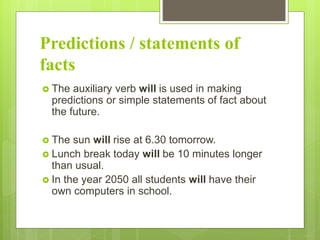
Predictions / statements of
facts
 The auxiliary verb will is used in making
predictions or simple statements of fact about
the future.
 The sun will rise at 6.30 tomorrow.
 Lunch break today will be 10 minutes longer
than usual.
 In the year 2050 all students will have their
own computers in school.
Intentions
 The auxiliary verb going to is used in talking
about intentions. (An intention is a plan for the
future that you have already thought about.)
 We're going to buy a new car next month.
 I'm going to work in a bank when I leave
school.
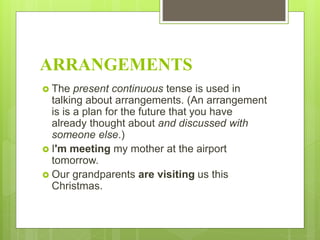
ARRANGEMENTS
 The present continuous tense is used in
talking about arrangements. (An arrangement
is is a plan for the future that you have
already thought about and discussed with
someone else.)
 I'm meeting my mother at the airport
tomorrow.
 Our grandparents are visiting us this
Christmas.
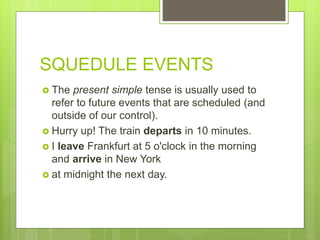
SQUEDULE EVENTS
 The present simple tense is usually used to
refer to future events that are scheduled (and
outside of our control).
 Hurry up! The train departs in 10 minutes.
 I leave Frankfurt at 5 o'clock in the morning
and arrive in New York
 at midnight the next day.
FUTURE PERFECT
 The formula for the future perfect tense is
pretty simple: will have + [past participle]. It
doesn’t matter if the subject of your sentence
is singular or plural. The formula doesn’t
change.

FUTURE TENSE.pptx

  • 1.
  • 2.
    FUTURE TENSE Predictions/statements offact - Intentions - Arrangements - Scheduled events
  • 3.
    Predictions / statementsof facts  The auxiliary verb will is used in making predictions or simple statements of fact about the future.  The sun will rise at 6.30 tomorrow.  Lunch break today will be 10 minutes longer than usual.  In the year 2050 all students will have their own computers in school.
  • 4.
    Intentions  The auxiliaryverb going to is used in talking about intentions. (An intention is a plan for the future that you have already thought about.)  We're going to buy a new car next month.  I'm going to work in a bank when I leave school.
  • 5.
    ARRANGEMENTS  The presentcontinuous tense is used in talking about arrangements. (An arrangement is is a plan for the future that you have already thought about and discussed with someone else.)  I'm meeting my mother at the airport tomorrow.  Our grandparents are visiting us this Christmas.
  • 6.
    SQUEDULE EVENTS  Thepresent simple tense is usually used to refer to future events that are scheduled (and outside of our control).  Hurry up! The train departs in 10 minutes.  I leave Frankfurt at 5 o'clock in the morning and arrive in New York  at midnight the next day.
  • 8.
    FUTURE PERFECT  Theformula for the future perfect tense is pretty simple: will have + [past participle]. It doesn’t matter if the subject of your sentence is singular or plural. The formula doesn’t change.