Future plc
                                                                        Annual Report and Accounts 2010


                                                                        Forward
Future plc


                          Annual Report and Accounts 2010  Future plc
www.futureplc.com

2 Balcombe Street
London NW1 6NW
UK
Tel +44 (0)20 7042 4000


                                                                        Focus
Beauford Court
30 Monmouth Street
Bath BA1 2BW
UK
Tel +44 (0)1225 442244
www.futureplc.com

Introduction


Contents                                 At Future we base everything we do on
Chairman’s statement
Business dynamics
                                     1
                                     2   enthusiasts who are passionate about
                                         their interests. From computer games to
Chief Executive’s review            4
Our areas of focus                  7
Our strategic focus                 8
Financial review
Corporate Responsibility
                                    14
                                    27
                                         film, from cycling to music-making, from
Board of Directors 
Directors’ report
                                    30
                                    32   photography to fast cars, we produce multi-
                                         media products that inform, entertain and
Corporate Governance report        36
Directors’ remuneration report     42
Independent auditors’ report       50
Financial statements
FTSE Media Sector Index
                                    51
                                    83
                                         unite these communities. Our focus on, and
Notice of Annual General Meeting
Investor information
                                    84
                                    89   commitment to, both function and form
                                         – editorial quality and design excellence
Directors and advisers             90
Financial calendar                 91
Contacts                           92

                                         coupled with accessibility and interactivity
                                         – have helped us to build market leadership
                                         positions in all of the specialist sectors in
                                         which we operate.


                                          Group financial highlights
                                           Year ended 30 September 2010


                                          Revenue                                                               EBITA

                                         £151.5m
                                          (2009: £153.1m)
                                                                                                                £10.1m
                                                                                                                 (2009: £10.1m)


                                          Adjusted earnings per share                                           Dividends

                                          2.4p                                                                 1.1p
                                          (2009: 1.8p)                                                           (2009: 0.9p)


                                           EBITA represents operating profit before amortisation of intangible assets, as shown on
                                           page 17 along with other key figures in the statutory results.
                                           Adjusted earnings per share are based on statutory results and exclude
                                           amortisation of intangibles and related tax effects.


Future plc 	                             Annual Report and Accounts 2010
1

Chairman’s statement
Roger Parry

                                                                               Dividend
                                                                               Despite tough trading conditions, the Board has been encouraged
                                                                               by operational improvements in the US and by half-yearly revenue
                                                                               trends. The Board is also encouraged by the increase in adjusted
                                                                               earnings per share and the reduction in net debt.

                                                                               The Board therefore recommends increasing the final dividend to 0.6p
                                                                               (2009: 0.5p). Together with the interim dividend of 0.5p (2009: 0.4p), this
                                                                               brings total dividends for the year to 1.1p (2009: 0.9p) per share in line with
                                                                               our dividend policy. This restores the size of total dividends to the level
                                                                               declared for 2008.

                                                                               If approved at the Annual General Meeting to be held on 9 February 2011,
                                                                               the final dividend of 0.6p per share will be paid on 1 April 2011 to all
                                                                               shareholders on the register on 18 February 2011. The ex-dividend date
                                                                               is 16 February 2011.

                                                                               Current trading outlook
                                                                               Consumer confidence is still fragile on both sides of the Atlantic, so our
                                                                               outlook for 2011 must remain cautious even though we’ve seen an
                                                                               encouraging improvement in second over first half performance.

                                                                               In the US, Government stimulus measures included a change to tax
                                                                               rules resulting in a $2.5m tax receipt which we will use to invest in our
                                                                               business next year. In 2011 we expect that this increased US investment
                                                                               - inter alia to improve our digital production capabilities - will hold back
                                                                               results for the first half-year. Across the Group, we continue to invest
                                                                               appropriately in our brands, in new products and in our people: because
                                                                               this predominantly organic approach has served us well during the
I am pleased to report that trading patterns stabilised                        last four years.

during 2010 and our financial position has significantly                       Board
improved. Our US business returned to profit this year                         In August this year, Mark Wood resigned as a non-executive Director in
                                                                               order to become our UK Chief Executive. Mark has significant experience
and in our UK business our portfolio spread helped us to                       and an excellent record in content creation and building digital
                                                                               businesses and we welcome his taking up this full-time role.
achieve revenues just 1% below those for 2009. Overall,
EBITA profit was flat. The pursuit of the same strategy                        In October, we were delighted to welcome Mark Whiteling as a
                                                                               non-executive Director. In addition to his varied financial and public
since 2006 has particularly helped us to withstand the                         company experience, he brings significant international perspective to
tough trading environment of the past two years.                               the Board. We anticipate appointing him as chair of the audit committee
                                                                               in succession to Patrick Taylor next year.

Strategy                                                                       Finally, I would like to thank all my Board colleagues for their
Future provides English-language content for communities of                    commitment and our shareholders for their support of our strategy which
enthusiasts: clusters of like-minded individuals whose interests range         I believe will continue to serve us well in the coming years.
from computer games to guitars, from cycling to film. We are
multi-platform, producing magazines, websites, events and multimedia
services for commercial partners and we export and license that content
to more than 90 countries.

Financial performance
Our 2010 results show Group revenue of £151.5m (2009: £153.1m) and
EBITA of £10.1m (2009: £10.1m). In the UK, 2009 profits benefited from
£1.3m of foreign exchange gains. In the US, we returned to profitability.
More detail is provided in the Chief Executive’s review and the
Financial review.
                                                                               Roger Parry
After reduced charges for amortisation of intangibles: £2.7m (2009:            24 November 2010
£3.9m) and net financing costs: £1.8m (2009: £2.5m), pre-tax profit was
£5.6m (2009: £3.7m). Cash generation remains strong and we reduced
net debt by 53% to £7.4m.

Basic earnings per share were 1.7p (2009: 0.9p). Adjusted earnings per
share for the year were 2.4p (2009: 1.8p), helped by a significantly reduced
tax charge.


Future plc 	                               Annual Report and Accounts 2010
2

Future at a glance


Business dynamics
Global reach
Future employs 1,200 people in the UK, US and
Australia delivering English-language content
24 hours a day, seven days a week.


Global revenues
Revenue split by source
1.	      UK 70%
2.	      US 30%


               2


                                                                                No.3
                                        1


                                                                                Special-interest publisher on
Advertising revenue split                                                       UK newsstand
1.	       Magazine 75%
2.	       Online 25%

                                                     No.1
               2


                                                                                                            3.4m
                                                     Largest producer of film
                                                     magazines in the UK


                                                     No.1                                                   Future sells 3.4 million
                                                                                                            magazines a month
                                        1            For games magazines
                                                     worldwide


A balanced portfolio                                 Technology 1                                               Games 2
Our magazines, digital properties and events are     Consumer electronics, computing,                           Console and PC Gaming
managed across four portfolio sectors:               photography, digital creative                              Future holds a unique position in the global games
                                                     Future’s technology portfolio is constantly                media market, combining official partnerships
                                                     innovating, reflecting the excitement of the               with all three global console manufacturers and
1.	          Technology 27%
                                                     fast-moving markets in which it operates. We               a unique cross-media approach. We are the only
2.	          Games 28%
                                                     are reaching and engaging with more technology             games media owner with reach across print,
3.	          Music  Movies 23%
                                                     enthusiasts than ever before through print, digital        online, covermounted discs, on-console editions
4.	          Active 22%
                                                     and events. Our portfolio includes:                        and events. Our portfolio includes:

                   4                                 In print: T3, MacLife, MacFormat, Maximum PC,              In print: Xbox 360: The Official Magazine, Official
                                   1                 Linux Format, Digital Camera, PhotoPlus, .net,             PlayStation Magazine, Nintendo Power, PC Gamer,
                                                     Computer Arts, Windows: The Official Magazine              Edge, GamesMaster, Nitro

                                                     In digital: techradar.com, T3.com, photoradar.com,         In digital: gamesradar.com, CVG.co.uk,
                                                     maximumpc.com, maclife.com, T3 edition for iPad,           pcgamer.com, Qore, FirstPlay
                                                     MacLife Tablet edition
                                                                                                                Face-to-face: Golden Joystick Awards
         3                                           Face-to-face: T3 Gadget Awards, Digital Camera
                                    2                Photographer of the Year Awards, .net Awards,
                                                     What Laptop Awards


Future plc 	                                Annual Report and Accounts 2010
3


    23m
    Unique monthly visitors to
    our websites


                                                                                                                                     No.1
                                                                                                                                     UK magazine licensor


                                                      No.1
                                                      UK magazine exporter

No.1
For guitar magazines
worldwide

                                                      No.1
                                                      Cycling publisher
                                                      worldwide


Music  Movies 3                                      Active 4                                               Licensing  exports
Film, music                                           Sports, automotive, hobbies  crafts                   We produce only English-language content, so
Future is the biggest guitar publisher in the world   Active comprises a broad range of active and           our international business has two routes to
and the biggest music-making publisher in both        crafting properties. Future’s depth and reach of       market: licensing and export copy sales. Our
the US and the UK. In film, Future is the UK’s        content in print and in digital makes us the world’s   diverse, multi-platform portfolio gives us great
leading publisher, with the broadest portfolio in     no.1 cycling publisher. In automotive, we are          opportunities to exploit our original product all
print, digital and events. Our portfolio includes:    leaders in performance tuning and sports bikes         around the globe.
                                                      with over 80,000 fans attending our events. We hold
In print: Guitar World, Guitar Aficionado, Classic    no.1 positions in all hobbies  crafts segments        Future’s approach is based on the cornerstones
Rock, Metal Hammer, Guitarist, Total Guitar,          in which we publish: cross stitching, papercraft,      of strong partnerships, innovation and passion.
Rhythm, Computer Music, Total Film, SFX, DVD         knitting and genealogy. Our portfolio includes:        It’s a formula that works: we are the UK’s no.1
Blu-ray Review                                                                                               magazine licensor and exporter, licensing
                                                      In print: Procycling, Cycling Plus, Mountain Biking    or exporting our products to 90 countries
In digital: musicradar.com, guitarworld.com,          UK, Triathlon Plus, Fast Bikes, Fast Car, Redline,     throughout the world.
totalfilm.com, Guitar World Lick of the Day app       Total Vauxhall, Simply Knitting, CrossStitcher,
                                                      Your Family Tree
Face-to-face: Classic Rock Roll of Honour,
Golden Gods Awards, Metal Hammer Live Tours,          In digital: bikeradar.com, cyclingnews.com,
High Voltage Festival, Revolver: Metal Masters        triradar.com, theknitter.co.uk

                                                      Face-to-face: Stitch and Craft Show, TRAX,
                                                      Total Vauxhall Live, Ford Fair

Future plc 	                                 Annual Report and Accounts 2010
4

Chief Executive’s review
Stevie Spring

                                                                     Overview:
                                                                     Despite continued investment in developing both new products and
                                                                     improving existing ones for the new content landscape, and despite
                                                                     not having the significant positive foreign exchange advantage we
                                                                     enjoyed last year, we saw a return to profit for our US business
                                                                     and Group EBITA for the full year was therefore held at £10.1m
                                                                     (2009: £10.1m).

                                                                     For the full year, copy sales and advertising were both down only low
                                                                     single digits as quarter on quarter trends improved. We also enjoyed
                                                                     some market-busting performances across the Group: our customer
                                                                     publishing sales were up 43%; digital revenues were up 14% and we
                                                                     saw some of our more established web properties delivering margins
                                                                     in excess of 30%.

                                                                     We continue to be strongly cash generative. This has allowed us to pay
                                                                     down our bank debt significantly, and still pay an appropriate dividend
                                                                     to shareholders whilst we experiment with new types of content and
                                                                     content delivery.

                                                                     And we now have ‘A’ list digital country leadership in post in both the
                                                                     US and the UK to help us better exploit the new technologies that are
                                                                     retraining the way consumers access (and pay for) content.


Fifty years ago, JFK said: ‘time and the world do not                Group strategy – update
stand still. Change is the law of life.’ Never has this held
more true than during the last two years for the global              Portfolio
economy and, closer to home, the media industry.                     Future is a federation of micro businesses. One of Future’s strengths
                                                                     is that we’re not reliant on any single host sector or revenue stream.
                                                                     We can adapt our investment focus and our product mix according to
After an exceptionally tough 2009, our focus during the              the fortunes of our host sectors. In 2010, our games business
                                                                     continued to be dampened by a sluggish release schedule. However,
past year has been on changing our business to fit that              we’ve seen strong performances in other parts of our portfolio, most
changed environment. We’ve made good progress. And                   notably in technology, music and sports.

can now move forward.                                                Prosumers
                                                                     Future, at its heart, is a company focused on creating or curating
                                                                     content for communities of enthusiasts who are passionate about their
                                                                     interests. So deeply engaged are our consumers that we call them
                                                                     ‘prosumers’ - because they’re closer to being ‘professional’
                                                                     consumers. This consumer-centric approach gives us two advantages:
                                                                     it enables us to focus our expertise on areas in which we truly excel,
                                                                     whether that’s photography, film or fast cars; and it enables us to build
                                                                     very powerful relationships with our consumers that we can extend
                                                                     across different platforms, in print, digital, face-to-face.

                                                                     Partnerships
                                                                     Future’s goal is to be the partner of choice for companies looking to
                                                                     do business with our communities of enthusiasts. We’ve continued our
                                                                     focus on developing and strengthening our commercial partnerships
                                                                     during the year. FuturePlus, our customer publishing agency, has
                                                                     grown its revenue on both sides of the Atlantic and attracted some
                                                                     exciting new partnerships. For the second time in three years, our
                                                                     sales team won the Association of Online Publishers’ Digital Sales
                                                                     Team of the Year Award, beating a shortlist that included the FT,
                                                                     Telegraph Media Group, Channel 4 and ITV.


Future plc 	                       Annual Report and Accounts 2010
5


43%
                                                                                 On an underlying basis, our trading has improved following a root and
                                                                                 branch review of every product and operational division in the business.
                                                                                 Like-for-like newsstand sales for our regular magazines were up against
                                                                                 a market down 6%. Advertising declines have also now slowed, and we
                                                                                 have reduced the number of volatile special issues by 36% which has had
Increase in customer publishing                                                  a positive effect on contribution. Again, our second half results saw an
revenue                                                                          improvement over last year with revenues up 8%.

                                                                                 Our customer publishing division enjoyed substantial revenue growth
                                                                                 – up 55% - following important launches for Coats, Blizzard and Best Buy
                                                                                 but it was an investment year for those products so contribution declined.
                                                                                 We expect that investment to pay off during our 2011 fiscal.

                                                                                 We also continue to invest in developing our online properties. We learnt
                                                                                 much about audience patterns, search, content discovery and social
UK business update:                                                              sharing from our standalone aggregation Blips sites which we closed
Our UK business, which comprises 70% of Group revenue, delivered                 earlier this year because, in common with most aggregators, it was
EBITA of £12.9m (2009: £15.9m) on revenue of £105.9m (2009: £106.5m)             proving unaffordable to deliver a valuable and valued user experience.
(£12.8m EBITA on revenue of £105.2m at constant currency). Second half           We have used that learning in expanding our ‘narrow and deep’ Radar
performance was stronger than first half and Q1 2011 advertising is              properties, and in launching new digital products for tablets.
already pacing ahead of 2010. We saw increases in both revenue and
contribution in 16 of our largest print titles from all parts of the portfolio   Finally, some good news from the post-Lehman fall-out: as part of the
except games, where we did see revenue growth in our digital products            US Government fiscal stimulus policy, we enjoyed a tax refund of
both online and on-console with the launch of FirstPlay.                         $2.5m which we intend, inter alia, to invest in developing Future Studios
                                                                                 in San Francisco to enable us to exploit new technologies and the
Videogaming still accounts for 21% of our UK revenues and remains one            opportunities for digital customer publishing as they expand over the
of the world’s most popular leisure pursuits. Step-change improvements           next three years.
in storytelling, production values and consoles (for motion and 3D) should
help increase our reach as increasing numbers of casual gamers evolve            Digital transformation:
into our core target: over 1.5 million votes in our annual Golden Joystick       In a year when the market has seen an explosion in interest in mobile
Awards this year: a 25% increase over last year’s all-time high.                 platforms and e-readers – accelerated by the launch of Apple’s iPad –
                                                                                 and when the debate on paid-for versus free content has raged, I’m very
Subscriptions were up again in revenue, volume, yield and retention. So          excited about the progress Future is making in digital.
our most loyal and valuable consumers continue to prove their loyalty and
value as ‘prosumers’ despite the economic backdrop. And, importantly,            Digital is integral to the way we do business: whether that’s the way
25% are from overseas. During the year, we moved supplier for                    we develop content through our multimedia teams; the way we deliver
direct-to-customer marketing to enable us to better serve international          it through websites, consoles or mobile devices; the way we optimise
and overseas subscriptions and ecommerce customers.                              it through search and social networking; the way we package and sell
                                                                                 commercial opportunities to our partners; or the way we protect and
We continue to innovate and push new products – FirstPlay on-console for         enforce our intellectual property. Digital revenue increased 14%
Sony and Guitar Aficionado both moved into profitability. Comic Heroes has       year-on-year, up 30% in the second half after a flat first half.
been contribution positive in year one. We’re launching Tap! for all things
Apple in Q1 2011 and we launched several apps in the year, with many             Encouragingly, we’re seeing our new digital revenue streams begin to
more in the pipeline.                                                            gain traction. Take TechRadar, for example. We launched this website
                                                                                 from scratch three years ago and it is now the UK’s biggest consumer
Every single product is part of our ‘do and learn’ approach and with each        technology news and reviews website with over 3.5m unique visitors
development we refine and improve our commercial thinking.                       every month. It has grown revenues by 58% year-on-year, which has
                                                                                 pushed gross margin above 30%, and is heading for a record-breaking
In the summer we were delighted to welcome a new UK Chief Executive,             next quarter. TechRadar best illustrates how we’re creating content
Mark Wood, who is one of the UK’s most experienced and talented                  informed by data on consumer need: searchable and shareable by the
leaders of content-focused companies, and a digital-business pioneer.            communities it serves; and attractive to clients who wish to trade with
His primary task over the coming year is to maximise our revenue                 those communities.
opportunities from digital formats.
                                                                                 Increasingly, content is being consumed on the move. And, again, we’ve
US business update:                                                              made real progress in developing content for mobile platforms. This is
Our US business experienced a truly ‘annus horribilis’ in 2009 and we            an area of huge potential: sales of digital versions of our magazines
made it a priority for 2010 to fix the issues within our control, and return     have increased tenfold in the six months to July 2010. We launched
it to profit.                                                                    bespoke interactive iPad editions for MacLife and T3. Within days,
                                                                                 MacLife’s iPad edition topped the Apple charts on both sides of the
With a new management team in place, we’ve succeeded in turning the              Atlantic and went on to exceed 400,000 downloads. T3 was number one
£3.3m reported loss in 2009 to a £0.2m contribution in 2010, helped in           in the UK at launch. We now have nine phone apps bringing us closer to
part by normalising newsstand, and an improved ratio of copies sold to           our readers. And we’re upgrading our websites to make them more
copies distributed.                                                              mobile friendly.


Future plc 	                                 Annual Report and Accounts 2010
6

Chief Executive’s review – continued


14%
                                                                             Partnerships: Commerce
                                                                             We’ve continued our focus on developing and strengthening our
                                                                             commercial partnerships during the year.

                                                                             For the second time in three years our sales team won the Association
                                                                             of Online Publishers’ Digital Sales Team of the Year Award, beating a
                                                                             shortlist that included the FT, Telegraph Media Group, Channel 4 and ITV.
                                                                             The team were recognised for their outstanding business development
                                                                             and integrated sales approach across different platforms (print and
Increase in digital revenue                                                  digital) and different niches: something all of our media industry peers
                                                                             are striving to achieve.

                                                                             FuturePlus, our customer publishing agency, has grown its revenue on
                                                                             both sides of the Atlantic and attracted some exciting new partnerships.
                                                                             Partnership publishing overall now represents 17% of UK revenues and
                                                                             39% of those in US.

                                                                             In foreign-language markets, after another year inevitably impacted by
                                                                             global recession, our international licensing business has been
                                                                             aggressively developing new product, adding 21 new licences including
                                                                             T3.com into the Middle East, Portugal and Scandinavia; T3 into Iran and
                                                                             Total Film into Indonesia.

Strategic update:                                                            Managing the business:
Throughout the business we’ve moved forward on all of our                    Despite all the positive examples of strategic progress around the
strategic priorities.                                                        business, I said at the end of 2009 that I expected the economic and
                                                                             structural pressures on our business to continue into 2010 and, in
Portfolio: Content                                                           aggregate, that has proved to be the case.
Future is a federation of micro businesses. One of Future’s strengths is
that we’re not reliant on any single host sector or revenue stream. We can   Consumer confidence is still fragile on both sides of the Atlantic, so our
adapt our investment focus and our product mix according to the fortunes     outlook for 2011 must remain cautious even though we’ve seen an
of our host sectors. In 2010 our games business continued to be              encouraging improvement in second over first half performance.
dampened by a sluggish release schedule. However, we’ve seen strong
performances in other parts of the portfolio, most notably in technology,    In 2011 we will be aggressively pursuing opportunities for growth and, on
music and sports.                                                            behalf of the Board and our shareholders, I’d like to thank everyone at
                                                                             Future for their continued creativity and commitment to building a
We’ve been perfectly placed to tap into a renewed consumer interest in       business that takes full advantage of the new technology landscape.
cycling in the last 12 months. Cycling Plus achieved its tenth year of
growth in the last round of ABCs and won ‘Specialist Consumer Magazine
of the Year’ at the PPA Awards beating Radio Times and Lonely Planet.
Our cycling websites, cyclingnews.com and bikeradar.com, together
broke four million unique monthly visitors during the year. And most
importantly we’ve translated this success into top and bottom line growth:
revenues up 28% to make cycling our second biggest web revenue and
contribution generator.
                                                                             Stevie Spring
Prosumers: Community                                                         Chief Executive, Future plc
Future, at its heart, is a company focused on creating or curating content   24 November 2010
for communities of enthusiasts who are passionate about their interests.
So deeply engaged are our consumers that we call them ‘prosumers’
– because they’re closer to being ‘professional’ consumers.

This consumer-centric approach gives us two advantages: it enables us
to focus our expertise on areas in which we truly excel, whether that’s
photography, film or fast cars; and it enables us to build very powerful
relationships with our consumers that we can extend across different
platforms, in print, in digital, face-to-face.

We understand that our customers want different content in different
formats. In print, it’s increasingly about collectable artefacts. So we
constantly strive to improve the quality and collectability of our print
content - which passionate consumers will commit their money and
time to. Our special ‘Classic Rock presents Slash’ fanpack sold out at a
cover price of £14.99. Online, musicradar.com’s visitors spend on average
about eight minutes on the site; twice MTV.com’s average dwell time.
And at our live music events – The Golden Gods in both UK and US were
seen by two million fans.


Future plc 	                              Annual Report and Accounts 2010
7

Our areas of focus


    Portfolio
    Prosumers
    Partnerships


    Balanced portfolio                                   Engaging prosumers                              Strengthening
                                                                                                         commercial partnerships


    100                                                  £5.04                                           43%
    Mini profit centres                                  Average UK cover price for Future magazines     Increase in customer publishing revenue


    60:40                                                8 mins                                          24%
    Consumer:Client revenue split                        Average dwell time on Future websites           Partnership publishing now 24% of
                                                                                                         total revenue


    Future manages its business as a portfolio of        We base everything we do on enthusiasts who     Our goal is to be the partner of choice for
    over 100 mini profit centres. This enables us to     are passionate about their interests. We call   companies looking to do business with our
    adjust our product mix to the fortunes of our        these enthusiasts ‘prosumers’ because their     communities of enthusiasts. The depth and
    host sectors and tightly manage costs. We’re         passion for their hobby makes them more like    breadth of our commercial partnerships are
    not reliant on any one of our host sectors, nor      professional consumers: more engaged, more      a key competitive differentiator for Future.
    on any single magazine or website, nor on any        loyal, more committed and more prepared to      Increasingly, companies also want to use our
    single source of revenue. We continue to invest      pay premium prices for premium products         creative and editorial talent for their own
    appropriately across our portfolio, which we         than consumers of general media. Our aim is     marketing communications - in print and
    believe will serve us well for the future.           to reach and engage them: in print,             digital format - and our FuturePlus division
                                                         face-to-face and online.                        is the access point for customer publishing.


Future plc 	                                 Annual Report and Accounts 2010
8

Our strategic focus
A balanced portfolio


Content focus

Active
Cyclingnews.com and bikeradar.com
together broke the four million unique
visitors barrier during the year


World’s No.1
We are the world’s leading
cycling publisher


Music  Movies
Classic Rock Prog now runs as
a bi-monthly title with a cover
price of £7.99


Future plc 	                             Annual Report and Accounts 2010
9


                                                                            Across its four core portfolio areas – Technology, Games,
                                                                            Music  Movies, Active – Future publishes more than 80 regular
                                                                            newsstand magazines, holds 27 annual live events and attracts
                                                                            23 million unique users to its websites every month. Within these
                                                                            sectors, we adapt our investment focus and our product mix
                                                                            according to the fortunes of our host markets.

                                                                            During the year, we’ve seen some strong performance throughout the
                                                                            portfolio, notably within technology, sports and music.

                                                                            In technology, techradar.com has gone from a standing start just three
                                                                            years ago to powering into the UK no.1 technology website slot and now
                                                                            attracts 3.5 million unique visitors per month. It has increased its revenue
                                                                            by 58% during the year. We’ve built on this success in digital by launching
                                                                            a number of ‘TechRadar’ bookazines in print. And we’ve announced the
                                                                            launch of two new technology products simultaneously in print and digital
                                                                            in the US and UK respectively: Maximum Tech, an in-depth technology
                                                                            guide, and Tap!, for users of iPhones and iPads.

                                                                            As the world’s no.1 cycling publisher, we’ve been perfectly placed to tap
                                                                            into a renewed consumer interest in cycling in the last 12 months. Cycling
                                                                            Plus achieved its tenth consecutive year of growth in the last round of
                                                                            ABCs and won ‘Specialist Consumer Magazine of the Year’ at the PPA
                                                                            Awards, beating Radio Times and Lonely Planet. In digital, our cycling
                                                                            websites broke the four million unique monthly visitors barrier.
Technology                                                                  Furthermore, we’ve translated this success into revenue and contribution
                                                                            growth: revenues up 28% to make cycling our second biggest web
Following the success of techradar.com,                                     revenue and contribution generator.
we’ve launched branded print guides
to phones and TVs                                                           In our music portfolio, Classic Rock recorded its ninth consecutive
                                                                            circulation increase in the last full-year ABCs and following a successful
                                                                            trial is now running its spin-off title Classic Rock Prog as a bi-monthly with
                                                                            a £7.99 cover price. During the year, Classic Rock also launched a series of
                                                                            successful print ‘specials’ and partnered with MAMA group to run the
                                                                            first ever High Voltage Festival.


We’ve been perfectly placed to tap
into a renewed consumer interest in
cycling in the last 12 months

Stevie Spring
Chief Executive, Future plc


                                                                            Games
                                                                            New website, pcgamer.com, is
                                                                            attracting over 1.5 million unique users
                                                                            per month within 12 months of launch


Future plc 	                              Annual Report and Accounts 2010
10

Our strategic focus
Engaging prosumers


Community focus


Guitar World’s online store sells
instructional DVDs retailing at
an average of $15


150,000
Future’s music-listening brands together
have nearly 150,000 Facebook fans


Future plc 	                               Annual Report and Accounts 2010
11


                                                                         Future creates or curates content for communities of enthusiasts
                                                                         who are passionate about their interests. We call these enthusiasts
                                                                         ‘prosumers’, because they’re more like professional consumers.
                                                                         At Future, everything we do is focused on these communities of
                                                                         prosumers.
Future’s Golden Gods events
were broadcast to millions of                                            The advantage of Future’s consumer-centric approach is that it enables
viewers on VH1                                                           us to build strength-in-depth in sectors where we truly excel: whether
                                                                         that’s photography, film or fast cars. And it enables us to build very
                                                                         powerful relationships with our communities of enthusiasts across
                                                                         different platforms: in print, digital or face-to-face.

                                                                         Take our music-listening portfolio, for example. We understand that fans
                                                                         of our print titles like Guitar World, Classic Rock and Metal Hammer also
                                                                         want an opportunity to engage with us, the experts, and with each other,
                                                                         online and face-to-face, as well as in print.

                                                                         In the last year, we successfully launched a series of high quality,
                                                                         collectable specials for Classic Rock magazine including a collectable
                                                                         Classic Rock presents Slash fanpack that sold out, even with a cover
                                                                         price of £14.99.

                                                                         Guitar World, the world’s biggest guitar magazine, is deepening its
                                                                         relationship with fans by strengthening its digital and print offer. It has
                                                                         announced the launch of a new, fully interactive, instructional app for
                                                                         guitar enthusiasts – the Guitar World Lick of the Day app. Online, Guitar
                                                                         World is building a library of exclusive video content for fans while
                                                                         its instructional DVDs are available to buy online, at retail and at
                                                                         the newsstand.

                                                                         Metal Hammer is a prime example of one of Future’s most successfully
                                                                         social-networked properties, with a following of over 80,000 fans on
                                                                         Facebook and nearly 30,000 on Twitter. Its programme of live events with
                                                                         sister title Revolver are also proving hugely popular: thousands of heavy
                                                                         metal fans attended Golden Gods events on both sides of the Atlantic and
                                                                         millions more followed them on TV as they were broadcast on VH1,
                                                                         massively extending the reach of our heavy metal monthly print sales.


                                         The high quality, collectable
                                         Classic Rock presents Slash
                                         fanpack sold out at £14.99


		                              Annual Report and Accounts 2010
12

Our strategic focus
Strengthening commercial partnerships


Commercial focus


FuturePlus
O2 and Best Buy (@Gamer)
We launched @Gamer, a new print
magazine for Best Buy, and have expanded
our relationship with O2


43%
Increase in customer
publishing revenue


Future plc 	                               Annual Report and Accounts 2010
13


               Deeper partnerships                        The depth and breadth of our commercial partnerships are a key
                                                          competitive differentiator for Future, and we’ve continued to
               Acer  Packard Bell                        strengthen these during the year.
               We ran a ten-month campaign across
                                                          FuturePlus, our customer publishing agency, has grown its revenue on
               our major websites for Acer and
                                                          both sides of the Atlantic, attracting some exciting new clients and
               Packard Bell
                                                          expanding relationships with existing ones.

                                                          We’ve grown business with existing clients including O2, Sky and Coats 
                                                          Clark as well as attracting new clients like Best Buy and Tesco as a result
                                                          of our strong customer focus and demonstrable return on investment.

                                                          The development of our relationship with Sky is a good example. Future
                                                          has published Sky Movies magazine for a number of years and this year
                                                          we expanded our relationship with them by producing two new digital
                                                          products: a Sky News election special and Sky Magazine Live. This won
                                                          three awards at the UK Digital Magazine Awards in 2010, including for
                                                          magazine of the year.

                                                          Our commercial focus extends beyond customer publishing and touches
                                                          every part of our business. For the second time in three years, Future’s
                                                          sales team won the Association of Online Publishers’ Digital Sales Team
                                                          of the Year Award, beating a shortlist that included the FT, Telegraph Media
                                                          Group, Channel 4 and ITV. The team were recognised for their outstanding
                                                          business development and integrated sales approach across different
                                                          platforms – print and digital.

                                                          And we’ve delivered more creative, targeted, commercial projects across
                                                          the business. From our biggest ever UK digital commercial deal for
                                                          Packard Bell and Acer to deliver a ten-month campaign running across
                                                          our major websites like TechRadar, T3 and TotalFilm; through to creative
                                                          solutions on musicradar.com that have helped this website to grow its
                                                          revenues by 53% in the year.


                                                          Unique solutions
                                                          Sky News election special
                                                          and Sky Magazine Live
                                                          We expanded our relationship with Sky by
                                                          producing a Sky News election special


Future plc 	            Annual Report and Accounts 2010
14

Financial review
John Bowman

                                                                  Future’s business
                                                                  Future plc is an international special-interest media group, listed on
                                                                  the London Stock Exchange (symbol FUTR). Founded in 1985 with
                                                                  one magazine, today we have operations in the UK, US and Australia
                                                                  creating over 180 special-interest publications, websites and events.
                                                                  We hold market-leading positions in games, film, music, technology,
                                                                  cycling, automotive and crafts. Our biggest-selling magazines
                                                                  include T3, Total Film, Classic Rock, Guitar World and Official Xbox
                                                                  Magazine. Our websites include gamesradar.com, bikeradar.com, and
                                                                  techradar.com.

                                                                  Future sells more than three million magazines each month; we
                                                                  attract more than 23 million unique visitors to our websites; and we
                                                                  host 27 annual live events. In addition, Future exports or syndicates
                                                                  publications to 90 countries, making us the UK’s number one
                                                                  exporter and licensor of monthly magazines.

                                                                  The majority of our products appeal to the young male demographic.
                                                                  While over three-quarters of the Group’s business is built on our own
                                                                  brands, we also operate a number of highly successful publishing
                                                                  partnerships with some of the world’s most respected companies.

                                                                  Market context
                                                                  General: the economic backdrop in 2010 was slightly better than
                                                                  in 2009. GDP statistics show that the recession officially ended in
                                                                  June 2009 in the US and in September 2009 in the UK. However,
                                                                  recovery has been fragile and unemployment rates remain
                                                                  stubbornly high; consumer confidence remains low and advertising
                                                                  has been under pressure.
Our most important assets are our nearly 1,200 people,            UK statistics: GDP for 2009 fell 5.0% and is forecast to grow by 1.6%
whose skills, enthusiasm and creative abilities underpin          in 2010 and 1.9% in 2011. The rate of unemployment is 7.7% and
                                                                  consumer price inflation is 3.2%. Interest rates have been held at
our business. Most of our employees are based in the              0.5% since March 2009.
UK and US. Our most significant financial asset is our
                                                                  US statistics: GDP for 2009 fell 3.2% and is forecast to grow by 2.6%
healthy cashflow.                                                 in 2010 and 2.4% in 2011. The rate of unemployment is 9.8% and
                                                                  consumer price inflation is 1.2%. Interest rates have been held at
                                                                  0.25% since early 2009.

                                                                  Expectations: most commentators expect interest rates, GDP
                                                                  growth and general inflation to remain very low during 2011.

                                                                  Our response: we have maintained our focus on active portfolio
                                                                  management, mitigating revenue disappointment through tight cost
                                                                  control, protecting profits, and maintaining cashflow to reduce net
                                                                  debt further. We have also continued to invest appropriately in our
                                                                  portfolio of products in order to benefit from market recovery
                                                                  in the mid-term.

                                                                  Future revenue growth is dependent on better exploiting existing
                                                                  sources of revenue: newsstand, subscriptions, advertising,
                                                                  licensing and events; and continuing to develop new sources:
                                                                  digital commercial solutions, publishing partnerships, print and
                                                                  online products.


Future plc 	                    Annual Report and Accounts 2010
15


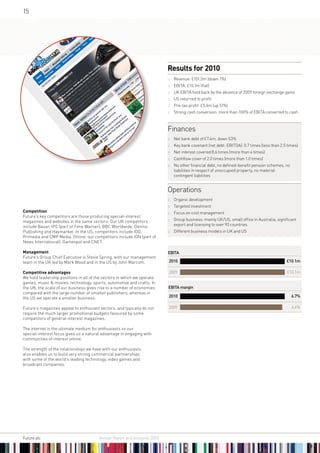
                                                                          Results for 2010
                                                                          ::	 Revenue: £151.5m (down 1%)
                                                                          ::	 EBITA: £10.1m (flat)
                                                                          ::	 UK EBITA held back by the absence of 2009 foreign exchange gains
                                                                          ::	 US returned to profit
                                                                          ::	 Pre-tax profit: £5.6m (up 51%)
                                                                          ::	 Strong cash conversion: more than 100% of EBITA converted to cash


                                                                          Finances
                                                                          ::	 Net bank debt of £7.4m, down 53%
                                                                          ::	 Key bank covenant (net debt: EBITDA): 0.7 times (less than 2.5 times)
                                                                          ::	 Net interest covered 8.6 times (more than 4 times)
                                                                          ::	 Cashflow cover of 2.0 times (more than 1.0 times)
                                                                          ::	 No other financial debt, no defined-benefit pension schemes, no
                                                                              liabilities in respect of unoccupied property, no material
                                                                              contingent liabilities


                                                                          Operations
                                                                          ::	 Organic development
                                                                          ::	 Targeted investment
Competition                                                               ::	 Focus on cost management
Future’s key competitors are those producing special-interest
magazines and websites in the same sectors. Our UK competitors            ::	 Group business: mainly UK/US, small office in Australia, significant
include Bauer, IPC (part of Time Warner), BBC Worldwide, Dennis               export and licensing to over 90 countries
Publishing and Haymarket. In the US, competitors include IDG,             ::	 Different business models in UK and US
Primedia and CMP Media. Online, our competitors include IGN (part of
News International), Gamespot and CNET.

Management                                                                EBITA
Future’s Group Chief Executive is Stevie Spring, with our management
team in the UK led by Mark Wood and in the US by John Marcom.             2010                                                              £10.1m

Competitive advantages                                                    2009                                                              £10.1m
We hold leadership positions in all of the sectors in which we operate:
games, music  movies, technology, sports, automotive and crafts. In
the UK, the scale of our business gives rise to a number of economies     EBITA margin
compared with the large number of smaller publishers; whereas in
the US we operate a smaller business.                                     2010                                                                  6.7%

Future’s magazines appeal to enthusiast sectors, and typically do not     2009                                                                  6.6%
require the much larger promotional budgets favoured by some
competitors of general-interest magazines.

The internet is the ultimate medium for enthusiasts so our
special-interest focus gives us a natural advantage in engaging with
communities of interest online.

The strength of the relationships we have with our enthusiasts
also enables us to build very strong commercial partnerships
with some of the world’s leading technology, video games and
broadcast companies.


Future plc 	                            Annual Report and Accounts 2010
16

Financial review – continued


Key Performance Indicators
The table below shows the Key Performance Indicators for 2009 and 2010. These were selected by the Board after considering the implications of the
Companies Act 2006 and other regulations and guidance in this area. Some of them are statistical indicators while others require more commentary as
explained below.


Key Performance Indicators for the year ended 30 September                                                                                                2010                      2009
Annual growth in revenue (at constant currency)                                                                                                           -1%                     -13%
EBITA operating margin (as a %)                                                                                                                          6.7%                      6.6%
Absolute EBITA (in Sterling)                                                                                                                          £10.1m                    £10.1m
Change in adjusted earnings per share (as a %)                                                                                                          +33%                      -36%
Number of magazines sold per month                                                                                                                       3.4m                     3.6m
Proportion of magazines sold from total number printed                                                                                       See notes 1–3             See notes 1–3
Proportion of Group’s business derived from
our brands compared with partnership publishing                                                                                               76:24 (note 4)            76:24 (note 4)
Number of unique users logging on to our websites per month                                                                                    23m (note 5)              27m (note 5)
Growth in total advertising revenue (as a % at constant currency)                                                                                         -5%                     -15%
Proportion of advertising revenue that is online (as a %)                                                                                                 25%                      23%
Human Capital                                                                                                                                     See note 6               See note 6
Net bank debt                                                                                                                                          £7.4m                   £15.6m


Notes
1.	 The majority of magazines printed by the Group are sold, and those unsold are mainly recycled and used for newspaper production. The precise proportion sold at newsstand is a
    detailed KPI each month for every title. However, the Group believes that it is commercially sensitive to disclose these percentages, since competitors typically do not release this
    information. Magazines printed for subscription have no wastage.
2.	 In the UK 74% of magazines (by volume) are sold at newsstand. Our overall UK average newsstand efficiency has been maintained at the same level achieved in 2009. Future has
    increased the proportion of magazine volume sales derived from subscription rather than newsstand, from 23% to 26%. The majority of UK revenues for magazines are derived
    from cover price.
3.	 In the US 31% of magazines (by volume) are sold at newsstand. The majority are sold by subscription at heavily discounted prices. Newsstand efficiency improved during the year.
4.	 Partnership publishing represents 24% of 2010 Group revenue. This category includes business from our Official magazines and programmes published for Microsoft (Xbox 360
    and Windows), Sony (PlayStation and Qore), Nintendo, plus customer publishing activities. The majority of the Group’s revenue is generated from our own brands.
5.	 For each of our websites we know the number of page impressions and the number of unique visitors to that website. We do not know how many unique visitors visit more than
    one of our websites. The number presented here is the simple total of each website’s average monthly number of unique visitors. 2009 figures included seven million unique users
    relating to our aggregation websites (since closed).
6.	 Human Capital is the Group’s most important resource, with 1,199 employees (at 30 September 2010). In the running of our business, we focus on retention of key employees and
    on refreshment of the team with new people and new ideas.


Future plc 	                                       Annual Report and Accounts 2010
17


Results for 2010
This financial review is based primarily on a comparison of our IFRS
results for the year ended 30 September 2010 with those for the year
ended 30 September 2009. Unless otherwise stated, change percentages
relate to a comparison of these two years. There has been no significant
change to the scope of the Group’s activities.

In running the business, Future management focuses on earnings before
interest, tax and amortisation. For convenience we refer to this as EBITA.

Statutory results for year ended 30 September
Revenue was £151.5m (2009: £153.1m) and the business generated
EBITA of £10.1m (2009: £10.1m) representing an EBITA margin of 6.7%
(2009: 6.6%).

The income statement includes reduced charges for amortisation of
intangible assets: £2.7m (2009: £3.9m) and net financing costs: £1.8m
(2009: £2.5m). Pre-tax profit was £5.6m (2009: £3.7m) for the year.


                                                       2010          2009
Year ended 30 September                                 £m            £m
Revenue                                              151.5          153.1
EBITA                                                 10.1           10.1
EBITA margin                                            6.7%          6.6%
Amortisation of intangible assets                     (2.7)          (3.9)
Operating profit                                        7.4           6.2
Net finance costs                                      (1.8)         (2.5)
Pre-tax profit                                          5.6           3.7
Earnings per share (p)                                  1.7p          0.9p
Adjusted earnings per share (p)                         2.4p          1.8p
Dividends relating to the year (p)                      1.1p          0.9p

Half-yearly performance
The table below analyses the business results during the last two years
into first-half and second-half performance.


                                            First       Second
                                     half-year to   half-year to
                                          March     September        Total
                                             £m             £m         £m
Revenue
Year to 30 September 2009                  76.6           76.5      153.1
Year to 30 September 2010                  71.4           80.1      151.5
EBITA
Year to 30 September 2009                    4.6              5.5    10.1
Year to 30 September 2010                    4.4              5.7    10.1

Dividend
Despite tough trading conditions, the Board has been encouraged by
operational improvements in the US and by half-yearly revenue trends.
The Board is also encouraged by the increase in adjusted earnings per
share and the reduction in net debt.

The Board recommends increasing the final dividend to 0.6p (2009: 0.5p).
Together with the interim dividend of 0.5p (2009: 0.4p), this brings total
dividends for the year to 1.1p (2009: 0.9p) per share in line with our
dividend policy. This restores the size of total dividends to the level
declared for 2008.

If approved at the Annual General Meeting to be held on 9 February 2011,
the final dividend of 0.6p per share will be paid on 1 April 2011 to all
shareholders on the register on 18 February 2011. The ex-dividend date is
16 February 2011.


Future plc 	                                Annual Report and Accounts 2010
18

Financial review – continued


Review of operations                                                          Analysis of revenue for year ended 30 September
Group revenue decreased by 1% to £151.5m and Group EBITA was                  The tables below analyse Group revenues in Sterling.
£10.1m, the same figure as for 2009.
                                                                                                             % of       2010          2009    Change
                                                                              By country                    Group        £m            £m         %
Currency effect of US Dollar
The most significant foreign currency affecting the Group is the US Dollar.   UK                             70%       105.9         106.5      -1%
The average exchange rate for the year was $1.56 = £1, compared with          US                             30%        46.2          47.0      -2%
$1.55 for the previous year.                                                  Intra-group                      –        (0.6)         (0.4)       –
                                                                              Group revenue                100%        151.5         153.1      -1%
The Group results are best understood by reviewing UK and US results
separately on pages 20 and 21 of this Report.
                                                                                                             % of       2010          2009    Change
                                                                              By type                       Group        £m            £m         %
Analysis of EBITA for year ended 30 September
                                                                              Circulation                    58%        88.7          90.7      -2%
                                  2010          2009              Change      Advertising                    30%        45.4          47.8      -5%
                                   £m            £m                   %
                                                                              Customer publishing             8%        11.6           8.1    +43%
UK                                12.9          15.9               -19%       Licensing, events  other       4%         5.8           6.5     -11%
US                                 0.2          (3.3)   Profit from loss      Group revenue                100%        151.5         153.1      -1%
Central costs                     (3.0)         (2.5)              +20%
Total EBITA                       10.1          10.1                 Flat                                    % of       2010          2009    Change
                                                                              Advertising revenue           Group        £m            £m         %
Central costs in 2009 benefited from £0.3m of provision releases              Magazines                      75%        33.9          37.2     -9%
and a lower IFRS2 charge.                                                     Online                         25%        11.5          10.6     +8%
                                                                              Advertising revenue          100%         45.4          47.8      -5%

                                                                              Proportion of Group                         UK           US      Group
                                                                              Games                                     14%           14%      28%
                                                                              Music  Movies                            16%            7%      23%
                                                                              Technology                                20%            7%      27%
                                                                              Active                                    20%            2%      22%
                                                                              Total                                     70%          30%      100%


Future plc 	                              Annual Report and Accounts 2010
19


Group performance for year ended 30 September

                                                2010            2010       2010      2010               2009                2009         2009
                                             Revenue     Contribution    Margin       % of           Revenue         Contribution       Margin
Group                                            £m               £m         %    revenue                £m                   £m            %
Games                                           43.0             9.1       21%      28%                   47.2              10.7         23%
Music  Movies                                  34.9             8.0       23%      23%                   33.8               7.0         21%
Technology                                      41.5            11.0       27%      27%                   41.3              11.4         28%
Active                                          32.7             7.2       22%      22%                   31.2               7.5         24%
                                                152.1           35.3       23%     100%               153.5                 36.6         24%
Less: intra-group                                (0.6)             –                                   (0.4)                   –
                                                151.5           35.3                                   153.1                36.6
Overheads                                                      (25.2)                                                      (26.5)
EBITA                                                           10.1      6.7%                                              10.1         6.6%
Amortisation                                                    (2.7)                                                       (3.9)
Operating profit                                                 7.4                                                         6.2


                                                Split of revenue by geography                    Group revenue by type

                                                1: UK 70%                                        1: Circulation 58%
                                                2: US 30%                                        2: Advertising 30%
                                                                                                 3: Customer publishing 8%
                                                                                                 4: Licensing, events and other 4%
                                                                                                                 4
                                                                                                      3
                                                  2


                                                                                             2
                                                                                                                                    1
                                                                            1


Future plc 	                      Annual Report and Accounts 2010
20

Financial review – continued


UK performance for year ended 30 September                                           This performance is encouraging in a media sector that continues to
                                                                                     experience very significant advertising and newsstand challenges and
                                           2010          2009       Change           reflects the underlying strength of our special-interest business, our
                                            £m            £m            %
                                                                                     continuing focus on operating performance in each sector and our ability
Circulation revenue                       66.5           69.3         -4%            to mitigate revenue disappointments swiftly.
Advertising revenue                       27.9           26.8         +4%
Customer publishing                        6.7            4.9        +37%            Circulation revenue fell by 4% and within this subscription revenue grew
Licensing, events  other                  4.8            5.5        -13%            by 3%, domestic newsstand revenue declined 11% and export revenue
                                                                                     grew by 3%.
Total revenue                            105.9         106.5           -1%
EBITA                                     12.9          15.9          -19%           Advertising revenue grew by 4% for the year. First-half advertising
EBITA margin                            12.2%          14.9%                         revenue was flat while second-half advertising revenue grew by 9%.

Future’s UK business (comprising 70% of Group revenue) remained                      The movements in other sources of revenue are shown in the table at the
resilient. Following a decline in first-half revenues of 3%, revenues in the         top of this page.
second-half grew so that revenue for the year was down 1% compared
with 2009.                                                                           The table below shows performance by sector.

EBITA for the year was £12.9m representing a margin of 12.2% of revenue.


                                                           2010            2010             2010           2010             2009          2009          2009
                                                        Revenue     Contribution          Margin            % of         Revenue   Contribution        Margin
                                                            £m               £m               %         revenue              £m             £m             %
Games                                                      21.5                6.0          28%            21%             23.9            8.2             34%
Music  Movies                                             24.5                6.4          26%            23%             23.4            6.8             29%
Technology                                                 31.0                9.1          29%            29%             31.2           10.0             32%
Active                                                     28.9                7.4          26%            27%             28.0            7.6             27%
                                                          105.9            28.9             27%           100%            106.5           32.6             31%
Overheads*                                                                (16.0)                                                         (16.7)
EBITA                                                                      12.9           12.2%                                           15.9         14.9%
Amortisation                                                               (1.3)                                                           (1.7)
Operating profit                                                           11.6                                                           14.2

*2010 EBITA includes foreign exchange gains of £0.1m (2009: £1.3m) which are included in overheads.


UK circulation volume by type                            UK circulation revenue by type                            UK advertising revenue

1: UK newsstand 58%                                      1: UK newsstand 53%                                       1: Online 24%
2: Export newsstand 16%                                  2: Export newsstand 20%                                   2: Magazines 76%
3: Subscriptions 26%                                     3: Subscriptions 27%


    3                                                          3                                                                                   1


                                 1                                                          1


2                                                                                                                    2
                                                           2


Future plc 	                               Annual Report and Accounts 2010
21


US performance for year ended 30 September                                          Reported circulation revenue grew by 4% as a result of a return
                                                                                    to more normalised trading following last year’s industry-wide
                                         2010         2009         Change           newsstand disruption.
                                          $m           $m              %
Circulation revenue                      34.6         33.2           +4%            Advertising revenue fell by 16% for the year. First-half advertising revenue
Advertising revenue                      27.3         32.6          -16%            was down 23% while second-half advertising revenue was down by 8%.
Customer publishing                       7.6          4.9          +55%            Advertising is a significantly greater portion of our US business than is the
Licensing, events  other                 2.5          2.3           +9%            case in the UK.
Total revenue                            72.0         73.0            -1%
                                                                                    Total US revenue fell 10% in the first-half but grew 8% in the second-half.
EBITA                                     0.3          (5.1)            –
EBITA margin                            0.4%         (7.0%)                         The table below shows performance by sector. We have maintained our
                                                                                    focus on operating and other costs.
After a very challenging year in 2009, we ended 2010 with revenue down
1% and a return to EBITA profit.

Reductions in revenue for the year reflect a planned reduction in the
number of products published during the year and a 16% reduction in
advertising revenue.


                                                        2010              2010              2010           2010              2009          2009           2009
                                                     Revenue       Contribution           Margin            % of          Revenue   Contribution         Margin
                                                         $m                 $m                %         revenue               $m             $m              %
Games                                                      33.5              4.9           15%             47%              36.2            3.8            10%
Music  Movies                                             16.2              2.5           15%             22%              16.2            0.3             2%
Technology                                                 16.3              3.0           18%             23%              15.6            2.2            14%
Active                                                      6.0             (0.3)          (5%)             8%               5.0           (0.1)           (2%)
                                                           72.0           10.1              14%           100%              73.0            6.2             8%
Overheads                                                                  (9.8)                                                          (11.3)
EBITA                                                                        0.3           0.4%                                            (5.1)         (7.0%)
Amortisation                                                                (2.1)                                                          (3.4)
Operating (loss)                                                            (1.8)                                                          (8.5)


US circulation volume by type                         US circulation revenue by type                               US advertising revenue

1: US newsstand 24%                                   1: US newsstand 52%                                          1: Online 28%
2: Export newsstand 6%                                2: Export newsstand 14%                                      2: Magazines 72%
3: Subscriptions 70%                                  3: Subscriptions 34%


                         1
                                                                                                                                                   1
                                                       3


                               2                                                           1

3                                                                                                                     2

                                                               2


Future plc 	                             Annual Report and Accounts 2010
22

Financial review – continued


Digital
The UK and US segmental figures above include digital revenue and
operating costs. Digital development continues as a key focus for the
business and Group digital revenue increased by 14% from £11.9m to
£13.6m.

Leasehold property and related balance sheet provisions
All of the Group’s property is either occupied or assigned, sub-let or the
lease surrendered. Property provisions carried at 30 September 2010
totalled £0.1m (2009: £0.2m).

Intangible assets
The annual charge for amortisation of intangible assets was £2.7m (2009:
£3.9m), the decrease reflecting lower additions in the previous year.
No impairment charge against intangible assets has been required
since 2006.

Taxation
The Group’s tax strategy is to minimise its liabilities to taxation, having
regard to commercial circumstances, tax history, the risk of changing
legislation, and delays in agreeing matters in certain territories.

The tax charge for the year amounted to £0.1m (2009: £0.9m),
representing an abnormally low effective tax rate of 2% as applied to
profit before tax. The standard rates of corporation tax are 28% (UK) and
40% (US). US Government stimulus measures included a change to tax
rules which permitted some tax losses to be set against tax payments in
earlier years. This resulted in a $2.5m tax refund (of which $2.0m was
received in September 2010 and the balance in October), thus lowering
the effective group tax rate from 30% to 2%.

The Group benefits from the structuring of certain acquisitions and
other planning steps.

Earnings per share
Basic earnings per share for the Group were 1.7p (2009: 0.9p). Adjusted
earnings per share were 2.4p (2009: 1.8p) and these are based on the
audited results which are then adjusted to exclude amortisation of
intangibles and related tax effects. Adjusted profit after tax amounted to
£7.9m (2009: £5.8m). The weighted average number of shares in issue
was 327.3m (2009: 326.3m). Full details are set out in note 9.

Trading updates during the year
During the financial year the Group issued trading updates or made
interim management statements (IMSs) on 24 November (with annual
results), 10 February (IMS), 30 March (pre-close trading update), 20 May
(with interim results), 3 August (IMS) and 28 September (pre-close
trading update). Each update superseded the previous one. The trading
update on 28 September 2010 stated that the Board expected the Group’s
results for the year to 30 September 2010 to be in line with market
expectations. This update implied EBITA profits of around £9.5m for the
year. The actual EBITA result for the year was £10.1m.


Future plc 	                                Annual Report and Accounts 2010
23


Balance sheet                                                               Net finance costs
As is common in media companies, Future has a low capital base and its      These were as follows:
value is better measured from its strong cash flows rather than by
returns on capital employed. The Group’s net assets at 30 September                                                                2010             2009
                                                                                                                                    £m               £m
2010 amounted to £86.2m (2009: £81.5m) of which £112.1m (2009:
£113.6m) related to intangible fixed assets. While the Group’s net assets   Net interest payable                                     1.8             1.8
increased as shown above, the Group reduced its net debt by 53% from        Fair value adjustment on interest rate swaps             0.1             0.5
£15.6m to £7.4m. The Group’s balance sheet is therefore stronger than a     Exchange (gains)/losses                                 (0.1)            0.2
year ago.
                                                                            Net finance costs                                       1.8              2.5
The Company’s accumulated distributable profits at 30 September 2010        Credit facility
were £50.3m.                                                                Future funds its operations through a mixture of operating cash flow
                                                                            generated by the business and bank debt. The banking facility was
Capital structure and treasury policy                                       renewed in May 2009 and matures in November 2012. Arrangement and
Since Future became a public company in June 1999, it has only once         other fees related to the new facility totalled £1.0m (to be amortised over
raised capital on the London Stock Exchange, via a £33m rights issue in     the term). Interest payable is to be calculated as the cost of three-month
September 2001.                                                             LIBOR (currently approximately 0.7%) plus an interest margin of between
                                                                            2.5% and 3.25%, dependent on covenant ratio (i). The key bank covenants
Future funds its operations through a mixture of operating cash flow        are that: (i) net debt is not to exceed 2.5 times Bank EBITDA; (ii) net
generated by the business and bank debt. At 30 September 2010 the           interest payable is to be covered at least four times by Bank EBITDA; (iii)
position at the year-end is well within the bank covenants as set out       cashflow is to cover the cost of debt service costs by specified ratios.
opposite.                                                                   These covenants are tested quarterly on the basis of rolling figures for
                                                                            the preceding 12 months.
Since September 2006 the Group has reduced its net bank debt by more
than 75% and has complied at all times with all covenants under the         Bank covenants
previous and the current banking facility.                                  The position at the year-end is well within the bank covenants as set out in
                                                                            the following table.
Cash flow and net debt
Net debt at 30 September 2010 was £7.4m. Future continues to be                                                      Year-end               Bank covenant
cash-generative and the largest cash inflow during the year was cash
generated from operations of £12.0m.                                        Net debt/EBITDA          	             0.7 times 	 Less than 2.5 times
                                                                            EBITDA/interest          	             8.6 times 	 More than 4.0 times
During the year the Group paid out £1.6m in dividends, £1.8m in respect     Cashflow cover           	             2.0 times 	 More than 1.0 times
of capital expenditure and £1.4m in net interest payments; net tax
receipts were £1.2m.                                                        Additionally, based on the calculation of 2010 Bank EBITDA, the Group
                                                                            has headroom of £22m, over and above the level of bank debt at
                                                                            30 September 2010. The Board therefore considers that the Group’s
                                                                            net bank debt is acceptable.

                                                                            Approximately two-thirds of Future’s net bank debt is in Sterling;
                                                                            year-end net debt denominated in US Dollars amounted to $4.2m.

                                                                            Consistent with policy published in previous years, the Group hedges
                                                                            between 25% and 50% of the gross bank debt above £10m. As at
                                                                            30 September 2010 the Group had hedged (a) £5m subject to an interest
                                                                            rate collar such that the interest rate cannot fall below 4.65% and cannot
                                                                            exceed 6%. This collar lasts for seven years from October 2007 and is
                                                                            cancellable by the bank after four years; (b) £5m at an interest rate of
                                                                            1.91% for two years from October 2009.


Future plc 	                              Annual Report and Accounts 2010
24

Financial review – continued


Risks                                                                         Advertiser behaviour
                                                                              Advertising represents less than one-third of the Group’s revenue and is
Risk management                                                               subject to variation not only in relation to the strength of the Group’s
We operate a continuous process of identifying, evaluating and managing       products but also in relation to shifts in macro-advertising trends.
risk. There are a number of general business risks to which Future is         However, over 90% of the Group’s advertising revenue is tailored to areas
naturally exposed in the UK and US. The range of risks faced by Future        of special-interest and is arguably, therefore, less susceptible to changes
has not increased since last year. Our internal controls seek to minimise     in levels of mainstream advertising, reflecting the advertising health of
the impact of such risks, as explained in our Corporate Governance            each sub-sector.
report on page 39.
                                                                              Distribution and magazine costs
Macro-economic environment                                                    Future contracts out printing and distribution and is therefore reliant on
The macro-economic environment during 2009 was the worst in the               the efficiency of suppliers of these services. The cost of paper and
Company’s history. Both the UK and US have emerged from recession             printing generally reflects market conditions. Approximately half of
but as explained earlier, general recovery has been patchy and 2010           Future’s magazines are sold with cover-mounted CDs or DVDs and these
trading conditions have remained tough. Future has continued to prove         too are purchased from external suppliers. Magazines are distributed by
remarkably resilient due to the Group’s focus on areas of special-interest.   nominated distributors and there are many links in the chain to ensure
Nonetheless, the Group may be exposed to any significant or renewed           that magazines, once printed, reach retail outlets on a timely basis. The
downturn in consumer confidence.                                              cost and efficiency of postal arrangements affects magazines sold by
                                                                              subscription, which is particularly significant for Future in the US, and
Consumer behaviour                                                            increasingly so for the UK.
Consumers’ propensity to spend money on magazines, digital editions,
online shopping, events and other products is influenced by a number of       Regulatory
economic factors, including general economic indicators.                      In addition to legislative constraints applicable to any business in the UK
                                                                              and US, Future is potentially constrained by competition regulation, and
58% of the Group’s revenue is dependent on consumers actively purchasing      by other regulations affecting the content of our publications.
magazines. Such purchases depend on the normal, competitive publishing
environment, which has been challenging during 2009 and 2010, and on          In September 2009 the UK’s Office of Fair Trading announced that it
the macro-economic environment. However, the out-of-pocket cost of            would not refer the newspaper and magazine distribution sector to the
magazines is low in comparison with many other items of consumer              Competition Commission.
expenditure and research shows that magazines are often regarded by
consumers as a low-cost treat.                                                Sources of Intellectual Property
                                                                              The majority of our Group revenues and profits are built on our own
Future believes that while its consumers are likely to seek information       brands. A proportion of the Group’s revenues and profits is derived from
about their chosen area of interest through a variety of media, an            magazines which are branded ‘Official’ in accordance with contracts with
increasing number of consumers are spending more time online.                 major companies including Microsoft, Sony and Nintendo. Although the
Advertising patterns continue to change and in the UK, internet               loss of any such contract would constitute a loss of revenue, the Group
advertising now accounts for a greater share of advertising expenditure       has a long history of successful publishing partnerships with these and
than is allocated to television, radio, billboards, magazines or              other companies.
newspapers.
                                                                              Protection of Intellectual Property
                                                                              As an English-language content provider, protecting and enforcing our
                                                                              intellectual property rights, particularly in an increasingly digital world
                                                                              where piracy is easier, is key. We are developing best practice within our
                                                                              businesses and actively involved in the industry, Government and European
                                                                              efforts to protect and enforce these rights against worldwide piracy. From
                                                                              time to time, the Group may be subject to disputes relating to these rights.
                                                                              Any such disputes are contested vigorously.

                                                                              Financial
                                                                              The Group is exposed to interest rate and foreign exchange risk, which it
                                                                              manages where appropriate by hedging arrangements. Taxation and VAT
                                                                              arrangements impacting the business are different in each country and
                                                                              any adverse change in such arrangements could impact our business.


Future plc 	                              Annual Report and Accounts 2010
25


                                       Share performance
                                       Earnings per share
                                       An absolute measure of performance, Adjusted Earnings Per Share are
                                       based on audited results and reflect the change in the amount of earnings
                                       created each year by the Group’s activities. The adjustments exclude
                                       amortisation of intangibles and related tax effects.

                                       Total shareholder return
                                       A comparative measure of performance, total shareholder return
                                       combines the change in the value of Future’s shares with the return
                                       provided to shareholders by dividends paid during the year.

                                       Future’s performance compared with a comparator group of other
                                       quoted media companies is highlighted on page 46 of the Directors’
                                       Remuneration report, which also explains the current means of aligning
                                       interests of management and shareholders.

                                       Power to buy back shares
                                       At the forthcoming AGM the Board will again seek to renew approval from
                                       shareholders to buy back shares. This power has never been used and at
                                       this time there is no intention to use the authority.


                                       Business outlook for 2011
                                       Although it has been announced that the recession has ended in the UK,
                                       as well as in the US, general economic recovery has been patchy and
                                       consumer confidence remains fragile.

                                       In 2010, second half revenues in the UK grew modestly, reversing their
                                       first half decline. In the US, we saw stability returning to revenues and a
                                       return to profit.

                                       Since 30 September, general trading conditions continue to be
                                       challenging and so we still take a cautious view. The impact of the UK
                                       Government’s spending review, announced on 20 October, has yet to fully
                                       manifest in consumer confidence. In the US, Government stimulus
                                       measures included a change to tax rules resulting in a $2.5m tax receipt
                                       which we will use to invest in our business next year.

                                       In 2011, we anticipate modest revenue growth, although profits will be held
                                       back by the increased US investment explained above, particularly in the
                                       first half-year. Across the Group, we continue to invest appropriately in our
                                       brands, in new products and in our people: because this predominantly
                                       organic approach has served us well during the last four years.


		   Annual Report and Accounts 2010
26

Financial review – continued


History of the Group
Future was founded as a UK company in 1985. Its focus as a
special-interest publisher has been built on a creative, innovative and
competitive culture.

In 1994, Future UK was acquired by Pearson plc, which subsequently sold
the business in 1998 to a management buy-out backed by Apax. In June
1999 the enlarged Group (now including the UK, US and other countries)
was floated on the London Stock Exchange. Future’s expansion included
further overseas subsidiaries and a rapid build-up of internet operations.

Following this period of over-extension, the Group was scaled back
during 2001, and its bank debt significantly reduced by (i) the disposal of
its then largest magazine, and (ii) a 20p rights issue.

From 2001, the Group ran subsidiaries only in the UK, US, France and
Italy. The Group had no net bank debt for three years from May 2002.
From 2003 to 2005 Future made a number of small acquisitions, funded
from its net cash position.

In December 2004, the Group announced an intention to double its size by
2008, and in June 2005 acquired a number of titles from Highbury House        During the last two years the Group has continued to focus on a largely
Communications plc, funded by bank debt. The financial results from this      organic strategy, concentrating on providing English-language content in
acquisition were disappointing and coincided with a period of reduced         key sectors, cross-platform.
profits, largely driven by the games market transition.

In 2006, the Board conducted an extensive review of the business, scaled
back the ambitious policy of rapid expansion, and appointed a new Chief
Executive, Stevie Spring, who set out the Group’s new strategy in the
Annual Report 2006.

From 2006 to 2008, the Group vigorously implemented its new strategy:
we sold or closed 51 weaker titles, disposed of Future Italy and Future       John Bowman
France; we diversified revenue streams, and enhanced our                      Group Finance Director, Future plc
cross-platform approach.                                                      24 November 2010


Future plc 	                                Annual Report and Accounts 2010
27

Corporate Responsibility


Corporate responsibility is integral to                                       Recycling and waste disposal
                                                                              The Group is economically strongly incentivised to minimise unsold
the way Future conducts its business.                                         magazines and we employ sophisticated techniques to help achieve this.
                                                                              More than 90% of Future’s unsold magazines are recycled. We also
We focus our efforts around four key                                          support the PPA’s initiative encouraging readers to recycle their
areas where we think we can make                                              magazines after use and we incorporate the WRAP recycle logo in all our
                                                                              magazines. We comply with our obligations under the Producer
a difference:                                                                 Responsibility Obligations (Packaging Waste) Regulations. The disposal of
                                                                              waste materials is also included in our print supplier audit.

                                                                              Discs and plastic packaging
The environment                                                               Future has pioneered the use of more environmentally friendly cover
Our people                                                                    discs. A new format of DVD that uses 50% less plastic and 50% less
                                                                              energy than traditional DVDs is being used on five titles in the UK and
The community                                                                 trialled on two titles in the US. We have phased out plastic packaging of
                                                                              discs. In 2010, 75% of our retail bagging and all of our UK subscription
Corporate practice                                                            bagging used oxy-biodegradable plastic film.

                                                                              Go Green
                                                                              Future runs an internal initiative aimed at improving awareness of
                                                                              recycling and energy saving in its UK offices. Driven by Future employees,
Stevie Spring, Chief Executive, is the Director accountable for Corporate     the campaign encourages employees to use less and recycle more by
Responsibility (CR) and, with the rest of the Board, regularly assesses the   providing information and recycling facilities. Every year, Go Green runs a
business to ensure responsible actions throughout, and to identify and        Go Green Week to raise awareness of these initiatives and has a
assess any risks to the Company’s short-term and long-term value              year-round campaign on the Company’s intranet site. We also measure
arising from CR matters.                                                      employee attitudes and understanding of issues so we can focus on
                                                                              relevant areas. In 2009, for example, recycling facility signage was an
Our environmental policy can be found on our website, futureplc.com.          area that employees felt could be improved, so we have better addressed
                                                                              this in 2010. In the UK all of our office copier paper is FSC certified and
                                                                              over 90% of our toner cartridges come from manufacturers incorporating
The environment                                                               recycled materials.

A responsible approach to the environment is essential to ensure the          Supplier audits
future sustainability of our business.                                        We have specialist software that enables us to carry out comprehensive
                                                                              environmental and ethical audits on our main suppliers. When we select
Sourcing paper                                                                suppliers we take account of their sourcing and production processes.
Paper is the largest raw material we use as a Group. We work hard to          We also consider environmental aspects such as the processing and
make sure that whatever we consume, we do in a way that is ethically          disposal of waste materials. We hold regular contract reviews to ensure
responsible and environmentally sustainable. In 2010, 100% of our paper       that appointed suppliers have procedures in place to minimise waste and
across the Group was sourced from either recycled fibre or sustainable        their impact on the environment at all stages of the production process.
forests where at least one tree is planted for every tree felled. Future UK
holds the FSC (Forestry Stewardship Council) Chain of Custody                 Consumption of resources
certification. This recognises Future’s commitment to sourcing paper          The table below estimates energy consumption as a result of the Group’s
supplies from sustainable forests. In 2010, 90% of the paper we used in       activities during the year ended 30 September 2010 (comparative figures
the UK was FSC certified. We actively encourage our suppliers to work         for 2009 are shown in brackets).
towards FSC certification or one of the other internationally recognised
and independently audited certification schemes for environmental care                                               Electricity       Gas         Water
in forest management and conservation.                                        Country                                     MWh           m3           m3
                                                                              UK                                         2,498     83,291         4,855
                                                                                                                        (2,289)    (79,351)      (4,892)
                                                                              US                                         1,369         816        2,200
                                                                                                                        (1,543)       (962)      (3,888)


                                                                              Future has satisfied the requirement to be a
Future in the UK holds FSC Chain of                                           constituent of the FTSE4Good Index.
Custody certification. This recognises                                        FTSE4Good is a financial index that identifies
Future’s commitment to sourcing paper                                         companies that meet globally recognised
supplies from sustainable forests.                                            corporate responsibility standards.


Future plc 	                               Annual Report and Accounts 2010
28

Corporate Responsibility – continued


Our people
Future’s employees are our most important assets; they are the driving
force behind our success as a business.


Data across the Group                                  2010           2009
Code of conduct circulated to all existing
and new employees                                       Yes            Yes
Female employees as a percentage of
workforce                                              35%            36%
Female managers as a percentage of
management                                             30%            26%
Employment of young people under the
age of 15                                             None          None
Consultation and communication
procedures in place for all areas of the
business                                                Yes            Yes
Earnings meet at least legal minimum
or minimum set by the industry                          Yes            Yes
Cases of reported and proven
discrimination or harassment                          None          None

Developing our people
Training needs are identified as part of each employee’s annual
performance appraisal. 83% of the UK workforce have to date completed
an appraisal in 2010 (2009: 65%).

In 2010 we ran skills training for our publishing teams, advertising and
central support departments. In-house training sessions provide training
for editors on commissioning, libel, defamation and copyright as well as
new software applications. We also provided online training, covering the
key disciplines of online content development.

In the UK, we have a sharesave plan for UK employees.

Health and safety
The health and safety of all employees is a key priority for the Group.
Future is largely an office-based environment. All companies across the
Group comply with relevant legislation and we communicate our health
and safety policy to all employees. During the year to 30 September 2010,
there were no fatalities; no serious injuries; ten minor injuries in the UK
and none in the US.

Policy on disability
The Company aims to ensure that when considering recruitment,
training, career development, promotion or any other aspect of
employment, no employee or job applicant is discriminated against, either
directly or indirectly, on the grounds of disability. If an employee became
disabled while in employment and as a result was unable to perform their
duties, we would make every effort to offer suitable alternative
employment and assistance with retraining.

Internal communication
Future has policies on employee communication; acceptable use of IT;
                                                                               In 2010 we ran skills training for our
health and safety; whistle-blowing and a commitment to diversity and           publishing teams, advertising and
opportunity. Our employees have access to free, confidential, employee         central support departments
well-being helplines.

In addition, we hold company meetings for all employees at least
annually, and extended leadership team meetings where we discuss the
financial performance of the Company. Future UK also has an Employee
Involvement Group, which allows employees to contribute to
strategic-level decision making. Future’s lively culture is echoed in
our company intranets and via our printed monthly internal magazine
which updates employees on industry and business news and
celebrates team successes.


Future plc 	                                 Annual Report and Accounts 2010
29


                                                                              The community
                                                                              We actively support the communities in which we operate through
                                                                              charitable donations and by encouraging our people to get involved in
                                                                              community initiatives.

                                                                              Giving something back
                                                                              A key tenet of our charitable donation policy is to empower our employees
                                                                              to support charities of their choice. For this reason, we run a matched
                                                                              contribution scheme. Employees raise money for their chosen charity
                                                                              and Future matches this amount, subject to a reasonable limit and to
                                                                              qualification under the rules of the scheme. During the year, £16,000 was
                                                                              paid under the charitable match scheme (2009: £26,000).

                                                                              As well as the charity matching scheme, Future makes local charitable
                                                                              donations in the cities where we have offices. The total amount of
                                                                              charitable donations made by the Group in the year was £39,000
                                                                              (2009: £55,000). We continued our partnership with Bath-based
                                                                              charitable foundation, Quartet, who make donations to local charities
                                                                              on our behalf. At our US headquarters in South San Francisco, other
                                                                              charities supported include Slide Ranch, First Graduate,
                                                                              Belmont-Redwood Shores Public School Foundation, Joy Prom and AIDS
                                                                              Walk San Fransisco.

                                                                              Future in the wider community
                                                                              Future people are actively involved with a number of national organisations
                                                                              including the Periodical Publishers’ Association, European Federation of
                                                                              Magazine Publishers, Association of Online Publishers, NABS, European 
                                                                              Leisure Software Publishers Association, the IPA, the Marketing Society
                                                                              and the International Federation of the Periodical Press. We are also
Through our partnership with Quartet,
                                                                              represented on The Bath Initiative, a public:private collaboration.
Future has supported Bath-based projects
like the City Farm
                                                                              In addition, Future’s Chief Executive Stevie Spring chairs BBC Children in
                                                                              Need, whose goal is to change positively the lives of disadvantaged
                                                                              children and young people in the UK.


                                                                              Corporate practice
                                                                              Supplier payments
                                                                              The Group does not follow an external code on payment practice, but it is
                                                                              our policy to settle the terms of payment with suppliers when agreeing
                                                                              the terms of each transaction; to ensure that suppliers are made aware of
                                                                              the terms of payment; and to pay all suppliers when their invoices
                                                                              become contractually due for payment. At 30 September 2010, the Group
                                                                              as a whole had 42 (2009: 42) days of purchases outstanding. The Company
We have continued our partnership with                                        had no trade creditors at 30 September 2010.
Bath-based charitable foundation Quartet.
                                                                              Ethics and human rights
                                                                              Future supports the standards set out in the UN Global Compact on the
                                                                              Responsibilities of Business, and endorses the principle that no
                                                                              underage, forced, or prison labour should be employed; that no one is
                                                                              denied a job because of gender, age, sexual orientation, ethnic origin,
                                                                              religion, affiliation or association and that factories comply with laws
We are members of the Periodical Publishers’                                  protecting the environment. Our supplier audits include an ethical
Association (PPA) and support its initiative                                  questionnaire. We work co-operatively with licensees and we do not
encouraging readers to recycle their magazines                                participate in or support exploitative labour or other arrangements in
after use. We incorporate the recycle logo in all                             any country.
our UK magazines.
                                                                              Political contributions
                                                                              In line with our Company policy, we do not make contributions to any
                                                                              political cause.

                                                                              More information
Future’s employee initiative, Go Green,                                       Our website futureplc.com includes more in-depth information on our
encourages staff to engage in                                                 CR policies and practices.
environmentally sustainable practices.


Future plc 	                                Annual Report and Accounts 2010
30

Board of Directors


 Roger Parry                           Stevie Spring                          John Bowman                            Michael Penington
 Independent non-executive             Chief Executive                        Group Finance Director                 Senior independent non-executive
 Chairman

 Roger has been Chairman since         Stevie has been Chief Executive        John has been Group Finance            Michael has been senior
 September 2001, a non-executive       since July 2006. She graduated         Director since November 2001. He       independent non-executive
 Director since June 1999 and is       in law, worked in marketing and        qualified as a chartered accountant    Director since 2002 and a Director
 Chairman of the Nomination            television before starting a 16-year   with KPMG, where he worked for         since April 2000. His experience
 committee. He is also                 career in advertising agency           seven years before joining Radio       includes 16 years at US investment
 non-executive Chairman of Media       management. From 2000 to 2006,         Clyde. He became Group Finance         bank Morgan Stanley, latterly as an
 Square plc, YouGov plc, Mobile        she was UK Chief Executive of          Director at Scottish Radio Holdings    Executive Director, Corporate
 Streams plc and the Shakespeare’s     Clear Channel. She is a Fellow of      plc (later part of Emap, now Bauer)    Finance Department. He holds a
 Globe Trust. His experience           both the Institute of Practitioners    and played a key role in the group’s   D.Phil. from Oxford University. He
 includes four years with McKinsey,    in Advertising and the Marketing       successful expansion by organic        is currently a partner in Oxford
 the international consulting firm,    Society; one of only three honorary    growth and acquisition. His media      Technology Management, which
 seven years as a journalist with      members of the Women’s                 experience includes commercial         manages a £30 million fund
 BBC TV and radio and                  Advertising Club; a patron of          radio, outdoor advertising, film,      investing in early stage technology
 directorships at Aegis Group plc,     NABS; and the first externally         newspaper, online and magazine         companies in the UK.
 WCRS plc, iTouch plc and More         appointed Chairman for BBC             publishing.
 Group plc – later Clear Channel       Children in Need.
 International – where for ten years
 he was Chief Executive.


Future plc 	                             Annual Report and Accounts 2010
31


 Patrick Taylor                        Seb Bishop                            Mark Whiteling                         Mark Millar
 Independent non-executive             Independent non-executive             Independent non-executive              Company Secretary and
                                                                                                                    General Counsel

 Patrick has been Chairman of the      Seb joined Future as an               Mark joined Future as an               Mark has been Company Secretary
 Audit committee since April 2001,     independent, non-executive            independent, non-executive             and General Counsel since
 and a Director since the same date.   Director in June 2007 and a           Director in October 2010. Mark has     September 2002. He joined from
 He qualified as a chartered           member of the Remuneration            a Master of Commerce degree and        Allen  Overy following more than
 accountant with Coopers              committee from November 2008.         qualifications as both a New           a decade’s experience of City legal
 Lybrand (now part of PwC) where       He is the CEO of (RED)                Zealand ACA and an American            work, including a wide range of UK
 he became a partner in 1980,          International, the business founded   CPA. He is currently Chief Financial   and international commercial and
 specialising in corporate finance.    by Bono and Bobby Shriver to fight    Officer of FTSE 250 company            corporate finance experience. He
 He was Finance Director of Capital    AIDS in Africa. In 2000, he founded   Premier Farnell plc, a leading         also acts as secretary to all Board
 Radio plc from 1989 to 1996 and       Espotting, the company that           multi-channel distributor              committees. He chairs the PPA’s
 subsequently Finance Director,        pioneered pay-per-click               of products and services to            Government and Regulatory
 then Chief Executive, of GWR          advertising and search marketing      design and purchasing                  Committee and is an industry
 Group plc, owner of the UK’s          in the UK. He expanded Espotting      professionals globally. His            representative on the boards of the
 largest commercial radio station,     before selling the company to         experience includes Group Finance      Publishers Licensing Society and
 Classic FM. He left GWR in 2003       MIVA, a US Nasdaq-quoted              Director of Communisis plc, the        the Copyright Licensing Agency.
 and is currently Chairman of          company in 2004, and taking up the    pan-European print management/
 Centaur Media.                        Presidency of MIVA until 2007. Seb    direct mail group and Tibbett 
                                       is Chairman of Steak, a               Britten plc, a FTSE 250 logistics
                                       fast-growing digital marketing        company, as well as roles at
                                       agency, and a non-executive board     SmithKline Beecham plc in both
                                       member of AdJug, a new Internet       the USA and Europe.
                                       advertising marketplace.


                                                                             Member of the Nomination               Member of the Audit committee
                                                                             committee

                                                                                                                    Company Secretary
                                                                             Member of the Remuneration
                                                                             committee


Future plc 	                             Annual Report and Accounts 2010
32

Directors’ report
For the year ended 30 September 2010


The information presented in this Directors’ report relates to Future plc       Share capital (all Ordinary shares)
and its subsidiaries. The Chairman’s statement, Chief Executive’s review,       The Company has a single class of share capital which is divided into
Financial review and Corporate Responsibility statement are each                Ordinary shares of one penny each. The rights and obligations attaching to
incorporated by reference into, and form part of, this Directors’ report.       the Company’s Ordinary shares and provisions governing the appointment
                                                                                and replacement of, as well as the powers of, the Directors, are set out in
Principal activity                                                              the Company’s articles of association, copies of which can be obtained
The Group’s principal activity is the publishing of special-interest consumer   from Companies House in the UK or by writing to the Company Secretary.
magazines and websites, notably in the areas of games, music  movies,          Save for restrictions that may from time to time be set out in the
technology and active sectors.                                                  Company’s articles of association or imposed by laws and regulations
                                                                                (including the Listing Rules of the Financial Services Authority), there are
The Company has subsidiaries operating in the UK, the US and Australia.         no restrictions on the voting rights attaching to the Ordinary shares or on
                                                                                the transfer of the Ordinary shares. The articles of association may be
Business review                                                                 amended only by a special resolution of the Company’s shareholders.
The purpose of the Annual Report is to provide information to the
shareholders of the Company.                                                    Details of all movements in share capital are given in note 23 on page 77.
                                                                                As at 30 September 2010, the number of shares in issue was 328.0 million.
Reviews of the Group’s activities during the year, the position at the year-    This represents a small increase of 0.24% compared with the number of
end and developments since then are set out in the Chairman’s statement,        shares in issue as at 30 September 2009. All of the new shares were issued
Chief Executive’s review, the Corporate Governance report and the               in satisfaction of employee share option exercises or share awards vesting
Financial review.                                                               during the year.

The Financial review explains financial performance, key performance            The Company was granted authority, at the Annual General Meeting held
indicators, the position at the year-end, any post balance sheet events,        on 18 March 2010, to purchase up to 32,719,000 of its own shares,
any likely future developments and a description of the principal risks         representing just under 10% of the Company’s issued share capital as at
and uncertainties facing the Group and how these are managed.                   7 December 2009, the date the notice was prepared. The Company has
                                                                                never purchased any of its shares and the authority will expire following the
The Annual Report contains certain forward-looking statements with              end of the Company’s Annual General Meeting to be held on 9 February
respect to the operations, performance and financial condition of the           2011, at which a resolution to renew such authority is proposed.
Group. By their nature, these statements involve uncertainty since future
events and circumstances can cause results to differ from those                 Significant shareholdings
anticipated. The forward-looking statements reflect knowledge and               At 9 December 2010, the Company had been notified of the following
information available at the date of preparation of this Annual Report and      significant interests in its Ordinary shares:
the Company undertakes no obligation to update those forward-looking
statements.
                                                                                                                                               Percentage of
                                                                                                                                  Number of     issued share
Result of 2010 Annual General Meeting                                           Shareholder                                         shares            capital
All resolutions put to the Annual General Meeting held on 18 March 2010
were passed unanimously on a show of hands. Shareholders holding more           Aberforth Partners LLP                          59,241,848          18.06%
than 81% of all issued shares submitted proxy votes and of these, more          Schroders Plc                                   56,067,597          17.10%
than 94% were cast in favour of all resolutions other than the resolution to    Fidelity International Limited                   39,677,762         12.10%
adopt the Directors’ remuneration report which attracted 64% of votes in
                                                                                Investec Asset Management Ltd                   28,710,000           8.75%
favour. The AGM authorised the Company to pay a final dividend of 0.5p per
Ordinary share on 1 April 2010 to those shareholders on the register on         Franklin Templeton Investments Corp             16,663,407           5.08%
12 March 2010, bringing total dividends relating to 2009 to 0.9p per            BT Pension Scheme Trustees Limited              13,171,683           4.02%
Ordinary share.                                                                 Artemis Investment Management Ltd               10,627,757           3.24%
                                                                                                                               224,160,054          68.35%
Reported financial results
The audited financial statements for the year ended 30 September 2010 are       Directors’ holdings (see opposite)               3,344,780           1.02%
set out on pages 51 to 82. Details of the Group’s results are set out in the    Total of significant holdings                  227,504,834          69.37%
consolidated income statement on page 52 and in the notes to the financial
                                                                                Total number of shares in issue                327,979,803            100%
statements on pages 61 to 82.
                                                                                Directors
Dividends
                                                                                Biographical details of the Directors holding office as at 30 September 2010
The Board’s policy on dividends and its recommendation for a final dividend
                                                                                are set out on pages 30 and 31.
are set out in the Chairman’s statement and on page 17 of the Financial
review. The Company’s Employee Benefit Trust waives its entitlement to
                                                                                Directors’ shareholdings in the Company’s share capital are set out
any dividends.
                                                                                opposite. No Director has any interest in any other share capital of the
                                                                                Company or any Group Company, nor does any Director have a material
                                                                                interest in any contract of significance to the Group.


Future plc 	                                Annual Report and Accounts 2010
33


Significant agreements                                                                          Directors’ responsibility for accounts
The provisions of the European Directive on Takeover Bids (as                                   The Directors are required by the Companies Act 2006 to prepare financial
implemented in the UK in the Companies Act 2006) require the Company to                         statements for each financial year and to ensure that the Directors’ report
disclose any significant agreements which take effect, alter or terminate                       and the consolidated financial statements for the Company and the Group
upon a change of control of the Company. In common with many other                              are prepared in accordance with applicable laws and regulations and give a
companies, the Group’s bank facility (details of which are set out in note 18                   true and fair view of the state of affairs of the Group as at the end of the
on page 71) is terminable upon change of control of the Company. In                             financial year, and of the profit and cash flows for the Company and the
common with market practice, awards under certain of the Group’s long-                          Group for that year.
term incentive plans (details of which are set out in the Directors’
remuneration report on page 44 and note 24 on page 77) will vest or                             The Directors are required to:
potentially be exchangeable into awards over a purchaser’s share capital
upon change of control of the Company.                                                          ::	 select suitable accounting policies and then apply them consistently;

Financial instruments                                                                           ::	 make judgements and estimates that are reasonable and prudent;
Information in relation to the Group’s use of financial instruments is set out                      and
in note 22 on pages 73 to 76.
                                                                                                ::	 state whether applicable accounting standards have been followed,
Corporate governance                                                                                subject to any material departures disclosed and explained in the
The Board supports best practice in corporate governance. The Board’s                               financial statements.
report on this subject is set out on pages 36 to 41.
                                                                                                The Directors are responsible for the keeping of proper accounting
Conflicts of interest                                                                           records, which disclose with reasonable accuracy at any time the financial
The Board has a set of procedures to ensure that: (i) conflicts of interest                     position of the Company and the Group and enable them to ensure that the
are raised by Directors (and any potential Directors prior to appointment);                     financial statements comply with the Companies Act 2006. They are also
(ii) appropriate guidelines are followed before any conflict is authorised                      responsible for the safeguarding of the assets of the Company and of the
(including ensuring that only Directors who have no interest in the matter                      Group, and for the taking of reasonable steps to prevent and detect fraud
being considered will be able to take the relevant decision and in taking the                   and other irregularities.
decision the Directors act in a way they consider, in good faith, will be most
likely to promote the Company’s success); and (iii) records are kept of                         The Directors are also responsible for the maintenance and integrity of the
conflicts of interest and authorisations. The Directors are satisfied that the                  Company’s website. Information published on the internet is accessible in
Board’s powers of authorisation of conflicts are operating effectively and                      many countries with different legal requirements. Legislation in the United
that the procedures have been followed. The procedures and any                                  Kingdom governing the preparation and dissemination of financial
authorisations will continue to be reviewed annually.                                           statements may differ from legislation in other jurisdictions.

Corporate responsibility
The Board considers that issues of corporate responsibility are important.
The Board’s report on this subject (including information and policies on
charitable donations, political donations, employee involvement, payment of
creditors and disability) is set out on pages 27 to 29.


Directors’ shareholdings

                                                                                             Balance as at               Purchases               Sales during            Balance as at
Directors in office at 30 September 2010 4, 5                                           30 September 2009            during the year                 the year       30 September 2010

Executive
S Spring                                                                                          585,689                  538,2596                        –                1,123,948
J Bowman                                                                                           811,191                 132,0516                  (80,000)                863,242
Non-executive
R Parry                                                                                           516,590                    50,000                          –                566,590
M Penington                                                                                       391,000                         –                          –                391,000
P Taylor                                                                                          200,000                         –                          –                200,000
S Bishop                                                                                                –                         –                          –                      –
Total                                                                                          2,504,470                   720,310                   (80,000)               3,144,780

1.	 All holdings are beneficial.
2.	 Between 30 September 2010 and 9 December 2010 (being the latest practicable date prior to publication of this document) there were no changes to these holdings.
3.	 Details of the share options and awards for executive Directors are set out on page 48. There are no such options or awards for non-executive Directors.
4. 	Mark Whiteling became a Director on 8 October 2010 and at that time he held 200,000 shares.
5. 	Mark Wood ceased to be a Director on 30 August 2010. He did not hold any shares at that time.
6. On 1 December 2009, following partial vesting of awards granted on 1 December 2006 under the Company’s Performance Share Plan, 264,044 Ordinary shares were transferred to
    Stevie Spring and 121,508 Ordinary shares (being the net of 222,352 Ordinary shares which vested less those sold to cover tax and national insurance liabilities) were transferred to
    John Bowman. On 19 December 2009, following vesting of the first half of their respective deferred share bonuses, 274,215 Ordinary shares were transferred to Stevie Spring and
    10,543 Ordinary shares (being the net of 18,281 Ordinary shares which vested less those sold to cover tax and national insurance liabilities) were transferred to John Bowman.


Future plc 	                                      Annual Report and Accounts 2010
34

Directors’ report – continued


Annual General Meeting 2011                                                    Ordinary resolution 11 – To authorise the Directors to issue and
At the Company’s twelfth Annual General Meeting, which will be held on         allot new Ordinary shares
9 February 2011 at 12 noon at 2 Balcombe Street, London NW1 6NW, a             Under the provisions of section 551 of the Companies Act 2006 (the 2006
number of resolutions will be proposed. The resolutions are set out in the     Act), the Directors may allot and issue Ordinary shares only if authorised to
Notice of Annual General Meeting on pages 84 to 88 and an explanation of       do so by the Company’s Articles of Association or by shareholders at a
all proposed resolutions is provided below.                                    shareholders’ meeting. Consistent with guidance issued by the Association
                                                                               of British Insurers (ABI) in December 2009 this resolution will, if passed,
Ordinary resolution 1 – Financial statements                                   authorise the Directors to allot shares up to a maximum nominal value of
Shareholders will be asked to approve the financial statements of the          £2,186,000 as follows:
Company for the financial year ended 30 September 2010, together with
the reports of the Directors and auditors. The audited financial statements    (a)	 in relation to a pre-emptive rights issue only, equity securities (as
appear on pages 51 to 82.                                                           defined by section 560 of the 2006 Act) up to a maximum nominal
                                                                                    amount of £2,186,000 which represents approximately two thirds of
Ordinary resolution 2 – Directors’ remuneration report                              the Company’s issued Ordinary shares (excluding treasury shares) as
Shareholders will be asked to approve the Directors’ remuneration report            at 9 December 2010. This maximum is reduced by the nominal amount
for the financial year ended 30 September 2010, which is set out on pages           of any Relevant Securities allotted under paragraph 11.2 of the notice
42 to 49.                                                                           of AGM;

Ordinary resolution 3 – Proposed final dividend                                (b)	 in any other case, Relevant Securities up to a maximum nominal
The Directors propose a final dividend of 0.6 pence per Ordinary share to be        amount of £1,093,000 which represents just under one third of the
paid on 1 April 2011 to those Ordinary shareholders on the register at close        Company’s issued Ordinary shares as at 9 December 2010. This
of business on 18 February 2011. This brings the total dividend payable in          maximum is reduced by the nominal amount of any equity securities
respect of the year ended 30 September 2010 to 1.1 pence per Ordinary               allotted under paragraph 11.1 of the notice of AGM in excess of
share. The Board’s policy on dividends and its recommendation for a final           £1,093,000.
dividend are set out in the Chairman’s statement and on page 17 of the
Financial review.                                                              If granted, this authority would replace all previous authorities granted
                                                                               in this connection. The authority granted by this resolution will expire on
Ordinary resolutions 4 to 8 – Election of Mark Whiteling and                   31 March 2012 or, if earlier, following the conclusion of the next Annual
annual re-election of other Directors                                          General Meeting of the Company. If the Directors exercise the authority
Following his appointment to the Board on 8 October 2010, Mark Whiteling       granted under paragraph 11.1 of the notice of AGM, they will all stand for
now stands for election to confirm his appointment. Consistent with our        re-election at the following AGM.
policy since 2004, all other Directors except for Michael Penington and
Patrick Taylor, who will retire from the Board at the AGM, are proposed        The Directors do not have any present intention of exercising this authority
for re-election. Biographical details of all Directors are set out on          other than in connection with any exercises under share option and other
pages 30 and 31.                                                               share incentive schemes, but intend to seek this authority each year. In
                                                                               addition, there may be circumstances where it would be appropriate for the
Following a rigorous performance evaluation and taking into account the        Company to issue new Ordinary shares, such as an acquisition where it
need for progressive refreshing of the Board, the Board confirms that the      might be appropriate for the consideration to be settled in whole, or in part,
performance of each executive and non-executive Director of the Company        by the issue of new Ordinary shares. The Company does not hold any
continues to be effective and to demonstrate commitment to the role.           shares in treasury.
However, as announced at last year’s AGM Michael Penington and Patrick
Taylor, who have served 10 and nine years respectively, have decided to        Ordinary resolution 12 – Approval of political donations
retire from the Board with effect from the forthcoming AGM in February         It remains the policy of the Company not to make political donations or to
2011. Roger Parry has served on the Board for 12 years. The Board              incur political expenditure, as those expressions are normally understood.
considers that he remains independent and in accordance with best              However, following broader definitions introduced by the 2006 Act, the
practice he is retiring and standing for re-election. The Nomination           Directors propose a resolution designed to avoid inadvertent infringement
committee has carefully considered the time commitments required from          of the new definitions.
and the contribution made by each Director and both the Nomination
committee and the Board unanimously recommend that each Director               The 2006 Act requires companies to obtain shareholders’ authority for
standing for re-election be re-elected.                                        donations to registered political parties and other political organisations
                                                                               totalling more than £5,000 in any 12-month period, and for any political
Ordinary resolutions 9 and 10 – Auditors                                       expenditure, subject to limited exceptions. The definition of donation in this
A resolution proposing the reappointment of PricewaterhouseCoopers LLP         context is very wide and extends to bodies such as those concerned with
as auditors of the Company and authorising the Directors to determine          policy review, law reform and the representation of the business
their remuneration will be proposed at the Annual General Meeting.             community. It could also include special interest groups, such as those
An explanation regarding the Board’s proposal to reappoint                     involved with the environment, which the Company and its subsidiaries
PricewaterhouseCoopers LLP as auditors can be found on page 40 of              might wish to support, even though these activities are not designed to
the Corporate Governance report.                                               support or to influence support for any particular political party.

                                                                               Special resolution 13 – Disapplication of statutory pre-emption
                                                                               rights
                                                                               Resolution 13 will be proposed to renew the Directors’ existing authority to
                                                                               allot new Ordinary shares for cash other than pro rata to existing
                                                                               shareholdings. Section 561 of the 2006 Act requires that equity securities
                                                                               issued for cash must first be offered to the Company’s existing holders of
                                                                               securities in proportion to their existing rights.


Future plc 	                               Annual Report and Accounts 2010
35


Consistent with the previous practice of the Company, the authority now         Special resolution 15 – General meetings on 14 days’ notice
sought would permit the allotment of Ordinary shares up to the amount           Notice periods for AGMs must give at least 21 days’ clear notice. For other
covered by resolution 11 in connection with a rights issue (or other pro rata   general meetings, the old minimum notice period of 14 days was increased
Ordinary share issue) and otherwise up to an aggregate nominal amount           to 21 days by the Companies (Shareholders’ Rights) Regulations 2009,
not exceeding £163,000, equivalent to just under 5% of the Company’s            unless shareholders approve a shorter period of at least 14 clear days. In
issued Ordinary share capital as at 9 December 2010, such authority to          the interests of greater efficiency, Resolution 15 seeks to renew approval
expire on 31 March 2012 or, if earlier, following the conclusion of the         for notice periods of at least 14 clear days.
Company’s next Annual General Meeting save that the Company would,
before the expiry of the power conferred, be able to make an offer or           Action to be taken
agreement which would or might require equity securities to be allotted         A form of proxy is included with this Annual Report for use in connection
after its expiry and the Directors would be able to allot equity securities     with the Annual General Meeting. Please complete and return the form in
pursuant to such an offer or agreement as if the power, if conferred,           accordance with the instructions printed on it to Computershare Investor
had not expired. If granted, this authority would replace all previous          Services PLC, The Pavilions, Bridgwater Road, Bristol, BS99 6ZY as soon as
authorities existing in this connection. The Board intends to renew this        possible and, in any event, no later than 12 noon on Monday 7 February
authority each year.                                                            2011. The return of the form of proxy will not prevent you from attending
                                                                                the Annual General Meeting and voting in person if you wish to do so.
The Board does not currently intend to issue more than 7.5% of the              Further information about the AGM, including about electronic appointment
Ordinary issued share capital of the Company in any rolling three-year          of proxies, is provided on pages 86 to 88.
period without prior consultation with the Investment Committees of
the Association of British Insurers and the National Association of             Recommendations
Pension Funds.                                                                  The Board believes that each of the resolutions to be proposed at the
                                                                                Annual General Meeting is in the best interests of the Company and its
Special resolution 14 – Purchase of own shares                                  shareholders as a whole. Accordingly, the Directors unanimously
Resolution 14 is proposed to renew the Company’s authority to make              recommend that you vote in favour of all of the resolutions proposed, as
market purchases of its own Ordinary shares. The maximum number of              they intend to do in respect of their own beneficial holdings.
Ordinary shares that may be purchased will be 32,790,000 representing
just under 10% of the issued Ordinary share capital of the Company as at        Annual General Meeting procedures and result
9 December 2010.                                                                As in previous years, the Company will: (a) indicate the level of proxies
                                                                                lodged on each resolution together with the balance for and against each
The minimum price payable for shares will be the nominal value of one           resolution and the number of abstentions; (b) announce the results of
penny per Ordinary share and the maximum price will not be more than            voting to the London Stock Exchange; and (c) post the results of voting on
the higher of 5% above the average of the middle-market quotation of the        our corporate website, www.futureplc.com.
Company’s Ordinary shares as derived from the London Stock Exchange
Daily Official List for the five business days immediately preceding the day    Disclosure of information to the auditors
on which the Ordinary shares are purchased and that stipulated by Article       The Directors confirm that they have complied with the relevant provisions of
5(1) of the Buy-back and Stabilisation Regulation 2003. This authority, if      the 2006 Act in preparing the financial statements. In addition, each of the
granted, would expire on 31 March 2012 or, if earlier, following the            Directors confirms that, so far as they are aware, there is no relevant audit
conclusion of the Company’s next Annual General Meeting save that the           information of which the auditors are unaware. Each Director has taken all
Company would, before expiry of the power conferred, be able to make a          reasonable steps to ensure that they are aware of any relevant audit
contract to purchase shares which may be executed wholly or partly after        information and that the auditors are aware of any relevant audit information.
its expiry, as if the power, if conferred, had not expired. The Board intends
to seek this authority each year. If approved, the power would be used only     Responsibility statement
where it was demonstrably in shareholders’ interests, such as by improving      To the best of the Board’s knowledge:
adjusted earnings per share.
                                                                                (a)	 the financial statements prepared in accordance with International
Whilst the Board has no current intention to use the power proposed,                 Financial Reporting Standards as adopted by the EU, give a true and
it considers that it is desirable to have this authority each year, as there         fair view of the assets, liabilities, financial position and profit of the
could be circumstances in which the purchase by the Company of its                   Company and the undertakings included in the consolidation taken as
own shares would be in the best interests of the Company and its                     a whole; and
shareholders generally.
                                                                                (b)	 the Chief Executive’s review and the Financial review include a fair
The 2006 Act permits certain listed companies to hold shares in treasury as          review of the development and performance of the business and the
an alternative to cancelling them following a purchase of own shares by the          position of the Company and the undertakings included in the
company. Shares held in treasury may subsequently be cancelled or sold               consolidation taken as a whole, together with a description of the
for cash, or used to satisfy employee share option or other awards under             principal risks and uncertainties that they face.
the company’s share option or long-term incentive schemes. Once held in
treasury, a company is not entitled to exercise any rights, including the       Approved by the Board of Directors and signed on its behalf by:
right to attend and vote at company meetings in respect of the shares and
no dividend or distribution of the company’s assets may be made to the
company in respect of shares held in treasury. If the Directors exercise the
authority conferred by resolution 14, they will consider holding any shares
purchased in treasury rather than cancelling them.
                                                                                Mark Millar
The total number of options to subscribe for or awards granted in respect       Company Secretary and General Counsel
of Ordinary shares that were outstanding at 9 December 2010 (being the
latest practicable date prior to publication of this document) was              9 December 2010
19,072,243. The proportion of issued share capital that they represented at
that time was 5.82% and the proportion of issued share capital that they
will represent if the full authority to purchase shares (existing and being
sought) is used is 6.46%.


Future plc 	                                 Annual Report and Accounts 2010
36

Corporate Governance report
Mark Millar

                                                                    Our approach to corporate governance
                                                                    Effective corporate governance requires not just compliance with legislative
                                                                    and requlatory requirements, but also applying the principle of good
                                                                    governance in the boardroom and throughout the business. At Future, we
                                                                    are committed to ensuring that good corporate governance is embedded at
                                                                    the heart of our business structure and processes.

                                                                    In this report, we provide detail on the role of the Board of Directors,
                                                                    followed by a more detailed focus on the work of each of the three key
                                                                    committees: the Audit committee, the Nomination committee and the
                                                                    Remuneration committee. Together, these give a clear insight into how we
                                                                    manage corporate governance principles and processes within Future.

                                                                    1. Board of Directors
                                                                    Membership of the Board
                                                                    The Board consists of two executive and five non-executive Directors.
                                                                    Biographies of Directors and details of their other time commitments are
                                                                    set out on pages 30 and 31.

                                                                    This year has seen a number of changes to the Board with two long-
                                                                    serving members, Patrick Taylor and Michael Penington, announcing their
                                                                    intention to stand down at the AGM in 2011 and Mark Wood resigning to
                                                                    become CEO of Future UK. The process for finding their successors is
                                                                    described below and the result is that we’ve welcomed Mark Whiteling to
                                                                    the Board who brings a wealth of financial, international and public
                                                                    company experience. All Board members have a diverse and relevant
The non-executives play a critical role on the Board in             range of media, digital and general business experience.
overseeing and scrutinising the running of the business
                                                                    Role of the non-executive Directors
and in ensuring that corporate governance remains at                The non-executives play a critical role on the Board in overseeing
the top of the agenda.                                              and scrutinising the running of the business and in ensuring that corporate
                                                                    governance remains at the top of the agenda. They all serve three-year
                                                                    terms, terminable by either party on three months’ notice at any time and
                                                                    subject to their annual re-election or removal by shareholders. Although
                                                                    annual re-election is not a requirement for Future, we believe it is the best
                                                                    way to ensure non-executives are directly accountable to shareholders.
Quick find contents
                                                                    All of the non-executive Directors are considered to be independent by the
                                                                    Board. There is a genuine mix of views and insights, as well as experience.
                                                                    Each non-executive Director is expected to commit 20 days to their role to
Page 36: Board of Directors                                         allow for preparation for and attendance at Board and committee meetings
Page 40: Audit committee                                            and keeping in touch with the senior management team, shareholders and
Page 41: Nomination committee                                       other stakeholders.
Page 41: Remuneration committee
                                                                    Roles of the Chairman and Chief Executive
                                                                    The Board reviewed in July 2010 the written division of duties and
                                                                    responsibilities between the Chairman and Chief Executive to ensure an
                                                                    effective division of these roles. The Board considered and was satisfied
                                                                    that these roles operate effectively, with the Chairman leading the Board
                                                                    and the Chief Executive leading the business.


Future plc 	                      Annual Report and Accounts 2010
37


Board meetings                                                               Non-executive Directors
The Board had seven scheduled meetings during the financial year (one of
which was by telephone) and attendance is summarised below. The Board        As a smaller company we are only required to have
had no unscheduled meetings but all Directors are aware of the need to be    two independent non-executive Directors. We decided
available and there is a clear contact process. Board meetings are           to comply with the full requirement and have at least
sometimes preceded by an informal dinner where senior management can         half the Board as non-executive Directors to bring
update the Board on business issues and challenges.                          broader experience because of the diversity of our
                                                                             business and our real desire to ensure that our
There is a regular and comprehensive exchange of information between         non-executives have the time to devote to corporate
meetings to ensure Board members are well informed to participate            governance as well as monitoring and challenging the
effectively in meetings. Directors receive a Board pack a week before the    executive team on operational and strategic matters.
meeting with minutes of the previous meeting; all papers for agenda items;
a report from the Company Secretary summarising any key legal issues
and providing any regulatory/legislative updates; and a summary of share
ownership and recent share dealing. Similar packs are provided for all
committee meetings. Between meetings the Board receives a monthly
Board report written by the executive Directors which summarises
                                                                              Combined Code on Corporate
financial and operational performance and provides updates on key             Governance
programmes within the business.

                                                               Attendance
                                                                              For the financial year ended 30 September 2010,
Director                                                      (7 meetings)    we’ve complied in full with the requirements of the
                                                                              Combined Code on Corporate Governance (2008)
Roger Parry                                                             7     which is available on the Financial Reporting
Stevie Spring                                                           7     Council website
John Bowman                                                             7     www.frc.org.uk/corporate/ukcgcode.cfm.
Michael Penington                                                       7
                                                                              We’ve been watching closely the work of Sir David
Patrick Taylor                                                          7
                                                                              Walker and his review of the Combined Code and
Mark Wood (resigned 30 August 2010)                                6 of 6     the resultant UK Corporate Governance Code which
Seb Bishop                                                              7     will apply to us for the next financial year. Where
                                                                              appropriate we’ve highlighted where we are already
                                                                              complying with the new provisions and what action
Mark Whiteling was appointed after the year-end.
                                                                              we’ve taken in light of the changes. The new code is
                                                                              also on the FRC’s website.
There is a written schedule of matters reserved for the Board which
sets out those matters that require Board approval. This schedule was
                                                                              The disclosures on share ownership, appointing and
reviewed in July 2010 and it was noted that 35 matters had been
                                                                              replacing directors and other similar disclosures
considered by the Board. The schedule is available on the Company’s
                                                                              required by rule 7.2.6 of the Disclosure and
website at www.futureplc.com.
                                                                              Transparency Rules are set out in the Directors’
                                                                              Report on pages 32 to 35.
Board decisions are made unanimously whenever possible but can be
made by majority. If Directors have concerns that cannot be resolved about
the running of the Company or a proposed action, their concerns are
recorded in the minutes. No such concerns were raised this year.

The Board regularly appoints a sub-committee consisting of at least two
Directors in order to finalise and approve those matters that have been
approved in principle by the Board, subject to final amendments only.
A permanent sub-committee consisting of at least two Directors exists
to approve the issue and allotment of new shares in satisfaction of
employee share schemes.                                                      Good corporate governance is
                                                                             essential for the long-term success
The Board has a number of nominated advisers (as listed on page 90).         of the Company
During the last financial year meetings were regularly held with key
advisers to keep them aware of issues, and PwC attended audit                Roger Parry
committee meetings and briefings with members of the executive and           Chairman, Future plc
senior finance teams.


Future plc 	                              Annual Report and Accounts 2010
38

Corporate Governance report – continued


Effective Development                                                            Accountability and going concern
Training and induction                                                           Financial and business reporting: going concern basis adopted in preparing
The Board’s training and development policy requires that all new                financial statements.
Directors should receive appropriate induction on joining the Board, both in
respect of the Group’s activities as a whole and of each operating company       The Directors are required to make an assessment of the Group’s ability to
individually. Having joined the Board in October, Mark Whiteling is              continue to trade as a going concern. During the year ended 30 September
scheduled to spend time with the executive teams at Future UK and Future         2010 the Group continued to reduce its level of net debt which stood at
US and have discussions with the Company’s senior statutory auditor at           £7.4m at the end of the year. In addition the Group was able to negotiate
PwC before the AGM in 2011.                                                      some added flexibility regarding one of the financial covenants as noted
                                                                                 below. The combination of these two events has given the Directors
Ongoing training for Directors is available as appropriate. The training and     increased confidence in the Group’s ability to continue to trade as a going
development needs of each individual Director are assessed and discussed         concern despite the continuing difficult market conditions. The Directors
during individual performance evaluation meetings with the Chairman and          have given this matter due consideration and have concluded that it is
Company Secretary as part of the annual Board performance evaluation.            appropriate to prepare the Group financial statements on a going concern
The Board encourages appropriate training and provides regular updates           basis. The two main considerations were as follows:
and refresher sessions by the Company’s legal advisers and auditors, to
inform the Board or relevant committees of important changes in                  i) Strength of the Group’s cash flow
legislation, regulation and best practice. During the past 12 months, the        The Group has generated £12.0m of cash in 2010 from its operations,
Directors have in particular received such updates on the new Corporate          representing more than 100% of reported EBITA. The nature of the Group’s
Governance Code and the Bribery Act.                                             operations is highly cash-generative and during the last three years the
                                                                                 ratio of cash generated from reported EBITA has been close to 100%. Most
Performance evaluation                                                           of the Group’s operating expenditure is cash expenditure, and the majority
Each Director has completed a Board performance evaluation                       of the Group’s revenue is collected from magazine distributors and from
questionnaire as part of the annual performance evaluation process.              advertising agencies and clients.
Although not part of the FTSE 350, in light of FTSE 350 companies being
required to use an external facilitator as part of the Board performance         ii) Continued support of the Group’s banks
evaluation, this year the process was revised to use material and                Dialogue – We maintain a regular and constructive dialogue with our
questionnaires provided by PwC. Each questionnaire was analysed and the          banking syndicate to keep them informed of how the Group is performing.
Chairman and Company Secretary met with each Director individually to            Two important issues to consider in relation to our banks are the renewal
discuss responses to the questionnaires and their individual performance         of facilities and covenant compliance.
during the year and any specific requirements for training and
development. Summaries of the results were prepared by the Company               Facilities – At 30 September 2010 the Group had headroom of £22m on
Secretary and presented to the Board for discussion. During the process          its bank facility, which was renewed in May 2009 and runs until maturity
the Board also compared its performance with the results and                     on 30 November 2012, which is more than two years after the date of these
recommendations from the prior year’s performance evaluation. The Board          financial statements. During that period repayments of £1.6m are due to
consider this exercise to be of significant value in ensuring a functional and   be made in October 2010 and at six-monthly intervals thereafter.
effective Board and committees.
                                                                                 Covenant compliance – Our bank facility has three key covenants.
The Chairman also met with non-executive Directors during the year               Under these, (i) net debt is not to exceed 2.5 times bank EBITDA and at
without the presence of executive Directors, in order to assess the              30 September 2010 this ratio was 0.7 times; (ii) net interest payable is to be
performance of the executive Directors.                                          covered at least four times by bank EBITDA and at 30 September 2010 this
                                                                                 ratio was 8.6 times; (iii) cashflow is to cover the cost of debt service costs
Michael Penington, senior independent Director, led a meeting of the non-        by a ratio of at least 1 and at 30 September 2010 the actual ratio was 2.0.
executive Directors without the Chairman being present in order to assess
the Chairman’s performance.


Summary of performance evaluation

Last year’s outcomes                  Steps taken this year                      This year’s outcomes                   Planned changes

US business losses                     Return to profitability                   Succession planning for NEDs           Appoint a further independent NED
Focus on replacing declining print     14% increase in digital revenue           No annual measurement of               Objectives to be set at strategy day
revenues                                                                         performance against set objectives
Costs management                       Further mitigation of costs during        Ongoing training                       Induction refreshers every three
                                       the year                                                                         years
Concern over senior management         Refreshment of key senior
retention                              management


Future plc 	                                Annual Report and Accounts 2010
39


In October 2010 agreement was reached with the Group’s banks on a
variation to the cashflow cover which provides greater flexibility for the      Advice and support
12 months ending 31 March 2011 and beyond. Provided that the ratio of
net debt to bank EBITDA at that date is less than 1:1 and projected to
remain below 1:1, then the cashflow cover will not be measured.                 All Directors have access to the Company Secretary
                                                                                who, as a qualified solicitor and share schemes
Covenants are tested quarterly on the basis of rolling figures for the          adviser, can advise them on issues of governance,
preceding 12 months. Given the cash inflows that have already been              best practice and any other legislative or regulatory
achieved to date and our expectations in relation to revenues, profits and      matters. The appointment and removal of the
cashflows for the year to 30 September 2011, the Directors are confident        Company Secretary is a Board decision. The Directors
that, in the absence of unforeseen circumstances, all relevant covenants        may also take independent professional advice at the
will be met at the next four testing points.                                    Company’s expense provided that they give notice to
                                                                                the Chairman. No such advice was sought during
Risk management and internal controls                                           2010. The Company maintains appropriate insurance
The Board conducted an annual review of financial, operational, legal and       for its Directors.
compliance risks with the assistance of members of the Group legal and
finance teams to ensure that there is a sound system of internal controls in
place and that these are sufficient to manage (rather than eliminate) those
risks effectively. No significant failings or weaknesses were identified as
part of this review. The Business Continuity Plan was also revised and
refreshed during the year.

The internal controls that are in place to ensure effective risk management
are structured to ensure a timely flow of information within the Group and
a clear structure of delegated authority and responsibility.

The Board approves a set of control documents which specify: (i) various
financial and treasury policies to be followed across the Group; and (ii)
the powers of delegated authority across the Group.

Our Group finance team manages our financial reporting processes
ensuring that there is appropriate control and review of the financial
information including the production of our consolidated annual accounts.
Group finance is supported by the operational finance managers
throughout the Group who have the responsibility and accountability to
provide information in keeping with our policies and procedures.

The UK and US operating companies each have a board (whose members
include the two executive Directors) responsible for ensuring that the
control documents are applied in practice. The board of the UK operating
company takes responsibility for the Australian business.                      As senior independent Director I meet with the
                                                                               non-executives alone regularly and we conduct a
Business review meetings are held monthly by the executive team with           performance evaluation of the Chairman. My contact
senior UK and US management in order to provide a proper opportunity for       details are available from the Company Secretary in
financial results and other business and operational issues to be explored     the event that any shareholder wants to meet me.
and addressed. These meetings take place in the cities in which the Group
has a significant presence. The UK and US Managing Directors present to        Michael Penington
the full Board annually and are involved in the strategy days each year.       Senior Independent Director


Future plc 	                                Annual Report and Accounts 2010
40

Corporate Governance report – continued


Internal audit                                                                  2. Audit committee
The Audit committee and the Board have again during 2010 reconsidered
whether there is a need for an internal audit function. It was concluded that                                                                      Attendance at
                                                                                                                                                       meetings
while an independent internal audit department with the necessary               Member                                                              (3 meetings)
technical skills is not currently justified, the committee should continue to
review this subject each year.                                                  Patrick Taylor (Chair)                                                         3
                                                                                Mark Wood (resigned 30 August 2010)                                       2 of 2
Whistle-blowing policy                                                          Michael Penington                                                              3
As part of its internal controls, the Group has a whistle-blowing policy
which is updated regularly and published on the Company’s intranet to           Mark Whiteling was appointed to the committee on 8 October 2010 and will
encourage employees to report, in good faith, any genuine suspicions of         chair it from February 2011 when Patrick Taylor steps down from the Board.
fraud or malpractice in order to identify any problems within the Group at      The chairman of the committee has recent and relevant financial experience.
an early stage. The policy is also designed to ensure that any employee
who raises a genuine concern is protected.                                      The Audit committee meets before the interim and annual results
                                                                                announcements and reviews the relevant financial results with the
Relations with shareholders/communication                                       executive management team and the external auditors. The Audit
We aim to have an open relationship with our shareholders and shareholders      committee also meets separately for the purposes of planning the audit
can find up-to-date information on Group activities on the Company’s            process, monitoring its effectiveness, reviewing the Group’s relationship
website, www.futureplc.com. There is a specific investor relations section on   with the auditor and undertaking a detailed review of the Group’s internal
that site which includes copies of all of the Group’s public announcements      controls. The Audit committee carries out the functions required by rule
made via the Regulatory News Service of the London Stock Exchange, as           7.1.3 of the Disclosure and Transparency Rules.
well as full copies of the Company’s annual and interim results,
presentations provided to analysts, and an audio recording of the most          Audit fees
recent such presentation made by the executive Directors.                       The Audit committee has reviewed the remuneration received by
                                                                                PricewaterhouseCoopers LLP for non-audit work conducted during the
All Directors are available to meet shareholders at the AGM or on request       financial year. The fees for non-audit work did not exceed the audit fee, and
by contacting the Chairman or Company Secretary. The Executive Directors        related mainly to advising in relation to taxation. For further details regarding
and the Chairman are also available at the analyst presentations of the         fees paid, see note 4 to the financial statements on page 63.
interim and annual results. Because more than 80% of the Company’s
shares are held by major institutions, the Executive Directors hold a series    Auditor independence
of meetings presenting the interim and annual results to these institutions     The Audit committee monitors the Company’s safeguards against
and gauging their views.                                                        compromising the objectivity and independence of the external auditors by
                                                                                performing an annual review of non-audit services provided to the Group
In order that all Directors are aware of the views of shareholders, Board       and their cost, reviewing whether the auditors believe there are any
packs include a note of views as expressed by shareholders during               relationships that may affect their independence and obtaining written
meetings held with Directors or as reported to Directors through the            confirmation from the auditors that they are independent.
Company’s brokers, together with copies of analysts’ notes, press articles
and other relevant information.                                                 For the financial year ended 30 September 2010, the Audit committee has
                                                                                conducted its review of the auditors’ independence and concluded that no
                                                                                conflict of interest exists between PricewaterhouseCoopers LLP audit and
                                                                                non-audit work and that their involvement in non-audit matters, which was
                                                                                mainly tax-related, was the most effective way of conducting the Group’s
                                                                                business during the year.

                                                                                Auditor appointment policy
                                                                                The Audit committee has reviewed its policy for appointing auditors and
                                                                                awarding non-audit work.

                                                                                The Group has little non-audit work but has an open mind about instructing
                                                                                firms other than PricewaterhouseCoopers LLP where appropriate.

                                                                                On the recommendation of the Audit committee, the Board has decided that
                                                                                it is in the best interests of the Company to put a resolution to shareholders
                                                                                that PricewaterhouseCoopers LLP, who have been the Company’s external
                                                                                auditor for a number of years, be reappointed as auditors for the
                                                                                forthcoming year. The resolution to appoint PricewaterhouseCoopers LLP
                                                                                will propose that they hold office until the conclusion of the next Annual
                                                                                General Meeting at which accounts are laid before the Company, at a level
                                                                                of remuneration to be determined by the Directors.


Future plc 	                               Annual Report and Accounts 2010
41


                                                                             3. Nomination committee
 Re-election of Directors
                                                                                                                                                   Attendance at
                                                                                                                                                       meetings
 As a smaller company we are not required to offer all                       Member                                                                 (2 meetings)
 our Directors up for annual election. However, all our                      Roger Parry (Chair)                                                               2
 Directors take individual and collective responsibility                     Patrick Taylor                                                                    2
 for the decisions that the Board makes and are happy
 to let shareholders judge their performance by                              Michael Penington                                                                 2
 standing for annual re-election. We have followed this
 practice since the AGM in 2005.                                             The Nomination committee’s work this year has focused on evaluating the
                                                                             balance of skills, experience, independence and knowledge on the Board in
                                                                             light of the announcement that Michael and Patrick would not be seeking
                                                                             re-election. The committee decided that one new non-executive Director
                                                                             with recent and relevant financial experience should be recruited and a
                                                                             description of the role and the capabilities required was drawn up. External
 Terms of reference for the Audit,                                           consultants were engaged to assist in finding suitable candidates and prior
 Remuneration and Nomination                                                 to appointment each candidate was interviewed separately by the Chairman
 committees                                                                  on behalf of the Nomination committee, Stevie Spring and John Bowman.
                                                                             As a result of this process, Mark Whiteling was recruited.

 The terms of reference for all committees are                               As a result of Mark Wood’s resignation to become UK Chief Executive in
 available on the Company’s website                                          September the committee decided that another non-executive should be
 www.futureplc.com and will be available at the                              recruited and the Company, through the committee, continues to seek a
 Company’s registered office in Bath and at the                              candidate with the appropriate skills. On his resignation, Mark Wood raised
 London office in the run up to the AGM in 2011.                             no written concerns with the Chairman.

                                                                             Following discussion of the skills and contribution of each Director, the
                                                                             Nomination committee supports the proposed re-election of all Directors
                                                                             standing for re-election at the 2011 AGM. In line with best practice, Roger
                                                                             Parry was excluded from approving the proposal for his re-election. The
                                                                             other two members of the committee are not standing for re-election.

                                                                             4. Remuneration committee

                                                                                                                                                   Attendance at
                                                                                                                                                       meetings
                                                                             Member                                                                 (7 meetings)

                                                                             Mark Wood (Chair until 30 August 2010)                                      5* of 6
                                                                             Patrick Taylor                                                                    7
                                                                             Michael Penington (Chair from 30 August 2010)                                     7
                                                                             Seb Bishop                                                                        7

                                                                             *	 Mark Wood did not attend a committee meeting in August whilst his application to
                                                                                become UK CEO was being considered.

                                                                             The Remuneration committee determines the remuneration packages of
                                                                             executive Directors, including performance-related awards and share-
                                                                             based incentives, and sets individual bonus targets for executive Directors
                                                                             and performance criteria attached to share-based incentives. The
                                                                             committee also determines the remuneration of the Chairman, manages
                                                                             and recommends remuneration levels for senior management in line with
                                                                             both industry remuneration packages and the Company’s remuneration
                                                                             policy, and considers and approves any new share-based incentive scheme
                                                                             proposed to be implemented. The Directors’ remuneration report is set out
                                                                             on pages 42 to 49.

                                                                             Approved by the Board of Directors and signed on its behalf by:


                                                                             Mark Millar
                                                                             Company Secretary and General Counsel

                                                                             9 December 2010


Future plc 	                               Annual Report and Accounts 2010
42

Directors’ remuneration report
For the year ended 30 September 2010


Compliance with best practice                                                    Policy on remuneration of executive Directors
As with all aspects of Corporate Governance, the Board applies best              The committee’s objective has been to weight executive Directors’
practice to its remuneration policy, in line with the provisions of Schedule 8   remuneration packages more towards performance-related pay, with
to the Large and Medium-sized Companies and Groups (Accounts and                 performance-related targets linked to financial performance of the Group
Reports) Regulations 2008, the Listing Rules and the Combined Code.              against budget and the Group’s performance against business objectives
Where applicable the Company has also sought to apply best practice in           and stated strategy. The committee has given further consideration during
line with the UK Code on Corporate Governance. This report is submitted to       the year to Directors’ remuneration for the following financial year and for
shareholders for approval at the forthcoming Annual General Meeting to be        financial years subsequent to that. The committee has concluded that
held on 9 February 2011.                                                         individual remuneration packages and non-executive Directors’ fees should
                                                                                 remain unchanged.
Remuneration committee
Four independent non-executive Directors served on the Remuneration              In determining the level and make-up of executive Directors’ remuneration,
committee during the year: Mark Wood chaired the committee until he              the committee also carefully considers the following issues:
resigned from the Board on 30 August 2010; Michael Penington chaired the
committee following Mark Wood’s resignation; and Patrick Taylor and Seb          (a)	 Remuneration packages offered to executive Directors should be
Bishop each served throughout the year. Mark Millar, Company Secretary,               competitive with those available for comparable roles in companies
who holds the ICSA share schemes qualification, is secretary to the                   operating in similar markets and on a similar scale. They should be
committee.                                                                            sufficiently desirable so as to attract, retain and motivate high calibre
                                                                                      Directors to perform at the highest levels, whilst at the same time
The committee is responsible for determining the basic annual salaries,               ensuring that recruitment and remuneration expenditure is not
incentive arrangements and terms of employment of executive Directors,                excessive and does not encourage excessive risk-taking.
for making recommendations regarding the level and make-up of the
remuneration packages of senior managers, including bonus schemes and            (b)	 The interests of executive Directors should be aligned with those of
share-based incentives, and ensuring that remuneration policies and                   shareholders by ensuring that a significant proportion of remuneration
practices do not encourage excessive risk-taking. The committee is also               is linked to Group performance.
responsible for fixing the Chairman’s remuneration and approving the
terms of any new share-based incentive scheme for any employees of the           (c)	 Remuneration packages and employment conditions of executive
Group, subject, where appropriate, to shareholder approval. No Director is            Directors are considered in conjunction with both those of key senior
involved in deciding his or her own remuneration. As explained on page 41,            managers (keeping succession planning in mind) and all employees in
the terms of reference of the Remuneration committee, reviewed annually,              the Group in order to achieve a consistent remuneration policy across
are available on the Company’s website.                                               the Group. Given the ongoing economic conditions, pay increases
                                                                                      across the UK business averaged 2% and this was taken into account
During the year, the committee has considered the level and make-up of                in the committee’s considerations.
executive Directors’ remuneration packages, the grant of share-based
incentive awards and the level and basis of performance-related bonuses.         (d)	 Cash and share-based incentives are payable dependent on Group
                                                                                      performance, thereby aligning the interests of executive Directors with
Advisers to Remuneration committee                                                    those of shareholders.
Hewitt New Bridge Street Consultants have been independent advisers to
the committee since the committee appointed them in 2002. They provide           (e)	 No subjective performance criteria were applied in the past. However,
no other services to the Company or its Directors.                                    following the committee’s decision last year, subjective criteria apply to
                                                                                      an element of the annual cash bonus of the Chief Executive and certain
Compliance with Combined Code                                                         other senior managers with effect from 1 October 2009 (with a financial
The Board has complied fully with the provisions of Section B of the                  underpin) in order to ensure that the committee retains discretion and
Combined Code in relation to Directors’ remuneration policy and practice,             to ensure no bonus is unjustly received. This approach will continue in
and has followed Schedule A to the Combined Code in relation to                       2011 and beyond.
performance-related remuneration policy. Further information regarding
the Company’s compliance with the provisions of the Combined Code is set         Details of the key elements of executive Directors’ remuneration packages
out in the Corporate Governance report on pages 36 to 41.                        are set out on pages 43 to 45. Details of Directors’ interests in share
                                                                                 schemes are set out on page 48 of this report and Directors’ shareholdings
                                                                                 are set out on page 33 of the Directors’ report.


Future plc 	                                Annual Report and Accounts 2010
43


The split of potential maximum remuneration for 2011 between basic and         In order to ensure that targets are stretching, the range for payment is:
performance-related pay is shown in the graphs below, which set out each
of the elements making up the total ongoing potential maximum                  ::	 If EBITA is 10% below target EBITA, no discretionary bonus will
remuneration.                                                                      be payable.

(a) Basic annual salary (reviewed on 1 October each year)                      ::	 If EBITA is between EBITA target and 10% below EBITA target, such
In assessing the level of basic annual salary for each executive Director,         amount as the committee determines in its discretion will be payable.
the committee takes into consideration in particular the remuneration of           The committee retained discretion to ensure that the level of bonus
equivalent roles within such comparable companies as the committee and             was merited by the individual.
its remuneration advisers consider appropriate (including both media
companies and companies with similar market capitalisations), as well as       ::	 If EBITA target is achieved, 40% of basic annual salary will be payable
the level of remuneration of senior managers and pay and employment                to the CEO and 25% of basic annual salary will be payable to the Group
conditions across the Group. In addition, the responsibilities of each             Finance Director.
executive Director are taken into consideration when determining the level
of basic annual salary which, with other elements of remuneration, is          ::	 If EBITA target is exceeded by up to 15%, such amount as the
reviewed annually by the committee to ensure that executive Directors’             Remuneration committee determines in its discretion in excess of 40%
remuneration packages are appropriate and are in line with median                  and 25% of basic annual salary respectively will be payable.
remuneration packages for the relevant comparator group. Salaries are
reviewed annually, with effect from 1 October, taking into account annual      ::	 If EBITA target is exceeded by 15% or more, the maximum bonus of
performance review data, the rate of inflation and salary increases across         80% of basic annual salary for the CEO and 50% of basic annual salary
the Group.                                                                         for the Group Finance Director will be payable.

The annual basic salaries for current executive Directors are set out below:   The adjusted EBITA target is set by the committee to be challenging and is
                                                                               set by reference to the budget for the relevant financial year. Target EBITA
                                         from             from       Change    for 2011 is not published here as that would be profit forecast guidance
                               1 October 2010   1 October 2009          (%)
                                                                               ahead of the relevant period. For 2010 target EBITA was £10.1m. With an
Stevie Spring                     £400,000         £400,000               –    EBITA performance of £10.1m the committee at its discretion awarded
John Bowman                       £246,000         £246,000               –    £100,000 for the Chief Executive and £39,000 for the Finance Director in
                                                                               respect of this part of the bonus.
(b)	 Performance-related annual bonuses
                                                                               In 2010 the committee varied the Annual Bonus Scheme by making an
All annual bonuses are at the discretion of the committee and are
                                                                               element of the Chief Executive’s bonus up to 20% of the Chief Executive’s
performance-linked. The overriding principle is that the performance
                                                                               salary determined by subjective criteria. For 2010 the subjective criteria
targets should be stretching and should reflect good progress in the
                                                                               included establishing a new US management team and closer UK/US
underlying business and an exceptional performance would be required to
                                                                               working. Following detailed discussion the committee awarded the Chief
achieve maximum bonus.
                                                                               Executive 15% out of the total of 20% giving a payment under this part of
                                                                               the Annual Bonus Scheme of £60,000.
In 2006, the committee designed and implemented a new annual
performance-related bonus scheme (Annual Bonus Scheme) to apply to the
                                                                               Payment of any annual bonus under the Annual Bonus Scheme is paid in
Chief Executive, the Group Finance Director and other senior managers.
                                                                               December, following announcement of preliminary results and the
                                                                               conclusion of the audit in respect of the preceding financial year. Payment
Such bonus is calculated by reference to the adjusted earnings before
                                                                               of Annual Bonus is subject to the executive being in the Company’s
interest, tax and amortisation (EBITA) profits of the Group in respect of
                                                                               employment at the time of payment of such bonus and not having given or
each financial year. Adjusted EBITA is used to ensure alignment within the
                                                                               received notice of termination of employment and not being subject to
Group and to focus executive Directors on the operating profitability of the
                                                                               disciplinary proceedings at that time.
Group to the benefit of shareholders.


Stevie Spring                                                                  John Bowman

1:	   Basic salary (non-performance related) 31.25%                            1:	   Basic salary (non-performance related) 38.10%
2:	   Annual bonus (max) (performance related) 31.25%                          2:	   Annual bonus (max) (performance related) 19.05%
3:	   PSP Dec 2010 grant (performance related) 31.25%                          3:	   PSP Dec 2010 grant (performance related) 38.10%
4:	   Pension contribution (non-performance related) 6.25%                     4:	   Pension contribution (non-performance related) 4.75%

                4                                                                           4

                              1

                                                                                                                1
                                                                               3
3


                                                                                                        2
                       2


Future plc 	                                Annual Report and Accounts 2010
44

Directors’ remuneration report – continued


The potential maximum annual bonus payable to the executive Directors          TSR Performance Criterion – 50% of PSP Award
under the Annual Bonus Scheme during the year was 100% of basic annual         If the Company’s TSR performance places it below median ranking, none of
salary for the Chief Executive and 50% for the Group Finance Director.         the part of the award dependent on TSR performance will vest. If the TSR
                                                                               performance places it above median ranking, 25% will vest through to 100%
The committee excluded exceptional income from bonus calculation during        if the Company is ranked in the upper quintile, i.e. top 20%. Between median
2007. There were no exceptional items in 2008, 2009 or 2010. Based on          and upper quintile, the award will vest on a pro rata straight-line basis.
EBITA performance achieved for 2010, and, in the case of the Chief
Executive, on individual performance measures, the committee awarded           In respect of the TSR performance, the Company’s performance is
total Annual Bonus payments of £160,000 to the Chief Executive and             measured against a basket of comparator companies comprising at all
£39,000 to the Group Finance Director.                                         times a minimum of 15 companies. The list for all outstanding grants
                                                                               currently comprises:
(c)	 Three-year cash bonuses
As highlighted in last year’s report, the Company has considered
establishing a new three-year cash bonus plan for future years to replace      Bloomsbury Publishing                         Mecom Group
the one that lapsed at the end of FY09 but having taken into account views     Centaur Media                                 Pearson
of shareholders, the committee has decided not to propose any such plan.
                                                                               Chime Communications                          Reed Elsevier
(d)	 Long-term incentive plans (general policy)                                Euromoney Institutional Investor              STV Group
The Board and the committee consider that it is right to align the interests   Haynes Publishing                             Trinity Mirror
of executive Directors and senior managers with those of shareholders by       Informa                                       Wilmington Group
encouraging Directors and senior managers to hold shares in the
                                                                               ITE Group                                     WPP Group
Company, and by the grant of appropriate long-term share incentives to
both executive Directors and senior managers.                                  ITV                                           Yell Group
                                                                               Johnston Press
Performance measures are considered by the committee to reflect
Company specifics and business objectives, taking into account                 During the year the committee considered the most appropriate list of
Company strategy.                                                              comparator companies given that the Company was currently not in the
                                                                               FTSE Small Cap due to liquidity issues. Having taken advice from its
2005 Performance Share Plan (PSP)                                              brokers, the list of comparator companies for forthcoming grants will be:
The 2005 PSP replaced both the 2003 LTIP and the discretionary share
options for executive Directors and other senior management. Other than        Bloomsbury Publishing	              Progressive Media
in exceptional circumstances, the maximum value of PSP Awards that             Centaur Media	                      Quarto
may be granted to any individual in any one-year period is 100% of basic       Chime Communications	               STV Group
annual salary.                                                                 Chrysalis	                          Ten Alps
                                                                               Haynes Publishing	                  Trinity Mirror
On 27 November 2009 awards were granted to, amongst others, Stevie             Johnston Press	                     Wilmington Group
Spring and John Bowman. These awards will vest on 27 November 2012,            MC Saatchi	                        Yell Group
subject to performance targets measured over the three-year period from        Mecom Group	
1 October 2009 to 30 September 2012 having been met, and provided that
the participants are still employed by the Company on the vesting date.        To alleviate short-term volatility, the return index will be averaged in the
Vesting of the awards is subject to both Total Shareholder Return (TSR) and    TSR calculations for each company over the three months prior to the start
Earnings Per Share (EPS) performance as described below. The                   and end of the performance period.
performance conditions were set following extensive consultation with
major institutional shareholders. Details of the awards made to executive      The Company considered it appropriate to measure performance in
Directors under the PSP are set out on page 48.                                respect of both EPS and TSR and the specific criteria are considered to be
                                                                               stretching. The performance criteria were set following consultation with
Annual awards under the PSP during the year were capped at 2,000,000           both the Association of British Insurers (ABI) and major shareholders.
shares and 1,230,000 shares for the Chief Executive and Finance Director       Consideration will be given to alternative performance conditions
to partially mitigate for the Company the weak share price at the date of      potentially better linked to business objectives for future years. The
grant on 27 November 2009.                                                     Company will also consult with major shareholders if any substantial
                                                                               changes to such measures are proposed to be implemented.
Annual awards under the PSP will be granted within the 42-day period
following announcement of preliminary results.                                 (e)	 Share option schemes (no options have been issued since 2004)
                                                                               No executive share options were granted to executive Directors or other
Awards granted in December 2007 lapsed in December 2010 due to the             employees during the year and it is intended that no further options will
performance criteria not having been met.                                      be granted. All share option schemes introduced by the Company have
                                                                               a ten-year life. Details of existing, outstanding share options of executive
EPS Performance Criterion – 50% of PSP Award                                   Directors are set out on page 48, and information regarding executive
Growth in EPS over the three years is to exceed annual RPI + 3% for the        share option schemes and all options grants (including the performance
award to vest, with full vesting at annual RPI + 8% and on a straight-line     conditions) are set out in note 24 to the financial statements on pages
basis between these levels.                                                    77 to 81.


Future plc 	                               Annual Report and Accounts 2010
45


Executive Directors may hold options under the all-employee sharesave                     Policy on Directors’ service contracts and termination payments
plan which, in common with plans of this type, are not subject to                         (a)	 Service contracts of executive Directors and compensation
performance conditions.                                                                   The service contracts of executive Directors are terminable on one year’s
                                                                                          notice. Compensation for early termination is limited to one year’s basic
(f)	 Pensions (money-purchase benefits only)                                              annual salary and benefits and the Director would be required to mitigate
The only element of remuneration that is pensionable is basic annual                      their loss. Any entitlements under share incentive plans will vest or lapse,
salary, excluding bonuses and benefits in kind. Employer’s pension                        as applicable, at the discretion of the committee, in accordance with the
contributions for executive Directors are payable at 20% for the Chief                    terms of such plans. The details are shown in the table below.
Executive and 12.5% for the Group Finance Director. Contributions by the
Group Finance Director are payable at 5%.                                                 (b)	 Letters of appointment of non-executive Directors
                                                                                          Non-executive Directors have three-year appointments with the Company,
Policy on share ownership                                                                 which are terminable on three months’ notice by either party or if the
The Company has a policy on share ownership by executive Directors                        director is not reappointed at the Company’s Annual General Meeting.
which requires that any such Director should accumulate a holding in
shares over a five-year period where the acquisition cost of those shares                 Retirement and re-election
represents at least one times salary.                                                     It is the Company’s policy that every Director stands for election every year.

Policy on remuneration of non-executive Directors                                         Policy on external appointments
The remuneration of non-executive Directors is determined by the Board                    The Company believes that exposure of its executive Directors to other
and reviewed every three years. Fees are paid at a standard annual rate to                Boards can be beneficial and can help to broaden their experience and
reflect the time, commitment and responsibilities of the roles, with                      knowledge. Executive Directors are therefore permitted to join other
additional fees paid to those who chair Board committees to reflect their                 boards as non-executive Directors, subject to the prior approval of the
additional responsibilities. Separately, the committee sets the fee payable               Board. Currently, neither of the executive Directors holds an external
to the Chairman of the Board. The Board considered the fees payable to                    appointment on the board of any other publicly listed company so no fees
non-executive Directors in the light of the reductions implemented from                   are due to them or the Company. Stevie Spring is chairman of the Trustees
1 October 2009 and concluded no changes were needed. The unchanged                        for BBC Children in Need, which is a registered charity.
standard fees from 1 October 2010 are set out in the table below:

                                                                                2011
Basic annual fees                                                                  £

Chairman                                                                     90,000
Other non-executive Directors                                                35,000
Additional fees¹
Chairman of committee                                                         5,000
Senior independent Director                                                   5,000
Member of committee                                                              Nil

Note:
¹	 Additional fees apply only once, regardless of the number of committees of which a
   non-executive Director is a member or a Chairman.

Non-executive Directors are not included in any performance-related
bonus, share incentive schemes or pension arrangements.


                                                                                                 Unexpired term
                                                                                                   of contract on        Notice period under                Compensation
Name of Director                                                       Date of contract       30 September 2010                     contract   payable on early termination
Stevie Spring                                                             6 June 2006             Until normal                   12 months           Salary and benefits
                                                                                                retirement age                                         during unexpired
                                                                                                                                                           notice period
John Bowman                                                      24 November 2004                 Until normal                   12 months           Salary and benefits
                                                                                                retirement age                                         during unexpired
                                                                                                                                                           notice period


Future plc 	                                     Annual Report and Accounts 2010
46

Directors’ remuneration report – continued


Performance graphs: Total Shareholder Return (TSR) against FTSE Media
(UK companies)
The committee has again chosen to publish graphs for two different
periods. In each case, these show the TSR on a holding of shares in the
Company compared with a hypothetical holding of shares made up of
shares of the same kinds and number as those by reference to which the
FTSE Media Sector Index (UK companies) is calculated.

Graph 1 shows the TSR during the one financial year ended
30 September 2010. Graph 2 shows the TSR for the five financial
years ended 30 September 2010.

The FTSE Media Sector Index (UK companies) is chosen by the Company
because it is the index in which the Company was until recently classified
and contains the companies which currently make up the comparator
companies for the purposes of the TSR-based performance criteria set in
respect of share-based awards granted by the Company since November
2001. The sector currently comprises the companies listed on page 83.


Graph 1: Financial year ended 30 September 2010
Total Shareholder Return: Rebased to Future plc as of 1 October 2009

150
150

120
120

 90
 90

 60
 60

 30
 30

   0
   0
       Oct 09     Nov 09      Dec 09       Jan 10   Feb 10      Mar 10   Apr 10     May 10   Jun 10   Jul 10   Aug 10   Sep 10
       Oct 09     Nov 09      Dec 09       Jan 10   Feb 10      Mar 10   Apr 10     May 10   Jun 10   Jul 10   Aug 10   Sep 10
         Future     FTSE All Share Media
         Future     FTSE All Share Media


Graph 2: Last five years
Total Shareholder Return: Rebased to Future plc as of 1 October 2005
150
150

120
120

 90
 90

 60
 60

 30
 30

   0
   0
       2005                      2006                    2007                     2008                2009               2010
       2005                      2006                    2007                     2008                2009               2010
        Future    FTSE All Share Media
        Future    FTSE All Share Media


Future plc 	                                  Annual Report and Accounts 2010
47


Directors’ remuneration (audited)
The emoluments of the Directors of the Company (including any entitlement to fees or emoluments from subsidiary companies and interests in any
long-term cash incentive schemes) were as set out below.

A.	 Aggregate emoluments

                                                                                                                                             Year ended 30         Year ended 30
                                                                                                                                           September 2010        September 2009
                                                                                                                                                     £’000                 £’000
Salaries and fees                                                                                                                                    888                     838
Benefits                                                                                                                                                  21                   21
Performance-related bonuses                                                                                                                           199                       –
Pension contributions                                                                                                                                 111                     92
Total                                                                                                                                               1,219                    951


B.	 Individual emoluments of Directors

                                                                              Performance-               Value of any other                                       Year ended
                                                    Salary and fees          related bonuses             non-cash benefits      Pension contributions            30 September
                                                                                                                                                                2010         2009
                                                 2010          2009          2010          2009         2010          2009          2010           2009        Total        Total
Directors in office at 30 September 2010        £’000         £’000         £’000         £’000        £’000         £’000         £’000          £’000        £’000        £’000
Executive
S Spring1,5                                      400           305           160               –          12            12           80             61          652          378
J Bowman1,5                                      246           246            39               –           9             9           31             31          325          286
Non-executive
R Parry2                                           90          100              –              –           –             –             –              –          90          100
M Penington                                        40            45             –              –           –             –             –              –          40           45
P Taylor                                           40            50             –              –           –             –             –              –          40           50
S Bishop                                           35            35             –              –           –             –             –              –          35           35

Notes:
1.	 Benefits for executive Directors comprise principally car allowance and private health insurance. There were no taxable expenses paid to any Director in the year.
2.	 Roger Parry served as non-executive Chairman throughout the year. Mr Parry’s services were provided by West Eight Investments Limited and fees in respect of his services were
    paid to that company.
3.	 Mark Wood ceased to be a Director on 30 August 2010 and fees paid totalled £37,000 (2009: £17,000)
4.	 Mark Whiteling became a Director on 8 October 2010.
5.	 In respect of the above emoluments, the total employer’s National Insurance Contributions for the year ended 30 September 2010 were £139,000 (2009: £111,000).


Future plc 	                                    Annual Report and Accounts 2010
48

Directors’ remuneration report – continued


Directors’ interests in share schemes (audited)
Details of options and other share incentives held by executive Directors and movements during the year are set out below along with details of the awards
made during the year.

                                                                                                                              Vested/                         Lapsed
                                                                                                Exercise                    exercised          Granted    unexercised
Directors in office at                            Price paid        Earliest                    price per    Balance at     during the       during the     during the     Balance at
30 September 2010                 Date of grant    for grant   exercise date     Expiry date    share (p)    1 Oct 2009          year 5           year6          year    30 Sept 2010
Executive discretionary
share option schemes1
J Bowman                        19 Nov 2001             Nil 19 Nov 2004             19 Nov            47       200,000               –               –              –      200,000
                                                                                      2011
PSP2
S Spring                         1 Dec 2006             Nil     1 Dec 2009              N/A           Nil      838,235 (264,044)                    –      (574,191)             –
                                 5 Dec 2007             Nil     5 Dec 2010              N/A           Nil      931,298         –                    –             –        931,298
                                19 Dec 2008             Nil    18 Dec 2011              N/A           Nil    1,876,923         –                    –             –      1,876,923
                                27 Nov 2009             Nil    27 Nov 2012              N/A           Nil            –         –            2,000,000             –      2,000,000
J Bowman                         1 Dec 2006             Nil     1 Dec 2009              N/A           Nil      705,882 (222,352)                    –     (483,530)              –
                                 5 Dec 2007             Nil     5 Dec 2010              N/A           Nil      751,145         –                    –              –       751,145
                                19 Dec 2008             Nil    18 Dec 2011              N/A           Nil    1,513,846         –                    -              –     1,513,846
                                 27 Nov 2009            Nil    27 Nov 2012              N/A           Nil              –             –      1,230,000               –    1,230,000
Deferred Bonus Shares3
                                                            19 Dec 2009
S Spring                        19 Dec 2008             Nil       2010                 N/A             –     548,429      (274,215)                 –              –       274,214
J Bowman                        19 Dec 2008             Nil 19 Dec 2009                 N/A             –      36,562        (18,281)                –              –        18,281
                                                                  2010
Sharesave4
S Spring                        21 Dec 2006             Nil     1 Feb 2010     1 Aug 2010             25        37,800               –              –       (37,800)              –
                                 12 Apr 2010            Nil     1 Jun 2013     1 Dec 2013           15.5             –               –         58,548              –         58,548

Notes:
1.	 The performance criteria which applied to this scheme are set out in note 24 on page 80.
2.	 The performance criteria which apply to the PSP scheme are set out on page 80.
3.	 Details of the Deferred Bonus Share awards, which have no performance conditions, are set out in note 24 on page 81.
4.	 Details of the Sharesave scheme, which has no performance conditions, are set out in note 24 on page 80.
5. The market price at the time of vesting of the PSP awards was 18.5p and at the time of vesting of the Deferred Bonus Shares was 16.5p.
6. The market price at the time of grant of the PSP awards was 18p and at the time of grant of the Sharesave award was 19p.

Share-based incentive awards granted to other employees
Executive discretionary share options have been granted over the Company’s shares under the share option schemes described in note 24 on pages 77 to 81.
Options granted since the 2001 rights issue are subject to performance criteria linked to growth in TSR or EPS, and are summarised in note 24.

Deferred Annual Bonus Scheme (DABS)
The DABS is a share-based incentive scheme, intended for senior managers, with levels of participation dependent on the relevant Group company’s
financial performance during the most recent financial year and, in the case of the Managing Directors of those businesses, on Group financial performance.
The maximum value of any award of shares granted under the DABS to any one participant is an amount which is equal to a fixed percentage of that eligible
participant’s annual cash bonus actually received or payable for the previous financial year. The number of shares to be awarded to each eligible participant
will be calculated by reference to the market value of a share in the Company on the date of the award.

The shares awarded under the DABS will be transferred to the eligible participant three years after the date of award, subject only to the employee
remaining in the employment of the Group throughout those three years.

In November 2009, DABS awards were granted over 320,332 shares to senior managers, the values of which were calculated in respect of each individual by
reference to the cash bonus payable to them in respect of the financial year to 30 September 2009. Further DABS awards will be made in the 42-day period
following announcement of preliminary results on 24 November 2010.

Sharesave plan
The Board wishes to continue to encourage employee share ownership. The Company’s sharesave plan is open to all eligible UK employees at the date an
invitation is made. Full details of the Sharesave Plan are set out in note 24. In total, under the Company’s Sharesave Plan there were, as at 30 September
2010, share options outstanding over 8,740,971 shares. Included in this total are the options granted to executive Directors in the table shown above.

Following adoption of the new Sharesave Plan at last year’s AGM the Company issued invitations to eligible employees on 19 March 2010, later than the
usual practice of issuing invitations to eligible employees each year normally within the period of 42 days following the publication of the Company’s interim
and/or annual results. It is the committee’s intention to revert to this normal timetable and issue such invitations within the 42-day window following
announcement of these results.


Future plc 	                                      Annual Report and Accounts 2010
49


Interests in shares                                                             Consequently, in August this year, the committee instructed the
The Directors’ interests in the issued shares of the Company, and               Company’s Employee Benefit Trust to purchase £100,000 of shares and
movements since 1 October 2009, are set out on page 33 of the Directors’        in September this year, the committee instructed the Company’s Employee
report. The Directors’ interests in discretionary/executive share options and   Benefit Trust to purchase a further £200,000 of shares in order to satisfy
sharesave options are set out on page 48.                                       certain awards or options in the future. As at 9 December 2010, 425,000
                                                                                shares had been purchased.
Dilution
The Remuneration committee has regard to ABI limits on dilution and             Share price during the financial year
regularly reviews the number of shares committed under share incentive          The middle-market price of a share in the Company during the financial
schemes in any rolling 10-year period and the headroom available for            year was in the range from 15.75 pence to 21.5 pence. The average price
granting share-based incentives in accordance with ABI guidelines on            for the financial year was 18.35 pence and at the end of the financial year
dilution limits.                                                                the share price was 18.75 pence.

As at 1 October 2009, the number of shares committed under share-based          Approved by the Board of Directors and signed on its behalf by:
incentive schemes since 1 October 1999 was 23,595,682.

During the year, a further 5,444,312 shares were committed under share-
based incentive schemes and 3,802,171 awards and options lapsed.

The total number of shares committed under share-based incentive
schemes as at 30 September 2010 was 25,237,823.                                 Michael Penington
                                                                                Chairman of the Remuneration committee
As at 30 September 2010, in respect of the 5% dilution limit, the 15,184,567
shares committed represents 4.6%, and in respect of the 10% dilution limit,     9 December 2010
the 25,237,823 shares committed represents 7.7%.

Purchase of shares by EBT
Due to the restriction of such thresholds the Company would not be able to
issue grants under the PSP or DABS schemes in full from December 2010.
As these schemes are an important part of remuneration packages of its
senior executives, the committee decided to start to purchase shares into
the Employee Benefit Trust to allow continued grants.


Future plc 	                               Annual Report and Accounts 2010
50

Independent auditors’ report to the
members of Future plc

We have audited the financial statements of Future plc for the year ended       Opinion on other matters prescribed by the Companies Act 2006
30 September 2010 which comprise the Consolidated income statement,             In our opinion:
the Consolidated statement of comprehensive income, the Consolidated
statement of changes in equity, the Company statement of changes in             ::	 the part of the Directors’ remuneration report to be audited has been
equity, the Consolidated balance sheet, the Company balance sheet, the              properly prepared in accordance with the Companies Act 2006;
Consolidated and Company cash flow statements and Notes to the
Consolidated and Company cash flow statements, the Accounting policies          ::	 the information given in the Directors’ report for the financial year for
and the related notes. The financial reporting framework that has been              which the financial statements are prepared is consistent with the
applied in their preparation is applicable law and International Financial          financial statements.
Reporting Standards (IFRSs) as adopted by the European Union and, as
regards the parent company financial statements, as applied in accordance       Matters on which we are required to report by exception
with the provisions of the Companies Act 2006.                                  We have nothing to report in respect of the following:

Respective responsibilities of directors and auditors                           Under the Companies Act 2006 we are required to report to you if,
As explained more fully in the Directors’ responsibility statement set out on   in our opinion:
page 33, the Directors are responsible for the preparation of the financial
statements and for being satisfied that they give a true and fair view. Our     ::	 adequate accounting records have not been kept by the parent
responsibility is to audit the financial statements in accordance with              company, or returns adequate for our audit have not been received
applicable law and International Standards on Auditing (UK and Ireland).            from branches not visited by us; or
Those standards require us to comply with the Auditing Practices Board’s
Ethical Standards for Auditors.                                                 ::	 the parent company financial statements and the part of the Directors’
                                                                                    remuneration report to be audited are not in agreement with the
This report, including the opinions, has been prepared for and only for the         accounting records and returns; or
Company’s members as a body in accordance with Chapter 3 of Part 16 of
the Companies Act 2006 and for no other purpose. We do not, in giving           ::	 certain disclosures of Directors’ remuneration specified by law are not
these opinions, accept or assume responsibility for any other purpose or to         made; or
any other person to whom this report is shown or into whose hands it may
come save where expressly agreed by our prior consent in writing.               ::	 we have not received all the information and explanations we require
                                                                                    for our audit.
Scope of the audit of the financial statements
An audit involves obtaining evidence about the amounts and disclosures in       Under the Listing Rules we are required to review:
the financial statements sufficient to give reasonable assurance that the
financial statements are free from material misstatement, whether caused        ::	 the Directors’ statement, set out on pages 38 and 39, in relation to
by fraud or error. This includes an assessment of: whether the accounting           going concern; and
policies are appropriate to the Group’s and the parent company’s
circumstances and have been consistently applied and adequately                 ::	 the parts of the Corporate Governance statement relating to the
disclosed; the reasonableness of significant accounting estimates made              Company’s compliance with the nine provisions of the June 2008
by the Directors; and the overall presentation of the financial statements.         Combined Code specified for our review.

Opinion on financial statements
In our opinion:
                                                                                Philip Stokes
::	 the financial statements give a true and fair view of the state of the      (Senior Statutory Auditor)
    Group’s and of the parent company’s affairs as at 30 September 2010         for and on behalf of PricewaterhouseCoopers LLP
    and of the Group’s profit and Group’s and parent company’s cash flows       Chartered Accountants and Statutory Auditors
    for the year then ended;                                                    London

::	 the Group financial statements have been properly prepared in               9 December 2010
    accordance with IFRSs as adopted by the European Union;

::	 the parent company financial statements have been properly prepared
    in accordance with IFRSs as adopted by the European Union and as
    applied in accordance with the provisions of the Companies Act 2006;
    and

::	 the financial statements have been prepared in accordance with the
    requirements of the Companies Act 2006 and, as regards the Group
    financial statements, Article 4 of the lAS Regulation.


Future plc 	                               Annual Report and Accounts 2010
51

Financial statements


                                                  Contents
                                                  Consolidated income statement        52
                                                  Consolidated statement
                                                  of comprehensive income              52
                                                  Consolidated statement
                                                  of changes in equity                 53
                                                  Company statement
                                                  of changes in equity                 53
                                                  Consolidated balance sheet           54
                                                  Company balance sheet                55
                                                  Consolidated and Company
                                                  cash flow statements                 56
                                                  Notes to the Consolidated
                                                  and Company cash
                                                  flow statements                      57
                                                  Accounting policies                  58
                                                  Notes to the financial statements    61


Future plc 	    Annual Report and Accounts 2010
52

Financial statements – continued


Consolidated income statement
for the year ended 30 September 2010

                                                                                                                       2010     2009
Continuing operations                                                                                 Note              £m       £m

Revenue                                                                                                1,2            151.5    153.1


Operating profit before amortisation of intangible assets                                                              10.1     10.1
Amortisation of intangible assets                                                                     4,11             (2.7)    (3.9)

Operating profit                                                                                         3              7.4      6.2
Finance income                                                                                           6                –      0.1
Finance costs                                                                                            6             (1.8)    (2.6)
Net finance costs                                                                                        6             (1.8)    (2.5)
Profit before tax                                                                                      1,4              5.6      3.7
Tax on profit                                                                                            7             (0.1)    (0.9)
Profit for the year                                                                                                     5.5      2.8


Earnings per 1p Ordinary share

                                                                                                                       2010     2009
Continuing operations                                                                                 Note            pence    pence

Basic earnings per share                                                                                 9              1.7      0.9
Diluted earnings per share                                                                               9              1.6      0.8

As permitted by the exemption under Section 408 of the Companies Act 2006 no Company income statement is presented.


Consolidated statement of comprehensive income
for the year ended 30 September 2010

                                                                                                                       2010     2009
                                                                                                      Note              £m       £m

Profit for the year                                                                                                     5.5      2.8

Currency translation differences                                                                                        0.1      2.3
Cash flow hedges                                                                                        25              0.1     (0.2)
Other comprehensive income for the year                                                                                 0.2      2.1
Total comprehensive income for the year                                                                                 5.7      4.9

Items in the statement above are disclosed net of tax.


Future plc 	                               Annual Report and Accounts 2010
53


Consolidated statement of changes in equity
for the year ended 30 September 2010

                                                                                                    Cash flow
                                                      Share         Share     Merger    Treasury       hedge     Retained      Total
                                                     capital     premium      reserve    reserve     reserve     earnings     equity
Group                                   Note            £m            £m          £m         £m            £m         £m         £m
Balance at 1 October 2008                               3.3         24.5       109.0        (0.3)           –       (56.9)     79.6
Profit for the year                                       –            –           –           –            –          2.8      2.8
Currency translation differences                          –            –           –           –            –          2.3      2.3
Cash flow hedges                         25               –            –           –           –         (0.2)           –     (0.2)
Other comprehensive income for the year                   –            –           –           –         (0.2)         2.3      2.1
Total comprehensive income for the year                   –            –           –           –         (0.2)         5.1      4.9
Final dividend relating to 2008            8              –            –           –           –            –        (2.0)     (2.0)
Interim dividend relating to 2009          8              –            –           –           –            –         (1.3)    (1.3)
Share schemes
– Value of employees’ services             5              –            –           –           –            –         0.4        0.4
Treasury shares acquired                 25               –            –           –        (0.1)           –           –       (0.1)
Transfer between reserves                25               –            –           –        0.3             –       (0.3)          –
Balance at 30 September 2009                            3.3         24.5       109.0        (0.1)        (0.2)     (55.0)      81.5
Profit for the year                                       –            –           –           –            –         5.5        5.5
Currency translation differences                          –            –           –           –            –         0.1        0.1
Cash flow hedges                         25               –            –           –           –          0.1           –        0.1
Other comprehensive income for the year                   –            –           –           –          0.1         0.1        0.2
Total comprehensive income for the year                   –            –           –           –          0.1         5.6        5.7
Final dividend relating to 2009            8              –            –           –           –            –        (1.6)      (1.6)
Share schemes
– Value of employees’ services             5              –            –           –           –            –         0.5       0.5
– Deferred tax on share schemes          13               –            –           –           –            –         0.1       0.1
Transfer between reserves                25               –            –           –         0.1            –        (0.1)        –
Balance at 30 September 2010                            3.3         24.5       109.0           –         (0.1)     (50.5)      86.2


Company statement of changes in equity
for the year ended 30 September 2010

                                                                                                    Cash flow
                                                                               Share       Share       hedge     Retained      Total
                                                                              capital   premium      reserve     earnings     equity
Company                                                              Note        £m          £m            £m         £m         £m
Balance at 1 October 2008                                                        3.3       24.5            –        64.8       92.6
Loss for the year                                                                  –          –            –         (7.5)      (7.5)
Total comprehensive loss for the year                                              –          –            –         (7.5)      (7.5)
Final dividend relating to 2008                                           8        –          –            –         (2.0)     (2.0)
Interim dividend relating to 2009                                         8        –          –            –         (1.3)      (1.3)
Share schemes
– Value of employees’ services                                                     –          –             –         0.4        0.4
Balance at 30 September 2009                                                     3.3       24.5             –       54.4       82.2
Loss for the year                                                                  –          –             –        (3.1)      (3.1)
Cash flow hedges                                                      25           –          –          (0.1)          –       (0.1)
Other comprehensive loss for the year                                              –          –          (0.1)          –       (0.1)
Total comprehensive loss for the year                                              –          –          (0.1)       (3.1)     (3.2)
Final dividend relating to 2009                                           8        –          –             –        (1.6)      (1.6)
Share schemes
– Value of employees’ services                                                     –          –             –        0.5        0.5
– Deferred tax on share schemes                                                    –          –             –        0.1        0.1
Balance at 30 September 2010                                                     3.3       24.5          (0.1)      50.3       78.0


Future plc 	                            Annual Report and Accounts 2010
54

Financial statements – continued


Consolidated balance sheet
as at 30 September 2010

                                                                                              2010     2009
                                                                                      Note     £m       £m

Assets
Non-current assets
Property, plant and equipment                                                          10      3.2      4.1
Intangible assets – goodwill                                                           11    110.9    110.8
Intangible assets – other                                                              11      1.2      2.8
Deferred tax                                                                           13      0.9      0.4
Total non-current assets                                                                     116.2    118.1
Current assets
Inventories                                                                            14      3.4      3.3
Corporation tax recoverable                                                                    0.3      0.2
Trade and other receivables                                                            15     23.8     23.1
Cash and cash equivalents                                                              16     13.3     14.6
Total current assets                                                                          40.8     41.2
Total assets                                                                                 157.0    159.3
Equity and liabilities
Equity
Issued share capital                                                                   23      3.3      3.3
Share premium account                                                                         24.5     24.5
Merger reserve                                                                         25    109.0    109.0
Treasury reserve                                                                       25       –      (0.1)
Cash flow hedge reserve                                                                25     (0.1)    (0.2)
Retained earnings                                                                            (50.5)   (55.0)
Total equity                                                                                 86.2      81.5
Non-current liabilities
Financial liabilities – interest-bearing loans and borrowings                          18      7.8     10.8
Financial liabilities – derivatives                                                    19      0.4      0.5
Deferred tax                                                                           13      2.0      3.4
Provisions                                                                             20      0.8      1.1
Other non-current liabilities                                                          21      2.4      2.5
Total non-current liabilities                                                                 13.4     18.3
Current liabilities
Financial liabilities – interest-bearing loans and borrowings                          18    12.9      19.4
Financial liabilities – derivatives                                                    19     0.3       0.2
Trade and other payables                                                               17    40.8      39.8
Corporation tax payable                                                                       3.4       0.1
Total current liabilities                                                                     57.4     59.5
Total liabilities                                                                             70.8     77.8
Total equity and liabilities                                                                 157.0    159.3

Approved by the Board of Directors on 24 November 2010 and signed on its behalf by:


R Parry	                                        J Bowman
Chairman	                                       Group Finance Director


Future plc 	                             Annual Report and Accounts 2010
55


Company balance sheet
as at 30 September 2010

                                                                                              2010     2009
                                                                                      Note     £m       £m

Assets
Non-current assets
Investment in Group undertakings                                                       12    159.1    159.1
Deferred tax                                                                           13      0.2      0.2
Total non-current assets                                                                     159.3    159.3
Current assets
Trade and other receivables                                                            15     39.5     36.6
Cash and cash equivalents                                                              16      0.7      2.7
Total current assets                                                                         40.2      39.3
Total assets                                                                                 199.5    198.6
Equity and liabilities
Equity
Issued share capital                                                                   23      3.3      3.3
Share premium account                                                                        24.5      24.5
Cash flow hedge reserve                                                                25     (0.1)       –
Retained earnings                                                                            50.3      54.4
Total equity                                                                                  78.0     82.2
Non-current liabilities
Financial liabilities – interest-bearing loans and borrowings                          18      7.8     10.8
Financial liabilities – derivatives                                                    19      0.4      0.5
Provisions                                                                             20      0.7      0.9
Total non-current liabilities                                                                  8.9     12.2
Current liabilities
Financial liabilities – interest-bearing loans and borrowings                          18      5.9     11.3
Financial liabilities – derivatives                                                    19      0.2        –
Trade and other payables                                                               17    106.5     92.9
Total current liabilities                                                                    112.6    104.2
Total liabilities                                                                            121.5    116.4
Total equity and liabilities                                                                 199.5    198.6

Approved by the Board of Directors on 24 November 2010 and signed on its behalf by:


R Parry	                                        J Bowman
Chairman	                                       Group Finance Director


Future plc 	                             Annual Report and Accounts 2010
56

Financial statements – continued


Consolidated and Company cash flow statements
for the year ended 30 September 2010

                                                                          Group    Company    Group     Company
                                                                           2010       2010     2009        2009
                                                                            £m         £m       £m          £m

Cash flows from operating activities
Cash generated from/(used in) operations                                  12.0        (3.7)   14.5         (2.7)
Interest received                                                             –          –      0.2            –
Tax received                                                                1.4          –      0.9            –
Interest paid                                                              (1.4)      (1.2)    (1.5)        (1.1)
Tax paid                                                                  (0.2)          –    (0.2)            –
Net cash generated from/(used in) operating activities                     11.8       (4.9)    13.9        (3.8)
Cash flows from investing activities
Purchase of property, plant and equipment                                  (0.8)         –      (1.1)         –
Purchase of magazine titles, websites and trademarks                       (0.2)         –     (0.2)          –
Purchase of computer software and website development                      (0.8)         –     (1.8)          –
Net movement in amounts owed to/by subsidiaries                               –       13.2         –        7.8
Net cash (used in)/generated from investing activities                     (1.8)      13.2     (3.1)        7.8
Cash flows from financing activities
Purchase of own shares by Employee Benefit Trust                              –          –      (0.1)         –
Draw down of bank loans                                                       –          –     17.9        12.3
Repayment of bank loans                                                    (9.9)      (8.7)   (18.7)       (8.0)
Rearrangement fees for bank loans                                             –          –     (0.8)       (0.8)
Equity dividends paid                                                      (1.6)      (1.6)    (3.3)       (3.3)
Net cash (used in)/generated from financing activities                    (11.5)     (10.3)    (5.0)        0.2
Net (decrease)/increase in cash and cash equivalents                       (1.5)      (2.0)     5.8        4.2
Cash and cash equivalents at beginning of year                            14.6         2.7      8.4         0.6
Exchange adjustments                                                        0.2          –      0.4        (2.1)
Cash and cash equivalents at end of year                                  13.3         0.7    14.6          2.7


Future plc 	                            Annual Report and Accounts 2010
57


Notes to the Consolidated and Company cash flow statements
for the year ended 30 September 2010

A. Cash generated from operations
The reconciliation of operating profit/(loss) to cash flows generated from/(used in) operations is set out below:

                                                                                        Group              Company                   Group                Company
                                                                                         2010                 2010                    2009                   2009
                                                                                          £m                   £m                      £m                     £m

Operating profit/(loss) for the year                                                       7.4                  (3.5)                  6.2                    (2.5)
Adjustments for:
Depreciation charge                                                                        1.6                       –                 1.8                       –
Amortisation of intangible assets                                                          2.7                       –                 3.9                       –
Share schemes
– Value of employees’ services                                                             0.5                     0.3                 0.4                     0.1
Operating profit/(loss) before changes in working capital and provisions                 12.2                   (3.2)                12.3                     (2.4)
Movement in provisions                                                                   (0.3)                  (0.3)                (0.2)                       –
(Increase)/decrease in inventories                                                        (0.1)                    –                  1.0                        –
(Increase)/decrease in trade and other receivables                                       (0.7)                     –                  6.9                        –
Increase/(decrease) in trade and other payables                                            0.9                  (0.2)                (5.5)                    (0.3)
Cash generated from/(used in) operations                                                 12.0                   (3.7)                14.5                     (2.7)


B. Analysis of net debt

                                                                                        1 October                        Non-cash     Exchange        30 September
                                                                                             2009     Cash flows          changes    movements                2010
Group                                                                                         £m              £m              £m           £m                  £m

Cash and cash equivalents                                                                    14.6            (1.5)              –             0.2             13.3
Debt due within one year                                                                    (19.4)            9.9            (3.3)            (0.1)          (12.9)
Debt due after more than one year                                                           (10.8)              –             3.0                –             (7.8)
Net debt                                                                                    (15.6)           8.4             (0.3)            0.1             (7.4)


                                                                                        1 October                        Non-cash     Exchange        30 September
                                                                                             2009     Cash flows          changes    movements                2010
Company                                                                                       £m              £m              £m           £m                  £m

Cash and cash equivalents                                                                     2.7           (2.0)               –               –              0.7
Debt due within one year                                                                    (11.3)           8.7             (3.3)              –             (5.9)
Debt due after more than one year                                                           (10.8)             –              3.0               –             (7.8)
Net debt                                                                                    (19.4)           6.7             (0.3)              –            (13.0)


C. Reconciliation of movement in net debt

                                                                                        Group              Company                   Group                Company
                                                                                         2010                 2010                    2009                   2009
                                                                                          £m                   £m                      £m                     £m

Net debt at start of year                                                                (15.6)                (19.4)                (21.9)                  (18.2)
(Decrease)/increase in cash and cash equivalents                                           (1.5)                (2.0)                  5.8                     4.2
Movement in borrowings                                                                      9.9                  8.7                   1.7                    (3.3)
Non-cash changes                                                                          (0.3)                 (0.3)                    –                        –
Exchange movements                                                                          0.1                    –                  (1.2)                    (2.1)
Net debt at end of year                                                                   (7.4)                (13.0)                (15.6)                  (19.4)


Future plc 	                                Annual Report and Accounts 2010
58

Financial statements – continued


Accounting policies                                                                  •	 Magazine newsstand circulation and advertising revenue is recognised
                                                                                        according to the date that the related publication goes on sale.
Basis of preparation                                                                 •	 Event income is recognised when the event has taken place.
The financial statements have been prepared under the historical cost                •	 Licensing revenue is recognised on the supply of the licensed content.
convention, except for derivative financial instruments and share awards
which are stated at fair value.                                                      •	 Other revenue is recognised at the time of sale or provision of service.

The principal accounting policies applied in the preparation of the                  Foreign currency translation
consolidated financial statements published in this 2010 Annual Report are           (a)	 Functional and presentation currency
set out below. These policies have been applied consistently to all years            Items included in the financial statements of each of the Group’s entities
presented, unless otherwise stated.                                                  are measured using the currency of the primary economic environment in
                                                                                     which the entity operates (‘the functional currency’). The consolidated
The financial statements of the Group have been prepared in accordance               financial statements are presented in Sterling, which is the Group’s
with International Financial Reporting Standards (IFRS) issued by the                presentation currency.
International Accounting Standards Board (IASB) and the International
Financial Reporting Interpretations Committee’s (IFRIC) interpretations as           (b)	 Transactions and balances
adopted by the European Union, applicable as at 30 September 2010, and               Foreign currency transactions are translated into the functional currency
those parts of the Companies Act 2006 applicable to companies reporting              using the exchange rate prevailing at the date of the transaction. Foreign
under IFRS.                                                                          exchange gains and losses resulting from the settlement of such
                                                                                     transactions and from the translation at balance sheet exchange rates of
The Group has taken advantage of the exemption under Section 408 of the              monetary assets and liabilities denominated in foreign currencies are
Companies Act 2006 not to present a Company income statement.                        recognised in the income statement.

Basis of consolidation                                                               (c)	 Group companies
Subsidiaries are all entities over which the Group has the power to govern           The results and financial position of all the Group entities that have a
the financial and operating policies, generally accompanying a                       functional currency different from the presentation currency are translated
shareholding of more than one half of the voting rights. The existence and           into the presentation currency as follows:
effect of potential voting rights that are currently exercisable or convertible
are considered when assessing whether the Group controls another entity.             (i)	 Assets and liabilities for each balance sheet are translated at the
Subsidiaries are fully consolidated from the date on which control is                     closing rate at the date of that balance sheet.
transferred to the Group. They are de-consolidated from the date that
                                                                                     (ii)	 Income and expenses for each income statement are translated at
control ceases. The purchase method of accounting is used to account for
                                                                                           average exchange rates.
the acquisition of subsidiaries by the Group.
                                                                                     (iii)	All resulting exchange differences are recognised as a separate
The cost of an acquisition is measured as the fair value of the assets given,              component of equity.
equity instruments issued and liabilities incurred or assumed at the date of         On consolidation, exchange differences arising from the translation of the
exchange, and includes the fair value of any asset or liability resulting from       net investment in foreign operations, and of borrowings and other currency
a contingent consideration arrangement. Acquisition-related costs are                instruments designated as hedges of such investments, are taken to
expensed as incurred. Identifiable assets acquired and liabilities and               shareholders’ equity. When a foreign operation is sold, exchange
contingent liabilities assumed in a business combination are measured                differences that were recorded in equity are recognised in the income
initially at their fair values at the acquisition date, irrespective of the extent   statement as part of the gain or loss on sale.
of any minority interest. The excess of the cost of acquisition over the fair
value of the Group’s share of the identifiable net assets acquired is                Goodwill and fair value adjustments existing at the transition date have
recorded as goodwill.                                                                been treated as assets and liabilities of the acquiring company. Goodwill
                                                                                     and fair value adjustments arising on the acquisition of a foreign entity post
Inter-company transactions, balances and unrealised gains on transactions            transition are treated as assets and liabilities of the foreign entity and
between Group companies are eliminated. Unrealised losses are also                   translated at the closing rate.
eliminated but considered an impairment indicator of the asset transferred.
Accounting policies of subsidiaries have been changed where necessary to             Employee benefits
ensure consistency with the policies adopted by the Group.                           (a)	 Pension obligations
                                                                                     The Group has a number of defined contribution plans. For defined
Segment reporting                                                                    contribution plans the Group pays contributions into a privately
The Group is organised and arranged primarily by geographical segment.               administered pension plan on a contractual or voluntary basis. The Group
Operating segments are reported in a manner consistent with the internal             has no further payment obligations once the contributions have been paid.
reporting provided to the Chief Operating Decision Maker which is                    Contributions are charged to the income statement as they are incurred.
considered to be the Board of Future plc.
                                                                                     (b)	 Share-based compensation
Revenue recognition                                                                  The Group operates a number of equity-settled, share-based compensation
Revenue from the sale of goods is recognised in the income statement                 plans. The fair value of the employee services received in exchange for the
when the significant risks and rewards of ownership have been transferred            grant of the awards is recognised as an expense. The total amount to be
to the buyer. Revenue from services rendered is recognised in the income             expensed over the appropriate service period is determined by reference to
statement once the service has been completed.                                       the fair value of the awards. The calculation of fair value includes
                                                                                     assumptions regarding the number of cancellations and excludes the
Revenue comprises the fair value of the consideration received or                    impact of any non-market vesting conditions (for example, earnings per
receivable for the sale of goods and services in the ordinary course of the          share). Non-market vesting conditions are included in assumptions about
Group’s activities. Revenue is shown net of value-added tax, estimated               the number of awards that are expected to vest. At each balance sheet
returns, rebates and discounts and after eliminating sales within the                date, the Group revises its estimates of the number of awards that are
Group. The following recognition criteria also apply:                                expected to vest. It recognises the impact of the revision of original
                                                                                     estimates, if any, in the income statement, with a corresponding
                                                                                     adjustment to equity.


Future plc 	                                  Annual Report and Accounts 2010
59


Shares in the Company are held in trust to satisfy the exercise of awards          •	 Leasehold properties and improvements – 50 years or period of the
under certain of the Group’s share-based compensation plans and                       lease if shorter.
exceptional awards. The trust is consolidated within the Group accounts.           •	 Plant and machinery – between one and five years.
These shares are presented in the consolidated balance sheet as a
                                                                                   •	 Equipment, fixtures and fittings – between one and five years.
deduction from equity at the market value on the date of acquisition.

(c)	 Bonus plans                                                                   The assets’ residual values and useful lives are reviewed, and adjusted if
The Group recognises a liability and an expense for bonuses taking into            appropriate, at each balance sheet date. An asset’s carrying amount is
consideration the profit attributable to the Company’s shareholders after          written down immediately to its recoverable amount if the asset’s carrying
certain adjustments. The Group recognises a provision where contractually          amount is greater than its estimated recoverable amount.
obliged or where there is a past practice that has created a constructive
obligation.                                                                        Gains and losses on disposals are determined by comparing proceeds with
                                                                                   carrying amounts. These are included in the income statement.
Leases
Leases in which a significant portion of the risks and rewards of ownership        Intangible assets
are retained by the lessor are classified as operating leases. Payments            (a)	 Goodwill
made under operating leases (net of any incentives received from the               All business combinations are accounted for by applying the purchase
lessor) are charged to the income statement on a straight-line basis over          method of accounting. In respect of business combinations that have
the period of the lease.                                                           occurred since 1 October 2004, goodwill represents the difference between
                                                                                   the cost of the acquisition and the fair value of net identifiable assets
Tax                                                                                acquired. In respect of business combinations prior to this date, goodwill is
Tax on the profit or loss for the year comprises current tax and deferred tax.     included on the basis of its deemed cost, which represents the amount
Tax is recognised in the income statement except to the extent that it relates     recorded under previous GAAP. The classification and accounting treatment
to items recognised directly in equity in which case it is recognised in equity.   of business combinations that occurred prior to 1 October 2004 has not
                                                                                   been reconsidered in preparing the Group’s opening IFRS balance sheet.
Current tax is payable based on taxable profits for the year, using tax rates
that have been enacted or substantively enacted at the balance sheet date,         Goodwill is stated at cost less any accumulated impairment losses.
along with any adjustment relating to tax payable in previous years. Taxable       Goodwill is allocated to appropriate cash generating units (those expected
profit differs from net profit in the income statement in that income or           to benefit from the business combination) and it is not subject to
expense items that are taxable or deductible in other years are excluded –         amortisation but is tested annually for impairment.
as are items that are never taxable or deductible. Current tax assets relate
to payments on account not offset against current tax liabilities.                 (b)	 Titles, trademarks, advertising relationships and other ‘magazine and
                                                                                   website related’ intangibles
Deferred tax is provided in full, using the liability method, on temporary         Magazine related intangible assets have a finite useful life and are stated at
differences arising between the tax bases of assets and liabilities and their      cost less accumulated amortisation. Assets acquired as part of a business
carrying amounts in the consolidated financial statements. However,                combination are initially stated at fair value. Amortisation is calculated
deferred tax is not accounted for if it arises from initial recognition of an      using the straight-line method to allocate the cost of these intangibles over
asset or liability in a transaction other than a business combination that at      their estimated useful lives (between one and five years).
the time of the transaction affects neither accounting nor taxable profit or
loss. Deferred tax is determined using tax rates (and laws) that have been         Expenditure incurred on the launch of new magazine titles is recognised
enacted or substantively enacted by the balance sheet date and are                 as an expense in the income statement as incurred.
expected to apply when the related deferred tax asset is realised or the
deferred tax liability is settled in the appropriate territory.                    (c) Computer software and website development
                                                                                   Non-integral computer software purchases are capitalised at cost. Costs
Deferred tax assets are recognised to the extent that it is probable that future   incurred in the development of new websites are capitalised only where
taxable profit will be available against which the temporary differences can       the cost can be directly attributed to developing the website to operate in
be utilised. Deferred tax is provided on temporary differences arising on          the manner intended by management and only to the extent of the future
investments in subsidiaries, except where the timing of the reversal of the        economic benefits expected from its use. These costs are amortised over
temporary difference is controlled by the Group and it is probable that the        their estimated useful lives (between one and three years). Costs
temporary difference will not reverse in the foreseeable future.                   associated with maintaining computer software programmes or websites
                                                                                   are recognised as an expense as incurred.
Dividends
Interim dividend distributions to the Company’s shareholders are                   Impairment of intangible assets
recognised as a liability in the financial statements in the period in which       Assets that have a finite useful life are subject to amortisation and are
they are paid. Final dividend distributions are recognised in the period in        reviewed for impairment whenever events or changes in circumstances
which they are approved.                                                           indicate that the carrying amount may not be recoverable. An impairment
                                                                                   loss is recognised for the amount by which the asset’s carrying amount
Property, plant and equipment                                                      exceeds its recoverable amount. The recoverable amount is the higher of
Property, plant and equipment is stated at cost (or deemed cost) less              an asset’s fair value less costs to sell and value in use. For the purposes of
accumulated depreciation and impairment losses. Certain items of property,         assessing impairment, assets are grouped at the lowest levels for which
plant and equipment that had been revalued to fair value prior to 1 October        there are separately identifiable cash flows (cash generating units).
2004, the date of transition to IFRS, are measured on the basis of deemed
cost, being the revalued amount at the date of that valuation. Cost includes       Inventories
expenditure that is directly attributable to the acquisition of the items.         Inventories are stated at the lower of cost and net realisable value.
                                                                                   For raw materials, cost is taken to be the purchase price. For work in
Depreciation                                                                       progress and finished products, cost is calculated as the direct cost of
Depreciation is calculated using the straight-line method to allocate the          production. It excludes borrowing costs. Net realisable value is the
cost of property, plant and equipment less residual value over estimated           estimated selling price in the ordinary course of business, less applicable
useful lives, as follows:                                                          variable selling expenses.


Future plc 	                                  Annual Report and Accounts 2010
60

Financial statements – continued


Trade receivables                                                                 changes will be reflected in the income statement or statement of changes
Trade receivables are initially recognised at fair value and subsequently         in equity as appropriate. The Group corporation tax provision reflects
measured at amortised cost using the effective interest method, less a            management’s estimation of the amount of tax payable for fiscal years with
provision for impairment.                                                         open tax computations where liabilities remain to be agreed with Her
                                                                                  Majesty’s Revenue and Customs.
Cash and cash equivalents
Cash and cash equivalents include cash in hand, deposits held at call with        (c)	 Returns provision
banks, other short-term highly liquid investments with original maturities        The Group makes a provision for sales returns at the end of each month.
of three months or less, and bank overdrafts. Bank overdrafts are shown           The UK estimate is calculated by looking at the forecast sales projections
within borrowings in current liabilities on the balance sheet.                    for the following month of the titles that were on sale at the year-end and
                                                                                  providing for any shortfall. The US estimate is made based on a study of the
Borrowings                                                                        historic levels of returns.
Borrowings are recognised initially at fair value, net of transaction costs
incurred. Borrowings are subsequently stated at amortised cost with any           Standards, interpretations and amendments to published standards
difference between the proceeds (net of transaction costs) and the                adopted by the Group
redemption value recognised in the income statement over the period of            There has been no material impact from the adoption of the following new
the borrowings using the effective interest method.                               standards, amendments to standards or interpretations which are relevant
                                                                                  to the Group:
Borrowings are classified as current liabilities unless the Group has an
unconditional right to defer settlement of the liability for at least 12 months   •	 IFRS 8 ‘Operating Segments’. IFRS 8 is a disclosure standard and
after the balance sheet date.                                                        requires that operating segments are reported in a manner consistent
                                                                                     with the internal reporting provided to the Chief Operating Decision
Provisions                                                                           Maker. Adoption of the standard has had no impact on the Group’s
Provisions are recognised when the Group has a present legal or                      reportable segments nor on the reported results or financial position of
constructive obligation as a result of past events, and it is more likely than       the Group.
not that an outflow of resources will be required to settle the obligation.
      •	 IAS 1 (Revised) ‘Presentation of Financial Statements’. The standard
                                                                                     has led to a number of terminology changes and has resulted in a
Provisions are measured at the Directors’ best estimate of the expenditure           number of changes in presentation and disclosure. The Group has
required to settle the obligation at the balance sheet date, and are                 chosen to present a separate income statement and statement of
discounted to present value where the effect is material.                            comprehensive income. However, adoption of the revised standard has
                                                                                     had no impact on the reported results or financial position of the Group.
Derivative financial instruments and hedging activities
                                                                                  •	 Amendments to IFRS 2 ‘Share-based Payment’. The amendment deals
The Group uses derivative financial instruments to reduce exposure to
                                                                                     with vesting conditions and cancellations. The amendment does not
foreign exchange and interest rate risks and recognises these at fair value
                                                                                     have a material impact on the reported results or financial position of
in its balance sheet. The Group applies cash flow hedge accounting under
                                                                                     the Group.
IAS 39 in respect of certain instruments held. For instruments for which
hedge accounting is applied, gains and losses are taken to equity. Any            •	 IFRS 3 (Revised) ‘Business Combinations’.
changes to the fair value of derivatives not hedge accounted for are              •	 IAS 27 (Revised) ‘Consolidated and Separate Financial Statements’.
recognised in the income statement. Any new instruments entered into by
                                                                                  •	 Amendments to IAS 39 ‘Financial Instruments: Recognition and
the Group will be reviewed on a ’case by case’ basis at inception to determine
                                                                                     Measurement’.
whether they should qualify as hedges and be accounted for accordingly
under IAS 39. In accordance with its treasury policy, the Group does not          •	 Amendments to IFRS 7 ‘Financial Instruments: Disclosures’.
hold or issue any derivative financial instruments for trading purposes.          •	 Amendment to IAS 32 ‘Financial Instruments: Presentation’.

Investments                                                                       Standards, interpretations and amendments to published standards
The Company’s investments in subsidiary undertakings are stated at the            that are not yet effective
fair value of consideration payable, including related acquisition costs, less    Certain new standards, amendments and interpretations to existing
any provisions for impairment.                                                    standards have been published that are mandatory for accounting periods
                                                                                  beginning on or after 1 October 2010 or later periods but which the Group
Critical accounting assumptions and judgements                                    has chosen not to adopt early. The new standards that could be relevant to
The preparation of the accounts under IFRS requires the use of certain            the Group’s operations are as follows:
critical accounting assumptions and requires management to exercise its
judgement and to make estimates in the process of applying the Group’s            •	 IFRS 9 ‘Financial Instruments’.
accounting policies. The areas requiring a higher degree of judgement or          •	 IAS 24 (Revised) ‘Related Party Disclosures’.
areas where assumptions and estimates are significant to the financial
statements are discussed below:                                                   •	 Amendment to IFRS 2 ‘Share-based Payment’ on group cash-settled
                                                                                     share-based payment transactions.
(a)	 Intangible fixed assets                                                      •	 Amendments to IAS 32 ‘Financial Instruments: Presentation’ on
The Group uses forecast cash flow information and estimates of future                classification of rights issues.
growth to assess whether goodwill and other intangible fixed assets are           •	 IFRIC 19 ‘Extinguishing Financial Liabilities with Equity Instruments’.
impaired. If the results of an operation in future years are adverse to the
estimates used for impairment testing, an impairment may be triggered at          Standards, interpretations and amendments to published standards
that point, or a reduction in useful economic life may be required.               that are effective but not relevant for the Group’s operations
                                                                                  •	 Amendments to IFRS 1 ‘First Time Adoption of IFRS’.
(b)	 Taxation
                                                                                  •	 Amendments to IAS 23 ‘Borrowing Costs’.
The Group is subject to tax in all territories, and judgement and estimates
of future profitability are required to determine the Group’s deferred tax
position. If the final tax outcome is different to that assumed, resulting


Future plc 	                                 Annual Report and Accounts 2010
61


Notes to the financial statements
1.	 Segmental reporting
The Group is organised and arranged primarily by geographical segment. The Board of Future plc considers the performance of the business from a
geographical perspective, namely the UK and the US. The Australian business is considered to be part of the UK segment and is not separately reported. The
Group has adopted IFRS 8 ‘Operating Segments’ with effect from 1 October 2009. IFRS 8 requires operating segments to be identified on the basis of internal
reports about components of the Group that are regularly reviewed by the Board of Future plc in order to allocate resources to the segment and to assess its
performance. The identification of the Group’s reportable segments has not changed.

(a)	 Geographical segment
(i)	 Segment revenue

                                                                                                                                          2010           2009
                                                                                                                                           £m             £m

UK                                                                                                                                      105.9           106.5
US                                                                                                                                       46.2            47.0
Revenue between segments                                                                                                                  (0.6)          (0.4)
Total                                                                                                                                   151.5           153.1

Revenue from external parties is measured in a manner consistent with that in the income statement. Transactions between segments are carried out at
arm’s length.

(ii)	 Segment EBITA

                                                                                                                                          2010           2009
                                                                                                                                           £m             £m

UK                                                                                                                                        12.9           15.9
US                                                                                                                                         0.2           (3.3)
Central costs                                                                                                                             (3.0)          (2.5)
Total segment EBITA                                                                                                                       10.1           10.1

EBITA is used by the Board to assess the performance of each segment. Segment EBITA represents the EBITA earned by each segment without the
allocation of central administration costs. This differs from the disclosure in the notes to the financial statements for the year ended 30 September 2009
where segment operating profit was disclosed. However, segment EBITA was disclosed in the 2009 Annual Report in the financial review.

A reconciliation of total segment EBITA to profit before tax is provided as follows:

                                                                                                                                          2010           2009
                                                                                                                                           £m             £m

Total segment EBITA                                                                                                                       10.1           10.1
Amortisation of intangible assets                                                                                                         (2.7)              (3.9)
Net finance costs                                                                                                                         (1.8)              (2.5)
Profit before tax                                                                                                                          5.6               3.7


(iii)	 Segment assets and liabilities

                                                                               Segment assets              Segment liabilities             Segment net assets
                                                                             2010           2009          2010              2009          2010            2009
                                                                              £m              £m           £m                £m            £m              £m

UK                                                                         121.4          123.5           (49.7)           (55.5)        71.7            68.0
US                                                                          35.6           35.8           (21.1)           (22.3)        14.5            13.5
Total                                                                      157.0          159.3          (70.8)            (77.8)        86.2            81.5


(iv)	 Other segment information

                                                                                                                   Capital                  Depreciation and
                                                                                                                 expenditure                  amortisation
                                                                                                          2010                 2009       2010            2009
                                                                                                           £m                   £m         £m               £m

UK                                                                                                         0.8                  1.3        2.3               2.8
US                                                                                                         0.9                  1.2        2.0               2.9
Total                                                                                                      1.7                  2.5        4.3               5.7

O
 ther than the items disclosed above and a share-based payments charge of £0.5m (2009: £0.4m) there were no other significant non-cash expenses during
the year.


Future plc 	                                Annual Report and Accounts 2010
62

Financial statements – continued


1.	 Segmental reporting (continued)
(b)	 Business segment
After geographical location, the Group is managed into four principal business segments. Each business segment comprises groups of individual magazines,
websites and events, combined according to the market sector in which they operate. The Group considers that the assets within each segment are exposed
to the same risks.

(i)	 Revenue by segment

                                                                                                                              2010                 2009
                                                                                                                               £m                   £m

Games                                                                                                                        43.0                  47.2
Music  Movies                                                                                                               34.9                  33.8
Technology                                                                                                                   41.5                  41.3
Active                                                                                                                       32.7                  31.2
Revenue between segments                                                                                                      (0.6)                (0.4)
Total                                                                                                                       151.5                 153.1


(ii)	 Gross profit by segment

                                                                                                                              2010                 2009
                                                                                                                               £m                   £m

Games                                                                                                                         9.1                  10.7
Music  Movies                                                                                                                8.0                   7.0
Technology                                                                                                                   11.0                  11.4
Active                                                                                                                        7.2                   7.5
Add back: distribution expenses                                                                                              12.0                  12.5
Total                                                                                                                         47.3                 49.1


2.	 Revenue
An additional analysis of the Group’s revenue is shown below:

                                                                                                                              2010                 2009
                                                                                                                               £m                   £m

Circulation                                                                                                                  88.7                  90.7
Advertising                                                                                                                  45.4                  47.8
Customer publishing                                                                                                          11.6                   8.1
Licensing, events and other                                                                                                   5.8                   6.5
Total                                                                                                                       151.5                 153.1


3.	 Operating profit

                                                                                                                              2010                 2009
                                                                                                                               £m                   £m

Revenue                                                                                                                     151.5                 153.1
Cost of sales                                                                                                              (104.2)               (104.0)
Gross profit                                                                                                                  47.3                  49.1
Distribution expenses                                                                                                        (12.0)                (12.5)
Administration expenses                                                                                                     (25.2)                 (26.5)
Amortisation of intangible assets                                                                                             (2.7)                  (3.9)
Operating profit                                                                                                               7.4                  6.2


Future plc 	                              Annual Report and Accounts 2010
63


4.	 Profit before tax

                                                                                                                               2010                 2009
                                                                                                                                £m                   £m

Profit before tax is stated after charging/(crediting):
Employee costs (note 5)                                                                                                        51.5                 50.8
Depreciation of owned assets (note 10)                                                                                           1.6                 1.8
Amortisation of intangible assets (note 11)                                                                                      2.7                 3.9
Hire of machinery and equipment                                                                                                  0.2                 0.2
Other operating lease rentals                                                                                                    3.3                 3.2
Net exchange differences on foreign currency balances                                                                           (0.1)                0.2

Fees paid to auditors

                                                                                                                               2010                 2009
                                                                                                                                £m                   £m

Audit fees in respect of the audit of the accounts of the Company                                                               0.1                  0.1
Audit fees in respect of the audit of the accounts of subsidiaries of the Company                                               0.1                  0.2
                                                                                                                                0.2                  0.3
Services relating to taxation                                                                                                   0.2                  0.2
Total fees                                                                                                                      0.4                  0.5


5.	 Employees

                                                                                                                               2010                 2009
                                                                                                                                £m                   £m

Wages and salaries                                                                                                            44.2                  43.6
Social security costs                                                                                                          5.7                   5.7
Other pension costs                                                                                                            1.1                   1.1
Share schemes
– Value of employees’ services                                                                                                  0.5                  0.4
Total staff costs                                                                                                              51.5                 50.8


                                                                                                                               2010                 2009
Average monthly number of people (including executive Directors)                                                                No.                  No.

Production                                                                                                                     978                  990
Administration                                                                                                                 216                  221
Total                                                                                                                         1,194                1,211

At 30 September 2010, the actual number of people employed by the Group was 1,199 (2009: 1,189). In respect of our primary segments 964 (2009: 991) were
employed in the UK and 235 (2009: 198) in the US.

The average number of people employed by the Company during the year was 18 (2009: 19).

IFRS 2 ‘Share-based Payment’ requires an expense for equity instruments granted to be recognised over the appropriate vesting period, measured at their
fair value at the date of grant.

The Group has used the Black-Scholes model to value instruments with non market-based performance criteria such as earnings per share. For
instruments with market-based performance criteria, notably total shareholder return, the Group has used a Monte Carlo model to determine the fair value.
Further details are given in note 24.

The expense for the year of £0.5m (2009: £0.4m) has been credited to reserves.


Future plc 	                              Annual Report and Accounts 2010
64

Financial statements – continued


5.	 Employees (continued)
Key management personnel compensation

                                                                                       Group              Company                  Group              Company
                                                                                        2010                 2010                   2009                 2009
                                                                                         £m                   £m                     £m                   £m

Salaries and other short-term employee benefits                                           1.1                  1.1                    0.9                   0.9
Post-employment benefits                                                                  0.1                  0.1                    0.1                   0.1
Share-based payments                                                                      0.3                  0.3                    0.1                   0.1
Total                                                                                     1.5                   1.5                   1.1                   1.1

Key management personnel are deemed to be the members of the Board of Future plc. It is this Board which has responsibility for planning, directing and
controlling the activities of the Group.

Further details on the Directors’ remuneration and interests are given in the Directors’ remuneration report on pages 42 to 49. The highest paid Director
during the year was Stevie Spring (2009: Stevie Spring) and details of her remuneration are shown on page 47.


6.	 Finance income and costs

                                                                                                                                     2010                 2009
                                                                                                                                      £m                   £m

Interest receivable                                                                                                                    –                    0.1
Total finance income                                                                                                                   –                    0.1
Interest payable on interest-bearing loans and borrowings                                                                            (1.4)                 (1.6)
Fair value loss on interest rate derivatives                                                                                         (0.1)                 (0.5)
Exchange gains/(losses)                                                                                                               0.1                  (0.2)
Amortisation of bank loan arrangement fees                                                                                           (0.3)                 (0.2)
Other finance costs                                                                                                                  (0.1)                  (0.1)
Total finance costs                                                                                                                  (1.8)                 (2.6)
Net finance costs                                                                                                                    (1.8)                 (2.5)


7.	 Tax on profit
The tax charged in the consolidated income statement is analysed below:

                                                                                                                                     2010                 2009
                                                                                                                                      £m                   £m

UK corporation tax
Current tax at 28% (2009: 28%) on the profit for the year                                                                             1.9                   1.1
Adjustments in respect of previous years                                                                                             (1.3)                  0.3
                                                                                                                                      0.6                   1.4
Foreign tax
Current tax on the loss for the year                                                                                                    –                     –
Adjustments in respect of previous years                                                                                             (1.6)                    –
Current tax                                                                                                                          (1.0)                  1.4
Deferred tax origination and reversal of timing differences
Current year (credit)/charge                                                                                                         (0.1)                  2.4
Adjustments in respect of previous years                                                                                              1.2                  (2.9)
Deferred tax                                                                                                                          1.1                  (0.5)
Total tax charge                                                                                                                      0.1                   0.9

In 2009, the Group recognised a portion of its historical losses resulting in a tax credit of £2.9m. The Group recognised these losses because it is considered
more likely than not that the value will be realised.


Future plc 	                               Annual Report and Accounts 2010
65


7.	 Tax on profit (continued)
The tax assessed in each period differs from the standard rate of corporation tax in the UK for the relevant period. The differences are explained below:

                                                                                                                                   2010                     2009
                                                                                                                                    £m                       £m

Profit before tax                                                                                                                   5.6                      3.7
Profit before tax at the standard UK tax rate of 28% (2009: 28%)                                                                     1.6                     1.0
Different tax rates applicable overseas                                                                                             (0.2)                   (0.7)
Tangible assets: differences relating to depreciation                                                                                  –                     0.2
Losses created or utilised                                                                                                           0.4                     2.2
Other net disallowable items                                                                                                           –                     0.8
Impact of prior year adjustments                                                                                                    (1.7)                   (2.6)
Total tax charge                                                                                                                     0.1                     0.9

A number of changes to the UK corporation tax system were announced in the June 2010 Budget Statement. These are described in more detail in note 13.

8.	 Dividends

                                                                                                                                   2010                     2009
Equity dividends                                                                                                                    £m                       £m

Number of shares in issue at end of year (million)                                                                                328.0                    327.2
Dividends paid in year (pence per share)                                                                                            0.5                      1.0
Dividends paid in year (£m)                                                                                                         1.6                      3.3

Interim dividends are recognised in the period in which they are paid and final dividends are recognised in the period in which they are approved.

A final dividend in respect of the year ended 30 September 2010 of 0.6 pence per share, amounting to a total dividend of £2.0m, is to be proposed at the
Annual General Meeting on 9 February 2011. The interim dividend for the six-month period to 31 March 2010 of 0.5 pence per share, amounting to £1.6m,
was paid on 1 October 2010. The financial statements do not reflect these dividends.

The dividend totalling £1.6m paid during the year ended 30 September 2010 relates to the final dividend declared for the year ended 30 September 2009 of
0.5 pence per share.

The dividends totalling £3.3m paid during the year ended 30 September 2009 relate to the interim dividend for the six-month period to 31 March 2009 of
0.4 pence per share (£1.3m) and the final dividend declared for the year ended 30 September 2008 of 0.6 pence per share (£2.0m).


9.	 Earnings per share
Basic earnings per share are calculated using the weighted average number of Ordinary shares in issue during the year. Diluted earnings per share have
been calculated by taking into account the dilutive effect of shares that would be issued on conversion into Ordinary shares of awards held under employee
share schemes.

The adjusted earnings per share removes the effect of the amortisation of intangible assets and any related tax effects from the calculation as follows:

Adjustments to profit after tax

                                                                                                                                   2010                     2009
                                                                                                                                    £m                       £m

Profit after tax                                                                                                                     5.5                     2.8
Add: amortisation of intangible assets                                                                                               2.7                     3.9
Tax effect of the above adjustment                                                                                                  (0.3)                   (0.9)
Adjusted profit after tax                                                                                                            7.9                     5.8


                                                                                                                                   2010                     2009

Weighted average number of shares in issue during the year:
– Basic                                                                                                                    327,314,532           326,261,814
– Dilutive effect of share awards                                                                                            8,442,387             7,528,758
– Diluted                                                                                                                  335,756,919           333,790,572
Basic earnings per share (in pence)                                                                                                 1.7                   0.9
Adjusted basic earnings per share (in pence)                                                                                       2.4                    1.8
Diluted earnings per share (in pence)                                                                                               1.6                   0.8
Adjusted diluted earnings per share (in pence)                                                                                     2.3                    1.7


Future plc 	                               Annual Report and Accounts 2010
66

Financial statements – continued


9.	 Earnings per share (continued)
The adjustments to profit have the following effect:

                                                                                                               2010      2009
                                                                                                              pence     pence

Basic earnings per share                                                                                         1.7      0.9
Amortisation of intangible assets                                                                                0.8      1.2
Tax effect of the above adjustment                                                                              (0.1)    (0.3)
Adjusted basic earnings per share                                                                               2.4       1.8

Diluted earnings per share                                                                                       1.6      0.8
Amortisation of intangible assets                                                                                0.8      1.2
Tax effect of the above adjustment                                                                              (0.1)    (0.3)
Adjusted diluted earnings per share                                                                             2.3       1.7


10.	 Property, plant and equipment

                                                                                                         Equipment,
                                                                              Land and     Plant and    fixtures and
                                                                              buildings   machinery          fittings   Total
Group                                                                               £m           £m               £m      £m

Cost
At 1 October 2008                                                                  3.7          6.2              2.3    12.2
Additions                                                                          0.1          0.6              0.1     0.8
Disposals                                                                            –          (1.1)              –     (1.1)
Exchange adjustments                                                               0.1          0.3              0.2     0.6
At 30 September 2009                                                               3.9          6.0             2.6     12.5
Additions                                                                            –          0.6             0.1      0.7
Disposals                                                                            –         (0.5)              –     (0.5)
At 30 September 2010                                                               3.9          6.1              2.7    12.7

Depreciation
At 1 October 2008                                                                 (1.5)        (4.3)            (1.5)    (7.3)
Charge for the year                                                               (0.3)        (1.2)            (0.3)    (1.8)
Disposals                                                                            –          1.1                –      1.1
Exchange adjustments                                                                 –         (0.3)            (0.1)    (0.4)
At 30 September 2009                                                              (1.8)        (4.7)            (1.9)    (8.4)
Charge for the year                                                               (0.4)        (0.9)            (0.3)    (1.6)
Disposals                                                                            –          0.5                –      0.5
At 30 September 2010                                                              (2.2)         (5.1)          (2.2)     (9.5)

Net book value at 30 September 2010                                                1.7          1.0              0.5     3.2
Net book value at 30 September 2009                                                2.1          1.3              0.7      4.1

Asset lives and residual values are reviewed annually.

Land and buildings at net book value comprise:

                                                                                                              Group     Group
                                                                                                               2010      2009
                                                                                                                £m        £m

Leasehold:
Over 50 years unexpired                                                                                          0.9      0.9
Under 50 years unexpired                                                                                         0.8      1.2
Total                                                                                                            1.7      2.1


Future plc 	                                Annual Report and Accounts 2010
67


11.	 Intangible assets

                                                                                                         Magazine
                                                                                    Goodwill           and website                Other                     Total
Group                                                                                   £m                    £m                    £m                        £m

Cost
At 1 October 2008                                                                       309.8                14.2                   5.4                   329.4
Additions                                                                                   –                 0.2                    1.5                     1.7
Disposals                                                                                   –                   –                   (0.1)                   (0.1)
Exchange adjustments                                                                      3.4                 0.6                   0.3                     4.3
At 30 September 2009                                                                    313.2                15.0                   7.1                   335.3
Additions                                                                                   –                 0.1                   0.9                     1.0
Exchange adjustments                                                                      0.2                 0.1                     –                     0.3
At 30 September 2010                                                                    313.4                15.2                   8.0                   336.6

Amortisation
At 1 October 2008                                                                       (201.5)              (11.6)                (3.3)                  (216.4)
Charge for the year                                                                          –                (1.6)                (2.3)                     (3.9)
Disposals                                                                                    –                   –                   0.1                      0.1
Exchange adjustments                                                                      (0.9)               (0.5)                 (0.1)                    (1.5)
At 30 September 2009                                                                 (202.4)                (13.7)                 (5.6)              (221.7)
Charge for the year                                                                        –                 (1.2)                 (1.5)                (2.7)
Exchange adjustments                                                                    (0.1)                   –                     –                  (0.1)
At 30 September 2010                                                                 (202.5)                (14.9)                  (7.1)             (224.5)

Net book value at 30 September 2010                                                     110.9                 0.3                   0.9                   112.1
Net book value at 30 September 2009                                                     110.8                 1.3                   1.5                   113.6

Magazine and website related assets relate mainly to trademarks, advertising relationships and customer lists. These assets are amortised over their
estimated economic lives, typically ranging between one and five years.

Any residual amount arising as a result of the purchase consideration being in excess of the value of identified magazine related assets is recorded as
goodwill. Goodwill is not amortised under IFRS, but is subject to impairment testing either annually or on the occurrence of some triggering event.
Goodwill is recorded and tested for impairment on a territory by territory basis.

Other intangibles relate to capitalised software costs and website development costs.

Impairment tests for goodwill and other intangibles
The Group tests goodwill annually for impairment or more frequently if there are indications that goodwill may be impaired.

Other intangible assets with a finite life are tested for impairment only where there is an indication that an impairment may have occurred. The Group does
not have any other intangible assets with infinite lives.

For the purpose of impairment testing, goodwill is allocated to the Group’s cash generating units (CGUs) which is the lowest level at which results are
reported to the Board and at which cash flows can be separately identified.


                                                                                                                                   2010                     2009
                                                                                                                                    £m                       £m

UK                                                                                                                                 89.1                     89.1
US                                                                                                                                 21.8                     21.7
Total                                                                                                                             110.9                   110.8

The recoverable amount of a CGU is based on value-in-use calculations. These calculations use cash flow projections based on financial forecasts, using
expectations of market developments covering a five-year period, which are approved by management. EBITDA margins of between 1% and 12% from years
one to five have been used. Cash flows beyond five years are assumed to be at a zero growth rate. An appropriate discount rate of 11.4% (2009: 13.6%),
representing the Group’s current pre-tax cost of capital, has been applied to these projections.

At 30 September 2010 the Group performed its annual impairment test on goodwill using the above discount rate for value-in-use calculations. These tests
concluded that no impairment is required (2009: nil). Recoverable amounts for the UK and US businesses exceeded the carrying values by £32.6m and £0.7m
respectively.

The value-in-use calculations are sensitive to changes in the discount rate and cash flows. The value in use of the UK and US businesses would be equal to
the carrying value of assets if the discount rate were 4.9% and 0.3% higher respectively or if forecast cash flows were 30.0% and 3.9% lower respectively.


Future plc 	                               Annual Report and Accounts 2010
68

Financial statements – continued


12.	 Investments

                                                                                                                                                  2010             2009
Company                                                                                                                                            £m               £m

Shares in Group undertakings
At 1 October                                                                                                                                    159.1               1.1
Additions                                                                                                                                           –             158.0
At 30 September                                                                                                                                 159.1             159.1

In the prior year the Company increased its investment in Rho Holdings Limited for consideration of £158.0m which was settled by the reassignment of an
inter-company debtor to Rho Holdings Limited.


13.	 Deferred tax assets and liabilities
The following are the major deferred tax assets and liabilities recognised by the Group, and the movements thereon, during the current and prior years.

                                                                                                                                            Provisions
                                                                                                                                             and other
                                                                          Intangible    Share-based Depreciation vs                             timing
                                                                              assets      payments tax allowances           Tax losses     differences             Total
                                                                                 £m             £m              £m                 £m              £m                £m

At 1 October 2008                                                               (2.2)            0.2              1.2               –                –             (0.8)
(Charged)/credited to income statement                                          (0.2)              –             (0.5)            2.7             (1.5)             0.5
Transfers                                                                          –               –             (0.2)              –             (2.7)            (2.9)
Exchange adjustments                                                               –               –              0.1             0.1                –              0.2
At 30 September 2009                                                            (2.4)             0.2             0.6             2.8             (4.2)            (3.0)
Credited/(charged) to income statement                                           0.2             (0.1)              –            (2.2)             1.0              (1.1)
Credited to equity                                                                 –              0.1               –               –                –               0.1
Transfers                                                                        0.2                –               –               –              2.7              2.9
At 30 September 2010                                                            (2.0)            0.2              0.6             0.6             (0.5)             (1.1)

A number of changes to the UK corporation tax system were announced in the June 2010 Budget Statement. The Finance (No 2) Act 2010, which was
substantively enacted on 20 July 2010, includes legislation reducing the main rate of corporation tax from 28% to 27% from 1 April 2011.

The change in rate had no material impact on the Group’s deferred tax assets and liabilities.

Further reductions to the main rate are proposed to reduce the rate by 1% per annum to 24% by 1 April 2014 which are expected to be enacted separately
each year. The changes had not been substantively enacted at the balance sheet date and, therefore any impacts arising are not included in these financial
statements. The overall effect of the further changes from 27% to 24%, if these were applied to the deferred tax balances at 30 September 2010, would be
to reduce the deferred tax liability by approximately £0.2m and reduce the deferred tax asset by approximately £0.1m, spread evenly between 2011, 2012
and 2013.

Certain deferred tax assets and liabilities have been offset against each other where they relate to the same jurisdiction. The following is the analysis of
deferred tax balances after offset for balance sheet purposes:

                                                                                                                                                  2010             2009
                                                                                                                                                   £m               £m

Deferred tax assets                                                                                                                                0.9              0.4
Deferred tax liabilities                                                                                                                          (2.0)            (3.4)
Net deferred tax liability                                                                                                                         (1.1)           (3.0)

The deferred tax asset of £0.9m (2009: £0.4m) is disclosed as a non-current asset of which the assets due within one year total £0.3m (2009: £0.4m).
The deferred tax liability of £2.0m (2009: £3.4m) is disclosed as a non-current liability of which the liabilities due within one year total £nil (2009: £nil).

As at 30 September 2010 the Group has:

•	 Unprovided deferred tax assets on tax losses totalling £10.8m (2009: £12.6m).

•	 Unprovided deferred tax assets on other temporary differences totalling £0.9m (2009: £1.0m).

Deferred tax assets have been recognised in respect of tax losses and other temporary differences where it is probable that these assets will be recovered.

No deferred tax is recognised on the unremitted earnings of overseas subsidiaries as any remitted earnings would not give rise to a tax liability in the
foreseeable future.

The deferred tax asset recognised on the Company’s balance sheet is in respect of share-based payments. The Company has no unprovided deferred tax
assets or liabilities at 30 September 2010 (2009: £nil).


Future plc 	                                  Annual Report and Accounts 2010
69


14.	 Inventories

                                                                                                                                    2010                    2009
                                                                                                                                     £m                      £m

Raw materials                                                                                                                        1.2                     0.8
Work in progress                                                                                                                     1.9                     2.1
Finished goods                                                                                                                       0.3                     0.4
Total                                                                                                                                3.4                     3.3

Inventory is stated after impairment of £0.1m (2009: £0.1m).

The cost of raw material inventories recognised as an expense and included within cost of sales amounted to £12.8m (2009: £13.9m).


15.	 Trade and other receivables

                                                                                       Group              Company                  Group              Company
                                                                                        2010                 2010                   2009                 2009
                                                                                         £m                   £m                     £m                   £m

Current assets:
Trade receivables                                                                       19.5                       –                20.8                      –
Provisions for impairment of trade receivables                                          (0.5)                      –                 (1.3)                    –
Trade receivables net                                                                   19.0                     –                  19.5                       –
Amounts owed by Group undertakings                                                         –                  39.5                     –                    36.6
Other receivables                                                                        0.1                     –                   0.2                       –
Prepayments and accrued income                                                           4.7                     –                   3.2                       –
                                                                                        23.8                  39.5                  22.9                    36.6
Non-current assets:
Other receivables                                                                          –                       –                 0.2                      –
Total                                                                                   23.8                  39.5                  23.1                    36.6

The Directors consider that the carrying amount of trade and other receivables approximates to their fair value.

Receivable balances from the two main magazine distributors, one in the UK segment and one in the US segment, represented 26% of the Group’s trade
receivables balance at 30 September 2010.

The average credit period taken on sales is 45 days (2009: 58 days). The Group has provided for estimated irrecoverable amounts in accordance with its
accounting policy described on page 60 of these financial statements.

Credit checks are obtained and, if applicable, guarantees put in place before a new customer is accepted and terms and credit limits are agreed. Bookings
are not taken before all these factors have been fulfilled. In addition, annual credit checks are carried out and fully documented. Final decisions on credit
terms are made by an appropriate senior manager within advertising or finance. In the event of a request to increase a customer’s credit limit the following
factors will be considered: trading history to date, re-review of credit status and review of the reason for the increase.

Included within the Group’s trade receivables balance are debtors with a carrying amount of £4.6m (2009: £6.1m) which are past due at the reporting date
but for which the Group has not provided as there has not been a significant change in credit quality and the Group believes that the amounts are still
recoverable. These relate to advertising and licensing debtors in the UK and US. The Group does not hold any security over these balances. A breakdown of
the ageing is as set out below:

                                                                                                                                   Group                Group
                                                                                                                                    2010                 2009
Past due                                                                                                                             £m                   £m

0-30 days                                                                                                                            3.0                     3.6
31-60 days                                                                                                                           1.0                     1.5
61-90 days                                                                                                                           0.5                     0.7
91+ days                                                                                                                             0.1                     0.3
Total                                                                                                                                4.6                     6.1

As at 30 September 2010, trade receivables of £0.5m (2009: £1.3m) were impaired and provided for. The individually impaired receivables mainly relate
to advertising and licensing customers. It is assessed that a portion of the receivables is expected to be recovered. These receivables are all more than
60 days old.


Future plc 	                               Annual Report and Accounts 2010
70

Financial statements – continued


15.	 Trade and other receivables (continued)
The movement in the Group provision for trade receivables during the year is as follows:

                                                                                                                                  Group                  Group
                                                                                                                                   2010                   2009
                                                                                                                                    £m                     £m

At 1 October                                                                                                                        1.3                    1.0
Provision for receivables impaired                                                                                                 (0.1)                   1.2
Receivables written off during the year                                                                                            (0.7)                  (0.9)
At 30 September                                                                                                                     0.5                    1.3

The creation and release of provision for impaired receivables have been included in administration expenses in the income statement. Amounts charged to
the allowance account are generally written off when there is no realistic expectation of recovering additional cash.

The other asset classes within trade and other receivables do not contain impaired assets.

The maximum exposure to credit risk at the reporting date is the carrying value of each class of receivable mentioned above. The Group does not hold any
collateral as security for trade receivables.

All the Company’s receivables are with Group undertakings and no additional disclosure in relation to credit risk is required.


16.	 Cash and cash equivalents

                                                                                       Group              Company                 Group                Company
                                                                                        2010                 2010                  2009                   2009
                                                                                         £m                   £m                    £m                     £m

Cash at bank and in hand                                                                13.3                   0.7                 14.6                    2.7
Cash and cash equivalents                                                               13.3                   0.7                 14.6                    2.7

The effective interest rate on short-term deposits was 0.2% (2009: 0.8%). These deposits have an average maturity period of one day (2009: one day).
The carrying amount of these assets approximates to their fair value.

The Group has a number of authorised counterparties with whom cash balances are held in the countries in which the Group operates. Credit risk is
minimised by considering the credit standing of all potential bankers before selecting them by the use of external credit ratings. At 30 September 2010 all
short-term deposits were rated according to Standard and Poor’s as A-1 (2009: A-1+).


17.	 Trade and other payables

                                                                                       Group              Company                 Group                Company
                                                                                        2010                 2010                  2009                   2009
                                                                                         £m                   £m                    £m                     £m
Trade payables                                                                          15.7                    –                  15.6                      –
Amounts owed to Group undertakings                                                         –                106.3                     –                   92.5
Other taxation and social security                                                       1.2                    –                   1.1                      –
Other payables                                                                           1.3                    –                   1.3                      –
Accruals and deferred income                                                            22.6                  0.2                  21.8                    0.4
Total                                                                                   40.8                106.5                  39.8                   92.9

Trade payables and accruals principally comprise amounts outstanding for trade purchases and ongoing costs. The average credit period for trade purchases
is 42 days (2009: 42 days). The Group has financial risk management policies in place to ensure all payables are paid within the agreed credit terms.

The Directors consider that the carrying amount of trade payables approximates to their fair value.


Future plc 	                               Annual Report and Accounts 2010
71


18.	 Financial liabilities – interest-bearing loans and borrowings
Non-current liabilities

                                                          Interest rate at              Group              Company                  Group              Company
                                                           30 September                  2010                 2010                   2009                 2009
                                                                     2010                 £m                   £m                     £m                   £m

Sterling term loan – unsecured                                     3.4%                    7.8                   7.8                  10.8                 10.8
Total                                                                                      7.8                   7.8                  10.8                 10.8

Current liabilities

                                                          Interest rate at              Group              Company                  Group              Company
                                                           30 September                  2010                 2010                   2009                 2009
                                                                     2010                 £m                   £m                     £m                   £m
Sterling term loan – unsecured                                     3.4%                   3.0                   3.0                    3.5                  3.5
Sterling revolving loan – unsecured                                3.4%                   2.9                   2.9                    7.8                  7.8
US Dollar revolving loan – unsecured                               3.1%                   7.0                     –                    8.1                    –
Total                                                                                    12.9                    5.9                  19.4                 11.3

The interest-bearing loans and borrowings are repayable as follows:

                                                                                        Group              Company                  Group              Company
                                                                                         2010                 2010                   2009                 2009
                                                                                          £m                   £m                     £m                   £m
Within one year                                                                          12.9                    5.9                  19.4                 11.3
Between one and two years                                                                 2.9                    2.9                   3.0                  3.0
Between two and five years                                                                4.9                    4.9                   7.8                  7.8
Total                                                                                    20.7                  13.7                  30.2                  22.1

The borrowings and interest are guaranteed by Future plc, Future Holdings 2002 Limited, Future Publishing Limited and Future US, Inc.

The Group utilises bank facilities with a syndicate of banks. The total facility available to the Group amounts to £36.8m and this can be drawn in Sterling, US
Dollars or Euros. The availability of the facility, which expires in November 2012, is subject to certain covenants which are tested on a quarterly basis. The
main financial covenants relate to Net Debt/EBITDA, EBITDA/Interest and Cashflow/Debt Service ratios and details of the measurements at 30 September
2010 are set out below:

                                                                                                                         30 September 2010             Covenant

Net debt/EBITDA                                                                                                                        0.7           2.5 times
EBITDA/Interest                                                                                                                        8.6           4.0 times
Cashflow/Debt Service                                                                                                                  2.0           1.0 times

Based on the above calculations the Group had headroom of £22m at 30 September 2010.


19.	 Financial liabilities – derivatives
The fair value of hedging derivatives is split between current and non-current assets or liabilities based on the maturity of the cash flows.

Non-current liabilities

                                                                                        Group              Company                  Group              Company
                                                                                         2010                 2010                   2009                 2009
                                                                                          £m                   £m                     £m                   £m
Interest rate derivatives                                                                 0.4                   0.4                    0.5                  0.5
Total                                                                                     0.4                   0.4                    0.5                  0.5

In line with the Board’s policy of hedging interest rate risk as disclosed in note 22, the Group entered into two interest rate derivatives in October 2007 to
reduce its exposure on a proportion of the outstanding debt under its committed facility: a US Dollar interest rate swap for US $8.0m, which had a fixed
interest rate of 4.67% and expired on 11 October 2009, and a UK interest rate collar over £5.0m which has a seven year period but is cancellable by the bank
after four years. The collar has a cap at 6.00% and a floor of 4.65%.

In September 2009, the Group entered into another UK interest rate swap for £5.0m which has a fixed rate of 1.91% and expires on 12 October 2011.

A fair value loss for the year of £0.1m (2009: £0.5m) on interest rate derivatives has been included within finance costs in the income statement.


Future plc 	                                Annual Report and Accounts 2010
72

Financial statements – continued


19.	 Financial liabilities – derivatives (continued)
Current liabilities

                                                                                            Group               Company                   Group                Company
                                                                                             2010                  2010                    2009                   2009
                                                                                              £m                    £m                      £m                     £m
Forward foreign exchange contracts                                                            0.1                       –                    0.2                         –
Interest rate derivatives                                                                     0.2                     0.2                      –                         –
Total                                                                                         0.3                     0.2                    0.2                         –

In May 2009 the Group entered into a number of forward foreign exchange contracts to sell US Dollars and Australian Dollars. These contracts had monthly
maturity dates and ended in September 2010. In October 2009, the Group entered into a number of forward foreign exchange contracts to sell Australian
Dollars. These contracts have monthly maturity dates and end in September 2011. In July 2010 and September 2010, the Group entered into a number of
forward foreign exchange contracts to sell US Dollars and Australian Dollars respectively. These contracts have monthly maturity dates which also end in
September 2011.

A fair value gain for the year of £0.1m on forward foreign exchange contracts has been recognised directly in equity as hedge accounting is applied to
these contracts.

The amounts of financial instruments carried at fair value by valuation method were:

                                                                                               2010                                                 2009
                                                                              Level 1         Level 2          Level 3          Level 1            Level 2       Level 3
Group                                                                            £m              £m               £m               £m                 £m            £m
Derivatives deemed held for trading                                                –             0.5                –                –                0.5                –
Derivatives used for hedging                                                       –             0.2                –                –                0.2                –
Total liabilities                                                                  –              0.7               –                –                0.7                –


                                                                                               2010                                                 2009
                                                                              Level 1         Level 2          Level 3          Level 1            Level 2       Level 3
Company                                                                          £m              £m               £m               £m                 £m            £m
Derivatives deemed held for trading                                                –              0.5               –                –                0.5                –
Derivatives used for hedging                                                       –              0.1               –                –                  –                –
Total liabilities                                                                  –              0.6               –                –                0.5                –

Level 1 – Quoted prices (unadjusted) in active markets for identical assets or liabilities.

Level 2 – Inputs (other than quoted prices included within level 1) that are observable for the asset or liability, either directly (that is, as prices) or indirectly
(that is, derived from prices).

Level 3 – Inputs for the asset or liability that are not based on observable market data (that is, unobservable inputs).


20.	 Provisions

                                                                                                             Property and
                                                                                                             dilapidations                 Other                   Total
Group                                                                                                                  £m                    £m                      £m

At 1 October 2009                                                                                                     0.2                     0.9                    1.1
Utilised in the year                                                                                                  (0.1)                  (0.2)                  (0.3)
At 30 September 2010                                                                                                     0.1                 0.7                    0.8

The provision for property and dilapidations relates to obligations under short leasehold agreements on vacant property. The provision has been discounted
at a rate in line with the Group’s post tax cost of capital which is 8.5%.

Other provisions as shown above and provisions of £0.7m (2009: £0.9m) for the Company relate to disposals made during 2007 and ongoing commercial
dispute resolution.

All of the above provisions will potentially be utilised or will reverse during the next five years.


Future plc 	                                  Annual Report and Accounts 2010
73


21.	 Other non-current liabilities

                                                                                                                                        2010                      2009
Group                                                                                                                                    £m                        £m

Other creditors                                                                                                                         2.4                        2.5

Other creditors consist mainly of deferred subscription revenue and a deferred property lease liability.


22.	 Financial instruments
Financial instruments by category
The Group’s financial assets and financial liabilities are set out below:

                                                                                       Fair value            Amortised cost                              2010
                                                                                                                                             Total               Total
                                                                                                      Loans and             Other         carrying              market
                                                                                     Derivatives     receivables        liabilities          value               value
Group                                                                       Note             £m              £m                 £m             £m                  £m
Trade receivables net                                                        15                –            19.0                  –            19.0              19.0
Other receivables                                                                              –             1.9                  –             1.9               1.9
Cash and cash equivalents                                                    16                –            13.3                  –            13.3              13.3
Total financial assets                                                                         –            34.2                  –            34.2              34.2
Trade payables                                                               17                –                –             (15.7)           (15.7)            (15.7)
Other liabilities                                                                              –                –              (5.9)            (5.9)              (5.9)
Current borrowings                                                           18                –            (12.9)                –            (12.9)            (13.2)
Non-current borrowings                                                       18                –             (7.8)                –             (7.8)              (8.1)
Derivatives                                                                  19             (0.7)               –                 –             (0.7)             (0.7)
Total financial liabilities                                                                 (0.7)          (20.7)             (21.6)           (43.0)            (43.6)


                                                                                       Fair value          Amortised cost                        2009
                                                                                                                                             Total               Total
                                                                                                      Loans and             Other         carrying              market
                                                                                     Derivatives     receivables        liabilities          value               value
Group                                                                       Note             £m              £m                 £m             £m                  £m
Trade receivables net                                                        15                –            19.5                  –            19.5               19.5
Other receivables                                                                              –             0.4                  –             0.4                0.4
Cash and cash equivalents                                                    16                –            14.6                  –            14.6               14.6
Total financial assets                                                                         –            34.5                  –            34.5              34.5
Trade payables                                                               17                –                –             (15.6)           (15.6)            (15.6)
Other liabilities                                                                              –                –               (9.8)            (9.8)             (9.8)
Current borrowings                                                           18                –            (19.4)                 –           (19.4)            (19.4)
Non-current borrowings                                                       18                –            (10.8)                 –           (10.8)            (10.8)
Derivatives                                                                  19             (0.7)               –                  –            (0.7)             (0.7)
Total financial liabilities                                                                 (0.7)           (30.2)            (25.4)           (56.3)            (56.3)

Total financial liabilities are shown net of unamortised costs which amounted to £0.6m (2009: £0.9m).


Future plc 	                                Annual Report and Accounts 2010
74

Financial statements – continued


22.	 Financial instruments (continued)
The Company’s financial assets and liabilities are set out below:

                                                                                      Fair value        Amortised cost                       2010
                                                                                                                                         Total          Total
                                                                                                     Loans and            Other       carrying         market
                                                                                     Derivatives    receivables       liabilities        value          value
Company                                                                    Note              £m             £m                £m           £m             £m
Other receivables                                                            15               –           39.5                 –         39.5               39.5
Cash and cash equivalents                                                    16               –            0.7                 –          0.7                0.7
Total financial assets                                                                        –           40.2                 –         40.2               40.2
Other liabilities                                                                             –               –          (106.5)       (106.5)         (106.5)
Current borrowings                                                           18               –            (5.9)              –           (5.9)          (6.2)
Non-current borrowings                                                       18               –            (7.8)              –           (7.8)           (8.1)
Derivatives                                                                  19            (0.6)              –               –          (0.6)           (0.6)
Total financial liabilities                                                                (0.6)         (13.7)          (106.5)       (120.8)         (121.4)


                                                                                      Fair value        Amortised cost                       2009
                                                                                                                                         Total          Total
                                                                                                     Loans and            Other       carrying         market
                                                                                     Derivatives    receivables       liabilities        value          value
Company                                                                    Note              £m             £m                £m           £m             £m
Other receivables                                                            15               –           36.6                 –         36.6               36.6
Cash and cash equivalents                                                    16               –            2.7                 –          2.7                2.7
Total financial assets                                                                        –           39.3                 –          39.3              39.3
Other liabilities                                                                             –               –           (92.8)         (92.8)            (92.8)
Current borrowings                                                           18               –           (11.3)              –           (11.3)            (11.3)
Non-current borrowings                                                       18               –           (10.8)              –          (10.8)            (10.8)
Derivatives                                                                  19            (0.5)              –               –            (0.5)             (0.5)
Total financial liabilities                                                                (0.5)          (22.1)          (92.8)        (115.4)            (115.4)

Total financial liabilities are shown net of unamortised costs which amounted to £0.6m (2009: £0.9m).

The fair value is the amount for which a financial instrument could be exchanged between knowledgeable, willing parties. If an active market exists, the
market price is applied. If an active market does not exist a discounted cash flow or generally accepted estimation and valuation technique based on market
conditions at the balance sheet date is used to calculate an estimated value.

The market value of financial instruments is determined by the use of valuation techniques including estimated discounted cash flows.

Treasury overview
The Group uses financial instruments to raise funding for its operations and to manage the financial risks arising from those operations. The agreements
governing the principal instruments entered into were approved by the Board.

The principal financing and treasury exposures faced by the Group arise from foreign currencies, working capital management, the financing of capital
expenditure and acquisitions, the management of interest rates on the Group’s debt, the investment of surplus cash and the management of the Group’s
debt facilities. The Group manages all of these exposures with an objective of remaining within covenant ratios agreed with the Group’s bankers. These ratios
are disclosed in note 18.

The capital structure of the Group is reviewed regularly by the Board to ensure that the debt/equity ratio of funding remains appropriate for the Group.

In order to maintain or adjust the capital structure, the Group may adjust the amount of dividends paid to shareholders, return capital to shareholders,
issue new shares or sell assets to reduce debt.


Future plc 	                               Annual Report and Accounts 2010
75


22.	 Financial instruments (continued)
Currency and interest rate profile
The currency and interest rate profile of the Group’s financial assets and liabilities is shown below:

                                                                  Financial assets                            Financial liabilities
                                                                            Non-                                               Non-                Net financial
                                                       Floating          interest               Floating      Fixed         interest                (liabilities)/
                                                           rate          bearing     Total          rate       rate         bearing       Total           assets
                                                            £m                £m       £m            £m         £m               £m         £m                 £m
At 30 September 2010
Currency:
Sterling                                                     –              19.1     19.1           (8.7)      (5.0)           (14.5)    (28.2)              (9.1)
US Dollar                                                  2.9               8.8     11.7           (7.0)         –              (7.0)   (14.0)             (2.3)
Euro                                                         –               0.7      0.7              –          –             (0.5)     (0.5)              0.2
Other                                                        –               2.7      2.7              –          –             (0.3)     (0.3)              2.4
Total                                                      2.9              31.3     34.2          (15.7)      (5.0)          (22.3)     (43.0)             (8.8)
At 30 September 2009
Currency:
Sterling                                                   5.8              13.8     19.6          (22.1)         –            (19.3)     (41.4)           (21.8)
US Dollar                                                  3.4               9.9     13.3           (3.1)      (5.0)            (6.2)     (14.3)             (1.0)
Euro                                                         –               0.3      0.3              –          –             (0.4)      (0.4)             (0.1)
Other                                                        –               1.3      1.3              –          –             (0.2)      (0.2)              1.1
Total                                                      9.2             25.3      34.5          (25.2)      (5.0)           (26.1)     (56.3)           (21.8)

Interest rate risk
Details of the interest rates on borrowings as at 30 September 2010 are set out in note 18.

The Group’s overall policy on hedging interest rate risk is as follows:

•	 To the extent that net debt is below £10m there is no requirement to hedge against interest rate fluctuations on the balance of the gross debt.

•	 To the extent that net debt is above £10m a minimum of 25% of the balance of the gross debt greater than £10m should be hedged.

In applying the above policy, management takes full consideration of cash flow projections to fix the period for which any hedging arrangements are
entered into.

Details of the Group’s interest rate derivatives at 30 September 2010 are set out in note 19.

The following table summarises the Group’s sensitivity to interest rate fluctuations at 30 September:

                                                                                                                                            Annualised impact
                                                                                                                                             on profit of a shift
                                                                                                                                             of 50 basis points
2010                                                                                                                                                         £m
Impact on profit after tax of interest rate increase                                                                                                         (0.1)
Impact on profit after tax of interest rate decrease                                                                                                          0.1


                                                                                                                                            Annualised impact
                                                                                                                                             on profit of a shift
                                                                                                                                             of 50 basis points
2009                                                                                                                                                         £m
Impact on profit after tax of interest rate increase                                                                                                        (0.2)
Impact on profit after tax of interest rate decrease                                                                                                         0.2


There would be no impact on equity excluding retained earnings.


Future plc 	                                Annual Report and Accounts 2010
76

Financial statements – continued


22.	 Financial instruments (continued)
Foreign exchange risk
Some of the Group’s activities are carried out in countries outside the United Kingdom where transactions are carried out in that country’s own functional
currency. Movements in exchange rates can therefore have a significant impact on the Group’s total cash flows, whilst the translation of the results, assets
and liabilities of foreign operations into Sterling can have a significant effect on the Group’s reported profits and balance sheet. The main exposures are to
movements in the US Dollar, Australian Dollar and Euro against Sterling, and Canadian Dollar against US Dollar.

The Group’s policy for managing exchange rate risk is summarised as follows:

•	 Transaction exposure – the Group manages this by ensuring that transactions are denominated in the local functional currency of the operating units
   wherever possible. Where this is not possible the use of forward contracts to hedge exposure is considered. The use of forward contracts (or any other
   derivative financial instrument) is subject to authorisation by the Group Finance Director. Details of the Group’s forward foreign exchange contracts at
   30 September 2010 are set out in note 19.

•	 Translation exposure – the Group matches currency assets with currency liabilities wherever possible as evidenced by the fact that £7.0m of gross debt is
   denominated in US Dollars.

The following table summarises the Group’s sensitivity to translational currency exposures at 30 September:

2010 currency risks expressed in
Currency 1/ Currency 2
£m                                                                                                      GBP/USD         GBP/AUD         GBP/EUR         USD/CAD
Reasonable shift                                                                                            20%             20%             20%             20%
Impact on profit after tax if Currency 1 strengthens against Currency 2                                      (0.1)           (0.1)            –              (0.1)
Impact on profit after tax if Currency 1 weakens against Currency 2                                           0.1             0.1             –               0.1
Impact on equity excluding retained earnings if Currency 1 strengthens against Currency 2                     0.5             0.2             –                 –
Impact on equity excluding retained earnings if Currency 1 weakens against Currency 2                        (0.5)          (0.2)             –                 –


2009 currency risks expressed in
Currency 1/ Currency 2
£m                                                                                                      GBP/USD         GBP/AUD         GBP/EUR         USD/CAD
Reasonable shift                                                                                            25%             30%             20%             20%
Impact on profit after tax if Currency 1 strengthens against Currency 2                                      (0.5)           (0.8)           (0.1)            –
Impact on profit after tax if Currency 1 weakens against Currency 2                                           0.5             0.8             0.1             –
Impact on equity excluding retained earnings if Currency 1 strengthens against Currency 2                       –             0.1               –             –
Impact on equity excluding retained earnings if Currency 1 weakens against Currency 2                           –            (0.1)              –             –


Liquidity risk
For the last three years the Group has funded the business largely from cash flows generated from operations and long-term debt. Details of the Group’s
borrowings are disclosed in note 18.

The Group monitors and manages the cash for the Group and has maintained committed banking facilities as noted above to mitigate any liquidity risk it may
face. If necessary, inter-company loans within the Group provide short-term cash needs. The following table shows the Group’s remaining contractual
maturity for financial liabilities and derivative financial instruments. The table has been drawn up based on the undiscounted cash flows of financial liabilities
based on the earliest date on which the Group is obliged to pay:

                                                                                                         Between         Between           After
                                                                                        Less than         one and         two and            five
                                                                                         one year       two years       five years         years            Total
30 September 2010                                                                             £m              £m               £m             £m              £m
Trade payables                                                                              15.7               –                –               –           15.7
Other liabilities                                                                            5.6             0.3                –               –            5.9
Borrowings                                                                                  13.5             3.5              5.0               –           22.0
Derivatives                                                                                  0.4             0.2              0.4               –            1.0
Total financial liabilities                                                                 35.2             4.0              5.4               –           44.6


                                                                                                         Between         Between            After
                                                                                        Less than         one and         two and             five
                                                                                         one year       two years       five years          years           Total
30 September 2009                                                                             £m              £m               £m             £m             £m
Trade payables                                                                              15.6               –                –               –           15.6
Other liabilities                                                                            9.3             0.3              0.2               –            9.8
Borrowings                                                                                  19.4             3.0              7.8               –           30.2
Derivatives                                                                                  0.2               –                –             0.5            0.7
Total financial liabilities                                                                 44.5             3.3              8.0             0.5           56.3


Future plc 	                                Annual Report and Accounts 2010
77


23.	 Issued share capital

                                                                                                                                     2010                   2009
                                                                                                                                      £m                     £m
Authorised share capital
Ordinary shares of 1p each
At beginning and end of year                                                                                                          6.0                    6.0


                                                                                                                                  Number                    2010
                                                                                                                                 of shares                   £m
Allotted, issued and fully paid
Ordinary shares of 1p each
At 1 October 2009                                                                                                          327,197,268                       3.3
Share options exercised                                                                                                       782,535                          –
At 30 September 2010                                                                                                      327,979,803                        3.3

During the year, 782,535 Ordinary shares with a nominal value of £7,825 were issued by the Company for a total cash commitment of £382 pursuant to share
scheme exercises as detailed in note 24.

In 2009, 324,200 Ordinary shares with a nominal value of £3,242 were issued by the Company for a total cash commitment of £688 pursuant to share scheme
exercises as detailed in note 24.


24.	 Share-based payments
The income statement charge for the year for share-based payments was £0.5m (2009: £0.4m). This charge has been included within administration
expenses.

These charges arise when employees are granted awards under the Group’s share option schemes, performance share plan (PSP), or deferred annual
bonus scheme (DABS), and when employees are granted awards by the trustees of The Future Network plc 1999 Employee Benefit Trust (EBT). The charge
equates to the fair value of the award and has been calculated using the Monte Carlo and Black-Scholes models, using the most appropriate model for each
scheme. Assumptions have been made in these models for expected volatility, risk-free rates and dividend yields.

The Company has not applied IFRS 2, ‘Share-based Payment’, retrospectively and therefore it has only been applied to options granted after 7 November
2002 which had not vested before 1 January 2005.

A reconciliation of movements in share options and other share incentive schemes is shown below:

                                                                                                                         2010                               2009
                                                                                                       2010         Weighted              2009         Weighted
                                                                                                   Number of          average         Number of          average
                                                                                                     shares     exercise price          shares     exercise price
Outstanding at the beginning of the year                                                         21,280,323          £0.076         11,635,820          £0.181
Granted                                                                                           5,444,312          £0.039         15,350,654          £0.055
Share options exercised – new share issues                                                         (782,535)         £0.003            (324,200)        £0.002
Share options exercised – EBT shares                                                               (382,376)         £0.000            (850,447)        £0.000
Lapsed                                                                                           (3,803,695)         £0.130          (4,531,504)        £0.292
Outstanding at 30 September                                                                      21,756,029          £0.062         21,280,323           £0.076
Exercisable at 30 September                                                                          701,728         £0.491            832,648          £0.598

The weighted average share price at the date of exercise of share options and other share incentive awards during the year was £0.179 (2009: £0.182).


Future plc 	                              Annual Report and Accounts 2010
78

Financial statements – continued


24.	 Share-based payments (continued)
For options and other share incentive schemes outstanding at 30 September the weighted average exercise prices and remaining contractual lives are
as follows:

                                                                                                                                   Weighted average
                                                                                                       Weighted average          remaining contractual
                                                                          Number of shares               exercise price              life in years
                                                                        2010            2009          2010             2009        2010             2009
International Scheme (excluding US)
November 2001                                                         6,170          6,170         £0.470          £0.470              1              2
September 2002                                                       43,086         43,086         £0.470          £0.470              2              3
Senior Scheme
November 2001                                                       168,085        168,085         £0.470          £0.470              1              2
Approved Scheme
April 2000                                                                –          7,638              –          £6.848              –              1
May 2001                                                             18,141         18,405         £0.747          £0.747              1              2
November 2001                                                       350,995        350,995         £0.470          £0.470              1              2
September 2002                                                       31,915         31,915         £0.470          £0.470              2              3
2000 US Plan
July 2000                                                                 –           7,112             –         $11.202              –              1
August 2000                                                               –            906              –         $12.676              –              1
October 2000                                                          1,740          1,740         $8.045          $8.045              –              1
December 2000                                                         1,596          1,596         $2.426          $2.426              –              1
November 2001                                                        80,000        195,000         £0.470          £0.470              1              2
Sharesave Plan
December 2006                                                              –        827,820             –          £0.250              –              1
December 2007                                                        297,587       442,955         £0.280          £0.280              1              2
December 2008                                                      7,137,792      7,911,552        £0.100          £0.100              2              3
April 2010                                                        1,305,592               –        £0.155               –              3              –
PSP
December 2006                                                             –       1,776,470              –               –             –              –
December 2007                                                     2,001,720      2,001,720               –               –             –              1
December 2008                                                     4,034,234      4,034,234               –               –             1              2
November 2009                                                     3,752,815               –              –               –             2              –
DABS
December 2006                                                             –        143,531               –               –             –              –
December 2007                                                       659,739        905,407               –               –             –              1
December 2008                                                     1,233,768       1,672,747              –               –             1              2
November 2009                                                       283,715               –              –               –             2              –
Deferred Bonus Shares
December 2008                                                       347,339        731,239               –               –             –              1
Total outstanding at 30 September                                21,756,029     21,280,323         £0.062          £0.076              1              2


Future plc 	                             Annual Report and Accounts 2010
79


24.	 Share-based payments (continued)
The fair value per share for grants made during the year and the assumptions used in the calculation are as follows:

                                                                                          2010                                                            2009
                                                                                                                            Deferred
                                                                                                                              Bonus
                                                                       DABS                PSP         Sharesave             Shares               DABS                 PSP         Sharesave
Grant date                                                        27/11/09           27/11/09          12/04/10            19/12/08           19/12/08           19/12/08          22/12/08
Share price at grant date                                           £0.180             £0.180            £0.190              £0.163             £0.163             £0.163            £0.165
Exercise price                                                           –                  –            £0.155                   –                  –                  –            £0.100
Vesting period (years)                                                   3                  3                 3                   1                  3                  3                 3
Expected volatility                                                   67%                67%               68%                 78%                62%                62%               62%
Option life (years)                                                      3                  3                 3                   1                  3                  3                 3
Expected life (years)                                                    3                  3                 3                   1                  3                  3                 3
Risk free rate                                                         2%                 2%                2%                  3%                 3%                 3%                3%
Dividend yield                                                         5%                 5%                5%                  7%                 7%                 7%                7%
TSR correlation                                                          –               12%                  –                   –                  –               12%                  –
Fair value                                                          £0.155             £0.131            £0.079              £0.149             £0.133             £0.109            £0.071
Fair value – EPS element                                                 –             £0.155                 –                   –                  –             £0.133                 –
Fair value – TSR element                                                 –             £0.107                 –                   –                  –             £0.085                 –

Notes:
1.	 The expected volatility is based on Future’s historical volatility, averaged over a period equal to the expected life, where possible. No account was taken for the volatility prior to the
    rights issue in 2001 to eliminate anomalies from the calculation.
2.	 The Black-Scholes model has been used to value all options with the exception of 50% of the PSP grants which have market based performance criteria; the Monte Carlo model
    has been used to value these awards.

Future plc operates eight share option schemes being:
– The Future Network plc 1999 International Share Option Scheme (International Scheme)
– The Future Network plc 1999 Senior Management Scheme (Senior Scheme)
– The Future Network plc 1999 Approved International Share Option Scheme (Approved Scheme)
– The Future Network plc 2000 US Stock Option Plan (2000 US Plan)
– The Future Network plc International Sharesave Scheme (International Sharesave Scheme)
– Addendum to The Future Network plc International Sharesave Scheme (Addendum)
– The Future Network plc UK Inland Revenue Approved Sharesave Plan 2000 (2000 Sharesave Plan)
– The Future plc 2010 Approved Sharesave Plan (2010 Sharesave Plan)

As at 30 September 2010, options had been granted under all of the above schemes.

The International Scheme
The International Scheme was used for the grant of options to all employees, save for those persons entitled to participate in the Senior Scheme.

Options granted in November 2001 and September 2002 under the International Scheme vested three years after the date of grant, subject to satisfaction of
performance criteria that required that the total shareholder return of the Company, for the three-year period following date of grant, must rank in the top
quartile of UK companies whose shares are listed in the Media and Entertainment Sector of the London Share Service of the Financial Times newspaper. If
the Company ranked in the second quartile of this comparator group, then only one-half of the options vested; if the Company ranked below the 50th
percentile of this comparator group, then none of the options vested.

The options granted in November 2001 and September 2002 each vested 50%.

No further options will be granted under this scheme.

The Senior Scheme
The Senior Scheme was used historically for the grant of options to the Board. Details of options outstanding are given in the Directors’ remuneration report
on page 48 and the performance criteria relating to these options are as set out overleaf for ‘The Approved Scheme’.

No further options will be granted under this scheme.


Future plc 	                                        Annual Report and Accounts 2010
80

Financial statements – continued


24.	 Share-based payments (continued)
The Approved Scheme
The Approved Scheme was used for the grant of options to all UK employees up to a value of £30,000.

Options granted under this scheme up until 2 May 2001 vested in eight equal tranches, one tranche every six months following publication of the annual and
interim results of the Group, depending on the satisfaction of performance criteria that required the normalised earnings per share of the Group to grow by
at least 3% per annum above the increase in the Retail Prices Index over the relevant period.

Options granted in November 2001 and September 2002 under the Approved Scheme vested three years after the date of grant, subject to satisfaction of
performance criteria that required that the total shareholder return of the Company, for the three-year period following date of grant, must rank in the top
quartile of UK companies whose shares are listed in the Media and Entertainment Sector of the London Share Service of the Financial Times newspaper. If
the Company ranked in the second quartile of this comparator group, then only one-half of the options vested; if the Company ranked below the 50th
percentile of this comparator group, then none of the options vested.

The options granted in November 2001 and September 2002 each vested 50%.

No further options will be granted under this scheme.

The 2000 US Plan
The 2000 US Plan was used for the grant of options to employees of the Company’s US business.

For options granted under the 2000 US Plan up until 2 May 2001, 25% of the shares under option typically vested on the first anniversary of an employee
joining (or, where options were granted under the US Plan to an existing employee, on the anniversary of the grant of such options). The balance of 75%
vested in equal monthly tranches over the three-year period commencing on the first vesting date. Whilst the Company had the right to impose performance
conditions, up until 19 November 2001 none were imposed as it was the Board’s view that it was unusual for options granted by US competitors to their US
employees to contain such criteria.

Options granted in November 2001 under the 2000 US Plan vested three years after the date of grant, subject to satisfaction of performance criteria that
required that the total shareholder return of the Company, for the three-year period following date of grant, must rank in the top quartile of UK companies
whose shares are listed in the Media and Entertainment sector of the London Share Service of the Financial Times newspaper. If the Company ranked in the
second quartile of this comparator group, then only one-half of the options vested; if the Company ranked below the 50th percentile of this comparator
group, then none of the options vested.

The options granted in November 2001 vested 50%.

No further options will be granted under this scheme.

The 2000 Sharesave Plan, 2010 Sharesave Plan, International Sharesave Scheme and the Addendum (the Sharesave Plans)
Under the Sharesave Plans the option entitlement granted to participating employees is linked to the monthly contributions which such employees have
agreed to pay into the Sharesave Plans (up to a maximum amount of £250 per month). The options granted under the Sharesave Plans vest on the third
anniversary of the grant of such options (or in the case of the Addendum applicable in the US, due to legal constraints, two years after the date of grant of
such options). Where legal and regulatory constraints permit, the Company uses its discretion to offer options granted under the Sharesave Plans at a
discount to the market price in force at the date of the invitation being made.

The Board exercised its discretion in March 2010 to issue invitations to participate in the Company’s 2010 Sharesave Plan to eligible employees in the UK
only. The option price represents a 20% discount to the market price at the time of the invitation.

The 2000 Sharesave Plan expired under the terms of its rules during the prior year and the Company adopted a replacement, the 2010 Sharesave Plan, at the
2010 Annual General Meeting. The rules of the new sharesave plan reflected changes in law and practice since 1999, but are substantially the same as those
of the expired plan.

Other share-based payments
No further share options are to be granted. Instead, the Group has put into place a number of alternative share incentive schemes, made one-off exceptional
awards of restricted shares in 2006 and awarded deferred bonus shares in 2008.

Performance Share Plan (PSP)
The PSP is a share-based incentive scheme open to the executive Directors and senior management, based on a percentage of the participant’s salary.
Awards under this scheme are subject to stretching performance criteria measured against both earnings per share (EPS) and total shareholder return
(TSR). Subject to the participant’s continued employment with the Group, awards will vest three years after the date of grant assuming that the following
performance criteria are achieved:

•	 A maximum of 50% of an award will vest if the Group’s growth in adjusted EPS is equal to RPI plus 8%, 0% will vest if the Group’s growth in adjusted EPS
   is equal to RPI plus 3%, and vesting will be on a pro rata straight-line basis between the two. If growth in the Group’s adjusted EPS is less than RPI plus
   3%, none of that 50% of the award will vest.

•	 The remaining 50% of the award will vest if the Company’s TSR performance, compared to a group of similar companies, places it in the top quintile as
   against the comparator companies. If the Company’s TSR performance is median, 12.5% of the award will vest, and vesting will be on a pro rata straight-
   line basis between the two points. If the Company’s performance is below median, none of that 50% of the award will vest. The comparator group of
   companies is as disclosed on page 44 of this Annual Report.

Grants were made under the PSP in December 2008 and November 2009.


Future plc 	                                Annual Report and Accounts 2010
81


24.	 Share-based payments (continued)
Deferred Annual Bonus Scheme (DABS)
The DABS is a share-based incentive scheme, in which the Directors do not participate, with the levels of participation dependent on the relevant operating
subsidiary’s financial performance during the previous financial year. The maximum value of any shares granted under the DABS to any one participant will
be an additional amount which is equal to a fixed percentage of that eligible participant’s annual cash bonus actually received or payable for the previous
financial year. The number of shares over which an award is to be granted to each participant will be calculated by reference to the market value of an
Ordinary share in the Company on the date of the award. The shares awarded under the DABS will be issued or transferred to the participant three years
after the date of the award, subject only to the employee remaining in the employment of the Group throughout the three-year period.

Grants were made under the DABS in December 2008 and November 2009.

2008 Future plc Deferred Bonus Share Awards
In December 2008 deferred bonus share awards were made to the Chief Executive, the Group Finance Director and other key senior managers. Half of the
shares awarded were transferred to participants in December 2009. The remaining shares will be transferred to participants in December 2010.


25.	 Other reserves
Treasury reserve
The treasury reserve represents the cost of shares in Future plc purchased in the market and held by the EBT to satisfy awards made by the trustees.

                                                                                                                                 Group                 Group
                                                                                                                                  2010                  2009
                                                                                                                                   £m                    £m
Balance at 1 October                                                                                                               (0.1)                   (0.3)
Acquired in the year                                                                                                                  –                    (0.1)
Utilised in the year                                                                                                                0.1                     0.3
At 30 September                                                                                                                      –                     (0.1)

During the year, the Group transferred £0.1m of shares to employees under Deferred Bonus Share Awards (2009: £0.3m of shares transferred under
Restricted Share Awards).

In September 2010, Future plc paid £0.1m to Abacus Corporate Trustees Limited as trustees of the EBT, which will be used to purchase Future plc shares in
the market. The treasury reserve is non-distributable.

Cash flow hedge reserve
The cash flow hedge reserve represents the net gains or losses on effective cash flow hedging instruments.

                                                                                      Group              Company                 Group              Company
                                                                                       2010                 2010                  2009                 2009
                                                                                        £m                   £m                    £m                   £m
Balance at 1 October                                                                   (0.2)                    –                     –                       –
Net fair value gains/(losses)                                                           0.1                  (0.1)                 (0.2)                      –
At 30 September                                                                         (0.1)                (0.1)                 (0.2)                      –

Merger reserve
The merger reserve of £109.0m (2009: £109.0m) arose following the 1999 Group reorganisation and is non-distributable.


26.	 Pensions
The Group operates a defined contribution scheme for employees resident in the United Kingdom.

In the US, the Group operates a section 401(K) profit sharing defined contribution plan in respect of pensions, which covers substantially all Future US
employees. The section 401(K) plan allows employees to invest in eight funds run by T. Rowe Price, but the employees, not the employer, have complete
control over what they invest in, although they have no control over the stocks owned by the funds.

During the year, £1.1m (2009: £1.1m) contributions were made to these plans.


Future plc 	                               Annual Report and Accounts 2010
82

Financial statements – continued


27.	 Commitments and contingent liabilities
(a) Operating lease commitments
At 30 September 2010, the Group had the following total future lease payments under non-cancellable operating leases:

                                                                         Land and                            Total     Land and                             Total
                                                                         buildings          Other            2010      buildings          Other             2009
                                                                               £m             £m               £m            £m             £m               £m
Within one year                                                                4.0            0.1             4.1           4.1            0.2               4.3
Between one and five years                                                    12.1            0.2            12.3          13.7            0.3              14.0
After five years                                                              11.0              –            11.0          13.5              –              13.5
Total                                                                         27.1            0.3            27.4          31.3            0.5              31.8

Future minimum sub-lease receipts expected under non-cancellable subleases at 30 September 2010 total £2.7m (2009: £3.3m).

During the year, £4.5m (2009: £4.6m) was recognised in the income statement in respect of operating lease rental payments and £1.0m (2009: £1.2m) was
recognised in respect of sub-lease receipts.

The Group leases various offices under non-cancellable operating lease agreements. The leases have various terms, escalation clauses and renewal rights.
The Group also leases other equipment under non-cancellable operating lease agreements.

(b) Contingent liabilities
There are no contingent liabilities expected to result in a material loss for the Group.

(c) Capital commitments
There were no material capital commitments as at 30 September 2010 (2009: £nil).


28.	 Related party transactions
The Group has no material transactions with related parties which might reasonably be expected to influence decisions made by users of these financial
statements.

During the year, the Company had management charges receivable of £0.6m (2009: £0.7m) and interest receivable of £nil (2009: £0.1m) from subsidiary
undertakings.


29.	 Principal subsidiary undertakings
The principal subsidiary undertakings at 30 September 2010 are shown below. A full list of subsidiaries is available at the Company’s registered office. All
subsidiaries are included in the consolidation. Shares of those companies marked with an * are indirectly owned by Future plc through an intermediate
holding company.


Company name                                                Country of incorporation           Nature of business          Holding %              Class of shares
Subsidiaries
Future Publishing Limited*                                  England and Wales              Magazine publishing                     100    £1 Ordinary shares
Future US, Inc*                                         USA (State of California)          Magazine publishing                     100        Not applicable


Future plc 	                                Annual Report and Accounts 2010
83

FTSE Media Sector Index


The following is a list of companies currently included in the FTSE Media Sector Index (UK companies). Reference is made to this list in the Directors’
remuneration report on page 46.

Aegis Group                                         Mecom Group
Bloomsbury Publishing                               moneysupermarket.com Group
British Sky Broadcasting                            Pearson
Centaur Media                                       Reed Elsevier
Chime Communications                                Rightmove
Chrysalis                                           Tarsus Group
Daily Mail ‘A’                                      Trinity Mirror
Euromoney Institutional Investor                    United Business Media
Huntsworth                                          UTV Media
Informa                                             Wilmington Group
ITE Group                                           WPP Group
ITV                                                 Yell Group
Johnston Press


Future plc 	                               Annual Report and Accounts 2010
84

Notice of Annual General Meeting

This Notice of Meeting is important and requires your immediate attention.                11.	 That, in substitution for any existing authority, the Directors be and are
If you are in any doubt as to what action you should take, you should consult your             hereby generally and unconditionally authorised in accordance with
stockbroker, bank manager, solicitor, accountant or other independent adviser                  section 551 of the Companies Act 2006 (the ‘Act’) to exercise all the
authorised under the Financial Services and Markets Act 2000.
                                                                                               powers of the Company to allot relevant securities (as defined in note
If you have sold or otherwise transferred all your shares in Future plc, please forward        20 on page 88):
this notice, together with the accompanying documents, as soon as possible either to
the purchaser or transferee or to the person who arranged the sale or transfer so that
                                                                                               11.1	 in connection with an offer by way of a rights issue (comprising
they can pass these documents to the purchaser or transferee.
                                                                                                     equity securities as defined by section 560 of the Act), up to an
                                                                                                     aggregate nominal amount of £2,186,000 (such amount to be
Notice of Annual General Meeting                                                                     reduced by the nominal amount of any relevant securities
Notice is hereby given that the twelfth Annual General Meeting of Future                             allotted under paragraph 11.2 below):
plc will be held on Wednesday 9 February 2011 at Future’s London office,
2 Balcombe Street, London NW1 6NW at 12 noon at which the following                                   (a)	 to holders of Ordinary shares in proportion (as nearly as
resolutions numbered 1 to 12 will be proposed as ordinary resolutions, and                                 may be practicable) to their respective holdings; and
resolutions numbered 13 to 15 will be proposed as special resolutions.
                                                                                                      (b)	 to holders of any other equity securities as required by the
Ordinary resolutions                                                                                       rights of those securities or as the Directors otherwise
1.	 To receive and adopt the audited financial statements of the Company                                   consider necessary,
    for the financial year ended 30 September 2010 and the reports of the
    Directors and the Auditors.                                                                	      but subject to such exclusions or other arrangements as the
                                                                                                      Board may deem necessary or expedient in relation to treasury
2.	 To approve the Remuneration report as set out in the Annual Report of                             shares, fractional entitlements, record dates, legal or practical
    the Company for the financial year ended 30 September 2010.                                       problems in or under the laws of any territory or the
                                                                                                      requirements of any regulatory body or stock exchange; and
3.	 To declare a final dividend of 0.6p per Ordinary share, payable on Friday
    1 April 2011 to all Ordinary shareholders on the register at the close of                  11.2	 in any other case, up to an aggregate nominal amount of
    business on Friday 18 February 2011.                                                             £1,093,000 (such amount to be reduced by the nominal amount
                                                                                                     of any equity securities allotted under paragraph 11.1 above in
4.	 To re-elect as a Director Roger Parry.                                                           excess of £1,093,000)

5.	 To re-elect as a Director Stevie Spring.                                              	    at any time or times during the period beginning on the date of the
                                                                                               passing of this resolution and ending following the conclusion of the
6.	 To re-elect as a Director John Bowman.                                                     Company’s next Annual General Meeting or, if earlier, on 31 March
                                                                                               2012 (unless previously revoked or varied by the Company in General
7.	 To re-elect as a Director Seb Bishop.                                                      Meeting) save that the Company may before expiry of this authority
                                                                                               make an offer or agreement which would or might require relevant
8.	 To elect as a Director Mark Whiteling.                                                     securities to be allotted after its expiry and the Directors may allot
                                                                                               relevant securities pursuant to such an offer or agreement as if the
9.	 To reappoint PricewaterhouseCoopers LLP, Chartered Accountants and                         authority hereby conferred had not expired.
    Registered Auditors, as auditors of the Company to hold office until the
    conclusion of the next General Meeting at which accounts are laid                     12.	 That, following the broader definitions introduced by sections 363 to
    before the Company.                                                                        365 of the Act of the terms used in (i), (ii) and (iii) below (which for the
                                                                                               purposes of this resolution have the meanings given by the Act), the
10.	To authorise the Directors to determine the remuneration of the                            Company and its subsidiaries at any time during the period for which
    auditors of the Company.                                                                   the resolution is effective be authorised together to:

                                                                                               (i)	   make political donations to political parties and/or independent
                                                                                                      election candidates not exceeding £50,000 in total;

                                                                                               (ii)	 make political donations to political organisations other than
                                                                                                     political parties not exceeding £50,000 in total; and

                                                                                               (iii)	 incur political expenditure not exceeding £50,000 in total,

                                                                                          	    during the period beginning with the date of the passing of this
                                                                                               resolution and ending following the conclusion of the Company’s next
                                                                                               Annual General Meeting or, if earlier, on 31 March 2012.


Future plc 	                                      Annual Report and Accounts 2010
85


Special resolutions                                                               14.	 That the Company be generally and unconditionally permitted to make
                                                                                       market purchases (within the meaning of section 693(4) of the Act) of
13.	 That the Directors be and are hereby empowered:                                   Ordinary shares of one penny each in the capital of the Company on
                                                                                       such terms and in such manner as the Directors of the Company may
     (i)	   subject to the passing of resolution 11, pursuant to section 570 of        think fit provided that:
            the Act to allot equity securities (within the meaning of section
            560 of the Act) for cash pursuant to the authority conferred upon          (a)	 the maximum aggregate number of Ordinary shares which
            it for the purposes of section 551 of the Act by resolution 11; and             may be purchased be limited to 32,790,000 (representing just
                                                                                            under 10% of the issued share capital of the Company as at
     (ii)	 to allot treasury shares,                                                        9 December 2010);

	    in either case as if section 561(1) of the Act did not apply to any such          (b)	 the minimum price payable per Ordinary share be one penny;
     allotment at any time or times during the period beginning on the
     date of the passing of this resolution and ending following the                   (c)	 the maximum price which may be paid for such Ordinary shares
     conclusion of the Company’s next Annual General Meeting or, if                         shall not be more than the higher of:
     earlier, on 31 March 2012 (save that the Company may before the
     expiry of the power hereby conferred make an offer or agreement                        (i)	   an amount equal to 5% above the average of the market
     which would or might require equity securities to be allotted after its                       values for an Ordinary share as derived from the London
     expiry and the Directors may allot equity securities pursuant to such                         Stock Exchange’s Daily Official List for the five business
     an offer or agreement as if the power hereby conferred had not                                days immediately preceding the date on which the Ordinary
     expired), such power being limited to:                                                        shares are purchased; and

     (a)	 the allotment of equity securities in connection with an offer by                 (ii)	 the amount stipulated by Article 5(1) of the Buy-back and
          way of a rights issue in favour of the holders of ordinary shares                       Stabilisation Regulation 2003;
          in proportion (as nearly as may be) to their respective holdings
          and, if the rights attaching to any other equity securities so               (d)	 unless previously renewed, varied or revoked, this authority shall
          provide, in favour of the holders of those equity securities in                   expire at the conclusion of the next Annual General Meeting
          accordance with such rights, but subject to such exclusions or                    following the date of this resolution or, if earlier, on 31 March
          other arrangements as the Directors consider necessary or                         2012; and
          expedient in connection with ordinary shares representing
          fractional entitlements or on account of either legal or practical           (e)	 the Company may make a contract to purchase shares under
          problems arising in connection with the laws of any territory, or                 the authority conferred by this resolution prior to expiry of such
          of the requirements of any generally recognised regulatory body                   authority, which may be executed wholly or partly after expiry of
          or stock exchange in any territory; and                                           this authority.

     (b)	 the allotment (otherwise than pursuant to sub-paragraph (a)             15.	 That a general meeting, other than an Annual General Meeting, may
          above) of equity securities up to an aggregate nominal amount of             be called on not less than 14 clear days’ notice.
          £163,000 (representing just under 5% of the issued share capital of
          the Company as at 9 December 2010).                                     On behalf of the Board


                                                                                  Mark Millar
                                                                                  Company Secretary

                                                                                  9 December 2010


Future plc 	                                 Annual Report and Accounts 2010
86

Notice of Annual General Meeting – continued


Notes:                                                                        Eligible shareholders
Further information about the AGM                                             7)	 The Company, pursuant to Regulation 41 of The Uncertificated
1)	 Information regarding the meeting, including the information required           Securities Regulations 2001, specifies that only those members on the
     by section 311A of the Act, is available from: www.futureplc.com/              register of the Company as at 6pm on Monday 7 February 2011 or, if
     investors.                                                                     this meeting is adjourned, in the register of members 48 hours before
                                                                                    the time of any adjourned meeting, shall be entitled to attend and vote
Attendance at AGM                                                                   at the meeting in respect of the number of shares registered in their
2)	 If you wish to attend the meeting in person, please bring the                   name at that time. Changes to entries on the Register after 6pm on
     attendance card attached to your form of proxy and arrive at Future’s          Monday 7 February 2011, or, if this meeting is adjourned, in the
     London office in sufficient time for registration. Directions will be          register of members 48 hours before the time of any adjourned
     provided at reception and the venue is accessible for the disabled.            meeting, shall be disregarded in determining the rights of any person
     Appointment of a proxy does not preclude a member from attending               to attend or vote at the meeting.
     the meeting and voting in person. If a member has appointed a proxy
     and attends the meeting in person, the proxy appointment will            Indirect investors
     automatically be terminated.                                             8)	 Any person to whom this notice is sent who is a person that has been
                                                                                   nominated under section 146 of the Act to enjoy information rights (a
Appointment of proxies                                                             ‘Nominated Person’) does not have a right to appoint a proxy.
3)	 Any member entitled to attend and vote at the meeting may appoint              However, a Nominated Person may, under an agreement with the
    one or more proxies to attend, speak and vote in their place. A                registered shareholder by whom they were nominated (a ‘Relevant
    member may appoint more than one proxy provided that each proxy is             Member’), have a right to be appointed (or to have someone else
    appointed to exercise the rights attached to a different share or              appointed) as a proxy for the meeting. Alternatively, if a Nominated
    shares held by that shareholder. If you appoint multiple proxies for a         Person does not have such a right, or does not wish to exercise it, they
    number of shares in excess of your holding, the proxy appointments             may have a right under any such agreement to give instructions to the
    may be treated as invalid. A proxy need not be a member of the                 Relevant Member as to the exercise of voting rights. A Nominated
    Company. A proxy card is enclosed. To be effective, proxy cards                Person’s main point of contact in terms of their investment in the
    should be completed in accordance with these notes and the notes to            Company remains the Relevant Member (or, perhaps, the Nominated
    the proxy form, signed and returned so as to be received by the                Person’s custodian or broker) and the Nominated Person should
    Company’s Registrars, Computershare Investor Services PLC, The                 continue to contact them (and not the Company) regarding any
    Pavilions, Bridgwater Road, Bristol BS99 6ZY not later than 12 noon            changes or queries relating to the Nominated Person’s personal
    on Monday 7 February 2011 being two business days before the time              details and their interest in the Company (including any administrative
    appointed for the holding of the meeting. If you submit more than one          matters). The only exception to this is where the Company expressly
    valid proxy appointment, the appointment received last before the              requests a response from the Nominated Person.
    latest time for the receipt of proxies will take precedence.
                                                                              Appointment of proxies through CREST
Electronic appointment of proxies                                             9)	 CREST members who wish to appoint a proxy or proxies through the
4)	 As an alternative to completing the printed proxy form, you may               CREST electronic proxy appointment service may do so for the
     appoint a proxy electronically by visiting the following website:            meeting and any adjournment(s) thereof by using the procedures
     www.eproxyappointment.com. You will be asked to enter the Control            described in the CREST Manual. CREST Personal Members or other
     Number, the Shareholder Reference Number (SRN) and PIN as                    CREST sponsored members, and those CREST members who have
     printed on your proxy form and to agree to certain terms and                 appointed a voting service provider(s), should refer to their CREST
     conditions. To be effective, electronic appointments must have been          sponsor or voting service provider(s), who will be able to take the
     received by the Company’s Registrars not later than 12 noon on               appropriate action on their behalf.
     Monday 7 February 2011.
                                                                              	    In order for a proxy appointment or instruction made using the CREST
Number of shares in issue                                                          service to be valid, the appropriate CREST message (a ‘CREST Proxy
5)	 As at the close of business on 9 December 2010 (being the last                 Instruction’) must be properly authenticated in accordance with
    business day prior to the publication of this notice) the Company’s            Euroclear UK  Ireland Limited’s specifications and must contain the
    issued share capital consisted of 327,979,803 Ordinary shares of one           information required for such instructions, as described in the CREST
    penny each. Each Ordinary share carries one vote. There are no                 Manual. The message, regardless of whether it constitutes the
    shares held in treasury. The total number of voting rights in the              appointment of a proxy or to an amendment to the instruction given to
    Company is therefore 327,979,803.                                              a previously appointed proxy must, in order to be valid, be transmitted
                                                                                   so as to be received by the issuer’s agent (ID 3RA50) by 12 noon on
Documents available for inspection                                                 Monday 7 February 2011, or, if the meeting is adjourned, not less than
6)	 Printed copies of the following documents will be available for                48 hours before the time fixed for the adjourned meeting. For this
    inspection during usual business hours on any weekday (Saturdays,              purpose, the time of receipt will be taken to be the time (as
    Sundays and public holidays excluded) at the registered office of the          determined by the timestamp applied to the message by the CREST
    Company at 30 Monmouth Street, Bath BA1 2BW and at the                         Applications Host) from which the issuer’s agent is able to retrieve
    Company’s London office at 2 Balcombe Street, London NW1 6NW,                  the message by enquiry to CREST in the manner prescribed by
    including on the day of the meeting from 11.45am until its completion:         CREST. After this time any change of instructions to proxies
                                                                                   appointed through CREST should be communicated to the
     a)	   the service contracts of the Company’s Directors and the letters        appointee through other means.
           of appointment for the non-executive Directors;

     b)	   the Terms of Reference of the Remuneration committee;

     c)	   the Terms of Reference of the Audit committee; and

     d)	   the Terms of Reference of the Nomination committee.


Future plc 	                               Annual Report and Accounts 2010
87


	    CREST members and, where applicable, their CREST sponsors or                Members’ right to require circulation of a resolution to be proposed at
     voting service providers should note that Euroclear UK  Ireland            the AGM
     Limited does not make available special procedures in CREST for any         15)	 Under section 338 of the Act, a member or members meeting the
     particular messages. Normal system timings and limitations will                  qualification criteria set out at note 18 below, may, subject to
     therefore apply in relation to the input of CREST Proxy Instructions. It         conditions set out at note 19, require the Company to give to members
     is the responsibility of the CREST member concerned to take (or, if              notice of a resolution which may properly be moved and is intended to
     the CREST member is a CREST personal member or sponsored                         be moved at that meeting.
     member or has appointed a voting service provider(s), to procure that
     his CREST sponsor or voting service provider(s) take(s)) such action as     Members’ right to have a matter of business dealt with at the AGM
     shall be necessary to ensure that a message is transmitted by means         16)	 Under section 338A of the Act, a member or members meeting the
     of the CREST system by any particular time. In this connection, CREST            qualification criteria set out at note 18 below, may, subject to the
     members and, where applicable, their CREST sponsors or voting                    conditions set out at note 19, require the Company to include in the
     service providers are referred, in particular, to those sections of the          business to be dealt with at the AGM a matter (other than a proposed
     CREST Manual concerning practical limitations of the CREST system                resolution) which may properly be included in the business (a matter
     and timings.                                                                     of business).

	    The Company may treat as invalid a CREST Proxy Instruction in the           Website publication of any audit concerns
     circumstances set out in Regulation 35(5)(a) of the Uncertificated          17)	 Pursuant to Chapter 5 of Part 16 of the Act, where requested by a
     Securities Regulations 2001.                                                     member or members meeting the qualification criteria set out at note
                                                                                      18 below, the Company must publish on its website a statement
Amending a proxy                                                                      setting out any matter that such members propose to raise at the
10)	 To change a proxy instruction, a member needs to submit a new proxy              AGM relating to the audit of the Company’s accounts (including the
     appointment using the methods set out above. Note that the deadlines             auditor’s report and the conduct of the audit) that are to be laid before
     for receipt of proxy appointments (see above) also apply in relation to          the AGM.
     amended instructions; any amended proxy appointment received after
     the relevant deadline will be disregarded. Where a member has               	    Where the Company is required to publish such a statement on
     appointed a proxy using the paper proxy form and would like to                   its website:
     change the instructions using another such form, that member
     should contact the Registrars on +44 (0)870 707 1443. If more than               (a)	 it may not require the members making the request to pay
     one valid proxy appointment is submitted, the appointment received                    any expenses incurred by the Company in complying with
     last before the deadline for the receipt of proxies will take precedence.             the request;

Revoking a proxy                                                                      (b)	 it must forward the statement to the Company’s auditors no later
11)	 In order to revoke a proxy instruction, a signed letter clearly stating a             than the time the statement is made available on the Company’s
     member’s intention to revoke a proxy appointment must be sent by                      website; and
     post or by hand to the Company’s Registrars, Computershare Investor
     Services PLC, The Pavilions, Bridgwater Road, Bristol BS99 6ZY. Note             (c)	 the statement may be dealt with as part of the business of
     that the deadlines for receipt of proxy appointments (see above) also                 the AGM.
     apply in relation to revocations; any revocation received after the
     relevant deadline will be disregarded.                                           The request:

Corporate members                                                                     (a)	 may be in hard copy form or in electronic form and must be
12)	 In the case of a member which is a company, any proxy form,                           authenticated by the person or persons making it (see note 19(d)
     amendment or revocation must be executed under its common seal                        and (e) below);
     or signed on its behalf by an officer of the company or an attorney for
     the company. Any power of attorney or any other authority under                  (b)	 either set out the statement in full or, if supporting a statement
     which the documents are signed (or a duly certified copy of such                      sent by another member, clearly identify the statement which is
     power of authority) must be included. A corporate member can                          being supported; and
     appoint one or more corporate representatives who may exercise, on
     its behalf, all its powers as a member provided that no more than one            (c)	 be received by the Company at least one week before the AGM.
     corporate representative exercises powers over the same share.
                                                                                 Members’ qualification criteria
Joint holders                                                                    18)	 In order to be able to exercise the members’ rights set out in notes 15
13)	 Where more than one of the joint holders purports to appoint a proxy,            to 17 above the relevant request must be made by:
     only the appointment submitted by the member whose name appears
     first on the register will be accepted.                                          (a)	 a member or members having a right to vote at the AGM and
                                                                                           holding at least 5% of total voting rights of the Company; or
Questions at the AGM
14)	 Under section 319A of the Act, the Company must answer any                       (b)	 at least 100 members having a right to vote at the AGM and
     question you ask relating to the business being dealt with at the                     holding, on average, at least £100 of paid up share capital.
     meeting unless:

     (a)	 answering the question would interfere unduly with the
          preparation for the meeting or involve the disclosure of
          confidential information;

     (b)	 the answer has already been given on a website in the form of an
          answer to a question; or

     (c)	 it is undesirable in the interests of the Company or the good
          order of the meeting that the question be answered.


Future plc 	                                Annual Report and Accounts 2010
88

Notice of Annual General Meeting – continued


Conditions                                                                             Relevant Securities
19)	 The conditions are that:                                                          20)	 Relevant Securities are:

     (a)	 Any resolution must not, if passed, be ineffective (whether by                    (a)	 Ordinary shares in the Company other than shares allotted
          reason of inconsistency with any enactment or the Company’s                            pursuant to:
          constitution or otherwise);
                                                                                                 (i)	   an employee share scheme (as defined by section 1166 of
     (b)	 The resolution or matter of business must not be defamatory of                                the Act);
          any person, frivolous or vexatious;
                                                                                                 (ii)	 a right to subscribe for shares in the Company where the
     (c)	 The request:                                                                                 grant of the right itself constituted a Relevant Security; or

           (i)	   may be in hard copy form or in electronic form;                                (iii)	 a right to convert securities into shares in the Company
                                                                                                        where the grant of the right itself constituted a Relevant
           (ii)	 must identify the resolution or the matter of business of                              Security.
                 which notice is to be given by either setting it out in full or, if
                 supporting a resolution/matter of business sent by another                 (b)	 Any right to subscribe for or to convert any security into shares in
                 member, clearly identifying the resolution/matter of                            the Company other than rights to subscribe for or convert any
                 business which is being supported;                                              security into shares allotted pursuant to an employee share
                                                                                                 scheme (as defined by section 1166 of the Act). References to the
           (iii)	 in the case of a resolution, must be accompanied by a                          allotment of Relevant Securities in the resolution include the
                  statement setting out the grounds for the request;                             grant of such rights.

           (iv)	 must be authenticated by the person or persons making it;
                 and

           (v)	 must be received by the Company not later than six weeks
                before the date of the AGM;

     (d)	 In the case of a request made in hard copy form, such request
          must be:

           (i)	   signed by you and state your full name and address; and

           (ii)	 sent either: by post to Mark Millar, Company Secretary,
                 Future plc, Beauford Court, 30 Monmouth Street,
                 Bath BA1 2BW; or by fax to +44(0)1225 822836 marked
                 for the attention of the Company Secretary;

     (e)	 In the case of a request made in electronic form, such
          request must:

           (i)	   state your full name and address; and

           (ii)	 be sent to cosec@futurenet.com. Please state ‘AGM’ in
                 the subject line of the e-mail. You may not use this
                 electronic address to communicate with the Company
                 for any other purpose.


Future plc 	                                   Annual Report and Accounts 2010
89

Investor information


Investor enquiries and information about Future                                  Warning to shareholders – ‘boiler room’ scams
For enquiries of a general nature regarding the Company and for investor         In recent years, many companies have become aware that their
relations enquiries please contact John Bowman at the Company’s London           shareholders have received unsolicited phone calls or correspondence
office, or visit futureplc.com and select the investor relations section.        concerning investment matters. These are typically from overseas based
                                                                                 ‘brokers’ who target UK shareholders, offering to sell them what often turn
Registrar and transfer office                                                    out to be worthless or high risk shares in US or UK investments. These
The Company’s share register is maintained by:                                   operations are commonly known as ‘boiler rooms’. These ‘brokers’ can be
                                                                                 very persistent and extremely persuasive, and a 2006 survey by the
Computershare Investor Services PLC                                              Financial Services Authority (FSA) reported that the average amount lost by
The Pavilions                                                                    investors is around £20,000.
Bridgwater Road
Bristol BS13 8AE                                                                 It is not just the novice investor that has been duped in this way; many of
Tel: +44 (0)870 707 1443                                                         the victims had been successfully investing for several years. Shareholders
                                                                                 are advised to be very wary of any unsolicited advice, offers to buy shares at
Shareholders should contact the Registrar, Computershare, in connection          a discount or offers of free company reports. If you receive any unsolicited
with changes of address, lost share certificates, transfers of shares and        investment advice:
bank mandate forms to enable automated payment of dividends.
                                                                                 •	 Make sure you get the correct name of the person and organisation
Online information – www.investorcentre.co.uk
Our Registrar, Computershare, has a service to provide shareholders with         •	 Check that they are properly authorised by the FSA before getting
online internet access to details of their shareholdings. The service is free,      involved by visiting www.fsa.gov.uk/register/
secure and easy to use. To register for the service, go to
www.investorcentre.co.uk.                                                        •	 Report the matter to the FSA either by calling 0845 606 1234 or visiting
                                                                                    www.moneymadeclear.org.uk
Unsolicited mail
The share register is by law a public document. To limit the receipt of mail     •	 If the calls persist, hang up.
from other organisations, please register with the Mailing Preference
Service, by visiting www.mpsonline.org.uk/mpsr/.                                 If you deal with an unauthorised firm, you will not be eligible to receive
                                                                                 payment under the Financial Services Compensation Scheme. The FSA can
                                                                                 be contacted by completing an online form at www.fsa.gov.uk/pages/doing/
                                                                                 regulated/law/alerts/overseas.html

                                                                                 Details of any share dealing facilities that the Company endorses will be
                                                                                 included in company mailings.

                                                                                 More detailed information on this or similar activity can be found at
                                                                                 www.moneymadeclear.org.uk


Future plc 	                                 Annual Report and Accounts 2010
90

Directors and advisers


Directors                                                                     Auditors
Roger Parry                                                                   PricewaterhouseCoopers LLP (‘PwC’)
Chairman                                                                      1 Embankment Place
                                                                              London WC2N 6RH
Stevie Spring
Chief Executive                                                               Broker
                                                                              Numis Securities Ltd
John Bowman                                                                   10 Paternoster Square
Group Finance Director                                                        London EC4M 7LT

Michael Penington                                                             Principal bankers
Senior independent non-executive Director                                     Barclays Bank plc
                                                                              1 Churchill Place
Patrick Taylor                                                                London E14 5HP
Non-executive Director
                                                                              Registrars
Seb Bishop                                                                    Computershare Investor Services PLC
Non-executive Director                                                        The Pavilions
                                                                              Bridgwater Road
Mark Whiteling                                                                Bristol BS13 8AE
Non-executive Director
                                                                              Solicitors
Company Secretary and                                                         Allen  Overy LLP
General Counsel                                                               One Bishops Square
Mark Millar                                                                   London E1 6AD

London office
2 Balcombe Street
London NW1 6NW
Tel +44 (0)20 7042 4000
www.futureplc.com

Registered office
Future plc
Beauford Court
30 Monmouth Street
Bath BA1 2BW
Tel +44 (0)1225 442244
Company registration number 3757874
Registered in England and Wales


Future plc 	                                Annual Report and Accounts 2010
91

Financial calendar


Financial calendar
Announcement of annual results and
final dividend recommendation
24 November 2010

Ex-dividend date
16 February 2011

Dividend record date
18 February 2011

Annual General Meeting and
approval of final dividend
9 February 2011

Final dividend payment date
1 April 2011

Half-year end
31 March 2011

Announcement of interim results
20 May 2011

Financial year-end
30 September 2011


Future plc 	                         Annual Report and Accounts 2010
92

Contacts


Where to contact us
Future plc                Future US, Inc.
www.futureplc.com         4000 Shoreline Court
                          Suite 400
2 Balcombe Street         South San Francisco
London NW1 6NW            CA 94080
UK                        USA
Tel +44 (0)20 7042 4000   Tel +1 650 872 1642

Beauford Court            149 Fifth Avenue
30 Monmouth Street        9th Floor
Bath BA1 2BW              New York
UK                        NY 10010
Tel +44 (0)1225 442244    USA
                          Tel +1 212 768 2966
Future Publishing Ltd
Beauford Court            Future Publishing (Overseas)
30 Monmouth Street        Ltd
Bath BA1 2BW              Suite 3, Level 10
UK                        100 Walker Street
Tel +44 (0)1225 442244    North Sydney
                          NSW 2060
2 Balcombe Street         Australia
London NW1 6NW            Tel +61 2 9955 2677
UK
Tel +44 (0)20 7042 4000


Future plc 	                  Annual Report and Accounts 2010
Designed and produced by Salterbaxter
Board photography by Tom Campbell
Printed by Fulmar


Future plc 	                            Annual Report and Accounts 2010
Future plc
                                                                        Annual Report and Accounts 2010


                                                                        Forward
Future plc


                          Annual Report and Accounts 2010  Future plc
www.futureplc.com

2 Balcombe Street
London NW1 6NW
UK
Tel +44 (0)20 7042 4000


                                                                        Focus
Beauford Court
30 Monmouth Street
Bath BA1 2BW
UK
Tel +44 (0)1225 442244

Future plc annual report

  • 1.
    Future plc Annual Report and Accounts 2010 Forward Future plc Annual Report and Accounts 2010  Future plc www.futureplc.com 2 Balcombe Street London NW1 6NW UK Tel +44 (0)20 7042 4000 Focus Beauford Court 30 Monmouth Street Bath BA1 2BW UK Tel +44 (0)1225 442244
  • 2.
    www.futureplc.com Introduction Contents At Future we base everything we do on Chairman’s statement Business dynamics 1 2 enthusiasts who are passionate about their interests. From computer games to Chief Executive’s review 4 Our areas of focus 7 Our strategic focus 8 Financial review Corporate Responsibility 14 27 film, from cycling to music-making, from Board of Directors Directors’ report 30 32 photography to fast cars, we produce multi- media products that inform, entertain and Corporate Governance report 36 Directors’ remuneration report 42 Independent auditors’ report 50 Financial statements FTSE Media Sector Index 51 83 unite these communities. Our focus on, and Notice of Annual General Meeting Investor information 84 89 commitment to, both function and form – editorial quality and design excellence Directors and advisers 90 Financial calendar 91 Contacts 92 coupled with accessibility and interactivity – have helped us to build market leadership positions in all of the specialist sectors in which we operate. Group financial highlights Year ended 30 September 2010 Revenue EBITA £151.5m (2009: £153.1m) £10.1m (2009: £10.1m) Adjusted earnings per share Dividends 2.4p 1.1p (2009: 1.8p) (2009: 0.9p) EBITA represents operating profit before amortisation of intangible assets, as shown on page 17 along with other key figures in the statutory results. Adjusted earnings per share are based on statutory results and exclude amortisation of intangibles and related tax effects. Future plc Annual Report and Accounts 2010
  • 3.
    1 Chairman’s statement Roger Parry Dividend Despite tough trading conditions, the Board has been encouraged by operational improvements in the US and by half-yearly revenue trends. The Board is also encouraged by the increase in adjusted earnings per share and the reduction in net debt. The Board therefore recommends increasing the final dividend to 0.6p (2009: 0.5p). Together with the interim dividend of 0.5p (2009: 0.4p), this brings total dividends for the year to 1.1p (2009: 0.9p) per share in line with our dividend policy. This restores the size of total dividends to the level declared for 2008. If approved at the Annual General Meeting to be held on 9 February 2011, the final dividend of 0.6p per share will be paid on 1 April 2011 to all shareholders on the register on 18 February 2011. The ex-dividend date is 16 February 2011. Current trading outlook Consumer confidence is still fragile on both sides of the Atlantic, so our outlook for 2011 must remain cautious even though we’ve seen an encouraging improvement in second over first half performance. In the US, Government stimulus measures included a change to tax rules resulting in a $2.5m tax receipt which we will use to invest in our business next year. In 2011 we expect that this increased US investment - inter alia to improve our digital production capabilities - will hold back results for the first half-year. Across the Group, we continue to invest appropriately in our brands, in new products and in our people: because this predominantly organic approach has served us well during the I am pleased to report that trading patterns stabilised last four years. during 2010 and our financial position has significantly Board improved. Our US business returned to profit this year In August this year, Mark Wood resigned as a non-executive Director in order to become our UK Chief Executive. Mark has significant experience and in our UK business our portfolio spread helped us to and an excellent record in content creation and building digital businesses and we welcome his taking up this full-time role. achieve revenues just 1% below those for 2009. Overall, EBITA profit was flat. The pursuit of the same strategy In October, we were delighted to welcome Mark Whiteling as a non-executive Director. In addition to his varied financial and public since 2006 has particularly helped us to withstand the company experience, he brings significant international perspective to tough trading environment of the past two years. the Board. We anticipate appointing him as chair of the audit committee in succession to Patrick Taylor next year. Strategy Finally, I would like to thank all my Board colleagues for their Future provides English-language content for communities of commitment and our shareholders for their support of our strategy which enthusiasts: clusters of like-minded individuals whose interests range I believe will continue to serve us well in the coming years. from computer games to guitars, from cycling to film. We are multi-platform, producing magazines, websites, events and multimedia services for commercial partners and we export and license that content to more than 90 countries. Financial performance Our 2010 results show Group revenue of £151.5m (2009: £153.1m) and EBITA of £10.1m (2009: £10.1m). In the UK, 2009 profits benefited from £1.3m of foreign exchange gains. In the US, we returned to profitability. More detail is provided in the Chief Executive’s review and the Financial review. Roger Parry After reduced charges for amortisation of intangibles: £2.7m (2009: 24 November 2010 £3.9m) and net financing costs: £1.8m (2009: £2.5m), pre-tax profit was £5.6m (2009: £3.7m). Cash generation remains strong and we reduced net debt by 53% to £7.4m. Basic earnings per share were 1.7p (2009: 0.9p). Adjusted earnings per share for the year were 2.4p (2009: 1.8p), helped by a significantly reduced tax charge. Future plc Annual Report and Accounts 2010
  • 4.
    2 Future at aglance Business dynamics Global reach Future employs 1,200 people in the UK, US and Australia delivering English-language content 24 hours a day, seven days a week. Global revenues Revenue split by source 1. UK 70% 2. US 30% 2 No.3 1 Special-interest publisher on Advertising revenue split UK newsstand 1. Magazine 75% 2. Online 25% No.1 2 3.4m Largest producer of film magazines in the UK No.1 Future sells 3.4 million magazines a month 1 For games magazines worldwide A balanced portfolio Technology 1 Games 2 Our magazines, digital properties and events are Consumer electronics, computing, Console and PC Gaming managed across four portfolio sectors: photography, digital creative Future holds a unique position in the global games Future’s technology portfolio is constantly media market, combining official partnerships innovating, reflecting the excitement of the with all three global console manufacturers and 1. Technology 27% fast-moving markets in which it operates. We a unique cross-media approach. We are the only 2. Games 28% are reaching and engaging with more technology games media owner with reach across print, 3. Music Movies 23% enthusiasts than ever before through print, digital online, covermounted discs, on-console editions 4. Active 22% and events. Our portfolio includes: and events. Our portfolio includes: 4 In print: T3, MacLife, MacFormat, Maximum PC, In print: Xbox 360: The Official Magazine, Official 1 Linux Format, Digital Camera, PhotoPlus, .net, PlayStation Magazine, Nintendo Power, PC Gamer, Computer Arts, Windows: The Official Magazine Edge, GamesMaster, Nitro In digital: techradar.com, T3.com, photoradar.com, In digital: gamesradar.com, CVG.co.uk, maximumpc.com, maclife.com, T3 edition for iPad, pcgamer.com, Qore, FirstPlay MacLife Tablet edition Face-to-face: Golden Joystick Awards 3 Face-to-face: T3 Gadget Awards, Digital Camera 2 Photographer of the Year Awards, .net Awards, What Laptop Awards Future plc Annual Report and Accounts 2010
  • 5.
    3 23m Unique monthly visitors to our websites No.1 UK magazine licensor No.1 UK magazine exporter No.1 For guitar magazines worldwide No.1 Cycling publisher worldwide Music Movies 3 Active 4 Licensing exports Film, music Sports, automotive, hobbies crafts We produce only English-language content, so Future is the biggest guitar publisher in the world Active comprises a broad range of active and our international business has two routes to and the biggest music-making publisher in both crafting properties. Future’s depth and reach of market: licensing and export copy sales. Our the US and the UK. In film, Future is the UK’s content in print and in digital makes us the world’s diverse, multi-platform portfolio gives us great leading publisher, with the broadest portfolio in no.1 cycling publisher. In automotive, we are opportunities to exploit our original product all print, digital and events. Our portfolio includes: leaders in performance tuning and sports bikes around the globe. with over 80,000 fans attending our events. We hold In print: Guitar World, Guitar Aficionado, Classic no.1 positions in all hobbies crafts segments Future’s approach is based on the cornerstones Rock, Metal Hammer, Guitarist, Total Guitar, in which we publish: cross stitching, papercraft, of strong partnerships, innovation and passion. Rhythm, Computer Music, Total Film, SFX, DVD knitting and genealogy. Our portfolio includes: It’s a formula that works: we are the UK’s no.1 Blu-ray Review magazine licensor and exporter, licensing In print: Procycling, Cycling Plus, Mountain Biking or exporting our products to 90 countries In digital: musicradar.com, guitarworld.com, UK, Triathlon Plus, Fast Bikes, Fast Car, Redline, throughout the world. totalfilm.com, Guitar World Lick of the Day app Total Vauxhall, Simply Knitting, CrossStitcher, Your Family Tree Face-to-face: Classic Rock Roll of Honour, Golden Gods Awards, Metal Hammer Live Tours, In digital: bikeradar.com, cyclingnews.com, High Voltage Festival, Revolver: Metal Masters triradar.com, theknitter.co.uk Face-to-face: Stitch and Craft Show, TRAX, Total Vauxhall Live, Ford Fair Future plc Annual Report and Accounts 2010
  • 6.
    4 Chief Executive’s review StevieSpring Overview: Despite continued investment in developing both new products and improving existing ones for the new content landscape, and despite not having the significant positive foreign exchange advantage we enjoyed last year, we saw a return to profit for our US business and Group EBITA for the full year was therefore held at £10.1m (2009: £10.1m). For the full year, copy sales and advertising were both down only low single digits as quarter on quarter trends improved. We also enjoyed some market-busting performances across the Group: our customer publishing sales were up 43%; digital revenues were up 14% and we saw some of our more established web properties delivering margins in excess of 30%. We continue to be strongly cash generative. This has allowed us to pay down our bank debt significantly, and still pay an appropriate dividend to shareholders whilst we experiment with new types of content and content delivery. And we now have ‘A’ list digital country leadership in post in both the US and the UK to help us better exploit the new technologies that are retraining the way consumers access (and pay for) content. Fifty years ago, JFK said: ‘time and the world do not Group strategy – update stand still. Change is the law of life.’ Never has this held more true than during the last two years for the global Portfolio economy and, closer to home, the media industry. Future is a federation of micro businesses. One of Future’s strengths is that we’re not reliant on any single host sector or revenue stream. We can adapt our investment focus and our product mix according to After an exceptionally tough 2009, our focus during the the fortunes of our host sectors. In 2010, our games business continued to be dampened by a sluggish release schedule. However, past year has been on changing our business to fit that we’ve seen strong performances in other parts of our portfolio, most changed environment. We’ve made good progress. And notably in technology, music and sports. can now move forward. Prosumers Future, at its heart, is a company focused on creating or curating content for communities of enthusiasts who are passionate about their interests. So deeply engaged are our consumers that we call them ‘prosumers’ - because they’re closer to being ‘professional’ consumers. This consumer-centric approach gives us two advantages: it enables us to focus our expertise on areas in which we truly excel, whether that’s photography, film or fast cars; and it enables us to build very powerful relationships with our consumers that we can extend across different platforms, in print, digital, face-to-face. Partnerships Future’s goal is to be the partner of choice for companies looking to do business with our communities of enthusiasts. We’ve continued our focus on developing and strengthening our commercial partnerships during the year. FuturePlus, our customer publishing agency, has grown its revenue on both sides of the Atlantic and attracted some exciting new partnerships. For the second time in three years, our sales team won the Association of Online Publishers’ Digital Sales Team of the Year Award, beating a shortlist that included the FT, Telegraph Media Group, Channel 4 and ITV. Future plc Annual Report and Accounts 2010
  • 7.
    5 43% On an underlying basis, our trading has improved following a root and branch review of every product and operational division in the business. Like-for-like newsstand sales for our regular magazines were up against a market down 6%. Advertising declines have also now slowed, and we have reduced the number of volatile special issues by 36% which has had Increase in customer publishing a positive effect on contribution. Again, our second half results saw an revenue improvement over last year with revenues up 8%. Our customer publishing division enjoyed substantial revenue growth – up 55% - following important launches for Coats, Blizzard and Best Buy but it was an investment year for those products so contribution declined. We expect that investment to pay off during our 2011 fiscal. We also continue to invest in developing our online properties. We learnt much about audience patterns, search, content discovery and social UK business update: sharing from our standalone aggregation Blips sites which we closed Our UK business, which comprises 70% of Group revenue, delivered earlier this year because, in common with most aggregators, it was EBITA of £12.9m (2009: £15.9m) on revenue of £105.9m (2009: £106.5m) proving unaffordable to deliver a valuable and valued user experience. (£12.8m EBITA on revenue of £105.2m at constant currency). Second half We have used that learning in expanding our ‘narrow and deep’ Radar performance was stronger than first half and Q1 2011 advertising is properties, and in launching new digital products for tablets. already pacing ahead of 2010. We saw increases in both revenue and contribution in 16 of our largest print titles from all parts of the portfolio Finally, some good news from the post-Lehman fall-out: as part of the except games, where we did see revenue growth in our digital products US Government fiscal stimulus policy, we enjoyed a tax refund of both online and on-console with the launch of FirstPlay. $2.5m which we intend, inter alia, to invest in developing Future Studios in San Francisco to enable us to exploit new technologies and the Videogaming still accounts for 21% of our UK revenues and remains one opportunities for digital customer publishing as they expand over the of the world’s most popular leisure pursuits. Step-change improvements next three years. in storytelling, production values and consoles (for motion and 3D) should help increase our reach as increasing numbers of casual gamers evolve Digital transformation: into our core target: over 1.5 million votes in our annual Golden Joystick In a year when the market has seen an explosion in interest in mobile Awards this year: a 25% increase over last year’s all-time high. platforms and e-readers – accelerated by the launch of Apple’s iPad – and when the debate on paid-for versus free content has raged, I’m very Subscriptions were up again in revenue, volume, yield and retention. So excited about the progress Future is making in digital. our most loyal and valuable consumers continue to prove their loyalty and value as ‘prosumers’ despite the economic backdrop. And, importantly, Digital is integral to the way we do business: whether that’s the way 25% are from overseas. During the year, we moved supplier for we develop content through our multimedia teams; the way we deliver direct-to-customer marketing to enable us to better serve international it through websites, consoles or mobile devices; the way we optimise and overseas subscriptions and ecommerce customers. it through search and social networking; the way we package and sell commercial opportunities to our partners; or the way we protect and We continue to innovate and push new products – FirstPlay on-console for enforce our intellectual property. Digital revenue increased 14% Sony and Guitar Aficionado both moved into profitability. Comic Heroes has year-on-year, up 30% in the second half after a flat first half. been contribution positive in year one. We’re launching Tap! for all things Apple in Q1 2011 and we launched several apps in the year, with many Encouragingly, we’re seeing our new digital revenue streams begin to more in the pipeline. gain traction. Take TechRadar, for example. We launched this website from scratch three years ago and it is now the UK’s biggest consumer Every single product is part of our ‘do and learn’ approach and with each technology news and reviews website with over 3.5m unique visitors development we refine and improve our commercial thinking. every month. It has grown revenues by 58% year-on-year, which has pushed gross margin above 30%, and is heading for a record-breaking In the summer we were delighted to welcome a new UK Chief Executive, next quarter. TechRadar best illustrates how we’re creating content Mark Wood, who is one of the UK’s most experienced and talented informed by data on consumer need: searchable and shareable by the leaders of content-focused companies, and a digital-business pioneer. communities it serves; and attractive to clients who wish to trade with His primary task over the coming year is to maximise our revenue those communities. opportunities from digital formats. Increasingly, content is being consumed on the move. And, again, we’ve US business update: made real progress in developing content for mobile platforms. This is Our US business experienced a truly ‘annus horribilis’ in 2009 and we an area of huge potential: sales of digital versions of our magazines made it a priority for 2010 to fix the issues within our control, and return have increased tenfold in the six months to July 2010. We launched it to profit. bespoke interactive iPad editions for MacLife and T3. Within days, MacLife’s iPad edition topped the Apple charts on both sides of the With a new management team in place, we’ve succeeded in turning the Atlantic and went on to exceed 400,000 downloads. T3 was number one £3.3m reported loss in 2009 to a £0.2m contribution in 2010, helped in in the UK at launch. We now have nine phone apps bringing us closer to part by normalising newsstand, and an improved ratio of copies sold to our readers. And we’re upgrading our websites to make them more copies distributed. mobile friendly. Future plc Annual Report and Accounts 2010
  • 8.
    6 Chief Executive’s review– continued 14% Partnerships: Commerce We’ve continued our focus on developing and strengthening our commercial partnerships during the year. For the second time in three years our sales team won the Association of Online Publishers’ Digital Sales Team of the Year Award, beating a shortlist that included the FT, Telegraph Media Group, Channel 4 and ITV. The team were recognised for their outstanding business development and integrated sales approach across different platforms (print and Increase in digital revenue digital) and different niches: something all of our media industry peers are striving to achieve. FuturePlus, our customer publishing agency, has grown its revenue on both sides of the Atlantic and attracted some exciting new partnerships. Partnership publishing overall now represents 17% of UK revenues and 39% of those in US. In foreign-language markets, after another year inevitably impacted by global recession, our international licensing business has been aggressively developing new product, adding 21 new licences including T3.com into the Middle East, Portugal and Scandinavia; T3 into Iran and Total Film into Indonesia. Strategic update: Managing the business: Throughout the business we’ve moved forward on all of our Despite all the positive examples of strategic progress around the strategic priorities. business, I said at the end of 2009 that I expected the economic and structural pressures on our business to continue into 2010 and, in Portfolio: Content aggregate, that has proved to be the case. Future is a federation of micro businesses. One of Future’s strengths is that we’re not reliant on any single host sector or revenue stream. We can Consumer confidence is still fragile on both sides of the Atlantic, so our adapt our investment focus and our product mix according to the fortunes outlook for 2011 must remain cautious even though we’ve seen an of our host sectors. In 2010 our games business continued to be encouraging improvement in second over first half performance. dampened by a sluggish release schedule. However, we’ve seen strong performances in other parts of the portfolio, most notably in technology, In 2011 we will be aggressively pursuing opportunities for growth and, on music and sports. behalf of the Board and our shareholders, I’d like to thank everyone at Future for their continued creativity and commitment to building a We’ve been perfectly placed to tap into a renewed consumer interest in business that takes full advantage of the new technology landscape. cycling in the last 12 months. Cycling Plus achieved its tenth year of growth in the last round of ABCs and won ‘Specialist Consumer Magazine of the Year’ at the PPA Awards beating Radio Times and Lonely Planet. Our cycling websites, cyclingnews.com and bikeradar.com, together broke four million unique monthly visitors during the year. And most importantly we’ve translated this success into top and bottom line growth: revenues up 28% to make cycling our second biggest web revenue and contribution generator. Stevie Spring Prosumers: Community Chief Executive, Future plc Future, at its heart, is a company focused on creating or curating content 24 November 2010 for communities of enthusiasts who are passionate about their interests. So deeply engaged are our consumers that we call them ‘prosumers’ – because they’re closer to being ‘professional’ consumers. This consumer-centric approach gives us two advantages: it enables us to focus our expertise on areas in which we truly excel, whether that’s photography, film or fast cars; and it enables us to build very powerful relationships with our consumers that we can extend across different platforms, in print, in digital, face-to-face. We understand that our customers want different content in different formats. In print, it’s increasingly about collectable artefacts. So we constantly strive to improve the quality and collectability of our print content - which passionate consumers will commit their money and time to. Our special ‘Classic Rock presents Slash’ fanpack sold out at a cover price of £14.99. Online, musicradar.com’s visitors spend on average about eight minutes on the site; twice MTV.com’s average dwell time. And at our live music events – The Golden Gods in both UK and US were seen by two million fans. Future plc Annual Report and Accounts 2010
  • 9.
    7 Our areas offocus Portfolio Prosumers Partnerships Balanced portfolio Engaging prosumers Strengthening commercial partnerships 100 £5.04 43% Mini profit centres Average UK cover price for Future magazines Increase in customer publishing revenue 60:40 8 mins 24% Consumer:Client revenue split Average dwell time on Future websites Partnership publishing now 24% of total revenue Future manages its business as a portfolio of We base everything we do on enthusiasts who Our goal is to be the partner of choice for over 100 mini profit centres. This enables us to are passionate about their interests. We call companies looking to do business with our adjust our product mix to the fortunes of our these enthusiasts ‘prosumers’ because their communities of enthusiasts. The depth and host sectors and tightly manage costs. We’re passion for their hobby makes them more like breadth of our commercial partnerships are not reliant on any one of our host sectors, nor professional consumers: more engaged, more a key competitive differentiator for Future. on any single magazine or website, nor on any loyal, more committed and more prepared to Increasingly, companies also want to use our single source of revenue. We continue to invest pay premium prices for premium products creative and editorial talent for their own appropriately across our portfolio, which we than consumers of general media. Our aim is marketing communications - in print and believe will serve us well for the future. to reach and engage them: in print, digital format - and our FuturePlus division face-to-face and online. is the access point for customer publishing. Future plc Annual Report and Accounts 2010
  • 10.
    8 Our strategic focus Abalanced portfolio Content focus Active Cyclingnews.com and bikeradar.com together broke the four million unique visitors barrier during the year World’s No.1 We are the world’s leading cycling publisher Music Movies Classic Rock Prog now runs as a bi-monthly title with a cover price of £7.99 Future plc Annual Report and Accounts 2010
  • 11.
    9 Across its four core portfolio areas – Technology, Games, Music Movies, Active – Future publishes more than 80 regular newsstand magazines, holds 27 annual live events and attracts 23 million unique users to its websites every month. Within these sectors, we adapt our investment focus and our product mix according to the fortunes of our host markets. During the year, we’ve seen some strong performance throughout the portfolio, notably within technology, sports and music. In technology, techradar.com has gone from a standing start just three years ago to powering into the UK no.1 technology website slot and now attracts 3.5 million unique visitors per month. It has increased its revenue by 58% during the year. We’ve built on this success in digital by launching a number of ‘TechRadar’ bookazines in print. And we’ve announced the launch of two new technology products simultaneously in print and digital in the US and UK respectively: Maximum Tech, an in-depth technology guide, and Tap!, for users of iPhones and iPads. As the world’s no.1 cycling publisher, we’ve been perfectly placed to tap into a renewed consumer interest in cycling in the last 12 months. Cycling Plus achieved its tenth consecutive year of growth in the last round of ABCs and won ‘Specialist Consumer Magazine of the Year’ at the PPA Awards, beating Radio Times and Lonely Planet. In digital, our cycling websites broke the four million unique monthly visitors barrier. Technology Furthermore, we’ve translated this success into revenue and contribution growth: revenues up 28% to make cycling our second biggest web Following the success of techradar.com, revenue and contribution generator. we’ve launched branded print guides to phones and TVs In our music portfolio, Classic Rock recorded its ninth consecutive circulation increase in the last full-year ABCs and following a successful trial is now running its spin-off title Classic Rock Prog as a bi-monthly with a £7.99 cover price. During the year, Classic Rock also launched a series of successful print ‘specials’ and partnered with MAMA group to run the first ever High Voltage Festival. We’ve been perfectly placed to tap into a renewed consumer interest in cycling in the last 12 months Stevie Spring Chief Executive, Future plc Games New website, pcgamer.com, is attracting over 1.5 million unique users per month within 12 months of launch Future plc Annual Report and Accounts 2010
  • 12.
    10 Our strategic focus Engagingprosumers Community focus Guitar World’s online store sells instructional DVDs retailing at an average of $15 150,000 Future’s music-listening brands together have nearly 150,000 Facebook fans Future plc Annual Report and Accounts 2010
  • 13.
    11 Future creates or curates content for communities of enthusiasts who are passionate about their interests. We call these enthusiasts ‘prosumers’, because they’re more like professional consumers. At Future, everything we do is focused on these communities of prosumers. Future’s Golden Gods events were broadcast to millions of The advantage of Future’s consumer-centric approach is that it enables viewers on VH1 us to build strength-in-depth in sectors where we truly excel: whether that’s photography, film or fast cars. And it enables us to build very powerful relationships with our communities of enthusiasts across different platforms: in print, digital or face-to-face. Take our music-listening portfolio, for example. We understand that fans of our print titles like Guitar World, Classic Rock and Metal Hammer also want an opportunity to engage with us, the experts, and with each other, online and face-to-face, as well as in print. In the last year, we successfully launched a series of high quality, collectable specials for Classic Rock magazine including a collectable Classic Rock presents Slash fanpack that sold out, even with a cover price of £14.99. Guitar World, the world’s biggest guitar magazine, is deepening its relationship with fans by strengthening its digital and print offer. It has announced the launch of a new, fully interactive, instructional app for guitar enthusiasts – the Guitar World Lick of the Day app. Online, Guitar World is building a library of exclusive video content for fans while its instructional DVDs are available to buy online, at retail and at the newsstand. Metal Hammer is a prime example of one of Future’s most successfully social-networked properties, with a following of over 80,000 fans on Facebook and nearly 30,000 on Twitter. Its programme of live events with sister title Revolver are also proving hugely popular: thousands of heavy metal fans attended Golden Gods events on both sides of the Atlantic and millions more followed them on TV as they were broadcast on VH1, massively extending the reach of our heavy metal monthly print sales. The high quality, collectable Classic Rock presents Slash fanpack sold out at £14.99 Annual Report and Accounts 2010
  • 14.
    12 Our strategic focus Strengtheningcommercial partnerships Commercial focus FuturePlus O2 and Best Buy (@Gamer) We launched @Gamer, a new print magazine for Best Buy, and have expanded our relationship with O2 43% Increase in customer publishing revenue Future plc Annual Report and Accounts 2010
  • 15.
    13 Deeper partnerships The depth and breadth of our commercial partnerships are a key competitive differentiator for Future, and we’ve continued to Acer Packard Bell strengthen these during the year. We ran a ten-month campaign across FuturePlus, our customer publishing agency, has grown its revenue on our major websites for Acer and both sides of the Atlantic, attracting some exciting new clients and Packard Bell expanding relationships with existing ones. We’ve grown business with existing clients including O2, Sky and Coats Clark as well as attracting new clients like Best Buy and Tesco as a result of our strong customer focus and demonstrable return on investment. The development of our relationship with Sky is a good example. Future has published Sky Movies magazine for a number of years and this year we expanded our relationship with them by producing two new digital products: a Sky News election special and Sky Magazine Live. This won three awards at the UK Digital Magazine Awards in 2010, including for magazine of the year. Our commercial focus extends beyond customer publishing and touches every part of our business. For the second time in three years, Future’s sales team won the Association of Online Publishers’ Digital Sales Team of the Year Award, beating a shortlist that included the FT, Telegraph Media Group, Channel 4 and ITV. The team were recognised for their outstanding business development and integrated sales approach across different platforms – print and digital. And we’ve delivered more creative, targeted, commercial projects across the business. From our biggest ever UK digital commercial deal for Packard Bell and Acer to deliver a ten-month campaign running across our major websites like TechRadar, T3 and TotalFilm; through to creative solutions on musicradar.com that have helped this website to grow its revenues by 53% in the year. Unique solutions Sky News election special and Sky Magazine Live We expanded our relationship with Sky by producing a Sky News election special Future plc Annual Report and Accounts 2010
  • 16.
    14 Financial review John Bowman Future’s business Future plc is an international special-interest media group, listed on the London Stock Exchange (symbol FUTR). Founded in 1985 with one magazine, today we have operations in the UK, US and Australia creating over 180 special-interest publications, websites and events. We hold market-leading positions in games, film, music, technology, cycling, automotive and crafts. Our biggest-selling magazines include T3, Total Film, Classic Rock, Guitar World and Official Xbox Magazine. Our websites include gamesradar.com, bikeradar.com, and techradar.com. Future sells more than three million magazines each month; we attract more than 23 million unique visitors to our websites; and we host 27 annual live events. In addition, Future exports or syndicates publications to 90 countries, making us the UK’s number one exporter and licensor of monthly magazines. The majority of our products appeal to the young male demographic. While over three-quarters of the Group’s business is built on our own brands, we also operate a number of highly successful publishing partnerships with some of the world’s most respected companies. Market context General: the economic backdrop in 2010 was slightly better than in 2009. GDP statistics show that the recession officially ended in June 2009 in the US and in September 2009 in the UK. However, recovery has been fragile and unemployment rates remain stubbornly high; consumer confidence remains low and advertising has been under pressure. Our most important assets are our nearly 1,200 people, UK statistics: GDP for 2009 fell 5.0% and is forecast to grow by 1.6% whose skills, enthusiasm and creative abilities underpin in 2010 and 1.9% in 2011. The rate of unemployment is 7.7% and consumer price inflation is 3.2%. Interest rates have been held at our business. Most of our employees are based in the 0.5% since March 2009. UK and US. Our most significant financial asset is our US statistics: GDP for 2009 fell 3.2% and is forecast to grow by 2.6% healthy cashflow. in 2010 and 2.4% in 2011. The rate of unemployment is 9.8% and consumer price inflation is 1.2%. Interest rates have been held at 0.25% since early 2009. Expectations: most commentators expect interest rates, GDP growth and general inflation to remain very low during 2011. Our response: we have maintained our focus on active portfolio management, mitigating revenue disappointment through tight cost control, protecting profits, and maintaining cashflow to reduce net debt further. We have also continued to invest appropriately in our portfolio of products in order to benefit from market recovery in the mid-term. Future revenue growth is dependent on better exploiting existing sources of revenue: newsstand, subscriptions, advertising, licensing and events; and continuing to develop new sources: digital commercial solutions, publishing partnerships, print and online products. Future plc Annual Report and Accounts 2010
  • 17.
    15 Results for 2010 :: Revenue: £151.5m (down 1%) :: EBITA: £10.1m (flat) :: UK EBITA held back by the absence of 2009 foreign exchange gains :: US returned to profit :: Pre-tax profit: £5.6m (up 51%) :: Strong cash conversion: more than 100% of EBITA converted to cash Finances :: Net bank debt of £7.4m, down 53% :: Key bank covenant (net debt: EBITDA): 0.7 times (less than 2.5 times) :: Net interest covered 8.6 times (more than 4 times) :: Cashflow cover of 2.0 times (more than 1.0 times) :: No other financial debt, no defined-benefit pension schemes, no liabilities in respect of unoccupied property, no material contingent liabilities Operations :: Organic development :: Targeted investment Competition :: Focus on cost management Future’s key competitors are those producing special-interest magazines and websites in the same sectors. Our UK competitors :: Group business: mainly UK/US, small office in Australia, significant include Bauer, IPC (part of Time Warner), BBC Worldwide, Dennis export and licensing to over 90 countries Publishing and Haymarket. In the US, competitors include IDG, :: Different business models in UK and US Primedia and CMP Media. Online, our competitors include IGN (part of News International), Gamespot and CNET. Management EBITA Future’s Group Chief Executive is Stevie Spring, with our management team in the UK led by Mark Wood and in the US by John Marcom. 2010 £10.1m Competitive advantages 2009 £10.1m We hold leadership positions in all of the sectors in which we operate: games, music movies, technology, sports, automotive and crafts. In the UK, the scale of our business gives rise to a number of economies EBITA margin compared with the large number of smaller publishers; whereas in the US we operate a smaller business. 2010 6.7% Future’s magazines appeal to enthusiast sectors, and typically do not 2009 6.6% require the much larger promotional budgets favoured by some competitors of general-interest magazines. The internet is the ultimate medium for enthusiasts so our special-interest focus gives us a natural advantage in engaging with communities of interest online. The strength of the relationships we have with our enthusiasts also enables us to build very strong commercial partnerships with some of the world’s leading technology, video games and broadcast companies. Future plc Annual Report and Accounts 2010
  • 18.
    16 Financial review –continued Key Performance Indicators The table below shows the Key Performance Indicators for 2009 and 2010. These were selected by the Board after considering the implications of the Companies Act 2006 and other regulations and guidance in this area. Some of them are statistical indicators while others require more commentary as explained below. Key Performance Indicators for the year ended 30 September 2010 2009 Annual growth in revenue (at constant currency) -1% -13% EBITA operating margin (as a %) 6.7% 6.6% Absolute EBITA (in Sterling) £10.1m £10.1m Change in adjusted earnings per share (as a %) +33% -36% Number of magazines sold per month 3.4m 3.6m Proportion of magazines sold from total number printed See notes 1–3 See notes 1–3 Proportion of Group’s business derived from our brands compared with partnership publishing 76:24 (note 4) 76:24 (note 4) Number of unique users logging on to our websites per month 23m (note 5) 27m (note 5) Growth in total advertising revenue (as a % at constant currency) -5% -15% Proportion of advertising revenue that is online (as a %) 25% 23% Human Capital See note 6 See note 6 Net bank debt £7.4m £15.6m Notes 1. The majority of magazines printed by the Group are sold, and those unsold are mainly recycled and used for newspaper production. The precise proportion sold at newsstand is a detailed KPI each month for every title. However, the Group believes that it is commercially sensitive to disclose these percentages, since competitors typically do not release this information. Magazines printed for subscription have no wastage. 2. In the UK 74% of magazines (by volume) are sold at newsstand. Our overall UK average newsstand efficiency has been maintained at the same level achieved in 2009. Future has increased the proportion of magazine volume sales derived from subscription rather than newsstand, from 23% to 26%. The majority of UK revenues for magazines are derived from cover price. 3. In the US 31% of magazines (by volume) are sold at newsstand. The majority are sold by subscription at heavily discounted prices. Newsstand efficiency improved during the year. 4. Partnership publishing represents 24% of 2010 Group revenue. This category includes business from our Official magazines and programmes published for Microsoft (Xbox 360 and Windows), Sony (PlayStation and Qore), Nintendo, plus customer publishing activities. The majority of the Group’s revenue is generated from our own brands. 5. For each of our websites we know the number of page impressions and the number of unique visitors to that website. We do not know how many unique visitors visit more than one of our websites. The number presented here is the simple total of each website’s average monthly number of unique visitors. 2009 figures included seven million unique users relating to our aggregation websites (since closed). 6. Human Capital is the Group’s most important resource, with 1,199 employees (at 30 September 2010). In the running of our business, we focus on retention of key employees and on refreshment of the team with new people and new ideas. Future plc Annual Report and Accounts 2010
  • 19.
    17 Results for 2010 Thisfinancial review is based primarily on a comparison of our IFRS results for the year ended 30 September 2010 with those for the year ended 30 September 2009. Unless otherwise stated, change percentages relate to a comparison of these two years. There has been no significant change to the scope of the Group’s activities. In running the business, Future management focuses on earnings before interest, tax and amortisation. For convenience we refer to this as EBITA. Statutory results for year ended 30 September Revenue was £151.5m (2009: £153.1m) and the business generated EBITA of £10.1m (2009: £10.1m) representing an EBITA margin of 6.7% (2009: 6.6%). The income statement includes reduced charges for amortisation of intangible assets: £2.7m (2009: £3.9m) and net financing costs: £1.8m (2009: £2.5m). Pre-tax profit was £5.6m (2009: £3.7m) for the year. 2010 2009 Year ended 30 September £m £m Revenue 151.5 153.1 EBITA 10.1 10.1 EBITA margin 6.7% 6.6% Amortisation of intangible assets (2.7) (3.9) Operating profit 7.4 6.2 Net finance costs (1.8) (2.5) Pre-tax profit 5.6 3.7 Earnings per share (p) 1.7p 0.9p Adjusted earnings per share (p) 2.4p 1.8p Dividends relating to the year (p) 1.1p 0.9p Half-yearly performance The table below analyses the business results during the last two years into first-half and second-half performance. First Second half-year to half-year to March September Total £m £m £m Revenue Year to 30 September 2009 76.6 76.5 153.1 Year to 30 September 2010 71.4 80.1 151.5 EBITA Year to 30 September 2009 4.6 5.5 10.1 Year to 30 September 2010 4.4 5.7 10.1 Dividend Despite tough trading conditions, the Board has been encouraged by operational improvements in the US and by half-yearly revenue trends. The Board is also encouraged by the increase in adjusted earnings per share and the reduction in net debt. The Board recommends increasing the final dividend to 0.6p (2009: 0.5p). Together with the interim dividend of 0.5p (2009: 0.4p), this brings total dividends for the year to 1.1p (2009: 0.9p) per share in line with our dividend policy. This restores the size of total dividends to the level declared for 2008. If approved at the Annual General Meeting to be held on 9 February 2011, the final dividend of 0.6p per share will be paid on 1 April 2011 to all shareholders on the register on 18 February 2011. The ex-dividend date is 16 February 2011. Future plc Annual Report and Accounts 2010
  • 20.
    18 Financial review –continued Review of operations Analysis of revenue for year ended 30 September Group revenue decreased by 1% to £151.5m and Group EBITA was The tables below analyse Group revenues in Sterling. £10.1m, the same figure as for 2009. % of 2010 2009 Change By country Group £m £m % Currency effect of US Dollar The most significant foreign currency affecting the Group is the US Dollar. UK 70% 105.9 106.5 -1% The average exchange rate for the year was $1.56 = £1, compared with US 30% 46.2 47.0 -2% $1.55 for the previous year. Intra-group – (0.6) (0.4) – Group revenue 100% 151.5 153.1 -1% The Group results are best understood by reviewing UK and US results separately on pages 20 and 21 of this Report. % of 2010 2009 Change By type Group £m £m % Analysis of EBITA for year ended 30 September Circulation 58% 88.7 90.7 -2% 2010 2009 Change Advertising 30% 45.4 47.8 -5% £m £m % Customer publishing 8% 11.6 8.1 +43% UK 12.9 15.9 -19% Licensing, events other 4% 5.8 6.5 -11% US 0.2 (3.3) Profit from loss Group revenue 100% 151.5 153.1 -1% Central costs (3.0) (2.5) +20% Total EBITA 10.1 10.1 Flat % of 2010 2009 Change Advertising revenue Group £m £m % Central costs in 2009 benefited from £0.3m of provision releases Magazines 75% 33.9 37.2 -9% and a lower IFRS2 charge. Online 25% 11.5 10.6 +8% Advertising revenue 100% 45.4 47.8 -5% Proportion of Group UK US Group Games 14% 14% 28% Music Movies 16% 7% 23% Technology 20% 7% 27% Active 20% 2% 22% Total 70% 30% 100% Future plc Annual Report and Accounts 2010
  • 21.
    19 Group performance foryear ended 30 September 2010 2010 2010 2010 2009 2009 2009 Revenue Contribution Margin % of Revenue Contribution Margin Group £m £m % revenue £m £m % Games 43.0 9.1 21% 28% 47.2 10.7 23% Music Movies 34.9 8.0 23% 23% 33.8 7.0 21% Technology 41.5 11.0 27% 27% 41.3 11.4 28% Active 32.7 7.2 22% 22% 31.2 7.5 24% 152.1 35.3 23% 100% 153.5 36.6 24% Less: intra-group (0.6) – (0.4) – 151.5 35.3 153.1 36.6 Overheads (25.2) (26.5) EBITA 10.1 6.7% 10.1 6.6% Amortisation (2.7) (3.9) Operating profit 7.4 6.2 Split of revenue by geography Group revenue by type 1: UK 70% 1: Circulation 58% 2: US 30% 2: Advertising 30% 3: Customer publishing 8% 4: Licensing, events and other 4% 4 3 2 2 1 1 Future plc Annual Report and Accounts 2010
  • 22.
    20 Financial review –continued UK performance for year ended 30 September This performance is encouraging in a media sector that continues to experience very significant advertising and newsstand challenges and 2010 2009 Change reflects the underlying strength of our special-interest business, our £m £m % continuing focus on operating performance in each sector and our ability Circulation revenue 66.5 69.3 -4% to mitigate revenue disappointments swiftly. Advertising revenue 27.9 26.8 +4% Customer publishing 6.7 4.9 +37% Circulation revenue fell by 4% and within this subscription revenue grew Licensing, events other 4.8 5.5 -13% by 3%, domestic newsstand revenue declined 11% and export revenue grew by 3%. Total revenue 105.9 106.5 -1% EBITA 12.9 15.9 -19% Advertising revenue grew by 4% for the year. First-half advertising EBITA margin 12.2% 14.9% revenue was flat while second-half advertising revenue grew by 9%. Future’s UK business (comprising 70% of Group revenue) remained The movements in other sources of revenue are shown in the table at the resilient. Following a decline in first-half revenues of 3%, revenues in the top of this page. second-half grew so that revenue for the year was down 1% compared with 2009. The table below shows performance by sector. EBITA for the year was £12.9m representing a margin of 12.2% of revenue. 2010 2010 2010 2010 2009 2009 2009 Revenue Contribution Margin % of Revenue Contribution Margin £m £m % revenue £m £m % Games 21.5 6.0 28% 21% 23.9 8.2 34% Music Movies 24.5 6.4 26% 23% 23.4 6.8 29% Technology 31.0 9.1 29% 29% 31.2 10.0 32% Active 28.9 7.4 26% 27% 28.0 7.6 27% 105.9 28.9 27% 100% 106.5 32.6 31% Overheads* (16.0) (16.7) EBITA 12.9 12.2% 15.9 14.9% Amortisation (1.3) (1.7) Operating profit 11.6 14.2 *2010 EBITA includes foreign exchange gains of £0.1m (2009: £1.3m) which are included in overheads. UK circulation volume by type UK circulation revenue by type UK advertising revenue 1: UK newsstand 58% 1: UK newsstand 53% 1: Online 24% 2: Export newsstand 16% 2: Export newsstand 20% 2: Magazines 76% 3: Subscriptions 26% 3: Subscriptions 27% 3 3 1 1 1 2 2 2 Future plc Annual Report and Accounts 2010
  • 23.
    21 US performance foryear ended 30 September Reported circulation revenue grew by 4% as a result of a return to more normalised trading following last year’s industry-wide 2010 2009 Change newsstand disruption. $m $m % Circulation revenue 34.6 33.2 +4% Advertising revenue fell by 16% for the year. First-half advertising revenue Advertising revenue 27.3 32.6 -16% was down 23% while second-half advertising revenue was down by 8%. Customer publishing 7.6 4.9 +55% Advertising is a significantly greater portion of our US business than is the Licensing, events other 2.5 2.3 +9% case in the UK. Total revenue 72.0 73.0 -1% Total US revenue fell 10% in the first-half but grew 8% in the second-half. EBITA 0.3 (5.1) – EBITA margin 0.4% (7.0%) The table below shows performance by sector. We have maintained our focus on operating and other costs. After a very challenging year in 2009, we ended 2010 with revenue down 1% and a return to EBITA profit. Reductions in revenue for the year reflect a planned reduction in the number of products published during the year and a 16% reduction in advertising revenue. 2010 2010 2010 2010 2009 2009 2009 Revenue Contribution Margin % of Revenue Contribution Margin $m $m % revenue $m $m % Games 33.5 4.9 15% 47% 36.2 3.8 10% Music Movies 16.2 2.5 15% 22% 16.2 0.3 2% Technology 16.3 3.0 18% 23% 15.6 2.2 14% Active 6.0 (0.3) (5%) 8% 5.0 (0.1) (2%) 72.0 10.1 14% 100% 73.0 6.2 8% Overheads (9.8) (11.3) EBITA 0.3 0.4% (5.1) (7.0%) Amortisation (2.1) (3.4) Operating (loss) (1.8) (8.5) US circulation volume by type US circulation revenue by type US advertising revenue 1: US newsstand 24% 1: US newsstand 52% 1: Online 28% 2: Export newsstand 6% 2: Export newsstand 14% 2: Magazines 72% 3: Subscriptions 70% 3: Subscriptions 34% 1 1 3 2 1 3 2 2 Future plc Annual Report and Accounts 2010
  • 24.
    22 Financial review –continued Digital The UK and US segmental figures above include digital revenue and operating costs. Digital development continues as a key focus for the business and Group digital revenue increased by 14% from £11.9m to £13.6m. Leasehold property and related balance sheet provisions All of the Group’s property is either occupied or assigned, sub-let or the lease surrendered. Property provisions carried at 30 September 2010 totalled £0.1m (2009: £0.2m). Intangible assets The annual charge for amortisation of intangible assets was £2.7m (2009: £3.9m), the decrease reflecting lower additions in the previous year. No impairment charge against intangible assets has been required since 2006. Taxation The Group’s tax strategy is to minimise its liabilities to taxation, having regard to commercial circumstances, tax history, the risk of changing legislation, and delays in agreeing matters in certain territories. The tax charge for the year amounted to £0.1m (2009: £0.9m), representing an abnormally low effective tax rate of 2% as applied to profit before tax. The standard rates of corporation tax are 28% (UK) and 40% (US). US Government stimulus measures included a change to tax rules which permitted some tax losses to be set against tax payments in earlier years. This resulted in a $2.5m tax refund (of which $2.0m was received in September 2010 and the balance in October), thus lowering the effective group tax rate from 30% to 2%. The Group benefits from the structuring of certain acquisitions and other planning steps. Earnings per share Basic earnings per share for the Group were 1.7p (2009: 0.9p). Adjusted earnings per share were 2.4p (2009: 1.8p) and these are based on the audited results which are then adjusted to exclude amortisation of intangibles and related tax effects. Adjusted profit after tax amounted to £7.9m (2009: £5.8m). The weighted average number of shares in issue was 327.3m (2009: 326.3m). Full details are set out in note 9. Trading updates during the year During the financial year the Group issued trading updates or made interim management statements (IMSs) on 24 November (with annual results), 10 February (IMS), 30 March (pre-close trading update), 20 May (with interim results), 3 August (IMS) and 28 September (pre-close trading update). Each update superseded the previous one. The trading update on 28 September 2010 stated that the Board expected the Group’s results for the year to 30 September 2010 to be in line with market expectations. This update implied EBITA profits of around £9.5m for the year. The actual EBITA result for the year was £10.1m. Future plc Annual Report and Accounts 2010
  • 25.
    23 Balance sheet Net finance costs As is common in media companies, Future has a low capital base and its These were as follows: value is better measured from its strong cash flows rather than by returns on capital employed. The Group’s net assets at 30 September 2010 2009 £m £m 2010 amounted to £86.2m (2009: £81.5m) of which £112.1m (2009: £113.6m) related to intangible fixed assets. While the Group’s net assets Net interest payable 1.8 1.8 increased as shown above, the Group reduced its net debt by 53% from Fair value adjustment on interest rate swaps 0.1 0.5 £15.6m to £7.4m. The Group’s balance sheet is therefore stronger than a Exchange (gains)/losses (0.1) 0.2 year ago. Net finance costs 1.8 2.5 The Company’s accumulated distributable profits at 30 September 2010 Credit facility were £50.3m. Future funds its operations through a mixture of operating cash flow generated by the business and bank debt. The banking facility was Capital structure and treasury policy renewed in May 2009 and matures in November 2012. Arrangement and Since Future became a public company in June 1999, it has only once other fees related to the new facility totalled £1.0m (to be amortised over raised capital on the London Stock Exchange, via a £33m rights issue in the term). Interest payable is to be calculated as the cost of three-month September 2001. LIBOR (currently approximately 0.7%) plus an interest margin of between 2.5% and 3.25%, dependent on covenant ratio (i). The key bank covenants Future funds its operations through a mixture of operating cash flow are that: (i) net debt is not to exceed 2.5 times Bank EBITDA; (ii) net generated by the business and bank debt. At 30 September 2010 the interest payable is to be covered at least four times by Bank EBITDA; (iii) position at the year-end is well within the bank covenants as set out cashflow is to cover the cost of debt service costs by specified ratios. opposite. These covenants are tested quarterly on the basis of rolling figures for the preceding 12 months. Since September 2006 the Group has reduced its net bank debt by more than 75% and has complied at all times with all covenants under the Bank covenants previous and the current banking facility. The position at the year-end is well within the bank covenants as set out in the following table. Cash flow and net debt Net debt at 30 September 2010 was £7.4m. Future continues to be Year-end Bank covenant cash-generative and the largest cash inflow during the year was cash generated from operations of £12.0m. Net debt/EBITDA 0.7 times Less than 2.5 times EBITDA/interest 8.6 times More than 4.0 times During the year the Group paid out £1.6m in dividends, £1.8m in respect Cashflow cover 2.0 times More than 1.0 times of capital expenditure and £1.4m in net interest payments; net tax receipts were £1.2m. Additionally, based on the calculation of 2010 Bank EBITDA, the Group has headroom of £22m, over and above the level of bank debt at 30 September 2010. The Board therefore considers that the Group’s net bank debt is acceptable. Approximately two-thirds of Future’s net bank debt is in Sterling; year-end net debt denominated in US Dollars amounted to $4.2m. Consistent with policy published in previous years, the Group hedges between 25% and 50% of the gross bank debt above £10m. As at 30 September 2010 the Group had hedged (a) £5m subject to an interest rate collar such that the interest rate cannot fall below 4.65% and cannot exceed 6%. This collar lasts for seven years from October 2007 and is cancellable by the bank after four years; (b) £5m at an interest rate of 1.91% for two years from October 2009. Future plc Annual Report and Accounts 2010
  • 26.
    24 Financial review –continued Risks Advertiser behaviour Advertising represents less than one-third of the Group’s revenue and is Risk management subject to variation not only in relation to the strength of the Group’s We operate a continuous process of identifying, evaluating and managing products but also in relation to shifts in macro-advertising trends. risk. There are a number of general business risks to which Future is However, over 90% of the Group’s advertising revenue is tailored to areas naturally exposed in the UK and US. The range of risks faced by Future of special-interest and is arguably, therefore, less susceptible to changes has not increased since last year. Our internal controls seek to minimise in levels of mainstream advertising, reflecting the advertising health of the impact of such risks, as explained in our Corporate Governance each sub-sector. report on page 39. Distribution and magazine costs Macro-economic environment Future contracts out printing and distribution and is therefore reliant on The macro-economic environment during 2009 was the worst in the the efficiency of suppliers of these services. The cost of paper and Company’s history. Both the UK and US have emerged from recession printing generally reflects market conditions. Approximately half of but as explained earlier, general recovery has been patchy and 2010 Future’s magazines are sold with cover-mounted CDs or DVDs and these trading conditions have remained tough. Future has continued to prove too are purchased from external suppliers. Magazines are distributed by remarkably resilient due to the Group’s focus on areas of special-interest. nominated distributors and there are many links in the chain to ensure Nonetheless, the Group may be exposed to any significant or renewed that magazines, once printed, reach retail outlets on a timely basis. The downturn in consumer confidence. cost and efficiency of postal arrangements affects magazines sold by subscription, which is particularly significant for Future in the US, and Consumer behaviour increasingly so for the UK. Consumers’ propensity to spend money on magazines, digital editions, online shopping, events and other products is influenced by a number of Regulatory economic factors, including general economic indicators. In addition to legislative constraints applicable to any business in the UK and US, Future is potentially constrained by competition regulation, and 58% of the Group’s revenue is dependent on consumers actively purchasing by other regulations affecting the content of our publications. magazines. Such purchases depend on the normal, competitive publishing environment, which has been challenging during 2009 and 2010, and on In September 2009 the UK’s Office of Fair Trading announced that it the macro-economic environment. However, the out-of-pocket cost of would not refer the newspaper and magazine distribution sector to the magazines is low in comparison with many other items of consumer Competition Commission. expenditure and research shows that magazines are often regarded by consumers as a low-cost treat. Sources of Intellectual Property The majority of our Group revenues and profits are built on our own Future believes that while its consumers are likely to seek information brands. A proportion of the Group’s revenues and profits is derived from about their chosen area of interest through a variety of media, an magazines which are branded ‘Official’ in accordance with contracts with increasing number of consumers are spending more time online. major companies including Microsoft, Sony and Nintendo. Although the Advertising patterns continue to change and in the UK, internet loss of any such contract would constitute a loss of revenue, the Group advertising now accounts for a greater share of advertising expenditure has a long history of successful publishing partnerships with these and than is allocated to television, radio, billboards, magazines or other companies. newspapers. Protection of Intellectual Property As an English-language content provider, protecting and enforcing our intellectual property rights, particularly in an increasingly digital world where piracy is easier, is key. We are developing best practice within our businesses and actively involved in the industry, Government and European efforts to protect and enforce these rights against worldwide piracy. From time to time, the Group may be subject to disputes relating to these rights. Any such disputes are contested vigorously. Financial The Group is exposed to interest rate and foreign exchange risk, which it manages where appropriate by hedging arrangements. Taxation and VAT arrangements impacting the business are different in each country and any adverse change in such arrangements could impact our business. Future plc Annual Report and Accounts 2010
  • 27.
    25 Share performance Earnings per share An absolute measure of performance, Adjusted Earnings Per Share are based on audited results and reflect the change in the amount of earnings created each year by the Group’s activities. The adjustments exclude amortisation of intangibles and related tax effects. Total shareholder return A comparative measure of performance, total shareholder return combines the change in the value of Future’s shares with the return provided to shareholders by dividends paid during the year. Future’s performance compared with a comparator group of other quoted media companies is highlighted on page 46 of the Directors’ Remuneration report, which also explains the current means of aligning interests of management and shareholders. Power to buy back shares At the forthcoming AGM the Board will again seek to renew approval from shareholders to buy back shares. This power has never been used and at this time there is no intention to use the authority. Business outlook for 2011 Although it has been announced that the recession has ended in the UK, as well as in the US, general economic recovery has been patchy and consumer confidence remains fragile. In 2010, second half revenues in the UK grew modestly, reversing their first half decline. In the US, we saw stability returning to revenues and a return to profit. Since 30 September, general trading conditions continue to be challenging and so we still take a cautious view. The impact of the UK Government’s spending review, announced on 20 October, has yet to fully manifest in consumer confidence. In the US, Government stimulus measures included a change to tax rules resulting in a $2.5m tax receipt which we will use to invest in our business next year. In 2011, we anticipate modest revenue growth, although profits will be held back by the increased US investment explained above, particularly in the first half-year. Across the Group, we continue to invest appropriately in our brands, in new products and in our people: because this predominantly organic approach has served us well during the last four years. Annual Report and Accounts 2010
  • 28.
    26 Financial review –continued History of the Group Future was founded as a UK company in 1985. Its focus as a special-interest publisher has been built on a creative, innovative and competitive culture. In 1994, Future UK was acquired by Pearson plc, which subsequently sold the business in 1998 to a management buy-out backed by Apax. In June 1999 the enlarged Group (now including the UK, US and other countries) was floated on the London Stock Exchange. Future’s expansion included further overseas subsidiaries and a rapid build-up of internet operations. Following this period of over-extension, the Group was scaled back during 2001, and its bank debt significantly reduced by (i) the disposal of its then largest magazine, and (ii) a 20p rights issue. From 2001, the Group ran subsidiaries only in the UK, US, France and Italy. The Group had no net bank debt for three years from May 2002. From 2003 to 2005 Future made a number of small acquisitions, funded from its net cash position. In December 2004, the Group announced an intention to double its size by 2008, and in June 2005 acquired a number of titles from Highbury House During the last two years the Group has continued to focus on a largely Communications plc, funded by bank debt. The financial results from this organic strategy, concentrating on providing English-language content in acquisition were disappointing and coincided with a period of reduced key sectors, cross-platform. profits, largely driven by the games market transition. In 2006, the Board conducted an extensive review of the business, scaled back the ambitious policy of rapid expansion, and appointed a new Chief Executive, Stevie Spring, who set out the Group’s new strategy in the Annual Report 2006. From 2006 to 2008, the Group vigorously implemented its new strategy: we sold or closed 51 weaker titles, disposed of Future Italy and Future John Bowman France; we diversified revenue streams, and enhanced our Group Finance Director, Future plc cross-platform approach. 24 November 2010 Future plc Annual Report and Accounts 2010
  • 29.
    27 Corporate Responsibility Corporate responsibilityis integral to Recycling and waste disposal The Group is economically strongly incentivised to minimise unsold the way Future conducts its business. magazines and we employ sophisticated techniques to help achieve this. More than 90% of Future’s unsold magazines are recycled. We also We focus our efforts around four key support the PPA’s initiative encouraging readers to recycle their areas where we think we can make magazines after use and we incorporate the WRAP recycle logo in all our magazines. We comply with our obligations under the Producer a difference: Responsibility Obligations (Packaging Waste) Regulations. The disposal of waste materials is also included in our print supplier audit. Discs and plastic packaging The environment Future has pioneered the use of more environmentally friendly cover Our people discs. A new format of DVD that uses 50% less plastic and 50% less energy than traditional DVDs is being used on five titles in the UK and The community trialled on two titles in the US. We have phased out plastic packaging of discs. In 2010, 75% of our retail bagging and all of our UK subscription Corporate practice bagging used oxy-biodegradable plastic film. Go Green Future runs an internal initiative aimed at improving awareness of recycling and energy saving in its UK offices. Driven by Future employees, Stevie Spring, Chief Executive, is the Director accountable for Corporate the campaign encourages employees to use less and recycle more by Responsibility (CR) and, with the rest of the Board, regularly assesses the providing information and recycling facilities. Every year, Go Green runs a business to ensure responsible actions throughout, and to identify and Go Green Week to raise awareness of these initiatives and has a assess any risks to the Company’s short-term and long-term value year-round campaign on the Company’s intranet site. We also measure arising from CR matters. employee attitudes and understanding of issues so we can focus on relevant areas. In 2009, for example, recycling facility signage was an Our environmental policy can be found on our website, futureplc.com. area that employees felt could be improved, so we have better addressed this in 2010. In the UK all of our office copier paper is FSC certified and over 90% of our toner cartridges come from manufacturers incorporating The environment recycled materials. A responsible approach to the environment is essential to ensure the Supplier audits future sustainability of our business. We have specialist software that enables us to carry out comprehensive environmental and ethical audits on our main suppliers. When we select Sourcing paper suppliers we take account of their sourcing and production processes. Paper is the largest raw material we use as a Group. We work hard to We also consider environmental aspects such as the processing and make sure that whatever we consume, we do in a way that is ethically disposal of waste materials. We hold regular contract reviews to ensure responsible and environmentally sustainable. In 2010, 100% of our paper that appointed suppliers have procedures in place to minimise waste and across the Group was sourced from either recycled fibre or sustainable their impact on the environment at all stages of the production process. forests where at least one tree is planted for every tree felled. Future UK holds the FSC (Forestry Stewardship Council) Chain of Custody Consumption of resources certification. This recognises Future’s commitment to sourcing paper The table below estimates energy consumption as a result of the Group’s supplies from sustainable forests. In 2010, 90% of the paper we used in activities during the year ended 30 September 2010 (comparative figures the UK was FSC certified. We actively encourage our suppliers to work for 2009 are shown in brackets). towards FSC certification or one of the other internationally recognised and independently audited certification schemes for environmental care Electricity Gas Water in forest management and conservation. Country MWh m3 m3 UK 2,498 83,291 4,855 (2,289) (79,351) (4,892) US 1,369 816 2,200 (1,543) (962) (3,888) Future has satisfied the requirement to be a Future in the UK holds FSC Chain of constituent of the FTSE4Good Index. Custody certification. This recognises FTSE4Good is a financial index that identifies Future’s commitment to sourcing paper companies that meet globally recognised supplies from sustainable forests. corporate responsibility standards. Future plc Annual Report and Accounts 2010
  • 30.
    28 Corporate Responsibility –continued Our people Future’s employees are our most important assets; they are the driving force behind our success as a business. Data across the Group 2010 2009 Code of conduct circulated to all existing and new employees Yes Yes Female employees as a percentage of workforce 35% 36% Female managers as a percentage of management 30% 26% Employment of young people under the age of 15 None None Consultation and communication procedures in place for all areas of the business Yes Yes Earnings meet at least legal minimum or minimum set by the industry Yes Yes Cases of reported and proven discrimination or harassment None None Developing our people Training needs are identified as part of each employee’s annual performance appraisal. 83% of the UK workforce have to date completed an appraisal in 2010 (2009: 65%). In 2010 we ran skills training for our publishing teams, advertising and central support departments. In-house training sessions provide training for editors on commissioning, libel, defamation and copyright as well as new software applications. We also provided online training, covering the key disciplines of online content development. In the UK, we have a sharesave plan for UK employees. Health and safety The health and safety of all employees is a key priority for the Group. Future is largely an office-based environment. All companies across the Group comply with relevant legislation and we communicate our health and safety policy to all employees. During the year to 30 September 2010, there were no fatalities; no serious injuries; ten minor injuries in the UK and none in the US. Policy on disability The Company aims to ensure that when considering recruitment, training, career development, promotion or any other aspect of employment, no employee or job applicant is discriminated against, either directly or indirectly, on the grounds of disability. If an employee became disabled while in employment and as a result was unable to perform their duties, we would make every effort to offer suitable alternative employment and assistance with retraining. Internal communication Future has policies on employee communication; acceptable use of IT; In 2010 we ran skills training for our health and safety; whistle-blowing and a commitment to diversity and publishing teams, advertising and opportunity. Our employees have access to free, confidential, employee central support departments well-being helplines. In addition, we hold company meetings for all employees at least annually, and extended leadership team meetings where we discuss the financial performance of the Company. Future UK also has an Employee Involvement Group, which allows employees to contribute to strategic-level decision making. Future’s lively culture is echoed in our company intranets and via our printed monthly internal magazine which updates employees on industry and business news and celebrates team successes. Future plc Annual Report and Accounts 2010
  • 31.
    29 The community We actively support the communities in which we operate through charitable donations and by encouraging our people to get involved in community initiatives. Giving something back A key tenet of our charitable donation policy is to empower our employees to support charities of their choice. For this reason, we run a matched contribution scheme. Employees raise money for their chosen charity and Future matches this amount, subject to a reasonable limit and to qualification under the rules of the scheme. During the year, £16,000 was paid under the charitable match scheme (2009: £26,000). As well as the charity matching scheme, Future makes local charitable donations in the cities where we have offices. The total amount of charitable donations made by the Group in the year was £39,000 (2009: £55,000). We continued our partnership with Bath-based charitable foundation, Quartet, who make donations to local charities on our behalf. At our US headquarters in South San Francisco, other charities supported include Slide Ranch, First Graduate, Belmont-Redwood Shores Public School Foundation, Joy Prom and AIDS Walk San Fransisco. Future in the wider community Future people are actively involved with a number of national organisations including the Periodical Publishers’ Association, European Federation of Magazine Publishers, Association of Online Publishers, NABS, European Leisure Software Publishers Association, the IPA, the Marketing Society and the International Federation of the Periodical Press. We are also Through our partnership with Quartet, represented on The Bath Initiative, a public:private collaboration. Future has supported Bath-based projects like the City Farm In addition, Future’s Chief Executive Stevie Spring chairs BBC Children in Need, whose goal is to change positively the lives of disadvantaged children and young people in the UK. Corporate practice Supplier payments The Group does not follow an external code on payment practice, but it is our policy to settle the terms of payment with suppliers when agreeing the terms of each transaction; to ensure that suppliers are made aware of the terms of payment; and to pay all suppliers when their invoices become contractually due for payment. At 30 September 2010, the Group as a whole had 42 (2009: 42) days of purchases outstanding. The Company We have continued our partnership with had no trade creditors at 30 September 2010. Bath-based charitable foundation Quartet. Ethics and human rights Future supports the standards set out in the UN Global Compact on the Responsibilities of Business, and endorses the principle that no underage, forced, or prison labour should be employed; that no one is denied a job because of gender, age, sexual orientation, ethnic origin, religion, affiliation or association and that factories comply with laws We are members of the Periodical Publishers’ protecting the environment. Our supplier audits include an ethical Association (PPA) and support its initiative questionnaire. We work co-operatively with licensees and we do not encouraging readers to recycle their magazines participate in or support exploitative labour or other arrangements in after use. We incorporate the recycle logo in all any country. our UK magazines. Political contributions In line with our Company policy, we do not make contributions to any political cause. More information Future’s employee initiative, Go Green, Our website futureplc.com includes more in-depth information on our encourages staff to engage in CR policies and practices. environmentally sustainable practices. Future plc Annual Report and Accounts 2010
  • 32.
    30 Board of Directors Roger Parry Stevie Spring John Bowman Michael Penington Independent non-executive Chief Executive Group Finance Director Senior independent non-executive Chairman Roger has been Chairman since Stevie has been Chief Executive John has been Group Finance Michael has been senior September 2001, a non-executive since July 2006. She graduated Director since November 2001. He independent non-executive Director since June 1999 and is in law, worked in marketing and qualified as a chartered accountant Director since 2002 and a Director Chairman of the Nomination television before starting a 16-year with KPMG, where he worked for since April 2000. His experience committee. He is also career in advertising agency seven years before joining Radio includes 16 years at US investment non-executive Chairman of Media management. From 2000 to 2006, Clyde. He became Group Finance bank Morgan Stanley, latterly as an Square plc, YouGov plc, Mobile she was UK Chief Executive of Director at Scottish Radio Holdings Executive Director, Corporate Streams plc and the Shakespeare’s Clear Channel. She is a Fellow of plc (later part of Emap, now Bauer) Finance Department. He holds a Globe Trust. His experience both the Institute of Practitioners and played a key role in the group’s D.Phil. from Oxford University. He includes four years with McKinsey, in Advertising and the Marketing successful expansion by organic is currently a partner in Oxford the international consulting firm, Society; one of only three honorary growth and acquisition. His media Technology Management, which seven years as a journalist with members of the Women’s experience includes commercial manages a £30 million fund BBC TV and radio and Advertising Club; a patron of radio, outdoor advertising, film, investing in early stage technology directorships at Aegis Group plc, NABS; and the first externally newspaper, online and magazine companies in the UK. WCRS plc, iTouch plc and More appointed Chairman for BBC publishing. Group plc – later Clear Channel Children in Need. International – where for ten years he was Chief Executive. Future plc Annual Report and Accounts 2010
  • 33.
    31 Patrick Taylor Seb Bishop Mark Whiteling Mark Millar Independent non-executive Independent non-executive Independent non-executive Company Secretary and General Counsel Patrick has been Chairman of the Seb joined Future as an Mark joined Future as an Mark has been Company Secretary Audit committee since April 2001, independent, non-executive independent, non-executive and General Counsel since and a Director since the same date. Director in June 2007 and a Director in October 2010. Mark has September 2002. He joined from He qualified as a chartered member of the Remuneration a Master of Commerce degree and Allen Overy following more than accountant with Coopers committee from November 2008. qualifications as both a New a decade’s experience of City legal Lybrand (now part of PwC) where He is the CEO of (RED) Zealand ACA and an American work, including a wide range of UK he became a partner in 1980, International, the business founded CPA. He is currently Chief Financial and international commercial and specialising in corporate finance. by Bono and Bobby Shriver to fight Officer of FTSE 250 company corporate finance experience. He He was Finance Director of Capital AIDS in Africa. In 2000, he founded Premier Farnell plc, a leading also acts as secretary to all Board Radio plc from 1989 to 1996 and Espotting, the company that multi-channel distributor committees. He chairs the PPA’s subsequently Finance Director, pioneered pay-per-click of products and services to Government and Regulatory then Chief Executive, of GWR advertising and search marketing design and purchasing Committee and is an industry Group plc, owner of the UK’s in the UK. He expanded Espotting professionals globally. His representative on the boards of the largest commercial radio station, before selling the company to experience includes Group Finance Publishers Licensing Society and Classic FM. He left GWR in 2003 MIVA, a US Nasdaq-quoted Director of Communisis plc, the the Copyright Licensing Agency. and is currently Chairman of company in 2004, and taking up the pan-European print management/ Centaur Media. Presidency of MIVA until 2007. Seb direct mail group and Tibbett is Chairman of Steak, a Britten plc, a FTSE 250 logistics fast-growing digital marketing company, as well as roles at agency, and a non-executive board SmithKline Beecham plc in both member of AdJug, a new Internet the USA and Europe. advertising marketplace. Member of the Nomination Member of the Audit committee committee Company Secretary Member of the Remuneration committee Future plc Annual Report and Accounts 2010
  • 34.
    32 Directors’ report For theyear ended 30 September 2010 The information presented in this Directors’ report relates to Future plc Share capital (all Ordinary shares) and its subsidiaries. The Chairman’s statement, Chief Executive’s review, The Company has a single class of share capital which is divided into Financial review and Corporate Responsibility statement are each Ordinary shares of one penny each. The rights and obligations attaching to incorporated by reference into, and form part of, this Directors’ report. the Company’s Ordinary shares and provisions governing the appointment and replacement of, as well as the powers of, the Directors, are set out in Principal activity the Company’s articles of association, copies of which can be obtained The Group’s principal activity is the publishing of special-interest consumer from Companies House in the UK or by writing to the Company Secretary. magazines and websites, notably in the areas of games, music movies, Save for restrictions that may from time to time be set out in the technology and active sectors. Company’s articles of association or imposed by laws and regulations (including the Listing Rules of the Financial Services Authority), there are The Company has subsidiaries operating in the UK, the US and Australia. no restrictions on the voting rights attaching to the Ordinary shares or on the transfer of the Ordinary shares. The articles of association may be Business review amended only by a special resolution of the Company’s shareholders. The purpose of the Annual Report is to provide information to the shareholders of the Company. Details of all movements in share capital are given in note 23 on page 77. As at 30 September 2010, the number of shares in issue was 328.0 million. Reviews of the Group’s activities during the year, the position at the year- This represents a small increase of 0.24% compared with the number of end and developments since then are set out in the Chairman’s statement, shares in issue as at 30 September 2009. All of the new shares were issued Chief Executive’s review, the Corporate Governance report and the in satisfaction of employee share option exercises or share awards vesting Financial review. during the year. The Financial review explains financial performance, key performance The Company was granted authority, at the Annual General Meeting held indicators, the position at the year-end, any post balance sheet events, on 18 March 2010, to purchase up to 32,719,000 of its own shares, any likely future developments and a description of the principal risks representing just under 10% of the Company’s issued share capital as at and uncertainties facing the Group and how these are managed. 7 December 2009, the date the notice was prepared. The Company has never purchased any of its shares and the authority will expire following the The Annual Report contains certain forward-looking statements with end of the Company’s Annual General Meeting to be held on 9 February respect to the operations, performance and financial condition of the 2011, at which a resolution to renew such authority is proposed. Group. By their nature, these statements involve uncertainty since future events and circumstances can cause results to differ from those Significant shareholdings anticipated. The forward-looking statements reflect knowledge and At 9 December 2010, the Company had been notified of the following information available at the date of preparation of this Annual Report and significant interests in its Ordinary shares: the Company undertakes no obligation to update those forward-looking statements. Percentage of Number of issued share Result of 2010 Annual General Meeting Shareholder shares capital All resolutions put to the Annual General Meeting held on 18 March 2010 were passed unanimously on a show of hands. Shareholders holding more Aberforth Partners LLP 59,241,848 18.06% than 81% of all issued shares submitted proxy votes and of these, more Schroders Plc 56,067,597 17.10% than 94% were cast in favour of all resolutions other than the resolution to Fidelity International Limited 39,677,762 12.10% adopt the Directors’ remuneration report which attracted 64% of votes in Investec Asset Management Ltd 28,710,000 8.75% favour. The AGM authorised the Company to pay a final dividend of 0.5p per Ordinary share on 1 April 2010 to those shareholders on the register on Franklin Templeton Investments Corp 16,663,407 5.08% 12 March 2010, bringing total dividends relating to 2009 to 0.9p per BT Pension Scheme Trustees Limited 13,171,683 4.02% Ordinary share. Artemis Investment Management Ltd 10,627,757 3.24% 224,160,054 68.35% Reported financial results The audited financial statements for the year ended 30 September 2010 are Directors’ holdings (see opposite) 3,344,780 1.02% set out on pages 51 to 82. Details of the Group’s results are set out in the Total of significant holdings 227,504,834 69.37% consolidated income statement on page 52 and in the notes to the financial Total number of shares in issue 327,979,803 100% statements on pages 61 to 82. Directors Dividends Biographical details of the Directors holding office as at 30 September 2010 The Board’s policy on dividends and its recommendation for a final dividend are set out on pages 30 and 31. are set out in the Chairman’s statement and on page 17 of the Financial review. The Company’s Employee Benefit Trust waives its entitlement to Directors’ shareholdings in the Company’s share capital are set out any dividends. opposite. No Director has any interest in any other share capital of the Company or any Group Company, nor does any Director have a material interest in any contract of significance to the Group. Future plc Annual Report and Accounts 2010
  • 35.
    33 Significant agreements Directors’ responsibility for accounts The provisions of the European Directive on Takeover Bids (as The Directors are required by the Companies Act 2006 to prepare financial implemented in the UK in the Companies Act 2006) require the Company to statements for each financial year and to ensure that the Directors’ report disclose any significant agreements which take effect, alter or terminate and the consolidated financial statements for the Company and the Group upon a change of control of the Company. In common with many other are prepared in accordance with applicable laws and regulations and give a companies, the Group’s bank facility (details of which are set out in note 18 true and fair view of the state of affairs of the Group as at the end of the on page 71) is terminable upon change of control of the Company. In financial year, and of the profit and cash flows for the Company and the common with market practice, awards under certain of the Group’s long- Group for that year. term incentive plans (details of which are set out in the Directors’ remuneration report on page 44 and note 24 on page 77) will vest or The Directors are required to: potentially be exchangeable into awards over a purchaser’s share capital upon change of control of the Company. :: select suitable accounting policies and then apply them consistently; Financial instruments :: make judgements and estimates that are reasonable and prudent; Information in relation to the Group’s use of financial instruments is set out and in note 22 on pages 73 to 76. :: state whether applicable accounting standards have been followed, Corporate governance subject to any material departures disclosed and explained in the The Board supports best practice in corporate governance. The Board’s financial statements. report on this subject is set out on pages 36 to 41. The Directors are responsible for the keeping of proper accounting Conflicts of interest records, which disclose with reasonable accuracy at any time the financial The Board has a set of procedures to ensure that: (i) conflicts of interest position of the Company and the Group and enable them to ensure that the are raised by Directors (and any potential Directors prior to appointment); financial statements comply with the Companies Act 2006. They are also (ii) appropriate guidelines are followed before any conflict is authorised responsible for the safeguarding of the assets of the Company and of the (including ensuring that only Directors who have no interest in the matter Group, and for the taking of reasonable steps to prevent and detect fraud being considered will be able to take the relevant decision and in taking the and other irregularities. decision the Directors act in a way they consider, in good faith, will be most likely to promote the Company’s success); and (iii) records are kept of The Directors are also responsible for the maintenance and integrity of the conflicts of interest and authorisations. The Directors are satisfied that the Company’s website. Information published on the internet is accessible in Board’s powers of authorisation of conflicts are operating effectively and many countries with different legal requirements. Legislation in the United that the procedures have been followed. The procedures and any Kingdom governing the preparation and dissemination of financial authorisations will continue to be reviewed annually. statements may differ from legislation in other jurisdictions. Corporate responsibility The Board considers that issues of corporate responsibility are important. The Board’s report on this subject (including information and policies on charitable donations, political donations, employee involvement, payment of creditors and disability) is set out on pages 27 to 29. Directors’ shareholdings Balance as at Purchases Sales during Balance as at Directors in office at 30 September 2010 4, 5 30 September 2009 during the year the year 30 September 2010 Executive S Spring 585,689 538,2596 – 1,123,948 J Bowman 811,191 132,0516 (80,000) 863,242 Non-executive R Parry 516,590 50,000 – 566,590 M Penington 391,000 – – 391,000 P Taylor 200,000 – – 200,000 S Bishop – – – – Total 2,504,470 720,310 (80,000) 3,144,780 1. All holdings are beneficial. 2. Between 30 September 2010 and 9 December 2010 (being the latest practicable date prior to publication of this document) there were no changes to these holdings. 3. Details of the share options and awards for executive Directors are set out on page 48. There are no such options or awards for non-executive Directors. 4. Mark Whiteling became a Director on 8 October 2010 and at that time he held 200,000 shares. 5. Mark Wood ceased to be a Director on 30 August 2010. He did not hold any shares at that time. 6. On 1 December 2009, following partial vesting of awards granted on 1 December 2006 under the Company’s Performance Share Plan, 264,044 Ordinary shares were transferred to Stevie Spring and 121,508 Ordinary shares (being the net of 222,352 Ordinary shares which vested less those sold to cover tax and national insurance liabilities) were transferred to John Bowman. On 19 December 2009, following vesting of the first half of their respective deferred share bonuses, 274,215 Ordinary shares were transferred to Stevie Spring and 10,543 Ordinary shares (being the net of 18,281 Ordinary shares which vested less those sold to cover tax and national insurance liabilities) were transferred to John Bowman. Future plc Annual Report and Accounts 2010
  • 36.
    34 Directors’ report –continued Annual General Meeting 2011 Ordinary resolution 11 – To authorise the Directors to issue and At the Company’s twelfth Annual General Meeting, which will be held on allot new Ordinary shares 9 February 2011 at 12 noon at 2 Balcombe Street, London NW1 6NW, a Under the provisions of section 551 of the Companies Act 2006 (the 2006 number of resolutions will be proposed. The resolutions are set out in the Act), the Directors may allot and issue Ordinary shares only if authorised to Notice of Annual General Meeting on pages 84 to 88 and an explanation of do so by the Company’s Articles of Association or by shareholders at a all proposed resolutions is provided below. shareholders’ meeting. Consistent with guidance issued by the Association of British Insurers (ABI) in December 2009 this resolution will, if passed, Ordinary resolution 1 – Financial statements authorise the Directors to allot shares up to a maximum nominal value of Shareholders will be asked to approve the financial statements of the £2,186,000 as follows: Company for the financial year ended 30 September 2010, together with the reports of the Directors and auditors. The audited financial statements (a) in relation to a pre-emptive rights issue only, equity securities (as appear on pages 51 to 82. defined by section 560 of the 2006 Act) up to a maximum nominal amount of £2,186,000 which represents approximately two thirds of Ordinary resolution 2 – Directors’ remuneration report the Company’s issued Ordinary shares (excluding treasury shares) as Shareholders will be asked to approve the Directors’ remuneration report at 9 December 2010. This maximum is reduced by the nominal amount for the financial year ended 30 September 2010, which is set out on pages of any Relevant Securities allotted under paragraph 11.2 of the notice 42 to 49. of AGM; Ordinary resolution 3 – Proposed final dividend (b) in any other case, Relevant Securities up to a maximum nominal The Directors propose a final dividend of 0.6 pence per Ordinary share to be amount of £1,093,000 which represents just under one third of the paid on 1 April 2011 to those Ordinary shareholders on the register at close Company’s issued Ordinary shares as at 9 December 2010. This of business on 18 February 2011. This brings the total dividend payable in maximum is reduced by the nominal amount of any equity securities respect of the year ended 30 September 2010 to 1.1 pence per Ordinary allotted under paragraph 11.1 of the notice of AGM in excess of share. The Board’s policy on dividends and its recommendation for a final £1,093,000. dividend are set out in the Chairman’s statement and on page 17 of the Financial review. If granted, this authority would replace all previous authorities granted in this connection. The authority granted by this resolution will expire on Ordinary resolutions 4 to 8 – Election of Mark Whiteling and 31 March 2012 or, if earlier, following the conclusion of the next Annual annual re-election of other Directors General Meeting of the Company. If the Directors exercise the authority Following his appointment to the Board on 8 October 2010, Mark Whiteling granted under paragraph 11.1 of the notice of AGM, they will all stand for now stands for election to confirm his appointment. Consistent with our re-election at the following AGM. policy since 2004, all other Directors except for Michael Penington and Patrick Taylor, who will retire from the Board at the AGM, are proposed The Directors do not have any present intention of exercising this authority for re-election. Biographical details of all Directors are set out on other than in connection with any exercises under share option and other pages 30 and 31. share incentive schemes, but intend to seek this authority each year. In addition, there may be circumstances where it would be appropriate for the Following a rigorous performance evaluation and taking into account the Company to issue new Ordinary shares, such as an acquisition where it need for progressive refreshing of the Board, the Board confirms that the might be appropriate for the consideration to be settled in whole, or in part, performance of each executive and non-executive Director of the Company by the issue of new Ordinary shares. The Company does not hold any continues to be effective and to demonstrate commitment to the role. shares in treasury. However, as announced at last year’s AGM Michael Penington and Patrick Taylor, who have served 10 and nine years respectively, have decided to Ordinary resolution 12 – Approval of political donations retire from the Board with effect from the forthcoming AGM in February It remains the policy of the Company not to make political donations or to 2011. Roger Parry has served on the Board for 12 years. The Board incur political expenditure, as those expressions are normally understood. considers that he remains independent and in accordance with best However, following broader definitions introduced by the 2006 Act, the practice he is retiring and standing for re-election. The Nomination Directors propose a resolution designed to avoid inadvertent infringement committee has carefully considered the time commitments required from of the new definitions. and the contribution made by each Director and both the Nomination committee and the Board unanimously recommend that each Director The 2006 Act requires companies to obtain shareholders’ authority for standing for re-election be re-elected. donations to registered political parties and other political organisations totalling more than £5,000 in any 12-month period, and for any political Ordinary resolutions 9 and 10 – Auditors expenditure, subject to limited exceptions. The definition of donation in this A resolution proposing the reappointment of PricewaterhouseCoopers LLP context is very wide and extends to bodies such as those concerned with as auditors of the Company and authorising the Directors to determine policy review, law reform and the representation of the business their remuneration will be proposed at the Annual General Meeting. community. It could also include special interest groups, such as those An explanation regarding the Board’s proposal to reappoint involved with the environment, which the Company and its subsidiaries PricewaterhouseCoopers LLP as auditors can be found on page 40 of might wish to support, even though these activities are not designed to the Corporate Governance report. support or to influence support for any particular political party. Special resolution 13 – Disapplication of statutory pre-emption rights Resolution 13 will be proposed to renew the Directors’ existing authority to allot new Ordinary shares for cash other than pro rata to existing shareholdings. Section 561 of the 2006 Act requires that equity securities issued for cash must first be offered to the Company’s existing holders of securities in proportion to their existing rights. Future plc Annual Report and Accounts 2010
  • 37.
    35 Consistent with theprevious practice of the Company, the authority now Special resolution 15 – General meetings on 14 days’ notice sought would permit the allotment of Ordinary shares up to the amount Notice periods for AGMs must give at least 21 days’ clear notice. For other covered by resolution 11 in connection with a rights issue (or other pro rata general meetings, the old minimum notice period of 14 days was increased Ordinary share issue) and otherwise up to an aggregate nominal amount to 21 days by the Companies (Shareholders’ Rights) Regulations 2009, not exceeding £163,000, equivalent to just under 5% of the Company’s unless shareholders approve a shorter period of at least 14 clear days. In issued Ordinary share capital as at 9 December 2010, such authority to the interests of greater efficiency, Resolution 15 seeks to renew approval expire on 31 March 2012 or, if earlier, following the conclusion of the for notice periods of at least 14 clear days. Company’s next Annual General Meeting save that the Company would, before the expiry of the power conferred, be able to make an offer or Action to be taken agreement which would or might require equity securities to be allotted A form of proxy is included with this Annual Report for use in connection after its expiry and the Directors would be able to allot equity securities with the Annual General Meeting. Please complete and return the form in pursuant to such an offer or agreement as if the power, if conferred, accordance with the instructions printed on it to Computershare Investor had not expired. If granted, this authority would replace all previous Services PLC, The Pavilions, Bridgwater Road, Bristol, BS99 6ZY as soon as authorities existing in this connection. The Board intends to renew this possible and, in any event, no later than 12 noon on Monday 7 February authority each year. 2011. The return of the form of proxy will not prevent you from attending the Annual General Meeting and voting in person if you wish to do so. The Board does not currently intend to issue more than 7.5% of the Further information about the AGM, including about electronic appointment Ordinary issued share capital of the Company in any rolling three-year of proxies, is provided on pages 86 to 88. period without prior consultation with the Investment Committees of the Association of British Insurers and the National Association of Recommendations Pension Funds. The Board believes that each of the resolutions to be proposed at the Annual General Meeting is in the best interests of the Company and its Special resolution 14 – Purchase of own shares shareholders as a whole. Accordingly, the Directors unanimously Resolution 14 is proposed to renew the Company’s authority to make recommend that you vote in favour of all of the resolutions proposed, as market purchases of its own Ordinary shares. The maximum number of they intend to do in respect of their own beneficial holdings. Ordinary shares that may be purchased will be 32,790,000 representing just under 10% of the issued Ordinary share capital of the Company as at Annual General Meeting procedures and result 9 December 2010. As in previous years, the Company will: (a) indicate the level of proxies lodged on each resolution together with the balance for and against each The minimum price payable for shares will be the nominal value of one resolution and the number of abstentions; (b) announce the results of penny per Ordinary share and the maximum price will not be more than voting to the London Stock Exchange; and (c) post the results of voting on the higher of 5% above the average of the middle-market quotation of the our corporate website, www.futureplc.com. Company’s Ordinary shares as derived from the London Stock Exchange Daily Official List for the five business days immediately preceding the day Disclosure of information to the auditors on which the Ordinary shares are purchased and that stipulated by Article The Directors confirm that they have complied with the relevant provisions of 5(1) of the Buy-back and Stabilisation Regulation 2003. This authority, if the 2006 Act in preparing the financial statements. In addition, each of the granted, would expire on 31 March 2012 or, if earlier, following the Directors confirms that, so far as they are aware, there is no relevant audit conclusion of the Company’s next Annual General Meeting save that the information of which the auditors are unaware. Each Director has taken all Company would, before expiry of the power conferred, be able to make a reasonable steps to ensure that they are aware of any relevant audit contract to purchase shares which may be executed wholly or partly after information and that the auditors are aware of any relevant audit information. its expiry, as if the power, if conferred, had not expired. The Board intends to seek this authority each year. If approved, the power would be used only Responsibility statement where it was demonstrably in shareholders’ interests, such as by improving To the best of the Board’s knowledge: adjusted earnings per share. (a) the financial statements prepared in accordance with International Whilst the Board has no current intention to use the power proposed, Financial Reporting Standards as adopted by the EU, give a true and it considers that it is desirable to have this authority each year, as there fair view of the assets, liabilities, financial position and profit of the could be circumstances in which the purchase by the Company of its Company and the undertakings included in the consolidation taken as own shares would be in the best interests of the Company and its a whole; and shareholders generally. (b) the Chief Executive’s review and the Financial review include a fair The 2006 Act permits certain listed companies to hold shares in treasury as review of the development and performance of the business and the an alternative to cancelling them following a purchase of own shares by the position of the Company and the undertakings included in the company. Shares held in treasury may subsequently be cancelled or sold consolidation taken as a whole, together with a description of the for cash, or used to satisfy employee share option or other awards under principal risks and uncertainties that they face. the company’s share option or long-term incentive schemes. Once held in treasury, a company is not entitled to exercise any rights, including the Approved by the Board of Directors and signed on its behalf by: right to attend and vote at company meetings in respect of the shares and no dividend or distribution of the company’s assets may be made to the company in respect of shares held in treasury. If the Directors exercise the authority conferred by resolution 14, they will consider holding any shares purchased in treasury rather than cancelling them. Mark Millar The total number of options to subscribe for or awards granted in respect Company Secretary and General Counsel of Ordinary shares that were outstanding at 9 December 2010 (being the latest practicable date prior to publication of this document) was 9 December 2010 19,072,243. The proportion of issued share capital that they represented at that time was 5.82% and the proportion of issued share capital that they will represent if the full authority to purchase shares (existing and being sought) is used is 6.46%. Future plc Annual Report and Accounts 2010
  • 38.
    36 Corporate Governance report MarkMillar Our approach to corporate governance Effective corporate governance requires not just compliance with legislative and requlatory requirements, but also applying the principle of good governance in the boardroom and throughout the business. At Future, we are committed to ensuring that good corporate governance is embedded at the heart of our business structure and processes. In this report, we provide detail on the role of the Board of Directors, followed by a more detailed focus on the work of each of the three key committees: the Audit committee, the Nomination committee and the Remuneration committee. Together, these give a clear insight into how we manage corporate governance principles and processes within Future. 1. Board of Directors Membership of the Board The Board consists of two executive and five non-executive Directors. Biographies of Directors and details of their other time commitments are set out on pages 30 and 31. This year has seen a number of changes to the Board with two long- serving members, Patrick Taylor and Michael Penington, announcing their intention to stand down at the AGM in 2011 and Mark Wood resigning to become CEO of Future UK. The process for finding their successors is described below and the result is that we’ve welcomed Mark Whiteling to the Board who brings a wealth of financial, international and public company experience. All Board members have a diverse and relevant The non-executives play a critical role on the Board in range of media, digital and general business experience. overseeing and scrutinising the running of the business Role of the non-executive Directors and in ensuring that corporate governance remains at The non-executives play a critical role on the Board in overseeing the top of the agenda. and scrutinising the running of the business and in ensuring that corporate governance remains at the top of the agenda. They all serve three-year terms, terminable by either party on three months’ notice at any time and subject to their annual re-election or removal by shareholders. Although annual re-election is not a requirement for Future, we believe it is the best way to ensure non-executives are directly accountable to shareholders. Quick find contents All of the non-executive Directors are considered to be independent by the Board. There is a genuine mix of views and insights, as well as experience. Each non-executive Director is expected to commit 20 days to their role to Page 36: Board of Directors allow for preparation for and attendance at Board and committee meetings Page 40: Audit committee and keeping in touch with the senior management team, shareholders and Page 41: Nomination committee other stakeholders. Page 41: Remuneration committee Roles of the Chairman and Chief Executive The Board reviewed in July 2010 the written division of duties and responsibilities between the Chairman and Chief Executive to ensure an effective division of these roles. The Board considered and was satisfied that these roles operate effectively, with the Chairman leading the Board and the Chief Executive leading the business. Future plc Annual Report and Accounts 2010
  • 39.
    37 Board meetings Non-executive Directors The Board had seven scheduled meetings during the financial year (one of which was by telephone) and attendance is summarised below. The Board As a smaller company we are only required to have had no unscheduled meetings but all Directors are aware of the need to be two independent non-executive Directors. We decided available and there is a clear contact process. Board meetings are to comply with the full requirement and have at least sometimes preceded by an informal dinner where senior management can half the Board as non-executive Directors to bring update the Board on business issues and challenges. broader experience because of the diversity of our business and our real desire to ensure that our There is a regular and comprehensive exchange of information between non-executives have the time to devote to corporate meetings to ensure Board members are well informed to participate governance as well as monitoring and challenging the effectively in meetings. Directors receive a Board pack a week before the executive team on operational and strategic matters. meeting with minutes of the previous meeting; all papers for agenda items; a report from the Company Secretary summarising any key legal issues and providing any regulatory/legislative updates; and a summary of share ownership and recent share dealing. Similar packs are provided for all committee meetings. Between meetings the Board receives a monthly Board report written by the executive Directors which summarises Combined Code on Corporate financial and operational performance and provides updates on key Governance programmes within the business. Attendance For the financial year ended 30 September 2010, Director (7 meetings) we’ve complied in full with the requirements of the Combined Code on Corporate Governance (2008) Roger Parry 7 which is available on the Financial Reporting Stevie Spring 7 Council website John Bowman 7 www.frc.org.uk/corporate/ukcgcode.cfm. Michael Penington 7 We’ve been watching closely the work of Sir David Patrick Taylor 7 Walker and his review of the Combined Code and Mark Wood (resigned 30 August 2010) 6 of 6 the resultant UK Corporate Governance Code which Seb Bishop 7 will apply to us for the next financial year. Where appropriate we’ve highlighted where we are already complying with the new provisions and what action Mark Whiteling was appointed after the year-end. we’ve taken in light of the changes. The new code is also on the FRC’s website. There is a written schedule of matters reserved for the Board which sets out those matters that require Board approval. This schedule was The disclosures on share ownership, appointing and reviewed in July 2010 and it was noted that 35 matters had been replacing directors and other similar disclosures considered by the Board. The schedule is available on the Company’s required by rule 7.2.6 of the Disclosure and website at www.futureplc.com. Transparency Rules are set out in the Directors’ Report on pages 32 to 35. Board decisions are made unanimously whenever possible but can be made by majority. If Directors have concerns that cannot be resolved about the running of the Company or a proposed action, their concerns are recorded in the minutes. No such concerns were raised this year. The Board regularly appoints a sub-committee consisting of at least two Directors in order to finalise and approve those matters that have been approved in principle by the Board, subject to final amendments only. A permanent sub-committee consisting of at least two Directors exists to approve the issue and allotment of new shares in satisfaction of employee share schemes. Good corporate governance is essential for the long-term success The Board has a number of nominated advisers (as listed on page 90). of the Company During the last financial year meetings were regularly held with key advisers to keep them aware of issues, and PwC attended audit Roger Parry committee meetings and briefings with members of the executive and Chairman, Future plc senior finance teams. Future plc Annual Report and Accounts 2010
  • 40.
    38 Corporate Governance report– continued Effective Development Accountability and going concern Training and induction Financial and business reporting: going concern basis adopted in preparing The Board’s training and development policy requires that all new financial statements. Directors should receive appropriate induction on joining the Board, both in respect of the Group’s activities as a whole and of each operating company The Directors are required to make an assessment of the Group’s ability to individually. Having joined the Board in October, Mark Whiteling is continue to trade as a going concern. During the year ended 30 September scheduled to spend time with the executive teams at Future UK and Future 2010 the Group continued to reduce its level of net debt which stood at US and have discussions with the Company’s senior statutory auditor at £7.4m at the end of the year. In addition the Group was able to negotiate PwC before the AGM in 2011. some added flexibility regarding one of the financial covenants as noted below. The combination of these two events has given the Directors Ongoing training for Directors is available as appropriate. The training and increased confidence in the Group’s ability to continue to trade as a going development needs of each individual Director are assessed and discussed concern despite the continuing difficult market conditions. The Directors during individual performance evaluation meetings with the Chairman and have given this matter due consideration and have concluded that it is Company Secretary as part of the annual Board performance evaluation. appropriate to prepare the Group financial statements on a going concern The Board encourages appropriate training and provides regular updates basis. The two main considerations were as follows: and refresher sessions by the Company’s legal advisers and auditors, to inform the Board or relevant committees of important changes in i) Strength of the Group’s cash flow legislation, regulation and best practice. During the past 12 months, the The Group has generated £12.0m of cash in 2010 from its operations, Directors have in particular received such updates on the new Corporate representing more than 100% of reported EBITA. The nature of the Group’s Governance Code and the Bribery Act. operations is highly cash-generative and during the last three years the ratio of cash generated from reported EBITA has been close to 100%. Most Performance evaluation of the Group’s operating expenditure is cash expenditure, and the majority Each Director has completed a Board performance evaluation of the Group’s revenue is collected from magazine distributors and from questionnaire as part of the annual performance evaluation process. advertising agencies and clients. Although not part of the FTSE 350, in light of FTSE 350 companies being required to use an external facilitator as part of the Board performance ii) Continued support of the Group’s banks evaluation, this year the process was revised to use material and Dialogue – We maintain a regular and constructive dialogue with our questionnaires provided by PwC. Each questionnaire was analysed and the banking syndicate to keep them informed of how the Group is performing. Chairman and Company Secretary met with each Director individually to Two important issues to consider in relation to our banks are the renewal discuss responses to the questionnaires and their individual performance of facilities and covenant compliance. during the year and any specific requirements for training and development. Summaries of the results were prepared by the Company Facilities – At 30 September 2010 the Group had headroom of £22m on Secretary and presented to the Board for discussion. During the process its bank facility, which was renewed in May 2009 and runs until maturity the Board also compared its performance with the results and on 30 November 2012, which is more than two years after the date of these recommendations from the prior year’s performance evaluation. The Board financial statements. During that period repayments of £1.6m are due to consider this exercise to be of significant value in ensuring a functional and be made in October 2010 and at six-monthly intervals thereafter. effective Board and committees. Covenant compliance – Our bank facility has three key covenants. The Chairman also met with non-executive Directors during the year Under these, (i) net debt is not to exceed 2.5 times bank EBITDA and at without the presence of executive Directors, in order to assess the 30 September 2010 this ratio was 0.7 times; (ii) net interest payable is to be performance of the executive Directors. covered at least four times by bank EBITDA and at 30 September 2010 this ratio was 8.6 times; (iii) cashflow is to cover the cost of debt service costs Michael Penington, senior independent Director, led a meeting of the non- by a ratio of at least 1 and at 30 September 2010 the actual ratio was 2.0. executive Directors without the Chairman being present in order to assess the Chairman’s performance. Summary of performance evaluation Last year’s outcomes Steps taken this year This year’s outcomes Planned changes US business losses Return to profitability Succession planning for NEDs Appoint a further independent NED Focus on replacing declining print 14% increase in digital revenue No annual measurement of Objectives to be set at strategy day revenues performance against set objectives Costs management Further mitigation of costs during Ongoing training Induction refreshers every three the year years Concern over senior management Refreshment of key senior retention management Future plc Annual Report and Accounts 2010
  • 41.
    39 In October 2010agreement was reached with the Group’s banks on a variation to the cashflow cover which provides greater flexibility for the Advice and support 12 months ending 31 March 2011 and beyond. Provided that the ratio of net debt to bank EBITDA at that date is less than 1:1 and projected to remain below 1:1, then the cashflow cover will not be measured. All Directors have access to the Company Secretary who, as a qualified solicitor and share schemes Covenants are tested quarterly on the basis of rolling figures for the adviser, can advise them on issues of governance, preceding 12 months. Given the cash inflows that have already been best practice and any other legislative or regulatory achieved to date and our expectations in relation to revenues, profits and matters. The appointment and removal of the cashflows for the year to 30 September 2011, the Directors are confident Company Secretary is a Board decision. The Directors that, in the absence of unforeseen circumstances, all relevant covenants may also take independent professional advice at the will be met at the next four testing points. Company’s expense provided that they give notice to the Chairman. No such advice was sought during Risk management and internal controls 2010. The Company maintains appropriate insurance The Board conducted an annual review of financial, operational, legal and for its Directors. compliance risks with the assistance of members of the Group legal and finance teams to ensure that there is a sound system of internal controls in place and that these are sufficient to manage (rather than eliminate) those risks effectively. No significant failings or weaknesses were identified as part of this review. The Business Continuity Plan was also revised and refreshed during the year. The internal controls that are in place to ensure effective risk management are structured to ensure a timely flow of information within the Group and a clear structure of delegated authority and responsibility. The Board approves a set of control documents which specify: (i) various financial and treasury policies to be followed across the Group; and (ii) the powers of delegated authority across the Group. Our Group finance team manages our financial reporting processes ensuring that there is appropriate control and review of the financial information including the production of our consolidated annual accounts. Group finance is supported by the operational finance managers throughout the Group who have the responsibility and accountability to provide information in keeping with our policies and procedures. The UK and US operating companies each have a board (whose members include the two executive Directors) responsible for ensuring that the control documents are applied in practice. The board of the UK operating company takes responsibility for the Australian business. As senior independent Director I meet with the non-executives alone regularly and we conduct a Business review meetings are held monthly by the executive team with performance evaluation of the Chairman. My contact senior UK and US management in order to provide a proper opportunity for details are available from the Company Secretary in financial results and other business and operational issues to be explored the event that any shareholder wants to meet me. and addressed. These meetings take place in the cities in which the Group has a significant presence. The UK and US Managing Directors present to Michael Penington the full Board annually and are involved in the strategy days each year. Senior Independent Director Future plc Annual Report and Accounts 2010
  • 42.
    40 Corporate Governance report– continued Internal audit 2. Audit committee The Audit committee and the Board have again during 2010 reconsidered whether there is a need for an internal audit function. It was concluded that Attendance at meetings while an independent internal audit department with the necessary Member (3 meetings) technical skills is not currently justified, the committee should continue to review this subject each year. Patrick Taylor (Chair) 3 Mark Wood (resigned 30 August 2010) 2 of 2 Whistle-blowing policy Michael Penington 3 As part of its internal controls, the Group has a whistle-blowing policy which is updated regularly and published on the Company’s intranet to Mark Whiteling was appointed to the committee on 8 October 2010 and will encourage employees to report, in good faith, any genuine suspicions of chair it from February 2011 when Patrick Taylor steps down from the Board. fraud or malpractice in order to identify any problems within the Group at The chairman of the committee has recent and relevant financial experience. an early stage. The policy is also designed to ensure that any employee who raises a genuine concern is protected. The Audit committee meets before the interim and annual results announcements and reviews the relevant financial results with the Relations with shareholders/communication executive management team and the external auditors. The Audit We aim to have an open relationship with our shareholders and shareholders committee also meets separately for the purposes of planning the audit can find up-to-date information on Group activities on the Company’s process, monitoring its effectiveness, reviewing the Group’s relationship website, www.futureplc.com. There is a specific investor relations section on with the auditor and undertaking a detailed review of the Group’s internal that site which includes copies of all of the Group’s public announcements controls. The Audit committee carries out the functions required by rule made via the Regulatory News Service of the London Stock Exchange, as 7.1.3 of the Disclosure and Transparency Rules. well as full copies of the Company’s annual and interim results, presentations provided to analysts, and an audio recording of the most Audit fees recent such presentation made by the executive Directors. The Audit committee has reviewed the remuneration received by PricewaterhouseCoopers LLP for non-audit work conducted during the All Directors are available to meet shareholders at the AGM or on request financial year. The fees for non-audit work did not exceed the audit fee, and by contacting the Chairman or Company Secretary. The Executive Directors related mainly to advising in relation to taxation. For further details regarding and the Chairman are also available at the analyst presentations of the fees paid, see note 4 to the financial statements on page 63. interim and annual results. Because more than 80% of the Company’s shares are held by major institutions, the Executive Directors hold a series Auditor independence of meetings presenting the interim and annual results to these institutions The Audit committee monitors the Company’s safeguards against and gauging their views. compromising the objectivity and independence of the external auditors by performing an annual review of non-audit services provided to the Group In order that all Directors are aware of the views of shareholders, Board and their cost, reviewing whether the auditors believe there are any packs include a note of views as expressed by shareholders during relationships that may affect their independence and obtaining written meetings held with Directors or as reported to Directors through the confirmation from the auditors that they are independent. Company’s brokers, together with copies of analysts’ notes, press articles and other relevant information. For the financial year ended 30 September 2010, the Audit committee has conducted its review of the auditors’ independence and concluded that no conflict of interest exists between PricewaterhouseCoopers LLP audit and non-audit work and that their involvement in non-audit matters, which was mainly tax-related, was the most effective way of conducting the Group’s business during the year. Auditor appointment policy The Audit committee has reviewed its policy for appointing auditors and awarding non-audit work. The Group has little non-audit work but has an open mind about instructing firms other than PricewaterhouseCoopers LLP where appropriate. On the recommendation of the Audit committee, the Board has decided that it is in the best interests of the Company to put a resolution to shareholders that PricewaterhouseCoopers LLP, who have been the Company’s external auditor for a number of years, be reappointed as auditors for the forthcoming year. The resolution to appoint PricewaterhouseCoopers LLP will propose that they hold office until the conclusion of the next Annual General Meeting at which accounts are laid before the Company, at a level of remuneration to be determined by the Directors. Future plc Annual Report and Accounts 2010
  • 43.
    41 3. Nomination committee Re-election of Directors Attendance at meetings As a smaller company we are not required to offer all Member (2 meetings) our Directors up for annual election. However, all our Roger Parry (Chair) 2 Directors take individual and collective responsibility Patrick Taylor 2 for the decisions that the Board makes and are happy to let shareholders judge their performance by Michael Penington 2 standing for annual re-election. We have followed this practice since the AGM in 2005. The Nomination committee’s work this year has focused on evaluating the balance of skills, experience, independence and knowledge on the Board in light of the announcement that Michael and Patrick would not be seeking re-election. The committee decided that one new non-executive Director with recent and relevant financial experience should be recruited and a description of the role and the capabilities required was drawn up. External Terms of reference for the Audit, consultants were engaged to assist in finding suitable candidates and prior Remuneration and Nomination to appointment each candidate was interviewed separately by the Chairman committees on behalf of the Nomination committee, Stevie Spring and John Bowman. As a result of this process, Mark Whiteling was recruited. The terms of reference for all committees are As a result of Mark Wood’s resignation to become UK Chief Executive in available on the Company’s website September the committee decided that another non-executive should be www.futureplc.com and will be available at the recruited and the Company, through the committee, continues to seek a Company’s registered office in Bath and at the candidate with the appropriate skills. On his resignation, Mark Wood raised London office in the run up to the AGM in 2011. no written concerns with the Chairman. Following discussion of the skills and contribution of each Director, the Nomination committee supports the proposed re-election of all Directors standing for re-election at the 2011 AGM. In line with best practice, Roger Parry was excluded from approving the proposal for his re-election. The other two members of the committee are not standing for re-election. 4. Remuneration committee Attendance at meetings Member (7 meetings) Mark Wood (Chair until 30 August 2010) 5* of 6 Patrick Taylor 7 Michael Penington (Chair from 30 August 2010) 7 Seb Bishop 7 * Mark Wood did not attend a committee meeting in August whilst his application to become UK CEO was being considered. The Remuneration committee determines the remuneration packages of executive Directors, including performance-related awards and share- based incentives, and sets individual bonus targets for executive Directors and performance criteria attached to share-based incentives. The committee also determines the remuneration of the Chairman, manages and recommends remuneration levels for senior management in line with both industry remuneration packages and the Company’s remuneration policy, and considers and approves any new share-based incentive scheme proposed to be implemented. The Directors’ remuneration report is set out on pages 42 to 49. Approved by the Board of Directors and signed on its behalf by: Mark Millar Company Secretary and General Counsel 9 December 2010 Future plc Annual Report and Accounts 2010
  • 44.
    42 Directors’ remuneration report Forthe year ended 30 September 2010 Compliance with best practice Policy on remuneration of executive Directors As with all aspects of Corporate Governance, the Board applies best The committee’s objective has been to weight executive Directors’ practice to its remuneration policy, in line with the provisions of Schedule 8 remuneration packages more towards performance-related pay, with to the Large and Medium-sized Companies and Groups (Accounts and performance-related targets linked to financial performance of the Group Reports) Regulations 2008, the Listing Rules and the Combined Code. against budget and the Group’s performance against business objectives Where applicable the Company has also sought to apply best practice in and stated strategy. The committee has given further consideration during line with the UK Code on Corporate Governance. This report is submitted to the year to Directors’ remuneration for the following financial year and for shareholders for approval at the forthcoming Annual General Meeting to be financial years subsequent to that. The committee has concluded that held on 9 February 2011. individual remuneration packages and non-executive Directors’ fees should remain unchanged. Remuneration committee Four independent non-executive Directors served on the Remuneration In determining the level and make-up of executive Directors’ remuneration, committee during the year: Mark Wood chaired the committee until he the committee also carefully considers the following issues: resigned from the Board on 30 August 2010; Michael Penington chaired the committee following Mark Wood’s resignation; and Patrick Taylor and Seb (a) Remuneration packages offered to executive Directors should be Bishop each served throughout the year. Mark Millar, Company Secretary, competitive with those available for comparable roles in companies who holds the ICSA share schemes qualification, is secretary to the operating in similar markets and on a similar scale. They should be committee. sufficiently desirable so as to attract, retain and motivate high calibre Directors to perform at the highest levels, whilst at the same time The committee is responsible for determining the basic annual salaries, ensuring that recruitment and remuneration expenditure is not incentive arrangements and terms of employment of executive Directors, excessive and does not encourage excessive risk-taking. for making recommendations regarding the level and make-up of the remuneration packages of senior managers, including bonus schemes and (b) The interests of executive Directors should be aligned with those of share-based incentives, and ensuring that remuneration policies and shareholders by ensuring that a significant proportion of remuneration practices do not encourage excessive risk-taking. The committee is also is linked to Group performance. responsible for fixing the Chairman’s remuneration and approving the terms of any new share-based incentive scheme for any employees of the (c) Remuneration packages and employment conditions of executive Group, subject, where appropriate, to shareholder approval. No Director is Directors are considered in conjunction with both those of key senior involved in deciding his or her own remuneration. As explained on page 41, managers (keeping succession planning in mind) and all employees in the terms of reference of the Remuneration committee, reviewed annually, the Group in order to achieve a consistent remuneration policy across are available on the Company’s website. the Group. Given the ongoing economic conditions, pay increases across the UK business averaged 2% and this was taken into account During the year, the committee has considered the level and make-up of in the committee’s considerations. executive Directors’ remuneration packages, the grant of share-based incentive awards and the level and basis of performance-related bonuses. (d) Cash and share-based incentives are payable dependent on Group performance, thereby aligning the interests of executive Directors with Advisers to Remuneration committee those of shareholders. Hewitt New Bridge Street Consultants have been independent advisers to the committee since the committee appointed them in 2002. They provide (e) No subjective performance criteria were applied in the past. However, no other services to the Company or its Directors. following the committee’s decision last year, subjective criteria apply to an element of the annual cash bonus of the Chief Executive and certain Compliance with Combined Code other senior managers with effect from 1 October 2009 (with a financial The Board has complied fully with the provisions of Section B of the underpin) in order to ensure that the committee retains discretion and Combined Code in relation to Directors’ remuneration policy and practice, to ensure no bonus is unjustly received. This approach will continue in and has followed Schedule A to the Combined Code in relation to 2011 and beyond. performance-related remuneration policy. Further information regarding the Company’s compliance with the provisions of the Combined Code is set Details of the key elements of executive Directors’ remuneration packages out in the Corporate Governance report on pages 36 to 41. are set out on pages 43 to 45. Details of Directors’ interests in share schemes are set out on page 48 of this report and Directors’ shareholdings are set out on page 33 of the Directors’ report. Future plc Annual Report and Accounts 2010
  • 45.
    43 The split ofpotential maximum remuneration for 2011 between basic and In order to ensure that targets are stretching, the range for payment is: performance-related pay is shown in the graphs below, which set out each of the elements making up the total ongoing potential maximum :: If EBITA is 10% below target EBITA, no discretionary bonus will remuneration. be payable. (a) Basic annual salary (reviewed on 1 October each year) :: If EBITA is between EBITA target and 10% below EBITA target, such In assessing the level of basic annual salary for each executive Director, amount as the committee determines in its discretion will be payable. the committee takes into consideration in particular the remuneration of The committee retained discretion to ensure that the level of bonus equivalent roles within such comparable companies as the committee and was merited by the individual. its remuneration advisers consider appropriate (including both media companies and companies with similar market capitalisations), as well as :: If EBITA target is achieved, 40% of basic annual salary will be payable the level of remuneration of senior managers and pay and employment to the CEO and 25% of basic annual salary will be payable to the Group conditions across the Group. In addition, the responsibilities of each Finance Director. executive Director are taken into consideration when determining the level of basic annual salary which, with other elements of remuneration, is :: If EBITA target is exceeded by up to 15%, such amount as the reviewed annually by the committee to ensure that executive Directors’ Remuneration committee determines in its discretion in excess of 40% remuneration packages are appropriate and are in line with median and 25% of basic annual salary respectively will be payable. remuneration packages for the relevant comparator group. Salaries are reviewed annually, with effect from 1 October, taking into account annual :: If EBITA target is exceeded by 15% or more, the maximum bonus of performance review data, the rate of inflation and salary increases across 80% of basic annual salary for the CEO and 50% of basic annual salary the Group. for the Group Finance Director will be payable. The annual basic salaries for current executive Directors are set out below: The adjusted EBITA target is set by the committee to be challenging and is set by reference to the budget for the relevant financial year. Target EBITA from from Change for 2011 is not published here as that would be profit forecast guidance 1 October 2010 1 October 2009 (%) ahead of the relevant period. For 2010 target EBITA was £10.1m. With an Stevie Spring £400,000 £400,000 – EBITA performance of £10.1m the committee at its discretion awarded John Bowman £246,000 £246,000 – £100,000 for the Chief Executive and £39,000 for the Finance Director in respect of this part of the bonus. (b) Performance-related annual bonuses In 2010 the committee varied the Annual Bonus Scheme by making an All annual bonuses are at the discretion of the committee and are element of the Chief Executive’s bonus up to 20% of the Chief Executive’s performance-linked. The overriding principle is that the performance salary determined by subjective criteria. For 2010 the subjective criteria targets should be stretching and should reflect good progress in the included establishing a new US management team and closer UK/US underlying business and an exceptional performance would be required to working. Following detailed discussion the committee awarded the Chief achieve maximum bonus. Executive 15% out of the total of 20% giving a payment under this part of the Annual Bonus Scheme of £60,000. In 2006, the committee designed and implemented a new annual performance-related bonus scheme (Annual Bonus Scheme) to apply to the Payment of any annual bonus under the Annual Bonus Scheme is paid in Chief Executive, the Group Finance Director and other senior managers. December, following announcement of preliminary results and the conclusion of the audit in respect of the preceding financial year. Payment Such bonus is calculated by reference to the adjusted earnings before of Annual Bonus is subject to the executive being in the Company’s interest, tax and amortisation (EBITA) profits of the Group in respect of employment at the time of payment of such bonus and not having given or each financial year. Adjusted EBITA is used to ensure alignment within the received notice of termination of employment and not being subject to Group and to focus executive Directors on the operating profitability of the disciplinary proceedings at that time. Group to the benefit of shareholders. Stevie Spring John Bowman 1: Basic salary (non-performance related) 31.25% 1: Basic salary (non-performance related) 38.10% 2: Annual bonus (max) (performance related) 31.25% 2: Annual bonus (max) (performance related) 19.05% 3: PSP Dec 2010 grant (performance related) 31.25% 3: PSP Dec 2010 grant (performance related) 38.10% 4: Pension contribution (non-performance related) 6.25% 4: Pension contribution (non-performance related) 4.75% 4 4 1 1 3 3 2 2 Future plc Annual Report and Accounts 2010
  • 46.
    44 Directors’ remuneration report– continued The potential maximum annual bonus payable to the executive Directors TSR Performance Criterion – 50% of PSP Award under the Annual Bonus Scheme during the year was 100% of basic annual If the Company’s TSR performance places it below median ranking, none of salary for the Chief Executive and 50% for the Group Finance Director. the part of the award dependent on TSR performance will vest. If the TSR performance places it above median ranking, 25% will vest through to 100% The committee excluded exceptional income from bonus calculation during if the Company is ranked in the upper quintile, i.e. top 20%. Between median 2007. There were no exceptional items in 2008, 2009 or 2010. Based on and upper quintile, the award will vest on a pro rata straight-line basis. EBITA performance achieved for 2010, and, in the case of the Chief Executive, on individual performance measures, the committee awarded In respect of the TSR performance, the Company’s performance is total Annual Bonus payments of £160,000 to the Chief Executive and measured against a basket of comparator companies comprising at all £39,000 to the Group Finance Director. times a minimum of 15 companies. The list for all outstanding grants currently comprises: (c) Three-year cash bonuses As highlighted in last year’s report, the Company has considered establishing a new three-year cash bonus plan for future years to replace Bloomsbury Publishing Mecom Group the one that lapsed at the end of FY09 but having taken into account views Centaur Media Pearson of shareholders, the committee has decided not to propose any such plan. Chime Communications Reed Elsevier (d) Long-term incentive plans (general policy) Euromoney Institutional Investor STV Group The Board and the committee consider that it is right to align the interests Haynes Publishing Trinity Mirror of executive Directors and senior managers with those of shareholders by Informa Wilmington Group encouraging Directors and senior managers to hold shares in the ITE Group WPP Group Company, and by the grant of appropriate long-term share incentives to both executive Directors and senior managers. ITV Yell Group Johnston Press Performance measures are considered by the committee to reflect Company specifics and business objectives, taking into account During the year the committee considered the most appropriate list of Company strategy. comparator companies given that the Company was currently not in the FTSE Small Cap due to liquidity issues. Having taken advice from its 2005 Performance Share Plan (PSP) brokers, the list of comparator companies for forthcoming grants will be: The 2005 PSP replaced both the 2003 LTIP and the discretionary share options for executive Directors and other senior management. Other than Bloomsbury Publishing Progressive Media in exceptional circumstances, the maximum value of PSP Awards that Centaur Media Quarto may be granted to any individual in any one-year period is 100% of basic Chime Communications STV Group annual salary. Chrysalis Ten Alps Haynes Publishing Trinity Mirror On 27 November 2009 awards were granted to, amongst others, Stevie Johnston Press Wilmington Group Spring and John Bowman. These awards will vest on 27 November 2012, MC Saatchi Yell Group subject to performance targets measured over the three-year period from Mecom Group 1 October 2009 to 30 September 2012 having been met, and provided that the participants are still employed by the Company on the vesting date. To alleviate short-term volatility, the return index will be averaged in the Vesting of the awards is subject to both Total Shareholder Return (TSR) and TSR calculations for each company over the three months prior to the start Earnings Per Share (EPS) performance as described below. The and end of the performance period. performance conditions were set following extensive consultation with major institutional shareholders. Details of the awards made to executive The Company considered it appropriate to measure performance in Directors under the PSP are set out on page 48. respect of both EPS and TSR and the specific criteria are considered to be stretching. The performance criteria were set following consultation with Annual awards under the PSP during the year were capped at 2,000,000 both the Association of British Insurers (ABI) and major shareholders. shares and 1,230,000 shares for the Chief Executive and Finance Director Consideration will be given to alternative performance conditions to partially mitigate for the Company the weak share price at the date of potentially better linked to business objectives for future years. The grant on 27 November 2009. Company will also consult with major shareholders if any substantial changes to such measures are proposed to be implemented. Annual awards under the PSP will be granted within the 42-day period following announcement of preliminary results. (e) Share option schemes (no options have been issued since 2004) No executive share options were granted to executive Directors or other Awards granted in December 2007 lapsed in December 2010 due to the employees during the year and it is intended that no further options will performance criteria not having been met. be granted. All share option schemes introduced by the Company have a ten-year life. Details of existing, outstanding share options of executive EPS Performance Criterion – 50% of PSP Award Directors are set out on page 48, and information regarding executive Growth in EPS over the three years is to exceed annual RPI + 3% for the share option schemes and all options grants (including the performance award to vest, with full vesting at annual RPI + 8% and on a straight-line conditions) are set out in note 24 to the financial statements on pages basis between these levels. 77 to 81. Future plc Annual Report and Accounts 2010
  • 47.
    45 Executive Directors mayhold options under the all-employee sharesave Policy on Directors’ service contracts and termination payments plan which, in common with plans of this type, are not subject to (a) Service contracts of executive Directors and compensation performance conditions. The service contracts of executive Directors are terminable on one year’s notice. Compensation for early termination is limited to one year’s basic (f) Pensions (money-purchase benefits only) annual salary and benefits and the Director would be required to mitigate The only element of remuneration that is pensionable is basic annual their loss. Any entitlements under share incentive plans will vest or lapse, salary, excluding bonuses and benefits in kind. Employer’s pension as applicable, at the discretion of the committee, in accordance with the contributions for executive Directors are payable at 20% for the Chief terms of such plans. The details are shown in the table below. Executive and 12.5% for the Group Finance Director. Contributions by the Group Finance Director are payable at 5%. (b) Letters of appointment of non-executive Directors Non-executive Directors have three-year appointments with the Company, Policy on share ownership which are terminable on three months’ notice by either party or if the The Company has a policy on share ownership by executive Directors director is not reappointed at the Company’s Annual General Meeting. which requires that any such Director should accumulate a holding in shares over a five-year period where the acquisition cost of those shares Retirement and re-election represents at least one times salary. It is the Company’s policy that every Director stands for election every year. Policy on remuneration of non-executive Directors Policy on external appointments The remuneration of non-executive Directors is determined by the Board The Company believes that exposure of its executive Directors to other and reviewed every three years. Fees are paid at a standard annual rate to Boards can be beneficial and can help to broaden their experience and reflect the time, commitment and responsibilities of the roles, with knowledge. Executive Directors are therefore permitted to join other additional fees paid to those who chair Board committees to reflect their boards as non-executive Directors, subject to the prior approval of the additional responsibilities. Separately, the committee sets the fee payable Board. Currently, neither of the executive Directors holds an external to the Chairman of the Board. The Board considered the fees payable to appointment on the board of any other publicly listed company so no fees non-executive Directors in the light of the reductions implemented from are due to them or the Company. Stevie Spring is chairman of the Trustees 1 October 2009 and concluded no changes were needed. The unchanged for BBC Children in Need, which is a registered charity. standard fees from 1 October 2010 are set out in the table below: 2011 Basic annual fees £ Chairman 90,000 Other non-executive Directors 35,000 Additional fees¹ Chairman of committee 5,000 Senior independent Director 5,000 Member of committee Nil Note: ¹ Additional fees apply only once, regardless of the number of committees of which a non-executive Director is a member or a Chairman. Non-executive Directors are not included in any performance-related bonus, share incentive schemes or pension arrangements. Unexpired term of contract on Notice period under Compensation Name of Director Date of contract 30 September 2010 contract payable on early termination Stevie Spring 6 June 2006 Until normal 12 months Salary and benefits retirement age during unexpired notice period John Bowman 24 November 2004 Until normal 12 months Salary and benefits retirement age during unexpired notice period Future plc Annual Report and Accounts 2010
  • 48.
    46 Directors’ remuneration report– continued Performance graphs: Total Shareholder Return (TSR) against FTSE Media (UK companies) The committee has again chosen to publish graphs for two different periods. In each case, these show the TSR on a holding of shares in the Company compared with a hypothetical holding of shares made up of shares of the same kinds and number as those by reference to which the FTSE Media Sector Index (UK companies) is calculated. Graph 1 shows the TSR during the one financial year ended 30 September 2010. Graph 2 shows the TSR for the five financial years ended 30 September 2010. The FTSE Media Sector Index (UK companies) is chosen by the Company because it is the index in which the Company was until recently classified and contains the companies which currently make up the comparator companies for the purposes of the TSR-based performance criteria set in respect of share-based awards granted by the Company since November 2001. The sector currently comprises the companies listed on page 83. Graph 1: Financial year ended 30 September 2010 Total Shareholder Return: Rebased to Future plc as of 1 October 2009 150 150 120 120 90 90 60 60 30 30 0 0 Oct 09 Nov 09 Dec 09 Jan 10 Feb 10 Mar 10 Apr 10 May 10 Jun 10 Jul 10 Aug 10 Sep 10 Oct 09 Nov 09 Dec 09 Jan 10 Feb 10 Mar 10 Apr 10 May 10 Jun 10 Jul 10 Aug 10 Sep 10 Future FTSE All Share Media Future FTSE All Share Media Graph 2: Last five years Total Shareholder Return: Rebased to Future plc as of 1 October 2005 150 150 120 120 90 90 60 60 30 30 0 0 2005 2006 2007 2008 2009 2010 2005 2006 2007 2008 2009 2010 Future FTSE All Share Media Future FTSE All Share Media Future plc Annual Report and Accounts 2010
  • 49.
    47 Directors’ remuneration (audited) Theemoluments of the Directors of the Company (including any entitlement to fees or emoluments from subsidiary companies and interests in any long-term cash incentive schemes) were as set out below. A. Aggregate emoluments Year ended 30 Year ended 30 September 2010 September 2009 £’000 £’000 Salaries and fees 888 838 Benefits 21 21 Performance-related bonuses 199 – Pension contributions 111 92 Total 1,219 951 B. Individual emoluments of Directors Performance- Value of any other Year ended Salary and fees related bonuses non-cash benefits Pension contributions 30 September 2010 2009 2010 2009 2010 2009 2010 2009 2010 2009 Total Total Directors in office at 30 September 2010 £’000 £’000 £’000 £’000 £’000 £’000 £’000 £’000 £’000 £’000 Executive S Spring1,5 400 305 160 – 12 12 80 61 652 378 J Bowman1,5 246 246 39 – 9 9 31 31 325 286 Non-executive R Parry2 90 100 – – – – – – 90 100 M Penington 40 45 – – – – – – 40 45 P Taylor 40 50 – – – – – – 40 50 S Bishop 35 35 – – – – – – 35 35 Notes: 1. Benefits for executive Directors comprise principally car allowance and private health insurance. There were no taxable expenses paid to any Director in the year. 2. Roger Parry served as non-executive Chairman throughout the year. Mr Parry’s services were provided by West Eight Investments Limited and fees in respect of his services were paid to that company. 3. Mark Wood ceased to be a Director on 30 August 2010 and fees paid totalled £37,000 (2009: £17,000) 4. Mark Whiteling became a Director on 8 October 2010. 5. In respect of the above emoluments, the total employer’s National Insurance Contributions for the year ended 30 September 2010 were £139,000 (2009: £111,000). Future plc Annual Report and Accounts 2010
  • 50.
    48 Directors’ remuneration report– continued Directors’ interests in share schemes (audited) Details of options and other share incentives held by executive Directors and movements during the year are set out below along with details of the awards made during the year. Vested/ Lapsed Exercise exercised Granted unexercised Directors in office at Price paid Earliest price per Balance at during the during the during the Balance at 30 September 2010 Date of grant for grant exercise date Expiry date share (p) 1 Oct 2009 year 5 year6 year 30 Sept 2010 Executive discretionary share option schemes1 J Bowman 19 Nov 2001 Nil 19 Nov 2004 19 Nov 47 200,000 – – – 200,000 2011 PSP2 S Spring 1 Dec 2006 Nil 1 Dec 2009 N/A Nil 838,235 (264,044) – (574,191) – 5 Dec 2007 Nil 5 Dec 2010 N/A Nil 931,298 – – – 931,298 19 Dec 2008 Nil 18 Dec 2011 N/A Nil 1,876,923 – – – 1,876,923 27 Nov 2009 Nil 27 Nov 2012 N/A Nil – – 2,000,000 – 2,000,000 J Bowman 1 Dec 2006 Nil 1 Dec 2009 N/A Nil 705,882 (222,352) – (483,530) – 5 Dec 2007 Nil 5 Dec 2010 N/A Nil 751,145 – – – 751,145 19 Dec 2008 Nil 18 Dec 2011 N/A Nil 1,513,846 – - – 1,513,846 27 Nov 2009 Nil 27 Nov 2012 N/A Nil – – 1,230,000 – 1,230,000 Deferred Bonus Shares3 19 Dec 2009 S Spring 19 Dec 2008 Nil 2010 N/A – 548,429 (274,215) – – 274,214 J Bowman 19 Dec 2008 Nil 19 Dec 2009 N/A – 36,562 (18,281) – – 18,281 2010 Sharesave4 S Spring 21 Dec 2006 Nil 1 Feb 2010 1 Aug 2010 25 37,800 – – (37,800) – 12 Apr 2010 Nil 1 Jun 2013 1 Dec 2013 15.5 – – 58,548 – 58,548 Notes: 1. The performance criteria which applied to this scheme are set out in note 24 on page 80. 2. The performance criteria which apply to the PSP scheme are set out on page 80. 3. Details of the Deferred Bonus Share awards, which have no performance conditions, are set out in note 24 on page 81. 4. Details of the Sharesave scheme, which has no performance conditions, are set out in note 24 on page 80. 5. The market price at the time of vesting of the PSP awards was 18.5p and at the time of vesting of the Deferred Bonus Shares was 16.5p. 6. The market price at the time of grant of the PSP awards was 18p and at the time of grant of the Sharesave award was 19p. Share-based incentive awards granted to other employees Executive discretionary share options have been granted over the Company’s shares under the share option schemes described in note 24 on pages 77 to 81. Options granted since the 2001 rights issue are subject to performance criteria linked to growth in TSR or EPS, and are summarised in note 24. Deferred Annual Bonus Scheme (DABS) The DABS is a share-based incentive scheme, intended for senior managers, with levels of participation dependent on the relevant Group company’s financial performance during the most recent financial year and, in the case of the Managing Directors of those businesses, on Group financial performance. The maximum value of any award of shares granted under the DABS to any one participant is an amount which is equal to a fixed percentage of that eligible participant’s annual cash bonus actually received or payable for the previous financial year. The number of shares to be awarded to each eligible participant will be calculated by reference to the market value of a share in the Company on the date of the award. The shares awarded under the DABS will be transferred to the eligible participant three years after the date of award, subject only to the employee remaining in the employment of the Group throughout those three years. In November 2009, DABS awards were granted over 320,332 shares to senior managers, the values of which were calculated in respect of each individual by reference to the cash bonus payable to them in respect of the financial year to 30 September 2009. Further DABS awards will be made in the 42-day period following announcement of preliminary results on 24 November 2010. Sharesave plan The Board wishes to continue to encourage employee share ownership. The Company’s sharesave plan is open to all eligible UK employees at the date an invitation is made. Full details of the Sharesave Plan are set out in note 24. In total, under the Company’s Sharesave Plan there were, as at 30 September 2010, share options outstanding over 8,740,971 shares. Included in this total are the options granted to executive Directors in the table shown above. Following adoption of the new Sharesave Plan at last year’s AGM the Company issued invitations to eligible employees on 19 March 2010, later than the usual practice of issuing invitations to eligible employees each year normally within the period of 42 days following the publication of the Company’s interim and/or annual results. It is the committee’s intention to revert to this normal timetable and issue such invitations within the 42-day window following announcement of these results. Future plc Annual Report and Accounts 2010
  • 51.
    49 Interests in shares Consequently, in August this year, the committee instructed the The Directors’ interests in the issued shares of the Company, and Company’s Employee Benefit Trust to purchase £100,000 of shares and movements since 1 October 2009, are set out on page 33 of the Directors’ in September this year, the committee instructed the Company’s Employee report. The Directors’ interests in discretionary/executive share options and Benefit Trust to purchase a further £200,000 of shares in order to satisfy sharesave options are set out on page 48. certain awards or options in the future. As at 9 December 2010, 425,000 shares had been purchased. Dilution The Remuneration committee has regard to ABI limits on dilution and Share price during the financial year regularly reviews the number of shares committed under share incentive The middle-market price of a share in the Company during the financial schemes in any rolling 10-year period and the headroom available for year was in the range from 15.75 pence to 21.5 pence. The average price granting share-based incentives in accordance with ABI guidelines on for the financial year was 18.35 pence and at the end of the financial year dilution limits. the share price was 18.75 pence. As at 1 October 2009, the number of shares committed under share-based Approved by the Board of Directors and signed on its behalf by: incentive schemes since 1 October 1999 was 23,595,682. During the year, a further 5,444,312 shares were committed under share- based incentive schemes and 3,802,171 awards and options lapsed. The total number of shares committed under share-based incentive schemes as at 30 September 2010 was 25,237,823. Michael Penington Chairman of the Remuneration committee As at 30 September 2010, in respect of the 5% dilution limit, the 15,184,567 shares committed represents 4.6%, and in respect of the 10% dilution limit, 9 December 2010 the 25,237,823 shares committed represents 7.7%. Purchase of shares by EBT Due to the restriction of such thresholds the Company would not be able to issue grants under the PSP or DABS schemes in full from December 2010. As these schemes are an important part of remuneration packages of its senior executives, the committee decided to start to purchase shares into the Employee Benefit Trust to allow continued grants. Future plc Annual Report and Accounts 2010
  • 52.
    50 Independent auditors’ reportto the members of Future plc We have audited the financial statements of Future plc for the year ended Opinion on other matters prescribed by the Companies Act 2006 30 September 2010 which comprise the Consolidated income statement, In our opinion: the Consolidated statement of comprehensive income, the Consolidated statement of changes in equity, the Company statement of changes in :: the part of the Directors’ remuneration report to be audited has been equity, the Consolidated balance sheet, the Company balance sheet, the properly prepared in accordance with the Companies Act 2006; Consolidated and Company cash flow statements and Notes to the Consolidated and Company cash flow statements, the Accounting policies :: the information given in the Directors’ report for the financial year for and the related notes. The financial reporting framework that has been which the financial statements are prepared is consistent with the applied in their preparation is applicable law and International Financial financial statements. Reporting Standards (IFRSs) as adopted by the European Union and, as regards the parent company financial statements, as applied in accordance Matters on which we are required to report by exception with the provisions of the Companies Act 2006. We have nothing to report in respect of the following: Respective responsibilities of directors and auditors Under the Companies Act 2006 we are required to report to you if, As explained more fully in the Directors’ responsibility statement set out on in our opinion: page 33, the Directors are responsible for the preparation of the financial statements and for being satisfied that they give a true and fair view. Our :: adequate accounting records have not been kept by the parent responsibility is to audit the financial statements in accordance with company, or returns adequate for our audit have not been received applicable law and International Standards on Auditing (UK and Ireland). from branches not visited by us; or Those standards require us to comply with the Auditing Practices Board’s Ethical Standards for Auditors. :: the parent company financial statements and the part of the Directors’ remuneration report to be audited are not in agreement with the This report, including the opinions, has been prepared for and only for the accounting records and returns; or Company’s members as a body in accordance with Chapter 3 of Part 16 of the Companies Act 2006 and for no other purpose. We do not, in giving :: certain disclosures of Directors’ remuneration specified by law are not these opinions, accept or assume responsibility for any other purpose or to made; or any other person to whom this report is shown or into whose hands it may come save where expressly agreed by our prior consent in writing. :: we have not received all the information and explanations we require for our audit. Scope of the audit of the financial statements An audit involves obtaining evidence about the amounts and disclosures in Under the Listing Rules we are required to review: the financial statements sufficient to give reasonable assurance that the financial statements are free from material misstatement, whether caused :: the Directors’ statement, set out on pages 38 and 39, in relation to by fraud or error. This includes an assessment of: whether the accounting going concern; and policies are appropriate to the Group’s and the parent company’s circumstances and have been consistently applied and adequately :: the parts of the Corporate Governance statement relating to the disclosed; the reasonableness of significant accounting estimates made Company’s compliance with the nine provisions of the June 2008 by the Directors; and the overall presentation of the financial statements. Combined Code specified for our review. Opinion on financial statements In our opinion: Philip Stokes :: the financial statements give a true and fair view of the state of the (Senior Statutory Auditor) Group’s and of the parent company’s affairs as at 30 September 2010 for and on behalf of PricewaterhouseCoopers LLP and of the Group’s profit and Group’s and parent company’s cash flows Chartered Accountants and Statutory Auditors for the year then ended; London :: the Group financial statements have been properly prepared in 9 December 2010 accordance with IFRSs as adopted by the European Union; :: the parent company financial statements have been properly prepared in accordance with IFRSs as adopted by the European Union and as applied in accordance with the provisions of the Companies Act 2006; and :: the financial statements have been prepared in accordance with the requirements of the Companies Act 2006 and, as regards the Group financial statements, Article 4 of the lAS Regulation. Future plc Annual Report and Accounts 2010
  • 53.
    51 Financial statements Contents Consolidated income statement 52 Consolidated statement of comprehensive income 52 Consolidated statement of changes in equity 53 Company statement of changes in equity 53 Consolidated balance sheet 54 Company balance sheet 55 Consolidated and Company cash flow statements 56 Notes to the Consolidated and Company cash flow statements 57 Accounting policies 58 Notes to the financial statements 61 Future plc Annual Report and Accounts 2010
  • 54.
    52 Financial statements –continued Consolidated income statement for the year ended 30 September 2010 2010 2009 Continuing operations Note £m £m Revenue 1,2 151.5 153.1 Operating profit before amortisation of intangible assets 10.1 10.1 Amortisation of intangible assets 4,11 (2.7) (3.9) Operating profit 3 7.4 6.2 Finance income 6 – 0.1 Finance costs 6 (1.8) (2.6) Net finance costs 6 (1.8) (2.5) Profit before tax 1,4 5.6 3.7 Tax on profit 7 (0.1) (0.9) Profit for the year 5.5 2.8 Earnings per 1p Ordinary share 2010 2009 Continuing operations Note pence pence Basic earnings per share 9 1.7 0.9 Diluted earnings per share 9 1.6 0.8 As permitted by the exemption under Section 408 of the Companies Act 2006 no Company income statement is presented. Consolidated statement of comprehensive income for the year ended 30 September 2010 2010 2009 Note £m £m Profit for the year 5.5 2.8 Currency translation differences 0.1 2.3 Cash flow hedges 25 0.1 (0.2) Other comprehensive income for the year 0.2 2.1 Total comprehensive income for the year 5.7 4.9 Items in the statement above are disclosed net of tax. Future plc Annual Report and Accounts 2010
  • 55.
    53 Consolidated statement ofchanges in equity for the year ended 30 September 2010 Cash flow Share Share Merger Treasury hedge Retained Total capital premium reserve reserve reserve earnings equity Group Note £m £m £m £m £m £m £m Balance at 1 October 2008 3.3 24.5 109.0 (0.3) – (56.9) 79.6 Profit for the year – – – – – 2.8 2.8 Currency translation differences – – – – – 2.3 2.3 Cash flow hedges 25 – – – – (0.2) – (0.2) Other comprehensive income for the year – – – – (0.2) 2.3 2.1 Total comprehensive income for the year – – – – (0.2) 5.1 4.9 Final dividend relating to 2008 8 – – – – – (2.0) (2.0) Interim dividend relating to 2009 8 – – – – – (1.3) (1.3) Share schemes – Value of employees’ services 5 – – – – – 0.4 0.4 Treasury shares acquired 25 – – – (0.1) – – (0.1) Transfer between reserves 25 – – – 0.3 – (0.3) – Balance at 30 September 2009 3.3 24.5 109.0 (0.1) (0.2) (55.0) 81.5 Profit for the year – – – – – 5.5 5.5 Currency translation differences – – – – – 0.1 0.1 Cash flow hedges 25 – – – – 0.1 – 0.1 Other comprehensive income for the year – – – – 0.1 0.1 0.2 Total comprehensive income for the year – – – – 0.1 5.6 5.7 Final dividend relating to 2009 8 – – – – – (1.6) (1.6) Share schemes – Value of employees’ services 5 – – – – – 0.5 0.5 – Deferred tax on share schemes 13 – – – – – 0.1 0.1 Transfer between reserves 25 – – – 0.1 – (0.1) – Balance at 30 September 2010 3.3 24.5 109.0 – (0.1) (50.5) 86.2 Company statement of changes in equity for the year ended 30 September 2010 Cash flow Share Share hedge Retained Total capital premium reserve earnings equity Company Note £m £m £m £m £m Balance at 1 October 2008 3.3 24.5 – 64.8 92.6 Loss for the year – – – (7.5) (7.5) Total comprehensive loss for the year – – – (7.5) (7.5) Final dividend relating to 2008 8 – – – (2.0) (2.0) Interim dividend relating to 2009 8 – – – (1.3) (1.3) Share schemes – Value of employees’ services – – – 0.4 0.4 Balance at 30 September 2009 3.3 24.5 – 54.4 82.2 Loss for the year – – – (3.1) (3.1) Cash flow hedges 25 – – (0.1) – (0.1) Other comprehensive loss for the year – – (0.1) – (0.1) Total comprehensive loss for the year – – (0.1) (3.1) (3.2) Final dividend relating to 2009 8 – – – (1.6) (1.6) Share schemes – Value of employees’ services – – – 0.5 0.5 – Deferred tax on share schemes – – – 0.1 0.1 Balance at 30 September 2010 3.3 24.5 (0.1) 50.3 78.0 Future plc Annual Report and Accounts 2010
  • 56.
    54 Financial statements –continued Consolidated balance sheet as at 30 September 2010 2010 2009 Note £m £m Assets Non-current assets Property, plant and equipment 10 3.2 4.1 Intangible assets – goodwill 11 110.9 110.8 Intangible assets – other 11 1.2 2.8 Deferred tax 13 0.9 0.4 Total non-current assets 116.2 118.1 Current assets Inventories 14 3.4 3.3 Corporation tax recoverable 0.3 0.2 Trade and other receivables 15 23.8 23.1 Cash and cash equivalents 16 13.3 14.6 Total current assets 40.8 41.2 Total assets 157.0 159.3 Equity and liabilities Equity Issued share capital 23 3.3 3.3 Share premium account 24.5 24.5 Merger reserve 25 109.0 109.0 Treasury reserve 25 – (0.1) Cash flow hedge reserve 25 (0.1) (0.2) Retained earnings (50.5) (55.0) Total equity 86.2 81.5 Non-current liabilities Financial liabilities – interest-bearing loans and borrowings 18 7.8 10.8 Financial liabilities – derivatives 19 0.4 0.5 Deferred tax 13 2.0 3.4 Provisions 20 0.8 1.1 Other non-current liabilities 21 2.4 2.5 Total non-current liabilities 13.4 18.3 Current liabilities Financial liabilities – interest-bearing loans and borrowings 18 12.9 19.4 Financial liabilities – derivatives 19 0.3 0.2 Trade and other payables 17 40.8 39.8 Corporation tax payable 3.4 0.1 Total current liabilities 57.4 59.5 Total liabilities 70.8 77.8 Total equity and liabilities 157.0 159.3 Approved by the Board of Directors on 24 November 2010 and signed on its behalf by: R Parry J Bowman Chairman Group Finance Director Future plc Annual Report and Accounts 2010
  • 57.
    55 Company balance sheet asat 30 September 2010 2010 2009 Note £m £m Assets Non-current assets Investment in Group undertakings 12 159.1 159.1 Deferred tax 13 0.2 0.2 Total non-current assets 159.3 159.3 Current assets Trade and other receivables 15 39.5 36.6 Cash and cash equivalents 16 0.7 2.7 Total current assets 40.2 39.3 Total assets 199.5 198.6 Equity and liabilities Equity Issued share capital 23 3.3 3.3 Share premium account 24.5 24.5 Cash flow hedge reserve 25 (0.1) – Retained earnings 50.3 54.4 Total equity 78.0 82.2 Non-current liabilities Financial liabilities – interest-bearing loans and borrowings 18 7.8 10.8 Financial liabilities – derivatives 19 0.4 0.5 Provisions 20 0.7 0.9 Total non-current liabilities 8.9 12.2 Current liabilities Financial liabilities – interest-bearing loans and borrowings 18 5.9 11.3 Financial liabilities – derivatives 19 0.2 – Trade and other payables 17 106.5 92.9 Total current liabilities 112.6 104.2 Total liabilities 121.5 116.4 Total equity and liabilities 199.5 198.6 Approved by the Board of Directors on 24 November 2010 and signed on its behalf by: R Parry J Bowman Chairman Group Finance Director Future plc Annual Report and Accounts 2010
  • 58.
    56 Financial statements –continued Consolidated and Company cash flow statements for the year ended 30 September 2010 Group Company Group Company 2010 2010 2009 2009 £m £m £m £m Cash flows from operating activities Cash generated from/(used in) operations 12.0 (3.7) 14.5 (2.7) Interest received – – 0.2 – Tax received 1.4 – 0.9 – Interest paid (1.4) (1.2) (1.5) (1.1) Tax paid (0.2) – (0.2) – Net cash generated from/(used in) operating activities 11.8 (4.9) 13.9 (3.8) Cash flows from investing activities Purchase of property, plant and equipment (0.8) – (1.1) – Purchase of magazine titles, websites and trademarks (0.2) – (0.2) – Purchase of computer software and website development (0.8) – (1.8) – Net movement in amounts owed to/by subsidiaries – 13.2 – 7.8 Net cash (used in)/generated from investing activities (1.8) 13.2 (3.1) 7.8 Cash flows from financing activities Purchase of own shares by Employee Benefit Trust – – (0.1) – Draw down of bank loans – – 17.9 12.3 Repayment of bank loans (9.9) (8.7) (18.7) (8.0) Rearrangement fees for bank loans – – (0.8) (0.8) Equity dividends paid (1.6) (1.6) (3.3) (3.3) Net cash (used in)/generated from financing activities (11.5) (10.3) (5.0) 0.2 Net (decrease)/increase in cash and cash equivalents (1.5) (2.0) 5.8 4.2 Cash and cash equivalents at beginning of year 14.6 2.7 8.4 0.6 Exchange adjustments 0.2 – 0.4 (2.1) Cash and cash equivalents at end of year 13.3 0.7 14.6 2.7 Future plc Annual Report and Accounts 2010
  • 59.
    57 Notes to theConsolidated and Company cash flow statements for the year ended 30 September 2010 A. Cash generated from operations The reconciliation of operating profit/(loss) to cash flows generated from/(used in) operations is set out below: Group Company Group Company 2010 2010 2009 2009 £m £m £m £m Operating profit/(loss) for the year 7.4 (3.5) 6.2 (2.5) Adjustments for: Depreciation charge 1.6 – 1.8 – Amortisation of intangible assets 2.7 – 3.9 – Share schemes – Value of employees’ services 0.5 0.3 0.4 0.1 Operating profit/(loss) before changes in working capital and provisions 12.2 (3.2) 12.3 (2.4) Movement in provisions (0.3) (0.3) (0.2) – (Increase)/decrease in inventories (0.1) – 1.0 – (Increase)/decrease in trade and other receivables (0.7) – 6.9 – Increase/(decrease) in trade and other payables 0.9 (0.2) (5.5) (0.3) Cash generated from/(used in) operations 12.0 (3.7) 14.5 (2.7) B. Analysis of net debt 1 October Non-cash Exchange 30 September 2009 Cash flows changes movements 2010 Group £m £m £m £m £m Cash and cash equivalents 14.6 (1.5) – 0.2 13.3 Debt due within one year (19.4) 9.9 (3.3) (0.1) (12.9) Debt due after more than one year (10.8) – 3.0 – (7.8) Net debt (15.6) 8.4 (0.3) 0.1 (7.4) 1 October Non-cash Exchange 30 September 2009 Cash flows changes movements 2010 Company £m £m £m £m £m Cash and cash equivalents 2.7 (2.0) – – 0.7 Debt due within one year (11.3) 8.7 (3.3) – (5.9) Debt due after more than one year (10.8) – 3.0 – (7.8) Net debt (19.4) 6.7 (0.3) – (13.0) C. Reconciliation of movement in net debt Group Company Group Company 2010 2010 2009 2009 £m £m £m £m Net debt at start of year (15.6) (19.4) (21.9) (18.2) (Decrease)/increase in cash and cash equivalents (1.5) (2.0) 5.8 4.2 Movement in borrowings 9.9 8.7 1.7 (3.3) Non-cash changes (0.3) (0.3) – – Exchange movements 0.1 – (1.2) (2.1) Net debt at end of year (7.4) (13.0) (15.6) (19.4) Future plc Annual Report and Accounts 2010
  • 60.
    58 Financial statements –continued Accounting policies • Magazine newsstand circulation and advertising revenue is recognised according to the date that the related publication goes on sale. Basis of preparation • Event income is recognised when the event has taken place. The financial statements have been prepared under the historical cost • Licensing revenue is recognised on the supply of the licensed content. convention, except for derivative financial instruments and share awards which are stated at fair value. • Other revenue is recognised at the time of sale or provision of service. The principal accounting policies applied in the preparation of the Foreign currency translation consolidated financial statements published in this 2010 Annual Report are (a) Functional and presentation currency set out below. These policies have been applied consistently to all years Items included in the financial statements of each of the Group’s entities presented, unless otherwise stated. are measured using the currency of the primary economic environment in which the entity operates (‘the functional currency’). The consolidated The financial statements of the Group have been prepared in accordance financial statements are presented in Sterling, which is the Group’s with International Financial Reporting Standards (IFRS) issued by the presentation currency. International Accounting Standards Board (IASB) and the International Financial Reporting Interpretations Committee’s (IFRIC) interpretations as (b) Transactions and balances adopted by the European Union, applicable as at 30 September 2010, and Foreign currency transactions are translated into the functional currency those parts of the Companies Act 2006 applicable to companies reporting using the exchange rate prevailing at the date of the transaction. Foreign under IFRS. exchange gains and losses resulting from the settlement of such transactions and from the translation at balance sheet exchange rates of The Group has taken advantage of the exemption under Section 408 of the monetary assets and liabilities denominated in foreign currencies are Companies Act 2006 not to present a Company income statement. recognised in the income statement. Basis of consolidation (c) Group companies Subsidiaries are all entities over which the Group has the power to govern The results and financial position of all the Group entities that have a the financial and operating policies, generally accompanying a functional currency different from the presentation currency are translated shareholding of more than one half of the voting rights. The existence and into the presentation currency as follows: effect of potential voting rights that are currently exercisable or convertible are considered when assessing whether the Group controls another entity. (i) Assets and liabilities for each balance sheet are translated at the Subsidiaries are fully consolidated from the date on which control is closing rate at the date of that balance sheet. transferred to the Group. They are de-consolidated from the date that (ii) Income and expenses for each income statement are translated at control ceases. The purchase method of accounting is used to account for average exchange rates. the acquisition of subsidiaries by the Group. (iii) All resulting exchange differences are recognised as a separate The cost of an acquisition is measured as the fair value of the assets given, component of equity. equity instruments issued and liabilities incurred or assumed at the date of On consolidation, exchange differences arising from the translation of the exchange, and includes the fair value of any asset or liability resulting from net investment in foreign operations, and of borrowings and other currency a contingent consideration arrangement. Acquisition-related costs are instruments designated as hedges of such investments, are taken to expensed as incurred. Identifiable assets acquired and liabilities and shareholders’ equity. When a foreign operation is sold, exchange contingent liabilities assumed in a business combination are measured differences that were recorded in equity are recognised in the income initially at their fair values at the acquisition date, irrespective of the extent statement as part of the gain or loss on sale. of any minority interest. The excess of the cost of acquisition over the fair value of the Group’s share of the identifiable net assets acquired is Goodwill and fair value adjustments existing at the transition date have recorded as goodwill. been treated as assets and liabilities of the acquiring company. Goodwill and fair value adjustments arising on the acquisition of a foreign entity post Inter-company transactions, balances and unrealised gains on transactions transition are treated as assets and liabilities of the foreign entity and between Group companies are eliminated. Unrealised losses are also translated at the closing rate. eliminated but considered an impairment indicator of the asset transferred. Accounting policies of subsidiaries have been changed where necessary to Employee benefits ensure consistency with the policies adopted by the Group. (a) Pension obligations The Group has a number of defined contribution plans. For defined Segment reporting contribution plans the Group pays contributions into a privately The Group is organised and arranged primarily by geographical segment. administered pension plan on a contractual or voluntary basis. The Group Operating segments are reported in a manner consistent with the internal has no further payment obligations once the contributions have been paid. reporting provided to the Chief Operating Decision Maker which is Contributions are charged to the income statement as they are incurred. considered to be the Board of Future plc. (b) Share-based compensation Revenue recognition The Group operates a number of equity-settled, share-based compensation Revenue from the sale of goods is recognised in the income statement plans. The fair value of the employee services received in exchange for the when the significant risks and rewards of ownership have been transferred grant of the awards is recognised as an expense. The total amount to be to the buyer. Revenue from services rendered is recognised in the income expensed over the appropriate service period is determined by reference to statement once the service has been completed. the fair value of the awards. The calculation of fair value includes assumptions regarding the number of cancellations and excludes the Revenue comprises the fair value of the consideration received or impact of any non-market vesting conditions (for example, earnings per receivable for the sale of goods and services in the ordinary course of the share). Non-market vesting conditions are included in assumptions about Group’s activities. Revenue is shown net of value-added tax, estimated the number of awards that are expected to vest. At each balance sheet returns, rebates and discounts and after eliminating sales within the date, the Group revises its estimates of the number of awards that are Group. The following recognition criteria also apply: expected to vest. It recognises the impact of the revision of original estimates, if any, in the income statement, with a corresponding adjustment to equity. Future plc Annual Report and Accounts 2010
  • 61.
    59 Shares in theCompany are held in trust to satisfy the exercise of awards • Leasehold properties and improvements – 50 years or period of the under certain of the Group’s share-based compensation plans and lease if shorter. exceptional awards. The trust is consolidated within the Group accounts. • Plant and machinery – between one and five years. These shares are presented in the consolidated balance sheet as a • Equipment, fixtures and fittings – between one and five years. deduction from equity at the market value on the date of acquisition. (c) Bonus plans The assets’ residual values and useful lives are reviewed, and adjusted if The Group recognises a liability and an expense for bonuses taking into appropriate, at each balance sheet date. An asset’s carrying amount is consideration the profit attributable to the Company’s shareholders after written down immediately to its recoverable amount if the asset’s carrying certain adjustments. The Group recognises a provision where contractually amount is greater than its estimated recoverable amount. obliged or where there is a past practice that has created a constructive obligation. Gains and losses on disposals are determined by comparing proceeds with carrying amounts. These are included in the income statement. Leases Leases in which a significant portion of the risks and rewards of ownership Intangible assets are retained by the lessor are classified as operating leases. Payments (a) Goodwill made under operating leases (net of any incentives received from the All business combinations are accounted for by applying the purchase lessor) are charged to the income statement on a straight-line basis over method of accounting. In respect of business combinations that have the period of the lease. occurred since 1 October 2004, goodwill represents the difference between the cost of the acquisition and the fair value of net identifiable assets Tax acquired. In respect of business combinations prior to this date, goodwill is Tax on the profit or loss for the year comprises current tax and deferred tax. included on the basis of its deemed cost, which represents the amount Tax is recognised in the income statement except to the extent that it relates recorded under previous GAAP. The classification and accounting treatment to items recognised directly in equity in which case it is recognised in equity. of business combinations that occurred prior to 1 October 2004 has not been reconsidered in preparing the Group’s opening IFRS balance sheet. Current tax is payable based on taxable profits for the year, using tax rates that have been enacted or substantively enacted at the balance sheet date, Goodwill is stated at cost less any accumulated impairment losses. along with any adjustment relating to tax payable in previous years. Taxable Goodwill is allocated to appropriate cash generating units (those expected profit differs from net profit in the income statement in that income or to benefit from the business combination) and it is not subject to expense items that are taxable or deductible in other years are excluded – amortisation but is tested annually for impairment. as are items that are never taxable or deductible. Current tax assets relate to payments on account not offset against current tax liabilities. (b) Titles, trademarks, advertising relationships and other ‘magazine and website related’ intangibles Deferred tax is provided in full, using the liability method, on temporary Magazine related intangible assets have a finite useful life and are stated at differences arising between the tax bases of assets and liabilities and their cost less accumulated amortisation. Assets acquired as part of a business carrying amounts in the consolidated financial statements. However, combination are initially stated at fair value. Amortisation is calculated deferred tax is not accounted for if it arises from initial recognition of an using the straight-line method to allocate the cost of these intangibles over asset or liability in a transaction other than a business combination that at their estimated useful lives (between one and five years). the time of the transaction affects neither accounting nor taxable profit or loss. Deferred tax is determined using tax rates (and laws) that have been Expenditure incurred on the launch of new magazine titles is recognised enacted or substantively enacted by the balance sheet date and are as an expense in the income statement as incurred. expected to apply when the related deferred tax asset is realised or the deferred tax liability is settled in the appropriate territory. (c) Computer software and website development Non-integral computer software purchases are capitalised at cost. Costs Deferred tax assets are recognised to the extent that it is probable that future incurred in the development of new websites are capitalised only where taxable profit will be available against which the temporary differences can the cost can be directly attributed to developing the website to operate in be utilised. Deferred tax is provided on temporary differences arising on the manner intended by management and only to the extent of the future investments in subsidiaries, except where the timing of the reversal of the economic benefits expected from its use. These costs are amortised over temporary difference is controlled by the Group and it is probable that the their estimated useful lives (between one and three years). Costs temporary difference will not reverse in the foreseeable future. associated with maintaining computer software programmes or websites are recognised as an expense as incurred. Dividends Interim dividend distributions to the Company’s shareholders are Impairment of intangible assets recognised as a liability in the financial statements in the period in which Assets that have a finite useful life are subject to amortisation and are they are paid. Final dividend distributions are recognised in the period in reviewed for impairment whenever events or changes in circumstances which they are approved. indicate that the carrying amount may not be recoverable. An impairment loss is recognised for the amount by which the asset’s carrying amount Property, plant and equipment exceeds its recoverable amount. The recoverable amount is the higher of Property, plant and equipment is stated at cost (or deemed cost) less an asset’s fair value less costs to sell and value in use. For the purposes of accumulated depreciation and impairment losses. Certain items of property, assessing impairment, assets are grouped at the lowest levels for which plant and equipment that had been revalued to fair value prior to 1 October there are separately identifiable cash flows (cash generating units). 2004, the date of transition to IFRS, are measured on the basis of deemed cost, being the revalued amount at the date of that valuation. Cost includes Inventories expenditure that is directly attributable to the acquisition of the items. Inventories are stated at the lower of cost and net realisable value. For raw materials, cost is taken to be the purchase price. For work in Depreciation progress and finished products, cost is calculated as the direct cost of Depreciation is calculated using the straight-line method to allocate the production. It excludes borrowing costs. Net realisable value is the cost of property, plant and equipment less residual value over estimated estimated selling price in the ordinary course of business, less applicable useful lives, as follows: variable selling expenses. Future plc Annual Report and Accounts 2010
  • 62.
    60 Financial statements –continued Trade receivables changes will be reflected in the income statement or statement of changes Trade receivables are initially recognised at fair value and subsequently in equity as appropriate. The Group corporation tax provision reflects measured at amortised cost using the effective interest method, less a management’s estimation of the amount of tax payable for fiscal years with provision for impairment. open tax computations where liabilities remain to be agreed with Her Majesty’s Revenue and Customs. Cash and cash equivalents Cash and cash equivalents include cash in hand, deposits held at call with (c) Returns provision banks, other short-term highly liquid investments with original maturities The Group makes a provision for sales returns at the end of each month. of three months or less, and bank overdrafts. Bank overdrafts are shown The UK estimate is calculated by looking at the forecast sales projections within borrowings in current liabilities on the balance sheet. for the following month of the titles that were on sale at the year-end and providing for any shortfall. The US estimate is made based on a study of the Borrowings historic levels of returns. Borrowings are recognised initially at fair value, net of transaction costs incurred. Borrowings are subsequently stated at amortised cost with any Standards, interpretations and amendments to published standards difference between the proceeds (net of transaction costs) and the adopted by the Group redemption value recognised in the income statement over the period of There has been no material impact from the adoption of the following new the borrowings using the effective interest method. standards, amendments to standards or interpretations which are relevant to the Group: Borrowings are classified as current liabilities unless the Group has an unconditional right to defer settlement of the liability for at least 12 months • IFRS 8 ‘Operating Segments’. IFRS 8 is a disclosure standard and after the balance sheet date. requires that operating segments are reported in a manner consistent with the internal reporting provided to the Chief Operating Decision Provisions Maker. Adoption of the standard has had no impact on the Group’s Provisions are recognised when the Group has a present legal or reportable segments nor on the reported results or financial position of constructive obligation as a result of past events, and it is more likely than the Group. not that an outflow of resources will be required to settle the obligation.
 • IAS 1 (Revised) ‘Presentation of Financial Statements’. The standard has led to a number of terminology changes and has resulted in a Provisions are measured at the Directors’ best estimate of the expenditure number of changes in presentation and disclosure. The Group has required to settle the obligation at the balance sheet date, and are chosen to present a separate income statement and statement of discounted to present value where the effect is material. comprehensive income. However, adoption of the revised standard has had no impact on the reported results or financial position of the Group. Derivative financial instruments and hedging activities • Amendments to IFRS 2 ‘Share-based Payment’. The amendment deals The Group uses derivative financial instruments to reduce exposure to with vesting conditions and cancellations. The amendment does not foreign exchange and interest rate risks and recognises these at fair value have a material impact on the reported results or financial position of in its balance sheet. The Group applies cash flow hedge accounting under the Group. IAS 39 in respect of certain instruments held. For instruments for which hedge accounting is applied, gains and losses are taken to equity. Any • IFRS 3 (Revised) ‘Business Combinations’. changes to the fair value of derivatives not hedge accounted for are • IAS 27 (Revised) ‘Consolidated and Separate Financial Statements’. recognised in the income statement. Any new instruments entered into by • Amendments to IAS 39 ‘Financial Instruments: Recognition and the Group will be reviewed on a ’case by case’ basis at inception to determine Measurement’. whether they should qualify as hedges and be accounted for accordingly under IAS 39. In accordance with its treasury policy, the Group does not • Amendments to IFRS 7 ‘Financial Instruments: Disclosures’. hold or issue any derivative financial instruments for trading purposes. • Amendment to IAS 32 ‘Financial Instruments: Presentation’. Investments Standards, interpretations and amendments to published standards The Company’s investments in subsidiary undertakings are stated at the that are not yet effective fair value of consideration payable, including related acquisition costs, less Certain new standards, amendments and interpretations to existing any provisions for impairment. standards have been published that are mandatory for accounting periods beginning on or after 1 October 2010 or later periods but which the Group Critical accounting assumptions and judgements has chosen not to adopt early. The new standards that could be relevant to The preparation of the accounts under IFRS requires the use of certain the Group’s operations are as follows: critical accounting assumptions and requires management to exercise its judgement and to make estimates in the process of applying the Group’s • IFRS 9 ‘Financial Instruments’. accounting policies. The areas requiring a higher degree of judgement or • IAS 24 (Revised) ‘Related Party Disclosures’. areas where assumptions and estimates are significant to the financial statements are discussed below: • Amendment to IFRS 2 ‘Share-based Payment’ on group cash-settled share-based payment transactions. (a) Intangible fixed assets • Amendments to IAS 32 ‘Financial Instruments: Presentation’ on The Group uses forecast cash flow information and estimates of future classification of rights issues. growth to assess whether goodwill and other intangible fixed assets are • IFRIC 19 ‘Extinguishing Financial Liabilities with Equity Instruments’. impaired. If the results of an operation in future years are adverse to the estimates used for impairment testing, an impairment may be triggered at Standards, interpretations and amendments to published standards that point, or a reduction in useful economic life may be required. that are effective but not relevant for the Group’s operations • Amendments to IFRS 1 ‘First Time Adoption of IFRS’. (b) Taxation • Amendments to IAS 23 ‘Borrowing Costs’. The Group is subject to tax in all territories, and judgement and estimates of future profitability are required to determine the Group’s deferred tax position. If the final tax outcome is different to that assumed, resulting Future plc Annual Report and Accounts 2010
  • 63.
    61 Notes to thefinancial statements 1. Segmental reporting The Group is organised and arranged primarily by geographical segment. The Board of Future plc considers the performance of the business from a geographical perspective, namely the UK and the US. The Australian business is considered to be part of the UK segment and is not separately reported. The Group has adopted IFRS 8 ‘Operating Segments’ with effect from 1 October 2009. IFRS 8 requires operating segments to be identified on the basis of internal reports about components of the Group that are regularly reviewed by the Board of Future plc in order to allocate resources to the segment and to assess its performance. The identification of the Group’s reportable segments has not changed. (a) Geographical segment (i) Segment revenue 2010 2009 £m £m UK 105.9 106.5 US 46.2 47.0 Revenue between segments (0.6) (0.4) Total 151.5 153.1 Revenue from external parties is measured in a manner consistent with that in the income statement. Transactions between segments are carried out at arm’s length. (ii) Segment EBITA 2010 2009 £m £m UK 12.9 15.9 US 0.2 (3.3) Central costs (3.0) (2.5) Total segment EBITA 10.1 10.1 EBITA is used by the Board to assess the performance of each segment. Segment EBITA represents the EBITA earned by each segment without the allocation of central administration costs. This differs from the disclosure in the notes to the financial statements for the year ended 30 September 2009 where segment operating profit was disclosed. However, segment EBITA was disclosed in the 2009 Annual Report in the financial review. A reconciliation of total segment EBITA to profit before tax is provided as follows: 2010 2009 £m £m Total segment EBITA 10.1 10.1 Amortisation of intangible assets (2.7) (3.9) Net finance costs (1.8) (2.5) Profit before tax 5.6 3.7 (iii) Segment assets and liabilities Segment assets Segment liabilities Segment net assets 2010 2009 2010 2009 2010 2009 £m £m £m £m £m £m UK 121.4 123.5 (49.7) (55.5) 71.7 68.0 US 35.6 35.8 (21.1) (22.3) 14.5 13.5 Total 157.0 159.3 (70.8) (77.8) 86.2 81.5 (iv) Other segment information Capital Depreciation and expenditure amortisation 2010 2009 2010 2009 £m £m £m £m UK 0.8 1.3 2.3 2.8 US 0.9 1.2 2.0 2.9 Total 1.7 2.5 4.3 5.7 O ther than the items disclosed above and a share-based payments charge of £0.5m (2009: £0.4m) there were no other significant non-cash expenses during the year. Future plc Annual Report and Accounts 2010
  • 64.
    62 Financial statements –continued 1. Segmental reporting (continued) (b) Business segment After geographical location, the Group is managed into four principal business segments. Each business segment comprises groups of individual magazines, websites and events, combined according to the market sector in which they operate. The Group considers that the assets within each segment are exposed to the same risks. (i) Revenue by segment 2010 2009 £m £m Games 43.0 47.2 Music Movies 34.9 33.8 Technology 41.5 41.3 Active 32.7 31.2 Revenue between segments (0.6) (0.4) Total 151.5 153.1 (ii) Gross profit by segment 2010 2009 £m £m Games 9.1 10.7 Music Movies 8.0 7.0 Technology 11.0 11.4 Active 7.2 7.5 Add back: distribution expenses 12.0 12.5 Total 47.3 49.1 2. Revenue An additional analysis of the Group’s revenue is shown below: 2010 2009 £m £m Circulation 88.7 90.7 Advertising 45.4 47.8 Customer publishing 11.6 8.1 Licensing, events and other 5.8 6.5 Total 151.5 153.1 3. Operating profit 2010 2009 £m £m Revenue 151.5 153.1 Cost of sales (104.2) (104.0) Gross profit 47.3 49.1 Distribution expenses (12.0) (12.5) Administration expenses (25.2) (26.5) Amortisation of intangible assets (2.7) (3.9) Operating profit 7.4 6.2 Future plc Annual Report and Accounts 2010
  • 65.
    63 4. Profit beforetax 2010 2009 £m £m Profit before tax is stated after charging/(crediting): Employee costs (note 5) 51.5 50.8 Depreciation of owned assets (note 10) 1.6 1.8 Amortisation of intangible assets (note 11) 2.7 3.9 Hire of machinery and equipment 0.2 0.2 Other operating lease rentals 3.3 3.2 Net exchange differences on foreign currency balances (0.1) 0.2 Fees paid to auditors 2010 2009 £m £m Audit fees in respect of the audit of the accounts of the Company 0.1 0.1 Audit fees in respect of the audit of the accounts of subsidiaries of the Company 0.1 0.2 0.2 0.3 Services relating to taxation 0.2 0.2 Total fees 0.4 0.5 5. Employees 2010 2009 £m £m Wages and salaries 44.2 43.6 Social security costs 5.7 5.7 Other pension costs 1.1 1.1 Share schemes – Value of employees’ services 0.5 0.4 Total staff costs 51.5 50.8 2010 2009 Average monthly number of people (including executive Directors) No. No. Production 978 990 Administration 216 221 Total 1,194 1,211 At 30 September 2010, the actual number of people employed by the Group was 1,199 (2009: 1,189). In respect of our primary segments 964 (2009: 991) were employed in the UK and 235 (2009: 198) in the US. The average number of people employed by the Company during the year was 18 (2009: 19). IFRS 2 ‘Share-based Payment’ requires an expense for equity instruments granted to be recognised over the appropriate vesting period, measured at their fair value at the date of grant. The Group has used the Black-Scholes model to value instruments with non market-based performance criteria such as earnings per share. For instruments with market-based performance criteria, notably total shareholder return, the Group has used a Monte Carlo model to determine the fair value. Further details are given in note 24. The expense for the year of £0.5m (2009: £0.4m) has been credited to reserves. Future plc Annual Report and Accounts 2010
  • 66.
    64 Financial statements –continued 5. Employees (continued) Key management personnel compensation Group Company Group Company 2010 2010 2009 2009 £m £m £m £m Salaries and other short-term employee benefits 1.1 1.1 0.9 0.9 Post-employment benefits 0.1 0.1 0.1 0.1 Share-based payments 0.3 0.3 0.1 0.1 Total 1.5 1.5 1.1 1.1 Key management personnel are deemed to be the members of the Board of Future plc. It is this Board which has responsibility for planning, directing and controlling the activities of the Group. Further details on the Directors’ remuneration and interests are given in the Directors’ remuneration report on pages 42 to 49. The highest paid Director during the year was Stevie Spring (2009: Stevie Spring) and details of her remuneration are shown on page 47. 6. Finance income and costs 2010 2009 £m £m Interest receivable – 0.1 Total finance income – 0.1 Interest payable on interest-bearing loans and borrowings (1.4) (1.6) Fair value loss on interest rate derivatives (0.1) (0.5) Exchange gains/(losses) 0.1 (0.2) Amortisation of bank loan arrangement fees (0.3) (0.2) Other finance costs (0.1) (0.1) Total finance costs (1.8) (2.6) Net finance costs (1.8) (2.5) 7. Tax on profit The tax charged in the consolidated income statement is analysed below: 2010 2009 £m £m UK corporation tax Current tax at 28% (2009: 28%) on the profit for the year 1.9 1.1 Adjustments in respect of previous years (1.3) 0.3 0.6 1.4 Foreign tax Current tax on the loss for the year – – Adjustments in respect of previous years (1.6) – Current tax (1.0) 1.4 Deferred tax origination and reversal of timing differences Current year (credit)/charge (0.1) 2.4 Adjustments in respect of previous years 1.2 (2.9) Deferred tax 1.1 (0.5) Total tax charge 0.1 0.9 In 2009, the Group recognised a portion of its historical losses resulting in a tax credit of £2.9m. The Group recognised these losses because it is considered more likely than not that the value will be realised. Future plc Annual Report and Accounts 2010
  • 67.
    65 7. Tax onprofit (continued) The tax assessed in each period differs from the standard rate of corporation tax in the UK for the relevant period. The differences are explained below: 2010 2009 £m £m Profit before tax 5.6 3.7 Profit before tax at the standard UK tax rate of 28% (2009: 28%) 1.6 1.0 Different tax rates applicable overseas (0.2) (0.7) Tangible assets: differences relating to depreciation – 0.2 Losses created or utilised 0.4 2.2 Other net disallowable items – 0.8 Impact of prior year adjustments (1.7) (2.6) Total tax charge 0.1 0.9 A number of changes to the UK corporation tax system were announced in the June 2010 Budget Statement. These are described in more detail in note 13. 8. Dividends 2010 2009 Equity dividends £m £m Number of shares in issue at end of year (million) 328.0 327.2 Dividends paid in year (pence per share) 0.5 1.0 Dividends paid in year (£m) 1.6 3.3 Interim dividends are recognised in the period in which they are paid and final dividends are recognised in the period in which they are approved. A final dividend in respect of the year ended 30 September 2010 of 0.6 pence per share, amounting to a total dividend of £2.0m, is to be proposed at the Annual General Meeting on 9 February 2011. The interim dividend for the six-month period to 31 March 2010 of 0.5 pence per share, amounting to £1.6m, was paid on 1 October 2010. The financial statements do not reflect these dividends. The dividend totalling £1.6m paid during the year ended 30 September 2010 relates to the final dividend declared for the year ended 30 September 2009 of 0.5 pence per share. The dividends totalling £3.3m paid during the year ended 30 September 2009 relate to the interim dividend for the six-month period to 31 March 2009 of 0.4 pence per share (£1.3m) and the final dividend declared for the year ended 30 September 2008 of 0.6 pence per share (£2.0m). 9. Earnings per share Basic earnings per share are calculated using the weighted average number of Ordinary shares in issue during the year. Diluted earnings per share have been calculated by taking into account the dilutive effect of shares that would be issued on conversion into Ordinary shares of awards held under employee share schemes. The adjusted earnings per share removes the effect of the amortisation of intangible assets and any related tax effects from the calculation as follows: Adjustments to profit after tax 2010 2009 £m £m Profit after tax 5.5 2.8 Add: amortisation of intangible assets 2.7 3.9 Tax effect of the above adjustment (0.3) (0.9) Adjusted profit after tax 7.9 5.8 2010 2009 Weighted average number of shares in issue during the year: – Basic 327,314,532 326,261,814 – Dilutive effect of share awards 8,442,387 7,528,758 – Diluted 335,756,919 333,790,572 Basic earnings per share (in pence) 1.7 0.9 Adjusted basic earnings per share (in pence) 2.4 1.8 Diluted earnings per share (in pence) 1.6 0.8 Adjusted diluted earnings per share (in pence) 2.3 1.7 Future plc Annual Report and Accounts 2010
  • 68.
    66 Financial statements –continued 9. Earnings per share (continued) The adjustments to profit have the following effect: 2010 2009 pence pence Basic earnings per share 1.7 0.9 Amortisation of intangible assets 0.8 1.2 Tax effect of the above adjustment (0.1) (0.3) Adjusted basic earnings per share 2.4 1.8 Diluted earnings per share 1.6 0.8 Amortisation of intangible assets 0.8 1.2 Tax effect of the above adjustment (0.1) (0.3) Adjusted diluted earnings per share 2.3 1.7 10. Property, plant and equipment Equipment, Land and Plant and fixtures and buildings machinery fittings Total Group £m £m £m £m Cost At 1 October 2008 3.7 6.2 2.3 12.2 Additions 0.1 0.6 0.1 0.8 Disposals – (1.1) – (1.1) Exchange adjustments 0.1 0.3 0.2 0.6 At 30 September 2009 3.9 6.0 2.6 12.5 Additions – 0.6 0.1 0.7 Disposals – (0.5) – (0.5) At 30 September 2010 3.9 6.1 2.7 12.7 Depreciation At 1 October 2008 (1.5) (4.3) (1.5) (7.3) Charge for the year (0.3) (1.2) (0.3) (1.8) Disposals – 1.1 – 1.1 Exchange adjustments – (0.3) (0.1) (0.4) At 30 September 2009 (1.8) (4.7) (1.9) (8.4) Charge for the year (0.4) (0.9) (0.3) (1.6) Disposals – 0.5 – 0.5 At 30 September 2010 (2.2) (5.1) (2.2) (9.5) Net book value at 30 September 2010 1.7 1.0 0.5 3.2 Net book value at 30 September 2009 2.1 1.3 0.7 4.1 Asset lives and residual values are reviewed annually. Land and buildings at net book value comprise: Group Group 2010 2009 £m £m Leasehold: Over 50 years unexpired 0.9 0.9 Under 50 years unexpired 0.8 1.2 Total 1.7 2.1 Future plc Annual Report and Accounts 2010
  • 69.
    67 11. Intangible assets Magazine Goodwill and website Other Total Group £m £m £m £m Cost At 1 October 2008 309.8 14.2 5.4 329.4 Additions – 0.2 1.5 1.7 Disposals – – (0.1) (0.1) Exchange adjustments 3.4 0.6 0.3 4.3 At 30 September 2009 313.2 15.0 7.1 335.3 Additions – 0.1 0.9 1.0 Exchange adjustments 0.2 0.1 – 0.3 At 30 September 2010 313.4 15.2 8.0 336.6 Amortisation At 1 October 2008 (201.5) (11.6) (3.3) (216.4) Charge for the year – (1.6) (2.3) (3.9) Disposals – – 0.1 0.1 Exchange adjustments (0.9) (0.5) (0.1) (1.5) At 30 September 2009 (202.4) (13.7) (5.6) (221.7) Charge for the year – (1.2) (1.5) (2.7) Exchange adjustments (0.1) – – (0.1) At 30 September 2010 (202.5) (14.9) (7.1) (224.5) Net book value at 30 September 2010 110.9 0.3 0.9 112.1 Net book value at 30 September 2009 110.8 1.3 1.5 113.6 Magazine and website related assets relate mainly to trademarks, advertising relationships and customer lists. These assets are amortised over their estimated economic lives, typically ranging between one and five years. Any residual amount arising as a result of the purchase consideration being in excess of the value of identified magazine related assets is recorded as goodwill. Goodwill is not amortised under IFRS, but is subject to impairment testing either annually or on the occurrence of some triggering event. Goodwill is recorded and tested for impairment on a territory by territory basis. Other intangibles relate to capitalised software costs and website development costs. Impairment tests for goodwill and other intangibles The Group tests goodwill annually for impairment or more frequently if there are indications that goodwill may be impaired. Other intangible assets with a finite life are tested for impairment only where there is an indication that an impairment may have occurred. The Group does not have any other intangible assets with infinite lives. For the purpose of impairment testing, goodwill is allocated to the Group’s cash generating units (CGUs) which is the lowest level at which results are reported to the Board and at which cash flows can be separately identified. 2010 2009 £m £m UK 89.1 89.1 US 21.8 21.7 Total 110.9 110.8 The recoverable amount of a CGU is based on value-in-use calculations. These calculations use cash flow projections based on financial forecasts, using expectations of market developments covering a five-year period, which are approved by management. EBITDA margins of between 1% and 12% from years one to five have been used. Cash flows beyond five years are assumed to be at a zero growth rate. An appropriate discount rate of 11.4% (2009: 13.6%), representing the Group’s current pre-tax cost of capital, has been applied to these projections. At 30 September 2010 the Group performed its annual impairment test on goodwill using the above discount rate for value-in-use calculations. These tests concluded that no impairment is required (2009: nil). Recoverable amounts for the UK and US businesses exceeded the carrying values by £32.6m and £0.7m respectively. The value-in-use calculations are sensitive to changes in the discount rate and cash flows. The value in use of the UK and US businesses would be equal to the carrying value of assets if the discount rate were 4.9% and 0.3% higher respectively or if forecast cash flows were 30.0% and 3.9% lower respectively. Future plc Annual Report and Accounts 2010
  • 70.
    68 Financial statements –continued 12. Investments 2010 2009 Company £m £m Shares in Group undertakings At 1 October 159.1 1.1 Additions – 158.0 At 30 September 159.1 159.1 In the prior year the Company increased its investment in Rho Holdings Limited for consideration of £158.0m which was settled by the reassignment of an inter-company debtor to Rho Holdings Limited. 13. Deferred tax assets and liabilities The following are the major deferred tax assets and liabilities recognised by the Group, and the movements thereon, during the current and prior years. Provisions and other Intangible Share-based Depreciation vs timing assets payments tax allowances Tax losses differences Total £m £m £m £m £m £m At 1 October 2008 (2.2) 0.2 1.2 – – (0.8) (Charged)/credited to income statement (0.2) – (0.5) 2.7 (1.5) 0.5 Transfers – – (0.2) – (2.7) (2.9) Exchange adjustments – – 0.1 0.1 – 0.2 At 30 September 2009 (2.4) 0.2 0.6 2.8 (4.2) (3.0) Credited/(charged) to income statement 0.2 (0.1) – (2.2) 1.0 (1.1) Credited to equity – 0.1 – – – 0.1 Transfers 0.2 – – – 2.7 2.9 At 30 September 2010 (2.0) 0.2 0.6 0.6 (0.5) (1.1) A number of changes to the UK corporation tax system were announced in the June 2010 Budget Statement. The Finance (No 2) Act 2010, which was substantively enacted on 20 July 2010, includes legislation reducing the main rate of corporation tax from 28% to 27% from 1 April 2011. The change in rate had no material impact on the Group’s deferred tax assets and liabilities. Further reductions to the main rate are proposed to reduce the rate by 1% per annum to 24% by 1 April 2014 which are expected to be enacted separately each year. The changes had not been substantively enacted at the balance sheet date and, therefore any impacts arising are not included in these financial statements. The overall effect of the further changes from 27% to 24%, if these were applied to the deferred tax balances at 30 September 2010, would be to reduce the deferred tax liability by approximately £0.2m and reduce the deferred tax asset by approximately £0.1m, spread evenly between 2011, 2012 and 2013. Certain deferred tax assets and liabilities have been offset against each other where they relate to the same jurisdiction. The following is the analysis of deferred tax balances after offset for balance sheet purposes: 2010 2009 £m £m Deferred tax assets 0.9 0.4 Deferred tax liabilities (2.0) (3.4) Net deferred tax liability (1.1) (3.0) The deferred tax asset of £0.9m (2009: £0.4m) is disclosed as a non-current asset of which the assets due within one year total £0.3m (2009: £0.4m). The deferred tax liability of £2.0m (2009: £3.4m) is disclosed as a non-current liability of which the liabilities due within one year total £nil (2009: £nil). As at 30 September 2010 the Group has: • Unprovided deferred tax assets on tax losses totalling £10.8m (2009: £12.6m). • Unprovided deferred tax assets on other temporary differences totalling £0.9m (2009: £1.0m). Deferred tax assets have been recognised in respect of tax losses and other temporary differences where it is probable that these assets will be recovered. No deferred tax is recognised on the unremitted earnings of overseas subsidiaries as any remitted earnings would not give rise to a tax liability in the foreseeable future. The deferred tax asset recognised on the Company’s balance sheet is in respect of share-based payments. The Company has no unprovided deferred tax assets or liabilities at 30 September 2010 (2009: £nil). Future plc Annual Report and Accounts 2010
  • 71.
    69 14. Inventories 2010 2009 £m £m Raw materials 1.2 0.8 Work in progress 1.9 2.1 Finished goods 0.3 0.4 Total 3.4 3.3 Inventory is stated after impairment of £0.1m (2009: £0.1m). The cost of raw material inventories recognised as an expense and included within cost of sales amounted to £12.8m (2009: £13.9m). 15. Trade and other receivables Group Company Group Company 2010 2010 2009 2009 £m £m £m £m Current assets: Trade receivables 19.5 – 20.8 – Provisions for impairment of trade receivables (0.5) – (1.3) – Trade receivables net 19.0 – 19.5 – Amounts owed by Group undertakings – 39.5 – 36.6 Other receivables 0.1 – 0.2 – Prepayments and accrued income 4.7 – 3.2 – 23.8 39.5 22.9 36.6 Non-current assets: Other receivables – – 0.2 – Total 23.8 39.5 23.1 36.6 The Directors consider that the carrying amount of trade and other receivables approximates to their fair value. Receivable balances from the two main magazine distributors, one in the UK segment and one in the US segment, represented 26% of the Group’s trade receivables balance at 30 September 2010. The average credit period taken on sales is 45 days (2009: 58 days). The Group has provided for estimated irrecoverable amounts in accordance with its accounting policy described on page 60 of these financial statements. Credit checks are obtained and, if applicable, guarantees put in place before a new customer is accepted and terms and credit limits are agreed. Bookings are not taken before all these factors have been fulfilled. In addition, annual credit checks are carried out and fully documented. Final decisions on credit terms are made by an appropriate senior manager within advertising or finance. In the event of a request to increase a customer’s credit limit the following factors will be considered: trading history to date, re-review of credit status and review of the reason for the increase. Included within the Group’s trade receivables balance are debtors with a carrying amount of £4.6m (2009: £6.1m) which are past due at the reporting date but for which the Group has not provided as there has not been a significant change in credit quality and the Group believes that the amounts are still recoverable. These relate to advertising and licensing debtors in the UK and US. The Group does not hold any security over these balances. A breakdown of the ageing is as set out below: Group Group 2010 2009 Past due £m £m 0-30 days 3.0 3.6 31-60 days 1.0 1.5 61-90 days 0.5 0.7 91+ days 0.1 0.3 Total 4.6 6.1 As at 30 September 2010, trade receivables of £0.5m (2009: £1.3m) were impaired and provided for. The individually impaired receivables mainly relate to advertising and licensing customers. It is assessed that a portion of the receivables is expected to be recovered. These receivables are all more than 60 days old. Future plc Annual Report and Accounts 2010
  • 72.
    70 Financial statements –continued 15. Trade and other receivables (continued) The movement in the Group provision for trade receivables during the year is as follows: Group Group 2010 2009 £m £m At 1 October 1.3 1.0 Provision for receivables impaired (0.1) 1.2 Receivables written off during the year (0.7) (0.9) At 30 September 0.5 1.3 The creation and release of provision for impaired receivables have been included in administration expenses in the income statement. Amounts charged to the allowance account are generally written off when there is no realistic expectation of recovering additional cash. The other asset classes within trade and other receivables do not contain impaired assets. The maximum exposure to credit risk at the reporting date is the carrying value of each class of receivable mentioned above. The Group does not hold any collateral as security for trade receivables. All the Company’s receivables are with Group undertakings and no additional disclosure in relation to credit risk is required. 16. Cash and cash equivalents Group Company Group Company 2010 2010 2009 2009 £m £m £m £m Cash at bank and in hand 13.3 0.7 14.6 2.7 Cash and cash equivalents 13.3 0.7 14.6 2.7 The effective interest rate on short-term deposits was 0.2% (2009: 0.8%). These deposits have an average maturity period of one day (2009: one day). The carrying amount of these assets approximates to their fair value. The Group has a number of authorised counterparties with whom cash balances are held in the countries in which the Group operates. Credit risk is minimised by considering the credit standing of all potential bankers before selecting them by the use of external credit ratings. At 30 September 2010 all short-term deposits were rated according to Standard and Poor’s as A-1 (2009: A-1+). 17. Trade and other payables Group Company Group Company 2010 2010 2009 2009 £m £m £m £m Trade payables 15.7 – 15.6 – Amounts owed to Group undertakings – 106.3 – 92.5 Other taxation and social security 1.2 – 1.1 – Other payables 1.3 – 1.3 – Accruals and deferred income 22.6 0.2 21.8 0.4 Total 40.8 106.5 39.8 92.9 Trade payables and accruals principally comprise amounts outstanding for trade purchases and ongoing costs. The average credit period for trade purchases is 42 days (2009: 42 days). The Group has financial risk management policies in place to ensure all payables are paid within the agreed credit terms. The Directors consider that the carrying amount of trade payables approximates to their fair value. Future plc Annual Report and Accounts 2010
  • 73.
    71 18. Financial liabilities– interest-bearing loans and borrowings Non-current liabilities Interest rate at Group Company Group Company 30 September 2010 2010 2009 2009 2010 £m £m £m £m Sterling term loan – unsecured 3.4% 7.8 7.8 10.8 10.8 Total 7.8 7.8 10.8 10.8 Current liabilities Interest rate at Group Company Group Company 30 September 2010 2010 2009 2009 2010 £m £m £m £m Sterling term loan – unsecured 3.4% 3.0 3.0 3.5 3.5 Sterling revolving loan – unsecured 3.4% 2.9 2.9 7.8 7.8 US Dollar revolving loan – unsecured 3.1% 7.0 – 8.1 – Total 12.9 5.9 19.4 11.3 The interest-bearing loans and borrowings are repayable as follows: Group Company Group Company 2010 2010 2009 2009 £m £m £m £m Within one year 12.9 5.9 19.4 11.3 Between one and two years 2.9 2.9 3.0 3.0 Between two and five years 4.9 4.9 7.8 7.8 Total 20.7 13.7 30.2 22.1 The borrowings and interest are guaranteed by Future plc, Future Holdings 2002 Limited, Future Publishing Limited and Future US, Inc. The Group utilises bank facilities with a syndicate of banks. The total facility available to the Group amounts to £36.8m and this can be drawn in Sterling, US Dollars or Euros. The availability of the facility, which expires in November 2012, is subject to certain covenants which are tested on a quarterly basis. The main financial covenants relate to Net Debt/EBITDA, EBITDA/Interest and Cashflow/Debt Service ratios and details of the measurements at 30 September 2010 are set out below: 30 September 2010 Covenant Net debt/EBITDA 0.7 2.5 times EBITDA/Interest 8.6 4.0 times Cashflow/Debt Service 2.0 1.0 times Based on the above calculations the Group had headroom of £22m at 30 September 2010. 19. Financial liabilities – derivatives The fair value of hedging derivatives is split between current and non-current assets or liabilities based on the maturity of the cash flows. Non-current liabilities Group Company Group Company 2010 2010 2009 2009 £m £m £m £m Interest rate derivatives 0.4 0.4 0.5 0.5 Total 0.4 0.4 0.5 0.5 In line with the Board’s policy of hedging interest rate risk as disclosed in note 22, the Group entered into two interest rate derivatives in October 2007 to reduce its exposure on a proportion of the outstanding debt under its committed facility: a US Dollar interest rate swap for US $8.0m, which had a fixed interest rate of 4.67% and expired on 11 October 2009, and a UK interest rate collar over £5.0m which has a seven year period but is cancellable by the bank after four years. The collar has a cap at 6.00% and a floor of 4.65%. In September 2009, the Group entered into another UK interest rate swap for £5.0m which has a fixed rate of 1.91% and expires on 12 October 2011. A fair value loss for the year of £0.1m (2009: £0.5m) on interest rate derivatives has been included within finance costs in the income statement. Future plc Annual Report and Accounts 2010
  • 74.
    72 Financial statements –continued 19. Financial liabilities – derivatives (continued) Current liabilities Group Company Group Company 2010 2010 2009 2009 £m £m £m £m Forward foreign exchange contracts 0.1 – 0.2 – Interest rate derivatives 0.2 0.2 – – Total 0.3 0.2 0.2 – In May 2009 the Group entered into a number of forward foreign exchange contracts to sell US Dollars and Australian Dollars. These contracts had monthly maturity dates and ended in September 2010. In October 2009, the Group entered into a number of forward foreign exchange contracts to sell Australian Dollars. These contracts have monthly maturity dates and end in September 2011. In July 2010 and September 2010, the Group entered into a number of forward foreign exchange contracts to sell US Dollars and Australian Dollars respectively. These contracts have monthly maturity dates which also end in September 2011. A fair value gain for the year of £0.1m on forward foreign exchange contracts has been recognised directly in equity as hedge accounting is applied to these contracts. The amounts of financial instruments carried at fair value by valuation method were: 2010 2009 Level 1 Level 2 Level 3 Level 1 Level 2 Level 3 Group £m £m £m £m £m £m Derivatives deemed held for trading – 0.5 – – 0.5 – Derivatives used for hedging – 0.2 – – 0.2 – Total liabilities – 0.7 – – 0.7 – 2010 2009 Level 1 Level 2 Level 3 Level 1 Level 2 Level 3 Company £m £m £m £m £m £m Derivatives deemed held for trading – 0.5 – – 0.5 – Derivatives used for hedging – 0.1 – – – – Total liabilities – 0.6 – – 0.5 – Level 1 – Quoted prices (unadjusted) in active markets for identical assets or liabilities. Level 2 – Inputs (other than quoted prices included within level 1) that are observable for the asset or liability, either directly (that is, as prices) or indirectly (that is, derived from prices). Level 3 – Inputs for the asset or liability that are not based on observable market data (that is, unobservable inputs). 20. Provisions Property and dilapidations Other Total Group £m £m £m At 1 October 2009 0.2 0.9 1.1 Utilised in the year (0.1) (0.2) (0.3) At 30 September 2010 0.1 0.7 0.8 The provision for property and dilapidations relates to obligations under short leasehold agreements on vacant property. The provision has been discounted at a rate in line with the Group’s post tax cost of capital which is 8.5%. Other provisions as shown above and provisions of £0.7m (2009: £0.9m) for the Company relate to disposals made during 2007 and ongoing commercial dispute resolution. All of the above provisions will potentially be utilised or will reverse during the next five years. Future plc Annual Report and Accounts 2010
  • 75.
    73 21. Other non-currentliabilities 2010 2009 Group £m £m Other creditors 2.4 2.5 Other creditors consist mainly of deferred subscription revenue and a deferred property lease liability. 22. Financial instruments Financial instruments by category The Group’s financial assets and financial liabilities are set out below: Fair value Amortised cost 2010 Total Total Loans and Other carrying market Derivatives receivables liabilities value value Group Note £m £m £m £m £m Trade receivables net 15 – 19.0 – 19.0 19.0 Other receivables – 1.9 – 1.9 1.9 Cash and cash equivalents 16 – 13.3 – 13.3 13.3 Total financial assets – 34.2 – 34.2 34.2 Trade payables 17 – – (15.7) (15.7) (15.7) Other liabilities – – (5.9) (5.9) (5.9) Current borrowings 18 – (12.9) – (12.9) (13.2) Non-current borrowings 18 – (7.8) – (7.8) (8.1) Derivatives 19 (0.7) – – (0.7) (0.7) Total financial liabilities (0.7) (20.7) (21.6) (43.0) (43.6) Fair value Amortised cost 2009 Total Total Loans and Other carrying market Derivatives receivables liabilities value value Group Note £m £m £m £m £m Trade receivables net 15 – 19.5 – 19.5 19.5 Other receivables – 0.4 – 0.4 0.4 Cash and cash equivalents 16 – 14.6 – 14.6 14.6 Total financial assets – 34.5 – 34.5 34.5 Trade payables 17 – – (15.6) (15.6) (15.6) Other liabilities – – (9.8) (9.8) (9.8) Current borrowings 18 – (19.4) – (19.4) (19.4) Non-current borrowings 18 – (10.8) – (10.8) (10.8) Derivatives 19 (0.7) – – (0.7) (0.7) Total financial liabilities (0.7) (30.2) (25.4) (56.3) (56.3) Total financial liabilities are shown net of unamortised costs which amounted to £0.6m (2009: £0.9m). Future plc Annual Report and Accounts 2010
  • 76.
    74 Financial statements –continued 22. Financial instruments (continued) The Company’s financial assets and liabilities are set out below: Fair value Amortised cost 2010 Total Total Loans and Other carrying market Derivatives receivables liabilities value value Company Note £m £m £m £m £m Other receivables 15 – 39.5 – 39.5 39.5 Cash and cash equivalents 16 – 0.7 – 0.7 0.7 Total financial assets – 40.2 – 40.2 40.2 Other liabilities – – (106.5) (106.5) (106.5) Current borrowings 18 – (5.9) – (5.9) (6.2) Non-current borrowings 18 – (7.8) – (7.8) (8.1) Derivatives 19 (0.6) – – (0.6) (0.6) Total financial liabilities (0.6) (13.7) (106.5) (120.8) (121.4) Fair value Amortised cost 2009 Total Total Loans and Other carrying market Derivatives receivables liabilities value value Company Note £m £m £m £m £m Other receivables 15 – 36.6 – 36.6 36.6 Cash and cash equivalents 16 – 2.7 – 2.7 2.7 Total financial assets – 39.3 – 39.3 39.3 Other liabilities – – (92.8) (92.8) (92.8) Current borrowings 18 – (11.3) – (11.3) (11.3) Non-current borrowings 18 – (10.8) – (10.8) (10.8) Derivatives 19 (0.5) – – (0.5) (0.5) Total financial liabilities (0.5) (22.1) (92.8) (115.4) (115.4) Total financial liabilities are shown net of unamortised costs which amounted to £0.6m (2009: £0.9m). The fair value is the amount for which a financial instrument could be exchanged between knowledgeable, willing parties. If an active market exists, the market price is applied. If an active market does not exist a discounted cash flow or generally accepted estimation and valuation technique based on market conditions at the balance sheet date is used to calculate an estimated value. The market value of financial instruments is determined by the use of valuation techniques including estimated discounted cash flows. Treasury overview The Group uses financial instruments to raise funding for its operations and to manage the financial risks arising from those operations. The agreements governing the principal instruments entered into were approved by the Board. The principal financing and treasury exposures faced by the Group arise from foreign currencies, working capital management, the financing of capital expenditure and acquisitions, the management of interest rates on the Group’s debt, the investment of surplus cash and the management of the Group’s debt facilities. The Group manages all of these exposures with an objective of remaining within covenant ratios agreed with the Group’s bankers. These ratios are disclosed in note 18. The capital structure of the Group is reviewed regularly by the Board to ensure that the debt/equity ratio of funding remains appropriate for the Group. In order to maintain or adjust the capital structure, the Group may adjust the amount of dividends paid to shareholders, return capital to shareholders, issue new shares or sell assets to reduce debt. Future plc Annual Report and Accounts 2010
  • 77.
    75 22. Financial instruments(continued) Currency and interest rate profile The currency and interest rate profile of the Group’s financial assets and liabilities is shown below: Financial assets Financial liabilities Non- Non- Net financial Floating interest Floating Fixed interest (liabilities)/ rate bearing Total rate rate bearing Total assets £m £m £m £m £m £m £m £m At 30 September 2010 Currency: Sterling – 19.1 19.1 (8.7) (5.0) (14.5) (28.2) (9.1) US Dollar 2.9 8.8 11.7 (7.0) – (7.0) (14.0) (2.3) Euro – 0.7 0.7 – – (0.5) (0.5) 0.2 Other – 2.7 2.7 – – (0.3) (0.3) 2.4 Total 2.9 31.3 34.2 (15.7) (5.0) (22.3) (43.0) (8.8) At 30 September 2009 Currency: Sterling 5.8 13.8 19.6 (22.1) – (19.3) (41.4) (21.8) US Dollar 3.4 9.9 13.3 (3.1) (5.0) (6.2) (14.3) (1.0) Euro – 0.3 0.3 – – (0.4) (0.4) (0.1) Other – 1.3 1.3 – – (0.2) (0.2) 1.1 Total 9.2 25.3 34.5 (25.2) (5.0) (26.1) (56.3) (21.8) Interest rate risk Details of the interest rates on borrowings as at 30 September 2010 are set out in note 18. The Group’s overall policy on hedging interest rate risk is as follows: • To the extent that net debt is below £10m there is no requirement to hedge against interest rate fluctuations on the balance of the gross debt. • To the extent that net debt is above £10m a minimum of 25% of the balance of the gross debt greater than £10m should be hedged. In applying the above policy, management takes full consideration of cash flow projections to fix the period for which any hedging arrangements are entered into. Details of the Group’s interest rate derivatives at 30 September 2010 are set out in note 19. The following table summarises the Group’s sensitivity to interest rate fluctuations at 30 September: Annualised impact on profit of a shift of 50 basis points 2010 £m Impact on profit after tax of interest rate increase (0.1) Impact on profit after tax of interest rate decrease 0.1 Annualised impact on profit of a shift of 50 basis points 2009 £m Impact on profit after tax of interest rate increase (0.2) Impact on profit after tax of interest rate decrease 0.2 There would be no impact on equity excluding retained earnings. Future plc Annual Report and Accounts 2010
  • 78.
    76 Financial statements –continued 22. Financial instruments (continued) Foreign exchange risk Some of the Group’s activities are carried out in countries outside the United Kingdom where transactions are carried out in that country’s own functional currency. Movements in exchange rates can therefore have a significant impact on the Group’s total cash flows, whilst the translation of the results, assets and liabilities of foreign operations into Sterling can have a significant effect on the Group’s reported profits and balance sheet. The main exposures are to movements in the US Dollar, Australian Dollar and Euro against Sterling, and Canadian Dollar against US Dollar. The Group’s policy for managing exchange rate risk is summarised as follows: • Transaction exposure – the Group manages this by ensuring that transactions are denominated in the local functional currency of the operating units wherever possible. Where this is not possible the use of forward contracts to hedge exposure is considered. The use of forward contracts (or any other derivative financial instrument) is subject to authorisation by the Group Finance Director. Details of the Group’s forward foreign exchange contracts at 30 September 2010 are set out in note 19. • Translation exposure – the Group matches currency assets with currency liabilities wherever possible as evidenced by the fact that £7.0m of gross debt is denominated in US Dollars. The following table summarises the Group’s sensitivity to translational currency exposures at 30 September: 2010 currency risks expressed in Currency 1/ Currency 2 £m GBP/USD GBP/AUD GBP/EUR USD/CAD Reasonable shift 20% 20% 20% 20% Impact on profit after tax if Currency 1 strengthens against Currency 2 (0.1) (0.1) – (0.1) Impact on profit after tax if Currency 1 weakens against Currency 2 0.1 0.1 – 0.1 Impact on equity excluding retained earnings if Currency 1 strengthens against Currency 2 0.5 0.2 – – Impact on equity excluding retained earnings if Currency 1 weakens against Currency 2 (0.5) (0.2) – – 2009 currency risks expressed in Currency 1/ Currency 2 £m GBP/USD GBP/AUD GBP/EUR USD/CAD Reasonable shift 25% 30% 20% 20% Impact on profit after tax if Currency 1 strengthens against Currency 2 (0.5) (0.8) (0.1) – Impact on profit after tax if Currency 1 weakens against Currency 2 0.5 0.8 0.1 – Impact on equity excluding retained earnings if Currency 1 strengthens against Currency 2 – 0.1 – – Impact on equity excluding retained earnings if Currency 1 weakens against Currency 2 – (0.1) – – Liquidity risk For the last three years the Group has funded the business largely from cash flows generated from operations and long-term debt. Details of the Group’s borrowings are disclosed in note 18. The Group monitors and manages the cash for the Group and has maintained committed banking facilities as noted above to mitigate any liquidity risk it may face. If necessary, inter-company loans within the Group provide short-term cash needs. The following table shows the Group’s remaining contractual maturity for financial liabilities and derivative financial instruments. The table has been drawn up based on the undiscounted cash flows of financial liabilities based on the earliest date on which the Group is obliged to pay: Between Between After Less than one and two and five one year two years five years years Total 30 September 2010 £m £m £m £m £m Trade payables 15.7 – – – 15.7 Other liabilities 5.6 0.3 – – 5.9 Borrowings 13.5 3.5 5.0 – 22.0 Derivatives 0.4 0.2 0.4 – 1.0 Total financial liabilities 35.2 4.0 5.4 – 44.6 Between Between After Less than one and two and five one year two years five years years Total 30 September 2009 £m £m £m £m £m Trade payables 15.6 – – – 15.6 Other liabilities 9.3 0.3 0.2 – 9.8 Borrowings 19.4 3.0 7.8 – 30.2 Derivatives 0.2 – – 0.5 0.7 Total financial liabilities 44.5 3.3 8.0 0.5 56.3 Future plc Annual Report and Accounts 2010
  • 79.
    77 23. Issued sharecapital 2010 2009 £m £m Authorised share capital Ordinary shares of 1p each At beginning and end of year 6.0 6.0 Number 2010 of shares £m Allotted, issued and fully paid Ordinary shares of 1p each At 1 October 2009 327,197,268 3.3 Share options exercised 782,535 – At 30 September 2010 327,979,803 3.3 During the year, 782,535 Ordinary shares with a nominal value of £7,825 were issued by the Company for a total cash commitment of £382 pursuant to share scheme exercises as detailed in note 24. In 2009, 324,200 Ordinary shares with a nominal value of £3,242 were issued by the Company for a total cash commitment of £688 pursuant to share scheme exercises as detailed in note 24. 24. Share-based payments The income statement charge for the year for share-based payments was £0.5m (2009: £0.4m). This charge has been included within administration expenses. These charges arise when employees are granted awards under the Group’s share option schemes, performance share plan (PSP), or deferred annual bonus scheme (DABS), and when employees are granted awards by the trustees of The Future Network plc 1999 Employee Benefit Trust (EBT). The charge equates to the fair value of the award and has been calculated using the Monte Carlo and Black-Scholes models, using the most appropriate model for each scheme. Assumptions have been made in these models for expected volatility, risk-free rates and dividend yields. The Company has not applied IFRS 2, ‘Share-based Payment’, retrospectively and therefore it has only been applied to options granted after 7 November 2002 which had not vested before 1 January 2005. A reconciliation of movements in share options and other share incentive schemes is shown below: 2010 2009 2010 Weighted 2009 Weighted Number of average Number of average shares exercise price shares exercise price Outstanding at the beginning of the year 21,280,323 £0.076 11,635,820 £0.181 Granted 5,444,312 £0.039 15,350,654 £0.055 Share options exercised – new share issues (782,535) £0.003 (324,200) £0.002 Share options exercised – EBT shares (382,376) £0.000 (850,447) £0.000 Lapsed (3,803,695) £0.130 (4,531,504) £0.292 Outstanding at 30 September 21,756,029 £0.062 21,280,323 £0.076 Exercisable at 30 September 701,728 £0.491 832,648 £0.598 The weighted average share price at the date of exercise of share options and other share incentive awards during the year was £0.179 (2009: £0.182). Future plc Annual Report and Accounts 2010
  • 80.
    78 Financial statements –continued 24. Share-based payments (continued) For options and other share incentive schemes outstanding at 30 September the weighted average exercise prices and remaining contractual lives are as follows: Weighted average Weighted average remaining contractual Number of shares exercise price life in years 2010 2009 2010 2009 2010 2009 International Scheme (excluding US) November 2001 6,170 6,170 £0.470 £0.470 1 2 September 2002 43,086 43,086 £0.470 £0.470 2 3 Senior Scheme November 2001 168,085 168,085 £0.470 £0.470 1 2 Approved Scheme April 2000 – 7,638 – £6.848 – 1 May 2001 18,141 18,405 £0.747 £0.747 1 2 November 2001 350,995 350,995 £0.470 £0.470 1 2 September 2002 31,915 31,915 £0.470 £0.470 2 3 2000 US Plan July 2000 – 7,112 – $11.202 – 1 August 2000 – 906 – $12.676 – 1 October 2000 1,740 1,740 $8.045 $8.045 – 1 December 2000 1,596 1,596 $2.426 $2.426 – 1 November 2001 80,000 195,000 £0.470 £0.470 1 2 Sharesave Plan December 2006 – 827,820 – £0.250 – 1 December 2007 297,587 442,955 £0.280 £0.280 1 2 December 2008 7,137,792 7,911,552 £0.100 £0.100 2 3 April 2010 1,305,592 – £0.155 – 3 – PSP December 2006 – 1,776,470 – – – – December 2007 2,001,720 2,001,720 – – – 1 December 2008 4,034,234 4,034,234 – – 1 2 November 2009 3,752,815 – – – 2 – DABS December 2006 – 143,531 – – – – December 2007 659,739 905,407 – – – 1 December 2008 1,233,768 1,672,747 – – 1 2 November 2009 283,715 – – – 2 – Deferred Bonus Shares December 2008 347,339 731,239 – – – 1 Total outstanding at 30 September 21,756,029 21,280,323 £0.062 £0.076 1 2 Future plc Annual Report and Accounts 2010
  • 81.
    79 24. Share-based payments(continued) The fair value per share for grants made during the year and the assumptions used in the calculation are as follows: 2010 2009 Deferred Bonus DABS PSP Sharesave Shares DABS PSP Sharesave Grant date 27/11/09 27/11/09 12/04/10 19/12/08 19/12/08 19/12/08 22/12/08 Share price at grant date £0.180 £0.180 £0.190 £0.163 £0.163 £0.163 £0.165 Exercise price – – £0.155 – – – £0.100 Vesting period (years) 3 3 3 1 3 3 3 Expected volatility 67% 67% 68% 78% 62% 62% 62% Option life (years) 3 3 3 1 3 3 3 Expected life (years) 3 3 3 1 3 3 3 Risk free rate 2% 2% 2% 3% 3% 3% 3% Dividend yield 5% 5% 5% 7% 7% 7% 7% TSR correlation – 12% – – – 12% – Fair value £0.155 £0.131 £0.079 £0.149 £0.133 £0.109 £0.071 Fair value – EPS element – £0.155 – – – £0.133 – Fair value – TSR element – £0.107 – – – £0.085 – Notes: 1. The expected volatility is based on Future’s historical volatility, averaged over a period equal to the expected life, where possible. No account was taken for the volatility prior to the rights issue in 2001 to eliminate anomalies from the calculation. 2. The Black-Scholes model has been used to value all options with the exception of 50% of the PSP grants which have market based performance criteria; the Monte Carlo model has been used to value these awards. Future plc operates eight share option schemes being: – The Future Network plc 1999 International Share Option Scheme (International Scheme) – The Future Network plc 1999 Senior Management Scheme (Senior Scheme) – The Future Network plc 1999 Approved International Share Option Scheme (Approved Scheme) – The Future Network plc 2000 US Stock Option Plan (2000 US Plan) – The Future Network plc International Sharesave Scheme (International Sharesave Scheme) – Addendum to The Future Network plc International Sharesave Scheme (Addendum) – The Future Network plc UK Inland Revenue Approved Sharesave Plan 2000 (2000 Sharesave Plan) – The Future plc 2010 Approved Sharesave Plan (2010 Sharesave Plan) As at 30 September 2010, options had been granted under all of the above schemes. The International Scheme The International Scheme was used for the grant of options to all employees, save for those persons entitled to participate in the Senior Scheme. Options granted in November 2001 and September 2002 under the International Scheme vested three years after the date of grant, subject to satisfaction of performance criteria that required that the total shareholder return of the Company, for the three-year period following date of grant, must rank in the top quartile of UK companies whose shares are listed in the Media and Entertainment Sector of the London Share Service of the Financial Times newspaper. If the Company ranked in the second quartile of this comparator group, then only one-half of the options vested; if the Company ranked below the 50th percentile of this comparator group, then none of the options vested. The options granted in November 2001 and September 2002 each vested 50%. No further options will be granted under this scheme. The Senior Scheme The Senior Scheme was used historically for the grant of options to the Board. Details of options outstanding are given in the Directors’ remuneration report on page 48 and the performance criteria relating to these options are as set out overleaf for ‘The Approved Scheme’. No further options will be granted under this scheme. Future plc Annual Report and Accounts 2010
  • 82.
    80 Financial statements –continued 24. Share-based payments (continued) The Approved Scheme The Approved Scheme was used for the grant of options to all UK employees up to a value of £30,000. Options granted under this scheme up until 2 May 2001 vested in eight equal tranches, one tranche every six months following publication of the annual and interim results of the Group, depending on the satisfaction of performance criteria that required the normalised earnings per share of the Group to grow by at least 3% per annum above the increase in the Retail Prices Index over the relevant period. Options granted in November 2001 and September 2002 under the Approved Scheme vested three years after the date of grant, subject to satisfaction of performance criteria that required that the total shareholder return of the Company, for the three-year period following date of grant, must rank in the top quartile of UK companies whose shares are listed in the Media and Entertainment Sector of the London Share Service of the Financial Times newspaper. If the Company ranked in the second quartile of this comparator group, then only one-half of the options vested; if the Company ranked below the 50th percentile of this comparator group, then none of the options vested. The options granted in November 2001 and September 2002 each vested 50%. No further options will be granted under this scheme. The 2000 US Plan The 2000 US Plan was used for the grant of options to employees of the Company’s US business. For options granted under the 2000 US Plan up until 2 May 2001, 25% of the shares under option typically vested on the first anniversary of an employee joining (or, where options were granted under the US Plan to an existing employee, on the anniversary of the grant of such options). The balance of 75% vested in equal monthly tranches over the three-year period commencing on the first vesting date. Whilst the Company had the right to impose performance conditions, up until 19 November 2001 none were imposed as it was the Board’s view that it was unusual for options granted by US competitors to their US employees to contain such criteria. Options granted in November 2001 under the 2000 US Plan vested three years after the date of grant, subject to satisfaction of performance criteria that required that the total shareholder return of the Company, for the three-year period following date of grant, must rank in the top quartile of UK companies whose shares are listed in the Media and Entertainment sector of the London Share Service of the Financial Times newspaper. If the Company ranked in the second quartile of this comparator group, then only one-half of the options vested; if the Company ranked below the 50th percentile of this comparator group, then none of the options vested. The options granted in November 2001 vested 50%. No further options will be granted under this scheme. The 2000 Sharesave Plan, 2010 Sharesave Plan, International Sharesave Scheme and the Addendum (the Sharesave Plans) Under the Sharesave Plans the option entitlement granted to participating employees is linked to the monthly contributions which such employees have agreed to pay into the Sharesave Plans (up to a maximum amount of £250 per month). The options granted under the Sharesave Plans vest on the third anniversary of the grant of such options (or in the case of the Addendum applicable in the US, due to legal constraints, two years after the date of grant of such options). Where legal and regulatory constraints permit, the Company uses its discretion to offer options granted under the Sharesave Plans at a discount to the market price in force at the date of the invitation being made. The Board exercised its discretion in March 2010 to issue invitations to participate in the Company’s 2010 Sharesave Plan to eligible employees in the UK only. The option price represents a 20% discount to the market price at the time of the invitation. The 2000 Sharesave Plan expired under the terms of its rules during the prior year and the Company adopted a replacement, the 2010 Sharesave Plan, at the 2010 Annual General Meeting. The rules of the new sharesave plan reflected changes in law and practice since 1999, but are substantially the same as those of the expired plan. Other share-based payments No further share options are to be granted. Instead, the Group has put into place a number of alternative share incentive schemes, made one-off exceptional awards of restricted shares in 2006 and awarded deferred bonus shares in 2008. Performance Share Plan (PSP) The PSP is a share-based incentive scheme open to the executive Directors and senior management, based on a percentage of the participant’s salary. Awards under this scheme are subject to stretching performance criteria measured against both earnings per share (EPS) and total shareholder return (TSR). Subject to the participant’s continued employment with the Group, awards will vest three years after the date of grant assuming that the following performance criteria are achieved: • A maximum of 50% of an award will vest if the Group’s growth in adjusted EPS is equal to RPI plus 8%, 0% will vest if the Group’s growth in adjusted EPS is equal to RPI plus 3%, and vesting will be on a pro rata straight-line basis between the two. If growth in the Group’s adjusted EPS is less than RPI plus 3%, none of that 50% of the award will vest. • The remaining 50% of the award will vest if the Company’s TSR performance, compared to a group of similar companies, places it in the top quintile as against the comparator companies. If the Company’s TSR performance is median, 12.5% of the award will vest, and vesting will be on a pro rata straight- line basis between the two points. If the Company’s performance is below median, none of that 50% of the award will vest. The comparator group of companies is as disclosed on page 44 of this Annual Report. Grants were made under the PSP in December 2008 and November 2009. Future plc Annual Report and Accounts 2010
  • 83.
    81 24. Share-based payments(continued) Deferred Annual Bonus Scheme (DABS) The DABS is a share-based incentive scheme, in which the Directors do not participate, with the levels of participation dependent on the relevant operating subsidiary’s financial performance during the previous financial year. The maximum value of any shares granted under the DABS to any one participant will be an additional amount which is equal to a fixed percentage of that eligible participant’s annual cash bonus actually received or payable for the previous financial year. The number of shares over which an award is to be granted to each participant will be calculated by reference to the market value of an Ordinary share in the Company on the date of the award. The shares awarded under the DABS will be issued or transferred to the participant three years after the date of the award, subject only to the employee remaining in the employment of the Group throughout the three-year period. Grants were made under the DABS in December 2008 and November 2009. 2008 Future plc Deferred Bonus Share Awards In December 2008 deferred bonus share awards were made to the Chief Executive, the Group Finance Director and other key senior managers. Half of the shares awarded were transferred to participants in December 2009. The remaining shares will be transferred to participants in December 2010. 25. Other reserves Treasury reserve The treasury reserve represents the cost of shares in Future plc purchased in the market and held by the EBT to satisfy awards made by the trustees. Group Group 2010 2009 £m £m Balance at 1 October (0.1) (0.3) Acquired in the year – (0.1) Utilised in the year 0.1 0.3 At 30 September – (0.1) During the year, the Group transferred £0.1m of shares to employees under Deferred Bonus Share Awards (2009: £0.3m of shares transferred under Restricted Share Awards). In September 2010, Future plc paid £0.1m to Abacus Corporate Trustees Limited as trustees of the EBT, which will be used to purchase Future plc shares in the market. The treasury reserve is non-distributable. Cash flow hedge reserve The cash flow hedge reserve represents the net gains or losses on effective cash flow hedging instruments. Group Company Group Company 2010 2010 2009 2009 £m £m £m £m Balance at 1 October (0.2) – – – Net fair value gains/(losses) 0.1 (0.1) (0.2) – At 30 September (0.1) (0.1) (0.2) – Merger reserve The merger reserve of £109.0m (2009: £109.0m) arose following the 1999 Group reorganisation and is non-distributable. 26. Pensions The Group operates a defined contribution scheme for employees resident in the United Kingdom. In the US, the Group operates a section 401(K) profit sharing defined contribution plan in respect of pensions, which covers substantially all Future US employees. The section 401(K) plan allows employees to invest in eight funds run by T. Rowe Price, but the employees, not the employer, have complete control over what they invest in, although they have no control over the stocks owned by the funds. During the year, £1.1m (2009: £1.1m) contributions were made to these plans. Future plc Annual Report and Accounts 2010
  • 84.
    82 Financial statements –continued 27. Commitments and contingent liabilities (a) Operating lease commitments At 30 September 2010, the Group had the following total future lease payments under non-cancellable operating leases: Land and Total Land and Total buildings Other 2010 buildings Other 2009 £m £m £m £m £m £m Within one year 4.0 0.1 4.1 4.1 0.2 4.3 Between one and five years 12.1 0.2 12.3 13.7 0.3 14.0 After five years 11.0 – 11.0 13.5 – 13.5 Total 27.1 0.3 27.4 31.3 0.5 31.8 Future minimum sub-lease receipts expected under non-cancellable subleases at 30 September 2010 total £2.7m (2009: £3.3m). During the year, £4.5m (2009: £4.6m) was recognised in the income statement in respect of operating lease rental payments and £1.0m (2009: £1.2m) was recognised in respect of sub-lease receipts. The Group leases various offices under non-cancellable operating lease agreements. The leases have various terms, escalation clauses and renewal rights. The Group also leases other equipment under non-cancellable operating lease agreements. (b) Contingent liabilities There are no contingent liabilities expected to result in a material loss for the Group. (c) Capital commitments There were no material capital commitments as at 30 September 2010 (2009: £nil). 28. Related party transactions The Group has no material transactions with related parties which might reasonably be expected to influence decisions made by users of these financial statements. During the year, the Company had management charges receivable of £0.6m (2009: £0.7m) and interest receivable of £nil (2009: £0.1m) from subsidiary undertakings. 29. Principal subsidiary undertakings The principal subsidiary undertakings at 30 September 2010 are shown below. A full list of subsidiaries is available at the Company’s registered office. All subsidiaries are included in the consolidation. Shares of those companies marked with an * are indirectly owned by Future plc through an intermediate holding company. Company name Country of incorporation Nature of business Holding % Class of shares Subsidiaries Future Publishing Limited* England and Wales Magazine publishing 100 £1 Ordinary shares Future US, Inc* USA (State of California) Magazine publishing 100 Not applicable Future plc Annual Report and Accounts 2010
  • 85.
    83 FTSE Media SectorIndex The following is a list of companies currently included in the FTSE Media Sector Index (UK companies). Reference is made to this list in the Directors’ remuneration report on page 46. Aegis Group Mecom Group Bloomsbury Publishing moneysupermarket.com Group British Sky Broadcasting Pearson Centaur Media Reed Elsevier Chime Communications Rightmove Chrysalis Tarsus Group Daily Mail ‘A’ Trinity Mirror Euromoney Institutional Investor United Business Media Huntsworth UTV Media Informa Wilmington Group ITE Group WPP Group ITV Yell Group Johnston Press Future plc Annual Report and Accounts 2010
  • 86.
    84 Notice of AnnualGeneral Meeting This Notice of Meeting is important and requires your immediate attention. 11. That, in substitution for any existing authority, the Directors be and are If you are in any doubt as to what action you should take, you should consult your hereby generally and unconditionally authorised in accordance with stockbroker, bank manager, solicitor, accountant or other independent adviser section 551 of the Companies Act 2006 (the ‘Act’) to exercise all the authorised under the Financial Services and Markets Act 2000. powers of the Company to allot relevant securities (as defined in note If you have sold or otherwise transferred all your shares in Future plc, please forward 20 on page 88): this notice, together with the accompanying documents, as soon as possible either to the purchaser or transferee or to the person who arranged the sale or transfer so that 11.1 in connection with an offer by way of a rights issue (comprising they can pass these documents to the purchaser or transferee. equity securities as defined by section 560 of the Act), up to an aggregate nominal amount of £2,186,000 (such amount to be Notice of Annual General Meeting reduced by the nominal amount of any relevant securities Notice is hereby given that the twelfth Annual General Meeting of Future allotted under paragraph 11.2 below): plc will be held on Wednesday 9 February 2011 at Future’s London office, 2 Balcombe Street, London NW1 6NW at 12 noon at which the following (a) to holders of Ordinary shares in proportion (as nearly as resolutions numbered 1 to 12 will be proposed as ordinary resolutions, and may be practicable) to their respective holdings; and resolutions numbered 13 to 15 will be proposed as special resolutions. (b) to holders of any other equity securities as required by the Ordinary resolutions rights of those securities or as the Directors otherwise 1. To receive and adopt the audited financial statements of the Company consider necessary, for the financial year ended 30 September 2010 and the reports of the Directors and the Auditors. but subject to such exclusions or other arrangements as the Board may deem necessary or expedient in relation to treasury 2. To approve the Remuneration report as set out in the Annual Report of shares, fractional entitlements, record dates, legal or practical the Company for the financial year ended 30 September 2010. problems in or under the laws of any territory or the requirements of any regulatory body or stock exchange; and 3. To declare a final dividend of 0.6p per Ordinary share, payable on Friday 1 April 2011 to all Ordinary shareholders on the register at the close of 11.2 in any other case, up to an aggregate nominal amount of business on Friday 18 February 2011. £1,093,000 (such amount to be reduced by the nominal amount of any equity securities allotted under paragraph 11.1 above in 4. To re-elect as a Director Roger Parry. excess of £1,093,000) 5. To re-elect as a Director Stevie Spring. at any time or times during the period beginning on the date of the passing of this resolution and ending following the conclusion of the 6. To re-elect as a Director John Bowman. Company’s next Annual General Meeting or, if earlier, on 31 March 2012 (unless previously revoked or varied by the Company in General 7. To re-elect as a Director Seb Bishop. Meeting) save that the Company may before expiry of this authority make an offer or agreement which would or might require relevant 8. To elect as a Director Mark Whiteling. securities to be allotted after its expiry and the Directors may allot relevant securities pursuant to such an offer or agreement as if the 9. To reappoint PricewaterhouseCoopers LLP, Chartered Accountants and authority hereby conferred had not expired. Registered Auditors, as auditors of the Company to hold office until the conclusion of the next General Meeting at which accounts are laid 12. That, following the broader definitions introduced by sections 363 to before the Company. 365 of the Act of the terms used in (i), (ii) and (iii) below (which for the purposes of this resolution have the meanings given by the Act), the 10. To authorise the Directors to determine the remuneration of the Company and its subsidiaries at any time during the period for which auditors of the Company. the resolution is effective be authorised together to: (i) make political donations to political parties and/or independent election candidates not exceeding £50,000 in total; (ii) make political donations to political organisations other than political parties not exceeding £50,000 in total; and (iii) incur political expenditure not exceeding £50,000 in total, during the period beginning with the date of the passing of this resolution and ending following the conclusion of the Company’s next Annual General Meeting or, if earlier, on 31 March 2012. Future plc Annual Report and Accounts 2010
  • 87.
    85 Special resolutions 14. That the Company be generally and unconditionally permitted to make market purchases (within the meaning of section 693(4) of the Act) of 13. That the Directors be and are hereby empowered: Ordinary shares of one penny each in the capital of the Company on such terms and in such manner as the Directors of the Company may (i) subject to the passing of resolution 11, pursuant to section 570 of think fit provided that: the Act to allot equity securities (within the meaning of section 560 of the Act) for cash pursuant to the authority conferred upon (a) the maximum aggregate number of Ordinary shares which it for the purposes of section 551 of the Act by resolution 11; and may be purchased be limited to 32,790,000 (representing just under 10% of the issued share capital of the Company as at (ii) to allot treasury shares, 9 December 2010); in either case as if section 561(1) of the Act did not apply to any such (b) the minimum price payable per Ordinary share be one penny; allotment at any time or times during the period beginning on the date of the passing of this resolution and ending following the (c) the maximum price which may be paid for such Ordinary shares conclusion of the Company’s next Annual General Meeting or, if shall not be more than the higher of: earlier, on 31 March 2012 (save that the Company may before the expiry of the power hereby conferred make an offer or agreement (i) an amount equal to 5% above the average of the market which would or might require equity securities to be allotted after its values for an Ordinary share as derived from the London expiry and the Directors may allot equity securities pursuant to such Stock Exchange’s Daily Official List for the five business an offer or agreement as if the power hereby conferred had not days immediately preceding the date on which the Ordinary expired), such power being limited to: shares are purchased; and (a) the allotment of equity securities in connection with an offer by (ii) the amount stipulated by Article 5(1) of the Buy-back and way of a rights issue in favour of the holders of ordinary shares Stabilisation Regulation 2003; in proportion (as nearly as may be) to their respective holdings and, if the rights attaching to any other equity securities so (d) unless previously renewed, varied or revoked, this authority shall provide, in favour of the holders of those equity securities in expire at the conclusion of the next Annual General Meeting accordance with such rights, but subject to such exclusions or following the date of this resolution or, if earlier, on 31 March other arrangements as the Directors consider necessary or 2012; and expedient in connection with ordinary shares representing fractional entitlements or on account of either legal or practical (e) the Company may make a contract to purchase shares under problems arising in connection with the laws of any territory, or the authority conferred by this resolution prior to expiry of such of the requirements of any generally recognised regulatory body authority, which may be executed wholly or partly after expiry of or stock exchange in any territory; and this authority. (b) the allotment (otherwise than pursuant to sub-paragraph (a) 15. That a general meeting, other than an Annual General Meeting, may above) of equity securities up to an aggregate nominal amount of be called on not less than 14 clear days’ notice. £163,000 (representing just under 5% of the issued share capital of the Company as at 9 December 2010). On behalf of the Board Mark Millar Company Secretary 9 December 2010 Future plc Annual Report and Accounts 2010
  • 88.
    86 Notice of AnnualGeneral Meeting – continued Notes: Eligible shareholders Further information about the AGM 7) The Company, pursuant to Regulation 41 of The Uncertificated 1) Information regarding the meeting, including the information required Securities Regulations 2001, specifies that only those members on the by section 311A of the Act, is available from: www.futureplc.com/ register of the Company as at 6pm on Monday 7 February 2011 or, if investors. this meeting is adjourned, in the register of members 48 hours before the time of any adjourned meeting, shall be entitled to attend and vote Attendance at AGM at the meeting in respect of the number of shares registered in their 2) If you wish to attend the meeting in person, please bring the name at that time. Changes to entries on the Register after 6pm on attendance card attached to your form of proxy and arrive at Future’s Monday 7 February 2011, or, if this meeting is adjourned, in the London office in sufficient time for registration. Directions will be register of members 48 hours before the time of any adjourned provided at reception and the venue is accessible for the disabled. meeting, shall be disregarded in determining the rights of any person Appointment of a proxy does not preclude a member from attending to attend or vote at the meeting. the meeting and voting in person. If a member has appointed a proxy and attends the meeting in person, the proxy appointment will Indirect investors automatically be terminated. 8) Any person to whom this notice is sent who is a person that has been nominated under section 146 of the Act to enjoy information rights (a Appointment of proxies ‘Nominated Person’) does not have a right to appoint a proxy. 3) Any member entitled to attend and vote at the meeting may appoint However, a Nominated Person may, under an agreement with the one or more proxies to attend, speak and vote in their place. A registered shareholder by whom they were nominated (a ‘Relevant member may appoint more than one proxy provided that each proxy is Member’), have a right to be appointed (or to have someone else appointed to exercise the rights attached to a different share or appointed) as a proxy for the meeting. Alternatively, if a Nominated shares held by that shareholder. If you appoint multiple proxies for a Person does not have such a right, or does not wish to exercise it, they number of shares in excess of your holding, the proxy appointments may have a right under any such agreement to give instructions to the may be treated as invalid. A proxy need not be a member of the Relevant Member as to the exercise of voting rights. A Nominated Company. A proxy card is enclosed. To be effective, proxy cards Person’s main point of contact in terms of their investment in the should be completed in accordance with these notes and the notes to Company remains the Relevant Member (or, perhaps, the Nominated the proxy form, signed and returned so as to be received by the Person’s custodian or broker) and the Nominated Person should Company’s Registrars, Computershare Investor Services PLC, The continue to contact them (and not the Company) regarding any Pavilions, Bridgwater Road, Bristol BS99 6ZY not later than 12 noon changes or queries relating to the Nominated Person’s personal on Monday 7 February 2011 being two business days before the time details and their interest in the Company (including any administrative appointed for the holding of the meeting. If you submit more than one matters). The only exception to this is where the Company expressly valid proxy appointment, the appointment received last before the requests a response from the Nominated Person. latest time for the receipt of proxies will take precedence. Appointment of proxies through CREST Electronic appointment of proxies 9) CREST members who wish to appoint a proxy or proxies through the 4) As an alternative to completing the printed proxy form, you may CREST electronic proxy appointment service may do so for the appoint a proxy electronically by visiting the following website: meeting and any adjournment(s) thereof by using the procedures www.eproxyappointment.com. You will be asked to enter the Control described in the CREST Manual. CREST Personal Members or other Number, the Shareholder Reference Number (SRN) and PIN as CREST sponsored members, and those CREST members who have printed on your proxy form and to agree to certain terms and appointed a voting service provider(s), should refer to their CREST conditions. To be effective, electronic appointments must have been sponsor or voting service provider(s), who will be able to take the received by the Company’s Registrars not later than 12 noon on appropriate action on their behalf. Monday 7 February 2011. In order for a proxy appointment or instruction made using the CREST Number of shares in issue service to be valid, the appropriate CREST message (a ‘CREST Proxy 5) As at the close of business on 9 December 2010 (being the last Instruction’) must be properly authenticated in accordance with business day prior to the publication of this notice) the Company’s Euroclear UK Ireland Limited’s specifications and must contain the issued share capital consisted of 327,979,803 Ordinary shares of one information required for such instructions, as described in the CREST penny each. Each Ordinary share carries one vote. There are no Manual. The message, regardless of whether it constitutes the shares held in treasury. The total number of voting rights in the appointment of a proxy or to an amendment to the instruction given to Company is therefore 327,979,803. a previously appointed proxy must, in order to be valid, be transmitted so as to be received by the issuer’s agent (ID 3RA50) by 12 noon on Documents available for inspection Monday 7 February 2011, or, if the meeting is adjourned, not less than 6) Printed copies of the following documents will be available for 48 hours before the time fixed for the adjourned meeting. For this inspection during usual business hours on any weekday (Saturdays, purpose, the time of receipt will be taken to be the time (as Sundays and public holidays excluded) at the registered office of the determined by the timestamp applied to the message by the CREST Company at 30 Monmouth Street, Bath BA1 2BW and at the Applications Host) from which the issuer’s agent is able to retrieve Company’s London office at 2 Balcombe Street, London NW1 6NW, the message by enquiry to CREST in the manner prescribed by including on the day of the meeting from 11.45am until its completion: CREST. After this time any change of instructions to proxies appointed through CREST should be communicated to the a) the service contracts of the Company’s Directors and the letters appointee through other means. of appointment for the non-executive Directors; b) the Terms of Reference of the Remuneration committee; c) the Terms of Reference of the Audit committee; and d) the Terms of Reference of the Nomination committee. Future plc Annual Report and Accounts 2010
  • 89.
    87 CREST members and, where applicable, their CREST sponsors or Members’ right to require circulation of a resolution to be proposed at voting service providers should note that Euroclear UK Ireland the AGM Limited does not make available special procedures in CREST for any 15) Under section 338 of the Act, a member or members meeting the particular messages. Normal system timings and limitations will qualification criteria set out at note 18 below, may, subject to therefore apply in relation to the input of CREST Proxy Instructions. It conditions set out at note 19, require the Company to give to members is the responsibility of the CREST member concerned to take (or, if notice of a resolution which may properly be moved and is intended to the CREST member is a CREST personal member or sponsored be moved at that meeting. member or has appointed a voting service provider(s), to procure that his CREST sponsor or voting service provider(s) take(s)) such action as Members’ right to have a matter of business dealt with at the AGM shall be necessary to ensure that a message is transmitted by means 16) Under section 338A of the Act, a member or members meeting the of the CREST system by any particular time. In this connection, CREST qualification criteria set out at note 18 below, may, subject to the members and, where applicable, their CREST sponsors or voting conditions set out at note 19, require the Company to include in the service providers are referred, in particular, to those sections of the business to be dealt with at the AGM a matter (other than a proposed CREST Manual concerning practical limitations of the CREST system resolution) which may properly be included in the business (a matter and timings. of business). The Company may treat as invalid a CREST Proxy Instruction in the Website publication of any audit concerns circumstances set out in Regulation 35(5)(a) of the Uncertificated 17) Pursuant to Chapter 5 of Part 16 of the Act, where requested by a Securities Regulations 2001. member or members meeting the qualification criteria set out at note 18 below, the Company must publish on its website a statement Amending a proxy setting out any matter that such members propose to raise at the 10) To change a proxy instruction, a member needs to submit a new proxy AGM relating to the audit of the Company’s accounts (including the appointment using the methods set out above. Note that the deadlines auditor’s report and the conduct of the audit) that are to be laid before for receipt of proxy appointments (see above) also apply in relation to the AGM. amended instructions; any amended proxy appointment received after the relevant deadline will be disregarded. Where a member has Where the Company is required to publish such a statement on appointed a proxy using the paper proxy form and would like to its website: change the instructions using another such form, that member should contact the Registrars on +44 (0)870 707 1443. If more than (a) it may not require the members making the request to pay one valid proxy appointment is submitted, the appointment received any expenses incurred by the Company in complying with last before the deadline for the receipt of proxies will take precedence. the request; Revoking a proxy (b) it must forward the statement to the Company’s auditors no later 11) In order to revoke a proxy instruction, a signed letter clearly stating a than the time the statement is made available on the Company’s member’s intention to revoke a proxy appointment must be sent by website; and post or by hand to the Company’s Registrars, Computershare Investor Services PLC, The Pavilions, Bridgwater Road, Bristol BS99 6ZY. Note (c) the statement may be dealt with as part of the business of that the deadlines for receipt of proxy appointments (see above) also the AGM. apply in relation to revocations; any revocation received after the relevant deadline will be disregarded. The request: Corporate members (a) may be in hard copy form or in electronic form and must be 12) In the case of a member which is a company, any proxy form, authenticated by the person or persons making it (see note 19(d) amendment or revocation must be executed under its common seal and (e) below); or signed on its behalf by an officer of the company or an attorney for the company. Any power of attorney or any other authority under (b) either set out the statement in full or, if supporting a statement which the documents are signed (or a duly certified copy of such sent by another member, clearly identify the statement which is power of authority) must be included. A corporate member can being supported; and appoint one or more corporate representatives who may exercise, on its behalf, all its powers as a member provided that no more than one (c) be received by the Company at least one week before the AGM. corporate representative exercises powers over the same share. Members’ qualification criteria Joint holders 18) In order to be able to exercise the members’ rights set out in notes 15 13) Where more than one of the joint holders purports to appoint a proxy, to 17 above the relevant request must be made by: only the appointment submitted by the member whose name appears first on the register will be accepted. (a) a member or members having a right to vote at the AGM and holding at least 5% of total voting rights of the Company; or Questions at the AGM 14) Under section 319A of the Act, the Company must answer any (b) at least 100 members having a right to vote at the AGM and question you ask relating to the business being dealt with at the holding, on average, at least £100 of paid up share capital. meeting unless: (a) answering the question would interfere unduly with the preparation for the meeting or involve the disclosure of confidential information; (b) the answer has already been given on a website in the form of an answer to a question; or (c) it is undesirable in the interests of the Company or the good order of the meeting that the question be answered. Future plc Annual Report and Accounts 2010
  • 90.
    88 Notice of AnnualGeneral Meeting – continued Conditions Relevant Securities 19) The conditions are that: 20) Relevant Securities are: (a) Any resolution must not, if passed, be ineffective (whether by (a) Ordinary shares in the Company other than shares allotted reason of inconsistency with any enactment or the Company’s pursuant to: constitution or otherwise); (i) an employee share scheme (as defined by section 1166 of (b) The resolution or matter of business must not be defamatory of the Act); any person, frivolous or vexatious; (ii) a right to subscribe for shares in the Company where the (c) The request: grant of the right itself constituted a Relevant Security; or (i) may be in hard copy form or in electronic form; (iii) a right to convert securities into shares in the Company where the grant of the right itself constituted a Relevant (ii) must identify the resolution or the matter of business of Security. which notice is to be given by either setting it out in full or, if supporting a resolution/matter of business sent by another (b) Any right to subscribe for or to convert any security into shares in member, clearly identifying the resolution/matter of the Company other than rights to subscribe for or convert any business which is being supported; security into shares allotted pursuant to an employee share scheme (as defined by section 1166 of the Act). References to the (iii) in the case of a resolution, must be accompanied by a allotment of Relevant Securities in the resolution include the statement setting out the grounds for the request; grant of such rights. (iv) must be authenticated by the person or persons making it; and (v) must be received by the Company not later than six weeks before the date of the AGM; (d) In the case of a request made in hard copy form, such request must be: (i) signed by you and state your full name and address; and (ii) sent either: by post to Mark Millar, Company Secretary, Future plc, Beauford Court, 30 Monmouth Street, Bath BA1 2BW; or by fax to +44(0)1225 822836 marked for the attention of the Company Secretary; (e) In the case of a request made in electronic form, such request must: (i) state your full name and address; and (ii) be sent to cosec@futurenet.com. Please state ‘AGM’ in the subject line of the e-mail. You may not use this electronic address to communicate with the Company for any other purpose. Future plc Annual Report and Accounts 2010
  • 91.
    89 Investor information Investor enquiriesand information about Future Warning to shareholders – ‘boiler room’ scams For enquiries of a general nature regarding the Company and for investor In recent years, many companies have become aware that their relations enquiries please contact John Bowman at the Company’s London shareholders have received unsolicited phone calls or correspondence office, or visit futureplc.com and select the investor relations section. concerning investment matters. These are typically from overseas based ‘brokers’ who target UK shareholders, offering to sell them what often turn Registrar and transfer office out to be worthless or high risk shares in US or UK investments. These The Company’s share register is maintained by: operations are commonly known as ‘boiler rooms’. These ‘brokers’ can be very persistent and extremely persuasive, and a 2006 survey by the Computershare Investor Services PLC Financial Services Authority (FSA) reported that the average amount lost by The Pavilions investors is around £20,000. Bridgwater Road Bristol BS13 8AE It is not just the novice investor that has been duped in this way; many of Tel: +44 (0)870 707 1443 the victims had been successfully investing for several years. Shareholders are advised to be very wary of any unsolicited advice, offers to buy shares at Shareholders should contact the Registrar, Computershare, in connection a discount or offers of free company reports. If you receive any unsolicited with changes of address, lost share certificates, transfers of shares and investment advice: bank mandate forms to enable automated payment of dividends. • Make sure you get the correct name of the person and organisation Online information – www.investorcentre.co.uk Our Registrar, Computershare, has a service to provide shareholders with • Check that they are properly authorised by the FSA before getting online internet access to details of their shareholdings. The service is free, involved by visiting www.fsa.gov.uk/register/ secure and easy to use. To register for the service, go to www.investorcentre.co.uk. • Report the matter to the FSA either by calling 0845 606 1234 or visiting www.moneymadeclear.org.uk Unsolicited mail The share register is by law a public document. To limit the receipt of mail • If the calls persist, hang up. from other organisations, please register with the Mailing Preference Service, by visiting www.mpsonline.org.uk/mpsr/. If you deal with an unauthorised firm, you will not be eligible to receive payment under the Financial Services Compensation Scheme. The FSA can be contacted by completing an online form at www.fsa.gov.uk/pages/doing/ regulated/law/alerts/overseas.html Details of any share dealing facilities that the Company endorses will be included in company mailings. More detailed information on this or similar activity can be found at www.moneymadeclear.org.uk Future plc Annual Report and Accounts 2010
  • 92.
    90 Directors and advisers Directors Auditors Roger Parry PricewaterhouseCoopers LLP (‘PwC’) Chairman 1 Embankment Place London WC2N 6RH Stevie Spring Chief Executive Broker Numis Securities Ltd John Bowman 10 Paternoster Square Group Finance Director London EC4M 7LT Michael Penington Principal bankers Senior independent non-executive Director Barclays Bank plc 1 Churchill Place Patrick Taylor London E14 5HP Non-executive Director Registrars Seb Bishop Computershare Investor Services PLC Non-executive Director The Pavilions Bridgwater Road Mark Whiteling Bristol BS13 8AE Non-executive Director Solicitors Company Secretary and Allen Overy LLP General Counsel One Bishops Square Mark Millar London E1 6AD London office 2 Balcombe Street London NW1 6NW Tel +44 (0)20 7042 4000 www.futureplc.com Registered office Future plc Beauford Court 30 Monmouth Street Bath BA1 2BW Tel +44 (0)1225 442244 Company registration number 3757874 Registered in England and Wales Future plc Annual Report and Accounts 2010
  • 93.
    91 Financial calendar Financial calendar Announcementof annual results and final dividend recommendation 24 November 2010 Ex-dividend date 16 February 2011 Dividend record date 18 February 2011 Annual General Meeting and approval of final dividend 9 February 2011 Final dividend payment date 1 April 2011 Half-year end 31 March 2011 Announcement of interim results 20 May 2011 Financial year-end 30 September 2011 Future plc Annual Report and Accounts 2010
  • 94.
    92 Contacts Where to contactus Future plc Future US, Inc. www.futureplc.com 4000 Shoreline Court Suite 400 2 Balcombe Street South San Francisco London NW1 6NW CA 94080 UK USA Tel +44 (0)20 7042 4000 Tel +1 650 872 1642 Beauford Court 149 Fifth Avenue 30 Monmouth Street 9th Floor Bath BA1 2BW New York UK NY 10010 Tel +44 (0)1225 442244 USA Tel +1 212 768 2966 Future Publishing Ltd Beauford Court Future Publishing (Overseas) 30 Monmouth Street Ltd Bath BA1 2BW Suite 3, Level 10 UK 100 Walker Street Tel +44 (0)1225 442244 North Sydney NSW 2060 2 Balcombe Street Australia London NW1 6NW Tel +61 2 9955 2677 UK Tel +44 (0)20 7042 4000 Future plc Annual Report and Accounts 2010
  • 95.
    Designed and producedby Salterbaxter Board photography by Tom Campbell Printed by Fulmar Future plc Annual Report and Accounts 2010
  • 96.
    Future plc Annual Report and Accounts 2010 Forward Future plc Annual Report and Accounts 2010  Future plc www.futureplc.com 2 Balcombe Street London NW1 6NW UK Tel +44 (0)20 7042 4000 Focus Beauford Court 30 Monmouth Street Bath BA1 2BW UK Tel +44 (0)1225 442244