annual report 2010
www.bodycote.com/audiocast

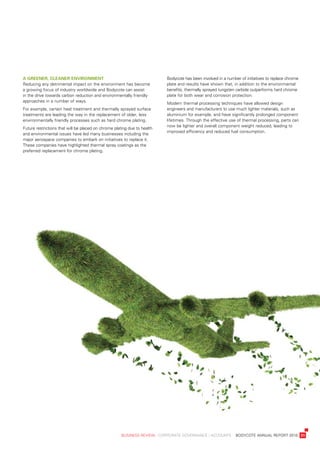
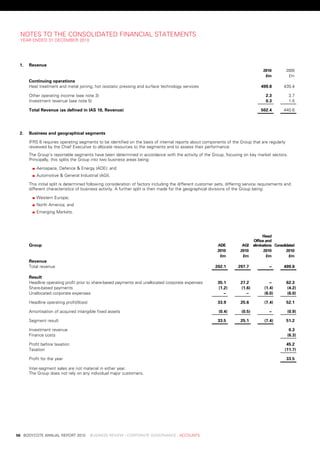
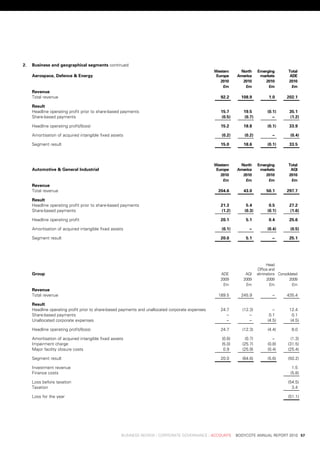
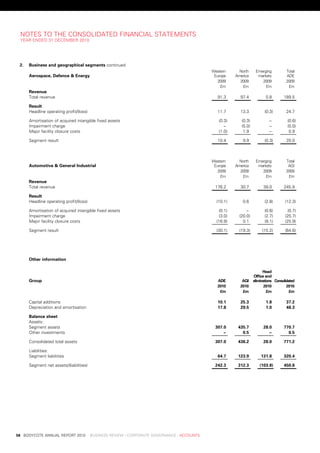
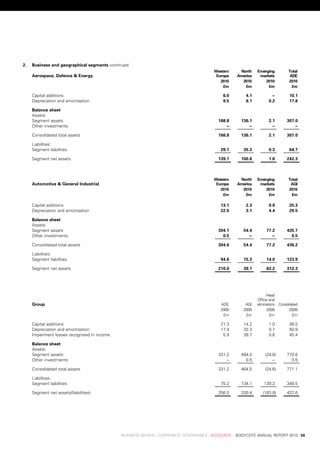
Bodycote continually improves the website offerings for both customers and investors. The most recent is the
addition of an audio webcast of Bodycote’s 2010 Results presentation in the Investor Relations section of the website.
We invite you to view and to listen by visiting www.bodycote.com/audiocast


Cover image
This photograph by Jane LaGoy shows the microstructure of a sample of an aluminium alloy casting that has undergone Hot Isostatic Pressing (HIP). The tree or skeleton-like dendrite structure is
typical of aluminium. The HIP process removes voids and porosity in the casting but still preserves the original microstructure of the metal. The result is a component with many desirable features,
including exceptional strength.
FinanCial	HiGHliGHts


                                                                                                                                          	            2010           	           2009

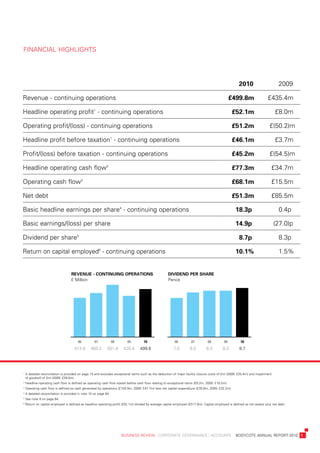
revenue	-	continuing	operations                                                                                                           	 £499.8m                   	 £435.4m

Headline	operating	profit1	-	continuing	operations                                                                                        	        £52.1m             	          £8.0m

operating	profit/(loss)	-	continuing	operations                                                                                           	        £51.2m             	     £(50.2)m
Headline	profit	before	taxation1	-	continuing	operations                                                                                  	        £46.1m             	          £3.7m

profit/(loss)	before	taxation	-	continuing	operations                                                                                     	        £45.2m             	     £(54.5)m

Headline	operating	cash	flow2                                                                                                             	        £77.3m             	      £34.7m

operating	cash	flow3                                                                                                                      	        £68.1m             	      £15.5m

net	debt                                                                                                                                  	        £51.3m             	      £85.5m

	 asic	headline	earnings	per	share4	-	continuing	operations
b                                                                                                                                         	         18.3p             	           0.4p

basic	earnings/(loss)	per	share                                                                                                           	         14.9p             	          (27.0)p

dividend	per	share5                                                                                                                       	            8.7p           	           8.3p

return	on	capital	employed6	-	continuing	operations                                                                                       	         10.1%             	           1.5%


                                  revenue	-	Continuing	operations                                    DiviDenD	per	share
                                  £	Million                                                          pence


                                       06          07            08      09         10                    06         07          08           09        10
                                    413.9       465.2       551.8      435.4      499.8                  7.0        8.0	        8.3        8.3         8.7


1
 		 	detailed	reconciliation	is	provided	on	page	15	and	excludes	exceptional	items	such	as	the	deduction	of	major	facility	closure	costs	of	£nil	(2009:	£25.4m)	and	impairment
  a
  of	goodwill	of	£nil	(2009:	£29.0m).
2
 		 eadline	operating	cash	flow	is	defined	as	operating	cash	flow	stated	before	cash	flow	relating	to	exceptional	items	(£9.2m,	2009:	£19.2m).
  H
3
 	operating	cash	flow	is	defined	as	cash	generated	by	operations	(£103.9m,	2009:	£47.7m)	less	net	capital	expenditure	(£35.8m,	2009:	£32.2m).
4
 	a	detailed	reconciliation	is	provided	in	note	10	on	page	64.
5
 	see	note	9	on	page	64.
6
 	return	on	capital	employed	is	defined	as	headline	operating	profit	(£52.1m)	divided	by	average	capital	employed	(£517.9m).	Capital	employed	is	defined	as	net	assets	plus	net	debt.


	                                                                     business	review	:	Corporate	GovernanCe	:	aCCounts				bodyCote	annual	report	2010	 1
Business	review                                                   aCCounts
    Financial	Highlights	                                 1           independent	auditors’	report	-	Group	Financial	statements	     46
    what	is	bodycote’s	business?	                         2           Consolidated	income	statement	                                 47
    Core	technologies	                                    3           Consolidated	statement	of	Comprehensive	income	                47
    the	outsourcing	principle	                            4           Consolidated	balance	sheet	                                    48
    on	solid	Foundations	–	a	component	journey	           5	          Consolidated	Cash	Flow	statement	                              49
    our	Global	network	                                   6           C
                                                                      	 onsolidated	statement	of	Changes	in	equity	                  50
    strategy	and	objectives	                              8           Group	accounting	policies	                                     51
    Key	performance	indicators	                           9           n
                                                                      	 otes	to	the	Consolidated	Financial	statements	               56
    Chairman’s	statement	                                10           Five	year	summary	                                             90
    Chief	executive’s	review	                            12           Company	balance	sheet	                                         91
    down	to	earth	–	a	component	journey	                 14           i
                                                                      	ndependent	auditors’	report	–	Company	Financial	statements	   92
    business	performance	                                15           C
                                                                      	 ompany	accounting	policies	                                  93
    powder	power	–	a	component	journey	                  16           notes	to	the	Company	Financial	statements	                     94
    business	overview	                                   17
                                                                      aDDitional	information
    business	review	–	aerospace,	defence	&	energy	       18
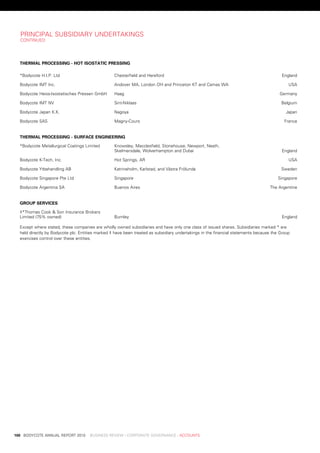
                                                                      principal	subsidiary	undertakings	                              99
    business	review	–	automotive	&	General	industrial	   20
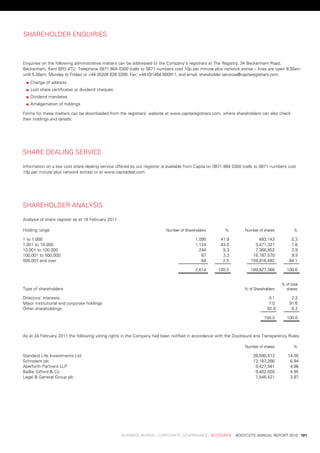
                                                                      shareholder	information	                                       101
    Finance	director’s	report	                           22
                                                                      Financial	Calendar	                                            102
    principal	risks	and	uncertainties	                   26
    Corporate	responsibility	and	sustainability	         28

    Corporate	governanCe
    directors’	report	                                   32
    Corporate	Governance	statement	                      34
    report	of	the	audit	Committee	                       36
    report	of	the	nomination	Committee	                  38
    board	report	on	remuneration	                        39
    directors’	responsibilities	statement	               44
    board	of	directors	and	advisers	                     45


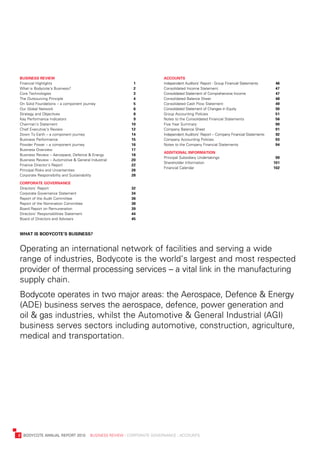
    what	is	BoDyCote’s	Business?


    operating	an	international	network	of	facilities	and	serving	a	wide	
    range	of	industries,	bodycote	is	the	world’s	largest	and	most	respected	
    provider	of	thermal	processing	services	–	a	vital	link	in	the	manufacturing	
    supply	chain.
    bodycote	operates	in	two	major	areas:	the	aerospace,	defence	&	energy	
    (ade)	business	serves	the	aerospace,	defence,	power	generation	and	
    oil	&	gas	industries,	whilst	the	automotive	&	General	industrial	(aGi)	
    business	serves	sectors	including	automotive,	construction,	agriculture,	
    medical	and	transportation.


	   2	 bodyCote	annual	report	2010				business	review	:	Corporate	GovernanCe	:	aCCounts
Core	teCHnoloGies


thermal	proCessing	
Bodycote	provides	thermal	processing	services	which	improve	
material	properties	such	as	strength,	durability	and	corrosion	
resistance,	enabling	manufacturers’	components	to	work	more	
efficiently	with	significantly	extended	operational	lifetimes.		
Bodycote’s	treatment	services	consist	of	a	number	of	core	
technologies:	heat	treatment	and	metal	joining,	hot	isostatic	
pressing	(hip)	and	surface	technology.

heat	treatment	and	metal	Joining
Heat	treatments	are	controlled	processes	used	to	alter	
the	microstructure	of	materials,	such	as	metals	and	alloys,	
to	impart	properties	which	benefit	the	working	life	of	a	component,	
for	example:	increased	surface	hardness,	temperature	resistance,	
ductility	and	strength.	Metal	joining	includes	specialised	processes	
such	as	electron	beam	welding,	vacuum	and	honeycomb	brazing	–	
complex	operations	requiring	a	fusion	of	expertise	and	technology.
bodycote	offers	an	extensive	range	of	heat	treatment	services	and	
specialist	metal	joining	techniques	from	facilities	around	the	world.		
with	unmatched	capacity	and	computerised	systems,	bodycote	
facilities	can	process	a	wide	range	of	component	sizes	to	exacting	
standards	with	reliable,	repeatable	results.
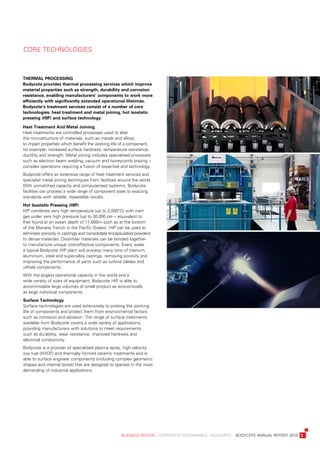
hot	isostatic	pressing	(hip)
Hip	combines	very	high	temperature	(up	to	2,000°C)	with	inert	
gas	under	very	high	pressure	(up	to	30,000	psi	–	equivalent	to	
that	found	at	an	ocean	depth	of	11,000m	such	as	at	the	bottom	
of	the	Mariana	trench	in	the	pacific	ocean).	Hip	can	be	used	to	
eliminate	porosity	in	castings	and	consolidate	encapsulated	powders	
to	dense	materials.	dissimilar	materials	can	be	bonded	together	
to	manufacture	unique	cost-effective	components.	every	week	
a	typical	bodycote	Hip	plant	will	process	many	tons	of	titanium,	
aluminium,	steel	and	super-alloy	castings,	removing	porosity	and	
improving	the	performance	of	parts	such	as	turbine	blades	and	
oilfield	components.
with	the	largest	operational	capacity	in	the	world	and	a	
wide	variety	of	sizes	of	equipment,	bodycote	Hip	is	able	to	
accommodate	large	volumes	of	small	product	as	economically	
as	large	individual	components.
surface	technology
surface	technologies	are	used	extensively	to	prolong	the	working	
life	of	components	and	protect	them	from	environmental	factors	
such	as	corrosion	and	abrasion.	the	range	of	surface	treatments	
available	from	bodycote	covers	a	wide	variety	of	applications,	
providing	manufacturers	with	solutions	to	meet	requirements	
such	as	durability,	wear	resistance,	improved	hardness	and	
electrical	conductivity.
bodycote	is	a	provider	of	specialised	plasma	spray,	high	velocity	
oxy	fuel	(HvoF)	and	thermally	formed	ceramic	treatments	and	is	
able	to	surface	engineer	components	(including	complex	geometric	
shapes	and	internal	bores)	that	are	designed	to	operate	in	the	most	
demanding	of	industrial	applications.


	                                                    business	review	:	Corporate	GovernanCe	:	aCCounts				bodyCote	annual	report	2010	 3
tHe	outsourCinG	prinCiple


              bodycote	has	a	long	history	                            the	partner	of	ChoiCe
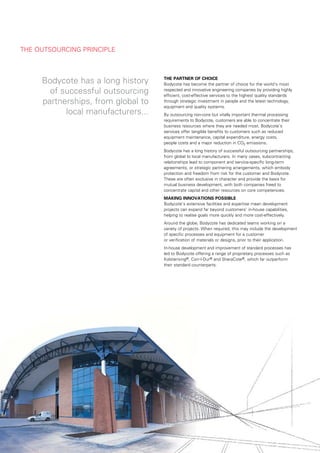
                                                                      bodycote	has	become	the	partner	of	choice	for	the	world’s	most	
                of	successful	outsourcing	                            respected	and	innovative	engineering	companies	by	providing	highly	
                                                                      efficient,	cost-effective	services	to	the	highest	quality	standards	
              partnerships,	from	global	to	                           through	strategic	investment	in	people	and	the	latest	technology,	
                                                                      equipment	and	quality	systems.
                    local	manufacturers...                            by	outsourcing	non-core	but	vitally	important	thermal	processing	
                                                                      requirements	to	bodycote,	customers	are	able	to	concentrate	their	
                                                                      business	resources	where	they	are	needed	most.	bodycote’s	
                                                                      services	offer	tangible	benefits	to	customers	such	as	reduced	
                                                                      equipment	maintenance,	capital	expenditure,	energy	costs,	
                                                                      people	costs	and	a	major	reduction	in	Co2	emissions.
                                                                      bodycote	has	a	long	history	of	successful	outsourcing	partnerships,	
                                                                      from	global	to	local	manufacturers.	in	many	cases,	subcontracting	
                                                                      relationships	lead	to	component	and	service-specific	long-term	
                                                                      agreements,	or	strategic	partnering	arrangements,	which	embody	
                                                                      protection	and	freedom	from	risk	for	the	customer	and	bodycote.		
                                                                      these	are	often	exclusive	in	character	and	provide	the	basis	for	
                                                                      mutual	business	development,	with	both	companies	freed	to	
                                                                      concentrate	capital	and	other	resources	on	core	competencies.
                                                                      making	innovations	possiBle
                                                                      bodycote’s	extensive	facilities	and	expertise	mean	development	
                                                                      projects	can	expand	far	beyond	customers’	in-house	capabilities,	
                                                                      helping	to	realise	goals	more	quickly	and	more	cost-effectively.
                                                                      around	the	globe,	bodycote	has	dedicated	teams	working	on	a	
                                                                      variety	of	projects.	when	required,	this	may	include	the	development	
                                                                      of	specific	processes	and	equipment	for	a	customer	
                                                                      or	verification	of	materials	or	designs,	prior	to	their	application.
                                                                      in-house	development	and	improvement	of	standard	processes	has	
                                                                      led	to	bodycote	offering	a	range	of	proprietary	processes	such	as	
                                                                      Kolsterising®,	Corr-i-dur®	and	sheraCote®,	which	far	outperform	
                                                                      their	standard	counterparts.


	   4	 bodyCote	annual	report	2010				business	review	:	Corporate	GovernanCe	:	aCCounts
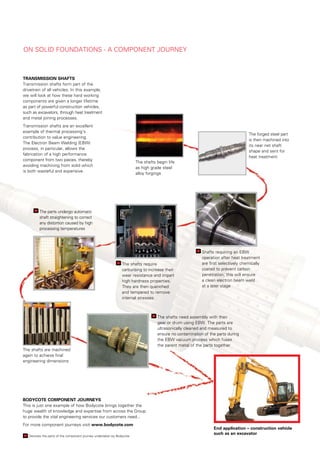
on	solid	Foundations	-	a	CoMponent	journey


transmission	shafts
transmission	shafts	form	part	of	the	
drivetrain	of	all	vehicles.	in	this	example,	
we	will	look	at	how	these	hard	working	
components	are	given	a	longer	lifetime	
as	part	of	powerful	construction	vehicles,	
such	as	excavators,	through	heat	treatment	
and	metal	joining	processes.
transmission	shafts	are	an	excellent	
example	of	thermal	processing’s	
                                                                                                                          the	forged	steel	part	
contribution	to	value	engineering.	
                                                                                                                          is	then	machined	into	
the	electron	beam	welding	(ebw)	
                                                                                                                          its	near	net	shaft	
process,	in	particular,	allows	the	
                                                                                                                          shape	and	sent	for	
fabrication	of	a	high	performance	
                                                                                                                          heat	treatment
component	from	two	pieces,	thereby	
                                                            the	shafts	begin	life	
avoiding	machining	from	solid	which	
                                                            as	high	grade	steel	
is	both	wasteful	and	expensive.	
                                                            alloy	forgings


      	   t
          	 he	parts	undergo	automatic	
          shaft	straightening	to	correct	
          any	distortion	caused	by	high	
          processing	temperatures


                                                                                            	   s
                                                                                                	 hafts	requiring	an	ebw	
                                                                                                operation	after	heat	treatment	
                                                    t
                                                    	 he	shafts	require	                        are	first	selectively	chemically	
                                                    carburising	to	increase	their	              coated	to	prevent	carbon	
                                                    wear	resistance	and	impart	                 penetration;	this	will	ensure	
                                                    high	hardness	properties.	                  a	clean	electron	beam	weld	
                                                    they	are	then	quenched	                     at	a	later	stage
                                                    and	tempered	to	remove	
                                                    internal	stresses


                                                                    	   t
                                                                        	 he	shafts	need	assembly	with	their
                                                                        gear	or	drum	using	ebw.	the	parts	are	
                                                                        ultrasonically	cleaned	and	measured	to	
                                                                        ensure	no	contamination	of	the	parts	during	
                                                                        the	ebw	vacuum	process	which	fuses	
                                                                        the	parent	metal	of	the	parts	together
the	shafts	are	machined	
again	to	achieve	final	
engineering	dimensions


BoDyCote	Component	Journeys
this	is	just	one	example	of	how	bodycote	brings	together	the	
huge	wealth	of	knowledge	and	expertise	from	across	the	Group	
to	provide	the	vital	engineering	services	our	customers	need...
For	more	component	journeys	visit	www.bodycote.com
                                                                                                      end	application	–	construction	vehicle	
	                                                                                                          such	as	an	excavator
                                                                 business	review	:	Corporate	GovernanCe	:	aCCounts				bodyCote	annual	report	2010	 5
    d
    	 enotes	the	parts	of	the	component	journey	undertaken	by	bodycote
paGe	title	in	Here	[delete	iF	not	required]
    our	Global	networK
    [paGe	title	line	2	iF	required]


      	aerospace	&	defence          	power	Generation                         	oil	&	Gas                 	automotive                      	Civil	eng,	agriculture,	rail	&	Marine


    overview
    as	the	only	truly	global	provider	of	subcontract	thermal	processing	
    services,	bodycote	is	able	to	offer	a	significant	advantage	to	its	
    customers.	through	an	international	network	of	plants,	bodycote	can	
    effectively	utilise	a	wealth	of	knowledge,	experience	and	specialist	
    expertise	to	deliver	quality	service	when	and	where	it	is	needed.
    the	network	operates	from	173	facilities,	with	customers	able	to	
    benefit	from	bodycote’s	comprehensive	range	of	services	from	
    multiple	locations.	Customers	know	that	if	their	business	expands,	
    bodycote	will	have	the	capability	to	meet	their	needs.	they	know	
    that	if	they	were	to	broaden	their	manufacturing	footprint,	bodycote	
    would	be	able	to	assist	them.	they	know	that	they	can	obtain	the	
    same	process	to	the	same	quality	standards	from	multiple	locations.	
                                                                                           north	ameriCa
    such	a	large	network	brings	economies	of	scale,	with	technology	
                                                                                           bodycote	has	39	facilities	in	north	america,	concentrated	where	
    developed	at	one	location	being	available	globally	if	the	market	
                                                                                           manufacturing	and	technical	industries	are	located.
    requires	it.
                                                                                           the	network	includes	five	specialist	operations,	four	offering	Hip,	
    the	bodycote	network	has	a	wealth	of	technical	accreditations,	
                                                                                           and	the	other	offering	surface	technology.	Hip	capacity	has	recently	
    some	industry	or	customer	specific,	others	more	general.	individual	
                                                                                           been	expanded	to	ensure	that	bodycote	is	best	positioned	to	satisfy	
    operations	concentrate	on	the	accreditations	suited	to	their	market.
                                                                                           its	customers’	needs	as	the	economic	climate	continues	to	improve.		
    although	bodycote	is	headquartered	in	the	uK,	89%	of	the	Group’s	
                                                                                           low	pressure	carburising	capability	has	been	similarly	expanded.	
    revenue	is	derived	outside	the	uK.	with	facilities	in	26	countries,	
                                                                                           this	energy	efficient	technology	can,	for	example,	enable	automotive	
    bodycote	is	truly	global.
                                                                                           manufacturers	to	produce	7-	and	8-speed	automatic	transmissions	of	
                                                                                           modest	weight	and	compact	dimensions,	which	assist	in	the	quest	
                                                                                           for	lower	emissions.


    group	revenue	By	market	seCtor                                                         revenue	By	market	seCtor	–	north	ameriCa
                                     	aerospace	&	defence                                                                 	aerospace	&	defence
                                     	energy                                                                              	energy
                                     	automotive                                                                          	automotive
                                     	Civil	eng,	agriculture,	rail	&	Marine                                               	Civil	eng,	agriculture,	rail	&	Marine
                                     	other	General	industrial                                                            	other	General	industrial


	   6	 bodyCote	annual	report	2010				business	review	:	Corporate	GovernanCe	:	aCCounts
paGe	title	in	Here	[delete	iF	not	required]
[paGe	title	line	2	iF	required]


    	tooling                     	Consumer	product                         	electronics	&	telecoms         	Medical	&	environmental             	Mining


western	europe                                                                               emerging	markets
bodycote	has	104	facilities	in	western	europe	including	seven	                               bodycote	has	30	facilities	in	emerging	geographies	including	
Hip	plants	and	seven	dedicated	surface	technology	facilities.	                               two	dedicated	surface	technology	plants,	one	each	in	singapore	
the	important	French,	German	and	scandinavian	markets	are	                                   and	dubai.	bodycote	is	the	number	one	thermal	processing	provider	
particularly	well	served	with	28,	19	and	18	facilities	respectively.		                       in	both	brazil	and	eastern	europe	and	is	number	two	in	China.	
recent	capacity	extensions	include	expanded	facilities	aimed	at	                             these	markets	have	a	special	emphasis	in	the	Group’s	growth	
the	needs	of	the	wind	energy	market.                                                         strategy	for	the	future.			
Hip	capacity	has	been	significantly	enhanced	to	meet	customers’	
growing	needs	for	this	service.	


revenue	By	market	seCtor	–	western	europe                                                   revenue	By	market	seCtor	–	emerging	markets
                                  	aerospace	&	defence                                                                          	aerospace	&	defence
                                  	energy                                                                                       	energy
                                  	automotive                                                                                   	automotive
                                  	Civil	eng,	agriculture,	rail	&	Marine                                                        	Civil	eng,	agriculture,	rail	&	Marine
                                  	other	General	industrial                                                                     	other	General	industrial


	                                                             business	review	:	Corporate	GovernanCe	:	aCCounts				bodyCote	annual	report	2010	 7
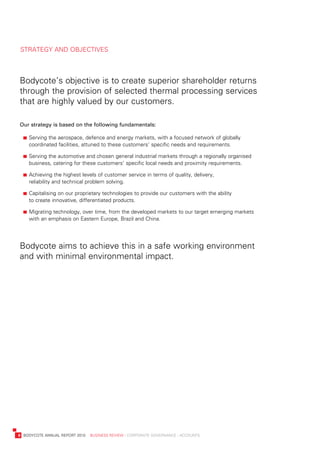
strateGy	and	objeCtives


    bodycote’s	objective	is	to	create	superior	shareholder	returns	
    through	the	provision	of	selected	thermal	processing	services		
    that	are	highly	valued	by	our	customers.

    Our strategy is based on the following fundamentals:	

    	   		 erving	the	aerospace,	defence	and	energy	markets,	with	a	focused	network	of	globally
         s
         coordinated	facilities,	attuned	to	these	customers’	specific	needs	and	requirements.

    	   		 erving	the	automotive	and	chosen	general	industrial	markets	through	a	regionally	organised
         s
         business,	catering	for	these	customers’	specific	local	needs	and	proximity	requirements.

    	   		 chieving	the	highest	levels	of	customer	service	in	terms	of	quality,	delivery,
         a
         reliability	and	technical	problem	solving.

    	   		 apitalising	on	our	proprietary	technologies	to	provide	our	customers	with	the	ability
         C
         to	create	innovative,	differentiated	products.

    	   		 igrating	technology,	over	time,	from	the	developed	markets	to	our	target	emerging	markets
         M
         with	an	emphasis	on	eastern	europe,	brazil	and	China.


    bodycote	aims	to	achieve	this	in	a	safe	working	environment
    and	with	minimal	environmental	impact.


	   8	 bodyCote	annual	report	2010				business	review	:	Corporate	GovernanCe	:	aCCounts
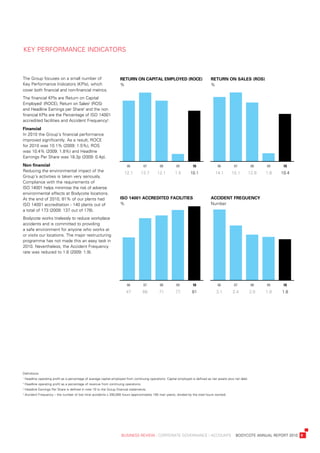
Key	perForManCe	indiCators


the	Group	focuses	on	a	small	number	of	                            return	on	Capital	employeD	(roCe)	                             return	on	sales	(ros)
Key	performance	indicators	(Kpis),	which	                          %                                                              %
cover	both	financial	and	non-financial	metrics.
the	financial	Kpis	are	return	on	Capital	
employed1	(roCe),	return	on	sales2	(ros)	
and	Headline	earnings	per	share3	and	the	non	
financial	Kpis	are	the	percentage	of	iso	14001	
accredited	facilities	and	accident	Frequency4.
financial
in	2010	the	Group’s	financial	performance	
improved	significantly.	as	a	result,	roCe	
for	2010	was	10.1%	(2009:	1.5%),	ros	
was	10.4%	(2009:	1.8%)	and	Headline	
earnings	per	share	was	18.3p	(2009:	0.4p).
non	financial                                                           06           07        08         09         10               06          07            08     09     10
reducing	the	environmental	impact	of	the	                             12.1        13.7       12.1        1.5        10.1             14.1       15.1           12.9	   1.8   10.4
Group’s	activities	is	taken	very	seriously.		
Compliance	with	the	requirements	of	
iso	14001	helps	minimise	the	risk	of	adverse	
environmental	effects	at	bodycote	locations.	
at	the	end	of	2010,	81%	of	our	plants	had	                         iso	14001	aCCreDiteD	faCilities                                aCCiDent	frequenCy
iso	14001	accreditation	-	140	plants	out	of	                       %                                                              number
a	total	of	173	(2009:	137	out	of	178).
bodycote	works	tirelessly	to	reduce	workplace	
accidents	and	is	committed	to	providing	
a	safe	environment	for	anyone	who	works	at	
or	visits	our	locations.	the	major	restructuring	
programme	has	not	made	this	an	easy	task	in	
2010.	nevertheless,	the	accident	Frequency	
rate	was	reduced	to	1.8	(2009:	1.9).


                                                                        06           07        08         09         10               06          07            08     09     10
                                                                        47           68       71         77          81               3.1        2.4           2.0	    1.9   1.8


definitions:
1
 	Headline	operating	profit	as	a	percentage	of	average	capital	employed	from	continuing	operations.	Capital	employed	is	defined	as	net	assets	plus	net	debt.
2
 	Headline	operating	profit	as	a	percentage	of	revenue	from	continuing	operations.
3
 	Headline	earnings	per	share	is	defined	in	note	10	to	the	Group	financial	statements.
4
 	accident	Frequency	–	the	number	of	lost	time	accidents	x	200,000	hours	(approximately	100	man	years),	divided	by	the	total	hours	worked.


	                                                                   business	review	:	Corporate	GovernanCe	:	aCCounts				bodyCote	annual	report	2010	 9
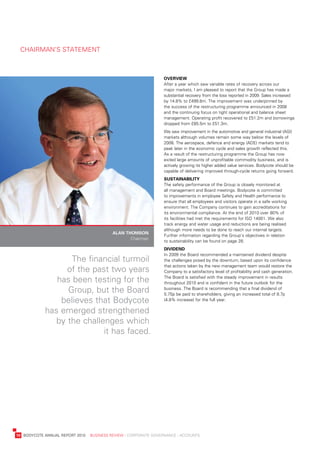
CHairMan’s	stateMent


                                                                       overview
                                                                       after	a	year	which	saw	variable	rates	of	recovery	across	our	
                                                                       major	markets,	i	am	pleased	to	report	that	the	Group	has	made	a	
                                                                       substantial	recovery	from	the	loss	reported	in	2009.	sales	increased	
                                                                       by	14.8%	to	£499.8m.	the	improvement	was	underpinned	by	
                                                                       the	success	of	the	restructuring	programme	announced	in	2008	
                                                                       and	the	continuing	focus	on	tight	operational	and	balance	sheet	
                                                                       management.	operating	profit	recovered	to	£51.2m	and	borrowings	
                                                                       dropped	from	£85.5m	to	£51.3m.
                                                                       we	saw	improvement	in	the	automotive	and	general	industrial	(aGi)	
                                                                       markets	although	volumes	remain	some	way	below	the	levels	of	
                                                                       2008.	the	aerospace,	defence	and	energy	(ade)	markets	tend	to	
                                                                       peak	later	in	the	economic	cycle	and	sales	growth	reflected	this.	
                                                                       as	a	result	of	the	restructuring	programme	the	Group	has	now	
                                                                       exited	large	amounts	of	unprofitable	commodity	business,	and	is	
                                                                       actively	growing	its	higher	added	value	services.	bodycote	should	be	
                                                                       capable	of	delivering	improved	through-cycle	returns	going	forward.
                                                                       sustainaBility
                                                                       the	safety	performance	of	the	Group	is	closely	monitored	at	
                                                                       all	management	and	board	meetings.	bodycote	is	committed	
                                                                       to	improvements	in	employee	safety	and	Health	performance	to	
                                                                       ensure	that	all	employees	and	visitors	operate	in	a	safe	working	
                                                                       environment.	the	Company	continues	to	gain	accreditations	for	
                                                                       its	environmental	compliance.	at	the	end	of	2010	over	80%	of	
                                                                       its	facilities	had	met	the	requirements	for	iso	14001.	we	also	
                                                                       track	energy	and	water	usage	and	reductions	are	being	realised	
                                                                       although	more	needs	to	be	done	to	reach	our	internal	targets.	
                                                alan	thomson
                                                                       Further	information	regarding	the	Group’s	objectives	in	relation	
                                                       Chairman
                                                                       to	sustainability	can	be	found	on	page	28.
                                                                       DiviDenD
                                                                       in	2009	the	board	recommended	a	maintained	dividend	despite	
                        the	financial	turmoil	                         the	challenges	posed	by	the	downturn,	based	upon	its	confidence	
                                                                       that	actions	taken	by	the	new	management	team	would	restore	the	
                       of	the	past	two	years	                          Company	to	a	satisfactory	level	of	profitability	and	cash	generation.	

                    has	been	testing	for	the	                          the	board	is	satisfied	with	the	steady	improvement	in	results	
                                                                       throughout	2010	and	is	confident	in	the	future	outlook	for	the	
                       Group,	but	the	board	                           business.	the	board	is	recommending	that	a	final	dividend	of	
                                                                       5.75p	be	paid	to	shareholders,	giving	an	increased	total	of	8.7p	
                     believes	that	bodycote	                           (4.8%	increase)	for	the	full	year.		

                 has	emerged	strengthened	
                    by	the	challenges	which	
                                 it	has	faced.	


	   10	 bodyCote	annual	report	2010				business	review	:	Corporate	GovernanCe	:	aCCounts
BoarD
after	the	changes	made	to	the	composition	of	the	board	in	
2008	and	2009	the	membership	was	unchanged	in	2010	and	
should	remain	so	throughout	2011.	during	the	year,	in	accordance	
with	its	usual	practice,	the	board	conducted	a	formal	internal	
evaluation	of	its	performance,	including	that	of	the	Chairman.	
in	2011	the	board	has	decided	that	this	process	will	be	carried	
out	by	an	external	facilitator	with	the	results	being	reported	in	the	
2011	annual	report.	this	external	evaluation	will	assist	the	Chairman	
in	the	process	of	gradually	refreshing	board	membership	to	meet	
the	changing	requirements	of	a	growing	business.	during	the	last	
year	all	board	members	received	training	on	current	topics	including	
reporting	standards,	risk	management	and	sustainability.	
in	line	with	the	revised	Governance	code	all	directors	have	agreed	
to	seek	re-election	at	the	annual	General	Meeting	in	april.	
summary
the	financial	turmoil	of	the	past	two	years	has	been	testing	for	
the	Group,	but	the	board	believes	that	bodycote	has	emerged	
strengthened	by	the	challenges	which	it	has	faced.	with	a	strong	
balance	sheet	and	an	excellent	management	team	we	face	the	
future	with	confidence.		
despite	the	mixed	business	climate	over	the	last	twelve	months	
the	Group	has	delivered	a	significant	improvement	in	performance	
and	is	well	positioned	for	the	future.	this	is	largely	due	to	the	hard	
work	and	commitment	of	stephen	Harris	and	his	colleagues	around	
the	world.	the	board	congratulates	them	on	their	achievements	
and	commitment	which	have	resulted	in	increased	value	for	
shareholders.	bodycote	remains	a	first	class	business	with	good	
prospects	for	the	future.


a.	m.	thomson
Chairman	
24	February	2011


	                                                    business	review	:	Corporate	GovernanCe	:	aCCounts				bodyCote	annual	report	2010	 11
CHieF	exeCutive’s	review


                                                                       traDing	overview
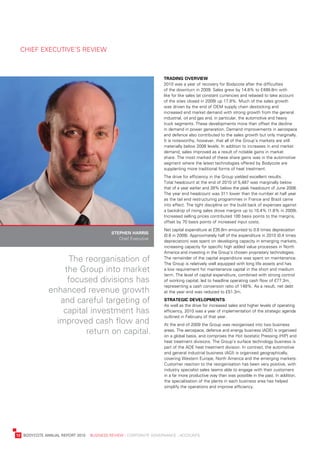
                                                                       2010	was	a	year	of	recovery	for	bodycote	after	the	difficulties	
                                                                       of	the	downturn	in	2009.	sales	grew	by	14.8%	to	£499.8m	with	
                                                                       like	for	like	sales	(at	constant	currencies	and	rebased	to	take	account	
                                                                       of	the	sites	closed	in	2009)	up	17.8%.	Much	of	the	sales	growth	
                                                                       was	driven	by	the	end	of	oeM	supply	chain	destocking	and	
                                                                       increased	end	market	demand	with	strong	growth	from	the	general	
                                                                       industrial,	oil	and	gas	and,	in	particular,	the	automotive	and	heavy	
                                                                       truck	segments.	these	developments	more	than	offset	the	decline	
                                                                       in	demand	in	power	generation.	demand	improvements	in	aerospace	
                                                                       and	defence	also	contributed	to	the	sales	growth	but	only	marginally.	
                                                                       it	is	noteworthy,	however,	that	all	of	the	Group’s	markets	are	still	
                                                                       materially	below	2008	levels.	in	addition	to	increases	in	end	market	
                                                                       demand,	sales	improved	as	a	result	of	notable	gains	in	market	
                                                                       share.	the	most	marked	of	these	share	gains	was	in	the	automotive	
                                                                       segment	where	the	latest	technologies	offered	by	bodycote	are	
                                                                       supplanting	more	traditional	forms	of	heat	treatment.
                                                                       the	drive	for	efficiency	in	the	Group	yielded	excellent	results.	
                                                                       total	headcount	at	the	end	of	2010	of	5,487	was	marginally	below	
                                                                       that	of	a	year	earlier	and	28%	below	the	peak	headcount	of	june	2008.	
                                                                       the	year	end	headcount	was	311	lower	than	the	number	at	half	year	
                                                                       as	the	tail	end	restructuring	programmes	in	France	and	brazil	came	
                                                                       into	effect.	the	tight	discipline	on	the	build	back	of	expenses	against	
                                                                       a	backdrop	of	rising	sales	drove	margins	up	to	10.4%	(1.8%	in	2009).	
                                                                       increased	selling	prices	contributed	100	basis	points	to	the	margins,	
                                                                       offset	by	70	basis	points	of	increased	input	costs.
                                                                       net	capital	expenditure	at	£35.8m	amounted	to	0.8	times	depreciation	
                                               stephen	harris
                                                                       (0.6	in	2009).	approximately	half	of	the	expenditure	in	2010	(0.4	times	
                                                  Chief	executive
                                                                       depreciation)	was	spent	on	developing	capacity	in	emerging	markets,	
                                                                       increasing	capacity	for	specific	high	added	value	processes	in	north	
                                                                       america	and	investing	in	the	Group’s	chosen	proprietary	technologies.	
                        the	reorganisation	of	                         the	remainder	of	the	capital	expenditure	was	spent	on	maintenance.	
                                                                       the	Group	is	relatively	well	equipped	with	long	life	assets	and	has	
                      the	Group	into	market	                           a	low	requirement	for	maintenance	capital	in	the	short	and	medium	
                                                                       term.	the	level	of	capital	expenditure,	combined	with	strong	control	
                       focused	divisions	has	                          of	working	capital,	led	to	headline	operating	cash	flow	of	£77.3m,	
                                                                       representing	a	cash	conversion	ratio	of	148%.	as	a	result,	net	debt	
                  enhanced	revenue	growth	                             at	the	year	end	was	reduced	to	£51.3m.

                     and	careful	targeting	of	                         strategiC	Developments
                                                                       as	well	as	the	drive	for	increased	sales	and	higher	levels	of	operating	
                      capital	investment	has	                          efficiency,	2010	was	a	year	of	implementation	of	the	strategic	agenda	
                                                                       outlined	in	February	of	that	year.
                    improved	cash	flow	and	                            at	the	end	of	2009	the	Group	was	reorganised	into	two	business	
                            return	on	capital.                         areas.	the	aerospace,	defence	and	energy	business	(ade)	is	organised	
                                                                       on	a	global	basis,	and	comprises	the	Hot	isostatic	pressing	(Hip)	and	
                                                                       heat	treatment	divisions.	the	Group’s	surface	technology	business	is	
                                                                       part	of	the	ade	heat	treatment	division.	in	contrast,	the	automotive	
                                                                       and	general	industrial	business	(aGi)	is	organised	geographically,	
                                                                       covering	western	europe,	north	america	and	the	emerging	markets.	
                                                                       Customer	reaction	to	the	reorganisation	has	been	very	positive,	with	
                                                                       industry	specialist	sales	teams	able	to	engage	with	their	customers	
                                                                       in	a	far	more	productive	way	than	was	possible	in	the	past.	in	addition,	
                                                                       the	specialisation	of	the	plants	in	each	business	area	has	helped	
                                                                       simplify	the	operations	and	improve	efficiency.


	   12	 bodyCote	annual	report	2010				business	review	:	Corporate	GovernanCe	:	aCCounts
development	of	the	emerging	markets	and	investment	in	bodycote’s	             outsourcing	remains	a	major	opportunity	for	the	Group.	agreements	
chosen	proprietary	technologies	are	key	elements	of	the	strategy.	            are	typically	framework	in	nature,	with	standard	terms	and	conditions	
the	emerging	markets	focus	for	bodycote	is	on	eastern	europe,	                and	a	commitment	to	sole	source	the	work	from	bodycote.	pricing	is	
brazil	and	China.	while	emerging	markets	revenues	represent	just	             normally	defined	as	a	base	level	with	prices	linked	to	various	indices	
over	10%	of	the	Group’s	business	today,	bodycote	is	already	the	              such	as	the	cost	of	energy.
market	leader	in	eastern	europe	and	brazil	and	number	two	in	China.	
                                                                              Going	forward	it	is	expected	that	the	pace	of	outsourcing	and	size	of	
in	2010	new	greenfield	sites	were	added	in	poland,	Czech	republic	
                                                                              outsource	contracts	will	increase.	this	is	due	not	only	to	the	general	
and	brazil,	while	additional	modern	capacity	was	deployed	in	existing	
                                                                              tendency	of	companies	to	eliminate	non	core	activities	over	time,	but	
plants	in	turkey,	brazil	and	China.
                                                                              also	to	two	other	significant	factors.
the	development	of	the	Group’s	proprietary	technologies	continued	
                                                                              	   		 he	rising	cost	of	energy.	bodycote	is	typically	more	energy	
                                                                                   t
apace	in	2010:
                                                                                   efficient	than	manufacturers	that	process	the	work	in-house	
	   		 he	speciality	stainless	steel	business	unit	(s3p)	capacity	was	
     t                                                                             and	can	balance	the	load	in	its	process	lines	by	aggregating	
     expanded	by	20%,	with	a	further	25%	put	on	order	in	readiness	                work	from	several	customers.	level	loading,	in	itself,	is	a	much	
     for	the	increased	demand	now	expected	for	this	business.                      more	efficient	way	of	operating	thermal	processing	plants	than	
	   		 he	Hot	isostatic	pressing	product	Fabrication	business	unit
     t                                                                             the	fluctuating	load	conditions	faced	by	most	manufacturers’	
     (Hip	pF)	grew	at	70%,	albeit	from	a	relatively	modest	base.	                  in-house	facilities.	as	a	result,	rising	energy	prices	tend	to	drive	
     the	business	operates	from	centres	of	excellence	in	Germany,	                 increased	levels	of	outsourcing.
     sweden	and	the	usa	with	much	of	the	process	development	                 	   		 he	general	move	of	manufacturing	industries	to	emerging	
                                                                                   t
     and	computer	modelling	carried	out	in	the	uK	and	the	usa.                     markets.	this	not	only	creates	opportunities	in	emerging	
	   		 he	Corrosion	prevention	processes	business	unit	(Cpp)	
     t                                                                             markets	for	bodycote	to	serve	these	customers,	but	also	
     commissioned	its	first	commercial	production	unit	for	the	                    provides	a	source	of	opportunity	in	developed	economies.	
     sheraCote®	family	of	processes.                                               this	is	because	most	customers	that	move	their	manufacturing	
                                                                                   to	emerging	markets	tend	not	to	close	their	facilities	completely	
progress	was	also	made	on	developing	the	Group’s	personnel	both	                   in	the	developed	economies.	instead,	these	facilities	stop	being	
internally	and	through	the	appointment	of	new	talent	in	many	areas.	               expanded	and	have	investment	constrained.	the	capital	intensive	
in	addition,	the	Group’s	executive	committee	was	also	strengthened	                nature	of	thermal	processing	means	that	such	facilities	often	
with	new	talent	recruited	during	the	year.	the	committee	comprises	                become	undercapitalised	or	outmoded	and	outsourcing	becomes	
five	divisional	presidents,	the	Human	resources	director	and	the	                  an	attractive	option.	the	choice	of	companies	capable	of	taking	
Group	Finance	director,	together	with	the	Chief	executive	officer,	                on	such	outsourced	work	in	a	reliable	way	is	small,	and	bodycote	
who	chairs	the	committee.                                                          becomes	the	preferred	partner	for	most	of	the	customer	base.
future	trenDs	                                                                summary	&	outlook
the	future	trends	for	bodycote’s	markets	are	very	favourable.	                2010	saw	a	notable	and	pleasing	improvement	in	the	performance	
the	more	notable	trends	include:                                              of	the	Group.	better	macro	economic	conditions	were	an	important	
	   		n	the	aerospace	segment	most	industry	analysts	foresee	a	
     i                                                                        contributor	to	this	and	the	underlying	ability	of	the	business	to	deliver	
     significant	growth	in	flying	hours	and	new	build	of	aeroplanes	          consistently	superior	value	has	been	strengthened	considerably.	
     associated	with	traffic	for	the	emerging	markets.	the	move	to	           total	revenue	growth	was	well	ahead	of	market	improvement.	
     higher	engine	operating	temperature	requirements	increases	              the	reorganisation	of	the	Group	into	market	focused	divisions	has	
     thermal	processing	needs.	these	are	all	positive	factors	for	            enhanced	revenue	growth	and	careful	targeting	of	capital	investment	
     the	demand	for	thermal	processing.                                       has	improved	cash	flow	and	return	on	capital.
	   		 ising	oil	and	gas	prices,	together	with	the	increasing	
     r                                                                        looking	at	2011,	it	is	anticipated	that	automotive	and	general	
     sophistication	associated	with	extracting	difficult	to	reach	            industrial	business	will	continue	to	grow	at	a	reasonable	pace.	
     reserves,	are	increasing	the	material	requirements	of	exploration	       aerospace,	defence	and	energy	demand	has	begun	to	recover,	
     and	production	equipment,	which	in	turn	is	driving	greater	              although	within	this	the	power	generation	segment	remains	soft,	
     demand	for	thermal	processing	services.                                  with	the	timing	of	improvement	still	unclear.	in	summary,	the	board	
	   		 ower	generation,	where	bodycote	enjoys	a	strong	presence
     p                                                                        is	confident	that	2011	will	be	another	year	of	growth	for	bodycote,	
     in	both	heat	treatment	and	Hip	services,	will	resume	its	long	           albeit	at	a	less	rapid	rate	than	experienced	in	2010.	the	year	has	
     term	growth	path	in	due	course,	as	the	expansion	in	the	                 started	in	line	with	these	expectations.	looking	further	out,	the	board	
     emerging	markets	continues.                                              sees	encouraging	opportunities	for	improved	through-cycle	returns.
	   		 he	automotive	segment	is	moving	to	more	sophisticated	materials	
     t
     engineering	as	manufacturers	try	to	reduce	weight	and	increase	
     strength.	this	in	turn	directly	increases	the	amount	of	thermal	
     processing	required.	in	addition,	the	introduction	of	hybrid	vehicles	
     is	leading	to	a	larger	number	of	components	in	vehicles,	which	
     in	turn	require	more	services	offered	by	bodycote.
                                                                              s.	C.	harris
                                                                              Chief	executive	
                                                                              24	February	2011


	                                                      business	review	:	Corporate	GovernanCe	:	aCCounts				bodyCote	annual	report	2010	 13
down	to	eartH	-	a	CoMponent	journey


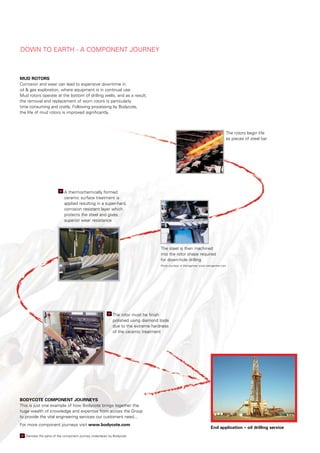
     muD	rotors
     Corrosion	and	wear	can	lead	to	expensive	downtime	in	
     oil	&	gas	exploration,	where	equipment	is	in	continual	use.	
     Mud	rotors	operate	at	the	bottom	of	drilling	wells,	and	as	a	result,	
     the	removal	and	replacement	of	worn	rotors	is	particularly	
     time	consuming	and	costly.	Following	processing	by	bodycote,	
     the	life	of	mud	rotors	is	improved	significantly.


                                                                                                                               the	rotors	begin	life	
                                                                                                                               as	pieces	of	steel	bar


                            a
                            	 	thermochemically	formed	
                            ceramic	surface	treatment	is	
                            applied	resulting	in	a	super-hard,	
                            corrosion	resistant	layer	which	
                            protects	the	steel	and	gives	
                            superior	wear	resistance


                                                                               the	steel	is	then	machined	
                                                                               into	the	rotor	shape	required	
                                                                               for	down-hole	drilling
                                                                               photo	courtesy	of	weingartner	www.weingartner.com


                                                   	   t
                                                       	 he	rotor	must	be	finish	
                                                       polished	using	diamond	tools	
                                                       due	to	the	extreme	hardness	
                                                       of	the	ceramic	treatment


     BoDyCote	Component	Journeys
     this	is	just	one	example	of	how	bodycote	brings	together	the	
     huge	wealth	of	knowledge	and	expertise	from	across	the	Group	
     to	provide	the	vital	engineering	services	our	customers	need...
     For	more	component	journeys	visit	www.bodycote.com
                                                                                                                    end	application	–	oil	drilling	service
	   14	 bodyCote	annual	report	2010				business	review	:	Corporate	GovernanCe	:	aCCounts
         d
         	 enotes	the	parts	of	the	component	journey	undertaken	by	bodycote
business	perForManCe


                                                            	       2010 	          2009                                                         	     2010 	      2009
                                                            	        £m 	            £m                                                          	      £m 	        £m

revenue	–	continuing	operations                                    499.8	          435.4            headline	operating	profit                          52.1          8.0
                                                                                                    add	back	non-cash	items:
operating	profit/(loss)                                             51.2	          (50.2)           		depreciation	and	amortisation                    47.4        49.6	
add	back:                                                                                           		share-based	payments                              4.2         (0.1)	
		Major	facility	closure	costs                              	           .–          25.4            			 oss/(profit)	on	disposal	of	property,	
                                                                                                      l
		impairment	charge                                         	           .–          31.5              plant	and	equipment                               0.7         (0.1)
			 mortisation	of	acquired	intangible	
  a
  fixed	assets                                                        0.9	            1.3           headline	eBitDa1                                  104.4        57.4

headline	operating	profit	–	                                                                        net	capital	expenditure                           (35.8)       (32.2)
continuing	operations                                               52.1              8.0           net	working	capital	movement                        8.7          9.5

                                                                                                    headline	operating	cash	flow                       77.3        34.7
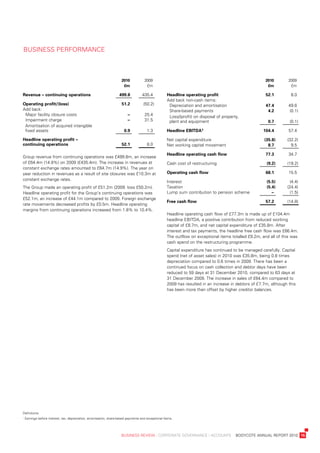
Group	revenue	from	continuing	operations	was	£499.8m,	an	increase	
of	£64.4m	(14.8%)	on	2009	(£435.4m).	the	increase	in	revenues	at	                                   Cash	cost	of	restructuring                          (9.2)      (19.2)
constant	exchange	rates	amounted	to	£64.7m	(14.9%).	the	year	on	
year	reduction	in	revenues	as	a	result	of	site	closures	was	£10.3m	at	                              operating	cash	flow                                68.1        15.5
constant	exchange	rates.
                                                                                                    interest                                            (5.5)        (4.4)
the	Group	made	an	operating	profit	of	£51.2m	(2009:	loss	£50.2m).	                                  taxation                                            (5.4)      (24.4)
Headline	operating	profit	for	the	Group’s	continuing	operations	was	                                lump	sum	contribution	to	pension	scheme               .–        (1.5)
£52.1m,	an	increase	of	£44.1m	compared	to	2009.	Foreign	exchange	
                                                                                                    free	cash	flow                                     57.2        (14.8)
rate	movements	decreased	profits	by	£0.5m.	Headline	operating	
margins	from	continuing	operations	increased	from	1.8%	to	10.4%.
                                                                                                    Headline	operating	cash	flow	of	£77.3m	is	made	up	of	£104.4m	
                                                                                                    headline	ebitda,	a	positive	contribution	from	reduced	working	
                                                                                                    capital	of	£8.7m,	and	net	capital	expenditure	of	£35.8m.	after	
                                                                                                    interest	and	tax	payments,	the	headline	free	cash	flow	was	£66.4m.	
                                                                                                    the	outflow	on	exceptional	items	totalled	£9.2m,	and	all	of	this	was	
                                                                                                    cash	spend	on	the	restructuring	programme.	
                                                                                                    Capital	expenditure	has	continued	to	be	managed	carefully.	Capital	
                                                                                                    spend	(net	of	asset	sales)	in	2010	was	£35.8m,	being	0.8	times	
                                                                                                    depreciation	compared	to	0.6	times	in	2009.	there	has	been	a	
                                                                                                    continued	focus	on	cash	collection	and	debtor	days	have	been	
                                                                                                    reduced	to	59	days	at	31	december	2010,	compared	to	63	days	at	
                                                                                                    31	december	2009.	the	increase	in	sales	of	£64.4m	compared	to	
                                                                                                    2009	has	resulted	in	an	increase	in	debtors	of	£7.7m,	although	this	
                                                                                                    has	been	more	than	offset	by	higher	creditor	balances.


definitions:
1
 	earnings	before	interest,	tax,	depreciation,	amortisation,	share-based	payments	and	exceptional	items.


	                                                                   business	review	:	Corporate	GovernanCe	:	aCCounts				bodyCote	annual	report	2010	 15
powder	power	-	a	CoMponent	journey


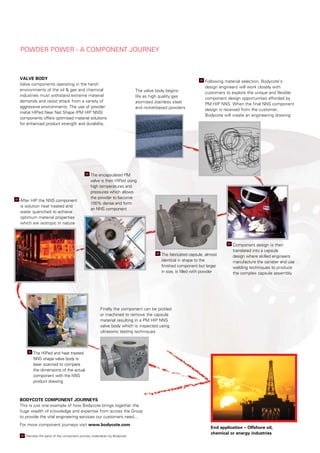
         valve	BoDy
                                                                                                           	   F
                                                                                                               	 ollowing	material	selection,	bodycote’s	
         valve	components	operating	in	the	harsh	
                                                                                                               design	engineers	will	work	closely	with	
         environments	of	the	oil	&	gas	and	chemical	                     the	valve	body	begins	                customers	to	explore	the	unique	and	flexible	
         industries	must	withstand	extreme	material	                     life	as	high	quality	gas	             component	design	opportunities	afforded	by	
         demands	and	resist	attack	from	a	variety	of	                    atomised	stainless	steel	             pM	Hip	nns.	when	the	final	nns	component	
         aggressive	environments.	the	use	of	powder	                     and	nickel-based	powders		            design	is	received	from	the	customer,	
         metal	Hiped	near	net	shape	(pM	Hip	nns)	
                                                                                                               bodycote	will	create	an	engineering	drawing		
         components	offers	optimised	material	solutions	
         for	enhanced	product	strength	and	durability.


                                             	   t
                                                 	 he	encapsulated	pM	
                                                 valve	is	then	Hiped	using	
                                                 high	temperatures	and	
                                                 pressures	which	allows	
                                                 the	powder	to	become	
    	    after	Hip	the	nns	component	
         	
                                                 100%	dense	and	form	
         is	solution	heat	treated	and	
                                                 an	nns	component
         water	quenched	to	achieve	
         optimum	material	properties	
         which	are	isotropic	in	nature


                                                                                                                            C
                                                                                                                            	 omponent	design	is	then	
                                                                                                                            translated	into	a	capsule	
                                                                                  	   t
                                                                                      	 he	fabricated	capsule,	almost	      design	where	skilled	engineers	
                                                                                      identical	in	shape	to	the	            manufacture	the	canister	and	use	
                                                                                      finished	component	but	larger	        welding	techniques	to	produce	
                                                                                      in	size,	is	filled	with	powder        the	complex	capsule	assembly	


                                                      Finally	the	component	can	be	pickled	
                                                      or	machined	to	remove	the	capsule	
                                                      material	resulting	in	a	pM	Hip	nns	
                                                      valve	body	which	is	inspected	using	
                                                      ultrasonic	testing	techniques


             	   the	Hiped	and	heat	treated	
                 	
                 nns	shape	valve	body	is	
                 laser	scanned	to	compare	
                 the	dimensions	of	the	actual	
                 component	with	the	nns	
                 product	drawing


         BoDyCote	Component	Journeys
         this	is	just	one	example	of	how	bodycote	brings	together	the	
         huge	wealth	of	knowledge	and	expertise	from	across	the	Group	
         to	provide	the	vital	engineering	services	our	customers	need...
         For	more	component	journeys	visit	www.bodycote.com
                                                                                                                 end	application	–	offshore	oil,	
	       16	 bodyCote	annual	report	2010				business	review	:	Corporate	GovernanCe	:	aCCounts
                                                                                                                 chemical	or	energy	industries
             d
             	 enotes	the	parts	of	the	component	journey	undertaken	by	bodycote
business	overview


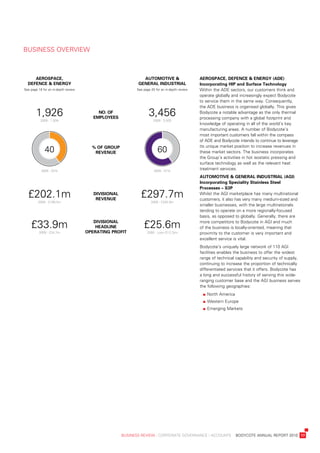
       aerospaCe,	                                              automotive	&	                     aerospaCe,	DefenCe	&	energy	(aDe)	
    DefenCe	&	energy                                          general	inDustrial                  incorporating	hip	and	surface	technology
see	page	18	for	an	in-depth	review                           see	page	20	for	an	in-depth	review   within	the	ade	sectors,	our	customers	think	and	
                                                                                                  operate	globally	and	increasingly	expect	bodycote	
                                                                                                  to	service	them	in	the	same	way.	Consequently,	
                                                                                                  the	ade	business	is	organised	globally.	this	gives	
       1,926	                             no.	of	
                                        employees
                                                                    3,456	                        bodycote	a	notable	advantage	as	the	only	thermal	
                                                                                                  processing	company	with	a	global	footprint	and	
          2009	:	1,934                                                 2009	:	3,505
                                                                                                  knowledge	of	operating	in	all	of	the	world’s	key	
                                                                                                  manufacturing	areas.	a	number	of	bodycote’s	
                                                                                                  most	important	customers	fall	within	the	compass	
                                                                                                  of	ade	and	bodycote	intends	to	continue	to	leverage	
                                                                                                  its	unique	market	position	to	increase	revenues	in	
             40                        %	of	group	
                                        revenue                           60                      these	market	sectors.	the	business	incorporates	
                                                                                                  the	Group’s	activities	in	hot	isostatic	pressing	and	
                                                                                                  surface	technology	as	well	as	the	relevant	heat	
           2009	:	43%                                                   2009	:	57%
                                                                                                  treatment	services.
                                                                                                  automotive	&	general	inDustrial	(agi)	
                                                                                                  incorporating	speciality	stainless	steel	
                                                                                                  processes	–	s3p
    £202.1m	                            Divisional	
                                         revenue
                                                               £297.7m	                           whilst	the	aGi	marketplace	has	many	multinational	
                                                                                                  customers,	it	also	has	very	many	medium-sized	and	
         2009	:	£189.5m                                               2009	:	£245.9m
                                                                                                  smaller	businesses,	with	the	large	multinationals	
                                                                                                  tending	to	operate	on	a	more	regionally-focused	
                                                                                                  basis,	as	opposed	to	globally.	Generally,	there	are	

     £33.9m	                            Divisional	
                                         heaDline	
                                     operating	profit
                                                                 £25.6m	                          more	competitors	to	bodycote	in	aGi	and	much	
                                                                                                  of	the	business	is	locally-oriented,	meaning	that	
         2009	:	£24.7m                                             2009	:	loss	£(12.3)m           proximity	to	the	customer	is	very	important	and	
                                                                                                  excellent	service	is	vital.	
                                                                                                  bodycote’s	uniquely	large	network	of	110	aGi	
                                                                                                  facilities	enables	the	business	to	offer	the	widest	
                                                                                                  range	of	technical	capability	and	security	of	supply,	
                                                                                                  continuing	to	increase	the	proportion	of	technically	
                                                                                                  differentiated	services	that	it	offers.	bodycote	has	
                                                                                                  a	long	and	successful	history	of	serving	this	wide-
                                                                                                  ranging	customer	base	and	the	aGi	business	serves	
                                                                                                  the	following	geographies:		
                                                                                                  	   		 orth	america
                                                                                                       n
                                                                                                  	   		 estern	europe
                                                                                                       w
                                                                                                  	   		 merging	Markets
                                                                                                       e


	                                                     business	review	:	Corporate	GovernanCe	:	aCCounts				bodyCote	annual	report	2010	 17
business	review	-	aerospaCe,	deFenCe	&	enerGy


                                                                             results
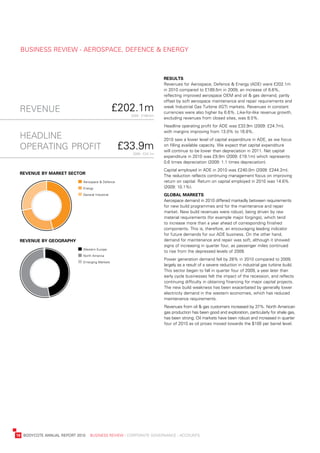
                                                                             revenues	for	aerospace,	defence	&	energy	(ade)	were	£202.1m	
                                                                             in	2010	compared	to	£189.5m	in	2009,	an	increase	of	6.6%,	
                                                                             reflecting	improved	aerospace	oeM	and	oil	&	gas	demand,	partly	
                                                                             offset	by	soft	aerospace	maintenance	and	repair	requirements	and	

     revenue                                            £202.1m              weak	industrial	Gas	turbine	(iGt)	markets.	revenues	in	constant	
                                                                             currencies	were	also	higher	by	6.6%.	like-for-like	revenue	growth,	
                                                           2009	:	£189.5m	
                                                                             excluding	revenues	from	closed	sites,	was	8.5%.
                                                                             Headline	operating	profit	for	ade	was	£33.9m	(2009:	£24.7m),	
                                                                             with	margins	improving	from	13.0%	to	16.8%.
     headline                                                                2010	saw	a	lower	level	of	capital	expenditure	in	ade,	as	we	focus	
     operating profit                                    £33.9m              on	filling	available	capacity.	we	expect	that	capital	expenditure	
                                                                             will	continue	to	be	lower	than	depreciation	in	2011.	net	capital	
                                                            2009	:	£24.7m
                                                                             expenditure	in	2010	was	£9.9m	(2009:	£19.1m)	which	represents	
                                                                             0.6	times	depreciation	(2009:	1.1	times	depreciation).
                                                                             Capital	employed	in	ade	in	2010	was	£240.0m	(2009:	£244.2m).		
     revenue	By	market	seCtor
                                                                             the	reduction	reflects	continuing	management	focus	on	improving	
                                  	aerospace	&	defence                       return	on	capital.	return	on	capital	employed	in	2010	was	14.6%	
                                  	energy                                    (2009:	10.1%).
                                  	General	industrial                        gloBal	markets	
                                                                             aerospace	demand	in	2010	differed	markedly	between	requirements	
                                                                             for	new	build	programmes	and	for	the	maintenance	and	repair	
                                                                             market.	new	build	revenues	were	robust,	being	driven	by	raw	
                                                                             material	requirements	(for	example	major	forgings),	which	tend	
                                                                             to	increase	more	than	a	year	ahead	of	corresponding	finished	
                                                                             components.	this	is,	therefore,	an	encouraging	leading	indicator	
                                                                             for	future	demands	for	our	ade	business.	on	the	other	hand,	
     revenue	By	geography                                                    demand	for	maintenance	and	repair	was	soft,	although	it	showed	
                                                                             signs	of	increasing	in	quarter	four,	as	passenger	miles	continued	
                                  	western	europe
                                                                             to	rise	from	the	depressed	levels	of	2009.
                                  	north	america
                                                                             power	generation	demand	fell	by	28%	in	2010	compared	to	2009,	
                                  	emerging	Markets
                                                                             largely	as	a	result	of	a	severe	reduction	in	industrial	gas	turbine	build.	
                                                                             this	sector	began	to	fall	in	quarter	four	of	2009,	a	year	later	than	
                                                                             early	cycle	businesses	felt	the	impact	of	the	recession,	and	reflects	
                                                                             continuing	difficulty	in	obtaining	financing	for	major	capital	projects.	
                                                                             the	new	build	weakness	has	been	exacerbated	by	generally	lower	
                                                                             electricity	demand	in	the	western	economies,	which	has	reduced	
                                                                             maintenance	requirements.
                                                                             revenues	from	oil	&	gas	customers	increased	by	37%.	north	american	
                                                                             gas	production	has	been	good	and	exploration,	particularly	for	shale	gas,	
                                                                             has	been	strong.	oil	markets	have	been	robust	and	increased	in	quarter	
                                                                             four	of	2010	as	oil	prices	moved	towards	the	$100	per	barrel	level.


	   18	 bodyCote	annual	report	2010				business	review	:	Corporate	GovernanCe	:	aCCounts
aChievements	in	2010
with	its	modest	restructuring	programme	completed	early,	the	ade	
business	has	been	able	to	focus	on	strengthening	its	management	
teams	and	developing	its	customer	offerings.	in	heat	treatment	we	
have	gained	additional	oeM	approvals	for	airframe	components,	
opening	additional	opportunities	for	new	build	aircraft	heat	treatment.	
in	Hip,	revenues	for	product	fabrication	(Hip	pF)	increased	by	70%	
and	work	included	the	largest	yet	single	piece	manifold	for	a	sub-sea	
oil	&	gas	application.
organisation	anD	people
as	part	of	developing	our	customer-facing	divisions,	a	number	
of	key	management	appointments	have	been	made.	in	ade,	
this	has	included	recruitment	of	managers	with	global	remits	for	
sales,	marketing	and	operations	for	both	heat	treatment	and	Hip.	
Measures	to	improve	productivity,	including	the	use	of	‘lean’	
techniques,	have	taken	over	from	the	2009	focus	on	restructuring.	
overall	headcount	remained	constant,	at	1,926,	and	despite	modest	
overall	revenue	growth	in	ade,	headline	operating	profit	improved	
from	£24.7m	to	£33.9m.
looking	aheaD
the	key	objective	for	ade	in	2011	is	to	build	on	the	foundation	
laid	in	2010	to	realise	growth	from	new	customers	and	processes,	
while	driving	further	productivity	and	operating	efficiency	improvements.	
the	clear	focus	on	customer	requirements	and	satisfaction	and	
proprietary	technology	has	produced	revenue	gains	in	2010	and	
we	expect	further	progress	in	2011.


	                                                     business	review	:	Corporate	GovernanCe	:	aCCounts				bodyCote	annual	report	2010	 19
business	review	-	autoMotive	&	General	industrial


                                                                                     results
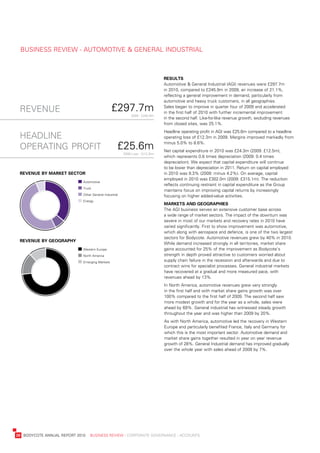
                                                                                     automotive	&	General	industrial	(aGi)	revenues	were	£297.7m	
                                                                                     in	2010,	compared	to	£245.9m	in	2009,	an	increase	of	21.1%,	
                                                                                     reflecting	a	general	improvement	in	demand,	particularly	from	
                                                                                     automotive	and	heavy	truck	customers,	in	all	geographies.	

     revenue                                          £297.7m                        sales	began	to	improve	in	quarter	four	of	2009	and	accelerated	
                                                                                     in	the	first	half	of	2010	with	further	incremental	improvement	
                                                                   2009	:	£245.9m	
                                                                                     in	the	second	half.	like-for-like	revenue	growth,	excluding	revenues	
                                                                                     from	closed	sites,	was	25.1%.
                                                                                     Headline	operating	profit	in	aGi	was	£25.6m	compared	to	a	headline	
     headline                                                                        operating	loss	of	£12.3m	in	2009.	Margins	improved	markedly	from	

     operating profit                                     £25.6m                     minus	5.0%	to	8.6%.
                                                                                     net	capital	expenditure	in	2010	was	£24.3m	(2009:	£12.5m),	
                                                              2009	loss	:	£(12.3)m
                                                                                     which	represents	0.8	times	depreciation	(2009:	0.4	times	
                                                                                     depreciation).	we	expect	that	capital	expenditure	will	continue	
                                                                                     to	be	lower	than	depreciation	in	2011.	return	on	capital	employed	
     revenue	By	market	seCtor                                                        in	2010	was	9.3%	(2009:	minus	4.2%).	on	average,	capital	
                                                                                     employed	in	2010	was	£302.0m	(2009:	£315.1m).	the	reduction	
                                  	automotive
                                                                                     reflects	continuing	restraint	in	capital	expenditure	as	the	Group	
                                  	truck
                                                                                     maintains	focus	on	improving	capital	returns	by	increasingly	
                                  	other	General	industrial                          focusing	on	higher	added-value	activities.
                                  	energy
                                                                                     markets	anD	geographies
                                                                                     the	aGi	business	serves	an	extensive	customer	base	across	
                                                                                     a	wide	range	of	market	sectors.	the	impact	of	the	downturn	was	
                                                                                     severe	in	most	of	our	markets	and	recovery	rates	in	2010	have	
                                                                                     varied	significantly.	First	to	show	improvement	was	automotive,	
                                                                                     which	along	with	aerospace	and	defence,	is	one	of	the	two	largest	
                                                                                     sectors	for	bodycote.	automotive	revenues	grew	by	40%	in	2010.	
     revenue	By	geography
                                                                                     while	demand	increased	strongly	in	all	territories,	market	share	
                                  	western	europe                                    gains	accounted	for	25%	of	the	improvement	as	bodycote’s	
                                  	north	america                                     strength	in	depth	proved	attractive	to	customers	worried	about	
                                  	emerging	Markets                                  supply	chain	failure	in	the	recession	and	afterwards	and	due	to	
                                                                                     contract	wins	for	specialist	processes.	General	industrial	markets	
                                                                                     have	recovered	at	a	gradual	and	more	measured	pace,	with	
                                                                                     revenues	ahead	by	13%.
                                                                                     in	north	america,	automotive	revenues	grew	very	strongly	
                                                                                     in	the	first	half	and	with	market	share	gains	growth	was	over	
                                                                                     100%	compared	to	the	first	half	of	2009.	the	second	half	saw	
                                                                                     more	modest	growth	and	for	the	year	as	a	whole,	sales	were	
                                                                                     ahead	by	69%.	General	industrial	has	witnessed	steady	growth	
                                                                                     throughout	the	year	and	was	higher	than	2009	by	20%.
                                                                                     as	with	north	america,	automotive	led	the	recovery	in	western	
                                                                                     europe	and	particularly	benefited	France,	italy	and	Germany	for	
                                                                                     which	this	is	the	most	important	sector.	automotive	demand	and	
                                                                                     market	share	gains	together	resulted	in	year	on	year	revenue	
                                                                                     growth	of	28%.	General	industrial	demand	has	improved	gradually	
                                                                                     over	the	whole	year	with	sales	ahead	of	2009	by	7%.


	   20	 bodyCote	annual	report	2010				business	review	:	Corporate	GovernanCe	:	aCCounts
the	improvement	in	the	nordic	countries	came	later	in	the	year,	
being	driven	particularly	by	the	return	of	heavy	truck	work,	notably	in	
sweden.	overall	sales	in	the	nordic	region	were	up	29%	compared	
to	2009,	with	revenues	in	western	europe	overall	being	up	13%.
the	Group’s	business	in	emerging	markets	generally	fared	very	
well	in	2010.	revenues	grew	25%	in	eastern	europe,	with	poland	
in	the	lead,	and	by	58%	in	China.	the	brazilian	business	has	been	
the	subject	of	major	restructuring	which	has	included	reducing	the	
workforce	by	32%.	the	largest	facility	was	closed,	a	new	greenfield	
location	was	established,	benefiting	from	the	Group’s	european	
know-how,	and	capacity	was	expanded.	even	during	the	disruption,	
sales	in	brazil	increased	by	7%	year	on	year.	the	business	has	a	
much	reduced	cost	base	and	improved	capability	and	has	the	right	
platform	to	benefit	from	short	and	medium	term	growth	that	we	
expect	in	latin	america.
aChievements	in	2010
the	major	restructuring	effort	in	the	aGi	business	is	all	but	complete,	
and	was	aimed	at	reducing	the	cost	base	and	exiting	low	value	
added	activities.	this	significant	management	challenge	has	been	
met	in	all	parts	of	the	business	and	the	benefits	are	clearly	evident	
in	the	2010	financial	performance.	there	has	also	been	a	high	
level	of	attention	to	maintaining	the	benefits	of	the	restructuring.	
during	2010	we	have	increased	capacity	in	several	differentiated	
technologies	in	both	the	united	states	and	europe.	Greenfield	
sites	have	been	opened	in	the	Czech	republic,	poland	and	brazil.	
speciality	stainless	steel	processing	capacity	has	been	added	in	
europe	and	the	first	production	facility	for	sheraCote®	has	been	
commissioned	in	the	uK.	new	outsourcing	contracts	have	been	
won	in	all	geographies.
organisation	anD	people
in	july	2008,	the	aGi	business	employed	5,201	people.	by	the	end	
of	2009	this	had	been	reduced	to	3,505.	notwithstanding	revenues	
in	aGi	increasing	by	21%,	headcount	has	declined	from	3,505	to	
3,456	in	2010,	clearly	demonstrating	success	in	keeping	costs	
under	control	and	driving	productivity	improvements.		
looking	aheaD
the	business	is	set	to	build	on	the	notable	improvements	in	
performance	delivered	in	2010.	this	will	be	founded	on	continued	
cost	control,	capital	expenditure	targeted	at	the	Group’s	various	
proprietary	technologies	and	the	development	of	emerging	
markets,	along	with	close	attention	to	meeting	and	exceeding	
all	customers’	expectations.	


	                                                     business	review	:	Corporate	GovernanCe	:	aCCounts				bodyCote	annual	report	2010	 21
FinanCe	direCtor’s	report


                                                                       finanCial	overview
                                                                                                                            	    2010 	    2009
                                                                                                                            	     £m 	      £m

                                                                       revenue                                                  499.8	    435.4

                                                                       Headline	operating	profit                                 52.1	       8.0
                                                                       amortisation	of	acquired	intangible	fixed	assets          (0.9)      (1.3)
                                                                       impairment	charge                                           .–     (31.5)
                                                                       Major	facility	closure	costs                                .–     (25.4)

                                                                       operating	profit/(loss)                                   51.2	    (50.2)
                                                                       net	finance	charge                                        (6.0)     (4.3)

                                                                       profit/(loss)	before	taxation                             45.2	    (54.5)
                                                                       taxation                                                 (11.7)      3.4

                                                                       profit/(loss)	for	the	year	–	continuing	operations        33.5     (51.1)
                                                                       loss	for	the	year	–	discontinued	operations               (5.8)       .–

                                                                       profit/(loss)	for	the	year                                27.7     (51.1)

                                                                       Group	revenues	for	2010	increased	by	14.8%	from	£435.4m	to	
                                                                       £499.8m.	in	constant	currencies	the	annual	increase	was	14.9%	
                                                                       (£64.7m).	the	improvement	in	the	second	half	was	somewhat	
                                                                       better	than	in	the	first,	with	revenues,	all	of	which	were	generated	
                                                                       organically,	increasing	by	22.2%	from	£207.5m	in	2009	to	£253.5m.	
                                                                       Headline	operating	profit	for	the	year	increased	from	£8.0m	to	
                                                                       £52.1m,	and	headline	operating	margin	was	10.4%	(2009:	1.8%).	
                                               DaviD	lanDless          operating	profit	was	£51.2m	(2009:	loss	£50.2m)	after	charging	
                                                 Finance	director      £0.9m	(2009:	£1.3m)	in	respect	of	the	amortisation	of	acquired	
                                                                       intangibles,	£nil	(2009:	£31.5m)	for	impairment,	and	£nil	(2009:	£25.4m)	
                                                                       for	major	facility	closure	costs.
                                                                       Headline	operating	cash	flow	for	the	Group	was	£77.3m	(2009:	
                                                                       £34.7m).	this	was	148.4%	(2009:	433.8%)	of	headline	operating	
                                                                       profit,	reflecting	tight	control	of	working	capital,	especially	payables,	
                                                                       which	more	than	offset	higher	inventory	and	receivables,	which	
                                                                       increased	as	a	result	of	the	recovery	in	activity	levels.	net	capital	
                                                                       expenditure	in	2010	at	£35.8m	(2009:	£32.2m)	continued	below	
                                                                       the	level	of	depreciation,	reflecting	continued	careful	management	
                                                                       and	a	focus	on	utilising	existing	equipment.
                                                                       after	deducting	interest	and	tax,	the	Group	reported	a	positive	
                                                                       free	cash	flow	of	£57.2m	(2009:	negative	£14.8m).
                                                                       during	2010,	bodycote	secured	its	funding	position	with	two	
                                                                       of	the	Group’s	three	bank	facilities,	both	of	which	were	due	to	
                                                                       mature	during	2010,	being	refinanced.	total	funding	now	available	
                                                                       to	bodycote	under	its	committed	facilities	is	£230.9m	(2009:	£348.4m),	
                                                                       expiring	between	March	and	july	2013.
                                                                       eXCeptional	Costs
                                                                       the	total	exceptional	costs	charged	to	the	income	statement	
                                                                       amounted	to	£0.9m	(2009:	£58.2m).
                                                                       the	current	year	charge	relates	wholly	to	the	amortisation	of	intangible	
                                                                       assets	arising	from	prior	years’	acquisitions.	there	were	no	acquisitions	
                                                                       during	the	year.	the	level	of	the	charge	reduced	compared	to	the	prior	
                                                                       year	(2009:	£1.3m)	as	certain	assets	were	fully	amortised	in	2009.
                                                                       with	improved	market	conditions	and	the	benefit	of	the	wide	ranging	
                                                                       restructuring	programme	charged	in	2008	and	2009,	the	board	has	
                                                                       concluded	that	no	impairment	charge	is	required	in	2010	(2009:	
                                                                       goodwill	impairment	of	£29.0m	and	investment	impairment	of	£2.5m).


	   22	 bodyCote	annual	report	2010				business	review	:	Corporate	GovernanCe	:	aCCounts
there	were	no	major	facility	closure	costs	during	2010	(2009:	£25.4m).	     taXation	
restructuring	actions	are	now	complete	in	most	parts	of	the	Group;	         the	tax	charge	was	£11.7m	for	the	year	compared	to	a	credit	
the	only	exceptions	being	the	finalisation	of	work	in	France,	brazil	and	   of	£3.4m	for	2009.	the	effective	tax	rate	on	continuing	operations	
italy,	which	will	continue	into	early	2011.	net	cash	expenditure	as	a	      of	25.9%	(2009:	6.2%)	resulted	from	the	blending	of	differing	
result	of	the	programme	was	£9.2m	(2009:	£19.2m),	including	£3.2m	          tax	rates	in	each	of	the	countries	in	which	the	Group	operates.	
proceeds	from	the	disposal	of	redundant	assets.	the	restructuring	          the	low	effective	tax	rate	for	2009	resulted	from	the	blending	
initiatives	delivered	annualised	cumulative	savings	of	£45.0m	in	2010.	     of	profit	making	jurisdictions	with	loss	making	jurisdictions	in	
as	the	restructuring	programme	is	now	essentially	complete	further	         that	particular	year	as	a	result	of	the	economic	downturn.
savings	will	be	modest.	
                                                                            the	headline	tax	rate	on	continuing	operations	for	2010	was	25.4%	
restructuring	provisions	outstanding	at	31	december	2010	total	             (2009:	108.1%),	being	stated	before	amortisation	of	acquired	
£20.2m,	being	£19.9m	related	to	the	2008/2009	programme	and	                intangibles	(which	are	generally	not	allowable	for	tax	purposes).	
£0.3m	related	to	environmental	remediation	from	earlier	initiatives.	       in	addition,	£5.8m	(2009:	£nil)	was	charged	in	respect	of	the	2008	
of	the	remaining	£20.2m	cash	costs,	£12.5m	is	expected	to	be	               disposal	of	the	testing	division	(see	discontinued	operations	below).
spent	in	2011	and	£7.7m	in	2012	and	later.	all	expenditure	after	
                                                                            subject	to	any	future	tax	legislation	changes,	the	headline	tax	rate	
the	end	of	2011	will	relate	to	environmental	remediation.
                                                                            is	expected	to	remain	below	the	current	uK	statutory	tax	rate	of	
operating	profit	from	Continuing	operations                                 28%	in	the	medium	term.
after	charging	exceptional	items	of	£0.9m	(2009:	£58.2m),	
                                                                            DisContinueD	operations
the	operating	profit	from	continuing	operations	was	£51.2m	
                                                                            bodycote	has	not	discontinued	any	business	streams	during	2010.	
(2009:	loss	of	£50.2m).	
                                                                            in	2008,	the	Group	sold	its	testing	division	and	during	2010	
profit	Before	taX	from	Continuing	operations                                provisions	relating	to	taxation	expected	to	arise	from	this	disposal	
Headline	profit	before	tax	for	continuing	operations	was	£46.1m	            were	reassessed.	the	impact	on	the	Group	accounts	of	these	
(2009:	£3.7m).	the	profit	before	tax	for	continuing	operations	was	         additional	provisions	is	a	charge	of	£5.8m	(2009:	nil).	in	the	2008	
£45.2m	(2009:	loss	of	£54.5m),	and	these	amounts	are	reconciled	            Group	accounts,	the	effective	rate	of	tax	on	the	profit	on	disposal	
as	follows:	                                                                was	stated	as	11.0%.	the	revised	effective	rate	of	tax	for	the	
                                                                            disposal,	taking	account	of	the	additional	tax	provision,	is	13.9%.	
                                                   	   2010 	      2009
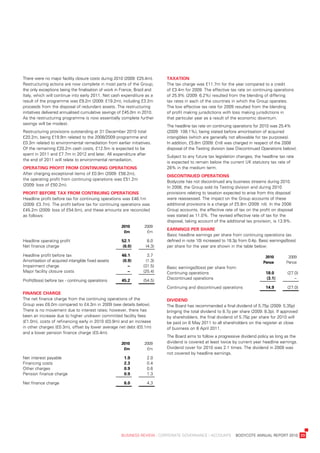
                                                                            earnings	per	share	
                                                   	    £m 	        £m
                                                                            basic	headline	earnings	per	share	from	continuing	operations	(as	
Headline	operating	profit                              52.1         8.0     defined	in	note	10)	increased	to	18.3p	from	0.4p.	basic	earnings/(loss)	
net	finance	charge                                     (6.0)       (4.3)    per	share	for	the	year	are	shown	in	the	table	below:

Headline	profit	before	tax                             46.1          3.7                                                   	      2010 	       2009
amortisation	of	acquired	intangible	fixed	assets       (0.9)        (1.3)                                                  	     pence 	      pence
impairment	charge                                        .–       (31.5)    basic	earnings/(loss)	per	share	from:
Major	facility	closure	costs                             .–       (25.4)    Continuing	operations                                 18.0        (27.0)
                                                                            discontinued	operations                               (3.1)          .–
profit/(loss)	before	tax	-	continuing	operations       45.2       (54.5)
                                                                            Continuing	and	discontinued	operations                14.9        (27.0)
finanCe	Charge	
the	net	finance	charge	from	the	continuing	operations	of	the	               DiviDenD	
Group	was	£6.0m	compared	to	£4.3m	in	2009	(see	details	below).	             the	board	has	recommended	a	final	dividend	of	5.75p	(2009:	5.35p)	
there	is	no	movement	due	to	interest	rates;	however,	there	has	             bringing	the	total	dividend	to	8.7p	per	share	(2009:	8.3p).	if	approved	
been	an	increase	due	to	higher	undrawn	committed	facility	fees	             by	shareholders,	the	final	dividend	of	5.75p	per	share	for	2010	will	
(£1.0m),	costs	of	refinancing	early	in	2010	(£0.9m)	and	an	increase	        be	paid	on	6	May	2011	to	all	shareholders	on	the	register	at	close	
in	other	charges	(£0.3m),	offset	by	lower	average	net	debt	(£0.1m)	         of	business	on	8	april	2011.
and	a	lower	pension	finance	charge	(£0.4m).
                                                                            the	board	aims	to	follow	a	progressive	dividend	policy	as	long	as	the	
                                                   	   2010 	      2009     dividend	is	covered	at	least	twice	by	current	year	headline	earnings.	
                                                   	    £m 	        £m      dividend	cover	for	2010	was	2.1	times.	the	dividend	in	2009	was	
                                                                            not	covered	by	headline	earnings.	
net	interest	payable                                    1.9         2.0
Financing	costs                                         2.3         0.4
other	charges                                           0.9         0.6
pension	finance	charge                                  0.9         1.3

net	finance	charge                                      6.0         4.3


	                                                      business	review	:	Corporate	GovernanCe	:	aCCounts				bodyCote	annual	report	2010	 23
FinanCe	direCtor’s	report
     Continued


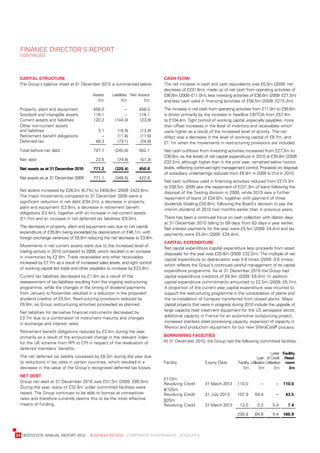
     Capital	struCture	                                                             Cash	flow
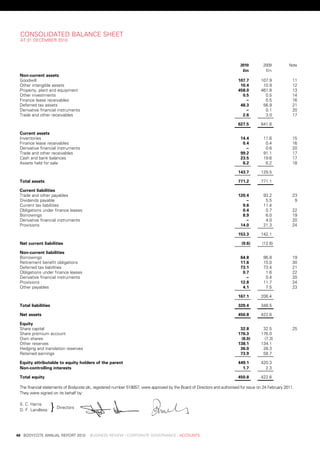
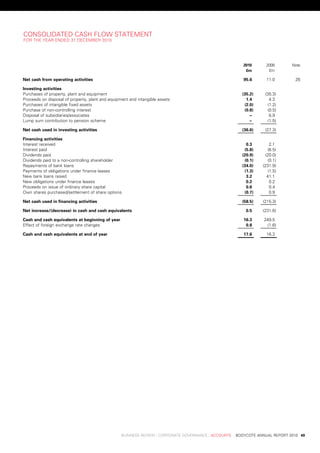
     the	Group’s	balance	sheet	at	31	december	2010	is	summarised	below:             the	net	increase	in	cash	and	cash	equivalents	was	£0.5m	(2009:	net	
                                                                                    decrease	of	£231.6m),	made	up	of	net	cash	from	operating	activities	of	
                                         	    assets 	   liabilities 	net	assets    £95.6m	(2009:	£11.0m),	less	investing	activities	of	£36.6m	(2009:	£27.3m)	
                                         	       £m 	           £m 	         £m     and	less	cash	used	in	financing	activities	of	£58.5m	(2009:	£215.3m).
     property,	plant	and	equipment             458.0           .–        458.0      the	increase	in	net	cash	from	operating	activities	from	£11.0m	to	£95.6m	
     Goodwill	and	intangible	assets            118.1           .–        118.1      is	driven	primarily	by	the	increase	in	headline	ebitda	from	£57.4m	
     Current	assets	and	liabilities            120.2       (144.0)        (23.8)    to	£104.4m.	tight	control	of	working	capital,	especially	payables,	more	
     other	non-current	assets	                                                      than	offset	increases	in	the	level	of	inventory	and	receivables	which	
     and	liabilities                             3.1        (16.9)        (13.8)    were	higher	as	a	result	of	the	increased	level	of	activity.	the	net	
     retirement	benefit	obligations               .–        (11.6)        (11.6)    effect	was	a	decrease	in	the	level	of	working	capital	of	£8.7m,	and	
     deferred	tax                               48.3        (73.1)        (24.8)    £1.1m	when	the	movements	in	restructuring	provisions	are	included.
     total	before	net	debt                     747.7       (245.6)       502.1      net	cash	outflows	from	investing	activities	increased	from	£27.3m	to	
                                                                                    £36.6m,	as	the	levels	of	net	capital	expenditure	in	2010	at	£35.8m	(2009:	
     net	debt                                   23.5        (74.8)        (51.3)
                                                                                    £32.2m),	although	higher	than	in	the	prior	year,	remained	below	historic	
     net	assets	as	at	31	December	2010         771.2       (320.4)       450.8      levels,	reflecting	continued	tight	management	control.	proceeds	on	disposal	
                                                                                    of	subsidiary	undertakings	reduced	from	£6.9m	in	2009	to	£nil	in	2010.
     net	assets	as	at	31	december	2009         771.1       (348.5)       422.6
                                                                                    net	cash	outflows	used	in	financing	activities	reduced	from	£215.3m	
                                                                                    to	£58.5m.	2009	saw	the	repayment	of	£231.9m	of	loans	following	the	
     net	assets	increased	by	£28.2m	(6.7%)	to	£450.8m	(2009:	£422.6m).	             disposal	of	the	testing	division	in	2008,	while	2010	saw	a	further	
     the	major	movements	compared	to	31	december	2009	were	a	                       repayment	of	loans	of	£34.0m,	together	with	payment	of	three	
     significant	reduction	in	net	debt	(£34.2m),	a	decrease	in	property,	           dividends	(totaling	£20.9m),	following	the	board’s	decision	to	pay	the	
     plant	and	equipment	(£3.8m),	a	decrease	in	retirement	benefit	                 interim	dividend	of	2010	two	months	earlier	than	in	previous	years.
     obligations	(£3.4m),	together	with	an	increase	in	net	current	assets	
     (£1.7m)	and	an	increase	in	net	deferred	tax	liabilities	(£8.3m).               there	has	been	a	continued	focus	on	cash	collection	with	debtor	days	
                                                                                    at	31	december	2010	falling	to	59	days	from	63	days	a	year	earlier.	
     the	decrease	in	property,	plant	and	equipment	was	due	to	net	capital	          net	interest	payments	for	the	year	were	£5.5m	(2009:	£4.4m)	and	tax	
     expenditure	of	£35.8m	being	exceeded	by	depreciation	of	£46.1m,	with	          payments	were	£5.4m	(2009:	£24.4m).
     foreign	exchange	variances	of	£8.0m	reducing	the	net	decrease	to	£3.8m.
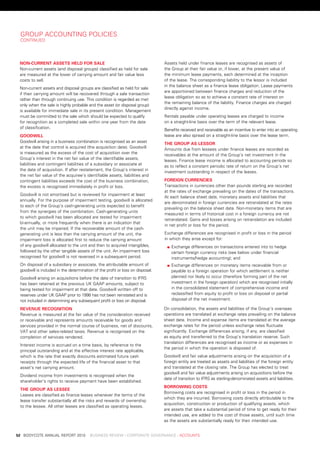
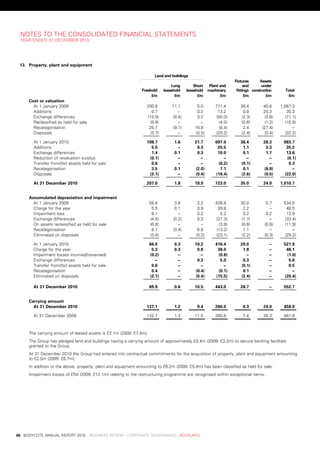
                                                                                    Capital	eXpenDiture	
     Movements	in	net	current	assets	were	due	to	the	increased	level	of	
                                                                                    net	capital	expenditure	(capital	expenditure	less	proceeds	from	asset	
     trading	activity	in	2010	compared	to	2009,	which	resulted	in	an	increase	
                                                                                    disposals)	for	the	year	was	£35.8m	(2009:	£32.2m).	the	multiple	of	net	
     in	inventories	by	£2.8m.	trade	receivables	and	other	receivables	
                                                                                    capital	expenditure	to	depreciation	was	0.8	times	(2009:	0.6	times),	
     increased	by	£7.7m	as	a	result	of	increased	sales	levels,	and	tight	control	
                                                                                    which	reflects	the	Group’s	continued	careful	management	of	its	capital	
     of	working	capital	led	trade	and	other	payables	to	increase	by	£23.8m.	
                                                                                    expenditure	programme.	as	at	31	december	2010	the	Group	had	
     Current	tax	liabilities	decreased	by	£1.8m	as	a	result	of	the	                 capital	expenditure	creditors	of	£6.9m	(2009:	£8.3m).	in	addition	
     reassessment	of	tax	liabilities	resulting	from	the	ongoing	restructuring	      capital	expenditure	commitments	amounted	to	£2.5m	(2009:	£6.7m).	
     programme,	while	the	changes	in	the	timing	of	dividend	payments	               a	proportion	of	the	current	year	capital	expenditure	was	incurred	to	
     from	january	to	november	resulted	in	a	reduction	in	the	proposed	              support	the	restructuring	programme	in	the	consolidation	of	plants	and	
     dividend	creditor	of	£5.5m.	restructuring	provisions	reduced	by	               the	re-installation	of	furnaces	transferred	from	closed	plants.	Major	
     £6.9m,	as	Group	restructuring	activities	proceeded	as	planned.                 capital	projects	that	were	in	progress	during	2010	include	the	upgrade	of	
                                                                                    large	capacity	heat	treatment	equipment	for	the	us	aerospace	sector,	
     net	liabilities	for	derivative	financial	instruments	decreased	by	
                                                                                    additional	capacity	in	France	for	an	automotive	outsourcing	project,	
     £3.7m	due	to	a	combination	of	instrument	maturity	and	changes	
                                                                                    increased	stainless	steel	processing	capacity,	expansion	of	capacity	in	
     in	exchange	and	interest	rates.
                                                                                    Mexico	and	production	equipment	for	our	new	sheraCote®	process.
     retirement	benefit	obligations	reduced	by	£3.4m	during	the	year,	
     primarily	as	a	result	of	the	announced	change	in	the	relevant	index	           Borrowing	faCilities	
     for	the	uK	scheme	from	rpi	to	Cpi	in	respect	of	the	revaluation	of	            at	31	december	2010,	the	Group	had	the	following	committed	facilities:
     deferred	members’	benefits.
                                                                                                                                                    	 letter	 	facility	
     the	net	deferred	tax	liability	increased	by	£8.3m	during	the	year	due	                                                            	 loan	 	of	Credit	 	 head-	
     to	reductions	in	tax	rates	in	certain	countries,	which	resulted	in	a	          Facility               expiry	date      	 Facility 	 tilisation 	 tilisation 	 room
                                                                                                                                       u            u
     decrease	in	the	value	of	the	Group’s	recognised	deferred	tax	losses.	                                                  	    £m 	          £m 	         £m 	     £m

     net	DeBt
                                                                                    £110m	
     Group	net	debt	at	31	december	2010	was	£51.3m	(2009:	£85.5m).	
                                                                                    revolving	Credit       31	March	2013     110.0           .–         .–    110.0
     during	the	year,	loans	of	£32.6m	under	committed	facilities	were	
                                                                                    €125m
     repaid.	the	Group	continues	to	be	able	to	borrow	at	competitive	               revolving	Credit       31	july	2013      107.9        64.4          .–      43.5
     rates	and	therefore	currently	deems	this	to	be	the	most	effective	             $20m	
     means	of	funding.                                                              revolving	Credit       31	March	2013       13.0        0.2         5.4        7.4

                                                                                                                             230.9        64.6         5.4    160.9


	   24	 bodyCote	annual	report	2010				business	review	:	Corporate	GovernanCe	:	aCCounts
Capital	management	                                                         the	Group	sponsors	three	defined	benefit	pension	arrangements	
the	Group	manages	its	capital	to	ensure	that	entities	in	the	Group	         in	the	usa	that	were	inherited	with	the	acquisition	of	lindberg	and	
will	be	able	to	continue	as	going	concerns,	while	maximising	the	           these	had	a	total	ias	19	deficit	at	31	december	2010	of	£0.5m	
return	to	shareholders.	the	capital	structure	of	the	Group	consists	        (2009:	£0.6m).	there	is	no	future	accrual	of	benefits.	in	brazil,	
of	debt,	which	includes	borrowings,	cash	and	cash	equivalents	and	          bodycote	operates	a	defined	benefit	plan	for	a	senior	member	
equity	attributable	to	equity	holders	of	the	parent,	comprising	capital,	   of	staff.	it	is	funded	and	the	member	continues	to	accrue	benefits.	
reserves	and	retained	earnings.	                                            at	31	december	2010	it	had	a	deficit	of	£0.1m	(2009:	£0.2m	deficit).
the	capital	structure	is	reviewed	regularly	by	the	board	of	directors.	     post	BalanCe	sheet	events
the	Group’s	policy	is	to	maintain	gearing,	determined	as	the	               there	are	no	post	balance	sheet	events	following	the	2010	year	end.
proportion	of	net	debt	to	total	capital,	within	defined	parameters,	
                                                                            Change	in	aCCounting	poliCies
allowing	movement	in	the	capital	structure	appropriate	to	the	
                                                                            the	changes	in	accounting	policies	are	detailed	in	the	accounting	
business	cycle	and	corporate	activity.	the	gearing	ratio	at	31	
                                                                            policies	on	page	51	of	this	report.	the	adoption	of	new	accounting	
december	2010	has	fallen	to	11%	(2009:	20%)	as	a	result	of	
                                                                            policies	has	not	had	any	material	impact	on	the	amounts	reported	
both	reduced	net	debt	and	increased	profit	in	the	period.
                                                                            in	these	financial	statements.
the	Group’s	debt	funding	policy	is	to	borrow	centrally	(where	it	is	
                                                                            going	ConCern	
tax	efficient	to	do	so),	using	a	mixture	of	short-term	borrowings,	
                                                                            the	Group’s	business	activities,	together	with	the	factors	likely	
longer-term	loans	and	finance	leases.	these	borrowings,	together	
                                                                            to	affect	its	future	development,	performance	and	position	are	
with	cash	generated	from	operations,	are	lent	or	contributed	as	
                                                                            set	out	in	this	Group	review.	the	review	includes	an	overview	
equity	to	subsidiaries	as	required.	the	aim	of	the	Group’s	funding	
                                                                            of	the	Group’s	financial	position,	its	cash	flows,	liquidity	position	
policy	is	to	ensure	continuity	of	finance	at	reasonable	cost,	based	
                                                                            and	borrowing	facilities.	in	addition,	there	is	a	description	of	the	
on	committed	facilities	from	several	sources,	arranged	with	a	spread	
                                                                            Group’s	objectives,	policies	and	processes	for	managing	its	capital;	
of	maturities.	the	recent	market	for	bank	funding	has	been	restricted	
                                                                            its	financial	risk	management	objectives;	details	of	its	financial	
to	shorter	tenures	than	have	been	available	in	the	past	and,	therefore,	
                                                                            instruments	and	hedging	activities;	and	its	exposures	to	credit	
it	is	intended	in	due	course	to	extend	the	maturity	profile	of	the	
                                                                            and	liquidity	risk.
Group’s	funding	(currently	2.4	years).
                                                                            the	Group	meets	its	working	capital	requirements	through	a	
DefineD	Benefit	pension	arrangements
                                                                            combination	of	committed	and	uncommitted	facilities	and	overdrafts.	
the	Group	has	defined	benefit	pension	obligations	in	the	uK,	
                                                                            the	overdrafts	and	uncommitted	facilities	are	repayable	on	demand	
Germany,	switzerland,	liechtenstein,	usa	and	brazil	and	cash	lump	
                                                                            but	the	committed	facilities	are	due	for	renewal	as	shown	below.	
sum	obligations	in	France,	italy	and	turkey,	the	entire	liabilities	
                                                                            there	is	sufficient	headroom	in	the	committed	facility	covenants	
for	which	are	reflected	in	the	Group	balance	sheet.	in	the	uK,	
                                                                            to	assume	that	these	facilities	can	be	operated	as	contracted	for	
the	Group	has	a	final	salary	scheme	that	was	closed	to	new	
                                                                            the	foreseeable	future.
members	in	november	2000,	but	continues	to	accrue	benefits	
for	the	123	current	employee	members.	the	deficit,	as	calculated	           	   	us$20m	revolving	Credit	Facility	maturing	31	March	2013
by	the	scheme	actuary	at	31	december	2010	using	the	principles	             	   	£110m	revolving	Credit	Facility	maturing	31	March	2013
of	ias	19	is	£0.6m	(2009:	£3.7m).	the	uK	scheme	deficit	decreased	
                                                                            	   	€125m	revolving	Credit	Facility	maturing	31	july	2013
by	£3.1m	during	the	year,	primarily	as	a	result	of	the	announced	
change	in	the	relevant	index	for	the	uK	scheme	from	rpi	to	Cpi	             the	Group’s	forecasts	and	projections,	taking	account	of	reasonable	
in	respect	of	the	revaluation	of	deferred	members’	benefits.                potential	changes	in	trading	performance,	show	that	the	Group	should	
the	Group’s	heat	treatment	business	in	Germany	has	inherited	               be	able	to	operate	within	the	level	of	its	current	committed	facilities.	
several	small	defined	benefit	arrangements	as	a	result	of	prior	            the	directors	have	reviewed	forecasts	and	projections	for	the	
years’	acquisitions.	they	are	all	unfunded	and	are	closed	to	new	           Group’s	markets	and	services,	assessing	the	committed	facility	and	
members	but	the	existing	members	continue	to	accrue	benefits.	              financial	covenant	headroom,	central	liquidity,	and	the	company’s	
the	ias	19	liability	at	31	december	2010	was	£3.6m	(2009:	£3.5m).	          ability	to	access	further	funding.	the	directors	also	reviewed	
in	liechtenstein	the	ias	19	liability	at	31	december	2010	was	              downside	sensitivity	analysis	over	the	forecast	period.	Following	
£0.4m	(2009:	£0.2m)	and	in	switzerland	was	£0.3m	(2009:	£0.1m).	            this	review,	the	directors	have	formed	a	judgement,	at	the	time	
arrangements	in	both	countries	are	funded.                                  of	approving	the	financial	statements,	that	there	is	a	reasonable	
in	France,	the	Group	operates	a	plan	which	pays	a	cash	lump	sum	            expectation	that	the	Group	has	adequate	resources	to	continue	
on	retirement	and	also	for	long	service.	the	plan	is	open	to	new	           in	operational	existence	for	the	foreseeable	future.	For	this	reason	
employees	but	by	its	nature	is	not	mortality	dependent.	it	is	unfunded	     the	directors	continue	to	adopt	the	going	concern	basis	in	preparing	
and	the	ias	19	liability	at	31	december	2010	was	£5.2m	(2009:	£5.7m).	      the	financial	statements.
italy	and	turkey	also	have	unfunded	cash	lump	sum	obligations,	
which	by	statute	are	open	to	new	members.	the	ias	19	liability	is	
£0.7m	for	italy	(2009:	£0.8m)	and	£0.2m	for	turkey	(2009:	£0.2m).


                                                                            D.	f.	landless
                                                                            Finance	director	
                                                                            24	February	2011


	                                                     business	review	:	Corporate	GovernanCe	:	aCCounts				bodyCote	annual	report	2010	 25
prinCipal	risKs	and	unCertainties


     effective	management	of	risks	is	essential	to	the	delivery	of	the	             environment
     Group’s	objectives.	the	Group’s	approach	has	been	for	divisional	              bodycote	is	committed	to	providing	the	highest	level	of	protection	
     management	to	report	their	significant	risks	to	the	Group,	explaining	         to	the	environment.	Historical	use	of	solvents	and	other	hazardous	
     the	nature	and	the	effectiveness	of	the	mitigation	that	is	in	place	           chemicals	could	have	led	to	ground	contamination.	the	environmental	
     to	manage	each	risk.	the	recent	appointment	of	a	vice-president	               laws	of	the	various	jurisdictions	impose	actual	and	potential	obligations	
     (risk	and	business	processes)	will	ensure	continuing	improvements	             on	bodycote	to	remediate	contaminated	sites,	both	those	currently	
     in	the	Group’s	risk	management	framework.	                                     operated	and,	in	some	cases,	those	which	have	been	sold.	bodycote	
                                                                                    incurs	costs	annually	in	meeting	its	obligations	and	maintains	a	provision	
     the	principal	risks	shown	below	represent	the	most	significant	areas	
                                                                                    of	£16.8m	to	meet	liabilities.	if	this	existing	provision	is	inadequate	
     which	the	board	believes	could	most	likely	impact	the	Group’s	financial	
                                                                                    to	meet	costs	arising	from	environmental	obligations,	then	this	could	
     performance	and	position,	together	with	the	actions	initiated	to	mitigate	
                                                                                    impact	the	Group’s	results.	some	of	the	Group’s	heat	treatment	plants	
     the	consequences.
                                                                                    continue	to	use	solvents	and	other	hazardous	chemicals	in	small	quantities	
     market	and	Customer	risks                                                      but	the	risk	of	future	contamination	is	managed	by	stringent	procedures,	
     Markets                                                                        typically	under	the	requirements	of	the	iso	14001	environmental	system.
     bodycote’s	presence	in	26	countries	and	in	a	wide	variety	of	end	
                                                                                    operational	risks
     markets	acts	as	a	natural	hedge	to	balance	out	localised	economic	
                                                                                    service	quality
     volatility.	nevertheless,	the	Group	is	continuously	working	to	improve	
                                                                                    work	that	is	released	into	use	which	is	not	in	compliance	with	
     its	responsiveness	to	changes	in	demand	and	uses	analytical	tools	to	
                                                                                    specification	could	arise	as	a	result	of	system	or	human	failure.	
     assess	the	flexibility	of	its	cost	base.	Close	contact	with	customers	
                                                                                    bodycote	has	stringent	quality	systems	in	place	and	where	necessary	
     provides	management	with	market	intelligence	that	allows	timely	action	
                                                                                    its	plants	have	relevant	accreditations,	such	as	iso	9000,	nadcap	and	
     to	minimise	the	impact	of	a	downturn.	this	was	demonstrated	in	the	
                                                                                    ts	16949.	all	facilities	are	subject	to	internal	audits,	external	audits	
     last	downturn,	which	began	at	the	end	of	2008,	when	the	Group	reacted	
                                                                                    by	accreditors	or	customer	inspections	at	least	once	a	year.
     quickly	to	changes	in	demand	and	reduced	its	cost	base	by	£45m	in	
     the	face	of	a	21%	fall	in	sales.                                               energy
                                                                                    an	energy	risk	management	committee	oversees	the	purchasing	
     Loss of key customers
                                                                                    of	all	the	Group’s	energy	requirements.	its	objective	is	to	minimise	
     the	Group	benefits	from	many	long	term	and	partnership	agreements	
                                                                                    the	potential	exposure	to	bodycote	of	rapid	changes	in	energy	prices	
     with	key	customers.	damage	to,	or	loss	of,	any	of	these	relationships	
                                                                                    and	to	match	commitments	to	buy	energy,	both	in	terms	of	price	
     may	be	detrimental	to	Group	results,	although	the	board	believe	this	
                                                                                    and	volume,	with	demand	for	the	Group’s	services.	an	increase	in	
     is	highly	unlikely	as	bodycote	has	excellent	long-term	relationships	
                                                                                    energy	cost	is	a	risk	which	the	Group	is	largely	able	to	mitigate	
     with	its	major	customers	and	the	Group’s	network	of	strategically	
                                                                                    through	price	adjustments	and	surcharges,	although	with	some	time	
     located	facilities	ensures	that	it	is	the	supplier	of	choice	to	these	major	
                                                                                    lag.	bodycote	is	confident	that	it	will	continue	to	be	able	to	pass	on	
     manufacturers.	Furthermore	there	is	no	significant	customer	dependency,	
                                                                                    energy	cost	increases	to	its	customers	in	future.
     with	the	Group’s	top	ten	customers	accounting	for	less	than	13%	
     of	sales	and	the	balance	made	up	by	many	thousands	of	customers.               regulatory	risks
     Corporate	and	Community	risks                                                  regulatory	and	legislative	Compliance
                                                                                    bodycote	operates	in	26	countries	which	all	have	unique	legislative	
     Human	resources
                                                                                    and	regulatory	requirements,	including	tax	regulations.	in	some	countries	
     bodycote	is	reliant	on	its	ability	to	recruit,	develop	and	retain	staff	to	
                                                                                    regulations	can	vary	from	state	to	state.	non-compliance	could	lead	to	
     meet	future	growth	plans.	Competition	for	resources	is	high	and	there	
                                                                                    penalties,	disruption	to	business,	diversion	of	management	time	and	
     is	a	risk	that	bodycote	may	not	be	able	to	attract	or	to	retain	skilled	
                                                                                    loss	of	reputation.	to	mitigate	this	risk	bodycote	engages	specialists	
     individuals.	as	the	market	leader	bodycote	is	seen	as	a	source	of	talent	
                                                                                    with	expertise	in	the	local	legislative	and	regulatory	landscape	to	
     by	competitors.	during	the	last	two	years	the	Group	has	addressed	
                                                                                    perform	compliance	activity	or	to	advise	local	management.
     the	risk	by	updating	its	Human	resources	(Hr)	strategy,	which	covers	
     succession	planning	and	staff	development	programmes,	performance	             financial	risks
     management	processes,	recruitment	policies	and	remuneration	strategy.          the	Group’s	treasury	function	provides	a	centralised	service	to	the	
                                                                                    Group	for	funding,	foreign	exchange,	interest	rate	management	and	
     safety	&	Health
                                                                                    counterparty	risk.	treasury	activities	have	the	objective	of	minimising	
     bodycote	is	committed	to	providing	the	highest	level	of	protection	in	
                                                                                    risk	and	treasury	operations	are	conducted	within	a	framework	of	policies	
     its	work	environment	and	to	safeguarding	the	safety	of	its	employees.	
                                                                                    and	guidelines	authorised	and	reviewed	periodically	by	the	board.	
     the	Group’s	work	environment	presents	a	number	of	risks	which	
                                                                                    Further	details	on	the	Group’s	financial	risks	and	risk	management	
     require	management.	shortcomings	in	health	and	safety	procedures	
                                                                                    policies	are	provided	in	note	20	to	the	financial	statements.
     can	have	a	significant	effect	on	individual	employees,	cause	disruption	
     to	business	and	lead	to	financial	penalties	and	loss	of	reputation.	safety	
     and	Health	(s&H)	policies	are	set	by	the	Group’s	safety	committee	and	
     all	facilities	are	required	to	operate	in	accordance	with	these	policies.	
     responsibility	for	implementation	of	s&H	policies	lies	with	divisional	
     management	and	each	division	has	a	professionally	competent	Head	
     of	s&H	in	place.	all	facilities	are	subject	to	safety	audits	at	least	once	
     a	year,	following	standard	audit	programmes,	and	findings	are	reported	
     to	divisional	and	corporate	management.


	   26	 bodyCote	annual	report	2010				business	review	:	Corporate	GovernanCe	:	aCCounts
risk               Description                                         impact                                           mitigation

market	anD	Customer	risks

Markets            a	substantial	proportion	of	bodycote’s	             as	a	low	proportion	of	the	Group’s	      	        		 ngage	in	continuous	dialogue	with	customers	and	
                                                                                                                          e
                   sales	are	closely	linked	to	the	economic	           costs	are	variable	(approx	20%),	a	fall	           monitor	macro-economic	forecasts	which	should	alert	
                   cycle.	sales	in	the	markets	served	by	the	          in	sales	will	have	a	significant	impact	           the	Group	to	likely	changes	in	demand.
                   aGi	businesses	(67%	of	the	total	Group)	            on	profitability.	                       	        		 aintain	flexibility	of	cost	base	e.g.	by	ensuring
                                                                                                                          M
                   tend	to	develop	in	line	with	or	ahead	of	                                                              that	a	proportion	of	the	workforce	is	employed	on	
                   the	economic	cycle,	whereas	aerospace	                                                                 temporary	contracts.
                   sales	(20%)	tend	to	track	behind	the	
                                                                                                                    	    		 espond	quickly	to	changes	in	customer	demand
                                                                                                                          r
                   economic	cycle.	sales	to	the	energy	
                                                                                                                          on	a	local	or	a	Group-wide	level.	
                   sectors	(13%)	are	closely	linked	to	energy	
                   prices,	which	in	turn	can	be	affected	by	
                   general	economic	activity.	short	order	
                   visibility	means	that	accurately	forecasting	
                   demand	remains	difficult.

loss	of	key	       damage	to	the	relationship	with	                    a	loss	of	a	key	customer	will	result	    	        		 ontinue	the	emphasis	on	long-term	agreements.
                                                                                                                          C
customers          key	customers	that	will	result	in	                  in	a	reduction	in	profit	and	may	affect	 	        		 aintain	excellent	relationships	with	major	customers.
                                                                                                                          M
                   loss	of	sales.                                      the	viability	of	one	or	more	of	the	               use	key	account	management	to	monitor	customer	
                                                                       Group’s	facilities.	                               satisfaction	with	Group’s	service	levels.	

Corporate	anD	Community	risks

Human	             bodycote’s	growth	plans	rely	on	its	                a	shortage	of	staff	with	the	                	    		 ontinue	development	of	a	Hr	strategy	to	address
                                                                                                                          C
resources          ability	to	retain,	develop	and	attract	staff.	      appropriate	skills	will	impede	the	                the	long-term	development	and	retention	of	staff.
                                                                       Group’s	ability	to	execute	                  	    	develop	succession	plans.
                                                                       its	business	plans.	
                                                                                                                    	    		 nsure	performance	management	processes
                                                                                                                          e
                                                                                                                          are	properly	implemented	and	used	effectively.

safety	and	        shortcomings	in	safety	and	                         Failure	to	develop,	implement	or	         	       		 aintain	a	Group	safety	committee	to	develop	health	
                                                                                                                          M
Health             health	framework.	                                  comply	with	the	highest	levels	of	                 and	safety	policies.
                                                                       safety	and	health	processes	can	lead	to	 	        		 aintain	Group-wide	health	and	safety	policies	enforced	
                                                                                                                          M
                                                                       injury,	financial	and	reputational	loss.	          by	divisional	health	and	safety	teams.	
                                                                                                                    	    		 afety	compliance	audits	at	least	once	a	year	at	all	plants.
                                                                                                                          s

environment        Ground	and	water	contamination	                     Financial	impact	of	cleaning	up	             	    		 emediation	of	contaminated	sites	as	required
                                                                                                                          r
                   through	the	use	of	potentially	                     contamination	from	past	and	present	               by	local	legislation.
                   hazardous	substances	and	emissions	                 activities	involving	hazardous	              	    		 educe	use	of	hazardous	substances,	such	as
                                                                                                                          r
                   of	carbon	dioxide.	                                 substances.	reputational	impact,	                  chlorinated	solvents.
                                                                       particularly	for	facilities	which	operate	
                                                                                                                    	    	adopt	iso	14001	certification.
                                                                       in	urban	or	residential	areas.
                                                                                                                    	    		 ontinuously	improve	energy	efficiency.
                                                                                                                          C


operational	risks

service	quality    work	being	released	for	end	use	that	               processed	part	will	not	perform	as	          	    		 aintain	industry	relevant	accreditations.
                                                                                                                          M
                   has	not	been	processed	to	specification.            required,	leading	to	financial	cost	of	      	    		 ivisional	quality	teams	to	maintain	quality	process
                                                                                                                          d
                                                                       remediation,	breakdown	in	customer	                at	plant	level.
                                                                       relationship,	reputational	loss,	and	
                                                                                                                    	    		 erform	quality	audits	at	all	plants	at	least	once	a	year.	
                                                                                                                          p
                                                                       potential	for	damages/litigation.

energy             increase	in	energy	prices.                          energy	is	the	second	largest	variable	 	          		 nergy	risk	management	committee	oversees
                                                                                                                          e
                                                                       cost	to	bodycote.	the	volatility	of	               energy	purchasing	and	energy	price	agreements.
                                                                       energy	prices	means	that	cost	changes	 	          		 ass	on	energy	costs	to	customers	through
                                                                                                                          p
                                                                       are	difficult	to	forecast	which	could	lead	        contractual	arrangements	and	regular	price	reviews.
                                                                       to	a	reduction	in	the	Group’s	profitability.

regulatory	risks

regulatory	        non-compliance	with	regulatory	                     non-compliance	could	lead	to	                	    		 ngage	local	specialists	to	support	bodycote	at	local,	
                                                                                                                          e
and	legislative	   or	legislative	requirements.                        financial	penalties,	disruption	to	                divisional	and	Group	level.
compliance                                                             business,	diversion	of	management	           	    		 evelop	business	process	to	incorporate	local
                                                                                                                          d
                                                                       time,	personal	and	corporate	liability	            regulatory	requirements.
                                                                       and	loss	of	reputation.


	                                                                   business	review	:	Corporate	GovernanCe	:	aCCounts				bodyCote	annual	report	2010	 27
Corporate	responsibility	and	sustainability


                                                                       our	approaCh
                                                                       bodycote’s	objective	is	to	create	superior	shareholder	returns	
                                                                       through	the	provision	of	selected	thermal	processing	services	
                                                                       that	are	highly	valued	by	our	customers	and	to	achieve	this	in	
                                                                       a	safe	working	environment,	with	minimal	environmental	impact.
                                                                       bodycote	is	dedicated	to	improving	management	of	corporate	
                                                                       responsibility	issues	and	is	implementing	policies	and	initiatives	
                                                                       to	achieve	this	goal.	the	future	success	and	growth	of	the	Group	
                                                                       is	intrinsically	linked	to	our	ability	to	ensure	the	Group’s	operations	
                                                                       are	sustainable	and	that	we	can	nurture	and	develop	our	talent.
                                                                       our	people
                                                                       the	strength	of	the	Group	primarily	rests	in	its	people	and	one	
                                                                       of	the	key	challenges	for	management	is	to	ensure	availability	
                                                                       of	appropriately	qualified	people	to	support	its	continued	growth.	
                                                                       bodycote	is	fortunate	to	have	a	competent	and	committed	
                                                                       international	team	that	is	well	respected	in	technical	and	business	
                                                                       circles.	Most	acquisitions	have	been	based	on	historical	relationships	
                                                                       with	bodycote	personnel	which	is	a	testament	to	the	integrity	
                                                                       of	the	Group’s	people.	
                                                                       the	board	has	established	a	remuneration	policy	that	rewards	
                                                                       performance	while	offering	competitive	base	packages.	in	line	with	
                                                                       the	policy	of	continuous	improvement,	the	Group	has	added	further	
                                                                       resources	in	this	area	to	assess	management	performance	and	to	
                                                                       improve	the	succession	pipeline	for	future	business	leadership.

                   bodycote	is	dedicated	to	                           bodycote’s	employment	policies	are	non-discriminatory,	complying	
                                                                       with	all	current	legislation	to	engender	equal	opportunity	irrespective	
                    improving	management	                              of	race,	gender,	religion,	disability,	sexual	orientation	or	nationality.	
                                                                       Harassment	is	not	tolerated.
                  of	corporate	responsibility	
                issues	and	is	implementing	
                      policies	and	initiatives	
                        to	achieve	this	goal.


	   28	 bodyCote	annual	report	2010				business	review	:	Corporate	GovernanCe	:	aCCounts
responsiBle	Business	ethiCs                                              improving	safety	Culture
all	bodycote	personnel	are	expected	to	apply	a	high	ethical	standard,	   the	nature	of	the	Group’s	operations	is	that	employees	are	regularly	
consistent	with	an	international	uK-listed	company.	directors	and	       exposed	to	potentially	dangerous	situations.	it	is	standard	bodycote	
employees	are	expected	to	ensure	that	their	personal	interests	          practice	to	ensure	that	appropriate	safety	and	health	policies	and	
do	not	at	any	time	conflict	with	those	of	bodycote.	shareholder	         procedures	are	in	force	around	the	Group	and	that	employees	are	
employees	are	advised	of	and	comply	with	share	trading	codes.            given	suitable	training	appropriate	to	their	working	environment.	
bodycote	has	systems	in	place	designed	to	ensure	compliance	             in	2004	the	Group	commenced	reporting	in	a	uniform	manner	its	
with	all	applicable	laws	and	regulations	and	conformity	with	all	        performance	internally	in	terms	of	both	the	frequency	and	severity	
relevant	codes	of	business	practice.	Further,	bodycote	does	not	         of	lost-time	accidents.	as	a	result,	each	facility	is	now	able	to	benchmark	
make	political	donations.                                                its	safety	and	health	performance	and	formulate	strategies	for	
                                                                         improvements.	bodycote	is	committed	to	the	highest	practicable	
with	regard	to	competition,	bodycote	aims	to	win	business	in	a	
                                                                         standards	of	safety	and	health	management	and	takes	a	zero	tolerance	
differentiated	high-value	manner.	the	Group	does	not	employ	unfair	
                                                                         approach	to	safety	violations.	
trading	methods	and	it	competes	vigorously	but	fairly	within	the	
requirements	of	the	applicable	laws.	employees	are	prohibited	from	      underpinning	the	vital	importance	of	workplace	safety,	bonus	
either	giving	or	receiving	any	inducements.                              payments	to	directors	and	senior	executives	are,	in	part,	dependent	
                                                                         on	achievement	of	safety	targets,	which	are	key	performance	indicators.
Communities
whilst	bodycote	has	no	centralised	community	initiatives	in	place,	      kpi	–	accident	frequency	(number)
our	global	teams	frequently	take	part	in	charity	events	and	groups	      bodycote	works	tirelessly	to	reduce	workplace	accidents	and	is	
that	help	to	foster	good	community	relationships.                        committed	to	providing	a	safe	environment	for	anyone	who	works	
                                                                         at	or	visits	our	locations.	the	major	restructuring	programme	has	
                                                                         not	made	this	an	easy	task	in	2010.	nevertheless,	the	accident	
                                                                         Frequency	rate	was	reduced	to	1.8	(2009:	1.9).


                                                                             06          07         08         09         10
                                                                             3.1        2.4        2.0	       1.9        1.8

                                                                         accident	Frequency	is	defined	as	the	number	of	lost	time	accidents	x	200,000	hours	
                                                                         (approximately	100	man	years),	divided	by	the	total	hours	worked.


	                                                    business	review	:	Corporate	GovernanCe	:	aCCounts				bodyCote	annual	report	2010	 29
Corporate	responsibility	and	sustainability
     Continued


     proteCting	the	environment                                               Carbon	footprint	and	water	consumption
     bodycote	operates	modern,	efficient	equipment	around	the	clock.	         the	reduction	of	Co2e	(carbon	dioxide	equivalent)	and	water	
     the	Group	aggregates	demand	from	a	wide	range	of	customers	              consumption	is	a	high	priority	for	the	Group.	
     to	maximise	efficiency	and	minimise	energy	costs.	by	replacing	
                                                                              total	Co2e	emissions	per	£m	sales	decreased	by	5%	in	2010	and	
     under-utilised	in-house	thermal	processing	operations	with	bodycote’s	
                                                                              water	usage	per	£m	sales	decreased	by	8%.	the	Group’s	total	Co2
     state-of-the-art	equipment,	the	overall	amount	of	energy	used	by	
                                                                              emission	data	is	based	on	scope	1	and	scope	2	emissions,	as	defined	
     industry	can	be	dramatically	reduced,	as	is	explained	further	in	
                                                                              by	the	uK	Government’s	department	for	environment,	Food	and	
     the	following	pages.	the	success	of	bodycote’s	processes	in	
                                                                              rural	affairs,	and	data	relating	to	this	has	been	calculated	to	include	
     addressing	these	issues	is	key	to	its	environmental	credentials.	
                                                                              country-specific	electricity	conversion	factors.
     the	Group	does	not	simply	aim	to	minimise	its	own	energy	
     consumption,	but	also	to	effect	substantial	reductions	in	its	           Carbon	footprint	                   water	consumption	
     customers’	energy	use.                                                   (tonne	Co2e/£m	sales)	              (thousand	m3/£m	sales)
     the	replacement,	where	possible,	of	harmful	materials	has	reduced	
     the	need	for	disposal	of	waste	products.	by	acting	responsibly	
     the	Group	has	been	able	to	substantially	reduce	its	chlorinated	
     solvent	usage	and	is	investing	in	closed	solvent	washing	systems	
     to	recuperate	solvent	effluent	and	reduce	evaporation	emissions.
     kpi	–	iso	14001	accredited	facilities	(%)
     reducing	the	environmental	impact	of	the	Group’s	activities	is	
     taken	very	seriously.	Compliance	with	the	requirements	of	iso	
     14001	helps	to	minimise	the	risk	of	adverse	environmental	effects	
     at	bodycote’s	locations.	at	the	end	of	2010,	81%	of	our	plants	had	
     achieved	iso	14001	accreditation	–	140	plants	out	of	a	total	of	173	         09       10                          09       10
     (2009:	137	out	of	178).                                                    698.5    665.5                       1.85     1.70


                                                                              bodycote	is	making	a	commitment	to	reducing	energy	and	water	
                                                                              consumption	and	specific	methods	for	achieving	this	will	be	explored	
                                                                              further	in	2011.


         06      07       08       09       10
        47       68       71       77       81


	   30	 bodyCote	annual	report	2010				business	review	:	Corporate	GovernanCe	:	aCCounts
a	greener,	Cleaner	environment                                             bodycote	has	been	involved	in	a	number	of	initiatives	to	replace	chrome	
reducing	any	detrimental	impact	on	the	environment	has	become	             plate	and	results	have	shown	that,	in	addition	to	the	environmental	
a	growing	focus	of	industry	worldwide	and	bodycote	can	assist	             benefits,	thermally	sprayed	tungsten	carbide	outperforms	hard	chrome	
in	the	drive	towards	carbon	reduction	and	environmentally	friendly	        plate	for	both	wear	and	corrosion	protection.
approaches	in	a	number	of	ways.
                                                                           Modern	thermal	processing	techniques	have	allowed	design	
For	example,	certain	heat	treatment	and	thermally	sprayed	surface	         engineers	and	manufacturers	to	use	much	lighter	materials,	such	as	
treatments	are	leading	the	way	in	the	replacement	of	older,	less	          aluminium	for	example,	and	have	significantly	prolonged	component	
environmentally	friendly	processes	such	as	hard	chrome	plating.            lifetimes.	through	the	effective	use	of	thermal	processing,	parts	can	
                                                                           now	be	lighter	and	overall	component	weight	reduced,	leading	to	
Future	restrictions	that	will	be	placed	on	chrome	plating	due	to	health	
                                                                           improved	efficiency	and	reduced	fuel	consumption.
and	environmental	issues	have	led	many	businesses	including	the	
major	aerospace	companies	to	embark	on	initiatives	to	replace	it.	
these	companies	have	highlighted	thermal	spray	coatings	as	the	
preferred	replacement	for	chrome	plating.


	                                                     business	review	:	Corporate	GovernanCe	:	aCCounts				bodyCote	annual	report	2010	 31
direCtors’	report


     the	directors	are	pleased	to	submit	their	report	and	the	audited	           Capital	struCture
     financial	statements	for	the	year	ended	31	december	2010.                   details	of	the	authorised	and	issued	share	capital	are	shown	in	note	25.	
                                                                                 the	Company	has	one	class	of	ordinary	shares,	which	carry	no	right	
     the	Chairman’s	statement,	the	Chief	executive’s	review,	the	
                                                                                 to	fixed	income.	each	share	carries	the	right	to	one	vote	at	general	
     Finance	director’s	report,	and	all	the	information	contained	on	pages	
                                                                                 meetings	of	the	Company.	there	are	no	specific	restrictions	on	the	
     8	to	45	together	comprise	the	directors’	report	for	the	year	ended	
                                                                                 size	of	a	holding	nor	on	the	transfer	of	shares,	both	of	which	are	
     31	december	2010.
                                                                                 governed	by	the	general	provisions	of	the	articles	of	association	
     prinCipal	aCtivities                                                        and	prevailing	legislation.	the	directors	are	not	aware	of	any	
     the	Company	is	a	holding	company	with	subsidiaries	carrying	on	             agreements	between	holders	of	the	Company’s	shares	that	may	
     business	in	the	provision	of	thermal	processing	services.	the	activities	   result	in	restrictions	on	the	transfer	of	securities	or	on	voting	rights.	
     and	locations	of	the	principal	subsidiary	undertakings	are	set	out	on	      details	of	employee	share	schemes	are	set	out	in	note	28	and	
     pages	99	and	100.                                                           shares	held	by	the	bodycote	employee	benefit	trust	abstain	from	
     group	review                                                                voting	and	waive	dividend.	no	person	has	any	special	rights	of	
     the	Group	review,	which	encompasses:	                                       control	over	the	Company’s	share	capital	and	all	issued	shares	
                                                                                 are	fully	paid.	the	appointment	and	replacement	of	directors	
     	   	strategy	and	objectives;	                                              is	governed	by	the	Company’s	articles	of	association,	the	uK	
     	   	Key	performance	indicators;                                            Corporate	Governance	Code,	the	Companies	act	and	related	
     	   	Chairman’s	statement;                                                  legislation.	the	articles	of	association	may	be	amended	by	
                                                                                 a	special	resolution	of	shareholders.	the	powers	of	the	directors	
     	   	Chief	executive’s	review;	
                                                                                 are	described	in	the	Corporate	Governance	statement	on	page	34.	
     	   	business	performance;                                                  under	the	articles	of	association	the	Company	has	authority	to	
     	   	business	overview;                                                     issue	ordinary	shares	with	a	nominal	value	of	£3,250,168.	there	are	
     	   	business	review;                                                       also	a	number	of	other	agreements	that	take	effect,	alter,	crystallise	
                                                                                 or	terminate	upon	a	change	of	control	of	the	Company	following	a	
     	   	Finance	director’s	report;	and
                                                                                 takeover	bid	such	as	commercial	contracts,	bank	loan	agreements,	
     	   	Corporate	responsibility	and	sustainability                            property	lease	agreements,	employment	contracts	and	employee	
                                                                                 share	plans.	none	of	these	are	considered	to	be	significant	in	terms	
     is	provided	on	pages	8	to	31	of	this	annual	report.	this	is	a	review	
                                                                                 of	their	likely	impact	on	the	business	of	the	Group	as	a	whole,	and	
     of	the	development	of	the	businesses	of	the	Group,	the	financial	
                                                                                 the	directors	are	not	aware	of	any	agreements	between	the	Company	
     performance	during	the	year	ended	31	december	2010,	key	
                                                                                 and	themselves	or	employees	that	provide	for	compensation	for	loss	
     performance	indicators,	a	description	of	the	principal	risks	and	
                                                                                 of	office	or	employment	that	occurs	because	of	a	takeover	bid.	
     uncertainties	facing	the	Group	and	information	about	the	use	of	
     financial	instruments.	the	Group	review	has	been	prepared	solely	           DireCtors
     to	assist	the	shareholders	in	assessing	the	Group’s	strategies	and	         the	current	directors	and	their	biographical	details	are	listed	on	
     the	potential	of	those	strategies.	it	should	not	be	relied	on	by	any	       page	45	and	all	served	throughout	the	year.	under	the	articles	of	
     other	party	for	any	other	purpose.	Forward-looking	statements	have	         association	of	the	Company	each	director	must	retire	from	office	
     been	made	by	the	directors	in	good	faith	using	information	available	       and	stand	for	re-election	by	shareholders	as	a	minimum	at	every	
     up	to	the	date	of	this	report	and	such	statements	should	be	regarded	       third	annual	general	meeting	in	order	to	continue	to	serve	as	a	
     with	caution	because	of	the	inherent	uncertainties	in	economic	             director.	However	in	view	of	the	newly	introduced	uK	Corporate	
     trends	and	business	risks.	since	the	end	of	the	financial	year	no	          Governance	Code	and	to	further	increase	accountability,	this	year	
     important	events	affecting	the	business	of	the	Group	have	occurred.         all	directors	will	retire	at	the	annual	General	Meeting	and	stand	for	
                                                                                 re-election	by	the	shareholders	if	they	wish	to	continue	to	serve	
     DiviDenDs
                                                                                 as	directors	of	the	Company.	accordingly,	those	directors	retiring	
     the	board	is	recommending	a	final	dividend	of	5.75p	per	ordinary	
                                                                                 and	offering	themselves	for	re-election	at	the	2011	annual	General	
     share	making	a	total	for	the	year	of	8.7p	per	share	(2009:	8.3p).	
                                                                                 Meeting	are	Messrs	a.M.	thomson,	s.C.	Harris,	d.F.	landless,	
     the	final	dividend,	if	approved,	will	be	paid	on	6	May	2011	to	
                                                                                 j.	vogelsang,	j.a.	biles	and	dr	K.	rajagopal.	the	re-elections	
     shareholders	on	the	register	at	the	close	of	business	on	8	april	2011.
                                                                                 of	Messrs	thomson	and	vogelsang	are	in	accordance	with	the	
     share	Capital                                                               retirement	provisions	of	the	articles	of	association.	the	service	
     the	Company’s	issued	ordinary	share	capital	as	at	31	december	2010	         agreements	for	Messrs	Harris	and	landless	are	terminable	by	12	
     was	£32.8m	and	during	the	year	was	increased	by	the	issue	of	               months’	notice.	the	remaining	directors	do	not	have	a	service	
     1,714,205	ordinary	shares	between	12	March		and	22	december	                agreement	with	the	Company	and	their	appointments	are	terminable	
     2010	for	a	total	consideration	of	£618,471	in	connection	with	the	          by	six	months’	notice	(or	in	the	case	of	the	Chairman,	Mr	thomson	
     Company’s	executive	share	incentive	schemes.	at	the	annual	                 by	12	months’	notice).
     General	Meeting	on	28	april	2010	the	shareholders	authorised	
     the	Company	to	purchase	up	to	18,816,771	of	its	own	shares.	
     this	authority	expires	at	the	conclusion	of	the	forthcoming	annual	
     General	Meeting	to	be	held	on	27	april	2011,	at	which	time	a	further	
     authority	will	be	sought	from	shareholders.	


	   32	 bodyCote	annual	report	2010				business	review	:	Corporate	GovernanCe	:	aCCounts
DireCtors’	interests	in	ContraCts	&	shares                                     researCh	anD	Development
details	of	the	executive	directors’	service	contracts	and	details	of	          product	development	and	quality	improvement	at	all	Group	companies	
the	directors’	interests	in	the	Company’s	shares	and	share	incentive	          is	a	continuous	process.	the	Group	has	a	policy	of	deploying	the	
plans	are	shown	in	the	board	report	on	remuneration	on	pages	                  best	technology	available	and	actively	seeking	improvements.	it	also	
39	to	43.	no	director	has	had	any	dealings	in	any	shares	or	options	           conducts	research	programmes	with	its	customers.
in	the	Company	since	31	december	2010.	qualifying	third	party	
                                                                               Donations
indemnity	provision	(as	defined	by	section	234	of	the	Companies	act	
                                                                               Charitable	donations	during	the	year	net	of	income	tax	amounted	
2006)	has	remained	in	force	for	the	directors	for	the	year	ended	31	
                                                                               to	£6,000	(2009:	£2,750).	there	were	no	political	contributions	in	
december	2010	and,	as	at	the	date	of	this	report,	remains	in	force	for	
                                                                               2009	or	2010.
the	benefit	of	the	current	directors	in	relation	to	certain	losses	and	
liabilities	which	they	may	incur	(or	have	incurred)	to	third	parties	in	the	   CreDitors	poliCy
course	of	their	duties.	apart	from	these	exceptions,	none	of	the	              Group	operating	companies	are	responsible	for	agreeing	the	terms	
directors	had	a	material	interest	in	any	contract	of	significance	in	          and	conditions	under	which	business	transactions	are	conducted.	
relation	to	the	Company	and	its	subsidiaries	at	any	time	during	the	           it	is	Group	policy	that	payments	to	suppliers	are	made	in	accordance	
financial	year.                                                                with	the	terms	agreed,	provided	that	these	suppliers	have	also	
                                                                               complied	with	applicable	terms	and	conditions.	Creditor	days	at	
potential	ConfliCts	of	interest
                                                                               the	year	end	for	the	Group	were	46	days	(2009:	46	days).	
during	2008	the	duties	owed	by	directors	to	a	company	were	codified	
and	extended	by	the	Companies	act	2006	so	that	directors	not	only	             shareholDers
had	to	declare	actual	conflicts	of	interests	in	transactions	as	they	          an	analysis	of	the	Company’s	shareholders	and	the	shares	in	issue	at	
arose	but	also	had	a	duty	to	avoid	such	conflicts	whether	real	or	             18	February	2011	and	details	of	the	interests	of	major	shareholders	
potential.	potential	conflicts	of	interest	could	arise	where	a	single	         in	voting	shares	notified	to	the	Company	pursuant	to	chapter	5	of	the	
director	owes	a	fiduciary	duty	to	more	than	one	organisation	                  disclosure	and	transparency	rules	are	given	on	page	101.
(a	‘situational	Conflict’)	which	typically	will	be	the	case	where	a	           auDitors
director	holds	directorships	in	more	than	one	company.	in	order	to	            in	accordance	with	the	provisions	of	section	489	of	the	Companies	
ensure	that	each	director	was	complying	with	the	new	duties,	each	             act	2006,	a	resolution	for	the	reappointment	of	deloitte	llp	as	
director	provided	the	Company	with	a	formal	declaration	to	disclose	           auditors	is	to	be	proposed	at	the	forthcoming	annual	General	
what	situational	Conflicts	affected	him.	the	board	reviewed	the	               Meeting.	each	person	who	is	a	director	at	the	date	of	approval	
declarations	and	approved	the	existence	of	each	declared	situational	          of	this	annual	report	confirms	that:-
Conflict	until	october	2011	and	permitted	each	affected	director	to	
attend	and	vote	at	bodycote	directors’	meetings,	on	the	basis	that	each	       	   		 o	far	as	each	director	is	aware,	there	is	no	relevant	audit	
                                                                                    s
such	director	continued	to	keep	bodycote’s	information	confidential,	               information	of	which	the	Company’s	auditors	are	unaware;	and	
and	provided	overall	that	such	authorisation	remained	appropriate	             	   		 ach	director	has	taken	all	the	steps	that	he	ought	to	have
                                                                                    e
and	in	the	interests	of	shareholders.	where	such	authorisation	                     taken	as	a	director	to	make	himself	aware	of	any	relevant	audit	
becomes	inappropriate	or	not	in	the	interests	of	bodycote	shareholders,	            information	and	to	establish	that	the	Company’s	auditors	are	
the	Chairman	or	the	nomination	Committee,	can	revoke	an	authorisation.	             aware	of	that	information.
no	such	revocations	have	been	made.
                                                                               this	statement	is	given	and	should	be	interpreted	in	accordance	
employment                                                                     with	the	provisions	of	section	418	of	the	Companies	act	2006.
the	Group	recognises	the	value	that	can	be	added	to	its	future	
profitability	and	strength	by	the	efforts	of	employees.	the	commitment	        annual	general	meeting
of	employees	to	excel	is	key	to	the	Group’s	continued	success.	                the	2011	annual	General	Meeting	will	be	held	on	27	april	2011	in	
through	their	attendance	at,	or	participation	in	strategy,	production,	        accordance	with	the	notice	being	sent	to	shareholders	with	this	report.	
safety	and	health	meetings	at	site	level,	employees	are	kept	up	to	date	       by	order	of	the	board
with	the	performance	and	progress	of	the	Group,	the	contribution	to	
the	Group	made	by	their	site	and	are	advised	of	safety	and	health	
issues.	the	Group	publishes	in	11	languages,	via	the	Group	intranet,	
an	electronic	magazine	for	all	staff	detailing	the	Group’s	activities,	
performance	and	some	of	its	personalities	and	has	also	featured	
                                                                                                                                   springwood	Court	
the	Group’s	open	door	policy	under	which	employee	concerns	can	
                                                                                                                                   springwood	Close	
be	voiced	on	a	confidential	basis.	approximately	1,600	bodycote	
                                                                                                                          tytherington	business	park	
employees	are	connected	to	the	bodycote	intranet,	which	improves	
                                                                               J.	r.	grime                                              Macclesfield	
knowledge	of	Group	activities,	and	assists	greatly	with	technology	
                                                                               secretary	                                                   Cheshire	
exchange	and	co-ordination.	it	is	the	Group’s	policy	to	give	full	and	
                                                                               24	February	2011                                            sK10	2xF
fair	consideration	to	applications	for	employment	from	disabled	
persons,	having	regard	to	their	particular	aptitudes	and	abilities,	
and	to	encourage	the	training	and	career	development	of	all	personnel	
employed	by	the	Group,	including	disabled	persons.	should	an	employee	
become	disabled	the	Group,	where	practicable,	will	seek	to	continue	
the	employment	and	arrange	appropriate	training.	an	equal	opportunities	
policy	is	in	operation	in	the	Group.


	                                                      business	review	:	Corporate	GovernanCe	:	aCCounts				bodyCote	annual	report	2010	 33
Corporate	GovernanCe	stateMent


     ComplianCe	with	2008	ComBineD	CoDe                                             	   	investments;
     in	respect	of	the	financial	year	2010	bodycote’s	obligation	under	the	         	   	equity	and	bank	financing;
     disclosure	and	transparency	rules	is	to	prepare	a	corporate	governance	
                                                                                    	   	internal	control	and	risk	management;
     statement	with	reference	to	the	Combined	Code	on	Corporate	
     Governance	published	by	the	uK	Financial	reporting	Council	(FrC)	              	   	Corporate	governance;
     in	june	2008	(the	‘2008	Code’).                                                	   	Key	external	and	internal	appointments;	and
     in	respect	of	each	subsequent	financial	year	such	statement	will	need	         	   	employee	share	incentives	and	the	uK	pension	scheme.
     to	reference	the	uK	Corporate	Governance	Code	issued	by	the	FrC	
                                                                                    in	advance	of	board	meetings	directors	are	supplied	with	up-to-date	
     in	june	2010	(the	‘new	Code’).
                                                                                    information	about	the	trading	performance	of	each	operating	
     in	respect	of	the	year	ended	31	december	2010	bodycote	has	complied	           division	and	sub-division,	the	Group’s	overall	financial	position	and	
     with	the	provisions	of	the	2008	Code,	save	that	the	board	has	taken	           its	achievement	against	prior	year,	budgets	and	forecasts.	they	are	
     the	view	that	generally	it	is	the	responsibility	of	the	Chief	executive	and	   also	supplied	with	the	latest	available	information	on	safety,	health	
     the	Finance	director	to	manage	relationships	with	institutional	investors.	    and	environmental	and	risk	management	issues	and	details	of	the	
     the	Chairman	also	meets	institutional	investors	to	discuss	overall	            safety	and	health	performance	of	the	Group,	and	each	division,	
     strategy,	governance	and	any	concerns	that	shareholders	may	have.	             in	terms	of	severity	and	frequency	rates	for	accidents	at	work.		
     only	where	these	more	usual	channels	of	communication	have	failed	
                                                                                    where	required,	a	director	may	seek	independent	professional	advice	
     would	the	board	expect	the	senior	independent	or	other	non-executive	                            **
                                                                                    the	cost	of	which	is	reimbursed	by	the	Company.	all	directors	have	
     directors	to	become	involved,	notwithstanding	that	both	the	2008	
                                                                                    access	to	the	Company	secretary	and	they	may	also	address	specific	
     Code	and	the	new	Code	specify	attendance	of	the	senior	independent	
                                                                                    issues	to	the	senior	independent	non-executive	director.	in	accordance	
     non-executive	director	at	meetings	with	major	shareholders.	regular	
                                                                                    with	the	articles	of	association,	all	newly	appointed	directors	and	
     feedback	by	the	Company’s	advisers	on	investor	meetings	and	
                                                                                    any	who	have	not	stood	for	re-election	at	the	two	previous	annual	
     results	presentations	is	circulated	to	all	directors.	
                                                                                    General	Meetings,	if	eligible,	must	submit	themselves	for	re-election.	
     apart	from	this	distinct	area,	bodycote	was	in	compliance	with	the	            non-executive	directors,	including	the	Chairman,	are	appointed	for	fixed	
     provisions	of	the	2008	Code	throughout	2010.                                   terms	not	exceeding	three	years	from	the	date	of	first	election	by	
     operation	of	the	CoDe                                                          shareholders,	after	which	the	appointment	may	be	extended	by	mutual	
     taken	together	with	the	audit	Committee	report,	the	nomination	                agreement.	a	statement	of	the	directors’	responsibilities	is	set	out	
     Committee	report	and	the	board	report	on	remuneration	presented	               on	page	44.	the	board	also	operates	three	committees.	these	are	
     on	pages	36	to	43,	this	statement	explains	how	bodycote	has	applied	           the	nomination	Committee,	the	remuneration	Committee	and	the	
     the	principles	of	good	corporate	governance	set	out	in	the	2008	Code.          audit	Committee.

     leaDership                                                                     so	that	the	necessary	actions	can	be	taken	promptly,	a	finance	
     the	board	is	responsible	to	shareholders	for	good	corporate	governance,	       committee,	comprising	the	Chairman	(or	failing	him	any	other	non-
     setting	the	Company’s	strategic	objectives,	values	and	standards	and	          executive	director),	the	Chief	executive	and	the	Finance	director	
     ensuring	the	necessary	resources	are	in	place	to	achieve	the	objectives.       operates	between	the	dates	of	scheduled	board	meetings	and	is	
                                                                                    authorised	to	make	decisions,	within	limits	defined	by	the	board,	in	
     the	board	met	on	eleven	occasions	during	2010,	including	a	specific	           respect	of	certain	finance,	treasury,	tax	or	investment	matters.
     meeting	to	review	and	update	the	Company’s	long-term	strategy.	
                                                                                    inDepenDenCe	of	non-eXeCutive	DireCtors
     the	board	of	directors	comprises	six	members,	of	whom	four	are	                the	board	considers	that	Messrs	j.a.	biles,	j.	vogelsang	and	
     non-executive	directors	and	two	are	executive	directors	led	by	the	
                                                                                    dr	K.	rajagopal	are	all	independent	for	the	purposes	of	the	Code.
     Company’s	part-time	non-executive	Chairman,	Mr	a.M.	thomson,	
     who	also	chairs	the	nomination	Committee.	the	Chief	executive	is	              Commitment
     Mr	s.C.	Harris	and	the	senior	independent	non-executive	director	              attendance	of	directors	at	regular	scheduled	meetings	of	the	
     is	Mr	j.	vogelsang,	who	also	chairs	the	remuneration	Committee.	               board	and	its	Committees	is	shown	in	the	table	below:
     the	audit	Committee	is	chaired	by	Mr	j.a.	biles.	brief	biographical	
     details	of	all	directors	are	given	on	page	45.                                                                       	     audit	 	 emuneration	 	 nomination	
                                                                                                                                       r
                                                                                    	                     	    Full	board 	 Committee 	 Committee 	 Committee
     the	board	makes	visits	to	uK	and	overseas	facilities.	Certain	defined	
                                                                                    director                  –––––––	eligible	to	attend	&	attended	–––––––
     powers	and	issues	are	reserved	for	the	board	to	decide,	inter	alia:	
     	   	strategy;                                                                 a.M.	thomson          	          11   	         –   	         7   	         1
                                                                                    s.C.	Harris           	          11   	         –   	         –   	         1
     	   	approval	of	financial	statements	and	circulars;                           j.	vogelsang          	          11   	         4   	         7   	         1
     	   	Capital	projects,	acquisitions	and	disposals;                             j.a.	biles            	          11   	         4   	         7   	         1
     	   	annual	budgets;                                                           K.	rajagopal          	          11   	         4   	         7   	         1
                                                                                    d.F.	landless         	          11   	         –   	         –   	         –
     	   		 irectors’	appointments,	service	agreements,	remuneration	and	
          d
          succession	planning;                                                      all	directors	attended	the	maximum	number	of	scheduled	board,	
     	   		 olicies	for	financial	statements,	treasury,	safety,	health	and	
          p                                                                         audit,	remuneration	and	nomination	Committee	meetings	that	they	
          environment,	donations;                                                   were	scheduled	to	attend.	in	addition	by	invitation	Messrs	thomson,	
     	   	Committees’	terms	of	reference;                                           Harris	and	landless	attended	the	whole	or	part	of	the	meetings	of	
                                                                                    the	audit,	nomination	and	remuneration	Committees.
     	   	board	and	committee	chairmen	and	membership;


	   34	 bodyCote	annual	report	2010				business	review	:	Corporate	GovernanCe	:	aCCounts
performanCe	evaluation                                                      the	Group	prepares	a	comprehensive	annual	budget	which	is	closely	
during	the	year,	the	board	conducted	an	evaluation	of	its	own	              monitored	and	updated	quarterly.	the	Group’s	authority	matrix	clearly	
performance	and	that	of	its	committees	and	individual	directors.	           sets	out	authority	limits	for	those	with	delegated	responsibility	and	
the	process	involved	the	completion	by	each	director	of	a	confidential	     specifies	what	can	only	be	decided	with	central	approval.
questionnaire	in	a	form	consistent	with	previous	years,	and	including	      the	internal	audit	department	monitors	the	Group’s	internal	financial	
amongst	other	areas:	remit	and	objectives,	board	composition,	              control	system	and	its	reviews	are	conducted	on	the	basis	of	plans	
training	and	resources,	governance,	stakeholder	engagement,	                approved	by	the	audit	Committee,	to	which	internal	audit	reports	
board	procedures	and	overall	effectiveness.                                 are	submitted	on	a	regular	basis.
the	Company	secretary	analysed	the	completed	questionnaires	and	            each	division	provides	assurance	on	specified	financial	and	non-financial	
summarised	the	findings	in	a	report	for	the	Chairman.	the	Chairman	         controls	and	these	are	reported	twice-yearly	to	the	audit	Committee.
subsequently	conducted	one-to-one	discussions	with	each	of	the	board	
members	after	which	he	reported	back	to	the	whole	board	on	the	             during	2010,	in	compliance	with	provision	C.2.1,	management	
evaluation	process.	the	responses	to	the	questionnaires	demonstrated	       performed	a	specific	assessment	for	the	purpose	of	this	annual	
a	high	degree	of	consistency	and	the	evaluation	process	affirmed	the	       report.	Management’s	assessment,	which	has	been	reviewed	by	
board’s	confidence	in	the	Group’s	system	of	corporate	governance.	          the	audit	Committee	and	the	board,	included	a	review	of	all	Group	
arising	from	the	exercise,	the	board	has	concluded	that	an	enhanced	        and	operational	risks	(by	means	of	workshops	and	interviews)	and	
focus	should	be	placed	on	divisional	strategies,	overall	performance	       the	risks	identified	(both	before	and	after	mitigating	actions)	were	
evaluation,	sustainability	and	risk	management.	                            assessed	using	conventional	impact	and	likelihood	scoring,	and	further	
                                                                            assessment,	monitoring	and	review	work	was	scheduled	for	2011.	
Messrs	s.C.	Harris	and	d.	F.	landless	were	appraised	internally	in	         the	Group’s	risk	management	framework	is	progressively	being	
january	and	February	2011.	the	remuneration	and	audit	Committees	           embedded	throughout	the	Group.	the	principal	risks	and	uncertainties	
reviewed	their	own	performance	in	december	2010	and	the	nomination	         affecting	the	Group	are	shown	in	the	Finance	director’s	report	on	
Committee	reviewed	its	performance	in	november	2010.                        page	26.	no	significant	previously	unidentified	risks	were	uncovered	
led	by	the	senior	independent	non-executive	director,	the	directors	        as	part	of	this	process,	and	the	necessary	actions	have	been	or	are	
have	carried	out	an	evaluation	of	the	Chairman’s	performance	in	            being	taken	to	remedy	any	significant	failings	or	weaknesses	identified	
november	2010.                                                              as	part	of	the	reviews.
proposals	for	re-eleCtion                                                   investor	relations
the	board	has	decided,	in	line	with	the	new	Code,	that	all	directors	       the	Chief	executive	and	Finance	director	regularly	talk	with	and	meet	
will	retire	annually	and,	other	than	in	the	case	of	any	director	who	has	   institutional	investors,	both	individually	and	collectively,	and	this	has	
decided	to	stand	down	from	the	board,	will	offer	themselves	for	            enabled	institutional	investors	to	increase	their	understanding	of	the	
re-election	at	the	annual	General	Meeting.	accordingly	Messrs	              Group’s	strategy.	the	business	of	the	annual	General	Meeting	comprises	
a.M.	thomson,	s.C.	Harris,	d.F.	landless,	j.	vogelsang,	j.a.	biles	         a	review	of	the	Group’s	operations	for	the	benefit	of	shareholders	
and	dr	K.	rajagopal	will	stand	for	re-election	and	the	board	               attending.	in	addition,	since	1998,	internet	users	have	been	able	to	
recommends	to	shareholders	that	they	re-elect	all	the	directors.            view	up-to-date	news	on	the	Group	and	its	share	price	via	the	bodycote	
                                                                            website	at	www.bodycote.com.	users	of	the	website	can	access	
the	performance	of	each	director	was	evaluated	as	indicated	above	
                                                                            news	of	all	recent	announcements	and	copies	of	results	presentations	
and	the	board	confirms	in	respect	of	each	that	their	performance	
                                                                            and	can	enrol	to	hear	live	presentations.	on	a	regular	basis,	bodycote’s	
continues	to	be	effective	and	that	each	continues	to	demonstrate	
                                                                            financial	advisers,	corporate	brokers	and	financial	public	relations	
commitment	to	his	respective	role.
                                                                            consultants	provide	the	directors	with	opinion	surveys	from	analysts	
internal	Control	&	risk	management                                          and	investing	institutions	following	visits	and	meetings	with	the	Chief	
the	board	is	responsible	for	the	Group’s	system	of	internal	control	        executive	and	Finance	director.	as	stated	on	page	34	the	Chairman	and	
and	for	reviewing	its	effectiveness.	such	a	system	is	designed	to	          senior	independent	non-executive	director	are	available	to	discuss	
manage	rather	than	eliminate	the	risk	of	failure	to	achieve	business	       any	issues	not	resolved	by	the	Chief	executive	and	Finance	director.	
objectives,	and	can	only	provide	reasonable	and	not	absolute	assurance	     on	specific	issues,	such	as	the	introduction	of	long	term	incentive	and	
against	material	misstatement	or	loss.	the	board	has	applied	principle	     share	matching	schemes	in	2006	and	changes	thereto	in	2009	and	
C.2	of	the	Code	by	establishing	a	continuous	process	for	identifying,	      2010,	and	in	2008	with	the	return	of	cash,	the	Company	will	seek	the	
evaluating	and	managing	the	Group’s	significant	risks,	including	risks	     views	of	leading	investors.
arising	out	of	bodycote’s	corporate	and	social	engagement.	the	board	
                                                                            by	order	of	the	board
continuously	and	regularly	reviews	the	process,	which	has	been	in	
place	from	the	start	of	2000	to	the	date	of	approval	of	this	report	and	
which	is	in	accordance	with	internal	Control:	Guidance	for	directors	
on	the	Combined	Code	published	in	september	1999	and	with	revised	
guidance	on	internal	control	published	october	2005.	the	board’s	
monitoring	covers	all	controls,	including	financial,	operational	and	                                                             springwood	Court	
compliance	controls	and	risk	management	systems.	it	is	based	                                                                     springwood	Close	
principally	on	reviewing	reports	from	management	and	from	internal	                                                      tytherington	business	park	
audit	to	consider	whether	any	significant	weaknesses	are	promptly	          J.	r.	grime                                                Macclesfield	
remedied	and	indicate	a	need	for	more	extensive	monitoring.	the	audit	      secretary	                                                     Cheshire	
Committee	assists	the	board	in	discharging	these	review	responsibilities.   24	February	2011                                              sK10	2xF


	                                                     business	review	:	Corporate	GovernanCe	:	aCCounts				bodyCote	annual	report	2010	 35
report	oF	tHe	audit	CoMMittee


     the	audit	Committee	is	a	sub-committee	of	the	board	whose	main	                 main	aCtivities	of	the	auDit	Committee
     role	is	to	encourage	and	safeguard	the	highest	standards	of	integrity,	         the	audit	Committee	met	four	times	during	2010,	and	in	February	2011	
     financial	reporting,	risk	management	and	internal	controls.	                    to	consider	this	financial	report	and	all	Committee	members	attended	
                                                                                     the	maximum	number	of	meetings	they	were	scheduled	to	attend.
     the	Committee’s	responsibilities	are	set	out	in	written	terms	of	
     reference	which	include	all	matters	indicated	by	the	disclosure	and	            the	Committee	also	meets	separately	with	the	vice-president	(risk	
     transparency	rules	and	the	Code,	which	are	available	for	inspection	            and	business	processes)	and	with	the	external	auditors,	without	
     on	the	Company’s	website	and	include:                                           management	being	present,	after	the	end	of	most	formal	meetings.
     	   		 eviewing	the	form	and	content	of	interim	and	full	year	accounts	
          r                                                                          in	addition,	the	Committee	Chairman	has	preparatory	meetings	
          and	results	announcements	of	the	Company,	interim	management	              with	the	external	auditors	and,	where	necessary,	with	Group	senior	
          statements	and	any	other	formal	announcements	relating	to	the	             management,	prior	to	committee	meetings.
          Company’s	financial	performance,	including	monitoring	their	integrity	
                                                                                     at	their	meetings,	the	audit	Committee	considers	an	agenda	of	
          and	reviewing	significant	reporting	issues	and	judgements	contained	
                                                                                     items	including	the	minutes	of	the	last	meeting	and	a	list	of	action	
          therein,	and	recommending	them	to	the	board	for	approval;
                                                                                     points	from	previous	meetings,	to	ensure	that	these	are	progressed.	
     	   		 eviewing	the	Group’s	systems	of	risk	management	and	internal	
          r                                                                          in	addition,	a	number	of	specific	items	were	reviewed:
          financial	control;
                                                                                     	   		 t	their	February	and	july	meetings,	the	audit	Committee	
                                                                                          a
     	   		 onitoring	and	reviewing	the	effectiveness	of	the	Company’s	
          m                                                                               reviewed	respectively	the	preliminary	and	interim	announcements	
          internal	audit	function	and	considering	regular	reports	from	internal	          of	results	and	the	draft	reports	and	accounts	for	the	financial	
          audit	on	internal	financial	controls	and	risk	management;                       year	and	the	half	year.	on	these	occasions	the	Committee	
     	   		 onsidering	the	appointment,	re-appointment	or	changing	of	
          c                                                                               reviewed	reports	from	the	external	auditors,	identifying	any	
          external	auditors,	overseeing	the	process	for	their	selection	and	              accounting	or	judgemental	items	requiring	its	attention	(including	
          making	recommendations	to	the	board	on	their	appointment	which	                 approval	of	the	processes,	assumptions	and	outcomes	to	assess	
          will	be	put	to	the	shareholders	for	their	approval	at	a	General	Meeting	        fair	values	and	impairments)	and	commenting	on	risk	management	
          and	to	approve	their	remuneration	and	terms	of	engagement;                      and	control	matters.
     	   		 greeing	the	nature	and	scope	of	the	external	auditor’s	work	and	
          a                                                                          	   		 	quarterly	report	on	internal	audit	from	the	vice-president
                                                                                          a
          considering	their	reports	on	the	Company’s	accounts,	reports	to	                (risk	and	business	processes)	was	presented	at	each	meeting	
          shareholders	and	their	evaluation	of	the	systems	of	internal	                   and	the	findings	discussed.	during	the	year	the	plan	for	the	
          financial	control	and	risk	management;	and                                      ensuing	year’s	work	was	considered.
     	   		 onitoring	and	reviewing	the	external	auditors’	independence,	
          m                                                                          	   		 he	external	auditors	also	presented	their	audit	plans	at	the	
                                                                                          t
          objectivity	and	effectiveness,	taking	into	account	professional	                december	and	april	meetings	covering	scope	of	work	to	be	done	
          and	regulatory	requirements.                                                    and	during	the	year	there	was	a	detailed	review	of	their	management	
                                                                                          letter	covering	the	auditors’	findings	in	respect	of	2009.
     Composition	of	the	auDit	Committee
                                                                                     	   		 he	audit	Committee	is	also	presented	with	an	update	on	any	
                                                                                          t
     the	audit	Committee	comprises	Messrs	j.a.	biles,	j.	vogelsang	
                                                                                          material	litigation	in	which	the	Group	may	be	involved.
     and	dr	K.	rajagopal	who	are	all	independent	non-executive	directors.	
     their	biographical	details	are	set	out	on	page	45	and	their	remuneration	       	   		 t	each	meeting	an	update	is	presented	of	any	new	accounting	
                                                                                          a
     is	shown	on	page	42.	the	Chairman	of	the	audit	Committee	since	                      developments	and	requirements	and	any	changes	in	corporate	
     16	august	2007	has	been	Mr	j.a.	biles,	who	was	appointed	a	director	                 governance	arrangements	that	may	affect	the	Group.
     on	that	date,	following	a	recommendation	from	the	nomination	                   	   		 n	a	regular	basis,	the	Committee	reviewed	papers	on	liquidity,	
                                                                                          o
     Committee.	the	audit	Committee	Chairman	is	considered	to	have	                       banking	arrangements	and	the	appropriateness	of	the	going	
     recent	and	relevant	financial	experience.	Mr	biles	is	a	chartered	                   concern	assumption	for	preparation	of	the	financial	statements.	
     accountant,	who	served	as	a	plc	finance	director	(FKi	plc	from	1998	                 the	Committee’s	activities	supported	the	directors	in	their	
     to	2004	and	Chubb	security	plc	from	1991	to	1997)	and	is	currently	                  assessment	of	the	going	concern	position	of	the	Group,	which	
     also	the	Chairman	of	the	audit	Committees	of	Charter	international	plc	              is	set	out	on	page	25.
     (2005)	and	Hermes	Fund	Managers	limited	(2005).	the	Company	                    	   		 uring	2010	a	new	position	of	vice-president	(risk	and	business	
                                                                                          d
     secretary	is	secretary	to	the	audit	Committee.	the	Chairman,	Chief	                  processes)	was	created	with	responsibility	for	developing	the	
     executive,	Finance	director,	senior	internal	auditor,	Group	Financial	               Group’s	risk	management	framework	and	enhancing	the	Group’s	
     Controller,	vice-president	(risk	and	business	processes),	Group	                     risk	assessment	and	mitigation	activities.	this	action	demonstrates	
     treasurer,	Head	of	tax,	other	senior	finance	personnel	and	external	                 the	board’s	continued	commitment	to	maintain	sound	risk	
     auditors	attend	audit	Committee	meetings	as	appropriate	by	invitation.               management	and	internal	control	systems.


	   36	 bodyCote	annual	report	2010				business	review	:	Corporate	GovernanCe	:	aCCounts
during	2010	the	audit	Committee	also:                                         internal	auDit
                                                                              internal	audit	independently	reviews	the	risk	and	control	processes	
	   		 ssessed	and	confirmed	the	independence	of	the	external	auditors;
     a
                                                                              operated	by	management.	it	carries	out	independent	audits	in	
	   		 aving	reviewed	the	effectiveness	of	the	audit,	the	performance	
     h                                                                        accordance	with	an	internal	audit	plan	which	is	agreed	with	the	
     and	capabilities	of	the	external	auditors	and	having	taken	into	         audit	Committee	before	the	start	of	the	financial	year.	this	plan	
     account	their	tenure	of	office	from	2002	and	whether	the	                takes	account	of	the	risk	management	framework	surrounding	
     position	should	be	formally	tendered,	recommended	to	the	                major	business	risks	in	each	operation	and	provides	a	high	degree	
     board	that	the	auditors	be	re-appointed	and	agreed	their	fees;           of	financial	and	geographical	coverage.	where	appropriate,	either	
	   		 pproved	the	Group’s	accounting	policies;
     a                                                                        because	of	language,	geographical	remoteness	or	where	technical	
	   		 pproved	the	management	representations	to	the	external	auditors;
     a                                                                        expertise	is	required,	the	internal	audit	department	engages	third	
                                                                              party	specialists	to	conduct	internal	audits.	internal	audit	reports	
	   		 eviewed	arrangements	for	reporting	and	investigating	fraud	and	
     r
                                                                              include	recommendations	to	improve	internal	controls	together	with	
     employee	concerns;	normal	internal	audit	activity	and	operation	
                                                                              agreed	managerial	action	plans	to	resolve	issues	raised.	internal	
     of	the	Group’s	‘open	door’	policy	uncovered	a	small	number	of	
                                                                              audit	follows	up	the	implementation	of	recommendations	and	
     potentially	fraudulent	incidents	which	were	all	fully	investigated.	
                                                                              reports	progress	to	senior	management	and	the	audit	Committee.	
     none	had	any	material	financial	impact	on	the	Group	and,	where	
                                                                              the	Committee	noted	that	the	2010	internal	audit	programme	
     necessary,	systems	and	procedures	were	amended	to	minimise	
                                                                              was	successfully	completed	with	sites	representing	approximately	
     the	risk	of	recurrence;
                                                                              70%	of	Group	revenue	being	the	subject	of	internal	audit	reports.	
	   		 eviewed	the	effectiveness	of	internal	controls	and	risk	
     r                                                                        at	the	same	time	there	was	a	declining	trend	in	the	requirement	
     management	processes	and	recommended	certain	changes;	                   for	corrective	actions.	the	effectiveness	of	the	internal	audit	function	
	   		 eviewed	the	terms	of	reference	for	the	audit	Committee;	and
     r                                                                        is	reviewed	and	discussed	on	an	annual	basis	with	the	vice	president	
	   		 ssessed	the	Committee’s	own	effectiveness.
     a                                                                        (risk	and	business	processes)	and	senior	internal	auditor.

inDepenDenCe	of	eXternal	auDitors                                             overview
the	audit	Committee	has	put	in	place	safeguards	to	ensure	that	the	           as	a	result	of	its	work	during	the	year,	the	audit	Committee	has	
independence	of	the	audit	is	not	compromised.	in	this	respect,	the	           concluded	that	it	has	acted	in	accordance	with	its	terms	of	reference	
audit	Committee	reviewed:                                                     and	has	ensured	the	independence	and	objectivity	of	the	external	auditors.

	   		 he	external	auditors’	plan	for	the	current	year,	noting	the	role	of	
     t                                                                        on	behalf	of	the	audit	Committee:
     the	senior	statutory	auditor,	who	signs	the	audit	report	and	who,	
     in	accordance	with	the	professional	rules,	has	not	held	office	for	
     more	than	five	years,	and	any	changes	in	the	key	audit	staff;
	   		 he	arrangements	for	day-to-day	management	of	the	audit	
     t
     relationship;	and
	   		 he	overall	extent	of	non-audit	services	provided	by	the	external	
     t
     auditors	as	specified	below.
                                                                              J.a.	Biles
the	policy	in	respect	of	services	provided	by	the	external	auditors	          audit	Committee	Chairman	
is	as	follows:                                                                24	February	2011
	   		 udit-related	services.	the	external	auditors	are	invited	to	provide	
     a
     services	where	their	position	as	auditors	renders	them	best	placed	
     to	undertake	the	work.	this	includes	reporting	and	certification	
     connected	with	borrowings,	shareholders	and	circulars,	regulatory	
     requirements	and	work	in	respect	of	acquisitions	and	disposals.
	   		n	the	case	of	other	services	no	contracts	in	excess	of	£20,000
     i
     in	value	can	be	awarded	to	the	external	auditors	without	prior	
     approval	from	the	Chairman	of	the	audit	Committee.
	   		 ax	and	general	consulting	work.	in	general	and	where	conflicts	
     t
     arise,	the	work	is	not	awarded	to	the	external	auditors	and	is	put	
     out	to	tender.
	   		 here	are	no	contractual	restrictions	on	who	the	audit	Committee	
     t
     can	choose	as	external	auditors.


	                                                      business	review	:	Corporate	GovernanCe	:	aCCounts				bodyCote	annual	report	2010	 37
report	oF	tHe	noMination	CoMMittee


     role	of	the	nomination	Committee                                             main	aCtivities	of	the	nomination	Committee
     the	nomination	Committee	is	a	sub-committee	of	the	board	whose	              Mr	a.M.	thomson	chairs	the	nomination	Committee	which	also	comprises	
     purpose	is	to	advise	the	board	on	the	appointment	and,	if	necessary,	        Messrs	j.a.	biles,	j.	vogelsang,	s.C.	Harris	and	dr	K.	rajagopal.	
     dismissal	of	executive	and	non-executive	directors.	the	full	terms	
                                                                                  in	2010	the	Committee	discussed	performance	management	and	
     of	reference	of	the	nomination	Committee	are	provided	on	the	
                                                                                  assessment	for	the	Chief	executive	and	other	senior	executives	and	
     Company’s	website.
                                                                                  considered	and	authorised	the	potential	conflicts	of	interest	which	
     Composition	of	the	nomination	Committee                                      might	arise	where	a	director	has	fiduciary	responsibilities	in	respect	
     the	nomination	Committee	comprises	all	the	independent	non-executive	        of	other	organisations.	no	inappropriate	conflicts	of	interests	exist.	
     directors	together	with	the	Chairman	and	Chief	executive.	the	quorum	        the	Committee	also	assigned	the	Chairman	to	review	and	agree	with	
     necessary	for	the	transaction	of	business	is	two,	each	of	whom	must	         the	Chief	executive	the	Group’s	objectives	for	the	forthcoming	year.	
     be	an	independent	non-executive	director.                                    in	november	2010	the	nomination	Committee,	with	both	executive	
     the	Chairman	acts	as	the	Chairman	of	the	Committee,	although	the	            directors	in	attendance,	carried	out	a	formal	evaluation	of	the	board’s	
     Chairman	may	not	chair	the	Committee	when	it	is	dealing	with	the	            performance,	and	reviewed	the	board’s	size	and	composition,	the	
     matter	of	succession	to	the	Chairmanship	of	the	Company.	only	members	       frequency	of	and	process	for	board	and	committee	meetings,	and	best	
     of	the	Committee	have	the	right	to	attend	the	Committee	meetings.	           practice	for	the	handling	of	a	number	of	board	issues	including	the	
     However,	other	individuals	and	external	advisers	may	be	invited	to	          review	of	strategy,	succession	planning,	sustainability,	the	implications	
     attend	for	all	or	part	of	any	meeting	as	and	when	appropriate.               for	bodycote	of	the	uK	bribery	act	and	risk	management.
     the	Company	secretary	is	secretary	to	the	Committee.                         on	behalf	of	the	Committee:
     the	Committee	has	the	authority	to	seek	any	information	that	is	
     required	from	any	officer	or	employee	of	the	Company	or	its	subsidiaries.	
     in	connection	with	its	duties,	the	Committee	is	authorised	by	the	board	
     to	take	such	independent	advice	(including	legal	or	other	professional	
     advice,	at	the	Company’s	expense)	as	it	considers	necessary,	including	
     requests	for	information	from,	or	commissioning	investigations	by	           a.m.	thomson
     external	advisers.                                                           Chairman	of	the	nomination	Committee	
                                                                                  24	February	2011


	   38	 bodyCote	annual	report	2010				business	review	:	Corporate	GovernanCe	:	aCCounts
board	report	on	reMuneration


the	remuneration	Committee	is	responsible	for	remuneration	                  the	Committee	also	considers	the	targets	set	for	the	variable	elements	
policies	that	aim	to	create	value	for	shareholders.	                         of	executive	directors’	and	senior	executives’	remuneration	which	
                                                                             at	all	times	aim	to	encourage	appropriate	behaviours	and	deliver	
remuneration	structures	and	packages	therefore	include	competitive	
                                                                             exceptional	and	sustainable	financial	performance	measured	against	
basic	salaries,	a	high	potential	for	variable	pay	that	is	clearly	linked	
                                                                             the	Group’s	strategic	plans.	
with	superior	performance	and	absolute	value	delivered	in	the	
business,	with	key	business	value	drivers	used	as	a	basis	for	               during	the	year	the	Committee	met	seven	times	to	consider	
measuring	performance	and	a	significant	proportion	of	variable	              amongst	other	matters:
pay	in	conditional	shares.
                                                                             	   		 he	annual	bonus	and	payments	for	the	financial	year	ended
                                                                                  t
this	report	sets	out	the	policy	and	disclosures	on	directors’	                    31	december	2009;
remuneration	as	required	by	the	large	and	Medium-sized	Companies	            	   		 he	annual	bonus	structure	and	performance	targets	for	the
                                                                                  t
and	Groups	(accounts	and	reports)	regulations	2008	issued	under	                  financial	year	ended	31	december	2010;
the	Companies	act	2006	(the	‘act’).	in	accordance	with	the	act,	a	
                                                                             	   		 asic	salaries	payable	to	each	of	the	executive	directors	to	ensure	
                                                                                  b
resolution	to	approve	this	report	will	be	proposed	at	the	forthcoming	
                                                                                  they	remain	both	competitive	and	aligned	with	remuneration	policy;
annual	General	Meeting	of	the	Company.	the	vote	will	have	advisory	
status	in	respect	of	the	remuneration	policy	and	overall	remuneration	       	   		 he	conditional	awards	made	under	the	bodycote	incentive	plan	
                                                                                  t
packages	and	will	not	be	specific	to	individual	levels	of	remuneration.	          and,	following	shareholder	approval	at	the	2010	aGM	of	changes	
the	Chairman	of	the	remuneration	Committee	will	be	available	at	                  to	the	bodycote	share	Match	plan,	the	first	round	of	awards	
the	annual	General	Meeting	to	answer	questions	about	directors’	                  under	the	new	bodycote	Co-investment	plan;
remuneration.	                                                               	   		 he	disclosure	policy	in	relation	to	performance	targets	attaching	
                                                                                  t
the	sections	of	this	report	dealing	with	directors’	emoluments	                   to	awards	made	under	both	its	short	and	long	term	incentive	
paid,	pensions	and	share	options	and	incentives	have	been	audited.	               plans	as	compared	to	its	peers	and	general	market	practice;	and
the	remaining	sections	are	not	subject	to	audit.                             	   		 he	company’s	remuneration	policy	in	light	of	the	revised	
                                                                                  t
                                                                                  recommendations	in	the	uK	Corporate	Governance	Code	(formerly	
the	remuneration	Committee
                                                                                  the	Combined	Code)	and	the	revised	abi	guidelines	on	executive	
the	Committee	determines	the	remuneration	of	executive	directors	
                                                                                  remuneration	published	in	december	2009.	
and	senior	executives,	and	the	terms	of	the	service	contracts	and	all	
other	terms	and	conditions	of	employment	of	the	executive	directors.	        fiXeD	elements	of	pay
the	Committee’s	full	terms	of	reference	are	available	on	the	Group’s	        the	fixed	elements	of	remuneration	are	salaries,	pensions	
website.	the	members	of	the	remuneration	Committee	during	                   and	other	benefits.
2010	were	j.	vogelsang	(Chairman),	j.a.	biles,	a.M.	thomson	and	             Basic	salary
dr	K.	rajagopal.	during	the	year,	the	Committee	has	taken	advice	            as	part	of	the	Committee’s	annual	review	process	the	basic	salaries	
from	ernst	&	young	llp	to	provide	independent	advice	on	remuneration.	       for	each	executive	director	and	the	senior	executives	were	reviewed	
in	addition,	the	Company	received	actuarial	and	other	pensions	advice	       by	the	Committee	during	the	year.	the	review	took	into	account	the	
from	deloitte	llp	in	relation	to	the	management	of	risk	arising	from	        responsibilities	and	performance	of	the	individual,	current	market	
the	uK	final	salary	pension	scheme.                                          practice	and	pay	in	similar	uK	engineering	businesses,	companies	
none	of	the	Committee	members	has	any	personal	financial	interest	           who	operate	in	the	same	sector	as	bodycote	and	companies	of	a	
(other	than	as	a	shareholder),	conflict	of	interest,	cross-directorships	    comparable	size	and	scale	of	operations.	the	Committee	was	also	
or	day-to-day	involvement	in	the	running	of	the	business.                    mindful	of	pay	levels	amongst	the	employee	population.

remuneration	poliCy                                                          pension	
the	Committee	aims	to	provide	a	remuneration	policy	consistent	              the	Committee	reviews	the	pension	arrangements	for	the	executive	
with	the	Group’s	overall	business	strategy	and	thereby	attract	and	          directors	to	ensure	that	the	benefits	provided	are	consistent	with	
retain	high	calibre	executives,	align	executives’	rewards	with	the	          those	provided	by	other	similar	companies.
creation	of	shareholder	value	and	motivate	executives	to	achieve	and	        Mr	Harris	is	a	member	of	the	Group’s	defined	contribution	
maintain	challenging	levels	of	company	and	individual	performance.	          arrangement	and	receives	contributions	from	the	Group	at	a	rate	
Market	rates	are	determined	by	reference	to	other	companies	of	              of	22%	of	basic	salary.	in	addition,	in	the	event	of	death,	a	death	
similar	size,	activities	and	complexity.	at	the	same	time,	policy	in	this	   in	service	benefit	of	eight	times	basic	salary	will	become	payable.
area	is	sensitive	to	the	remuneration	structure	within	the	Group.
                                                                             the	pension	for	Mr	landless	is	provided	partly	under	the	Group’s	
the	Committee	keeps	both	the	fixed	and	variable	elements	of	each	            uK	contributory	defined	benefit	pension	scheme,	which	has	a	
executive	director’s	and	senior	executive’s	overall	package	under	           normal	retirement	age	of	65	and	which	is	closed	to	new	members	
review.	in	recent	years,	the	Committee	has	progressively	increased	          with	increases	in	pensionable	salary	capped	at	3%	per	annum,	and	
the	proportion	of	variable	as	opposed	to	fixed	element	of	pay,	so	that	      partly	through	a	defined	contribution	arrangement.	the	Group’s	
currently	the	total	potential	from	variable	performance	related	pay	         contributions	to	Mr	landless’	defined	contribution	arrangement	are	
is	now	substantially	in	excess	of	basic	pay.                                 16%	of	basic	salary	above	the	defined	benefit	scheme	cap.


	                                                      business	review	:	Corporate	GovernanCe	:	aCCounts				bodyCote	annual	report	2010	 39
board	report	on	reMuneration
     Continued


     the	defined	benefit	scheme	also	provides	lump	sum	death-in-service	            share	awards
     benefits	and	pension	benefits	based	on	final	pensionable	salary.               bodycote	incentive	plan	(bip)
     an	analysis	of	the	accrued	pension	entitlements	for	Mr	landless	under	         the	Company	operates	the	bip	under	which	executive	directors	and	
     the	defined	benefit	pension	scheme	during	2010	is	given	on	page	42.            senior	executives	are	rewarded	for	the	delivery	of	the	Company’s	
                                                                                    strategic	plan.	Final	awards	are	based	upon	two	performance	
     other	fixed	elements                                                           measures,	over	a	three	year	period:
     the	Company	provides	other	benefits	in	line	with	market	practices.	
                                                                                    	   		 0%	of	the	award	is	subject	to	a	return	on	capital	employed	
                                                                                         5
     these	include	the	provision	of	a	company	car	(or	an	allowance	in	
                                                                                         (roCe)	performance	condition;	and
     lieu),	private	medical	insurance	for	the	executive	directors	and	their	
     families,	and	long-term	disability	insurance.                                  	   		 0%	of	the	award	is	subject	to	an	earnings	per	share	(eps)	
                                                                                         5
                                                                                         performance	condition.
     variaBle	elements	of	pay
     there	are	three	variable	elements	of	pay.                                      For	bip	conditional	awards	made	in	2009,	the	Committee	determined	
                                                                                    that	the	entry	threshold	targets	require	roCe	equal	to	10%	and	eps	
     annual	Bonuses                                                                 equal	to	16	pence	for	the	performance	period	ending	31	december	
     the	Committee	provided	executive	directors	and	other	senior	                   2011.	For	bip	conditional	awards	made	in	2010,	the	entry	threshold	
     executives	with	the	opportunity	to	receive	an	annual	bonus	in	2010	            targets	require	roCe	and	eps	of	11.1%	and	19.8	pence	respectively	
     of	up	to	100%	of	basic	salary,	subject	to	meeting	targets	based	upon	          for	the	performance	period	ending	31	december	2012.	
     Group,	individual	performance	and	the	achievement	of	personal	
     objectives.	For	those	senior	executives	with	divisional	responsibilities,	     in	the	event	that	the	entry	threshold	target	for	both	eps	and	roCe	
     part	of	the	performance-related	bonus	is	also	based	on	their	relevant	         are	not	achieved	none	of	the	conditional	awards	will	vest.	regardless	
     sphere	of	responsibility.	the	Committee	adopt	a	weighted	basket	               of	roCe	performance,	should	eps	at	the	end	of	the	performance	
     of	measures	approach	to	target	setting	for	annual	bonuses	that	                period	be	below	16	pence	for	awards	made	in	2009	and	2010	then	
     includes	a	range	of	key	financial	and	individual	performance	metrics.	         no	award	shall	vest.	
     the	Committee	consider	this	approach	the	most	appropriate	in	order	            the	Committee	intends	to	use	the	roCe	and	eps	measures	in	
     to	ensure	behaviours	are	appropriately	balanced.	                              combination	for	bip	awards	made	in	2011.
     the	measures	used	for	annual	bonus	payments	in	respect	of	2010,	               details	of	the	awards	made	under	the	bip	are	provided	on	page	43.
     the	maximum	potential	and	the	level	of	performance	achieved	are	
                                                                                    Following	completion	of	the	performance	period	on	31	december	2010,	
     set	out	as	follows:
                                                                                    the	remuneration	Committee	has	determined	that	none	of	the	bip	
                                                                                    awards	made	in	2008	shall	vest	(2007:	nil).	
     Measure                                        Maximum	 achievement
                                                                                    Deferred	share	awards
     Group	Management	operating	profit                    50%               50%
                                                                                    bodycote	Co-investment	plan	(Cip)
     Group	Cash	Management                                30%               30%
                                                                                    as	noted	above,	certain	changes	made	to	the	bodycote	share	Match	
     Finally,	up	to	20%	of	the	annual	bonus	was	subject	to	individual	              plan	(bsMp)	were	approved	by	shareholders,	now	renamed	as	the	
     performance	objectives.	several	performance	objectives	are	set	for	            bodycote	Co-investment	plan.	the	Cip	continues	to	provide	a	link	
     executive	directors	and	all	senior	executives	and	these	are	designed	to	       between	the	Company’s	short	and	long-term	incentive	arrangements	
     achieve	delivery	of	key	financial	and	or	strategic	objectives	for	the	Group.   and	the	key	changes	were:

     in	addition	to	the	measures	set	out	above,	the	Committee	also	has	             	   		 xecutives	are	able	to	invest	in	shares	up	to	a	value	equivalent
                                                                                         e
     discretion	to	reduce	the	awards	otherwise	earned	by	up	to	10%	to	                   to	40%	of	net	basic	salary	regardless	of	whether	a	cash	bonus	
     take	into	account	the	safety	performance	of	the	Group.                              has	been	paid;	and
                                                                                    	   		 he	performance	criterion	for	awards	is	an	absolute	total	
                                                                                         t
     as	a	result,	the	bonus	payable	was	98%	of	basic	salary	for	both	the	
                                                                                         shareholder	return	(tsr)	target.
     Chief	executive	and	the	Finance	director	in	respect	of	performance	
     in	2010.                                                                       the	Cip	will	continue	to	provide	the	grant	of	awards	of	matching	
     For	2011	the	Committee	has	determined	that	the	bonus	opportunity	              shares	to	participants	on	an	annual	basis	in	a	maximum	ratio	of	1:1	
     for	executive	directors	and	senior	executives	will	again	be	contingent	        to	the	gross	investment	made	in	deferred	shares.	deferred	shares	
     on	meeting	targets	relating	to	safety,	operating	profit,	cash	management	      must	be	held	for	three	years	and	the	threshold	target	for	vesting	of	
     and	personal	objectives.	no	bonus	will	be	paid	for	the	cash	management	        the	matching	shares	awarded	in	2010	and	2011	is	tsr	growth	of	
     element	unless	the	level	of	operating	profit	achieved	is	at	least	95%	         not	less	than	4%	per	annum	compound	in	excess	of	growth	in	the	
     of	target.                                                                     Consumer	prices	index	(Cpi).	10%	per	annum	compound	growth	
                                                                                    in	excess	of	growth	in	the	Cpi	will	be	required	for	full	vesting.


	   40	 bodyCote	annual	report	2010				business	review	:	Corporate	GovernanCe	:	aCCounts
details	of	the	awards	under	the	Cip	together	with	previous	awards	        each	is	terminable	under	the	Company’s	articles	of	association,	
under	the	bsMp	and	the	joining	award	made	to	Mr	Harris	in	october	        the	act,	by	the	director’s	resignation	or	otherwise	on	six	months’	
2008	are	noted	on	page	43.                                                notice	(twelve	months	in	the	case	of	the	Chairman)	if	termination	
                                                                          occurs	before	expiry	of	the	term.	
Following	completion	of	the	performance	period	on	31	december	2010,	
the	remuneration	Committee	has	determined	that	none	of	the	share	         to	determine	the	fees	it	pays	to	non-executive	directors,	the	board	
match	awards	made	in	2008	under	the	bsMp	shall	vest	(2007:	nil).          takes	into	account	the	need	to	attract	individuals	of	appropriate	
                                                                          calibre	and	expertise,	the	fees	paid	to	non-executive	directors	by	
total	shareholDer	return	(tsr)
                                                                          other	companies	of	a	similar	size	and	scale	of	operations	and	the	
the	graph	on	page	43	illustrates	the	Company’s	tsr	performance	
                                                                          time	commitment	attached	to	each	appointment.	the	board	keeps	
since	2005	relative	to	the	Ftse	all	share	industrial	index	of	which	
                                                                          fees	under	review.	the	Chairman	and	non-executive	directors	are	
the	Company	is	a	component	part.	this	sector	is	considered	the	
                                                                          not	entitled	to	any	pension	or	other	employment	benefits	or	to	
most	appropriate	comparator	group	over	the	five-year	period	to	
                                                                          participate	in	any	incentive	scheme.
december	2010.	in	line	with	market	practice	the	calculation	for	
tsr	assumes	reinvestment	of	dividends	and	is	based	on	data	               approved	by	the	board:
provided	by	datastream.
serviCe	ContraCts
it	is	the	Company’s	policy	that	executive	directors	have	service	
contracts	with	a	one-year	notice	period.	all	the	executive	directors	
have	service	agreements	which	are	terminable	by	one	year’s	
notice	by	the	employer	at	any	time,	and	by	payment	of	one	year’s	         J.	vogelsang
remuneration	in	lieu	of	notice	by	the	employer,	and	by	one	year’s	        Chairman	of	the	remuneration	Committee	
remuneration	in	the	event	of	a	change	in	control	of	the	Company	          24	February	2011
(save	for	Mr	Harris	where	the	change	of	control	provision	does	not	
apply).	legally	appropriate	factors	would	be	taken	into	account	to	
mitigate	any	compensation	payment,	covering	basic	salary,	annual	
incentives	and	benefits,	which	may	arise	on	the	termination	of	
employment	of	any	executive	director,	other	than	payments	made	
on	a	change	in	control	or	for	payments	in	lieu	of	notice.	Mr	Harris’	
service	agreement	is	dated	6	october	2008	and	Mr	landless’	
contract	is	dated	26	september	2001.	
eXeCutive	DireCtors’	shareholDing	retention	poliCy
in	2005	the	Committee	introduced	a	shareholding	retention	policy	
under	which	executive	directors	and	other	senior	executives	are	
expected,	within	five	years	of	that	date	or	commencement	of	
employment	if	later,	to	build	up	a	shareholding	in	the	Company.	
in	respect	of	executive	directors	the	expectation	is	to	hold	at	least	
100%	of	basic	salary.	as	at	31	december	2010,	the	Committee	is	
satisfied	that	the	executive	directors	have	fulfilled	this	requirement.
non-eXeCutive	DireCtors
the	remuneration	of	non-executive	directors	is	determined	by	
the	Chairman	and	the	executive	directors.	remuneration	for	
the	Chairman	is	determined	by	the	whole	board	(excluding	the	
Chairman).	remuneration	for	the	Chairman	and	non-executive	
directors	takes	into	account	the	time	commitments	and	duties	
and	responsibilities	involved.	the	Chairman	and	each	non-executive	
director	hold	letters	of	appointment	for	terms	of	three	years	(or	41	
months	in	respect	of	the	Chairman).


	                                                    business	review	:	Corporate	GovernanCe	:	aCCounts				bodyCote	annual	report	2010	 41
board	report	on	reMuneration
     Continued


     emoluments	During	the	year	–	auDiteD

                                                                                                                     B
                                                                                                                     	 asic	salary	              	        annual	 	         total 	          total
                                                                                                                     	 and	fees 	       Benefits 	         Bonus 	          2010 	           2009
                                                                                                                     	       £000 	        £000 	           £000 	          £000 	           £000
     executive	Directors
     s.C.	Harris	                                                                                                    	        400 	            26 	          392 	          *818 	            443
     d.F.	landless	                                                                                                  	        268 	            27 	          262 	           557 	            308

                                                                                                                     	        668 	            53 	          654 	         1,375 	            751

     non-executive	Directors
     a.M.	thomson	                                                                                                   	        130   	            –   	          –   	        130      	       130
     j.	vogelsang                                                                                                    	         46   	            –   	          –   	         46      	        46
     j.a.	biles	                                                                                                     	         47   	            –   	          –   	         47      	        47
     K.	rajagopal	                                                                                                   	         40   	            –   	          –   	         40      	        40

                                                                                                                     	        931 	            53 	          654 	         1,638 	          1,014

     *s.C.	Harris	waived	his	right	to	the	performance-related	bonus	prior	to	its	determination.	the	amount	of	£818,000	shown	as	emoluments	for	s.C.	Harris	includes	an	amount	of	£392,000	which	
     has	been	appointed	to	an	employee	benefit	trust.


     DireCtors’	interests	–	auDiteD
     the	beneficial	interest	of	the	directors	and	their	families	in	the	ordinary	shares	of	the	Company	are	detailed	below.	

     ordinary	shareholdings                                                                                                         	       31	December	2010 	              31	December	2009
     	                                                                                                                              	              number	of	 	                    number	of	
     	                                                                                                                              	         ordinary	shares 	               ordinary	shares
     executive	Directors
     s.C.	Harris	                                                                                                                   	                    138,690 	                         98,048
     d.F.	landless	                                                                                                                 	                    134,948 	                        156,024

     non-executive	Directors
     a.M.	thomson	                                                                                                                  	                     41,841    	                      41,841
     j.	vogelsang                                                                                                                   	                          –    	                           –
     j.a.	biles	                                                                                                                    	                     23,157    	                      23,157
     K.	rajagopal	                                                                                                                  	                     17,368    	                      17,368

     none	of	the	directors	has	a	beneficial	interest	in	the	shares	of	any	other	Group	Company,	or	non-beneficial	interest	in	the	Company	or	any	
     other	Group	Company.


     DireCtors’	pensions	–	auDiteD*

                                                                                                                   transfer	
                                                                                                                       value
                                                                                                                      of	real
                                                                                                                   increase
                                                                                                               	in	accrued	          real
                                                                        real	                                        annual	     increase	
                                  accrued	                          increase	                        increase	      pension	 in	transfer	                                 accrued	
                                   annual	         transfer	     in	accrued	                      in	accrued	           (less	 value	less	                                 annual	        **transfer	
                                pension	at	        value	at	          annual	                          annual	 members’        members’	 member’s	                      pension	at	        value	at	
     Director                    01/01/10         01/01/10           pension         inflation        pension Contributions) Contributions Contributions                 31/12/10          31/12/10
                                     £000             £000              £000             £000            £000           £000         £000          £000                      £000              £000

     d.F.	landless                       37             561               2.5             1.7              4.2               19               82              17               41               686

     *			derek	sleight	retired	as	a	director	on	27	april	2009	but	continued	as	an	employee	until	his	retirement	on	6	april	2010.	He	started	to	draw	his	pension	with	effect	from	1	May	2010.	on	1	
         april	2010	his	pension	was	increased	by	way	of	a	Company	augmentation	of	£175,000	which	was	contributed	to	the	defined	benefit	scheme	in	lieu	of	pay	that	he	would	have	earned	during	
         a	period	of	notice.
     **		the	trustee	of	the	bodycote	uK	pension	scheme	has	not	reviewed	the	basis	on	which	transfer	values	are	calculated	in	order	to	allow	for	the	change	of	statutory	indexation	from	rpi	to	Cpi.	
         therefore,	the	above	figures	continue	to	assume	rpi	increases	in	deferment	and	payment.	However,	when	the	trustee	reviews	transfer	value	assumptions,	this	is	likely	to	lead	to	a	change	
         in	actuarial	assumptions	that	would	reduce	the	transfer	value	entitlement	at	the	year	end	to	£627,000.


	   42	 bodyCote	annual	report	2010				business	review	:	Corporate	GovernanCe	:	aCCounts
DireCtors’	interests	unDer	the	BoDyCote	inCentive	plan	–	auDiteD

                                          interests	as	at	                awarded	                     lapsed		         interests	as	at	               market	price	
                                         1	January	2010                    in	year                     in	year      31	December	2010                  at	award	date           vesting	date

s.C.	Harris	                                    514,138                         –                             –                 514,138                      £1.56          February	2012
                                                      –                   391,345                             –                 391,345                      £1.79          February	2013

d.F.	landless	                                   76,784                         –                    (76,784)                         –                      £2.94              May	2010
	                                               132,275                         –                           –                   132,275                      £1.89              May	2011
	                                               344,215                         –                           –                   344,215                      £1.56          February	2012
                                                      –                   262,004                           –                   262,004                      £1.79          February	2013

DireCtors’	interests	unDer	the	BoDyCote	Co-investment	plan	(formerly	BoDyCote	share	matCh	plan)	–	auDiteD


                                                                    interests	as	at	 *awarded/(lapsed)	                        as	at	                  market	price	               earliest	
                                                                   1	January	2010               in	year             31	December	2010                  at	award	date           vesting	date

s.C.	Harris	                                                           **145,474                           –                    145,474                      £1.40            March	2012
	                                                                         23,437                           –                     23,437                      £1.87            March	2012
                                                                               –                      82,942                     82,942                      £1.93             May	2013

d.F.	landless	                                                                3,380                   (3,380)                           –                    £2.93             May	2010
	                                                                             8,252                         –                       8,252                    £1.79            March	2011
	                                                                             4,480                         –                       4,480                    £1.87            March	2012
                                                                                  –                     8,010                       8,010                    £1.89             May	2013

*	 hares	acquired	via	investment	of	the	net	of	tax	annual	bonus	under	the	Co-investment	plan	are	eligible	for	a	matching	award	by	reference	to	the	gross	amount	invested.
 s
**	this	award	relates	to	the	joining	award	made	in	november	2008	following	s.C.	Harris’	appointment	as	Chief	executive	designate.


total	shareholDer	return	(tsr)
         250


         200


         150


         100
Value
   (£)


         50


          0
         31-Dec-05                      31-Dec-06                       31-Dec-07                       31-Dec-08                         31-Dec-09                    31-Dec-10

                                   This graph looks at the value, by 31/12/10, of £100 invested in Bodycote plc on 31/12/05 compared with that
                                   of £100 invested in the FTSE All Share Industrials. The points plotted are the values at financial year-ends.

                                                                   Bodycote plc                              FTSE All Share Industrials
                                                                                                                                                            Source: Datastream


	                                                                  business	review	:	Corporate	GovernanCe	:	aCCounts				bodyCote	annual	report	2010	 43
direCtors’	responsibilities	stateMent


     responsiBility	of	DireCtors	for	the	preparation	                              responsiBility	statement	of	the	DireCtors	in	respeCt	
     of	the	annual	report	anD	finanCial	statements                                 of	the	annual	report	anD	the	finanCial	statements
     the	directors	are	responsible	for	preparing	the	annual	report,	               we	confirm	that	to	the	best	of	our	knowledge:
     the	board	report	on	remuneration	and	the	financial	statements	
                                                                                   	   		 he	financial	statements,	prepared	in	accordance	with	the	
                                                                                        t
     in	accordance	with	applicable	law	and	regulations.
                                                                                        relevant	financial	reporting	framework,	give	a	true	and	fair	
     Company	law	requires	the	directors	to	prepare	financial	statements	                view	of	the	assets,	liabilities,	financial	position	and	profit	
     for	each	financial	year.	under	that	law	the	directors	are	required	to	             or	loss	of	the	Company	and	the	undertakings	included	in	
     prepare	the	group	financial	statements	in	accordance	with	international	           the	consolidation	taken	as	a	whole;	and
     Financial	reporting	standards	(iFrss)	as	adopted	by	the	european	             	   		 he	Chairman’s	statement,	the	Chief	executive’s	report,
                                                                                        t
     union	and	article	4	of	the	ias	regulation	and	have	elected	to	prepare	             the	Finance	director’s	report,	all	the	information	contained	
     the	parent	company	financial	statements	in	accordance	with	united	                 on	pages	8	to	43	together	comprise	the	directors’	report	for	
     Kingdom	Generally	accepted	accounting	practice	(united	Kingdom	                    the	year	ended	31	december	2010.	it	includes	a	fair	review	
     accounting	standards	and	applicable	law).	under	company	law	the	                   of	the	development	and	performance	of	the	business	and	the	
     directors	must	not	approve	the	accounts	unless	they	are	satisfied	                 position	of	the	Company	and	the	undertakings	included	in	the	
     that	they	give	a	true	and	fair	view	of	the	state	of	affairs	of	the	                consolidation	taken	as	a	whole,	together	with	a	description	of	
     Company	and	of	the	profit	or	loss	of	the	Company	for	that	period.                  the	principal	risks	and	uncertainties	that	they	face.
     in	preparing	the	parent	company	financial	statements,	the	directors	
                                                                                   this	responsibility	statement	was	approved	by	the	board	of	directors	
     are	required	to:
                                                                                   on	24	February	2011	and	is	signed	on	its	behalf	by:
     	   		 elect	suitable	accounting	policies	and	then	apply	them	consistently;
          s
     	   		 ake	judgements	and	accounting	estimates	that	are	reasonable	
          m
          and	prudent;
     	   		 tate	whether	applicable	uK	accounting	standards	have	been	
          s
          followed,	subject	to	any	material	departures	disclosed	and	
          explained	in	the	financial	statements;	and
                                                                                   s.C.	harris
     	   		 repare	the	financial	statements	on	the	going	concern	basis	
          p                                                                        Chief	executive	
          unless	it	is	inappropriate	to	presume	that	the	Company	will	             24	February	2011	
          continue	in	business.

     in	preparing	the	Group	financial	statements,	international	accounting	
     standard	1	requires	that	directors:
     	   		 roperly	select	and	apply	accounting	policies;
          p
     	   		 resent	information,	including	accounting	policies,	in	a	manner	
          p
          that	provides	relevant,	reliable,	comparable	and	understandable	
                                                                                   D.f.	landless
          information;	
                                                                                   Finance	director	
     	   		 rovide	additional	disclosures	when	compliance	with	the
          p                                                                        24	February	2011
          specific	requirements	in	iFrss	are	insufficient	to	enable	users	
          to	understand	the	impact	of	particular	transactions,	other	events	
          and	conditions	on	the	entity’s	financial	position	and	financial	
          performance;	and
     	   		 ake	an	assessment	of	the	Company’s	ability	to	continue
          m
          as	a	going	concern.

     the	directors	are	responsible	for	keeping	adequate	accounting	records	
     that	are	sufficient	to	show	and	explain	the	Company’s	transactions	
     and	disclose	with	reasonable	accuracy	at	any	time	the	financial	position	
     of	the	Company	and	enable	them	to	ensure	that	the	financial	
     statements	comply	with	the	Companies	act	2006.	they	are	also	
     responsible	for	safeguarding	the	assets	of	the	Company	and	hence	
     for	taking	reasonable	steps	for	the	prevention	and	detection	of	fraud	
     and	other	irregularities.
     the	directors	are	responsible	for	the	maintenance	and	integrity	of	
     the	corporate	and	financial	information	included	on	the	Company’s	
     website.	legislation	in	the	united	Kingdom	governing	the	preparation	
     and	dissemination	of	financial	statements	may	differ	from	legislation	
     in	other	jurisdictions.


	   44	 bodyCote	annual	report	2010				business	review	:	Corporate	GovernanCe	:	aCCounts
board	oF	direCtors	and	advisers


BoarD	of	DireCtors                                                         seCretary	anD	registereD	offiCe
executive	Directors                                                        J.	r.	grime	–	solicitor
s.	C.	harris	-	Chief	executive                                             springwood	Court	
appointed	a	director	on	1	november	2008	and	Chief	executive	from	          springwood	Close	
12	january	2009.	non-executive	director	of	brixton	plc	from	2006	          tytherington	business	park	
to	2009.	executive	director	at	spectris	plc	from	2003	to	2008	and	at	      Macclesfield	
powell	duffryn	plc	from	1995	to	2003.	prior	to	this	he	held	several	       Cheshire	
senior	positions	in	apv	inc.	in	the	united	states	from	1984	to	1995.	      sK10	2xF
Member	of	the	nomination	Committee.	a	Chartered	engineer.                  tel:	+44(0)1625	505300	
D.	f.	landless	-	finance	Director                                          Fax:	+44(0)1625	505313	
appointed	Finance	director	and	joined	the	Group	in	1999.	From	             registered	number	519057	england	and	wales
1989	to	1997	served	as	Finance	director	in	uK	and	us	divisions	of	         aDvisers
Courtaulds	plc.	Finance	director	of	Courtaulds	Coatings	(Holdings)	
                                                                           auditors
limited	from	1997	to	1999.	a	Chartered	Management	accountant.
                                                                           deloitte	llp
non-executive	Directors
                                                                           principal	Bankers
a.	m.	thomson	-	Chairman                                                   HsbC	bank	plc,	barclays	bank	plC,	the	royal	bank	of	scotland	plc,	
appointed	a	director	in	2007.	Chairman	of	Hays	plC	(2010)	and	             svenska	Handelsbanken	ab,	lloyds	tsb	bank	plc,	uniCredit	bank	
Hamsard	3054	ltd	(polypipe),	and	senior	independent	non-executive	         aG,	inG	bank	nv,	scotiabank	europe	plc	and	wells	Fargo	bank,	na
director	of	johnson	Matthey	plc	and	non-executive	director	of	
alstom	sa.	president	of	the	institute	of	Chartered	accountants	            solicitors
of	scotland.	served	as	Finance	director	of	smiths	Group	plc	from	          eversheds	llp	and	Herbert	smith	llp
1995	to	2006	and	of	rugby	Group	plc	from	1992	to	1995.	Member	             financial	advisers
of	the	remuneration	Committee	and	Chairman	of	the	nomination	              lazard	&	Co.	limited
Committee.	a	Chartered	accountant.
                                                                           Brokers
J.	vogelsang	-	senior	independent	                                         Credit	suisse	securities	(europe)	limited	and	evolution	securities	limited
non-executive	Director	–	netherlands
appointed	a	director	in	2003.	non-executive	director	of	Metex	sa	          registrars
(2007).	president	of	technology	at	basell	polyolefins	(2001	to	2002),	     Capita	registrars	limited,	Huddersfield
president	of	Montell	polyolefins	europe	(1999	to	2001),	vice-president	
shell	Chemical	europe	and	africa	(1994	to	1999)	and	Chief	executive	
of	the	shell	Companies	in	sweden	(1992	to	1994).	Chairman	of	the	
remuneration	Committee	and	member	of	the	audit	and	nomination	
Committees.	a	Chemical	engineer.
J.	a.	Biles
appointed	a	director	in	2007.	non-executive	director	of	Charter	
international	plc	(2005),	Hermes	Fund	Managers	limited	(2005),	
armorGroup	international	plc	(2004	to	2008),	and	of	northern	ireland	
electricity	plc	(previously	viridian	Group	plc)	(2005	to	2011).	Finance	
director	of	FKi	plc	from	1998	to	2004	and	Group	Finance	director	
of	Chubb	security	plC	(1991	to	1997).	Chairman	of	the	audit	
Committee	and	member	of	the	remuneration	and	nomination	
Committees.	a	Chartered	accountant.
k.	rajagopal
appointed	a	director	on	24	september	2008.	non-executive	director	
of	w.s.	atkins	plc	(2008),	spirax-sarco	engineering	plc	(2009)	and	
e2v	technologies	plC	(2010)	and	member	of	uK	Council	for	science	
and	technology.	executive	director	of	boC	Group	plc	(2000	to	2006)	
and	Chief	executive	of	boC	edwards	(1998	to	2006)	and	non-executive	
director	of	Foseco	plc	(2005	to	2008).	Member	of	the	audit,	
remuneration	and	nomination	Committees.	a	Mechanical	engineer.


	                                                    business	review	:	Corporate	GovernanCe	:	aCCounts				bodyCote	annual	report	2010	 45
independent	auditors’	report
     to	tHe	MeMbers	oF	bodyCote	plC


     we	have	audited	the	group	financial	statements	of	bodycote	                 opinion	on	other	matter	presCriBeD	
     plc	for	the	year	ended	31	december	2010,	which	comprise	the	                By	the	Companies	aCt	2006
     Consolidated	income	statement,	the	Consolidated	balance	sheet,	             in	our	opinion:
     the	Consolidated	Cash	Flow	statement,	the	Consolidated	statement	
                                                                                 	   		 he	part	of	the	board	report	on	remuneration	to	be	audited
                                                                                      t
     of	Comprehensive	income,	the	Consolidated	statement	of	Changes	
                                                                                      has	been	properly	prepared	in	accordance	with	the	Companies	
     in	equity,	the	statement	of	Group	accounting	policies	and	the	
                                                                                      act	2006;	and
     related	notes	1	to	30.	the	financial	reporting	framework	that	has	
     been	applied	in	their	preparation	is	applicable	law	and	international	      	   		 he	information	given	in	the	directors’	report	for	the	financial	
                                                                                      t
     Financial	reporting	standards	(iFrss)	as	adopted	by	the	european	                year	for	which	the	financial	statements	are	prepared	is	
     union.	we	have	also	audited	the	information	in	the	board	report	                 consistent	with	the	group	financial	statements.
     on	remuneration	that	is	described	as	having	been	audited.
                                                                                 matters	on	whiCh	we	are	requireD	
     this	report	is	made	solely	to	the	company’s	members,	as	a	body,	            to	report	By	eXCeption
     in	accordance	with	Chapter	3	of	part	16	of	the	Companies	act	2006.	         we	have	nothing	to	report	in	respect	of	the	following:
     our	audit	work	has	been	undertaken	so	that	we	might	state	to	the	
                                                                                 under	the	Companies	act	2006	we	are	required	to	report	to	you	if,	
     company’s	members	those	matters	we	are	required	to	state	to	them	
                                                                                 in	our	opinion:
     in	an	auditors’	report	and	for	no	other	purpose.	to	the	fullest	extent	
     permitted	by	law,	we	do	not	accept	or	assume	responsibility	to	anyone	      	   		 ertain	disclosures	of	directors’	remuneration	specified	by	law	
                                                                                      c
     other	than	the	company	and	the	company’s	members	as	a	body,	for	                 are	not	made;	or
     our	audit	work,	for	this	report,	or	for	the	opinions	we	have	formed.        	   		 e	have	not	received	all	the	information	and	explanations	we	
                                                                                      w
     respeCtive	responsiBilities	of	DireCtors	anD	auDitors                            require	for	our	audit.
     as	explained	more	fully	in	the	directors’	responsibilities	statement,	
                                                                                 under	the	listing	rules	we	are	required	to	review:
     the	directors	are	responsible	for	the	preparation	of	the	group	financial	
     statements	and	for	being	satisfied	that	they	give	a	true	and	fair	view.	    	   		 he	directors’	statement	contained	within	the	Group	review
                                                                                      t
     our	responsibility	is	to	audit	and	express	an	opinion	on	the	group	              in	relation	to	going	concern;
     financial	statements	in	accordance	with	applicable	law	and	international	   	   		 he	part	of	the	Corporate	Governance	statement	relating
                                                                                      t
     standards	on	auditing	(uK	and	ireland).	those	standards	require	                 to	the	company’s	compliance	with	the	nine	provisions	of	the	
     us	to	comply	with	the	auditing	practices	board’s	(apb’s)	ethical	                june	2008	Combined	Code	specified	for	our	review;	and
     standards	for	auditors.                                                     	   		 ertain	elements	of	the	report	to	shareholders	by	the	board
                                                                                      c
     sCope	of	the	auDit	of	the	finanCial	statements                                   on	directors	remuneration.
     an	audit	involves	obtaining	evidence	about	the	amounts	and	
     disclosures	in	the	financial	statements	sufficient	to	give	reasonable	      other	matter
     assurance	that	the	financial	statements	are	free	from	material	             we	have	reported	separately	on	the	parent	company	financial	
     misstatement,	whether	caused	by	fraud	or	error.	this	includes	an	           statements	of	bodycote	plc	for	the	year	ended	31	december	2010.
     assessment	of:	whether	the	accounting	policies	are	appropriate	to	
     the	group’s	circumstances	and	have	been	consistently	applied	and	
     adequately	disclosed;	the	reasonableness	of	significant	accounting	
     estimates	made	by	the	directors;	and	the	overall	presentation	
     of	the	financial	statements.
                                                                                 nicola	mitchell	(senior	statutory	auditor)
     opinion	on	finanCial	statements                                             for	and	on	behalf	of	deloitte	llp	
     in	our	opinion	the	group	financial	statements:                              Chartered	accountants	and	statutory	auditors		
     	   		 ive	a	true	and	fair	view	of	the	state	of	the	group’s	affairs	as
          g                                                                      Manchester,	uK	
          at	31	december	2010	and	of	its	profit	for	the	year	then	ended;         24	February	2011
     	   		 ave	been	properly	prepared	in	accordance	with	iFrss	as	
          h
          adopted	by	the	european	union;	and
     	   		 ave	been	prepared	in	accordance	with	the	requirements	of
          h
          the	Companies	act	2006	and	article	4	of	the	ias	regulation.


	   46	 bodyCote	annual	report	2010				business	review	:	Corporate	GovernanCe	:	aCCounts
Consolidated	inCoMe	stateMent
For	tHe	year	ended	31	deCeMber	2010


                                                                                                     	    2010 	     2009        note
                                                                                                     	     £m 	       £m

revenue	-	continuing	operations                                                                          499.8	     435.4	         1

operating	profit/(loss)	-	continuing	operations                                                           51.2	     (50.2)         3

operating	profit	prior	to	exceptional	items                                                               52.1	        8.0	
amortisation	of	acquired	intangible	fixed	assets                                                          (0.9)       (1.3)
impairment	charge                                                                                           .–	     (31.5)
Major	facility	closure	costs                                                                                .–	     (25.4)

operating	profit/(loss)	-	continuing	operations                                                           51.2	     (50.2)

investment	revenue                                                                                          0.3	      1.5	         5
Finance	costs                                                                                              (6.3)     (5.8)         6

profit/(loss)	before	taxation	-	continuing	operations                                                     45.2	     (54.5)

taxation                                                                                                  (11.7)      3.4	         7

profit/(loss)	for	the	year	-	continuing	operations                                                        33.5	     (51.1)

Discontinued	operations
loss	for	the	year	-	discontinued	operations                                                                (5.8)       .–	         8

profit/(loss)	for	the	year                                                                                27.7	     (51.1)

attributable	to:
equity	holders	of	the	parent                                                                              27.6	     (50.1)
non-controlling	interests                                                                                  0.1	      (1.0)

                                                                                                          27.7	     (51.1)


earnings/(loss)	per	share                                                                                                         10
                                                                                                     	   pence 	    pence
From	continuing	operations:
basic                                                                                                     18.0	     (27.0)
diluted                                                                                                   18.0	     (27.0)

From	continuing	and	discontinued	operations:
basic                                                                                                     14.9	     (27.0)
diluted                                                                                                   14.9	     (27.0)


Consolidated	stateMent	oF	CoMpreHensive	inCoMe	
For	tHe	year	ended	31	deCeMber	2010


                                                                                                     	    2010 	     2009
                                                                                                     	     £m 	       £m

profit/(loss)	for	the	year                                                                                27.7	     (51.1)

reduction	of	revaluation	surplus                                                                           (0.1)       .–	
exchange	gains/(losses)	on	translation	of	foreign	operations                                                9.7	     (4.8)
actuarial	gains/(losses)	on	defined	benefit	pension	schemes                                                 3.7	     (3.3)
tax	on	items	taken	directly	to	equity                                                                      (0.9)      0.9	

other	comprehensive	income/(expense)	for	the	year                                                         12.4	      (7.2)

total	comprehensive	income/(expense)	for	the	year                                                         40.1	     (58.3)

attributable	to:
equity	holders	of	the	parent                                                                              40.0	     (57.3)
non-controlling	interests                                                                                  0.1	      (1.0)

                                                                                                          40.1	     (58.3)


	                                                  business	review	:	Corporate	GovernanCe	:	aCCounts				bodyCote	annual	report	2010	 47
Consolidated	balanCe	sHeet
     at	31	deCeMber	2010


                                                                                                                         	      2010 	       2009 	        note
                                                                                                                         	       £m 	         £m
     non-current	assets
     Goodwill                                                                                                                  107.7        107.9	           11
     other	intangible	assets                                                                                                    10.4         10.9	           12
     property,	plant	and	equipment                                                                                             458.0	       461.8	           13
     other	investments                                                                                                           0.5	         0.5	           14
     Finance	lease	receivables                                                                                                    .–	         0.5	           16
     deferred	tax	assets                                                                                                        48.3	        56.9	           21
     derivative	financial	instruments                                                                                             .–	         0.1	           20
     trade	and	other	receivables                                                                                                 2.6	         3.0	           17

                                                                                                                               627.5	       641.6	

     Current	assets
     inventories                                                                                                                14.4	        11.6	           15
     Finance	lease	receivables                                                                                                   0.4	         0.4	           16
     derivative	financial	instruments                                                                                             .–	         0.6	           20
     trade	and	other	receivables                                                                                                99.2	        91.1	           17
     Cash	and	bank	balances                                                                                                     23.5	        19.6	           17
     assets	held	for	sale                                                                                                        6.2	         6.2	           18

                                                                                                                               143.7	       129.5	

     total	assets                                                                                                              771.2	       771.1	

     Current	liabilities
     trade	and	other	payables                                                                                                  120.4	        93.2	           23
     dividends	payable                                                                                                            .–	         5.5	            9
     Current	tax	liabilities                                                                                                     9.6	        11.4	
     obligations	under	finance	leases                                                                                            0.4	         0.7	           22
     borrowings                                                                                                                  8.9	         6.0	           19
     derivative	financial	instruments                                                                                             .–	         4.0	           20
     provisions                                                                                                                 14.0	        21.3	           24

                                                                                                                               153.3	       142.1	

     net	current	liabilities                                                                                                     (9.6)      (12.6)

     non-current	liabilities
     borrowings                                                                                                                 64.8	        96.8	           19
     retirement	benefit	obligations                                                                                             11.6	        15.0	           30
     deferred	tax	liabilities                                                                                                   73.1	        73.4	           21
     obligations	under	finance	leases                                                                                            0.7	         1.6	           22
     derivative	financial	instruments                                                                                             .–	         0.4	           20
     provisions                                                                                                                 12.8	        11.7	           24
     other	payables                                                                                                              4.1	         7.5	           23

                                                                                                                               167.1	       206.4	

     total	liabilities                                                                                                         320.4	       348.5	

     net	assets                                                                                                                450.8	       422.6	

     equity
     share	capital                                                                                                              32.8	        32.5	           25
     share	premium	account                                                                                                     176.3	       176.0	
     own	shares                                                                                                                 (8.0)         (7.3)
     other	reserves                                                                                                            138.1	       134.1	
     Hedging	and	translation	reserves                                                                                           36.0	        26.3	
     retained	earnings                                                                                                          73.9	        58.7	

     equity	attributable	to	equity	holders	of	the	parent                                                                       449.1	       420.3	
     non-controlling	interests                                                                                                   1.7	         2.3	

     total	equity                                                                                                              450.8	       422.6	

     the	financial	statements	of	bodycote	plc,	registered	number	519057,	were	approved	by	the	board	of	directors	and	authorised	for	issue	on	24	February	2011.	
     they	were	signed	on	its	behalf	by:	
     	

     d.	F.	landless      }
     s.	C.	Harris							 		
                            directors


	   48	 bodyCote	annual	report	2010				business	review	:	Corporate	GovernanCe	:	aCCounts
Consolidated	CasH	Flow	stateMent
For	tHe	year	ended	31	deCeMber	2010


                                                                                                    	    2010 	     2009        note
                                                                                                    	     £m 	       £m

net	cash	from	operating	activities                                                                       95.6	      11.0	        26

investing	activities
purchases	of	property,	plant	and	equipment                                                               (35.2)    (35.3)
proceeds	on	disposal	of	property,	plant	and	equipment	and	intangible	assets                                1.4	       4.3	
purchases	of	intangible	fixed	assets                                                                      (2.0)      (1.2)
purchase	of	non-controlling	interest                                                                      (0.8)      (0.5)
disposal	of	subsidiaries/associates                                                                         .–	       6.9	
lump	sum	contribution	to	pension	scheme                                                                     .–	     (1.5)

net	cash	used	in	investing	activities                                                                    (36.6)    (27.3)

financing	activities
interest	received                                                                                          0.3	       2.1	
interest	paid                                                                                             (5.8)      (6.5)
dividends	paid                                                                                           (20.9)    (20.0)
dividends	paid	to	a	non-controlling	shareholder                                                           (0.1)      (0.1)
repayments	of	bank	loans                                                                                 (34.0)   (231.9)
payments	of	obligations	under	finance	leases                                                              (1.3)      (1.5)
new	bank	loans	raised                                                                                      3.2	     41.1	
new	obligations	under	finance	leases                                                                       0.2	       0.2	
proceeds	on	issue	of	ordinary	share	capital                                                                0.6	       0.4	
own	shares	purchased/settlement	of	share	options                                                          (0.7)       0.9	

net	cash	used	in	financing	activities                                                                    (58.5)   (215.3)

net	increase/(decrease)	in	cash	and	cash	equivalents                                                       0.5	   (231.6)

Cash	and	cash	equivalents	at	beginning	of	year                                                           16.3	     249.5	
effect	of	foreign	exchange	rate	changes                                                                   0.8	      (1.6)

Cash	and	cash	equivalents	at	end	of	year                                                                 17.6	      16.3	


	                                                 business	review	:	Corporate	GovernanCe	:	aCCounts				bodyCote	annual	report	2010	 49
Consolidated	stateMent	oF	CHanGes	in	equity
     For	tHe	year	ended	31	deCeMber	2010


                                                                                                                     	      equity
                                                                                            	 hedging	               a
                                                                                                                     	 ttributable
                                                        	    share	                         	       and              	 to	equity      	     non-
                                            	    share	 	 premium	 	    own	 	       other	 	translation 	 retained	 	 holders	of     	controlling 	    total
                                            	   capital 	 account 	    shares 	   reserves 	 reserves 	 earnings 	 the	parent         	 interests 	    equity
                                            	      £m 	        £m 	       £m 	         £m 	          £m 	       £m 	           £m     	        £m 	      £m

     1	january	2009                              32.4	      175.7	      (10.9)      137.3	        31.1	       126.4	       492.0	             4.9	     496.9	

     net	loss	for	the	year                          .–	         .–         .–           .–           .–        (50.1)       (50.1)           (1.0)     (51.1)
     exchange	differences	on	
     translation	of	overseas	operations             .–          .–         .–           .–	       (63.1)          .–        (63.1)           (0.2)     (63.3)
     Movement	on	hedges	
     of	net	investments                             .–	         .–	        .–           .–	       58.3	           .–	        58.3	             .–	      58.3	
     actuarial	losses	on	defined	benefit	
     pension	schemes	net	of	deferred	tax            .–          .–	        .–           .–	          .–         (2.4)        (2.4)             .–        (2.4)
     total	comprehensive	
     expense	for	the	year                           .–          .–	        .–           .–         (4.8)       (52.5)       (57.3)           (1.2)     (58.5)

     issue	of	share	capital                        0.1	       0.3	         .–	          .–	          .–	          .–          0.4	             .–        0.4	
     return	of	capital	to	shareholders	
     and	redemption	of	b	shares                     .–          .–	        .–	         0.7	          .–         (0.7)          .–              .–          .–	
     acquired	in	the	year/settlement	
     of	share	options                               .–          .–	       0.9	          .–	          .–           .–           0.9	            .–        0.9	
     share-based	payments                           .–	         .–	       2.7	        (3.9)          .–          0.9	         (0.3)            .–       (0.3)
     dividends	paid                                 .–          .–         .–	          .–	          .–        (15.4)       (15.4)           (0.1)     (15.5)
     purchase	of	non-controlling	interest           .–	         .–         .–	          .–           .–           .–	           .–           (1.3)      (1.3)

     31	December	2009                            32.5	      176.0	       (7.3)      134.1	        26.3	         58.7	      420.3	             2.3	     422.6	

     net	profit	for	the	year                        .–	         .–         .–           .–           .–         27.6	        27.6	            0.1	      27.7	
     exchange	differences	on	
     translation	of	overseas	operations             .–          .–         .–           .–        10.7	           .–         10.7	             .–       10.7	
     Movement	on	hedges	of	
     net	investments                                .–          .–	        .–           .–         (1.0)          .–         (1.0)             .–        (1.0)
     reduction	of	revaluation	surplus               .–          .–         .–         (0.1)          .–           .–         (0.1)             .–        (0.1)
     actuarial	gains	on	defined	benefit	
     pension	schemes	net	of	deferred	tax            .–          .–         .–           .–           .–          2.8	         2.8	             .–        2.8	
     total	comprehensive	
     income	for	the	year                            .–          .–	        .–         (0.1)         9.7	        30.4	        40.0	            0.1	      40.1	

     issue	of	share	capital                        0.3	       0.3	         .–           .–           .–           .–          0.6	             .–        0.6	
     acquired	in	the	year/settlement	
     of	share	options                               .–          .–       (0.7)          .–           .–           .–         (0.7)             .–       (0.7)
     share-based	payments                           .–          .–         .–          4.1	          .–          0.2	         4.3	             .–        4.3	
     dividends	paid                                 .–          .–         .–           .–           .–        (15.4)       (15.4)           (0.1)     (15.5)
     purchase	of	non-controlling	interest           .–          .–         .–           .–           .–           .–           .–            (0.6)      (0.6)

     31	December	2010                            32.8	      176.3	       (8.0)      138.1	        36.0	         73.9	      449.1	             1.7	     450.8	


     the	remaining	1.7	million	b	shares	were	redeemed	in	2009.
     included	in	other	reserves	is	the	capital	redemption	reserve	arising	on	redemption	of	the	Group’s	b	shares	of	£129.4m	(2009:	£129.4m).
     the	own	shares	reserve	represents	the	cost	of	shares	in	bodycote	plc	purchased	in	the	market.	at	31	december	2010	3,837,581	(2009:	
     2,100,427)	ordinary	shares	of	17	3/11p	each	were	held	by	the	bodycote	international	employee	benefit	trust	to	satisfy	share-based	payments	
     under	the	Group’s	incentive	schemes	(see	note	28).


	   50	 bodyCote	annual	report	2010				business	review	:	Corporate	GovernanCe	:	aCCounts
Group	aCCountinG	poliCies


Basis	of	aCCounting                                                        going	ConCern
the	financial	statements	of	the	Group	have	been	prepared	in	               the	directors	have	at	the	time	of	approving	the	financial	statements	
accordance	with	international	Financial	reporting	standards	(iFrs).	       a	reasonable	expectation	that	the	Company	and	the	Group	have	
the	financial	statements	have	also	been	prepared	in	accordance	            adequate	resources	to	continue	in	operational	existence	for	the	
with	iFrs	adopted	by	the	european	union	and	therefore	the	group	           foreseeable	future.	thus	they	continue	to	adopt	the	going	concern	
financial	statements	comply	with	article	4	of	eu	ias	regulation	as	        basis	of	accounting	in	preparing	the	financial	statements.	Further	
adopted	for	use	in	the	eu.                                                 detail	is	contained	in	the	Finance	director’s	report	on	page	25.
the	Group	has	adopted	standards	and	interpretations	issued	                Basis	of	ConsoliDation
by	the	international	accounting	standards	board	(iasb)	and	the	            the	consolidated	financial	statements	incorporate	the	financial	
international	Financial	reporting	interpretations	Committee	of	the	        statements	of	the	Company	and	entities	controlled	by	the	Company	
iasb	(iFriC).	individual	standards	and	interpretations	have	to	be	         (its	subsidiaries)	made	up	to	31	december	each	year.	Control	is	achieved	
adopted	by	the	european	Commission	(eC)	and	the	process	leads	             where	the	Company	has	the	power	to	govern	the	financial	and	operating	
to	a	delay	between	the	issue	and	adoption	of	new	standards	and	            policies	of	an	investee	entity	so	as	to	obtain	benefits	from	its	activities	
in	some	cases	amendment	by	the	eC.	                                        except	to	the	extent	that	the	minority	has	a	binding	obligation	and	is	
international	Financial	reporting	standards	are	subject	to	ongoing	        able	to	make	an	additional	investment	to	cover	the	losses.
amendment	by	the	iasb	and	subsequent	endorsement	by	the	eC	                on	acquisition,	the	assets	and	liabilities	and	contingent	liabilities	
and	are	therefore	subject	to	change.                                       of	a	subsidiary	are	measured	at	their	fair	values	at	the	date	of	
the	financial	statements	have	been	prepared	on	the	historical	cost	        acquisition.	any	excess	of	the	cost	of	acquisition	over	the	fair	values	
basis,	with	the	exception	of	accounting	for	share-based	payments	          of	the	identifiable	net	assets	acquired	is	recognised	as	goodwill.	
and	certain	financial	instruments.	the	principal	accounting	policies	      any	deficiency	of	the	cost	of	acquisition	below	the	fair	values	of	
adopted	are	set	out	below.                                                 the	identifiable	net	assets	acquired	(i.e.	discount	on	acquisition)	
                                                                           is	credited	to	the	income	statement	in	the	period	of	acquisition.	
aDoption	of	new	anD	reviseD	stanDarDs                                      the	interest	of	minority	shareholders	is	stated	at	the	minority’s	
the	following	new	and	revised	standards	and	interpretations	               proportion	of	the	fair	values	of	the	assets	and	liabilities	recognised.	
have	been	adopted	in	the	current	year.	their	adoption	has	not	had	         subsequently,	any	losses	applicable	to	the	minority	interest	in	excess	
any	significant	impact	on	the	amounts	reported	in	these	financial	         of	the	minority	interest	are	allocated	against	the	interests	of	the	parent.	
statements	but	may	impact	the	accounting	for	future	transactions	
                                                                           the	results	of	subsidiaries	acquired	or	disposed	of	during	the	year	
and	arrangements.
                                                                           are	included	in	the	consolidated	income	statement	from	the	effective	
ifrs	3	(revised	Jan	2008)	‘Business	Combinations’,	ias	27	                 date	of	acquisition	or	up	to	the	effective	date	of	disposal,	as	appropriate.	
(amended	2008)	‘Consolidated	and	separate	financial	statements’	           where	necessary,	adjustments	are	made	to	the	financial	statements	
and	ias	28	(amended	2008)	‘investments	in	associates’                      of	subsidiaries	to	bring	the	accounting	policies	used	into	line	with	
these	standards	have	introduced	a	number	of	changes	in	the	                those	used	by	the	Group.	
accounting	for	business	combinations	when	acquiring	a	subsidiary	or	
                                                                           all	intra-group	transactions,	balances,	income	and	expenses	are	
an	associate.	iFrs	3	(2008)	has	also	introduced	additional	disclosure	
                                                                           eliminated	on	consolidation.
requirements	for	acquisitions.	
                                                                           investments	in	assoCiates
ifriC	17	‘Distributions	of	non-cash	assets	to	owners’
                                                                           an	associate	is	an	entity	over	which	the	Group	is	in	a	position	to	exercise	
the	interpretation	provides	guidance	on	when	an	entity	should	
                                                                           significant	influence,	but	not	control	or	joint	control,	through	participation	
recognise	a	non-cash	dividend	payable,	how	to	measure	the	dividend	
                                                                           in	the	financial	and	operating	policy	decisions	of	the	investee.	
payable	and	how	to	account	for	any	difference	between	the	carrying	
amount	of	the	assets	distributed	and	the	carrying	amount	of	the	           the	results	and	assets	and	liabilities	of	associates	are	incorporated	
dividend	payable	when	the	payable	is	settled.                              in	these	financial	statements	using	the	equity	method	of	accounting.	
                                                                           investments	in	associates	are	carried	in	the	balance	sheet	at	cost	as	
the	following	amendments	were	made	as	part	of	improvements	to	
                                                                           adjusted	by	post-acquisition	changes	in	the	Group’s	share	of	the	net	
iFrss	(2009):
                                                                           assets	of	the	associate,	less	any	impairment	in	the	value	of	individual	
amendments	to	ifrs	2	‘share-based	payment’                                 investments.	losses	of	the	associates	in	excess	of	the	Group’s	
iFrs	2	has	been	amended	following	the	issue	of	iFrs	3	(2008),	to	          interest	in	those	associates	are	not	recognised.	
confirm	that	the	contribution	of	a	business	on	the	formation	of	a	joint	
                                                                           any	excess	of	the	cost	of	acquisition	over	the	Group’s	share	of	
venture	and	common	control	transactions	are	not	within	the	scope	of	
                                                                           the	fair	values	of	the	identifiable	assets,	liabilities	and	contingent	
iFrs	2.	in	addition,	the	amendments	to	iFrs	2	clarify	the	accounting	
                                                                           liabilities	of	the	associate	at	the	date	of	acquisition	is	recognised	
for	share-based	payment	transactions	between	group	entities.
                                                                           as	goodwill.	the	goodwill	is	included	within	the	carrying	amount	
amendments	to	ias	17	‘leases’                                              of	the	investment.	any	deficiency	of	the	cost	of	acquisition	below	
ias	17	has	been	amended	such	that	it	may	be	possible	to	classify	          the	Group’s	share	of	the	fair	values	of	the	identifiable	assets,	
a	lease	of	land	as	a	finance	lease	if	it	meets	the	criteria	for	that	      liabilities	and	contingent	liabilities	of	the	associate	at	the	date	
classification	under	ias	17.	                                              of	acquisition	(i.e.	discount	on	acquisition)	is	credited	in	profit	
                                                                           and	loss	in	the	period	of	acquisition.
amendments	to	ias	39	‘financial	instruments:	recognition	
and	measurement’                                                           where	a	group	company	transacts	with	an	associate	of	the	Group,	
ias	39	has	been	amended	to	state	that	options	contracts	between	           profits	and	losses	are	eliminated	to	the	extent	of	the	Group’s	
an	acquirer	and	a	selling	shareholder	to	buy	or	sell	an	acquiree	that	     interest	in	the	relevant	associate.	losses	may	provide	evidence	of	
will	result	in	a	business	combination	at	a	future	acquisition	date	are	    an	impairment	of	the	asset	transferred,	in	which	case	appropriate	
not	excluded	from	the	scope	of	the	standard.                               provision	is	made	for	impairment.


	                                                    business	review	:	Corporate	GovernanCe	:	aCCounts				bodyCote	annual	report	2010	 51
Group	aCCountinG	poliCies
     Continued


     non-Current	assets	helD	for	sale                                               assets	held	under	finance	leases	are	recognised	as	assets	of	
     non-current	assets	(and	disposal	groups)	classified	as	held	for	sale	          the	Group	at	their	fair	value	or,	if	lower,	at	the	present	value	of	
     are	measured	at	the	lower	of	carrying	amount	and	fair	value	less	              the	minimum	lease	payments,	each	determined	at	the	inception	
     costs	to	sell.	                                                                of	the	lease.	the	corresponding	liability	to	the	lessor	is	included	
                                                                                    in	the	balance	sheet	as	a	finance	lease	obligation.	lease	payments	
     non-current	assets	and	disposal	groups	are	classified	as	held	for	sale	
                                                                                    are	apportioned	between	finance	charges	and	reduction	of	the	
     if	their	carrying	amount	will	be	recovered	through	a	sale	transaction	
                                                                                    lease	obligation	so	as	to	achieve	a	constant	rate	of	interest	on	
     rather	than	through	continuing	use.	this	condition	is	regarded	as	met	
                                                                                    the	remaining	balance	of	the	liability.	Finance	charges	are	charged	
     only	when	the	sale	is	highly	probable	and	the	asset	(or	disposal	group)	
                                                                                    directly	against	income.	
     is	available	for	immediate	sale	in	its	present	condition.	Management	
     must	be	committed	to	the	sale	which	should	be	expected	to	qualify	             rentals	payable	under	operating	leases	are	charged	to	income	
     for	recognition	as	a	completed	sale	within	one	year	from	the	date	             on	a	straight-line	basis	over	the	term	of	the	relevant	lease.
     of	classification.	                                                            benefits	received	and	receivable	as	an	incentive	to	enter	into	an	operating	
     gooDwill                                                                       lease	are	also	spread	on	a	straight-line	basis	over	the	lease	term.
     Goodwill	arising	in	a	business	combination	is	recognised	as	an	asset	          the	group	as	lessor
     at	the	date	that	control	is	acquired	(the	acquisition	date).	Goodwill	         amounts	due	from	lessees	under	finance	leases	are	recorded	as	
     is	measured	as	the	excess	of	the	cost	of	acquisition	over	the	                 receivables	at	the	amount	of	the	Group’s	net	investment	in	the	
     Group’s	interest	in	the	net	fair	value	of	the	identifiable	assets,	            leases.	Finance	lease	income	is	allocated	to	accounting	periods	so	
     liabilities	and	contingent	liabilities	of	a	subsidiary	or	associate	at	        as	to	reflect	a	constant	periodic	rate	of	return	on	the	Group’s	net	
     the	date	of	acquisition.	if	after	restatement,	the	Group’s	interest	in	        investment	outstanding	in	respect	of	the	leases.	
     the	net	fair	value	of	the	acquiree’s	identifiable	assets,	liabilities	and	
     contingent	liabilities	exceeds	the	cost	of	the	business	combination,	          foreign	CurrenCies
     the	excess	is	recognised	immediately	in	profit	or	loss.                        transactions	in	currencies	other	than	pounds	sterling	are	recorded	
                                                                                    at	the	rates	of	exchange	prevailing	on	the	dates	of	the	transactions.	
     Goodwill	is	not	amortised	but	is	reviewed	for	impairment	at	least	
                                                                                    at	each	balance	sheet	date,	monetary	assets	and	liabilities	that	
     annually.	For	the	purpose	of	impairment	testing,	goodwill	is	allocated	
                                                                                    are	denominated	in	foreign	currencies	are	retranslated	at	the	rates	
     to	each	of	the	Group’s	cash-generating	units	expected	to	benefit	
                                                                                    prevailing	on	the	balance	sheet	date.	non-monetary	items	that	are	
     from	the	synergies	of	the	combination.	Cash-generating	units	
                                                                                    measured	in	terms	of	historical	cost	in	a	foreign	currency	are	not	
     to	which	goodwill	has	been	allocated	are	tested	for	impairment	
                                                                                    retranslated.	Gains	and	losses	arising	on	retranslation	are	included	
     bi-annually,	or	more	frequently	when	there	is	an	indication	that	
                                                                                    in	net	profit	or	loss	for	the	period.
     the	unit	may	be	impaired.	if	the	recoverable	amount	of	the	cash-
     generating	unit	is	less	than	the	carrying	amount	of	the	unit,	the	             exchange	differences	are	recognised	in	profit	or	loss	in	the	period	
     impairment	loss	is	allocated	first	to	reduce	the	carrying	amount	              in	which	they	arise	except	for:
     of	any	goodwill	allocated	to	the	unit	and	then	to	acquired	intangibles,	       	   		 xchange	differences	on	transactions	entered	into	to	hedge	
                                                                                         e
     followed	by	the	other	tangible	assets	of	the	unit.	an	impairment	loss	              certain	foreign	currency	risks	(see	below	under	financial	
     recognised	for	goodwill	is	not	reversed	in	a	subsequent	period.                     instruments/hedge	accounting);	and
     on	disposal	of	a	subsidiary	or	associate,	the	attributable	amount	of	          	   		 xchange	differences	on	monetary	items	receivable	from	or	
                                                                                         e
     goodwill	is	included	in	the	determination	of	the	profit	or	loss	on	disposal.        payable	to	a	foreign	operation	for	which	settlement	is	neither	
     Goodwill	arising	on	acquisitions	before	the	date	of	transition	to	iFrs	             planned	nor	likely	to	occur	(therefore	forming	part	of	the	net	
     has	been	retained	at	the	previous	uK	Gaap	amounts,	subject	to	                      investment	in	the	foreign	operation)	which	are	recognised	initially	
     being	tested	for	impairment	at	that	date.	Goodwill	written	off	to	                  in	the	consolidated	statement	of	comprehensive	income	and	
     reserves	under	uK	Gaap	prior	to	1998	has	not	been	reinstated	and	is	                reclassified	from	equity	to	profit	or	loss	on	disposal	or	partial	
     not	included	in	determining	any	subsequent	profit	or	loss	on	disposal.              disposal	of	the	net	investment.

     revenue	reCognition                                                            on	consolidation,	the	assets	and	liabilities	of	the	Group’s	overseas	
     revenue	is	measured	at	the	fair	value	of	the	consideration	received	           operations	are	translated	at	exchange	rates	prevailing	on	the	balance	
     or	receivable	and	represents	amounts	receivable	for	goods	and	                 sheet	date.	income	and	expense	items	are	translated	at	the	average	
     services	provided	in	the	normal	course	of	business,	net	of	discounts,	         exchange	rates	for	the	period	unless	exchange	rates	fluctuate	
     vat	and	other	sales-related	taxes.	revenue	is	recognised	on	the	               significantly.	exchange	differences	arising,	if	any,	are	classified	
     completion	of	services	rendered.                                               as	equity	and	transferred	to	the	Group’s	translation	reserve.	such	
                                                                                    translation	differences	are	recognised	as	income	or	as	expenses	in	
     interest	income	is	accrued	on	a	time	basis,	by	reference	to	the	
                                                                                    the	period	in	which	the	operation	is	disposed	of.
     principal	outstanding	and	at	the	effective	interest	rate	applicable,	
     which	is	the	rate	that	exactly	discounts	estimated	future	cash	                Goodwill	and	fair	value	adjustments	arising	on	the	acquisition	of	a	
     receipts	through	the	expected	life	of	the	financial	asset	to	that	             foreign	entity	are	treated	as	assets	and	liabilities	of	the	foreign	entity	
     asset’s	net	carrying	amount.	                                                  and	translated	at	the	closing	rate.	the	Group	has	elected	to	treat	
                                                                                    goodwill	and	fair	value	adjustments	arising	on	acquisitions	before	the	
     dividend	income	from	investments	is	recognised	when	the	
                                                                                    date	of	transition	to	iFrs	as	sterling-denominated	assets	and	liabilities.
     shareholder’s	rights	to	receive	payment	have	been	established.
                                                                                    Borrowing	Costs
     the	group	as	lessee
                                                                                    borrowing	costs	are	recognised	in	profit	or	loss	in	the	period	in	
     leases	are	classified	as	finance	leases	whenever	the	terms	of	the	
                                                                                    which	they	are	incurred.	borrowing	costs	directly	attributable	to	the	
     lease	transfer	substantially	all	the	risks	and	rewards	of	ownership	
                                                                                    acquisition,	construction	or	production	of	qualifying	assets,	which	
     to	the	lessee.	all	other	leases	are	classified	as	operating	leases.	
                                                                                    are	assets	that	take	a	substantial	period	of	time	to	get	ready	for	their	
                                                                                    intended	use,	are	added	to	the	cost	of	those	assets,	until	such	time	
                                                                                    as	the	assets	are	substantially	ready	for	their	intended	use.


	   52	 bodyCote	annual	report	2010				business	review	:	Corporate	GovernanCe	:	aCCounts
government	grants                                                            deferred	tax	liabilities	are	recognised	for	taxable	temporary	
Government	grants	relating	to	property,	plant	and	equipment	are	             differences	arising	on	investments	in	subsidiaries	and	associates,	
treated	as	deferred	income	and	released	to	profit	and	loss	over	the	         and	interests	in	joint	ventures,	except	where	the	Group	is	able	to	
expected	useful	lives	of	the	assets	concerned.	                              control	the	reversal	of	the	temporary	difference	and	it	is	probable	that	
                                                                             the	temporary	difference	will	not	reverse	in	the	foreseeable	future.	
operating	profit
operating	profit	is	stated	after	charging	restructuring	costs,	goodwill	     deferred	tax	is	calculated	at	the	tax	rates	that	are	expected	to	apply	
impairment,	amortisation	of	acquired	intangible	assets	and	after	the	        in	the	period	when	the	liability	is	settled	or	the	asset	is	realised.	
post-tax	share	of	results	of	associates	but	before	investment	income	        deferred	tax	is	charged	or	credited	in	the	income	statement,	except	
and	finance	costs.                                                           when	it	relates	to	items	charged	or	credited	directly	to	equity,	
                                                                             in	which	case	the	deferred	tax	is	also	dealt	with	in	equity.	
DisContinueD	operations
in	accordance	with	iFrs	5	‘non-current	assets	Held	for	sale	and	             the	carrying	amount	of	deferred	tax	assets	is	reviewed	at	each	
discontinued	operations’,	the	Group	has	separately	disclosed	                balance	sheet	date	and	reduced	to	the	extent	that	it	is	no	longer	
the	results	of	the	testing	division	as	discontinued	following	the	           probable	that	sufficient	taxable	profits	will	be	available	to	allow	
disposal	of	the	business	in	october	2008,	and	subsequent	provision	          all	or	part	of	the	asset	to	be	recovered.
adjustment	during	2010.                                                      deferred	tax	assets	and	liabilities	are	offset	when	there	is	a	legally	
retirement	Benefit	Costs                                                     enforceable	right	to	set-off	current	tax	assets	against	current	tax	
payments	to	defined	contribution	retirement	benefit	schemes	are	             liabilities	and	when	they	relate	to	income	taxes	levied	by	the	same	
charged	as	an	expense	as	they	fall	due.	payments	made	to	state-              taxation	authority	and	the	Group	intends	to	settle	its	current	tax	
managed	retirement	benefit	schemes	are	dealt	with	as	payments	to	            assets	and	liabilities	on	a	net	basis.
defined	contribution	schemes	where	the	Group’s	obligations	under	            property,	plant	anD	equipment
the	schemes	are	equivalent	to	those	arising	in	a	defined	contribution	       property,	plant	and	equipment	are	stated	at	cost	less	accumulated	
retirement	benefit	scheme.	                                                  depreciation	and	any	recognised	impairment	loss.	
For	defined	benefit	schemes,	the	cost	of	providing	benefits	is	              depreciation	is	charged	so	as	to	write	off	the	cost	of	assets,	other	
determined	using	the	projected	unit	Credit	Method,	with	actuarial	           than	land	and	properties	under	construction,	less	their	residual	
valuations	being	carried	out	at	each	balance	sheet	date.	actuarial	          values,	over	their	estimated	useful	lives,	using	the	straight-line	
gains	and	losses	are	recognised	in	full	in	the	period	in	which	they	         method,	on	the	following	bases:
occur.	they	are	recognised	outside	profit	or	loss	and	presented	in	
the	consolidated	statement	of	comprehensive	income.	                         Freehold	buildings		      2%	
                                                                             leasehold	property		      over	the	period	of	the	lease	
past	service	cost	is	recognised	immediately	to	the	extent	that	the	          Fixtures	and	fittings		   10%	-	20%	
benefits	are	already	vested,	and	otherwise	is	amortised	on	a	straight-       plant	and	machinery		     5%	-	20%	
line	basis	over	the	average	period	until	the	benefits	become	vested.		       Motor	vehicles		          20%	-	33%
the	retirement	benefit	obligation	recognised	in	the	balance	sheet	           assets	held	under	finance	leases	are	depreciated	over	their	expected	
represents	the	present	value	of	the	defined	benefit	obligation	as	           useful	lives	on	the	same	basis	as	owned	assets	or,	where	shorter,	
adjusted	for	unrecognised	past	service	cost,	and	as	reduced	by	              over	the	term	of	the	relevant	lease.	the	gain	or	loss	arising	on	the	
the	fair	value	of	the	scheme	assets.	any	asset	resulting	from	this	          disposal	or	retirement	of	an	asset	is	determined	as	the	difference	
calculation	is	limited	to	past	service	cost,	plus	the	present	value	of	      between	the	sales	proceeds	and	the	carrying	amount	of	the	asset	
available	refunds	and	reductions	in	future	contributions	to	the	scheme.      and	is	recognised	in	income.
taXation                                                                     assets	in	the	course	of	construction	are	carried	at	cost,	plus	appropriate	
the	tax	expense	represents	the	sum	of	the	tax	currently	payable	             borrowing	costs,	less	any	recognised	impairment	loss.	depreciation	
and	deferred	tax.	                                                           commences	when	the	assets	are	ready	for	their	intended	use.
the	tax	currently	payable	is	based	on	taxable	profit	for	the	year.	          impairment	of	tangiBle	anD	intangiBle	assets	
taxable	profit	differs	from	net	profit	as	reported	in	the	income	            eXCluDing	gooDwill
statement	because	it	excludes	items	of	income	or	expense	that	are	           at	each	balance	sheet	date,	the	Group	reviews	the	carrying	amounts	
taxable	or	deductible	in	other	years	and	it	further	excludes	items	that	     of	its	tangible	and	intangible	assets	to	determine	whether	there	is	
are	never	taxable	or	deductible.	the	Group’s	liability	for	current	tax	      any	indication	that	those	assets	have	suffered	an	impairment	loss.	
is	calculated	using	tax	rates	that	have	been	enacted	or	substantively	       if	any	such	indication	exists,	the	recoverable	amount	of	the	asset	is	
enacted	by	the	balance	sheet	date.	                                          estimated	in	order	to	determine	the	extent	of	the	impairment	loss	
deferred	tax	is	the	tax	expected	to	be	payable	or	recoverable	on	            (if	any).	where	the	asset	does	not	generate	cash	flows	that	are	
differences	between	the	carrying	amounts	of	assets	and	liabilities	in	       independent	from	other	assets,	the	Group	estimates	the	recoverable	
the	financial	statements	and	the	corresponding	tax	bases	used	in	the	        amount	of	the	cash-generating	unit	to	which	the	asset	belongs.	
computation	of	taxable	profit,	and	is	accounted	for	using	the	balance	       recoverable	amount	is	the	higher	of	fair	value	less	costs	to	sell	and	
sheet	liability	method.	deferred	tax	liabilities	are	generally	recognised	   value	in	use.	in	assessing	value	in	use,	the	estimated	future	cash	
for	all	taxable	temporary	differences	and	deferred	tax	assets	are	           flows	are	discounted	to	their	present	value	using	a	discount	rate	that	
recognised	to	the	extent	that	it	is	probable	that	taxable	profits	           reflects	current	market	assessments	of	the	time	value	of	money	and	
will	be	available	against	which	deductible	temporary	differences	            the	risks	specific	to	the	asset	for	which	the	estimates	of	future	cash	
can	be	utilised.	such	assets	and	liabilities	are	not	recognised	if	          flows	have	not	been	adjusted.	
the	temporary	difference	arises	from	goodwill	or	from	the	initial	
recognition	(other	than	in	a	business	combination)	of	other	assets	          if	the	recoverable	amount	of	an	asset	(or	cash-generating	unit)	is	
and	liabilities	in	a	transaction	that	affects	neither	the	tax	profit	nor	    estimated	to	be	less	than	its	carrying	amount,	the	carrying	amount	of	
the	accounting	profit.	                                                      the	asset	(cash-generating	unit)	is	reduced	to	its	recoverable	amount.	
                                                                             an	impairment	loss	is	recognised	as	an	expense	immediately.


	                                                    business	review	:	Corporate	GovernanCe	:	aCCounts				bodyCote	annual	report	2010	 53
Group	aCCountinG	poliCies
     Continued


     where	an	impairment	loss	subsequently	reverses,	the	carrying	                  For	certain	categories	of	financial	asset,	such	as	trade	receivables,	
     amount	of	the	asset	(cash-generating	unit)	is	increased	to	the	                assets	that	are	assessed	not	to	be	impaired	individually	are	subsequently	
     revised	estimate	of	its	recoverable	amount,	but	so	that	the	increased	         assessed	for	impairment	on	a	collective	basis.	objective	evidence	of	
     carrying	amount	does	not	exceed	the	carrying	amount	that	would	                impairment	for	a	portfolio	of	receivables	could	include	the	Group’s	past	
     have	been	determined	had	no	impairment	loss	been	recognised	                   experience	of	collecting	payments,	an	increase	in	the	number	of	
     for	the	asset	(cash-generating	unit)	in	prior	years.	a	reversal	of	an	         delayed	payments	in	the	portfolio	past	the	average	credit	period,	as	
     impairment	loss	is	recognised	as	income	immediately.                           well	as	observable	changes	in	national	or	local	economic	conditions	
                                                                                    that	correlate	with	default	on	receivables.	
     inventories
     inventories	are	stated	at	the	lower	of	cost	and	net	realisable	value.	         the	carrying	amount	of	the	financial	asset	is	reduced	by	the	
     Cost	comprises	direct	materials	and,	where	applicable,	direct	labour	          impairment	loss	directly	for	all	financial	assets	with	the	exception	
     costs	and	those	overheads	that	have	been	incurred	in	bringing	the	             of	trade	receivables,	where	the	carrying	amount	is	reduced	through	
     inventories	to	their	present	location	and	condition.	net	realisable	value	     the	use	of	an	allowance	account.	when	a	trade	receivable	is	
     represents	the	estimated	selling	price	less	all	estimated	costs	of	            considered	uncollectable,	it	is	written	off	against	the	allowance	
     completion	and	costs	to	be	incurred	in	marketing,	selling	and	distribution.    account.	subsequent	recoveries	of	amounts	previously	written	off	
                                                                                    are	credited	against	the	allowance	account.	Changes	in	the	carrying	
     finanCial	instruments
                                                                                    amount	of	the	allowance	account	are	recognised	in	profit	or	loss.
     Financial	assets	and	financial	liabilities	are	recognised	on	the	Group’s	
     balance	sheet	when	the	Group	becomes	a	party	to	the	contractual	               Derivative	finanCial	instruments
     provisions	of	the	instrument.	                                                 the	Group	uses	derivative	financial	instruments,	in	particular	interest	
                                                                                    rate	swaps,	foreign	currency	swaps	and	forward	exchange	contracts,	
     loans	and	receivables
                                                                                    to	manage	the	financial	risks	arising	from	the	business	activities	and	
     trade	receivables,	loans,	and	other	receivables	that	have	fixed	or	
                                                                                    the	financing	of	those	activities.	the	Group	does	not	use	derivative	
     determinable	payments	that	are	not	quoted	in	an	active	market	
                                                                                    financial	instruments	for	speculative	purposes.
     are	classified	as	‘loans	and	receivables’.	loans	and	receivables	are	
     measured	at	amortised	cost	using	the	effective	interest	method,	               the	use	of	financial	derivatives	is	governed	by	the	Group’s	policies	
     less	any	impairment.	interest	income	is	recognised	by	applying	the	            approved	by	the	board	of	directors,	which	provide	written	principles	
     effective	interest	rate,	except	for	trade	receivables,	which	do	not	           on	the	use	of	financial	derivatives.	
     carry	any	interest	and	are	stated	at	their	nominal	value	as	reduced	           derivative	financial	instruments	are	recognised	as	assets	and	
     by	appropriate	allowances	for	estimated	irrecoverable	amounts.	                liabilities	measured	at	their	fair	value	on	the	balance	sheet	date.	
     Cash	and	Cash	equivalents                                                      Changes	in	the	fair	value	of	any	derivative	instruments	that	do	
     Cash	and	cash	equivalents	comprise	cash	in	hand	and	demand	deposits	           not	fulfil	the	criteria	for	hedge	accounting	contained	in	ias	39	are	
     and	other	short-term	highly	liquid	investments	that	are	readily	convertible	   recognised	immediately	in	the	income	statement.	a	derivative	is	
     to	a	known	amount	of	cash	and	are	subject	to	an	insignificant	risk	of	         presented	as	a	non-current	asset	or	a	non-current	liability	if	the	
     changes	in	value.                                                              remaining	maturity	of	the	instrument	is	more	than	12	months	and	it	
                                                                                    is	not	expected	to	be	realised	or	settled	within	12	months.
     financial	liabilities	and	equity
     Financial	liabilities	and	equity	instruments	are	classified	according	to	      heDge	aCCounting
     the	substance	of	the	contractual	arrangements	entered	into.	an	equity	         the	Group	uses	foreign	currency	debt	and	cross	currency	swaps	
     instrument	is	any	contract	that	evidences	a	residual	interest	in	the	          to	hedge	its	exposure	to	changes	in	the	underlying	net	assets	of	
     assets	of	the	Group	after	deducting	all	of	its	liabilities.                    overseas	operations	arising	from	foreign	exchange	rate	movements.	

     Bank	Borrowings                                                                the	Group	maintains	documentation	of	the	relationship	between	
     interest-bearing	bank	loans	and	overdrafts	are	recorded	at	the	proceeds	       the	hedged	item	and	the	hedging	instrument	at	the	inception	of	a	
     received,	net	of	transaction	costs.	Finance	charges,	including	premiums	       hedging	transaction	together	with	the	risk	management	objective	
     payable	on	settlement	or	redemption	and	direct	issue	costs,	are	accounted	     and	the	strategy	underlying	the	designated	hedge.	the	Group	
     for	on	an	accruals	basis	to	the	income	statement	using	the	effective	          also	documents	its	assessment,	both	at	the	inception	of	the	
     interest	method	and	are	added	to	the	carrying	amount	of	the	instrument	        hedging	relationship	and	subsequently	on	an	ongoing	basis,	of	the	
     to	the	extent	that	they	are	not	settled	in	the	period	in	which	they	arise.     effectiveness	of	the	hedge	in	offsetting	movements	in	the	fair	values	
                                                                                    or	cash	flows	of	the	hedged	items.
     trade	payables
     trade	payables	are	not	interest-bearing	and	are	stated	at	their	               when	hedge	accounting	is	used,	the	relevant	hedging	relationships	are	
     nominal	value.                                                                 classified	as	fair	value	hedges,	cash	flow	hedges	or	net	investment	hedges.

     equity	instruments                                                             note	20	sets	out	the	details	of	the	fair	values	of	the	derivative	
     equity	instruments	issued	by	the	Company	are	recorded	at	the	                  instruments	used	for	hedging	purposes.
     proceeds	received,	net	of	direct	issue	costs.                                  fair	value	hedge
     impairment	of	financial	assets                                                 Changes	in	the	fair	value	of	derivatives	that	are	designated	and	
     Financial	assets	are	assessed	for	indicators	of	impairment	at	each	            qualify	as	fair	value	hedges	are	recorded	in	the	income	statement,	
     balance	sheet	date.	Financial	assets	are	impaired	where	there	is	objective	    together	with	any	changes	in	the	fair	value	of	the	hedged	asset	or	
     evidence	that,	as	a	result	of	one	or	more	events	that	occurred	after	the	      liability	that	are	attributable	to	the	hedged	risk.
     initial	recognition	of	the	financial	asset,	the	estimated	future	cash	flows	   Cash	flow	hedge
     of	the	investment	have	been	impacted.                                          Cash	flow	hedging	matches	the	cash	flows	of	hedged	items	against	
     objective	evidence	of	impairment	could	include:                                the	corresponding	cash	flow	of	the	derivative.	the	effective	part	of	
                                                                                    any	gain	or	loss	on	the	derivative	is	recognised	directly	in	equity	and	
     	   		 ignificant	financial	difficulty	of	the	customer	or	counterparty;	or
          s                                                                         the	hedged	item	is	accounted	for	in	accordance	with	the	policy	for	
     	   		 efault	or	delinquency	in	payments.
          d                                                                         that	financial	instrument.	any	ineffective	part	of	any	gain	or	loss	is	
                                                                                    recognised	immediately	in	the	income	statement.	

	   54	 bodyCote	annual	report	2010				business	review	:	Corporate	GovernanCe	:	aCCounts
Hedge	accounting	is	discontinued	when	the	hedging	instrument	                  or	in	other	circumstances	where	remediation	by	the	Group	is	
expires	or	is	sold,	terminated,	or	exercised,	or	no	longer	qualifies	for	      required.	the	provision	is	reviewed	annually.
hedge	accounting.	at	that	time,	any	cumulative	gain	or	loss	on	the	
                                                                               key	sourCes	of	estimation	unCertainty
hedging	instrument	recognised	in	equity	is	retained	in	equity	until	
                                                                               the	key	assumptions	concerning	the	future,	and	other	key	sources	of	
the	forecast	transaction	occurs.	if	a	hedged	transaction	is	no	longer	
                                                                               estimation	uncertainty	at	the	balance	sheet	date,	that	have	a	significant	
expected	to	occur,	the	net	cumulative	gain	or	loss	recognised	in	
                                                                               risk	of	causing	a	material	adjustment	to	the	carrying	amounts	of	assets	
equity	is	transferred	to	net	profit	or	loss	for	the	period.
                                                                               and	liabilities	within	the	next	financial	year,	are	discussed	below.
net	investment	hedge
                                                                               impairment	of	goodwill	and	fixed	assets
Hedges	of	net	investments	in	foreign	operations	are	accounted	for	
                                                                               determining	whether	goodwill	and	fixed	assets	are	impaired	requires	
similarly	to	cash	flow	hedges.	to	the	extent	the	hedge	is	effective,	
                                                                               an	estimation	of	the	value	in	use	of	the	cash-generating	units	to	
changes	in	the	fair	value	of	the	hedging	instrument	arising	from	
                                                                               which	the	assets	have	been	allocated.	the	value	in	use	calculation	
the	hedged	risk	are	recognised	in	the	consolidated	statement	of	
                                                                               requires	the	entity	to	estimate	the	future	cash	flows	expected	to	
comprehensive	income	and	accumulated	in	the	hedging	and	translation	
                                                                               arise	from	the	cash-generating	unit	and	a	suitable	discount	rate	in	
reserve.	the	gain	or	loss	relating	to	the	ineffective	portion	is	
                                                                               order	to	calculate	present	value.	
recognised	immediately	in	the	income	statement.
                                                                               retirement	Benefit	schemes
Gains	and	losses	accumulated	in	equity	are	included	in	the	income	
                                                                               accounting	for	retirement	benefit	schemes	under	ias	19	requires	
statement	in	the	event	that	the	foreign	operation	is	disposed	of.	
                                                                               an	assessment	of	the	future	benefits	payable	in	accordance	with	
provisions                                                                     actuarial	assumptions,	which	are	set	out	in	note	30.
provisions	are	recognised	when	the	Group	has	a	present	obligation	
                                                                               taxation
(legal	or	constructive)	as	a	result	of	a	past	event,	when	it	is	probable	
                                                                               the	Group	is	subject	to	taxes	in	numerous	jurisdictions.	significant	
that	the	Group	will	be	required	to	settle	that	obligation	and	when	a	
                                                                               judgement	is	required	in	determining	the	worldwide	provision	for	tax.	
reliable	estimate	can	be	made	of	the	amount	of	the	obligation.
                                                                               there	are	many	transactions	and	calculations	for	which	the	ultimate	
the	amount	recognised	as	a	provision	is	the	best	estimate	of	                  tax	determination	is	uncertain	during	the	ordinary	course	of	business.	
the	consideration	required	to	settle	the	present	obligation	at	the	            the	Group	recognises	liabilities	for	anticipated	tax	audit	issues	based	
balance	sheet	date,	taking	into	account	the	risks	and	uncertainties	           on	estimates	of	whether	additional	taxes	will	be	due.	where	the	
surrounding	the	obligation.	where	a	provision	is	measured	using	the	           final	tax	outcome	of	these	matters	is	different	from	the	amounts	
cash	flows	estimated	to	settle	the	present	obligation,	its	carrying	           that	were	initially	recorded,	such	differences	will	impact	the	current	
amount	is	the	present	value	of	those	cash	flows.                               tax	provision,	deferred	tax	provisions	and	income	statement	in	the	
provisions	for	restructuring	costs	are	recognised	when	the	Group	              period	in	which	such	determination	is	made.
has	a	detailed	formal	plan	for	the	restructuring	and	has	raised	a	valid	       general	information
expectation	in	those	affected	that	it	will	carry	out	the	restructuring	        bodycote	plc	is	a	company	incorporated	in	the	united	Kingdom	under	
by	starting	to	implement	the	plan	or	announcing	its	main	features	to	          the	Companies	acts	1948	to	1980.	the	address	of	the	registered	
those	affected	by	it.                                                          office	is	given	on	page	45.	the	nature	of	the	Group’s	operations	and	
the	measurement	of	a	restructuring	provision	includes	only	the	                its	principal	activities	are	set	out	on	page	32	in	the	directors’	report.	
direct	expenditures	arising	from	the	restructuring	which	are	those	            these	financial	statements	are	presented	in	pounds	sterling	because	
amounts	that	are	both	necessarily	entailed	by	the	restructuring	and	           that	is	the	currency	of	the	primary	economic	environment	in	which	the	
not	associated	with	the	ongoing	activities	of	the	entity.                      Group	operates.	Foreign	operations	are	included	in	accordance	with	
share-BaseD	payments                                                           the	policies	set	out	in	the	Foreign	Currencies	accounting	policy	above.	
the	Group	has	applied	the	requirements	of	iFrs	2	‘share-based	payment’.        at	the	date	of	authorisation	of	these	financial	statements,	the	following	
the	Group	issues	equity-settled	share-based	payments	to	certain	               standards	and	interpretations	which	have	not	been	applied	in	these	
employees.	equity-settled	share-based	payments	are	measured	at	fair	           financial	statements	were	in	issue	but	not	yet	effective	(and	in	some	
value	at	the	date	of	grant.	the	fair	value	determined	at	the	grant	date	of	    cases	had	not	yet	been	adopted	by	the	eu):
the	equity-settled	share-based	payments	is	expensed	on	a	straight-line	        	 		Frs	9:	Financial	instruments
                                                                                  i
basis	over	the	vesting	period.	at	each	balance	sheet	date,	the	Group	          	   		as	24	(amended):	related	party	disclosures
                                                                                    i
revises	its	estimate	of	the	number	of	equity	instruments	expected	to	
vest	as	a	result	of	the	effect	of	non-market	based	vesting	conditions.	        	   		as	32	(amended):	Classification	of	rights	issues
                                                                                    i
the	impact	of	the	revision	of	the	original	estimates,	if	any,	is	recognised	   	   		FriC	19:	extinguishing	Financial	liabilities	with	equity	instruments
                                                                                    i
in	profit	or	loss	such	that	the	cumulative	expense	reflects	the	revised	       	   		FriC	14	(amended):	prepayments	of	a	Minimum	Funding	requirement
                                                                                    i
estimates	with	a	corresponding	adjustment	to	the	equity-settled	employee	
                                                                               	   		Frs	7	(amended):	disclosure	–	transfers	of	Financial	assets
                                                                                    i
benefits	reserve.	Fair	value	is	measured	by	use	of	a	black-scholes	model.
                                                                               	   		as	12	(amended):	deferred	tax:	recovery	of	underlying	assets
                                                                                    i
CritiCal	JuDgements	in	applying	the	group’s	
                                                                               	   		mprovements	to	iFrss	(May	2010)
                                                                                    i
aCCounting	poliCies
in	the	process	of	applying	the	Group’s	accounting	policies,	which	are	         the	adoption	of	iFrs	9,	which	the	Group	plans	to	adopt	for	the	year	
described	above,	management	has	made	the	following	judgements	                 beginning	on	1	january	2013,	will	impact	both	the	measurement	and	
that	have	the	most	significant	effect	on	the	amounts	recognised	               disclosures	of	Financial	instruments.	the	directors	do	not	expect	that	
in	the	financial	statements	(apart	from	those	involving	estimations,	          the	adoption	of	the	other	standards	listed	above	will	have	a	material	
which	are	dealt	with	below).                                                   impact	on	the	financial	statements	of	the	Group	in	future	periods.
provisions	for	environmental	liabilities
the	Group	provides	for	the	costs	of	environmental	remediation	
that	have	been	identified,	either	as	part	of	acquisition	due	diligence,	


	                                                      business	review	:	Corporate	GovernanCe	:	aCCounts				bodyCote	annual	report	2010	 55
notes	to	tHe	Consolidated	FinanCial	stateMents
     year	ended	31	deCeMber	2010


     1.   revenue
                                                                                                                                    	    2010 	        2009
                                                                                                                                    	     £m 	          £m
          Continuing	operations
          Heat	treatment	and	metal	joining,	hot	isostatic	pressing	and	surface	technology	services                                      499.8	        435.4	

          other	operating	income	(see	note	3)                                                                                              2.3	          3.7	
          investment	revenue	(see	note	5)                                                                                                  0.3	          1.5	

          total	revenue	(as	defined	in	ias	18,	revenue)                                                                                 502.4	        440.6	


     2.   Business	and	geographical	segments

          iFrs	8	requires	operating	segments	to	be	identified	on	the	basis	of	internal	reports	about	components	of	the	Group	that	are	regularly	
          reviewed	by	the	Chief	executive	to	allocate	resources	to	the	segments	and	to	assess	their	performance.
          the	Group’s	reportable	segments	have	been	determined	in	accordance	with	the	activity	of	the	Group,	focusing	on	key	market	sectors.	
          principally,	this	splits	the	Group	into	two	business	areas	being:

          	   	aerospace,	defence	&	energy	(ade);	and
          	   	automotive	&	General	industrial	(aGi).

          this	initial	split	is	determined	following	consideration	of	factors	including	the	different	customer	sets,	differing	service	requirements	and	
          different	characteristics	of	business	activity.	a	further	split	is	then	made	for	the	geographical	divisions	of	the	Group	being:

          	   	western	europe;
          	   	north	america;	and
          	   	emerging	Markets.


                                                                                                                                 	       head		
                                                                                                                                 	 office	and	
          group                                                                                          	     aDe 	         agi 	 eliminations 	 onsolidated
                                                                                                                                                C
                                                                                                         	     2010 	       2010 	        2010 	        2010
                                                                                                         	      £m 	         £m 	           £m 	          £m
          revenue
          total	revenue                                                                                       202.1	      297.7	            .–	       499.8	

          result
          Headline	operating	profit	prior	to	share-based	payments	and	unallocated	corporate	expenses           35.1	        27.2	           .–	        62.3	
          share-based	payments                                                                                 (1.2)        (1.6)         (1.4)        (4.2)
          unallocated	corporate	expenses                                                                         .–	          .–	         (6.0)        (6.0)

          Headline	operating	profit/(loss)                                                                     33.9	        25.6	         (7.4)        52.1	

          amortisation	of	acquired	intangible	fixed	assets                                                      (0.4)       (0.5)           .–	         (0.9)

          segment	result                                                                                       33.5	        25.1	         (7.4)        51.2	

          investment	revenue                                                                                                                             0.3	
          Finance	costs                                                                                                                                 (6.3)

          profit	before	taxation                                                                                                                        45.2	
          taxation                                                                                                                                     (11.7)

          profit	for	the	year                                                                                                                          33.5	

          inter-segment	sales	are	not	material	in	either	year.	
          the	Group	does	not	rely	on	any	individual	major	customers.


	   56	 bodyCote	annual	report	2010				business	review	:	Corporate	GovernanCe	:	aCCounts
2.   Business	and	geographical	segments	continued
                                                                                                  	   western	   	    north	     	 emerging	 	    total	
     aerospace,	Defence	&	energy                                                                  	    europe    	   america     	 markets 	       aDe
                                                                                                  	      2010    	     2010      	     2010 	     2010
                                                                                                  	       £m     	      £m       	      £m 	        £m
     revenue
     total	revenue                                                                                       92.2	        108.9	            1.0	     202.1	

     result
     Headline	operating	profit	prior	to	share-based	payments	                                            15.7	         19.5	            (0.1)     35.1	
     share-based	payments                                                                                (0.5)         (0.7)              .–	     (1.2)

     Headline	operating	profit/(loss)                                                                    15.2	         18.8	            (0.1)     33.9	

     amortisation	of	acquired	intangible	fixed	assets                                                    (0.2)          (0.2)             .–	      (0.4)

     segment	result                                                                                      15.0	         18.6	            (0.1)     33.5	


                                                                                                  	   western	   	    north	     	 emerging	 	    total	
     automotive	&	general	industrial                                                              	    europe    	   america     	 markets 	       agi
                                                                                                  	      2010    	     2010      	     2010 	     2010
                                                                                                  	       £m     	      £m       	      £m 	       £m
     revenue
     total	revenue                                                                                      204.6	         43.0	           50.1	     297.7	

     result
     Headline	operating	profit	prior	to	share-based	payments	                                            21.3	           5.4	            0.5	     27.2	
     share-based	payments                                                                                (1.2)          (0.3)           (0.1)     (1.6)

     Headline	operating	profit                                                                           20.1	           5.1	           0.4	      25.6	

     amortisation	of	acquired	intangible	fixed	assets                                                    (0.1)            .–	           (0.4)      (0.5)

     segment	result                                                                                      20.0	           5.1	             .–	     25.1	


                                                                                                                            	       Head	
                                                                                                                            	 office	and	
     group                                                                                        	      ade 	          aGi 	 eliminations 	Consolidated
                                                                                                  	      2009 	        2009 	       2009 	         2009
                                                                                                  	       £m 	          £m 	           £m 	          £m
     revenue
     total	revenue                                                                                      189.5	        245.9	              .–	    435.4	

     result
     Headline	operating	profit	prior	to	share-based	payments	and	unallocated	corporate	expenses          24.7	         (12.3)             .–	     12.4	
     share-based	payments                                                                                  .–	            .–	            0.1	      0.1	
     unallocated	corporate	expenses                                                                        .–	            .–	           (4.5)     (4.5)

     Headline	operating	profit/(loss)                                                                    24.7	         (12.3)           (4.4)       8.0	

     amortisation	of	acquired	intangible	fixed	assets                                                    (0.6)           (0.7)            .–	       (1.3)
     impairment	charge                                                                                   (5.0)         (25.7)           (0.8)     (31.5)
     Major	facility	closure	costs                                                                         0.9	         (25.9)           (0.4)     (25.4)

     segment	result                                                                                      20.0	         (64.6)           (5.6)     (50.2)

     investment	revenue                                                                                                                             1.5	
     Finance	costs                                                                                                                                 (5.8)

     loss	before	taxation                                                                                                                         (54.5)
     taxation                                                                                                                                       3.4	

     loss	for	the	year                                                                                                                            (51.1)


	                                                   business	review	:	Corporate	GovernanCe	:	aCCounts				bodyCote	annual	report	2010	 57
notes	to	tHe	Consolidated	FinanCial	stateMents
     year	ended	31	deCeMber	2010


     2.   Business	and	geographical	segments	continued
                                                                                           	   western	    	     north	   	 emerging	 	     total	
          aerospace,	Defence	&	energy                                                      	    europe     	   america    	 markets 	       ade
                                                                                           	      2009     	     2009     	    2009 	       2009
                                                                                           	       £m      	      £m      	      £m 	        £m
          revenue
          total	revenue                                                                           91.3	          97.4	           0.8	      189.5	

          result
          Headline	operating	profit/(loss)                                                        11.7	          13.3	           (0.3)      24.7	

          amortisation	of	acquired	intangible	fixed	assets                                        (0.3)           (0.3)            .–	       (0.6)
          impairment	charge                                                                         .–	           (5.0)            .–	       (5.0)
          Major	facility	closure	costs                                                            (1.0)            1.9	            .–	        0.9	

          segment	result                                                                          10.4	            9.9	          (0.3)      20.0	


                                                                                           	   western	    	     north	   	 emerging	 	     total	
          automotive	&	general	industrial                                                  	    europe     	   america    	 markets 	        aGi
                                                                                           	      2009     	     2009     	    2009 	       2009
                                                                                           	       £m      	      £m      	      £m 	        £m
          revenue
          total	revenue                                                                         176.2	           30.7	          39.0	      245.9	

          result
          Headline	operating	profit/(loss)                                                       (10.1)            0.6	          (2.8)      (12.3)

          amortisation	of	acquired	intangible	fixed	assets                                         (0.1)            .–	          (0.6)        (0.7)
          impairment	charge                                                                        (3.0)         (20.0)          (2.7)      (25.7)
          Major	facility	closure	costs                                                           (16.9)            0.1	          (9.1)      (25.9)

          segment	result                                                                         (30.1)          (19.3)        (15.2)       (64.6)


          other	information

                                                                                                                      	       head		
                                                                                                                      	 office	and	
          group                                                                            	      aDe 	           agi 	 eliminations 	 onsolidated
                                                                                                                                     C
                                                                                           	      2010 	         2010 	        2010 	        2010
                                                                                           	       £m 	           £m 	           £m 	          £m

          Capital	additions                                                                       10.1	          25.3	           1.8	       37.2	
          depreciation	and	amortisation                                                           17.8	          29.5	           1.0	       48.3	

          Balance	sheet
          assets:
          segment	assets                                                                        307.0	          435.7	          28.0	      770.7	
          other	investments                                                                        .–	            0.5	            .–	        0.5	

          Consolidated	total	assets                                                             307.0	          436.2	          28.0	      771.2	

          liabilities:
          segment	liabilities                                                                     64.7	         123.9	         131.8	      320.4	

          segment	net	assets/(liabilities)                                                      242.3	          312.3	        (103.8)      450.8	


	   58	 bodyCote	annual	report	2010				business	review	:	Corporate	GovernanCe	:	aCCounts
2.   Business	and	geographical	segments	continued
                                                                                      	   western	   	    north	   	 emerging	 	      total	
     aerospace,	Defence	&	energy                                                      	    europe    	   america   	 markets 	         aDe
                                                                                      	      2010    	     2010    	     2010 	       2010
                                                                                      	       £m     	      £m     	      £m 	          £m

     Capital	additions                                                                        6.0	          4.1	           .–	        10.1	
     depreciation	and	amortisation                                                            9.5	          8.1	          0.2	        17.8	

     Balance	sheet
     assets:
     segment	assets                                                                         168.8	        136.1	          2.1	       307.0	
     other	investments                                                                         .–	           .–	           .–	          .–	

     Consolidated	total	assets                                                              168.8	        136.1	          2.1	       307.0	

     liabilities:
     segment	liabilities                                                                     29.1	         35.3	          0.3	        64.7	

     segment	net	assets                                                                     139.7	        100.8	          1.8	       242.3	


                                                                                      	   western	   	    north	   	 emerging	 	      total	
     automotive	&	general	industrial                                                  	    europe    	   america   	 markets 	         agi
                                                                                      	      2010    	     2010    	     2010 	       2010
                                                                                      	       £m     	      £m     	      £m 	         £m

     Capital	additions                                                                       13.1	          2.3	          9.9	        25.3	
     depreciation	and	amortisation                                                           22.0	          3.1	          4.4	        29.5	

     Balance	sheet
     assets:
     segment	assets                                                                         304.1	         54.4	         77.2	       435.7	
     other	investments                                                                        0.5	           .–	           .–	         0.5	

     Consolidated	total	assets                                                              304.6	         54.4	         77.2	       436.2	

     liabilities:
     segment	liabilities                                                                     94.6	         15.3	         14.0	       123.9	

     segment	net	assets                                                                     210.0	         39.1	         63.2	       312.3	


                                                                                                                	       Head	
                                                                                                                	 office	and	
     group                                                                            	      ade 	          aGi 	 eliminations 	Consolidated
                                                                                      	      2009 	        2009 	       2009 	         2009
                                                                                      	       £m 	          £m 	           £m 	          £m

     Capital	additions                                                                       21.3	         14.2	          1.0	        36.5	
     depreciation	and	amortisation                                                           17.9	         32.3	          0.7	        50.9	
     impairment	losses	recognised	in	income                                                   5.9	         38.7	          0.8	        45.4	

     Balance	sheet
     assets:
     segment	assets                                                                         331.2	        464.0	        (24.6)       770.6	
     other	investments                                                                         .–	          0.5	           .–	         0.5	

     Consolidated	total	assets                                                              331.2	        464.5	        (24.6)       771.1	

     liabilities:
     segment	liabilities                                                                     75.2	        134.1	        139.2	       348.5	

     segment	net	assets/(liabilities)                                                       256.0	        330.4	       (163.8)       422.6	


	                                             business	review	:	Corporate	GovernanCe	:	aCCounts				bodyCote	annual	report	2010	 59
notes	to	tHe	Consolidated	FinanCial	stateMents
     year	ended	31	deCeMber	2010


     2.   Business	and	geographical	segments	continued
                                                                                           	   western     	     north	   	 emerging	 	    total	
          aerospace,	Defence	&	energy                                                      	    europe     	   america    	 markets 	      ade
                                                                                           	      2009     	     2009     	    2009 	      2009
                                                                                           	       £m      	      £m      	      £m 	       £m

          Capital	additions                                                                       14.5	            6.8	           .–	      21.3	
          depreciation	and	amortisation                                                             9.5	           8.3	          0.1	      17.9	
          impairment	losses	recognised	in	income                                                   (0.2)           6.1	           .–	       5.9	

          Balance	sheet
          assets:
          segment	assets                                                                        162.6	          166.9	           1.7	     331.2	
          other	investments                                                                        .–	             .–	            .–	        .–	

          Consolidated	total	assets                                                             162.6	          166.9	           1.7	     331.2	

          liabilities:
          segment	liabilities                                                                     35.9	          39.1	           0.2	      75.2	

          segment	net	assets                                                                    126.7	          127.8	           1.5	     256.0	


                                                                                           	   western	    	     north	   	 emerging	 	    total	
          automotive	&	general	industrial                                                  	    europe     	   america    	 markets 	       aGi
                                                                                           	      2009     	     2009     	    2009 	      2009
                                                                                           	       £m      	      £m      	      £m 	       £m

          Capital	additions                                                                        7.9	           1.7	           4.6	      14.2	
          depreciation	and	amortisation                                                           24.6	           2.9	           4.8	      32.3	
          impairment	losses	recognised	in	income                                                  11.5	          20.2	           7.0	      38.7	

          Balance	sheet
          assets:
          segment	assets                                                                        334.0	           58.6	          71.4	     464.0	
          other	investments                                                                       0.5	             .–	            .–	       0.5	

          Consolidated	total	assets                                                             334.5	           58.6	          71.4	     464.5	

          liabilities:
          segment	liabilities                                                                   102.4	           14.7	          17.0	     134.1	

          segment	net	assets                                                                    232.1	           43.9	          54.4	     330.4	


          revenue	by	country
                                                                                                                          	     2010 	     2009
                                                                                                                          	      £m 	       £m

          usa                                                                                                                  142.8	     123.0	
          France                                                                                                                76.3	      74.9	
          Germany                                                                                                               61.1	      50.2	
          uK                                                                                                                    54.7	      52.7	
          others                                                                                                               164.9	     134.6	

          total	revenue	-	continuing	operations                                                                                499.8	     435.4	


	   60	 bodyCote	annual	report	2010				business	review	:	Corporate	GovernanCe	:	aCCounts
3.   operating	profit/(loss)

                                                                                                                   	Continuing	   	 Continuing	
                                                                                                                   	operations    	 operations
                                                                                                                   	      2010    	      2009
                                                                                                                   	       £m     	        £m

     revenue                                                                                                            499.8	          435.4	
     Cost	of	sales                                                                                                     (332.9)         (321.5)

     Gross	profit                                                                                                       166.9	         113.9	

     other	operating	income                                                                                               2.3	             3.7	
     distribution	costs                                                                                                 (17.4)          (18.4)
     administration	expenses*                                                                                           (99.7)          (90.9)
     other	operating	expenses                                                                                              .–	            (0.3)
     amortisation	of	acquired	intangible	fixed	assets*                                                                   (0.9)            (1.3)
     impairment	charge*                                                                                                    .–	          (31.5)
     Major	facility	closure	costs*                                                                                         .–	          (25.4)

     operating	profit/(loss)		                                                                                           51.2	          (50.2)

     *administration	expenses	total	£100.6m	(2009:	£149.1m).


     exceptional	items	comprise:
                                                                                                                   	     2010 	          2009
                                                                                                                   	      £m 	            £m

     amortisation	of	acquired	intangible	fixed	assets                                                                      0.9	           1.3	
     impairment	of	goodwill                                                                                                 .–	          29.0	
     Major	facility	closure	costs                                                                                           .–	          25.4	
     impairment	of	investment	in/loan	due	from	associate                                                                    .–	           2.5	

                                                                                                                           0.9	          58.2	


     Further	details	of	these	items	are	included	in	the	Finance	director's	report	on	pages	22	to	25.


     profit/(loss)	for	the	year	has	been	arrived	at	after	charging/(crediting):
                                                                                                                   	     2010 	          2009
                                                                                                                   	      £m 	            £m
     Continuing	operations:
       net	foreign	exchange	losses                                                                                         .–	            0.3	
       depreciation	of	property,	plant	and	equipment                                                                     46.1	          48.5	
       amortisation	of	intangible	fixed	assets                                                                            2.2	            2.4	
       impairment	of	goodwill                                                                                              .–	          29.0	
       loss/(profit)	on	disposal	of	property,	plant	and	equipment                                                         0.7	           (0.1)
       staff	costs	(see	note	4)                                                                                         207.6	         199.2	
       auditors’	remuneration	for	audit	services	(see	page	62)                                                            0.7	            0.8	


	                                                      business	review	:	Corporate	GovernanCe	:	aCCounts				bodyCote	annual	report	2010	 61
notes	to	tHe	Consolidated	FinanCial	stateMents
     year	ended	31	deCeMber	2010


     3.   operating	profit/(loss)	continued

          a	more	detailed	analysis	of	auditors'	remuneration	on	a	worldwide	basis	is	provided	below:
                                                                                                                                	     2010 	        2009
                                                                                                                                	      £m 	          £m

          Fees	payable	to	the	Company's	auditor	for	the	audit	of	the	Company's	annual	accounts                                         0.1	          0.1	

          Fees	payable	to	the	Company's	auditor	and	its	associates	for	other	services:
           the	audit	of	the	Company's	subsidiaries	pursuant	to	legislation                                                             0.6	          0.7	

           total	audit	fees                                                                                                            0.7	          0.8	
           tax	services                                                                                                                 .–	          0.1	

                                                                                                                                       0.7	          0.9	


          in	addition	to	the	amounts	shown	above,	the	auditors	received	fees	of	£5,000	(2009:	£5,000)	for	the	audit	of	the	Group's	pension	schemes.
          Fees	paid	to	the	Company’s	auditor,	deloitte	llp,	and	its	associates	for	services	other	than	statutory	audit	of	the	Company	are	not	
          disclosed	in	the	subsidiaries’	accounts	since	the	consolidated	accounts	of	the	subsidiaries’	parent,	bodycote	plc,	are	required	to	disclose	
          non-audit	fees	on	a	consolidated	basis.
          a	description	of	the	work	of	the	audit	Committee	is	set	out	in	the	audit	Committee	report	and	includes	an	explanation	of	how	auditor	
          objectivity	and	independence	is	safeguarded	when	non-audit	services	are	provided	by	the	auditors.


     4.   staff	costs

          the	average	monthly	number	of	employees	(including	executive	directors)	was:
                                                                                                                                	     2010 	        2009
                                                                                                                                	   number 	      number
          ade:
            western	europe                                                                                                      	    1,001	 	      1,044	
            north	america                                                                                                       	      900	 	      1,047	
            emerging	Markets                                                                                                    	       10	 	         10	
          aGi:
            western	europe                                                                                                      	    2,053	   	    2,214	
            north	america                                                                                                       	      460	   	      370	
            emerging	Markets                                                                                                    	    1,070	   	    1,272	
          Head	office                                                                                                           	      109	   	       63	

                                                                                                                                	    5,603	 	      6,020	


                                                                                                                                	     2010 	        2009
                                                                                                                                	      £m 	          £m
          their	aggregate	remuneration	comprised:
          wages	and	salaries                                                                                                         172.8	        162.4	
          social	security	costs                                                                                                       29.6	         32.2	
          other	pension	costs                                                                                                          5.2	          4.6	

                                                                                                                                     207.6	        199.2	


          disclosure	of	individual	directors'	remuneration,	share	interests,	share	options,	long	term	incentive	schemes,	pension	contributions	and	
          pension	entitlements	required	by	the	Companies	act	2006	and	those	specified	for	audit	by	the	listing	rules	of	the	Financial	services	
          authority	are	shown	in	the	tables	in	the	board	report	on	remuneration	on	pages	39	to	43	and	form	part	of	these	financial	statements.


	   62	 bodyCote	annual	report	2010				business	review	:	Corporate	GovernanCe	:	aCCounts
5.   investment	revenue
                                                                                                                                   	   2010 	         2009
                                                                                                                                   	    £m 	           £m

     interest	on	bank	deposits                                                                                                          0.2	            1.3	
     other	interest	receivable                                                                                                          0.1	            0.2	

                                                                                                                                        0.3	            1.5	
     all	investment	revenue	relates	to	loans	and	receivables.


6.   finance	costs
                                                                                                                                   	   2010 	         2009
                                                                                                                                   	    £m 	           £m

     interest	on	bank	overdrafts	and	loans*                                                                                             1.8	            3.0	
     interest	on	obligations	under	finance	leases                                                                                       0.2	            0.3	
     interest	on	derivative	financial	instruments                                                                                        .–	            0.1	
     interest	on	pension	scheme	liabilities                                                                                             5.2	            5.1	
     return	on	pension	assets                                                                                                          (4.3)           (3.8)
     other	finance	charges*                                                                                                             3.4	            1.1	

     total	finance	costs                                                                                                                6.3	            5.8	

     *	amounts	arising	on	financial	liabilities	measured	at	amortised	cost.


7.   taxation
                                                                               			Continuing	operations 			Discontinued	operations       					total
                                                                           	         2010 	       2009 	        2010 	      2009 	     2010 	         2009
                                                                           	           £m 	         £m 	         £m 	        £m 	       £m 	           £m

     Current	taxation	-	charge	for	the	year                                           8.8	         2.0	         .–	          .–	        8.8	            2.0	
     Current	taxation	-	adjustments	in	respect	of	previous	years                     (3.8)         1.8	        5.8	          .–	        2.0	            1.8	
     deferred	tax	(see	note	21)                                                       6.7	        (7.2)         .–	          .–	        6.7	           (7.2)

                                                                                    11.7	         (3.4)        5.8	          .–	       17.5	           (3.4)

     uK	corporation	tax	is	calculated	at	28.0%	(2009:	28.0%)	of	the	estimated	assessable	profit	for	the	year.	taxation	for	other	jurisdictions	
     is	calculated	at	the	rates	prevailing	in	the	respective	jurisdictions.
     of	the	total	charge	to	current	tax	£5.8m	(2009:	£nil)	is	additional	provisions	relating	to	taxation	expected	to	arise	from	the	2008	disposal	
     of	the	testing	business.
     the	charge	for	the	year	can	be	reconciled	to	the	profit	per	the	income	statement	as	follows:


                                                                                                                                   	   2010 	         2009
                                                                                                                                   	    £m 	           £m
     profit/(loss)	before	tax:
     Continuing	operations                                                                                                             45.2	          (54.5)

     tax	at	the	uK	corporation	tax	rate	of	28.0%	(2009:	28.0%)                                                                         12.7	          (15.3)
     tax	effect	of	expenses	that	are	not	deductible	in	determining	taxable	profit                                                      (3.8)           11.8	
     deferred	tax	assets	not	recognised                                                                                                 3.7	            6.3	
     tax	provision	in	respect	of	the	disposal	of	the	testing	division                                                                   5.8	             .–	
     tax	effect	of	other	adjustments	in	respect	of	previous	years                                                                      (1.8)            1.6	
     effect	of	different	tax	rates	of	subsidiaries	operating	in	other	jurisdictions                                                     0.9	           (7.8)

     tax	expense/(credit)	for	the	year                                                                                                 17.5	           (3.4)

     the	tax	charge/(credit)	on	items	taken	directly	to	equity	is	£0.9m	(2009:	£(0.9)m).


	                                                    business	review	:	Corporate	GovernanCe	:	aCCounts				bodyCote	annual	report	2010	 63
notes	to	tHe	Consolidated	FinanCial	stateMents
     year	ended	31	deCeMber	2010


     8.   Discontinued	operations


          the	testing	business	was	sold	on	17	october	2008.	during	2010	various	provisions,	primarily	relating	to	taxation	arising	from	the	sale	
          were	reassessed.
          the	results	of	the	discontinued	operations	included	in	the	consolidated	income	statement	were	as	follows:

                                                                                                                                	   2010 	      2009
                                                                                                                                	    £m 	        £m

          attributable	tax	expense                                                                                                   (5.8)           .–	

          net	loss	attributable	to	discontinued	operations                                                                           (5.8)           .–	


     9.   Dividends
                                                                                                                                	   2010 	      2009
                                                                                                                                	    £m 	        £m
          amounts	recognised	as	distributions	to	equity	holders	in	the	year:
          Final	dividend	for	the	year	ended	31	december	2009	of	5.35p	(2008:	5.35p)	per	share                                        9.9	           9.9	
          b	share	special	dividend	or	redemption	for	the	year	ended	31	december	2008	of	40.00p	per	share                              .–	           0.7	
          interim	dividend	for	the	year	ended	31	december	2010	of	2.95p	(2009:	2.95p)	per	share                                      5.5	           5.5	

                                                                                                                                    15.4	       16.1	

          proposed	final	dividend	for	the	year	ended	31	december	2010	of	5.75p	(2009:	5.35p)	per	share                              10.9	       10.1	


          the	proposed	final	dividend	is	subject	to	approval	by	shareholders	at	the	annual	General	Meeting	and	has	not	been	included	as	a	liability	
          in	these	financial	statements.


     10. earnings/(loss)	per	share

          the	calculation	of	the	basic	and	diluted	earnings/(loss)	per	share	is	based	on	the	following	data:

                                                                                                        	               2010 	                  2009
                                                                                                        	                £m 	                    £m
          earnings/(loss)
          earnings/(loss)	for	the	purpose	of	basic	earnings/(loss)	per	share	being	net	profit/(loss)	
          attributable	to	equity	holders	of	the	parent                                                                  27.6	                   (50.1)


                                                                                                        	              2010 	                  2009
                                                                                                        	            number 	                number
          number	of	shares
          weighted	average	number	of	ordinary	shares	for	the	purpose	of	basic	earnings	per	share        	       185,543,260 	           185,557,762

          effect	of	dilutive	potential	ordinary	shares:
            share	options                                                                               	           180,586 	                 16,466

          weighted	average	number	of	ordinary	shares	for	the	purpose	of	diluted	earnings	per	share 	            185,723,846 	           185,574,228


	   64	 bodyCote	annual	report	2010				business	review	:	Corporate	GovernanCe	:	aCCounts
10. earnings/(loss)	per	share	continued

    from	continuing	operations
                                                                                                                     	     2010 	      2009
                                                                                                                     	      £m 	        £m
    earnings/(loss)
    net	profit/(loss)	attributable	to	equity	holders	of	the	parent                                                         27.6	      (50.1)
    adjustments	to	exclude	loss	for	the	year	from	discontinued	operations                                                   5.8	         .–	

    profit/(loss)	from	continuing	operations	for	the	purpose	of	basic	earnings/(loss)	per	share	
    excluding	discontinued	operations                                                                                      33.4	      (50.1)

    the	denominators	used	are	the	same	as	those	detailed	above	for	both	basic	and	diluted	earnings/(loss)	per	share	from	continuing	and	
    discontinued	operations.

                                                                                                                     	     2010 	      2009
                                                                                                                     	    pence 	     pence
    earnings/(loss)	per	share	from	continuing	and	discontinued	operations:
      basic                                                                                                                14.9	      (27.0)

      diluted                                                                                                              14.9	      (27.0)


                                                                                                                     	     2010 	      2009
                                                                                                                     	    pence 	     pence
    loss	per	share	from	discontinued	operations:
      basic                                                                                                                 (3.1)           .–	

      diluted                                                                                                               (3.1)           .–	


                                                                                                                     	     2010 	      2009
                                                                                                                     	    pence 	     pence
    earnings/(loss)	per	share	from	continuing	operations:
      basic                                                                                                                18.0	      (27.0)

      diluted                                                                                                              18.0	      (27.0)


                                                                                                                     	     2010 	      2009
                                                                                                                     	      £m 	        £m
    headline	earnings
    net	profit/(loss)	attributable	to	equity	holders	of	the	parent                                                         27.6	      (50.1)

    add	back:
      impairment	charge                                                                                                       .–	      31.5	
      amortisation	of	acquired	intangible	fixed	assets	(net	of	tax)                                                          0.8	       1.2	
      Major	facility	closure	costs	(net	of	tax)                                                                             (0.2)      18.1	
      loss	for	the	year	-	discontinued	operations                                                                            5.8	        .–	

    headline	earnings                                                                                                      34.0	           0.7	


                                                                                                                     	     2010 	      2009
                                                                                                                     	    pence 	     pence
    earnings	per	share	from	headline	earnings:
     basic                                                                                                                 18.3	           0.4	

     diluted                                                                                                               18.3	           0.4	


	                                                    business	review	:	Corporate	GovernanCe	:	aCCounts				bodyCote	annual	report	2010	 65
notes	to	tHe	Consolidated	FinanCial	stateMents
     year	ended	31	deCeMber	2010


     11. goodwill

                                                                                                                                	      2010 	       2009
                                                                                                                                	       £m 	         £m
         Cost
         at	1	january                                                                                                                 177.3	       180.3	
         exchange	differences                                                                                                           1.3	        (2.1)
         adjustment	on	acquisition	of	non-controlling	interest                                                                           .–	         (0.9)
         adjustment	for	deferred	consideration                                                                                         (0.5)           .–	

         at	31	december                                                                                                               178.1	       177.3	


         accumulated	impairment
         at	1	january                                                                                                                  69.4	        38.7	
         exchange	differences                                                                                                           1.0	         1.7	
         impairment	losses	for	the	year                                                                                                  .–	        29.0	

         at	31	december                                                                                                                70.4	        69.4	

         Carrying	amount                                                                                                              107.7	       107.9	


         Goodwill	acquired	in	a	business	combination	is	allocated,	at	acquisition,	to	the	business	units	that	are	expected	to	benefit	from	that	
         business	combination.	after	recognition	of	impairment	losses,	the	carrying	amount	of	goodwill	has	been	allocated	as	follows:


                                                                                                                                	      2010 	       2009
                                                                                                                                	       £m 	         £m
         ade:
           western	europe                                                                                                              26.8	        27.4	
           north	america                                                                                                               37.1	        36.9	
         aGi:
           western	europe                                                                                                              17.9	        18.0	
           north	america                                                                                                               15.2	        15.2	
           emerging	Markets                                                                                                            10.7	        10.4	

                                                                                                                                      107.7	       107.9	


         the	Group	tests	goodwill	at	least	annually	for	impairment,	or	more	frequently	if	there	are	indications	that	goodwill	might	be	impaired.
         the	recoverable	amounts	of	the	cash	generating	units	are	determined	from	value	in	use	calculations.	the	key	assumptions	for	those	
         calculations	are	the	discount	rates,	growth	rates	and	expected	changes	to	selling	prices	and	direct	costs	during	the	period.	Management	
         estimates	discount	rates	using	pre-tax	rates	that	reflect	current	market	assessments	of	the	time	value	of	money	and	the	risks	specific	
         to	the	cash	generating	units.	the	rate	used	to	discount	the	forecast	cash	flows	for	all	cash	generating	units	is	9.5%	(2009:	9.5%).	
         a	10%	change	in	the	discount	rate	identified	no	triggers	of	impairment.	the	recoverable	amount	is	the	sum	of	the	discounted	cash	
         flows	over	a	fifteen	year	period,	being	management’s	expectation	of	the	useful	life	of	the	existing	asset	base.
         the	Group	prepares	cash	flow	forecasts	based	on	management	estimates	for	the	next	five	years.	the	expected	sales	reflect	management’s	
         expectation	of	how	sales	will	develop	at	this	point	in	the	economic	cycle.	the	expected	profit	margin	reflects	management’s	experience	
         of	each	cash	generating	unit’s	profitability	at	the	forecast	level	of	sales	and	incorporates	the	impact	of	the	restructuring	programme,	where	
         appropriate.	Cash	flows	after	five	years	are	based	on	an	estimated	growth	rate	of	3.2%	(2009:	3.1%),	being	the	historical	weighted	average	
         growth	in	Gdp	in	the	markets	that	the	Group	operates	in.	this	rate	does	not	exceed	the	average	long-term	growth	rate	for	the	relevant	markets.
         the	Group	has	conducted	a	sensitivity	analysis	on	the	impairment	test	of	each	cash	generating	unit’s	carrying	value.	a	cut	in	the	sales	growth	
         rate	by	seven	percentage	points	would	result	in	the	carrying	value	of	goodwill	for	the	Group	being	reduced	to	its	recoverable	amount.


	   66	 bodyCote	annual	report	2010				business	review	:	Corporate	GovernanCe	:	aCCounts
12. other	intangible	assets
                                                                                               	 other	intangible	assets	
                                                                                               	      acquired	through	
                                                                                    	 software 	 business	combinations            	    total
                                                                                    	      £m 	                      £m           	     £m
    Cost
      at	1	january	2009                                                                    11.4	                   11.0	               22.4	
      exchange	differences                                                                 (0.7)                   (0.5)               (1.2)
      additions                                                                             1.2	                     .–	                1.2	
      disposals                                                                            (0.2)                     .–	               (0.2)

      at	1	january	2010                                                                    11.7	                   10.5	               22.2	
      exchange	differences                                                                   .–	                    0.2	                0.2	
      additions                                                                             2.0	                     .–	                2.0	
      disposals                                                                            (0.5)                     .–	               (0.5)

      at	31	December	2010                                                                  13.2	                   10.7	               23.9	


    amortisation
     at	1	january	2009                                                                      7.1	                     2.5	                9.6	
     exchange	differences                                                                  (0.5)                      .–	               (0.5)
     Charge	for	the	year                                                                    1.1	                     1.3	                2.4	
     disposals                                                                             (0.2)                      .–	               (0.2)

      at	1	january	2010                                                                     7.5	                     3.8	              11.3	
      exchange	differences                                                                   .–	                     0.1	               0.1	
      Charge	for	the	year                                                                   1.3	                     0.9	               2.2	
      disposals                                                                            (0.1)                      .–	              (0.1)

      at	31	December	2010                                                                   8.7	                     4.8	              13.5	

    Carrying	amount	
      at	31	December	2010                                                                   4.5	                     5.9	              10.4	

      at	31	december	2009                                                                   4.2	                     6.7	              10.9	


    the	amortisation	periods	for	intangible	assets	are:
                                                                                                                                  	    years
      software                                                                                                                    	   3	to	5
      Customer	relationships                                                                                                      	 10	to	15
      Membership	lists                                                                                                            	       15
      non-compete	arrangements                                                                                                    	   2	to	5
      trade	names                                                                                                                 	        3


    intangible	assets	are	amortised	on	a	straight-line	basis	and	the	amortisation	is	recognised	within	administration	expenses.


	                                                  business	review	:	Corporate	GovernanCe	:	aCCounts				bodyCote	annual	report	2010	 67
notes	to	tHe	Consolidated	FinanCial	stateMents
     year	ended	31	deCeMber	2010


     13. property,	plant	and	equipment

                                                                           land	and	buildings
                                                                                                                 	   fixtures	    	     assets	
                                                                           	     long		 	    short	 	 plant	and	 	         and	   	      under	
                                                                	 freehold 	 leasehold 	 leasehold 	 machinery 	      fittings    	construction 	     total
                                                                	      £m 	        £m 	        £m 	         £m 	           £m     	        £m 	        £m
         Cost	or	valuation
           at	1	january	2009                                         200.8	         11.1	        5.0	     771.4	        38.4	            40.6	      1,067.3	
           additions                                                     0.7	          .–	       0.2	       13.2	         0.9	           20.3	          35.3	
           exchange	differences                                       (15.0)         (0.4)       0.2	      (50.0)        (2.3)            (3.6)        (71.1)
           reclassified	as	held	for	sale                                (9.8)          .–	        .–	        (4.0)       (0.6)            (1.2)        (15.6)
           recategorisation                                            25.7	         (9.1)      16.8	        (8.4)        2.4	          (27.4)            .–	
           disposals                                                   (3.7)           .–	      (0.5)     (25.2)        (2.4)            (0.4)        (32.2)

           at	1	january	2010                                         198.7	          1.6	       21.7	     697.0	        36.4	            28.3	        983.7	
           additions                                                   5.0	           .–	        0.3	      25.5	         1.1	             3.3	         35.2	
           exchange	differences                                        1.4	          0.1	        0.3	      10.0	         0.1	             1.7	         13.6	
           reduction	of	revaluation	surplus                           (0.1)           .–	         .–	        .–	          .–	              .–	         (0.1)
           transfer	from/(to)	assets	held	for	sale                     0.6	           .–          .–	      (0.2)        (0.1)              .–	          0.3	
           recategorisation                                            3.5	          0.1	       (2.0)       7.1	         0.1	            (8.8)           .–	
           disposals                                                  (2.1)           .–	       (0.4)     (16.4)        (2.6)            (0.5)        (22.0)

           at	31	December	2010                                       207.0	          1.8	       19.9	     723.0	        35.0	            24.0	      1,010.7	


         accumulated	depreciation	and	impairment
           at	1	january	2009                                            58.4	        3.8	        2.2	     438.9	        30.0	              0.7	       534.0	
           Charge	for	the	year                                            5.5	       0.1	        0.9	       39.8	         2.2	              .–	         48.5	
           impairment	loss                                                8.1	        .–	        0.2	         5.2	        0.2	             0.2	         13.9	
           exchange	differences                                          (4.5)      (0.2)        0.3	      (27.3)        (1.7)              .–	        (33.4)
           on	assets	reclassified	as	held	for	sale                       (6.8)        .–	         .–	        (3.9)       (0.6)            (0.6)        (11.9)
           recategorisation                                               8.7	      (3.4)        6.8	      (13.2)         1.1	              .–	           .–	
           eliminated	on	disposals                                      (3.4)         .–	       (0.2)     (23.1)        (2.2)             (0.3)       (29.2)

           at	1	january	2010                                            66.0	        0.3	       10.2	     416.4	        29.0	               .–	       521.9	
           Charge	for	the	year                                           5.2	        0.3	        0.8	      38.0	         1.8	               .–	        46.1	
           impairment	losses	incurred/(reversed)                        (0.2)         .–	         .–	      (0.8)          .–	               .–	        (1.0)
           exchange	differences                                           .–	         .–	        0.3	       5.0	         0.3	               .–	         5.6	
           transfer	from/(to)	assets	held	for	sale                       0.6	         .–	         .–	        .–	        (0.1)               .–	         0.5	
           recategorisation                                              0.4	         .–	       (0.4)      (0.1)         0.1	               .–	          .–	
           eliminated	on	disposals                                      (2.1)         .–	       (0.4)     (15.5)        (2.4)               .–	       (20.4)

           at	31	December	2010                                          69.9	        0.6	       10.5	     443.0	        28.7	               .–	       552.7	


         Carrying	amount
           at	31	December	2010                                       137.1	          1.2	        9.4	     280.0	          6.3	           24.0	        458.0	

           at	31	december	2009                                       132.7	          1.3	       11.5	     280.6	          7.4	           28.3	        461.8	


         the	carrying	amount	of	leased	assets	is	£2.1m	(2009:	£7.4m).
         the	Group	has	pledged	land	and	buildings	having	a	carrying	amount	of	approximately	£0.4m	(2009:	£3.2m)	to	secure	banking	facilities	
         granted	to	the	Group.
         at	31	december	2010	the	Group	had	entered	into	contractual	commitments	for	the	acquisition	of	property,	plant	and	equipment	amounting	
         to	£2.5m	(2009:	£6.7m).
         in	addition	to	the	above,	property,	plant	and	equipment	amounting	to	£6.2m	(2009:	£5.8m)	has	been	classified	as	held	for	sale.
         impairment	losses	of	£nil	(2009:	£12.1m)	relating	to	the	restructuring	programme	are	recognised	within	exceptional	items.


	   68	 bodyCote	annual	report	2010				business	review	:	Corporate	GovernanCe	:	aCCounts
14. subsidiaries,	associates	and	other	investments

    a	list	of	the	significant	investments	in	subsidiaries,	including	the	name,	country	of	incorporation	and	proportion	of	ownership	interest	
    is	given	on	page	99	and	100.

                                                                                                                              	     2010 	       2009
                                                                                                                              	      £m 	         £m
    aggregated	amounts	relating	to	associates
      total	assets                                                                                                                     .–	       94.5	

      total	liabilities                                                                                                                .–	     170.6	

      revenues                                                                                                                         .–	       60.0	

      loss                                                                                                                             .–	      (24.2)


    amounts	recognised	in	the	income	statement	and	in	the	balance	sheet	are	as	follows:

                                                                                                                              	     2010 	       2009
                                                                                                                              	      £m 	         £m

      operating	profit                                                                                                                 .–	         .–	
      less:	interest                                                                                                                   .–	         .–	
      less:	tax                                                                                                                        .–	         .–	

      share	of	results	of	associates	prior	to	impairment                                                                               .–	         .–	

      interest	in	associates                                                                                                           .–	         .–	

      sundry	investments                                                                                                             0.5	         0.5	


    the	Group’s	share	of	the	results	of	associates	of	£nil	(2009:	£5.9m)	has	not	been	recognised	as	the	board	considers	that	the	investments	
    are	fully	impaired.
    the	Group’s	associated	company	ssCp	Coatings	s.à.r.l.	was	recapitalised	through	a	share	issue	in	a	new	company	during	the	year.	the	Group	
    chose	not	to	participate	in	this	share	issue,	and	as	a	result,	the	Group’s	percentage	holding	in	the	business	has	significantly	reduced	to	a	level	
    where	the	Group	no	longer	classifies	the	business	as	an	associate	company.
    during	the	prior	year	the	small	associate	business	in	thailand	was	sold	back	to	the	associate	partners	resulting	in	a	£2.5m	loss	that	was	
    included	in	the	impairment	charge	in	2009.


15. inventories
                                                                                                                              	     2010 	       2009
                                                                                                                              	      £m 	         £m

    raw	materials                                                                                                                   10.1	         9.0	
    work-in-progress                                                                                                                 4.1	         2.4	
    Finished	goods	and	goods	for	resale                                                                                              0.2	         0.2	

                                                                                                                                    14.4	        11.6	


	                                                   business	review	:	Corporate	GovernanCe	:	aCCounts				bodyCote	annual	report	2010	 69
notes	to	tHe	Consolidated	FinanCial	stateMents
     year	ended	31	deCeMber	2010


     16. finance	lease	receivables	
                                                                                                                                          					present	value	
                                                                                                                					minimum	              					of	minimum	
                                                                                                           					lease	payments          					lease	payments
                                                                                                       	        2010 	       2009 	          2010 	        2009
                                                                                                       	           £m 	       £m 	              £m 	        £m
         amounts	receivable	under	finance	leases:
          within	one	year                                                                                      0.4	          0.4	           0.4	           0.4	
          in	the	second	to	fifth	years	inclusive                                                                .–	          0.5	            .–	           0.5	

                                                                                                               0.4	          0.9	           0.4	           0.9	

           less:	unearned	finance	income                                                                         .–	          .–	

           present	value	of	minimum	lease	payments	receivable                                                  0.4	          0.9	


         analysed	as:
           non-current	finance	lease	receivables	(recoverable	after	12	months)                                                               .–	           0.5	
           Current	finance	lease	receivables	(recoverable	within	12	months)                                                                 0.4	           0.4	

                                                                                                                                            0.4	           0.9	

         the	present	value	of	minimum	lease	payments	is	denominated	in	the	following	currencies:

           euro                                                                                                                             0.2	           0.6	
           us	dollar                                                                                                                        0.2	           0.3	

                                                                                                                                            0.4	           0.9	


         the	Group	has	entered	into	finance	leasing	arrangements	with	ionbond	aG,	for	3	pvd	machines.	the	average	term	of	finance	leases	
         entered	into	is	7	years.	unguaranteed	residual	values	of	assets	leased	under	finance	leases	at	the	balance	sheet	date	are	£0.4m	(2009:	
         £0.9m).	the	interest	rate	inherent	in	the	leases	is	fixed	at	the	contract	date	for	the	entire	lease	term.	the	average	effective	interest	rate	
         contracted	approximates	to	4.7%	(2009:	4.5%).	the	fair	value	of	the	Group’s	finance	lease	receivables	at	31	december	2010	is	estimated	
         at	£0.4m	(2009:	£0.9m).	the	lease	receivables	are	secured	on	the	related	assets.
         the	maximum	exposure	to	credit	risk	of	finance	lease	receivables	for	the	current	and	prior	period	is	the	carrying	amount	as	the	Group	has	
         no	allowance	for	doubtful	debts.	the	finance	lease	receivables	are	not	past	due	and	are	not	impaired	in	the	current	nor	in	the	prior	year.


     17. other	financial	assets

         trade	and	other	receivables
                                                                                                                                    	      2010 	        2009
                                                                                                                                    	       £m 	          £m
           amounts	falling	due	within	one	year:
            amount	receivable	for	the	supply	of	services                                                                                   85.3	         71.9	
            other	debtors	and	prepayments*                                                                                                 13.9	         19.2	

                                                                                                                                           99.2	         91.1	

           amounts	falling	due	after	more	than	one	year:
            other	debtors	and	prepayments*                                                                                                  2.6	           3.0	


         the	average	credit	period	given	to	customers	for	the	supply	of	services	as	at	31	december	2010	is	59	days	(2009:	63	days).	an	allowance	
         has	been	made	for	estimated	irrecoverable	amounts	from	the	supply	of	services	of	£6.9m	(2009:	£8.1m).	this	allowance	has	been	
         determined	by	reference	to	past	default	experience.
         the	directors	consider	that	the	carrying	amount	of	trade	and	other	receivables	approximates	their	fair	value.
         *	other	financial	assets	include	prepayments	and	other	debtors,	which	are	not	included	as	financial	assets	under	iFrs	7.


	   70	 bodyCote	annual	report	2010				business	review	:	Corporate	GovernanCe	:	aCCounts
17. other	financial	assets	continued

    Credit	risk

    the	Group’s	principal	financial	assets	are	bank	balances,	cash	and	trade	and	other	receivables.
    the	Group’s	credit	risk	is	primarily	attributable	to	its	trade	receivables.	the	amounts	presented	in	the	balance	sheet	are	net	of	allowances	
    for	doubtful	receivables.	an	allowance	for	impairment	is	made	where	there	is	an	identified	loss	event	which,	based	on	previous	experience,	
    is	evidence	of	a	reduction	in	the	recoverability	of	cash	flows.
    the	credit	risk	on	liquid	funds	and	derivative	financial	instruments	is	limited	because	the	counterparties	are	banks	with	high	credit-ratings	
    assigned	by	international	credit-rating	agencies.
    the	Group	has	no	significant	concentration	of	credit	risk,	with	exposure	spread	over	a	large	number	of	counterparties	and	customers.	
    Further	disclosure	of	the	Group’s	financial	instrument	risk	management	activities	is	set	out	in	note	20.
    included	in	the	Group’s	trade	receivable	balance	are	debtors	with	a	carrying	amount	of	£16.7m	(2009:	£16.6m)	which	are	past	due	at	the	
    reporting	date	for	which	the	Group	has	not	provided	as	there	has	not	been	a	significant	change	in	credit	quality	and	the	amounts	are	still	
    considered	recoverable.	the	Group	does	not	hold	any	collateral	over	these	balances.


    ageing	of	past	due	but	not	impaired	receivables:
                                                                                                                             	      2010 	      2009
                                                                                                                             	       £m 	        £m

      amounts	overdue	by	up	to	1	month                                                                                              13.2	       12.2	
      amounts	overdue	by	1-2	months                                                                                                  2.2	        2.1	
      amounts	overdue	by	2-3	months                                                                                                  0.4	        0.6	
      amounts	overdue	by	more	than	3	months                                                                                          0.9	        1.7	

                                                                                                                                    16.7	       16.6	


    Movement	in	the	allowance	for	doubtful	debts:
                                                                                                                             	      2010 	      2009
                                                                                                                             	       £m 	        £m

      balance	at	1	january	                                                                                                          8.1	         8.4	
      impairment	losses	recognised                                                                                                   2.6	         3.0	
      amounts	written	off	as	uncollectable                                                                                          (2.2)        (1.2)
      impairment	losses	reversed                                                                                                    (1.5)        (1.5)
      exchange	differences                                                                                                          (0.1)        (0.6)

                                                                                                                                     6.9	        8.1	


    in	determining	the	recoverability	of	a	trade	receivable	the	Group	considers	any	change	in	the	quality	of	the	trade	receivable	from	the	date	
    credit	was	initially	granted	up	to	the	reporting	date.	the	concentration	of	credit	risk	is	limited	due	to	the	customer	base	being	large	and	
    unrelated.	accordingly	the	directors	believe	that	there	is	no	further	credit	provision	required	in	excess	of	the	allowance	for	doubtful	debts.
    included	in	the	allowance	for	doubtful	debts	are	individually	impaired	trade	receivables	with	a	gross	balance	of	£8.6m	(2009:	£10.1m).	
    the	impairment	recognised	represents	the	difference	between	the	carrying	amount	of	these	trade	receivables	and	the	present	value	
    of	the	expected	proceeds.	the	Group	does	not	hold	any	collateral	over	these	balances.


    ageing	of	impaired	trade	receivables:
                                                                                                                             	      2010 	      2009
                                                                                                                             	       £m 	        £m

      3-12	months                                                                                                                    1.8	        3.4	
      over	12	months                                                                                                                 6.8	        6.7	

                                                                                                                                     8.6	       10.1	


	                                                   business	review	:	Corporate	GovernanCe	:	aCCounts				bodyCote	annual	report	2010	 71
notes	to	tHe	Consolidated	FinanCial	stateMents
     year	ended	31	deCeMber	2010


     17. other	financial	assets	continued

         Cash	and	bank	balances

         Cash	and	bank	balances	comprise	cash	held	by	the	Group	and	short-term	bank	deposits	with	an	original	maturity	of	three	months	or	less.	
         the	carrying	amount	of	these	assets	approximates	to	their	fair	value.	a	breakdown	of	significant	cash	and	bank	balances	by	currency	is	as	follows:


                                                                                                                                  	      2010 	      2009
                                                                                                                                  	       £m 	        £m

           sterling                                                                                                                       0.2	         0.1	
           euro                                                                                                                          12.2	         8.1	
           swedish	Krona                                                                                                                  2.3	         2.4	
           polish	Zloty                                                                                                                   1.5	         2.8	
           brazilian	real                                                                                                                 1.1	         0.2	
           swiss	Franc                                                                                                                    0.9	         0.7	
           us	dollar                                                                                                                      0.8	         2.2	
           Czech	republic	Koruna                                                                                                          0.7	         0.7	
           Chinese	yuan                                                                                                                   0.7	         0.4	
           indian	rupee                                                                                                                   0.5	         0.1	
           thai	baht                                                                                                                      0.5	         0.1	
           japanese	yen                                                                                                                   0.4	         0.5	
           Mexican	peso                                                                                                                   0.4	         0.1	
           romanian	leu                                                                                                                   0.4	         0.2	
           other                                                                                                                          0.9	         1.0	

           total	cash	and	bank	balances                                                                                                  23.5	       19.6	


     18. assets	held	for	sale

         as	a	result	of	the	restructuring	programme	a	number	of	Group	assets	are	currently	held	for	sale.	they	comprise	the	following:


                                                                                                                                  	      2010 	      2009
                                                                                                                                  	       £m 	        £m

         property,	plant	and	equipment                                                                                                    6.2	         5.8	
         inventories                                                                                                                       .–	         0.1	
         receivables                                                                                                                       .–	         0.3	

                                                                                                                                          6.2	         6.2	

         it	is	expected	that	the	disposal	of	these	assets	will	be	completed	during	2011.	the	assets	held	for	sale	are	analysed	between	operating	
         segments	as	follows:


                                                                                                                                  	      2010 	      2009
                                                                                                                                  	       £m 	        £m
         ade:
           western	europe                                                                                                                 1.3	         0.9	
           north	america                                                                                                                  0.6	         0.6	
         aGi:
           western	europe                                                                                                                 1.8	         2.4	
           north	america                                                                                                                  0.3	         0.7	
           emerging	Markets                                                                                                               2.2	         1.6	

                                                                                                                                          6.2	         6.2	


	   72	 bodyCote	annual	report	2010				business	review	:	Corporate	GovernanCe	:	aCCounts
19. Borrowings
                                                                                                                           	   2010 	     2009
                                                                                                                           	    £m 	       £m
    borrowings	at	amortised	cost
      bank	overdrafts                                                                                                           5.9	       3.3	
      loans                                                                                                                    67.8	      99.5	

                                                                                                                               73.7	     102.8	
    the	borrowings	are	repayable	as	follows:
      on	demand	or	within	one	year                                                                                              8.9	       6.0	
      in	the	second	year                                                                                                        0.1	       0.2	
      in	the	third	to	fifth	years                                                                                              64.5	      96.3	
      after	five	years                                                                                                          0.2	       0.3	

                                                                                                                               73.7	     102.8	

    less:	amount	due	for	settlement	within	12	months	(shown	under	current	liabilities)                                         (8.9)       (6.0)

    amount	due	for	settlement	after	12	months                                                                                  64.8	      96.8	


    analysis	of	borrowings	by	currency:

                                                                                                           	 swedish	 	    other	
                                                                        	   sterling 	    euro 	 us	Dollar 	   krona 		currencies 	       total
                                                                        	        £m 	      £m 	       £m 	       £m 	         £m 	         £m
    at	31	december	2010
      bank	overdrafts                                                            .–	        5.0	        0.8	         .–	        0.1	       5.9	
      loans                                                                    48.0	        8.8	        9.9	        0.7	        0.4	      67.8	

                                                                               48.0	      13.8	       10.7	         0.7	        0.5	      73.7	

    at	31	december	2009
      bank	overdrafts                                                           1.2	       1.0	         0.3	        0.7	        0.1	       3.3	
      loans                                                                    75.0	      14.5	         2.6	        7.0	        0.4	      99.5	

                                                                               76.2	      15.5	         2.9	        7.7	        0.5	     102.8	


                                                                                                                           	   2010 	     2009
    the	weighted	average	interest	rates	paid	were	as	follows:                                                              	     % 	        %

      bank	overdrafts	and	loans                                                                                                 1.7	       1.6	


    loans	and	finance	leases	of	£1.5m	(2009:	£3.0m)	were	arranged	at	fixed	interest	rates	and	expose	the	Group	to	fair	value	interest	rate	risk.	
    the	remaining	borrowings	are	arranged	at	floating	rates,	thus	exposing	the	Group	to	cash	flow	interest	rate	risk.


	                                                 business	review	:	Corporate	GovernanCe	:	aCCounts				bodyCote	annual	report	2010	 73
notes	to	tHe	Consolidated	FinanCial	stateMents
     year	ended	31	deCeMber	2010


     19. Borrowings	continued

         the	directors	estimate	the	fair	value	of	the	Group’s	borrowings	as	follows:
                                                                                                                                	     2010 	      2009
                                                                                                                                	      £m 	        £m

           bank	overdrafts                                                                                                             5.9	        3.3	

           loans                                                                                                                      67.8	       99.5	


         the	other	principal	features	of	the	Group’s	borrowings	are	as	follows:
           (i)		bank	overdrafts	are	repayable	on	demand.	no	overdrafts	are	secured.
           (ii)	the	Group	has	three	principal	loans	which	are	secured	by	upstream	guarantees	provided	by	subsidiaries:
               (a)		 rawings	of	£nil	(2009:	£nil)	under	a	revolving	Credit	Facility	of	£110m.	this	unsecured	facility	commenced	on	8	january	2010	
                   d
                   and	matures	on	31	March	2013.	the	multi	currency	drawings	under	this	facility	carry	an	interest	rate	of	between	2.25%	and	3.25%	
                   above	libor	(the	margin	at	31	december	2010	was	2.25%).
               (b)		 rawings	of	£64.4m	(2009:	£96.2m)	under	a	revolving	Credit	Facility	of	€125m.	this	unsecured	facility	commenced	on	31	july	
                   d
                   2006	for	a	period	of	seven	years.	the	euro	drawings	under	this	facility	carry	an	interest	rate	of	between	0.80%	and	1.10%	above	
                   libor	(the	margin	at	31	december	2010	was	0.8%).
               (c)		 etters	of	credit	and	loan	drawings	of	£5.6m	(2009:	£6.5m)	under	a	revolving	Credit	and	letter	of	Credit	Facility	of	$20m.	
                   l
                   this	unsecured	facility	commenced	on	18	February	2010	and	matures	on	31	March	2013.	the	us	dollar	drawings	and	letter	
                   of	Credit	fees	under	this	facility	carry	a	margin/fee	of	between	1.00%	and	3.25%	above	libor	(the	margin	at	31	december	2010	
                   was	2.25%	and	the	letter	of	credit	fee	was	1.00%).
         at	31	december	2010	the	Group	had	available	£160.9m	(2009:	£245.8m)	of	undrawn	committed	borrowing	facilities.
         all	borrowings	are	classified	as	financial	liabilities	measured	at	amortised	cost.


     20. Derivative	financial	instruments

         Currency	derivatives	that	are	designated	and	effective	as	hedging	instruments	carried	at	fair	value


                                                                                                     	 notional	           	        notional	
                                                                                                     	 amount 	 fair	value 	        amount 	 Fair	value
         asset/(liability)                                                                           	    2010 	      2010 	          2009 	      2009
                                                                                                     	      £m 	       £m 	              £m 	       £m
         Current
         Forward	foreign	exchange	contracts                                                                  0.9	         .–	          1.3	         0.1	
         Cross	currency	swaps	-	fixed/fixed                                                                   .–	         .–	         31.2	         0.2	
         Cross	currency	swaps	-	floating/floating                                                             .–	         .–          39.3	        (3.3)
         energy	contracts                                                                                     .–	         .–	          1.7	        (0.4)

                                                                                                             0.9	         .–          73.5	        (3.4)

         non-current
         Forward	foreign	exchange	contracts                                                                   .–	         .–	          0.7	          .–	
         Cross	currency	swaps	-	fixed/fixed                                                                   .–	         .–	         10.7	        (0.3)
         Cross	currency	swaps	-	floating/floating                                                             .–	         .–	           .–	          .–	
         energy	contracts                                                                                     .–	         .–           0.1	          .–	

                                                                                                              .–	         .–	         11.5	        (0.3)

         total
         Forward	foreign	exchange	contracts                                                                  0.9	         .–	          2.0	         0.1	
         Cross	currency	swaps	-	fixed/fixed                                                                   .–	         .–	         41.9	        (0.1)
         Cross	currency	swaps	-	floating/floating                                                             .–	         .–	         39.3	        (3.3)
         energy	contracts                                                                                     .–	         .–	          1.8	        (0.4)

                                                                                                             0.9	         .–	         85.0	        (3.7)


	   74	 bodyCote	annual	report	2010				business	review	:	Corporate	GovernanCe	:	aCCounts
20. Derivative	financial	instruments	continued


    the	Group	utilises	currency	derivatives	to	hedge	material	future	transactions	and	cash	flows.	the	Group	uses	foreign	currency	forward	
    contracts	in	the	management	of	its	exchange	rate	exposures.	the	contracts	are	primarily	denominated	in	the	currencies	of	the	Group’s	
    principal	markets.	the	unrecognised	gains	and	losses	were	not	significant	in	either	2010	or	2009.
    in	accordance	with	iFrs	7	’improving	disclosures	about	Financial	instruments’,	the	Group’s	financial	instruments	are	considered	to	be	
    classified	as	level	2	instruments.	Fair	value	measurements	are	those	derived	from	inputs	other	than	quoted	prices	included	within	level	1	
    that	are	observable	for	the	asset	or	liabilities,	either	directly	(i.e.	as	prices)	or	indirectly	(i.e.	derived	from	prices).
    Fair	value	is	determined	using	quoted	forward	exchange	rates	and	yield	curves	derived	from	quoted	interest	rates	matching	maturities	
    of	the	contracts.
    the	Group’s	interest	rate	risk	is	primarily	in	relation	to	its	fixed	rate	borrowings	(fair	value	risk)	and	floating	rate	borrowings	(cash	flow	risk).	
    From	time	to	time	the	Group	will	use	interest	rate	derivative	contracts	to	manage	its	exposure	to	interest	rate	movements	within	Group	
    policy.	However	at	the	balance	sheet	date	the	Group	had	no	interest	rate	derivative	contracts.
    during	the	year	the	Group’s	foreign	currency	denominated	cross	currency	swaps	either	matured	and	were	not	rolled	over	or	unwound.


                                                                                                                                 	 swedish	 	     total	
                                                                                             	   sterling 	     euro 	 us	Dollar 	   krona 	 fair	value
    asset/(liability)                                                                        	      2010 	      2010 	     2010 	     2010 	       2010
                                                                                             	        £m 	       £m 	       £m 	       £m 	         £m

    Forward	foreign	exchange	contracts                                                               (0.2)        0.3	        0.4	        (0.5)               .–	
    Fixed/fixed                                                                                        .–	         .–	         .–	          .–                .–
    Floating/floating                                                                                  .–	         .–	         .–           .–                .–
    energy	contracts                                                                                   .–	         .–          .–           .–                .–

    total                                                                                            (0.2)        0.3	        0.4	        (0.5)               .–	


    on	demand	or	within	one	year                                                                     (0.2)        0.3	        0.4	        (0.5)               .–
    in	the	second	year                                                                                 .–          .–          .–           .–                .–	

                                                                                                     (0.2)        0.3	        0.4	        (0.5)               .–	


                                                                                        	        swedish		 	   danish		 	   swiss		 	    Czech	   	        total		
                                                    	    sterling 	    euro 	 us	dollar 	          Krona 	      Krone 	     Franc 	     Koruna    	   fair	value
    asset/(liability)                               	      2009 	      2009 	    2009 	             2009 	       2009 	      2009 	       2009    	        2009
                                                    	        £m 	       £m 	      £m 	               £m 	         £m 	        £m 	         £m     	          £m

    Forward	foreign	exchange	contracts                     (0.1)         1.9	        (1.5)             .–          .–	         .–	        (0.2)             0.1	
    Fixed/fixed                                            41.9	       (35.5)          .–	             .–	         .–	       (6.5)          .–	            (0.1)
    Floating/floating                                      39.3	       (33.8)          .–	           (3.5)       (3.0)       (2.3)          .–	            (3.3)
    energy	contracts                                         .–	          .–           .–	           (0.4)         .–	         .–	          .–	            (0.4)

    total                                                  81.1	       (67.4)        (1.5)           (3.9)       (3.0)       (8.8)        (0.2)            (3.7)


    on	demand	or	within	one	year                           70.4	       (59.2)        (0.8)           (3.9)       (3.0)       (6.7)        (0.2)            (3.4)
    in	the	second	year                                     10.7	        (8.2)        (0.7)             .–	         .–	       (2.1)          .–	            (0.3)

                                                           81.1	       (67.4)        (1.5)           (3.9)       (3.0)       (8.8)        (0.2)            (3.7)


    financial	risk	management
    the	Group’s	treasury	function	provides	a	centralised	service	to	the	Group	for	funding,	foreign	exchange,	interest	rate	management	and	
    counterparty	risk.	treasury	activities	have	the	objective	of	minimising	risk	and	treasury	operations	are	conducted	within	a	framework	of	
    policies	and	guidelines	authorised	and	reviewed	by	the	board.
    the	Group	uses	a	number	of	derivative	instruments	that	are	transacted,	for	risk	management	purposes	only,	by	specialist	treasury	personnel.	
    the	use	of	financial	instruments,	including	derivatives,	is	permitted	when	approved	by	the	board,	where	the	effect	is	to	minimise	risk	for	
    the	Group.	speculative	trading	of	derivatives	or	other	financial	instruments	is	not	permitted.	there	has	been	no	significant	change	during	
    the	financial	year,	or	since	the	end	of	the	year,	to	the	types	or	scope	of	financial	risks	faced	by	the	Group.


	                                                       business	review	:	Corporate	GovernanCe	:	aCCounts				bodyCote	annual	report	2010	 75
notes	to	tHe	Consolidated	FinanCial	stateMents
     year	ended	31	deCeMber	2010


     20. Derivative	financial	instruments	continued

         liquidity	risk
         liquidity	risk	is	defined	as	the	risk	that	the	Group	might	not	be	able	to	settle	or	meet	its	obligations	on	time	or	at	a	reasonable	price.	
         liquidity	risk	arises	as	a	result	of	mismatches	between	cash	inflows	and	outflows	from	the	business.	this	risk	is	monitored	on	a	centralised	
         basis	through	regular	cash	flow	forecasting,	a	three-year	rolling	strategic	plan,	an	annual	budget	agreed	by	the	board	each	december	and	
         a	quarterly	re-forecast	undertaken	during	the	financial	year.	to	mitigate	the	risk,	the	resulting	forecast	net	debt	is	measured	against	the	
         liquidity	headroom	policy	which,	at	the	current	net	debt	levels,	requires	committed	facilities	(plus	term	loans	in	excess	of	one	year)	to	
         exceed	net	debt	by	50%.
         as	at	31	december	2010,	the	Group	had	committed	facilities	of	£230.9m	(2009:	£348.5m)	which	exceeded	net	debt	of	£51.3m	(2009:	£85.5m)	
         by	350%	(2009:	308%).	the	Group	also	uses	uncommitted	short-term	bank	facilities	to	manage	short-term	liquidity	but	these	facilities	
         are	excluded	from	the	liquidity	headroom	policy.	the	Group	manages	longer-term	liquidity	through	committed	bank	facilities	and	will,	
         if	appropriate,	raise	funds	on	capital	markets.	Following	the	completion	of	the	£110m	revolving	Credit	Facility	and	the	$20m	revolving	
         and	letter	of	Credit	facility	on	8	january	2010	and	18	February	2010	respectively,	the	Group’s	principal	committed	bank	facilities	have	the	
         following	maturity	dates:

         	   	£110m	revolving	Credit	Facility	31	March	2013	(2.2	years)
         	   	€125m	revolving	Credit	Facility	31	july	2013	(2.6	years)
         	   	$20m	revolving	and	letter	of	Credit	Facility	31	March	2013	(2.2	years)

         in	addition,	cash	management	pooling,	netting	and	concentration	techniques	are	used	to	minimise	borrowings.
         as	at	31	december	2010,	the	Group	had	gross	cash	of	£23.5m	(2009:	£19.6m).

         interest	rate	risk
         interest	rate	risk	arises	on	borrowings	and	cash	balances	(and	derivative	liabilities	and	assets)	which	are	at	floating	interest	rates.	
         Changes	in	interest	rates	could	have	the	effect	of	either	increasing	or	decreasing	the	Group’s	net	profit.	under	the	Group’s	interest	rate	
         management	policy,	the	interest	rates	on	each	of	the	Group’s	major	currency	monetary	assets	and	liabilities	are	managed	to	achieve	the	
         desired	mix	of	fixed	and	variable	rates	for	each	major	net	currency	exposure.	the	major	interest	rate	risk	is	to	uK	rates	but	exposures	also	
         exist	to	rates	in	the	usa,	europe	and	sweden.	Measurement	of	this	interest	rate	risk	and	its	potential	volatility	to	the	Group’s	reported	
         financial	performance	is	undertaken	on	a	monthly	basis	and	the	board	uses	this	information	to	determine,	from	time	to	time,	
         an	appropriate	mix	of	fixed	and	floating	rates.
         as	at	31	december	2010,	3%	of	net	debt	was	at	fixed	rates	(2009:	3%).	the	average	tenure	of	the	fixed	rate	debt	was	5.2	years	(2009:	3.9	years).

         Currency	risk
         bodycote	has	operations	in	26	countries	and	is	therefore	exposed	to	foreign	exchange	translation	risk	when	the	profits	and	net	assets	of	
         these	entities	are	consolidated	into	the	Group	accounts.
         over	89%	of	the	Group’s	sales	are	in	currencies	other	than	sterling	(eur	38%,	usd	29%,	seK	7%	and	brl	5%).		Cumulatively	over	the	year,	
         sterling	rates	moved	such	that	the	sales	for	the	year	were	£0.3m	worse	than	if	sales	had	been	translated	at	the	rates	prevailing	in	2009.
         it	is	Group	policy	not	to	hedge	exposure	for	the	translation	of	reported	profits.
         the	Group’s	balance	sheet	translation	policy	is	not	to	actively	hedge	currency	net	assets.	However,	where	appropriate,	the	Group	will	still	
         match	centrally	held	currency	borrowings	to	the	net	assets.	the	Group	principally	borrows	in	sterling	but	also	maintains	debt	in	us	dollar,	
         euro	and	swedish	Krona,	consistent	with	the	location	of	the	Group’s	assets.	the	Group	recognises	foreign	exchange	movements	in	equity	
         for	the	translation	of	net	investment	hedging	instruments	and	balances.	as	a	result	of	the	Group’s	change	of	balance	sheet	translation	policy,	
         £84.6m	of	cross	currency	swap	liabilities	existing	at	31	december	2009	were	either	cancelled	or	not	rolled	over	at	maturity,	during	the	year.
          transaction	foreign	exchange	exposures	arise	when	entities	within	the	Group	enter	into	contracts	to	pay	or	receive	funds	in	a	currency	
          different	from	the	functional	currency	of	the	entity	concerned.	it	is	Group	policy	to	hedge	exposure	to	cash	transactions	in	foreign	currencies	
          when	a	commitment	arises,	usually	through	the	use	of	foreign	exchange	forward	contracts.	even	though	approximately	89%	of	the	Group’s	
          sales	are	generated	outside	the	uK,	the	nature	of	the	business	is	such	that	cross	border	sales	and	purchases	are	limited	and,	other	than	
          interest,	such	exposures	are	immaterial	for	the	Group.

          market	risk	sensitivity	analysis
          the	Group	has	measured	the	estimated	charge	to	the	income	statement	and	equity	of	either	an	instantaneous	increase	or	decrease	
          of	1%	(100	basis	points)	in	market	interest	rates	or	a	10%	strengthening	or	weakening	in	sterling	against	all	other	currencies	from	the	
          applicable	rates	as	at	31	december	2010,	for	all	financial	instruments	with	all	other	variables	remaining	constant.	this	analysis	is	for	
          illustrative	purposes	only.	the	sensitivity	analysis	excludes	the	impact	of	market	risks	on	net	post	employment	benefit	obligations.


	   76	 bodyCote	annual	report	2010				business	review	:	Corporate	GovernanCe	:	aCCounts
20. Derivative	financial	instruments	continued

    interest	rate	sensitivity
    the	interest	rate	sensitivity	analysis	is	based	on	the	following	assumptions:

    	   	changes	in	market	interest	rates	affect	the	interest	income	or	expense	of	variable	interest	financial	instruments;
    	   	changes	in	market	interest	rates	only	affect	the	income	statement	in	relation	to	financial	instruments	with	fixed	interest	if	these
        are	recognised	at	their	fair	value;	and
    	   	changes	in	market	interest	rates	affect	the	fair	value	of	derivative	financial	instruments	designated	as	hedging	instruments.

    under	these	assumptions,	a	one	percentage	point	fall	or	rise	in	market	interest	rates	for	all	currencies	in	which	the	Group	has	variable	
    net	cash	or	net	borrowings	at	31	december	2010	would	reduce	or	increase	profit	before	tax	by	approximately	£0.5m	(2009:	£0.9m).	
    there	is	no	significant	impact	on	equity.

    Currency	sensitivity
    taking	the	2010	sales	by	currency,	a	10%	weakening/strengthening	in	the	2010	cumulative	average	rates	for	all	currencies	versus	sterling	
    would	have	given	rise	to	a	+£50m/-£41m	movement	in	sales	respectively.		the	impact	on	headline	operating	profit	is	affected	by	the	mix	
    of	losses	and	profits	in	the	various	currencies.	However,	taking	the	2010	operating	profit	mix,	a	10%	weakening/strengthening	in	2010	
    cumulative	average	rates	for	all	currencies	would	have	given	rise	to	a	+£6m/-£5m	movement	in	headline	operating	profit.

    Counterparty	risk
    Counterparty	risk	encompasses	settlement	risk	on	derivative	financial	instruments	and	money	market	contracts	and	credit	risk	on	cash,	
    time	deposits	and	money	market	funds.	the	Group	monitors	its	credit	exposure	to	its	counterparties	via	their	credit	ratings	(where	
    applicable)	and	through	its	policy,	thereby	limiting	its	exposure	to	any	one	party	to	ensure	there	is	no	significant	concentration	of	credit	risk.	
    Group	policy	is	to	enter	into	such	transactions	only	with	counterparties	with	a	long-term	credit	rating	of	a-/a3	or	better.	However,	acquired	
    businesses	occasionally	have	dealings	with	banks	with	lower	credit	ratings.	business	with	such	banks	is	moved	as	soon	as	practicable.

21. Deferred	tax

    the	following	are	the	major	deferred	tax	liabilities	and	(assets)	recognised	by	the	Group	and	movements	thereon	during	the	current	
    and	prior	reporting	periods:
                                                                                       	accelerated	              	 retirement	
                                                                                       	         tax	 	      tax	 	     benefit	
                                                                                       d
                                                                                       	 epreciation 	    losses 	 obligations 	     other 	       total
                                                                                       	        £m 	         £m 	          £m 	        £m 	         £m

    at	1	january	2009                                                                         71.1	        (9.3)         (8.9)       (27.1)        25.8	
    (Credit)/charge	to	income                                                                  (6.0)      (12.7)          5.8	          5.7	        (7.2)
    Credit	to	equity                                                                             .–	         .–	         (0.8)         (0.1)       (0.9)
    transfers                                                                                 (5.4)         9.3	         (0.4)        (1.8)          1.7	
    exchange	differences                                                                      (5.5)         0.4	          0.2	          2.0	       (2.9)

    at	1	january	2010                                                                          54.2	      (12.3)         (4.1)       (21.3)        16.5	
    (Credit)/charge	to	income                                                                  (2.5)        5.3	           .–	         3.9	         6.7	
    Charge	to	equity                                                                             .–	         .–	          0.9	          .–	         0.9	
    disposal	of	subsidiaries                                                                     .–	       (0.1)           .–	          .–	        (0.1)
    transfers                                                                                 (10.7)       (1.7)          0.1	        13.0	         0.7	
    exchange	differences                                                                         .–	       (0.1)           .–	         0.2	         0.1	
    effect	of	change	in	tax	rate:
      income	statement                                                                          0.1	          .–	          .–	        (0.1)           .–	

    at	31	december	2010                                                                       41.1	        (8.9)         (3.1)        (4.3)        24.8	

    Certain	deferred	tax	assets	and	liabilities	have	been	offset.	the	following	is	the	analysis	of	the	deferred	tax	balances	(after	offset)	for	
    financial	reporting	purposes:
                                                                                                                                 	   2010 	        2009
                                                                                                                                 	    £m 	          £m

    deferred	tax	liabilities                                                                                                          73.1	     73.4	
    deferred	tax	assets                                                                                                              (48.3)    (56.9)

                                                                                                                                     24.8	         16.5	


    other	deferred	tax	assets	relate	to	provisions	recognised	in	the	financial	statements	that	are	not	yet	deductible	for	tax	purposes,	
    in	particular	in	relation	to	restructuring	charges	and	local	profit	differences	that	are	expected	to	reverse	over	time.
    at	the	balance	sheet	date,	the	Group	has	unused	tax	losses	of	£208.0m	(2009:	£177.1m)	available	for	offset	against	future	profits.	
    a	deferred	tax	asset	has	been	recognised	in	respect	of	£101.0m	(2009:	£83.4m)	of	such	losses,	based	on	management	forecasts	of	
    future	taxable	profits	against	which	the	assets	can	be	recovered	in	the	relevant	jurisdictions.	no	deferred	tax	asset	has	been	recognised	
    in	respect	of	the	remaining	£107.0m	(2009:	£93.7m)	of	such	losses.	all	recognised	losses	may	be	carried	forward	indefinitely.


	                                                   business	review	:	Corporate	GovernanCe	:	aCCounts				bodyCote	annual	report	2010	 77
notes	to	tHe	Consolidated	FinanCial	stateMents
     year	ended	31	deCeMber	2010


     22. obligations	under	finance	leases
                                                                                                                                      					present	value	
                                                                                                              					minimum	            					of	minimum	
                                                                                                         					lease	payments        					lease	payments
                                                                                                     	        2010 	       2009 	        2010 	        2009
                                                                                                     	           £m 	       £m 	            £m 	        £m
         amounts	payable	under	finance	leases:
          within	one	year                                                                                    0.5	          1.0	         0.4	           0.7	
          in	the	second	to	fifth	years	inclusive                                                             0.5	          1.5	         0.4	           1.2	
          after	five	years                                                                                   0.3	          0.4	         0.3	           0.4	

                                                                                                             1.3	          2.9	         1.1	           2.3	

           less:	future	finance	charges                                                                     (0.2)         (0.6)

           present	value	of	lease	obligations                                                                1.1	          2.3	


         analysed	as:
           amount	due	for	settlement	after	12	months                                                                                    0.7	           1.6	
           amount	due	for	settlement	within	12	months	(shown	under	current	liabilities)                                                 0.4	           0.7	

                                                                                                                                        1.1	           2.3	


         the	present	value	of	minimum	lease	payments	is	denominated	in	the	following	currencies:

           sterling                                                                                                                     0.6	           0.7	
           us	dollar                                                                                                                    0.3	           0.5	
           euro                                                                                                                         0.2	           0.5	
           danish	Krone                                                                                                                  .–	           0.6	

                                                                                                                                        1.1	           2.3	


         it	is	the	Group’s	policy	to	lease	certain	of	its	fixtures	and	equipment	under	finance	leases.	the	average	lease	term	is	5.2	years.	For	the	
         year	ended	31	december	2010,	the	average	effective	borrowing	rate	was	7.8%	(2009:	7.8%).	interest	rates	are	fixed	at	the	contract	date.	
         all	leases	are	on	a	fixed	repayment	basis	and	no	arrangements	have	been	entered	into	for	contingent	rental	payments.	the	fair	value	of	
         the	Group’s	lease	obligations	approximates	to	their	carrying	amount.
         the	Group’s	obligations	under	finance	leases	are	secured	by	the	lessors’	rights	over	the	leased	assets.


	   78	 bodyCote	annual	report	2010				business	review	:	Corporate	GovernanCe	:	aCCounts
23. other	financial	liabilities

    trade	and	other	payables	
                                                                                                                                    	      2010 	     2009
                                                                                                                                    	       £m 	       £m
       amounts	falling	due	within	one	year:
        trade	creditors                                                                                                                    38.6	      29.9	
        other	taxes	and	social	security*                                                                                                   16.5	      14.7	
        other	creditors                                                                                                                    21.8	      11.4	
        accruals	and	deferred	income                                                                                                       43.5	      37.2	

                                                                                                                                          120.4	      93.2	

       amounts	falling	due	after	more	than	one	year:
        other	creditors                                                                                                                     4.1	       7.5	


    trade	creditors	and	accruals	principally	comprise	amounts	outstanding	for	trade	purchases	and	ongoing	costs.	the	average	credit	period	
    taken	for	trade	purchases	as	at	31	december	2010	is	46	days	(2009:	46	days).
    the	directors	consider	that	the	carrying	amount	of	trade	payables	approximates	to	their	fair	value.
    *other	financial	liabilities	include	other	taxes	and	social	security,	which	are	not	included	as	financial	liabilities	in	iFrs	7.
    the	following	table	details	the	Group’s	remaining	contractual	maturity	for	its	financial	liabilities.	the	table	has	been	drawn	up	based	on	the	
    undiscounted	cash	flows	of	financial	liabilities	based	on	the	earliest	date	on	which	the	Group	can	be	required	to	pay.	the	table	includes	
    both	interest	and	principal	cash	flows.


                                                                                          	 less	than		
                                                                                          	    1	year 	 1-2	years 	 2-5	years 	         5+	years 	   total
                                                                                          	      2010 	      2010 	      2010 	             2010 	   2010
                                                                                          	       £m 	        £m 	        £m 	               £m 	     £m

    non-interest	bearing*                                                                      134.4	          3.5	          4.7	           8.7	     151.3	
    Finance	lease	liability                                                                      0.5	          0.3	          0.2	           0.3	       1.3	
    bank	loans	and	overdrafts                                                                   95.5	          0.2	          0.2	           0.3	      96.2	
    derivative	financial	instruments                                                             0.9	           .–	           .–	            .–	       0.9	

                                                                                               231.3	          4.0	          5.1	           9.3	     249.7	


                                                                                          	 less	than		
                                                                                          	    1	year 	   1-2	years 	   2-5	years 	     5+	years 	    total
                                                                                          	     2009 	        2009 	        2009 	         2009 	     2009
                                                                                          	       £m 	          £m 	          £m 	           £m 	      £m

    non-interest	bearing*                                                                      114.5	         9.2	           4.8	           5.2	     133.7	
    Finance	lease	liability                                                                      0.9	         0.9	           0.5	           0.5	       2.8	
    bank	loans	and	overdrafts                                                                  117.4	         0.2	           0.3	           0.3	     118.2	
    derivative	financial	instruments                                                            77.5	        11.5	            .–	            .–	      89.0	

                                                                                               310.3	        21.8	           5.6	           6.0	     343.7	


    of	the	£96.2m	(2009:	£118.2m)	bank	loan	and	overdraft	outflows	disclosed	above,	£nil	(2009:	£nil)	and	£64.4m	(2009:	£96.2m)	of	bank	
    loans	are	drawn	under	committed	facilities	maturing	on	31	March	2013	and	31	july	2013	respectively.	the	overdrafts	are	on-demand	and	
    largely	part	of	pooling	arrangements,	which	include	offsetting	cash	balances.	of	the	£0.9m	(2009:	£89.0m)	derivative	financial	instrument	
    outflows	disclosed	above,	£0.9m	(2009:	£85.1m)	are	matched	by	derivative	cash	inflows.
    *non-interest	bearing	financial	liabilities	include	other	taxes	and	social	security,	which	are	not	included	as	financial	liabilities	in	iFrs	7.	
    these	are	payable	in	less	than	one	year.


	                                                     business	review	:	Corporate	GovernanCe	:	aCCounts				bodyCote	annual	report	2010	 79
notes	to	tHe	Consolidated	FinanCial	stateMents
     year	ended	31	deCeMber	2010


     24. provisions

                                                                                                                    	restructuring
                                                                                                                    	 environ-	 	      environ-	
                                                                                                      restructuring 	     mental 	      mental 	   total
                                                                                                      	        £m 	           £m 	          £m 	    £m

         at	1	january	2010                                                                                   17.6	          9.5	           5.9	     33.0	
         increase	in	provision                                                                                5.1	          1.6	           0.6	      7.3	
         release	of	provision                                                                                (1.8)         (0.1)            .–	     (1.9)
         utilisation	of	provision                                                                           (11.1)         (1.3)            .–	    (12.4)
         exchange	difference                                                                                  0.2	          0.5	           0.1	      0.8	

         at	31	December	2010                                                                                 10.0	        10.2	            6.6	     26.8	

         included	in	current	liabilities                                                                                                            14.0	
         included	in	non-current	liabilities                                                                                                        12.8	

                                                                                                                                                    26.8	


         the	restructuring	provision	relates	to	the	remaining	costs	associated	with	the	closure	of	various	Heat	treatment	sites.	Further	details	
         are	contained	in	the	Finance	director’s	report.
         the	Group	provides	for	the	costs	of	environmental	remediation	that	have	been	identified,	either	as	part	of	acquisition	due	diligence,	
         or	in	other	circumstances	where	remediation	by	the	Group	is	required.	this	provision	is	reviewed	annually	and	is	separated	into	
         restructuring	environmental	and	environmental	to	separately	identify	environmental	provisions	relating	to	the	restructuring	programme	
         from	those	arising	in	the	ordinary	course	of	business.
         the	increase	in	restructuring	provisions	is	due	to	the	ongoing	implementation	of	the	global	restructuring	initiatives.	in	addition	income	
         of	£4.0m	was	recognised	following	the	disposal	of	non	core	assets	associated	with	the	restructuring	plans.	the	reversal	of	certain	asset	
         impairments	of	£0.8m	was	also	recognised	in	relation	to	the	ongoing	restructuring.
         Cash	outflows	in	respect	of	these	liabilities	are	expected	to	occur	within	5	years.	


     25. share	capital
                                                                                                                                   	      2010 	    2009
                                                                                                                                   	       £m 	      £m
         authorised:
         248,947,368	(2009:	248,947,368)	ordinary	shares	of	17	3/11p	each	                                                                43.0	     43.0	

         325,000,000	(2009:	325,000,000)	b	shares	of	40p	each                                                                            130.0	    130.0	


         issued	and	fully	paid:
         189,881,917	(2009:	188,167,712)	ordinary	shares	of	17	3/11p	each	                                                                32.8	     32.5	


	   80	 bodyCote	annual	report	2010				business	review	:	Corporate	GovernanCe	:	aCCounts
26. notes	to	the	cash	flow	statement

                                                                                                                            	     2010 	      2009
                                                                                                                            	      £m 	        £m

    profit/(loss)	for	the	year                                                                                                    27.7	       (51.1)

    adjustments	for:
      investment	revenue                                                                                                          (0.3)        (1.5)
      Finance	costs                                                                                                                6.3	         5.8	
      taxation	-	continuing	and	discontinued                                                                                      17.5	        (3.4)
      depreciation	of	property,	plant	and	equipment                                                                               46.1	       48.5	
      amortisation	of	intangible	assets                                                                                            2.2	         2.4	
      loss/(profit)	on	disposal	of	property,	plant	and	equipment                                                                   0.7	        (0.1)
      share-based	payments                                                                                                         4.2	        (0.1)
      impairment	charge                                                                                                             .–	       31.5	
      Major	facility	closure	costs                                                                                                (1.6)       12.6	

    ebitda*                                                                                                                      102.8	       44.6	

      (increase)/decrease	in	inventories                                                                                          (2.7)         1.4	
      (increase)/decrease	in	receivables                                                                                          (4.7)        29.2	
      increase/(decrease)	in	payables                                                                                             15.5	       (21.6)
      decrease	in	provisions                                                                                                      (7.0)        (5.9)

    Cash	generated	by	operations                                                                                                 103.9	       47.7	

      Cash	outflow	from	settlement	of	derivative	financial	instruments                                                             (2.9)      (12.3)
      income	taxes	paid                                                                                                            (5.4)      (24.4)

    net	cash	from	operating	activities                                                                                            95.6	       11.0	

    *	earnings	before	interest,	tax,	depreciation,	amortisation,	impairment	and	share-based	payments.

    Cash	and	cash	equivalents	comprise:
      Cash	and	bank	balances                                                                                                      23.5	       19.6	
      bank	overdrafts	(included	in	borrowings)                                                                                    (5.9)       (3.3)

                                                                                                                                  17.6	       16.3	


27. operating	lease	arrangements	-	the	group	as	lessee
                                                                                                                            	     2010 	      2009
                                                                                                                            	      £m 	        £m

    Minimum	lease	payments	under	operating	leases	recognised	as	an	expense                                                        14.4	       14.1	

    at	the	balance	sheet	date,	the	Group	had	outstanding	commitments	for	future	minimum	lease	payments	under	non-cancellable	operating	
    leases,	which	fall	due	as	follows:

                                                                                                                            	     2010 	      2009
                                                                                                                            	      £m 	        £m

    within	one	year                                                                                                               11.7	        8.1	
    in	the	second	to	fifth	years	inclusive                                                                                        19.2	       20.0	
    after	five	years                                                                                                              14.6	       12.0	

                                                                                                                                  45.5	       40.1	


    operating	lease	payments	represent	rentals	payable	by	the	Group	for	certain	of	its	land	and	buildings,	fixtures	and	fittings	and	motor	vehicles.


	                                                   business	review	:	Corporate	GovernanCe	:	aCCounts				bodyCote	annual	report	2010	 81
notes	to	tHe	Consolidated	FinanCial	stateMents
     year	ended	31	deCeMber	2010


     28. share-based	payments	-	equity-settled	share	option	scheme

         the	Company	operates	3	share	option	schemes	in	relation	to	Group	employees.	options	are	exercisable	at	the	middle	market	closing	price	
         for	the	working	day	prior	to	the	date	of	grant	and	are	excercisable	3	years	from	the	date	of	grant	if	stated	performance	criteria	have	been	met.	
         options	lapse	if	not	excercised	within	ten	years	(7	years	for	the	1996	scheme)	of	the	date	of	grant	or	if	the	participant	leaves	Group	employment.
         details	of	the	share	options	outstanding	during	the	year	are	as	follows:


         Date	of	grant                                 	   option	price	in	pence 	       exercise	period          										no.	of	options	outstanding
                                                                                                           	                    2010 	                     2009

         May-00                                        	                231.42   	          2003-2010      	                  –     	                245,316	
         apr-01                                        	                203.37   	          2004-2011      	            262,002	    	                471,391	
         sep-02                                        	                125.76   	          2005-2012      	            112,295	    	                139,032	
         sep-03                                        	                147.27   	          2006-2013      	            311,654	    	                410,581	

                                                                                                           	            685,951 	                  1,266,320


         Movements	in	share	options	are	summarised	as	follows:

                                                       	      number	of	shares	 	     weighted	average	 	       number	of	shares	 	         weighted	average	
                                                       	         under	option 	           exercise	price 	         under	option 	              exercise	price
                                                       	                  2010 	                   2010 	                  2009 	                       2009
                                                                                	                 pence                           	                    pence

         outstanding	at	the	beginning	of	the	year      	             1,266,320	 	               183.95	 	             2,012,802	 	                       197.04	
         exercised	during	the	year                     	              (214,204) 	               167.77	 	              (261,937) 	                       132.13	
         expired	during	the	year                       	              (366,165) 	               222.16	 	              (484,545) 	                       267.24	
         outstanding	and	exercisable	at	the	end	
         of	the	year                                   	               685,951	 	               165.18	 	             1,266,320	 	                       183.95	


         the	weighted	average	share	price	at	the	date	of	exercise	for	share	options	exercised	during	the	year	was	167.77	pence.	the	options	
         outstanding	at	31	december	2010	had	a	weighted	average	exercise	price	of	165.18	pence,	and	a	weighted	average	remaining	contractual	
         life	of	1.6	years.	the	average	share	price	during	the	year	was	224.2	pence.


         the	inputs	into	the	black-scholes	model	are	as	follows:
                                                                                                           	                 2010 	                        2009

           weighted	average	share	price                                          	               pence                     157.5	                         157.5	
           weighted	average	exercise	price                                       	               pence                     157.5	                         157.5	
           expected	volatility                                                   	                   %                      42.7	                          42.7	
           expected	life                                                         	                years                      3.0	                           3.0	
           risk-free	rate                                                        	                   %                       4.0	                           4.0	
           expected	dividends                                                    	                   %                       4.3	                           4.3	


         expected	volatility	was	determined	by	calculating	the	historical	volatility	of	the	Group’s	share	price	over	the	previous	3	years.	
         the	expected	life	used	in	the	model	has	been	adjusted,	based	on	management’s	best	estimate,	for	the	effects	of	non-transferability,	
         exercise	restrictions,	and	behavioural	considerations.
         the	Group	recognised	total	expenses	of	£4.2m	(2009:	income	of	£0.1m)	related	to	equity-settled	share-based	payment	transactions.


	   82	 bodyCote	annual	report	2010				business	review	:	Corporate	GovernanCe	:	aCCounts
29.   related	party	transactions

      transactions	between	the	Company	and	its	subsidiaries,	which	are	related	parties,	have	been	eliminated	on	consolidation	and	are	
      not	disclosed	in	this	note.	transactions	between	the	Group	and	its	associates	are	disclosed	below.	transactions	between	the	Company	
      and	its	subsidiaries	and	associates	are	disclosed	in	the	Company’s	separate	financial	statements.

      trading	transactions
      the	Group’s	associated	company	ssCp	Coatings	s.à.r.l.	was	recapitalised	through	a	share	issue	in	a	new	company	during	the	year.	
      the	Group	chose	not	to	participate	in	this	share	issue,	and	as	a	result,	the	Group’s	percentage	holding	in	the	business	has	significantly	
      reduced	to	a	level	where	the	Group	no	longer	classifies	the	business	as	an	associate	company.
      during	the	prior	year,	Group	companies	entered	into	the	following	transactions	with	related	parties	who	are	not	members	of	the	Group,	
      namely	ssCp	Coatings	s.à.r.l.	and	thai	induction	services	Company	ltd:


                                                     										sale	of	goods	         										purchase	of	    										amounts	owed	    										amounts	owed	
                                                      										and	services    										goods	and	services 										by	related	parties 										to	related	parties
                                                 	         2010 	         2009 	          2010 	         2009 	         2010 	      2009 	         2010 	        2009
                                                 	           £m 	          £m 	              £m 	         £m 	            £m 	       £m 	            £m 	          £m

      associates                                            .–	          3.3	            .–            0.2	            .–          18.0	            .–	            .–	


      sales	of	goods	and	services	includes	payments	received	from	finance	leases	(see	note	16),	the	provision	of	management	services	and	
      interest	receivable.	all	transactions	were	made	at	arm’s	length.
      during	the	prior	year	the	small	associate	business	in	thailand	was	sold	back	to	the	associate	partners	resulting	in	a	cash	inflow	of	£6.9m.	
      as	a	result	of	the	termination	of	the	agreement	the	Group	reported	a	loss	of	£2.5m.
      the	remuneration	of	the	board	of	directors,	who	are	considered	key	management	personnel	of	the	Group,	was	as	follows:


                                                                                                                                           	     2010 	         2009
                                                                                                                                           	      £m 	           £m

      short-term	employee	benefits                                                                                                                 1.6	           1.2	
      share-based	payments                                                                                                                          .–	           0.4	

                                                                                                                                                   1.6	           1.6	


      Further	information	about	the	remuneration	of	the	individual	directors	is	provided	in	the	board	report	on	remuneration	on	pages	39	to	43.


	                                                    business	review	:	Corporate	GovernanCe	:	aCCounts				bodyCote	annual	report	2010	 83
notes	to	tHe	Consolidated	FinanCial	stateMents
     year	ended	31	deCeMber	2010


     30. retirement	benefit	obligations

         the	Group	operated	a	number	of	pension	schemes	and	provided	leaving	service	benefits	to	certain	employees	during	the	year.	the	defined	
         benefit	obligation	less	fair	value	of	assets	at	the	end	of	the	year	and	total	expense	recognised	in	the	income	statement	are	summarised	
         below	as	follows:

         Defined	benefit	schemes
                                                                                                                                    	     2010 	       2009
                                                                                                                                    	      £m 	         £m

         uK	scheme                                                                                                                        (0.6)         (3.7)
         non-uK	schemes                                                                                                                  (11.0)       (11.3)

                                                                                                                                         (11.6)       (15.0)

         total	expense	recognised	in	income	statement
                                                                                                                                    	     2010 	       2009
                                                                                                                                    	      £m 	         £m

         uK	scheme                                                                                                                          1.1	        1.2	
         non-uK	schemes                                                                                                                     1.2	        0.4	

                                                                                                                                            2.3	        1.6	


         Further	details	of	the	Group’s	defined	benefit	arrangements	are	given	in	the	Finance	director’s	report	on	page	25.


         uk	scheme

         the	Company	sponsors	the	bodycote	uK	pension	scheme	which	is	a	funded	defined	benefit	arrangement	for	certain	uK	employees.	
         the	last	full	actuarial	valuation	of	the	scheme	was	carried	out	by	a	qualified	independent	actuary	as	at	6	april	2008	using	the	projected	
         unit	credit	method	and	was	updated	on	an	approximate	basis	to	31	december	2010.	the	projected	unit	credit	method	is	an	accrued	
         benefits	valuation	method	in	which	the	scheme	liabilities	make	allowance	for	projected	earnings.
         the	contributions	made	by	the	employer	over	the	financial	year	have	been	£1.0m,	comprising	£0.6m	in	respect	of	benefit	accrual	and	
         £0.4m	in	respect	of	ongoing	expense.	this	level	of	contribution	has	been	reviewed	following	the	triennial	valuation	of	the	scheme	
         completed	as	at	6	april	2008	and	it	is	expected	that	the	deficit	will	be	extinguished	by	december	2016.
         it	is	the	policy	of	the	Group	to	recognise	all	actuarial	gains	and	losses	in	the	year	in	which	they	occur	outside	of	the	profit	and	loss	account	
         and	in	the	statement	of	Comprehensive	income.
         the	uK	scheme	deficit	decreased	by	£3.1m	during	the	year,	primarily	as	a	result	of	the	announced	change	in	the	relevant	index	for	the	
         uK	scheme	from	rpi	to	Cpi	in	respect	of	the	revaluation	of	deferred	members’	benefits.


         reconciliation	of	opening	and	closing	balances	of	the	present	value	of	the	defined	benefit	obligation
                                                                                                                                    	     2010 	       2009
                                                                                                                                    	      £m 	         £m

         defined	benefit	obligation	at	start	of	year                                                                                      73.6	        63.7	
         Current	service	cost                                                                                                              0.8	         0.8	
         interest	cost                                                                                                                     4.2	         3.8	
         Contributions	by	plan	participants                                                                                                0.3	         0.4	
         actuarial	(gain)/loss                                                                                                            (0.8)         7.3	
         benefits	paid,	death	in	service	insurance	premiums	and	expenses                                                                  (2.3)        (2.4)

         defined	benefit	obligation	at	end	of	year                                                                                        75.8	        73.6	


         reconciliation	of	opening	and	closing	balances	of	the	fair	value	of	plan	assets
                                                                                                                                    	     2010 	       2009
                                                                                                                                    	      £m 	         £m

         Fair	value	of	assets	at	start	of	year                                                                                            69.9	        63.0	
         expected	return	on	assets                                                                                                         3.9	         3.4	
         actuarial	gain                                                                                                                    2.4	         4.5	
         Contributions	by	employer                                                                                                         1.0	         1.0	
         Contributions	by	plan	participants                                                                                                0.3	         0.4	
         benefits	paid,	death	in	service	insurance	premiums	and	expenses                                                                  (2.3)        (2.4)

         Fair	value	of	assets	at	end	of	year                                                                                              75.2	        69.9	


	   84	 bodyCote	annual	report	2010				business	review	:	Corporate	GovernanCe	:	aCCounts
30. retirement	benefit	obligations	continued

    total	expense	recognised	in	the	income	statement
                                                                                                                           	    2010 	      2009
                                                                                                                           	     £m 	        £m

    Current	service	cost                                                                                                          0.8	        0.8	
    interest	on	pension	scheme	liabilities                                                                                        4.2	        3.8	
    expected	return	on	pension	scheme	assets                                                                                     (3.9)       (3.4)

    total	expenses                                                                                                                1.1	        1.2	


    the	cumulative	amount	of	actuarial	losses	recognised	in	the	statement	of	Comprehensive	income	since	adoption	of	ias	19	is	£9.9m.
    of	the	expense	for	the	year,	£0.8m	(2009:	£0.8m)	has	been	included	in	the	operating	profit	and	£0.3m	(2009:	£0.4m)	has	been	included	
    in	finance	charges.	actuarial	gains	and	losses	have	been	reported	in	other	comprehensive	income.


    assets
                                                                                                            	     2010 	        2009 	      2008
                                                                                                            	      £m 	          £m 	        £m

    equities	(including	property)                                                                                 32.2	         26.0	       22.1	
    bonds	(including	gilts)                                                                                       38.1	         38.7	       14.9	
    treasury	bonds                                                                                                  .–	           .–	       21.0	
    Cash                                                                                                           0.2	          0.1	        0.6	
    with	profits	insured	policy                                                                                     .–	          0.6	        0.3	
    Hedge	funds                                                                                                    4.7	          4.5	        4.1	

                                                                                                                  75.2	         69.9	       63.0	


    none	of	the	fair	value	of	the	assets	shown	above	include	any	of	the	Group’s	own	financial	instruments	or	any	property	occupied	by,	
    or	other	assets	used	by	the	Group.


    expected	long-term	rates	of	return
    the	expected	long-term	return	on	cash	is	equal	to	bank	base	rate	at	the	balance	sheet	date.	the	expected	return	on	bonds	is	determined	
    by	reference	to	uK	long	dated	gilt	and	bond	yields	at	the	balance	sheet	date.	the	expected	rates	of	return	on	equities	and	property	have	
    been	determined	by	setting	an	appropriate	risk	premium	above	gilt/bond	yields	having	regard	to	market	conditions	at	the	balance	sheet	date.
    the	expected	long-term	rates	of	return	are	as	follows:

                                                                                                            	     2010 	         2009 	      2008
                                                                                                            	    %	per		 	      %	per	 	    %	per	
                                                                                                            	   annum 	        annum 	     annum

    equities                                                                                                        6.9	          7.3	        6.6	
    bonds                                                                                                           4.9	          5.3	        4.8	
    treasury	bonds                                                                                                   .–	           .–	        5.5	
    with	profits	insured	policy                                                                                      .–           5.3	        4.8	
    Hedge	funds                                                                                                     6.9	          7.3	        6.6	
    Cash                                                                                                            0.5	          0.5	        1.5	
    overall	for	scheme                                                                                              5.8	          6.1	        5.7	


    actual	return	on	plan	assets
    the	actual	return	on	the	plan	assets	for	the	year	ended	31	december	2010	was	8.8%	(2009:	12.5%).


	                                                 business	review	:	Corporate	GovernanCe	:	aCCounts				bodyCote	annual	report	2010	 85
notes	to	tHe	Consolidated	FinanCial	stateMents
     year	ended	31	deCeMber	2010


     30. retirement	benefit	obligations	continued

         assumptions
                                                                                                                	       2010 	         2009 	         2008
                                                                                                                	      %	per	 	       %	per	 	       %	per	
                                                                                                                	     annum 	        annum 	        annum

         rpi	inflation                                                                                          	       3.65    	      3.70     	    3.15
         Cpi	inflation                                                                                          	       3.15    	         –	    	       –	
         salary	increases                                                                                       	       3.00    	      3.00     	    3.00
         rate	of	discount                                                                                       	       5.50    	      5.70     	    6.00
         allowance	for	pension	in	payment	increases	of	rpi	or	5%	p.a.	if	less                                   	       3.55    	      3.60     	    3.10
         allowance	for	pension	in	payment	increases	of	rpi	or	3%	p.a.	if	less                                   	       2.75    	      2.80     	     n/a
         allowance	for	revaluation	of	deferred	pensions                                                         	       3.15    	      3.70     	    3.15

         Mortality	–	current	pensioners
                                                                                                                	 pa	92	yoB	 	 pa	92	yob	 	 pa	92	yob	
                                                                                                                	 mC,	1%	 	 MC,	1%	 	 MC,	1%	
         actuarial	tables	used                                                                                  	 underpin 	 underpin 	 underpin

         life	expectancy	for	members	currently	aged	65                                                                  22.5           22.5           22.5

         Mortality	–	future	pensioners
                                                                                                                	 pa	92	yoB	 	 pa	92	yob	 	 pa	92	yob	
                                                                                                                	 mC,	1%	 	 MC,	1%	 	 MC,	1%	
         actuarial	tables	used                                                                                  	 underpin 	 underpin 	 underpin

         life	expectancy	at	age	65	for	members	currently	aged	40                                                        24.0           24.0           24.0


         impact	of	changes	to	assumptions
         the	impact	of	changes	to	certain	assumptions	on	the	current	deficit	and	the	2011	charge	to	the	income	statement	on	the	uK	scheme	is	
         shown	in	the	table	below:
                                                                                                                                               	     impact	
                                                                                                                                               	 on	2011	
                                                                                                                                	    impact	 	       charge	
                                                                                                                                	 on	current		 	 to	income	
                                                                                                                                	     deficit 	 statement
                                                                                                                                	        £m 	           £m

         Change	in	discount	rate	by	0.25%	(decrease	in	rate	increases	liability)                                                         3.6	            .–	

         Change	in	inflation	assumption	by	0.25%	(increase	in	rate	increases	liability)                                                  1.8	          0.1	
         Change	in	mortality	assumption	from	pa92	yob,	Medium	Cohort	with	a	1%	underpin	to	pa92,	
         long	Cohort	with	a	1%	underpin	(change	increases	liability)                                                                     3.7	          0.3	

         Change	in	the	value	of	equities	by	5%	(decrease	increases	liability)                                                            1.4	          0.1	

         Change	in	the	expected	return	on	equities	assumption	by	0.25%                                                                    .–	          0.1	


         present	value	of	defined	benefit	obligations,	fair	value	of	assets	and	deficit
                                                                                                                	       2010 	         2009 	        2008
                                                                                                                	        £m 	           £m 	          £m

         present	value	of	defined	benefit	obligation                                                                    75.8	          73.6	          63.7	
         Fair	value	of	plan	assets                                                                                     (75.2)         (69.9)         (63.0)

         deficit	in	the	scheme                                                                                           0.6	            3.7	          0.7	


         as	all	actuarial	gains	and	losses	are	recognised,	the	deficit	shown	above	at	31	december	2010	is	that	recognised	in	the	balance	sheet.
         the	best	estimate	of	contributions	to	be	paid	into	the	plan	for	the	year	ending	31	december	2011	is	£0.9m.


	   86	 bodyCote	annual	report	2010				business	review	:	Corporate	GovernanCe	:	aCCounts
30. retirement	benefit	obligations	continued

    amounts	for	the	current	and	previous	four	years
                                                                                  	      2010 	     2009 	      2008 	      2007 	     2006
                                                                                  	       £m 	       £m 	        £m 	        £m 	       £m

    Fair	value	of	assets                                                                (75.2)      (69.9)     (63.0)       (47.6)     (43.9)
    present	value	of	defined	benefit	obligation                                          75.8	       73.6	      63.7	        61.0	      67.2	

    deficit	in	the	scheme                                                                 0.6	        3.7	       0.7	       13.4	       23.3	

    Gain/(loss)	from	experience	adjustment	on	plan	liabilities                             .–	         .–       (0.4)         0.1	        .–	
    Gain/(loss)	from	experience	adjustment	on	plan	assets                                 2.3	        4.5	     (10.7)        (0.8)       0.7	


    Combined	non-uk	disclosures

    the	Group	operates	schemes	in	the	usa,	brazil	and	continental	europe.	in	the	us	there	are	three	defined	benefit	pension	arrangements.	
    these	are	Metallurgical	inc	pension	plan,	Combined	bodycote	pension	plan	and	the	supplemental	retirement	plan.	all	are	closed	to	
    new	accrual.	the	last	full	actuarial	valuation	of	these	schemes	was	carried	out	by	a	qualified	independent	actuary	as	at	1	january	2008	
    (31	december	2008	for	the	Metallurgical	plan)	and	updated	on	an	approximate	basis	to	31	december	2010.	Contributions	made	by	the	
    Company	over	the	year	were	$0.6m.	the	Group	also	operates	a	defined	benefit	scheme	for	1	employee	in	brazil.
    in	europe	the	Group	operates	defined	benefit	pension,	post	retirement	and	long-service	arrangements	for	certain	employees	in	France,	
    Germany,	italy,	turkey	(all	of	which	are	unfunded),	switzerland	and	liechtenstein.	


    reconciliation	of	opening	and	closing	balances	of	the	present	value	of	the	defined	benefit	obligation
                                                                                                                        	   2010 	     2009
                                                                                                                        	    £m 	       £m

    defined	benefit	obligation	at	start	of	year                                                                             19.8	       22.6	
    Current	service	cost                                                                                                     0.6	         0.5	
    interest	cost                                                                                                            1.0	         1.3	
    actuarial	loss                                                                                                            .–	         0.9	
    benefits	paid,	death	in	service	insurance	premiums	and	expenses                                                         (0.9)        (2.7)
    settlement                                                                                                                .–	        (1.0)
    employee	contributions                                                                                                   0.1	         0.1	
    past	service	cost                                                                                                        0.6	          .–	
    exchange	rate	loss/(gain)                                                                                                0.8	       (1.9)

    defined	benefit	obligation	at	end	of	year                                                                               22.0	       19.8	


    reconciliation	of	opening	and	closing	balances	of	the	fair	value	of	plan	assets
                                                                                                                        	   2010 	     2009
                                                                                                                        	    £m 	       £m

    Fair	value	of	assets	at	start	of	year                                                                                     8.5	       8.4	
    expected	return	on	assets                                                                                                 0.4	       0.4	
    actuarial	gain                                                                                                            0.1	       0.6	
    Contributions	by	employer                                                                                                 0.5	       0.5	
    Contributions	by	employees                                                                                                0.1	       0.1	
    benefits	paid,	death	in	service	insurance	premiums	and	expenses                                                          (0.3)      (0.8)
    exchange	rate	gain/(loss)	                                                                                                1.1	      (0.7)

    Fair	value	of	assets	at	end	of	year                                                                                     10.4	        8.5	


	                                                  business	review	:	Corporate	GovernanCe	:	aCCounts				bodyCote	annual	report	2010	 87
notes	to	tHe	Consolidated	FinanCial	stateMents
     year	ended	31	deCeMber	2010


     30. retirement	benefit	obligations	continued


         total	expense	recognised	in	the	income	statement
                                                                                                                              	      2010 	       2009
                                                                                                                              	       £m 	         £m

         Current	service	cost                                                                                                          0.6	         0.5	
         interest	on	pension	scheme	liabilities                                                                                        1.0	         1.3	
         expected	return	on	pension	scheme	assets                                                                                     (0.4)        (0.4)
         settlement	gain                                                                                                                .–	        (1.0)

         total	expenses                                                                                                               1.2	          0.4	


         of	the	expense	for	the	year,	£0.6m	(2009:	income	of	£0.5m)	has	been	included	in	the	operating	profit	and	£0.6m	(2009:	£0.9m)	has	been	
         included	in	finance	charges.	actuarial	gains	and	losses	have	been	reported	in	other	comprehensive	income.
         the	cumulative	amount	of	actuarial	losses	recognised	in	the	statement	of	Comprehensive	income	since	adoption	of	ias	19	is	£0.7m.	


         assets
                                                                                                                 	    2010 	         2009 	       2008
                                                                                                                 	     £m 	           £m 	         £m

         equities                                                                                                      1.1	           0.9	          1.3	
         bonds                                                                                                         0.6	           0.7	          0.8	
         Cash                                                                                                          1.3	           0.9	           .–	
         insurance	contracts	-	brazil                                                                                  1.2	           1.0	          0.6	
         insurance	contracts	-	switzerland	and	liechtenstein                                                           6.2	           5.0	          5.7	

                                                                                                                      10.4	           8.5	          8.4	


         none	of	the	fair	values	of	the	assets	shown	above	include	any	of	the	Group’s	own	financial	instruments	or	any	property	occupied	by,	
         or	other	assets	used	by	the	Group.	

         expected	long-term	rates	of	return
         the	expected	long-term	return	on	assets	varies	by	country	and	each	reflect	the	respective	expected	future	market	rates	or	returns	
         on	assets	underlying	insurance	contracts	where	relevant.

         actual	return	on	plan	assets	
         the	actual	return	on	the	plan	assets	for	the	year	ending	31	december	2010	was	6%.


         assumptions	for	2010
                                                                                                    	    salary	 	 rate	of	                 	 pension	
                                                                                                    	 increases 	 discount 	      inflation 	 increases
                                                                                                    	     %	per	 	   %	per	 	        %	per	 	     %	per	
                                                                                                    	   annum 	    annum 	         annum 	      annum

         usa                                                                                        	      n/a   	    5.50    	       n/a     	    n/a
         brazil                                                                                     	     6.59   	   10.30    	      4.50     	    n/a
         France                                                                                     	     3.00   	    4.60    	      2.00     	    n/a
         Germany                                                                                    	     2.50   	    4.65    	       n/a     	   1.75
         italy                                                                                      	      n/a   	    4.00    	      2.00     	    n/a
         turkey                                                                                     	      n/a   	   10.00    	      5.10     	    n/a
         liechtenstein                                                                              	     2.50   	    2.75    	       n/a     	    n/a
         switzerland                                                                                	     3.00   	    2.75    	       n/a     	    n/a


	   88	 bodyCote	annual	report	2010				business	review	:	Corporate	GovernanCe	:	aCCounts
30. retirement	benefit	obligations	continued

    present	value	of	defined	benefit	obligations,	fair	value	of	assets	and	deficit
                                                                                                              	   2010 	     2009 	     2008
                                                                                                              	    £m 	       £m 	       £m

    present	value	of	defined	benefit	obligation                                                                    22.0	     19.8	       22.6	
    Fair	value	of	plan	assets                                                                                     (10.4)     (8.5)       (8.4)

    deficit	in	the	scheme                                                                                         11.6	      11.3	       14.2	

    unrecognised	prior	service	cost                                                                                (0.6)       .–             .–	

    net	liability	recognised	in	the	balance	sheet                                                                 11.0	      11.3	       14.2	


    as	all	actuarial	gains	and	losses	are	recognised,	the	deficit	shown	above	at	31	december	2010	is	that	recognised	in	the	balance	sheet.


    amounts	for	the	current	and	previous	four	years
                                                                                     	   2010 	      2009 	       2008 	     2007 	     2006
                                                                                     	    £m 	        £m 	         £m 	       £m 	       £m

    Fair	value	of	assets                                                                 (10.4)       (8.5)        (8.4)      (4.1)       (3.7)
    present	value	of	defined	benefit	obligation                                           22.0	      19.8	        22.6	      14.6	       14.5	

    deficit	in	the	scheme                                                                11.6	       11.3	        14.2	      10.5	       10.8	

    Gain/(loss)	from	experience	adjustment	on	plan	liabilities                             0.5	       (0.3)        (3.7)     (0.9)           0.6	
    Gain	from	experience	adjustment	on	plan	assets                                         0.1	        0.6	         2.9	      0.1	           0.3	
    (loss)/gain	from	effects	of	changing	assumptions                                      (0.5)       (0.7)        (0.5)     (1.2)           0.3	


    the	only	funded	plans	are	those	operated	in	usa,	brazil,	switzerland	and	liechtenstein	(sweden	having	been	settled	in	2009).	
    the	best	estimate	of	contributions	to	be	paid	into	the	plans	for	the	year	ending	31	december	2011	is	£0.4m.


	                                                   business	review	:	Corporate	GovernanCe	:	aCCounts				bodyCote	annual	report	2010	 89
Five	year	suMMary


                                                                                	    2010 	    2009 	    2008 	    2007 	    2006
                                                                                	     £m 	      £m 	      £m 	      £m 	      £m
     revenue
     existing	operations                                                            499.8	    435.4	    551.8	    465.2	    413.9	
     discontinued	operations                                                           .–	       ,–	    164.9	    175.3	    144.7	

     revenue	–	continuing	and	discontinued	operations	                              499.8	    435.4	    716.7	    640.5	    558.6	

     profit	for	continuing	and	discontinued	operations:
     headline	operating	profit                                                       52.1	      8.0	      91.7	    91.3	     79.7	
     share	of	results	of	associates’	interest	and	tax                                  .–	       .–         .–        .–      (0.6)
     amortisation	and	impairment	of	goodwill	and	intangible	fixed	assets             (0.9)    (32.8)     (33.8)     (9.1)     (7.0)
     impairment	of	investment	in	associate                                             .–        .–      (12.1)       .–      (8.3)
     Major	facility	closure	costs                                                      .–     (25.4)     (77.6)     (5.4)     (5.0)
     Change	to	pension	scheme	rules                                                    .–        .–         .–       4.1	       .–
     bid	response	costs                                                                .–        .–         .–      (2.1)       .–
     profit	on	disposal	of	operations                                                  .–	       .–	    199.3	        .–        .–

     profit/(loss)	before	interest	and	tax                                           51.2	    (50.2)    167.5	     78.8	     58.8	
     net	interest	payable                                                            (6.0)     (4.3)    (10.0)    (10.3)    (12.2)

     profit/(loss)	before	taxation                                                    45.2	   (54.5)    157.5	     68.5	     46.6	
     taxation                                                                        (17.5)     3.4	     (6.8)    (14.7)     (2.7)

     profit/(loss)	after	taxation                                                    27.7	    (51.1)    150.7	     53.8	     43.9	
     non-controlling	interests                                                       (0.1)      1.0	     (0.9)     (1.0)     (0.8)

     profit/(loss)	attributable	to	the	equity	holders	of	the	parent                  27.6	    (50.1)    149.8	     52.8	     43.1	

     Headline	earnings	per	share	(pence)                                             18.3	      0.4	     17.5	     16.6	     17.3	
     dividends	per	share	(pence)                                                      8.7	      8.3	      8.3	      8.0	      7.0	


     assets	employed
     intangible	fixed	assets                                                        118.1	    118.8	     154.4	   227.3	    212.3	
     tangible	fixed	assets                                                          458.0	    461.8	     533.3	   508.9	    448.4	
     other	assets	and	liabilities                                                   (74.0)     (72.5)   (126.1)    (41.4)    (45.9)

                                                                                    502.1	    508.1	    561.6	    694.8	    614.8	

     financed	by
     share	capital                                                                   32.8	     32.5	     32.4	     32.4	     32.2	
     reserves                                                                       416.3	    387.8	    459.6	    457.6	    417.3	

     shareholders’	funds                                                            449.1	    420.3	    492.0	    490.0	    449.5	
     non-controlling	interests                                                        1.7	      2.3	      4.9	      6.6	      4.4	
     net	borrowings                                                                  51.3	     85.5	     64.7	    198.2	    160.9	

     Capital	employed                                                               502.1	    508.1	    561.6	    694.8	    614.8	


     net	assets	per	share	(pence)                                                   236.5	    223.4	    262.4	    151.4	    139.5	

     return	on	capital	employed:
     Headline	operating	profit	(continuing	and	discontinued	operations)	
     divided	by	average	capital	employed                                             10.1	      1.5	     12.6	     13.9	     13.8	


	   90	 bodyCote	annual	report	2010				business	review	:	Corporate	GovernanCe	:	aCCounts
CoMpany	balanCe	sHeet
at	31	deCeMber	2010


                                                                                                                    	      2010 	       2009          note
                                                                                                                    	       £m 	         £m
fixed	assets
tangible	fixed	assets                                                                                                      	3.1	        	2.9	            2
investments                                                                                                              	393.2	      	395.1	            3

                                                                                                                         	396.3	      	398.0	

Current	assets
debtors
	-	due	within	one	year                                                                                                    	11.2	       	22.6	            4
	-	due	after	one	year                                                                                                     	56.8	       	70.3	            4
Cash	at	bank	and	in	hand                                                                                                   	0.7	        	2.8	

                                                                                                                          	68.7	       	95.7	

Current	liabilities
Creditors	:	amounts	falling	due	within	one	year                                                                            	(8.1)      	(13.4)           5

net	current	assets	                                                                                                       	60.6	       	82.3	

total	assets	less	current	liabilities                                                                                    	456.9	      	480.3	

Creditors	:	amounts	falling	due	after	more	than	one	year                                                                   	(0.6)       	(0.5)           5

net	assets                                                                                                               	456.3	      	479.8	

Capital	and	reserves
Called-up	share	capital                                                                                                   	32.8	       	32.5	            7
share	premium	account                                                                                                    	176.3	      	176.0	            7
other	reserves                                                                                                           	124.6	      	125.0	            7
profit	and	loss	account                                                                                                  	122.6	      	146.3	            7

shareholders’	funds                                                                                                      	456.3	      	479.8	


the	financial	statements	of	bodycote	plc,	registered	number	519057,	were	approved	by	the	board	of	directors	and	authorised	for	issue	on	24	February	2011.	
they	were	signed	on	its	behalf	by:	
	

d.	F.	landless   }
s.	C.	Harris							 		
                       directors


	                                                      business	review	:	Corporate	GovernanCe	:	aCCounts				bodyCote	annual	report	2010	 91
independent	auditors’	report
     to	tHe	MeMbers	oF	bodyCote	plC


     we	have	audited	the	parent	company	financial	statements	of	               opinion	on	finanCial	statements
     bodycote	plc	for	the	year	ended	31	december	2010	which	comprise	          in	our	opinion	the	parent	company	financial	statements:
     the	Company	balance	sheet,	the	Company	accounting	policies	and	
                                                                               	   		 ive	a	true	and	fair	view	of	the	state	of	the	company’s	affairs
                                                                                    g
     the	related	notes	1	to	11.	the	financial	reporting	framework	that	
                                                                                    as	at	31	december	2010;
     has	been	applied	in	their	preparation	is	applicable	law	and	united	
     Kingdom	accounting	standards	(united	Kingdom	Generally	accepted	          	   		 ave	been	properly	prepared	in	accordance	with	united	Kingdom	
                                                                                    h
     accounting	practice).                                                          Generally	accepted	accounting	practice;	and
                                                                               	   		 ave	been	prepared	in	accordance	with	the	requirements
                                                                                    h
     this	report	is	made	solely	to	the	company’s	members,	as	a	body,	
                                                                                    of	the	Companies	act	2006.
     in	accordance	with	Chapter	3	of	part	16	of	the	Companies	act	2006.	
     our	audit	work	has	been	undertaken	so	that	we	might	state	to	the	         opinion	on	other	matter	presCriBeD	
     company’s	members	those	matters	we	are	required	to	state	to	them	         By	the	Companies	aCt	2006
     in	an	auditors’	report	and	for	no	other	purpose.	to	the	fullest	extent	   in	our	opinion	the	information	given	in	the	directors’	report	for	
     permitted	by	law,	we	do	not	accept	or	assume	responsibility	to	anyone	    the	financial	year	for	which	the	financial	statements	are	prepared	
     other	than	the	company	and	the	company’s	members	as	a	body,	for	          is	consistent	with	the	parent	company	financial	statements.
     our	audit	work,	for	this	report,	or	for	the	opinions	we	have	formed.
                                                                               matters	on	whiCh	we	are	requireD	
     respeCtive	responsiBilities	of	DireCtors	anD	auDitors                     to	report	By	eXCeption
     as	explained	more	fully	in	the	directors’	responsibilities	statement,	    we	have	nothing	to	report	in	respect	of	the	following	matters	where	
     the	directors	are	responsible	for	the	preparation	of	the	parent	          the	Companies	act	2006	requires	us	to	report	to	you	if,	in	our	opinion:
     company	financial	statements	and	for	being	satisfied	that	they	
     give	a	true	and	fair	view.	our	responsibility	is	to	audit	and	express	    	   		 dequate	accounting	records	have	not	been	kept	by	the
                                                                                    a
     opinion	on	the	parent	company	financial	statements	in	accordance	              parent	company,	or	returns	adequate	for	our	audit	have	not	
     with	applicable	law	and	international	standards	on	auditing	(uK	and	           been	received	from	branches	not	visited	by	us;	or
     ireland).	those	standards	require	us	to	comply	with	the	auditing	         	   		 he	parent	company	financial	statements	and	the	part	of
                                                                                    t
     practices	board’s	(apb’s)	ethical	standards	for	auditors.                      the	directors’	remuneration	report	to	be	audited	are	not	
                                                                                    in	agreement	with	the	accounting	records	and	returns;	or
     sCope	of	the	auDit	of	the	finanCial	statements
     an	audit	involves	obtaining	evidence	about	the	amounts	and	               	   		 ertain	disclosures	of	directors’	remuneration	specified
                                                                                    c
     disclosures	in	the	financial	statements	sufficient	to	give	reasonable	         by	law	are	not	made;	or
     assurance	that	the	financial	statements	are	free	from	material	           	   		 e	have	not	received	all	the	information	and	explanations
                                                                                    w
     misstatement,	whether	caused	by	fraud	or	error.	this	includes	                 we	require	for	our	audit.
     an	assessment	of:	whether	the	accounting	policies	are	appropriate	
     to	the	parent	company’s	circumstances	and	have	been	consistently	         other	matter
     applied	and	adequately	disclosed;	the	reasonableness	of	significant	      we	have	reported	separately	on	the	group	financial	statements	
     accounting	estimates	made	by	the	directors;	and	the	overall	              of	bodycote	plc	for	the	year	ended	31	december	2010	and	the	
     presentation	of	the	financial	statements.                                 information	in	the	board	report	on	remuneration	that	is	described	
                                                                               as	having	been	audited.


                                                                               nicola	mitchell	(senior	statutory	auditor)
                                                                               for	and	on	behalf	of	deloitte	llp	
                                                                               Chartered	accountants	and	statutory	auditors		
                                                                               Manchester,	uK	
                                                                               24	February	2011


	   92	 bodyCote	annual	report	2010				business	review	:	Corporate	GovernanCe	:	aCCounts
CoMpany	aCCountinG	poliCies


aCCounting	Convention                                                                  taXation
the	financial	statements	have	been	prepared	under	the	historical	                      Current	uK	corporation	tax	and	foreign	tax	is	provided	at	amounts	
cost	convention	and	in	accordance	with	applicable	law	and	united	                      expected	to	be	paid	(or	recovered)	using	the	tax	rates	and	laws	that	
Kingdom	accounting	standards.	the	principal	accounting	policies	                       have	been	enacted	or	substantively	enacted	by	the	balance	sheet	date.	
are	summarised	below.	they	have	all	been	applied	consistently	
                                                                                       deferred	tax	is	recognised	in	respect	of	all	timing	differences	that	
throughout	the	year	and	the	preceding	year	in	dealing	with	items	
                                                                                       have	originated	but	not	reversed	at	the	balance	sheet	date	where	
that	are	considered	material	in	relation	to	the	Company’s	financial	
                                                                                       transactions	or	events	that	result	in	an	obligation	to	pay	more	tax	
statements.	in	accordance	with	section	408	of	the	Companies	act	
                                                                                       in	the	future	or	a	right	to	pay	less	tax	in	the	future	have	occurred	
2006	a	separate	profit	and	loss	account	dealing	with	the	results	of	
                                                                                       at	the	balance	sheet	date.	timing	differences	are	differences	
the	Company	has	not	been	presented.
                                                                                       between	the	Company’s	taxable	profits	and	its	results	as	stated	
going	ConCern                                                                          in	the	financial	statements	that	arise	from	the	inclusion	of	gains	
the	directors	have	at	the	time	of	approving	the	financial	statements,	                 and	losses	in	tax	assessments	in	periods	different	from	those	in	
a	reasonable	expectation	that	the	Company	has	adequate	resources	                      which	they	are	recognised	in	the	financial	statements.	
to	continue	in	operational	existence	for	the	foreseeable	future.	                      a	net	deferred	tax	asset	is	regarded	as	recoverable	and	therefore	
thus	they	continue	to	adopt	the	going	concern	basis	of	accounting	                     recognised	only	when,	on	the	basis	of	all	available	evidence,	it	can	
in	preparing	the	financial	statements.	Further	detail	is	contained	in	                 be	regarded	as	more	likely	than	not	that	there	will	be	suitable	taxable	
the	Finance	director’s	report	on	page	25.                                              profits	from	which	the	future	reversal	of	the	underlying	timing	
investments                                                                            differences	can	be	deducted.	
investments	are	held	at	cost	less	provision	for	impairment.                            deferred	tax	is	measured	at	the	average	tax	rates	that	are	expected	
foreign	CurrenCies                                                                     to	apply	in	the	periods	in	which	the	timing	differences	are	expected	
transactions	in	currencies	other	than	pounds	sterling	are	recorded	                    to	reverse	based	on	tax	rates	and	laws	that	have	been	enacted	or	
at	the	rates	of	exchange	prevailing	on	the	dates	of	the	transactions.	                 substantively	enacted	by	the	balance	sheet	date.	deferred	tax	is	
at	each	balance	sheet	date,	monetary	assets	and	liabilities	that	                      measured	on	a	discounted	basis	to	reflect	the	time	value	of	money	
are	denominated	in	foreign	currencies	are	retranslated	at	the	rates	                   over	the	period	between	the	balance	sheet	date	and	the	dates	on	
prevailing	on	the	balance	sheet	date.	non-monetary	items	that	are	                     which	it	is	estimated	that	the	underlying	timing	differences	will	
measured	in	terms	of	historical	cost	in	a	foreign	currency	are	not	                    reverse.	the	discount	rates	used	reflect	the	post-tax	yields	to	maturity	
retranslated.	Gains	and	losses	arising	on	retranslation	are	included	                  that	can	be	obtained	on	government	bonds	with	similar	maturity	
in	net	profit	or	loss	for	the	period.	                                                 dates	and	currencies	to	those	of	the	deferred	tax	assets	or	liabilities.

pension	Costs                                                                          DeBt
For	defined	benefit	and	defined	contribution	schemes,	the	amount	                      debt	is	initially	stated	at	the	amount	of	the	net	proceeds	after	
charged	to	the	profit	and	loss	account	in	respect	of	pension	costs	is	                 deduction	of	issue	costs.	the	carrying	amount	is	increased	by	the	
the	contributions	payable	in	the	year.	For	further	details	see	note	10.                finance	cost	in	respect	of	the	accounting	period	and	reduced	by	
                                                                                       payments	made	in	the	period.	Finance	costs	of	debt	are	recognised	
leases
                                                                                       in	the	profit	and	loss	account	over	the	term	of	such	instruments	
assets	held	under	finance	leases	and	other	similar	contracts,	
                                                                                       at	a	constant	rate	on	the	carrying	amount.	
which	confer	rights	and	obligations	similar	to	those	attached	
to	owned	assets,	are	capitalised	as	tangible	fixed	assets	and	are	                     relateD	party	transaCtions
depreciated	over	the	shorter	of	the	lease	terms	and	their	useful	                      the	Company	has	taken	advantage	of	the	exemption	contained	
lives.	the	capital	elements	of	future	lease	obligations	are	recorded	                  in	Frs	8	‘related	party	transactions’	not	to	disclose	transactions	
as	liabilities,	while	the	interest	elements	are	charged	to	the	profit	                 or	balances	with	wholly-owned	entities	of	the	Group.
and	loss	account	over	the	period	of	the	lease	to	produce	a	constant	                   share-BaseD	payments
rate	of	charge	on	the	balance	of	capital	repayments	outstanding.	                      the	Company	has	applied	the	requirements	of	Frs	20	
Hire	purchase	transactions	are	dealt	with	similarly,	except	that	                      ‘share-based	payment’.	
assets	are	depreciated	over	their	useful	lives.	
                                                                                       the	Company	issues	equity-settled	share-based	payments	
rental	costs	under	operating	leases	are	charged	to	the	profit	and	                     to	certain	employees.	equity-settled	share-based	payments	are	
loss	account	on	a	straight-line	basis	over	the	period	of	the	lease.                    measured	at	fair	value	at	the	date	of	grant.	the	fair	value	determined	
the	Company	as	lessor                                                                  at	the	grant	date	of	the	equity-settled	share-based	payments	is	
amounts	due	from	lessees	under	finance	leases	are	recorded	as	                         expensed	on	a	straight-line	basis	over	the	vesting	period.	at	each	
receivables	at	the	amount	of	the	Company’s	net	investment	in	the	                      balance	sheet	date,	the	Company	revises	its	estimate	of	the	number	
leases.	Finance	lease	income	is	allocated	to	accounting	periods	so	                    of	equity	instruments	expected	to	vest	as	a	result	of	the	effect	of	
as	to	reflect	a	constant	periodic	rate	of	return	on	the	Company’s	                     non-market	based	vesting	conditions.	the	impact	of	the	revision	
net	investment	outstanding	in	respect	of	the	leases.                                   of	the	original	estimates,	if	any,	is	recognised	in	profit	or	loss	such	
                                                                                       that	the	cumulative	expense	reflects	the	revised	estimates	with	a	
tangiBle	fiXeD	assets
                                                                                       corresponding	adjustment	to	the	equity-settled	employee	benefits	
tangible	fixed	assets	are	stated	at	cost	net	of	depreciation	and	any	
                                                                                       reserve.	Fair	value	is	measured	by	use	of	a	black-scholes	model.
provision	for	impairment.	depreciation	is	provided	on	a	straight-line	
basis,	to	reduce	the	carrying	value	to	the	estimated	residual	value	
at	the	point	of	sale,	at	the	following	annual	rates:
Fixtures	and	fittings:																																																				10%	to	20%
residual	value	is	calculated	on	prices	prevailing	at	the	date	of	acquisition.


	                                                             business	review	:	Corporate	GovernanCe	:	aCCounts				bodyCote	annual	report	2010	 93
notes	to	tHe	CoMpany	FinanCial	stateMents
     year	ended	31	deCeMber	2010


     1.   loss	for	the	year

          bodycote	plc	reported	a	loss	for	the	financial	year	ended	31	december	2010	of	£8.3m	(2009:	loss	£1.8m).
          the	auditors’	remuneration	for	audit	and	other	services	is	disclosed	in	note	3	to	the	consolidated	financial	statements.
          total	employee	costs	(including	executive	directors)	were:
                                                                                                                               		    2010	 	       2009	
                                                                                                                               	      £m	 	         £m	

          wages	and	salaries                                                                                                         	6.7	          	3.0	
          social	security	costs                                                                                                      	0.7	          	0.3	
          other	pension	costs                                                                                                        	0.5	          	0.4	

                                                                                                                                     	7.9	          	3.7	


     2.   tangible	fixed	assets
                                                                                                                               	                fixtures	
                                                                                                                               	             and	fittings
                                                                                                                               	                      £m
          Cost

            at	1	january	2010                                                                                                                       	3.9	
            additions                                                                                                                               	1.1	
            disposals                                                                                                                               	(0.4)

            at	31	December	2010                                                                                                                     	4.6	


          Depreciation

            at	1	january	2010                                                                                                                       	1.0	
            Charge	for	the	year                                                                                                                     	0.8	
            disposals                                                                                                                               	(0.3)

            at	31	December	2010                                                                                                                     	1.5	


          net	book	value

            at	31	December	2010                                                                                                                     	3.1	

            at	31	december	2009                                                                                                                     	2.9	


	   94	 bodyCote	annual	report	2010				business	review	:	Corporate	GovernanCe	:	aCCounts
3.   investments
                                                                                                              	 shares	in	
                                                                                                   	   shares 	 associates 	      loans 	    total
                                                                                                   	      £m 	         £m 	         £m 	      £m
     Cost
       at	1	january	2010                                                                               	401.2	        	7.3	         	0.1	   	408.6	
       acquisitions	and	advances                                                                          	2.1	        	.–	          	.–	      	2.1	
       disposals	and	repayments                                                                          	(3.0)      	(7.3)        	(0.1)    	(10.4)

       at	31	December	2010                                                                             	400.3	         	.–	          	.–	   	400.3	


     provision	for	impairment
       at	1	january	2010                                                                                 	6.2	        	7.3	          	.–	    	13.5	
       provision	in	the	year                                                                             	0.9	         	.–	          	.–	      	0.9	
       disposals                                                                                          	.–	       	(7.3)          	.–	     	(7.3)

       at	31	December	2010                                                                               	7.1	         	.–	          	.–	     	7.1	


     net	book	value

       at	31	December	2010                                                                             	393.2	         	.–	          	.–	   	393.2	

       at	31	december	2009                                                                             	395.0	         	.–	        	0.1	    	395.1	


     the	Company’s	associated	company	ssCp	Coatings	s.à.r.l.	was	recapitalised	through	a	share	issue	in	a	new	company	during	the	year.	
     the	Company	chose	not	to	participate	in	this	share	issue,	and	as	a	result,	the	Company’s	percentage	holding	in	the	business	has	significantly	
     reduced	to	a	level	where	the	Company	no	longer	classifies	the	business	as	an	associate	company.


4.   Debtors
                                                                                                                              	    2010 	     2009
                                                                                                                              	     £m 	       £m
     amounts	falling	due	within	one	year:
      amounts	owed	by	subsidiary	undertakings                                                                                       0.5	      11.7	
      Corporation	tax	recoverable                                                                                                   6.3	       7.2	
      deferred	taxation	(note	6)                                                                                                    2.5	       2.3	
      Finance	lease	receivables                                                                                                     0.4	       0.4	
      other	debtors	and	prepayments                                                                                                 1.5	       1.0	

                                                                                                                                   11.2	      22.6	


     amounts	falling	due	after	more	than	one	year:
      amounts	owed	by	subsidiary	undertakings                                                                                     	56.8	     	69.8	
      Finance	lease	receivables                                                                                                     	.–	      	0.5	

                                                                                                                                   56.8	      70.3	

                                                                                                                                   68.0	      92.9	


	                                                   business	review	:	Corporate	GovernanCe	:	aCCounts				bodyCote	annual	report	2010	 95
notes	to	tHe	CoMpany	FinanCial	stateMents
     year	ended	31	deCeMber	2010


     5.   Creditors
                                                                                           	   2010 	      2009
                                                                                           	    £m 	        £m
          amounts	falling	due	within	one	year:
           bank	loans                                                                           	.–	        	2.6	
           trade	creditors                                                                     	0.9	        	0.6	
           amounts	owed	to	subsidiary	undertakings                                             	2.9	        	1.1	
           dividends	payable                                                                    	.–	        	5.5	
           other	taxes	and	social	security                                                     	0.1	        	0.2	
           other	creditors                                                                     	0.8	        	0.5	
           accruals	and	deferred	income                                                        	3.4	        	2.9	

                                                                                               	8.1	       	13.4	


          amounts	falling	due	after	more	than	one	year:
           amounts	owed	to	subsidiary	undertakings                                             	0.6	        	0.5	

                                                                                               	0.6	        	0.5	


          Bank	loans	are	repayable:
           on	demand	or	within	12	months                                                        	.–	        	2.6	

                                                                                                 .–	        	2.6	


     6.   Deferred	tax	asset

                                                                                                       	     £m
            at	1	january	2010                                                                                2.3	
            profit	and	loss	credit                                                                           0.2	

            at	31	December	2010                                                                              2.5	


                                                                                           	   2010 	      2009
                                                                                           	    £m 	        £m
          Deferred	tax	is	recognised	as	follows:
            tax	losses                                                                         	0.4	        	1.7	
            other	timing	differences                                                           	2.1	        	0.6	

            deferred	tax	asset                                                                 	2.5	        	2.3	


	   96	 bodyCote	annual	report	2010				business	review	:	Corporate	GovernanCe	:	aCCounts
7.   Capital	and	reserves

     share	capital:

     ordinary	shares	(allotted,	called-up	and	fully-paid)
                                                                                                                  	    number	of	shares 	        £m
     at	1	january	2010                                                                                            	         188,167,712	       32.5	
     allotted	in	the	year                                                                                         	           1,714,205	        0.3	

     at	31	December	2010                                                                                          	         189,881,917	       32.8	


     details	of	share	options	in	issue	on	the	Company’s	share	capital	and	share-based	payments	are	set	out	in	note	28	to	the	consolidated	
     financial	statements.


     reserves:
                                                                                                   	    share	            	   profit	
                                                                                                   	 premium	 	    other	 	 and	loss	
                                                                                                   	 account	 	 reserves	 	 account	 	        total	
                                                                                                   		     £m	 		     £m	 		      £m	 		        £m	

     at	1	january	2010                                                                                  	176.0	       	125.0	    	146.3	     	447.3	
     dividends	paid                                                                                        	.–	           	.–	    	(15.4)     	(15.4)
     loss	for	the	year                                                                                     	.–	           	.–	      	(8.3)      	(8.3)
     premium	arising	on	issue	of	equity	shares	(net	of	expenses)                                          	0.3	           	.–	         .–	       	0.3	
     share-based	payments	and	acquisition	of	own	shares                                                    	.–	         	(0.4)         .–	      	(0.4)

     at	31	December	2010                                                                                	176.3	       	124.6	    	122.6	     	423.5	


     the	other	reserves	is	stated	after	deducting	£8.0m	(2009:	£7.3m)	relating	to	shares	held	in	the	bodycote	international	employee	benefit	
     trust.	the	bodycote	international	employee	benefit	trust	holds	bodycote	plc	shares	and	satisfies	awards	made	under	various	employee	
     incentive	schemes	when	issuance	of	new	shares	is	not	appropriate.
     at	31	december	2010	3,837,581	(2009:	2,100,427)	ordinary	shares	of	17	3/11p	each	were	held	by	the	bodycote	international	employee	
     benefit	trust	and,	following	recommendations	by	the	employer,	are	provisionally	allocated	to	satisfy	awards	under	employee	incentive	
     schemes.	the	trust	waives	payment	of	dividend.	the	market	value	of	these	shares	was	£10.8m	(2009:	£3.3m).
     included	in	other	reserves	is	the	capital	redemption	reserve	of	£129.4m	(2009:	£129.4m).


8.   Contingent	liabilities


     the	Company	has	guaranteed	bank	overdrafts,	loans	and	letters	of	credit	of	certain	subsidiary	undertakings	amounting	to	£80.5m	(2009:	£108.1m).


	                                                   business	review	:	Corporate	GovernanCe	:	aCCounts				bodyCote	annual	report	2010	 97
notes	to	tHe	CoMpany	FinanCial	stateMents
     year	ended	31	deCeMber	2010


     9.   financial	Commitments

          annual	commitments	under	non-cancellable	operating	leases	are	as	follows:
                                                                                                                                     	    2010 	         2009
                                                                                                                                     	     £m 	           £m

          within	one	year                                                                                                                   0.3           0.3
          in	the	second	to	fifth	years	inclusive                                                                                            0.8           0.9
          after	five	years                                                                                                                  0.5           0.7

                                                                                                                                            1.6           1.9


          operating	lease	payments	represent	rentals	payable	by	the	Company	for	its	land	and	buildings.


     10. pension	commitments

          the	Company	participates	in	a	group	defined	benefit	scheme,	the	details	of	which	are	disclosed	in	note	30	to	the	consolidated	financial	
          statements.	However,	the	Company	is	unable	to	identify	its	share	of	the	underlying	assets	and	liabilities	and	has	therefore	accounted	for	
          the	scheme	as	if	it	were	a	defined	contribution	scheme.	Full	disclosures	concerning	the	scheme	as	required	by	ias	19	are	set	out	in	note	
          30	to	the	consolidated	financial	statements.	these	also	satisfy	the	requirements	of	Frs17	’retirement	benefits’.
          the	contributions	made	by	the	Company	over	the	financial	year	to	both	the	defined	contribution	and	the	defined	benefit	schemes	
          amounted	to	£0.4m	(2009:	£0.3m)	and	£0.1m	(2009:	£0.1m)	respectively.


     11. related	party	transactions

          the	Company’s	associated	company	ssCp	Coatings	s.à.r.l.	was	recapitalised	through	a	share	issue	in	a	new	company	during	the	year.	
          the	Company	chose	not	to	participate	in	this	share	issue,	and	as	a	result,	the	Company’s	percentage	holding	in	the	business	has	significantly	
          reduced	to	a	level	where	the	Company	no	longer	classifies	the	business	as	an	associate	company.
          during	the	prior	year,	the	Company	entered	into	the	following	transactions	with	related	parties	who	are	not	members	of	the	Group,	
          namely	ssCp	Coatings	s.à.r.l.

                                                                                                            						sale	of	goods	       						amounts	owed	
                                                                                                             						and	services       						by	related	parties
                                                                                                       	        2010 	        2009 	         2010 	       2009
                                                                                                       	          £m	 	         £m	 	         £m	 	         £m	

          associates                                                                                            	.–	         	2.4	           	.–	       	17.9	


          sales	of	goods	and	services	include	payments	received	from	finance	leases,	the	provision	of	management	services	and	interest	receivable.	
          all	transactions	were	made	at	arm’s	length.
          at	31	december	2009,	a	provision	of	£17.0m	was	recognised	against	the	£17.9m	amounts	owed	by	related	parties	above.


	   98	 bodyCote	annual	report	2010				business	review	:	Corporate	GovernanCe	:	aCCounts
prinCipal	subsidiary	undertaKinGs


thermal	proCessing	-	heat	treatment	anD	metal	Joining
                                                                                                                                          Country	of	
                                                                                                                                       incorporation

*bodycote	Heat	treatments	limited	                  Cambridge,	Chard,	Cheltenham,	Coventry,	derby,	Gillingham,	Great	barr,	
                                                    Hazel	Grove,	Macclesfield,	rotherham,	skelmersdale,	stillington	and	woodford            england

bodycote	Hardiff	GmbH                               landsberg                                                                              Germany

bodycote	wärmebehandlung	GmbH	                      ebersbach,	eching,	essen,	esslingen,	Karben,	Korntal,	langenfeld,	
	                                                   langenselbold,	lüdenscheid,	Menden,	nürnberg,	otterfing,	remscheid,	
                                                    sömmerda,	sprockhövel	and	wehingen                                                     Germany

nitrion	GmbH                                        otterfing                                                                              Germany

bodycote	Hardingscentrum	bv                         diemen,	Hengelo,	tilburg	and	venlo	                                                 netherlands

bodycote	Hardiff	bv                                 apeldoorn	                                                                          netherlands

bodycote	värmebehandling	ab                         Göteborg,	Hudiksvall,	Karlskoga,	Malmö,	Mora,	stockholm,	värnamo	and	västerås	         sweden

bodycote	sas	                                       ambazac,	amiens,	beaugency,	billy-berclau,	Cernay,	Chanteloup	les	vignes,	
	                                                   Chassieu,	Condé	sur	noireau,	Gemenos,	Gennevilliers,	lagny	sur	Marne,	
	                                                   la	Monnerie	le	Montel,	la	talaudière,	le	subdray,	neuilly	en	thelle,	
	                                                   nogent,	pusignan,	serres	Castet,	st	aubin	les	elbeuf,	st	nicolas	d’aliermont,	
                                                    st	rémy	en	Mauges,	villaz	and	voreppe                                                    France

techmeta	sa                                         Metz-tessy                                                                               France

nitruvid	sas                                        argenteuil	and	Gandrange                                                                 France

bodycote	belgium	sa                                 brussels                                                                               belgium

bodycote	lämpökäsittely	oy                          pieksämäki,	tampere,	vaasa	and	vantaa                                                    Finland

bodycote	varmebehandling	a/s                        Herlev	and	ejby                                                                        denmark

bodycote	italia	srl                                 Gorgonzola                                                                                  italy

bodycote	trattamenti	termici	spa                    Flero,	Madone	and	rodengo                                                                   italy

bodycote	wärmebehandlung	wien	GmbH                  Kapfenberg,	Marchtrenk	and	vienna	                                                       austria

bodycote	rheintal	wärmebehandlung	aG                schaan	                                                                           liechtenstein

bodycote	schweiz	wärmebehandlung	aG                 urdorf	                                                                             switzerland

bodycote	Ht	s.r.o                                   brno,	liberec,	Krnov,	plzen	and	prague                                           Czech	republic

bodycote	polska	sp	z.o.o                            Czestochowa,	Chelmno,	Kozerki,	swiebodzin,	warsaw	and	Zabrze	                            poland

bodycote	tratamente	termice	srl	
(75%	owned)	‡                                       brasov	and	Cugir                                                                       romania

bodycote	Hökezelö	KFt		                             budapest	                                                                              Hungary

bodycote	istas	isil	islem	sanayi	ve	ticaret	as	
(60%	owned)	‡                                       ankara,	bursa,	istanbul	and	izmir                                                        turkey
bodycote	thermal	processing,	inc.	                  Fremont,	santa	Fe	springs	and	Huntington	park,	rancho	dominguez,	vernon,	
	                                                   westminster	Ca,	berlin,	waterbury,	south	windsor	and	suffield	Ct,	ipswich	
	                                                   and	worcester	Ma,	Canton	and	livonia	Mi,	Cincinnati,	Cleveland	and	london	
	                                                   oH,	oklahoma	City	and	tulsa	oK,	arlington,	dallas,	Houston	and	Fort	worth	
	                                                   tx,	laconia	nH,	Melrose	park	il,	indianapolis	in,	eden	prairie	Mn,	rochester	
                                                    ny,	sturtevant	and	new	berlin	wi                                                           usa

bodycote	thermal	processing	Canada,	inc.            newmarket	and	Kitchener	on	                                                             Canada

bodycote	thermal	processing	Mexico	limited          silao	and	Guaymas,	Mexico                                                               england

bodycote	brasimet	processamento	termico	ltda        Campinas,	joinville,	sao	leopoldo	and	jundiai                                             brazil

bodycote	wuxi	technology	Co.	limited                wuxi                                                                                      China

bodycote	(ningbo)	Heat	treatment	Co.	limited        ningbo                                                                                    China

bodycote	Metallurgical	services	india	pvt	limited   ranjangaon                                                                                 india


	                                                     business	review	:	Corporate	GovernanCe	:	aCCounts				bodyCote	annual	report	2010	 99
prinCipal	subsidiary	undertaKinGs
      Continued


      thermal	proCessing	-	hot	isostatiC	pressing

      *bodycote	H.i.p.	ltd                            Chesterfield	and	Hereford                                                              england

      bodycote	iMt	inc.                               andover	Ma,	london	oH	and	princeton	Kt	and	Camas	wa                                       usa

      bodycote	Heiss-isostatisches	pressen	GmbH       Haag                                                                                  Germany

      bodycote	iMt	nv                                 sint-niklaas                                                                           belgium

      bodycote	japan	K.K.                             nagoya                                                                                   japan

      bodycote	sas                                    Magny-Cours                                                                             France


      thermal	proCessing	-	surfaCe	engineering

      *bodycote	Metallurgical	Coatings	limited	       Knowsley,	Macclesfield,	stonehouse,	newport,	neath,	
                                                      skelmersdale,	wolverhampton	and	dubai                                                  england

      bodycote	K-tech,	inc.                           Hot	springs,	ar                                                                           usa

      bodycote	ytbehandling	ab                        Katrineholm,	Karlstad,	and	västra	Frölunda	                                            sweden

      bodycote	singapore	pte	ltd                      singapore                                                                            singapore

      bodycote	argentina	sa                           buenos	aires                                                                     the	argentine


      group	serviCes

      ‡*thomas	Cook	&	son	insurance	brokers	
      limited	(75%	owned)                             burnley                                                                                england

      except	where	stated,	these	companies	are	wholly	owned	subsidiaries	and	have	only	one	class	of	issued	shares.	subsidiaries	marked	*	are	
      held	directly	by	bodycote	plc.	entities	marked	‡	have	been	treated	as	subsidiary	undertakings	in	the	financial	statements	because	the	Group	
      exercises	control	over	these	entities.	


	   100	 bodyCote	annual	report	2010				business	review	:	Corporate	GovernanCe	:	aCCounts
sHareHolder	enquiries


enquiries	on	the	following	administrative	matters	can	be	addressed	to	the	Company’s	registrars	at	the	registry,	34	beckenham	road,	
beckenham,	Kent	br3	4tu.	telephone	0871	664	0300	(calls	to	0871	numbers	cost	10p	per	minute	plus	network	extras	–	lines	are	open	8.30am	
until	5.30pm,	Monday	to	Friday)	or	+44	(0)208	639	3399;	Fax:	+44	(0)1484	600911;	and	email;	shareholder.services@capitaregistrars.com.
	   		 hange	of	address
     C
	   		 ost	share	certificates	or	dividend	cheques
     l
	   		 ividend	mandates
     d
	   		 malgamation	of	holdings
     a

Forms	for	these	matters	can	be	downloaded	from	the	registrars’	website	at	www.capitaregistrars.com,	where	shareholders	can	also	check	
their	holdings	and	details.


sHare	dealinG	serviCe

information	on	a	low	cost	share	dealing	service	offered	by	our	registrar	is	available	from	Capita	on	0871	664	0300	(calls	to	0871	numbers	cost	
10p	per	minute	plus	network	extras)	or	at	www.capitadeal.com.


sHareHolder	analysis

analysis	of	share	register	as	at	18	February	2011:

Holding	range                                                            	 number	of	shareholders 	      % 	       number	of	shares 	          %

1	to	1,000                                                               	                1,095   	    41.9   	           483,143      	     0.3
1,001	to	10,000                                                          	                1,124   	    43.0   	         3,471,321      	     1.8
10,001	to	100,000                                                        	                  244   	     9.3   	         7,368,852      	     3.9
100,001	to	500,000	                                                      	                   87   	     3.3   	        18,787,570      	     9.9
500,001	and	over	                                                        	                   64   	     2.5   	       159,816,482      	    84.1

                                                                         	                2,614 	     100.0 	         189,927,368 	        100.0


                                                                                                                                     	 %	of	total	
type	of	shareholders                                                                                          	    %	of	shareholders 	   shares

directors’	interests                                                                                          	                  0.1         2.2
Major	institutional	and	corporate	holdings                                                                    	                  7.0        91.6
other	shareholdings                                                                                           	                 92.9         6.2

                                                                                                              	               100.0        100.0


as	at	24	February	2011	the	following	voting	rights	in	the	Company	had	been	notified	in	accordance	with	the	disclosure	and	transparency	rules.

                                                                                                              	    number	of	shares 	          %

standard	life	investments	ltd                                                                                 	         26,580,513     	   14.00
schroders	plc                                                                                                 	         13,187,266     	    6.94
aberforth	partners	llp                                                                                        	          9,427,581     	    4.96
baillie	Gifford	&	Co                                                                                          	          9,402,000     	    4.95
legal	&	General	Group	plc                                                                                     	          7,546,421     	    3.97


	                                                    business	review	:	Corporate	GovernanCe	:	aCCounts				bodyCote	annual	report	2010	 101
FinanCial	Calendar


      annual	general	meeting	                                                                 27	april	2011
      final	dividend	for	2010	                                                                  6	May	2011
      interim	results	for	2011	                                                                   july	2011
      interim	dividend	for	2011	                                                            	november	2011
      results	for	2011	                                                                       February	2012


	   102	 bodyCote	annual	report	2010				business	review	:	Corporate	GovernanCe	:	aCCounts
notes


	       business	review	:	Corporate	GovernanCe	:	aCCounts				bodyCote	annual	report	2010	 103
notes


	   104	 bodyCote	annual	report	2010				business	review	:	Corporate	GovernanCe	:	aCCounts
www.bodycote.com


Bodycote plc                          © Bodycote plc 2011
Springwood Court                               Ref: ID5284
                              Designed and produced by ID
Springwood Close
                             www.interactivedimension.com
Tytherington Business Park
Macclesfield                           Printed by Shanleys
Cheshire
SK10 2XF
Tel: +44 (0)1625 505300
Fax: +44 (0)1625 505313
Email: info@bodycote.com

My cool new Slideshow2!

  • 1.
  • 2.
    www.bodycote.com/audiocast Bodycote continually improvesthe website offerings for both customers and investors. The most recent is the addition of an audio webcast of Bodycote’s 2010 Results presentation in the Investor Relations section of the website. We invite you to view and to listen by visiting www.bodycote.com/audiocast Cover image This photograph by Jane LaGoy shows the microstructure of a sample of an aluminium alloy casting that has undergone Hot Isostatic Pressing (HIP). The tree or skeleton-like dendrite structure is typical of aluminium. The HIP process removes voids and porosity in the casting but still preserves the original microstructure of the metal. The result is a component with many desirable features, including exceptional strength.
  • 3.
    FinanCial HiGHliGHts 2010 2009 revenue - continuing operations £499.8m £435.4m Headline operating profit1 - continuing operations £52.1m £8.0m operating profit/(loss) - continuing operations £51.2m £(50.2)m Headline profit before taxation1 - continuing operations £46.1m £3.7m profit/(loss) before taxation - continuing operations £45.2m £(54.5)m Headline operating cash flow2 £77.3m £34.7m operating cash flow3 £68.1m £15.5m net debt £51.3m £85.5m asic headline earnings per share4 - continuing operations b 18.3p 0.4p basic earnings/(loss) per share 14.9p (27.0)p dividend per share5 8.7p 8.3p return on capital employed6 - continuing operations 10.1% 1.5% revenue - Continuing operations DiviDenD per share £ Million pence 06 07 08 09 10 06 07 08 09 10 413.9 465.2 551.8 435.4 499.8 7.0 8.0 8.3 8.3 8.7 1 detailed reconciliation is provided on page 15 and excludes exceptional items such as the deduction of major facility closure costs of £nil (2009: £25.4m) and impairment a of goodwill of £nil (2009: £29.0m). 2 eadline operating cash flow is defined as operating cash flow stated before cash flow relating to exceptional items (£9.2m, 2009: £19.2m). H 3 operating cash flow is defined as cash generated by operations (£103.9m, 2009: £47.7m) less net capital expenditure (£35.8m, 2009: £32.2m). 4 a detailed reconciliation is provided in note 10 on page 64. 5 see note 9 on page 64. 6 return on capital employed is defined as headline operating profit (£52.1m) divided by average capital employed (£517.9m). Capital employed is defined as net assets plus net debt. business review : Corporate GovernanCe : aCCounts bodyCote annual report 2010 1
  • 4.
    Business review aCCounts Financial Highlights 1 independent auditors’ report - Group Financial statements 46 what is bodycote’s business? 2 Consolidated income statement 47 Core technologies 3 Consolidated statement of Comprehensive income 47 the outsourcing principle 4 Consolidated balance sheet 48 on solid Foundations – a component journey 5 Consolidated Cash Flow statement 49 our Global network 6 C onsolidated statement of Changes in equity 50 strategy and objectives 8 Group accounting policies 51 Key performance indicators 9 n otes to the Consolidated Financial statements 56 Chairman’s statement 10 Five year summary 90 Chief executive’s review 12 Company balance sheet 91 down to earth – a component journey 14 i ndependent auditors’ report – Company Financial statements 92 business performance 15 C ompany accounting policies 93 powder power – a component journey 16 notes to the Company Financial statements 94 business overview 17 aDDitional information business review – aerospace, defence & energy 18 principal subsidiary undertakings 99 business review – automotive & General industrial 20 shareholder information 101 Finance director’s report 22 Financial Calendar 102 principal risks and uncertainties 26 Corporate responsibility and sustainability 28 Corporate governanCe directors’ report 32 Corporate Governance statement 34 report of the audit Committee 36 report of the nomination Committee 38 board report on remuneration 39 directors’ responsibilities statement 44 board of directors and advisers 45 what is BoDyCote’s Business? operating an international network of facilities and serving a wide range of industries, bodycote is the world’s largest and most respected provider of thermal processing services – a vital link in the manufacturing supply chain. bodycote operates in two major areas: the aerospace, defence & energy (ade) business serves the aerospace, defence, power generation and oil & gas industries, whilst the automotive & General industrial (aGi) business serves sectors including automotive, construction, agriculture, medical and transportation. 2 bodyCote annual report 2010 business review : Corporate GovernanCe : aCCounts
  • 5.
    Core teCHnoloGies thermal proCessing Bodycote provides thermal processing services which improve material properties such as strength, durability and corrosion resistance, enabling manufacturers’ components to work more efficiently with significantly extended operational lifetimes. Bodycote’s treatment services consist of a number of core technologies: heat treatment and metal joining, hot isostatic pressing (hip) and surface technology. heat treatment and metal Joining Heat treatments are controlled processes used to alter the microstructure of materials, such as metals and alloys, to impart properties which benefit the working life of a component, for example: increased surface hardness, temperature resistance, ductility and strength. Metal joining includes specialised processes such as electron beam welding, vacuum and honeycomb brazing – complex operations requiring a fusion of expertise and technology. bodycote offers an extensive range of heat treatment services and specialist metal joining techniques from facilities around the world. with unmatched capacity and computerised systems, bodycote facilities can process a wide range of component sizes to exacting standards with reliable, repeatable results. hot isostatic pressing (hip) Hip combines very high temperature (up to 2,000°C) with inert gas under very high pressure (up to 30,000 psi – equivalent to that found at an ocean depth of 11,000m such as at the bottom of the Mariana trench in the pacific ocean). Hip can be used to eliminate porosity in castings and consolidate encapsulated powders to dense materials. dissimilar materials can be bonded together to manufacture unique cost-effective components. every week a typical bodycote Hip plant will process many tons of titanium, aluminium, steel and super-alloy castings, removing porosity and improving the performance of parts such as turbine blades and oilfield components. with the largest operational capacity in the world and a wide variety of sizes of equipment, bodycote Hip is able to accommodate large volumes of small product as economically as large individual components. surface technology surface technologies are used extensively to prolong the working life of components and protect them from environmental factors such as corrosion and abrasion. the range of surface treatments available from bodycote covers a wide variety of applications, providing manufacturers with solutions to meet requirements such as durability, wear resistance, improved hardness and electrical conductivity. bodycote is a provider of specialised plasma spray, high velocity oxy fuel (HvoF) and thermally formed ceramic treatments and is able to surface engineer components (including complex geometric shapes and internal bores) that are designed to operate in the most demanding of industrial applications. business review : Corporate GovernanCe : aCCounts bodyCote annual report 2010 3
  • 6.
    tHe outsourCinG prinCiple bodycote has a long history the partner of ChoiCe bodycote has become the partner of choice for the world’s most of successful outsourcing respected and innovative engineering companies by providing highly efficient, cost-effective services to the highest quality standards partnerships, from global to through strategic investment in people and the latest technology, equipment and quality systems. local manufacturers... by outsourcing non-core but vitally important thermal processing requirements to bodycote, customers are able to concentrate their business resources where they are needed most. bodycote’s services offer tangible benefits to customers such as reduced equipment maintenance, capital expenditure, energy costs, people costs and a major reduction in Co2 emissions. bodycote has a long history of successful outsourcing partnerships, from global to local manufacturers. in many cases, subcontracting relationships lead to component and service-specific long-term agreements, or strategic partnering arrangements, which embody protection and freedom from risk for the customer and bodycote. these are often exclusive in character and provide the basis for mutual business development, with both companies freed to concentrate capital and other resources on core competencies. making innovations possiBle bodycote’s extensive facilities and expertise mean development projects can expand far beyond customers’ in-house capabilities, helping to realise goals more quickly and more cost-effectively. around the globe, bodycote has dedicated teams working on a variety of projects. when required, this may include the development of specific processes and equipment for a customer or verification of materials or designs, prior to their application. in-house development and improvement of standard processes has led to bodycote offering a range of proprietary processes such as Kolsterising®, Corr-i-dur® and sheraCote®, which far outperform their standard counterparts. 4 bodyCote annual report 2010 business review : Corporate GovernanCe : aCCounts
  • 7.
    on solid Foundations - a CoMponent journey transmission shafts transmission shafts form part of the drivetrain of all vehicles. in this example, we will look at how these hard working components are given a longer lifetime as part of powerful construction vehicles, such as excavators, through heat treatment and metal joining processes. transmission shafts are an excellent example of thermal processing’s the forged steel part contribution to value engineering. is then machined into the electron beam welding (ebw) its near net shaft process, in particular, allows the shape and sent for fabrication of a high performance heat treatment component from two pieces, thereby the shafts begin life avoiding machining from solid which as high grade steel is both wasteful and expensive. alloy forgings t he parts undergo automatic shaft straightening to correct any distortion caused by high processing temperatures s hafts requiring an ebw operation after heat treatment t he shafts require are first selectively chemically carburising to increase their coated to prevent carbon wear resistance and impart penetration; this will ensure high hardness properties. a clean electron beam weld they are then quenched at a later stage and tempered to remove internal stresses t he shafts need assembly with their gear or drum using ebw. the parts are ultrasonically cleaned and measured to ensure no contamination of the parts during the ebw vacuum process which fuses the parent metal of the parts together the shafts are machined again to achieve final engineering dimensions BoDyCote Component Journeys this is just one example of how bodycote brings together the huge wealth of knowledge and expertise from across the Group to provide the vital engineering services our customers need... For more component journeys visit www.bodycote.com end application – construction vehicle such as an excavator business review : Corporate GovernanCe : aCCounts bodyCote annual report 2010 5 d enotes the parts of the component journey undertaken by bodycote
  • 8.
    paGe title in Here [delete iF not required] our Global networK [paGe title line 2 iF required] aerospace & defence power Generation oil & Gas automotive Civil eng, agriculture, rail & Marine overview as the only truly global provider of subcontract thermal processing services, bodycote is able to offer a significant advantage to its customers. through an international network of plants, bodycote can effectively utilise a wealth of knowledge, experience and specialist expertise to deliver quality service when and where it is needed. the network operates from 173 facilities, with customers able to benefit from bodycote’s comprehensive range of services from multiple locations. Customers know that if their business expands, bodycote will have the capability to meet their needs. they know that if they were to broaden their manufacturing footprint, bodycote would be able to assist them. they know that they can obtain the same process to the same quality standards from multiple locations. north ameriCa such a large network brings economies of scale, with technology bodycote has 39 facilities in north america, concentrated where developed at one location being available globally if the market manufacturing and technical industries are located. requires it. the network includes five specialist operations, four offering Hip, the bodycote network has a wealth of technical accreditations, and the other offering surface technology. Hip capacity has recently some industry or customer specific, others more general. individual been expanded to ensure that bodycote is best positioned to satisfy operations concentrate on the accreditations suited to their market. its customers’ needs as the economic climate continues to improve. although bodycote is headquartered in the uK, 89% of the Group’s low pressure carburising capability has been similarly expanded. revenue is derived outside the uK. with facilities in 26 countries, this energy efficient technology can, for example, enable automotive bodycote is truly global. manufacturers to produce 7- and 8-speed automatic transmissions of modest weight and compact dimensions, which assist in the quest for lower emissions. group revenue By market seCtor revenue By market seCtor – north ameriCa aerospace & defence aerospace & defence energy energy automotive automotive Civil eng, agriculture, rail & Marine Civil eng, agriculture, rail & Marine other General industrial other General industrial 6 bodyCote annual report 2010 business review : Corporate GovernanCe : aCCounts
  • 9.
    paGe title in Here [delete iF not required] [paGe title line 2 iF required] tooling Consumer product electronics & telecoms Medical & environmental Mining western europe emerging markets bodycote has 104 facilities in western europe including seven bodycote has 30 facilities in emerging geographies including Hip plants and seven dedicated surface technology facilities. two dedicated surface technology plants, one each in singapore the important French, German and scandinavian markets are and dubai. bodycote is the number one thermal processing provider particularly well served with 28, 19 and 18 facilities respectively. in both brazil and eastern europe and is number two in China. recent capacity extensions include expanded facilities aimed at these markets have a special emphasis in the Group’s growth the needs of the wind energy market. strategy for the future. Hip capacity has been significantly enhanced to meet customers’ growing needs for this service. revenue By market seCtor – western europe revenue By market seCtor – emerging markets aerospace & defence aerospace & defence energy energy automotive automotive Civil eng, agriculture, rail & Marine Civil eng, agriculture, rail & Marine other General industrial other General industrial business review : Corporate GovernanCe : aCCounts bodyCote annual report 2010 7
  • 10.
    strateGy and objeCtives bodycote’s objective is to create superior shareholder returns through the provision of selected thermal processing services that are highly valued by our customers. Our strategy is based on the following fundamentals: erving the aerospace, defence and energy markets, with a focused network of globally s coordinated facilities, attuned to these customers’ specific needs and requirements. erving the automotive and chosen general industrial markets through a regionally organised s business, catering for these customers’ specific local needs and proximity requirements. chieving the highest levels of customer service in terms of quality, delivery, a reliability and technical problem solving. apitalising on our proprietary technologies to provide our customers with the ability C to create innovative, differentiated products. igrating technology, over time, from the developed markets to our target emerging markets M with an emphasis on eastern europe, brazil and China. bodycote aims to achieve this in a safe working environment and with minimal environmental impact. 8 bodyCote annual report 2010 business review : Corporate GovernanCe : aCCounts
  • 11.
    Key perForManCe indiCators the Group focuses on a small number of return on Capital employeD (roCe) return on sales (ros) Key performance indicators (Kpis), which % % cover both financial and non-financial metrics. the financial Kpis are return on Capital employed1 (roCe), return on sales2 (ros) and Headline earnings per share3 and the non financial Kpis are the percentage of iso 14001 accredited facilities and accident Frequency4. financial in 2010 the Group’s financial performance improved significantly. as a result, roCe for 2010 was 10.1% (2009: 1.5%), ros was 10.4% (2009: 1.8%) and Headline earnings per share was 18.3p (2009: 0.4p). non financial 06 07 08 09 10 06 07 08 09 10 reducing the environmental impact of the 12.1 13.7 12.1 1.5 10.1 14.1 15.1 12.9 1.8 10.4 Group’s activities is taken very seriously. Compliance with the requirements of iso 14001 helps minimise the risk of adverse environmental effects at bodycote locations. at the end of 2010, 81% of our plants had iso 14001 aCCreDiteD faCilities aCCiDent frequenCy iso 14001 accreditation - 140 plants out of % number a total of 173 (2009: 137 out of 178). bodycote works tirelessly to reduce workplace accidents and is committed to providing a safe environment for anyone who works at or visits our locations. the major restructuring programme has not made this an easy task in 2010. nevertheless, the accident Frequency rate was reduced to 1.8 (2009: 1.9). 06 07 08 09 10 06 07 08 09 10 47 68 71 77 81 3.1 2.4 2.0 1.9 1.8 definitions: 1 Headline operating profit as a percentage of average capital employed from continuing operations. Capital employed is defined as net assets plus net debt. 2 Headline operating profit as a percentage of revenue from continuing operations. 3 Headline earnings per share is defined in note 10 to the Group financial statements. 4 accident Frequency – the number of lost time accidents x 200,000 hours (approximately 100 man years), divided by the total hours worked. business review : Corporate GovernanCe : aCCounts bodyCote annual report 2010 9
  • 12.
    CHairMan’s stateMent overview after a year which saw variable rates of recovery across our major markets, i am pleased to report that the Group has made a substantial recovery from the loss reported in 2009. sales increased by 14.8% to £499.8m. the improvement was underpinned by the success of the restructuring programme announced in 2008 and the continuing focus on tight operational and balance sheet management. operating profit recovered to £51.2m and borrowings dropped from £85.5m to £51.3m. we saw improvement in the automotive and general industrial (aGi) markets although volumes remain some way below the levels of 2008. the aerospace, defence and energy (ade) markets tend to peak later in the economic cycle and sales growth reflected this. as a result of the restructuring programme the Group has now exited large amounts of unprofitable commodity business, and is actively growing its higher added value services. bodycote should be capable of delivering improved through-cycle returns going forward. sustainaBility the safety performance of the Group is closely monitored at all management and board meetings. bodycote is committed to improvements in employee safety and Health performance to ensure that all employees and visitors operate in a safe working environment. the Company continues to gain accreditations for its environmental compliance. at the end of 2010 over 80% of its facilities had met the requirements for iso 14001. we also track energy and water usage and reductions are being realised although more needs to be done to reach our internal targets. alan thomson Further information regarding the Group’s objectives in relation Chairman to sustainability can be found on page 28. DiviDenD in 2009 the board recommended a maintained dividend despite the financial turmoil the challenges posed by the downturn, based upon its confidence that actions taken by the new management team would restore the of the past two years Company to a satisfactory level of profitability and cash generation. has been testing for the the board is satisfied with the steady improvement in results throughout 2010 and is confident in the future outlook for the Group, but the board business. the board is recommending that a final dividend of 5.75p be paid to shareholders, giving an increased total of 8.7p believes that bodycote (4.8% increase) for the full year. has emerged strengthened by the challenges which it has faced. 10 bodyCote annual report 2010 business review : Corporate GovernanCe : aCCounts
  • 13.
    BoarD after the changes made to the composition of the board in 2008 and 2009 the membership was unchanged in 2010 and should remain so throughout 2011. during the year, in accordance with its usual practice, the board conducted a formal internal evaluation of its performance, including that of the Chairman. in 2011 the board has decided that this process will be carried out by an external facilitator with the results being reported in the 2011 annual report. this external evaluation will assist the Chairman in the process of gradually refreshing board membership to meet the changing requirements of a growing business. during the last year all board members received training on current topics including reporting standards, risk management and sustainability. in line with the revised Governance code all directors have agreed to seek re-election at the annual General Meeting in april. summary the financial turmoil of the past two years has been testing for the Group, but the board believes that bodycote has emerged strengthened by the challenges which it has faced. with a strong balance sheet and an excellent management team we face the future with confidence. despite the mixed business climate over the last twelve months the Group has delivered a significant improvement in performance and is well positioned for the future. this is largely due to the hard work and commitment of stephen Harris and his colleagues around the world. the board congratulates them on their achievements and commitment which have resulted in increased value for shareholders. bodycote remains a first class business with good prospects for the future. a. m. thomson Chairman 24 February 2011 business review : Corporate GovernanCe : aCCounts bodyCote annual report 2010 11
  • 14.
    CHieF exeCutive’s review traDing overview 2010 was a year of recovery for bodycote after the difficulties of the downturn in 2009. sales grew by 14.8% to £499.8m with like for like sales (at constant currencies and rebased to take account of the sites closed in 2009) up 17.8%. Much of the sales growth was driven by the end of oeM supply chain destocking and increased end market demand with strong growth from the general industrial, oil and gas and, in particular, the automotive and heavy truck segments. these developments more than offset the decline in demand in power generation. demand improvements in aerospace and defence also contributed to the sales growth but only marginally. it is noteworthy, however, that all of the Group’s markets are still materially below 2008 levels. in addition to increases in end market demand, sales improved as a result of notable gains in market share. the most marked of these share gains was in the automotive segment where the latest technologies offered by bodycote are supplanting more traditional forms of heat treatment. the drive for efficiency in the Group yielded excellent results. total headcount at the end of 2010 of 5,487 was marginally below that of a year earlier and 28% below the peak headcount of june 2008. the year end headcount was 311 lower than the number at half year as the tail end restructuring programmes in France and brazil came into effect. the tight discipline on the build back of expenses against a backdrop of rising sales drove margins up to 10.4% (1.8% in 2009). increased selling prices contributed 100 basis points to the margins, offset by 70 basis points of increased input costs. net capital expenditure at £35.8m amounted to 0.8 times depreciation stephen harris (0.6 in 2009). approximately half of the expenditure in 2010 (0.4 times Chief executive depreciation) was spent on developing capacity in emerging markets, increasing capacity for specific high added value processes in north america and investing in the Group’s chosen proprietary technologies. the reorganisation of the remainder of the capital expenditure was spent on maintenance. the Group is relatively well equipped with long life assets and has the Group into market a low requirement for maintenance capital in the short and medium term. the level of capital expenditure, combined with strong control focused divisions has of working capital, led to headline operating cash flow of £77.3m, representing a cash conversion ratio of 148%. as a result, net debt enhanced revenue growth at the year end was reduced to £51.3m. and careful targeting of strategiC Developments as well as the drive for increased sales and higher levels of operating capital investment has efficiency, 2010 was a year of implementation of the strategic agenda outlined in February of that year. improved cash flow and at the end of 2009 the Group was reorganised into two business return on capital. areas. the aerospace, defence and energy business (ade) is organised on a global basis, and comprises the Hot isostatic pressing (Hip) and heat treatment divisions. the Group’s surface technology business is part of the ade heat treatment division. in contrast, the automotive and general industrial business (aGi) is organised geographically, covering western europe, north america and the emerging markets. Customer reaction to the reorganisation has been very positive, with industry specialist sales teams able to engage with their customers in a far more productive way than was possible in the past. in addition, the specialisation of the plants in each business area has helped simplify the operations and improve efficiency. 12 bodyCote annual report 2010 business review : Corporate GovernanCe : aCCounts
  • 15.
    development of the emerging markets and investment in bodycote’s outsourcing remains a major opportunity for the Group. agreements chosen proprietary technologies are key elements of the strategy. are typically framework in nature, with standard terms and conditions the emerging markets focus for bodycote is on eastern europe, and a commitment to sole source the work from bodycote. pricing is brazil and China. while emerging markets revenues represent just normally defined as a base level with prices linked to various indices over 10% of the Group’s business today, bodycote is already the such as the cost of energy. market leader in eastern europe and brazil and number two in China. Going forward it is expected that the pace of outsourcing and size of in 2010 new greenfield sites were added in poland, Czech republic outsource contracts will increase. this is due not only to the general and brazil, while additional modern capacity was deployed in existing tendency of companies to eliminate non core activities over time, but plants in turkey, brazil and China. also to two other significant factors. the development of the Group’s proprietary technologies continued he rising cost of energy. bodycote is typically more energy t apace in 2010: efficient than manufacturers that process the work in-house he speciality stainless steel business unit (s3p) capacity was t and can balance the load in its process lines by aggregating expanded by 20%, with a further 25% put on order in readiness work from several customers. level loading, in itself, is a much for the increased demand now expected for this business. more efficient way of operating thermal processing plants than he Hot isostatic pressing product Fabrication business unit t the fluctuating load conditions faced by most manufacturers’ (Hip pF) grew at 70%, albeit from a relatively modest base. in-house facilities. as a result, rising energy prices tend to drive the business operates from centres of excellence in Germany, increased levels of outsourcing. sweden and the usa with much of the process development he general move of manufacturing industries to emerging t and computer modelling carried out in the uK and the usa. markets. this not only creates opportunities in emerging he Corrosion prevention processes business unit (Cpp) t markets for bodycote to serve these customers, but also commissioned its first commercial production unit for the provides a source of opportunity in developed economies. sheraCote® family of processes. this is because most customers that move their manufacturing to emerging markets tend not to close their facilities completely progress was also made on developing the Group’s personnel both in the developed economies. instead, these facilities stop being internally and through the appointment of new talent in many areas. expanded and have investment constrained. the capital intensive in addition, the Group’s executive committee was also strengthened nature of thermal processing means that such facilities often with new talent recruited during the year. the committee comprises become undercapitalised or outmoded and outsourcing becomes five divisional presidents, the Human resources director and the an attractive option. the choice of companies capable of taking Group Finance director, together with the Chief executive officer, on such outsourced work in a reliable way is small, and bodycote who chairs the committee. becomes the preferred partner for most of the customer base. future trenDs summary & outlook the future trends for bodycote’s markets are very favourable. 2010 saw a notable and pleasing improvement in the performance the more notable trends include: of the Group. better macro economic conditions were an important n the aerospace segment most industry analysts foresee a i contributor to this and the underlying ability of the business to deliver significant growth in flying hours and new build of aeroplanes consistently superior value has been strengthened considerably. associated with traffic for the emerging markets. the move to total revenue growth was well ahead of market improvement. higher engine operating temperature requirements increases the reorganisation of the Group into market focused divisions has thermal processing needs. these are all positive factors for enhanced revenue growth and careful targeting of capital investment the demand for thermal processing. has improved cash flow and return on capital. ising oil and gas prices, together with the increasing r looking at 2011, it is anticipated that automotive and general sophistication associated with extracting difficult to reach industrial business will continue to grow at a reasonable pace. reserves, are increasing the material requirements of exploration aerospace, defence and energy demand has begun to recover, and production equipment, which in turn is driving greater although within this the power generation segment remains soft, demand for thermal processing services. with the timing of improvement still unclear. in summary, the board ower generation, where bodycote enjoys a strong presence p is confident that 2011 will be another year of growth for bodycote, in both heat treatment and Hip services, will resume its long albeit at a less rapid rate than experienced in 2010. the year has term growth path in due course, as the expansion in the started in line with these expectations. looking further out, the board emerging markets continues. sees encouraging opportunities for improved through-cycle returns. he automotive segment is moving to more sophisticated materials t engineering as manufacturers try to reduce weight and increase strength. this in turn directly increases the amount of thermal processing required. in addition, the introduction of hybrid vehicles is leading to a larger number of components in vehicles, which in turn require more services offered by bodycote. s. C. harris Chief executive 24 February 2011 business review : Corporate GovernanCe : aCCounts bodyCote annual report 2010 13
  • 16.
    down to eartH - a CoMponent journey muD rotors Corrosion and wear can lead to expensive downtime in oil & gas exploration, where equipment is in continual use. Mud rotors operate at the bottom of drilling wells, and as a result, the removal and replacement of worn rotors is particularly time consuming and costly. Following processing by bodycote, the life of mud rotors is improved significantly. the rotors begin life as pieces of steel bar a thermochemically formed ceramic surface treatment is applied resulting in a super-hard, corrosion resistant layer which protects the steel and gives superior wear resistance the steel is then machined into the rotor shape required for down-hole drilling photo courtesy of weingartner www.weingartner.com t he rotor must be finish polished using diamond tools due to the extreme hardness of the ceramic treatment BoDyCote Component Journeys this is just one example of how bodycote brings together the huge wealth of knowledge and expertise from across the Group to provide the vital engineering services our customers need... For more component journeys visit www.bodycote.com end application – oil drilling service 14 bodyCote annual report 2010 business review : Corporate GovernanCe : aCCounts d enotes the parts of the component journey undertaken by bodycote
  • 17.
    business perForManCe 2010 2009 2010 2009 £m £m £m £m revenue – continuing operations 499.8 435.4 headline operating profit 52.1 8.0 add back non-cash items: operating profit/(loss) 51.2 (50.2) depreciation and amortisation 47.4 49.6 add back: share-based payments 4.2 (0.1) Major facility closure costs .– 25.4 oss/(profit) on disposal of property, l impairment charge .– 31.5 plant and equipment 0.7 (0.1) mortisation of acquired intangible a fixed assets 0.9 1.3 headline eBitDa1 104.4 57.4 headline operating profit – net capital expenditure (35.8) (32.2) continuing operations 52.1 8.0 net working capital movement 8.7 9.5 headline operating cash flow 77.3 34.7 Group revenue from continuing operations was £499.8m, an increase of £64.4m (14.8%) on 2009 (£435.4m). the increase in revenues at Cash cost of restructuring (9.2) (19.2) constant exchange rates amounted to £64.7m (14.9%). the year on year reduction in revenues as a result of site closures was £10.3m at operating cash flow 68.1 15.5 constant exchange rates. interest (5.5) (4.4) the Group made an operating profit of £51.2m (2009: loss £50.2m). taxation (5.4) (24.4) Headline operating profit for the Group’s continuing operations was lump sum contribution to pension scheme .– (1.5) £52.1m, an increase of £44.1m compared to 2009. Foreign exchange free cash flow 57.2 (14.8) rate movements decreased profits by £0.5m. Headline operating margins from continuing operations increased from 1.8% to 10.4%. Headline operating cash flow of £77.3m is made up of £104.4m headline ebitda, a positive contribution from reduced working capital of £8.7m, and net capital expenditure of £35.8m. after interest and tax payments, the headline free cash flow was £66.4m. the outflow on exceptional items totalled £9.2m, and all of this was cash spend on the restructuring programme. Capital expenditure has continued to be managed carefully. Capital spend (net of asset sales) in 2010 was £35.8m, being 0.8 times depreciation compared to 0.6 times in 2009. there has been a continued focus on cash collection and debtor days have been reduced to 59 days at 31 december 2010, compared to 63 days at 31 december 2009. the increase in sales of £64.4m compared to 2009 has resulted in an increase in debtors of £7.7m, although this has been more than offset by higher creditor balances. definitions: 1 earnings before interest, tax, depreciation, amortisation, share-based payments and exceptional items. business review : Corporate GovernanCe : aCCounts bodyCote annual report 2010 15
  • 18.
    powder power - a CoMponent journey valve BoDy F ollowing material selection, bodycote’s valve components operating in the harsh design engineers will work closely with environments of the oil & gas and chemical the valve body begins customers to explore the unique and flexible industries must withstand extreme material life as high quality gas component design opportunities afforded by demands and resist attack from a variety of atomised stainless steel pM Hip nns. when the final nns component aggressive environments. the use of powder and nickel-based powders design is received from the customer, metal Hiped near net shape (pM Hip nns) bodycote will create an engineering drawing components offers optimised material solutions for enhanced product strength and durability. t he encapsulated pM valve is then Hiped using high temperatures and pressures which allows the powder to become after Hip the nns component 100% dense and form is solution heat treated and an nns component water quenched to achieve optimum material properties which are isotropic in nature C omponent design is then translated into a capsule t he fabricated capsule, almost design where skilled engineers identical in shape to the manufacture the canister and use finished component but larger welding techniques to produce in size, is filled with powder the complex capsule assembly Finally the component can be pickled or machined to remove the capsule material resulting in a pM Hip nns valve body which is inspected using ultrasonic testing techniques the Hiped and heat treated nns shape valve body is laser scanned to compare the dimensions of the actual component with the nns product drawing BoDyCote Component Journeys this is just one example of how bodycote brings together the huge wealth of knowledge and expertise from across the Group to provide the vital engineering services our customers need... For more component journeys visit www.bodycote.com end application – offshore oil, 16 bodyCote annual report 2010 business review : Corporate GovernanCe : aCCounts chemical or energy industries d enotes the parts of the component journey undertaken by bodycote
  • 19.
    business overview aerospaCe, automotive & aerospaCe, DefenCe & energy (aDe) DefenCe & energy general inDustrial incorporating hip and surface technology see page 18 for an in-depth review see page 20 for an in-depth review within the ade sectors, our customers think and operate globally and increasingly expect bodycote to service them in the same way. Consequently, the ade business is organised globally. this gives 1,926 no. of employees 3,456 bodycote a notable advantage as the only thermal processing company with a global footprint and 2009 : 1,934 2009 : 3,505 knowledge of operating in all of the world’s key manufacturing areas. a number of bodycote’s most important customers fall within the compass of ade and bodycote intends to continue to leverage its unique market position to increase revenues in 40 % of group revenue 60 these market sectors. the business incorporates the Group’s activities in hot isostatic pressing and surface technology as well as the relevant heat 2009 : 43% 2009 : 57% treatment services. automotive & general inDustrial (agi) incorporating speciality stainless steel processes – s3p £202.1m Divisional revenue £297.7m whilst the aGi marketplace has many multinational customers, it also has very many medium-sized and 2009 : £189.5m 2009 : £245.9m smaller businesses, with the large multinationals tending to operate on a more regionally-focused basis, as opposed to globally. Generally, there are £33.9m Divisional heaDline operating profit £25.6m more competitors to bodycote in aGi and much of the business is locally-oriented, meaning that 2009 : £24.7m 2009 : loss £(12.3)m proximity to the customer is very important and excellent service is vital. bodycote’s uniquely large network of 110 aGi facilities enables the business to offer the widest range of technical capability and security of supply, continuing to increase the proportion of technically differentiated services that it offers. bodycote has a long and successful history of serving this wide- ranging customer base and the aGi business serves the following geographies: orth america n estern europe w merging Markets e business review : Corporate GovernanCe : aCCounts bodyCote annual report 2010 17
  • 20.
    business review - aerospaCe, deFenCe & enerGy results revenues for aerospace, defence & energy (ade) were £202.1m in 2010 compared to £189.5m in 2009, an increase of 6.6%, reflecting improved aerospace oeM and oil & gas demand, partly offset by soft aerospace maintenance and repair requirements and revenue £202.1m weak industrial Gas turbine (iGt) markets. revenues in constant currencies were also higher by 6.6%. like-for-like revenue growth, 2009 : £189.5m excluding revenues from closed sites, was 8.5%. Headline operating profit for ade was £33.9m (2009: £24.7m), with margins improving from 13.0% to 16.8%. headline 2010 saw a lower level of capital expenditure in ade, as we focus operating profit £33.9m on filling available capacity. we expect that capital expenditure will continue to be lower than depreciation in 2011. net capital 2009 : £24.7m expenditure in 2010 was £9.9m (2009: £19.1m) which represents 0.6 times depreciation (2009: 1.1 times depreciation). Capital employed in ade in 2010 was £240.0m (2009: £244.2m). revenue By market seCtor the reduction reflects continuing management focus on improving aerospace & defence return on capital. return on capital employed in 2010 was 14.6% energy (2009: 10.1%). General industrial gloBal markets aerospace demand in 2010 differed markedly between requirements for new build programmes and for the maintenance and repair market. new build revenues were robust, being driven by raw material requirements (for example major forgings), which tend to increase more than a year ahead of corresponding finished components. this is, therefore, an encouraging leading indicator for future demands for our ade business. on the other hand, revenue By geography demand for maintenance and repair was soft, although it showed signs of increasing in quarter four, as passenger miles continued western europe to rise from the depressed levels of 2009. north america power generation demand fell by 28% in 2010 compared to 2009, emerging Markets largely as a result of a severe reduction in industrial gas turbine build. this sector began to fall in quarter four of 2009, a year later than early cycle businesses felt the impact of the recession, and reflects continuing difficulty in obtaining financing for major capital projects. the new build weakness has been exacerbated by generally lower electricity demand in the western economies, which has reduced maintenance requirements. revenues from oil & gas customers increased by 37%. north american gas production has been good and exploration, particularly for shale gas, has been strong. oil markets have been robust and increased in quarter four of 2010 as oil prices moved towards the $100 per barrel level. 18 bodyCote annual report 2010 business review : Corporate GovernanCe : aCCounts
  • 21.
    aChievements in 2010 with its modest restructuring programme completed early, the ade business has been able to focus on strengthening its management teams and developing its customer offerings. in heat treatment we have gained additional oeM approvals for airframe components, opening additional opportunities for new build aircraft heat treatment. in Hip, revenues for product fabrication (Hip pF) increased by 70% and work included the largest yet single piece manifold for a sub-sea oil & gas application. organisation anD people as part of developing our customer-facing divisions, a number of key management appointments have been made. in ade, this has included recruitment of managers with global remits for sales, marketing and operations for both heat treatment and Hip. Measures to improve productivity, including the use of ‘lean’ techniques, have taken over from the 2009 focus on restructuring. overall headcount remained constant, at 1,926, and despite modest overall revenue growth in ade, headline operating profit improved from £24.7m to £33.9m. looking aheaD the key objective for ade in 2011 is to build on the foundation laid in 2010 to realise growth from new customers and processes, while driving further productivity and operating efficiency improvements. the clear focus on customer requirements and satisfaction and proprietary technology has produced revenue gains in 2010 and we expect further progress in 2011. business review : Corporate GovernanCe : aCCounts bodyCote annual report 2010 19
  • 22.
    business review - autoMotive & General industrial results automotive & General industrial (aGi) revenues were £297.7m in 2010, compared to £245.9m in 2009, an increase of 21.1%, reflecting a general improvement in demand, particularly from automotive and heavy truck customers, in all geographies. revenue £297.7m sales began to improve in quarter four of 2009 and accelerated in the first half of 2010 with further incremental improvement 2009 : £245.9m in the second half. like-for-like revenue growth, excluding revenues from closed sites, was 25.1%. Headline operating profit in aGi was £25.6m compared to a headline headline operating loss of £12.3m in 2009. Margins improved markedly from operating profit £25.6m minus 5.0% to 8.6%. net capital expenditure in 2010 was £24.3m (2009: £12.5m), 2009 loss : £(12.3)m which represents 0.8 times depreciation (2009: 0.4 times depreciation). we expect that capital expenditure will continue to be lower than depreciation in 2011. return on capital employed revenue By market seCtor in 2010 was 9.3% (2009: minus 4.2%). on average, capital employed in 2010 was £302.0m (2009: £315.1m). the reduction automotive reflects continuing restraint in capital expenditure as the Group truck maintains focus on improving capital returns by increasingly other General industrial focusing on higher added-value activities. energy markets anD geographies the aGi business serves an extensive customer base across a wide range of market sectors. the impact of the downturn was severe in most of our markets and recovery rates in 2010 have varied significantly. First to show improvement was automotive, which along with aerospace and defence, is one of the two largest sectors for bodycote. automotive revenues grew by 40% in 2010. revenue By geography while demand increased strongly in all territories, market share western europe gains accounted for 25% of the improvement as bodycote’s north america strength in depth proved attractive to customers worried about emerging Markets supply chain failure in the recession and afterwards and due to contract wins for specialist processes. General industrial markets have recovered at a gradual and more measured pace, with revenues ahead by 13%. in north america, automotive revenues grew very strongly in the first half and with market share gains growth was over 100% compared to the first half of 2009. the second half saw more modest growth and for the year as a whole, sales were ahead by 69%. General industrial has witnessed steady growth throughout the year and was higher than 2009 by 20%. as with north america, automotive led the recovery in western europe and particularly benefited France, italy and Germany for which this is the most important sector. automotive demand and market share gains together resulted in year on year revenue growth of 28%. General industrial demand has improved gradually over the whole year with sales ahead of 2009 by 7%. 20 bodyCote annual report 2010 business review : Corporate GovernanCe : aCCounts
  • 23.
    the improvement in the nordic countries came later in the year, being driven particularly by the return of heavy truck work, notably in sweden. overall sales in the nordic region were up 29% compared to 2009, with revenues in western europe overall being up 13%. the Group’s business in emerging markets generally fared very well in 2010. revenues grew 25% in eastern europe, with poland in the lead, and by 58% in China. the brazilian business has been the subject of major restructuring which has included reducing the workforce by 32%. the largest facility was closed, a new greenfield location was established, benefiting from the Group’s european know-how, and capacity was expanded. even during the disruption, sales in brazil increased by 7% year on year. the business has a much reduced cost base and improved capability and has the right platform to benefit from short and medium term growth that we expect in latin america. aChievements in 2010 the major restructuring effort in the aGi business is all but complete, and was aimed at reducing the cost base and exiting low value added activities. this significant management challenge has been met in all parts of the business and the benefits are clearly evident in the 2010 financial performance. there has also been a high level of attention to maintaining the benefits of the restructuring. during 2010 we have increased capacity in several differentiated technologies in both the united states and europe. Greenfield sites have been opened in the Czech republic, poland and brazil. speciality stainless steel processing capacity has been added in europe and the first production facility for sheraCote® has been commissioned in the uK. new outsourcing contracts have been won in all geographies. organisation anD people in july 2008, the aGi business employed 5,201 people. by the end of 2009 this had been reduced to 3,505. notwithstanding revenues in aGi increasing by 21%, headcount has declined from 3,505 to 3,456 in 2010, clearly demonstrating success in keeping costs under control and driving productivity improvements. looking aheaD the business is set to build on the notable improvements in performance delivered in 2010. this will be founded on continued cost control, capital expenditure targeted at the Group’s various proprietary technologies and the development of emerging markets, along with close attention to meeting and exceeding all customers’ expectations. business review : Corporate GovernanCe : aCCounts bodyCote annual report 2010 21
  • 24.
    FinanCe direCtor’s report finanCial overview 2010 2009 £m £m revenue 499.8 435.4 Headline operating profit 52.1 8.0 amortisation of acquired intangible fixed assets (0.9) (1.3) impairment charge .– (31.5) Major facility closure costs .– (25.4) operating profit/(loss) 51.2 (50.2) net finance charge (6.0) (4.3) profit/(loss) before taxation 45.2 (54.5) taxation (11.7) 3.4 profit/(loss) for the year – continuing operations 33.5 (51.1) loss for the year – discontinued operations (5.8) .– profit/(loss) for the year 27.7 (51.1) Group revenues for 2010 increased by 14.8% from £435.4m to £499.8m. in constant currencies the annual increase was 14.9% (£64.7m). the improvement in the second half was somewhat better than in the first, with revenues, all of which were generated organically, increasing by 22.2% from £207.5m in 2009 to £253.5m. Headline operating profit for the year increased from £8.0m to £52.1m, and headline operating margin was 10.4% (2009: 1.8%). DaviD lanDless operating profit was £51.2m (2009: loss £50.2m) after charging Finance director £0.9m (2009: £1.3m) in respect of the amortisation of acquired intangibles, £nil (2009: £31.5m) for impairment, and £nil (2009: £25.4m) for major facility closure costs. Headline operating cash flow for the Group was £77.3m (2009: £34.7m). this was 148.4% (2009: 433.8%) of headline operating profit, reflecting tight control of working capital, especially payables, which more than offset higher inventory and receivables, which increased as a result of the recovery in activity levels. net capital expenditure in 2010 at £35.8m (2009: £32.2m) continued below the level of depreciation, reflecting continued careful management and a focus on utilising existing equipment. after deducting interest and tax, the Group reported a positive free cash flow of £57.2m (2009: negative £14.8m). during 2010, bodycote secured its funding position with two of the Group’s three bank facilities, both of which were due to mature during 2010, being refinanced. total funding now available to bodycote under its committed facilities is £230.9m (2009: £348.4m), expiring between March and july 2013. eXCeptional Costs the total exceptional costs charged to the income statement amounted to £0.9m (2009: £58.2m). the current year charge relates wholly to the amortisation of intangible assets arising from prior years’ acquisitions. there were no acquisitions during the year. the level of the charge reduced compared to the prior year (2009: £1.3m) as certain assets were fully amortised in 2009. with improved market conditions and the benefit of the wide ranging restructuring programme charged in 2008 and 2009, the board has concluded that no impairment charge is required in 2010 (2009: goodwill impairment of £29.0m and investment impairment of £2.5m). 22 bodyCote annual report 2010 business review : Corporate GovernanCe : aCCounts
  • 25.
    there were no major facility closure costs during 2010 (2009: £25.4m). taXation restructuring actions are now complete in most parts of the Group; the tax charge was £11.7m for the year compared to a credit the only exceptions being the finalisation of work in France, brazil and of £3.4m for 2009. the effective tax rate on continuing operations italy, which will continue into early 2011. net cash expenditure as a of 25.9% (2009: 6.2%) resulted from the blending of differing result of the programme was £9.2m (2009: £19.2m), including £3.2m tax rates in each of the countries in which the Group operates. proceeds from the disposal of redundant assets. the restructuring the low effective tax rate for 2009 resulted from the blending initiatives delivered annualised cumulative savings of £45.0m in 2010. of profit making jurisdictions with loss making jurisdictions in as the restructuring programme is now essentially complete further that particular year as a result of the economic downturn. savings will be modest. the headline tax rate on continuing operations for 2010 was 25.4% restructuring provisions outstanding at 31 december 2010 total (2009: 108.1%), being stated before amortisation of acquired £20.2m, being £19.9m related to the 2008/2009 programme and intangibles (which are generally not allowable for tax purposes). £0.3m related to environmental remediation from earlier initiatives. in addition, £5.8m (2009: £nil) was charged in respect of the 2008 of the remaining £20.2m cash costs, £12.5m is expected to be disposal of the testing division (see discontinued operations below). spent in 2011 and £7.7m in 2012 and later. all expenditure after subject to any future tax legislation changes, the headline tax rate the end of 2011 will relate to environmental remediation. is expected to remain below the current uK statutory tax rate of operating profit from Continuing operations 28% in the medium term. after charging exceptional items of £0.9m (2009: £58.2m), DisContinueD operations the operating profit from continuing operations was £51.2m bodycote has not discontinued any business streams during 2010. (2009: loss of £50.2m). in 2008, the Group sold its testing division and during 2010 profit Before taX from Continuing operations provisions relating to taxation expected to arise from this disposal Headline profit before tax for continuing operations was £46.1m were reassessed. the impact on the Group accounts of these (2009: £3.7m). the profit before tax for continuing operations was additional provisions is a charge of £5.8m (2009: nil). in the 2008 £45.2m (2009: loss of £54.5m), and these amounts are reconciled Group accounts, the effective rate of tax on the profit on disposal as follows: was stated as 11.0%. the revised effective rate of tax for the disposal, taking account of the additional tax provision, is 13.9%. 2010 2009 earnings per share £m £m basic headline earnings per share from continuing operations (as Headline operating profit 52.1 8.0 defined in note 10) increased to 18.3p from 0.4p. basic earnings/(loss) net finance charge (6.0) (4.3) per share for the year are shown in the table below: Headline profit before tax 46.1 3.7 2010 2009 amortisation of acquired intangible fixed assets (0.9) (1.3) pence pence impairment charge .– (31.5) basic earnings/(loss) per share from: Major facility closure costs .– (25.4) Continuing operations 18.0 (27.0) discontinued operations (3.1) .– profit/(loss) before tax - continuing operations 45.2 (54.5) Continuing and discontinued operations 14.9 (27.0) finanCe Charge the net finance charge from the continuing operations of the DiviDenD Group was £6.0m compared to £4.3m in 2009 (see details below). the board has recommended a final dividend of 5.75p (2009: 5.35p) there is no movement due to interest rates; however, there has bringing the total dividend to 8.7p per share (2009: 8.3p). if approved been an increase due to higher undrawn committed facility fees by shareholders, the final dividend of 5.75p per share for 2010 will (£1.0m), costs of refinancing early in 2010 (£0.9m) and an increase be paid on 6 May 2011 to all shareholders on the register at close in other charges (£0.3m), offset by lower average net debt (£0.1m) of business on 8 april 2011. and a lower pension finance charge (£0.4m). the board aims to follow a progressive dividend policy as long as the 2010 2009 dividend is covered at least twice by current year headline earnings. £m £m dividend cover for 2010 was 2.1 times. the dividend in 2009 was not covered by headline earnings. net interest payable 1.9 2.0 Financing costs 2.3 0.4 other charges 0.9 0.6 pension finance charge 0.9 1.3 net finance charge 6.0 4.3 business review : Corporate GovernanCe : aCCounts bodyCote annual report 2010 23
  • 26.
    FinanCe direCtor’s report Continued Capital struCture Cash flow the Group’s balance sheet at 31 december 2010 is summarised below: the net increase in cash and cash equivalents was £0.5m (2009: net decrease of £231.6m), made up of net cash from operating activities of assets liabilities net assets £95.6m (2009: £11.0m), less investing activities of £36.6m (2009: £27.3m) £m £m £m and less cash used in financing activities of £58.5m (2009: £215.3m). property, plant and equipment 458.0 .– 458.0 the increase in net cash from operating activities from £11.0m to £95.6m Goodwill and intangible assets 118.1 .– 118.1 is driven primarily by the increase in headline ebitda from £57.4m Current assets and liabilities 120.2 (144.0) (23.8) to £104.4m. tight control of working capital, especially payables, more other non-current assets than offset increases in the level of inventory and receivables which and liabilities 3.1 (16.9) (13.8) were higher as a result of the increased level of activity. the net retirement benefit obligations .– (11.6) (11.6) effect was a decrease in the level of working capital of £8.7m, and deferred tax 48.3 (73.1) (24.8) £1.1m when the movements in restructuring provisions are included. total before net debt 747.7 (245.6) 502.1 net cash outflows from investing activities increased from £27.3m to £36.6m, as the levels of net capital expenditure in 2010 at £35.8m (2009: net debt 23.5 (74.8) (51.3) £32.2m), although higher than in the prior year, remained below historic net assets as at 31 December 2010 771.2 (320.4) 450.8 levels, reflecting continued tight management control. proceeds on disposal of subsidiary undertakings reduced from £6.9m in 2009 to £nil in 2010. net assets as at 31 december 2009 771.1 (348.5) 422.6 net cash outflows used in financing activities reduced from £215.3m to £58.5m. 2009 saw the repayment of £231.9m of loans following the net assets increased by £28.2m (6.7%) to £450.8m (2009: £422.6m). disposal of the testing division in 2008, while 2010 saw a further the major movements compared to 31 december 2009 were a repayment of loans of £34.0m, together with payment of three significant reduction in net debt (£34.2m), a decrease in property, dividends (totaling £20.9m), following the board’s decision to pay the plant and equipment (£3.8m), a decrease in retirement benefit interim dividend of 2010 two months earlier than in previous years. obligations (£3.4m), together with an increase in net current assets (£1.7m) and an increase in net deferred tax liabilities (£8.3m). there has been a continued focus on cash collection with debtor days at 31 december 2010 falling to 59 days from 63 days a year earlier. the decrease in property, plant and equipment was due to net capital net interest payments for the year were £5.5m (2009: £4.4m) and tax expenditure of £35.8m being exceeded by depreciation of £46.1m, with payments were £5.4m (2009: £24.4m). foreign exchange variances of £8.0m reducing the net decrease to £3.8m. Capital eXpenDiture Movements in net current assets were due to the increased level of net capital expenditure (capital expenditure less proceeds from asset trading activity in 2010 compared to 2009, which resulted in an increase disposals) for the year was £35.8m (2009: £32.2m). the multiple of net in inventories by £2.8m. trade receivables and other receivables capital expenditure to depreciation was 0.8 times (2009: 0.6 times), increased by £7.7m as a result of increased sales levels, and tight control which reflects the Group’s continued careful management of its capital of working capital led trade and other payables to increase by £23.8m. expenditure programme. as at 31 december 2010 the Group had Current tax liabilities decreased by £1.8m as a result of the capital expenditure creditors of £6.9m (2009: £8.3m). in addition reassessment of tax liabilities resulting from the ongoing restructuring capital expenditure commitments amounted to £2.5m (2009: £6.7m). programme, while the changes in the timing of dividend payments a proportion of the current year capital expenditure was incurred to from january to november resulted in a reduction in the proposed support the restructuring programme in the consolidation of plants and dividend creditor of £5.5m. restructuring provisions reduced by the re-installation of furnaces transferred from closed plants. Major £6.9m, as Group restructuring activities proceeded as planned. capital projects that were in progress during 2010 include the upgrade of large capacity heat treatment equipment for the us aerospace sector, net liabilities for derivative financial instruments decreased by additional capacity in France for an automotive outsourcing project, £3.7m due to a combination of instrument maturity and changes increased stainless steel processing capacity, expansion of capacity in in exchange and interest rates. Mexico and production equipment for our new sheraCote® process. retirement benefit obligations reduced by £3.4m during the year, primarily as a result of the announced change in the relevant index Borrowing faCilities for the uK scheme from rpi to Cpi in respect of the revaluation of at 31 december 2010, the Group had the following committed facilities: deferred members’ benefits. letter facility the net deferred tax liability increased by £8.3m during the year due loan of Credit head- to reductions in tax rates in certain countries, which resulted in a Facility expiry date Facility tilisation tilisation room u u decrease in the value of the Group’s recognised deferred tax losses. £m £m £m £m net DeBt £110m Group net debt at 31 december 2010 was £51.3m (2009: £85.5m). revolving Credit 31 March 2013 110.0 .– .– 110.0 during the year, loans of £32.6m under committed facilities were €125m repaid. the Group continues to be able to borrow at competitive revolving Credit 31 july 2013 107.9 64.4 .– 43.5 rates and therefore currently deems this to be the most effective $20m means of funding. revolving Credit 31 March 2013 13.0 0.2 5.4 7.4 230.9 64.6 5.4 160.9 24 bodyCote annual report 2010 business review : Corporate GovernanCe : aCCounts
  • 27.
    Capital management the Group sponsors three defined benefit pension arrangements the Group manages its capital to ensure that entities in the Group in the usa that were inherited with the acquisition of lindberg and will be able to continue as going concerns, while maximising the these had a total ias 19 deficit at 31 december 2010 of £0.5m return to shareholders. the capital structure of the Group consists (2009: £0.6m). there is no future accrual of benefits. in brazil, of debt, which includes borrowings, cash and cash equivalents and bodycote operates a defined benefit plan for a senior member equity attributable to equity holders of the parent, comprising capital, of staff. it is funded and the member continues to accrue benefits. reserves and retained earnings. at 31 december 2010 it had a deficit of £0.1m (2009: £0.2m deficit). the capital structure is reviewed regularly by the board of directors. post BalanCe sheet events the Group’s policy is to maintain gearing, determined as the there are no post balance sheet events following the 2010 year end. proportion of net debt to total capital, within defined parameters, Change in aCCounting poliCies allowing movement in the capital structure appropriate to the the changes in accounting policies are detailed in the accounting business cycle and corporate activity. the gearing ratio at 31 policies on page 51 of this report. the adoption of new accounting december 2010 has fallen to 11% (2009: 20%) as a result of policies has not had any material impact on the amounts reported both reduced net debt and increased profit in the period. in these financial statements. the Group’s debt funding policy is to borrow centrally (where it is going ConCern tax efficient to do so), using a mixture of short-term borrowings, the Group’s business activities, together with the factors likely longer-term loans and finance leases. these borrowings, together to affect its future development, performance and position are with cash generated from operations, are lent or contributed as set out in this Group review. the review includes an overview equity to subsidiaries as required. the aim of the Group’s funding of the Group’s financial position, its cash flows, liquidity position policy is to ensure continuity of finance at reasonable cost, based and borrowing facilities. in addition, there is a description of the on committed facilities from several sources, arranged with a spread Group’s objectives, policies and processes for managing its capital; of maturities. the recent market for bank funding has been restricted its financial risk management objectives; details of its financial to shorter tenures than have been available in the past and, therefore, instruments and hedging activities; and its exposures to credit it is intended in due course to extend the maturity profile of the and liquidity risk. Group’s funding (currently 2.4 years). the Group meets its working capital requirements through a DefineD Benefit pension arrangements combination of committed and uncommitted facilities and overdrafts. the Group has defined benefit pension obligations in the uK, the overdrafts and uncommitted facilities are repayable on demand Germany, switzerland, liechtenstein, usa and brazil and cash lump but the committed facilities are due for renewal as shown below. sum obligations in France, italy and turkey, the entire liabilities there is sufficient headroom in the committed facility covenants for which are reflected in the Group balance sheet. in the uK, to assume that these facilities can be operated as contracted for the Group has a final salary scheme that was closed to new the foreseeable future. members in november 2000, but continues to accrue benefits for the 123 current employee members. the deficit, as calculated us$20m revolving Credit Facility maturing 31 March 2013 by the scheme actuary at 31 december 2010 using the principles £110m revolving Credit Facility maturing 31 March 2013 of ias 19 is £0.6m (2009: £3.7m). the uK scheme deficit decreased €125m revolving Credit Facility maturing 31 july 2013 by £3.1m during the year, primarily as a result of the announced change in the relevant index for the uK scheme from rpi to Cpi the Group’s forecasts and projections, taking account of reasonable in respect of the revaluation of deferred members’ benefits. potential changes in trading performance, show that the Group should the Group’s heat treatment business in Germany has inherited be able to operate within the level of its current committed facilities. several small defined benefit arrangements as a result of prior the directors have reviewed forecasts and projections for the years’ acquisitions. they are all unfunded and are closed to new Group’s markets and services, assessing the committed facility and members but the existing members continue to accrue benefits. financial covenant headroom, central liquidity, and the company’s the ias 19 liability at 31 december 2010 was £3.6m (2009: £3.5m). ability to access further funding. the directors also reviewed in liechtenstein the ias 19 liability at 31 december 2010 was downside sensitivity analysis over the forecast period. Following £0.4m (2009: £0.2m) and in switzerland was £0.3m (2009: £0.1m). this review, the directors have formed a judgement, at the time arrangements in both countries are funded. of approving the financial statements, that there is a reasonable in France, the Group operates a plan which pays a cash lump sum expectation that the Group has adequate resources to continue on retirement and also for long service. the plan is open to new in operational existence for the foreseeable future. For this reason employees but by its nature is not mortality dependent. it is unfunded the directors continue to adopt the going concern basis in preparing and the ias 19 liability at 31 december 2010 was £5.2m (2009: £5.7m). the financial statements. italy and turkey also have unfunded cash lump sum obligations, which by statute are open to new members. the ias 19 liability is £0.7m for italy (2009: £0.8m) and £0.2m for turkey (2009: £0.2m). D. f. landless Finance director 24 February 2011 business review : Corporate GovernanCe : aCCounts bodyCote annual report 2010 25
  • 28.
    prinCipal risKs and unCertainties effective management of risks is essential to the delivery of the environment Group’s objectives. the Group’s approach has been for divisional bodycote is committed to providing the highest level of protection management to report their significant risks to the Group, explaining to the environment. Historical use of solvents and other hazardous the nature and the effectiveness of the mitigation that is in place chemicals could have led to ground contamination. the environmental to manage each risk. the recent appointment of a vice-president laws of the various jurisdictions impose actual and potential obligations (risk and business processes) will ensure continuing improvements on bodycote to remediate contaminated sites, both those currently in the Group’s risk management framework. operated and, in some cases, those which have been sold. bodycote incurs costs annually in meeting its obligations and maintains a provision the principal risks shown below represent the most significant areas of £16.8m to meet liabilities. if this existing provision is inadequate which the board believes could most likely impact the Group’s financial to meet costs arising from environmental obligations, then this could performance and position, together with the actions initiated to mitigate impact the Group’s results. some of the Group’s heat treatment plants the consequences. continue to use solvents and other hazardous chemicals in small quantities market and Customer risks but the risk of future contamination is managed by stringent procedures, Markets typically under the requirements of the iso 14001 environmental system. bodycote’s presence in 26 countries and in a wide variety of end operational risks markets acts as a natural hedge to balance out localised economic service quality volatility. nevertheless, the Group is continuously working to improve work that is released into use which is not in compliance with its responsiveness to changes in demand and uses analytical tools to specification could arise as a result of system or human failure. assess the flexibility of its cost base. Close contact with customers bodycote has stringent quality systems in place and where necessary provides management with market intelligence that allows timely action its plants have relevant accreditations, such as iso 9000, nadcap and to minimise the impact of a downturn. this was demonstrated in the ts 16949. all facilities are subject to internal audits, external audits last downturn, which began at the end of 2008, when the Group reacted by accreditors or customer inspections at least once a year. quickly to changes in demand and reduced its cost base by £45m in the face of a 21% fall in sales. energy an energy risk management committee oversees the purchasing Loss of key customers of all the Group’s energy requirements. its objective is to minimise the Group benefits from many long term and partnership agreements the potential exposure to bodycote of rapid changes in energy prices with key customers. damage to, or loss of, any of these relationships and to match commitments to buy energy, both in terms of price may be detrimental to Group results, although the board believe this and volume, with demand for the Group’s services. an increase in is highly unlikely as bodycote has excellent long-term relationships energy cost is a risk which the Group is largely able to mitigate with its major customers and the Group’s network of strategically through price adjustments and surcharges, although with some time located facilities ensures that it is the supplier of choice to these major lag. bodycote is confident that it will continue to be able to pass on manufacturers. Furthermore there is no significant customer dependency, energy cost increases to its customers in future. with the Group’s top ten customers accounting for less than 13% of sales and the balance made up by many thousands of customers. regulatory risks Corporate and Community risks regulatory and legislative Compliance bodycote operates in 26 countries which all have unique legislative Human resources and regulatory requirements, including tax regulations. in some countries bodycote is reliant on its ability to recruit, develop and retain staff to regulations can vary from state to state. non-compliance could lead to meet future growth plans. Competition for resources is high and there penalties, disruption to business, diversion of management time and is a risk that bodycote may not be able to attract or to retain skilled loss of reputation. to mitigate this risk bodycote engages specialists individuals. as the market leader bodycote is seen as a source of talent with expertise in the local legislative and regulatory landscape to by competitors. during the last two years the Group has addressed perform compliance activity or to advise local management. the risk by updating its Human resources (Hr) strategy, which covers succession planning and staff development programmes, performance financial risks management processes, recruitment policies and remuneration strategy. the Group’s treasury function provides a centralised service to the Group for funding, foreign exchange, interest rate management and safety & Health counterparty risk. treasury activities have the objective of minimising bodycote is committed to providing the highest level of protection in risk and treasury operations are conducted within a framework of policies its work environment and to safeguarding the safety of its employees. and guidelines authorised and reviewed periodically by the board. the Group’s work environment presents a number of risks which Further details on the Group’s financial risks and risk management require management. shortcomings in health and safety procedures policies are provided in note 20 to the financial statements. can have a significant effect on individual employees, cause disruption to business and lead to financial penalties and loss of reputation. safety and Health (s&H) policies are set by the Group’s safety committee and all facilities are required to operate in accordance with these policies. responsibility for implementation of s&H policies lies with divisional management and each division has a professionally competent Head of s&H in place. all facilities are subject to safety audits at least once a year, following standard audit programmes, and findings are reported to divisional and corporate management. 26 bodyCote annual report 2010 business review : Corporate GovernanCe : aCCounts
  • 29.
    risk Description impact mitigation market anD Customer risks Markets a substantial proportion of bodycote’s as a low proportion of the Group’s ngage in continuous dialogue with customers and e sales are closely linked to the economic costs are variable (approx 20%), a fall monitor macro-economic forecasts which should alert cycle. sales in the markets served by the in sales will have a significant impact the Group to likely changes in demand. aGi businesses (67% of the total Group) on profitability. aintain flexibility of cost base e.g. by ensuring M tend to develop in line with or ahead of that a proportion of the workforce is employed on the economic cycle, whereas aerospace temporary contracts. sales (20%) tend to track behind the espond quickly to changes in customer demand r economic cycle. sales to the energy on a local or a Group-wide level. sectors (13%) are closely linked to energy prices, which in turn can be affected by general economic activity. short order visibility means that accurately forecasting demand remains difficult. loss of key damage to the relationship with a loss of a key customer will result ontinue the emphasis on long-term agreements. C customers key customers that will result in in a reduction in profit and may affect aintain excellent relationships with major customers. M loss of sales. the viability of one or more of the use key account management to monitor customer Group’s facilities. satisfaction with Group’s service levels. Corporate anD Community risks Human bodycote’s growth plans rely on its a shortage of staff with the ontinue development of a Hr strategy to address C resources ability to retain, develop and attract staff. appropriate skills will impede the the long-term development and retention of staff. Group’s ability to execute develop succession plans. its business plans. nsure performance management processes e are properly implemented and used effectively. safety and shortcomings in safety and Failure to develop, implement or aintain a Group safety committee to develop health M Health health framework. comply with the highest levels of and safety policies. safety and health processes can lead to aintain Group-wide health and safety policies enforced M injury, financial and reputational loss. by divisional health and safety teams. afety compliance audits at least once a year at all plants. s environment Ground and water contamination Financial impact of cleaning up emediation of contaminated sites as required r through the use of potentially contamination from past and present by local legislation. hazardous substances and emissions activities involving hazardous educe use of hazardous substances, such as r of carbon dioxide. substances. reputational impact, chlorinated solvents. particularly for facilities which operate adopt iso 14001 certification. in urban or residential areas. ontinuously improve energy efficiency. C operational risks service quality work being released for end use that processed part will not perform as aintain industry relevant accreditations. M has not been processed to specification. required, leading to financial cost of ivisional quality teams to maintain quality process d remediation, breakdown in customer at plant level. relationship, reputational loss, and erform quality audits at all plants at least once a year. p potential for damages/litigation. energy increase in energy prices. energy is the second largest variable nergy risk management committee oversees e cost to bodycote. the volatility of energy purchasing and energy price agreements. energy prices means that cost changes ass on energy costs to customers through p are difficult to forecast which could lead contractual arrangements and regular price reviews. to a reduction in the Group’s profitability. regulatory risks regulatory non-compliance with regulatory non-compliance could lead to ngage local specialists to support bodycote at local, e and legislative or legislative requirements. financial penalties, disruption to divisional and Group level. compliance business, diversion of management evelop business process to incorporate local d time, personal and corporate liability regulatory requirements. and loss of reputation. business review : Corporate GovernanCe : aCCounts bodyCote annual report 2010 27
  • 30.
    Corporate responsibility and sustainability our approaCh bodycote’s objective is to create superior shareholder returns through the provision of selected thermal processing services that are highly valued by our customers and to achieve this in a safe working environment, with minimal environmental impact. bodycote is dedicated to improving management of corporate responsibility issues and is implementing policies and initiatives to achieve this goal. the future success and growth of the Group is intrinsically linked to our ability to ensure the Group’s operations are sustainable and that we can nurture and develop our talent. our people the strength of the Group primarily rests in its people and one of the key challenges for management is to ensure availability of appropriately qualified people to support its continued growth. bodycote is fortunate to have a competent and committed international team that is well respected in technical and business circles. Most acquisitions have been based on historical relationships with bodycote personnel which is a testament to the integrity of the Group’s people. the board has established a remuneration policy that rewards performance while offering competitive base packages. in line with the policy of continuous improvement, the Group has added further resources in this area to assess management performance and to improve the succession pipeline for future business leadership. bodycote is dedicated to bodycote’s employment policies are non-discriminatory, complying with all current legislation to engender equal opportunity irrespective improving management of race, gender, religion, disability, sexual orientation or nationality. Harassment is not tolerated. of corporate responsibility issues and is implementing policies and initiatives to achieve this goal. 28 bodyCote annual report 2010 business review : Corporate GovernanCe : aCCounts
  • 31.
    responsiBle Business ethiCs improving safety Culture all bodycote personnel are expected to apply a high ethical standard, the nature of the Group’s operations is that employees are regularly consistent with an international uK-listed company. directors and exposed to potentially dangerous situations. it is standard bodycote employees are expected to ensure that their personal interests practice to ensure that appropriate safety and health policies and do not at any time conflict with those of bodycote. shareholder procedures are in force around the Group and that employees are employees are advised of and comply with share trading codes. given suitable training appropriate to their working environment. bodycote has systems in place designed to ensure compliance in 2004 the Group commenced reporting in a uniform manner its with all applicable laws and regulations and conformity with all performance internally in terms of both the frequency and severity relevant codes of business practice. Further, bodycote does not of lost-time accidents. as a result, each facility is now able to benchmark make political donations. its safety and health performance and formulate strategies for improvements. bodycote is committed to the highest practicable with regard to competition, bodycote aims to win business in a standards of safety and health management and takes a zero tolerance differentiated high-value manner. the Group does not employ unfair approach to safety violations. trading methods and it competes vigorously but fairly within the requirements of the applicable laws. employees are prohibited from underpinning the vital importance of workplace safety, bonus either giving or receiving any inducements. payments to directors and senior executives are, in part, dependent on achievement of safety targets, which are key performance indicators. Communities whilst bodycote has no centralised community initiatives in place, kpi – accident frequency (number) our global teams frequently take part in charity events and groups bodycote works tirelessly to reduce workplace accidents and is that help to foster good community relationships. committed to providing a safe environment for anyone who works at or visits our locations. the major restructuring programme has not made this an easy task in 2010. nevertheless, the accident Frequency rate was reduced to 1.8 (2009: 1.9). 06 07 08 09 10 3.1 2.4 2.0 1.9 1.8 accident Frequency is defined as the number of lost time accidents x 200,000 hours (approximately 100 man years), divided by the total hours worked. business review : Corporate GovernanCe : aCCounts bodyCote annual report 2010 29
  • 32.
    Corporate responsibility and sustainability Continued proteCting the environment Carbon footprint and water consumption bodycote operates modern, efficient equipment around the clock. the reduction of Co2e (carbon dioxide equivalent) and water the Group aggregates demand from a wide range of customers consumption is a high priority for the Group. to maximise efficiency and minimise energy costs. by replacing total Co2e emissions per £m sales decreased by 5% in 2010 and under-utilised in-house thermal processing operations with bodycote’s water usage per £m sales decreased by 8%. the Group’s total Co2 state-of-the-art equipment, the overall amount of energy used by emission data is based on scope 1 and scope 2 emissions, as defined industry can be dramatically reduced, as is explained further in by the uK Government’s department for environment, Food and the following pages. the success of bodycote’s processes in rural affairs, and data relating to this has been calculated to include addressing these issues is key to its environmental credentials. country-specific electricity conversion factors. the Group does not simply aim to minimise its own energy consumption, but also to effect substantial reductions in its Carbon footprint water consumption customers’ energy use. (tonne Co2e/£m sales) (thousand m3/£m sales) the replacement, where possible, of harmful materials has reduced the need for disposal of waste products. by acting responsibly the Group has been able to substantially reduce its chlorinated solvent usage and is investing in closed solvent washing systems to recuperate solvent effluent and reduce evaporation emissions. kpi – iso 14001 accredited facilities (%) reducing the environmental impact of the Group’s activities is taken very seriously. Compliance with the requirements of iso 14001 helps to minimise the risk of adverse environmental effects at bodycote’s locations. at the end of 2010, 81% of our plants had achieved iso 14001 accreditation – 140 plants out of a total of 173 09 10 09 10 (2009: 137 out of 178). 698.5 665.5 1.85 1.70 bodycote is making a commitment to reducing energy and water consumption and specific methods for achieving this will be explored further in 2011. 06 07 08 09 10 47 68 71 77 81 30 bodyCote annual report 2010 business review : Corporate GovernanCe : aCCounts
  • 33.
    a greener, Cleaner environment bodycote has been involved in a number of initiatives to replace chrome reducing any detrimental impact on the environment has become plate and results have shown that, in addition to the environmental a growing focus of industry worldwide and bodycote can assist benefits, thermally sprayed tungsten carbide outperforms hard chrome in the drive towards carbon reduction and environmentally friendly plate for both wear and corrosion protection. approaches in a number of ways. Modern thermal processing techniques have allowed design For example, certain heat treatment and thermally sprayed surface engineers and manufacturers to use much lighter materials, such as treatments are leading the way in the replacement of older, less aluminium for example, and have significantly prolonged component environmentally friendly processes such as hard chrome plating. lifetimes. through the effective use of thermal processing, parts can now be lighter and overall component weight reduced, leading to Future restrictions that will be placed on chrome plating due to health improved efficiency and reduced fuel consumption. and environmental issues have led many businesses including the major aerospace companies to embark on initiatives to replace it. these companies have highlighted thermal spray coatings as the preferred replacement for chrome plating. business review : Corporate GovernanCe : aCCounts bodyCote annual report 2010 31
  • 34.
    direCtors’ report the directors are pleased to submit their report and the audited Capital struCture financial statements for the year ended 31 december 2010. details of the authorised and issued share capital are shown in note 25. the Company has one class of ordinary shares, which carry no right the Chairman’s statement, the Chief executive’s review, the to fixed income. each share carries the right to one vote at general Finance director’s report, and all the information contained on pages meetings of the Company. there are no specific restrictions on the 8 to 45 together comprise the directors’ report for the year ended size of a holding nor on the transfer of shares, both of which are 31 december 2010. governed by the general provisions of the articles of association prinCipal aCtivities and prevailing legislation. the directors are not aware of any the Company is a holding company with subsidiaries carrying on agreements between holders of the Company’s shares that may business in the provision of thermal processing services. the activities result in restrictions on the transfer of securities or on voting rights. and locations of the principal subsidiary undertakings are set out on details of employee share schemes are set out in note 28 and pages 99 and 100. shares held by the bodycote employee benefit trust abstain from group review voting and waive dividend. no person has any special rights of the Group review, which encompasses: control over the Company’s share capital and all issued shares are fully paid. the appointment and replacement of directors strategy and objectives; is governed by the Company’s articles of association, the uK Key performance indicators; Corporate Governance Code, the Companies act and related Chairman’s statement; legislation. the articles of association may be amended by a special resolution of shareholders. the powers of the directors Chief executive’s review; are described in the Corporate Governance statement on page 34. business performance; under the articles of association the Company has authority to business overview; issue ordinary shares with a nominal value of £3,250,168. there are business review; also a number of other agreements that take effect, alter, crystallise or terminate upon a change of control of the Company following a Finance director’s report; and takeover bid such as commercial contracts, bank loan agreements, Corporate responsibility and sustainability property lease agreements, employment contracts and employee share plans. none of these are considered to be significant in terms is provided on pages 8 to 31 of this annual report. this is a review of their likely impact on the business of the Group as a whole, and of the development of the businesses of the Group, the financial the directors are not aware of any agreements between the Company performance during the year ended 31 december 2010, key and themselves or employees that provide for compensation for loss performance indicators, a description of the principal risks and of office or employment that occurs because of a takeover bid. uncertainties facing the Group and information about the use of financial instruments. the Group review has been prepared solely DireCtors to assist the shareholders in assessing the Group’s strategies and the current directors and their biographical details are listed on the potential of those strategies. it should not be relied on by any page 45 and all served throughout the year. under the articles of other party for any other purpose. Forward-looking statements have association of the Company each director must retire from office been made by the directors in good faith using information available and stand for re-election by shareholders as a minimum at every up to the date of this report and such statements should be regarded third annual general meeting in order to continue to serve as a with caution because of the inherent uncertainties in economic director. However in view of the newly introduced uK Corporate trends and business risks. since the end of the financial year no Governance Code and to further increase accountability, this year important events affecting the business of the Group have occurred. all directors will retire at the annual General Meeting and stand for re-election by the shareholders if they wish to continue to serve DiviDenDs as directors of the Company. accordingly, those directors retiring the board is recommending a final dividend of 5.75p per ordinary and offering themselves for re-election at the 2011 annual General share making a total for the year of 8.7p per share (2009: 8.3p). Meeting are Messrs a.M. thomson, s.C. Harris, d.F. landless, the final dividend, if approved, will be paid on 6 May 2011 to j. vogelsang, j.a. biles and dr K. rajagopal. the re-elections shareholders on the register at the close of business on 8 april 2011. of Messrs thomson and vogelsang are in accordance with the share Capital retirement provisions of the articles of association. the service the Company’s issued ordinary share capital as at 31 december 2010 agreements for Messrs Harris and landless are terminable by 12 was £32.8m and during the year was increased by the issue of months’ notice. the remaining directors do not have a service 1,714,205 ordinary shares between 12 March and 22 december agreement with the Company and their appointments are terminable 2010 for a total consideration of £618,471 in connection with the by six months’ notice (or in the case of the Chairman, Mr thomson Company’s executive share incentive schemes. at the annual by 12 months’ notice). General Meeting on 28 april 2010 the shareholders authorised the Company to purchase up to 18,816,771 of its own shares. this authority expires at the conclusion of the forthcoming annual General Meeting to be held on 27 april 2011, at which time a further authority will be sought from shareholders. 32 bodyCote annual report 2010 business review : Corporate GovernanCe : aCCounts
  • 35.
    DireCtors’ interests in ContraCts & shares researCh anD Development details of the executive directors’ service contracts and details of product development and quality improvement at all Group companies the directors’ interests in the Company’s shares and share incentive is a continuous process. the Group has a policy of deploying the plans are shown in the board report on remuneration on pages best technology available and actively seeking improvements. it also 39 to 43. no director has had any dealings in any shares or options conducts research programmes with its customers. in the Company since 31 december 2010. qualifying third party Donations indemnity provision (as defined by section 234 of the Companies act Charitable donations during the year net of income tax amounted 2006) has remained in force for the directors for the year ended 31 to £6,000 (2009: £2,750). there were no political contributions in december 2010 and, as at the date of this report, remains in force for 2009 or 2010. the benefit of the current directors in relation to certain losses and liabilities which they may incur (or have incurred) to third parties in the CreDitors poliCy course of their duties. apart from these exceptions, none of the Group operating companies are responsible for agreeing the terms directors had a material interest in any contract of significance in and conditions under which business transactions are conducted. relation to the Company and its subsidiaries at any time during the it is Group policy that payments to suppliers are made in accordance financial year. with the terms agreed, provided that these suppliers have also complied with applicable terms and conditions. Creditor days at potential ConfliCts of interest the year end for the Group were 46 days (2009: 46 days). during 2008 the duties owed by directors to a company were codified and extended by the Companies act 2006 so that directors not only shareholDers had to declare actual conflicts of interests in transactions as they an analysis of the Company’s shareholders and the shares in issue at arose but also had a duty to avoid such conflicts whether real or 18 February 2011 and details of the interests of major shareholders potential. potential conflicts of interest could arise where a single in voting shares notified to the Company pursuant to chapter 5 of the director owes a fiduciary duty to more than one organisation disclosure and transparency rules are given on page 101. (a ‘situational Conflict’) which typically will be the case where a auDitors director holds directorships in more than one company. in order to in accordance with the provisions of section 489 of the Companies ensure that each director was complying with the new duties, each act 2006, a resolution for the reappointment of deloitte llp as director provided the Company with a formal declaration to disclose auditors is to be proposed at the forthcoming annual General what situational Conflicts affected him. the board reviewed the Meeting. each person who is a director at the date of approval declarations and approved the existence of each declared situational of this annual report confirms that:- Conflict until october 2011 and permitted each affected director to attend and vote at bodycote directors’ meetings, on the basis that each o far as each director is aware, there is no relevant audit s such director continued to keep bodycote’s information confidential, information of which the Company’s auditors are unaware; and and provided overall that such authorisation remained appropriate ach director has taken all the steps that he ought to have e and in the interests of shareholders. where such authorisation taken as a director to make himself aware of any relevant audit becomes inappropriate or not in the interests of bodycote shareholders, information and to establish that the Company’s auditors are the Chairman or the nomination Committee, can revoke an authorisation. aware of that information. no such revocations have been made. this statement is given and should be interpreted in accordance employment with the provisions of section 418 of the Companies act 2006. the Group recognises the value that can be added to its future profitability and strength by the efforts of employees. the commitment annual general meeting of employees to excel is key to the Group’s continued success. the 2011 annual General Meeting will be held on 27 april 2011 in through their attendance at, or participation in strategy, production, accordance with the notice being sent to shareholders with this report. safety and health meetings at site level, employees are kept up to date by order of the board with the performance and progress of the Group, the contribution to the Group made by their site and are advised of safety and health issues. the Group publishes in 11 languages, via the Group intranet, an electronic magazine for all staff detailing the Group’s activities, performance and some of its personalities and has also featured springwood Court the Group’s open door policy under which employee concerns can springwood Close be voiced on a confidential basis. approximately 1,600 bodycote tytherington business park employees are connected to the bodycote intranet, which improves J. r. grime Macclesfield knowledge of Group activities, and assists greatly with technology secretary Cheshire exchange and co-ordination. it is the Group’s policy to give full and 24 February 2011 sK10 2xF fair consideration to applications for employment from disabled persons, having regard to their particular aptitudes and abilities, and to encourage the training and career development of all personnel employed by the Group, including disabled persons. should an employee become disabled the Group, where practicable, will seek to continue the employment and arrange appropriate training. an equal opportunities policy is in operation in the Group. business review : Corporate GovernanCe : aCCounts bodyCote annual report 2010 33
  • 36.
    Corporate GovernanCe stateMent ComplianCe with 2008 ComBineD CoDe investments; in respect of the financial year 2010 bodycote’s obligation under the equity and bank financing; disclosure and transparency rules is to prepare a corporate governance internal control and risk management; statement with reference to the Combined Code on Corporate Governance published by the uK Financial reporting Council (FrC) Corporate governance; in june 2008 (the ‘2008 Code’). Key external and internal appointments; and in respect of each subsequent financial year such statement will need employee share incentives and the uK pension scheme. to reference the uK Corporate Governance Code issued by the FrC in advance of board meetings directors are supplied with up-to-date in june 2010 (the ‘new Code’). information about the trading performance of each operating in respect of the year ended 31 december 2010 bodycote has complied division and sub-division, the Group’s overall financial position and with the provisions of the 2008 Code, save that the board has taken its achievement against prior year, budgets and forecasts. they are the view that generally it is the responsibility of the Chief executive and also supplied with the latest available information on safety, health the Finance director to manage relationships with institutional investors. and environmental and risk management issues and details of the the Chairman also meets institutional investors to discuss overall safety and health performance of the Group, and each division, strategy, governance and any concerns that shareholders may have. in terms of severity and frequency rates for accidents at work. only where these more usual channels of communication have failed where required, a director may seek independent professional advice would the board expect the senior independent or other non-executive ** the cost of which is reimbursed by the Company. all directors have directors to become involved, notwithstanding that both the 2008 access to the Company secretary and they may also address specific Code and the new Code specify attendance of the senior independent issues to the senior independent non-executive director. in accordance non-executive director at meetings with major shareholders. regular with the articles of association, all newly appointed directors and feedback by the Company’s advisers on investor meetings and any who have not stood for re-election at the two previous annual results presentations is circulated to all directors. General Meetings, if eligible, must submit themselves for re-election. apart from this distinct area, bodycote was in compliance with the non-executive directors, including the Chairman, are appointed for fixed provisions of the 2008 Code throughout 2010. terms not exceeding three years from the date of first election by operation of the CoDe shareholders, after which the appointment may be extended by mutual taken together with the audit Committee report, the nomination agreement. a statement of the directors’ responsibilities is set out Committee report and the board report on remuneration presented on page 44. the board also operates three committees. these are on pages 36 to 43, this statement explains how bodycote has applied the nomination Committee, the remuneration Committee and the the principles of good corporate governance set out in the 2008 Code. audit Committee. leaDership so that the necessary actions can be taken promptly, a finance the board is responsible to shareholders for good corporate governance, committee, comprising the Chairman (or failing him any other non- setting the Company’s strategic objectives, values and standards and executive director), the Chief executive and the Finance director ensuring the necessary resources are in place to achieve the objectives. operates between the dates of scheduled board meetings and is authorised to make decisions, within limits defined by the board, in the board met on eleven occasions during 2010, including a specific respect of certain finance, treasury, tax or investment matters. meeting to review and update the Company’s long-term strategy. inDepenDenCe of non-eXeCutive DireCtors the board of directors comprises six members, of whom four are the board considers that Messrs j.a. biles, j. vogelsang and non-executive directors and two are executive directors led by the dr K. rajagopal are all independent for the purposes of the Code. Company’s part-time non-executive Chairman, Mr a.M. thomson, who also chairs the nomination Committee. the Chief executive is Commitment Mr s.C. Harris and the senior independent non-executive director attendance of directors at regular scheduled meetings of the is Mr j. vogelsang, who also chairs the remuneration Committee. board and its Committees is shown in the table below: the audit Committee is chaired by Mr j.a. biles. brief biographical details of all directors are given on page 45. audit emuneration nomination r Full board Committee Committee Committee the board makes visits to uK and overseas facilities. Certain defined director ––––––– eligible to attend & attended ––––––– powers and issues are reserved for the board to decide, inter alia: strategy; a.M. thomson 11 – 7 1 s.C. Harris 11 – – 1 approval of financial statements and circulars; j. vogelsang 11 4 7 1 Capital projects, acquisitions and disposals; j.a. biles 11 4 7 1 annual budgets; K. rajagopal 11 4 7 1 d.F. landless 11 – – – irectors’ appointments, service agreements, remuneration and d succession planning; all directors attended the maximum number of scheduled board, olicies for financial statements, treasury, safety, health and p audit, remuneration and nomination Committee meetings that they environment, donations; were scheduled to attend. in addition by invitation Messrs thomson, Committees’ terms of reference; Harris and landless attended the whole or part of the meetings of the audit, nomination and remuneration Committees. board and committee chairmen and membership; 34 bodyCote annual report 2010 business review : Corporate GovernanCe : aCCounts
  • 37.
    performanCe evaluation the Group prepares a comprehensive annual budget which is closely during the year, the board conducted an evaluation of its own monitored and updated quarterly. the Group’s authority matrix clearly performance and that of its committees and individual directors. sets out authority limits for those with delegated responsibility and the process involved the completion by each director of a confidential specifies what can only be decided with central approval. questionnaire in a form consistent with previous years, and including the internal audit department monitors the Group’s internal financial amongst other areas: remit and objectives, board composition, control system and its reviews are conducted on the basis of plans training and resources, governance, stakeholder engagement, approved by the audit Committee, to which internal audit reports board procedures and overall effectiveness. are submitted on a regular basis. the Company secretary analysed the completed questionnaires and each division provides assurance on specified financial and non-financial summarised the findings in a report for the Chairman. the Chairman controls and these are reported twice-yearly to the audit Committee. subsequently conducted one-to-one discussions with each of the board members after which he reported back to the whole board on the during 2010, in compliance with provision C.2.1, management evaluation process. the responses to the questionnaires demonstrated performed a specific assessment for the purpose of this annual a high degree of consistency and the evaluation process affirmed the report. Management’s assessment, which has been reviewed by board’s confidence in the Group’s system of corporate governance. the audit Committee and the board, included a review of all Group arising from the exercise, the board has concluded that an enhanced and operational risks (by means of workshops and interviews) and focus should be placed on divisional strategies, overall performance the risks identified (both before and after mitigating actions) were evaluation, sustainability and risk management. assessed using conventional impact and likelihood scoring, and further assessment, monitoring and review work was scheduled for 2011. Messrs s.C. Harris and d. F. landless were appraised internally in the Group’s risk management framework is progressively being january and February 2011. the remuneration and audit Committees embedded throughout the Group. the principal risks and uncertainties reviewed their own performance in december 2010 and the nomination affecting the Group are shown in the Finance director’s report on Committee reviewed its performance in november 2010. page 26. no significant previously unidentified risks were uncovered led by the senior independent non-executive director, the directors as part of this process, and the necessary actions have been or are have carried out an evaluation of the Chairman’s performance in being taken to remedy any significant failings or weaknesses identified november 2010. as part of the reviews. proposals for re-eleCtion investor relations the board has decided, in line with the new Code, that all directors the Chief executive and Finance director regularly talk with and meet will retire annually and, other than in the case of any director who has institutional investors, both individually and collectively, and this has decided to stand down from the board, will offer themselves for enabled institutional investors to increase their understanding of the re-election at the annual General Meeting. accordingly Messrs Group’s strategy. the business of the annual General Meeting comprises a.M. thomson, s.C. Harris, d.F. landless, j. vogelsang, j.a. biles a review of the Group’s operations for the benefit of shareholders and dr K. rajagopal will stand for re-election and the board attending. in addition, since 1998, internet users have been able to recommends to shareholders that they re-elect all the directors. view up-to-date news on the Group and its share price via the bodycote website at www.bodycote.com. users of the website can access the performance of each director was evaluated as indicated above news of all recent announcements and copies of results presentations and the board confirms in respect of each that their performance and can enrol to hear live presentations. on a regular basis, bodycote’s continues to be effective and that each continues to demonstrate financial advisers, corporate brokers and financial public relations commitment to his respective role. consultants provide the directors with opinion surveys from analysts internal Control & risk management and investing institutions following visits and meetings with the Chief the board is responsible for the Group’s system of internal control executive and Finance director. as stated on page 34 the Chairman and and for reviewing its effectiveness. such a system is designed to senior independent non-executive director are available to discuss manage rather than eliminate the risk of failure to achieve business any issues not resolved by the Chief executive and Finance director. objectives, and can only provide reasonable and not absolute assurance on specific issues, such as the introduction of long term incentive and against material misstatement or loss. the board has applied principle share matching schemes in 2006 and changes thereto in 2009 and C.2 of the Code by establishing a continuous process for identifying, 2010, and in 2008 with the return of cash, the Company will seek the evaluating and managing the Group’s significant risks, including risks views of leading investors. arising out of bodycote’s corporate and social engagement. the board by order of the board continuously and regularly reviews the process, which has been in place from the start of 2000 to the date of approval of this report and which is in accordance with internal Control: Guidance for directors on the Combined Code published in september 1999 and with revised guidance on internal control published october 2005. the board’s monitoring covers all controls, including financial, operational and springwood Court compliance controls and risk management systems. it is based springwood Close principally on reviewing reports from management and from internal tytherington business park audit to consider whether any significant weaknesses are promptly J. r. grime Macclesfield remedied and indicate a need for more extensive monitoring. the audit secretary Cheshire Committee assists the board in discharging these review responsibilities. 24 February 2011 sK10 2xF business review : Corporate GovernanCe : aCCounts bodyCote annual report 2010 35
  • 38.
    report oF tHe audit CoMMittee the audit Committee is a sub-committee of the board whose main main aCtivities of the auDit Committee role is to encourage and safeguard the highest standards of integrity, the audit Committee met four times during 2010, and in February 2011 financial reporting, risk management and internal controls. to consider this financial report and all Committee members attended the maximum number of meetings they were scheduled to attend. the Committee’s responsibilities are set out in written terms of reference which include all matters indicated by the disclosure and the Committee also meets separately with the vice-president (risk transparency rules and the Code, which are available for inspection and business processes) and with the external auditors, without on the Company’s website and include: management being present, after the end of most formal meetings. eviewing the form and content of interim and full year accounts r in addition, the Committee Chairman has preparatory meetings and results announcements of the Company, interim management with the external auditors and, where necessary, with Group senior statements and any other formal announcements relating to the management, prior to committee meetings. Company’s financial performance, including monitoring their integrity at their meetings, the audit Committee considers an agenda of and reviewing significant reporting issues and judgements contained items including the minutes of the last meeting and a list of action therein, and recommending them to the board for approval; points from previous meetings, to ensure that these are progressed. eviewing the Group’s systems of risk management and internal r in addition, a number of specific items were reviewed: financial control; t their February and july meetings, the audit Committee a onitoring and reviewing the effectiveness of the Company’s m reviewed respectively the preliminary and interim announcements internal audit function and considering regular reports from internal of results and the draft reports and accounts for the financial audit on internal financial controls and risk management; year and the half year. on these occasions the Committee onsidering the appointment, re-appointment or changing of c reviewed reports from the external auditors, identifying any external auditors, overseeing the process for their selection and accounting or judgemental items requiring its attention (including making recommendations to the board on their appointment which approval of the processes, assumptions and outcomes to assess will be put to the shareholders for their approval at a General Meeting fair values and impairments) and commenting on risk management and to approve their remuneration and terms of engagement; and control matters. greeing the nature and scope of the external auditor’s work and a quarterly report on internal audit from the vice-president a considering their reports on the Company’s accounts, reports to (risk and business processes) was presented at each meeting shareholders and their evaluation of the systems of internal and the findings discussed. during the year the plan for the financial control and risk management; and ensuing year’s work was considered. onitoring and reviewing the external auditors’ independence, m he external auditors also presented their audit plans at the t objectivity and effectiveness, taking into account professional december and april meetings covering scope of work to be done and regulatory requirements. and during the year there was a detailed review of their management letter covering the auditors’ findings in respect of 2009. Composition of the auDit Committee he audit Committee is also presented with an update on any t the audit Committee comprises Messrs j.a. biles, j. vogelsang material litigation in which the Group may be involved. and dr K. rajagopal who are all independent non-executive directors. their biographical details are set out on page 45 and their remuneration t each meeting an update is presented of any new accounting a is shown on page 42. the Chairman of the audit Committee since developments and requirements and any changes in corporate 16 august 2007 has been Mr j.a. biles, who was appointed a director governance arrangements that may affect the Group. on that date, following a recommendation from the nomination n a regular basis, the Committee reviewed papers on liquidity, o Committee. the audit Committee Chairman is considered to have banking arrangements and the appropriateness of the going recent and relevant financial experience. Mr biles is a chartered concern assumption for preparation of the financial statements. accountant, who served as a plc finance director (FKi plc from 1998 the Committee’s activities supported the directors in their to 2004 and Chubb security plc from 1991 to 1997) and is currently assessment of the going concern position of the Group, which also the Chairman of the audit Committees of Charter international plc is set out on page 25. (2005) and Hermes Fund Managers limited (2005). the Company uring 2010 a new position of vice-president (risk and business d secretary is secretary to the audit Committee. the Chairman, Chief processes) was created with responsibility for developing the executive, Finance director, senior internal auditor, Group Financial Group’s risk management framework and enhancing the Group’s Controller, vice-president (risk and business processes), Group risk assessment and mitigation activities. this action demonstrates treasurer, Head of tax, other senior finance personnel and external the board’s continued commitment to maintain sound risk auditors attend audit Committee meetings as appropriate by invitation. management and internal control systems. 36 bodyCote annual report 2010 business review : Corporate GovernanCe : aCCounts
  • 39.
    during 2010 the audit Committee also: internal auDit internal audit independently reviews the risk and control processes ssessed and confirmed the independence of the external auditors; a operated by management. it carries out independent audits in aving reviewed the effectiveness of the audit, the performance h accordance with an internal audit plan which is agreed with the and capabilities of the external auditors and having taken into audit Committee before the start of the financial year. this plan account their tenure of office from 2002 and whether the takes account of the risk management framework surrounding position should be formally tendered, recommended to the major business risks in each operation and provides a high degree board that the auditors be re-appointed and agreed their fees; of financial and geographical coverage. where appropriate, either pproved the Group’s accounting policies; a because of language, geographical remoteness or where technical pproved the management representations to the external auditors; a expertise is required, the internal audit department engages third party specialists to conduct internal audits. internal audit reports eviewed arrangements for reporting and investigating fraud and r include recommendations to improve internal controls together with employee concerns; normal internal audit activity and operation agreed managerial action plans to resolve issues raised. internal of the Group’s ‘open door’ policy uncovered a small number of audit follows up the implementation of recommendations and potentially fraudulent incidents which were all fully investigated. reports progress to senior management and the audit Committee. none had any material financial impact on the Group and, where the Committee noted that the 2010 internal audit programme necessary, systems and procedures were amended to minimise was successfully completed with sites representing approximately the risk of recurrence; 70% of Group revenue being the subject of internal audit reports. eviewed the effectiveness of internal controls and risk r at the same time there was a declining trend in the requirement management processes and recommended certain changes; for corrective actions. the effectiveness of the internal audit function eviewed the terms of reference for the audit Committee; and r is reviewed and discussed on an annual basis with the vice president ssessed the Committee’s own effectiveness. a (risk and business processes) and senior internal auditor. inDepenDenCe of eXternal auDitors overview the audit Committee has put in place safeguards to ensure that the as a result of its work during the year, the audit Committee has independence of the audit is not compromised. in this respect, the concluded that it has acted in accordance with its terms of reference audit Committee reviewed: and has ensured the independence and objectivity of the external auditors. he external auditors’ plan for the current year, noting the role of t on behalf of the audit Committee: the senior statutory auditor, who signs the audit report and who, in accordance with the professional rules, has not held office for more than five years, and any changes in the key audit staff; he arrangements for day-to-day management of the audit t relationship; and he overall extent of non-audit services provided by the external t auditors as specified below. J.a. Biles the policy in respect of services provided by the external auditors audit Committee Chairman is as follows: 24 February 2011 udit-related services. the external auditors are invited to provide a services where their position as auditors renders them best placed to undertake the work. this includes reporting and certification connected with borrowings, shareholders and circulars, regulatory requirements and work in respect of acquisitions and disposals. n the case of other services no contracts in excess of £20,000 i in value can be awarded to the external auditors without prior approval from the Chairman of the audit Committee. ax and general consulting work. in general and where conflicts t arise, the work is not awarded to the external auditors and is put out to tender. here are no contractual restrictions on who the audit Committee t can choose as external auditors. business review : Corporate GovernanCe : aCCounts bodyCote annual report 2010 37
  • 40.
    report oF tHe noMination CoMMittee role of the nomination Committee main aCtivities of the nomination Committee the nomination Committee is a sub-committee of the board whose Mr a.M. thomson chairs the nomination Committee which also comprises purpose is to advise the board on the appointment and, if necessary, Messrs j.a. biles, j. vogelsang, s.C. Harris and dr K. rajagopal. dismissal of executive and non-executive directors. the full terms in 2010 the Committee discussed performance management and of reference of the nomination Committee are provided on the assessment for the Chief executive and other senior executives and Company’s website. considered and authorised the potential conflicts of interest which Composition of the nomination Committee might arise where a director has fiduciary responsibilities in respect the nomination Committee comprises all the independent non-executive of other organisations. no inappropriate conflicts of interests exist. directors together with the Chairman and Chief executive. the quorum the Committee also assigned the Chairman to review and agree with necessary for the transaction of business is two, each of whom must the Chief executive the Group’s objectives for the forthcoming year. be an independent non-executive director. in november 2010 the nomination Committee, with both executive the Chairman acts as the Chairman of the Committee, although the directors in attendance, carried out a formal evaluation of the board’s Chairman may not chair the Committee when it is dealing with the performance, and reviewed the board’s size and composition, the matter of succession to the Chairmanship of the Company. only members frequency of and process for board and committee meetings, and best of the Committee have the right to attend the Committee meetings. practice for the handling of a number of board issues including the However, other individuals and external advisers may be invited to review of strategy, succession planning, sustainability, the implications attend for all or part of any meeting as and when appropriate. for bodycote of the uK bribery act and risk management. the Company secretary is secretary to the Committee. on behalf of the Committee: the Committee has the authority to seek any information that is required from any officer or employee of the Company or its subsidiaries. in connection with its duties, the Committee is authorised by the board to take such independent advice (including legal or other professional advice, at the Company’s expense) as it considers necessary, including requests for information from, or commissioning investigations by a.m. thomson external advisers. Chairman of the nomination Committee 24 February 2011 38 bodyCote annual report 2010 business review : Corporate GovernanCe : aCCounts
  • 41.
    board report on reMuneration the remuneration Committee is responsible for remuneration the Committee also considers the targets set for the variable elements policies that aim to create value for shareholders. of executive directors’ and senior executives’ remuneration which at all times aim to encourage appropriate behaviours and deliver remuneration structures and packages therefore include competitive exceptional and sustainable financial performance measured against basic salaries, a high potential for variable pay that is clearly linked the Group’s strategic plans. with superior performance and absolute value delivered in the business, with key business value drivers used as a basis for during the year the Committee met seven times to consider measuring performance and a significant proportion of variable amongst other matters: pay in conditional shares. he annual bonus and payments for the financial year ended t this report sets out the policy and disclosures on directors’ 31 december 2009; remuneration as required by the large and Medium-sized Companies he annual bonus structure and performance targets for the t and Groups (accounts and reports) regulations 2008 issued under financial year ended 31 december 2010; the Companies act 2006 (the ‘act’). in accordance with the act, a asic salaries payable to each of the executive directors to ensure b resolution to approve this report will be proposed at the forthcoming they remain both competitive and aligned with remuneration policy; annual General Meeting of the Company. the vote will have advisory status in respect of the remuneration policy and overall remuneration he conditional awards made under the bodycote incentive plan t packages and will not be specific to individual levels of remuneration. and, following shareholder approval at the 2010 aGM of changes the Chairman of the remuneration Committee will be available at to the bodycote share Match plan, the first round of awards the annual General Meeting to answer questions about directors’ under the new bodycote Co-investment plan; remuneration. he disclosure policy in relation to performance targets attaching t the sections of this report dealing with directors’ emoluments to awards made under both its short and long term incentive paid, pensions and share options and incentives have been audited. plans as compared to its peers and general market practice; and the remaining sections are not subject to audit. he company’s remuneration policy in light of the revised t recommendations in the uK Corporate Governance Code (formerly the remuneration Committee the Combined Code) and the revised abi guidelines on executive the Committee determines the remuneration of executive directors remuneration published in december 2009. and senior executives, and the terms of the service contracts and all other terms and conditions of employment of the executive directors. fiXeD elements of pay the Committee’s full terms of reference are available on the Group’s the fixed elements of remuneration are salaries, pensions website. the members of the remuneration Committee during and other benefits. 2010 were j. vogelsang (Chairman), j.a. biles, a.M. thomson and Basic salary dr K. rajagopal. during the year, the Committee has taken advice as part of the Committee’s annual review process the basic salaries from ernst & young llp to provide independent advice on remuneration. for each executive director and the senior executives were reviewed in addition, the Company received actuarial and other pensions advice by the Committee during the year. the review took into account the from deloitte llp in relation to the management of risk arising from responsibilities and performance of the individual, current market the uK final salary pension scheme. practice and pay in similar uK engineering businesses, companies none of the Committee members has any personal financial interest who operate in the same sector as bodycote and companies of a (other than as a shareholder), conflict of interest, cross-directorships comparable size and scale of operations. the Committee was also or day-to-day involvement in the running of the business. mindful of pay levels amongst the employee population. remuneration poliCy pension the Committee aims to provide a remuneration policy consistent the Committee reviews the pension arrangements for the executive with the Group’s overall business strategy and thereby attract and directors to ensure that the benefits provided are consistent with retain high calibre executives, align executives’ rewards with the those provided by other similar companies. creation of shareholder value and motivate executives to achieve and Mr Harris is a member of the Group’s defined contribution maintain challenging levels of company and individual performance. arrangement and receives contributions from the Group at a rate Market rates are determined by reference to other companies of of 22% of basic salary. in addition, in the event of death, a death similar size, activities and complexity. at the same time, policy in this in service benefit of eight times basic salary will become payable. area is sensitive to the remuneration structure within the Group. the pension for Mr landless is provided partly under the Group’s the Committee keeps both the fixed and variable elements of each uK contributory defined benefit pension scheme, which has a executive director’s and senior executive’s overall package under normal retirement age of 65 and which is closed to new members review. in recent years, the Committee has progressively increased with increases in pensionable salary capped at 3% per annum, and the proportion of variable as opposed to fixed element of pay, so that partly through a defined contribution arrangement. the Group’s currently the total potential from variable performance related pay contributions to Mr landless’ defined contribution arrangement are is now substantially in excess of basic pay. 16% of basic salary above the defined benefit scheme cap. business review : Corporate GovernanCe : aCCounts bodyCote annual report 2010 39
  • 42.
    board report on reMuneration Continued the defined benefit scheme also provides lump sum death-in-service share awards benefits and pension benefits based on final pensionable salary. bodycote incentive plan (bip) an analysis of the accrued pension entitlements for Mr landless under the Company operates the bip under which executive directors and the defined benefit pension scheme during 2010 is given on page 42. senior executives are rewarded for the delivery of the Company’s strategic plan. Final awards are based upon two performance other fixed elements measures, over a three year period: the Company provides other benefits in line with market practices. 0% of the award is subject to a return on capital employed 5 these include the provision of a company car (or an allowance in (roCe) performance condition; and lieu), private medical insurance for the executive directors and their families, and long-term disability insurance. 0% of the award is subject to an earnings per share (eps) 5 performance condition. variaBle elements of pay there are three variable elements of pay. For bip conditional awards made in 2009, the Committee determined that the entry threshold targets require roCe equal to 10% and eps annual Bonuses equal to 16 pence for the performance period ending 31 december the Committee provided executive directors and other senior 2011. For bip conditional awards made in 2010, the entry threshold executives with the opportunity to receive an annual bonus in 2010 targets require roCe and eps of 11.1% and 19.8 pence respectively of up to 100% of basic salary, subject to meeting targets based upon for the performance period ending 31 december 2012. Group, individual performance and the achievement of personal objectives. For those senior executives with divisional responsibilities, in the event that the entry threshold target for both eps and roCe part of the performance-related bonus is also based on their relevant are not achieved none of the conditional awards will vest. regardless sphere of responsibility. the Committee adopt a weighted basket of roCe performance, should eps at the end of the performance of measures approach to target setting for annual bonuses that period be below 16 pence for awards made in 2009 and 2010 then includes a range of key financial and individual performance metrics. no award shall vest. the Committee consider this approach the most appropriate in order the Committee intends to use the roCe and eps measures in to ensure behaviours are appropriately balanced. combination for bip awards made in 2011. the measures used for annual bonus payments in respect of 2010, details of the awards made under the bip are provided on page 43. the maximum potential and the level of performance achieved are Following completion of the performance period on 31 december 2010, set out as follows: the remuneration Committee has determined that none of the bip awards made in 2008 shall vest (2007: nil). Measure Maximum achievement Deferred share awards Group Management operating profit 50% 50% bodycote Co-investment plan (Cip) Group Cash Management 30% 30% as noted above, certain changes made to the bodycote share Match Finally, up to 20% of the annual bonus was subject to individual plan (bsMp) were approved by shareholders, now renamed as the performance objectives. several performance objectives are set for bodycote Co-investment plan. the Cip continues to provide a link executive directors and all senior executives and these are designed to between the Company’s short and long-term incentive arrangements achieve delivery of key financial and or strategic objectives for the Group. and the key changes were: in addition to the measures set out above, the Committee also has xecutives are able to invest in shares up to a value equivalent e discretion to reduce the awards otherwise earned by up to 10% to to 40% of net basic salary regardless of whether a cash bonus take into account the safety performance of the Group. has been paid; and he performance criterion for awards is an absolute total t as a result, the bonus payable was 98% of basic salary for both the shareholder return (tsr) target. Chief executive and the Finance director in respect of performance in 2010. the Cip will continue to provide the grant of awards of matching For 2011 the Committee has determined that the bonus opportunity shares to participants on an annual basis in a maximum ratio of 1:1 for executive directors and senior executives will again be contingent to the gross investment made in deferred shares. deferred shares on meeting targets relating to safety, operating profit, cash management must be held for three years and the threshold target for vesting of and personal objectives. no bonus will be paid for the cash management the matching shares awarded in 2010 and 2011 is tsr growth of element unless the level of operating profit achieved is at least 95% not less than 4% per annum compound in excess of growth in the of target. Consumer prices index (Cpi). 10% per annum compound growth in excess of growth in the Cpi will be required for full vesting. 40 bodyCote annual report 2010 business review : Corporate GovernanCe : aCCounts
  • 43.
    details of the awards under the Cip together with previous awards each is terminable under the Company’s articles of association, under the bsMp and the joining award made to Mr Harris in october the act, by the director’s resignation or otherwise on six months’ 2008 are noted on page 43. notice (twelve months in the case of the Chairman) if termination occurs before expiry of the term. Following completion of the performance period on 31 december 2010, the remuneration Committee has determined that none of the share to determine the fees it pays to non-executive directors, the board match awards made in 2008 under the bsMp shall vest (2007: nil). takes into account the need to attract individuals of appropriate calibre and expertise, the fees paid to non-executive directors by total shareholDer return (tsr) other companies of a similar size and scale of operations and the the graph on page 43 illustrates the Company’s tsr performance time commitment attached to each appointment. the board keeps since 2005 relative to the Ftse all share industrial index of which fees under review. the Chairman and non-executive directors are the Company is a component part. this sector is considered the not entitled to any pension or other employment benefits or to most appropriate comparator group over the five-year period to participate in any incentive scheme. december 2010. in line with market practice the calculation for tsr assumes reinvestment of dividends and is based on data approved by the board: provided by datastream. serviCe ContraCts it is the Company’s policy that executive directors have service contracts with a one-year notice period. all the executive directors have service agreements which are terminable by one year’s notice by the employer at any time, and by payment of one year’s J. vogelsang remuneration in lieu of notice by the employer, and by one year’s Chairman of the remuneration Committee remuneration in the event of a change in control of the Company 24 February 2011 (save for Mr Harris where the change of control provision does not apply). legally appropriate factors would be taken into account to mitigate any compensation payment, covering basic salary, annual incentives and benefits, which may arise on the termination of employment of any executive director, other than payments made on a change in control or for payments in lieu of notice. Mr Harris’ service agreement is dated 6 october 2008 and Mr landless’ contract is dated 26 september 2001. eXeCutive DireCtors’ shareholDing retention poliCy in 2005 the Committee introduced a shareholding retention policy under which executive directors and other senior executives are expected, within five years of that date or commencement of employment if later, to build up a shareholding in the Company. in respect of executive directors the expectation is to hold at least 100% of basic salary. as at 31 december 2010, the Committee is satisfied that the executive directors have fulfilled this requirement. non-eXeCutive DireCtors the remuneration of non-executive directors is determined by the Chairman and the executive directors. remuneration for the Chairman is determined by the whole board (excluding the Chairman). remuneration for the Chairman and non-executive directors takes into account the time commitments and duties and responsibilities involved. the Chairman and each non-executive director hold letters of appointment for terms of three years (or 41 months in respect of the Chairman). business review : Corporate GovernanCe : aCCounts bodyCote annual report 2010 41
  • 44.
    board report on reMuneration Continued emoluments During the year – auDiteD B asic salary annual total total and fees Benefits Bonus 2010 2009 £000 £000 £000 £000 £000 executive Directors s.C. Harris 400 26 392 *818 443 d.F. landless 268 27 262 557 308 668 53 654 1,375 751 non-executive Directors a.M. thomson 130 – – 130 130 j. vogelsang 46 – – 46 46 j.a. biles 47 – – 47 47 K. rajagopal 40 – – 40 40 931 53 654 1,638 1,014 *s.C. Harris waived his right to the performance-related bonus prior to its determination. the amount of £818,000 shown as emoluments for s.C. Harris includes an amount of £392,000 which has been appointed to an employee benefit trust. DireCtors’ interests – auDiteD the beneficial interest of the directors and their families in the ordinary shares of the Company are detailed below. ordinary shareholdings 31 December 2010 31 December 2009 number of number of ordinary shares ordinary shares executive Directors s.C. Harris 138,690 98,048 d.F. landless 134,948 156,024 non-executive Directors a.M. thomson 41,841 41,841 j. vogelsang – – j.a. biles 23,157 23,157 K. rajagopal 17,368 17,368 none of the directors has a beneficial interest in the shares of any other Group Company, or non-beneficial interest in the Company or any other Group Company. DireCtors’ pensions – auDiteD* transfer value of real increase in accrued real real annual increase accrued increase increase pension in transfer accrued annual transfer in accrued in accrued (less value less annual **transfer pension at value at annual annual members’ members’ member’s pension at value at Director 01/01/10 01/01/10 pension inflation pension Contributions) Contributions Contributions 31/12/10 31/12/10 £000 £000 £000 £000 £000 £000 £000 £000 £000 £000 d.F. landless 37 561 2.5 1.7 4.2 19 82 17 41 686 * derek sleight retired as a director on 27 april 2009 but continued as an employee until his retirement on 6 april 2010. He started to draw his pension with effect from 1 May 2010. on 1 april 2010 his pension was increased by way of a Company augmentation of £175,000 which was contributed to the defined benefit scheme in lieu of pay that he would have earned during a period of notice. ** the trustee of the bodycote uK pension scheme has not reviewed the basis on which transfer values are calculated in order to allow for the change of statutory indexation from rpi to Cpi. therefore, the above figures continue to assume rpi increases in deferment and payment. However, when the trustee reviews transfer value assumptions, this is likely to lead to a change in actuarial assumptions that would reduce the transfer value entitlement at the year end to £627,000. 42 bodyCote annual report 2010 business review : Corporate GovernanCe : aCCounts
  • 45.
    DireCtors’ interests unDer the BoDyCote inCentive plan – auDiteD interests as at awarded lapsed interests as at market price 1 January 2010 in year in year 31 December 2010 at award date vesting date s.C. Harris 514,138 – – 514,138 £1.56 February 2012 – 391,345 – 391,345 £1.79 February 2013 d.F. landless 76,784 – (76,784) – £2.94 May 2010 132,275 – – 132,275 £1.89 May 2011 344,215 – – 344,215 £1.56 February 2012 – 262,004 – 262,004 £1.79 February 2013 DireCtors’ interests unDer the BoDyCote Co-investment plan (formerly BoDyCote share matCh plan) – auDiteD interests as at *awarded/(lapsed) as at market price earliest 1 January 2010 in year 31 December 2010 at award date vesting date s.C. Harris **145,474 – 145,474 £1.40 March 2012 23,437 – 23,437 £1.87 March 2012 – 82,942 82,942 £1.93 May 2013 d.F. landless 3,380 (3,380) – £2.93 May 2010 8,252 – 8,252 £1.79 March 2011 4,480 – 4,480 £1.87 March 2012 – 8,010 8,010 £1.89 May 2013 * hares acquired via investment of the net of tax annual bonus under the Co-investment plan are eligible for a matching award by reference to the gross amount invested. s ** this award relates to the joining award made in november 2008 following s.C. Harris’ appointment as Chief executive designate. total shareholDer return (tsr) 250 200 150 100 Value (£) 50 0 31-Dec-05 31-Dec-06 31-Dec-07 31-Dec-08 31-Dec-09 31-Dec-10 This graph looks at the value, by 31/12/10, of £100 invested in Bodycote plc on 31/12/05 compared with that of £100 invested in the FTSE All Share Industrials. The points plotted are the values at financial year-ends. Bodycote plc FTSE All Share Industrials Source: Datastream business review : Corporate GovernanCe : aCCounts bodyCote annual report 2010 43
  • 46.
    direCtors’ responsibilities stateMent responsiBility of DireCtors for the preparation responsiBility statement of the DireCtors in respeCt of the annual report anD finanCial statements of the annual report anD the finanCial statements the directors are responsible for preparing the annual report, we confirm that to the best of our knowledge: the board report on remuneration and the financial statements he financial statements, prepared in accordance with the t in accordance with applicable law and regulations. relevant financial reporting framework, give a true and fair Company law requires the directors to prepare financial statements view of the assets, liabilities, financial position and profit for each financial year. under that law the directors are required to or loss of the Company and the undertakings included in prepare the group financial statements in accordance with international the consolidation taken as a whole; and Financial reporting standards (iFrss) as adopted by the european he Chairman’s statement, the Chief executive’s report, t union and article 4 of the ias regulation and have elected to prepare the Finance director’s report, all the information contained the parent company financial statements in accordance with united on pages 8 to 43 together comprise the directors’ report for Kingdom Generally accepted accounting practice (united Kingdom the year ended 31 december 2010. it includes a fair review accounting standards and applicable law). under company law the of the development and performance of the business and the directors must not approve the accounts unless they are satisfied position of the Company and the undertakings included in the that they give a true and fair view of the state of affairs of the consolidation taken as a whole, together with a description of Company and of the profit or loss of the Company for that period. the principal risks and uncertainties that they face. in preparing the parent company financial statements, the directors this responsibility statement was approved by the board of directors are required to: on 24 February 2011 and is signed on its behalf by: elect suitable accounting policies and then apply them consistently; s ake judgements and accounting estimates that are reasonable m and prudent; tate whether applicable uK accounting standards have been s followed, subject to any material departures disclosed and explained in the financial statements; and s.C. harris repare the financial statements on the going concern basis p Chief executive unless it is inappropriate to presume that the Company will 24 February 2011 continue in business. in preparing the Group financial statements, international accounting standard 1 requires that directors: roperly select and apply accounting policies; p resent information, including accounting policies, in a manner p that provides relevant, reliable, comparable and understandable D.f. landless information; Finance director rovide additional disclosures when compliance with the p 24 February 2011 specific requirements in iFrss are insufficient to enable users to understand the impact of particular transactions, other events and conditions on the entity’s financial position and financial performance; and ake an assessment of the Company’s ability to continue m as a going concern. the directors are responsible for keeping adequate accounting records that are sufficient to show and explain the Company’s transactions and disclose with reasonable accuracy at any time the financial position of the Company and enable them to ensure that the financial statements comply with the Companies act 2006. they are also responsible for safeguarding the assets of the Company and hence for taking reasonable steps for the prevention and detection of fraud and other irregularities. the directors are responsible for the maintenance and integrity of the corporate and financial information included on the Company’s website. legislation in the united Kingdom governing the preparation and dissemination of financial statements may differ from legislation in other jurisdictions. 44 bodyCote annual report 2010 business review : Corporate GovernanCe : aCCounts
  • 47.
    board oF direCtors and advisers BoarD of DireCtors seCretary anD registereD offiCe executive Directors J. r. grime – solicitor s. C. harris - Chief executive springwood Court appointed a director on 1 november 2008 and Chief executive from springwood Close 12 january 2009. non-executive director of brixton plc from 2006 tytherington business park to 2009. executive director at spectris plc from 2003 to 2008 and at Macclesfield powell duffryn plc from 1995 to 2003. prior to this he held several Cheshire senior positions in apv inc. in the united states from 1984 to 1995. sK10 2xF Member of the nomination Committee. a Chartered engineer. tel: +44(0)1625 505300 D. f. landless - finance Director Fax: +44(0)1625 505313 appointed Finance director and joined the Group in 1999. From registered number 519057 england and wales 1989 to 1997 served as Finance director in uK and us divisions of aDvisers Courtaulds plc. Finance director of Courtaulds Coatings (Holdings) auditors limited from 1997 to 1999. a Chartered Management accountant. deloitte llp non-executive Directors principal Bankers a. m. thomson - Chairman HsbC bank plc, barclays bank plC, the royal bank of scotland plc, appointed a director in 2007. Chairman of Hays plC (2010) and svenska Handelsbanken ab, lloyds tsb bank plc, uniCredit bank Hamsard 3054 ltd (polypipe), and senior independent non-executive aG, inG bank nv, scotiabank europe plc and wells Fargo bank, na director of johnson Matthey plc and non-executive director of alstom sa. president of the institute of Chartered accountants solicitors of scotland. served as Finance director of smiths Group plc from eversheds llp and Herbert smith llp 1995 to 2006 and of rugby Group plc from 1992 to 1995. Member financial advisers of the remuneration Committee and Chairman of the nomination lazard & Co. limited Committee. a Chartered accountant. Brokers J. vogelsang - senior independent Credit suisse securities (europe) limited and evolution securities limited non-executive Director – netherlands appointed a director in 2003. non-executive director of Metex sa registrars (2007). president of technology at basell polyolefins (2001 to 2002), Capita registrars limited, Huddersfield president of Montell polyolefins europe (1999 to 2001), vice-president shell Chemical europe and africa (1994 to 1999) and Chief executive of the shell Companies in sweden (1992 to 1994). Chairman of the remuneration Committee and member of the audit and nomination Committees. a Chemical engineer. J. a. Biles appointed a director in 2007. non-executive director of Charter international plc (2005), Hermes Fund Managers limited (2005), armorGroup international plc (2004 to 2008), and of northern ireland electricity plc (previously viridian Group plc) (2005 to 2011). Finance director of FKi plc from 1998 to 2004 and Group Finance director of Chubb security plC (1991 to 1997). Chairman of the audit Committee and member of the remuneration and nomination Committees. a Chartered accountant. k. rajagopal appointed a director on 24 september 2008. non-executive director of w.s. atkins plc (2008), spirax-sarco engineering plc (2009) and e2v technologies plC (2010) and member of uK Council for science and technology. executive director of boC Group plc (2000 to 2006) and Chief executive of boC edwards (1998 to 2006) and non-executive director of Foseco plc (2005 to 2008). Member of the audit, remuneration and nomination Committees. a Mechanical engineer. business review : Corporate GovernanCe : aCCounts bodyCote annual report 2010 45
  • 48.
    independent auditors’ report to tHe MeMbers oF bodyCote plC we have audited the group financial statements of bodycote opinion on other matter presCriBeD plc for the year ended 31 december 2010, which comprise the By the Companies aCt 2006 Consolidated income statement, the Consolidated balance sheet, in our opinion: the Consolidated Cash Flow statement, the Consolidated statement he part of the board report on remuneration to be audited t of Comprehensive income, the Consolidated statement of Changes has been properly prepared in accordance with the Companies in equity, the statement of Group accounting policies and the act 2006; and related notes 1 to 30. the financial reporting framework that has been applied in their preparation is applicable law and international he information given in the directors’ report for the financial t Financial reporting standards (iFrss) as adopted by the european year for which the financial statements are prepared is union. we have also audited the information in the board report consistent with the group financial statements. on remuneration that is described as having been audited. matters on whiCh we are requireD this report is made solely to the company’s members, as a body, to report By eXCeption in accordance with Chapter 3 of part 16 of the Companies act 2006. we have nothing to report in respect of the following: our audit work has been undertaken so that we might state to the under the Companies act 2006 we are required to report to you if, company’s members those matters we are required to state to them in our opinion: in an auditors’ report and for no other purpose. to the fullest extent permitted by law, we do not accept or assume responsibility to anyone ertain disclosures of directors’ remuneration specified by law c other than the company and the company’s members as a body, for are not made; or our audit work, for this report, or for the opinions we have formed. e have not received all the information and explanations we w respeCtive responsiBilities of DireCtors anD auDitors require for our audit. as explained more fully in the directors’ responsibilities statement, under the listing rules we are required to review: the directors are responsible for the preparation of the group financial statements and for being satisfied that they give a true and fair view. he directors’ statement contained within the Group review t our responsibility is to audit and express an opinion on the group in relation to going concern; financial statements in accordance with applicable law and international he part of the Corporate Governance statement relating t standards on auditing (uK and ireland). those standards require to the company’s compliance with the nine provisions of the us to comply with the auditing practices board’s (apb’s) ethical june 2008 Combined Code specified for our review; and standards for auditors. ertain elements of the report to shareholders by the board c sCope of the auDit of the finanCial statements on directors remuneration. an audit involves obtaining evidence about the amounts and disclosures in the financial statements sufficient to give reasonable other matter assurance that the financial statements are free from material we have reported separately on the parent company financial misstatement, whether caused by fraud or error. this includes an statements of bodycote plc for the year ended 31 december 2010. assessment of: whether the accounting policies are appropriate to the group’s circumstances and have been consistently applied and adequately disclosed; the reasonableness of significant accounting estimates made by the directors; and the overall presentation of the financial statements. nicola mitchell (senior statutory auditor) opinion on finanCial statements for and on behalf of deloitte llp in our opinion the group financial statements: Chartered accountants and statutory auditors ive a true and fair view of the state of the group’s affairs as g Manchester, uK at 31 december 2010 and of its profit for the year then ended; 24 February 2011 ave been properly prepared in accordance with iFrss as h adopted by the european union; and ave been prepared in accordance with the requirements of h the Companies act 2006 and article 4 of the ias regulation. 46 bodyCote annual report 2010 business review : Corporate GovernanCe : aCCounts
  • 49.
    Consolidated inCoMe stateMent For tHe year ended 31 deCeMber 2010 2010 2009 note £m £m revenue - continuing operations 499.8 435.4 1 operating profit/(loss) - continuing operations 51.2 (50.2) 3 operating profit prior to exceptional items 52.1 8.0 amortisation of acquired intangible fixed assets (0.9) (1.3) impairment charge .– (31.5) Major facility closure costs .– (25.4) operating profit/(loss) - continuing operations 51.2 (50.2) investment revenue 0.3 1.5 5 Finance costs (6.3) (5.8) 6 profit/(loss) before taxation - continuing operations 45.2 (54.5) taxation (11.7) 3.4 7 profit/(loss) for the year - continuing operations 33.5 (51.1) Discontinued operations loss for the year - discontinued operations (5.8) .– 8 profit/(loss) for the year 27.7 (51.1) attributable to: equity holders of the parent 27.6 (50.1) non-controlling interests 0.1 (1.0) 27.7 (51.1) earnings/(loss) per share 10 pence pence From continuing operations: basic 18.0 (27.0) diluted 18.0 (27.0) From continuing and discontinued operations: basic 14.9 (27.0) diluted 14.9 (27.0) Consolidated stateMent oF CoMpreHensive inCoMe For tHe year ended 31 deCeMber 2010 2010 2009 £m £m profit/(loss) for the year 27.7 (51.1) reduction of revaluation surplus (0.1) .– exchange gains/(losses) on translation of foreign operations 9.7 (4.8) actuarial gains/(losses) on defined benefit pension schemes 3.7 (3.3) tax on items taken directly to equity (0.9) 0.9 other comprehensive income/(expense) for the year 12.4 (7.2) total comprehensive income/(expense) for the year 40.1 (58.3) attributable to: equity holders of the parent 40.0 (57.3) non-controlling interests 0.1 (1.0) 40.1 (58.3) business review : Corporate GovernanCe : aCCounts bodyCote annual report 2010 47
  • 50.
    Consolidated balanCe sHeet at 31 deCeMber 2010 2010 2009 note £m £m non-current assets Goodwill 107.7 107.9 11 other intangible assets 10.4 10.9 12 property, plant and equipment 458.0 461.8 13 other investments 0.5 0.5 14 Finance lease receivables .– 0.5 16 deferred tax assets 48.3 56.9 21 derivative financial instruments .– 0.1 20 trade and other receivables 2.6 3.0 17 627.5 641.6 Current assets inventories 14.4 11.6 15 Finance lease receivables 0.4 0.4 16 derivative financial instruments .– 0.6 20 trade and other receivables 99.2 91.1 17 Cash and bank balances 23.5 19.6 17 assets held for sale 6.2 6.2 18 143.7 129.5 total assets 771.2 771.1 Current liabilities trade and other payables 120.4 93.2 23 dividends payable .– 5.5 9 Current tax liabilities 9.6 11.4 obligations under finance leases 0.4 0.7 22 borrowings 8.9 6.0 19 derivative financial instruments .– 4.0 20 provisions 14.0 21.3 24 153.3 142.1 net current liabilities (9.6) (12.6) non-current liabilities borrowings 64.8 96.8 19 retirement benefit obligations 11.6 15.0 30 deferred tax liabilities 73.1 73.4 21 obligations under finance leases 0.7 1.6 22 derivative financial instruments .– 0.4 20 provisions 12.8 11.7 24 other payables 4.1 7.5 23 167.1 206.4 total liabilities 320.4 348.5 net assets 450.8 422.6 equity share capital 32.8 32.5 25 share premium account 176.3 176.0 own shares (8.0) (7.3) other reserves 138.1 134.1 Hedging and translation reserves 36.0 26.3 retained earnings 73.9 58.7 equity attributable to equity holders of the parent 449.1 420.3 non-controlling interests 1.7 2.3 total equity 450.8 422.6 the financial statements of bodycote plc, registered number 519057, were approved by the board of directors and authorised for issue on 24 February 2011. they were signed on its behalf by: d. F. landless } s. C. Harris directors 48 bodyCote annual report 2010 business review : Corporate GovernanCe : aCCounts
  • 51.
    Consolidated CasH Flow stateMent For tHe year ended 31 deCeMber 2010 2010 2009 note £m £m net cash from operating activities 95.6 11.0 26 investing activities purchases of property, plant and equipment (35.2) (35.3) proceeds on disposal of property, plant and equipment and intangible assets 1.4 4.3 purchases of intangible fixed assets (2.0) (1.2) purchase of non-controlling interest (0.8) (0.5) disposal of subsidiaries/associates .– 6.9 lump sum contribution to pension scheme .– (1.5) net cash used in investing activities (36.6) (27.3) financing activities interest received 0.3 2.1 interest paid (5.8) (6.5) dividends paid (20.9) (20.0) dividends paid to a non-controlling shareholder (0.1) (0.1) repayments of bank loans (34.0) (231.9) payments of obligations under finance leases (1.3) (1.5) new bank loans raised 3.2 41.1 new obligations under finance leases 0.2 0.2 proceeds on issue of ordinary share capital 0.6 0.4 own shares purchased/settlement of share options (0.7) 0.9 net cash used in financing activities (58.5) (215.3) net increase/(decrease) in cash and cash equivalents 0.5 (231.6) Cash and cash equivalents at beginning of year 16.3 249.5 effect of foreign exchange rate changes 0.8 (1.6) Cash and cash equivalents at end of year 17.6 16.3 business review : Corporate GovernanCe : aCCounts bodyCote annual report 2010 49
  • 52.
    Consolidated stateMent oF CHanGes in equity For tHe year ended 31 deCeMber 2010 equity hedging a ttributable share and to equity non- share premium own other translation retained holders of controlling total capital account shares reserves reserves earnings the parent interests equity £m £m £m £m £m £m £m £m £m 1 january 2009 32.4 175.7 (10.9) 137.3 31.1 126.4 492.0 4.9 496.9 net loss for the year .– .– .– .– .– (50.1) (50.1) (1.0) (51.1) exchange differences on translation of overseas operations .– .– .– .– (63.1) .– (63.1) (0.2) (63.3) Movement on hedges of net investments .– .– .– .– 58.3 .– 58.3 .– 58.3 actuarial losses on defined benefit pension schemes net of deferred tax .– .– .– .– .– (2.4) (2.4) .– (2.4) total comprehensive expense for the year .– .– .– .– (4.8) (52.5) (57.3) (1.2) (58.5) issue of share capital 0.1 0.3 .– .– .– .– 0.4 .– 0.4 return of capital to shareholders and redemption of b shares .– .– .– 0.7 .– (0.7) .– .– .– acquired in the year/settlement of share options .– .– 0.9 .– .– .– 0.9 .– 0.9 share-based payments .– .– 2.7 (3.9) .– 0.9 (0.3) .– (0.3) dividends paid .– .– .– .– .– (15.4) (15.4) (0.1) (15.5) purchase of non-controlling interest .– .– .– .– .– .– .– (1.3) (1.3) 31 December 2009 32.5 176.0 (7.3) 134.1 26.3 58.7 420.3 2.3 422.6 net profit for the year .– .– .– .– .– 27.6 27.6 0.1 27.7 exchange differences on translation of overseas operations .– .– .– .– 10.7 .– 10.7 .– 10.7 Movement on hedges of net investments .– .– .– .– (1.0) .– (1.0) .– (1.0) reduction of revaluation surplus .– .– .– (0.1) .– .– (0.1) .– (0.1) actuarial gains on defined benefit pension schemes net of deferred tax .– .– .– .– .– 2.8 2.8 .– 2.8 total comprehensive income for the year .– .– .– (0.1) 9.7 30.4 40.0 0.1 40.1 issue of share capital 0.3 0.3 .– .– .– .– 0.6 .– 0.6 acquired in the year/settlement of share options .– .– (0.7) .– .– .– (0.7) .– (0.7) share-based payments .– .– .– 4.1 .– 0.2 4.3 .– 4.3 dividends paid .– .– .– .– .– (15.4) (15.4) (0.1) (15.5) purchase of non-controlling interest .– .– .– .– .– .– .– (0.6) (0.6) 31 December 2010 32.8 176.3 (8.0) 138.1 36.0 73.9 449.1 1.7 450.8 the remaining 1.7 million b shares were redeemed in 2009. included in other reserves is the capital redemption reserve arising on redemption of the Group’s b shares of £129.4m (2009: £129.4m). the own shares reserve represents the cost of shares in bodycote plc purchased in the market. at 31 december 2010 3,837,581 (2009: 2,100,427) ordinary shares of 17 3/11p each were held by the bodycote international employee benefit trust to satisfy share-based payments under the Group’s incentive schemes (see note 28). 50 bodyCote annual report 2010 business review : Corporate GovernanCe : aCCounts
  • 53.
    Group aCCountinG poliCies Basis of aCCounting going ConCern the financial statements of the Group have been prepared in the directors have at the time of approving the financial statements accordance with international Financial reporting standards (iFrs). a reasonable expectation that the Company and the Group have the financial statements have also been prepared in accordance adequate resources to continue in operational existence for the with iFrs adopted by the european union and therefore the group foreseeable future. thus they continue to adopt the going concern financial statements comply with article 4 of eu ias regulation as basis of accounting in preparing the financial statements. Further adopted for use in the eu. detail is contained in the Finance director’s report on page 25. the Group has adopted standards and interpretations issued Basis of ConsoliDation by the international accounting standards board (iasb) and the the consolidated financial statements incorporate the financial international Financial reporting interpretations Committee of the statements of the Company and entities controlled by the Company iasb (iFriC). individual standards and interpretations have to be (its subsidiaries) made up to 31 december each year. Control is achieved adopted by the european Commission (eC) and the process leads where the Company has the power to govern the financial and operating to a delay between the issue and adoption of new standards and policies of an investee entity so as to obtain benefits from its activities in some cases amendment by the eC. except to the extent that the minority has a binding obligation and is international Financial reporting standards are subject to ongoing able to make an additional investment to cover the losses. amendment by the iasb and subsequent endorsement by the eC on acquisition, the assets and liabilities and contingent liabilities and are therefore subject to change. of a subsidiary are measured at their fair values at the date of the financial statements have been prepared on the historical cost acquisition. any excess of the cost of acquisition over the fair values basis, with the exception of accounting for share-based payments of the identifiable net assets acquired is recognised as goodwill. and certain financial instruments. the principal accounting policies any deficiency of the cost of acquisition below the fair values of adopted are set out below. the identifiable net assets acquired (i.e. discount on acquisition) is credited to the income statement in the period of acquisition. aDoption of new anD reviseD stanDarDs the interest of minority shareholders is stated at the minority’s the following new and revised standards and interpretations proportion of the fair values of the assets and liabilities recognised. have been adopted in the current year. their adoption has not had subsequently, any losses applicable to the minority interest in excess any significant impact on the amounts reported in these financial of the minority interest are allocated against the interests of the parent. statements but may impact the accounting for future transactions the results of subsidiaries acquired or disposed of during the year and arrangements. are included in the consolidated income statement from the effective ifrs 3 (revised Jan 2008) ‘Business Combinations’, ias 27 date of acquisition or up to the effective date of disposal, as appropriate. (amended 2008) ‘Consolidated and separate financial statements’ where necessary, adjustments are made to the financial statements and ias 28 (amended 2008) ‘investments in associates’ of subsidiaries to bring the accounting policies used into line with these standards have introduced a number of changes in the those used by the Group. accounting for business combinations when acquiring a subsidiary or all intra-group transactions, balances, income and expenses are an associate. iFrs 3 (2008) has also introduced additional disclosure eliminated on consolidation. requirements for acquisitions. investments in assoCiates ifriC 17 ‘Distributions of non-cash assets to owners’ an associate is an entity over which the Group is in a position to exercise the interpretation provides guidance on when an entity should significant influence, but not control or joint control, through participation recognise a non-cash dividend payable, how to measure the dividend in the financial and operating policy decisions of the investee. payable and how to account for any difference between the carrying amount of the assets distributed and the carrying amount of the the results and assets and liabilities of associates are incorporated dividend payable when the payable is settled. in these financial statements using the equity method of accounting. investments in associates are carried in the balance sheet at cost as the following amendments were made as part of improvements to adjusted by post-acquisition changes in the Group’s share of the net iFrss (2009): assets of the associate, less any impairment in the value of individual amendments to ifrs 2 ‘share-based payment’ investments. losses of the associates in excess of the Group’s iFrs 2 has been amended following the issue of iFrs 3 (2008), to interest in those associates are not recognised. confirm that the contribution of a business on the formation of a joint any excess of the cost of acquisition over the Group’s share of venture and common control transactions are not within the scope of the fair values of the identifiable assets, liabilities and contingent iFrs 2. in addition, the amendments to iFrs 2 clarify the accounting liabilities of the associate at the date of acquisition is recognised for share-based payment transactions between group entities. as goodwill. the goodwill is included within the carrying amount amendments to ias 17 ‘leases’ of the investment. any deficiency of the cost of acquisition below ias 17 has been amended such that it may be possible to classify the Group’s share of the fair values of the identifiable assets, a lease of land as a finance lease if it meets the criteria for that liabilities and contingent liabilities of the associate at the date classification under ias 17. of acquisition (i.e. discount on acquisition) is credited in profit and loss in the period of acquisition. amendments to ias 39 ‘financial instruments: recognition and measurement’ where a group company transacts with an associate of the Group, ias 39 has been amended to state that options contracts between profits and losses are eliminated to the extent of the Group’s an acquirer and a selling shareholder to buy or sell an acquiree that interest in the relevant associate. losses may provide evidence of will result in a business combination at a future acquisition date are an impairment of the asset transferred, in which case appropriate not excluded from the scope of the standard. provision is made for impairment. business review : Corporate GovernanCe : aCCounts bodyCote annual report 2010 51
  • 54.
    Group aCCountinG poliCies Continued non-Current assets helD for sale assets held under finance leases are recognised as assets of non-current assets (and disposal groups) classified as held for sale the Group at their fair value or, if lower, at the present value of are measured at the lower of carrying amount and fair value less the minimum lease payments, each determined at the inception costs to sell. of the lease. the corresponding liability to the lessor is included in the balance sheet as a finance lease obligation. lease payments non-current assets and disposal groups are classified as held for sale are apportioned between finance charges and reduction of the if their carrying amount will be recovered through a sale transaction lease obligation so as to achieve a constant rate of interest on rather than through continuing use. this condition is regarded as met the remaining balance of the liability. Finance charges are charged only when the sale is highly probable and the asset (or disposal group) directly against income. is available for immediate sale in its present condition. Management must be committed to the sale which should be expected to qualify rentals payable under operating leases are charged to income for recognition as a completed sale within one year from the date on a straight-line basis over the term of the relevant lease. of classification. benefits received and receivable as an incentive to enter into an operating gooDwill lease are also spread on a straight-line basis over the lease term. Goodwill arising in a business combination is recognised as an asset the group as lessor at the date that control is acquired (the acquisition date). Goodwill amounts due from lessees under finance leases are recorded as is measured as the excess of the cost of acquisition over the receivables at the amount of the Group’s net investment in the Group’s interest in the net fair value of the identifiable assets, leases. Finance lease income is allocated to accounting periods so liabilities and contingent liabilities of a subsidiary or associate at as to reflect a constant periodic rate of return on the Group’s net the date of acquisition. if after restatement, the Group’s interest in investment outstanding in respect of the leases. the net fair value of the acquiree’s identifiable assets, liabilities and contingent liabilities exceeds the cost of the business combination, foreign CurrenCies the excess is recognised immediately in profit or loss. transactions in currencies other than pounds sterling are recorded at the rates of exchange prevailing on the dates of the transactions. Goodwill is not amortised but is reviewed for impairment at least at each balance sheet date, monetary assets and liabilities that annually. For the purpose of impairment testing, goodwill is allocated are denominated in foreign currencies are retranslated at the rates to each of the Group’s cash-generating units expected to benefit prevailing on the balance sheet date. non-monetary items that are from the synergies of the combination. Cash-generating units measured in terms of historical cost in a foreign currency are not to which goodwill has been allocated are tested for impairment retranslated. Gains and losses arising on retranslation are included bi-annually, or more frequently when there is an indication that in net profit or loss for the period. the unit may be impaired. if the recoverable amount of the cash- generating unit is less than the carrying amount of the unit, the exchange differences are recognised in profit or loss in the period impairment loss is allocated first to reduce the carrying amount in which they arise except for: of any goodwill allocated to the unit and then to acquired intangibles, xchange differences on transactions entered into to hedge e followed by the other tangible assets of the unit. an impairment loss certain foreign currency risks (see below under financial recognised for goodwill is not reversed in a subsequent period. instruments/hedge accounting); and on disposal of a subsidiary or associate, the attributable amount of xchange differences on monetary items receivable from or e goodwill is included in the determination of the profit or loss on disposal. payable to a foreign operation for which settlement is neither Goodwill arising on acquisitions before the date of transition to iFrs planned nor likely to occur (therefore forming part of the net has been retained at the previous uK Gaap amounts, subject to investment in the foreign operation) which are recognised initially being tested for impairment at that date. Goodwill written off to in the consolidated statement of comprehensive income and reserves under uK Gaap prior to 1998 has not been reinstated and is reclassified from equity to profit or loss on disposal or partial not included in determining any subsequent profit or loss on disposal. disposal of the net investment. revenue reCognition on consolidation, the assets and liabilities of the Group’s overseas revenue is measured at the fair value of the consideration received operations are translated at exchange rates prevailing on the balance or receivable and represents amounts receivable for goods and sheet date. income and expense items are translated at the average services provided in the normal course of business, net of discounts, exchange rates for the period unless exchange rates fluctuate vat and other sales-related taxes. revenue is recognised on the significantly. exchange differences arising, if any, are classified completion of services rendered. as equity and transferred to the Group’s translation reserve. such translation differences are recognised as income or as expenses in interest income is accrued on a time basis, by reference to the the period in which the operation is disposed of. principal outstanding and at the effective interest rate applicable, which is the rate that exactly discounts estimated future cash Goodwill and fair value adjustments arising on the acquisition of a receipts through the expected life of the financial asset to that foreign entity are treated as assets and liabilities of the foreign entity asset’s net carrying amount. and translated at the closing rate. the Group has elected to treat goodwill and fair value adjustments arising on acquisitions before the dividend income from investments is recognised when the date of transition to iFrs as sterling-denominated assets and liabilities. shareholder’s rights to receive payment have been established. Borrowing Costs the group as lessee borrowing costs are recognised in profit or loss in the period in leases are classified as finance leases whenever the terms of the which they are incurred. borrowing costs directly attributable to the lease transfer substantially all the risks and rewards of ownership acquisition, construction or production of qualifying assets, which to the lessee. all other leases are classified as operating leases. are assets that take a substantial period of time to get ready for their intended use, are added to the cost of those assets, until such time as the assets are substantially ready for their intended use. 52 bodyCote annual report 2010 business review : Corporate GovernanCe : aCCounts
  • 55.
    government grants deferred tax liabilities are recognised for taxable temporary Government grants relating to property, plant and equipment are differences arising on investments in subsidiaries and associates, treated as deferred income and released to profit and loss over the and interests in joint ventures, except where the Group is able to expected useful lives of the assets concerned. control the reversal of the temporary difference and it is probable that the temporary difference will not reverse in the foreseeable future. operating profit operating profit is stated after charging restructuring costs, goodwill deferred tax is calculated at the tax rates that are expected to apply impairment, amortisation of acquired intangible assets and after the in the period when the liability is settled or the asset is realised. post-tax share of results of associates but before investment income deferred tax is charged or credited in the income statement, except and finance costs. when it relates to items charged or credited directly to equity, in which case the deferred tax is also dealt with in equity. DisContinueD operations in accordance with iFrs 5 ‘non-current assets Held for sale and the carrying amount of deferred tax assets is reviewed at each discontinued operations’, the Group has separately disclosed balance sheet date and reduced to the extent that it is no longer the results of the testing division as discontinued following the probable that sufficient taxable profits will be available to allow disposal of the business in october 2008, and subsequent provision all or part of the asset to be recovered. adjustment during 2010. deferred tax assets and liabilities are offset when there is a legally retirement Benefit Costs enforceable right to set-off current tax assets against current tax payments to defined contribution retirement benefit schemes are liabilities and when they relate to income taxes levied by the same charged as an expense as they fall due. payments made to state- taxation authority and the Group intends to settle its current tax managed retirement benefit schemes are dealt with as payments to assets and liabilities on a net basis. defined contribution schemes where the Group’s obligations under property, plant anD equipment the schemes are equivalent to those arising in a defined contribution property, plant and equipment are stated at cost less accumulated retirement benefit scheme. depreciation and any recognised impairment loss. For defined benefit schemes, the cost of providing benefits is depreciation is charged so as to write off the cost of assets, other determined using the projected unit Credit Method, with actuarial than land and properties under construction, less their residual valuations being carried out at each balance sheet date. actuarial values, over their estimated useful lives, using the straight-line gains and losses are recognised in full in the period in which they method, on the following bases: occur. they are recognised outside profit or loss and presented in the consolidated statement of comprehensive income. Freehold buildings 2% leasehold property over the period of the lease past service cost is recognised immediately to the extent that the Fixtures and fittings 10% - 20% benefits are already vested, and otherwise is amortised on a straight- plant and machinery 5% - 20% line basis over the average period until the benefits become vested. Motor vehicles 20% - 33% the retirement benefit obligation recognised in the balance sheet assets held under finance leases are depreciated over their expected represents the present value of the defined benefit obligation as useful lives on the same basis as owned assets or, where shorter, adjusted for unrecognised past service cost, and as reduced by over the term of the relevant lease. the gain or loss arising on the the fair value of the scheme assets. any asset resulting from this disposal or retirement of an asset is determined as the difference calculation is limited to past service cost, plus the present value of between the sales proceeds and the carrying amount of the asset available refunds and reductions in future contributions to the scheme. and is recognised in income. taXation assets in the course of construction are carried at cost, plus appropriate the tax expense represents the sum of the tax currently payable borrowing costs, less any recognised impairment loss. depreciation and deferred tax. commences when the assets are ready for their intended use. the tax currently payable is based on taxable profit for the year. impairment of tangiBle anD intangiBle assets taxable profit differs from net profit as reported in the income eXCluDing gooDwill statement because it excludes items of income or expense that are at each balance sheet date, the Group reviews the carrying amounts taxable or deductible in other years and it further excludes items that of its tangible and intangible assets to determine whether there is are never taxable or deductible. the Group’s liability for current tax any indication that those assets have suffered an impairment loss. is calculated using tax rates that have been enacted or substantively if any such indication exists, the recoverable amount of the asset is enacted by the balance sheet date. estimated in order to determine the extent of the impairment loss deferred tax is the tax expected to be payable or recoverable on (if any). where the asset does not generate cash flows that are differences between the carrying amounts of assets and liabilities in independent from other assets, the Group estimates the recoverable the financial statements and the corresponding tax bases used in the amount of the cash-generating unit to which the asset belongs. computation of taxable profit, and is accounted for using the balance recoverable amount is the higher of fair value less costs to sell and sheet liability method. deferred tax liabilities are generally recognised value in use. in assessing value in use, the estimated future cash for all taxable temporary differences and deferred tax assets are flows are discounted to their present value using a discount rate that recognised to the extent that it is probable that taxable profits reflects current market assessments of the time value of money and will be available against which deductible temporary differences the risks specific to the asset for which the estimates of future cash can be utilised. such assets and liabilities are not recognised if flows have not been adjusted. the temporary difference arises from goodwill or from the initial recognition (other than in a business combination) of other assets if the recoverable amount of an asset (or cash-generating unit) is and liabilities in a transaction that affects neither the tax profit nor estimated to be less than its carrying amount, the carrying amount of the accounting profit. the asset (cash-generating unit) is reduced to its recoverable amount. an impairment loss is recognised as an expense immediately. business review : Corporate GovernanCe : aCCounts bodyCote annual report 2010 53
  • 56.
    Group aCCountinG poliCies Continued where an impairment loss subsequently reverses, the carrying For certain categories of financial asset, such as trade receivables, amount of the asset (cash-generating unit) is increased to the assets that are assessed not to be impaired individually are subsequently revised estimate of its recoverable amount, but so that the increased assessed for impairment on a collective basis. objective evidence of carrying amount does not exceed the carrying amount that would impairment for a portfolio of receivables could include the Group’s past have been determined had no impairment loss been recognised experience of collecting payments, an increase in the number of for the asset (cash-generating unit) in prior years. a reversal of an delayed payments in the portfolio past the average credit period, as impairment loss is recognised as income immediately. well as observable changes in national or local economic conditions that correlate with default on receivables. inventories inventories are stated at the lower of cost and net realisable value. the carrying amount of the financial asset is reduced by the Cost comprises direct materials and, where applicable, direct labour impairment loss directly for all financial assets with the exception costs and those overheads that have been incurred in bringing the of trade receivables, where the carrying amount is reduced through inventories to their present location and condition. net realisable value the use of an allowance account. when a trade receivable is represents the estimated selling price less all estimated costs of considered uncollectable, it is written off against the allowance completion and costs to be incurred in marketing, selling and distribution. account. subsequent recoveries of amounts previously written off are credited against the allowance account. Changes in the carrying finanCial instruments amount of the allowance account are recognised in profit or loss. Financial assets and financial liabilities are recognised on the Group’s balance sheet when the Group becomes a party to the contractual Derivative finanCial instruments provisions of the instrument. the Group uses derivative financial instruments, in particular interest rate swaps, foreign currency swaps and forward exchange contracts, loans and receivables to manage the financial risks arising from the business activities and trade receivables, loans, and other receivables that have fixed or the financing of those activities. the Group does not use derivative determinable payments that are not quoted in an active market financial instruments for speculative purposes. are classified as ‘loans and receivables’. loans and receivables are measured at amortised cost using the effective interest method, the use of financial derivatives is governed by the Group’s policies less any impairment. interest income is recognised by applying the approved by the board of directors, which provide written principles effective interest rate, except for trade receivables, which do not on the use of financial derivatives. carry any interest and are stated at their nominal value as reduced derivative financial instruments are recognised as assets and by appropriate allowances for estimated irrecoverable amounts. liabilities measured at their fair value on the balance sheet date. Cash and Cash equivalents Changes in the fair value of any derivative instruments that do Cash and cash equivalents comprise cash in hand and demand deposits not fulfil the criteria for hedge accounting contained in ias 39 are and other short-term highly liquid investments that are readily convertible recognised immediately in the income statement. a derivative is to a known amount of cash and are subject to an insignificant risk of presented as a non-current asset or a non-current liability if the changes in value. remaining maturity of the instrument is more than 12 months and it is not expected to be realised or settled within 12 months. financial liabilities and equity Financial liabilities and equity instruments are classified according to heDge aCCounting the substance of the contractual arrangements entered into. an equity the Group uses foreign currency debt and cross currency swaps instrument is any contract that evidences a residual interest in the to hedge its exposure to changes in the underlying net assets of assets of the Group after deducting all of its liabilities. overseas operations arising from foreign exchange rate movements. Bank Borrowings the Group maintains documentation of the relationship between interest-bearing bank loans and overdrafts are recorded at the proceeds the hedged item and the hedging instrument at the inception of a received, net of transaction costs. Finance charges, including premiums hedging transaction together with the risk management objective payable on settlement or redemption and direct issue costs, are accounted and the strategy underlying the designated hedge. the Group for on an accruals basis to the income statement using the effective also documents its assessment, both at the inception of the interest method and are added to the carrying amount of the instrument hedging relationship and subsequently on an ongoing basis, of the to the extent that they are not settled in the period in which they arise. effectiveness of the hedge in offsetting movements in the fair values or cash flows of the hedged items. trade payables trade payables are not interest-bearing and are stated at their when hedge accounting is used, the relevant hedging relationships are nominal value. classified as fair value hedges, cash flow hedges or net investment hedges. equity instruments note 20 sets out the details of the fair values of the derivative equity instruments issued by the Company are recorded at the instruments used for hedging purposes. proceeds received, net of direct issue costs. fair value hedge impairment of financial assets Changes in the fair value of derivatives that are designated and Financial assets are assessed for indicators of impairment at each qualify as fair value hedges are recorded in the income statement, balance sheet date. Financial assets are impaired where there is objective together with any changes in the fair value of the hedged asset or evidence that, as a result of one or more events that occurred after the liability that are attributable to the hedged risk. initial recognition of the financial asset, the estimated future cash flows Cash flow hedge of the investment have been impacted. Cash flow hedging matches the cash flows of hedged items against objective evidence of impairment could include: the corresponding cash flow of the derivative. the effective part of any gain or loss on the derivative is recognised directly in equity and ignificant financial difficulty of the customer or counterparty; or s the hedged item is accounted for in accordance with the policy for efault or delinquency in payments. d that financial instrument. any ineffective part of any gain or loss is recognised immediately in the income statement. 54 bodyCote annual report 2010 business review : Corporate GovernanCe : aCCounts
  • 57.
    Hedge accounting is discontinued when the hedging instrument or in other circumstances where remediation by the Group is expires or is sold, terminated, or exercised, or no longer qualifies for required. the provision is reviewed annually. hedge accounting. at that time, any cumulative gain or loss on the key sourCes of estimation unCertainty hedging instrument recognised in equity is retained in equity until the key assumptions concerning the future, and other key sources of the forecast transaction occurs. if a hedged transaction is no longer estimation uncertainty at the balance sheet date, that have a significant expected to occur, the net cumulative gain or loss recognised in risk of causing a material adjustment to the carrying amounts of assets equity is transferred to net profit or loss for the period. and liabilities within the next financial year, are discussed below. net investment hedge impairment of goodwill and fixed assets Hedges of net investments in foreign operations are accounted for determining whether goodwill and fixed assets are impaired requires similarly to cash flow hedges. to the extent the hedge is effective, an estimation of the value in use of the cash-generating units to changes in the fair value of the hedging instrument arising from which the assets have been allocated. the value in use calculation the hedged risk are recognised in the consolidated statement of requires the entity to estimate the future cash flows expected to comprehensive income and accumulated in the hedging and translation arise from the cash-generating unit and a suitable discount rate in reserve. the gain or loss relating to the ineffective portion is order to calculate present value. recognised immediately in the income statement. retirement Benefit schemes Gains and losses accumulated in equity are included in the income accounting for retirement benefit schemes under ias 19 requires statement in the event that the foreign operation is disposed of. an assessment of the future benefits payable in accordance with provisions actuarial assumptions, which are set out in note 30. provisions are recognised when the Group has a present obligation taxation (legal or constructive) as a result of a past event, when it is probable the Group is subject to taxes in numerous jurisdictions. significant that the Group will be required to settle that obligation and when a judgement is required in determining the worldwide provision for tax. reliable estimate can be made of the amount of the obligation. there are many transactions and calculations for which the ultimate the amount recognised as a provision is the best estimate of tax determination is uncertain during the ordinary course of business. the consideration required to settle the present obligation at the the Group recognises liabilities for anticipated tax audit issues based balance sheet date, taking into account the risks and uncertainties on estimates of whether additional taxes will be due. where the surrounding the obligation. where a provision is measured using the final tax outcome of these matters is different from the amounts cash flows estimated to settle the present obligation, its carrying that were initially recorded, such differences will impact the current amount is the present value of those cash flows. tax provision, deferred tax provisions and income statement in the provisions for restructuring costs are recognised when the Group period in which such determination is made. has a detailed formal plan for the restructuring and has raised a valid general information expectation in those affected that it will carry out the restructuring bodycote plc is a company incorporated in the united Kingdom under by starting to implement the plan or announcing its main features to the Companies acts 1948 to 1980. the address of the registered those affected by it. office is given on page 45. the nature of the Group’s operations and the measurement of a restructuring provision includes only the its principal activities are set out on page 32 in the directors’ report. direct expenditures arising from the restructuring which are those these financial statements are presented in pounds sterling because amounts that are both necessarily entailed by the restructuring and that is the currency of the primary economic environment in which the not associated with the ongoing activities of the entity. Group operates. Foreign operations are included in accordance with share-BaseD payments the policies set out in the Foreign Currencies accounting policy above. the Group has applied the requirements of iFrs 2 ‘share-based payment’. at the date of authorisation of these financial statements, the following the Group issues equity-settled share-based payments to certain standards and interpretations which have not been applied in these employees. equity-settled share-based payments are measured at fair financial statements were in issue but not yet effective (and in some value at the date of grant. the fair value determined at the grant date of cases had not yet been adopted by the eu): the equity-settled share-based payments is expensed on a straight-line Frs 9: Financial instruments i basis over the vesting period. at each balance sheet date, the Group as 24 (amended): related party disclosures i revises its estimate of the number of equity instruments expected to vest as a result of the effect of non-market based vesting conditions. as 32 (amended): Classification of rights issues i the impact of the revision of the original estimates, if any, is recognised FriC 19: extinguishing Financial liabilities with equity instruments i in profit or loss such that the cumulative expense reflects the revised FriC 14 (amended): prepayments of a Minimum Funding requirement i estimates with a corresponding adjustment to the equity-settled employee Frs 7 (amended): disclosure – transfers of Financial assets i benefits reserve. Fair value is measured by use of a black-scholes model. as 12 (amended): deferred tax: recovery of underlying assets i CritiCal JuDgements in applying the group’s mprovements to iFrss (May 2010) i aCCounting poliCies in the process of applying the Group’s accounting policies, which are the adoption of iFrs 9, which the Group plans to adopt for the year described above, management has made the following judgements beginning on 1 january 2013, will impact both the measurement and that have the most significant effect on the amounts recognised disclosures of Financial instruments. the directors do not expect that in the financial statements (apart from those involving estimations, the adoption of the other standards listed above will have a material which are dealt with below). impact on the financial statements of the Group in future periods. provisions for environmental liabilities the Group provides for the costs of environmental remediation that have been identified, either as part of acquisition due diligence, business review : Corporate GovernanCe : aCCounts bodyCote annual report 2010 55
  • 58.
    notes to tHe Consolidated FinanCial stateMents year ended 31 deCeMber 2010 1. revenue 2010 2009 £m £m Continuing operations Heat treatment and metal joining, hot isostatic pressing and surface technology services 499.8 435.4 other operating income (see note 3) 2.3 3.7 investment revenue (see note 5) 0.3 1.5 total revenue (as defined in ias 18, revenue) 502.4 440.6 2. Business and geographical segments iFrs 8 requires operating segments to be identified on the basis of internal reports about components of the Group that are regularly reviewed by the Chief executive to allocate resources to the segments and to assess their performance. the Group’s reportable segments have been determined in accordance with the activity of the Group, focusing on key market sectors. principally, this splits the Group into two business areas being: aerospace, defence & energy (ade); and automotive & General industrial (aGi). this initial split is determined following consideration of factors including the different customer sets, differing service requirements and different characteristics of business activity. a further split is then made for the geographical divisions of the Group being: western europe; north america; and emerging Markets. head office and group aDe agi eliminations onsolidated C 2010 2010 2010 2010 £m £m £m £m revenue total revenue 202.1 297.7 .– 499.8 result Headline operating profit prior to share-based payments and unallocated corporate expenses 35.1 27.2 .– 62.3 share-based payments (1.2) (1.6) (1.4) (4.2) unallocated corporate expenses .– .– (6.0) (6.0) Headline operating profit/(loss) 33.9 25.6 (7.4) 52.1 amortisation of acquired intangible fixed assets (0.4) (0.5) .– (0.9) segment result 33.5 25.1 (7.4) 51.2 investment revenue 0.3 Finance costs (6.3) profit before taxation 45.2 taxation (11.7) profit for the year 33.5 inter-segment sales are not material in either year. the Group does not rely on any individual major customers. 56 bodyCote annual report 2010 business review : Corporate GovernanCe : aCCounts
  • 59.
    2. Business and geographical segments continued western north emerging total aerospace, Defence & energy europe america markets aDe 2010 2010 2010 2010 £m £m £m £m revenue total revenue 92.2 108.9 1.0 202.1 result Headline operating profit prior to share-based payments 15.7 19.5 (0.1) 35.1 share-based payments (0.5) (0.7) .– (1.2) Headline operating profit/(loss) 15.2 18.8 (0.1) 33.9 amortisation of acquired intangible fixed assets (0.2) (0.2) .– (0.4) segment result 15.0 18.6 (0.1) 33.5 western north emerging total automotive & general industrial europe america markets agi 2010 2010 2010 2010 £m £m £m £m revenue total revenue 204.6 43.0 50.1 297.7 result Headline operating profit prior to share-based payments 21.3 5.4 0.5 27.2 share-based payments (1.2) (0.3) (0.1) (1.6) Headline operating profit 20.1 5.1 0.4 25.6 amortisation of acquired intangible fixed assets (0.1) .– (0.4) (0.5) segment result 20.0 5.1 .– 25.1 Head office and group ade aGi eliminations Consolidated 2009 2009 2009 2009 £m £m £m £m revenue total revenue 189.5 245.9 .– 435.4 result Headline operating profit prior to share-based payments and unallocated corporate expenses 24.7 (12.3) .– 12.4 share-based payments .– .– 0.1 0.1 unallocated corporate expenses .– .– (4.5) (4.5) Headline operating profit/(loss) 24.7 (12.3) (4.4) 8.0 amortisation of acquired intangible fixed assets (0.6) (0.7) .– (1.3) impairment charge (5.0) (25.7) (0.8) (31.5) Major facility closure costs 0.9 (25.9) (0.4) (25.4) segment result 20.0 (64.6) (5.6) (50.2) investment revenue 1.5 Finance costs (5.8) loss before taxation (54.5) taxation 3.4 loss for the year (51.1) business review : Corporate GovernanCe : aCCounts bodyCote annual report 2010 57
  • 60.
    notes to tHe Consolidated FinanCial stateMents year ended 31 deCeMber 2010 2. Business and geographical segments continued western north emerging total aerospace, Defence & energy europe america markets ade 2009 2009 2009 2009 £m £m £m £m revenue total revenue 91.3 97.4 0.8 189.5 result Headline operating profit/(loss) 11.7 13.3 (0.3) 24.7 amortisation of acquired intangible fixed assets (0.3) (0.3) .– (0.6) impairment charge .– (5.0) .– (5.0) Major facility closure costs (1.0) 1.9 .– 0.9 segment result 10.4 9.9 (0.3) 20.0 western north emerging total automotive & general industrial europe america markets aGi 2009 2009 2009 2009 £m £m £m £m revenue total revenue 176.2 30.7 39.0 245.9 result Headline operating profit/(loss) (10.1) 0.6 (2.8) (12.3) amortisation of acquired intangible fixed assets (0.1) .– (0.6) (0.7) impairment charge (3.0) (20.0) (2.7) (25.7) Major facility closure costs (16.9) 0.1 (9.1) (25.9) segment result (30.1) (19.3) (15.2) (64.6) other information head office and group aDe agi eliminations onsolidated C 2010 2010 2010 2010 £m £m £m £m Capital additions 10.1 25.3 1.8 37.2 depreciation and amortisation 17.8 29.5 1.0 48.3 Balance sheet assets: segment assets 307.0 435.7 28.0 770.7 other investments .– 0.5 .– 0.5 Consolidated total assets 307.0 436.2 28.0 771.2 liabilities: segment liabilities 64.7 123.9 131.8 320.4 segment net assets/(liabilities) 242.3 312.3 (103.8) 450.8 58 bodyCote annual report 2010 business review : Corporate GovernanCe : aCCounts
  • 61.
    2. Business and geographical segments continued western north emerging total aerospace, Defence & energy europe america markets aDe 2010 2010 2010 2010 £m £m £m £m Capital additions 6.0 4.1 .– 10.1 depreciation and amortisation 9.5 8.1 0.2 17.8 Balance sheet assets: segment assets 168.8 136.1 2.1 307.0 other investments .– .– .– .– Consolidated total assets 168.8 136.1 2.1 307.0 liabilities: segment liabilities 29.1 35.3 0.3 64.7 segment net assets 139.7 100.8 1.8 242.3 western north emerging total automotive & general industrial europe america markets agi 2010 2010 2010 2010 £m £m £m £m Capital additions 13.1 2.3 9.9 25.3 depreciation and amortisation 22.0 3.1 4.4 29.5 Balance sheet assets: segment assets 304.1 54.4 77.2 435.7 other investments 0.5 .– .– 0.5 Consolidated total assets 304.6 54.4 77.2 436.2 liabilities: segment liabilities 94.6 15.3 14.0 123.9 segment net assets 210.0 39.1 63.2 312.3 Head office and group ade aGi eliminations Consolidated 2009 2009 2009 2009 £m £m £m £m Capital additions 21.3 14.2 1.0 36.5 depreciation and amortisation 17.9 32.3 0.7 50.9 impairment losses recognised in income 5.9 38.7 0.8 45.4 Balance sheet assets: segment assets 331.2 464.0 (24.6) 770.6 other investments .– 0.5 .– 0.5 Consolidated total assets 331.2 464.5 (24.6) 771.1 liabilities: segment liabilities 75.2 134.1 139.2 348.5 segment net assets/(liabilities) 256.0 330.4 (163.8) 422.6 business review : Corporate GovernanCe : aCCounts bodyCote annual report 2010 59
  • 62.
    notes to tHe Consolidated FinanCial stateMents year ended 31 deCeMber 2010 2. Business and geographical segments continued western north emerging total aerospace, Defence & energy europe america markets ade 2009 2009 2009 2009 £m £m £m £m Capital additions 14.5 6.8 .– 21.3 depreciation and amortisation 9.5 8.3 0.1 17.9 impairment losses recognised in income (0.2) 6.1 .– 5.9 Balance sheet assets: segment assets 162.6 166.9 1.7 331.2 other investments .– .– .– .– Consolidated total assets 162.6 166.9 1.7 331.2 liabilities: segment liabilities 35.9 39.1 0.2 75.2 segment net assets 126.7 127.8 1.5 256.0 western north emerging total automotive & general industrial europe america markets aGi 2009 2009 2009 2009 £m £m £m £m Capital additions 7.9 1.7 4.6 14.2 depreciation and amortisation 24.6 2.9 4.8 32.3 impairment losses recognised in income 11.5 20.2 7.0 38.7 Balance sheet assets: segment assets 334.0 58.6 71.4 464.0 other investments 0.5 .– .– 0.5 Consolidated total assets 334.5 58.6 71.4 464.5 liabilities: segment liabilities 102.4 14.7 17.0 134.1 segment net assets 232.1 43.9 54.4 330.4 revenue by country 2010 2009 £m £m usa 142.8 123.0 France 76.3 74.9 Germany 61.1 50.2 uK 54.7 52.7 others 164.9 134.6 total revenue - continuing operations 499.8 435.4 60 bodyCote annual report 2010 business review : Corporate GovernanCe : aCCounts
  • 63.
    3. operating profit/(loss) Continuing Continuing operations operations 2010 2009 £m £m revenue 499.8 435.4 Cost of sales (332.9) (321.5) Gross profit 166.9 113.9 other operating income 2.3 3.7 distribution costs (17.4) (18.4) administration expenses* (99.7) (90.9) other operating expenses .– (0.3) amortisation of acquired intangible fixed assets* (0.9) (1.3) impairment charge* .– (31.5) Major facility closure costs* .– (25.4) operating profit/(loss) 51.2 (50.2) *administration expenses total £100.6m (2009: £149.1m). exceptional items comprise: 2010 2009 £m £m amortisation of acquired intangible fixed assets 0.9 1.3 impairment of goodwill .– 29.0 Major facility closure costs .– 25.4 impairment of investment in/loan due from associate .– 2.5 0.9 58.2 Further details of these items are included in the Finance director's report on pages 22 to 25. profit/(loss) for the year has been arrived at after charging/(crediting): 2010 2009 £m £m Continuing operations: net foreign exchange losses .– 0.3 depreciation of property, plant and equipment 46.1 48.5 amortisation of intangible fixed assets 2.2 2.4 impairment of goodwill .– 29.0 loss/(profit) on disposal of property, plant and equipment 0.7 (0.1) staff costs (see note 4) 207.6 199.2 auditors’ remuneration for audit services (see page 62) 0.7 0.8 business review : Corporate GovernanCe : aCCounts bodyCote annual report 2010 61
  • 64.
    notes to tHe Consolidated FinanCial stateMents year ended 31 deCeMber 2010 3. operating profit/(loss) continued a more detailed analysis of auditors' remuneration on a worldwide basis is provided below: 2010 2009 £m £m Fees payable to the Company's auditor for the audit of the Company's annual accounts 0.1 0.1 Fees payable to the Company's auditor and its associates for other services: the audit of the Company's subsidiaries pursuant to legislation 0.6 0.7 total audit fees 0.7 0.8 tax services .– 0.1 0.7 0.9 in addition to the amounts shown above, the auditors received fees of £5,000 (2009: £5,000) for the audit of the Group's pension schemes. Fees paid to the Company’s auditor, deloitte llp, and its associates for services other than statutory audit of the Company are not disclosed in the subsidiaries’ accounts since the consolidated accounts of the subsidiaries’ parent, bodycote plc, are required to disclose non-audit fees on a consolidated basis. a description of the work of the audit Committee is set out in the audit Committee report and includes an explanation of how auditor objectivity and independence is safeguarded when non-audit services are provided by the auditors. 4. staff costs the average monthly number of employees (including executive directors) was: 2010 2009 number number ade: western europe 1,001 1,044 north america 900 1,047 emerging Markets 10 10 aGi: western europe 2,053 2,214 north america 460 370 emerging Markets 1,070 1,272 Head office 109 63 5,603 6,020 2010 2009 £m £m their aggregate remuneration comprised: wages and salaries 172.8 162.4 social security costs 29.6 32.2 other pension costs 5.2 4.6 207.6 199.2 disclosure of individual directors' remuneration, share interests, share options, long term incentive schemes, pension contributions and pension entitlements required by the Companies act 2006 and those specified for audit by the listing rules of the Financial services authority are shown in the tables in the board report on remuneration on pages 39 to 43 and form part of these financial statements. 62 bodyCote annual report 2010 business review : Corporate GovernanCe : aCCounts
  • 65.
    5. investment revenue 2010 2009 £m £m interest on bank deposits 0.2 1.3 other interest receivable 0.1 0.2 0.3 1.5 all investment revenue relates to loans and receivables. 6. finance costs 2010 2009 £m £m interest on bank overdrafts and loans* 1.8 3.0 interest on obligations under finance leases 0.2 0.3 interest on derivative financial instruments .– 0.1 interest on pension scheme liabilities 5.2 5.1 return on pension assets (4.3) (3.8) other finance charges* 3.4 1.1 total finance costs 6.3 5.8 * amounts arising on financial liabilities measured at amortised cost. 7. taxation Continuing operations Discontinued operations total 2010 2009 2010 2009 2010 2009 £m £m £m £m £m £m Current taxation - charge for the year 8.8 2.0 .– .– 8.8 2.0 Current taxation - adjustments in respect of previous years (3.8) 1.8 5.8 .– 2.0 1.8 deferred tax (see note 21) 6.7 (7.2) .– .– 6.7 (7.2) 11.7 (3.4) 5.8 .– 17.5 (3.4) uK corporation tax is calculated at 28.0% (2009: 28.0%) of the estimated assessable profit for the year. taxation for other jurisdictions is calculated at the rates prevailing in the respective jurisdictions. of the total charge to current tax £5.8m (2009: £nil) is additional provisions relating to taxation expected to arise from the 2008 disposal of the testing business. the charge for the year can be reconciled to the profit per the income statement as follows: 2010 2009 £m £m profit/(loss) before tax: Continuing operations 45.2 (54.5) tax at the uK corporation tax rate of 28.0% (2009: 28.0%) 12.7 (15.3) tax effect of expenses that are not deductible in determining taxable profit (3.8) 11.8 deferred tax assets not recognised 3.7 6.3 tax provision in respect of the disposal of the testing division 5.8 .– tax effect of other adjustments in respect of previous years (1.8) 1.6 effect of different tax rates of subsidiaries operating in other jurisdictions 0.9 (7.8) tax expense/(credit) for the year 17.5 (3.4) the tax charge/(credit) on items taken directly to equity is £0.9m (2009: £(0.9)m). business review : Corporate GovernanCe : aCCounts bodyCote annual report 2010 63
  • 66.
    notes to tHe Consolidated FinanCial stateMents year ended 31 deCeMber 2010 8. Discontinued operations the testing business was sold on 17 october 2008. during 2010 various provisions, primarily relating to taxation arising from the sale were reassessed. the results of the discontinued operations included in the consolidated income statement were as follows: 2010 2009 £m £m attributable tax expense (5.8) .– net loss attributable to discontinued operations (5.8) .– 9. Dividends 2010 2009 £m £m amounts recognised as distributions to equity holders in the year: Final dividend for the year ended 31 december 2009 of 5.35p (2008: 5.35p) per share 9.9 9.9 b share special dividend or redemption for the year ended 31 december 2008 of 40.00p per share .– 0.7 interim dividend for the year ended 31 december 2010 of 2.95p (2009: 2.95p) per share 5.5 5.5 15.4 16.1 proposed final dividend for the year ended 31 december 2010 of 5.75p (2009: 5.35p) per share 10.9 10.1 the proposed final dividend is subject to approval by shareholders at the annual General Meeting and has not been included as a liability in these financial statements. 10. earnings/(loss) per share the calculation of the basic and diluted earnings/(loss) per share is based on the following data: 2010 2009 £m £m earnings/(loss) earnings/(loss) for the purpose of basic earnings/(loss) per share being net profit/(loss) attributable to equity holders of the parent 27.6 (50.1) 2010 2009 number number number of shares weighted average number of ordinary shares for the purpose of basic earnings per share 185,543,260 185,557,762 effect of dilutive potential ordinary shares: share options 180,586 16,466 weighted average number of ordinary shares for the purpose of diluted earnings per share 185,723,846 185,574,228 64 bodyCote annual report 2010 business review : Corporate GovernanCe : aCCounts
  • 67.
    10. earnings/(loss) per share continued from continuing operations 2010 2009 £m £m earnings/(loss) net profit/(loss) attributable to equity holders of the parent 27.6 (50.1) adjustments to exclude loss for the year from discontinued operations 5.8 .– profit/(loss) from continuing operations for the purpose of basic earnings/(loss) per share excluding discontinued operations 33.4 (50.1) the denominators used are the same as those detailed above for both basic and diluted earnings/(loss) per share from continuing and discontinued operations. 2010 2009 pence pence earnings/(loss) per share from continuing and discontinued operations: basic 14.9 (27.0) diluted 14.9 (27.0) 2010 2009 pence pence loss per share from discontinued operations: basic (3.1) .– diluted (3.1) .– 2010 2009 pence pence earnings/(loss) per share from continuing operations: basic 18.0 (27.0) diluted 18.0 (27.0) 2010 2009 £m £m headline earnings net profit/(loss) attributable to equity holders of the parent 27.6 (50.1) add back: impairment charge .– 31.5 amortisation of acquired intangible fixed assets (net of tax) 0.8 1.2 Major facility closure costs (net of tax) (0.2) 18.1 loss for the year - discontinued operations 5.8 .– headline earnings 34.0 0.7 2010 2009 pence pence earnings per share from headline earnings: basic 18.3 0.4 diluted 18.3 0.4 business review : Corporate GovernanCe : aCCounts bodyCote annual report 2010 65
  • 68.
    notes to tHe Consolidated FinanCial stateMents year ended 31 deCeMber 2010 11. goodwill 2010 2009 £m £m Cost at 1 january 177.3 180.3 exchange differences 1.3 (2.1) adjustment on acquisition of non-controlling interest .– (0.9) adjustment for deferred consideration (0.5) .– at 31 december 178.1 177.3 accumulated impairment at 1 january 69.4 38.7 exchange differences 1.0 1.7 impairment losses for the year .– 29.0 at 31 december 70.4 69.4 Carrying amount 107.7 107.9 Goodwill acquired in a business combination is allocated, at acquisition, to the business units that are expected to benefit from that business combination. after recognition of impairment losses, the carrying amount of goodwill has been allocated as follows: 2010 2009 £m £m ade: western europe 26.8 27.4 north america 37.1 36.9 aGi: western europe 17.9 18.0 north america 15.2 15.2 emerging Markets 10.7 10.4 107.7 107.9 the Group tests goodwill at least annually for impairment, or more frequently if there are indications that goodwill might be impaired. the recoverable amounts of the cash generating units are determined from value in use calculations. the key assumptions for those calculations are the discount rates, growth rates and expected changes to selling prices and direct costs during the period. Management estimates discount rates using pre-tax rates that reflect current market assessments of the time value of money and the risks specific to the cash generating units. the rate used to discount the forecast cash flows for all cash generating units is 9.5% (2009: 9.5%). a 10% change in the discount rate identified no triggers of impairment. the recoverable amount is the sum of the discounted cash flows over a fifteen year period, being management’s expectation of the useful life of the existing asset base. the Group prepares cash flow forecasts based on management estimates for the next five years. the expected sales reflect management’s expectation of how sales will develop at this point in the economic cycle. the expected profit margin reflects management’s experience of each cash generating unit’s profitability at the forecast level of sales and incorporates the impact of the restructuring programme, where appropriate. Cash flows after five years are based on an estimated growth rate of 3.2% (2009: 3.1%), being the historical weighted average growth in Gdp in the markets that the Group operates in. this rate does not exceed the average long-term growth rate for the relevant markets. the Group has conducted a sensitivity analysis on the impairment test of each cash generating unit’s carrying value. a cut in the sales growth rate by seven percentage points would result in the carrying value of goodwill for the Group being reduced to its recoverable amount. 66 bodyCote annual report 2010 business review : Corporate GovernanCe : aCCounts
  • 69.
    12. other intangible assets other intangible assets acquired through software business combinations total £m £m £m Cost at 1 january 2009 11.4 11.0 22.4 exchange differences (0.7) (0.5) (1.2) additions 1.2 .– 1.2 disposals (0.2) .– (0.2) at 1 january 2010 11.7 10.5 22.2 exchange differences .– 0.2 0.2 additions 2.0 .– 2.0 disposals (0.5) .– (0.5) at 31 December 2010 13.2 10.7 23.9 amortisation at 1 january 2009 7.1 2.5 9.6 exchange differences (0.5) .– (0.5) Charge for the year 1.1 1.3 2.4 disposals (0.2) .– (0.2) at 1 january 2010 7.5 3.8 11.3 exchange differences .– 0.1 0.1 Charge for the year 1.3 0.9 2.2 disposals (0.1) .– (0.1) at 31 December 2010 8.7 4.8 13.5 Carrying amount at 31 December 2010 4.5 5.9 10.4 at 31 december 2009 4.2 6.7 10.9 the amortisation periods for intangible assets are: years software 3 to 5 Customer relationships 10 to 15 Membership lists 15 non-compete arrangements 2 to 5 trade names 3 intangible assets are amortised on a straight-line basis and the amortisation is recognised within administration expenses. business review : Corporate GovernanCe : aCCounts bodyCote annual report 2010 67
  • 70.
    notes to tHe Consolidated FinanCial stateMents year ended 31 deCeMber 2010 13. property, plant and equipment land and buildings fixtures assets long short plant and and under freehold leasehold leasehold machinery fittings construction total £m £m £m £m £m £m £m Cost or valuation at 1 january 2009 200.8 11.1 5.0 771.4 38.4 40.6 1,067.3 additions 0.7 .– 0.2 13.2 0.9 20.3 35.3 exchange differences (15.0) (0.4) 0.2 (50.0) (2.3) (3.6) (71.1) reclassified as held for sale (9.8) .– .– (4.0) (0.6) (1.2) (15.6) recategorisation 25.7 (9.1) 16.8 (8.4) 2.4 (27.4) .– disposals (3.7) .– (0.5) (25.2) (2.4) (0.4) (32.2) at 1 january 2010 198.7 1.6 21.7 697.0 36.4 28.3 983.7 additions 5.0 .– 0.3 25.5 1.1 3.3 35.2 exchange differences 1.4 0.1 0.3 10.0 0.1 1.7 13.6 reduction of revaluation surplus (0.1) .– .– .– .– .– (0.1) transfer from/(to) assets held for sale 0.6 .– .– (0.2) (0.1) .– 0.3 recategorisation 3.5 0.1 (2.0) 7.1 0.1 (8.8) .– disposals (2.1) .– (0.4) (16.4) (2.6) (0.5) (22.0) at 31 December 2010 207.0 1.8 19.9 723.0 35.0 24.0 1,010.7 accumulated depreciation and impairment at 1 january 2009 58.4 3.8 2.2 438.9 30.0 0.7 534.0 Charge for the year 5.5 0.1 0.9 39.8 2.2 .– 48.5 impairment loss 8.1 .– 0.2 5.2 0.2 0.2 13.9 exchange differences (4.5) (0.2) 0.3 (27.3) (1.7) .– (33.4) on assets reclassified as held for sale (6.8) .– .– (3.9) (0.6) (0.6) (11.9) recategorisation 8.7 (3.4) 6.8 (13.2) 1.1 .– .– eliminated on disposals (3.4) .– (0.2) (23.1) (2.2) (0.3) (29.2) at 1 january 2010 66.0 0.3 10.2 416.4 29.0 .– 521.9 Charge for the year 5.2 0.3 0.8 38.0 1.8 .– 46.1 impairment losses incurred/(reversed) (0.2) .– .– (0.8) .– .– (1.0) exchange differences .– .– 0.3 5.0 0.3 .– 5.6 transfer from/(to) assets held for sale 0.6 .– .– .– (0.1) .– 0.5 recategorisation 0.4 .– (0.4) (0.1) 0.1 .– .– eliminated on disposals (2.1) .– (0.4) (15.5) (2.4) .– (20.4) at 31 December 2010 69.9 0.6 10.5 443.0 28.7 .– 552.7 Carrying amount at 31 December 2010 137.1 1.2 9.4 280.0 6.3 24.0 458.0 at 31 december 2009 132.7 1.3 11.5 280.6 7.4 28.3 461.8 the carrying amount of leased assets is £2.1m (2009: £7.4m). the Group has pledged land and buildings having a carrying amount of approximately £0.4m (2009: £3.2m) to secure banking facilities granted to the Group. at 31 december 2010 the Group had entered into contractual commitments for the acquisition of property, plant and equipment amounting to £2.5m (2009: £6.7m). in addition to the above, property, plant and equipment amounting to £6.2m (2009: £5.8m) has been classified as held for sale. impairment losses of £nil (2009: £12.1m) relating to the restructuring programme are recognised within exceptional items. 68 bodyCote annual report 2010 business review : Corporate GovernanCe : aCCounts
  • 71.
    14. subsidiaries, associates and other investments a list of the significant investments in subsidiaries, including the name, country of incorporation and proportion of ownership interest is given on page 99 and 100. 2010 2009 £m £m aggregated amounts relating to associates total assets .– 94.5 total liabilities .– 170.6 revenues .– 60.0 loss .– (24.2) amounts recognised in the income statement and in the balance sheet are as follows: 2010 2009 £m £m operating profit .– .– less: interest .– .– less: tax .– .– share of results of associates prior to impairment .– .– interest in associates .– .– sundry investments 0.5 0.5 the Group’s share of the results of associates of £nil (2009: £5.9m) has not been recognised as the board considers that the investments are fully impaired. the Group’s associated company ssCp Coatings s.à.r.l. was recapitalised through a share issue in a new company during the year. the Group chose not to participate in this share issue, and as a result, the Group’s percentage holding in the business has significantly reduced to a level where the Group no longer classifies the business as an associate company. during the prior year the small associate business in thailand was sold back to the associate partners resulting in a £2.5m loss that was included in the impairment charge in 2009. 15. inventories 2010 2009 £m £m raw materials 10.1 9.0 work-in-progress 4.1 2.4 Finished goods and goods for resale 0.2 0.2 14.4 11.6 business review : Corporate GovernanCe : aCCounts bodyCote annual report 2010 69
  • 72.
    notes to tHe Consolidated FinanCial stateMents year ended 31 deCeMber 2010 16. finance lease receivables present value minimum of minimum lease payments lease payments 2010 2009 2010 2009 £m £m £m £m amounts receivable under finance leases: within one year 0.4 0.4 0.4 0.4 in the second to fifth years inclusive .– 0.5 .– 0.5 0.4 0.9 0.4 0.9 less: unearned finance income .– .– present value of minimum lease payments receivable 0.4 0.9 analysed as: non-current finance lease receivables (recoverable after 12 months) .– 0.5 Current finance lease receivables (recoverable within 12 months) 0.4 0.4 0.4 0.9 the present value of minimum lease payments is denominated in the following currencies: euro 0.2 0.6 us dollar 0.2 0.3 0.4 0.9 the Group has entered into finance leasing arrangements with ionbond aG, for 3 pvd machines. the average term of finance leases entered into is 7 years. unguaranteed residual values of assets leased under finance leases at the balance sheet date are £0.4m (2009: £0.9m). the interest rate inherent in the leases is fixed at the contract date for the entire lease term. the average effective interest rate contracted approximates to 4.7% (2009: 4.5%). the fair value of the Group’s finance lease receivables at 31 december 2010 is estimated at £0.4m (2009: £0.9m). the lease receivables are secured on the related assets. the maximum exposure to credit risk of finance lease receivables for the current and prior period is the carrying amount as the Group has no allowance for doubtful debts. the finance lease receivables are not past due and are not impaired in the current nor in the prior year. 17. other financial assets trade and other receivables 2010 2009 £m £m amounts falling due within one year: amount receivable for the supply of services 85.3 71.9 other debtors and prepayments* 13.9 19.2 99.2 91.1 amounts falling due after more than one year: other debtors and prepayments* 2.6 3.0 the average credit period given to customers for the supply of services as at 31 december 2010 is 59 days (2009: 63 days). an allowance has been made for estimated irrecoverable amounts from the supply of services of £6.9m (2009: £8.1m). this allowance has been determined by reference to past default experience. the directors consider that the carrying amount of trade and other receivables approximates their fair value. * other financial assets include prepayments and other debtors, which are not included as financial assets under iFrs 7. 70 bodyCote annual report 2010 business review : Corporate GovernanCe : aCCounts
  • 73.
    17. other financial assets continued Credit risk the Group’s principal financial assets are bank balances, cash and trade and other receivables. the Group’s credit risk is primarily attributable to its trade receivables. the amounts presented in the balance sheet are net of allowances for doubtful receivables. an allowance for impairment is made where there is an identified loss event which, based on previous experience, is evidence of a reduction in the recoverability of cash flows. the credit risk on liquid funds and derivative financial instruments is limited because the counterparties are banks with high credit-ratings assigned by international credit-rating agencies. the Group has no significant concentration of credit risk, with exposure spread over a large number of counterparties and customers. Further disclosure of the Group’s financial instrument risk management activities is set out in note 20. included in the Group’s trade receivable balance are debtors with a carrying amount of £16.7m (2009: £16.6m) which are past due at the reporting date for which the Group has not provided as there has not been a significant change in credit quality and the amounts are still considered recoverable. the Group does not hold any collateral over these balances. ageing of past due but not impaired receivables: 2010 2009 £m £m amounts overdue by up to 1 month 13.2 12.2 amounts overdue by 1-2 months 2.2 2.1 amounts overdue by 2-3 months 0.4 0.6 amounts overdue by more than 3 months 0.9 1.7 16.7 16.6 Movement in the allowance for doubtful debts: 2010 2009 £m £m balance at 1 january 8.1 8.4 impairment losses recognised 2.6 3.0 amounts written off as uncollectable (2.2) (1.2) impairment losses reversed (1.5) (1.5) exchange differences (0.1) (0.6) 6.9 8.1 in determining the recoverability of a trade receivable the Group considers any change in the quality of the trade receivable from the date credit was initially granted up to the reporting date. the concentration of credit risk is limited due to the customer base being large and unrelated. accordingly the directors believe that there is no further credit provision required in excess of the allowance for doubtful debts. included in the allowance for doubtful debts are individually impaired trade receivables with a gross balance of £8.6m (2009: £10.1m). the impairment recognised represents the difference between the carrying amount of these trade receivables and the present value of the expected proceeds. the Group does not hold any collateral over these balances. ageing of impaired trade receivables: 2010 2009 £m £m 3-12 months 1.8 3.4 over 12 months 6.8 6.7 8.6 10.1 business review : Corporate GovernanCe : aCCounts bodyCote annual report 2010 71
  • 74.
    notes to tHe Consolidated FinanCial stateMents year ended 31 deCeMber 2010 17. other financial assets continued Cash and bank balances Cash and bank balances comprise cash held by the Group and short-term bank deposits with an original maturity of three months or less. the carrying amount of these assets approximates to their fair value. a breakdown of significant cash and bank balances by currency is as follows: 2010 2009 £m £m sterling 0.2 0.1 euro 12.2 8.1 swedish Krona 2.3 2.4 polish Zloty 1.5 2.8 brazilian real 1.1 0.2 swiss Franc 0.9 0.7 us dollar 0.8 2.2 Czech republic Koruna 0.7 0.7 Chinese yuan 0.7 0.4 indian rupee 0.5 0.1 thai baht 0.5 0.1 japanese yen 0.4 0.5 Mexican peso 0.4 0.1 romanian leu 0.4 0.2 other 0.9 1.0 total cash and bank balances 23.5 19.6 18. assets held for sale as a result of the restructuring programme a number of Group assets are currently held for sale. they comprise the following: 2010 2009 £m £m property, plant and equipment 6.2 5.8 inventories .– 0.1 receivables .– 0.3 6.2 6.2 it is expected that the disposal of these assets will be completed during 2011. the assets held for sale are analysed between operating segments as follows: 2010 2009 £m £m ade: western europe 1.3 0.9 north america 0.6 0.6 aGi: western europe 1.8 2.4 north america 0.3 0.7 emerging Markets 2.2 1.6 6.2 6.2 72 bodyCote annual report 2010 business review : Corporate GovernanCe : aCCounts
  • 75.
    19. Borrowings 2010 2009 £m £m borrowings at amortised cost bank overdrafts 5.9 3.3 loans 67.8 99.5 73.7 102.8 the borrowings are repayable as follows: on demand or within one year 8.9 6.0 in the second year 0.1 0.2 in the third to fifth years 64.5 96.3 after five years 0.2 0.3 73.7 102.8 less: amount due for settlement within 12 months (shown under current liabilities) (8.9) (6.0) amount due for settlement after 12 months 64.8 96.8 analysis of borrowings by currency: swedish other sterling euro us Dollar krona currencies total £m £m £m £m £m £m at 31 december 2010 bank overdrafts .– 5.0 0.8 .– 0.1 5.9 loans 48.0 8.8 9.9 0.7 0.4 67.8 48.0 13.8 10.7 0.7 0.5 73.7 at 31 december 2009 bank overdrafts 1.2 1.0 0.3 0.7 0.1 3.3 loans 75.0 14.5 2.6 7.0 0.4 99.5 76.2 15.5 2.9 7.7 0.5 102.8 2010 2009 the weighted average interest rates paid were as follows: % % bank overdrafts and loans 1.7 1.6 loans and finance leases of £1.5m (2009: £3.0m) were arranged at fixed interest rates and expose the Group to fair value interest rate risk. the remaining borrowings are arranged at floating rates, thus exposing the Group to cash flow interest rate risk. business review : Corporate GovernanCe : aCCounts bodyCote annual report 2010 73
  • 76.
    notes to tHe Consolidated FinanCial stateMents year ended 31 deCeMber 2010 19. Borrowings continued the directors estimate the fair value of the Group’s borrowings as follows: 2010 2009 £m £m bank overdrafts 5.9 3.3 loans 67.8 99.5 the other principal features of the Group’s borrowings are as follows: (i) bank overdrafts are repayable on demand. no overdrafts are secured. (ii) the Group has three principal loans which are secured by upstream guarantees provided by subsidiaries: (a) rawings of £nil (2009: £nil) under a revolving Credit Facility of £110m. this unsecured facility commenced on 8 january 2010 d and matures on 31 March 2013. the multi currency drawings under this facility carry an interest rate of between 2.25% and 3.25% above libor (the margin at 31 december 2010 was 2.25%). (b) rawings of £64.4m (2009: £96.2m) under a revolving Credit Facility of €125m. this unsecured facility commenced on 31 july d 2006 for a period of seven years. the euro drawings under this facility carry an interest rate of between 0.80% and 1.10% above libor (the margin at 31 december 2010 was 0.8%). (c) etters of credit and loan drawings of £5.6m (2009: £6.5m) under a revolving Credit and letter of Credit Facility of $20m. l this unsecured facility commenced on 18 February 2010 and matures on 31 March 2013. the us dollar drawings and letter of Credit fees under this facility carry a margin/fee of between 1.00% and 3.25% above libor (the margin at 31 december 2010 was 2.25% and the letter of credit fee was 1.00%). at 31 december 2010 the Group had available £160.9m (2009: £245.8m) of undrawn committed borrowing facilities. all borrowings are classified as financial liabilities measured at amortised cost. 20. Derivative financial instruments Currency derivatives that are designated and effective as hedging instruments carried at fair value notional notional amount fair value amount Fair value asset/(liability) 2010 2010 2009 2009 £m £m £m £m Current Forward foreign exchange contracts 0.9 .– 1.3 0.1 Cross currency swaps - fixed/fixed .– .– 31.2 0.2 Cross currency swaps - floating/floating .– .– 39.3 (3.3) energy contracts .– .– 1.7 (0.4) 0.9 .– 73.5 (3.4) non-current Forward foreign exchange contracts .– .– 0.7 .– Cross currency swaps - fixed/fixed .– .– 10.7 (0.3) Cross currency swaps - floating/floating .– .– .– .– energy contracts .– .– 0.1 .– .– .– 11.5 (0.3) total Forward foreign exchange contracts 0.9 .– 2.0 0.1 Cross currency swaps - fixed/fixed .– .– 41.9 (0.1) Cross currency swaps - floating/floating .– .– 39.3 (3.3) energy contracts .– .– 1.8 (0.4) 0.9 .– 85.0 (3.7) 74 bodyCote annual report 2010 business review : Corporate GovernanCe : aCCounts
  • 77.
    20. Derivative financial instruments continued the Group utilises currency derivatives to hedge material future transactions and cash flows. the Group uses foreign currency forward contracts in the management of its exchange rate exposures. the contracts are primarily denominated in the currencies of the Group’s principal markets. the unrecognised gains and losses were not significant in either 2010 or 2009. in accordance with iFrs 7 ’improving disclosures about Financial instruments’, the Group’s financial instruments are considered to be classified as level 2 instruments. Fair value measurements are those derived from inputs other than quoted prices included within level 1 that are observable for the asset or liabilities, either directly (i.e. as prices) or indirectly (i.e. derived from prices). Fair value is determined using quoted forward exchange rates and yield curves derived from quoted interest rates matching maturities of the contracts. the Group’s interest rate risk is primarily in relation to its fixed rate borrowings (fair value risk) and floating rate borrowings (cash flow risk). From time to time the Group will use interest rate derivative contracts to manage its exposure to interest rate movements within Group policy. However at the balance sheet date the Group had no interest rate derivative contracts. during the year the Group’s foreign currency denominated cross currency swaps either matured and were not rolled over or unwound. swedish total sterling euro us Dollar krona fair value asset/(liability) 2010 2010 2010 2010 2010 £m £m £m £m £m Forward foreign exchange contracts (0.2) 0.3 0.4 (0.5) .– Fixed/fixed .– .– .– .– .– Floating/floating .– .– .– .– .– energy contracts .– .– .– .– .– total (0.2) 0.3 0.4 (0.5) .– on demand or within one year (0.2) 0.3 0.4 (0.5) .– in the second year .– .– .– .– .– (0.2) 0.3 0.4 (0.5) .– swedish danish swiss Czech total sterling euro us dollar Krona Krone Franc Koruna fair value asset/(liability) 2009 2009 2009 2009 2009 2009 2009 2009 £m £m £m £m £m £m £m £m Forward foreign exchange contracts (0.1) 1.9 (1.5) .– .– .– (0.2) 0.1 Fixed/fixed 41.9 (35.5) .– .– .– (6.5) .– (0.1) Floating/floating 39.3 (33.8) .– (3.5) (3.0) (2.3) .– (3.3) energy contracts .– .– .– (0.4) .– .– .– (0.4) total 81.1 (67.4) (1.5) (3.9) (3.0) (8.8) (0.2) (3.7) on demand or within one year 70.4 (59.2) (0.8) (3.9) (3.0) (6.7) (0.2) (3.4) in the second year 10.7 (8.2) (0.7) .– .– (2.1) .– (0.3) 81.1 (67.4) (1.5) (3.9) (3.0) (8.8) (0.2) (3.7) financial risk management the Group’s treasury function provides a centralised service to the Group for funding, foreign exchange, interest rate management and counterparty risk. treasury activities have the objective of minimising risk and treasury operations are conducted within a framework of policies and guidelines authorised and reviewed by the board. the Group uses a number of derivative instruments that are transacted, for risk management purposes only, by specialist treasury personnel. the use of financial instruments, including derivatives, is permitted when approved by the board, where the effect is to minimise risk for the Group. speculative trading of derivatives or other financial instruments is not permitted. there has been no significant change during the financial year, or since the end of the year, to the types or scope of financial risks faced by the Group. business review : Corporate GovernanCe : aCCounts bodyCote annual report 2010 75
  • 78.
    notes to tHe Consolidated FinanCial stateMents year ended 31 deCeMber 2010 20. Derivative financial instruments continued liquidity risk liquidity risk is defined as the risk that the Group might not be able to settle or meet its obligations on time or at a reasonable price. liquidity risk arises as a result of mismatches between cash inflows and outflows from the business. this risk is monitored on a centralised basis through regular cash flow forecasting, a three-year rolling strategic plan, an annual budget agreed by the board each december and a quarterly re-forecast undertaken during the financial year. to mitigate the risk, the resulting forecast net debt is measured against the liquidity headroom policy which, at the current net debt levels, requires committed facilities (plus term loans in excess of one year) to exceed net debt by 50%. as at 31 december 2010, the Group had committed facilities of £230.9m (2009: £348.5m) which exceeded net debt of £51.3m (2009: £85.5m) by 350% (2009: 308%). the Group also uses uncommitted short-term bank facilities to manage short-term liquidity but these facilities are excluded from the liquidity headroom policy. the Group manages longer-term liquidity through committed bank facilities and will, if appropriate, raise funds on capital markets. Following the completion of the £110m revolving Credit Facility and the $20m revolving and letter of Credit facility on 8 january 2010 and 18 February 2010 respectively, the Group’s principal committed bank facilities have the following maturity dates: £110m revolving Credit Facility 31 March 2013 (2.2 years) €125m revolving Credit Facility 31 july 2013 (2.6 years) $20m revolving and letter of Credit Facility 31 March 2013 (2.2 years) in addition, cash management pooling, netting and concentration techniques are used to minimise borrowings. as at 31 december 2010, the Group had gross cash of £23.5m (2009: £19.6m). interest rate risk interest rate risk arises on borrowings and cash balances (and derivative liabilities and assets) which are at floating interest rates. Changes in interest rates could have the effect of either increasing or decreasing the Group’s net profit. under the Group’s interest rate management policy, the interest rates on each of the Group’s major currency monetary assets and liabilities are managed to achieve the desired mix of fixed and variable rates for each major net currency exposure. the major interest rate risk is to uK rates but exposures also exist to rates in the usa, europe and sweden. Measurement of this interest rate risk and its potential volatility to the Group’s reported financial performance is undertaken on a monthly basis and the board uses this information to determine, from time to time, an appropriate mix of fixed and floating rates. as at 31 december 2010, 3% of net debt was at fixed rates (2009: 3%). the average tenure of the fixed rate debt was 5.2 years (2009: 3.9 years). Currency risk bodycote has operations in 26 countries and is therefore exposed to foreign exchange translation risk when the profits and net assets of these entities are consolidated into the Group accounts. over 89% of the Group’s sales are in currencies other than sterling (eur 38%, usd 29%, seK 7% and brl 5%). Cumulatively over the year, sterling rates moved such that the sales for the year were £0.3m worse than if sales had been translated at the rates prevailing in 2009. it is Group policy not to hedge exposure for the translation of reported profits. the Group’s balance sheet translation policy is not to actively hedge currency net assets. However, where appropriate, the Group will still match centrally held currency borrowings to the net assets. the Group principally borrows in sterling but also maintains debt in us dollar, euro and swedish Krona, consistent with the location of the Group’s assets. the Group recognises foreign exchange movements in equity for the translation of net investment hedging instruments and balances. as a result of the Group’s change of balance sheet translation policy, £84.6m of cross currency swap liabilities existing at 31 december 2009 were either cancelled or not rolled over at maturity, during the year. transaction foreign exchange exposures arise when entities within the Group enter into contracts to pay or receive funds in a currency different from the functional currency of the entity concerned. it is Group policy to hedge exposure to cash transactions in foreign currencies when a commitment arises, usually through the use of foreign exchange forward contracts. even though approximately 89% of the Group’s sales are generated outside the uK, the nature of the business is such that cross border sales and purchases are limited and, other than interest, such exposures are immaterial for the Group. market risk sensitivity analysis the Group has measured the estimated charge to the income statement and equity of either an instantaneous increase or decrease of 1% (100 basis points) in market interest rates or a 10% strengthening or weakening in sterling against all other currencies from the applicable rates as at 31 december 2010, for all financial instruments with all other variables remaining constant. this analysis is for illustrative purposes only. the sensitivity analysis excludes the impact of market risks on net post employment benefit obligations. 76 bodyCote annual report 2010 business review : Corporate GovernanCe : aCCounts
  • 79.
    20. Derivative financial instruments continued interest rate sensitivity the interest rate sensitivity analysis is based on the following assumptions: changes in market interest rates affect the interest income or expense of variable interest financial instruments; changes in market interest rates only affect the income statement in relation to financial instruments with fixed interest if these are recognised at their fair value; and changes in market interest rates affect the fair value of derivative financial instruments designated as hedging instruments. under these assumptions, a one percentage point fall or rise in market interest rates for all currencies in which the Group has variable net cash or net borrowings at 31 december 2010 would reduce or increase profit before tax by approximately £0.5m (2009: £0.9m). there is no significant impact on equity. Currency sensitivity taking the 2010 sales by currency, a 10% weakening/strengthening in the 2010 cumulative average rates for all currencies versus sterling would have given rise to a +£50m/-£41m movement in sales respectively. the impact on headline operating profit is affected by the mix of losses and profits in the various currencies. However, taking the 2010 operating profit mix, a 10% weakening/strengthening in 2010 cumulative average rates for all currencies would have given rise to a +£6m/-£5m movement in headline operating profit. Counterparty risk Counterparty risk encompasses settlement risk on derivative financial instruments and money market contracts and credit risk on cash, time deposits and money market funds. the Group monitors its credit exposure to its counterparties via their credit ratings (where applicable) and through its policy, thereby limiting its exposure to any one party to ensure there is no significant concentration of credit risk. Group policy is to enter into such transactions only with counterparties with a long-term credit rating of a-/a3 or better. However, acquired businesses occasionally have dealings with banks with lower credit ratings. business with such banks is moved as soon as practicable. 21. Deferred tax the following are the major deferred tax liabilities and (assets) recognised by the Group and movements thereon during the current and prior reporting periods: accelerated retirement tax tax benefit d epreciation losses obligations other total £m £m £m £m £m at 1 january 2009 71.1 (9.3) (8.9) (27.1) 25.8 (Credit)/charge to income (6.0) (12.7) 5.8 5.7 (7.2) Credit to equity .– .– (0.8) (0.1) (0.9) transfers (5.4) 9.3 (0.4) (1.8) 1.7 exchange differences (5.5) 0.4 0.2 2.0 (2.9) at 1 january 2010 54.2 (12.3) (4.1) (21.3) 16.5 (Credit)/charge to income (2.5) 5.3 .– 3.9 6.7 Charge to equity .– .– 0.9 .– 0.9 disposal of subsidiaries .– (0.1) .– .– (0.1) transfers (10.7) (1.7) 0.1 13.0 0.7 exchange differences .– (0.1) .– 0.2 0.1 effect of change in tax rate: income statement 0.1 .– .– (0.1) .– at 31 december 2010 41.1 (8.9) (3.1) (4.3) 24.8 Certain deferred tax assets and liabilities have been offset. the following is the analysis of the deferred tax balances (after offset) for financial reporting purposes: 2010 2009 £m £m deferred tax liabilities 73.1 73.4 deferred tax assets (48.3) (56.9) 24.8 16.5 other deferred tax assets relate to provisions recognised in the financial statements that are not yet deductible for tax purposes, in particular in relation to restructuring charges and local profit differences that are expected to reverse over time. at the balance sheet date, the Group has unused tax losses of £208.0m (2009: £177.1m) available for offset against future profits. a deferred tax asset has been recognised in respect of £101.0m (2009: £83.4m) of such losses, based on management forecasts of future taxable profits against which the assets can be recovered in the relevant jurisdictions. no deferred tax asset has been recognised in respect of the remaining £107.0m (2009: £93.7m) of such losses. all recognised losses may be carried forward indefinitely. business review : Corporate GovernanCe : aCCounts bodyCote annual report 2010 77
  • 80.
    notes to tHe Consolidated FinanCial stateMents year ended 31 deCeMber 2010 22. obligations under finance leases present value minimum of minimum lease payments lease payments 2010 2009 2010 2009 £m £m £m £m amounts payable under finance leases: within one year 0.5 1.0 0.4 0.7 in the second to fifth years inclusive 0.5 1.5 0.4 1.2 after five years 0.3 0.4 0.3 0.4 1.3 2.9 1.1 2.3 less: future finance charges (0.2) (0.6) present value of lease obligations 1.1 2.3 analysed as: amount due for settlement after 12 months 0.7 1.6 amount due for settlement within 12 months (shown under current liabilities) 0.4 0.7 1.1 2.3 the present value of minimum lease payments is denominated in the following currencies: sterling 0.6 0.7 us dollar 0.3 0.5 euro 0.2 0.5 danish Krone .– 0.6 1.1 2.3 it is the Group’s policy to lease certain of its fixtures and equipment under finance leases. the average lease term is 5.2 years. For the year ended 31 december 2010, the average effective borrowing rate was 7.8% (2009: 7.8%). interest rates are fixed at the contract date. all leases are on a fixed repayment basis and no arrangements have been entered into for contingent rental payments. the fair value of the Group’s lease obligations approximates to their carrying amount. the Group’s obligations under finance leases are secured by the lessors’ rights over the leased assets. 78 bodyCote annual report 2010 business review : Corporate GovernanCe : aCCounts
  • 81.
    23. other financial liabilities trade and other payables 2010 2009 £m £m amounts falling due within one year: trade creditors 38.6 29.9 other taxes and social security* 16.5 14.7 other creditors 21.8 11.4 accruals and deferred income 43.5 37.2 120.4 93.2 amounts falling due after more than one year: other creditors 4.1 7.5 trade creditors and accruals principally comprise amounts outstanding for trade purchases and ongoing costs. the average credit period taken for trade purchases as at 31 december 2010 is 46 days (2009: 46 days). the directors consider that the carrying amount of trade payables approximates to their fair value. *other financial liabilities include other taxes and social security, which are not included as financial liabilities in iFrs 7. the following table details the Group’s remaining contractual maturity for its financial liabilities. the table has been drawn up based on the undiscounted cash flows of financial liabilities based on the earliest date on which the Group can be required to pay. the table includes both interest and principal cash flows. less than 1 year 1-2 years 2-5 years 5+ years total 2010 2010 2010 2010 2010 £m £m £m £m £m non-interest bearing* 134.4 3.5 4.7 8.7 151.3 Finance lease liability 0.5 0.3 0.2 0.3 1.3 bank loans and overdrafts 95.5 0.2 0.2 0.3 96.2 derivative financial instruments 0.9 .– .– .– 0.9 231.3 4.0 5.1 9.3 249.7 less than 1 year 1-2 years 2-5 years 5+ years total 2009 2009 2009 2009 2009 £m £m £m £m £m non-interest bearing* 114.5 9.2 4.8 5.2 133.7 Finance lease liability 0.9 0.9 0.5 0.5 2.8 bank loans and overdrafts 117.4 0.2 0.3 0.3 118.2 derivative financial instruments 77.5 11.5 .– .– 89.0 310.3 21.8 5.6 6.0 343.7 of the £96.2m (2009: £118.2m) bank loan and overdraft outflows disclosed above, £nil (2009: £nil) and £64.4m (2009: £96.2m) of bank loans are drawn under committed facilities maturing on 31 March 2013 and 31 july 2013 respectively. the overdrafts are on-demand and largely part of pooling arrangements, which include offsetting cash balances. of the £0.9m (2009: £89.0m) derivative financial instrument outflows disclosed above, £0.9m (2009: £85.1m) are matched by derivative cash inflows. *non-interest bearing financial liabilities include other taxes and social security, which are not included as financial liabilities in iFrs 7. these are payable in less than one year. business review : Corporate GovernanCe : aCCounts bodyCote annual report 2010 79
  • 82.
    notes to tHe Consolidated FinanCial stateMents year ended 31 deCeMber 2010 24. provisions restructuring environ- environ- restructuring mental mental total £m £m £m £m at 1 january 2010 17.6 9.5 5.9 33.0 increase in provision 5.1 1.6 0.6 7.3 release of provision (1.8) (0.1) .– (1.9) utilisation of provision (11.1) (1.3) .– (12.4) exchange difference 0.2 0.5 0.1 0.8 at 31 December 2010 10.0 10.2 6.6 26.8 included in current liabilities 14.0 included in non-current liabilities 12.8 26.8 the restructuring provision relates to the remaining costs associated with the closure of various Heat treatment sites. Further details are contained in the Finance director’s report. the Group provides for the costs of environmental remediation that have been identified, either as part of acquisition due diligence, or in other circumstances where remediation by the Group is required. this provision is reviewed annually and is separated into restructuring environmental and environmental to separately identify environmental provisions relating to the restructuring programme from those arising in the ordinary course of business. the increase in restructuring provisions is due to the ongoing implementation of the global restructuring initiatives. in addition income of £4.0m was recognised following the disposal of non core assets associated with the restructuring plans. the reversal of certain asset impairments of £0.8m was also recognised in relation to the ongoing restructuring. Cash outflows in respect of these liabilities are expected to occur within 5 years. 25. share capital 2010 2009 £m £m authorised: 248,947,368 (2009: 248,947,368) ordinary shares of 17 3/11p each 43.0 43.0 325,000,000 (2009: 325,000,000) b shares of 40p each 130.0 130.0 issued and fully paid: 189,881,917 (2009: 188,167,712) ordinary shares of 17 3/11p each 32.8 32.5 80 bodyCote annual report 2010 business review : Corporate GovernanCe : aCCounts
  • 83.
    26. notes to the cash flow statement 2010 2009 £m £m profit/(loss) for the year 27.7 (51.1) adjustments for: investment revenue (0.3) (1.5) Finance costs 6.3 5.8 taxation - continuing and discontinued 17.5 (3.4) depreciation of property, plant and equipment 46.1 48.5 amortisation of intangible assets 2.2 2.4 loss/(profit) on disposal of property, plant and equipment 0.7 (0.1) share-based payments 4.2 (0.1) impairment charge .– 31.5 Major facility closure costs (1.6) 12.6 ebitda* 102.8 44.6 (increase)/decrease in inventories (2.7) 1.4 (increase)/decrease in receivables (4.7) 29.2 increase/(decrease) in payables 15.5 (21.6) decrease in provisions (7.0) (5.9) Cash generated by operations 103.9 47.7 Cash outflow from settlement of derivative financial instruments (2.9) (12.3) income taxes paid (5.4) (24.4) net cash from operating activities 95.6 11.0 * earnings before interest, tax, depreciation, amortisation, impairment and share-based payments. Cash and cash equivalents comprise: Cash and bank balances 23.5 19.6 bank overdrafts (included in borrowings) (5.9) (3.3) 17.6 16.3 27. operating lease arrangements - the group as lessee 2010 2009 £m £m Minimum lease payments under operating leases recognised as an expense 14.4 14.1 at the balance sheet date, the Group had outstanding commitments for future minimum lease payments under non-cancellable operating leases, which fall due as follows: 2010 2009 £m £m within one year 11.7 8.1 in the second to fifth years inclusive 19.2 20.0 after five years 14.6 12.0 45.5 40.1 operating lease payments represent rentals payable by the Group for certain of its land and buildings, fixtures and fittings and motor vehicles. business review : Corporate GovernanCe : aCCounts bodyCote annual report 2010 81
  • 84.
    notes to tHe Consolidated FinanCial stateMents year ended 31 deCeMber 2010 28. share-based payments - equity-settled share option scheme the Company operates 3 share option schemes in relation to Group employees. options are exercisable at the middle market closing price for the working day prior to the date of grant and are excercisable 3 years from the date of grant if stated performance criteria have been met. options lapse if not excercised within ten years (7 years for the 1996 scheme) of the date of grant or if the participant leaves Group employment. details of the share options outstanding during the year are as follows: Date of grant option price in pence exercise period no. of options outstanding 2010 2009 May-00 231.42 2003-2010 – 245,316 apr-01 203.37 2004-2011 262,002 471,391 sep-02 125.76 2005-2012 112,295 139,032 sep-03 147.27 2006-2013 311,654 410,581 685,951 1,266,320 Movements in share options are summarised as follows: number of shares weighted average number of shares weighted average under option exercise price under option exercise price 2010 2010 2009 2009 pence pence outstanding at the beginning of the year 1,266,320 183.95 2,012,802 197.04 exercised during the year (214,204) 167.77 (261,937) 132.13 expired during the year (366,165) 222.16 (484,545) 267.24 outstanding and exercisable at the end of the year 685,951 165.18 1,266,320 183.95 the weighted average share price at the date of exercise for share options exercised during the year was 167.77 pence. the options outstanding at 31 december 2010 had a weighted average exercise price of 165.18 pence, and a weighted average remaining contractual life of 1.6 years. the average share price during the year was 224.2 pence. the inputs into the black-scholes model are as follows: 2010 2009 weighted average share price pence 157.5 157.5 weighted average exercise price pence 157.5 157.5 expected volatility % 42.7 42.7 expected life years 3.0 3.0 risk-free rate % 4.0 4.0 expected dividends % 4.3 4.3 expected volatility was determined by calculating the historical volatility of the Group’s share price over the previous 3 years. the expected life used in the model has been adjusted, based on management’s best estimate, for the effects of non-transferability, exercise restrictions, and behavioural considerations. the Group recognised total expenses of £4.2m (2009: income of £0.1m) related to equity-settled share-based payment transactions. 82 bodyCote annual report 2010 business review : Corporate GovernanCe : aCCounts
  • 85.
    29. related party transactions transactions between the Company and its subsidiaries, which are related parties, have been eliminated on consolidation and are not disclosed in this note. transactions between the Group and its associates are disclosed below. transactions between the Company and its subsidiaries and associates are disclosed in the Company’s separate financial statements. trading transactions the Group’s associated company ssCp Coatings s.à.r.l. was recapitalised through a share issue in a new company during the year. the Group chose not to participate in this share issue, and as a result, the Group’s percentage holding in the business has significantly reduced to a level where the Group no longer classifies the business as an associate company. during the prior year, Group companies entered into the following transactions with related parties who are not members of the Group, namely ssCp Coatings s.à.r.l. and thai induction services Company ltd: sale of goods purchase of amounts owed amounts owed and services goods and services by related parties to related parties 2010 2009 2010 2009 2010 2009 2010 2009 £m £m £m £m £m £m £m £m associates .– 3.3 .– 0.2 .– 18.0 .– .– sales of goods and services includes payments received from finance leases (see note 16), the provision of management services and interest receivable. all transactions were made at arm’s length. during the prior year the small associate business in thailand was sold back to the associate partners resulting in a cash inflow of £6.9m. as a result of the termination of the agreement the Group reported a loss of £2.5m. the remuneration of the board of directors, who are considered key management personnel of the Group, was as follows: 2010 2009 £m £m short-term employee benefits 1.6 1.2 share-based payments .– 0.4 1.6 1.6 Further information about the remuneration of the individual directors is provided in the board report on remuneration on pages 39 to 43. business review : Corporate GovernanCe : aCCounts bodyCote annual report 2010 83
  • 86.
    notes to tHe Consolidated FinanCial stateMents year ended 31 deCeMber 2010 30. retirement benefit obligations the Group operated a number of pension schemes and provided leaving service benefits to certain employees during the year. the defined benefit obligation less fair value of assets at the end of the year and total expense recognised in the income statement are summarised below as follows: Defined benefit schemes 2010 2009 £m £m uK scheme (0.6) (3.7) non-uK schemes (11.0) (11.3) (11.6) (15.0) total expense recognised in income statement 2010 2009 £m £m uK scheme 1.1 1.2 non-uK schemes 1.2 0.4 2.3 1.6 Further details of the Group’s defined benefit arrangements are given in the Finance director’s report on page 25. uk scheme the Company sponsors the bodycote uK pension scheme which is a funded defined benefit arrangement for certain uK employees. the last full actuarial valuation of the scheme was carried out by a qualified independent actuary as at 6 april 2008 using the projected unit credit method and was updated on an approximate basis to 31 december 2010. the projected unit credit method is an accrued benefits valuation method in which the scheme liabilities make allowance for projected earnings. the contributions made by the employer over the financial year have been £1.0m, comprising £0.6m in respect of benefit accrual and £0.4m in respect of ongoing expense. this level of contribution has been reviewed following the triennial valuation of the scheme completed as at 6 april 2008 and it is expected that the deficit will be extinguished by december 2016. it is the policy of the Group to recognise all actuarial gains and losses in the year in which they occur outside of the profit and loss account and in the statement of Comprehensive income. the uK scheme deficit decreased by £3.1m during the year, primarily as a result of the announced change in the relevant index for the uK scheme from rpi to Cpi in respect of the revaluation of deferred members’ benefits. reconciliation of opening and closing balances of the present value of the defined benefit obligation 2010 2009 £m £m defined benefit obligation at start of year 73.6 63.7 Current service cost 0.8 0.8 interest cost 4.2 3.8 Contributions by plan participants 0.3 0.4 actuarial (gain)/loss (0.8) 7.3 benefits paid, death in service insurance premiums and expenses (2.3) (2.4) defined benefit obligation at end of year 75.8 73.6 reconciliation of opening and closing balances of the fair value of plan assets 2010 2009 £m £m Fair value of assets at start of year 69.9 63.0 expected return on assets 3.9 3.4 actuarial gain 2.4 4.5 Contributions by employer 1.0 1.0 Contributions by plan participants 0.3 0.4 benefits paid, death in service insurance premiums and expenses (2.3) (2.4) Fair value of assets at end of year 75.2 69.9 84 bodyCote annual report 2010 business review : Corporate GovernanCe : aCCounts
  • 87.
    30. retirement benefit obligations continued total expense recognised in the income statement 2010 2009 £m £m Current service cost 0.8 0.8 interest on pension scheme liabilities 4.2 3.8 expected return on pension scheme assets (3.9) (3.4) total expenses 1.1 1.2 the cumulative amount of actuarial losses recognised in the statement of Comprehensive income since adoption of ias 19 is £9.9m. of the expense for the year, £0.8m (2009: £0.8m) has been included in the operating profit and £0.3m (2009: £0.4m) has been included in finance charges. actuarial gains and losses have been reported in other comprehensive income. assets 2010 2009 2008 £m £m £m equities (including property) 32.2 26.0 22.1 bonds (including gilts) 38.1 38.7 14.9 treasury bonds .– .– 21.0 Cash 0.2 0.1 0.6 with profits insured policy .– 0.6 0.3 Hedge funds 4.7 4.5 4.1 75.2 69.9 63.0 none of the fair value of the assets shown above include any of the Group’s own financial instruments or any property occupied by, or other assets used by the Group. expected long-term rates of return the expected long-term return on cash is equal to bank base rate at the balance sheet date. the expected return on bonds is determined by reference to uK long dated gilt and bond yields at the balance sheet date. the expected rates of return on equities and property have been determined by setting an appropriate risk premium above gilt/bond yields having regard to market conditions at the balance sheet date. the expected long-term rates of return are as follows: 2010 2009 2008 % per % per % per annum annum annum equities 6.9 7.3 6.6 bonds 4.9 5.3 4.8 treasury bonds .– .– 5.5 with profits insured policy .– 5.3 4.8 Hedge funds 6.9 7.3 6.6 Cash 0.5 0.5 1.5 overall for scheme 5.8 6.1 5.7 actual return on plan assets the actual return on the plan assets for the year ended 31 december 2010 was 8.8% (2009: 12.5%). business review : Corporate GovernanCe : aCCounts bodyCote annual report 2010 85
  • 88.
    notes to tHe Consolidated FinanCial stateMents year ended 31 deCeMber 2010 30. retirement benefit obligations continued assumptions 2010 2009 2008 % per % per % per annum annum annum rpi inflation 3.65 3.70 3.15 Cpi inflation 3.15 – – salary increases 3.00 3.00 3.00 rate of discount 5.50 5.70 6.00 allowance for pension in payment increases of rpi or 5% p.a. if less 3.55 3.60 3.10 allowance for pension in payment increases of rpi or 3% p.a. if less 2.75 2.80 n/a allowance for revaluation of deferred pensions 3.15 3.70 3.15 Mortality – current pensioners pa 92 yoB pa 92 yob pa 92 yob mC, 1% MC, 1% MC, 1% actuarial tables used underpin underpin underpin life expectancy for members currently aged 65 22.5 22.5 22.5 Mortality – future pensioners pa 92 yoB pa 92 yob pa 92 yob mC, 1% MC, 1% MC, 1% actuarial tables used underpin underpin underpin life expectancy at age 65 for members currently aged 40 24.0 24.0 24.0 impact of changes to assumptions the impact of changes to certain assumptions on the current deficit and the 2011 charge to the income statement on the uK scheme is shown in the table below: impact on 2011 impact charge on current to income deficit statement £m £m Change in discount rate by 0.25% (decrease in rate increases liability) 3.6 .– Change in inflation assumption by 0.25% (increase in rate increases liability) 1.8 0.1 Change in mortality assumption from pa92 yob, Medium Cohort with a 1% underpin to pa92, long Cohort with a 1% underpin (change increases liability) 3.7 0.3 Change in the value of equities by 5% (decrease increases liability) 1.4 0.1 Change in the expected return on equities assumption by 0.25% .– 0.1 present value of defined benefit obligations, fair value of assets and deficit 2010 2009 2008 £m £m £m present value of defined benefit obligation 75.8 73.6 63.7 Fair value of plan assets (75.2) (69.9) (63.0) deficit in the scheme 0.6 3.7 0.7 as all actuarial gains and losses are recognised, the deficit shown above at 31 december 2010 is that recognised in the balance sheet. the best estimate of contributions to be paid into the plan for the year ending 31 december 2011 is £0.9m. 86 bodyCote annual report 2010 business review : Corporate GovernanCe : aCCounts
  • 89.
    30. retirement benefit obligations continued amounts for the current and previous four years 2010 2009 2008 2007 2006 £m £m £m £m £m Fair value of assets (75.2) (69.9) (63.0) (47.6) (43.9) present value of defined benefit obligation 75.8 73.6 63.7 61.0 67.2 deficit in the scheme 0.6 3.7 0.7 13.4 23.3 Gain/(loss) from experience adjustment on plan liabilities .– .– (0.4) 0.1 .– Gain/(loss) from experience adjustment on plan assets 2.3 4.5 (10.7) (0.8) 0.7 Combined non-uk disclosures the Group operates schemes in the usa, brazil and continental europe. in the us there are three defined benefit pension arrangements. these are Metallurgical inc pension plan, Combined bodycote pension plan and the supplemental retirement plan. all are closed to new accrual. the last full actuarial valuation of these schemes was carried out by a qualified independent actuary as at 1 january 2008 (31 december 2008 for the Metallurgical plan) and updated on an approximate basis to 31 december 2010. Contributions made by the Company over the year were $0.6m. the Group also operates a defined benefit scheme for 1 employee in brazil. in europe the Group operates defined benefit pension, post retirement and long-service arrangements for certain employees in France, Germany, italy, turkey (all of which are unfunded), switzerland and liechtenstein. reconciliation of opening and closing balances of the present value of the defined benefit obligation 2010 2009 £m £m defined benefit obligation at start of year 19.8 22.6 Current service cost 0.6 0.5 interest cost 1.0 1.3 actuarial loss .– 0.9 benefits paid, death in service insurance premiums and expenses (0.9) (2.7) settlement .– (1.0) employee contributions 0.1 0.1 past service cost 0.6 .– exchange rate loss/(gain) 0.8 (1.9) defined benefit obligation at end of year 22.0 19.8 reconciliation of opening and closing balances of the fair value of plan assets 2010 2009 £m £m Fair value of assets at start of year 8.5 8.4 expected return on assets 0.4 0.4 actuarial gain 0.1 0.6 Contributions by employer 0.5 0.5 Contributions by employees 0.1 0.1 benefits paid, death in service insurance premiums and expenses (0.3) (0.8) exchange rate gain/(loss) 1.1 (0.7) Fair value of assets at end of year 10.4 8.5 business review : Corporate GovernanCe : aCCounts bodyCote annual report 2010 87
  • 90.
    notes to tHe Consolidated FinanCial stateMents year ended 31 deCeMber 2010 30. retirement benefit obligations continued total expense recognised in the income statement 2010 2009 £m £m Current service cost 0.6 0.5 interest on pension scheme liabilities 1.0 1.3 expected return on pension scheme assets (0.4) (0.4) settlement gain .– (1.0) total expenses 1.2 0.4 of the expense for the year, £0.6m (2009: income of £0.5m) has been included in the operating profit and £0.6m (2009: £0.9m) has been included in finance charges. actuarial gains and losses have been reported in other comprehensive income. the cumulative amount of actuarial losses recognised in the statement of Comprehensive income since adoption of ias 19 is £0.7m. assets 2010 2009 2008 £m £m £m equities 1.1 0.9 1.3 bonds 0.6 0.7 0.8 Cash 1.3 0.9 .– insurance contracts - brazil 1.2 1.0 0.6 insurance contracts - switzerland and liechtenstein 6.2 5.0 5.7 10.4 8.5 8.4 none of the fair values of the assets shown above include any of the Group’s own financial instruments or any property occupied by, or other assets used by the Group. expected long-term rates of return the expected long-term return on assets varies by country and each reflect the respective expected future market rates or returns on assets underlying insurance contracts where relevant. actual return on plan assets the actual return on the plan assets for the year ending 31 december 2010 was 6%. assumptions for 2010 salary rate of pension increases discount inflation increases % per % per % per % per annum annum annum annum usa n/a 5.50 n/a n/a brazil 6.59 10.30 4.50 n/a France 3.00 4.60 2.00 n/a Germany 2.50 4.65 n/a 1.75 italy n/a 4.00 2.00 n/a turkey n/a 10.00 5.10 n/a liechtenstein 2.50 2.75 n/a n/a switzerland 3.00 2.75 n/a n/a 88 bodyCote annual report 2010 business review : Corporate GovernanCe : aCCounts
  • 91.
    30. retirement benefit obligations continued present value of defined benefit obligations, fair value of assets and deficit 2010 2009 2008 £m £m £m present value of defined benefit obligation 22.0 19.8 22.6 Fair value of plan assets (10.4) (8.5) (8.4) deficit in the scheme 11.6 11.3 14.2 unrecognised prior service cost (0.6) .– .– net liability recognised in the balance sheet 11.0 11.3 14.2 as all actuarial gains and losses are recognised, the deficit shown above at 31 december 2010 is that recognised in the balance sheet. amounts for the current and previous four years 2010 2009 2008 2007 2006 £m £m £m £m £m Fair value of assets (10.4) (8.5) (8.4) (4.1) (3.7) present value of defined benefit obligation 22.0 19.8 22.6 14.6 14.5 deficit in the scheme 11.6 11.3 14.2 10.5 10.8 Gain/(loss) from experience adjustment on plan liabilities 0.5 (0.3) (3.7) (0.9) 0.6 Gain from experience adjustment on plan assets 0.1 0.6 2.9 0.1 0.3 (loss)/gain from effects of changing assumptions (0.5) (0.7) (0.5) (1.2) 0.3 the only funded plans are those operated in usa, brazil, switzerland and liechtenstein (sweden having been settled in 2009). the best estimate of contributions to be paid into the plans for the year ending 31 december 2011 is £0.4m. business review : Corporate GovernanCe : aCCounts bodyCote annual report 2010 89
  • 92.
    Five year suMMary 2010 2009 2008 2007 2006 £m £m £m £m £m revenue existing operations 499.8 435.4 551.8 465.2 413.9 discontinued operations .– ,– 164.9 175.3 144.7 revenue – continuing and discontinued operations 499.8 435.4 716.7 640.5 558.6 profit for continuing and discontinued operations: headline operating profit 52.1 8.0 91.7 91.3 79.7 share of results of associates’ interest and tax .– .– .– .– (0.6) amortisation and impairment of goodwill and intangible fixed assets (0.9) (32.8) (33.8) (9.1) (7.0) impairment of investment in associate .– .– (12.1) .– (8.3) Major facility closure costs .– (25.4) (77.6) (5.4) (5.0) Change to pension scheme rules .– .– .– 4.1 .– bid response costs .– .– .– (2.1) .– profit on disposal of operations .– .– 199.3 .– .– profit/(loss) before interest and tax 51.2 (50.2) 167.5 78.8 58.8 net interest payable (6.0) (4.3) (10.0) (10.3) (12.2) profit/(loss) before taxation 45.2 (54.5) 157.5 68.5 46.6 taxation (17.5) 3.4 (6.8) (14.7) (2.7) profit/(loss) after taxation 27.7 (51.1) 150.7 53.8 43.9 non-controlling interests (0.1) 1.0 (0.9) (1.0) (0.8) profit/(loss) attributable to the equity holders of the parent 27.6 (50.1) 149.8 52.8 43.1 Headline earnings per share (pence) 18.3 0.4 17.5 16.6 17.3 dividends per share (pence) 8.7 8.3 8.3 8.0 7.0 assets employed intangible fixed assets 118.1 118.8 154.4 227.3 212.3 tangible fixed assets 458.0 461.8 533.3 508.9 448.4 other assets and liabilities (74.0) (72.5) (126.1) (41.4) (45.9) 502.1 508.1 561.6 694.8 614.8 financed by share capital 32.8 32.5 32.4 32.4 32.2 reserves 416.3 387.8 459.6 457.6 417.3 shareholders’ funds 449.1 420.3 492.0 490.0 449.5 non-controlling interests 1.7 2.3 4.9 6.6 4.4 net borrowings 51.3 85.5 64.7 198.2 160.9 Capital employed 502.1 508.1 561.6 694.8 614.8 net assets per share (pence) 236.5 223.4 262.4 151.4 139.5 return on capital employed: Headline operating profit (continuing and discontinued operations) divided by average capital employed 10.1 1.5 12.6 13.9 13.8 90 bodyCote annual report 2010 business review : Corporate GovernanCe : aCCounts
  • 93.
    CoMpany balanCe sHeet at 31 deCeMber 2010 2010 2009 note £m £m fixed assets tangible fixed assets 3.1 2.9 2 investments 393.2 395.1 3 396.3 398.0 Current assets debtors - due within one year 11.2 22.6 4 - due after one year 56.8 70.3 4 Cash at bank and in hand 0.7 2.8 68.7 95.7 Current liabilities Creditors : amounts falling due within one year (8.1) (13.4) 5 net current assets 60.6 82.3 total assets less current liabilities 456.9 480.3 Creditors : amounts falling due after more than one year (0.6) (0.5) 5 net assets 456.3 479.8 Capital and reserves Called-up share capital 32.8 32.5 7 share premium account 176.3 176.0 7 other reserves 124.6 125.0 7 profit and loss account 122.6 146.3 7 shareholders’ funds 456.3 479.8 the financial statements of bodycote plc, registered number 519057, were approved by the board of directors and authorised for issue on 24 February 2011. they were signed on its behalf by: d. F. landless } s. C. Harris directors business review : Corporate GovernanCe : aCCounts bodyCote annual report 2010 91
  • 94.
    independent auditors’ report to tHe MeMbers oF bodyCote plC we have audited the parent company financial statements of opinion on finanCial statements bodycote plc for the year ended 31 december 2010 which comprise in our opinion the parent company financial statements: the Company balance sheet, the Company accounting policies and ive a true and fair view of the state of the company’s affairs g the related notes 1 to 11. the financial reporting framework that as at 31 december 2010; has been applied in their preparation is applicable law and united Kingdom accounting standards (united Kingdom Generally accepted ave been properly prepared in accordance with united Kingdom h accounting practice). Generally accepted accounting practice; and ave been prepared in accordance with the requirements h this report is made solely to the company’s members, as a body, of the Companies act 2006. in accordance with Chapter 3 of part 16 of the Companies act 2006. our audit work has been undertaken so that we might state to the opinion on other matter presCriBeD company’s members those matters we are required to state to them By the Companies aCt 2006 in an auditors’ report and for no other purpose. to the fullest extent in our opinion the information given in the directors’ report for permitted by law, we do not accept or assume responsibility to anyone the financial year for which the financial statements are prepared other than the company and the company’s members as a body, for is consistent with the parent company financial statements. our audit work, for this report, or for the opinions we have formed. matters on whiCh we are requireD respeCtive responsiBilities of DireCtors anD auDitors to report By eXCeption as explained more fully in the directors’ responsibilities statement, we have nothing to report in respect of the following matters where the directors are responsible for the preparation of the parent the Companies act 2006 requires us to report to you if, in our opinion: company financial statements and for being satisfied that they give a true and fair view. our responsibility is to audit and express dequate accounting records have not been kept by the a opinion on the parent company financial statements in accordance parent company, or returns adequate for our audit have not with applicable law and international standards on auditing (uK and been received from branches not visited by us; or ireland). those standards require us to comply with the auditing he parent company financial statements and the part of t practices board’s (apb’s) ethical standards for auditors. the directors’ remuneration report to be audited are not in agreement with the accounting records and returns; or sCope of the auDit of the finanCial statements an audit involves obtaining evidence about the amounts and ertain disclosures of directors’ remuneration specified c disclosures in the financial statements sufficient to give reasonable by law are not made; or assurance that the financial statements are free from material e have not received all the information and explanations w misstatement, whether caused by fraud or error. this includes we require for our audit. an assessment of: whether the accounting policies are appropriate to the parent company’s circumstances and have been consistently other matter applied and adequately disclosed; the reasonableness of significant we have reported separately on the group financial statements accounting estimates made by the directors; and the overall of bodycote plc for the year ended 31 december 2010 and the presentation of the financial statements. information in the board report on remuneration that is described as having been audited. nicola mitchell (senior statutory auditor) for and on behalf of deloitte llp Chartered accountants and statutory auditors Manchester, uK 24 February 2011 92 bodyCote annual report 2010 business review : Corporate GovernanCe : aCCounts
  • 95.
    CoMpany aCCountinG poliCies aCCounting Convention taXation the financial statements have been prepared under the historical Current uK corporation tax and foreign tax is provided at amounts cost convention and in accordance with applicable law and united expected to be paid (or recovered) using the tax rates and laws that Kingdom accounting standards. the principal accounting policies have been enacted or substantively enacted by the balance sheet date. are summarised below. they have all been applied consistently deferred tax is recognised in respect of all timing differences that throughout the year and the preceding year in dealing with items have originated but not reversed at the balance sheet date where that are considered material in relation to the Company’s financial transactions or events that result in an obligation to pay more tax statements. in accordance with section 408 of the Companies act in the future or a right to pay less tax in the future have occurred 2006 a separate profit and loss account dealing with the results of at the balance sheet date. timing differences are differences the Company has not been presented. between the Company’s taxable profits and its results as stated going ConCern in the financial statements that arise from the inclusion of gains the directors have at the time of approving the financial statements, and losses in tax assessments in periods different from those in a reasonable expectation that the Company has adequate resources which they are recognised in the financial statements. to continue in operational existence for the foreseeable future. a net deferred tax asset is regarded as recoverable and therefore thus they continue to adopt the going concern basis of accounting recognised only when, on the basis of all available evidence, it can in preparing the financial statements. Further detail is contained in be regarded as more likely than not that there will be suitable taxable the Finance director’s report on page 25. profits from which the future reversal of the underlying timing investments differences can be deducted. investments are held at cost less provision for impairment. deferred tax is measured at the average tax rates that are expected foreign CurrenCies to apply in the periods in which the timing differences are expected transactions in currencies other than pounds sterling are recorded to reverse based on tax rates and laws that have been enacted or at the rates of exchange prevailing on the dates of the transactions. substantively enacted by the balance sheet date. deferred tax is at each balance sheet date, monetary assets and liabilities that measured on a discounted basis to reflect the time value of money are denominated in foreign currencies are retranslated at the rates over the period between the balance sheet date and the dates on prevailing on the balance sheet date. non-monetary items that are which it is estimated that the underlying timing differences will measured in terms of historical cost in a foreign currency are not reverse. the discount rates used reflect the post-tax yields to maturity retranslated. Gains and losses arising on retranslation are included that can be obtained on government bonds with similar maturity in net profit or loss for the period. dates and currencies to those of the deferred tax assets or liabilities. pension Costs DeBt For defined benefit and defined contribution schemes, the amount debt is initially stated at the amount of the net proceeds after charged to the profit and loss account in respect of pension costs is deduction of issue costs. the carrying amount is increased by the the contributions payable in the year. For further details see note 10. finance cost in respect of the accounting period and reduced by payments made in the period. Finance costs of debt are recognised leases in the profit and loss account over the term of such instruments assets held under finance leases and other similar contracts, at a constant rate on the carrying amount. which confer rights and obligations similar to those attached to owned assets, are capitalised as tangible fixed assets and are relateD party transaCtions depreciated over the shorter of the lease terms and their useful the Company has taken advantage of the exemption contained lives. the capital elements of future lease obligations are recorded in Frs 8 ‘related party transactions’ not to disclose transactions as liabilities, while the interest elements are charged to the profit or balances with wholly-owned entities of the Group. and loss account over the period of the lease to produce a constant share-BaseD payments rate of charge on the balance of capital repayments outstanding. the Company has applied the requirements of Frs 20 Hire purchase transactions are dealt with similarly, except that ‘share-based payment’. assets are depreciated over their useful lives. the Company issues equity-settled share-based payments rental costs under operating leases are charged to the profit and to certain employees. equity-settled share-based payments are loss account on a straight-line basis over the period of the lease. measured at fair value at the date of grant. the fair value determined the Company as lessor at the grant date of the equity-settled share-based payments is amounts due from lessees under finance leases are recorded as expensed on a straight-line basis over the vesting period. at each receivables at the amount of the Company’s net investment in the balance sheet date, the Company revises its estimate of the number leases. Finance lease income is allocated to accounting periods so of equity instruments expected to vest as a result of the effect of as to reflect a constant periodic rate of return on the Company’s non-market based vesting conditions. the impact of the revision net investment outstanding in respect of the leases. of the original estimates, if any, is recognised in profit or loss such that the cumulative expense reflects the revised estimates with a tangiBle fiXeD assets corresponding adjustment to the equity-settled employee benefits tangible fixed assets are stated at cost net of depreciation and any reserve. Fair value is measured by use of a black-scholes model. provision for impairment. depreciation is provided on a straight-line basis, to reduce the carrying value to the estimated residual value at the point of sale, at the following annual rates: Fixtures and fittings: 10% to 20% residual value is calculated on prices prevailing at the date of acquisition. business review : Corporate GovernanCe : aCCounts bodyCote annual report 2010 93
  • 96.
    notes to tHe CoMpany FinanCial stateMents year ended 31 deCeMber 2010 1. loss for the year bodycote plc reported a loss for the financial year ended 31 december 2010 of £8.3m (2009: loss £1.8m). the auditors’ remuneration for audit and other services is disclosed in note 3 to the consolidated financial statements. total employee costs (including executive directors) were: 2010 2009 £m £m wages and salaries 6.7 3.0 social security costs 0.7 0.3 other pension costs 0.5 0.4 7.9 3.7 2. tangible fixed assets fixtures and fittings £m Cost at 1 january 2010 3.9 additions 1.1 disposals (0.4) at 31 December 2010 4.6 Depreciation at 1 january 2010 1.0 Charge for the year 0.8 disposals (0.3) at 31 December 2010 1.5 net book value at 31 December 2010 3.1 at 31 december 2009 2.9 94 bodyCote annual report 2010 business review : Corporate GovernanCe : aCCounts
  • 97.
    3. investments shares in shares associates loans total £m £m £m £m Cost at 1 january 2010 401.2 7.3 0.1 408.6 acquisitions and advances 2.1 .– .– 2.1 disposals and repayments (3.0) (7.3) (0.1) (10.4) at 31 December 2010 400.3 .– .– 400.3 provision for impairment at 1 january 2010 6.2 7.3 .– 13.5 provision in the year 0.9 .– .– 0.9 disposals .– (7.3) .– (7.3) at 31 December 2010 7.1 .– .– 7.1 net book value at 31 December 2010 393.2 .– .– 393.2 at 31 december 2009 395.0 .– 0.1 395.1 the Company’s associated company ssCp Coatings s.à.r.l. was recapitalised through a share issue in a new company during the year. the Company chose not to participate in this share issue, and as a result, the Company’s percentage holding in the business has significantly reduced to a level where the Company no longer classifies the business as an associate company. 4. Debtors 2010 2009 £m £m amounts falling due within one year: amounts owed by subsidiary undertakings 0.5 11.7 Corporation tax recoverable 6.3 7.2 deferred taxation (note 6) 2.5 2.3 Finance lease receivables 0.4 0.4 other debtors and prepayments 1.5 1.0 11.2 22.6 amounts falling due after more than one year: amounts owed by subsidiary undertakings 56.8 69.8 Finance lease receivables .– 0.5 56.8 70.3 68.0 92.9 business review : Corporate GovernanCe : aCCounts bodyCote annual report 2010 95
  • 98.
    notes to tHe CoMpany FinanCial stateMents year ended 31 deCeMber 2010 5. Creditors 2010 2009 £m £m amounts falling due within one year: bank loans .– 2.6 trade creditors 0.9 0.6 amounts owed to subsidiary undertakings 2.9 1.1 dividends payable .– 5.5 other taxes and social security 0.1 0.2 other creditors 0.8 0.5 accruals and deferred income 3.4 2.9 8.1 13.4 amounts falling due after more than one year: amounts owed to subsidiary undertakings 0.6 0.5 0.6 0.5 Bank loans are repayable: on demand or within 12 months .– 2.6 .– 2.6 6. Deferred tax asset £m at 1 january 2010 2.3 profit and loss credit 0.2 at 31 December 2010 2.5 2010 2009 £m £m Deferred tax is recognised as follows: tax losses 0.4 1.7 other timing differences 2.1 0.6 deferred tax asset 2.5 2.3 96 bodyCote annual report 2010 business review : Corporate GovernanCe : aCCounts
  • 99.
    7. Capital and reserves share capital: ordinary shares (allotted, called-up and fully-paid) number of shares £m at 1 january 2010 188,167,712 32.5 allotted in the year 1,714,205 0.3 at 31 December 2010 189,881,917 32.8 details of share options in issue on the Company’s share capital and share-based payments are set out in note 28 to the consolidated financial statements. reserves: share profit premium other and loss account reserves account total £m £m £m £m at 1 january 2010 176.0 125.0 146.3 447.3 dividends paid .– .– (15.4) (15.4) loss for the year .– .– (8.3) (8.3) premium arising on issue of equity shares (net of expenses) 0.3 .– .– 0.3 share-based payments and acquisition of own shares .– (0.4) .– (0.4) at 31 December 2010 176.3 124.6 122.6 423.5 the other reserves is stated after deducting £8.0m (2009: £7.3m) relating to shares held in the bodycote international employee benefit trust. the bodycote international employee benefit trust holds bodycote plc shares and satisfies awards made under various employee incentive schemes when issuance of new shares is not appropriate. at 31 december 2010 3,837,581 (2009: 2,100,427) ordinary shares of 17 3/11p each were held by the bodycote international employee benefit trust and, following recommendations by the employer, are provisionally allocated to satisfy awards under employee incentive schemes. the trust waives payment of dividend. the market value of these shares was £10.8m (2009: £3.3m). included in other reserves is the capital redemption reserve of £129.4m (2009: £129.4m). 8. Contingent liabilities the Company has guaranteed bank overdrafts, loans and letters of credit of certain subsidiary undertakings amounting to £80.5m (2009: £108.1m). business review : Corporate GovernanCe : aCCounts bodyCote annual report 2010 97
  • 100.
    notes to tHe CoMpany FinanCial stateMents year ended 31 deCeMber 2010 9. financial Commitments annual commitments under non-cancellable operating leases are as follows: 2010 2009 £m £m within one year 0.3 0.3 in the second to fifth years inclusive 0.8 0.9 after five years 0.5 0.7 1.6 1.9 operating lease payments represent rentals payable by the Company for its land and buildings. 10. pension commitments the Company participates in a group defined benefit scheme, the details of which are disclosed in note 30 to the consolidated financial statements. However, the Company is unable to identify its share of the underlying assets and liabilities and has therefore accounted for the scheme as if it were a defined contribution scheme. Full disclosures concerning the scheme as required by ias 19 are set out in note 30 to the consolidated financial statements. these also satisfy the requirements of Frs17 ’retirement benefits’. the contributions made by the Company over the financial year to both the defined contribution and the defined benefit schemes amounted to £0.4m (2009: £0.3m) and £0.1m (2009: £0.1m) respectively. 11. related party transactions the Company’s associated company ssCp Coatings s.à.r.l. was recapitalised through a share issue in a new company during the year. the Company chose not to participate in this share issue, and as a result, the Company’s percentage holding in the business has significantly reduced to a level where the Company no longer classifies the business as an associate company. during the prior year, the Company entered into the following transactions with related parties who are not members of the Group, namely ssCp Coatings s.à.r.l. sale of goods amounts owed and services by related parties 2010 2009 2010 2009 £m £m £m £m associates .– 2.4 .– 17.9 sales of goods and services include payments received from finance leases, the provision of management services and interest receivable. all transactions were made at arm’s length. at 31 december 2009, a provision of £17.0m was recognised against the £17.9m amounts owed by related parties above. 98 bodyCote annual report 2010 business review : Corporate GovernanCe : aCCounts
  • 101.
    prinCipal subsidiary undertaKinGs thermal proCessing - heat treatment anD metal Joining Country of incorporation *bodycote Heat treatments limited Cambridge, Chard, Cheltenham, Coventry, derby, Gillingham, Great barr, Hazel Grove, Macclesfield, rotherham, skelmersdale, stillington and woodford england bodycote Hardiff GmbH landsberg Germany bodycote wärmebehandlung GmbH ebersbach, eching, essen, esslingen, Karben, Korntal, langenfeld, langenselbold, lüdenscheid, Menden, nürnberg, otterfing, remscheid, sömmerda, sprockhövel and wehingen Germany nitrion GmbH otterfing Germany bodycote Hardingscentrum bv diemen, Hengelo, tilburg and venlo netherlands bodycote Hardiff bv apeldoorn netherlands bodycote värmebehandling ab Göteborg, Hudiksvall, Karlskoga, Malmö, Mora, stockholm, värnamo and västerås sweden bodycote sas ambazac, amiens, beaugency, billy-berclau, Cernay, Chanteloup les vignes, Chassieu, Condé sur noireau, Gemenos, Gennevilliers, lagny sur Marne, la Monnerie le Montel, la talaudière, le subdray, neuilly en thelle, nogent, pusignan, serres Castet, st aubin les elbeuf, st nicolas d’aliermont, st rémy en Mauges, villaz and voreppe France techmeta sa Metz-tessy France nitruvid sas argenteuil and Gandrange France bodycote belgium sa brussels belgium bodycote lämpökäsittely oy pieksämäki, tampere, vaasa and vantaa Finland bodycote varmebehandling a/s Herlev and ejby denmark bodycote italia srl Gorgonzola italy bodycote trattamenti termici spa Flero, Madone and rodengo italy bodycote wärmebehandlung wien GmbH Kapfenberg, Marchtrenk and vienna austria bodycote rheintal wärmebehandlung aG schaan liechtenstein bodycote schweiz wärmebehandlung aG urdorf switzerland bodycote Ht s.r.o brno, liberec, Krnov, plzen and prague Czech republic bodycote polska sp z.o.o Czestochowa, Chelmno, Kozerki, swiebodzin, warsaw and Zabrze poland bodycote tratamente termice srl (75% owned) ‡ brasov and Cugir romania bodycote Hökezelö KFt budapest Hungary bodycote istas isil islem sanayi ve ticaret as (60% owned) ‡ ankara, bursa, istanbul and izmir turkey bodycote thermal processing, inc. Fremont, santa Fe springs and Huntington park, rancho dominguez, vernon, westminster Ca, berlin, waterbury, south windsor and suffield Ct, ipswich and worcester Ma, Canton and livonia Mi, Cincinnati, Cleveland and london oH, oklahoma City and tulsa oK, arlington, dallas, Houston and Fort worth tx, laconia nH, Melrose park il, indianapolis in, eden prairie Mn, rochester ny, sturtevant and new berlin wi usa bodycote thermal processing Canada, inc. newmarket and Kitchener on Canada bodycote thermal processing Mexico limited silao and Guaymas, Mexico england bodycote brasimet processamento termico ltda Campinas, joinville, sao leopoldo and jundiai brazil bodycote wuxi technology Co. limited wuxi China bodycote (ningbo) Heat treatment Co. limited ningbo China bodycote Metallurgical services india pvt limited ranjangaon india business review : Corporate GovernanCe : aCCounts bodyCote annual report 2010 99
  • 102.
    prinCipal subsidiary undertaKinGs Continued thermal proCessing - hot isostatiC pressing *bodycote H.i.p. ltd Chesterfield and Hereford england bodycote iMt inc. andover Ma, london oH and princeton Kt and Camas wa usa bodycote Heiss-isostatisches pressen GmbH Haag Germany bodycote iMt nv sint-niklaas belgium bodycote japan K.K. nagoya japan bodycote sas Magny-Cours France thermal proCessing - surfaCe engineering *bodycote Metallurgical Coatings limited Knowsley, Macclesfield, stonehouse, newport, neath, skelmersdale, wolverhampton and dubai england bodycote K-tech, inc. Hot springs, ar usa bodycote ytbehandling ab Katrineholm, Karlstad, and västra Frölunda sweden bodycote singapore pte ltd singapore singapore bodycote argentina sa buenos aires the argentine group serviCes ‡*thomas Cook & son insurance brokers limited (75% owned) burnley england except where stated, these companies are wholly owned subsidiaries and have only one class of issued shares. subsidiaries marked * are held directly by bodycote plc. entities marked ‡ have been treated as subsidiary undertakings in the financial statements because the Group exercises control over these entities. 100 bodyCote annual report 2010 business review : Corporate GovernanCe : aCCounts
  • 103.
    sHareHolder enquiries enquiries on the following administrative matters can be addressed to the Company’s registrars at the registry, 34 beckenham road, beckenham, Kent br3 4tu. telephone 0871 664 0300 (calls to 0871 numbers cost 10p per minute plus network extras – lines are open 8.30am until 5.30pm, Monday to Friday) or +44 (0)208 639 3399; Fax: +44 (0)1484 600911; and email; shareholder.services@capitaregistrars.com. hange of address C ost share certificates or dividend cheques l ividend mandates d malgamation of holdings a Forms for these matters can be downloaded from the registrars’ website at www.capitaregistrars.com, where shareholders can also check their holdings and details. sHare dealinG serviCe information on a low cost share dealing service offered by our registrar is available from Capita on 0871 664 0300 (calls to 0871 numbers cost 10p per minute plus network extras) or at www.capitadeal.com. sHareHolder analysis analysis of share register as at 18 February 2011: Holding range number of shareholders % number of shares % 1 to 1,000 1,095 41.9 483,143 0.3 1,001 to 10,000 1,124 43.0 3,471,321 1.8 10,001 to 100,000 244 9.3 7,368,852 3.9 100,001 to 500,000 87 3.3 18,787,570 9.9 500,001 and over 64 2.5 159,816,482 84.1 2,614 100.0 189,927,368 100.0 % of total type of shareholders % of shareholders shares directors’ interests 0.1 2.2 Major institutional and corporate holdings 7.0 91.6 other shareholdings 92.9 6.2 100.0 100.0 as at 24 February 2011 the following voting rights in the Company had been notified in accordance with the disclosure and transparency rules. number of shares % standard life investments ltd 26,580,513 14.00 schroders plc 13,187,266 6.94 aberforth partners llp 9,427,581 4.96 baillie Gifford & Co 9,402,000 4.95 legal & General Group plc 7,546,421 3.97 business review : Corporate GovernanCe : aCCounts bodyCote annual report 2010 101
  • 104.
    FinanCial Calendar annual general meeting 27 april 2011 final dividend for 2010 6 May 2011 interim results for 2011 july 2011 interim dividend for 2011 november 2011 results for 2011 February 2012 102 bodyCote annual report 2010 business review : Corporate GovernanCe : aCCounts
  • 105.
    notes business review : Corporate GovernanCe : aCCounts bodyCote annual report 2010 103
  • 106.
    notes 104 bodyCote annual report 2010 business review : Corporate GovernanCe : aCCounts
  • 107.
    www.bodycote.com Bodycote plc © Bodycote plc 2011 Springwood Court Ref: ID5284 Designed and produced by ID Springwood Close www.interactivedimension.com Tytherington Business Park Macclesfield Printed by Shanleys Cheshire SK10 2XF Tel: +44 (0)1625 505300 Fax: +44 (0)1625 505313 Email: info@bodycote.com