By Jonathan Le
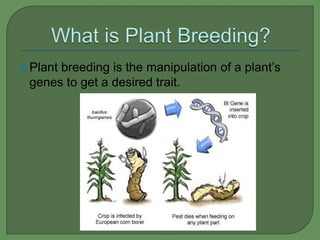
 Plant
      breeding is the manipulation of a plant’s
 genes to get a desired trait.
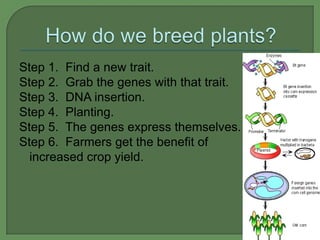
Step 1. Find a new trait.
Step 2. Grab the genes with that trait.
Step 3. DNA insertion.
Step 4. Planting.
Step 5. The genes express themselves.
Step 6. Farmers get the benefit of
  increased crop yield.
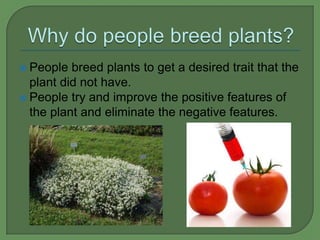
 People  breed plants to get a desired trait that the
  plant did not have.
 People try and improve the positive features of
  the plant and eliminate the negative features.
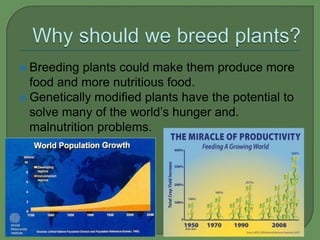
 Breeding  plants could make them produce more
  food and more nutritious food.
 Genetically modified plants have the potential to
  solve many of the world’s hunger and.
  malnutrition problems.
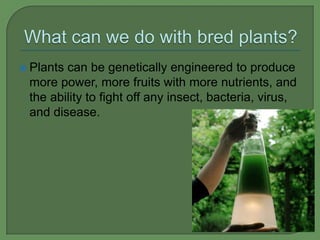
 Plantscan be genetically engineered to produce
 more power, more fruits with more nutrients, and
 the ability to fight off any insect, bacteria, virus,
 and disease.
   http://broekhofict.nl.server26.firstfind.nl/futureplants/index.php?page=ho
    me
   http://plbrgen.cals.cornell.edu/
   http://en.wikipedia.org/wiki/Plant_breeding
   http://www.agron.iastate.edu/seedsandbreeds/Tracy.pdf
   http://www.eubios.info/Papers/gecsc.htm
   http://www.sciencedaily.com/articles/p/plant_breeding.htm
   http://en.wikipedia.org/wiki/Genetically_modified_crops
   http://www.epsoweb.org/partnerships/plants-for-the-future
   http://www.popsci.com/science/article/2011-01/life-cycle-genetically-
    modified-seed
   Images:
   http://worldofgenetics.weebly.com/overview.html
   http://www.scq.ubc.ca/plant-breeding-versus-plant-genetics/
   http://ourohio.org/teachers/Take-Note/american-agriculture-production/
   http://www.tomsguide.com/us/latro-algae-photosynthesis-lamp,news-
    7012.html

Future Plants Presentation

  • 1.
  • 2.
     Plant breeding is the manipulation of a plant’s genes to get a desired trait.
  • 3.
    Step 1. Finda new trait. Step 2. Grab the genes with that trait. Step 3. DNA insertion. Step 4. Planting. Step 5. The genes express themselves. Step 6. Farmers get the benefit of increased crop yield.
  • 4.
     People breed plants to get a desired trait that the plant did not have.  People try and improve the positive features of the plant and eliminate the negative features.
  • 5.
     Breeding plants could make them produce more food and more nutritious food.  Genetically modified plants have the potential to solve many of the world’s hunger and. malnutrition problems.
  • 6.
     Plantscan begenetically engineered to produce more power, more fruits with more nutrients, and the ability to fight off any insect, bacteria, virus, and disease.
  • 7.
    http://broekhofict.nl.server26.firstfind.nl/futureplants/index.php?page=ho me  http://plbrgen.cals.cornell.edu/  http://en.wikipedia.org/wiki/Plant_breeding  http://www.agron.iastate.edu/seedsandbreeds/Tracy.pdf  http://www.eubios.info/Papers/gecsc.htm  http://www.sciencedaily.com/articles/p/plant_breeding.htm  http://en.wikipedia.org/wiki/Genetically_modified_crops  http://www.epsoweb.org/partnerships/plants-for-the-future  http://www.popsci.com/science/article/2011-01/life-cycle-genetically- modified-seed  Images:  http://worldofgenetics.weebly.com/overview.html  http://www.scq.ubc.ca/plant-breeding-versus-plant-genetics/  http://ourohio.org/teachers/Take-Note/american-agriculture-production/  http://www.tomsguide.com/us/latro-algae-photosynthesis-lamp,news- 7012.html