Creative CNTRL
the
future
of
retail (2016)
It seems as though the divide between digital and
physical retail is rapidly blurring. In 2016, trends
in retail will continue to create an even more seamless
shopping experience for the consumer, helping to ensure
that anyone can “shop anywhere and receive goods in the
most convenient way possible.”
Below are trends that we predict will dominate the
retail industry in 2016, and how some retailers are
already taking advantage of them.
You may have already heard a lot of buzz around the
“Internet of Things” (IoT), and in 2016, we expect
the buzz to get louder in the retail scene.
Wait, what is the Internet of Things?
IoT, a network of electronically- embedded “things”
with sensors, software, and network connectivity
to collect and exchange data with each other, is
not rookies to the game. Luxury brand Hugo Boss has
started to use heat sensors in some of their stores
to track customer movement and determine which
areas of the store are receiving the most traffic.
Findings from these sensors are valuable for Hugo
Boss’s visual merchandising strategies.
1. Internet
of things
2. smarter
feedbackWith information from sales
transactions and newer sources of
information such as IoT data, social
media and review platforms, you can
now get feedback more easily than
ever.
How will you use this information to
uncover new insights and help improve
the quality of your products and
services?
3. touching and
testing
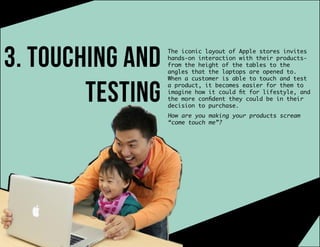
The iconic layout of Apple stores invites
hands-on interaction with their products-
from the height of the tables to the
angles that the laptops are opened to.
When a customer is able to touch and test
a product, it becomes easier for them to
imagine how it could fit for lifestyle, and
the more confident they could be in their
decision to purchase.
How are you making your products scream
“come touch me”?
4. customization
Consider offering personalized recommendations to
aid consumers who enter your shop without a clear
shopping goal in mind or who may be unfamiliar
with the product or service through signage or
superb customer service. Believe it or not, you
see this everyday:
Don’t know what type of Tomato you should pick?
Trader Joe’s signs not only distinguish cherry
tomatoes from plum tomatoes, but they also suggest
that the former are great for adding to salads and
the latter are better for slicing.
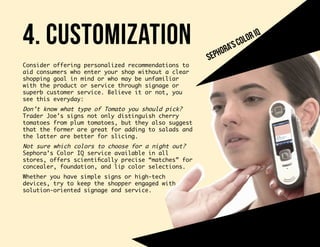
Not sure which colors to choose for a night out?
Sephora’s Color IQ service available in all
stores, offers scientifically precise “matches” for
concealer, foundation, and lip color selections.
Whether you have simple signs or high-tech
devices, try to keep the shopper engaged with
solution-oriented signage and service.
sephora’scoloriq
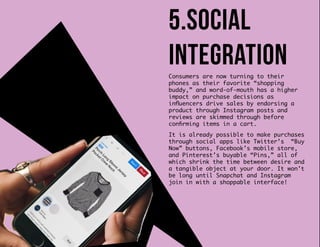
Consumers are now turning to their
phones as their favorite “shopping
buddy,” and word-of-mouth has a higher
impact on purchase decisions as
influencers drive sales by endorsing a
product through Instagram posts and
reviews are skimmed through before
confirming items in a cart.
It is already possible to make purchases
through social apps like Twitter’s “Buy
Now” buttons, Facebook’s mobile store,
and Pinterest’s buyable “Pins,” all of
which shrink the time between desire and
a tangible object at your door. It won’t
be long until Snapchat and Instagram
join in with a shoppable interface!
5.social
integration
6. omnichannel
strategies
kohl’skiosks
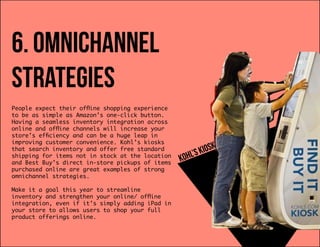
People expect their offline shopping experience
to be as simple as Amazon’s one-click button.
Having a seamless inventory integration across
online and offline channels will increase your
store’s efficiency and can be a huge leap in
improving customer convenience. Kohl’s kiosks
that search inventory and offer free standard
shipping for items not in stock at the location
and Best Buy’s direct in-store pickups of items
purchased online are great examples of strong
omnichannel strategies.
Make it a goal this year to streamline
inventory and strengthen your online/ offline
integration, even if it’s simply adding iPad in
your store to allows users to shop your full
product offerings online.
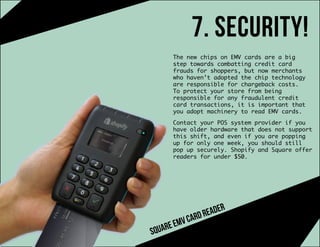
7. security!
The new chips on EMV cards are a big
step towards combatting credit card
frauds for shoppers, but now merchants
who haven’t adopted the chip technology
are responsible for chargeback costs.
To protect your store from being
responsible for any fraudulent credit
card transactions, it is important that
you adopt machinery to read EMV cards.
Contact your POS system provider if you
have older hardware that does not support
this shift, and even if you are popping
up for only one week, you should still
pop up securely. Shopify and Square offer
readers for under $50.
squareemvcardreader
8. selling
experiencesMany customers have become accustomed to shopping from the
comfort of their own homes, and in order to lure shoppers
into your stores you need to offer a new generation of
shopping experiences. Build offline relationships with your
shoppers through pop-up shops, brand activations and a
calendar of events.
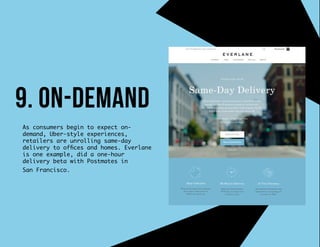
As consumers begin to expect on-
demand, Uber-style experiences,
retailers are unrolling same-day
delivery to offices and homes. Everlane
is one example, did a one-hour
delivery beta with Postmates in
San Francisco.
9. on-demand
About
Creative CNTRL is a full service experiential
marketing and pop up shop agency based in NYC
and Miami with a team of cultural engineers,
storytellers, and creatives. We create dynamic
experiences that strengthen brand loyalty and
increase brand awareness through engaging events,
pop ups shops, and activations.
Our campaigns provide programming relevant to
the socially connected consumer, and customized
solutions tailored to the goals of our clients.
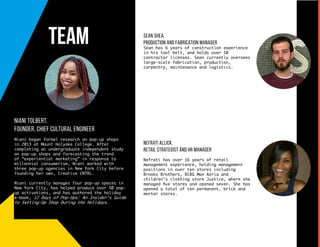
Nefrati Allick,
Retail Strategist and HR Manager
Nefrati has over 16 years of retail
management experience, holding management
positions in over ten stores including
Brooks Brothers, BCBG Max Azria and
children’s clothing store Justice, where she
managed five stores and opened seven. She has
opened a total of ten permanent, brick and
mortar stores.
sean shea,
production and fabrication manager
Sean has 6 years of construction experience
in his tool belt, and holds over 10
contractor licenses. Sean currently oversees
large-scale fabrication, production,
carpentry, maintenance and logistics.
Team
niani tolbert,
founder, chief cultural engineer
Niani began formal research on pop-up shops
in 2013 at Mount Holyoke College. After
completing an undergraduate independent study
on pop-up shops and forecasting the trend
of “experiential marketing” in response to
millennial consumerism, Niani worked with
three pop-up agencies in New York City before
founding her own, Creative CNTRL.
Niani currently manages four pop-up spaces in
New York City, has helped produce over 50 pop-
up activations, and has authored the holiday
e-book, 12 Days of Pop-Ups: An Insider’s Guide
to Setting-Up Shop During the Holidays.
ready to activate?
Niani@Creative-CNTRL.com
www.creative-cntrl.com
(646) 665-4036

Future of Retail- 2016

  • 1.
  • 2.
    It seems asthough the divide between digital and physical retail is rapidly blurring. In 2016, trends in retail will continue to create an even more seamless shopping experience for the consumer, helping to ensure that anyone can “shop anywhere and receive goods in the most convenient way possible.” Below are trends that we predict will dominate the retail industry in 2016, and how some retailers are already taking advantage of them.
  • 3.
    You may havealready heard a lot of buzz around the “Internet of Things” (IoT), and in 2016, we expect the buzz to get louder in the retail scene. Wait, what is the Internet of Things? IoT, a network of electronically- embedded “things” with sensors, software, and network connectivity to collect and exchange data with each other, is not rookies to the game. Luxury brand Hugo Boss has started to use heat sensors in some of their stores to track customer movement and determine which areas of the store are receiving the most traffic. Findings from these sensors are valuable for Hugo Boss’s visual merchandising strategies. 1. Internet of things
  • 4.
    2. smarter feedbackWith informationfrom sales transactions and newer sources of information such as IoT data, social media and review platforms, you can now get feedback more easily than ever. How will you use this information to uncover new insights and help improve the quality of your products and services?
  • 5.
    3. touching and testing Theiconic layout of Apple stores invites hands-on interaction with their products- from the height of the tables to the angles that the laptops are opened to. When a customer is able to touch and test a product, it becomes easier for them to imagine how it could fit for lifestyle, and the more confident they could be in their decision to purchase. How are you making your products scream “come touch me”?
  • 6.
    4. customization Consider offeringpersonalized recommendations to aid consumers who enter your shop without a clear shopping goal in mind or who may be unfamiliar with the product or service through signage or superb customer service. Believe it or not, you see this everyday: Don’t know what type of Tomato you should pick? Trader Joe’s signs not only distinguish cherry tomatoes from plum tomatoes, but they also suggest that the former are great for adding to salads and the latter are better for slicing. Not sure which colors to choose for a night out? Sephora’s Color IQ service available in all stores, offers scientifically precise “matches” for concealer, foundation, and lip color selections. Whether you have simple signs or high-tech devices, try to keep the shopper engaged with solution-oriented signage and service. sephora’scoloriq
  • 7.
    Consumers are nowturning to their phones as their favorite “shopping buddy,” and word-of-mouth has a higher impact on purchase decisions as influencers drive sales by endorsing a product through Instagram posts and reviews are skimmed through before confirming items in a cart. It is already possible to make purchases through social apps like Twitter’s “Buy Now” buttons, Facebook’s mobile store, and Pinterest’s buyable “Pins,” all of which shrink the time between desire and a tangible object at your door. It won’t be long until Snapchat and Instagram join in with a shoppable interface! 5.social integration
  • 8.
    6. omnichannel strategies kohl’skiosks People expecttheir offline shopping experience to be as simple as Amazon’s one-click button. Having a seamless inventory integration across online and offline channels will increase your store’s efficiency and can be a huge leap in improving customer convenience. Kohl’s kiosks that search inventory and offer free standard shipping for items not in stock at the location and Best Buy’s direct in-store pickups of items purchased online are great examples of strong omnichannel strategies. Make it a goal this year to streamline inventory and strengthen your online/ offline integration, even if it’s simply adding iPad in your store to allows users to shop your full product offerings online.
  • 9.
    7. security! The newchips on EMV cards are a big step towards combatting credit card frauds for shoppers, but now merchants who haven’t adopted the chip technology are responsible for chargeback costs. To protect your store from being responsible for any fraudulent credit card transactions, it is important that you adopt machinery to read EMV cards. Contact your POS system provider if you have older hardware that does not support this shift, and even if you are popping up for only one week, you should still pop up securely. Shopify and Square offer readers for under $50. squareemvcardreader
  • 10.
    8. selling experiencesMany customershave become accustomed to shopping from the comfort of their own homes, and in order to lure shoppers into your stores you need to offer a new generation of shopping experiences. Build offline relationships with your shoppers through pop-up shops, brand activations and a calendar of events.
  • 11.
    As consumers beginto expect on- demand, Uber-style experiences, retailers are unrolling same-day delivery to offices and homes. Everlane is one example, did a one-hour delivery beta with Postmates in San Francisco. 9. on-demand
  • 12.
    About Creative CNTRL isa full service experiential marketing and pop up shop agency based in NYC and Miami with a team of cultural engineers, storytellers, and creatives. We create dynamic experiences that strengthen brand loyalty and increase brand awareness through engaging events, pop ups shops, and activations. Our campaigns provide programming relevant to the socially connected consumer, and customized solutions tailored to the goals of our clients.
  • 13.
    Nefrati Allick, Retail Strategistand HR Manager Nefrati has over 16 years of retail management experience, holding management positions in over ten stores including Brooks Brothers, BCBG Max Azria and children’s clothing store Justice, where she managed five stores and opened seven. She has opened a total of ten permanent, brick and mortar stores. sean shea, production and fabrication manager Sean has 6 years of construction experience in his tool belt, and holds over 10 contractor licenses. Sean currently oversees large-scale fabrication, production, carpentry, maintenance and logistics. Team niani tolbert, founder, chief cultural engineer Niani began formal research on pop-up shops in 2013 at Mount Holyoke College. After completing an undergraduate independent study on pop-up shops and forecasting the trend of “experiential marketing” in response to millennial consumerism, Niani worked with three pop-up agencies in New York City before founding her own, Creative CNTRL. Niani currently manages four pop-up spaces in New York City, has helped produce over 50 pop- up activations, and has authored the holiday e-book, 12 Days of Pop-Ups: An Insider’s Guide to Setting-Up Shop During the Holidays.
  • 14.