Fusion devices and the history
of fusion research
Early concepts: The pinch device
• Toroidal chamber
enclosing a hot plasma,
with an electric current
‘pinching’ the plasma and
keeping it away from the
wall
• Developed by Peter
Thonemann (Australia)
and Sir George Thomson
(UK)
R=25cm
a=3cm
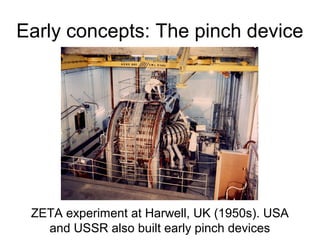
ZETA experiment at Harwell, UK (1950s). USA
and USSR also built early pinch devices
Early concepts: The pinch device
The tokamak
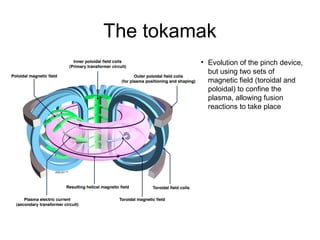
• Evolution of the pinch device,
but using two sets of
magnetic field (toroidal and
poloidal) to confine the
plasma, allowing fusion
reactions to take place
The tokamak
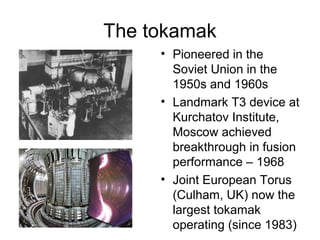
• Pioneered in the
Soviet Union in the
1950s and 1960s
• Landmark T3 device at
Kurchatov Institute,
Moscow achieved
breakthrough in fusion
performance – 1968
• Joint European Torus
(Culham, UK) now the
largest tokamak
operating (since 1983)
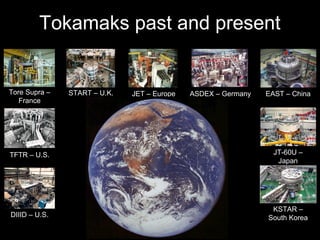
EAST – China
KSTAR –
South Korea
Tokamaks past and present
JT-60U –
Japan
JET – Europe
TFTR – U.S.
ASDEX – Germany
DIIID – U.S.
Tore Supra –
France
START – U.K.
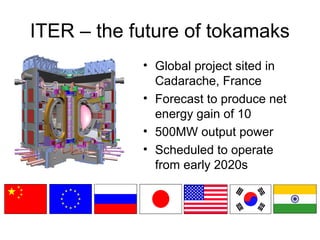
ITER – the future of tokamaks
• Global project sited in
Cadarache, France
• Forecast to produce net
energy gain of 10
• 500MW output power
• Scheduled to operate
from early 2020s
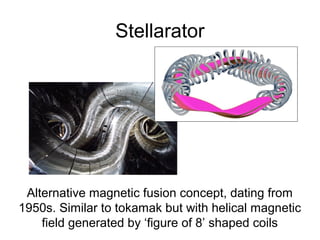
Stellarator
Alternative magnetic fusion concept, dating from
1950s. Similar to tokamak but with helical magnetic
field generated by ‘figure of 8’ shaped coils
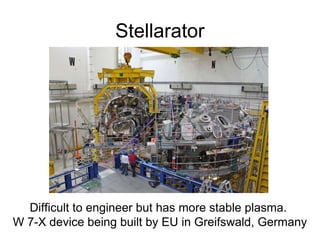
Stellarator
Difficult to engineer but has more stable plasma.
W 7-X device being built by EU in Greifswald, Germany
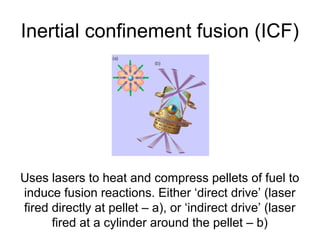
Inertial confinement fusion (ICF)
Uses lasers to heat and compress pellets of fuel to
induce fusion reactions. Either ‘direct drive’ (laser
fired directly at pellet – a), or ‘indirect drive’ (laser
fired at a cylinder around the pellet – b)
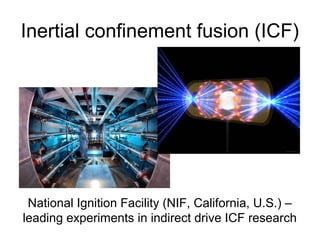
Inertial confinement fusion (ICF)
National Ignition Facility (NIF, California, U.S.) –
leading experiments in indirect drive ICF research
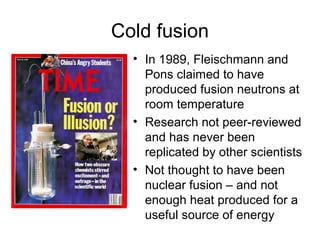
Cold fusion
• In 1989, Fleischmann and
Pons claimed to have
produced fusion neutrons at
room temperature
• Research not peer-reviewed
and has never been
replicated by other scientists
• Not thought to have been
nuclear fusion – and not
enough heat produced for a
useful source of energy

Fusion devices history

  • 1.
    Fusion devices andthe history of fusion research
  • 2.
    Early concepts: Thepinch device • Toroidal chamber enclosing a hot plasma, with an electric current ‘pinching’ the plasma and keeping it away from the wall • Developed by Peter Thonemann (Australia) and Sir George Thomson (UK) R=25cm a=3cm
  • 3.
    ZETA experiment atHarwell, UK (1950s). USA and USSR also built early pinch devices Early concepts: The pinch device
  • 4.
    The tokamak • Evolutionof the pinch device, but using two sets of magnetic field (toroidal and poloidal) to confine the plasma, allowing fusion reactions to take place
  • 5.
    The tokamak • Pioneeredin the Soviet Union in the 1950s and 1960s • Landmark T3 device at Kurchatov Institute, Moscow achieved breakthrough in fusion performance – 1968 • Joint European Torus (Culham, UK) now the largest tokamak operating (since 1983)
  • 6.
    EAST – China KSTAR– South Korea Tokamaks past and present JT-60U – Japan JET – Europe TFTR – U.S. ASDEX – Germany DIIID – U.S. Tore Supra – France START – U.K.
  • 7.
    ITER – thefuture of tokamaks • Global project sited in Cadarache, France • Forecast to produce net energy gain of 10 • 500MW output power • Scheduled to operate from early 2020s
  • 8.
    Stellarator Alternative magnetic fusionconcept, dating from 1950s. Similar to tokamak but with helical magnetic field generated by ‘figure of 8’ shaped coils
  • 9.
    Stellarator Difficult to engineerbut has more stable plasma. W 7-X device being built by EU in Greifswald, Germany
  • 10.
    Inertial confinement fusion(ICF) Uses lasers to heat and compress pellets of fuel to induce fusion reactions. Either ‘direct drive’ (laser fired directly at pellet – a), or ‘indirect drive’ (laser fired at a cylinder around the pellet – b)
  • 11.
    Inertial confinement fusion(ICF) National Ignition Facility (NIF, California, U.S.) – leading experiments in indirect drive ICF research
  • 12.
    Cold fusion • In1989, Fleischmann and Pons claimed to have produced fusion neutrons at room temperature • Research not peer-reviewed and has never been replicated by other scientists • Not thought to have been nuclear fusion – and not enough heat produced for a useful source of energy

Editor's Notes

  • #7 Tokamaks with notable features and achievements