Fundraising at UMBC 
Tips for funding your student organization’s project or 
initiative. 
Dayna Carpenter – Director, Annual Giving 
Office of Institutional Advancement, UMBC 
dayna@umbc.edu 
(410) 455-3377
Sources of Funding . . . 
• SGA Funding 
• BreakingGround Grant 
•On-Campus Fundraising 
• Off-Campus Fundraising 
• Crowdfunding
Office of Institutional Advancement 
• Public Relations & Marketing 
• Creative Services 
• Alumni & Development Communications 
• Advancement Services 
• Advancement Operations 
• Alumni Relations 
• Corporate & Foundation Relations 
• Major Gifts Fundraising 
• Annual Giving Program
Annual Giving Team 
Broad-based outreach to parents, faculty and staff, and UMBC’s 
65,000+ alumni base. 
• Phonathon 
• Direct Mail 
• Online Engagement (including crowdfunding) 
We can partner with student organizations to: 
• Strategize fundraising opportunities 
• Build crowdfunding pages and other tools to raise money for 
student activities.
What is crowdfunding? 
crowd·fund·ing 
ˈkroudˌfəndiNG/ 
noun 
1. The practice of funding a project or venture by raising many small 
amounts of money from a large number of people, typically via the 
Internet. 
"musicians, filmmakers, and artists have successfully raised funds and 
fostered awareness through crowdfunding"
History of Crowdfunding 
• Originated from crowdsourcing 
• First platform launched in 2001 
• Musicians and artists 
• Grassroots political fundraising 
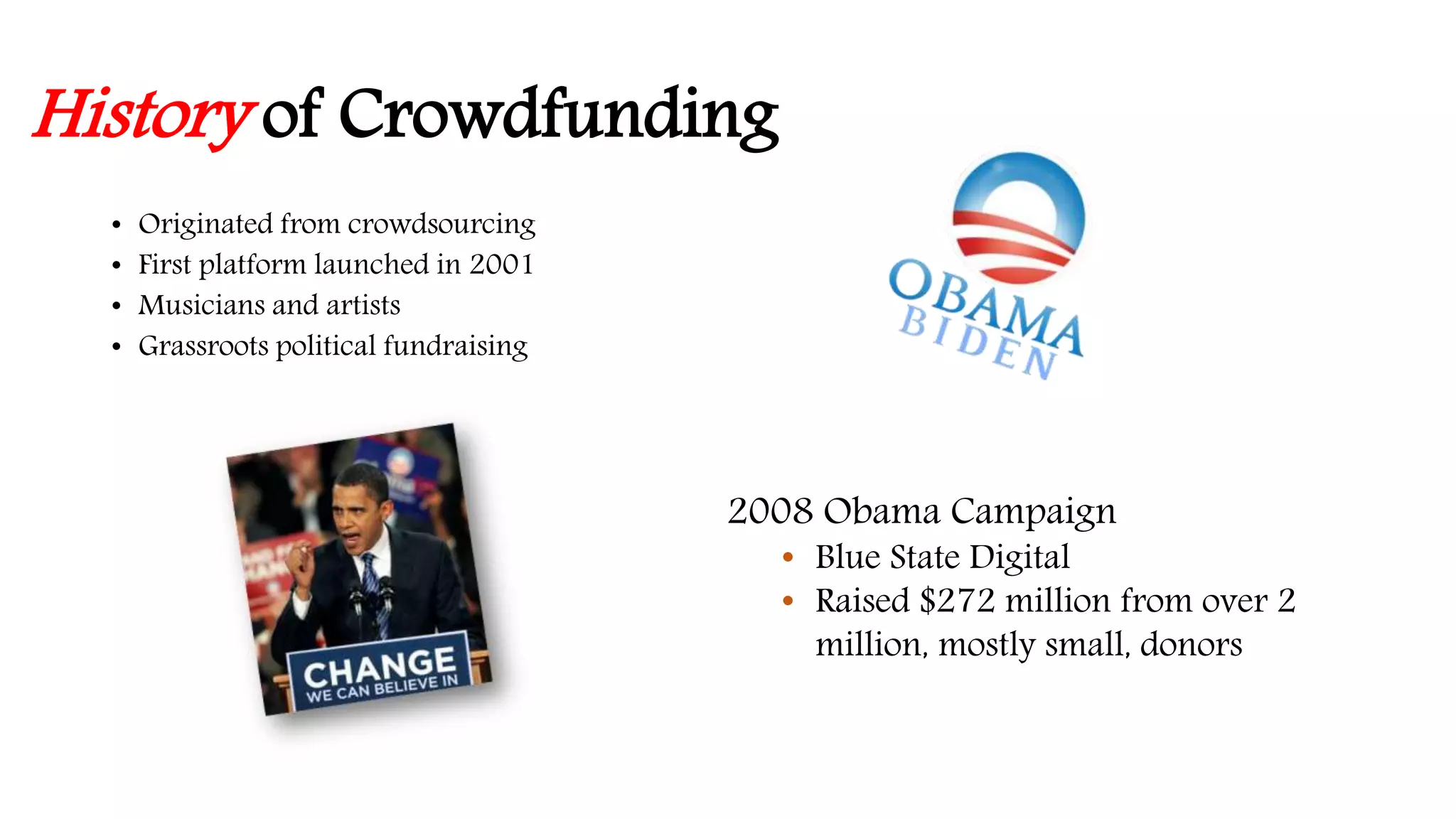
2008 Obama Campaign 
• Blue State Digital 
• Raised $272 million from over 2 
million, mostly small, donors
Crowdfunding is Growing Fast
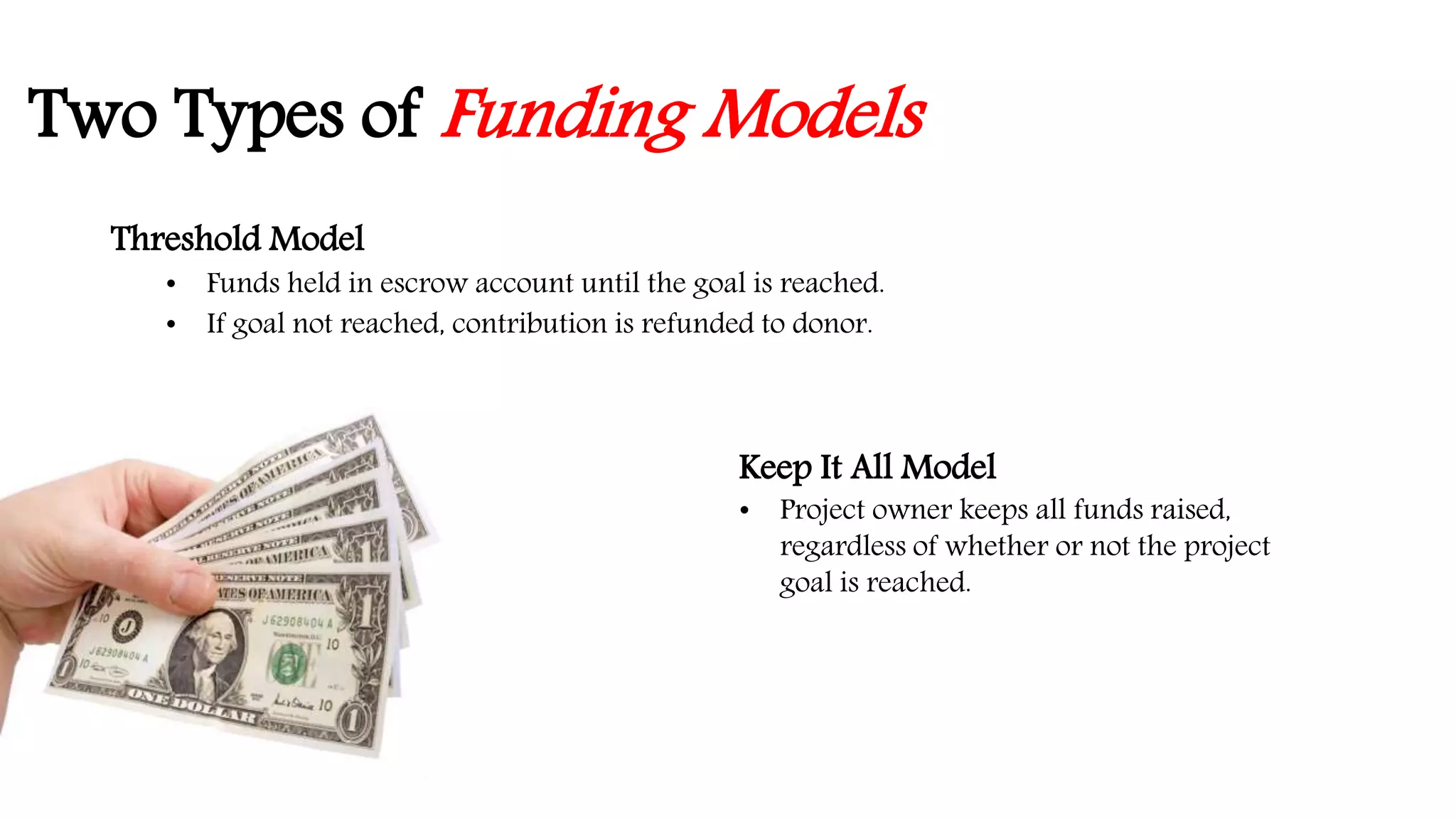
Two Types of Funding Models 
Threshold Model 
• Funds held in escrow account until the goal is reached. 
• If goal not reached, contribution is refunded to donor. 
Keep It All Model 
• Project owner keeps all funds raised, 
regardless of whether or not the project 
goal is reached.
Motivations of Crowdfunding Donors 
• Want to believe that their contributions matter 
• Feedback loops 
• Reciprocal relationships 
• Wash’s Completion Bias 
• Social Loafing . . . =0(
UMBC Crowdfunding: Pilot Year . . . 
• Launched in June of 2013 
• Focused on student organizations 
• 323 total donors 
• 8.5% of all first-time alumni donors to UMBC 
• $16,838.50 (Average gift of $52.13) 
• Entry-point to giving for recurring gifts
Your passionate community . . . 
…students, alumni, parents, faculty, staff, others
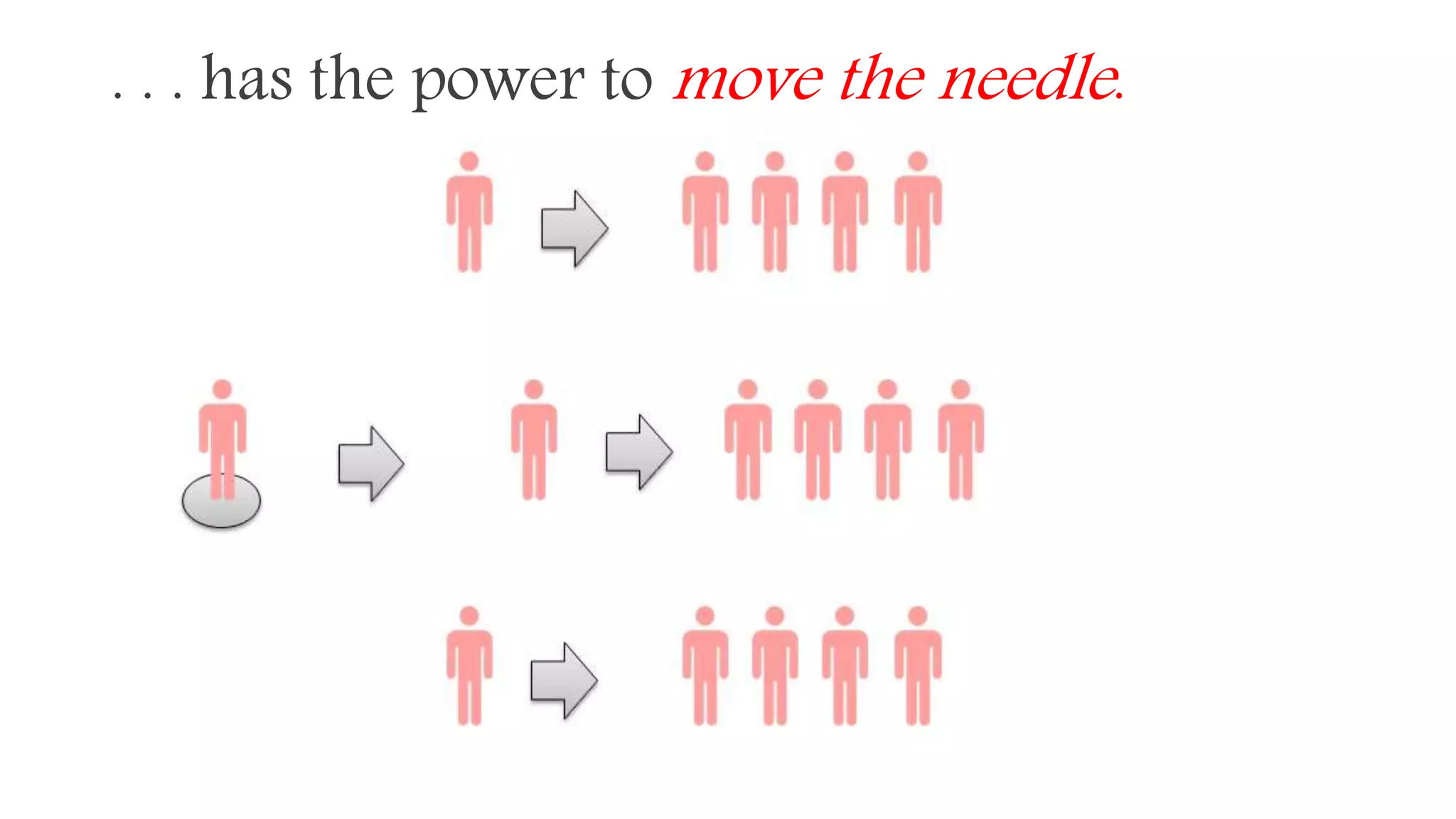
. . . has the power to move the needle .
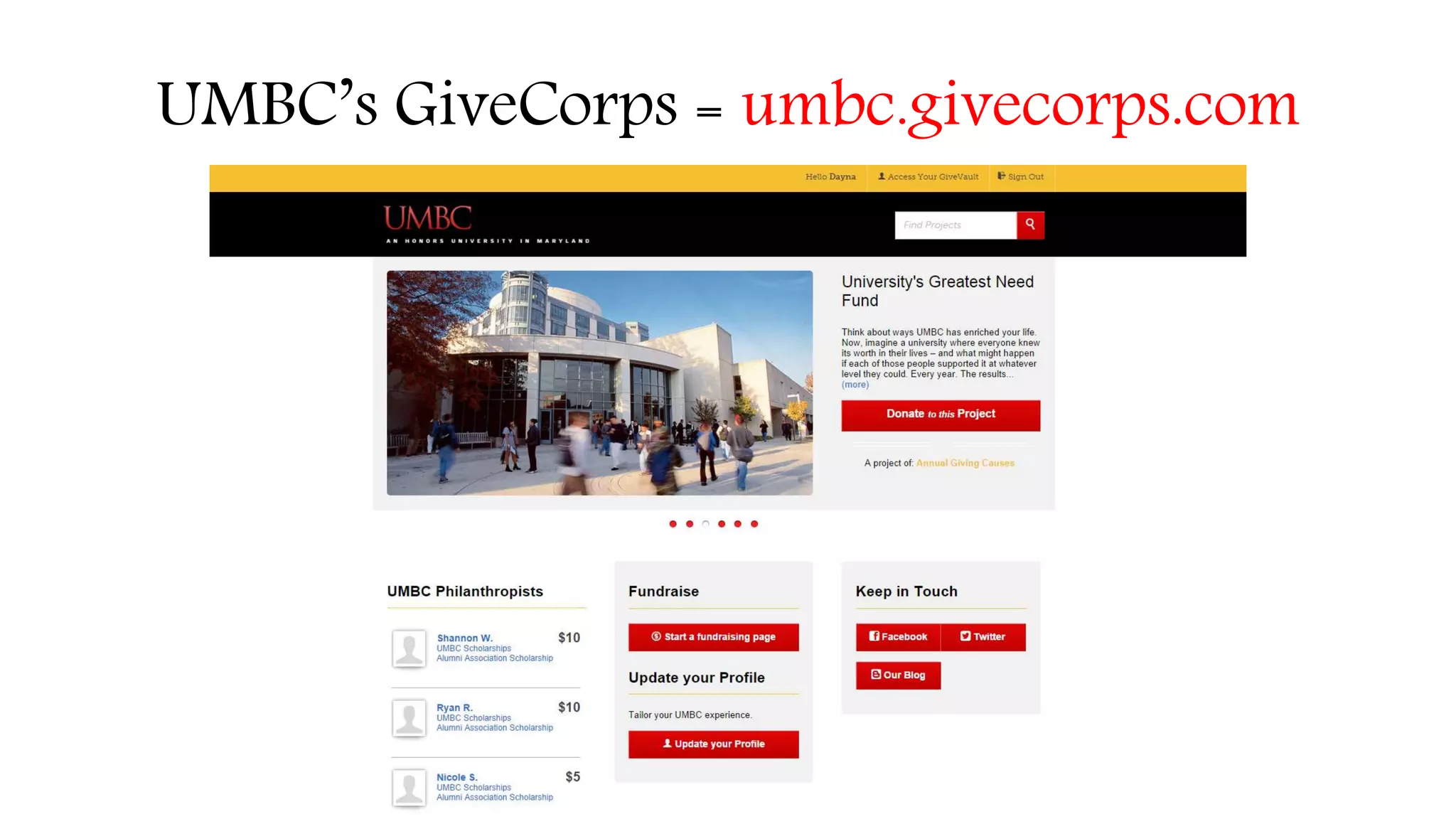
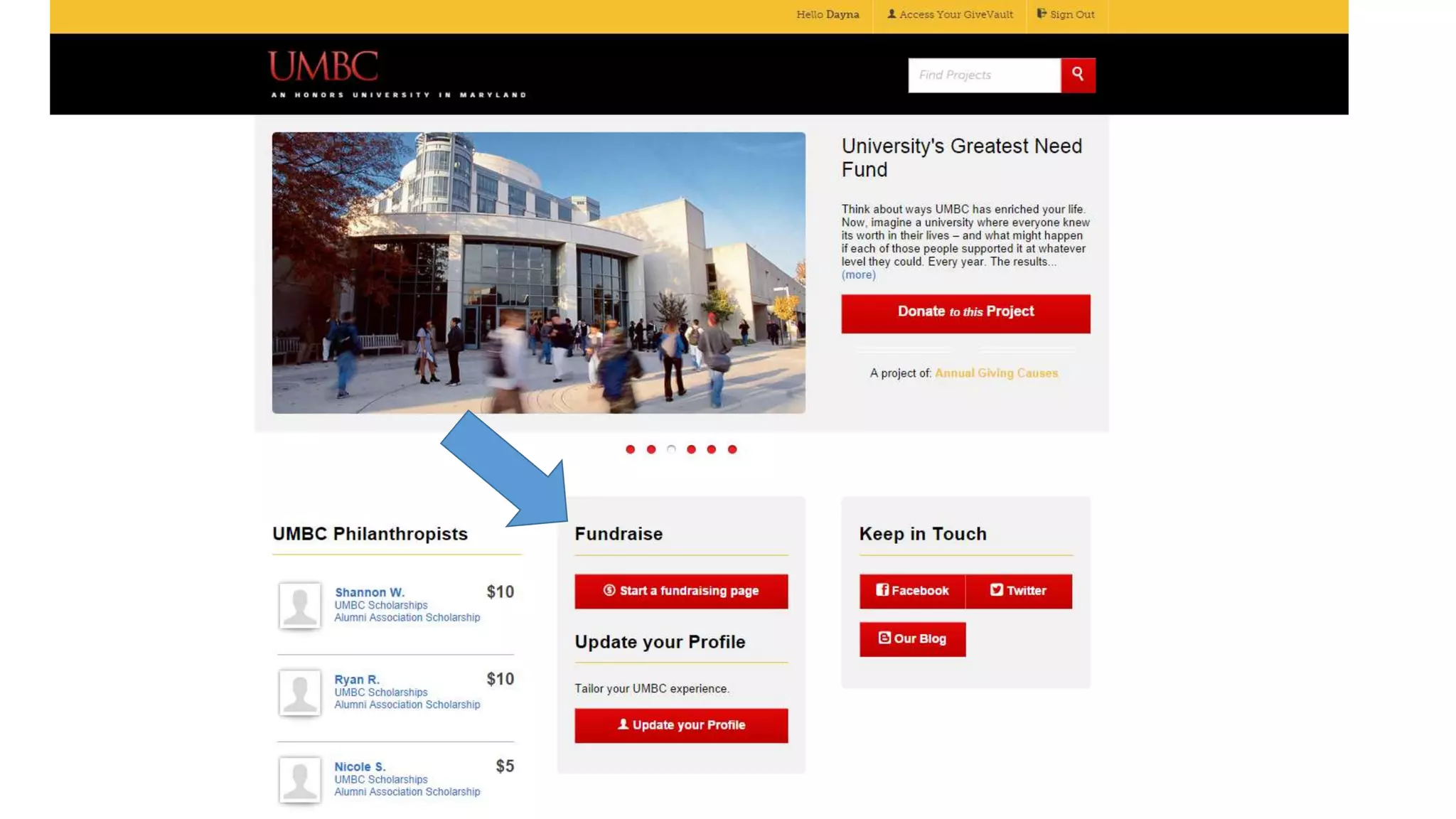
UMBC’s GiveCorps = umbc.givecorps.com
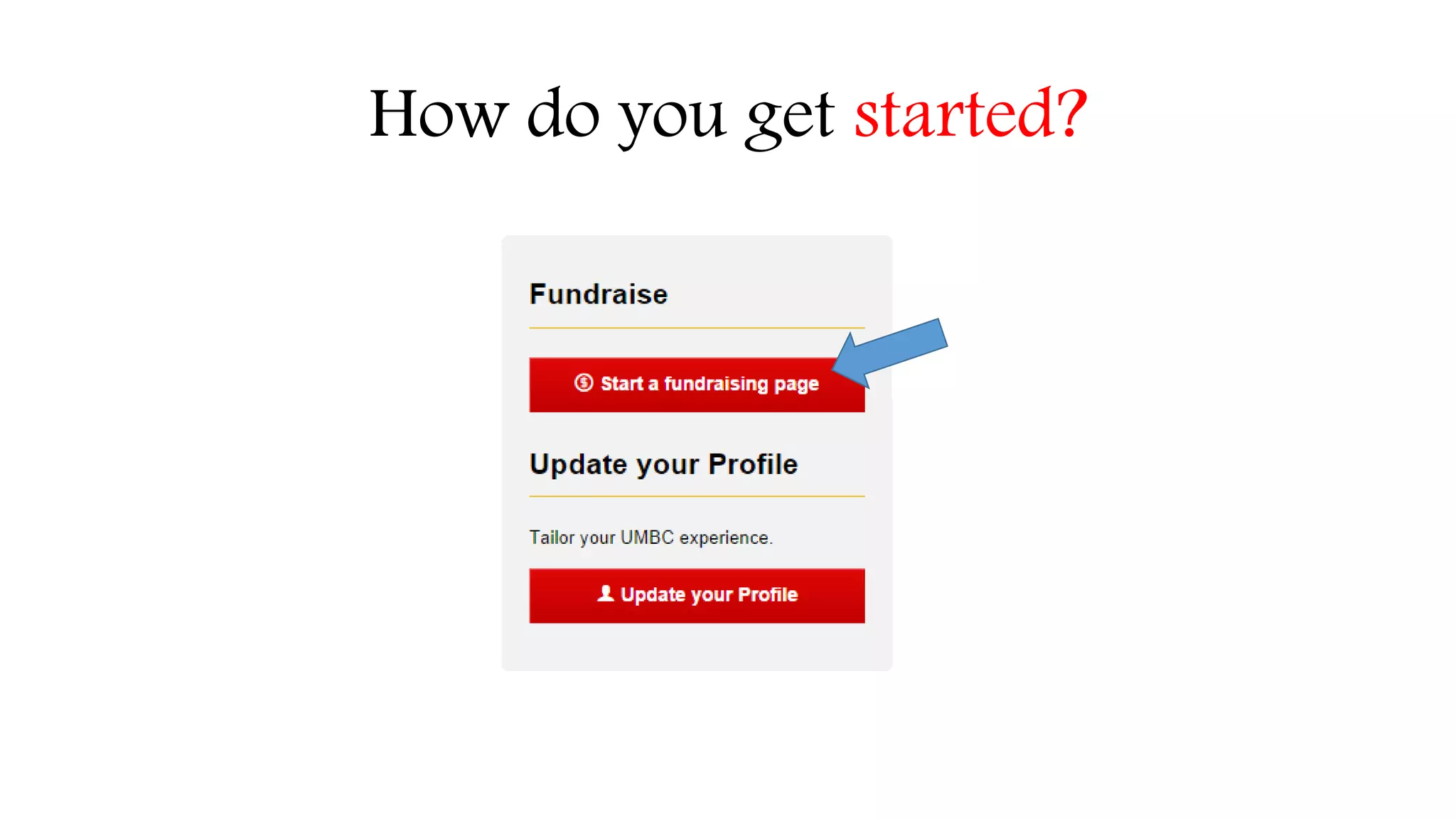
How do you get started?
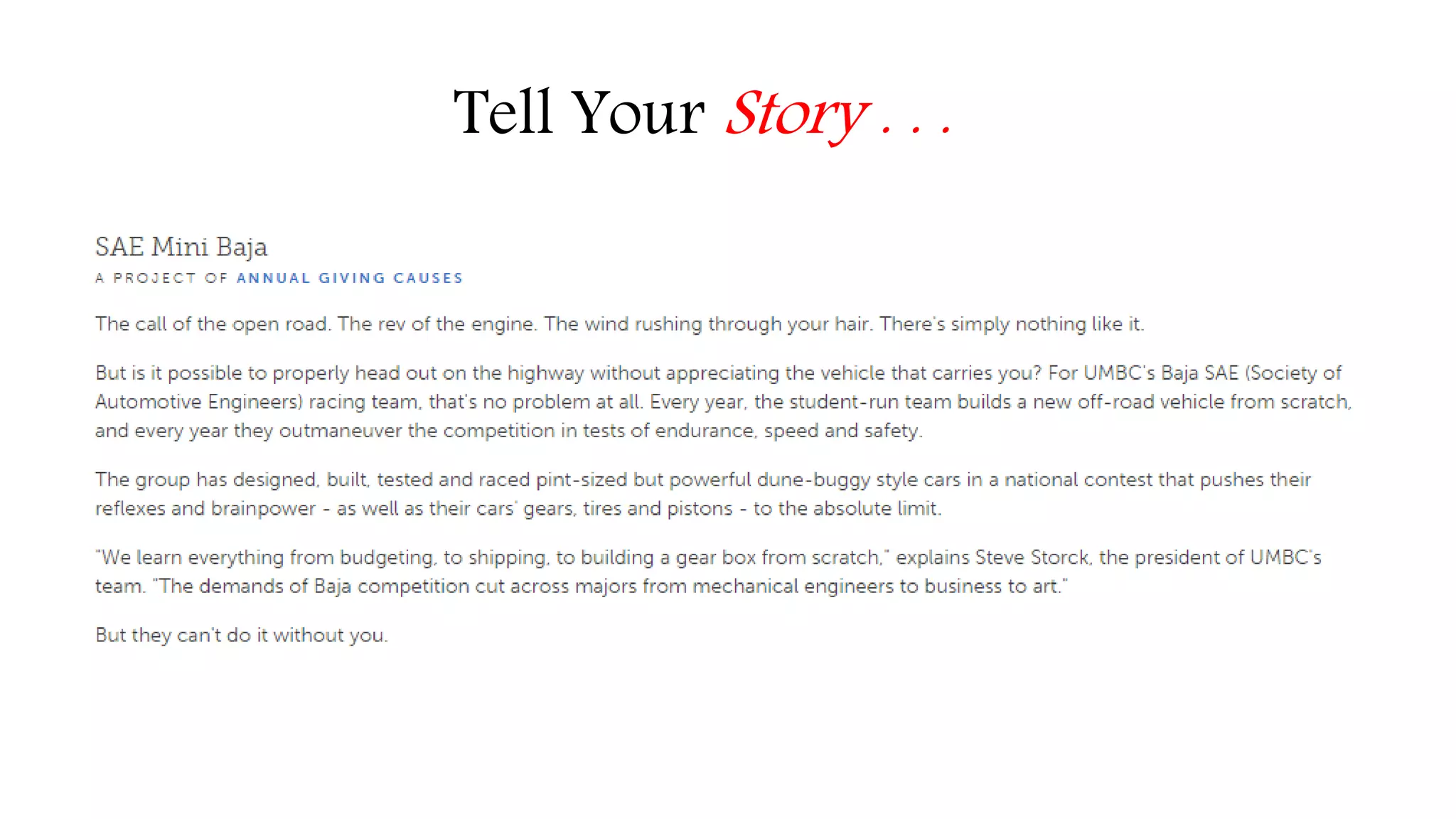
Tell Your Story . . .
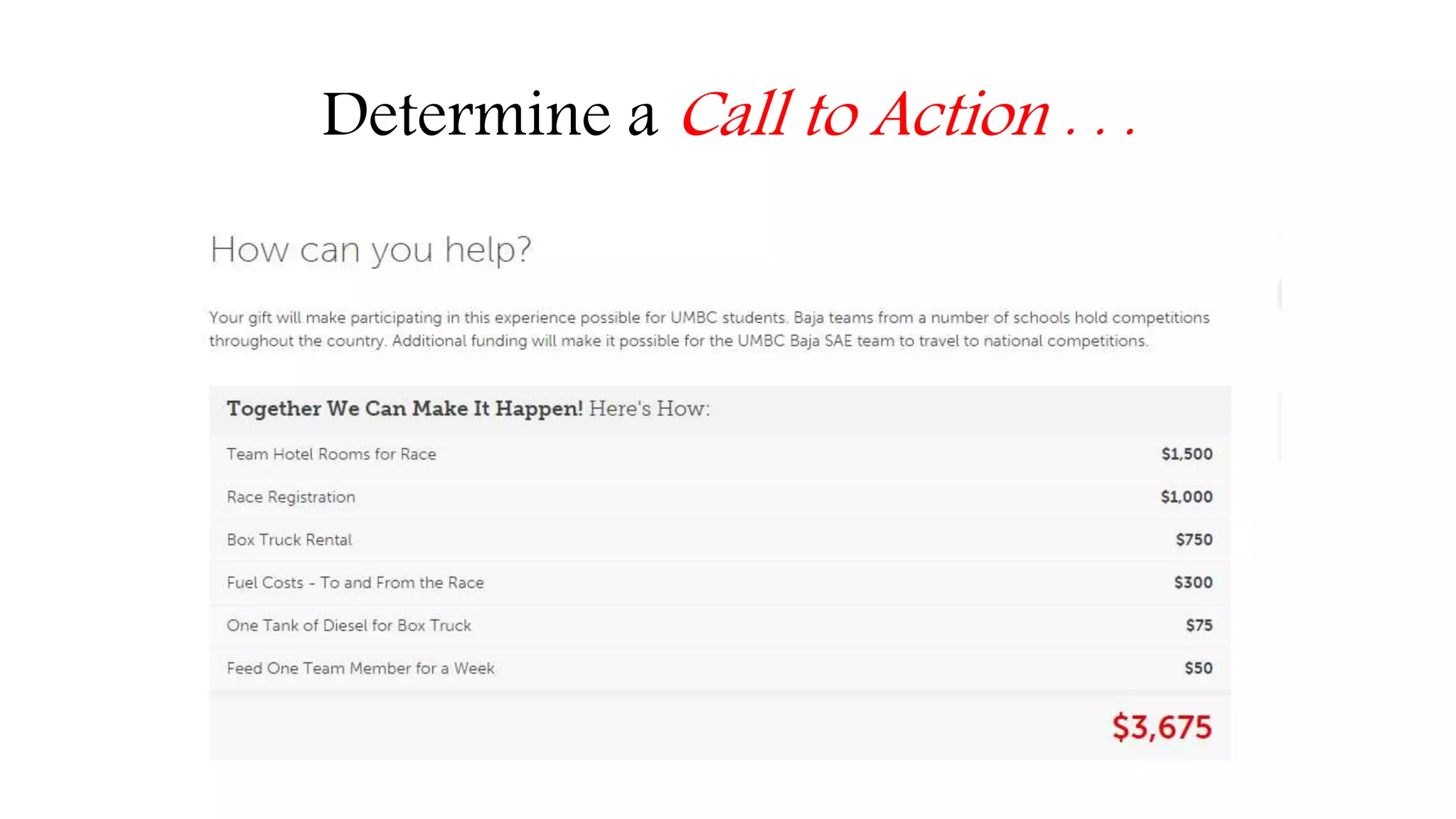
Determine a Call to Action . . .
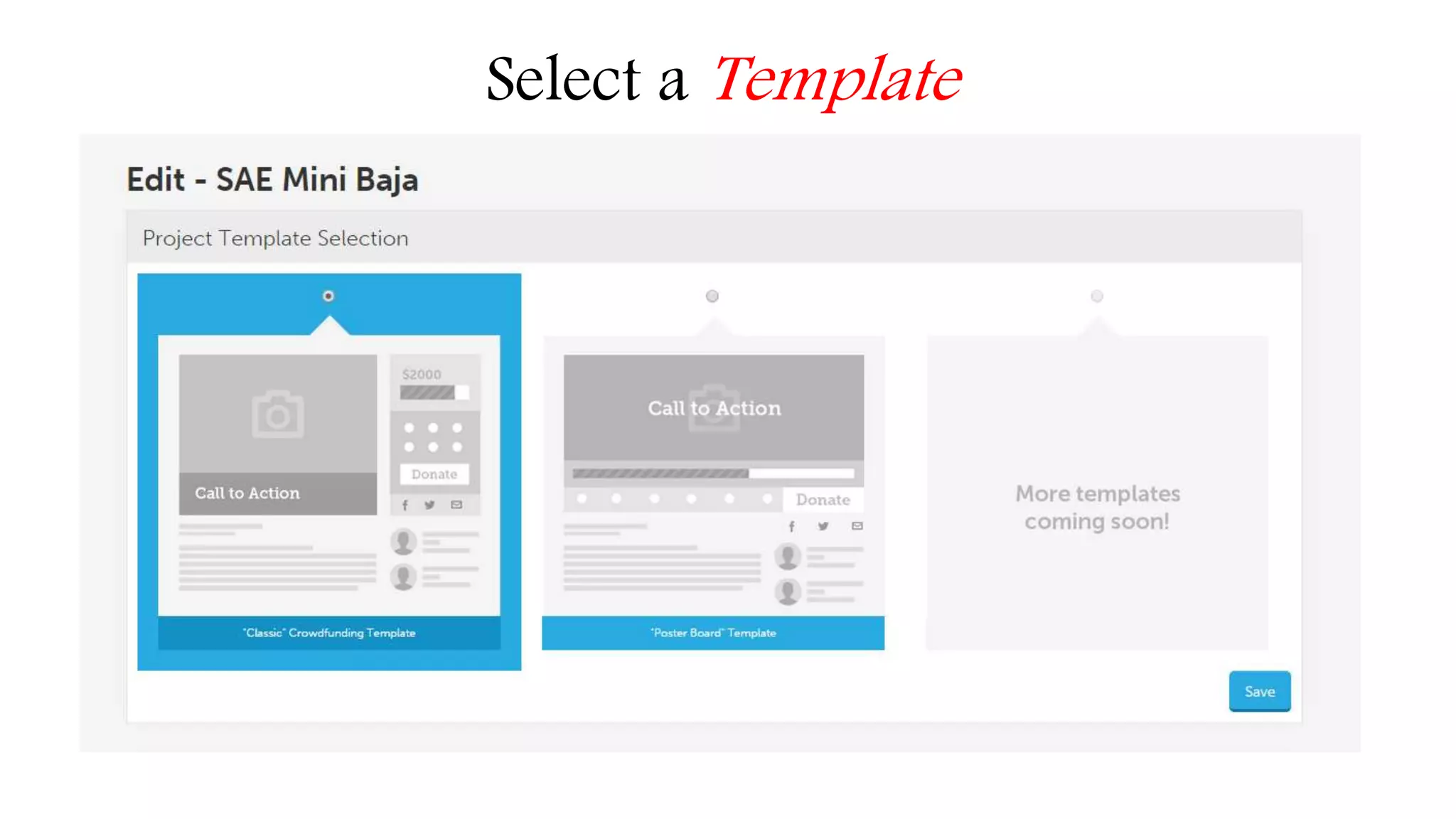
Select a Template
Collaborate with OIA 
• Build fundraising marketing strategy 
• Assistance in writing & editing 
• Working with University System of Maryland Foundation 
• Additional promotion 
• Direct Mail 
• Social Media 
• Blog Posts/Story-telling
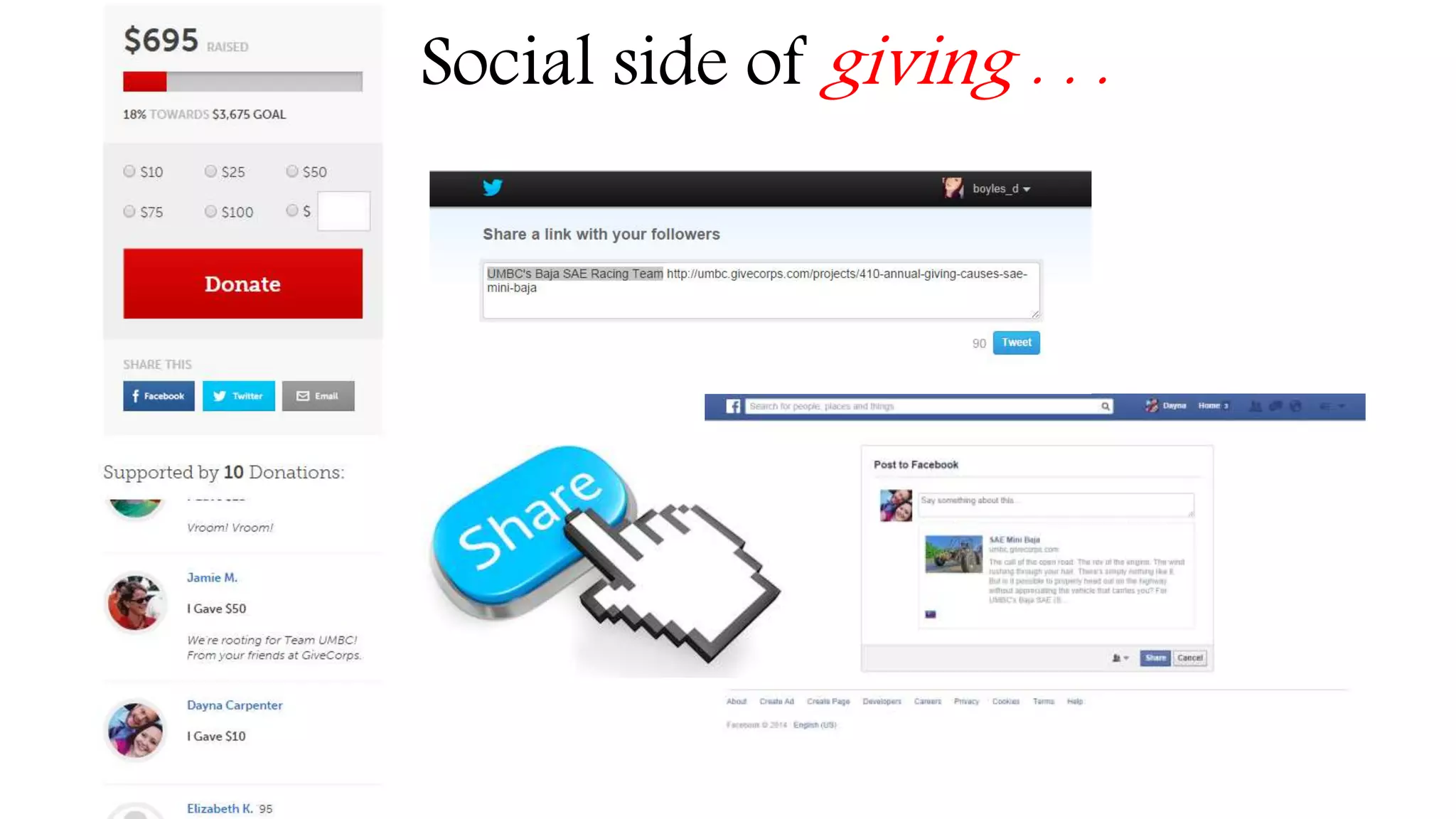
Social side of giving . . .
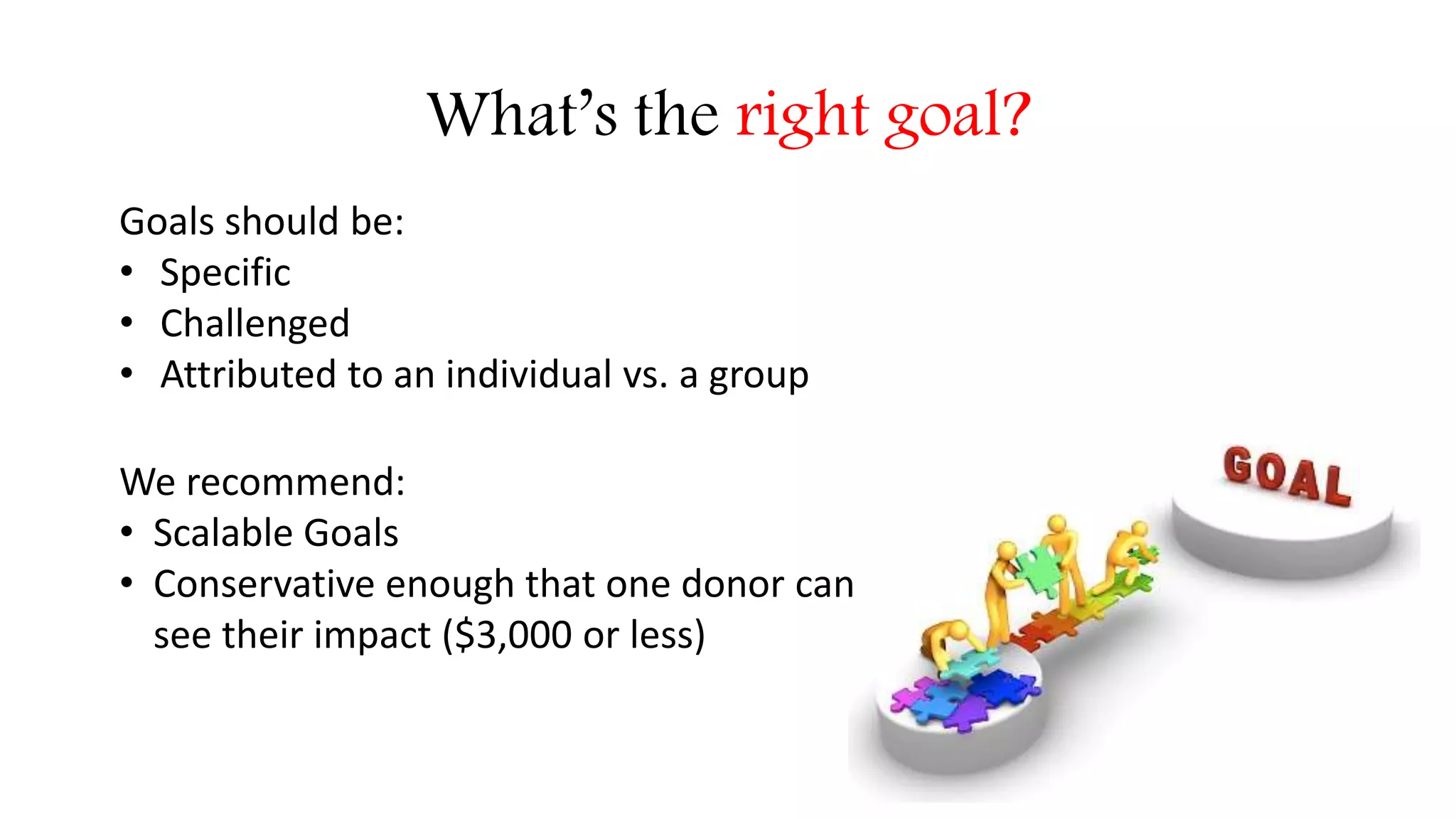
What’s the right goal? 
Goals should be: 
• Specific 
• Challenged 
• Attributed to an individual vs. a group 
We recommend: 
• Scalable Goals 
• Conservative enough that one donor can 
see their impact ($3,000 or less)
What’s a Good Fit? 
All funds raised should benefit the UMBC’s students or campus in a direct 
way. 
In addition, the strongest candidates for the program have: 
• A great story 
• UMBC-recognized student organization 
• A strong leadership team 
• An active community of students, alumni, and parents 
• A minimum of 10-20 active members 
We are unable to support: 
• Individuals 
• Raising funds for an outside organization 
• National Chapters 
• Unaffiliated nonprofit organizations 
• Groups that are not officially recognized as UMBC student 
organizations
What’s a Good Fit? 
To date, we’ve helped raise funds for: 
• Travel expenses 
• Food 
• Production of a cd 
• Scholarships 
• Sports Equipment 
• Registration Fees 
• Car Rental
Marketing . . .
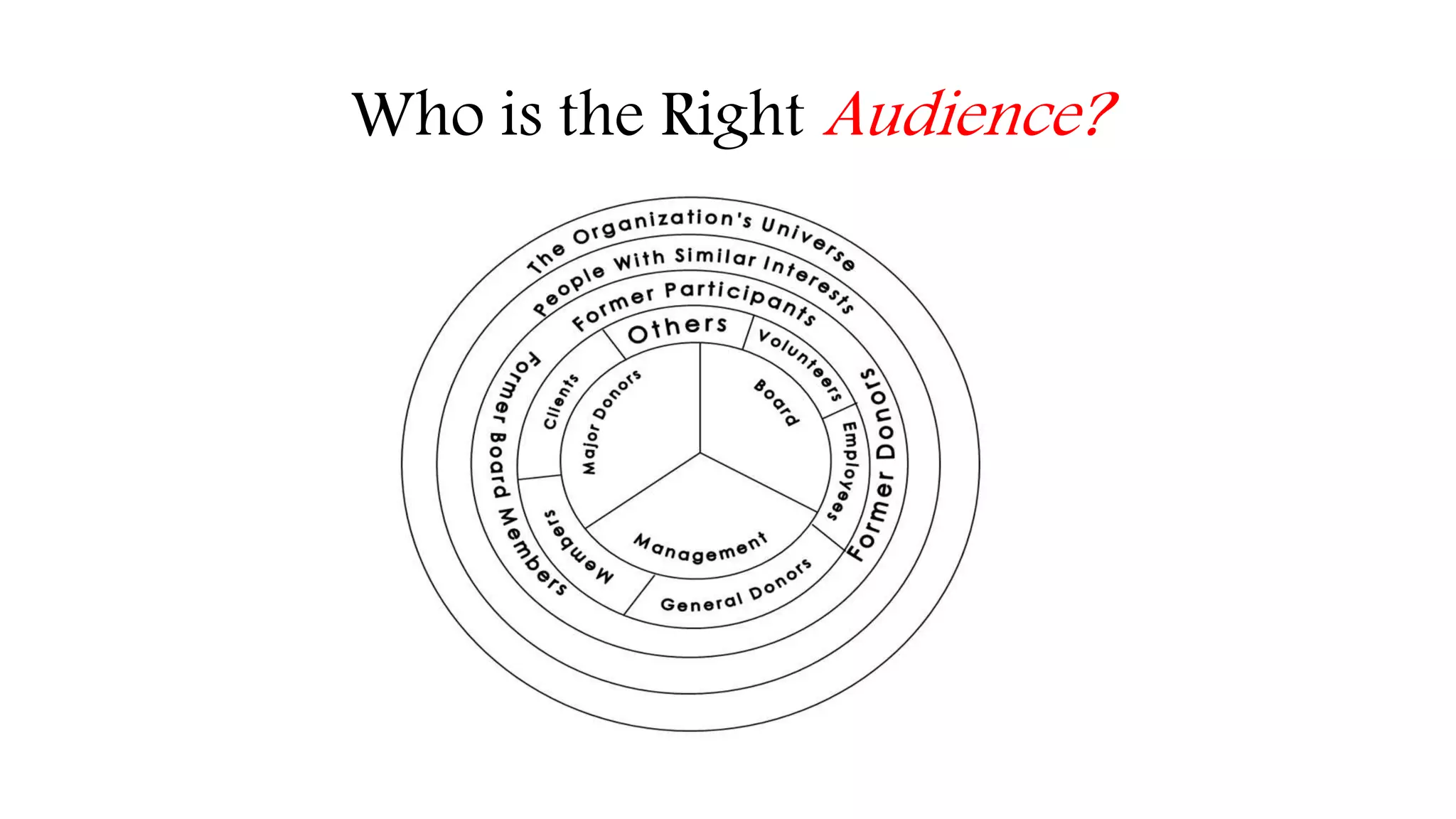
Who is the Right Audience?
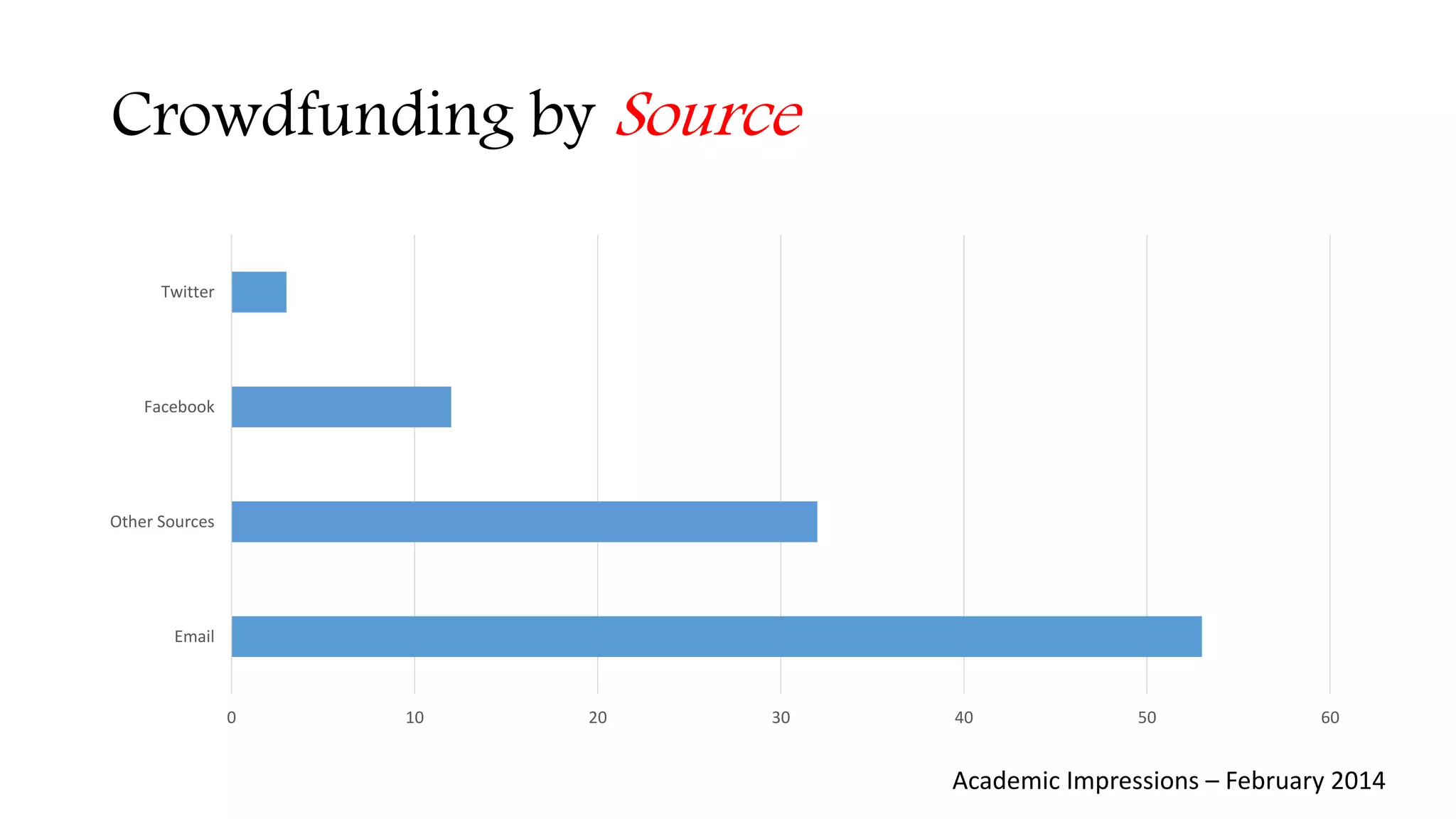
Crowdfunding by Source 
0 10 20 30 40 50 60 
Twitter 
Facebook 
Other Sources 
Email 
Academic Impressions – February 2014
Questions?
Thank You! 
Need more information? 
Dayna Carpenter – Director, Annual Giving 
dayna@umbc.edu 
(410) 455 - 3377 
Felicia Felton – Assistant Director, Annual Giving 
fdfelton@umbc.edu 
(410) 455 - 1361

Fundraising at UMBC: Tips for funding your student organization's project or initiative

  • 1.
    Fundraising at UMBC Tips for funding your student organization’s project or initiative. Dayna Carpenter – Director, Annual Giving Office of Institutional Advancement, UMBC dayna@umbc.edu (410) 455-3377
  • 2.
    Sources of Funding. . . • SGA Funding • BreakingGround Grant •On-Campus Fundraising • Off-Campus Fundraising • Crowdfunding
  • 3.
    Office of InstitutionalAdvancement • Public Relations & Marketing • Creative Services • Alumni & Development Communications • Advancement Services • Advancement Operations • Alumni Relations • Corporate & Foundation Relations • Major Gifts Fundraising • Annual Giving Program
  • 4.
    Annual Giving Team Broad-based outreach to parents, faculty and staff, and UMBC’s 65,000+ alumni base. • Phonathon • Direct Mail • Online Engagement (including crowdfunding) We can partner with student organizations to: • Strategize fundraising opportunities • Build crowdfunding pages and other tools to raise money for student activities.
  • 5.
    What is crowdfunding? crowd·fund·ing ˈkroudˌfəndiNG/ noun 1. The practice of funding a project or venture by raising many small amounts of money from a large number of people, typically via the Internet. "musicians, filmmakers, and artists have successfully raised funds and fostered awareness through crowdfunding"
  • 6.
    History of Crowdfunding • Originated from crowdsourcing • First platform launched in 2001 • Musicians and artists • Grassroots political fundraising 2008 Obama Campaign • Blue State Digital • Raised $272 million from over 2 million, mostly small, donors
  • 7.
  • 8.
    Two Types ofFunding Models Threshold Model • Funds held in escrow account until the goal is reached. • If goal not reached, contribution is refunded to donor. Keep It All Model • Project owner keeps all funds raised, regardless of whether or not the project goal is reached.
  • 9.
    Motivations of CrowdfundingDonors • Want to believe that their contributions matter • Feedback loops • Reciprocal relationships • Wash’s Completion Bias • Social Loafing . . . =0(
  • 10.
    UMBC Crowdfunding: PilotYear . . . • Launched in June of 2013 • Focused on student organizations • 323 total donors • 8.5% of all first-time alumni donors to UMBC • $16,838.50 (Average gift of $52.13) • Entry-point to giving for recurring gifts
  • 11.
    Your passionate community. . . …students, alumni, parents, faculty, staff, others
  • 12.
    . . .has the power to move the needle .
  • 13.
    UMBC’s GiveCorps =umbc.givecorps.com
  • 18.
    How do youget started?
  • 21.
  • 22.
    Determine a Callto Action . . .
  • 23.
  • 24.
    Collaborate with OIA • Build fundraising marketing strategy • Assistance in writing & editing • Working with University System of Maryland Foundation • Additional promotion • Direct Mail • Social Media • Blog Posts/Story-telling
  • 25.
    Social side ofgiving . . .
  • 26.
    What’s the rightgoal? Goals should be: • Specific • Challenged • Attributed to an individual vs. a group We recommend: • Scalable Goals • Conservative enough that one donor can see their impact ($3,000 or less)
  • 27.
    What’s a GoodFit? All funds raised should benefit the UMBC’s students or campus in a direct way. In addition, the strongest candidates for the program have: • A great story • UMBC-recognized student organization • A strong leadership team • An active community of students, alumni, and parents • A minimum of 10-20 active members We are unable to support: • Individuals • Raising funds for an outside organization • National Chapters • Unaffiliated nonprofit organizations • Groups that are not officially recognized as UMBC student organizations
  • 28.
    What’s a GoodFit? To date, we’ve helped raise funds for: • Travel expenses • Food • Production of a cd • Scholarships • Sports Equipment • Registration Fees • Car Rental
  • 29.
  • 30.
    Who is theRight Audience?
  • 32.
    Crowdfunding by Source 0 10 20 30 40 50 60 Twitter Facebook Other Sources Email Academic Impressions – February 2014
  • 35.
  • 36.
    Thank You! Needmore information? Dayna Carpenter – Director, Annual Giving dayna@umbc.edu (410) 455 - 3377 Felicia Felton – Assistant Director, Annual Giving fdfelton@umbc.edu (410) 455 - 1361

Editor's Notes

  • #4 While Institutional Advancement doesn’t actively fund raise for any particular student organization, we are happy to meet with you to talk about a fundraising strategy. Areas that you would be most likely to partner with are Alumni Relations, Annual Giving, and Corporate & Foundation Relations. Corporate & Foundation Relations develops relationships with businesses and philanthropic foundations to secure funding. If they are talking with a corporation and it seems like a possible funding opportunity for a particular student organization, they will definitely pursue it. Along that same line, it would be great to learn about any possible industry engagement opportunities that a student organization might have (i.e. a need for industry speakers on a certain topic at a weekly meeting.) UMBC’s CFR team can help to make those matches. Also – if your organization intends to reach out to a company, we would love to see solicitation materials in advance to offer our guidance and feedback. Because of the complex nature of many of those relationships, we love to be kept in the loop on any interactions with companies. Annual Giving and Alumni Relations are working to engage UMBC’s alumni base of over 65,000+ individuals. The Alumni Relations team hosts a number of events throughout the year, as well as hosting a career mentoring program through the Student Alumni Association. Annual Giving offers the opportunity for fundraising from UMBC’s alumni, faculty/staff, and parent audiences.
  • #6 Most of you have probably used (or at least seen) platforms like KickStarter, IndieGoGo, or GoFundMe – so the idea of crowdfunding probably isn’t new.
  • #7 Crowdfunding has been around – in a loose form – for decades. The Statue of Liberty was funded by a number of donors who purchased miniature versions of the statues to help it go from concept to reality. There have also been instances throughout history of artists and musicians having their work funded by a crowdfunding model. However, the actual term crowdfunding is more recent. It originated from the concept of crowdsourcing, where many people came together online to solve complex problems. We also see many ties with grassroots political fundraising (Howe, 2009, and Parry, 2009). With the premise being that many politicians were engaged in crowdfunding activites as they looked to fund their political campaigns and elections. They sought many small gifts from individuals that, pooled together, amounted to significant campaign contributions. Howe cited the fundraising success of Barack Obama’s 2008 presidential campaign as a game changer, where the politician and his staffers harnessed the power of the web and turned the old model into a science, “raising some $272 million from more than 2 million, mostly small, donors” (Howe, 2009, p. 253). Through his campaign, Obama’s campaign team worked with Blue State Digital – a strategic consulting and technology firm. Some of the first colleges and universities to partner with Blue State did so because the firm’s background was not in higher education and they felt that the firm would bring a fresh perspective to their online communications with alumni (Parry, 2009). The firm’s creative and strategic use of technology “increased the general public’s comfort level with the kinds of tools that are going to benefit higher ed when it comes to engagement and giving online” (Parry, 2009). Blue State are segmenting donors “by their interests and by how deep a relationship they [were] willing to have with an institution, and to talk to groups differently if possible” (Parry, 2009).
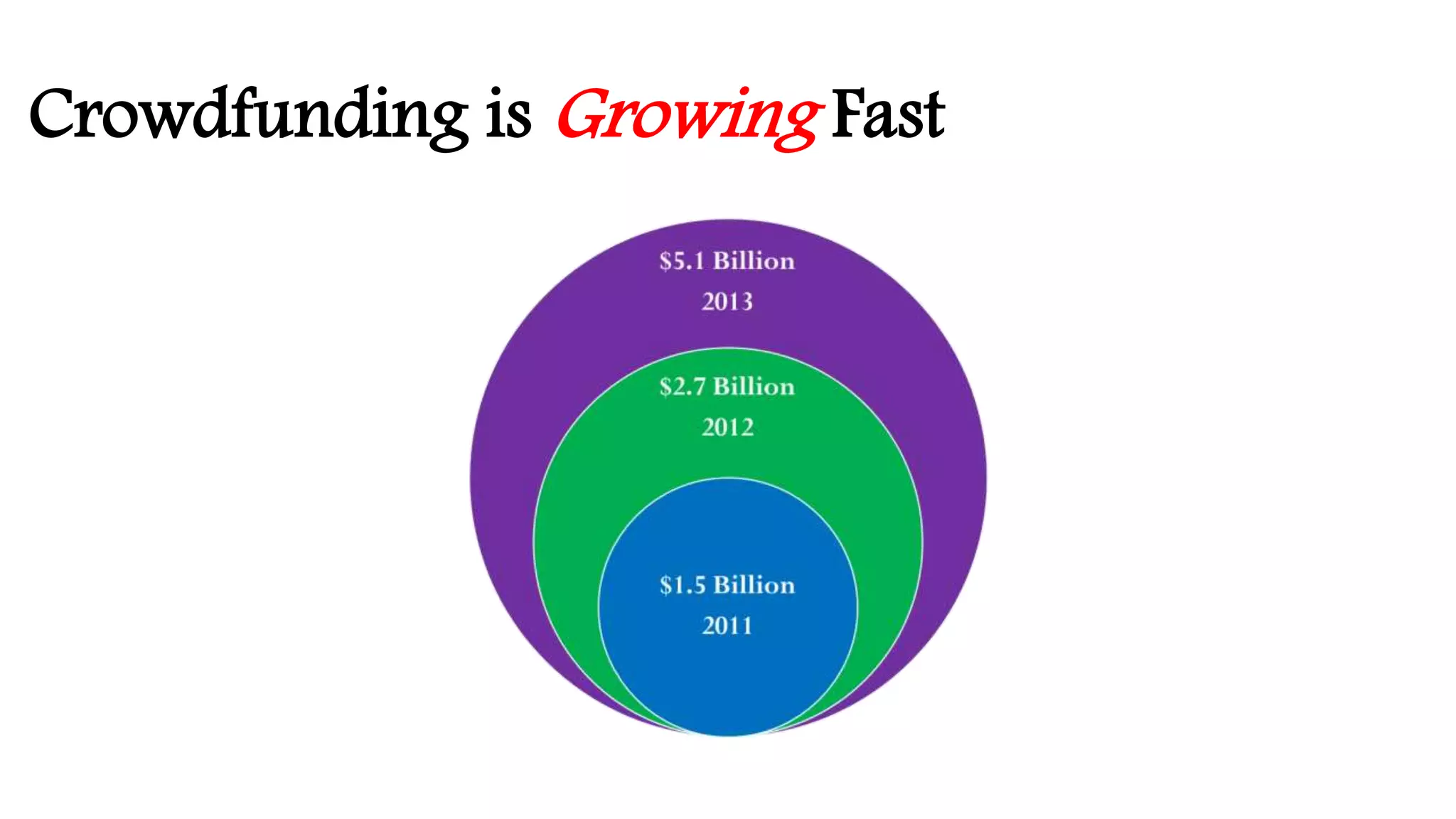
  • #8 The prevalence of crowdfunding platforms is growing quickly. In 2012, there were “more than 50 crowdfunding websites in the US, and they are experiencing an exponential growth in popularity” (Gerber, Hui, and Kuo, 2012). By 2013, the number of crowdfunding sites worldwide ballooned to more than 450 (Jarrell, 2013). Danmayr’s research shared that 98% of funds raised through crowdfunding efforts were attributed to platforms in North America and Europe. A World Bank report estimated that $1.5 billion was secured through platforms in 2011. Recent figures show that $5.1 billion was raised in 2013 (Hanselman, 2014).
  • #9 Most crowdfunding platforms can be divided into two general types depending on how they handled money. Threshold Model – (Think KickStarter or IndieGoGo . . . ) Here, funds are held in an escrow account until the goal is reached. If the goal is not reached, funds are refunded or credited back to the donor who can then reinvest with another project. Keep It All Model – (This is much more typical in the nonprofit sector). Here, the project owner or organization gets to keep all funds raised, regardless of whether or not the project goal is actually reached. UMBC’s GiveCorps platform is the second of these two types. All funds that your student organization is able to raise on the platform will be received, regardless of whether or not you hit your ultimate fundraising goal. Also, unlike outside platforms (like KickStarter or IndieGoGo) we aren’t keeping any percentages of donations to your group. If someone donates $5, you get $5 . . . If they donate $5,000 – you get $5,000.
  • #10 Feedback Loops – People are motivated by the feedback and recognition of their peers. Brabham cited the presence of feedback loops as both a marketing tool and a motivator for individuals to be brought into a new project (considering a contribution to something they hadn’t before) – and – to introducing other actors into the stewardship process. Goals – They like working towards goals, especially when those goals are specific, challenged and attributed to an individual vs. a group. The individual vs. the group was a common theme in the research – stating that the most successful projects had initial funding from friends and family members who would be attached to an individual associated with the group – as opposed to a general ask when the donor didn’t have a personal connection with the project being funded. After the initial gifts were made, those people not associated with the gift would be more likely to contribute. Reciprocal Relationships – Giving was more likely when there was a reciprocal relationship or request. They found that people were more likely to donate to an organization if they were first asked how much they would like to donate. The strongest connections happen when the relationship is mutually beneficial. Wash’s Completion Bias – People were more motivated to give when they saw that a goal was within reach. Gifts to complete a project’s goal were more likely to come from previous donors as opposed to non-completion donors. Individuals made larger gifts (up to two times larger) than the typical donation when they were finishing a project. This was compelling because it highlighted the importance of having a goal that is achievable. Meters and visible depictions of progress towards a goal could enhance this. Social Loafing – Wash (Michigan) also referenced the phenomenon of social loafing. This happens within groups who lack urgency because they assume that someone else in their group would do the heavy lifting in the campaign. If a group of people was working toward a goal and they did not have a clearly defined role or individual goal – it was much more likely that they wouldn’t do the necessary work to complete the project’s goal. People are less motivated to work toward group goals because they can’t see a strong connection between their effort and the final outcome as they can for individual work.
  • #14 What is UMBC’s GiveCorps? UMBC’s GiveCorps is a new project-based crowdfunding platform that is available to help student clubs, groups, and organizations to achieve great work. Does your club or organization need funds to carry out a project, trip, or initiative this year? UMBC’s Annual Giving team will train your group on how to successfully reach your goal. UMBC’s Engineers Without Borders, Down and Dirty Dog Band, Mini Baja,  and Alternative Spring Break Projects have all received some funding from students, alumni, parents, faculty, and staff who have connected with projects through GiveCorps. What does UMBC’s GiveCorps Program Cost? The cost of using UMBC’s GiveCorps is covered completely by the University. How are donations handled? 100 percent of all funds raised by your project campaign will be designated to your account, even if you do not reach your goal. Unlike other crowdfunding platforms, the UMBC Foundation doesn’t keep a percentage of funds raised. There are no program costs or fees charged to your team.
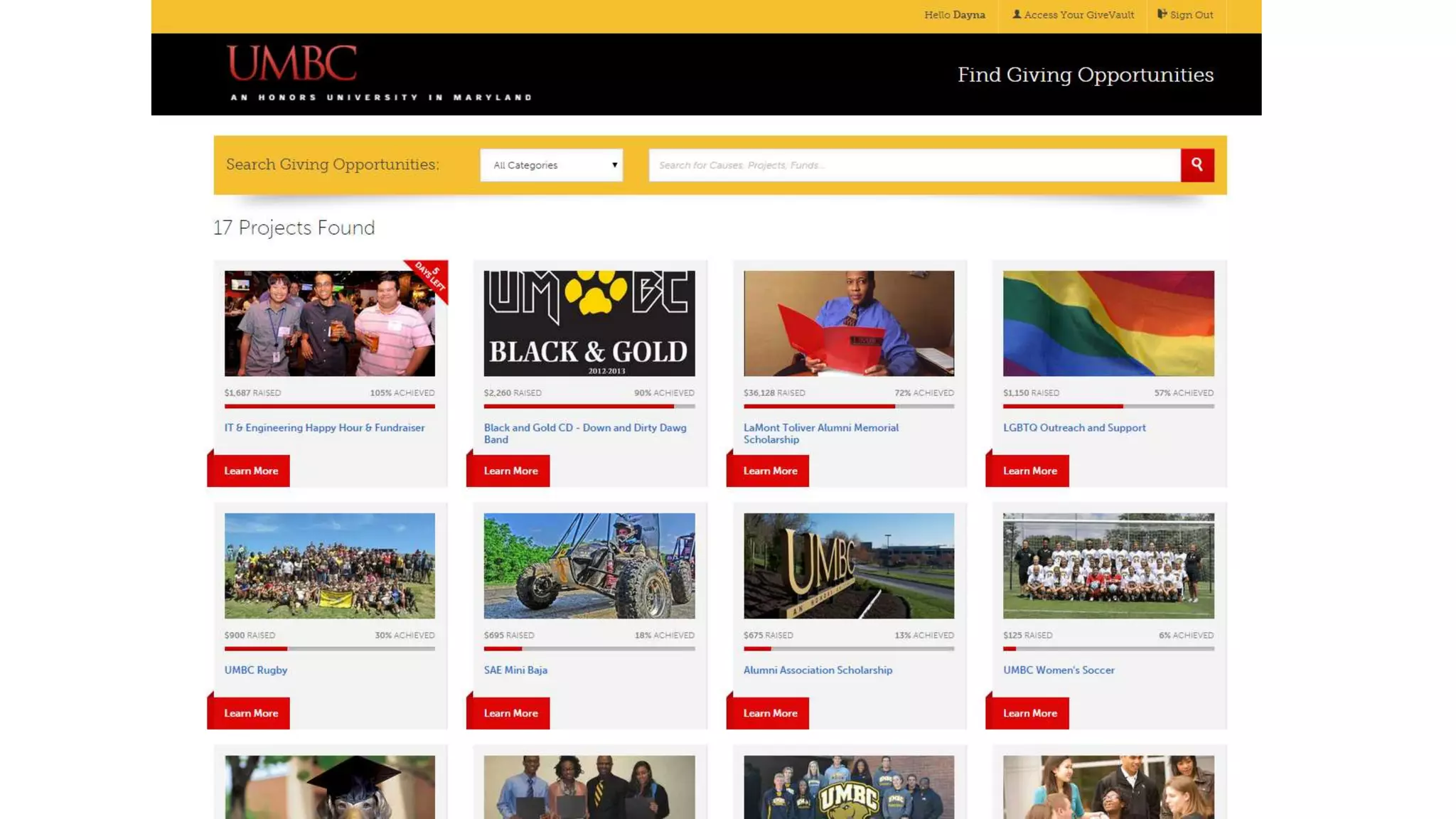
  • #15 In year one – we helped to support students involved with our Mini-Baja racing team, travel for students associated with Alternative Spring Break and Engineers Without Borders trips, and our institution’s Pep Band . . . that travels with our sports teams. While we haven’t seen an immediate impact on STUDENT giving – we have seen increased alumni giving. I’ll show you around some of our more successful project pages: UMBC Engineering & Information Technology Happy Hour – The mobile-ready form Meyerhoff – LaMont Toliver Alumni Scholarship – Bringing together a donor constituency to honor a program director’s legacy Pep Band – Great project marketers tripled their funds raised LGBTQ Outreach – Increased awareness through better marketing and a donor’s passion . . . . (a mid-level donor found project online, and has committed to endowing a fund) Alumni Association Scholarship – Members from the Chapter of Alumni’s Executive Board committed to making $10/mo, recurring gifts through GiveCorps. Together, their small group will be able to fund one scholarship award for the upcoming academic year.
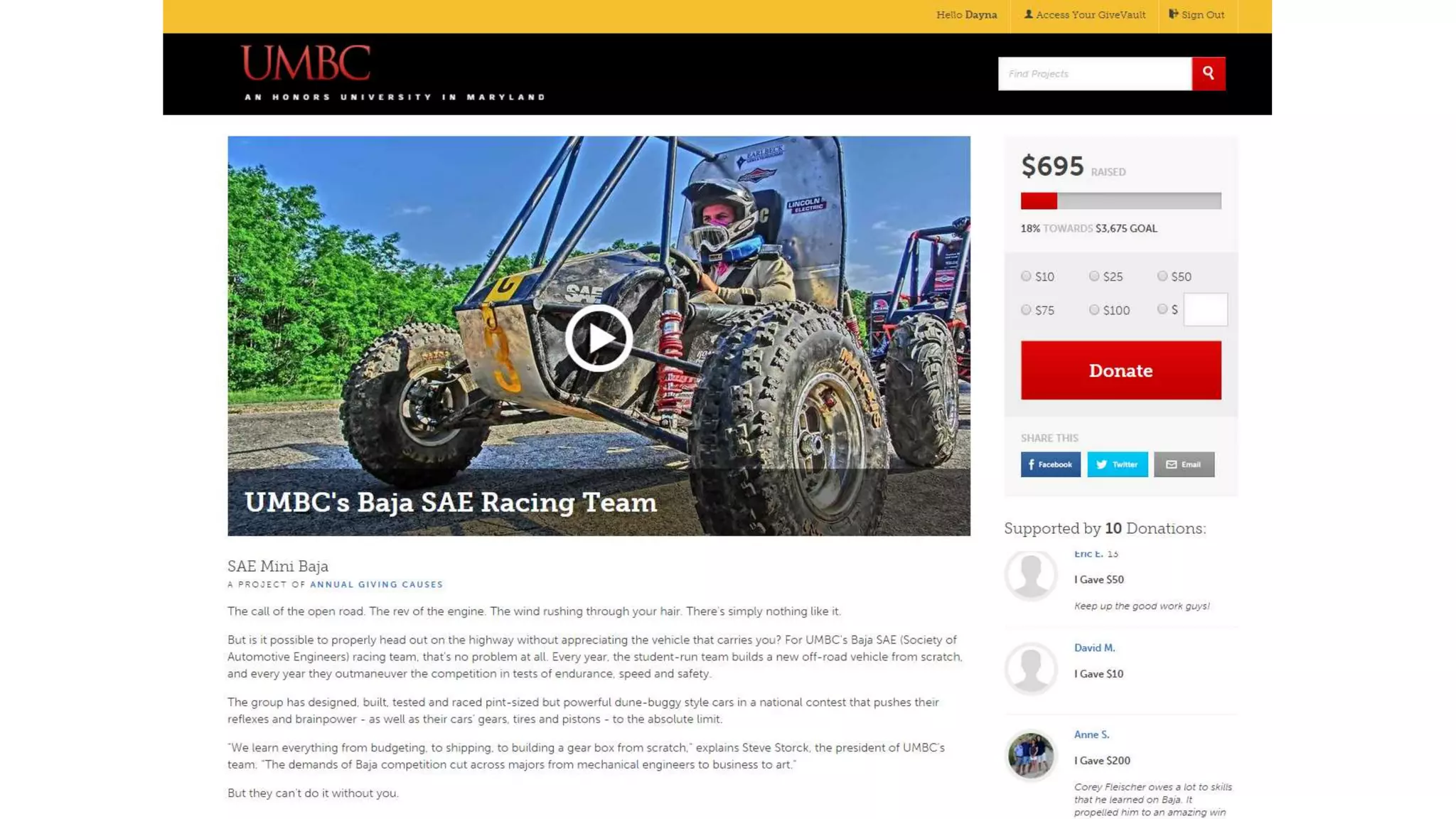
  • #16 So, let’s take a moment and dive deeper into one of the projects. UMBC’s Mini Baja team was one of our first partners. Great, high-resolution photo A terrific story – They were using their experience and knowledge gained from taking courses at UMBC to build a racing car. So it’s a project that marries education with fun. They have a need – both for parts for the car . . . And for registration and travel expenses involved with entering the car in a number of competitions.
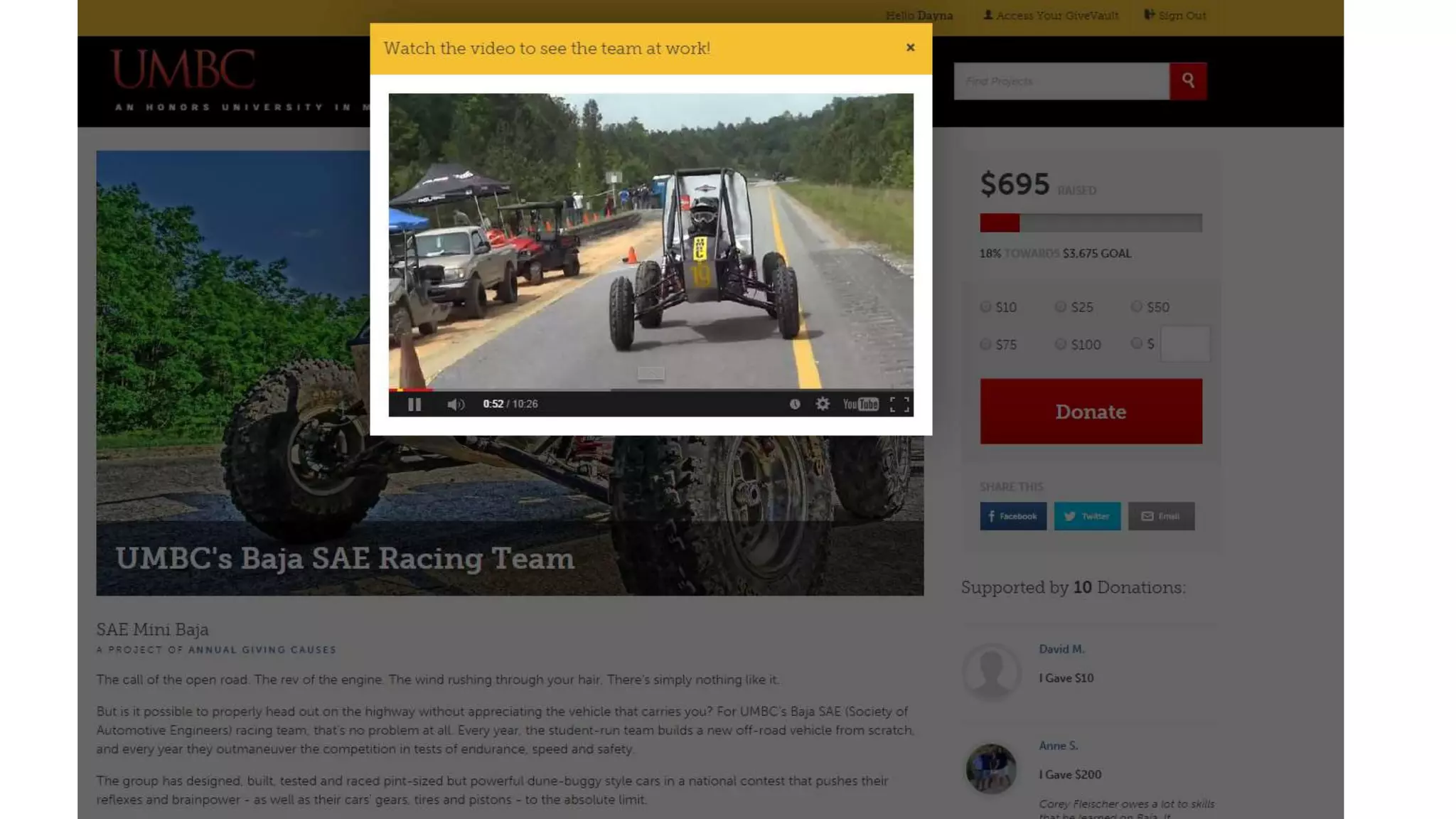
  • #17 UMBC’s GiveCorps page offers the opportunity to incorporate video – which can be a great way to tell your organization’s story. Mini Baja shows their scope of work – and one of their working cars “on the road”. The Pep Band did a fun out-take that worked like an info-mercial And a number of the Alternative Spring Break projects linked to the trip organizers who spoke about the work they would be conducting over Spring Break.
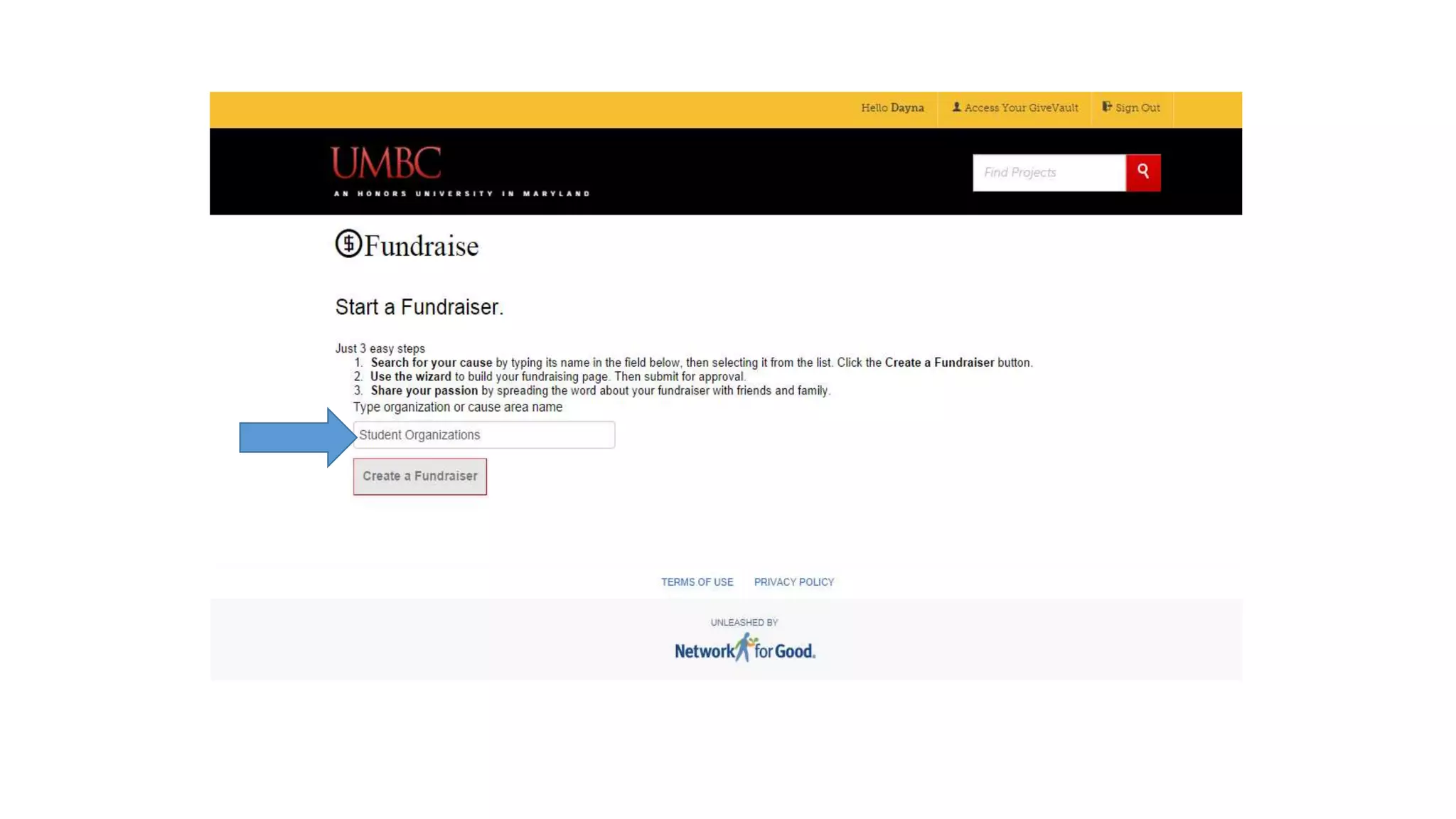
  • #20 It takes you to the beginning of a “wizard tool” that walks you through the process, step-by-step. You’ll want to type in “Student Organizations” into the box, to make sure that you link with the correct account.
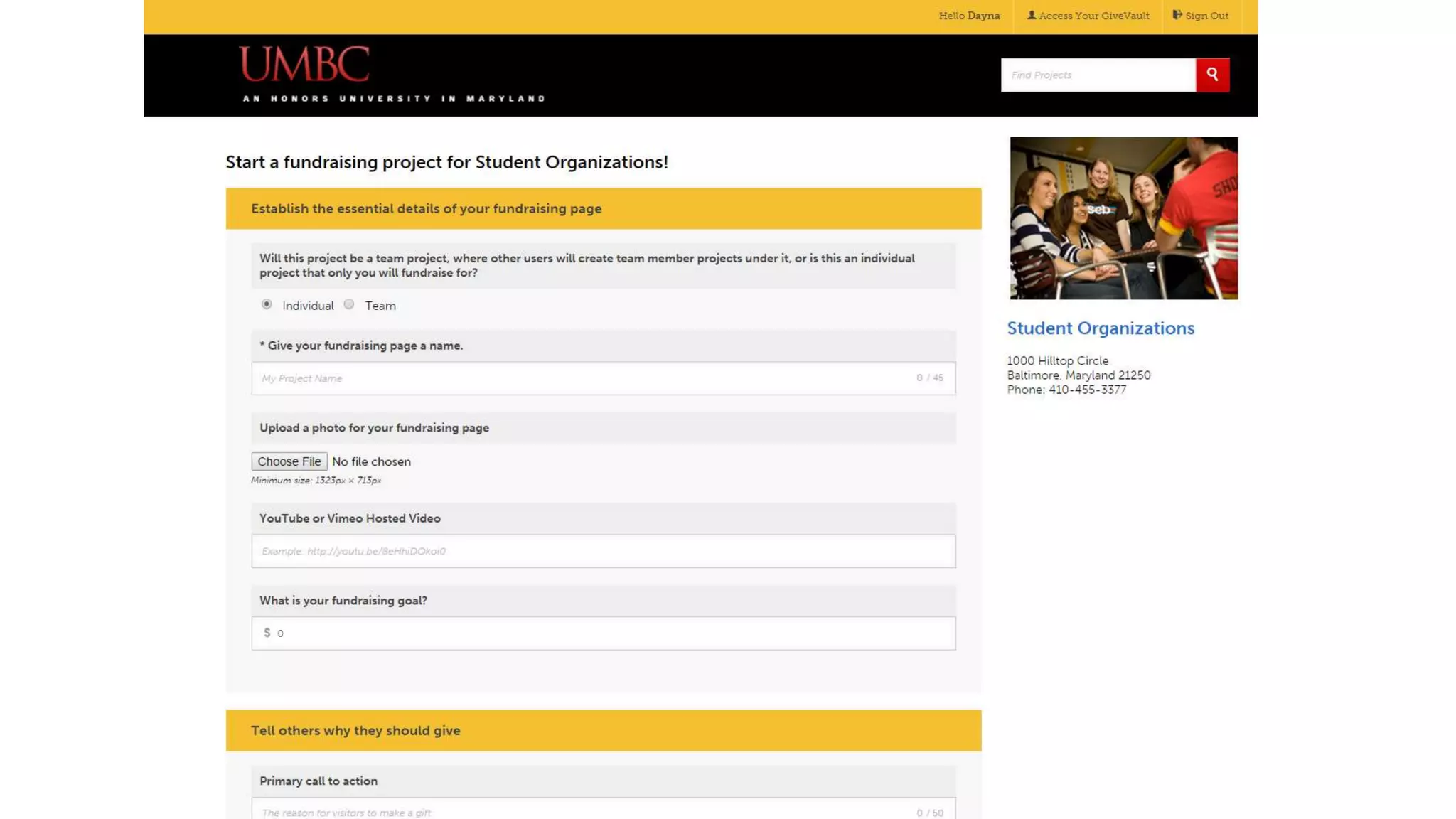
  • #21 You’ll want to give your page a name and select a great, high-resolution photo to represent your organization. If you have a video, you can link it up through this page. You’ll want to set a financial goal. You’ll need to develop a call to action – And then your project is sent away for “review”.
  • #22 Have fun with the description of your project. Donors will connect with projects that are detailed and provide a fun, authentic view of the work that you do. Be creative. Be funny. Be unique. This is also a piece that our teams in Alumni & Development Communications and Annual Giving will help you with. No project goes “live” to the site without a review. Our A&D Communications team will look through your text, offer suggestions, and make sure that not only your development language is really strong and clear – but – also that your grammar is correct, too.
  • #23 I also encourage groups to consider a strong call-to-action . . . . You want the donor looking at your page to have no question about where their money is going and how it is used. Funds raised can cover travel and associated expenses with attending a conference or event. Money can go to support operational expenses – materials for workshops or building something (like the mini-baja car) Funds raised can cover food, room expenses, etc. It’s helpful if you can think out a budget and show the break-down. The Pep Band did a fantastic job of creating a budget and then sending project updates to donors as they hit certain dollar marks. You’ll also see here that Mini Baja really detailed how money would be spent. This type of illustration helps a donor see themselves in your project. Maybe someone connects with wanting to pay for race registration, so they would donate $1,000 – or maybe they have a more modest budget – but can help fund $50 for feeding a team member.
  • #24 GiveCorps is constantly looking at ways to improve their platform. They recently provided us with updated templates – so you can change the look and feel of your project page.
  • #25 How can OIA help?
  • #27 Goals – They like working towards goals, especially when those goals are specific, challenged and attributed to an individual vs. a group. The individual vs. the group was a common theme in the research – stating that the most successful projects had initial funding from friends and family members who would be attached to an individual associated with the group – as opposed to a general ask when the donor didn’t have a personal connection with the project being funded. After the initial gifts were made, those people not associated with the gift would be more likely to contribute. We also recommend Goals that are scalable. Instead of an all-or-nothing threshold, consider what it might cost for one member to attend a conference in NYC – build from there. You can market to donors: “If we can raise another $1,200, we can send another student to attend the national conference . . . . “ Most successful projects are below the $3,000 threshold. This keeps the goal low enough that one donor can make a modest gift and see their impact on a goal/meter, etc. Looking back to donor motivations, we know that donations to projects tend to increase in size and frequency when the project gets close to it’s goal. People want to know that THEIR gift made a difference.
  • #30 The key to making projects successful is in marketing. Projects are much more likely to succeed with embedded champions (that’s you!). Champions are people who volunteer to fundraise on behalf of a particular fundraising campaign. The more champions you have, the more likely it is that you will reach your goal. It is recommended that you have at least ten (10) Champions to launch a campaign. If you have at least 10 champions in your student organization who are ready to email projects, it’s likely you’re going to be successful. UMBC’s Annual Giving team is committed to training and educating groups on how to be effective fundraisers so they are adequately prepared for the launch of their campaigns. The Annual Giving team will provide Champion Training, designed to help project members understand crowdfunding, how to use the GiveCorps technology, and what will be expected of them through the fundraising campaign.
  • #31 Looking at a Concentric Circle Constituency Model can help you identify who might be the best audience for your organization. Widening circles represent the energy of an organization – and the flow and dissipation of energy moving outward from the center. . . . The closer to the center of the action, the greater the energy and the stronger the bond between the donor and your project. The core constituency then, would be at the center of your concentric circles.
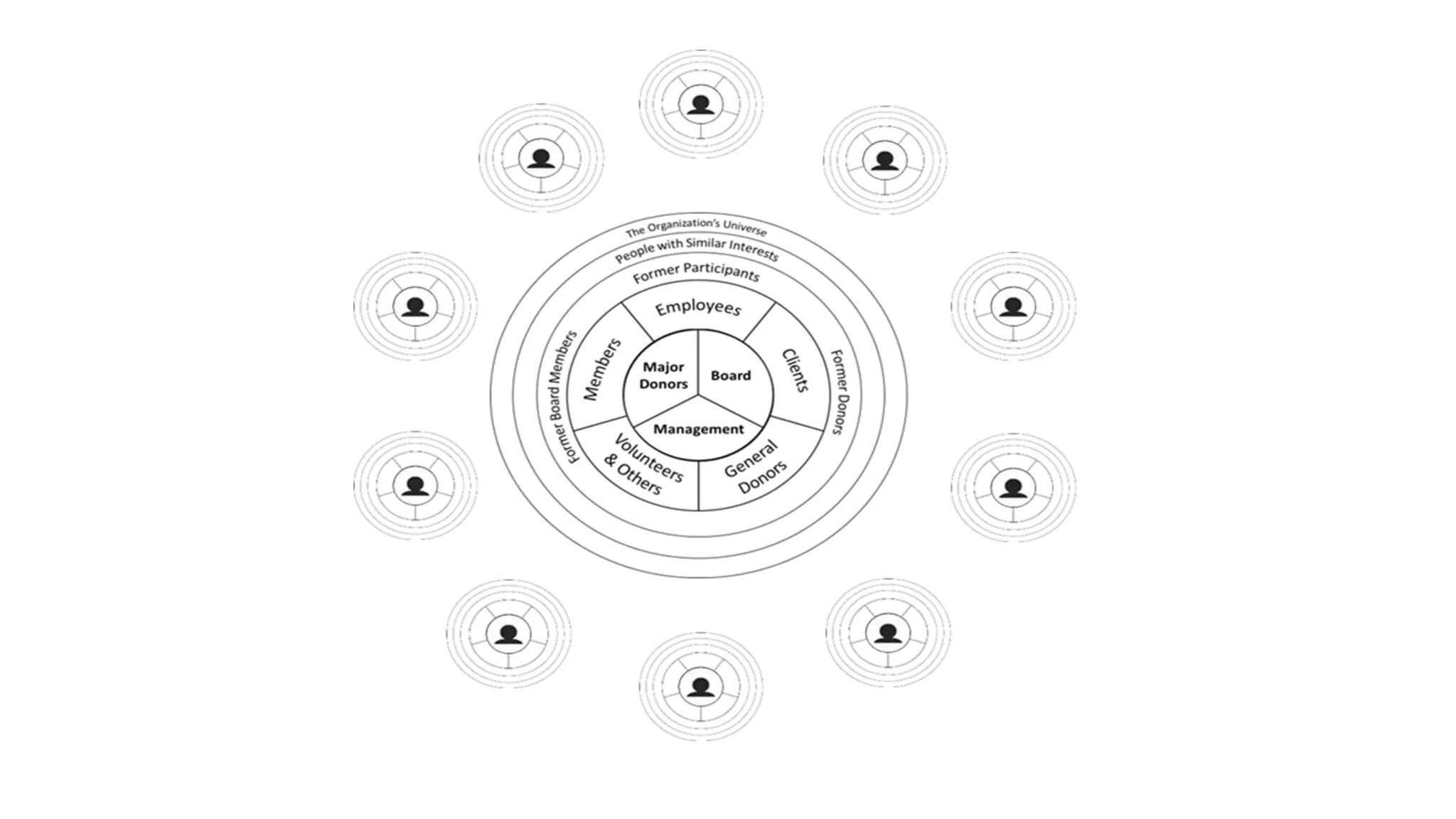
  • #32 While the core constituency of the institution remains intact, one can imagine how project team members have the potential to expand and change the circle’s reach. When each individual takes on a fundraiser or advocate role, they become the center of their own concentric circle. Some circles will overlap, some will be larger or smaller than others, but the end result is the same. Each motivated individual attached to a project has the potential to reach a different donor constituency. This model could help to address some concerns about the limitations of crowdfunding pertaining to fundraising within a closed network of donors. The most successful projects will be driven by individuals and not necessarily by the institution. The polished, institutional messages won’t necessarily equate into crowdfunding success. More often, a personal email communication from a peer – polished or not – will go much further in garnering support for a cause. Contributors to projects are supporting the program AND the individual who is promoting the program.
  • #33 The trick is that crowdfunding needs to start as largely EMAIL driven. A study by Arizona State University found that: 3% of donors came in through Twitter 12% reported having found the cause through Facebook 32% through “other sources” . . . Person-to-person, event-based, etc. And 53% found out about the project through EMAIL communications.
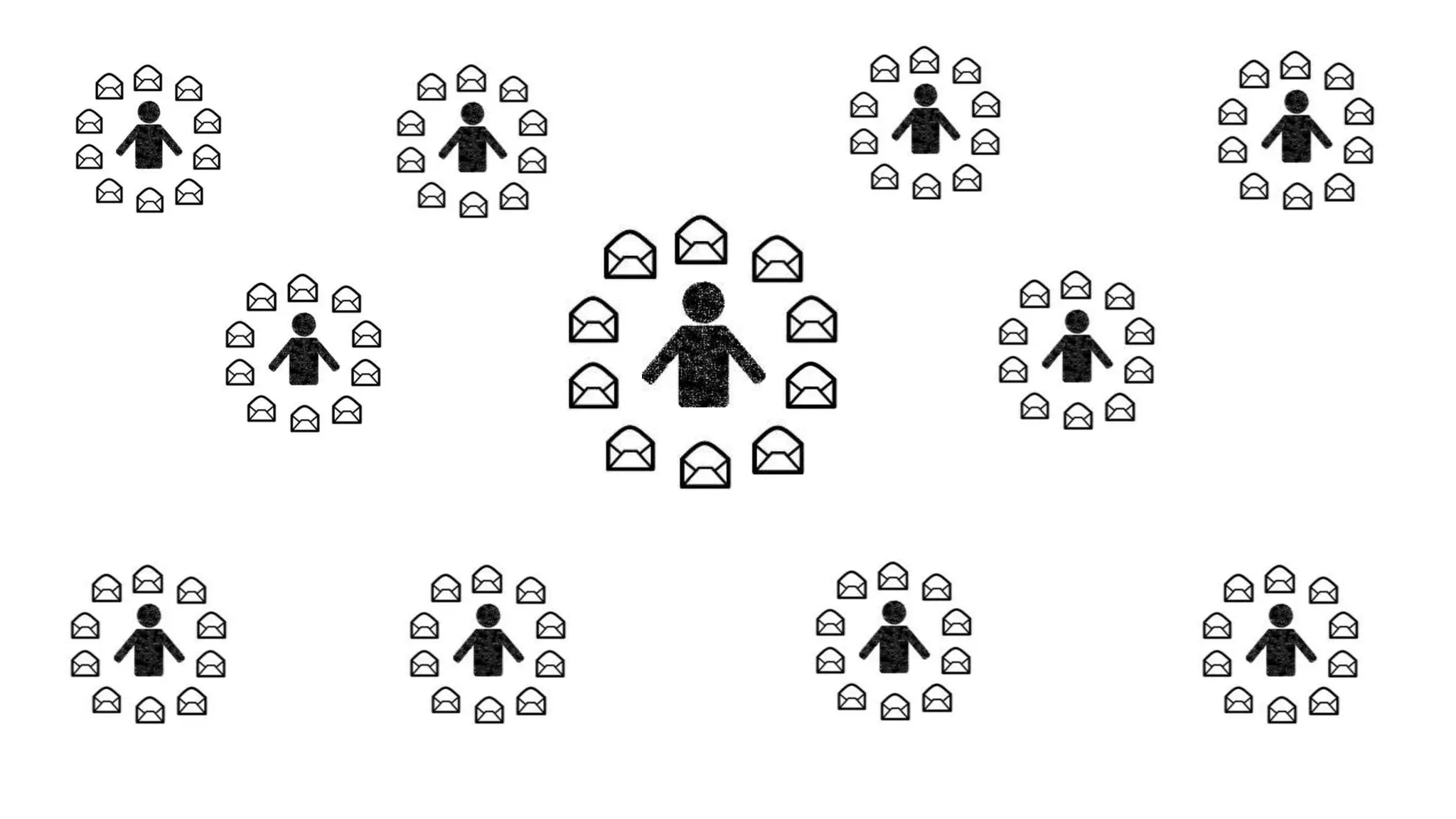
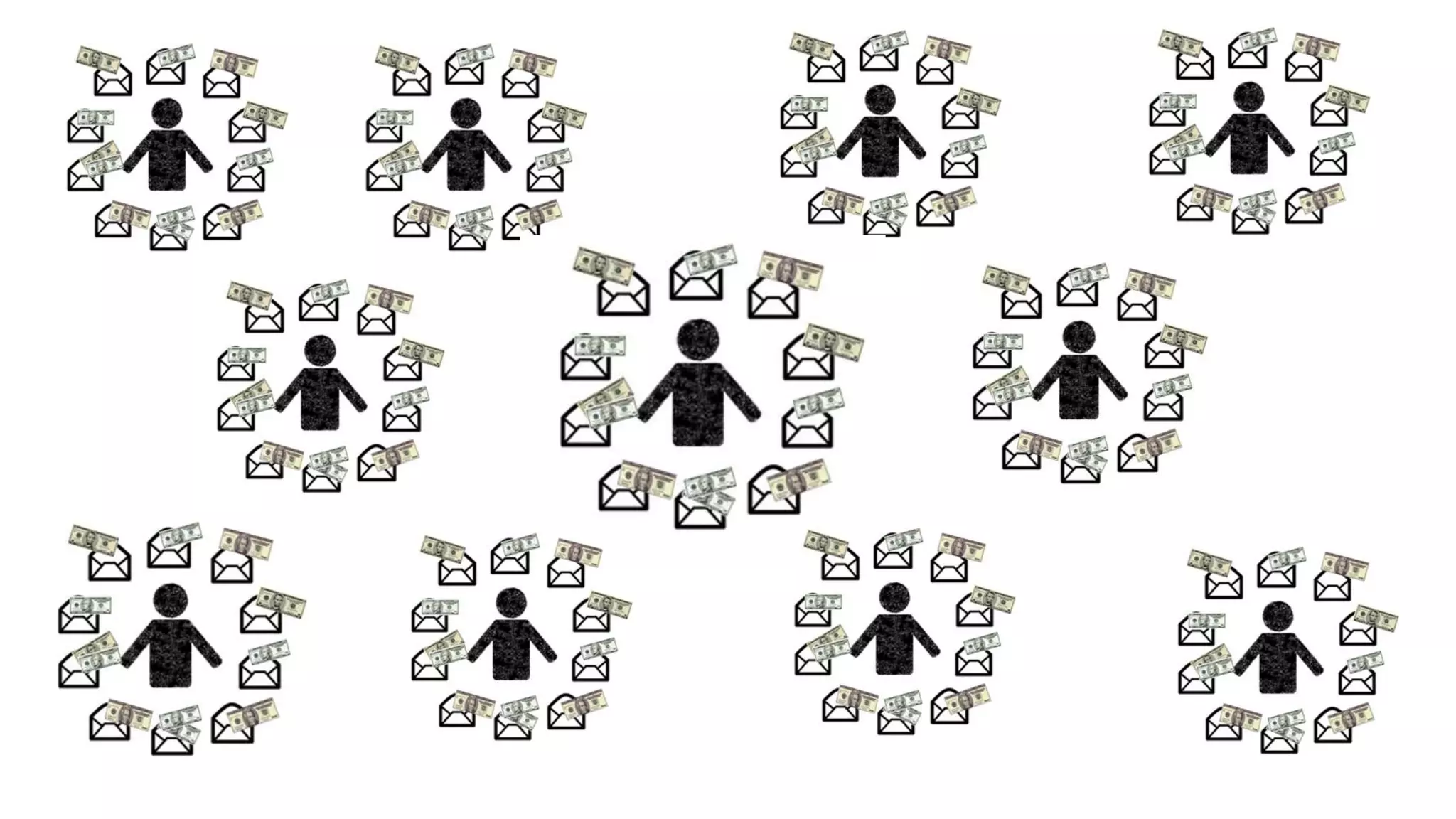
  • #34 If everyone in your organization reached out to 10 people they knew through email (parents, friends, alumni) – think of how much the impact could be.
  • #35 In a recent study by Arizona State University – they found that each email sent from a team of 12-20 individuals – typically generated about $4.