FUNDAMENTALS OF
DRAWING
INSTRUCTOR: JUSTIN DAVE B. GALLARDO
INTRODUCTION
• Drawing is a form of visual art
that makes use of any
number of drawing
instruments to mark a two-
dimensional medium
• An artist who practices or works
in drawing may be called a
draftsman or draughtsman.
Raphael, study for what became the Alba Madonna, with
other sketches
INTRODUCTION
•The medium has been a popular and
fundamental means of public expression
throughout human history. It is one of the
simplest and most efficient means of
communicating visual ideas.
INTRODUCTION
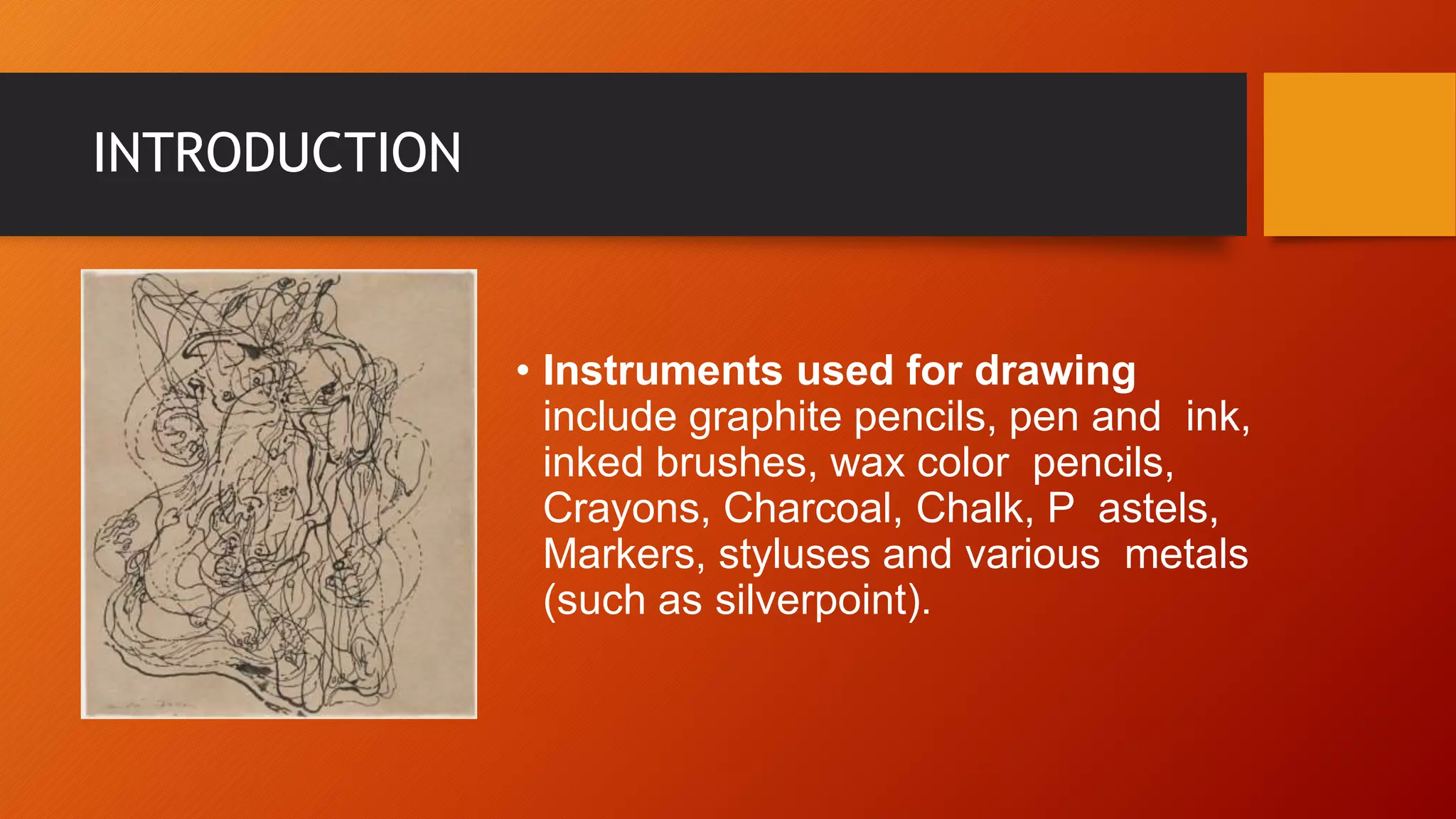
• Instruments used for drawing
include graphite pencils, pen and ink,
inked brushes, wax color pencils,
Crayons, Charcoal, Chalk, P astels,
Markers, styluses and various metals
(such as silverpoint).
INTRODUCTION
• Other materials: used for drawing includes various
kinds of eraser, pecils sharpeners, geometric
apparatus, such as rulers, protactors and etc.
• The most common surfaces for drawing is
paper, although other surface materials such as
cardboard, plastic, leather, canvas, a nd board, may
be used. Temporary drawings may be made on a
blackboard or whiteboard or indeed almost anything
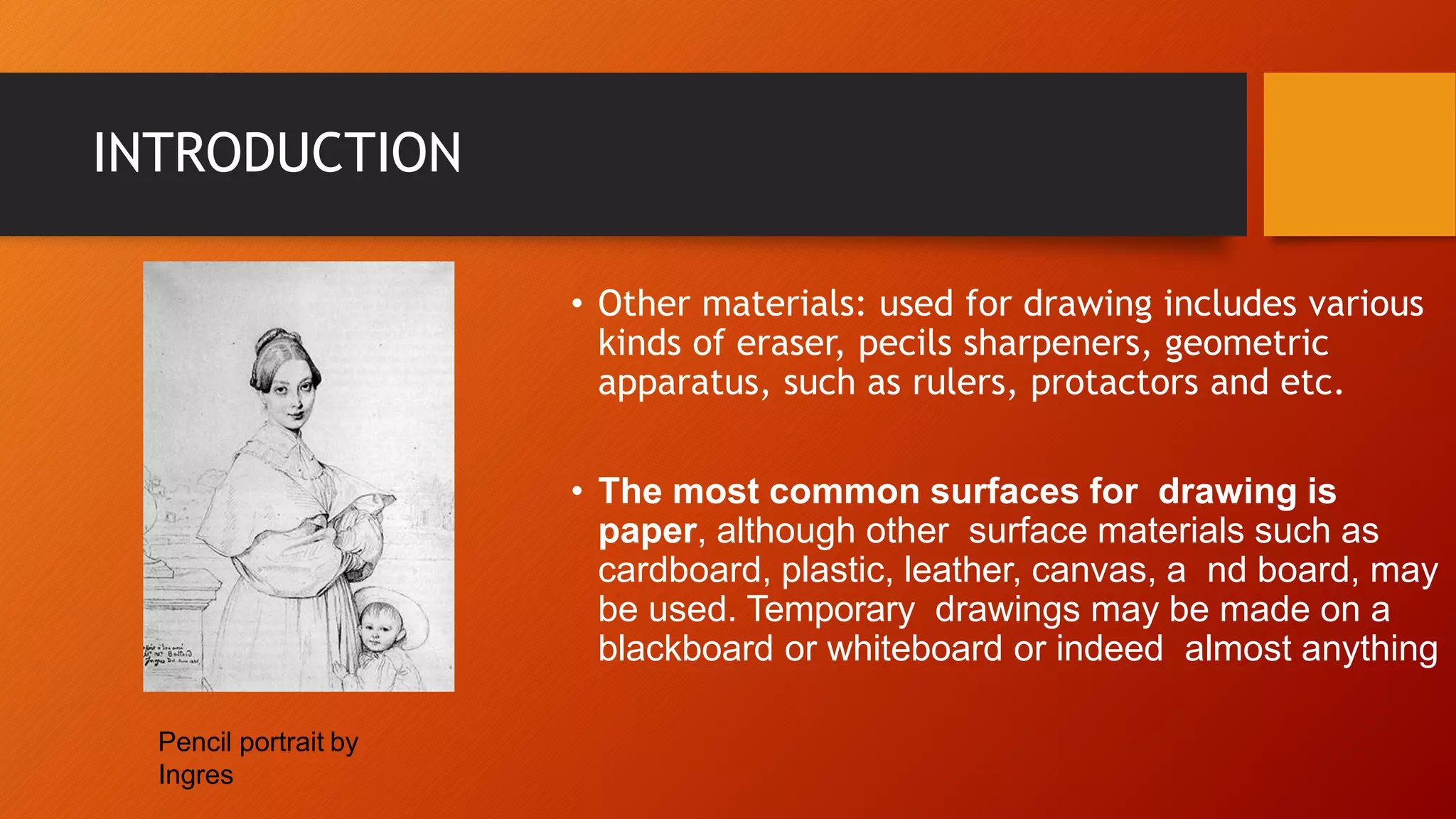
Pencil portrait by
Ingres
Origin of Basic Drawing
Materials
Origin of Basic Drawing Materials
• Paper
• The precursor to modern paper dates
back to 2nd century BC in China.
• From China, the paper making process
spread to the Middle East, then to
medieval Europe in the 13th century,
where the first water- powered paper
mills were built.
• In 1844, Canadian inventor Charles
Fenerty and German F.G. Keller
independently developed processes for
pulping wood fibers significantly lowering
the cost
Hemp wrapping
paper, China, circa 100BC
Origin of Basic Drawing Materials
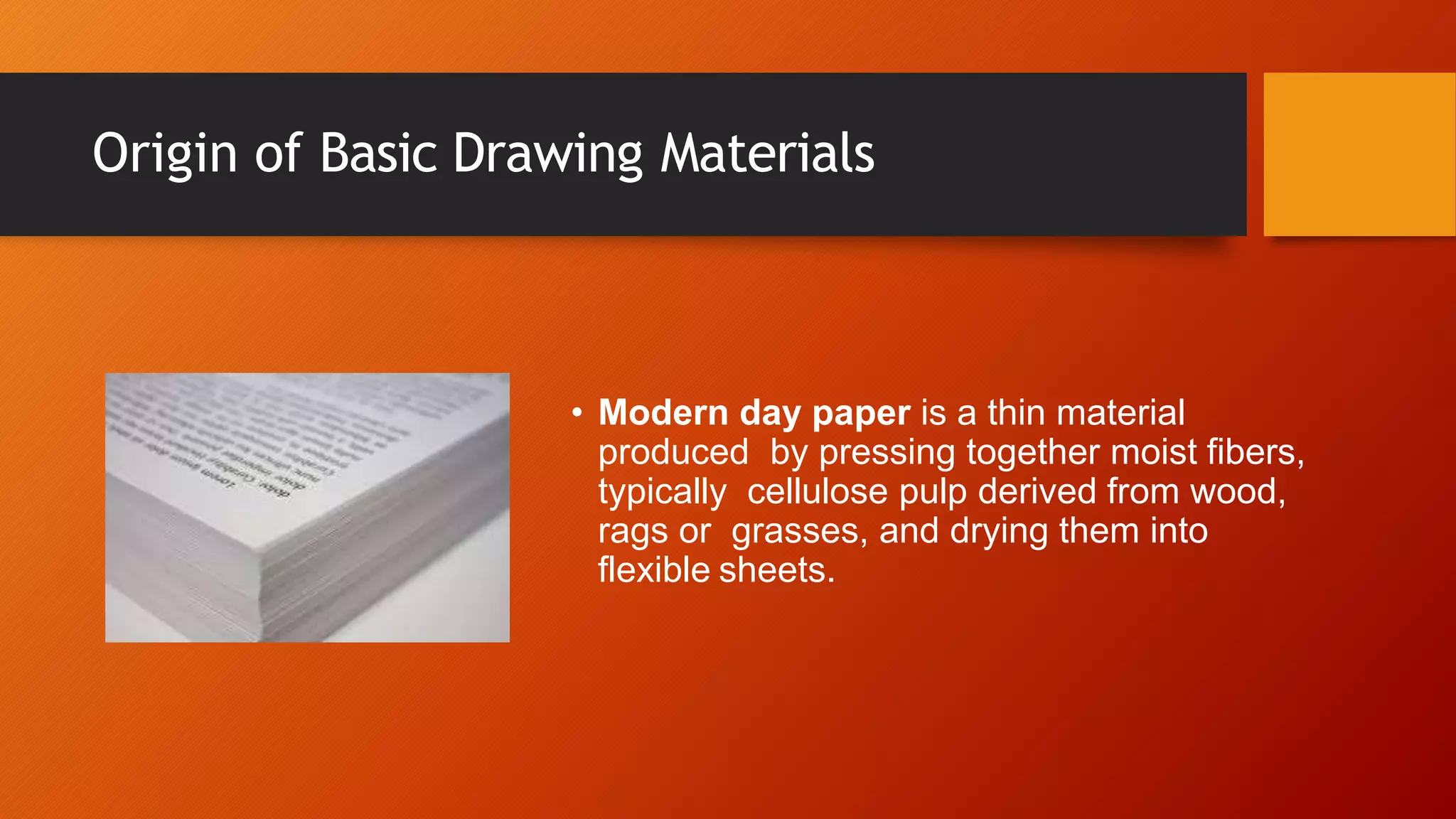
• Modern day paper is a thin material
produced by pressing together moist fibers,
typically cellulose pulp derived from wood,
rags or grasses, and drying them into
flexible sheets.
Origin of Basic Drawing Materials
• Pencil
• Origination of the word “Pencil”
• O from French: “pincel”, which means ―
a
small paintbrush‖
• O From Latin: “penicillus” a "little tail―
• Evolution
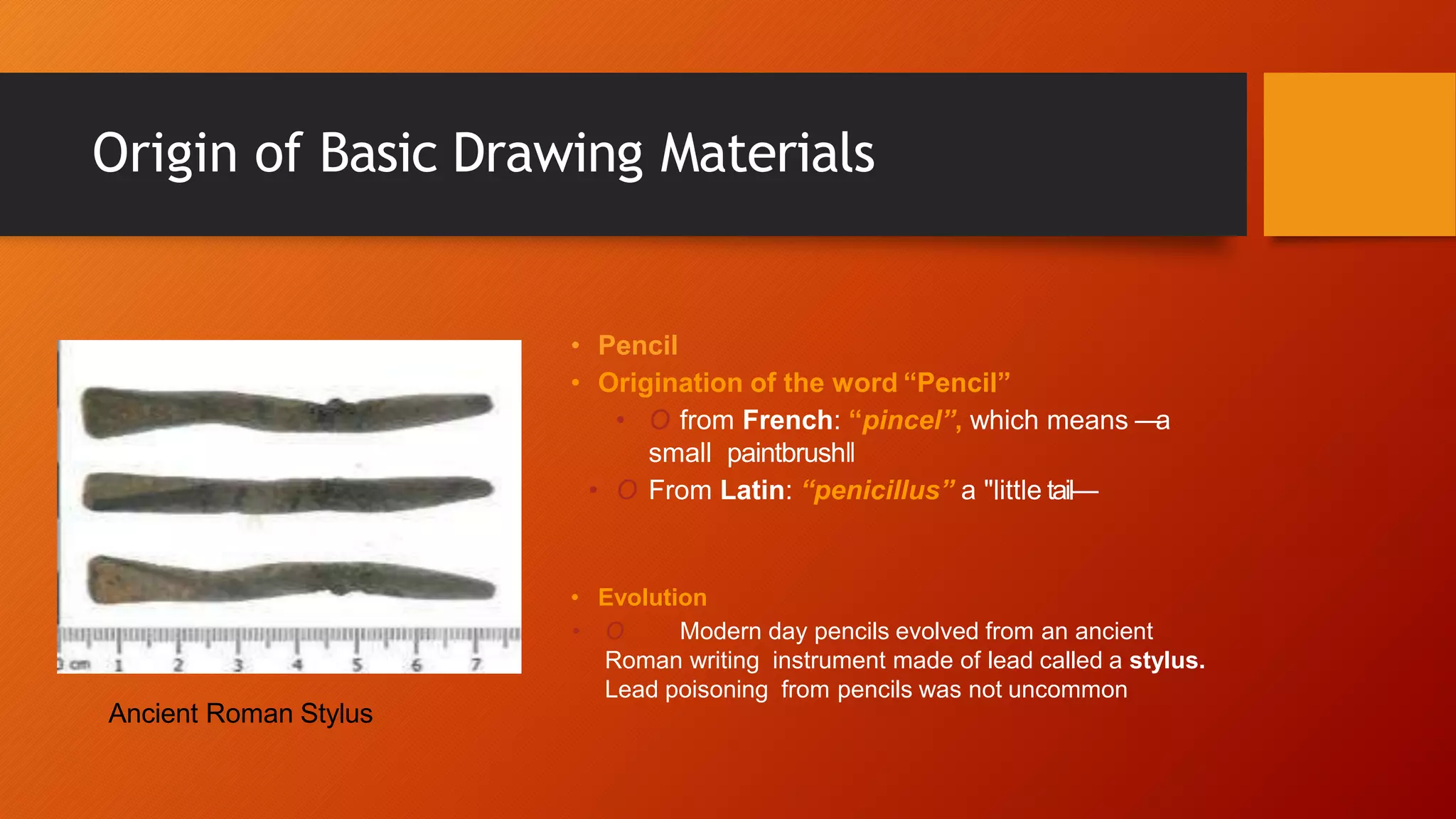
• O Modern day pencils evolved from an ancient
Roman writing instrument made of lead called a stylus.
Lead poisoning from pencils was not uncommon
Ancient Roman Stylus
Origin of Basic Drawing Materials
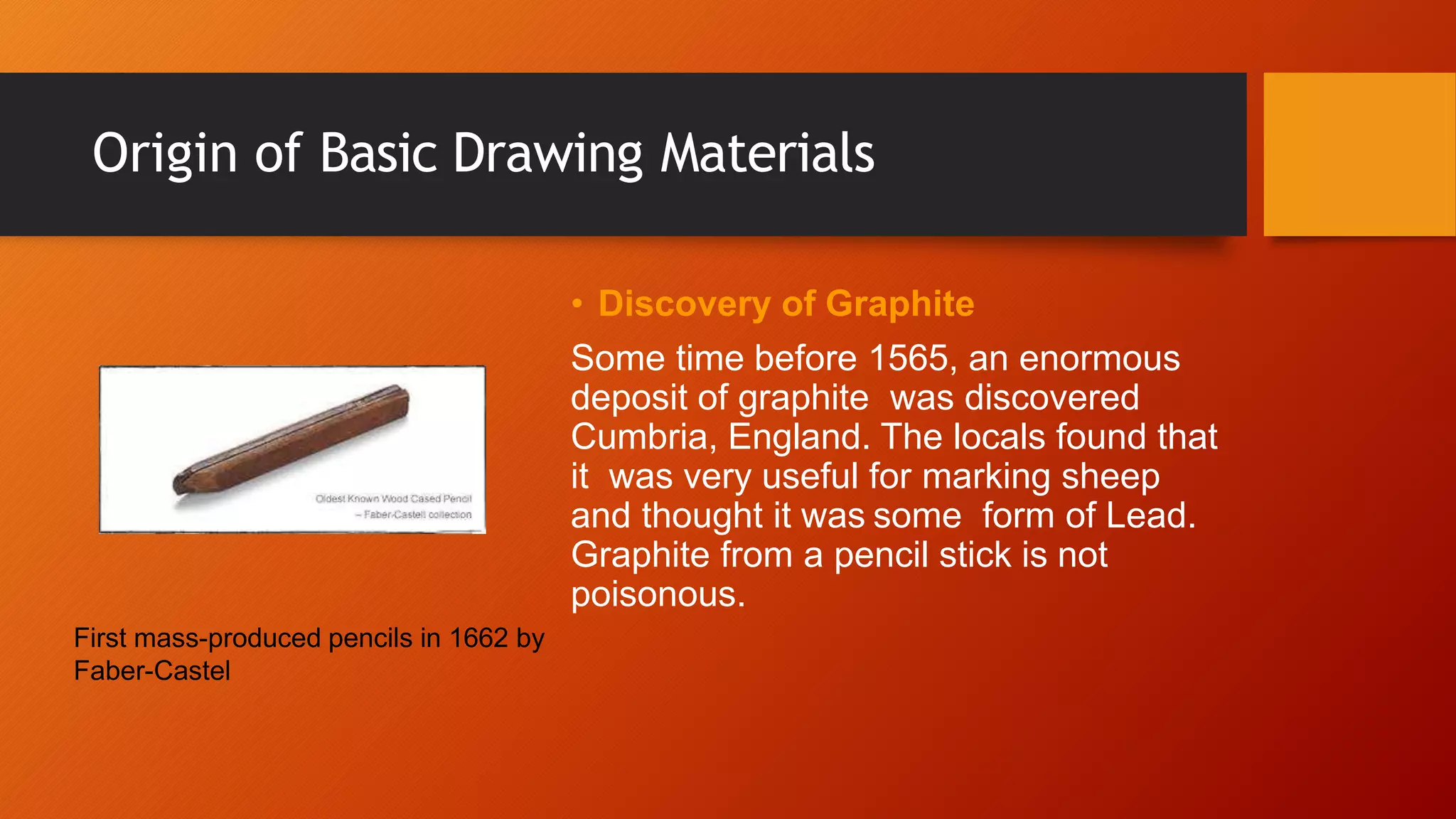
• Discovery of Graphite
Some time before 1565, an enormous
deposit of graphite was discovered
Cumbria, England. The locals found that
it was very useful for marking sheep
and thought it was some form of Lead.
Graphite from a pencil stick is not
poisonous.
First mass-produced pencils in 1662 by
Faber-Castel
Origin of Basic Drawing Materials
• Grading and classification
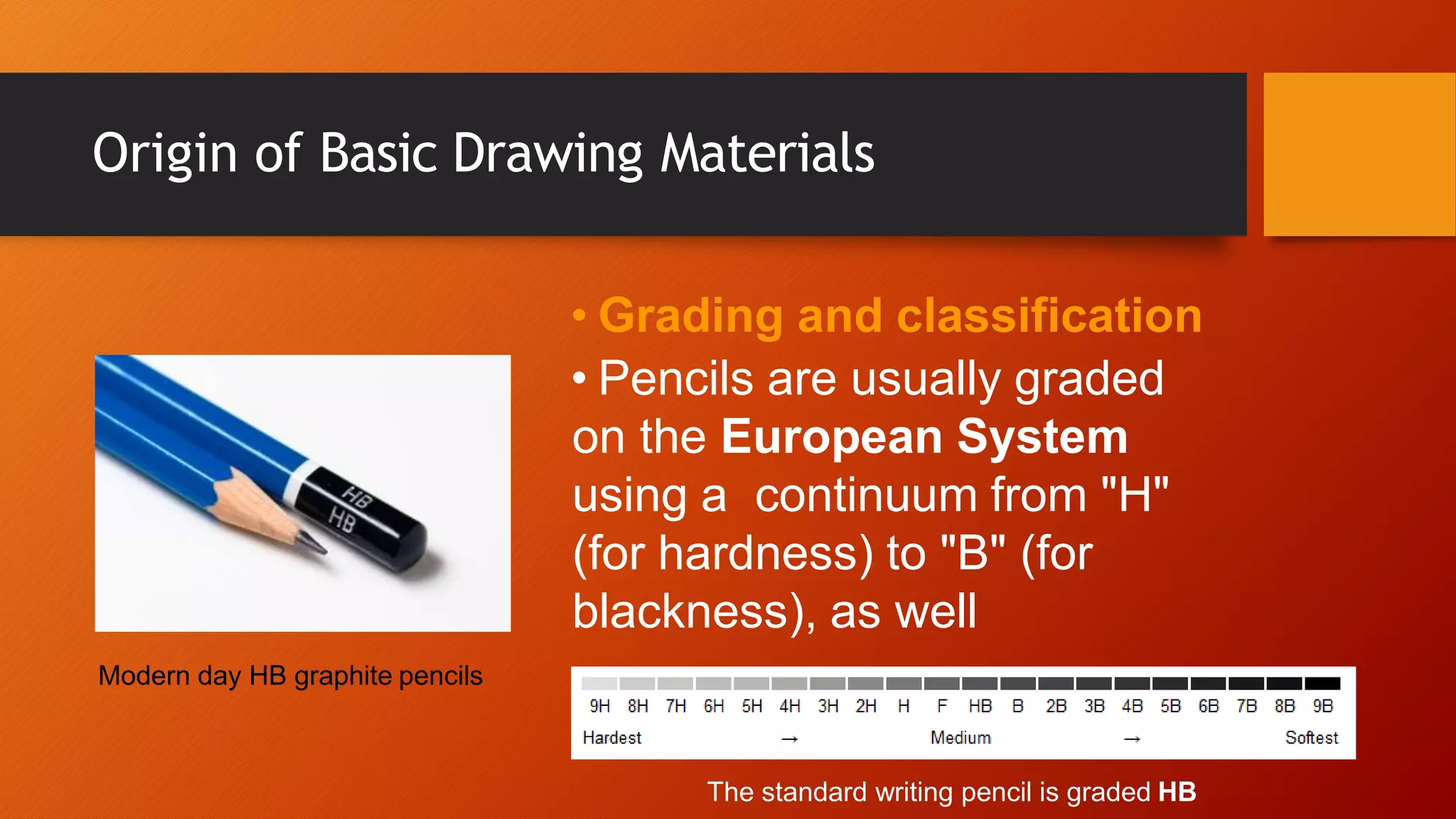
• Pencils are usually graded
on the European System
using a continuum from "H"
(for hardness) to "B" (for
blackness), as well
The standard writing pencil is graded HB
Modern day HB graphite pencils

FUNDAMENTALS OF DRAWING.pptx

  • 1.
  • 2.
    INTRODUCTION • Drawing isa form of visual art that makes use of any number of drawing instruments to mark a two- dimensional medium • An artist who practices or works in drawing may be called a draftsman or draughtsman. Raphael, study for what became the Alba Madonna, with other sketches
  • 3.
    INTRODUCTION •The medium hasbeen a popular and fundamental means of public expression throughout human history. It is one of the simplest and most efficient means of communicating visual ideas.
  • 4.
    INTRODUCTION • Instruments usedfor drawing include graphite pencils, pen and ink, inked brushes, wax color pencils, Crayons, Charcoal, Chalk, P astels, Markers, styluses and various metals (such as silverpoint).
  • 5.
    INTRODUCTION • Other materials:used for drawing includes various kinds of eraser, pecils sharpeners, geometric apparatus, such as rulers, protactors and etc. • The most common surfaces for drawing is paper, although other surface materials such as cardboard, plastic, leather, canvas, a nd board, may be used. Temporary drawings may be made on a blackboard or whiteboard or indeed almost anything Pencil portrait by Ingres
  • 6.
    Origin of BasicDrawing Materials
  • 7.
    Origin of BasicDrawing Materials • Paper • The precursor to modern paper dates back to 2nd century BC in China. • From China, the paper making process spread to the Middle East, then to medieval Europe in the 13th century, where the first water- powered paper mills were built. • In 1844, Canadian inventor Charles Fenerty and German F.G. Keller independently developed processes for pulping wood fibers significantly lowering the cost Hemp wrapping paper, China, circa 100BC
  • 8.
    Origin of BasicDrawing Materials • Modern day paper is a thin material produced by pressing together moist fibers, typically cellulose pulp derived from wood, rags or grasses, and drying them into flexible sheets.
  • 9.
    Origin of BasicDrawing Materials • Pencil • Origination of the word “Pencil” • O from French: “pincel”, which means ― a small paintbrush‖ • O From Latin: “penicillus” a "little tail― • Evolution • O Modern day pencils evolved from an ancient Roman writing instrument made of lead called a stylus. Lead poisoning from pencils was not uncommon Ancient Roman Stylus
  • 10.
    Origin of BasicDrawing Materials • Discovery of Graphite Some time before 1565, an enormous deposit of graphite was discovered Cumbria, England. The locals found that it was very useful for marking sheep and thought it was some form of Lead. Graphite from a pencil stick is not poisonous. First mass-produced pencils in 1662 by Faber-Castel
  • 11.
    Origin of BasicDrawing Materials • Grading and classification • Pencils are usually graded on the European System using a continuum from "H" (for hardness) to "B" (for blackness), as well The standard writing pencil is graded HB Modern day HB graphite pencils