Fashion Design
Mezgebu Tesfaye
January , 2024
For-Level-II
Course name; Identify Design process for fashion designs
Preparation of workstation
UNIT - ONE…
UNIT - TWO…
Design process
UNIT - THREE..…
Elements and principles of design.
UNIT - FOUR..…
Characteristics of color and prepare color
chart
COURSE CONTENT
Preparation of
workstation
In this unit you will be learn;
 Selection and preparation of tools and equipment
 Preparation of workbench according to OHS Practice
After completion of this unit,
you will be able to:
Selecting and preparing of
tools and equipment
Preparing workbench
according to OHS practice
INTRODUCTION
• Working on a fashion collection include a series of
idea, sketches, diverse themes and inspirations, as
well as various silhouette, pattern, texture, and
colour experimentation.
For commercial
designers
• is the first step towards bringing designs to reality.
• Fashion figures are the foundation of a designer's
vision, serving as the blueprint for their designs.
Drawing fashion
figures
• is about current populism, and fashion designers
represent the spirit of the times, or zeitgeist, via
their work.
• Designer always being on the hunt for new and
exciting things to inspire.
Fashion, by
definition,
Tools and
equipments
of drawing
Drawing Paper …
It is making artistic drawings soft to heavy
structural drawings)
It is also used for print a hard copy of digital
drawings
Different types of drawings
require different sizes of
drawing papers.
Paper size Dimensions (cm) Paper Area
Α5 14.8 x 21 cm 0.03108 m2
Α4 21 x 29.7 cm 0.0612 m2
Α3 29.7 x 42 cm 0.125 m2
Α2 42 x 59.4 cm 0.25 m2
Α1 59.4 x 84.1 cm 0.50 m2
Α0 84.1 x 118.9 cm 1 m2
Cont..…
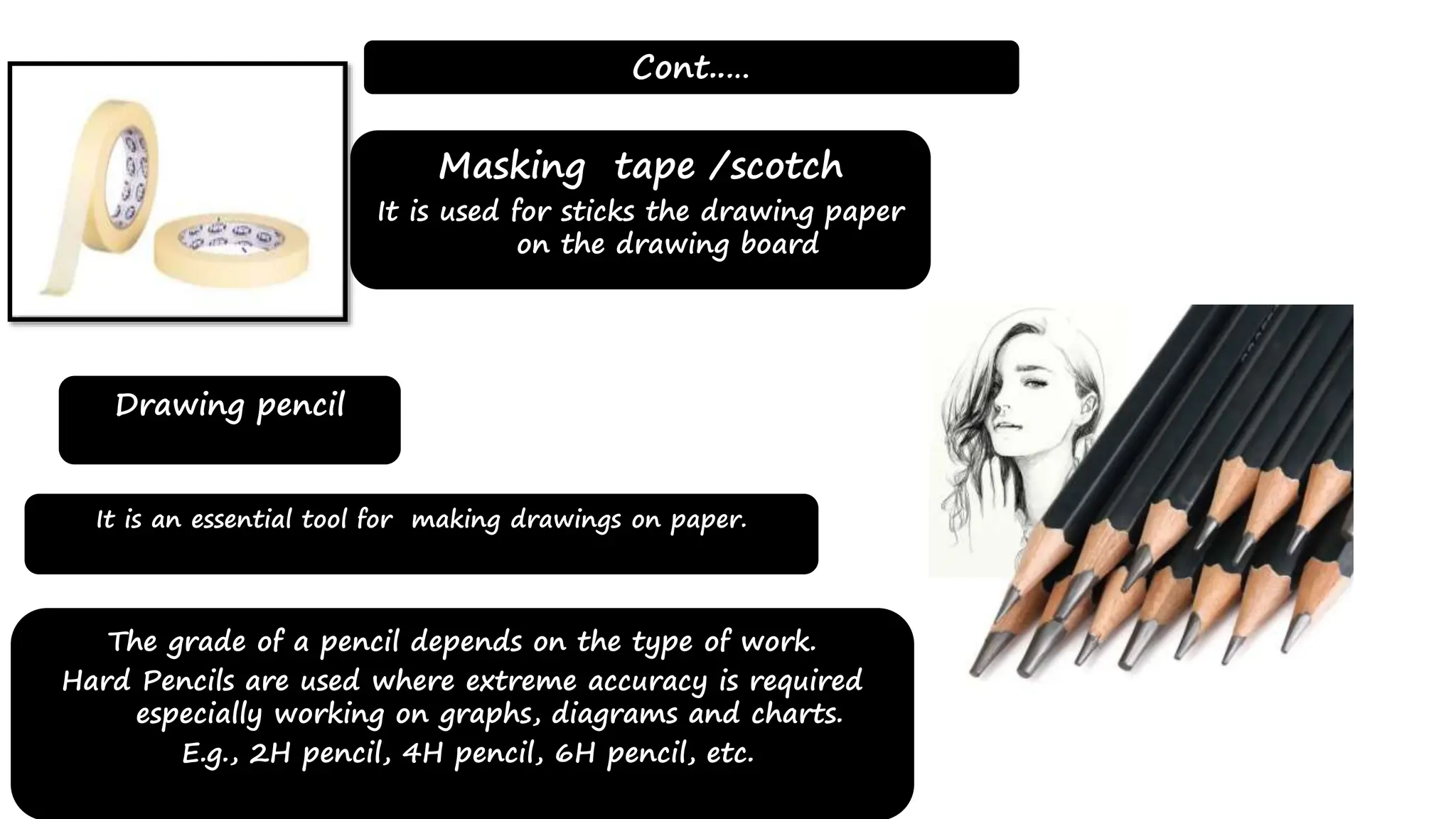
Masking tape /scotch
It is used for sticks the drawing paper
on the drawing board
It is an essential tool for making drawings on paper.
The grade of a pencil depends on the type of work.
Hard Pencils are used where extreme accuracy is required
especially working on graphs, diagrams and charts.
E.g., 2H pencil, 4H pencil, 6H pencil, etc.
Drawing pencil
Cont..…
Drawing pencil
MEDIUM PENCILS are used for general purpose work in drawing
E.g., HB Pencil
SOFT PENCILS are too soft to be used in mechanical drafting. They are beneficial for
the artwork of various kinds. E.g., 2B Pencil, 4B Pencil, 6B Pencil, etc.
Colored Pencils
Blend the boundaries of color used to enhance
drawings and sketches. The quality of the
brand of colored pencil that you use greatly
affects the results that you will see in your
drawing.
Types of
drawing
pencil and
their uses
Types of drawing pencil and their uses
B Pencil Types
These pencils contain darker lines compared to ‘H’ and ‘F’ however; they are easily erasable
without any effort being put in. While some people may use them for note-taking purposes,
they are excellent for doodling and sketching, as well. It is soft
1. 8B
This type of pencil is extremely dark and comes
out as the darkest of grays on paper. It is best
used for drawing and sketching purposes since it
makes very dark and prominent marks that end
up sticking out on a page.
2. 7B
Almost similar to 8B, this type of pencil is also great for art-related purposes. It
gives off a very dark gray shade that sticks to the paper and makes drawings look
great on paper.
Types of drawing pencil and their
uses
3. 6B
It is best for adding dark values to your drawing
pieces. It is a great option for achieve realistic
textures like skin, fur or fabric.
4. 5B
This pencil produces a darker mark
than the ones after it and is quite
softer than a 2B pencil for example.
5. 4B
The 4B pencil is slightly lighter than 5B
and is also an excellent choice for
sketching and drawing purposes.
Types of drawing pencil and their
uses
2B
The 2B pencil is best for medium to dark shading and
provides a good range of tone or value from light to a
dark shade. It is commonly used for art purposes,
especially drawing, shading and sketching.
HB
This pencil falls in the exact middle of the pencil
lead scale. HB is a significantly hard pencil, making
it a reasonably hard pencil even for drawing
purposes. The ‘H’ refers to the hardness of the
pencil, and the letter ‘B’ is used to denote the
blackness of the particular pencil’s mark.
F’’ pencil
‘F’ stands for fine point. This pencil, compared to
the others is slightly harder.
H Pencil Types and their uses
The ‘H’ pencils are generally very hard, and they are able to hold a tip in place,
ensuring extreme precision. They also make light lines that can be erased with
great ease and convenience so one can easily use these pencils to design products
or write things on paper.
2H pencil
This pencil falls in the exact middle of the pencil
lead scale. HB is a significantly hard pencil, making
it a reasonably hard pencil even for drawing
purposes. The ‘H’ refers to the hardness of the
pencil, and the letter ‘B’ is used to denote the
blackness of the particular pencil’s mark.
H Pencil Types and their uses
3H
3H is an extremely light shade of gray that leaves a very light imprint on paper. It
can be a great choice for sketches where you need to add light shades or slightly
fill in the empty spaces with a pencil.
4H
This is an excellent choice of pencil for light, fine
and even shading. It is more towards the gray side
and less shiny because of the amount of clay it
contains. It is also easier to keep sharp so can be
easily used for shading and sketching.
H Pencil Types and their uses
5H
This type of pencil helps create the darkest and the
thinnest of lines, given its hardness levels. This
happens because it falls towards the end of the “H”
or hardness scale, hence, giving a hard touch. It is a
great option particularly for those who are into
drawing and sketching and wish to draw dark and
think lines.
6H
This is a top-quality graphite pencil that is
primarily designed for the purpose of sketching,
writing, and drawing. It is an ideal pencil for
artistic and technical applications.
Cont..…
Charcoal or conte
Because of their point, charcoal pencils are best used for detailed
drawings and showcasing the highlights and shadows of your
subjects
Charcoal comes in both stick and pencil form. Sticks of charcoal are usually
either “vine” or “compressed”. Vine charcoal is softer and produces lighter
marks, while compressed charcoal – which is concentrated, produces darker
marks.
Charcoal provides a broader range of value and mark-making than what’s
possible with graphite. The manner in which marks are made is different as
well.
Cont..…
Chalk, Chalk Pastels, Oil Pastels
Chalk, Chalk Pastels, Oil Pastels Oil pastels are a form of chalk that has
been compressed with oil. All chalks and oil pastels come in a wide
range of colors. A variety of soft, blended effects can be obtained by
layering several colors and using brushes, cloth or paper to blend
Triangular scale
A tool generally used when reproducing a drawing in an
enlarged or reduced form to some regular proportion.
Its primary function is to reproduce the measurements of an
object in full size, reduced size, and enlarged size.
Pencil sharpener
A pencil Sharpener is a mechanical gadget used for
sharpening pencils.
Cont..…
T-square
It is a drawing instrument used when making horizontal lines.
It is also used for guiding triangles when drawing vertical lines and
perpendicular lines with the help of a set square.
It is made of wood, plastic, or a combination.
Triangle scale
It is a three-sided ruler, which contains two equal
sides intersecting at a 90-degree angle and the
third side at 45, 30, including 60-degree angles.
Commonly used triangles are:
o 30 degrees X 60 degrees
o 45 degrees X 45 degrees
Cont..…
Drawing table
The drawing table is made up of wood, plastic, or glass and has
smooth surfaces where drawing paper is placed and fixed with
the help of tape.
Sketch Book
A sketchbook is a blank notebook or pad of paper that
artists of all types can use to work on their art.
These days, some artists may choose to use a
digital sketchbook instead of a traditional paper
version. Either way, the sketchbook serves as a
collection of blank canvases.
Drawing table
Cont..…
Liquid marker ( crayon)
Fashion designers prefer ultra-bendable,
low odor, alcohol based inks.
Water color and oil color
This media is used for fashion
illustration.
A paintbrush is a brush used to apply paint
or ink. A paintbrush is usually made by
clamping bristles to a handle with a
ferrule. They are available in various
sizes, shapes, and materials. Thicker
ones are used for filling in, and thinner
ones are used for details.
Cont..…
Liquid marker ( crayon)
Fashion illustration image.
Selecting and Preparing materials and equipment
 Generally, softer graphite pencils will allow a darker, softer tone, while harder graphite
will offer a harder line and a more pointed end.
 Brand-new pots of ink, sharp, colorful pencils and acrylic tubes just waiting to be
squeezed may look inviting but, to a beginner, they also hold an element of anxiety.
 It is necessary to use proper drafting/drawing materials and tools to make an excellent
design.
 These materials are generally utilized by architects, drafters, engineers, painters, or
other technical persons.
 Without proper knowledge of your equipment, you could be limiting yourself
significantly.
Preparation of workbench according to OHS Practice
 The focus of the generalist OHS professional is the prevention of work-related
fatality, injury, disease and ill health..
 Standard operating procedures
 Personal protective equipment
 Safe materials handling
 Taking of rest breaks
 Ergonomic arrangement of workplaces
 Following marked walkways
 Safe storage of equipment
 Housekeeping
OHS Practice in
Design
Conti…
Preparation of workbench according to OHS Practice
 The focus of the generalist OHS professional is the prevention of work-related
fatality, injury, disease and ill health..
 Standard operating procedures
 Personal protective equipment
 Safe materials handling
 Taking of rest breaks
 Ergonomic arrangement of workplaces
 Following marked walkways
 Safe storage of equipment
 Housekeeping
OHS Practice in
Design
 Questions ??
Occupational Health and Safety requirements in
fashion industry
Occupational Health and Safety requirements
• Definition: Occupational safetyand health (OSH) isa cross
disciplinaryarea concerned with protecting the safety,health and
welfareof people engagedin work or employment.
• History: OSH has been signed into law on December 29, 1970 by
Richard M. Nixon (USA). Called “The Occupational Safety and
Health Act of 1970 – 29 USC 653”
• Mission: To save lives, To prevent injuries and To protect
industrial workers
Basics of
OSH
Occupational Health and Safety requirements
I. The goalsof occupational safetyand health programs includeto adoptive a
safeand healthy work environment.
II. OSH mayalsoprotect co-workers,family members, employers,customers
and many others who might be affected bythe workplace environment
III. Quality and environment matters are given equal priority to other
major business objectives.
1. To ensure that all employees and workers are inducted and aware of the
health and safety practices.
2. To achieve Zero Notice of Prohibition for OSH Issues
3. To strive toward Zero life loss at work places
4. Implement, develop and continue improve in OHSAS 18001 Standard
OSH
Requirements
Objectives
Occupational Health and Safety requirements
Why OHS is essential in
apparel manufacturing?
1. Because of the three basic types of interaction in the
apparel manufacturing working environment including:
Man and physical, chemical and biological agents;
Man and Machine & Man and Man:
A multi-dimensional workers health related risk factors
associated with the apparel industry are mostly occurred
because of highly repetitive work.
Occupational Health and Safety requirements
Why OHS is essential in
apparel manufacturing?
2. In order to be well competent in global market,
It is not only the quality parameters which are
important towards acceptance of the product as per the
intended end use, but also the working environment in
which the garments are to be produced, is equally
important for the entire product acceptance.
Classification of hazards occurred in the apparel industry
SAFETY HAZARDS
(slips, trips and falls, faulty
equipment, etc.)
BIOLOGICAL
HAZARDS (mold,
insects/pests,
communicable diseases,
etc.)
 (ILO,2001) has categorized OSH hazards under five specific categories.
CHEMICAL & DUST
HAZARDS
(cleaning products,
pesticides, asbestos, etc.)
ERGONOMIC HAZARDS
(repetition, lifting,
awkward postures, etc.)
Workplace
hazards
PHYSICAL HAZARDS
(noise, temperature
extremes, radiation, etc.)
Ergonomics Hazards In the apparel industry
Cutting Department:
• The heavy wight fabric rolls are manually transported from table to table by lifting the roll.
The people doing this operation tend to complain about MSD’s to muscle and back.:
• Cutting without safety support (chain glove) will resulted for hand injury
 Employees push fabric through the sewing
machine, which may require extending arms
bending at the wrist, and applying force.
 When setting up material for stitching,
workers may have to flex or bend their
necks to view the position of the fabric.
Ergonomics Hazards In the apparel industry
Sewing Department
Workplace design considerations
1. Standard Operating Procedures
• SOP is a written step by step guidelines or as a
form of flow diagram with proper explanation.
• SOP is one type of manual which provides
guidelines for operating procedure or working
procedure.
• The SOP should be put in a working place where
it will be easily visible. The SOP should be
printed form with proper lamination on it to avoid
damage.
Ventilation considerations
• Ventilation is an effective engineering means
to prevent accumulation of vapors of
explosive/flammable mixtures or inhalation
of toxic gases or vapors in the workplace.
• However, attention must be paid to the
relevant environmental protection
requirements in the discharge of exhaust air
to prevent contamination of the outside
environment
Lighting considerations
What is Ergonomics
Ergonomics
Physical
ergonomics
Cognitive
ergonomics
Organizationa
l ergonomics
 Ergonomics is the study of people in their working environment.
 It is designs or modifies the work to fit the worker, not the other way around.
 The goal is to eliminate discomfort and risk of injury due to work.
 The field of ergonomics aims to optimize safety, comfort, and productivity by reducing
physical strain and stress on the body.
 Workplace ergonomics is the science of designing the workplace, keeping in mind the
capabilities and limitations of the worker.
 Poor worksite design leads to fatigued, frustrated and hurting workers.
 A workplace ergonomics improvement process removes risk factors that lead to
musculoskeletal injuries and allows for improved human performance and productivity.
Benefits of Workplace Ergonomics
Ergonomics
Physical
ergonomics
Cognitive
ergonomics
Organizationa
l ergonomics
An effective ergonomics process can benefit the organization in a number of different ways.
 Ergonomics reduces costs.
 Ergonomics improves productivity.
 Ergonomics improves quality.
 Ergonomics improves employee engagement.
 Ergonomics creates a better safety culture.
Ergonomics considerations
Ergonomic concept Ergonomics components
Ergonomics
Physical
ergonomics
Cognitive
ergonomics
Organizationa
l ergonomics
Principles Of Ergonomics
 Maintain the ‘S’curve
Principles Of Ergonomics
 Keep everything in easy reach
Principles Of Ergonomics
 Work at proper heights
Principles Of Ergonomics
 Reduce excessive force
Principles Of Ergonomics
 Minimize static and fatigue load
Change to:
Principles Of Ergonomics
 Minimize pressure points
Principles of Ergonomics
 Reduce excessive motion
 Provide clearance
Principles Of Ergonomics
• Move, stretch and exercise
Personal Protective Equipment (PPE)
The primary objective of using PPE is to protect workers against
the risks of hazardous phenomena affecting the body through
inhalation or contact.
• Protective Clothing: Protective clothing provides skin protection
against chemical splashes, vapor and particulate exposures and other
physical hazards
• Hand and foot protection : Impervious gloves protect the hands
of the worker from contacting hazardous chemicals and machines
• Eye protection: Safety goggles that completely enclose the eyes provides
superior eye protection.
• Respiratory protective equipment (RPE): protects against exposure to dusts,
gases, fumes and vapors, but exposure duration should be kept short.
• Monitoring and health surveillance: Monitoring is a means to ensure the
effectiveness of the control measures through measuring the levels of the contaminants
in the air at strategic locations in the workplace or at the breathing zone of the workers
concerned.
Personal Protective Equipment (PPE)
Assignment 1
Discuss briefly about fashion design process.
 Notes; page number no more than 3 page
 Date of summited 31/01/2024G.c

mary help college-2.pptx

  • 1.
    Fashion Design Mezgebu Tesfaye January, 2024 For-Level-II Course name; Identify Design process for fashion designs
  • 2.
    Preparation of workstation UNIT- ONE… UNIT - TWO… Design process UNIT - THREE..… Elements and principles of design. UNIT - FOUR..… Characteristics of color and prepare color chart COURSE CONTENT
  • 3.
    Preparation of workstation In thisunit you will be learn;  Selection and preparation of tools and equipment  Preparation of workbench according to OHS Practice
  • 4.
    After completion ofthis unit, you will be able to: Selecting and preparing of tools and equipment Preparing workbench according to OHS practice
  • 5.
  • 6.
    • Working ona fashion collection include a series of idea, sketches, diverse themes and inspirations, as well as various silhouette, pattern, texture, and colour experimentation. For commercial designers • is the first step towards bringing designs to reality. • Fashion figures are the foundation of a designer's vision, serving as the blueprint for their designs. Drawing fashion figures • is about current populism, and fashion designers represent the spirit of the times, or zeitgeist, via their work. • Designer always being on the hunt for new and exciting things to inspire. Fashion, by definition,
  • 9.
  • 10.
    Drawing Paper … Itis making artistic drawings soft to heavy structural drawings) It is also used for print a hard copy of digital drawings Different types of drawings require different sizes of drawing papers. Paper size Dimensions (cm) Paper Area Α5 14.8 x 21 cm 0.03108 m2 Α4 21 x 29.7 cm 0.0612 m2 Α3 29.7 x 42 cm 0.125 m2 Α2 42 x 59.4 cm 0.25 m2 Α1 59.4 x 84.1 cm 0.50 m2 Α0 84.1 x 118.9 cm 1 m2
  • 11.
    Cont..… Masking tape /scotch Itis used for sticks the drawing paper on the drawing board It is an essential tool for making drawings on paper. The grade of a pencil depends on the type of work. Hard Pencils are used where extreme accuracy is required especially working on graphs, diagrams and charts. E.g., 2H pencil, 4H pencil, 6H pencil, etc. Drawing pencil
  • 12.
    Cont..… Drawing pencil MEDIUM PENCILSare used for general purpose work in drawing E.g., HB Pencil SOFT PENCILS are too soft to be used in mechanical drafting. They are beneficial for the artwork of various kinds. E.g., 2B Pencil, 4B Pencil, 6B Pencil, etc. Colored Pencils Blend the boundaries of color used to enhance drawings and sketches. The quality of the brand of colored pencil that you use greatly affects the results that you will see in your drawing.
  • 13.
  • 14.
    Types of drawingpencil and their uses B Pencil Types These pencils contain darker lines compared to ‘H’ and ‘F’ however; they are easily erasable without any effort being put in. While some people may use them for note-taking purposes, they are excellent for doodling and sketching, as well. It is soft 1. 8B This type of pencil is extremely dark and comes out as the darkest of grays on paper. It is best used for drawing and sketching purposes since it makes very dark and prominent marks that end up sticking out on a page. 2. 7B Almost similar to 8B, this type of pencil is also great for art-related purposes. It gives off a very dark gray shade that sticks to the paper and makes drawings look great on paper.
  • 15.
    Types of drawingpencil and their uses 3. 6B It is best for adding dark values to your drawing pieces. It is a great option for achieve realistic textures like skin, fur or fabric. 4. 5B This pencil produces a darker mark than the ones after it and is quite softer than a 2B pencil for example. 5. 4B The 4B pencil is slightly lighter than 5B and is also an excellent choice for sketching and drawing purposes.
  • 16.
    Types of drawingpencil and their uses 2B The 2B pencil is best for medium to dark shading and provides a good range of tone or value from light to a dark shade. It is commonly used for art purposes, especially drawing, shading and sketching. HB This pencil falls in the exact middle of the pencil lead scale. HB is a significantly hard pencil, making it a reasonably hard pencil even for drawing purposes. The ‘H’ refers to the hardness of the pencil, and the letter ‘B’ is used to denote the blackness of the particular pencil’s mark. F’’ pencil ‘F’ stands for fine point. This pencil, compared to the others is slightly harder.
  • 17.
    H Pencil Typesand their uses The ‘H’ pencils are generally very hard, and they are able to hold a tip in place, ensuring extreme precision. They also make light lines that can be erased with great ease and convenience so one can easily use these pencils to design products or write things on paper. 2H pencil This pencil falls in the exact middle of the pencil lead scale. HB is a significantly hard pencil, making it a reasonably hard pencil even for drawing purposes. The ‘H’ refers to the hardness of the pencil, and the letter ‘B’ is used to denote the blackness of the particular pencil’s mark.
  • 18.
    H Pencil Typesand their uses 3H 3H is an extremely light shade of gray that leaves a very light imprint on paper. It can be a great choice for sketches where you need to add light shades or slightly fill in the empty spaces with a pencil. 4H This is an excellent choice of pencil for light, fine and even shading. It is more towards the gray side and less shiny because of the amount of clay it contains. It is also easier to keep sharp so can be easily used for shading and sketching.
  • 19.
    H Pencil Typesand their uses 5H This type of pencil helps create the darkest and the thinnest of lines, given its hardness levels. This happens because it falls towards the end of the “H” or hardness scale, hence, giving a hard touch. It is a great option particularly for those who are into drawing and sketching and wish to draw dark and think lines. 6H This is a top-quality graphite pencil that is primarily designed for the purpose of sketching, writing, and drawing. It is an ideal pencil for artistic and technical applications.
  • 20.
    Cont..… Charcoal or conte Becauseof their point, charcoal pencils are best used for detailed drawings and showcasing the highlights and shadows of your subjects Charcoal comes in both stick and pencil form. Sticks of charcoal are usually either “vine” or “compressed”. Vine charcoal is softer and produces lighter marks, while compressed charcoal – which is concentrated, produces darker marks. Charcoal provides a broader range of value and mark-making than what’s possible with graphite. The manner in which marks are made is different as well.
  • 21.
    Cont..… Chalk, Chalk Pastels,Oil Pastels Chalk, Chalk Pastels, Oil Pastels Oil pastels are a form of chalk that has been compressed with oil. All chalks and oil pastels come in a wide range of colors. A variety of soft, blended effects can be obtained by layering several colors and using brushes, cloth or paper to blend Triangular scale A tool generally used when reproducing a drawing in an enlarged or reduced form to some regular proportion. Its primary function is to reproduce the measurements of an object in full size, reduced size, and enlarged size. Pencil sharpener A pencil Sharpener is a mechanical gadget used for sharpening pencils.
  • 22.
    Cont..… T-square It is adrawing instrument used when making horizontal lines. It is also used for guiding triangles when drawing vertical lines and perpendicular lines with the help of a set square. It is made of wood, plastic, or a combination. Triangle scale It is a three-sided ruler, which contains two equal sides intersecting at a 90-degree angle and the third side at 45, 30, including 60-degree angles. Commonly used triangles are: o 30 degrees X 60 degrees o 45 degrees X 45 degrees
  • 23.
    Cont..… Drawing table The drawingtable is made up of wood, plastic, or glass and has smooth surfaces where drawing paper is placed and fixed with the help of tape. Sketch Book A sketchbook is a blank notebook or pad of paper that artists of all types can use to work on their art. These days, some artists may choose to use a digital sketchbook instead of a traditional paper version. Either way, the sketchbook serves as a collection of blank canvases.
  • 24.
  • 25.
    Cont..… Liquid marker (crayon) Fashion designers prefer ultra-bendable, low odor, alcohol based inks. Water color and oil color This media is used for fashion illustration. A paintbrush is a brush used to apply paint or ink. A paintbrush is usually made by clamping bristles to a handle with a ferrule. They are available in various sizes, shapes, and materials. Thicker ones are used for filling in, and thinner ones are used for details.
  • 26.
    Cont..… Liquid marker (crayon) Fashion illustration image.
  • 27.
    Selecting and Preparingmaterials and equipment  Generally, softer graphite pencils will allow a darker, softer tone, while harder graphite will offer a harder line and a more pointed end.  Brand-new pots of ink, sharp, colorful pencils and acrylic tubes just waiting to be squeezed may look inviting but, to a beginner, they also hold an element of anxiety.  It is necessary to use proper drafting/drawing materials and tools to make an excellent design.  These materials are generally utilized by architects, drafters, engineers, painters, or other technical persons.  Without proper knowledge of your equipment, you could be limiting yourself significantly.
  • 28.
    Preparation of workbenchaccording to OHS Practice  The focus of the generalist OHS professional is the prevention of work-related fatality, injury, disease and ill health..  Standard operating procedures  Personal protective equipment  Safe materials handling  Taking of rest breaks  Ergonomic arrangement of workplaces  Following marked walkways  Safe storage of equipment  Housekeeping OHS Practice in Design
  • 29.
  • 30.
    Preparation of workbenchaccording to OHS Practice  The focus of the generalist OHS professional is the prevention of work-related fatality, injury, disease and ill health..  Standard operating procedures  Personal protective equipment  Safe materials handling  Taking of rest breaks  Ergonomic arrangement of workplaces  Following marked walkways  Safe storage of equipment  Housekeeping OHS Practice in Design
  • 31.
  • 32.
    Occupational Health andSafety requirements in fashion industry
  • 33.
    Occupational Health andSafety requirements • Definition: Occupational safetyand health (OSH) isa cross disciplinaryarea concerned with protecting the safety,health and welfareof people engagedin work or employment. • History: OSH has been signed into law on December 29, 1970 by Richard M. Nixon (USA). Called “The Occupational Safety and Health Act of 1970 – 29 USC 653” • Mission: To save lives, To prevent injuries and To protect industrial workers Basics of OSH
  • 34.
    Occupational Health andSafety requirements I. The goalsof occupational safetyand health programs includeto adoptive a safeand healthy work environment. II. OSH mayalsoprotect co-workers,family members, employers,customers and many others who might be affected bythe workplace environment III. Quality and environment matters are given equal priority to other major business objectives. 1. To ensure that all employees and workers are inducted and aware of the health and safety practices. 2. To achieve Zero Notice of Prohibition for OSH Issues 3. To strive toward Zero life loss at work places 4. Implement, develop and continue improve in OHSAS 18001 Standard OSH Requirements Objectives
  • 35.
    Occupational Health andSafety requirements Why OHS is essential in apparel manufacturing? 1. Because of the three basic types of interaction in the apparel manufacturing working environment including: Man and physical, chemical and biological agents; Man and Machine & Man and Man: A multi-dimensional workers health related risk factors associated with the apparel industry are mostly occurred because of highly repetitive work.
  • 36.
    Occupational Health andSafety requirements Why OHS is essential in apparel manufacturing? 2. In order to be well competent in global market, It is not only the quality parameters which are important towards acceptance of the product as per the intended end use, but also the working environment in which the garments are to be produced, is equally important for the entire product acceptance.
  • 38.
    Classification of hazardsoccurred in the apparel industry SAFETY HAZARDS (slips, trips and falls, faulty equipment, etc.) BIOLOGICAL HAZARDS (mold, insects/pests, communicable diseases, etc.)  (ILO,2001) has categorized OSH hazards under five specific categories. CHEMICAL & DUST HAZARDS (cleaning products, pesticides, asbestos, etc.) ERGONOMIC HAZARDS (repetition, lifting, awkward postures, etc.) Workplace hazards PHYSICAL HAZARDS (noise, temperature extremes, radiation, etc.)
  • 39.
    Ergonomics Hazards Inthe apparel industry
  • 40.
    Ergonomics Hazards Inthe apparel industry Cutting Department: • The heavy wight fabric rolls are manually transported from table to table by lifting the roll. The people doing this operation tend to complain about MSD’s to muscle and back.: • Cutting without safety support (chain glove) will resulted for hand injury
  • 41.
     Employees pushfabric through the sewing machine, which may require extending arms bending at the wrist, and applying force.  When setting up material for stitching, workers may have to flex or bend their necks to view the position of the fabric. Ergonomics Hazards In the apparel industry Sewing Department
  • 42.
  • 43.
    1. Standard OperatingProcedures • SOP is a written step by step guidelines or as a form of flow diagram with proper explanation. • SOP is one type of manual which provides guidelines for operating procedure or working procedure. • The SOP should be put in a working place where it will be easily visible. The SOP should be printed form with proper lamination on it to avoid damage.
  • 44.
    Ventilation considerations • Ventilationis an effective engineering means to prevent accumulation of vapors of explosive/flammable mixtures or inhalation of toxic gases or vapors in the workplace. • However, attention must be paid to the relevant environmental protection requirements in the discharge of exhaust air to prevent contamination of the outside environment
  • 45.
  • 46.
    What is Ergonomics Ergonomics Physical ergonomics Cognitive ergonomics Organizationa lergonomics  Ergonomics is the study of people in their working environment.  It is designs or modifies the work to fit the worker, not the other way around.  The goal is to eliminate discomfort and risk of injury due to work.  The field of ergonomics aims to optimize safety, comfort, and productivity by reducing physical strain and stress on the body.  Workplace ergonomics is the science of designing the workplace, keeping in mind the capabilities and limitations of the worker.  Poor worksite design leads to fatigued, frustrated and hurting workers.  A workplace ergonomics improvement process removes risk factors that lead to musculoskeletal injuries and allows for improved human performance and productivity.
  • 47.
    Benefits of WorkplaceErgonomics Ergonomics Physical ergonomics Cognitive ergonomics Organizationa l ergonomics An effective ergonomics process can benefit the organization in a number of different ways.  Ergonomics reduces costs.  Ergonomics improves productivity.  Ergonomics improves quality.  Ergonomics improves employee engagement.  Ergonomics creates a better safety culture.
  • 48.
    Ergonomics considerations Ergonomic conceptErgonomics components Ergonomics Physical ergonomics Cognitive ergonomics Organizationa l ergonomics
  • 49.
    Principles Of Ergonomics Maintain the ‘S’curve
  • 50.
    Principles Of Ergonomics Keep everything in easy reach
  • 51.
    Principles Of Ergonomics Work at proper heights
  • 52.
    Principles Of Ergonomics Reduce excessive force
  • 53.
    Principles Of Ergonomics Minimize static and fatigue load Change to:
  • 54.
    Principles Of Ergonomics Minimize pressure points
  • 55.
    Principles of Ergonomics Reduce excessive motion  Provide clearance
  • 56.
    Principles Of Ergonomics •Move, stretch and exercise
  • 57.
    Personal Protective Equipment(PPE) The primary objective of using PPE is to protect workers against the risks of hazardous phenomena affecting the body through inhalation or contact. • Protective Clothing: Protective clothing provides skin protection against chemical splashes, vapor and particulate exposures and other physical hazards • Hand and foot protection : Impervious gloves protect the hands of the worker from contacting hazardous chemicals and machines
  • 58.
    • Eye protection:Safety goggles that completely enclose the eyes provides superior eye protection. • Respiratory protective equipment (RPE): protects against exposure to dusts, gases, fumes and vapors, but exposure duration should be kept short. • Monitoring and health surveillance: Monitoring is a means to ensure the effectiveness of the control measures through measuring the levels of the contaminants in the air at strategic locations in the workplace or at the breathing zone of the workers concerned. Personal Protective Equipment (PPE)
  • 60.
    Assignment 1 Discuss brieflyabout fashion design process.  Notes; page number no more than 3 page  Date of summited 31/01/2024G.c