Function In Java
Members
SAFI ALAM :- 230101120296
DIPAK KUMAR :- 230101120293
RAJ KUMAR :- 230101120294
SHEKHAR KUMAR UPADHYAY:- 230101120295
GUIDED BY :- Prof.
Satyanarayan Sahoo
CONTENT
Introduction
Defining function
Function declaration
Calling function
Function overloading
Return statement
Scope
Statics vs Instance
Lamda Expression
Conclusio
1
Introduction to Functions in Java
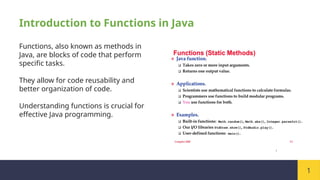
Functions, also known as methods in
Java, are blocks of code that perform
specific tasks.
They allow for code reusability and
better organization of code.
Understanding functions is crucial for
effective Java programming.
2
Defining a Function
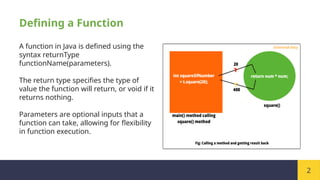
A function in Java is defined using the
syntax returnType
functionName(parameters).
The return type specifies the type of
value the function will return, or void if it
returns nothing.
Parameters are optional inputs that a
function can take, allowing for flexibility
in function execution.
3
Function Declaration Example
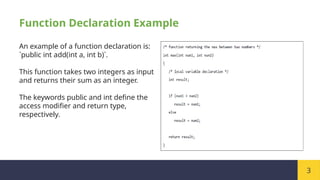
An example of a function declaration is:
`public int add(int a, int b)`.
This function takes two integers as input
and returns their sum as an integer.
The keywords public and int define the
access modifier and return type,
respectively.
4
Calling a Function
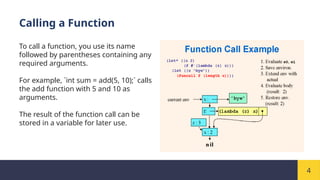
To call a function, you use its name
followed by parentheses containing any
required arguments.
For example, `int sum = add(5, 10);` calls
the add function with 5 and 10 as
arguments.
The result of the function call can be
stored in a variable for later use.
5
Function Overloading
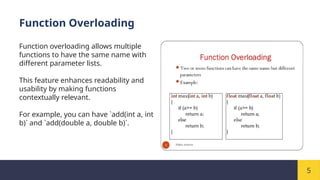
Function overloading allows multiple
functions to have the same name with
different parameter lists.
This feature enhances readability and
usability by making functions
contextually relevant.
For example, you can have `add(int a, int
b)` and `add(double a, double b)`.
6
Return Statement
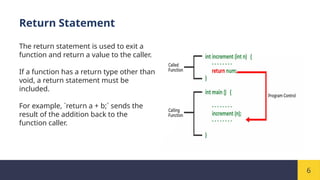
The return statement is used to exit a
function and return a value to the caller.
If a function has a return type other than
void, a return statement must be
included.
For example, `return a + b;` sends the
result of the addition back to the
function caller.
7
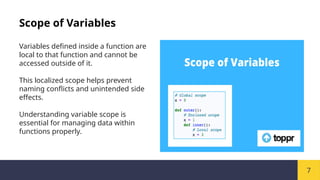
Scope of Variables
Variables defined inside a function are
local to that function and cannot be
accessed outside of it.
This localized scope helps prevent
naming conflicts and unintended side
effects.
Understanding variable scope is
essential for managing data within
functions properly.
8
Static vs Instance Methods
Static methods belong to the class rather than instances
of the class and can be called without creating an object.
Instance methods require an object of the class to be
invoked and can access instance variables.
Understanding the difference is vital for effective object-
oriented programming in Java.
10
Conclusion
Functions are fundamental building blocks in Java that facilitate code
organization and reusability.
Mastering function usage, including concepts like overloading and
scope, is essential for any Java programmer.
Continued practice and application of functions will enhance your Java
development skills significantly.
Functions In Java PPT.        safi .pptx

Functions In Java PPT. safi .pptx

  • 1.
    Function In Java Members SAFIALAM :- 230101120296 DIPAK KUMAR :- 230101120293 RAJ KUMAR :- 230101120294 SHEKHAR KUMAR UPADHYAY:- 230101120295 GUIDED BY :- Prof. Satyanarayan Sahoo
  • 2.
    CONTENT Introduction Defining function Function declaration Callingfunction Function overloading Return statement Scope Statics vs Instance Lamda Expression Conclusio
  • 3.
    1 Introduction to Functionsin Java Functions, also known as methods in Java, are blocks of code that perform specific tasks. They allow for code reusability and better organization of code. Understanding functions is crucial for effective Java programming.
  • 4.
    2 Defining a Function Afunction in Java is defined using the syntax returnType functionName(parameters). The return type specifies the type of value the function will return, or void if it returns nothing. Parameters are optional inputs that a function can take, allowing for flexibility in function execution.
  • 5.
    3 Function Declaration Example Anexample of a function declaration is: `public int add(int a, int b)`. This function takes two integers as input and returns their sum as an integer. The keywords public and int define the access modifier and return type, respectively.
  • 6.
    4 Calling a Function Tocall a function, you use its name followed by parentheses containing any required arguments. For example, `int sum = add(5, 10);` calls the add function with 5 and 10 as arguments. The result of the function call can be stored in a variable for later use.
  • 7.
    5 Function Overloading Function overloadingallows multiple functions to have the same name with different parameter lists. This feature enhances readability and usability by making functions contextually relevant. For example, you can have `add(int a, int b)` and `add(double a, double b)`.
  • 8.
    6 Return Statement The returnstatement is used to exit a function and return a value to the caller. If a function has a return type other than void, a return statement must be included. For example, `return a + b;` sends the result of the addition back to the function caller.
  • 9.
    7 Scope of Variables Variablesdefined inside a function are local to that function and cannot be accessed outside of it. This localized scope helps prevent naming conflicts and unintended side effects. Understanding variable scope is essential for managing data within functions properly.
  • 10.
    8 Static vs InstanceMethods Static methods belong to the class rather than instances of the class and can be called without creating an object. Instance methods require an object of the class to be invoked and can access instance variables. Understanding the difference is vital for effective object- oriented programming in Java.
  • 11.
    10 Conclusion Functions are fundamentalbuilding blocks in Java that facilitate code organization and reusability. Mastering function usage, including concepts like overloading and scope, is essential for any Java programmer. Continued practice and application of functions will enhance your Java development skills significantly.

Editor's Notes

  • #3 Image source: https://studylib.net/doc/15147941/functions--static-methods--java-function.-applications.
  • #4 Image source: https://www.scientecheasy.com/2020/06/return-type-in-java.html/
  • #5 Image source: https://likhithanjali.github.io/tutorials/c_functions.html
  • #6 Image source: https://courses.cs.washington.edu/courses/cse341/03sp/slides/jed-envt-model/sld036.htm
  • #7 Image source: https://www.slideshare.net/ritikasharma59/function-oveloading-72025644
  • #8 Image source: https://cegrjfao.blob.core.windows.net/ogw1gpijtv/define-return-statement-with-example.html
  • #9 Image source: https://www.toppr.com/guides/computer-science/introduction-to-python/scope-of-variables/
  • #10 Image source: https://pynative.com/python-classes-and-objects/
  • #11 Image source: https://www.pinterest.com/pin/basic-building-blocks-of-java-components-of-java-programs--523402787930329454/