1
Functional
Design
Explained
David Sankel - Stellar Science
david@stellarscience.com
CppCon 2015
2
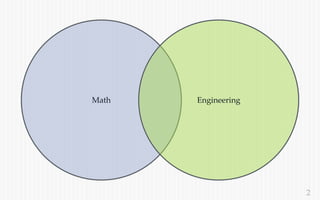
Math Engineering
3Stellar ScienceDavid Sankel
Quiz
Are the following two C++ programs the same?
4Stellar ScienceDavid Sankel
Quiz
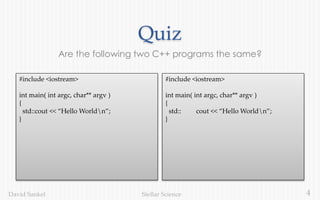
Are the following two C++ programs the same?
#include <iostream>
int main( int argc, char** argv )
{
std::cout << “Hello Worldn”;
}
#include <iostream>
int main( int argc, char** argv )
{
std:: cout << “Hello Worldn”;
}
5Stellar ScienceDavid Sankel
Quiz
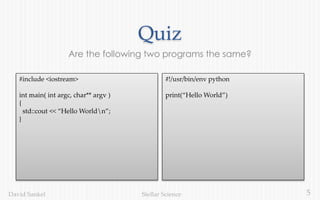
Are the following two programs the same?
#include <iostream>
int main( int argc, char** argv )
{
std::cout << “Hello Worldn”;
}
#!/usr/bin/env python
print(“Hello World”)
6Stellar ScienceDavid Sankel
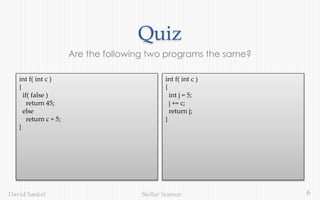
Quiz
Are the following two programs the same?
int f( int c )
{
if( false )
return 45;
else
return c + 5;
}
int f( int c )
{
int j = 5;
j += c;
return j;
}
7Stellar ScienceDavid Sankel
Essence of Programs
Ideally we would like:
• Strong equivalence properties
• Something written down
• A set of rules we can apply to any program
Any ideas of what would be a good essence language?
8Stellar ScienceDavid Sankel
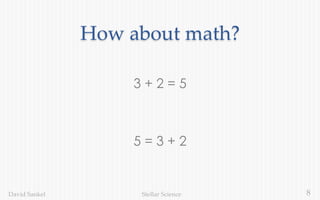
How about math?
3 + 2 = 5
5 = 3 + 2
9Stellar ScienceDavid Sankel
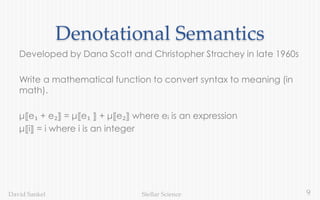
Denotational Semantics
Developed by Dana Scott and Christopher Strachey in late 1960s
Write a mathematical function to convert syntax to meaning (in
math).
μ⟦e₁ + e₂⟧ = μ⟦e₁ ⟧ + μ⟦e₂⟧ where eᵢ is an expression
μ⟦i⟧ = i where i is an integer
10Stellar ScienceDavid Sankel
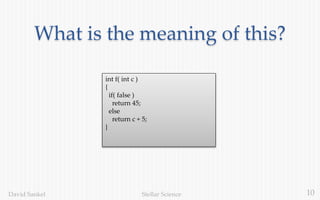
What is the meaning of this?
int f( int c )
{
if( false )
return 45;
else
return c + 5;
}
11Stellar ScienceDavid Sankel
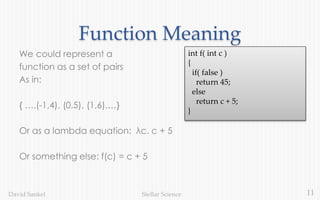
Function Meaning
We could represent a
function as a set of pairs
As in:
{ …,(-1,4), (0,5), (1,6),…}
Or as a lambda equation: λc. c + 5
Or something else: f(c) = c + 5
int f( int c )
{
if( false )
return 45;
else
return c + 5;
}
12Stellar ScienceDavid Sankel
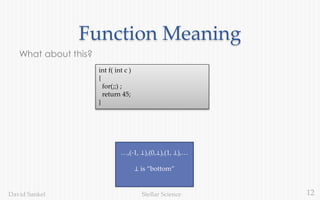
Function Meaning
What about this?
int f( int c )
{
for(;;) ;
return 45;
}
…,(-1, ⊥),(0,⊥),(1, ⊥),…
⊥ is “bottom”
13Stellar ScienceDavid Sankel
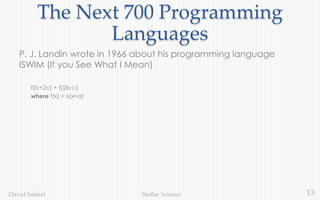
The Next 700 Programming
Languages
P. J. Landin wrote in 1966 about his programming language
ISWIM (If you See What I Mean)
f(b+2c) + f(2b-c)
where f(x) = x(x+a)
14Stellar ScienceDavid Sankel
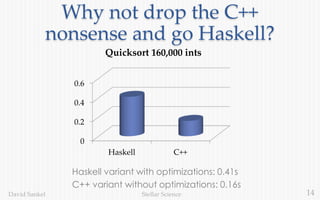
Why not drop the C++
nonsense and go Haskell?
Haskell variant with optimizations: 0.41s
C++ variant without optimizations: 0.16s
0
0.2
0.4
0.6
Haskell C++
Quicksort 160,000 ints
15Stellar ScienceDavid Sankel
Languages and Machines
16Stellar ScienceDavid Sankel
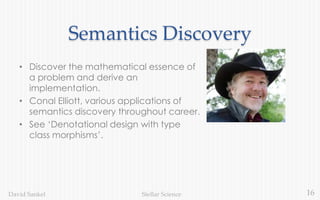
Semantics Discovery
• Discover the mathematical essence of
a problem and derive an
implementation.
• Conal Elliott, various applications of
semantics discovery throughout career.
• See ‘Denotational design with type
class morphisms’.
17Stellar ScienceDavid Sankel
Ingredients
• Math augmented with some extra constructs can represent
the essence of code.
• Write programs in math.
• C++ straddles more levels of abstraction than any other
language.
• Discover essence of problem using math and derive
implementation.
18Stellar ScienceDavid Sankel
Functional Design
1. Discover the mathematical essence of the problem and write
it out.
2. Derive an efficient implementation in C++ that has the
interface discovered in #1.
19Stellar ScienceDavid Sankel
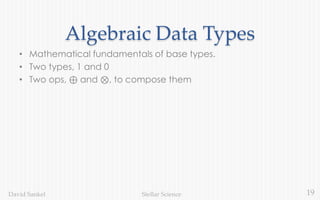
Algebraic Data Types
• Mathematical fundamentals of base types.
• Two types, 1 and 0
• Two ops, ⊕ and ⊗, to compose them
20Stellar ScienceDavid Sankel
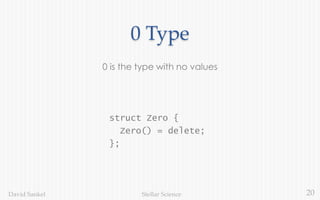
0 Type
0 is the type with no values
struct Zero {
Zero() = delete;
};
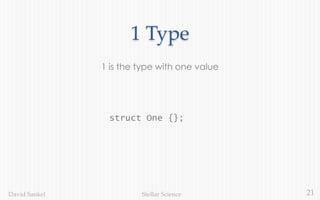
21Stellar ScienceDavid Sankel
1 Type
1 is the type with one value
struct One {};
22Stellar ScienceDavid Sankel
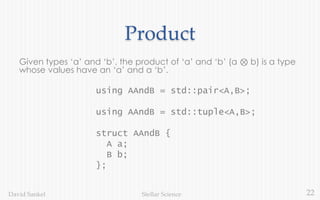
Product
Given types ‘a’ and ‘b’, the product of ‘a’ and ‘b’ (a ⊗ b) is a type
whose values have an ‘a’ and a ‘b’.
using AAndB = std::pair<A,B>;
using AAndB = std::tuple<A,B>;
struct AAndB {
A a;
B b;
};
23Stellar ScienceDavid Sankel
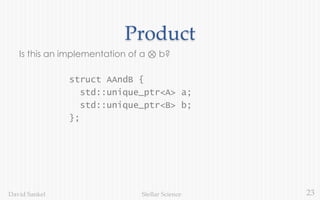
Product
Is this an implementation of a ⊗ b?
struct AAndB {
std::unique_ptr<A> a;
std::unique_ptr<B> b;
};
24Stellar ScienceDavid Sankel
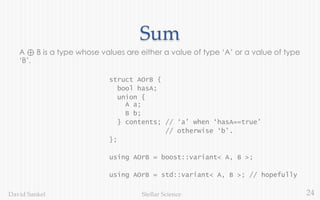
Sum
A ⊕ B is a type whose values are either a value of type ‘A’ or a value of type
‘B’.
struct AOrB {
bool hasA;
union {
A a;
B b;
} contents; // ‘a’ when ‘hasA==true’
// otherwise ‘b’.
};
using AOrB = boost::variant< A, B >;
using AOrB = std::variant< A, B >; // hopefully
25Stellar ScienceDavid Sankel
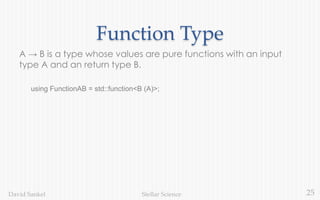
Function Type
A → B is a type whose values are pure functions with an input
type A and an return type B.
using FunctionAB = std::function<B (A)>;
26Stellar ScienceDavid Sankel
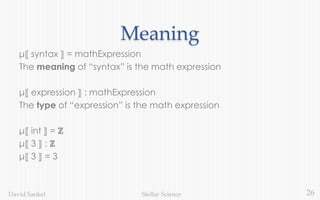
Meaning
μ⟦ syntax ⟧ = mathExpression
The meaning of “syntax” is the math expression
μ⟦ expression ⟧ : mathExpression
The type of “expression” is the math expression
μ⟦ int ⟧ = ℤ
μ⟦ 3 ⟧ : ℤ
μ⟦ 3 ⟧ = 3
27Stellar ScienceDavid Sankel
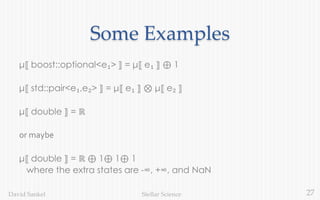
Some Examples
μ⟦ boost::optional<e₁> ⟧ = μ⟦ e₁ ⟧ ⊕ 1
μ⟦ std::pair<e₁,e₂> ⟧ = μ⟦ e₁ ⟧ ⊗ μ⟦ e₂ ⟧
μ⟦ double ⟧ = ℝ
or maybe
μ⟦ double ⟧ = ℝ ⊕ 1⊕ 1⊕ 1
where the extra states are -∞, +∞, and NaN
28Stellar ScienceDavid Sankel
What is a movie?
29Stellar ScienceDavid Sankel
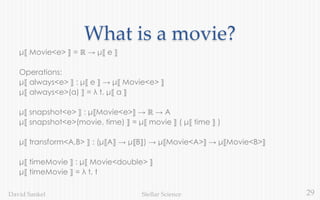
What is a movie?
μ⟦ Movie<e> ⟧ = ℝ → μ⟦ e ⟧
Operations:
μ⟦ always<e> ⟧ : μ⟦ e ⟧ → μ⟦ Movie<e> ⟧
μ⟦ always<e>(a) ⟧ = λ t. μ⟦ a ⟧
μ⟦ snapshot<e> ⟧ : μ⟦Movie<e>⟧ → ℝ → A
μ⟦ snapshot<e>(movie, time) ⟧ = μ⟦ movie ⟧ ( μ⟦ time ⟧ )
μ⟦ transform<A,B> ⟧ : (μ⟦A⟧ → μ⟦B⟧) → μ⟦Movie<A>⟧ → μ⟦Movie<B>⟧
μ⟦ timeMovie ⟧ : μ⟦ Movie<double> ⟧
μ⟦ timeMovie ⟧ = λ t. t
30Stellar ScienceDavid Sankel
Grey flux movie
auto greyFluxMovie = transform(
[]( double timeInSeconds ) -> Image {
double dummy;
double greyness = std::modf( timeInSeconds, &dummy );
return greyImage( greyness );
, time );
31Stellar ScienceDavid Sankel
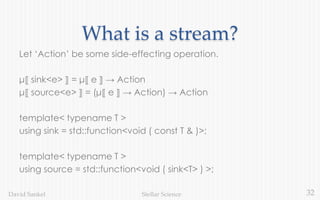
What is a stream?
32Stellar ScienceDavid Sankel
What is a stream?
Let ‘Action’ be some side-effecting operation.
μ⟦ sink<e> ⟧ = μ⟦ e ⟧ → Action
μ⟦ source<e> ⟧ = (μ⟦ e ⟧ → Action) → Action
template< typename T >
using sink = std::function<void ( const T & )>;
template< typename T >
using source = std::function<void ( sink<T> ) >;
33Stellar ScienceDavid Sankel
Example source/sink
source<char> consoleInput = []( sink<char> s ) {
int inputChar;
while( (inputChar = std::cin.get()) != EOF ) {
s( static_cast< char >( inputChar ) );
};
sink<char> consoleOutput = []( char c ) {
std::cout.put( c );
};
34Stellar ScienceDavid Sankel
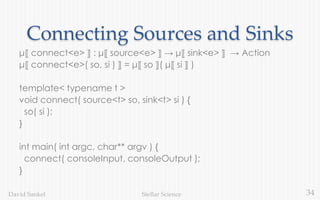
Connecting Sources and Sinks
μ⟦ connect<e> ⟧ : μ⟦ source<e> ⟧ → μ⟦ sink<e> ⟧ → Action
μ⟦ connect<e>( so, si ) ⟧ = μ⟦ so ⟧( μ⟦ si ⟧ )
template< typename t >
void connect( source<t> so, sink<t> si ) {
so( si );
}
int main( int argc, char** argv ) {
connect( consoleInput, consoleOutput );
}
35Stellar ScienceDavid Sankel
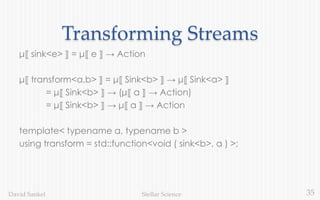
Transforming Streams
μ⟦ sink<e> ⟧ = μ⟦ e ⟧ → Action
μ⟦ transform<a,b> ⟧ = μ⟦ Sink<b> ⟧ → μ⟦ Sink<a> ⟧
= μ⟦ Sink<b> ⟧ → (μ⟦ a ⟧ → Action)
= μ⟦ Sink<b> ⟧ → μ⟦ a ⟧ → Action
template< typename a, typename b >
using transform = std::function<void ( sink<b>, a ) >;
36Stellar ScienceDavid Sankel
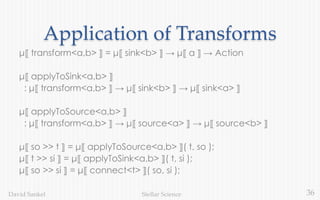
Application of Transforms
μ⟦ transform<a,b> ⟧ = μ⟦ sink<b> ⟧ → μ⟦ a ⟧ → Action
μ⟦ applyToSink<a,b> ⟧
: μ⟦ transform<a,b> ⟧ → μ⟦ sink<b> ⟧ → μ⟦ sink<a> ⟧
μ⟦ applyToSource<a,b> ⟧
: μ⟦ transform<a,b> ⟧ → μ⟦ source<a> ⟧ → μ⟦ source<b> ⟧
μ⟦ so >> t ⟧ = μ⟦ applyToSource<a,b> ⟧( t, so );
μ⟦ t >> si ⟧ = μ⟦ applyToSink<a,b> ⟧( t, si );
μ⟦ so >> si ⟧ = μ⟦ connect<t> ⟧( so, si );
37Stellar ScienceDavid Sankel
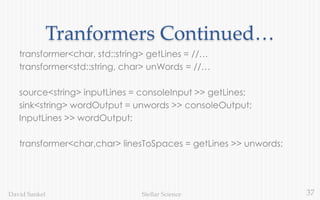
Tranformers Continued…
transformer<char, std::string> getLines = //…
transformer<std::string, char> unWords = //…
source<string> inputLines = consoleInput >> getLines;
sink<string> wordOutput = unwords >> consoleOutput;
InputLines >> wordOutput;
transformer<char,char> linesToSpaces = getLines >> unwords;
38Stellar ScienceDavid Sankel
What is command line
processing?
39Stellar ScienceDavid Sankel
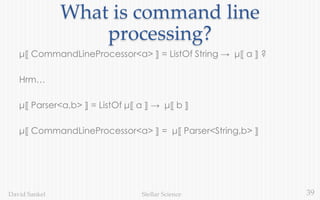
What is command line
processing?
μ⟦ CommandLineProcessor<a> ⟧ = ListOf String → μ⟦ a ⟧ ?
Hrm…
μ⟦ Parser<a,b> ⟧ = ListOf μ⟦ a ⟧ → μ⟦ b ⟧
μ⟦ CommandLineProcessor<a> ⟧ = μ⟦ Parser<String,b> ⟧
40Stellar ScienceDavid Sankel
Command Line Parsing
struct HelpFlag{};
struct UserFlag{
std::string user;
};
auto flagP = mix(
args(“--help”, HelpFlag()),
args(“--user“ >> stringP,
[]( std::string username ) { return UserFlag{username}; })
41Stellar ScienceDavid Sankel
Command Line Parsing
struct ListAccounts {};
struct ListJob {
int jobId;
};
struct CommandLineParse {
std::vector< boost::variant< HelpFlag, UserFlag > > globalFlags;
boost::variant< ListAccounts, ListJob > mode;
};
auto parser = flagP
>> (args( “listAccounts”, ListAccounts() ) ||
(args( “listJob” ) >> “--jobId” >> intP( []( int id ) { return ListJob{id};}));
42Stellar ScienceDavid Sankel
Benefits
• Highly Flexible
• Highly Composible
• Type safe
• Simple
43Stellar ScienceDavid Sankel
Functional
Design
1. Discover the essence
2. Derive the
implementation
• Beautiful API’s
• Screaming Speed
david@stellarscience.com

Functional Design Explained (David Sankel CppCon 2015)

  • 1.
    1 Functional Design Explained David Sankel -Stellar Science david@stellarscience.com CppCon 2015
  • 2.
  • 3.
    3Stellar ScienceDavid Sankel Quiz Arethe following two C++ programs the same?
  • 4.
    4Stellar ScienceDavid Sankel Quiz Arethe following two C++ programs the same? #include <iostream> int main( int argc, char** argv ) { std::cout << “Hello Worldn”; } #include <iostream> int main( int argc, char** argv ) { std:: cout << “Hello Worldn”; }
  • 5.
    5Stellar ScienceDavid Sankel Quiz Arethe following two programs the same? #include <iostream> int main( int argc, char** argv ) { std::cout << “Hello Worldn”; } #!/usr/bin/env python print(“Hello World”)
  • 6.
    6Stellar ScienceDavid Sankel Quiz Arethe following two programs the same? int f( int c ) { if( false ) return 45; else return c + 5; } int f( int c ) { int j = 5; j += c; return j; }
  • 7.
    7Stellar ScienceDavid Sankel Essenceof Programs Ideally we would like: • Strong equivalence properties • Something written down • A set of rules we can apply to any program Any ideas of what would be a good essence language?
  • 8.
    8Stellar ScienceDavid Sankel Howabout math? 3 + 2 = 5 5 = 3 + 2
  • 9.
    9Stellar ScienceDavid Sankel DenotationalSemantics Developed by Dana Scott and Christopher Strachey in late 1960s Write a mathematical function to convert syntax to meaning (in math). μ⟦e₁ + e₂⟧ = μ⟦e₁ ⟧ + μ⟦e₂⟧ where eᵢ is an expression μ⟦i⟧ = i where i is an integer
  • 10.
    10Stellar ScienceDavid Sankel Whatis the meaning of this? int f( int c ) { if( false ) return 45; else return c + 5; }
  • 11.
    11Stellar ScienceDavid Sankel FunctionMeaning We could represent a function as a set of pairs As in: { …,(-1,4), (0,5), (1,6),…} Or as a lambda equation: λc. c + 5 Or something else: f(c) = c + 5 int f( int c ) { if( false ) return 45; else return c + 5; }
  • 12.
    12Stellar ScienceDavid Sankel FunctionMeaning What about this? int f( int c ) { for(;;) ; return 45; } …,(-1, ⊥),(0,⊥),(1, ⊥),… ⊥ is “bottom”
  • 13.
    13Stellar ScienceDavid Sankel TheNext 700 Programming Languages P. J. Landin wrote in 1966 about his programming language ISWIM (If you See What I Mean) f(b+2c) + f(2b-c) where f(x) = x(x+a)
  • 14.
    14Stellar ScienceDavid Sankel Whynot drop the C++ nonsense and go Haskell? Haskell variant with optimizations: 0.41s C++ variant without optimizations: 0.16s 0 0.2 0.4 0.6 Haskell C++ Quicksort 160,000 ints
  • 15.
  • 16.
    16Stellar ScienceDavid Sankel SemanticsDiscovery • Discover the mathematical essence of a problem and derive an implementation. • Conal Elliott, various applications of semantics discovery throughout career. • See ‘Denotational design with type class morphisms’.
  • 17.
    17Stellar ScienceDavid Sankel Ingredients •Math augmented with some extra constructs can represent the essence of code. • Write programs in math. • C++ straddles more levels of abstraction than any other language. • Discover essence of problem using math and derive implementation.
  • 18.
    18Stellar ScienceDavid Sankel FunctionalDesign 1. Discover the mathematical essence of the problem and write it out. 2. Derive an efficient implementation in C++ that has the interface discovered in #1.
  • 19.
    19Stellar ScienceDavid Sankel AlgebraicData Types • Mathematical fundamentals of base types. • Two types, 1 and 0 • Two ops, ⊕ and ⊗, to compose them
  • 20.
    20Stellar ScienceDavid Sankel 0Type 0 is the type with no values struct Zero { Zero() = delete; };
  • 21.
    21Stellar ScienceDavid Sankel 1Type 1 is the type with one value struct One {};
  • 22.
    22Stellar ScienceDavid Sankel Product Giventypes ‘a’ and ‘b’, the product of ‘a’ and ‘b’ (a ⊗ b) is a type whose values have an ‘a’ and a ‘b’. using AAndB = std::pair<A,B>; using AAndB = std::tuple<A,B>; struct AAndB { A a; B b; };
  • 23.
    23Stellar ScienceDavid Sankel Product Isthis an implementation of a ⊗ b? struct AAndB { std::unique_ptr<A> a; std::unique_ptr<B> b; };
  • 24.
    24Stellar ScienceDavid Sankel Sum A⊕ B is a type whose values are either a value of type ‘A’ or a value of type ‘B’. struct AOrB { bool hasA; union { A a; B b; } contents; // ‘a’ when ‘hasA==true’ // otherwise ‘b’. }; using AOrB = boost::variant< A, B >; using AOrB = std::variant< A, B >; // hopefully
  • 25.
    25Stellar ScienceDavid Sankel FunctionType A → B is a type whose values are pure functions with an input type A and an return type B. using FunctionAB = std::function<B (A)>;
  • 26.
    26Stellar ScienceDavid Sankel Meaning μ⟦syntax ⟧ = mathExpression The meaning of “syntax” is the math expression μ⟦ expression ⟧ : mathExpression The type of “expression” is the math expression μ⟦ int ⟧ = ℤ μ⟦ 3 ⟧ : ℤ μ⟦ 3 ⟧ = 3
  • 27.
    27Stellar ScienceDavid Sankel SomeExamples μ⟦ boost::optional<e₁> ⟧ = μ⟦ e₁ ⟧ ⊕ 1 μ⟦ std::pair<e₁,e₂> ⟧ = μ⟦ e₁ ⟧ ⊗ μ⟦ e₂ ⟧ μ⟦ double ⟧ = ℝ or maybe μ⟦ double ⟧ = ℝ ⊕ 1⊕ 1⊕ 1 where the extra states are -∞, +∞, and NaN
  • 28.
  • 29.
    29Stellar ScienceDavid Sankel Whatis a movie? μ⟦ Movie<e> ⟧ = ℝ → μ⟦ e ⟧ Operations: μ⟦ always<e> ⟧ : μ⟦ e ⟧ → μ⟦ Movie<e> ⟧ μ⟦ always<e>(a) ⟧ = λ t. μ⟦ a ⟧ μ⟦ snapshot<e> ⟧ : μ⟦Movie<e>⟧ → ℝ → A μ⟦ snapshot<e>(movie, time) ⟧ = μ⟦ movie ⟧ ( μ⟦ time ⟧ ) μ⟦ transform<A,B> ⟧ : (μ⟦A⟧ → μ⟦B⟧) → μ⟦Movie<A>⟧ → μ⟦Movie<B>⟧ μ⟦ timeMovie ⟧ : μ⟦ Movie<double> ⟧ μ⟦ timeMovie ⟧ = λ t. t
  • 30.
    30Stellar ScienceDavid Sankel Greyflux movie auto greyFluxMovie = transform( []( double timeInSeconds ) -> Image { double dummy; double greyness = std::modf( timeInSeconds, &dummy ); return greyImage( greyness ); , time );
  • 31.
  • 32.
    32Stellar ScienceDavid Sankel Whatis a stream? Let ‘Action’ be some side-effecting operation. μ⟦ sink<e> ⟧ = μ⟦ e ⟧ → Action μ⟦ source<e> ⟧ = (μ⟦ e ⟧ → Action) → Action template< typename T > using sink = std::function<void ( const T & )>; template< typename T > using source = std::function<void ( sink<T> ) >;
  • 33.
    33Stellar ScienceDavid Sankel Examplesource/sink source<char> consoleInput = []( sink<char> s ) { int inputChar; while( (inputChar = std::cin.get()) != EOF ) { s( static_cast< char >( inputChar ) ); }; sink<char> consoleOutput = []( char c ) { std::cout.put( c ); };
  • 34.
    34Stellar ScienceDavid Sankel ConnectingSources and Sinks μ⟦ connect<e> ⟧ : μ⟦ source<e> ⟧ → μ⟦ sink<e> ⟧ → Action μ⟦ connect<e>( so, si ) ⟧ = μ⟦ so ⟧( μ⟦ si ⟧ ) template< typename t > void connect( source<t> so, sink<t> si ) { so( si ); } int main( int argc, char** argv ) { connect( consoleInput, consoleOutput ); }
  • 35.
    35Stellar ScienceDavid Sankel TransformingStreams μ⟦ sink<e> ⟧ = μ⟦ e ⟧ → Action μ⟦ transform<a,b> ⟧ = μ⟦ Sink<b> ⟧ → μ⟦ Sink<a> ⟧ = μ⟦ Sink<b> ⟧ → (μ⟦ a ⟧ → Action) = μ⟦ Sink<b> ⟧ → μ⟦ a ⟧ → Action template< typename a, typename b > using transform = std::function<void ( sink<b>, a ) >;
  • 36.
    36Stellar ScienceDavid Sankel Applicationof Transforms μ⟦ transform<a,b> ⟧ = μ⟦ sink<b> ⟧ → μ⟦ a ⟧ → Action μ⟦ applyToSink<a,b> ⟧ : μ⟦ transform<a,b> ⟧ → μ⟦ sink<b> ⟧ → μ⟦ sink<a> ⟧ μ⟦ applyToSource<a,b> ⟧ : μ⟦ transform<a,b> ⟧ → μ⟦ source<a> ⟧ → μ⟦ source<b> ⟧ μ⟦ so >> t ⟧ = μ⟦ applyToSource<a,b> ⟧( t, so ); μ⟦ t >> si ⟧ = μ⟦ applyToSink<a,b> ⟧( t, si ); μ⟦ so >> si ⟧ = μ⟦ connect<t> ⟧( so, si );
  • 37.
    37Stellar ScienceDavid Sankel TranformersContinued… transformer<char, std::string> getLines = //… transformer<std::string, char> unWords = //… source<string> inputLines = consoleInput >> getLines; sink<string> wordOutput = unwords >> consoleOutput; InputLines >> wordOutput; transformer<char,char> linesToSpaces = getLines >> unwords;
  • 38.
    38Stellar ScienceDavid Sankel Whatis command line processing?
  • 39.
    39Stellar ScienceDavid Sankel Whatis command line processing? μ⟦ CommandLineProcessor<a> ⟧ = ListOf String → μ⟦ a ⟧ ? Hrm… μ⟦ Parser<a,b> ⟧ = ListOf μ⟦ a ⟧ → μ⟦ b ⟧ μ⟦ CommandLineProcessor<a> ⟧ = μ⟦ Parser<String,b> ⟧
  • 40.
    40Stellar ScienceDavid Sankel CommandLine Parsing struct HelpFlag{}; struct UserFlag{ std::string user; }; auto flagP = mix( args(“--help”, HelpFlag()), args(“--user“ >> stringP, []( std::string username ) { return UserFlag{username}; })
  • 41.
    41Stellar ScienceDavid Sankel CommandLine Parsing struct ListAccounts {}; struct ListJob { int jobId; }; struct CommandLineParse { std::vector< boost::variant< HelpFlag, UserFlag > > globalFlags; boost::variant< ListAccounts, ListJob > mode; }; auto parser = flagP >> (args( “listAccounts”, ListAccounts() ) || (args( “listJob” ) >> “--jobId” >> intP( []( int id ) { return ListJob{id};}));
  • 42.
    42Stellar ScienceDavid Sankel Benefits •Highly Flexible • Highly Composible • Type safe • Simple
  • 43.
    43Stellar ScienceDavid Sankel Functional Design 1.Discover the essence 2. Derive the implementation • Beautiful API’s • Screaming Speed david@stellarscience.com

Editor's Notes

  • #2 The designs that produced with the methodology we will develop, will not only be simple and concise, but they’ll approach a purity where you start to wonder if you’re getting close to an optimal design.
  • #5 Here although the individual files are different, the syntax tree is the same. We have syntactic equivalence.
  • #6 The one on the right is Python. Note that python outputs a newline with every print statement. These are not syntactically equivalent. We can say they are the same because ‘diff’ says the output of these two programs is the same.
  • #7 Clearly not syntactically equivalent. Neither of these programs have output we can compare using diff. Here we make a mental representation of both of these programs. That mental representation has the strong equivalence property. We mentally remove the extraneous noise. We check that and give an answer. That won’t help convince someone else of the equivalence though. It would be really nice if we could write down this intermediate format.
  • #8 Hint: you learned this language in grade school.
  • #12 All of these have the strong equality guarantee provided by math.
  • #13 We can come up with math that defines how bottom interacts with everything else. A bottom statement followed by another statement has a meaning of bottom, etc. We see that there is an art here to extending the math used in the “semantic domain” to capture
  • #14 The idea here was to make a programming language based on mathematical notation. Note how Haskell is the modern offspring of this idea that all the kids are using these days. Comment about how ‘monads’ ‘monoids’ ‘categories’, etc. are essential to Haskell’s roots of an attempt to be a mathematics computer language. Also interesting how Landin called his language “see what I mean” before Scott Strachey’s rigorous definition of meaning.
  • #15 I just asked google for an implementation of each and ran them on 160,000 ints. Can the Haskell version be optimized to go just as fast as the C++ one? Probably, but then it will loose what makes Haskell the math language. With Haskell we get all the expressivity, but we pay the price of not being able to understand or easily tweak the runtime behavior. Just as a hint, Agda is even worse!
  • #16 The low-level represents ability to speak to the machine in the language most natural to it. High-level indicates ability to speak to the programmer succinctly and abstractly (math). In other words, the higher level languages relate more closely to the essence of the problem.
  • #17 We don’t want to use Haskell basically because we don’t want to be limited by its syntax.
  • #39 Discuss getopt and boost’s program options libraries. What if I want to use single rather than double dash? What if I want positional arguments to effect what comes after? What is it that I really want? If wanting these options requires yet another feature and complexity be added to the library, that is a good indicator that the semantic domain wasn’t nailed in the first place. Time to start over.
  • #40 Discuss getopt and boost’s program options libraries. What if I want to use single rather than double dash? What if I want positional arguments to effect what comes after? What is it that I really want? If wanting these options requires yet another feature and complexity be added to the library, that is a good indicator that the semantic domain wasn’t nailed in the first place. Time to start over.
  • #42 Flexible, composable, safe.
  • #44 Denotational semantics, but reversed of how they intended it. We go from the high-level math to the low-level implementation.