


Full Loop
Analytics
Framework
Sol Mesz // sol@solmesz.com
A new way to measure product
performance
Hello!
2
• I have over 15 years of experience as a
Product Manager, with a focus on strategy,
UX and User Research.
• I worked with a wide range of companies,
from Fortune 10 to startups and NGOs from
different industries and business models.
• I worked in projects in the US, Australia and
Argentina.
• I am currently Co-founder and Product
Strategy Director at Kambrica
• I currently help companies make better
product and design decisions.
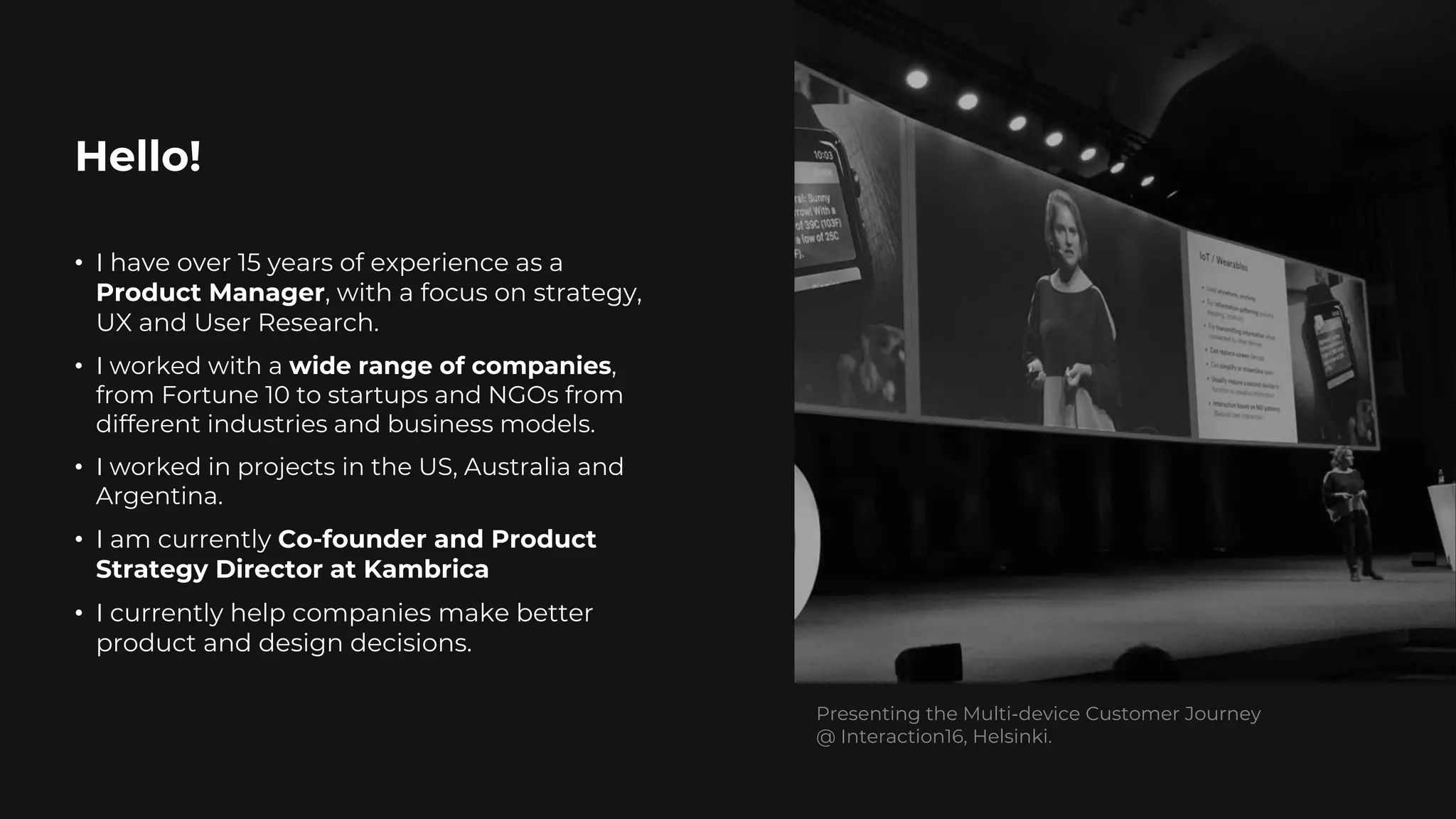
Presenting the Multi-device Customer Journey
@ Interaction16, Helsinki.
What is a
framework?
A framework is the underlying structure that
organizes a system.
This framework organizes product or
business metrics in order to deliver a holistic
vision of the performance.
Before we begin…
Why this framework?
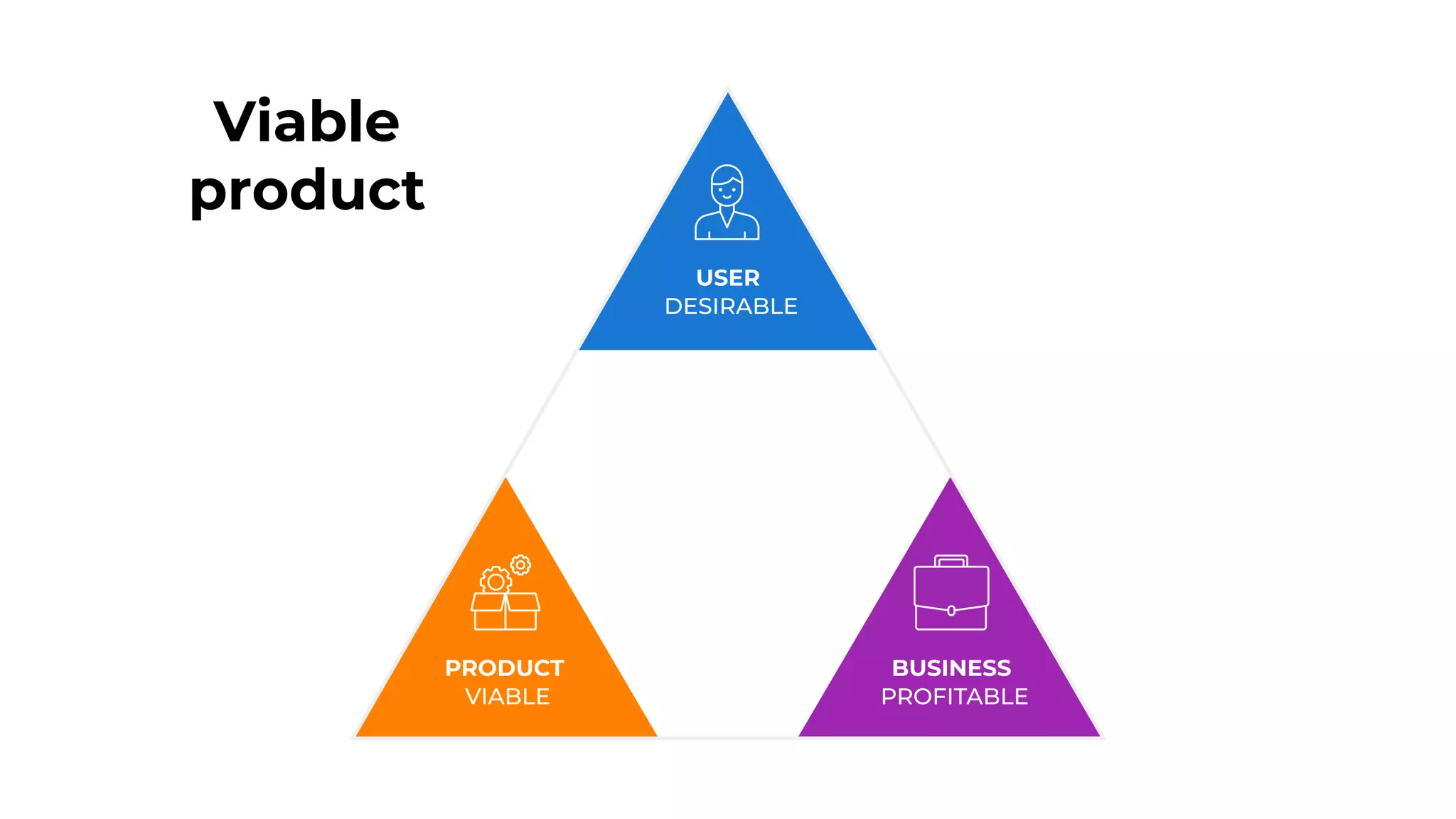
Viable
product
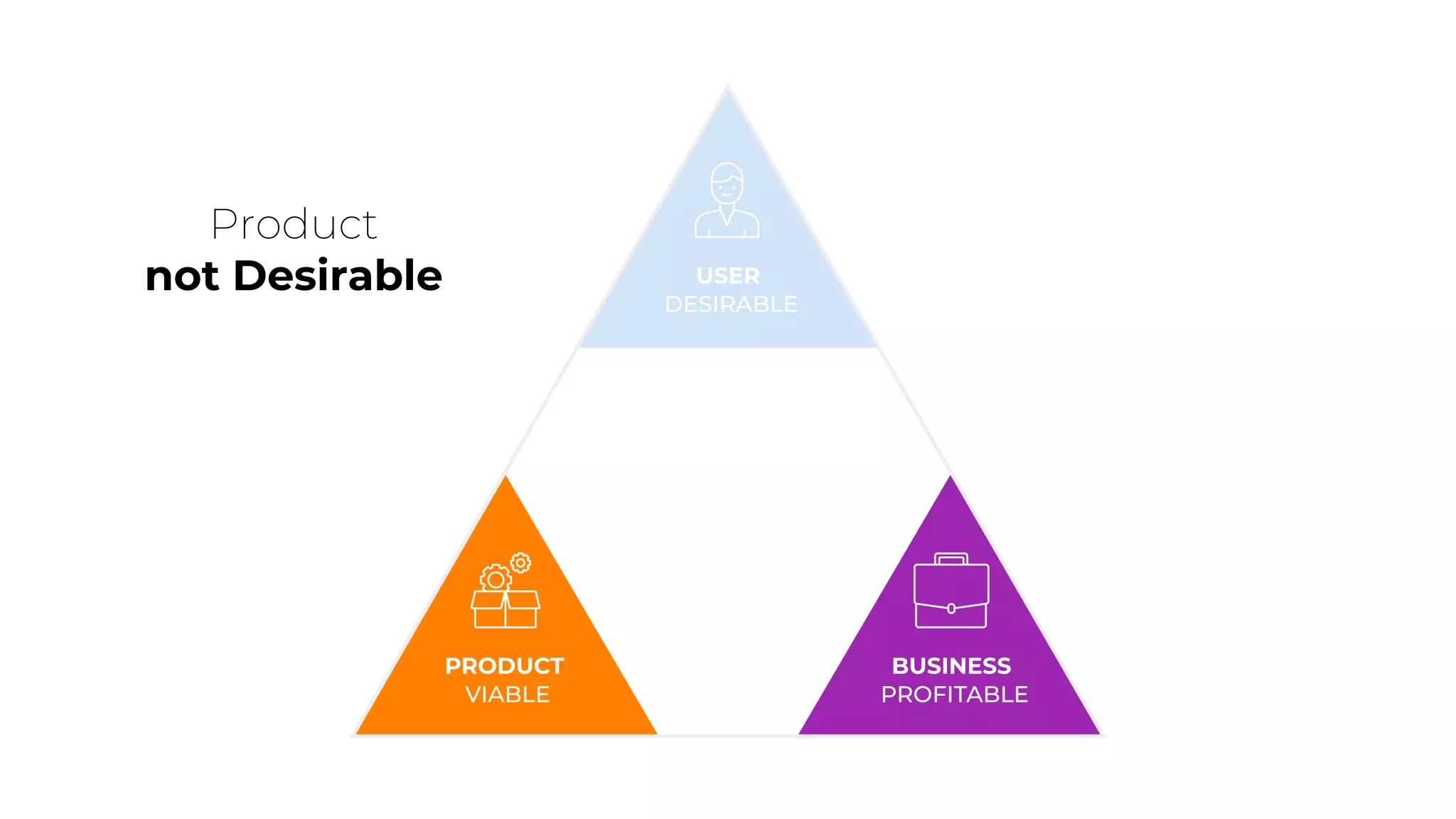
Product
not Desirable
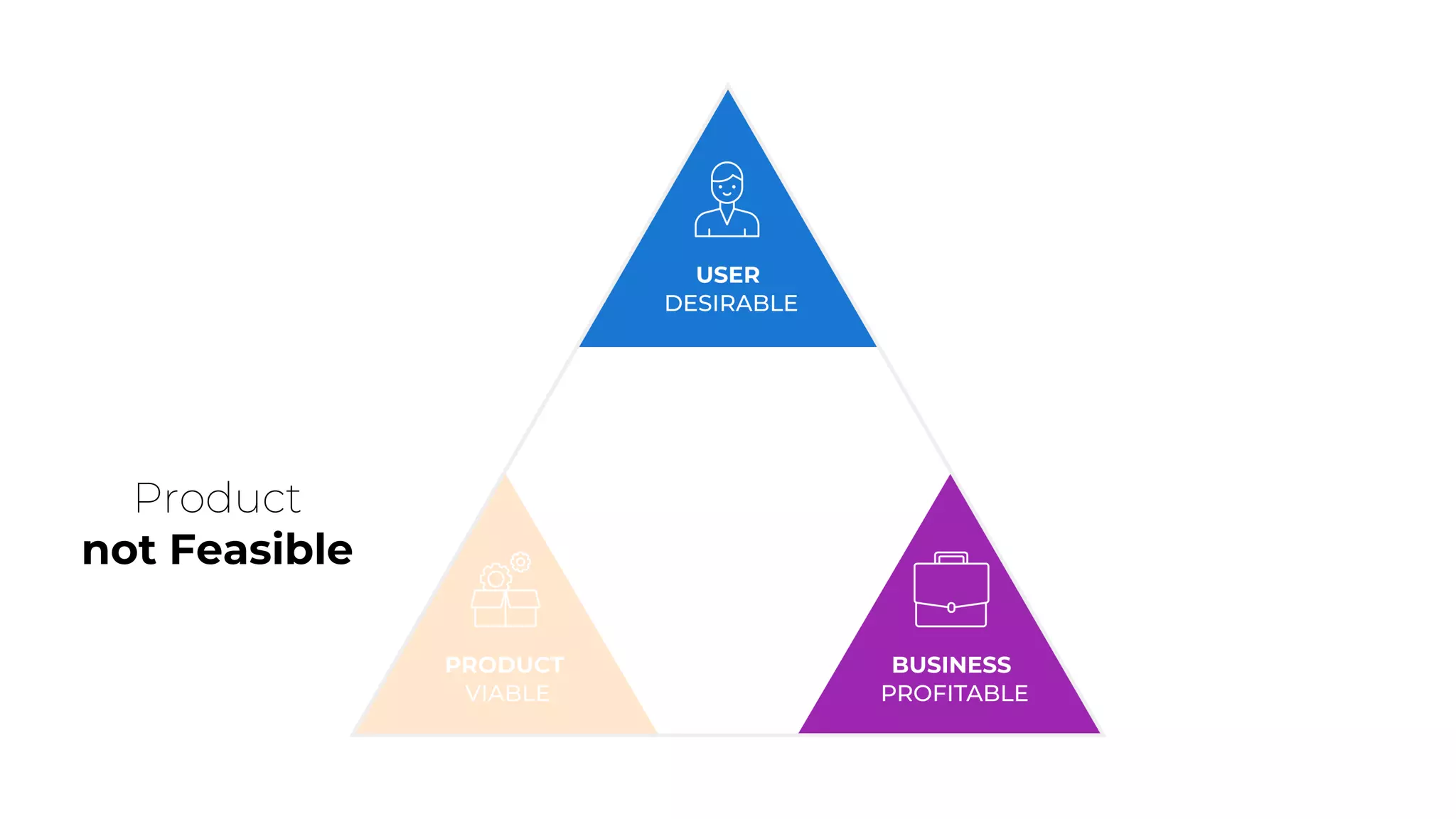
Product
not Feasible
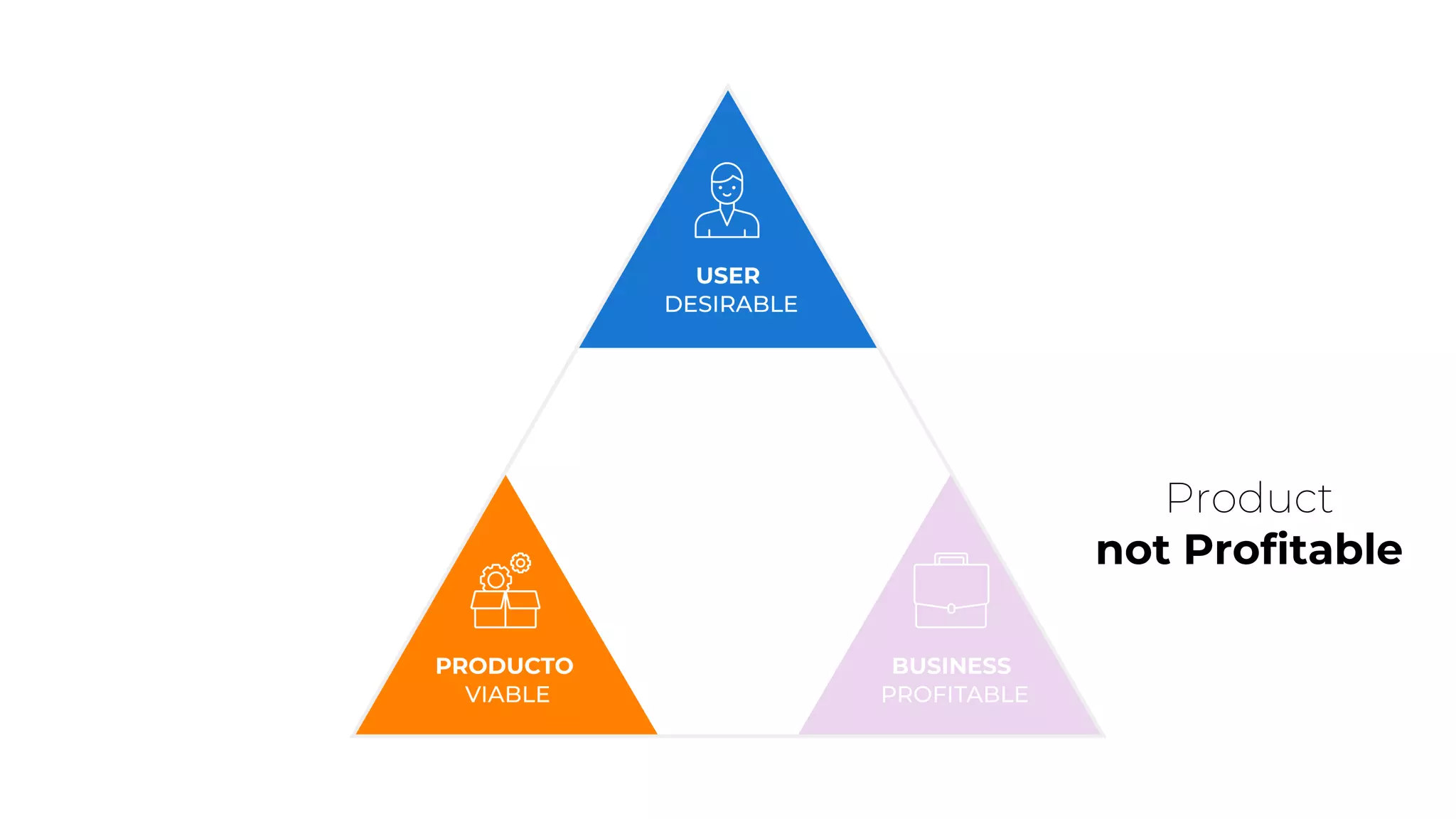
Product
not Profitable
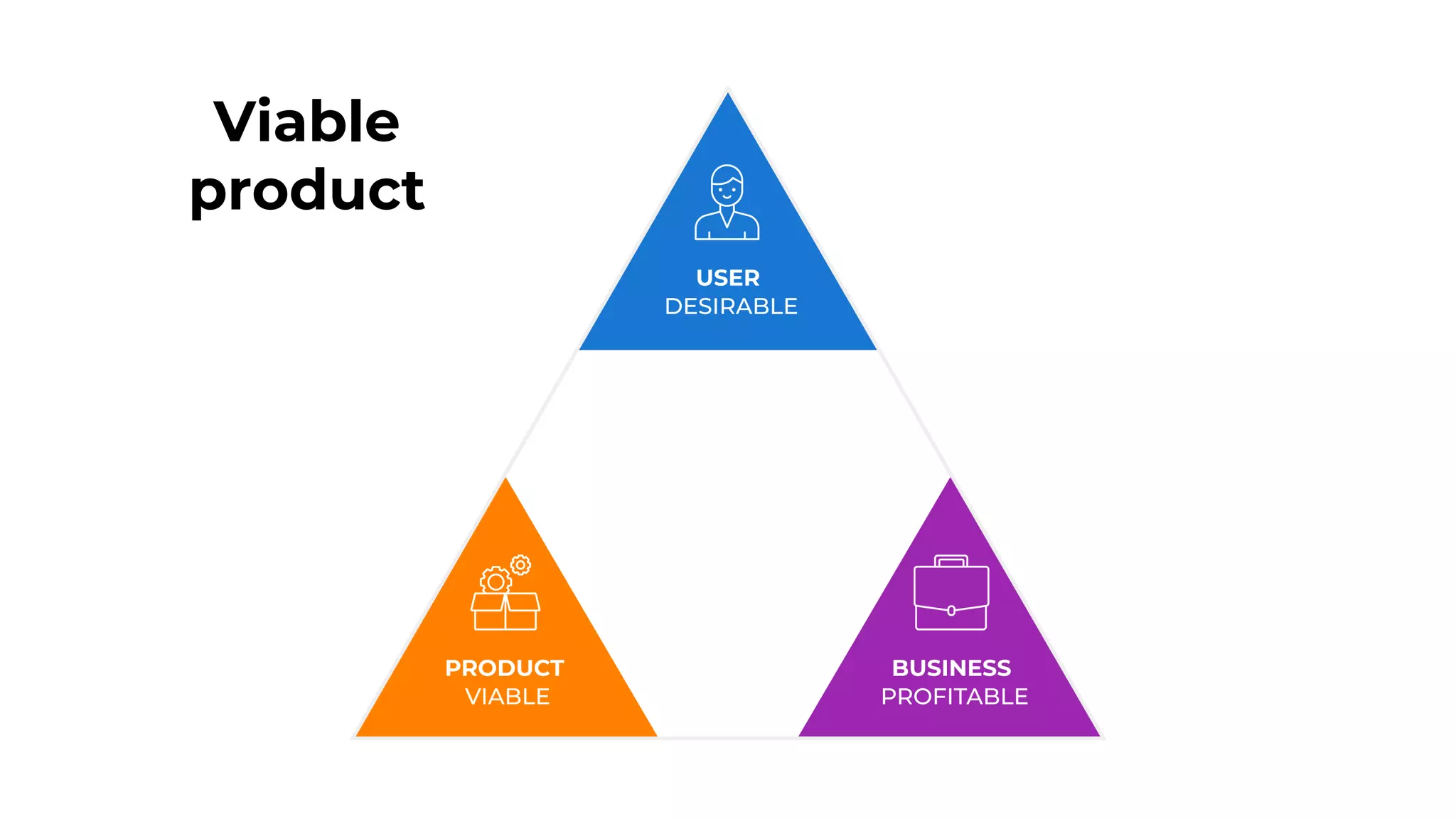
Viable
product
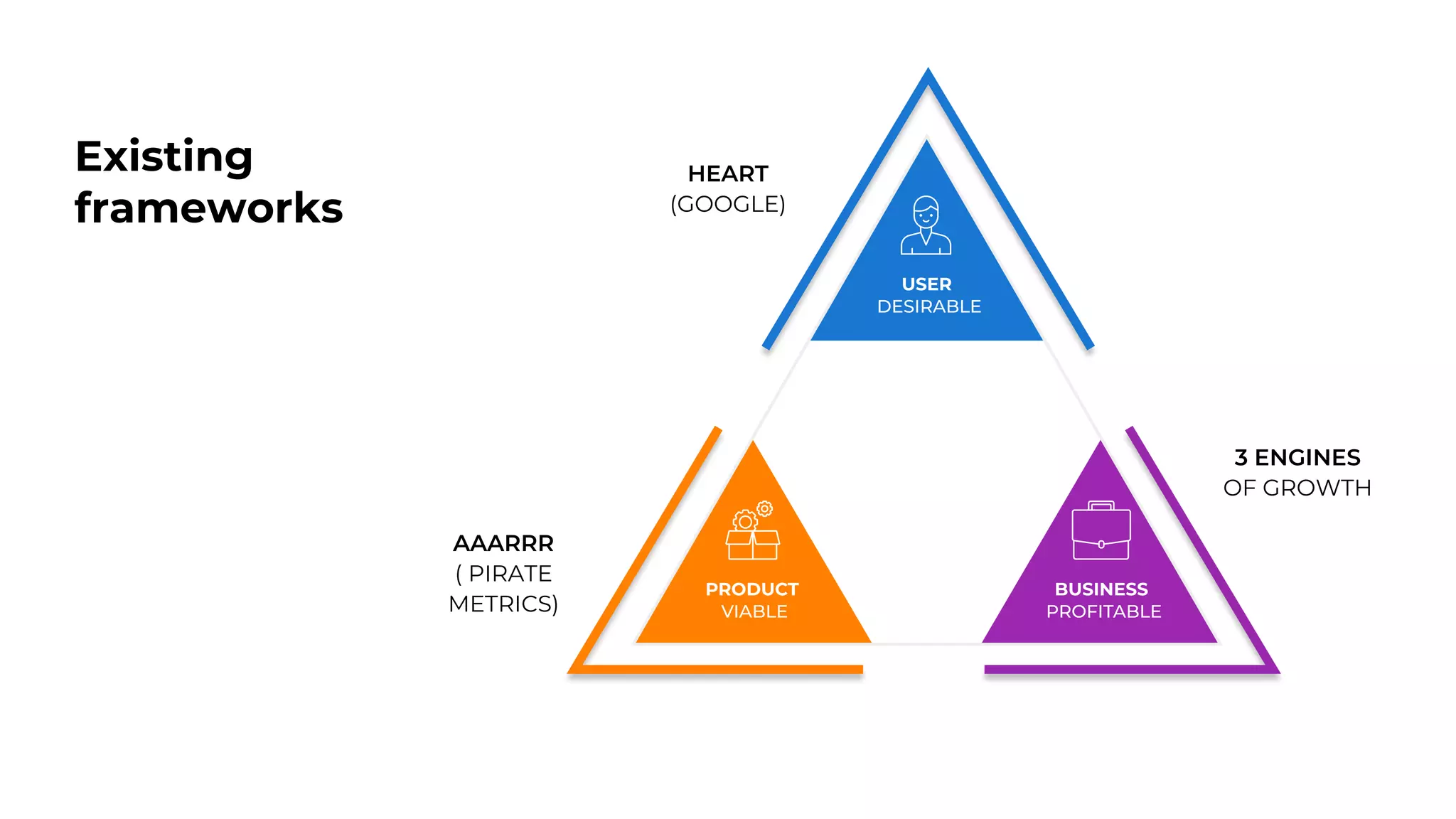
Existing
frameworks
AAARRR
( PIRATE
METRICS)
HEART
(GOOGLE)
3 ENGINES
OF GROWTH
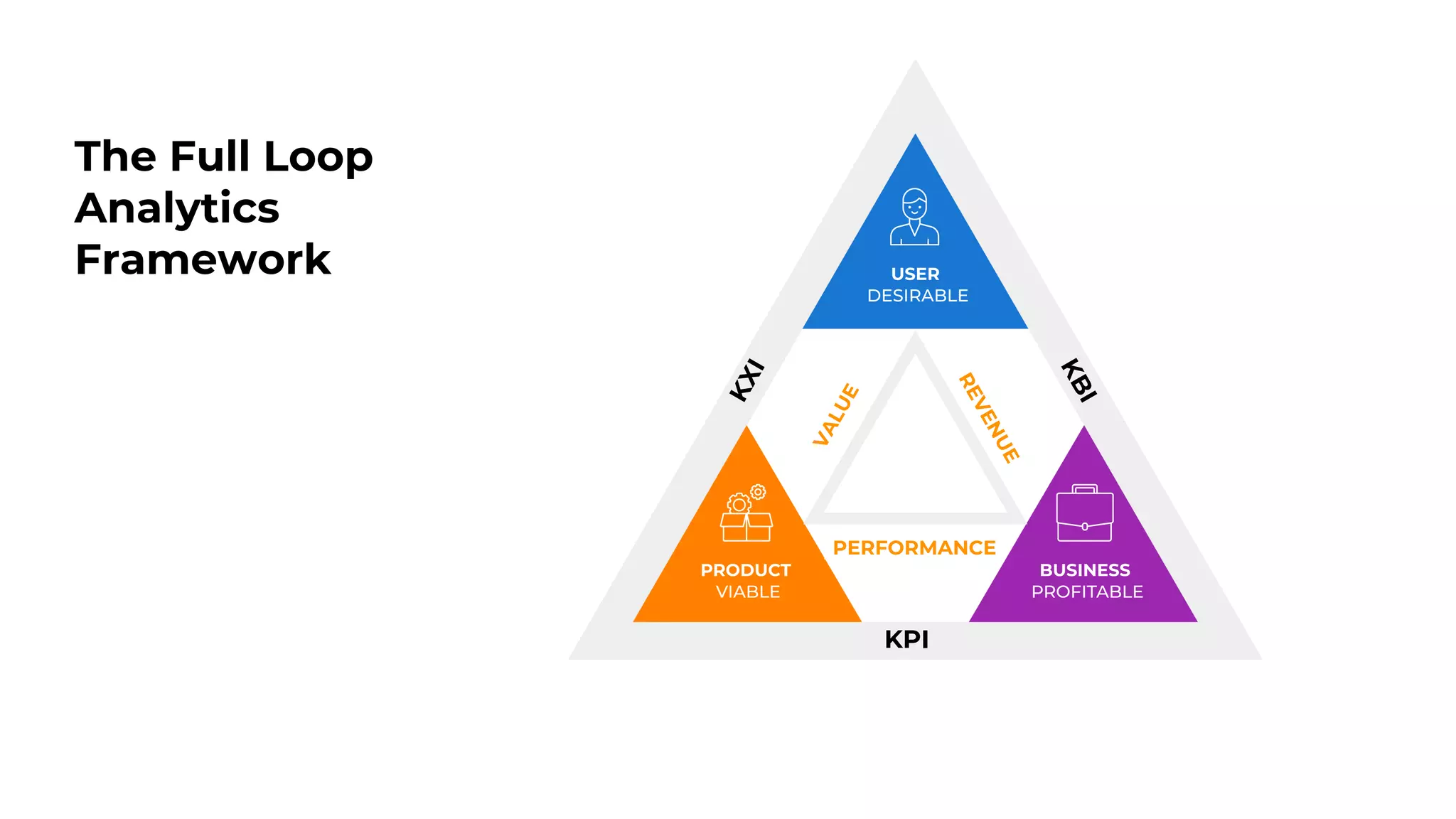
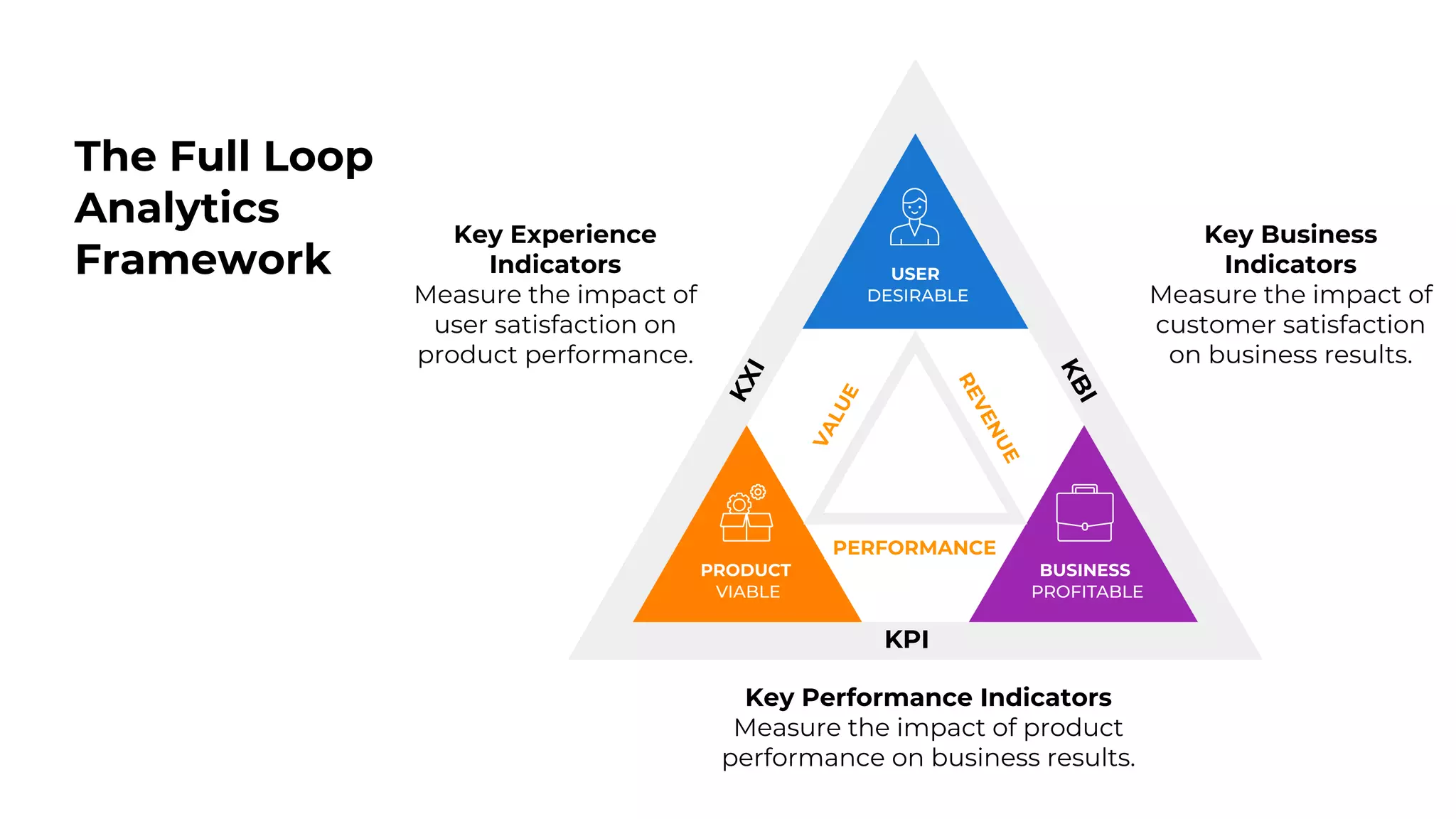
The Full Loop
Analytics
Framework USER
DESIRABLE
PRODUCT
VIABLE
BUSINESS
PROFITABLE
KPI
PERFORMANCE
The Full Loop
Analytics
Framework USER
DESIRABLE
PRODUCT
VIABLE
BUSINESS
PROFITABLE
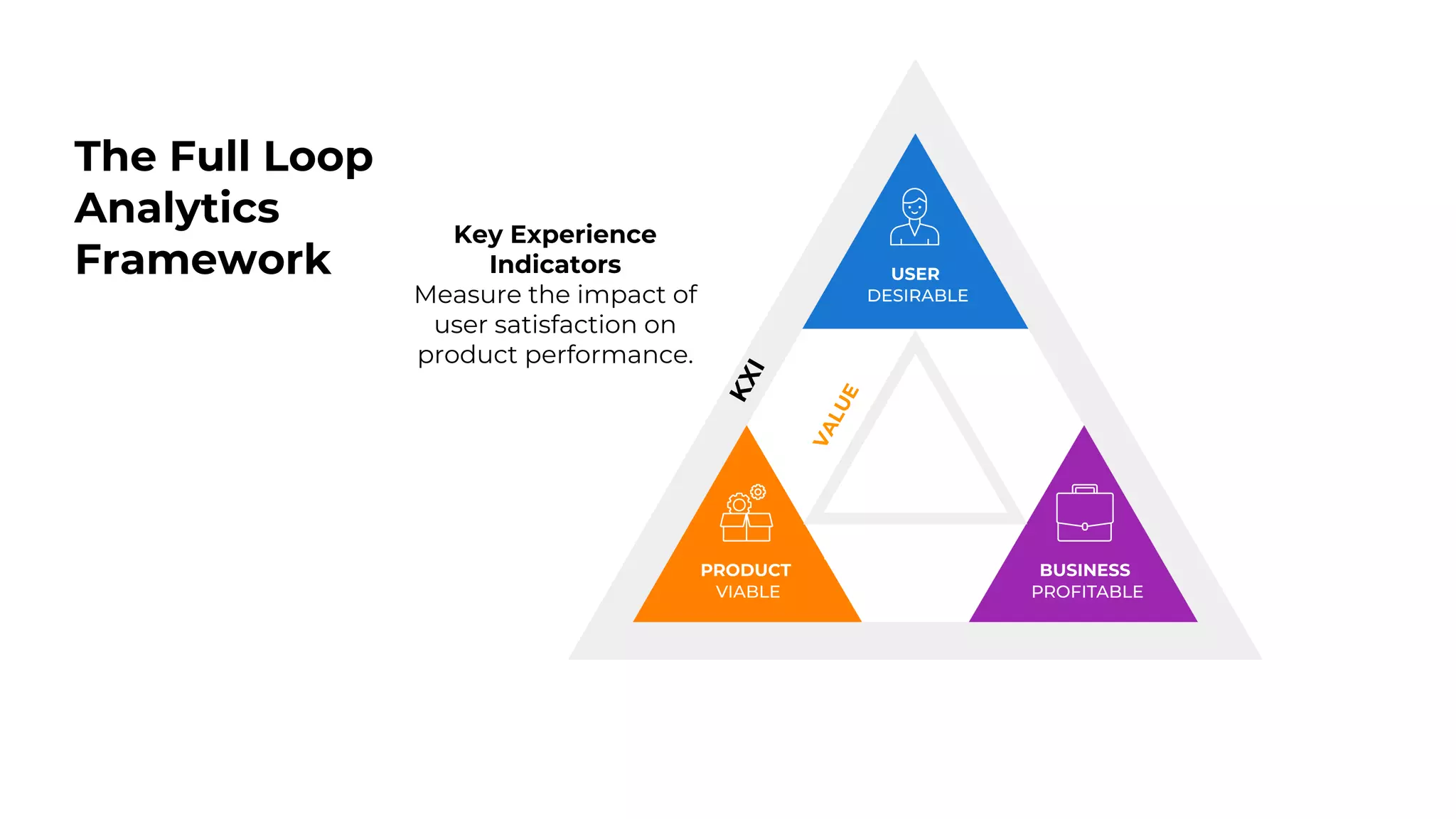
Key Experience
Indicators
Measure the impact of
user satisfaction on
product performance.
The Full Loop
Analytics
Framework USER
DESIRABLE
PRODUCT
VIABLE
BUSINESS
PROFITABLE
KPI
PERFORMANCE
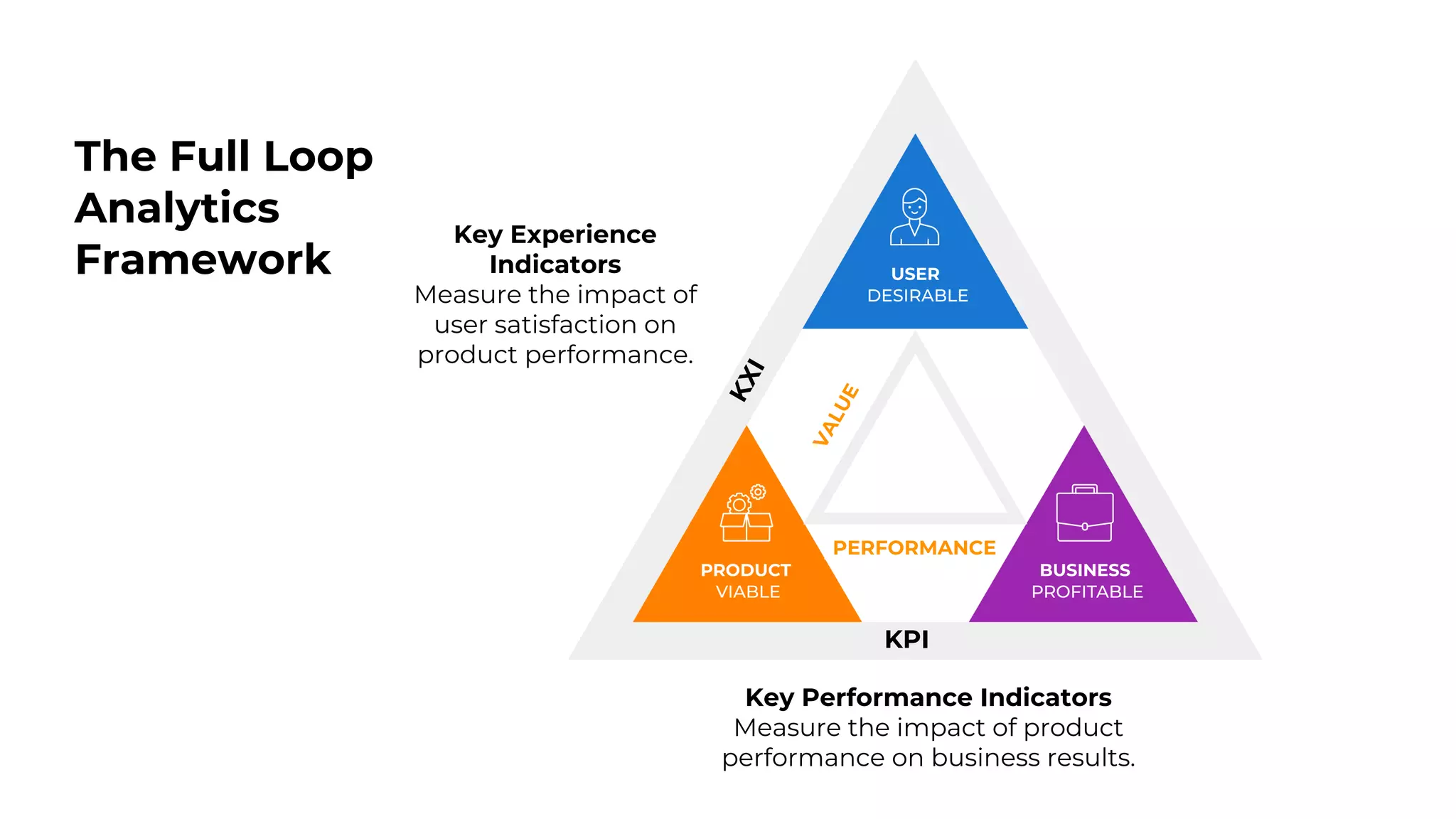
Key Performance Indicators
Measure the impact of product
performance on business results.
Key Experience
Indicators
Measure the impact of
user satisfaction on
product performance.
The Full Loop
Analytics
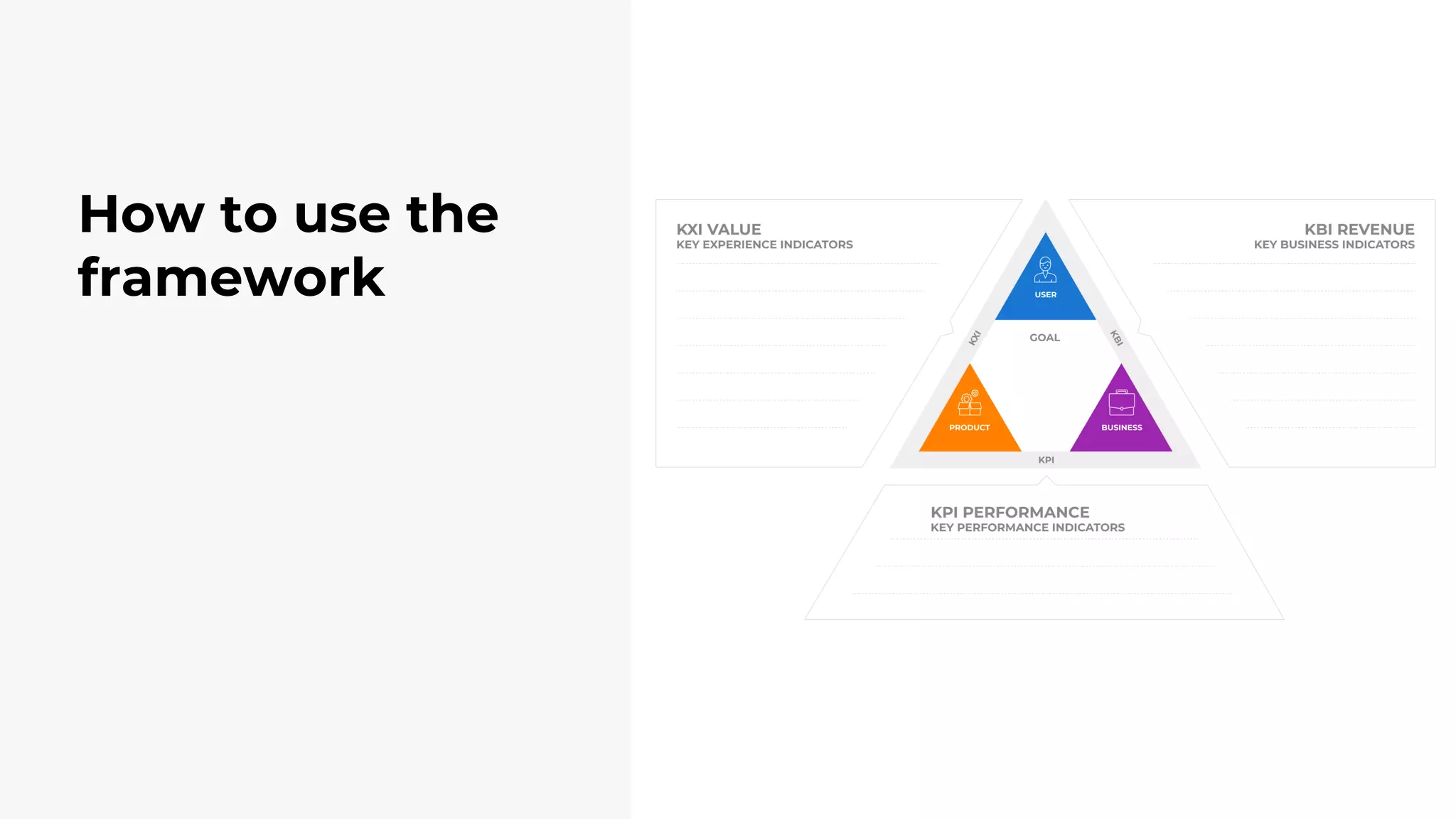
Framework USER
DESIRABLE
PRODUCT
VIABLE
BUSINESS
PROFITABLE
KPI
PERFORMANCE
Key Experience
Indicators
Measure the impact of
user satisfaction on
product performance.
Key Performance Indicators
Measure the impact of product
performance on business results.
Key Business
Indicators
Measure the impact of
customer satisfaction
on business results.
The metrics, explained
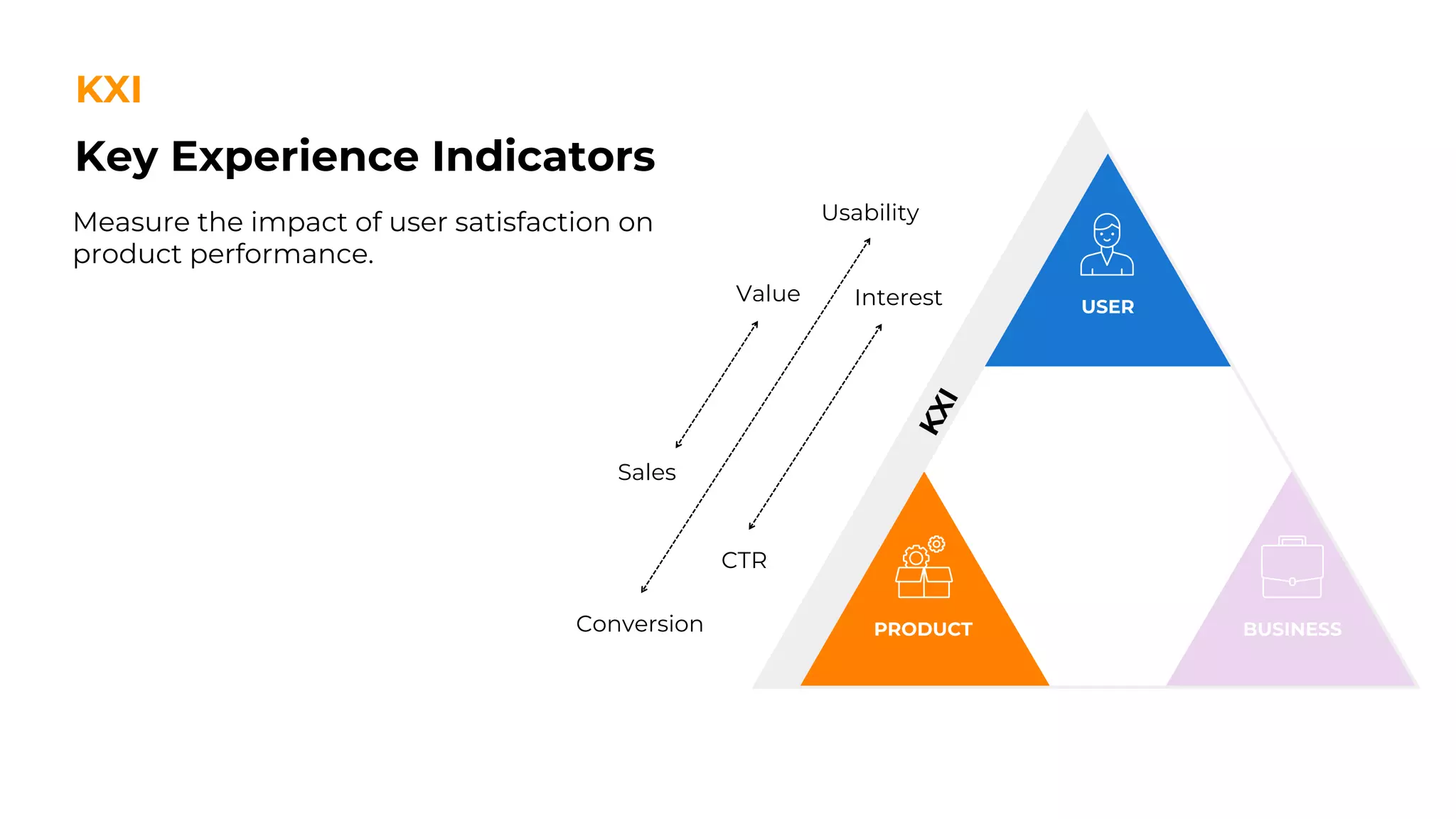
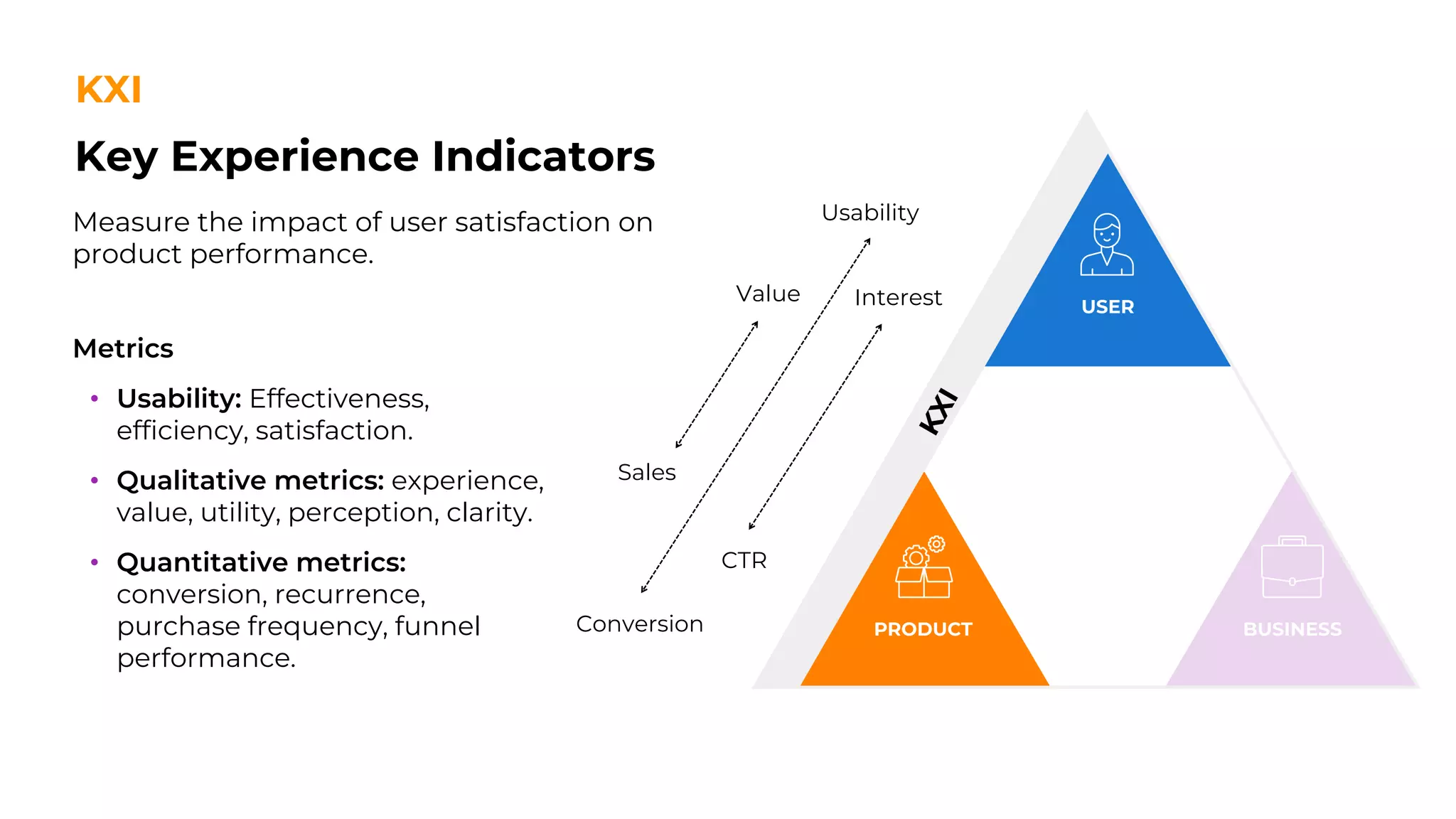
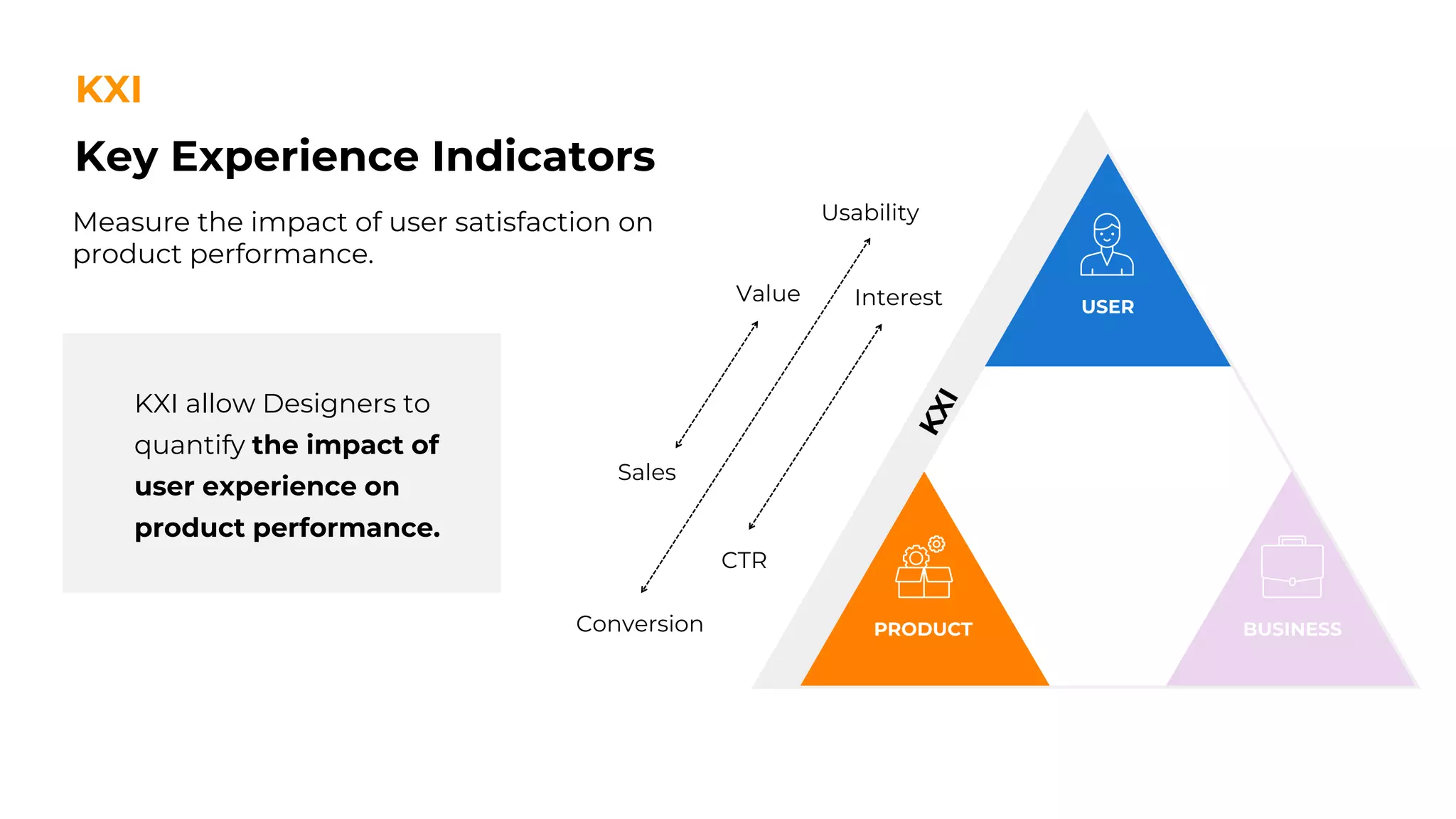
Key Experience Indicators
KXI
Sales
Value
Conversion
Usability
CTR
Interest
Measure the impact of user satisfaction on
product performance.
Key Experience Indicators
KXI
Sales
Value
Conversion
Usability
CTR
Interest
Measure the impact of user satisfaction on
product performance.
Metrics
• Usability: Effectiveness,
efficiency, satisfaction.
• Qualitative metrics: experience,
value, utility, perception, clarity.
• Quantitative metrics:
conversion, recurrence,
purchase frequency, funnel
performance.
Key Experience Indicators
KXI
Sales
Value
Conversion
Usability
CTR
Interest
Measure the impact of user satisfaction on
product performance.
KXI allow Designers to
quantify the impact of
user experience on
product performance.
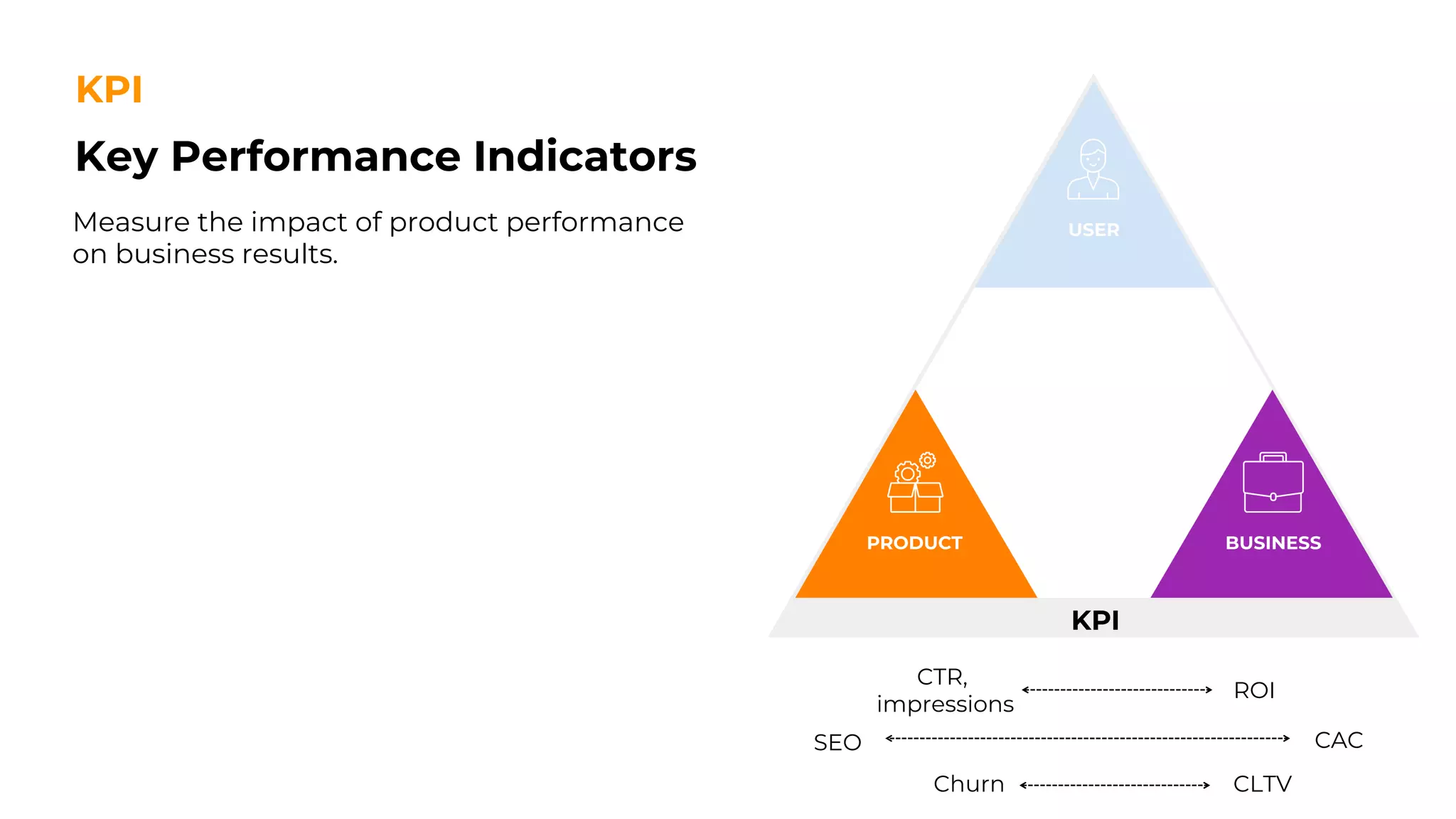
Key Performance Indicators
KPI
Measure the impact of product performance
on business results.
CTR,
impressions
ROI
SEO CAC
Churn CLTV
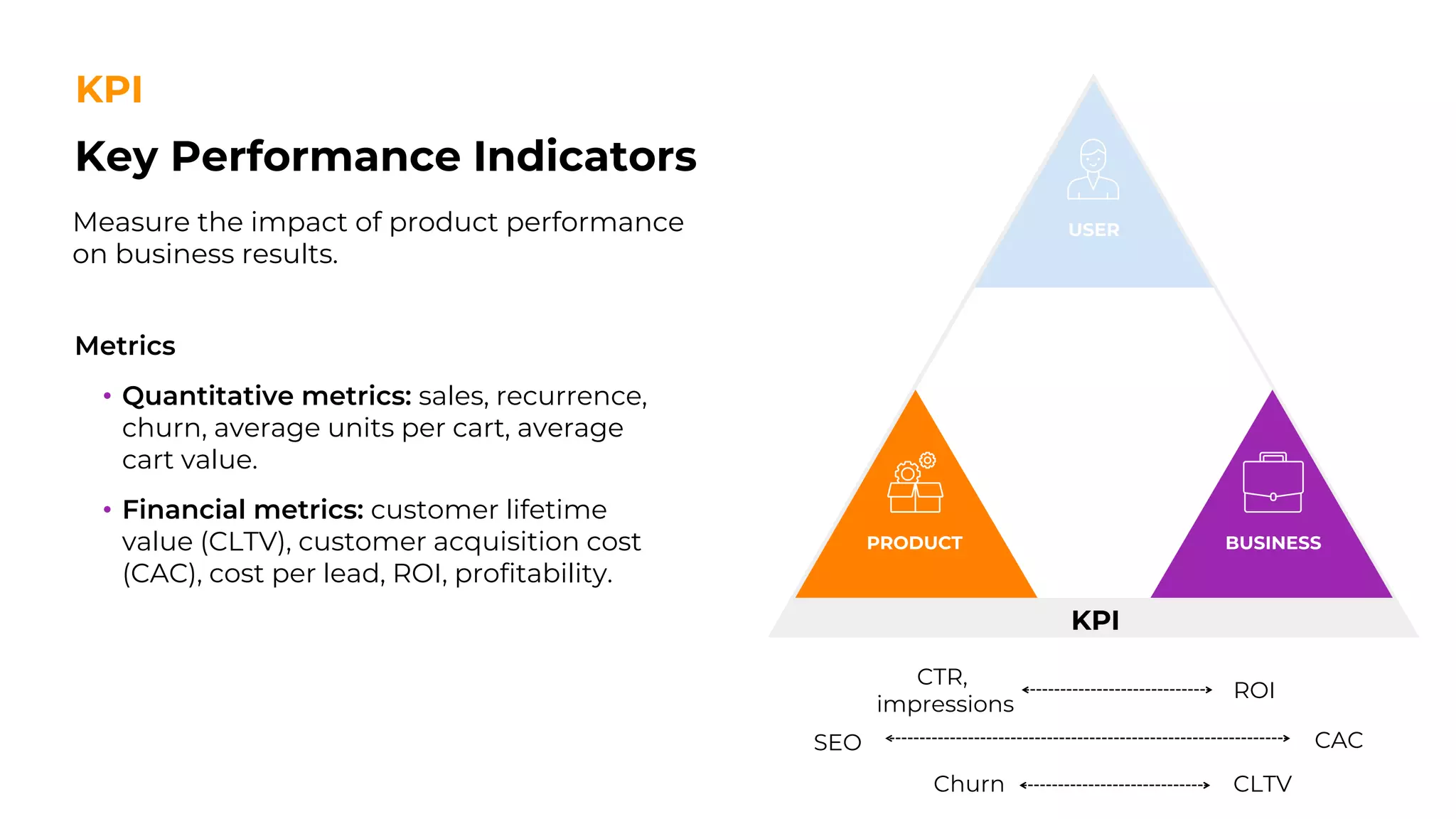
Key Performance Indicators
KPI
Measure the impact of product performance
on business results.
CTR,
impressions
ROI
SEO CAC
Churn CLTV
Metrics
• Quantitative metrics: sales, recurrence,
churn, average units per cart, average
cart value.
• Financial metrics: customer lifetime
value (CLTV), customer acquisition cost
(CAC), cost per lead, ROI, profitability.
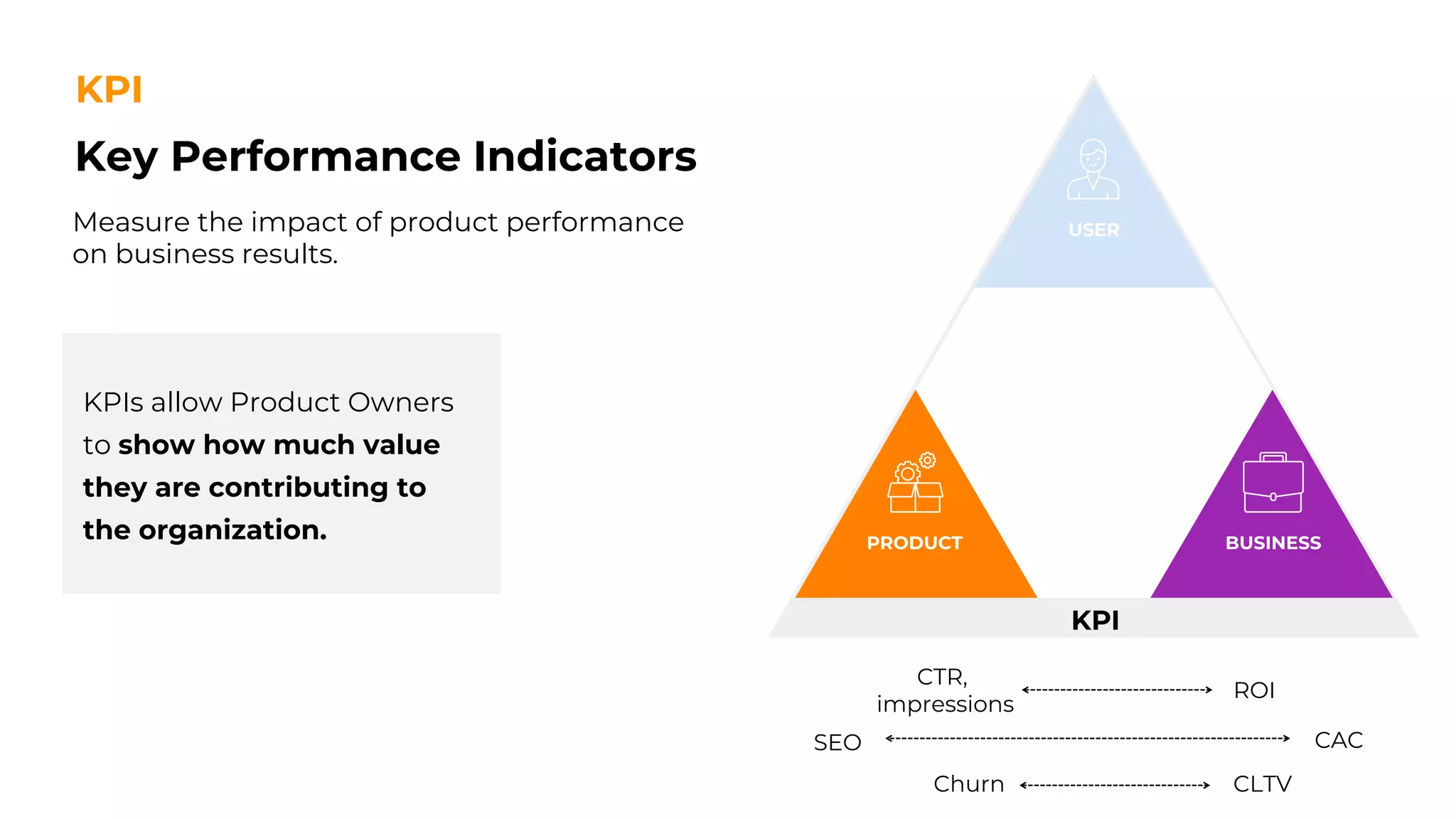
Key Performance Indicators
KPI
Measure the impact of product performance
on business results.
CTR,
impressions
ROI
SEO CAC
Churn CLTV
KPIs allow Product Owners
to show how much value
they are contributing to
the organization.
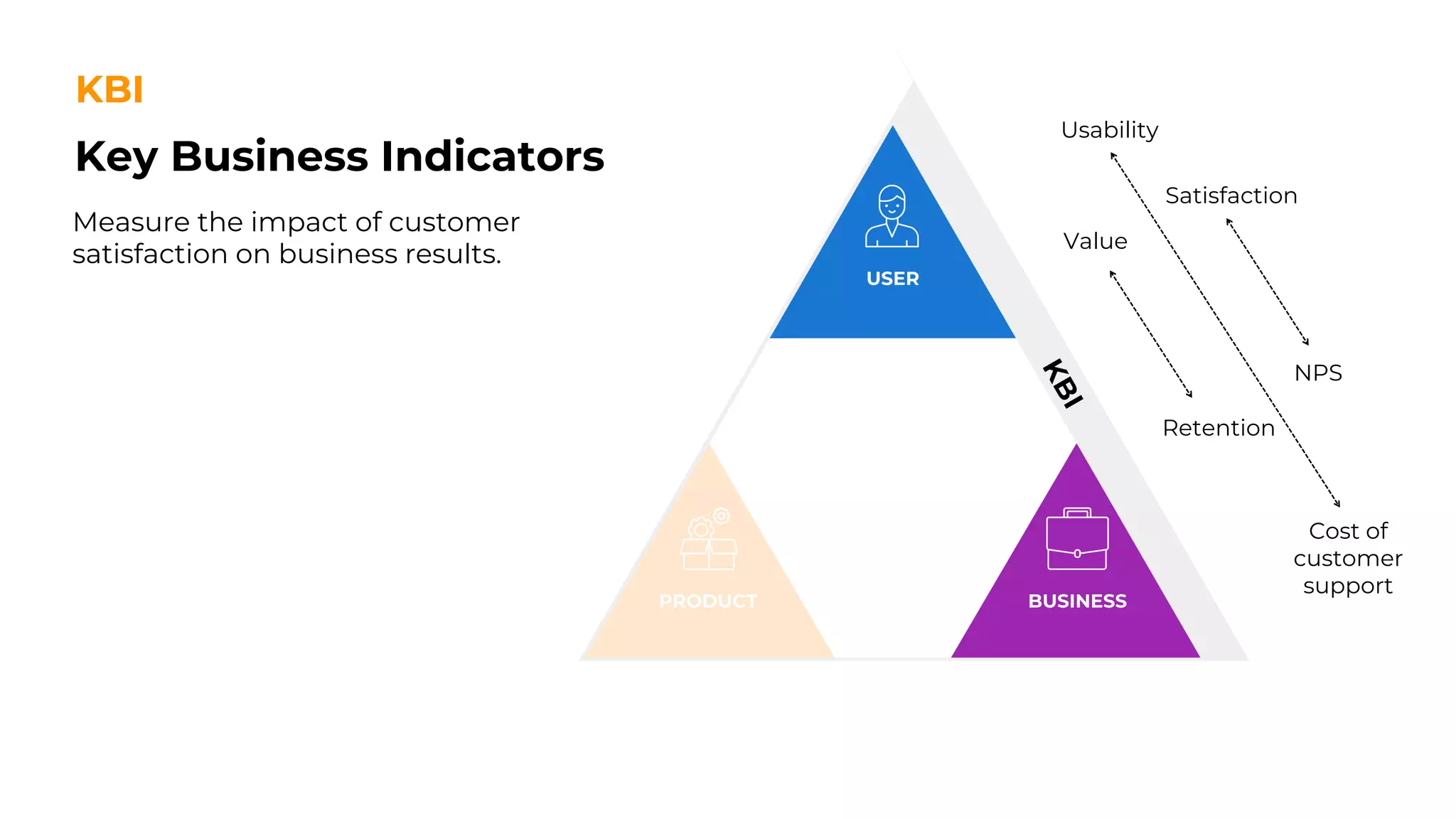
Key Business Indicators
KBI
Measure the impact of customer
satisfaction on business results.
Satisfaction
Cost of
customer
support
Value
Usability
Retention
NPS
Key Business Indicators
KBI
Measure the impact of customer
satisfaction on business results.
Satisfaction
Cost of
customer
support
Value
Usability
Retention
NPS
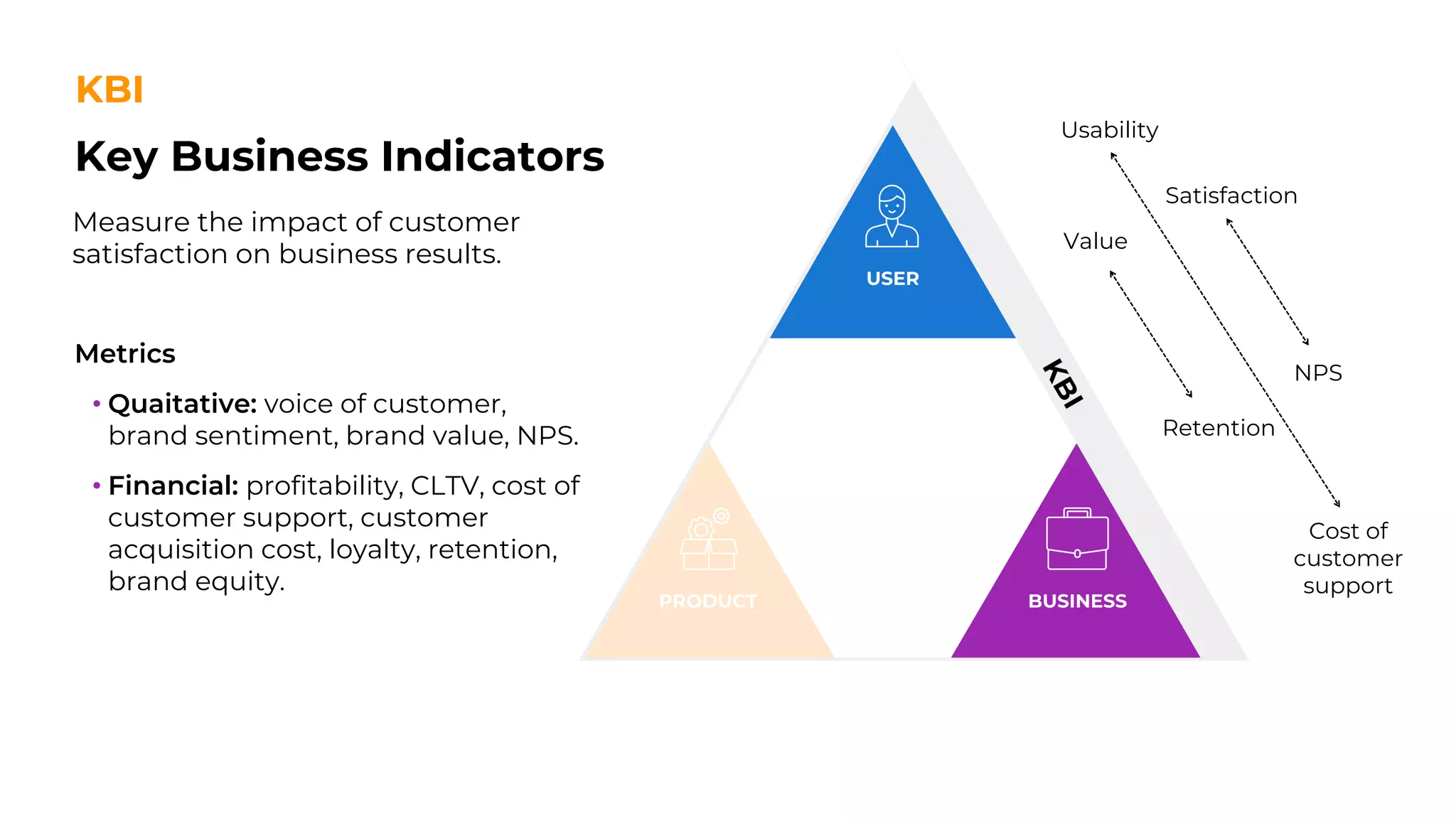
Metrics
• Quaitative: voice of customer,
brand sentiment, brand value, NPS.
• Financial: profitability, CLTV, cost of
customer support, customer
acquisition cost, loyalty, retention,
brand equity.
Key Business Indicators
KBI
Measure the impact of customer
satisfaction on business results.
Satisfaction
Cost of
customer
support
Value
Usability
Retention
NPS
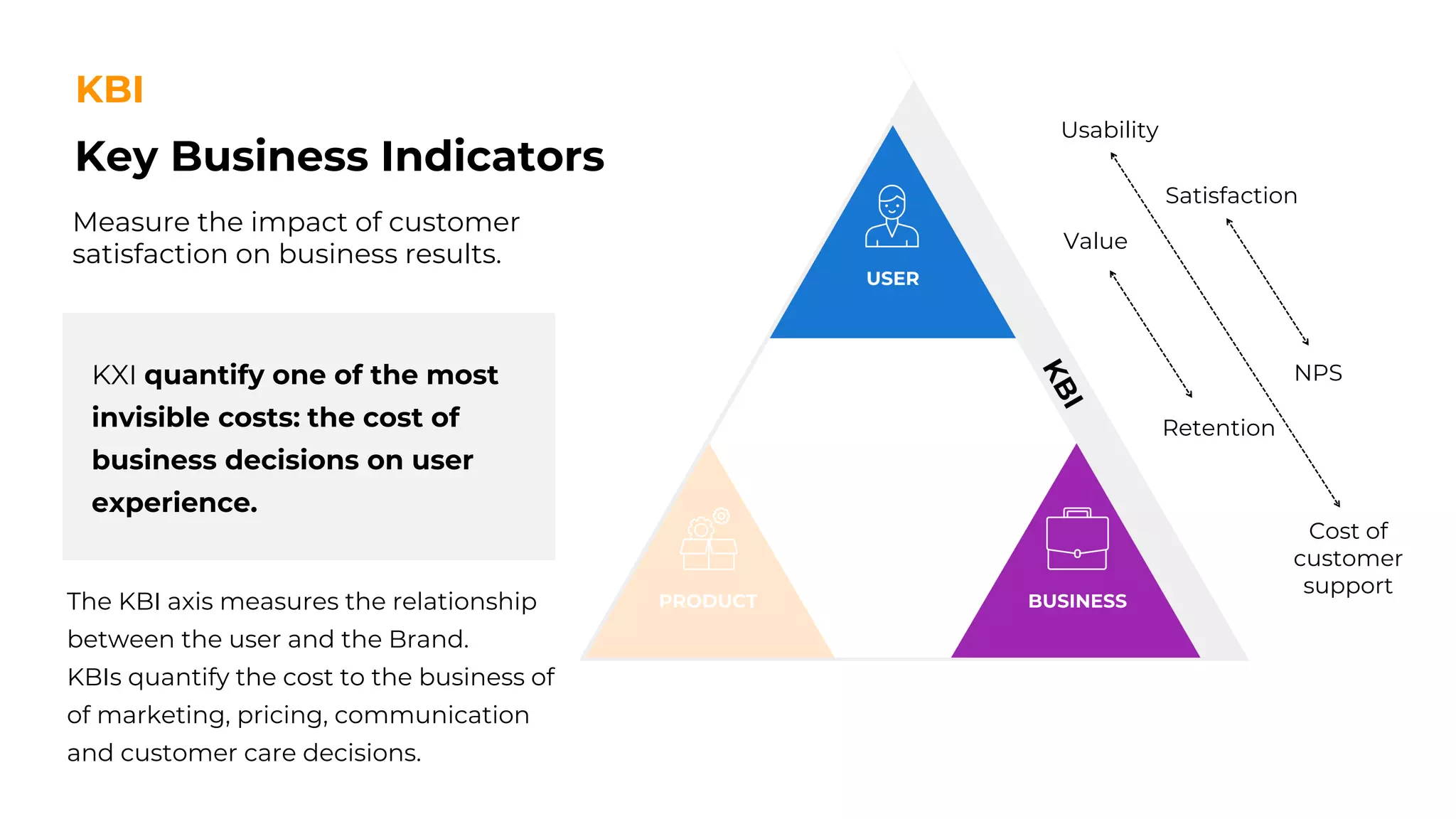
KXI quantify one of the most
invisible costs: the cost of
business decisions on user
experience.
The KBI axis measures the relationship
between the user and the Brand.
KBIs quantify the cost to the business of
of marketing, pricing, communication
and customer care decisions.
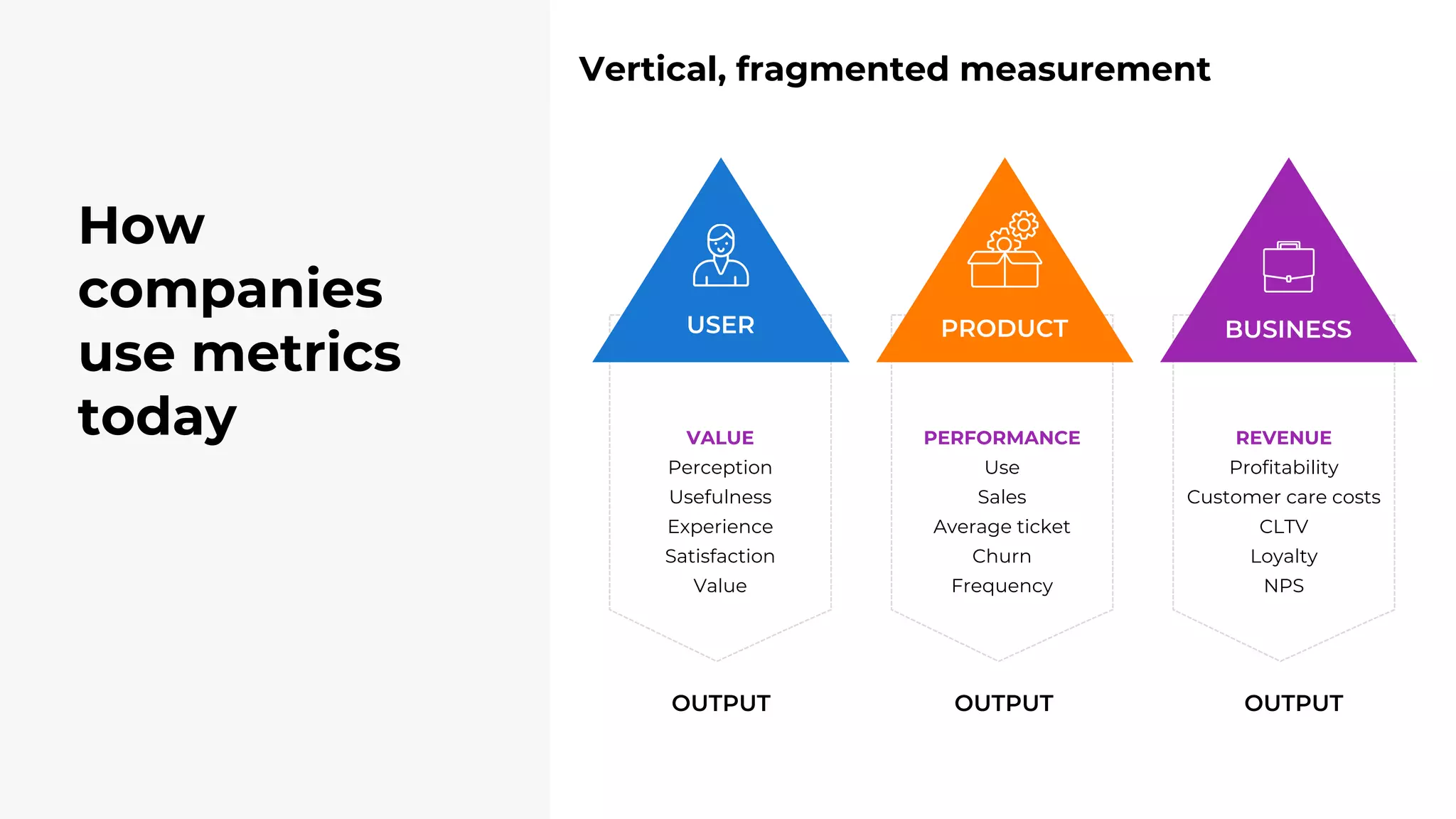
Vertical, fragmented measurement
REVENUE
Profitability
Customer care costs
CLTV
Loyalty
NPS
OUTPUT
BUSINESS
PERFORMANCE
Use
Sales
Average ticket
Churn
Frequency
OUTPUT
PRODUCT
VALUE
Perception
Usefulness
Experience
Satisfaction
Value
OUTPUT
USER
How
companies
use metrics
today
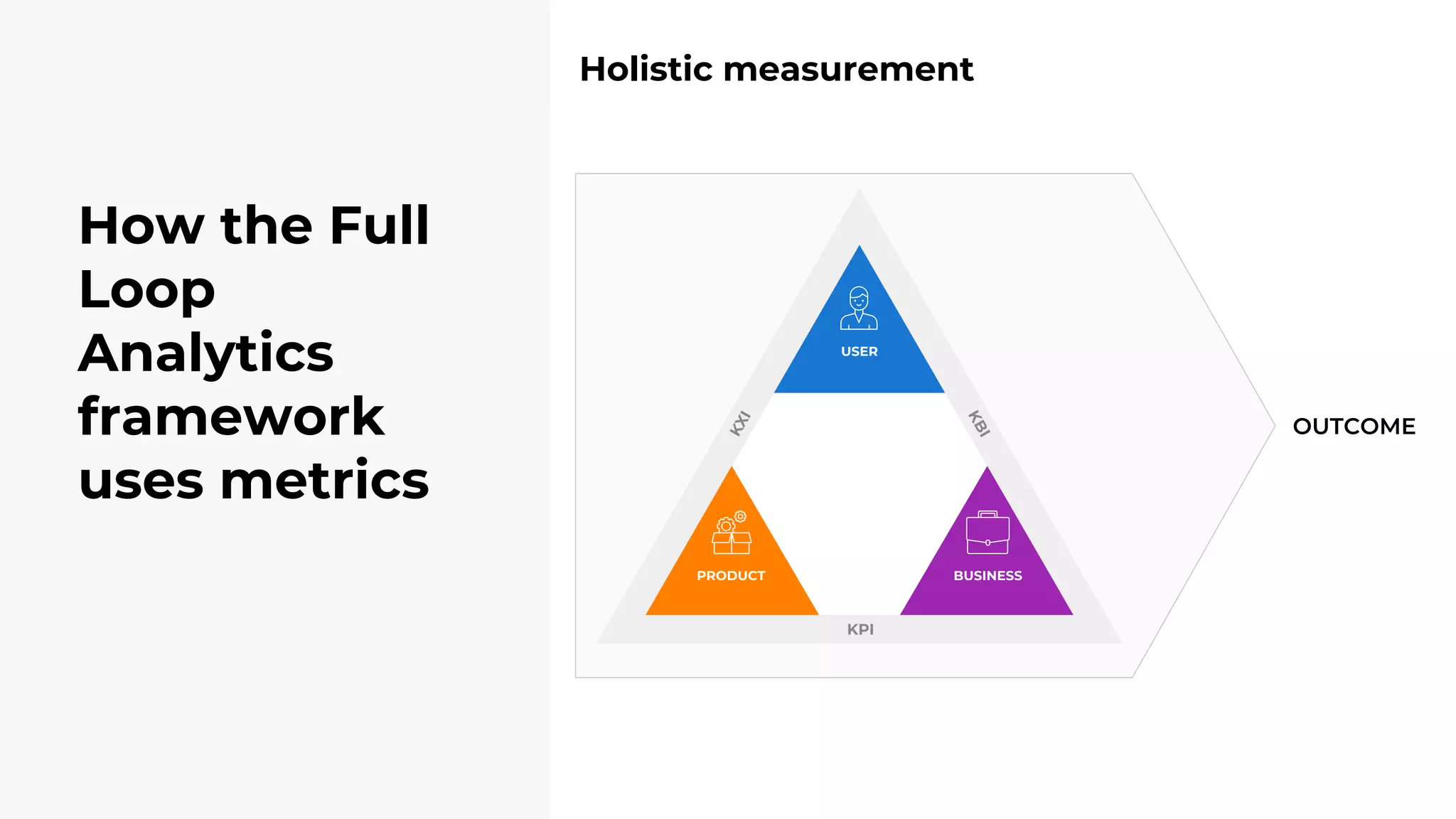
Holistic measurement
How the Full
Loop
Analytics
framework
uses metrics
OUTCOME
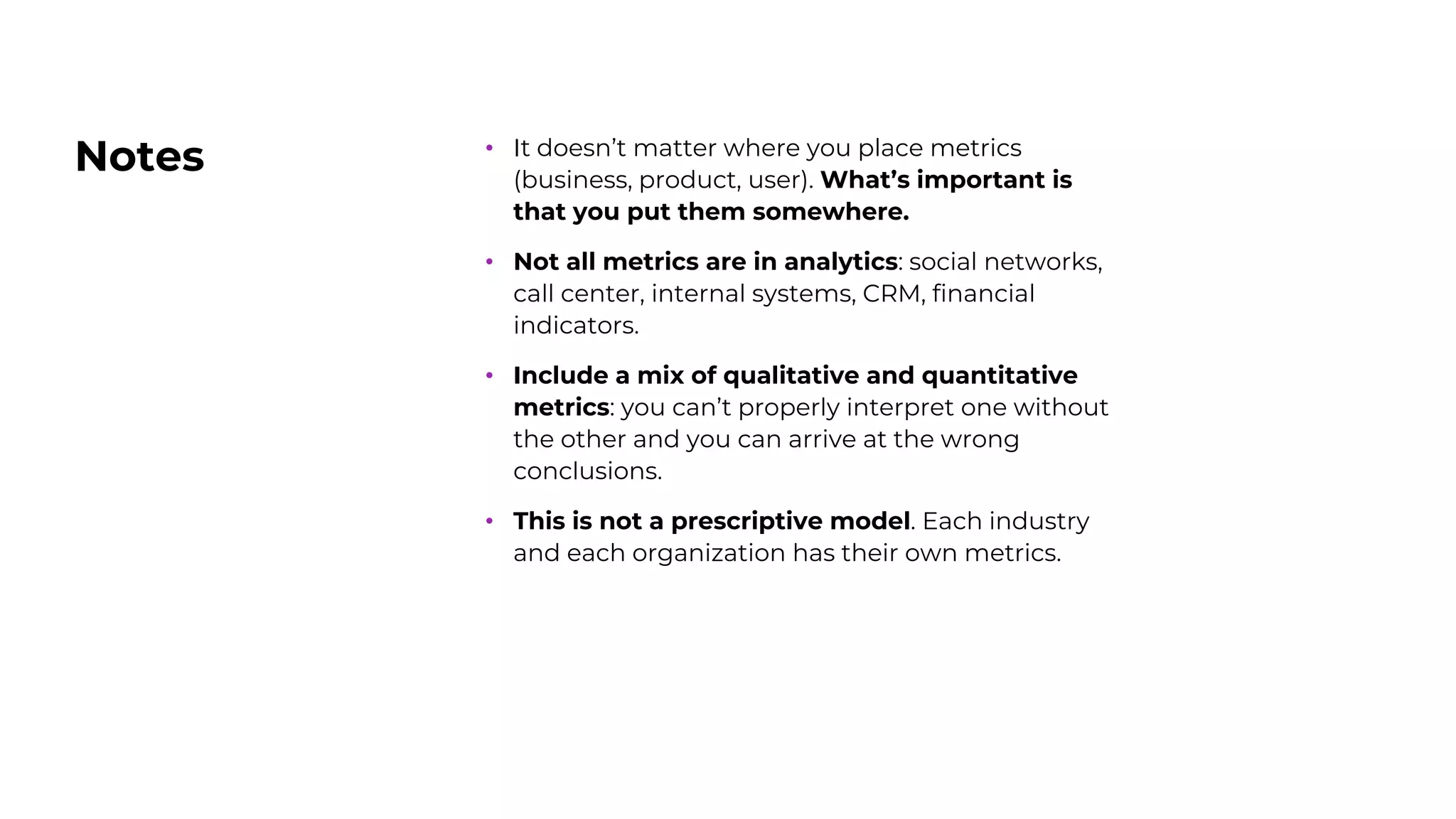
Notes • It doesn’t matter where you place metrics
(business, product, user). What’s important is
that you put them somewhere.
• Not all metrics are in analytics: social networks,
call center, internal systems, CRM, financial
indicators.
• Include a mix of qualitative and quantitative
metrics: you can’t properly interpret one without
the other and you can arrive at the wrong
conclusions.
• This is not a prescriptive model. Each industry
and each organization has their own metrics.
How to use the
Framework
How to use the
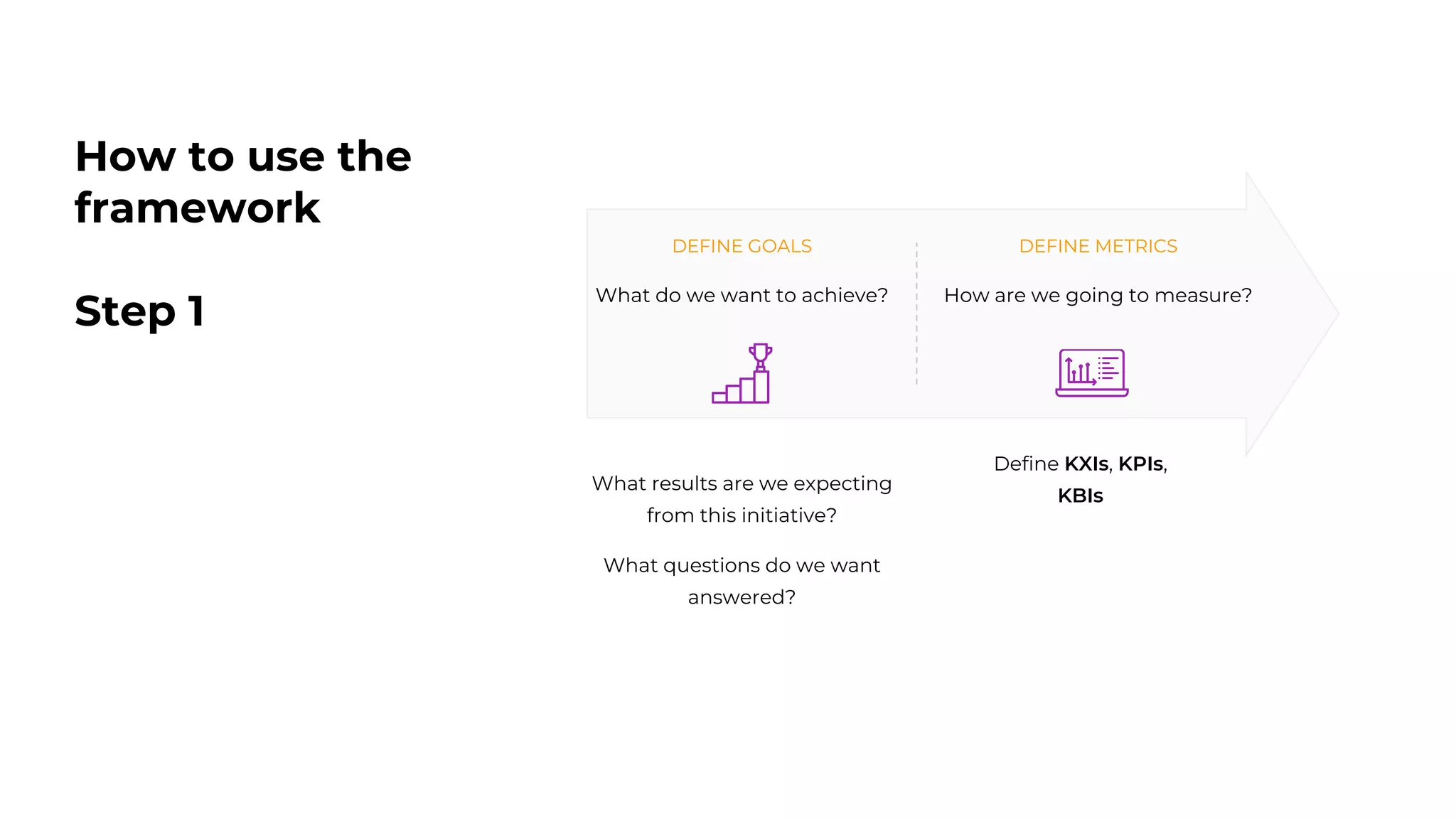
framework
Step 1
DEFINE GOALS
What do we want to achieve?
What results are we expecting
from this initiative?
What questions do we want
answered?
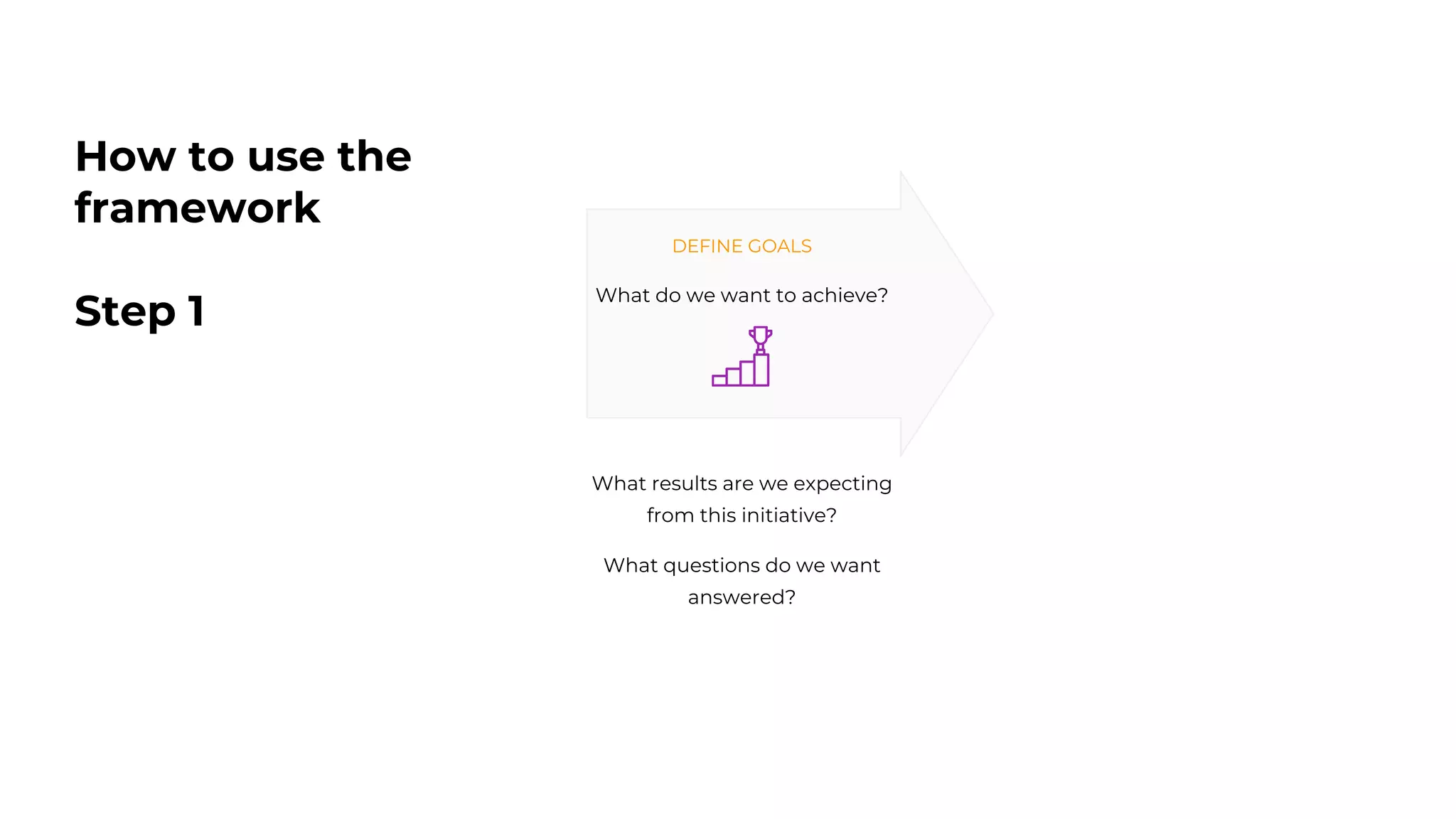
How to use the
framework
Step 1
DEFINE GOALS
What do we want to achieve?
What results are we expecting
from this initiative?
What questions do we want
answered?
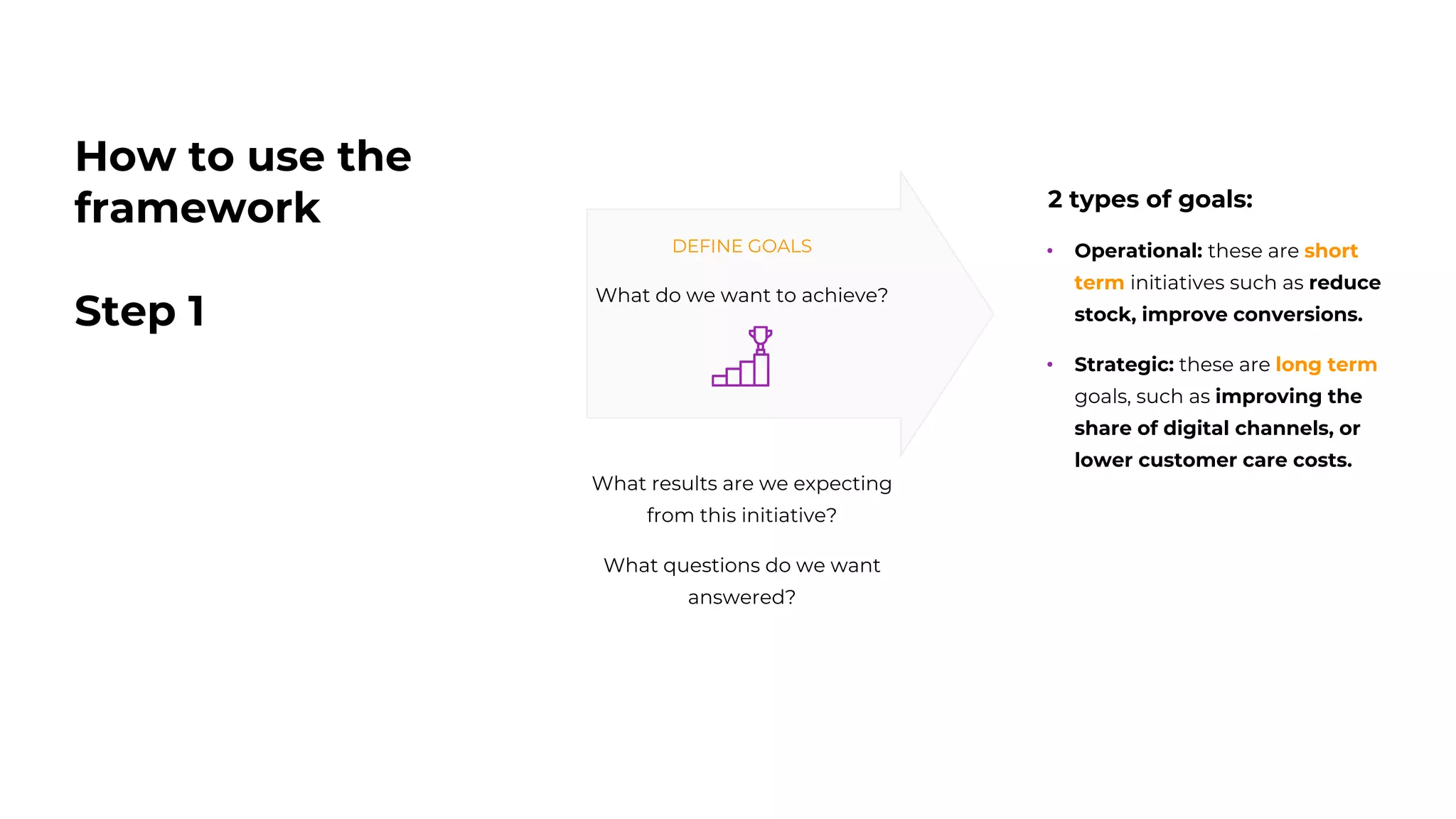
2 types of goals:
• Operational: these are short
term initiatives such as reduce
stock, improve conversions.
• Strategic: these are long term
goals, such as improving the
share of digital channels, or
lower customer care costs.
How to use the
framework
Step 1
DEFINE METRICS
How are we going to measure?
Define KXIs, KPIs,
KBIs
DEFINE GOALS
What do we want to achieve?
What results are we expecting
from this initiative?
What questions do we want
answered?
How to use the
framework
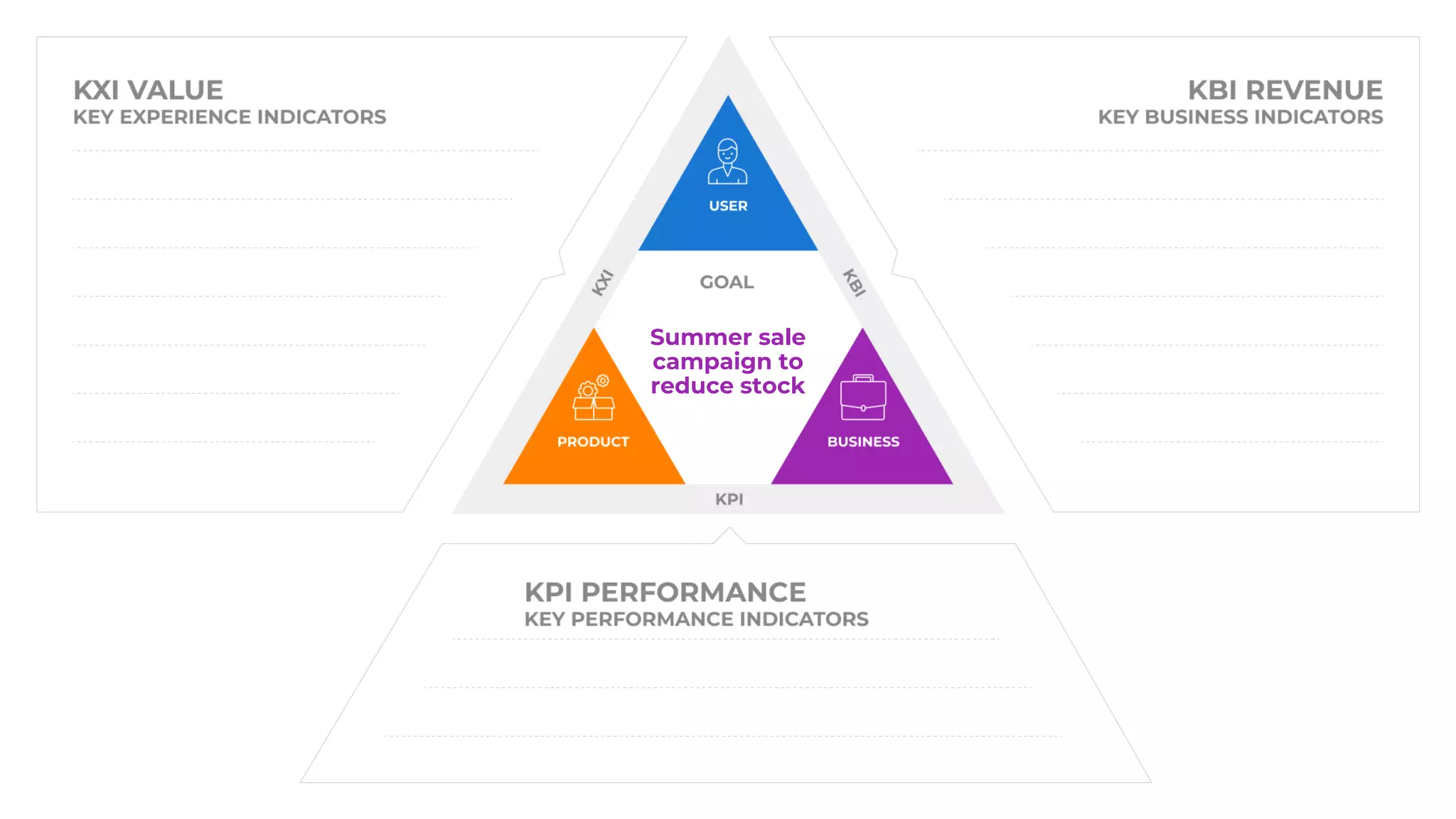
Summer sale
campaign to
reduce stock
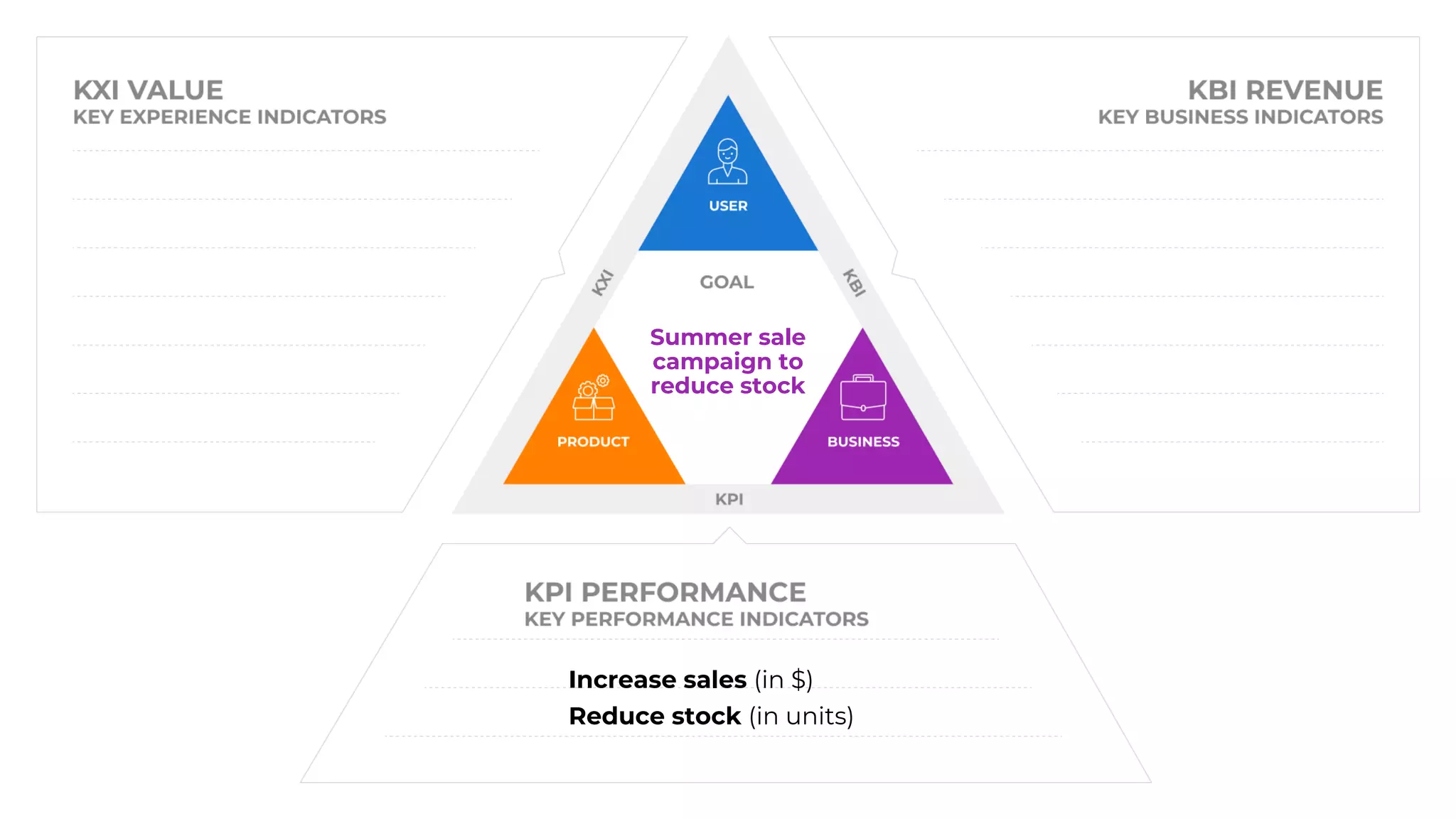
Increase sales (in $)
Reduce stock (in units)
Summer sale
campaign to
reduce stock
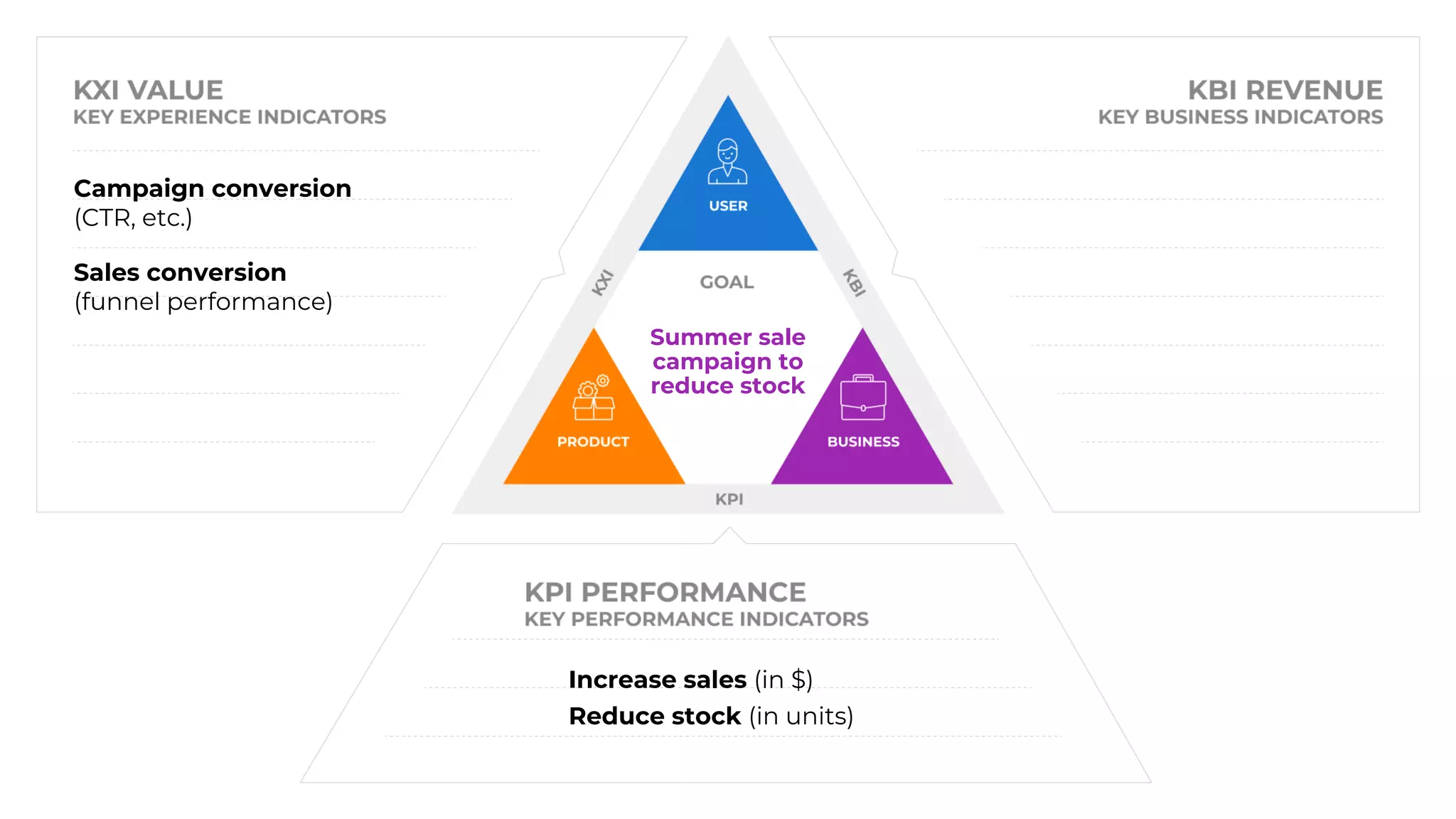
Campaign conversion
(CTR, etc.)
Sales conversion
(funnel performance)
Increase sales (in $)
Reduce stock (in units)
Summer sale
campaign to
reduce stock
Campaign conversion
(CTR, etc.)
Sales conversion
(funnel performance)
Increase sales (in $)
Reduce stock (in units)
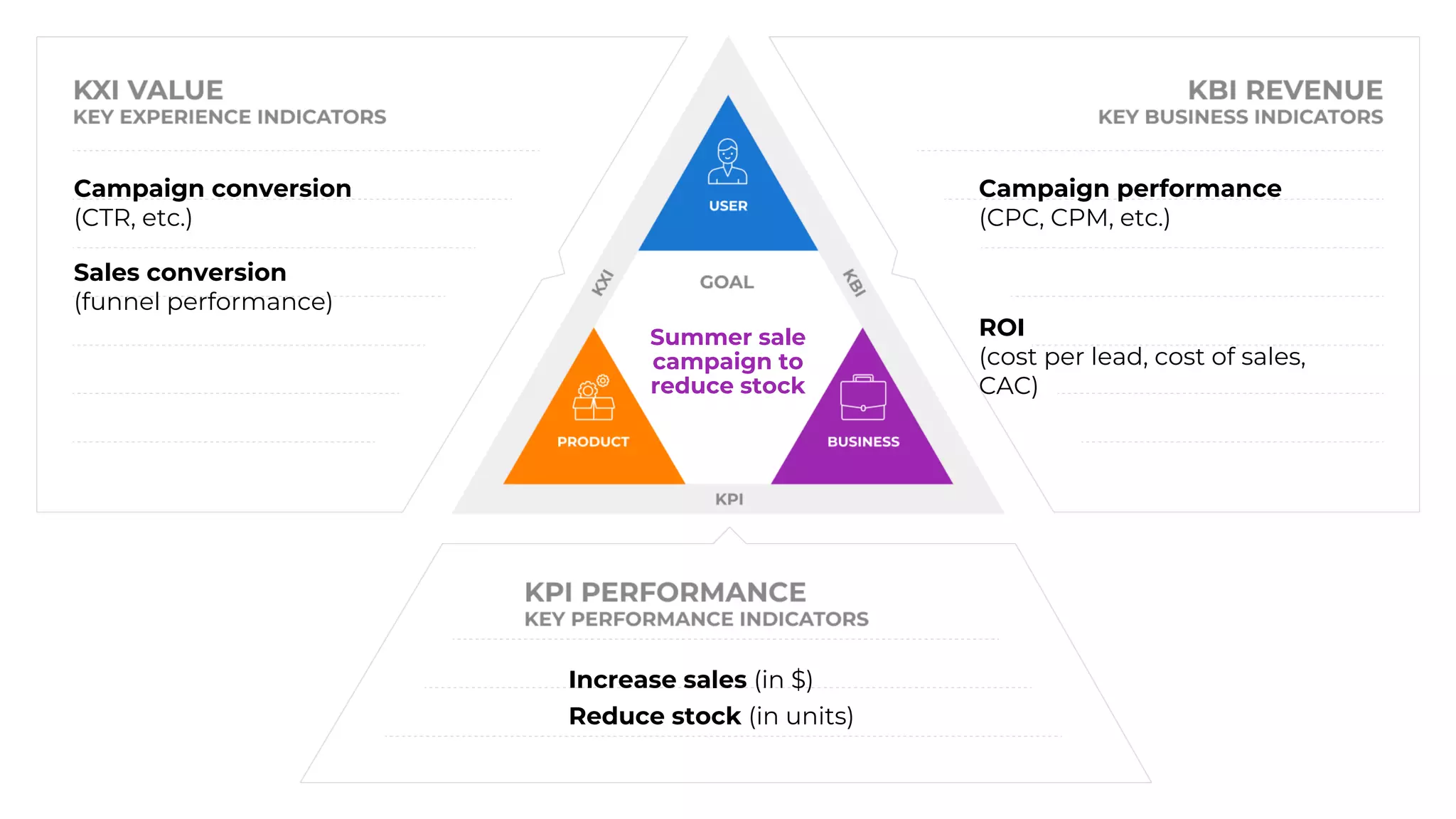
Campaign performance
(CPC, CPM, etc.)
ROI
(cost per lead, cost of sales,
CAC)
Summer sale
campaign to
reduce stock
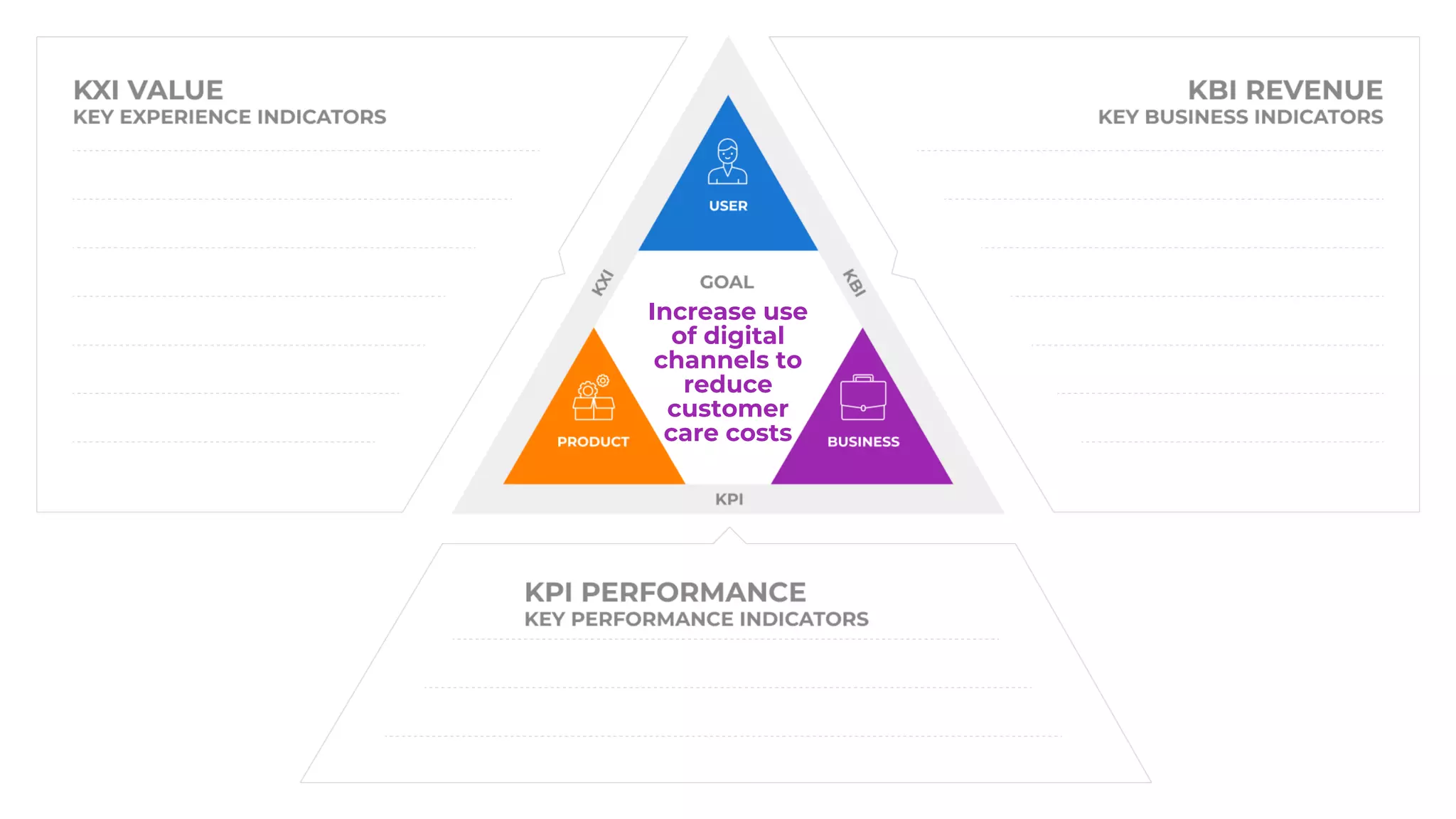
Increase use
of digital
channels to
reduce
customer
care costs
Increase use
of digital
channels to
reduce
customer
care costs
Volume of self-service transactions -digital
channels
(increase over time)
Share % of each channel
(increase over time)
Increase use
of digital
channels to
reduce
customer
care costs
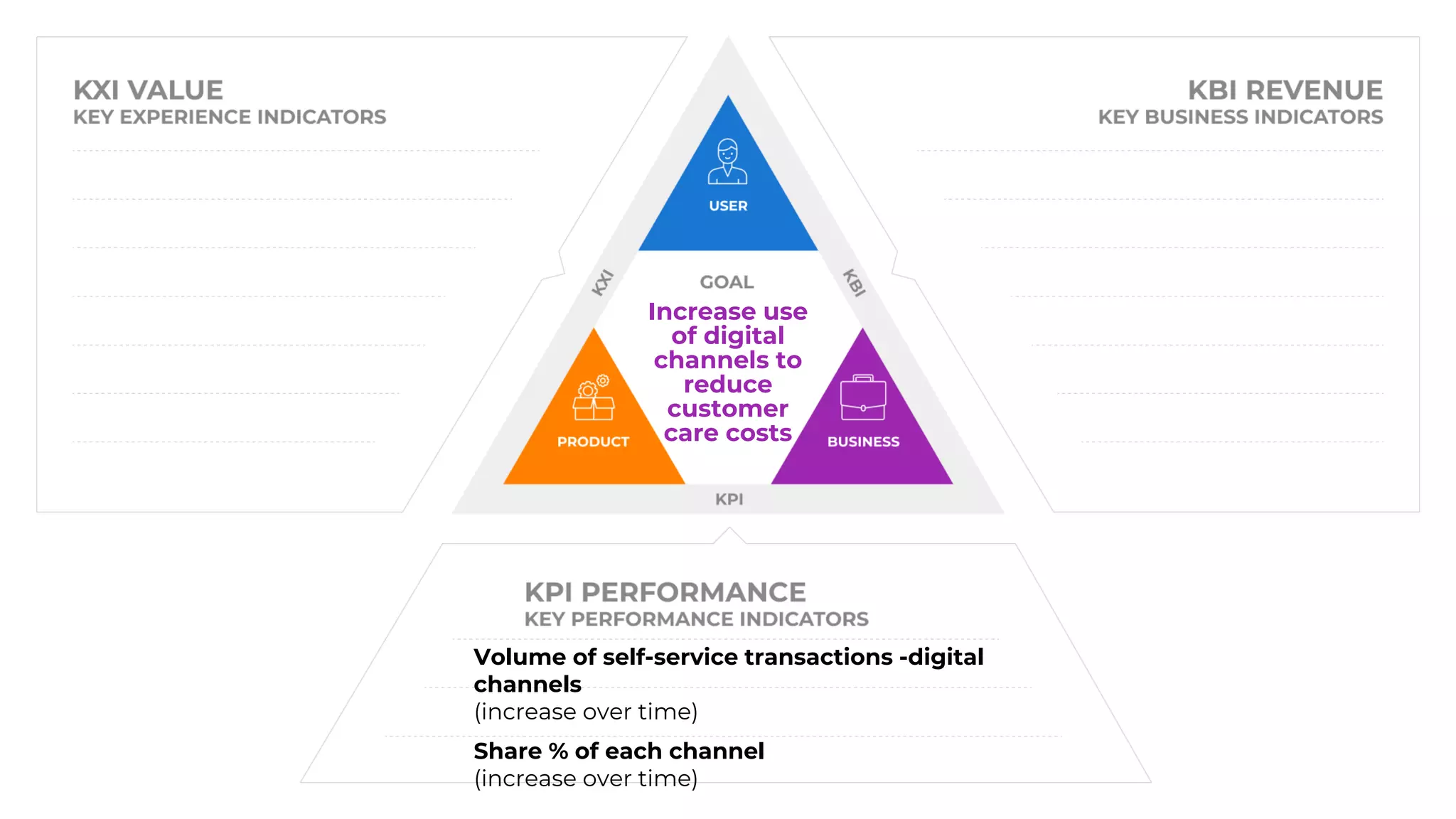
Volume of self-service transactions -digital
channels
(increase over time)
Share % of each channel
(increase over time)
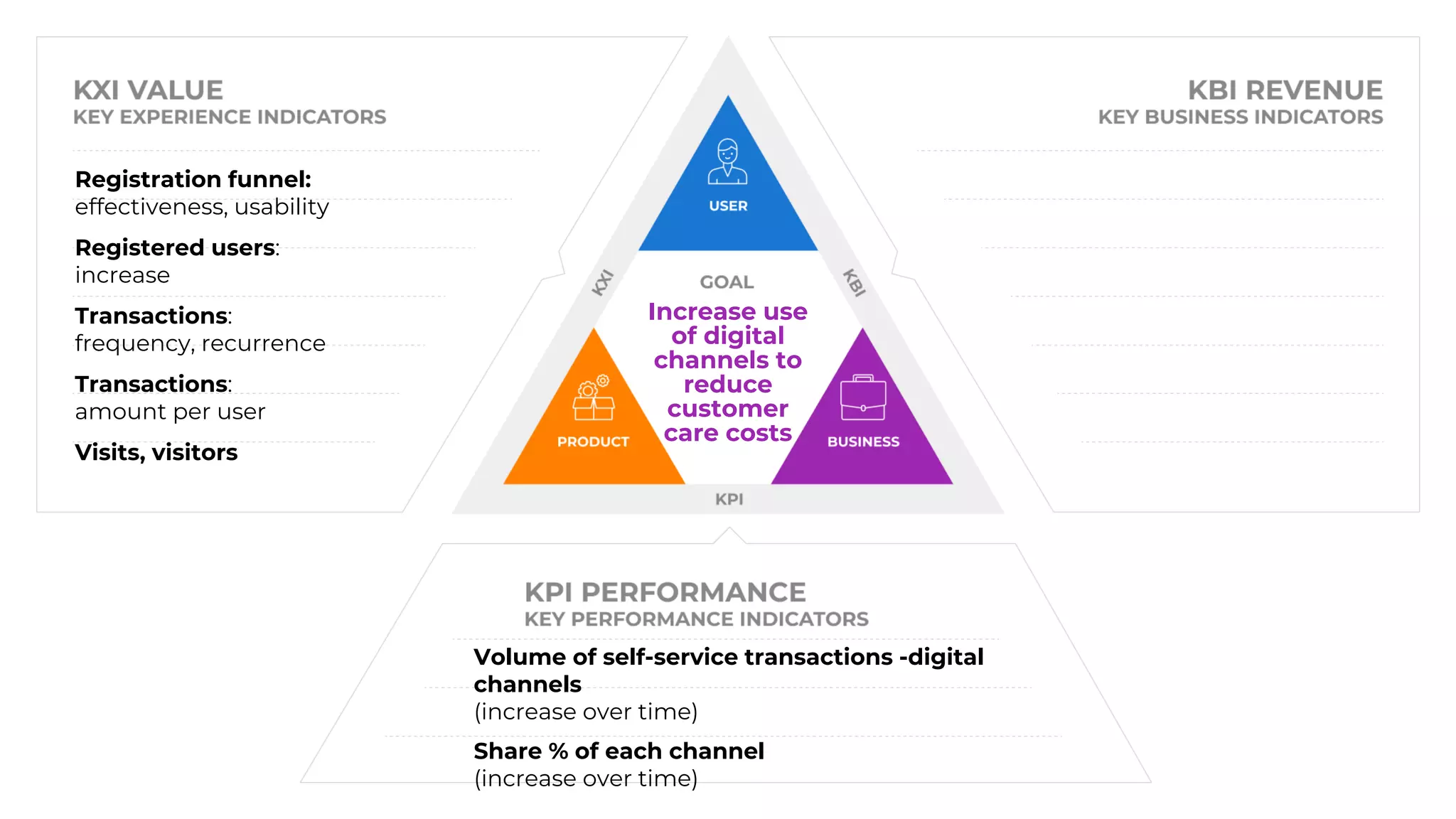
Registration funnel:
effectiveness, usability
Registered users:
increase
Transactions:
frequency, recurrence
Transactions:
amount per user
Visits, visitors
Increase use
of digital
channels to
reduce
customer
care costs
Volume of self-service transactions -digital
channels
(increase over time)
Share % of each channel
(increase over time)
Registration funnel:
effectiveness, usability
Registered users:
increase
Transactions:
frequency, recurrence
Transactions:
amount per user
Visits, visitors
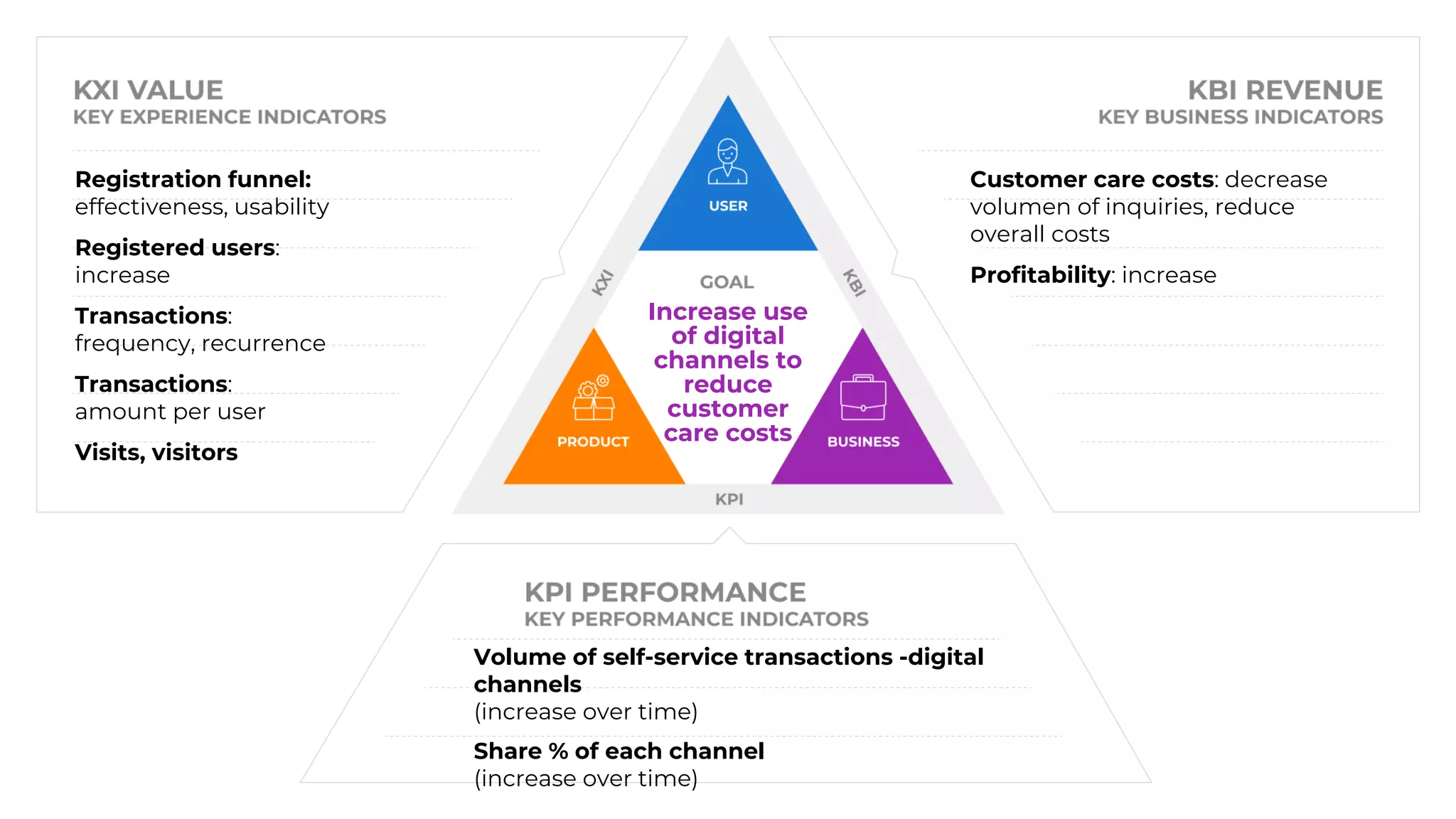
Customer care costs: decrease
volumen of inquiries, reduce
overall costs
Profitability: increase
Summing up… • This framework provides a holistic view. Enables
organizations to visualize the impact of different
initiatives across the whole organization.
• Helps you think in outcomes, not outputs. Results,
not silos.
• Aligns all areas, enables conversations, promotes
a common language and improves collaboration.
• Measuring usability along with business metrics
takes Design out of the pixel management realm
and into conversations of a higher level.
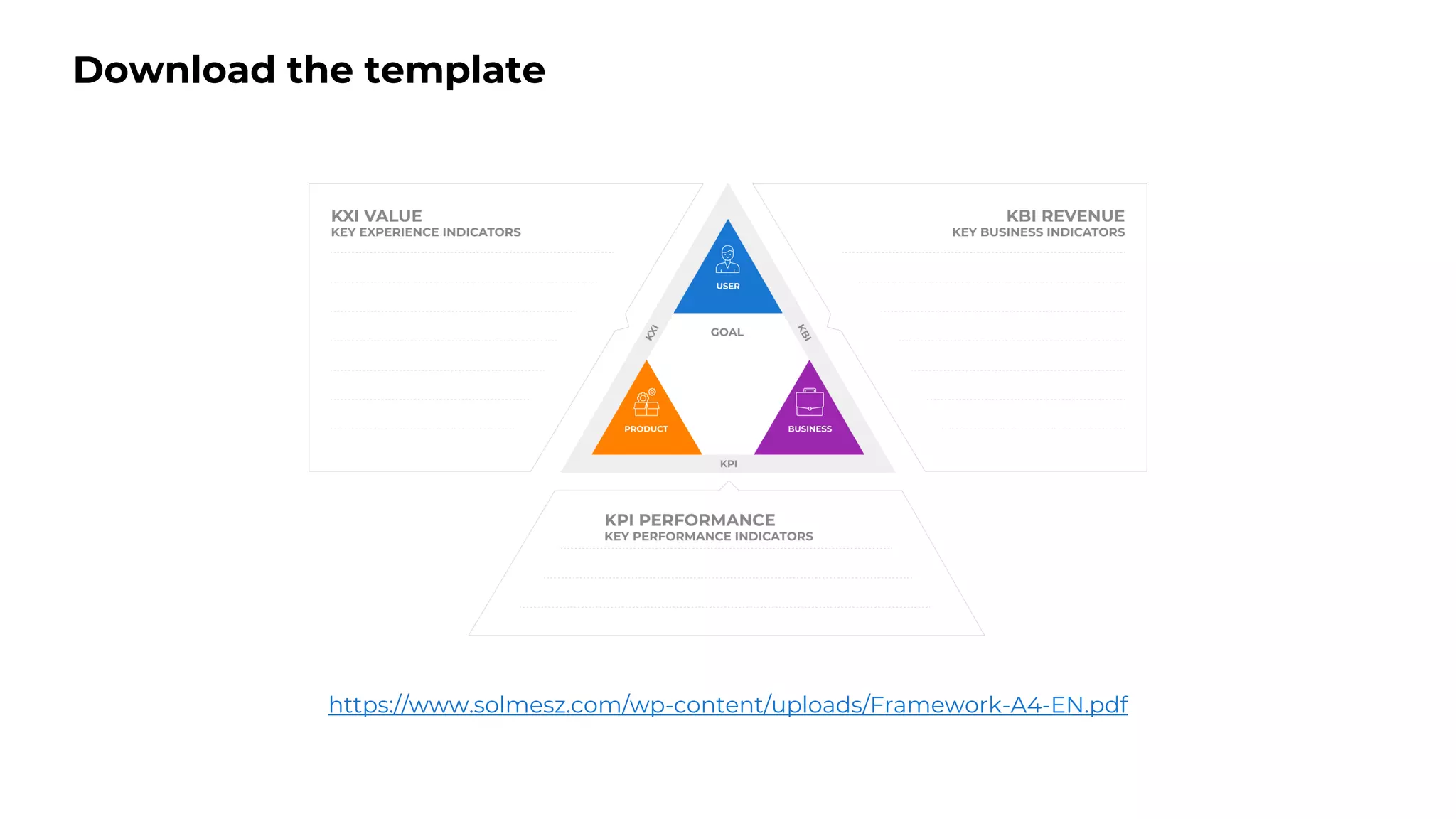
Download the template
https://www.solmesz.com/wp-content/uploads/Framework-A4-EN.pdf
Thank you!
Sol Mesz
Product Strategy Consultant
www.Solmesz.com
sol@solmesz.com
linkedin.com/in/solmesz/
medium.com/@solmesz

Full loop analytics framework (English version)

  • 1.
    Full Loop Analytics Framework Sol Mesz// sol@solmesz.com A new way to measure product performance
  • 2.
    Hello! 2 • I haveover 15 years of experience as a Product Manager, with a focus on strategy, UX and User Research. • I worked with a wide range of companies, from Fortune 10 to startups and NGOs from different industries and business models. • I worked in projects in the US, Australia and Argentina. • I am currently Co-founder and Product Strategy Director at Kambrica • I currently help companies make better product and design decisions. Presenting the Multi-device Customer Journey @ Interaction16, Helsinki.
  • 3.
    What is a framework? Aframework is the underlying structure that organizes a system. This framework organizes product or business metrics in order to deliver a holistic vision of the performance. Before we begin…
  • 4.
  • 5.
  • 6.
  • 7.
  • 8.
  • 9.
  • 10.
  • 11.
    The Full Loop Analytics FrameworkUSER DESIRABLE PRODUCT VIABLE BUSINESS PROFITABLE KPI PERFORMANCE
  • 12.
    The Full Loop Analytics FrameworkUSER DESIRABLE PRODUCT VIABLE BUSINESS PROFITABLE Key Experience Indicators Measure the impact of user satisfaction on product performance.
  • 13.
    The Full Loop Analytics FrameworkUSER DESIRABLE PRODUCT VIABLE BUSINESS PROFITABLE KPI PERFORMANCE Key Performance Indicators Measure the impact of product performance on business results. Key Experience Indicators Measure the impact of user satisfaction on product performance.
  • 14.
    The Full Loop Analytics FrameworkUSER DESIRABLE PRODUCT VIABLE BUSINESS PROFITABLE KPI PERFORMANCE Key Experience Indicators Measure the impact of user satisfaction on product performance. Key Performance Indicators Measure the impact of product performance on business results. Key Business Indicators Measure the impact of customer satisfaction on business results.
  • 15.
  • 16.
    Key Experience Indicators KXI Sales Value Conversion Usability CTR Interest Measurethe impact of user satisfaction on product performance.
  • 17.
    Key Experience Indicators KXI Sales Value Conversion Usability CTR Interest Measurethe impact of user satisfaction on product performance. Metrics • Usability: Effectiveness, efficiency, satisfaction. • Qualitative metrics: experience, value, utility, perception, clarity. • Quantitative metrics: conversion, recurrence, purchase frequency, funnel performance.
  • 18.
    Key Experience Indicators KXI Sales Value Conversion Usability CTR Interest Measurethe impact of user satisfaction on product performance. KXI allow Designers to quantify the impact of user experience on product performance.
  • 19.
    Key Performance Indicators KPI Measurethe impact of product performance on business results. CTR, impressions ROI SEO CAC Churn CLTV
  • 20.
    Key Performance Indicators KPI Measurethe impact of product performance on business results. CTR, impressions ROI SEO CAC Churn CLTV Metrics • Quantitative metrics: sales, recurrence, churn, average units per cart, average cart value. • Financial metrics: customer lifetime value (CLTV), customer acquisition cost (CAC), cost per lead, ROI, profitability.
  • 21.
    Key Performance Indicators KPI Measurethe impact of product performance on business results. CTR, impressions ROI SEO CAC Churn CLTV KPIs allow Product Owners to show how much value they are contributing to the organization.
  • 22.
    Key Business Indicators KBI Measurethe impact of customer satisfaction on business results. Satisfaction Cost of customer support Value Usability Retention NPS
  • 23.
    Key Business Indicators KBI Measurethe impact of customer satisfaction on business results. Satisfaction Cost of customer support Value Usability Retention NPS Metrics • Quaitative: voice of customer, brand sentiment, brand value, NPS. • Financial: profitability, CLTV, cost of customer support, customer acquisition cost, loyalty, retention, brand equity.
  • 24.
    Key Business Indicators KBI Measurethe impact of customer satisfaction on business results. Satisfaction Cost of customer support Value Usability Retention NPS KXI quantify one of the most invisible costs: the cost of business decisions on user experience. The KBI axis measures the relationship between the user and the Brand. KBIs quantify the cost to the business of of marketing, pricing, communication and customer care decisions.
  • 25.
    Vertical, fragmented measurement REVENUE Profitability Customercare costs CLTV Loyalty NPS OUTPUT BUSINESS PERFORMANCE Use Sales Average ticket Churn Frequency OUTPUT PRODUCT VALUE Perception Usefulness Experience Satisfaction Value OUTPUT USER How companies use metrics today
  • 26.
    Holistic measurement How theFull Loop Analytics framework uses metrics OUTCOME
  • 27.
    Notes • Itdoesn’t matter where you place metrics (business, product, user). What’s important is that you put them somewhere. • Not all metrics are in analytics: social networks, call center, internal systems, CRM, financial indicators. • Include a mix of qualitative and quantitative metrics: you can’t properly interpret one without the other and you can arrive at the wrong conclusions. • This is not a prescriptive model. Each industry and each organization has their own metrics.
  • 28.
    How to usethe Framework
  • 29.
    How to usethe framework Step 1 DEFINE GOALS What do we want to achieve? What results are we expecting from this initiative? What questions do we want answered?
  • 30.
    How to usethe framework Step 1 DEFINE GOALS What do we want to achieve? What results are we expecting from this initiative? What questions do we want answered? 2 types of goals: • Operational: these are short term initiatives such as reduce stock, improve conversions. • Strategic: these are long term goals, such as improving the share of digital channels, or lower customer care costs.
  • 31.
    How to usethe framework Step 1 DEFINE METRICS How are we going to measure? Define KXIs, KPIs, KBIs DEFINE GOALS What do we want to achieve? What results are we expecting from this initiative? What questions do we want answered?
  • 32.
    How to usethe framework
  • 33.
  • 34.
    Increase sales (in$) Reduce stock (in units) Summer sale campaign to reduce stock
  • 35.
    Campaign conversion (CTR, etc.) Salesconversion (funnel performance) Increase sales (in $) Reduce stock (in units) Summer sale campaign to reduce stock
  • 36.
    Campaign conversion (CTR, etc.) Salesconversion (funnel performance) Increase sales (in $) Reduce stock (in units) Campaign performance (CPC, CPM, etc.) ROI (cost per lead, cost of sales, CAC) Summer sale campaign to reduce stock
  • 37.
    Increase use of digital channelsto reduce customer care costs
  • 38.
    Increase use of digital channelsto reduce customer care costs Volume of self-service transactions -digital channels (increase over time) Share % of each channel (increase over time)
  • 39.
    Increase use of digital channelsto reduce customer care costs Volume of self-service transactions -digital channels (increase over time) Share % of each channel (increase over time) Registration funnel: effectiveness, usability Registered users: increase Transactions: frequency, recurrence Transactions: amount per user Visits, visitors
  • 40.
    Increase use of digital channelsto reduce customer care costs Volume of self-service transactions -digital channels (increase over time) Share % of each channel (increase over time) Registration funnel: effectiveness, usability Registered users: increase Transactions: frequency, recurrence Transactions: amount per user Visits, visitors Customer care costs: decrease volumen of inquiries, reduce overall costs Profitability: increase
  • 41.
    Summing up… •This framework provides a holistic view. Enables organizations to visualize the impact of different initiatives across the whole organization. • Helps you think in outcomes, not outputs. Results, not silos. • Aligns all areas, enables conversations, promotes a common language and improves collaboration. • Measuring usability along with business metrics takes Design out of the pixel management realm and into conversations of a higher level.
  • 42.
  • 43.
    Thank you! Sol Mesz ProductStrategy Consultant www.Solmesz.com sol@solmesz.com linkedin.com/in/solmesz/ medium.com/@solmesz