FUEL
CELLS
Alternative energy source
Contents
1. Introduction
2. What is a fuel cell?
3. How Fuel Cells Work?
4. Parts of a Fuel Cell
5. Design, Principle & Operation of
Fuel Cell
6. Classification Of Fuel Cells
7. Types of Fuel Cells
8. Phosphoric Acid Fuel cell
9. Alkaline Fuel Cells (AFC)
10.Bibliography
Introduction
• Fuel cells differ from conventional cells in the
respect that active material (fuel & oxygen) are
not contained within the cell but are supplied
from outside.
• It is much like a battery that can be recharged
while you are drawing power from it.
• It provides a DC voltage that can be used to
power motors, lights and any number of
electrical appliances.
What is a fuel cell?
• A fuel cell is an electrochemical energy
conversion device.A fuel cell converts the
chemicals hydrogen and oxygen into water, and
in the process it produces electricity.
• A fuel cell is a device that generates electricity
by a chemical reaction. Every fuel cell has two
electrodes, one positive and one negative,
called cathode and anode respectively. The
reactions that produce electricity take place at
the electrodes.
How Fuel Cells
Work?
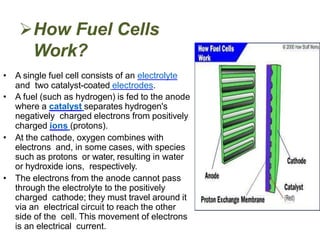
• A single fuel cell consists of an electrolyte
and two catalyst-coated electrodes.
• A fuel (such as hydrogen) is fed to the anode
where a catalyst separates hydrogen's
negatively charged electrons from positively
charged ions (protons).
• At the cathode, oxygen combines with
electrons and, in some cases, with species
such as protons or water, resulting in water
or hydroxide ions, respectively.
• The electrons from the anode cannot pass
through the electrolyte to the positively
charged cathode; they must travel around it
via an electrical circuit to reach the other
side of the cell. This movement of electrons
is an electrical current.
Parts of a Fuel Cell
• Anode
– Negative post of the fuel cell.
– Conducts the electrons that are freed from the hydrogen
molecules so that they can be used in an external circuit.
– Etched channels disperse hydrogen gas over the surface of
catalyst
• Cathode
– Positive post of the fuel cell
– Etched channels distribute oxygen to the surface of the catalyst.
– Conducts electrons back from the external circuit to the catalyst
– Recombine with the hydrogen ions and oxygen to form water
Parts of a Fuel Cell (Contd)
• Electrolyte
– Proton exchange membrane.
– Specially treated material, only conducts positively charged
ions.
– Membrane blocks electrons.
• Catalyst
– Special material that facilitates reaction of oxygen and
hydrogen
– Usually platinum powder very thinly coated onto carbon
paper or
cloth.
– Rough & porous maximizes surface area exposed to
hydrogen or oxygen
– The platinum-coated side of the catalyst faces the PEM.
Design, Principle & Operation
of Fuel Cell:
• Chemistry of fuel
cell At anode:-
2H2 = 4H + 4e
At Cathode:-
O2 + 4H + 4e = 2H2O
• NET REACTION
2H2 + O2 = 2H2O
• Principle:
The fuel is oxidized on the anode and
oxidant reduced on the cathode. One
species of ions are transported from
one electrode to the other through
the electrolyte to combine there with
their counterparts, while electrons
travel through the external circuit
producing the electrical current.
Classification Of Fuel Cells:
• Based on the temperature range in which they
operate: low temperature(25-100 C), medium
temperature (100-500) , high temperature(500-1000) &
very high temperature(above 1000)
• According to the type of electrolyte : aqueous, non aqueous,
molten or solid.
• According to the physical state of the fuel:
Gas(hydrogen, lower hydrocarbons ), Liquid(alcohols,
hydrazine, higher hydrocarbons), Solid(Metals)
• Primary fuel cell: Reactants are passed through the cell only
once & the products of the reaction being discarded. (H 2 – O 2
fuel cell )
• Secondary fuel cell: Reactants are passed through the cell
many times because they are regenerated by different
methods.( Nitric oxide – chlorine fuel cell)
Types of Fuel
Cells
Fuel cells are classified primarily by the kind of
electrolyte they employ.
• Phosphoric-acid fuel cell (PAFC)
• Alkaline fuel cell (AFC)
• Solid oxide fuel cell (SOFC)
• Molten carbonate fuel cell (MCFC)
• Polymer electrolyte membrane fuel cells (PEM)
• Direct methanol fuel cells (DMFC)
• Regenerative fuel cells
Phosphoric Acid
Fuel cell
• PAFCs were the first fuel cells
to be commercialized.
• It is considered the "first
generation" of modern fuel cells.
• This type of fuel cell is typically
used for stationary power
generation.
• Some PAFCs have been used to
power large vehicles such as city
buses.
Construction
• PAFCs use liquid phosphoric acid
as the electrolyte.
• The acid is contained in a Teflon-
bonded silicon carbide matrix.
• It consists of porous carbon
electrodes containing a platinum
catalyst.
Functioning
• The charge carrier in this type of fuel cell is the hydrogen ion (H+,
proton).
• The hydrogen introduced at the anode is split into its protons and
electrons.
• Positively charged hydrogen ions migrate through the electrolyte
from the anode to the cathode.
• Hydrogen is able to permeate the phosphoric acid while electrons are
not.
• Electrons generated at the anode travel through an external
circuit, providing electric power along the way, and return to
the cathode.
• There the electrons, hydrogen ions and oxygen form water, which
is expelled from the cell. A platinum catalyst at the electrodes
speeds the reactions.
Reactions of PAFCs
• Anode
Reaction: 2 H2
=> 4 H+ + 4 e-
• Cathode Reaction:
O2(g) + 4 H+ + 4 e- => 2H2O
• Overall Cell
Reaction: 2 H2 +
O2 => 2 H2O
• The formation of carbon monoxide (CO) around electrodes can
"poison" a fuel cell, because carbon monoxide binds to the
platinum catalyst at the anode, decreasing the fuel cell's efficiency.
• Hydrogen for the fuel cell is extracted from a hydrocarbon fuel
in an external reformer.
• If the hydrocarbon fuel is gasoline, sulfur must be removed or it will
damage the electrode catalyst.
Advantages
• One advantage of PAFC cells is that at 200 degrees C they
tolerate a CO concentration of about 1.5 percent.
• Another advantage is that concentrated phosphoric acid electrolyte can
operate above the boiling point of water, a limitation on other acid
electrolytes that require water for conductivity. The acid requires,
however, that other components in the cell resist corrosion.
• They run on already available fuels. This is the reason that phosphoric
acid fuel
cells were the first fuel cells to become commercially viable.
• PAFCs of up to 200 kw capacity are in commercial operation, and units of
11 MW capacity have been tested.
• PAFCs are moderately high temperature fuel cells, running at roughly 250-
300° C.
• Efficiencies of PAFCs average 40 to 50 percent, but this can rise to
about 80 percent if the waste heat is reused in a cogeneration
system.
Drawbacks of PAFCs
• PAFCs require an expensive platinum catalyst,
which raises the cost of the fuel cell.
• PAFCs still rely upon hydrocarbon fuels. This
means greenhouse gas emissions are
produced and the potential for catalyst
poisoning is of concern.
• PAFCs are also less powerful than other fuel
cells, given the same weight and volume. As a
result, these fuel cells are typically large and
heavy.
Alkaline Fuel Cells
(AFC)
• AFCs are also known as
Bacon fuel cells after their
British inventor Francis
Thomas Bacon.
• Along with phosphoric acid
fuel cells, they were one of
the earliest FCs developed
and have been used by
NASA.
• They consume hydrogen
and pure oxygen, to
produce water, heat, and
Light metal
hardware
Alkaline Membrane FC
Materials and Components
Simplified
thermal
management
Non-acidic
membrane
Non-
platinum
catalysts
AFC Subtypes
Name Fuel Operating
Characteristic
s
Metal Hydride Fuel
Cells (MHFC)
Oxygen < 40 C
Direct Borohydride
Fuel Cells (DBFC)
Sodium Borohydride 70 C
Zinc-Air Fuel Cells
(ZAFC)
Zinc < 40 C with most
producing 20 kW
Construction
• The basic construction involves two electrodes
that are separated by a porous matrix that is
saturated with an aqueous alkaline solution.
• This construction is very similar to that of batteries, as
are the metals and chemicals used.
• Alkaline fuel cells use an electrolyte that is an aqueous
(water- based) solution of potassium hydroxide (KOH).
• The concentration of KOH can be varied with the fuel
cell operating temperature, which ranges from 150˚Cto
220˚C.
• AFC’srely on both hydrogen and pure oxygen to operate.
Functioning of AFCs
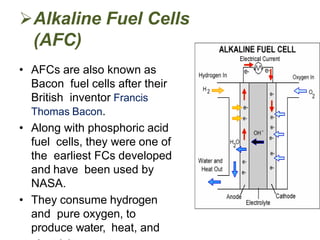
• The charge carrier for an AFC is the hydroxyl ion (OH-).
• On the cathode side of the fuel cell, oxygen enters and
combines
with water to produce Hydroxyl ions.
• These ions are capable of permeating the electrolyte layer
and of traveling to the anode.
• At the anode, hydrogen gas reacts with the OH- ions to
produce
water and release electrons.
• Water formed at the anode migrates back to the cathode
• Electrons generated at the anode supply electrical power
to an external circuit then return to the cathode.
• There the electrons react with oxygen and water to produce
more
hydroxyl ions that diffuse into the electrolyte.
Reaction of AFCs
• This set of reactions in the fuel cell produces electricity and
by-
product heat.
• Anode Reaction:
2 H2 + 4 OH- => 4 H2O + 4 e-
• Cathode Reaction:
O2 + 2 H2O + 4 e- => 4 OH-
• Overall Net
Reaction: 2 H2 +
O2 => 2H2O
• AFCs are very sensitive to CO2 that may be present in
the fuel or air.
• Operating temperatures inside alkali cells are around 150
to 200 degrees C (about 300 to 400 degrees F).
Advantages
• AFCs are the cheapest fuel cells to manufacture.
• The catalyst that is required on the electrodes can be any of a
number of different materials that are relatively inexpensive
compared to the catalysts required for other types of fuel cells.
• Alkali fuel cells operate at efficiencies up to 70 percent and, like
other fuel cells, create little pollution.
• AFCs have efficiencies of near 60% in most applications, making
them one of the few normal temperature (100 C to 250 C) fuel cells
to achieve high efficiency without precious metal catalysts (e.g.
cobalt,nickel).
• Because they produce potable water in addition to electricity, they
have been a logical choice for spacecraft.
Drawbacks of AFCs
• Its exquisite sensitivity to carbon dioxide. Even trace
amounts of CO2 that may be present in the fuel or air can
affect the cell’s operation substantially by converting the
potassium hydroxide electrolyte into potassium carbonate.
• Potassium carbonate is a solid that blocks pores in the
cathode. This reduces the ionic conductivity of fuel cell and
diminishes the speed with which the reaction can proceed.
• AFCs are limited to closed environments, such as space and
undersea vehicles, and must be run on pure hydrogen and
oxygen.
THANK
YOU…!!!

Fuel Cells.pptx

  • 1.
  • 2.
    Contents 1. Introduction 2. Whatis a fuel cell? 3. How Fuel Cells Work? 4. Parts of a Fuel Cell 5. Design, Principle & Operation of Fuel Cell 6. Classification Of Fuel Cells 7. Types of Fuel Cells 8. Phosphoric Acid Fuel cell 9. Alkaline Fuel Cells (AFC) 10.Bibliography
  • 3.
    Introduction • Fuel cellsdiffer from conventional cells in the respect that active material (fuel & oxygen) are not contained within the cell but are supplied from outside. • It is much like a battery that can be recharged while you are drawing power from it. • It provides a DC voltage that can be used to power motors, lights and any number of electrical appliances.
  • 4.
    What is afuel cell? • A fuel cell is an electrochemical energy conversion device.A fuel cell converts the chemicals hydrogen and oxygen into water, and in the process it produces electricity. • A fuel cell is a device that generates electricity by a chemical reaction. Every fuel cell has two electrodes, one positive and one negative, called cathode and anode respectively. The reactions that produce electricity take place at the electrodes.
  • 5.
    How Fuel Cells Work? •A single fuel cell consists of an electrolyte and two catalyst-coated electrodes. • A fuel (such as hydrogen) is fed to the anode where a catalyst separates hydrogen's negatively charged electrons from positively charged ions (protons). • At the cathode, oxygen combines with electrons and, in some cases, with species such as protons or water, resulting in water or hydroxide ions, respectively. • The electrons from the anode cannot pass through the electrolyte to the positively charged cathode; they must travel around it via an electrical circuit to reach the other side of the cell. This movement of electrons is an electrical current.
  • 6.
    Parts of aFuel Cell • Anode – Negative post of the fuel cell. – Conducts the electrons that are freed from the hydrogen molecules so that they can be used in an external circuit. – Etched channels disperse hydrogen gas over the surface of catalyst • Cathode – Positive post of the fuel cell – Etched channels distribute oxygen to the surface of the catalyst. – Conducts electrons back from the external circuit to the catalyst – Recombine with the hydrogen ions and oxygen to form water
  • 7.
    Parts of aFuel Cell (Contd) • Electrolyte – Proton exchange membrane. – Specially treated material, only conducts positively charged ions. – Membrane blocks electrons. • Catalyst – Special material that facilitates reaction of oxygen and hydrogen – Usually platinum powder very thinly coated onto carbon paper or cloth. – Rough & porous maximizes surface area exposed to hydrogen or oxygen – The platinum-coated side of the catalyst faces the PEM.
  • 8.
    Design, Principle &Operation of Fuel Cell: • Chemistry of fuel cell At anode:- 2H2 = 4H + 4e At Cathode:- O2 + 4H + 4e = 2H2O • NET REACTION 2H2 + O2 = 2H2O • Principle: The fuel is oxidized on the anode and oxidant reduced on the cathode. One species of ions are transported from one electrode to the other through the electrolyte to combine there with their counterparts, while electrons travel through the external circuit producing the electrical current.
  • 10.
    Classification Of FuelCells: • Based on the temperature range in which they operate: low temperature(25-100 C), medium temperature (100-500) , high temperature(500-1000) & very high temperature(above 1000) • According to the type of electrolyte : aqueous, non aqueous, molten or solid. • According to the physical state of the fuel: Gas(hydrogen, lower hydrocarbons ), Liquid(alcohols, hydrazine, higher hydrocarbons), Solid(Metals) • Primary fuel cell: Reactants are passed through the cell only once & the products of the reaction being discarded. (H 2 – O 2 fuel cell ) • Secondary fuel cell: Reactants are passed through the cell many times because they are regenerated by different methods.( Nitric oxide – chlorine fuel cell)
  • 11.
    Types of Fuel Cells Fuelcells are classified primarily by the kind of electrolyte they employ. • Phosphoric-acid fuel cell (PAFC) • Alkaline fuel cell (AFC) • Solid oxide fuel cell (SOFC) • Molten carbonate fuel cell (MCFC) • Polymer electrolyte membrane fuel cells (PEM) • Direct methanol fuel cells (DMFC) • Regenerative fuel cells
  • 12.
    Phosphoric Acid Fuel cell •PAFCs were the first fuel cells to be commercialized. • It is considered the "first generation" of modern fuel cells. • This type of fuel cell is typically used for stationary power generation. • Some PAFCs have been used to power large vehicles such as city buses.
  • 13.
    Construction • PAFCs useliquid phosphoric acid as the electrolyte. • The acid is contained in a Teflon- bonded silicon carbide matrix. • It consists of porous carbon electrodes containing a platinum catalyst.
  • 14.
    Functioning • The chargecarrier in this type of fuel cell is the hydrogen ion (H+, proton). • The hydrogen introduced at the anode is split into its protons and electrons. • Positively charged hydrogen ions migrate through the electrolyte from the anode to the cathode. • Hydrogen is able to permeate the phosphoric acid while electrons are not. • Electrons generated at the anode travel through an external circuit, providing electric power along the way, and return to the cathode. • There the electrons, hydrogen ions and oxygen form water, which is expelled from the cell. A platinum catalyst at the electrodes speeds the reactions.
  • 15.
    Reactions of PAFCs •Anode Reaction: 2 H2 => 4 H+ + 4 e- • Cathode Reaction: O2(g) + 4 H+ + 4 e- => 2H2O • Overall Cell Reaction: 2 H2 + O2 => 2 H2O • The formation of carbon monoxide (CO) around electrodes can "poison" a fuel cell, because carbon monoxide binds to the platinum catalyst at the anode, decreasing the fuel cell's efficiency. • Hydrogen for the fuel cell is extracted from a hydrocarbon fuel in an external reformer. • If the hydrocarbon fuel is gasoline, sulfur must be removed or it will damage the electrode catalyst.
  • 16.
    Advantages • One advantageof PAFC cells is that at 200 degrees C they tolerate a CO concentration of about 1.5 percent. • Another advantage is that concentrated phosphoric acid electrolyte can operate above the boiling point of water, a limitation on other acid electrolytes that require water for conductivity. The acid requires, however, that other components in the cell resist corrosion. • They run on already available fuels. This is the reason that phosphoric acid fuel cells were the first fuel cells to become commercially viable. • PAFCs of up to 200 kw capacity are in commercial operation, and units of 11 MW capacity have been tested. • PAFCs are moderately high temperature fuel cells, running at roughly 250- 300° C. • Efficiencies of PAFCs average 40 to 50 percent, but this can rise to about 80 percent if the waste heat is reused in a cogeneration system.
  • 17.
    Drawbacks of PAFCs •PAFCs require an expensive platinum catalyst, which raises the cost of the fuel cell. • PAFCs still rely upon hydrocarbon fuels. This means greenhouse gas emissions are produced and the potential for catalyst poisoning is of concern. • PAFCs are also less powerful than other fuel cells, given the same weight and volume. As a result, these fuel cells are typically large and heavy.
  • 18.
    Alkaline Fuel Cells (AFC) •AFCs are also known as Bacon fuel cells after their British inventor Francis Thomas Bacon. • Along with phosphoric acid fuel cells, they were one of the earliest FCs developed and have been used by NASA. • They consume hydrogen and pure oxygen, to produce water, heat, and
  • 19.
    Light metal hardware Alkaline MembraneFC Materials and Components Simplified thermal management Non-acidic membrane Non- platinum catalysts
  • 20.
    AFC Subtypes Name FuelOperating Characteristic s Metal Hydride Fuel Cells (MHFC) Oxygen < 40 C Direct Borohydride Fuel Cells (DBFC) Sodium Borohydride 70 C Zinc-Air Fuel Cells (ZAFC) Zinc < 40 C with most producing 20 kW
  • 21.
    Construction • The basicconstruction involves two electrodes that are separated by a porous matrix that is saturated with an aqueous alkaline solution. • This construction is very similar to that of batteries, as are the metals and chemicals used. • Alkaline fuel cells use an electrolyte that is an aqueous (water- based) solution of potassium hydroxide (KOH). • The concentration of KOH can be varied with the fuel cell operating temperature, which ranges from 150˚Cto 220˚C. • AFC’srely on both hydrogen and pure oxygen to operate.
  • 22.
    Functioning of AFCs •The charge carrier for an AFC is the hydroxyl ion (OH-). • On the cathode side of the fuel cell, oxygen enters and combines with water to produce Hydroxyl ions. • These ions are capable of permeating the electrolyte layer and of traveling to the anode. • At the anode, hydrogen gas reacts with the OH- ions to produce water and release electrons. • Water formed at the anode migrates back to the cathode • Electrons generated at the anode supply electrical power to an external circuit then return to the cathode. • There the electrons react with oxygen and water to produce more hydroxyl ions that diffuse into the electrolyte.
  • 23.
    Reaction of AFCs •This set of reactions in the fuel cell produces electricity and by- product heat. • Anode Reaction: 2 H2 + 4 OH- => 4 H2O + 4 e- • Cathode Reaction: O2 + 2 H2O + 4 e- => 4 OH- • Overall Net Reaction: 2 H2 + O2 => 2H2O • AFCs are very sensitive to CO2 that may be present in the fuel or air. • Operating temperatures inside alkali cells are around 150 to 200 degrees C (about 300 to 400 degrees F).
  • 24.
    Advantages • AFCs arethe cheapest fuel cells to manufacture. • The catalyst that is required on the electrodes can be any of a number of different materials that are relatively inexpensive compared to the catalysts required for other types of fuel cells. • Alkali fuel cells operate at efficiencies up to 70 percent and, like other fuel cells, create little pollution. • AFCs have efficiencies of near 60% in most applications, making them one of the few normal temperature (100 C to 250 C) fuel cells to achieve high efficiency without precious metal catalysts (e.g. cobalt,nickel). • Because they produce potable water in addition to electricity, they have been a logical choice for spacecraft.
  • 25.
    Drawbacks of AFCs •Its exquisite sensitivity to carbon dioxide. Even trace amounts of CO2 that may be present in the fuel or air can affect the cell’s operation substantially by converting the potassium hydroxide electrolyte into potassium carbonate. • Potassium carbonate is a solid that blocks pores in the cathode. This reduces the ionic conductivity of fuel cell and diminishes the speed with which the reaction can proceed. • AFCs are limited to closed environments, such as space and undersea vehicles, and must be run on pure hydrogen and oxygen.
  • 26.