Safeguard Rule-Resources, Risks,
Compliance, and Consequences
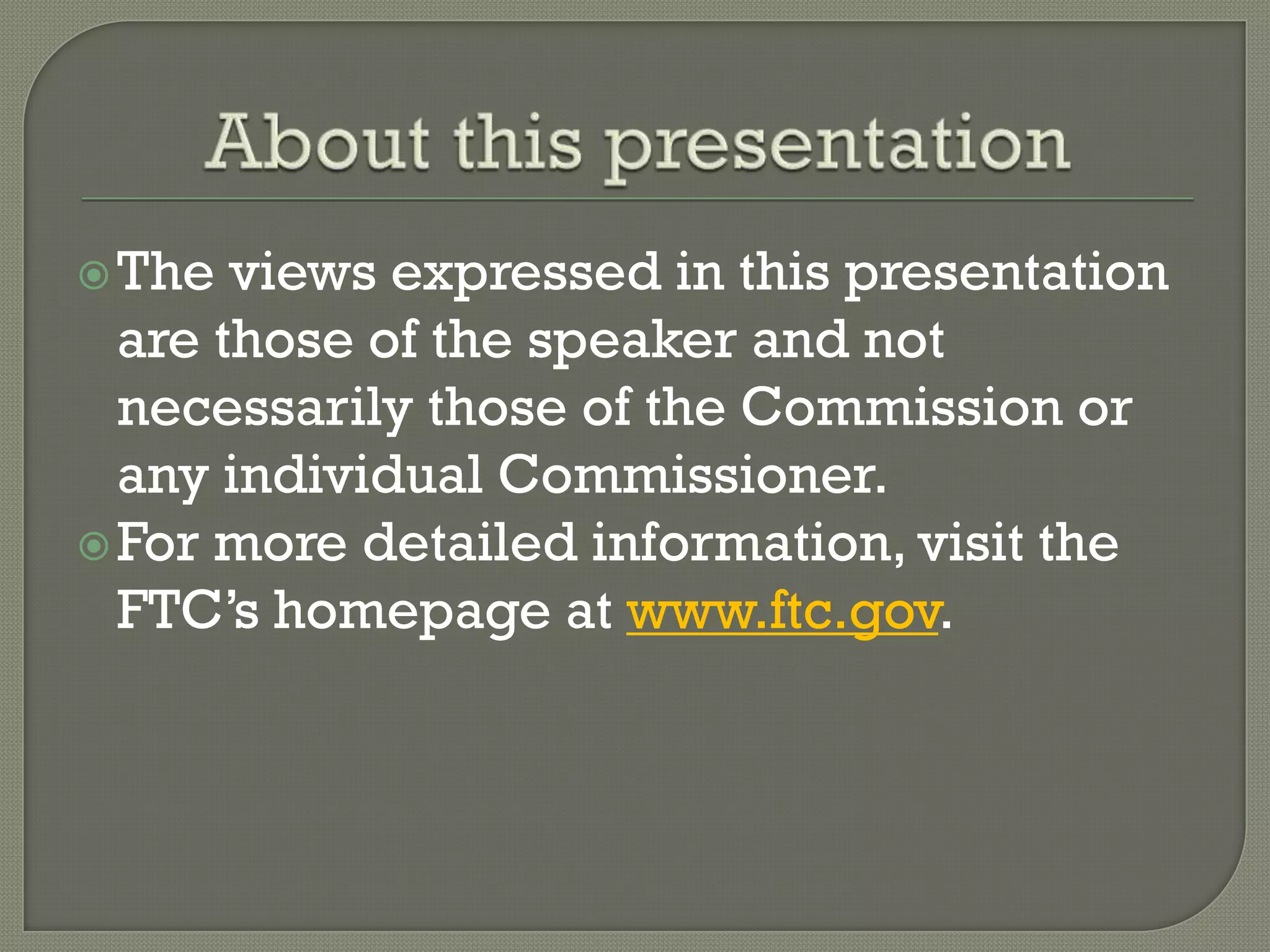
 The  views expressed in this presentation
  are those of the speaker and not
  necessarily those of the Commission or
  any individual Commissioner.
 For more detailed information, visit the
  FTC’s homepage at www.ftc.gov.
 Implements   the security provisions of the
  Gramm-Leach-Bliley Act of 1999.
 Took effect May 23, 2003, with an extra
  year to conform third-party service
  provider contracts entered into prior to
  June 24, 2002.
 Has flexible standard, but imposes
  certain basic requirements. See 67 Fed.
  Reg. 36484.
 Each financial institution must develop,
  implement and maintain a comprehensive
  information security program that is written in
  readily accessible part(s);
 The program must contain administrative,
  technical and physical safeguards that are
  appropriate to:
   the size and complexity of the financial institution;
   the nature and scope of its activities; and
   the sensitivity its customer information.
 Designate   one or more employees to
  coordinate its program;
 Assess risks to the security of customer
  information;
 Design and implement safeguards to address
  risks, and test and monitor their effectiveness
  over time;
 Oversee service providers; and
 Adjust the program to address developments.

      * Fines of up to $3500 for failure to draft an IT Security Plan.
         This is on top of any fines for the violations themselves
To assess risks and design safeguards, a
     financial institution must consider all
     relevant areas of its operation, including:
1.    Employee training and management;
2.    Information systems, including network and
      software design, as well as information
      processing, storage, transmission and
      disposal;
3.    Detecting, preventing and responding to
      attacks, intrusions, or other systems failures.
 Take reasonable steps to select and retain
  service providers that are capable of
  maintaining appropriate safeguards for the
  customer information at issue; and
 Require service providers by contract to
  implement and maintain such safeguards.

  *Service providers are companies that handle or have
   access to customer information in the course of
   providing services directly to a financial institution.
 Applies  to financial institutions under the
  FTC’s jurisdiction;
 Includes financial institutions that receive
  customer information from another
  financial institution.
 This includes anyone who helps to
  arrange credit (including RV Dealers,
  The Finance Department, and the
  persons filling out/handling Credit Apps)
 Any  institution the business of which is
  engaging in financial activities as
  described in section 4(k) of the Bank
  Holding Company Act of 1956. An
  institution that is significantly engaged in
  financial activities is a financial
  institution.
 This last piece is what includes us
 Lending, exchanging, transferring, investing   for
  others, or safeguarding money or securities.
  [4(k)(4)(A)]
 An activity that the Federal Reserve Board has
  determined to be closely related to banking.
  [4(k)(4)(F); 12 C.F.R. 225.28]
   Extending credit and servicing loans
   Collection agency services
 Anactivity that a bank holding company may
 engage in outside the U.S. [4(k)(4)(G); 12 C.F.R.
 211.5].
 Mortgage   broker
 Check casher
 Pay-day lender
 Credit counseling service
 Retailer that issues its own credit card
 Auto/RV dealers that lease and/or
  finance
 “Customer information,” which means:
  1. Nonpublic personal information concerning its
       own customers; and
    2. Nonpublic personal information that it receives
       from a financial institution about the customers of
       another financial institution;
    3. This would include credit applications, copies of
       drivers license, social security number, Tax ID #,
       proof of income, and anything else that is not
       normally available to the public.

   NOTE: Customer information includes information
    handled by affiliates.
 Ifa financial institution shares customer
  information with its affiliates, it must ensure that
  the affiliates have adequate safeguards in
  place.
 Affiliate means any company that controls, is
  controlled by, or is under common control with
  another company.
 See Privacy Rule, section 313.3(a).
 Both   Rules implement section 501 of the GLBA.
 The Safeguards Rule uses Privacy Rule
 definitions, but defines new terms “customer
 information” and “service provider.”
 The Privacy Rule focuses on Privacy Notices,
 Opt Out rights and limits on use and disclosure;
 the Safeguards Rule focuses on security.
 Top ThreeReasons Dealerships are NOT
 in compliance
  1. “Won’t happen to me”
  2. “We do that”
  3. “We’ve already done enough”
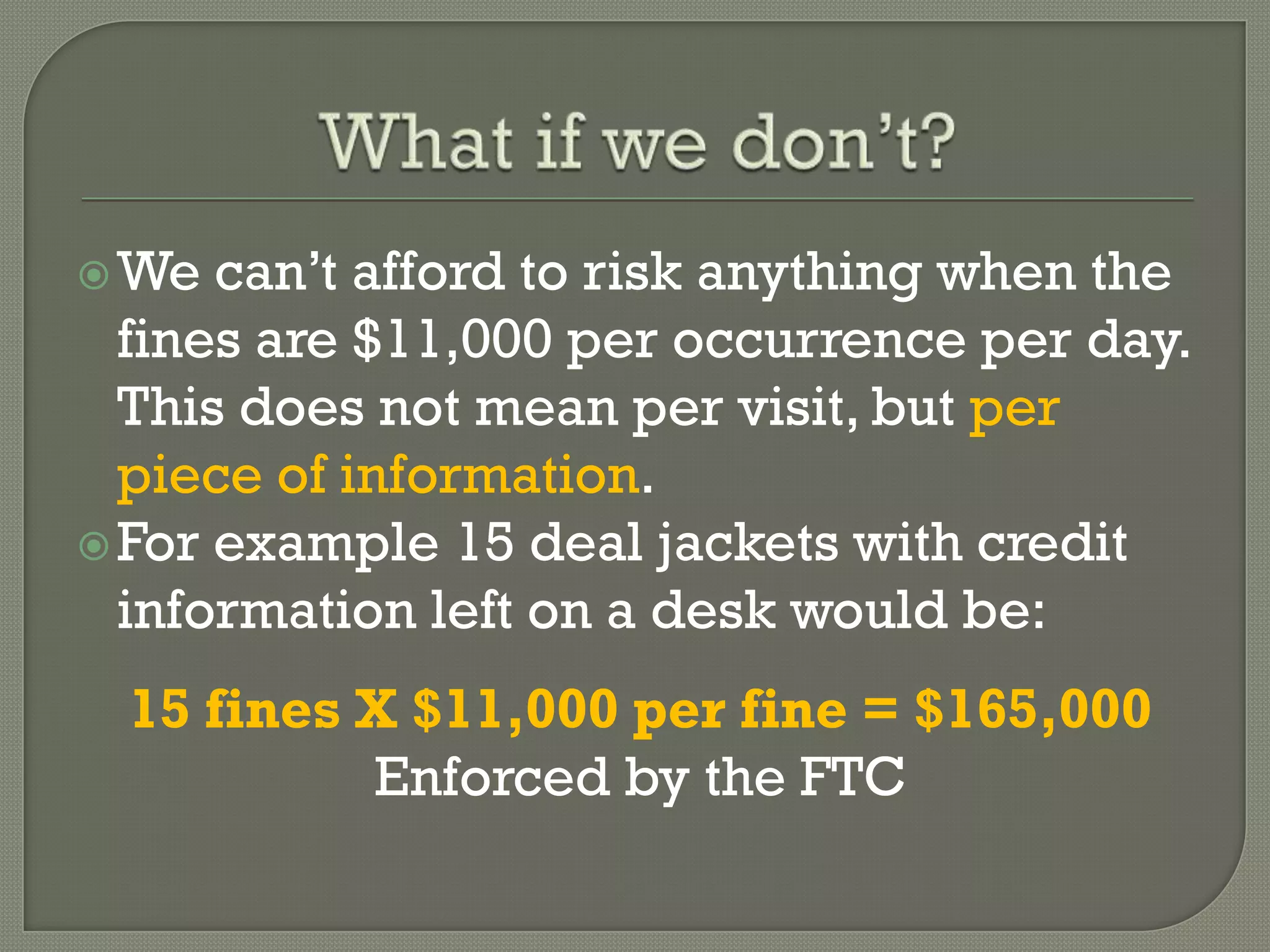
 We  can’t afford to risk anything when the
  fines are $11,000 per occurrence per day.
  This does not mean per visit, but per
  piece of information.
 For example 15 deal jackets with credit
  information left on a desk would be:
  15 fines X $11,000 per fine = $165,000
           Enforced by the FTC
 Theyusually conduct inspections around
 the opening, closing and lunch hrs of
 businesses. Why do you think this is?

 Whywould they want to inspect a
 company like Camping World?
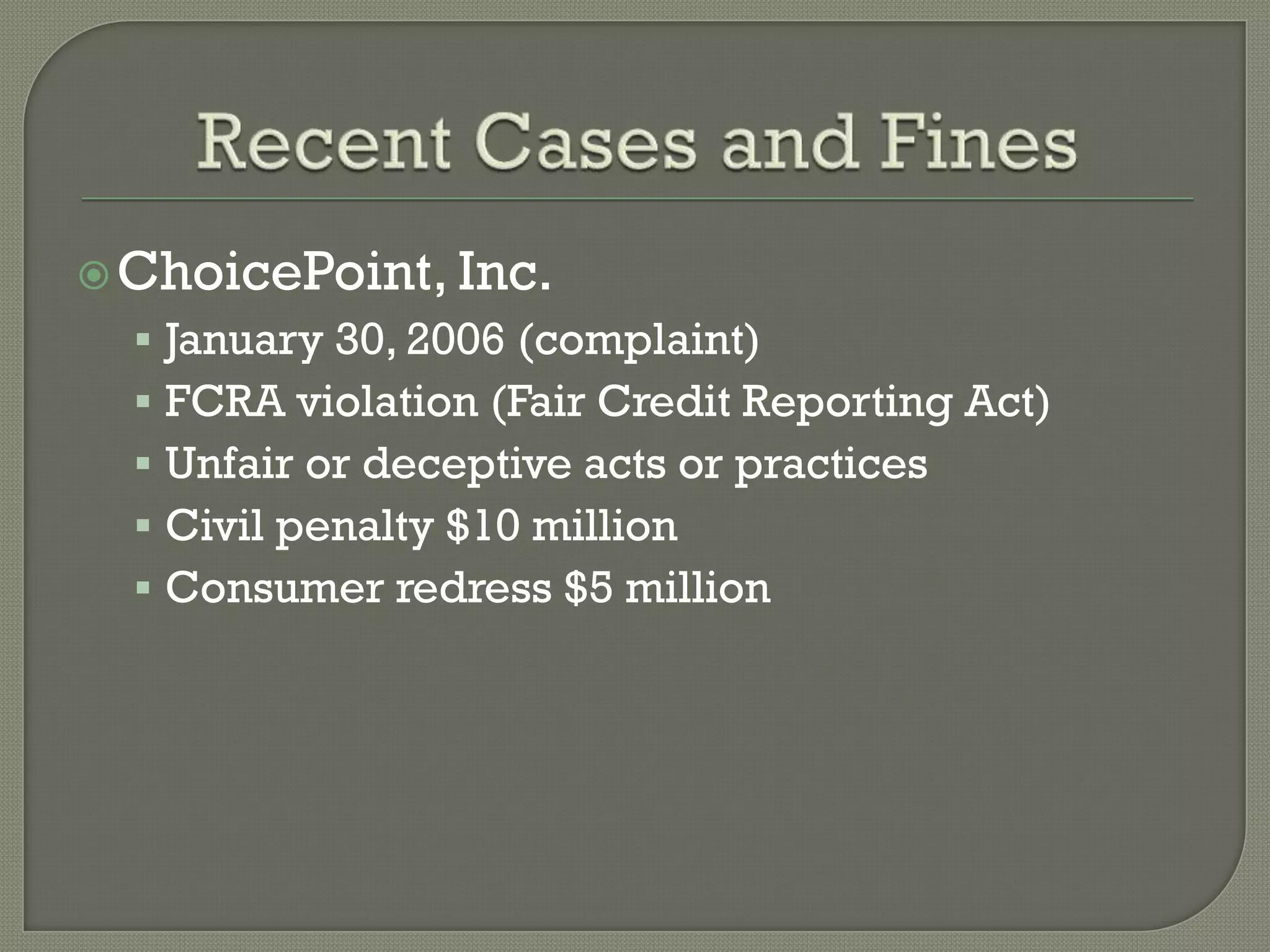
 ChoicePoint, Inc.
   January 30, 2006 (complaint)
   FCRA violation (Fair Credit Reporting Act)
   Unfair or deceptive acts or practices
   Civil penalty $10 million
   Consumer redress $5 million
 Top Three   Risk Areas
  1. Lack of documentation
  2. Uncontrolled computer access
  3. Lack of training
 Documentation
  ISP (Information Security Plan) in writing
  Administrative, technical, and physical
   safeguards
  Service provider addendums
  Monitoring efforts
  Training efforts
 Training   and Management
   Reporting violations
   Sharing logins
   Passwords on monitor
   “Clean desk” rule
   New employee orientation
   Management seriousness
 DMS
  Specific separate logins
  Rights and profiles
  Automatic log-off
  Passwords
  Remote access
  CRM
 Network/PC
  Specific logins
  Passwords
  Network access
  Monitoring
  Controlled external storage
  Windows lock/automatic logoff
 Internet
   Restricted access
   Filtering and monitoring
   E commerce
   Web-based e-mail accounts
   Written Internet Usage Policy
 E-mail
   Controlled account
   Retention (sent and deleted)
   Passwords
   Monitoring
   Backup
1.   Store documents and electronic back ups in a
     secure/locked room in locked file cabinets
2.   Limit access and keys to those who need it.
3.   Put working deals back when you are done with
     them.
4.   Log off or lock your computer if you leave your
     desk.
5.   Finance and Salesmanagers lock working deals
     in a file cabinet you leave your desk (even for a
     brief Hello or Turn Over)
6.   Have a proper storage/disposal process for
     dead deals. DO NOT throw them in the
     garbage!
7.   Report any suspicious person or activity to a
     supervisor
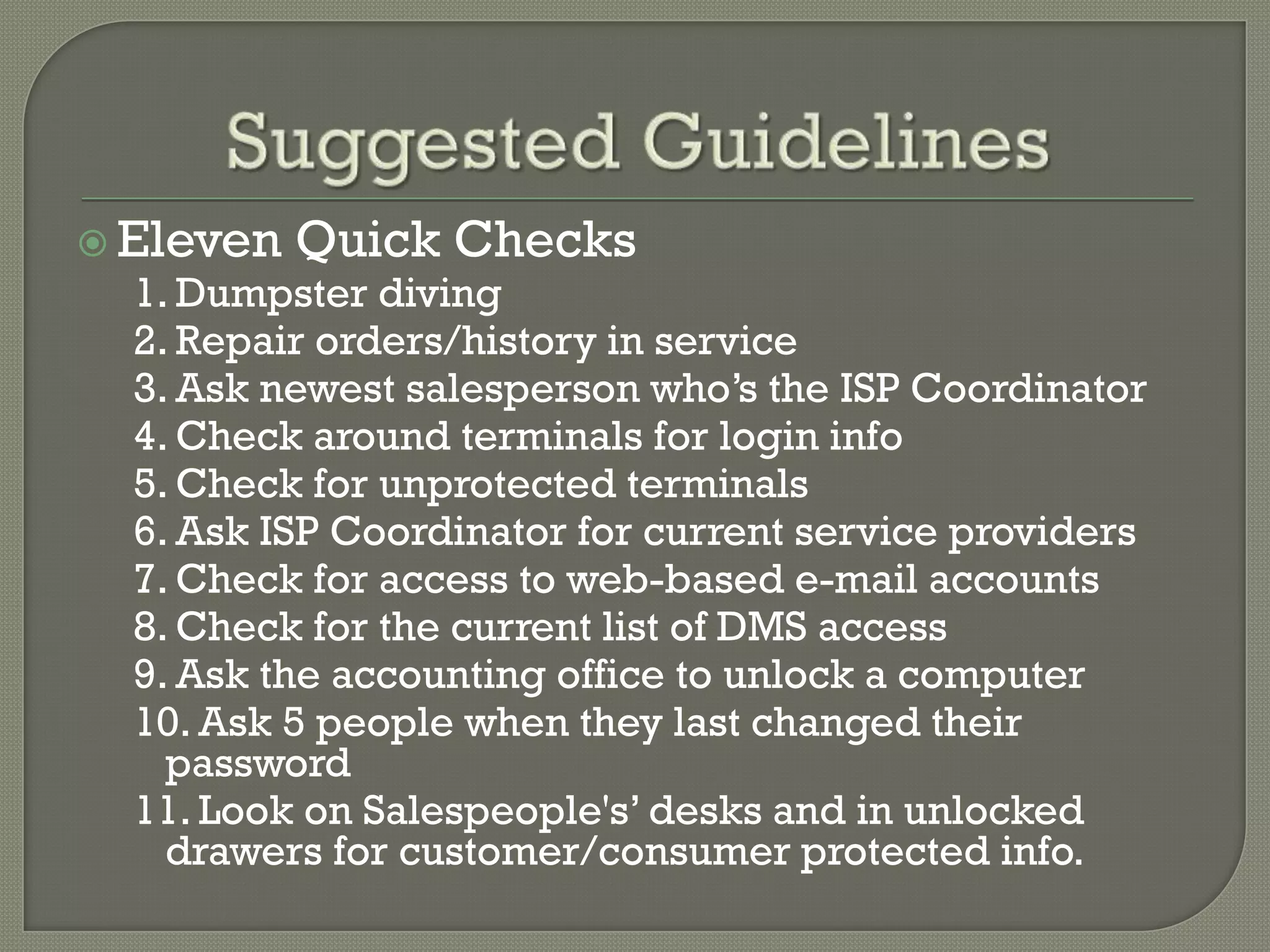
 Eleven   Quick Checks
  1. Dumpster diving
  2. Repair orders/history in service
  3. Ask newest salesperson who’s the ISP Coordinator
  4. Check around terminals for login info
  5. Check for unprotected terminals
  6. Ask ISP Coordinator for current service providers
  7. Check for access to web-based e-mail accounts
  8. Check for the current list of DMS access
  9. Ask the accounting office to unlock a computer
  10. Ask 5 people when they last changed their
    password
  11. Look on Salespeople's’ desks and in unlocked
    drawers for customer/consumer protected info.
FTC overview on glba final rule on safeguards 2010 Compliance Presentation

FTC overview on glba final rule on safeguards 2010 Compliance Presentation

  • 1.
  • 2.
     The views expressed in this presentation are those of the speaker and not necessarily those of the Commission or any individual Commissioner.  For more detailed information, visit the FTC’s homepage at www.ftc.gov.
  • 3.
     Implements the security provisions of the Gramm-Leach-Bliley Act of 1999.  Took effect May 23, 2003, with an extra year to conform third-party service provider contracts entered into prior to June 24, 2002.  Has flexible standard, but imposes certain basic requirements. See 67 Fed. Reg. 36484.
  • 4.
     Each financialinstitution must develop, implement and maintain a comprehensive information security program that is written in readily accessible part(s);  The program must contain administrative, technical and physical safeguards that are appropriate to:  the size and complexity of the financial institution;  the nature and scope of its activities; and  the sensitivity its customer information.
  • 5.
     Designate one or more employees to coordinate its program;  Assess risks to the security of customer information;  Design and implement safeguards to address risks, and test and monitor their effectiveness over time;  Oversee service providers; and  Adjust the program to address developments. * Fines of up to $3500 for failure to draft an IT Security Plan. This is on top of any fines for the violations themselves
  • 6.
    To assess risksand design safeguards, a financial institution must consider all relevant areas of its operation, including: 1. Employee training and management; 2. Information systems, including network and software design, as well as information processing, storage, transmission and disposal; 3. Detecting, preventing and responding to attacks, intrusions, or other systems failures.
  • 7.
     Take reasonablesteps to select and retain service providers that are capable of maintaining appropriate safeguards for the customer information at issue; and  Require service providers by contract to implement and maintain such safeguards. *Service providers are companies that handle or have access to customer information in the course of providing services directly to a financial institution.
  • 8.
     Applies to financial institutions under the FTC’s jurisdiction;  Includes financial institutions that receive customer information from another financial institution.  This includes anyone who helps to arrange credit (including RV Dealers, The Finance Department, and the persons filling out/handling Credit Apps)
  • 9.
     Any institution the business of which is engaging in financial activities as described in section 4(k) of the Bank Holding Company Act of 1956. An institution that is significantly engaged in financial activities is a financial institution.  This last piece is what includes us
  • 10.
     Lending, exchanging,transferring, investing for others, or safeguarding money or securities. [4(k)(4)(A)]  An activity that the Federal Reserve Board has determined to be closely related to banking. [4(k)(4)(F); 12 C.F.R. 225.28]  Extending credit and servicing loans  Collection agency services  Anactivity that a bank holding company may engage in outside the U.S. [4(k)(4)(G); 12 C.F.R. 211.5].
  • 11.
     Mortgage broker  Check casher  Pay-day lender  Credit counseling service  Retailer that issues its own credit card  Auto/RV dealers that lease and/or finance
  • 12.
     “Customer information,”which means: 1. Nonpublic personal information concerning its own customers; and 2. Nonpublic personal information that it receives from a financial institution about the customers of another financial institution; 3. This would include credit applications, copies of drivers license, social security number, Tax ID #, proof of income, and anything else that is not normally available to the public.  NOTE: Customer information includes information handled by affiliates.
  • 13.
     Ifa financialinstitution shares customer information with its affiliates, it must ensure that the affiliates have adequate safeguards in place.  Affiliate means any company that controls, is controlled by, or is under common control with another company.  See Privacy Rule, section 313.3(a).
  • 14.
     Both Rules implement section 501 of the GLBA.  The Safeguards Rule uses Privacy Rule definitions, but defines new terms “customer information” and “service provider.”  The Privacy Rule focuses on Privacy Notices, Opt Out rights and limits on use and disclosure; the Safeguards Rule focuses on security.
  • 15.
     Top ThreeReasonsDealerships are NOT in compliance 1. “Won’t happen to me” 2. “We do that” 3. “We’ve already done enough”
  • 16.
     We can’t afford to risk anything when the fines are $11,000 per occurrence per day. This does not mean per visit, but per piece of information.  For example 15 deal jackets with credit information left on a desk would be: 15 fines X $11,000 per fine = $165,000 Enforced by the FTC
  • 17.
     Theyusually conductinspections around the opening, closing and lunch hrs of businesses. Why do you think this is?  Whywould they want to inspect a company like Camping World?
  • 18.
     ChoicePoint, Inc.  January 30, 2006 (complaint)  FCRA violation (Fair Credit Reporting Act)  Unfair or deceptive acts or practices  Civil penalty $10 million  Consumer redress $5 million
  • 19.
     Top Three Risk Areas 1. Lack of documentation 2. Uncontrolled computer access 3. Lack of training
  • 20.
     Documentation ISP (Information Security Plan) in writing  Administrative, technical, and physical safeguards  Service provider addendums  Monitoring efforts  Training efforts
  • 21.
     Training and Management  Reporting violations  Sharing logins  Passwords on monitor  “Clean desk” rule  New employee orientation  Management seriousness
  • 22.
     DMS Specific separate logins  Rights and profiles  Automatic log-off  Passwords  Remote access  CRM
  • 23.
     Network/PC Specific logins  Passwords  Network access  Monitoring  Controlled external storage  Windows lock/automatic logoff
  • 24.
     Internet  Restricted access  Filtering and monitoring  E commerce  Web-based e-mail accounts  Written Internet Usage Policy
  • 25.
     E-mail  Controlled account  Retention (sent and deleted)  Passwords  Monitoring  Backup
  • 26.
    1. Store documents and electronic back ups in a secure/locked room in locked file cabinets 2. Limit access and keys to those who need it. 3. Put working deals back when you are done with them. 4. Log off or lock your computer if you leave your desk. 5. Finance and Salesmanagers lock working deals in a file cabinet you leave your desk (even for a brief Hello or Turn Over) 6. Have a proper storage/disposal process for dead deals. DO NOT throw them in the garbage! 7. Report any suspicious person or activity to a supervisor
  • 27.
     Eleven Quick Checks 1. Dumpster diving 2. Repair orders/history in service 3. Ask newest salesperson who’s the ISP Coordinator 4. Check around terminals for login info 5. Check for unprotected terminals 6. Ask ISP Coordinator for current service providers 7. Check for access to web-based e-mail accounts 8. Check for the current list of DMS access 9. Ask the accounting office to unlock a computer 10. Ask 5 people when they last changed their password 11. Look on Salespeople's’ desks and in unlocked drawers for customer/consumer protected info.

Editor's Notes

  • #18 Answer #1-Because that’s when we are most likely to be away from our desk with computer open (morning coffee), deals lying on desk (lunch) or understaffed and doors cabinets/doors unlocked (closing)Answer #2-Large credit transactions, small credit card purchases, and industry still catching up to modern threats, and can afford a large fine