Date printed 05.07.2013, Revision 05.07.2013 Version 01 Page 1 / 7
Fire Security A.S.
Safety Data Sheet 1907/2006/EC - REACH (GB)
FS11
4636 Kristiansand
SECTION 1: Identification of the substance / preparation and of the company
1.1 Product identifier
FS11
1.2 Relevant identified uses of the substance or mixture and uses advised against
1.2.1 Relevant uses
Intumescent fire retardant coatings
1.2.2 Uses advised against
None known.
1.3 Details of the supplier of the safety data sheet
Company Fire Security A.S.
Skibåsen 20 B
4636 Kristiansand / NORWAY
Phone + 47 95 47 80 00
Fax + 47 38 02 15 31
Homepage www.fire-security.com
E-mail headquarter@fire-security.com
Address enquiries to
Technical information headquarter@fire-security.com
Safety Data Sheet sdb@chemiebuero.de
1.4 Emergency phone
Company 0047-95478000 (7:00 am - 5:00 pm) 0047-95279262 (5:00 pm - 7:00 am)
SECTION 2: Hazards identification
2.1 Classification of the substance or mixture
2.1.1 Classification according to Regulation (EC) No 1272/2008 [CLP]
No classification.
2.1.2 Classification according to Regulation 67/548/EEC or 1999/45/EC
No classification.
2.2 Label elements
The product is required to be labelled in accordance with EC-Directives.
Labelling according to Regulation 67/548/EEC or 1999/45/EC
Hazard symbols none
R-phrases none
Special labelling Safety data sheet available for professional user on request.
2004/42/CE 0 g/l II A i WB One-pack performance coatings (max. 140 g/l)
2.3 Other hazards
Human health dangers Frequent persistent contact with the skin can cause skin irritation.
Environmental hazards Does not contain any PBT or vPvB substances.
Other hazards Further hazards were not determined with the current level of knowledge.
http://www.chemiebuero.de, Phone +49 (0)941-566-398 (-455), E-mail info@chemiebuero.de, v. 130625a GB
Date printed 05.07.2013, Revision 05.07.2013 Version 01 Page 2 / 7
Fire Security A.S.
Safety Data Sheet 1907/2006/EC - REACH (GB)
FS11
4636 Kristiansand
SECTION 3: Composition / Information on ingredients
3.1 Product-type:
The product is a mixture.
Range [%] Substance
1 - <5
GHS/CLP: Acute Tox. 4: H302
EEC: Xn, R 22
Tris(2-chloro-1-methylethyl) phosphate
CAS: 13674-84-5, EINECS/ELINCS: 237-158-7, ECB-Nr.: 01-2119486772-26-xxxx
Comment on component parts Substances of Very High Concern - SVHC: substances are not contained or are below 0,1%.
For full text of H-statements and R-phrases: see SECTION 16.
SECTION 4: First aid measures
4.1 Description of first aid measures
General information Change soaked clothing.
Inhalation Ensure supply of fresh air.
In the event of symptoms seek for medical treatment.
Skin contact When in contact with the skin, clean with soap and water.
Consult a doctor if skin irritation persists.
Eye contact Rinse cautiously with water for several minutes. Remove contact lenses, if present and easy
to do. Continue rinsing.
If eye irritation persists: Get medical advice/attention.
Ingestion Supply with medical care.
Do not induce vomiting.
Rinse out mouth and give plenty of water to drink.
4.2 Most important symptoms and effects, both acute and delayed
Irritant effects
4.3 Indication of any immediate medical attention and special treatment needed
Treat symptomatically.
SECTION 5: Fire-fighting measures
5.1 Extinguishing media
Suitable extinguishing media Product itself is non-combustible. Fire extinguishing method of surrounding areas must be
considered.
Extinguishing media that must not
be used
Full water jet.
5.2 Special hazards arising from the substance or mixture
Unknown risk of formation of toxic pyrolysis products.
Carbon monoxide (CO)
Nitrogen oxides (NOx).
Phosphorus oxides (POx).
Chlorine compounds.
5.3 Advice for firefighters
Use self-contained breathing apparatus.
Fire residues and contaminated firefighting water must be disposed of in accordance within
the local regulations.
SECTION 6: Accidental release measures
6.1 Personal precautions, protective equipment and emergency procedures
High risk of slipping due to leakage/spillage of product.
6.2 Environmental precautions
Do not discharge into the drains/surface waters/groundwater.
http://www.chemiebuero.de, Phone +49 (0)941-566-398 (-455), E-mail info@chemiebuero.de, v. 130625a GB
Date printed 05.07.2013, Revision 05.07.2013 Version 01 Page 3 / 7
Fire Security A.S.
Safety Data Sheet 1907/2006/EC - REACH (GB)
FS11
4636 Kristiansand
6.3 Methods and material for containment and cleaning up
Take up mechanically.
Take up residues with absorbent material (e.g. sand).
Dispose of absorbed material in accordance within the regulations.
6.4 Reference to other sections
See SECTION 8+13
SECTION 7: Handling and storage
7.1 Precautions for safe handling
Provide suitable vacuuming at the processing area.
Use only in well-ventilated areas.
Use barrier skin cream.
Wash hands before breaks and after work.
7.2 Conditions for safe storage, including any incompatibilities
Keep only in original container.
Do not store together with food and animal food/diet.
Keep container tightly closed.
7.3 Specific end use(s)
See product use, SECTION 1.2
SECTION 8: Exposure controls / personal protection
8.1 Control parameters
Ingredients with occupational
exposure limits to be monitored (GB)
Range [%] Substance
10 - <25 Pentaerythritol
CAS: 115-77-5, EINECS/ELINCS: 204-104-9, ECB-Nr.: 01-2119473985-20-XXXX
Long-term exposure: 10 mg/m³, inhalable dust, respirable dust: TWA=4 mg/m³
Short-term exposure (15-minute): 20 mg/m³
1 - <10 Titanium dioxide
CAS: 13463-67-7, EINECS/ELINCS: 236-675-5
Long-term exposure: 4 mg/m³, respirable; total inhalable: TWA=10 mg/m³
DNEL
Range [%] Substance
1 - <5 Tris(2-chloro-1-methylethyl) phosphate, CAS: 13674-84-5
Industrial, dermal, Long-term - systemic effects: 2,08 mg/kg bw/day.
Industrial, inhalative, Long-term - systemic effects: 5,82 mg/m³.
Industrial, inhalative, Acute - systemic effects: 22,4 mg/m³.
Industrial, dermal, Acute - systemic effects: 8 mg/kg bw/day.
PNEC
Range [%] Substance
1 - <5 Tris(2-chloro-1-methylethyl) phosphate, CAS: 13674-84-5
sediment (marine water), 1,34 mg/kg dwt.
soil, 1,7 mg/kg dwt.
marine water, 0,064 mg/l.
fresh water, 0,64 mg/l.
sediment, 13,4 mg/kg dwt.
sewage treatment plants (STP), 7,84 mg/l.
http://www.chemiebuero.de, Phone +49 (0)941-566-398 (-455), E-mail info@chemiebuero.de, v. 130625a GB
Date printed 05.07.2013, Revision 05.07.2013 Version 01 Page 4 / 7
Fire Security A.S.
Safety Data Sheet 1907/2006/EC - REACH (GB)
FS11
4636 Kristiansand
8.2 Exposure controls
Additional advice on system design Ensure adequate ventilation on workstation.
Eye protection Safety glasses.
Hand protection Butyl rubber, >480 min (EN 374).
The details concerned are recommendations. Please contact the glove supplier for further
information.
Skin protection Not required under normal conditions.
Other Avoid contact with eyes and skin.
Do not inhale aerosols.
Respiratory protection Breathing apparatus in the event of high concentrations.
Short term: filter apparatus, combination filter A-P2.
Thermal hazards not applicable
Delimitation and monitoring of the
environmental exposition
Protect the environment by applying appropriate control measures to prevent or limit
emissions.
SECTION 9: Physical and chemical properties
9.1 Information on basic physical and chemical properties
Form pasty
Color white
Odor characteristic
Odour threshold not determined
pH-value 6,5 - 8,5
pH-value [1%] not determined
Boiling point [°C] not determined
Flash point [°C] not applicable
Flammability [°C] not applicable
Lower explosion limit not applicable
Upper explosion limit not applicable
Oxidizing properties no
Vapour pressure/gas pressure [kPa] not determined
Density [g/ml] 1,18 - 1,28
Bulk density [kg/m³] not applicable
Solubility in water soluble
Partition coefficient [n-octanol/water] not determined
Viscosity 8000 - 14000 mPa.s (20°C)
Relative vapour density determined
in air
not determined
Evaporation speed not determined
Melting point [°C] not determined
Autoignition temperature [°C] not applicable
Decomposition temperature not determined
9.2 Other information
none
SECTION 10: Stability and reactivity
10.1 Reactivity
No dangerous reactions known if used as directed.
10.2 Chemical stability
The product is stable under standard conditions.
10.3 Possibility of hazardous reactions
No hazardous reactions known.
http://www.chemiebuero.de, Phone +49 (0)941-566-398 (-455), E-mail info@chemiebuero.de, v. 130625a GB
Date printed 05.07.2013, Revision 05.07.2013 Version 01 Page 5 / 7
Fire Security A.S.
Safety Data Sheet 1907/2006/EC - REACH (GB)
FS11
4636 Kristiansand
10.4 Conditions to avoid
See SECTION 7.2.
10.5 Incompatible materials
not determined
10.6 Hazardous decomposition products
No hazardous decomposition products known.
SECTION 11: Toxicological information
11.1 Information on toxicological effects
Acute toxicity
Range [%] Substance
1 - <5 Tris(2-chloro-1-methylethyl) phosphate, CAS: 13674-84-5
LC0, inhalative, Rat: > 7 mg/l 4h.
LD50, dermal, Rat: > 2000 mg/kg.
LD50, oral, Rat: > 500 -2000 mg/kg.
Serious eye damage/irritation not determined
Skin corrosion/irritation not determined
Respiratory or skin sensitisation not determined
Specific target organ toxicity —
single exposure
not determined
Specific target organ toxicity —
repeated exposure
not determined
Mutagenicity There is no evidence of any mutagenic effects.
Reproduction toxicity There is no evidence of any reproductive toxicity effects.
Carcinogenicity There is no evidence of any carcinogenic effects.
General remarks
No classification on the basis of the calculation procedure of the preparation directive.
Toxicological data of complete product are not available.
The toxicity data listed pertaining to the ingredients are intended for those working in the
medicinal professions, experts for occupational health and safety and toxicologists. The
toxicity data pertaining to the ingredients were supplied by the manufacturers of raw materials.
SECTION 12: Ecological information
12.1 Toxicity
Range [%] Substance
1 - <5 Tris(2-chloro-1-methylethyl) phosphate, CAS: 13674-84-5
LC50, (96h), Pimephales promelas: 51 mg/l.
IC50, (72h), Algae: 82 mg/l.
EC50, (48h), Daphnia magna: 131 mg/l.
EC50, (3h), Bacteria: 784 mg/l.
12.2 Persistence and degradability
Behaviour in environment
compartments
not determined
Behaviour in sewage plant not determined
Biological degradability not determined
12.3 Bioaccumulative potential
not determined
12.4 Mobility in soil
not determined
http://www.chemiebuero.de, Phone +49 (0)941-566-398 (-455), E-mail info@chemiebuero.de, v. 130625a GB
Date printed 05.07.2013, Revision 05.07.2013 Version 01 Page 6 / 7
Fire Security A.S.
Safety Data Sheet 1907/2006/EC - REACH (GB)
FS11
4636 Kristiansand
12.5 Results of PBT and vPvB assessment
Based on all available information not to be classified as PBT or vPvB respectively.
12.6 Other adverse effects
No classification on the basis of the calculation procedure of the preparation directive.
Ecological data of complete product are not available.
The product contains organically bound halogen in accordance with the formulation.
The toxicity data pertaining to the ingredients were supplied by the manufacturers of raw materials.
SECTION 13: Disposal considerations
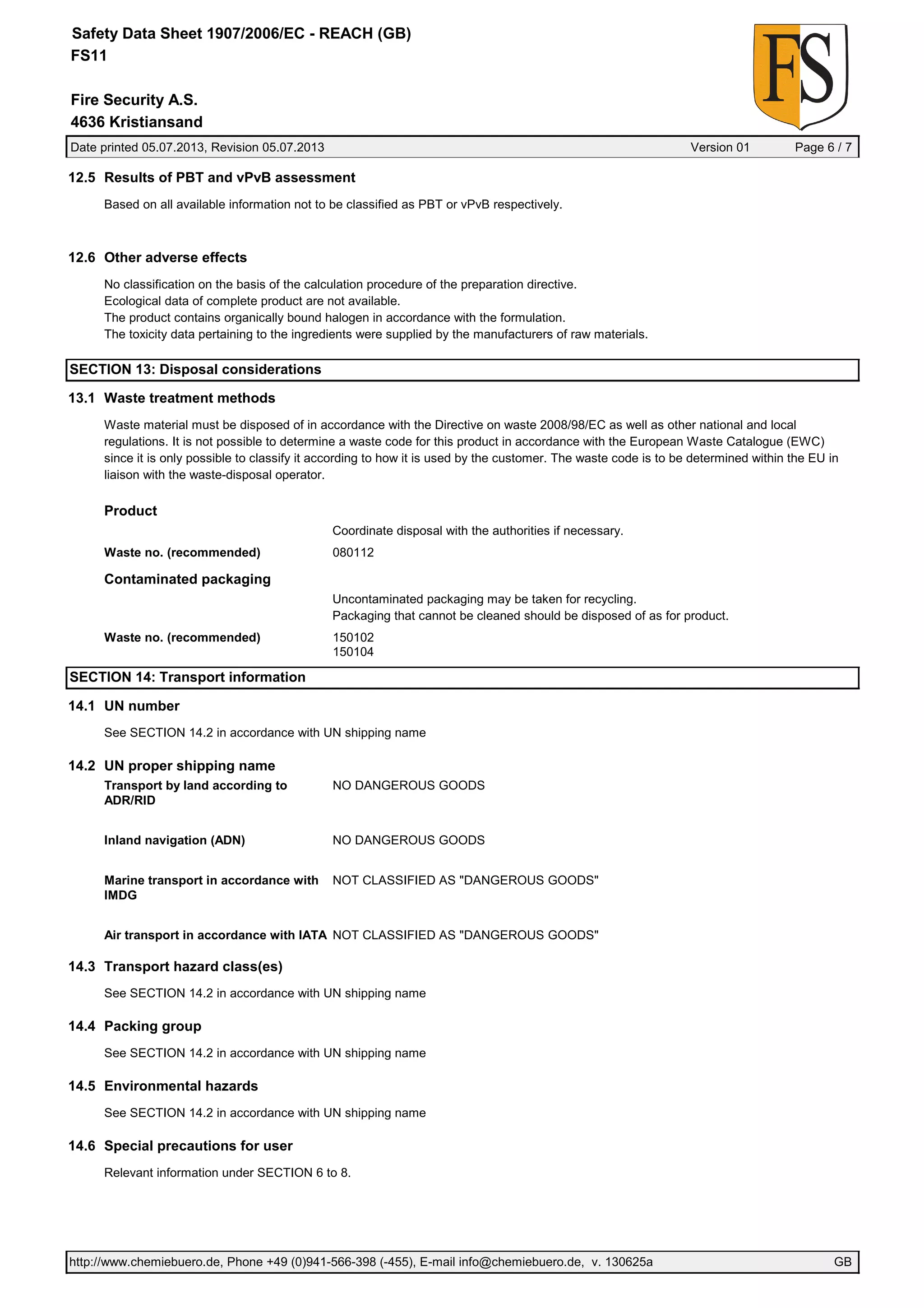
13.1 Waste treatment methods
Waste material must be disposed of in accordance with the Directive on waste 2008/98/EC as well as other national and local
regulations. It is not possible to determine a waste code for this product in accordance with the European Waste Catalogue (EWC)
since it is only possible to classify it according to how it is used by the customer. The waste code is to be determined within the EU in
liaison with the waste-disposal operator.
Product
Coordinate disposal with the authorities if necessary.
Waste no. (recommended) 080112
Contaminated packaging
Uncontaminated packaging may be taken for recycling.
Packaging that cannot be cleaned should be disposed of as for product.
Waste no. (recommended) 150102
150104
SECTION 14: Transport information
14.1 UN number
See SECTION 14.2 in accordance with UN shipping name
14.2 UN proper shipping name
Transport by land according to
ADR/RID
NO DANGEROUS GOODS
Inland navigation (ADN) NO DANGEROUS GOODS
Marine transport in accordance with
IMDG
NOT CLASSIFIED AS "DANGEROUS GOODS"
Air transport in accordance with IATA NOT CLASSIFIED AS "DANGEROUS GOODS"
14.3 Transport hazard class(es)
See SECTION 14.2 in accordance with UN shipping name
14.4 Packing group
See SECTION 14.2 in accordance with UN shipping name
14.5 Environmental hazards
See SECTION 14.2 in accordance with UN shipping name
14.6 Special precautions for user
Relevant information under SECTION 6 to 8.
http://www.chemiebuero.de, Phone +49 (0)941-566-398 (-455), E-mail info@chemiebuero.de, v. 130625a GB
Date printed 05.07.2013, Revision 05.07.2013 Version 01 Page 7 / 7
Fire Security A.S.
Safety Data Sheet 1907/2006/EC - REACH (GB)
FS11
4636 Kristiansand
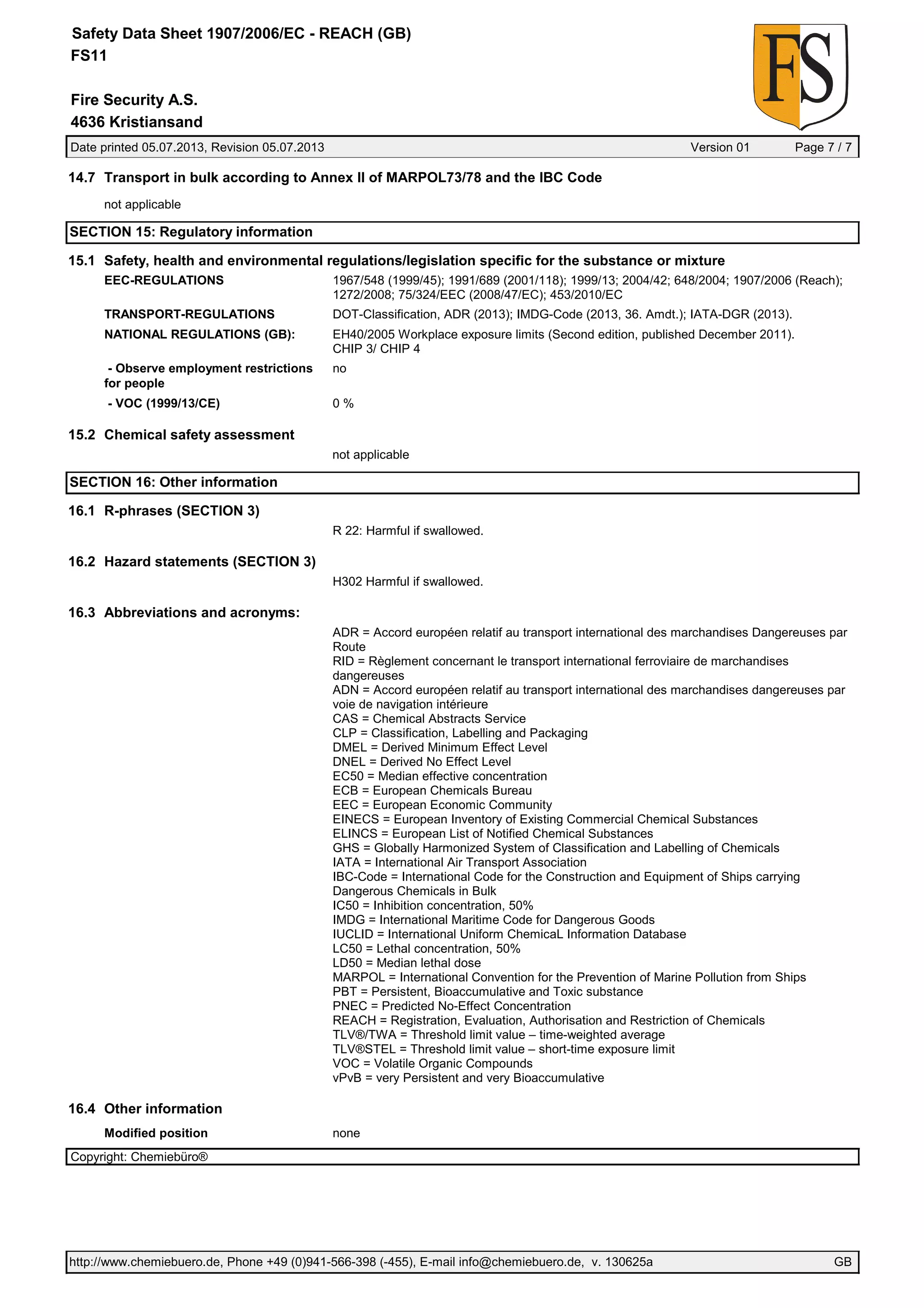
14.7 Transport in bulk according to Annex II of MARPOL73/78 and the IBC Code
not applicable
SECTION 15: Regulatory information
15.1 Safety, health and environmental regulations/legislation specific for the substance or mixture
EEC-REGULATIONS 1967/548 (1999/45); 1991/689 (2001/118); 1999/13; 2004/42; 648/2004; 1907/2006 (Reach);
1272/2008; 75/324/EEC (2008/47/EC); 453/2010/EC
TRANSPORT-REGULATIONS DOT-Classification, ADR (2013); IMDG-Code (2013, 36. Amdt.); IATA-DGR (2013).
NATIONAL REGULATIONS (GB): EH40/2005 Workplace exposure limits (Second edition, published December 2011).
CHIP 3/ CHIP 4
- Observe employment restrictions
for people
no
- VOC (1999/13/CE) 0 %
15.2 Chemical safety assessment
not applicable
SECTION 16: Other information
16.1 R-phrases (SECTION 3)
R 22: Harmful if swallowed.
16.2 Hazard statements (SECTION 3)
H302 Harmful if swallowed.
16.3 Abbreviations and acronyms:
ADR = Accord européen relatif au transport international des marchandises Dangereuses par
Route
RID = Règlement concernant le transport international ferroviaire de marchandises
dangereuses
ADN = Accord européen relatif au transport international des marchandises dangereuses par
voie de navigation intérieure
CAS = Chemical Abstracts Service
CLP = Classification, Labelling and Packaging
DMEL = Derived Minimum Effect Level
DNEL = Derived No Effect Level
EC50 = Median effective concentration
ECB = European Chemicals Bureau
EEC = European Economic Community
EINECS = European Inventory of Existing Commercial Chemical Substances
ELINCS = European List of Notified Chemical Substances
GHS = Globally Harmonized System of Classification and Labelling of Chemicals
IATA = International Air Transport Association
IBC-Code = International Code for the Construction and Equipment of Ships carrying
Dangerous Chemicals in Bulk
IC50 = Inhibition concentration, 50%
IMDG = International Maritime Code for Dangerous Goods
IUCLID = International Uniform ChemicaL Information Database
LC50 = Lethal concentration, 50%
LD50 = Median lethal dose
MARPOL = International Convention for the Prevention of Marine Pollution from Ships
PBT = Persistent, Bioaccumulative and Toxic substance
PNEC = Predicted No-Effect Concentration
REACH = Registration, Evaluation, Authorisation and Restriction of Chemicals
TLV®/TWA = Threshold limit value – time-weighted average
TLV®STEL = Threshold limit value – short-time exposure limit
VOC = Volatile Organic Compounds
vPvB = very Persistent and very Bioaccumulative
16.4 Other information
Modified position none
Copyright: Chemiebüro®
http://www.chemiebuero.de, Phone +49 (0)941-566-398 (-455), E-mail info@chemiebuero.de, v. 130625a GB

Cable Fire Protection - Coatings | Cable Coating | Intumescent Cable Coating

  • 1.
    Date printed 05.07.2013,Revision 05.07.2013 Version 01 Page 1 / 7 Fire Security A.S. Safety Data Sheet 1907/2006/EC - REACH (GB) FS11 4636 Kristiansand SECTION 1: Identification of the substance / preparation and of the company 1.1 Product identifier FS11 1.2 Relevant identified uses of the substance or mixture and uses advised against 1.2.1 Relevant uses Intumescent fire retardant coatings 1.2.2 Uses advised against None known. 1.3 Details of the supplier of the safety data sheet Company Fire Security A.S. Skibåsen 20 B 4636 Kristiansand / NORWAY Phone + 47 95 47 80 00 Fax + 47 38 02 15 31 Homepage www.fire-security.com E-mail headquarter@fire-security.com Address enquiries to Technical information headquarter@fire-security.com Safety Data Sheet sdb@chemiebuero.de 1.4 Emergency phone Company 0047-95478000 (7:00 am - 5:00 pm) 0047-95279262 (5:00 pm - 7:00 am) SECTION 2: Hazards identification 2.1 Classification of the substance or mixture 2.1.1 Classification according to Regulation (EC) No 1272/2008 [CLP] No classification. 2.1.2 Classification according to Regulation 67/548/EEC or 1999/45/EC No classification. 2.2 Label elements The product is required to be labelled in accordance with EC-Directives. Labelling according to Regulation 67/548/EEC or 1999/45/EC Hazard symbols none R-phrases none Special labelling Safety data sheet available for professional user on request. 2004/42/CE 0 g/l II A i WB One-pack performance coatings (max. 140 g/l) 2.3 Other hazards Human health dangers Frequent persistent contact with the skin can cause skin irritation. Environmental hazards Does not contain any PBT or vPvB substances. Other hazards Further hazards were not determined with the current level of knowledge. http://www.chemiebuero.de, Phone +49 (0)941-566-398 (-455), E-mail info@chemiebuero.de, v. 130625a GB
  • 2.
    Date printed 05.07.2013,Revision 05.07.2013 Version 01 Page 2 / 7 Fire Security A.S. Safety Data Sheet 1907/2006/EC - REACH (GB) FS11 4636 Kristiansand SECTION 3: Composition / Information on ingredients 3.1 Product-type: The product is a mixture. Range [%] Substance 1 - <5 GHS/CLP: Acute Tox. 4: H302 EEC: Xn, R 22 Tris(2-chloro-1-methylethyl) phosphate CAS: 13674-84-5, EINECS/ELINCS: 237-158-7, ECB-Nr.: 01-2119486772-26-xxxx Comment on component parts Substances of Very High Concern - SVHC: substances are not contained or are below 0,1%. For full text of H-statements and R-phrases: see SECTION 16. SECTION 4: First aid measures 4.1 Description of first aid measures General information Change soaked clothing. Inhalation Ensure supply of fresh air. In the event of symptoms seek for medical treatment. Skin contact When in contact with the skin, clean with soap and water. Consult a doctor if skin irritation persists. Eye contact Rinse cautiously with water for several minutes. Remove contact lenses, if present and easy to do. Continue rinsing. If eye irritation persists: Get medical advice/attention. Ingestion Supply with medical care. Do not induce vomiting. Rinse out mouth and give plenty of water to drink. 4.2 Most important symptoms and effects, both acute and delayed Irritant effects 4.3 Indication of any immediate medical attention and special treatment needed Treat symptomatically. SECTION 5: Fire-fighting measures 5.1 Extinguishing media Suitable extinguishing media Product itself is non-combustible. Fire extinguishing method of surrounding areas must be considered. Extinguishing media that must not be used Full water jet. 5.2 Special hazards arising from the substance or mixture Unknown risk of formation of toxic pyrolysis products. Carbon monoxide (CO) Nitrogen oxides (NOx). Phosphorus oxides (POx). Chlorine compounds. 5.3 Advice for firefighters Use self-contained breathing apparatus. Fire residues and contaminated firefighting water must be disposed of in accordance within the local regulations. SECTION 6: Accidental release measures 6.1 Personal precautions, protective equipment and emergency procedures High risk of slipping due to leakage/spillage of product. 6.2 Environmental precautions Do not discharge into the drains/surface waters/groundwater. http://www.chemiebuero.de, Phone +49 (0)941-566-398 (-455), E-mail info@chemiebuero.de, v. 130625a GB
  • 3.
    Date printed 05.07.2013,Revision 05.07.2013 Version 01 Page 3 / 7 Fire Security A.S. Safety Data Sheet 1907/2006/EC - REACH (GB) FS11 4636 Kristiansand 6.3 Methods and material for containment and cleaning up Take up mechanically. Take up residues with absorbent material (e.g. sand). Dispose of absorbed material in accordance within the regulations. 6.4 Reference to other sections See SECTION 8+13 SECTION 7: Handling and storage 7.1 Precautions for safe handling Provide suitable vacuuming at the processing area. Use only in well-ventilated areas. Use barrier skin cream. Wash hands before breaks and after work. 7.2 Conditions for safe storage, including any incompatibilities Keep only in original container. Do not store together with food and animal food/diet. Keep container tightly closed. 7.3 Specific end use(s) See product use, SECTION 1.2 SECTION 8: Exposure controls / personal protection 8.1 Control parameters Ingredients with occupational exposure limits to be monitored (GB) Range [%] Substance 10 - <25 Pentaerythritol CAS: 115-77-5, EINECS/ELINCS: 204-104-9, ECB-Nr.: 01-2119473985-20-XXXX Long-term exposure: 10 mg/m³, inhalable dust, respirable dust: TWA=4 mg/m³ Short-term exposure (15-minute): 20 mg/m³ 1 - <10 Titanium dioxide CAS: 13463-67-7, EINECS/ELINCS: 236-675-5 Long-term exposure: 4 mg/m³, respirable; total inhalable: TWA=10 mg/m³ DNEL Range [%] Substance 1 - <5 Tris(2-chloro-1-methylethyl) phosphate, CAS: 13674-84-5 Industrial, dermal, Long-term - systemic effects: 2,08 mg/kg bw/day. Industrial, inhalative, Long-term - systemic effects: 5,82 mg/m³. Industrial, inhalative, Acute - systemic effects: 22,4 mg/m³. Industrial, dermal, Acute - systemic effects: 8 mg/kg bw/day. PNEC Range [%] Substance 1 - <5 Tris(2-chloro-1-methylethyl) phosphate, CAS: 13674-84-5 sediment (marine water), 1,34 mg/kg dwt. soil, 1,7 mg/kg dwt. marine water, 0,064 mg/l. fresh water, 0,64 mg/l. sediment, 13,4 mg/kg dwt. sewage treatment plants (STP), 7,84 mg/l. http://www.chemiebuero.de, Phone +49 (0)941-566-398 (-455), E-mail info@chemiebuero.de, v. 130625a GB
  • 4.
    Date printed 05.07.2013,Revision 05.07.2013 Version 01 Page 4 / 7 Fire Security A.S. Safety Data Sheet 1907/2006/EC - REACH (GB) FS11 4636 Kristiansand 8.2 Exposure controls Additional advice on system design Ensure adequate ventilation on workstation. Eye protection Safety glasses. Hand protection Butyl rubber, >480 min (EN 374). The details concerned are recommendations. Please contact the glove supplier for further information. Skin protection Not required under normal conditions. Other Avoid contact with eyes and skin. Do not inhale aerosols. Respiratory protection Breathing apparatus in the event of high concentrations. Short term: filter apparatus, combination filter A-P2. Thermal hazards not applicable Delimitation and monitoring of the environmental exposition Protect the environment by applying appropriate control measures to prevent or limit emissions. SECTION 9: Physical and chemical properties 9.1 Information on basic physical and chemical properties Form pasty Color white Odor characteristic Odour threshold not determined pH-value 6,5 - 8,5 pH-value [1%] not determined Boiling point [°C] not determined Flash point [°C] not applicable Flammability [°C] not applicable Lower explosion limit not applicable Upper explosion limit not applicable Oxidizing properties no Vapour pressure/gas pressure [kPa] not determined Density [g/ml] 1,18 - 1,28 Bulk density [kg/m³] not applicable Solubility in water soluble Partition coefficient [n-octanol/water] not determined Viscosity 8000 - 14000 mPa.s (20°C) Relative vapour density determined in air not determined Evaporation speed not determined Melting point [°C] not determined Autoignition temperature [°C] not applicable Decomposition temperature not determined 9.2 Other information none SECTION 10: Stability and reactivity 10.1 Reactivity No dangerous reactions known if used as directed. 10.2 Chemical stability The product is stable under standard conditions. 10.3 Possibility of hazardous reactions No hazardous reactions known. http://www.chemiebuero.de, Phone +49 (0)941-566-398 (-455), E-mail info@chemiebuero.de, v. 130625a GB
  • 5.
    Date printed 05.07.2013,Revision 05.07.2013 Version 01 Page 5 / 7 Fire Security A.S. Safety Data Sheet 1907/2006/EC - REACH (GB) FS11 4636 Kristiansand 10.4 Conditions to avoid See SECTION 7.2. 10.5 Incompatible materials not determined 10.6 Hazardous decomposition products No hazardous decomposition products known. SECTION 11: Toxicological information 11.1 Information on toxicological effects Acute toxicity Range [%] Substance 1 - <5 Tris(2-chloro-1-methylethyl) phosphate, CAS: 13674-84-5 LC0, inhalative, Rat: > 7 mg/l 4h. LD50, dermal, Rat: > 2000 mg/kg. LD50, oral, Rat: > 500 -2000 mg/kg. Serious eye damage/irritation not determined Skin corrosion/irritation not determined Respiratory or skin sensitisation not determined Specific target organ toxicity — single exposure not determined Specific target organ toxicity — repeated exposure not determined Mutagenicity There is no evidence of any mutagenic effects. Reproduction toxicity There is no evidence of any reproductive toxicity effects. Carcinogenicity There is no evidence of any carcinogenic effects. General remarks No classification on the basis of the calculation procedure of the preparation directive. Toxicological data of complete product are not available. The toxicity data listed pertaining to the ingredients are intended for those working in the medicinal professions, experts for occupational health and safety and toxicologists. The toxicity data pertaining to the ingredients were supplied by the manufacturers of raw materials. SECTION 12: Ecological information 12.1 Toxicity Range [%] Substance 1 - <5 Tris(2-chloro-1-methylethyl) phosphate, CAS: 13674-84-5 LC50, (96h), Pimephales promelas: 51 mg/l. IC50, (72h), Algae: 82 mg/l. EC50, (48h), Daphnia magna: 131 mg/l. EC50, (3h), Bacteria: 784 mg/l. 12.2 Persistence and degradability Behaviour in environment compartments not determined Behaviour in sewage plant not determined Biological degradability not determined 12.3 Bioaccumulative potential not determined 12.4 Mobility in soil not determined http://www.chemiebuero.de, Phone +49 (0)941-566-398 (-455), E-mail info@chemiebuero.de, v. 130625a GB
  • 6.
    Date printed 05.07.2013,Revision 05.07.2013 Version 01 Page 6 / 7 Fire Security A.S. Safety Data Sheet 1907/2006/EC - REACH (GB) FS11 4636 Kristiansand 12.5 Results of PBT and vPvB assessment Based on all available information not to be classified as PBT or vPvB respectively. 12.6 Other adverse effects No classification on the basis of the calculation procedure of the preparation directive. Ecological data of complete product are not available. The product contains organically bound halogen in accordance with the formulation. The toxicity data pertaining to the ingredients were supplied by the manufacturers of raw materials. SECTION 13: Disposal considerations 13.1 Waste treatment methods Waste material must be disposed of in accordance with the Directive on waste 2008/98/EC as well as other national and local regulations. It is not possible to determine a waste code for this product in accordance with the European Waste Catalogue (EWC) since it is only possible to classify it according to how it is used by the customer. The waste code is to be determined within the EU in liaison with the waste-disposal operator. Product Coordinate disposal with the authorities if necessary. Waste no. (recommended) 080112 Contaminated packaging Uncontaminated packaging may be taken for recycling. Packaging that cannot be cleaned should be disposed of as for product. Waste no. (recommended) 150102 150104 SECTION 14: Transport information 14.1 UN number See SECTION 14.2 in accordance with UN shipping name 14.2 UN proper shipping name Transport by land according to ADR/RID NO DANGEROUS GOODS Inland navigation (ADN) NO DANGEROUS GOODS Marine transport in accordance with IMDG NOT CLASSIFIED AS "DANGEROUS GOODS" Air transport in accordance with IATA NOT CLASSIFIED AS "DANGEROUS GOODS" 14.3 Transport hazard class(es) See SECTION 14.2 in accordance with UN shipping name 14.4 Packing group See SECTION 14.2 in accordance with UN shipping name 14.5 Environmental hazards See SECTION 14.2 in accordance with UN shipping name 14.6 Special precautions for user Relevant information under SECTION 6 to 8. http://www.chemiebuero.de, Phone +49 (0)941-566-398 (-455), E-mail info@chemiebuero.de, v. 130625a GB
  • 7.
    Date printed 05.07.2013,Revision 05.07.2013 Version 01 Page 7 / 7 Fire Security A.S. Safety Data Sheet 1907/2006/EC - REACH (GB) FS11 4636 Kristiansand 14.7 Transport in bulk according to Annex II of MARPOL73/78 and the IBC Code not applicable SECTION 15: Regulatory information 15.1 Safety, health and environmental regulations/legislation specific for the substance or mixture EEC-REGULATIONS 1967/548 (1999/45); 1991/689 (2001/118); 1999/13; 2004/42; 648/2004; 1907/2006 (Reach); 1272/2008; 75/324/EEC (2008/47/EC); 453/2010/EC TRANSPORT-REGULATIONS DOT-Classification, ADR (2013); IMDG-Code (2013, 36. Amdt.); IATA-DGR (2013). NATIONAL REGULATIONS (GB): EH40/2005 Workplace exposure limits (Second edition, published December 2011). CHIP 3/ CHIP 4 - Observe employment restrictions for people no - VOC (1999/13/CE) 0 % 15.2 Chemical safety assessment not applicable SECTION 16: Other information 16.1 R-phrases (SECTION 3) R 22: Harmful if swallowed. 16.2 Hazard statements (SECTION 3) H302 Harmful if swallowed. 16.3 Abbreviations and acronyms: ADR = Accord européen relatif au transport international des marchandises Dangereuses par Route RID = Règlement concernant le transport international ferroviaire de marchandises dangereuses ADN = Accord européen relatif au transport international des marchandises dangereuses par voie de navigation intérieure CAS = Chemical Abstracts Service CLP = Classification, Labelling and Packaging DMEL = Derived Minimum Effect Level DNEL = Derived No Effect Level EC50 = Median effective concentration ECB = European Chemicals Bureau EEC = European Economic Community EINECS = European Inventory of Existing Commercial Chemical Substances ELINCS = European List of Notified Chemical Substances GHS = Globally Harmonized System of Classification and Labelling of Chemicals IATA = International Air Transport Association IBC-Code = International Code for the Construction and Equipment of Ships carrying Dangerous Chemicals in Bulk IC50 = Inhibition concentration, 50% IMDG = International Maritime Code for Dangerous Goods IUCLID = International Uniform ChemicaL Information Database LC50 = Lethal concentration, 50% LD50 = Median lethal dose MARPOL = International Convention for the Prevention of Marine Pollution from Ships PBT = Persistent, Bioaccumulative and Toxic substance PNEC = Predicted No-Effect Concentration REACH = Registration, Evaluation, Authorisation and Restriction of Chemicals TLV®/TWA = Threshold limit value – time-weighted average TLV®STEL = Threshold limit value – short-time exposure limit VOC = Volatile Organic Compounds vPvB = very Persistent and very Bioaccumulative 16.4 Other information Modified position none Copyright: Chemiebüro® http://www.chemiebuero.de, Phone +49 (0)941-566-398 (-455), E-mail info@chemiebuero.de, v. 130625a GB