From Galapagos to Twitter:
Darwin, Natural Selection,
and Web 2.0


Xavier Llorà

National Center for Supercomputing Applications
University of Illinois at Urbana-Champaign
Urbana, Illinois, 61801

xllora@ncsa.illinois.edu
http://www.ncsa.illinois.edu/~xllora
What is this talk about?

• Simple answer:
  Darwin’s natural selection concept and information technologies

• Natural selection?
       Natural selection is the process by which heritable traits that
       make it more likely for an organism to survive and successfully
     reproduce become more common in a population over successive
                                 generations.

• Remember, back on Darwin’s time genetics were unknown
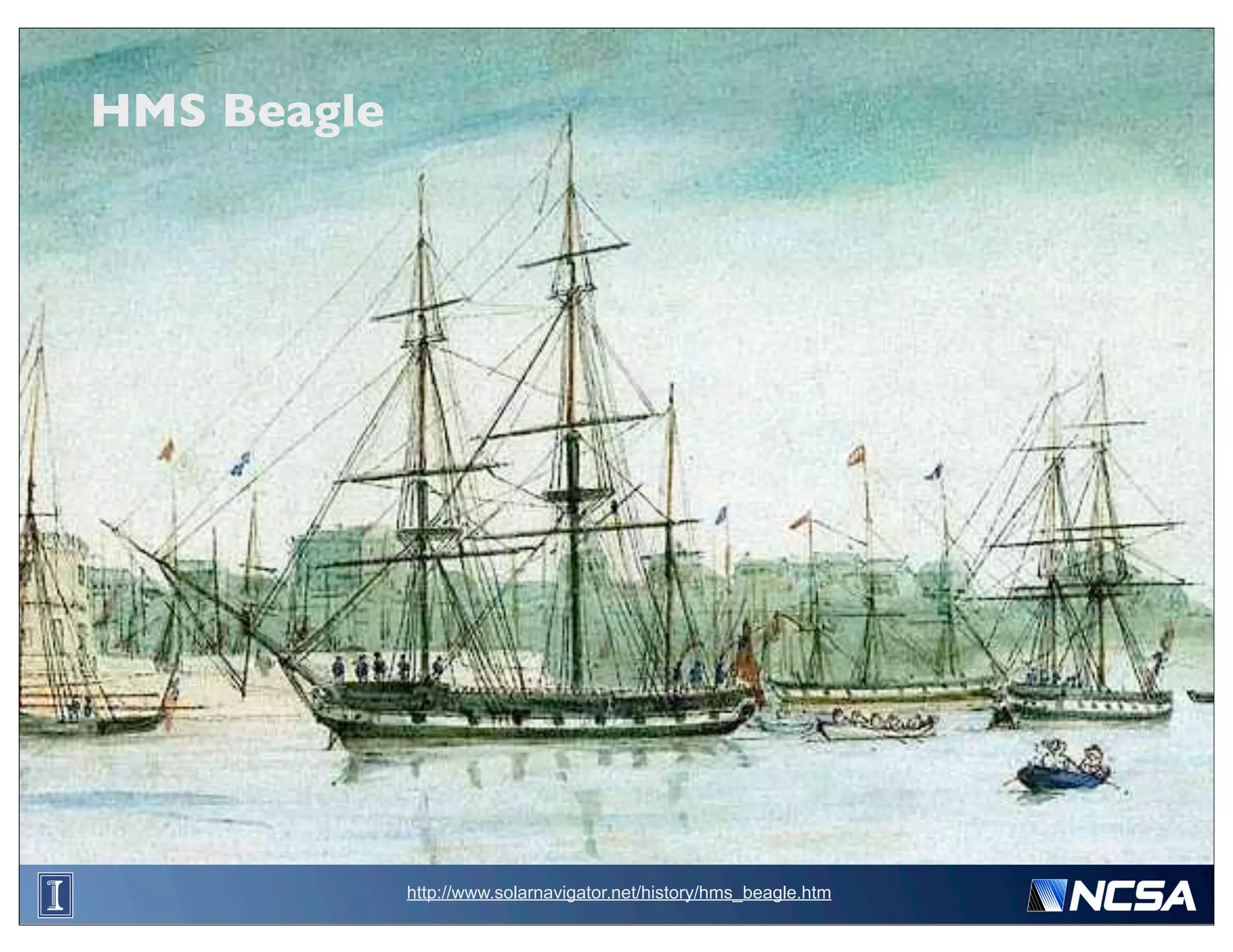
Darwin on HMS Beagle
A quick Darwin background check

• In Edinburgh Charles Darwin
   • Learnt standard geology (Robert Jameson)
   • Exposed to British catastrophism of 1820s
   • Run into Lamarckian ideas with Robert Grant
• Cambridge provide him a chance to
   • Under John Henslow, explored boundaries between varieties and
     species
   • Read and accepted traditional theological explanations of the world
• Evolution existed before and after Darwin
• HMS Beagle
   • Left Plymouth 2pm on December 27, 1831
   • Returned October 2, 1836
HMS Beagle


             http://www.solarnavigator.net/history/hms_beagle.htm
And Galapagos happened
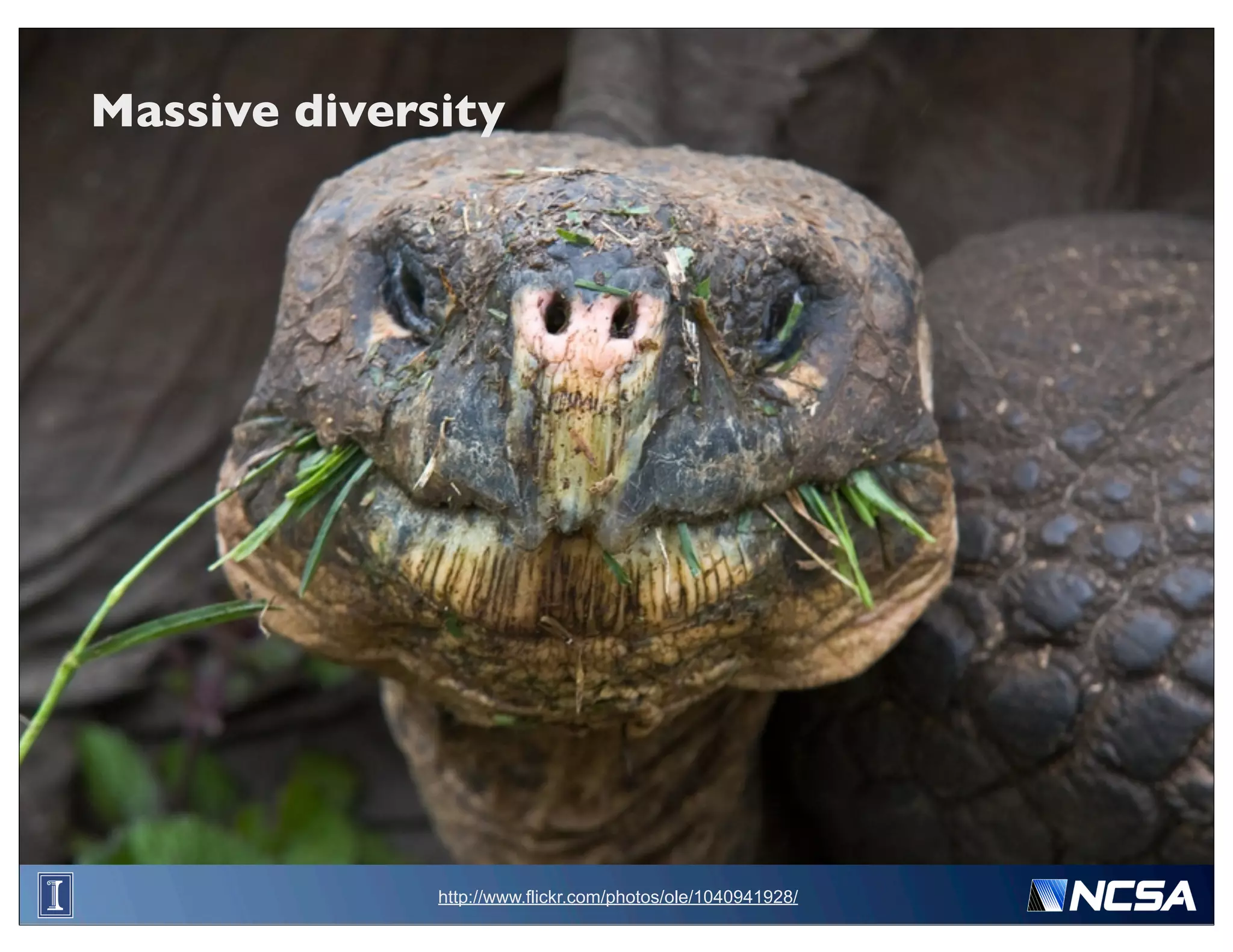
Massive diversity


              http://www.flickr.com/photos/ole/1040941928/
A key realization

• Knowledge on the boundaries of variation/species
• The facts
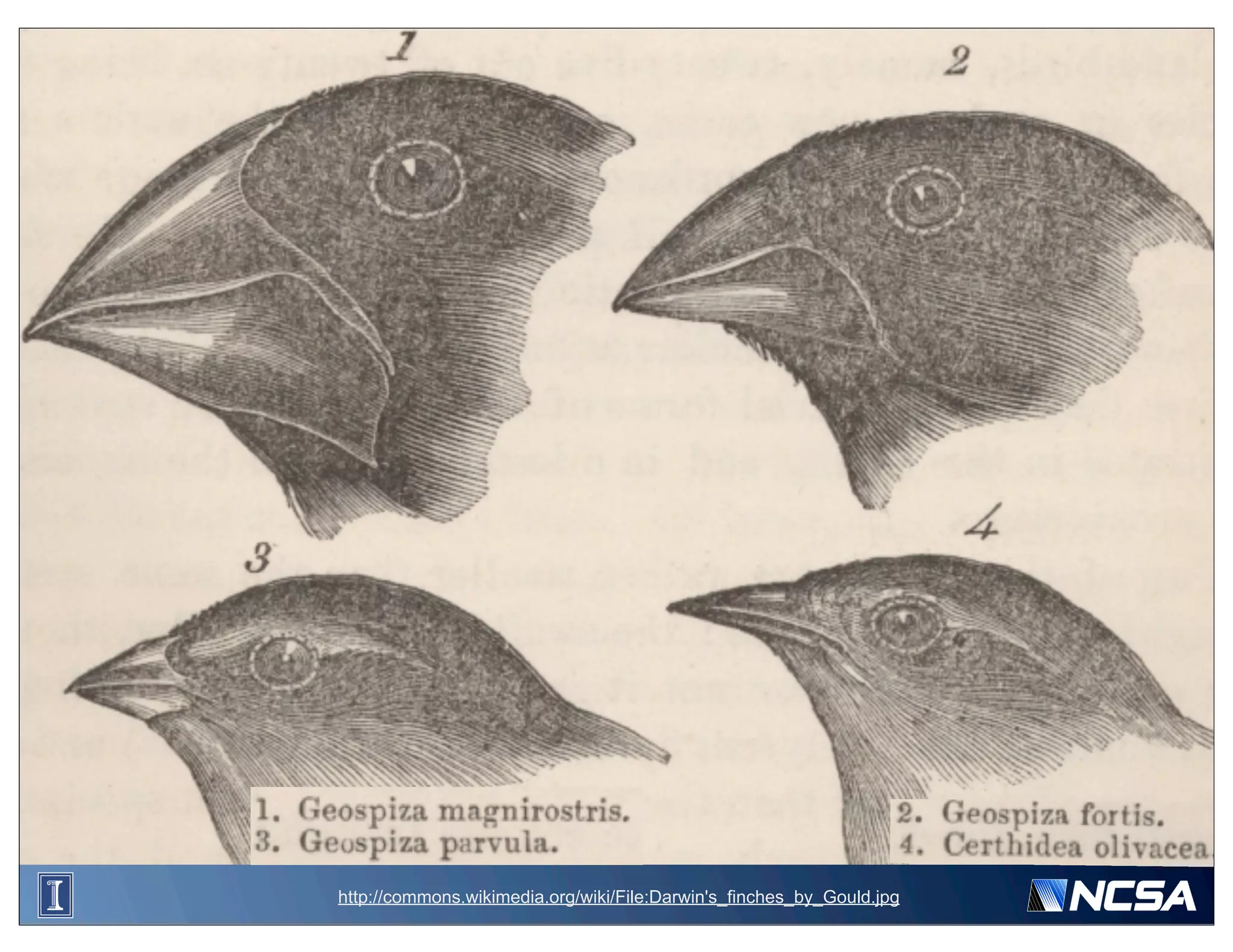
   •   Large number of islands
   •   Islands are spatially separated
   •   Wide diversities of species (different sources of food)
   •   Very close species (beyond variation)
• Start accumulating descriptions of specimens
http://commons.wikimedia.org/wiki/File:Darwin's_finches_by_Gould.jpg
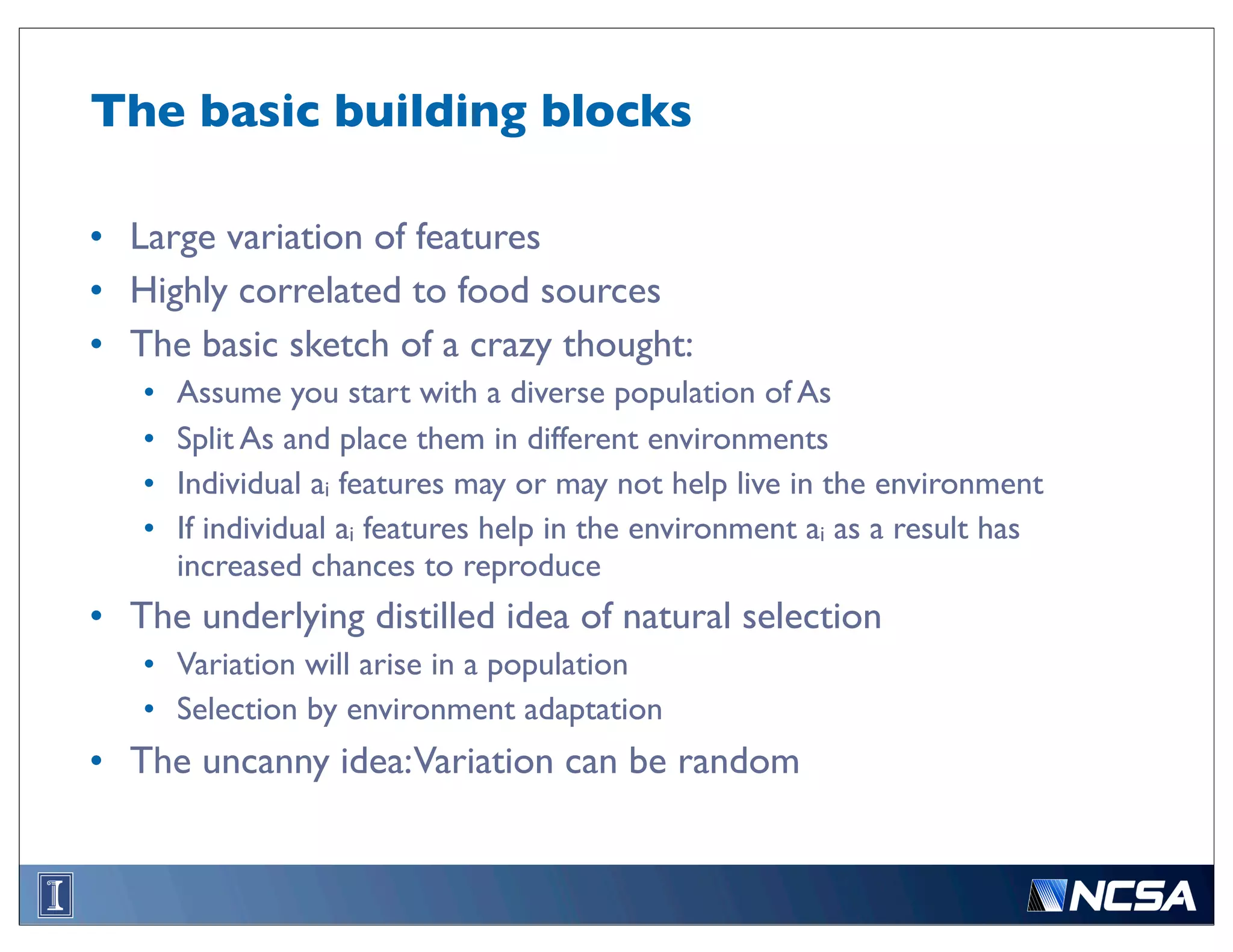
The basic building blocks

• Large variation of features
• Highly correlated to food sources
• The basic sketch of a crazy thought:
   •   Assume you start with a diverse population of As
   •   Split As and place them in different environments
   •   Individual ai features may or may not help live in the environment
   •   If individual ai features help in the environment ai as a result has
       increased chances to reproduce
• The underlying distilled idea of natural selection
   • Variation will arise in a population
   • Selection by environment adaptation
• The uncanny idea:Variation can be random
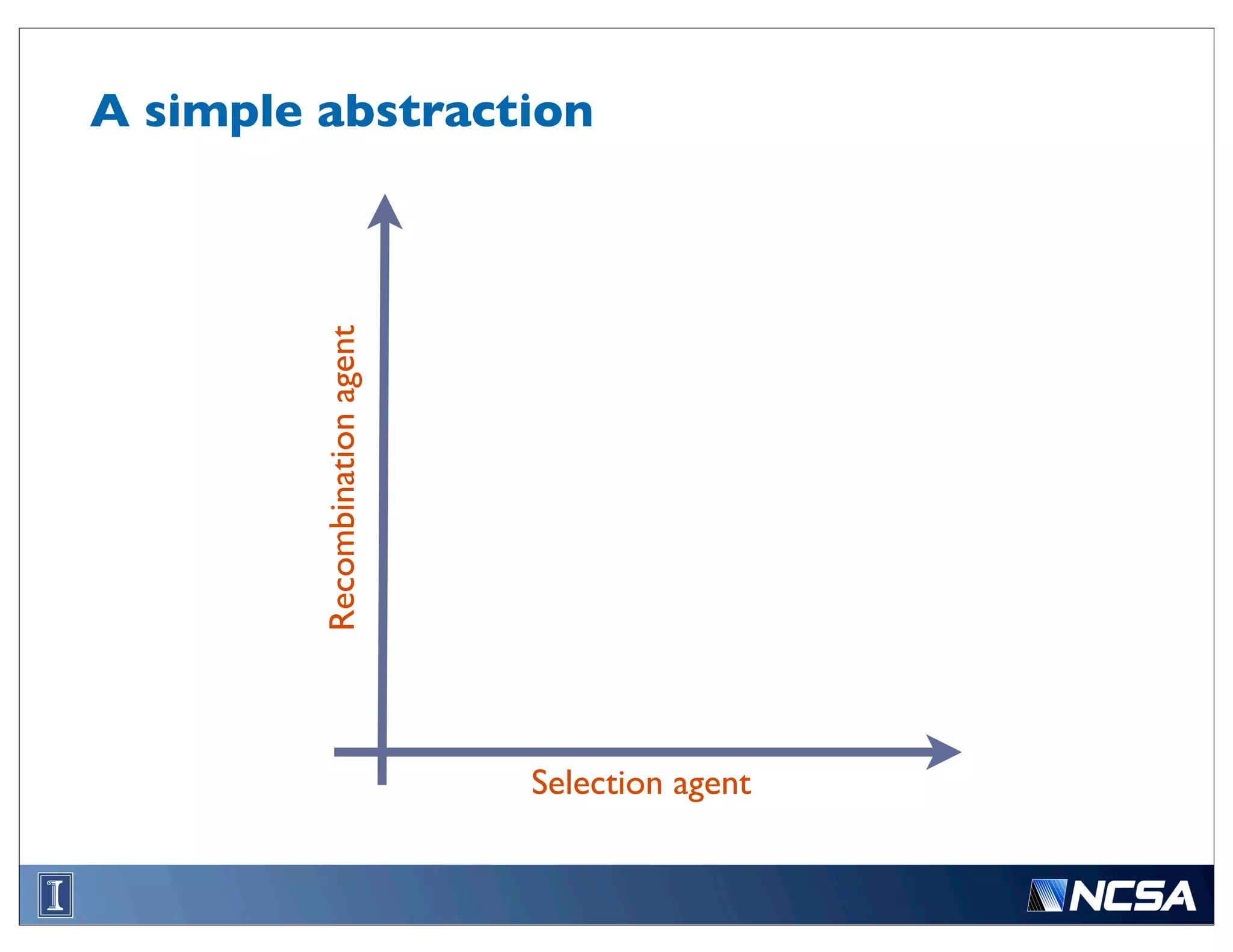
A simple abstraction


         Recombination agent


                               Selection agent
[Fast forward] ... and genomics arise
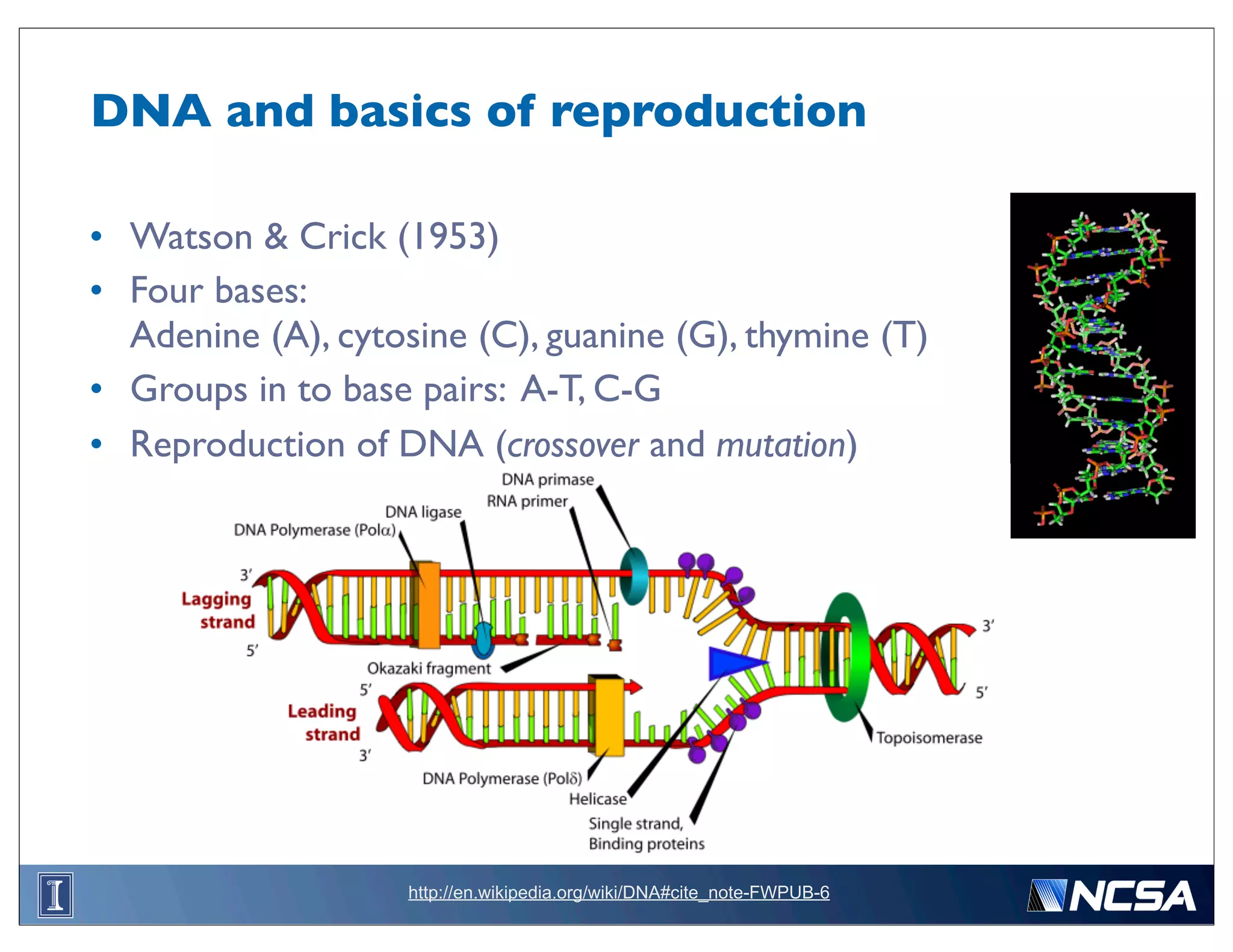
DNA and basics of reproduction

• Watson & Crick (1953)
• Four bases:
  Adenine (A), cytosine (C), guanine (G), thymine (T)
• Groups in to base pairs: A-T, C-G
• Reproduction of DNA (crossover and mutation)


                    http://en.wikipedia.org/wiki/DNA#cite_note-FWPUB-6
[Fast forward] ... and computers happen
A quick stop in the late 60s

•   Computers were the next cool thing
•   Genetics were on the rise
•   A professor at University of Michigan
•   Natural evolution
    • Diverse population of individual
    • Individual ai features may or may not help
      live in the environment
    • If individual ai features help in the
      environment ai as a result has increased
      chances to reproduce
• Artificial evolution?
    • Model of such evolutionary process
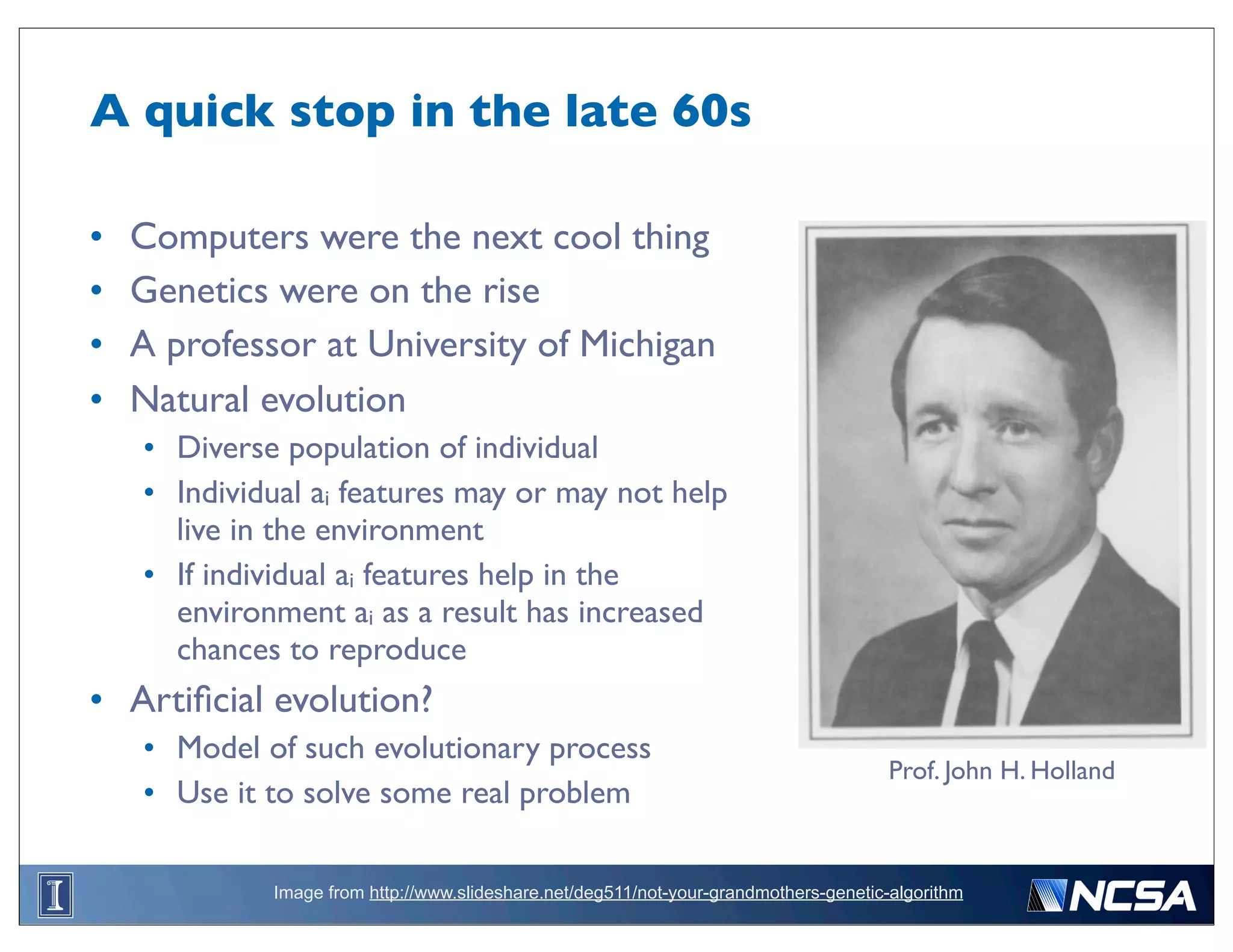
                                                                                       Prof. John H. Holland
    • Use it to solve some real problem

             Image from http://www.slideshare.net/deg511/not-your-grandmothers-genetic-algorithm
What is a genetic algorithm?	


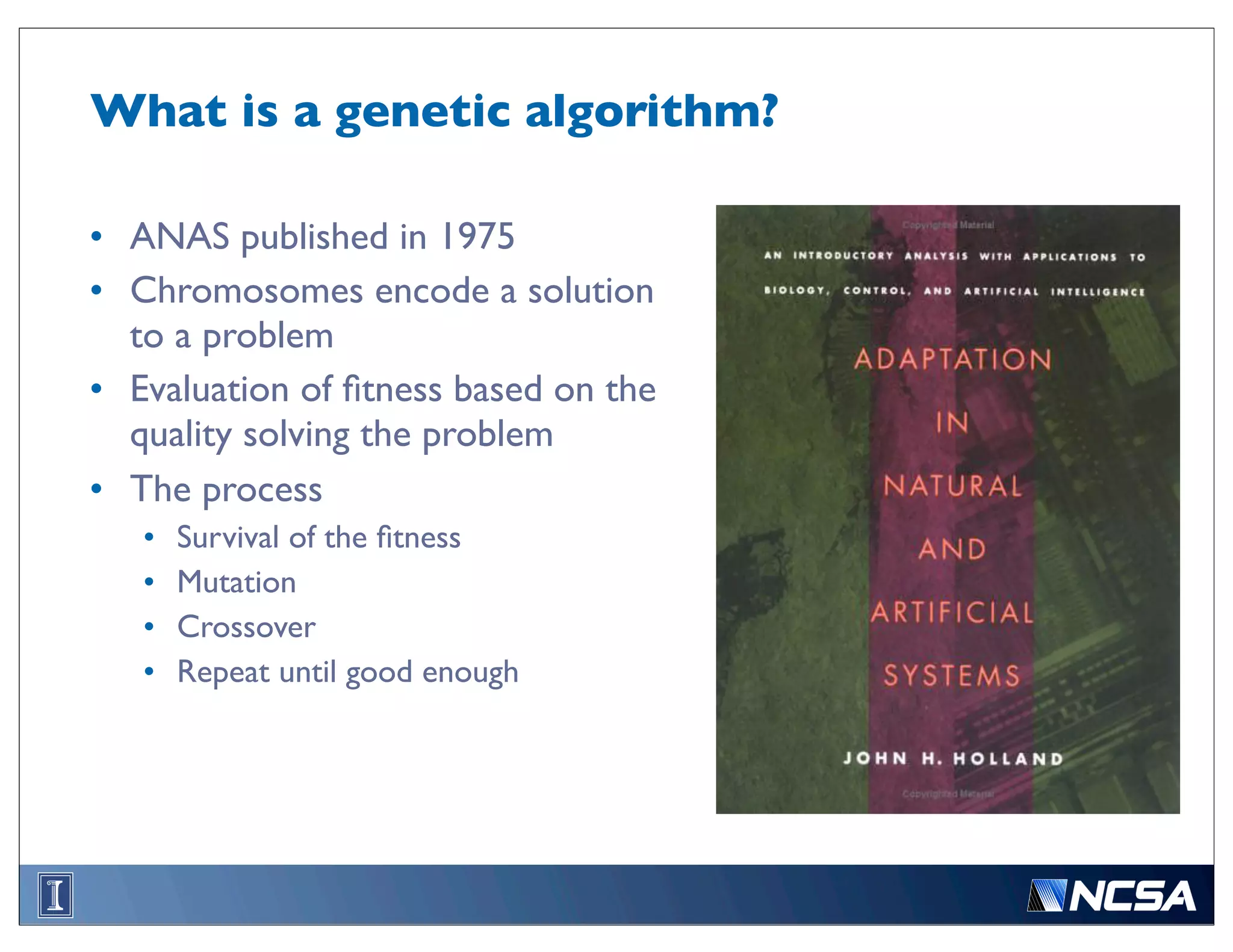
• ANAS published in 1975
• Chromosomes encode a solution
  to a problem
• Evaluation of fitness based on the
  quality solving the problem
• The process
   •   Survival of the fitness
   •   Mutation
   •   Crossover
   •   Repeat until good enough
A simple example

•   Imagine you have a box with an array of switches
•   0 off, 1on
•   Depending on the switch arrangement you get some payoff
•   Payoff is equivalent to the number of switches that are on
•   The goal: Maximize the payoff
Encoding the problem

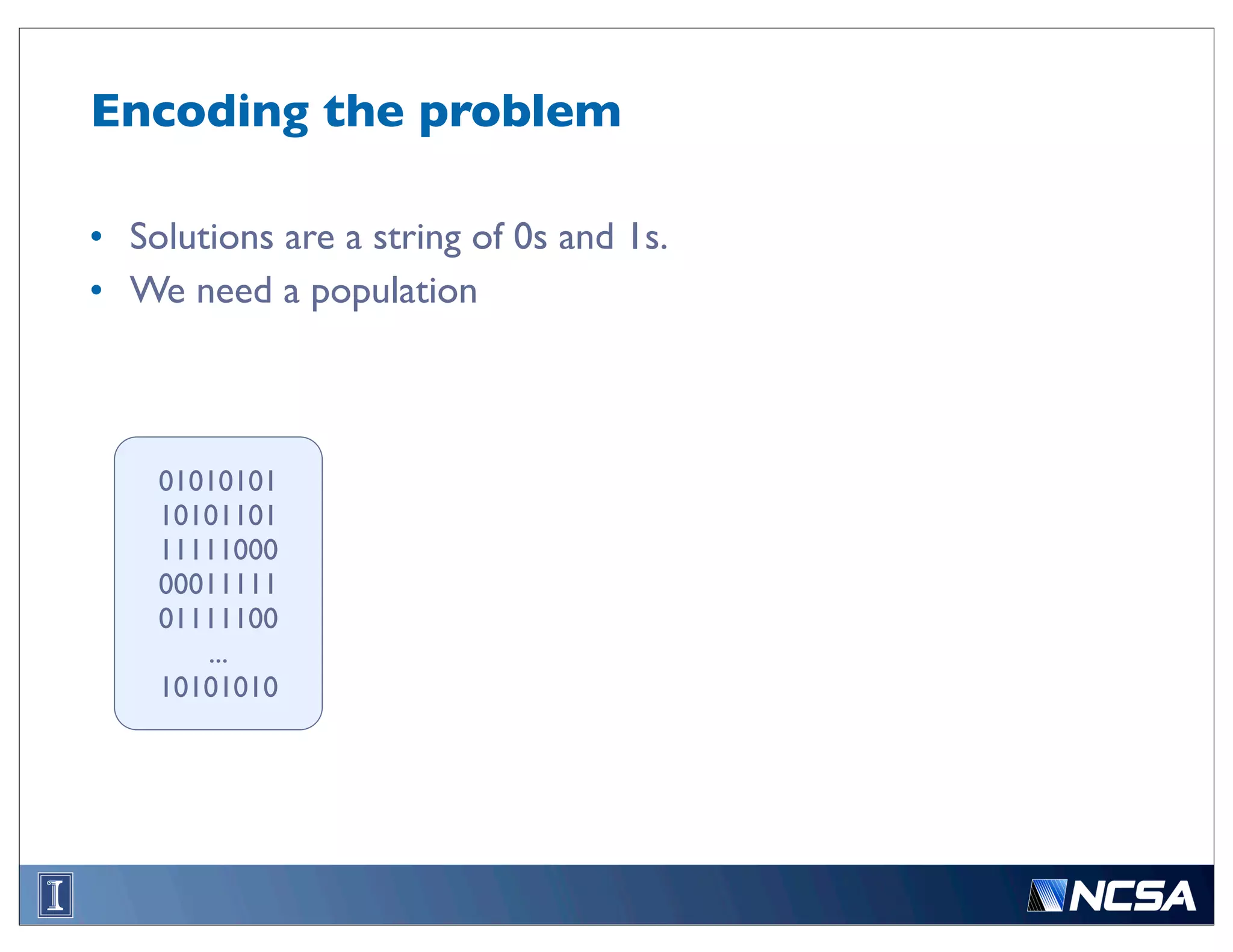
• Solutions are a string of 0s and 1s.
• We need a population


    01010101
    10101101
    11111000
    00011111
    01111100
       ...
    10101010
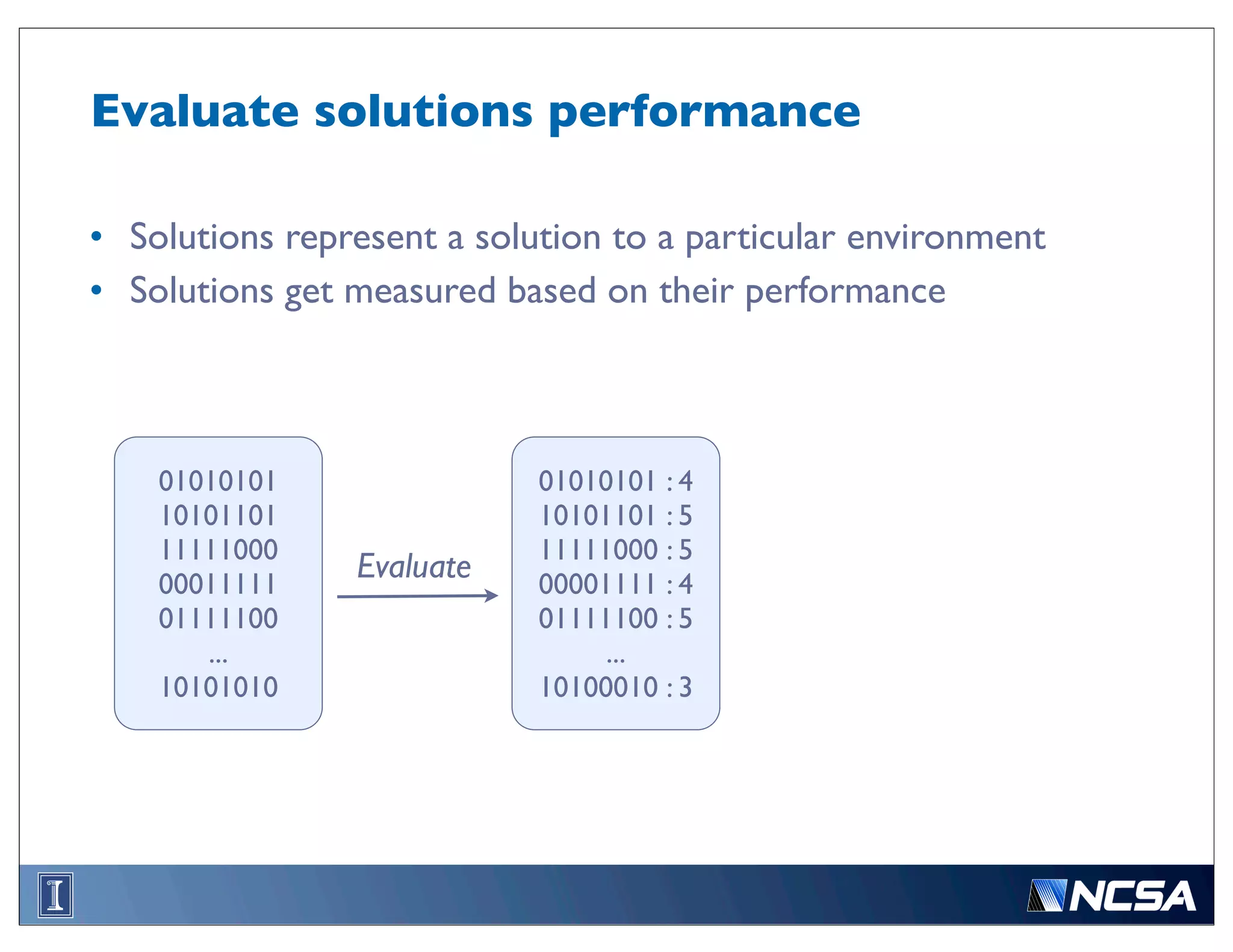
Evaluate solutions performance

• Solutions represent a solution to a particular environment
• Solutions get measured based on their performance


    01010101                01010101 : 4
    10101101                10101101 : 5
    11111000                11111000 : 5
    00011111
                Evaluate    00001111 : 4
    01111100                01111100 : 5
       ...                       ...
    10101010                10100010 : 3
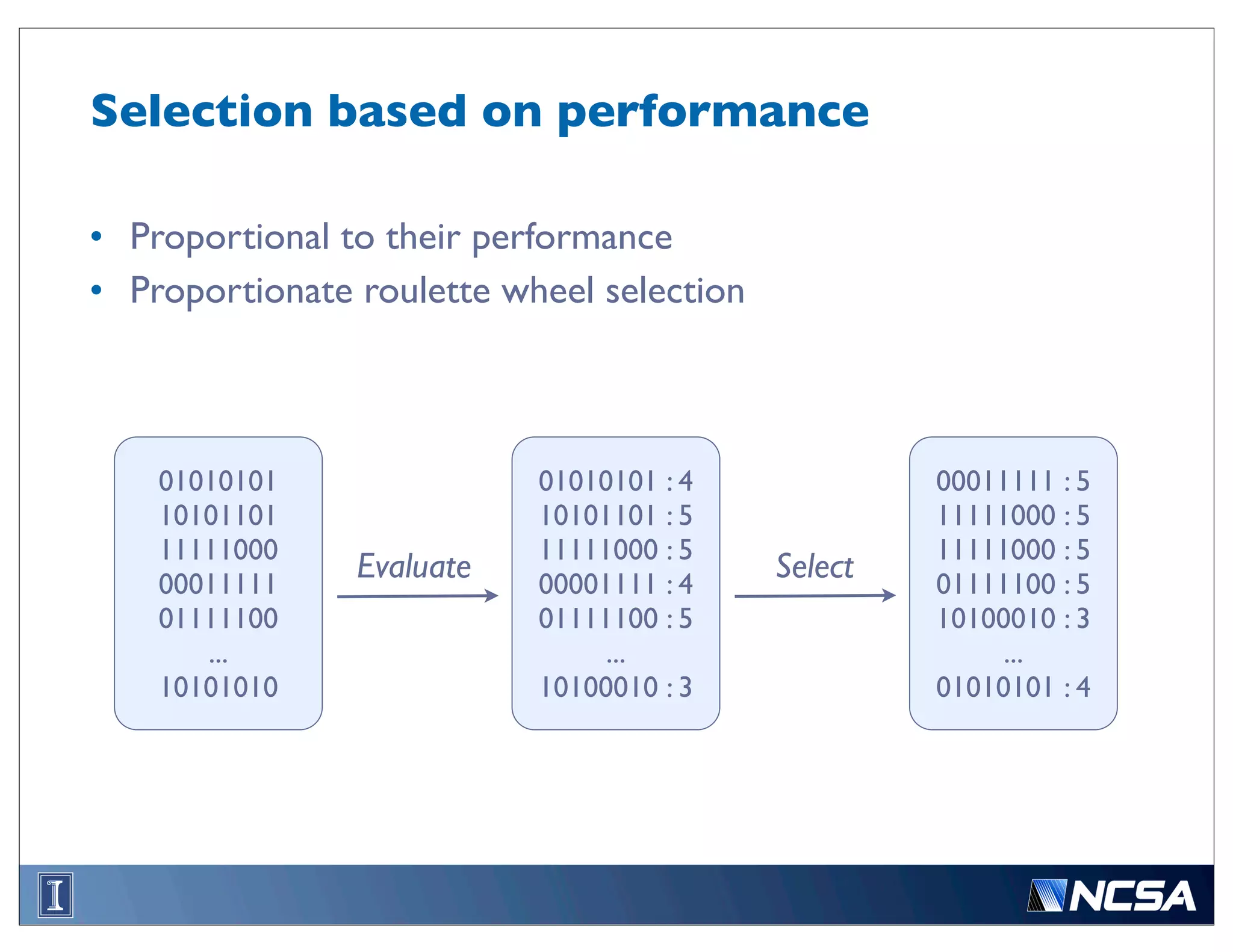
Selection based on performance

• Proportional to their performance
• Proportionate roulette wheel selection


    01010101               01010101 : 4             00011111 : 5
    10101101               10101101 : 5             11111000 : 5
    11111000               11111000 : 5             11111000 : 5
    00011111
                Evaluate   00001111 : 4
                                           Select   01111100 : 5
    01111100               01111100 : 5             10100010 : 3
       ...                      ...                      ...
    10101010               10100010 : 3             01010101 : 4
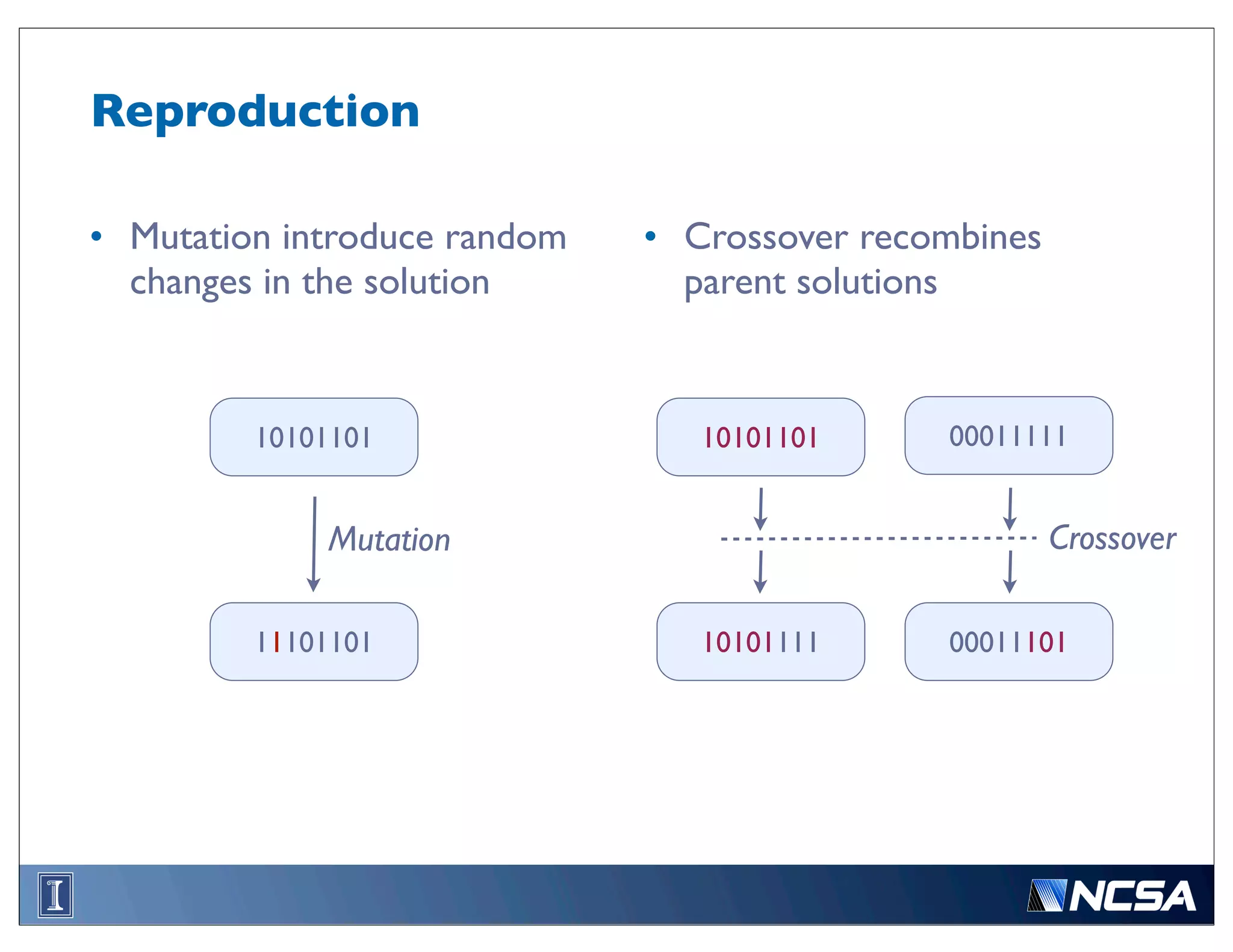
Reproduction

• Mutation introduce random   • Crossover recombines
  changes in the solution       parent solutions


         10101101                10101101     00011111


             Mutation                                  Crossover

         11101101                10101111     00011101
A nagging question

• In early 80s by David E. Goldberg
• How do uninteresting operators yield interesting behavior?
• 1983 proposed the innovation intuition:
  “Genetic algorithm power like that of human innovation”
• The underlying elements:
   • Selection + mutation as hillclimbing or kaizen
   • Selection + crossover = innovation
• In another words
   • Introducing small changes and keeping them if the improve performance
   • [...] Takes two to invent anything. One makes up combinations; the other
     one chooses [...] (Paul Valéry)
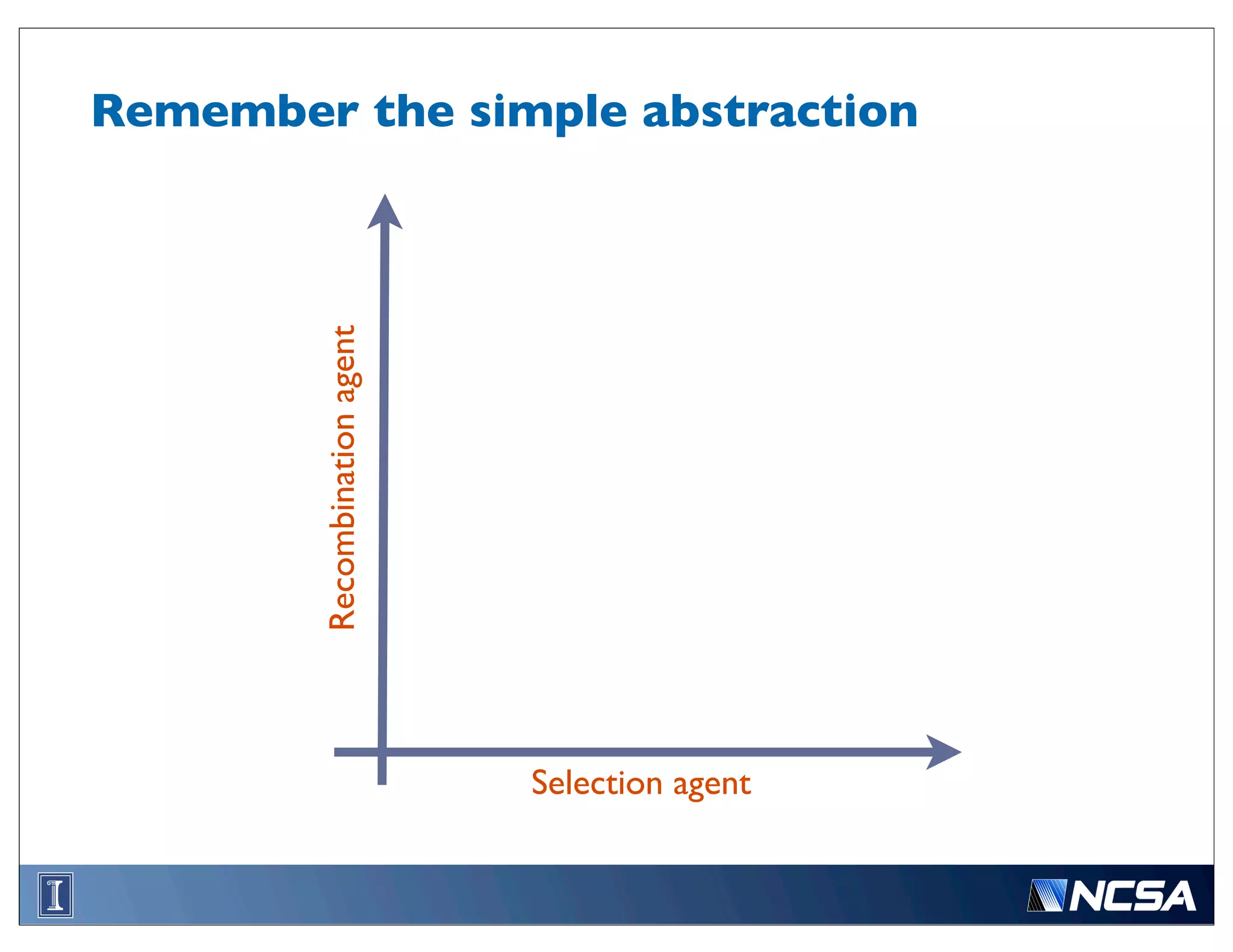
Remember the simple abstraction


        Recombination agent


                              Selection agent
Goldberg’s intuition

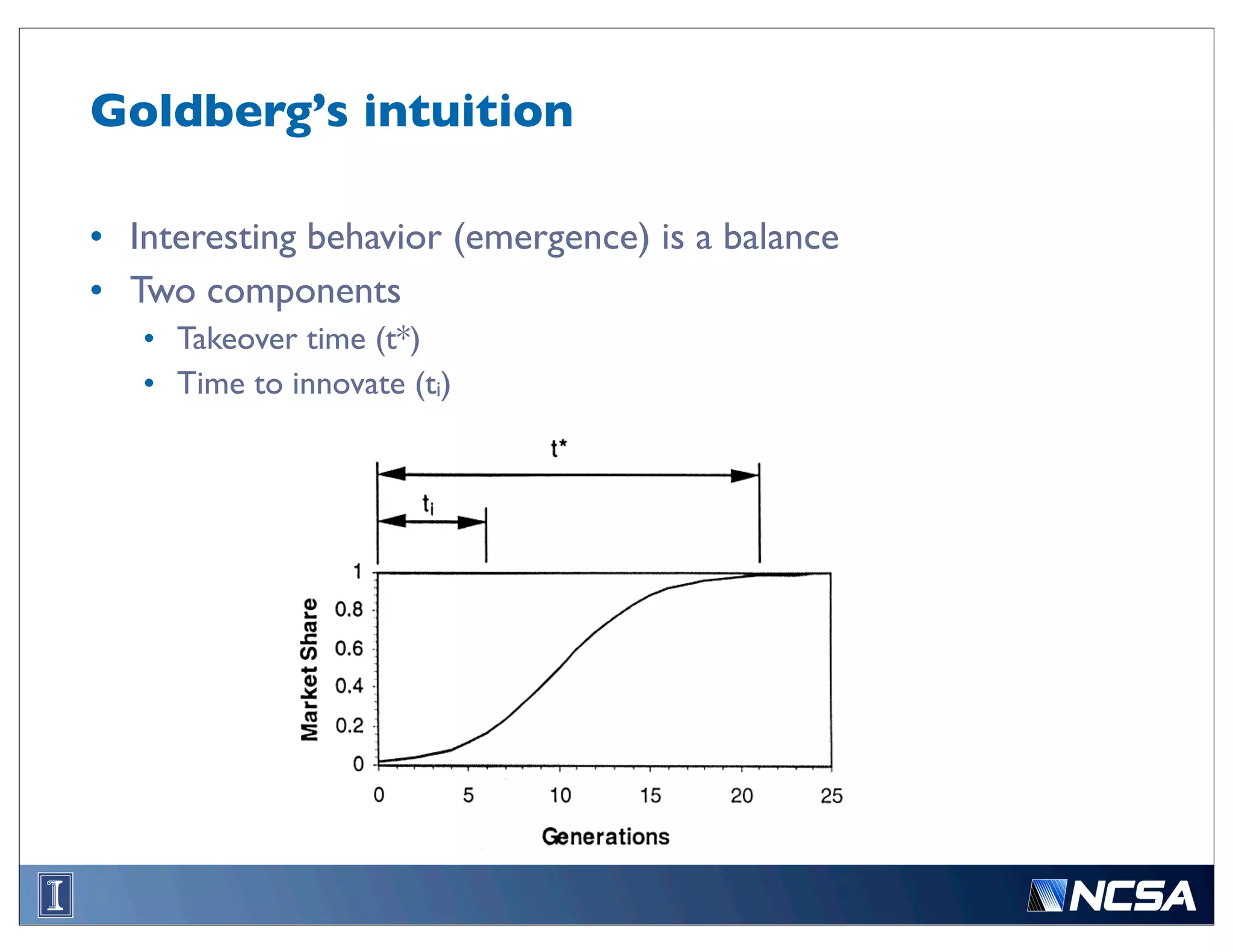
• Interesting behavior (emergence) is a balance
• Two components
   • Takeover time (t*)
   • Time to innovate (ti)
Goldberg’s intuition

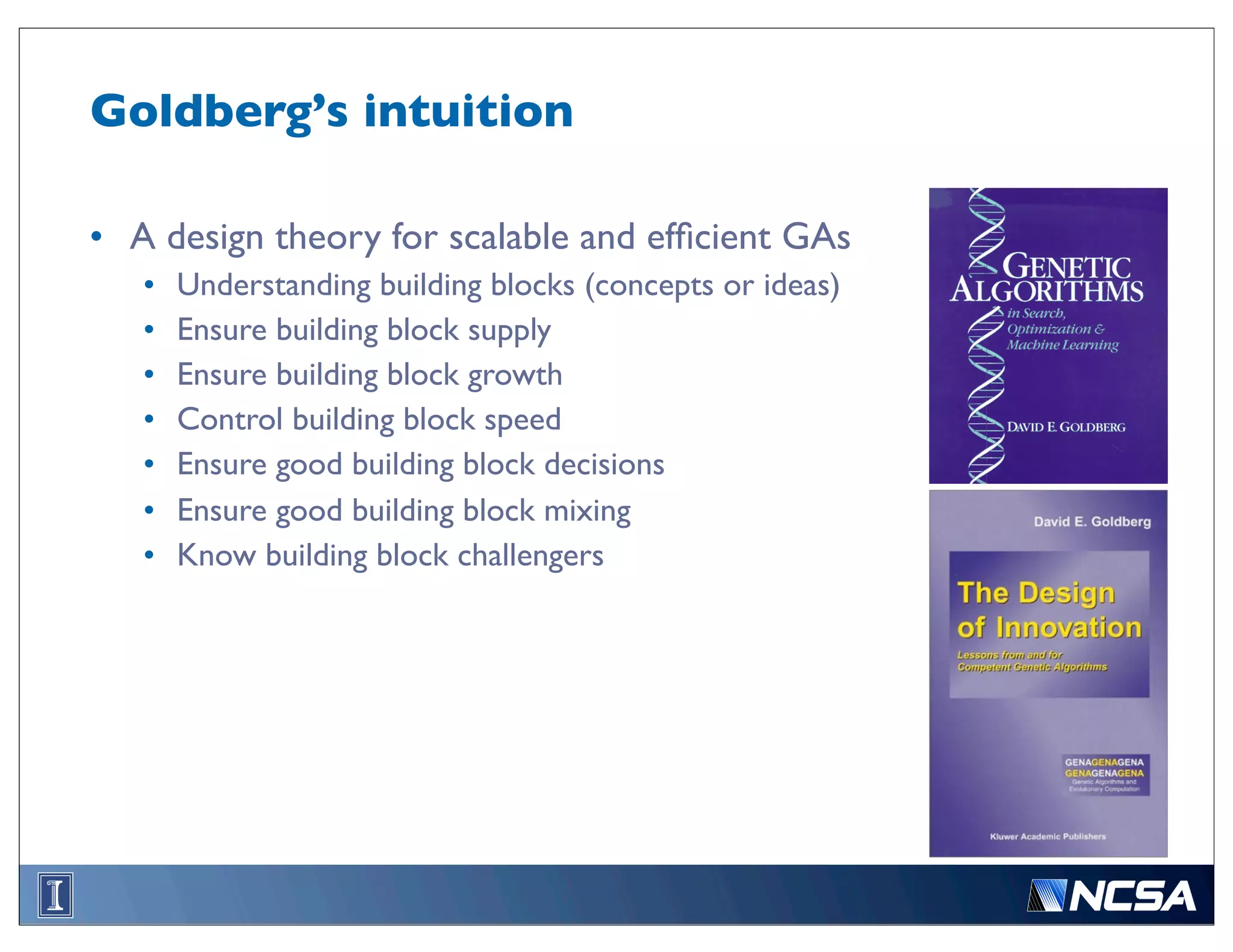
• A design theory for scalable and efficient GAs
   •   Understanding building blocks (concepts or ideas)
   •   Ensure building block supply
   •   Ensure building block growth
   •   Control building block speed
   •   Ensure good building block decisions
   •   Ensure good building block mixing
   •   Know building block challengers
An interesting social insight

• GAs used for optimization, search, machine learning, ...
• But Valéry’s quote also implied a social aspect to innovation
   • Solutions may be created in the vacuum, randomly, or carefully crafted
   • There is a social element of acceptance/rejection
• Paul Valéry (1871-1945) lived after Darwin published his ideas
[Fast forward] ... The 2.0 information age
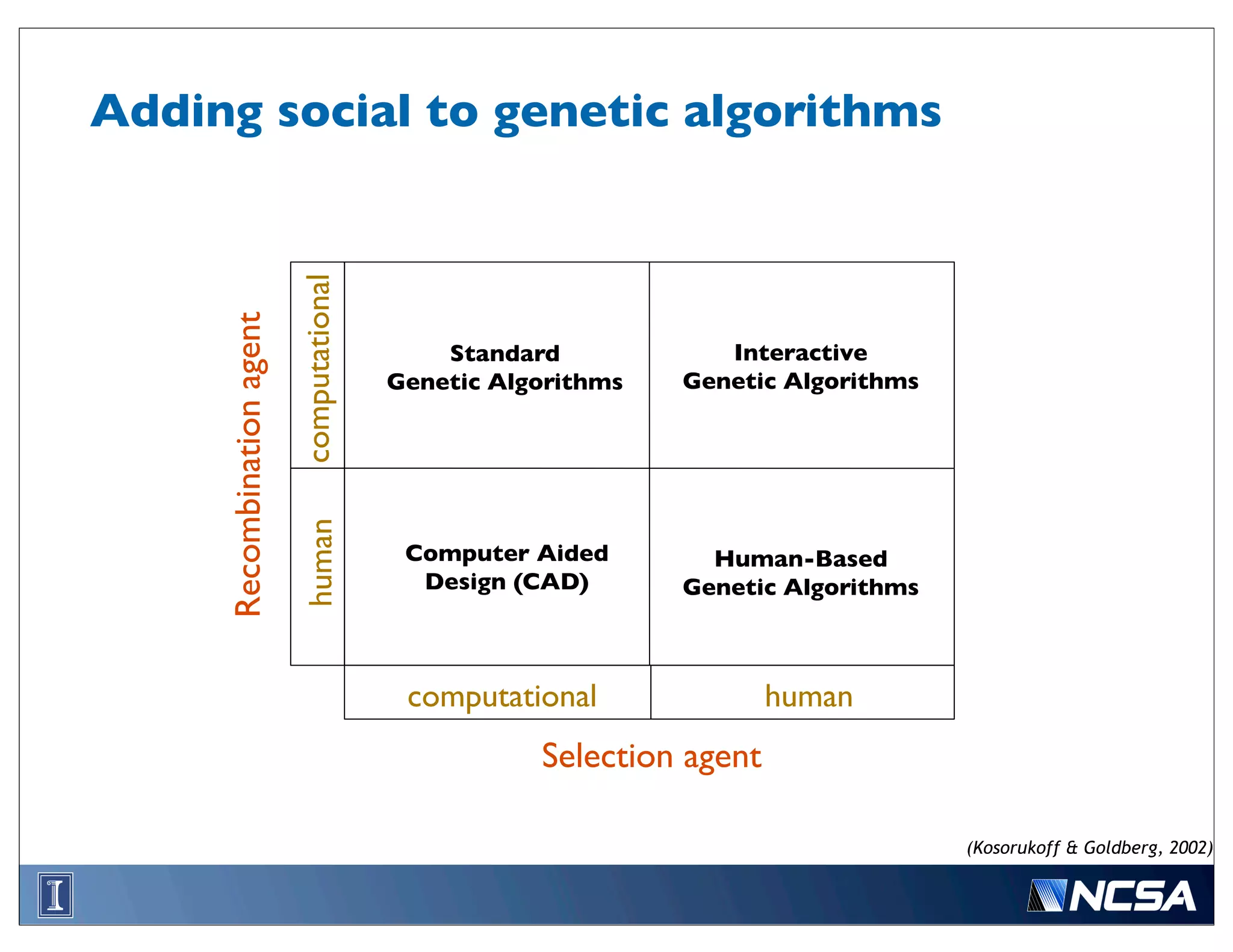
Adding social to genetic algorithms


                           computational
     Recombination agent

                                               Standard            Interactive
                                           Genetic Algorithms   Genetic Algorithms
                           human


                                            Computer Aided        Human-Based
                                             Design (CAD)       Genetic Algorithms


                                            computational               human
                                                      Selection agent

                                                                                     (Kosorukoff & Goldberg, 2002)
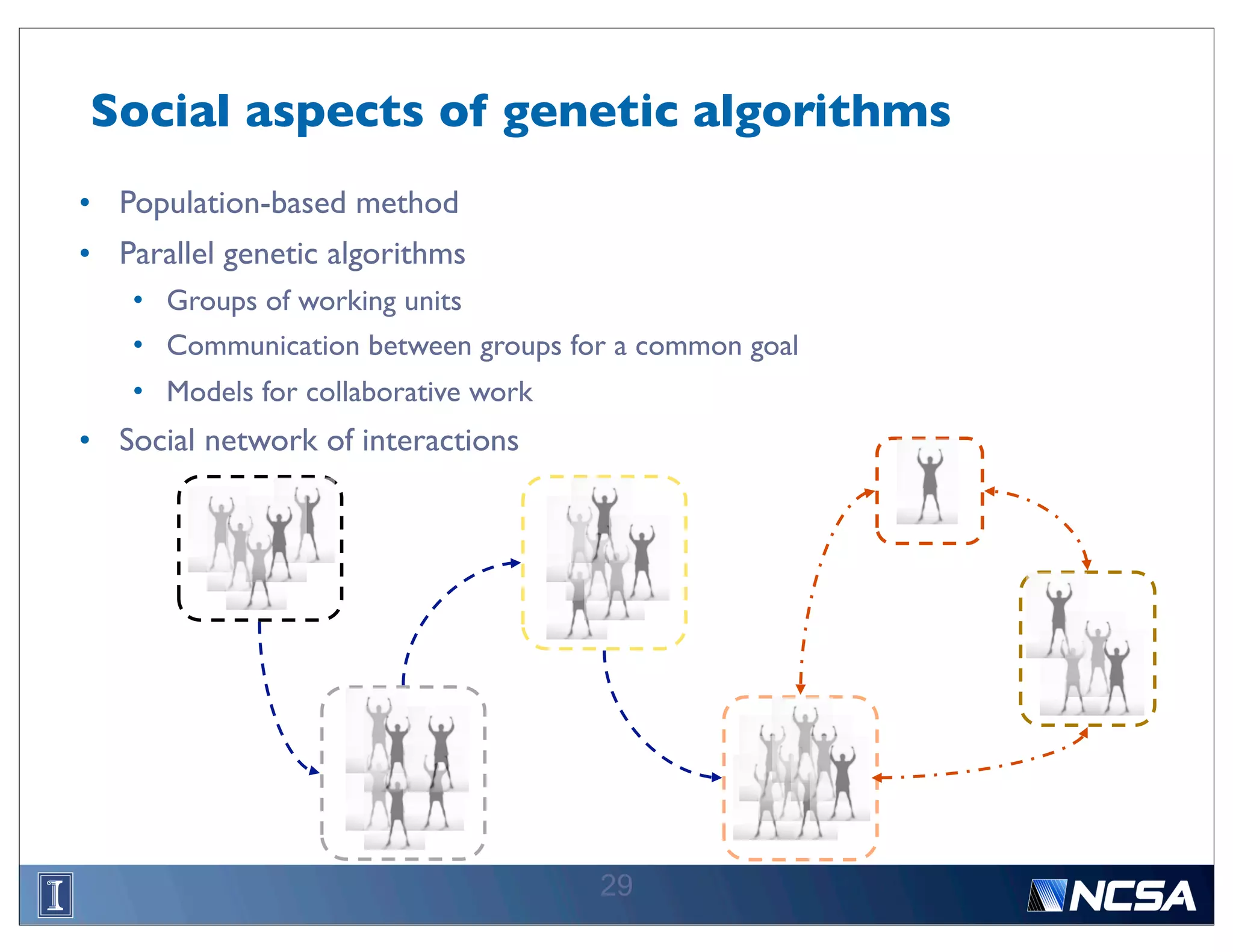
Social aspects of genetic algorithms
• Population-based method
• Parallel genetic algorithms
    • Groups of working units
    • Communication between groups for a common goal
    • Models for collaborative work
• Social network of interactions


                                      29
The DISCUS project

• IlliGAL & NCSA collaboration started in 2003
• Computers have become mediators of collaborations
   • Email, chat rooms, blogs, wikis…
   • A flood of available information
   • Different modes of communication
• Let’s take advantage of such information
   •   Logs of conversations
   •   Archive of documents (email attachments, blogs, personal web pages…)
   •   Human-computer interactions
   •   Social aspect of the communication and collaboration


                                     30
The question

• Could we help build a system using genetic algorithms/natural
  selection ideas that could foster innovation and creativity?
• The era of available Web 2.0 tools
   • Web portals
   • Collaboration and communication tools (message boards, chats, blogs,
     Twitter…)
   • Genetic algorithm (Interactive, Human-based, and Parallel GAs)
   • Chance discovery (KeyGraphs and Influence Diffusion Models)
   • Data and text mining
   • Information retrieval
   • Web services
   • Data-intensive computing


                                    31
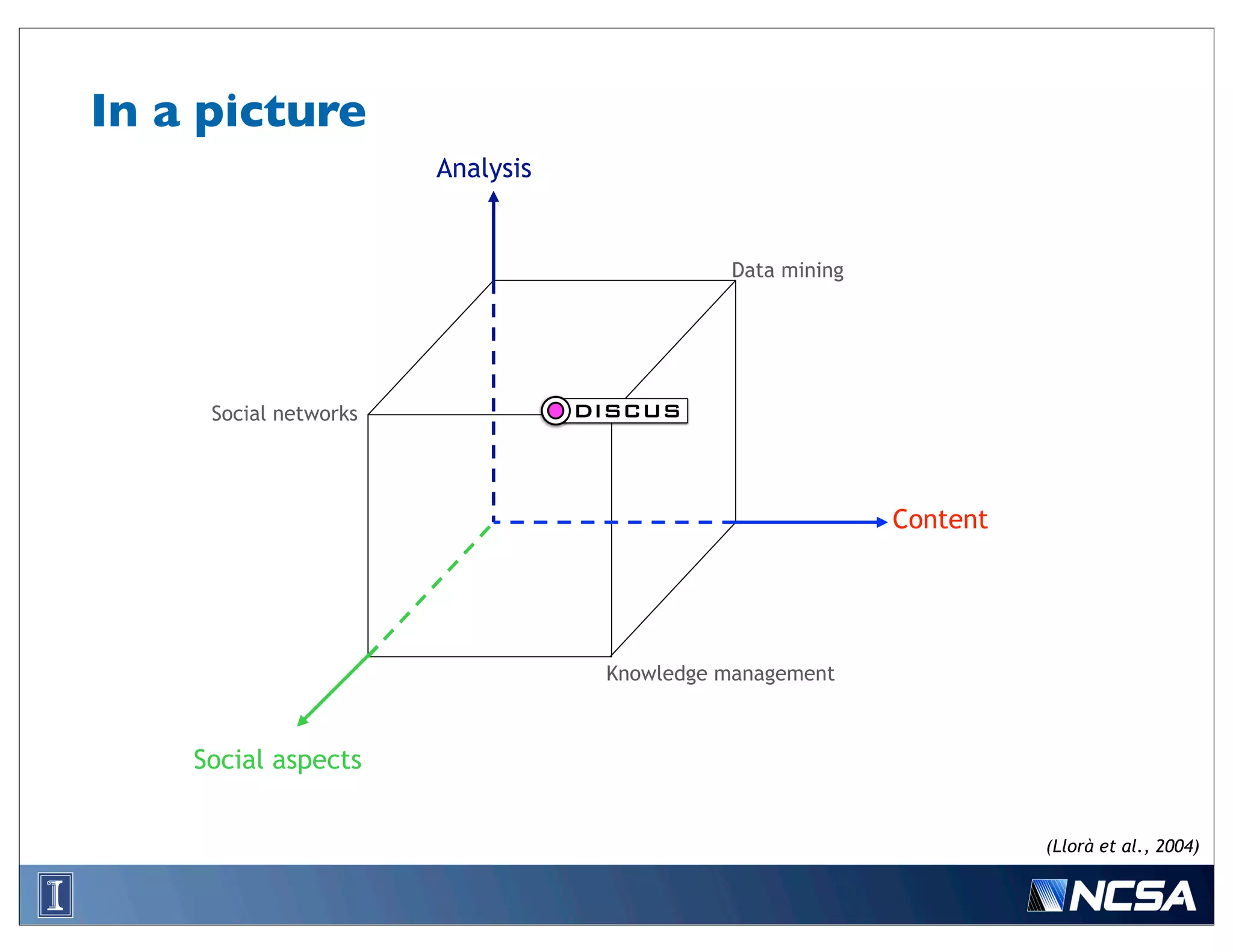
In a picture
                       Analysis


                                            Data mining


     Social networks


                                                          Content


                                  Knowledge management


    Social aspects


                                                                    (Llorà et al., 2004)
A simple exercise

• Imagine you are chatting with your friends
• Your ideas are bundled in messages
   • You pass them your your friends
   • They read them, think about them
   • Your friends reply to you
• Could we model it using natural selection?
   • Valéry suggest so
   • Goldberg proposed a simple model using the human-based GA analogy
• If so, Goldberg’s methodology should apply
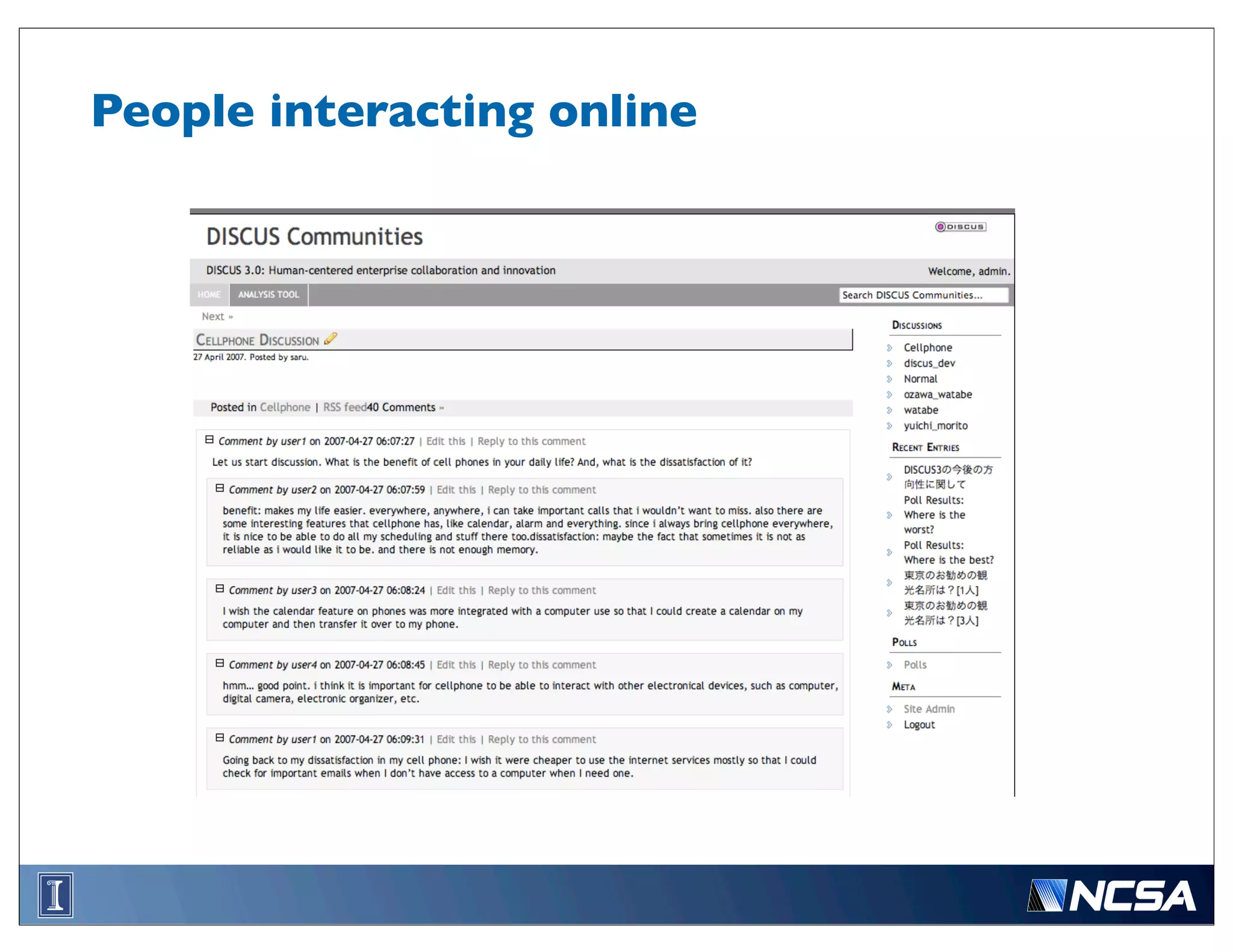
People interacting online
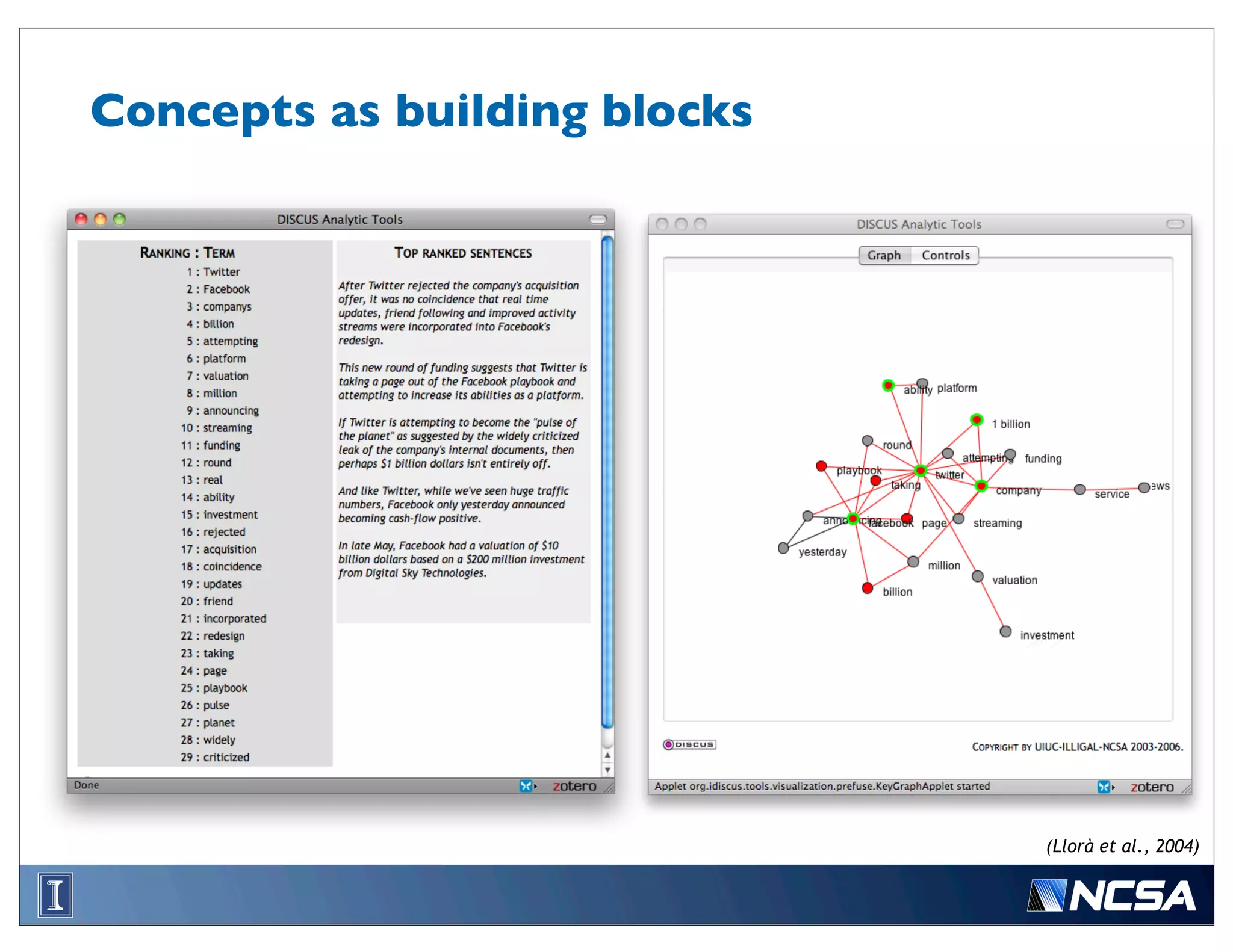
Concepts as building blocks


                              (Llorà et al., 2004)
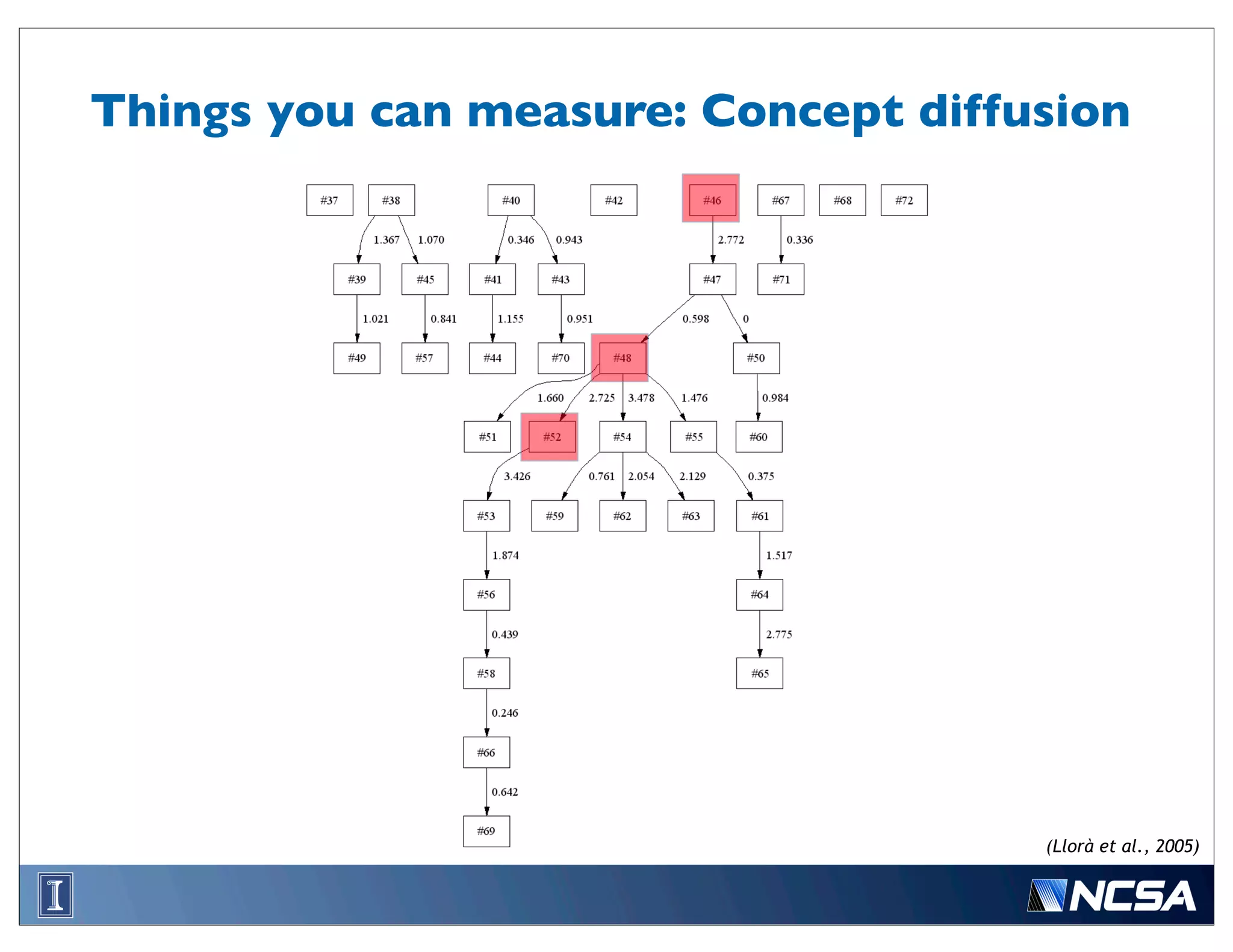
Things you can measure: Concept diffusion


                                     (Llorà et al., 2005)
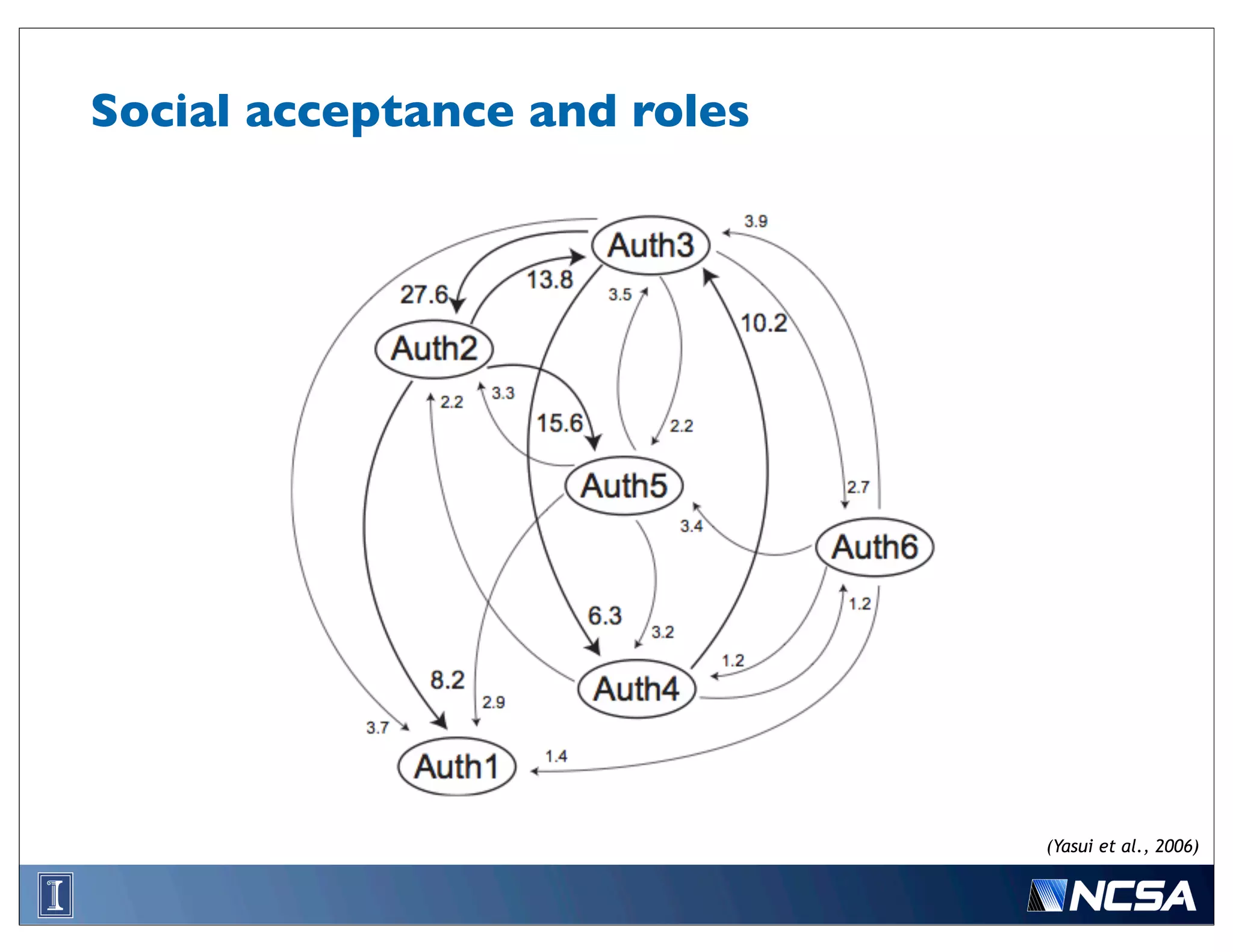
Social acceptance and roles


                              (Yasui et al., 2006)
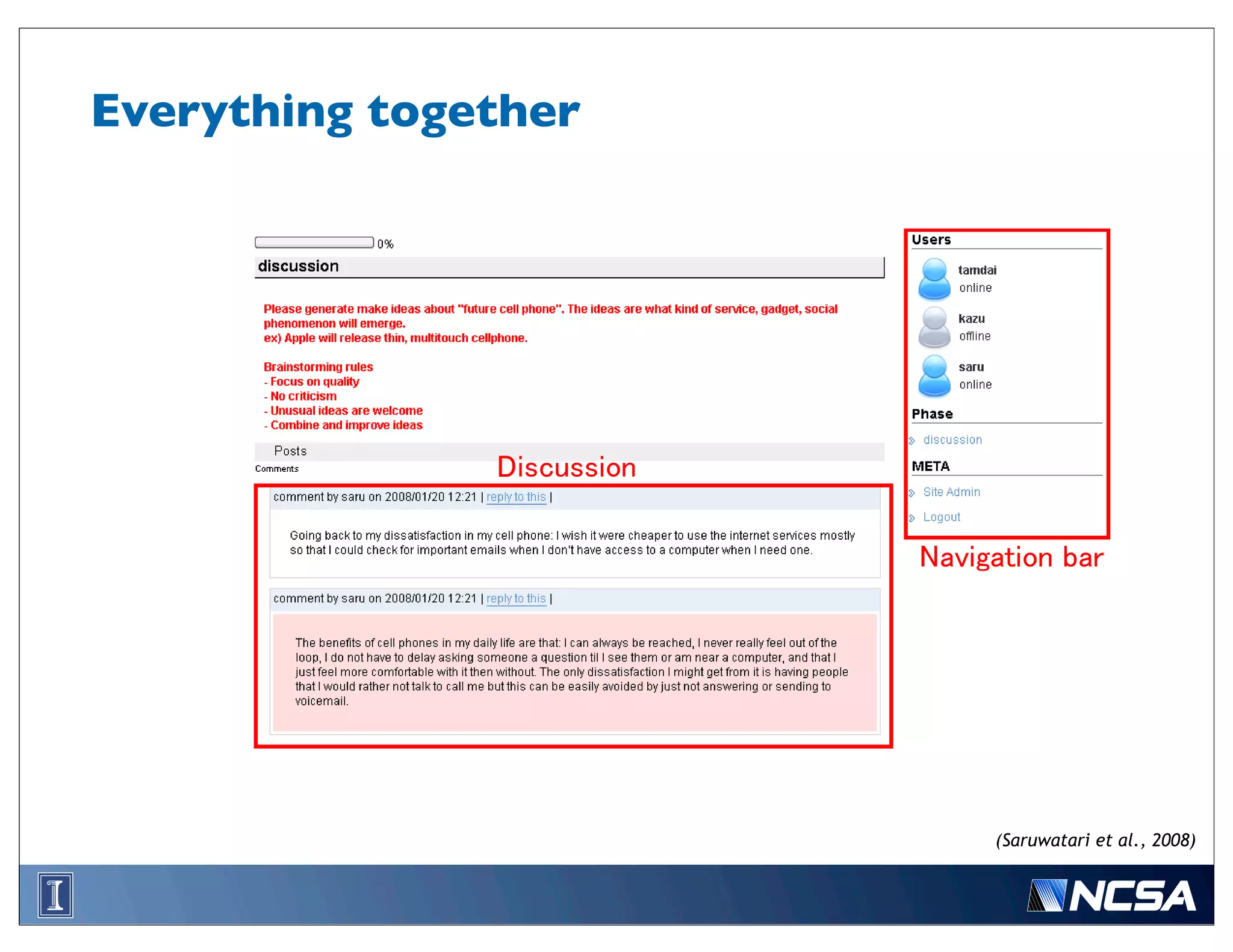
Everything together


                      (Saruwatari et al., 2008)
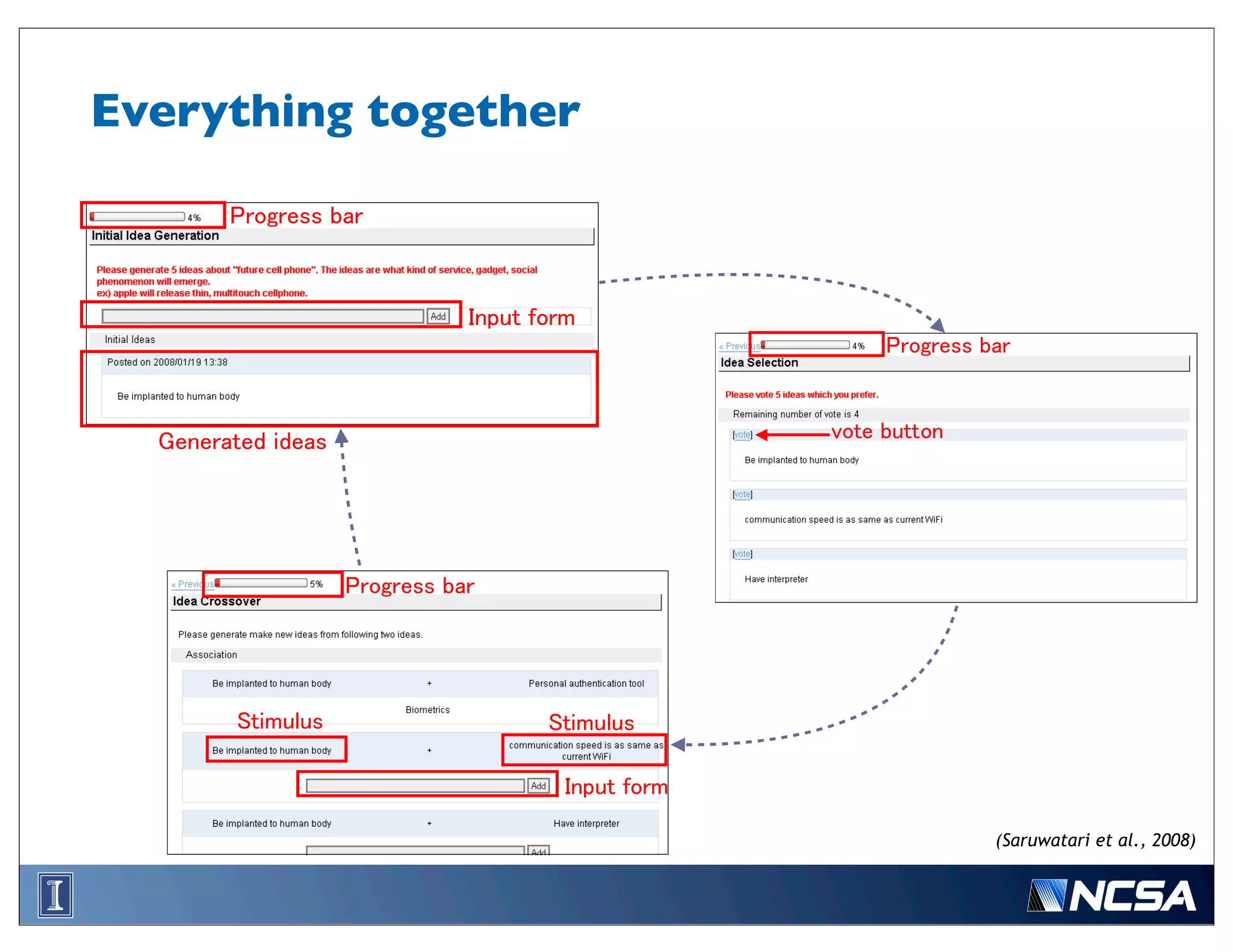
Everything together


                      (Saruwatari et al., 2008)
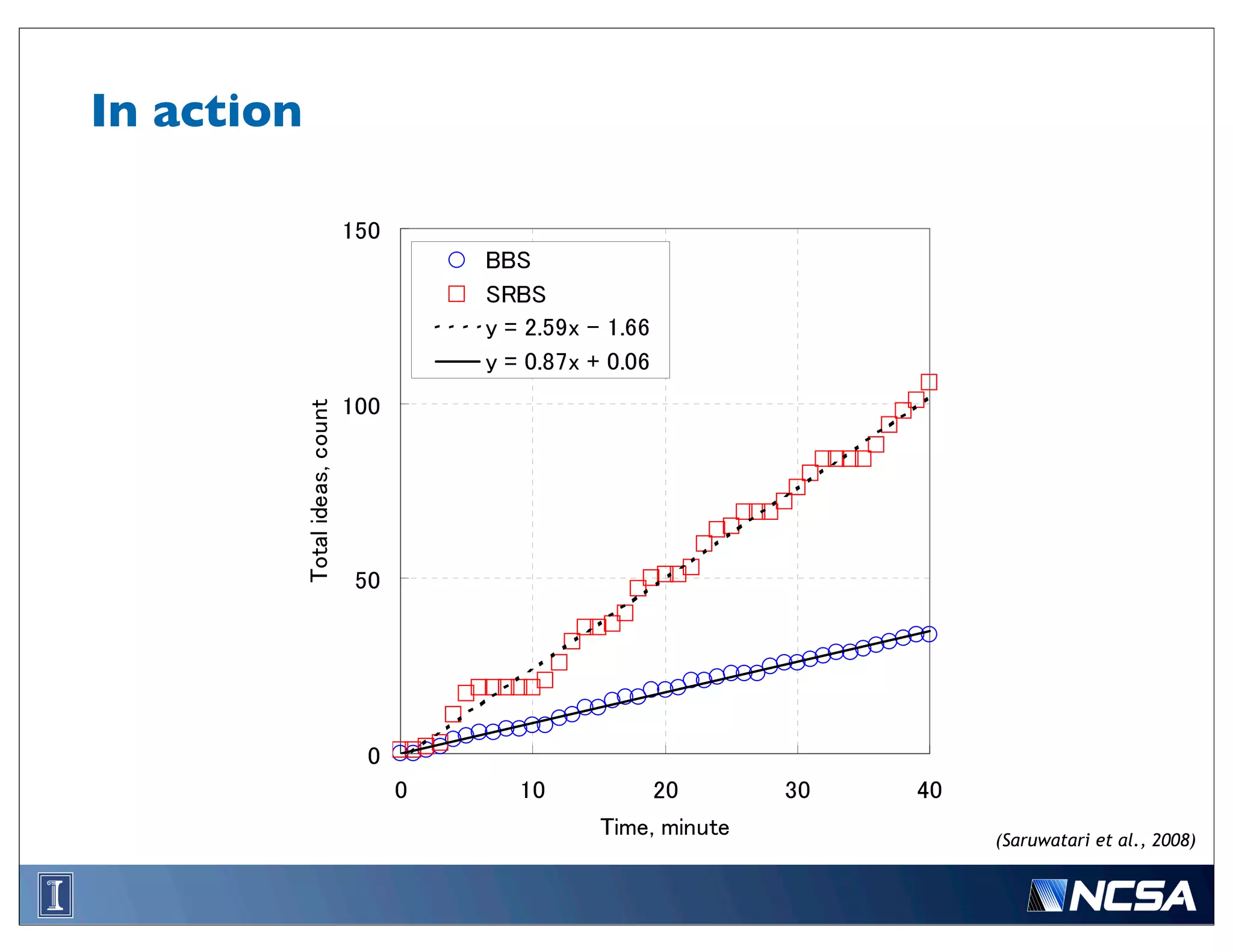
In action


            (Saruwatari et al., 2008)
Other possible usages

•   Tracking influence on social media (e.g. Twitter)
•   User preference modeling
•   Topic overlap
•   Topic/trend dynamics (how conversation is changing on the fly)
•   Blogosphere and company message misalignment
•   ...
... and beyond
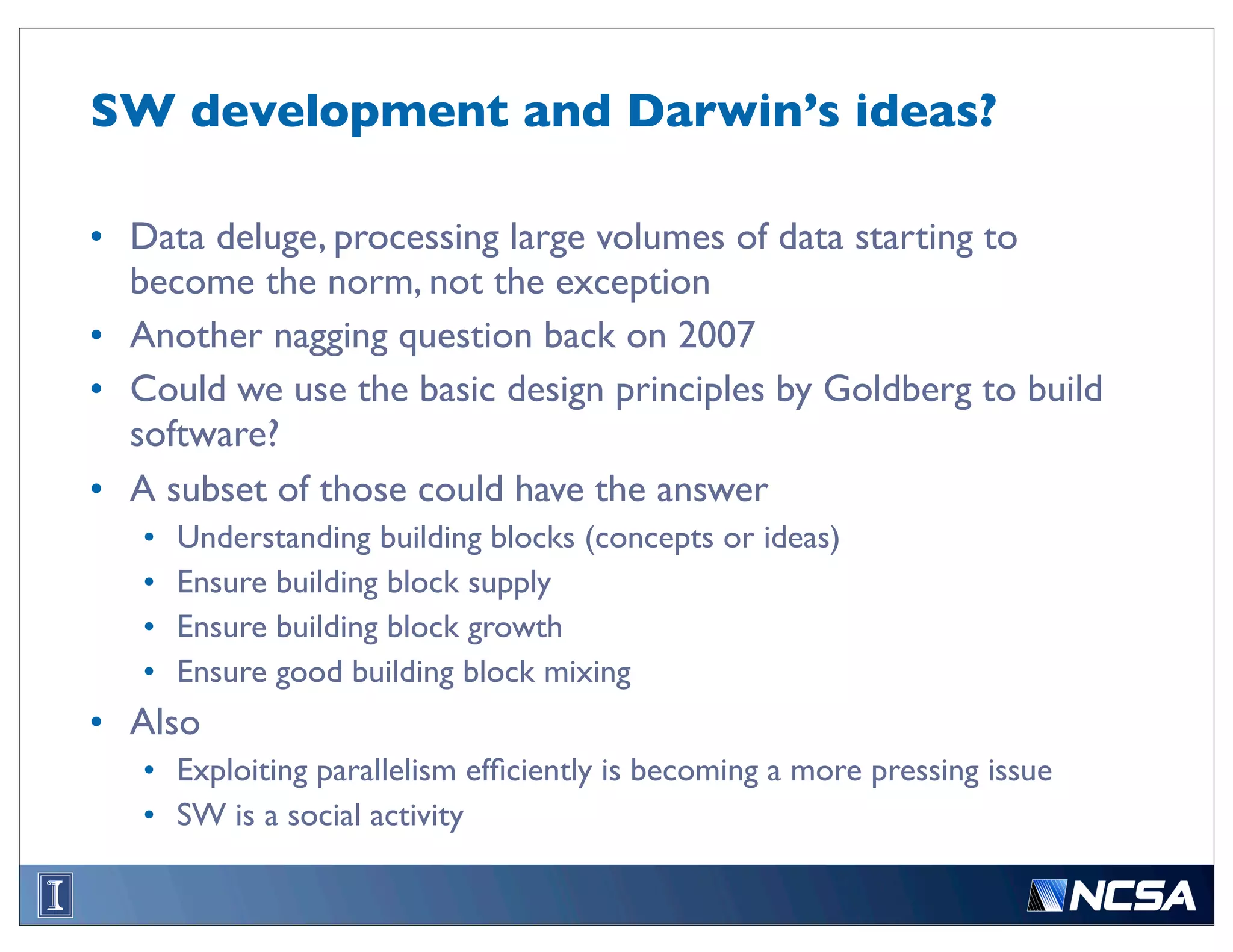
SW development and Darwin’s ideas?

• Data deluge, processing large volumes of data starting to
  become the norm, not the exception
• Another nagging question back on 2007
• Could we use the basic design principles by Goldberg to build
  software?
• A subset of those could have the answer
   •   Understanding building blocks (concepts or ideas)
   •   Ensure building block supply
   •   Ensure building block growth
   •   Ensure good building block mixing
• Also
   • Exploiting parallelism efficiently is becoming a more pressing issue
   • SW is a social activity
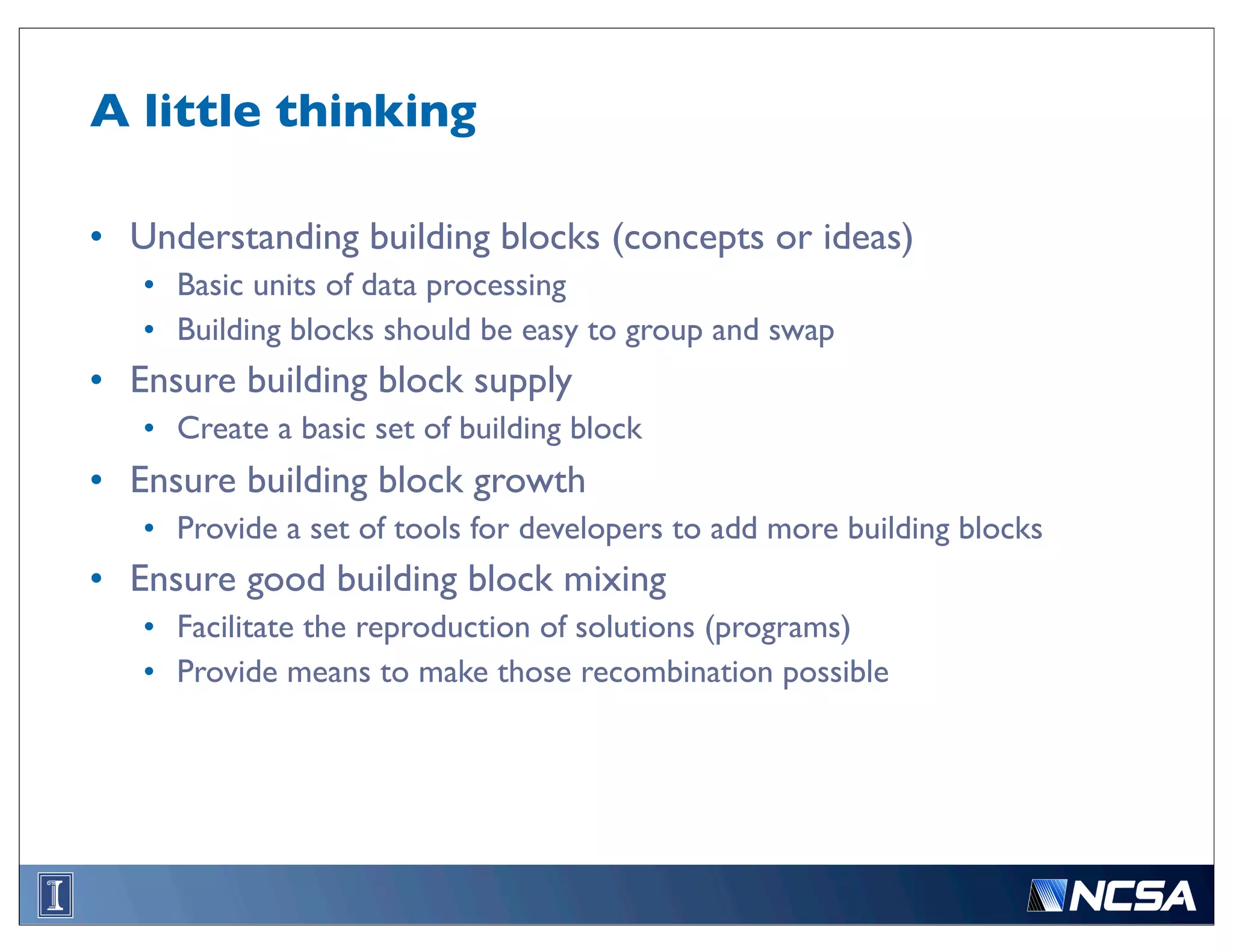
A little thinking

• Understanding building blocks (concepts or ideas)
   • Basic units of data processing
   • Building blocks should be easy to group and swap
• Ensure building block supply
   • Create a basic set of building block
• Ensure building block growth
   • Provide a set of tools for developers to add more building blocks
• Ensure good building block mixing
   • Facilitate the reproduction of solutions (programs)
   • Provide means to make those recombination possible
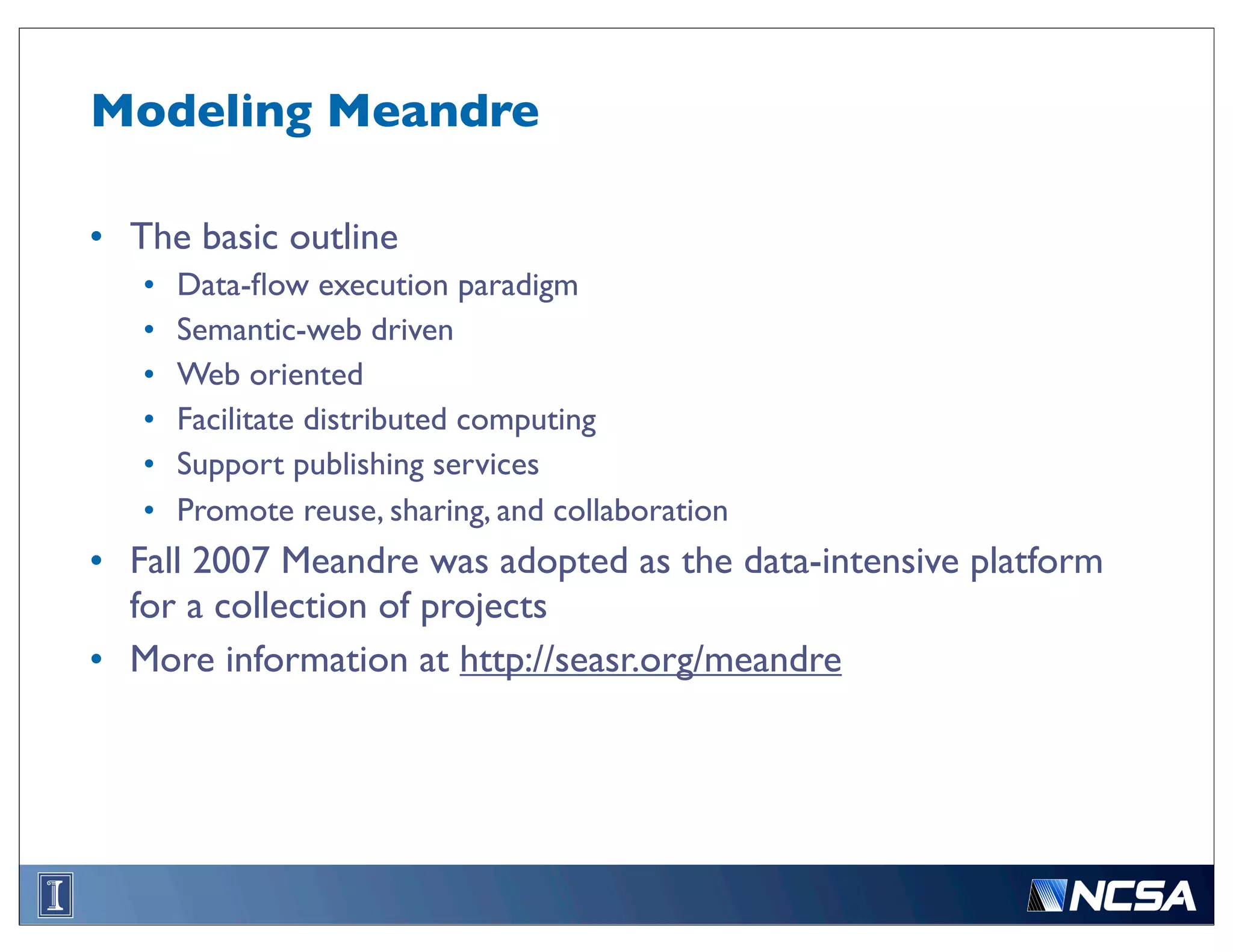
Modeling Meandre

• The basic outline
   •   Data-flow execution paradigm
   •   Semantic-web driven
   •   Web oriented
   •   Facilitate distributed computing
   •   Support publishing services
   •   Promote reuse, sharing, and collaboration
• Fall 2007 Meandre was adopted as the data-intensive platform
  for a collection of projects
• More information at http://seasr.org/meandre
Data flow execution in Meandre

• A simple example c ← a+b
• A traditional control-driven language

        a = 1
        b = 2
        c = a+b


• Execution following the sequence of instructions
• One step at a time
      • a+b+c+d requires 3 steps
      • Could be easily parallelized
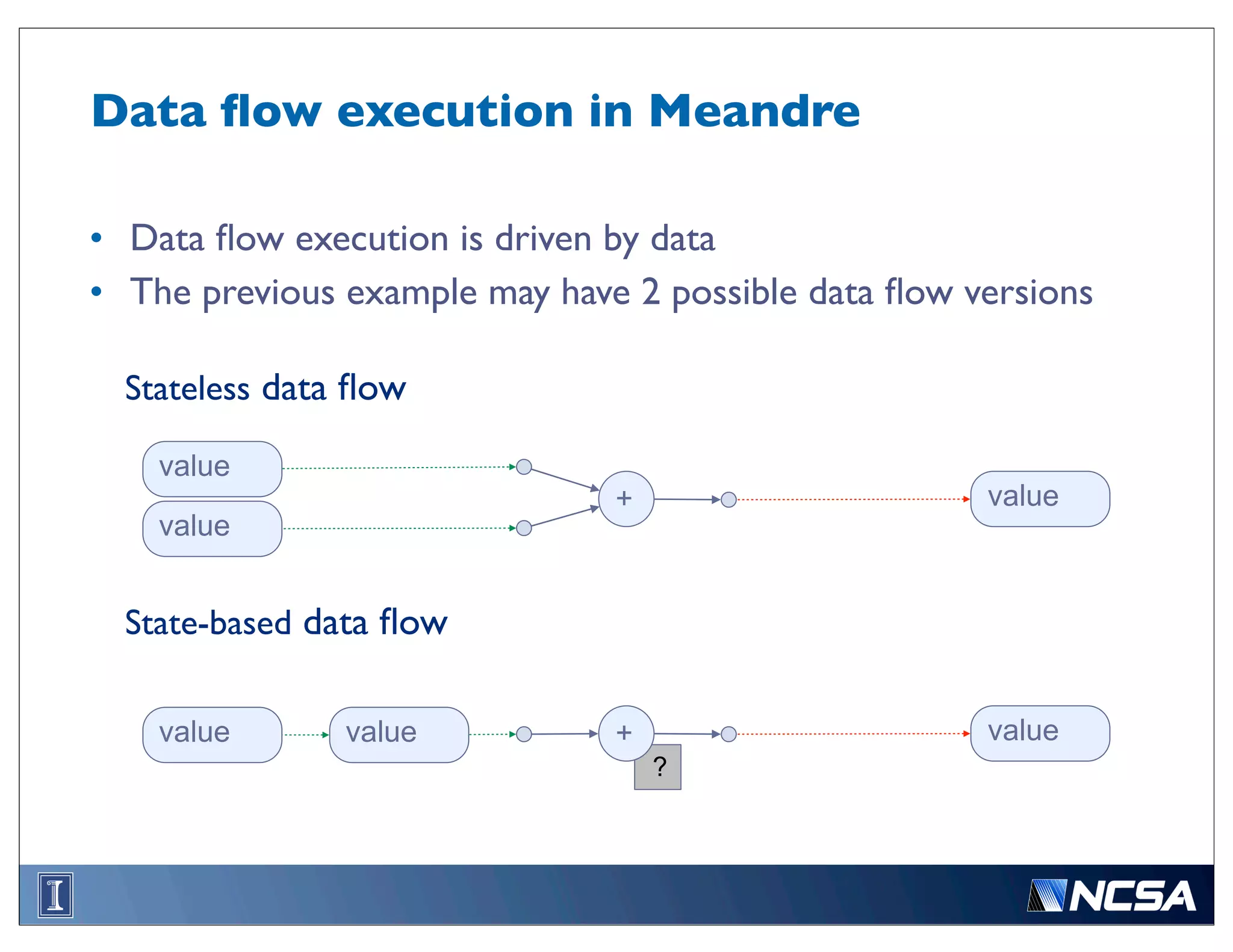
Data flow execution in Meandre

• Data flow execution is driven by data
• The previous example may have 2 possible data flow versions

  Stateless data flow

    value
                               +                     value
    value


  State-based data flow

    value       value          +                     value
                                   ?
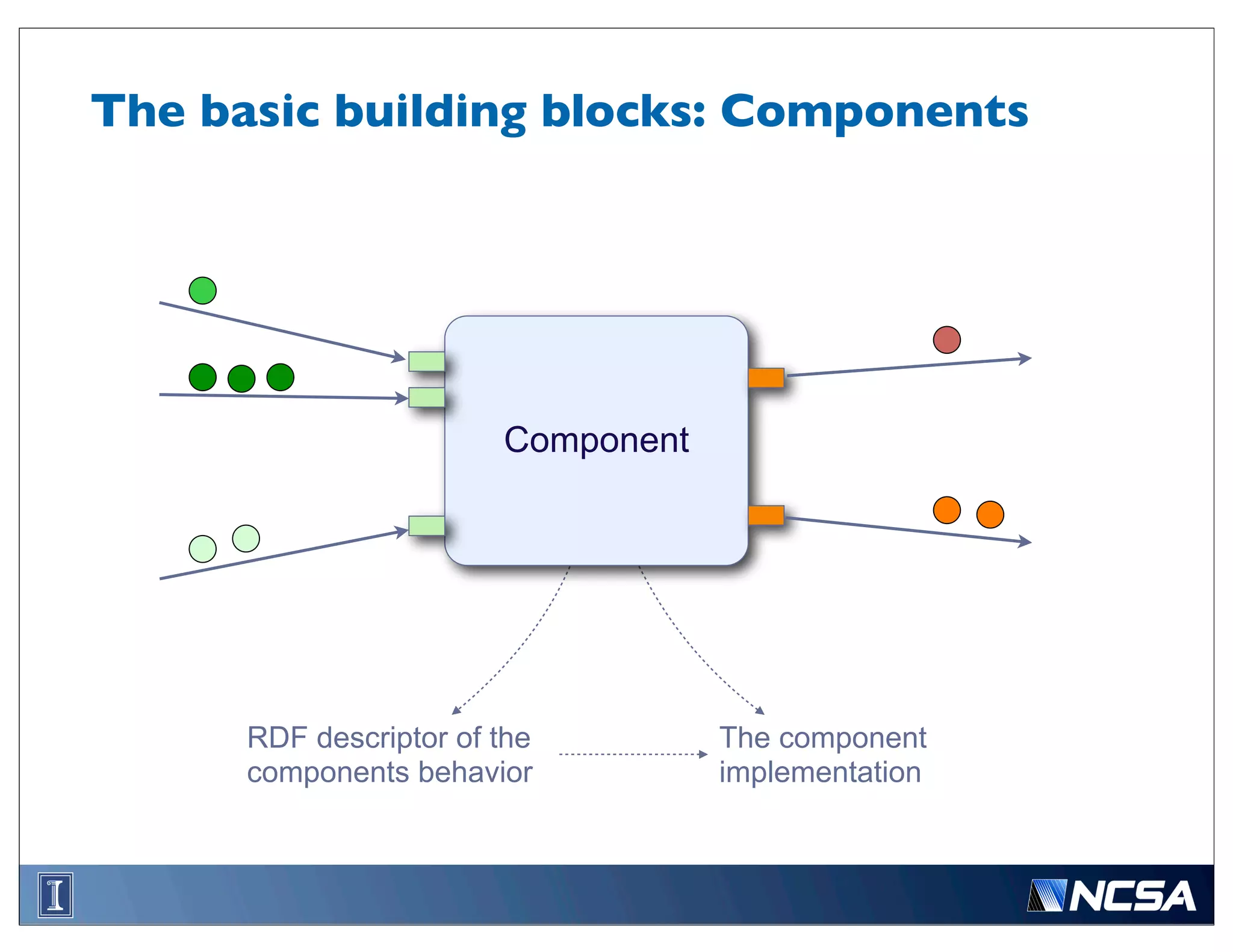
The basic building blocks: Components


                        Component


      RDF descriptor of the         The component
      components behavior           implementation
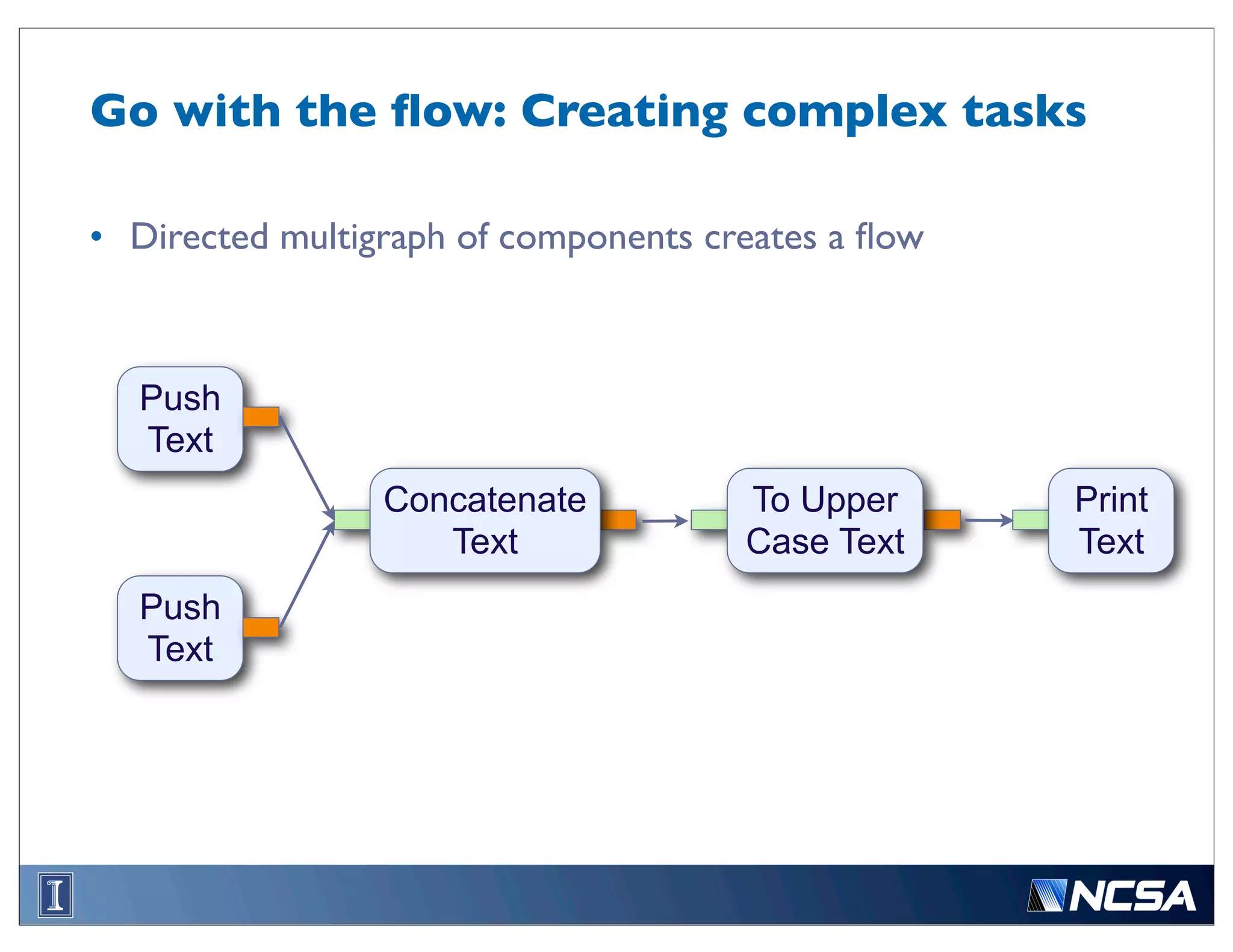
Go with the flow: Creating complex tasks

• Directed multigraph of components creates a flow


  Push
  Text
                 Concatenate          To Upper      Print
                    Text              Case Text     Text
  Push
  Text
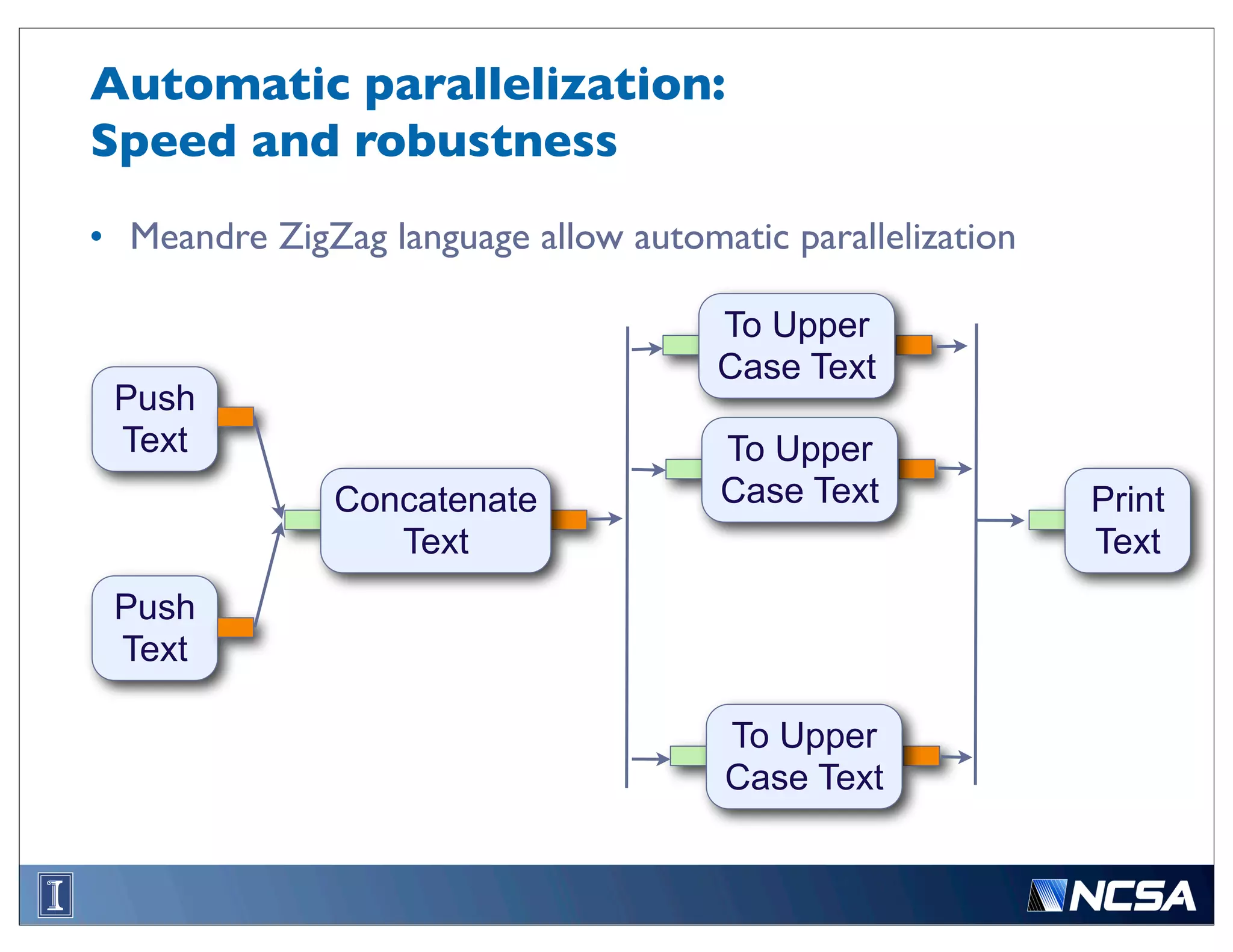
Automatic parallelization:
Speed and robustness
• Meandre ZigZag language allow automatic parallelization

                                      To Upper
                                      Case Text
 Push
 Text                                 To Upper
               Concatenate            Case Text             Print
                  Text                                      Text
 Push
 Text

                                       To Upper
                                       Case Text
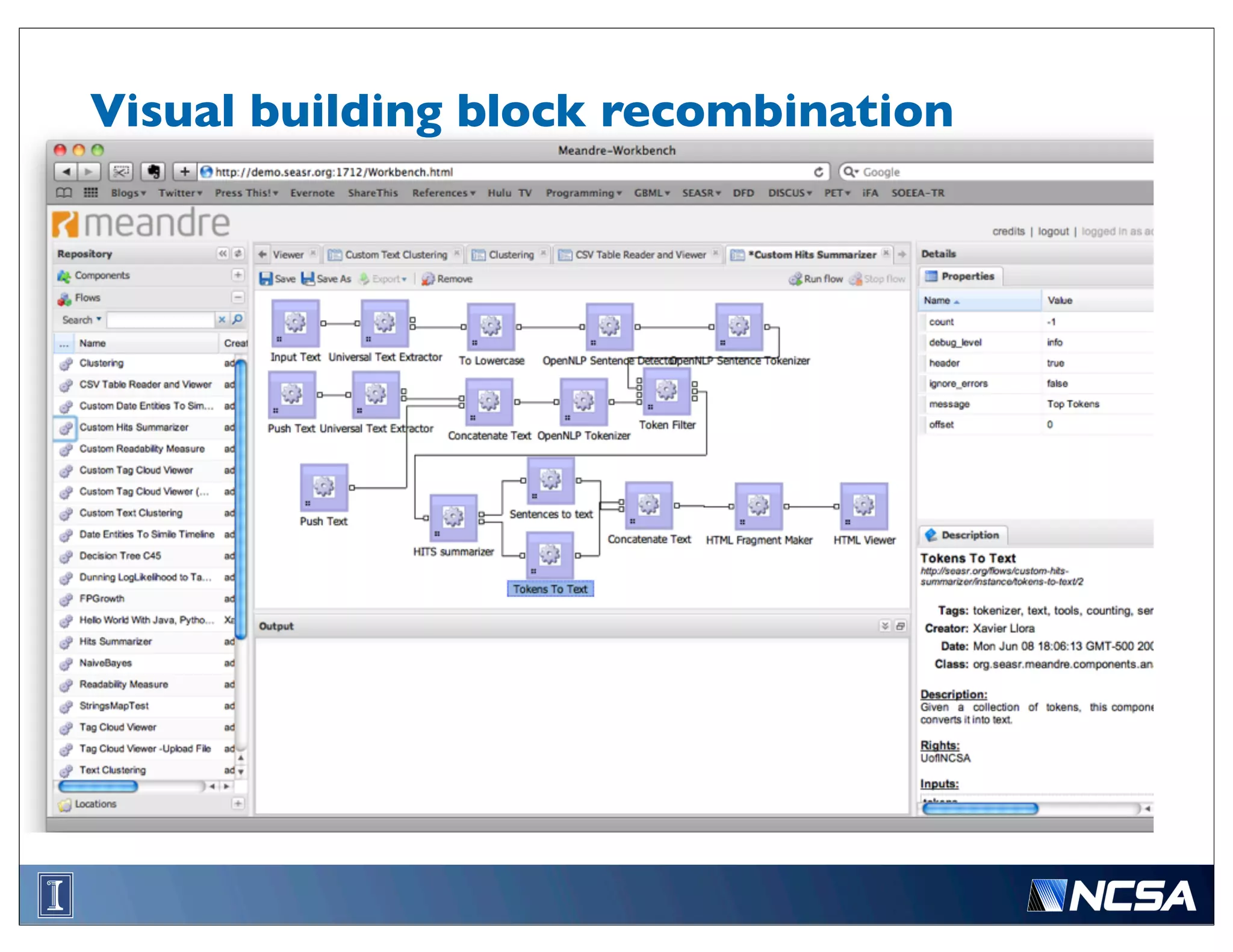
Visual building block recombination
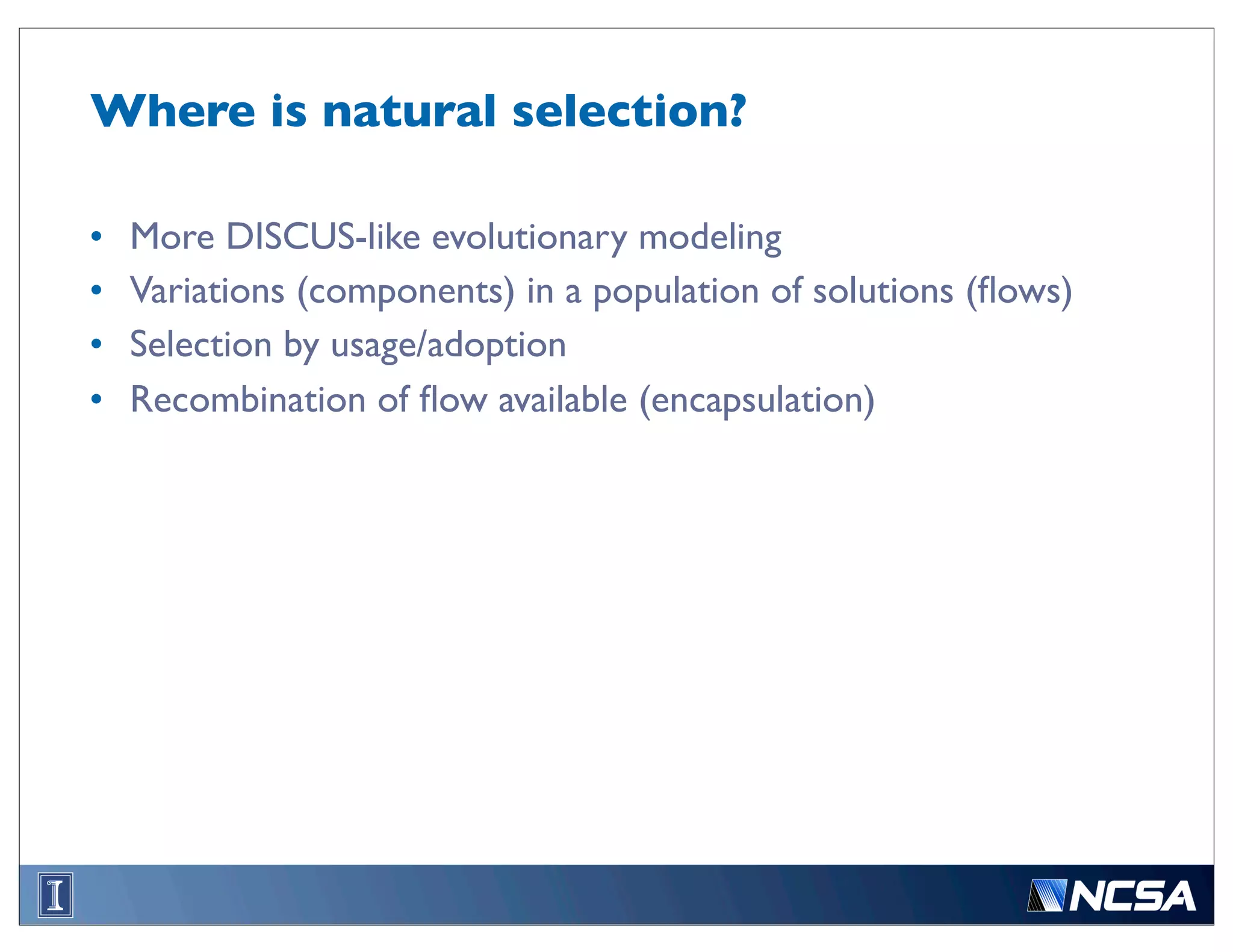
Where is natural selection?

•   More DISCUS-like evolutionary modeling
•   Variations (components) in a population of solutions (flows)
•   Selection by usage/adoption
•   Recombination of flow available (encapsulation)
The take away message
Basic food for thought

• The underlying distilled idea of natural selection
   • Variation will arise in a population
   • Selection by environment adaptation
• Powerful modeling tool
   •   Problem solving (optimization and search)
   •   Machine learning
   •   Human social interaction modeling
   •   Defining new ways to explore computer programming
   •   ...
• Don’t be afraid to try and explore
More information

• Illinois Genetic Algorithms Laboratory
   • http://www.illigal.uiuc.edu/web
• The DISCUS project
   • http://www.i-discus.org
• The Meandre project
   • http://seasr.org/meandre
   • http://seasr.org
• National Center for Supercomputing Applications
   • http://www.ncsa.illinois.edu
• Homepage
   • http://www.xavierllora.net
• Some related Twitter users
   • People: @xllora, @deg511
   • Labs and projects: @illigal, @projectmeandre, @seasrproject
From Galapagos to Twitter:
Darwin, Natural Selection,
and Web 2.0


Xavier Llorà

National Center for Supercomputing Applications
University of Illinois at Urbana-Champaign
Urbana, Illinois, 61801

xllora@ncsa.illinois.edu
http://www.ncsa.illinois.edu/~xllora

From Galapagos to Twitter: Darwin, Natural Selection, and Web 2.0

  • 1.
    From Galapagos toTwitter: Darwin, Natural Selection, and Web 2.0 Xavier Llorà National Center for Supercomputing Applications University of Illinois at Urbana-Champaign Urbana, Illinois, 61801 xllora@ncsa.illinois.edu http://www.ncsa.illinois.edu/~xllora
  • 2.
    What is thistalk about? • Simple answer: Darwin’s natural selection concept and information technologies • Natural selection? Natural selection is the process by which heritable traits that make it more likely for an organism to survive and successfully reproduce become more common in a population over successive generations. • Remember, back on Darwin’s time genetics were unknown
  • 3.
  • 4.
    A quick Darwinbackground check • In Edinburgh Charles Darwin • Learnt standard geology (Robert Jameson) • Exposed to British catastrophism of 1820s • Run into Lamarckian ideas with Robert Grant • Cambridge provide him a chance to • Under John Henslow, explored boundaries between varieties and species • Read and accepted traditional theological explanations of the world • Evolution existed before and after Darwin • HMS Beagle • Left Plymouth 2pm on December 27, 1831 • Returned October 2, 1836
  • 5.
    HMS Beagle http://www.solarnavigator.net/history/hms_beagle.htm
  • 6.
  • 7.
    Massive diversity http://www.flickr.com/photos/ole/1040941928/
  • 8.
    A key realization •Knowledge on the boundaries of variation/species • The facts • Large number of islands • Islands are spatially separated • Wide diversities of species (different sources of food) • Very close species (beyond variation) • Start accumulating descriptions of specimens
  • 9.
  • 10.
    The basic buildingblocks • Large variation of features • Highly correlated to food sources • The basic sketch of a crazy thought: • Assume you start with a diverse population of As • Split As and place them in different environments • Individual ai features may or may not help live in the environment • If individual ai features help in the environment ai as a result has increased chances to reproduce • The underlying distilled idea of natural selection • Variation will arise in a population • Selection by environment adaptation • The uncanny idea:Variation can be random
  • 11.
    A simple abstraction Recombination agent Selection agent
  • 12.
    [Fast forward] ...and genomics arise
  • 13.
    DNA and basicsof reproduction • Watson & Crick (1953) • Four bases: Adenine (A), cytosine (C), guanine (G), thymine (T) • Groups in to base pairs: A-T, C-G • Reproduction of DNA (crossover and mutation) http://en.wikipedia.org/wiki/DNA#cite_note-FWPUB-6
  • 14.
    [Fast forward] ...and computers happen
  • 15.
    A quick stopin the late 60s • Computers were the next cool thing • Genetics were on the rise • A professor at University of Michigan • Natural evolution • Diverse population of individual • Individual ai features may or may not help live in the environment • If individual ai features help in the environment ai as a result has increased chances to reproduce • Artificial evolution? • Model of such evolutionary process Prof. John H. Holland • Use it to solve some real problem Image from http://www.slideshare.net/deg511/not-your-grandmothers-genetic-algorithm
  • 16.
    What is agenetic algorithm? • ANAS published in 1975 • Chromosomes encode a solution to a problem • Evaluation of fitness based on the quality solving the problem • The process • Survival of the fitness • Mutation • Crossover • Repeat until good enough
  • 17.
    A simple example • Imagine you have a box with an array of switches • 0 off, 1on • Depending on the switch arrangement you get some payoff • Payoff is equivalent to the number of switches that are on • The goal: Maximize the payoff
  • 18.
    Encoding the problem •Solutions are a string of 0s and 1s. • We need a population 01010101 10101101 11111000 00011111 01111100 ... 10101010
  • 19.
    Evaluate solutions performance •Solutions represent a solution to a particular environment • Solutions get measured based on their performance 01010101 01010101 : 4 10101101 10101101 : 5 11111000 11111000 : 5 00011111 Evaluate 00001111 : 4 01111100 01111100 : 5 ... ... 10101010 10100010 : 3
  • 20.
    Selection based onperformance • Proportional to their performance • Proportionate roulette wheel selection 01010101 01010101 : 4 00011111 : 5 10101101 10101101 : 5 11111000 : 5 11111000 11111000 : 5 11111000 : 5 00011111 Evaluate 00001111 : 4 Select 01111100 : 5 01111100 01111100 : 5 10100010 : 3 ... ... ... 10101010 10100010 : 3 01010101 : 4
  • 21.
    Reproduction • Mutation introducerandom • Crossover recombines changes in the solution parent solutions 10101101 10101101 00011111 Mutation Crossover 11101101 10101111 00011101
  • 22.
    A nagging question •In early 80s by David E. Goldberg • How do uninteresting operators yield interesting behavior? • 1983 proposed the innovation intuition: “Genetic algorithm power like that of human innovation” • The underlying elements: • Selection + mutation as hillclimbing or kaizen • Selection + crossover = innovation • In another words • Introducing small changes and keeping them if the improve performance • [...] Takes two to invent anything. One makes up combinations; the other one chooses [...] (Paul Valéry)
  • 23.
    Remember the simpleabstraction Recombination agent Selection agent
  • 24.
    Goldberg’s intuition • Interestingbehavior (emergence) is a balance • Two components • Takeover time (t*) • Time to innovate (ti)
  • 25.
    Goldberg’s intuition • Adesign theory for scalable and efficient GAs • Understanding building blocks (concepts or ideas) • Ensure building block supply • Ensure building block growth • Control building block speed • Ensure good building block decisions • Ensure good building block mixing • Know building block challengers
  • 26.
    An interesting socialinsight • GAs used for optimization, search, machine learning, ... • But Valéry’s quote also implied a social aspect to innovation • Solutions may be created in the vacuum, randomly, or carefully crafted • There is a social element of acceptance/rejection • Paul Valéry (1871-1945) lived after Darwin published his ideas
  • 27.
    [Fast forward] ...The 2.0 information age
  • 28.
    Adding social togenetic algorithms computational Recombination agent Standard Interactive Genetic Algorithms Genetic Algorithms human Computer Aided Human-Based Design (CAD) Genetic Algorithms computational human Selection agent (Kosorukoff & Goldberg, 2002)
  • 29.
    Social aspects ofgenetic algorithms • Population-based method • Parallel genetic algorithms • Groups of working units • Communication between groups for a common goal • Models for collaborative work • Social network of interactions 29
  • 30.
    The DISCUS project •IlliGAL & NCSA collaboration started in 2003 • Computers have become mediators of collaborations • Email, chat rooms, blogs, wikis… • A flood of available information • Different modes of communication • Let’s take advantage of such information • Logs of conversations • Archive of documents (email attachments, blogs, personal web pages…) • Human-computer interactions • Social aspect of the communication and collaboration 30
  • 31.
    The question • Couldwe help build a system using genetic algorithms/natural selection ideas that could foster innovation and creativity? • The era of available Web 2.0 tools • Web portals • Collaboration and communication tools (message boards, chats, blogs, Twitter…) • Genetic algorithm (Interactive, Human-based, and Parallel GAs) • Chance discovery (KeyGraphs and Influence Diffusion Models) • Data and text mining • Information retrieval • Web services • Data-intensive computing 31
  • 32.
    In a picture Analysis Data mining Social networks Content Knowledge management Social aspects (Llorà et al., 2004)
  • 33.
    A simple exercise •Imagine you are chatting with your friends • Your ideas are bundled in messages • You pass them your your friends • They read them, think about them • Your friends reply to you • Could we model it using natural selection? • Valéry suggest so • Goldberg proposed a simple model using the human-based GA analogy • If so, Goldberg’s methodology should apply
  • 34.
  • 35.
    Concepts as buildingblocks (Llorà et al., 2004)
  • 36.
    Things you canmeasure: Concept diffusion (Llorà et al., 2005)
  • 37.
    Social acceptance androles (Yasui et al., 2006)
  • 38.
    Everything together (Saruwatari et al., 2008)
  • 39.
    Everything together (Saruwatari et al., 2008)
  • 40.
    In action (Saruwatari et al., 2008)
  • 41.
    Other possible usages • Tracking influence on social media (e.g. Twitter) • User preference modeling • Topic overlap • Topic/trend dynamics (how conversation is changing on the fly) • Blogosphere and company message misalignment • ...
  • 42.
  • 43.
    SW development andDarwin’s ideas? • Data deluge, processing large volumes of data starting to become the norm, not the exception • Another nagging question back on 2007 • Could we use the basic design principles by Goldberg to build software? • A subset of those could have the answer • Understanding building blocks (concepts or ideas) • Ensure building block supply • Ensure building block growth • Ensure good building block mixing • Also • Exploiting parallelism efficiently is becoming a more pressing issue • SW is a social activity
  • 44.
    A little thinking •Understanding building blocks (concepts or ideas) • Basic units of data processing • Building blocks should be easy to group and swap • Ensure building block supply • Create a basic set of building block • Ensure building block growth • Provide a set of tools for developers to add more building blocks • Ensure good building block mixing • Facilitate the reproduction of solutions (programs) • Provide means to make those recombination possible
  • 45.
    Modeling Meandre • Thebasic outline • Data-flow execution paradigm • Semantic-web driven • Web oriented • Facilitate distributed computing • Support publishing services • Promote reuse, sharing, and collaboration • Fall 2007 Meandre was adopted as the data-intensive platform for a collection of projects • More information at http://seasr.org/meandre
  • 46.
    Data flow executionin Meandre • A simple example c ← a+b • A traditional control-driven language a = 1 b = 2 c = a+b • Execution following the sequence of instructions • One step at a time • a+b+c+d requires 3 steps • Could be easily parallelized
  • 47.
    Data flow executionin Meandre • Data flow execution is driven by data • The previous example may have 2 possible data flow versions Stateless data flow value + value value State-based data flow value value + value ?
  • 48.
    The basic buildingblocks: Components Component RDF descriptor of the The component components behavior implementation
  • 49.
    Go with theflow: Creating complex tasks • Directed multigraph of components creates a flow Push Text Concatenate To Upper Print Text Case Text Text Push Text
  • 50.
    Automatic parallelization: Speed androbustness • Meandre ZigZag language allow automatic parallelization To Upper Case Text Push Text To Upper Concatenate Case Text Print Text Text Push Text To Upper Case Text
  • 51.
    Visual building blockrecombination
  • 52.
    Where is naturalselection? • More DISCUS-like evolutionary modeling • Variations (components) in a population of solutions (flows) • Selection by usage/adoption • Recombination of flow available (encapsulation)
  • 53.
  • 54.
    Basic food forthought • The underlying distilled idea of natural selection • Variation will arise in a population • Selection by environment adaptation • Powerful modeling tool • Problem solving (optimization and search) • Machine learning • Human social interaction modeling • Defining new ways to explore computer programming • ... • Don’t be afraid to try and explore
  • 55.
    More information • IllinoisGenetic Algorithms Laboratory • http://www.illigal.uiuc.edu/web • The DISCUS project • http://www.i-discus.org • The Meandre project • http://seasr.org/meandre • http://seasr.org • National Center for Supercomputing Applications • http://www.ncsa.illinois.edu • Homepage • http://www.xavierllora.net • Some related Twitter users • People: @xllora, @deg511 • Labs and projects: @illigal, @projectmeandre, @seasrproject
  • 56.
    From Galapagos toTwitter: Darwin, Natural Selection, and Web 2.0 Xavier Llorà National Center for Supercomputing Applications University of Illinois at Urbana-Champaign Urbana, Illinois, 61801 xllora@ncsa.illinois.edu http://www.ncsa.illinois.edu/~xllora