

© Copyright 2018 Pivotal Software, Inc. All rights Reserved.
Shaun Norris
Field CIO, APJ
August 2019
From 10 deploys per year to 4 per day at DBS:
How Pivotal Platform can reduce operational toil
Shaun Norris Dapeng Liu
Field CIO for Asia Pacific & Japan Head of Credit Risk Development
team at DBS Bank in Singapore.
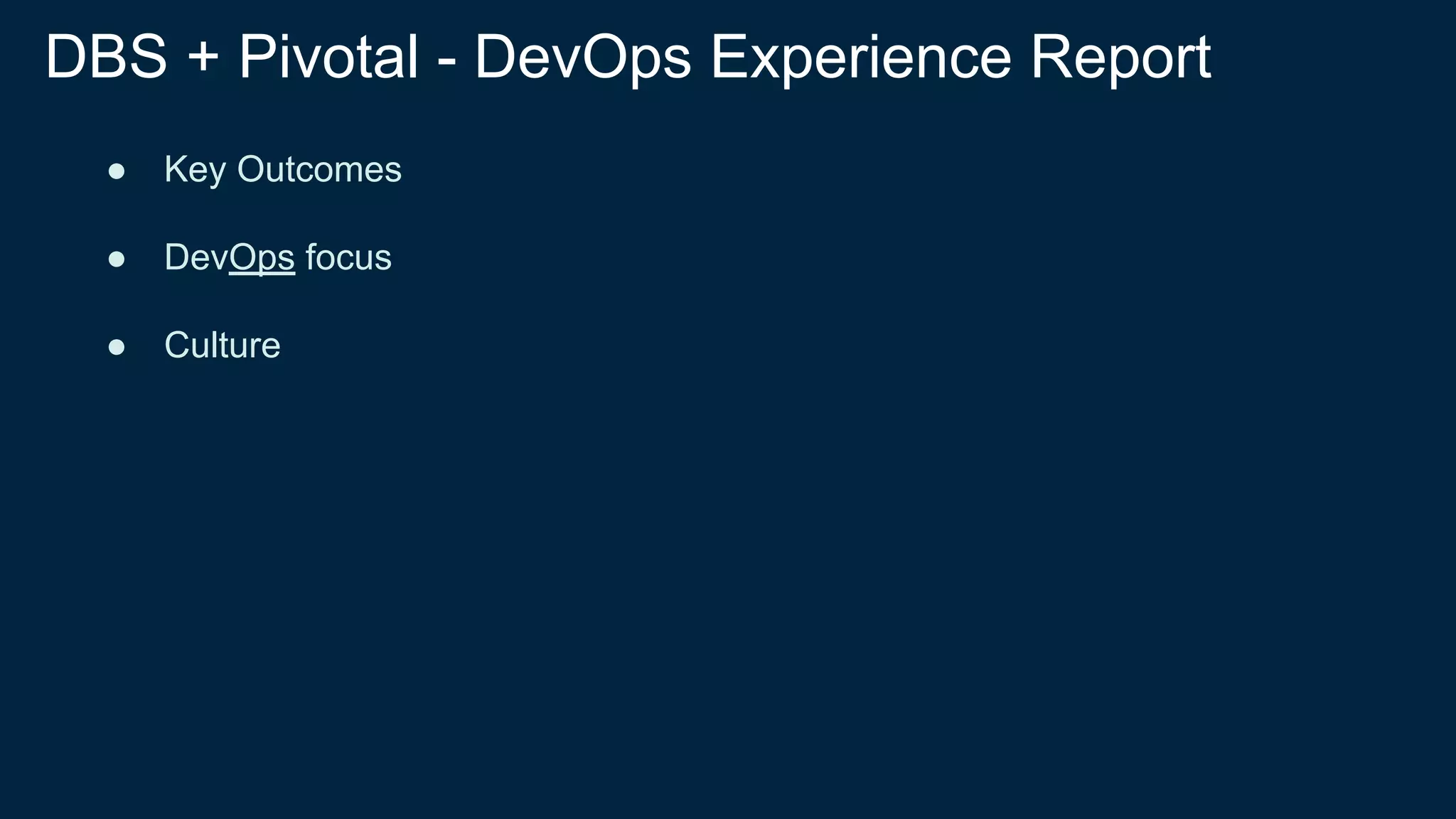
DBS + Pivotal - DevOps Experience Report
● Key Outcomes
● DevOps focus
● Culture
https://www.euromoney.com/article/b1fmmkjyhws0h9/world39s-best-bank-2019-dbs
Business Outcomes
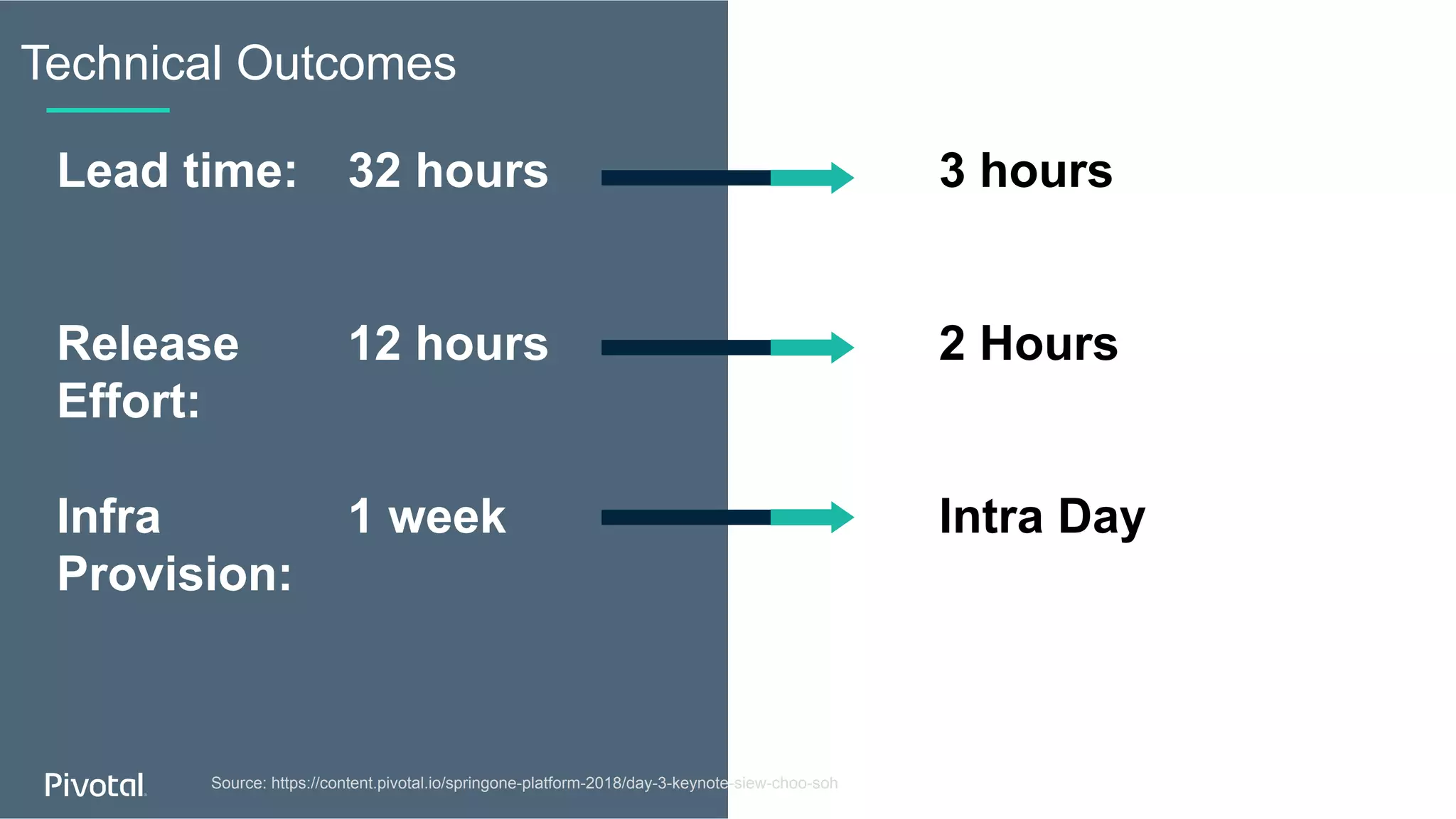
Technical Outcomes
Lead time: 32 hours
Release 12 hours
Effort:
Infra 1 week
Provision:
© Copyright 2017 Pivotal Software, Inc. All rights Reserved.Source: https://content.pivotal.io/springone-platform-2018/day-3-keynote-siew-choo-soh
3 hours
2 Hours
Intra Day
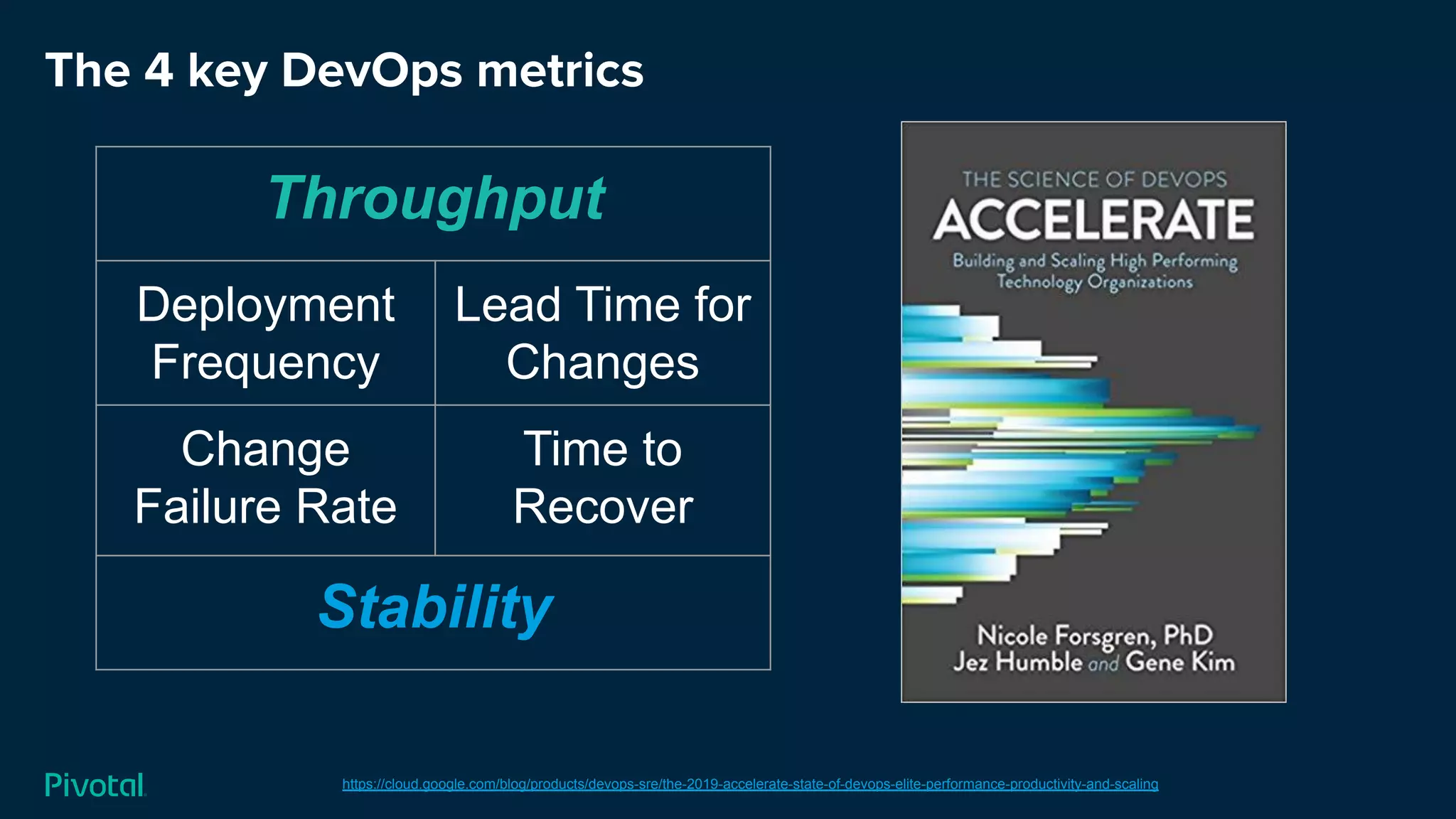
The 4 key DevOps metrics
https://cloud.google.com/blog/products/devops-sre/the-2019-accelerate-state-of-devops-elite-performance-productivity-and-scaling
Throughput
Deployment
Frequency
Lead Time for
Changes
Change
Failure Rate
Time to
Recover
Stability
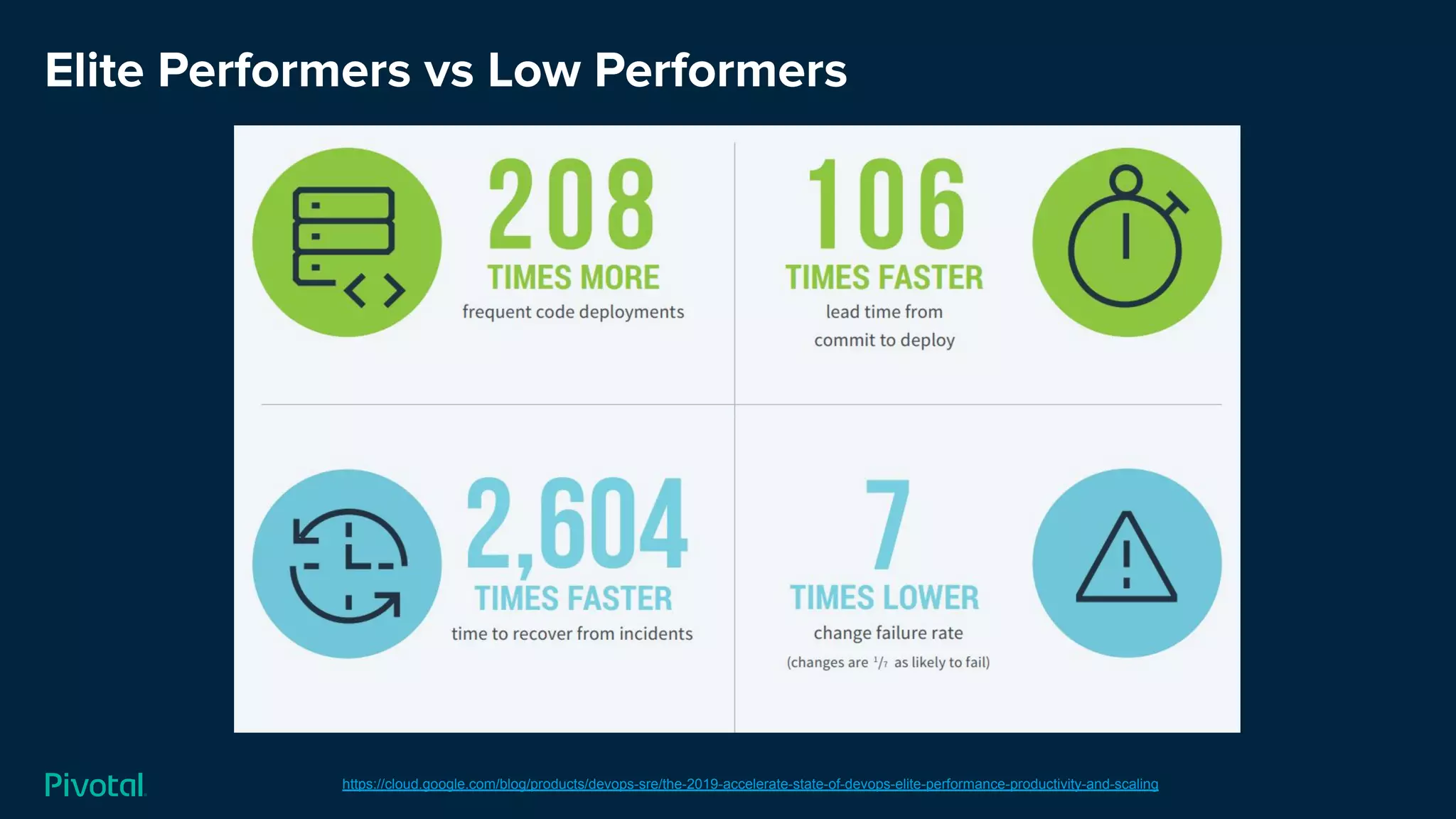
Elite Performers vs Low Performers
https://cloud.google.com/blog/products/devops-sre/the-2019-accelerate-state-of-devops-elite-performance-productivity-and-scaling
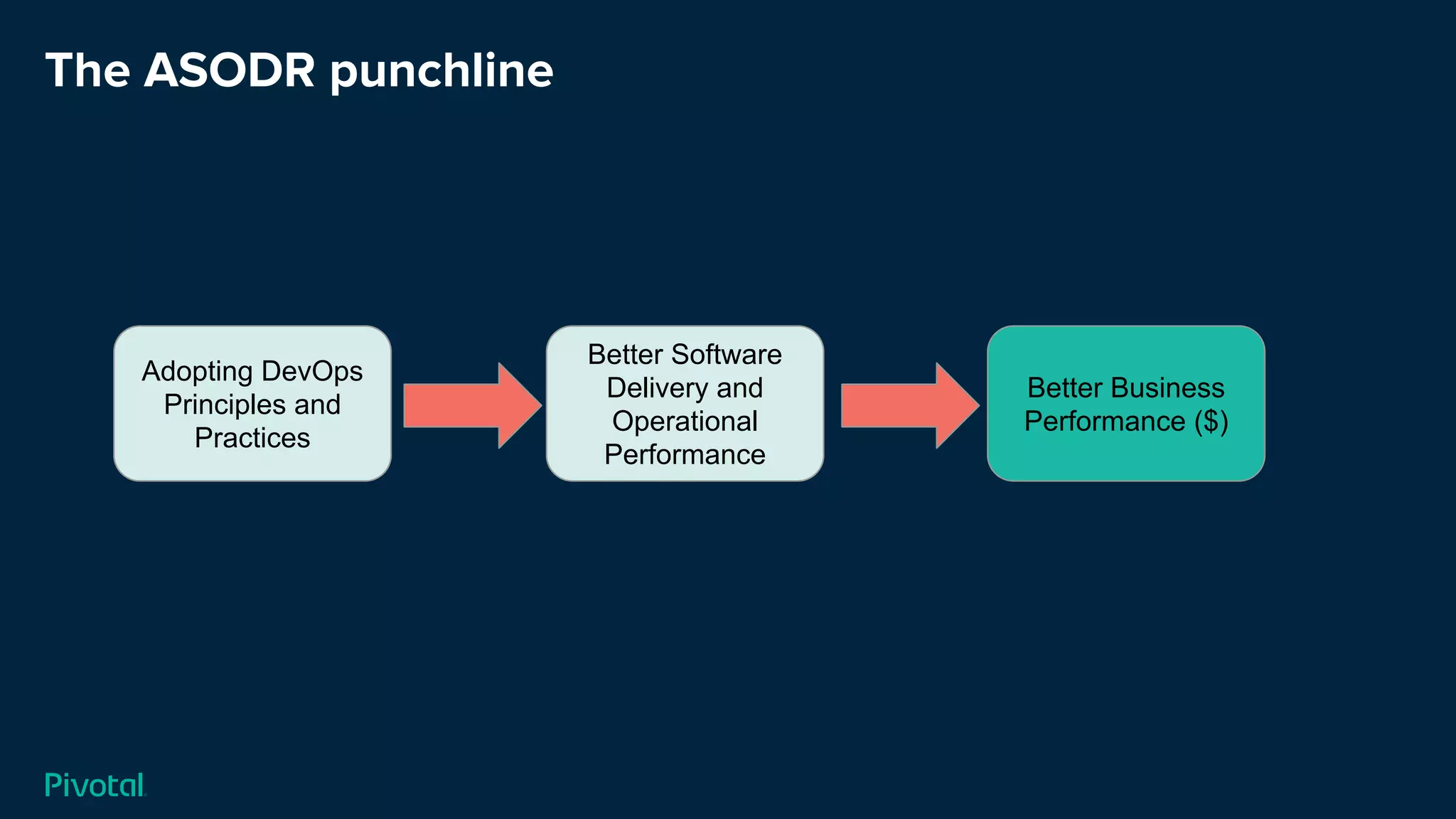
The ASODR punchline
Adopting DevOps
Principles and
Practices
Better Software
Delivery and
Operational
Performance
Better Business
Performance ($)
“[the] highest performers are twice as likely to meet or
exceed their organizational performance goals. ”
Why does this matter to every business?
https://cloud.google.com/blog/products/devops-sre/the-2019-accelerate-state-of-devops-elite-performance-productivity-and-scaling
ASODR … in a DBS context?
Adopting DevOps
Principles and
Practices
Better Software
Delivery and
Operational
Performance
Better Business
Performance ($)
● Cloud native
architecture
● Using a PaaS to
abstract infra
● Using private cloud
● Automated delivery
pipeline
● Self service infra
provisioning
● 10x release
cadence
improvement
● Release prep time
dramatically lower
● Deployments now
in office hours, not
on weekends
● Improvement in
employee
engagement
● World’s Best Bank
as voted by
EuroMoney in July
2019
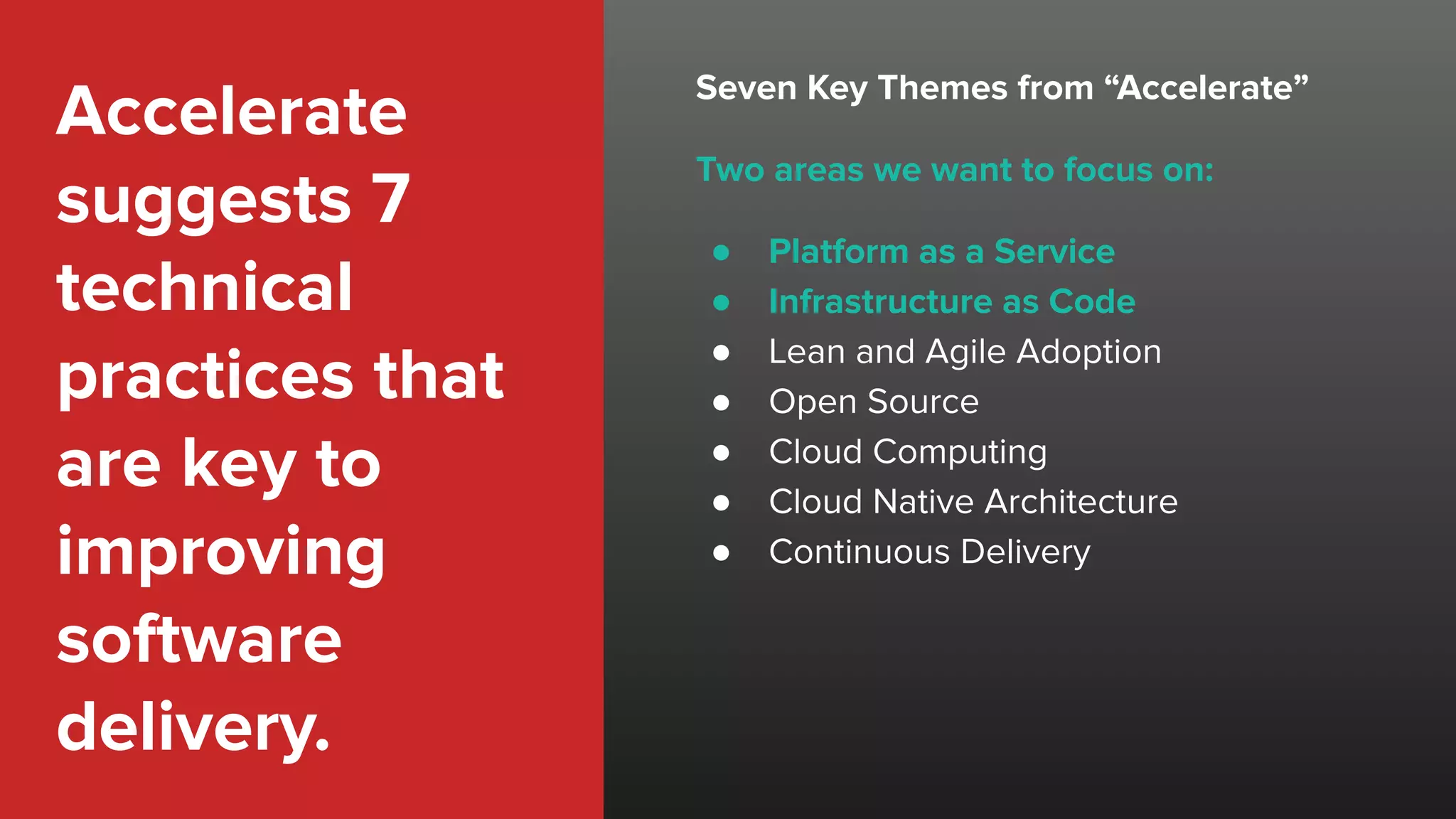
Accelerate
suggests 7
technical
practices that
are key to
improving
software
delivery.
Seven Key Themes from “Accelerate”
Two areas we want to focus on:
● Platform as a Service
● Infrastructure as Code
● Lean and Agile Adoption
● Open Source
● Cloud Computing
● Cloud Native Architecture
● Continuous Delivery
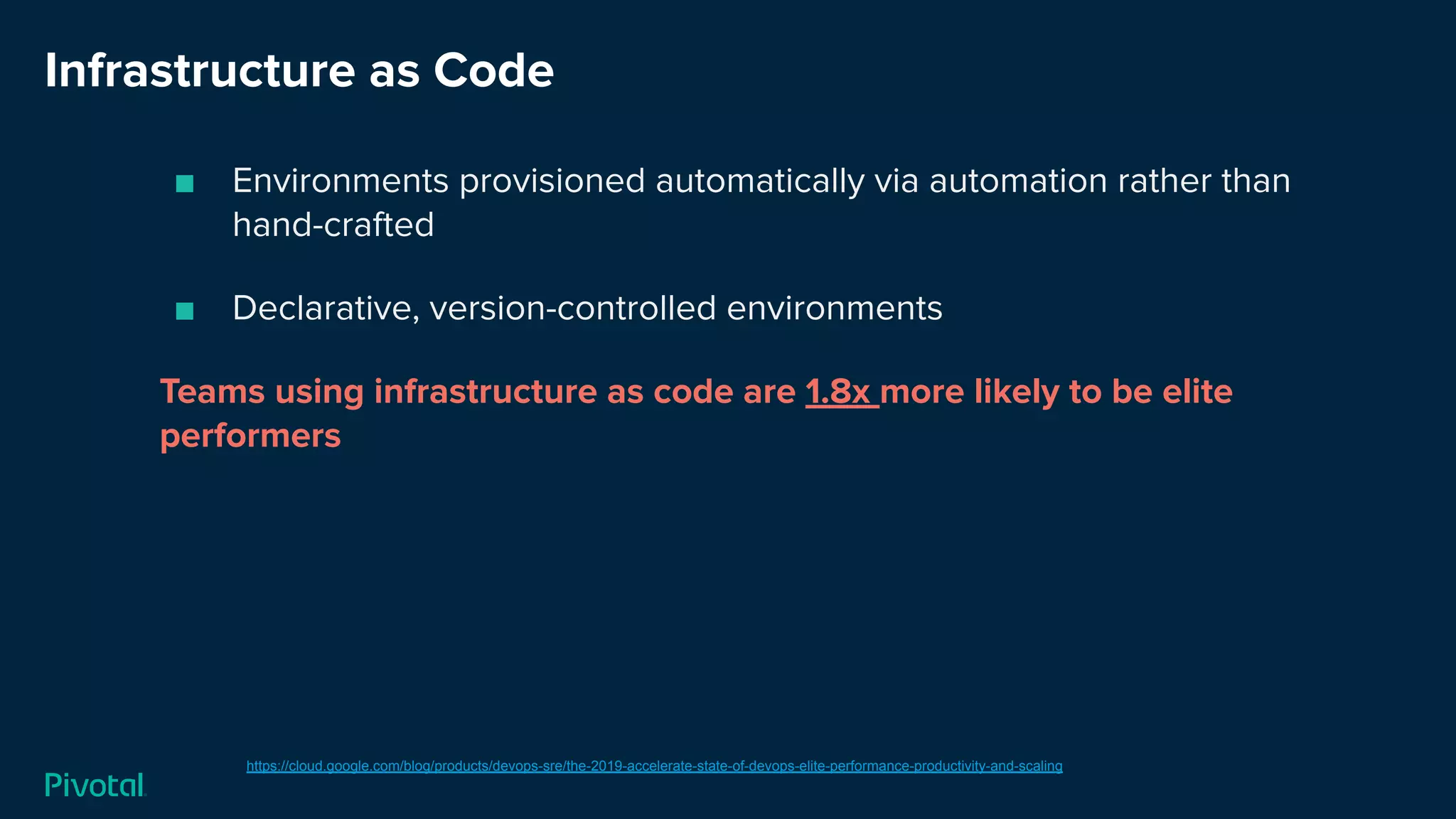
Infrastructure as Code
■ Environments provisioned automatically via automation rather than
hand-crafted
■ Declarative, version-controlled environments
Teams using infrastructure as code are 1.8x more likely to be elite
performers
https://cloud.google.com/blog/products/devops-sre/the-2019-accelerate-state-of-devops-elite-performance-productivity-and-scaling
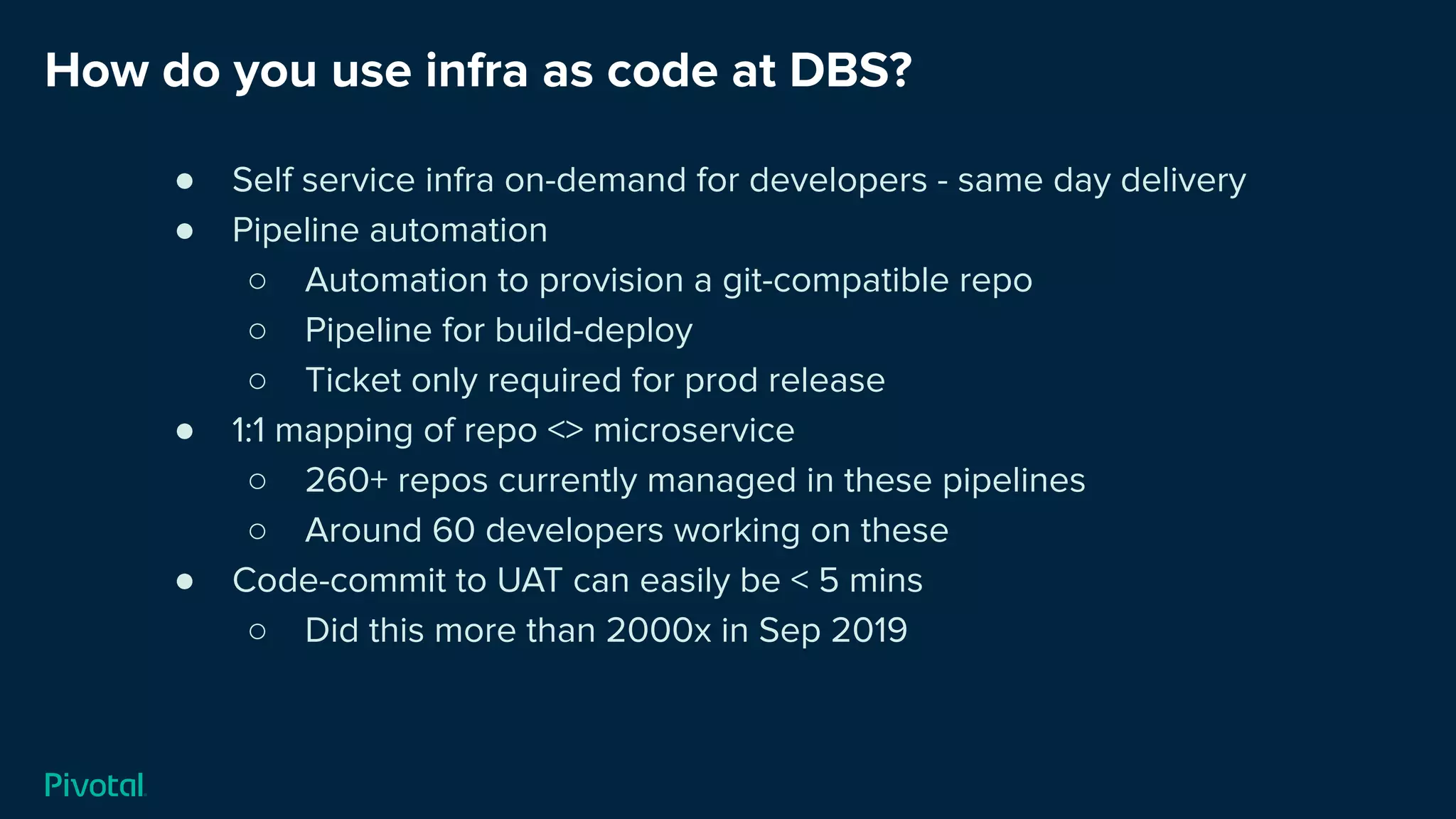
How do you use infra as code at DBS?
● Self service infra on-demand for developers - same day delivery
● Pipeline automation
○ Automation to provision a git-compatible repo
○ Pipeline for build-deploy
○ Ticket only required for prod release
● 1:1 mapping of repo <> microservice
○ 260+ repos currently managed in these pipelines
○ Around 60 developers working on these
● Code-commit to UAT can easily be < 5 mins
○ Did this more than 2000x in Sep 2019
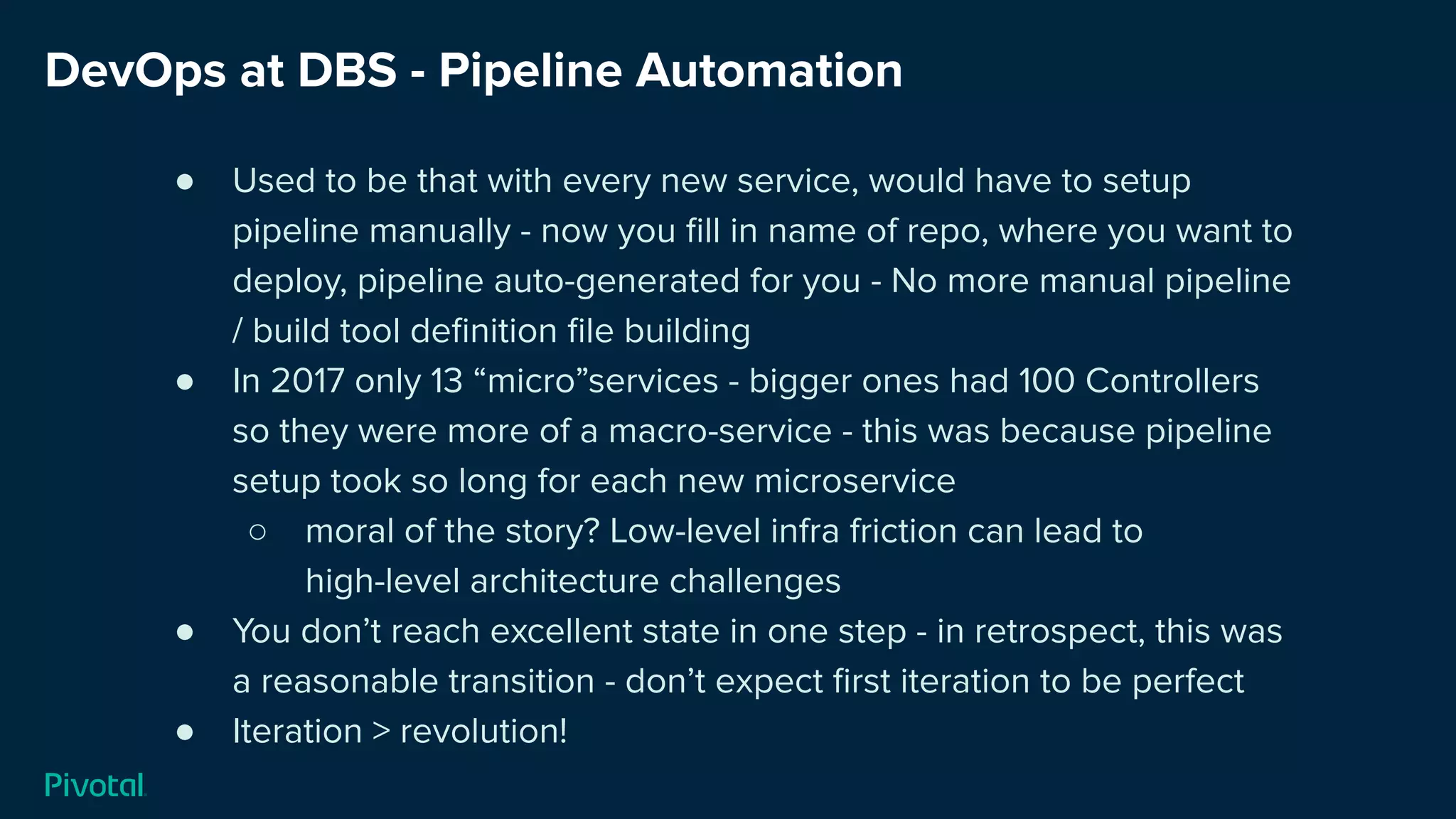
DevOps at DBS - Pipeline Automation
● Used to be that with every new service, would have to setup
pipeline manually - now you fill in name of repo, where you want to
deploy, pipeline auto-generated for you - No more manual pipeline
/ build tool definition file building
● In 2017 only 13 “micro”services - bigger ones had 100 Controllers
so they were more of a macro-service - this was because pipeline
setup took so long for each new microservice
○ moral of the story? Low-level infra friction can lead to
high-level architecture challenges
● You don’t reach excellent state in one step - in retrospect, this was
a reasonable transition - don’t expect first iteration to be perfect
● Iteration > revolution!
Platform as a Service
Teams who use a PaaS are 1.5x more likely to be
elite performers (2018 SODR)
Why? Likely because their developers are spending
more time above the value line and less time
wrangling infrastructure.
What has DBS experience been using PaaS in your team?
https://cloud.google.com/blog/products/devops-sre/the-2019-accelerate-state-of-devops-elite-performance-productivity-and-scaling
● As a development team, using a platform to abstract infra has
allowed devs to focus more on business logic
● We don’t use persistent storage - forces right design decisions
● Routing setup by default when we deploy
● Logging and log aggregation are automatic, no need to wire up
for every application
● We use buildpacks to build containers, no need to manually
write YAML files for docker containers
● 140+ applications running in production
● 600+ container instances running to support these apps
Why did you adopt a PaaS at DBS?
● Log aggregation
● Monitoring
● Patching for both apps and platform itself
● Can be run by a platform team
● Architecture Standards and guardrails
● Service Brokers to access off platform APIs
● Makes self-service infra-as-code easy to do and the default
How has Operations improved?
● Incident Management?
● Coping with legacy process like change management?
● Cloud Native Architecture enabling team autonomy
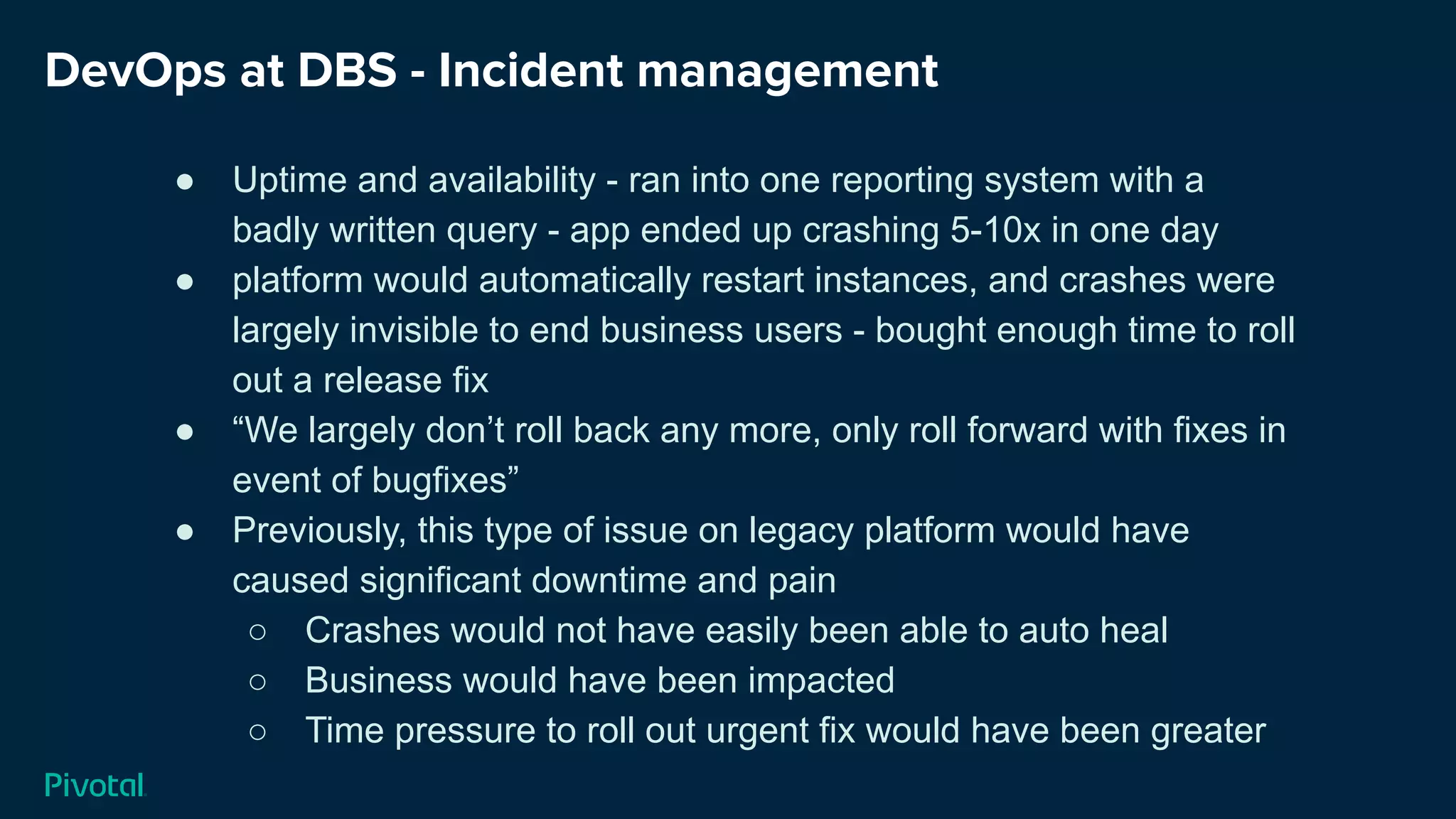
DevOps at DBS - Incident management
● Uptime and availability - ran into one reporting system with a
badly written query - app ended up crashing 5-10x in one day
● platform would automatically restart instances, and crashes were
largely invisible to end business users - bought enough time to roll
out a release fix
● “We largely don’t roll back any more, only roll forward with fixes in
event of bugfixes”
● Previously, this type of issue on legacy platform would have
caused significant downtime and pain
○ Crashes would not have easily been able to auto heal
○ Business would have been impacted
○ Time pressure to roll out urgent fix would have been greater
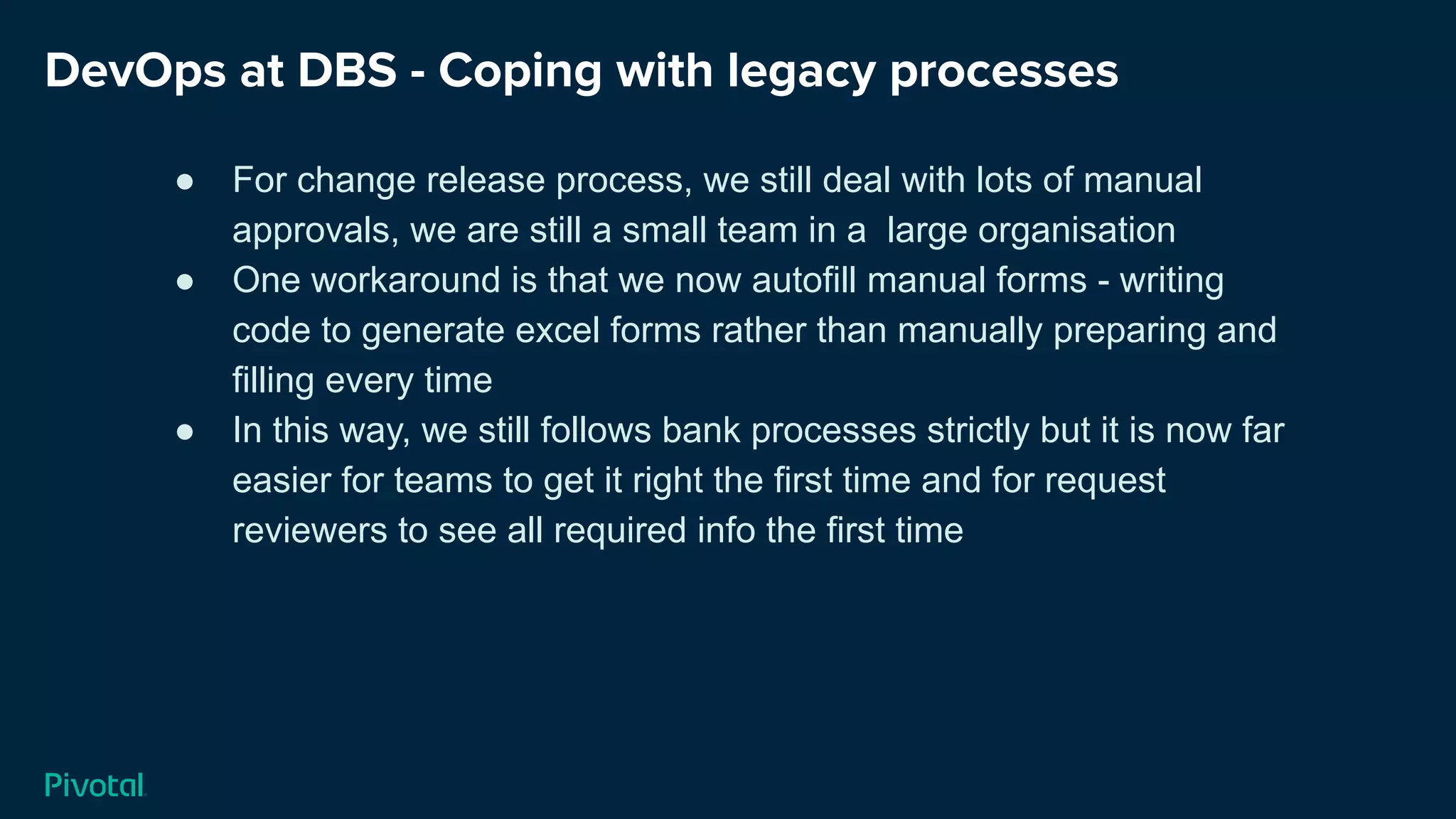
DevOps at DBS - Coping with legacy processes
● For change release process, we still deal with lots of manual
approvals, we are still a small team in a large organisation
● One workaround is that we now autofill manual forms - writing
code to generate excel forms rather than manually preparing and
filling every time
● In this way, we still follows bank processes strictly but it is now far
easier for teams to get it right the first time and for request
reviewers to see all required info the first time
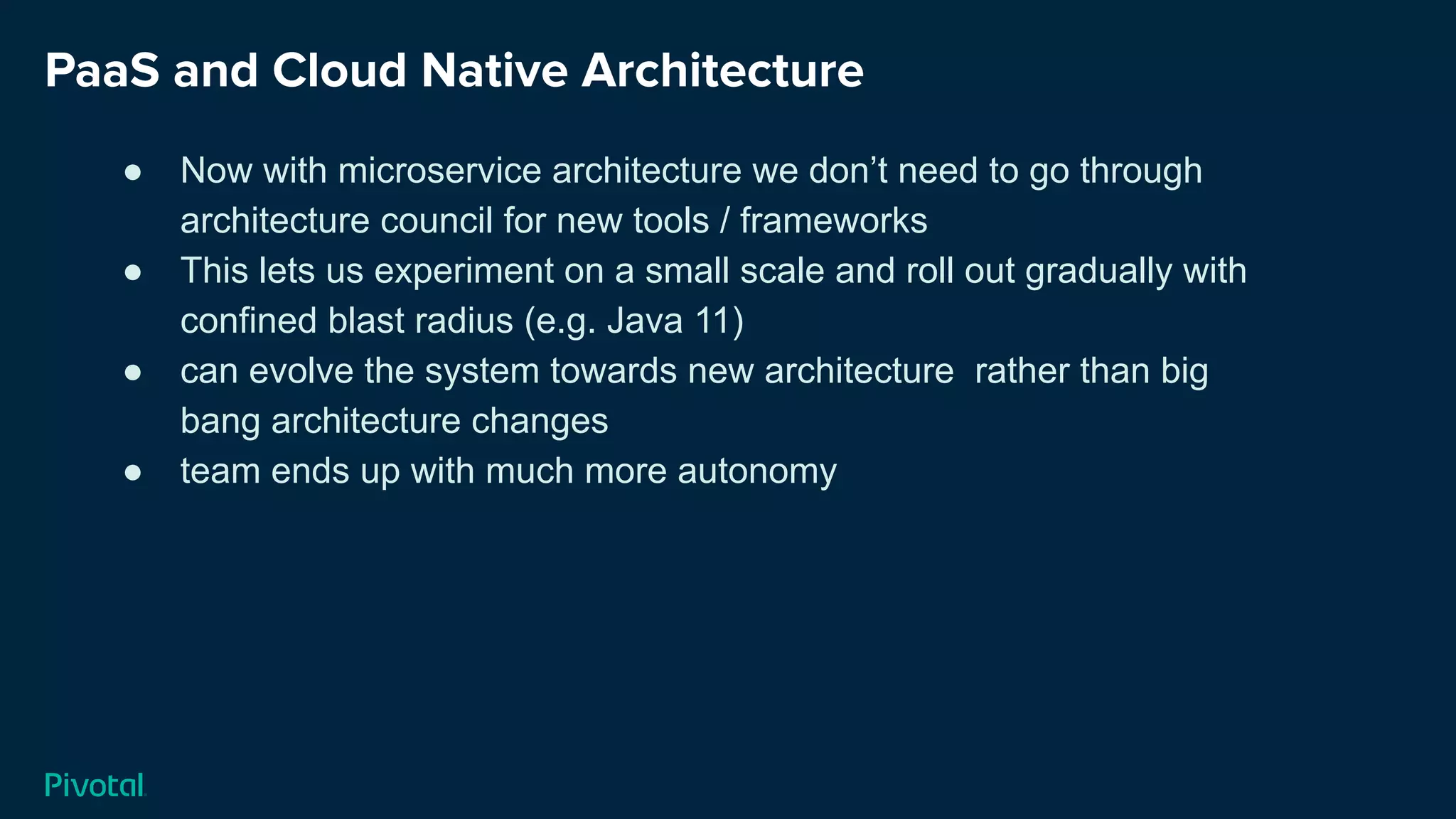
PaaS and Cloud Native Architecture
● Now with microservice architecture we don’t need to go through
architecture council for new tools / frameworks
● This lets us experiment on a small scale and roll out gradually with
confined blast radius (e.g. Java 11)
● can evolve the system towards new architecture rather than big
bang architecture changes
● team ends up with much more autonomy
Culture Changes?
● Team Topology
● Sustainable pace
● Psychological Safety
● Employee Engagement
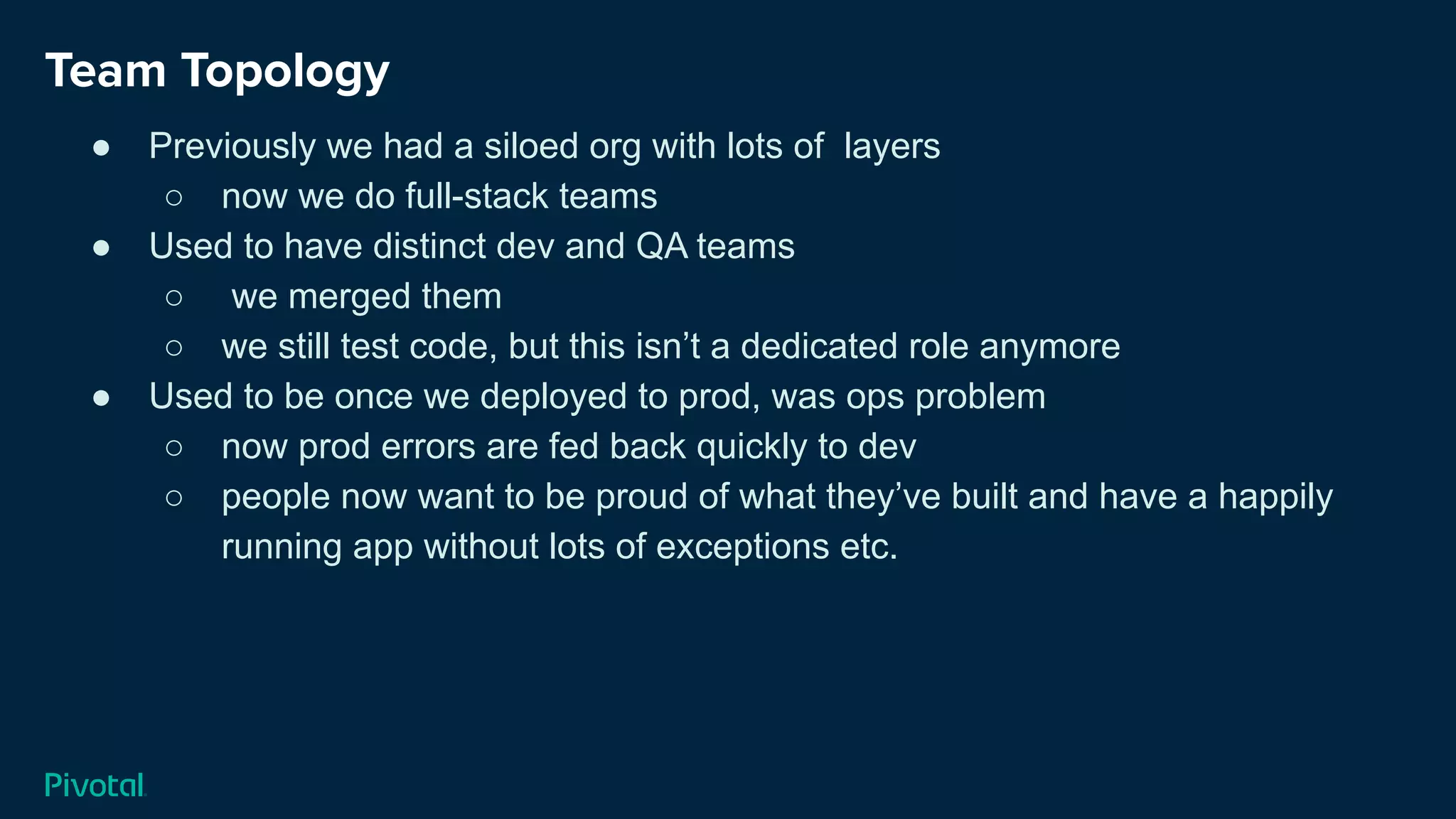
Team Topology
● Previously we had a siloed org with lots of layers
○ now we do full-stack teams
● Used to have distinct dev and QA teams
○ we merged them
○ we still test code, but this isn’t a dedicated role anymore
● Used to be once we deployed to prod, was ops problem
○ now prod errors are fed back quickly to dev
○ people now want to be proud of what they’ve built and have a happily
running app without lots of exceptions etc.
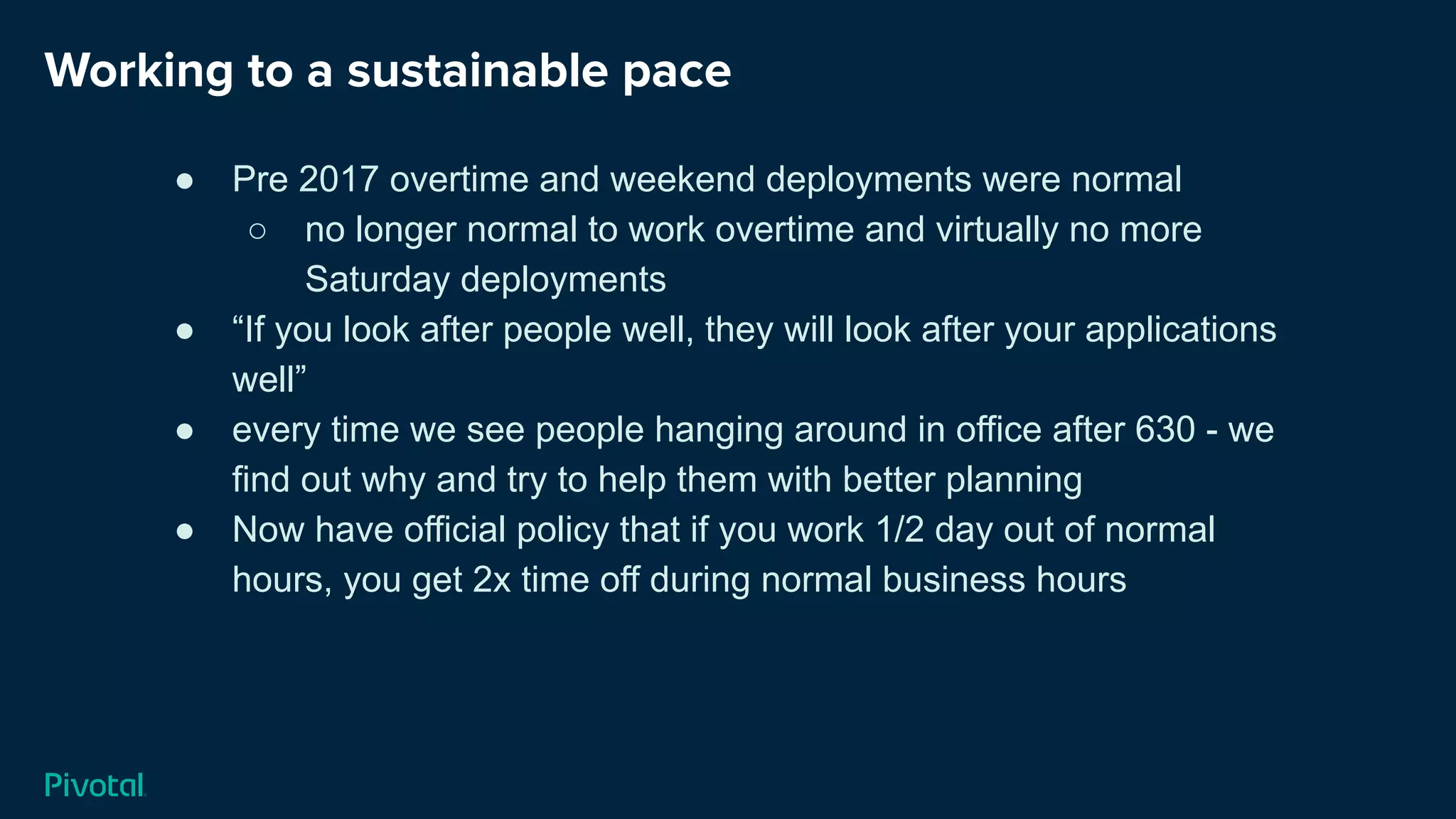
Working to a sustainable pace
● Pre 2017 overtime and weekend deployments were normal
○ no longer normal to work overtime and virtually no more
Saturday deployments
● “If you look after people well, they will look after your applications
well”
● every time we see people hanging around in office after 630 - we
find out why and try to help them with better planning
● Now have official policy that if you work 1/2 day out of normal
hours, you get 2x time off during normal business hours
Psychological Safety
● Being able to move faster, including repairing incidents in
production means that it reduces the tension around things
breaking
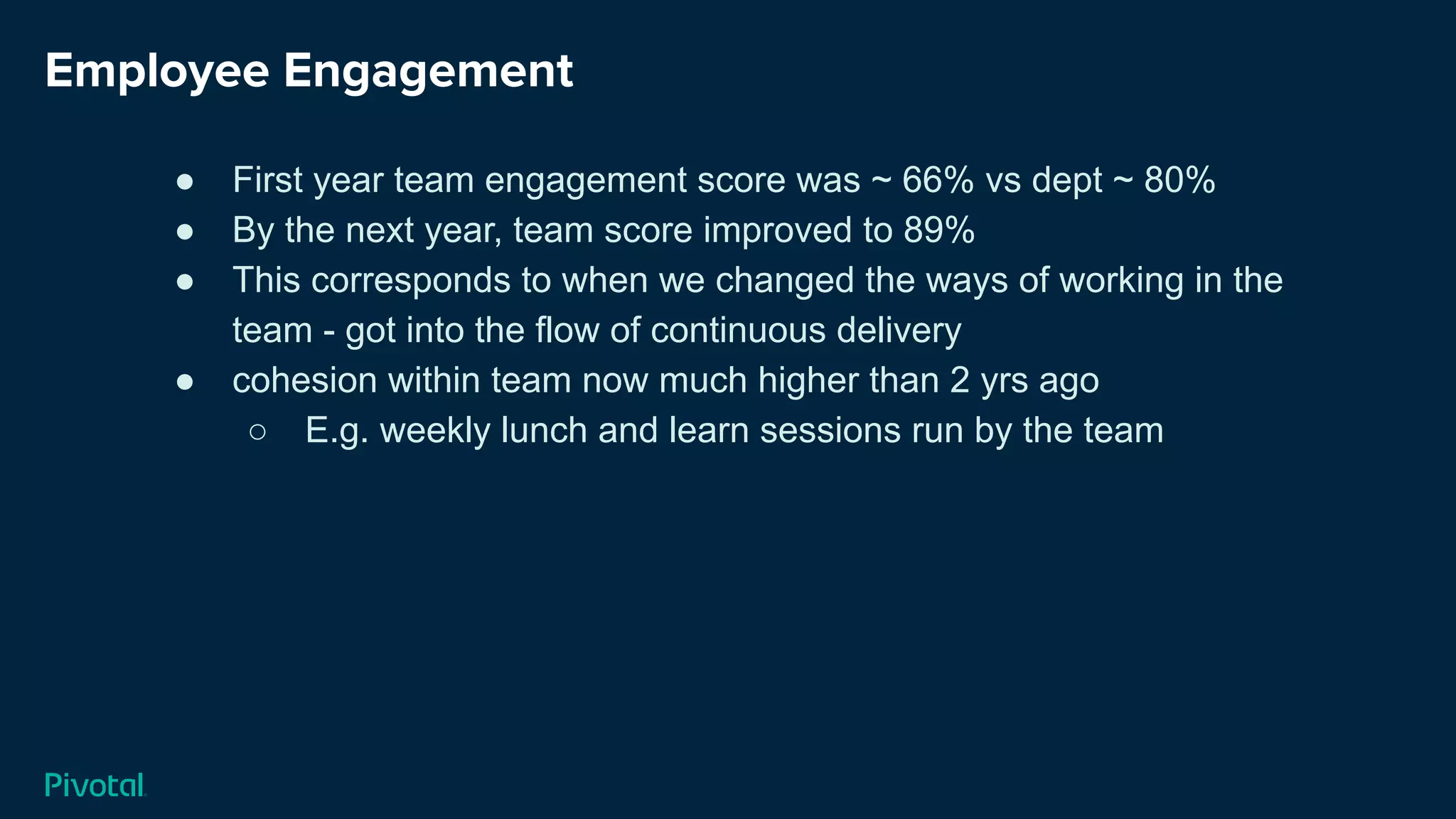
Employee Engagement
● First year team engagement score was ~ 66% vs dept ~ 80%
● By the next year, team score improved to 89%
● This corresponds to when we changed the ways of working in the
team - got into the flow of continuous delivery
● cohesion within team now much higher than 2 yrs ago
○ E.g. weekly lunch and learn sessions run by the team
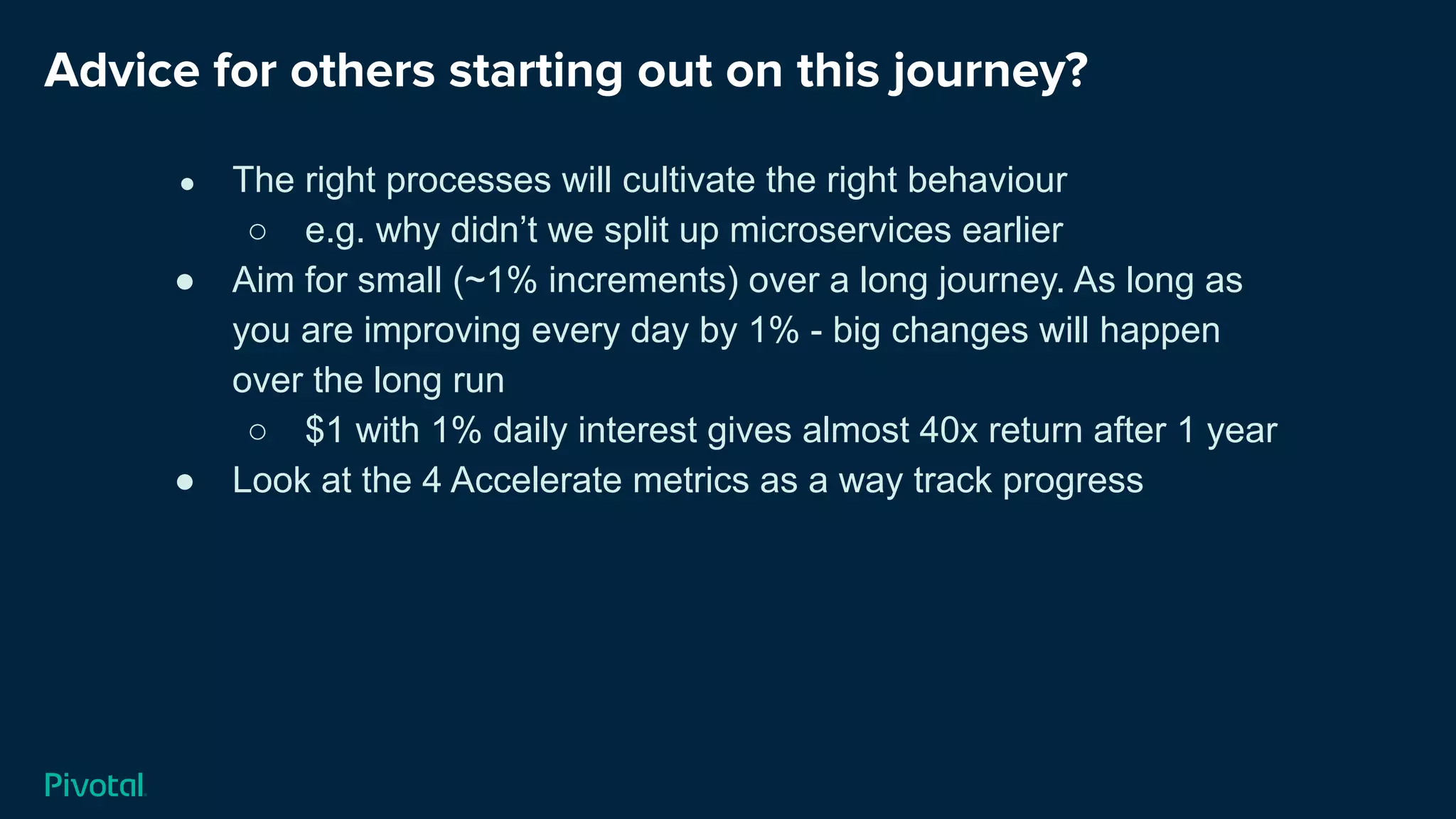
Advice for others starting out on this journey?
● The right processes will cultivate the right behaviour
○ e.g. why didn’t we split up microservices earlier
● Aim for small (~1% increments) over a long journey. As long as
you are improving every day by 1% - big changes will happen
over the long run
○ $1 with 1% daily interest gives almost 40x return after 1 year
● Look at the 4 Accelerate metrics as a way track progress
@RealGeneKim
Expected to ship
November 19th 2019
from IT Revolution Press
Transforming How The World Builds Software
© Copyright 2019 Pivotal Software, Inc. All rights Reserved.

From 10 Deploys Per Year to 4 Per Day at DBS Bank: How Pivotal Platform Can Reduce Operational Toil

  • 1.
    © Copyright 2018Pivotal Software, Inc. All rights Reserved. Shaun Norris Field CIO, APJ August 2019 From 10 deploys per year to 4 per day at DBS: How Pivotal Platform can reduce operational toil
  • 2.
    Shaun Norris DapengLiu Field CIO for Asia Pacific & Japan Head of Credit Risk Development team at DBS Bank in Singapore.
  • 3.
    DBS + Pivotal- DevOps Experience Report ● Key Outcomes ● DevOps focus ● Culture
  • 4.
  • 5.
    Technical Outcomes Lead time:32 hours Release 12 hours Effort: Infra 1 week Provision: © Copyright 2017 Pivotal Software, Inc. All rights Reserved.Source: https://content.pivotal.io/springone-platform-2018/day-3-keynote-siew-choo-soh 3 hours 2 Hours Intra Day
  • 6.
    The 4 keyDevOps metrics https://cloud.google.com/blog/products/devops-sre/the-2019-accelerate-state-of-devops-elite-performance-productivity-and-scaling Throughput Deployment Frequency Lead Time for Changes Change Failure Rate Time to Recover Stability
  • 7.
    Elite Performers vsLow Performers https://cloud.google.com/blog/products/devops-sre/the-2019-accelerate-state-of-devops-elite-performance-productivity-and-scaling
  • 8.
    The ASODR punchline AdoptingDevOps Principles and Practices Better Software Delivery and Operational Performance Better Business Performance ($)
  • 9.
    “[the] highest performersare twice as likely to meet or exceed their organizational performance goals. ” Why does this matter to every business? https://cloud.google.com/blog/products/devops-sre/the-2019-accelerate-state-of-devops-elite-performance-productivity-and-scaling
  • 10.
    ASODR … ina DBS context? Adopting DevOps Principles and Practices Better Software Delivery and Operational Performance Better Business Performance ($) ● Cloud native architecture ● Using a PaaS to abstract infra ● Using private cloud ● Automated delivery pipeline ● Self service infra provisioning ● 10x release cadence improvement ● Release prep time dramatically lower ● Deployments now in office hours, not on weekends ● Improvement in employee engagement ● World’s Best Bank as voted by EuroMoney in July 2019
  • 11.
    Accelerate suggests 7 technical practices that arekey to improving software delivery. Seven Key Themes from “Accelerate” Two areas we want to focus on: ● Platform as a Service ● Infrastructure as Code ● Lean and Agile Adoption ● Open Source ● Cloud Computing ● Cloud Native Architecture ● Continuous Delivery
  • 12.
    Infrastructure as Code ■Environments provisioned automatically via automation rather than hand-crafted ■ Declarative, version-controlled environments Teams using infrastructure as code are 1.8x more likely to be elite performers https://cloud.google.com/blog/products/devops-sre/the-2019-accelerate-state-of-devops-elite-performance-productivity-and-scaling
  • 13.
    How do youuse infra as code at DBS? ● Self service infra on-demand for developers - same day delivery ● Pipeline automation ○ Automation to provision a git-compatible repo ○ Pipeline for build-deploy ○ Ticket only required for prod release ● 1:1 mapping of repo <> microservice ○ 260+ repos currently managed in these pipelines ○ Around 60 developers working on these ● Code-commit to UAT can easily be < 5 mins ○ Did this more than 2000x in Sep 2019
  • 14.
    DevOps at DBS- Pipeline Automation ● Used to be that with every new service, would have to setup pipeline manually - now you fill in name of repo, where you want to deploy, pipeline auto-generated for you - No more manual pipeline / build tool definition file building ● In 2017 only 13 “micro”services - bigger ones had 100 Controllers so they were more of a macro-service - this was because pipeline setup took so long for each new microservice ○ moral of the story? Low-level infra friction can lead to high-level architecture challenges ● You don’t reach excellent state in one step - in retrospect, this was a reasonable transition - don’t expect first iteration to be perfect ● Iteration > revolution!
  • 15.
    Platform as aService Teams who use a PaaS are 1.5x more likely to be elite performers (2018 SODR) Why? Likely because their developers are spending more time above the value line and less time wrangling infrastructure.
  • 16.
    What has DBSexperience been using PaaS in your team? https://cloud.google.com/blog/products/devops-sre/the-2019-accelerate-state-of-devops-elite-performance-productivity-and-scaling ● As a development team, using a platform to abstract infra has allowed devs to focus more on business logic ● We don’t use persistent storage - forces right design decisions ● Routing setup by default when we deploy ● Logging and log aggregation are automatic, no need to wire up for every application ● We use buildpacks to build containers, no need to manually write YAML files for docker containers ● 140+ applications running in production ● 600+ container instances running to support these apps
  • 17.
    Why did youadopt a PaaS at DBS? ● Log aggregation ● Monitoring ● Patching for both apps and platform itself ● Can be run by a platform team ● Architecture Standards and guardrails ● Service Brokers to access off platform APIs ● Makes self-service infra-as-code easy to do and the default
  • 18.
    How has Operationsimproved? ● Incident Management? ● Coping with legacy process like change management? ● Cloud Native Architecture enabling team autonomy
  • 19.
    DevOps at DBS- Incident management ● Uptime and availability - ran into one reporting system with a badly written query - app ended up crashing 5-10x in one day ● platform would automatically restart instances, and crashes were largely invisible to end business users - bought enough time to roll out a release fix ● “We largely don’t roll back any more, only roll forward with fixes in event of bugfixes” ● Previously, this type of issue on legacy platform would have caused significant downtime and pain ○ Crashes would not have easily been able to auto heal ○ Business would have been impacted ○ Time pressure to roll out urgent fix would have been greater
  • 20.
    DevOps at DBS- Coping with legacy processes ● For change release process, we still deal with lots of manual approvals, we are still a small team in a large organisation ● One workaround is that we now autofill manual forms - writing code to generate excel forms rather than manually preparing and filling every time ● In this way, we still follows bank processes strictly but it is now far easier for teams to get it right the first time and for request reviewers to see all required info the first time
  • 21.
    PaaS and CloudNative Architecture ● Now with microservice architecture we don’t need to go through architecture council for new tools / frameworks ● This lets us experiment on a small scale and roll out gradually with confined blast radius (e.g. Java 11) ● can evolve the system towards new architecture rather than big bang architecture changes ● team ends up with much more autonomy
  • 22.
    Culture Changes? ● TeamTopology ● Sustainable pace ● Psychological Safety ● Employee Engagement
  • 23.
    Team Topology ● Previouslywe had a siloed org with lots of layers ○ now we do full-stack teams ● Used to have distinct dev and QA teams ○ we merged them ○ we still test code, but this isn’t a dedicated role anymore ● Used to be once we deployed to prod, was ops problem ○ now prod errors are fed back quickly to dev ○ people now want to be proud of what they’ve built and have a happily running app without lots of exceptions etc.
  • 24.
    Working to asustainable pace ● Pre 2017 overtime and weekend deployments were normal ○ no longer normal to work overtime and virtually no more Saturday deployments ● “If you look after people well, they will look after your applications well” ● every time we see people hanging around in office after 630 - we find out why and try to help them with better planning ● Now have official policy that if you work 1/2 day out of normal hours, you get 2x time off during normal business hours
  • 25.
    Psychological Safety ● Beingable to move faster, including repairing incidents in production means that it reduces the tension around things breaking
  • 26.
    Employee Engagement ● Firstyear team engagement score was ~ 66% vs dept ~ 80% ● By the next year, team score improved to 89% ● This corresponds to when we changed the ways of working in the team - got into the flow of continuous delivery ● cohesion within team now much higher than 2 yrs ago ○ E.g. weekly lunch and learn sessions run by the team
  • 27.
    Advice for othersstarting out on this journey? ● The right processes will cultivate the right behaviour ○ e.g. why didn’t we split up microservices earlier ● Aim for small (~1% increments) over a long journey. As long as you are improving every day by 1% - big changes will happen over the long run ○ $1 with 1% daily interest gives almost 40x return after 1 year ● Look at the 4 Accelerate metrics as a way track progress
  • 28.
    @RealGeneKim Expected to ship November19th 2019 from IT Revolution Press
  • 29.
    Transforming How TheWorld Builds Software © Copyright 2019 Pivotal Software, Inc. All rights Reserved.