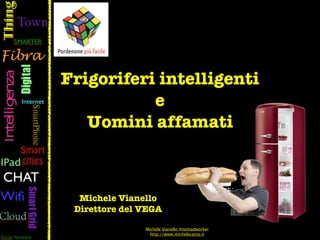
Frigoriferi intelligenti
           e
   Uomini affamati


  Michele Vianello
 Direttore del VEGA

               Michele Vianello #nomadworker
                 http://www.michelecamp.it
Sono il Direttore Generale
del VEGA (Il Parco Scientifico e
    Tecnologico di Venezia).
     Mi sono occupato e mi
   occupo di WEB e di Social
              Media,
      di Città Intelligenti.
    Sono un #nomadworker.
   Incubo aziende e progetto
  edifici per nomadic worker.
  Mi trovate su Facebook, su
       Twitter, Pinterest,
      su Linkedin ecc. ecc.
 Se volete seguirmi, leggete il
            mio blog:
 http://www.michelecamp.it
      p.s.sono considerato
       uno“starnutitore”
          v. Seth Godin
vediamo se funziona anche con
              voi....
#nomadworker’s	 production

                        Manifesto	 di	 principi
                               di	 una
                        “Citta’	 Intelligente”
                              YouTube	 
                         michelevianello100


           http://www.michelecamp.it
         @michelevianello #nomadworker
4 innovazioni
“change or die”
    Michele Vianello #nomadworker
      http://www.michelecamp.it
Michele Vianello #nomadworker
  http://www.michelecamp.it
Michele Vianello #nomadworker
  http://www.michelecamp.it
Michele Vianello #nomadworker
  http://www.michelecamp.it
Michele Vianello #nomadworker
  http://www.michelecamp.it
Cloud
 Computing:
 una grande
nuvola di dati?

        Michele Vianello #nomadworker
          http://www.michelecamp.it
The Internet of Things Leads to the Internet
of Everything
The Internet of Things Leads to the Internet
of Everything
                       Over 50% of Internet connections are things
                    2011: 15+ billion permanent, 50+ billion intermittent
                   2020: 30+ billion permanent, >200 billion intermittent
The Internet of Things Leads to the Internet
   of Everything
                                      Over 50% of Internet connections are things
Remote sensing of objects          2011: 15+ billion permanent, 50+ billion intermittent
and environment                   2020: 30+ billion permanent, >200 billion intermittent


        Cameras and microphones
        widely deployed                                         Everything
                                                                has a URL
The Internet of Things Leads to the Internet
   of Everything
                                        Over 50% of Internet connections are things
Remote sensing of objects            2011: 15+ billion permanent, 50+ billion intermittent
and environment                     2020: 30+ billion permanent, >200 billion intermittent


                 Audio $0.5

        Cameras and microphones
        widely deployed                                           Everything
                                                                  has a URL

                                                               2 GB flash $3


                              LTE
                                                                               NFC
     GPRS $7/Wi-Fi $3
                                           7" 800 x 400 display $20
The Internet of Things Leads to the Internet
   of Everything
                                           Over 50% of Internet connections are things
Remote sensing of objects               2011: 15+ billion permanent, 50+ billion intermittent
and environment                        2020: 30+ billion permanent, >200 billion intermittent

                                      Building and                     New routes to
                                      infrastructure                     market via
                 Audio $0.5           management                     intelligent objects

        Cameras and microphones
        widely deployed                                              Everything
                                                                     has a URL

                                                                  2 GB flash $3
     Content and services via
       connected products
                                         Augmented            Situational decision
                                         reality              support
                                LTE
                                                                                  NFC
     GPRS $7/Wi-Fi $3
                                               7" 800 x 400 display $20
Michele Vianello #nomadworker
  http://www.michelecamp.it
Michele Vianello #nomadworker
  http://www.michelecamp.it
Michele Vianello #nomadworker
  http://www.michelecamp.it
???? Caccia
all’errore????


   Michele Vianello #nomadworker
     http://www.michelecamp.it
Riassumendo....
 miei cari esseri umani avete a
         disposizione:

 1) Piattaforme social, wiki, crouwd
         per poter comunicare
(siete liberi dalla schiavitù della TV);
     2) Device Mobili (sempre in
               Internet);
    3) Disponibilità di conoscenza
    ovunque e a qualunque orario;
 4) Frigoriferi che vi dicono quando
              fare la spesa.


              Michele Vianello #nomadworker
                http://www.michelecamp.it
Una città non è “smart”
l’uso delle tecnologie deve essere
               “smart”;
 la Città - le persone che usano le
tecnologie in modo “smart” sono
         INTELLIGENTI.


          Michele Vianello #nomadworker
            http://www.michelecamp.it
Michele Vianello #nomadworker
   Michele Vianello #nomadworker
  http://www.michelecamp.it
      http://www.michelecamp.it
“La Città Intelligente” è un
percorso non una destinazione
            finale.


        Michele Vianello #nomadworker
           Michele Vianello #nomadworker
          http://www.michelecamp.it
              http://www.michelecamp.it
Stay hungry
Stay foolish


Michele Vianello #nomadworker
  http://www.michelecamp.it
Stay hungry
     Stay foolish


L’innovazione è il frutto
di atti di disobbedienza
    ben organizzati


     Michele Vianello #nomadworker
       http://www.michelecamp.it
Nella Città
           intelligente


cambia
tutto...


                       ...l’organizzazione
                            del tempo....

           Michele Vianello #nomadworker
             http://www.michelecamp.it
ORARI!!!                              RISIEDERE!!!

CITTA’ DECONTESTUALIZZATA


  LAVORO!!!
              Michele Vianello #nomadworker
                http://www.michelecamp.it
1 - COWORKING....

   2 - DECONGESTIONARE IL
          TRAFFICO....

3 - SOSTENIBILITA’ AMBIENTALE


         Michele Vianello #nomadworker
           http://www.michelecamp.it
Michele Vianello #nomadworker
  http://www.michelecamp.it
Ogni anno nel mondo
           abbiamo a disposizione
            un trilione di ore da
          dedicare al tempo libero!!!


Michele Vianello #nomadworker
  http://www.michelecamp.it
Ogni anno nel mondo
           abbiamo a disposizione
            un trilione di ore da
          dedicare al tempo libero!!!

          Una persona nata nel 1960,
           a oggi ha guardato circa
           50.000 ore di televisione.
              Prima di morire ne
                guarderà altre
                   30.000.

Michele Vianello #nomadworker
  http://www.michelecamp.it
... e se per 80.000 ore della
         nostra vita ci
      trasformassimo in
     PROSUMER?
            Michele Vianello #nomadworker
              http://www.michelecamp.it
slide di Michele Vianello
Michele Vianello #nomadworker
  http://www.michelecamp.it
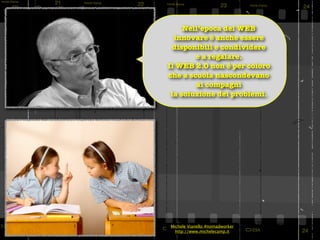
Nell’epoca del WEB
  innovare è anche essere
  disponibili e condividere
        e a regalare.
Il WEB 2.0 non è per coloro
che a scuola nascondevano
        ai compagni
 la soluzione dei problemi.


                                slide di Michele Vianello
Michele Vianello #nomadworker
  http://www.michelecamp.it
“Crowdsourcing”: la scelta di regalare
    il proprio tempo per attività
           sociali sul web
             Michele Vianello #nomadworker
               http://www.michelecamp.it
Naturalmente mi
 interessano le vostre
      idee, i vostri
suggerimenti, le vostre
         critiche.
  Scrivetemi sul blog,
    su Facebook, su
                           il mio blog: http://www.michelecamp.it
        Twitter.....
    sono facilmente           michele.vianello0@aliceeposta.it

  reperibile in rete!!!!      michele.vianello@vegapark.ve.it

                             @michelevianello #nomadworker
GRAZIE PER L’ATTENZIONE!!!!!


   Naturalmente mi
 interessano le vostre
      idee, i vostri
suggerimenti, le vostre
         critiche.
  Scrivetemi sul blog,
    su Facebook, su
                           il mio blog: http://www.michelecamp.it
        Twitter.....
    sono facilmente           michele.vianello0@aliceeposta.it

  reperibile in rete!!!!      michele.vianello@vegapark.ve.it

                             @michelevianello #nomadworker

Frigoriferi Intelligenti e Uomini Affamati

  • 1.
    Frigoriferi intelligenti e Uomini affamati Michele Vianello Direttore del VEGA Michele Vianello #nomadworker http://www.michelecamp.it
  • 2.
    Sono il DirettoreGenerale del VEGA (Il Parco Scientifico e Tecnologico di Venezia). Mi sono occupato e mi occupo di WEB e di Social Media, di Città Intelligenti. Sono un #nomadworker. Incubo aziende e progetto edifici per nomadic worker. Mi trovate su Facebook, su Twitter, Pinterest, su Linkedin ecc. ecc. Se volete seguirmi, leggete il mio blog: http://www.michelecamp.it p.s.sono considerato uno“starnutitore” v. Seth Godin vediamo se funziona anche con voi....
  • 3.
    #nomadworker’s production Manifesto di principi di una “Citta’ Intelligente” YouTube michelevianello100 http://www.michelecamp.it @michelevianello #nomadworker
  • 4.
    4 innovazioni “change ordie” Michele Vianello #nomadworker http://www.michelecamp.it
  • 5.
    Michele Vianello #nomadworker http://www.michelecamp.it
  • 6.
    Michele Vianello #nomadworker http://www.michelecamp.it
  • 7.
    Michele Vianello #nomadworker http://www.michelecamp.it
  • 8.
    Michele Vianello #nomadworker http://www.michelecamp.it
  • 9.
    Cloud Computing: unagrande nuvola di dati? Michele Vianello #nomadworker http://www.michelecamp.it
  • 10.
    The Internet ofThings Leads to the Internet of Everything
  • 11.
    The Internet ofThings Leads to the Internet of Everything Over 50% of Internet connections are things 2011: 15+ billion permanent, 50+ billion intermittent 2020: 30+ billion permanent, >200 billion intermittent
  • 12.
    The Internet ofThings Leads to the Internet of Everything Over 50% of Internet connections are things Remote sensing of objects 2011: 15+ billion permanent, 50+ billion intermittent and environment 2020: 30+ billion permanent, >200 billion intermittent Cameras and microphones widely deployed Everything has a URL
  • 13.
    The Internet ofThings Leads to the Internet of Everything Over 50% of Internet connections are things Remote sensing of objects 2011: 15+ billion permanent, 50+ billion intermittent and environment 2020: 30+ billion permanent, >200 billion intermittent Audio $0.5 Cameras and microphones widely deployed Everything has a URL 2 GB flash $3 LTE NFC GPRS $7/Wi-Fi $3 7" 800 x 400 display $20
  • 14.
    The Internet ofThings Leads to the Internet of Everything Over 50% of Internet connections are things Remote sensing of objects 2011: 15+ billion permanent, 50+ billion intermittent and environment 2020: 30+ billion permanent, >200 billion intermittent Building and New routes to infrastructure market via Audio $0.5 management intelligent objects Cameras and microphones widely deployed Everything has a URL 2 GB flash $3 Content and services via connected products Augmented Situational decision reality support LTE NFC GPRS $7/Wi-Fi $3 7" 800 x 400 display $20
  • 15.
    Michele Vianello #nomadworker http://www.michelecamp.it
  • 16.
    Michele Vianello #nomadworker http://www.michelecamp.it
  • 17.
    Michele Vianello #nomadworker http://www.michelecamp.it
  • 18.
    ???? Caccia all’errore???? Michele Vianello #nomadworker http://www.michelecamp.it
  • 19.
    Riassumendo.... miei cariesseri umani avete a disposizione: 1) Piattaforme social, wiki, crouwd per poter comunicare (siete liberi dalla schiavitù della TV); 2) Device Mobili (sempre in Internet); 3) Disponibilità di conoscenza ovunque e a qualunque orario; 4) Frigoriferi che vi dicono quando fare la spesa. Michele Vianello #nomadworker http://www.michelecamp.it
  • 20.
    Una città nonè “smart” l’uso delle tecnologie deve essere “smart”; la Città - le persone che usano le tecnologie in modo “smart” sono INTELLIGENTI. Michele Vianello #nomadworker http://www.michelecamp.it
  • 21.
    Michele Vianello #nomadworker Michele Vianello #nomadworker http://www.michelecamp.it http://www.michelecamp.it
  • 22.
    “La Città Intelligente”è un percorso non una destinazione finale. Michele Vianello #nomadworker Michele Vianello #nomadworker http://www.michelecamp.it http://www.michelecamp.it
  • 23.
    Stay hungry Stay foolish MicheleVianello #nomadworker http://www.michelecamp.it
  • 24.
    Stay hungry Stay foolish L’innovazione è il frutto di atti di disobbedienza ben organizzati Michele Vianello #nomadworker http://www.michelecamp.it
  • 25.
    Nella Città intelligente cambia tutto... ...l’organizzazione del tempo.... Michele Vianello #nomadworker http://www.michelecamp.it
  • 26.
    ORARI!!! RISIEDERE!!! CITTA’ DECONTESTUALIZZATA LAVORO!!! Michele Vianello #nomadworker http://www.michelecamp.it
  • 27.
    1 - COWORKING.... 2 - DECONGESTIONARE IL TRAFFICO.... 3 - SOSTENIBILITA’ AMBIENTALE Michele Vianello #nomadworker http://www.michelecamp.it
  • 28.
    Michele Vianello #nomadworker http://www.michelecamp.it
  • 29.
    Ogni anno nelmondo abbiamo a disposizione un trilione di ore da dedicare al tempo libero!!! Michele Vianello #nomadworker http://www.michelecamp.it
  • 30.
    Ogni anno nelmondo abbiamo a disposizione un trilione di ore da dedicare al tempo libero!!! Una persona nata nel 1960, a oggi ha guardato circa 50.000 ore di televisione. Prima di morire ne guarderà altre 30.000. Michele Vianello #nomadworker http://www.michelecamp.it
  • 31.
    ... e seper 80.000 ore della nostra vita ci trasformassimo in PROSUMER? Michele Vianello #nomadworker http://www.michelecamp.it
  • 32.
    slide di MicheleVianello Michele Vianello #nomadworker http://www.michelecamp.it
  • 33.
    Nell’epoca del WEB innovare è anche essere disponibili e condividere e a regalare. Il WEB 2.0 non è per coloro che a scuola nascondevano ai compagni la soluzione dei problemi. slide di Michele Vianello Michele Vianello #nomadworker http://www.michelecamp.it
  • 34.
    “Crowdsourcing”: la sceltadi regalare il proprio tempo per attività sociali sul web Michele Vianello #nomadworker http://www.michelecamp.it
  • 35.
    Naturalmente mi interessanole vostre idee, i vostri suggerimenti, le vostre critiche. Scrivetemi sul blog, su Facebook, su il mio blog: http://www.michelecamp.it Twitter..... sono facilmente michele.vianello0@aliceeposta.it reperibile in rete!!!! michele.vianello@vegapark.ve.it @michelevianello #nomadworker
  • 36.
    GRAZIE PER L’ATTENZIONE!!!!! Naturalmente mi interessano le vostre idee, i vostri suggerimenti, le vostre critiche. Scrivetemi sul blog, su Facebook, su il mio blog: http://www.michelecamp.it Twitter..... sono facilmente michele.vianello0@aliceeposta.it reperibile in rete!!!! michele.vianello@vegapark.ve.it @michelevianello #nomadworker

Editor's Notes

  • #2 \n
  • #3 \n
  • #4 \n
  • #5 \n
  • #6 \n
  • #7 \n
  • #8 \n
  • #9 \n
  • #10 The Internet of Things (IoT) is a concept that describes how the Internet will expand as physical items such as consumer devices and physical assets are connected to the Internet. The vision and concept have existed for years; however, there has been an acceleration in the number and types of things that are being connected and in the technologies for identifying, sensing and communicating. This leads to the important trend of imbuing IT tools and practices into operational technology (OT), plus value can be gained when these newly smart and connected objects can be linked to traditional IT systems to inject purchases and other business transactions. They can also use this link to receive updated behavioral orders, adjusting the way those OT objects act to the situation and the objectives determined by the business strategy and IT systems. Key elements of the IoT include:\nEmbedded sensors: Sensors that detect and communicate changes (e.g., accelerometers, GPS, compasses, cameras) are being embedded not just in mobile devices but in an increasing number of places and objects. \nImage recognition: Image recognition technologies strive to identify objects, people, buildings, places, logos and anything else that has value to consumers and enterprises. Smartphones and tablets equipped with cameras have pushed this technology from mainly industrial applications to broad consumer and enterprise applications.\nNFC payment: NFC allows users to make payments by waving their mobile phone in front of a compatible reader. Once NFC is embedded in a critical mass of phones for payment, industries such as public transportation, airlines, retail and healthcare can explore other areas in which NFC technology can improve efficiency and customer service.\n
  • #11 The Internet of Things (IoT) is a concept that describes how the Internet will expand as physical items such as consumer devices and physical assets are connected to the Internet. The vision and concept have existed for years; however, there has been an acceleration in the number and types of things that are being connected and in the technologies for identifying, sensing and communicating. This leads to the important trend of imbuing IT tools and practices into operational technology (OT), plus value can be gained when these newly smart and connected objects can be linked to traditional IT systems to inject purchases and other business transactions. They can also use this link to receive updated behavioral orders, adjusting the way those OT objects act to the situation and the objectives determined by the business strategy and IT systems. Key elements of the IoT include:\nEmbedded sensors: Sensors that detect and communicate changes (e.g., accelerometers, GPS, compasses, cameras) are being embedded not just in mobile devices but in an increasing number of places and objects. \nImage recognition: Image recognition technologies strive to identify objects, people, buildings, places, logos and anything else that has value to consumers and enterprises. Smartphones and tablets equipped with cameras have pushed this technology from mainly industrial applications to broad consumer and enterprise applications.\nNFC payment: NFC allows users to make payments by waving their mobile phone in front of a compatible reader. Once NFC is embedded in a critical mass of phones for payment, industries such as public transportation, airlines, retail and healthcare can explore other areas in which NFC technology can improve efficiency and customer service.\n
  • #12 The Internet of Things (IoT) is a concept that describes how the Internet will expand as physical items such as consumer devices and physical assets are connected to the Internet. The vision and concept have existed for years; however, there has been an acceleration in the number and types of things that are being connected and in the technologies for identifying, sensing and communicating. This leads to the important trend of imbuing IT tools and practices into operational technology (OT), plus value can be gained when these newly smart and connected objects can be linked to traditional IT systems to inject purchases and other business transactions. They can also use this link to receive updated behavioral orders, adjusting the way those OT objects act to the situation and the objectives determined by the business strategy and IT systems. Key elements of the IoT include:\nEmbedded sensors: Sensors that detect and communicate changes (e.g., accelerometers, GPS, compasses, cameras) are being embedded not just in mobile devices but in an increasing number of places and objects. \nImage recognition: Image recognition technologies strive to identify objects, people, buildings, places, logos and anything else that has value to consumers and enterprises. Smartphones and tablets equipped with cameras have pushed this technology from mainly industrial applications to broad consumer and enterprise applications.\nNFC payment: NFC allows users to make payments by waving their mobile phone in front of a compatible reader. Once NFC is embedded in a critical mass of phones for payment, industries such as public transportation, airlines, retail and healthcare can explore other areas in which NFC technology can improve efficiency and customer service.\n
  • #13 The Internet of Things (IoT) is a concept that describes how the Internet will expand as physical items such as consumer devices and physical assets are connected to the Internet. The vision and concept have existed for years; however, there has been an acceleration in the number and types of things that are being connected and in the technologies for identifying, sensing and communicating. This leads to the important trend of imbuing IT tools and practices into operational technology (OT), plus value can be gained when these newly smart and connected objects can be linked to traditional IT systems to inject purchases and other business transactions. They can also use this link to receive updated behavioral orders, adjusting the way those OT objects act to the situation and the objectives determined by the business strategy and IT systems. Key elements of the IoT include:\nEmbedded sensors: Sensors that detect and communicate changes (e.g., accelerometers, GPS, compasses, cameras) are being embedded not just in mobile devices but in an increasing number of places and objects. \nImage recognition: Image recognition technologies strive to identify objects, people, buildings, places, logos and anything else that has value to consumers and enterprises. Smartphones and tablets equipped with cameras have pushed this technology from mainly industrial applications to broad consumer and enterprise applications.\nNFC payment: NFC allows users to make payments by waving their mobile phone in front of a compatible reader. Once NFC is embedded in a critical mass of phones for payment, industries such as public transportation, airlines, retail and healthcare can explore other areas in which NFC technology can improve efficiency and customer service.\n
  • #14 The Internet of Things (IoT) is a concept that describes how the Internet will expand as physical items such as consumer devices and physical assets are connected to the Internet. The vision and concept have existed for years; however, there has been an acceleration in the number and types of things that are being connected and in the technologies for identifying, sensing and communicating. This leads to the important trend of imbuing IT tools and practices into operational technology (OT), plus value can be gained when these newly smart and connected objects can be linked to traditional IT systems to inject purchases and other business transactions. They can also use this link to receive updated behavioral orders, adjusting the way those OT objects act to the situation and the objectives determined by the business strategy and IT systems. Key elements of the IoT include:\nEmbedded sensors: Sensors that detect and communicate changes (e.g., accelerometers, GPS, compasses, cameras) are being embedded not just in mobile devices but in an increasing number of places and objects. \nImage recognition: Image recognition technologies strive to identify objects, people, buildings, places, logos and anything else that has value to consumers and enterprises. Smartphones and tablets equipped with cameras have pushed this technology from mainly industrial applications to broad consumer and enterprise applications.\nNFC payment: NFC allows users to make payments by waving their mobile phone in front of a compatible reader. Once NFC is embedded in a critical mass of phones for payment, industries such as public transportation, airlines, retail and healthcare can explore other areas in which NFC technology can improve efficiency and customer service.\n
  • #15 The Internet of Things (IoT) is a concept that describes how the Internet will expand as physical items such as consumer devices and physical assets are connected to the Internet. The vision and concept have existed for years; however, there has been an acceleration in the number and types of things that are being connected and in the technologies for identifying, sensing and communicating. This leads to the important trend of imbuing IT tools and practices into operational technology (OT), plus value can be gained when these newly smart and connected objects can be linked to traditional IT systems to inject purchases and other business transactions. They can also use this link to receive updated behavioral orders, adjusting the way those OT objects act to the situation and the objectives determined by the business strategy and IT systems. Key elements of the IoT include:\nEmbedded sensors: Sensors that detect and communicate changes (e.g., accelerometers, GPS, compasses, cameras) are being embedded not just in mobile devices but in an increasing number of places and objects. \nImage recognition: Image recognition technologies strive to identify objects, people, buildings, places, logos and anything else that has value to consumers and enterprises. Smartphones and tablets equipped with cameras have pushed this technology from mainly industrial applications to broad consumer and enterprise applications.\nNFC payment: NFC allows users to make payments by waving their mobile phone in front of a compatible reader. Once NFC is embedded in a critical mass of phones for payment, industries such as public transportation, airlines, retail and healthcare can explore other areas in which NFC technology can improve efficiency and customer service.\n
  • #16 The Internet of Things (IoT) is a concept that describes how the Internet will expand as physical items such as consumer devices and physical assets are connected to the Internet. The vision and concept have existed for years; however, there has been an acceleration in the number and types of things that are being connected and in the technologies for identifying, sensing and communicating. This leads to the important trend of imbuing IT tools and practices into operational technology (OT), plus value can be gained when these newly smart and connected objects can be linked to traditional IT systems to inject purchases and other business transactions. They can also use this link to receive updated behavioral orders, adjusting the way those OT objects act to the situation and the objectives determined by the business strategy and IT systems. Key elements of the IoT include:\nEmbedded sensors: Sensors that detect and communicate changes (e.g., accelerometers, GPS, compasses, cameras) are being embedded not just in mobile devices but in an increasing number of places and objects. \nImage recognition: Image recognition technologies strive to identify objects, people, buildings, places, logos and anything else that has value to consumers and enterprises. Smartphones and tablets equipped with cameras have pushed this technology from mainly industrial applications to broad consumer and enterprise applications.\nNFC payment: NFC allows users to make payments by waving their mobile phone in front of a compatible reader. Once NFC is embedded in a critical mass of phones for payment, industries such as public transportation, airlines, retail and healthcare can explore other areas in which NFC technology can improve efficiency and customer service.\n
  • #17 The Internet of Things (IoT) is a concept that describes how the Internet will expand as physical items such as consumer devices and physical assets are connected to the Internet. The vision and concept have existed for years; however, there has been an acceleration in the number and types of things that are being connected and in the technologies for identifying, sensing and communicating. This leads to the important trend of imbuing IT tools and practices into operational technology (OT), plus value can be gained when these newly smart and connected objects can be linked to traditional IT systems to inject purchases and other business transactions. They can also use this link to receive updated behavioral orders, adjusting the way those OT objects act to the situation and the objectives determined by the business strategy and IT systems. Key elements of the IoT include:\nEmbedded sensors: Sensors that detect and communicate changes (e.g., accelerometers, GPS, compasses, cameras) are being embedded not just in mobile devices but in an increasing number of places and objects. \nImage recognition: Image recognition technologies strive to identify objects, people, buildings, places, logos and anything else that has value to consumers and enterprises. Smartphones and tablets equipped with cameras have pushed this technology from mainly industrial applications to broad consumer and enterprise applications.\nNFC payment: NFC allows users to make payments by waving their mobile phone in front of a compatible reader. Once NFC is embedded in a critical mass of phones for payment, industries such as public transportation, airlines, retail and healthcare can explore other areas in which NFC technology can improve efficiency and customer service.\n
  • #18 The Internet of Things (IoT) is a concept that describes how the Internet will expand as physical items such as consumer devices and physical assets are connected to the Internet. The vision and concept have existed for years; however, there has been an acceleration in the number and types of things that are being connected and in the technologies for identifying, sensing and communicating. This leads to the important trend of imbuing IT tools and practices into operational technology (OT), plus value can be gained when these newly smart and connected objects can be linked to traditional IT systems to inject purchases and other business transactions. They can also use this link to receive updated behavioral orders, adjusting the way those OT objects act to the situation and the objectives determined by the business strategy and IT systems. Key elements of the IoT include:\nEmbedded sensors: Sensors that detect and communicate changes (e.g., accelerometers, GPS, compasses, cameras) are being embedded not just in mobile devices but in an increasing number of places and objects. \nImage recognition: Image recognition technologies strive to identify objects, people, buildings, places, logos and anything else that has value to consumers and enterprises. Smartphones and tablets equipped with cameras have pushed this technology from mainly industrial applications to broad consumer and enterprise applications.\nNFC payment: NFC allows users to make payments by waving their mobile phone in front of a compatible reader. Once NFC is embedded in a critical mass of phones for payment, industries such as public transportation, airlines, retail and healthcare can explore other areas in which NFC technology can improve efficiency and customer service.\n
  • #19 The Internet of Things (IoT) is a concept that describes how the Internet will expand as physical items such as consumer devices and physical assets are connected to the Internet. The vision and concept have existed for years; however, there has been an acceleration in the number and types of things that are being connected and in the technologies for identifying, sensing and communicating. This leads to the important trend of imbuing IT tools and practices into operational technology (OT), plus value can be gained when these newly smart and connected objects can be linked to traditional IT systems to inject purchases and other business transactions. They can also use this link to receive updated behavioral orders, adjusting the way those OT objects act to the situation and the objectives determined by the business strategy and IT systems. Key elements of the IoT include:\nEmbedded sensors: Sensors that detect and communicate changes (e.g., accelerometers, GPS, compasses, cameras) are being embedded not just in mobile devices but in an increasing number of places and objects. \nImage recognition: Image recognition technologies strive to identify objects, people, buildings, places, logos and anything else that has value to consumers and enterprises. Smartphones and tablets equipped with cameras have pushed this technology from mainly industrial applications to broad consumer and enterprise applications.\nNFC payment: NFC allows users to make payments by waving their mobile phone in front of a compatible reader. Once NFC is embedded in a critical mass of phones for payment, industries such as public transportation, airlines, retail and healthcare can explore other areas in which NFC technology can improve efficiency and customer service.\n
  • #20 The Internet of Things (IoT) is a concept that describes how the Internet will expand as physical items such as consumer devices and physical assets are connected to the Internet. The vision and concept have existed for years; however, there has been an acceleration in the number and types of things that are being connected and in the technologies for identifying, sensing and communicating. This leads to the important trend of imbuing IT tools and practices into operational technology (OT), plus value can be gained when these newly smart and connected objects can be linked to traditional IT systems to inject purchases and other business transactions. They can also use this link to receive updated behavioral orders, adjusting the way those OT objects act to the situation and the objectives determined by the business strategy and IT systems. Key elements of the IoT include:\nEmbedded sensors: Sensors that detect and communicate changes (e.g., accelerometers, GPS, compasses, cameras) are being embedded not just in mobile devices but in an increasing number of places and objects. \nImage recognition: Image recognition technologies strive to identify objects, people, buildings, places, logos and anything else that has value to consumers and enterprises. Smartphones and tablets equipped with cameras have pushed this technology from mainly industrial applications to broad consumer and enterprise applications.\nNFC payment: NFC allows users to make payments by waving their mobile phone in front of a compatible reader. Once NFC is embedded in a critical mass of phones for payment, industries such as public transportation, airlines, retail and healthcare can explore other areas in which NFC technology can improve efficiency and customer service.\n
  • #21 The Internet of Things (IoT) is a concept that describes how the Internet will expand as physical items such as consumer devices and physical assets are connected to the Internet. The vision and concept have existed for years; however, there has been an acceleration in the number and types of things that are being connected and in the technologies for identifying, sensing and communicating. This leads to the important trend of imbuing IT tools and practices into operational technology (OT), plus value can be gained when these newly smart and connected objects can be linked to traditional IT systems to inject purchases and other business transactions. They can also use this link to receive updated behavioral orders, adjusting the way those OT objects act to the situation and the objectives determined by the business strategy and IT systems. Key elements of the IoT include:\nEmbedded sensors: Sensors that detect and communicate changes (e.g., accelerometers, GPS, compasses, cameras) are being embedded not just in mobile devices but in an increasing number of places and objects. \nImage recognition: Image recognition technologies strive to identify objects, people, buildings, places, logos and anything else that has value to consumers and enterprises. Smartphones and tablets equipped with cameras have pushed this technology from mainly industrial applications to broad consumer and enterprise applications.\nNFC payment: NFC allows users to make payments by waving their mobile phone in front of a compatible reader. Once NFC is embedded in a critical mass of phones for payment, industries such as public transportation, airlines, retail and healthcare can explore other areas in which NFC technology can improve efficiency and customer service.\n
  • #22 The Internet of Things (IoT) is a concept that describes how the Internet will expand as physical items such as consumer devices and physical assets are connected to the Internet. The vision and concept have existed for years; however, there has been an acceleration in the number and types of things that are being connected and in the technologies for identifying, sensing and communicating. This leads to the important trend of imbuing IT tools and practices into operational technology (OT), plus value can be gained when these newly smart and connected objects can be linked to traditional IT systems to inject purchases and other business transactions. They can also use this link to receive updated behavioral orders, adjusting the way those OT objects act to the situation and the objectives determined by the business strategy and IT systems. Key elements of the IoT include:\nEmbedded sensors: Sensors that detect and communicate changes (e.g., accelerometers, GPS, compasses, cameras) are being embedded not just in mobile devices but in an increasing number of places and objects. \nImage recognition: Image recognition technologies strive to identify objects, people, buildings, places, logos and anything else that has value to consumers and enterprises. Smartphones and tablets equipped with cameras have pushed this technology from mainly industrial applications to broad consumer and enterprise applications.\nNFC payment: NFC allows users to make payments by waving their mobile phone in front of a compatible reader. Once NFC is embedded in a critical mass of phones for payment, industries such as public transportation, airlines, retail and healthcare can explore other areas in which NFC technology can improve efficiency and customer service.\n
  • #23 The Internet of Things (IoT) is a concept that describes how the Internet will expand as physical items such as consumer devices and physical assets are connected to the Internet. The vision and concept have existed for years; however, there has been an acceleration in the number and types of things that are being connected and in the technologies for identifying, sensing and communicating. This leads to the important trend of imbuing IT tools and practices into operational technology (OT), plus value can be gained when these newly smart and connected objects can be linked to traditional IT systems to inject purchases and other business transactions. They can also use this link to receive updated behavioral orders, adjusting the way those OT objects act to the situation and the objectives determined by the business strategy and IT systems. Key elements of the IoT include:\nEmbedded sensors: Sensors that detect and communicate changes (e.g., accelerometers, GPS, compasses, cameras) are being embedded not just in mobile devices but in an increasing number of places and objects. \nImage recognition: Image recognition technologies strive to identify objects, people, buildings, places, logos and anything else that has value to consumers and enterprises. Smartphones and tablets equipped with cameras have pushed this technology from mainly industrial applications to broad consumer and enterprise applications.\nNFC payment: NFC allows users to make payments by waving their mobile phone in front of a compatible reader. Once NFC is embedded in a critical mass of phones for payment, industries such as public transportation, airlines, retail and healthcare can explore other areas in which NFC technology can improve efficiency and customer service.\n
  • #24 The Internet of Things (IoT) is a concept that describes how the Internet will expand as physical items such as consumer devices and physical assets are connected to the Internet. The vision and concept have existed for years; however, there has been an acceleration in the number and types of things that are being connected and in the technologies for identifying, sensing and communicating. This leads to the important trend of imbuing IT tools and practices into operational technology (OT), plus value can be gained when these newly smart and connected objects can be linked to traditional IT systems to inject purchases and other business transactions. They can also use this link to receive updated behavioral orders, adjusting the way those OT objects act to the situation and the objectives determined by the business strategy and IT systems. Key elements of the IoT include:\nEmbedded sensors: Sensors that detect and communicate changes (e.g., accelerometers, GPS, compasses, cameras) are being embedded not just in mobile devices but in an increasing number of places and objects. \nImage recognition: Image recognition technologies strive to identify objects, people, buildings, places, logos and anything else that has value to consumers and enterprises. Smartphones and tablets equipped with cameras have pushed this technology from mainly industrial applications to broad consumer and enterprise applications.\nNFC payment: NFC allows users to make payments by waving their mobile phone in front of a compatible reader. Once NFC is embedded in a critical mass of phones for payment, industries such as public transportation, airlines, retail and healthcare can explore other areas in which NFC technology can improve efficiency and customer service.\n
  • #25 \n
  • #26 \n
  • #27 \n
  • #28 \n
  • #29 \n
  • #30 \n
  • #31 \n
  • #32 \n
  • #33 \n
  • #34 \n
  • #35 \n
  • #36 \n
  • #37 \n
  • #38 \n
  • #39 \n
  • #40 \n
  • #41 \n
  • #42 \n
  • #43 \n
  • #44 \n