

I Learned Who I Was When…
    Identity Development
            Friends Academy
         Rosetta Eun Ryong Lee
          Seattle Girls’ School

   Rosetta Eun Ryong Lee (http://tiny.cc/rosettalee)
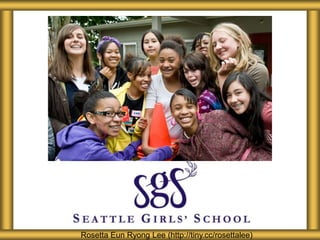
About Seattle Girls’ School


        Rosetta Eun Ryong Lee (http://tiny.cc/rosettalee)
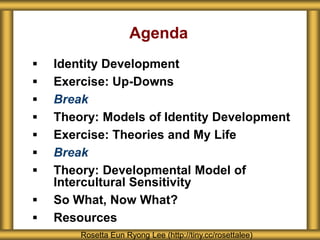
Agenda
   Identity Development
   Exercise: Up-Downs
   Break
   Theory: Models of Identity Development
   Exercise: Theories and My Life
   Break
   Theory: Developmental Model of
    Intercultural Sensitivity
   So What, Now What?
   Resources
        Rosetta Eun Ryong Lee (http://tiny.cc/rosettalee)
Rosetta Eun Ryong Lee (http://tiny.cc/rosettalee)
Identity Development

 What is it?

 What are the
 various dimensions
 of identity?
 Why identity
 development?

       Rosetta Eun Ryong Lee (http://tiny.cc/rosettalee)
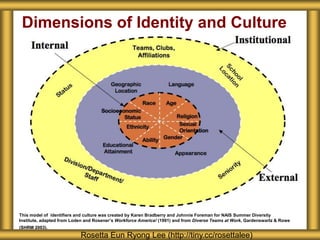
Dimensions of Identity and Culture


This model of identifiers and culture was created by Karen Bradberry and Johnnie Foreman for NAIS Summer Diversity
Institute, adapted from Loden and Rosener’s Workforce America! (1991) and from Diverse Teams at Work, Gardenswartz & Rowe
(SHRM 2003).
                           Rosetta Eun Ryong Lee (http://tiny.cc/rosettalee)
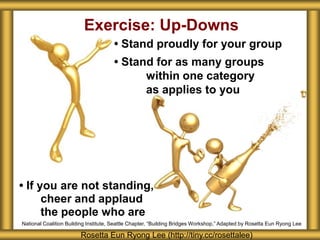
Exercise: Up-Downs
                                      • Stand proudly for your group
                                      • Stand for as many groups
                                            within one category
                                            as applies to you


• If you are not standing,
      cheer and applaud
      the people who are
National Coalition Building Institute, Seattle Chapter, “Building Bridges Workshop,” Adapted by Rosetta Eun Ryong Lee

                        Rosetta Eun Ryong Lee (http://tiny.cc/rosettalee)
Debrief: Up-Downs
                            How did it feel to
                            stand and claim your
                            identities and
                            experiences? To be
                            applauded for them?
                            To applaud others for
                            their identities and
                            their experiences?


Rosetta Eun Ryong Lee (http://tiny.cc/rosettalee)
Break


Rosetta Eun Ryong Lee (http://tiny.cc/rosettalee)
Racial, Ethnic, LGB Identity
  Development Models

                              • All Models Have
                                 Some Value
                              • All Models Have
                                 Some Limitations
                              • Models Can Extend
                                 Beyond Cultural
                                 Identifiers Used


   Rosetta Eun Ryong Lee (http://tiny.cc/rosettalee)
Exercise:
       Theories Jigsaw

                            Please choose a theory
                            that reflects one of your
                          identities. Read the theory
                             summary and ask the
                            facilitator any questions
                               you have about it.


Rosetta Eun Ryong Lee (http://tiny.cc/rosettalee)
Exercise:
       Theories Jigsaw


                          Please take turns sharing
                                highlights and
                           understandings from the
                          theory you read. Do these
                         theories resonate with your
                              own experience?


Rosetta Eun Ryong Lee (http://tiny.cc/rosettalee)
Break


Rosetta Eun Ryong Lee (http://tiny.cc/rosettalee)
Identity Development:
Hidden Lessons of School

                                  Theory
                                    Comparisons

                                  Co-Authorship of
                                    Identity

                                  Our Roles as
                                    Educators

 Rosetta Eun Ryong Lee (http://tiny.cc/rosettalee)
R.T. Carter’s Model:
 Racial Identity and
 Social Interactions

             Parallel
             Regressive
             Crossed
             Progressive
             Symbiotic


Rosetta Eun Ryong Lee (http://tiny.cc/rosettalee)
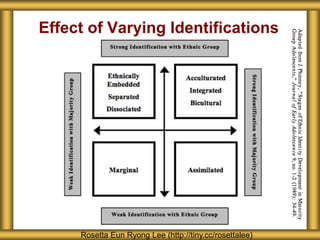
Effect of Varying Identifications


     Rosetta Eun Ryong Lee (http://tiny.cc/rosettalee)
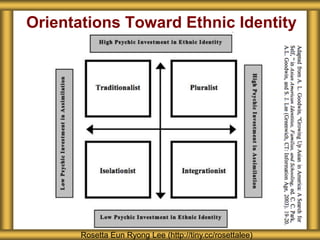
Orientations Toward Ethnic Identity


       Rosetta Eun Ryong Lee (http://tiny.cc/rosettalee)
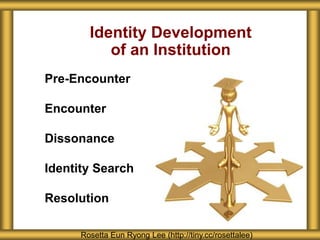
Identity Development
           of an Institution
Pre-Encounter

Encounter

Dissonance

Identity Search

Resolution

      Rosetta Eun Ryong Lee (http://tiny.cc/rosettalee)
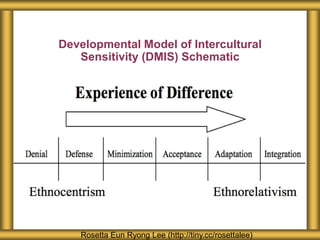
Developmental Model of Intercultural
   Sensitivity (DMIS) Schematic


   Rosetta Eun Ryong Lee (http://tiny.cc/rosettalee)
So What? Now What?


Rosetta Eun Ryong Lee (http://tiny.cc/rosettalee)
Self Assessment
             and Goal Setting

   What did you learn today
    that was new, helpful, or
    thought provoking?
   What are some goals or
    strategies you would like to
    apply in the classroom or
    in your life?


          Rosetta Eun Ryong Lee (http://tiny.cc/rosettalee)
Presenter Information
     Rosetta Eun Ryong Lee
     6th Faculty and
     Professional Outreach
     Seattle Girls’ School
     2706 S Jackson Street
     Seattle WA 98144
     (206) 805-6562
     rlee@seattlegirlsschool.org
     http://tiny.cc/rosettalee

Rosetta Eun Ryong Lee (http://tiny.cc/rosettalee)
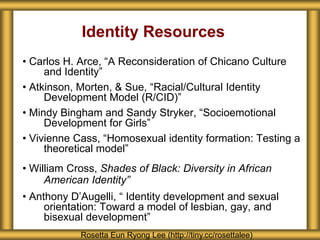
Identity Resources
• Carlos H. Arce, “A Reconsideration of Chicano Culture
     and Identity”
• Atkinson, Morten, & Sue, “Racial/Cultural Identity
     Development Model (R/CID)”
• Mindy Bingham and Sandy Stryker, “Socioemotional
     Development for Girls”
• Vivienne Cass, “Homosexual identity formation: Testing a
     theoretical model”
• William Cross, Shades of Black: Diversity in African
     American Identity”
• Anthony D’Augelli, “ Identity development and sexual
     orientation: Toward a model of lesbian, gay, and
     bisexual development”
            Rosetta Eun Ryong Lee (http://tiny.cc/rosettalee)
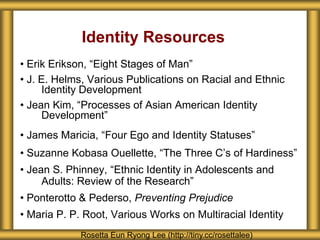
Identity Resources
• Erik Erikson, “Eight Stages of Man”
• J. E. Helms, Various Publications on Racial and Ethnic
     Identity Development
• Jean Kim, “Processes of Asian American Identity
     Development”
• James Maricia, “Four Ego and Identity Statuses”
• Suzanne Kobasa Ouellette, “The Three C’s of Hardiness”
• Jean S. Phinney, “Ethnic Identity in Adolescents and
     Adults: Review of the Research”
• Ponterotto & Pederso, Preventing Prejudice
• Maria P. P. Root, Various Works on Multiracial Identity
             Rosetta Eun Ryong Lee (http://tiny.cc/rosettalee)
Identity Resources
• Patricia Romney, Karlene Ferron, and Jennifer Hill,
     “Measuring the Success of Diversity Directors in
     Independent Schools”
• Pedro Ruiz, “Latino/a Identity Development Model”
• Chalmer E. Thompson and Robert T. Carter, Racial
    Identity Theory
• Alex Wilson, “How We Find Ourselves: Identity
     Development and Two Spirit People”
• Christine J. Yeh, “The Collectivistic Nature of Identity
    Development Among Asian-American College
    Students”

           Rosetta Eun Ryong Lee (http://tiny.cc/rosettalee)
Miscellaneous Resources
• Karen Bradberry and Johnnie Foreman, “Privilege and
     Power,” Summer Diversity Institute, National Association
     of Independent Schools, 2009
• Po Bronson and Ashley Merryman, Nurture Shock
• Kevin Jennings, GLSEN (Gay Lesbian and Straight Education
     Network) www.glsen.org
• Allan G. Johnson, Privilege, Power, and Difference
• Johnnie McKinley, “Leveling the Playing Field and Raising
     African American Students’ Achievement in Twenty-nine
     Urban Classrooms,” New Horizons for Learning,
     http://www.newhorizons.org/strategies/differentiated/
     mckinley.htm
Michael J Nakkula and Eric Toshalis, Understanding Youth.

             Rosetta Eun Ryong Lee (http://tiny.cc/rosettalee)
The following are slides and exercises
         for extra time, if any


      Rosetta Eun Ryong Lee (http://tiny.cc/rosettalee)
Case Study:
       Identity and Schools


Rosetta Eun Ryong Lee (http://sites.google.com/site/sgsprofessionaloutreach/)
Case Study: Sibling Role Model
A 5th grade class is studying the Little Rock Eight story and the
experiences of the first African American students in integrated
schools. The curriculum is a well-vetted and successful one. It
includes many readings, first person accounts, and an in-depth
analysis of the n word (its history, impact, etc.). One day after
school, Kevin, a 2nd grader at the same school, overhears his 5th
grader brother reading aloud one of the readings with his
classmate, a first person account that uses the n word in full form.
Kevin mulls over the term and wonders what it means. At school,
he looks up the n word in the dictionary. He gathers a few of his
friends, and they talk about what the word means with some
confusion, some amusement, and some discomfort. Two girls,
one African American and one multiracial (part African heritage),
see the boys engrossed in the dictionary. One of the boys looks
at one of the girls, points to her, and giggles. The girls decide to
go over and investigate, and they find out what the boys are up to.
Angry and upset, they report the incident to a teacher.
Rosetta Eun Ryong Lee (http://sites.google.com/site/sgsprofessionaloutreach/)
Case Study: Sibling Role Model
What’s going on?
How is the conflict based on identity
development?
What would you do to increase
awareness, understanding, and esteem
for your community?
What issues from this case resonate
with you and Friends Academy?
Rosetta Eun Ryong Lee (http://sites.google.com/site/sgsprofessionaloutreach/)
Case Study: Inclusion “Versus” Rigor?
After years of hearing complaints from students of color, their
families, and their allies that the curriculum only represents white
(and mostly white male) authors, your English department has
revamped the literature curriculum such that all students would
read works by authors from various racial and ethnic groups. A
few parents begin expressing concern that their white children are
talking at home about how “class is always about people of color”
and “we never read white authors.” Some parents and even
teachers are also concerned that the students “will not be
adequately exposed to the classics” and therefore “will not have
the same academic advantage” as students from other schools
which have a “more robust classic literature curriculum.” They are
especially concerned about performance in standardized tests
and college courses. These parents and teachers say that they
support diversity and have nothing against the authors being
presented, but they are pushing the school to have the changes to
the literature curriculum to be implemented in optional or
enrichment courses instead of the required courses.
Rosetta Eun Ryong Lee (http://sites.google.com/site/sgsprofessionaloutreach/)
Case Study: Inclusion “Versus” Rigor
What’s going on?
How is the conflict based on identity
development?
What would you do to increase
awareness, understanding, and esteem
for your community?
What issues from this case resonate
with you and Friends Academy?
Rosetta Eun Ryong Lee (http://sites.google.com/site/sgsprofessionaloutreach/)
Case Study: Between Two Worlds
Julio, a Latino student, has told the school counselor that he is
negotiating a very confusing life. On one hand, he loves school. He
is doing well in classes and has high academic ability and
performance. On the other hand, he is enrolled in mostly honors
classes, where he is one of the few (and often the only) Latino
students. Enrique, his best friend from childhood years, started to
diverge from Julio’s academic path starting freshman year when Julio
was placed on an accelerated track and Enrique was not. Enrique
struggles academically, and he has gotten into more disciplinary
trouble the more his academic performance has slipped. These two
friends have no classes together and are having difficulty maintaining
their closeness. Julio’s friends in his honors classes have nicknamed
him “Leo” recently, and Julio has tolerated it and sometimes even
liked it. Enrique, hearing this, pushes Julio that he is no longer
“connected to his roots” and “becoming whiter every day.” To prove
himself to Enrique that he is “still one of the guys,” Julio agrees to
graffiti the boys’ bathroom walls with their neighborhood gang’s
symbol. They are caught in this act by a staff member.
Rosetta Eun Ryong Lee (http://sites.google.com/site/sgsprofessionaloutreach/)
Case Study: Between Two Worlds
What’s going on?
How is the conflict based on identity
development?
What would you do to increase
awareness, understanding, and esteem
for your community?
What issues from this case resonate
with you and Friends Academy?
Rosetta Eun Ryong Lee (http://sites.google.com/site/sgsprofessionaloutreach/)
Case Study: On My Own Time
Monique is an African American student who is very proud of
her Black heritage. She mode and code switches to meet
academic and social expectations of the classroom, and she
is a successful student. In unstructured spaces (lunch,
hallways, etc.), Monique expresses herself and her
understanding of her ethnic heritage by speaking Ebonics or
African American Vernacular English with her Black friends;
she does many of her school reports on African American
leaders and role models; and she wears her hair proudly in
an Afro daily. One day, she approaches the Diversity
Director, frustrated by interactions with Ms. Johnson, an
African American teacher. This teacher has repeatedly
admonished the student over the use of Ebonics, saying “It’s
not a real language, so you shouldn’t use it at school.” She
feels that Ms. Johnson is being unfair and that she is going to
influence other teachers to “keep her down.”
Rosetta Eun Ryong Lee (http://sites.google.com/site/sgsprofessionaloutreach/)
Case Study: On My Own Time
What’s going on?
How is the conflict based on identity
development?
What would you do to increase
awareness, understanding, and esteem
for your community?
What issues from this case resonate
with you and Friends Academy?
Rosetta Eun Ryong Lee (http://sites.google.com/site/sgsprofessionaloutreach/)

Friends Academy Identity Development for Faculty and Staff

  • 1.
    I Learned WhoI Was When… Identity Development Friends Academy Rosetta Eun Ryong Lee Seattle Girls’ School Rosetta Eun Ryong Lee (http://tiny.cc/rosettalee)
  • 2.
    About Seattle Girls’School Rosetta Eun Ryong Lee (http://tiny.cc/rosettalee)
  • 3.
    Agenda  Identity Development  Exercise: Up-Downs  Break  Theory: Models of Identity Development  Exercise: Theories and My Life  Break  Theory: Developmental Model of Intercultural Sensitivity  So What, Now What?  Resources Rosetta Eun Ryong Lee (http://tiny.cc/rosettalee)
  • 4.
    Rosetta Eun RyongLee (http://tiny.cc/rosettalee)
  • 5.
    Identity Development  Whatis it?  What are the various dimensions of identity?  Why identity development? Rosetta Eun Ryong Lee (http://tiny.cc/rosettalee)
  • 6.
    Dimensions of Identityand Culture This model of identifiers and culture was created by Karen Bradberry and Johnnie Foreman for NAIS Summer Diversity Institute, adapted from Loden and Rosener’s Workforce America! (1991) and from Diverse Teams at Work, Gardenswartz & Rowe (SHRM 2003). Rosetta Eun Ryong Lee (http://tiny.cc/rosettalee)
  • 7.
    Exercise: Up-Downs • Stand proudly for your group • Stand for as many groups within one category as applies to you • If you are not standing, cheer and applaud the people who are National Coalition Building Institute, Seattle Chapter, “Building Bridges Workshop,” Adapted by Rosetta Eun Ryong Lee Rosetta Eun Ryong Lee (http://tiny.cc/rosettalee)
  • 8.
    Debrief: Up-Downs How did it feel to stand and claim your identities and experiences? To be applauded for them? To applaud others for their identities and their experiences? Rosetta Eun Ryong Lee (http://tiny.cc/rosettalee)
  • 9.
    Break Rosetta Eun RyongLee (http://tiny.cc/rosettalee)
  • 10.
    Racial, Ethnic, LGBIdentity Development Models • All Models Have Some Value • All Models Have Some Limitations • Models Can Extend Beyond Cultural Identifiers Used Rosetta Eun Ryong Lee (http://tiny.cc/rosettalee)
  • 11.
    Exercise: Theories Jigsaw Please choose a theory that reflects one of your identities. Read the theory summary and ask the facilitator any questions you have about it. Rosetta Eun Ryong Lee (http://tiny.cc/rosettalee)
  • 12.
    Exercise: Theories Jigsaw Please take turns sharing highlights and understandings from the theory you read. Do these theories resonate with your own experience? Rosetta Eun Ryong Lee (http://tiny.cc/rosettalee)
  • 13.
    Break Rosetta Eun RyongLee (http://tiny.cc/rosettalee)
  • 14.
    Identity Development: Hidden Lessonsof School Theory Comparisons Co-Authorship of Identity Our Roles as Educators Rosetta Eun Ryong Lee (http://tiny.cc/rosettalee)
  • 15.
    R.T. Carter’s Model: Racial Identity and Social Interactions  Parallel  Regressive  Crossed  Progressive  Symbiotic Rosetta Eun Ryong Lee (http://tiny.cc/rosettalee)
  • 16.
    Effect of VaryingIdentifications Rosetta Eun Ryong Lee (http://tiny.cc/rosettalee)
  • 17.
    Orientations Toward EthnicIdentity Rosetta Eun Ryong Lee (http://tiny.cc/rosettalee)
  • 18.
    Identity Development of an Institution Pre-Encounter Encounter Dissonance Identity Search Resolution Rosetta Eun Ryong Lee (http://tiny.cc/rosettalee)
  • 19.
    Developmental Model ofIntercultural Sensitivity (DMIS) Schematic Rosetta Eun Ryong Lee (http://tiny.cc/rosettalee)
  • 20.
    So What? NowWhat? Rosetta Eun Ryong Lee (http://tiny.cc/rosettalee)
  • 21.
    Self Assessment and Goal Setting  What did you learn today that was new, helpful, or thought provoking?  What are some goals or strategies you would like to apply in the classroom or in your life? Rosetta Eun Ryong Lee (http://tiny.cc/rosettalee)
  • 22.
    Presenter Information Rosetta Eun Ryong Lee 6th Faculty and Professional Outreach Seattle Girls’ School 2706 S Jackson Street Seattle WA 98144 (206) 805-6562 rlee@seattlegirlsschool.org http://tiny.cc/rosettalee Rosetta Eun Ryong Lee (http://tiny.cc/rosettalee)
  • 23.
    Identity Resources • CarlosH. Arce, “A Reconsideration of Chicano Culture and Identity” • Atkinson, Morten, & Sue, “Racial/Cultural Identity Development Model (R/CID)” • Mindy Bingham and Sandy Stryker, “Socioemotional Development for Girls” • Vivienne Cass, “Homosexual identity formation: Testing a theoretical model” • William Cross, Shades of Black: Diversity in African American Identity” • Anthony D’Augelli, “ Identity development and sexual orientation: Toward a model of lesbian, gay, and bisexual development” Rosetta Eun Ryong Lee (http://tiny.cc/rosettalee)
  • 24.
    Identity Resources • ErikErikson, “Eight Stages of Man” • J. E. Helms, Various Publications on Racial and Ethnic Identity Development • Jean Kim, “Processes of Asian American Identity Development” • James Maricia, “Four Ego and Identity Statuses” • Suzanne Kobasa Ouellette, “The Three C’s of Hardiness” • Jean S. Phinney, “Ethnic Identity in Adolescents and Adults: Review of the Research” • Ponterotto & Pederso, Preventing Prejudice • Maria P. P. Root, Various Works on Multiracial Identity Rosetta Eun Ryong Lee (http://tiny.cc/rosettalee)
  • 25.
    Identity Resources • PatriciaRomney, Karlene Ferron, and Jennifer Hill, “Measuring the Success of Diversity Directors in Independent Schools” • Pedro Ruiz, “Latino/a Identity Development Model” • Chalmer E. Thompson and Robert T. Carter, Racial Identity Theory • Alex Wilson, “How We Find Ourselves: Identity Development and Two Spirit People” • Christine J. Yeh, “The Collectivistic Nature of Identity Development Among Asian-American College Students” Rosetta Eun Ryong Lee (http://tiny.cc/rosettalee)
  • 26.
    Miscellaneous Resources • KarenBradberry and Johnnie Foreman, “Privilege and Power,” Summer Diversity Institute, National Association of Independent Schools, 2009 • Po Bronson and Ashley Merryman, Nurture Shock • Kevin Jennings, GLSEN (Gay Lesbian and Straight Education Network) www.glsen.org • Allan G. Johnson, Privilege, Power, and Difference • Johnnie McKinley, “Leveling the Playing Field and Raising African American Students’ Achievement in Twenty-nine Urban Classrooms,” New Horizons for Learning, http://www.newhorizons.org/strategies/differentiated/ mckinley.htm Michael J Nakkula and Eric Toshalis, Understanding Youth. Rosetta Eun Ryong Lee (http://tiny.cc/rosettalee)
  • 27.
    The following areslides and exercises for extra time, if any Rosetta Eun Ryong Lee (http://tiny.cc/rosettalee)
  • 28.
    Case Study: Identity and Schools Rosetta Eun Ryong Lee (http://sites.google.com/site/sgsprofessionaloutreach/)
  • 29.
    Case Study: SiblingRole Model A 5th grade class is studying the Little Rock Eight story and the experiences of the first African American students in integrated schools. The curriculum is a well-vetted and successful one. It includes many readings, first person accounts, and an in-depth analysis of the n word (its history, impact, etc.). One day after school, Kevin, a 2nd grader at the same school, overhears his 5th grader brother reading aloud one of the readings with his classmate, a first person account that uses the n word in full form. Kevin mulls over the term and wonders what it means. At school, he looks up the n word in the dictionary. He gathers a few of his friends, and they talk about what the word means with some confusion, some amusement, and some discomfort. Two girls, one African American and one multiracial (part African heritage), see the boys engrossed in the dictionary. One of the boys looks at one of the girls, points to her, and giggles. The girls decide to go over and investigate, and they find out what the boys are up to. Angry and upset, they report the incident to a teacher. Rosetta Eun Ryong Lee (http://sites.google.com/site/sgsprofessionaloutreach/)
  • 30.
    Case Study: SiblingRole Model What’s going on? How is the conflict based on identity development? What would you do to increase awareness, understanding, and esteem for your community? What issues from this case resonate with you and Friends Academy? Rosetta Eun Ryong Lee (http://sites.google.com/site/sgsprofessionaloutreach/)
  • 31.
    Case Study: Inclusion“Versus” Rigor? After years of hearing complaints from students of color, their families, and their allies that the curriculum only represents white (and mostly white male) authors, your English department has revamped the literature curriculum such that all students would read works by authors from various racial and ethnic groups. A few parents begin expressing concern that their white children are talking at home about how “class is always about people of color” and “we never read white authors.” Some parents and even teachers are also concerned that the students “will not be adequately exposed to the classics” and therefore “will not have the same academic advantage” as students from other schools which have a “more robust classic literature curriculum.” They are especially concerned about performance in standardized tests and college courses. These parents and teachers say that they support diversity and have nothing against the authors being presented, but they are pushing the school to have the changes to the literature curriculum to be implemented in optional or enrichment courses instead of the required courses. Rosetta Eun Ryong Lee (http://sites.google.com/site/sgsprofessionaloutreach/)
  • 32.
    Case Study: Inclusion“Versus” Rigor What’s going on? How is the conflict based on identity development? What would you do to increase awareness, understanding, and esteem for your community? What issues from this case resonate with you and Friends Academy? Rosetta Eun Ryong Lee (http://sites.google.com/site/sgsprofessionaloutreach/)
  • 33.
    Case Study: BetweenTwo Worlds Julio, a Latino student, has told the school counselor that he is negotiating a very confusing life. On one hand, he loves school. He is doing well in classes and has high academic ability and performance. On the other hand, he is enrolled in mostly honors classes, where he is one of the few (and often the only) Latino students. Enrique, his best friend from childhood years, started to diverge from Julio’s academic path starting freshman year when Julio was placed on an accelerated track and Enrique was not. Enrique struggles academically, and he has gotten into more disciplinary trouble the more his academic performance has slipped. These two friends have no classes together and are having difficulty maintaining their closeness. Julio’s friends in his honors classes have nicknamed him “Leo” recently, and Julio has tolerated it and sometimes even liked it. Enrique, hearing this, pushes Julio that he is no longer “connected to his roots” and “becoming whiter every day.” To prove himself to Enrique that he is “still one of the guys,” Julio agrees to graffiti the boys’ bathroom walls with their neighborhood gang’s symbol. They are caught in this act by a staff member. Rosetta Eun Ryong Lee (http://sites.google.com/site/sgsprofessionaloutreach/)
  • 34.
    Case Study: BetweenTwo Worlds What’s going on? How is the conflict based on identity development? What would you do to increase awareness, understanding, and esteem for your community? What issues from this case resonate with you and Friends Academy? Rosetta Eun Ryong Lee (http://sites.google.com/site/sgsprofessionaloutreach/)
  • 35.
    Case Study: OnMy Own Time Monique is an African American student who is very proud of her Black heritage. She mode and code switches to meet academic and social expectations of the classroom, and she is a successful student. In unstructured spaces (lunch, hallways, etc.), Monique expresses herself and her understanding of her ethnic heritage by speaking Ebonics or African American Vernacular English with her Black friends; she does many of her school reports on African American leaders and role models; and she wears her hair proudly in an Afro daily. One day, she approaches the Diversity Director, frustrated by interactions with Ms. Johnson, an African American teacher. This teacher has repeatedly admonished the student over the use of Ebonics, saying “It’s not a real language, so you shouldn’t use it at school.” She feels that Ms. Johnson is being unfair and that she is going to influence other teachers to “keep her down.” Rosetta Eun Ryong Lee (http://sites.google.com/site/sgsprofessionaloutreach/)
  • 36.
    Case Study: OnMy Own Time What’s going on? How is the conflict based on identity development? What would you do to increase awareness, understanding, and esteem for your community? What issues from this case resonate with you and Friends Academy? Rosetta Eun Ryong Lee (http://sites.google.com/site/sgsprofessionaloutreach/)