A different form of education 
*
http://www.a-w-i-p.com/index.php/2010/08/07/2010-humanity-s-choice-as-foreseen- 
* 
by-ru
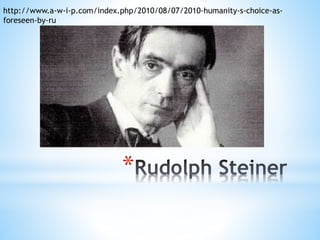
*Waldorf schools originated in Germany during the 
early 1900’s by Rudolf Steiner. 
*This school was developed in order to provide 
education for the children of the workers at the 
Waldorf-Astoria Company cigarette factory. 
*The schools were co-educational and open to all 
students regardless of educational background, 
social class, or religion.(Teaching Young Children) 
*In 1928 the Waldorf school became the biggest 
nondenominational school in Germany and served as 
a model for other branches of Waldorf schools. 
*(Waldorf Canada) 
*
* The Waldorf school struggled during World War II due to 
incessant harassment. 
* The original Waldorf school was closed during the war 
because “there was no place in Nazi Germany for any school 
that educated individuals to think for themselves”. () 
* Although the school was struggling in Germany, branches 
were starting to open all across the globe. 
* The first school that used the Waldorf education model in the 
United States was the Rudolf Steiner School in New York City 
in 1928. 
* Since then over one thousand Waldorf schools have opened in 
sixty countries with about 150 currently open in the United 
States. 
* (Waldorf Cananda) 
*
* Steiner created the school around a new movement of Anthroposophy – a 
spiritual philosophy based around science and mysticism. He believed 
that “there was a unity among the spirit, body, and mind and that good 
education was a tool for keeping these elements in balance” (Edwards, 
2002) 
* Based on this philosophy it was stated that “The first seven years of life 
are a time of tremendous growth and transformation. Having left the 
spiritual worlds, the child begins the journey of incarnation, and the soul 
and spirit have to struggle to adapt to the vessel of the body” (Waldorf 
Early Childhood Education Association of North America, 2010) 
* Therefore, Waldorf schools have a major focus on elementary education 
from birth to age 7. 
* Waldorf schools are broken apart into three age ranges each consisting of 
7 years. Each age range focuses on a different part of the child’s 
development. 
* Waldorf curriculum is based around oral learning and memory. 
*
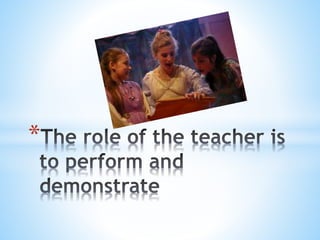
* Teachers in Waldorf schools are considered performers as 
they have to lead and demonstrate academic, artistic, and 
spiritual activities for the children to imitate. 
* Teachers are also expected to be a moral leader for the class 
and to create a strong community throughout the class that 
models caring and concern. 
* The role of the teacher changes depending on the age of the 
children. 
* During early childhood, teachers have to be nurturing and 
supportive. 
* As children move on into the second and third stage, 
educators guide their students into becoming more 
independent. 
* (Teaching Young Children, Henninger) 
*
*
* The first stage of Waldorf education consists of children from 
newborns all the way to age 7. 
* Learning through imitation and doing and creating a sense of wonder 
is extremely important during this stage. 
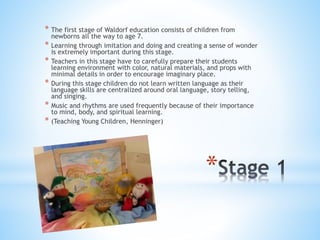
* Teachers in this stage have to carefully prepare their students 
learning environment with color, natural materials, and props with 
minimal details in order to encourage imaginary place. 
* During this stage children do not learn written language as their 
language skills are centralized around oral language, story telling, 
and singing. 
* Music and rhythms are used frequently because of their importance 
* 
to mind, body, and spiritual learning. 
* (Teaching Young Children, Henninger)
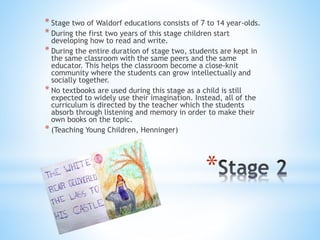
* Stage two of Waldorf educations consists of 7 to 14 year-olds. 
* During the first two years of this stage children start 
developing how to read and write. 
* During the entire duration of stage two, students are kept in 
the same classroom with the same peers and the same 
educator. This helps the classroom become a close-knit 
community where the students can grow intellectually and 
socially together. 
* No textbooks are used during this stage as a child is still 
expected to widely use their imagination. Instead, all of the 
curriculum is directed by the teacher which the students 
absorb through listening and memory in order to make their 
own books on the topic. 
* (Teaching Young Children, Henninger) 
*
* Stage three consists of adolescents age 14 to 21. 
* In this stage, students are expected to use rational and abstract 
thinking. 
* Students are introduced to subjects that focus on ethics, social 
responsibilities, and more rigorous academic work . 
* During this stage, computers and technology are used as a way to 
expand the students learning. 
* Teachers are still expected to encourage childhood wonder, curiosity, 
belief in goodness, and a love of beauty (Edwards, 2002) 
* Feelings, willpower, and moral nature are emphasized during this 
stage to develop not only the head but also the heart and hands. 
* (Teaching Young Children, Henninger) 
*
* The following are teaching strategies that are commonly practiced in 
every Waldorf school and can easily be applied to any childhood learning 
setting. 
* Greeting students with a handshake to show genuine care. 
* Create a buddy system to create a better community and develop self 
esteem in social environments. 
* Integrate art into the curriculum to clarify a child’s understanding. 
* Plan for gardening and outdoor nature activities to integrate science into 
everyday learning. 
* Incorporate music and rhythm activities for mind, body, and spiritual 
learning. 
* Promote active movement for quality learning. 
* Use storytelling for developing basic conceptual understandings. 
* (Teaching Young Children, Henninger) 
*
*Gnomes are believed to be real 
*Friend of Waldorf parent described school as 
“gnomes good, television bad” 
*Faceless toys and pinecones are common toys used 
to help expand imagination. 
*Steiner believed the living could cultivate the 
ability to enter the spirit world. 
*Knitting is a very common practice in Waldorf 
schools and most kids spend their free time knitting 
and playing the recorder. 
*
* Students sing hymns to "spirit" every day 
* All classroom supplies are made of natural fibers 
* There are no clocks, mirrors, or tests in the school to reduce 
the idea of competition or self-focus. 
* Specific colors, such as black, brown and purple, are not 
allowed due to their negative energy. Each color has a 
specific meaning. 
* Waldorf schools support a “personal belief exemption” or a 
PBE where parents can opt out of vaccinating their children, 
which has led to drama in a San Francisco neighborhood due 
to the school being blamed for the recent chicken pox and 
whooping cough outbreak. 
*
Sources

Education model waldorf (2)

  • 1.
    A different formof education *
  • 2.
  • 3.
    *Waldorf schools originatedin Germany during the early 1900’s by Rudolf Steiner. *This school was developed in order to provide education for the children of the workers at the Waldorf-Astoria Company cigarette factory. *The schools were co-educational and open to all students regardless of educational background, social class, or religion.(Teaching Young Children) *In 1928 the Waldorf school became the biggest nondenominational school in Germany and served as a model for other branches of Waldorf schools. *(Waldorf Canada) *
  • 4.
    * The Waldorfschool struggled during World War II due to incessant harassment. * The original Waldorf school was closed during the war because “there was no place in Nazi Germany for any school that educated individuals to think for themselves”. () * Although the school was struggling in Germany, branches were starting to open all across the globe. * The first school that used the Waldorf education model in the United States was the Rudolf Steiner School in New York City in 1928. * Since then over one thousand Waldorf schools have opened in sixty countries with about 150 currently open in the United States. * (Waldorf Cananda) *
  • 5.
    * Steiner createdthe school around a new movement of Anthroposophy – a spiritual philosophy based around science and mysticism. He believed that “there was a unity among the spirit, body, and mind and that good education was a tool for keeping these elements in balance” (Edwards, 2002) * Based on this philosophy it was stated that “The first seven years of life are a time of tremendous growth and transformation. Having left the spiritual worlds, the child begins the journey of incarnation, and the soul and spirit have to struggle to adapt to the vessel of the body” (Waldorf Early Childhood Education Association of North America, 2010) * Therefore, Waldorf schools have a major focus on elementary education from birth to age 7. * Waldorf schools are broken apart into three age ranges each consisting of 7 years. Each age range focuses on a different part of the child’s development. * Waldorf curriculum is based around oral learning and memory. *
  • 6.
    * Teachers inWaldorf schools are considered performers as they have to lead and demonstrate academic, artistic, and spiritual activities for the children to imitate. * Teachers are also expected to be a moral leader for the class and to create a strong community throughout the class that models caring and concern. * The role of the teacher changes depending on the age of the children. * During early childhood, teachers have to be nurturing and supportive. * As children move on into the second and third stage, educators guide their students into becoming more independent. * (Teaching Young Children, Henninger) *
  • 7.
  • 8.
    * The firststage of Waldorf education consists of children from newborns all the way to age 7. * Learning through imitation and doing and creating a sense of wonder is extremely important during this stage. * Teachers in this stage have to carefully prepare their students learning environment with color, natural materials, and props with minimal details in order to encourage imaginary place. * During this stage children do not learn written language as their language skills are centralized around oral language, story telling, and singing. * Music and rhythms are used frequently because of their importance * to mind, body, and spiritual learning. * (Teaching Young Children, Henninger)
  • 9.
    * Stage twoof Waldorf educations consists of 7 to 14 year-olds. * During the first two years of this stage children start developing how to read and write. * During the entire duration of stage two, students are kept in the same classroom with the same peers and the same educator. This helps the classroom become a close-knit community where the students can grow intellectually and socially together. * No textbooks are used during this stage as a child is still expected to widely use their imagination. Instead, all of the curriculum is directed by the teacher which the students absorb through listening and memory in order to make their own books on the topic. * (Teaching Young Children, Henninger) *
  • 10.
    * Stage threeconsists of adolescents age 14 to 21. * In this stage, students are expected to use rational and abstract thinking. * Students are introduced to subjects that focus on ethics, social responsibilities, and more rigorous academic work . * During this stage, computers and technology are used as a way to expand the students learning. * Teachers are still expected to encourage childhood wonder, curiosity, belief in goodness, and a love of beauty (Edwards, 2002) * Feelings, willpower, and moral nature are emphasized during this stage to develop not only the head but also the heart and hands. * (Teaching Young Children, Henninger) *
  • 11.
    * The followingare teaching strategies that are commonly practiced in every Waldorf school and can easily be applied to any childhood learning setting. * Greeting students with a handshake to show genuine care. * Create a buddy system to create a better community and develop self esteem in social environments. * Integrate art into the curriculum to clarify a child’s understanding. * Plan for gardening and outdoor nature activities to integrate science into everyday learning. * Incorporate music and rhythm activities for mind, body, and spiritual learning. * Promote active movement for quality learning. * Use storytelling for developing basic conceptual understandings. * (Teaching Young Children, Henninger) *
  • 12.
    *Gnomes are believedto be real *Friend of Waldorf parent described school as “gnomes good, television bad” *Faceless toys and pinecones are common toys used to help expand imagination. *Steiner believed the living could cultivate the ability to enter the spirit world. *Knitting is a very common practice in Waldorf schools and most kids spend their free time knitting and playing the recorder. *
  • 13.
    * Students singhymns to "spirit" every day * All classroom supplies are made of natural fibers * There are no clocks, mirrors, or tests in the school to reduce the idea of competition or self-focus. * Specific colors, such as black, brown and purple, are not allowed due to their negative energy. Each color has a specific meaning. * Waldorf schools support a “personal belief exemption” or a PBE where parents can opt out of vaccinating their children, which has led to drama in a San Francisco neighborhood due to the school being blamed for the recent chicken pox and whooping cough outbreak. *
  • 14.