FSK Modulation
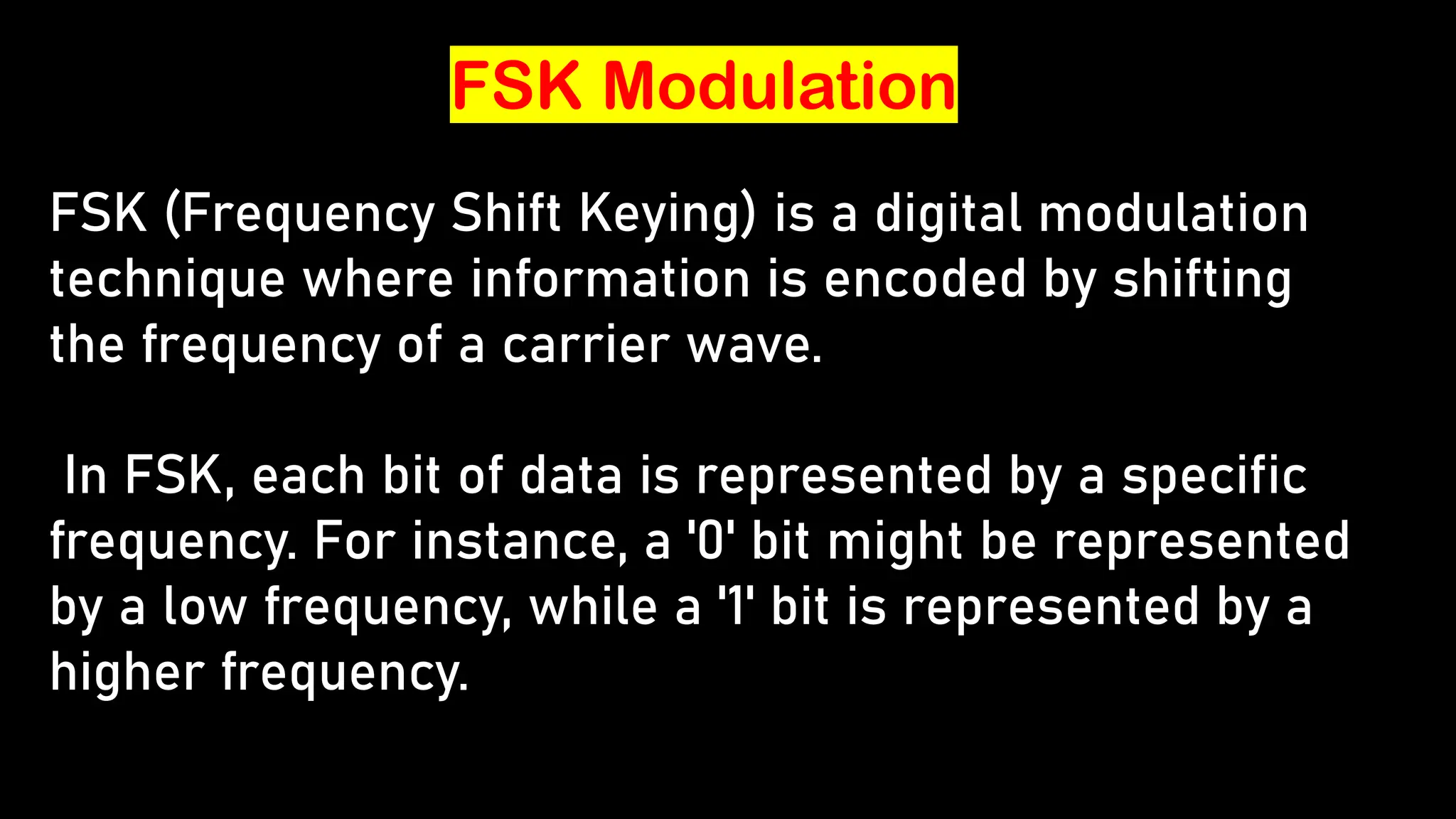
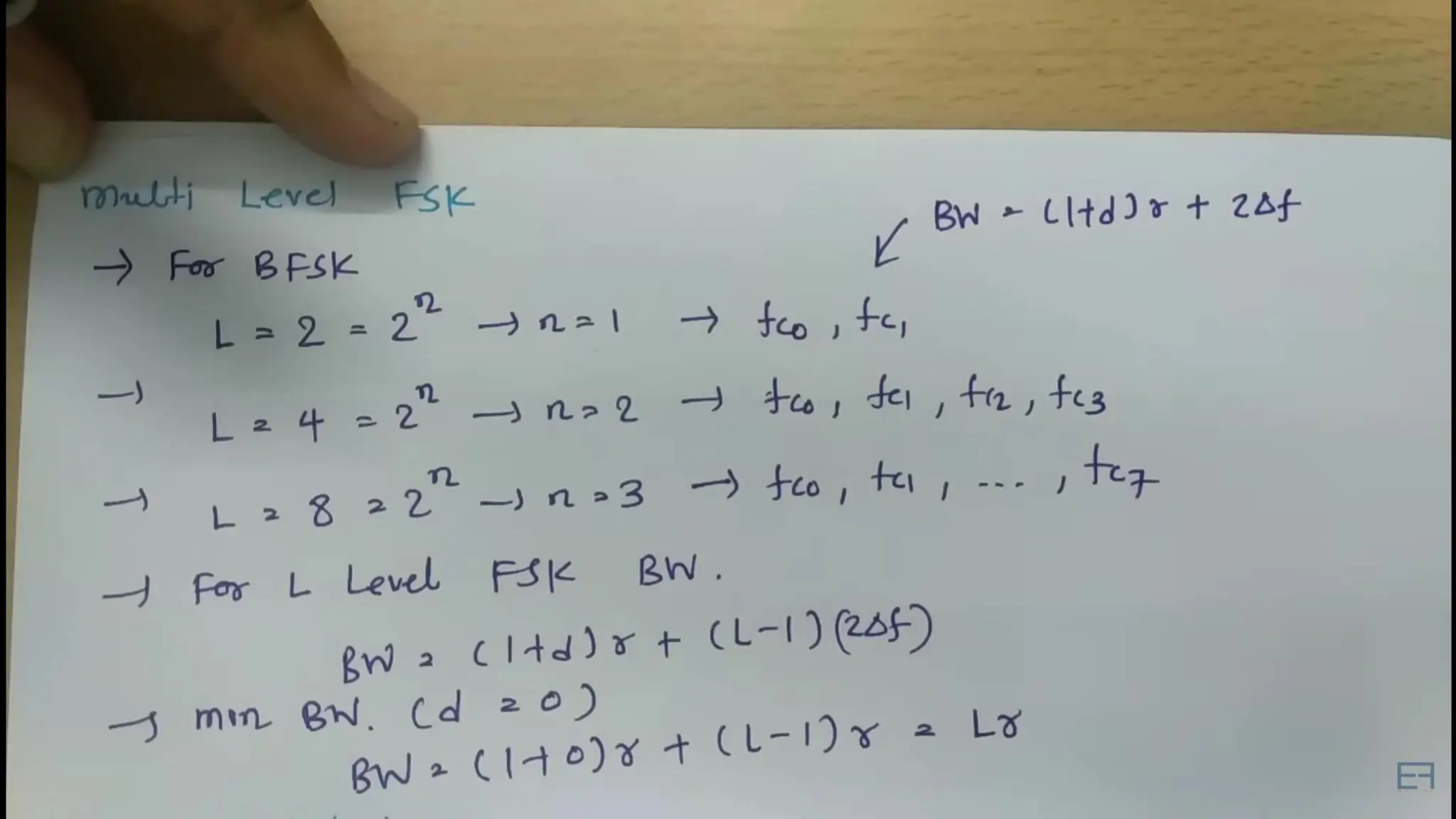
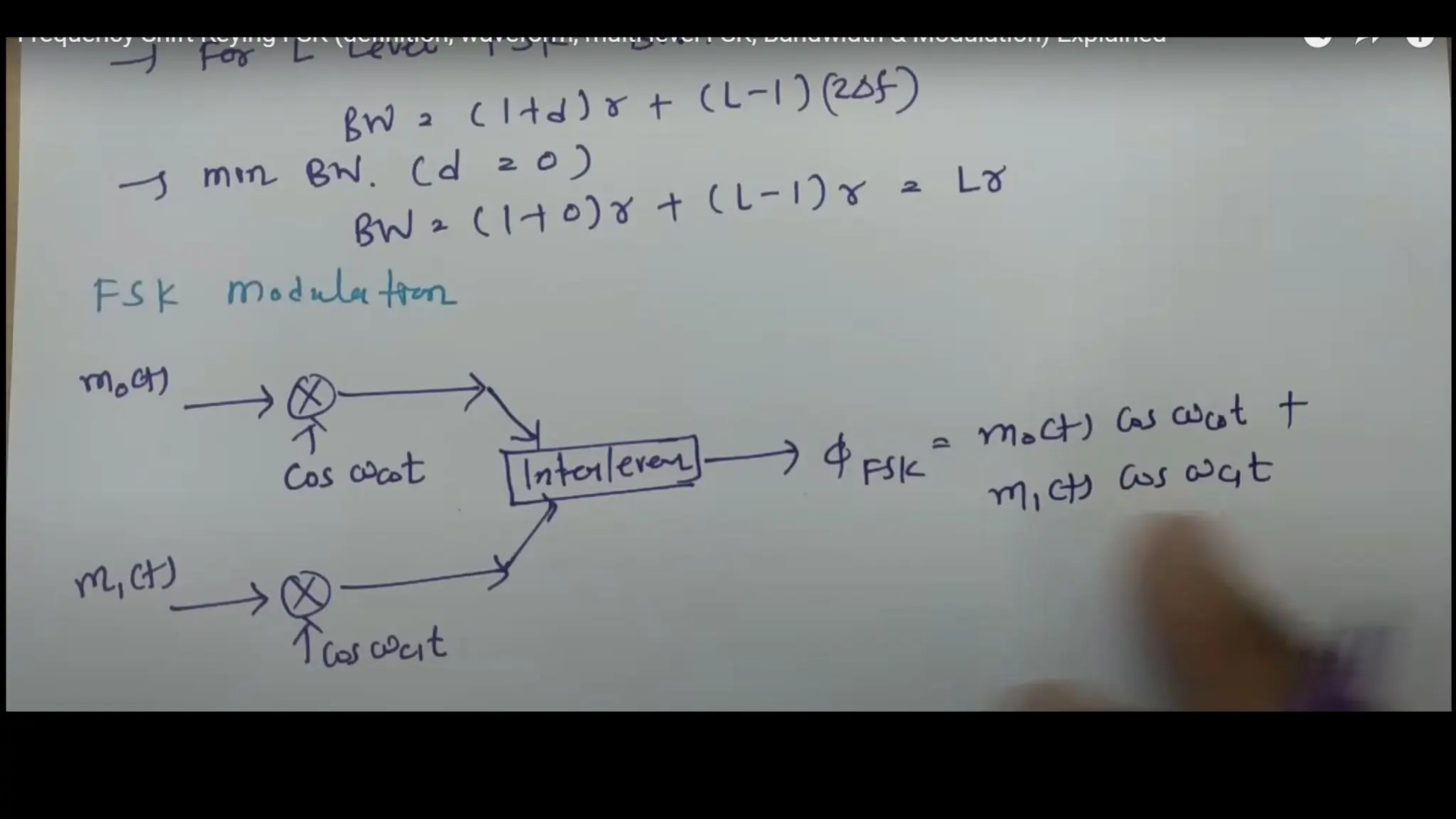
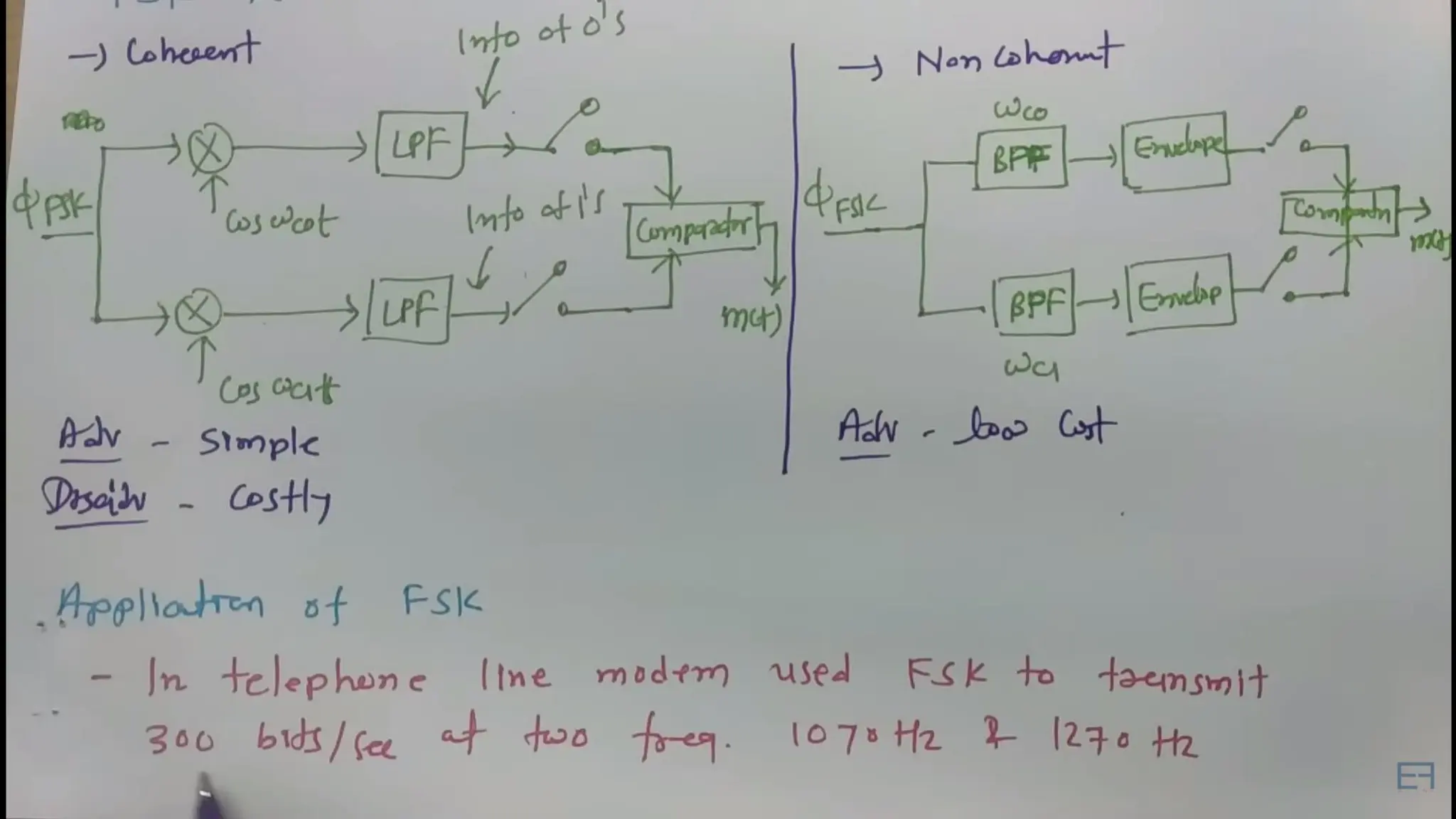
FSK (Frequency Shift Keying) is a digital modulation
technique where information is encoded by shifting
the frequency of a carrier wave.
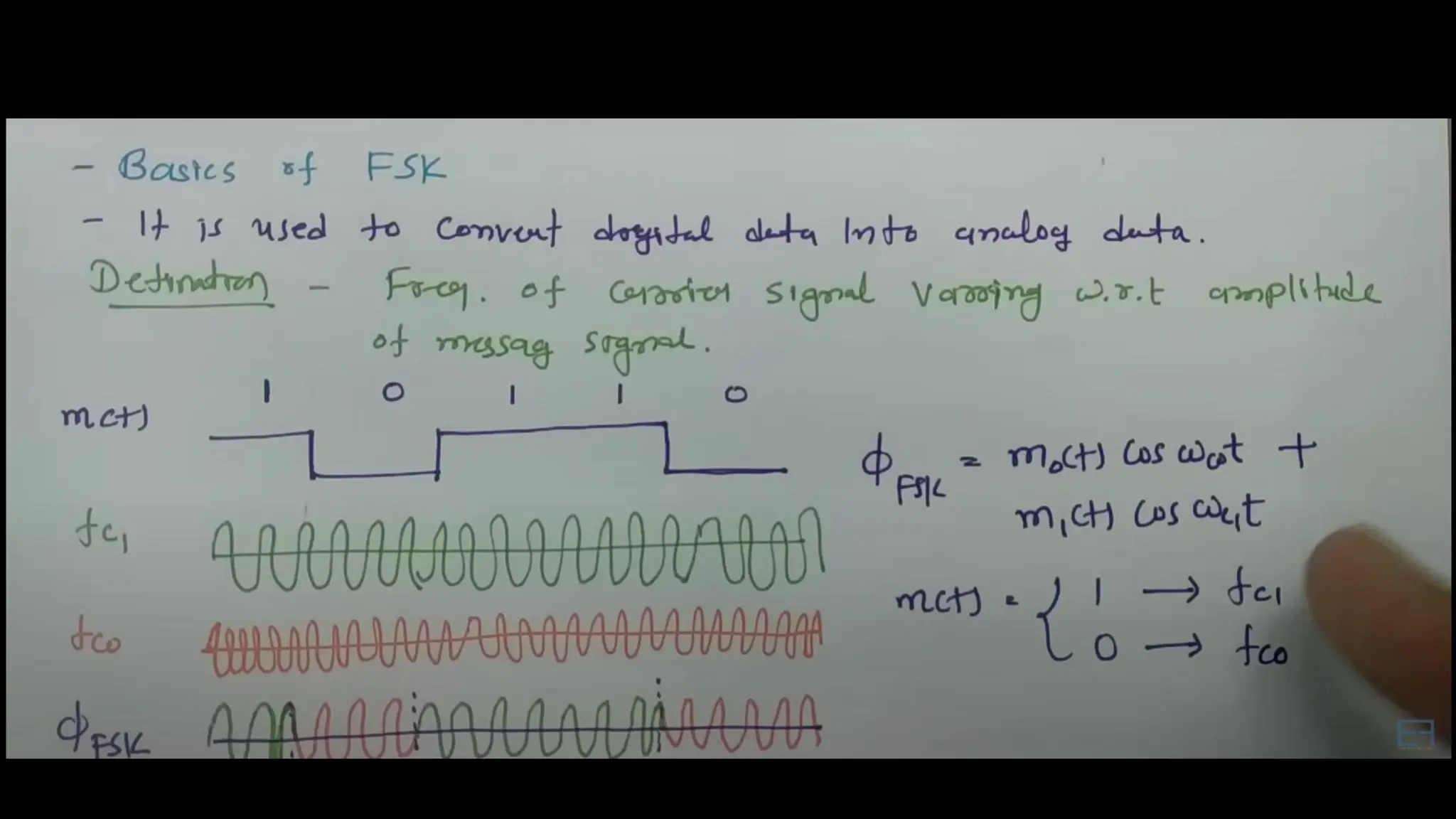
In FSK, each bit of data is represented by a specific
frequency. For instance, a '0' bit might be represented
by a low frequency, while a '1' bit is represented by a
higher frequency.
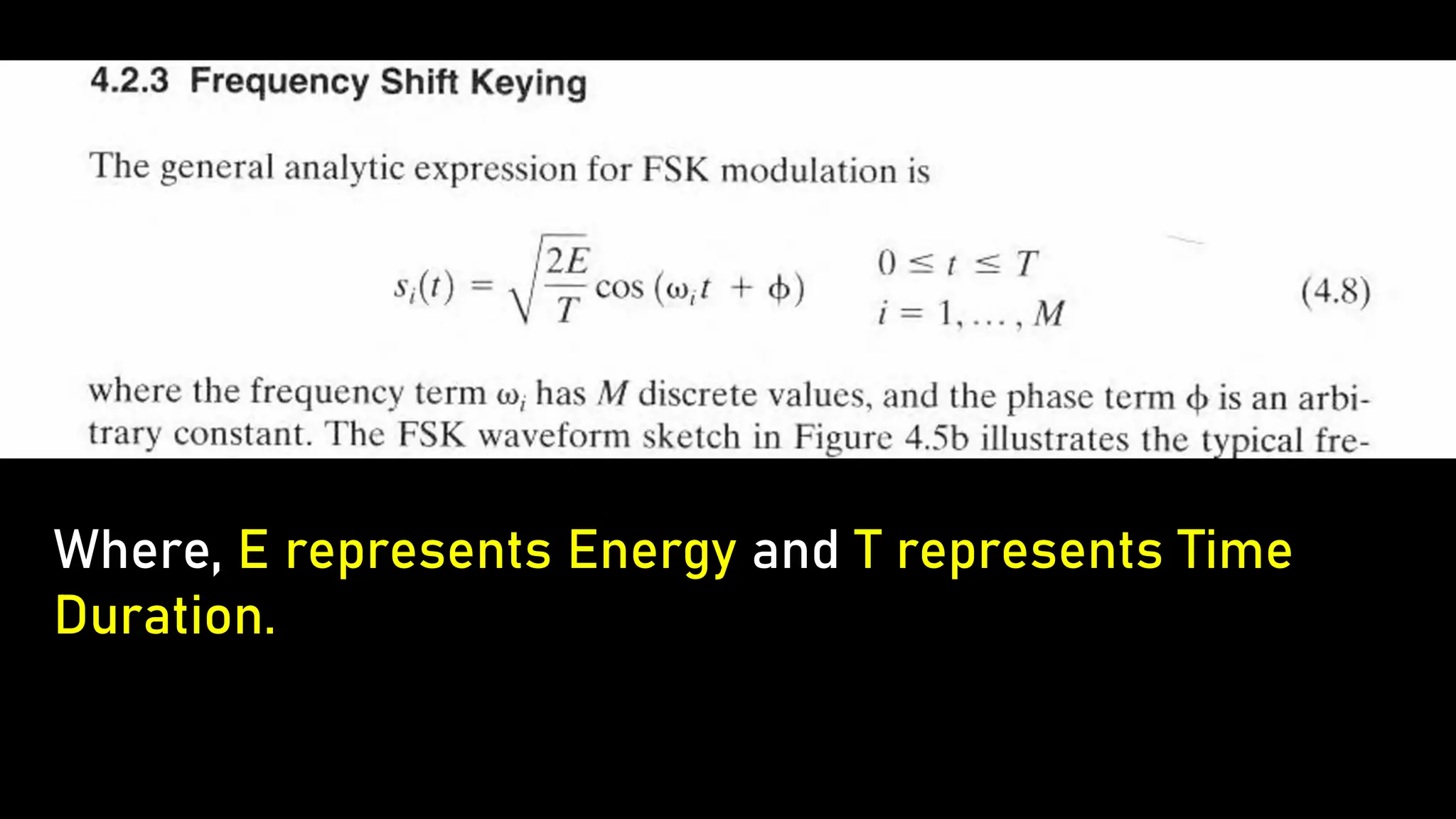
Where, E represents Energy and T represents Time
Duration.
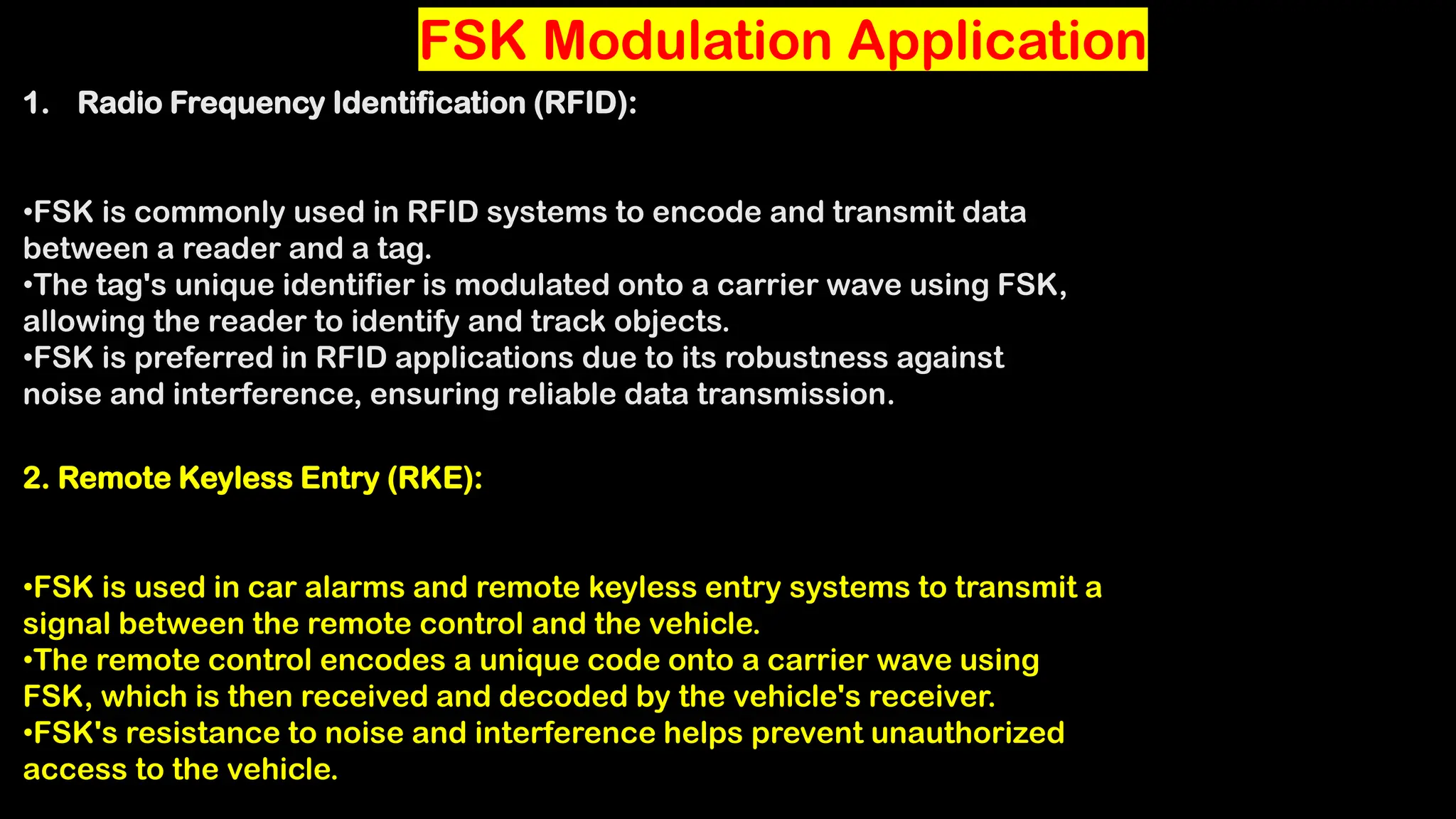
1. Radio Frequency Identification (RFID):
•FSK is commonly used in RFID systems to encode and transmit data
between a reader and a tag.
•The tag's unique identifier is modulated onto a carrier wave using FSK,
allowing the reader to identify and track objects.
•FSK is preferred in RFID applications due to its robustness against
noise and interference, ensuring reliable data transmission.
2. Remote Keyless Entry (RKE):
•FSK is used in car alarms and remote keyless entry systems to transmit a
signal between the remote control and the vehicle.
•The remote control encodes a unique code onto a carrier wave using
FSK, which is then received and decoded by the vehicle's receiver.
•FSK's resistance to noise and interference helps prevent unauthorized
access to the vehicle.
FSK Modulation Application
3. Wireless Data Transmission
•FSK can be used for wireless data transmission,
such as in short-range communication systems like
Bluetooth and Zigbee.
•Data is encoded onto a carrier wave using FSK,
allowing it to be transmitted over the airwaves.
•FSK's simplicity and robustness make it suitable for
wireless data transmission applications.
4. Digital Audio Broadcasting (DAB):
•FSK is used in DAB systems to transmit digital audio
signals over the airwaves.
•The audio data is encoded onto a carrier wave using
FSK, allowing it to be received and decoded by
compatible receivers.
•FSK's ability to provide high-quality audio in noisy
environments makes it suitable for DAB applications.
5. Wireless Telegraphy:
•FSK was used in early wireless telegraphy systems to transmit
Morse code messages.
•The dots and dashes of Morse code were represented by
different frequencies, which were modulated onto a carrier
wave using FSK.
•FSK's simplicity and reliability made it suitable for wireless
telegraphy applications.
6. Other Applications:
•FSK is also used in various other applications,
such as:
• Wireless sensors
• Industrial automation
• Medical devices
• Meter reading systems
• Home automation

Frequency Shift Keying Modulation Explained

  • 1.
    FSK Modulation FSK (FrequencyShift Keying) is a digital modulation technique where information is encoded by shifting the frequency of a carrier wave. In FSK, each bit of data is represented by a specific frequency. For instance, a '0' bit might be represented by a low frequency, while a '1' bit is represented by a higher frequency.
  • 3.
    Where, E representsEnergy and T represents Time Duration.
  • 8.
    1. Radio FrequencyIdentification (RFID): •FSK is commonly used in RFID systems to encode and transmit data between a reader and a tag. •The tag's unique identifier is modulated onto a carrier wave using FSK, allowing the reader to identify and track objects. •FSK is preferred in RFID applications due to its robustness against noise and interference, ensuring reliable data transmission. 2. Remote Keyless Entry (RKE): •FSK is used in car alarms and remote keyless entry systems to transmit a signal between the remote control and the vehicle. •The remote control encodes a unique code onto a carrier wave using FSK, which is then received and decoded by the vehicle's receiver. •FSK's resistance to noise and interference helps prevent unauthorized access to the vehicle. FSK Modulation Application
  • 9.
    3. Wireless DataTransmission •FSK can be used for wireless data transmission, such as in short-range communication systems like Bluetooth and Zigbee. •Data is encoded onto a carrier wave using FSK, allowing it to be transmitted over the airwaves. •FSK's simplicity and robustness make it suitable for wireless data transmission applications. 4. Digital Audio Broadcasting (DAB): •FSK is used in DAB systems to transmit digital audio signals over the airwaves. •The audio data is encoded onto a carrier wave using FSK, allowing it to be received and decoded by compatible receivers. •FSK's ability to provide high-quality audio in noisy environments makes it suitable for DAB applications. 5. Wireless Telegraphy: •FSK was used in early wireless telegraphy systems to transmit Morse code messages. •The dots and dashes of Morse code were represented by different frequencies, which were modulated onto a carrier wave using FSK. •FSK's simplicity and reliability made it suitable for wireless telegraphy applications. 6. Other Applications: •FSK is also used in various other applications, such as: • Wireless sensors • Industrial automation • Medical devices • Meter reading systems • Home automation