French property
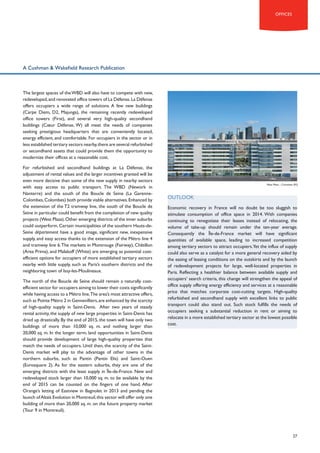
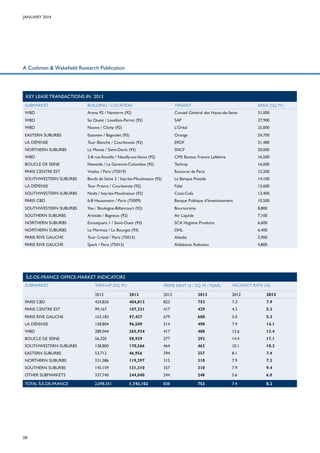
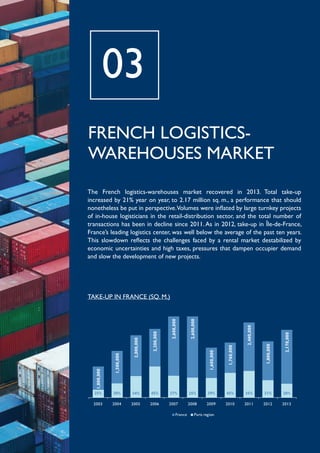
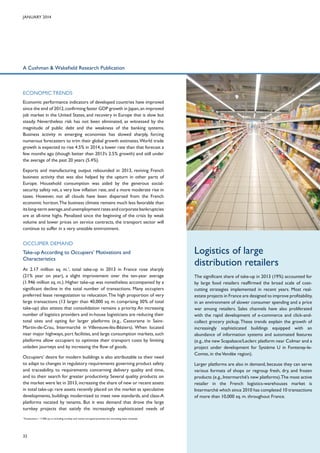
Market
2014
A Cushman & Wakefield Research Publication
January 2014

A Cushman & Wakefield Research Publication

Contents
EDITORIAL	3
eCONOMy	5
FRENCH PROPERTY INVESTMENT market	7
Investment Volume	
8
Investment Volume by Location	
8
Key Investors	
9
Offices	11
Retail	13
Industrial	15
Yields	17
Outlook	17
	
ILE-DE-FRANCE OFFICE MARKET	
19
Occupier Demand	
20
Rental Values	
24
Available and Future Supply 	
25
Outlook	27
	
FRENCH LOGISTICS-WAREHOUSES MARKET	
31
Economic Trends 	
32
Occupier Demand	
32
Rental Values	
34
Available and Future supply 	
34
Outlook	35
	
FRENCH RETAIL MARKET	
37
Economic and Legal Environment	
38
The New Role of Stores	
39
Retailer Demand 	
41
Trends in Supply	
45
Rental Values 	
49
Outlook	50
	
Glossary	52
	
CONTACTS					

2

54
editorial

A Cushman & Wakefield Research Publication

eDITORIAL
In addition to regular episodes of French bashing in the international
media, recent changes on the political and economic scenes have
reinforced fears among the French, a people not known for their
optimism. Forecasters expect at best a timid recovery in 2014, far
from the solid activity seen on the other sides of the Channel and
Atlantic, and equally remote from the robustness of the German
model. Yet while skepticism persists, most economic indicators for
France are moving in the right direction. The belief that the worst
is behind us could begin to dispel the cloud of uncertainty that has
long darkened the French commercial-property market.
Furthermore, the gap between the relatively stable investment
market and the more chaotic rental market is likely to narrow.

As the French property market recovers, Cushman & Wakefield
France will further expand its services in order to provide
customized advice to all players in the commercial-property
market, to address their concerns, and to help them adapt to
rapidly changing market conditions. Our dynamic and experienced
teams, which moved from strength to strength in 2013 – the sales
of 8 place Vendôme, a portion of the Altarea portfolio, the Passy
Plaza shopping center in Paris, and Boursorama’s new offices in
Boulogne, as well as the opening of the first Primark stores in
France and the Valentino boutiques in Paris and Saint-Tropez – will
provide the same outstanding service in 2014.

The gulf is nonetheless too wide to encourage any clear-cut
improvement in the short term. In 2013, good news was mixed
with bad: a 1% rise in investment in France and the lowest take-up
in the Paris region since 2003. We may reasonably expect a
moderate rise in lettings of office and warehouse properties in
2014, but economic, fiscal, and regulatory instability will continue
to inspire caution among tenants. Many occupiers now prefer lease
renegotiation to moving, while others choose to relocate but do so
with very conservative standards. Their targets are usually
conveniently located, high-quality sites that meet both cost-cutting
and modernization criteria. The deep divisions within the French
market are not expected to disappear; hence the increasing
urgency of questions concerning the future of the most obsolete
sites, and the technical and economic feasibility of adapting to new
standards.
On a positive note, investment in France should be considerably
higher than in 2013, in line with the growth of more than 10%
forecast for investments worldwide in 2014. Several large and very
large transactions are already under way, confirming the significant
amount of money to be invested and the enthusiasm of long-term
institutional investors (e.g., insurance companies, sovereign wealth
funds, and new international players) for core assets. Greater
concessions made by vendors and renewed interest from
opportunistic investors will favor even less-secure assets and
enhance the French market’s appeal to a wide variety of investors.

Olivier Gérard
President

3
eCONOMy

A Cushman & Wakefield Research Publication

eConomy
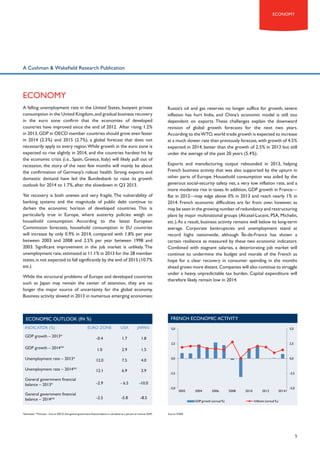
A falling unemployment rate in the United States, buoyant private
consumption in the United Kingdom, and gradual business recovery
in the euro zone confirm that the economies of developed
countries have improved since the end of 2012. After rising 1.2%
in 2013, GDP in OECD member countries should grow even faster
in 2014 (2.3%) and 2015 (2.7%), a global forecast that does not
necessarily apply to every region. While growth in the euro zone is
expected to rise slightly in 2014, and the countries hardest hit by
the economic crisis (i.e., Spain, Greece, Italy) will likely pull out of
recession, the story of the next few months will mainly be about
the confirmation of Germany’s robust health. Strong exports and
domestic demand have led the Bundesbank to raise its growth
outlook for 2014 to 1.7%, after the slowdown in Q3 2013.
Yet recovery is both uneven and very fragile. The vulnerability of
banking systems and the magnitude of public debt continue to
darken the economic horizon of developed countries. This is
particularly true in Europe, where austerity policies weigh on
household consumption. According to the latest European
Commission forecasts, household consumption in EU countries
will increase by only 0.9% in 2014, compared with 1.8% per year
between 2003 and 2008 and 2.5% per year between 1998 and
2003. Significant improvement in the job market is unlikely. The
unemployment rate, estimated at 11.1% in 2013 for the 28 member
states, is not expected to fall significantly by the end of 2015 (10.7%
est.).
While the structural problems of Europe and developed countries
such as Japan may remain the center of attention, they are no
longer the major source of uncertainty for the global economy.
Business activity slowed in 2013 in numerous emerging economies:

Exports and manufacturing output rebounded in 2013, helping
French business activity that was also supported by the upturn in
other parts of Europe. Household consumption was aided by the
generous social-security safety net, a very low inflation rate, and a
more moderate rise in taxes. In addition, GDP growth in France—
flat in 2012—may edge above 0% in 2013 and reach nearly 1% in
2014. French economic difficulties are far from over, however, as
may be seen in the growing number of redundancy and restructuring
plans by major multinational groups (Alcatel-Lucent, PSA, Michelin,
etc.). As a result, business activity remains well below its long-term
average. Corporate bankruptcies and unemployment stand at
record highs nationwide, although Île-de-France has shown a
certain resilience as measured by these two economic indicators.
Combined with stagnant salaries, a deteriorating job market will
continue to undermine the budget and morale of the French as
hope for a clear recovery in consumer spending in the months
ahead grows more distant. Companies will also continue to struggle
under a heavy, unpredictable tax burden. Capital expenditure will
therefore likely remain low in 2014.

French economic activity

Economic outlook (in %)
Indicator (%)

Russia’s oil and gas reserves no longer suffice for growth, severe
inflation has hurt India, and China’s economic model is still too
dependent on exports. These challenges explain the downward
revision of global growth forecasts for the next two years.
According to the WTO, world trade growth is expected to increase
at a much slower rate than previously forecast, with growth of 4.5%
expected in 2014, better than the growth of 2.5% in 2013 but still
under the average of the past 20 years (5.4%).

EURO ZONE

USA

JAPAN

-0.4

1.7

1.8

GDP growth – 2014**

1.0

2.9

1.5

Unemployment rate – 2013*

12.0

7.5

4.0

Unemployment rate – 2014**

12.1

6.9

3.9

General government financial
balance – 2013*

-2.9

- 6.5

-10.0

GDP growth – 2013*

General government financial
balance – 2014**

-2.5

-5.8

5,0
5,0

5,0

2,5
2,5

2,5

0,0
0,0

0,0

-2,5
-2,5

-2,5

-5,0
-5,0
2002
2002

-8.5

*Estimated **Forecast - Source: OECD (the general government financial balance is calculated as a percent of nominal GDP)

5,0

2,5

0,0

-2,5

2004
2004

2006
2006

2008

2008

GDP growth (annual %)
Croissance du PIB (annuelle %)

2010

2010

2012

2012

-5,0
-5,0
2014 f

2014 P

Inflation (annual %,)

Inflation (annuellle %)

Source: INSEE

5
01
FRENCH PROPERTY
INVESTMENT Market
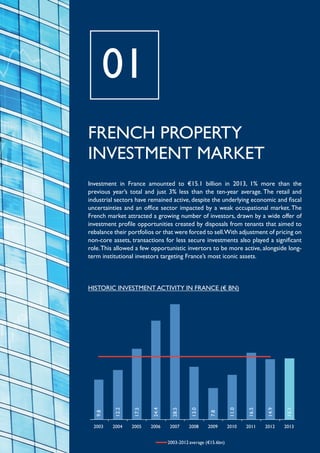
Investment in France amounted to €15.1 billion in 2013, 1% more than the
previous year’s total and just 3% less than the ten-year average. The retail and
industrial sectors have remained active, despite the underlying economic and fiscal
uncertainties and an office sector impacted by a weak occupational market. The
French market attracted a growing number of investors, drawn by a wide offer of
investment profile opportunities created by disposals from tenants that aimed to
rebalance their portfolios or that were forced to sell.With adjustment of pricing on
non-core assets, transactions for less secure investments also played a significant
role. This allowed a few opportunistic invertors to be more active, alongside longterm institutional investors targeting France’s most iconic assets.

”

HISTORIC INVESTMENT ACTIVITY IN France (€ BN)
30

25

20

15

10

12.2

17.5

24.4

28.5

13.0

7.8

11.0

16.5

14.9

15.1

0

9.8

5

2003

2004

2005

2006

2007

2008

2009

2010

2011

2012

2013

2003-2012 average (€15.6bn)
January 2014

A Cushman & Wakefield Research Publication

INVESTMENT VOLUME

INVESTMENT VOLUME BY LOCATION

The overall performance of the French market in 2013 was similar
to that of 2012. The total number of transactions continued to
decline (393, compared with 421 in 2012 and 451 in 2011), although
overall volume was supported by a substantial element of large
transactions.There were 36 transactions of more than €100 million,
for a total of €7.3 billion (i.e. 48% of total investment in France in
2013). A more detailed breakdown by transaction-volume slice,
however, shows that the market is in the process or readjusting to
a more conventional profile. Transactions of €100-200 million were
relatively stable year on year (€3.9 billion), while transactions of
more than €200 million declined by 17% (i.e., -€700 million).This fall
was compensated for by activity in the €50-100 million segment,
which saw 52 transactions in 2013 for a total of €3.7 billion
(compared with 39 transactions for a total of €2.7 billion in 2012).

Paris / Île-de-France

Because of the decline in large-volume transactions, portfolios
played a less decisive role in 2013 than in the previous year. At
€3 billion, portfolios represented only 20% of total amounts invested
in France, compared with €4.1 billion (27%) in 2012. However, large
portfolios still played a role across the various asset classes: office
properties (Docks Lyonnais portfolio sold to ADIA), retail
properties (Vivarte portfolio acquired by La Française AM), and
industrial properties (Logicad portfolio sold by Icade to Apollo).
Some of these transactions were carried out as joint ventures, the
preferred structure of certain large investors aiming to increase
their exposure to the property sector while benefiting from the
knowledge and experience of major pure players. NBIM (with
Prologis in the logistics sector) and Allianz (with Altarea in the
shopping-center sector) partnered with specialists that were
offering stakes in their portfolios. These two investors used JVs as
investment vehicles in 2011 and 2012: NBIM acquired from Allianz
half of a Parisian portfolio comprising mainly office properties, and
Allianz acquired from Hammerson 75% of the Espace Saint-Quentin.

100%
100%

80%

60%

26%

64%

64%

60%

28%
28%

67%

67%

51%

20%
20%

0%
0%
9%

€15-50m
20%
21%

24%

26%

80%

49%

51%

26%
26%

49%

23%
23%

23%
23%

24%
24%

10%
10%

9%
9%

2013
2013
France
France

2013

€1-15m
8%

2012
2012
France
France

Office
Office

2012

2013
2012
2013
2012
Provinces
Provinces Provinces
Provinces
Retail
Retail

Industrial
Industrial
% in volume

18%

€50-100m
24%

% in volume, all products

8

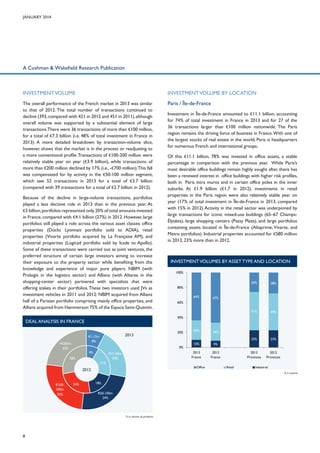
INVESTMENT VOlUMES BY ASSET TYPE AND LOCATION

40%

28%

€100200m
25%

Of this €11.1 billion, 78% was invested in office assets, a stable
percentage in comparison with the previous year. While Paris’s
most desirable office buildings remain highly sought after, there has
been a renewed interest in office buildings with higher risk profiles,
both in Paris intra muros and in certain office poles in the inner
suburbs. At €1.9 billion (€1.7 in 2012), investments in retail
properties in the Paris region were also relatively stable year on
year (17% of total investment in Île-de-France in 2013, compared
with 15% in 2012). Activity in the retail sector was underpinned by
large transactions for iconic mixed-use buildings (65–67 ChampsÉlysées), large shopping centers (Passy Plaza), and large portfolios
containing assets located in Île-de-France (Altaprime, Vivarte, and
Metro portfolios). Industrial properties accounted for €580 million
in 2013, 23% more than in 2012.

40%

DEAL ANALYSIS in france

>€200m
23%

Investment in Île-de-France amounted to €11.1 billion, accounting
for 74% of total investment in France in 2013 and for 27 of the
36 transactions larger than €100 million nationwide. The Paris
region remains the driving force of business in France. With one of
the largest stocks of real estate in the world, Paris is headquarters
for numerous French and international groups.
INVESTMENT

A Cushman & Wakefield Research Publication

Provinces
An overall investment of nearly €4 billion in the provinces accounted
for 26% of total investment in France in 2013, a stable performance
year on year but 18% higher than the ten-year average (€3.4 billion).
The proportion of investments in retail properties (€2 billion in
2013) rose to 51% in 2013 from 49% in 2012, while investments in
the office sector declined slightly, from 28% of total investment in
2012 to 26% in 2013. Retail properties continued to drive the
market in the provinces, notably through the sales of malls and
large shopping centers (Immochan portfolio sold to CNP, disposal
of 50% of Odysseum shopping center in Montpellier, acquisition by
Eurocommercial Properties of a shopping center in Val Thoiry, etc.).
However, this general trend does not conceal the significant
differences among regions. With €990 million invested, the RhôneAlpes region is by far the largest market outside Île-de-France.
Large transactions for new and recent office supply (City One in
Lyon, Silky in Vénissieux) and sales of vast retail and industrial sites
(Val Thoiry, Parc du Moulin in Vent) have moved the Rhône-Alpes
region ahead of Provence-Alpes-Côte d’Azur (€290 million
invested, of which 65% for logistics assets) and Nord-Pas-de-Calais

to be refurbished or presenting tenant risk (CACIB headquarters
in Courbevoie acquired by Blackstone, River Plaza in Asnières-surSeine sold to KKR). UK investors were more diverse in their asset
targets: logistics, with the new Maisons du Monde platform near
Marseille; offices, with part of the Ponant building in the 15th district;
retail, with the Metro portfolio; and even the core segment.
German investors, still the largest foreign investors in France,
accounted for only 8% of total investment in 2013 (9% in 2012).
Usually represented by large insurance companies and open-ended
funds, German investors were particularly selective, targeting office
space and mixed-use buildings in Paris business districts
(118 Champs-Élysées acquired by Pramerica). German investors
also showed continued interest in the Lyon market and its highestquality office assets (Anthémis, City One). However, it was the
acquisition by Allianz of 49% of the Altaprime (Altarea) shoppingcenter portfolio, the third-largest transaction of the year in France,
that characterized German investment activity in 2013. The
important role played by Germany in the French market is due as
much to sales as to acquisitions. Funds such as Aberdeen and
Kanam continued their disposals, which supplied other investors
with relatively secure products.

(€270 million).
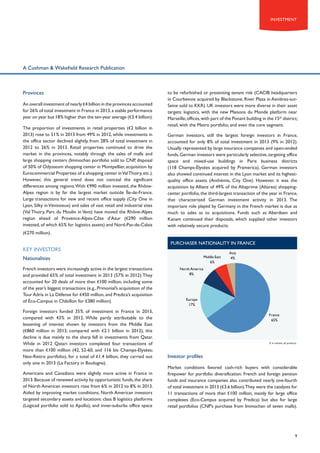
PURCHASER NATIONALITY in france

KEY INVESTORS
Middle East
6%

Nationalities
French investors were increasingly active in the largest transactions
and provided 65% of total investment in 2013 (57% in 2012). They
accounted for 20 deals of more than €100 million, including some
of the year’s biggest transactions (e.g., Primonial’s acquisition of the
Tour Adria in La Défense for €450 million, and Predica’s acquisition
of éco-Campus in Châtillon for €380 million).
Foreign investors funded 35% of investment in France in 2013,
compared with 43% in 2012. While partly attributable to the
lessening of interest shown by investors from the Middle East
(€860 million in 2013, compared with €2.1 billion in 2012), this
decline is due mainly to the sharp fall in investments from Qatar.
While in 2012 Qatari investors completed four transactions of
more than €100 million (42, 52-60, and 116 bis Champs-Elysées;
Neo-Retiro portfolio), for a total of €1.4 billion, they carried out
only one in 2013 (La Factory in Boulogne).
Americans and Canadians were slightly more active in France in
2013. Because of renewed activity by opportunistic funds, the share
of North American investors rose from 6% in 2012 to 8% in 2013.
Aided by improving market conditions, North American investors
targeted secondary assets and locations: class B logistics platforms
(Logicad portfolio sold to Apollo), and inner-suburbs office space

Asia
4%

North America
8%

Europe
17%
France
65%

% in volume, all products

Investor profiles
Market conditions favored cash-rich buyers with considerable
firepower for portfolio diversification. French and foreign pension
funds and insurance companies also contributed nearly one-fourth
of total investment in 2013 (€3.6 billion).They were the catalysts for
11 transactions of more than €100 million, mainly for large office
complexes (Eco-Campus acquired by Predica) but also for large
retail portfolios (CNP’s purchase from Immochan of seven malls).

9
January 2014

A Cushman & Wakefield Research Publication

With investments of €1.8 billion, SCPIs contributed 12% of total investment
in France in 2013, reaffirming their interest in the French market through
office and retail transactions of usually less than €50 million. SCPIs’ 15%
share of total investment in 2012 declined because of the significant rise in
investment by OPCIs (from 6% in 2012 to 15% in 2013), as exemplified by
Primonial’s acquisition of several office assets in Paris and the inner suburbs
(Tour Adria in La Défense, Spark in Paris 13th, etc.).
Property companies contributed 11% of total investment in France in 2013.
Some focused on mixed-use buildings in Paris CBD (acquisition of
50 Haussmann by Terreïs and of 52 rue Marbeuf by Gecina), while others
purchased assets for repositioning such as the Mirabeau tower (Gecina)
and the Val Thoiry shopping center (Eurocommercial Properties), whose
expansion and refurbishment have been scheduled. Yet it was on the sell
side that property companies were most active, whether forced to sell
their assets, taking profit from mature assets, or rebalancing their portfolios
by giving added weight to large, regional shopping centers and high-street
retail. The disposals carried out by property companies provided a flow of
long-term and large-scale assets that are essential for insurance companies
(sale of Passy Plaza to Generali by Eurocommercial Properties) and for
German funds (purchase of 118 Champs-Élysées by Pramerica from
Risanamento, sale of the Issy Trois Moulins shopping center to Union
Investment by Corio).
Sovereign wealth funds (SWFs) were less active in 2013, contributing 8% of
total investment, compared with 20% in 2012—a decline of €1.8 billion.
This performance is not due to a loss of appetite by SWFs for French
property, but rather to the lack of available products that meet their
investment criteria. Some SWFs added to and diversified their positions on
the French market. The Norwegian NBIM, for example, invested in the
industrial sector through a JV with Prologis. Asian newcomers also
reaffirmed their desire to acquire Paris’s most prestigious assets (acquisition
by SOFAZ of 8 Place Vendôme). SWFs may continue to be active in the
coming months because of opportunities created by the sale of large prime
Parisian assets (e.g., the Risanamento portfolio and the Beaugrenelle
shopping center), and because of increasing interest shown by other
nationalities (e.g., Chinese, Malaysian, Korean).

Focus on SCPIs’
The enthusiasm of individual investors for real-estate
investment in France did not flag in 2013, and the SCPI
(French REIT) remained one of the most popular investment
products in France. However, net inflows were down slightly,
and the amounts invested by SCPIs in in real-estate also
declined in 2013 on an annual basis.
In H1 2013, capitalization of the 81 SCPIs specialized in
corporate real estate amounted to €25.09 billion (€23.95
billion in H1 2012), with net inflow of €1.09 billion (11% less
than in H1 2012). This trend fails to describe the marked
differences among the various types of SCPI. Fund inflow to
traditional SCPIs fell by 10.3% in H1 2013 year on year, while
inflows to regional SCPIs rose by 55.1%. Retail-property
SCPIs also experienced sharply lower inflows (-31%).
This trend is indicative of the distribution of amounts
invested in 2013 in the French commercial-property market,
with 67% invested in offices. The most active asset managers
include La Française AM, Amundi, Primonial REIM, BNP
Paribas, and NAMI-AEW Europe.
Sources: ASPIM, IEIF.

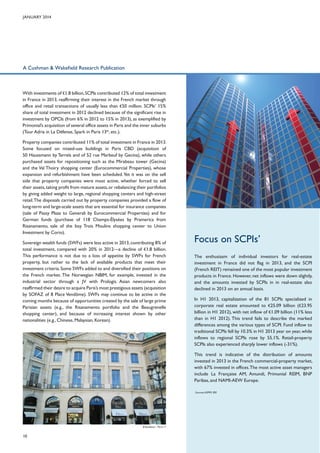
8 Vendôme – Paris 1st

10
INVESTMENT

A Cushman & Wakefield Research Publication

Geographic distribution

PURCHASER TYPE in france
Private
5%

Owner
occupier
5%

SWFs
8%

Insurance companies/
mutual funds
24%

Property
companies
11%

Investment funds
20%

SCPIs
12%
OPCIs
15%

% in volume, all products

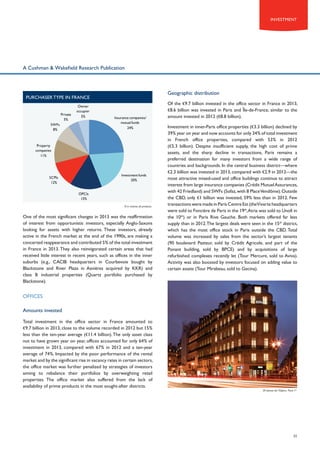
One of the most significant changes in 2013 was the reaffirmation
of interest from opportunistic investors, especially Anglo-Saxons
looking for assets with higher returns. These investors, already
active in the French market at the end of the 1990s, are making a
concerted reappearance and contributed 5% of the total investment
in France in 2013. They also reinvigorated certain areas that had
received little interest in recent years, such as offices in the inner
suburbs (e.g., CACIB headquarters in Courbevoie bought by
Blackstone and River Plaza in Asnières acquired by KKR) and
class B industrial properties (Quartz portfolio purchased by
Blackstone).

Of the €9.7 billion invested in the office sector in France in 2013,
€8.6 billion was invested in Paris and Île-de-France, similar to the
amount invested in 2012 (€8.8 billion).
Investment in inner-Paris office properties (€3.3 billion) declined by
39% year on year and now accounts for only 34% of total investment
in French office properties, compared with 53% in 2012
(€5.3 billion). Despite insufficient supply, the high cost of prime
assets, and the sharp decline in transactions, Paris remains a
preferred destination for many investors from a wide range of
countries and backgrounds. In the central business district—where
€2.3 billion was invested in 2013, compared with €2.9 in 2012—the
most attractive mixed-used and office buildings continue to attract
interest from large insurance companies (Crédit Mutuel Assurances,
with 42 Friedland) and SWFs (Sofaz, with 8 Place Vendôme). Outside
the CBD, only €1 billion was invested, 59% less than in 2012. Few
transactions were made in Paris Centre Est (theVivarte headquarters
were sold to Foncière de Paris in the 19th, Atria was sold to Unofi in
the 10th) or in Paris Rive Gauche. Both markets offered far less
supply than in 2012. The largest deals were seen in the 15th district,
which has the most office stock in Paris outside the CBD. Total
volume was increased by sales from the sector’s largest tenants
(90 boulevard Pasteur, sold by Crédit Agricole, and part of the
Ponant building, sold by BPCE) and by acquisitions of large
refurbished complexes recently let (Tour Mercure, sold to Aviva).
Activity was also boosted by investors focused on adding value to
certain assets (Tour Mirabeau, sold to Gecina).

OFFICES
Amounts invested
Total investment in the office sector in France amounted to
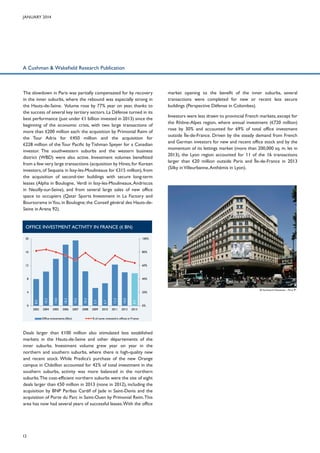
€9.7 billion in 2013, close to the volume recorded in 2012 but 15%
less than the ten-year average (€11.4 billion). The only asset class
not to have grown year on year, offices accounted for only 64% of
investment in 2013, compared with 67% in 2012 and a ten-year
average of 74%. Impacted by the poor performance of the rental
market and by the significant rise in vacancy rates in certain sectors,
the office market was further penalized by strategies of investors
aiming to rebalance their portfolios by overweighting retail
properties. The office market also suffered from the lack of
availability of prime products in the most sought-after districts.
29 avenue de l’Opéra– Paris 1st

11
January 2014

A Cushman & Wakefield Research Publication

The slowdown in Paris was partially compensated for by recovery
in the inner suburbs, where the rebound was especially strong in
the Hauts-de-Seine. Volume rose by 77% year on year, thanks to
the success of several key tertiary sectors. La Défense turned in its
best performance (just under €1 billion invested in 2013) since the
beginning of the economic crisis, with two large transactions of
more than €200 million each: the acquisition by Primonial Reim of
the Tour Adria for €450 million and the acquisition for
€228 million of the Tour Pacific by Tishman Speyer for a Canadian
investor. The southwestern suburbs and the western business
district (WBD) were also active. Investment volumes benefitted
from a few very large transactions (acquisition by Hines, for Korean
investors, of Sequana in Issy-les-Moulineaux for €315 million), from
the acquisition of second-tier buildings with secure long-term
leases (Alpha in Boulogne, Verdi in Issy-les-Moulineaux, Andriscos
in Neuilly-sur-Seine), and from several large sales of new office
space to occupiers (Qatar Sports Investment in La Factory and
Boursorama in You, in Boulogne; the Conseil général des Hauts-deSeine in Arena 92).

market opening to the benefit of the inner suburbs, several
transactions were completed for new or recent less secure
buildings (Perspective Défense in Colombes).
Investors were less drawn to provincial French markets, except for
the Rhône-Alpes region, where annual investment (€720 million)
rose by 30% and accounted for 69% of total office investment
outside Île-de-France. Driven by the steady demand from French
and German investors for new and recent office stock and by the
momentum of its lettings market (more than 200,000 sq. m. let in
2013), the Lyon region accounted for 11 of the 16 transactions
larger than €20 million outside Paris and Île-de-France in 2013
(Silky in Villeurbanne, Anthémis in Lyon).

OFFICE INVESTMENT ACTIVITY IN France (€ BN)

9.7

2003

0

10.0

20%

12.3

4

6.7

40%

5.3

8

10.3

60%

19.5

12

18.2

80%

14.0

16

10.2

100%

8.0

20

2004

2005

2006

2007

2008

2009

2010

2011

2012

2013

Office investments (€bn)

0%

% of sums invested in offices in France

Deals larger than €100 million also stimulated less established
markets in the Hauts-de-Seine and other départements of the
inner suburbs. Investment volume grew year on year in the
northern and southern suburbs, where there is high-quality new
and recent stock. While Predica’s purchase of the new Orange
campus in Châtillon accounted for 42% of total investment in the
southern suburbs, activity was more balanced in the northern
suburbs. The cost-efficient northern suburbs were the site of eight
deals larger than €50 million in 2013 (none in 2012), including the
acquisition by BNP Paribas Cardif of Jade in Saint-Denis and the
acquisition of Porte du Parc in Saint-Ouen by Primonial Reim. This
area has now had several years of successful leases. With the office

12

50 boulevard Haussman - Paris 9th
INVESTMENT

A Cushman & Wakefield Research Publication

EXAMPLES OF OFFICE ACQUISITIONS IN 2013
PROPERTY

LOCATION

VENDOR

PURCHASER

Portfolio

île-de-France

Les Docks Lyonnais

ADIA

Adria tower

La Défense (92)

Testa

éco-Campus

Châtillon (92)

Sequana tower

PRICE (€ M)

AREA (SQ. M.)

580 (est.)

111,000

Primonial Reim

450

54,000

Nexity, Interconstruction

Predica

380

72 000

Issy-les-Moulineaux (92)

Les Docks Lyonnais

Hines (Koreans)

315

42,000

33 Lafayette

Paris (75009)

Ivanhoe Cambridge

Deka

277

28,800

Pacific tower

La Défense (92)

Ivanhoe Cambridge

Tishman Speyer

228

52,900

Technopole

Meudon-La-Forêt (92)

Commerz Real

SMABTP

215

54,300

Nuovo

Clichy (92)

Nexity

BNP Cardif / Sogecap

190

35,000

CACIB hq

Courbevoie (92)

Crédit Agricole SA

Blackstone

188

44,000

Mirabeau tower

Paris (75015)

Aberdeen

Gecina

186

30,300

Jade

Saint-Denis (92)

Kanam

BNP Cardif / Sogecap

170

38,500

Spark

Paris (75013)

Emerige, AOG

Primonial Reim

162

21,700

42 Friedland

Paris (75008)

Ivanhoe Cambridge

Crédit Mutuel Assurances

162

10,500

50-52 boulevard
Haussmann

Paris (75009)

Generali

Terreis

138

14,900

Okabé

Le Kremlin-Bicêtre (94)

Altarea-Cogedim

Primonial Reim

121

23,400

River Plaza

Asnières-sur-Seine (92)

Aberdeen

KKR

89

26,700

Anthemis

Lyon (69)

DeAWM

Realis

85

20,000

RETAIL
Amounts invested
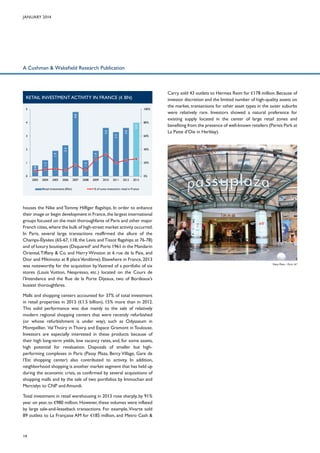
Investment in French retail assets in 2013 amounted to €4 billion,
11% more than in 2012, which had been an outstanding year. The
highest since 2007, this amount represents 26% of total investment
in France, compared with an annual average of 17% during
2003-2012.
The relatively high number of transactions of more than €100
million was due to an influx of quality supply to the French retail
market, which attracted foreign funds and large French institutions.
Twelve deals of more than €100 million accounted for 51% of total
investment in French retail assets in 2013. Several single-asset
transactions were completed, but it was portfolio disposals and
sale-and-leaseback transactions that accounted for 40% of total
investment in retail assets in 2013. The market was also driven by
numerous transactions of less than €50 million carried out both in
the city center and in the suburbs by SCPIs (BNP Paribas Reim,
Amundi, Primonial Reim, etc.).

Nonetheless, the solid performance of retail markets did not mask
a two-tier phenomenon in the French market. Investors continue
to compete for large regional shopping centers, prime retail
locations on the most famous thoroughfares, and assets with
significant potential for repositioning. On the other hand, obsolete
assets and secondary sites have been impacted by the downturn in
household consumption and by drawn-out and tougher leasenegotiation tactics by retailers. The rapid development of
e-commerce and competition from large, modern shopping
complexes also widen the gap in the French market.

Asset types
Investment in high streets amounted to €1.6 billion (i.e., 39% of
total investment in retail assets), a decline of 13% year on year
attributable to fewer large transactions. Two transactions larger
than €300 million and totaling €825 million were recorded in 2012
(e.g., 52-60 Champs-Élysées, acquired by Qatar for more than
€500 million), while the largest deal of 2013 was the acquisition for
€260 million of 65-67 Champs-Élysées, a mixed-use building that

13
January 2014

A Cushman & Wakefield Research Publication

RETAIL INVESTMENT ACTIVITY IN France (€ BN)
100%

4.8

5

80%

60%

40%

1.2

0.8

1

20%

1.2

1.9

1.9

2.3

2

3.6

3

3.3

3.6

4.0

4

0%

0
2003

2004

2005

2006

Retail investments (€bn)

2007

2008

2009

2010

2011

2012

2013

% of sums invested in retail in France

houses the Nike and Tommy Hilfiger flagships. In order to enhance
their image or begin development in France, the largest international
groups focused on the main thoroughfares of Paris and other major
French cities, where the bulk of high-street market activity occurred.
In Paris, several large transactions reaffirmed the allure of the
Champs-Élysées (65-67, 118, the Levis and Tissot flagships at 76-78)
and of luxury boutiques (Dsquared² and Ports 1961 in the Mandarin
Oriental, Tiffany & Co. and Harry Winston at 6 rue de la Paix, and
Dior and Mikimoto at 8 place Vendôme). Elsewhere in France, 2013
was noteworthy for the acquisition by Vastned of a portfolio of six
stores (Louis Vuitton, Nespresso, etc.) located on the Cours de
l’Intendance and the Rue de la Porte Dijeaux, two of Bordeaux’s
busiest thoroughfares.
Malls and shopping centers accounted for 37% of total investment
in retail properties in 2013 (€1.5 billion), 15% more than in 2012.
This solid performance was due mainly to the sale of relatively
modern regional shopping centers that were recently refurbished
(or whose refurbishment is under way), such as Odysseum in
Montpellier, Val Thoiry in Thoiry, and Espace Gramont in Toulouse.
Investors are especially interested in these products because of
their high long-term yields, low vacancy rates, and, for some assets,
high potential for revaluation. Disposals of smaller but highperforming complexes in Paris (Passy Plaza, Bercy Village, Gare de
l’Est shopping center) also contributed to activity. In addition,
neighborhood shopping is another market segment that has held up
during the economic crisis, as confirmed by several acquisitions of
shopping malls and by the sale of two portfolios by Immochan and
Mercialys to CNP and Amundi.
Total investment in retail warehousing in 2013 rose sharply, by 91%
year on year, to €980 million. However, these volumes were inflated
by large sale-and-leaseback transactions. For example, Vivarte sold
89 outlets to La Française AM for €185 million, and Metro Cash &

14

Carry sold 43 outlets to Hermes Reim for €178 million. Because of
investor discretion and the limited number of high-quality assets on
the market, transactions for other asset types in the outer suburbs
were relatively rare. Investors showed a natural preference for
existing supply located in the center of large retail zones and
benefiting from the presence of well-known retailers (Parisis Park at
La Patte d’Oie in Herblay).

Passy Plaza – Paris 16th
INVESTMENT

A Cushman & Wakefield Research Publication

EXAMPLES OF RETAIL ACQUISITIONS IN 2013
TYPE

PROPERTY

LOCATION

VENDOR

PURCHASER

PRICE
(€M)

AREA (SQ.
M.)

Shopping centre

Altaprime portfolio (49%)

France

Altarea-Cogedim

Allianz

395

155,800

High street retail

65-67 Champs-élysées*

Paris (75008)

Shaftesbury AM

Thor Equities

260

10,200

Sale and leaseback

Vivaldi portfolio

France

Vivarte

La Francaise AM

185

53,700

High street retail

Opéra Capucines*

Paris (75002)

Ofi Reim

Generali

178

10,600

Sale and leaseback

Metro Cash & Carry
portfolio (75%)

France

Metro Properties

Hermes REIM

178

-

Gallery/Retail park

Sanba portfolio

Provinces

Immochan

CNP

160

48,000

Shopping centre

Passy Plaza

Paris (75016)

Eurocommercial
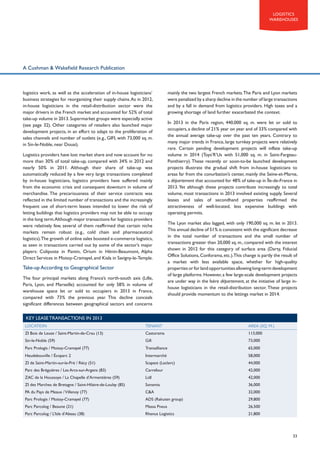
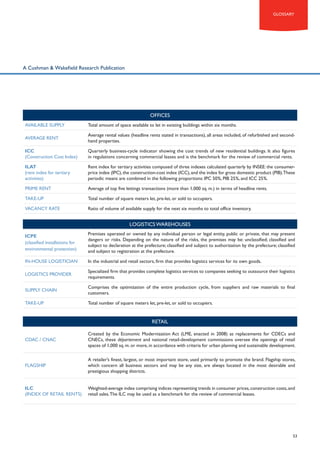
Properties

Generali

141

8,100

High street retail

8 place Vendôme*

Paris (75001)

Axa Real Rstate

SOFAZ

135

5,400

High street retail

118 Champs-élysées*

Paris (75008)

Risanamento

Pramerica

135

3,800

Shopping centre

Val Thoiry

Thoiry (01)

Vastned

Eurocommercial Properties

105

23,400

High street retail

76-78 Champs-élysées

Paris (75008)

Archon

AG Real Estate

83

3,100

High street retail

43 boulevard des Capucines*

Paris (75002)

Crédit Foncier

Invesco

74

4,900

High street retail

2 flagships at Mandarin
Oriental hotel

Paris (75001)

Société Foncière
Lyonnaise

Mandarin Oriental Hotel
Group

73

1,300

Factory outlet

Marques Avenue

Romans-surIsère (26)

CBRE Global
Investors

AEW Europe (Nami)

51

17,000

High street retail

SPIIC portfolio

Bordeaux (33)

Private

Vastned

47

3,250

Retail park

Parisis Park

Franconville (95)

Henderson
Global Investors

Cordea Savills

40

8,900
* mixed-use asset

INDUSTRIAL
Amounts invested

80%

3.2

3

2.6

60%

2.1

2

1

1.5

1.3

1.5

40%

2009

2010

0.8

0.7

20%

0.6

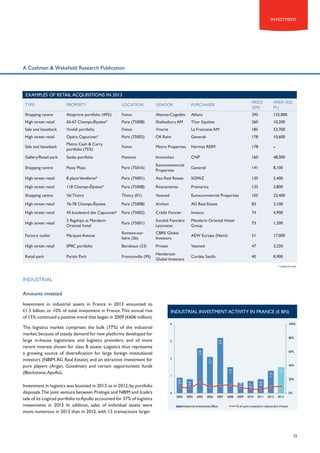
Investment in logistics was boosted in 2013, as in 2012, by portfolio
disposals.The joint venture between Prologis and NBIM and Icade’s
sale of its Logicad portfolio to Apollo accounted for 37% of logistics
investments in 2013. In addition, sales of individual assets were
more numerous in 2013 than in 2012, with 12 transactions larger

100%

4

0.8

The logistics market comprises the bulk (77%) of the industrial
market, because of steady demand for new platforms developed for
large in-house logisticians and logistics providers, and of more
recent interest shown for class B assets. Logistics thus represents
a growing source of diversification for large foreign institutional
investors (NBIM, AG Real Estate), and an attractive investment for
pure players (Argan, Goodman) and certain opportunistic funds
(Blackstone, Apollo).

INDUSTRIAL INVESTMENT ACTIVITY IN France (€ BN)

0.9

Investment in industrial assets in France in 2013 amounted to
€1.5 billion, or 10% of total investment in France. This annual rise
of 15% continued a positive trend that began in 2009 (€606 million).

0%

0
2003

2004

2005

2006

2007

Industrial investments (€bn)

2008

2011

2012

2013

% of sums invested in industrial in France

15
January 2014

A Cushman & Wakefield Research Publication

Île-de-France and the rest of France is sometimes substantial. The
Paris region represented only 30% of total logistics investment in
2013, while the provinces accounted for 70%, mainly because of
disposals of large portfolios and market activity in Lyon, Lille, and
Marseille.

than €20 million in 2013, compared with nine the previous year.
This increase reflects the success of large turnkey projects, whose
rapid growth meets the cost-cutting and modernization
requirements of in-house logisticians in the retail-distribution
sector. The acquisitions of two platforms larger than 100,000 sq. m.
in Saint-Martin-de-Crau, one leased to Maisons du Monde and sold
to Tristan Capital Partners and the other developed for Castorama
and sold to AG Real Estate, were two of the most significant
transactions in 2013. AG Real Estate also acquired a 60,000 sq. m.
site built for Darty in Pusignan, near Lyon. These transactions
illustrate the premium paid by investors for the four principal
markets on the north-south axis (Lille, Paris, Lyon, and Marseille),
which remain the most desirable locations for occupiers because
of their proximity to large consumer populations, major roads, and
transport infrastructure. The difference in performance between

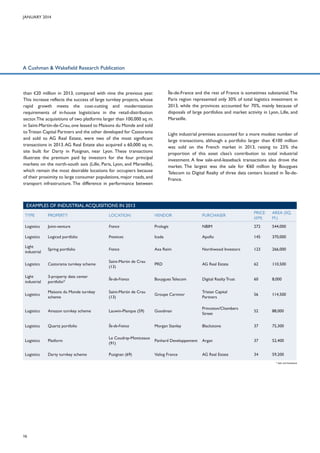
Light industrial premises accounted for a more modest number of
large transactions, although a portfolio larger than €100 million
was sold on the French market in 2013, raising to 23% the
proportion of this asset class’s contribution to total industrial
investment. A few sale-and-leaseback transactions also drove the
market. The largest was the sale for €60 million by Bouygues
Telecom to Digital Realty of three data centers located in Île-deFrance.

EXAMPLES OF INDUSTRIAL ACQUISITIONS IN 2013
TYPE

PROPERTY

LOCATION

VENDOR

PURCHASER

PRICE
(€M)

AREA (SQ.
M.)

Logistics

Joint-venture

France

Prologis

NBIM

272

544,000

Logistics

Logicad portfolio

Provinces

Icade

Apollo

145

370,000

Light
industrial

Spring portfolio

France

Axa Reim

Northwood Investors

123

266,000

Logistics

Castorama turnkey scheme

Saint-Martin de Crau
(13)

PRD

AG Real Estate

62

110,500

Light
industrial

3-property data center
portfolio*

Île-de-France

Bouygues Telecom

Digital Realty Trust

60

8,000

Logistics

Maisons du Monde turnkey
scheme

Saint-Martin de Crau
(13)

Groupe Carnivor

Tristan Capital
Partners

56

114,500

Logistics

Amazon turnkey scheme

Lauwin-Planque (59)

Goodman

Princeton/Chambers
Street

52

88,000

Logistics

Quartz portfolio

Île-de-France

Morgan Stanley

Blackstone

37

75,300

Logistics

Platform

Le Coudray-Montceaux
(91)

Panhard Developpement

Argan

37

52,400

Logistics

Darty turnkey scheme

Pusignan (69)

Vailog France

AG Real Estate

34

59,200
* Sale and leaseback

16
Investment

A Cushman & Wakefield Research Publication

YIELDS
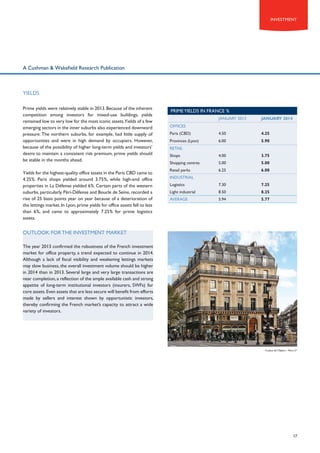
Prime yields were relatively stable in 2013. Because of the inherent
competition among investors for mixed-use buildings, yields
remained low to very low for the most iconic assets.Yields of a few
emerging sectors in the inner suburbs also experienced downward
pressure. The northern suburbs, for example, had little supply of
opportunities and were in high demand by occupiers. However,
because of the possibility of higher long-term yields and investors’
desire to maintain a consistent risk premium, prime yields should
be stable in the months ahead.
Yields for the highest-quality office assets in the Paris CBD came to
4.25%. Paris shops yielded around 3.75%, while high-end office
properties in La Défense yielded 6%. Certain parts of the western
suburbs, particularly Péri-Défense and Boucle de Seine, recorded a
rise of 25 basis points year on year because of a deterioration of
the lettings market. In Lyon, prime yields for office assets fell to less
than 6%, and came to approximately 7.25% for prime logistics
assets.

PRIME YIELDS IN France %
JANUARY 2013

JANUARY 2014

Paris (CBD)

4.50

4.25

Provinces (Lyon)

6.00

5.90

Shops

4.00

3.75

Shopping centres

5.00

5.00

Retail parks

6.25

6.00

Logistics

7.30

7.25

Light industrial

8.50

8.25

AVERAGE

5.94

5.77

OFFICES

RETAIL

INDUSTRIAL

OUTLOOK FOR THE INVESTMENT MARKET
The year 2013 confirmed the robustness of the French investment
market for office property, a trend expected to continue in 2014.
Although a lack of fiscal visibility and weakening lettings markets
may slow business, the overall investment volume should be higher
in 2014 than in 2013. Several large and very large transactions are
near completion, a reflection of the ample available cash and strong
appetite of long-term institutional investors (insurers, SWFs) for
core assets. Even assets that are less secure will benefit from efforts
made by sellers and interest shown by opportunistic investors,
thereby confirming the French market’s capacity to attract a wide
variety of investors.

4 place de l’Opéra – Paris 2nd

17
02
îLE-DE-FRANCE OFFICE
MARKET

”

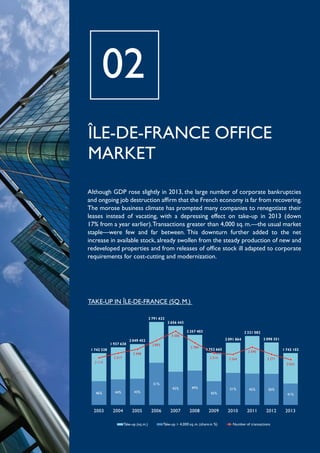
Although GDP rose slightly in 2013, the large number of corporate bankruptcies
and ongoing job destruction affirm that the French economy is far from recovering.
The morose business climate has prompted many companies to renegotiate their
leases instead of vacating, with a depressing effect on take-up in 2013 (down
17% from a year earlier). Transactions greater than 4,000 sq. m.—the usual market
staple—were few and far between. This downturn further added to the net
increase in available stock, already swollen from the steady production of new and
redeveloped properties and from releases of office stock ill adapted to corporate
requirements for cost-cutting and modernization.

Take-up in Île-de-France (sq. m.)
3 000 000
3 000 000
2 500 000
2 500 000
2 000 000
2 000 000
1 500 000
1 500 000

4 000
4 000

2 791 622
2 791 622 2 656 443
2 656 443

2 049 452
2 049 452
1 937 638
1 937 638

1 742 328
1 742 328
2 114
2 114

2 317
2 317

3 306
3 306
2 893
2 893

2 357 403
2 357 403

2 784
2 784

1 752 665
1 752 665
2 314
2 314

3 000
3 000

2 098 351
2 098 351

2 091 864
2 091 864

2 498
2 498

3 500
3 500

2 321 082
2 321 082

1 743 102 2 500
1 743 102 2 500

2 590
2 590
2 271
2 271

2 264
2 264

2 033
2 033

1 500
1 500

1 000 000
1 000 000
51%
51%
500 000
500 000

2 000
2 000

46%
46%

44%
44%

43%
43%

2003
2003

2004
2004

2005
2005

42%
42%

11 000
000

49%
49%
45%
45%

51%
51%

45%
45%

50%
50%

2011

2012
2012

41%
41%

0 0

500
500
00

Take-up (sq. m.)
Take-up (sq. m.)

2006
2006

2007
2007

2008
2008

2009
2009

Take-up > 4,000 sq. m. (share in %)

2010

Number of transactions
transactions

2013
2013
January 2014

A Cushman & Wakefield Research Publication

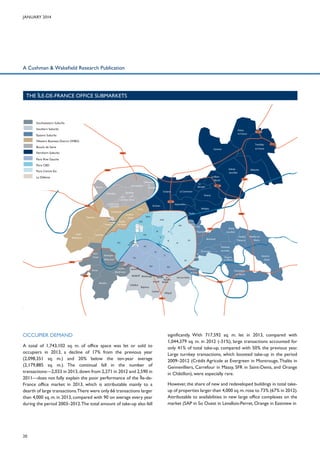
THE îLE-DE-FRANCE OFFICE SUBMARKETS

Southwestern Suburbs
Southern Suburbs

Roissyen-France

Eastern Suburbs

A1

Western Business District (WBD)
Tremblay-

Boucle de Seine
Northern Suburbs

A104

en France

Gonesse
A15

Paris Rive Gauche
Paris CBD
Aulnaysous-Bois

A86

Paris Centre Est

Gennevilliers

Bezons

La GarenneColombes

A14

Le
Bourget
Drancy
A1

St-Ouen

Bobigny

XVIII

XVII

XIX

SaintCloud
A12

Le PréSt-Gervais
Les Lilas

II

e

ein

III

I
VII

IV

Vincennes
StMandé

Issy-les
Moulineaux

Sèvres
A86

Meudon

V

XV

Billancourt

NeuillyPlaisance

Montreuil

XX

XI

VI

Boulogne-

Rosnysous-Bois

A3

Bagnolet

X

VIII

S
La

A86

Paris

Suresnes
XVI

Aubervilliers
Pantin

LevalloisPerret
La
Défense Neuillysur-Seine
Puteaux

IX

RueilMalmaison

A3

A86

La Courneuve

St-Denis

Clichy

Courbevoie

Nanterre

VilleneuvelaGarenne

AsnièressurBoisColombes Seine

Colombes

Villepinte

Le BlancMesnil

La Défense

Fontenaysous-Bois

B

XIV

XIII

rd
Pér
iphé
riq

Malakoff Montrouge ue
Gentilly Le
Kremlin
Arcueil Bicêtre
Châtillon
Bagneux
Cachan

Noisy-leGrand

Nogentsur-Marne

XII

Vanves ouleva

Neuilly-surMarne

Charentonle-Pont

Champignysur-Marne

Ivry-sur-Seine
A4

Villejuif
A6

A86

OCCUPIER DEMAND
A total of 1,743,102 sq. m. of office space was let or sold to
occupiers in 2013, a decline of 17% from the previous year
(2,098,351 sq. m.) and 20% below the ten-year average
(2,179,885 sq. m.). The continual fall in the number of
transactions—2,033 in 2013, down from 2,271 in 2012 and 2,590 in
A6
2011—does not fully explain the poor performance of the Île-deA10
France office market in 2013, which is attributable mainly to a
dearth of large transactions.There were only 66 transactions larger
than 4,000 sq. m. in 2013, compared with 90 on average every year
during the period 2003–2012. The total amount of take-up also fell

20

significantly. With 717,592 sq. m. let in 2013, compared with
1,044,379 sq. m. in 2012 (-31%), large transactions accounted for
only 41% of total take-up, compared with 50% the previous year.
Large turnkey transactions, which boosted take-up in the period
2009–2012 (Crédit Agricole at Evergreen in Montrouge, Thalès in
Gennevilliers, Carrefour in Massy, SFR in Saint-Denis, and Orange
in Châtillon), were especially rare.
However, the share of new and redeveloped buildings in total takeup of properties larger than 4,000 sq. m. rose to 73% (67% in 2012).
Attributable to availabilities in new large office complexes on the
market (SAP in So Ouest in Levallois-Perret, Orange in Eastview in
offices

A Cushman & Wakefield Research Publication

Bagnolet, etc.), this increase also stresses the success of new urban
property-development sectors, such as ZAC Paris Nord-Est in Paris
(Rectorat de Paris in the Visalto), or Le Trapèze in BoulogneBillancourt (Boursorama in You, BBDO in Ardeko, PSG in La
Factory). Some of these large development projects helped sustain
the market for sales to occupiers, at a time when there was a sharp
fall in the volume of office stock acquired by SMEs.The total surface
area transacted in owner-occupier sales was therefore 12% below
the ten-year average. Despite interest rates at historic lows and an
economic environment that highlights the safe-haven value of
property, SMEs continued to play a game of wait-and-see, partly
because of constant financial duress and partly because of more
difficult negotiations between buyers and sellers.
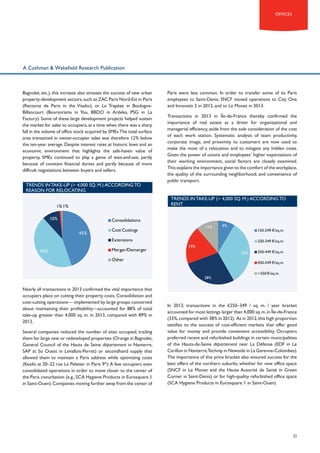
Trends in take-up (> 4,000 sq. m.) according to
reason for relocating

Paris were less common. In order to transfer some of its Paris
employees to Saint-Denis, SNCF moved operations to City One
and Innovatis 2 in 2012, and to Le Monet in 2013.
Transactions in 2013 in Île-de-France thereby confirmed the
importance of real estate as a driver for organizational and
managerial efficiency, aside from the sole consideration of the cost
of each work station. Systematic analysis of team productivity,
corporate image, and proximity to customers are now used to
make the most of a relocation and to mitigate any hidden costs.
Given the power of unions and employees’ higher expectations of
their working environment, social factors are closely examined.
This explains the importance given to the comfort of the workplace,
the quality of the surrounding neighborhood, and convenience of
public transport.

Trends in take-up (> 4,000 sq. m.) according to
rent

1% 1%
10%

Consolidations
45%

11%

Cost Cuttings

9%

150-249 €/sq.m.

Extensions
43%

Merger/Demerger

250-349 €/sq.m.
19%
33%

Other

450-549 €/sq.m.
28%

Nearly all transactions in 2013 confirmed the vital importance that
occupiers place on cutting their property costs. Consolidation and
cost-cutting operations— implemented by large groups concerned
about maintaining their profitability—accounted for 88% of total
take-up greater than 4,000 sq. m. in 2013, compared with 89% in
2012.
Several companies reduced the number of sites occupied, trading
them for large new or redeveloped properties (Orange in Bagnolet,
General Council of the Hauts de Seine département in Nanterre,
SAP at So Ouest in Levallois-Perret) or secondhand supply that
allowed them to maintain a Paris address while optimizing costs
(Keolis at 20–22 rue Le Peletier in Paris 9th). A few occupiers even
consolidated operations in order to move closer to the center of
the Paris conurbation (e.g., SCA Hygiene Products in Eurosquare 1
in Saint-Ouen). Companies moving further away from the center of

350-449 €/sq.m.

>550 €/sq.m.

In 2013, transactions in the €250–349 / sq. m. / year bracket
accounted for most lettings larger than 4,000 sq. m. in Île-de-France
(33%, compared with 38% in 2012). As in 2012, this high proportion
testifies to the success of cost-efficient markets that offer good
value for money and provide convenient accessibility. Occupiers
preferred recent and refurbished buildings in certain municipalities
of the Hauts-de-Seine département near La Défense (EDF in Le
Carillon in Nanterre,Technip in Newside in La Garenne-Colombes).
The importance of this price bracket also ensured success for the
best offers of the northern suburbs, whether for new office space
(SNCF in Le Monet and the Haute Autorité de Santé in Green
Corner in Saint-Denis) or for high-quality refurbished office space
(SCA Hygiene Products in Eurosquare 1 in Saint-Ouen).

21
January 2014

A Cushman & Wakefield Research Publication

reached €700 / sq. m. / year in 2013, a first since 2005. At the other
extreme, transactions smaller than €249 / sq. m. / year were also
fewer than in the previous year, a sign of flat rental activity in the
most far-flung areas of the Paris conurbation. Occupiers have also
lost interest in secondhand supply in less well-established areas of
the inner suburbs.
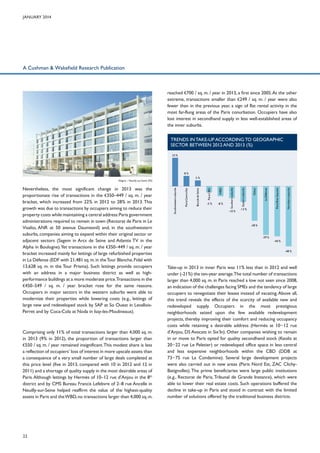
Trends in take-up according to geographic
sector between 2012 and 2013 (%)
23 %

8%

Comprising only 11% of total transactions larger than 4,000 sq. m.
in 2013 (9% in 2012), the proportion of transactions larger than
€550 / sq. m. / year remained insignificant. This modest share is less
a reflection of occupiers’ loss of interest in more upscale assets than
a consequence of a very small number of large deals completed at
this price level (five in 2013, compared with 10 in 2012 and 12 in
2011) and a shortage of quality supply in the most desirable areas of
Paris. Although lettings by Hermès of 10–12 rue d’Anjou in the 8th
district and by CMS Bureau Francis Lefebvre of 2–8 rue Ancelle in
Neuilly-sur-Seine helped reaffirm the value of the highest-quality
assets in Paris and the WBD, no transactions larger than 4,000 sq. m.

22

-10 %

Northern suburbs

-13 %

Paris Rive Gauche

La Défense

Other

-8 %

Eastern suburbs

WBD

-5 %

Southern suburbs

Paris CBD

Paris Centre Est

Southwestern suburbs

Nevertheless, the most significant change in 2013 was the
proportionate rise of transactions in the €350–449 / sq. m. / year
bracket, which increased from 22% in 2012 to 28% in 2013. This
growth was due to transactions by occupiers aiming to reduce their
property costs while maintaining a central address: Paris government
administrations required to remain in town (Rectorat de Paris in Le
Visalto, ANR at 50 avenue Daumesnil) and, in the southwestern
suburbs, companies aiming to expand within their original sector or
adjacent sectors (Sagem in Arcs de Seine and Atlantis TV in the
Alpha in Boulogne). Yet transactions in the €350–449 / sq. m. / year
bracket increased mainly for lettings of large refurbished properties
in La Défense (EDF with 21,481 sq. m. in the Tour Blanche, Fidal with
13,628 sq. m. in the Tour Prisma). Such lettings provide occupiers
with an address in a major business district as well as highperformance buildings at a more moderate price.Transactions in the
€450–549 / sq. m. / year bracket rose for the same reasons.
Occupiers in major sectors in the western suburbs were able to
modernize their properties while lowering costs (e.g., lettings of
large new and redeveloped stock by SAP at So Ouest in LevalloisPerret and by Coca-Cola at Noda in Issy-les-Moulineaux).

Boucle de Seine

5%

Alegria – Neuilly-sur-Seine (92)

-28 %

-39 %
-40 %
-48 %

Take-up in 2013 in inner Paris was 11% less than in 2012 and well
under (-21%) the ten-year average.The total number of transactions
larger than 4,000 sq. m. in Paris reached a low not seen since 2008,
an indication of the challenges facing SMEs and the tendency of large
occupiers to renegotiate their leases instead of vacating. Above all,
this trend reveals the effects of the scarcity of available new and
redeveloped supply. Occupiers in the most prestigious
neighborhoods seized upon the few available redevelopment
projects, thereby improving their comfort and reducing occupancy
costs while retaining a desirable address (Hermès at 10−12 rue
d’Anjou, DS Avocats in Six’In). Other companies wishing to remain
in or move to Paris opted for quality secondhand stock (Keolis at
20−22 rue Le Peletier) or redeveloped office space in less central
and less expensive neighborhoods within the CBD (DDB at
73−75 rue La Condamine). Several large development projects
were also carried out in new areas (Paris Nord Est, ZAC ClichyBatignolles). The prime beneficiaries were large public institutions
(e.g., Rectorat de Paris, Tribunal de Grande Instance), which were
able to lower their real estate costs. Such operations buffered the
decline in take-up in Paris and stood in contrast with the limited
number of solutions offered by the traditional business districts.
offices

A Cushman & Wakefield Research Publication

The southwestern suburbs were the only submarket of the inner
suburbs to see a rise in take-up (+23%). Several transactions
reaffirmed the success of new tertiary sectors (Le Trapèze in
Boulogne-Billancourt, the Bords de Seine neighborhood in Issy-lesMoulineaux). Occupiers seized lettings opportunities in new
property developments to modernize their offices (e.g., Coca-Cola
in Noda, Boursorama in You, BBDO in Ardeko). The southwestern
suburbs continued to command strong loyalty. They also proved
attractive to Paris-based companies confronted with scarce supply
of quality assets and eager to lower property costs without overly
compromising their image.
Other markets in the western suburbs were flat. La Défense had its
worst year in a decade, with just 96,509 sq. m. let in 2013. Usually
driven by lettings of large and very large properties, La Défense was
hurt by the very small number of deals larger than 4,000 sq. m. (four,
and only one greater than 20,000 sq. m.). La Défense was also
penalized by the lack of lettings of new and redeveloped supply.
Large tenants saved money by agreeing to measures granted by
landlords to minimize the vacancy rates of their properties. Of total
take-up in 2013, 82% was for refurbished buildings. Occupiers were
thus able to modernize their buildings at relatively low cost (Fidal in
the Tour Prisma, EDF in the Tour Blanche, Egencia in the Tour Egée).
In contrast with trends observed at La Défense, the success of new
stock helped to cushion the fall in demand in the WBD. Five leases
were signed for new buildings larger than 10,000 sq. m., including
CMS Bureau Francis Lefebvre 2−8 rue Ancelle in Neuilly, SAP in So
Ouest, and CG 92 in Arena 92.

Area Prima – Châtillon (92)

In 2013, other sectors of the inner suburbs played a less active role
than in recent years, despite an economic context that favored costcutting initiatives by occupiers. The downturn of cost-efficient
markets should be put into perspective, and is no doubt related to
the decline of certain business sectors and to fewer large and very
large transactions. Despite a decline in the number of new large

properties available—the result of successful lettings in 2011 and
2012—the northern suburbs continued to see large new leases in
Saint-Denis (SNCF in Le Monet and the HAS in Green Corner),
Saint-Ouen (SCA Hygiene Products in Eurosquare 1, SVP in Dock
en Seine) and in other communes of the Seine-Saint-Denis
département (DHL in Le Mermoz in Le Bourget).
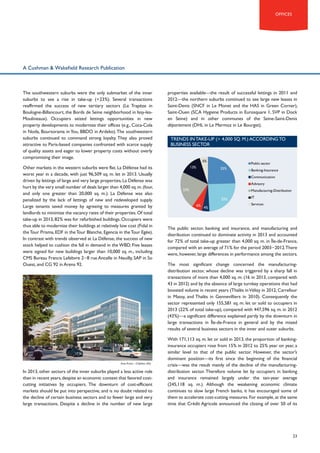
Trends in take-up (> 4,000 sq. m.) according to
business sector
5%
13%

Public sector
25%

Banking-Insurance
Communication
Advisory

22%

Manufacturing-Distribution
25%
6%

4%

IT
Services

The public sector, banking and insurance, and manufacturing and
distribution continued to dominate activity in 2013 and accounted
for 72% of total take-up greater than 4,000 sq. m. in Île-de-France,
compared with an average of 71% for the period 2003−2012.There
were, however, large differences in performance among the sectors.
The most significant change concerned the manufacturingdistribution sector, whose decline was triggered by a sharp fall in
transactions of more than 4,000 sq. m. (16 in 2013, compared with
43 in 2012) and by the absence of large turnkey operations that had
boosted volume in recent years (Thalès in Vélizy in 2012, Carrefour
in Massy, and Thalès in Gennevilliers in 2010). Consequently the
sector represented only 155,581 sq. m. let or sold to occupiers in
2013 (22% of total take-up), compared with 447,596 sq. m. in 2012
(43%)—a significant difference explained partly by the downturn in
large transactions in Île-de-France in general and by the mixed
results of several business sectors in the inner and outer suburbs.
With 171,113 sq. m. let or sold in 2013, the proportion of bankinginsurance occupiers rose from 15% in 2012 to 25% year on year, a
similar level to that of the public sector. However, the sector’s
dominant position—its first since the beginning of the financial
crisis—was the result mainly of the decline of the manufacturingdistribution sector. Therefore volume let by occupiers in banking
and insurance remained largely under the ten-year average
(245,118 sq. m.). Although the weakening economic climate
continues to slow large French banks, it has encouraged some of
them to accelerate cost-cutting measures. For example, at the same
time that Crédit Agricole announced the closing of over 50 of its

23
January 2014

A Cushman & Wakefield Research Publication

agencies in Île-de-France by 2015, the bank expanded its campuses
in Montrouge and Guyancourt. The construction of two new
buildings (Eole and Alsace) will allow Crédit Agricole to
accommodate a greater number of its employees in these buildings
and to share numerous services and facilities. In contrast with the
trend in the financial sector of relocating employees to the suburbs,
insurance companies and private health insurers stood out by
taking the opposite tack and moving back into Paris (acquisition by
the Fonds de Garantie of a stake in the Trio Daumesnil project).

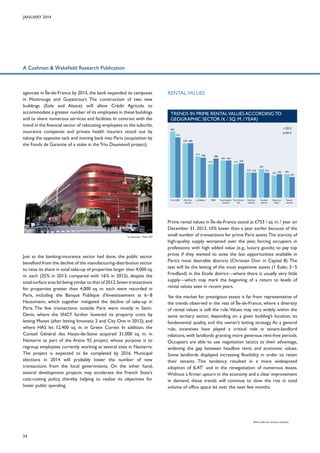
RENTAL VALUES

Trends in prime rental values according to
geographic sector (€ / sq. m. / year)
900 €/m²

2012

823

800 €/m²

2013

753
679 680

700 €/m²
600 €/m²

514

500 €/m²

498

488
417

464 463
417 429

400 €/m²

357
315 310

300 €/m²

310

277

292

294
257

200 €/m²
100 €/m²
0 €/m²

Le Garance – Paris 20th

Just as the banking-insurance sector had done, the public sector
benefited from the decline of the manufacturing-distribution sector
to raise its share in total take-up of properties larger than 4,000 sq.
m. each (25% in 2013, compared with 16% in 2012), despite the
total surface area let being similar to that of 2012. Seven transactions
for properties greater than 4,000 sq. m. each were recorded in
Paris, including the Banque Publique d’Investissement at 6−8
Haussmann, which together mitigated the decline of take-up in
Paris. The few transactions outside Paris were mostly in SaintDenis, where the SNCF further lowered its property costs by
letting Monet (after letting Innovatis 2 and City One in 2012), and
where HAS let 12,400 sq. m. in Green Corner. In addition, the
Conseil Général des Hauts-de-Seine acquired 31,000 sq. m. in
Nanterre as part of the Arena 92 project, whose purpose is to
regroup employees currently working at several sites in Nanterre.
The project is expected to be completed by 2016. Municipal
elections in 2014 will probably lower the number of new
transactions from the local governments. On the other hand,
several development projects may accelerate the French State’s
cost-cutting policy, thereby helping to realize its objectives for
lower public spending.

Paris CBD

Paris Rive
Gauche

La Défense

WBD

Southwestern Paris Centre
suburbs
Est

Northern
suburbs

Southern
suburbs

Boucle de
Seine

Eastern
suburbs

Prime rental values in Île-de-France stood at €753 / sq. m. / year on
December 31, 2013, 10% lower than a year earlier because of the
small number of transactions for prime Paris assets. The scarcity of
high-quality supply worsened over the year, forcing occupiers in
professions with high added value (e.g., luxury goods) to pay top
prices if they wanted to seize the last opportunities available in
Paris’s most desirable districts (Christian Dior in Capital 8). The
test will be the letting of the most expensive assets (1 Euler, 3−5
Friedland) in the Etoile district—where there is usually very little
supply—which may mark the beginning of a return to levels of
rental values seen in recent years.
Yet the market for prestigious assets is far from representative of
the trends observed in the rest of Île-de-France, where a diversity
of rental values is still the rule. Values may vary widely within the
same tertiary sector, depending on a given building’s location, its
fundamental quality, and the owner’s letting strategy. As a general
rule, incentives have played a critical role in tenant-landlord
relations, with landlords granting more generous rent-free periods.
Occupiers are able to use negotiation tactics to their advantage,
widening the gap between headline rents and economic values.
Some landlords displayed increasing flexibility in order to retain
their tenants. This tendency resulted in a more widespread
adoption of ILAT1 and in the renegotiation of numerous leases.
Without a firmer upturn in the economy and a clear improvement
in demand, these trends will continue to slow the rise in total
volume of office space let over the next few months.

Rent index for tertiary activities.

1

24
offices

A Cushman & Wakefield Research Publication

AVAILABLE and future SUPPLY
5 000 000

9,0 %

8,2
7,9
7,4

1 000 000
0
500 000

56%

56%

56%

56%
2003

2004

2003
Total stock

2003

2004

2004
Total stock

After the modest amount of office space completed in Îlede-France in 2012 (570,000 sq. m.), developments completed
in 2013 totaled 750,000 sq. m., an annual increase of 32%.
Concentrated at 40% in three western sectors (La Défense,
the southwestern suburbs, and the Boucle de Seine), this
construction volume is still far from the record set in 2009
(1.3 million sq. m.). Nearly 60% of the total volume is for
development projects partially or fully pre-let (e.g., Cityzen
in Bois-Colombes, Solstys in the 8th district), or turnkey
schemes for large occupiers (first phase of new SFR
headquarters in Saint-Denis, new Carrefour headquarters in
Massy).
This change nonetheless confirms the increasing construction
activity in the Paris region. There were 2.03 million sq. m.
under construction at December 31, 2013, compared with
1.5 million sq. m. a year earlier. Part of the new volume is
attributable to speculative schemes, although there were also
a few turnkey projects (Ministry of Defense in Balard, Orange
éco-campus in Châtillon). Several significant projects are
under construction in Paris: 46,000 sq. m. developed by AXA,
near the Ministry of Defense; 38,000 sq. m. (Cardinal)
developed by SFL in the 2nd district; and 25,000 sq. m.
(Millénaire 4) launched by Icade in the Parc du Millénaire.

57%
25%

57%
25%
2005

54%
20%

54%
2006

20%

5.7

54%
25%

54%

54%
2007

6.6

56%
30%
56%

2008

30%

58%
58%

27%

25%

58%

27%
2009

27%

58%

2006

Total stock > 4,000 sq. m.

2007

2008

2009

New-redeveloped supply (all sizes)

57%
57%
24%

57%

25%
2010

24%

2011

25%

25%

20%
2005
2006
2007
2008
2009
Surfaces >4000 m²
Stock neuf/restructuré (toutes surfaces)
2005

7.1

58%

56%

30%

25%

58%

7,1

7.9

24%

3 869 380
3 869 380
3 869 380

5,7

8.0

7,9

3 720 902
3 720 902
3 720 902

3 290 764
3 290 764
3 290 764

54%

25%

0

Increase in construction
activity in the Paris region

57%

56%

56%

6,6

6,5

6.5

2 794 676
2 794 676
2 794 676

1 500 000
500 000

7.1

7.1

6.7

3 133 113
3 133 113
3 133 113

2 000 000
1 000 000

3 413 681
3 413 681
3 413 681

2 500 000
1 500 000

3 383 320
3 383 320
3 383 320

3 000 000
2 000 000

6,7

3 117 655
3 117 655
3 117 655

3 500 000
2 500 000

5,7

7,1

7,1

8,0

4 066 053
4 066 053
4 066 053

6,5

4 500 000
3 500 000
4 000 000
3 000 000

6,6

4 103 109
4 103 109
4 103 109

7,1
7,1
7,1
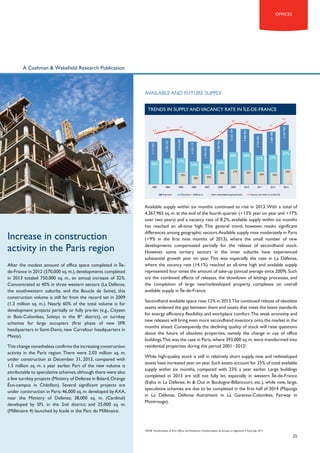
Trends in supply and vacancy rate in Île-de-France
6,7

5 000 000
4 000 000

7,4

7.4

57%
57%
23%

57%

23%
2012

23%

8,0 %

4 367 965
4 367 965
4 367 965

8,0

4 500 000

8,2

8.2

57%

9,0 %
7,0 %
8,0 %
6,0 %
7,0 %
5,0 %
6,0 %
4,0 %
5,0 %
3,0 %

57%
25%
57%

4,0 %
2,0 %
3,0 %
1,0 %

25%
2013

25%

2,0 %
0,0 %
1,0 %

0,0 %

2010

2011
2012
2013
Taux de vacance à moins de 6 mois

2010

2011

2012

2013

Vacancy rate within 6 months (%)

Available supply within six months continued to rise in 2013. With a total of
4,367,965 sq. m. at the end of the fourth quarter (+13% year on year and +17%
over two years) and a vacancy rate of 8.2%, available supply within six months
has reached an all-time high. This general trend, however, masks significant
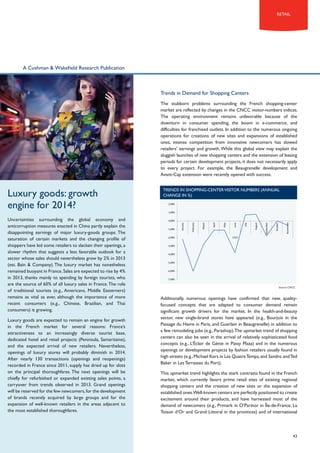
differences among geographic sectors. Available supply rose moderately in Paris
(+9% in the first nine months of 2013), where the small number of new
developments compensated partially for the release of secondhand stock.
However, some tertiary sectors in the inner suburbs have experienced
substantial growth year on year. This was especially the case in La Défense,
where the vacancy rate (14.1%) reached an all-time high and available supply
represented four times the amount of take-up (annual average since 2009). Such
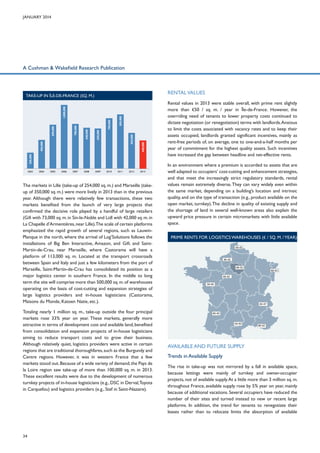
are the combined effects of releases, the slowdown of lettings processes, and
the completion of large new/redeveloped property complexes on overall
available supply in Île-de-France.
Secondhand available space rose 12% in 2013.The continued release of obsolete
assets widened the gap between them and assets that meet the latest standards
for energy efficiency, flexibility, and workplace comfort. The weak economy and
new releases will bring even more secondhand inventory onto the market in the
months ahead. Consequently, the declining quality of stock will raise questions
about the future of obsolete properties, namely the change in use of office
buildings.This was the case in Paris, where 393,000 sq. m. were transformed into
residential properties during the period 2001−20122.
While high-quality stock is still in relatively short supply, new and redeveloped
assets have increased year on year. Such assets account for 25% of total available
supply within six months, compared with 23% a year earlier. Large buildings
completed in 2013 are still not fully let, especially in western Île-de-France
(Eqho in La Défense, In & Out in Boulogne-Billancourt, etc.), while new, large,
speculative schemes are due to be completed in the first half of 2014 (Majunga
in La Défense, Défense Autrement in La Garenne-Colombes, Fairway in
Montrouge).

2

APUR, Transformation of Paris Offices into Residences (Transformations de bureaux en logements à Paris), July 2013.

25
January 2014

A Cushman & Wakefield Research Publication

Future supply to 2016
2 500 000

2 000 000

2 088 350
1 500 000

1 000 000

1 352 319

591 969

500 000

470 197

291 294

0

2014

2015

2016

Volume of secure future supply > 10,000 sq. m.
Volume of likely future supply > 10,000 sq. m.
Average take-up >5,000 sq. m. over the past 5 years
Average take-up >10,000 sq. m. over the past 5 years

The total volume of definite future supply of space over
10,000 sq. m. in 2014 (1,352,319 sq. m.) largely outweighs the
average take-up figure of office space over 5,000 sq. m.
(865,438 sq. m.) of the past five years. This imbalance is made up of
supply which was unabsorbed in 2013 (unabsorbed supply is
deferred to 2014), new releases, and occasional launches of
speculative schemes.A clear-cut recovery in demand seems unlikely
in the short term. Competition among tertiary sectors to attract
occupiers is therefore expected to grow more heated, despite
significant differences in volume and quality of stock in each
geographic area.

may be restored, after State-owned assets have been put on the
market (10 boulevard de Grenelle) and 46,000 sq. m. launched by
AXA at the Balard site. The ZAC Rive Gauche has also been a
victim of its own success. With new supply on hold until the
completion of the first projects in the Austerlitz-Tolbiac and
Masséna-Bruneseau sectors, the more residential neighborhoods
of Paris Centre Est and Paris Rive Gauche (e.g., Pushed Slab in the
13th, Parisquare in the 11th, and the Garance in the 20th) could enjoy
greater absorption of large properties.

Future supply for inner Paris remains relatively limited. Most new
projects will not be completed before 2016−2017 (Samaritaine
and Poste du Louvre in the CBD, expansion of major development
zones such as ZAC Clichy-Batignolles and ZAC Rive Gauche),
although Parisian occupiers will have access to high-quality property
solutions by the end of 2015. There will be more redeveloped
supply in the eastern part of the CBD (26 Drouot, Cardinal) than
in the highly valued Etoile district (1 Euler, 3−5 Friedland), where
some companies may attempt to renegotiate their leases in order
to lower short-term property costs. In addition to several
refurbished and secondhand buildings (Paris Bourse), this new
inflow may be to the advantage of cost-conscious occupiers less
dependent on a prestigious address. The conditions are slightly
different in the Left Bank, where immediate alternatives have been
virtually nonexistent since the absorption of several prestigious
projects in the 7th district (103 Grenelle, 23−25 rue de l’Université,
Laennec) and the gradual letting of refurbished buildings in the 15th
(Tour Cristal). In 2015, a more balanced offering in the 15th district

The WBD and La Défense account for 36% of total future supply
greater than 10,000 sq. m. outside Paris proper through 2015. This
figure reflects ongoing releases and the importance of projects
under development. The inflow of high-quality supply to Neuillysur-Seine could fulfill the needs of occupiers facing a scarcity of
supply in the western part of the CBD. Usually undersupplied, this
market offers, in addition to smaller refurbished properties
(164 Perretti), three projects larger than 10,000 sq. m. One of them,
Alegria, is ideally located near avenue Charles de Gaulle. LevalloisPerret also offers redeveloped (So Ouest Plaza) and refurbished
(Libertis, Espace Seine, Carré Champerret) large spaces that could
compete with those of Boulogne-Billancourt. Because of
opportunities created by large, recently redeveloped corporate
headquarters (In & Out) and by the just-completed first projects of
the second phase of Trapèze (Kinetik, the remaining space in
Ardeko), Boulogne could continue to drive activity in the
southwestern suburbs in 2014, after numerous large transactions
in 2013.

26

Primopera – Paris 9th
offices

A Cushman & Wakefield Research Publication

The largest spaces of the WBD will also have to compete with new,
redeveloped, and renovated office towers of La Défense. La Défense
offers occupiers a wide range of solutions. A few new buildings
(Carpe Diem, D2, Majunga), the remaining recently redeveloped
office towers (First), and several very high-quality secondhand
buildings (Cœur Défense, W) all meet the needs of companies
seeking prestigious headquarters that are conveniently located,
energy efficient, and comfortable. For occupiers in the sector or in
less established tertiary sectors nearby, there are several refurbished
or secondhand assets that could provide them the opportunity to
modernize their offices at a reasonable cost.
For refurbished and secondhand buildings at La Défense, the
adjustment of rental values and the larger incentives granted will be
even more decisive than some of the new supply in nearby sectors
with easy access to public transport. The WBD (Nework in
Nanterre) and the south of the Boucle de Seine (La GarenneColombes, Colombes) both provide viable alternatives. Enhanced by
the extension of the T2 tramway line, the south of the Boucle de
Seine in particular could benefit from the completion of new quality
projects (West Plaza). Other emerging districts of the inner suburbs
could outperform. Certain municipalities of the southern Hauts-deSeine département have a good image, significant new, inexpensive
supply, and easy access thanks to the extension of the Métro line 4
and tramway line 6. The markets in Montrouge (Fairway), Châtillon
(Area Prima), and Malakoff (White) are emerging as potential costefficient options for occupiers of more established tertiary sectors
nearby with little supply, such as Paris’s southern districts and the
neighboring town of Issy-les-Moulineaux.
The north of the Boucle de Seine should remain a naturally costefficient sector for occupiers aiming to lower their costs significantly
while having access to a Métro line.The area’s most attractive offers,
such as Pointe Métro 2 in Gennevilliers, are enhanced by the scarcity
of high-quality supply in Saint-Denis. After two years of steady
rental activity, the supply of new large properties in Saint-Denis has
dried up drastically. By the end of 2015, the town will have only two
buildings of more than 10,000 sq. m. and nothing larger than
20,000 sq. m. In the longer term, land opportunities in Saint-Denis
should provide development of large high-quality properties that
match the needs of occupiers. Until then, the scarcity of the SaintDenis market will play to the advantage of other towns in the
northern suburbs, such as Pantin (Pantin Elis) and Saint-Ouen
(Eurosquare 2). As for the eastern suburbs, they are one of the
emerging districts with the least supply in Île-de-France. New and
redeveloped stock larger than 10,000 sq. m. to be available by the
end of 2015 can be counted on the fingers of one hand. After
Orange’s letting of Eastview in Bagnolet in 2013 and pending the
launch of Altaïs Evolution in Montreuil, this sector will offer only one
building of more than 20,000 sq. m. on the future property market
(Tour 9 in Montreuil).

West Plaza – Colombes (92)

OUTLOOK
Economic recovery in France will no doubt be too sluggish to
stimulate consumption of office space in 2014. With companies
continuing to renegotiate their leases instead of relocating, the
volume of take-up should remain under the ten-year average.
Consequently the Île-de-France market will have significant
quantities of available space, leading to increased competition
among tertiary sectors to attract occupiers.Yet the influx of supply
could also serve as a catalyst for a more general recovery aided by
the easing of leasing conditions on the outskirts and by the launch
of redevelopment projects for large, well-located properties in
Paris. Reflecting a healthier balance between available supply and
occupiers’ search criteria, this change will strengthen the appeal of
office supply offering energy efficiency and services at a reasonable
price that matches corporate cost-cutting targets. High-quality
refurbished and secondhand supply with excellent links to public
transport could also stand out. Such stock fulfills the needs of
occupiers seeking a substantial reduction in rent or aiming to
relocate in a more established tertiary sector at the lowest possible
cost.

27
January 2014

A Cushman & Wakefield Research Publication

key lease transactions in 2013
submarket

BUILDING / LOCATION

TENANT

AREA (SQ. M.)

WBD

Arena 92 / Nanterre (92)

Conseil Général des Hauts-de-Seine

31,000

WBD

So Ouest / Levallois-Perret (92)

SAP

27,900

WBD

Nuovo / Clichy (92)

L’Oréal

25,000

Eastern suburbs

Eastview / Bagnolet (93)

Orange

24,700

LA DéFENSE

Tour Blanche / Courbevoie (92)

ERDF

21,480

NORthern suburbs

Le Monet / Saint-Denis (93)

SNCF

20,000

WBD

2-8 rue Ancelle / Neuilly-sur-Seine (92)

CMS Bureau Francis Lefebvre

16,500

BOUCLE DE SEINE

Newside / La Garenne-Colombes (92)

Technip

16,000

PARIS CENTRE EST

Visalto / Paris (75019)

Rectorat de Paris

15,200

SOUTHWESTERN SUBURBS

Bords de Seine 2 / Issy-les-Moulineaux (92)

La Banque Postale

14,100

LA DéFENSE

Tour Prisma / Courbevoie (92)

Fidal

13,600

SOUTHWESTERN SUBURBS

Noda / Issy-les-Moulineaux (92)

Coca-Cola

13,400

PARIS CBD

6-8 Haussmann / Paris (75009)

Banque Publique d’Investissement

10,500

SOUTHWESTERN SUBURBS

You / Boulogne-Billancourt (92)

Boursorama

8,800

Southern suburbs

Aristide / Bagneux (92)

Air Liquide

7,100

NORthern suburbs

Eurosquare 1 / Saint-Ouen (93)

SCA Hygiene Products

6,600

NORthern suburbs

Le Mermoz / Le Bourget (93)

DHL

6,400

PARIS RIVE GAUCHE

Tour Cristal / Paris (75015)

Altedia

5,900

PARIS RIVE GAUCHE

Spark / Paris (75013)

Aldebaran Robotics

4,800

Île-de-france office-market indicators
SUBMARKET

TAKE-UP (SQ. M.)
2012

2013

2012

2013

2012

2013

PARIS CBD

424,836

404,813

823

753

7.3

7.9

PRIME RENT (€ / SQ. M. / YEAR)

VACANCY RATE (%)

PARIS CENTRE EST

99,167

107,321

417

429

4.3

5.3

PARIS RIVE GAUCHE

163,183

97,427

679

680

5.0

5.3

LA DÉFENSE

158,804

96,509

514

498

7.9

14.1

WBD

289,044

265,934

417

488

12.6

13.4

BOUCLE DE SEINE

56,320

58,929

277

292

14.4

17.1

SOUTHWESTERN SUBURBS

138,800

170,566

464

463

10.1

10.3

Eastern suburbs

53,712

46,956

294

257

8.1

7.4

NORthern suburbs

231,586

119,297

315

310

7.9

7.3

Southern suburbs

145,159

131,310

357

310

7.9

9.4

OTHER SUBMARKETS

337,740

244,040

244

248

5.6

6.0

TOTAL ÎLE-DE-FRANCE

2,098,351

1,743,102

838

753

7.4

8.2

28
Les marchés
immobilierS
français

études & Recherche Cushman & Wakefield

PERSPECTIVES
Après l’embellie passagère de 2011, l’année 2012 a marqué une contraction du marché des bureaux d’Ile-de-France, illustrée par la remontée
sensible de l’offre disponible et le fléchissement de la demande des utilisateurs. Si l’envolée du taux de chômage est généralement moins
marquée en région parisienne qu’au niveau national, les perspectives économiques ne permettent pas d’espérer une franche reprise de la
consommation de surfaces de bureaux dans les prochains mois. Elles augurent au contraire d’un plus grand attentisme des utilisateurs, qui
pèsera sur l’évolution de la demande placée. Contraintes de poursuivre la réduction de leurs coûts immobiliers, les grandes entreprises
continueront toutefois d’absorber les bureaux neufs ou de seconde-main de qualité d’Ile-de-France, au profit des marchés les plus établis qui
offrent encore quelques rares opportunités d’implantation ou des marchés tertiaires disposant de bureaux neufs bien reliés aux transports.

29
03
FRENCH LOGISTICSWAREHOUSES MARKET

45%

35%

31%

20%

2003

2004

2005

2006

2007

2008

2009

2010

2011

2012

2013

France

Paris region

2,170,000

39%

1,800,000

25%

2,400,000

27%

1,760,000

45%

1,600,000

2,600,000

34%

2,200,000

30%

2,000,000

25%

1,500,000

2,600,000

Take-up in France (sq. m.)

1,000,000

”

The French logistics-warehouses market recovered in 2013. Total take-up
increased by 21% year on year, to 2.17 million sq. m., a performance that should
nonetheless be put in perspective.Volumes were inflated by large turnkey projects
of in-house logisticians in the retail-distribution sector, and the total number of
transactions has been in decline since 2011. As in 2012, take-up in Île-de-France,
France’s leading logistics center, was well below the average of the past ten years.
This slowdown reflects the challenges faced by a rental market destabilized by
economic uncertainties and high taxes, pressures that dampen occupier demand
and slow the development of new projects.
January 2014

A Cushman & Wakefield Research Publication

ECONOMIC TRENDS
Economic performance indicators of developed countries have improved
since the end of 2012, confirming faster GDP growth in Japan, an improved
job market in the United States, and recovery in Europe that is slow but
steady. Nevertheless risk has not been eliminated, as witnessed by the
magnitude of public debt and the weakness of the banking systems.
Business activity in emerging economies has slowed sharply, forcing
numerous forecasters to trim their global growth estimates. World trade
growth is expected to rise 4.5% in 2014, a lower rate than that forecast a
few months ago (though better than 2013’s 2.5% growth) and still under
the average of the past 20 years (5.4%).
Exports and manufacturing output rebounded in 2013, reviving French
business activity that was also helped by the upturn in other parts of
Europe. Household consumption was aided by the generous socialsecurity safety net, a very low inflation rate, and a more moderate rise in
taxes. However, not all clouds have been dispersed from the French
economic horizon.The business climate remains much less favorable than
its long-term average, and unemployment rates and corporate bankruptcies
are at all-time highs. Penalized since the beginning of the crisis by weak
volume and lower prices on service contracts, the transport sector will
continue to suffer in a very unstable environment.

OCCUPIER DEMAND
Take-up According to Occupiers’ Motivations and
Characteristics
At 2.17 million sq. m.1, total take-up in 2013 in France rose sharply
(21% year on year), a slight improvement over the ten-year average
(1.946 million sq. m.). Higher take-up was nonetheless accompanied by a
significant decline in the total number of transactions. Many occupiers
preferred lease renegotiation to relocation. The high proportion of very
large transactions (13 larger than 40,000 sq. m. comprising 30% of total
take-up) also attests that consolidation remains a priority. An increasing
number of logistics providers and in-house logisticians are reducing their
total sites and opting for larger platforms (e.g., Castorama in SaintMartin-de-Crau, Intermarché in Villeneuve-lès-Béziers). When located
near major highways, port facilities, and large consumption markets, such
platforms allow occupiers to optimize their transport costs by limiting
unladen journeys and by increasing the flow of goods.
Occupiers’ desire for modern buildings is also attributable to their need
to adapt to changes in regulatory requirements governing product safety
and traceability, to requirements concerning delivery quality and time,
and to their search for greater productivity. Several quality products on
the market were let in 2013, increasing the share of new or recent assets
in total take-up: rare assets recently placed on the market as speculative
developments, buildings modernized to meet new standards, and class-A
platforms vacated by tenants. But it was demand that drove the large
turnkey projects that satisfy the increasingly sophisticated needs of
Transactions > 5 000 sq. m. including turnkey and owner-occupied premises but excluding lease renewals.

1

32

Logistics of large
distribution retailers
The significant share of take-up in 2013 (19%) accounted for
by large food retailers reaffirmed the broad scale of costcutting strategies implemented in recent years. Most realestate projects in France are designed to improve profitability,
in an environment of slower consumer spending and a price
war among retailers. Sales channels have also proliferated
with the rapid development of e-commerce and click-andcollect grocery pickup. These trends explain the growth of
increasingly sophisticated buildings equipped with an
abundance of information systems and automated features
(e.g., the new Scapalsace/Leclerc platform near Colmar and a
project under development for Système U in Fontenay-leComte, in the Vendée region).
Larger platforms are also in demand, because they can serve
various formats of shops or regroup fresh, dry, and frozen
products (e.g., Intermarché’s new platforms).The most active
retailer in the French logistics-warehouses market is
Intermarché which since 2010 has completed 10 transactions
of more than 10,000 sq. m. throughout France.
Logistics
warehouses

A Cushman & Wakefield Research Publication

logistics work, as well as the acceleration of in-house logisticians’
business strategies for reorganizing their supply chains. As in 2012,
in-house logisticians in the retail-distribution sector were the
major drivers in the French market and accounted for 52% of total
take-up volume in 2013. Supermarket groups were especially active
(see page 32). Other categories of retailers also launched major
development projects, in an effort to adapt to the proliferation of
sales channels and number of outlets (e.g., GIFI, with 73,000 sq. m.
in Sin-le-Noble, near Douai).
Logistics providers have lost market share and now account for no
more than 30% of total take-up, compared with 34% in 2012 and
nearly 50% in 2011. Although their share of take-up was
automatically reduced by a few very large transactions completed
by in-house logisticians, logistics providers have suffered mainly
from the economic crisis and consequent downturn in volume of
merchandise. The precariousness of their service contracts was
reflected in the limited number of transactions and the increasingly
frequent use of short-term leases intended to lower the risk of
letting buildings that logistics providers may not be able to occupy
in the long term.Although major transactions for logistics providers
were relatively few, several of them reaffirmed that certain niche
markets remain robust (e.g., cold chain and pharmaceutical
logistics).The growth of online sales boosted e-commerce logistics,
as seen in transactions carried out by some of the sector’s major
players: Coliposte in Pantin, Orium in Hénin-Beaumont, Alpha
Direct Services in Moissy-Cramayel, and Kiala in Savigny-le-Temple.

Take-up According to Geographical Sector
The four principal markets along France’s north-south axis (Lille,
Paris, Lyon, and Marseille) accounted for only 58% in volume of
warehouse space let or sold to occupiers in 2013 in France,
compared with 73% the previous year. This decline conceals
significant differences between geographical sectors and concerns

mainly the two largest French markets. The Paris and Lyon markets
were penalized by a sharp decline in the number of large transactions
and by a fall in demand from logistics providers. High taxes and a
growing shortage of land further exacerbated the context.
In 2013 in the Paris region, 440,000 sq. m. were let or sold to
occupiers, a decline of 21% year on year and of 33% compared with
the annual average take-up over the past ten years. Contrary to
many major trends in France, large turnkey projects were relatively
rare. Certain pending development projects will inflate take-up
volume in 2014 (Toys’R’Us with 51,000 sq. m. in Saint-FargeauPonthierry). These recently or soon-to-be launched development
projects illustrate the gradual shift from in-house logisticians to
areas far from the conurbation’s center, mainly the Seine-et-Marne,
a département that accounted for 48% of take-up in Île-de-France in
2013. Yet although these projects contribute increasingly to total
volume, most transactions in 2013 involved existing supply. Several
leases and sales of secondhand properties reaffirmed the
attractiveness of well-located, less expensive buildings with
operating permits.
The Lyon market also lagged, with only 190,000 sq. m. let in 2013.
This annual decline of 51% is consistent with the significant decrease
in the total number of transactions and the small number of
transactions greater than 20,000 sq. m., compared with the interest
shown in 2012 for this category of surface area (Darty, Fiducial
Office Solutions, Conforama, etc.).This change is partly the result of
a market with less available space, whether for high-quality
properties or for land opportunities allowing long-term development
of large platforms. However, a few large-scale development projects
are under way in the Isère département, at the initiative of large inhouse logisticians in the retail-distribution sector. These projects
should provide momentum to the lettings market in 2014.

Key LEASE TRANSACTIONS IN 2013
Location

Tenant

Area (sq. m.)

ZI Bois de Leuze / Saint-Martin-de-Crau (13)

Castorama

113,000

Sin-le-Noble (59)

Gifi

73,000

Parc Prologis / Moissy-Cramayel (77)

Transalliance

65,000

Heudebouville / écoparc 2

Intermarché

58,000

ZI de Saint-Martin-sur-le-Pré / Récy (51)

Scapest (Leclerc)

44,000

Parc des Bréguières / Les Arcs-sur-Argens (83)

Carrefour

42,000

ZAC de la Houssoye / La Chapelle d’Armentières (59)

Lidl

42,000

ZI des Marches de Bretagne / Saint-Hilaire-de-Loulay (85)

Sonamia

36,000

PA du Pays de Meaux / Villenoy (77)

C&A

32,000

Parc Prologis / Moissy-Cramayel (77)

ADS (Rakuten group)

29,800

Parc Parcolog / Beaune (21)

Massa Pneus

26,500

Parc Parcolog / L’Isle d’Abeau (38)

Rhenus Logistics

21,800

33
January 2014

A Cushman & Wakefield Research Publication

RENTAL VALUES

250,000

440,000

560,000

2009

850,000

630,000

790,000

640,000
2008

450,000

690,000

700,000

1,000,000

Take-up in Île-de-France (sq. m.)

2003

2004

2005

2006

2007

2010

2011

2012

2013

The markets in Lille (take-up of 254,000 sq. m.) and Marseille (takeup of 350,000 sq. m.) were more lively in 2013 than in the previous
year. Although there were relatively few transactions, these two
markets benefited from the launch of very large projects that
confirmed the decisive role played by a handful of large retailers
(Gifi with 73,000 sq. m. in Sin-le-Noble and Lidl with 42,000 sq. m. in
La Chapelle d’Armentières, near Lille).The scale of certain platforms
emphasized the rapid growth of several regions, such as LauwinPlanque in the north, where the arrival of Log’Solutions follows the
installations of Big Ben Interactive, Amazon, and Gifi; and SaintMartin-de-Crau, near Marseille, where Castorama will have a
platform of 113,000 sq. m. Located at the transport crossroads
between Spain and Italy and just a few kilometers from the port of
Marseille, Saint-Martin-de-Crau has consolidated its position as a
major logistics center in southern France. In the middle to long
term the site will comprise more than 500,000 sq. m. of warehouses
operating on the basis of cost-cutting and expansion strategies of
large logistics providers and in-house logisticians (Castorama,
Maisons du Monde, Katoen Natie, etc.).
Totaling nearly 1 million sq. m., take-up outside the four principal
markets rose 33% year on year. These markets, generally more
attractive in terms of development cost and available land, benefited
from consolidation and expansion projects of in-house logisticians
aiming to reduce transport costs and to grow their business.
Although relatively quiet, logistics providers were active in certain
regions that are traditional thoroughfares, such as the Burgundy and
Centre regions. However, it was in western France that a few
markets stood out. Because of a wide variety of demand, the Pays de
la Loire region saw take-up of more than 100,000 sq. m. in 2013.
These excellent results were due to the development of numerous
turnkey projects of in-house logisticians (e.g., DSC in Derval,Toyota
in Carquefou) and logistics providers (e.g., Stef in Saint-Nazaire).

34

Rental values in 2013 were stable overall, with prime rent slightly
more than €50 / sq. m. / year in Île-de-France. However, the
overriding need of tenants to lower property costs continued to
dictate negotiation (or renegotiation) terms with landlords.Anxious
to limit the costs associated with vacancy rates and to keep their
assets occupied, landlords granted significant incentives, mainly as
rent-free periods of, on average, one to one-and-a-half months per
year of commitment for the highest quality assets. Such incentives
have increased the gap between headline and net-effective rents.
In an environment where a premium is accorded to assets that are
well adapted to occupiers’ cost-cutting and enhancement strategies,
and that meet the increasingly strict regulatory standards, rental
values remain extremely diverse. They can vary widely even within
the same market, depending on a building’s location and intrinsic
quality, and on the type of transaction (e.g., product available on the
open market, turnkey). The decline in quality of existing supply and
the shortage of land in several well-known areas also explain the
upward price pressure in certain micromarkets with little available
space.
Prime rents for logistics warehouses (€ / sq. m. / year)

AVAILABLE AND FUTURE SUPPLY
Trends in available supply
The rise in take-up was not mirrored by a fall in available space,
because lettings were mainly of turnkey and owner-occupier
projects, not of available supply. At a little more than 3 million sq. m.
throughout France, available supply rose by 5% year on year, mainly
because of additional vacations. Several occupiers have reduced the
number of their sites and turned instead to new or recent large
platforms. In addition, the trend for tenants to renegotiate their
leases rather than to relocate limits the absorption of available
Logistics
warehouses

A Cushman & Wakefield Research Publication

the number of opportunities available to occupiers and encouraged
the leasing of conveniently located high-quality secondhand buildings
with operating permits. In a few markets, the absorption of available
supply was also aided by the letting or sale of inexpensive assets of
lesser quality. Some companies were thus able to reduce their
supply-chain costs and to grow their business at a reasonable cost.
Boosted by recent vacancies and composed mainly of secondhand
assets, availably supply rose substantially year on year in Île-deFrance, where nearly 50% of France’s total supply is concentrated. A
large portion of this volume lies in the southern part of the Paris
region, mainly around the Sénart area. The Roissy area, north of
Paris, also has overcapacity, with the communes of Marly-la-Ville and
Saint-Witz currently offering several large, secondhand, high-quality
properties. Available supply is also trending upwards in the Lille and
Marseille regions. The most significant recent transactions were
mainly for large turnkey projects.With no effect on changes in stock,
these developments were implemented by tenants vacating large
secondhand spaces, thereby contributing to the expansion of
available supply on the market. In both of these markets, the volume
of projects set to break ground remains high, and defers to the
medium term the possibility of a supply shortage. However, the
progressive absorption of available supply and the lack of land in the
Lyon region confirm the reversal of the trend there. Supply therefore
will grow even rarer in the sectors on the outskirts of Lyon (e.g.,
Rocade Est). The Nord-Isère and Plaine de l’Ain sectors, although
still with more supply than other sectors, have also seen their supply
drastically reduced.

Trends in Future Supply
The scarcity of real-estate opportunities, exacerbated by difficulties
in developing new projects in certain areas along the north-south
axis, is a hindrance to future supply trends.This is especially the case
in densely populated urban zones, where the rise in flow from
tenants requires ever-larger sites, rare in the inner suburbs.
Furthermore, logistics in the inner suburbs is forced to compete
with other functions (housing, offices, etc.) that are often more
warmly welcomed by neighbors and municipalities. The trend of
relocating logistics operations to more distant sectors, often far
from the centers of large cities, is expected to continue, particularly
in the form of large multimodal parks. As illustrated recently by
Carrefour’s announcement of a new 42,000 sq. m. site at the Parc
des Bréguières (Var département), these parks meet the needs of
occupiers and provide them with considerable available land, pooled
expenses and services, and access to safety and sustainabledevelopment standards.
The rapid development of e-commerce and the proliferation of
small-format neighborhood grocery stores in city centers have
resulted in large cities’ deciding to maintain local dedicated logistics

sites. For example, a “Charter for Sustainable Urban Logistics” was
recently signed in Paris. The Charter brings together institutional
bodies (City of Paris, Regional Council of Île-de-France, etc.), rail
and river operators (RFF, VNF, etc.), and companies (UPS, Sephora,
Casino, etc.). An explanatory note mentions expressly “the creation
of new urban logistics spaces on public property but also on private
property or in facilities of social-housing landlords.” A few urbandevelopment zones have already been targeted by the municipality
(ZAC Bercy-Charenton, Chapelle Internationale, etc.). These would
supplement the local city-distribution sites already implemented in
Paris (Beaugrenelle ELU2). The inner suburbs are also seeing an
increasing number of buildings designed specifically for urban
logistics, particularly through the refurbishment of existing logistics
buildings (Pantin Logistique) and the rehabilitation of abandoned
production sites. As seen in ID Logistics’ project for the former PSA
site in Aulnay, such conversion projects bring new blood to the local
economy and save jobs, without consuming additional real estate.
While the conversion of former industrial sites or obsolete buildings
can provide real-estate opportunities, redevelopment remains
strongly influenced by location. Certain sites that enjoy existing
infrastructure are ideally placed to service large consumption zones.
They may also justify significant investment for decontamination,
refurbishment work, and integration of new environmental
standards and regulations. However, the future is more uncertain
for obsolete buildings or sites whose location is less than ideal.This
is all the more true because higher taxes (fees for business creation,
TSB,3 etc.) weigh increasingly on the development of new realestate projects, especially in Île-de-France. In addition to problems
related to bank financing, available land, and slow administrative
procedures, fiscal uncertainties continue to compromise the
sustainability of the logistics sector in Île-de-France. In the longer
term, it is the markets located just outside the Paris region (Oise,
Loiret, etc.) that will benefit the most from these conditions.

OUTLOOK FOR THE FRENCH MARKET
In 2014, the French logistics-warehouses market will be challenged
by sluggish economic growth, undefined fiscal policy, and conservative
financing conditions. However, the business recovery seen in 2013
should continue in 2014. In-house logisticians—forced to reduce
their transport costs, to prepare for changes in regulatory standards,
and to adapt to the abundance of new sales channels—will continue
to play a vital role as large, modern retail-distribution platforms are
implemented. These platforms will boost take-up in the centers
along the north-south axis and in other markets around France in
areas that offer real-estate opportunities and locations near major
transport lines. However, such development projects will also
increase vacancies, thereby widening the gap between secondhand
high-quality property stock and obsolete assets that are difficult to
let.

Espace Logistique Urbain (urban logistics space).
Office tax (TSB): annual tax on facilities used for offices, retail, storage, and parking.

2
3

35
04
FRENCH RETAIL MARKET

”

In 2013, economic problems faced by a growing number of retailers, combined
with decisions by certain groups to continue network optimization by closing their
worst-performing stores, further divided the French retail market. In contrast
with the downturn of second-tier thoroughfares and sites, leading assets enjoyed
steady demand by retailers aiming to raise their visibility and to reduce the risks
related to store openings. Such prime slots, which attract the lion’s share of French
consumers and foreign tourists, are better protected against the fickleness of
shoppers, the onslaught of e-commerce, and increasing competition from new retail
developments. In order to expand their networks in France or to experiment with
higher-quality formats, retailers benefited from departures of a few large groups in
prime locations where there is usually little available supply.

French retail-property stock
LOCATION

NUMBER OF SITES

NUMBER OF SHOPS

TOTAL AREA (SQ.M.)

Provinces

209

112,316

13,579,138

Ile-de-France

83

26,167

4,015,729

Total

292

138,483

17,594,867

Provinces

749

26,140

14,785,607

Ile-de-France

188

10,031

4,111,811

Total

937

36,171

19,897,418

HIGH STREETS *

SHOPPING CENTRES **

RETAIL PARKS ***
Provinces

924

35,295

29,419,286

Ile-de-France

132

4,949

4,221,740

Total

1,056

40,244

33,638,026

*Compromising at least 50 sites/** Shopping centre compromising at least 10 sites/*** Retail Parks compromising at least 10 sites.
Source : Cushman & Wakefield – as at 1st january 2014.
January 2014

A Cushman & Wakefield Research Publication

ECONOMIC AND LEGAL ENVIRONMENT

numbers of websites such as leboncoin.fr, already viewed by more
than 17 million unique visitors every month.

Slight rebound in consumer spending
E-commerce market share still growing
e-tailing in france
60

50%

50

40%
33%

34%

40
28%

30%
25%

30

24%
22%
19%

20

20%
14%

10%

20,0

25,0

31,0

37,7

45,0

51,5

2006

0

15,6

10

11,6

In 2012, household consumption fell by 0.4 %, only the second
decline (the first, -0.2%, was in 1993) recorded since WWII.
Economists initially expected another decline in 2013 but gradually
revised their forecasts to growth of between 0% and 0.5% for the
year. This slight rebound, explained by the tendency of households
to dip further into their savings, brings growth back to a level close
to that of 2011. The rebound was also due to a rise in purchasing
power (+0.3% in 2013, compared with - 0.9% in 2012), related to
the generous social-security safety net, very low inflation, and the
more moderate increase in taxes. However, a high tax burden,
quasi-stagnant wages, and the growing proportion of
nondiscretionary spending (e.g., housing, energy) weigh heavily on
French consumers and dash any hope for a clear recovery in the
months ahead.With unemployment at record levels and 5.2 million
job seekers,1 the consumer-confidence index is bound to remain
significantly under its long-term average.

2007

2008

2009

2010

2011

2012

2013 e

Turnover (€ billion)

0%

YOY growth (%)

Source: FEVAD

Inflation and household consumption (%)
3
3
2,5
2,5

2.3
2.3

2.8
2.8

1.7
1.7

2
2
1,5
1,5
1
1

1.5
1.5

0,5
0,5
0
02007
2007
-0,5
-0,5

0.5
0.5

0.6
0.6

2.1
2.1
2
2

1.5
1.5
0.5
0.5

0.7
0.7

0.1
0.1
2008
2008

2009
2009

2010
2010

2011
2011

2012
2012

0.2
0.2
2013e
2013e

-0.4
-0.4

-1
-1
Inflation (%)
Inflation (%)

Household consumption (%)

Source: INSEE / Consensus forecasts

Recessionary consumer spending
All indicators suggest that consumer spending will be flat in 2014.
The clothing sector, where sales fell by 1.3% on an annual basis
during the period January–November 2013, will remain one of the
sectors hardest hit by rapidly changing consumer tastes and by
fierce competition among retailers. Other sectors (e.g., furniture,
restaurants) are also feeling the pinch of dwindling consumer
budgets. However, new styles of consumer behavior and retail
positioning suited to the crisis will continue to thrive in the current
climate of economic uncertainty, as seen in the rapid growth of
discount retailers. Business activities such as ridesharing, repair
services, and used goods will continue to expand and boost visitor
Unemployment categories A, B, and C (Source: Dares, November 2013).

1

38

E-commerce sales topped €50 billion in 2013, a 14% annual increase,
compared with growth of 19% a year earlier. Online sales may be
slowing but are still significant—even impressive, compared with
retail sales overall—and are supported by a rise in the frequency of
online purchases and by the surge of online shoppers over the age
of 65. E-commerce will therefore continue to take market share.
The proliferation of drive-through grocery-pickup points (2,600 in
November 2013, compared with fewer than 2000 a year earlier)
has diluted revenues of large distribution retailers, while online
competition has hurt earnings of retailers in the sectors most
vulnerable to the threat of the Internet (e.g., culture, household
appliances, telecommunications). However, the conflict between
e-commerce and traditional retailers should be put in perspective.
The problems faced by a few well-known pure players (e.g.,
Pixmania) have exposed the challenges to finding a sustainably
profitable online model. In addition, the product offer of major
clicks-and-mortar retail groups is now better suited to customer
demands. As proof, in 2013 Darty, Décathlon, and Leroy-Merlin
broke into the top 15 of the most-visited e-commerce sites in
France.

The regulatory framework governing retailers is still unclear
The fog surrounding the regulatory framework for retailers did not
lift in 2013. However, several bills containing important provisions
are currently under examination. The Pinel bill governing craft
trades, retail, and very small companies—to be debated in early
2014 at the National Assembly—contains various measures
designed to curb inflation of commercial rents (with the ILC
retail

A Cushman & Wakefield Research Publication

Commercial Rent Index as benchmark), to improve relations between
landlords and tenants (priority given to the retailer in the event of a sale),
and to advance laws governing urban retail development (unilateral rights
of the CNAC concerning retail space of more than 30,000 sq. m.). In
addition, the ALUR2 bill, adopted on second reading by the National
Assembly in January 2014, contains several important provisions: the
requirement that retail-project initiators restore lots and treat wasteland,
and the requirement that drive-through grocery-pickup sites have retailoperating permits.

THE NEW ROLE OF storeS
« There’s nothing more moving than to experience the power of architecture.
After entering a store, the customer sees, hears, and breathes the brand’s
universe. The message is all the stronger because it is felt physically and is
emblazoned lastingly on the unconscious mind as a subliminal image. »3
Peter Marino, architect and chief designer for numerous flagship stores of luxury
groups worldwide.

Extended retail opening
hours: a controversial topic
Ordered by the Prime Minister in light of various court
rulings, statements by politicians, and demonstrations by
employees, the Bailly report was unveiled on December 2,
2013. This document reveals the competitive imbalances and
opacity that have reigned since the Maillé law was adopted in
2009. The Bailly report also stresses the importance of
regulatory softening, which would lead to job and wealth
creation.
Taking into account consumers’ generally favorable view of
the opening of stores on Sundays (69% of French people and
82% of residents in the Paris region4) and the largely
underexploited potential of international tourism, the Bailly
report calls for the elimination of tourist zones and
exceptional consumer areas (PUCE) and the implementation
of new zones defined through dialog with all stakeholders
(PACT and PACC5).
The report also proposes raising the limit to 12 (from five)
for exceptional openings authorized by the mayor, a level
more in keeping with the European average. Although the
report does not address the question of the possibility of
late evening hours for retailers, and while a reappraisal of
existing exemptions creates even more uncertainty, the
Prime Minister’s positive reaction at least opens the door to
a better-adapted legal framework.

Les Français et l’ouverture des magasins le dimanche, [The French and store openings on Sundays], IFOP for
Metronews, October 2013.
Boundaries governing tourism (PACT) and retail (PACC) zones.

4
5

The arrival of new concept stores is part of the growth strategies of
major groups. Such stores embody the repositioning of retailers faced
with competition from newcomers, booming e-commerce, and evershorter fashion cycles. With numerous openings and store refurbishments,
this trend became even more visible in 2013 (see the table on page 42 for
the most representative examples). Flagship-store formats, created by
retailers in a wide variety of business sectors and price points, express
the care taken in recent months to improve the shopping experience, to
raise customer loyalty, and to gain market share:
•	 The opening of a spectacular flagship raises a retailer’s visibility.
Large and sometimes expanded by adjacent space, these stores feature
a large variety of products that are displayed in an especially luxurious
manner or with new technologies (“connected” stores). Flagships
stores are often used to reposition retail brands via openings of new
concepts (e.g., La Halle in a number of former Virgin Megastores, C&A
in Le Madeleine) and the refurbishment of existing sales points (e.g.,
Marionnaud on the Champs-Élysées).
•	 The spread of single-brand stores allows them to grow closer to
their customers, to offer exclusive services, and sometimes to be
rejuvenated. In the cosmetics sector there were numerous examples
in 2013, with the opening of Caudalie stores in the Marais, and Roger
& Gallet and Chanel on Rue Saint-Honoré.
•	 Hybrid stores in the form of shops featuring a dedicated restaurant
have appeared in the partnership between Columbus Café and Gémo,
and in the work of Michelin-starred chef Guy Martin, whose restaurant
Le 68 opened in Guerlain’s refurbished flagship on the Champs-Élysées.
Such formats not only promote the brand’s most luxurious products,
but are also a means for building customer loyalty. New projects for
shopping centers also illustrate the rapid development of the
“retailtainment” concept. La Vill’Up, which combines shopping, food,

Bill governing the right to housing and urban renewal.
Interview published in M Le Magazine of Le Monde newspaper on November 29, 2013

2
3

39
January 2014

A Cushman & Wakefield Research Publication

•	 	 nd entertainment, is expected to open in Paris by the end of
a
2014.
•	 The abundance of multi-brand stores encourages synergies
among retailers from the same group, combined by the concept
“all under one roof” (e.g., Vivarte, Beaumanoir, OrchestraPrémaman).These stores provide a practical shopping experience
for consumers while promoting the group’s image and optimizing
costs.

•	 The boom in travel retail allows retailers and brands to go to
their customers, wherever they are (railway stations, highways,
airports).
•	 Supplementing the promotional events carried out on internet
or in brick-and-mortar shops, pop-up stores stem from a
desire for proximity with customers. They are often tied to the
launch of new products and can temporarily resuscitate dead
slots in high streets, shopping centers, and retail parks.

SIGNIFICANT EXAMPLES
TYPE

RETAILER/PROJECT

EXAMPLES OF RECENT OPENINGS/PROJECTS

Expansion of flagships

Moncler

7 Rue du Faubourg Saint-Honoré (Paris 8)

Hackett

78 Boulevard des Capucines (Paris 2)

Kiabi

Villeneuve d’Ascq (59)

“Connected” stores

194 Boulevard Saint-Germain (Paris 7)
Beaugrenelle shopping center (Paris 15)

Caudalie
Single-brand stores

Karl Lagerfeld
Darty

8 Rue des Francs Bourgeois (Paris 3)
11 bis Rue Scribe (Paris 9)
115 Boulevard Saint-Germain (Paris 6)

La Vill’Up

La Vill’Up shopping center, Paris (75019)

Beaumanoir/Flormar

Sainte-Geneviève-des-Bois (91)

Gémo/Columbus Café

Hybrid formats

Lindt
The North Face

Mondeville 2 shopping center, Mondeville (14)

La Halle

1 Place Victor Hugo (Paris 16)
Le Madeleine shopping center (Paris 9)

Orchestra/Prémaman
All under one roof

Mondevillage RW (14) / Boulevard Montmartre (Paris 2)

André “Héritage”
C&A

Move upmarket

Heron Parc / Villeneuve d’Ascq (59)
Retail Park de Saint-Bonnet-de-Mure (69)
Les Halles Castellane / Montpellier (34)

Desigual
Travel retail

Groupe Beaumanoir
Groupe Vivarte

Gare de l’Est shopping center (Paris 10)

Starbucks (Autogrill)

Gare de l’Est shopping center (Paris 10)

Décathlon/Darty

40

Les 4 Vallées shopping center, Albertville (73)

Gemey-Maybelline

Rosny 2 shopping center, Rosny-sous-Bois (92)

C&A

Pop-up stores

Total service station / Ferrières-en-Brie (77)

Fnac

Centre Pompidou / Place Georges Pompidou (Paris 3)
retail

A Cushman & Wakefield Research Publication

RETAILER DEMAND
General trends in demand
Most demand still comes from well-known streets in Paris and
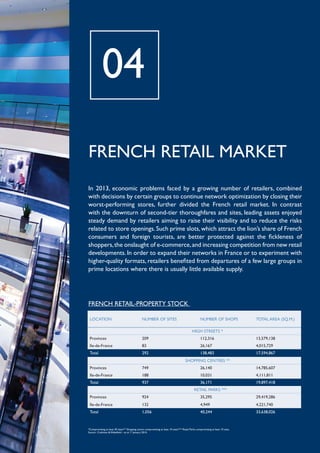
other French cities, regional shopping centers, key zones in the
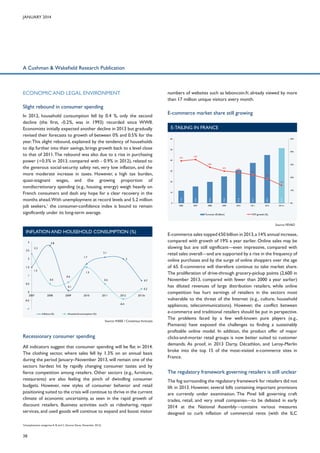
outskirts, and development projects with a large catchment area.
Prime markets are desirable precisely because of their capacity to
absorb available slots rapidly. These assignments constituted a large
part of the French retail market in 2013, presenting growth
opportunities for large international retailers (e.g., Desigual, Place
du Capitole in Toulouse, in the space formerly occupied by the
Castela bookshop) and new French brands (e.g.,The Kase in several
sites vacated by The Phone House). The assignments also created
opportunities for certain established French groups to test new,
more upmarket concepts designed to meet new trends in
consumption and to ward off competition from recent arrivals (e.g.,
La Halle in a number of former Virgin Megastores). Several recent
arrivals in France have continued to expand (e.g., Desigual, JD
Sports, Marks & Spencer) alongside new international retailers
created by famous brands (e.g., H&M, & Other Stories, Cheap
Monday). Several new players have begun their development in
France by encouraging large projects for new or expanded shopping
centers (e.g., Primark at Qwartz, in Villeneuve-la-Garenne;Terranova
at Rives d’Arcins, near Bordeaux; and David Mayer Naman at
Aéroville, in Roissy).
Nonetheless, the constant flow of newcomers does not hide the
difficulties faced by other relatively recent retailers (e.g., OVS,
Anthony Morato). Several have failed to establish their clientele, a
reminder that positioning is key for businesses entering new
markets. Yet the slowdown of certain retailers’ expansion and the
closing of stores is far from concerning only those retailers recently
arrived in France. Most retailers have a wait-and-see policy.
Whenever they decide to resume their development, they tend to
focus their efforts on the top sites while unloading their weakest
sales points. Unsurprisingly it is the secondary markets, and the
locations and equipment that lack attractive positioning, that have
been hurt by these arbitrages, a trend that confirms the growing
polarization of the French retail-property market.

time other single-brand shops were opening (e.g., Aesop, Rue des
Abesses, and Roger & Gallet, Rue Saint-Honoré).
Le Marais and Saint-Germain-des-Prés remain two of Paris’s most
lively neighborhoods, and continue to attract tourists and wealthy
Parisians. Omega has let a store on Rue de Sèvres, further
emphasizing the area’s move upmarket after the arrival of Berluti
and Shang Xia. Le Marais, one of the few neighborhoods in Paris to
offer store hours on Sundays, is still home to a large number of
ready-to-wear retailers, although the sectors of cosmetics (e.g.,
Caudalie) and restaurants (e.g., Pierre Hermé) are also very present.
Several high-end fashion retailers have recently opened (e.g., Michael
Kors, Karl Lagerfeld, Carven) near long-standing French retailers.
With the grand opening of higher-quality stores and concepts (e.g.,
Maje and Comptoirs des Cotonniers, Rue des Francs Bourgeois),
retailers’ domination of the neighborhood has been reinforced. In
addition to the rapid gentrification of the eastern part of Paris,
openings by famous brands, designers, and showrooms in submarkets
more or less near Le Marais also contributed to the shift in the
center of gravity of Paris retail (e.g., Helmut Lang in the Haut-Marais,
Sandro on the boulevard Beaumarchais, COS and Repetto on the
Rue de Charonne).
Other Paris thoroughfares, such as the Rue de Rivoli, are undeniably
back in demand. After the announcement in 2012 of the arrival of
Forever 21, the Rue de Rivoli saw new leases for large stores such
as Mango and Intersport (replacing Esprit and Adidas respectively).
The prime retail slots on the Champs-élysées remain highly soughtafter.Tag Heuer’s leasing of no. 104 is just the latest of the numerous
grand openings of flagships in recent years (e.g., Marks & Spencer,
Zara,Tiffany & Co.). However, with available space declining, openings
will automatically be fewer, except for a few transactions likely to
provide momentum to the lower part of the avenue and contribute
to its upscale trend.

Trends in Demand for High Streets
Major thoroughfares continued to be sought after in 2013 because
of rising international tourism (annual growth of 5.2% in number of
foreign tourists in Paris during the period January–October 20136),
ongoing large projects for urban development, and the hosting of
major events (Marseille, European Capital of Culture). For many
retailers in a wide variety of sectors, prime retail slots remain a
priority target. In addition to luxury goods and ready-to-wear, the
cosmetics sector contributed a large number of openings. For
example, Kiko pursued its systematic coverage of Paris and other
French cities (e.g., Rue Sainte-Catherine in Bordeaux) at the same
6

Boutique Valentino - 92 rue du Faubourg Saint-Honoré - Paris 8th

Paris Tourism Research Department, Paris Tourism Office, November 2013.

41
January 2014

A Cushman & Wakefield Research Publication

Luxury thoroughfares still receive steady demand. New leases (e.g.,
Valentino, Tory Burch, Viktor & Rolf, Peuterey) have reaffirmed the
success of the Rue Saint-Honoré.The numerous grand openings on
the Avenue Montaigne and the Rue du Faubourg Saint-Honoré
were, for the most part, projects that had been launched in 2012
(e.g., Qela, Berluti, Pucci,Yves Saint-Laurent), transfers (e.g., Moncler,
Fendi), and refurbishments of existing stores (e.g., Loewe,Valentino).
Several major openings on the Côte d’Azur—where spending by
Ukrainian tourists last summer was up by as much as 46% year on
year—consolidated the status of the Croisette in Cannes (e.g.,
Ermanno Scervino, Chaumet) and highlighted LVMH Group’s
ambitions in Saint-Tropez (e.g., Fred, Bulgari).
In other parts of France, the chief shopping thoroughfares of large
conurbations continued to benefit from the arrival of newcomers
and from the expansion of international retailers (e.g., Hema, Rue

Sainte-Catherine in Bordeaux, UGG Australia, Rue Edouard Herriot
in Lyon). Changes in the retail market of the young-spirited and
vibrant city of Toulouse, whose city center is now partially closed
to traffic, are representative of the appeal of regional capitals. In
2013 Toulouse was the theater of significant transactions by
retailers for large spaces vacated by major French retailers (e.g.,
Primark in the building formerly occupied by Galeries Lafayette,
Orange taking over from Natures & Découvertes on Rue AlsaceLorraine, Desigual in the space formerly occupied by Castela, Place
du Capitole).
Demand by retailers for major thoroughfares will not slow in 2014.
As a result, secondary thoroughfares and the city centers of small
and medium-sized towns will continue to suffer from arbitrages
carried out by retailers and from occasional transfers for larger or
less expensive space on the outskirts.

Significant high-street transactions in 2013
Retailer

Location

Address

Area (sq. m.)

La Halle

Paris 2

5 Boulevard Montmartre

2,500

Massimo Dutti

Paris 2

18-20 Rue de la Paix

1,690

Uniqlo

Paris 4

39 Rue des Francs Bourgeois

1,560

Mango

Paris 1

146 Rue de Rivoli

1,274

Viktor & Rolf

Paris 1

370 Rue Saint-Honoré

590

Valentino

Paris 8

92 Rue du Faubourg Saint-Honoré

500

All Saints

Paris 4

23 Rue des Rosiers

300

Maje

Paris 8

31-311 Avenue des Champs-élysées

150

Tag Heuer

Paris 8

104 Avenue des Champs-élysées

125

Primark

Toulouse

77 Rue Alsace-Lorraine

11,000

Hema

Bordeaux

73 Rue Sainte-Catherine

400

Zadig & Voltaire

Lille

13 Rue des Chats-Bossus

370

Desigual

Toulouse

20 Place du Capitole

320

JD Sports

Marseille

29 Rue Saint-Ferréol

240

UGG Australia

Lyon

38 rue Edouard Herriot

200

Valentino

Saint-Tropez

10 Rue François Sibilli

130

PARIS

provinceS

42
retail

A Cushman & Wakefield Research Publication

Trends in Demand for Shopping Centers
The stubborn problems surrounding the French shopping-center
market are reflected by changes in the CNCC visitor-numbers indices.
The operating environment remains unfavorable because of the
downturn in consumer spending, the boom in e-commerce, and
difficulties for franchised outlets. In addition to the numerous ongoing
operations for creations of new sites and expansions of established
ones, intense competition from innovative newcomers has slowed
retailers’ earnings and growth. While this global view may explain the
sluggish launches of new shopping centers and the extension of leasing
periods for certain development projects, it does not necessarily apply
to every project. For example, the Beaugrenelle development and
Avant-Cap extension were recently opened with success.

Luxury goods are expected to remain an engine for growth
in the French market for several reasons: France’s
attractiveness to an increasingly diverse tourist base,
dedicated hotel and retail projects (Peninsula, Samaritaine),
and the expected arrival of new retailers. Nevertheless,
openings of luxury stores will probably diminish in 2014.
After nearly 130 transactions (openings and reopenings)
recorded in France since 2011, supply has dried up for slots
on the principal thoroughfares. The next openings will be
chiefly for refurbished or expanded existing sales points, a
carryover from trends observed in 2013. Grand openings
will be reserved for the few newcomers, for the development
of brands recently acquired by large groups and for the
expansion of well-known retailers in the areas adjacent to
the most established thoroughfares.

2,00%

-2,00%

November

October

August

July

May

April

June

-1,00%

March

0,00%

September

1,00%

February

Uncertainties surrounding the global economy and
anticorruption measures enacted in China partly explain the
disappointing earnings of major luxury-goods groups. The
saturation of certain markets and the changing profile of
shoppers have led some retailers to slacken their openings, a
slower rhythm that suggests a less favorable outlook for a
sector whose sales should nevertheless grow by 2% in 2013
(est. Bain & Company). The luxury market has nonetheless
remained buoyant in France. Sales are expected to rise by 4%
in 2013, thanks mainly to spending by foreign tourists, who
are the source of 60% of all luxury sales in France. The role
of traditional tourists (e.g., Americans, Middle Easterners)
remains as vital as ever, although the importance of more
recent consumers (e.g., Chinese, Brazilian, and Thai
consumers) is growing.

Trends in shopping-center visitor numbers (annual
change in %)

January

Luxury goods: growth
engine for 2014?

2 013

-3,00%
-4,00%
-5,00%
-6,00%
-7,00%

Source: CNCC

Additionally, numerous openings have confirmed that new, qualityfocused concepts that are adapted to consumer demand remain
significant growth drivers for the market. In the health-and-beauty
sector, new single-brand stores have appeared (e.g., Bourjois in the
Passage du Havre in Paris, and Guerlain in Beaugrenelle) in addition to
a few remodeling jobs (e.g., Parashop). The upmarket trend of shopping
centers can also be seen in the arrival of relatively sophisticated food
concepts (e.g., L’éclair de Génie in Passy Plaza) and in the numerous
openings or development projects by fashion retailers usually found in
high streets (e.g., Michael Kors in Les Quatre Temps, and Sandro and Ted
Baker in Les Terrasses du Port).
This upmarket trend highlights the stark contrasts found in the French
market, which currently favors prime retail sites of existing regional
shopping centers and the creation of new sites or the expansion of
established ones.Well-known centers are perfectly positioned to create
excitement around their products, and have harnessed most of the
demand of newcomers (e.g., Primark in O’Parinor in Île-de-France, La
Toison d’Or and Grand Littoral in the provinces) and of international

43
January 2014

A Cushman & Wakefield Research Publication

retailers recently arrived in France (e.g., JD Sports in Créteil Soleil
and Les Terrasses du Port). Solid results by smaller centers also
demonstrated that the “big boys” were not the only centers to
outperform. The development of numerous expansion projects by
the property arms of large hypermarket groups reaffirmed the
attractiveness of neighborhood shopping centers and malls.

retail parks give retailers the opportunity to grow at minimal
expense. Retailers long established in shopping centers are now
able to enter the retail-park market as opportunities arise (e.g.,
H&M in Creil, Camaïeu in Green 7 in Salaise-sur-Sanne). Yet it was
established French retailers long present in peripheral zones that
accounted for most of the demand. Their “all under one roof”
stores reflect the synergies generated by certain groups (e.g.,
Beaumanoir multi-brand stores). Other retailers (e.g., La Halle)
have opened new, higher-quality concept stores. International
newcomers were relatively rare, except for a few Belgian and
Dutch retailers testing markets in the east and north of France
(e.g., Tom & Co, Action).

Lego - Carré Jaude 2 - Clermont-Ferrand (63)

However, the problems of secondary sites revealed the extent of
retailers’ loss of interest in shopping centers that are badly located
or designed, whether midsized shopping centers or city-center sites
in small and medium-sized conurbations. Such locations, with
neither the capacity to attract prestigious retailers nor the means
to stage exciting events that satisfy consumers’ desire for novelty,
are the most exposed to an erosion of visitor numbers. In addition,
secondary sites also fall victim to restructuring arbitrages made by
retail groups, to financial problems experienced by franchised
outlets, and to the competitive threat posed by the internet to longstanding leading retailers.

Trends in Demand for Retail Parks
In 2013, the French retail-park market continued to enjoy demand
from large retailers in diverse business sectors. Several retailers in
toys and children’s wear (e.g., Orchestra-Prémaman at Heron Parc
in Villeneuve d’Ascq), sporting goods, leisure goods, and fashion
have contributed to the flow of openings. A few discount retailers
have also continued to grow, such as Babou, Centrakor, Noz, and
Gifi, whose total number of stores has doubled over the past
decade. Retailers located in peripheral zones, with a product offer
adapted to the budget constraints of today’s consumer, appear to
be well prepared to confront the crisis.The low occupancy costs of

44

Magasin Orchestra Prémaman - Heron Parc - Villeneuve d’Ascq (59)

The best-established parks in the major conurbations logically
remain the most sought after, because they allow retailers to
reduce risks related to openings. However, these desirable locations
do not hide the fact that the French market overall is in trouble.
Numerous retailers have delayed or stopped their expansion plans.
Such decisions hurt the sustainability of many development projects
whose lettings are currently under way. In addition, several retailers
have transferred their outlets to new retail parks or to larger
peripheral zones. These transfers sometimes allow independent
retailers and discount chains to grow at low cost, but they also
lower the overall quality of certain secondary zones.
retail

A Cushman & Wakefield Research Publication

TRENDS IN SUPPLY
General trends
After Surcouf’s closing in 2012, the year 2013 was notable for the closing
or difficulties of other major retailers on the French retail market (e.g.,
Virgin Megastore, Chapitre bookshops, Marithé et François Girbaud).
Certain liquidations brought an abundance of high-quality supply to the
market. This newly available supply, in addition to that created by closings
of other retailers, alleviated the scarcity of opportunities for the most
attractive sites. Despite a satisfactory absorption rate, several of these
sites are still unoccupied and may enliven the French retail market in 2014.
Furthermore, the list of retailers in trouble could get even longer.

A long-term rising trend in
retail vacancy rates?
The retail vacancy rate, estimated by PROCOS at 7.1% for
French city centers in 2012 (6.3% in 2011), has reached 8.6%
in the centers of cities of 50,000 to 100,000 inhabitants
(6.3% in 2011) and even exceeds 10% in several city centers
(e.g., Alençon, Nevers, Roubaix, Niort). Although major cities
enjoy vacancy rates of close to zero on the most prestigious
thoroughfares, overall they feel the effects of a decline in
retail activity. Because of retailers’ relocating to larger zones,
vacancy rates have also risen in several retail parks. While
small malls and the largest shopping centers have held up
relatively well, midsized centers have experienced a rise in
vacancy rates over the past ten years: from 3.7% to 4.2% for
centers with 40–80 retail units, and from 3.8% to 5.5% for
those with 80–120 units, according to PROCOS.
The growing dichotomy between prime and secondary
thoroughfares, as well as among the various center formats,
will probably become more pronounced in the years to
come. Because of the rise of e-commerce, which by 2030
may account for nearly one-quarter of total consumer
spending, some analysts forecast the disappearance of a
considerable portion of retail-property stock (1.7 million
sq. m., according to Booz & Company). While it is difficult to
predict its extent, this change will certainly result in the
transformation of a large amount of retail and service space
(banks, travel agencies, telephone stores).

7
Procos, La vacance commerciale, un phénomène qui s’accroît [Retail vacancy rates: a rising phenomenon], June 2013.
8
Booz & Company, Perspective 2020 : quelle place pour la distribution traditionnelle dans un monde digital ? [Outlook
2020: Does traditional retail still have a place in a digital world?], October 2013.

However, the closing of stores by retail groups and independents
contributed above all to the increase in available space in secondary
markets, raising in certain cases the risk of derelict retail spaces.This trend
is all the more worrisome, because of the steady pace of store openings.
In contrast with household consumption—stagnant since the crisis
began—880,000 sq. m. of retail space was opened in 2013, compared with
920,000 sq. m. in 2012 and 750,000 sq. m. in 2011. The development of
new retail schemes, sustained by the growing tendency of property
owners to expand their sites in order to rejuvenate them or to capitalize
on their reputation, has further diluted retailers’ revenues.The proliferation
of development projects also hinders lettings and has sometimes led to
projects’ being postponed or even canceled.

Trends in supply on high streets
As a result of vacancies by retailers under financial difficulty or restructuring
their store network, exceptional opportunities have arisen on some of
Paris’s most desirable streets (e.g., 52-60 Champs-élysées and sites vacated
on Rue de Rivoli by Etam, Adidas, and Esprit) and in regional capitals (e.g.,
the former Virgin Megastore and Lafayette Maison on the Rue AlsaceLorraine in Toulouse). Nevertheless, prime retail sites on major
thoroughfares remain rare and expensive, a reality that encourages retailers
to focus on improving existing supply in order to innovate and gain market
share. In Paris, the shortage of supply in some neighborhoods, combined
with the rise in international tourism and the growing popularity of certain
trendy areas, has led to retailers’ increasingly turning to alternative districts.
For example, the Rue de Marignan is now home to certain luxury retailers,
while more accessible designers and luxury shops can be found in the
Haut-Marais.
In the longer term, a few large-scale development projects should stir up
the established submarkets in Paris and in large conurbations in the rest of
France. In Paris, the largest projects are the refurbishments of the
Samaritaine and the Poste du Louvre, on the right bank, and the
redevelopment of the Marché Saint-Germain on the left bank. Elsewhere in
France, a few cities will remain in the spotlight, such as Bordeaux
(Promenade Sainte-Catherine) and Marseille. Riding the wave of the
success of the event “Marseille, European Capital of Culture 2013,”

45
January 2014

A Cushman & Wakefield Research Publication

Marseille will see continued work on the Rue de la République. At the
same time, several large shopping centers (e.g., Les Terrasses du Port,
Le Prado, Centre Bourse) will be developed or refurbished. In addition,
the renewal of supply will depend largely on the emergence of new
retail hubs in the major sectors under development in Paris (ZAC
Clichy-Batignolles and Paris Centre Est) and the inner suburbs (e.g.,
Rives de Seine in Boulogne-Billancourt). Available space will also be
boosted by the creation of new neighborhoods near the centers of
certain regional cities (e.g., Les Maourines in Toulouse).

Trends in Supply of Shopping Centers
In 2013, 356,172 sq. m. of new shopping centers was opened, a solid
rise of 37% year on year, attributable mainly to the grand opening of a
few large-scale projects. Four centers of more than 20,000 sq. m.
accounted for half of the volume, including three in Île-de-France: Ilo
in Epinay-sur-Seine, Beaugrenelle in Paris, and Aéroville in Roissy.
Following on the heels of other large projects recently completed in
the Paris region (Le Millénaire in 2011, So Ouest in 2012), Beaugrenelle
and Aéroville are especially representative of the trend towards very
large centers and of the high quality of the available space and
architecture.The opening in 2014 of Qwartz in Villeneuve-la-Garenne
and Les Terrasses du Port in Marseille will confirm this trend.

52-60 avenue des Champs-élysées – Paris 8th
Le Grand Village – Fenouillet (31)

High-Street Pipeline Between 2014 and 2017
city

PROJECT

AREA (SQ.M.)

Paris

Passage du Nord

32,500

Marseille

Rue de la République

30,000

Paris

La Samaritaine

26,000

Orléans

La Rue des Halles

11,300

Toulouse

Les Maourines

11,000

Marseille

Les Voûtes de la Major

7,500

46

The construction of large projects involves consolidation of the mostestablished retail sites. After Les Sentiers de Claye in the Paris region
and Atlantis near Nantes, both completed in 2012, several developers
have continued to benefit from expansion and redevelopment
projects, capitalizing on the reputation of large centers in order to
renew their supply.These projects have attracted brands that are new
to local markets (e.g., Lego at Carré Jaude 2 in Clermont-Ferrand,
Hollister and Crocs at Alma in Rennes) as well as more trendy food
and fashion outlets (e.g., Adidas Originals at Rives d’Arcins near
Bordeaux).This upmarket transformation can also be found in smaller
shopping centers. Several refurbishment and expansion programs
illustrate the measures taken by the property arms of large
hypermarket groups to update their centers and malls to today’s
tastes, to attract new and exciting retailers (e.g., Desigual and Kiko in
the expanded Leclerc center in Pau), and to meet the needs of local
consumers. Some of these sites have even been held up as models for
sustainable urban development (e.g., Les Eléis, opened in Cherbourg
in 2013).
retail

A Cushman & Wakefield Research Publication

Key shopping-center openings
key openings in 2013
LOCATION

SHOPPING CENTER

TYPE OF DEVELOPMENT

AREA SQM

Tremblay-en-France (93)

Aéroville

Creation

84,640

Paris (75015)

Beaugrenelle

Extension-Redevelopment

45,000

Épinay-sur-Seine (93)

L’Ilo

Redevelopment

36,700

Caen (14)

Les Rives de l’Orne

Creation

28,700

Dijon (21)

La Toison d’Or

Extension

14,100

key openings announced for 2014
LOCATION

SHOPPING CENTER

TYPE OF DEVELOPMENT

AREA SQM

Villeneuve-la-Garenne (92)

Qwartz

Creation

63,000

Marseille (13)

Les Terrasses du Port

Creation

61,000

Paris (75019)

La Vill’Up

Creation

24,000

Paris (75001)

Forum des Halles

Extension

15,100

Le Chesnay (78)

Parly 2

Extension

14,300

french shopping-center openings and pipeline (sq. m.)
500 000
450 000
400 000
350 000
300 000
250 000
200 000
150 000
100 000
50 000
0
2 012
creation

2 013
extension

redéveloppement
redevelopment

2014f
transfert-extension

Le Prado - Marseille (13)

47
January 2014

A Cushman & Wakefield Research Publication

Trends in Supply of Retail Parks
The volume of retail parks opened in 2013 (455,119 sq. m.) was
slightly less (-18%) than that in 2012, when several large-scale
projects were completed, including Les Quatre Chênes in PontaultCombault and especially Atoll, near Angers. Nevertheless several
large projects opened in 2013. Mondevillage (near Caen) and
Costières Sud (near Nîmes) are both representative of the rapid
growth of the new retail-park formats in the west and south of
France. Both recent and scheduled openings continue to highlight
the stark differences between new expansion projects for existing
parks in Île-de-France (Clos du Chêne in Montévrain in 2013, after
the Shopping Parc de Lieusaint in 2012) and the creation of new
centers in the dominant retail zones of large conurbations (Waves
Grand Sud near Metz in 2014).

French retail-park openings and pipeline (sq. m.)

600 000

500 000

400 000

300 000

200 000

Supply trends of retail parks fulfill the needs of regions with solid
demographic growth and of suburbs of major cities where everdenser populations may not have access to the same level of services
and products as those populations living “in town.” Although the
influx of new supply—in addition to further intensifying the effect of
retailers’ transfers—is sometimes harmful to existing high streets
and peripheral zones, it can also revive undeveloped and deteriorated
retail zones (Be Green near Troyes, Mondevillage near Caen). The
sensitively designed architecture of certain shopping centers, the
growing application of sustainable-development standards, the
greater allotment of space for food outlets and entertainment, and
the market’s overall rise in quality signal the arrival of a hybrid
model. Currently under development in Saint-Genis-Pouilly, the
Open shopping center is representative of this new approach.

100 000

0
2 012

2 013

2014f

L’Open - Saint-Genis-Pouilly (01)

48
retail

A Cushman & Wakefield Research Publication

Key retail-park openings
KEY OPENINGS IN 2013
LOCATION

RETAIL PARK

TYPE OF DEVELOPMENT

AREA SQM

Mondeville (14)

Mondevillage

Creation

42,000

Saint-Parres-aux-Tertres (10)

Be Green

Creation

35,000

Nîmes (30)

Costières Park

Creation

27,000

Boé (47)

O’Green

Creation

26,000

Montévrain (77)

Clos du Chêne

Extension

21,000

KEY OPENINGS ANNOUNCED FOR 2014
LOCATION

RETAIL PARK

TYPE OF DEVELOPMENT

AREA SQM

Brétigny-sur-Orge (91)

Les Promenades de Brétigny

Creation

45,000

Moulins-lès-Metz (57)

The Waves

Creation

38,500

Saint-Paul-lès-Romans (26)

Parc Saint-Paul

Extension

27,500

Montluçon (03)

PAC Saint-Jacques

Creation

18,000

Villennes-sur Seine (78)

White Parc

Creation

11,600

RENTAL VALUES
Prime rental values in Paris continued to rise because of strong
demand from international retailers seeking prime locations on
thoroughfares with little supply. This rise was observed in rapidly
developing neighborhoods (Le Marais, Saint-Germain-des-Près) and
the principal luxury markets. However, the trend was most
pronounced on the Champs-Elysées, which consolidated its status
as the third-most-expensive street in the world, after Causeway Bay
in Hong Kong and Fifth Avenue in New York. The price increases
seen in certain Parisian thoroughfares were in contrast to the flat
rental values of prime retail locations in the rest of France and in the
most established shopping centers and peripheral zones. Meanwhile
downward pressure was felt on rental values in secondary locations
Retailers’ determination to lower their occupancy costs encouraged
increasingly aggressive negotiation tactics. As a result, landlords
granted more incentives, such as reductions for refurbishment or
rent-free periods. Tenants also negotiated costs to compensate for
the steep tax hikes seen in certain municipalities. The French
authorities took into account the rising rent-to-sales ratios and the
effect of weakened business on the socioeconomic fabric of
numerous regions. The bill introduced by Sylvia Pinel, Minister of
Craft Trades, Industry, and Tourism, encompasses various measures
intended to curb the rise of commercial rents (required
benchmarking to the ILC Commercial Rent Index, rent increases
capped) and to improve relations between landlords and tenants
(more transparent breakdown of costs, break option after three
years).

Trends in shopping-center prime rental values
(€ / sq. m. / year)*
ÎLE-DE-FRANCE

2013

2012

Regional shopping
centers

2,000

2,000

Large shopping centers

950

950

Regional shopping
centers

1,400

1,400

Large shopping centers

700

700

Trend 2014

PROVINCES

*For very well-situated 150 m² of retail space (clothing or services) in existing centers that are leaders in
their catchment areas.

Trends in retail-park prime rental values
(€ / sq. m. / year)*
2013

2012

ÎLE-DE-FRANCE

180

180

PROVINCES

170

170

Trend 2014

*For 1,000 sq. m. and new space in top slots in strong catchment areas.

49
January 2014

A Cushman & Wakefield Research Publication

trends in high street prime rental values (Zone A, € / sq. m. / year)
2013

2012

Champs-élysées

18,000

15,000

Avenue Montaigne

10,000

8,000

Rue du Faubourg Saint-Honoré

10,000

8,000

Boulevard Haussmann/Grands Magasins

6,000

5,000

Boulevard Saint-Germain

6,000

5,500

Rue de Rivoli

4,500

4,000

Lyon / Rue de la République

2,200

2,200

Lille / Rue Neuve/Béthune

2,200

2,200

Marseille / Rue Saint-Ferréol

2,000

2,000

Bordeaux / Rue Sainte-Catherine

2,200

2,200

Nice / Rue Jean Médecin

2,200

2,200

Toulouse / Avenue Alsace-Lorraine

2,200

2,200

Cannes / Croisette

6,500

6,500

Strasbourg / Place Kléber

2,000

2,000

Trend 2014

PARIS

PROVINCE

OUTLOOK FOR THE FRENCH RETAIL MARKET
Anemic growth, unwaveringly high unemployment, and economic problems faced by a growing number of retailers will impede the French
retail market in 2014. The next few months will be especially challenging for secondary markets, where vacancy rates will continue to rise
because of retailer defections and arbitrages. However, the most significant openings will occur in prime retail locations on high streets and in
the biggest shopping centers, largely immune to the financial crisis. As a result of their attractiveness and high visitor numbers, these sites will
remain sought after, both by new players developing in France and by long-standing retailers testing concepts designed to fulfill the latest trends
in consumption and to confront constantly changing competitive forces.

50
Les marchés
immobilierS
français

études & Recherche Cushman & Wakefield
January 2014

A Cushman & Wakefield Research Publication

Glossary
INVESTMENT
Asset manager

Professional responsible for creating an investment fund. He/she defines the fund strategy and structure,
raises funds from investors, and oversees the fund throughout its life.

Family office

Private structure for high-net-worth families whose assets require sophisticated management. The
principal function of a family office is to optimize, organize, protect, and increase the family’s assets,
whatever they may be. The family’s own wealth, often accumulated over several generations, constitutes
the financial capital of the structure.

Institutional investors

Professional that collects long-term savings from individual investors to invest on their behalf. This
category includes sundry institutions: mutual funds, insurance companies, pension funds, banks, propertyinvestment firms, other retirement funds, etc.

Investment fund

Investment vehicles, often collective (multiple ownership), that comprise financial or real-estate assets;
managed by regulated and certified structures (investment companies).

Investment volume

Volume of all transactions recorded by Cushman & Wakefield concerning standard commercialproperty transactions (offices, shopping centers, high-street shops, retail parks, logistics warehouses,
and manufacturing premises) of more than €1 million (including sales to occupiers) over a given period.

Net initial yield

Percentage rate expressing the ratio at a time “t” between a building’s income (net of unrecoverable
costs) and its purchase price (sale price plus fees and transfer duties).

Open-ended fund

Fund with no limit on the number of shares it may issue.

OPCI
(French real-estate
investment trust)

Mutual savings scheme designed for retail or institutional investments in property assets. OPCI portfolios
must include investments in property assets (at least 60%) and in cash or cash equivalents (at least
10%). Like SIICs (listed real-estate investment companies), OPCIs are tax exempt, provided they pay out
dividends. Because they are not listed, OPCIs are not subject to market fluctuations.

Opportunistic fund

Fund that targets maximum profitability, using one or more of the following: high added value, significant
risk exposure, and high leverage.

Pension fund

Fund specialized in raising capital from individual savers and investing it in financial markets, in order to
provide those investors with retirement income through funded pension plans. Such funds are often risk
averse.

Prime/core asset

Asset of excellent quality, exceptionally located, and under a firm, long-term lease with one or more
rental commitments.

Property company

Commercial company whose purpose is the establishment, management, and operation of a property
portfolio, in order to maximize profitability.

SCPI
(Real-estate investment
trust)

An investment trust whose exclusive purpose is to own and manage a portfolio of rental properties.
At least 90% of an SCPI portfolio must consist of property assets. An SCPI’s purpose is to sell shares in
acquired buildings to shareholders. SCPIs are not traded on a stock exchange, are financed by savings
from the public, and are exempt from corporate tax. Individual shareholders must pay tax on any income
received from the trust.

Speculative development Building whose construction has begun without prior sale or lease to an occupier.
VEFA
(Vente en l’Etat Futur
d’Achèvement)

52

Forward sale, or the sale of a property asset before it has been completed. In a forward sale, the vendor
transfers immediately to the purchaser all property rights and ownership of the buildings as they are
completed.
glossary

A Cushman & Wakefield Research Publication

OFFICES
Available supply

Total amount of space available to let in existing buildings within six months.

Average rent

Average rental values (headline rents stated in transactions), all areas included, of refurbished and secondhand properties.

ICC
(Construction Cost Index)

Quarterly business-cycle indicator showing the cost trends of new residential buildings. It also figures
in regulations concerning commercial leases and is the benchmark for the review of commercial rents.

ILAT
(rent index for tertiary
activities)

Rent index for tertiary activities composed of three indexes calculated quarterly by INSEE: the consumerprice index (IPC), the construction-cost index (ICC), and the index for gross domestic product (PIB).These
periodic means are combined in the following proportions: IPC 50%, PIB 25%, and ICC 25%.

Prime rent

Average of top five lettings transactions (more than 1,000 sq. m.) in terms of headline rents.

Take-up

Total number of square meters let, pre-let, or sold to occupiers.

Vacancy rate

Ratio of volume of available supply for the next six months to total office inventory.

LOGISTICS WAREHOUSES
ICPE
(classified installations for
environmental protection)

Premises operated or owned by any individual person or legal entity, public or private, that may present
dangers or risks. Depending on the nature of the risks, the premises may be: unclassified; classified and
subject to declaration at the prefecture; classified and subject to authorization by the prefecture; classified
and subject to registration at the prefecture.

In-house logistician

In the industrial and retail sectors, firm that provides logistics services for its own goods.

Logistics provider

Specialized firm that provides complete logistics services to companies seeking to outsource their logistics
requirements.

Supply chain

Comprises the optimization of the entire production cycle, from suppliers and raw materials to final
customers.

Take-up

Total number of square meters let, pre-let, or sold to occupiers.

RETAIL
CDAC / CNAC

Created by the Economic Modernization Act (LME, enacted in 2008) as replacements for CDECs and
CNECs, these département and national retail-development commissions oversee the openings of retail
spaces of 1,000 sq. m. or more, in accordance with criteria for urban planning and sustainable development.

Flagship

A retailer’s finest, largest, or most important store, used primarily to promote the brand. Flagship stores,
which concern all business sectors and may be any size, are always located in the most desirable and
prestigious shopping districts.

ILC
(Index of retail rents)

Weighted-average index comprising indices representing trends in consumer prices, construction costs, and
retail sales. The ILC may be used as a benchmark for the review of commercial leases.

53
A Cushman & Wakefield Research Publication

Contacts

Olivier Gérard
President

Philippe Guillerm
Head of Valuation

Thierry Juteau
Head of Capital Markets Group

Guy Grundy
Head of Corporate Services

Christian Dubois
Head of Retail Agency

Jean-Paul Deheeger
Head of Industrial Agency

Ludovic Delaisse
Head of Office Agency and Development

Thomas Hébert
Head of Consultancy

Stéphane Bureau
Head of Property and Asset Management

David Bourla
Head of Research

For further information, please contact:
David Bourla
Head of Research France
+33 (0)1 53 76 91 91
david.bourla@eur.cushwake.com

C&W is the world’s largest privately-held commercial real estate services firm. Founded in 1917, it has 250 offices in
60 countries and more than 16,000 employees. The firm represents a diverse customer base ranging from small
businesses to Fortune 500 companies. It offers a complete range of services within five primary disciplines: Transaction
Services, including tenant and landlord representation in office, industrial and retail real estate; Capital Markets, including
property sales, investment management, investment banking, debt and equity financing; Client Solutions, including
integrated real estate strategies for large corporations and property owners, Consulting Services, including business
and real estate consulting; and Valuation & Advisory, including appraisals, highest and best use analysis, dispute resolution
and litigation support, along with specialized expertise in various industry sectors. A recognized leader in global real
estate research, the firm publishes a broad array of proprietary reports available on its online Knowledge Center at:
www.cushmanwakefield.fr
This report has been prepared solely for information purposes. It does not purport to be a complete description of the
markets or developments contained in this material. The information on which this report is based has been obtained from
sources we believe to be reliable, but we have not independently verified such information and we do not guarantee that
the information is accurate or complete. Published by Corporate Communications.
©2014 Cushman & Wakefield, Inc. All rights reserved.

Cushman & Wakefield France
11-13 avenue de Friedland
75008 Paris

54

Follow us on:
www.cushmanwakefield.fr

French Property Market 2014

  • 1.
    French property Market 2014 A Cushman& Wakefield Research Publication
  • 2.
    January 2014 A Cushman& Wakefield Research Publication Contents EDITORIAL 3 eCONOMy 5 FRENCH PROPERTY INVESTMENT market 7 Investment Volume 8 Investment Volume by Location 8 Key Investors 9 Offices 11 Retail 13 Industrial 15 Yields 17 Outlook 17 ILE-DE-FRANCE OFFICE MARKET 19 Occupier Demand 20 Rental Values 24 Available and Future Supply 25 Outlook 27 FRENCH LOGISTICS-WAREHOUSES MARKET 31 Economic Trends 32 Occupier Demand 32 Rental Values 34 Available and Future supply 34 Outlook 35 FRENCH RETAIL MARKET 37 Economic and Legal Environment 38 The New Role of Stores 39 Retailer Demand 41 Trends in Supply 45 Rental Values 49 Outlook 50 Glossary 52 CONTACTS 2 54
  • 3.
    editorial A Cushman &Wakefield Research Publication eDITORIAL In addition to regular episodes of French bashing in the international media, recent changes on the political and economic scenes have reinforced fears among the French, a people not known for their optimism. Forecasters expect at best a timid recovery in 2014, far from the solid activity seen on the other sides of the Channel and Atlantic, and equally remote from the robustness of the German model. Yet while skepticism persists, most economic indicators for France are moving in the right direction. The belief that the worst is behind us could begin to dispel the cloud of uncertainty that has long darkened the French commercial-property market. Furthermore, the gap between the relatively stable investment market and the more chaotic rental market is likely to narrow. As the French property market recovers, Cushman & Wakefield France will further expand its services in order to provide customized advice to all players in the commercial-property market, to address their concerns, and to help them adapt to rapidly changing market conditions. Our dynamic and experienced teams, which moved from strength to strength in 2013 – the sales of 8 place Vendôme, a portion of the Altarea portfolio, the Passy Plaza shopping center in Paris, and Boursorama’s new offices in Boulogne, as well as the opening of the first Primark stores in France and the Valentino boutiques in Paris and Saint-Tropez – will provide the same outstanding service in 2014. The gulf is nonetheless too wide to encourage any clear-cut improvement in the short term. In 2013, good news was mixed with bad: a 1% rise in investment in France and the lowest take-up in the Paris region since 2003. We may reasonably expect a moderate rise in lettings of office and warehouse properties in 2014, but economic, fiscal, and regulatory instability will continue to inspire caution among tenants. Many occupiers now prefer lease renegotiation to moving, while others choose to relocate but do so with very conservative standards. Their targets are usually conveniently located, high-quality sites that meet both cost-cutting and modernization criteria. The deep divisions within the French market are not expected to disappear; hence the increasing urgency of questions concerning the future of the most obsolete sites, and the technical and economic feasibility of adapting to new standards. On a positive note, investment in France should be considerably higher than in 2013, in line with the growth of more than 10% forecast for investments worldwide in 2014. Several large and very large transactions are already under way, confirming the significant amount of money to be invested and the enthusiasm of long-term institutional investors (e.g., insurance companies, sovereign wealth funds, and new international players) for core assets. Greater concessions made by vendors and renewed interest from opportunistic investors will favor even less-secure assets and enhance the French market’s appeal to a wide variety of investors. Olivier Gérard President 3
  • 5.
    eCONOMy A Cushman &Wakefield Research Publication eConomy A falling unemployment rate in the United States, buoyant private consumption in the United Kingdom, and gradual business recovery in the euro zone confirm that the economies of developed countries have improved since the end of 2012. After rising 1.2% in 2013, GDP in OECD member countries should grow even faster in 2014 (2.3%) and 2015 (2.7%), a global forecast that does not necessarily apply to every region. While growth in the euro zone is expected to rise slightly in 2014, and the countries hardest hit by the economic crisis (i.e., Spain, Greece, Italy) will likely pull out of recession, the story of the next few months will mainly be about the confirmation of Germany’s robust health. Strong exports and domestic demand have led the Bundesbank to raise its growth outlook for 2014 to 1.7%, after the slowdown in Q3 2013. Yet recovery is both uneven and very fragile. The vulnerability of banking systems and the magnitude of public debt continue to darken the economic horizon of developed countries. This is particularly true in Europe, where austerity policies weigh on household consumption. According to the latest European Commission forecasts, household consumption in EU countries will increase by only 0.9% in 2014, compared with 1.8% per year between 2003 and 2008 and 2.5% per year between 1998 and 2003. Significant improvement in the job market is unlikely. The unemployment rate, estimated at 11.1% in 2013 for the 28 member states, is not expected to fall significantly by the end of 2015 (10.7% est.). While the structural problems of Europe and developed countries such as Japan may remain the center of attention, they are no longer the major source of uncertainty for the global economy. Business activity slowed in 2013 in numerous emerging economies: Exports and manufacturing output rebounded in 2013, helping French business activity that was also supported by the upturn in other parts of Europe. Household consumption was aided by the generous social-security safety net, a very low inflation rate, and a more moderate rise in taxes. In addition, GDP growth in France— flat in 2012—may edge above 0% in 2013 and reach nearly 1% in 2014. French economic difficulties are far from over, however, as may be seen in the growing number of redundancy and restructuring plans by major multinational groups (Alcatel-Lucent, PSA, Michelin, etc.). As a result, business activity remains well below its long-term average. Corporate bankruptcies and unemployment stand at record highs nationwide, although Île-de-France has shown a certain resilience as measured by these two economic indicators. Combined with stagnant salaries, a deteriorating job market will continue to undermine the budget and morale of the French as hope for a clear recovery in consumer spending in the months ahead grows more distant. Companies will also continue to struggle under a heavy, unpredictable tax burden. Capital expenditure will therefore likely remain low in 2014. French economic activity Economic outlook (in %) Indicator (%) Russia’s oil and gas reserves no longer suffice for growth, severe inflation has hurt India, and China’s economic model is still too dependent on exports. These challenges explain the downward revision of global growth forecasts for the next two years. According to the WTO, world trade growth is expected to increase at a much slower rate than previously forecast, with growth of 4.5% expected in 2014, better than the growth of 2.5% in 2013 but still under the average of the past 20 years (5.4%). EURO ZONE USA JAPAN -0.4 1.7 1.8 GDP growth – 2014** 1.0 2.9 1.5 Unemployment rate – 2013* 12.0 7.5 4.0 Unemployment rate – 2014** 12.1 6.9 3.9 General government financial balance – 2013* -2.9 - 6.5 -10.0 GDP growth – 2013* General government financial balance – 2014** -2.5 -5.8 5,0 5,0 5,0 2,5 2,5 2,5 0,0 0,0 0,0 -2,5 -2,5 -2,5 -5,0 -5,0 2002 2002 -8.5 *Estimated **Forecast - Source: OECD (the general government financial balance is calculated as a percent of nominal GDP) 5,0 2,5 0,0 -2,5 2004 2004 2006 2006 2008 2008 GDP growth (annual %) Croissance du PIB (annuelle %) 2010 2010 2012 2012 -5,0 -5,0 2014 f 2014 P Inflation (annual %,) Inflation (annuellle %) Source: INSEE 5
  • 7.
    01 FRENCH PROPERTY INVESTMENT Market Investmentin France amounted to €15.1 billion in 2013, 1% more than the previous year’s total and just 3% less than the ten-year average. The retail and industrial sectors have remained active, despite the underlying economic and fiscal uncertainties and an office sector impacted by a weak occupational market. The French market attracted a growing number of investors, drawn by a wide offer of investment profile opportunities created by disposals from tenants that aimed to rebalance their portfolios or that were forced to sell.With adjustment of pricing on non-core assets, transactions for less secure investments also played a significant role. This allowed a few opportunistic invertors to be more active, alongside longterm institutional investors targeting France’s most iconic assets. ” HISTORIC INVESTMENT ACTIVITY IN France (€ BN) 30 25 20 15 10 12.2 17.5 24.4 28.5 13.0 7.8 11.0 16.5 14.9 15.1 0 9.8 5 2003 2004 2005 2006 2007 2008 2009 2010 2011 2012 2013 2003-2012 average (€15.6bn)
  • 8.
    January 2014 A Cushman& Wakefield Research Publication INVESTMENT VOLUME INVESTMENT VOLUME BY LOCATION The overall performance of the French market in 2013 was similar to that of 2012. The total number of transactions continued to decline (393, compared with 421 in 2012 and 451 in 2011), although overall volume was supported by a substantial element of large transactions.There were 36 transactions of more than €100 million, for a total of €7.3 billion (i.e. 48% of total investment in France in 2013). A more detailed breakdown by transaction-volume slice, however, shows that the market is in the process or readjusting to a more conventional profile. Transactions of €100-200 million were relatively stable year on year (€3.9 billion), while transactions of more than €200 million declined by 17% (i.e., -€700 million).This fall was compensated for by activity in the €50-100 million segment, which saw 52 transactions in 2013 for a total of €3.7 billion (compared with 39 transactions for a total of €2.7 billion in 2012). Paris / Île-de-France Because of the decline in large-volume transactions, portfolios played a less decisive role in 2013 than in the previous year. At €3 billion, portfolios represented only 20% of total amounts invested in France, compared with €4.1 billion (27%) in 2012. However, large portfolios still played a role across the various asset classes: office properties (Docks Lyonnais portfolio sold to ADIA), retail properties (Vivarte portfolio acquired by La Française AM), and industrial properties (Logicad portfolio sold by Icade to Apollo). Some of these transactions were carried out as joint ventures, the preferred structure of certain large investors aiming to increase their exposure to the property sector while benefiting from the knowledge and experience of major pure players. NBIM (with Prologis in the logistics sector) and Allianz (with Altarea in the shopping-center sector) partnered with specialists that were offering stakes in their portfolios. These two investors used JVs as investment vehicles in 2011 and 2012: NBIM acquired from Allianz half of a Parisian portfolio comprising mainly office properties, and Allianz acquired from Hammerson 75% of the Espace Saint-Quentin. 100% 100% 80% 60% 26% 64% 64% 60% 28% 28% 67% 67% 51% 20% 20% 0% 0% 9% €15-50m 20% 21% 24% 26% 80% 49% 51% 26% 26% 49% 23% 23% 23% 23% 24% 24% 10% 10% 9% 9% 2013 2013 France France 2013 €1-15m 8% 2012 2012 France France Office Office 2012 2013 2012 2013 2012 Provinces Provinces Provinces Provinces Retail Retail Industrial Industrial % in volume 18% €50-100m 24% % in volume, all products 8 INVESTMENT VOlUMES BY ASSET TYPE AND LOCATION 40% 28% €100200m 25% Of this €11.1 billion, 78% was invested in office assets, a stable percentage in comparison with the previous year. While Paris’s most desirable office buildings remain highly sought after, there has been a renewed interest in office buildings with higher risk profiles, both in Paris intra muros and in certain office poles in the inner suburbs. At €1.9 billion (€1.7 in 2012), investments in retail properties in the Paris region were also relatively stable year on year (17% of total investment in Île-de-France in 2013, compared with 15% in 2012). Activity in the retail sector was underpinned by large transactions for iconic mixed-use buildings (65–67 ChampsÉlysées), large shopping centers (Passy Plaza), and large portfolios containing assets located in Île-de-France (Altaprime, Vivarte, and Metro portfolios). Industrial properties accounted for €580 million in 2013, 23% more than in 2012. 40% DEAL ANALYSIS in france >€200m 23% Investment in Île-de-France amounted to €11.1 billion, accounting for 74% of total investment in France in 2013 and for 27 of the 36 transactions larger than €100 million nationwide. The Paris region remains the driving force of business in France. With one of the largest stocks of real estate in the world, Paris is headquarters for numerous French and international groups.
  • 9.
    INVESTMENT A Cushman &Wakefield Research Publication Provinces An overall investment of nearly €4 billion in the provinces accounted for 26% of total investment in France in 2013, a stable performance year on year but 18% higher than the ten-year average (€3.4 billion). The proportion of investments in retail properties (€2 billion in 2013) rose to 51% in 2013 from 49% in 2012, while investments in the office sector declined slightly, from 28% of total investment in 2012 to 26% in 2013. Retail properties continued to drive the market in the provinces, notably through the sales of malls and large shopping centers (Immochan portfolio sold to CNP, disposal of 50% of Odysseum shopping center in Montpellier, acquisition by Eurocommercial Properties of a shopping center in Val Thoiry, etc.). However, this general trend does not conceal the significant differences among regions. With €990 million invested, the RhôneAlpes region is by far the largest market outside Île-de-France. Large transactions for new and recent office supply (City One in Lyon, Silky in Vénissieux) and sales of vast retail and industrial sites (Val Thoiry, Parc du Moulin in Vent) have moved the Rhône-Alpes region ahead of Provence-Alpes-Côte d’Azur (€290 million invested, of which 65% for logistics assets) and Nord-Pas-de-Calais to be refurbished or presenting tenant risk (CACIB headquarters in Courbevoie acquired by Blackstone, River Plaza in Asnières-surSeine sold to KKR). UK investors were more diverse in their asset targets: logistics, with the new Maisons du Monde platform near Marseille; offices, with part of the Ponant building in the 15th district; retail, with the Metro portfolio; and even the core segment. German investors, still the largest foreign investors in France, accounted for only 8% of total investment in 2013 (9% in 2012). Usually represented by large insurance companies and open-ended funds, German investors were particularly selective, targeting office space and mixed-use buildings in Paris business districts (118 Champs-Élysées acquired by Pramerica). German investors also showed continued interest in the Lyon market and its highestquality office assets (Anthémis, City One). However, it was the acquisition by Allianz of 49% of the Altaprime (Altarea) shoppingcenter portfolio, the third-largest transaction of the year in France, that characterized German investment activity in 2013. The important role played by Germany in the French market is due as much to sales as to acquisitions. Funds such as Aberdeen and Kanam continued their disposals, which supplied other investors with relatively secure products. (€270 million). PURCHASER NATIONALITY in france KEY INVESTORS Middle East 6% Nationalities French investors were increasingly active in the largest transactions and provided 65% of total investment in 2013 (57% in 2012). They accounted for 20 deals of more than €100 million, including some of the year’s biggest transactions (e.g., Primonial’s acquisition of the Tour Adria in La Défense for €450 million, and Predica’s acquisition of éco-Campus in Châtillon for €380 million). Foreign investors funded 35% of investment in France in 2013, compared with 43% in 2012. While partly attributable to the lessening of interest shown by investors from the Middle East (€860 million in 2013, compared with €2.1 billion in 2012), this decline is due mainly to the sharp fall in investments from Qatar. While in 2012 Qatari investors completed four transactions of more than €100 million (42, 52-60, and 116 bis Champs-Elysées; Neo-Retiro portfolio), for a total of €1.4 billion, they carried out only one in 2013 (La Factory in Boulogne). Americans and Canadians were slightly more active in France in 2013. Because of renewed activity by opportunistic funds, the share of North American investors rose from 6% in 2012 to 8% in 2013. Aided by improving market conditions, North American investors targeted secondary assets and locations: class B logistics platforms (Logicad portfolio sold to Apollo), and inner-suburbs office space Asia 4% North America 8% Europe 17% France 65% % in volume, all products Investor profiles Market conditions favored cash-rich buyers with considerable firepower for portfolio diversification. French and foreign pension funds and insurance companies also contributed nearly one-fourth of total investment in 2013 (€3.6 billion).They were the catalysts for 11 transactions of more than €100 million, mainly for large office complexes (Eco-Campus acquired by Predica) but also for large retail portfolios (CNP’s purchase from Immochan of seven malls). 9
  • 10.
    January 2014 A Cushman& Wakefield Research Publication With investments of €1.8 billion, SCPIs contributed 12% of total investment in France in 2013, reaffirming their interest in the French market through office and retail transactions of usually less than €50 million. SCPIs’ 15% share of total investment in 2012 declined because of the significant rise in investment by OPCIs (from 6% in 2012 to 15% in 2013), as exemplified by Primonial’s acquisition of several office assets in Paris and the inner suburbs (Tour Adria in La Défense, Spark in Paris 13th, etc.). Property companies contributed 11% of total investment in France in 2013. Some focused on mixed-use buildings in Paris CBD (acquisition of 50 Haussmann by Terreïs and of 52 rue Marbeuf by Gecina), while others purchased assets for repositioning such as the Mirabeau tower (Gecina) and the Val Thoiry shopping center (Eurocommercial Properties), whose expansion and refurbishment have been scheduled. Yet it was on the sell side that property companies were most active, whether forced to sell their assets, taking profit from mature assets, or rebalancing their portfolios by giving added weight to large, regional shopping centers and high-street retail. The disposals carried out by property companies provided a flow of long-term and large-scale assets that are essential for insurance companies (sale of Passy Plaza to Generali by Eurocommercial Properties) and for German funds (purchase of 118 Champs-Élysées by Pramerica from Risanamento, sale of the Issy Trois Moulins shopping center to Union Investment by Corio). Sovereign wealth funds (SWFs) were less active in 2013, contributing 8% of total investment, compared with 20% in 2012—a decline of €1.8 billion. This performance is not due to a loss of appetite by SWFs for French property, but rather to the lack of available products that meet their investment criteria. Some SWFs added to and diversified their positions on the French market. The Norwegian NBIM, for example, invested in the industrial sector through a JV with Prologis. Asian newcomers also reaffirmed their desire to acquire Paris’s most prestigious assets (acquisition by SOFAZ of 8 Place Vendôme). SWFs may continue to be active in the coming months because of opportunities created by the sale of large prime Parisian assets (e.g., the Risanamento portfolio and the Beaugrenelle shopping center), and because of increasing interest shown by other nationalities (e.g., Chinese, Malaysian, Korean). Focus on SCPIs’ The enthusiasm of individual investors for real-estate investment in France did not flag in 2013, and the SCPI (French REIT) remained one of the most popular investment products in France. However, net inflows were down slightly, and the amounts invested by SCPIs in in real-estate also declined in 2013 on an annual basis. In H1 2013, capitalization of the 81 SCPIs specialized in corporate real estate amounted to €25.09 billion (€23.95 billion in H1 2012), with net inflow of €1.09 billion (11% less than in H1 2012). This trend fails to describe the marked differences among the various types of SCPI. Fund inflow to traditional SCPIs fell by 10.3% in H1 2013 year on year, while inflows to regional SCPIs rose by 55.1%. Retail-property SCPIs also experienced sharply lower inflows (-31%). This trend is indicative of the distribution of amounts invested in 2013 in the French commercial-property market, with 67% invested in offices. The most active asset managers include La Française AM, Amundi, Primonial REIM, BNP Paribas, and NAMI-AEW Europe. Sources: ASPIM, IEIF. 8 Vendôme – Paris 1st 10
  • 11.
    INVESTMENT A Cushman &Wakefield Research Publication Geographic distribution PURCHASER TYPE in france Private 5% Owner occupier 5% SWFs 8% Insurance companies/ mutual funds 24% Property companies 11% Investment funds 20% SCPIs 12% OPCIs 15% % in volume, all products One of the most significant changes in 2013 was the reaffirmation of interest from opportunistic investors, especially Anglo-Saxons looking for assets with higher returns. These investors, already active in the French market at the end of the 1990s, are making a concerted reappearance and contributed 5% of the total investment in France in 2013. They also reinvigorated certain areas that had received little interest in recent years, such as offices in the inner suburbs (e.g., CACIB headquarters in Courbevoie bought by Blackstone and River Plaza in Asnières acquired by KKR) and class B industrial properties (Quartz portfolio purchased by Blackstone). Of the €9.7 billion invested in the office sector in France in 2013, €8.6 billion was invested in Paris and Île-de-France, similar to the amount invested in 2012 (€8.8 billion). Investment in inner-Paris office properties (€3.3 billion) declined by 39% year on year and now accounts for only 34% of total investment in French office properties, compared with 53% in 2012 (€5.3 billion). Despite insufficient supply, the high cost of prime assets, and the sharp decline in transactions, Paris remains a preferred destination for many investors from a wide range of countries and backgrounds. In the central business district—where €2.3 billion was invested in 2013, compared with €2.9 in 2012—the most attractive mixed-used and office buildings continue to attract interest from large insurance companies (Crédit Mutuel Assurances, with 42 Friedland) and SWFs (Sofaz, with 8 Place Vendôme). Outside the CBD, only €1 billion was invested, 59% less than in 2012. Few transactions were made in Paris Centre Est (theVivarte headquarters were sold to Foncière de Paris in the 19th, Atria was sold to Unofi in the 10th) or in Paris Rive Gauche. Both markets offered far less supply than in 2012. The largest deals were seen in the 15th district, which has the most office stock in Paris outside the CBD. Total volume was increased by sales from the sector’s largest tenants (90 boulevard Pasteur, sold by Crédit Agricole, and part of the Ponant building, sold by BPCE) and by acquisitions of large refurbished complexes recently let (Tour Mercure, sold to Aviva). Activity was also boosted by investors focused on adding value to certain assets (Tour Mirabeau, sold to Gecina). OFFICES Amounts invested Total investment in the office sector in France amounted to €9.7 billion in 2013, close to the volume recorded in 2012 but 15% less than the ten-year average (€11.4 billion). The only asset class not to have grown year on year, offices accounted for only 64% of investment in 2013, compared with 67% in 2012 and a ten-year average of 74%. Impacted by the poor performance of the rental market and by the significant rise in vacancy rates in certain sectors, the office market was further penalized by strategies of investors aiming to rebalance their portfolios by overweighting retail properties. The office market also suffered from the lack of availability of prime products in the most sought-after districts. 29 avenue de l’Opéra– Paris 1st 11
  • 12.
    January 2014 A Cushman& Wakefield Research Publication The slowdown in Paris was partially compensated for by recovery in the inner suburbs, where the rebound was especially strong in the Hauts-de-Seine. Volume rose by 77% year on year, thanks to the success of several key tertiary sectors. La Défense turned in its best performance (just under €1 billion invested in 2013) since the beginning of the economic crisis, with two large transactions of more than €200 million each: the acquisition by Primonial Reim of the Tour Adria for €450 million and the acquisition for €228 million of the Tour Pacific by Tishman Speyer for a Canadian investor. The southwestern suburbs and the western business district (WBD) were also active. Investment volumes benefitted from a few very large transactions (acquisition by Hines, for Korean investors, of Sequana in Issy-les-Moulineaux for €315 million), from the acquisition of second-tier buildings with secure long-term leases (Alpha in Boulogne, Verdi in Issy-les-Moulineaux, Andriscos in Neuilly-sur-Seine), and from several large sales of new office space to occupiers (Qatar Sports Investment in La Factory and Boursorama in You, in Boulogne; the Conseil général des Hauts-deSeine in Arena 92). market opening to the benefit of the inner suburbs, several transactions were completed for new or recent less secure buildings (Perspective Défense in Colombes). Investors were less drawn to provincial French markets, except for the Rhône-Alpes region, where annual investment (€720 million) rose by 30% and accounted for 69% of total office investment outside Île-de-France. Driven by the steady demand from French and German investors for new and recent office stock and by the momentum of its lettings market (more than 200,000 sq. m. let in 2013), the Lyon region accounted for 11 of the 16 transactions larger than €20 million outside Paris and Île-de-France in 2013 (Silky in Villeurbanne, Anthémis in Lyon). OFFICE INVESTMENT ACTIVITY IN France (€ BN) 9.7 2003 0 10.0 20% 12.3 4 6.7 40% 5.3 8 10.3 60% 19.5 12 18.2 80% 14.0 16 10.2 100% 8.0 20 2004 2005 2006 2007 2008 2009 2010 2011 2012 2013 Office investments (€bn) 0% % of sums invested in offices in France Deals larger than €100 million also stimulated less established markets in the Hauts-de-Seine and other départements of the inner suburbs. Investment volume grew year on year in the northern and southern suburbs, where there is high-quality new and recent stock. While Predica’s purchase of the new Orange campus in Châtillon accounted for 42% of total investment in the southern suburbs, activity was more balanced in the northern suburbs. The cost-efficient northern suburbs were the site of eight deals larger than €50 million in 2013 (none in 2012), including the acquisition by BNP Paribas Cardif of Jade in Saint-Denis and the acquisition of Porte du Parc in Saint-Ouen by Primonial Reim. This area has now had several years of successful leases. With the office 12 50 boulevard Haussman - Paris 9th
  • 13.
    INVESTMENT A Cushman &Wakefield Research Publication EXAMPLES OF OFFICE ACQUISITIONS IN 2013 PROPERTY LOCATION VENDOR PURCHASER Portfolio île-de-France Les Docks Lyonnais ADIA Adria tower La Défense (92) Testa éco-Campus Châtillon (92) Sequana tower PRICE (€ M) AREA (SQ. M.) 580 (est.) 111,000 Primonial Reim 450 54,000 Nexity, Interconstruction Predica 380 72 000 Issy-les-Moulineaux (92) Les Docks Lyonnais Hines (Koreans) 315 42,000 33 Lafayette Paris (75009) Ivanhoe Cambridge Deka 277 28,800 Pacific tower La Défense (92) Ivanhoe Cambridge Tishman Speyer 228 52,900 Technopole Meudon-La-Forêt (92) Commerz Real SMABTP 215 54,300 Nuovo Clichy (92) Nexity BNP Cardif / Sogecap 190 35,000 CACIB hq Courbevoie (92) Crédit Agricole SA Blackstone 188 44,000 Mirabeau tower Paris (75015) Aberdeen Gecina 186 30,300 Jade Saint-Denis (92) Kanam BNP Cardif / Sogecap 170 38,500 Spark Paris (75013) Emerige, AOG Primonial Reim 162 21,700 42 Friedland Paris (75008) Ivanhoe Cambridge Crédit Mutuel Assurances 162 10,500 50-52 boulevard Haussmann Paris (75009) Generali Terreis 138 14,900 Okabé Le Kremlin-Bicêtre (94) Altarea-Cogedim Primonial Reim 121 23,400 River Plaza Asnières-sur-Seine (92) Aberdeen KKR 89 26,700 Anthemis Lyon (69) DeAWM Realis 85 20,000 RETAIL Amounts invested Investment in French retail assets in 2013 amounted to €4 billion, 11% more than in 2012, which had been an outstanding year. The highest since 2007, this amount represents 26% of total investment in France, compared with an annual average of 17% during 2003-2012. The relatively high number of transactions of more than €100 million was due to an influx of quality supply to the French retail market, which attracted foreign funds and large French institutions. Twelve deals of more than €100 million accounted for 51% of total investment in French retail assets in 2013. Several single-asset transactions were completed, but it was portfolio disposals and sale-and-leaseback transactions that accounted for 40% of total investment in retail assets in 2013. The market was also driven by numerous transactions of less than €50 million carried out both in the city center and in the suburbs by SCPIs (BNP Paribas Reim, Amundi, Primonial Reim, etc.). Nonetheless, the solid performance of retail markets did not mask a two-tier phenomenon in the French market. Investors continue to compete for large regional shopping centers, prime retail locations on the most famous thoroughfares, and assets with significant potential for repositioning. On the other hand, obsolete assets and secondary sites have been impacted by the downturn in household consumption and by drawn-out and tougher leasenegotiation tactics by retailers. The rapid development of e-commerce and competition from large, modern shopping complexes also widen the gap in the French market. Asset types Investment in high streets amounted to €1.6 billion (i.e., 39% of total investment in retail assets), a decline of 13% year on year attributable to fewer large transactions. Two transactions larger than €300 million and totaling €825 million were recorded in 2012 (e.g., 52-60 Champs-Élysées, acquired by Qatar for more than €500 million), while the largest deal of 2013 was the acquisition for €260 million of 65-67 Champs-Élysées, a mixed-use building that 13
  • 14.
    January 2014 A Cushman& Wakefield Research Publication RETAIL INVESTMENT ACTIVITY IN France (€ BN) 100% 4.8 5 80% 60% 40% 1.2 0.8 1 20% 1.2 1.9 1.9 2.3 2 3.6 3 3.3 3.6 4.0 4 0% 0 2003 2004 2005 2006 Retail investments (€bn) 2007 2008 2009 2010 2011 2012 2013 % of sums invested in retail in France houses the Nike and Tommy Hilfiger flagships. In order to enhance their image or begin development in France, the largest international groups focused on the main thoroughfares of Paris and other major French cities, where the bulk of high-street market activity occurred. In Paris, several large transactions reaffirmed the allure of the Champs-Élysées (65-67, 118, the Levis and Tissot flagships at 76-78) and of luxury boutiques (Dsquared² and Ports 1961 in the Mandarin Oriental, Tiffany & Co. and Harry Winston at 6 rue de la Paix, and Dior and Mikimoto at 8 place Vendôme). Elsewhere in France, 2013 was noteworthy for the acquisition by Vastned of a portfolio of six stores (Louis Vuitton, Nespresso, etc.) located on the Cours de l’Intendance and the Rue de la Porte Dijeaux, two of Bordeaux’s busiest thoroughfares. Malls and shopping centers accounted for 37% of total investment in retail properties in 2013 (€1.5 billion), 15% more than in 2012. This solid performance was due mainly to the sale of relatively modern regional shopping centers that were recently refurbished (or whose refurbishment is under way), such as Odysseum in Montpellier, Val Thoiry in Thoiry, and Espace Gramont in Toulouse. Investors are especially interested in these products because of their high long-term yields, low vacancy rates, and, for some assets, high potential for revaluation. Disposals of smaller but highperforming complexes in Paris (Passy Plaza, Bercy Village, Gare de l’Est shopping center) also contributed to activity. In addition, neighborhood shopping is another market segment that has held up during the economic crisis, as confirmed by several acquisitions of shopping malls and by the sale of two portfolios by Immochan and Mercialys to CNP and Amundi. Total investment in retail warehousing in 2013 rose sharply, by 91% year on year, to €980 million. However, these volumes were inflated by large sale-and-leaseback transactions. For example, Vivarte sold 89 outlets to La Française AM for €185 million, and Metro Cash & 14 Carry sold 43 outlets to Hermes Reim for €178 million. Because of investor discretion and the limited number of high-quality assets on the market, transactions for other asset types in the outer suburbs were relatively rare. Investors showed a natural preference for existing supply located in the center of large retail zones and benefiting from the presence of well-known retailers (Parisis Park at La Patte d’Oie in Herblay). Passy Plaza – Paris 16th
  • 15.
    INVESTMENT A Cushman &Wakefield Research Publication EXAMPLES OF RETAIL ACQUISITIONS IN 2013 TYPE PROPERTY LOCATION VENDOR PURCHASER PRICE (€M) AREA (SQ. M.) Shopping centre Altaprime portfolio (49%) France Altarea-Cogedim Allianz 395 155,800 High street retail 65-67 Champs-élysées* Paris (75008) Shaftesbury AM Thor Equities 260 10,200 Sale and leaseback Vivaldi portfolio France Vivarte La Francaise AM 185 53,700 High street retail Opéra Capucines* Paris (75002) Ofi Reim Generali 178 10,600 Sale and leaseback Metro Cash & Carry portfolio (75%) France Metro Properties Hermes REIM 178 - Gallery/Retail park Sanba portfolio Provinces Immochan CNP 160 48,000 Shopping centre Passy Plaza Paris (75016) Eurocommercial Properties Generali 141 8,100 High street retail 8 place Vendôme* Paris (75001) Axa Real Rstate SOFAZ 135 5,400 High street retail 118 Champs-élysées* Paris (75008) Risanamento Pramerica 135 3,800 Shopping centre Val Thoiry Thoiry (01) Vastned Eurocommercial Properties 105 23,400 High street retail 76-78 Champs-élysées Paris (75008) Archon AG Real Estate 83 3,100 High street retail 43 boulevard des Capucines* Paris (75002) Crédit Foncier Invesco 74 4,900 High street retail 2 flagships at Mandarin Oriental hotel Paris (75001) Société Foncière Lyonnaise Mandarin Oriental Hotel Group 73 1,300 Factory outlet Marques Avenue Romans-surIsère (26) CBRE Global Investors AEW Europe (Nami) 51 17,000 High street retail SPIIC portfolio Bordeaux (33) Private Vastned 47 3,250 Retail park Parisis Park Franconville (95) Henderson Global Investors Cordea Savills 40 8,900 * mixed-use asset INDUSTRIAL Amounts invested 80% 3.2 3 2.6 60% 2.1 2 1 1.5 1.3 1.5 40% 2009 2010 0.8 0.7 20% 0.6 Investment in logistics was boosted in 2013, as in 2012, by portfolio disposals.The joint venture between Prologis and NBIM and Icade’s sale of its Logicad portfolio to Apollo accounted for 37% of logistics investments in 2013. In addition, sales of individual assets were more numerous in 2013 than in 2012, with 12 transactions larger 100% 4 0.8 The logistics market comprises the bulk (77%) of the industrial market, because of steady demand for new platforms developed for large in-house logisticians and logistics providers, and of more recent interest shown for class B assets. Logistics thus represents a growing source of diversification for large foreign institutional investors (NBIM, AG Real Estate), and an attractive investment for pure players (Argan, Goodman) and certain opportunistic funds (Blackstone, Apollo). INDUSTRIAL INVESTMENT ACTIVITY IN France (€ BN) 0.9 Investment in industrial assets in France in 2013 amounted to €1.5 billion, or 10% of total investment in France. This annual rise of 15% continued a positive trend that began in 2009 (€606 million). 0% 0 2003 2004 2005 2006 2007 Industrial investments (€bn) 2008 2011 2012 2013 % of sums invested in industrial in France 15
  • 16.
    January 2014 A Cushman& Wakefield Research Publication Île-de-France and the rest of France is sometimes substantial. The Paris region represented only 30% of total logistics investment in 2013, while the provinces accounted for 70%, mainly because of disposals of large portfolios and market activity in Lyon, Lille, and Marseille. than €20 million in 2013, compared with nine the previous year. This increase reflects the success of large turnkey projects, whose rapid growth meets the cost-cutting and modernization requirements of in-house logisticians in the retail-distribution sector. The acquisitions of two platforms larger than 100,000 sq. m. in Saint-Martin-de-Crau, one leased to Maisons du Monde and sold to Tristan Capital Partners and the other developed for Castorama and sold to AG Real Estate, were two of the most significant transactions in 2013. AG Real Estate also acquired a 60,000 sq. m. site built for Darty in Pusignan, near Lyon. These transactions illustrate the premium paid by investors for the four principal markets on the north-south axis (Lille, Paris, Lyon, and Marseille), which remain the most desirable locations for occupiers because of their proximity to large consumer populations, major roads, and transport infrastructure. The difference in performance between Light industrial premises accounted for a more modest number of large transactions, although a portfolio larger than €100 million was sold on the French market in 2013, raising to 23% the proportion of this asset class’s contribution to total industrial investment. A few sale-and-leaseback transactions also drove the market. The largest was the sale for €60 million by Bouygues Telecom to Digital Realty of three data centers located in Île-deFrance. EXAMPLES OF INDUSTRIAL ACQUISITIONS IN 2013 TYPE PROPERTY LOCATION VENDOR PURCHASER PRICE (€M) AREA (SQ. M.) Logistics Joint-venture France Prologis NBIM 272 544,000 Logistics Logicad portfolio Provinces Icade Apollo 145 370,000 Light industrial Spring portfolio France Axa Reim Northwood Investors 123 266,000 Logistics Castorama turnkey scheme Saint-Martin de Crau (13) PRD AG Real Estate 62 110,500 Light industrial 3-property data center portfolio* Île-de-France Bouygues Telecom Digital Realty Trust 60 8,000 Logistics Maisons du Monde turnkey scheme Saint-Martin de Crau (13) Groupe Carnivor Tristan Capital Partners 56 114,500 Logistics Amazon turnkey scheme Lauwin-Planque (59) Goodman Princeton/Chambers Street 52 88,000 Logistics Quartz portfolio Île-de-France Morgan Stanley Blackstone 37 75,300 Logistics Platform Le Coudray-Montceaux (91) Panhard Developpement Argan 37 52,400 Logistics Darty turnkey scheme Pusignan (69) Vailog France AG Real Estate 34 59,200 * Sale and leaseback 16
  • 17.
    Investment A Cushman &Wakefield Research Publication YIELDS Prime yields were relatively stable in 2013. Because of the inherent competition among investors for mixed-use buildings, yields remained low to very low for the most iconic assets.Yields of a few emerging sectors in the inner suburbs also experienced downward pressure. The northern suburbs, for example, had little supply of opportunities and were in high demand by occupiers. However, because of the possibility of higher long-term yields and investors’ desire to maintain a consistent risk premium, prime yields should be stable in the months ahead. Yields for the highest-quality office assets in the Paris CBD came to 4.25%. Paris shops yielded around 3.75%, while high-end office properties in La Défense yielded 6%. Certain parts of the western suburbs, particularly Péri-Défense and Boucle de Seine, recorded a rise of 25 basis points year on year because of a deterioration of the lettings market. In Lyon, prime yields for office assets fell to less than 6%, and came to approximately 7.25% for prime logistics assets. PRIME YIELDS IN France % JANUARY 2013 JANUARY 2014 Paris (CBD) 4.50 4.25 Provinces (Lyon) 6.00 5.90 Shops 4.00 3.75 Shopping centres 5.00 5.00 Retail parks 6.25 6.00 Logistics 7.30 7.25 Light industrial 8.50 8.25 AVERAGE 5.94 5.77 OFFICES RETAIL INDUSTRIAL OUTLOOK FOR THE INVESTMENT MARKET The year 2013 confirmed the robustness of the French investment market for office property, a trend expected to continue in 2014. Although a lack of fiscal visibility and weakening lettings markets may slow business, the overall investment volume should be higher in 2014 than in 2013. Several large and very large transactions are near completion, a reflection of the ample available cash and strong appetite of long-term institutional investors (insurers, SWFs) for core assets. Even assets that are less secure will benefit from efforts made by sellers and interest shown by opportunistic investors, thereby confirming the French market’s capacity to attract a wide variety of investors. 4 place de l’Opéra – Paris 2nd 17
  • 19.
    02 îLE-DE-FRANCE OFFICE MARKET ” Although GDProse slightly in 2013, the large number of corporate bankruptcies and ongoing job destruction affirm that the French economy is far from recovering. The morose business climate has prompted many companies to renegotiate their leases instead of vacating, with a depressing effect on take-up in 2013 (down 17% from a year earlier). Transactions greater than 4,000 sq. m.—the usual market staple—were few and far between. This downturn further added to the net increase in available stock, already swollen from the steady production of new and redeveloped properties and from releases of office stock ill adapted to corporate requirements for cost-cutting and modernization. Take-up in Île-de-France (sq. m.) 3 000 000 3 000 000 2 500 000 2 500 000 2 000 000 2 000 000 1 500 000 1 500 000 4 000 4 000 2 791 622 2 791 622 2 656 443 2 656 443 2 049 452 2 049 452 1 937 638 1 937 638 1 742 328 1 742 328 2 114 2 114 2 317 2 317 3 306 3 306 2 893 2 893 2 357 403 2 357 403 2 784 2 784 1 752 665 1 752 665 2 314 2 314 3 000 3 000 2 098 351 2 098 351 2 091 864 2 091 864 2 498 2 498 3 500 3 500 2 321 082 2 321 082 1 743 102 2 500 1 743 102 2 500 2 590 2 590 2 271 2 271 2 264 2 264 2 033 2 033 1 500 1 500 1 000 000 1 000 000 51% 51% 500 000 500 000 2 000 2 000 46% 46% 44% 44% 43% 43% 2003 2003 2004 2004 2005 2005 42% 42% 11 000 000 49% 49% 45% 45% 51% 51% 45% 45% 50% 50% 2011 2012 2012 41% 41% 0 0 500 500 00 Take-up (sq. m.) Take-up (sq. m.) 2006 2006 2007 2007 2008 2008 2009 2009 Take-up > 4,000 sq. m. (share in %) Take-up > 4,000 sq. m. (share in %) 2010 Number of transactions transactions 2013 2013
  • 20.
    January 2014 A Cushman& Wakefield Research Publication THE îLE-DE-FRANCE OFFICE SUBMARKETS Southwestern Suburbs Southern Suburbs Roissyen-France Eastern Suburbs A1 Western Business District (WBD) Tremblay- Boucle de Seine Northern Suburbs A104 en France Gonesse A15 Paris Rive Gauche Paris CBD Aulnaysous-Bois A86 Paris Centre Est Gennevilliers Bezons La GarenneColombes A14 Le Bourget Drancy A1 St-Ouen Bobigny XVIII XVII XIX SaintCloud A12 Le PréSt-Gervais Les Lilas II e ein III I VII IV Vincennes StMandé Issy-les Moulineaux Sèvres A86 Meudon V XV Billancourt NeuillyPlaisance Montreuil XX XI VI Boulogne- Rosnysous-Bois A3 Bagnolet X VIII S La A86 Paris Suresnes XVI Aubervilliers Pantin LevalloisPerret La Défense Neuillysur-Seine Puteaux IX RueilMalmaison A3 A86 La Courneuve St-Denis Clichy Courbevoie Nanterre VilleneuvelaGarenne AsnièressurBoisColombes Seine Colombes Villepinte Le BlancMesnil La Défense Fontenaysous-Bois B XIV XIII rd Pér iphé riq Malakoff Montrouge ue Gentilly Le Kremlin Arcueil Bicêtre Châtillon Bagneux Cachan Noisy-leGrand Nogentsur-Marne XII Vanves ouleva Neuilly-surMarne Charentonle-Pont Champignysur-Marne Ivry-sur-Seine A4 Villejuif A6 A86 OCCUPIER DEMAND A total of 1,743,102 sq. m. of office space was let or sold to occupiers in 2013, a decline of 17% from the previous year (2,098,351 sq. m.) and 20% below the ten-year average (2,179,885 sq. m.). The continual fall in the number of transactions—2,033 in 2013, down from 2,271 in 2012 and 2,590 in A6 2011—does not fully explain the poor performance of the Île-deA10 France office market in 2013, which is attributable mainly to a dearth of large transactions.There were only 66 transactions larger than 4,000 sq. m. in 2013, compared with 90 on average every year during the period 2003–2012. The total amount of take-up also fell 20 significantly. With 717,592 sq. m. let in 2013, compared with 1,044,379 sq. m. in 2012 (-31%), large transactions accounted for only 41% of total take-up, compared with 50% the previous year. Large turnkey transactions, which boosted take-up in the period 2009–2012 (Crédit Agricole at Evergreen in Montrouge, Thalès in Gennevilliers, Carrefour in Massy, SFR in Saint-Denis, and Orange in Châtillon), were especially rare. However, the share of new and redeveloped buildings in total takeup of properties larger than 4,000 sq. m. rose to 73% (67% in 2012). Attributable to availabilities in new large office complexes on the market (SAP in So Ouest in Levallois-Perret, Orange in Eastview in
  • 21.
    offices A Cushman &Wakefield Research Publication Bagnolet, etc.), this increase also stresses the success of new urban property-development sectors, such as ZAC Paris Nord-Est in Paris (Rectorat de Paris in the Visalto), or Le Trapèze in BoulogneBillancourt (Boursorama in You, BBDO in Ardeko, PSG in La Factory). Some of these large development projects helped sustain the market for sales to occupiers, at a time when there was a sharp fall in the volume of office stock acquired by SMEs.The total surface area transacted in owner-occupier sales was therefore 12% below the ten-year average. Despite interest rates at historic lows and an economic environment that highlights the safe-haven value of property, SMEs continued to play a game of wait-and-see, partly because of constant financial duress and partly because of more difficult negotiations between buyers and sellers. Trends in take-up (> 4,000 sq. m.) according to reason for relocating Paris were less common. In order to transfer some of its Paris employees to Saint-Denis, SNCF moved operations to City One and Innovatis 2 in 2012, and to Le Monet in 2013. Transactions in 2013 in Île-de-France thereby confirmed the importance of real estate as a driver for organizational and managerial efficiency, aside from the sole consideration of the cost of each work station. Systematic analysis of team productivity, corporate image, and proximity to customers are now used to make the most of a relocation and to mitigate any hidden costs. Given the power of unions and employees’ higher expectations of their working environment, social factors are closely examined. This explains the importance given to the comfort of the workplace, the quality of the surrounding neighborhood, and convenience of public transport. Trends in take-up (> 4,000 sq. m.) according to rent 1% 1% 10% Consolidations 45% 11% Cost Cuttings 9% 150-249 €/sq.m. Extensions 43% Merger/Demerger 250-349 €/sq.m. 19% 33% Other 450-549 €/sq.m. 28% Nearly all transactions in 2013 confirmed the vital importance that occupiers place on cutting their property costs. Consolidation and cost-cutting operations— implemented by large groups concerned about maintaining their profitability—accounted for 88% of total take-up greater than 4,000 sq. m. in 2013, compared with 89% in 2012. Several companies reduced the number of sites occupied, trading them for large new or redeveloped properties (Orange in Bagnolet, General Council of the Hauts de Seine département in Nanterre, SAP at So Ouest in Levallois-Perret) or secondhand supply that allowed them to maintain a Paris address while optimizing costs (Keolis at 20–22 rue Le Peletier in Paris 9th). A few occupiers even consolidated operations in order to move closer to the center of the Paris conurbation (e.g., SCA Hygiene Products in Eurosquare 1 in Saint-Ouen). Companies moving further away from the center of 350-449 €/sq.m. >550 €/sq.m. In 2013, transactions in the €250–349 / sq. m. / year bracket accounted for most lettings larger than 4,000 sq. m. in Île-de-France (33%, compared with 38% in 2012). As in 2012, this high proportion testifies to the success of cost-efficient markets that offer good value for money and provide convenient accessibility. Occupiers preferred recent and refurbished buildings in certain municipalities of the Hauts-de-Seine département near La Défense (EDF in Le Carillon in Nanterre,Technip in Newside in La Garenne-Colombes). The importance of this price bracket also ensured success for the best offers of the northern suburbs, whether for new office space (SNCF in Le Monet and the Haute Autorité de Santé in Green Corner in Saint-Denis) or for high-quality refurbished office space (SCA Hygiene Products in Eurosquare 1 in Saint-Ouen). 21
  • 22.
    January 2014 A Cushman& Wakefield Research Publication reached €700 / sq. m. / year in 2013, a first since 2005. At the other extreme, transactions smaller than €249 / sq. m. / year were also fewer than in the previous year, a sign of flat rental activity in the most far-flung areas of the Paris conurbation. Occupiers have also lost interest in secondhand supply in less well-established areas of the inner suburbs. Trends in take-up according to geographic sector between 2012 and 2013 (%) 23 % 8% Comprising only 11% of total transactions larger than 4,000 sq. m. in 2013 (9% in 2012), the proportion of transactions larger than €550 / sq. m. / year remained insignificant. This modest share is less a reflection of occupiers’ loss of interest in more upscale assets than a consequence of a very small number of large deals completed at this price level (five in 2013, compared with 10 in 2012 and 12 in 2011) and a shortage of quality supply in the most desirable areas of Paris. Although lettings by Hermès of 10–12 rue d’Anjou in the 8th district and by CMS Bureau Francis Lefebvre of 2–8 rue Ancelle in Neuilly-sur-Seine helped reaffirm the value of the highest-quality assets in Paris and the WBD, no transactions larger than 4,000 sq. m. 22 -10 % Northern suburbs -13 % Paris Rive Gauche La Défense Other -8 % Eastern suburbs WBD -5 % Southern suburbs Paris CBD Paris Centre Est Southwestern suburbs Nevertheless, the most significant change in 2013 was the proportionate rise of transactions in the €350–449 / sq. m. / year bracket, which increased from 22% in 2012 to 28% in 2013. This growth was due to transactions by occupiers aiming to reduce their property costs while maintaining a central address: Paris government administrations required to remain in town (Rectorat de Paris in Le Visalto, ANR at 50 avenue Daumesnil) and, in the southwestern suburbs, companies aiming to expand within their original sector or adjacent sectors (Sagem in Arcs de Seine and Atlantis TV in the Alpha in Boulogne). Yet transactions in the €350–449 / sq. m. / year bracket increased mainly for lettings of large refurbished properties in La Défense (EDF with 21,481 sq. m. in the Tour Blanche, Fidal with 13,628 sq. m. in the Tour Prisma). Such lettings provide occupiers with an address in a major business district as well as highperformance buildings at a more moderate price.Transactions in the €450–549 / sq. m. / year bracket rose for the same reasons. Occupiers in major sectors in the western suburbs were able to modernize their properties while lowering costs (e.g., lettings of large new and redeveloped stock by SAP at So Ouest in LevalloisPerret and by Coca-Cola at Noda in Issy-les-Moulineaux). Boucle de Seine 5% Alegria – Neuilly-sur-Seine (92) -28 % -39 % -40 % -48 % Take-up in 2013 in inner Paris was 11% less than in 2012 and well under (-21%) the ten-year average.The total number of transactions larger than 4,000 sq. m. in Paris reached a low not seen since 2008, an indication of the challenges facing SMEs and the tendency of large occupiers to renegotiate their leases instead of vacating. Above all, this trend reveals the effects of the scarcity of available new and redeveloped supply. Occupiers in the most prestigious neighborhoods seized upon the few available redevelopment projects, thereby improving their comfort and reducing occupancy costs while retaining a desirable address (Hermès at 10−12 rue d’Anjou, DS Avocats in Six’In). Other companies wishing to remain in or move to Paris opted for quality secondhand stock (Keolis at 20−22 rue Le Peletier) or redeveloped office space in less central and less expensive neighborhoods within the CBD (DDB at 73−75 rue La Condamine). Several large development projects were also carried out in new areas (Paris Nord Est, ZAC ClichyBatignolles). The prime beneficiaries were large public institutions (e.g., Rectorat de Paris, Tribunal de Grande Instance), which were able to lower their real estate costs. Such operations buffered the decline in take-up in Paris and stood in contrast with the limited number of solutions offered by the traditional business districts.
  • 23.
    offices A Cushman &Wakefield Research Publication The southwestern suburbs were the only submarket of the inner suburbs to see a rise in take-up (+23%). Several transactions reaffirmed the success of new tertiary sectors (Le Trapèze in Boulogne-Billancourt, the Bords de Seine neighborhood in Issy-lesMoulineaux). Occupiers seized lettings opportunities in new property developments to modernize their offices (e.g., Coca-Cola in Noda, Boursorama in You, BBDO in Ardeko). The southwestern suburbs continued to command strong loyalty. They also proved attractive to Paris-based companies confronted with scarce supply of quality assets and eager to lower property costs without overly compromising their image. Other markets in the western suburbs were flat. La Défense had its worst year in a decade, with just 96,509 sq. m. let in 2013. Usually driven by lettings of large and very large properties, La Défense was hurt by the very small number of deals larger than 4,000 sq. m. (four, and only one greater than 20,000 sq. m.). La Défense was also penalized by the lack of lettings of new and redeveloped supply. Large tenants saved money by agreeing to measures granted by landlords to minimize the vacancy rates of their properties. Of total take-up in 2013, 82% was for refurbished buildings. Occupiers were thus able to modernize their buildings at relatively low cost (Fidal in the Tour Prisma, EDF in the Tour Blanche, Egencia in the Tour Egée). In contrast with trends observed at La Défense, the success of new stock helped to cushion the fall in demand in the WBD. Five leases were signed for new buildings larger than 10,000 sq. m., including CMS Bureau Francis Lefebvre 2−8 rue Ancelle in Neuilly, SAP in So Ouest, and CG 92 in Arena 92. Area Prima – Châtillon (92) In 2013, other sectors of the inner suburbs played a less active role than in recent years, despite an economic context that favored costcutting initiatives by occupiers. The downturn of cost-efficient markets should be put into perspective, and is no doubt related to the decline of certain business sectors and to fewer large and very large transactions. Despite a decline in the number of new large properties available—the result of successful lettings in 2011 and 2012—the northern suburbs continued to see large new leases in Saint-Denis (SNCF in Le Monet and the HAS in Green Corner), Saint-Ouen (SCA Hygiene Products in Eurosquare 1, SVP in Dock en Seine) and in other communes of the Seine-Saint-Denis département (DHL in Le Mermoz in Le Bourget). Trends in take-up (> 4,000 sq. m.) according to business sector 5% 13% Public sector 25% Banking-Insurance Communication Advisory 22% Manufacturing-Distribution 25% 6% 4% IT Services The public sector, banking and insurance, and manufacturing and distribution continued to dominate activity in 2013 and accounted for 72% of total take-up greater than 4,000 sq. m. in Île-de-France, compared with an average of 71% for the period 2003−2012.There were, however, large differences in performance among the sectors. The most significant change concerned the manufacturingdistribution sector, whose decline was triggered by a sharp fall in transactions of more than 4,000 sq. m. (16 in 2013, compared with 43 in 2012) and by the absence of large turnkey operations that had boosted volume in recent years (Thalès in Vélizy in 2012, Carrefour in Massy, and Thalès in Gennevilliers in 2010). Consequently the sector represented only 155,581 sq. m. let or sold to occupiers in 2013 (22% of total take-up), compared with 447,596 sq. m. in 2012 (43%)—a significant difference explained partly by the downturn in large transactions in Île-de-France in general and by the mixed results of several business sectors in the inner and outer suburbs. With 171,113 sq. m. let or sold in 2013, the proportion of bankinginsurance occupiers rose from 15% in 2012 to 25% year on year, a similar level to that of the public sector. However, the sector’s dominant position—its first since the beginning of the financial crisis—was the result mainly of the decline of the manufacturingdistribution sector. Therefore volume let by occupiers in banking and insurance remained largely under the ten-year average (245,118 sq. m.). Although the weakening economic climate continues to slow large French banks, it has encouraged some of them to accelerate cost-cutting measures. For example, at the same time that Crédit Agricole announced the closing of over 50 of its 23
  • 24.
    January 2014 A Cushman& Wakefield Research Publication agencies in Île-de-France by 2015, the bank expanded its campuses in Montrouge and Guyancourt. The construction of two new buildings (Eole and Alsace) will allow Crédit Agricole to accommodate a greater number of its employees in these buildings and to share numerous services and facilities. In contrast with the trend in the financial sector of relocating employees to the suburbs, insurance companies and private health insurers stood out by taking the opposite tack and moving back into Paris (acquisition by the Fonds de Garantie of a stake in the Trio Daumesnil project). RENTAL VALUES Trends in prime rental values according to geographic sector (€ / sq. m. / year) 900 €/m² 2012 823 800 €/m² 2013 753 679 680 700 €/m² 600 €/m² 514 500 €/m² 498 488 417 464 463 417 429 400 €/m² 357 315 310 300 €/m² 310 277 292 294 257 200 €/m² 100 €/m² 0 €/m² Le Garance – Paris 20th Just as the banking-insurance sector had done, the public sector benefited from the decline of the manufacturing-distribution sector to raise its share in total take-up of properties larger than 4,000 sq. m. each (25% in 2013, compared with 16% in 2012), despite the total surface area let being similar to that of 2012. Seven transactions for properties greater than 4,000 sq. m. each were recorded in Paris, including the Banque Publique d’Investissement at 6−8 Haussmann, which together mitigated the decline of take-up in Paris. The few transactions outside Paris were mostly in SaintDenis, where the SNCF further lowered its property costs by letting Monet (after letting Innovatis 2 and City One in 2012), and where HAS let 12,400 sq. m. in Green Corner. In addition, the Conseil Général des Hauts-de-Seine acquired 31,000 sq. m. in Nanterre as part of the Arena 92 project, whose purpose is to regroup employees currently working at several sites in Nanterre. The project is expected to be completed by 2016. Municipal elections in 2014 will probably lower the number of new transactions from the local governments. On the other hand, several development projects may accelerate the French State’s cost-cutting policy, thereby helping to realize its objectives for lower public spending. Paris CBD Paris Rive Gauche La Défense WBD Southwestern Paris Centre suburbs Est Northern suburbs Southern suburbs Boucle de Seine Eastern suburbs Prime rental values in Île-de-France stood at €753 / sq. m. / year on December 31, 2013, 10% lower than a year earlier because of the small number of transactions for prime Paris assets. The scarcity of high-quality supply worsened over the year, forcing occupiers in professions with high added value (e.g., luxury goods) to pay top prices if they wanted to seize the last opportunities available in Paris’s most desirable districts (Christian Dior in Capital 8). The test will be the letting of the most expensive assets (1 Euler, 3−5 Friedland) in the Etoile district—where there is usually very little supply—which may mark the beginning of a return to levels of rental values seen in recent years. Yet the market for prestigious assets is far from representative of the trends observed in the rest of Île-de-France, where a diversity of rental values is still the rule. Values may vary widely within the same tertiary sector, depending on a given building’s location, its fundamental quality, and the owner’s letting strategy. As a general rule, incentives have played a critical role in tenant-landlord relations, with landlords granting more generous rent-free periods. Occupiers are able to use negotiation tactics to their advantage, widening the gap between headline rents and economic values. Some landlords displayed increasing flexibility in order to retain their tenants. This tendency resulted in a more widespread adoption of ILAT1 and in the renegotiation of numerous leases. Without a firmer upturn in the economy and a clear improvement in demand, these trends will continue to slow the rise in total volume of office space let over the next few months. Rent index for tertiary activities. 1 24
  • 25.
    offices A Cushman &Wakefield Research Publication AVAILABLE and future SUPPLY 5 000 000 9,0 % 8,2 7,9 7,4 1 000 000 0 500 000 56% 56% 56% 56% 2003 2004 2003 Total stock 2003 2004 2004 Total stock After the modest amount of office space completed in Îlede-France in 2012 (570,000 sq. m.), developments completed in 2013 totaled 750,000 sq. m., an annual increase of 32%. Concentrated at 40% in three western sectors (La Défense, the southwestern suburbs, and the Boucle de Seine), this construction volume is still far from the record set in 2009 (1.3 million sq. m.). Nearly 60% of the total volume is for development projects partially or fully pre-let (e.g., Cityzen in Bois-Colombes, Solstys in the 8th district), or turnkey schemes for large occupiers (first phase of new SFR headquarters in Saint-Denis, new Carrefour headquarters in Massy). This change nonetheless confirms the increasing construction activity in the Paris region. There were 2.03 million sq. m. under construction at December 31, 2013, compared with 1.5 million sq. m. a year earlier. Part of the new volume is attributable to speculative schemes, although there were also a few turnkey projects (Ministry of Defense in Balard, Orange éco-campus in Châtillon). Several significant projects are under construction in Paris: 46,000 sq. m. developed by AXA, near the Ministry of Defense; 38,000 sq. m. (Cardinal) developed by SFL in the 2nd district; and 25,000 sq. m. (Millénaire 4) launched by Icade in the Parc du Millénaire. 57% 25% 57% 25% 2005 54% 20% 54% 2006 20% 5.7 54% 25% 54% 54% 2007 6.6 56% 30% 56% 2008 30% 58% 58% 27% 25% 58% 27% 2009 27% 58% 2006 Total stock > 4,000 sq. m. 2007 2008 2009 New-redeveloped supply (all sizes) 57% 57% 24% 57% 25% 2010 24% 2011 25% 25% 20% 2005 2006 2007 2008 2009 Surfaces >4000 m² Stock neuf/restructuré (toutes surfaces) 2005 7.1 58% 56% 30% 25% 58% 7,1 7.9 24% 3 869 380 3 869 380 3 869 380 5,7 8.0 7,9 3 720 902 3 720 902 3 720 902 3 290 764 3 290 764 3 290 764 54% 25% 0 Increase in construction activity in the Paris region 57% 56% 56% 6,6 6,5 6.5 2 794 676 2 794 676 2 794 676 1 500 000 500 000 7.1 7.1 6.7 3 133 113 3 133 113 3 133 113 2 000 000 1 000 000 3 413 681 3 413 681 3 413 681 2 500 000 1 500 000 3 383 320 3 383 320 3 383 320 3 000 000 2 000 000 6,7 3 117 655 3 117 655 3 117 655 3 500 000 2 500 000 5,7 7,1 7,1 8,0 4 066 053 4 066 053 4 066 053 6,5 4 500 000 3 500 000 4 000 000 3 000 000 6,6 4 103 109 4 103 109 4 103 109 7,1 7,1 7,1 Trends in supply and vacancy rate in Île-de-France 6,7 5 000 000 4 000 000 7,4 7.4 57% 57% 23% 57% 23% 2012 23% 8,0 % 4 367 965 4 367 965 4 367 965 8,0 4 500 000 8,2 8.2 57% 9,0 % 7,0 % 8,0 % 6,0 % 7,0 % 5,0 % 6,0 % 4,0 % 5,0 % 3,0 % 57% 25% 57% 4,0 % 2,0 % 3,0 % 1,0 % 25% 2013 25% 2,0 % 0,0 % 1,0 % 0,0 % 2010 2011 2012 2013 Taux de vacance à moins de 6 mois 2010 2011 2012 2013 Vacancy rate within 6 months (%) Available supply within six months continued to rise in 2013. With a total of 4,367,965 sq. m. at the end of the fourth quarter (+13% year on year and +17% over two years) and a vacancy rate of 8.2%, available supply within six months has reached an all-time high. This general trend, however, masks significant differences among geographic sectors. Available supply rose moderately in Paris (+9% in the first nine months of 2013), where the small number of new developments compensated partially for the release of secondhand stock. However, some tertiary sectors in the inner suburbs have experienced substantial growth year on year. This was especially the case in La Défense, where the vacancy rate (14.1%) reached an all-time high and available supply represented four times the amount of take-up (annual average since 2009). Such are the combined effects of releases, the slowdown of lettings processes, and the completion of large new/redeveloped property complexes on overall available supply in Île-de-France. Secondhand available space rose 12% in 2013.The continued release of obsolete assets widened the gap between them and assets that meet the latest standards for energy efficiency, flexibility, and workplace comfort. The weak economy and new releases will bring even more secondhand inventory onto the market in the months ahead. Consequently, the declining quality of stock will raise questions about the future of obsolete properties, namely the change in use of office buildings.This was the case in Paris, where 393,000 sq. m. were transformed into residential properties during the period 2001−20122. While high-quality stock is still in relatively short supply, new and redeveloped assets have increased year on year. Such assets account for 25% of total available supply within six months, compared with 23% a year earlier. Large buildings completed in 2013 are still not fully let, especially in western Île-de-France (Eqho in La Défense, In & Out in Boulogne-Billancourt, etc.), while new, large, speculative schemes are due to be completed in the first half of 2014 (Majunga in La Défense, Défense Autrement in La Garenne-Colombes, Fairway in Montrouge). 2 APUR, Transformation of Paris Offices into Residences (Transformations de bureaux en logements à Paris), July 2013. 25
  • 26.
    January 2014 A Cushman& Wakefield Research Publication Future supply to 2016 2 500 000 2 000 000 2 088 350 1 500 000 1 000 000 1 352 319 591 969 500 000 470 197 291 294 0 2014 2015 2016 Volume of secure future supply > 10,000 sq. m. Volume of likely future supply > 10,000 sq. m. Average take-up >5,000 sq. m. over the past 5 years Average take-up >10,000 sq. m. over the past 5 years The total volume of definite future supply of space over 10,000 sq. m. in 2014 (1,352,319 sq. m.) largely outweighs the average take-up figure of office space over 5,000 sq. m. (865,438 sq. m.) of the past five years. This imbalance is made up of supply which was unabsorbed in 2013 (unabsorbed supply is deferred to 2014), new releases, and occasional launches of speculative schemes.A clear-cut recovery in demand seems unlikely in the short term. Competition among tertiary sectors to attract occupiers is therefore expected to grow more heated, despite significant differences in volume and quality of stock in each geographic area. may be restored, after State-owned assets have been put on the market (10 boulevard de Grenelle) and 46,000 sq. m. launched by AXA at the Balard site. The ZAC Rive Gauche has also been a victim of its own success. With new supply on hold until the completion of the first projects in the Austerlitz-Tolbiac and Masséna-Bruneseau sectors, the more residential neighborhoods of Paris Centre Est and Paris Rive Gauche (e.g., Pushed Slab in the 13th, Parisquare in the 11th, and the Garance in the 20th) could enjoy greater absorption of large properties. Future supply for inner Paris remains relatively limited. Most new projects will not be completed before 2016−2017 (Samaritaine and Poste du Louvre in the CBD, expansion of major development zones such as ZAC Clichy-Batignolles and ZAC Rive Gauche), although Parisian occupiers will have access to high-quality property solutions by the end of 2015. There will be more redeveloped supply in the eastern part of the CBD (26 Drouot, Cardinal) than in the highly valued Etoile district (1 Euler, 3−5 Friedland), where some companies may attempt to renegotiate their leases in order to lower short-term property costs. In addition to several refurbished and secondhand buildings (Paris Bourse), this new inflow may be to the advantage of cost-conscious occupiers less dependent on a prestigious address. The conditions are slightly different in the Left Bank, where immediate alternatives have been virtually nonexistent since the absorption of several prestigious projects in the 7th district (103 Grenelle, 23−25 rue de l’Université, Laennec) and the gradual letting of refurbished buildings in the 15th (Tour Cristal). In 2015, a more balanced offering in the 15th district The WBD and La Défense account for 36% of total future supply greater than 10,000 sq. m. outside Paris proper through 2015. This figure reflects ongoing releases and the importance of projects under development. The inflow of high-quality supply to Neuillysur-Seine could fulfill the needs of occupiers facing a scarcity of supply in the western part of the CBD. Usually undersupplied, this market offers, in addition to smaller refurbished properties (164 Perretti), three projects larger than 10,000 sq. m. One of them, Alegria, is ideally located near avenue Charles de Gaulle. LevalloisPerret also offers redeveloped (So Ouest Plaza) and refurbished (Libertis, Espace Seine, Carré Champerret) large spaces that could compete with those of Boulogne-Billancourt. Because of opportunities created by large, recently redeveloped corporate headquarters (In & Out) and by the just-completed first projects of the second phase of Trapèze (Kinetik, the remaining space in Ardeko), Boulogne could continue to drive activity in the southwestern suburbs in 2014, after numerous large transactions in 2013. 26 Primopera – Paris 9th
  • 27.
    offices A Cushman &Wakefield Research Publication The largest spaces of the WBD will also have to compete with new, redeveloped, and renovated office towers of La Défense. La Défense offers occupiers a wide range of solutions. A few new buildings (Carpe Diem, D2, Majunga), the remaining recently redeveloped office towers (First), and several very high-quality secondhand buildings (Cœur Défense, W) all meet the needs of companies seeking prestigious headquarters that are conveniently located, energy efficient, and comfortable. For occupiers in the sector or in less established tertiary sectors nearby, there are several refurbished or secondhand assets that could provide them the opportunity to modernize their offices at a reasonable cost. For refurbished and secondhand buildings at La Défense, the adjustment of rental values and the larger incentives granted will be even more decisive than some of the new supply in nearby sectors with easy access to public transport. The WBD (Nework in Nanterre) and the south of the Boucle de Seine (La GarenneColombes, Colombes) both provide viable alternatives. Enhanced by the extension of the T2 tramway line, the south of the Boucle de Seine in particular could benefit from the completion of new quality projects (West Plaza). Other emerging districts of the inner suburbs could outperform. Certain municipalities of the southern Hauts-deSeine département have a good image, significant new, inexpensive supply, and easy access thanks to the extension of the Métro line 4 and tramway line 6. The markets in Montrouge (Fairway), Châtillon (Area Prima), and Malakoff (White) are emerging as potential costefficient options for occupiers of more established tertiary sectors nearby with little supply, such as Paris’s southern districts and the neighboring town of Issy-les-Moulineaux. The north of the Boucle de Seine should remain a naturally costefficient sector for occupiers aiming to lower their costs significantly while having access to a Métro line.The area’s most attractive offers, such as Pointe Métro 2 in Gennevilliers, are enhanced by the scarcity of high-quality supply in Saint-Denis. After two years of steady rental activity, the supply of new large properties in Saint-Denis has dried up drastically. By the end of 2015, the town will have only two buildings of more than 10,000 sq. m. and nothing larger than 20,000 sq. m. In the longer term, land opportunities in Saint-Denis should provide development of large high-quality properties that match the needs of occupiers. Until then, the scarcity of the SaintDenis market will play to the advantage of other towns in the northern suburbs, such as Pantin (Pantin Elis) and Saint-Ouen (Eurosquare 2). As for the eastern suburbs, they are one of the emerging districts with the least supply in Île-de-France. New and redeveloped stock larger than 10,000 sq. m. to be available by the end of 2015 can be counted on the fingers of one hand. After Orange’s letting of Eastview in Bagnolet in 2013 and pending the launch of Altaïs Evolution in Montreuil, this sector will offer only one building of more than 20,000 sq. m. on the future property market (Tour 9 in Montreuil). West Plaza – Colombes (92) OUTLOOK Economic recovery in France will no doubt be too sluggish to stimulate consumption of office space in 2014. With companies continuing to renegotiate their leases instead of relocating, the volume of take-up should remain under the ten-year average. Consequently the Île-de-France market will have significant quantities of available space, leading to increased competition among tertiary sectors to attract occupiers.Yet the influx of supply could also serve as a catalyst for a more general recovery aided by the easing of leasing conditions on the outskirts and by the launch of redevelopment projects for large, well-located properties in Paris. Reflecting a healthier balance between available supply and occupiers’ search criteria, this change will strengthen the appeal of office supply offering energy efficiency and services at a reasonable price that matches corporate cost-cutting targets. High-quality refurbished and secondhand supply with excellent links to public transport could also stand out. Such stock fulfills the needs of occupiers seeking a substantial reduction in rent or aiming to relocate in a more established tertiary sector at the lowest possible cost. 27
  • 28.
    January 2014 A Cushman& Wakefield Research Publication key lease transactions in 2013 submarket BUILDING / LOCATION TENANT AREA (SQ. M.) WBD Arena 92 / Nanterre (92) Conseil Général des Hauts-de-Seine 31,000 WBD So Ouest / Levallois-Perret (92) SAP 27,900 WBD Nuovo / Clichy (92) L’Oréal 25,000 Eastern suburbs Eastview / Bagnolet (93) Orange 24,700 LA DéFENSE Tour Blanche / Courbevoie (92) ERDF 21,480 NORthern suburbs Le Monet / Saint-Denis (93) SNCF 20,000 WBD 2-8 rue Ancelle / Neuilly-sur-Seine (92) CMS Bureau Francis Lefebvre 16,500 BOUCLE DE SEINE Newside / La Garenne-Colombes (92) Technip 16,000 PARIS CENTRE EST Visalto / Paris (75019) Rectorat de Paris 15,200 SOUTHWESTERN SUBURBS Bords de Seine 2 / Issy-les-Moulineaux (92) La Banque Postale 14,100 LA DéFENSE Tour Prisma / Courbevoie (92) Fidal 13,600 SOUTHWESTERN SUBURBS Noda / Issy-les-Moulineaux (92) Coca-Cola 13,400 PARIS CBD 6-8 Haussmann / Paris (75009) Banque Publique d’Investissement 10,500 SOUTHWESTERN SUBURBS You / Boulogne-Billancourt (92) Boursorama 8,800 Southern suburbs Aristide / Bagneux (92) Air Liquide 7,100 NORthern suburbs Eurosquare 1 / Saint-Ouen (93) SCA Hygiene Products 6,600 NORthern suburbs Le Mermoz / Le Bourget (93) DHL 6,400 PARIS RIVE GAUCHE Tour Cristal / Paris (75015) Altedia 5,900 PARIS RIVE GAUCHE Spark / Paris (75013) Aldebaran Robotics 4,800 Île-de-france office-market indicators SUBMARKET TAKE-UP (SQ. M.) 2012 2013 2012 2013 2012 2013 PARIS CBD 424,836 404,813 823 753 7.3 7.9 PRIME RENT (€ / SQ. M. / YEAR) VACANCY RATE (%) PARIS CENTRE EST 99,167 107,321 417 429 4.3 5.3 PARIS RIVE GAUCHE 163,183 97,427 679 680 5.0 5.3 LA DÉFENSE 158,804 96,509 514 498 7.9 14.1 WBD 289,044 265,934 417 488 12.6 13.4 BOUCLE DE SEINE 56,320 58,929 277 292 14.4 17.1 SOUTHWESTERN SUBURBS 138,800 170,566 464 463 10.1 10.3 Eastern suburbs 53,712 46,956 294 257 8.1 7.4 NORthern suburbs 231,586 119,297 315 310 7.9 7.3 Southern suburbs 145,159 131,310 357 310 7.9 9.4 OTHER SUBMARKETS 337,740 244,040 244 248 5.6 6.0 TOTAL ÎLE-DE-FRANCE 2,098,351 1,743,102 838 753 7.4 8.2 28
  • 29.
    Les marchés immobilierS français études &Recherche Cushman & Wakefield PERSPECTIVES Après l’embellie passagère de 2011, l’année 2012 a marqué une contraction du marché des bureaux d’Ile-de-France, illustrée par la remontée sensible de l’offre disponible et le fléchissement de la demande des utilisateurs. Si l’envolée du taux de chômage est généralement moins marquée en région parisienne qu’au niveau national, les perspectives économiques ne permettent pas d’espérer une franche reprise de la consommation de surfaces de bureaux dans les prochains mois. Elles augurent au contraire d’un plus grand attentisme des utilisateurs, qui pèsera sur l’évolution de la demande placée. Contraintes de poursuivre la réduction de leurs coûts immobiliers, les grandes entreprises continueront toutefois d’absorber les bureaux neufs ou de seconde-main de qualité d’Ile-de-France, au profit des marchés les plus établis qui offrent encore quelques rares opportunités d’implantation ou des marchés tertiaires disposant de bureaux neufs bien reliés aux transports. 29
  • 31.
    03 FRENCH LOGISTICSWAREHOUSES MARKET 45% 35% 31% 20% 2003 2004 2005 2006 2007 2008 2009 2010 2011 2012 2013 France Parisregion 2,170,000 39% 1,800,000 25% 2,400,000 27% 1,760,000 45% 1,600,000 2,600,000 34% 2,200,000 30% 2,000,000 25% 1,500,000 2,600,000 Take-up in France (sq. m.) 1,000,000 ” The French logistics-warehouses market recovered in 2013. Total take-up increased by 21% year on year, to 2.17 million sq. m., a performance that should nonetheless be put in perspective.Volumes were inflated by large turnkey projects of in-house logisticians in the retail-distribution sector, and the total number of transactions has been in decline since 2011. As in 2012, take-up in Île-de-France, France’s leading logistics center, was well below the average of the past ten years. This slowdown reflects the challenges faced by a rental market destabilized by economic uncertainties and high taxes, pressures that dampen occupier demand and slow the development of new projects.
  • 32.
    January 2014 A Cushman& Wakefield Research Publication ECONOMIC TRENDS Economic performance indicators of developed countries have improved since the end of 2012, confirming faster GDP growth in Japan, an improved job market in the United States, and recovery in Europe that is slow but steady. Nevertheless risk has not been eliminated, as witnessed by the magnitude of public debt and the weakness of the banking systems. Business activity in emerging economies has slowed sharply, forcing numerous forecasters to trim their global growth estimates. World trade growth is expected to rise 4.5% in 2014, a lower rate than that forecast a few months ago (though better than 2013’s 2.5% growth) and still under the average of the past 20 years (5.4%). Exports and manufacturing output rebounded in 2013, reviving French business activity that was also helped by the upturn in other parts of Europe. Household consumption was aided by the generous socialsecurity safety net, a very low inflation rate, and a more moderate rise in taxes. However, not all clouds have been dispersed from the French economic horizon.The business climate remains much less favorable than its long-term average, and unemployment rates and corporate bankruptcies are at all-time highs. Penalized since the beginning of the crisis by weak volume and lower prices on service contracts, the transport sector will continue to suffer in a very unstable environment. OCCUPIER DEMAND Take-up According to Occupiers’ Motivations and Characteristics At 2.17 million sq. m.1, total take-up in 2013 in France rose sharply (21% year on year), a slight improvement over the ten-year average (1.946 million sq. m.). Higher take-up was nonetheless accompanied by a significant decline in the total number of transactions. Many occupiers preferred lease renegotiation to relocation. The high proportion of very large transactions (13 larger than 40,000 sq. m. comprising 30% of total take-up) also attests that consolidation remains a priority. An increasing number of logistics providers and in-house logisticians are reducing their total sites and opting for larger platforms (e.g., Castorama in SaintMartin-de-Crau, Intermarché in Villeneuve-lès-Béziers). When located near major highways, port facilities, and large consumption markets, such platforms allow occupiers to optimize their transport costs by limiting unladen journeys and by increasing the flow of goods. Occupiers’ desire for modern buildings is also attributable to their need to adapt to changes in regulatory requirements governing product safety and traceability, to requirements concerning delivery quality and time, and to their search for greater productivity. Several quality products on the market were let in 2013, increasing the share of new or recent assets in total take-up: rare assets recently placed on the market as speculative developments, buildings modernized to meet new standards, and class-A platforms vacated by tenants. But it was demand that drove the large turnkey projects that satisfy the increasingly sophisticated needs of Transactions > 5 000 sq. m. including turnkey and owner-occupied premises but excluding lease renewals. 1 32 Logistics of large distribution retailers The significant share of take-up in 2013 (19%) accounted for by large food retailers reaffirmed the broad scale of costcutting strategies implemented in recent years. Most realestate projects in France are designed to improve profitability, in an environment of slower consumer spending and a price war among retailers. Sales channels have also proliferated with the rapid development of e-commerce and click-andcollect grocery pickup. These trends explain the growth of increasingly sophisticated buildings equipped with an abundance of information systems and automated features (e.g., the new Scapalsace/Leclerc platform near Colmar and a project under development for Système U in Fontenay-leComte, in the Vendée region). Larger platforms are also in demand, because they can serve various formats of shops or regroup fresh, dry, and frozen products (e.g., Intermarché’s new platforms).The most active retailer in the French logistics-warehouses market is Intermarché which since 2010 has completed 10 transactions of more than 10,000 sq. m. throughout France.
  • 33.
    Logistics warehouses A Cushman &Wakefield Research Publication logistics work, as well as the acceleration of in-house logisticians’ business strategies for reorganizing their supply chains. As in 2012, in-house logisticians in the retail-distribution sector were the major drivers in the French market and accounted for 52% of total take-up volume in 2013. Supermarket groups were especially active (see page 32). Other categories of retailers also launched major development projects, in an effort to adapt to the proliferation of sales channels and number of outlets (e.g., GIFI, with 73,000 sq. m. in Sin-le-Noble, near Douai). Logistics providers have lost market share and now account for no more than 30% of total take-up, compared with 34% in 2012 and nearly 50% in 2011. Although their share of take-up was automatically reduced by a few very large transactions completed by in-house logisticians, logistics providers have suffered mainly from the economic crisis and consequent downturn in volume of merchandise. The precariousness of their service contracts was reflected in the limited number of transactions and the increasingly frequent use of short-term leases intended to lower the risk of letting buildings that logistics providers may not be able to occupy in the long term.Although major transactions for logistics providers were relatively few, several of them reaffirmed that certain niche markets remain robust (e.g., cold chain and pharmaceutical logistics).The growth of online sales boosted e-commerce logistics, as seen in transactions carried out by some of the sector’s major players: Coliposte in Pantin, Orium in Hénin-Beaumont, Alpha Direct Services in Moissy-Cramayel, and Kiala in Savigny-le-Temple. Take-up According to Geographical Sector The four principal markets along France’s north-south axis (Lille, Paris, Lyon, and Marseille) accounted for only 58% in volume of warehouse space let or sold to occupiers in 2013 in France, compared with 73% the previous year. This decline conceals significant differences between geographical sectors and concerns mainly the two largest French markets. The Paris and Lyon markets were penalized by a sharp decline in the number of large transactions and by a fall in demand from logistics providers. High taxes and a growing shortage of land further exacerbated the context. In 2013 in the Paris region, 440,000 sq. m. were let or sold to occupiers, a decline of 21% year on year and of 33% compared with the annual average take-up over the past ten years. Contrary to many major trends in France, large turnkey projects were relatively rare. Certain pending development projects will inflate take-up volume in 2014 (Toys’R’Us with 51,000 sq. m. in Saint-FargeauPonthierry). These recently or soon-to-be launched development projects illustrate the gradual shift from in-house logisticians to areas far from the conurbation’s center, mainly the Seine-et-Marne, a département that accounted for 48% of take-up in Île-de-France in 2013. Yet although these projects contribute increasingly to total volume, most transactions in 2013 involved existing supply. Several leases and sales of secondhand properties reaffirmed the attractiveness of well-located, less expensive buildings with operating permits. The Lyon market also lagged, with only 190,000 sq. m. let in 2013. This annual decline of 51% is consistent with the significant decrease in the total number of transactions and the small number of transactions greater than 20,000 sq. m., compared with the interest shown in 2012 for this category of surface area (Darty, Fiducial Office Solutions, Conforama, etc.).This change is partly the result of a market with less available space, whether for high-quality properties or for land opportunities allowing long-term development of large platforms. However, a few large-scale development projects are under way in the Isère département, at the initiative of large inhouse logisticians in the retail-distribution sector. These projects should provide momentum to the lettings market in 2014. Key LEASE TRANSACTIONS IN 2013 Location Tenant Area (sq. m.) ZI Bois de Leuze / Saint-Martin-de-Crau (13) Castorama 113,000 Sin-le-Noble (59) Gifi 73,000 Parc Prologis / Moissy-Cramayel (77) Transalliance 65,000 Heudebouville / écoparc 2 Intermarché 58,000 ZI de Saint-Martin-sur-le-Pré / Récy (51) Scapest (Leclerc) 44,000 Parc des Bréguières / Les Arcs-sur-Argens (83) Carrefour 42,000 ZAC de la Houssoye / La Chapelle d’Armentières (59) Lidl 42,000 ZI des Marches de Bretagne / Saint-Hilaire-de-Loulay (85) Sonamia 36,000 PA du Pays de Meaux / Villenoy (77) C&A 32,000 Parc Prologis / Moissy-Cramayel (77) ADS (Rakuten group) 29,800 Parc Parcolog / Beaune (21) Massa Pneus 26,500 Parc Parcolog / L’Isle d’Abeau (38) Rhenus Logistics 21,800 33
  • 34.
    January 2014 A Cushman& Wakefield Research Publication RENTAL VALUES 250,000 440,000 560,000 2009 850,000 630,000 790,000 640,000 2008 450,000 690,000 700,000 1,000,000 Take-up in Île-de-France (sq. m.) 2003 2004 2005 2006 2007 2010 2011 2012 2013 The markets in Lille (take-up of 254,000 sq. m.) and Marseille (takeup of 350,000 sq. m.) were more lively in 2013 than in the previous year. Although there were relatively few transactions, these two markets benefited from the launch of very large projects that confirmed the decisive role played by a handful of large retailers (Gifi with 73,000 sq. m. in Sin-le-Noble and Lidl with 42,000 sq. m. in La Chapelle d’Armentières, near Lille).The scale of certain platforms emphasized the rapid growth of several regions, such as LauwinPlanque in the north, where the arrival of Log’Solutions follows the installations of Big Ben Interactive, Amazon, and Gifi; and SaintMartin-de-Crau, near Marseille, where Castorama will have a platform of 113,000 sq. m. Located at the transport crossroads between Spain and Italy and just a few kilometers from the port of Marseille, Saint-Martin-de-Crau has consolidated its position as a major logistics center in southern France. In the middle to long term the site will comprise more than 500,000 sq. m. of warehouses operating on the basis of cost-cutting and expansion strategies of large logistics providers and in-house logisticians (Castorama, Maisons du Monde, Katoen Natie, etc.). Totaling nearly 1 million sq. m., take-up outside the four principal markets rose 33% year on year. These markets, generally more attractive in terms of development cost and available land, benefited from consolidation and expansion projects of in-house logisticians aiming to reduce transport costs and to grow their business. Although relatively quiet, logistics providers were active in certain regions that are traditional thoroughfares, such as the Burgundy and Centre regions. However, it was in western France that a few markets stood out. Because of a wide variety of demand, the Pays de la Loire region saw take-up of more than 100,000 sq. m. in 2013. These excellent results were due to the development of numerous turnkey projects of in-house logisticians (e.g., DSC in Derval,Toyota in Carquefou) and logistics providers (e.g., Stef in Saint-Nazaire). 34 Rental values in 2013 were stable overall, with prime rent slightly more than €50 / sq. m. / year in Île-de-France. However, the overriding need of tenants to lower property costs continued to dictate negotiation (or renegotiation) terms with landlords.Anxious to limit the costs associated with vacancy rates and to keep their assets occupied, landlords granted significant incentives, mainly as rent-free periods of, on average, one to one-and-a-half months per year of commitment for the highest quality assets. Such incentives have increased the gap between headline and net-effective rents. In an environment where a premium is accorded to assets that are well adapted to occupiers’ cost-cutting and enhancement strategies, and that meet the increasingly strict regulatory standards, rental values remain extremely diverse. They can vary widely even within the same market, depending on a building’s location and intrinsic quality, and on the type of transaction (e.g., product available on the open market, turnkey). The decline in quality of existing supply and the shortage of land in several well-known areas also explain the upward price pressure in certain micromarkets with little available space. Prime rents for logistics warehouses (€ / sq. m. / year) AVAILABLE AND FUTURE SUPPLY Trends in available supply The rise in take-up was not mirrored by a fall in available space, because lettings were mainly of turnkey and owner-occupier projects, not of available supply. At a little more than 3 million sq. m. throughout France, available supply rose by 5% year on year, mainly because of additional vacations. Several occupiers have reduced the number of their sites and turned instead to new or recent large platforms. In addition, the trend for tenants to renegotiate their leases rather than to relocate limits the absorption of available
  • 35.
    Logistics warehouses A Cushman &Wakefield Research Publication the number of opportunities available to occupiers and encouraged the leasing of conveniently located high-quality secondhand buildings with operating permits. In a few markets, the absorption of available supply was also aided by the letting or sale of inexpensive assets of lesser quality. Some companies were thus able to reduce their supply-chain costs and to grow their business at a reasonable cost. Boosted by recent vacancies and composed mainly of secondhand assets, availably supply rose substantially year on year in Île-deFrance, where nearly 50% of France’s total supply is concentrated. A large portion of this volume lies in the southern part of the Paris region, mainly around the Sénart area. The Roissy area, north of Paris, also has overcapacity, with the communes of Marly-la-Ville and Saint-Witz currently offering several large, secondhand, high-quality properties. Available supply is also trending upwards in the Lille and Marseille regions. The most significant recent transactions were mainly for large turnkey projects.With no effect on changes in stock, these developments were implemented by tenants vacating large secondhand spaces, thereby contributing to the expansion of available supply on the market. In both of these markets, the volume of projects set to break ground remains high, and defers to the medium term the possibility of a supply shortage. However, the progressive absorption of available supply and the lack of land in the Lyon region confirm the reversal of the trend there. Supply therefore will grow even rarer in the sectors on the outskirts of Lyon (e.g., Rocade Est). The Nord-Isère and Plaine de l’Ain sectors, although still with more supply than other sectors, have also seen their supply drastically reduced. Trends in Future Supply The scarcity of real-estate opportunities, exacerbated by difficulties in developing new projects in certain areas along the north-south axis, is a hindrance to future supply trends.This is especially the case in densely populated urban zones, where the rise in flow from tenants requires ever-larger sites, rare in the inner suburbs. Furthermore, logistics in the inner suburbs is forced to compete with other functions (housing, offices, etc.) that are often more warmly welcomed by neighbors and municipalities. The trend of relocating logistics operations to more distant sectors, often far from the centers of large cities, is expected to continue, particularly in the form of large multimodal parks. As illustrated recently by Carrefour’s announcement of a new 42,000 sq. m. site at the Parc des Bréguières (Var département), these parks meet the needs of occupiers and provide them with considerable available land, pooled expenses and services, and access to safety and sustainabledevelopment standards. The rapid development of e-commerce and the proliferation of small-format neighborhood grocery stores in city centers have resulted in large cities’ deciding to maintain local dedicated logistics sites. For example, a “Charter for Sustainable Urban Logistics” was recently signed in Paris. The Charter brings together institutional bodies (City of Paris, Regional Council of Île-de-France, etc.), rail and river operators (RFF, VNF, etc.), and companies (UPS, Sephora, Casino, etc.). An explanatory note mentions expressly “the creation of new urban logistics spaces on public property but also on private property or in facilities of social-housing landlords.” A few urbandevelopment zones have already been targeted by the municipality (ZAC Bercy-Charenton, Chapelle Internationale, etc.). These would supplement the local city-distribution sites already implemented in Paris (Beaugrenelle ELU2). The inner suburbs are also seeing an increasing number of buildings designed specifically for urban logistics, particularly through the refurbishment of existing logistics buildings (Pantin Logistique) and the rehabilitation of abandoned production sites. As seen in ID Logistics’ project for the former PSA site in Aulnay, such conversion projects bring new blood to the local economy and save jobs, without consuming additional real estate. While the conversion of former industrial sites or obsolete buildings can provide real-estate opportunities, redevelopment remains strongly influenced by location. Certain sites that enjoy existing infrastructure are ideally placed to service large consumption zones. They may also justify significant investment for decontamination, refurbishment work, and integration of new environmental standards and regulations. However, the future is more uncertain for obsolete buildings or sites whose location is less than ideal.This is all the more true because higher taxes (fees for business creation, TSB,3 etc.) weigh increasingly on the development of new realestate projects, especially in Île-de-France. In addition to problems related to bank financing, available land, and slow administrative procedures, fiscal uncertainties continue to compromise the sustainability of the logistics sector in Île-de-France. In the longer term, it is the markets located just outside the Paris region (Oise, Loiret, etc.) that will benefit the most from these conditions. OUTLOOK FOR THE FRENCH MARKET In 2014, the French logistics-warehouses market will be challenged by sluggish economic growth, undefined fiscal policy, and conservative financing conditions. However, the business recovery seen in 2013 should continue in 2014. In-house logisticians—forced to reduce their transport costs, to prepare for changes in regulatory standards, and to adapt to the abundance of new sales channels—will continue to play a vital role as large, modern retail-distribution platforms are implemented. These platforms will boost take-up in the centers along the north-south axis and in other markets around France in areas that offer real-estate opportunities and locations near major transport lines. However, such development projects will also increase vacancies, thereby widening the gap between secondhand high-quality property stock and obsolete assets that are difficult to let. Espace Logistique Urbain (urban logistics space). Office tax (TSB): annual tax on facilities used for offices, retail, storage, and parking. 2 3 35
  • 37.
    04 FRENCH RETAIL MARKET ” In2013, economic problems faced by a growing number of retailers, combined with decisions by certain groups to continue network optimization by closing their worst-performing stores, further divided the French retail market. In contrast with the downturn of second-tier thoroughfares and sites, leading assets enjoyed steady demand by retailers aiming to raise their visibility and to reduce the risks related to store openings. Such prime slots, which attract the lion’s share of French consumers and foreign tourists, are better protected against the fickleness of shoppers, the onslaught of e-commerce, and increasing competition from new retail developments. In order to expand their networks in France or to experiment with higher-quality formats, retailers benefited from departures of a few large groups in prime locations where there is usually little available supply. French retail-property stock LOCATION NUMBER OF SITES NUMBER OF SHOPS TOTAL AREA (SQ.M.) Provinces 209 112,316 13,579,138 Ile-de-France 83 26,167 4,015,729 Total 292 138,483 17,594,867 Provinces 749 26,140 14,785,607 Ile-de-France 188 10,031 4,111,811 Total 937 36,171 19,897,418 HIGH STREETS * SHOPPING CENTRES ** RETAIL PARKS *** Provinces 924 35,295 29,419,286 Ile-de-France 132 4,949 4,221,740 Total 1,056 40,244 33,638,026 *Compromising at least 50 sites/** Shopping centre compromising at least 10 sites/*** Retail Parks compromising at least 10 sites. Source : Cushman & Wakefield – as at 1st january 2014.
  • 38.
    January 2014 A Cushman& Wakefield Research Publication ECONOMIC AND LEGAL ENVIRONMENT numbers of websites such as leboncoin.fr, already viewed by more than 17 million unique visitors every month. Slight rebound in consumer spending E-commerce market share still growing e-tailing in france 60 50% 50 40% 33% 34% 40 28% 30% 25% 30 24% 22% 19% 20 20% 14% 10% 20,0 25,0 31,0 37,7 45,0 51,5 2006 0 15,6 10 11,6 In 2012, household consumption fell by 0.4 %, only the second decline (the first, -0.2%, was in 1993) recorded since WWII. Economists initially expected another decline in 2013 but gradually revised their forecasts to growth of between 0% and 0.5% for the year. This slight rebound, explained by the tendency of households to dip further into their savings, brings growth back to a level close to that of 2011. The rebound was also due to a rise in purchasing power (+0.3% in 2013, compared with - 0.9% in 2012), related to the generous social-security safety net, very low inflation, and the more moderate increase in taxes. However, a high tax burden, quasi-stagnant wages, and the growing proportion of nondiscretionary spending (e.g., housing, energy) weigh heavily on French consumers and dash any hope for a clear recovery in the months ahead.With unemployment at record levels and 5.2 million job seekers,1 the consumer-confidence index is bound to remain significantly under its long-term average. 2007 2008 2009 2010 2011 2012 2013 e Turnover (€ billion) 0% YOY growth (%) Source: FEVAD Inflation and household consumption (%) 3 3 2,5 2,5 2.3 2.3 2.8 2.8 1.7 1.7 2 2 1,5 1,5 1 1 1.5 1.5 0,5 0,5 0 02007 2007 -0,5 -0,5 0.5 0.5 0.6 0.6 2.1 2.1 2 2 1.5 1.5 0.5 0.5 0.7 0.7 0.1 0.1 2008 2008 2009 2009 2010 2010 2011 2011 2012 2012 0.2 0.2 2013e 2013e -0.4 -0.4 -1 -1 Inflation (%) Inflation (%) Household consumption (%) Household consumption (%) Source: INSEE / Consensus forecasts Recessionary consumer spending All indicators suggest that consumer spending will be flat in 2014. The clothing sector, where sales fell by 1.3% on an annual basis during the period January–November 2013, will remain one of the sectors hardest hit by rapidly changing consumer tastes and by fierce competition among retailers. Other sectors (e.g., furniture, restaurants) are also feeling the pinch of dwindling consumer budgets. However, new styles of consumer behavior and retail positioning suited to the crisis will continue to thrive in the current climate of economic uncertainty, as seen in the rapid growth of discount retailers. Business activities such as ridesharing, repair services, and used goods will continue to expand and boost visitor Unemployment categories A, B, and C (Source: Dares, November 2013). 1 38 E-commerce sales topped €50 billion in 2013, a 14% annual increase, compared with growth of 19% a year earlier. Online sales may be slowing but are still significant—even impressive, compared with retail sales overall—and are supported by a rise in the frequency of online purchases and by the surge of online shoppers over the age of 65. E-commerce will therefore continue to take market share. The proliferation of drive-through grocery-pickup points (2,600 in November 2013, compared with fewer than 2000 a year earlier) has diluted revenues of large distribution retailers, while online competition has hurt earnings of retailers in the sectors most vulnerable to the threat of the Internet (e.g., culture, household appliances, telecommunications). However, the conflict between e-commerce and traditional retailers should be put in perspective. The problems faced by a few well-known pure players (e.g., Pixmania) have exposed the challenges to finding a sustainably profitable online model. In addition, the product offer of major clicks-and-mortar retail groups is now better suited to customer demands. As proof, in 2013 Darty, Décathlon, and Leroy-Merlin broke into the top 15 of the most-visited e-commerce sites in France. The regulatory framework governing retailers is still unclear The fog surrounding the regulatory framework for retailers did not lift in 2013. However, several bills containing important provisions are currently under examination. The Pinel bill governing craft trades, retail, and very small companies—to be debated in early 2014 at the National Assembly—contains various measures designed to curb inflation of commercial rents (with the ILC
  • 39.
    retail A Cushman &Wakefield Research Publication Commercial Rent Index as benchmark), to improve relations between landlords and tenants (priority given to the retailer in the event of a sale), and to advance laws governing urban retail development (unilateral rights of the CNAC concerning retail space of more than 30,000 sq. m.). In addition, the ALUR2 bill, adopted on second reading by the National Assembly in January 2014, contains several important provisions: the requirement that retail-project initiators restore lots and treat wasteland, and the requirement that drive-through grocery-pickup sites have retailoperating permits. THE NEW ROLE OF storeS « There’s nothing more moving than to experience the power of architecture. After entering a store, the customer sees, hears, and breathes the brand’s universe. The message is all the stronger because it is felt physically and is emblazoned lastingly on the unconscious mind as a subliminal image. »3 Peter Marino, architect and chief designer for numerous flagship stores of luxury groups worldwide. Extended retail opening hours: a controversial topic Ordered by the Prime Minister in light of various court rulings, statements by politicians, and demonstrations by employees, the Bailly report was unveiled on December 2, 2013. This document reveals the competitive imbalances and opacity that have reigned since the Maillé law was adopted in 2009. The Bailly report also stresses the importance of regulatory softening, which would lead to job and wealth creation. Taking into account consumers’ generally favorable view of the opening of stores on Sundays (69% of French people and 82% of residents in the Paris region4) and the largely underexploited potential of international tourism, the Bailly report calls for the elimination of tourist zones and exceptional consumer areas (PUCE) and the implementation of new zones defined through dialog with all stakeholders (PACT and PACC5). The report also proposes raising the limit to 12 (from five) for exceptional openings authorized by the mayor, a level more in keeping with the European average. Although the report does not address the question of the possibility of late evening hours for retailers, and while a reappraisal of existing exemptions creates even more uncertainty, the Prime Minister’s positive reaction at least opens the door to a better-adapted legal framework. Les Français et l’ouverture des magasins le dimanche, [The French and store openings on Sundays], IFOP for Metronews, October 2013. Boundaries governing tourism (PACT) and retail (PACC) zones. 4 5 The arrival of new concept stores is part of the growth strategies of major groups. Such stores embody the repositioning of retailers faced with competition from newcomers, booming e-commerce, and evershorter fashion cycles. With numerous openings and store refurbishments, this trend became even more visible in 2013 (see the table on page 42 for the most representative examples). Flagship-store formats, created by retailers in a wide variety of business sectors and price points, express the care taken in recent months to improve the shopping experience, to raise customer loyalty, and to gain market share: • The opening of a spectacular flagship raises a retailer’s visibility. Large and sometimes expanded by adjacent space, these stores feature a large variety of products that are displayed in an especially luxurious manner or with new technologies (“connected” stores). Flagships stores are often used to reposition retail brands via openings of new concepts (e.g., La Halle in a number of former Virgin Megastores, C&A in Le Madeleine) and the refurbishment of existing sales points (e.g., Marionnaud on the Champs-Élysées). • The spread of single-brand stores allows them to grow closer to their customers, to offer exclusive services, and sometimes to be rejuvenated. In the cosmetics sector there were numerous examples in 2013, with the opening of Caudalie stores in the Marais, and Roger & Gallet and Chanel on Rue Saint-Honoré. • Hybrid stores in the form of shops featuring a dedicated restaurant have appeared in the partnership between Columbus Café and Gémo, and in the work of Michelin-starred chef Guy Martin, whose restaurant Le 68 opened in Guerlain’s refurbished flagship on the Champs-Élysées. Such formats not only promote the brand’s most luxurious products, but are also a means for building customer loyalty. New projects for shopping centers also illustrate the rapid development of the “retailtainment” concept. La Vill’Up, which combines shopping, food, Bill governing the right to housing and urban renewal. Interview published in M Le Magazine of Le Monde newspaper on November 29, 2013 2 3 39
  • 40.
    January 2014 A Cushman& Wakefield Research Publication • nd entertainment, is expected to open in Paris by the end of a 2014. • The abundance of multi-brand stores encourages synergies among retailers from the same group, combined by the concept “all under one roof” (e.g., Vivarte, Beaumanoir, OrchestraPrémaman).These stores provide a practical shopping experience for consumers while promoting the group’s image and optimizing costs. • The boom in travel retail allows retailers and brands to go to their customers, wherever they are (railway stations, highways, airports). • Supplementing the promotional events carried out on internet or in brick-and-mortar shops, pop-up stores stem from a desire for proximity with customers. They are often tied to the launch of new products and can temporarily resuscitate dead slots in high streets, shopping centers, and retail parks. SIGNIFICANT EXAMPLES TYPE RETAILER/PROJECT EXAMPLES OF RECENT OPENINGS/PROJECTS Expansion of flagships Moncler 7 Rue du Faubourg Saint-Honoré (Paris 8) Hackett 78 Boulevard des Capucines (Paris 2) Kiabi Villeneuve d’Ascq (59) “Connected” stores 194 Boulevard Saint-Germain (Paris 7) Beaugrenelle shopping center (Paris 15) Caudalie Single-brand stores Karl Lagerfeld Darty 8 Rue des Francs Bourgeois (Paris 3) 11 bis Rue Scribe (Paris 9) 115 Boulevard Saint-Germain (Paris 6) La Vill’Up La Vill’Up shopping center, Paris (75019) Beaumanoir/Flormar Sainte-Geneviève-des-Bois (91) Gémo/Columbus Café Hybrid formats Lindt The North Face Mondeville 2 shopping center, Mondeville (14) La Halle 1 Place Victor Hugo (Paris 16) Le Madeleine shopping center (Paris 9) Orchestra/Prémaman All under one roof Mondevillage RW (14) / Boulevard Montmartre (Paris 2) André “Héritage” C&A Move upmarket Heron Parc / Villeneuve d’Ascq (59) Retail Park de Saint-Bonnet-de-Mure (69) Les Halles Castellane / Montpellier (34) Desigual Travel retail Groupe Beaumanoir Groupe Vivarte Gare de l’Est shopping center (Paris 10) Starbucks (Autogrill) Gare de l’Est shopping center (Paris 10) Décathlon/Darty 40 Les 4 Vallées shopping center, Albertville (73) Gemey-Maybelline Rosny 2 shopping center, Rosny-sous-Bois (92) C&A Pop-up stores Total service station / Ferrières-en-Brie (77) Fnac Centre Pompidou / Place Georges Pompidou (Paris 3)
  • 41.
    retail A Cushman &Wakefield Research Publication RETAILER DEMAND General trends in demand Most demand still comes from well-known streets in Paris and other French cities, regional shopping centers, key zones in the outskirts, and development projects with a large catchment area. Prime markets are desirable precisely because of their capacity to absorb available slots rapidly. These assignments constituted a large part of the French retail market in 2013, presenting growth opportunities for large international retailers (e.g., Desigual, Place du Capitole in Toulouse, in the space formerly occupied by the Castela bookshop) and new French brands (e.g.,The Kase in several sites vacated by The Phone House). The assignments also created opportunities for certain established French groups to test new, more upmarket concepts designed to meet new trends in consumption and to ward off competition from recent arrivals (e.g., La Halle in a number of former Virgin Megastores). Several recent arrivals in France have continued to expand (e.g., Desigual, JD Sports, Marks & Spencer) alongside new international retailers created by famous brands (e.g., H&M, & Other Stories, Cheap Monday). Several new players have begun their development in France by encouraging large projects for new or expanded shopping centers (e.g., Primark at Qwartz, in Villeneuve-la-Garenne;Terranova at Rives d’Arcins, near Bordeaux; and David Mayer Naman at Aéroville, in Roissy). Nonetheless, the constant flow of newcomers does not hide the difficulties faced by other relatively recent retailers (e.g., OVS, Anthony Morato). Several have failed to establish their clientele, a reminder that positioning is key for businesses entering new markets. Yet the slowdown of certain retailers’ expansion and the closing of stores is far from concerning only those retailers recently arrived in France. Most retailers have a wait-and-see policy. Whenever they decide to resume their development, they tend to focus their efforts on the top sites while unloading their weakest sales points. Unsurprisingly it is the secondary markets, and the locations and equipment that lack attractive positioning, that have been hurt by these arbitrages, a trend that confirms the growing polarization of the French retail-property market. time other single-brand shops were opening (e.g., Aesop, Rue des Abesses, and Roger & Gallet, Rue Saint-Honoré). Le Marais and Saint-Germain-des-Prés remain two of Paris’s most lively neighborhoods, and continue to attract tourists and wealthy Parisians. Omega has let a store on Rue de Sèvres, further emphasizing the area’s move upmarket after the arrival of Berluti and Shang Xia. Le Marais, one of the few neighborhoods in Paris to offer store hours on Sundays, is still home to a large number of ready-to-wear retailers, although the sectors of cosmetics (e.g., Caudalie) and restaurants (e.g., Pierre Hermé) are also very present. Several high-end fashion retailers have recently opened (e.g., Michael Kors, Karl Lagerfeld, Carven) near long-standing French retailers. With the grand opening of higher-quality stores and concepts (e.g., Maje and Comptoirs des Cotonniers, Rue des Francs Bourgeois), retailers’ domination of the neighborhood has been reinforced. In addition to the rapid gentrification of the eastern part of Paris, openings by famous brands, designers, and showrooms in submarkets more or less near Le Marais also contributed to the shift in the center of gravity of Paris retail (e.g., Helmut Lang in the Haut-Marais, Sandro on the boulevard Beaumarchais, COS and Repetto on the Rue de Charonne). Other Paris thoroughfares, such as the Rue de Rivoli, are undeniably back in demand. After the announcement in 2012 of the arrival of Forever 21, the Rue de Rivoli saw new leases for large stores such as Mango and Intersport (replacing Esprit and Adidas respectively). The prime retail slots on the Champs-élysées remain highly soughtafter.Tag Heuer’s leasing of no. 104 is just the latest of the numerous grand openings of flagships in recent years (e.g., Marks & Spencer, Zara,Tiffany & Co.). However, with available space declining, openings will automatically be fewer, except for a few transactions likely to provide momentum to the lower part of the avenue and contribute to its upscale trend. Trends in Demand for High Streets Major thoroughfares continued to be sought after in 2013 because of rising international tourism (annual growth of 5.2% in number of foreign tourists in Paris during the period January–October 20136), ongoing large projects for urban development, and the hosting of major events (Marseille, European Capital of Culture). For many retailers in a wide variety of sectors, prime retail slots remain a priority target. In addition to luxury goods and ready-to-wear, the cosmetics sector contributed a large number of openings. For example, Kiko pursued its systematic coverage of Paris and other French cities (e.g., Rue Sainte-Catherine in Bordeaux) at the same 6 Boutique Valentino - 92 rue du Faubourg Saint-Honoré - Paris 8th Paris Tourism Research Department, Paris Tourism Office, November 2013. 41
  • 42.
    January 2014 A Cushman& Wakefield Research Publication Luxury thoroughfares still receive steady demand. New leases (e.g., Valentino, Tory Burch, Viktor & Rolf, Peuterey) have reaffirmed the success of the Rue Saint-Honoré.The numerous grand openings on the Avenue Montaigne and the Rue du Faubourg Saint-Honoré were, for the most part, projects that had been launched in 2012 (e.g., Qela, Berluti, Pucci,Yves Saint-Laurent), transfers (e.g., Moncler, Fendi), and refurbishments of existing stores (e.g., Loewe,Valentino). Several major openings on the Côte d’Azur—where spending by Ukrainian tourists last summer was up by as much as 46% year on year—consolidated the status of the Croisette in Cannes (e.g., Ermanno Scervino, Chaumet) and highlighted LVMH Group’s ambitions in Saint-Tropez (e.g., Fred, Bulgari). In other parts of France, the chief shopping thoroughfares of large conurbations continued to benefit from the arrival of newcomers and from the expansion of international retailers (e.g., Hema, Rue Sainte-Catherine in Bordeaux, UGG Australia, Rue Edouard Herriot in Lyon). Changes in the retail market of the young-spirited and vibrant city of Toulouse, whose city center is now partially closed to traffic, are representative of the appeal of regional capitals. In 2013 Toulouse was the theater of significant transactions by retailers for large spaces vacated by major French retailers (e.g., Primark in the building formerly occupied by Galeries Lafayette, Orange taking over from Natures & Découvertes on Rue AlsaceLorraine, Desigual in the space formerly occupied by Castela, Place du Capitole). Demand by retailers for major thoroughfares will not slow in 2014. As a result, secondary thoroughfares and the city centers of small and medium-sized towns will continue to suffer from arbitrages carried out by retailers and from occasional transfers for larger or less expensive space on the outskirts. Significant high-street transactions in 2013 Retailer Location Address Area (sq. m.) La Halle Paris 2 5 Boulevard Montmartre 2,500 Massimo Dutti Paris 2 18-20 Rue de la Paix 1,690 Uniqlo Paris 4 39 Rue des Francs Bourgeois 1,560 Mango Paris 1 146 Rue de Rivoli 1,274 Viktor & Rolf Paris 1 370 Rue Saint-Honoré 590 Valentino Paris 8 92 Rue du Faubourg Saint-Honoré 500 All Saints Paris 4 23 Rue des Rosiers 300 Maje Paris 8 31-311 Avenue des Champs-élysées 150 Tag Heuer Paris 8 104 Avenue des Champs-élysées 125 Primark Toulouse 77 Rue Alsace-Lorraine 11,000 Hema Bordeaux 73 Rue Sainte-Catherine 400 Zadig & Voltaire Lille 13 Rue des Chats-Bossus 370 Desigual Toulouse 20 Place du Capitole 320 JD Sports Marseille 29 Rue Saint-Ferréol 240 UGG Australia Lyon 38 rue Edouard Herriot 200 Valentino Saint-Tropez 10 Rue François Sibilli 130 PARIS provinceS 42
  • 43.
    retail A Cushman &Wakefield Research Publication Trends in Demand for Shopping Centers The stubborn problems surrounding the French shopping-center market are reflected by changes in the CNCC visitor-numbers indices. The operating environment remains unfavorable because of the downturn in consumer spending, the boom in e-commerce, and difficulties for franchised outlets. In addition to the numerous ongoing operations for creations of new sites and expansions of established ones, intense competition from innovative newcomers has slowed retailers’ earnings and growth. While this global view may explain the sluggish launches of new shopping centers and the extension of leasing periods for certain development projects, it does not necessarily apply to every project. For example, the Beaugrenelle development and Avant-Cap extension were recently opened with success. Luxury goods are expected to remain an engine for growth in the French market for several reasons: France’s attractiveness to an increasingly diverse tourist base, dedicated hotel and retail projects (Peninsula, Samaritaine), and the expected arrival of new retailers. Nevertheless, openings of luxury stores will probably diminish in 2014. After nearly 130 transactions (openings and reopenings) recorded in France since 2011, supply has dried up for slots on the principal thoroughfares. The next openings will be chiefly for refurbished or expanded existing sales points, a carryover from trends observed in 2013. Grand openings will be reserved for the few newcomers, for the development of brands recently acquired by large groups and for the expansion of well-known retailers in the areas adjacent to the most established thoroughfares. 2,00% -2,00% November October August July May April June -1,00% March 0,00% September 1,00% February Uncertainties surrounding the global economy and anticorruption measures enacted in China partly explain the disappointing earnings of major luxury-goods groups. The saturation of certain markets and the changing profile of shoppers have led some retailers to slacken their openings, a slower rhythm that suggests a less favorable outlook for a sector whose sales should nevertheless grow by 2% in 2013 (est. Bain & Company). The luxury market has nonetheless remained buoyant in France. Sales are expected to rise by 4% in 2013, thanks mainly to spending by foreign tourists, who are the source of 60% of all luxury sales in France. The role of traditional tourists (e.g., Americans, Middle Easterners) remains as vital as ever, although the importance of more recent consumers (e.g., Chinese, Brazilian, and Thai consumers) is growing. Trends in shopping-center visitor numbers (annual change in %) January Luxury goods: growth engine for 2014? 2 013 -3,00% -4,00% -5,00% -6,00% -7,00% Source: CNCC Additionally, numerous openings have confirmed that new, qualityfocused concepts that are adapted to consumer demand remain significant growth drivers for the market. In the health-and-beauty sector, new single-brand stores have appeared (e.g., Bourjois in the Passage du Havre in Paris, and Guerlain in Beaugrenelle) in addition to a few remodeling jobs (e.g., Parashop). The upmarket trend of shopping centers can also be seen in the arrival of relatively sophisticated food concepts (e.g., L’éclair de Génie in Passy Plaza) and in the numerous openings or development projects by fashion retailers usually found in high streets (e.g., Michael Kors in Les Quatre Temps, and Sandro and Ted Baker in Les Terrasses du Port). This upmarket trend highlights the stark contrasts found in the French market, which currently favors prime retail sites of existing regional shopping centers and the creation of new sites or the expansion of established ones.Well-known centers are perfectly positioned to create excitement around their products, and have harnessed most of the demand of newcomers (e.g., Primark in O’Parinor in Île-de-France, La Toison d’Or and Grand Littoral in the provinces) and of international 43
  • 44.
    January 2014 A Cushman& Wakefield Research Publication retailers recently arrived in France (e.g., JD Sports in Créteil Soleil and Les Terrasses du Port). Solid results by smaller centers also demonstrated that the “big boys” were not the only centers to outperform. The development of numerous expansion projects by the property arms of large hypermarket groups reaffirmed the attractiveness of neighborhood shopping centers and malls. retail parks give retailers the opportunity to grow at minimal expense. Retailers long established in shopping centers are now able to enter the retail-park market as opportunities arise (e.g., H&M in Creil, Camaïeu in Green 7 in Salaise-sur-Sanne). Yet it was established French retailers long present in peripheral zones that accounted for most of the demand. Their “all under one roof” stores reflect the synergies generated by certain groups (e.g., Beaumanoir multi-brand stores). Other retailers (e.g., La Halle) have opened new, higher-quality concept stores. International newcomers were relatively rare, except for a few Belgian and Dutch retailers testing markets in the east and north of France (e.g., Tom & Co, Action). Lego - Carré Jaude 2 - Clermont-Ferrand (63) However, the problems of secondary sites revealed the extent of retailers’ loss of interest in shopping centers that are badly located or designed, whether midsized shopping centers or city-center sites in small and medium-sized conurbations. Such locations, with neither the capacity to attract prestigious retailers nor the means to stage exciting events that satisfy consumers’ desire for novelty, are the most exposed to an erosion of visitor numbers. In addition, secondary sites also fall victim to restructuring arbitrages made by retail groups, to financial problems experienced by franchised outlets, and to the competitive threat posed by the internet to longstanding leading retailers. Trends in Demand for Retail Parks In 2013, the French retail-park market continued to enjoy demand from large retailers in diverse business sectors. Several retailers in toys and children’s wear (e.g., Orchestra-Prémaman at Heron Parc in Villeneuve d’Ascq), sporting goods, leisure goods, and fashion have contributed to the flow of openings. A few discount retailers have also continued to grow, such as Babou, Centrakor, Noz, and Gifi, whose total number of stores has doubled over the past decade. Retailers located in peripheral zones, with a product offer adapted to the budget constraints of today’s consumer, appear to be well prepared to confront the crisis.The low occupancy costs of 44 Magasin Orchestra Prémaman - Heron Parc - Villeneuve d’Ascq (59) The best-established parks in the major conurbations logically remain the most sought after, because they allow retailers to reduce risks related to openings. However, these desirable locations do not hide the fact that the French market overall is in trouble. Numerous retailers have delayed or stopped their expansion plans. Such decisions hurt the sustainability of many development projects whose lettings are currently under way. In addition, several retailers have transferred their outlets to new retail parks or to larger peripheral zones. These transfers sometimes allow independent retailers and discount chains to grow at low cost, but they also lower the overall quality of certain secondary zones.
  • 45.
    retail A Cushman &Wakefield Research Publication TRENDS IN SUPPLY General trends After Surcouf’s closing in 2012, the year 2013 was notable for the closing or difficulties of other major retailers on the French retail market (e.g., Virgin Megastore, Chapitre bookshops, Marithé et François Girbaud). Certain liquidations brought an abundance of high-quality supply to the market. This newly available supply, in addition to that created by closings of other retailers, alleviated the scarcity of opportunities for the most attractive sites. Despite a satisfactory absorption rate, several of these sites are still unoccupied and may enliven the French retail market in 2014. Furthermore, the list of retailers in trouble could get even longer. A long-term rising trend in retail vacancy rates? The retail vacancy rate, estimated by PROCOS at 7.1% for French city centers in 2012 (6.3% in 2011), has reached 8.6% in the centers of cities of 50,000 to 100,000 inhabitants (6.3% in 2011) and even exceeds 10% in several city centers (e.g., Alençon, Nevers, Roubaix, Niort). Although major cities enjoy vacancy rates of close to zero on the most prestigious thoroughfares, overall they feel the effects of a decline in retail activity. Because of retailers’ relocating to larger zones, vacancy rates have also risen in several retail parks. While small malls and the largest shopping centers have held up relatively well, midsized centers have experienced a rise in vacancy rates over the past ten years: from 3.7% to 4.2% for centers with 40–80 retail units, and from 3.8% to 5.5% for those with 80–120 units, according to PROCOS. The growing dichotomy between prime and secondary thoroughfares, as well as among the various center formats, will probably become more pronounced in the years to come. Because of the rise of e-commerce, which by 2030 may account for nearly one-quarter of total consumer spending, some analysts forecast the disappearance of a considerable portion of retail-property stock (1.7 million sq. m., according to Booz & Company). While it is difficult to predict its extent, this change will certainly result in the transformation of a large amount of retail and service space (banks, travel agencies, telephone stores). 7 Procos, La vacance commerciale, un phénomène qui s’accroît [Retail vacancy rates: a rising phenomenon], June 2013. 8 Booz & Company, Perspective 2020 : quelle place pour la distribution traditionnelle dans un monde digital ? [Outlook 2020: Does traditional retail still have a place in a digital world?], October 2013. However, the closing of stores by retail groups and independents contributed above all to the increase in available space in secondary markets, raising in certain cases the risk of derelict retail spaces.This trend is all the more worrisome, because of the steady pace of store openings. In contrast with household consumption—stagnant since the crisis began—880,000 sq. m. of retail space was opened in 2013, compared with 920,000 sq. m. in 2012 and 750,000 sq. m. in 2011. The development of new retail schemes, sustained by the growing tendency of property owners to expand their sites in order to rejuvenate them or to capitalize on their reputation, has further diluted retailers’ revenues.The proliferation of development projects also hinders lettings and has sometimes led to projects’ being postponed or even canceled. Trends in supply on high streets As a result of vacancies by retailers under financial difficulty or restructuring their store network, exceptional opportunities have arisen on some of Paris’s most desirable streets (e.g., 52-60 Champs-élysées and sites vacated on Rue de Rivoli by Etam, Adidas, and Esprit) and in regional capitals (e.g., the former Virgin Megastore and Lafayette Maison on the Rue AlsaceLorraine in Toulouse). Nevertheless, prime retail sites on major thoroughfares remain rare and expensive, a reality that encourages retailers to focus on improving existing supply in order to innovate and gain market share. In Paris, the shortage of supply in some neighborhoods, combined with the rise in international tourism and the growing popularity of certain trendy areas, has led to retailers’ increasingly turning to alternative districts. For example, the Rue de Marignan is now home to certain luxury retailers, while more accessible designers and luxury shops can be found in the Haut-Marais. In the longer term, a few large-scale development projects should stir up the established submarkets in Paris and in large conurbations in the rest of France. In Paris, the largest projects are the refurbishments of the Samaritaine and the Poste du Louvre, on the right bank, and the redevelopment of the Marché Saint-Germain on the left bank. Elsewhere in France, a few cities will remain in the spotlight, such as Bordeaux (Promenade Sainte-Catherine) and Marseille. Riding the wave of the success of the event “Marseille, European Capital of Culture 2013,” 45
  • 46.
    January 2014 A Cushman& Wakefield Research Publication Marseille will see continued work on the Rue de la République. At the same time, several large shopping centers (e.g., Les Terrasses du Port, Le Prado, Centre Bourse) will be developed or refurbished. In addition, the renewal of supply will depend largely on the emergence of new retail hubs in the major sectors under development in Paris (ZAC Clichy-Batignolles and Paris Centre Est) and the inner suburbs (e.g., Rives de Seine in Boulogne-Billancourt). Available space will also be boosted by the creation of new neighborhoods near the centers of certain regional cities (e.g., Les Maourines in Toulouse). Trends in Supply of Shopping Centers In 2013, 356,172 sq. m. of new shopping centers was opened, a solid rise of 37% year on year, attributable mainly to the grand opening of a few large-scale projects. Four centers of more than 20,000 sq. m. accounted for half of the volume, including three in Île-de-France: Ilo in Epinay-sur-Seine, Beaugrenelle in Paris, and Aéroville in Roissy. Following on the heels of other large projects recently completed in the Paris region (Le Millénaire in 2011, So Ouest in 2012), Beaugrenelle and Aéroville are especially representative of the trend towards very large centers and of the high quality of the available space and architecture.The opening in 2014 of Qwartz in Villeneuve-la-Garenne and Les Terrasses du Port in Marseille will confirm this trend. 52-60 avenue des Champs-élysées – Paris 8th Le Grand Village – Fenouillet (31) High-Street Pipeline Between 2014 and 2017 city PROJECT AREA (SQ.M.) Paris Passage du Nord 32,500 Marseille Rue de la République 30,000 Paris La Samaritaine 26,000 Orléans La Rue des Halles 11,300 Toulouse Les Maourines 11,000 Marseille Les Voûtes de la Major 7,500 46 The construction of large projects involves consolidation of the mostestablished retail sites. After Les Sentiers de Claye in the Paris region and Atlantis near Nantes, both completed in 2012, several developers have continued to benefit from expansion and redevelopment projects, capitalizing on the reputation of large centers in order to renew their supply.These projects have attracted brands that are new to local markets (e.g., Lego at Carré Jaude 2 in Clermont-Ferrand, Hollister and Crocs at Alma in Rennes) as well as more trendy food and fashion outlets (e.g., Adidas Originals at Rives d’Arcins near Bordeaux).This upmarket transformation can also be found in smaller shopping centers. Several refurbishment and expansion programs illustrate the measures taken by the property arms of large hypermarket groups to update their centers and malls to today’s tastes, to attract new and exciting retailers (e.g., Desigual and Kiko in the expanded Leclerc center in Pau), and to meet the needs of local consumers. Some of these sites have even been held up as models for sustainable urban development (e.g., Les Eléis, opened in Cherbourg in 2013).
  • 47.
    retail A Cushman &Wakefield Research Publication Key shopping-center openings key openings in 2013 LOCATION SHOPPING CENTER TYPE OF DEVELOPMENT AREA SQM Tremblay-en-France (93) Aéroville Creation 84,640 Paris (75015) Beaugrenelle Extension-Redevelopment 45,000 Épinay-sur-Seine (93) L’Ilo Redevelopment 36,700 Caen (14) Les Rives de l’Orne Creation 28,700 Dijon (21) La Toison d’Or Extension 14,100 key openings announced for 2014 LOCATION SHOPPING CENTER TYPE OF DEVELOPMENT AREA SQM Villeneuve-la-Garenne (92) Qwartz Creation 63,000 Marseille (13) Les Terrasses du Port Creation 61,000 Paris (75019) La Vill’Up Creation 24,000 Paris (75001) Forum des Halles Extension 15,100 Le Chesnay (78) Parly 2 Extension 14,300 french shopping-center openings and pipeline (sq. m.) 500 000 450 000 400 000 350 000 300 000 250 000 200 000 150 000 100 000 50 000 0 2 012 creation 2 013 extension redéveloppement redevelopment 2014f transfert-extension Le Prado - Marseille (13) 47
  • 48.
    January 2014 A Cushman& Wakefield Research Publication Trends in Supply of Retail Parks The volume of retail parks opened in 2013 (455,119 sq. m.) was slightly less (-18%) than that in 2012, when several large-scale projects were completed, including Les Quatre Chênes in PontaultCombault and especially Atoll, near Angers. Nevertheless several large projects opened in 2013. Mondevillage (near Caen) and Costières Sud (near Nîmes) are both representative of the rapid growth of the new retail-park formats in the west and south of France. Both recent and scheduled openings continue to highlight the stark differences between new expansion projects for existing parks in Île-de-France (Clos du Chêne in Montévrain in 2013, after the Shopping Parc de Lieusaint in 2012) and the creation of new centers in the dominant retail zones of large conurbations (Waves Grand Sud near Metz in 2014). French retail-park openings and pipeline (sq. m.) 600 000 500 000 400 000 300 000 200 000 Supply trends of retail parks fulfill the needs of regions with solid demographic growth and of suburbs of major cities where everdenser populations may not have access to the same level of services and products as those populations living “in town.” Although the influx of new supply—in addition to further intensifying the effect of retailers’ transfers—is sometimes harmful to existing high streets and peripheral zones, it can also revive undeveloped and deteriorated retail zones (Be Green near Troyes, Mondevillage near Caen). The sensitively designed architecture of certain shopping centers, the growing application of sustainable-development standards, the greater allotment of space for food outlets and entertainment, and the market’s overall rise in quality signal the arrival of a hybrid model. Currently under development in Saint-Genis-Pouilly, the Open shopping center is representative of this new approach. 100 000 0 2 012 2 013 2014f L’Open - Saint-Genis-Pouilly (01) 48
  • 49.
    retail A Cushman &Wakefield Research Publication Key retail-park openings KEY OPENINGS IN 2013 LOCATION RETAIL PARK TYPE OF DEVELOPMENT AREA SQM Mondeville (14) Mondevillage Creation 42,000 Saint-Parres-aux-Tertres (10) Be Green Creation 35,000 Nîmes (30) Costières Park Creation 27,000 Boé (47) O’Green Creation 26,000 Montévrain (77) Clos du Chêne Extension 21,000 KEY OPENINGS ANNOUNCED FOR 2014 LOCATION RETAIL PARK TYPE OF DEVELOPMENT AREA SQM Brétigny-sur-Orge (91) Les Promenades de Brétigny Creation 45,000 Moulins-lès-Metz (57) The Waves Creation 38,500 Saint-Paul-lès-Romans (26) Parc Saint-Paul Extension 27,500 Montluçon (03) PAC Saint-Jacques Creation 18,000 Villennes-sur Seine (78) White Parc Creation 11,600 RENTAL VALUES Prime rental values in Paris continued to rise because of strong demand from international retailers seeking prime locations on thoroughfares with little supply. This rise was observed in rapidly developing neighborhoods (Le Marais, Saint-Germain-des-Près) and the principal luxury markets. However, the trend was most pronounced on the Champs-Elysées, which consolidated its status as the third-most-expensive street in the world, after Causeway Bay in Hong Kong and Fifth Avenue in New York. The price increases seen in certain Parisian thoroughfares were in contrast to the flat rental values of prime retail locations in the rest of France and in the most established shopping centers and peripheral zones. Meanwhile downward pressure was felt on rental values in secondary locations Retailers’ determination to lower their occupancy costs encouraged increasingly aggressive negotiation tactics. As a result, landlords granted more incentives, such as reductions for refurbishment or rent-free periods. Tenants also negotiated costs to compensate for the steep tax hikes seen in certain municipalities. The French authorities took into account the rising rent-to-sales ratios and the effect of weakened business on the socioeconomic fabric of numerous regions. The bill introduced by Sylvia Pinel, Minister of Craft Trades, Industry, and Tourism, encompasses various measures intended to curb the rise of commercial rents (required benchmarking to the ILC Commercial Rent Index, rent increases capped) and to improve relations between landlords and tenants (more transparent breakdown of costs, break option after three years). Trends in shopping-center prime rental values (€ / sq. m. / year)* ÎLE-DE-FRANCE 2013 2012 Regional shopping centers 2,000 2,000 Large shopping centers 950 950 Regional shopping centers 1,400 1,400 Large shopping centers 700 700 Trend 2014 PROVINCES *For very well-situated 150 m² of retail space (clothing or services) in existing centers that are leaders in their catchment areas. Trends in retail-park prime rental values (€ / sq. m. / year)* 2013 2012 ÎLE-DE-FRANCE 180 180 PROVINCES 170 170 Trend 2014 *For 1,000 sq. m. and new space in top slots in strong catchment areas. 49
  • 50.
    January 2014 A Cushman& Wakefield Research Publication trends in high street prime rental values (Zone A, € / sq. m. / year) 2013 2012 Champs-élysées 18,000 15,000 Avenue Montaigne 10,000 8,000 Rue du Faubourg Saint-Honoré 10,000 8,000 Boulevard Haussmann/Grands Magasins 6,000 5,000 Boulevard Saint-Germain 6,000 5,500 Rue de Rivoli 4,500 4,000 Lyon / Rue de la République 2,200 2,200 Lille / Rue Neuve/Béthune 2,200 2,200 Marseille / Rue Saint-Ferréol 2,000 2,000 Bordeaux / Rue Sainte-Catherine 2,200 2,200 Nice / Rue Jean Médecin 2,200 2,200 Toulouse / Avenue Alsace-Lorraine 2,200 2,200 Cannes / Croisette 6,500 6,500 Strasbourg / Place Kléber 2,000 2,000 Trend 2014 PARIS PROVINCE OUTLOOK FOR THE FRENCH RETAIL MARKET Anemic growth, unwaveringly high unemployment, and economic problems faced by a growing number of retailers will impede the French retail market in 2014. The next few months will be especially challenging for secondary markets, where vacancy rates will continue to rise because of retailer defections and arbitrages. However, the most significant openings will occur in prime retail locations on high streets and in the biggest shopping centers, largely immune to the financial crisis. As a result of their attractiveness and high visitor numbers, these sites will remain sought after, both by new players developing in France and by long-standing retailers testing concepts designed to fulfill the latest trends in consumption and to confront constantly changing competitive forces. 50
  • 51.
    Les marchés immobilierS français études &Recherche Cushman & Wakefield
  • 52.
    January 2014 A Cushman& Wakefield Research Publication Glossary INVESTMENT Asset manager Professional responsible for creating an investment fund. He/she defines the fund strategy and structure, raises funds from investors, and oversees the fund throughout its life. Family office Private structure for high-net-worth families whose assets require sophisticated management. The principal function of a family office is to optimize, organize, protect, and increase the family’s assets, whatever they may be. The family’s own wealth, often accumulated over several generations, constitutes the financial capital of the structure. Institutional investors Professional that collects long-term savings from individual investors to invest on their behalf. This category includes sundry institutions: mutual funds, insurance companies, pension funds, banks, propertyinvestment firms, other retirement funds, etc. Investment fund Investment vehicles, often collective (multiple ownership), that comprise financial or real-estate assets; managed by regulated and certified structures (investment companies). Investment volume Volume of all transactions recorded by Cushman & Wakefield concerning standard commercialproperty transactions (offices, shopping centers, high-street shops, retail parks, logistics warehouses, and manufacturing premises) of more than €1 million (including sales to occupiers) over a given period. Net initial yield Percentage rate expressing the ratio at a time “t” between a building’s income (net of unrecoverable costs) and its purchase price (sale price plus fees and transfer duties). Open-ended fund Fund with no limit on the number of shares it may issue. OPCI (French real-estate investment trust) Mutual savings scheme designed for retail or institutional investments in property assets. OPCI portfolios must include investments in property assets (at least 60%) and in cash or cash equivalents (at least 10%). Like SIICs (listed real-estate investment companies), OPCIs are tax exempt, provided they pay out dividends. Because they are not listed, OPCIs are not subject to market fluctuations. Opportunistic fund Fund that targets maximum profitability, using one or more of the following: high added value, significant risk exposure, and high leverage. Pension fund Fund specialized in raising capital from individual savers and investing it in financial markets, in order to provide those investors with retirement income through funded pension plans. Such funds are often risk averse. Prime/core asset Asset of excellent quality, exceptionally located, and under a firm, long-term lease with one or more rental commitments. Property company Commercial company whose purpose is the establishment, management, and operation of a property portfolio, in order to maximize profitability. SCPI (Real-estate investment trust) An investment trust whose exclusive purpose is to own and manage a portfolio of rental properties. At least 90% of an SCPI portfolio must consist of property assets. An SCPI’s purpose is to sell shares in acquired buildings to shareholders. SCPIs are not traded on a stock exchange, are financed by savings from the public, and are exempt from corporate tax. Individual shareholders must pay tax on any income received from the trust. Speculative development Building whose construction has begun without prior sale or lease to an occupier. VEFA (Vente en l’Etat Futur d’Achèvement) 52 Forward sale, or the sale of a property asset before it has been completed. In a forward sale, the vendor transfers immediately to the purchaser all property rights and ownership of the buildings as they are completed.
  • 53.
    glossary A Cushman &Wakefield Research Publication OFFICES Available supply Total amount of space available to let in existing buildings within six months. Average rent Average rental values (headline rents stated in transactions), all areas included, of refurbished and secondhand properties. ICC (Construction Cost Index) Quarterly business-cycle indicator showing the cost trends of new residential buildings. It also figures in regulations concerning commercial leases and is the benchmark for the review of commercial rents. ILAT (rent index for tertiary activities) Rent index for tertiary activities composed of three indexes calculated quarterly by INSEE: the consumerprice index (IPC), the construction-cost index (ICC), and the index for gross domestic product (PIB).These periodic means are combined in the following proportions: IPC 50%, PIB 25%, and ICC 25%. Prime rent Average of top five lettings transactions (more than 1,000 sq. m.) in terms of headline rents. Take-up Total number of square meters let, pre-let, or sold to occupiers. Vacancy rate Ratio of volume of available supply for the next six months to total office inventory. LOGISTICS WAREHOUSES ICPE (classified installations for environmental protection) Premises operated or owned by any individual person or legal entity, public or private, that may present dangers or risks. Depending on the nature of the risks, the premises may be: unclassified; classified and subject to declaration at the prefecture; classified and subject to authorization by the prefecture; classified and subject to registration at the prefecture. In-house logistician In the industrial and retail sectors, firm that provides logistics services for its own goods. Logistics provider Specialized firm that provides complete logistics services to companies seeking to outsource their logistics requirements. Supply chain Comprises the optimization of the entire production cycle, from suppliers and raw materials to final customers. Take-up Total number of square meters let, pre-let, or sold to occupiers. RETAIL CDAC / CNAC Created by the Economic Modernization Act (LME, enacted in 2008) as replacements for CDECs and CNECs, these département and national retail-development commissions oversee the openings of retail spaces of 1,000 sq. m. or more, in accordance with criteria for urban planning and sustainable development. Flagship A retailer’s finest, largest, or most important store, used primarily to promote the brand. Flagship stores, which concern all business sectors and may be any size, are always located in the most desirable and prestigious shopping districts. ILC (Index of retail rents) Weighted-average index comprising indices representing trends in consumer prices, construction costs, and retail sales. The ILC may be used as a benchmark for the review of commercial leases. 53
  • 54.
    A Cushman &Wakefield Research Publication Contacts Olivier Gérard President Philippe Guillerm Head of Valuation Thierry Juteau Head of Capital Markets Group Guy Grundy Head of Corporate Services Christian Dubois Head of Retail Agency Jean-Paul Deheeger Head of Industrial Agency Ludovic Delaisse Head of Office Agency and Development Thomas Hébert Head of Consultancy Stéphane Bureau Head of Property and Asset Management David Bourla Head of Research For further information, please contact: David Bourla Head of Research France +33 (0)1 53 76 91 91 david.bourla@eur.cushwake.com C&W is the world’s largest privately-held commercial real estate services firm. Founded in 1917, it has 250 offices in 60 countries and more than 16,000 employees. The firm represents a diverse customer base ranging from small businesses to Fortune 500 companies. It offers a complete range of services within five primary disciplines: Transaction Services, including tenant and landlord representation in office, industrial and retail real estate; Capital Markets, including property sales, investment management, investment banking, debt and equity financing; Client Solutions, including integrated real estate strategies for large corporations and property owners, Consulting Services, including business and real estate consulting; and Valuation & Advisory, including appraisals, highest and best use analysis, dispute resolution and litigation support, along with specialized expertise in various industry sectors. A recognized leader in global real estate research, the firm publishes a broad array of proprietary reports available on its online Knowledge Center at: www.cushmanwakefield.fr This report has been prepared solely for information purposes. It does not purport to be a complete description of the markets or developments contained in this material. The information on which this report is based has been obtained from sources we believe to be reliable, but we have not independently verified such information and we do not guarantee that the information is accurate or complete. Published by Corporate Communications. ©2014 Cushman & Wakefield, Inc. All rights reserved. Cushman & Wakefield France 11-13 avenue de Friedland 75008 Paris 54 Follow us on:
  • 56.