French Cuisine
Mrs. R.Subha, M.Sc., M.Phil., D.C.T.,
Assistant Professor of Home Science
Introduction
• In France, cuisine is not simply a source of
pleasure but a multifaceted discipline.
• focus on tradition, technique and mastery of
style - French cuisine is arguably most
aesthetic cuisine in the world.
• Gastronomique capital - Paris
• France may be divided into four culinary
regions—the North West, North East, South
West and South East.
North West Region
area of long coastline and maritime climate- cool summers, warm winters and
heavy rain
• cuisine heavily influenced by sea food.
• Clams, lobsters, Dungeness crabs, oysters, skate,
mackerel and Dover sole are all relished.
• Wild game including boar, rabbit, duck and pheasant,
along with domestic goat and lamb are all popular.
• Normandy is renowned for cow’s milk cheese -
Camembert and superior butter which is utilized heavily
in local cuisine.
• Fruits and vegetable of this region include pears, plums,
apples, potatoes, artichokes, endive and pumpkins.
• Wheat is the preferred grain and walnuts the favourite
nut.
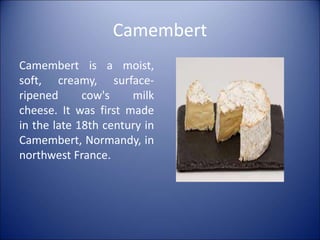
Camembert
Camembert is a moist,
soft, creamy, surface-
ripened cow's milk
cheese. It was first made
in the late 18th century in
Camembert, Normandy, in
northwest France.
Endive French Salad
• An endive is a bitter,
crunchy leaf vegetable
from the chicory family
Clams
marine animal with two
shells
Dungeness crab
renowned for its sweet,
succulent meat and delicate
texture.
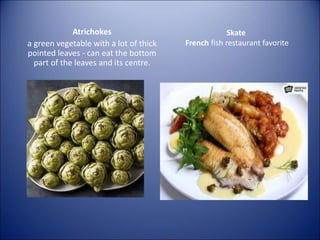
Atrichokes
a green vegetable with a lot of thick
pointed leaves - can eat the bottom
part of the leaves and its centre.
Skate
French fish restaurant favorite
North East Region
• North East region of France includes Nord Pays de Calais,
Picardy, Champagne, Alsace, Lorraine and Franche-Comte
• influenced by its neighboring nations – Germany,
Switzerland and Belgium
• foods traditionally associated with Germanic cuisine such
as sauerkraut and sausages are popular as are waffles and
beets, items of Flemish origin.
• Pork, wild game, foi gras, freshwater fish, escargots (snails)
and frogs are commonly utilized.
• The products of this region are wheat, barley, endive,
beets, potatoes, cabbage, wild mushrooms, truffles, plums,
apples, cherries, grapes, asparagus and cheese.
• Wheat is used to make spaetzle and egg noodles.
Foie gras
specialty food product
made of the liver of a
duck or goose.
Escargots
edible land snails
Spaetzle
type of Central European
egg noodles typically
served as a side for meat
dishes with sauce
Truffles
•edible underground fungi.
Found in close association with
trees.
•used in pasta dishes, risotto,
sauces, or grated over seafood
or meat
South East Region
• consists of Burgundy, Auvergne, Limousine, Rhône Alps,
Côte d‘Azur and Corsica
• home to the city of Lyon the culinary capital of France
• Beef, pork, lamb, duck and rabbit are all common as are
cheeses derived from cow‘s, sheep‘s and goat‘s milk
• Artichokes, eggplants, tomatoes, garlic, olives, herbs,
apricots, cherries, plums and figs flourish in the cool
Mediterranean climate
• Common fish include anchovies, sardines, red mullets and
monkfish. Specialties of this region include Dijon mustard,
Le Puv lentils, bouillabaisse, ratatouille and tapenade.
Bouillabaisse
• classic French fish soup with seafood
• Provencal fish soup with a tomato base
Tapenade
• made with olives and
capers, then flavored
with other herbs and
spices.
• The dish is finished with
plenty of olive oil to
give it the desired
consistency.
Ratatouille
The typical ingredients in
ratatouille are tomatoes,
zucchini, peppers, eggplant,
onions and fresh herbs.
South West Region
• The provinces of Midi-Pyrenees, Languedoc-Roussillon,
Aquitaine and Poitou-Charentes.
• This area borders Spain and is heavily influenced by
Spanish cuisine and the Arab moors conquerors from
Africa.
• Seafood is popular including monkfish, eel, tuna,
oysters, cod and mussels.
• Poultry, walnuts, chestnuts, porcini and chanterelles
mushrooms are harvested.
• The Moors introduced exotic spices such as pepper,
cumin, anise, ginger, cinnamon and caraway.
• Specialties are fish soup with peppers and onion and
Jambon de Bayonne.
• The staples are wheat, barley and corn are like the
Spanish use almond paste for thickening sauces.
Porcini and chanterelles
Porcini a type of edible,
brown-capped fungus
with thick, white stalks.
Chanterelles - wild edible
mushrooms. They are
orange, yellow or white,
meaty and funnel-shaped.
Jambon de Bayonne
Bayonne ham or jambon
de Bayonne is a cured
ham that takes its name
from the ancient port city
of Bayonne in the far
southwest of France
Monkfish is a bottom-
dwelling fish with firm,
lean flesh that's often
compared to lobster
Mussels
type of small sea animal (a
shellfish) that can be
eaten, with a black shell
in two parts
Conclusion
• France has been invaded by explorers from many foreign countries.
• In certain areas of the country Celtic, British, Basque, Spanish,
Italians, Greek and Arab influences are evident.
• The Celtic Gaul introduced farming to this area and also developed
Charcuterie for which France is famous even today.
• The Romans who took over introduced cheese making and the
Moors introduced goat rearing and spices.
• Arab influence is evident in the use of almonds and rice.
• With the marriage of Catherine de Medici to Henry II the
foundations for modern French cuisine were established.
• Marie Antonio Carême (1784-1833) the great Chef who organized
and detailed dishes according to courses laid the foundation for
Grande Cuisine.
• It was further refined by Chef Georges-Aguste Escoffier whose
approach was based on simplicity and called it Cuisine Classique.
• The next major shift in French cuisine was initiated by Chef Fernand
Point (1897-1955) who further simplified the menu and laid the
ground work for Nouvelle Cuisine.
References
https://uou.ac.in/sites/default/files/slm/HM-
102.pdf

French Cuisine.ppt

  • 1.
    French Cuisine Mrs. R.Subha,M.Sc., M.Phil., D.C.T., Assistant Professor of Home Science
  • 2.
    Introduction • In France,cuisine is not simply a source of pleasure but a multifaceted discipline. • focus on tradition, technique and mastery of style - French cuisine is arguably most aesthetic cuisine in the world. • Gastronomique capital - Paris • France may be divided into four culinary regions—the North West, North East, South West and South East.
  • 3.
    North West Region areaof long coastline and maritime climate- cool summers, warm winters and heavy rain • cuisine heavily influenced by sea food. • Clams, lobsters, Dungeness crabs, oysters, skate, mackerel and Dover sole are all relished. • Wild game including boar, rabbit, duck and pheasant, along with domestic goat and lamb are all popular. • Normandy is renowned for cow’s milk cheese - Camembert and superior butter which is utilized heavily in local cuisine. • Fruits and vegetable of this region include pears, plums, apples, potatoes, artichokes, endive and pumpkins. • Wheat is the preferred grain and walnuts the favourite nut.
  • 4.
    Camembert Camembert is amoist, soft, creamy, surface- ripened cow's milk cheese. It was first made in the late 18th century in Camembert, Normandy, in northwest France.
  • 5.
    Endive French Salad •An endive is a bitter, crunchy leaf vegetable from the chicory family
  • 6.
    Clams marine animal withtwo shells Dungeness crab renowned for its sweet, succulent meat and delicate texture.
  • 7.
    Atrichokes a green vegetablewith a lot of thick pointed leaves - can eat the bottom part of the leaves and its centre. Skate French fish restaurant favorite
  • 8.
    North East Region •North East region of France includes Nord Pays de Calais, Picardy, Champagne, Alsace, Lorraine and Franche-Comte • influenced by its neighboring nations – Germany, Switzerland and Belgium • foods traditionally associated with Germanic cuisine such as sauerkraut and sausages are popular as are waffles and beets, items of Flemish origin. • Pork, wild game, foi gras, freshwater fish, escargots (snails) and frogs are commonly utilized. • The products of this region are wheat, barley, endive, beets, potatoes, cabbage, wild mushrooms, truffles, plums, apples, cherries, grapes, asparagus and cheese. • Wheat is used to make spaetzle and egg noodles.
  • 9.
    Foie gras specialty foodproduct made of the liver of a duck or goose. Escargots edible land snails
  • 10.
    Spaetzle type of CentralEuropean egg noodles typically served as a side for meat dishes with sauce Truffles •edible underground fungi. Found in close association with trees. •used in pasta dishes, risotto, sauces, or grated over seafood or meat
  • 11.
    South East Region •consists of Burgundy, Auvergne, Limousine, Rhône Alps, Côte d‘Azur and Corsica • home to the city of Lyon the culinary capital of France • Beef, pork, lamb, duck and rabbit are all common as are cheeses derived from cow‘s, sheep‘s and goat‘s milk • Artichokes, eggplants, tomatoes, garlic, olives, herbs, apricots, cherries, plums and figs flourish in the cool Mediterranean climate • Common fish include anchovies, sardines, red mullets and monkfish. Specialties of this region include Dijon mustard, Le Puv lentils, bouillabaisse, ratatouille and tapenade.
  • 12.
    Bouillabaisse • classic Frenchfish soup with seafood • Provencal fish soup with a tomato base
  • 13.
    Tapenade • made witholives and capers, then flavored with other herbs and spices. • The dish is finished with plenty of olive oil to give it the desired consistency. Ratatouille The typical ingredients in ratatouille are tomatoes, zucchini, peppers, eggplant, onions and fresh herbs.
  • 14.
    South West Region •The provinces of Midi-Pyrenees, Languedoc-Roussillon, Aquitaine and Poitou-Charentes. • This area borders Spain and is heavily influenced by Spanish cuisine and the Arab moors conquerors from Africa. • Seafood is popular including monkfish, eel, tuna, oysters, cod and mussels. • Poultry, walnuts, chestnuts, porcini and chanterelles mushrooms are harvested. • The Moors introduced exotic spices such as pepper, cumin, anise, ginger, cinnamon and caraway. • Specialties are fish soup with peppers and onion and Jambon de Bayonne. • The staples are wheat, barley and corn are like the Spanish use almond paste for thickening sauces.
  • 15.
    Porcini and chanterelles Porcinia type of edible, brown-capped fungus with thick, white stalks. Chanterelles - wild edible mushrooms. They are orange, yellow or white, meaty and funnel-shaped. Jambon de Bayonne Bayonne ham or jambon de Bayonne is a cured ham that takes its name from the ancient port city of Bayonne in the far southwest of France
  • 16.
    Monkfish is abottom- dwelling fish with firm, lean flesh that's often compared to lobster Mussels type of small sea animal (a shellfish) that can be eaten, with a black shell in two parts
  • 17.
    Conclusion • France hasbeen invaded by explorers from many foreign countries. • In certain areas of the country Celtic, British, Basque, Spanish, Italians, Greek and Arab influences are evident. • The Celtic Gaul introduced farming to this area and also developed Charcuterie for which France is famous even today. • The Romans who took over introduced cheese making and the Moors introduced goat rearing and spices. • Arab influence is evident in the use of almonds and rice. • With the marriage of Catherine de Medici to Henry II the foundations for modern French cuisine were established. • Marie Antonio Carême (1784-1833) the great Chef who organized and detailed dishes according to courses laid the foundation for Grande Cuisine. • It was further refined by Chef Georges-Aguste Escoffier whose approach was based on simplicity and called it Cuisine Classique. • The next major shift in French cuisine was initiated by Chef Fernand Point (1897-1955) who further simplified the menu and laid the ground work for Nouvelle Cuisine.
  • 18.