FRENCH

COMPARATIVES AND
SUPERLATIVES
This learning guide is divided into different
parts with a quick recap after each topic.
1)

WHAT IS COMPARATIVES AND SUPERLATIVES?

2)

COMPARATIVES AND SUPERLATIVES OF ADJECTIVES

3)

COMPARATIVES AND SUPERLATIVES OF ADVERBS

4)

THE IRREGULARS
1. WHAT IS
COMPARATIVES AND SUPERLATIVES?
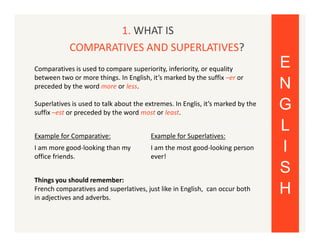
Comparatives is used to compare superiority, inferiority, or equality
between two or more things. In English, it’s marked by the suffix –er or
preceded by the word more or less.
Superlatives is used to talk about the extremes. In Englis, it’s marked by the
suffix –est or preceded by the word most or least.
Example for Comparative:

Example for Superlatives:

I am more good-looking than my
office friends.

I am the most good-looking person
ever!

Things you should remember:
French comparatives and superlatives, just like in English, can occur both
in adjectives and adverbs.

E
N
G
L
I
S
H
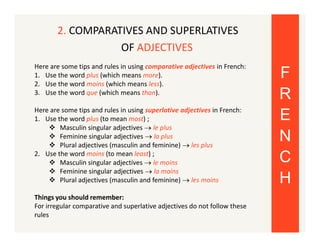
2. COMPARATIVES AND SUPERLATIVES
OF ADJECTIVES
Here are some tips and rules in using comparative adjectives in French:
1. Use the word plus (which means more).
2. Use the word moins (which means less).
3. Use the word que (which means than).
Here are some tips and rules in using superlative adjectives in French:
1. Use the word plus (to mean most) ;
 Masculin singular adjectives  le plus
 Feminine singular adjectives  la plus
 Plural adjectives (masculin and feminine)  les plus
2. Use the word moins (to mean least) ;
 Masculin singular adjectives  le moins
 Feminine singular adjectives  la moins
 Plural adjectives (masculin and feminine)  les moins
Things you should remember:
For irregular comparative and superlative adjectives do not follow these
rules

F
R
E
N
C
H
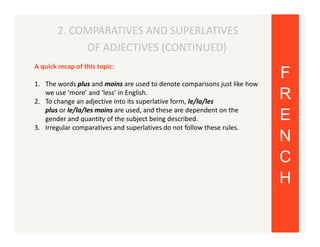
2. COMPARATIVES AND SUPERLATIVES
OF ADJECTIVES (CONTINUED)
A quick recap of this topic:
1. The words plus and moins are used to denote comparisons just like how
we use ‘more’ and ‘less’ in English.
2. To change an adjective into its superlative form, le/la/les
plus or le/la/les moins are used, and these are dependent on the
gender and quantity of the subject being described.
3. Irregular comparatives and superlatives do not follow these rules.

F
R
E
N
C
H
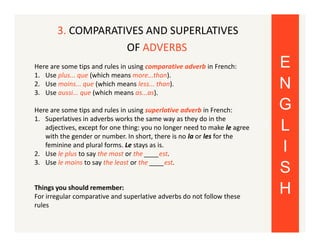
3. COMPARATIVES AND SUPERLATIVES
OF ADVERBS
Here are some tips and rules in using comparative adverb in French:
1. Use plus... que (which means more...than).
2. Use moins... que (which means less... than).
3. Use aussi... que (which means as...as).
Here are some tips and rules in using superlative adverb in French:
1. Superlatives in adverbs works the same way as they do in the
adjectives, except for one thing: you no longer need to make le agree
with the gender or number. In short, there is no la or les for the
feminine and plural forms. Le stays as is.
2. Use le plus to say the most or the ____est.
3. Use le moins to say the least or the ____est.
Things you should remember:
For irregular comparative and superlative adverbs do not follow these
rules

E
N
G
L
I
S
H
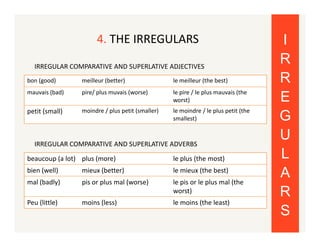
4. THE IRREGULARS
IRREGULAR COMPARATIVE AND SUPERLATIVE ADJECTIVES
bon (good)

meilleur (better)

le meilleur (the best)

mauvais (bad)

pire/ plus muvais (worse)

le pire / le plus mauvais (the
worst)

petit (small)

moindre / plus petit (smaller)

le moindre / le plus petit (the
smallest)

IRREGULAR COMPARATIVE AND SUPERLATIVE ADVERBS
beaucoup (a lot) plus (more)

le plus (the most)

bien (well)

mieux (better)

le mieux (the best)

mal (badly)

pis or plus mal (worse)

le pis or le plus mal (the
worst)

Peu (little)

moins (less)

le moins (the least)

I
R
R
E
G
U
L
A
R
S
A quick recap of this topic:
1. Comparatives and superlatives of adverbs are formed in the same way
as the adjectives. Plus… que, moins… que, and aussi… que for
comparatives and le plus and le moins for superlatives.
2. Unlike the adjectives, the comparatives and superlatives of the adverbs
no longer need to agree to the gender or number to the word they are
describing.

S
U
M
M
A
R
Y
About Talk in French
• Visit our website to get some free French
Lessons
Sign-up to our newsletter
• And get a free study guide to learn french
Talk in French on Facebook
• Visit our Facebook: 1 word and 1 French
Expression per day and so much more

French comparatives and superlatives

  • 1.
  • 2.
    This learning guideis divided into different parts with a quick recap after each topic. 1) WHAT IS COMPARATIVES AND SUPERLATIVES? 2) COMPARATIVES AND SUPERLATIVES OF ADJECTIVES 3) COMPARATIVES AND SUPERLATIVES OF ADVERBS 4) THE IRREGULARS
  • 3.
    1. WHAT IS COMPARATIVESAND SUPERLATIVES? Comparatives is used to compare superiority, inferiority, or equality between two or more things. In English, it’s marked by the suffix –er or preceded by the word more or less. Superlatives is used to talk about the extremes. In Englis, it’s marked by the suffix –est or preceded by the word most or least. Example for Comparative: Example for Superlatives: I am more good-looking than my office friends. I am the most good-looking person ever! Things you should remember: French comparatives and superlatives, just like in English, can occur both in adjectives and adverbs. E N G L I S H
  • 4.
    2. COMPARATIVES ANDSUPERLATIVES OF ADJECTIVES Here are some tips and rules in using comparative adjectives in French: 1. Use the word plus (which means more). 2. Use the word moins (which means less). 3. Use the word que (which means than). Here are some tips and rules in using superlative adjectives in French: 1. Use the word plus (to mean most) ;  Masculin singular adjectives  le plus  Feminine singular adjectives  la plus  Plural adjectives (masculin and feminine)  les plus 2. Use the word moins (to mean least) ;  Masculin singular adjectives  le moins  Feminine singular adjectives  la moins  Plural adjectives (masculin and feminine)  les moins Things you should remember: For irregular comparative and superlative adjectives do not follow these rules F R E N C H
  • 5.
    2. COMPARATIVES ANDSUPERLATIVES OF ADJECTIVES (CONTINUED) A quick recap of this topic: 1. The words plus and moins are used to denote comparisons just like how we use ‘more’ and ‘less’ in English. 2. To change an adjective into its superlative form, le/la/les plus or le/la/les moins are used, and these are dependent on the gender and quantity of the subject being described. 3. Irregular comparatives and superlatives do not follow these rules. F R E N C H
  • 6.
    3. COMPARATIVES ANDSUPERLATIVES OF ADVERBS Here are some tips and rules in using comparative adverb in French: 1. Use plus... que (which means more...than). 2. Use moins... que (which means less... than). 3. Use aussi... que (which means as...as). Here are some tips and rules in using superlative adverb in French: 1. Superlatives in adverbs works the same way as they do in the adjectives, except for one thing: you no longer need to make le agree with the gender or number. In short, there is no la or les for the feminine and plural forms. Le stays as is. 2. Use le plus to say the most or the ____est. 3. Use le moins to say the least or the ____est. Things you should remember: For irregular comparative and superlative adverbs do not follow these rules E N G L I S H
  • 7.
    4. THE IRREGULARS IRREGULARCOMPARATIVE AND SUPERLATIVE ADJECTIVES bon (good) meilleur (better) le meilleur (the best) mauvais (bad) pire/ plus muvais (worse) le pire / le plus mauvais (the worst) petit (small) moindre / plus petit (smaller) le moindre / le plus petit (the smallest) IRREGULAR COMPARATIVE AND SUPERLATIVE ADVERBS beaucoup (a lot) plus (more) le plus (the most) bien (well) mieux (better) le mieux (the best) mal (badly) pis or plus mal (worse) le pis or le plus mal (the worst) Peu (little) moins (less) le moins (the least) I R R E G U L A R S
  • 8.
    A quick recapof this topic: 1. Comparatives and superlatives of adverbs are formed in the same way as the adjectives. Plus… que, moins… que, and aussi… que for comparatives and le plus and le moins for superlatives. 2. Unlike the adjectives, the comparatives and superlatives of the adverbs no longer need to agree to the gender or number to the word they are describing. S U M M A R Y
  • 9.
    About Talk inFrench • Visit our website to get some free French Lessons
  • 10.
    Sign-up to ournewsletter • And get a free study guide to learn french
  • 11.
    Talk in Frenchon Facebook • Visit our Facebook: 1 word and 1 French Expression per day and so much more