Free Radicals
Presented by Kendra, Dave,
Natalia, Karl, Aneesh, Leif,
Kevin, Shivani, Fifi, Sandra and
Carolyn
Free Radicals
1. What is a Free Radical
2. How are they created
3. Sources
4. Damage
5. Prevention
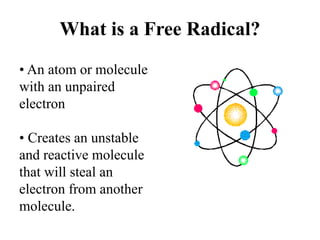
• An atom or molecule
with an unpaired
electron
• Creates an unstable
and reactive molecule
that will steal an
electron from another
molecule.
What is a Free Radical?
• This molecule now
becomes a new free
radical and causes a
chain of reactions.
• If this occurs inside
an organism, it can lead
to significant damage.
How are Free radicals created?
1. Reduction
Loss of an electron
2. Oxidation
Gain of an electron
3. Homolytic cleavage
The splitting of a complex molecule, into
simpler molecules
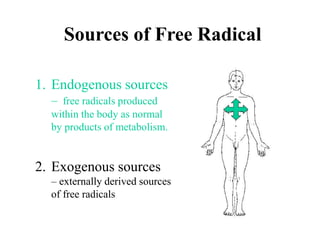
1. Endogenous sources
– free radicals produced
within the body as normal
byproducts of metabolism.
2. Exogenous sources
– externally derived sources
of free radicals
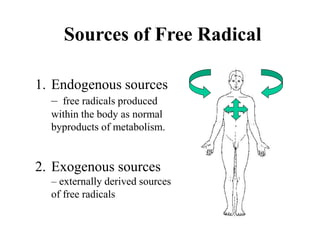
Sources of Free Radical
1. Endogenous sources
– free radicals produced
within the body as normal
by products of metabolism.
2. Exogenous sources
– externally derived sources
of free radicals
Sources of Free Radical
Endogenous sources
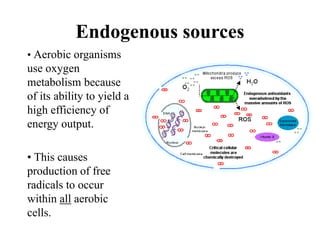
• Aerobic organisms
use oxygen
metabolism because
of its ability to yield a
high efficiency of
energy output.
• This causes
production of free
radicals to occur
within all aerobic
cells.
Superoxides
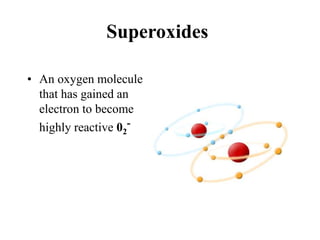
• An oxygen molecule
that has gained an
electron to become
highly reactive 02
-
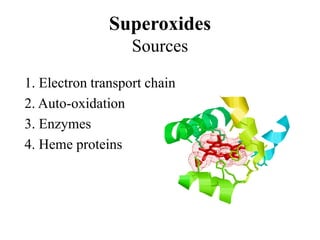
1. Electron transport chain
2. Auto-oxidation
3. Enzymes
4. Heme proteins
Superoxides
Sources
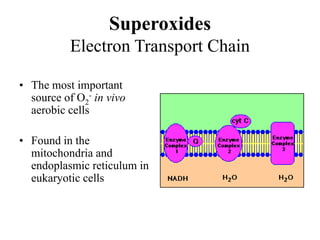
• The most important
source of O2
- in vivo
aerobic cells
• Found in the
mitochondria and
endoplasmic reticulum in
eukaryotic cells
Superoxides
Electron Transport Chain
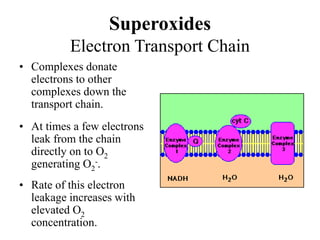
• Complexes donate
electrons to other
complexes down the
transport chain.
• At times a few electrons
leak from the chain
directly on to O2
generating O2
-.
• Rate of this electron
leakage increases with
elevated O2
concentration.
Superoxides
Electron Transport Chain
• Glyceraldehyde
• FADH2
• Hormones adrenalin
and noradrenalin
• Neurotransmitter
dopamine
• Thiol compounds,
such as cysteine
Note: O2 is poorly reactive, so most
auto-oxidation reactions are greatly
accelerated by transition metals, such as
iron and copper.
• Several biologically
important molecules
oxidize in the presence
of O2 to yield O2
-.
Superoxides
Auto-oxidation reactions
• Intestine and
Ischaemic tissues
• Catalyzes
oxidation of both
hypoxanthine and
xanthine to uric
acid while reducing
O2 to both O2
- and
H2O2.
Xanthine oxidase
Aldehyde oxidase
Nitric oxide
synthase
Indoleamine
2,3-dioxygenase
Tryptophan
dioxygenase
Superoxides
Enzymes
• Produced in the
Liver
• Oxidizes a wide
range of aldehydes
and other
compounds while
producing O2
-
Superoxides
Enzymes
Xanthine oxidase
Aldehyde oxidase
Nitric oxide
synthase
Indoleamine
2,3-dioxygenase
Tryptophan
dioxygenase
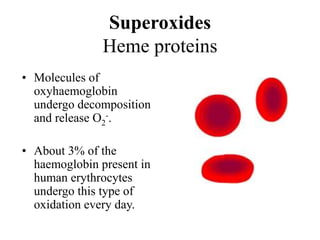
• Molecules of
oxyhaemoglobin
undergo decomposition
and release O2
-.
• About 3% of the
haemoglobin present in
human erythrocytes
undergo this type of
oxidation every day.
Superoxides
Heme proteins
Respiratory Burst
•Macrophages phagocytose foreign particles and expose
them to enzymatically produced free radicals - O2
-, HOCl,
H2O2, OH, NO
•The production of these toxic molecules breakdown the
foreign particles in the phagosome
•Increased cellular O2 consumption is needed to produce
them
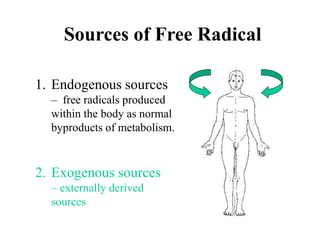
1. Endogenous sources
– free radicals produced
within the body as normal
byproducts of metabolism.
2. Exogenous sources
– externally derived
sources
Sources of Free Radical
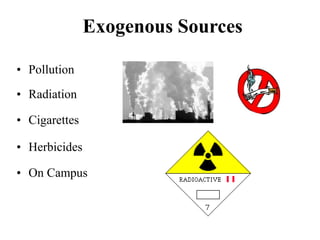
Exogenous Sources
• Pollution
• Radiation
• Cigarettes
• Herbicides
• On Campus
Exogenous Sources
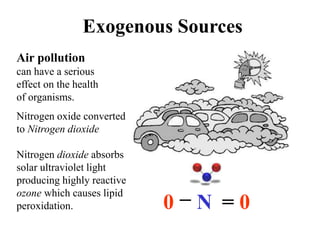
Air pollution
can have a serious
effect on the health
of organisms.
0 = N = 0
Nitrogen oxide converted
to Nitrogen dioxide
Nitrogen dioxide absorbs
solar ultraviolet light
producing highly reactive
ozone which causes lipid
peroxidation.
Exogenous Sources
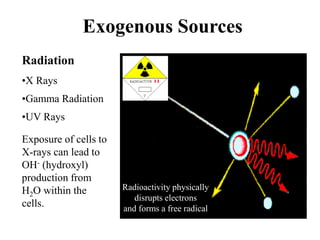
Radiation
•X Rays
•Gamma Radiation
•UV Rays
Exposure of cells to
X-rays can lead to
OH- (hydroxyl)
production from
H2O within the
cells.
Radioactivity physically
disrupts electrons
and forms a free radical.
Exogenous Sources
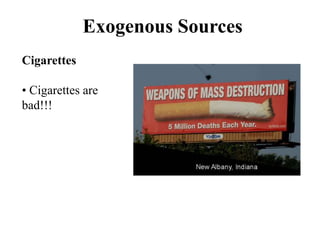
Cigarettes
• Cigarettes are
bad!!!
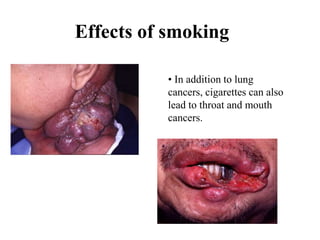
Effects of smoking
• In addition to lung
cancers, cigarettes can also
lead to throat and mouth
cancers.
Exogenous Sources
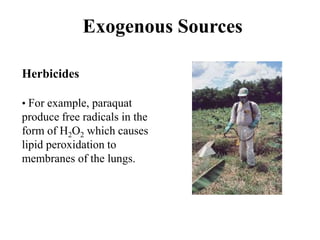
Herbicides
• For example, paraquat
produce free radicals in the
form of H2O2 which causes
lipid peroxidation to
membranes of the lungs.
Exogenous Sources
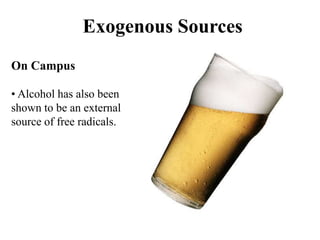
On Campus
• Alcohol has also been
shown to be an external
source of free radicals.
Exogenous Sources
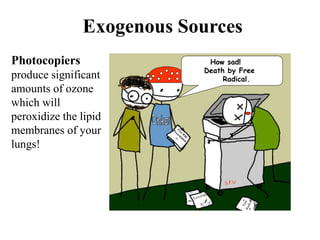
Photocopiers
produce significant
amounts of ozone
which will
peroxidize the lipid
membranes of your
lungs!
How sad!
Death by Free
Radical.
Damage
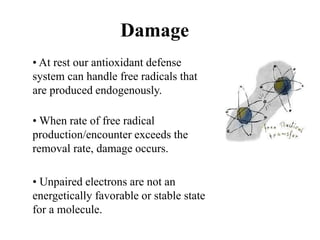
• At rest our antioxidant defense
system can handle free radicals that
are produced endogenously.
• When rate of free radical
production/encounter exceeds the
removal rate, damage occurs.
• Unpaired electrons are not an
energetically favorable or stable state
for a molecule.
Damage
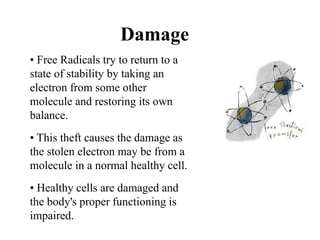
• Free Radicals try to return to a
state of stability by taking an
electron from some other
molecule and restoring its own
balance.
• This theft causes the damage as
the stolen electron may be from a
molecule in a normal healthy cell.
• Healthy cells are damaged and
the body's proper functioning is
impaired.
Damage
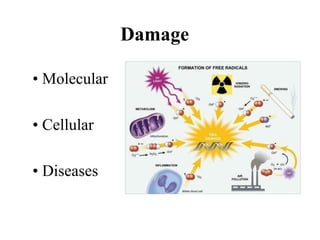
• Molecular
• Cellular
• Diseases
Molecular Level
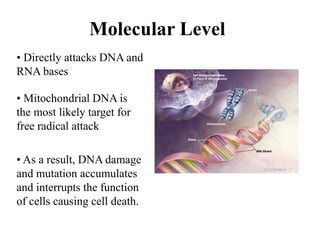
• Directly attacks DNA and
RNA bases
• Mitochondrial DNA is
the most likely target for
free radical attack
• As a result, DNA damage
and mutation accumulates
and interrupts the function
of cells causing cell death.
Cellular Level
• Unsaturated lipid molecules
of cell membranes are
particularly susceptible to
damage.
• Free radicals breakdown of
lipids resulting in the
hardening of cell wall.
• This can lead to a decrease
intracellular [Ca2+] which
results in reduced neural
activity.
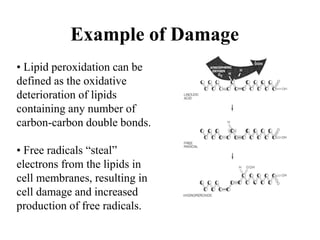
• Lipid peroxidation can be
defined as the oxidative
deterioration of lipids
containing any number of
carbon-carbon double bonds.
• Free radicals “steal”
electrons from the lipids in
cell membranes, resulting in
cell damage and increased
production of free radicals.
Example of Damage
Diseases
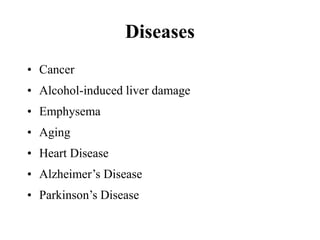
• Cancer
• Alcohol-induced liver damage
• Emphysema
• Aging
• Heart Disease
• Alzheimer’s Disease
• Parkinson’s Disease
Reducing Free Radicals
1. Reduce the
exposure to
exogenous free
radical sources. Antioxidants
& Exercise
2. Enhance the
bodies own defense
systems with…
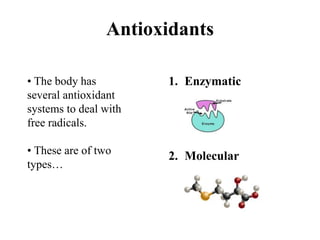
1. Enzymatic
2. Molecular
• The body has
several antioxidant
systems to deal with
free radicals.
• These are of two
types…
Antioxidants
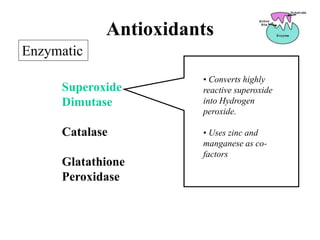
Superoxide
Dimutase
Catalase
Glatathione
Peroxidase
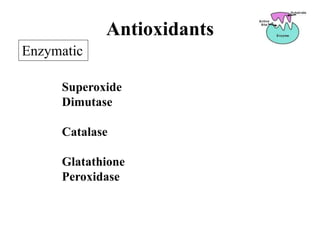
Enzymatic
Antioxidants
Superoxide
Dimutase
Catalase
Glatathione
Peroxidase
Enzymatic
Antioxidants
• Converts highly
reactive superoxide
into Hydrogen
peroxide.
• Uses zinc and
manganese as co-
factors
Superoxide
Dimutase
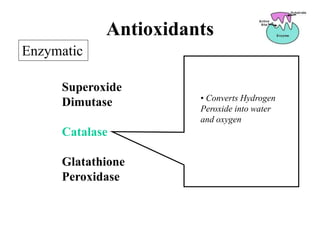
Catalase
Glatathione
Peroxidase
Enzymatic
Antioxidants
• Converts Hydrogen
Peroxide into water
and oxygen
Superoxide
Dimutase
Catalase
Glatathione
Peroxidase
Enzymatic
Antioxidants
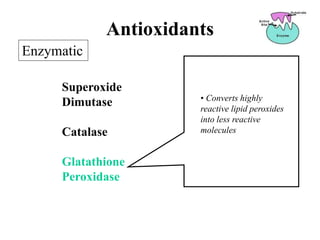
• Converts highly
reactive lipid peroxides
into less reactive
molecules
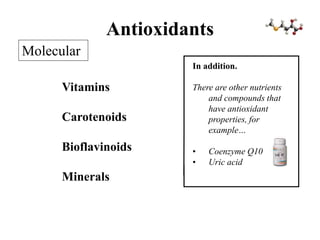
Antioxidants
Vitamins
Carotenoids
Bioflavinoids
Minerals
Molecular
Antioxidants
Vitamins
Carotenoids
Bioflavinoids
Minerals
Molecular
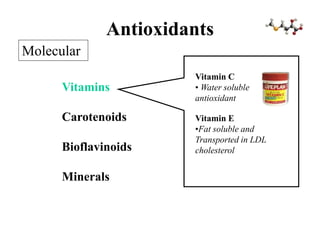
Vitamin C
• Water soluble
antioxidant
Vitamin E
•Fat soluble and
Transported in LDL
cholesterol
Antioxidants
Vitamins
Carotenoids
Bioflavinoids
Minerals
Molecular
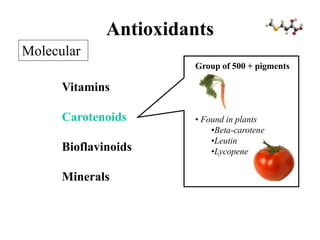
Group of 500 + pigments
• Found in plants
•Beta-carotene
•Leutin
•Lycopene
Antioxidants
Vitamins
Carotenoids
Bioflavinoids
Minerals
Molecular
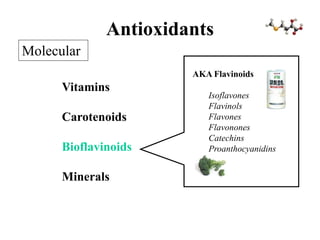
AKA Flavinoids
Isoflavones
Flavinols
Flavones
Flavonones
Catechins
Proanthocyanidins
Antioxidants
Vitamins
Carotenoids
Bioflavinoids
Minerals
Molecular
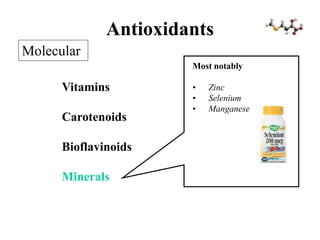
Most notably
• Zinc
• Selenium
• Manganese
Antioxidants
Vitamins
Carotenoids
Bioflavinoids
Minerals
Molecular
In addition.
There are other nutrients
and compounds that
have antioxidant
properties, for
example…
• Coenzyme Q10
• Uric acid
• Exercise will greatly
enhance the bodies own
antioxidant defense
system.
• Antioxidant enzymes
production is increased
with exercise, this will
counteract the free
radicals formed.
Antioxidants
Antioxidants
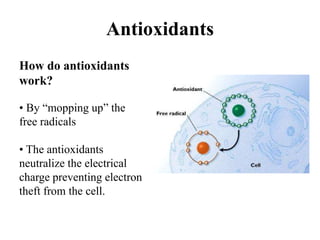
How do antioxidants
work?
• By “mopping up” the
free radicals
• The antioxidants
neutralize the electrical
charge preventing electron
theft from the cell.
Summary
• Unpaired electrons cause damage at
the cellular & molecular level
• Endogenous & exogenous sources
• Health risks including cancer
• Impact may be minimized through
decreasing exposure, exercising,
eating vegetables, and taking vitamins
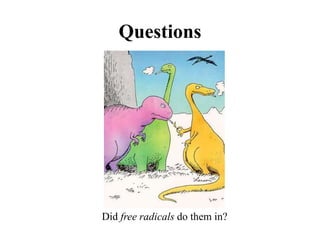
Questions
Did free radicals do them in?

Free Radicals CHEMISTRY presentation ppt