Motion in One
Dimension
Free Fall
Free Fall
 Assumes no air
resistance
 http://www.youtube.com/watch?v=5C5_dOEyA
fk
 Acceleration is constant for the entire fall
 Acceleration due to gravity (ag or g )
 Has a value of -9.8 m/s2
(negative for downward)
 Roughly equivalent to -22 (mi/h)/s
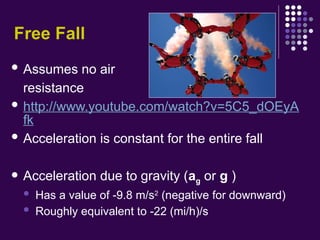
What observations can you
make about the picture?
Free Fall
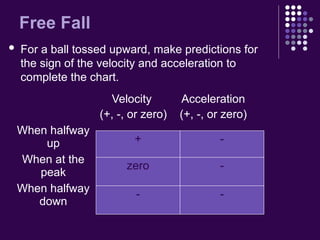
 For a ball tossed upward, make predictions for
the sign of the velocity and acceleration to
complete the chart.
Velocity
(+, -, or zero)
Acceleration
(+, -, or zero)
When halfway
up
When at the
peak
When halfway
down
+ -
zero -
- -
Graphing Free Fall
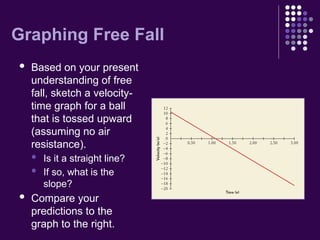
 Based on your present
understanding of free
fall, sketch a velocity-
time graph for a ball
that is tossed upward
(assuming no air
resistance).
 Is it a straight line?
 If so, what is the
slope?
 Compare your
predictions to the
graph to the right.
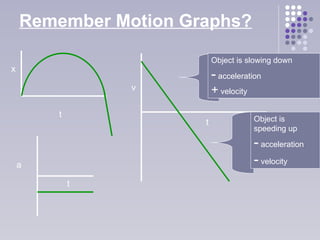
Remember Motion Graphs?
x
a
t
t
Object is slowing down
- acceleration
+ velocity
Object is
speeding up
- acceleration
- velocity
v
t
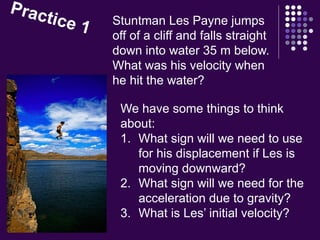
Stuntman Les Payne jumps
off of a cliff and falls straight
down into water 35 m below.
What was his velocity when
he hit the water?
Practice 1
We have some things to think
about:
1. What sign will we need to use
for his displacement if Les is
moving downward?
2. What sign will we need for the
acceleration due to gravity?
3. What is Les’ initial velocity?
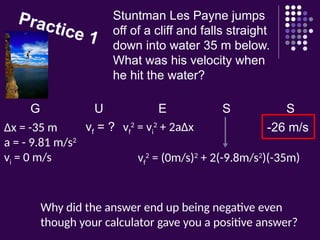
Stuntman Les Payne jumps
off of a cliff and falls straight
down into water 35 m below.
What was his velocity when
he hit the water?
Practice 1
G U E S S
Δx = -35 m
a = - 9.81 m/s2
vi = 0 m/s
vf = ? vf
2
= vi
2
+ 2aΔx
vf
2
= (0m/s)2
+ 2(-9.8m/s2
)(-35m)
-26 m/s
Why did the answer end up being negative even
though your calculator gave you a positive answer?
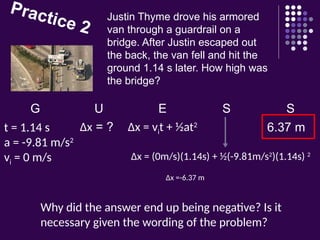
Justin Thyme drove his armored
van through a guardrail on a
bridge. After Justin escaped out
the back, the van fell and hit the
ground 1.14 s later. How high
was the bridge?
Practice 2
Practice 2
G U E S S
t = 1.14 s
a = -9.81 m/s2
vi = 0 m/s
Δx = ? Δx = vit + ½at2
Δx = (0m/s)(1.14s) + ½(-9.81m/s2
)(1.14s) 2
6.37 m
Why did the answer end up being negative? Is it
necessary given the wording of the problem?
Justin Thyme drove his armored
van through a guardrail on a
bridge. After Justin escaped out
the back, the van fell and hit the
ground 1.14 s later. How high was
the bridge?
Δx =-6.37 m
Practice 3 You throw a watermelon straight
up to your friend Bill Ding who is
standing on a balcony 7.25 m
above you. You throw the
watermelon upward, it passes Bill,
and then falls back down to him
and hits the balcony. The entire
journey took 1.95 s.
a) How fast did you throw the
watermelon?
b) How high did the watermelon
go?
You throw a watermelon straight up to your
friend Bill Ding who is standing on a
balcony 7.25 m above you. You throw the
watermelon upward, it passes Bill, and then
falls back down to him and hits the balcony.
The entire journey took 1.95 s.
a) How fast did you throw the
watermelon?
b) How high did the watermelon go?
Practice 3
G U E S S
Δx = 7.25 m
t = 1.95 s
a = -9.81 m/s2
vi = ?
Δx = vit + ½at2
7.25 m= (vi)(1.95s) + ½(-9.81m/s2
)(1.95s) 2
13.3 m/s
You throw a watermelon straight up to your
friend Bill Ding who is standing on a balcony
7.25 m above you. You throw the watermelon
upward, it passes Bill, and then falls back down
to him and hits the balcony. The entire journey
took 1.95 s.
a) How fast did you throw the watermelon?
b) How high did the watermelon go?
Practice 3
G U E S S
vi = 13.3 m/s
a = -9.81 m/s2
vf = 0 m/s
Δx = ?
vf
2
= vi
2
+ 2aΔx
(0m/s)2
= (13.3m/s)2
+ 2(-9.81m/s2
)Δx
9.02 m
Measurement Symbol Value
acceleration due to
gravity
g 9.81 m/s2
Freefall
Summary
NOW YOU TRY
 Do practice F (1-3) from chapter 2 (page 64)

Free Fall Powerpoint Presentation (Problems and Formulas)

  • 1.
  • 2.
    Free Fall  Assumesno air resistance  http://www.youtube.com/watch?v=5C5_dOEyA fk  Acceleration is constant for the entire fall  Acceleration due to gravity (ag or g )  Has a value of -9.8 m/s2 (negative for downward)  Roughly equivalent to -22 (mi/h)/s
  • 3.
    What observations canyou make about the picture?
  • 4.
    Free Fall  Fora ball tossed upward, make predictions for the sign of the velocity and acceleration to complete the chart. Velocity (+, -, or zero) Acceleration (+, -, or zero) When halfway up When at the peak When halfway down + - zero - - -
  • 5.
    Graphing Free Fall Based on your present understanding of free fall, sketch a velocity- time graph for a ball that is tossed upward (assuming no air resistance).  Is it a straight line?  If so, what is the slope?  Compare your predictions to the graph to the right.
  • 6.
    Remember Motion Graphs? x a t t Objectis slowing down - acceleration + velocity Object is speeding up - acceleration - velocity v t
  • 7.
    Stuntman Les Paynejumps off of a cliff and falls straight down into water 35 m below. What was his velocity when he hit the water? Practice 1 We have some things to think about: 1. What sign will we need to use for his displacement if Les is moving downward? 2. What sign will we need for the acceleration due to gravity? 3. What is Les’ initial velocity?
  • 8.
    Stuntman Les Paynejumps off of a cliff and falls straight down into water 35 m below. What was his velocity when he hit the water? Practice 1 G U E S S Δx = -35 m a = - 9.81 m/s2 vi = 0 m/s vf = ? vf 2 = vi 2 + 2aΔx vf 2 = (0m/s)2 + 2(-9.8m/s2 )(-35m) -26 m/s Why did the answer end up being negative even though your calculator gave you a positive answer?
  • 9.
    Justin Thyme drovehis armored van through a guardrail on a bridge. After Justin escaped out the back, the van fell and hit the ground 1.14 s later. How high was the bridge? Practice 2
  • 10.
    Practice 2 G UE S S t = 1.14 s a = -9.81 m/s2 vi = 0 m/s Δx = ? Δx = vit + ½at2 Δx = (0m/s)(1.14s) + ½(-9.81m/s2 )(1.14s) 2 6.37 m Why did the answer end up being negative? Is it necessary given the wording of the problem? Justin Thyme drove his armored van through a guardrail on a bridge. After Justin escaped out the back, the van fell and hit the ground 1.14 s later. How high was the bridge? Δx =-6.37 m
  • 11.
    Practice 3 Youthrow a watermelon straight up to your friend Bill Ding who is standing on a balcony 7.25 m above you. You throw the watermelon upward, it passes Bill, and then falls back down to him and hits the balcony. The entire journey took 1.95 s. a) How fast did you throw the watermelon? b) How high did the watermelon go?
  • 12.
    You throw awatermelon straight up to your friend Bill Ding who is standing on a balcony 7.25 m above you. You throw the watermelon upward, it passes Bill, and then falls back down to him and hits the balcony. The entire journey took 1.95 s. a) How fast did you throw the watermelon? b) How high did the watermelon go? Practice 3 G U E S S Δx = 7.25 m t = 1.95 s a = -9.81 m/s2 vi = ? Δx = vit + ½at2 7.25 m= (vi)(1.95s) + ½(-9.81m/s2 )(1.95s) 2 13.3 m/s
  • 13.
    You throw awatermelon straight up to your friend Bill Ding who is standing on a balcony 7.25 m above you. You throw the watermelon upward, it passes Bill, and then falls back down to him and hits the balcony. The entire journey took 1.95 s. a) How fast did you throw the watermelon? b) How high did the watermelon go? Practice 3 G U E S S vi = 13.3 m/s a = -9.81 m/s2 vf = 0 m/s Δx = ? vf 2 = vi 2 + 2aΔx (0m/s)2 = (13.3m/s)2 + 2(-9.81m/s2 )Δx 9.02 m
  • 15.
    Measurement Symbol Value accelerationdue to gravity g 9.81 m/s2 Freefall Summary
  • 16.
    NOW YOU TRY Do practice F (1-3) from chapter 2 (page 64)

Editor's Notes

  • #4 When presenting this slide, you may wish to refer students to Figure 15 in their textbook. You can also demonstrate the motion for students. Toss a ball up and catch it. Ask students to focus on the spot half-way up and observe the motion at that time. They can then predict the sign for the velocity and acceleration at that point. Then ask students to focus on the peak and, finally, on a point half-way down. Often students believe the acceleration at the top is zero because the velocity is zero. Point out to them that acceleration is not velocity, but changing velocity. At the top, the velocity is changing from + to -. Ask students to explain each combination above. For example, a positive velocity (moving upward) and a negative acceleration (downward) would cause the velocity to decrease.
  • #5 Now students are asked to graph the motion they just observed. This graph should match the answers to the chart on the last slide. Remind them that they are graphing velocity, but acceleration is the slope of the velocity-time graph. Student graphs may have a different initial velocity and a different x-intercept (the time at which the velocity reaches zero), but their graphs should have the same shape and slope as the one given on the slide. Point out that the velocity is zero at the peak (t = 1.1 s for this graph) while the acceleration is never zero because the slope is always negative. Help them get an approximate slope for the graph shown on the slide. It should be close to -9.81 (m/s)/s.