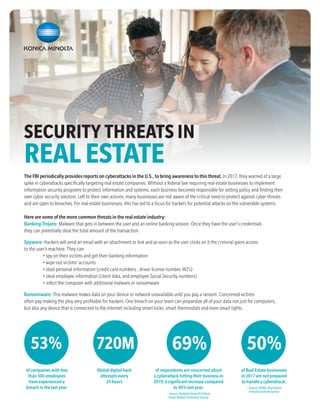
SECURITY THREATS IN
REALESTATE
The FBI periodically provides reports on cyberattacks in the U.S., to bring awareness to this threat. In 2017, they warned of a large
spike in cyberattacks specifically targeting real estate companies. Without a federal law requiring real estate businesses to implement
information security programs to protect information and systems, each business becomes responsible for setting policy and finding their
own cyber security solution. Left to their own actions, many businesses are not aware of the critical need to protect against cyber threats
and are open to breaches. For real estate businesses, this has led to a focus for hackers for potential attacks on the vulnerable systems.
Here are some of the more common threats in the real estate industry:
Banking Trojans: Malware that gets in between the user and an online banking session. Once they have the user's credentials
they can potentially steal the total amount of the transaction.
Spyware: Hackers will send an email with an attachment or link and as soon as the user clicks on it the criminal gains access
to the user’s machine. They can:
	 • spy on their victims and get their banking information
	 • wipe out victims’ accounts
	 • steal personal information (credit card numbers , driver license number, W2’s)
	 • steal employee information (client data, and employee Social Security numbers)
	 • infect the computer with additional malware or ransomware
Ransomware: This malware makes data on your device or network unavailable until you pay a ransom. Concerned victims
often pay making the ploy very profitable for hackers. One breach on your team can jeopardize all of your data not just for computers,
but also any device that is connected to the internet including smart locks, smart thermostats and even smart lights.
53% 720M 69%
of companies with less
than 500 employees
have experienced a
breach in the last year.
Global digital hack
attempts every
24 hours
of respondents are concerned about
a cyberattack hitting their business in
2019, a significant increase compared
to 46% last year.
– Source: Seyfarth Shaw 2019 Real
Estate Market Sentiment Survey
50%
of Real Estate businesses
in 2017 are not prepared
to handle a cyberattack.
– Source: KPMG, Real Estate
Industry Outlook Survey
©2019KONICAMINOLTABUSINESSSOLUTIONSU.S.A.,INC.All rights reserved. Reproduction in whole or in part without written
permission is prohibited. KONICA MINOLTA and the KONICA MINOLTA logo are registered trademarks or trademarks of KONICA MINOLTA, INC.
All other product and brand names are trademarks or registered trademarks of their respective companies or organizations. All features and
functions described here may not be available on some products. Design & specifications are subject to change without notice.
KONICA MINOLTA BUSINESS SOLUTIONS U.S.A., INC.
100 Williams Drive, Ramsey, New Jersey 07446
CountOnKonicaMinolta.com
8/19-P
For complete information on Konica Minolta products and solutions,
please visit: CountOnKonicaMinolta.com
Corporate credential phishing: A Business Email Compromise (BEC) is a cyberattack that tricks a business into wiring money to a
criminal’s bank account. In the real estate industry, the criminal often uses the DocuSign logo fraudulently with spoof email addresses
and fake messages to get unwitting users to click on what seems to be a legitimate transaction.
Last year’s figures show that “May 2018 reported the highest number of BEC real estate victims since 2015.”
												 –Source: FBI
Consumer credential phishing: Hackers use common home buying and consumer brands that frequently send notification-style
emails, including Amazon and Facebook, to lure homebuyers into making fraudulent transactions vis the BEC. According to the FBI,
multi-billions in business losses can be attributed to BEC’s, and real estate companies are specially targeted in these attacks to infect
every participant in the real estate transaction.
Mortgage Closing Wire Scam: Prior to closing on the sale of a home, when buyer receives an email from their real estate agent, title
attorney or other trusted service professional with specific details of the time, date and location of the closing, there is also fraudulent,
detailed and urgent instructions on how to wire money for the down payment. The payment goes to the criminal’s bank account, and
they within moments of the wire transfer, they withdraw the money with no trail to track them.
The number of victims of the mortgage closing wire scam ballooned to 10,000, an 1,110 percent increase
in the years 2015 to 2017 with financial losses totaling over $56 million, a 2,200 percent increase.
									 – Internet Crime Complaint Center, FBI
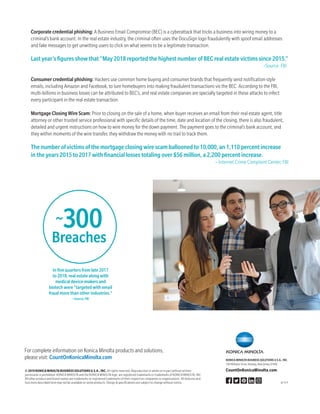
~300Breaches
In five quarters from late 2017
to 2018, real estate along with
medical device-makers and
biotech were "targeted with email
fraud more than other industries."
—Source: FBI

Keep your office secure

  • 1.
    SECURITY THREATS IN REALESTATE TheFBI periodically provides reports on cyberattacks in the U.S., to bring awareness to this threat. In 2017, they warned of a large spike in cyberattacks specifically targeting real estate companies. Without a federal law requiring real estate businesses to implement information security programs to protect information and systems, each business becomes responsible for setting policy and finding their own cyber security solution. Left to their own actions, many businesses are not aware of the critical need to protect against cyber threats and are open to breaches. For real estate businesses, this has led to a focus for hackers for potential attacks on the vulnerable systems. Here are some of the more common threats in the real estate industry: Banking Trojans: Malware that gets in between the user and an online banking session. Once they have the user's credentials they can potentially steal the total amount of the transaction. Spyware: Hackers will send an email with an attachment or link and as soon as the user clicks on it the criminal gains access to the user’s machine. They can: • spy on their victims and get their banking information • wipe out victims’ accounts • steal personal information (credit card numbers , driver license number, W2’s) • steal employee information (client data, and employee Social Security numbers) • infect the computer with additional malware or ransomware Ransomware: This malware makes data on your device or network unavailable until you pay a ransom. Concerned victims often pay making the ploy very profitable for hackers. One breach on your team can jeopardize all of your data not just for computers, but also any device that is connected to the internet including smart locks, smart thermostats and even smart lights. 53% 720M 69% of companies with less than 500 employees have experienced a breach in the last year. Global digital hack attempts every 24 hours of respondents are concerned about a cyberattack hitting their business in 2019, a significant increase compared to 46% last year. – Source: Seyfarth Shaw 2019 Real Estate Market Sentiment Survey 50% of Real Estate businesses in 2017 are not prepared to handle a cyberattack. – Source: KPMG, Real Estate Industry Outlook Survey
  • 2.
    ©2019KONICAMINOLTABUSINESSSOLUTIONSU.S.A.,INC.All rights reserved.Reproduction in whole or in part without written permission is prohibited. KONICA MINOLTA and the KONICA MINOLTA logo are registered trademarks or trademarks of KONICA MINOLTA, INC. All other product and brand names are trademarks or registered trademarks of their respective companies or organizations. All features and functions described here may not be available on some products. Design & specifications are subject to change without notice. KONICA MINOLTA BUSINESS SOLUTIONS U.S.A., INC. 100 Williams Drive, Ramsey, New Jersey 07446 CountOnKonicaMinolta.com 8/19-P For complete information on Konica Minolta products and solutions, please visit: CountOnKonicaMinolta.com Corporate credential phishing: A Business Email Compromise (BEC) is a cyberattack that tricks a business into wiring money to a criminal’s bank account. In the real estate industry, the criminal often uses the DocuSign logo fraudulently with spoof email addresses and fake messages to get unwitting users to click on what seems to be a legitimate transaction. Last year’s figures show that “May 2018 reported the highest number of BEC real estate victims since 2015.” –Source: FBI Consumer credential phishing: Hackers use common home buying and consumer brands that frequently send notification-style emails, including Amazon and Facebook, to lure homebuyers into making fraudulent transactions vis the BEC. According to the FBI, multi-billions in business losses can be attributed to BEC’s, and real estate companies are specially targeted in these attacks to infect every participant in the real estate transaction. Mortgage Closing Wire Scam: Prior to closing on the sale of a home, when buyer receives an email from their real estate agent, title attorney or other trusted service professional with specific details of the time, date and location of the closing, there is also fraudulent, detailed and urgent instructions on how to wire money for the down payment. The payment goes to the criminal’s bank account, and they within moments of the wire transfer, they withdraw the money with no trail to track them. The number of victims of the mortgage closing wire scam ballooned to 10,000, an 1,110 percent increase in the years 2015 to 2017 with financial losses totaling over $56 million, a 2,200 percent increase. – Internet Crime Complaint Center, FBI ~300Breaches In five quarters from late 2017 to 2018, real estate along with medical device-makers and biotech were "targeted with email fraud more than other industries." —Source: FBI