FRAMEWORK FOR
MATHEMATICS TEACHER
EDUCATION
INTRODUCTION
Prepared by: Raluto, Randel Roy
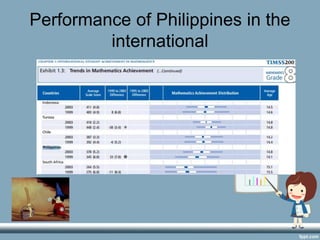
Performance of Philippines in the
international
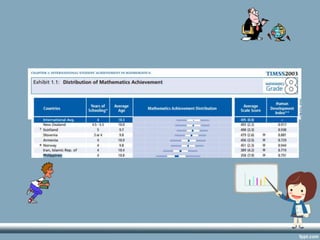
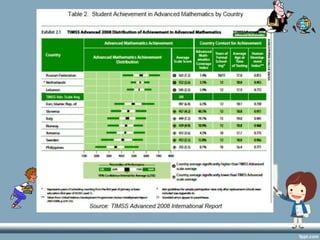
TIMSS advanced results showed that, in general,
Philippines performed least among ten (10)
participating countries in mathematics overall and as
well as in specific content areas and cognitive
domains in terms of average scale score and
percent correct responses. Comparing the scale
scores of the students with the benchmark levels,
only 1% of the Filipino students reached the
Advanced level.
Filipino students did relatively better in Geometry
than they did overall and relatively less well in
Calculus.
Most of mathematics teachers are
challenge by:
1. The amount and depth of content in
mathematics that is available for them to
learn they could teach good and correct
mathematics to students;
2. The varied cognitive of students requiring
a wide range of pedagogical approaches to
learning mathematics.
3. The unpredictability of students contexts
and behavior there days that require
teachers to be armed with multiple ideas for
managing students, class behavior and
resources.
4. The existence of various types of
technologies and their rapid advancement.
5. The perceived disconnect between school
mathematics and everyday life.
6. Their role as models of positive values
and attitude, which would carry students far
in their lives and careers,
7. The need to continuously develop
themselves in the teaching profession

Framework for mathematics teacher education

  • 1.
  • 2.
    Performance of Philippinesin the international
  • 5.
    TIMSS advanced resultsshowed that, in general, Philippines performed least among ten (10) participating countries in mathematics overall and as well as in specific content areas and cognitive domains in terms of average scale score and percent correct responses. Comparing the scale scores of the students with the benchmark levels, only 1% of the Filipino students reached the Advanced level. Filipino students did relatively better in Geometry than they did overall and relatively less well in Calculus.
  • 6.
    Most of mathematicsteachers are challenge by: 1. The amount and depth of content in mathematics that is available for them to learn they could teach good and correct mathematics to students; 2. The varied cognitive of students requiring a wide range of pedagogical approaches to learning mathematics.
  • 7.
    3. The unpredictabilityof students contexts and behavior there days that require teachers to be armed with multiple ideas for managing students, class behavior and resources. 4. The existence of various types of technologies and their rapid advancement.
  • 8.
    5. The perceiveddisconnect between school mathematics and everyday life. 6. Their role as models of positive values and attitude, which would carry students far in their lives and careers, 7. The need to continuously develop themselves in the teaching profession