Workshop Technology &
Practice
ET11023
Lecture 9
Foundry Workshop Part 02
Eng. ThimiraNimsaraDulanjana
BSc Eng (Hon’s) UOM, AMIE(SL),ECSL
Department of Engineering Technology,
Sabaragamuwa University of Sri Lanka
11/21/2024 ET11023 1
❖All the authors of original materials (figures, photos, diagrams
and etc.)
❖Manufacturing Engineering and Technology, Sixth edition - Serope
Kalpakjian, Steven
R. Schmid, Hamldon Musa
❖A Textbook of Workshop Technology, - R.S Khurmi, J. K Gupta
❖Lecture notes;- by Mr. Buddhika Sampath, University of Moratuwa
Acknowledgment
11/21/2024 ET11023 2
1. Introduction to workshops
2. Workshop Safety Practices
3. Sheet Metal Workshop and Equipment
4. Metal Joining Part 01
1. Rivets
2. Nut and Bolts
3. Welding-Liquid state welding/Fusion Welding
5. Metal Joining Part 02
1. Solid state welding
2. Brazing and Soldering
6. Foundry Workshop Part 01
1. Introduction foundry
2. Terminologies used in casting
7. Foundry Workshop Part 02
1. Sand Casting
2. Other Casting Processes
3. Furnace
11/21/2024 ET11023 3
11/21/2024 ET11023 4
1
Introduction:
Safety practices in the work place, personal safety equipment, use of correct tools,
correct use of tools, fitting operations.
LO-1
2
Sheet Metal Works:
Introduction, sheet metal tools, marking and layout, operations – bending, cutting,
rolling, soldering
LO-1, LO-2,
LO-3
3
Foundry Practice:
Introduction, casting processes, pattern making, foundry tools, core making, melting
furnace – cupola, sand casting, die casting
LO-1, LO-2
4
Forging Practice:
Introduction, forging tools, operations – upsetting, drawing, cutting, bending,
punching, forging presses and hammers, advantages and limitations
LO-1, LO-2
5
Metal Joining:
Safety considerations, introduction, soldering, brazing, welding – gas welding, arc
welding, resistance welding, tungsten inert gas welding (TIG), metal inert gas welding
(MIG)
LO-1, LO-2,
LO-3
6
Operation of workshop machinery:
Introduction to workshop machinery, their functions, limitations, lathe machines,
m1
i1
l/
l4
in
/20
g
21
machines, drilling machines.
LO-1, LO-2,
LO-4
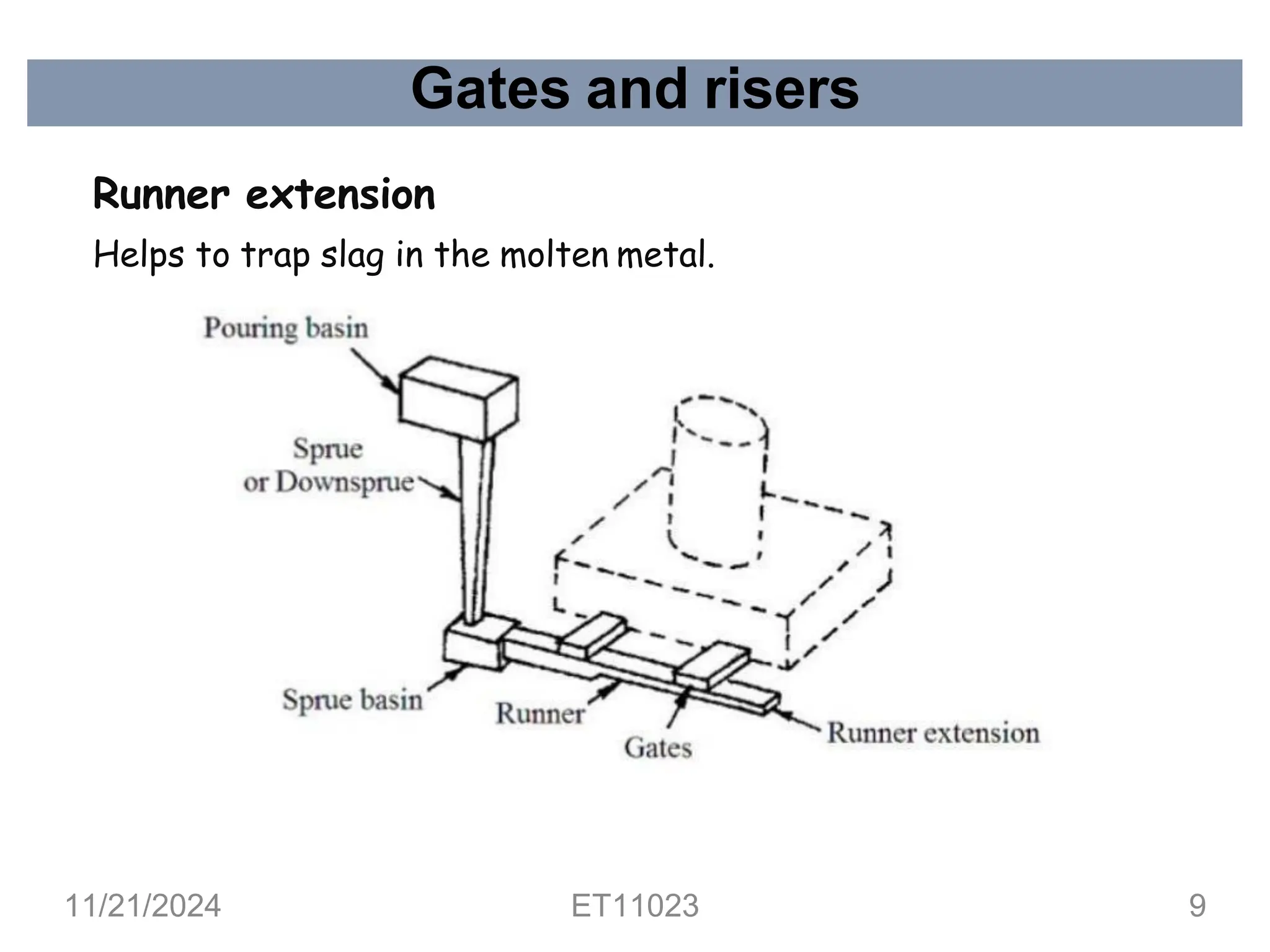
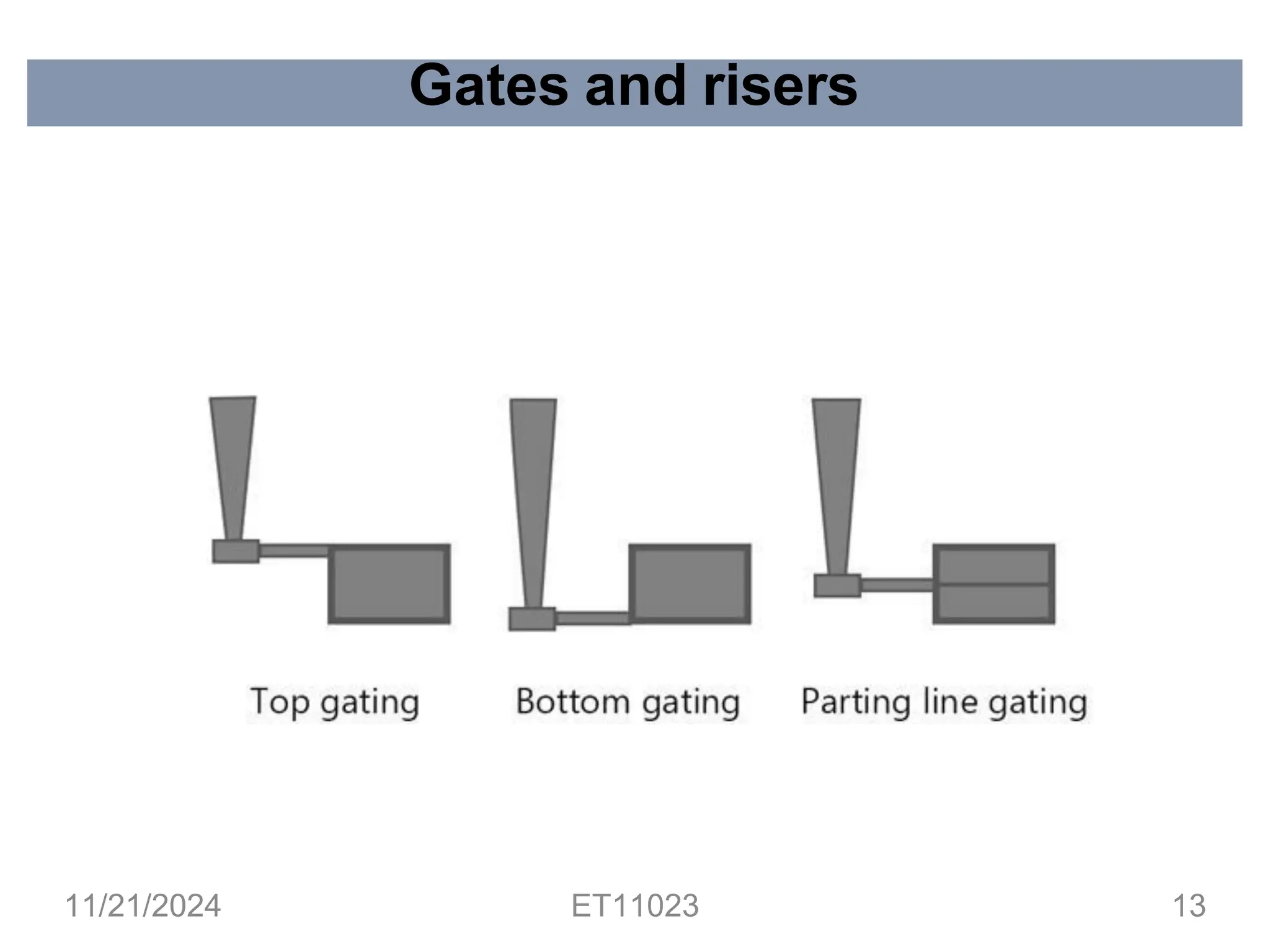
Gates and risers
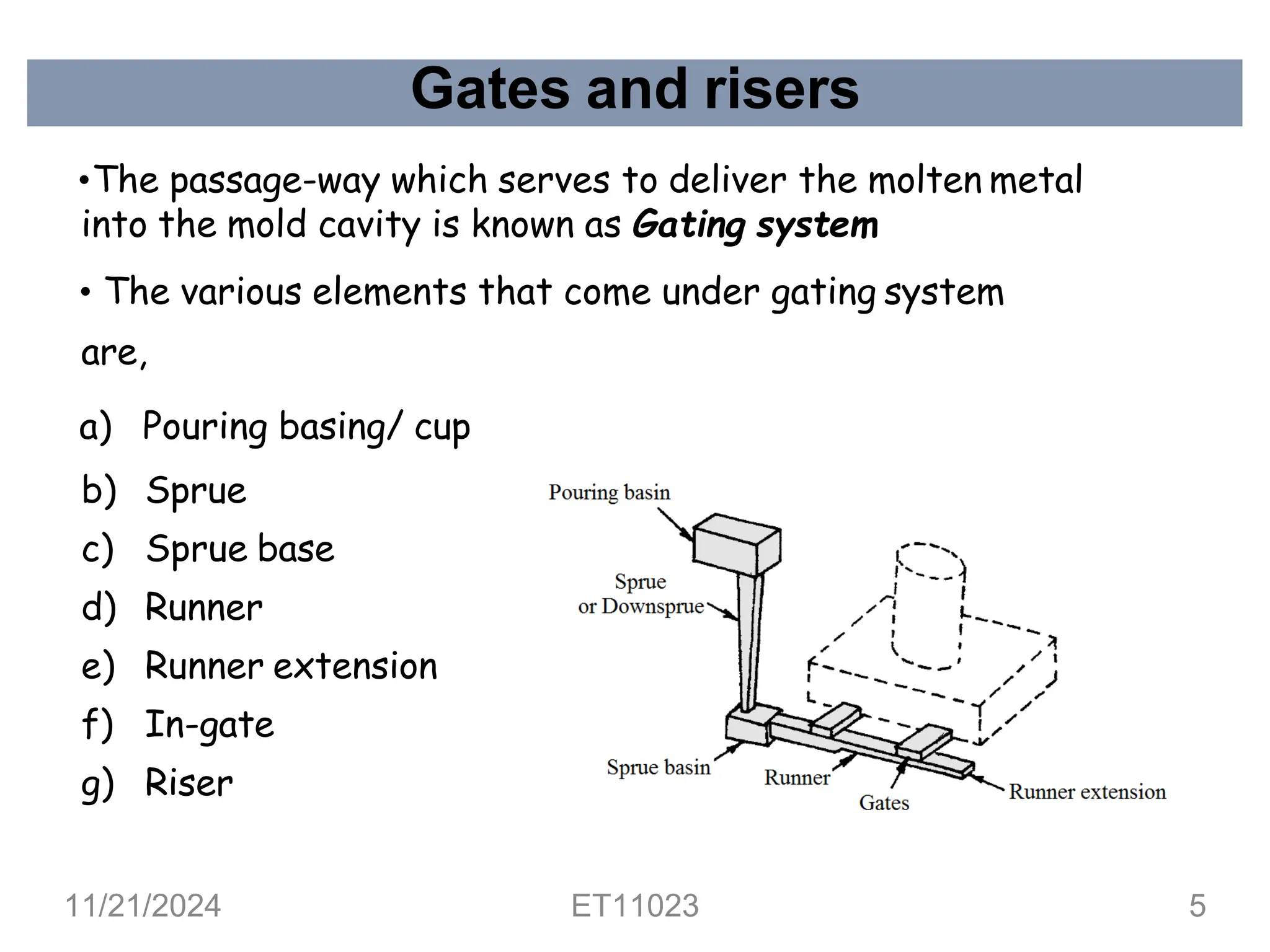
•The passage-way which serves to deliver the molten metal
into the mold cavity is known as Gating system
• The various elements that come under gating system
are,
a) Pouring basing/ cup
b) Sprue
c) Sprue base
d) Runner
e) Runner extension
f) In-gate
g) Riser
11/21/2024 ET11023 5
Gates and risers
✓ Designing a gating system requires careful consideration according
to the technology, materials, and castings.
✓ This system determines the flow rate of metal to the mold cavity.
✓ If the flow rate is too fast, there is a risk of corrosion while if the
speed is too slow it can cause the metal to be cool before filling the
chamber, which directly affects the quality of the casting.
✓ The shape and size of the gating system in casting are properly
arranged when making the mold. If the gating system is not designed
properly, it can cause severe casting defects.
11/21/2024 ET11023 6
Gates and risers
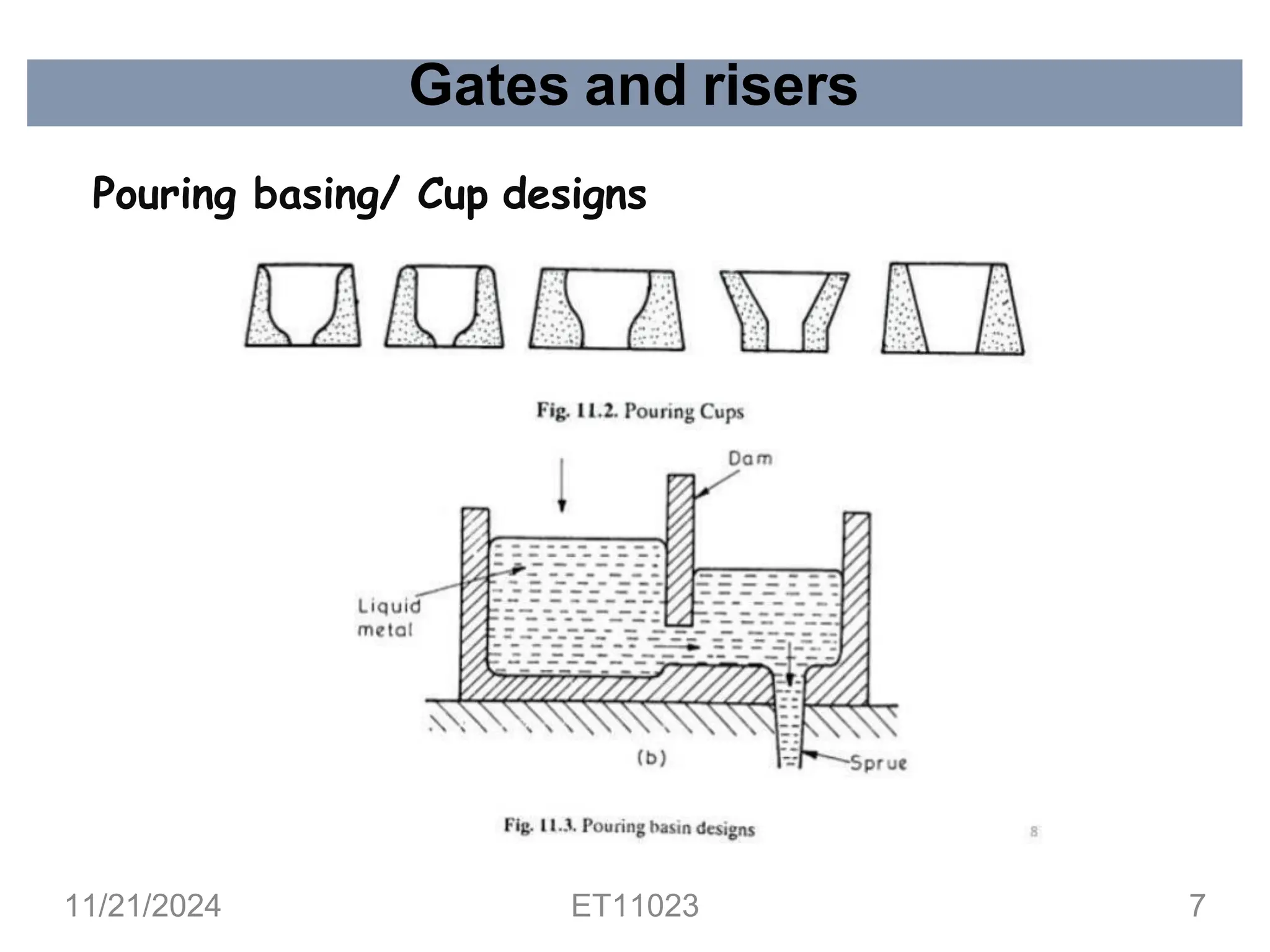
Pouring basing/ Cup designs
11/21/2024 ET11023 7
Gates and risers
Pouring basing/ Cup designs
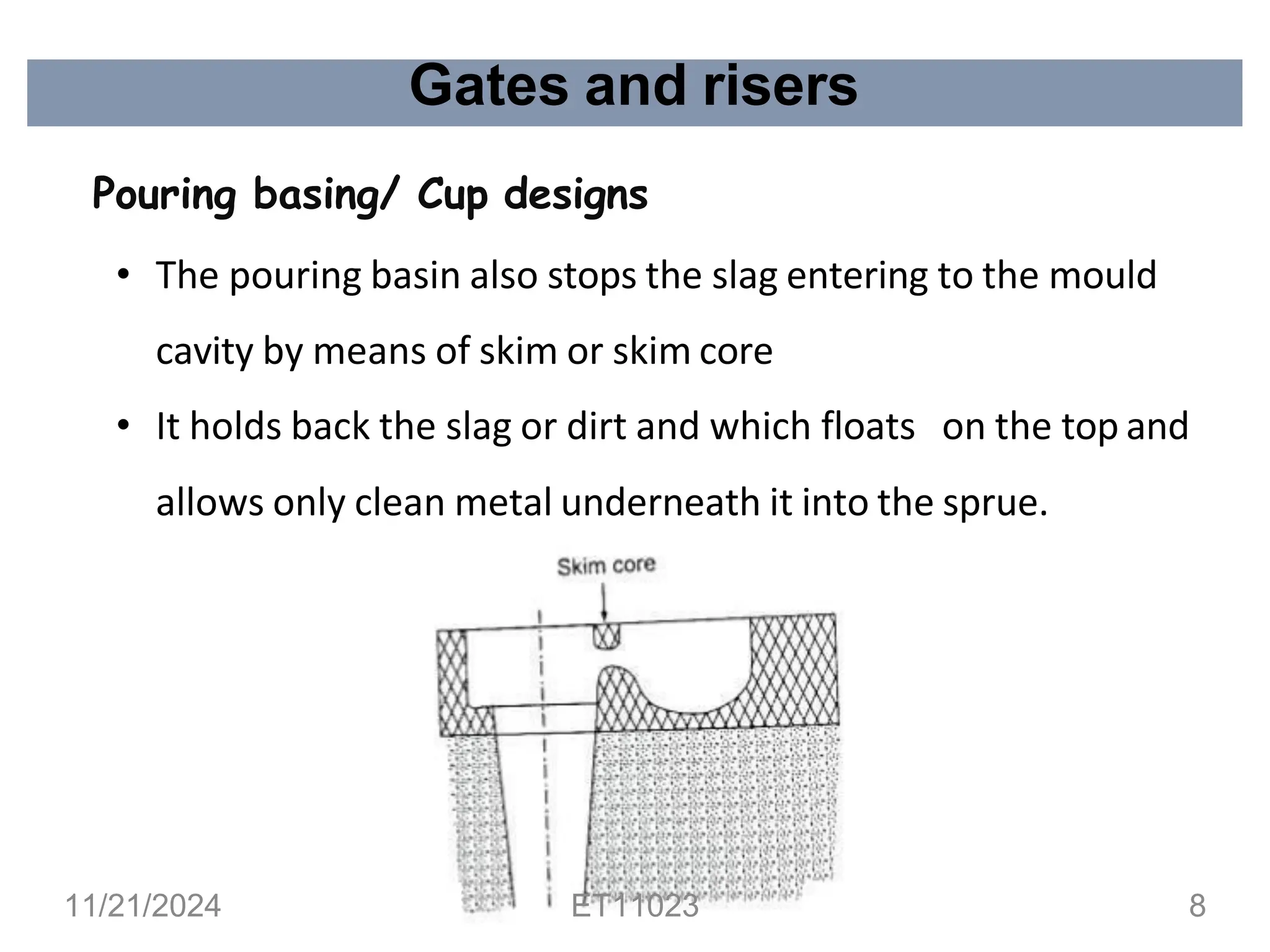
• The pouring basin also stops the slag entering to the mould
cavity by means of skim or skim core
• It holds back the slag or dirt and which floats on the top and
allows only clean metal underneath it into the sprue.
11/21/2024 ET11023 8
Gates and risers
Runner extension
Helps to trap slag in the molten metal.
11/21/2024 ET11023 9
Gates and risers
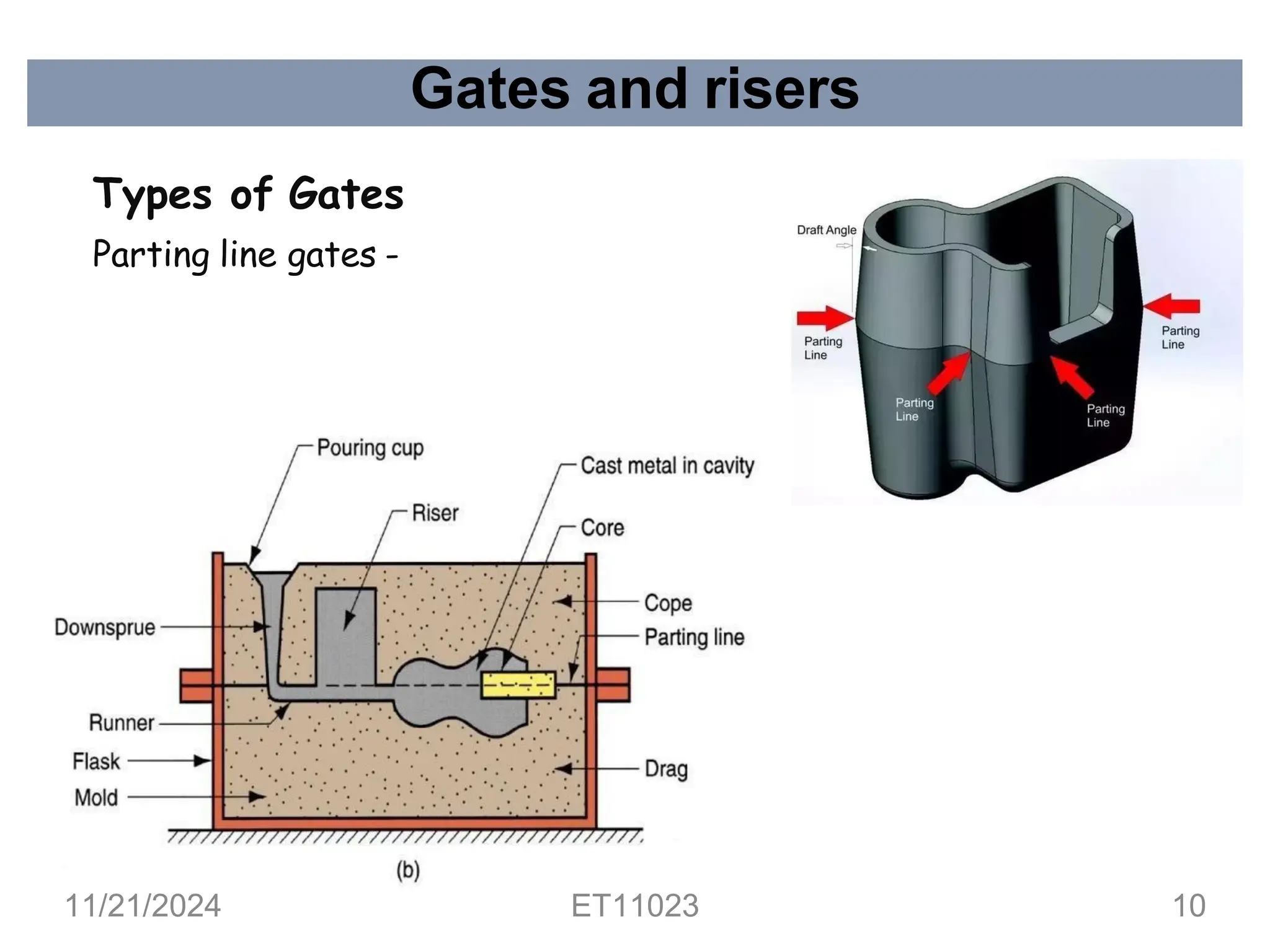
Types of Gates
Parting line gates -
11/21/2024 ET11023 10
Gates and risers
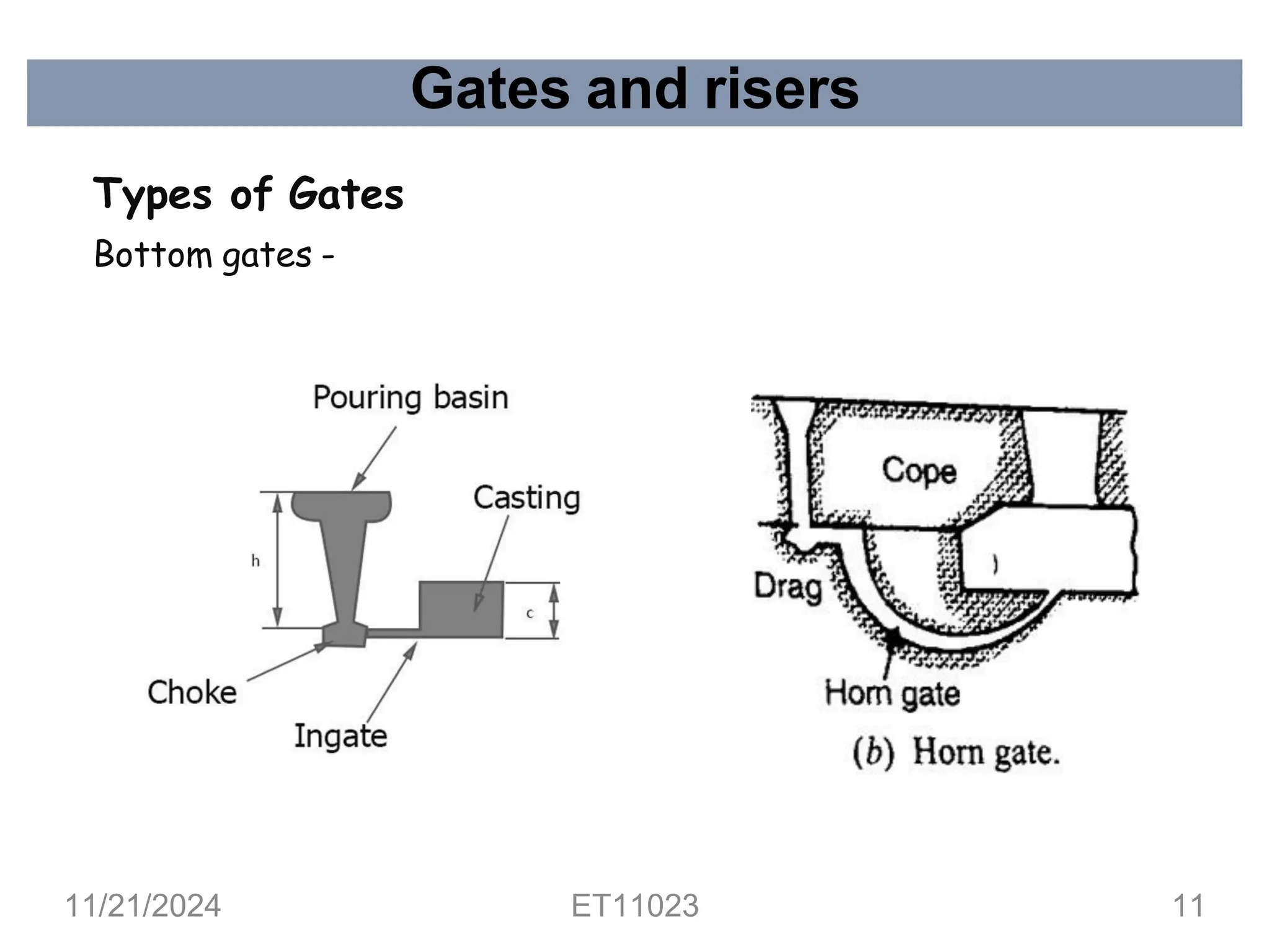
Types of Gates
Bottom gates -
11/21/2024 ET11023 11
Gates and risers
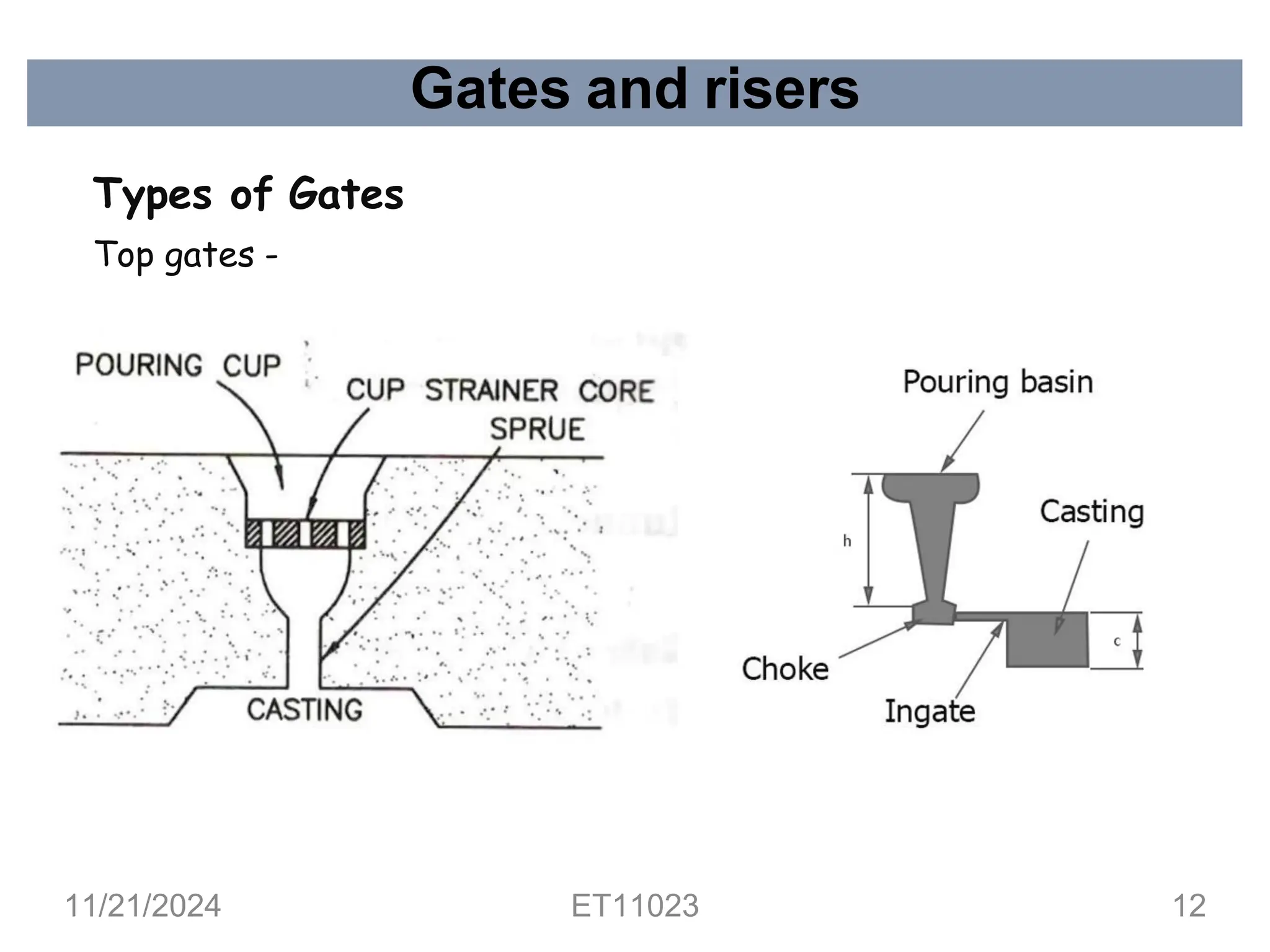
Types of Gates
Top gates -
11/21/2024 ET11023 12
Gates and risers
11/21/2024 ET11023 13
Gates and risers
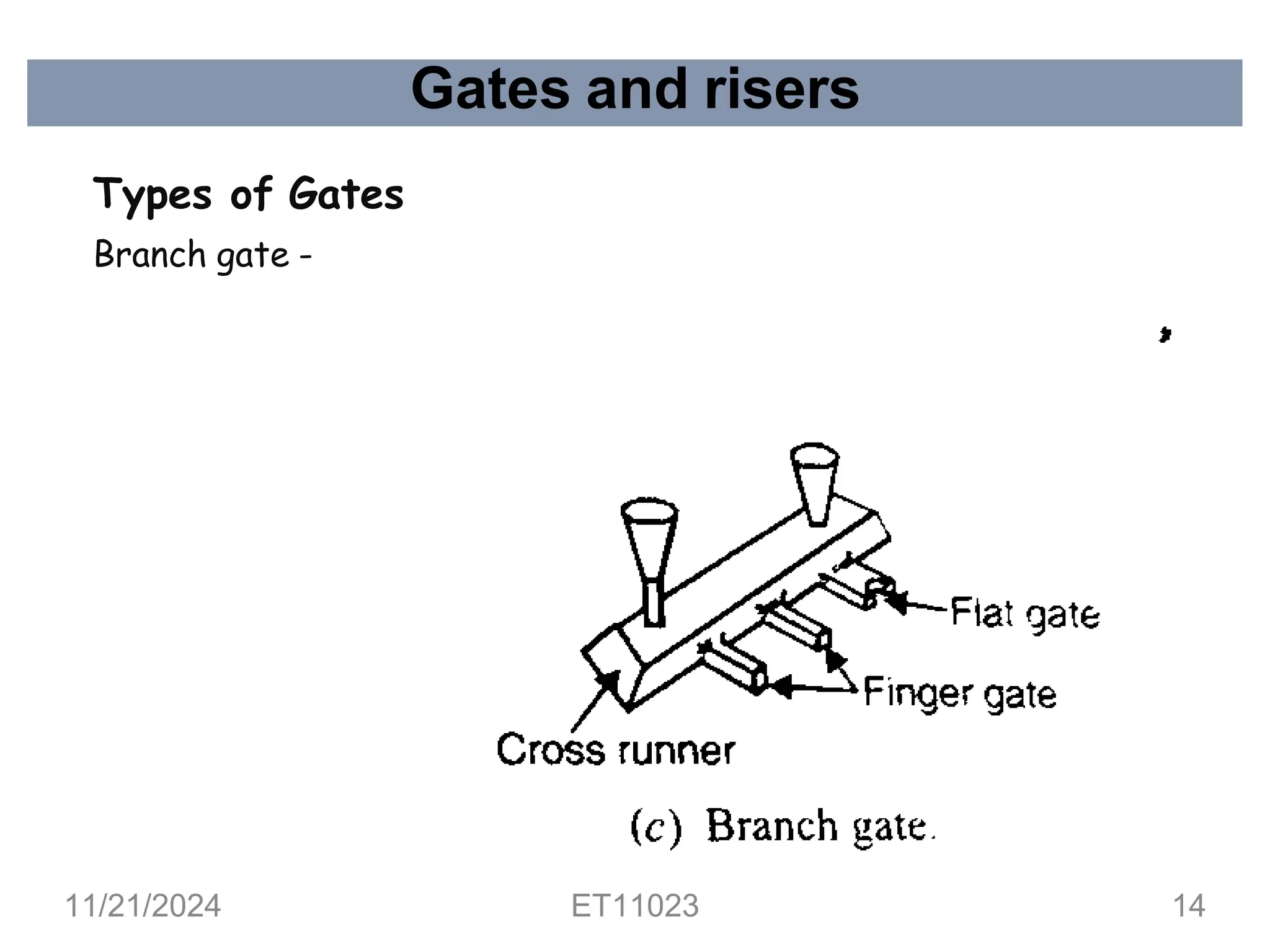
Types of Gates
Branch gate -
11/21/2024 ET11023 14
Gates and risers
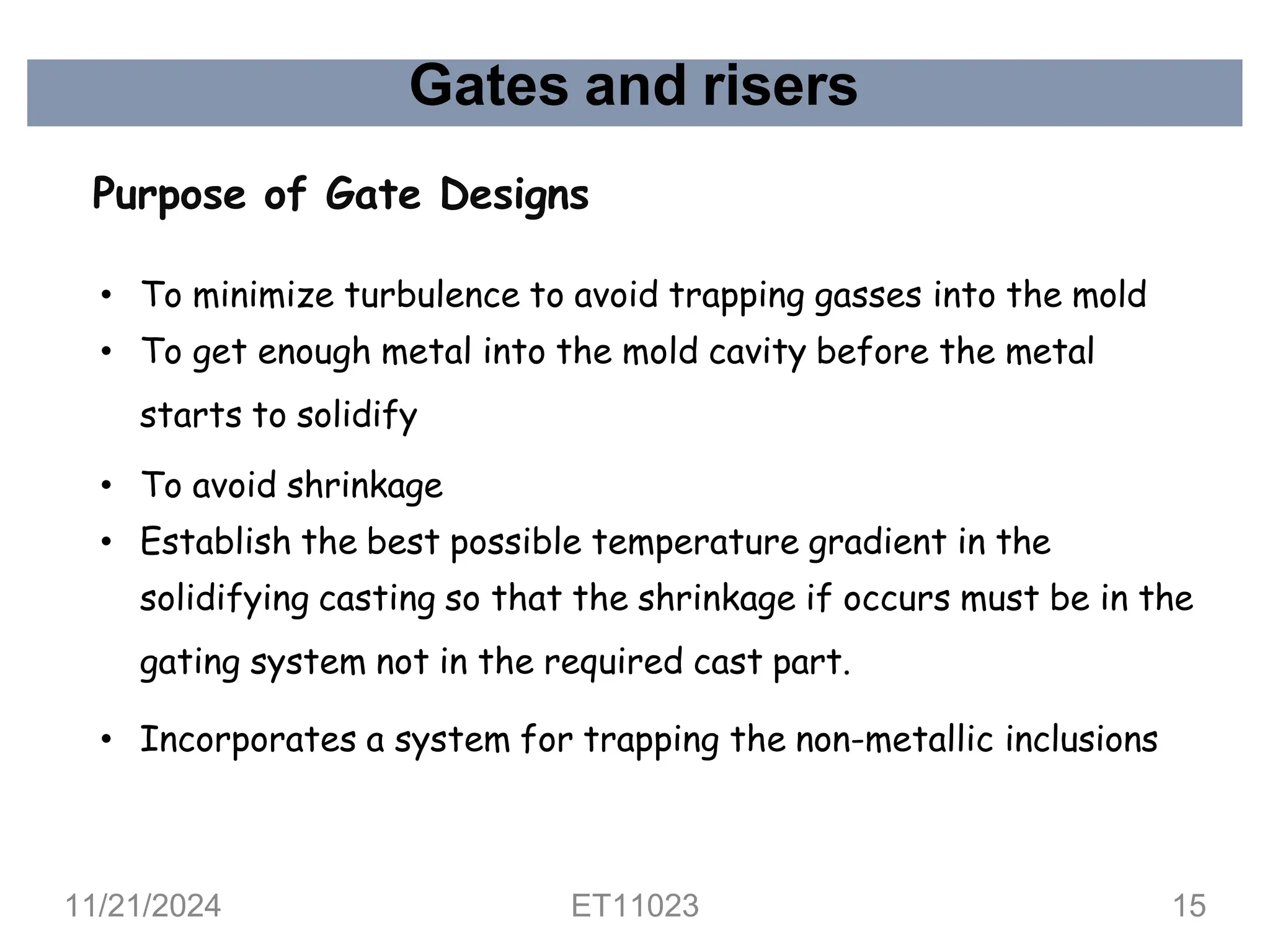
Purpose of Gate Designs
• To minimize turbulence to avoid trapping gasses into the mold
• To get enough metal into the mold cavity before the metal
starts to solidify
• To avoid shrinkage
• Establish the best possible temperature gradient in the
solidifying casting so that the shrinkage if occurs must be in the
gating system not in the required cast part.
• Incorporates a system for trapping the non-metallic inclusions
11/21/2024 ET11023 15
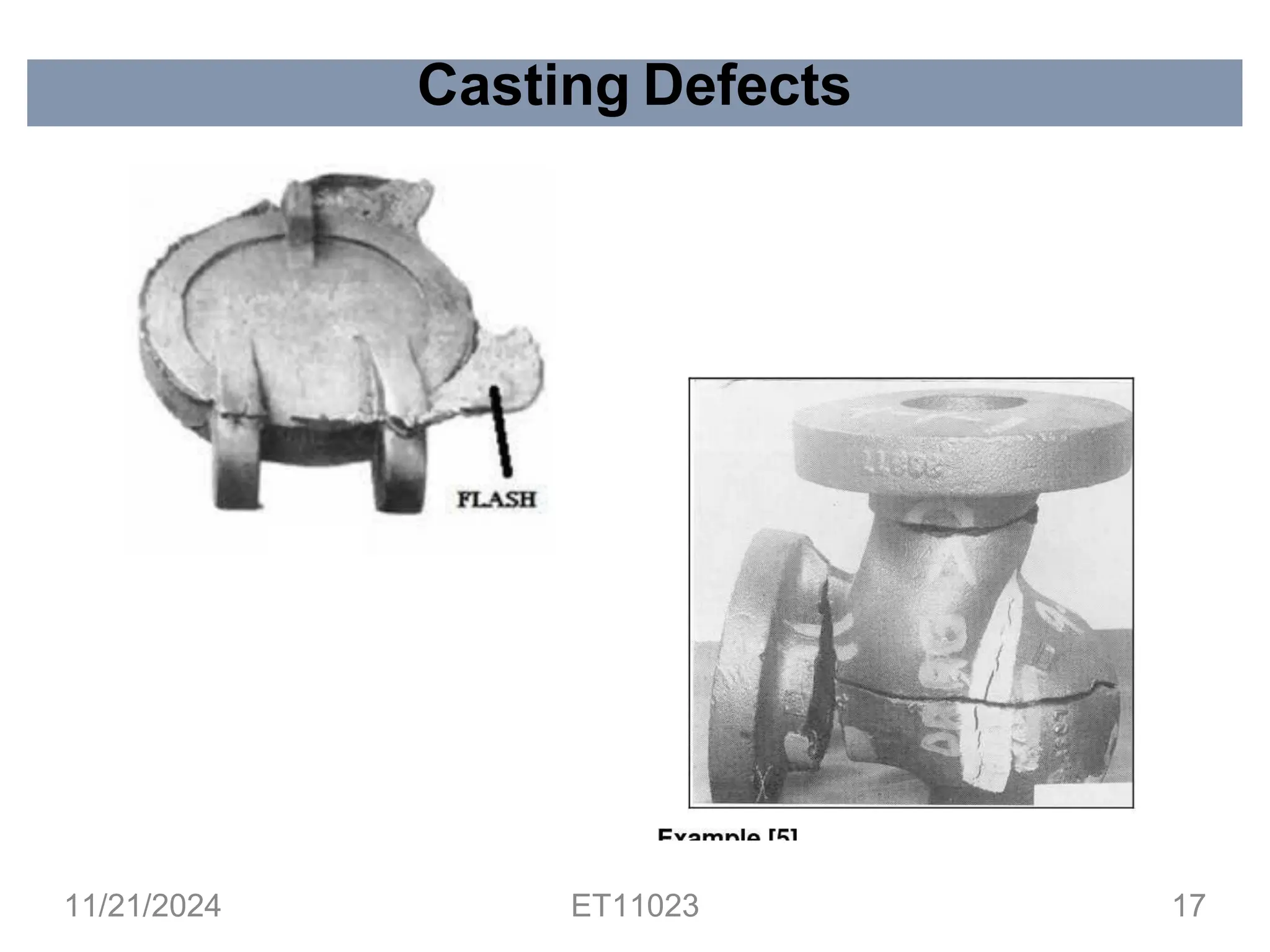
Casting Defects
• Metallic projections (Ex: Flashes)
• Cavities
• Porosity
• Discontinuities
• Defective surface
• Incomplete casting
• Incorrect dimensions or shape
• Inclusions
11/21/2024 ET11023 16
Casting Defects
11/21/2024 ET11023 17
Casting Defects
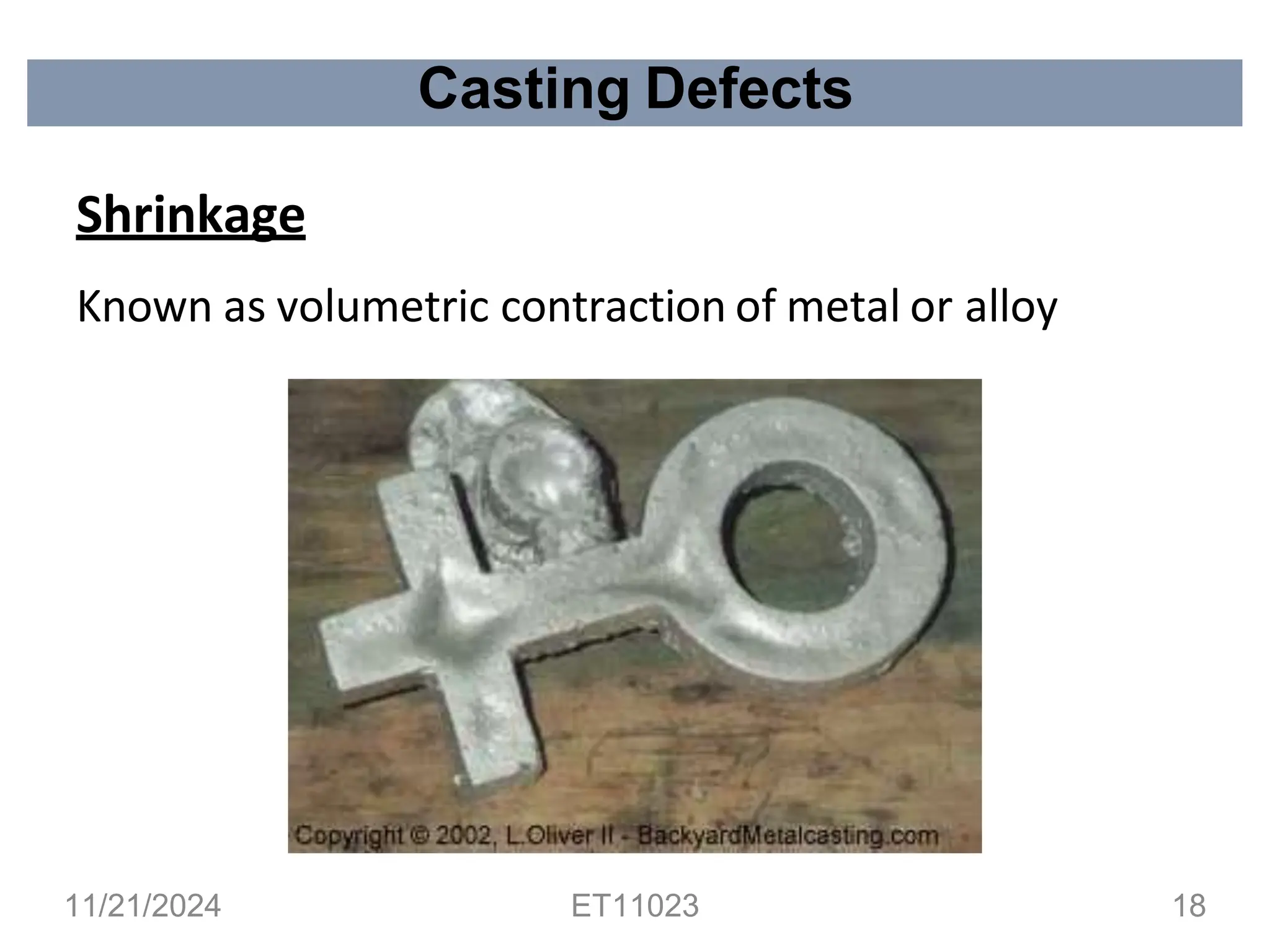
Shrinkage
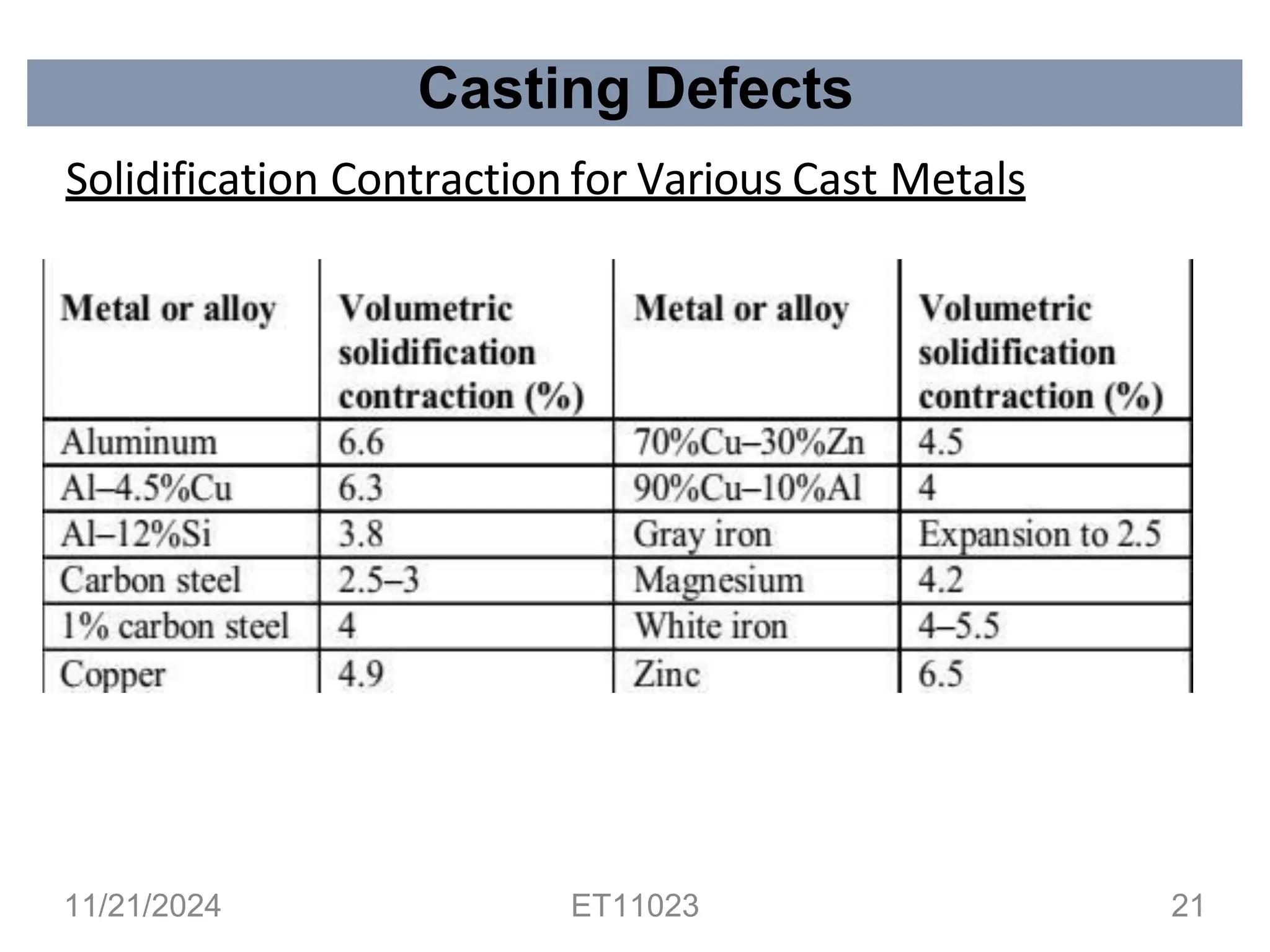
Known as volumetric contraction of metal or alloy
11/21/2024 ET11023 18
Casting Defects
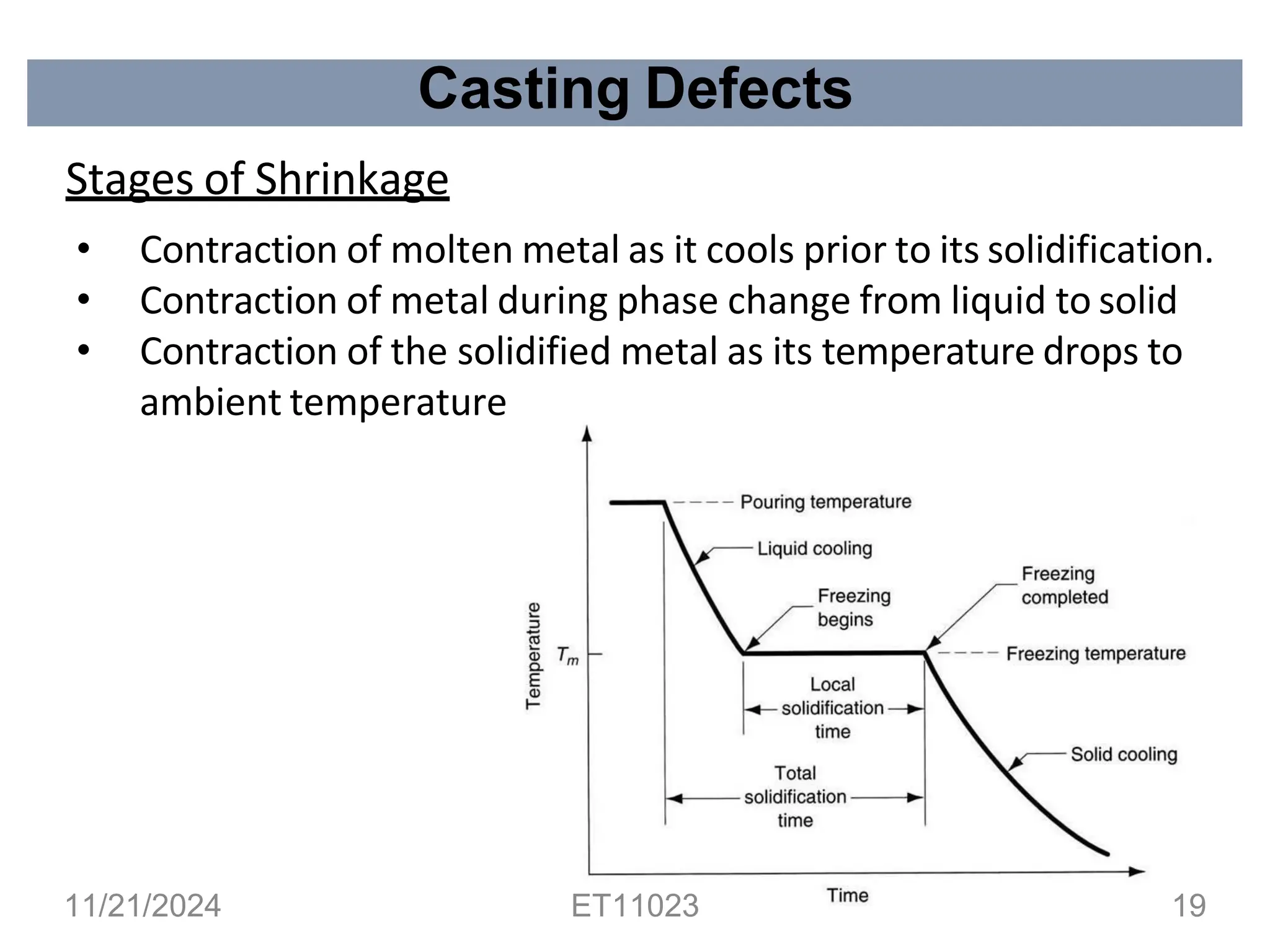
Stages of Shrinkage
• Contraction of molten metal as it cools prior to its solidification.
• Contraction of metal during phase change from liquid to solid
• Contraction of the solidified metal as its temperature drops to
ambient temperature
11/21/2024 ET11023 19
Casting Defects
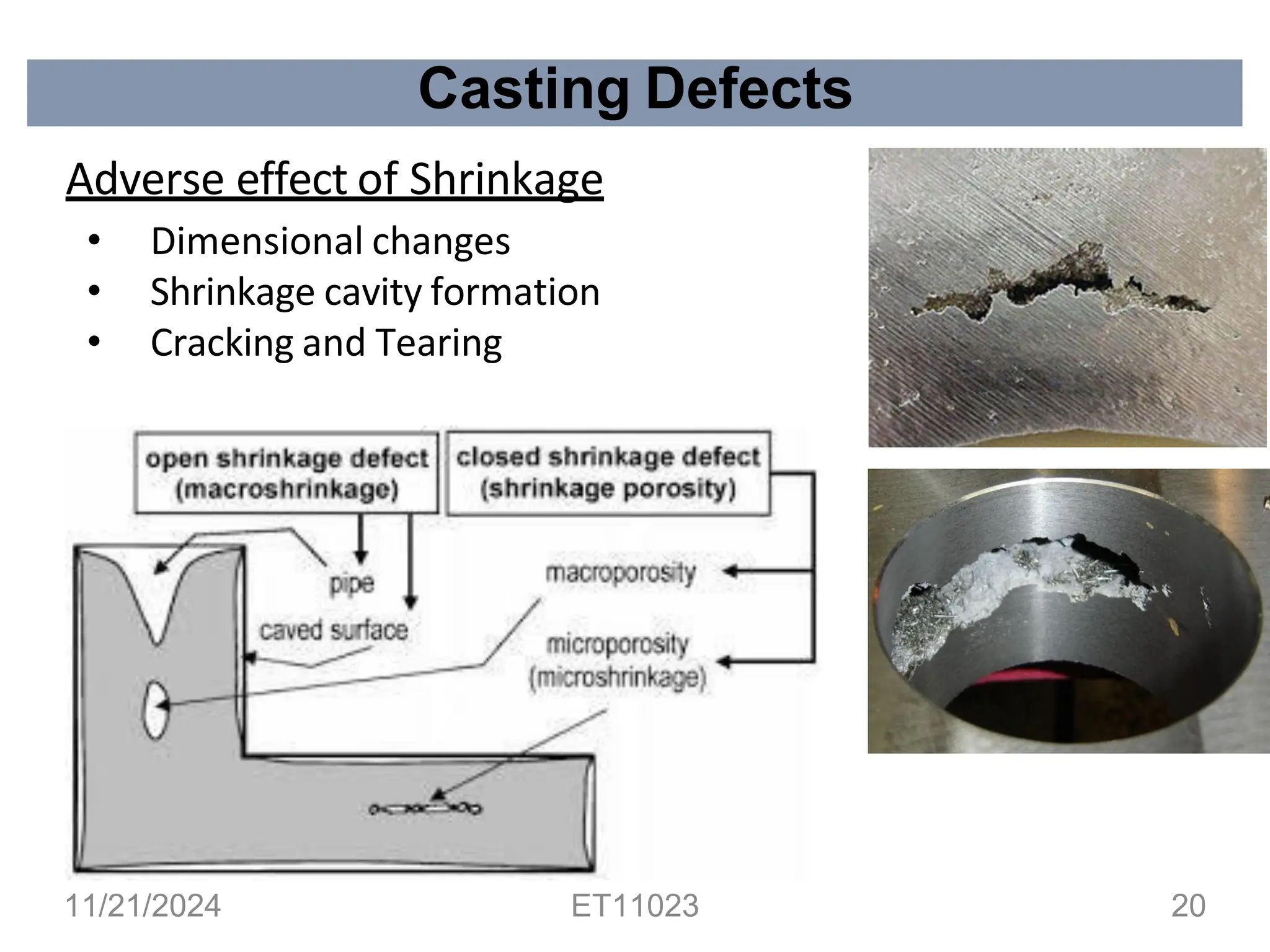
Adverse effect of Shrinkage
• Dimensional changes
• Shrinkage cavity formation
• Cracking and Tearing
11/21/2024 ET11023 20
Casting Defects
Solidification Contraction for Various Cast Metals
11/21/2024 ET11023 21
Casting Defects
Porosity
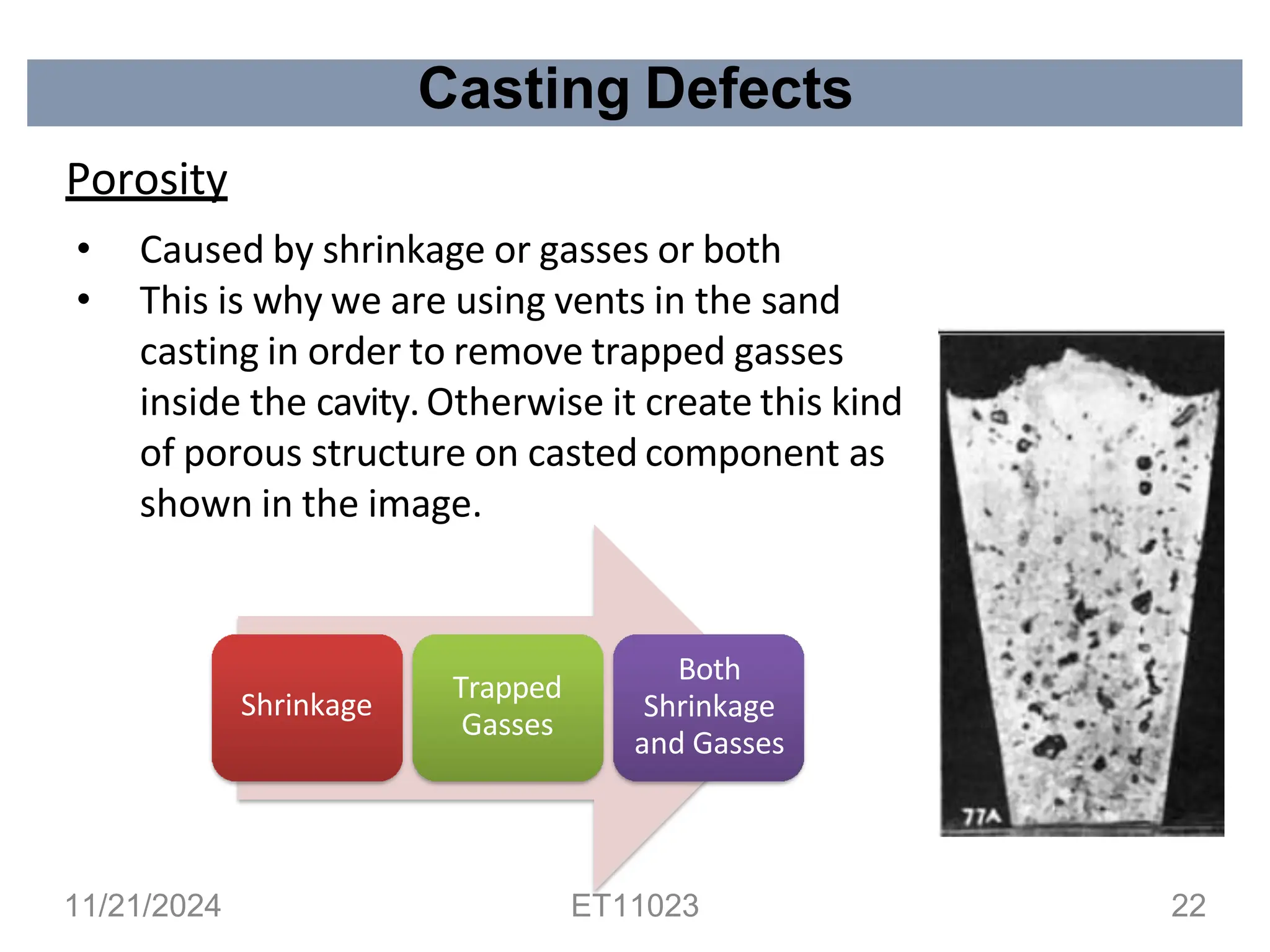
• Caused by shrinkage or gasses or both
• This is why we are using vents in the sand
casting in order to remove trapped gasses
inside the cavity.Otherwise it create this kind
of porous structure on casted component as
shown in the image.
Shrinkage
Trapped
Gasses
Both
Shrinkage
and Gasses
11/21/2024 ET11023 22
Casting Defects
Adverse effects of Porosity
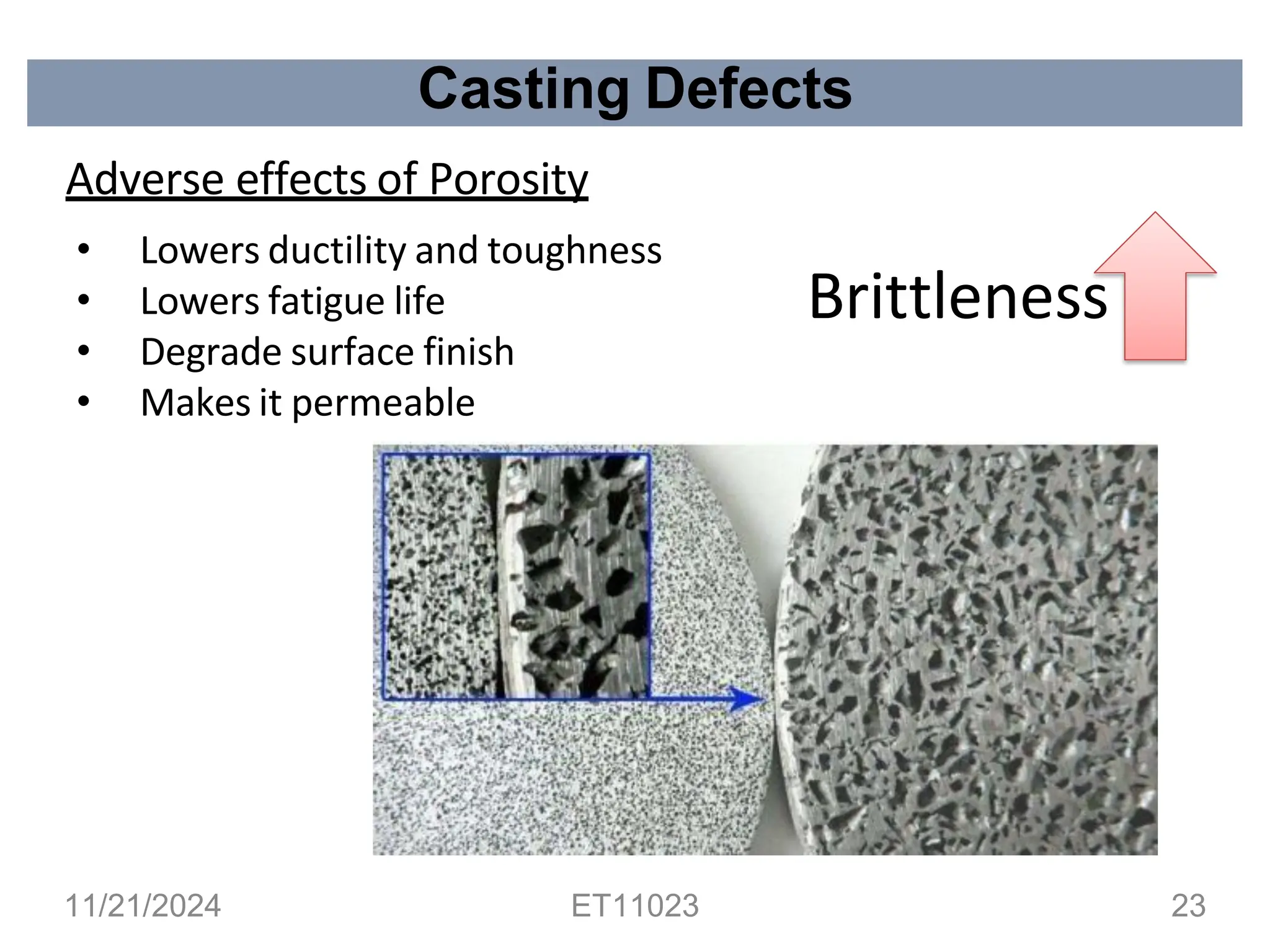
• Lowers ductility and toughness
• Lowers fatigue life
• Degrade surface finish
• Makes it permeable
Brittleness
11/21/2024 ET11023 23
Casting Defects
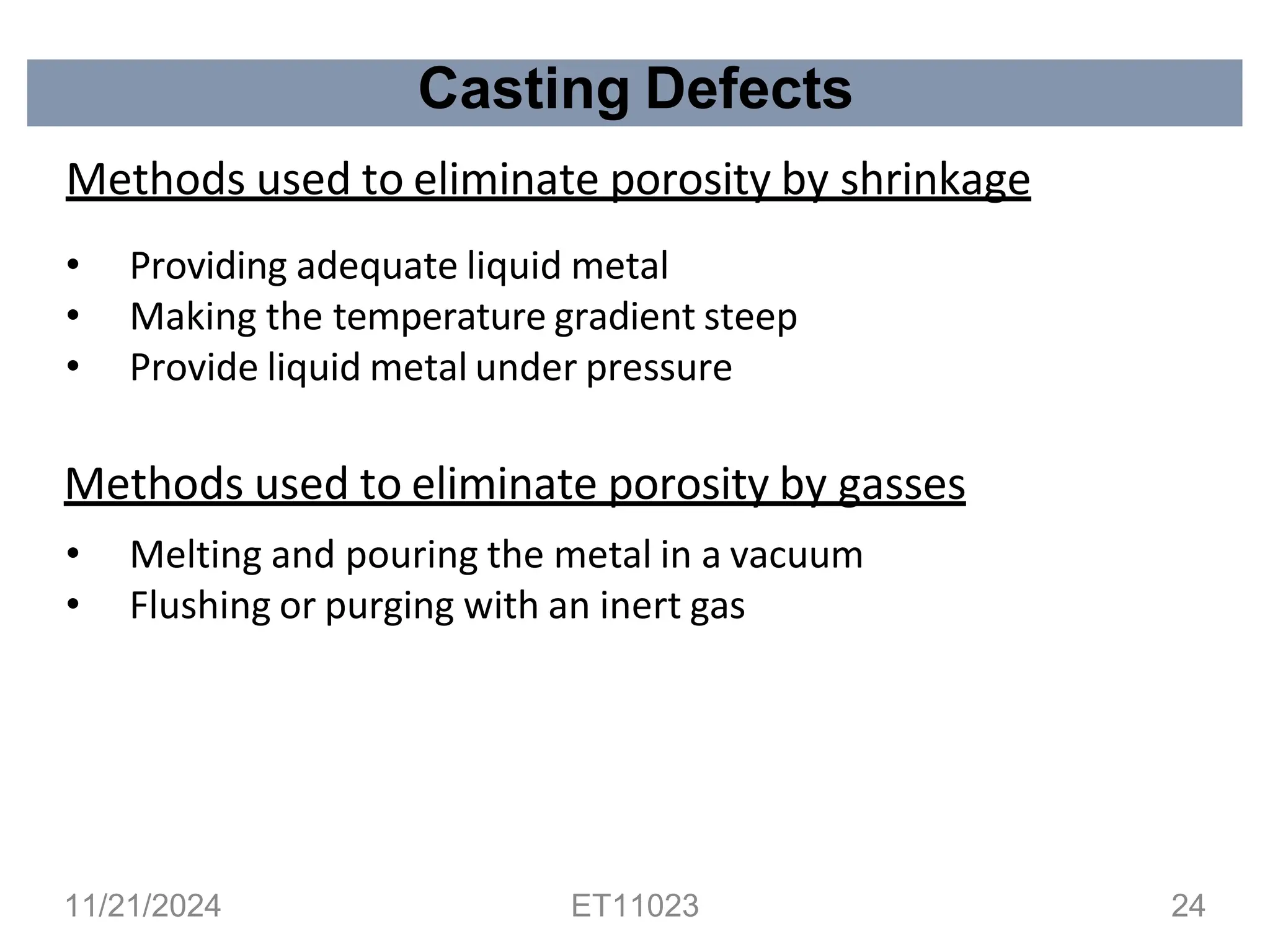
Methods used to eliminate porosity by shrinkage
• Providing adequate liquid metal
• Making the temperature gradient steep
• Provide liquid metal under pressure
Methods used to eliminate porosity by gasses
• Melting and pouring the metal in a vacuum
• Flushing or purging with an inert gas
11/21/2024 ET11023 24
Casting Defects
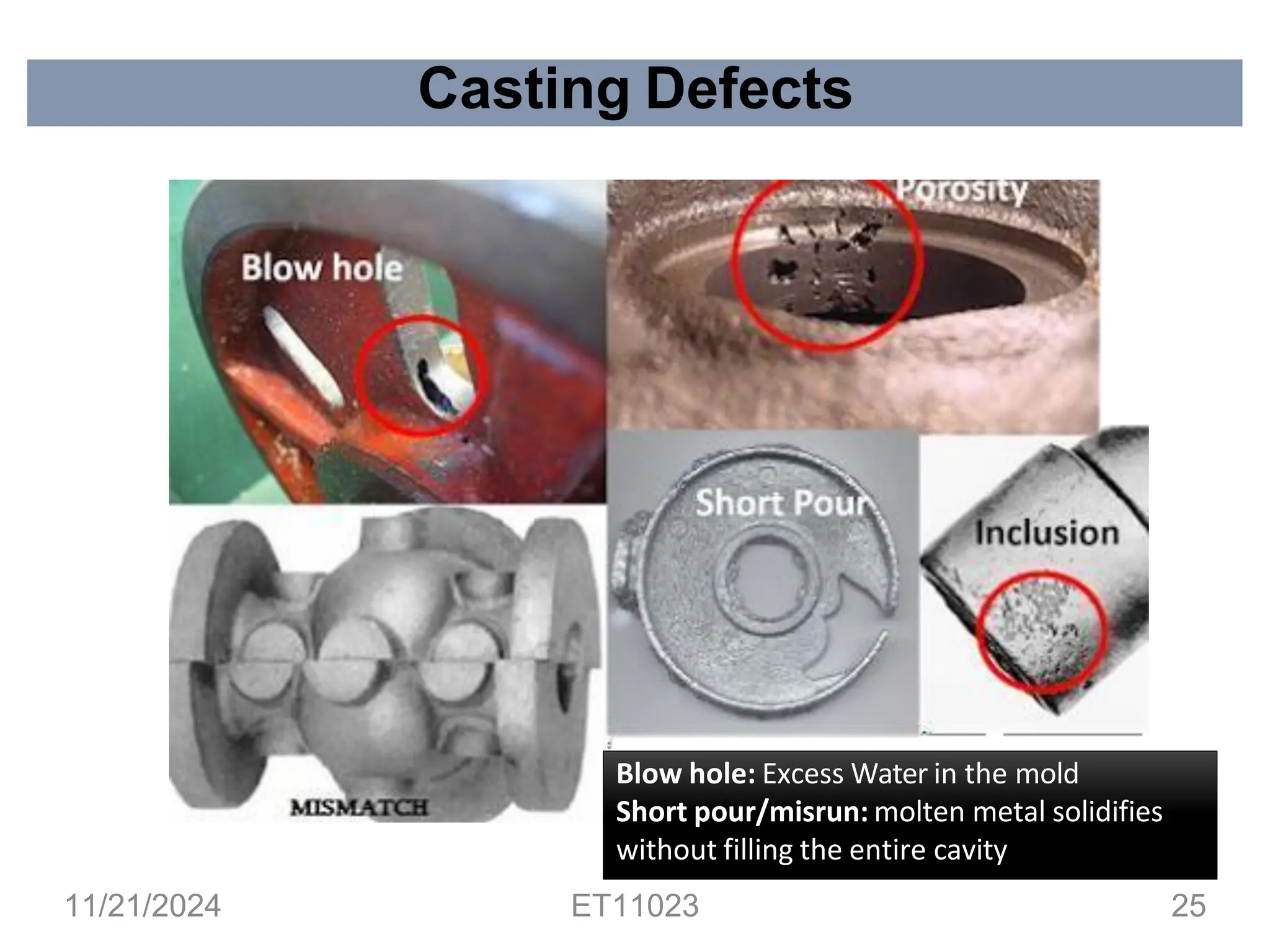
Blow hole: Excess Water in the mold
Short pour/misrun: molten metal solidifies
without filling the entire cavity
11/21/2024 ET11023 25
Casting Defects
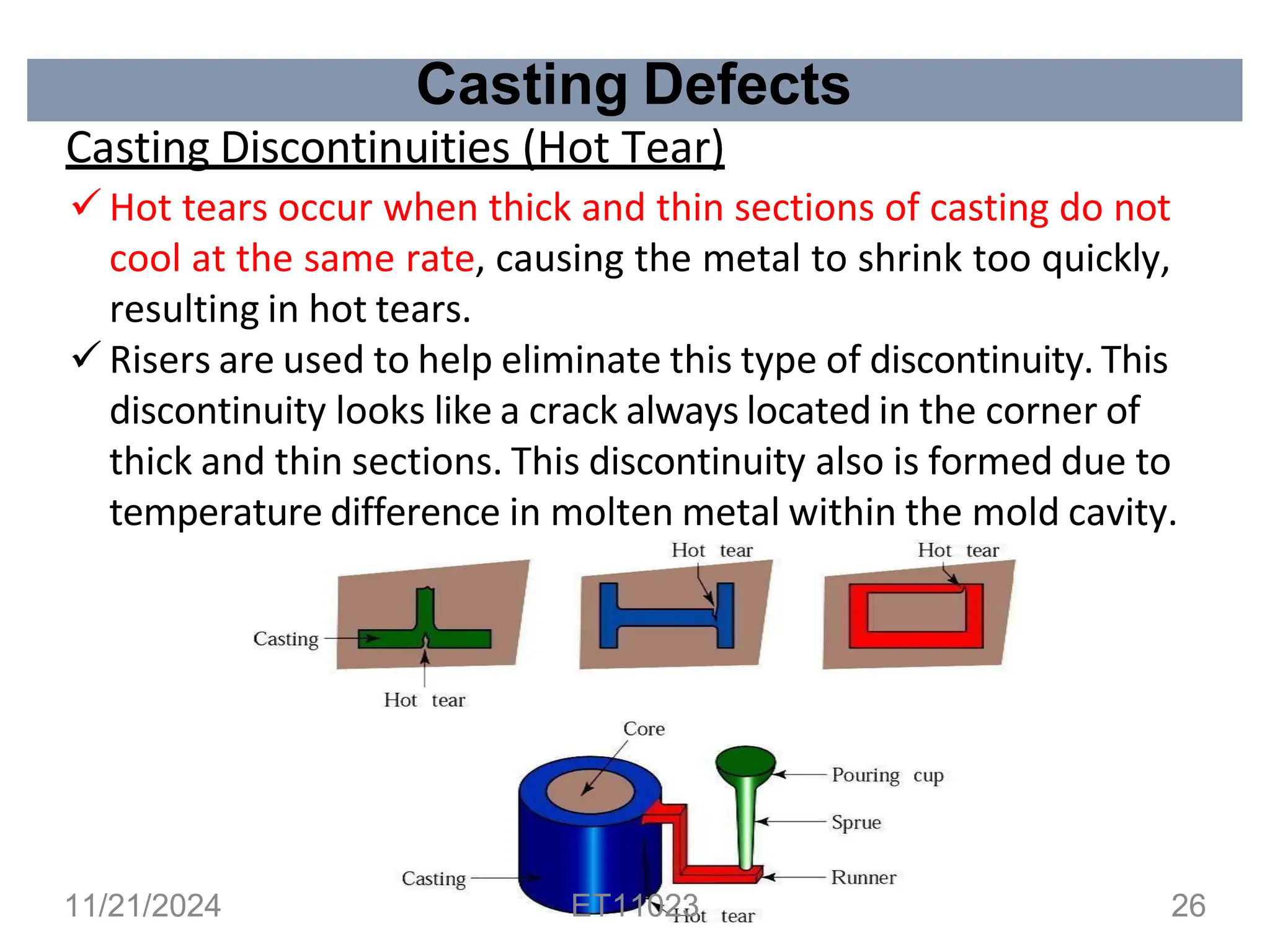
Casting Discontinuities (Hot Tear)
✓ Hot tears occur when thick and thin sections of casting do not
cool at the same rate, causing the metal to shrink too quickly,
resulting in hot tears.
✓ Risers are used to help eliminate this type of discontinuity. This
discontinuity looks like a crack always located in the corner of
thick and thin sections. This discontinuity also is formed due to
temperature difference in molten metal within the mold cavity.
11/21/2024 ET11023 26
Casting Defects
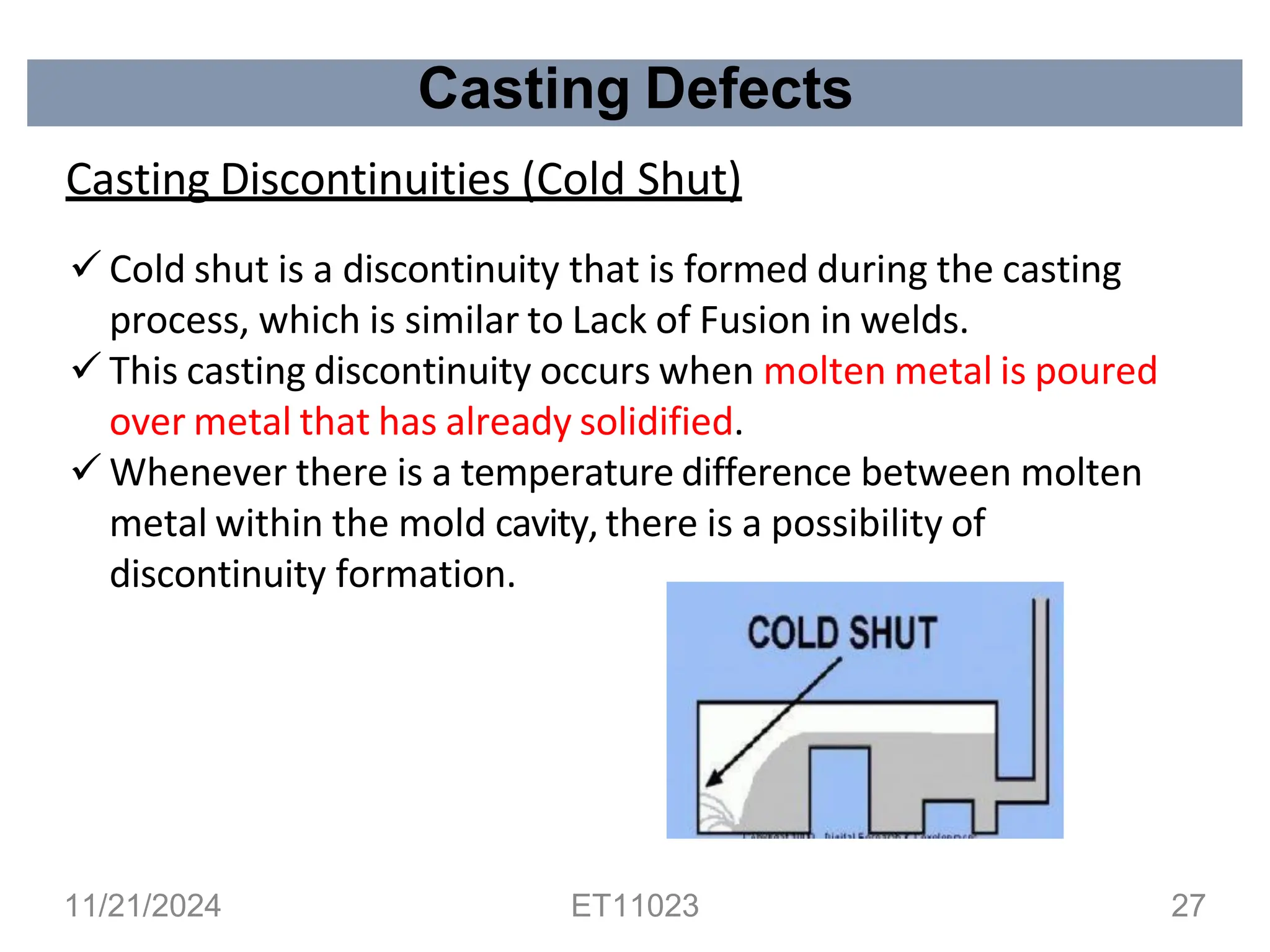
Casting Discontinuities (Cold Shut)
✓ Cold shut is a discontinuity that is formed during the casting
process, which is similar to Lack of Fusion in welds.
✓ This casting discontinuity occurs when molten metal is poured
over metal that has already solidified.
✓ Whenever there is a temperature difference between molten
metal within the mold cavity, there is a possibility of
discontinuity formation.
11/21/2024 ET11023 27
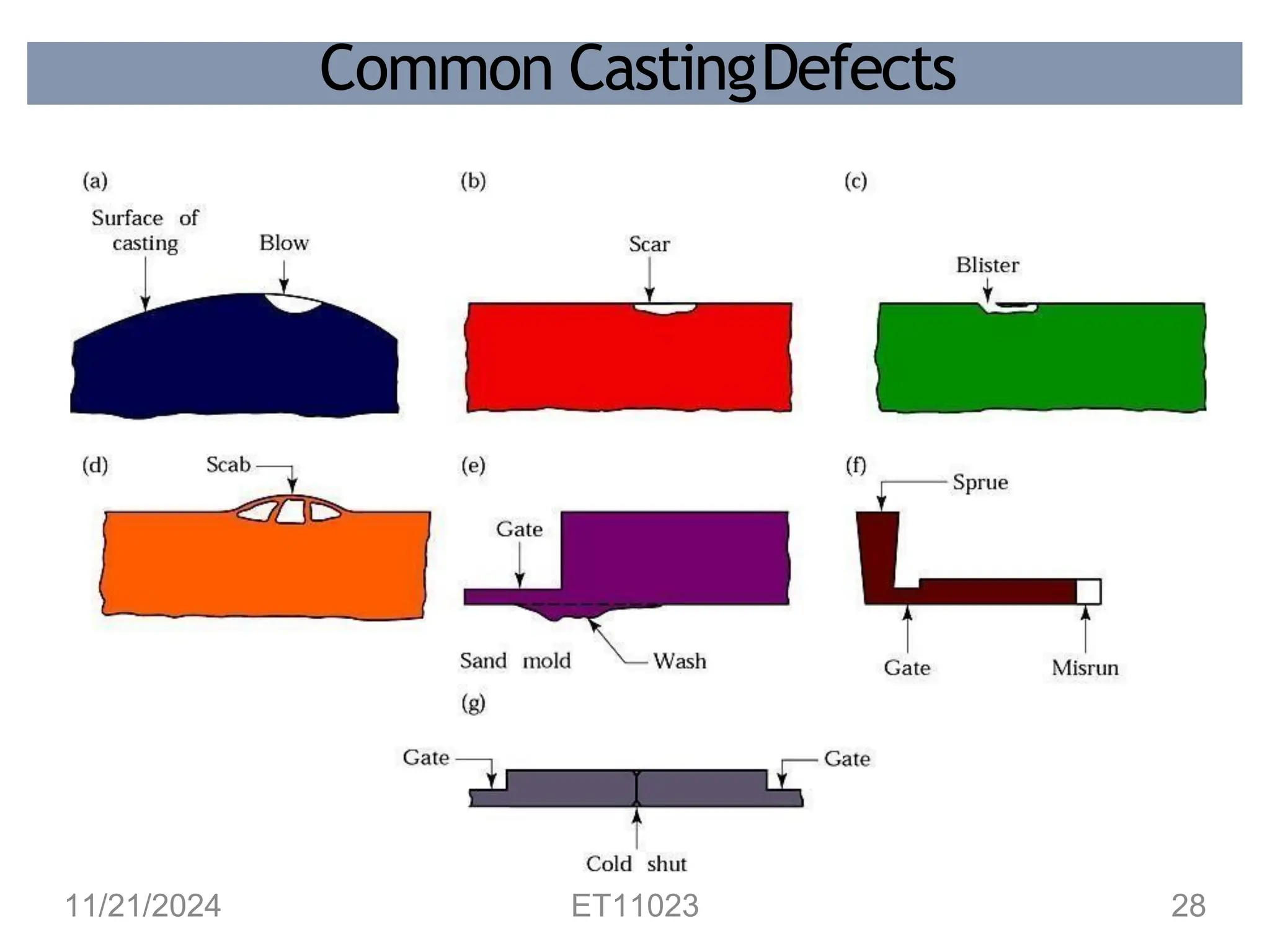
Common CastingDefects
11/21/2024 ET11023 28
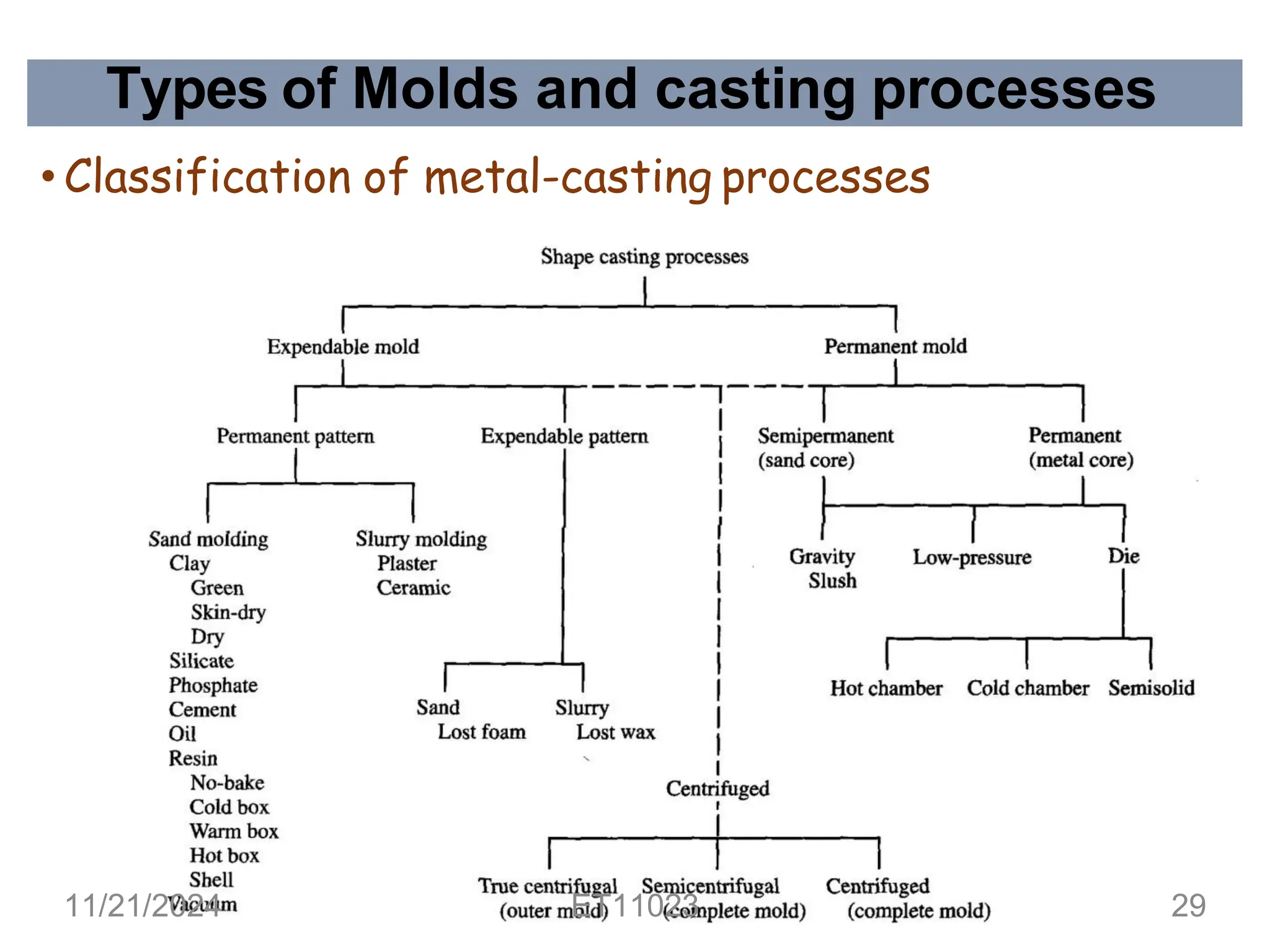
Types of Molds and casting processes
• Classification of metal-casting processes
11/21/2024 ET11023 29
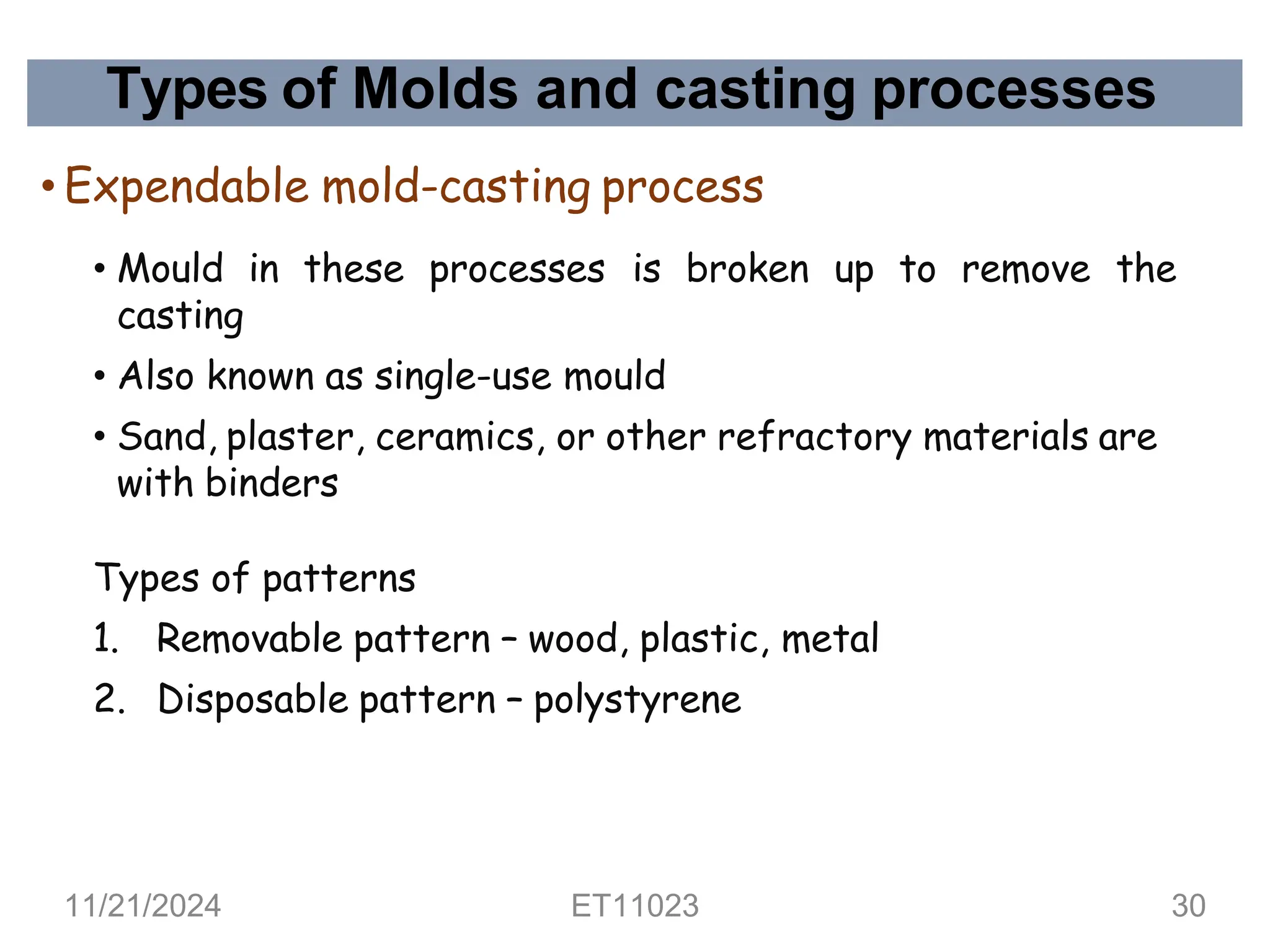
Types of Molds and casting processes
• Expendable mold-casting process
• Mould in these processes is broken up to remove the
casting
• Also known as single-use mould
• Sand, plaster, ceramics, or other refractory materials are
with binders
Types of patterns
1. Removable pattern – wood, plastic, metal
2. Disposable pattern – polystyrene
11/21/2024 ET11023 30
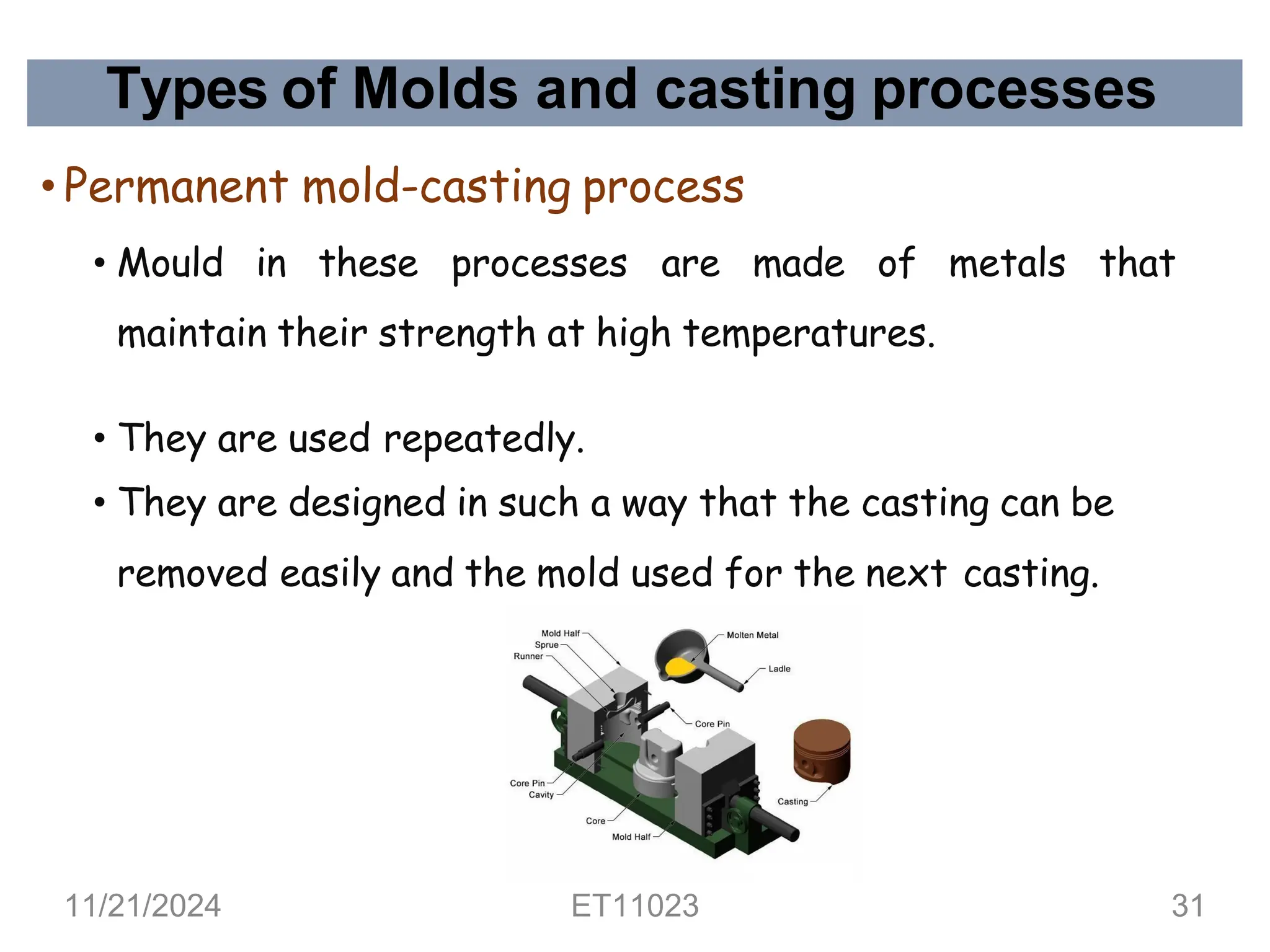
Types of Molds and casting processes
• Permanent mold-casting process
• Mould in these processes are made of metals that
maintain their strength at high temperatures.
• They are used repeatedly.
• They are designed in such a way that the casting can be
removed easily and the mold used for the next casting.
11/21/2024 ET11023 31
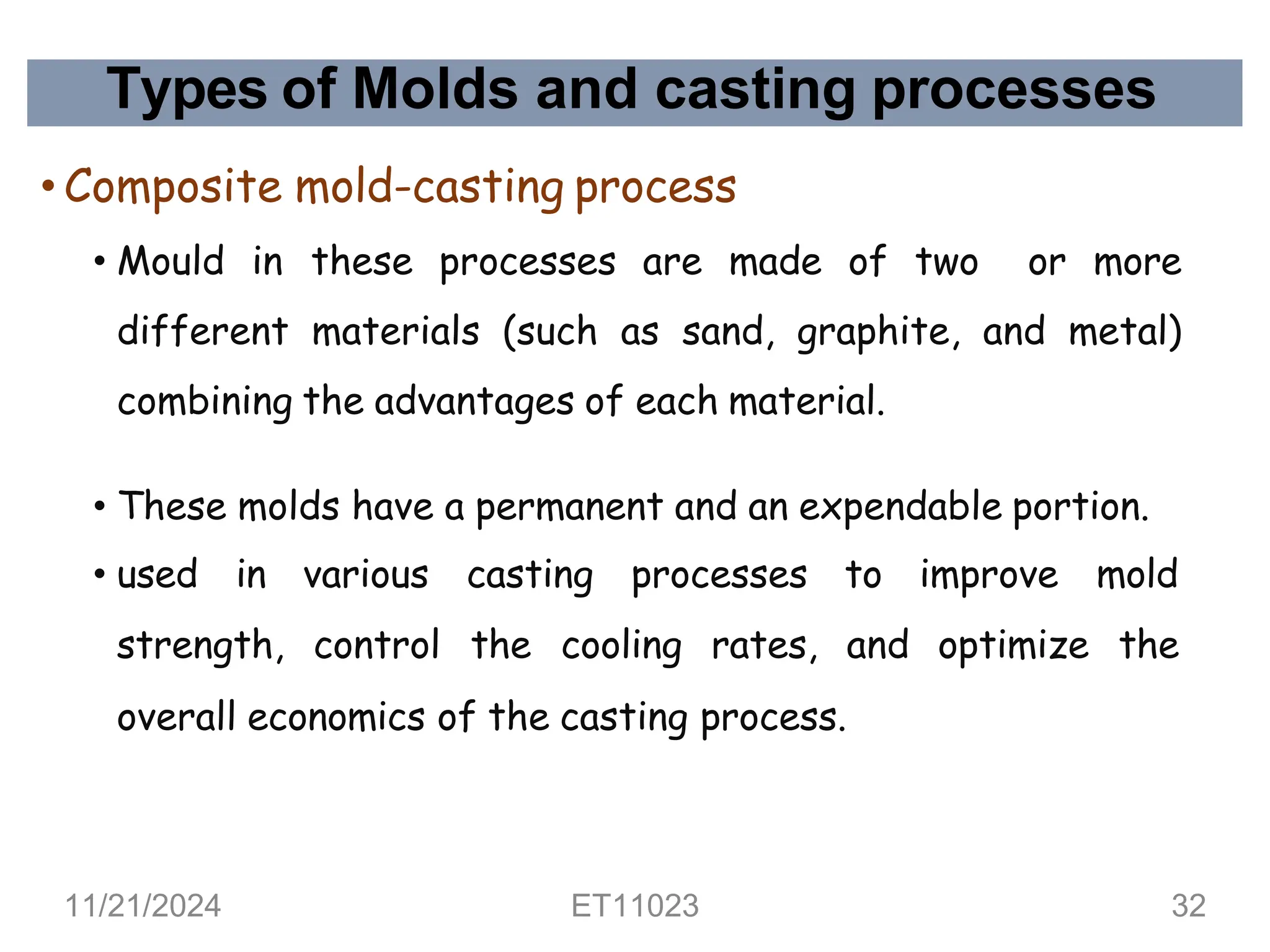
Types of Molds and casting processes
• Composite mold-casting process
• Mould in these processes are made of two or more
different materials (such as sand, graphite, and metal)
combining the advantages of each material.
• These molds have a permanent and an expendable portion.
• used in various casting processes to improve mold
strength, control the cooling rates, and optimize the
overall economics of the casting process.
11/21/2024 ET11023 32
Expendable mold-casting process
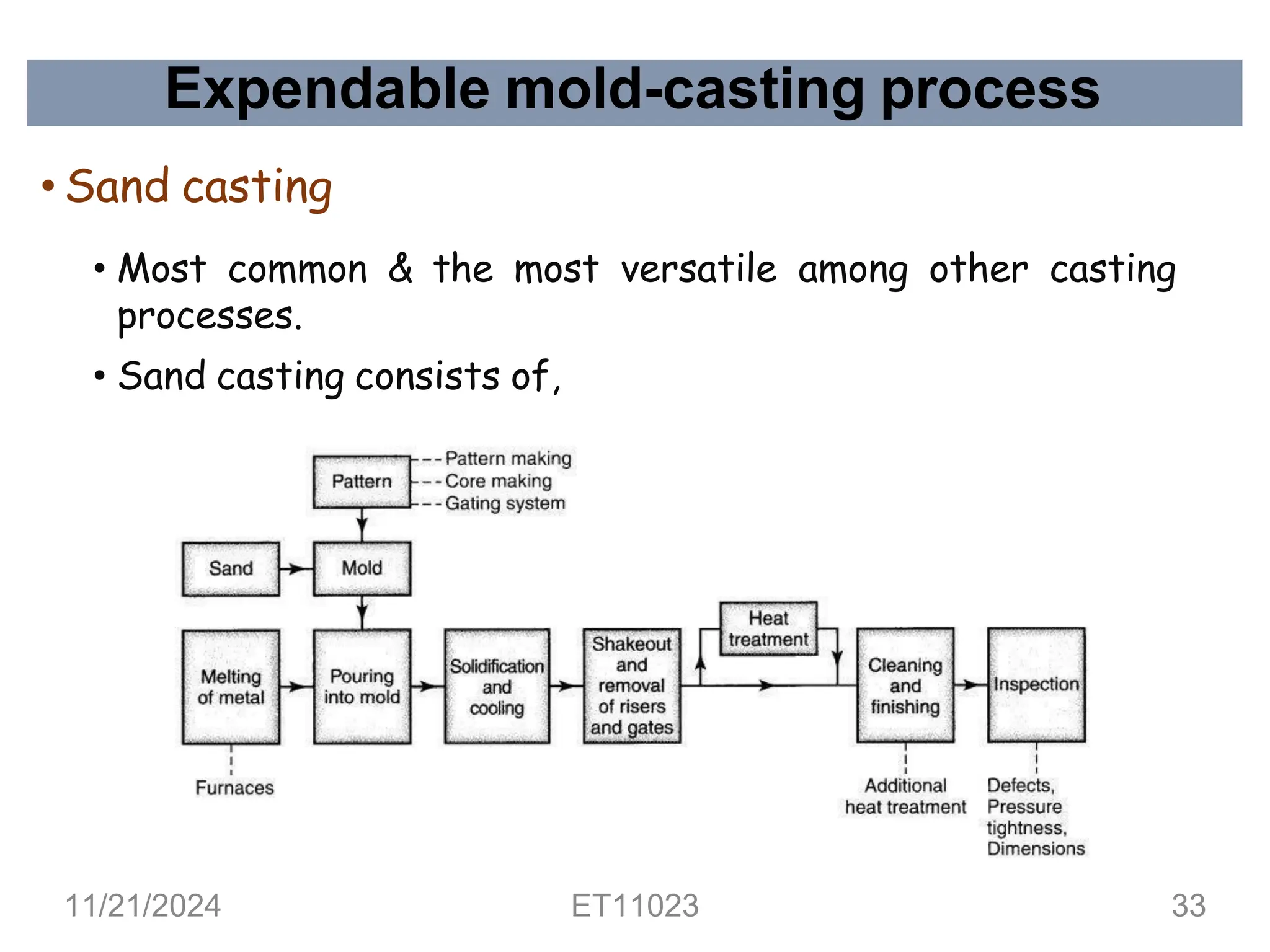
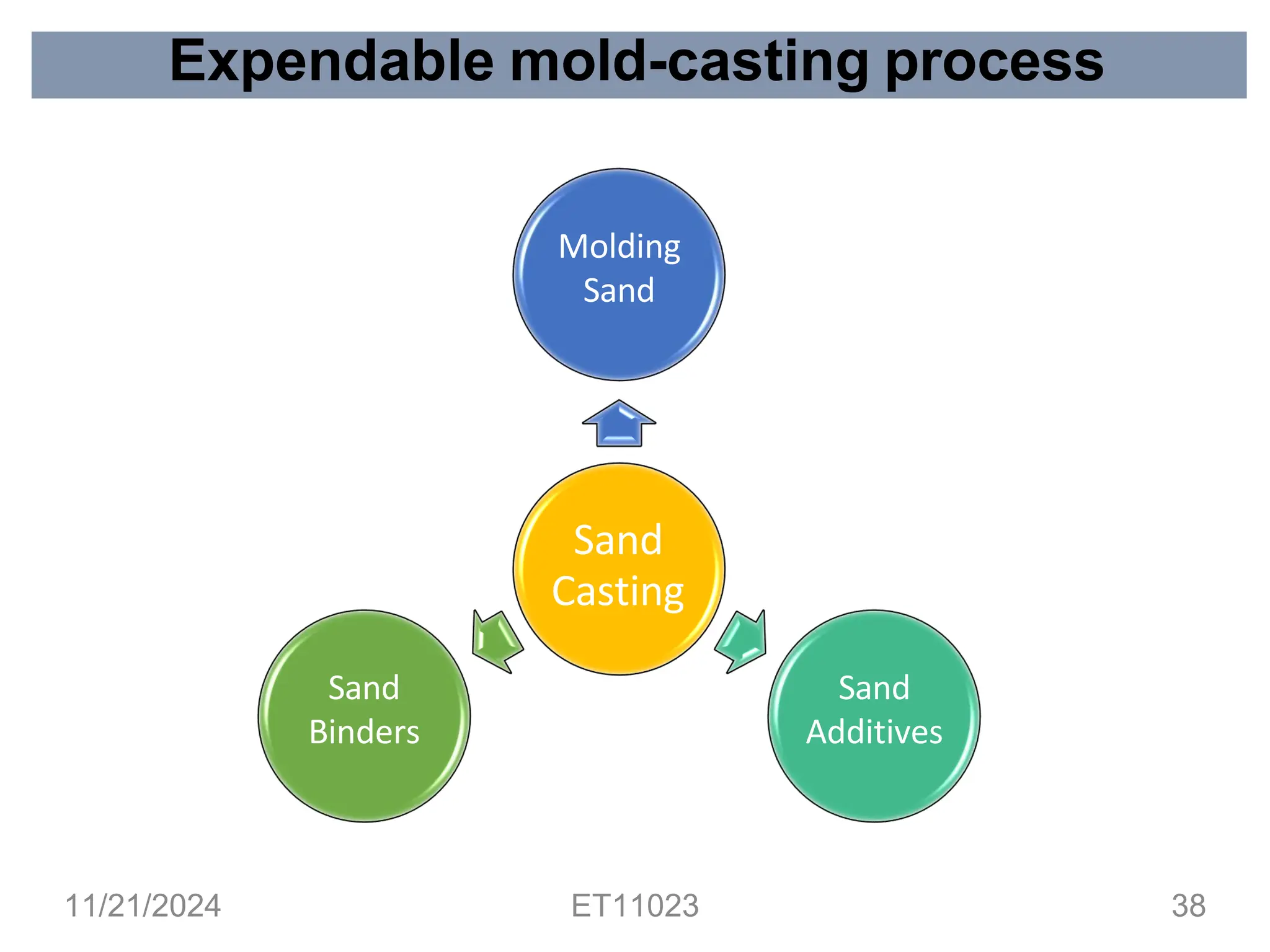
• Sand casting
• Most common & the most versatile among other casting
processes.
• Sand casting consists of,
11/21/2024 ET11023 33
Expendable mold-casting process
• Sand casting
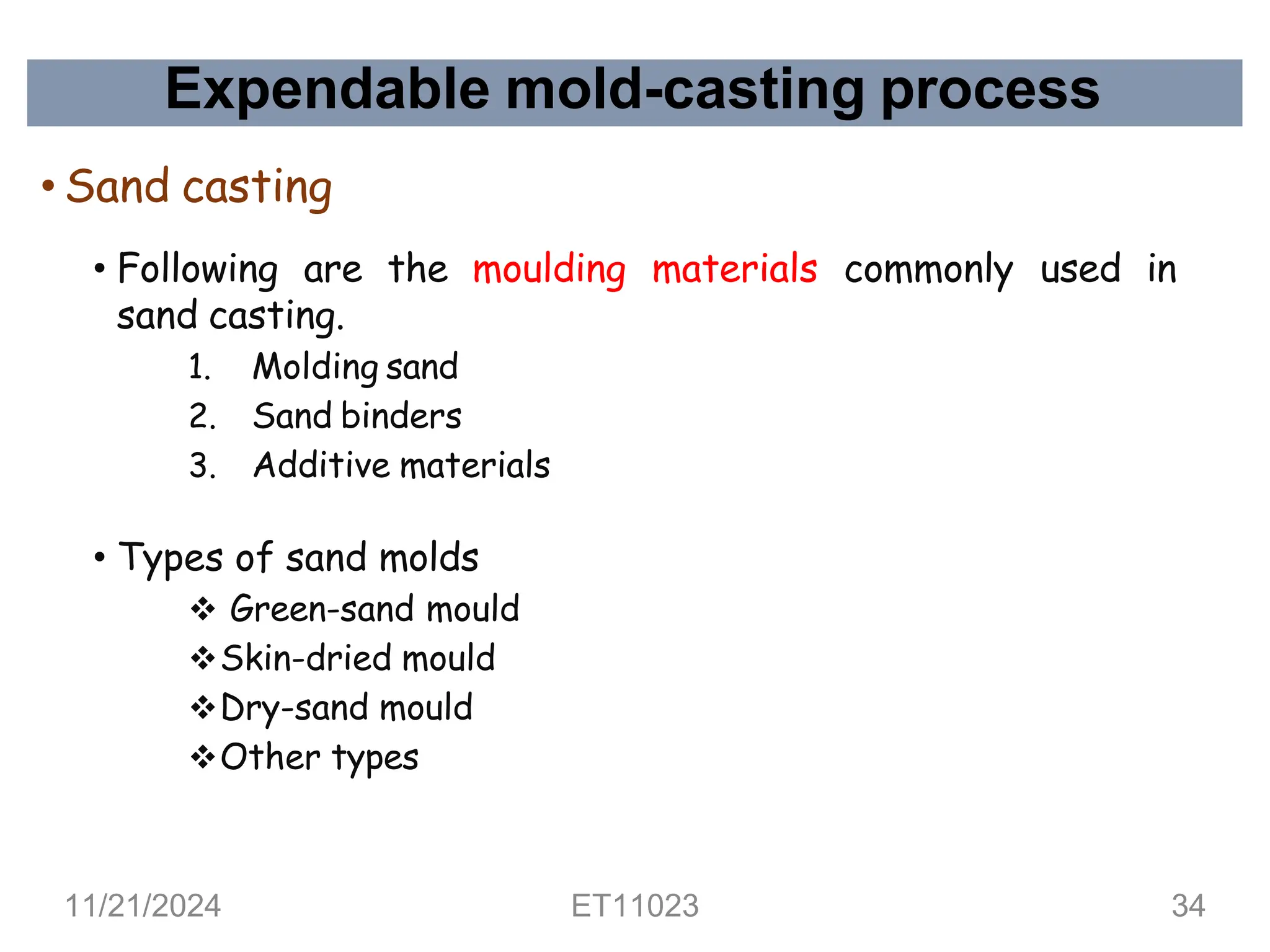
• Following are the moulding materials commonly used in
sand casting.
1. Molding sand
2. Sand binders
3. Additive materials
• Types of sand molds
❖ Green-sand mould
❖Skin-dried mould
❖Dry-sand mould
❖Other types
11/21/2024 ET11023 34
Expendable mold-casting process
Green-Sand Mould
• The term Green Sand denotes the presence of moisture in
molding sand and indicates that the mold is not baked or dried.
• It is basically the mixture of sand, clay and water.
• The clay contain of green send is about 30% and water contain is
about 8%.
• Clay and water used to increase binding strength of sand.
• Low Cost Sand
• Good for small castings
Skin Dry Mould
• These are made of green sand with dry sand baking.
• In some cases, moisture is dried from the surface layer of rammed
sand to a depth of 25 mm by heater or gas torches.
• These are more common in large moulds and can be used for
casting, practically all ferrous and non-ferrous alloys.
11/21/2024 ET11023 35
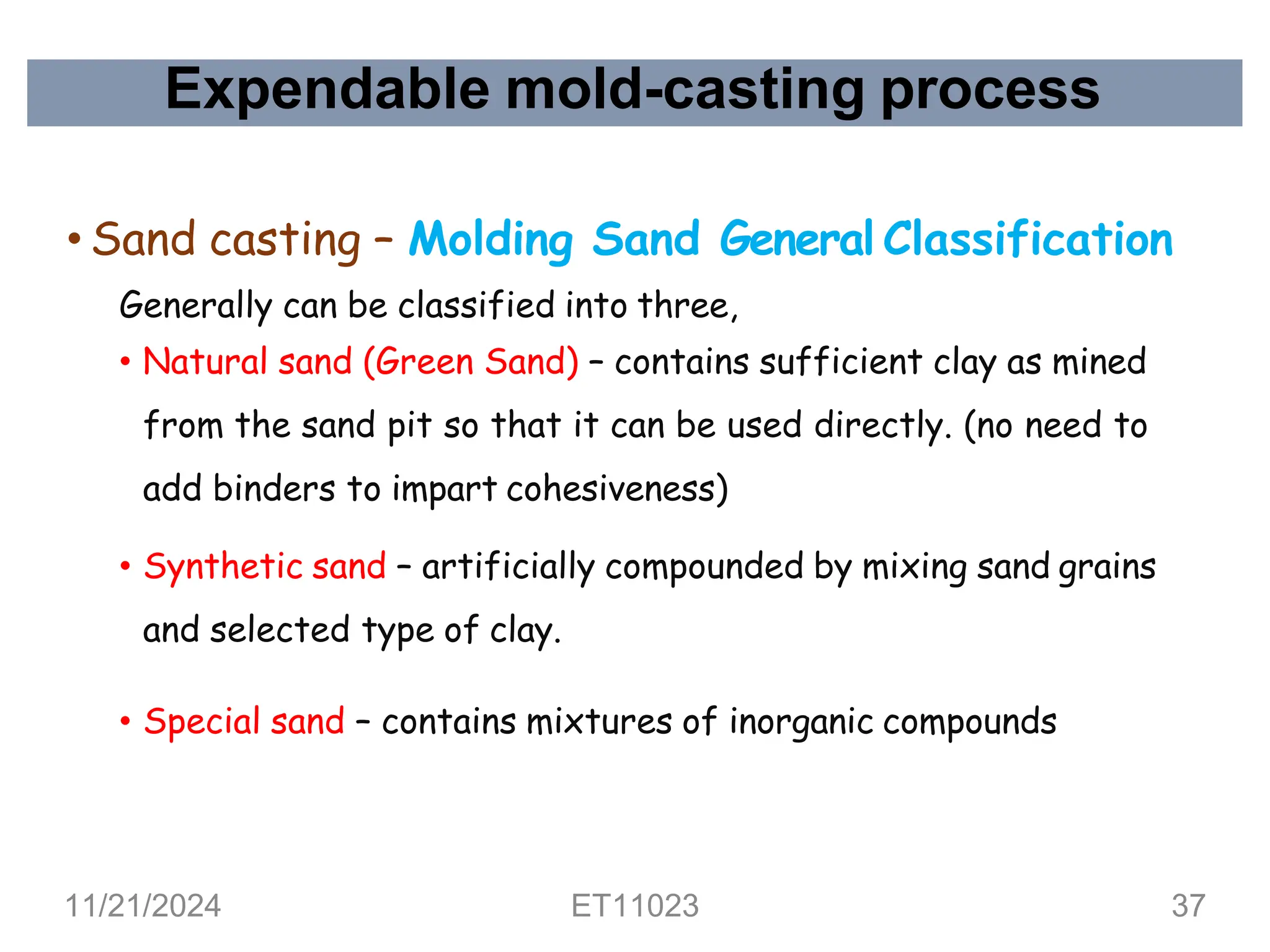
Expendable mold-casting process
Dry-Sand Mould
• Dry sand casting is a sophisticated form of green sand process, in
which the sand mold is baked at a given temperature to make it
stronger.
• This process in mostly used in large foundries to produce big
ferrous and non-ferrous castings like engine blocks, construction
parts, etc.
11/21/2024 ET11023 36
Expendable mold-casting process
• Sand casting – Molding Sand General Classification
Generally can be classified into three,
• Natural sand (Green Sand) – contains sufficient clay as mined
from the sand pit so that it can be used directly. (no need to
add binders to impart cohesiveness)
• Synthetic sand – artificially compounded by mixing sand grains
and selected type of clay.
• Special sand – contains mixtures of inorganic compounds
11/21/2024 ET11023 37
Sand
Casting
Molding
Sand
Sand
Additives
Sand
Binders
Expendable mold-casting process
11/21/2024 ET11023 38
Expendable mold-casting process
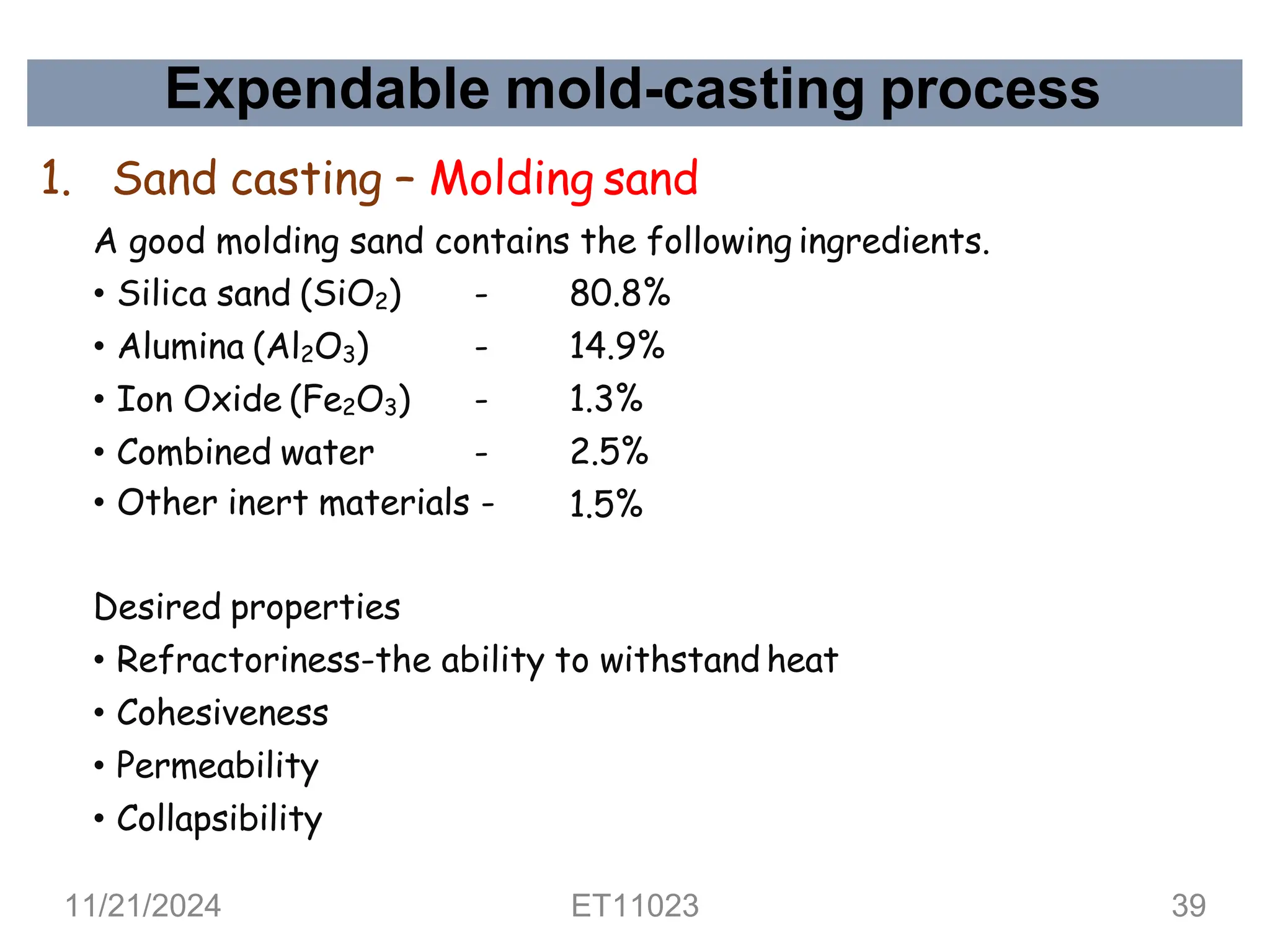
• Silica sand (SiO2) - 80.8%
• Alumina (Al2O3) - 14.9%
• Ion Oxide (Fe2O3) - 1.3%
• Combined water - 2.5%
• Other inert materials - 1.5%
Desired properties
• Refractoriness-the ability to withstand heat
• Cohesiveness
• Permeability
• Collapsibility
1. Sand casting – Molding sand
A good molding sand contains the following ingredients.
11/21/2024 ET11023 39
Expendable mold-casting process
2. Sand casting – Sand binders
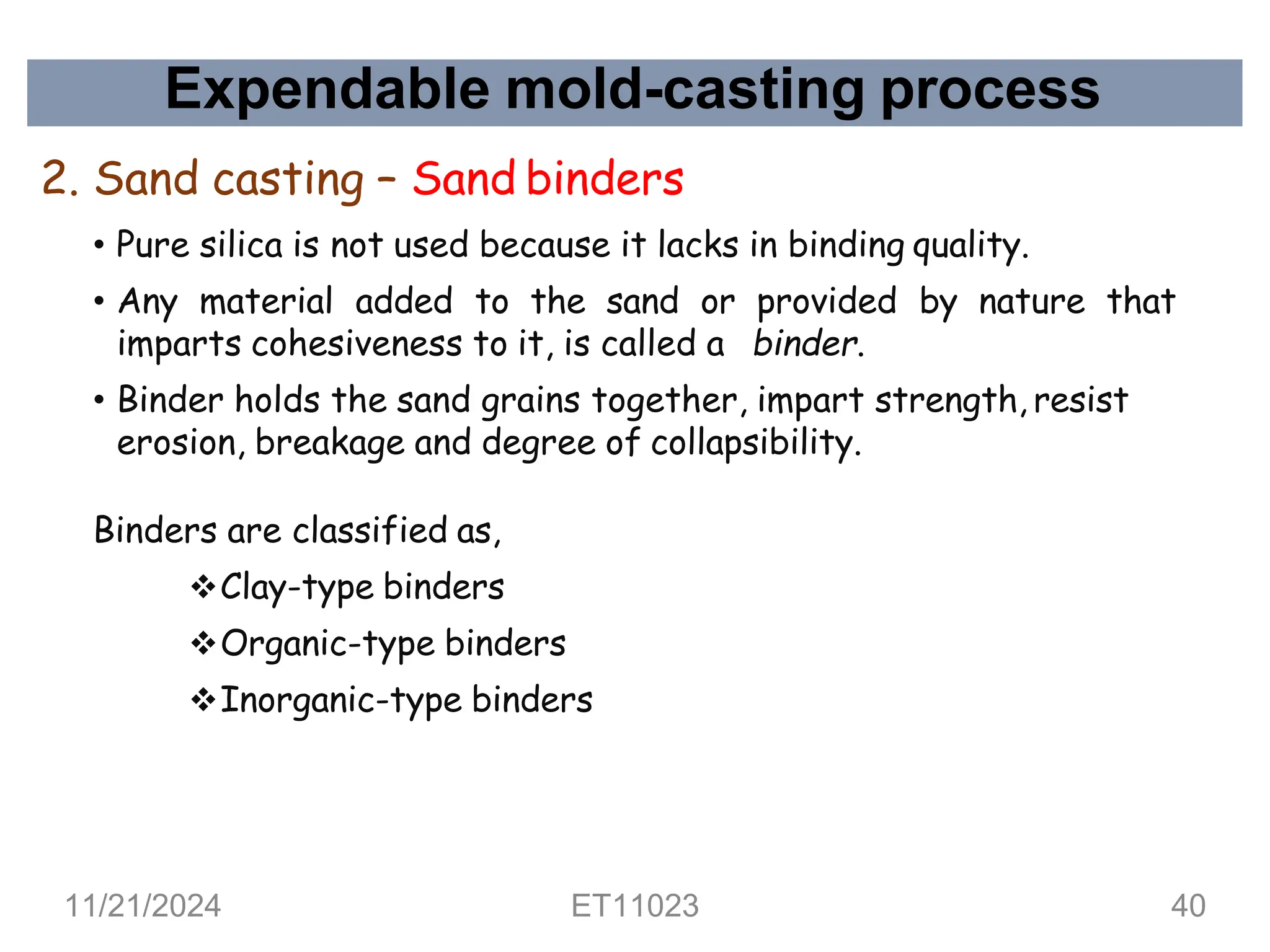
• Pure silica is not used because it lacks in binding quality.
• Any material added to the sand or provided by nature that
imparts cohesiveness to it, is called a binder.
• Binder holds the sand grains together, impart strength, resist
erosion, breakage and degree of collapsibility.
Binders are classified as,
❖Clay-type binders
❖Organic-type binders
❖Inorganic-type binders
11/21/2024 ET11023 40
Expendable mold-casting process
3. Sand casting – Sand additives
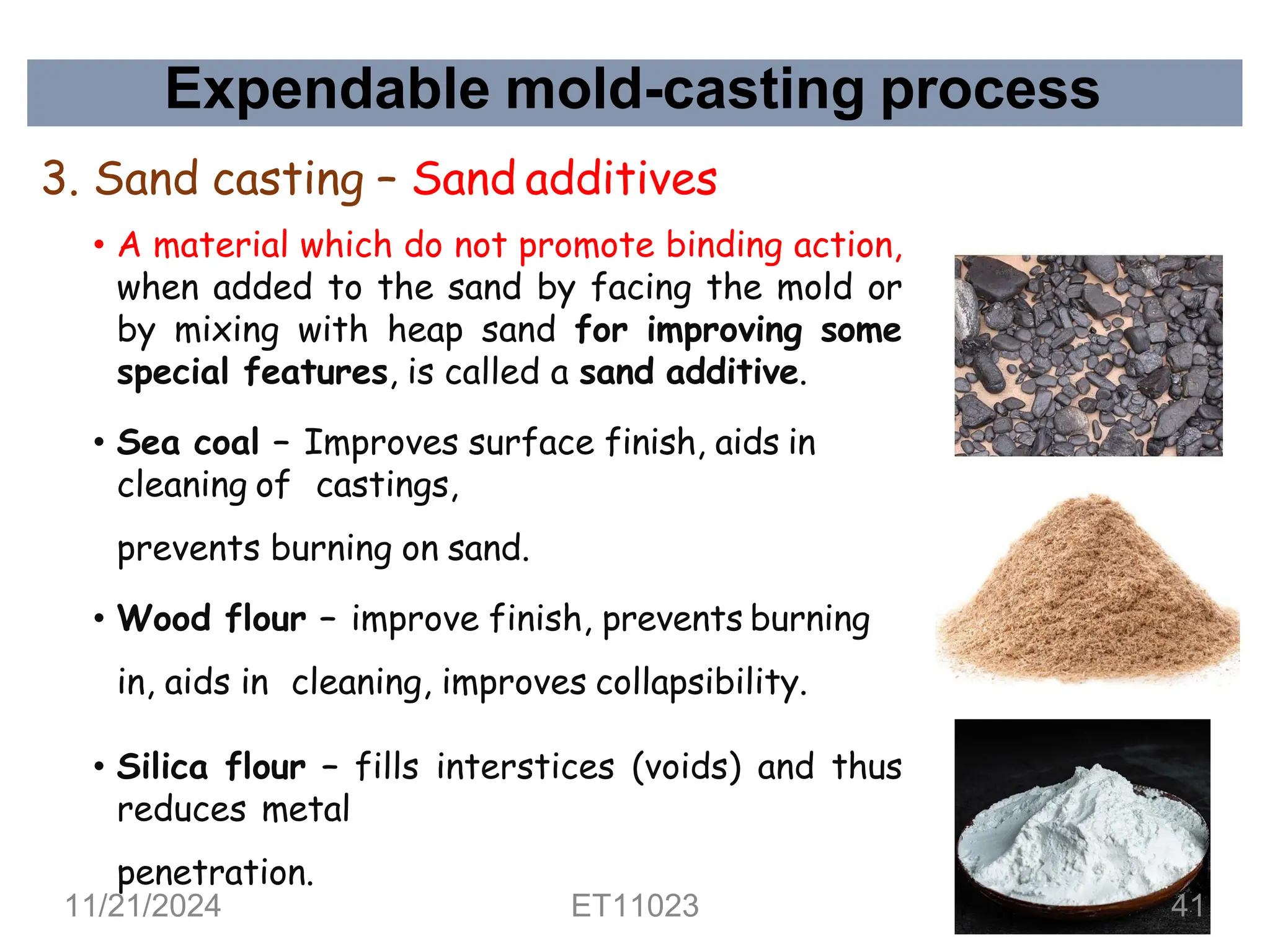
• A material which do not promote binding action,
when added to the sand by facing the mold or
by mixing with heap sand for improving some
special features, is called a sand additive.
• Sea coal – Improves surface finish, aids in
cleaning of castings,
prevents burning on sand.
• Wood flour – improve finish, prevents burning
in, aids in cleaning, improves collapsibility.
• Silica flour – fills interstices (voids) and thus
reduces metal
penetration.
11/21/2024 ET11023 41
Other casting processes
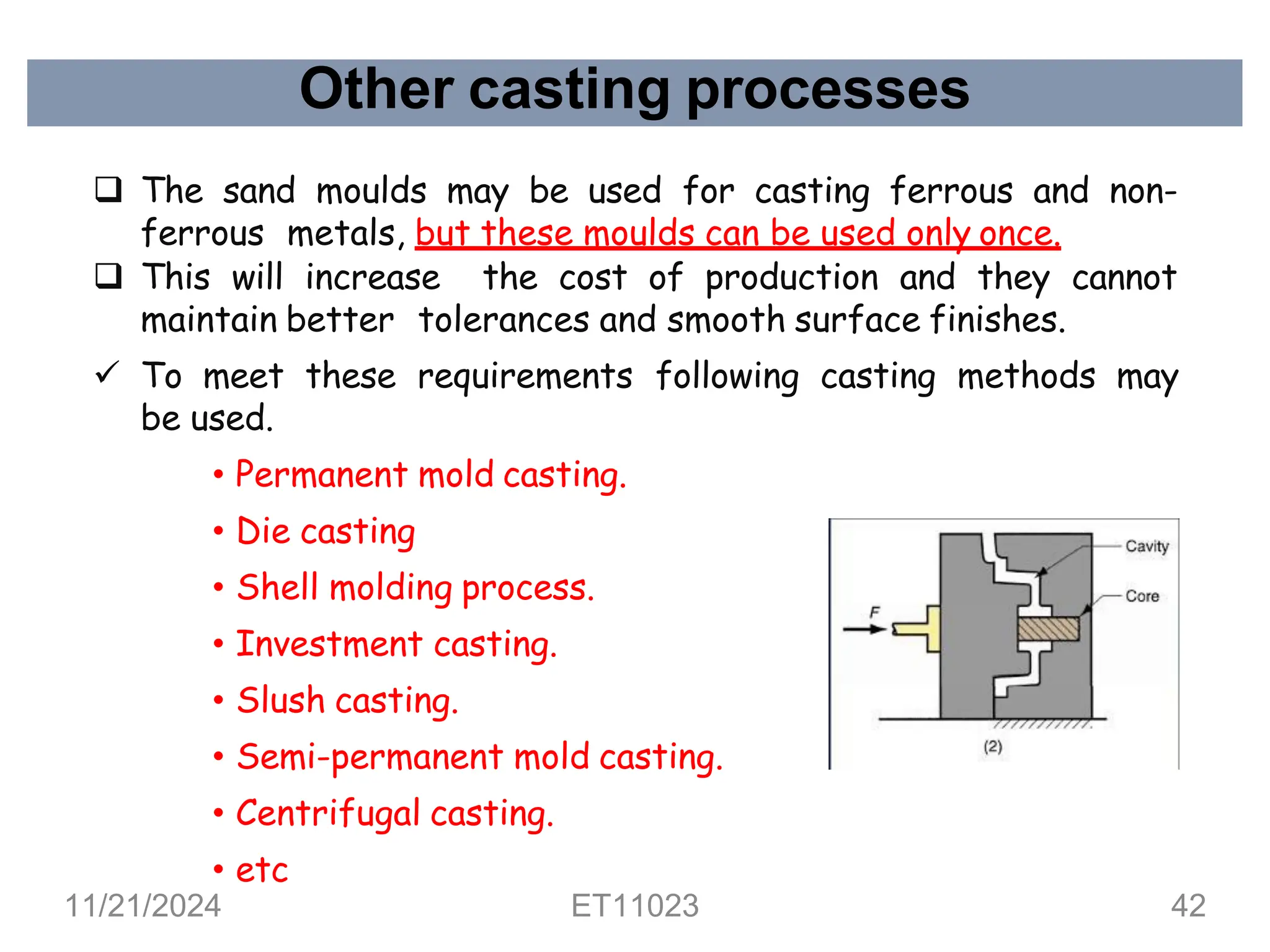
❑ The sand moulds may be used for casting ferrous and non-
ferrous metals, but these moulds can be used only once.
❑ This will increase the cost of production and they cannot
maintain better tolerances and smooth surface finishes.
✓ To meet these requirements following casting methods may
be used.
• Permanent mold casting.
• Die casting
• Shell molding process.
• Investment casting.
• Slush casting.
• Semi-permanent mold casting.
• Centrifugal casting.
• etc
11/21/2024 ET11023 42
Other casting processes
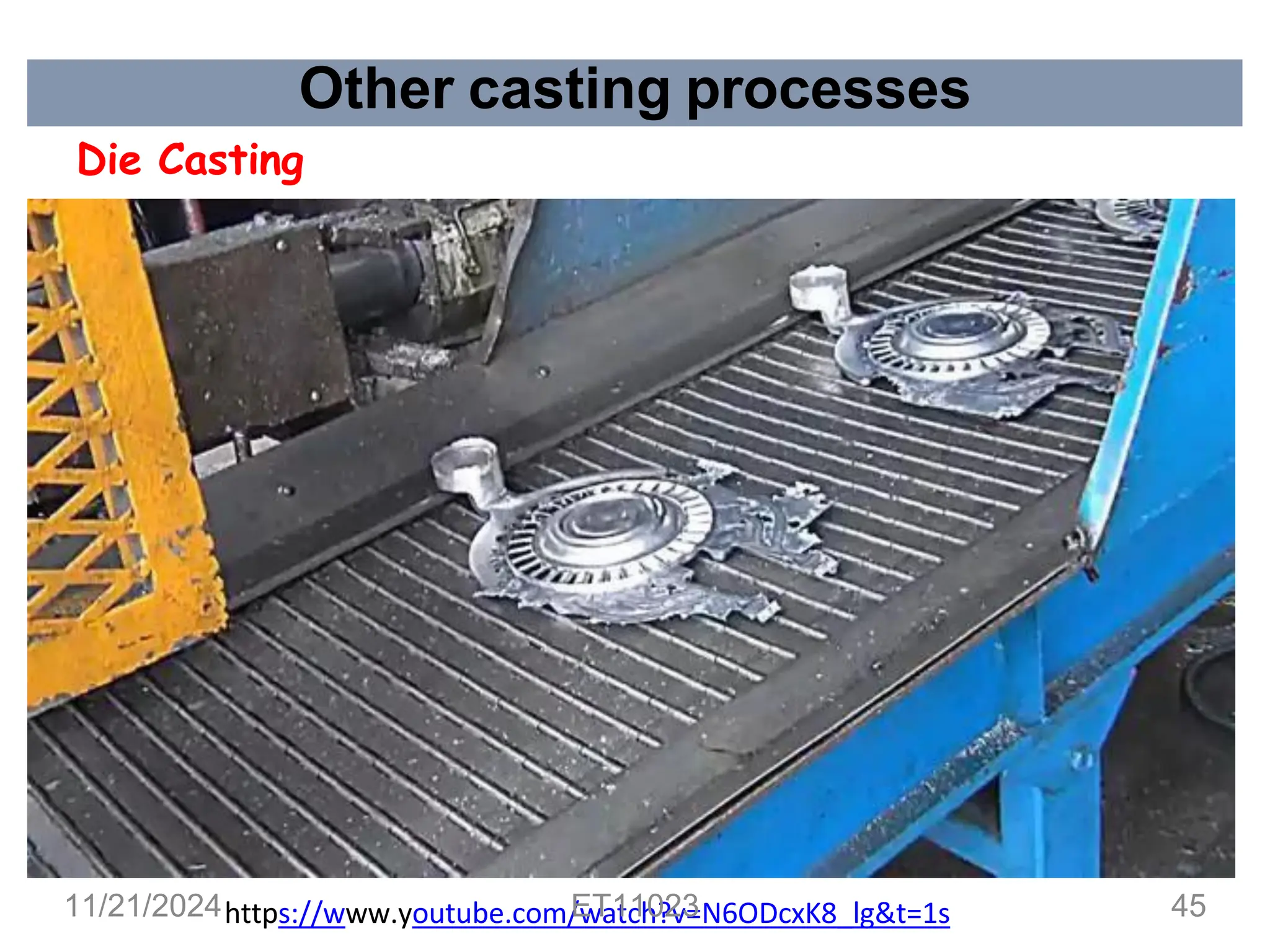
Die Casting
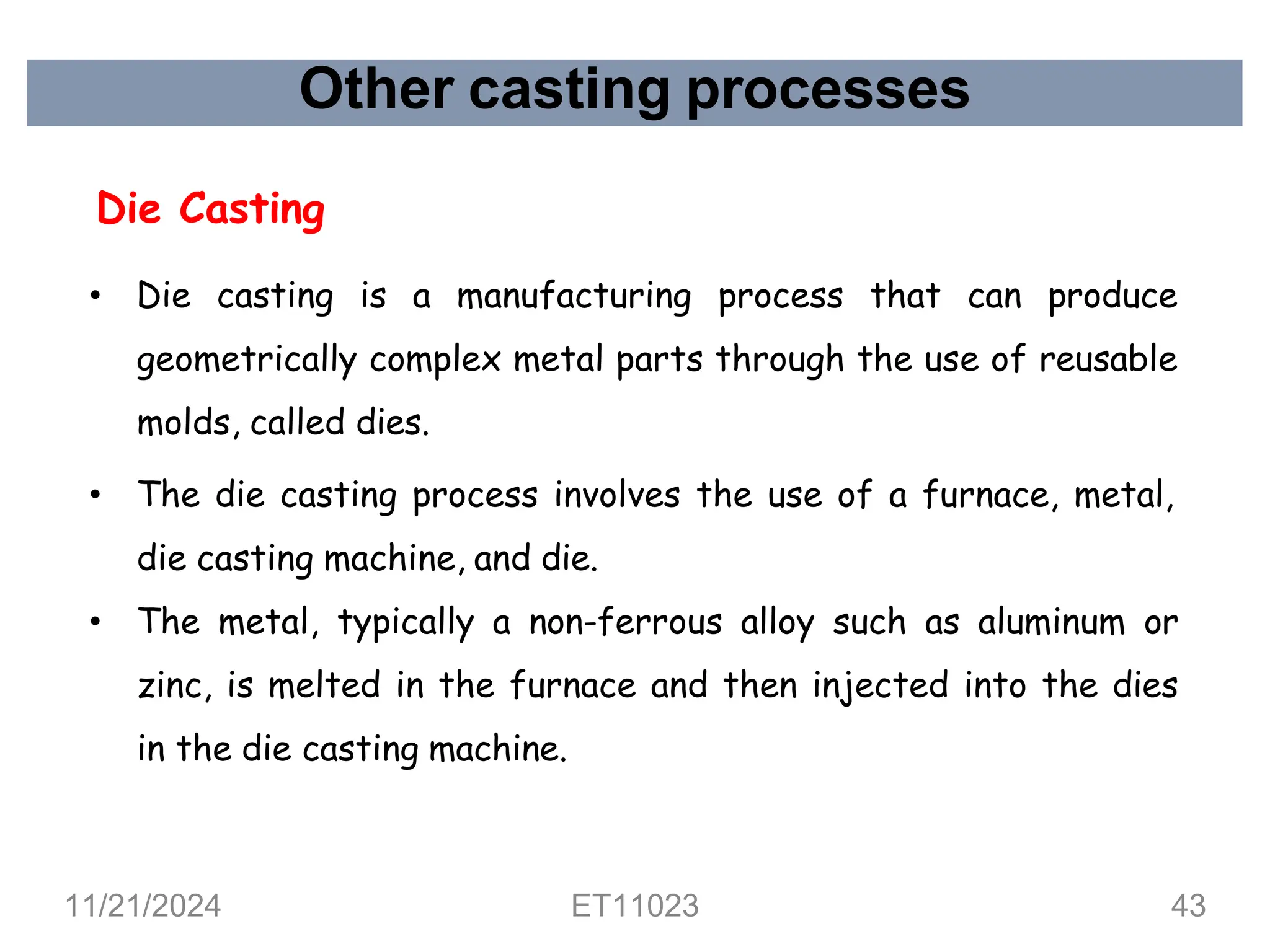
• Die casting is a manufacturing process that can produce
geometrically complex metal parts through the use of reusable
molds, called dies.
• The die casting process involves the use of a furnace, metal,
die casting machine, and die.
• The metal, typically a non-ferrous alloy such as aluminum or
zinc, is melted in the furnace and then injected into the dies
in the die casting machine.
11/21/2024 ET11023 43
Other casting processes
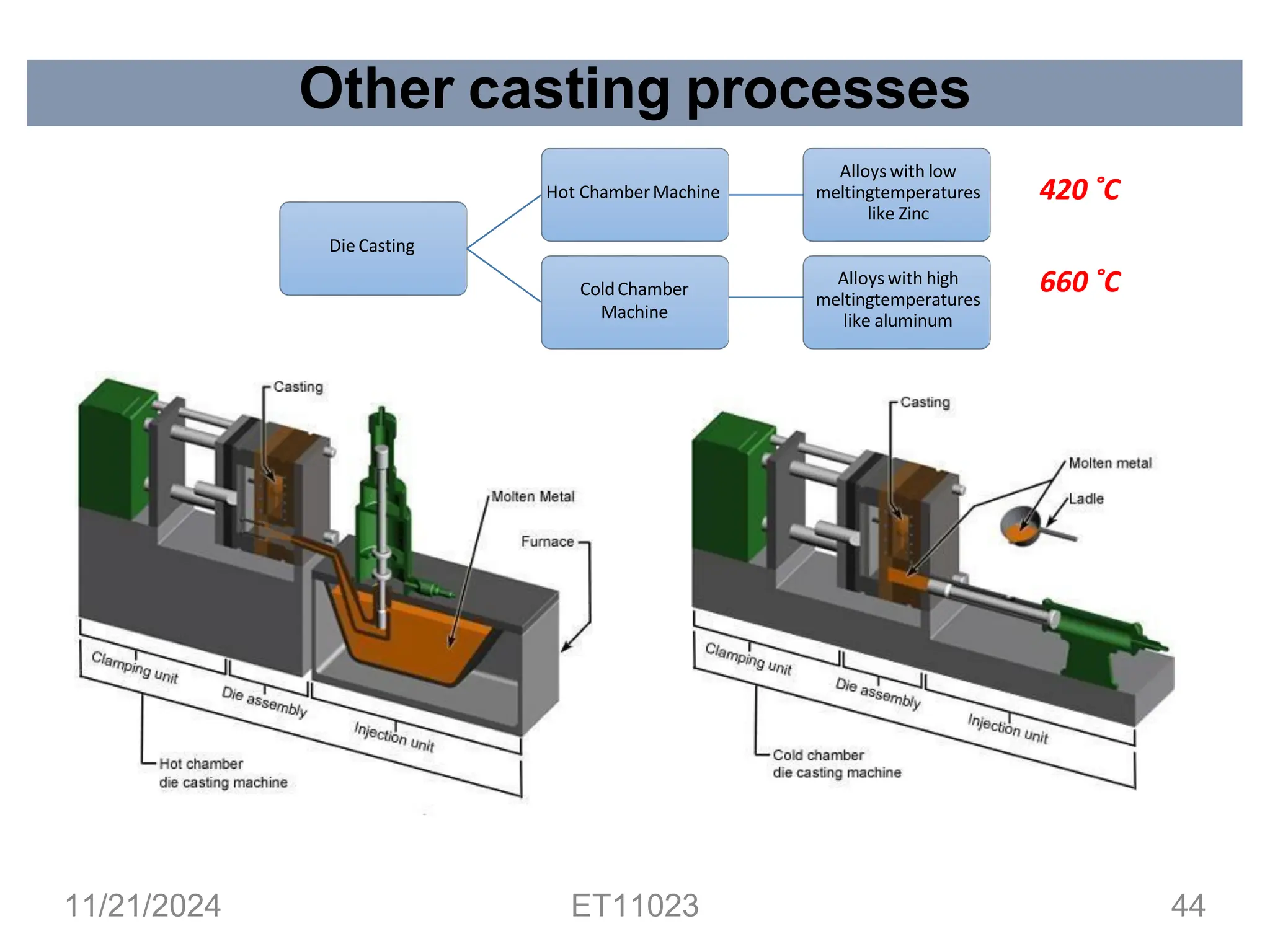
Die Casting
Hot ChamberMachine
Alloys with low
meltingtemperatures
like Zinc
ColdChamber
Machine
Alloys with high
meltingtemperatures
like aluminum
420 ˚C
660 ˚C
11/21/2024 ET11023 44
Other casting processes
Die Casting
https://www.youtube.com/watch?v=N6ODcxK8_lg&t=1s
11/21/2024 ET11023 45
Other casting processes
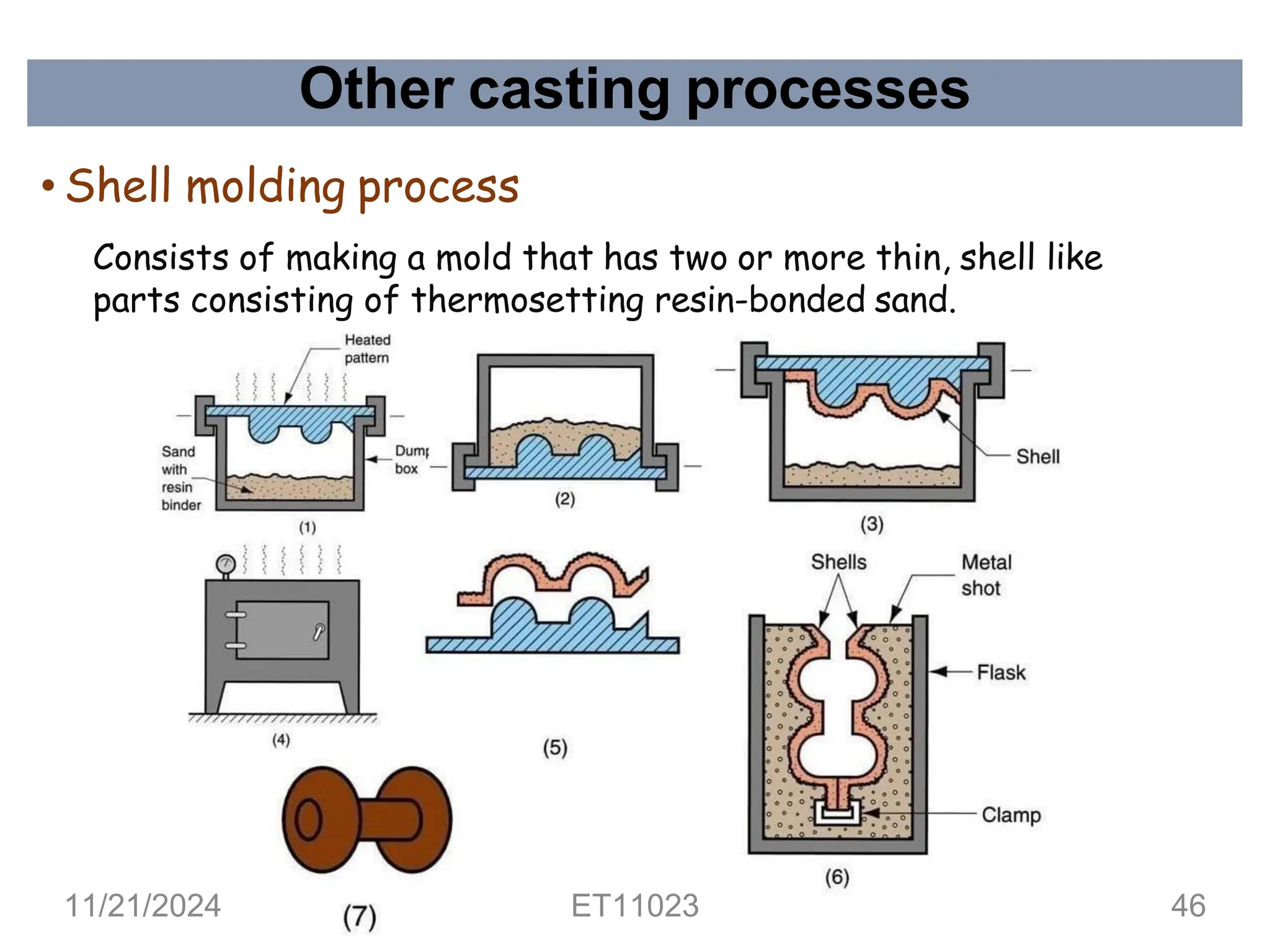
• Shell molding process
Consists of making a mold that has two or more thin, shell like
parts consisting of thermosetting resin-bonded sand.
11/21/2024 ET11023 46
Other casting processes
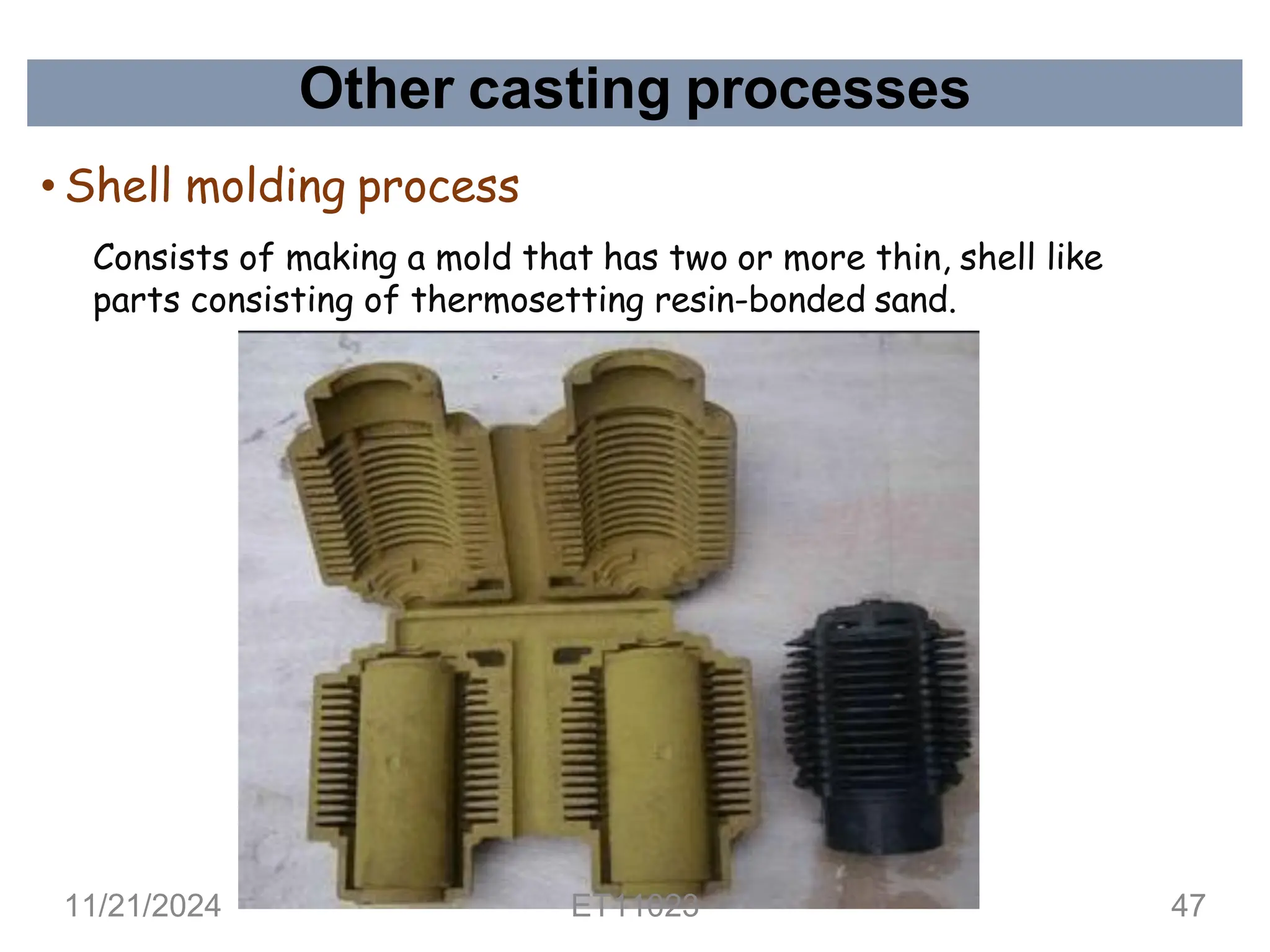
• Shell molding process
Consists of making a mold that has two or more thin, shell like
parts consisting of thermosetting resin-bonded sand.
11/21/2024 ET11023 47
Other casting processes
• Shell molding process
11/21/2024 ET11023 48
Other casting processes
• Shell molding process
Source: https://www.youtube.com/watch?v=nz_TBlO3vQ4
11/21/2024 ET11023 49
Other casting processes
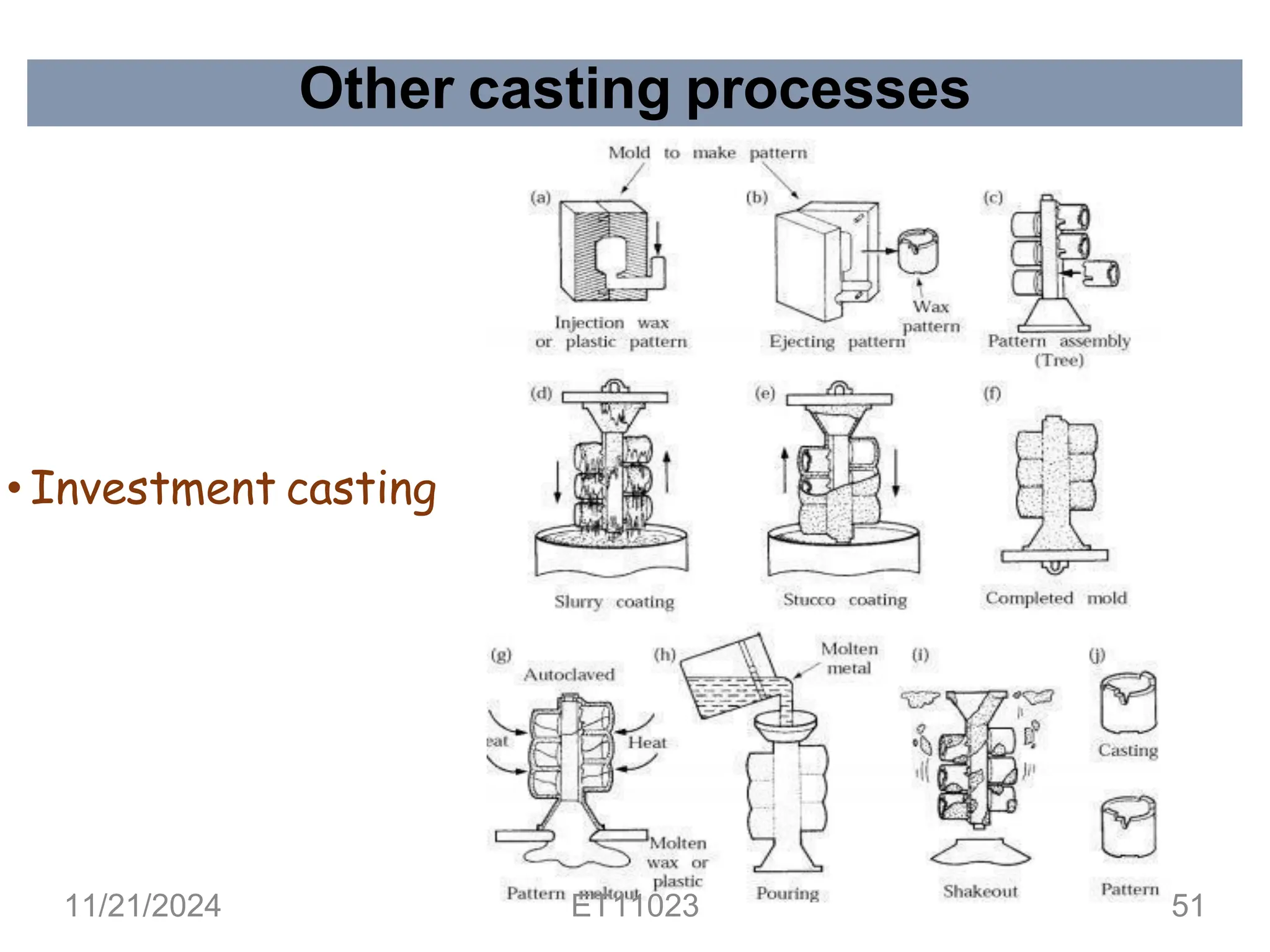
• Investment casting
Also known as lost wax process or precision casting.
The castings produced by this method are within very close
tolerances and do not need subsequent machining.
Steps involve,
1. Making of pattern
2. Attaching the patterns to a central wax sprue, to form a
casting cluster
3. Building the shell
4. Melting of the wax
5. Pouring metal
6. Breaking of mould
7. Disassembling castings
11/21/2024 ET11023 50
Other casting processes
• Investment casting
11/21/2024 ET11023 51
Other casting processes
• Investment casting
Source: https://www.youtube.com/watch?v=TVsJlWEzZY8
11/21/2024 ET11023 52
Other casting processes
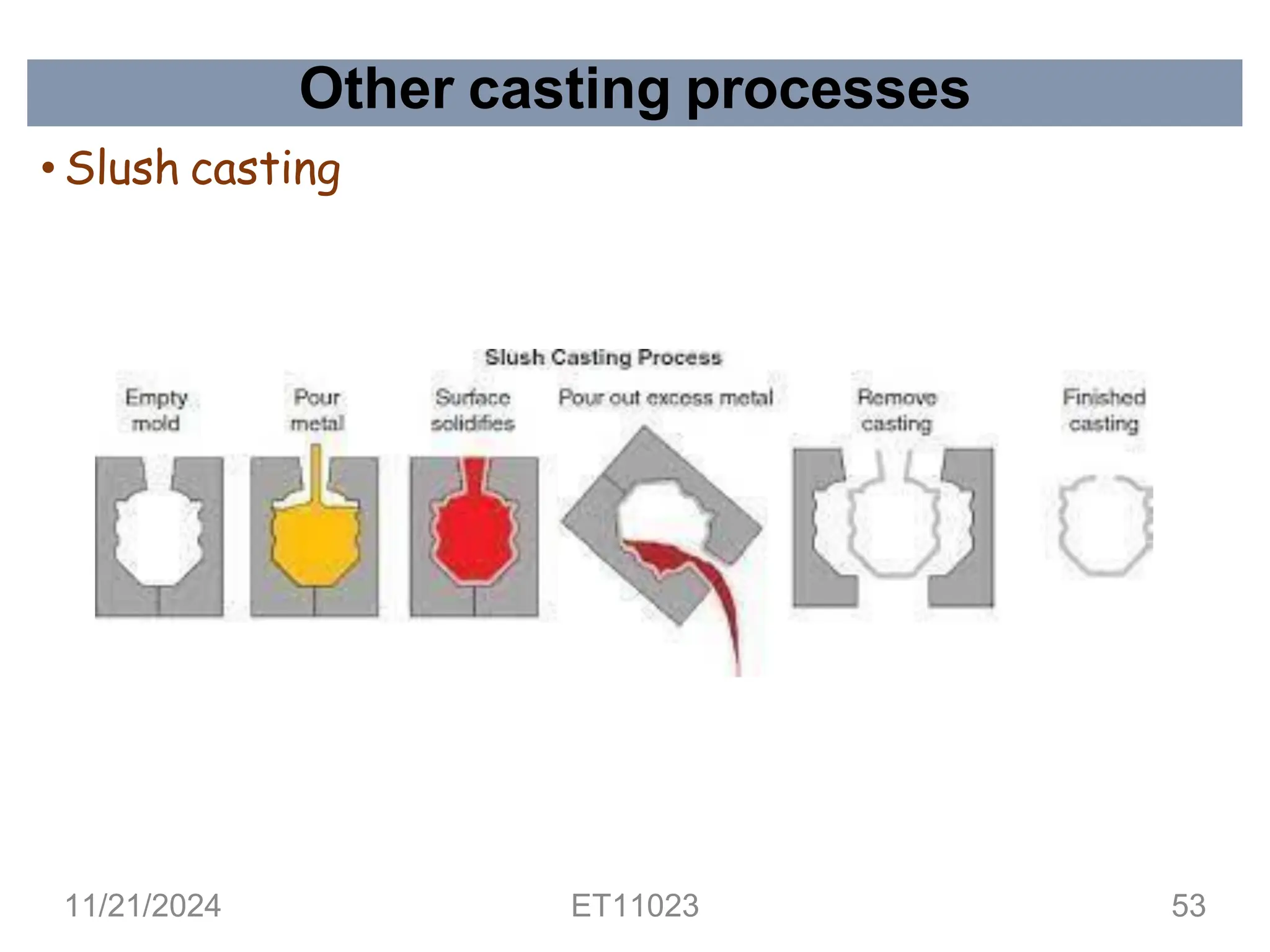
• Slush casting
11/21/2024 ET11023 53
Other casting processes
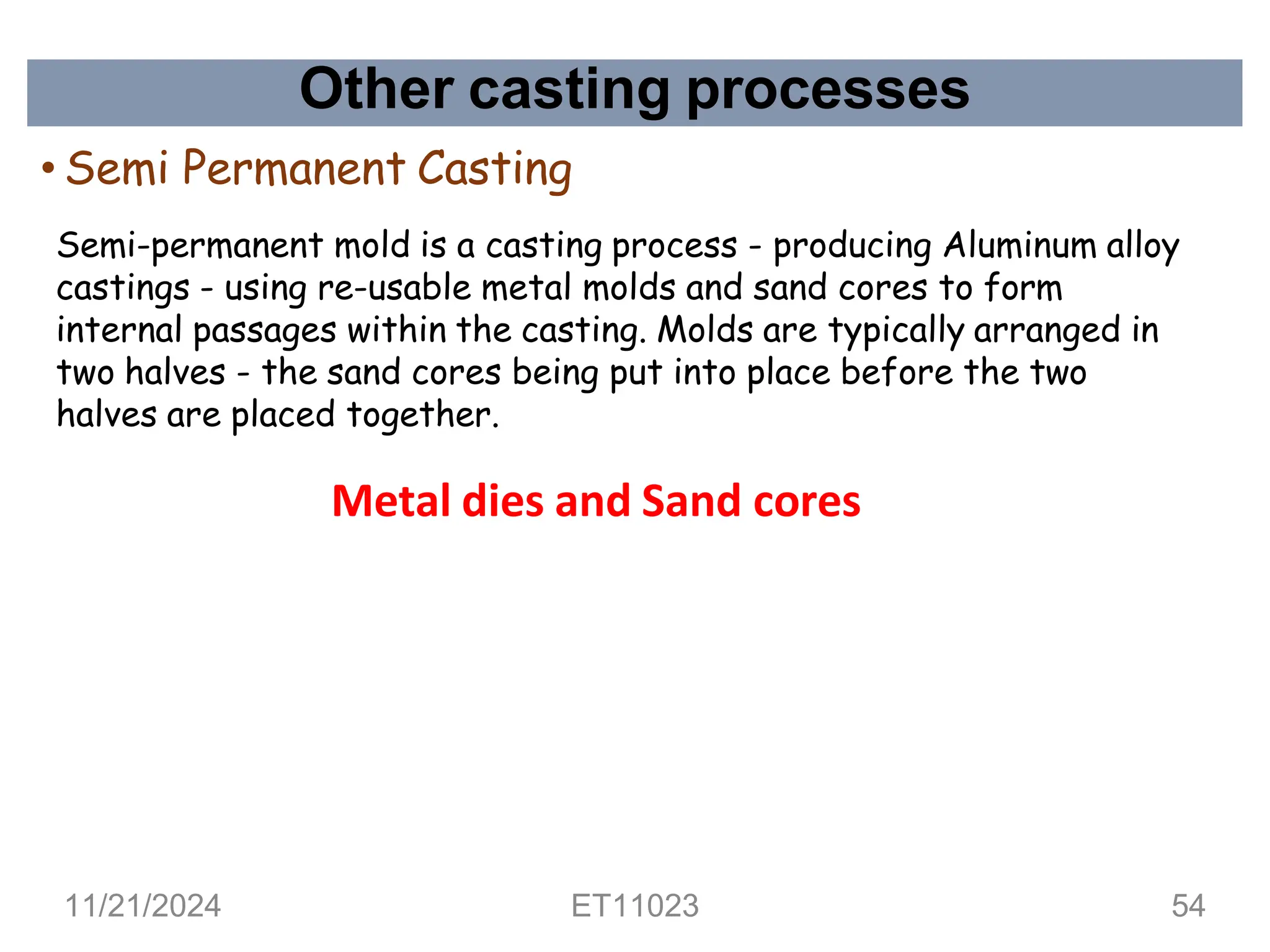
• Semi Permanent Casting
Semi-permanent mold is a casting process - producing Aluminum alloy
castings - using re-usable metal molds and sand cores to form
internal passages within the casting. Molds are typically arranged in
two halves - the sand cores being put into place before the two
halves are placed together.
Metal dies and Sand cores
11/21/2024 ET11023 54
Other casting processes
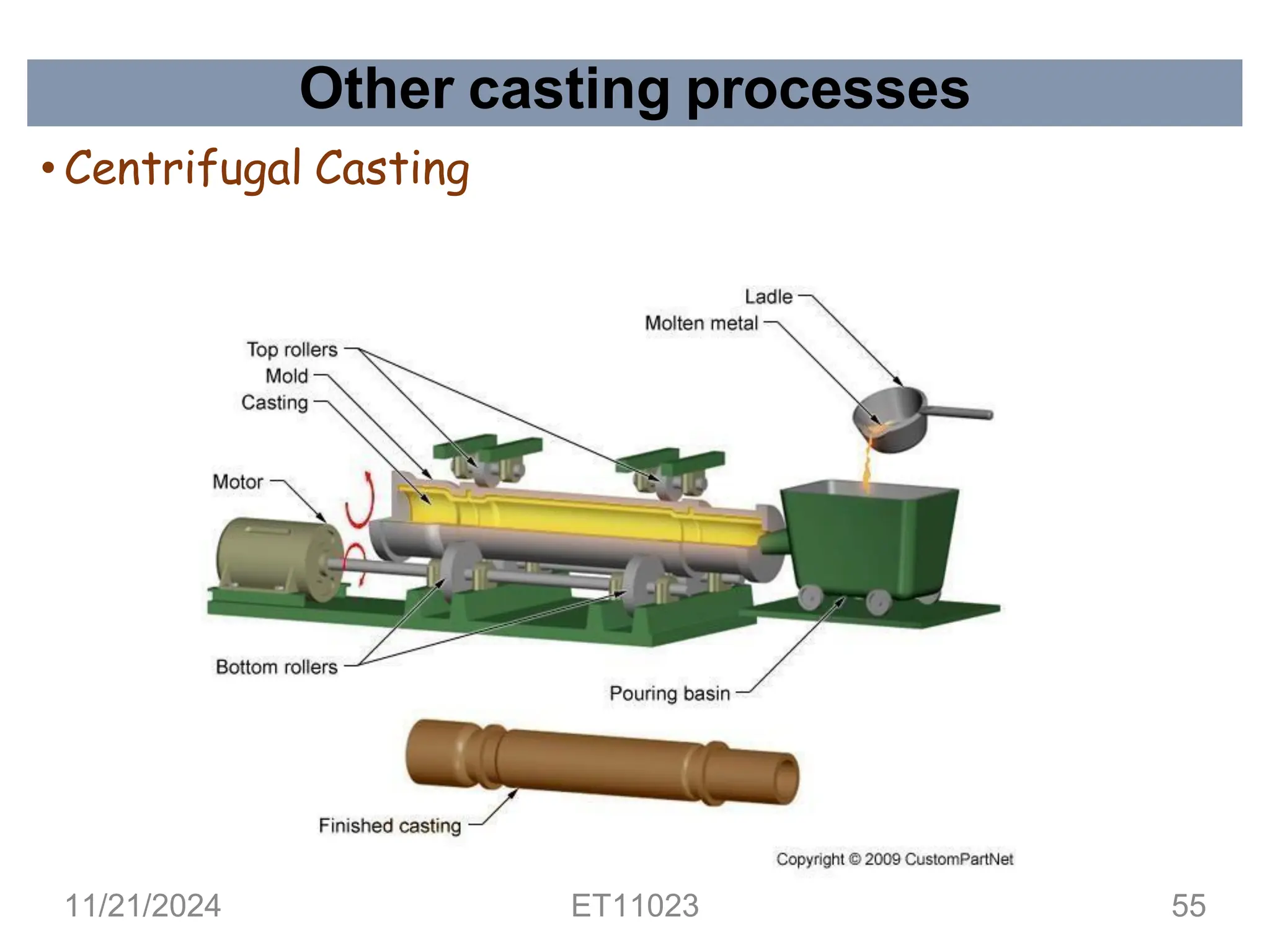
• Centrifugal Casting
11/21/2024 ET11023 55
Melting furnaces
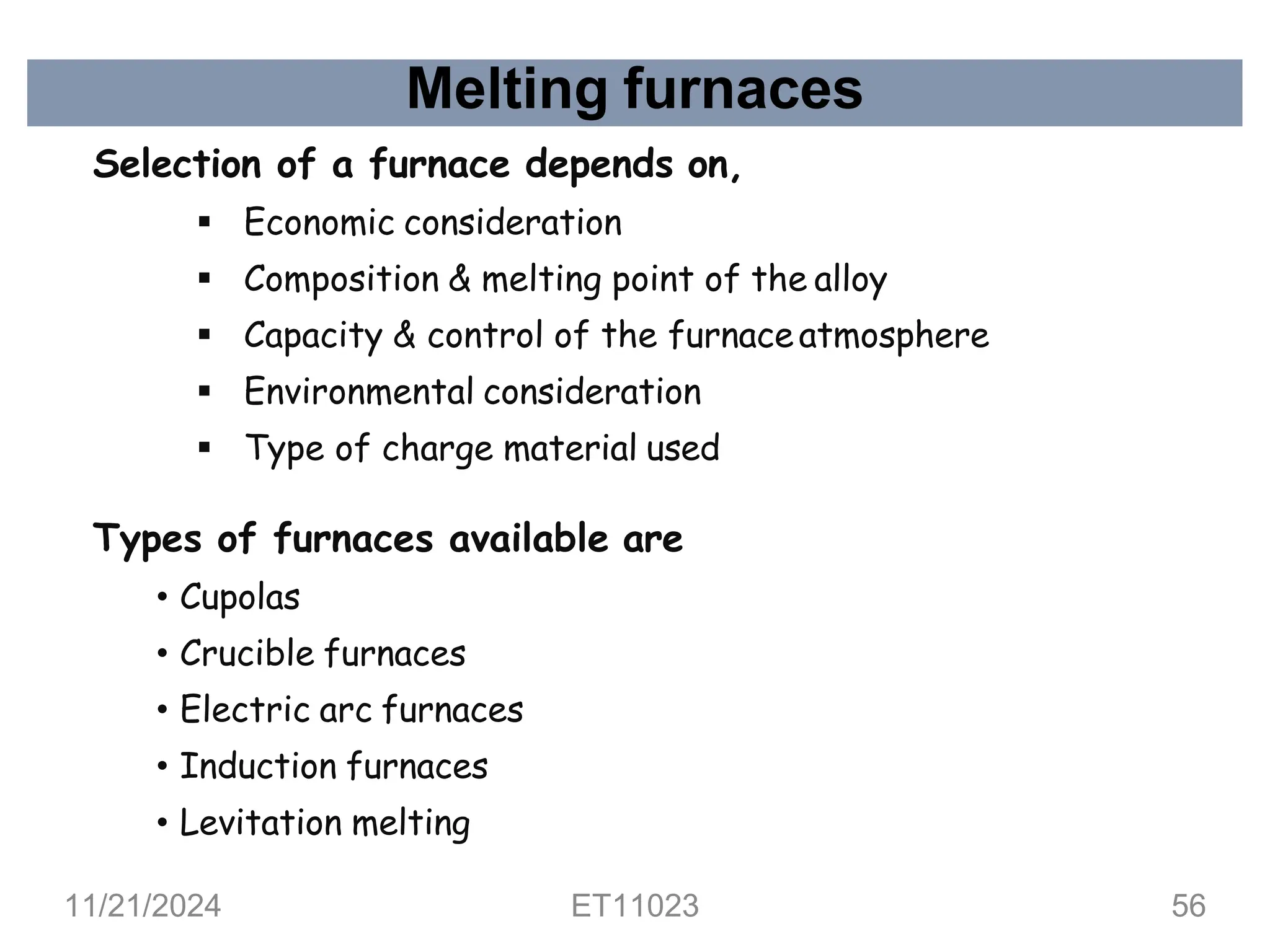
Selection of a furnace depends on,
▪ Economic consideration
▪ Composition & melting point of the alloy
▪ Capacity & control of the furnaceatmosphere
▪ Environmental consideration
▪ Type of charge material used
Types of furnaces available are
• Cupolas
• Crucible furnaces
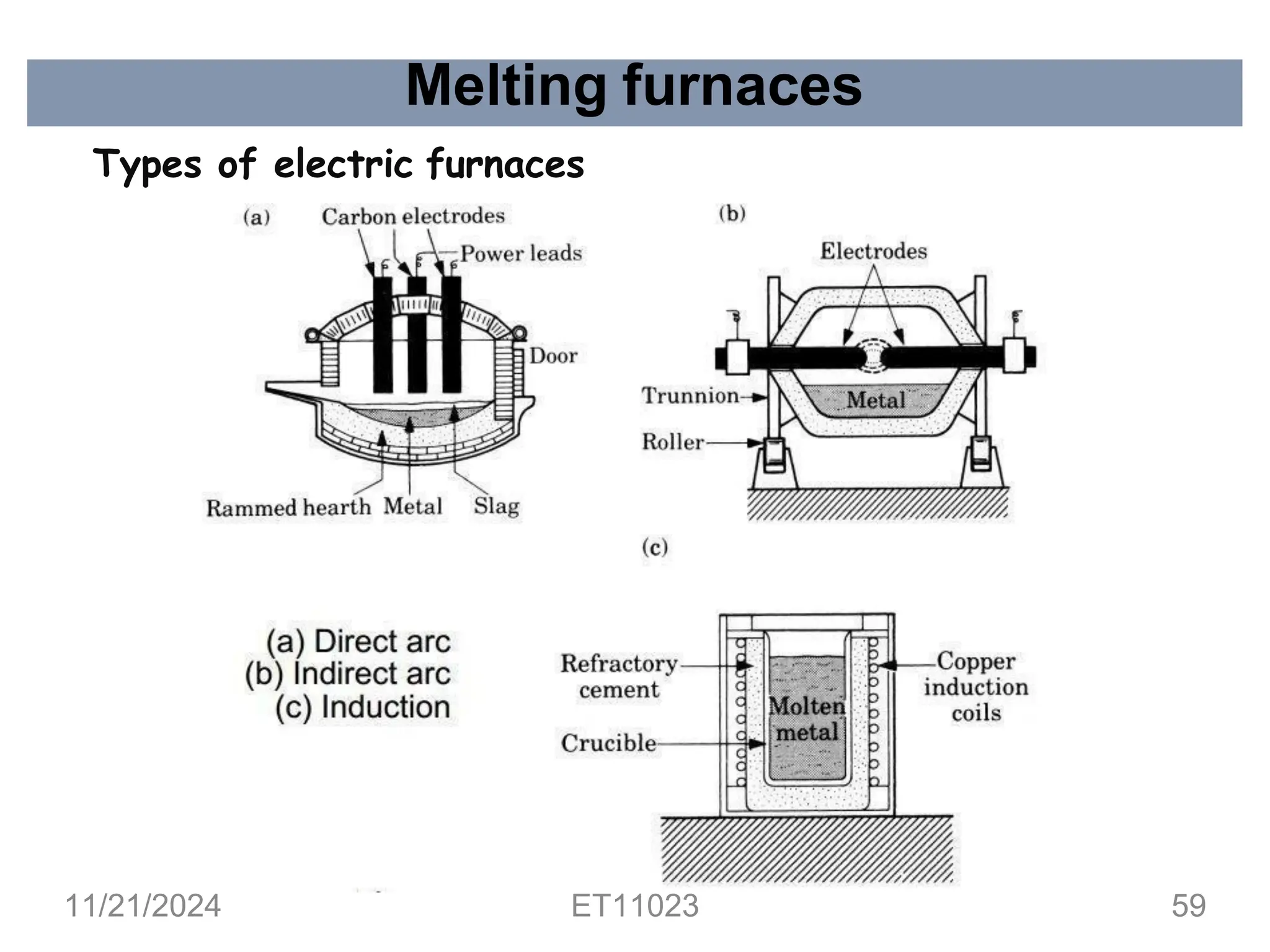
• Electric arc furnaces
• Induction furnaces
• Levitation melting
11/21/2024 ET11023 56
Melting furnaces
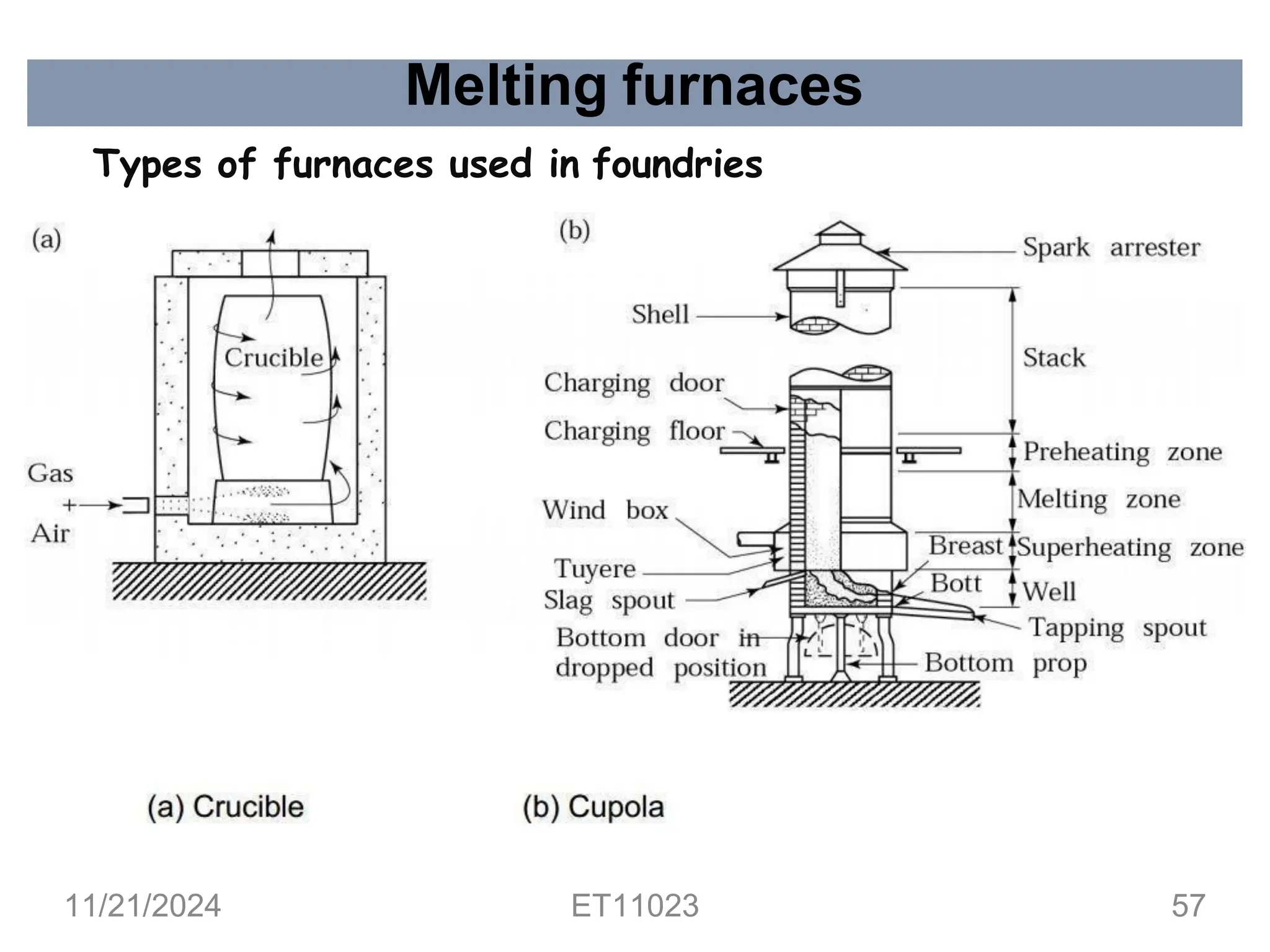
Types of furnaces used in foundries
11/21/2024 ET11023 57
Melting furnaces
Cupola
https://www.youtube.com/watch?v=bUbNVzOuJvA
11/21/2024 ET11023 58
Melting furnaces
Types of electric furnaces
11/21/2024 ET11023 59
Applications
• Automobile industry
• Ship-building industry
• Aerospace industry
• Manufacturing industry
• Household appliances
• Etc.
11/21/2024 ET11023 60
Advantages of casting
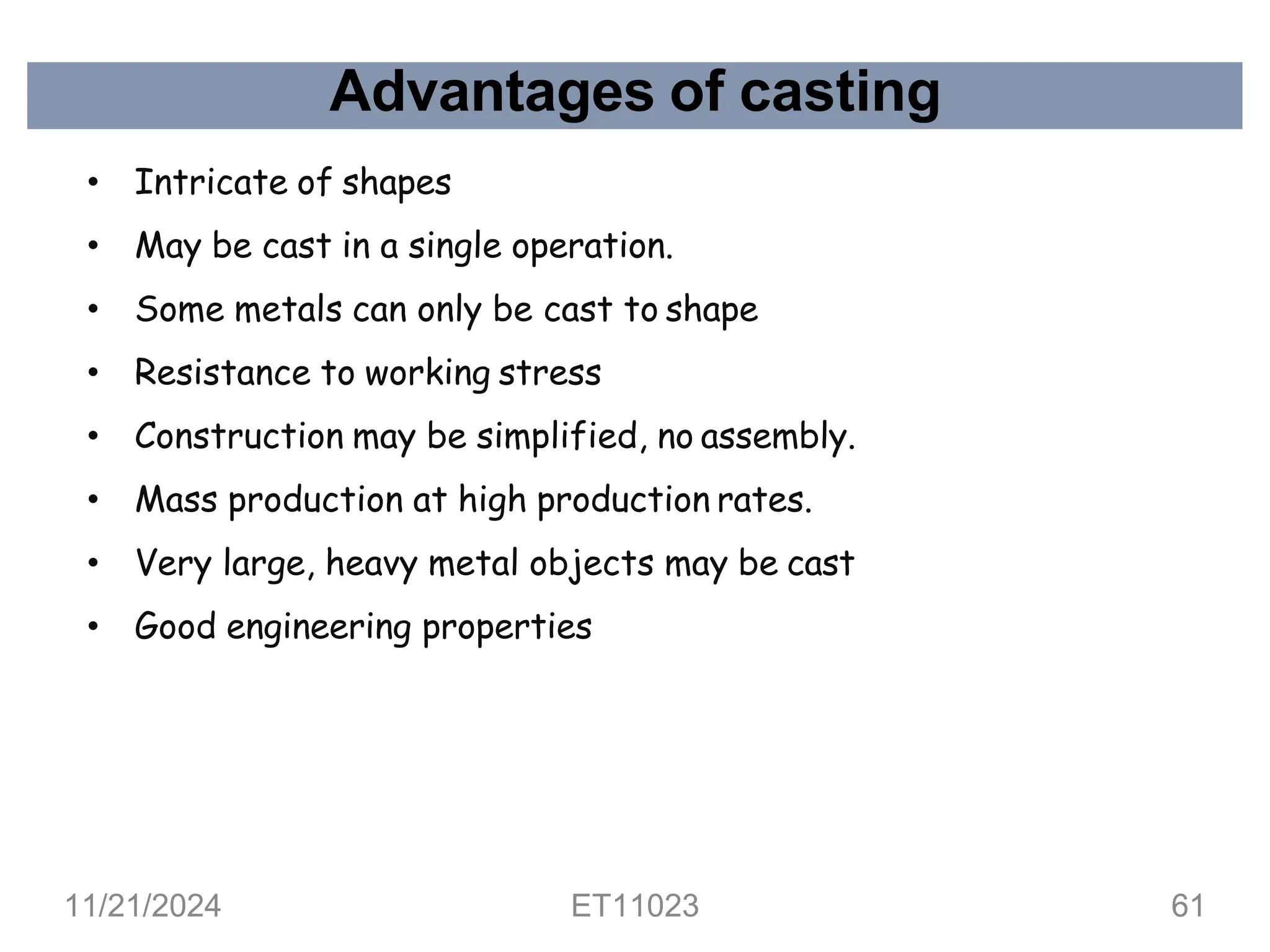
• Intricate of shapes
• May be cast in a single operation.
• Some metals can only be cast to shape
• Resistance to working stress
• Construction may be simplified, no assembly.
• Mass production at high production rates.
• Very large, heavy metal objects may be cast
• Good engineering properties
11/21/2024 ET11023 61
Limitations in casting
• Surface finish & dimensional accuracy.
• Limitations in toughness & strength.
• Limitations in making thin & complex structures.
• Shrinkage & porosity.
• Casting defects
11/21/2024 ET11023 62
11/21/2024 ET11023 63

Lecture 09Lecture 08 workshop technology notess.pdf.pdf

  • 1.
    Workshop Technology & Practice ET11023 Lecture9 Foundry Workshop Part 02 Eng. ThimiraNimsaraDulanjana BSc Eng (Hon’s) UOM, AMIE(SL),ECSL Department of Engineering Technology, Sabaragamuwa University of Sri Lanka 11/21/2024 ET11023 1
  • 2.
    ❖All the authorsof original materials (figures, photos, diagrams and etc.) ❖Manufacturing Engineering and Technology, Sixth edition - Serope Kalpakjian, Steven R. Schmid, Hamldon Musa ❖A Textbook of Workshop Technology, - R.S Khurmi, J. K Gupta ❖Lecture notes;- by Mr. Buddhika Sampath, University of Moratuwa Acknowledgment 11/21/2024 ET11023 2
  • 3.
    1. Introduction toworkshops 2. Workshop Safety Practices 3. Sheet Metal Workshop and Equipment 4. Metal Joining Part 01 1. Rivets 2. Nut and Bolts 3. Welding-Liquid state welding/Fusion Welding 5. Metal Joining Part 02 1. Solid state welding 2. Brazing and Soldering 6. Foundry Workshop Part 01 1. Introduction foundry 2. Terminologies used in casting 7. Foundry Workshop Part 02 1. Sand Casting 2. Other Casting Processes 3. Furnace 11/21/2024 ET11023 3
  • 4.
    11/21/2024 ET11023 4 1 Introduction: Safetypractices in the work place, personal safety equipment, use of correct tools, correct use of tools, fitting operations. LO-1 2 Sheet Metal Works: Introduction, sheet metal tools, marking and layout, operations – bending, cutting, rolling, soldering LO-1, LO-2, LO-3 3 Foundry Practice: Introduction, casting processes, pattern making, foundry tools, core making, melting furnace – cupola, sand casting, die casting LO-1, LO-2 4 Forging Practice: Introduction, forging tools, operations – upsetting, drawing, cutting, bending, punching, forging presses and hammers, advantages and limitations LO-1, LO-2 5 Metal Joining: Safety considerations, introduction, soldering, brazing, welding – gas welding, arc welding, resistance welding, tungsten inert gas welding (TIG), metal inert gas welding (MIG) LO-1, LO-2, LO-3 6 Operation of workshop machinery: Introduction to workshop machinery, their functions, limitations, lathe machines, m1 i1 l/ l4 in /20 g 21 machines, drilling machines. LO-1, LO-2, LO-4
  • 5.
    Gates and risers •Thepassage-way which serves to deliver the molten metal into the mold cavity is known as Gating system • The various elements that come under gating system are, a) Pouring basing/ cup b) Sprue c) Sprue base d) Runner e) Runner extension f) In-gate g) Riser 11/21/2024 ET11023 5
  • 6.
    Gates and risers ✓Designing a gating system requires careful consideration according to the technology, materials, and castings. ✓ This system determines the flow rate of metal to the mold cavity. ✓ If the flow rate is too fast, there is a risk of corrosion while if the speed is too slow it can cause the metal to be cool before filling the chamber, which directly affects the quality of the casting. ✓ The shape and size of the gating system in casting are properly arranged when making the mold. If the gating system is not designed properly, it can cause severe casting defects. 11/21/2024 ET11023 6
  • 7.
    Gates and risers Pouringbasing/ Cup designs 11/21/2024 ET11023 7
  • 8.
    Gates and risers Pouringbasing/ Cup designs • The pouring basin also stops the slag entering to the mould cavity by means of skim or skim core • It holds back the slag or dirt and which floats on the top and allows only clean metal underneath it into the sprue. 11/21/2024 ET11023 8
  • 9.
    Gates and risers Runnerextension Helps to trap slag in the molten metal. 11/21/2024 ET11023 9
  • 10.
    Gates and risers Typesof Gates Parting line gates - 11/21/2024 ET11023 10
  • 11.
    Gates and risers Typesof Gates Bottom gates - 11/21/2024 ET11023 11
  • 12.
    Gates and risers Typesof Gates Top gates - 11/21/2024 ET11023 12
  • 13.
  • 14.
    Gates and risers Typesof Gates Branch gate - 11/21/2024 ET11023 14
  • 15.
    Gates and risers Purposeof Gate Designs • To minimize turbulence to avoid trapping gasses into the mold • To get enough metal into the mold cavity before the metal starts to solidify • To avoid shrinkage • Establish the best possible temperature gradient in the solidifying casting so that the shrinkage if occurs must be in the gating system not in the required cast part. • Incorporates a system for trapping the non-metallic inclusions 11/21/2024 ET11023 15
  • 16.
    Casting Defects • Metallicprojections (Ex: Flashes) • Cavities • Porosity • Discontinuities • Defective surface • Incomplete casting • Incorrect dimensions or shape • Inclusions 11/21/2024 ET11023 16
  • 17.
  • 18.
    Casting Defects Shrinkage Known asvolumetric contraction of metal or alloy 11/21/2024 ET11023 18
  • 19.
    Casting Defects Stages ofShrinkage • Contraction of molten metal as it cools prior to its solidification. • Contraction of metal during phase change from liquid to solid • Contraction of the solidified metal as its temperature drops to ambient temperature 11/21/2024 ET11023 19
  • 20.
    Casting Defects Adverse effectof Shrinkage • Dimensional changes • Shrinkage cavity formation • Cracking and Tearing 11/21/2024 ET11023 20
  • 21.
    Casting Defects Solidification Contractionfor Various Cast Metals 11/21/2024 ET11023 21
  • 22.
    Casting Defects Porosity • Causedby shrinkage or gasses or both • This is why we are using vents in the sand casting in order to remove trapped gasses inside the cavity.Otherwise it create this kind of porous structure on casted component as shown in the image. Shrinkage Trapped Gasses Both Shrinkage and Gasses 11/21/2024 ET11023 22
  • 23.
    Casting Defects Adverse effectsof Porosity • Lowers ductility and toughness • Lowers fatigue life • Degrade surface finish • Makes it permeable Brittleness 11/21/2024 ET11023 23
  • 24.
    Casting Defects Methods usedto eliminate porosity by shrinkage • Providing adequate liquid metal • Making the temperature gradient steep • Provide liquid metal under pressure Methods used to eliminate porosity by gasses • Melting and pouring the metal in a vacuum • Flushing or purging with an inert gas 11/21/2024 ET11023 24
  • 25.
    Casting Defects Blow hole:Excess Water in the mold Short pour/misrun: molten metal solidifies without filling the entire cavity 11/21/2024 ET11023 25
  • 26.
    Casting Defects Casting Discontinuities(Hot Tear) ✓ Hot tears occur when thick and thin sections of casting do not cool at the same rate, causing the metal to shrink too quickly, resulting in hot tears. ✓ Risers are used to help eliminate this type of discontinuity. This discontinuity looks like a crack always located in the corner of thick and thin sections. This discontinuity also is formed due to temperature difference in molten metal within the mold cavity. 11/21/2024 ET11023 26
  • 27.
    Casting Defects Casting Discontinuities(Cold Shut) ✓ Cold shut is a discontinuity that is formed during the casting process, which is similar to Lack of Fusion in welds. ✓ This casting discontinuity occurs when molten metal is poured over metal that has already solidified. ✓ Whenever there is a temperature difference between molten metal within the mold cavity, there is a possibility of discontinuity formation. 11/21/2024 ET11023 27
  • 28.
  • 29.
    Types of Moldsand casting processes • Classification of metal-casting processes 11/21/2024 ET11023 29
  • 30.
    Types of Moldsand casting processes • Expendable mold-casting process • Mould in these processes is broken up to remove the casting • Also known as single-use mould • Sand, plaster, ceramics, or other refractory materials are with binders Types of patterns 1. Removable pattern – wood, plastic, metal 2. Disposable pattern – polystyrene 11/21/2024 ET11023 30
  • 31.
    Types of Moldsand casting processes • Permanent mold-casting process • Mould in these processes are made of metals that maintain their strength at high temperatures. • They are used repeatedly. • They are designed in such a way that the casting can be removed easily and the mold used for the next casting. 11/21/2024 ET11023 31
  • 32.
    Types of Moldsand casting processes • Composite mold-casting process • Mould in these processes are made of two or more different materials (such as sand, graphite, and metal) combining the advantages of each material. • These molds have a permanent and an expendable portion. • used in various casting processes to improve mold strength, control the cooling rates, and optimize the overall economics of the casting process. 11/21/2024 ET11023 32
  • 33.
    Expendable mold-casting process •Sand casting • Most common & the most versatile among other casting processes. • Sand casting consists of, 11/21/2024 ET11023 33
  • 34.
    Expendable mold-casting process •Sand casting • Following are the moulding materials commonly used in sand casting. 1. Molding sand 2. Sand binders 3. Additive materials • Types of sand molds ❖ Green-sand mould ❖Skin-dried mould ❖Dry-sand mould ❖Other types 11/21/2024 ET11023 34
  • 35.
    Expendable mold-casting process Green-SandMould • The term Green Sand denotes the presence of moisture in molding sand and indicates that the mold is not baked or dried. • It is basically the mixture of sand, clay and water. • The clay contain of green send is about 30% and water contain is about 8%. • Clay and water used to increase binding strength of sand. • Low Cost Sand • Good for small castings Skin Dry Mould • These are made of green sand with dry sand baking. • In some cases, moisture is dried from the surface layer of rammed sand to a depth of 25 mm by heater or gas torches. • These are more common in large moulds and can be used for casting, practically all ferrous and non-ferrous alloys. 11/21/2024 ET11023 35
  • 36.
    Expendable mold-casting process Dry-SandMould • Dry sand casting is a sophisticated form of green sand process, in which the sand mold is baked at a given temperature to make it stronger. • This process in mostly used in large foundries to produce big ferrous and non-ferrous castings like engine blocks, construction parts, etc. 11/21/2024 ET11023 36
  • 37.
    Expendable mold-casting process •Sand casting – Molding Sand General Classification Generally can be classified into three, • Natural sand (Green Sand) – contains sufficient clay as mined from the sand pit so that it can be used directly. (no need to add binders to impart cohesiveness) • Synthetic sand – artificially compounded by mixing sand grains and selected type of clay. • Special sand – contains mixtures of inorganic compounds 11/21/2024 ET11023 37
  • 38.
  • 39.
    Expendable mold-casting process •Silica sand (SiO2) - 80.8% • Alumina (Al2O3) - 14.9% • Ion Oxide (Fe2O3) - 1.3% • Combined water - 2.5% • Other inert materials - 1.5% Desired properties • Refractoriness-the ability to withstand heat • Cohesiveness • Permeability • Collapsibility 1. Sand casting – Molding sand A good molding sand contains the following ingredients. 11/21/2024 ET11023 39
  • 40.
    Expendable mold-casting process 2.Sand casting – Sand binders • Pure silica is not used because it lacks in binding quality. • Any material added to the sand or provided by nature that imparts cohesiveness to it, is called a binder. • Binder holds the sand grains together, impart strength, resist erosion, breakage and degree of collapsibility. Binders are classified as, ❖Clay-type binders ❖Organic-type binders ❖Inorganic-type binders 11/21/2024 ET11023 40
  • 41.
    Expendable mold-casting process 3.Sand casting – Sand additives • A material which do not promote binding action, when added to the sand by facing the mold or by mixing with heap sand for improving some special features, is called a sand additive. • Sea coal – Improves surface finish, aids in cleaning of castings, prevents burning on sand. • Wood flour – improve finish, prevents burning in, aids in cleaning, improves collapsibility. • Silica flour – fills interstices (voids) and thus reduces metal penetration. 11/21/2024 ET11023 41
  • 42.
    Other casting processes ❑The sand moulds may be used for casting ferrous and non- ferrous metals, but these moulds can be used only once. ❑ This will increase the cost of production and they cannot maintain better tolerances and smooth surface finishes. ✓ To meet these requirements following casting methods may be used. • Permanent mold casting. • Die casting • Shell molding process. • Investment casting. • Slush casting. • Semi-permanent mold casting. • Centrifugal casting. • etc 11/21/2024 ET11023 42
  • 43.
    Other casting processes DieCasting • Die casting is a manufacturing process that can produce geometrically complex metal parts through the use of reusable molds, called dies. • The die casting process involves the use of a furnace, metal, die casting machine, and die. • The metal, typically a non-ferrous alloy such as aluminum or zinc, is melted in the furnace and then injected into the dies in the die casting machine. 11/21/2024 ET11023 43
  • 44.
    Other casting processes DieCasting Hot ChamberMachine Alloys with low meltingtemperatures like Zinc ColdChamber Machine Alloys with high meltingtemperatures like aluminum 420 ˚C 660 ˚C 11/21/2024 ET11023 44
  • 45.
    Other casting processes DieCasting https://www.youtube.com/watch?v=N6ODcxK8_lg&t=1s 11/21/2024 ET11023 45
  • 46.
    Other casting processes •Shell molding process Consists of making a mold that has two or more thin, shell like parts consisting of thermosetting resin-bonded sand. 11/21/2024 ET11023 46
  • 47.
    Other casting processes •Shell molding process Consists of making a mold that has two or more thin, shell like parts consisting of thermosetting resin-bonded sand. 11/21/2024 ET11023 47
  • 48.
    Other casting processes •Shell molding process 11/21/2024 ET11023 48
  • 49.
    Other casting processes •Shell molding process Source: https://www.youtube.com/watch?v=nz_TBlO3vQ4 11/21/2024 ET11023 49
  • 50.
    Other casting processes •Investment casting Also known as lost wax process or precision casting. The castings produced by this method are within very close tolerances and do not need subsequent machining. Steps involve, 1. Making of pattern 2. Attaching the patterns to a central wax sprue, to form a casting cluster 3. Building the shell 4. Melting of the wax 5. Pouring metal 6. Breaking of mould 7. Disassembling castings 11/21/2024 ET11023 50
  • 51.
    Other casting processes •Investment casting 11/21/2024 ET11023 51
  • 52.
    Other casting processes •Investment casting Source: https://www.youtube.com/watch?v=TVsJlWEzZY8 11/21/2024 ET11023 52
  • 53.
    Other casting processes •Slush casting 11/21/2024 ET11023 53
  • 54.
    Other casting processes •Semi Permanent Casting Semi-permanent mold is a casting process - producing Aluminum alloy castings - using re-usable metal molds and sand cores to form internal passages within the casting. Molds are typically arranged in two halves - the sand cores being put into place before the two halves are placed together. Metal dies and Sand cores 11/21/2024 ET11023 54
  • 55.
    Other casting processes •Centrifugal Casting 11/21/2024 ET11023 55
  • 56.
    Melting furnaces Selection ofa furnace depends on, ▪ Economic consideration ▪ Composition & melting point of the alloy ▪ Capacity & control of the furnaceatmosphere ▪ Environmental consideration ▪ Type of charge material used Types of furnaces available are • Cupolas • Crucible furnaces • Electric arc furnaces • Induction furnaces • Levitation melting 11/21/2024 ET11023 56
  • 57.
    Melting furnaces Types offurnaces used in foundries 11/21/2024 ET11023 57
  • 58.
  • 59.
    Melting furnaces Types ofelectric furnaces 11/21/2024 ET11023 59
  • 60.
    Applications • Automobile industry •Ship-building industry • Aerospace industry • Manufacturing industry • Household appliances • Etc. 11/21/2024 ET11023 60
  • 61.
    Advantages of casting •Intricate of shapes • May be cast in a single operation. • Some metals can only be cast to shape • Resistance to working stress • Construction may be simplified, no assembly. • Mass production at high production rates. • Very large, heavy metal objects may be cast • Good engineering properties 11/21/2024 ET11023 61
  • 62.
    Limitations in casting •Surface finish & dimensional accuracy. • Limitations in toughness & strength. • Limitations in making thin & complex structures. • Shrinkage & porosity. • Casting defects 11/21/2024 ET11023 62
  • 63.