WELCOME!
SPORT ACADEMY
POST GRADUATE PROGRAMME IN VOLLEY BALL COACHING
Foundation of Volleyball Coaching Individual Assignment
Title: Preparing of Fixtures and Leading Tournaments
By: Getahun Berie Submitted To: Mr. Astatikie B.
Bahir Dar, Ethiopia
May 2013
Main Contents
Definition of Tournament
Leading Tournaments
Different Fixtures in Different Tournaments
Definition of Tournament
• A tournament is a series of games or matches that are used to decide the winner of
a competition.
• ………is a series of a particular sports competitions in which one team finally
wins and all other participating teams lose the matches or games.
• ……. is a contest where teams or individuals compete but not necessarily against
each other.
Importance of Tournaments
Tournaments provides recreation to all, i.e. athletes, organizers, spectators,
students, etc.
The sportsman learns ethical values such as honesty, fair play, and respect for
others.
Tournaments motivate the people towards the sports.
Cont’d
• Tournaments help the players to monitor the level of their performance and evaluate their
standards of achievement.
• …..is a powerful medium of popularize a particular game or sports.
• Tournament have become a big money spinner
Types of Tournament
The most important and commonly used tournaments are:-
Knock-out or elimination (single elimination, consolation elimination, double elimination)
League or round
robin(single league and double league) Combination
tournaments(knock-out cum knock-out, knock-out cum league, league cum knock-out, and
league cum league)
Challenge (ladder, pyramid, spider web)
Among the above tournament type, challenge type is used to held games like boxing,
tennis, table tennis, and badminton rather than volleyball.
Knock-out or Elimination Tournament
• In this tournament, participants or teams are eliminated from the tournament after a
certain number of losses.
• Opportunities are given to the winning players/teams only.
There are three common types of elimination tournament: -
Single Elimination: - the teams ones defeated gets eliminated from the tournament and not
given another chance to play.
A winner is a team defeats all the game in the schedule.
A single elimination tournament is well known and simple to design.
Consolation Elimination: -… is much better than the single knock-out tournament because
loser teams get another chance to play with other losers. have two winners: the champion of
the elimination bracket and the winner of the consolation bracket. There are two types of
consolation tournaments: Type A, and Type B.
 In type A, all losers in the first round (second round if a bye in the first) play another
single elimination tournament.
 The winner of the second single elimination tournament is the consolation winner.
cont’d
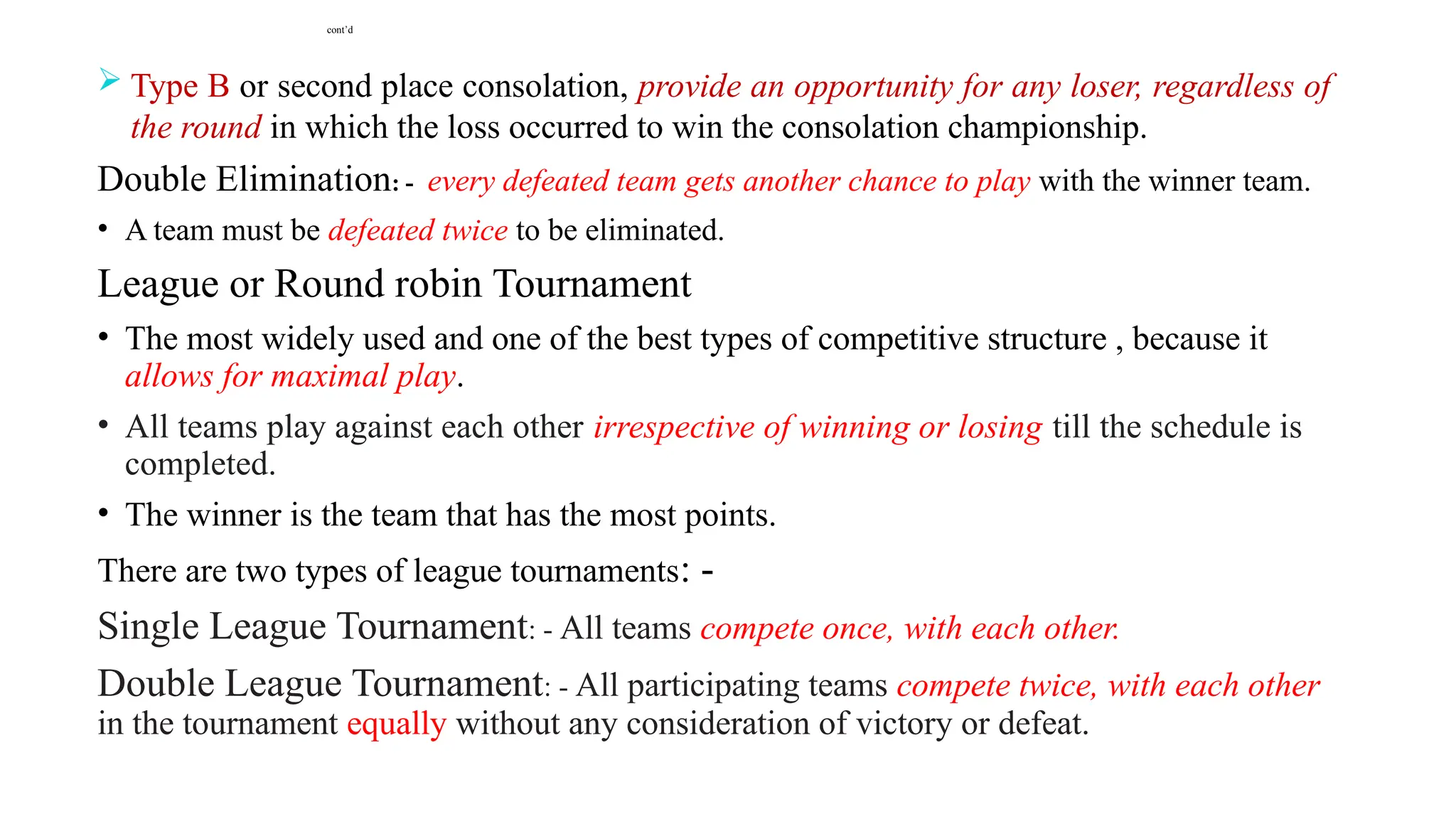
 Type B or second place consolation, provide an opportunity for any loser, regardless of
the round in which the loss occurred to win the consolation championship.
Double Elimination: - every defeated team gets another chance to play with the winner team.
• A team must be defeated twice to be eliminated.
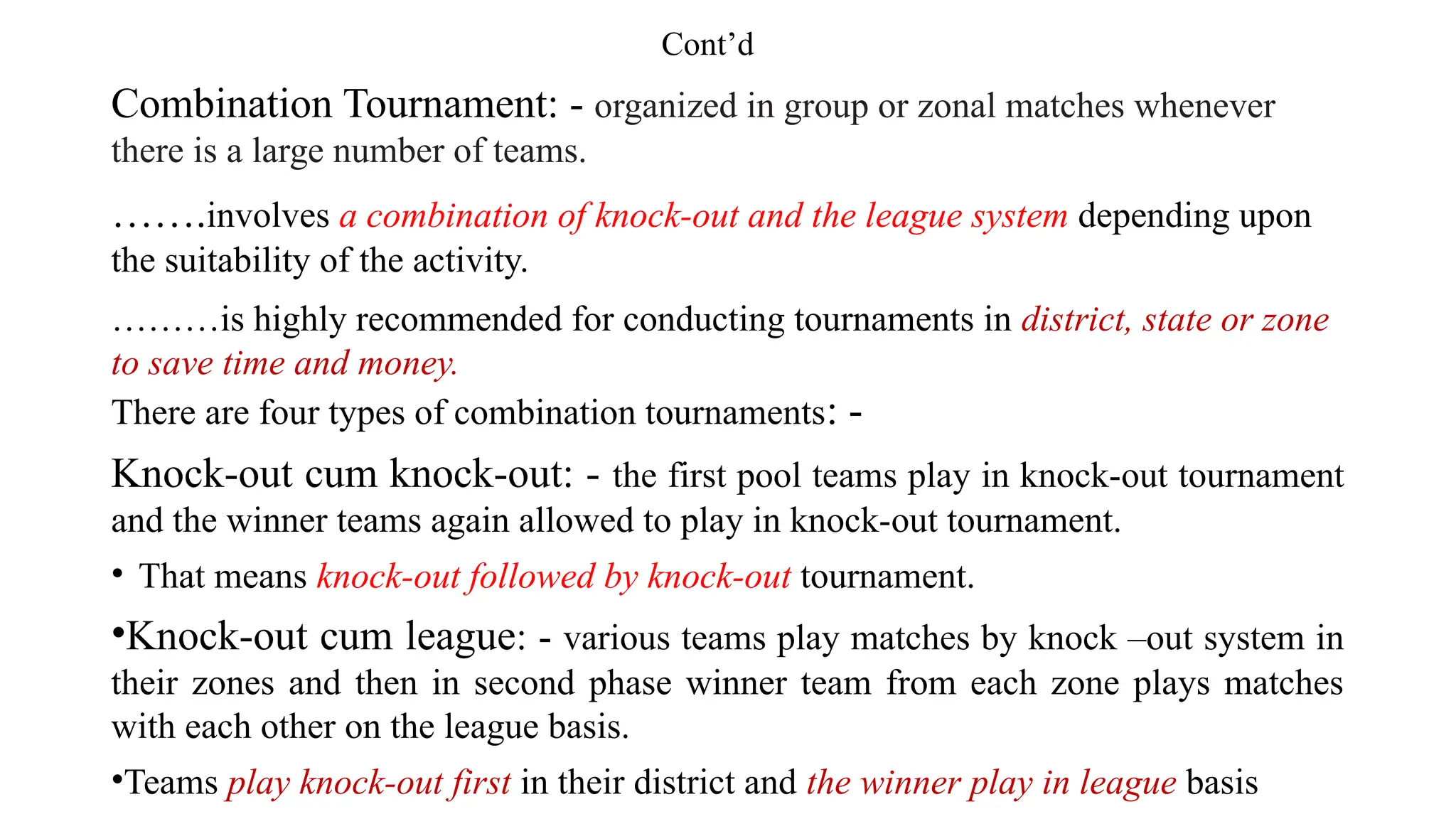
League or Round robin Tournament
• The most widely used and one of the best types of competitive structure , because it
allows for maximal play.
• All teams play against each other irrespective of winning or losing till the schedule is
completed.
• The winner is the team that has the most points.
There are two types of league tournaments: -
Single League Tournament: - All teams compete once, with each other.
Double League Tournament: - All participating teams compete twice, with each other
in the tournament equally without any consideration of victory or defeat.
Cont’d
Combination Tournament: - organized in group or zonal matches whenever
there is a large number of teams.
…….involves a combination of knock-out and the league system depending upon
the suitability of the activity.
………is highly recommended for conducting tournaments in district, state or zone
to save time and money.
There are four types of combination tournaments: -
Knock-out cum knock-out: - the first pool teams play in knock-out tournament
and the winner teams again allowed to play in knock-out tournament.
• That means knock-out followed by knock-out tournament.
•Knock-out cum league: - various teams play matches by knock –out system in
their zones and then in second phase winner team from each zone plays matches
with each other on the league basis.
•Teams play knock-out first in their district and the winner play in league basis
Cont’d
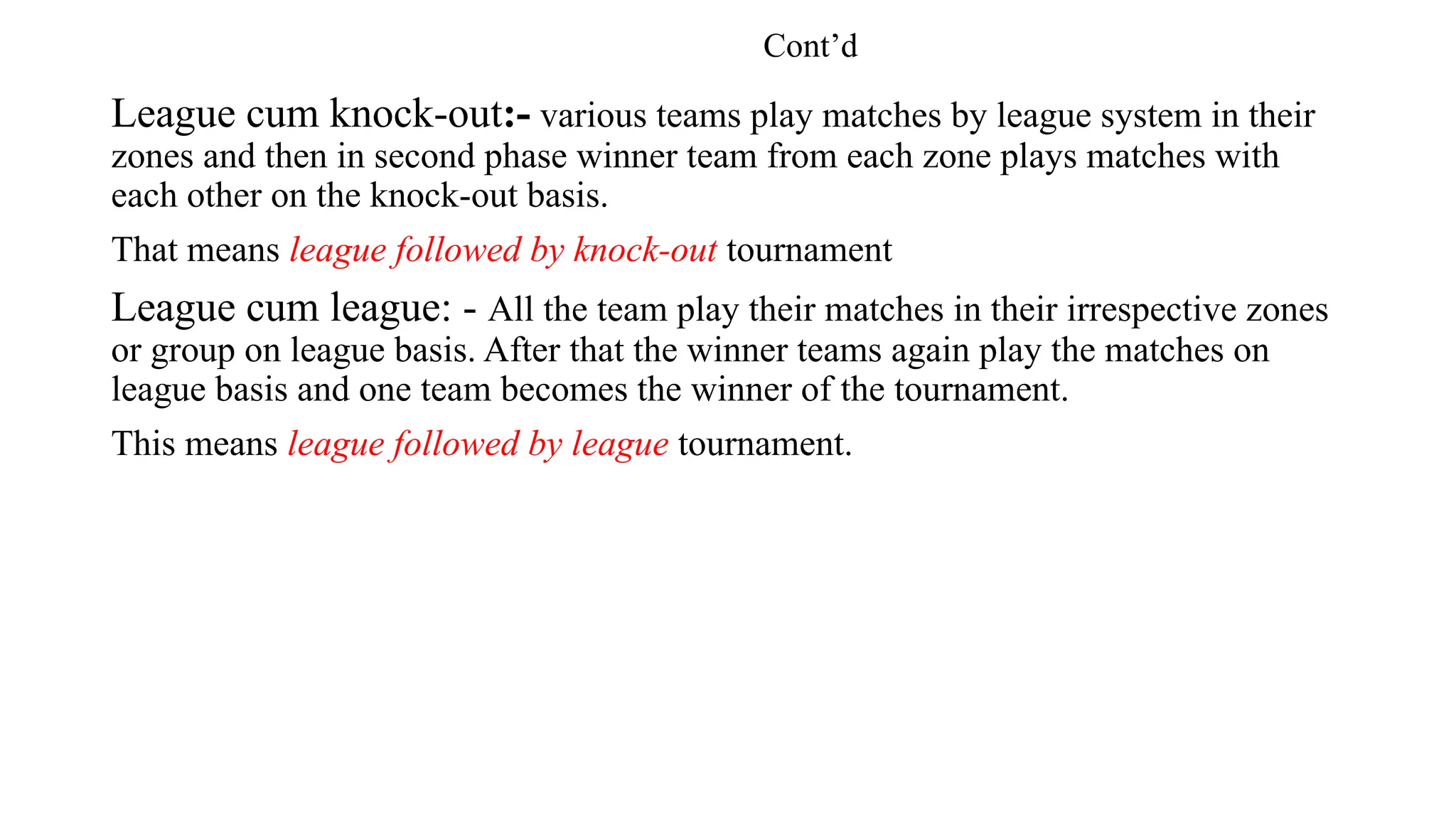
League cum knock-out:- various teams play matches by league system in their
zones and then in second phase winner team from each zone plays matches with
each other on the knock-out basis.
That means league followed by knock-out tournament
League cum league: - All the team play their matches in their irrespective zones
or group on league basis. After that the winner teams again play the matches on
league basis and one team becomes the winner of the tournament.
This means league followed by league tournament.
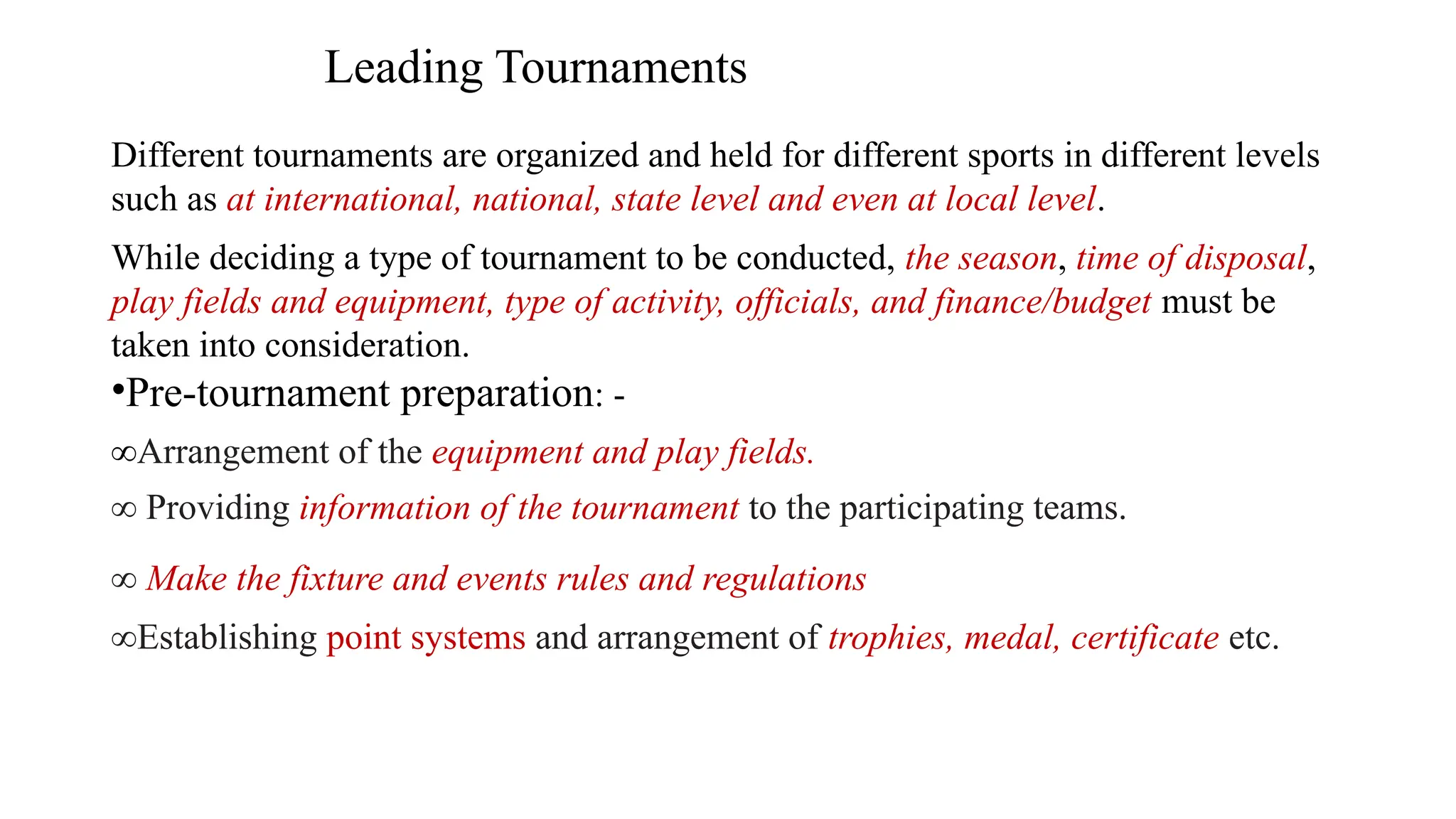
Leading Tournaments
Different tournaments are organized and held for different sports in different levels
such as at international, national, state level and even at local level.
While deciding a type of tournament to be conducted, the season, time of disposal,
play fields and equipment, type of activity, officials, and finance/budget must be
taken into consideration.
•Pre-tournament preparation: -
∞Arrangement of the equipment and play fields.
∞ Providing information of the tournament to the participating teams.
∞ Make the fixture and events rules and regulations
∞Establishing point systems and arrangement of trophies, medal, certificate etc.
Cont’d
• During tournament preparation: -
# Check all the equipment, ground facilities before starting the events.
# Check all eligibility of players and other officials.
# Provide first- aid to injured players.
# Prepare matches result, score sheet or press release.
•Post Tournament Preparation: -
•
€Check the departing teams, refund security money and other related documents.
•€ Present the Medal, Merit certificate, Trophy to the position holder’s players.
•€ Make the payments of officials and other bodies.
•€ Returns the borrowed things to the concerned ones.
•Make a final event report and present to authority.
Different Fixtures in different tournaments
Tournaments are played in various forms of fixture.
Fixture is a process of arranging the teams or players in systematic order in various
groups for competition.
•Knock-out Fixture Procedure: - is the fastest method to know about the winner
team in the tournament.
Seeding a team: - is system of sorting the teams and fitting them in the fixtures so
that the stronger teams do not meet each other in earlier rounds. This method is good
if we know the real strong teams.
•Allotment of byes to teams: - The advantage given to a team usually by
drawing a lot, and exempting it from playing a match in the first round is known as
bye. Byes are given to a specific number of teams in the first round.
The number of byes are decided by subtracting the number of teams from the next
higher number which is in power of two’s (2n
-no of teams) and placing into upper and
lower half.
Cont’d
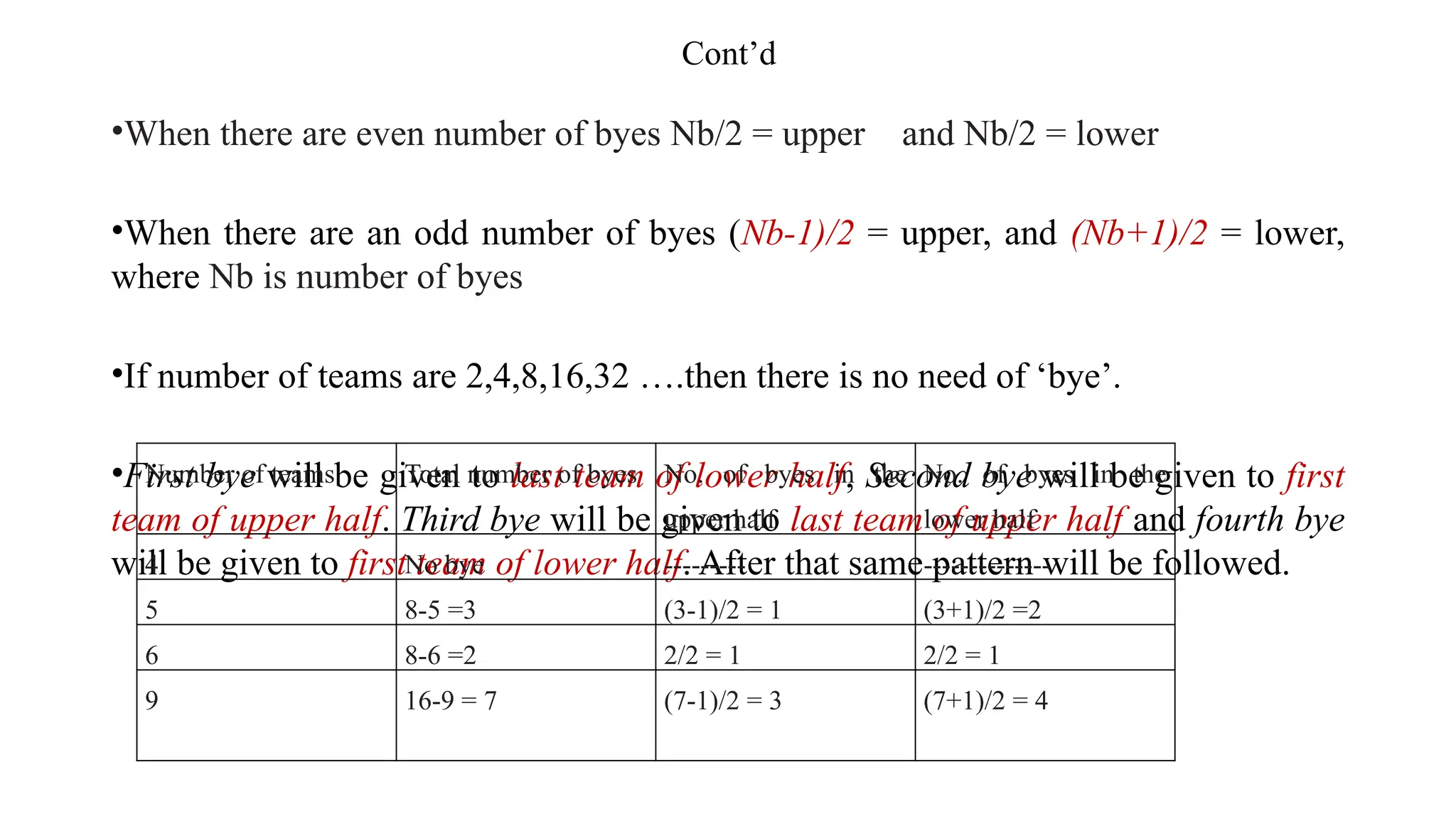
•When there are even number of byes Nb/2 = upper and Nb/2 = lower
•When there are an odd number of byes (Nb-1)/2 = upper, and (Nb+1)/2 = lower,
where Nb is number of byes
•If number of teams are 2,4,8,16,32 ….then there is no need of ‘bye’.
•First bye will be given to last team of lower half, Second bye will be given to first
team of upper half. Third bye will be given to last team of upper half and fourth bye
will be given to first team of lower half. After that same pattern will be followed.
Number of teams Total number of byes No. of byes in the
upper half
No. of byes in the
lower half
4 No bye --------- --------------
5 8-5 =3 (3-1)/2 = 1 (3+1)/2 =2
6 8-6 =2 2/2 = 1 2/2 = 1
9 16-9 = 7 (7-1)/2 = 3 (7+1)/2 = 4
Methods of Preparing Fixtures for Knock-out tournaments
•First determine total number of teams participating in the tournament
•Second calculate total number of matches to be played in the tournament
Total number of matches = n-1, where n is the total number of teams participating in
a single tournament.
• Next determining the number of teams in upper half and lower half:-
a. If the number of teams is even, then equal number of teams will be divided in
both halves i.e. n/2, where n is the total number of teams.
b. If the number of teams is odd, the following method is applied:
•Number of teams in upper half= (n+1)/2, and
•Number of teams in lower half= (n-1)/2, where n is number of teams
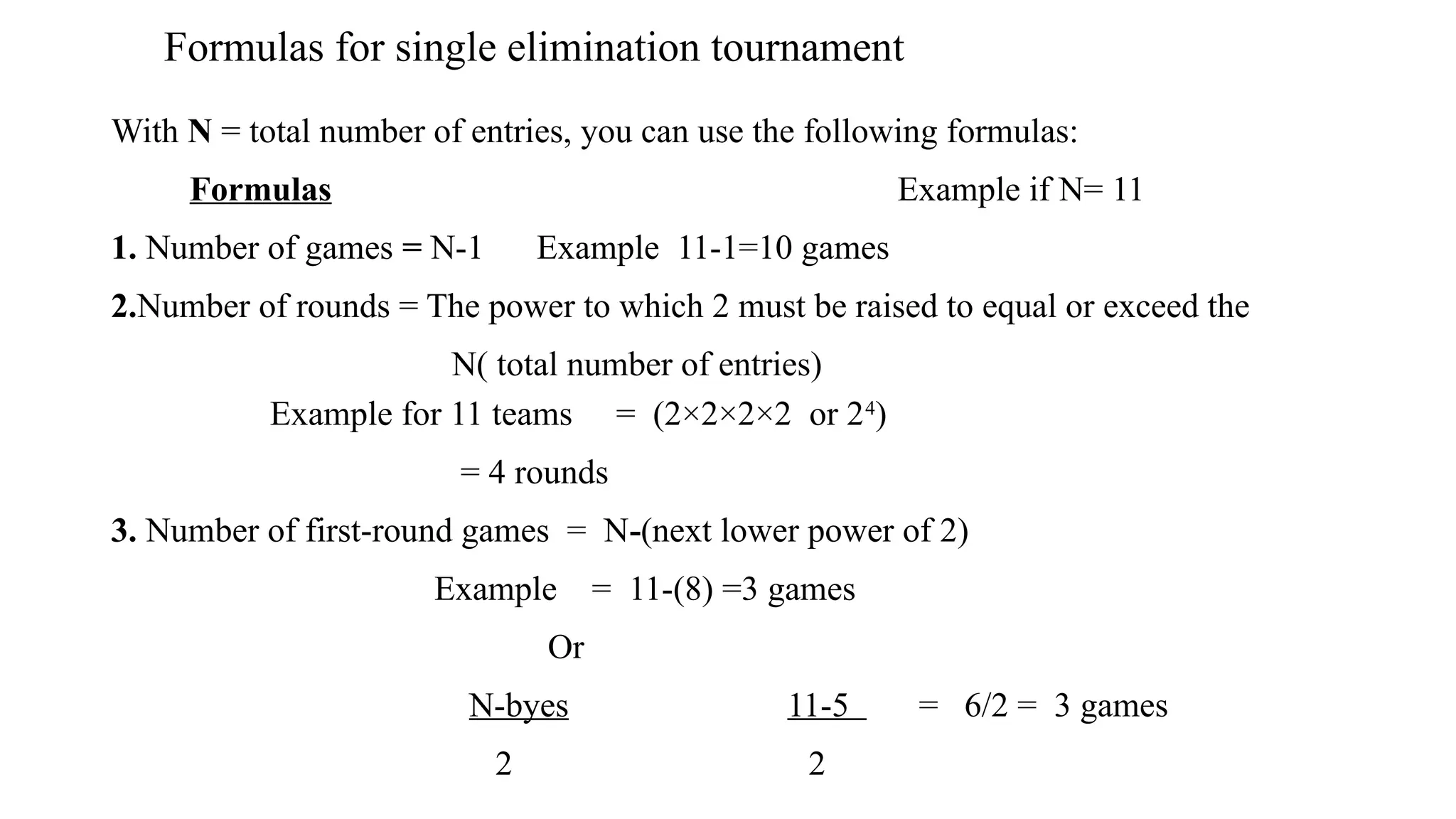
Formulas for single elimination tournament
With N = total number of entries, you can use the following formulas:
Formulas Example if N= 11
1. Number of games = N-1 Example 11-1=10 games
2.Number of rounds = The power to which 2 must be raised to equal or exceed the
N( total number of entries)
Example for 11 teams = (2×2×2×2 or 24
)
= 4 rounds
3. Number of first-round games = N-(next lower power of 2)
Example = 11-(8) =3 games
Or
N-byes 11-5 = 6/2 = 3 games
2 2
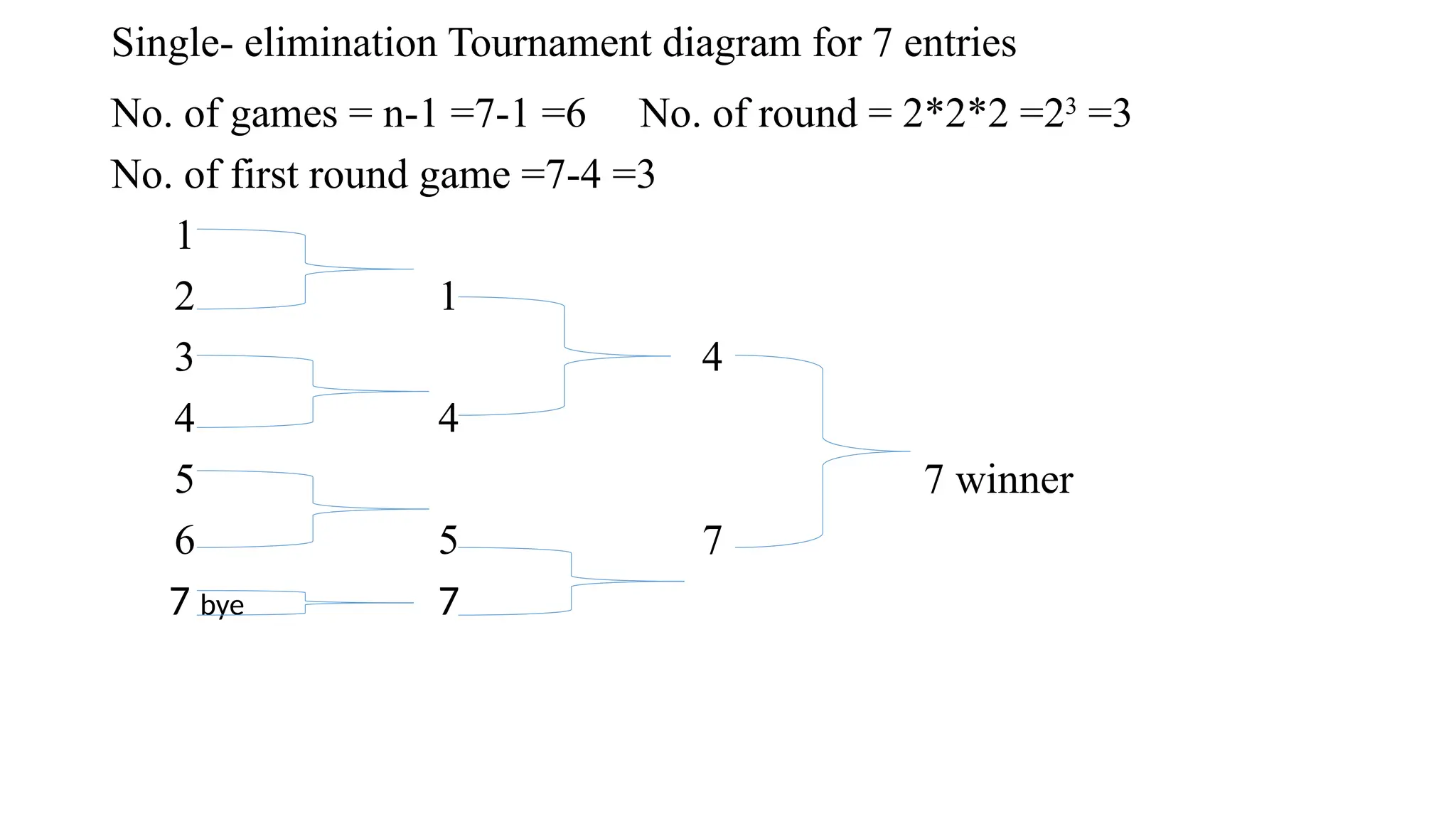
Single- elimination Tournament diagram for 7 entries
No. of games = n-1 =7-1 =6 No. of round = 2*2*2 =23
=3
No. of first round game =7-4 =3
1
2 1
3 4
4 4
5 7 winner
6 5 7
7 bye 7
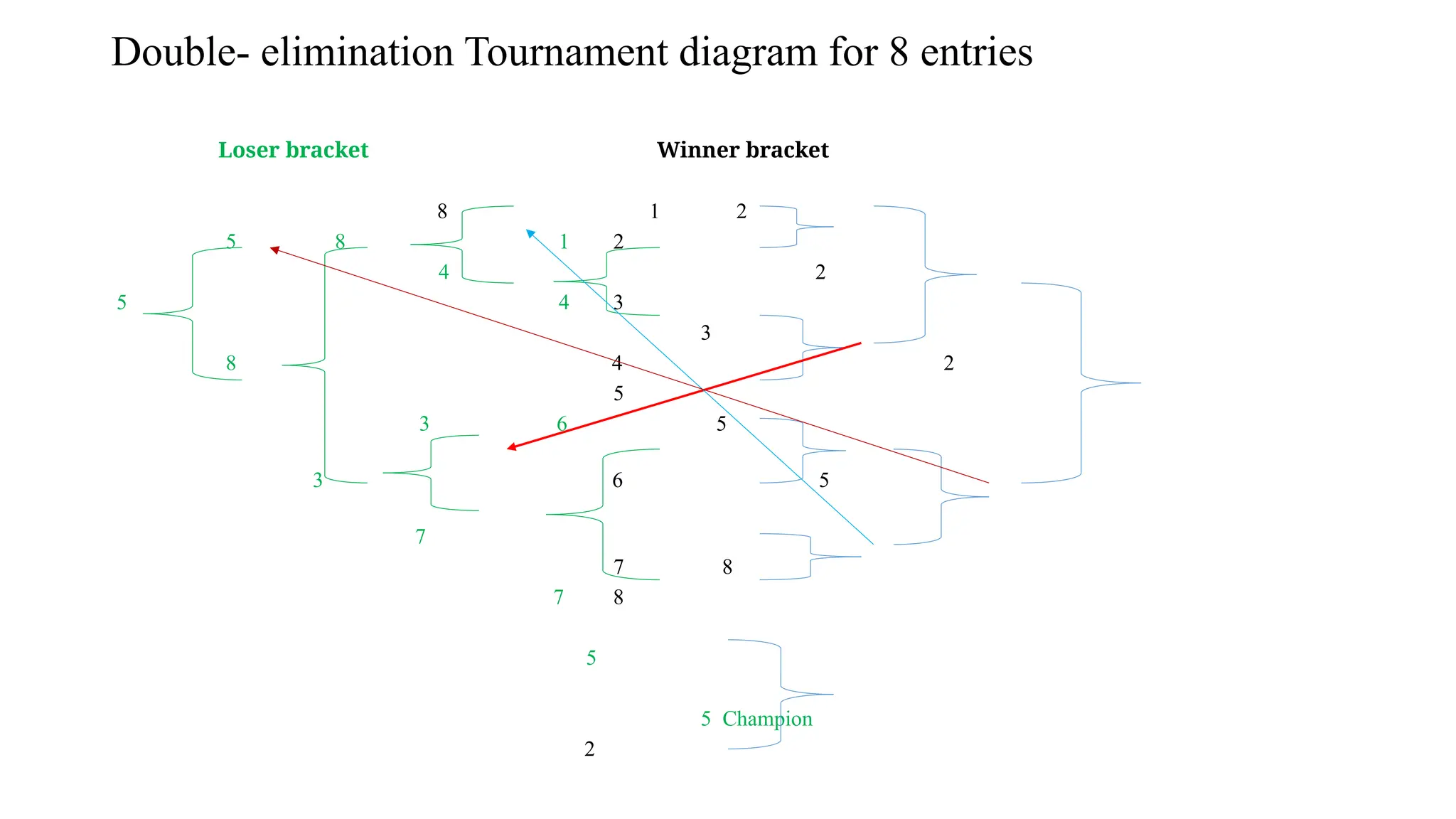
Double- elimination Tournament diagram for 8 entries
Loser bracket Winner bracket
8 1 2
5 8 1 2
4 2
5 4 3
3
8 4 2
5
3 6 5
3 6 5
7
7 8
7 8
5
5 Champion
2
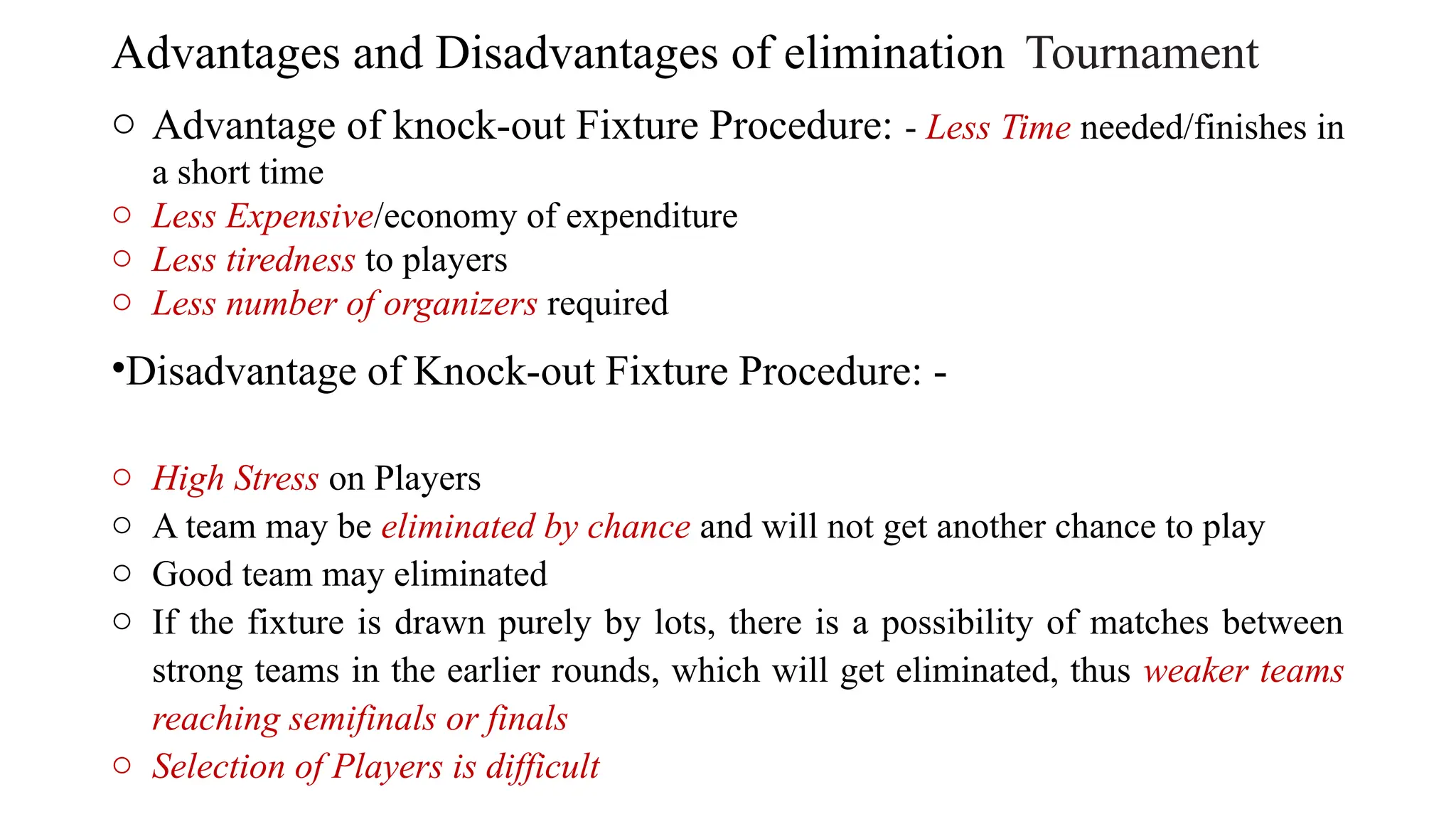
Advantages and Disadvantages of elimination Tournament
o Advantage of knock-out Fixture Procedure: - Less Time needed/finishes in
a short time
o Less Expensive/economy of expenditure
o Less tiredness to players
o Less number of organizers required
•Disadvantage of Knock-out Fixture Procedure: -
o High Stress on Players
o A team may be eliminated by chance and will not get another chance to play
o Good team may eliminated
o If the fixture is drawn purely by lots, there is a possibility of matches between
strong teams in the earlier rounds, which will get eliminated, thus weaker teams
reaching semifinals or finals
o Selection of Players is difficult
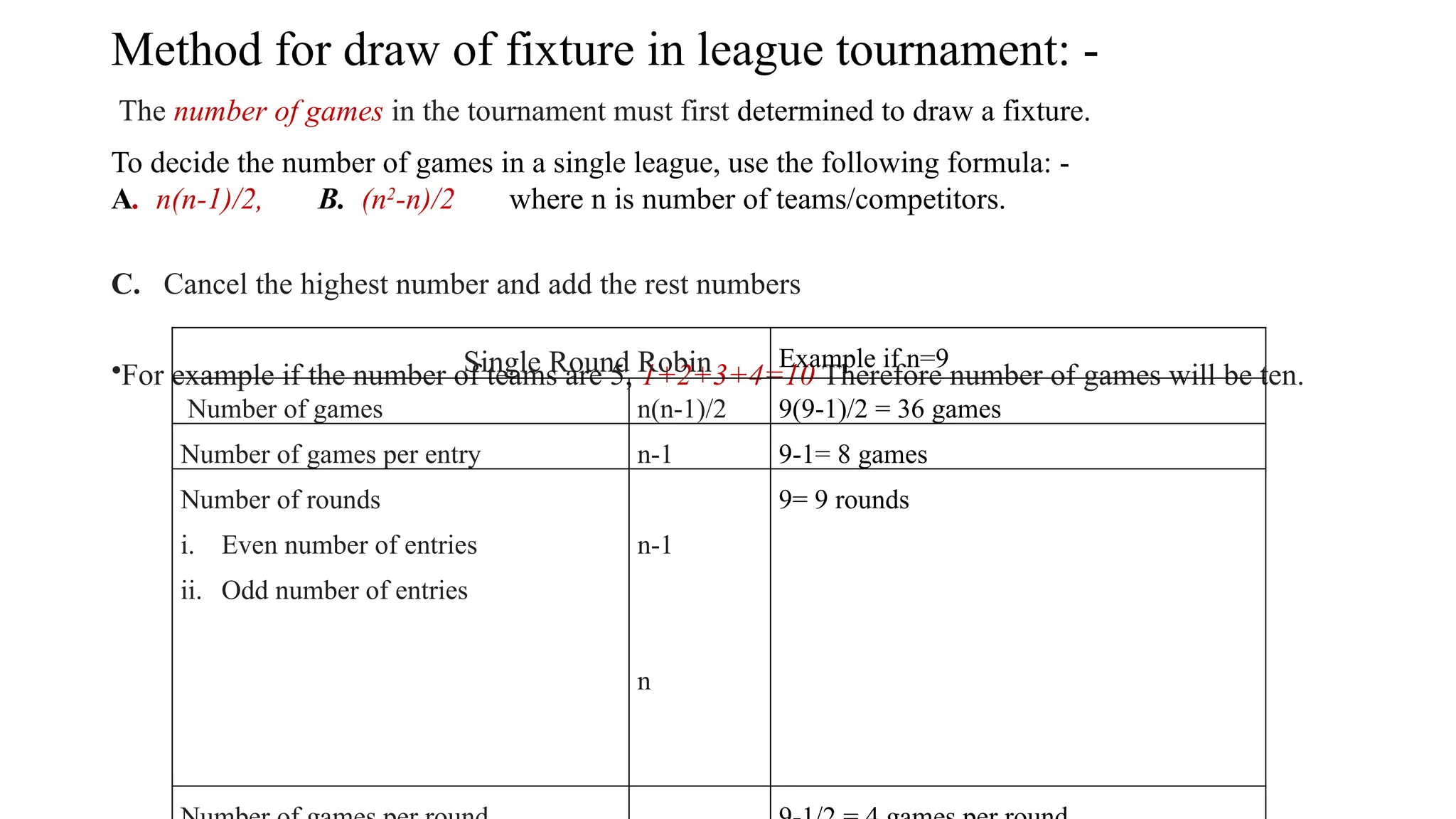
Method for draw of fixture in league tournament: -
The number of games in the tournament must first determined to draw a fixture.
To decide the number of games in a single league, use the following formula: -
A. n(n-1)/2, B. (n2
-n)/2 where n is number of teams/competitors.
C. Cancel the highest number and add the rest numbers
•For example if the number of teams are 5, 1+2+3+4=10 Therefore number of games will be ten.
Single Round Robin Example if n=9
Number of games n(n-1)/2 9(9-1)/2 = 36 games
Number of games per entry n-1 9-1= 8 games
Number of rounds
i. Even number of entries
ii. Odd number of entries
n-1
n
9= 9 rounds
Cont’d
•√ When it is double league tournament, all the above expression will be multiplied by two.
•In league tournament we can use cyclic, stair-case, and tabular methods for designing the
program/fixtures for register scores.
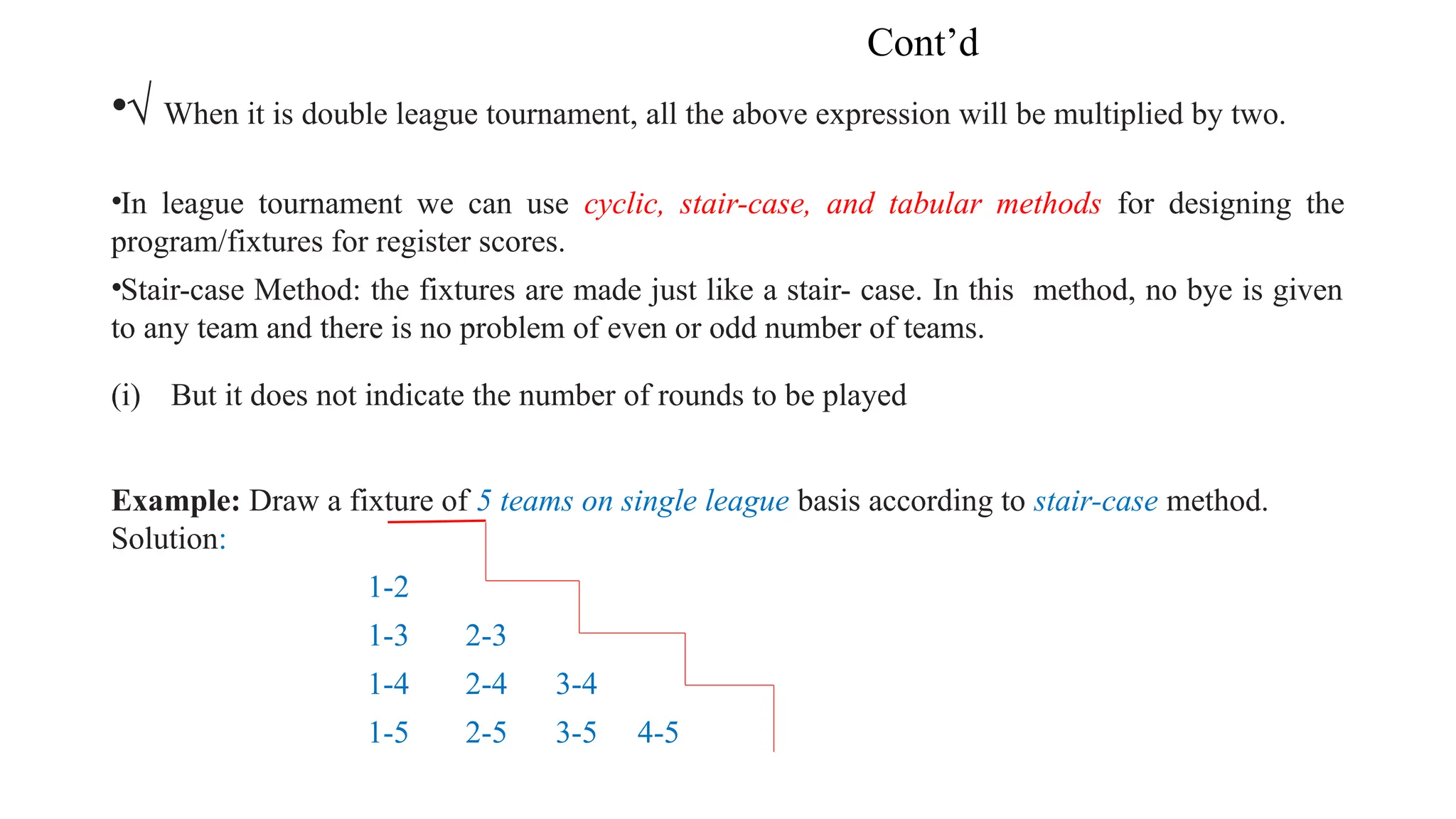
•Stair-case Method: the fixtures are made just like a stair- case. In this method, no bye is given
to any team and there is no problem of even or odd number of teams.
(i) But it does not indicate the number of rounds to be played
Example: Draw a fixture of 5 teams on single league basis according to stair-case method.
Solution:
1-2
1-3 2-3
1-4 2-4 3-4
1-5 2-5 3-5 4-5
Cont’d
Cyclic Method: In cyclic method, if the number of teams is even, the team number 1
is fixed on the top of right hand side and other teams in ascending order consecutively
downward and then upward on the left side and rotate them clockwise. If the number of
teams is odd, then bye is fixed on top right side and the rest procedure remains same.
(a)The number of rounds in case of even number of teams will be n -1, where n =
number of teams. The number of rounds in case of odd number of teams will
be n, where n = number of teams.
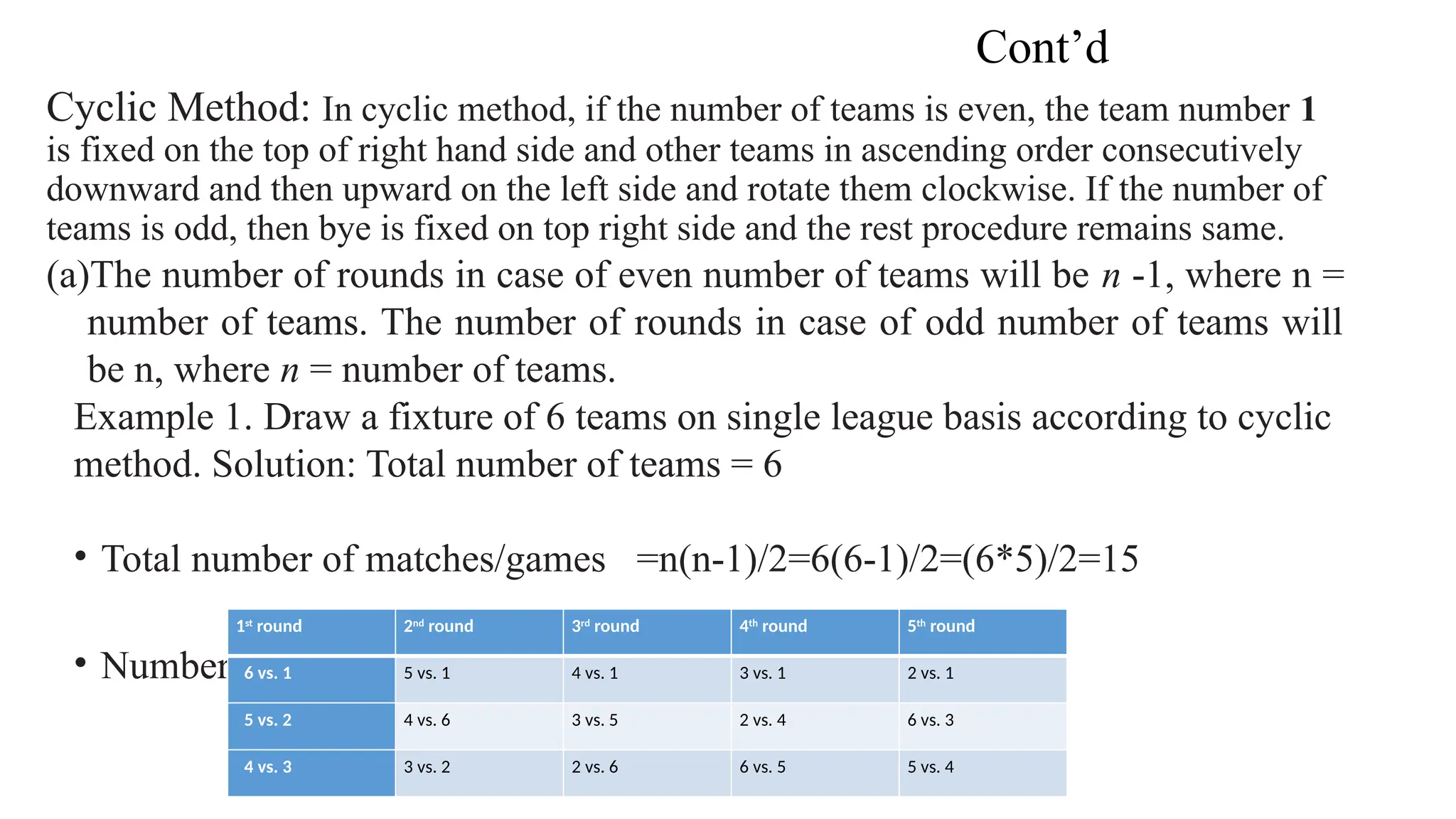
Example 1. Draw a fixture of 6 teams on single league basis according to cyclic
method. Solution: Total number of teams = 6
• Total number of matches/games =n(n-1)/2=6(6-1)/2=(6*5)/2=15
• Number of rounds = n-1 = 6-1 = 5 rounds.
1st
round 2nd
round 3rd
round 4th
round 5th
round
6 vs. 1 5 vs. 1 4 vs. 1 3 vs. 1 2 vs. 1
5 vs. 2 4 vs. 6 3 vs. 5 2 vs. 4 6 vs. 3
4 vs. 3 3 vs. 2 2 vs. 6 6 vs. 5 5 vs. 4
Cont’d
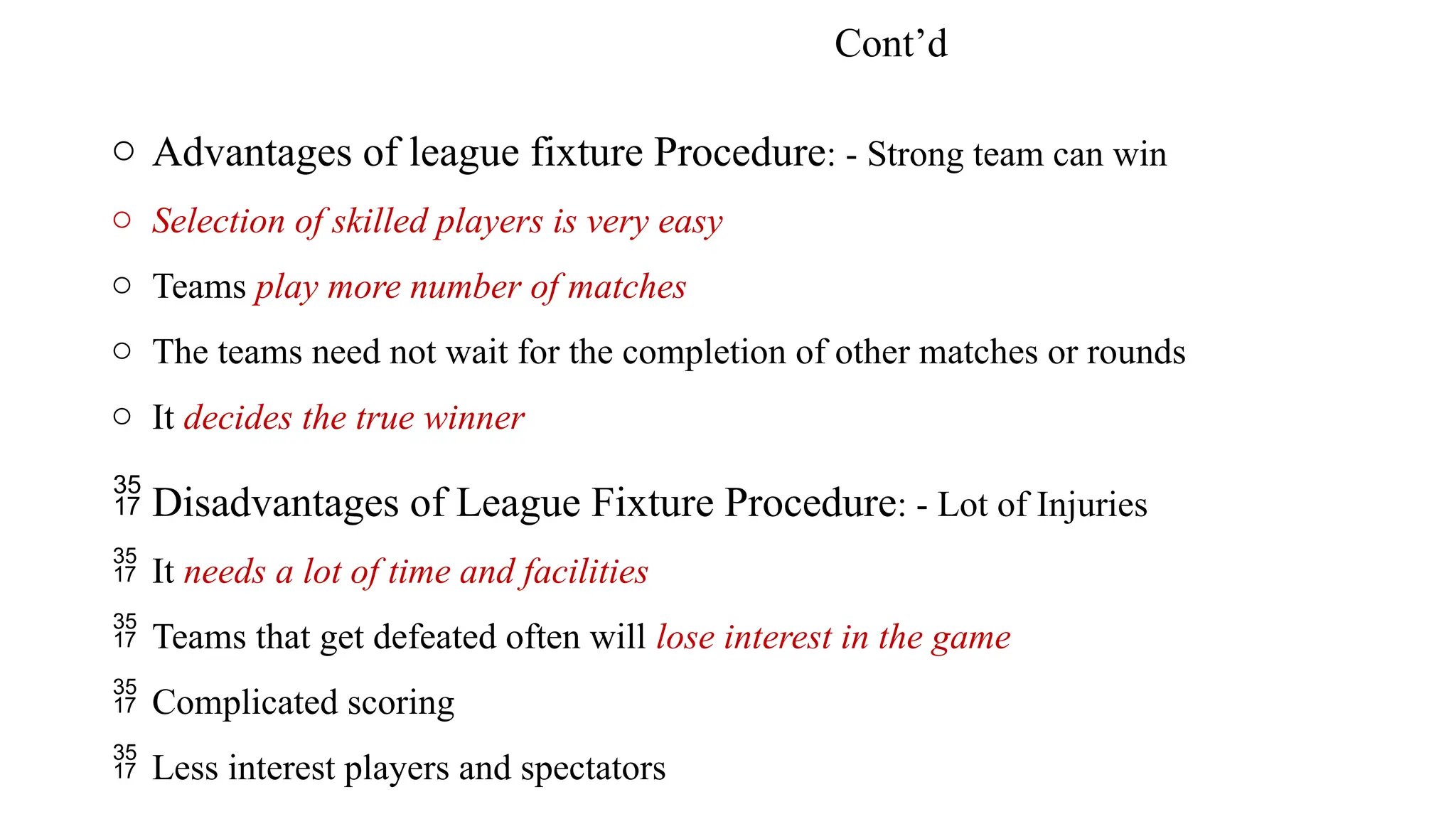
o Advantages of league fixture Procedure: - Strong team can win
o Selection of skilled players is very easy
o Teams play more number of matches
o The teams need not wait for the completion of other matches or rounds
o It decides the true winner
 Disadvantages of League Fixture Procedure: - Lot of Injuries
 It needs a lot of time and facilities
 Teams that get defeated often will lose interest in the game
 Complicated scoring
 Less interest players and spectators
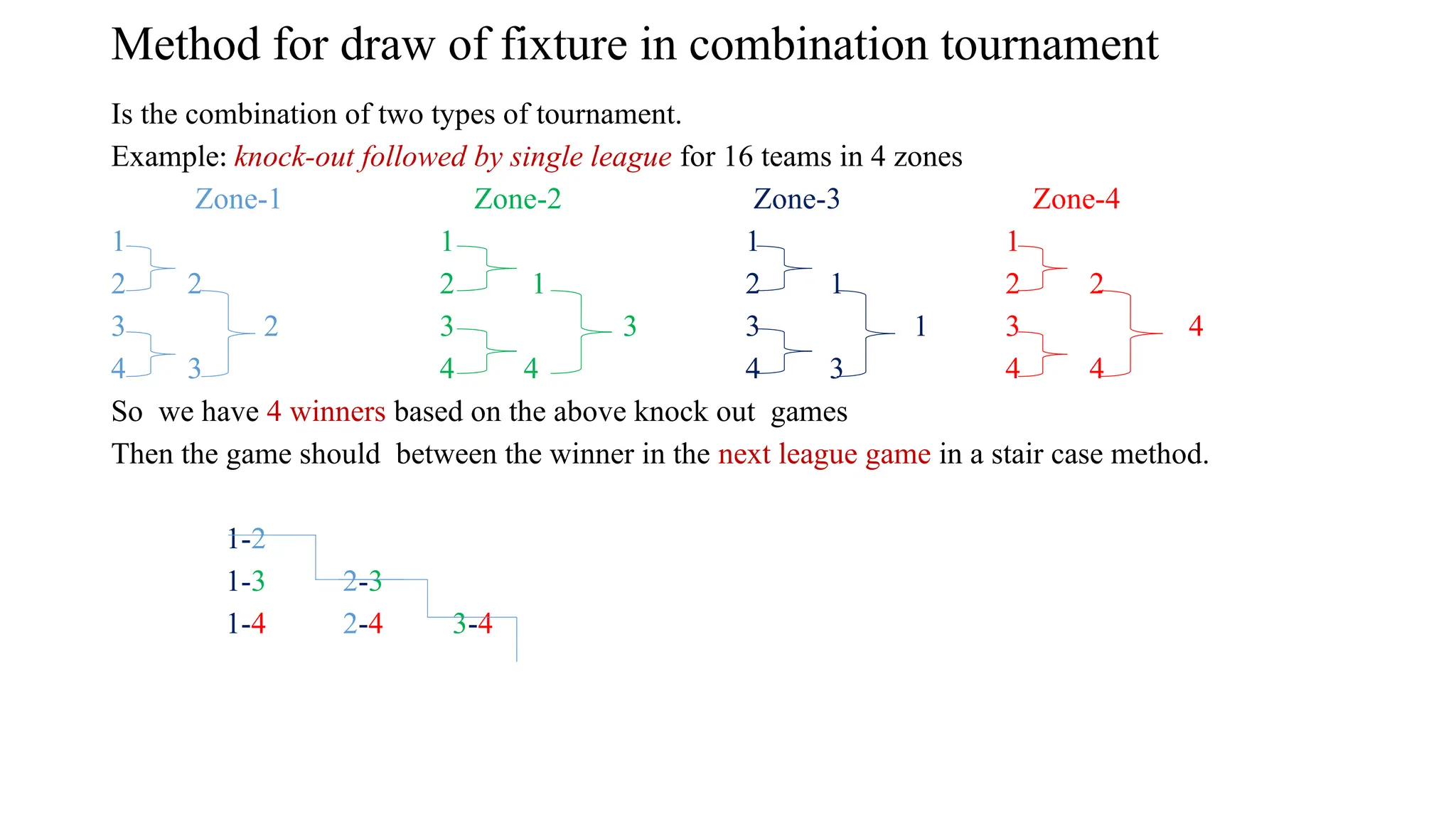
Method for draw of fixture in combination tournament
Is the combination of two types of tournament.
Example: knock-out followed by single league for 16 teams in 4 zones
Zone-1 Zone-2 Zone-3 Zone-4
1 1 1 1
2 2 2 1 2 1 2 2
3 2 3 3 3 1 3 4
4 3 4 4 4 3 4 4
So we have 4 winners based on the above knock out games
Then the game should between the winner in the next league game in a stair case method.
1-2
1-3 2-3
1-4 2-4 3-4
Intramural and Extramural
Intramurals :- The activities which are performed within the campus of an Institution
are called intramurals
• Students of other school can not participate in these activities
• Motto: A game for all and each for a game
objectives of intramural:-
1. To develop Leadership Qualities among students
3. To develop Feeling of Cooperation
4. To provide Recreation
5. To develop the Feeling of Sports-manship
Extramural:- The activities which are performed outside the walls of an institution or
school. objectives of extramural:-
1. To provide Experience to Students
2. To improve the Standard of Sports
3. To broaden the Base of Sports
4. To develop Sportsmanship and Fraternity

Thank you!

FoundationPPT1 hardware and networking .pptx

  • 1.
  • 2.
    SPORT ACADEMY POST GRADUATEPROGRAMME IN VOLLEY BALL COACHING Foundation of Volleyball Coaching Individual Assignment Title: Preparing of Fixtures and Leading Tournaments By: Getahun Berie Submitted To: Mr. Astatikie B. Bahir Dar, Ethiopia May 2013
  • 3.
    Main Contents Definition ofTournament Leading Tournaments Different Fixtures in Different Tournaments
  • 4.
    Definition of Tournament •A tournament is a series of games or matches that are used to decide the winner of a competition. • ………is a series of a particular sports competitions in which one team finally wins and all other participating teams lose the matches or games. • ……. is a contest where teams or individuals compete but not necessarily against each other. Importance of Tournaments Tournaments provides recreation to all, i.e. athletes, organizers, spectators, students, etc. The sportsman learns ethical values such as honesty, fair play, and respect for others. Tournaments motivate the people towards the sports.
  • 5.
    Cont’d • Tournaments helpthe players to monitor the level of their performance and evaluate their standards of achievement. • …..is a powerful medium of popularize a particular game or sports. • Tournament have become a big money spinner Types of Tournament The most important and commonly used tournaments are:- Knock-out or elimination (single elimination, consolation elimination, double elimination) League or round robin(single league and double league) Combination tournaments(knock-out cum knock-out, knock-out cum league, league cum knock-out, and league cum league) Challenge (ladder, pyramid, spider web) Among the above tournament type, challenge type is used to held games like boxing, tennis, table tennis, and badminton rather than volleyball.
  • 6.
    Knock-out or EliminationTournament • In this tournament, participants or teams are eliminated from the tournament after a certain number of losses. • Opportunities are given to the winning players/teams only. There are three common types of elimination tournament: - Single Elimination: - the teams ones defeated gets eliminated from the tournament and not given another chance to play. A winner is a team defeats all the game in the schedule. A single elimination tournament is well known and simple to design. Consolation Elimination: -… is much better than the single knock-out tournament because loser teams get another chance to play with other losers. have two winners: the champion of the elimination bracket and the winner of the consolation bracket. There are two types of consolation tournaments: Type A, and Type B.  In type A, all losers in the first round (second round if a bye in the first) play another single elimination tournament.  The winner of the second single elimination tournament is the consolation winner.
  • 7.
    cont’d  Type Bor second place consolation, provide an opportunity for any loser, regardless of the round in which the loss occurred to win the consolation championship. Double Elimination: - every defeated team gets another chance to play with the winner team. • A team must be defeated twice to be eliminated. League or Round robin Tournament • The most widely used and one of the best types of competitive structure , because it allows for maximal play. • All teams play against each other irrespective of winning or losing till the schedule is completed. • The winner is the team that has the most points. There are two types of league tournaments: - Single League Tournament: - All teams compete once, with each other. Double League Tournament: - All participating teams compete twice, with each other in the tournament equally without any consideration of victory or defeat.
  • 8.
    Cont’d Combination Tournament: -organized in group or zonal matches whenever there is a large number of teams. …….involves a combination of knock-out and the league system depending upon the suitability of the activity. ………is highly recommended for conducting tournaments in district, state or zone to save time and money. There are four types of combination tournaments: - Knock-out cum knock-out: - the first pool teams play in knock-out tournament and the winner teams again allowed to play in knock-out tournament. • That means knock-out followed by knock-out tournament. •Knock-out cum league: - various teams play matches by knock –out system in their zones and then in second phase winner team from each zone plays matches with each other on the league basis. •Teams play knock-out first in their district and the winner play in league basis
  • 9.
    Cont’d League cum knock-out:-various teams play matches by league system in their zones and then in second phase winner team from each zone plays matches with each other on the knock-out basis. That means league followed by knock-out tournament League cum league: - All the team play their matches in their irrespective zones or group on league basis. After that the winner teams again play the matches on league basis and one team becomes the winner of the tournament. This means league followed by league tournament.
  • 10.
    Leading Tournaments Different tournamentsare organized and held for different sports in different levels such as at international, national, state level and even at local level. While deciding a type of tournament to be conducted, the season, time of disposal, play fields and equipment, type of activity, officials, and finance/budget must be taken into consideration. •Pre-tournament preparation: - ∞Arrangement of the equipment and play fields. ∞ Providing information of the tournament to the participating teams. ∞ Make the fixture and events rules and regulations ∞Establishing point systems and arrangement of trophies, medal, certificate etc.
  • 11.
    Cont’d • During tournamentpreparation: - # Check all the equipment, ground facilities before starting the events. # Check all eligibility of players and other officials. # Provide first- aid to injured players. # Prepare matches result, score sheet or press release. •Post Tournament Preparation: - • €Check the departing teams, refund security money and other related documents. •€ Present the Medal, Merit certificate, Trophy to the position holder’s players. •€ Make the payments of officials and other bodies. •€ Returns the borrowed things to the concerned ones. •Make a final event report and present to authority.
  • 12.
    Different Fixtures indifferent tournaments Tournaments are played in various forms of fixture. Fixture is a process of arranging the teams or players in systematic order in various groups for competition. •Knock-out Fixture Procedure: - is the fastest method to know about the winner team in the tournament. Seeding a team: - is system of sorting the teams and fitting them in the fixtures so that the stronger teams do not meet each other in earlier rounds. This method is good if we know the real strong teams. •Allotment of byes to teams: - The advantage given to a team usually by drawing a lot, and exempting it from playing a match in the first round is known as bye. Byes are given to a specific number of teams in the first round. The number of byes are decided by subtracting the number of teams from the next higher number which is in power of two’s (2n -no of teams) and placing into upper and lower half.
  • 13.
    Cont’d •When there areeven number of byes Nb/2 = upper and Nb/2 = lower •When there are an odd number of byes (Nb-1)/2 = upper, and (Nb+1)/2 = lower, where Nb is number of byes •If number of teams are 2,4,8,16,32 ….then there is no need of ‘bye’. •First bye will be given to last team of lower half, Second bye will be given to first team of upper half. Third bye will be given to last team of upper half and fourth bye will be given to first team of lower half. After that same pattern will be followed. Number of teams Total number of byes No. of byes in the upper half No. of byes in the lower half 4 No bye --------- -------------- 5 8-5 =3 (3-1)/2 = 1 (3+1)/2 =2 6 8-6 =2 2/2 = 1 2/2 = 1 9 16-9 = 7 (7-1)/2 = 3 (7+1)/2 = 4
  • 14.
    Methods of PreparingFixtures for Knock-out tournaments •First determine total number of teams participating in the tournament •Second calculate total number of matches to be played in the tournament Total number of matches = n-1, where n is the total number of teams participating in a single tournament. • Next determining the number of teams in upper half and lower half:- a. If the number of teams is even, then equal number of teams will be divided in both halves i.e. n/2, where n is the total number of teams. b. If the number of teams is odd, the following method is applied: •Number of teams in upper half= (n+1)/2, and •Number of teams in lower half= (n-1)/2, where n is number of teams
  • 15.
    Formulas for singleelimination tournament With N = total number of entries, you can use the following formulas: Formulas Example if N= 11 1. Number of games = N-1 Example 11-1=10 games 2.Number of rounds = The power to which 2 must be raised to equal or exceed the N( total number of entries) Example for 11 teams = (2×2×2×2 or 24 ) = 4 rounds 3. Number of first-round games = N-(next lower power of 2) Example = 11-(8) =3 games Or N-byes 11-5 = 6/2 = 3 games 2 2
  • 16.
    Single- elimination Tournamentdiagram for 7 entries No. of games = n-1 =7-1 =6 No. of round = 2*2*2 =23 =3 No. of first round game =7-4 =3 1 2 1 3 4 4 4 5 7 winner 6 5 7 7 bye 7
  • 17.
    Double- elimination Tournamentdiagram for 8 entries Loser bracket Winner bracket 8 1 2 5 8 1 2 4 2 5 4 3 3 8 4 2 5 3 6 5 3 6 5 7 7 8 7 8 5 5 Champion 2
  • 18.
    Advantages and Disadvantagesof elimination Tournament o Advantage of knock-out Fixture Procedure: - Less Time needed/finishes in a short time o Less Expensive/economy of expenditure o Less tiredness to players o Less number of organizers required •Disadvantage of Knock-out Fixture Procedure: - o High Stress on Players o A team may be eliminated by chance and will not get another chance to play o Good team may eliminated o If the fixture is drawn purely by lots, there is a possibility of matches between strong teams in the earlier rounds, which will get eliminated, thus weaker teams reaching semifinals or finals o Selection of Players is difficult
  • 19.
    Method for drawof fixture in league tournament: - The number of games in the tournament must first determined to draw a fixture. To decide the number of games in a single league, use the following formula: - A. n(n-1)/2, B. (n2 -n)/2 where n is number of teams/competitors. C. Cancel the highest number and add the rest numbers •For example if the number of teams are 5, 1+2+3+4=10 Therefore number of games will be ten. Single Round Robin Example if n=9 Number of games n(n-1)/2 9(9-1)/2 = 36 games Number of games per entry n-1 9-1= 8 games Number of rounds i. Even number of entries ii. Odd number of entries n-1 n 9= 9 rounds
  • 20.
    Cont’d •√ When itis double league tournament, all the above expression will be multiplied by two. •In league tournament we can use cyclic, stair-case, and tabular methods for designing the program/fixtures for register scores. •Stair-case Method: the fixtures are made just like a stair- case. In this method, no bye is given to any team and there is no problem of even or odd number of teams. (i) But it does not indicate the number of rounds to be played Example: Draw a fixture of 5 teams on single league basis according to stair-case method. Solution: 1-2 1-3 2-3 1-4 2-4 3-4 1-5 2-5 3-5 4-5
  • 21.
    Cont’d Cyclic Method: Incyclic method, if the number of teams is even, the team number 1 is fixed on the top of right hand side and other teams in ascending order consecutively downward and then upward on the left side and rotate them clockwise. If the number of teams is odd, then bye is fixed on top right side and the rest procedure remains same. (a)The number of rounds in case of even number of teams will be n -1, where n = number of teams. The number of rounds in case of odd number of teams will be n, where n = number of teams. Example 1. Draw a fixture of 6 teams on single league basis according to cyclic method. Solution: Total number of teams = 6 • Total number of matches/games =n(n-1)/2=6(6-1)/2=(6*5)/2=15 • Number of rounds = n-1 = 6-1 = 5 rounds. 1st round 2nd round 3rd round 4th round 5th round 6 vs. 1 5 vs. 1 4 vs. 1 3 vs. 1 2 vs. 1 5 vs. 2 4 vs. 6 3 vs. 5 2 vs. 4 6 vs. 3 4 vs. 3 3 vs. 2 2 vs. 6 6 vs. 5 5 vs. 4
  • 22.
    Cont’d o Advantages ofleague fixture Procedure: - Strong team can win o Selection of skilled players is very easy o Teams play more number of matches o The teams need not wait for the completion of other matches or rounds o It decides the true winner  Disadvantages of League Fixture Procedure: - Lot of Injuries  It needs a lot of time and facilities  Teams that get defeated often will lose interest in the game  Complicated scoring  Less interest players and spectators
  • 23.
    Method for drawof fixture in combination tournament Is the combination of two types of tournament. Example: knock-out followed by single league for 16 teams in 4 zones Zone-1 Zone-2 Zone-3 Zone-4 1 1 1 1 2 2 2 1 2 1 2 2 3 2 3 3 3 1 3 4 4 3 4 4 4 3 4 4 So we have 4 winners based on the above knock out games Then the game should between the winner in the next league game in a stair case method. 1-2 1-3 2-3 1-4 2-4 3-4
  • 24.
    Intramural and Extramural Intramurals:- The activities which are performed within the campus of an Institution are called intramurals • Students of other school can not participate in these activities • Motto: A game for all and each for a game objectives of intramural:- 1. To develop Leadership Qualities among students 3. To develop Feeling of Cooperation 4. To provide Recreation 5. To develop the Feeling of Sports-manship Extramural:- The activities which are performed outside the walls of an institution or school. objectives of extramural:- 1. To provide Experience to Students 2. To improve the Standard of Sports 3. To broaden the Base of Sports 4. To develop Sportsmanship and Fraternity
  • 25.