Strengthening Your Inner
Well-Being!
An “Each Mind Matters”
Seminar
Evan Sternard, M.S. Ed., M.S.
Assistant Professor, Crafton Hills College
Social and Emotional Wellbeing
 Health and wellbeing is
more than just the
absence of an illness. It
includes our physical health
and safety, social and
emotional health, spiritual
wellness and subjective
sense of wellbeing.
Social and emotional
wellbeing is an
important life aspect,
and has an impact on
physical health, quality
of life and personal
achievements.
Mental and Emotional Well-being: What’s In It
For Me?
 Mental and emotional well-being
is essential to overall health.
Positive mental health allows
people to realize their full
potential, cope with the stresses
of life, work productively, and
make meaningful contributions
to their communities.
 Early childhood
experiences have lasting,
measurable consequences
later in life; therefore,
fostering emotional well-
being from the earliest
stages of life helps build a
foundation for overall
health and well-being.
Mental and Emotional Well-being:
If It’s Not There
 Anxiety, mood (e.g., depression) and impulse control
disorders are associated with a higher probability of
risk behaviors (e.g., tobacco, alcohol and other drug
use, risky sexual behavior), intimate partner and family
violence, many other chronic and acute conditions (e.g.,
obesity, diabetes, cardiovascular disease, HIV/STD’s),
and premature death.
Characteristics of Emotional
Wellness
Emotional Wellness is the ability to be aware of
and accept our feelings, rather than deny them;
have an optimistic approach to life, and
enjoy life despite its occasional disappointments
and frustrations.
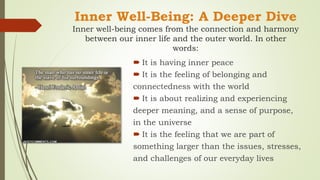
Inner Well-Being: A Deeper Dive
Inner well-being comes from the connection and harmony
between our inner life and the outer world. In other
words:
 It is having inner peace
 It is the feeling of belonging and
connectedness with the world
 It is about realizing and experiencing
deeper meaning, and a sense of purpose,
in the universe
 It is the feeling that we are part of
something larger than the issues, stresses,
and challenges of our everyday lives
Inner Well-Being
(cont.)
 The way to inner well-being
involves acceptance of the
world and transcendence
(going above or letting go)
of our everyday
lives. Meditation, rituals,
yoga and other practices
can develop inner well-
being.
 Your values, beliefs, principles,
and morals help to define your
inner self. Take time to consider
what these are and if your
behaviors and actions are in
accordance and harmony with
these factors.
 By cultivating compassion,
love, forgiveness, acceptance,
trust, kindness, empathy,
altruism, joy and fulfilment in
our lives, we help our inner
health.
“Happiness Is
All In Our
Mind”
We are far more in
control of our
happiness and
contentment than we
usually realize!
“We must stop
OUTSOURCING our
happiness.”
Eight Golden Tips for Emotional
Wellness
1. Keep expectations of yourself
and others realistic.
Unrealistic expectations lead
to disappointment and
feelings of failure.
2. Develop realistic goals and
set out to achieve them, one
day at a time.
3. Learn to accept the
changes in your life.
4. Release the anger and
the resentments. Or…keep
carrying that baggage!
(More) Eight Golden Tips for
Emotional Wellness
5. Surround yourself with
positive thoughts and (mostly)
positive people. Gravitate
toward people who are uplifting
and supportive and away from
those who operate in negativity.
6. Choose to be a good friend to
yourself
7. Take good care of your
body.
8. If you are experiencing
emotional difficulty, talk to
someone.
Resilience
The term resilience is
related to social and
emotional wellbeing,
but is not exactly the
same.
 Resilience is the capacity
to deal constructively
with change or
challenges, allowing a
person to maintain or re-
establish their social and
emotional wellbeing in
the face of difficult
events.
Mindfulness
 Mindfulness. It’s a pretty
straightforward word. It
suggests that the mind is
fully attending to what’s
happening, to what
you’re doing, to the
space you’re moving
through, here and now.
 Mindfulness is the basic
human ability to be fully
present, aware of where
we are and what we’re
doing, and not overly
reactive or overwhelmed
by what’s going on
around us.
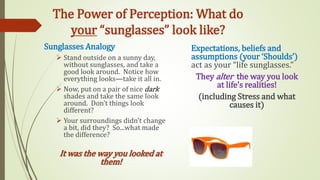
The Power of Perception: What do
your “sunglasses” look like?
Sunglasses Analogy
 Stand outside on a sunny day,
without sunglasses, and take a
good look around. Notice how
everything looks—take it all in.
 Now, put on a pair of nice dark
shades and take the same look
around. Don’t things look
different?
 Your surroundings didn’t change
a bit, did they? So...what made
the difference?
It was the way you looked at
them!
Expectations, beliefs and
assumptions (your ‘Shoulds’)
act as your “life sunglasses.”
They alter the way you look
at life’s realities!
(including Stress and what
causes it)
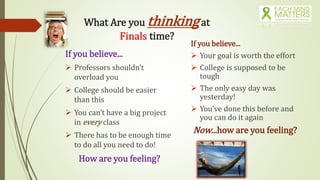
What Are you thinkingat
Finals time?
If you believe...
 Professors shouldn’t
overload you
 College should be easier
than this
 You can’t have a big project
in every class
 There has to be enough time
to do all you need to do!
How are you feeling?
If you believe...
 Your goal is worth the effort
 College is supposed to be
tough
 The only easy day was
yesterday!
 You’ve done this before and
you can do it again
Now...how are you feeling?
Perception is Everything!
Did your
circumstances
change?
Certainly not!
What changed was
the way you looked
at them—what you
thought about
them!
Get the Picture?
“Handling Depression:
Staying Up When You’re
Feeling Down”
An “Each Mind Matters” Student Seminar
Evan Sternard, M.S.Ed., M.S.
Assistant Professor, Crafton Hills College
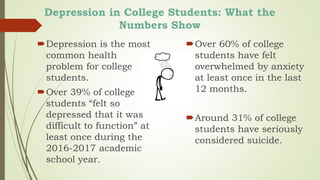
Depression in College Students: What the
Numbers Show
Depression is the most
common health
problem for college
students.
Over 39% of college
students “felt so
depressed that it was
difficult to function” at
least once during the
2016-2017 academic
school year.
Over 60% of college
students have felt
overwhelmed by anxiety
at least once in the last
12 months.
Around 31% of college
students have seriously
considered suicide.
What is Depression?
Depression is a medical illness with many
symptoms, including physical ones.
 Sadness is only a small
part of depression. Some
people with depression
may not feel sadness at
all, but become more
irritable, or just lose
interest in things they
usually like to do.
 Depression interferes
with your daily life and
normal function. Don’t
ignore or try to hide the
symptoms. It is not a
character flaw, and you
can’t “will” it away.
What are the signs and symptoms of
Depression?
Persistent sad, anxious, or
“empty” mood
Feelings of hopelessness,
pessimism
Feelings of guilt, worthlessness,
helplessness
Loss of interest or pleasure in
hobbies and activities
Decreased energy, fatigue, being
“slowed down”
More Signs and Symptoms of
Depression
Difficulty concentrating, remembering, making
decisions
Difficulty sleeping, early-morning awakening, or
oversleeping
Appetite and/or unwanted weight changes
Thoughts of death or suicide; suicide attempts
Restlessness, irritability
It’s Great to Ask For Help!
 If you don’t ask for help,
depression may get worse
and contribute to other
health problems, while
robbing you of the
academic and social
enjoyment and success
that brought you to
college in the first place.
 It can also lead to “self-
medication” with high-
risk behaviors with their
own serious
consequences, such as
binge drinking and other
substance abuse and
having unsafe sex.
If I think I may have depression, where can I
get help here at Crafton Hills College??
Health and Wellness Center
Located in SSB-101
Mental Health Services
Depression, stress testing and counseling, crisis
intervention and short-term situational
counseling* for relationship difficulties, anxiety,
stress and depression. Licensed Marriage and
Family Therapist available for psychotherapy.
Every CHC student qualifies for eight (8) FREE
Clinical counseling sessions at our Health &
Wellness Center!
Support Groups—Help, Encouragement
and Support for You!
Support Groups: A Sample Menu
 Evan Sternard, M.S.Ed., M.S.
 “Stress Less” Stress/Anxiety Management
 Layla Subhani, M.A., LMFT
 “Goddess by Design” Women’s Support Group
 Layla Subhani, M.A., LMFT
 Meditation/Deep Breathing/Reducing Body Stress
 Julie Estrella, LMFT, PhD.
 ACTion Group: ACT Therapy and Mindfulness group for
Anxiety & Depression
 For information contact Counseling at 389-3366 or
the Health & Wellness Center at 389-3272
What Else Can I Do?
Don’t expect to get better immediately, but you will feel
yourself improving gradually over time.
 Remember that, by
treating your
depression, you are
helping yourself
succeed in college and
after graduation.
Self-Care for Depression
Daily exercise, spending
time outside in nature
and in the sun, and
eating healthy foods
can also help you feel
better.
Get enough sleep. Try
to have consistent sleep
habits and avoid all-
night study sessions.
Your counselor may
teach you how to be
aware of your feelings
and teach you
relaxation
techniques. Use
these when you start
feeling down or
upset.
Avoid using drugs
and at least
minimize, if not
totally avoid, alcohol.
(More) Self-Care for Depression
 Break up large tasks into
small ones, and do what
you can as you can; try not
to do too many things at
once.
 Try to spend time with
supportive family members
or friends, and take
advantage of campus
resources, such as student
support groups. Talking
with your parents,
guardian, or other students
who listen and care about
you gives you support.
 Try to get out with friends
and try fun things that help
you express yourself. As
you recover from
depression, you may find
that even if you don’t feel
like going out with friends,
if you push yourself to do
so, you’ll be able to enjoy
yourself more than you
thought.
 Remember that, by treating
your depression, you are
helping yourself succeed in
college and after
graduation.
What Can I Do to Help Myself?
(Thoughts from fellow college students)
 I cycle, which helps, and I
take long walks in the
country.
 I try to keep active, even if
that's just getting out of
bed, washed and ready
before 10am, so that the
days don't become an endless
blur of nothingness.
 I make lists of why I feel
depressed, what I can change
and how I can change it.
 Be kind to yourself. If you need
'me time', give it to yourself. You
are worth it.
 I've made a list of things I usually
enjoy, like knitting or playing the
guitar, and I try to do little bits of
these activities when I'm feeling
low.
 [What helps is] surrounding myself
with friends and family who
understand without pointing it out,
who treat me normally but
recognize that everyday life can be
a struggle sometimes.

fostering-emotional-well-being.pptx

  • 1.
    Strengthening Your Inner Well-Being! An“Each Mind Matters” Seminar Evan Sternard, M.S. Ed., M.S. Assistant Professor, Crafton Hills College
  • 2.
    Social and EmotionalWellbeing  Health and wellbeing is more than just the absence of an illness. It includes our physical health and safety, social and emotional health, spiritual wellness and subjective sense of wellbeing. Social and emotional wellbeing is an important life aspect, and has an impact on physical health, quality of life and personal achievements.
  • 3.
    Mental and EmotionalWell-being: What’s In It For Me?  Mental and emotional well-being is essential to overall health. Positive mental health allows people to realize their full potential, cope with the stresses of life, work productively, and make meaningful contributions to their communities.  Early childhood experiences have lasting, measurable consequences later in life; therefore, fostering emotional well- being from the earliest stages of life helps build a foundation for overall health and well-being.
  • 4.
    Mental and EmotionalWell-being: If It’s Not There  Anxiety, mood (e.g., depression) and impulse control disorders are associated with a higher probability of risk behaviors (e.g., tobacco, alcohol and other drug use, risky sexual behavior), intimate partner and family violence, many other chronic and acute conditions (e.g., obesity, diabetes, cardiovascular disease, HIV/STD’s), and premature death.
  • 5.
    Characteristics of Emotional Wellness EmotionalWellness is the ability to be aware of and accept our feelings, rather than deny them; have an optimistic approach to life, and enjoy life despite its occasional disappointments and frustrations.
  • 6.
    Inner Well-Being: ADeeper Dive Inner well-being comes from the connection and harmony between our inner life and the outer world. In other words:  It is having inner peace  It is the feeling of belonging and connectedness with the world  It is about realizing and experiencing deeper meaning, and a sense of purpose, in the universe  It is the feeling that we are part of something larger than the issues, stresses, and challenges of our everyday lives
  • 7.
    Inner Well-Being (cont.)  Theway to inner well-being involves acceptance of the world and transcendence (going above or letting go) of our everyday lives. Meditation, rituals, yoga and other practices can develop inner well- being.  Your values, beliefs, principles, and morals help to define your inner self. Take time to consider what these are and if your behaviors and actions are in accordance and harmony with these factors.  By cultivating compassion, love, forgiveness, acceptance, trust, kindness, empathy, altruism, joy and fulfilment in our lives, we help our inner health.
  • 8.
    “Happiness Is All InOur Mind” We are far more in control of our happiness and contentment than we usually realize! “We must stop OUTSOURCING our happiness.”
  • 9.
    Eight Golden Tipsfor Emotional Wellness 1. Keep expectations of yourself and others realistic. Unrealistic expectations lead to disappointment and feelings of failure. 2. Develop realistic goals and set out to achieve them, one day at a time. 3. Learn to accept the changes in your life. 4. Release the anger and the resentments. Or…keep carrying that baggage!
  • 10.
    (More) Eight GoldenTips for Emotional Wellness 5. Surround yourself with positive thoughts and (mostly) positive people. Gravitate toward people who are uplifting and supportive and away from those who operate in negativity. 6. Choose to be a good friend to yourself 7. Take good care of your body. 8. If you are experiencing emotional difficulty, talk to someone.
  • 11.
    Resilience The term resilienceis related to social and emotional wellbeing, but is not exactly the same.  Resilience is the capacity to deal constructively with change or challenges, allowing a person to maintain or re- establish their social and emotional wellbeing in the face of difficult events.
  • 12.
    Mindfulness  Mindfulness. It’sa pretty straightforward word. It suggests that the mind is fully attending to what’s happening, to what you’re doing, to the space you’re moving through, here and now.  Mindfulness is the basic human ability to be fully present, aware of where we are and what we’re doing, and not overly reactive or overwhelmed by what’s going on around us.
  • 13.
    The Power ofPerception: What do your “sunglasses” look like? Sunglasses Analogy  Stand outside on a sunny day, without sunglasses, and take a good look around. Notice how everything looks—take it all in.  Now, put on a pair of nice dark shades and take the same look around. Don’t things look different?  Your surroundings didn’t change a bit, did they? So...what made the difference? It was the way you looked at them! Expectations, beliefs and assumptions (your ‘Shoulds’) act as your “life sunglasses.” They alter the way you look at life’s realities! (including Stress and what causes it)
  • 14.
    What Are youthinkingat Finals time? If you believe...  Professors shouldn’t overload you  College should be easier than this  You can’t have a big project in every class  There has to be enough time to do all you need to do! How are you feeling? If you believe...  Your goal is worth the effort  College is supposed to be tough  The only easy day was yesterday!  You’ve done this before and you can do it again Now...how are you feeling?
  • 15.
    Perception is Everything! Didyour circumstances change? Certainly not! What changed was the way you looked at them—what you thought about them! Get the Picture?
  • 16.
    “Handling Depression: Staying UpWhen You’re Feeling Down” An “Each Mind Matters” Student Seminar Evan Sternard, M.S.Ed., M.S. Assistant Professor, Crafton Hills College
  • 17.
    Depression in CollegeStudents: What the Numbers Show Depression is the most common health problem for college students. Over 39% of college students “felt so depressed that it was difficult to function” at least once during the 2016-2017 academic school year. Over 60% of college students have felt overwhelmed by anxiety at least once in the last 12 months. Around 31% of college students have seriously considered suicide.
  • 18.
    What is Depression? Depressionis a medical illness with many symptoms, including physical ones.  Sadness is only a small part of depression. Some people with depression may not feel sadness at all, but become more irritable, or just lose interest in things they usually like to do.  Depression interferes with your daily life and normal function. Don’t ignore or try to hide the symptoms. It is not a character flaw, and you can’t “will” it away.
  • 19.
    What are thesigns and symptoms of Depression? Persistent sad, anxious, or “empty” mood Feelings of hopelessness, pessimism Feelings of guilt, worthlessness, helplessness Loss of interest or pleasure in hobbies and activities Decreased energy, fatigue, being “slowed down”
  • 20.
    More Signs andSymptoms of Depression Difficulty concentrating, remembering, making decisions Difficulty sleeping, early-morning awakening, or oversleeping Appetite and/or unwanted weight changes Thoughts of death or suicide; suicide attempts Restlessness, irritability
  • 21.
    It’s Great toAsk For Help!  If you don’t ask for help, depression may get worse and contribute to other health problems, while robbing you of the academic and social enjoyment and success that brought you to college in the first place.  It can also lead to “self- medication” with high- risk behaviors with their own serious consequences, such as binge drinking and other substance abuse and having unsafe sex.
  • 22.
    If I thinkI may have depression, where can I get help here at Crafton Hills College?? Health and Wellness Center Located in SSB-101 Mental Health Services Depression, stress testing and counseling, crisis intervention and short-term situational counseling* for relationship difficulties, anxiety, stress and depression. Licensed Marriage and Family Therapist available for psychotherapy. Every CHC student qualifies for eight (8) FREE Clinical counseling sessions at our Health & Wellness Center!
  • 23.
    Support Groups—Help, Encouragement andSupport for You! Support Groups: A Sample Menu  Evan Sternard, M.S.Ed., M.S.  “Stress Less” Stress/Anxiety Management  Layla Subhani, M.A., LMFT  “Goddess by Design” Women’s Support Group  Layla Subhani, M.A., LMFT  Meditation/Deep Breathing/Reducing Body Stress  Julie Estrella, LMFT, PhD.  ACTion Group: ACT Therapy and Mindfulness group for Anxiety & Depression  For information contact Counseling at 389-3366 or the Health & Wellness Center at 389-3272
  • 24.
    What Else CanI Do? Don’t expect to get better immediately, but you will feel yourself improving gradually over time.  Remember that, by treating your depression, you are helping yourself succeed in college and after graduation.
  • 25.
    Self-Care for Depression Dailyexercise, spending time outside in nature and in the sun, and eating healthy foods can also help you feel better. Get enough sleep. Try to have consistent sleep habits and avoid all- night study sessions. Your counselor may teach you how to be aware of your feelings and teach you relaxation techniques. Use these when you start feeling down or upset. Avoid using drugs and at least minimize, if not totally avoid, alcohol.
  • 26.
    (More) Self-Care forDepression  Break up large tasks into small ones, and do what you can as you can; try not to do too many things at once.  Try to spend time with supportive family members or friends, and take advantage of campus resources, such as student support groups. Talking with your parents, guardian, or other students who listen and care about you gives you support.  Try to get out with friends and try fun things that help you express yourself. As you recover from depression, you may find that even if you don’t feel like going out with friends, if you push yourself to do so, you’ll be able to enjoy yourself more than you thought.  Remember that, by treating your depression, you are helping yourself succeed in college and after graduation.
  • 27.
    What Can IDo to Help Myself? (Thoughts from fellow college students)  I cycle, which helps, and I take long walks in the country.  I try to keep active, even if that's just getting out of bed, washed and ready before 10am, so that the days don't become an endless blur of nothingness.  I make lists of why I feel depressed, what I can change and how I can change it.  Be kind to yourself. If you need 'me time', give it to yourself. You are worth it.  I've made a list of things I usually enjoy, like knitting or playing the guitar, and I try to do little bits of these activities when I'm feeling low.  [What helps is] surrounding myself with friends and family who understand without pointing it out, who treat me normally but recognize that everyday life can be a struggle sometimes.

Editor's Notes

  • #2 Introduce concept of “I’ll be happy when…”
  • #14 How many times have you known two people who have experienced virtually the same event/life circumstance, and responded to it in noticeably different ways? Ever wondered how and why that is? Question to ponder: What exactly ARE my expectations?
  • #15 The Key Question: What do I tell myself about the realities in my life?