5.1
Copyright © The McGraw-Hill Companies, Inc. Permission required for reproduction or display.
Chapter 5
Introduction to
Modern Symmetric-key
Ciphers
5.2
Objectives
❏ To distinguish between traditional and modern
symmetric-key ciphers.
❏ To introduce modern block ciphers and discuss
their characteristics.
❏ To explain why modern block ciphers need to be
designed as substitution ciphers.
❏ To introduce components of block ciphers such as
P-boxes and S-boxes.
Chapter 5
5.3
Objectives (Continued)
❏ To discuss product ciphers and distinguish
between two classes of product ciphers: Feistel
and non-Feistel ciphers.
❏ To discuss two kinds of attacks particularly
designed for modern block ciphers: differential
and linear cryptanalysis.
❏ To introduce stream ciphers and to distinguish
between synchronous and nonsynchronous stream
ciphers.
❏ To discuss linear and nonlinear feedback shift
registers for implementing stream ciphers.
Chapter 5
5.4
5-1 MODERN BLOCK CIPHERS
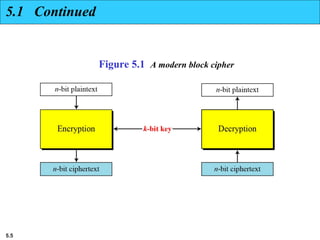
A symmetric-key modern block cipher encrypts an
n-bit block of plaintext or decrypts an n-bit block of
ciphertext. The encryption or decryption algorithm
uses a k-bit key.
5.1.1 Substitution or Transposition
5.1.2 Block Ciphers as Permutation Groups
5.1.3 Components of a Modern Block Cipher
5.1.4 Product Ciphers
5.1.5 Two Classes of Product Ciphers
5.1.6 Attacks on Block Ciphers
Topics discussed in this section:
5.5
Figure 5.1 A modern block cipher
5.1 Continued
5.6
5.1 Continued
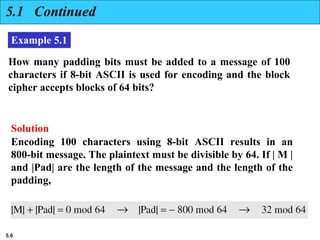
Example 5.1
How many padding bits must be added to a message of 100
characters if 8-bit ASCII is used for encoding and the block
cipher accepts blocks of 64 bits?
Encoding 100 characters using 8-bit ASCII results in an
800-bit message. The plaintext must be divisible by 64. If | M |
and |Pad| are the length of the message and the length of the
padding,
Solution
5.7
A modern block cipher can be designed to act as a
substitution cipher or a transposition cipher.
5.1.1 Substitution or Transposition
To be resistant to exhaustive-search attack,
a modern block cipher needs to be
designed as a substitution cipher.
Note
5.8
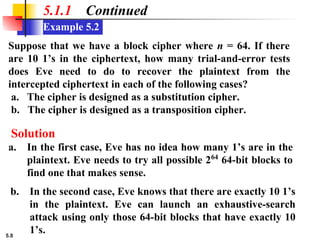
Example 5.2
5.1.1 Continued
Suppose that we have a block cipher where n = 64. If there
are 10 1’s in the ciphertext, how many trial-and-error tests
does Eve need to do to recover the plaintext from the
intercepted ciphertext in each of the following cases?
a. The cipher is designed as a substitution cipher.
b. The cipher is designed as a transposition cipher.
a. In the first case, Eve has no idea how many 1’s are in the
plaintext. Eve needs to try all possible 264
64-bit blocks to
find one that makes sense.
Solution
b. In the second case, Eve knows that there are exactly 10 1’s
in the plaintext. Eve can launch an exhaustive-search
attack using only those 64-bit blocks that have exactly 10
1’s.
5.9
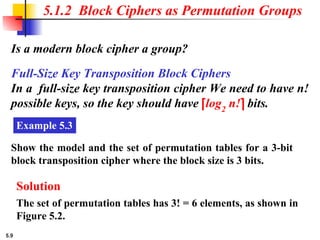
Is a modern block cipher a group?
5.1.2 Block Ciphers as Permutation Groups
Full-Size Key Transposition Block Ciphers
In a full-size key transposition cipher We need to have n!
possible keys, so the key should have ⎡log2
n!⎤ bits.
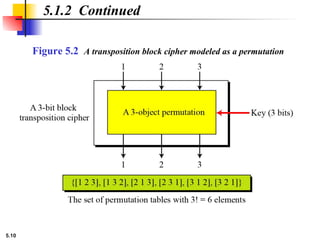
Example 5.3
Show the model and the set of permutation tables for a 3-bit
block transposition cipher where the block size is 3 bits.
Solution
The set of permutation tables has 3! = 6 elements, as shown in
Figure 5.2.
5.10
Figure 5.2 A transposition block cipher modeled as a permutation
5.1.2 Continued
5.11
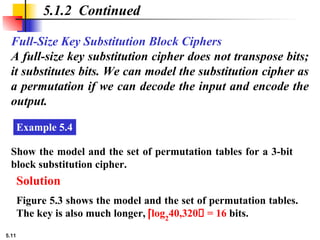
Full-Size Key Substitution Block Ciphers
A full-size key substitution cipher does not transpose bits;
it substitutes bits. We can model the substitution cipher as
a permutation if we can decode the input and encode the
output.
5.1.2 Continued
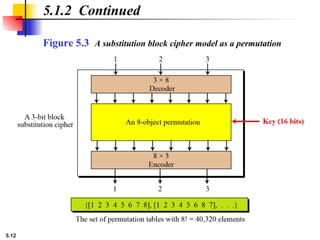
Example 5.4
Show the model and the set of permutation tables for a 3-bit
block substitution cipher.
Figure 5.3 shows the model and the set of permutation tables.
The key is also much longer, ⎡log2
40,320 = 16 bits.
Solution
5.12
Figure 5.3 A substitution block cipher model as a permutation
5.1.2 Continued
5.13
5.1.2 Continued
A full-size key n-bit transposition cipher or a
substitution block cipher can be modeled
as a permutation, but their key sizes are different:
Note
❑ Transposition: the key is ⎡log2
n! bits long.
❑ Substitution: the key is ⎡log2
(2n
)! bits long.
A partial-key cipher is a group under the
composition operation if it is a subgroup
of the corresponding full-size key cipher.
Note
5.14
Modern block ciphers normally are keyed substitution
ciphers in which the key allows only partial mappings
from the possible inputs to the possible outputs.
5.1.3 Components of a Modern Block Cipher
A P-box (permutation box) parallels the traditional
transposition cipher for characters. It transposes bits.
P-Boxes
5.15
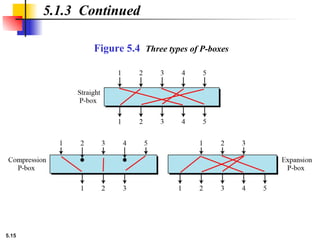
Figure 5.4 Three types of P-boxes
5.1.3 Continued
5.16
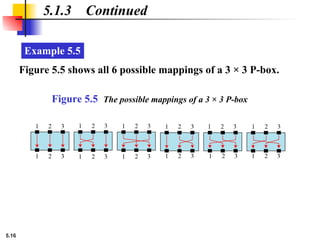
Example 5.5
5.1.3 Continued
Figure 5.5 The possible mappings of a 3 × 3 P-box
Figure 5.5 shows all 6 possible mappings of a 3 × 3 P-box.
5.17
5.1.3 Continued
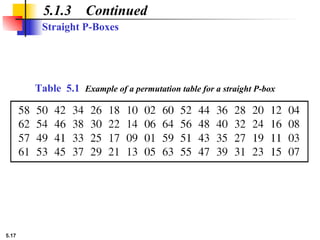
Table 5.1 Example of a permutation table for a straight P-box
Straight P-Boxes
5.18
Example 5.6
5.1.2 Continued
Design an 8 × 8 permutation table for a straight P-box that
moves the two middle bits (bits 4 and 5) in the input word to
the two ends (bits 1 and 8) in the output words. Relative
positions of other bits should not be changed.
Solution
We need a straight P-box with the table [4 1 2 3 6 7 8 5].
The relative positions of input bits 1, 2, 3, 6, 7, and 8 have not
been changed, but the first output takes the fourth input and
the eighth output takes the fifth input.
5.19
Compression P-Boxes
5.1.3 Continued
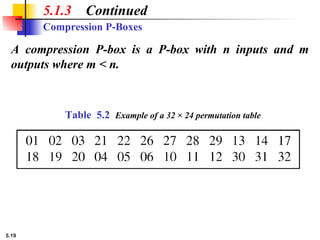
A compression P-box is a P-box with n inputs and m
outputs where m < n.
Table 5.2 Example of a 32 × 24 permutation table
5.20
5.1.3 Continued
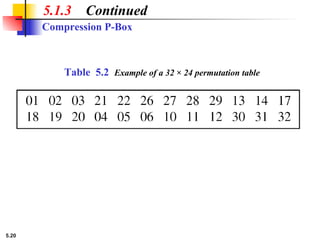
Table 5.2 Example of a 32 × 24 permutation table
Compression P-Box
5.21
Expansion P-Boxes
5.1.3 Continued
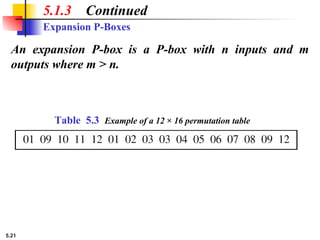
An expansion P-box is a P-box with n inputs and m
outputs where m > n.
Table 5.3 Example of a 12 × 16 permutation table
5.22
5.1.3 Continued
P-Boxes: Invertibility
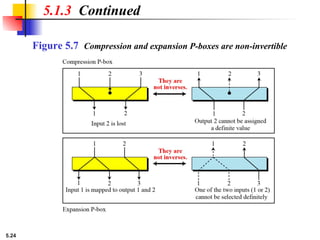
A straight P-box is invertible, but compression and
expansion P-boxes are not.
Note
5.23
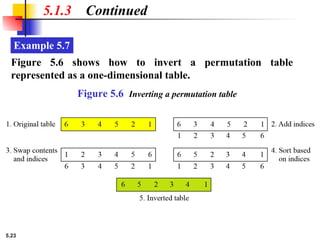
Example 5.7
5.1.3 Continued
Figure 5.6 shows how to invert a permutation table
represented as a one-dimensional table.
Figure 5.6 Inverting a permutation table
5.24
Figure 5.7 Compression and expansion P-boxes are non-invertible
5.1.3 Continued
5.25
5.1.3 Continued
S-Box
An S-box (substitution box) can be thought of as a
miniature substitution cipher.
An S-box is an m × n substitution unit, where m and
n are not necessarily the same.
Note
5.26
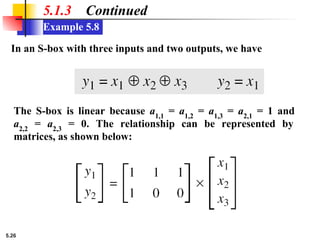
Example 5.8
5.1.3 Continued
In an S-box with three inputs and two outputs, we have
The S-box is linear because a1,1
= a1,2
= a1,3
= a2,1
= 1 and
a2,2
= a2,3
= 0. The relationship can be represented by
matrices, as shown below:
5.27
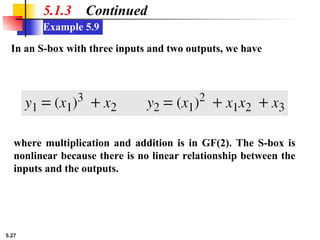
Example 5.9
5.1.3 Continued
In an S-box with three inputs and two outputs, we have
where multiplication and addition is in GF(2). The S-box is
nonlinear because there is no linear relationship between the
inputs and the outputs.
5.28
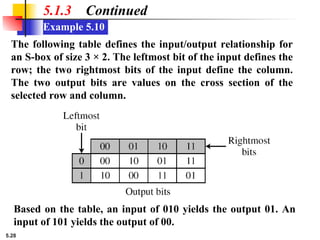
Example 5.10
5.1.3 Continued
The following table defines the input/output relationship for
an S-box of size 3 × 2. The leftmost bit of the input defines the
row; the two rightmost bits of the input define the column.
The two output bits are values on the cross section of the
selected row and column.
Based on the table, an input of 010 yields the output 01. An
input of 101 yields the output of 00.
5.29
5.1.3 Continued
S-Boxes: Invertibility
An S-box may or may not be invertible. In an invertible
S-box, the number of input bits should be the same as the
number of output bits.
5.30
Example 5.11
5.1.3 Continued
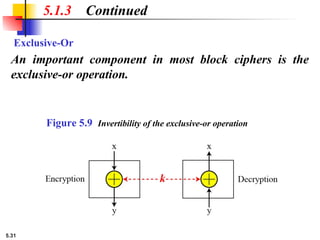
Figure 5.8 shows an example of an invertible S-box. For
example, if the input to the left box is 001, the output is 101.
The input 101 in the right table creates the output 001, which
shows that the two tables are inverses of each other.
Figure 5.8 S-box tables for Example 5.11
5.31
5.1.3 Continued
Exclusive-Or
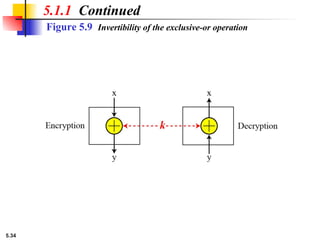
An important component in most block ciphers is the
exclusive-or operation.
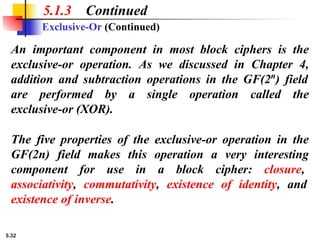
Figure 5.9 Invertibility of the exclusive-or operation
5.32
5.1.3 Continued
Exclusive-Or (Continued)
An important component in most block ciphers is the
exclusive-or operation. As we discussed in Chapter 4,
addition and subtraction operations in the GF(2n
) field
are performed by a single operation called the
exclusive-or (XOR).
The five properties of the exclusive-or operation in the
GF(2n) field makes this operation a very interesting
component for use in a block cipher: closure,
associativity, commutativity, existence of identity, and
existence of inverse.
5.33
5.1.3 Continued
Exclusive-Or (Continued)
The inverse of a component in a cipher makes sense if the
component represents a unary operation (one input and
one output). For example, a keyless P-box or a keyless
S-box can be made invertible because they have one input
and one output. An exclusive operation is a binary
operation. The inverse of an exclusive-or operation can
make sense only if one of the inputs is fixed (is the same
in encryption and decryption). For example, if one of the
inputs is the key, which normally is the same in
encryption and decryption, then an exclusive-or operation
is self-invertible, as shown in Figure 5.9.
5.34
Figure 5.9 Invertibility of the exclusive-or operation
5.1.1 Continued
5.35
5.1.3 Continued
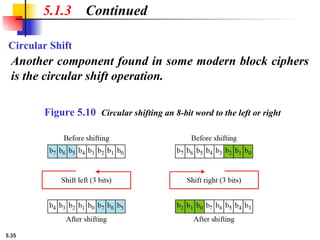
Circular Shift
Another component found in some modern block ciphers
is the circular shift operation.
Figure 5.10 Circular shifting an 8-bit word to the left or right
5.36
5.1.3 Continued
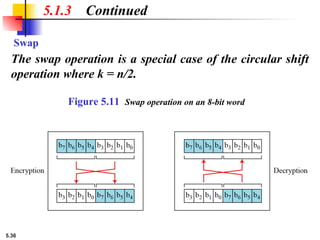
Swap
The swap operation is a special case of the circular shift
operation where k = n/2.
Figure 5.11 Swap operation on an 8-bit word
5.37
5.1.3 Continued
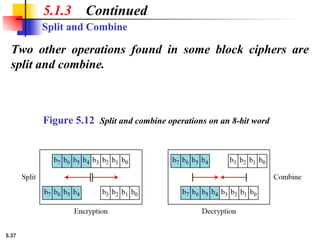
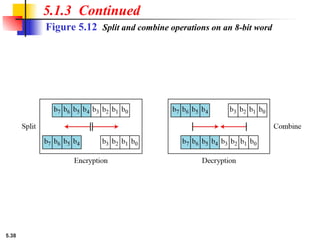
Split and Combine
Two other operations found in some block ciphers are
split and combine.
Figure 5.12 Split and combine operations on an 8-bit word
5.38
Figure 5.12 Split and combine operations on an 8-bit word
5.1.3 Continued
5.39
Shannon introduced the concept of a product cipher. A
product cipher is a complex cipher combining
substitution, permutation, and other components
discussed in previous sections.
5.1.4 Product Ciphers
5.40
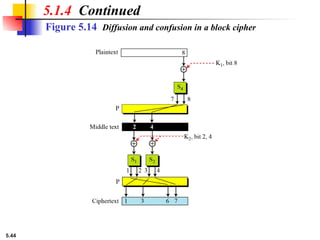
Diffusion
The idea of diffusion is to hide the relationship between
the ciphertext and the plaintext.
5.1.4 Continued
Diffusion hides the relationship between the
ciphertext and the plaintext.
Note
5.41
Confusion
The idea of confusion is to hide the relationship between
the ciphertext and the key.
5.1.4 Continued
Confusion hides the relationship between the
ciphertext and the key.
Note
5.42
Rounds
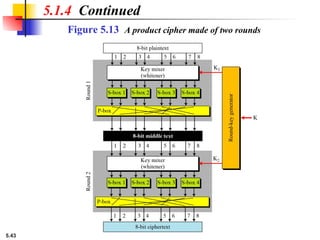
Diffusion and confusion can be achieved using iterated
product ciphers where each iteration is a combination of
S-boxes, P-boxes, and other components.
5.1.4 Continued
5.43
Figure 5.13 A product cipher made of two rounds
5.1.4 Continued
5.44
Figure 5.14 Diffusion and confusion in a block cipher
5.1.4 Continued
5.45
Modern block ciphers are all product ciphers, but they are
divided into two classes.
1. Feistel ciphers
2. Non-Feistel ciphers
5.1.5 Two Classes of Product Ciphers
5.46
Feistel Ciphers
Feistel designed a very intelligent and interesting cipher
that has been used for decades. A Feistel cipher can have
three types of components: self-invertible, invertible, and
noninvertible.
5.1.5 Continued
5.47
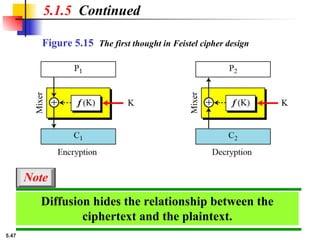
Figure 5.15 The first thought in Feistel cipher design
5.1.5 Continued
Diffusion hides the relationship between the
ciphertext and the plaintext.
Note
5.48
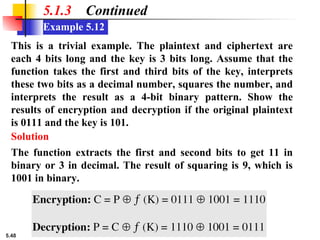
Example 5.12
5.1.3 Continued
This is a trivial example. The plaintext and ciphertext are
each 4 bits long and the key is 3 bits long. Assume that the
function takes the first and third bits of the key, interprets
these two bits as a decimal number, squares the number, and
interprets the result as a 4-bit binary pattern. Show the
results of encryption and decryption if the original plaintext
is 0111 and the key is 101.
The function extracts the first and second bits to get 11 in
binary or 3 in decimal. The result of squaring is 9, which is
1001 in binary.
Solution
5.49
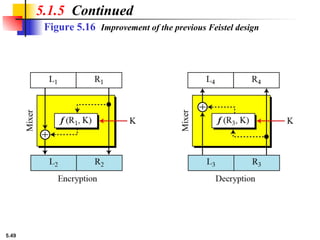
Figure 5.16 Improvement of the previous Feistel design
5.1.5 Continued
5.50
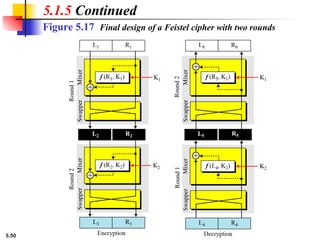
Figure 5.17 Final design of a Feistel cipher with two rounds
5.1.5 Continued
5.51
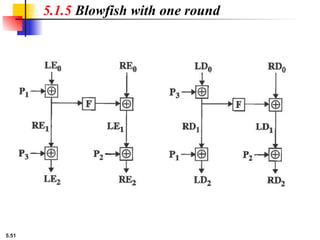
5.1.5 Blowfish with one round
5.52
Non-Feistel Ciphers
A non-Feistel cipher uses only invertible components. A
component in the encryption cipher has the
corresponding component in the decryption cipher.
5.1.5 Continued
5.53
Attacks on traditional ciphers can also be used on modern
block ciphers, but today’s block ciphers resist most of the
attacks discussed in Chapter 3.
5.1.6 Attacks on Block Ciphers
5.54
Differential Cryptanalysis
Eli Biham and Adi Shamir introduced the idea of
differential cryptanalysis. This is a chosen-plaintext
attack.
5.1.5 Continued
5.55
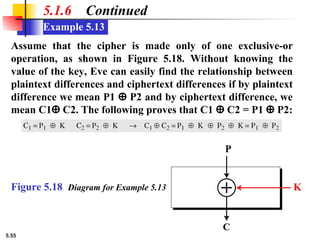
Example 5.13
5.1.6 Continued
Assume that the cipher is made only of one exclusive-or
operation, as shown in Figure 5.18. Without knowing the
value of the key, Eve can easily find the relationship between
plaintext differences and ciphertext differences if by plaintext
difference we mean P1 ⊕ P2 and by ciphertext difference, we
mean C1⊕ C2. The following proves that C1 ⊕ C2 = P1 ⊕ P2:
Figure 5.18 Diagram for Example 5.13
5.56
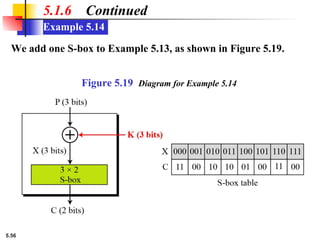
Example 5.14
5.1.6 Continued
We add one S-box to Example 5.13, as shown in Figure 5.19.
Figure 5.19 Diagram for Example 5.14
5.57
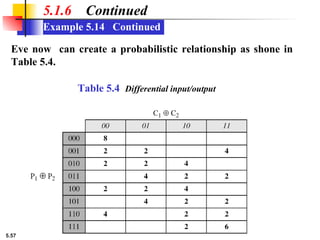
Example 5.14 Continued
5.1.6 Continued
Eve now can create a probabilistic relationship as shone in
Table 5.4.
Table 5.4 Differential input/output
5.58
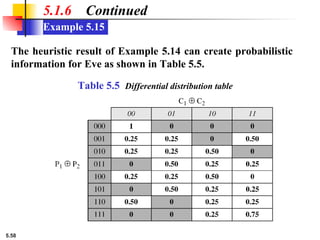
Example 5.15
5.1.6 Continued
The heuristic result of Example 5.14 can create probabilistic
information for Eve as shown in Table 5.5.
Table 5.5 Differential distribution table
5.59
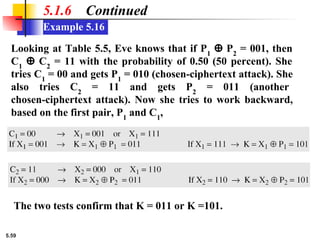
Example 5.16
5.1.6 Continued
Looking at Table 5.5, Eve knows that if P1
⊕ P2
= 001, then
C1
⊕ C2
= 11 with the probability of 0.50 (50 percent). She
tries C1
= 00 and gets P1
= 010 (chosen-ciphertext attack). She
also tries C2
= 11 and gets P2
= 011 (another
chosen-ciphertext attack). Now she tries to work backward,
based on the first pair, P1
and C1
,
The two tests confirm that K = 011 or K =101.
5.60
5.1.6 Continued
A more detailed differential cryptanalysis is given
in Appendix N.
Note
Differential cryptanalysis is based on a nonuniform
differential distribution table of the S-boxes in a
block cipher.
Note
5.61
Linear Cryptanalysis
Linear cryptanalysis was presented by Mitsuru Matsui in
1993. The analysis uses known plaintext attacks.
5.1.6 Continued
5.62
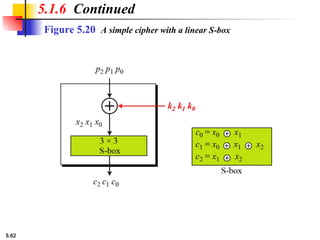
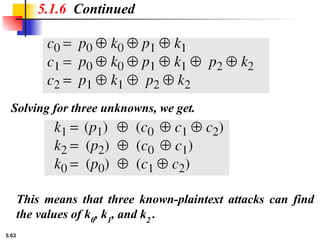
Figure 5.20 A simple cipher with a linear S-box
5.1.6 Continued
5.63
5.1.6 Continued
Solving for three unknowns, we get.
This means that three known-plaintext attacks can find
the values of k0
, k1
, and k2
.
5.64
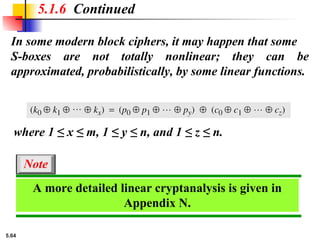
5.1.6 Continued
In some modern block ciphers, it may happen that some
S-boxes are not totally nonlinear; they can be
approximated, probabilistically, by some linear functions.
where 1 ≤ x ≤ m, 1 ≤ y ≤ n, and 1 ≤ z ≤ n.
A more detailed linear cryptanalysis is given in
Appendix N.
Note
5.65
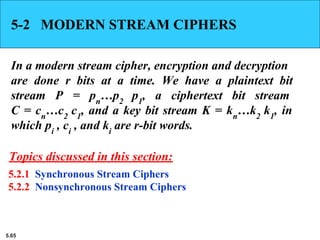
5-2 MODERN STREAM CIPHERS
In a modern stream cipher, encryption and decryption
are done r bits at a time. We have a plaintext bit
stream P = pn
…p2
p1
, a ciphertext bit stream
C = cn
…c2
c1
, and a key bit stream K = kn
…k2
k1
, in
which pi
, ci
, and ki
are r-bit words.
5.2.1 Synchronous Stream Ciphers
5.2.2 Nonsynchronous Stream Ciphers
Topics discussed in this section:
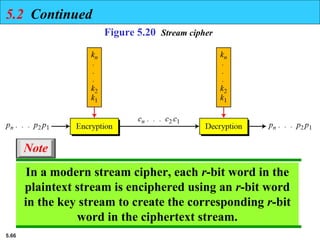
5.66
5.2 Continued
In a modern stream cipher, each r-bit word in the
plaintext stream is enciphered using an r-bit word
in the key stream to create the corresponding r-bit
word in the ciphertext stream.
Note
Figure 5.20 Stream cipher
5.67
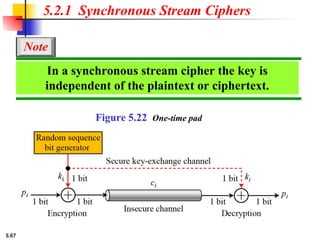
5.2.1 Synchronous Stream Ciphers
In a synchronous stream cipher the key is
independent of the plaintext or ciphertext.
Note
Figure 5.22 One-time pad
5.68
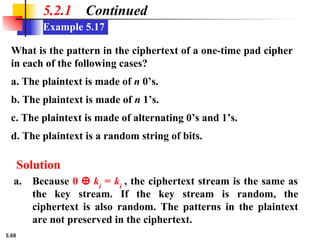
Example 5.17
5.2.1 Continued
What is the pattern in the ciphertext of a one-time pad cipher
in each of the following cases?
a. The plaintext is made of n 0’s.
b. The plaintext is made of n 1’s.
c. The plaintext is made of alternating 0’s and 1’s.
d. The plaintext is a random string of bits.
Solution
a. Because 0 ⊕ ki
= ki
, the ciphertext stream is the same as
the key stream. If the key stream is random, the
ciphertext is also random. The patterns in the plaintext
are not preserved in the ciphertext.
5.69
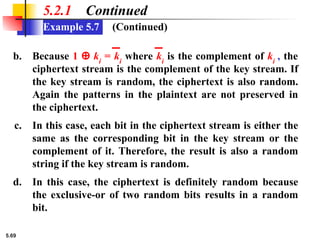
Example 5.7
5.2.1 Continued
b. Because 1 ⊕ ki
= ki
where ki
is the complement of ki
, the
ciphertext stream is the complement of the key stream. If
the key stream is random, the ciphertext is also random.
Again the patterns in the plaintext are not preserved in
the ciphertext.
c. In this case, each bit in the ciphertext stream is either the
same as the corresponding bit in the key stream or the
complement of it. Therefore, the result is also a random
string if the key stream is random.
d. In this case, the ciphertext is definitely random because
the exclusive-or of two random bits results in a random
bit.
(Continued)
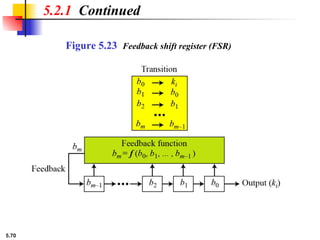
5.70
Figure 5.23 Feedback shift register (FSR)
5.2.1 Continued
5.71
Example 5.18
5.2.1 Continued
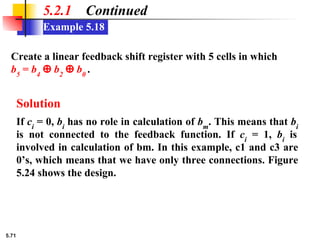
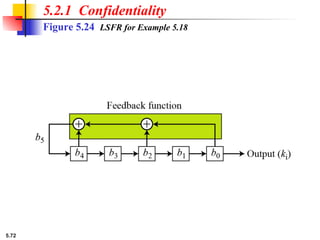
Create a linear feedback shift register with 5 cells in which
b5
= b4
⊕ b2
⊕ b0
.
Solution
If ci
= 0, bi
has no role in calculation of bm
. This means that bi
is not connected to the feedback function. If ci
= 1, bi
is
involved in calculation of bm. In this example, c1 and c3 are
0’s, which means that we have only three connections. Figure
5.24 shows the design.
5.72
Figure 5.24 LSFR for Example 5.18
5.2.1 Confidentiality
5.73
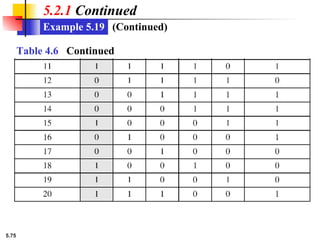
Example 5.19
5.2.1 Continued
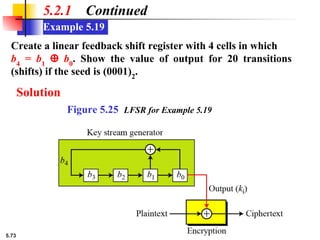
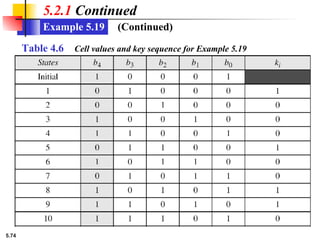
Create a linear feedback shift register with 4 cells in which
b4
= b1
⊕ b0
. Show the value of output for 20 transitions
(shifts) if the seed is (0001)2
.
Solution
Figure 5.25 LFSR for Example 5.19
5.74
Table 4.6 Cell values and key sequence for Example 5.19
5.2.1 Continued
Example 5.19 (Continued)
5.75
Table 4.6 Continued
5.2.1 Continued
Example 5.19 (Continued)
5.76
5.2.1 Continued
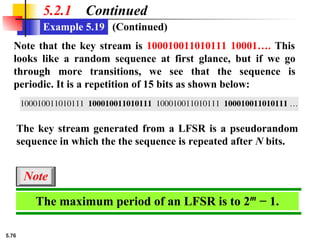
Note that the key stream is 100010011010111 10001…. This
looks like a random sequence at first glance, but if we go
through more transitions, we see that the sequence is
periodic. It is a repetition of 15 bits as shown below:
The key stream generated from a LFSR is a pseudorandom
sequence in which the the sequence is repeated after N bits.
The maximum period of an LFSR is to 2m
− 1.
Note
Example 5.19 (Continued)
5.77
Example 5.20
5.2.1 Continued
The characteristic polynomial for the LFSR in Example 5.19
is (x4
+ x + 1), which is a primitive polynomial. Table 4.4
(Chapter 4) shows that it is an irreducible polynomial. This
polynomial also divides (x7
+ 1) = (x4
+ x + 1) (x3
+ 1), which
means e = 23
− 1 = 7.
5.78
In a nonsynchronous stream cipher, each key in the key
stream depends on previous plaintext or ciphertext.
5.2.2 Nonsynchronous Stream Ciphers
In a nonsynchronous stream cipher, the key
depends on either the plaintext or ciphertext.
Note

Forouzan cryptography and Network Security Ch-5

  • 1.
    5.1 Copyright © TheMcGraw-Hill Companies, Inc. Permission required for reproduction or display. Chapter 5 Introduction to Modern Symmetric-key Ciphers
  • 2.
    5.2 Objectives ❏ To distinguishbetween traditional and modern symmetric-key ciphers. ❏ To introduce modern block ciphers and discuss their characteristics. ❏ To explain why modern block ciphers need to be designed as substitution ciphers. ❏ To introduce components of block ciphers such as P-boxes and S-boxes. Chapter 5
  • 3.
    5.3 Objectives (Continued) ❏ Todiscuss product ciphers and distinguish between two classes of product ciphers: Feistel and non-Feistel ciphers. ❏ To discuss two kinds of attacks particularly designed for modern block ciphers: differential and linear cryptanalysis. ❏ To introduce stream ciphers and to distinguish between synchronous and nonsynchronous stream ciphers. ❏ To discuss linear and nonlinear feedback shift registers for implementing stream ciphers. Chapter 5
  • 4.
    5.4 5-1 MODERN BLOCKCIPHERS A symmetric-key modern block cipher encrypts an n-bit block of plaintext or decrypts an n-bit block of ciphertext. The encryption or decryption algorithm uses a k-bit key. 5.1.1 Substitution or Transposition 5.1.2 Block Ciphers as Permutation Groups 5.1.3 Components of a Modern Block Cipher 5.1.4 Product Ciphers 5.1.5 Two Classes of Product Ciphers 5.1.6 Attacks on Block Ciphers Topics discussed in this section:
  • 5.
    5.5 Figure 5.1 Amodern block cipher 5.1 Continued
  • 6.
    5.6 5.1 Continued Example 5.1 Howmany padding bits must be added to a message of 100 characters if 8-bit ASCII is used for encoding and the block cipher accepts blocks of 64 bits? Encoding 100 characters using 8-bit ASCII results in an 800-bit message. The plaintext must be divisible by 64. If | M | and |Pad| are the length of the message and the length of the padding, Solution
  • 7.
    5.7 A modern blockcipher can be designed to act as a substitution cipher or a transposition cipher. 5.1.1 Substitution or Transposition To be resistant to exhaustive-search attack, a modern block cipher needs to be designed as a substitution cipher. Note
  • 8.
    5.8 Example 5.2 5.1.1 Continued Supposethat we have a block cipher where n = 64. If there are 10 1’s in the ciphertext, how many trial-and-error tests does Eve need to do to recover the plaintext from the intercepted ciphertext in each of the following cases? a. The cipher is designed as a substitution cipher. b. The cipher is designed as a transposition cipher. a. In the first case, Eve has no idea how many 1’s are in the plaintext. Eve needs to try all possible 264 64-bit blocks to find one that makes sense. Solution b. In the second case, Eve knows that there are exactly 10 1’s in the plaintext. Eve can launch an exhaustive-search attack using only those 64-bit blocks that have exactly 10 1’s.
  • 9.
    5.9 Is a modernblock cipher a group? 5.1.2 Block Ciphers as Permutation Groups Full-Size Key Transposition Block Ciphers In a full-size key transposition cipher We need to have n! possible keys, so the key should have ⎡log2 n!⎤ bits. Example 5.3 Show the model and the set of permutation tables for a 3-bit block transposition cipher where the block size is 3 bits. Solution The set of permutation tables has 3! = 6 elements, as shown in Figure 5.2.
  • 10.
    5.10 Figure 5.2 Atransposition block cipher modeled as a permutation 5.1.2 Continued
  • 11.
    5.11 Full-Size Key SubstitutionBlock Ciphers A full-size key substitution cipher does not transpose bits; it substitutes bits. We can model the substitution cipher as a permutation if we can decode the input and encode the output. 5.1.2 Continued Example 5.4 Show the model and the set of permutation tables for a 3-bit block substitution cipher. Figure 5.3 shows the model and the set of permutation tables. The key is also much longer, ⎡log2 40,320 = 16 bits. Solution
  • 12.
    5.12 Figure 5.3 Asubstitution block cipher model as a permutation 5.1.2 Continued
  • 13.
    5.13 5.1.2 Continued A full-sizekey n-bit transposition cipher or a substitution block cipher can be modeled as a permutation, but their key sizes are different: Note ❑ Transposition: the key is ⎡log2 n! bits long. ❑ Substitution: the key is ⎡log2 (2n )! bits long. A partial-key cipher is a group under the composition operation if it is a subgroup of the corresponding full-size key cipher. Note
  • 14.
    5.14 Modern block ciphersnormally are keyed substitution ciphers in which the key allows only partial mappings from the possible inputs to the possible outputs. 5.1.3 Components of a Modern Block Cipher A P-box (permutation box) parallels the traditional transposition cipher for characters. It transposes bits. P-Boxes
  • 15.
    5.15 Figure 5.4 Threetypes of P-boxes 5.1.3 Continued
  • 16.
    5.16 Example 5.5 5.1.3 Continued Figure5.5 The possible mappings of a 3 × 3 P-box Figure 5.5 shows all 6 possible mappings of a 3 × 3 P-box.
  • 17.
    5.17 5.1.3 Continued Table 5.1Example of a permutation table for a straight P-box Straight P-Boxes
  • 18.
    5.18 Example 5.6 5.1.2 Continued Designan 8 × 8 permutation table for a straight P-box that moves the two middle bits (bits 4 and 5) in the input word to the two ends (bits 1 and 8) in the output words. Relative positions of other bits should not be changed. Solution We need a straight P-box with the table [4 1 2 3 6 7 8 5]. The relative positions of input bits 1, 2, 3, 6, 7, and 8 have not been changed, but the first output takes the fourth input and the eighth output takes the fifth input.
  • 19.
    5.19 Compression P-Boxes 5.1.3 Continued Acompression P-box is a P-box with n inputs and m outputs where m < n. Table 5.2 Example of a 32 × 24 permutation table
  • 20.
    5.20 5.1.3 Continued Table 5.2Example of a 32 × 24 permutation table Compression P-Box
  • 21.
    5.21 Expansion P-Boxes 5.1.3 Continued Anexpansion P-box is a P-box with n inputs and m outputs where m > n. Table 5.3 Example of a 12 × 16 permutation table
  • 22.
    5.22 5.1.3 Continued P-Boxes: Invertibility Astraight P-box is invertible, but compression and expansion P-boxes are not. Note
  • 23.
    5.23 Example 5.7 5.1.3 Continued Figure5.6 shows how to invert a permutation table represented as a one-dimensional table. Figure 5.6 Inverting a permutation table
  • 24.
    5.24 Figure 5.7 Compressionand expansion P-boxes are non-invertible 5.1.3 Continued
  • 25.
    5.25 5.1.3 Continued S-Box An S-box(substitution box) can be thought of as a miniature substitution cipher. An S-box is an m × n substitution unit, where m and n are not necessarily the same. Note
  • 26.
    5.26 Example 5.8 5.1.3 Continued Inan S-box with three inputs and two outputs, we have The S-box is linear because a1,1 = a1,2 = a1,3 = a2,1 = 1 and a2,2 = a2,3 = 0. The relationship can be represented by matrices, as shown below:
  • 27.
    5.27 Example 5.9 5.1.3 Continued Inan S-box with three inputs and two outputs, we have where multiplication and addition is in GF(2). The S-box is nonlinear because there is no linear relationship between the inputs and the outputs.
  • 28.
    5.28 Example 5.10 5.1.3 Continued Thefollowing table defines the input/output relationship for an S-box of size 3 × 2. The leftmost bit of the input defines the row; the two rightmost bits of the input define the column. The two output bits are values on the cross section of the selected row and column. Based on the table, an input of 010 yields the output 01. An input of 101 yields the output of 00.
  • 29.
    5.29 5.1.3 Continued S-Boxes: Invertibility AnS-box may or may not be invertible. In an invertible S-box, the number of input bits should be the same as the number of output bits.
  • 30.
    5.30 Example 5.11 5.1.3 Continued Figure5.8 shows an example of an invertible S-box. For example, if the input to the left box is 001, the output is 101. The input 101 in the right table creates the output 001, which shows that the two tables are inverses of each other. Figure 5.8 S-box tables for Example 5.11
  • 31.
    5.31 5.1.3 Continued Exclusive-Or An importantcomponent in most block ciphers is the exclusive-or operation. Figure 5.9 Invertibility of the exclusive-or operation
  • 32.
    5.32 5.1.3 Continued Exclusive-Or (Continued) Animportant component in most block ciphers is the exclusive-or operation. As we discussed in Chapter 4, addition and subtraction operations in the GF(2n ) field are performed by a single operation called the exclusive-or (XOR). The five properties of the exclusive-or operation in the GF(2n) field makes this operation a very interesting component for use in a block cipher: closure, associativity, commutativity, existence of identity, and existence of inverse.
  • 33.
    5.33 5.1.3 Continued Exclusive-Or (Continued) Theinverse of a component in a cipher makes sense if the component represents a unary operation (one input and one output). For example, a keyless P-box or a keyless S-box can be made invertible because they have one input and one output. An exclusive operation is a binary operation. The inverse of an exclusive-or operation can make sense only if one of the inputs is fixed (is the same in encryption and decryption). For example, if one of the inputs is the key, which normally is the same in encryption and decryption, then an exclusive-or operation is self-invertible, as shown in Figure 5.9.
  • 34.
    5.34 Figure 5.9 Invertibilityof the exclusive-or operation 5.1.1 Continued
  • 35.
    5.35 5.1.3 Continued Circular Shift Anothercomponent found in some modern block ciphers is the circular shift operation. Figure 5.10 Circular shifting an 8-bit word to the left or right
  • 36.
    5.36 5.1.3 Continued Swap The swapoperation is a special case of the circular shift operation where k = n/2. Figure 5.11 Swap operation on an 8-bit word
  • 37.
    5.37 5.1.3 Continued Split andCombine Two other operations found in some block ciphers are split and combine. Figure 5.12 Split and combine operations on an 8-bit word
  • 38.
    5.38 Figure 5.12 Splitand combine operations on an 8-bit word 5.1.3 Continued
  • 39.
    5.39 Shannon introduced theconcept of a product cipher. A product cipher is a complex cipher combining substitution, permutation, and other components discussed in previous sections. 5.1.4 Product Ciphers
  • 40.
    5.40 Diffusion The idea ofdiffusion is to hide the relationship between the ciphertext and the plaintext. 5.1.4 Continued Diffusion hides the relationship between the ciphertext and the plaintext. Note
  • 41.
    5.41 Confusion The idea ofconfusion is to hide the relationship between the ciphertext and the key. 5.1.4 Continued Confusion hides the relationship between the ciphertext and the key. Note
  • 42.
    5.42 Rounds Diffusion and confusioncan be achieved using iterated product ciphers where each iteration is a combination of S-boxes, P-boxes, and other components. 5.1.4 Continued
  • 43.
    5.43 Figure 5.13 Aproduct cipher made of two rounds 5.1.4 Continued
  • 44.
    5.44 Figure 5.14 Diffusionand confusion in a block cipher 5.1.4 Continued
  • 45.
    5.45 Modern block ciphersare all product ciphers, but they are divided into two classes. 1. Feistel ciphers 2. Non-Feistel ciphers 5.1.5 Two Classes of Product Ciphers
  • 46.
    5.46 Feistel Ciphers Feistel designeda very intelligent and interesting cipher that has been used for decades. A Feistel cipher can have three types of components: self-invertible, invertible, and noninvertible. 5.1.5 Continued
  • 47.
    5.47 Figure 5.15 Thefirst thought in Feistel cipher design 5.1.5 Continued Diffusion hides the relationship between the ciphertext and the plaintext. Note
  • 48.
    5.48 Example 5.12 5.1.3 Continued Thisis a trivial example. The plaintext and ciphertext are each 4 bits long and the key is 3 bits long. Assume that the function takes the first and third bits of the key, interprets these two bits as a decimal number, squares the number, and interprets the result as a 4-bit binary pattern. Show the results of encryption and decryption if the original plaintext is 0111 and the key is 101. The function extracts the first and second bits to get 11 in binary or 3 in decimal. The result of squaring is 9, which is 1001 in binary. Solution
  • 49.
    5.49 Figure 5.16 Improvementof the previous Feistel design 5.1.5 Continued
  • 50.
    5.50 Figure 5.17 Finaldesign of a Feistel cipher with two rounds 5.1.5 Continued
  • 51.
  • 52.
    5.52 Non-Feistel Ciphers A non-Feistelcipher uses only invertible components. A component in the encryption cipher has the corresponding component in the decryption cipher. 5.1.5 Continued
  • 53.
    5.53 Attacks on traditionalciphers can also be used on modern block ciphers, but today’s block ciphers resist most of the attacks discussed in Chapter 3. 5.1.6 Attacks on Block Ciphers
  • 54.
    5.54 Differential Cryptanalysis Eli Bihamand Adi Shamir introduced the idea of differential cryptanalysis. This is a chosen-plaintext attack. 5.1.5 Continued
  • 55.
    5.55 Example 5.13 5.1.6 Continued Assumethat the cipher is made only of one exclusive-or operation, as shown in Figure 5.18. Without knowing the value of the key, Eve can easily find the relationship between plaintext differences and ciphertext differences if by plaintext difference we mean P1 ⊕ P2 and by ciphertext difference, we mean C1⊕ C2. The following proves that C1 ⊕ C2 = P1 ⊕ P2: Figure 5.18 Diagram for Example 5.13
  • 56.
    5.56 Example 5.14 5.1.6 Continued Weadd one S-box to Example 5.13, as shown in Figure 5.19. Figure 5.19 Diagram for Example 5.14
  • 57.
    5.57 Example 5.14 Continued 5.1.6Continued Eve now can create a probabilistic relationship as shone in Table 5.4. Table 5.4 Differential input/output
  • 58.
    5.58 Example 5.15 5.1.6 Continued Theheuristic result of Example 5.14 can create probabilistic information for Eve as shown in Table 5.5. Table 5.5 Differential distribution table
  • 59.
    5.59 Example 5.16 5.1.6 Continued Lookingat Table 5.5, Eve knows that if P1 ⊕ P2 = 001, then C1 ⊕ C2 = 11 with the probability of 0.50 (50 percent). She tries C1 = 00 and gets P1 = 010 (chosen-ciphertext attack). She also tries C2 = 11 and gets P2 = 011 (another chosen-ciphertext attack). Now she tries to work backward, based on the first pair, P1 and C1 , The two tests confirm that K = 011 or K =101.
  • 60.
    5.60 5.1.6 Continued A moredetailed differential cryptanalysis is given in Appendix N. Note Differential cryptanalysis is based on a nonuniform differential distribution table of the S-boxes in a block cipher. Note
  • 61.
    5.61 Linear Cryptanalysis Linear cryptanalysiswas presented by Mitsuru Matsui in 1993. The analysis uses known plaintext attacks. 5.1.6 Continued
  • 62.
    5.62 Figure 5.20 Asimple cipher with a linear S-box 5.1.6 Continued
  • 63.
    5.63 5.1.6 Continued Solving forthree unknowns, we get. This means that three known-plaintext attacks can find the values of k0 , k1 , and k2 .
  • 64.
    5.64 5.1.6 Continued In somemodern block ciphers, it may happen that some S-boxes are not totally nonlinear; they can be approximated, probabilistically, by some linear functions. where 1 ≤ x ≤ m, 1 ≤ y ≤ n, and 1 ≤ z ≤ n. A more detailed linear cryptanalysis is given in Appendix N. Note
  • 65.
    5.65 5-2 MODERN STREAMCIPHERS In a modern stream cipher, encryption and decryption are done r bits at a time. We have a plaintext bit stream P = pn …p2 p1 , a ciphertext bit stream C = cn …c2 c1 , and a key bit stream K = kn …k2 k1 , in which pi , ci , and ki are r-bit words. 5.2.1 Synchronous Stream Ciphers 5.2.2 Nonsynchronous Stream Ciphers Topics discussed in this section:
  • 66.
    5.66 5.2 Continued In amodern stream cipher, each r-bit word in the plaintext stream is enciphered using an r-bit word in the key stream to create the corresponding r-bit word in the ciphertext stream. Note Figure 5.20 Stream cipher
  • 67.
    5.67 5.2.1 Synchronous StreamCiphers In a synchronous stream cipher the key is independent of the plaintext or ciphertext. Note Figure 5.22 One-time pad
  • 68.
    5.68 Example 5.17 5.2.1 Continued Whatis the pattern in the ciphertext of a one-time pad cipher in each of the following cases? a. The plaintext is made of n 0’s. b. The plaintext is made of n 1’s. c. The plaintext is made of alternating 0’s and 1’s. d. The plaintext is a random string of bits. Solution a. Because 0 ⊕ ki = ki , the ciphertext stream is the same as the key stream. If the key stream is random, the ciphertext is also random. The patterns in the plaintext are not preserved in the ciphertext.
  • 69.
    5.69 Example 5.7 5.2.1 Continued b.Because 1 ⊕ ki = ki where ki is the complement of ki , the ciphertext stream is the complement of the key stream. If the key stream is random, the ciphertext is also random. Again the patterns in the plaintext are not preserved in the ciphertext. c. In this case, each bit in the ciphertext stream is either the same as the corresponding bit in the key stream or the complement of it. Therefore, the result is also a random string if the key stream is random. d. In this case, the ciphertext is definitely random because the exclusive-or of two random bits results in a random bit. (Continued)
  • 70.
    5.70 Figure 5.23 Feedbackshift register (FSR) 5.2.1 Continued
  • 71.
    5.71 Example 5.18 5.2.1 Continued Createa linear feedback shift register with 5 cells in which b5 = b4 ⊕ b2 ⊕ b0 . Solution If ci = 0, bi has no role in calculation of bm . This means that bi is not connected to the feedback function. If ci = 1, bi is involved in calculation of bm. In this example, c1 and c3 are 0’s, which means that we have only three connections. Figure 5.24 shows the design.
  • 72.
    5.72 Figure 5.24 LSFRfor Example 5.18 5.2.1 Confidentiality
  • 73.
    5.73 Example 5.19 5.2.1 Continued Createa linear feedback shift register with 4 cells in which b4 = b1 ⊕ b0 . Show the value of output for 20 transitions (shifts) if the seed is (0001)2 . Solution Figure 5.25 LFSR for Example 5.19
  • 74.
    5.74 Table 4.6 Cellvalues and key sequence for Example 5.19 5.2.1 Continued Example 5.19 (Continued)
  • 75.
    5.75 Table 4.6 Continued 5.2.1Continued Example 5.19 (Continued)
  • 76.
    5.76 5.2.1 Continued Note thatthe key stream is 100010011010111 10001…. This looks like a random sequence at first glance, but if we go through more transitions, we see that the sequence is periodic. It is a repetition of 15 bits as shown below: The key stream generated from a LFSR is a pseudorandom sequence in which the the sequence is repeated after N bits. The maximum period of an LFSR is to 2m − 1. Note Example 5.19 (Continued)
  • 77.
    5.77 Example 5.20 5.2.1 Continued Thecharacteristic polynomial for the LFSR in Example 5.19 is (x4 + x + 1), which is a primitive polynomial. Table 4.4 (Chapter 4) shows that it is an irreducible polynomial. This polynomial also divides (x7 + 1) = (x4 + x + 1) (x3 + 1), which means e = 23 − 1 = 7.
  • 78.
    5.78 In a nonsynchronousstream cipher, each key in the key stream depends on previous plaintext or ciphertext. 5.2.2 Nonsynchronous Stream Ciphers In a nonsynchronous stream cipher, the key depends on either the plaintext or ciphertext. Note