Slide 11.1
Saunders, Lewis and Thornhill, Research Methods for Business Students, 5th Edition, © Mark Saunders, Philip Lewis and Adrian Thornhill 2009
Collecting primary data using
questionnaires
Slide 11.2
Saunders, Lewis and Thornhill, Research Methods for Business Students, 5th Edition, © Mark Saunders, Philip Lewis and Adrian Thornhill 2009
Use of questionnaires (1)
Definition of Questionnaires
Techniques of data collection in which each
person is asked to respond to the same set of
questions in a predetermined order
Adapted from deVaus (2002)
Slide 11.3
Saunders, Lewis and Thornhill, Research Methods for Business Students, 5th Edition, © Mark Saunders, Philip Lewis and Adrian Thornhill 2009
Use of questionnaires (2)
When to use questionnaires
• For explanatory or descriptive research
• Linked with other methods in a multiple-methods
research design
• To collect responses from a large sample prior to
quantitative analysis
Slide 11.4
Saunders, Lewis and Thornhill, Research Methods for Business Students, 5th Edition, © Mark Saunders, Philip Lewis and Adrian Thornhill 2009
Use of questionnaires (3)
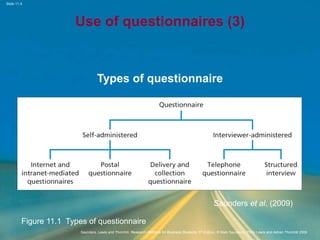
Types of questionnaire
Saunders et al. (2009)
Figure 11.1 Types of questionnaire
Slide 11.5
Saunders, Lewis and Thornhill, Research Methods for Business Students, 5th Edition, © Mark Saunders, Philip Lewis and Adrian Thornhill 2009
Choice of questionnaire
Related factors
• Characteristics of the respondents and access
• Respondents answers not being contaminated or
distorted
• Size of sample required for analysis
• Type and number of questions required
• Available resources including use of computer software
Slide 11.6
Saunders, Lewis and Thornhill, Research Methods for Business Students, 5th Edition, © Mark Saunders, Philip Lewis and Adrian Thornhill 2009
Data collection
Key factors
• Precisely defined questions
• Representative and accurate sampling
• An understanding of the organisational context
• Relationships between variables – dependent,
independent and extraneous
• Types of variable
Slide 11.7
Saunders, Lewis and Thornhill, Research Methods for Business Students, 5th Edition, © Mark Saunders, Philip Lewis and Adrian Thornhill 2009
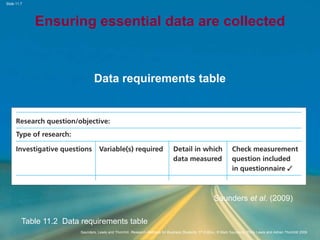
Ensuring essential data are collected
Data requirements table
Saunders et al. (2009)
Table 11.2 Data requirements table
Slide 11.8
Saunders, Lewis and Thornhill, Research Methods for Business Students, 5th Edition, © Mark Saunders, Philip Lewis and Adrian Thornhill 2009
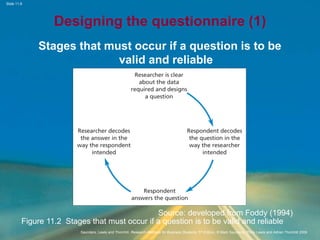
Designing the questionnaire (1)
Stages that must occur if a question is to be
valid and reliable
Source: developed from Foddy (1994)
Figure 11.2 Stages that must occur if a question is to be valid and reliable
Slide 11.9
Saunders, Lewis and Thornhill, Research Methods for Business Students, 5th Edition, © Mark Saunders, Philip Lewis and Adrian Thornhill 2009
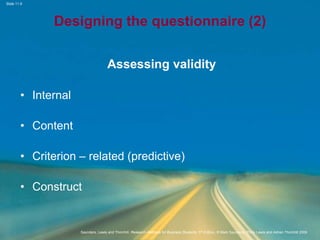
Designing the questionnaire (2)
Assessing validity
• Internal
• Content
• Criterion – related (predictive)
• Construct
Slide 11.10
Saunders, Lewis and Thornhill, Research Methods for Business Students, 5th Edition, © Mark Saunders, Philip Lewis and Adrian Thornhill 2009
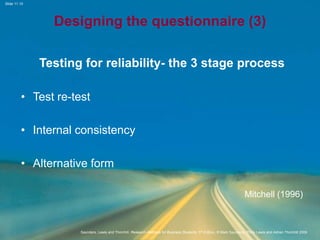
Designing the questionnaire (3)
Testing for reliability- the 3 stage process
• Test re-test
• Internal consistency
• Alternative form
Mitchell (1996)
Slide 11.11
Saunders, Lewis and Thornhill, Research Methods for Business Students, 5th Edition, © Mark Saunders, Philip Lewis and Adrian Thornhill 2009
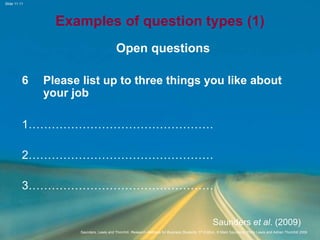
Examples of question types (1)
Open questions
6 Please list up to three things you like about
your job
1…………………………………………
2…………………………………………
3…………………………………………
Saunders et al. (2009)
Slide 11.12
Saunders, Lewis and Thornhill, Research Methods for Business Students, 5th Edition, © Mark Saunders, Philip Lewis and Adrian Thornhill 2009
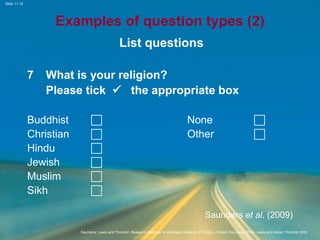
Examples of question types (2)
List questions
7 What is your religion?
Please tick  the appropriate box
Buddhist  None 
Christian  Other 
Hindu 
Jewish 
Muslim 
Sikh 
Saunders et al. (2009)
Slide 11.13
Saunders, Lewis and Thornhill, Research Methods for Business Students, 5th Edition, © Mark Saunders, Philip Lewis and Adrian Thornhill 2009
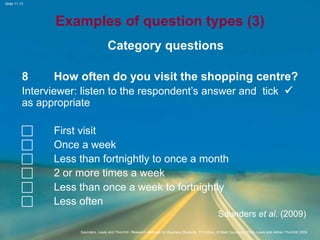
Examples of question types (3)
Category questions
8 How often do you visit the shopping centre?
Interviewer: listen to the respondent’s answer and tick 
as appropriate
 First visit
 Once a week
 Less than fortnightly to once a month
 2 or more times a week
 Less than once a week to fortnightly
 Less often
Saunders et al. (2009)
Slide 11.14
Saunders, Lewis and Thornhill, Research Methods for Business Students, 5th Edition, © Mark Saunders, Philip Lewis and Adrian Thornhill 2009
Examples of question types (4)
Ranking questions
9 Please number each of the factors listed below in
order of importance to you in choosing a new car.
Number the most important 1, the next 2 and so
on. If a factor has no importance at all, please
leave blank.
Factor Importance
Carbon dioxide emissions [ ]
Boot size [ ]
Depreciation [ ]
Price [ ]
Adapted from Saunders et al. (2009)
Slide 11.15
Saunders, Lewis and Thornhill, Research Methods for Business Students, 5th Edition, © Mark Saunders, Philip Lewis and Adrian Thornhill 2009
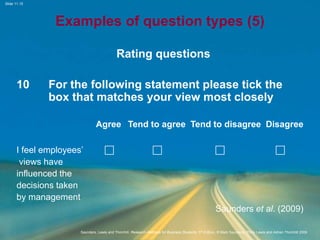
Examples of question types (5)
Rating questions
10 For the following statement please tick the
box that matches your view most closely
Agree Tend to agree Tend to disagree Disagree
I feel employees’    
views have
influenced the
decisions taken
by management
Saunders et al. (2009)
Slide 11.16
Saunders, Lewis and Thornhill, Research Methods for Business Students, 5th Edition, © Mark Saunders, Philip Lewis and Adrian Thornhill 2009
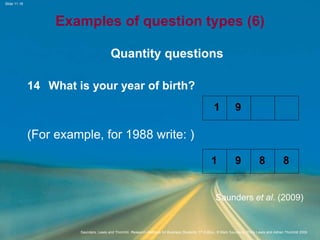
Examples of question types (6)
Quantity questions
14 What is your year of birth?
(For example, for 1988 write: )
Saunders et al. (2009)
1
1
9
9 8 8
Slide 11.17
Saunders, Lewis and Thornhill, Research Methods for Business Students, 5th Edition, © Mark Saunders, Philip Lewis and Adrian Thornhill 2009
Designing individual questions (1)
Other considerations
• Adopting or adapting existing questions – remember
to check copyright
• Question wording
• Translating questions into other languages
• Question coding
Slide 11.18
Saunders, Lewis and Thornhill, Research Methods for Business Students, 5th Edition, © Mark Saunders, Philip Lewis and Adrian Thornhill 2009
Designing individual questions (2)
Checklist Box 11.11
Complete the Checklist in Box 11.11
to help you with the wording of your questions
Saunders et al. (2009)
Slide 11.19
Saunders, Lewis and Thornhill, Research Methods for Business Students, 5th Edition, © Mark Saunders, Philip Lewis and Adrian Thornhill 2009
Constructing the questionnaire
Main considerations
• Order and flow of questions
• Questionnaire layout
Slide 11.20
Saunders, Lewis and Thornhill, Research Methods for Business Students, 5th Edition, © Mark Saunders, Philip Lewis and Adrian Thornhill 2009
Explaining the purpose and testing
Key points
• The covering letter
• Introducing and closing the questionnaire
• Pilot testing and assessing validity
Slide 11.21
Saunders, Lewis and Thornhill, Research Methods for Business Students, 5th Edition, © Mark Saunders, Philip Lewis and Adrian Thornhill 2009
Administering the questionnaire
Points to consider
• Internet and intranet-mediated responses
• Postal questionnaires
• Delivery and Collection
• Telephone questionnaires
• Structured interviews
Slide 11.22
Saunders, Lewis and Thornhill, Research Methods for Business Students, 5th Edition, © Mark Saunders, Philip Lewis and Adrian Thornhill 2009
Summary: Chapter 11
• Questionnaires are often used to collect descriptive
and explanatory data
• Five main types of questionnaire are Internet- or
intra-net mediated, postal, delivery and collection,
telephone and interview schedule
• Precise data that meet the research objectives can
be produced by using a data requirements table
Slide 11.23
Saunders, Lewis and Thornhill, Research Methods for Business Students, 5th Edition, © Mark Saunders, Philip Lewis and Adrian Thornhill 2009
Summary: Chapter 11
• Data validity and reliability and response rate
depend on design, structure and rigorous pilot
testing
• Wording and order of questions and question types
are important considerations
• Closed questions should be pre-coded to facilitate
data input and analysis
Slide 11.24
Saunders, Lewis and Thornhill, Research Methods for Business Students, 5th Edition, © Mark Saunders, Philip Lewis and Adrian Thornhill 2009
Summary: Chapter 11
• Important design features are a clear layout, a
logical order and flow of questions and easily
completed responses
• Questionnaires should be carefully introduced and
pilot tested prior to administration
• Administration needs to be appropriate to the type of
questionnaire

9780273716884_pp11.ppt

  • 1.
    Slide 11.1 Saunders, Lewisand Thornhill, Research Methods for Business Students, 5th Edition, © Mark Saunders, Philip Lewis and Adrian Thornhill 2009 Collecting primary data using questionnaires
  • 2.
    Slide 11.2 Saunders, Lewisand Thornhill, Research Methods for Business Students, 5th Edition, © Mark Saunders, Philip Lewis and Adrian Thornhill 2009 Use of questionnaires (1) Definition of Questionnaires Techniques of data collection in which each person is asked to respond to the same set of questions in a predetermined order Adapted from deVaus (2002)
  • 3.
    Slide 11.3 Saunders, Lewisand Thornhill, Research Methods for Business Students, 5th Edition, © Mark Saunders, Philip Lewis and Adrian Thornhill 2009 Use of questionnaires (2) When to use questionnaires • For explanatory or descriptive research • Linked with other methods in a multiple-methods research design • To collect responses from a large sample prior to quantitative analysis
  • 4.
    Slide 11.4 Saunders, Lewisand Thornhill, Research Methods for Business Students, 5th Edition, © Mark Saunders, Philip Lewis and Adrian Thornhill 2009 Use of questionnaires (3) Types of questionnaire Saunders et al. (2009) Figure 11.1 Types of questionnaire
  • 5.
    Slide 11.5 Saunders, Lewisand Thornhill, Research Methods for Business Students, 5th Edition, © Mark Saunders, Philip Lewis and Adrian Thornhill 2009 Choice of questionnaire Related factors • Characteristics of the respondents and access • Respondents answers not being contaminated or distorted • Size of sample required for analysis • Type and number of questions required • Available resources including use of computer software
  • 6.
    Slide 11.6 Saunders, Lewisand Thornhill, Research Methods for Business Students, 5th Edition, © Mark Saunders, Philip Lewis and Adrian Thornhill 2009 Data collection Key factors • Precisely defined questions • Representative and accurate sampling • An understanding of the organisational context • Relationships between variables – dependent, independent and extraneous • Types of variable
  • 7.
    Slide 11.7 Saunders, Lewisand Thornhill, Research Methods for Business Students, 5th Edition, © Mark Saunders, Philip Lewis and Adrian Thornhill 2009 Ensuring essential data are collected Data requirements table Saunders et al. (2009) Table 11.2 Data requirements table
  • 8.
    Slide 11.8 Saunders, Lewisand Thornhill, Research Methods for Business Students, 5th Edition, © Mark Saunders, Philip Lewis and Adrian Thornhill 2009 Designing the questionnaire (1) Stages that must occur if a question is to be valid and reliable Source: developed from Foddy (1994) Figure 11.2 Stages that must occur if a question is to be valid and reliable
  • 9.
    Slide 11.9 Saunders, Lewisand Thornhill, Research Methods for Business Students, 5th Edition, © Mark Saunders, Philip Lewis and Adrian Thornhill 2009 Designing the questionnaire (2) Assessing validity • Internal • Content • Criterion – related (predictive) • Construct
  • 10.
    Slide 11.10 Saunders, Lewisand Thornhill, Research Methods for Business Students, 5th Edition, © Mark Saunders, Philip Lewis and Adrian Thornhill 2009 Designing the questionnaire (3) Testing for reliability- the 3 stage process • Test re-test • Internal consistency • Alternative form Mitchell (1996)
  • 11.
    Slide 11.11 Saunders, Lewisand Thornhill, Research Methods for Business Students, 5th Edition, © Mark Saunders, Philip Lewis and Adrian Thornhill 2009 Examples of question types (1) Open questions 6 Please list up to three things you like about your job 1………………………………………… 2………………………………………… 3………………………………………… Saunders et al. (2009)
  • 12.
    Slide 11.12 Saunders, Lewisand Thornhill, Research Methods for Business Students, 5th Edition, © Mark Saunders, Philip Lewis and Adrian Thornhill 2009 Examples of question types (2) List questions 7 What is your religion? Please tick  the appropriate box Buddhist  None  Christian  Other  Hindu  Jewish  Muslim  Sikh  Saunders et al. (2009)
  • 13.
    Slide 11.13 Saunders, Lewisand Thornhill, Research Methods for Business Students, 5th Edition, © Mark Saunders, Philip Lewis and Adrian Thornhill 2009 Examples of question types (3) Category questions 8 How often do you visit the shopping centre? Interviewer: listen to the respondent’s answer and tick  as appropriate  First visit  Once a week  Less than fortnightly to once a month  2 or more times a week  Less than once a week to fortnightly  Less often Saunders et al. (2009)
  • 14.
    Slide 11.14 Saunders, Lewisand Thornhill, Research Methods for Business Students, 5th Edition, © Mark Saunders, Philip Lewis and Adrian Thornhill 2009 Examples of question types (4) Ranking questions 9 Please number each of the factors listed below in order of importance to you in choosing a new car. Number the most important 1, the next 2 and so on. If a factor has no importance at all, please leave blank. Factor Importance Carbon dioxide emissions [ ] Boot size [ ] Depreciation [ ] Price [ ] Adapted from Saunders et al. (2009)
  • 15.
    Slide 11.15 Saunders, Lewisand Thornhill, Research Methods for Business Students, 5th Edition, © Mark Saunders, Philip Lewis and Adrian Thornhill 2009 Examples of question types (5) Rating questions 10 For the following statement please tick the box that matches your view most closely Agree Tend to agree Tend to disagree Disagree I feel employees’     views have influenced the decisions taken by management Saunders et al. (2009)
  • 16.
    Slide 11.16 Saunders, Lewisand Thornhill, Research Methods for Business Students, 5th Edition, © Mark Saunders, Philip Lewis and Adrian Thornhill 2009 Examples of question types (6) Quantity questions 14 What is your year of birth? (For example, for 1988 write: ) Saunders et al. (2009) 1 1 9 9 8 8
  • 17.
    Slide 11.17 Saunders, Lewisand Thornhill, Research Methods for Business Students, 5th Edition, © Mark Saunders, Philip Lewis and Adrian Thornhill 2009 Designing individual questions (1) Other considerations • Adopting or adapting existing questions – remember to check copyright • Question wording • Translating questions into other languages • Question coding
  • 18.
    Slide 11.18 Saunders, Lewisand Thornhill, Research Methods for Business Students, 5th Edition, © Mark Saunders, Philip Lewis and Adrian Thornhill 2009 Designing individual questions (2) Checklist Box 11.11 Complete the Checklist in Box 11.11 to help you with the wording of your questions Saunders et al. (2009)
  • 19.
    Slide 11.19 Saunders, Lewisand Thornhill, Research Methods for Business Students, 5th Edition, © Mark Saunders, Philip Lewis and Adrian Thornhill 2009 Constructing the questionnaire Main considerations • Order and flow of questions • Questionnaire layout
  • 20.
    Slide 11.20 Saunders, Lewisand Thornhill, Research Methods for Business Students, 5th Edition, © Mark Saunders, Philip Lewis and Adrian Thornhill 2009 Explaining the purpose and testing Key points • The covering letter • Introducing and closing the questionnaire • Pilot testing and assessing validity
  • 21.
    Slide 11.21 Saunders, Lewisand Thornhill, Research Methods for Business Students, 5th Edition, © Mark Saunders, Philip Lewis and Adrian Thornhill 2009 Administering the questionnaire Points to consider • Internet and intranet-mediated responses • Postal questionnaires • Delivery and Collection • Telephone questionnaires • Structured interviews
  • 22.
    Slide 11.22 Saunders, Lewisand Thornhill, Research Methods for Business Students, 5th Edition, © Mark Saunders, Philip Lewis and Adrian Thornhill 2009 Summary: Chapter 11 • Questionnaires are often used to collect descriptive and explanatory data • Five main types of questionnaire are Internet- or intra-net mediated, postal, delivery and collection, telephone and interview schedule • Precise data that meet the research objectives can be produced by using a data requirements table
  • 23.
    Slide 11.23 Saunders, Lewisand Thornhill, Research Methods for Business Students, 5th Edition, © Mark Saunders, Philip Lewis and Adrian Thornhill 2009 Summary: Chapter 11 • Data validity and reliability and response rate depend on design, structure and rigorous pilot testing • Wording and order of questions and question types are important considerations • Closed questions should be pre-coded to facilitate data input and analysis
  • 24.
    Slide 11.24 Saunders, Lewisand Thornhill, Research Methods for Business Students, 5th Edition, © Mark Saunders, Philip Lewis and Adrian Thornhill 2009 Summary: Chapter 11 • Important design features are a clear layout, a logical order and flow of questions and easily completed responses • Questionnaires should be carefully introduced and pilot tested prior to administration • Administration needs to be appropriate to the type of questionnaire